
Physical and Competitive Environments and Their Influence on Developmental Experiences in Youth Basketball: A Mixed-Methods Study

 ,
,  , , and
Abstract
1. Introduction
2. Materials and Methods
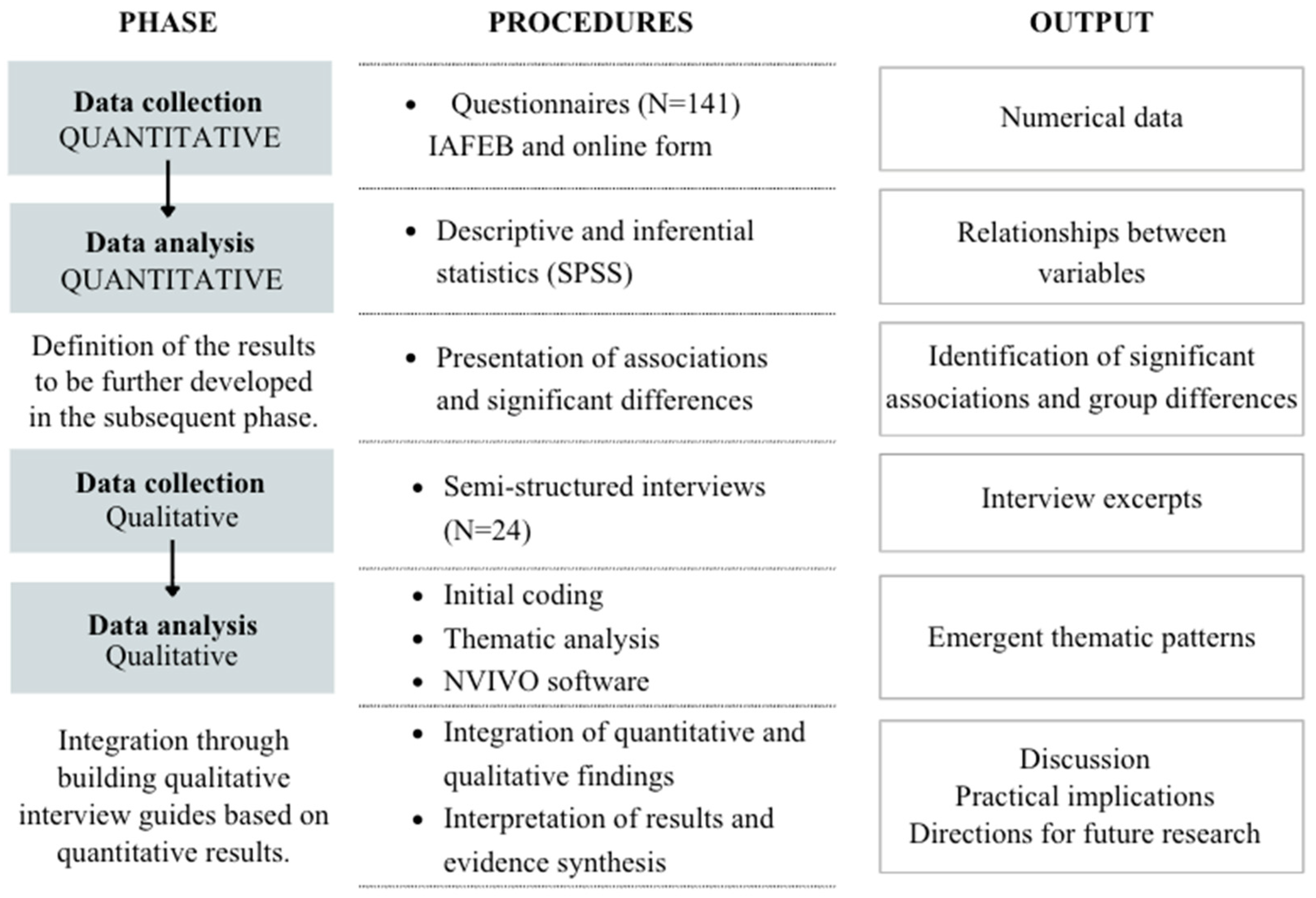
2.1. Study Design
2.2. Ethical Approval
2.3. Phase 1: Quantitative Stage
2.3.1. Participants and Sampling
2.3.2. Instrument
2.3.3. Data Analysis of the Quantitative Phase
2.4. Phase 2: Qualitative Stage
2.4.1. Data Collection
2.4.2. Analysis of Data from the Qualitative Phase
2.4.3. Integration of Quantitative and Qualitative Data
3. Results
3.1. Physical Environments Across Developmental Stages
“At the core, the court was open. It wasn’t the best option for us to train, but as it wasn’t anything serious, we could train calmly; there was a normal table, the balls weren’t the best quality, but we could train normally […]”.(Athlete 16)
“[…] it was a cement court. I remember to this day; I was 11 years old when I said to my coach, ‘we train on a pigeon poo court’. We had to clean the court, clean the balls, and then we played on a court where we had to set up all the timers and the scoreboard because it was a rented court […]”.(Athlete 8)
“The [name of the club] was the best; the gym is gigantic, full of courts, a gym full of equipment, the biggest structure I’ve ever seen and trained in. There were four courts there where you could train basketball and shooting […]”.(Athlete 33)
“The structure was much better than the others in terms of courts; the balls were very well preserved. The tables were maintained almost every month, so they were always good for training. We had a gym available, a fitness coach for pre-training warm-ups, as well as tactical and technical training. It was a much better structure than the others”.(Athlete 32)
3.2. Availability and Quality of Practice Materials
“[…] in the beginning, it was those plastic penalty balls. The place was great, the floor was wooden, but we never had help with materials; it was a basket that tore, only the rim was left, the ball was full of pitombo […]”.(Athlete 54)
“[…] what was scarcer were the balls, but for the rest of the materials we found a way to manage, like cones, ropes, things like that.”(Athlete 107)
“As it was the club’s subsidiary, it was much better financially. They had more reinforced equipment; the ball was already made of leather, there was a pump, and cones to organise the drills […]”.(Athlete 54)
“[…] it was another world. We arrived, and the first thing we saw in the gym was the wooden court. The club was huge—it was another planet for us. In 2018, I clearly saw the difference between playing in a social project and playing in a club […]”.(Athlete 129)
3.3. Perceived Influence of Environments on Sport Development
“[…] The equipment was enough. Obviously, it could have been improved a lot, even because sometimes there was no court to train on or we had to train at very inconvenient times. There were conditions that allowed us to start, but it was not always ideal. Still, it was enough to get started”.(Athlete 19)
“When it rained a lot, we did not come, but when it rained and then stopped, we were able to train even when the court was wet. When the weather was bad, we took risks, but when it rained heavily, the coach offered online training so we could train at home […]”.(Athlete 107)
“[…] The [name of the club] is totally different from the [name of the project]; it’s another world. Structurally, it’s a fantastic club. You have a court available all day, a great gym inside the club, physiotherapy services, everything […]”.(Athlete 102)
“It was very good because they received a lot of government investment. The courts were excellent, new balls arrived every week, and the gym was sensational. Even before the renovation, the structure was already very good, and the court is one of the best in [name of city] […]”.(Athlete 129)
3.4. Regional Disparities in Competitive Environments
“Apart from soccer, you have to prove that the sport is good for people to want to practise it. Here, only schools play, and teams that have money and are really passionate about basketball”.(Athlete 64, Amazonas)
“Basketball should improve a lot here; it is very undervalued in Maranhão […]”.(Athlete 46, Maranhão)
“[…] here there is usually one team per city, but not every city competes because there is no money to travel and no investment from the city. Sometimes even the city’s court is very poor, and there is no way to organise championships. In the end, most teams are concentrated in Salvador”.(Athlete 129, Bahia)
“[…] the good thing about the state of Paraná is that it strongly encourages athletes. Being called up to a state or national team already brings scholarships. If you make the national team, it’s another level, and participating in national championships is highly valued […]”.(Athlete 8, Paraná)
“[…] here in Santa Catarina there is a lot of support from the local government; they really encourage sport”.(Athlete 90, Santa Catarina)
“[…] this is true for any sport: the main showcases are usually Rio de Janeiro, São Paulo, and Santa Catarina. There is no way to play professionally in some regions, such as Mato Grosso”.(Athlete 120, Santa Catarina)
3.5. Summary of Integrated Findings
4. Discussion
5. Limitations and Practical Implications
6. Conclusions
Author Contributions
Funding

Institutional Review Board Statement
Informed Consent Statement
Data Availability Statement
Conflicts of Interest
References
- Beneli, L.M.; Galatti, L.R.; Montagner, P.C. Analysis of social-sportive characteristics of Brazilian women’s national basketball team players. Rev. Psicol. Deporte 2017, 26, 133–137. [Google Scholar]
- Bourdieu, P. Sport and social class. Soc. Sci. Inf. 1978, 17, 819–840. [Google Scholar] [CrossRef] [Scilit]
- Côté, J. The influence of the family in the development of talent in sport. Sport Psychol. 1999, 13, 395–417. [Google Scholar] [CrossRef] [Scilit]
- Knight, C.J.; Holt, N.L. Parenting in youth sport: From research to practice. In Routledge Handbook of Sport Psychology; Routledge: London, UK, 2014; pp. 302–315. [Google Scholar]
- Côté, J.; Baker, J.; Abernethy, B. Practice and play in the development of sport expertise. In Handbook of Sport Psychology, 3rd ed.; Tenenbaum, G., Eklund, R.C., Eds.; Wiley: Hoboken, NJ, USA, 2007; pp. 184–202. [Google Scholar]
- Fraser-Thomas, J.L.; Côté, J.; Deakin, J. Youth sport programs: An avenue to foster positive youth development. Phys. Educ. Sport Pedagogy 2005, 10, 19–40. [Google Scholar] [CrossRef] [Scilit]
- Côté, J.; Turnnidge, J.; Vierimaa, M. A personal assets approach to youth sport. In Routledge Handbook of Youth Sport; Green, K., Smith, A., Eds.; Routledge: London, UK, 2016; pp. 243–255. [Google Scholar]
- Côté, J.; Turnnidge, J.; Murata, A. Youth sport research: Describing the integrated dynamic elements of the personal assets framework. Int. J. Sport Psychol. 2020, 51, 562–578. [Google Scholar] [CrossRef] [Scilit]
- Côté, J.; Murata, A.; Martin, L.J. The personal and social development of children in sport. In The Wiley-Blackwell Handbook of Childhood Social Development; Smith, P.K., Hart, C.H., Eds.; Wiley-Blackwell: Hoboken, NJ, USA, 2022; pp. 386–404. [Google Scholar] [CrossRef] [Scilit]
- Galatti, L.R.; Marques, R.; Barros, C.E.; Paes, R.R. Excellence in women basketball: Sport career development of world champions and Olympic medallist Brazilian athletes. Rev. Psicol. Deporte 2019, 28, 17–23. [Google Scholar]
- Galatti, L.R.; Marques Filho, C.V.; Santos, Y.Y.S.; Watoniki, G.; Korkasas, P.; Mercadante, L.A. Trajetória no basquetebol e perfil sociodemográfico de atletas brasileiras ao longo da carreira: Um estudo com a liga de basquete feminino. Movimento 2021, 27, e27014. [Google Scholar] [CrossRef] [Scilit]
- Collet, C.; Folle, A.; Ibáñez, S.J.; Nascimento, J.V. Practice context on sport development of elite Brazilian volleyball athletes. J. Phys. Educ. 2021, 32, e3225. [Google Scholar] [CrossRef] [Scilit]
- Lima, L.A.; Reverdito, R.S.; Scaglia, A.J.; Galatti, L.R. Engagement in athletic careers: A study of Brazilian female handball world champions. Int. J. Sports Sci. Coach. 2022, 18, 1056–1066. [Google Scholar] [CrossRef] [Scilit]
- Lima, L.A.; Reverdito, R.S.; Folle, A.; Subjana, C.L.; Galatti, L.R. Excellence in handball: Sport development of Brazilian world champion athletes. Quaderns Psicol. 2022, 24, e1798. [Google Scholar] [CrossRef] [Scilit]
- Mascarin, R.B.; Vicentini, L.; Marques, R.F.R. Brazilian women elite futsal players’ career development. Motriz Rev. Educ. Fis. 2019, 25, e101968. [Google Scholar] [CrossRef] [Scilit]
- Maciel, L.F.P.; Ibáñez, S.J.; Beirith, M.K.; Folle, A. Social dynamics established through sport: Implications for the sports training of young brazilian basketball athletes. Sports 2025, 13, 84. [Google Scholar] [CrossRef] [Scilit]
- Creswell, J.W. Research Design: Qualitative, Quantitative, and Mixed Methods Approaches, 4th ed.; Sage: Thousand Oaks, CA, USA, 2014. [Google Scholar]
- Creswell, J.W.; Plano Clark, V.L. Designing and Conducting Mixed Methods Research, 3rd ed.; Sage: Thousand Oaks, CA, USA, 2018. [Google Scholar]
- Ibáñez, S.J.; Feu, S. Research designs in Sports Science. E-balonmano.com J. Sports Sci. 2026, 22, 1–46. [Google Scholar]
- Sparkes, A.C.; Smith, B. Qualitative Research Methods in Sport, Exercise and Health: From Process to Product; Taylor & Francis: London, UK, 2013. [Google Scholar]
- Collet, C.; Nascimento, J.V.; Folle, A.; Ibáñez, S.J. Construction and validation of an instrument for analysing sport training in volleyball. Cuad. Psicol. Deporte 2019, 19, 178–191. [Google Scholar] [CrossRef] [Scilit]
- McCrudden, M.T.; McTigue, E.M. Implementing integration in an explanatory sequential mixed methods study of Belief Bias About Climate Change with High School Students. J. Mix. Methods Res. 2019, 13, 381–400. [Google Scholar] [CrossRef] [Scilit]
- Braun, V.; Clarke, V. Using thematic analysis in psychology. Qual. Res. Psychol. 2006, 3, 77–101. [Google Scholar] [CrossRef] [Scilit]
- Smith, B.; McGannon, K.R. Developing rigor in qualitative research: Problems and opportunities within sport and exercise psychology. Int. Rev. Sport Exerc. Psychol. 2018, 11, 101–121. [Google Scholar] [CrossRef] [Scilit]
- Denscombe, M. Communities of practice: A research paradigm for the mixed methods approach. J. Mix. Methods Res. 2008, 2, 270–283. [Google Scholar] [CrossRef] [Scilit]
- Maciel, L.F.P.; Beirith, M.K.; Ibáñez, S.J.; Galatti, L.R.; Farias, G.O.; Folle, A. Personal engagement of basketball athletes: Insights from mixed methods research. J. Phys. Educ. Sport 2024, 24, 1795–1806. [Google Scholar] [CrossRef]
- Cunha, D.L.; Fraiha, G.A.L.; Darido, S.C.; Pérez, B.L.; Galatti, L.R. Career pathways of basketball players in the new Brazilian basketball. Cuad. Psicol. Deporte 2017, 17, 119–128. [Google Scholar]
- Santinha, G.; Oliveira, R.; Gonçalves, L.J. Contextual factors influencing young athletes’ decisions to engage in sport. Healthcare 2022, 10, 347. [Google Scholar] [CrossRef] [Scilit] [PubMed]
- Pontes, S.S.; Silva, A.M.; Santos, L.M.S.; Sousa, B.V.N.; Oliveira, E.F. Physical activity and sport practices in Brazil. Rev. Bras. Promoç. Saúde 2019, 32. [Google Scholar] [CrossRef] [Scilit]
- Maciel, L.F.P.; Folle, A.; Flach, M.C.; Silva, S.C.; Da Silva, W.R.; Beirith, M.K.; Collet, C. The relative age effect on athletes of the Santa Catarina Basketball Federation. Monten. J. Sports Sci. Med. 2022, 11, 29–35. [Google Scholar] [CrossRef] [Scilit]


| Practice Settings | Quality | ≤10 Years | 11–14 Years | 15–17 Years | 18–19 Years | χ2 (p) | ||||
|---|---|---|---|---|---|---|---|---|---|---|
| Public Places | Low quality | 47 | (43%) | 37 | (34%) | 2 | (18%) | 24 | (33%) | 9.65 (p = 0.646) |
| Moderate | 42 | (39%) | 44 | (40%) | 7 | (64%) | 36 | (49%) | ||
| High quality | 19 | (18%) | 28 | (26%) | 2 | (18%) | 13 | (18%) | ||
| Public Gym | Low quality | 29 | (29%) | 27 | (25%) | 4 | (26%) | 27 | (39%) | 25.91 (p = 0.014) |
| Moderate | 51 | (50%) | 48 | (46%) | 1 | (7%) | 21 | (30%) | ||
| High quality | 22 | (22%) | 19 | (27%) | 10 | (66%) | 21 | (31%) | ||
| Private Gym | Low quality | 26 | (23%) | 12 | (9%) | 2 | (6%) | 15 | (17%) | 43.92 (p < 0.001) |
| Moderate | 15 | (14%) | 11 | (9%) | 6 | (18%) | 22 | (26%) | ||
| High quality | 69 | (63%) | 104 | (82%) | 26 | (76%) | 49 | (57%) | ||
| School | Low quality | 48 | (48%) | 34 | (31%) | 4 | (33%) | 20 | (27%) | 19.50 (p = 0.077) |
| Moderate | 31 | (31%) | 36 | (33%) | 6 | (50%) | 24 | (33%) | ||
| High quality | 21 | (21%) | 39 | (35%) | 2 | (16%) | 29 | (40%) | ||
| Alternative settings | Low quality | 38 | (64%) | 29 | (46%) | 1 | (25%) | 21 | (47%) | 17.35 (p = 0.137) |
| Moderate | 18 | (30%) | 19 | (30%) | 3 | (75%) | 16 | (36%) | ||
| High quality | 3 | (5%) | 14 | (23%) | 0 | (0%) | 7 | (15%) | ||
| Materials | Quality | ≤10 Years | 11–14 Years | 15–17 Years | 18–19 Years | χ2 (p) | ||||
|---|---|---|---|---|---|---|---|---|---|---|
| Balls, cones, tables | Low quality | 17 | (12%) | 10 | (7%) | 0 | (0%) | 4 | (4%) | 139.8 (p < 0.001) |
| Moderate | 61 | (44%) | 17 | (12%) | 4 | (10%) | 43 | (44%) | ||
| High quality | 59 | (43%) | 112 | (81%) | 34 | (89%) | 51 | (52%) | ||
| Uniforms, vests | Low quality | 33 | (24%) | 11 | (8%) | 0 | (0%) | 10 | (10%) | 192.3 (p < 0.001) |
| Moderate | 51 | (37%) | 16 | (11%) | 0 | (0%) | 49 | (50%) | ||
| High quality | 53 | (39%) | 112 | (81%) | 38 | (100%) | 39 | (40%) | ||
| Influence of Location and Materials | Quality | ≤10 Years | 11–14 Years | 15–17 Years | 18–19 Years | χ2 (p) | ||||
|---|---|---|---|---|---|---|---|---|---|---|
| Overall impact | Negative | 3 | (2%) | 9 | (6%) | 0 | (0%) | 0 | (0%) | 648.5 (p < 0.001) |
| Indifferent | 124 | (90%) | 1 | (1%) | 0 | (0%) | 1 | (1%) | ||
| Positive | 10 | (7%) | 129 | (93%) | 38 | (100%) | 97 | (99%) | ||
Disclaimer/Publisher’s Note: The statements, opinions and data contained in all publications are solely those of the individual author(s) and contributor(s) and not of MDPI and/or the editor(s). MDPI and/or the editor(s) disclaim responsibility for any injury to people or property resulting from any ideas, methods, instructions or products referred to in the content. |
© 2026 by the authors. Licensee MDPI, Basel, Switzerland. This article is an open access article distributed under the terms and conditions of the Creative Commons Attribution (CC BY) license.
Share and Cite
Folle, A.; Maciel, L.F.P.; Beirith, M.K.; Alcoser, S.D.I.; Ibáñez, S.J. Physical and Competitive Environments and Their Influence on Developmental Experiences in Youth Basketball: A Mixed-Methods Study. Sports 2026, 14, 86. https://doi.org/10.3390/sports14030086
Folle A, Maciel LFP, Beirith MK, Alcoser SDI, Ibáñez SJ. Physical and Competitive Environments and Their Influence on Developmental Experiences in Youth Basketball: A Mixed-Methods Study. Sports. 2026; 14(3):86. https://doi.org/10.3390/sports14030086
Chicago/Turabian StyleFolle, Alexandra, Larissa Fernanda Porto Maciel, Mariana Klauck Beirith, Sandy Dorian Isla Alcoser, and Sergio José Ibáñez. 2026. "Physical and Competitive Environments and Their Influence on Developmental Experiences in Youth Basketball: A Mixed-Methods Study" Sports 14, no. 3: 86. https://doi.org/10.3390/sports14030086
APA StyleFolle, A., Maciel, L. F. P., Beirith, M. K., Alcoser, S. D. I., & Ibáñez, S. J. (2026). Physical and Competitive Environments and Their Influence on Developmental Experiences in Youth Basketball: A Mixed-Methods Study. Sports, 14(3), 86. https://doi.org/10.3390/sports14030086