<?xml version="1.0" encoding="UTF-8"?>
<!DOCTYPE article PUBLIC "-//NLM//DTD Journal Publishing DTD v2.3 20070202//EN" "journalpublishing.dtd">
<article xmlns:mml="http://www.w3.org/1998/Math/MathML" xmlns:xlink="http://www.w3.org/1999/xlink" xml:lang="en" article-type="research-article">
  <front>
    <journal-meta>
      <journal-id journal-id-type="publisher-id">minerals</journal-id>
      <journal-title>Minerals</journal-title>
      <abbrev-journal-title abbrev-type="publisher">Minerals</abbrev-journal-title>
      <abbrev-journal-title abbrev-type="pubmed">Minerals</abbrev-journal-title>
      <issn pub-type="epub">2075-163X</issn>
      <publisher>
        <publisher-name>Molecular Diversity Preservation International</publisher-name>
      </publisher>
    </journal-meta>
    <article-meta>
      <article-id pub-id-type="doi">10.3390/min2010040</article-id>
      <article-id pub-id-type="publisher-id">minerals-02-00040</article-id>
      <article-categories>
        <subj-group>
          <subject>Article</subject>
        </subj-group>
      </article-categories>
      <title-group>
        <article-title>Fits and Misfits in Organic Matrix Analyses: Case of the Soluble Matrices of the Nacreous Layer of <italic>Pinctada margaritifera</italic> (Mollusca)</article-title>
      </title-group>
      <contrib-group>
        <contrib contrib-type="author">
          <name>
            <surname>Dauphin</surname>
            <given-names>Yannicke</given-names>
          </name>
          <xref rid="af1-minerals-02-00040" ref-type="aff">1</xref>
          <xref rid="c1-minerals-02-00040" ref-type="corresp">*</xref>
        </contrib>
        <contrib contrib-type="author">
          <name>
            <surname>Nouet</surname>
            <given-names>Julius</given-names>
          </name>
          <xref rid="af1-minerals-02-00040" ref-type="aff">1</xref>
        </contrib>
      </contrib-group>
      <aff id="af1-minerals-02-00040"><label>1 </label>UMR 8148 Interactions et Dynamique des Environnements de Surface, Bat. 504, Université Paris Sud, Orsay Cedex 91405, France; Email: <email>yannicke.dauphin@u-psud.fr</email> (Y.D); Email: <email>julius.nouet@u-psud.fr</email> (J.N)</aff>
      <author-notes>
        <corresp id="c1-minerals-02-00040"><label>*</label>Author to whom correspondence should be addressed; Email: <email>yannicke.dauphin@u-psud.fr</email>; Tel.: +33-1-69156117; Fax: +33-1-69156121.</corresp>
      </author-notes>
      <pub-date pub-type="epub">
        <day>27</day>
        <month>02</month>
        <year>2012</year>
      </pub-date>
      <pub-date pub-type="collection">
        <month>01</month>
        <year>2012</year>
      </pub-date>
      <volume>2</volume>
      <issue>1</issue>
      <fpage>40</fpage>
      <lpage>54</lpage>
      <history>
        <date date-type="received">
          <day>17</day>
          <month>01</month>
          <year>2012</year>
        </date>
        <date date-type="rev-recd">
          <day>16</day>
          <month>02</month>
          <year>2012</year>
        </date>
        <date date-type="accepted">
          <day>17</day>
          <month>02</month>
          <year>2012</year>
        </date>
      </history>
      <permissions>
        <copyright-statement>© 2012 by the authors; licensee MDPI, Basel, Switzerland.</copyright-statement>
        <copyright-year>2012</copyright-year>
        <license xmlns:xlink="http://www.w3.org/1999/xlink" license-type="open-access" xlink:href="http://creativecommons.org/licenses/by/3.0/">
          <p>This article is an open-access article distributed under the terms and conditions of the Creative Commons Attribution license (http://creativecommons.org/licenses/by/3.0/).</p>
        </license>
      </permissions>
      <abstract>
        <p>Mollusk shells, especially the nacre, are of commercial interest as well as palaeoenvironmental proxies. They are also investigated as biomaterials for medical purposes and biomimetics. Although the mineralogy is well-known and unique (aragonite tablets), the organic components are various. However, determination of the precise composition of the soluble organic matrix (SOM) of the nacreous layer is difficult. Among the range of possible techniques, 1D electrophoresis and High-performance liquid chromatography (HPLC) have previously been applied separately to differentiate pI and molecular weights. To date, no clear correlation has been established between the two parameters obtained in such conditions. Here, we report the use of preparative electrophoresis, coupled with HPLC, to determine the molecular weights of the pI fractions. The results are compared with 2D gel electrophoresis. It is shown that both methods have drawbacks and advantages, and are not redundant. The complexity of the composition of the nacreous tablet shown by scanning electron microscope (SEM) and Atomic Force Microscope (AFM) observations is also evidenced by electrophoresis and HPLC.</p>
      </abstract>
      <kwd-group>
        <kwd>soluble organic matrix</kwd>
        <kwd>mollusk shell</kwd>
        <kwd>nacre</kwd>
        <kwd>electrophoresis</kwd>
        <kwd>HPLC</kwd>
      </kwd-group>
    </article-meta>
  </front>
  <body>
    <sec sec-type="intro">
      <title>1.  Introduction</title>
      <p>Mollusk shells are collected for their beautiful shapes and colors. Shape, ornamentation and color are the main criteria used for taxonomy and phylogeny. However, Boggild [<xref ref-type="bibr" rid="B1-minerals-02-00040">1</xref>] and Taylor <italic>et al</italic>. [<xref ref-type="bibr" rid="B2-minerals-02-00040">2</xref>] have shown that the mineralogy and the arrangement of the shell layers (microstructure) are related to taxonomy. Detailed works have confirmed the potential use of microstructures for taxonomy and phylogeny [<xref ref-type="bibr" rid="B3-minerals-02-00040">3</xref>,<xref ref-type="bibr" rid="B4-minerals-02-00040">4</xref>]. Among the various layers known in mollusk shells, some have complex 3D arrangements (crossed lamellar layers), whereas others are simple (prism, nacre). Thus, despite the crossed lamellar layer in the more abundant layer, the nacre is the better-known layer. Not only are the brick and wall structure easy to decipher, but nacre is used in jewelry and pearl farming.</p>
      <p>The nacreous layer is present in the three main classes: Bivalvia, Gastropoda and Cephalopoda, and Wise [<xref ref-type="bibr" rid="B5-minerals-02-00040">5</xref>] and Erben [<xref ref-type="bibr" rid="B6-minerals-02-00040">6</xref>] have shown that the arrangement of the tablets differs in these taxa. Using transmission (TEM) and scanning electron microscopes (SEM), Mutvei [<xref ref-type="bibr" rid="B7-minerals-02-00040">7</xref>,<xref ref-type="bibr" rid="B8-minerals-02-00040">8</xref>,<xref ref-type="bibr" rid="B9-minerals-02-00040">9</xref>] has shown that the inner structure of the tablets also differs in the three classes. Topography and structure of the interlamellar and intercrystalline organic components have been studied by Grégoire [<xref ref-type="bibr" rid="B10-minerals-02-00040">10</xref>,<xref ref-type="bibr" rid="B11-minerals-02-00040">11</xref>,<xref ref-type="bibr" rid="B12-minerals-02-00040">12</xref>], Nakahara [<xref ref-type="bibr" rid="B13-minerals-02-00040">13</xref>,<xref ref-type="bibr" rid="B14-minerals-02-00040">14</xref>]. At this stage, few data are available on the intracrystalline organic matrix, due to the decalcification processes used for transmission electron microscopes. Interlamellar membranes comprise three layers in gastropod nacre, the middle one being soluble [<xref ref-type="bibr" rid="B13-minerals-02-00040">13</xref>,<xref ref-type="bibr" rid="B14-minerals-02-00040">14</xref>]. Thus, the soluble organic matrix has two components: the intracrystalline matrix and the middle layer of the membranes. Various fractionation procedures were used to characterize the composition of the nacre [<xref ref-type="bibr" rid="B15-minerals-02-00040">15</xref>,<xref ref-type="bibr" rid="B16-minerals-02-00040">16</xref>,<xref ref-type="bibr" rid="B17-minerals-02-00040">17</xref>], but they were mainly focused on the insoluble components. The high contents of the soluble protein fraction in acidic amino acids were shown by Weiner [<xref ref-type="bibr" rid="B18-minerals-02-00040">18</xref>]. Since numerous papers deal with the soluble proteins of the nacreous layer of <italic>Pinctada</italic>, and it is impossible to enter into detailed discussion of the results (see [<xref ref-type="bibr" rid="B19-minerals-02-00040">19</xref>]).</p>
      <p>Despite all these studies, few data are available on the relationships between the molecular weights and pI of the soluble matrix of the nacreous layer. Acidity was mainly inferred from amino acid analyses, and molecular weights from 1D electrophoresis. Unfortunately, efforts to relate pI to molecular weights have been rare. 1D electrophoresis gels have a limited molecular weights range, so that high molecular weights (&gt;100 or</p>
      <p>In this study, we used preparative electrophoresis and HPLC to estimate the molecular weights of the soluble organic matrices fractionated according to the pI of the nacreous layer of the pearl oyster. The results were compared with those of 2D electrophoresis.</p>
    </sec>
    <sec sec-type="results">
      <title>2.  Results and Discussion</title>
      <p>In common with most mollusks, the shell of <italic>Pinctada margaritifera</italic> (Linnaeus, 1758) has several microstructural layers. The topographical relationships of the two main layers are simple, so that collecting the nacreous layer is easy. Moreover, the nacreous layer is thick, and comprises abundant organic matrices.</p>
      <sec>
        <title>2.1. Micro- and Nanostructures</title>
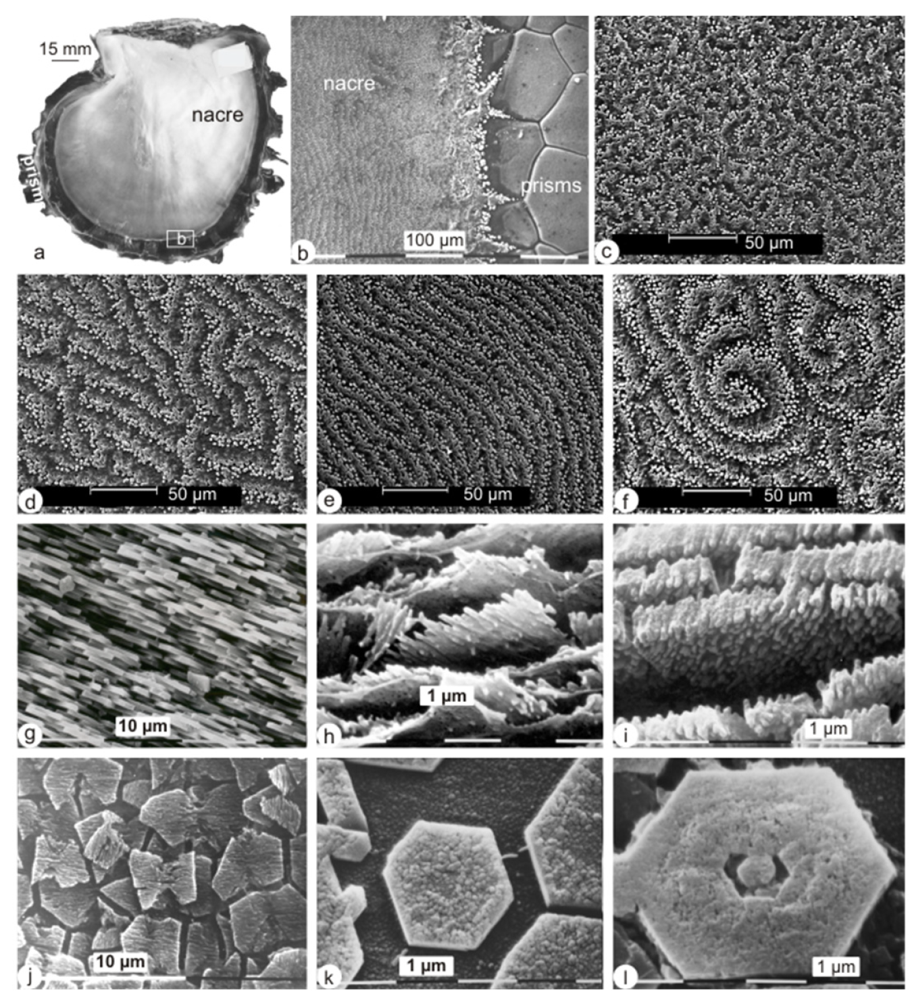
        <p>The thin outer shell layer is composed of calcitic prisms, while the thick inner layer is built by aragonitic nacreous tablets. While the prismatic layer is black, the nacreous layer is black at the first stage, then becomes white (<xref ref-type="fig" rid="minerals-02-00040-f001">Figure 1</xref>a). The first stage of the nacreous layer is an organic deposit on the prisms, mainly on the thick organic walls surrounding the prismatic units (<xref ref-type="fig" rid="minerals-02-00040-f001">Figure 1</xref>b). Mineralized nacreous tablets follow a three-stage pattern (<xref ref-type="fig" rid="minerals-02-00040-f001">Figure 1</xref>c–e) from an irregular to a linear drawing. At last, in the white part of the inner surface, the growth pattern shows the classical spiral arrangement (<xref ref-type="fig" rid="minerals-02-00040-f001">Figure 1</xref>f). The nacreous tablets are arranged in regular layers (<xref ref-type="fig" rid="minerals-02-00040-f001">Figure 1</xref>g) described as “bricks and mortar”, because tablets are separated by organic lamellae. However, tablets are not pure mineral: they are a mixture of mineral and organic materials, as shown by fixed and etched samples (<xref ref-type="fig" rid="minerals-02-00040-f001">Figure 1</xref>h–j). A polished surface etched with the Mutvei’s solution (acetic acid + glutaraldehyde [<xref ref-type="bibr" rid="B21-minerals-02-00040">21</xref>]) shows that tablets comprise parallel acicular crystallites parallel to the surface of the tablets, while remains of the interlamellar membranes are visible (<xref ref-type="fig" rid="minerals-02-00040-f001">Figure 1</xref>h). When the organic components are destroyed by commercial NaClO for 20 min, before using the Mutvei’s solution, another arrangement is revealed: parallel acicular crystallites are visible, perpendicular to the surface of the tablets. However, the surface shows that these crystallites are aligned, and are composed of small granules. An enzymatic etching (trypsine) shows that a tablet is composed of two sectors, the solubility of which differs (<xref ref-type="fig" rid="minerals-02-00040-f001">Figure 1</xref>j). Sectors are built by acicular crystallites. Such sectors are not revealed with another enzymatic hydrolysis (pronase), but the granular surface of the tablets is visible, the outer edge being less etched (<xref ref-type="fig" rid="minerals-02-00040-f001">Figure 1</xref>k). The heterogenous composition of a tablet and the different composition of the central part are also shown (<xref ref-type="fig" rid="minerals-02-00040-f001">Figure 1</xref>l).</p>
        <p>Unetched and etched surfaces evidence the complexity of the structure and composition of the nacreous layer. Moreover, despite the fact that used enzymes are not specific for a protein, the resulting images displayed various aspects. Thus it may be inferred that the organic components in the interlamellar membranes and within the tablets are numerous.</p>
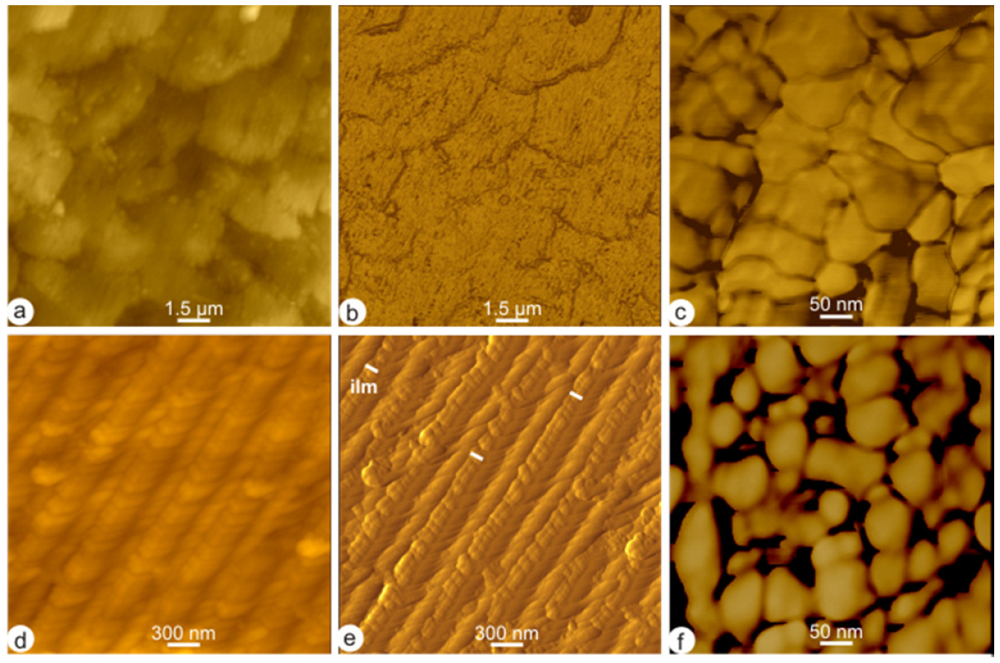
        <p>Atomic force microscope (AFM) images also show the overlapping tablets, the surrounding organic membranes and the inner acicular crystallites (<xref ref-type="fig" rid="minerals-02-00040-f002">Figure 2</xref>a,b). Acicular crystallites are built of aligned granules (<xref ref-type="fig" rid="minerals-02-00040-f002">Figure 2</xref>c). These granules are surrounded by a thin cortex, as shown by phase image. Changes in color within granules suggest their heterogeneous composition (<xref ref-type="fig" rid="minerals-02-00040-f002">Figure 2</xref>d).</p>
        <fig id="minerals-02-00040-f001" position="anchor">
          <label>Figure 1</label>
          <caption>
            <p>Microstructure of the shell of <italic>Pinctada margaritifera</italic><italic>. </italic>(<bold>a</bold>) Inner view, showing that a large part of the valve is covered with the nacreous layer. The outer prismatic layer is visible on the marginal scales; (<bold>b</bold>) Detail of the inner surface showing the transition between the outer calcitic prismatic layer and the inner aragonitic nacreous layer; (<bold>c</bold>) Inner surface: first stage of the nacre, with an irregular pattern, near the transition; (<bold>d</bold>) Inner surface: second stage of the nacreous layer, towards the inner part of the shell; (<bold>e</bold>) Inner surface: third stage of the nacreous layer, with parallel bands; (<bold>f</bold>) Inner surface: classical spiral pattern of the adult nacre; (<bold>g</bold>) Vertical section showing the layers of nacreous aragonitic tablets; (<bold>h</bold>) Vertical section showing the interlamellar organic membrane. The fixative-etching solution emphasizes the composite structure of the tablets. Polished, fixed and etched with Mutvei’s solution for 20 min, pH 4 at 15 °C; (<bold>i</bold>) Vertical fracture showing the inner structure of the nacreous tablets. The elongated crystallites displayed in Figure 1h are aligned. Dilute NaClO for 20 min at 15 °C. Mutvei’s solution for 40 min, pH 4 at 15 °C; (<bold>j</bold>) Tangential polished surface, showing the soluble and insoluble sectors with a tablet, as described by Mutvei [<xref ref-type="bibr" rid="B7-minerals-02-00040">7</xref>,<xref ref-type="bibr" rid="B8-minerals-02-00040">8</xref>]. Sectors are composed of elongated acicular crystallites. Etched with trypsine in HEPES buffer, 1 mg/mL for 19 h, 38 °C, pH 7.5; (<bold>k</bold>) Inner surface showing growing hexagonal tablets with a “soluble” center and a granular structure. Pronase in Ca acetate buffer, 2 mg/mL, 5h 30, pH 8 at 38 °C;<bold/>(<bold>l</bold>)<bold/>Inner surface of the nacreous layer, showing the nodular center of a growing tablet, surrounded by a soluble zone. Unpolished surface, pronase 1 mg/mL for 3 h at 38.2 °C, pH 7.4.</p>
          </caption>
          <graphic xmlns:xlink="http://www.w3.org/1999/xlink" xlink:href="minerals-02-00040-g001.tif"/>
        </fig>
        <fig id="minerals-02-00040-f002" position="anchor">
          <label>Figure 2</label>
          <caption>
            <p>Nanostructure of the shell of <italic>Pinctada margaritifera</italic><italic>. </italic>Inner surface of the shell, showing the partially superimposed tablets. Muvei’s solution 10 min, room temperature. Critical point drying. AFM height image; (<bold>b</bold>) AFM phase image of the same. Elongated crystallites within the tablets are visible; (<bold>c</bold>) Granular structure; granules are surrounded by a cortex (amorphous CaCO3 or amorphous CaCO3 + organic components). Detail of Figure 2a, b; (<bold>d</bold>) Vertical section showing the layers of tablets. Etched (acetic acid 0.1% + glutaraldehyde 2%) for 10 s at room temperature. AFM height image; (<bold>e</bold>) AFM phase image of the same, showing the interlamellar organic membrane (ilm); (<bold>f</bold>) Granular structure of the juvenile nacreous layer. AFM phase image.</p>
          </caption>
          <graphic xmlns:xlink="http://www.w3.org/1999/xlink" xlink:href="minerals-02-00040-g002.tif"/>
        </fig>
      </sec>
      <sec>
        <title>2.2. Bulk Analyses of the Soluble Organic Matrix</title>
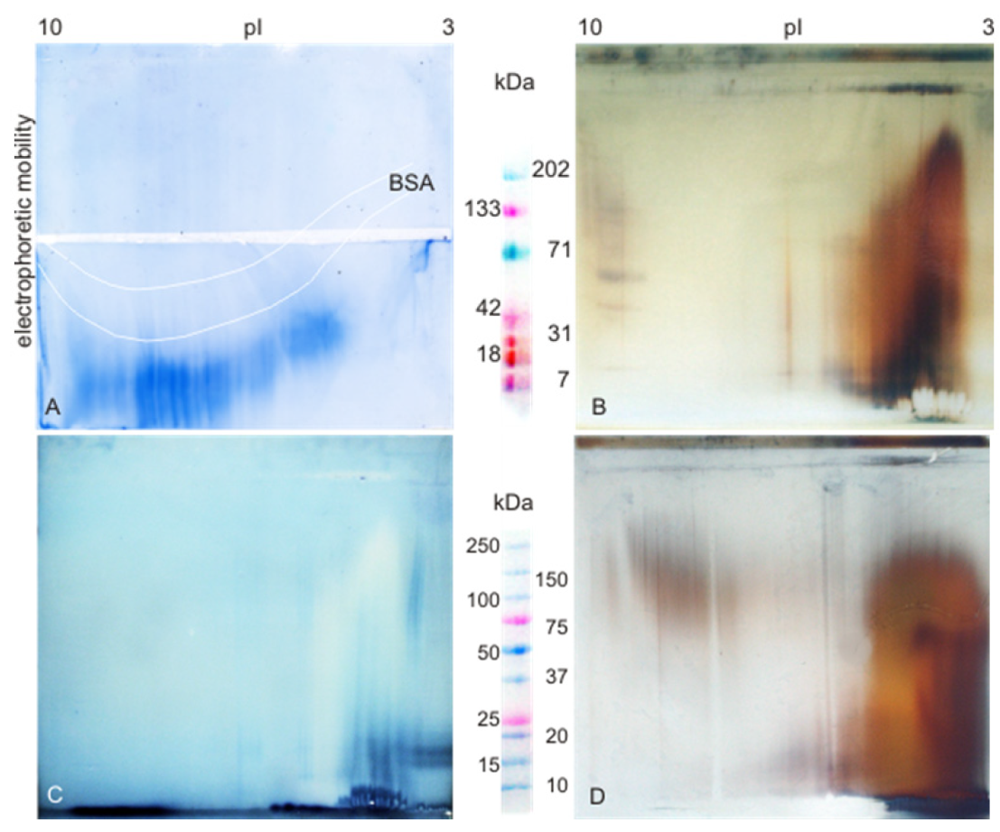
        <p>In an electrophoretic analysis, the pI of a component equals the pH of its zero mobility. In electrophoretic titration curves (ETC), this corresponds to the pH at which the component curve crosses the trough. Electrophoretic titration curves of bovine serum albumin (BSA) display two pI (4.6 and 5.6) (<xref ref-type="fig" rid="minerals-02-00040-f003">Figure 3</xref>a, white lines). Soluble nacreous matrix shows different electrophoretic mobilities at different pH values (<xref ref-type="fig" rid="minerals-02-00040-f003">Figure 3</xref>a). Coomassie blue stain of the nacreous components is more intense in the basic part of the gel, where the greatest difference in mobilities occurs. Discontinuities in the blue color confirm the heterogeneity and complexity of the nacreous matrix, the pI of which is acidic.</p>
      </sec>
      <sec>
        <title>2.3. Molecular Weights Versus pI</title>
        <p>IPG strips are stained in 2D electrophoresis, showing that a part of the soluble matrix has high molecular weights (between 250 and 500 kDa) and does not penetrate into the second gel (<xref ref-type="fig" rid="minerals-02-00040-f003">Figure 3</xref>B, D). Using the usual fixative procedure, the immobilized pH gradient strip (IPG strip) is heavily stained in the acidic part (<xref ref-type="fig" rid="minerals-02-00040-f003">Figure 3</xref>b). The acidic part of the 2D gel is heavily stained, with discrete thin lines according to the pl, but with large smears according to the molecular weights. Some discrete faint bands are visible in the basic part of the gel. In the acidic—low molecular weights of the gel, a specific zone with no staining and a “cauliflower” pattern is present. Due to the Coomassie blue stain, the background of the Zn stain gel is blue. However, the discrete thin lines according to the pI, the “cauliflower pattern” and the smears in molecular weights are visible (<xref ref-type="fig" rid="minerals-02-00040-f003">Figure 3</xref>c). The patterns in the acidic parts of the Ag and Zn stained gels are similar. However, pI bands are more visible in the Zn stained gel. The second Ag stained gel, with the special fixative procedure [<xref ref-type="bibr" rid="B20-minerals-02-00040">20</xref>], has a slightly different pattern (<xref ref-type="fig" rid="minerals-02-00040-f003">Figure 3</xref>d). IPG strip is stained also in the acidic part. In the second dimension gel, discrete bands are visible according to the pI, while only smears are visible for molecular weights. However, the “cauliflower” pattern of the gel 3b is absent, and a stained zone is shown in the basic—high molecular weights. More acidic components are stained on the right part of the gel. In this gel, a small band in the middle part of the pI range is not visible, as well as the basic part stained in <xref ref-type="fig" rid="minerals-02-00040-f003">Figure 3</xref>b.</p>
        <fig id="minerals-02-00040-f003" position="anchor">
          <label>Figure 3</label>
          <caption>
            <p>Electrophoreses of the soluble organic matrix extracted from the nacreous layer. (<bold>a</bold>) Titration curve (ETC), showing the acidity of the matrix. Coomassie blue stain; (<bold>b</bold>) Two dimensional gel: conventional fixing procedure, Ag staining; (<bold>c</bold>) Two dimensional gel: conventional fixing procedure, Zn staining for proteins; (<bold>d</bold>) Two dimensional gel: improved fixing procedure, Ag staining.</p>
          </caption>
          <graphic xmlns:xlink="http://www.w3.org/1999/xlink" xlink:href="minerals-02-00040-g003.tif"/>
        </fig>
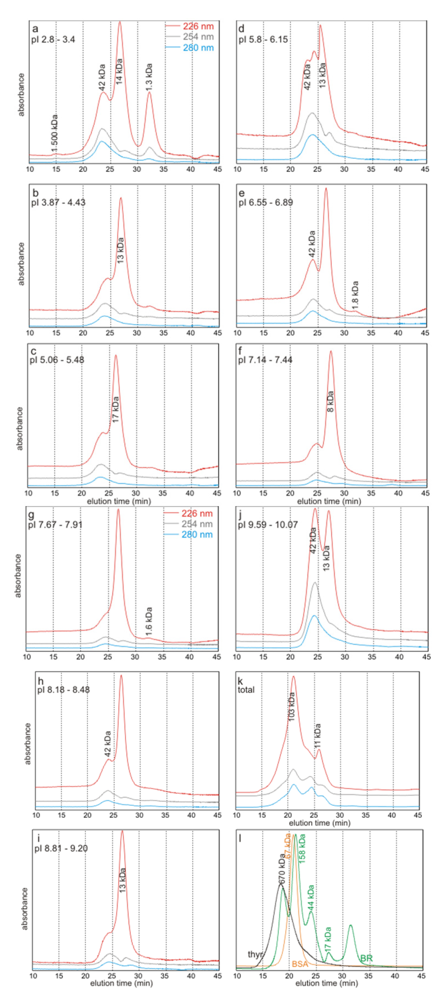
        <p>HPLC profiles of the soluble matrix pI fractions vary from 1,500 kDa to 1 kDa (<xref ref-type="fig" rid="minerals-02-00040-f004">Figure 4</xref>a–j). The main peak is at 14 kDa (8–17 kDa range) in all the fractions, the second one being at about 42 kDa at 226 nm. However, ratios between the two peaks differ all along the pI range. Small peaks at about 1–2 kDa are also present. At 254 and 280 nm, the main peak is at about 42 kDa (<xref ref-type="fig" rid="minerals-02-00040-f004">Figure 4</xref>a–j). Some fractions show several strong peaks at 226 nm: the first acidic (pI 2.8–3.4, <xref ref-type="fig" rid="minerals-02-00040-f004">Figure 4</xref>a), the last basic (pI 9.59–10.07, <xref ref-type="fig" rid="minerals-02-00040-f004">Figure 4</xref>j), and an intermediate one (pI 5.8–6.15, <xref ref-type="fig" rid="minerals-02-00040-f004">Figure 4</xref>d). However, the main peak at 254 and 280 nm is also at about 42 kDa in these three fractions.</p>
        <p>The main peak of the bulk soluble matrix is at about 103 kDa (<xref ref-type="fig" rid="minerals-02-00040-f004">Figure 4</xref>k), the second peak is at about 11 kDa at 226 nm. At 254 and 280 nm, the profiles are similar. An intermediate third peak is well marked at 254 and 280 nm, but appears as a shoulder at 226 nm. A weak shoulder is also present at about 1,500 kDa.</p>
        <fig id="minerals-02-00040-f004" position="anchor">
          <label>Figure 4</label>
          <caption>
            <p>HPLC profiles of SOM after the pI fractionation with preparative electrophoreses (<bold>a</bold>–<bold>i</bold>); l: standard proteins. Molecular weights differ in every fraction. However the asymmetry of the peaks shows that they are composed of several molecules.</p>
          </caption>
          <graphic xmlns:xlink="http://www.w3.org/1999/xlink" xlink:href="minerals-02-00040-g004.tif"/>
        </fig>
      </sec>
      <sec>
        <title>2.4. Discussion</title>
        <sec>
          <title>2.4.1. Methods</title>
          <p>The main features are similar in the three 2D gels, resulting from different fixative and staining procedures. However, details are different, especially in the low molecular weights—acidic pI.</p>
          <p>Molecular weights can be estimated with HPLC and electrophoresis. However, these two methods are not redundant, as shown by the results on the soluble organic matrix extracted from the nacreous layer of <italic>Pinctada margaritifera</italic>. Some problems are common: because of the complexity and abundance of molecules, no discrete molecular weights were obtained in both HPLC and 2D electrophoresis. Moreover, the calibration was done with standard globular proteins (Figures 3, 4l). HPLC profiles show the difficult task of calibration. The BioRad standard contains thyroglobuline at 670 kDa. It can be seen that the peak is not at the same elution time when compared with an isolated thyroglobuline (<xref ref-type="fig" rid="minerals-02-00040-f004">Figure 4</xref>l); despite their having the same molecular weights according to the data sheets. Both HPLC and electrophoresis have advantages and disadvantages. Electrophoresis allows several successive staining procedures, so that several characteristics of the molecules are obtained in a single run. The exact position of acidic and neutral sugars and glycoproteins is visible. However, the range of the molecular weights is limited, and a part of the matrices does not penetrate in the first strip, as shown by the blue or brown color. The maximal molecular weights in these pI gels are about 500 kDa. HPLC allows a better range of molecular weights, with columns connected in a series. With several detectors, it is possible to estimate the composition of the matrices. However, only molecular weights are estimated. Protein molecular weights are also determined using time-of-flight mass spectrometry (TOF-MS). Despite a theoretical wide molecular weights range, these analytical systems are usually calibrated for a small range, so that only a part of the components is known. Moreover, they are often coupled with 2D electrophoresis or liquid chromatography, and the larger molecular weights are not included. It is also used to quantify proteins, sugars or lipids, or to identify proteins through proteomics techniques.</p>
          <p>The fractionation according to the pI is a separate procedure. Concerns are high about the pH range of available ampholytes, especially for low-pH values; the ampholytes used for calibration (Biorad Bio-lytes 3/10) are only guaranteed for pH between 3.5 and 9.5: no relevant data can therefore be collected for very acidic molecules (pI </p>
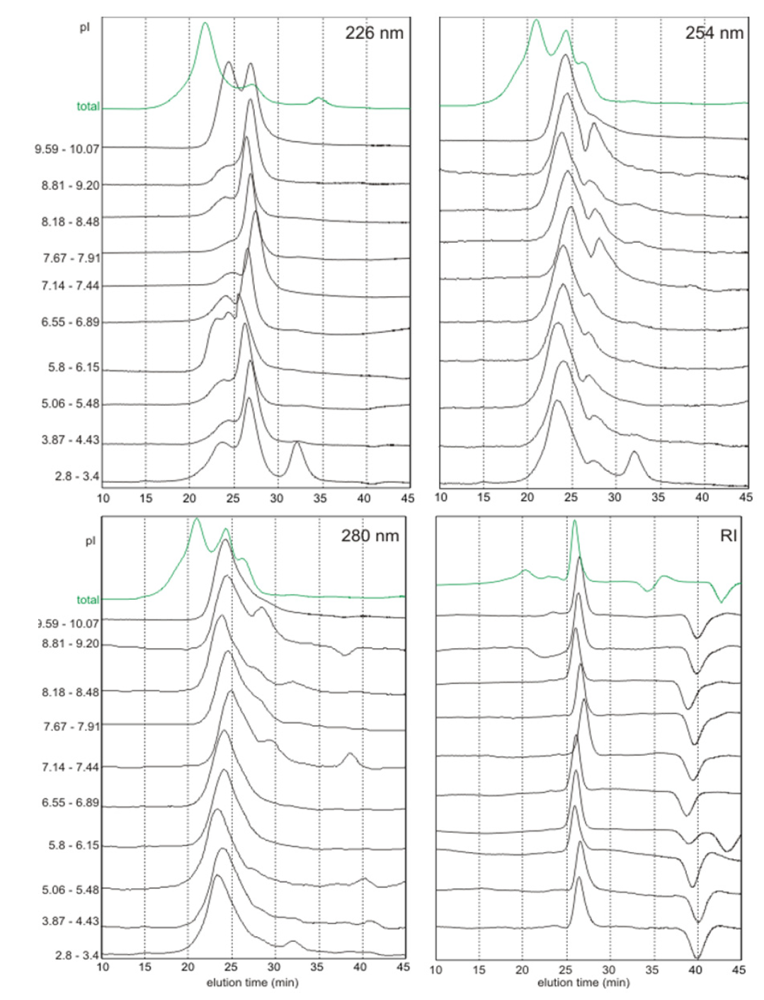
          <p>Absence of the high molecular weights of the total SOM is clearly visible in a diagram showing the HPLC profiles for every pI fraction for every wavelength (<xref ref-type="fig" rid="minerals-02-00040-f005">Figure 5</xref>).</p>
          <fig id="minerals-02-00040-f005" position="anchor">
            <label>Figure 5</label>
            <caption>
              <p>HPLC profiles showing the molecular weights of every pI fraction and of the non‑fractionated SOM (total), displayed according to the UV wavelength detection and refractometric index. The diversity of the molecular weights in different fractions is visible.</p>
            </caption>
            <graphic xmlns:xlink="http://www.w3.org/1999/xlink" xlink:href="minerals-02-00040-g005.tif"/>
          </fig>
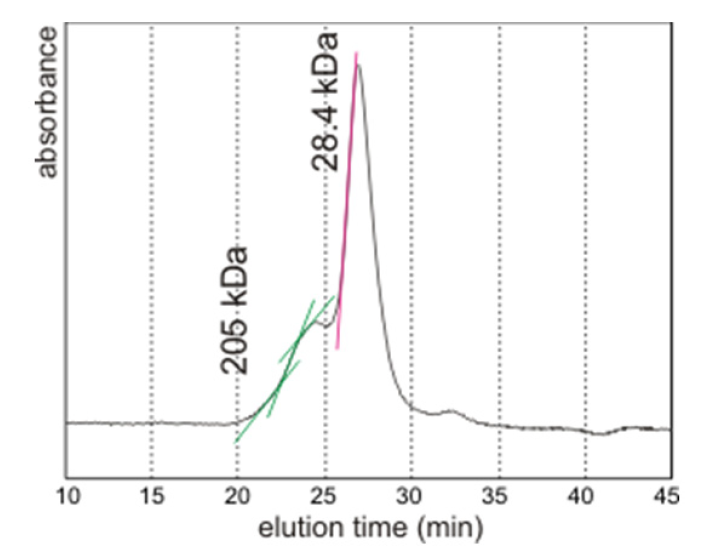
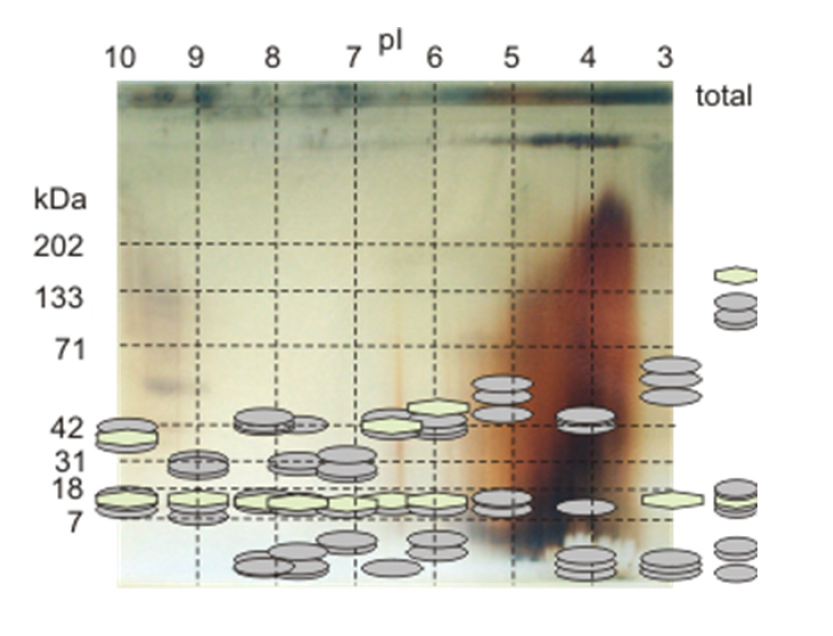
          <p>Moreover, HPLC and electrophoresis allow only an estimate of molecular weights. Smears are dominant in electrophoresis, whereas the shape and asymmetry of the peaks in HPLC clearly show that several molecules are included within a peak (<xref ref-type="fig" rid="minerals-02-00040-f006">Figure 6</xref>). Thus, the apparent discrepancy between the main molecular weights in fractionated matrices and the bulk matrix can be explained by poor separation in both techniques. A comparison of the HPLC and 2D electrophoresis has been attempted in the range of the electrophoresis molecular weights (<xref ref-type="fig" rid="minerals-02-00040-f007">Figure 7</xref>). Thus, the highest molecular weights detected with HPLC, at about 1,500 kDa, are not shown in this figure. Given that molecular weights are only estimated, there is no discrepancy in the molecular weights of the total organic matrix (HPLC) and electrophoresis. It must be noted that the number of SOM components is probably very high. Such a study has not been done on mollusk shells. However, it may be suggested that the “lost” molecular weights in the fractionated matrix are included in the asymmetric peaks in HPLC profiles due to “poor” separation.</p>
          <p>Thus, depending on the selected parameters, there is neither a good nor a bad method.</p>
          <fig id="minerals-02-00040-f006" position="anchor">
            <label>Figure 6</label>
            <caption>
              <p>Figure 6. HPLC profile showing that the slope is composed of several units; this is indicative of the presence of several molecular weights.</p>
            </caption>
            <graphic xmlns:xlink="http://www.w3.org/1999/xlink" xlink:href="minerals-02-00040-g006.tif"/>
          </fig>
          <fig id="minerals-02-00040-f007" position="anchor">
            <label>Figure 7</label>
            <caption>
              <p>Figure 7. Comparison of a 2D-electrophoresis gel and molecular weights as determined using HPLC (oval: UV detection, polygon: refractometric detection).</p>
            </caption>
            <graphic xmlns:xlink="http://www.w3.org/1999/xlink" xlink:href="minerals-02-00040-g007.tif"/>
          </fig>
        </sec>
      </sec>
      <sec>
        <title>2.5. Comparison with the Known Proteins in Nacre</title>
        <p>Despite the fact that nacre is the best-known layer, few components are separated and identified. Among them, most are proteins. Sugars and lipids are also present [<xref ref-type="bibr" rid="B22-minerals-02-00040">22</xref>,<xref ref-type="bibr" rid="B23-minerals-02-00040">23</xref>], but they are not well known. Proteins extracted from the insoluble and soluble matrix have been identified in the nacreous layer of several <italic>Pinctada</italic> species. Because of the diversity of preparative extraction, data are confused. Moreover, soluble matrices have been extracted from the insoluble matrix using different etching processes such as alkali solution [<xref ref-type="bibr" rid="B24-minerals-02-00040">24</xref>]. Such results confirm the TEM observations of Nakahara [<xref ref-type="bibr" rid="B13-minerals-02-00040">13</xref>] on the structure of the interlamellar membranes of the nacreous structure.</p>
        <p>Despite some proteins being named from their apparent molecular weights, they often comprise several variants, so that the small differences are visible as irregularities in HPLC spectra or electrophoreses with a wide range of molecular weights. Bédouet <italic>et al</italic>. [<xref ref-type="bibr" rid="B25-minerals-02-00040">25</xref>] have observed several bands in the acetic-soluble matrix of <italic>P. maxima</italic>: a main band at 20 kDa, and several faint bands at 60, 15, 12 and 9 kDa. Pereira-Mouries <italic>et al</italic>. [<xref ref-type="bibr" rid="B26-minerals-02-00040">26</xref>] have confirmed that the concept of insoluble and soluble matrices depends on the demineralizing procedures. Both water-soluble and EDTA-soluble matrices appear as smears in SDS PAGE electrophoresis. However, two faint bands are visible at about 14 and 20 kDa in the EDTA-soluble matrix. They suggested that the 14 kDa band is similar to the acidic N14 protein (pI 4.8) described by Kono <italic>et al</italic>. [<xref ref-type="bibr" rid="B27-minerals-02-00040">27</xref>] in <italic>P. maxima</italic>. P14 is known in the acetic acid-soluble matrix [<xref ref-type="bibr" rid="B28-minerals-02-00040">28</xref>]. The acetic-soluble matrix of <italic>P. fucata</italic> yields the P60 protein, a complex composed of several units [<xref ref-type="bibr" rid="B29-minerals-02-00040">29</xref>]. The nacrein, N28 and N35 proteins are included in the P60. The EDTA-soluble matrix of <italic>P. fucata</italic> was also analyzed [<xref ref-type="bibr" rid="B30-minerals-02-00040">30</xref>,<xref ref-type="bibr" rid="B31-minerals-02-00040">31</xref>]. Smears were observed between 45–60 kDa, and below 43 kDa. The EDTA-soluble matrix band at 55 kDa (nacrein) was shown to be glycosylated and sulfated [<xref ref-type="bibr" rid="B32-minerals-02-00040">32</xref>]. Faint bands at 35, 25 and 21 kDa were also detected in <italic>P. fucata</italic>.</p>
        <p>Attempts to solubilize the insoluble acidic extracts were more or less successful and provide additional data. It must be noted that in most cases, the used electrophoretic gels allow only “low” molecular weights (</p>
        <p>An exact correlation between the results obtained by different methods is not easy. However, the main features are similar: low sugar content, low organic sulfate content, numerous proteins, and moderate to high pI.</p>
      </sec>
    </sec>
    <sec>
      <title>3.  Experimental Section</title>
      <sec>
        <title>3.1. Materials</title>
        <p>Adult specimens of <italic>Pinctada margaritifera</italic> (Linnaeus, 1758) (Pteriomorpha, Pterioida, Pteriacea, Pteriidae) were collected in farms from French Polynesia. The shell is large, almost equivalve, with moderately convex valves. Concentric growth scales are present on the outer side of the valves. The outline is almost circular, and the outer color is greyish green. The inner part of the shell is white with black margins (<xref ref-type="fig" rid="minerals-02-00040-f001">Figure 1</xref>a).</p>
        <p>Precision Plus standards (10–250 kDa), kaleidoscope pre-stained standards (6.9–202 kDa), gel filtration standards and ampholytes were from BioRad. Chondroitin sulfate A and trypsine were obtained from Sigma. Pronase was purchased from Merck.</p>
      </sec>
      <sec>
        <title>3.2. Organic Matrix Extraction</title>
        <p>To remove contaminants and residual tissues, samples were immersed in 3% NaClO for 1 hour. The samples were then rinsed with Milli-Q water, dried, and ground into powder. Powdered samples were immersed in 5 mL of Milli-Q water, then decalcified by progressive addition of 50% acetic acid to maintain the pH above 4. The entire extract was centrifuged at 20,000 g for 15 min to yield a soluble (SOM) and an insoluble (IOM) fraction. The soluble fraction was desalted by exchange with Milli-Q water on a micro-concentrator (Filtron) using a 3-kDa cut-off membrane and lyophilized.</p>
      </sec>
      <sec>
        <title>3.3. Scanning Electron (SEM) and Atomic Force (AFM) Microscopes</title>
        <p>Fractured and polished surfaces were used. Polished sections were etched with various acids and enzymes to reveal microstructural features; details of sample preparations are given in the figure legends. SEM observations were conducted using a Philips SEM 505 and XL30 microscopes. AFM observations were obtained with a Veeco Nanoscope III Dimension 3100. Samples were imaged at room temperature and in air. The probe consisted of a cantilever with an integrated silicon nitride tip. Micron scale images were acquired using tapping mode and phase imaging.</p>
      </sec>
      <sec>
        <title>3.4. Electrophoreses</title>
        <p>Electrophoretic titration curves (ETC): Non-denaturing electrophoresis was done to estimate the acidity of the soluble organic matrices. The charge intensity curve of proteins was determined with carrier ampholyte gels. Homogeneous polyacrylamide gels (T 4.2%, C 3%) with 3% ampholytes BioLyte pH 3–10, were prepared [<xref ref-type="bibr" rid="B33-minerals-02-00040">33</xref>]. Components with molecular weights near 500 kDa can be detected with such gels. Following the electrophoretic run, the gels were placed in a fixing and staining colloidal Coomassie solution. Because of the absence of SDS in the gel and buffer, a washing phase is not necessary. Gels were then washed in water for 1h to remove the acid.</p>
        <p>2D gel electrophoresis was done using the procedure described in Dauphin [<xref ref-type="bibr" rid="B34-minerals-02-00040">34</xref>,<xref ref-type="bibr" rid="B35-minerals-02-00040">35</xref>]. After electrophoresis and before Ag staining, two fixative procedures were used on two other gels: (1) the gel was placed in 40% methanol with 10% acetic acid for 24 h to fix the proteins and to remove the SDS; (2) the gel was fixed according to Gotliv <italic>et al</italic>. [<xref ref-type="bibr" rid="B20-minerals-02-00040">20</xref>].</p>
        <p>Preparative isoelectric focusing (IEF) was performed on a Rotofor cell (Biorad). A 5 W pre-run was done to allow the system to come to thermal equilibrium, so that the chiller was adjusted at 5 °C. The sample was mixed with ampholytes (pH 3–10) and Milli-Q water. Electrolyte buffers were: (1) anode NaOH 0.1M and cathode: H3PO4 0.1M. The power supply was set to 15 W constant power and the run was stopped when the voltage reached a constant value (total time ~4 h). Twenty fractions were obtained, fraction 1 at the anode pole and fraction 20 at the cathode pole. After focusing, the solution in each compartment is collected. Ampholytes were removed using 3 kDa Microsep centrifugated for 75 min at 5,000 g; then, purified samples were lyophilized.</p>
        <p>Chromatographic analyses were performed using two TSK G5000PW and G3000PW columns. These columns were used in series allowing the separation of proteins from 200 to 1 × 10⁶ Da. They were eluted with 0.2 mM Tris, pH 7.5 at a flow rate of 0.75 mL/min using a high sensitivity refractive index detector PE 200 (Perkin-Elmer), and a multiple wavelength—diode array detector Agilent series1200 and monitored at 210, 226, 254 and 278 nm. The quantity of soluble matrices in each of the 20 fractions resulting from IEF was low. Thus, two successive fractions were mixed to obtain 10 fractions. The lyophilized SOM was dissolved in the buffer overnight, and all analyses were performed at ambient temperature.</p>
      </sec>
    </sec>
    <sec sec-type="conclusions">
      <title>4.  Conclusions</title>
      <p>Only a small number of individual components are known in the most studied structure of invertebrate skeletons: the nacreous layer of mollusk shells. Moreover, most of these are proteins. The comparison of preparative electrofocusing (pI)—HPLC (molecular weights) and 2D electrophoresis data shows that high molecular weight components exist, despite the fact that only low molecular weights proteins have been identified. The observed smears in 2D electrophoresis correspond to the asymmetric peaks in HPLC, despite the different buffers used in these methods. Thus, it may be inferred that the SOM of the nacreous layer of <italic>Pinctada</italic> comprises numerous individual components, perhaps hundreds as for the chicken eggshell. Such hypothesis is strengthened by the variety of figures obtained with different fixative and etching procedures. The special composition of the central part of the tablets has been previously shown [<xref ref-type="bibr" rid="B36-minerals-02-00040">36</xref>,<xref ref-type="bibr" rid="B37-minerals-02-00040">37</xref>,<xref ref-type="bibr" rid="B38-minerals-02-00040">38</xref>], and also the differential solubility of the sectors [<xref ref-type="bibr" rid="B36-minerals-02-00040">36</xref>]. However, a precise localization of these different molecules is not yet known.</p>
      <p>Similar data are not available for other <italic>Pinctada</italic> species used in pearl farming. As for the SOM role in the biomineralization process, data are scarce despite that <italic>in vitro</italic> CaCO3 crystallization experiments show that proteins of the soluble and “insoluble organic matrices can modify the shape of the resulting crystals.</p>
    </sec>
  </body>
  <back>
    <ack>
      <title>Acknowledgements</title>
      <p>Funding from ANR Pnano under Project No. ANR-07-NANO-061-02-MONOPOLY is gratefully acknowledged. </p>
    </ack>
    <ref-list>
      <title>References</title>
      <ref id="B1-minerals-02-00040">
        <label>1.</label>
        <citation citation-type="journal">
          <person-group person-group-type="author">
            <name>
              <surname>Boggild</surname>
              <given-names>O.B.</given-names>
            </name>
          </person-group>
          <article-title>The shell structure of the Mollusks.</article-title>
          <source>Det Kongelige Danske Videnskabernes Selskabs Skrifter Naturvidenskabelig Og Mathematisk Afdeling</source>
          <year>1930</year>
          <volume>9</volume>
          <fpage>231</fpage>
          <lpage>326</lpage>
        </citation>
      </ref>
      <ref id="B2-minerals-02-00040">
        <label>2.</label>
        <citation citation-type="journal">
          <person-group person-group-type="author">
            <name>
              <surname>Hall</surname>
              <given-names>A.</given-names>
            </name>
            <name>
              <surname>Kennedy</surname>
              <given-names>W.J.</given-names>
            </name>
            <name>
              <surname>Taylor</surname>
              <given-names>J.D.</given-names>
            </name>
          </person-group>
          <article-title>The shell structure and mineralogy of the Bivalvia. II. Lucinacea-Clavagellacea.</article-title>
          <source>Bull. Br. Mus. Nat. hist. Zool.</source>
          <year>1973</year>
          <volume>22</volume>
          <fpage>253</fpage>
          <lpage>294</lpage>
        </citation>
      </ref>
      <ref id="B3-minerals-02-00040">
        <label>3.</label>
        <citation citation-type="journal">
          <person-group person-group-type="author">
            <name>
              <surname>Kobayashi</surname>
              <given-names>I.</given-names>
            </name>
          </person-group>
          <article-title>Internal microstructure of the shell of Bivalve Molluscs.</article-title>
          <source>Am. Zool.</source>
          <year>1969</year>
          <volume>9</volume>
          <fpage>663</fpage>
          <lpage>672</lpage>
        </citation>
      </ref>
      <ref id="B4-minerals-02-00040">
        <label>4.</label>
        <citation citation-type="book">
          <person-group person-group-type="author">
            <name>
              <surname>Kobayashi</surname>
              <given-names>I.</given-names>
            </name>
          </person-group>
          <article-title>Various patterns of biomineralization and its phylogenetic significances in Bivalve mollusks</article-title>
          <source>The Mechanisms of Biomineralization in Animals and Plants</source>
          <person-group person-group-type="editor">
            <name>
              <surname>Eds.</surname>
            </name>
            <name>
              <surname>Watabe</surname>
              <given-names>N.</given-names>
            </name>
            <name>
              <surname>Omori</surname>
              <given-names>M.</given-names>
            </name>
          </person-group>
          <year>1980</year>
          <publisher-name>Tokai University Press</publisher-name>
          <publisher-loc>Tokyo, Japan</publisher-loc>
        </citation>
      </ref>
      <ref id="B5-minerals-02-00040">
        <label>5.</label>
        <citation citation-type="journal">
          <person-group person-group-type="author">
            <name>
              <surname>Wise</surname>
              <given-names>S.W.</given-names>
              <suffix>Jr.</suffix>
            </name>
          </person-group>
          <article-title>Microarchitecture and mode of formation of nacre (mother-of-pearl) in Pelecypods, Gastropods, and Cephalopods.</article-title>
          <source>Ecolog. Geol. Helv.</source>
          <year>1970</year>
          <volume>63</volume>
          <fpage>775</fpage>
          <lpage>797</lpage>
        </citation>
      </ref>
      <ref id="B6-minerals-02-00040">
        <label>6.</label>
        <citation citation-type="journal">
          <person-group person-group-type="author">
            <name>
              <surname>Erben</surname>
              <given-names>H.K.</given-names>
            </name>
          </person-group>
          <article-title>Uber die Bildung und das Wachstum von Perlmutt.</article-title>
          <source>Biomineralization</source>
          <year>1972</year>
          <volume>4</volume>
          <fpage>16</fpage>
          <lpage>36</lpage>
        </citation>
      </ref>
      <ref id="B7-minerals-02-00040">
        <label>7.</label>
        <citation citation-type="journal">
          <person-group person-group-type="author">
            <name>
              <surname>Mutvei</surname>
              <given-names>H.</given-names>
            </name>
          </person-group>
          <article-title>The nacreous layer in Mytilus, Nucula, and Unio (Bivalvia)—Crystalline composition and nucleation of nacreous tablets.</article-title>
          <source>Calc. Tiss. Res.</source>
          <year>1977</year>
          <volume>24</volume>
          <fpage>11</fpage>
          <lpage>18</lpage>
          <pub-id pub-id-type="doi">10.1007/BF02223291</pub-id>
        </citation>
      </ref>
      <ref id="B8-minerals-02-00040">
        <label>8.</label>
        <citation citation-type="journal">
          <person-group person-group-type="author">
            <name>
              <surname>Mutvei</surname>
              <given-names>H.</given-names>
            </name>
          </person-group>
          <article-title>Ultrastructural characteristics of the nacre in some Gastropods.</article-title>
          <source>Zool. Scripta</source>
          <year>1978</year>
          <volume>7</volume>
          <fpage>287</fpage>
          <lpage>296</lpage>
          <pub-id pub-id-type="doi">10.1111/j.1463-6409.1978.tb00612.x</pub-id>
        </citation>
      </ref>
      <ref id="B9-minerals-02-00040">
        <label>9.</label>
        <citation citation-type="confproc">
          <person-group person-group-type="author">
            <name>
              <surname>Mutvei</surname>
              <given-names>H.</given-names>
            </name>
          </person-group>
          <article-title>Ultrastructural research on molluscan nacre. In</article-title>
          <source>Proceedings of the 27th International Geological Congress</source>
          <conf-date>1984</conf-date>
          <conf-loc>Moscow, Russia</conf-loc>
        </citation>
      </ref>
      <ref id="B10-minerals-02-00040">
        <label>10.</label>
        <citation citation-type="journal">
          <person-group person-group-type="author">
            <name>
              <surname>Grégoire</surname>
              <given-names>C.</given-names>
            </name>
          </person-group>
          <article-title>Topography of the organic components in mother-of-pearl.</article-title>
          <source>J. Biophys. Bioch. Cytol.</source>
          <year>1957</year>
          <volume>3</volume>
          <fpage>798</fpage>
          <lpage>808</lpage>
        </citation>
      </ref>
      <ref id="B11-minerals-02-00040">
        <label>11.</label>
        <citation citation-type="journal">
          <person-group person-group-type="author">
            <name>
              <surname>Grégoire</surname>
              <given-names>C.</given-names>
            </name>
          </person-group>
          <article-title>Further studies on structure of the organic components in mother-of-pearl, especially in pelecypods (part 1).</article-title>
          <source>Bull. Inst. Roy. Sci. Nat. Belg.</source>
          <year>1960</year>
          <volume>36</volume>
          <fpage>1</fpage>
          <lpage>22</lpage>
        </citation>
      </ref>
      <ref id="B12-minerals-02-00040">
        <label>12.</label>
        <citation citation-type="journal">
          <person-group person-group-type="author">
            <name>
              <surname>Grégoire</surname>
              <given-names>C.</given-names>
            </name>
          </person-group>
          <article-title>Sur la structure des matrices organiques des coquilles de Mollusques.</article-title>
          <source>Biol. Rev.</source>
          <year>1967</year>
          <volume>42</volume>
          <fpage>653</fpage>
          <lpage>688</lpage>
          <pub-id pub-id-type="doi">10.1111/j.1469-185X.1967.tb01534.x</pub-id>
          <pub-id pub-id-type="pmid">4866936</pub-id>
        </citation>
      </ref>
      <ref id="B13-minerals-02-00040">
        <label>13.</label>
        <citation citation-type="journal">
          <person-group person-group-type="author">
            <name>
              <surname>Nakahara</surname>
              <given-names>H.</given-names>
            </name>
          </person-group>
          <article-title>An electron microscope study of the growing surface of nacre in two gastropod species, Turbo cornutus Tegula pfeifferi.</article-title>
          <source>Venus</source>
          <year>1979</year>
          <volume>38</volume>
          <fpage>205</fpage>
          <lpage>211</lpage>
        </citation>
      </ref>
      <ref id="B14-minerals-02-00040">
        <label>14.</label>
        <citation citation-type="book">
          <person-group person-group-type="author">
            <name>
              <surname>Nakahara</surname>
              <given-names>H.</given-names>
            </name>
          </person-group>
          <article-title>Calcification in gastropod nacre</article-title>
          <source>Biomineralization and Biological Metal Accumulation</source>
          <person-group person-group-type="editor">
            <name>
              <surname>Eds.</surname>
            </name>
            <name>
              <surname>de Jong</surname>
              <given-names>E.W.</given-names>
            </name>
            <name>
              <surname>Westbroek</surname>
              <given-names>P.</given-names>
            </name>
          </person-group>
          <year>1983</year>
          <publisher-name>Reidel Pub.</publisher-name>
          <publisher-loc>Dordrecht, The Netherlands</publisher-loc>
        </citation>
      </ref>
      <ref id="B15-minerals-02-00040">
        <label>15.</label>
        <citation citation-type="journal">
          <person-group person-group-type="author">
            <name>
              <surname>Itasaka</surname>
              <given-names>O.</given-names>
            </name>
            <name>
              <surname>Hatano</surname>
              <given-names>H.</given-names>
            </name>
            <name>
              <surname>Tanaka</surname>
              <given-names>S.</given-names>
            </name>
          </person-group>
          <article-title>Biochemical Studies on pearl. IX. Amino acid composition of conchiolin in pearl and shell.</article-title>
          <source>Bull. Chem. Soc. Jpn.</source>
          <year>1960</year>
          <volume>33</volume>
          <fpage>543</fpage>
          <lpage>545</lpage>
          <pub-id pub-id-type="doi">10.1246/bcsj.33.543</pub-id>
        </citation>
      </ref>
      <ref id="B16-minerals-02-00040">
        <label>16.</label>
        <citation citation-type="journal">
          <person-group person-group-type="author">
            <name>
              <surname>Voss-Foucart</surname>
              <given-names>F.</given-names>
            </name>
          </person-group>
          <article-title>Essais de solubilisation et de fractionnement d'une conchioline (nacre murale de Nautilus pompilus, mollusque céphalopode).</article-title>
          <source>Comp. Biochem. Physiol.</source>
          <year>1968</year>
          <volume>26</volume>
          <fpage>877</fpage>
          <lpage>880</lpage>
          <pub-id pub-id-type="doi">10.1016/0010-406X(68)90007-8</pub-id>
        </citation>
      </ref>
      <ref id="B17-minerals-02-00040">
        <label>17.</label>
        <citation citation-type="journal">
          <person-group person-group-type="author">
            <name>
              <surname>Voss-Foucart</surname>
              <given-names>F.</given-names>
            </name>
          </person-group>
          <article-title>Constituants organiques des coquilles de mollusques actuels et fossiles.</article-title>
          <source>Haliotis</source>
          <year>1972</year>
          <volume>2</volume>
          <fpage>81</fpage>
          <lpage>88</lpage>
        </citation>
      </ref>
      <ref id="B18-minerals-02-00040">
        <label>18.</label>
        <citation citation-type="journal">
          <person-group person-group-type="author">
            <name>
              <surname>Weiner</surname>
              <given-names>S.W.</given-names>
            </name>
          </person-group>
          <article-title>Aspartic acid-rich proteins: Major components of the soluble organic matrix of mollusk shells.</article-title>
          <source>Calcif. Tissue Int.</source>
          <year>1979</year>
          <volume>29</volume>
          <fpage>167</fpage>
          <lpage>193</lpage>
        </citation>
      </ref>
      <ref id="B19-minerals-02-00040">
        <label>19.</label>
        <citation citation-type="book">
          <person-group person-group-type="author">
            <name>
              <surname>Bonucci</surname>
              <given-names>E.</given-names>
            </name>
          </person-group>
          <source>Biological Calcification. Normal and Pathological Processes in the Early Stages</source>
          <year>2007</year>
          <fpage>592</fpage>
          <publisher-name>Springer-Verlag</publisher-name>
          <publisher-loc>Berlin, Germany</publisher-loc>
        </citation>
      </ref>
      <ref id="B20-minerals-02-00040">
        <label>20.</label>
        <citation citation-type="journal">
          <person-group person-group-type="author">
            <name>
              <surname>Weiner</surname>
              <given-names>S.</given-names>
            </name>
            <name>
              <surname>Addadi</surname>
              <given-names>L.</given-names>
            </name>
            <name>
              <surname>Gotliv</surname>
              <given-names>B.A.</given-names>
            </name>
          </person-group>
          <article-title>Mollusk shell acidic proteins: in search of individual functions.</article-title>
          <source>Biochemistry</source>
          <year>2003</year>
          <volume>4</volume>
          <fpage>522</fpage>
          <lpage>529</lpage>
        </citation>
      </ref>
      <ref id="B21-minerals-02-00040">
        <label>21.</label>
        <citation citation-type="journal">
          <person-group person-group-type="author">
            <name>
              <surname>Dunca</surname>
              <given-names>E.</given-names>
            </name>
            <name>
              <surname>Fiebig</surname>
              <given-names>E.</given-names>
            </name>
            <name>
              <surname>Pfeiffer</surname>
              <given-names>P.</given-names>
            </name>
            <name>
              <surname>Schöne</surname>
              <given-names>B.R.</given-names>
            </name>
          </person-group>
          <article-title>Mutvei’s solution: An ideal agent for resolving microgrowth structures of biogenic carbonates.</article-title>
          <source>Paleoegeogr. Palaeoclim. Palaeoecol.</source>
          <year>2005</year>
          <volume>228</volume>
          <fpage>149</fpage>
          <lpage>166</lpage>
          <pub-id pub-id-type="doi">10.1016/j.palaeo.2005.03.054</pub-id>
        </citation>
      </ref>
      <ref id="B22-minerals-02-00040">
        <label>22.</label>
        <citation citation-type="journal">
          <person-group person-group-type="author">
            <name>
              <surname>Dauphin</surname>
              <given-names>Y.</given-names>
            </name>
            <name>
              <surname>Farre</surname>
              <given-names>B.</given-names>
            </name>
          </person-group>
          <article-title>Lipids from the nacreous and prismatic layers of two Pteriomorpha Mollusk shells.</article-title>
          <source>Comp. Biochem. Physiol.</source>
          <year>2009</year>
          <volume>B152</volume>
          <fpage>103</fpage>
          <lpage>109</lpage>
        </citation>
      </ref>
      <ref id="B23-minerals-02-00040">
        <label>23.</label>
        <citation citation-type="journal">
          <person-group person-group-type="author">
            <name>
              <surname>Lopez</surname>
              <given-names>E.</given-names>
            </name>
            <name>
              <surname>Le Ny</surname>
              <given-names>K.</given-names>
            </name>
            <name>
              <surname>Gasser</surname>
              <given-names>P.</given-names>
            </name>
            <name>
              <surname>Lati</surname>
              <given-names>E.</given-names>
            </name>
            <name>
              <surname>Bédouet</surname>
              <given-names>L.</given-names>
            </name>
            <name>
              <surname>Rousseau</surname>
              <given-names>M.</given-names>
            </name>
          </person-group>
          <article-title>Restoration of stratum corneum with nacre lipids.</article-title>
          <source>Comp. Biochem. Physiol.</source>
          <year>2006</year>
          <volume>B145</volume>
          <fpage>1</fpage>
          <lpage>9</lpage>
        </citation>
      </ref>
      <ref id="B24-minerals-02-00040">
        <label>24.</label>
        <citation citation-type="journal">
          <person-group person-group-type="author">
            <name>
              <surname>Akera</surname>
              <given-names>S.</given-names>
            </name>
            <name>
              <surname>Horita</surname>
              <given-names>C.</given-names>
            </name>
            <name>
              <surname>Hasegawa</surname>
              <given-names>K.</given-names>
            </name>
            <name>
              <surname>Kono</surname>
              <given-names>M.</given-names>
            </name>
            <name>
              <surname>Hayashi</surname>
              <given-names>N.</given-names>
            </name>
            <name>
              <surname>Samata</surname>
              <given-names>T.</given-names>
            </name>
          </person-group>
          <article-title>A new matrix protein family related to the nacreous layer formation of Pinctada fucata.</article-title>
          <source>FEBS Lett.</source>
          <year>1999</year>
          <volume>462</volume>
          <fpage>225</fpage>
          <lpage>229</lpage>
          <pub-id pub-id-type="doi">10.1016/S0014-5793(99)01387-3</pub-id>
          <pub-id pub-id-type="pmid">10580124</pub-id>
        </citation>
      </ref>
      <ref id="B25-minerals-02-00040">
        <label>25.</label>
        <citation citation-type="journal">
          <person-group person-group-type="author">
            <name>
              <surname>Giraud</surname>
              <given-names>M.</given-names>
            </name>
            <name>
              <surname>Lopez</surname>
              <given-names>E.</given-names>
            </name>
            <name>
              <surname>Milet</surname>
              <given-names>C.</given-names>
            </name>
            <name>
              <surname>Marin</surname>
              <given-names>F.</given-names>
            </name>
            <name>
              <surname>Schuller</surname>
              <given-names>M.J.</given-names>
            </name>
            <name>
              <surname>Bédouet</surname>
              <given-names>L.</given-names>
            </name>
          </person-group>
          <article-title>Soluble proteins of the nacre of the giant oyster Pinctada maxima and of the abalone Haliotis tuberculata: Extraction and partial analysis of nacre proteins.</article-title>
          <source>Comp. Biochem. Physiol.</source>
          <year>2001</year>
          <volume>B128</volume>
          <fpage>389</fpage>
          <lpage>400</lpage>
        </citation>
      </ref>
      <ref id="B26-minerals-02-00040">
        <label>26.</label>
        <citation citation-type="journal">
          <person-group person-group-type="author">
            <name>
              <surname>Lopez</surname>
              <given-names>E.</given-names>
            </name>
            <name>
              <surname>Milet</surname>
              <given-names>C.</given-names>
            </name>
            <name>
              <surname>Barthelemy</surname>
              <given-names>M.</given-names>
            </name>
            <name>
              <surname>Peduzzi</surname>
              <given-names>J.</given-names>
            </name>
            <name>
              <surname>Ribeiro</surname>
              <given-names>C.</given-names>
            </name>
            <name>
              <surname>Almeida</surname>
              <given-names>M.J.</given-names>
            </name>
            <name>
              <surname>Pereira-Mouries</surname>
              <given-names>L.</given-names>
            </name>
          </person-group>
          <article-title>Soluble silk-like organic matrix in the nacreous layer of the bivalve Pinctada maxima.</article-title>
          <source>Eur. J. Biochem.</source>
          <year>2002</year>
          <volume>269</volume>
          <fpage>4994</fpage>
          <lpage>5003</lpage>
          <pub-id pub-id-type="doi">10.1046/j.1432-1033.2002.03203.x</pub-id>
          <pub-id pub-id-type="pmid">12383258</pub-id>
        </citation>
      </ref>
      <ref id="B27-minerals-02-00040">
        <label>27.</label>
        <citation citation-type="journal">
          <person-group person-group-type="author">
            <name>
              <surname>Samata</surname>
              <given-names>T.</given-names>
            </name>
            <name>
              <surname>Hayashi</surname>
              <given-names>N.</given-names>
            </name>
            <name>
              <surname>Kono</surname>
              <given-names>M.</given-names>
            </name>
          </person-group>
          <article-title>Molecular mechanism of the nacreous layer formation in Pinctada maxima.</article-title>
          <source>Biochem. Biophys. Res. Com.</source>
          <year>2000</year>
          <volume>269</volume>
          <fpage>213</fpage>
          <lpage>218</lpage>
          <pub-id pub-id-type="doi">10.1006/bbrc.2000.2274</pub-id>
          <pub-id pub-id-type="pmid">10694502</pub-id>
        </citation>
      </ref>
      <ref id="B28-minerals-02-00040">
        <label>28.</label>
        <citation citation-type="journal">
          <person-group person-group-type="author">
            <name>
              <surname>Nie</surname>
              <given-names>Y.</given-names>
            </name>
            <name>
              <surname>Xie</surname>
              <given-names>L.</given-names>
            </name>
            <name>
              <surname>Zhang</surname>
              <given-names>R.</given-names>
            </name>
            <name>
              <surname>Zhang</surname>
              <given-names>C.</given-names>
            </name>
            <name>
              <surname>Ma</surname>
              <given-names>C.</given-names>
            </name>
          </person-group>
          <article-title>Extraction and purification of matrix protein from the nacre of pearl oyster Pinctada fucata.</article-title>
          <source>TSINGHUA Sci. Tech.</source>
          <year>2005</year>
          <volume>10</volume>
          <fpage>499</fpage>
          <lpage>503</lpage>
          <pub-id pub-id-type="doi">10.1016/S1007-0214(05)70107-3</pub-id>
        </citation>
      </ref>
      <ref id="B29-minerals-02-00040">
        <label>29.</label>
        <citation citation-type="journal">
          <person-group person-group-type="author">
            <name>
              <surname>Xu</surname>
              <given-names>Z.F.</given-names>
            </name>
            <name>
              <surname>Zhou</surname>
              <given-names>W.</given-names>
            </name>
            <name>
              <surname>Wang</surname>
              <given-names>Y.</given-names>
            </name>
            <name>
              <surname>Chen</surname>
              <given-names>R.</given-names>
            </name>
            <name>
              <surname>Su</surname>
              <given-names>W.</given-names>
            </name>
            <name>
              <surname>Zhou</surname>
              <given-names>J.</given-names>
            </name>
            <name>
              <surname>Zhang</surname>
              <given-names>X.</given-names>
            </name>
            <name>
              <surname>Lao</surname>
              <given-names>Y.</given-names>
            </name>
          </person-group>
          <article-title>Characterization and in vitro mineralization function of a soluble protein complex P60 from the nacre of Pinctada fucata.</article-title>
          <source>Comp. Biochem. Physiol.</source>
          <year>2007</year>
          <volume>B148</volume>
          <fpage>201</fpage>
          <lpage>208</lpage>
        </citation>
      </ref>
      <ref id="B30-minerals-02-00040">
        <label>30.</label>
        <citation citation-type="journal">
          <person-group person-group-type="author">
            <name>
              <surname>Zhang</surname>
              <given-names>R.</given-names>
            </name>
            <name>
              <surname>Xie</surname>
              <given-names>L.</given-names>
            </name>
            <name>
              <surname>Ma</surname>
              <given-names>Z.</given-names>
            </name>
            <name>
              <surname>Yan</surname>
              <given-names>Z.</given-names>
            </name>
            <name>
              <surname>Liu</surname>
              <given-names>X.</given-names>
            </name>
            <name>
              <surname>Shangguan</surname>
              <given-names>J.</given-names>
            </name>
            <name>
              <surname>Gong</surname>
              <given-names>N.</given-names>
            </name>
          </person-group>
          <article-title>Immunolocalization of matrix proteins in nacre lamellae and their in vivo effects on aragonitic tablet growth.</article-title>
          <source>J. Struct. Biol.</source>
          <year>2008</year>
          <volume>164</volume>
          <fpage>33</fpage>
          <lpage>40</lpage>
          <pub-id pub-id-type="doi">10.1016/j.jsb.2008.05.009</pub-id>
          <pub-id pub-id-type="pmid">18620869</pub-id>
        </citation>
      </ref>
      <ref id="B31-minerals-02-00040">
        <label>31.</label>
        <citation citation-type="journal">
          <person-group person-group-type="author">
            <name>
              <surname>Zhang</surname>
              <given-names>R.</given-names>
            </name>
            <name>
              <surname>Xie</surname>
              <given-names>L.</given-names>
            </name>
            <name>
              <surname>Yan</surname>
              <given-names>Z.</given-names>
            </name>
            <name>
              <surname>Li</surname>
              <given-names>Q.</given-names>
            </name>
            <name>
              <surname>Li</surname>
              <given-names>Q.</given-names>
            </name>
            <name>
              <surname>Ma</surname>
              <given-names>Z.</given-names>
            </name>
            <name>
              <surname>Gong</surname>
              <given-names>N.</given-names>
            </name>
          </person-group>
          <article-title>Characterization of calcium deposition and shell matrix protein secretion in primary mantle tissue culture from the marine pearl oyster Pinctada fucata.</article-title>
          <source>Biotechnology</source>
          <year>2008</year>
          <volume>10</volume>
          <fpage>457</fpage>
          <lpage>465</lpage>
        </citation>
      </ref>
      <ref id="B32-minerals-02-00040">
        <label>32.</label>
        <citation citation-type="journal">
          <person-group person-group-type="author">
            <name>
              <surname>Samata</surname>
              <given-names>T.</given-names>
            </name>
            <name>
              <surname>Ishikawa</surname>
              <given-names>F.</given-names>
            </name>
            <name>
              <surname>Norizuki</surname>
              <given-names>M.</given-names>
            </name>
            <name>
              <surname>Takakura</surname>
              <given-names>D.</given-names>
            </name>
          </person-group>
          <article-title>Isolation and characterization of the N-linked oligosaccharides in nacrein from Pinctada fucata.</article-title>
          <source>Mar. Biotechnol.</source>
          <year>2008</year>
          <volume>10</volume>
          <fpage>290</fpage>
          <lpage>296</lpage>
          <pub-id pub-id-type="doi">10.1007/s10126-007-9063-8</pub-id>
          <pub-id pub-id-type="pmid">18253795</pub-id>
        </citation>
      </ref>
      <ref id="B33-minerals-02-00040">
        <label>33.</label>
        <citation citation-type="book">
          <person-group person-group-type="author">
            <name>
              <surname>Westermeier</surname>
              <given-names>R.</given-names>
            </name>
          </person-group>
          <article-title>Electrophoresis in practice</article-title>
          <source>A Guide to Methods and Applications of DNA and Protein Separations</source>
          <year>1997</year>
          <fpage>331</fpage>
          <publisher-name>VCH Verlagsgesellschaft mbH</publisher-name>
          <publisher-loc>Weinhiem, Germany</publisher-loc>
        </citation>
      </ref>
      <ref id="B34-minerals-02-00040">
        <label>34.</label>
        <citation citation-type="journal">
          <person-group person-group-type="author">
            <name>
              <surname>Dauphin</surname>
              <given-names>Y.</given-names>
            </name>
          </person-group>
          <article-title>Comparative studies of skeletal soluble matrices from some scleractinian corals and mollusks.</article-title>
          <source>Int. J. Biol. Macromol.</source>
          <year>2001</year>
          <volume>28</volume>
          <fpage>293</fpage>
          <lpage>304</lpage>
          <pub-id pub-id-type="doi">10.1016/S0141-8130(01)00124-6</pub-id>
          <pub-id pub-id-type="pmid">11311719</pub-id>
        </citation>
      </ref>
      <ref id="B35-minerals-02-00040">
        <label>35.</label>
        <citation citation-type="journal">
          <person-group person-group-type="author">
            <name>
              <surname>Dauphin</surname>
              <given-names>Y.</given-names>
            </name>
          </person-group>
          <article-title>Comparison of the soluble matrices of the calcitic prismatic layer of Pinna nobilis (Mollusca, Bivalvia, Pteriomorpha).</article-title>
          <source>Comp. Biochem. Physiol.</source>
          <year>2002</year>
          <volume>A132</volume>
          <fpage>577</fpage>
          <lpage>590</lpage>
        </citation>
      </ref>
      <ref id="B36-minerals-02-00040">
        <label>36.</label>
        <citation citation-type="journal">
          <person-group person-group-type="author">
            <name>
              <surname>Mutvei</surname>
              <given-names>H.</given-names>
            </name>
          </person-group>
          <article-title>On the micro- and ultrastructure of the conchiolin in the nacreous layer of some recent and fossil mollusks.</article-title>
          <source>Stockholm Contr. Geol.</source>
          <year>1969</year>
          <volume>XX</volume>
          <fpage>1</fpage>
          <lpage>16</lpage>
        </citation>
      </ref>
      <ref id="B37-minerals-02-00040">
        <label>37.</label>
        <citation citation-type="book">
          <person-group person-group-type="author">
            <name>
              <surname>Ristedt</surname>
              <given-names>H.</given-names>
            </name>
            <name>
              <surname>Crenshaw</surname>
              <given-names>M.A.</given-names>
            </name>
          </person-group>
          <article-title>The histochemical localization of reactive groups in septal nacre from Nautilus pompilius L.</article-title>
          <source>The Mechanisms of Mineralization in the Invertebrates and Plants</source>
          <person-group person-group-type="editor">
            <name>
              <surname>Wilbur</surname>
              <given-names>K.M.</given-names>
            </name>
            <name>
              <surname>Eds.</surname>
            </name>
            <name>
              <surname>Watabe</surname>
              <given-names>N.</given-names>
            </name>
          </person-group>
          <year>1976</year>
          <volume>5</volume>
          <fpage>355</fpage>
          <lpage>367</lpage>
          <publisher-name>The University of South Carolina Press</publisher-name>
          <publisher-loc>Columbia, SC, USA</publisher-loc>
        </citation>
      </ref>
      <ref id="B38-minerals-02-00040">
        <label>38.</label>
        <citation citation-type="journal">
          <person-group person-group-type="author">
            <name>
              <surname>Weiner</surname>
              <given-names>S.</given-names>
            </name>
            <name>
              <surname>Addadi</surname>
              <given-names>L.</given-names>
            </name>
            <name>
              <surname>Gotliv</surname>
              <given-names>B.A.</given-names>
            </name>
            <name>
              <surname>Nudelman</surname>
              <given-names>F.</given-names>
            </name>
          </person-group>
          <article-title>Mollusk shell formation: mapping the distribution of organic matrix components underlying a single aragonitic tablet in nacre.</article-title>
          <source>J. Struct. Biol.</source>
          <year>2006</year>
          <volume>153</volume>
          <fpage>176</fpage>
          <lpage>187</lpage>
          <pub-id pub-id-type="doi">10.1016/j.jsb.2005.09.009</pub-id>
          <pub-id pub-id-type="pmid">16413789</pub-id>
        </citation>
      </ref>
    </ref-list>
  </back>
</article>