<?xml version="1.0" encoding="UTF-8"?>
<!DOCTYPE article PUBLIC "-//NLM//DTD Journal Publishing DTD v2.3 20070202//EN" "journalpublishing.dtd">
<article xmlns:mml="http://www.w3.org/1998/Math/MathML" xmlns:xlink="http://www.w3.org/1999/xlink" xml:lang="en" article-type="research-article">
  <front>
    <journal-meta>
      <journal-id journal-id-type="publisher-id">symmetry</journal-id>
      <journal-title>Symmetry</journal-title>
      <abbrev-journal-title abbrev-type="publisher">Symmetry</abbrev-journal-title>
      <abbrev-journal-title abbrev-type="pubmed">symmetry</abbrev-journal-title>
      <issn pub-type="epub">2073-8994</issn>
      <publisher>
        <publisher-name>MDPI</publisher-name>
      </publisher>
    </journal-meta>
    <article-meta>
      <article-id pub-id-type="doi">10.3390/sym4030545</article-id>
      <article-id pub-id-type="publisher-id">symmetry-04-00545</article-id>
      <article-categories>
        <subj-group>
          <subject>Article</subject>
        </subj-group>
      </article-categories>
      <title-group>
        <article-title>Barrel Pseudotilings</article-title>
      </title-group>
      <contrib-group>
        <contrib contrib-type="author">
          <name>
            <surname>Leopold</surname>
            <given-names>Undine</given-names>
          </name>
        </contrib>
      </contrib-group>
      <aff id="af1-symmetry-04-00545">Department of Mathematics, Northeastern University, Boston, MA 02115, USA; Email: <email>leopold.u@husky.neu.edu</email>; Tel.: +1-617-373-5655; Fax: +1-617-373-5658</aff>
      <pub-date pub-type="epub">
        <day>30</day>
        <month>08</month>
        <year>2012</year>
      </pub-date>
      <pub-date pub-type="collection">
        <month>09</month>
        <year>2012</year>
      </pub-date>
      <volume>4</volume>
      <issue>3</issue>
      <fpage>545</fpage>
      <lpage>565</lpage>
      <history>
        <date date-type="received">
          <day>29</day>
          <month>06</month>
          <year>2012</year>
        </date>
        <date date-type="rev-recd">
          <day>13</day>
          <month>08</month>
          <year>2012</year>
        </date>
        <date date-type="accepted">
          <day>19</day>
          <month>08</month>
          <year>2012</year>
        </date>
      </history>
      <permissions>
        <copyright-statement>© 2012 by the authors; licensee MDPI, Basel, Switzerland.</copyright-statement>
        <copyright-year>2012</copyright-year>
        <license xmlns:xlink="http://www.w3.org/1999/xlink" license-type="open-access" xlink:href="http://creativecommons.org/licenses/by/3.0/">
          <p>This article is an open-access article distributed under the terms and conditions of the Creative Commons Attribution license (http://creativecommons.org/licenses/by/3.0/).</p>
        </license>
      </permissions>
      <abstract>
        <p>This paper describes 4-valent tiling-like structures, called pseudotilings, composed of barrel tiles and apeirogonal pseudotiles in Euclidean 3-space. These (frequently face-to-face) pseudotilings naturally rise in columns above 3-valent plane tilings by convex polygons, such that each column is occupied by stacked congruent barrel tiles or congruent apeirogonal pseudotiles. No physical space is occupied by the apeirogonal pseudotiles. Many interesting pseudotilings arise from plane tilings with high symmetry. As combinatorial structures, these are abstract polytopes of rank 4 with both ﬁnite and inﬁnite 2-faces and facets.</p>
      </abstract>
      <kwd-group>
        <kwd>tiling</kwd>
        <kwd>pseudotiling</kwd>
        <kwd>abstract polytope</kwd>
        <kwd>realization</kwd>
      </kwd-group>
    </article-meta>
  </front>
  <body>
    <sec sec-type="intro">
      <title>1. Introduction</title>
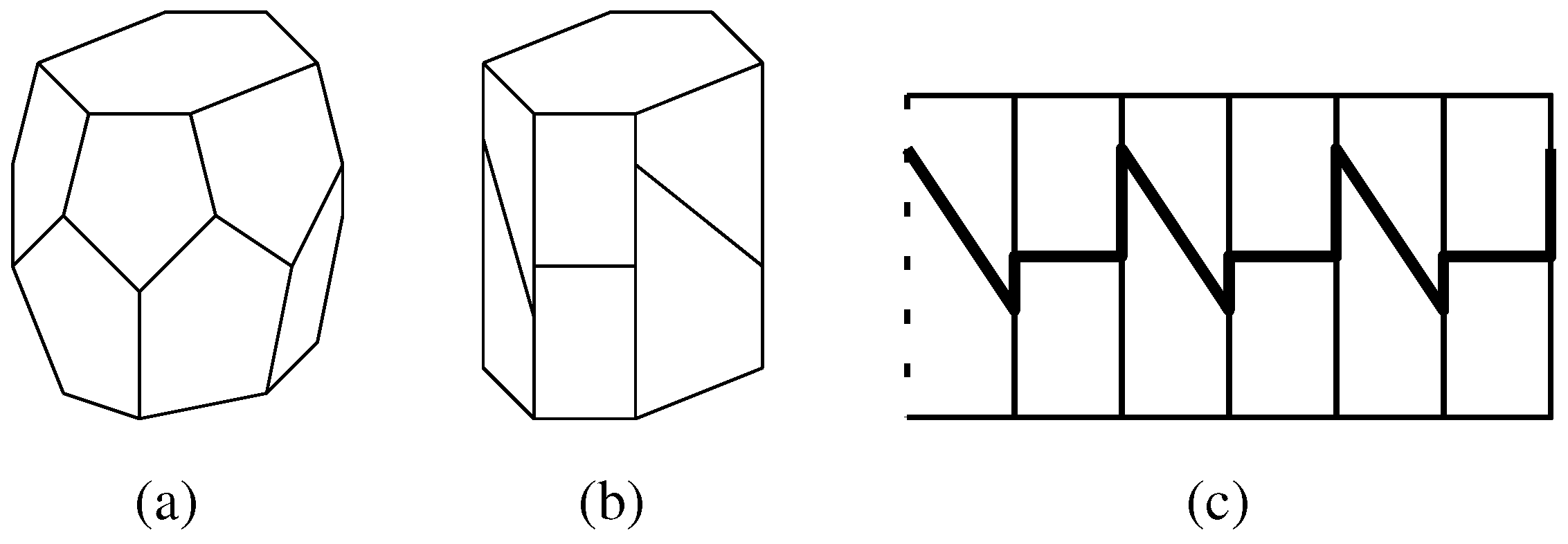
      <p>An <italic>n-gonal barrel</italic> is a simple polyhedron whose outer shell is easily constructed. Take two <italic>n</italic>-gons, surround each by a ring of <italic>n</italic> pentagons, then glue the two halves together at their respective boundaries. For example, a hexagonal barrel is shown in <xref ref-type="fig" rid="symmetry-04-00545-f001">Figure 1</xref>a, and a pentagonal barrel is a (not necessarily regular) pentagonal dodecahedron.</p>
      <p>This article deﬁnes and investigates structures in Euclidean 3-space which are closely related to both normal simple tilings by barrels and normal simple tilings in the plane. The deviation from classical tiling theory occurs when we introduce <italic>apeirobarrels</italic>, barrels over relatively tame apeirogons (inﬁnite simple polygons in 3-space), which are not tiles in the typical sense as they contain no physical volume. For this reason, we call our constructed objects <italic>barrel pseudotilings</italic>.</p>
      <p>Allowing inﬁnite regular polygons as faces, Grünbaum [<xref ref-type="bibr" rid="B1-symmetry-04-00545">1</xref>] discovered many new regular polyhedra in Euclidean 3-space besides the already well-known Platonic solids, planar tessellations, Kepler–Poinsot polyhedra, and Petrie–Coxeter polyhedra (see also [<xref ref-type="bibr" rid="B2-symmetry-04-00545">2</xref>]). The list of 47 regular polyhedra presented in [<xref ref-type="bibr" rid="B1-symmetry-04-00545">1</xref>] was just one polyhedron short of being complete, which was remedied by Dress ([<xref ref-type="bibr" rid="B3-symmetry-04-00545">3</xref>,<xref ref-type="bibr" rid="B4-symmetry-04-00545">4</xref>]) a few years later, who also proved the completeness of the list. Later, Leytem [<xref ref-type="bibr" rid="B5-symmetry-04-00545">5</xref>] found an alternative way to obtain the elusive 48th Grünbaum–Dress polyhedron.</p>
      <p>Over the last few decades, the development of the theory of abstract polytopes and their realizations provided a common framework for the investigation of regular and other polytopes. This generalization of polyhedra and polytopes to combinatorial objects seemed only natural after a long evolution of the terms <italic>polygon</italic> and <italic>polyhedron</italic>. While the Grünbaum–Dress polyhedra are regular (abstract) 3-polytopes, realized in 3-space, McMullen and Schulte [<xref ref-type="bibr" rid="B6-symmetry-04-00545">6</xref>] investigated faithful and discrete realizations of regular 4-polytopes in 3-space, in addition to providing a new proof of Dress’ completeness result. Their complete list encompasses 8 regular 4-apeirotopes (inﬁnite polytopes) in <inline-graphic xmlns:xlink="http://www.w3.org/1999/xlink" xlink:href="symmetry-04-00545-i001.tif"/>. The subject of abstract polytopes and their realizations has developed greatly since and is still evolving (see, e.g., [<xref ref-type="bibr" rid="B7-symmetry-04-00545">7</xref>,<xref ref-type="bibr" rid="B8-symmetry-04-00545">8</xref>]).</p>
      <p>After giving a ﬁrst example of a barrel pseudotiling in <xref ref-type="sec" rid="sec2-symmetry-04-00545">Section 2</xref>, we review the terminology in <xref ref-type="sec" rid="sec3-symmetry-04-00545">Section 3</xref>, and then proceed to <xref ref-type="sec" rid="sec4-symmetry-04-00545">Section 4</xref> for the proper deﬁnitions. We create each barrel pseudotiling from a normal, simple, plane tiling by convex <italic>polygons</italic>, by a process outlined in <xref ref-type="sec" rid="sec5-symmetry-04-00545">Section 5</xref>. After analyzing the properties of barrel pseudotilings in <xref ref-type="sec" rid="sec6-symmetry-04-00545">Section 6</xref>, we arrive at an equivalent deﬁnition for certain classes in the form of decorated plane triangulations (<xref ref-type="sec" rid="sec7-symmetry-04-00545">Section 7</xref>). More examples and some remarks follow in <xref ref-type="sec" rid="sec8-symmetry-04-00545">Section 8</xref> and <xref ref-type="sec" rid="sec9-symmetry-04-00545">Section 9</xref>.</p>
      <p>What makes the pseudotilings interesting, among other things, is that they are faithful realizations of certain abstract rank 4 polytopes (see <xref ref-type="sec" rid="sec3.4-symmetry-04-00545">Section 3.4</xref> and <xref ref-type="sec" rid="sec4-symmetry-04-00545">Section 4</xref>). For faces of rank 0, 1, and 2, we have vertices, edges, and <italic>planar</italic> ﬁnite faces, as well as non-planar apeirogons. The tiles (barrels) and apeirogonal pseudotiles (apeirogonal barrels) form the set of 3-faces (facets). These polytopes are simple, as well as both inﬁnite in all inner ranks and with (inﬁnitely many) inﬁnite rank 2 faces, but they can be realized faithfully in low-dimensional Euclidean 3-space with a translational symmetry in one direction. While realizations of <italic>regular</italic> and <italic>chiral</italic> abstract 4-polytopes in <inline-graphic xmlns:xlink="http://www.w3.org/1999/xlink" xlink:href="symmetry-04-00545-i001.tif"/> have received the most attention (e.g. [<xref ref-type="bibr" rid="B6-symmetry-04-00545">6</xref>,<xref ref-type="bibr" rid="B7-symmetry-04-00545">7</xref>], Section 7F of [<xref ref-type="bibr" rid="B8-symmetry-04-00545">8</xref>]), it still seems worthwhile to investigate other, less symmetrical, classes as well. The construction process connects the barrel pseudotilings to (partially) directed inﬁnite graphs stemming from triangulations, many of which are visually appealing. It may be worth exploring these connections in the future.</p>
      <p>As a note of caution to the reader, in deviating from the original usage in [<xref ref-type="bibr" rid="B1-symmetry-04-00545">1</xref>], the term <italic>apeirogon</italic> denotes in this paper <italic>any</italic> inﬁnite, simple polygon. The preﬁx <italic>apeir</italic>- is used to emphasize the presence of inﬁnite faces or inﬁnitely many faces of some kind (similar to the usage in [<xref ref-type="bibr" rid="B6-symmetry-04-00545">6</xref>,<xref ref-type="bibr" rid="B8-symmetry-04-00545">8</xref>]), however it is <italic>not</italic> used to denote regularity or even a particular symmetry.</p>
    </sec>
    <sec id="sec2-symmetry-04-00545">
      <title>2. A First Example</title>
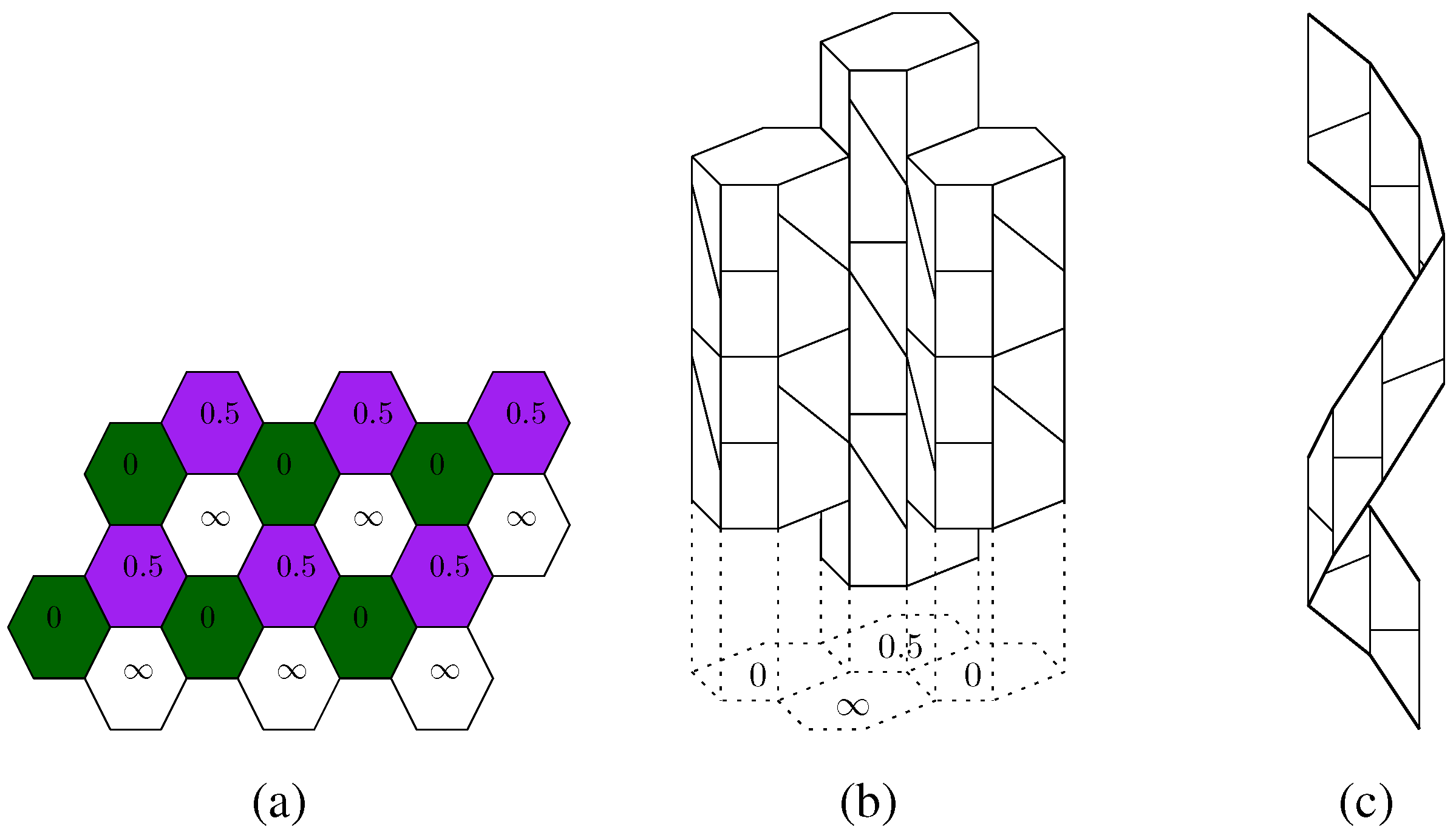
      <p>Start with the regular hexagonal tiling (6<sup>3</sup>) of the plane. Color the tiles in the tiling properly (<italic>i.e.</italic>, such that no two adjacent tiles have the same color) with three colors, see <xref ref-type="fig" rid="symmetry-04-00545-f002">Figure 2</xref>a. For reasons that will soon become clear, the color labels have been chosen from the set {0, 0.5, ∞}. Consider a hexagonal barrel stemming from a hexagonal <italic>right </italic>prism of height 1, such as in <xref ref-type="fig" rid="symmetry-04-00545-f001">Figure 1</xref>b, with the prism’s mantle altered as shown “unwrapped” in <xref ref-type="fig" rid="symmetry-04-00545-f001">Figure 1</xref>c. We can construct an inﬁnite stack of pairwise congruent hexagonal barrels of this kind whose common faces are hexagons. Call this object in space a hex-stack. Now, consider our planar hexagonal tiling as situated on a horizontal plane in Euclidean 3-space. Each hexagon gives rise to a hexagonal column which extends indeﬁnitely in either direction perpendicular to the plane. The columns associated to colors 0 and 0.5 of our base tiling can be ﬁlled up with directly congruent hex-stacks. It is possible to do that in such a way that all the inclined (<italic>i.e.</italic>, neither horizontal nor vertical) edges in the barrels’ sides face a column associated to color ∞. Then, in order to obtain a partial face-to-face tiling (see <xref ref-type="sec" rid="sec3-symmetry-04-00545">Section 3</xref> for terminology) of 3-space from all these hexagonal barrels, we have to match up the pentagons which, as points sets, appear as rectangles. For this we shift the columns over hexagonal tiles with color 0.5 vertically by half a step relative to those over hexagonal tiles with color 0 (see <xref ref-type="fig" rid="symmetry-04-00545-f002">Figure 2</xref>b), which explains the choice of labels. Note that the planar tiling (6<sup>3</sup>) functions merely as a guide in the construction of the columns. The plane in which (6<sup>3</sup>) is situated serves as a reference plane for applying shifts when positioning adjacent barrel-ﬁlled columns relative to each other in order to match the pentagons.</p>
      <fig id="symmetry-04-00545-f001" position="anchor">
        <label>Figure 1</label>
        <caption>
          <p>(<bold>a</bold>) A hexagonal barrel; (<bold>b</bold>) A hexagonal barrel stemming from an hexagonal <italic>right </italic>prism; (<bold>c</bold>) The mantle of a hexagonal barrel stemming from an hexagonal <italic>right </italic>prism.</p>
        </caption>
        <graphic xmlns:xlink="http://www.w3.org/1999/xlink" xlink:href="symmetry-04-00545-g001.tif"/>
      </fig>
      <fig id="symmetry-04-00545-f002" position="anchor">
        <label>Figure 2</label>
        <caption>
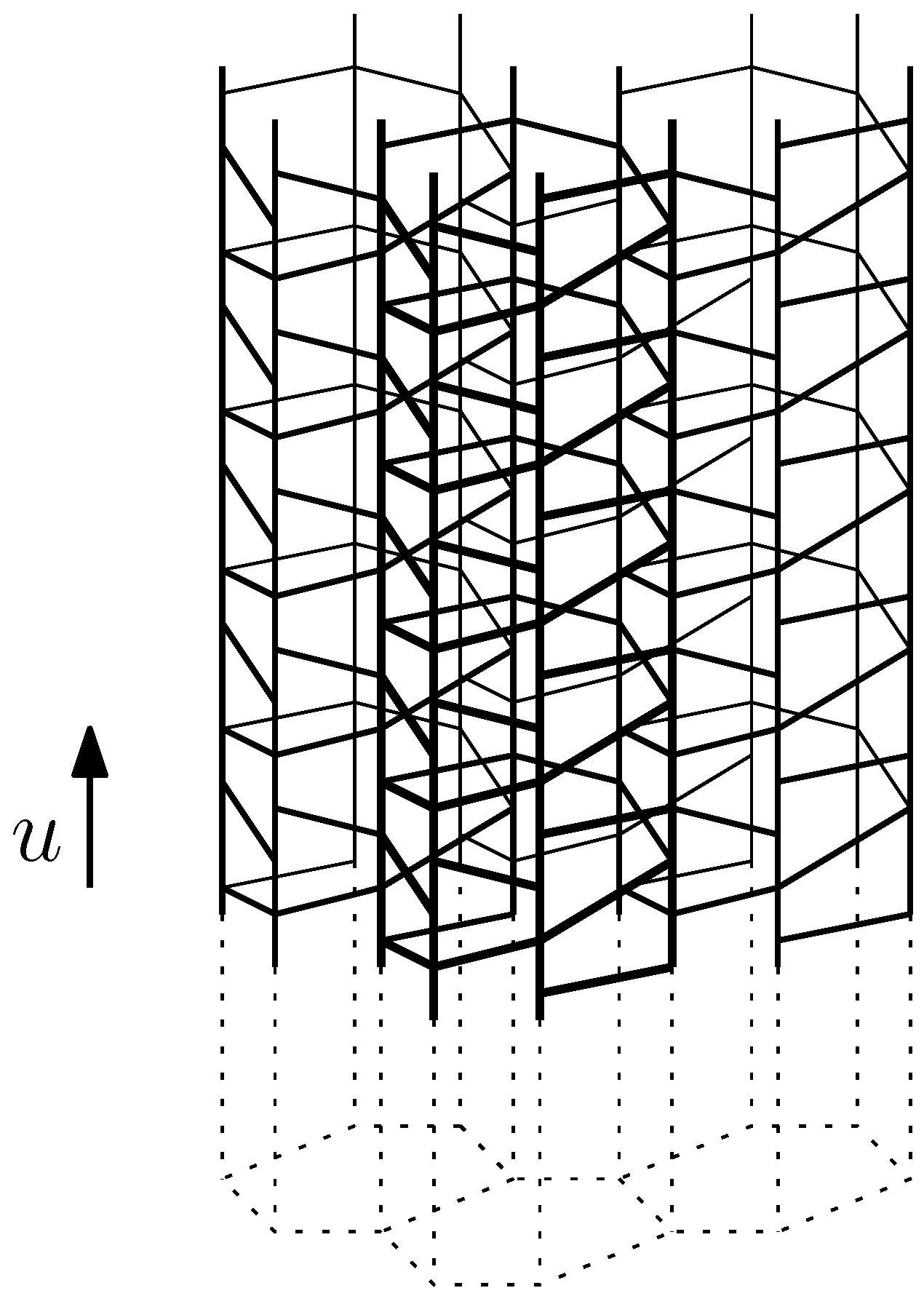
          <p>(<bold>a</bold>) A proper 3-coloring of (6<sup>3</sup>); (<bold>b</bold>) Part of the constructed barrel pseudotiling. Note the emerging face structure of the column associated to color ∞, particularly the apeirogons (spirals); (<bold>c</bold>) Part of a single apeirobarrel.</p>
        </caption>
        <graphic xmlns:xlink="http://www.w3.org/1999/xlink" xlink:href="symmetry-04-00545-g002.tif"/>
      </fig>
      <p>The remaining part of 3-space separates into inﬁnite columns associated to tiles of color ∞. Let these columns inherit the boundary structure from the hexagonal barrels in adjacent columns. As a result, the boundary of each column colored ∞ falls apart into three “intertwined” or “stacked” apeirobarrels (see <xref ref-type="fig" rid="symmetry-04-00545-f002">Figure 2</xref>b,c), where an <italic>apeirobarrel</italic> is deﬁned as two parallel apeirogons joined by two inﬁnite “rings” of pentagons. Even though no physical volume is occupied by these <italic>pseudotiles</italic>, the last set of columns can now also be regarded as “tiled”, preserving the face-to-face property and simplicity. Another way to say this is that apeirobarrels can be stacked so that the union of their mantles covers the mantle of an inﬁnite prismatic column completely without overlaps, which is consistent with the way ﬁnite barrels stack. This can be done in a left-handed and a right-handed version in the obvious way.</p>
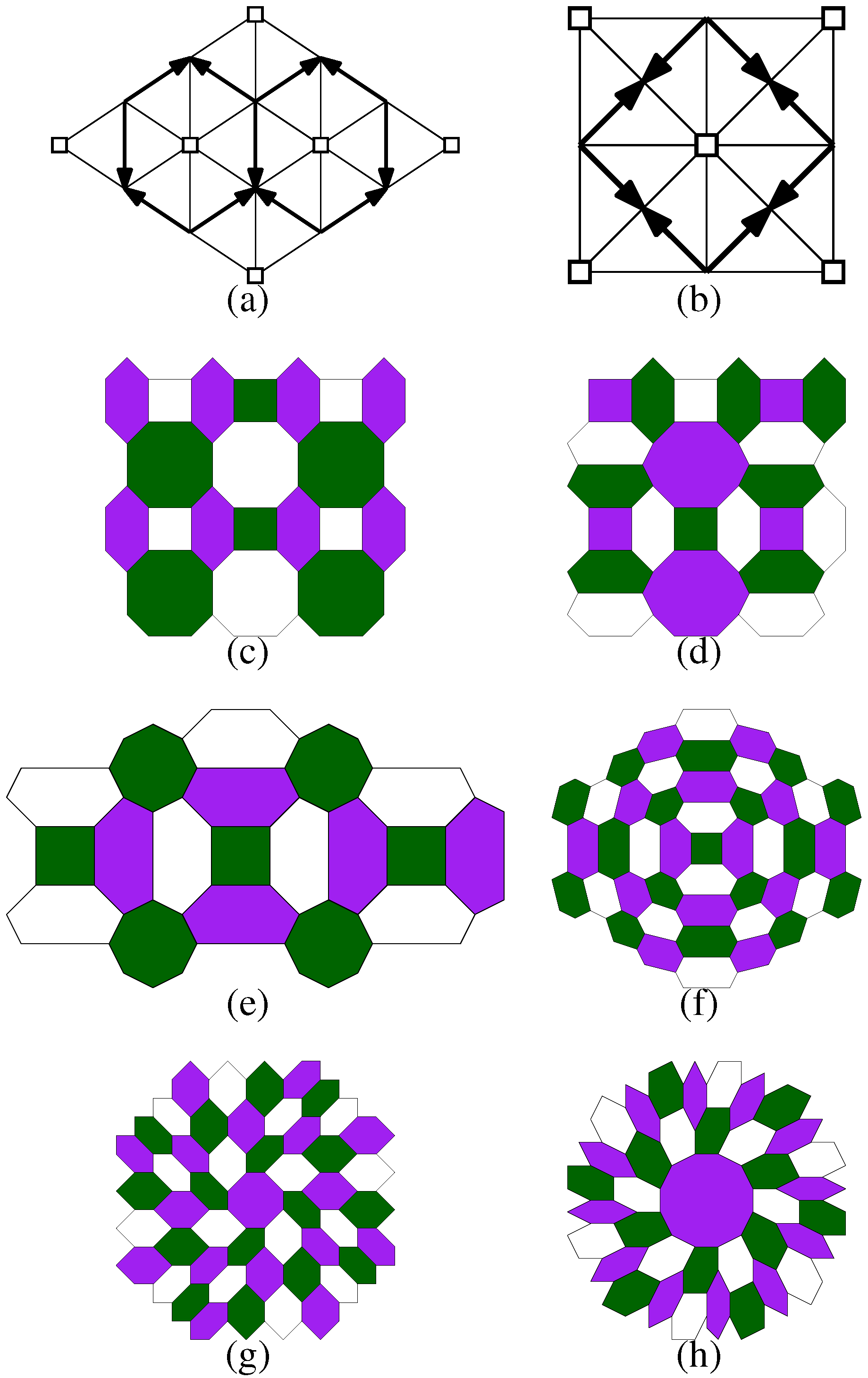
      <p>Moreover, a similar construction is possible for several other plane tilings, including the uniform tilings (4.6.12) and (4.8<sup>2</sup>), in which the regular convex polygons surrounding each vertex have four, six, and twelve, respectively four, eight, and eight vertices. Naturally, the question comes up which kinds of <italic>barrel pseudotilings </italic>arise this way. This is explored in this article.</p>
      <p>Related kinds of tiling-like structures with apeirogons, but in the Euclidean plane instead of 3-space, have been investigated by Grünbaum, Miller, and Shephard in [<xref ref-type="bibr" rid="B9-symmetry-04-00545">9</xref>]. The similarity with the structures considered in this article is perhaps greatest in some of the planar structures (called strip tilings) depicted in <xref ref-type="fig" rid="symmetry-04-00545-f006">Figure 6</xref> of [<xref ref-type="bibr" rid="B9-symmetry-04-00545">9</xref>].</p>
    </sec>
    <sec id="sec3-symmetry-04-00545">
      <title>3. Basic Notions</title>
      <p>In order to keep the exposition as self-contained as possible, we will now review basic notions from several areas of relevance.</p>
      <sec>
        <title>3.1. Tilings and Barrel Polyhedra</title>
        <p>A <italic>tiling </italic>of Euclidean <italic>d</italic>-space <inline-graphic xmlns:xlink="http://www.w3.org/1999/xlink" xlink:href="symmetry-04-00545-i002.tif"/> is a locally ﬁnite, countable collection of closed topological cells (<italic>tiles</italic>), which satisfy the following three conditions. First, each tile is a <italic>topological d</italic>-polytope, a homeomorphic image of a convex <italic>d</italic>-polytope. Second, the union of all tiles is <inline-graphic xmlns:xlink="http://www.w3.org/1999/xlink" xlink:href="symmetry-04-00545-i002.tif"/>. Third, the intersection of any two distinct tiles is either empty or a proper face of each; in particular, if this intersection is a <italic>k</italic>-face of each tile, then it is a <italic>k-face </italic>of the tiling. In other places in the literature, such a tiling may be called <italic>face-to-face </italic>(compare [<xref ref-type="bibr" rid="B10-symmetry-04-00545">10</xref>,<xref ref-type="bibr" rid="B11-symmetry-04-00545">11</xref>]). A <italic>normal </italic>tiling is a tiling in which the tiles are uniformly bounded in size (<italic>i.e.</italic>, each tile contains a <italic>d</italic>-ball of some small radius, and is contained in a <italic>d</italic>-ball of some larger radius). A tiling of <inline-graphic xmlns:xlink="http://www.w3.org/1999/xlink" xlink:href="symmetry-04-00545-i002.tif"/> is <italic>simple </italic>if all vertices are (<italic>d</italic> + 1)-valent. However, this latter notion is only applicable when “vertices” and “edges” are well-deﬁned, such as in the context of plane tilings or face-to-face tilings (for any <italic>d</italic>). The face poset of a (face-to-face) tiling, when amended by a unique largest and a unique smallest (empty) face, can be interpreted as an abstract polytope, see <xref ref-type="sec" rid="sec3.4-symmetry-04-00545">Section 3.4</xref>.</p>
        <p>A <italic>barrel over a topological n-gon </italic>is a simple topological 3-polytope with two disjoint distinguished <italic>n</italic>-gonal 2-faces, such that all other 2-faces are pentagonal and adjacent to exactly one of the distinguished faces. Thus, the distinguished faces—also called <italic>top </italic>and <italic>bottom </italic>(<italic>base</italic>) of the barrel—have <italic>n</italic> pentagonal adjacents each, giving a total of 2<italic>n</italic> pentagonal faces (if <italic>n</italic> = 5, all 12 = 2<italic>n</italic> + 2 faces are pentagons). In short, the sides of the barrel are formed by two rings of pentagons. In an extreme case, such a barrel can be obtained (but not as a convex polytope in the strict sense!) from an <italic>n</italic>-gonal right prism by partitioning the rectangles in the prism’s mantle accordingly (as indicated in <xref ref-type="fig" rid="symmetry-04-00545-f001">Figure 1</xref>b). In this article, we will explicitly allow faces in polytopes to be coplanar, even when they are adjacent.</p>
      </sec>
      <sec>
        <title>3.2. Plane Graphs</title>
        <p>All graphs considered in this paper will be <italic>simple</italic>, which means that no multiple edges or loops occur, but they will not necessarily be ﬁnite. In fact, most graphs we encounter will be inﬁnite.</p>
        <p>Let <italic>G</italic> = (<italic>V</italic>, <italic>E</italic>) be such a (simple) graph. A <italic>dominating set </italic>(compare [<xref ref-type="bibr" rid="B12-symmetry-04-00545">12</xref>]) is a subset of vertices <italic>V</italic>′⊆ <italic>V</italic>, such that each vertex <italic>v</italic> ∈ <italic>V</italic> is either in <italic>V</italic>′ itself, or adjacent (via an edge) to a vertex in <italic>V</italic>′, or both. By contrast, a subset <italic>V</italic>′ ⊆ <italic>V</italic> is <italic>independent </italic>if no two distinct vertices <italic>v</italic>, <italic>w</italic> of <italic>V</italic>′are adjacent in <italic>G</italic>. A <italic>maximal independent set </italic>is an independent set <italic>V</italic>′ of vertices with the property that there is no independent superset (<italic>V</italic>′ cannot be enlarged without becoming dependent, <italic>i.e.</italic>, without introducing a pair of distinct adjacent vertices). As such, maximal independent sets are equivalent to dominating independent sets ([<xref ref-type="bibr" rid="B12-symmetry-04-00545">12</xref>], p. 117, the result for ﬁnite graphs can be extended to inﬁnite graphs).</p>
      </sec>
      <sec>
        <title>3.3. Simplicial Complexes</title>
        <p>A <italic>(geometric) simplicial complex </italic>Δ, in the classical sense, is a collection of geometric <italic>simplices</italic> (the convex hull of (<italic>d</italic> + 1) afﬁnely independent points, where <italic>d</italic> denotes the dimension of the simplex) in some Euclidean space, with the following two properties. Faces of simplices in Δ are again in Δ, and the intersection of any two simplices from Δ is a face of each (and therefore in Δ). If Δ is not an empty collection, then these properties imply that it contains at least the empty face (as a (−1)-dimensional simplex). As usual, and compatible with the notions from graph theory or tiling theory, the zero-dimensional (one-dimensional, two-dimensional) simplices are called <italic>vertices </italic>(<italic>edges</italic>, <italic>triangles</italic>).</p>
        <p>The (open) star of a vertex <italic>v</italic>, <italic>St</italic><sub>Δ</sub>(<italic>v</italic>), is the collection of all simplices incident to <italic>v</italic>. By contrast, the <italic>simplicial neighborhood</italic>, or <italic>closed star</italic>, denoted <italic>Nb</italic><sub>Δ</sub>(<italic>v</italic>), is deﬁned as the collection consisting of all simplices incident to <italic>v</italic> (<italic>i.e.</italic>, containing <italic>v</italic> as a face), and all their (simplicial) faces. Therefore, the simplicial neighborhood is a simplicial complex. The <italic>link </italic>of a vertex <italic>v</italic> in Δ, denoted <italic>Lk</italic><sub>Δ</sub>(<italic>v</italic>), is deﬁned as <italic>Lk</italic><sub>Δ</sub>(<italic>v</italic>) := <italic>Nb</italic><sub>Δ</sub>(<italic>v</italic>) \ <italic>St</italic><sub>Δ</sub>(<italic>v</italic>). (For further reference, see also [<xref ref-type="bibr" rid="B13-symmetry-04-00545">13</xref>], pp. 31–42.)</p>
        <p>For the purpose of this article, we will use the term <italic>geometric simplicial complex </italic>even when the simplices are only homeomorphic images of the standard simplex in the appropriate dimension, as long as all other properties are retained. For example, a (topological) triangulation of the plane is a two-dimensional geometric simplicial complex.</p>
        <p>The <italic>k-skeleton </italic>of a simplicial complex ignores all faces of dimension greater than <italic>k</italic>, and is, in fact, a simplicial complex. We will use the notation <italic>G</italic>(Δ) to refer to the 1-skeleton, or induced <italic>edge graph</italic>, of a simplicial complex Δ.</p>
      </sec>
      <sec id="sec3.4-symmetry-04-00545">
        <title>3.4. Abstract Polytopes</title>
        <p>We will only need some very basic ideas about abstract polytopes, which are combinatorial objects generalizing the previously existing notions of (convex or non-convex) polyhedra and polytopes. For a thorough discussion of abstract polytopes it is recommended to consult the standard reference by McMullen and Schulte [<xref ref-type="bibr" rid="B8-symmetry-04-00545">8</xref>]. Brieﬂy, an <italic>abstract </italic>n<italic>-polytope</italic> <inline-graphic xmlns:xlink="http://www.w3.org/1999/xlink" xlink:href="symmetry-04-00545-i019.tif"/> is a certain kind of graded poset of <italic>faces </italic>(including a unique smallest face of rank −1, and a unique largest face of rank <italic>n</italic>), with the partial order being <italic>incidence</italic>. The rank of a face corresponds to the notion of <italic>dimension </italic>for traditional polytopes (such as the convex polytopes), and so the traditional terms <italic>vertex </italic>and <italic>edge </italic>are used for the rank 0 and rank 1 faces, respectively. The poset <inline-graphic xmlns:xlink="http://www.w3.org/1999/xlink" xlink:href="symmetry-04-00545-i019.tif"/> needs to satisfy the following two additional combinatorial properties taken from standard polytopes. First, <inline-graphic xmlns:xlink="http://www.w3.org/1999/xlink" xlink:href="symmetry-04-00545-i019.tif"/> is <italic>strongly ﬂag-connected</italic>, and second, if two incident faces <italic>F</italic> &lt; <italic>G</italic> are exactly <italic>two </italic>ranks apart, then there exist precisely <italic>two </italic>faces <italic>H</italic> such that <italic>F</italic> &lt; <italic>H</italic> &lt; <italic>G</italic> (compare the deﬁnitions in [<xref ref-type="bibr" rid="B8-symmetry-04-00545">8</xref>], pp. 22–25).</p>
        <p>In order to understand the ﬁrst condition, we need to know that a <italic>section </italic>of <inline-graphic xmlns:xlink="http://www.w3.org/1999/xlink" xlink:href="symmetry-04-00545-i019.tif"/> is a graded poset deﬁned for any two incident faces <italic>F</italic> ≤ <italic>G</italic> as {<italic>H</italic> ∈ <italic>P</italic>|<italic>F</italic> ≤ <italic>H</italic> ≤ <italic>G</italic>}, again with incidence as partial order. A <italic>ﬂag</italic> is a maximal chain in a poset, and for graded posets of ﬁnite rank all ﬂags have the same length (for example, all ﬂags in <inline-graphic xmlns:xlink="http://www.w3.org/1999/xlink" xlink:href="symmetry-04-00545-i019.tif"/> have length <italic>n</italic> + 2). <inline-graphic xmlns:xlink="http://www.w3.org/1999/xlink" xlink:href="symmetry-04-00545-i019.tif"/> is said to be <italic>strongly ﬂag-connected </italic>if each section of <inline-graphic xmlns:xlink="http://www.w3.org/1999/xlink" xlink:href="symmetry-04-00545-i019.tif"/> (including <inline-graphic xmlns:xlink="http://www.w3.org/1999/xlink" xlink:href="symmetry-04-00545-i019.tif"/> itself) is <italic>ﬂag-connected</italic>, that is, if each ﬂag can be joined to any other ﬂag (within the same section) via a sequence of ﬂags, changing only one element (face) in the ﬂag at a time.</p>
        <p>The second condition is commonly called the <italic>diamond condition</italic>, as <italic>F</italic>, <italic>G</italic>, and the two faces <italic>H</italic> in between form the shape of a diamond in the Hasse diagram <inline-graphic xmlns:xlink="http://www.w3.org/1999/xlink" xlink:href="symmetry-04-00545-i019.tif"/>. For example, in an abstract 4-polytope (which is the kind of polytope that we will encounter in this article), the diamond condition stipulates the following:</p>
        <list>
          <list-item>
            <p>(1) Each edge is incident to precisely two vertices;</p>
          </list-item>
          <list-item>
            <p>(2) For each 2-face and each of its incident vertices, there are precisely two edges which are incident with both the 2-face and the vertex;</p>
          </list-item>
          <list-item>
            <p>(3) For each 3-face (<italic>facet</italic>) and each of its incident edges, there are precisely two 2-faces incident with both;</p>
          </list-item>
          <list-item>
            <p>(4) There are precisely two facets incident with each 2-face.</p>
          </list-item>
        </list>
        <p>A <italic>faithful realization </italic>of an abstract polytope <inline-graphic xmlns:xlink="http://www.w3.org/1999/xlink" xlink:href="symmetry-04-00545-i019.tif"/> is an injective mapping of its vertices into a suitable Euclidean space, along with a suitable interpretation of its combinatorial structure in the geometric setting. When considering realizations of abstract <italic>regular </italic>polytopes (see [<xref ref-type="bibr" rid="B6-symmetry-04-00545">6</xref>,<xref ref-type="bibr" rid="B7-symmetry-04-00545">7</xref>,<xref ref-type="bibr" rid="B8-symmetry-04-00545">8</xref>], Section 7F), one usually requires that the symmetry is retained, <italic>i.e.</italic>, that the ﬂag-transitive automorphism group of the abstract polytope carries over to a group of isometries which acts transitively on the ﬂags of the realization. In this paper, however, we drop this requirement in order to obtain more realizations. To give an example of a realization of a 4-polytope that is not necessarily regular, any face-to-face, normal tiling of <inline-graphic xmlns:xlink="http://www.w3.org/1999/xlink" xlink:href="symmetry-04-00545-i001.tif"/> is a realization of a so-called abstract 4<italic>-apeirotope </italic>(polytope containing either inﬁnitely many ﬁnite faces, or inﬁnite faces, or both).</p>
      </sec>
    </sec>
    <sec id="sec4-symmetry-04-00545">
      <title>4. Deﬁnition of Barrel Pseudotilings</title>
      <p>This section is devoted to the proper, but rather technical, deﬁnition of a <italic>barrel pseudotiling</italic>. All the barrels in the considered pseudotilings stem from (right) prisms in one form or another, so we begin by explaining the concept of a <italic>stack of apeiroprisms</italic>.</p>
      <p><bold>Deﬁnition 4.1.</bold> <italic>Let D be a plane polygonal disc in a horizontal plane of <inline-graphic xmlns:xlink="http://www.w3.org/1999/xlink" xlink:href="symmetry-04-00545-i001.tif"/> with unit normal vector u = (0, 0, 1). A</italic> <sc>STACK OF APEIROPRISMS</sc>, <italic>or an</italic> ∞-<sc>PRISM STACK</sc>, Φ <italic>associated with D, is a doubly inﬁnite right prism, or cylinder, Z = D + <inline-graphic xmlns:xlink="http://www.w3.org/1999/xlink" xlink:href="symmetry-04-00545-i003.tif"/> together with a family <inline-graphic xmlns:xlink="http://www.w3.org/1999/xlink" xlink:href="symmetry-04-00545-i020.tif"/> = {A<sub>0</sub>,...,A<sub>k−1</sub>} of k &gt; 1 mutually non-intersecting apeirogons in ∂Z = ∂D + <inline-graphic xmlns:xlink="http://www.w3.org/1999/xlink" xlink:href="symmetry-04-00545-i003.tif"/> (the mantle of the cylinder) with the following properties: </italic></p>
      <list>
        <list-item>
          <p><italic>(1) <inline-graphic xmlns:xlink="http://www.w3.org/1999/xlink" xlink:href="symmetry-04-00545-i020.tif"/> is strictly monotone in the direction of u, meaning that every section of Z by a plane parallel to </italic>aﬀ(D) <italic>meets every apeirogon in <inline-graphic xmlns:xlink="http://www.w3.org/1999/xlink" xlink:href="symmetry-04-00545-i020.tif"/> in exactly one point;</italic> </p>
        </list-item>
        <list-item>
          <p><italic>(2) Any two adjacent edges of an apeirogon in <inline-graphic xmlns:xlink="http://www.w3.org/1999/xlink" xlink:href="symmetry-04-00545-i020.tif"/> lie in adjacent bounding walls of Z. Thus, each apeirogon A in <inline-graphic xmlns:xlink="http://www.w3.org/1999/xlink" xlink:href="symmetry-04-00545-i020.tif"/> spirals around Z, in both directions, such that its vertices lie above the vertices of D;</italic> </p>
        </list-item>
        <list-item>
          <p><italic>(3) For each i</italic> = 0,...,<italic>k</italic> − 1 <italic>and each x in A<sub>i</sub>, we have x + ru ∈ A<sub>l</sub> for some l if and only if r ∈ <inline-graphic xmlns:xlink="http://www.w3.org/1999/xlink" xlink:href="symmetry-04-00545-i004.tif"/>; and in particular, x + ju ∈ A<sub>i+j</sub> for each j ∈ <inline-graphic xmlns:xlink="http://www.w3.org/1999/xlink" xlink:href="symmetry-04-00545-i004.tif"/>, with subscripts taken modulo k. (Thus, more informally, the points directly above x on apeirogons occur at integer distances from x, with the apeirogons repeating periodically modulo ku.)</italic> </p>
        </list-item>
      </list>
      <p>Any <italic>A<sub>i</sub></italic> + [0, 1]<italic>u</italic> (for <italic>i</italic> = 0, 1,...,<italic>k</italic> − 1) is the mantle of a single <italic>apeiroprism</italic> in a faithful realization (the apeiroprism itself, however, is an abstract polytope whose face poset contains all faces of the mantle, <italic>i.e.</italic>, the parallelograms and their faces, as well as the apeirogons <italic>A<sub>i</sub></italic> and <italic>A<sub>i+1</sub></italic>, and a unique three-dimensional largest face). Subsequently, each apeiroprism gives rise to an <italic>apeirobarrel</italic> via a subdivision of the mantle parallelograms into pentagons.</p>
      <p><bold>Deﬁnition 4.2.</bold> <italic>A </italic><sc>STACK OF APEIROBARRELS</sc><italic>, or an ∞-</italic><sc>STACK</sc><italic>, </italic>Ω<italic>, is a stack of apeiroprisms as in Deﬁnition 4.1, together with a partition of its mantle into (topological) pentagon faces obtained in the following way. All edges of the apeirogons in <inline-graphic xmlns:xlink="http://www.w3.org/1999/xlink" xlink:href="symmetry-04-00545-i020.tif"/> are retained as edges of pentagons; each vertical edge (parallel to u) of the mantle is split into three edges by two new vertices, called </italic><sc>PARTITION VERTICES</sc><italic>, in its relative interior; and each parallelogram on the mantle A<sub>i</sub> </italic> + [0, 1]<italic>u of an apeiroprism (for i </italic>= 0, 1,...,<italic>k</italic> − 1<italic>) is subdivided into two coplanar pentagon faces by a new edge that connects a pair of new vertices on opposite vertical edges of the parallelogram. These new edges are called </italic><sc>PARTITION EDGES</sc><italic>.</italic></p>
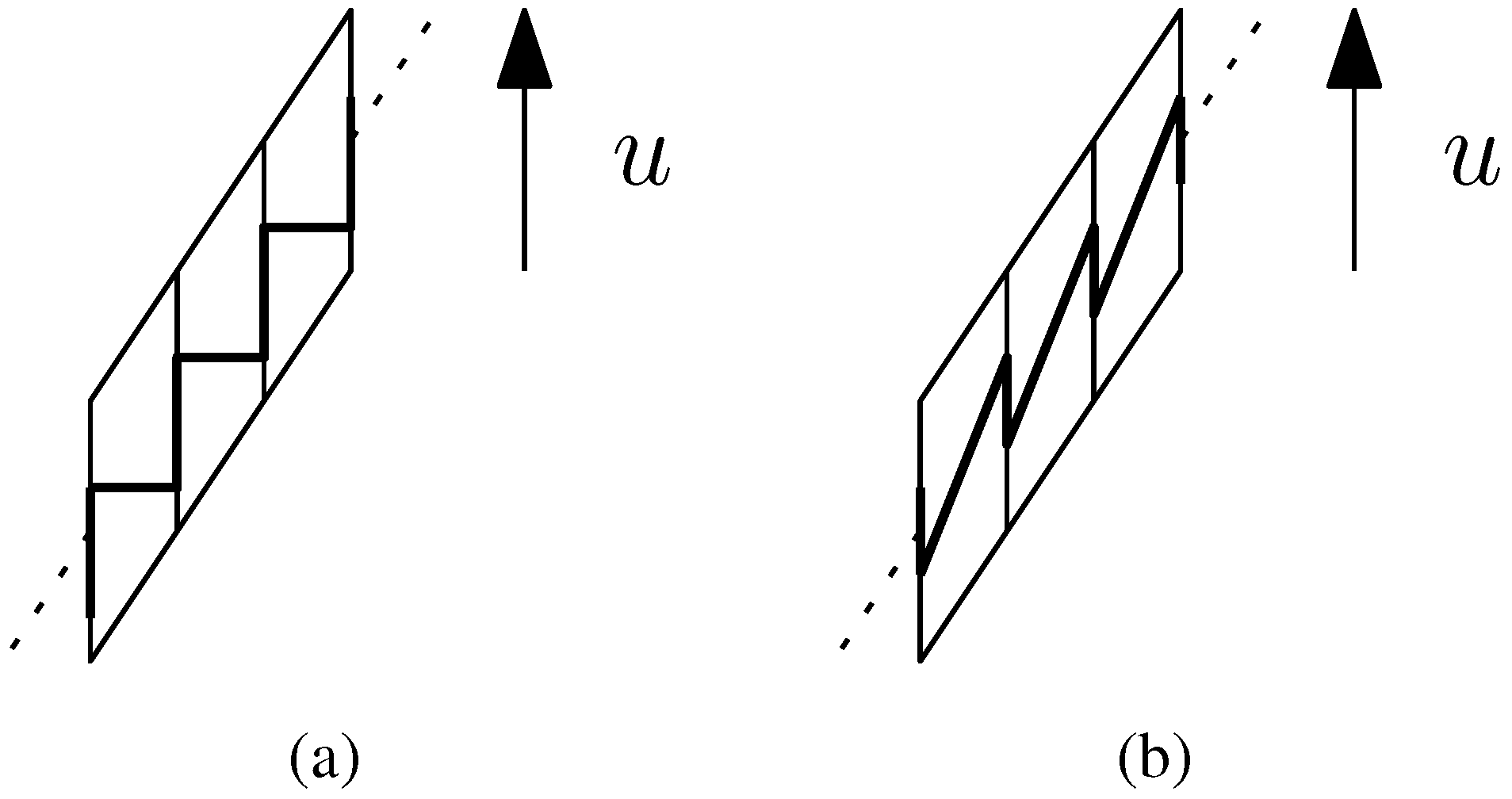
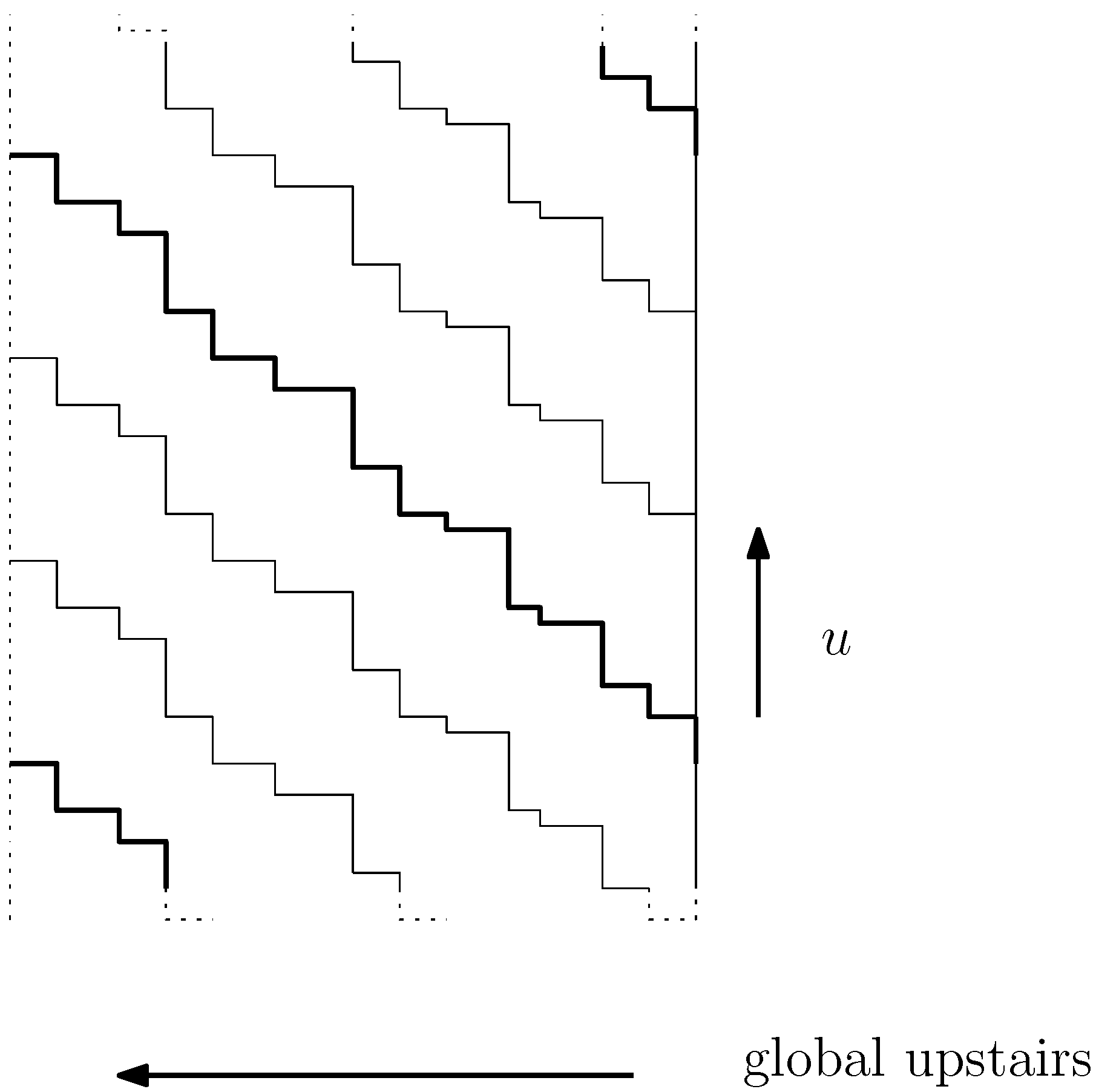
      <p>A <italic>staircase </italic>is any inﬁnite polygon in the mantle of Ω whose successive edges consist alternately of partition edges and vertical edges, such that all traversed vertices are partition vertices (see <xref ref-type="fig" rid="symmetry-04-00545-f003">Figure 3</xref>a for an example). Intuitively, the partition edges and vertical edges in these mathematical staircases correspond to the treads and risers of ordinary staircases. Note that staircases do not cross the apeirogonal bases of apeiroprisms (which, in extending the analogy, would take the role of stringers). The <italic>winding orientation </italic>of an ∞-stack is the orientation (clockwise or counterclockwise) in which the apeirogonal bases wind upwards (<italic>i.e.</italic>, in the direction of <italic>u</italic> = (0, 0, 1)) and is already prescribed by the apeirogons in Φ.</p>
      <p><bold>Deﬁnition 4.3.</bold> <italic>Let B be a ﬁnite barrel stemming from an n-gonal right prism of height </italic>1<italic> whose polygonal disc base D is in a horizontal plane with unit normal vector u </italic>= (0, 0, 1)<italic>. Call the added vertices in the vertical edges of the prism </italic><sc>PARTITION VERTICES</sc><italic>, and the added non-vertical edges separating a rectangle into pentagons </italic><sc>PARTITION EDGES</sc><italic>. Then, in this ﬁnite case, a </italic><sc>STAIRCASE</sc><italic> is a simple closed polygon consisting of edges of the barrel and passing only through partition vertices. A </italic><sc>STACK OF </sc><italic>n-</italic><sc>GONAL BARRELS </sc><italic>or n-</italic><sc>STACK</sc><italic>, </italic>Ω<italic>, is the set of barrels </italic>{<italic>B</italic> + <italic>lu</italic> | <italic>l</italic> ∈<inline-graphic xmlns:xlink="http://www.w3.org/1999/xlink" xlink:href="symmetry-04-00545-i004.tif"/>}, <italic>whose union ﬁlls the doubly inﬁnite right prism (cylinder) Z = D + <inline-graphic xmlns:xlink="http://www.w3.org/1999/xlink" xlink:href="symmetry-04-00545-i003.tif"/>. A </italic><sc>FINITE STACK </sc><italic>is an n-stack for some ﬁnite n. </italic></p>
      <p>Thus, every barrel in a ﬁnite stack has an “impossible staircase” (familiar, e.g., from Dutch artist </p>
      <p>M.C. Escher’s print <italic>Ascending and Descending </italic>from 1960, see [<xref ref-type="bibr" rid="B14-symmetry-04-00545">14</xref>], p. 146): Partition edges (treads) and vertical edges linking partition edges (risers) close up to give a ﬁnite, non-planar polygon.</p>
      <p><bold>Deﬁnition 4.4.</bold> <italic>A </italic><sc>BARREL PSEUDOTILING </sc><italic><inline-graphic xmlns:xlink="http://www.w3.org/1999/xlink" xlink:href="symmetry-04-00545-i005.tif"/> is a countable collection of vertical ∞-stacks and vertical ﬁnite stacks with the following two properties. First, the underlying family of doubly inﬁnite prisms (cyclinders) gives a locally ﬁnite tiling of <inline-graphic xmlns:xlink="http://www.w3.org/1999/xlink" xlink:href="symmetry-04-00545-i001.tif"/> which, when cut by a horizontal plane, determines a locally ﬁnite, simple, face-to-face tiling in this plane. Second, any two barrels associated to distinct stacks in <inline-graphic xmlns:xlink="http://www.w3.org/1999/xlink" xlink:href="symmetry-04-00545-i005.tif"/> intersect, if at all, in a common ﬁnite face (vertex, edge, or pentagon). Note that the construction of the stacks implies that distinct barrels in the same ﬁnite stack also intersect either in a common face (ﬁnite polygon), or not at all.</italic></p>
      <p>Observe that translation by <italic>u</italic> is a built-in symmetry of the pseudotiling <inline-graphic xmlns:xlink="http://www.w3.org/1999/xlink" xlink:href="symmetry-04-00545-i005.tif"/>. The ﬁnite barrels by themselves form a tessellation of a noncompact 3-manifold with inﬁnitely many boundary components. In a way, the boundary components get sewn together by the stacks of apeirobarrels.</p>
      <p>Combinatorially, the faces of the constructed object, together with a unique largest face of rank 4 and a unique smallest (empty) face of rank −1, form a graded poset as required for an abstract 4-polytope. The faces of rank 0 are the vertices, the faces of rank 1 are the edges of the pseudotiling, the faces of rank 2 are the planar polygons and non-planar apeirogons, and the faces of rank 3 are the tiles (barrels) and pseudotiles (apeirobarrels). There are inﬁnitely many faces of each of these kinds. Additionally, we have <italic>inﬁnite</italic> 2-faces, the bases of the apeirobarrels (<italic>i.e.</italic>, the apeirogons). Strong ﬂag-connectedness is easily veriﬁed. The diamond condition holds because the criteria for a 4-polytope as listed in<xref ref-type="sec" rid="sec3.4-symmetry-04-00545">Section 3.4</xref> are fulﬁlled. In particular, each 2-face is incident to precisely two 3-faces; it is here where the condition of <italic>k</italic> &gt; 1 apeirogons (and thus <italic>k</italic> &gt; 1 apeirobarrels) per ∞-stack is required. Thus, the abstract polytope underlying <inline-graphic xmlns:xlink="http://www.w3.org/1999/xlink" xlink:href="symmetry-04-00545-i005.tif"/> is a (non-regular) 4-apeirotope.</p>
      <p>This 4-apeirotope is realized faithfully in Euclidean 3-space, such that all ﬁnite faces lie in an afﬁne subspace of the appropriate dimension and coincide with the convex hull of their vertices (straight edges, plane polygons, ﬁnite barrels stemming from right prisms). The size of the ﬁnite barrels is uniformly bounded, so a property very close to normality is retained. All vertices are 4-valent, so, in many ways, barrel pseudotilings are similar to simple normal tilings of 3-space.</p>
      <p>We conclude this section with a note on the face-to-face property.</p>
      <p><bold>Remark 4.1.</bold> <inline-graphic xmlns:xlink="http://www.w3.org/1999/xlink" xlink:href="symmetry-04-00545-i005.tif"/> <italic>is </italic><sc>FACE-TO-FACE</sc><italic>, in the sense that any two distinct barrels (ﬁnite or inﬁnite) intersect, if at all, in a common face, precisely when each ∞-stack consists of at least three apeirobarrels.</italic></p>
    </sec>
    <sec id="sec5-symmetry-04-00545">
      <title>5. Outline of the Construction</title>
      <p>A rough outline of constructing a pseudotiling by polygonal barrels and ∞-barrels is provided by the following ﬁve steps.</p>
      <p>First of all, select a plane, simple, normal tiling <inline-graphic xmlns:xlink="http://www.w3.org/1999/xlink" xlink:href="symmetry-04-00545-i006.tif"/> by (convex, simple) polygons, situated in the horizontal plane through the origin of <inline-graphic xmlns:xlink="http://www.w3.org/1999/xlink" xlink:href="symmetry-04-00545-i001.tif"/>, where the unit normal vector <italic>u</italic> = (0, 0, 1) denotes the direction “up”. All plane tilings mentioned in this paper are assumed to be of this type (recall that our deﬁnition of tiling includes the face-to-face property). We call <inline-graphic xmlns:xlink="http://www.w3.org/1999/xlink" xlink:href="symmetry-04-00545-i006.tif"/> a <italic>base tiling</italic>. The faces of <inline-graphic xmlns:xlink="http://www.w3.org/1999/xlink" xlink:href="symmetry-04-00545-i006.tif"/> will not (or not necessarily) be used in the completed barrel pseudotiling; rather, its tiles serve as guides for the inﬁnite columns in <inline-graphic xmlns:xlink="http://www.w3.org/1999/xlink" xlink:href="symmetry-04-00545-i001.tif"/> which will extend in the directions ±<italic>u</italic>. Second, for each <italic>n</italic>-gonal tile (<italic>n</italic> ≥ 3) of <inline-graphic xmlns:xlink="http://www.w3.org/1999/xlink" xlink:href="symmetry-04-00545-i006.tif"/> assign either a color in [0, 1), or ∞, according as the associated column is to be used for a stack of ﬁnite barrels, or apeirobarrels. We obtain a <italic>coloring </italic>or <italic>shift function f</italic> : T (<inline-graphic xmlns:xlink="http://www.w3.org/1999/xlink" xlink:href="symmetry-04-00545-i006.tif"/>) → [0, 1) ∪ {∞}, where T (<inline-graphic xmlns:xlink="http://www.w3.org/1999/xlink" xlink:href="symmetry-04-00545-i006.tif"/>) denotes the set of tiles of <inline-graphic xmlns:xlink="http://www.w3.org/1999/xlink" xlink:href="symmetry-04-00545-i006.tif"/>. Third, for each ﬁnite-colored polygon <italic>P</italic>, let <italic>P</italic> + <inline-graphic xmlns:xlink="http://www.w3.org/1999/xlink" xlink:href="symmetry-04-00545-i003.tif"/> be the underlying cylinder for a stack of right <italic>prisms</italic>, with the (disjoint) union of prism bases being <italic>P</italic> + <inline-graphic xmlns:xlink="http://www.w3.org/1999/xlink" xlink:href="symmetry-04-00545-i007.tif"/>. </p>
      <p>The fourth step deserves a more detailed explanation and will be carefully analyzed in the next section: Shift each stack of <italic>n</italic>-prisms associated to a ﬁnite-colored tile <italic>P</italic> of <inline-graphic xmlns:xlink="http://www.w3.org/1999/xlink" xlink:href="symmetry-04-00545-i006.tif"/> by the amount <italic>α</italic> = <italic>f</italic>(<italic>P</italic>) in [0, 1) in the direction of <italic>u</italic>, as prescribed by the function <italic>f</italic> (<italic>i.e.</italic>, shifting by (0,0,<italic>α</italic>)). The disjoint union of prism bases is now at <italic>P</italic> + (<inline-graphic xmlns:xlink="http://www.w3.org/1999/xlink" xlink:href="symmetry-04-00545-i004.tif"/> + <italic>α</italic>)<italic>u</italic>. The aim of our construction is to obtain a new face structure on each prism, turning each <italic>n</italic>-prism into an <italic>n</italic>-barrel. This is done by respecting topological adjacencies, in fact, by taking the ﬁnal facial structure of the constructed object (up to rank 2) to be completely determined by the topology.</p>
      <p>In order to assure that each rectangle in a prism’s mantle splits into precisely two 2-faces, it is necessary and sufﬁcient to shift adjacent stacks (<italic>i.e.</italic>, stacks over adjacent tiles in the underlying plane tiling <inline-graphic xmlns:xlink="http://www.w3.org/1999/xlink" xlink:href="symmetry-04-00545-i006.tif"/>) by different amounts. Since <inline-graphic xmlns:xlink="http://www.w3.org/1999/xlink" xlink:href="symmetry-04-00545-i006.tif"/> is locally ﬁnite and consists of countably many tiles, it is clearly possible to ﬁnd a shift function with this property. However, we need to be more restrictive in order to assure that the partition edges and vertices produce only pentagons. Therefore, consider any tile in <inline-graphic xmlns:xlink="http://www.w3.org/1999/xlink" xlink:href="symmetry-04-00545-i006.tif"/>. When cyclically traversing the adjacent tiles in <italic>counterclockwise </italic>order, and listing the corresponding function values of <italic>f </italic>(which will be the shift lengths applied to the stacks of ﬁnite prisms), using asterisks ∗ as placeholders for tiles colored ∞, we will obtain a symbol like (∗,<italic>α</italic><sub>0</sub>,<italic>α</italic><sub>1</sub>,..., ∗,...). Let us call such a symbol a <italic>neighborhood symbol </italic>for the respective tile. A neighborhood symbol for a tile is not unique, since the neighbors can be traversed from different starting points, although we do adopt the convention to list the values of <italic>f</italic> in counterclockwise order around the tile. All neighborhood symbols for the same tile (using the same coloring function <italic>f</italic>) differ only by a cyclic permutation, so we need to keep in mind that the neighborhood symbol is a cyclic symbol.</p>
      <p>The requirement of splitting the rectangles in the mantle of an <italic>n</italic>-prism into pentagons necessitates a condition on the neighborhood symbols, which is explained subsequently. Let <italic>α</italic> be the amount of shift applied to the stack associated to the <italic>ﬁnite</italic>-colored <italic>n</italic>-gonal tile <italic>P</italic> with neighborhood symbol (∗,<italic>α</italic><sub>0</sub>,<italic>α</italic><sub>1</sub>,..., ∗,...). Let (∗, (<italic>α</italic><sub>0</sub> − <italic>α</italic>) mod 1, (<italic>α</italic><sub>1</sub> − <italic>α</italic>) mod 1,..., ∗,...) be the <italic>augmented neighborhood symbol </italic>for <italic>P</italic>, with the convention that “<italic>x</italic> mod 1” for <italic>x</italic> ∈ (−1, 0) equals <italic>x</italic> + 1 ∈ (0, 1). Then we require that, for ﬁnite-colored tiles, the (contiguous) subsequences of (cyclically) consecutive numbers in the augmented neighborhood symbol—as delimited by asterisks—are either all increasing or all decreasing. Violating this condition results in the introduction of hexagons and quadrilaterals on the mantle. An obvious consequence is that each tile which has <italic>not </italic>been colored by ∞ itself must be adjacent to an ∞-colored tile (so the neighborhood symbol for ﬁnite-colored tiles may be written down starting with ∗), otherwise we would have no delimiter, and the cyclic symbol would have to consist of ever increasing entries.</p>
      <p>It may not be possible to carry out step four consistently, depending on earlier decisions, <italic>i.e.</italic>, selection and coloring of the plane tiling. However, if step four can be carried out successfully, then step ﬁve is to ﬁt a stack of apeirogonal barrels (∞-stack) on each inﬁnite column <italic>P</italic> + <inline-graphic xmlns:xlink="http://www.w3.org/1999/xlink" xlink:href="symmetry-04-00545-i003.tif"/> perpendicular to an ∞-colored tile <italic>P</italic> of the plane tiling. Again, depending on earlier decisions, this may or may not be possible (recall that the condition in step four was only a necessary one). The next section investigates the conditions on <italic>f</italic> which must be satisﬁed so that the last two steps of the outline can be carried out.</p>
    </sec>
    <sec id="sec6-symmetry-04-00545">
      <title>6. Barrel Pseudotilings with Isolated Apeirostacks</title>

      <p>Recall that for the remainder of this article, we consider our plane base tiling <inline-graphic xmlns:xlink="http://www.w3.org/1999/xlink" xlink:href="symmetry-04-00545-i006.tif"/> as situated in the horizontal plane <italic>π</italic> through the origin of <inline-graphic xmlns:xlink="http://www.w3.org/1999/xlink" xlink:href="symmetry-04-00545-i001.tif"/>, always looking at the plane tiling from “above”, where <italic>u</italic> = (0, 0, 1) denotes the direction “up”. Recall further that <inline-graphic xmlns:xlink="http://www.w3.org/1999/xlink" xlink:href="symmetry-04-00545-i006.tif"/> functions as an aid in the construction of a barrel pseudotiling <inline-graphic xmlns:xlink="http://www.w3.org/1999/xlink" xlink:href="symmetry-04-00545-i005.tif"/>, and that its faces (vertices, edges, tiles) need not be present in <inline-graphic xmlns:xlink="http://www.w3.org/1999/xlink" xlink:href="symmetry-04-00545-i005.tif"/>.</p>
      <fig id="symmetry-04-00545-f003" position="anchor">
        <label>Figure 3</label>
        <caption>
          <p>Unwrapped: An apeirobarrel winding up upstairs (<bold>a</bold>); and an apeirobarrel winding up downstairs (<bold>b</bold>). The staircases are highlighted.</p>
        </caption>
        <graphic xmlns:xlink="http://www.w3.org/1999/xlink" xlink:href="symmetry-04-00545-g003.tif"/>
      </fig>
      <p>To each barrel and apeirobarrel in a barrel pseudotiling <inline-graphic xmlns:xlink="http://www.w3.org/1999/xlink" xlink:href="symmetry-04-00545-i005.tif"/> based on <inline-graphic xmlns:xlink="http://www.w3.org/1999/xlink" xlink:href="symmetry-04-00545-i006.tif"/> there is an associated <italic>upstairs orientation </italic>(clockwise or counterclockwise): This is the orientation in which the staircase in the mantle leads “upstairs”, if one were to step on the partition edges (treads), so this is either counterclockwise (up) or clockwise (up). For example, in <xref ref-type="fig" rid="symmetry-04-00545-f001">Figure 1</xref>c we go upstairs from left to right, so if what is depicted corresponds to the unwrapped view of the mantle when walking around the outside of the barrel, then the upstairs orientation is counterclockwise. By contrast, remember that the <italic>winding orientation </italic>of an ∞-stack is the orientation (clockwise or counterclockwise) in which the apeirogonal bases wind upwards. Note here that, for apeirobarrels, the upstairs orientation does <italic>not generally </italic>correspond to the winding orientation, compare the examples of unwrapped apeirobarrels in <xref ref-type="fig" rid="symmetry-04-00545-f003">Figure 3</xref>. However, in pseudotilings with only isolated ∞-stacks there is indeed such a correspondence, see Lemma 6.3. Before concentrating on pseudotilings with only isolated ∞-stacks, let us establish two general facts.</p>
      <p><bold>Lemma 6.1.</bold> <italic>All barrels (both ﬁnite and inﬁnite) in a barrel pseudotiling <inline-graphic xmlns:xlink="http://www.w3.org/1999/xlink" xlink:href="symmetry-04-00545-i005.tif"/> have the same upstairs orientation. This is the </italic><sc>GLOBAL UPSTAIRS ORIENTATION </sc><italic>of <inline-graphic xmlns:xlink="http://www.w3.org/1999/xlink" xlink:href="symmetry-04-00545-i005.tif"/>.</italic></p>
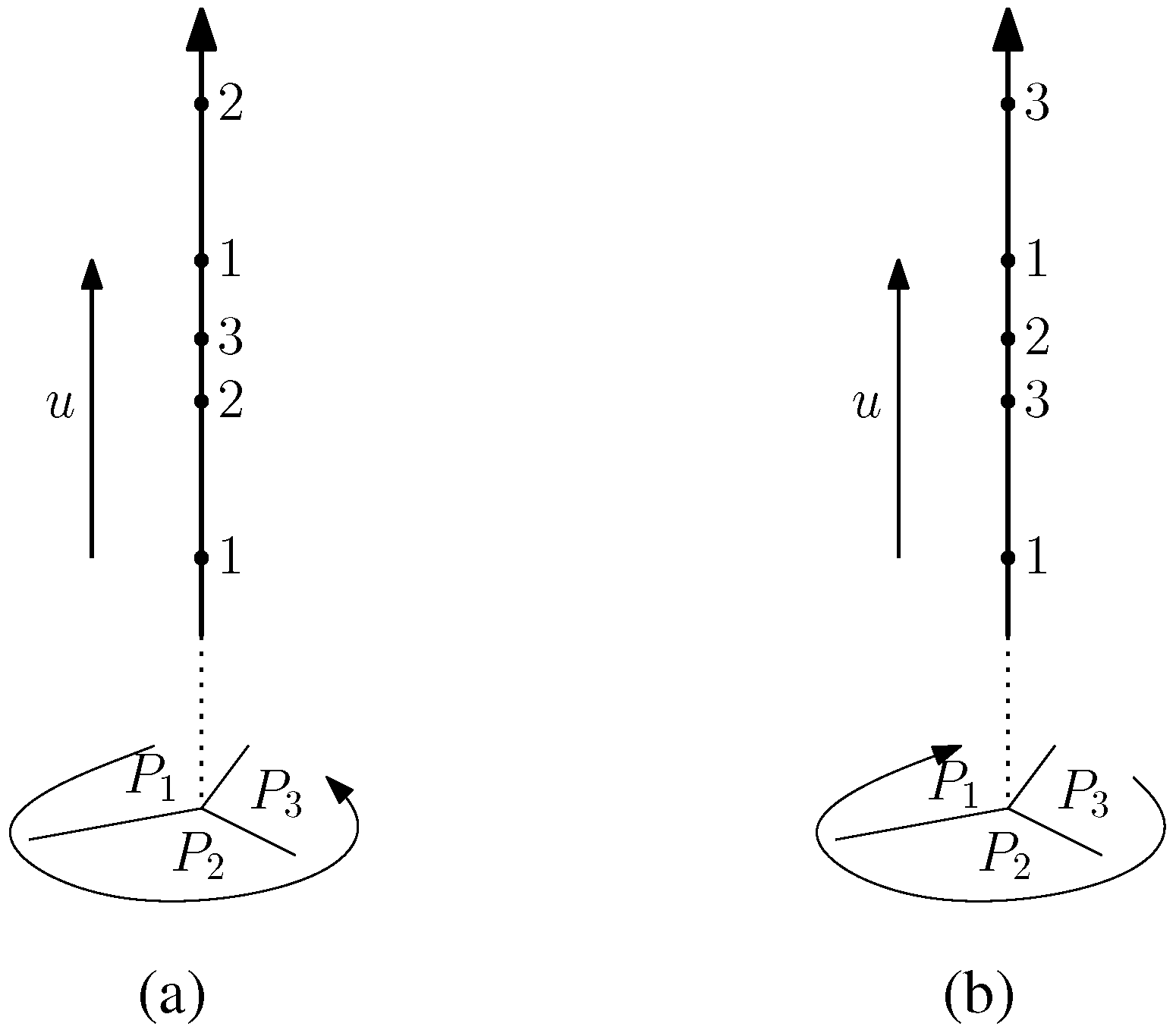
      <p><italic>Proof</italic>. Consider any vertex <italic>v</italic> of the plane base tiling <inline-graphic xmlns:xlink="http://www.w3.org/1999/xlink" xlink:href="symmetry-04-00545-i006.tif"/> in the plane <italic>π</italic>, and assume that tiles <italic>P</italic><sub>1</sub>, <italic>P</italic><sub>2</sub>, and <italic>P</italic><sub>3</sub> meet there as pictured in <xref ref-type="fig" rid="symmetry-04-00545-f004">Figure 4</xref> (in particular, (<italic>P</italic><sub>1</sub>,<italic>P</italic><sub>2</sub>,<italic>P</italic><sub>3</sub>) is the listing of tiles in counterclockwise order around <italic>v</italic>). In the pseudotiling, <italic>v</italic> corresponds to a line <italic>v</italic> + <inline-graphic xmlns:xlink="http://www.w3.org/1999/xlink" xlink:href="symmetry-04-00545-i003.tif"/> perpendicular to the plane. We move upwards on this line (in direction <italic>u</italic> = (0, 0, 1)) starting at <italic>v</italic>, and we mark all vertices of the pseudotiling (note that <italic>v</italic> may not be one of them). In addition, we label a vertex on this line 1, 2, or 3, depending on whether the vertex in question is incident to a base of a (ﬁnite or inﬁnite) barrel of the stack associated to <italic>P</italic><sub>1</sub>, <italic>P</italic><sub>2</sub>, or <italic>P</italic><sub>3</sub>. We obtain a repeating pattern since translation by the vertical unit vector <italic>u</italic> is a built-in symmetry of the pseudotiling. If the repeating pattern is (1, 2, 3) (<italic>i.e.</italic>, coherent with the right-hand rule), then the upstairs orientation of each barrel meeting a point on this line is counterclockwise, as can easily be seen. Otherwise, if the repeating pattern is (1, 3, 2), then the upstairs orientation of each barrel meeting a point of the line is clockwise. Moreover, if the upstairs orientation for barrels in one stack is set (e.g., in a construction process), then this determines the orientations for all barrels in adjacent stacks. These stacks, in turn, determine the orientations for all stacks adjacent to them, and so forth. Thus, the upstairs orientations of barrels must be globally compatible, <italic>i.e.</italic>, the same.</p>
      <fig id="symmetry-04-00545-f004" position="anchor">
        <label>Figure 4</label>
        <caption>
          <p>Determining upstairs orientations: (<bold>a</bold>) Counterclockwise; (<bold>b</bold>) clockwise.</p>
        </caption>
        <graphic xmlns:xlink="http://www.w3.org/1999/xlink" xlink:href="symmetry-04-00545-g004.tif"/>
      </fig>
      <p><bold>Remark 6.1.</bold> <italic>From the proof of Lemma 6.1 follows that if P</italic><sub>1</sub><italic>, P</italic><sub>2</sub><italic>, P</italic><sub>3 </sub><italic>are assigned </italic><sc>FINITE </sc><italic>colors α</italic><sub>1</sub><italic>, α</italic><sub>2</sub><italic>, α</italic><sub>3</sub><italic>, respectively, of which w.l.o.g. α</italic><sub>1</sub><italic> is the smallest, then the global upstairs orientation is counterclockwise if α</italic><sub>1</sub><italic> &lt; α</italic><sub>2</sub><italic> &lt; α</italic><sub>3</sub><italic>, and clockwise if α</italic><sub>1</sub><italic> &lt; α</italic><sub>3</sub><italic> &lt; α</italic><sub>2</sub><italic>. Incidentally, any shift function f which assigns its ﬁnite values around such vertices of <inline-graphic xmlns:xlink="http://www.w3.org/1999/xlink" xlink:href="symmetry-04-00545-i006.tif"/> coherently with a particular global upstairs orientation automatically satisﬁes the necessary condition on the augmented neighborhood symbols for ﬁnite-colored tiles (see step four in <xref ref-type="sec" rid="sec5-symmetry-04-00545">Section 5</xref>). Thus, we have a new and more practical necessary condition on f.</italic></p>
      <p><bold>Lemma 6.2.</bold> <italic>If a colored plane tiling (<inline-graphic xmlns:xlink="http://www.w3.org/1999/xlink" xlink:href="symmetry-04-00545-i006.tif"/>, <italic>f</italic>) gives rise to a barrel pseudotiling in one upstairs orientation, then the same base tiling—with altered coloring—also gives rise to a barrel pseudotiling in the reverse upstairs orientation</italic>.</p>
      <p><italic>Proof</italic>. One way to construct a compatible barrel pseudotiling is to reﬂect the existing barrel pseudotiling in the plane <italic>π</italic>, which clearly yields a barrel pseudotiling of opposite upstairs orientation. Note that, in this case, the winding orientation in each apeirostack changes as well, whereas the altered coloring <italic>f</italic>′ <sup>' </sup>of the base tiling <inline-graphic xmlns:xlink="http://www.w3.org/1999/xlink" xlink:href="symmetry-04-00545-i006.tif"/> is given by:</p>
      <p><disp-formula id="symmetry-04-00545-i008">
          <inline-graphic xmlns:xlink="http://www.w3.org/1999/xlink" xlink:href="symmetry-04-00545-i008.tif"/>
          </disp-formula></p>
      <p>This fact allows us to adopt the convention that, unless otherwise stated, all subsequent barrel pseudotilings are assumed to have a counterclockwise upstairs orientation. We now focus on the properties of barrel pseudotilings with only <italic>isolated </italic>∞-stacks, <italic>i.e.</italic>, barrel pseudotilings where apeirostacks are not directly adjacent.</p>
      <p><bold>Lemma 6.3.</bold> <italic>In a barrel pseudotiling with only isolated </italic>∞<italic>-stacks the winding orientation of any </italic>∞<italic>-stack is coherent with (</italic>i.e.<italic>, the same as) the global upstairs orientation.</italic></p>
      <p><italic>Proof.</italic> Select any ∞-stack Ω. Because Ω has no faces in common with other ∞-stacks, the inﬁnite staircases in the mantle of Ω have horizontal steps. Consequently, when unwinding the mantle as pictured in <xref ref-type="fig" rid="symmetry-04-00545-f005">Figure 5</xref>, all staircases will be monotonically increasing when following the global upstairs orientation.</p>
      <p>Let <italic>A</italic> be any apeirogonal face (base apeirogon of an apeirobarrel) in the ∞-stack. Suppose the winding orientation of <italic>A</italic> is opposed to the global upstairs orientation. Then <italic>A</italic> must intersect a staircase, which is impossible. Therefore, the winding orientation of <italic>A</italic>, and thus of any apeirogonal face, is coherent with the global upstairs orientation.</p>
      <fig id="symmetry-04-00545-f005" position="anchor">
        <label>Figure 5</label>
        <caption>
          <p>Staircase lines on unwrapped mantle of ∞-stack (schematic). Other edges have been omitted for clarity.</p>
        </caption>
        <graphic xmlns:xlink="http://www.w3.org/1999/xlink" xlink:href="symmetry-04-00545-g005.tif"/>
      </fig>
      <p>It is not known if there is any such correspondence for pseudotilings with adjacent ∞-stacks, which makes it harder to explore them. Therefore, for the remainder of this article, all considered barrel pseudotilings have only isolated apeirostacks.</p>
      <p>The following Lemma characterizes when <italic>isolated </italic>∞-stacks are compatible with a given shift function <italic>f</italic> and a counterclockwise global upstairs orientation. Recall that the neighborhood symbol is taken in counterclockwise orientation, so it corresponds to our default choice of upstairs orientation. </p>
      <p><bold>Lemma 6.4.</bold> <italic>Let T be an n-gonal tile in the base tiling </italic><inline-graphic xmlns:xlink="http://www.w3.org/1999/xlink" xlink:href="symmetry-04-00545-i006.tif"/> <italic>with f(T</italic>) = ∞ <italic>and a neighborhood symbol </italic>(<italic>α</italic><sub>0</sub>,<italic>α</italic><sub>1</sub>,...,<italic>α</italic><sub>n−1</sub>) <italic>with ﬁnite entries. Assume the global upstairs orientation is counterclockwise. An isolated </italic>∞<italic>-stack </italic>Ω <italic>with k</italic> ≥ 2 <italic>distinct apeirogonal faces (spirals), which consequently consists of k distinct apeirogonal barrels, can be constructed over T if and only if we have α<sub>i</sub></italic> &gt; <italic>α</italic><sub>i+1</sub><italic> for precisely k mutually distinct indices i (indices modulo n).</italic></p>
      <p><bold>Remark 6.2.</bold> <italic>The case k</italic> = 1 <italic>would lead to a degenerate </italic>∞<italic>-stack and cannot happen in a pseudotiling (compare Deﬁnitions 4.1 and 4.2).</italic></p>
      <p><italic>Proof.</italic> Let us ﬁrst show that a constructed ∞-stack Ω with <italic>k</italic> distinct apeirobarrels implies the condition on the neighborhood symbol. In Ω, any of the <italic>k</italic> apeirogonal bases climbs <italic>k</italic> units before making a complete turn around the stack, and consequently, so do the <italic>k</italic> staircases. By deﬁnition, in an isolated ∞-stack all entries in the neighborhood symbol are ﬁnite. Consequently, any staircase consists of vertical and horizontal segments only, is monotone in the direction of <italic>u</italic>, and the height of two partition vertices stemming from <italic>any </italic>base in the <italic>i</italic>-th adjacent stack determines the corresponding shift entry <italic>α</italic><sub>i</sub> in the neighborhood symbol (by taking the remainder of the height modulo 1, <italic>i.e.</italic>, disregarding full units of distance and reducing to an entry in [0, 1)). Fixing an arbitrary staircase in Ω and starting at a step (tread) on height <italic>r</italic> which reduces to the smallest <italic>α</italic><sub>i</sub>, w.l.o.g. <italic>α</italic><sub>1</sub>, the corresponding contiguous entries in the neighborhood symbol increase as long as the staircase is trapped between <italic>r</italic> and <inline-graphic xmlns:xlink="http://www.w3.org/1999/xlink" xlink:href="symmetry-04-00545-i009.tif"/> + 1. Only when the staircase reaches a step at a height of <inline-graphic xmlns:xlink="http://www.w3.org/1999/xlink" xlink:href="symmetry-04-00545-i009.tif"/> + 1 or greater will there be a jump from a larger to a smaller entry in the neighborhood symbol. Subsequently, the next jump will occur when a height of <inline-graphic xmlns:xlink="http://www.w3.org/1999/xlink" xlink:href="symmetry-04-00545-i009.tif"/> + 2 or greater is reached and so forth. Thus, if the staircase climbs <italic>k</italic> units when following the global upstairs orientation once around the stack, we obtain <italic>k</italic> jumps from an <italic>α</italic><sub>i</sub> to a strictly smaller <italic>α</italic><sub>i+1</sub> in the neighborhood symbol.</p>
      <p>Conversely, in constructing an ∞-stack Ω, any apeirogonal faces are constructed as polygonal lines not intersecting the staircases. Any time there is a jump in the entries of the neighborhood symbol from an <italic>α</italic><sub>i</sub> to a strictly smaller <italic>α</italic><sub>i+1</sub>, the staircase has climbed another unit. Consequently, if there are <italic>k</italic> such jumps, the staircase climbs <italic>k</italic> units before making a complete turn around the stack. An apeirogonal base must therefore also climb <italic>k</italic> units. Translations in the direction of <italic>u</italic> by integer multiples are prescribed symmetries of the pseudotiling. A translation by <italic>ku</italic> is a symmetry that transforms the staircase under consideration into itself, but this is not true for translation by less than <italic>k</italic> units in the direction of <italic>u</italic>. Thus, we must have <italic>k</italic> staircases in total in Ω, and therefore <italic>k</italic> apeirogonal faces and <italic>barrels</italic>.</p>
      <p>Observe that the condition formulated in Remark 6.1 assures that step four of the construction outline can be carried out, whereas the condition in Lemma 6.4 assures that ∞-stacks can be ﬁtted in step ﬁve (as long as <italic>f</italic> isolates all ∞-stacks). This, however, constructs not only the apeirostacks, but also the missing vertices and edges on the ﬁnite stacks, so we are done. We are now in the position to summarize the necessary and sufﬁcient conditions for when a pair (<inline-graphic xmlns:xlink="http://www.w3.org/1999/xlink" xlink:href="symmetry-04-00545-i006.tif"/>, <italic>f</italic>) of a base tiling and coloring (shift) function gives rise to a barrel pseudotiling with only isolated ∞-stacks.</p>
      <p><bold>Theorem 6.1.</bold> <italic>A pair </italic>(<inline-graphic xmlns:xlink="http://www.w3.org/1999/xlink" xlink:href="symmetry-04-00545-i006.tif"/>, <italic>f</italic>) <italic>of a normal, simple, plane base tiling </italic><inline-graphic xmlns:xlink="http://www.w3.org/1999/xlink" xlink:href="symmetry-04-00545-i006.tif"/> <italic>and a coloring (shift) function </italic></p>
      <p><italic>f</italic> : <italic>T</italic> (<inline-graphic xmlns:xlink="http://www.w3.org/1999/xlink" xlink:href="symmetry-04-00545-i006.tif"/>) → [0, 1) ∪ {∞} <italic>gives rise to a barrel pseudotiling with only isolated </italic>∞<italic>-stacks and counterclockwise global upstairs orientation if and only if the following two conditions hold. </italic></p>
	  <list>
	  <list-item>
      <p><italic>(1) For each vertex v of </italic><inline-graphic xmlns:xlink="http://www.w3.org/1999/xlink" xlink:href="symmetry-04-00545-i006.tif"/> <italic>where tiles P</italic><sub>1</sub><italic>, P</italic><sub>2</sub><italic>, P</italic><sub>3</sub><italic> meet in counterclockwise order around v, such that their colors α</italic><sub>1</sub> = <italic>f</italic>(<italic>P</italic><sub>1</sub>)<italic>, α</italic><sub>2</sub> = <italic>f</italic>(<italic>P</italic><sub>2</sub>)<italic>, α</italic><sub>3</sub> = <italic>f</italic>(<italic>P</italic><sub>3</sub>) <italic>are ﬁnite, and of which w.l.o.g. α</italic><sub>1</sub><italic> is the smallest, the inequality α</italic><sub>1</sub>  &lt; <italic>α</italic><sub>2</sub> &lt; <italic>α</italic><sub>3</sub><italic> holds;</italic></p>
	  </list-item>
	  <list-item>
      <p><italic>(2) For each n-gonal tile P of </italic><inline-graphic xmlns:xlink="http://www.w3.org/1999/xlink" xlink:href="symmetry-04-00545-i006.tif"/> <italic>with f(P</italic> ) = ∞<italic>, all entries in a neighborhood symbol </italic>(<italic>α</italic><sub>0</sub>,<italic>α</italic><sub>1</sub>,...,<italic>α</italic><sub>n−1</sub>) <italic>are ﬁnite, and there are at least two distinct indices i such that α<sub>i</sub></italic> &gt; <italic>α</italic><sub>i+1</sub><italic> (indices taken modulo n). </italic></p>
	  </list-item>
	  </list>
    </sec>
    <sec id="sec7-symmetry-04-00545">
      <title>7. Barrel Pseudotilings and Decorated Plane Triangulations</title>
      <p>Any normal simple tiling of the plane has a normal simple dual, which is a (topological) triangulation of the plane (<italic>cf</italic>. [<xref ref-type="bibr" rid="B10-symmetry-04-00545">10</xref>], Chapter 4.2). We can thus formulate properties of any simple, normal, plane base tiling <inline-graphic xmlns:xlink="http://www.w3.org/1999/xlink" xlink:href="symmetry-04-00545-i006.tif"/> with associated coloring of tiles, which gives rise to a barrel pseudotiling with isolated ∞-stacks, in terms of a (normal) dual triangulation <inline-graphic xmlns:xlink="http://www.w3.org/1999/xlink" xlink:href="symmetry-04-00545-i010.tif"/>. We do this not only for the sake of having dual statements, but also to draw connections to plane graphs (speciﬁcally, edge graphs of triangulations of the plane). Note that we do not make the assumption of convexity in the dual, since it is not generally known whether any tiling by convex polygons has a dual which also consists of convex polygons (<italic>cf</italic>. [<xref ref-type="bibr" rid="B10-symmetry-04-00545">10</xref>], p. 174).</p>
      <p>Assume that <inline-graphic xmlns:xlink="http://www.w3.org/1999/xlink" xlink:href="symmetry-04-00545-i006.tif"/> is a normal, simple, plane tiling by convex polygons with an appropriate coloring <italic>f</italic> on the tiles, which gives rise to a barrel pseudotiling with only isolated ∞-stacks in counterclockwise global upstairs orientation (as usual). Then let <inline-graphic xmlns:xlink="http://www.w3.org/1999/xlink" xlink:href="symmetry-04-00545-i010.tif"/> be a dual to <inline-graphic xmlns:xlink="http://www.w3.org/1999/xlink" xlink:href="symmetry-04-00545-i006.tif"/>, which is a (normal, topological) triangulation of the plane with vertex set <italic>V</italic> (<inline-graphic xmlns:xlink="http://www.w3.org/1999/xlink" xlink:href="symmetry-04-00545-i010.tif"/>). By slight abuse of notation we also denote the associated inﬁnite geometric simplicial complex with <inline-graphic xmlns:xlink="http://www.w3.org/1999/xlink" xlink:href="symmetry-04-00545-i010.tif"/>. The vertices of <inline-graphic xmlns:xlink="http://www.w3.org/1999/xlink" xlink:href="symmetry-04-00545-i010.tif"/> inherit the coloring or shift function <inline-graphic xmlns:xlink="http://www.w3.org/1999/xlink" xlink:href="symmetry-04-00545-i011.tif"/> : <italic>V</italic> = <italic>V</italic> (<inline-graphic xmlns:xlink="http://www.w3.org/1999/xlink" xlink:href="symmetry-04-00545-i010.tif"/>) → [0, 1) ∪ {∞} from the function <italic>f</italic> on the tiles of <inline-graphic xmlns:xlink="http://www.w3.org/1999/xlink" xlink:href="symmetry-04-00545-i006.tif"/>. This adds decoration to the triangulation, but we will also add further decoration by directing some of the edges. Let <italic>V</italic><sup>0 </sup>= (<inline-graphic xmlns:xlink="http://www.w3.org/1999/xlink" xlink:href="symmetry-04-00545-i011.tif"/>)<sup>−</sup><sup>1 </sup>([0, 1)) denote the set of vertices of <inline-graphic xmlns:xlink="http://www.w3.org/1999/xlink" xlink:href="symmetry-04-00545-i010.tif"/> with ﬁnite value under <inline-graphic xmlns:xlink="http://www.w3.org/1999/xlink" xlink:href="symmetry-04-00545-i011.tif"/>, and let <inline-graphic xmlns:xlink="http://www.w3.org/1999/xlink" xlink:href="symmetry-04-00545-i006.tif"/><sup>0 </sup>denote the simplicial subcomplex of <inline-graphic xmlns:xlink="http://www.w3.org/1999/xlink" xlink:href="symmetry-04-00545-i010.tif"/> induced by <italic>V</italic><sup>0 </sup>(it contains all simplices which have only vertices in <italic>V</italic><sup>0</sup>, and the empty simplex).</p>
      <p><bold>Note 7.1.</bold> <italic>The set V</italic><sup>∞ </sup>:= <italic>V</italic> \ <italic>V</italic><sup>0 </sup><italic>is a dominating independent set in the edge graph of </italic><inline-graphic xmlns:xlink="http://www.w3.org/1999/xlink" xlink:href="symmetry-04-00545-i010.tif"/> <italic>(see </italic>[<xref ref-type="bibr" rid="B12-symmetry-04-00545">12</xref>] <italic>or <xref ref-type="sec" rid="sec3-symmetry-04-00545">Section 3</xref> of this article for terminology). </italic></p>
      <p>This is simply the dual version of the statement that all tiles are either colored ∞, or adjacent to an ∞-colored tile, but not both. As a consequence, <inline-graphic xmlns:xlink="http://www.w3.org/1999/xlink" xlink:href="symmetry-04-00545-i006.tif"/><sup>0 </sup>contains no complete simplicial neighborhood of a vertex in <inline-graphic xmlns:xlink="http://www.w3.org/1999/xlink" xlink:href="symmetry-04-00545-i010.tif"/>, <italic>i.e.</italic>, there are no vertices of <inline-graphic xmlns:xlink="http://www.w3.org/1999/xlink" xlink:href="symmetry-04-00545-i006.tif"/><sup>0 </sup>which lie in its interior (we do not use the term <italic>relative interior </italic>here because <inline-graphic xmlns:xlink="http://www.w3.org/1999/xlink" xlink:href="symmetry-04-00545-i006.tif"/><sup>0 </sup>may be a one-dimensional subcomplex of <inline-graphic xmlns:xlink="http://www.w3.org/1999/xlink" xlink:href="symmetry-04-00545-i006.tif"/>). We have:</p>
      <p><bold>Note 7.2.</bold> <italic>The underlying topological space </italic>|<inline-graphic xmlns:xlink="http://www.w3.org/1999/xlink" xlink:href="symmetry-04-00545-i006.tif"/><sup>0</sup>| <italic>of </italic><inline-graphic xmlns:xlink="http://www.w3.org/1999/xlink" xlink:href="symmetry-04-00545-i006.tif"/><sup>0 </sup><italic>is (path-)connected. In fact, </italic>|<inline-graphic xmlns:xlink="http://www.w3.org/1999/xlink" xlink:href="symmetry-04-00545-i006.tif"/><sup>0</sup>| <italic>is obtained from </italic><inline-graphic xmlns:xlink="http://www.w3.org/1999/xlink" xlink:href="symmetry-04-00545-i012.tif"/> <italic>by deleting the mutually disjoint open discs given by the open stars of the vertices in V</italic><sup>∞ </sup><italic>.</italic></p>
      <p>Furthermore, the function <inline-graphic xmlns:xlink="http://www.w3.org/1999/xlink" xlink:href="symmetry-04-00545-i011.tif"/> naturally induces directions on the edges in <inline-graphic xmlns:xlink="http://www.w3.org/1999/xlink" xlink:href="symmetry-04-00545-i006.tif"/><sup>0</sup>, where {<italic>x</italic>, <italic>y</italic>} turns into the directed edge, or <italic>arc</italic>, (<italic>x</italic>, <italic>y</italic>) with <italic>tail x</italic> and <italic>head y</italic> if <inline-graphic xmlns:xlink="http://www.w3.org/1999/xlink" xlink:href="symmetry-04-00545-i011.tif"/>(<italic>x</italic>) &lt; <inline-graphic xmlns:xlink="http://www.w3.org/1999/xlink" xlink:href="symmetry-04-00545-i011.tif"/>(<italic>y</italic>) (these values are ﬁnite, by deﬁnition of <inline-graphic xmlns:xlink="http://www.w3.org/1999/xlink" xlink:href="symmetry-04-00545-i006.tif"/><sup>0</sup>). Furthermore, every arc is <italic>oriented </italic>in mathematically positive or negative direction <italic>with respect to an incident triangle</italic>, depending on whether it runs counterclockwise or clockwise around a point in the triangle’s interior. Since the global upstairs orientation is assumed as mathematically positive (for the pseudotiling based on <inline-graphic xmlns:xlink="http://www.w3.org/1999/xlink" xlink:href="symmetry-04-00545-i006.tif"/>), Remark 6.1 implies that every triangle in <inline-graphic xmlns:xlink="http://www.w3.org/1999/xlink" xlink:href="symmetry-04-00545-i006.tif"/><sup>0 </sup>has two mathematically positive and one mathematically negative oriented arcs. Note that the resulting directed edge graph of <inline-graphic xmlns:xlink="http://www.w3.org/1999/xlink" xlink:href="symmetry-04-00545-i006.tif"/><sup>0</sup>, which we denote by <inline-graphic xmlns:xlink="http://www.w3.org/1999/xlink" xlink:href="symmetry-04-00545-i013.tif"/>, must not have directed cycles, as the value of <inline-graphic xmlns:xlink="http://www.w3.org/1999/xlink" xlink:href="symmetry-04-00545-i011.tif"/> increases for successive vertices along directed paths.</p>
      <fig id="symmetry-04-00545-f006" position="anchor">
        <label>Figure 6</label>
        <caption>
          <p>The neighborhood of a regular vertex <italic>v</italic> in <inline-graphic xmlns:xlink="http://www.w3.org/1999/xlink" xlink:href="symmetry-04-00545-i006.tif"/><sup>0</sup>.</p>
        </caption>
        <graphic xmlns:xlink="http://www.w3.org/1999/xlink" xlink:href="symmetry-04-00545-g006.tif"/>
      </fig>
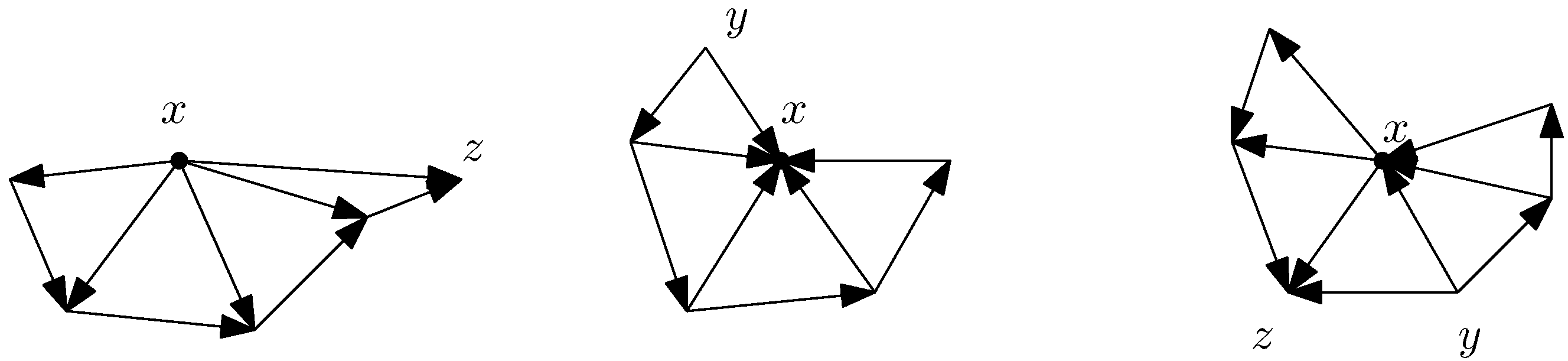
      <p>A <italic>cut-vertex</italic>—for the purpose of this paper—is a vertex <italic>x</italic> of <inline-graphic xmlns:xlink="http://www.w3.org/1999/xlink" xlink:href="symmetry-04-00545-i006.tif"/><sup>0 </sup>such that the underlying topological space <inline-graphic xmlns:xlink="http://www.w3.org/1999/xlink" xlink:href="symmetry-04-00545-i014.tif"/> of its link in <inline-graphic xmlns:xlink="http://www.w3.org/1999/xlink" xlink:href="symmetry-04-00545-i006.tif"/><sup>0 </sup>is disconnected. A vertex of <inline-graphic xmlns:xlink="http://www.w3.org/1999/xlink" xlink:href="symmetry-04-00545-i006.tif"/><sup>0 </sup>which is not a cut-vertex is called a <italic>regular vertex</italic>. Note that the simplicial neighborhood <inline-graphic xmlns:xlink="http://www.w3.org/1999/xlink" xlink:href="symmetry-04-00545-i015.tif"/> of any regular vertex <italic>x</italic> in <inline-graphic xmlns:xlink="http://www.w3.org/1999/xlink" xlink:href="symmetry-04-00545-i006.tif"/><sup>0 </sup>has as underlying topological space a closed disc whose boundary is a simple cycle containing <italic>x</italic> (as <italic>x</italic> cannot be an interior vertex). With directed arcs, there are three types of neighborhoods for regular vertices <italic>x</italic>, see <xref ref-type="fig" rid="symmetry-04-00545-f006">Figure 6</xref>, as classiﬁed by the digraph of edges in that neighborhood (closed star), denoted <inline-graphic xmlns:xlink="http://www.w3.org/1999/xlink" xlink:href="symmetry-04-00545-i016.tif"/>: </p>
      <list>
        <list-item>
          <p>• <italic>x</italic> is the tail of all incident arcs, <italic>i.e.</italic>, a <italic>source </italic>in <inline-graphic xmlns:xlink="http://www.w3.org/1999/xlink" xlink:href="symmetry-04-00545-i016.tif"/>. In this case, <italic>x</italic> is the only source in <inline-graphic xmlns:xlink="http://www.w3.org/1999/xlink" xlink:href="symmetry-04-00545-i016.tif"/>. The boundary cycle has a single edge, (<italic>x</italic>, <italic>z</italic>), which is oriented negatively (with respect to (wrt) an interior point of the neighborhood), and <italic>z</italic> is the only sink in <inline-graphic xmlns:xlink="http://www.w3.org/1999/xlink" xlink:href="symmetry-04-00545-i016.tif"/>;</p>
        </list-item>
        <list-item>
          <p>• <italic>x</italic> is the head of all incident arcs, <italic>i.e.</italic>, a <italic>sink </italic>in <inline-graphic xmlns:xlink="http://www.w3.org/1999/xlink" xlink:href="symmetry-04-00545-i016.tif"/>. In this case, <italic>x</italic> is the only sink in <inline-graphic xmlns:xlink="http://www.w3.org/1999/xlink" xlink:href="symmetry-04-00545-i016.tif"/>, the boundary cycle of <inline-graphic xmlns:xlink="http://www.w3.org/1999/xlink" xlink:href="symmetry-04-00545-i015.tif"/> has a single edge, (<italic>y</italic>, <italic>x</italic>), which is oriented negatively, and <italic>y</italic> is the only source in <inline-graphic xmlns:xlink="http://www.w3.org/1999/xlink" xlink:href="symmetry-04-00545-i016.tif"/>;</p>
        </list-item>
        <list-item>
          <p>• <italic>x</italic> is neither a source nor a sink in <inline-graphic xmlns:xlink="http://www.w3.org/1999/xlink" xlink:href="symmetry-04-00545-i016.tif"/>. In this case, <italic>x</italic> is incident to a unique triangle <italic>yxz</italic> (labelled counterclockwise) for which it is a <italic>transition vertex</italic>, that is <italic>x</italic> is the head of (<italic>y</italic>, <italic>x</italic>) and the tail of (<italic>x</italic>, <italic>z</italic>) . The only source and sink in <inline-graphic xmlns:xlink="http://www.w3.org/1999/xlink" xlink:href="symmetry-04-00545-i016.tif"/> are <italic>y</italic> and <italic>z</italic>, respectively. The boundary cycle of <inline-graphic xmlns:xlink="http://www.w3.org/1999/xlink" xlink:href="symmetry-04-00545-i015.tif"/> has a single negatively oriented edge, (<italic>y</italic>, <italic>z</italic>).</p>
        </list-item>
      </list>
      <p>For cut-vertices <italic>x</italic>, the neighborhood splits into components for which <italic>x</italic> is a regular vertex, or which are single arcs containing <italic>x</italic>. </p>
      <p>We call two triangles <italic>s</italic>, <italic>t</italic> of <inline-graphic xmlns:xlink="http://www.w3.org/1999/xlink" xlink:href="symmetry-04-00545-i006.tif"/><sup>0 </sup><italic>triangle-connected </italic>if there is a ﬁnite sequence <italic>s</italic> = <italic>t</italic><sub>0</sub>,<italic>t</italic><sub>1</sub>,...,<italic>t</italic><sub>n</sub> = <italic>t</italic> of triangles in <inline-graphic xmlns:xlink="http://www.w3.org/1999/xlink" xlink:href="symmetry-04-00545-i006.tif"/><sup>0</sup>, such that for <italic>i</italic> =1,...,<italic>n</italic> the triangles <italic>t</italic><sub>i−1</sub> and <italic>t</italic><sub>i</sub> are adjacent (<italic>i.e.</italic>, they share an edge). We call a simplicial subcomplex of <inline-graphic xmlns:xlink="http://www.w3.org/1999/xlink" xlink:href="symmetry-04-00545-i006.tif"/><sup>0 </sup>induced by a set of mutually triangle-connected triangles of <inline-graphic xmlns:xlink="http://www.w3.org/1999/xlink" xlink:href="symmetry-04-00545-i006.tif"/><sup>0 </sup>a <italic>triangle component</italic>. By deﬁnition, the underlying topological space of any triangle component is connected. However, we can also prove the following:</p>
      <p><bold>Lemma 7.1.</bold> <italic>If S is a (maximal) triangle component of </italic><inline-graphic xmlns:xlink="http://www.w3.org/1999/xlink" xlink:href="symmetry-04-00545-i006.tif"/><sup>0</sup><italic>, then its underlying topological space </italic>|<italic>S</italic>| <italic>is simply connected. In particular, for ﬁnite triangle components S, the space </italic>|<italic>S</italic>| <italic>is a closed disc.</italic></p>
      <p><italic>Proof.</italic> Assume the contrary, <italic>i.e.</italic>, that there exists a noncontractible (topological) cycle <italic>C</italic> in |<italic>S</italic>|. Then there exists a <italic>ﬁnite</italic> triangle-connected subcomponent <italic>S</italic>′ of <italic>S</italic> whose underlying space still contains <italic>C</italic>. We prove inductively that |<italic>S</italic>′| is a closed topological disc (the second statement), and thus contains no nontrivial cycle, which implies that |<italic>S</italic>| is simply connected.</p>
      <p>First of all, observe that, by deﬁnition, any (ﬁnite) triangle component <italic>S</italic>′ of <italic>S</italic> can be built up by successively attaching triangles along at least one edge (arc) to smaller triangle components. We now make use of the directed edges and their orientation with respect to incident triangles, in particular on the boundary of the component. Since <italic>S</italic>′ is ﬁnite, |<italic>S</italic>′| is bounded and has ﬁnitely many boundary arcs (after assigning directions). We show that, topologically, the boundary is a simple closed curve, and thus encloses a disc.</p>
      <p>A single triangle, as the base case, has two positively and exactly one negatively oriented arc (wrt an interior point). Suppose now that after <italic>k</italic> steps we have built up a component <italic>S<sub>k</sub></italic> which has exactly one negatively oriented arc on its boundary (wrt an interior point of the incident boundary triangle). We know that directed cycles cannot occur in the directed graph of our constructed component. When adding a triangle to the component in order to obtain <italic>S<sub>k</sub></italic><sub>+</sub><sub>1</sub> the following cases need to be considered:</p>
      <list>
        <list-item>
          <p>• The new triangle is glued on at a single positive boundary arc only. In this case this positive boundary arc (which now is no longer on the boundary) is replaced by two positive boundary arcs in <italic>S<sub>k</sub></italic><sub>+1</sub>, and <italic>S<sub>k</sub></italic><sub>+1</sub> retains exactly one negative arc on its boundary;</p>
        </list-item>
        <list-item>
          <p>• The new triangle is glued on at a single negative boundary arc only. In this case this negative boundary arc is replaced by a positive and a negative boundary arc in <italic>S<sub>k</sub></italic><sub>+</sub><sub>1</sub>, and <italic>S<sub>k</sub></italic><sub>+1</sub> still has exactly one negative arc on its boundary;</p>
        </list-item>
        <list-item>
          <p>• The new triangle is glued to <italic>two </italic>boundary arcs. Since by the induction hypothesis there is only one negative arc in the boundary of <italic>S<sub>k</sub></italic>, and the new triangle cannot be glued to two previously positive arcs (because they would have to match up with two negative arcs in the triangle), exactly one of those arcs must be positive, and one must be negative. These boundary arcs are replaced by a single positive boundary arc, leading to <italic>S<sub>k</sub></italic><sub>+</sub><sub>1</sub> having only positive arcs in its boundary. This is impossible because it would lead to an oriented cycle in the boundary, <italic>i.e.</italic>, to cyclically ever increasing values of <inline-graphic xmlns:xlink="http://www.w3.org/1999/xlink" xlink:href="symmetry-04-00545-i011.tif"/> on the traversed vertices;</p>
        </list-item>
        <list-item>
          <p>• The new triangle is glued to <italic>three </italic>boundary arcs. This is also impossible, because as in the previous case, two positive and one negative arc would be removed from the boundary, leading to an oriented cycle in the boundary;</p>
        </list-item>
        <list-item>
          <p>• The new triangle is glued on at a single positive (negative) boundary arc, and its third vertex is also glued. However, then the new boundary would (topologically) not be a simple closed curve, as <italic>four </italic>boundary arcs meet at that (glued) vertex, creating more than one cycle (regardless of edge direction) in the boundary. As there is still only one negatively oriented arc, this would lead to an oriented cycle in the boundary, which is forbidden.</p>
        </list-item>
      </list>
      <p>Thus, in passing from <italic>S<sub>k</sub></italic> to <italic>S<sub>k</sub></italic><sub>+</sub><sub>1</sub>, the new triangle can only be attached along a single edge on the boundary of <italic>S<sub>k</sub></italic>, as described in the ﬁrst two cases. The boundary must form a simple closed curve (dangling edges <italic>etc. </italic>do not occur by deﬁnition). In particular, |<italic>S<sub>k</sub></italic><sub>+1</sub>| is a closed topological disc because it is also a bounded region. The component <italic>S<sub>k</sub></italic><sub>+</sub><sub>1</sub> then has one more arc on the boundary, which is positively oriented, and retains one negatively oriented arc. This satisﬁes the induction hypothesis, so we have established that |<italic>S</italic>′| is a closed topological disc.</p>
      <p>Note that if a ﬁnite triangle component <italic>S</italic> consists of <italic>n</italic> triangles, then the boundary contains (<italic>n</italic> + 1) positive arcs and one negative arc.</p>
      <p>We can now give a dual version of Theorem 6.1, which is not formulated in terms of a precise coloring <inline-graphic xmlns:xlink="http://www.w3.org/1999/xlink" xlink:href="symmetry-04-00545-i011.tif"/>, but in terms of directed and undirected edges. This seems easier to handle in any kind of construction attempt, as the images in the next section show.</p>
      <p><bold>Theorem 7.1.</bold> <italic>A normal simple tiling </italic><inline-graphic xmlns:xlink="http://www.w3.org/1999/xlink" xlink:href="symmetry-04-00545-i006.tif"/> <italic>of </italic><inline-graphic xmlns:xlink="http://www.w3.org/1999/xlink" xlink:href="symmetry-04-00545-i012.tif"/> <italic>by convex polygons gives rise to a barrel pseudotiling with isolated </italic>∞<italic>-stacks and counterclockwise upstairs orientation if and only if some edges of the (any) dual triangulation </italic><inline-graphic xmlns:xlink="http://www.w3.org/1999/xlink" xlink:href="symmetry-04-00545-i010.tif"/> <italic>can be directed such that the following conditions are all satisﬁed:</italic></p>
	  <list>
	  <list-item>
      <p><italic>(1) The set of vertices which are only incident to </italic><sc>UNDIRECTED </sc><italic>edges, denoted V</italic><sup>∞</sup><italic>, is a dominating independent set in the edge graph G(</italic><inline-graphic xmlns:xlink="http://www.w3.org/1999/xlink" xlink:href="symmetry-04-00545-i010.tif"/>)<italic>; </italic></p>
	  </list-item>
	  <list-item>
      <p><italic>(2) For each x in V</italic><sup>∞</sup><italic>, the boundary of </italic><inline-graphic xmlns:xlink="http://www.w3.org/1999/xlink" xlink:href="symmetry-04-00545-i017.tif"/> <italic>has at least two directed arcs going in </italic><sc>CLOCKWISE ORIENTATION </sc><italic>around an interior point; </italic></p>
	  </list-item>
	  <list-item>
      <p><italic>(3) Each triangle in </italic><inline-graphic xmlns:xlink="http://www.w3.org/1999/xlink" xlink:href="symmetry-04-00545-i010.tif"/> <italic>which has all its boundary edges oriented contains precisely one clockwise arc and two counterclockwise arcs. </italic></p>
	  </list-item>
	  </list>
      <p><bold>Remark 7.1.</bold> <italic>We note without proof that condition (3) can be rephrased as follows. Each maximal triangle component of </italic><inline-graphic xmlns:xlink="http://www.w3.org/1999/xlink" xlink:href="symmetry-04-00545-i006.tif"/><sup>0 </sup><italic>has, when edges are directed, exactly one arc on its boundary which is negatively oriented with respect to an interior point. It is not entirely obvious, and therefore remarkable, that conditions (1), (2), (3) prevent directed cycles in the partially directed edge graph of </italic><inline-graphic xmlns:xlink="http://www.w3.org/1999/xlink" xlink:href="symmetry-04-00545-i010.tif"/> <italic>(note that a directed cycle should not contain undirected edges). </italic></p>
    </sec>
    <sec id="sec8-symmetry-04-00545">
      <title>8. A Small Zoo of Examples</title>
      <p>For all examples shown in this section, we still implicitly assume that the global upstairs direction is mathematically positive (<italic>i.e.</italic>, counterclockwise).</p>
      <p>A class of base tilings which reproduce the examples mentioned in <xref ref-type="sec" rid="sec2-symmetry-04-00545">Section 2</xref> are the simple normal plane tilings which are properly 3-colorable. In this case, we can assume the colors (shifts) to be 0, 0.5, and ∞. <xref ref-type="fig" rid="symmetry-04-00545-f007">Figure 7</xref>a,b show (in the dual base tiling) how barrel pseudotilings can arise from the uniform tilings (6<sup>3</sup>) and (4.8<sup>2</sup>). Recall that the uniform tilings of the plane are precisely the vertex-transitive tilings by regular convex polygons. Recall further that (<italic>n</italic><sub>1</sub>,<italic>n</italic><sub>2</sub>,...,<italic>n</italic><sub>k</sub>) is the standard notation for a uniform tiling of the plane where each vertex is cyclically surrounded by an <italic>n</italic><sub>1</sub>-gon, <italic>n</italic><sub>2</sub>-gon, and so forth, in that order (compare [<xref ref-type="bibr" rid="B10-symmetry-04-00545">10</xref>], chapter 2.1). Further 3-colorable tilings are also shown in parts <xref ref-type="fig" rid="symmetry-04-00545-f007">Figure 7</xref>c–h. The ease of ﬁnding barrel pseudotilings for these lies in the consequences of 3-colorability for the conditions in Theorem 6.1. The ﬁrst condition is automatically fulﬁlled with an ∞-colored tile at each vertex; and ∞-colored tiles have at least four adjacents, so their neighborhood symbols fall apart into at least two cyclically increasing subsequences, thus satisfying the second condition.</p>
      <fig id="symmetry-04-00545-f007" position="anchor">
        <label>Figure 7</label>
        <caption>
          <p>Decorated duals of the uniform base tilings (6<sup>3</sup>) and (4.8<sup>2</sup>) (<bold>a</bold>,<bold>b</bold>). The small boxes <inline-graphic xmlns:xlink="http://www.w3.org/1999/xlink" xlink:href="symmetry-04-00545-i018.tif"/> indicate ∞-colored vertices, and arrows indicate an increase in the function <inline-graphic xmlns:xlink="http://www.w3.org/1999/xlink" xlink:href="symmetry-04-00545-i011.tif"/>. Patches of properly 3-colorable normal simple plane tilings, (<bold>c</bold>)–(<bold>e</bold>) periodic, (<bold>f</bold>)–(<bold>h</bold>) non-periodic.</p>
        </caption>
        <graphic xmlns:xlink="http://www.w3.org/1999/xlink" xlink:href="symmetry-04-00545-g007.tif"/>
      </fig>
      <p>More interesting things happen when the base tiling is not 3-colorable, or if one deliberately uses more than three colors or shift lengths (possibly inﬁnitely many). In this case, the conditions on the neighborhood symbol have signiﬁcant implications, unlike in the previous case. In the decorated dual base tiling we can now see longer paths and possibly nonempty triangle components forming. <xref ref-type="fig" rid="symmetry-04-00545-f008">Figure 8</xref> shows some examples, all of which yield periodic pseudotilings, <italic>i.e.</italic>, barrel pseudotilings with translational symmetry in three linearly independent directions, almost all of which are face-to-face. Observe that the absolute magnitude of the (ﬁnite) shift lengths is of little relevance, but rather is the shift difference among neighboring tiles (or vertices, in the dual). Finitely many colors (shift lengths) are sufﬁcient if and only if all oriented paths in the decorated dual base tiling are of ﬁnite length, and the minimal number of colors needed is the same as the number of vertices on the longest directed path.</p>
      <fig id="symmetry-04-00545-f008" position="anchor">
        <label>Figure 8</label>
        <caption>
          <p>Barrel pseudotilings arise from the information encoded in a coloring of (6<sup>3</sup>) with four (<bold>a</bold>) and (<bold>b</bold>), ﬁve (<bold>c</bold>), and nine (<bold>d</bold>) colors. More examples stem from (4.8<sup>2</sup>) with eleven colors (<bold>e</bold>), from a 4-colored tiling (<bold>f</bold>) and (<bold>g</bold>), and a 5-colored version of (3.12<sup>2</sup>) (<bold>h</bold>) and (<bold>i</bold>). All except (<bold>e</bold>) give face-to-face barrel pseudotilings.</p>
        </caption>
        <graphic xmlns:xlink="http://www.w3.org/1999/xlink" xlink:href="symmetry-04-00545-g008.tif"/>
      </fig>
    </sec>
    <sec id="sec9-symmetry-04-00545">
      <title>9. Remarks</title>
      <p>We conclude the paper with some remarks about barrel pseudotilings and suggestions for further investigation in more general settings. In <xref ref-type="sec" rid="sec8-symmetry-04-00545">Section 8</xref>, many periodic examples of barrel pseudotilings were shown. It would be nice to have an algorithm to construct periodic barrel pseudotilings from periodic base tilings. As we have seen, not all suitable base tilings are periodic, but periodic base tilings seem to be a more interesting case because of their additional symmetry. Furthermore, the terrain is wide open when it comes to allowing adjacent ∞-stacks; it is unclear if there is a connection between winding orientation and upstairs orientation along the lines of Lemma 6.3, as well as how a decorated planar triangulation could capture all of the essential information in this case.</p>
      <p>We have made many assumptions and chosen the deﬁnitions in this article in a certain way. First, we require that (ﬁnite) barrels stem from a <italic>right </italic>prism and that planar base tilings consist of <italic>convex </italic>polygons. However, it is conceivable that this is only a technical assumption to simplify the description of statements and procedures. It may be possible—but it has not been investigated—to deform the pseudotilings so that no coplanar adjacent 2-faces occur. For some pseudotilings, it may even be possible to have strictly convex polytopes emerge as the ﬁnite cells.</p>
      <p>Second, we selected the deﬁnitions so as to produce structures which are realizations of abstract rank 4 polytopes. Several very similarly arising structures have been discarded on the grounds of not being associated with an abstract rank 4 polytope. Nevertheless, it may be of interest to chemists or crystallographers to identify the corresponding 4-valent atomic networks. <xref ref-type="fig" rid="symmetry-04-00545-f009">Figure 9</xref> shows an example patch of a structure, which has translational symmetry in three directions (and additional symmetries) yet fails to be classiﬁed as a barrel pseudotiling because only one apeirogon appears per stack (the degenerate case mentioned in Remark 6.2).</p>
      <fig id="symmetry-04-00545-f009" position="anchor">
        <label>Figure 9</label>
        <caption>
          <p>This patch with base (6<sup>3</sup>) is not part of a barrel pseudotiling, as the face structure of the object does not correspond to an abstract 4-polytope.</p>
        </caption>
        <graphic xmlns:xlink="http://www.w3.org/1999/xlink" xlink:href="symmetry-04-00545-g009.tif"/>
      </fig>
      <p>In order to further explore the connection with abstract polytopes, one could use a similar construction not only on tilings of the plane, but also on polyhedral maps. This would not ﬁt as nicely into <inline-graphic xmlns:xlink="http://www.w3.org/1999/xlink" xlink:href="symmetry-04-00545-i001.tif"/>, but perhaps it would still produce interesting results. Finally, it should be possible to quotient by a multiple of <italic>u</italic> in order to produce and study ﬁnite objects.</p>
    </sec>
  </body>
  <back>
    <ack>
      <title>Acknowledgments</title>
      <p>The author would like to thank Egon Schulte for his careful reading and many helpful suggestions. Also, the author would like to thank the two anonymous referees for their insightful comments which led to the improvement of this paper.</p>
    </ack>
    <ref-list>
      <title>References and Notes</title>
      <ref id="B1-symmetry-04-00545">
        <label>1.</label>
        <citation citation-type="journal">
          <person-group person-group-type="author">
            <name>
              <surname>Grünbaum</surname>
              <given-names>B.</given-names>
            </name>
          </person-group>
          <article-title>Regular polyhedra—old and new</article-title>
          <source>Aequ. Math.</source>
          <year>1977</year>
          <volume>16</volume>
          <fpage>1</fpage>
          <lpage>20</lpage>
          <pub-id pub-id-type="doi">10.1007/BF01836414</pub-id>
        </citation>
      </ref>
      <ref id="B2-symmetry-04-00545">
        <label>2.</label>
        <citation citation-type="book">
          <person-group person-group-type="author">
            <name>
              <surname>Schulte</surname>
              <given-names>E.</given-names>
            </name>
          </person-group>
          <article-title>Symmetry of polytopes and polyhedra</article-title>
          <source>Handbook of Discrete and Computational Geometry</source>
          <edition>2nd</edition>
          <person-group person-group-type="editor">
            <name>
              <surname>Goodman</surname>
              <given-names>J.E.</given-names>
            </name>
            <name>
              <surname>O’Rourke</surname>
              <given-names>J.</given-names>
            </name>
          </person-group>
          <publisher-name>Chapman &amp; Hall/CRC</publisher-name>
          <publisher-loc>Boca Raton, FL, USA</publisher-loc>
          <year>2004</year>
          <fpage>431</fpage>
          <lpage>454</lpage>
        </citation>
      </ref>
      <ref id="B3-symmetry-04-00545">
        <label>3.</label>
        <citation citation-type="journal">
          <person-group person-group-type="author">
            <name>
              <surname>Dress</surname>
              <given-names>A.W.M.</given-names>
            </name>
          </person-group>
          <article-title>A combinatorial theory of Grünbaum’s new regular polyhedra, Part I: Günbaums’s new regular polyhedra and their automorphism group</article-title>
          <source>Aequ. Math.</source>
          <year>1981</year>
          <volume>23</volume>
          <fpage>252</fpage>
          <lpage>265</lpage>
          <pub-id pub-id-type="doi">10.1007/BF02188039</pub-id>
        </citation>
      </ref>
      <ref id="B4-symmetry-04-00545">
        <label>4.</label>
        <citation citation-type="journal">
          <person-group person-group-type="author">
            <name>
              <surname>Dress</surname>
              <given-names>A.W.M.</given-names>
            </name>
          </person-group>
          <article-title>A combinatorial theory of Grünbaums’s new regular polyhedra, Part II: Complete enumeration</article-title>
          <source>Aequ. Math.</source>
          <year>1985</year>
          <volume>29</volume>
          <fpage>222</fpage>
          <lpage>243</lpage>
          <pub-id pub-id-type="doi">10.1007/BF02189831</pub-id>
        </citation>
      </ref>
      <ref id="B5-symmetry-04-00545">
        <label>5.</label>
        <citation citation-type="journal">
          <person-group person-group-type="author">
            <name>
              <surname>Leytem</surname>
              <given-names>C.</given-names>
            </name>
          </person-group>
          <article-title>Pseudo-Petrie operators on Grünbaumpolyhedra</article-title>
          <source>Math. Slovaca</source>
          <year>1997</year>
          <volume>47</volume>
          <fpage>175</fpage>
          <lpage>188</lpage>
        </citation>
      </ref>
      <ref id="B6-symmetry-04-00545">
        <label>6.</label>
        <citation citation-type="journal">
          <person-group person-group-type="author">
            <name>
              <surname>McMullen</surname>
              <given-names>P.</given-names>
            </name>
            <name>
              <surname>Schulte</surname>
              <given-names>E.</given-names>
            </name>
          </person-group>
          <article-title>Regular polytopes in ordinary space</article-title>
          <source>Discrete Comput. Geom.</source>
          <year>1997</year>
          <volume>17</volume>
          <fpage>449</fpage>
          <lpage>478</lpage>
          <pub-id pub-id-type="doi">10.1007/PL00009304</pub-id>
        </citation>
      </ref>
      <ref id="B7-symmetry-04-00545">
        <label>7.</label>
        <citation citation-type="book">
          <person-group person-group-type="author">
            <name>
              <surname>McMullen</surname>
              <given-names>P.</given-names>
            </name>
            <name>
              <surname>Schulte</surname>
              <given-names>E.</given-names>
            </name>
          </person-group>
          <article-title>Regular and chiralpolytopes in low dimensions</article-title>
          <source>The Coxeter Legacy: Reﬂections and Projections</source>
          <person-group person-group-type="editor">
            <name>
              <surname>Davis</surname>
              <given-names>C.</given-names>
            </name>
            <name>
              <surname>Ellers</surname>
              <given-names>E.W.</given-names>
            </name>
          </person-group>
          <publisher-name>AMS</publisher-name>
          <publisher-loc>Providence, RI, USA</publisher-loc>
          <year>2005</year>
          <fpage>87</fpage>
          <lpage>106</lpage>
        </citation>
      </ref>
      <ref id="B8-symmetry-04-00545">
        <label>8.</label>
        <citation citation-type="book">
          <person-group person-group-type="author">
            <name>
              <surname>McMullen</surname>
              <given-names>P.</given-names>
            </name>
            <name>
              <surname>Schulte</surname>
              <given-names>E.</given-names>
            </name>
          </person-group>
          <source>Abstract Regular Polytopes (Encyclopedia of Mathematics and its Applications)</source>
          <publisher-name>Cambridge University Press</publisher-name>
          <publisher-loc>Cambridge, UK</publisher-loc>
          <year>2002</year>
          <volume>92</volume>
        </citation>
      </ref>
      <ref id="B9-symmetry-04-00545">
        <label>9.</label>
        <citation citation-type="book">
          <person-group person-group-type="author">
            <name>
              <surname>Grünbaum</surname>
              <given-names>B.</given-names>
            </name>
            <name>
              <surname>Shephard</surname>
              <given-names>G.C.</given-names>
            </name>
            <name>
              <surname>Miller</surname>
              <given-names>J.C.P.</given-names>
            </name>
          </person-group>
          <article-title>Uniform tilings with hollow tiles</article-title>
          <source>The Geometric Vein: The Coxeter Festschrift</source>
          <person-group person-group-type="editor">
            <name>
              <surname>Davis</surname>
              <given-names>C.</given-names>
            </name>
            <name>
              <surname>Grünbaum</surname>
              <given-names>B.</given-names>
            </name>
            <name>
              <surname>Sherk</surname>
              <given-names>F.A.</given-names>
            </name>
          </person-group>
          <publisher-name>Springer</publisher-name>
          <publisher-loc>New York, NY, USA</publisher-loc>
          <year>1981</year>
          <fpage>17</fpage>
          <lpage>64</lpage>
        </citation>
      </ref>
      <ref id="B10-symmetry-04-00545">
        <label>10.</label>
        <citation citation-type="book">
          <person-group person-group-type="author">
            <name>
              <surname>Grünbaum</surname>
              <given-names>B.</given-names>
            </name>
            <name>
              <surname>Shephard</surname>
              <given-names>G.C.</given-names>
            </name>
          </person-group>
          <source>Tilingsand Patterns</source>
          <publisher-name>W.H. Freeman and Company</publisher-name>
          <publisher-loc>New York, NY, USA</publisher-loc>
          <year>1987</year>
        </citation>
      </ref>
      <ref id="B11-symmetry-04-00545">
        <label>11.</label>
        <citation citation-type="book">
          <person-group person-group-type="author">
            <name>
              <surname>Schattschneider</surname>
              <given-names>D.</given-names>
            </name>
            <name>
              <surname>Senechal</surname>
              <given-names>D.</given-names>
            </name>
          </person-group>
          <article-title>Tilings</article-title>
          <source>Handbook of Discrete and Computational Geometry</source>
          <edition>2nd</edition>
          <person-group person-group-type="editor">
            <name>
              <surname>Goodman</surname>
              <given-names>J.E.</given-names>
            </name>
            <name>
              <surname>O’Rourke</surname>
              <given-names>J.</given-names>
            </name>
          </person-group>
          <publisher-name>Chapman &amp; Hall/CRC</publisher-name>
          <publisher-loc>Boca Raton, FL, USA</publisher-loc>
          <year>2004</year>
          <fpage>53</fpage>
          <lpage>72</lpage>
        </citation>
      </ref>
      <ref id="B12-symmetry-04-00545">
        <label>12.</label>
        <citation citation-type="book">
          <person-group person-group-type="author">
            <name>
              <surname>West</surname>
              <given-names>D.B.</given-names>
            </name>
          </person-group>
          <source>Introduction to Graph Theory</source>
          <publisher-name>Prentice Hall Inc.</publisher-name>
          <publisher-loc>Upper Saddle River, NJ, USA</publisher-loc>
          <year>1996</year>
        </citation>
      </ref>
      <ref id="B13-symmetry-04-00545">
        <label>13.</label>
        <citation citation-type="book">
          <person-group person-group-type="author">
            <name>
              <surname>Maunder</surname>
              <given-names>C.R.F.</given-names>
            </name>
          </person-group>
          <source>Algebraic Topology</source>
          <publisher-name>Cambridge University Press</publisher-name>
          <publisher-loc>Cambridge, UK</publisher-loc>
          <year>1980</year>
        </citation>
      </ref>
      <ref id="B14-symmetry-04-00545">
        <label>14.</label>
        <citation citation-type="book">
          <person-group person-group-type="author">
            <name>
              <surname>Locher</surname>
              <given-names>J.L.</given-names>
            </name>
          </person-group>
          <source>The Magic of M.C. Escher</source>
          <publisher-name>Harry N. Abrams</publisher-name>
          <publisher-loc>New York, NY, USA</publisher-loc>
          <year>2000</year>
        </citation>
      </ref>
    </ref-list>
  </back>
</article>