Article

Rangelands: Where Anthromes Meet Their Limits
1
Department of Geography, University of California-Berkeley, Berkeley, CA 94720, USA
2
Department of History, University of California-Davis, Davis, CA 95616, USA
3
USDA-ARS-Jornada Experimental Range, New Mexico State University, Las Cruces, NM 88003, USA
*
Author to whom correspondence should be addressed.
Submission received: 18 January 2017 / Revised: 27 March 2017 / Accepted: 26 April 2017 / Published: 1 May 2017
(This article belongs to the Special Issue Anthropogenic Biomes)

Abstract

Defining rangelands as anthromes enabled Ellis and Ramankutty (2008) to conclude that more than three-quarters of Earth’s land is anthropogenic; without rangelands, this figure would have been less than half. They classified all lands grazed by domestic livestock as rangelands, provided that human population densities were low; similar areas without livestock were excluded and classified instead as ‘wildlands’. This paper examines the empirical basis and conceptual assumptions of defining and categorizing rangelands in this fashion. Empirically, we conclude that a large proportion of rangelands, although used to varying degrees by domesticated livestock, are not altered significantly by this use, especially in arid, highly variable environments and in settings with long evolutionary histories of herbivory by wild animals. Even where changes have occurred, the dynamics and components of many rangelands remain structurally and functionally equivalent to those that preceded domestic livestock grazing or would be found in its absence. In much of Africa and Asia, grazing is so longstanding as to be inextricable from ‘natural’ or reference conditions for those sites. Thus, the extent of anthropogenic biomes is significantly overstated. Conceptually, rangelands reveal the dependence of the anthromes thesis on outdated assumptions of ecological climax and equilibrium. Coming to terms with rangelands—how they can be classified, understood, and managed sustainably—thus offers important lessons for understanding anthromes and the Anthropocene as a whole. At the root of these lessons, we argue, is not the question of human impacts on ecosystems but property relations among humans.
Keywords: pastoralism; grazing lands; drylands; livestock grazing; non-equilibrium ecology; desertification; variability pastoralism; grazing lands; drylands; livestock grazing; non-equilibrium ecology; desertification; variability
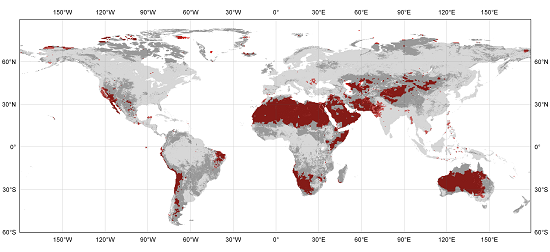
Graphical Abstract