Forefronting the Socio-Ecological in Savanna Landscapes through Their Spatial and Temporal Contingencies


Abstract
1. Introduction
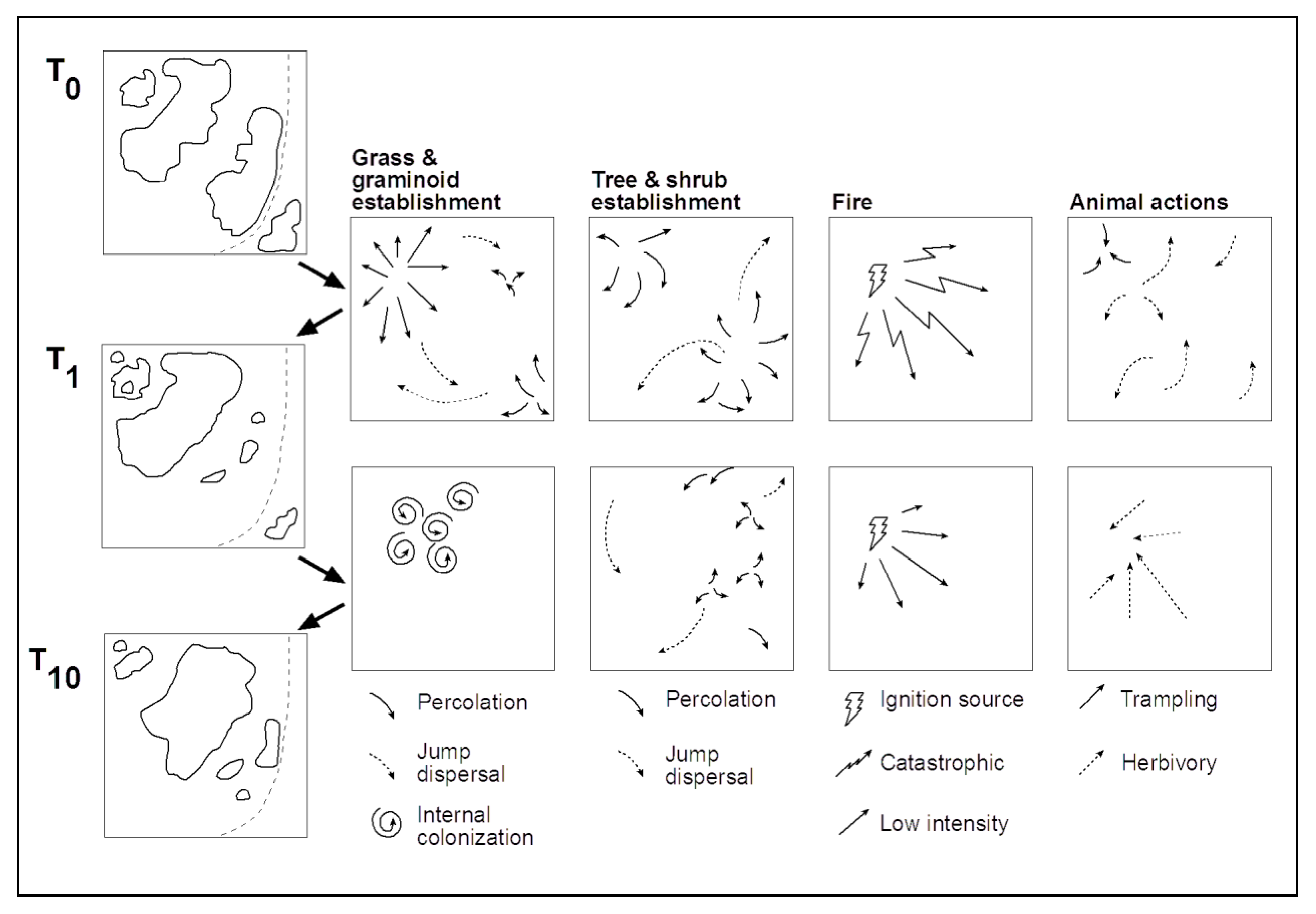
2. Landscape Dynamism and Spatial Contingency

3. Landscape Dynamism and Temporal Contingency
4. Contingencies in Practice
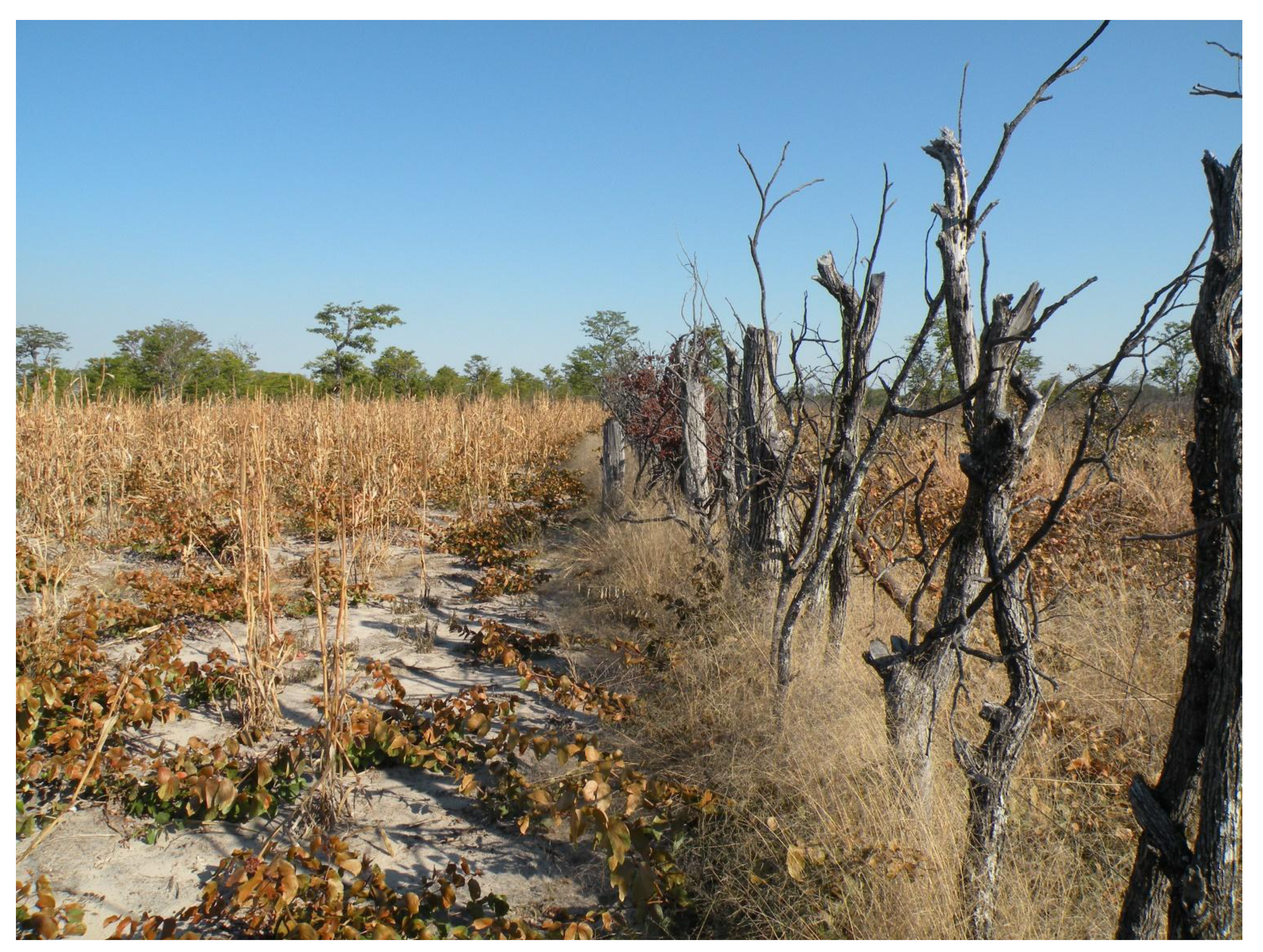
5. Field Observations of Socio-Ecological Savannas

6. Future Prospects
Acknowledgments
Conflicts of Interest
References
- Lee, W.T. The Face of the Earth as Seen from the Air: A Study in the Application of Airplane Photography to Geography; American Geographical Society Special Publication No. 4. Conde Naste Press: Washington, DC, USA, 1922. [Google Scholar]
- Sauer, C.O. The Morphology of Landscape; University of California Press: Berkeley, CA, USA, 1925. [Google Scholar]
- Glenn-Lewin, D.C.; Peet, R.K.; Veblen, T.T. (Eds.) Plant Succession: Theory and Application; Chapman and Hall: London, UK, 1992.
- Forman, R.T.T. Land Mosaics: The Ecology of Landscapes and Regions; Cambridge University Press: Cambridge, UK, 1995. [Google Scholar]
- Pickett, S.T.A.; Cadenasso, M.L. Landscape ecology: Spatial heterogeneity in ecological systems. Science 1995, 269, 331–334. [Google Scholar]
- Rhoads, B.L.; Thorn, C.E. The Scientific Nature of Geomorphology; Wiley: Chichester, UK, 1996. [Google Scholar]
- Acácio, V.; Holmgren, M.; Moreira, F.; Mohren, G.M.J. Oak persistence in Mediterranean landscapes: The combined role of management, topography, and wildfires. Ecol. Soc. 2010, 14, 40. [Google Scholar]
- Duncan, S.L.; McComb, B.C.; Johnson, K.N. Integrating ecological and social ranges of variability in conservation of biodiversity: Past, present, and future. Ecol. Soc. 2010, 15, 5. [Google Scholar]
- Helming, K.; Pérez-Soba, M. Landscape scenarios and multifunctionality: Making land use impact assessment operational. Ecol. Soc. 2011, 16, 50. [Google Scholar]
- Scholes, R.J.; Archer, S.R. Tree-grass interactions in savannas. Ann. Rev. Ecol. Syst. 1997, 28, 517–544. [Google Scholar] [CrossRef]
- Petit, C.; Scudder, T.; Lambin, E. Quantifying processes of land-cover change by remote sensing: Resettlement and rapid land-cover changes in south-eastern Zambia. Int. J. Remote Sens. 2001, 22, 3435–3456. [Google Scholar] [CrossRef]
- House, J.I.; Archer, S.; Breshears, D.D.; Scholes, R.J. Conundrums in mixed woody–herbaceous plant systems. J. Biogeogr. 2003, 30, 1763–1777. [Google Scholar] [CrossRef]
- Folke, C.; Gunderson, L. Challenging complexities of change: The first issue of ecology and society. Ecol. Soc. 2004, 9, 19. [Google Scholar]
- Sankaran, M.; Hanan, N.P.; Scholes, R.J.; Ratnam, J.; Augustine, D.J.; Cade, B.S.; Gignoux, J.; Higgins, S.I.; Le Roux, X.; Ludwig, F.; et al. Determinants of woody cover in African savannas. Nature 2005, 438, 846–849. [Google Scholar] [CrossRef]
- Sano, E.E.; Ferreira, L.G.; Asner, G.P.; Steinke, E.T. Spatial and temporal probabilities of obtaining cloud-free Landsat images over the Brazilian tropical savanna. Int. J. Remote Sens. 2007, 28, 2739–2752. [Google Scholar] [CrossRef]
- Mertens, B.; Lambin, E.F. Land-cover-change trajectories in Southern Cameroon. Ann. Assoc. Am. Geogr. 2000, 90, 467–494. [Google Scholar] [CrossRef]
- Crews-Meyer, K.A. Characterizing landscape dynamism via paneled-pattern metrics. Photogramm. Eng. Remote Sens. 2002, 68, 1031–1040. [Google Scholar]
- Xu, X.-M.; Madden, L.V. Use of SADIE statistics to study spatial dynamics of plant disease epidemics. Plant Pathol. 2004, 53, 38–49. [Google Scholar] [CrossRef]
- Breed, A.C.; Field, H.E.; Smith, C.S.; Edmonston, J.; Meers, J. Bats without borders: Long-distance movements and implications for disease risk management. EcoHealth 2010, 7, 204–212. [Google Scholar] [CrossRef]
- Tilman, D.; Knops, J.; Wedin, D.; Reich, P.; Ritchie, M.; Siemann, E. The influence of functional diversity and composition on ecosystem processes. Science 1997, 277, 1300–1302. [Google Scholar] [CrossRef]
- Mazurek, M.J.; Zielinski, W.J. Individual legacy trees influence vertebrate wildlife diversity in commercial forests. For. Ecol. Manag. 2004, 193, 321–334. [Google Scholar] [CrossRef]
- Ricklefs, R.E. History and diversity: Explorations at the intersection of ecology and evolution. Am. Nat. 2007, 170, S56–S70. [Google Scholar] [CrossRef]
- Trollope, W.S.W. Ecological Effects of Fire in South African Savannas. In Ecology of Tropical Savannas; Huntley, B.J., Walker, B.H., Eds.; Springer-Verlag Ecological Studies: Berlin, Germany, 1982; Volume 42, pp. 292–306. [Google Scholar]
- Ringrose, S.; Matheson, W.; Wolski, P.; Huntsman-Mapilaa, P. Vegetation cover trends along the Botswana Kalahari transect. J. Arid Environ. 2003, 54, 297–317. [Google Scholar] [CrossRef]
- Brudvig, L.A.; Asbjornsen, H. Dynamics and determinants of Quercus alba seedling success following savanna encroachment and restoration. For. Ecol. Manag. 2009, 257, 876–884. [Google Scholar] [CrossRef]
- Liverman, D.; Moran, E.F.; Rindfuss, R.R.; Stern, P.C. People and Pixels: Linking Remote Sensing and Social Science; National Academy Press: Washington, DC, USA, 1998. [Google Scholar]
- DeFries, R.S.; Field, C.B.; Fung, I.; Collatz, G.J.; Bounoua, L. Combining satellite data and biogeochemical models to estimate global effects of human-induced land cover change on carbon emissions and primary productivity. Glob. Biogeochem. Cy. 1999, 13, 803–815. [Google Scholar] [CrossRef]
- Rindfuss, R.R.; Walsh, S.J.; Turner, B.L., II; Fox, J.; Mishra, V. Developing a science of land change: Challenges and methodological issues. Proc. Natl. Acad. Sci. USA 2004, 101, 13976–13981. [Google Scholar] [CrossRef]
- Turner, B.L., II; Lambin, E.F.; Reenberg, A. The emergence of land change science for global environmental change and sustainability. Proc. Natl. Acad. Sci. USA 2007, 104, 20666–20671. [Google Scholar]
- Zimmerer, K.S.; Bassett, T.J. Political Ecology: An Integrative Approach to Geography and Environment-Development Studies; Guilford Press: New York, NY, USA, 2003. [Google Scholar]
- Turner, B.L., II; Robbins, P. Land-change science and political ecology: Similarities, differences, and implications for sustainability science. Annu. Rev. Environ. Resour. 2008, 33, 295–316. [Google Scholar] [CrossRef]
- Turner, B.L., II; Kasperson, R.E.; Matson, P.A.; McCarthy, J.J.; Corell, R.W.; Christensen, L.; Eckley, N.; Kasperson, J.X.; Luers, A.; Martello, M.L.; et al. A framework for vulnerability analysis in sustainability science. Proc. Natl. Acad. Sci. USA 2003, 100, 8074–8079. [Google Scholar] [CrossRef]
- Walker, R.; Drzyzga, S.A.; Li, Y.; Qi, J.; Caldas, M.; Arima, E.; Vergara, D. A behavioral model of landscape change in the Amazon basin: The colonist case. Ecol. Appl. 2004, 14, S299–S312. [Google Scholar] [CrossRef]
- Gunderson, L.; Folke, C. Resilience 2011: Leading transformational change. Ecol. Soc. 2011, 16, 30. [Google Scholar]
- Turner, B.L., II; Matson, P.A.; McCarthy, J.J.; Corell, R.W.; Christensen, L.; Eckley, N.; Hovelsrud-Broda, G.K.; Kasperson, J.X.; Kasperson, R.E.; Luers, A.; et al. Illustrating the coupled human-environment system for vulnerability analysis: Three case studies. Proc. Natl. Acad. Sci. USA 2003, 100, 8080–8085. [Google Scholar] [CrossRef]
- Ostrom, E. A general framework for analyzing sustainability of social-ecological systems. Science 2009, 325, 419–422. [Google Scholar] [CrossRef]
- Peterson, D.L.; Parker, V.T. Ecological Scale: Theory and Applications; Columbia University Press: New York, NY, USA, 1998. [Google Scholar]
- Brown, D.G.; Riolo, R.; Robinson, D.T.; North, M.; Rand, W. Spatial progress and data models: Toward integration of agent-based models and GIS. J. Geogr. Syst. 2005, 7, 25–47. [Google Scholar] [CrossRef]
- Walsh, S.J.; Messina, J.P.; Mena, C.F.; Malanson, G.P.; Page, P.H. Complexity theory, spatial simulation models, and land use dynamics in the northern Ecuadorian Amazon. Geoforum 2008, 39, 867–878. [Google Scholar] [CrossRef]
- Zimmerer, K.S.; Young, K.R. Nature’s Geography: New Lessons for Conservation in Developing Countries; University of Wisconsin Press: Madison, WI, USA, 1998. [Google Scholar]
- Walsh, S.J.; Butler, D.R.; Malanson, G.P. An overview of scale, pattern, process relationships in geomorphology: A remote sensing and GIS perspective. Geomorphology 1998, 21, 183–205. [Google Scholar] [CrossRef]
- Turner, M.G.; Gardner, R.H.; O’Neill, R.V. Landscape Ecology in Theory and Practice: Pattern and Process; Springer-Verlag: New York, NY, USA, 2001. [Google Scholar]
- Walsh, S.J.; Crews-Meyer, K.A. Linking People, Place, and Policy: A GIScience Approach; Kluwer Academic Press: Norwell, MA, USA, 2002. [Google Scholar]
- Prober, S.M.; O’Connor, M.H.; Walsh, F.J. Australian Aboriginal peoples’ seasonal knowledge: A potential basis for shared understanding in environmental management. Ecol. Soc. 2011, 16, 12. [Google Scholar]
- Walsh, S.J.; Mena, C.F.; DeHart, J.L.; Frizzelle, B.G. Stylized environments and ABMs: Educational tools for examining the causes and consequences of land use/land cover change. Geocarto Int. 2009, 24, 423–435. [Google Scholar] [CrossRef]
- Urban, D.L.; O’Neill, R.V.; Shugart, H.H., Jr. Landscape ecology. Bioscience 1987, 37, 119–127. [Google Scholar] [CrossRef]
- Burel, F.; Baudry, J. Landscape Ecology: Concepts, Methods and Applications; Science Publishers: Enfield, NH, USA, 2003. [Google Scholar]
- Haines-Young, R.; Chopping, M. Quantifying landscape structure: A review of landscape indices and their application to forested landscapes. Prog. Phys. Geogr. 1996, 20, 418–445. [Google Scholar] [CrossRef]
- Yarrow, M.M.; Marín, V.H. Toward conceptual cohesiveness: A historical analysis of the theory and utility of ecological boundaries and transition zones. Ecosystems 2007, 10, 462–476. [Google Scholar] [CrossRef]
- Shima, J.S.; Noonburg, E.G.; Phillips, N.E. Life history and matrix heterogeneity interact to shape metapopulation connectivity in spatially structured environments. Ecology 2010, 91, 1215–1224. [Google Scholar] [CrossRef]
- White, P.S.; Jentsch, A. The search for generality in studies of disturbance and ecosystem dynamics. Prog. Bot. 2001, 62, 399–450. [Google Scholar] [CrossRef]
- Kennedy, R.E.; Cohen, W.B.; Schroeder, T.A. Trajectory-based change detection for automated characterization of forest disturbance dynamics. Remote Sens. Environ. 2007, 110, 370–386. [Google Scholar] [CrossRef]
- Crews-Meyer, K.A. Temporal extensions of landscape ecology theory and practice: Examples from the Peruvian Amazon. Prof. Geogr. 2006, 58, 421–435. [Google Scholar] [CrossRef]
- Malanson, G.P.; Zeng, Y.; Walsh, S.J. Landscape frontiers, geography frontiers: Lessons to be learned. Prof. Geogr. 2006, 58, 383–396. [Google Scholar] [CrossRef]
- Mast, J.N.; Chambers, C. Integrated approaches, multiple scales: Snag dynamics in burned versus unburned landscapes. Prof. Geogr. 2006, 58, 397–405. [Google Scholar] [CrossRef]
- Southworth, J.; Cumming, G.S.; Marsik, M.; Binford, M.W. Linking spatial and temporal variation at multiple scales in a heterogeneous landscape. Prof. Geogr. 2006, 58, 406–420. [Google Scholar] [CrossRef]
- Baker, W.L. Longterm response of disturbance landscapes to human intervention and global change. Landsc. Ecol. 1995, 10, 143–159. [Google Scholar] [CrossRef]
- Allen, T.F.H. The Landscape “Level” is Dead: Persuading the Family to Take it off the Respirator. In Ecological Scale: Theory and Application; Peterson, D.L., Parker, V.T., Eds.; Columbia University Press: New York, NY, USA, 1998; p. 608. [Google Scholar]
- Crawley, M.J. Plant Ecology; Blackwell Science: Oxford, UK, 1997. [Google Scholar]
- Uriarte, M.; Condit, R.; Canham, C.D.; Hubbell, S.P. A spatially explicit model of sapling growth in a tropical forest: Does the identity of neighbours matter? J. Ecol. 2004, 92, 348–360. [Google Scholar] [CrossRef]
- Tobler, W.R. A computer movie simulating urban growth in the Detroit region. Econ. Geogr. 1970, 46, 234–240. [Google Scholar] [CrossRef]
- Griffith, D.A. Spatial Autocorrelation: A Primer; Association of American Geographers: Washington, DC, USA, 1987. [Google Scholar]
- Legendre, P. Spatial autocorrelation: Trouble or new paradigm? Ecology 1993, 74, 1659–1673, 63. Legendre, P. Spatial autocorrelation: Trouble or new paradigm? Ecology1993, 74, 1659-1673.. [Google Scholar] [CrossRef]
- Millington, A.C.; Velez-Liendo, X.M.; Bradley, A.V. Scale dependence in multitemporal mapping of forest fragmentation in Bolivia: Implications for explaining temporal trends in landscape ecology and applications to biodiversity conservation. Photogramm. Eng. Remote Sens. 2003, 57, 289–299. [Google Scholar] [CrossRef]
- Stuart, N.; Barratt, T.; Place, C. Classifying the Neotropical savannas of Belize using remote sensing and ground survey. J. Biogeogr. 2006, 33, 476–490. [Google Scholar] [CrossRef]
- Nangendo, G.; Steege, H.; Bongers, F. Composition of woody species in a dynamic forest-woodland-savannah mosaic in Uganda: Implications for conservation and management. Biodivers. Conserv. 2006, 15, 1467–1495. [Google Scholar] [CrossRef]
- Jensen, J.R. Remote Sensing of Environment; Prentice Hall: Upper Saddle River, NJ, USA, 2000. [Google Scholar]
- Jensen, J.R. Introductory Digital Image Processing: A Remote Sensing Perspective, 2nd ed.; Simon and Schuster: Upper Saddle River, NJ, USA, 1996. [Google Scholar]
- Anderson, J.J.; Cobb, N. Tree cover discrimination in panchromatic aerial imagery of pinyon-juniper woodlands. Photogramm. Eng. Remote Sens. 2004, 70, 1063–1068. [Google Scholar]
- Sarkar, S.; Crews, K.A.; Young, K.R.; Kelley, C.D.; Moffett, A. A dynamic graph automata approach to modeling landscape change in the Andes and the Amazon. Environ. Plan. B 2009, 36, 300–318. [Google Scholar] [CrossRef]
- Hill, M.J.; Hanan, N.P. Current Approaches to Measurement, Remote Sensing, and Modeling in Savannas: A Synthesis. In Ecosystem Function in Savannas: Measurement and Modeling at Landscape to Global Scales; Hill, M.J., Ed.; CRC Press: Hoboken, NJ, USA, 2010; pp. 515–545. [Google Scholar]
- Ahl, V.; Allen, T.F.H. Hierarchy Theory: A Vision, Vocabulary, and Epistemology; Columbia University Press: New York, NY, USA, 1996. [Google Scholar]
- Walker, R.; Meyers, J.A. Thresholds in ecological and social-ecological systems: A developing database. Ecol. Soc. 2004, 9, 3. [Google Scholar]
- Peters, D.P.C.; Gosz, J.R.; Pockman, W.T.; Small, E.E.; Parmenter, R.R.; Collins, S.L.; Muldavin, E. Integrating patch and boundary dynamics to understand and predict biotic transitions at multiple scales. Landsc. Ecol. 2006, 21, 19–33. [Google Scholar] [CrossRef]
- Perry, G.L.W. Landscapes, space and equilibrium: Shifting viewpoints. Prog. Phys. Geogr. 2002, 26, 339–359. [Google Scholar] [CrossRef]
- Cadenasso, M.L.; Pickett, S.T.A.; Grove, J.M. Dimensions of ecosystem complexity: Heterogeneity, connectivity, and history. Ecol. Complex. 2006, 3, 1–12. [Google Scholar] [CrossRef]
- Dietz, H.; Edwards, P.J. Recognition that causal processes change during plant invasion helps explain conflicts in evidence. Ecology 2006, 87, 1359–1367. [Google Scholar] [CrossRef]
- Laris, P. Humanizing savanna biogeography: Linking human practices with ecological patterns in a frequently burned savanna of southern Mali. Ann. Assoc. Am. Geogr. 2011, 101, 1067–1088. [Google Scholar] [CrossRef]
- Pickett, S.T.A.; Collins, S.L.; Armesto, J.J. Models, mechanisms and pathways of succession. Bot. Rev. 1987, 53, 335–371. [Google Scholar] [CrossRef]
- Belyea, L.R.; Lancaster, J. Assembly rules within a contingent ecology. Oikos 1999, 86, 402–416. [Google Scholar] [CrossRef]
- Veblen, T.T.; Hadley, K.S.; Nel, E.M.; Kitzberger, T.; Reid, M.; Villalba, R. Disturbance regime and disturbance interactions in a Rocky Mountain subalpine forest. J. Ecol. 1994, 82, 125–135. [Google Scholar] [CrossRef]
- Kulakowski, D.; Veblen, T.T.; Bebi, P. Effects of fire and spruce beetle outbreak legacies on the disturbance regime of a subalpine forest in Colorado. J. Biogeogr. 2003, 30, 1445–1456. [Google Scholar] [CrossRef]
- Pontius, R.G., Jr.; Shusas, E.; McEachern, M. Detecting important categorical land changes while accounting for persistence. Agric. Ecosyst. Environ. 2004, 101, 251–268. [Google Scholar] [CrossRef]
- Sinclair, A.R.E.; Arcese, P. Serengeti II: Dynamics, Management and Conservation of an Ecosystem; The University of Chicago Press: Chicago, IL, USA, 1995; p. 665. [Google Scholar]
- Crews-Meyer, K.A. Agricultural landscape change and stability: Historical patch-level analysis. Agric. Ecosyst. Environ. 2004, 101, 155–169. [Google Scholar] [CrossRef]
- Bassett, T.J.; Zuéli, K.B. Environmental discourses and the Ivorian savanna. Ann. Assoc. Am. Geogr. 2000, 90, 67–95. [Google Scholar] [CrossRef]
- Van Apeldoorn, D.F.; Kok, K.; Sonneveld, M.P.W.; Veldkamp, T.A. Panarchy rules: Rethinking resilience of agroecosystems, evidence from Dutch dairy-farming. Ecol. Soc. 2011, 16, 39. [Google Scholar]
- Young, K.R.; Aspinall, R. Kaleidoscoping landscapes, shifting perspectives. Prof. Geogr. 2006, 58, 436–447. [Google Scholar] [CrossRef]
- Butzer, K.W.; Helgren, D.M. Livestock, land cover, and environmental history: The Tablelands of New South Wales, Australia, 1820–1920. Ann. Assoc. Am. Geogr. 2005, 95, 80–111. [Google Scholar] [CrossRef]
- Lambin, E.F.; Geist, H.J.; Lepers, E. Dynamics of land-use and land-cover change in tropical regions. Annu. Rev. Environ. Resour. 2003, 28, 205–241. [Google Scholar] [CrossRef]
- Fairhead, J.; Leach, M. Misreading the African Landscape: Society and Ecology in a Forest-Savanna Mosaic; Cambridge University Press: Cambridge, UK, 1996; p. 354. [Google Scholar]
- Egan, D.; Howell, E.A. (Eds.) The Historical Ecology Handbook: A Restorationist’S Guide to Reference Ecosystems; Island Press: Washington, DC, USA, 2001.
- Willis, K.J.; Bennett, K.D.; Froyd, C.; Figueroa-Rangel, B. How can a knowledge of the past help to conserve the future? Biodiversity conservation strategies and the relevance of long-term ecological studies. Philos. Trans. R. Soc. Series B 2007, 362, 175–186. [Google Scholar] [CrossRef]
- Cerling, T.E.; Wynn, J.G.; Andanje, S.A.; Bird, M.I.; Kimutai Korir, D.; Levin, N.E.; Mace, W.; Macharia, A.N.; Quade, J.; Remien, C.H. Woody cover and hominin environments in the past 6 million years. Nature 2011, 476, 51–56. [Google Scholar] [CrossRef]
- Duvall, C.S. Biocomplexity from the ground up: Vegetation patterns in a west African savanna landscape. Ann. Assoc. Am. Geogr. 2011, 101, 497–522. [Google Scholar] [CrossRef]
- Diniz-Filho, J.A.F.; Bini, L.M.; Hawkins, B.A. Spatial autocorrelation and red herrings in geographical ecology. Glob. Ecol. Biogeogr. 2003, 12, 53–64. [Google Scholar] [CrossRef]
- Fotheringham, A.S.; Brunsdon, C.; Charlton, M. Geographically Weighted Regression: The Analysis of Spatially Varying Relationships; John Wiley & Sons: Hoboken, NJ, USA, 2002; p. 269. [Google Scholar]
- Favier, C.; Chave, J.; Fabing, A.; Schwartz, D.; Dubois, M.A. Modelling forest-savanna mosaic dynamics in man-influenced environments: Effects of fire, climate and soil heterogeneity. Ecol. Model. 2004, 171, 85–102. [Google Scholar] [CrossRef]
- Davis, M.A.; Wrage, K.J.; Reich, P.B. Competition between tree seedlings and herbaceous vegetation: Support for a theory of resource supply and demand. J. Ecol. 1998, 86, 652–661. [Google Scholar] [CrossRef]
- Loik, M.E.; Breshears, D.D.; Lauenroth, W.K.; Belnap, J. A multi-scale perspective of water pulses in dryland ecosystems: Climatology and ecohydrology of the western USA. Oecologia 2004, 141, 269–281. [Google Scholar]
- Knapp, A.K.; Smith, M.D.; Collins, S.L.; Zambatis, N.; Peel, M.; Emery, S.; Wojdak, J.; Horner-Devine, M.C.; Biggs, H.; Kruger, J.; et al. Generality in ecology: Testing North American grassland rules in South African savannas. Front. Ecol. Environ. 2004, 2, 483–491. [Google Scholar] [CrossRef]
- Bestelmeyer, B.T.; Ward, J.P.; Havstad, K.M. Soil-geomorphic heterogeneity governs patchy vegetation dynamics at an arid ecotone. Ecology 2006, 87, 963–973. [Google Scholar] [CrossRef]
- Aerts, R.; November, E.; van der Borght, I.; Behailu, M.; Hermy, M.; Muys, B. Effects of pioneer shrubs on the recruitment of the fleshy-fruited tree Olea europaea spp. cuspidata in Afromontane savanna. Appl. Veg. Sci. 2006, 9, 117–126. [Google Scholar] [CrossRef]
- Butterfield, B.J.; Betancourt, J.L.; Turner, R.M.; Briggs, J.M. Facilitation drives 65 years of vegetation change in the Sonoran Desert. Ecology 2010, 91, 1132–1139. [Google Scholar] [CrossRef]
- Dublin, H.T.; Sinclair, A.R.E.; McGlade, J. Elephants and fire as causes of multiple stable states in the Serengeti-Mara woodlands. J. Anim. Ecol. 1990, 59, 1147–1164. [Google Scholar] [CrossRef]
- Cromsigt, J.P.G.M.; Olff, H. Resource partitioning among savanna grazers mediated by local heterogeneity: An experimental approach. Ecology 2006, 87, 1532–1541. [Google Scholar] [CrossRef]
- Higgins, S.I.; Bond, W.J.; Trollope, W.S.W. Fire, resprouting and variability: A recipe for grass-tree coexistence in savanna. J. Ecol. 2000, 88, 213–229. [Google Scholar] [CrossRef]
- Svirezhev, Y.; Zavalishin, N. “Forest-grass” global vegetation model with forest age structure. Ecol. Model. 2003, 160, 1–12. [Google Scholar] [CrossRef]
- Pennington, D.D.; Collins, S.L. Response of an aridland ecosystem to interannual climate variability and prolonged drought. Landsc. Ecol. 2007, 22, 897–910. [Google Scholar] [CrossRef]
- Sharp, B.R.; Bowman, D.M.J.S. Patterns of long-term woody vegetation change in a sandstone-plateau savanna woodland, Northern Territory, Australia. J. Trop. Ecol. 2004, 20, 259–270. [Google Scholar] [CrossRef]
- Gilliam, F.S.; Platt, W.J.; Peet, R.K. Natural disturbances and the physiognomy of pine savannas: A phenomenological model. Appl. Veg. Sci. 2006, 9, 83–96. [Google Scholar] [CrossRef]
- Li, B.-L. A theoretical framework of ecological phase transitions for characterizing tree-grass dynamics. Acta Biotheor. 2002, 50, 141–154. [Google Scholar] [CrossRef]
- Grice, A.C.; Radford, I.J.; Abbott, B.N. Regional and landscape-scale patterns of shrub invasion in tropical savanna. Biol. Invasions 2000, 2, 187–205. [Google Scholar] [CrossRef]
- Tobler, M.W.; Cochard, R.; Edwards, P.J. The impact of cattle ranching on large-scale vegetation patterns in a coastal savanna in Tanzania. J. Appl. Ecol. 2003, 40, 430–444. [Google Scholar] [CrossRef]
- Russell-Smith, J.; Stanton, P.J.; Edwards, A.C.; Whitehead, P.J. Rain forest invasion of eucalypt-dominated woodland savanna, Iron Range, north-eastern Australia: I. Rates of landscape change. J. Biogeogr. 2004, 31, 1305–1316. [Google Scholar] [CrossRef]
- Cassidy, L. Anthropogenic Burning in the Okavango Panhandle of Botswana: Livelihoods and Spatial Dimensions. M.Sc. Thesis, University of Florida, Gainesville, FL, USA, 2003; p. 227. [Google Scholar]
- Mbaiwa, J. The socio-economic and environmental impacts of tourism development on the Okavango Delta, north-western Botswana. J. Arid Environ. 2003, 54, 447–467. [Google Scholar] [CrossRef]
- Mbaiwa, J. Tourism Development, Rural Livelihoods and Conservation in the Okavango Delta. Ph.D. Dissertation, Texas A&M University, ollege Station, TX, USA, 2008; p. 188. [Google Scholar]
- Kgathi, D.L.; Ngwenya, B.N.; Darkoh, M.B.K. Rural Livelihoods, Risk and Political Economy of Access to Natural Resources in the Okavango Delta, Botswana; NOVA Publishers: Hauppauge, NY, USA, 2012; p. 375. [Google Scholar]
- Hoffman, W.A.; Schroeder, W.; Jackson, R.B. Positive feedbacks of fire, climate, and vegetation and the conversion of tropical savanna. Geophys. Res. Lett. 2002, 29, 2052. [Google Scholar] [CrossRef]
- Seno, S.K.; Shaw, W.W. Land tenure policies, Maasai traditions, and wildlife conservation in Kenya. Soc. Nat. Resour. 2002, 15, 79–88. [Google Scholar] [CrossRef]
- Smith, J.; Winograd, M.; Gallopin, G.; Pachico, D. Dynamics of the agricultural frontier in the Amazon and savannas of Brazil: Analyzing the impact of policy and technology. Environ. Model. Assess. 1998, 3, 31–46. [Google Scholar] [CrossRef]
- Turner, M.D. Shifting Scales, Lines, and Lives: The Politics of Conservation Science and Development in the Sahel. In Globalization and New Geographies of Conservation; Zimmerer, K.S., Ed.; University of Chicago Press: Chicago, IL, USA, 2006; pp. 166–185. [Google Scholar]
- Turner, M.D. Social and Environmental Changes in Global Savannas: Linking Social Variables to Biophysical Dynamics. In Ecosystem Function in Savannas: Measurement and Modeling at Landscape to Global Scales; Hill, M.J., Ed.; CRC Press: Hoboken, NJ, USA, 2010; pp. 497–512. [Google Scholar]
- Mladenoff, D.J.; Baker, W.L. Spatial Modeling of Forest Landscapes: Approaches and Limitations; Cambridge University Press: Cambridge, UK, 1999. [Google Scholar]
- Getis, A.; Mur, J.; Zoller, H.G. Spatial Econometrics and Spatial Statistics; Palgrave Macmillan: Hampshire, UK, 2004. [Google Scholar]
- Coppolillo, P.B. Central-place analysis and modeling of landscape-scale resource use in an East African agropastoral system. Landsc. Ecol. 2001, 16, 205–219. [Google Scholar] [CrossRef]
- de Beurs, K.M.; Henebry, G.M. Land surface phenology, climatic variation, and institutional change: Analyzing agricultural land cover change in Kazakhstan. Remote Sens. Environ. 2004, 89, 497–509. [Google Scholar] [CrossRef]
- Parker, D.C.; Meretsky, V. Measuring pattern outcomes in an agent-based model of edge-effect externalities using spatial metrics. Agric. Ecosyst. Environ. 2004, 101, 233–250. [Google Scholar] [CrossRef]
- Henry, S.; Boyle, P.; Lambin, E.F. Modelling inter-provincial migration in Burkina Faso, West Africa: The role of socio-demographic and environmental factors. Appl. Geogr. 2003, 23, 115–136. [Google Scholar] [CrossRef]
- Bousquet, F.; le Page, C. Multi-agent simulations and ecosystem management: A review. Ecol. Model. 2004, 176, 313–332. [Google Scholar] [CrossRef]
- Lovell, S.T.; Johnston, D.M. Designing landscapes for performance based on emerging principles in landscape ecology. Ecol. Soc. 2009, 14, 44. [Google Scholar]
- Mori, A.S. Ecosystem management based on natural disturbances: Hierarchical context and non-equilibrium paradigm. J. Appl. Ecol. 2011, 48, 280–292. [Google Scholar] [CrossRef]
- Evans, T.P.; Kelley, H. Multi-scale analysis of a household level agent-based model of land cover change. J. Environ. Manag. 2004, 72, 57–72. [Google Scholar] [CrossRef]
- Ju, J.; Gopal, S.; Kolaczyk, E.D. On the choice of spatial and categorical scale in remote sensing land cover classification. Remote Sens. Environ. 2005, 96, 62–77. [Google Scholar] [CrossRef]
- Vermaat, J.E.; Eppink, F.; van den Bergh, C.J.M.; Barendregt, A.; van Belle, J. Aggregation and the matching of scales in spatial economics and landscape ecology: Empirical evidence and prospects for integration. Ecol. Econ. 2005, 52, 229–237. [Google Scholar] [CrossRef]
- Beerling, D.J.; Osborne, C.P. The origin of the savanna biome. Glob. Chang. Biol. 2006, 12, 2023–2031. [Google Scholar] [CrossRef]
- Walker, B.H.; Janssen, M.A. Rangelands, pastoralists and governments: Interlinked systems of people and nature. Philos. Trans. R. Soc. Lon. B 2002, 357, 719–725. [Google Scholar] [CrossRef]
- Perz, S.G. The changing social contexts of deforestation in the Brazilian Amazon. Soc. Sci. Q. 2002, 83, 35–52. [Google Scholar]
- Anderson, J.; Hardy, E.; Roach, J.; Witmer, R. A Land Use and Land Cover Classification System for Use with Remote Sensing Data; US Government Printing Office: Washington, DC, USA, 1976.
- Vanacker, V.; Govers, G.; Barros, S.; Poesen, J.; Deckers, J. The effect of short-term socio-economic and demographic change on landuse dynamics and its corresponding geomorphic response with relation to water erosion in a tropical mountainous catchment, Ecuador. Landsc. Ecol. 2003, 18, 1–15. [Google Scholar] [CrossRef]
- Nagendra, H.; Southworth, J.; Tucker, C. Accessibility as a determinant of landscape transformation in western Honduras: Linking pattern and process. Landsc. Ecol. 2003, 18, 141–158. [Google Scholar] [CrossRef]
- McCleary, A.L.; Crews-Meyer, K.A.; Young, K.R. Refining forest classifications in the western Amazon using an intra-annual multi-temporal approach. Int. J. Remote Sens. 2008, 29, 991–1006. [Google Scholar] [CrossRef]
- Neuenschwander, A.L.; Crews, K.A. Disturbance, management, and landscape dynamics: Wavelet analysis of vegetation indices in the lower Okavango Delta, Botswana. Photogramm. Eng. Remote Sens. 2008, 74, 753–764. [Google Scholar]
- Nagendra, H.; Southworth, J. Reforesting Landscapes: Linking Pattern and Process; Springer Press: New York, NY, USA, 2009; p. 377. [Google Scholar]
- Mishra, N.B.; Crews, K.A.; Neuenschwander, A.L. Sensitivity of EVI-based harmonic regression to temporal resolution in the lower Okavango Delta. Int. J. Remote Sens. 2012, 33, 7703–7726. [Google Scholar] [CrossRef]
- Entwisle, B.; Rindfuss, R.R.; Walsh, S.J.; Evans, T.P.; Curran, S.R. Geographic information systems, spatial network analysis, and contraceptive choice. Demography 1997, 34, 171–187. [Google Scholar] [CrossRef]
© 2013 by the authors; licensee MDPI, Basel, Switzerland. This article is an open access article distributed under the terms and conditions of the Creative Commons Attribution license (http://creativecommons.org/licenses/by/3.0/).
Share and Cite
Crews, K.A.; Young, K.R. Forefronting the Socio-Ecological in Savanna Landscapes through Their Spatial and Temporal Contingencies. Land 2013, 2, 452-471. https://doi.org/10.3390/land2030452
Crews KA, Young KR. Forefronting the Socio-Ecological in Savanna Landscapes through Their Spatial and Temporal Contingencies. Land. 2013; 2(3):452-471. https://doi.org/10.3390/land2030452
Chicago/Turabian StyleCrews, Kelley A., and Kenneth R. Young. 2013. "Forefronting the Socio-Ecological in Savanna Landscapes through Their Spatial and Temporal Contingencies" Land 2, no. 3: 452-471. https://doi.org/10.3390/land2030452
APA StyleCrews, K. A., & Young, K. R. (2013). Forefronting the Socio-Ecological in Savanna Landscapes through Their Spatial and Temporal Contingencies. Land, 2(3), 452-471. https://doi.org/10.3390/land2030452