<?xml version="1.0" encoding="UTF-8"?>
<!DOCTYPE article PUBLIC "-//NLM//DTD Journal Publishing DTD v2.3 20070202//EN" "journalpublishing.dtd">
<article xmlns:mml="http://www.w3.org/1998/Math/MathML" xmlns:xlink="http://www.w3.org/1999/xlink" xml:lang="en" article-type="research-article">
  <front>
    <journal-meta>
      <journal-id journal-id-type="publisher-id">land</journal-id>
      <journal-title>Land</journal-title>
      <abbrev-journal-title abbrev-type="publisher">Land</abbrev-journal-title>
      <abbrev-journal-title abbrev-type="pubmed">Land</abbrev-journal-title>
      <issn pub-type="epub">2073-445X</issn>
      <publisher>
        <publisher-name>MDPI</publisher-name>
      </publisher>
    </journal-meta>
    <article-meta>
      <article-id pub-id-type="doi">10.3390/land2010060</article-id>
      <article-id pub-id-type="publisher-id">land-02-00060</article-id>
      <article-categories>
        <subj-group>
          <subject>Article</subject>
        </subj-group>
      </article-categories>
      <title-group>
        <article-title>On Demand, Development and Dependence: A Review of Current and Future Implications of Socioeconomic Changes for Integrated Water Resource Management in the Okavango Catchment of Southern Africa </article-title>

      </title-group>
      <contrib-group>
        <contrib contrib-type="author">
          <name>
            <surname>Weinzierl</surname>
            <given-names>Thomas</given-names>
          </name>
          <xref rid="af1-land-02-00060" ref-type="aff">1</xref>
        </contrib>
        <contrib contrib-type="author">
          <name>
            <surname>Schilling</surname>
            <given-names>Janpeter</given-names>
          </name>
          <xref rid="af2-land-02-00060" ref-type="aff">2</xref>
          <xref rid="c1-land-02-00060" ref-type="corresp">*</xref>
        </contrib>
      </contrib-group>
      <aff id="af1-land-02-00060"><label>1 </label>Department of Physical Geography, University of Hamburg, Bundesstraße 55, 20146 Hamburg, Germany; E-Mail: <email>thomas.weinzierl@zmaw.de</email></aff>
      <aff id="af2-land-02-00060"><label>2 </label>Department of Geography, Colgate University, 13 Oak Drive, Hamilton, NY 13346, USA</aff>
      <author-notes>
        <corresp id="c1-land-02-00060"><label>*</label> Author to whom correspondence should be addressed; E-Mail: <email>jschilling@colgate.edu</email>; Tel.: +1-315-228-6381; Fax: +1-315-228-7038.</corresp>
      </author-notes>
      <pub-date pub-type="epub">
        <day>28</day>
        <month>02</month>
        <year>2013</year>
      </pub-date>
      <pub-date pub-type="collection">
        <month>03</month>
        <year>2013</year>
      </pub-date>
      <volume>2</volume>
      <issue>1</issue>
      <fpage>60</fpage>
      <lpage>80</lpage>
      <history>
        <date date-type="received">
          <day>03</day>
          <month>01</month>
          <year>2013</year>
        </date>
        <date date-type="rev-recd">
          <day>13</day>
          <month>02</month>
          <year>2013</year>
        </date>
        <date date-type="accepted">
          <day>21</day>
          <month>02</month>
          <year>2013</year>
        </date>
      </history>
      <permissions>
        <copyright-statement>© 2013 by the authors; licensee MDPI, Basel, Switzerland.</copyright-statement>
        <copyright-year>2013</copyright-year>
        <license xmlns:xlink="http://www.w3.org/1999/xlink" license-type="open-access" xlink:href="http://creativecommons.org/licenses/by/3.0/">
          <p>This article is an open access article distributed under the terms and conditions of the Creative Commons Attribution license (http://creativecommons.org/licenses/by/3.0/).</p>
        </license>
      </permissions>
      <abstract>
        <p>Water is both a key and limited resource in the Okavango Catchment of Southern Africa. It is vital for the ecosystem and the three riparian states Angola, Botswana and Namibia who use the water of the catchment for multiple purposes including pastoralism, farming and tourism. Socioeconomic changes, primarily strong population growth and increasing development demands pose significant challenges for the Okavango Catchment and its Integrated Water Resource Management (IWRM). In this paper, we first review the socioeconomic background and the current and projected water situation. Against this background, we analyze the dependence of the riparian states and the local livelihoods on the Okavango Catchment. Third, we discuss the implications of socioeconomic changes and increased water demand for the IWRM in the catchment. We review the scientific literature and relevant reports. Further we utilize (geo-spatial) analysis of socioeconomic, livelihood and hydrological data, supplemented by a field visit to Namibia and Botswana. Our findings suggest that strong population growth and the stabilization of Angola are likely to increase the pressure to develop the region along the Okavango. The central challenge for IWRM is hence to enable Angola to meet its development needs without limiting livelihood and economic prospects in Botswana and Namibia. </p>
      </abstract>
      <kwd-group>
        <kwd>integrated water resource management</kwd>
        <kwd>livelihood</kwd>
        <kwd>economic development</kwd>
        <kwd>population growth</kwd>
        <kwd>Okavango</kwd>
        <kwd>Angola</kwd>
        <kwd>Namibia</kwd>
        <kwd>Botswana</kwd>
      </kwd-group>
    </article-meta>
  </front>
  <body>
    <sec sec-type="intro">
      <title>1. Introduction</title>
      <p>The Okavango River in southern Africa is about 1,100 km long and shared by three countries [<xref ref-type="bibr" rid="B1-land-02-00060">1</xref>]. The ‘lifeline’ [<xref ref-type="bibr" rid="B2-land-02-00060">2</xref>] originates in a semitropical drainage network on the humid Bie Plateau of Central Angola, about 1,200 meters above sea level before it crosses the Caprivi Strip in Namibia and disperses into a complex series of heavily vegetated channels and shallow basins of the Okavango Delta in Botswana [<xref ref-type="bibr" rid="B3-land-02-00060">3</xref>,<xref ref-type="bibr" rid="B4-land-02-00060">4</xref>]. With an area of about 15,000 km<sup>2</sup>, the Okavango Delta only constitutes a small part of the entire catchment area of about 430,000 km<sup>2</sup> [<xref ref-type="bibr" rid="B1-land-02-00060">1</xref>] which is facing rapid socioeconomic changes and an uncertain future of water supply from groundwater and rainfall. Water demands are likely to increase mostly because of population growth. Agriculture and other human activity such as tourism have the potential to interfere with the ecosystems by introducing pollutants and nutrients to a mainly hypotrophic (nutrient poor) environment [<xref ref-type="bibr" rid="B5-land-02-00060">5</xref>].</p>
      <p>The three states sharing the Okavango Catchment could hardly be more different. In the north, ‘resource cursed’ Angola slowly recovering from 27 years of civil war which ended in 2002 [<xref ref-type="bibr" rid="B6-land-02-00060">6</xref>]. In the southwest, Namibia flanked by the Namib and Kalahari deserts and one of the most arid countries in the world. And in the southeast of the Okavango Catchment, Botswana, often depicted as a ‘role model of democracy for Africa’ since its independence from the UK in 1966 [<xref ref-type="bibr" rid="B3-land-02-00060">3</xref>]. As diverse as the riparian states are, they are all interconnected, depending on the ecosystem of the Okavango Catchment to varying degrees and for different reasons. An effective management of the catchment is not only important to enable economic prosperity and to mitigate overuse but also to prevent conflict among the riparian states [<xref ref-type="bibr" rid="B7-land-02-00060">7</xref>]. For this purpose the three riparian states established the Permanent Okavango River Basin Water Commission (OKACOM) who in the mid 1990’s developed an Integrated Water Resource Management (IWRM) strategy geared to balance economic interests and ecological sustainability in the catchment area [<xref ref-type="bibr" rid="B8-land-02-00060">8</xref>,<xref ref-type="bibr" rid="B9-land-02-00060">9</xref>].</p>
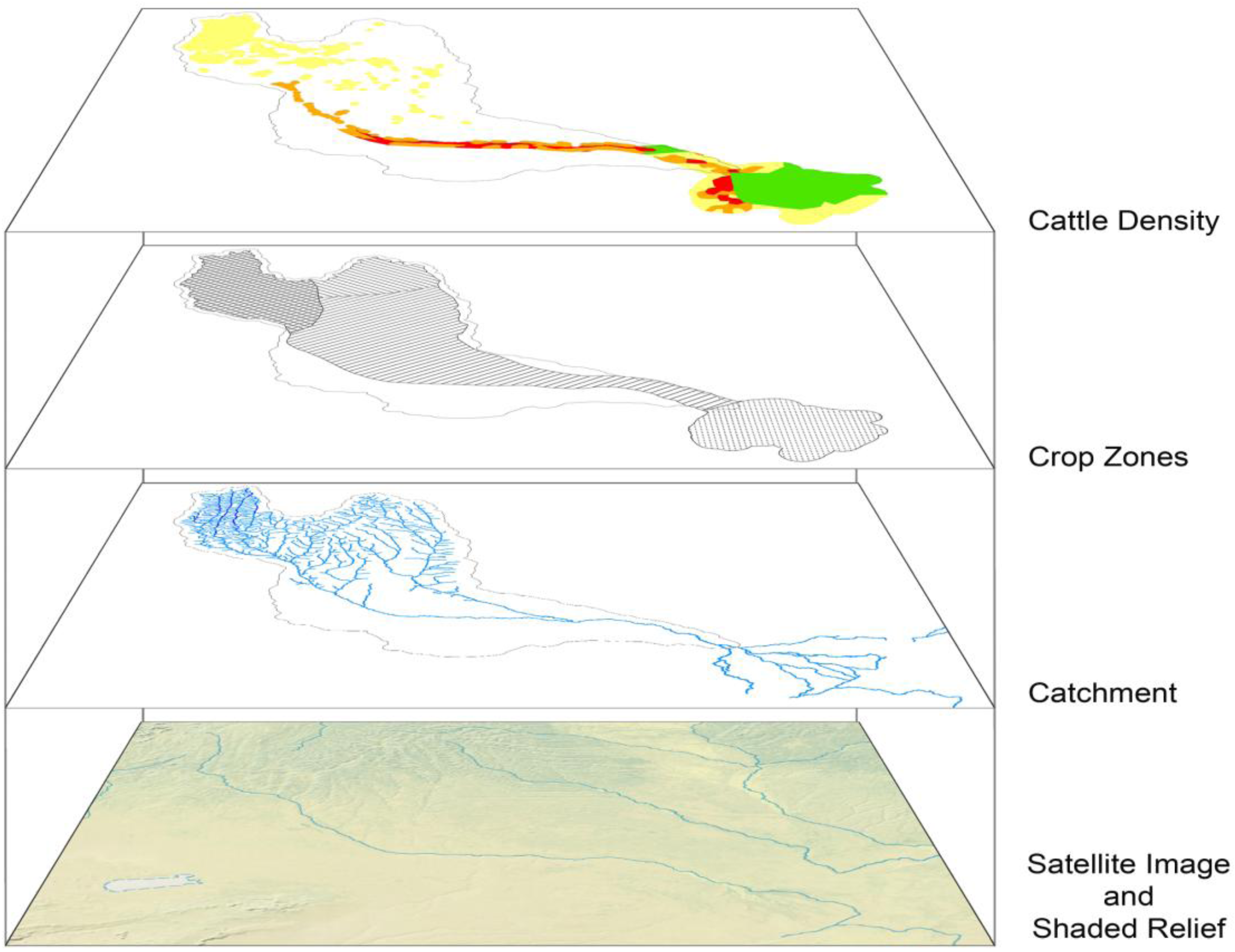
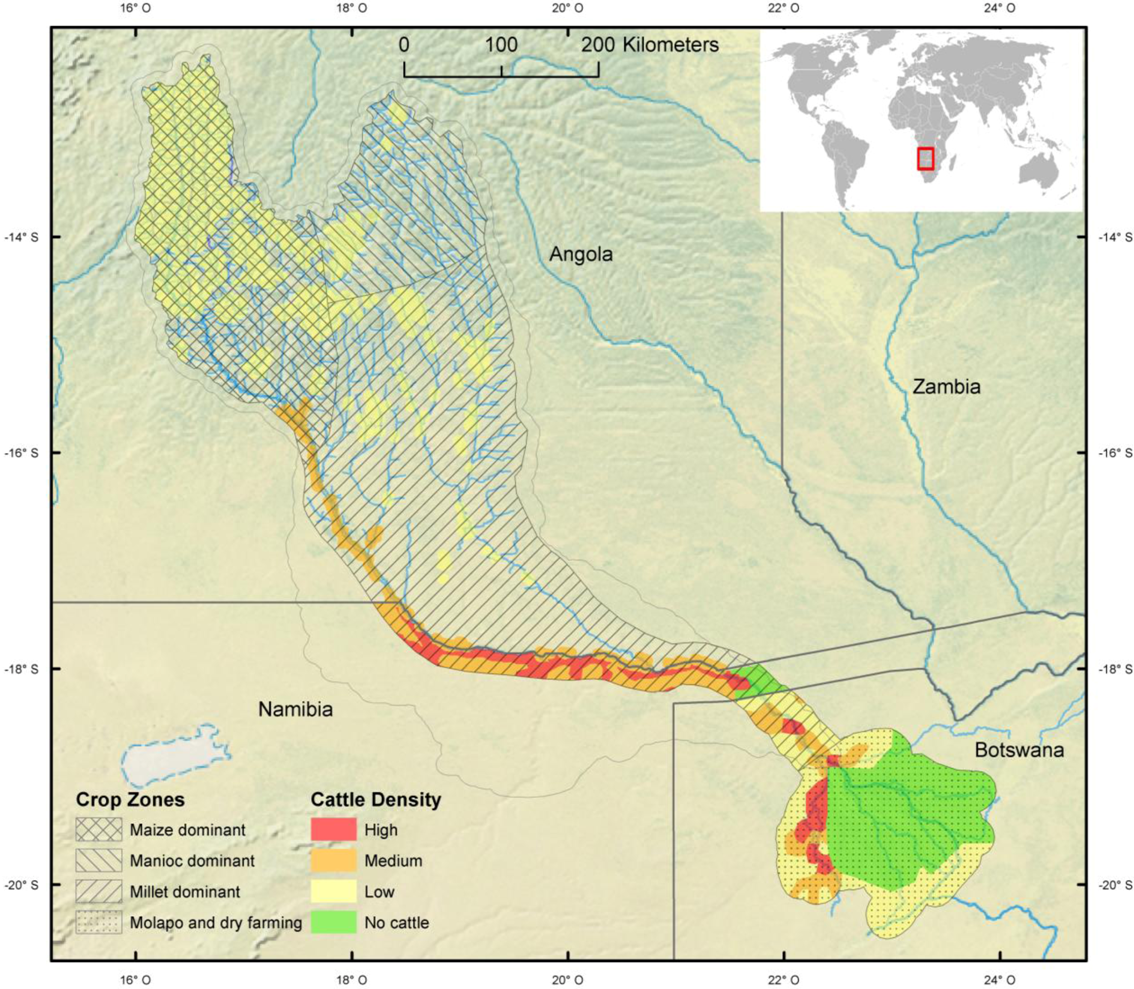
      <p>Against this background the article pursues three objectives: First, to describe the socioeconomic background and the current and projected water situation; second, to analyze the dependence of the riparian states and the local livelihoods on the Okavango Catchment; and, third, to discuss the implications of these changes for the Integrated Water Resource Management (IWRM) in the catchment. To achieve these objectives we review the scientific literature as well as reports by local, national and regional institutions. Further we analyze socioeconomic, livelihood and hydrological data from a variety of sources and at different scales. We produce a map which combines (to our knowledge for the first time) the farming and livestock activity in the Okavango Catchment (<xref ref-type="fig" rid="land-02-00060-f001">Figure 1</xref>, <xref ref-type="fig" rid="land-02-00060-f002">Figure 2</xref>). A field visit to Namibia and Botswana in 2010 complements our research which is part of the ongoing ‘The Future Okavango’ (TFO) project, a cooperation between several European and local institutions and universities to promote sustainable land use and resource management in the region (see [<xref ref-type="bibr" rid="B10-land-02-00060">10</xref>]). </p>
      <p>The article proceeds as follows. First we describe the methods, including our approach and the data used (<xref ref-type="sec" rid="sec2-land-02-00060">Section 2</xref>). Second we analyze the socioeconomic background of Angola, Botswana and Namibia (<xref ref-type="sec" rid="sec3-land-02-00060">Section 3</xref>). Against this background we discuss the dependence of the riparian states on the Okavango Catchment (<xref ref-type="sec" rid="sec4-land-02-00060">Section 4</xref>) before <xref ref-type="sec" rid="sec5-land-02-00060">Section 5</xref>, <xref ref-type="sec" rid="sec6-land-02-00060">Section 6</xref> review the current and future water situation in the catchment and its implications for the IWRM. <xref ref-type="sec" rid="sec7-land-02-00060">Section 7</xref> ties the previous aspects together and concludes. </p>
      <fig id="land-02-00060-f001" position="float">
        <label>Figure 1</label>
        <caption>
          <p>Compilation of panel maps (own representation based on data from [<xref ref-type="bibr" rid="B14-land-02-00060">14</xref>,<xref ref-type="bibr" rid="B15-land-02-00060">15</xref>,<xref ref-type="bibr" rid="B16-land-02-00060">16</xref>]).</p>
        </caption>
        <graphic xmlns:xlink="http://www.w3.org/1999/xlink" xlink:href="land-02-00060-g001.tif"/>
      </fig>
      <fig id="land-02-00060-f002" position="float">
        <label>Figure 2</label>
        <caption>
          <p>Farming and livestock density in the Okavango Catchment (own representation based on data from [<xref ref-type="bibr" rid="B14-land-02-00060">14</xref>,<xref ref-type="bibr" rid="B15-land-02-00060">15</xref>,<xref ref-type="bibr" rid="B16-land-02-00060">16</xref>]).</p>
        </caption>
        <graphic xmlns:xlink="http://www.w3.org/1999/xlink" xlink:href="land-02-00060-g002.tif"/>
      </fig>
    </sec>
    <sec sec-type="methods" id="sec2-land-02-00060">
      <title>2. Methods</title>
      <sec>
        <title>2.1. Approach</title>
        <p>To explore the interplay between demand, development and dependence and its implications for the Integrated Water Resource Management in the Okavango Catchment we start with a review of the scientific literature supplemented by reports of local, national and regional institutions (see for example, [<xref ref-type="bibr" rid="B11-land-02-00060">11</xref>,<xref ref-type="bibr" rid="B12-land-02-00060">12</xref>,<xref ref-type="bibr" rid="B13-land-02-00060">13</xref>]). The combination of these sources is promising to understand issues of economic development and water demand (management) from different perspectives. To visualize the livelihood dependence and to identify potential areas of conflicting usages in the Okavango Catchment, we utilize geo-referenced data (see top part of <xref ref-type="table" rid="land-02-00060-t001">Table 1</xref>). <xref ref-type="fig" rid="land-02-00060-f001">Figure 1</xref> shows the series of panel maps which were used to produce the map in <xref ref-type="fig" rid="land-02-00060-f002">Figure 2</xref> (see <xref ref-type="sec" rid="sec4-land-02-00060">Section 4</xref> for discussion). In addition to the literature review and the geo-referenced data we analyze socioeconomic and hydrological data from national and international institutions. </p>
      </sec>
      <sec>
        <title>2.2. Data</title>
        <p>As shown in <xref ref-type="table" rid="land-02-00060-t001">Table 1</xref>, the majority of our data sources are bodies of the United Nations, the World Bank and the Central Intelligence Agency of the United States of America. The advantage of relying on these well-established agencies is the high level of data quality and its homogenous collection and calculation method which allows for comparisons between countries. On the downside, the data is only available on national scale. Hence any conclusion drawn from this data should be interpreted as a background since the Okavango Catchment only compromises limited parts of each national territory. Nonetheless national developments as captured by national data are likely to impact the Okavango Catchment especially when they are as rapid and extensive as the population growth in Angola (see following section). </p>
        <p>Besides the limitations in geographical scope, the up-to-dateness of some of the data needs to be pointed out. For instance, the most recent data of the Food and Agriculture Organization of the United Nations (FAO) on the total freshwater withdrawal dates back to 2000. As this figure is both central for the water management and likely to have changed over the past 12 years, more recent estimates are needed. For some indicators the data refers to different years for each country. In parts this problem is minimized by combining sources. For example the latest Gini index for Namibia as given by the World Bank [<xref ref-type="bibr" rid="B17-land-02-00060">17</xref>] refers to the year 2004, for Botswana it is even 1994. To avoid comparing data which is more than a decade apart, we used national surveys (see <xref ref-type="table" rid="land-02-00060-t001">Table 1</xref>). Hence the following sections rely on the most recent data available today.</p>
        <table-wrap id="land-02-00060-t001" position="float">
          <object-id pub-id-type="pii">land-02-00060-t001_Table 1</object-id>
          <label>Table 1</label>
          <caption>
            <p>Overview of used data (in order of occurrence in the article).</p>
          </caption>
          <table>
            <tbody>
              <tr>
                <td colspan="4" align="center" valign="middle">
                  <bold>Data for Map of the Okavango Catchment</bold>
                </td>
              </tr>
              <tr style="border-top: solid thin">
                <td align="center" valign="middle">
                  <bold>Name</bold>
                </td>
                <td align="center" valign="middle">
                  <bold>Source</bold>
                </td>
                <td align="center" valign="middle">
                  <bold>Refers to Year(s)</bold>
                </td>
                <td align="center" valign="middle">
                  <bold>Scale</bold>
                </td>
              </tr>
              <tr style="border-top: solid thin">
                <td align="center" valign="middle">Cattle density</td>
                <td align="center" valign="middle">Environmental Information Service Namibia 2002 [<xref ref-type="bibr" rid="B14-land-02-00060">14</xref>] </td>
                <td align="center" valign="middle">2002</td>
                <td align="center" valign="middle">subnat.</td>
              </tr>
              <tr>
                <td align="center" valign="middle">Crop zones</td>
                <td align="center" valign="middle">Environmental Information Service Namibia 2004 [<xref ref-type="bibr" rid="B15-land-02-00060">15</xref>] </td>
                <td align="center" valign="middle">2004</td>
                <td align="center" valign="middle">subnat.</td>
              </tr>
              <tr>
                <td align="center" valign="middle">Catchment/river drainage</td>
                <td align="center" valign="middle">Environmental Information Service Namibia 2004 [<xref ref-type="bibr" rid="B15-land-02-00060">15</xref>]</td>
                <td align="center" valign="middle">2004</td>
                <td align="center" valign="middle">reg.</td>
              </tr>
              <tr>
                <td align="center" valign="middle">Satellite image with shaded relief</td>
                <td align="center" valign="middle">Natural Earth 2013 [<xref ref-type="bibr" rid="B16-land-02-00060">16</xref>]</td>
                <td align="center" valign="middle">2013</td>
                <td align="center" valign="middle">reg.</td>
              </tr>
              <tr style="border-top: solid thin">
                <td colspan="4" align="center" valign="middle">
                  <bold>Socioeconomic and Water Data</bold>
                </td>
              </tr>
              <tr style="border-top: solid thin">
                <td align="center" valign="middle">
                  <bold>Name</bold>
                </td>
                <td align="center" valign="middle">
                  <bold>Source</bold>
                </td>
                <td align="center" valign="middle">
                  <bold>Refers to Year(s)</bold>
                </td>
                <td align="center" valign="middle">
                  <bold>Scale</bold>
                </td>
              </tr>
              <tr style="border-top: solid thin">
                <td align="center" valign="middle">GDP in millions </td>
                <td align="center" valign="middle">CIA 2013 [<xref ref-type="bibr" rid="B18-land-02-00060">18</xref>,<xref ref-type="bibr" rid="B19-land-02-00060">19</xref>,<xref ref-type="bibr" rid="B20-land-02-00060">20</xref>] </td>
                <td align="center" valign="middle">2012 (est.)</td>
                <td align="center" valign="middle">nat.</td>
              </tr>
              <tr>
                <td align="center" valign="middle">GDP per capita</td>
                <td align="center" valign="middle">CIA 2013 [<xref ref-type="bibr" rid="B18-land-02-00060">18</xref>,<xref ref-type="bibr" rid="B19-land-02-00060">19</xref>,<xref ref-type="bibr" rid="B20-land-02-00060">20</xref>]</td>
                <td align="center" valign="middle">2012 (est.)</td>
                <td align="center" valign="middle">nat.</td>
              </tr>
              <tr>
                <td align="center" valign="middle">Gini index</td>
                <td align="center" valign="middle">World Bank 2013 [<xref ref-type="bibr" rid="B17-land-02-00060">17</xref>], Republic of Botswana 2004 [<xref ref-type="bibr" rid="B21-land-02-00060">21</xref>], Republic of Namibia 2012 (in [<xref ref-type="bibr" rid="B22-land-02-00060">22</xref>]) </td>
                <td align="center" valign="middle">2000, 2002/03,2009/10</td>
                <td align="center" valign="middle">nat.</td>
              </tr>
              <tr>
                <td align="center" valign="middle">Human development index</td>
                <td align="center" valign="middle">UNDP 2011 [<xref ref-type="bibr" rid="B23-land-02-00060">23</xref>] </td>
                <td align="center" valign="middle">2011</td>
                <td align="center" valign="middle">nat.</td>
              </tr>
              <tr>
                <td align="center" valign="middle">Pop. living &lt; 1.25 USD/day</td>
                <td align="center" valign="middle">UNDP 2011 [<xref ref-type="bibr" rid="B23-land-02-00060">23</xref>]</td>
                <td align="center" valign="middle">2000, 2004, 2005</td>
                <td align="center" valign="middle">nat.</td>
              </tr>
              <tr>
                <td align="center" valign="middle">Population in 2011 </td>
                <td align="center" valign="middle">FAO 2012 [<xref ref-type="bibr" rid="B24-land-02-00060">24</xref>,<xref ref-type="bibr" rid="B25-land-02-00060">25</xref>,<xref ref-type="bibr" rid="B26-land-02-00060">26</xref>] </td>
                <td align="center" valign="middle">2011</td>
                <td align="center" valign="middle">nat.</td>
              </tr>
              <tr>
                <td align="center" valign="middle">Population projection for 2020 and 2050</td>
                <td align="center" valign="middle">UN 2011 [<xref ref-type="bibr" rid="B27-land-02-00060">27</xref>]</td>
                <td align="center" valign="middle">2020, 2050</td>
                <td align="center" valign="middle">nat.</td>
              </tr>
              <tr>
                <td align="center" valign="middle">Agriculture percentage of GDP (2011)</td>
                <td align="center" valign="middle">World Bank 2013 [<xref ref-type="bibr" rid="B17-land-02-00060">17</xref>]</td>
                <td align="center" valign="middle">2011</td>
                <td align="center" valign="middle">nat.</td>
              </tr>
              <tr>
                <td align="center" valign="middle">Agriculture percentage of labor</td>
                <td align="center" valign="middle">CIA 2013 [18,20], UN 2012 [<xref ref-type="bibr" rid="B28-land-02-00060">28</xref>] </td>
                <td align="center" valign="middle">2003, 2005, 2008</td>
                <td align="center" valign="middle">nat.</td>
              </tr>
              <tr>
                <td align="center" valign="middle">Tourist arrivals at national borders (2010)</td>
                <td align="center" valign="middle">World Bank 2013 [<xref ref-type="bibr" rid="B17-land-02-00060">17</xref>]</td>
                <td align="center" valign="middle">2010</td>
                <td align="center" valign="middle">nat.</td>
              </tr>
              <tr>
                <td align="center" valign="middle">Total renewable water resources (km<sup>3</sup>/yr)</td>
                <td align="center" valign="middle">FAO 2012 [<xref ref-type="bibr" rid="B24-land-02-00060">24</xref>,<xref ref-type="bibr" rid="B25-land-02-00060">25</xref>,<xref ref-type="bibr" rid="B26-land-02-00060">26</xref>]</td>
                <td align="center" valign="middle">long term average</td>
                <td align="center" valign="middle">nat.</td>
              </tr>
              <tr>
                <td align="center" valign="middle">Total freshwater withdrawal</td>
                <td align="center" valign="middle">FAO 2012 [<xref ref-type="bibr" rid="B24-land-02-00060">24</xref>,<xref ref-type="bibr" rid="B25-land-02-00060">25</xref>,<xref ref-type="bibr" rid="B26-land-02-00060">26</xref>]</td>
                <td align="center" valign="middle">2000</td>
                <td align="center" valign="middle">nat.</td>
              </tr>
              <tr>
                <td align="center" valign="middle">Water poverty index (2002)</td>
                <td align="center" valign="middle">Ahlenius 2005 [<xref ref-type="bibr" rid="B29-land-02-00060">29</xref>]</td>
                <td align="center" valign="middle">2002</td>
                <td align="center" valign="middle">nat.</td>
              </tr>
              <tr>
                <td align="center" valign="middle">Projected growth in consumptive water demand</td>
                <td align="center" valign="middle">Ashton 2003 [<xref ref-type="bibr" rid="B30-land-02-00060">30</xref>]</td>
                <td align="center" valign="middle">2000, 2010 (proj.), 2020 (proj.)</td>
                <td align="center" valign="middle">nat.</td>
              </tr>
            </tbody>
          </table>
		  <table-wrap-foot>
			<fn>
        <p>nat. = national, subnat. = subnational, reg. = regional, proj. = projection.</p>
			</fn>
			</table-wrap-foot>
        </table-wrap>
      </sec>
    </sec>
    <sec id="sec3-land-02-00060">
      <title>3. Socioeconomic Background</title>
      <sec>
        <title>3.1. Economy and Development</title>
        <p><xref ref-type="table" rid="land-02-00060-t002">Table 2</xref> summarizes the key economic and development indicators. In absolute terms Angola has by far the highest gross domestic product (GDP), while when measured per capita Angola ranks behind Namibia and Botswana. In all three countries the income is highly unequally distributed across households as indicated by the Gini index. And while Botswana and Namibia have reached a medium level of human development, significant portions of the population in each country and particularly in Angola still live in absolute poverty. The lower level of development and higher poverty in Angola are the result of nearly three decades of civil war which has cost up to 1.5 million lives, destroyed significant parts of the infrastructure, drove inflation, fuelled corruption and displaced millions of people within and beyond the borders of the country [<xref ref-type="bibr" rid="B18-land-02-00060">18</xref>,<xref ref-type="bibr" rid="B31-land-02-00060">31</xref>,<xref ref-type="bibr" rid="B32-land-02-00060">32</xref>].</p>
        <table-wrap id="land-02-00060-t002" position="float">
          <object-id pub-id-type="pii">land-02-00060-t002_Table 2</object-id>
          <label>Table 2</label>
          <caption>
            <p>Economy and development in Angola, Botswana and Namibia [<xref ref-type="bibr" rid="B17-land-02-00060">17</xref>,<xref ref-type="bibr" rid="B18-land-02-00060">18</xref>,<xref ref-type="bibr" rid="B19-land-02-00060">19</xref>,<xref ref-type="bibr" rid="B20-land-02-00060">20</xref>,<xref ref-type="bibr" rid="B21-land-02-00060">21</xref>,<xref ref-type="bibr" rid="B23-land-02-00060">23</xref>].</p>
          </caption>
          <table>
            <thead>
              <tr>
                <th align="center" valign="middle"> </th>
                <th align="center" valign="middle">GDP in Billions (ppp 2012 est.)</th>
                <th align="center" valign="middle">GDP per Capita (ppp 2012 est.)</th>
                <th align="center" valign="middle">Gini Index</th>
                <th align="center" valign="middle">HDI (2011)</th>
                <th align="center" valign="middle">Pop. Living &lt; 1.25 USD/day</th>
              </tr>
            </thead>
            <tbody>
              <tr>
                <td align="center" valign="middle">Angola</td>
                <td align="center" valign="middle">126.2 USD</td>
                <td align="center" valign="middle">6,200 USD</td>
                <td align="center" valign="middle">58.6 (2000)</td>
                <td align="center" valign="middle">0.486</td>
                <td align="center" valign="middle">54.3% (2000)</td>
              </tr>
              <tr>
                <td align="center" valign="middle">Botswana</td>
                <td align="center" valign="middle">31.5 USD</td>
                <td align="center" valign="middle">16,800 USD</td>
                <td align="center" valign="middle">57.3 (2002/03)</td>
                <td align="center" valign="middle">0.633</td>
                <td align="center" valign="middle">23.1% (2005)</td>
              </tr>
              <tr>
                <td align="center" valign="middle">Namibia</td>
                <td align="center" valign="middle">16.8 USD</td>
                <td align="center" valign="middle">7,800 USD</td>
                <td align="center" valign="middle">59.6 (2009/10)</td>
                <td align="center" valign="middle">0.625</td>
                <td align="center" valign="middle">31.9% (2004)</td>
              </tr>
            </tbody>
          </table>
		  <table-wrap-foot>
			<fn>
        <p>ppp = purchasing power parity, pop. = population, USD = United States dollar.</p>
			</fn>
			</table-wrap-foot>
        </table-wrap>
        <p>Surveys conducted in the Angolan part of the Okavango Basin have revealed not only high levels of malnutrition but also widespread malaria, diarrhea, anemia and tuberculosis [<xref ref-type="bibr" rid="B31-land-02-00060">31</xref>,<xref ref-type="bibr" rid="B33-land-02-00060">33</xref>]. Perhaps the most crucial problem the Angolan people and government have to cope with, are an estimated eight to ten million landmines, both anti-tank and anti-personnel, which have been laid during the war in mostly unmarked minefields across some 50% of Angola’s territory, making it one of the most heavily mined countries in the world [<xref ref-type="bibr" rid="B31-land-02-00060">31</xref>,<xref ref-type="bibr" rid="B34-land-02-00060">34</xref>]. Nevertheless, a postwar reconstruction boom, the resettlement of displaced people and, most of all, high prices for oil on the world market have led to high growth rates in construction and agriculture as well as an overall economic growth rate of more than 17% between 2004 and 2008 [<xref ref-type="bibr" rid="B18-land-02-00060">18</xref>]. </p>
        <p>Based on the country’s richness in renewable (land, forests, fishing grounds) and non-renewable resources (oil, gas, diamonds, iron ore, gold) as well as its high hydropower potential, Angola is often portrayed as southern Africa’s ‘economic powerhouse’ of the future [<xref ref-type="bibr" rid="B31-land-02-00060">31</xref>]. Today, Botswana is generally seen as the African ‘success story’ having achieved nearly four decades of economic growth, multi-party democracy and low levels of corruption [<xref ref-type="bibr" rid="B35-land-02-00060">35</xref>]. Among the three riparian states Namibia has the youngest economy, gaining independence from South Africa in 1990 [<xref ref-type="bibr" rid="B36-land-02-00060">36</xref>].</p>
      </sec>
      <sec>
        <title>3.2. Population Growth</title>
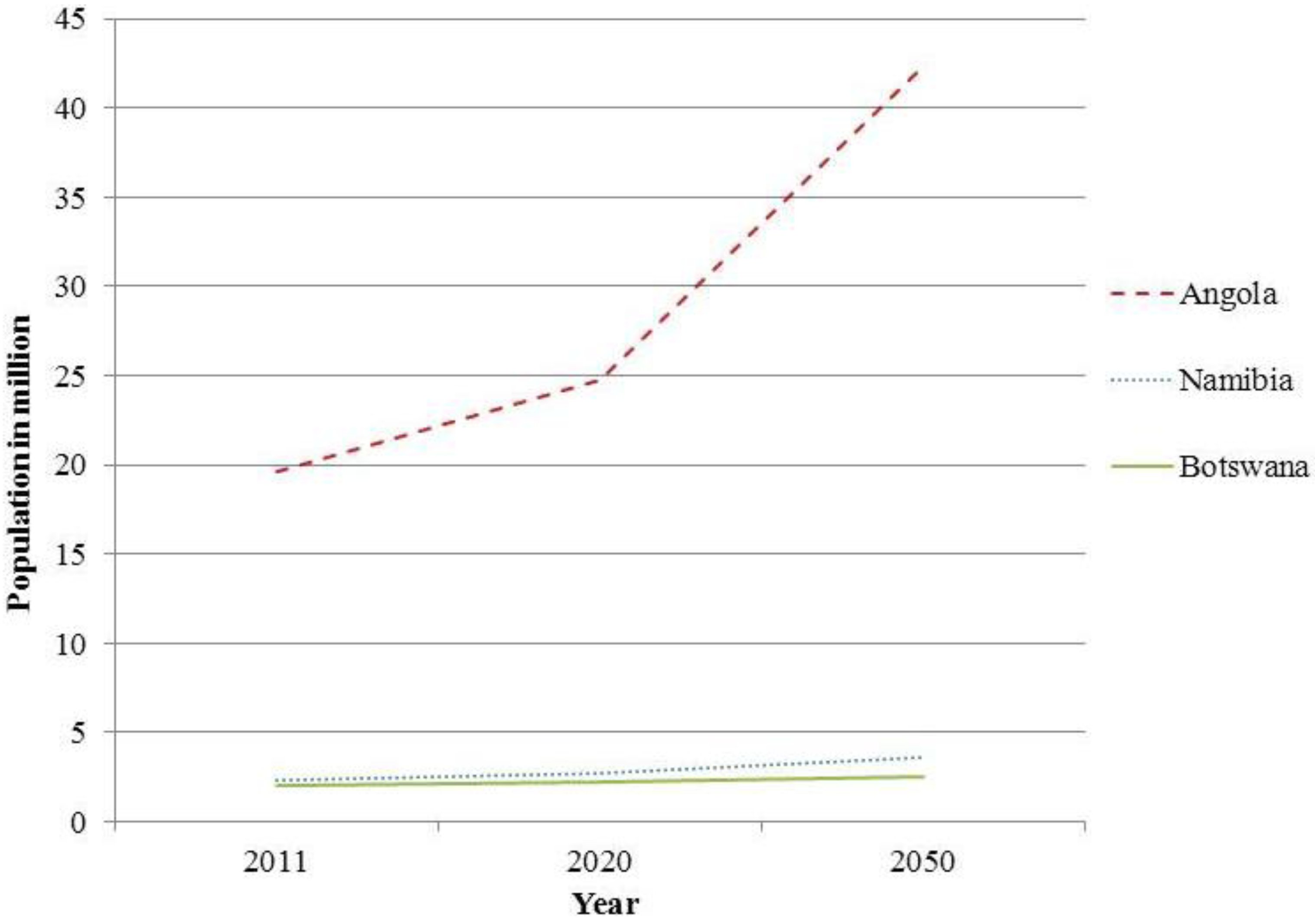
        <p><xref ref-type="fig" rid="land-02-00060-f003">Figure 3</xref> shows the medium population projection of the United Nations until 2050. Angola’s current population of about 19.6 million (population density 15.7 people per km<sup>2</sup>) is expected to more than double by 2050 [<xref ref-type="bibr" rid="B26-land-02-00060">26</xref>]. For Namibia a population growth of about 55%, and for Botswana 23% are projected until 2050 but from lower current populations and population densities. Namibia is one of the least densely populated countries in Sub-Saharan Africa with an average density of only 2.8 people per km<sup>2</sup> [<xref ref-type="bibr" rid="B26-land-02-00060">26</xref>]. In Botswana the population density is higher with 3.5 people per km<sup>2</sup>. The urban centers along the Okavango River include Maun located just inside the lower margin of the delta, Rundu in Namibia and Menongue in Angola [<xref ref-type="bibr" rid="B2-land-02-00060">2</xref>]. Overall the additional 25.5 million people until 2050 are expected to increase the pressure on the Okavango Catchment, especially in Angola.</p>
        <fig id="land-02-00060-f003" position="float">
          <label>Figure 3</label>
          <caption>
            <p>Population in 2011 and projection for 2020 and 2050 in Angola, Botswana and Namibia (own representation based on data from [<xref ref-type="bibr" rid="B24-land-02-00060">24</xref>,<xref ref-type="bibr" rid="B25-land-02-00060">25</xref>,<xref ref-type="bibr" rid="B26-land-02-00060">26</xref>,<xref ref-type="bibr" rid="B27-land-02-00060">27</xref>]).</p>
          </caption>
          <graphic xmlns:xlink="http://www.w3.org/1999/xlink" xlink:href="land-02-00060-g003.tif"/>
        </fig>
      </sec>
    </sec>
    <sec id="sec4-land-02-00060">
      <title>4. Dependence of the Riparian States on the Okavango Catchment</title>
      <p>Each of the three riparian states depends on the Okavango Catchment to varying degrees but mostly for two reasons. On the one hand the Okavango Catchment offers job opportunities in agriculture and tourism which contribute to the national GDP. On the other hand it serves as a livelihood base for mostly subsistence agriculture, pastoralism and production of local products.</p>
      <sec>
        <title>4.1. Economic Dependence</title>
        <p>With respect to the national economies, agriculture only plays a minor role for the GDPs of the riparian states but it is an important source of employment, especially in Angola and Botswana (<xref ref-type="table" rid="land-02-00060-t003">Table 3</xref>). For Botswana the Okavango is an essential resource for the tourism sector which has grown significantly over the past decades [<xref ref-type="bibr" rid="B37-land-02-00060">37</xref>,<xref ref-type="bibr" rid="B38-land-02-00060">38</xref>]. In Namibia tourism is the third highest foreign currency earner, contributing about 4.7% to the GDP in 2011 [<xref ref-type="bibr" rid="B39-land-02-00060">39</xref>,<xref ref-type="bibr" rid="B40-land-02-00060">40</xref>].</p>
        <table-wrap id="land-02-00060-t003" position="float">
          <object-id pub-id-type="pii">land-02-00060-t003_Table 3</object-id>
          <label>Table 3</label>
          <caption>
            <p>Agriculture and tourism in Angola, Botswana and Namibia [<xref ref-type="bibr" rid="B17-land-02-00060">17</xref>,<xref ref-type="bibr" rid="B18-land-02-00060">18</xref>,<xref ref-type="bibr" rid="B19-land-02-00060">19</xref>,<xref ref-type="bibr" rid="B20-land-02-00060">20</xref>,<xref ref-type="bibr" rid="B28-land-02-00060">28</xref>].</p>
          </caption>
          <table>
            <thead>
              <tr>
                <th align="center" valign="middle"> </th>
                <th align="center" valign="middle">Agriculture Percentage of GDP (2011)</th>
                <th align="center" valign="middle">Agriculture Percentage of Labor</th>
                <th align="center" valign="middle">Tourist Arrivals at National Borders (2010)</th>
              </tr>
            </thead>
            <tbody>
              <tr>
                <td align="center" valign="middle">Angola</td>
                <td align="center" valign="middle">10.1</td>
                <td align="center" valign="middle">85.0 (2003)</td>
                <td align="center" valign="middle">425,000 </td>
              </tr>
              <tr>
                <td align="center" valign="middle">Botswana</td>
                <td align="center" valign="middle">2.5</td>
                <td align="center" valign="middle">29.9 (2005)</td>
                <td align="center" valign="middle">2,145,000 </td>
              </tr>
              <tr>
                <td align="center" valign="middle">Namibia</td>
                <td align="center" valign="middle">7.3</td>
                <td align="center" valign="middle">16.3 (2008)</td>
                <td align="center" valign="middle">984,000 </td>
              </tr>
            </tbody>
          </table>
        </table-wrap>
        <p>In Botswana tourism is the second largest economic sector after mining, contributing about 4.5% to the country’s GDP through expenditures on accommodation and service providers [<xref ref-type="bibr" rid="B7-land-02-00060">7</xref>,<xref ref-type="bibr" rid="B32-land-02-00060">32</xref>,<xref ref-type="bibr" rid="B41-land-02-00060">41</xref>]. It is estimated that the delta has a total of 107 accommodation establishments [<xref ref-type="bibr" rid="B42-land-02-00060">42</xref>]. The approximately 120,000 tourists who visit the Okavango Delta annually, increase the environmental pressure on the Okavango through increased water demand and production of waste. In the Rundu area, for example, the monthly average water use increases by 50% to 70% during the high season of tourism [<xref ref-type="bibr" rid="B43-land-02-00060">43</xref>].</p>
        <p>The government of Botswana requires lodge operators to install treatment systems for waste water, but environmental standards, for instance for septic tanks, are often not met or sewage is directly disposed into the Okavango or groundwater reserves [<xref ref-type="bibr" rid="B42-land-02-00060">42</xref>,<xref ref-type="bibr" rid="B44-land-02-00060">44</xref>]. According to Mbaiwa [<xref ref-type="bibr" rid="B41-land-02-00060">41</xref>], the average per capita waste water generated across the camps in the Okavango Delta is 200 liters per person per day.</p>
      </sec>
      <sec>
        <title>4.2. Livelihood Dependence</title>
        <p>Beyond the tourism sector the Okavango is an important livelihood resource for the local pastoral and farming communities (<xref ref-type="fig" rid="land-02-00060-f002">Figure 2</xref>). The majority (77%) of the Okavango basin population is rural [<xref ref-type="bibr" rid="B45-land-02-00060">45</xref>]. Over 95% of the approximately 125,000 people living in and around the Okavango Delta in Botswana directly depend on the natural resources to sustain their livelihoods through fishing, collection of various plants and ‘molapo’ farming [<xref ref-type="bibr" rid="B46-land-02-00060">46</xref>]. This type of flood recession farming makes use of the fields, called ‘molapo’ (or plural ‘melapo’) that are located near or in the floodplains of the Okavango River [<xref ref-type="bibr" rid="B47-land-02-00060">47</xref>].</p>
        <p>Among the many natural resources that are harvested in the Okavango Delta are palm fibers obtained from <italic>Hyphaene petersiana</italic>, which are used to produce baskets. Two types of river reed, <italic>Phragmites australis</italic> and <italic>Phragmites mauritianus</italic> are harvested for sale or used as building material [<xref ref-type="bibr" rid="B48-land-02-00060">48</xref>]. The core part of the Okavango Delta (large green area in <xref ref-type="fig" rid="land-02-00060-f002">Figure 2</xref>) was declared a game reserve. The reserve is fenced off with veterinary cordon fences to prevent the spreading of livestock diseases from wildlife in the reserve to bordering areas hosting cattle reared mostly for the European beef market. As the migratory routes of wildlife such as zebras, giraffes and buffalo are blocked by the fences, they have been criticized for contributing to a loss of wildlife [<xref ref-type="bibr" rid="B49-land-02-00060">49</xref>].</p>
        <p>Throughout the delta molapo farming is practiced [<xref ref-type="bibr" rid="B11-land-02-00060">11</xref>]. Towards the border to Namibia millet farming dominates. In Namibia, the Okavango mainly supports rearing of cattle while in Angola the river is predominantly used for subsistence farming of maize, manioc and millet. The underutilization of the Okavango on the Angolan side of the Angolan-Namibian border can be explained mainly by the civil war and land mines that were placed here in the process. Once the area, located in the province of Cuando-Cubango, is cleared of landmines, increased agricultural and pastoral activity can be expected. </p>
      </sec>
    </sec>
    <sec id="sec5-land-02-00060">
      <title>5. Current and Future Water Situation in the Riparian States</title>
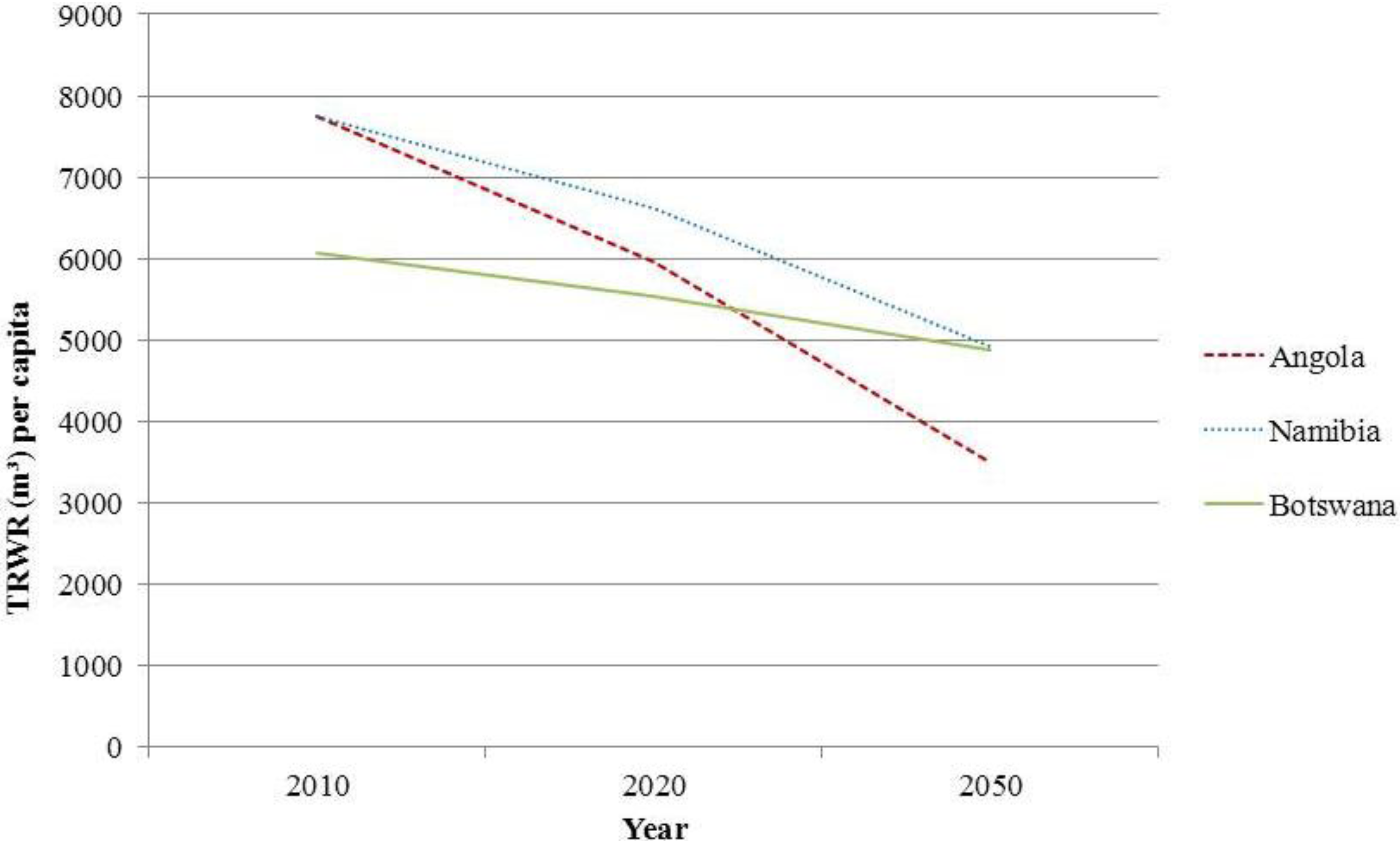
      <p>In none of the three riparian states is the situation of water supply currently stressed or scarce, when measured in total renewable water resources (TRWR) per capita (<xref ref-type="fig" rid="land-02-00060-f004">Figure 4</xref>). This even applies to mainly arid Namibia because of the country’s low total population (see previous section). </p>
      <p><xref ref-type="table" rid="land-02-00060-t004">Table 4</xref> shows that the TRWR and its withdrawal is highest in Angola followed by Namibia and Botswana. If a wider approach to water supply is taken, the water situation based on the physical water availability is partly reversed. According to water poverty index (WPI) which takes into account measurements of water access, capacity and environment in addition to the physical water availability, Angola shows the highest level of water poverty, followed by Botswana and Namibia (<xref ref-type="table" rid="land-02-00060-t004">Table 4</xref>, see also <xref ref-type="fig" rid="land-02-00060-f004">Figure 4</xref>). </p>
      <table-wrap id="land-02-00060-t004" position="float">
        <object-id pub-id-type="pii">land-02-00060-t004_Table 4</object-id>
        <label>Table 4</label>
        <caption>
          <p>Water resources, withdrawal and water poverty in Angola, Botswana and Namibia [<xref ref-type="bibr" rid="B24-land-02-00060">24</xref>,<xref ref-type="bibr" rid="B25-land-02-00060">25</xref>,<xref ref-type="bibr" rid="B26-land-02-00060">26</xref>,<xref ref-type="bibr" rid="B29-land-02-00060">29</xref>]</p>
        </caption>
        <table>
          <thead>
            <tr>
              <th align="center" valign="middle"> </th>
              <th align="center" valign="middle">Total Renewable Water Resources (km<sup>3</sup>/yr)</th>
              <th align="center" valign="middle">Total Freshwater withdrawal (2000) (km<sup>3</sup>)</th>
              <th align="center" valign="middle">Water Poverty Index (2002)*</th>
            </tr>
          </thead>
          <tbody>
            <tr>
              <td align="center" valign="middle">Angola</td>
              <td align="center" valign="middle">148</td>
              <td align="center" valign="middle">0.64</td>
              <td align="center" valign="middle">41</td>
            </tr>
            <tr>
              <td align="center" valign="middle">Botswana</td>
              <td align="center" valign="middle">12.2</td>
              <td align="center" valign="middle">0.19</td>
              <td align="center" valign="middle">57</td>
            </tr>
            <tr>
              <td align="center" valign="middle">Namibia</td>
              <td align="center" valign="middle">17.7</td>
              <td align="center" valign="middle">0.3</td>
              <td align="center" valign="middle">60</td>
            </tr>
          </tbody>
        </table>
		<table-wrap-foot>
			<fn>
      <p>a higher water provision.ppp = purchasing power parity, pop. = population, USD = United States dollar; <bold>*</bold> The WPI ranges from 0 and 100. Lower scores indicate higher water poverty.</p>
			</fn>
			</table-wrap-foot>
      </table-wrap>
      <p>The following sections describe the current and projected water situation in each country in more detail.</p>
      <sec>
        <title>5.1. Angola</title>
        <p>Currently, Angola does not have a water problem because of the high level of annual precipitation of about 1,000 mm (2007–2011 average) it receives and the aftermath of the civil war limiting economic development and population density in the upper basin of the nearly pristine Cuando-Cubango province [<xref ref-type="bibr" rid="B50-land-02-00060">50</xref>,<xref ref-type="bibr" rid="B51-land-02-00060">51</xref>,<xref ref-type="bibr" rid="B52-land-02-00060">52</xref>]. In the near future though, the manipulation of water resources is likely to emerge as a compelling strategy to improve living standards and boosting both industry and agriculture in Angola [<xref ref-type="bibr" rid="B32-land-02-00060">32</xref>,<xref ref-type="bibr" rid="B51-land-02-00060">51</xref>]. A primary objective will presumably be the stimulation of the diamond industry, which requires a significant amount of energy and water [<xref ref-type="bibr" rid="B53-land-02-00060">53</xref>]. Despite the partly unreliable data for this region, it is very likely that subsistence agriculture and animal husbandry are the dominant economic activities among residents in the Cuando-Cubango province. The water usage here is limited to supplies to villages and some small-scale floodplain irrigation [<xref ref-type="bibr" rid="B7-land-02-00060">7</xref>]. Turton [<xref ref-type="bibr" rid="B54-land-02-00060">54</xref>] worries that agricultural development on a larger scale may result in seepage of agro-chemicals into the aquatic system. Ellery and McCarthy [<xref ref-type="bibr" rid="B55-land-02-00060">55</xref>] argue that the introduction of leached fertilizers, phosphates and nitrates through extensive agriculture in the predominantly sandy soils of the catchment could lead to the eutrophication of the water downstream and disrupt the balance between different plant communities in the delta, impacting profoundly on the structure and functioning of the ecosystem. Cuando-Cubango being the traditional stronghold of Jonas Savimbi’s UNITA (União Nacional para a Independência Total de Angola) rebel movement and subject to a major government offensive from 2001 to early 2002 [<xref ref-type="bibr" rid="B31-land-02-00060">31</xref>], it was for a long time almost impossible for the government to make comprehensive socioeconomic plans for the region, let alone implement them [<xref ref-type="bibr" rid="B7-land-02-00060">7</xref>]. The end of the civil war provides an opportunity for development in general and for the Cuando-Cubango province in particular.</p>
      </sec>
      <sec>
        <title>5.2. Botswana</title>
        <p>In total, Botswana shares four river basins with its neighboring countries: the Limpopo, Orange, Zambezi and Okavango. This results in a situation where 94% of its theoretically accessible freshwater resources originate outside its borders [<xref ref-type="bibr" rid="B56-land-02-00060">56</xref>], making water resource management complex and contributing to the vulnerability of the country in multiple ways. The development of surface water in Botswana is further constrained by a number of factors such as its low and erratic run-off, lack of available dam sites and high evaporation rates. Since the beginning of the nineteenth century, several attempts have been made to develop large-scale arable and irrigation projects in and around the Okavango Delta. A number of surveys have been carried out but due to ecological concerns, high transport costs and the unreliability of water inflow, these commercial plans have all been abandoned except for two irrigation schemes south of Shakawe [<xref ref-type="bibr" rid="B57-land-02-00060">57</xref>].</p>
        <p>Only approximately 35% of Botswana’s total water supply is from surface water, whereas the remainder (65%) is from groundwater [<xref ref-type="bibr" rid="B58-land-02-00060">58</xref>]. An estimated 21,000 boreholes are scattered across Botswana to ensure water supply in many parts of the country [<xref ref-type="bibr" rid="B59-land-02-00060">59</xref>] and about 60 additional boreholes are drilled each year to meet the increasing demand [<xref ref-type="bibr" rid="B60-land-02-00060">60</xref>]. Botswana faces problems with groundwater salinity and high concentrations of fluorides, nitrates and other contaminations mainly caused by fecal material from septic tanks and pit latrines [<xref ref-type="bibr" rid="B59-land-02-00060">59</xref>]. There is some evidence which suggests that groundwater is used at a much higher rate than the rate of replenishment [<xref ref-type="bibr" rid="B58-land-02-00060">58</xref>,<xref ref-type="bibr" rid="B61-land-02-00060">61</xref>]. Recharge rates of groundwater aquifers range from 40 mm/yr in the extreme north to virtually zero in the central and western parts of the country. The average recharge is only around 3 mm/yr [<xref ref-type="bibr" rid="B58-land-02-00060">58</xref>]. At the current rates of abstraction, resource lifetime may be limited to decades rather than centuries [<xref ref-type="bibr" rid="B61-land-02-00060">61</xref>].</p>
        <p>Studies for the Botswana National Water Master Plan showed that by 2020, all of Botswana’s internal water resources will be fully utilized and the country will have no option but to resort to international water resources to augment local supplies [<xref ref-type="bibr" rid="B62-land-02-00060">62</xref>]. The studies also revealed that urban water demands were growing at a much faster rate than rural water demand, corresponding to population growth trends (<xref ref-type="fig" rid="land-02-00060-f003">Figure 3</xref>). </p>
        <p>Water consumption in the villages is heavily subsidized by the government, giving little incentive to conserve water at individual level. Until 1993, water supply to farmers was free of charge [<xref ref-type="bibr" rid="B59-land-02-00060">59</xref>]. Current pricing policies of water for major village are aimed only at recovering the operating costs of the supply schemes, which has in most cases not been achieved yet due to poor billing and revenue collection and the small consumer base. For smaller villages, tariffs are aimed at the recovery of 33% of the costs [<xref ref-type="bibr" rid="B63-land-02-00060">63</xref>]. The supply situation is also complicated by problems of distribution: system water losses average 15% to 25% but may run as high as 35% when older pipes are used [<xref ref-type="bibr" rid="B64-land-02-00060">64</xref>].</p>
      </sec>
      <sec>
        <title>5.3. Namibia</title>
        <p>Being one of the most arid countries in sub-Saharan Africa, Namibia lacks permanent natural water bodies or perennial rivers originating within its territory. About 42.5 mm of the average annual rainfall of only 250 mm is lost to evapotranspiration [<xref ref-type="bibr" rid="B32-land-02-00060">32</xref>]. To cope with irregular surface flow, the country invested in facilities to capture and store the episodic runoff in its ephemeral rivers. Ten dams yield nearly half of Namibia’s estimated surface water from non-shared rivers [<xref ref-type="bibr" rid="B32-land-02-00060">32</xref>]. Surface storage is complimented by groundwater pumping (around 300 million m<sup>3</sup>/yr). However, in densely populated Central Namibia, both surface and groundwater availability is very limited and despite all efforts of irrigation, less than 5% of the country is arable. Enjoying relative political and economic stability since its independence, Namibia was the first country in the world to incorporate environmental protection into its constitution. Nearly 6% of the land is nationally protected, including large portions of coastal areas of the Namib Desert [<xref ref-type="bibr" rid="B65-land-02-00060">65</xref>].</p>
        <p>As the Okavango River flows along the border of Angola and Namibia, both states consider they have a ‘riparian right’ to abstract water from this section of the river. In Namibia, the Okavango River provides the main water supply for the town of Rundu and the commercial irrigation schemes in the northernmost part of the country [<xref ref-type="bibr" rid="B50-land-02-00060">50</xref>]. About 16.5 million m<sup>3</sup> of water per year are taken for irrigating 1,100 ha in the Kavango region and approximately 5.5 million m<sup>3</sup> per year are taken for domestic water supply to Rundu and villages along the river [<xref ref-type="bibr" rid="B66-land-02-00060">66</xref>]. One hectare of irrigated land uses about as much water as 1,000 cattle or 1,600 rural residents [<xref ref-type="bibr" rid="B13-land-02-00060">13</xref>]. Past attempts of Namibian officials to pursue the large-scale abstraction of surface water from the Okavango and to extend the water supply to the central part of the country via pipelines were perceived strongly negative and have ultimately failed due to resistance from the public. Main causes of concern were the possible effects on tourism at the Okavango River in Namibia and the delta in Botswana as well as the resulting income loss for local residents [<xref ref-type="bibr" rid="B67-land-02-00060">67</xref>].</p>
        <p>In the past, hand-dug wells with a depth rarely exceeding 10 m represented the most important source of drinking water in the rural regions of Namibia, but this method fails to provide an adequate water supply for the growing population. Treated wastewater is used more and more often for applications that do not require drinking water quality, such as landscape irrigation. In Namibia, reuse of water is practiced in many urban areas such as Swakopmund, Walvis Bay, Tsumeb, Otjiwarongo, Okahandja, Mariental, Oranjemund and Windhoek [<xref ref-type="bibr" rid="B68-land-02-00060">68</xref>]. Another possibility is the tapping of a deeper water table (at a depth of about 60 to 80 m), which has turned out to be very saline, though, especially in the more densely populated areas. Groundwater salinity in Namibia ranges from low saline freshwater lenses up to over 5,000 mg/L TDS (total dissolved solids), a value at which water is too saline (sodium, fluorine, sulphate) for any possible use. A maximum salinity of 1,000 mg/L TDS has been identified by the World Health Organization as the maximum possible level for drinking water, whereas water with a salinity between 1,000 and 5,000 mg/L TDS is only acceptable for watering livestock. Therefore, the most pressing water problem in northern Namibia is not the general availability of groundwater, but above all the water quality [<xref ref-type="bibr" rid="B43-land-02-00060">43</xref>].</p>
      </sec>
      <sec>
        <title>5.4. Projected Water Situation</title>
        <p>Assuming that the TRWR (<xref ref-type="table" rid="land-02-00060-t004">Table 4</xref>) remain the same, the expected population growth shown in <xref ref-type="fig" rid="land-02-00060-f003">Figure 3</xref> will decrease the per capita water supply until 2050 in all three countries (<xref ref-type="fig" rid="land-02-00060-f004">Figure 4</xref>). In Angola the per capita water supply is projected to be less than half of the current state. Namibia could experience a decrease of more than 2,800 m<sup>3</sup> per capita. The smallest decreases are expected in Botswana. The decreasing per capita water availability will contribute to an increase in water poverty in all countries (see <xref ref-type="table" rid="land-02-00060-t004">Table 4</xref>, <xref ref-type="fig" rid="land-02-00060-f004">Figure 4</xref>). Climatic changes are expected to have a limited effect on the physical water availability until 2050 but for the period 2070 to 2099 flow decreases in the Okavango Basin of up to 26% are projected [<xref ref-type="bibr" rid="B5-land-02-00060">5</xref>].</p>
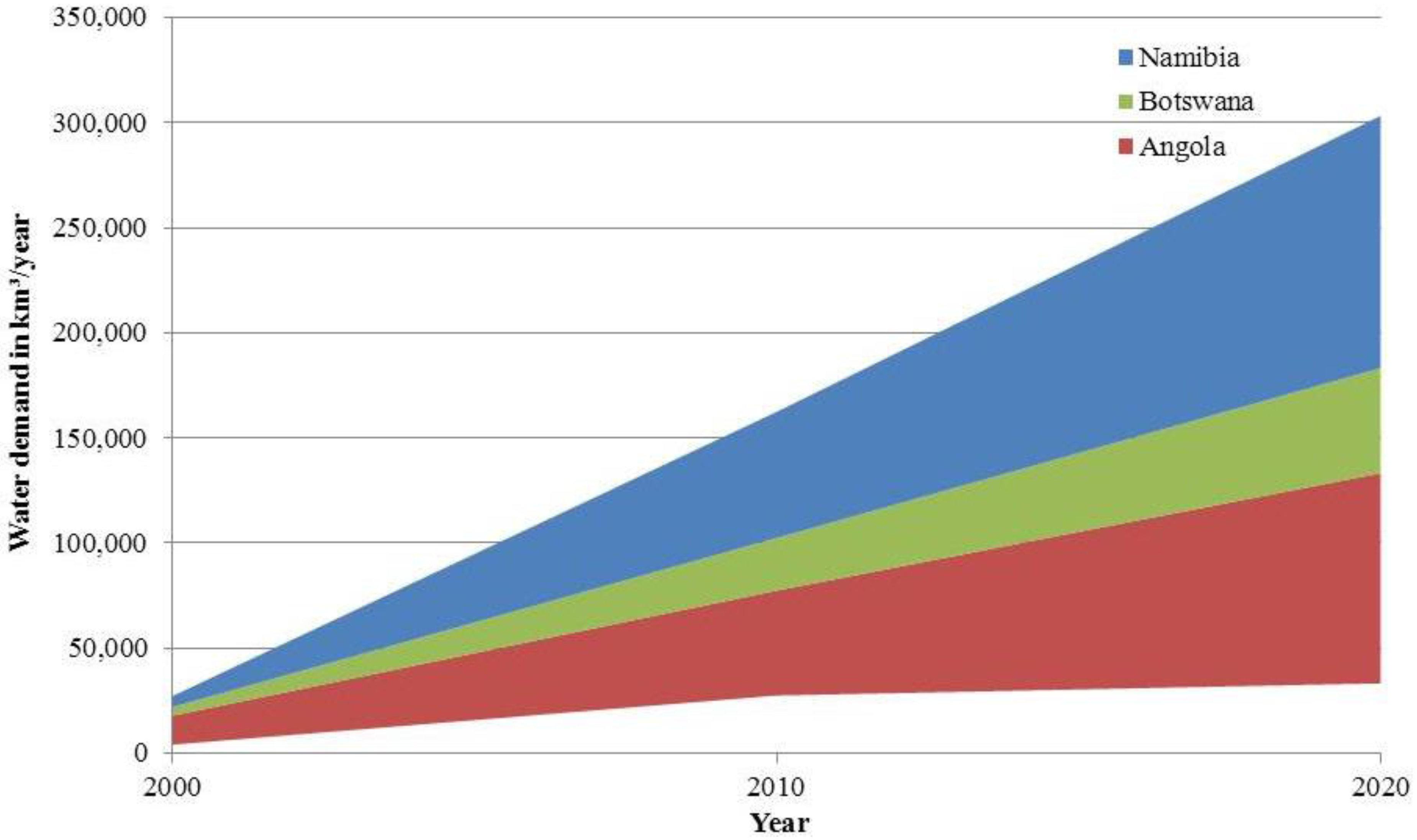
        <p>The future consumptive water demand was estimated by Ashton [<xref ref-type="bibr" rid="B30-land-02-00060">30</xref>] who developed a projection based on two scenarios. <xref ref-type="fig" rid="land-02-00060-f005">Figure 5</xref> shows the range between the high and the low scenario for each country. The high scenario considers potential new developments including irrigation schemes and water transfers from the Okavango. The low scenario keeps the current per capita water use pattern unchanged but population growth is taken into account which would increase total water needs by 44% [<xref ref-type="bibr" rid="B30-land-02-00060">30</xref>]. Overall, <xref ref-type="fig" rid="land-02-00060-f005">Figure 5</xref> shows a wide range between the two scenarios which illustrates the high uncertainty about future demand. While demand increases are projected for all three countries, the most significant increases are expected in Namibia and Angola. </p>
      <fig id="land-02-00060-f004" position="float">
        <label>Figure 4</label>
        <caption>
          <p>Projected total renewable water resources (TRWR) per capita for 2010, 2020 and 2050 in Angola, Botswana and Namibia (own representation based on data from [<xref ref-type="bibr" rid="B24-land-02-00060">24</xref>,<xref ref-type="bibr" rid="B25-land-02-00060">25</xref>,<xref ref-type="bibr" rid="B26-land-02-00060">26</xref>,<xref ref-type="bibr" rid="B27-land-02-00060">27</xref>]).</p>
        </caption>
        <graphic xmlns:xlink="http://www.w3.org/1999/xlink" xlink:href="land-02-00060-g004.tif"/>
      </fig>
        <fig id="land-02-00060-f005" position="float">
          <label>Figure 5</label>
          <caption>
            <p>Projected growth in consumptive water demand (own representation based on data from [<xref ref-type="bibr" rid="B30-land-02-00060">30</xref>]).</p>
          </caption>
          <graphic xmlns:xlink="http://www.w3.org/1999/xlink" xlink:href="land-02-00060-g005.tif"/>
        </fig>
      </sec>
    </sec>
    <sec id="sec6-land-02-00060">
      <title>6. Implications for IWRM: Chances and Challenges</title>
      <sec>
        <title>6.1. General Challenges, Principles and Key Strategies</title>
        <p>Integrated Water Resource Management (IWRM) has emerged as an alternative to the traditional sector-by-sector, top-down resource management approach [<xref ref-type="bibr" rid="B8-land-02-00060">8</xref>,<xref ref-type="bibr" rid="B69-land-02-00060">69</xref>]. The Global Water Partnership (GWP) defines IWRM as ‘a process which promotes the coordinated development and management of water, land and related resources, in order to maximize the resultant economic and social welfare in an equitable manner without compromising the sustainability of vital ecosystems’ [<xref ref-type="bibr" rid="B8-land-02-00060">8</xref>]. Gaining broad attention following the international conferences on water and environmental issues in Dublin and Rio de Janeiro in 1992 [<xref ref-type="bibr" rid="B8-land-02-00060">8</xref>], the approach has recently been criticized for its broadness and its similarity to the ecosystem service approach [<xref ref-type="bibr" rid="B70-land-02-00060">70</xref>,<xref ref-type="bibr" rid="B71-land-02-00060">71</xref>]. However, supporters and critics alike emphasize that the success of IWRM depends on its implementation. </p>
        <p>Whereas some IWRM principles (as discussed below) may be commonly applicable, independent of context and stage of economic or social development, there is no universal blueprint as to how such principles can be put into practice. Factors such as natural conditions, character and intensity of water problems, human resources, institutional capacities, the relative strengths and characteristics of the public and private sectors, the cultural setting and many others, differ greatly between countries and regions. Therefore, practical implementation of the concept of IWRM must reflect such variations and thus will necessarily take a variety of forms [<xref ref-type="bibr" rid="B8-land-02-00060">8</xref>]. Also, past experience shows that implementation of IWRM is usually a slow process that could take several decades to be fully effective. </p>
        <p>The following general challenges have been identified by the GWP [<xref ref-type="bibr" rid="B8-land-02-00060">8</xref>]:
        <list list-type="order">
          <list-item>
            <p>Securing water for people and food production;</p>
          </list-item>
          <list-item>
            <p>Protecting vital ecosystems;</p>
          </list-item>
          <list-item>
            <p>Dealing with variability of water in space and time;</p>
          </list-item>
          <list-item>
            <p>Managing water-associated risks;</p>
          </list-item>
          <list-item>
            <p>Creating popular awareness and understanding;</p>
          </list-item>
          <list-item>
            <p>Forging the political will to act;</p>
          </list-item>
          <list-item>
            <p>Ensuring collaboration across sectors and boundaries.</p>
          </list-item>
        </list></p>
        <p>To overcome these challenges, consistent progress on multiple ‘fronts’ is necessary. Four central concepts are suggested to guide the implementation of IWRM [<xref ref-type="bibr" rid="B72-land-02-00060">72</xref>].</p>
        <sec>
          <title>Integration</title>
          <p>In contrast to sectoral approaches, IWRM emphasizes the horizontal integration of sectors that use and/or affect water. In order to effectively coordinate water supply and sanitation, agriculture use, energy generation, industrial use, environmental protection and other sectors, new institutions and policies are often required. Furthermore, vertical integration is needed to coordinate efforts between local, regional, national and international water users and institutions.</p>
        </sec>
        <sec>
          <title>Decentralization</title>
          <p>The second key concept of IWRM is to place responsibility for water resource management at the lowest effective administrative level. River basin organizations provide a means of decentralizing management authority from national governments to the basin or sub-basin level, where special attention can be paid to specific local problems. Whereas the appropriate level of decentralization depends on the nature of the specific water management problem in question, IWRM seeks to strike a balance between top-down and bottom-up management.</p>
        </sec>
        <sec>
          <title>Participation</title>
          <p>The third approach of IWRM is to strengthen community-based organizations, water user associations and stakeholders to give them a greater role in management decisions. Full and effective participation requires gender awareness and special efforts to allow women and vulnerable groups to participate in management decisions, in accordance with the Dublin Principles.</p>
        </sec>
        <sec>
          <title>Economic and Financial Stability</title>
          <p>A long-term goal of IWRM is full economic sustainability, with proper attention given to the economic value of water. Xie [<xref ref-type="bibr" rid="B72-land-02-00060">72</xref>] calls it inevitable that, to achieve this goal, water is priced at its full cost, at minimum accounting for the cost of withdrawing and delivering the water. Also, laws and policies should establish clear water use rights.</p>
        </sec>
      </sec>
      <sec>
        <title>6.2. Chances and Challenges for the Okavango Catchment</title>
        <p>The three riparian countries have all been colonies or protectorates under different foreign powers, resulting in different administrative cultures. They also have different official languages and particularly Angolan delegations have to rely on translators [<xref ref-type="bibr" rid="B45-land-02-00060">45</xref>]. Communication processes in the basin are not only complicated by language barriers. Electronic media (e.g., radio programs) are used to inform communities living in more remote regions, a process working well in Namibia and Botswana but less effectively in Angola due to the lack of communication infrastructure [<xref ref-type="bibr" rid="B34-land-02-00060">34</xref>]. There is also a general tendency to promote economic development at the expense of the environment [<xref ref-type="bibr" rid="B73-land-02-00060">73</xref>]. Unclear and overlapping jurisdictions in and between the involved institutions are obstacles for policy implementation [<xref ref-type="bibr" rid="B60-land-02-00060">60</xref>,<xref ref-type="bibr" rid="B74-land-02-00060">74</xref>]. In Namibia for example, the private company NamWater provides the long-distance water supply to the urban areas and their surroundings through its own distribution network. In rural areas however water supply is controlled by the Ministry of Agriculture, Water and Forestry who owns the water infrastructure here. The differences in ownership result in frequent interruptions of water supply. </p>
        <p>Beyond the institutional challenges in each country, the previously described socioeconomic developments and projected water situations pose two main challenges for the IWRM in the Okavango Catchment. First, the increasing demand for water and second the shifting power relations. In Angola, the demand for water is mainly driven by strong population growth. The additional 23 million people until 2050 will increase the pressure to utilize the fertile land along the Okavango. How fast the southern part of the Cuando-Cubango province will be populated depends on the progress made clearing the mines in the area [<xref ref-type="bibr" rid="B75-land-02-00060">75</xref>]. While in Botswana a population growth of ‘only’ 23% between 2011 and 2050 is expected, the government’s effort to promote tourism is likely to increase the per capita water demand, especially in the Okavango Delta [<xref ref-type="bibr" rid="B76-land-02-00060">76</xref>,<xref ref-type="bibr" rid="B77-land-02-00060">77</xref>]. In Namibia, the projected 55% population growth (2011 to 2050) will increase the demand for fresh water while water resources for non-human consumption will be less stressed. </p>
        <p>The political stabilization and strengthening economic power of Angola generally make the country a more reliable and stable partner within the Permanent Okavango River Basin Water Commission (OKACOM) Agreement. However, Angola’s increasing water demand and its position as an upstream state are likely to lead to an increased use of the Okavango. </p>
        <p>Despite the apparent conflict potential, outbreak of violence over water resources in the region is unlikely. So far, water conflicts in the Okavango River Basin have centered on verbal disagreements, particularly between Namibia and Botswana [<xref ref-type="bibr" rid="B7-land-02-00060">7</xref>,<xref ref-type="bibr" rid="B78-land-02-00060">78</xref>]. Of 261 international river basins only 55 have treaty mechanisms to guide joint management [<xref ref-type="bibr" rid="B79-land-02-00060">79</xref>] and the Okavango River Basin is one of them. With the aim of managing the basin as a single entity, the three sovereign states of Angola, Botswana and Namibia agreed to sign the ‘OKACOM Agreement’ in 1994. The agreement commits the member states to a coordinated and environmentally sustainable development of regional water resources, while addressing the legitimate social and economic needs of each of the riparian states. The three countries recognize the implications that developments upstream of the river can have on the resource downstream. The agreement also established the OKACOM as a technical advisor on matters relating to the conservation, development and utilization of the resources of common interest to the basin members. The role of OKACOM is to anticipate and reduce those unintended, unacceptable and often unnecessary impacts that occur due to uncoordinated resources development. The 1994 agreement gives OKACOM several legal responsibilities including to determine the long term safe yield of the river basin, to estimate reasonable demand from the consumers, as well as to prepare criteria for conservation, equitable allocation and sustainable utilization of water resources [<xref ref-type="bibr" rid="B12-land-02-00060">12</xref>]. OKACOM can be regarded as pivotal to overcome the challenges of increasing demand and shifting power relations in a peaceful manner. </p>
      </sec>
    </sec>
    <sec id="sec7-land-02-00060">
      <title>7. Conclusion</title>
      <p>The Okavango Catchment is used by the three riparian states to varying degrees and for multiple purposes. In Botswana, tourism is the central use, combined with (fenced-off) cattle rearing, as well as flood recession and millet farming. On the Namibian side of the Okavango Catchment, cattle rearing is the dominant use. Across the border on the Angolan side, the cattle density decreases because of the land mines which were placed there during almost three decades of civil war. The pressure to clear the mines and to populate the Okavango Catchment is increasing as Angola’s current population of 19.6 million is expected to more than double by 2050. The Permanent Okavango River Basin Water Commission (OKACOM) and the Integrated Water Resource Management (IWRM) need to prepare for an increased demand for water in Angola but also in Botswana as a promotion of tourism is likely to increase the per capita water consumption. As Angola is increasingly recovering from the aftermath of the civil war, the country could become a more stable partner within the OKACOM Agreement. On other hand, the IWRM needs to allow Angola to develop the Cuando-Cubango province without extracting amounts of water that would limit farming, pastoralism and tourism in Botswana and Namibia. Especially in Namibia, the IWRM needs to address the issue of water quality, as water for non-human consumption is not likely to be critical in the near future. In all countries there is a need for more recent estimates of the total freshwater withdrawals. Given the level of poverty and essentiality of water for the local livelihoods in all riparian countries, it seems unrealistic and even undesirable to achieve economic sustainability through pricing of water at full cost. Finally, an outbreak of violent conflict between the riparian states is currently unlikely, however, it is critical for the IWRM to address the challenges posed by the interplay of demand, development and dependence.</p>
    </sec>
  </body>
  <back>
    <ack>
      <title>Acknowledgments</title>
      <p>We thank the reviewers for their constructive and helpful comments.</p>
    </ack>
    <ref-list>
      <title>References</title>
      <ref id="B1-land-02-00060">
        <label>1.</label>
        <citation citation-type="book">
          <person-group person-group-type="author">
            <name>
              <surname>Scudder</surname>
              <given-names>T.</given-names>
            </name>
          </person-group>
          <article-title>Okavango River Basin</article-title>
          <source>Management of Transboundary Rivers and Lakes</source>
          <person-group person-group-type="editor">
            <name>
              <surname>Varis</surname>
              <given-names>O.</given-names>
            </name>
            <name>
              <surname>Biswas</surname>
              <given-names>A.</given-names>
            </name>
            <name>
              <surname>Tortajada</surname>
              <given-names>C.</given-names>
            </name>
          </person-group>
          <publisher-name>Springer</publisher-name>
          <publisher-loc>Berlin, Germany</publisher-loc>
          <year>2008</year>
          <fpage>81</fpage>
          <lpage>103</lpage>
        </citation>
      </ref>
      <ref id="B2-land-02-00060">
        <label>2.</label>
        <citation citation-type="book">
          <person-group person-group-type="author">
            <name>
              <surname>Mendelsohn</surname>
              <given-names>J.</given-names>
            </name>
            <name>
              <surname>Obeid</surname>
              <given-names>S.</given-names>
            </name>
          </person-group>
          <source>Okavango River: The Flow of a Lifeline</source>
          <publisher-name>Struik</publisher-name>
          <publisher-loc>Cape Town, South Africa</publisher-loc>
          <year>2004</year>
        </citation>
      </ref>
      <ref id="B3-land-02-00060">
        <label>3.</label>
        <citation citation-type="book">
          <person-group person-group-type="author">
            <name>
              <surname>Alemaw</surname>
              <given-names>F.</given-names>
            </name>
            <name>
              <surname>Ashworth</surname>
              <given-names>J.M.</given-names>
            </name>
            <name>
              <surname>Hughes</surname>
              <given-names>D.</given-names>
            </name>
          </person-group>
          <source>Hydrology of the Okavango Delta</source>
          <publisher-name>Department of Water</publisher-name>
          <publisher-loc>Gaborone, Botswana</publisher-loc>
          <year>2003</year>
        </citation>
      </ref>
      <ref id="B4-land-02-00060">
        <label>4.</label>
        <citation citation-type="journal">
          <person-group person-group-type="author">
            <name>
              <surname>Milzow</surname>
              <given-names>C.</given-names>
            </name>
            <name>
              <surname>Kgotlhang</surname>
              <given-names>L.</given-names>
            </name>
            <name>
              <surname>Bauer-Gottwein</surname>
              <given-names>P.</given-names>
            </name>
            <name>
              <surname>Meier</surname>
              <given-names>P.</given-names>
            </name>
            <name>
              <surname>Kinzelbach</surname>
              <given-names>W.</given-names>
            </name>
          </person-group>
          <article-title>Regional review: the hydrology of the Okavango Delta, Botswana—Processes, data and modelling</article-title>
          <source>Hydrogeol. J.</source>
          <year>2009</year>
          <volume>17</volume>
          <fpage>1297</fpage>
          <lpage>1328</lpage>
          <pub-id pub-id-type="doi">10.1007/s10040-009-0436-0</pub-id>
        </citation>
      </ref>
      <ref id="B5-land-02-00060">
        <label>5.</label>
        <citation citation-type="journal">
          <person-group person-group-type="author">
            <name>
              <surname>Andersson</surname>
              <given-names>L.</given-names>
            </name>
            <name>
              <surname>Wilk</surname>
              <given-names>J.</given-names>
            </name>
            <name>
              <surname>Todd</surname>
              <given-names>M.C.</given-names>
            </name>
            <name>
              <surname>Hughes</surname>
              <given-names>D.A.</given-names>
            </name>
            <name>
              <surname>Earle</surname>
              <given-names>A.</given-names>
            </name>
            <name>
              <surname>Kniveton</surname>
              <given-names>D.</given-names>
            </name>
            <name>
              <surname>Layberry</surname>
              <given-names>R.</given-names>
            </name>
            <name>
              <surname>Savenije</surname>
              <given-names>H.H.G.</given-names>
            </name>
          </person-group>
          <article-title>Impact of climate change and development scenarios on flow patterns in the Okavango River</article-title>
          <source>J. Hydrol.</source>
          <year>2006</year>
          <volume>331</volume>
          <fpage>43</fpage>
          <lpage>57</lpage>
          <pub-id pub-id-type="doi">10.1016/j.jhydrol.2006.04.039</pub-id>
        </citation>
      </ref>
      <ref id="B6-land-02-00060">
        <label>6.</label>
        <citation citation-type="journal">
          <person-group person-group-type="author">
            <name>
              <surname>Hammond</surname>
              <given-names>J.L.</given-names>
            </name>
          </person-group>
          <article-title>The resource curse and oil revenues in Angola and Venezuela</article-title>
          <source>Sci. Soc.</source>
          <year>2011</year>
          <volume>75</volume>
          <fpage>348</fpage>
          <lpage>378</lpage>
          <pub-id pub-id-type="doi">10.1521/siso.2011.75.3.348</pub-id>
        </citation>
      </ref>
      <ref id="B7-land-02-00060">
        <label>7.</label>
        <citation citation-type="journal">
          <person-group person-group-type="author">
            <name>
              <surname>Mbaiwa</surname>
              <given-names>J.E.</given-names>
            </name>
          </person-group>
          <article-title>Causes and possible solutions to water resource conflicts in the Okavango River Basin: The case of Angola, Namibia and Botswana</article-title>
          <source>Phys. Chem. Earth A/B/C</source>
          <year>2004</year>
          <volume>29</volume>
          <fpage>1319</fpage>
          <lpage>1326</lpage>
          <pub-id pub-id-type="doi">10.1016/j.pce.2004.09.015</pub-id>
        </citation>
      </ref>
      <ref id="B8-land-02-00060">
        <label>8.</label>
        <citation citation-type="web">
          <collab>Global Water Partnership (GWP)</collab>
          <source>Integrated Water Resources Management</source>
          <publisher-name>GWP</publisher-name>
          <publisher-loc>Stockholm, Sweden</publisher-loc>
          <year>2000</year>
          <comment>Available online:<ext-link xmlns:xlink="http://www.w3.org/1999/xlink" xlink:href="http://www.gwp.org/Global/GWP-CACENA_Files/en/pdf/tec04.pdf" ext-link-type="uri">http://www.gwp.org/Global/GWP-CACENA_Files/en/pdf/tec04.pdf</ext-link></comment>
          <access-date>(accessed on 6 December 2012)</access-date>
        </citation>
      </ref>
      <ref id="B9-land-02-00060">
        <label>9.</label>
        <citation citation-type="book">
          <person-group person-group-type="author">
            <name>
              <surname>Pinheiro</surname>
              <given-names>I.</given-names>
            </name>
            <name>
              <surname>Gabaake</surname>
              <given-names>G.</given-names>
            </name>
            <name>
              <surname>Heyns</surname>
              <given-names>P.</given-names>
            </name>
          </person-group>
          <article-title>Cooperation in the Okavango River Basin: The OKACOM Perspective</article-title>
          <source>Transboundary Rivers, Sovereignty and Development: Hydropolitical Drivers in the Okavango River Basin</source>
          <person-group person-group-type="editor">
            <name>
              <surname>Turton</surname>
              <given-names>A.</given-names>
            </name>
            <name>
              <surname>Ashton</surname>
              <given-names>P.</given-names>
            </name>
            <name>
              <surname>Cloete</surname>
              <given-names>E.</given-names>
            </name>
          </person-group>
          <publisher-name>African Water Issues Research Unit</publisher-name>
          <publisher-loc>Pretoria, South Africa</publisher-loc>
          <year>2003</year>
          <fpage>105</fpage>
          <lpage>118</lpage>
        </citation>
      </ref>
      <ref id="B10-land-02-00060">
        <label>10.</label>
        <citation citation-type="web">
          <article-title>The Future Okavango (TFO)</article-title>
          <year>2013</year>
          <comment>Available online:<ext-link xmlns:xlink="http://www.w3.org/1999/xlink" xlink:href="http://www.future-okavango.org" ext-link-type="uri">http://www.future-okavango.org</ext-link></comment>
          <access-date>(accessed on 11 February 2013)</access-date>
        </citation>
      </ref>
      <ref id="B11-land-02-00060">
        <label>11.</label>
        <citation citation-type="web">
          <person-group person-group-type="author">
            <name>
              <surname>Scudder</surname>
              <given-names>T.</given-names>
            </name>
          </person-group>
          <article-title>Botswana’s Southern Okavango Integrated Water Development Project and Hydro-Québec’s Grande Baleine Project</article-title>
          <year>2003</year>
          <comment>Available online:<ext-link xmlns:xlink="http://www.w3.org/1999/xlink" xlink:href="http://www.hss.caltech.edu/~tzs/Okavango" ext-link-type="uri">http://www.hss.caltech.edu/~tzs/Okavango</ext-link></comment>
          <access-date>(accessed on 11 December 2012)</access-date>
        </citation>
      </ref>
      <ref id="B12-land-02-00060">
        <label>12.</label>
        <citation citation-type="web">
          <article-title>Permanent Okavango River Basin Water Commission (OKACOM)</article-title>
          <year>2012</year>
          <comment>Available online:<ext-link xmlns:xlink="http://www.w3.org/1999/xlink" xlink:href="http://www.okacom.org/" ext-link-type="uri">http://www.okacom.org/</ext-link></comment>
          <access-date>(accessed on 6 December 2012)</access-date>
        </citation>
      </ref>
      <ref id="B13-land-02-00060">
        <label>13.</label>
        <citation citation-type="book">
          <person-group person-group-type="author">
            <name>
              <surname>Byers</surname>
              <given-names>B.</given-names>
            </name>
          </person-group>
          <source>Environmental Threats and Opportunities in Namibia: A Comprehensive Assessment</source>
          <publisher-name>Ministry of Environment and Tourism</publisher-name>
          <publisher-loc>Windhoek, Namibia</publisher-loc>
          <year>1997</year>
        </citation>
      </ref>
      <ref id="B14-land-02-00060">
        <label>14.</label>
        <citation citation-type="web">
          <article-title>Environmental Information Service Namibia Densities of Cattle</article-title>
          <year>2002</year>
          <comment>Available online:<ext-link xmlns:xlink="http://www.w3.org/1999/xlink" xlink:href="http://www.the-eis.com/searchresults.php?action=moreinfo&amp;id=209" ext-link-type="uri">http://www.the-eis.com/searchresults.php?action=moreinfo&amp;id=209</ext-link></comment>
          <access-date>(accessed on 25 January 2013)</access-date>
        </citation>
      </ref>
      <ref id="B15-land-02-00060">
        <label>15.</label>
        <citation citation-type="web">
          <article-title>Environmental Information Service Namibia Crop Production Okavango</article-title>
          <year>2004</year>
          <comment>Available online:<ext-link xmlns:xlink="http://www.w3.org/1999/xlink" xlink:href="http://www.the-eis.com/searchresults.php?action=moreinfo&amp;id=3224" ext-link-type="uri">http://www.the-eis.com/searchresults.php?action=moreinfo&amp;id=3224</ext-link></comment>
          <access-date>(accessed on 25 January 2013)</access-date>
        </citation>
      </ref>
      <ref id="B16-land-02-00060">
        <label>16.</label>
        <citation citation-type="web">
          <article-title>Natural Earth Physical Vectors</article-title>
          <year>2013</year>
          <comment>Available online:<ext-link xmlns:xlink="http://www.w3.org/1999/xlink" xlink:href="http://www.naturalearthdata.com/downloads/10m-physical-vectors/" ext-link-type="uri">http://www.naturalearthdata.com/downloads/10m-physical-vectors/</ext-link></comment>
          <access-date>(accessed on 12 February 2013)</access-date>
        </citation>
      </ref>
      <ref id="B17-land-02-00060">
        <label>17.</label>
        <citation citation-type="web">
          <article-title>World Bank World Development Indicators</article-title>
          <year>2013</year>
          <comment>Available online:<ext-link xmlns:xlink="http://www.w3.org/1999/xlink" xlink:href="http://data.worldbank.org/data-catalog/world-development-indicators" ext-link-type="uri">http://data.worldbank.org/data-catalog/world-development-indicators</ext-link></comment>
          <access-date>(accessed on 12 February 2013)</access-date>
        </citation>
      </ref>
      <ref id="B18-land-02-00060">
        <label>18.</label>
        <citation citation-type="web">
          <collab>Central Intelligence Agency (CIA)</collab>
          <article-title>The World Factbook—Angola</article-title>
          <year>2013</year>
          <comment>Available online:<ext-link xmlns:xlink="http://www.w3.org/1999/xlink" xlink:href="https://www.cia.gov/library/publications/the-world-factbook/geos/ao.html" ext-link-type="uri">https://www.cia.gov/library/publications/the-world-factbook/geos/ao.html</ext-link></comment>
          <access-date>(accessed on 12 February 2013)</access-date>
        </citation>
      </ref>
      <ref id="B19-land-02-00060">
        <label>19.</label>
        <citation citation-type="web">
          <collab>Central Intelligence Agency (CIA)</collab>
          <article-title>The World Factbook—Botswana</article-title>
          <year>2013</year>
          <comment>Available online:<ext-link xmlns:xlink="http://www.w3.org/1999/xlink" xlink:href="https://www.cia.gov/library/publications/the-world-factbook/geos/bc.html" ext-link-type="uri">https://www.cia.gov/library/publications/the-world-factbook/geos/bc.html</ext-link></comment>
          <access-date>(accessed on 12 February 2013)</access-date>
        </citation>
      </ref>
      <ref id="B20-land-02-00060">
        <label>20.</label>
        <citation citation-type="web">
          <collab>Central Intelligence Agency (CIA)</collab>
          <article-title>The World Factbook—Namibia</article-title>
          <year>2013</year>
          <comment>Available online:<ext-link xmlns:xlink="http://www.w3.org/1999/xlink" xlink:href="https://www.cia.gov/library/publications/the-world-factbook/geos/wa.html" ext-link-type="uri">https://www.cia.gov/library/publications/the-world-factbook/geos/wa.html</ext-link></comment>
          <access-date>(accessed on 12 February 2013)</access-date>
        </citation>
      </ref>
      <ref id="B21-land-02-00060">
        <label>21.</label>
        <citation citation-type="web">
          <article-title>Rebublic of Botswana Household Income and Expenditure Survey 2002/03</article-title>
          <year>2004</year>
          <comment>Available online:<ext-link xmlns:xlink="http://www.w3.org/1999/xlink" xlink:href="http://www.cso.gov.bw/templates/cso/file/File/2002-03hies_report.pdf" ext-link-type="uri">http://www.cso.gov.bw/templates/cso/file/File/2002-03hies_report.pdf</ext-link></comment>
          <access-date>(accessed on 6 December 2012)</access-date>
        </citation>
      </ref>
      <ref id="B22-land-02-00060">
        <label>22.</label>
        <citation citation-type="web">
          <article-title>Namibian Sun Nam Gini-Coefficient now 0.59</article-title>
          <year>2012</year>
          <comment>Available online:<ext-link xmlns:xlink="http://www.w3.org/1999/xlink" xlink:href="http://www.namibiansun.com/content/business/nam-gini-coefficient-now-059" ext-link-type="uri">http://www.namibiansun.com/content/business/nam-gini-coefficient-now-059</ext-link></comment>
          <access-date>(accessed on 12 February 2013)</access-date>
        </citation>
      </ref>
      <ref id="B23-land-02-00060">
        <label>23.</label>
        <citation citation-type="web">
          <article-title>United Nations Development Programme (UNDP). Regional and National Trends in the Human Development Index 1980–2011</article-title>
          <year>2011</year>
          <comment>Available online:<ext-link xmlns:xlink="http://www.w3.org/1999/xlink" xlink:href="http://hdr.undp.org/en/data/trends/" ext-link-type="uri">http://hdr.undp.org/en/data/trends/</ext-link></comment>
          <access-date>(accessed on 11 December 2012)</access-date>
        </citation>
      </ref>
      <ref id="B24-land-02-00060">
        <label>24.</label>
        <citation citation-type="web">
          <collab>Food and Agriculture Organization of the United Nations (FAO)</collab>
          <article-title>Country Fact Sheet—Botswana</article-title>
          <year>2012</year>
          <comment>Available online:<ext-link xmlns:xlink="http://www.w3.org/1999/xlink" xlink:href="http://www.fao.org/nr/water/aquastat/data/factsheets/aquastat_fact_sheet_bwa_en.pdf" ext-link-type="uri">http://www.fao.org/nr/water/aquastat/data/factsheets/aquastat_fact_sheet_bwa_en.pdf</ext-link></comment>
          <access-date>(accessed on 11 December 2012)</access-date>
        </citation>
      </ref>
      <ref id="B25-land-02-00060">
        <label>25.</label>
        <citation citation-type="web">
          <collab>Food and Agriculture Organization of the United Nations (FAO)</collab>
          <article-title>Country Fact Sheet—Namibia</article-title>
          <year>2012</year>
          <comment>Available online:<ext-link xmlns:xlink="http://www.w3.org/1999/xlink" xlink:href="http://www.fao.org/nr/water/aquastat/data/factsheets/aquastat_fact_sheet_nam_en.pdf" ext-link-type="uri">http://www.fao.org/nr/water/aquastat/data/factsheets/aquastat_fact_sheet_nam_en.pdf</ext-link></comment>
          <access-date>(accessed on 11 December 2012)</access-date>
        </citation>
      </ref>
      <ref id="B26-land-02-00060">
        <label>26.</label>
        <citation citation-type="web">
          <collab>Food and Agriculture Organization of the United Nations (FAO)</collab>
          <article-title>Country Fact Sheet—Angola</article-title>
          <year>2012</year>
          <comment>Available online:<ext-link xmlns:xlink="http://www.w3.org/1999/xlink" xlink:href="http://www.fao.org/nr/water/aquastat/data/factsheets/aquastat_fact_sheet_ago_en.pdf" ext-link-type="uri">http://www.fao.org/nr/water/aquastat/data/factsheets/aquastat_fact_sheet_ago_en.pdf</ext-link></comment>
          <access-date>(accessed on 11 December 2012)</access-date>
        </citation>
      </ref>
      <ref id="B27-land-02-00060">
        <label>27.</label>
        <citation citation-type="book">
          <article-title>World Population Prospects—The 2010 Revision: Highlights and Advance Tables</article-title>
          <publisher-name>United Nations</publisher-name>
          <publisher-loc>New York, NY, USA</publisher-loc>
          <year>2011</year>
        </citation>
      </ref>
      <ref id="B28-land-02-00060">
        <label>28.</label>
        <citation citation-type="web">
          <collab>United Nations (UN)</collab>
          <article-title>Data—Botswana</article-title>
          <year>2012</year>
          <comment>Available online:<ext-link xmlns:xlink="http://www.w3.org/1999/xlink" xlink:href="http://data.un.org/CountryProfile.aspx?crName=Botswana" ext-link-type="uri">http://data.un.org/CountryProfile.aspx?crName=Botswana</ext-link></comment>
          <access-date>(accessed on 11 December 2012)</access-date>
        </citation>
      </ref>
      <ref id="B29-land-02-00060">
        <label>29.</label>
        <citation citation-type="web">
          <person-group person-group-type="author">
            <name>
              <surname>Ahlenius</surname>
              <given-names>H.</given-names>
            </name>
          </person-group>
          <article-title>Water Poverty Index, by Country in 2002</article-title>
          <year>2005</year>
          <comment>Available online:<ext-link xmlns:xlink="http://www.w3.org/1999/xlink" xlink:href="http://www.grida.no/graphicslib/detail/water-poverty-index-by-country-in-2002_d6db" ext-link-type="uri">http://www.grida.no/graphicslib/detail/water-poverty-index-by-country-in-2002_d6db</ext-link></comment>
          <access-date>(accessed on 11 December 2012)</access-date>
        </citation>
      </ref>
      <ref id="B30-land-02-00060">
        <label>30.</label>
        <citation citation-type="book">
          <person-group person-group-type="author">
            <name>
              <surname>Ashton</surname>
              <given-names>P.J.</given-names>
            </name>
          </person-group>
          <article-title>The Search for an Equitable Basis for Water Sharing in the Okavango River Basin</article-title>
          <source>International Waters in Southern Africa</source>
          <person-group person-group-type="editor">
            <name>
              <surname>Nakamura</surname>
              <given-names>M.</given-names>
            </name>
          </person-group>
          <publisher-name>United Nations University Press</publisher-name>
          <publisher-loc>Tokyo, Japan</publisher-loc>
          <year>2003</year>
          <fpage>164</fpage>
          <lpage>188</lpage>
        </citation>
      </ref>
      <ref id="B31-land-02-00060">
        <label>31.</label>
        <citation citation-type="book">
          <person-group person-group-type="author">
            <name>
              <surname>Porto</surname>
              <given-names>J.</given-names>
            </name>
            <name>
              <surname>Clover</surname>
              <given-names>J.</given-names>
            </name>
          </person-group>
          <article-title>The Peace Dividend in Angola—Strategic Implications for Okavango Basin Cooperation</article-title>
          <source>Transboundary Rivers, Sovereignity and Development - Hydropolitical Drivers in the Okavango Basin</source>
          <person-group person-group-type="editor">
            <name>
              <surname>Turton</surname>
              <given-names>A.</given-names>
            </name>
            <name>
              <surname>Ashton</surname>
              <given-names>P.</given-names>
            </name>
            <name>
              <surname>Cloete</surname>
              <given-names>E.</given-names>
            </name>
          </person-group>
          <publisher-name>Green Cross International</publisher-name>
          <publisher-loc>Pretoria, South Africa</publisher-loc>
          <year>2003</year>
          <fpage>65</fpage>
          <lpage>81</lpage>
        </citation>
      </ref>
      <ref id="B32-land-02-00060">
        <label>32.</label>
        <citation citation-type="web">
          <collab>USAID</collab>
          <article-title>Sharing Water: Towards a Transboundary Concensus on the Management of the Okavango Basin</article-title>
          <year>2005</year>
          <comment>Available online:<ext-link xmlns:xlink="http://www.w3.org/1999/xlink" xlink:href="http://pdf.usaid.gov/pdf_docs/pdacd456.pdf" ext-link-type="uri">http://pdf.usaid.gov/pdf_docs/pdacd456.pdf</ext-link></comment>
          <access-date>(accessed on 11 December 2012)</access-date>
        </citation>
      </ref>
      <ref id="B33-land-02-00060">
        <label>33.</label>
        <citation citation-type="book">
          <collab>UN</collab>
          <article-title>Angola: The Post-War Challenges; Common Country Assessment 2002</article-title>
          <publisher-name>United Nations County Office</publisher-name>
          <publisher-loc>Luanda, Angola</publisher-loc>
          <year>2002</year>
        </citation>
      </ref>
      <ref id="B34-land-02-00060">
        <label>34.</label>
        <citation citation-type="book">
          <person-group person-group-type="author">
            <name>
              <surname>Ashton</surname>
              <given-names>P.J.</given-names>
            </name>
            <name>
              <surname>Neal</surname>
              <given-names>M.</given-names>
            </name>
          </person-group>
          <article-title>Public Involvement in Water Resource Management Within the Okavango River Basin</article-title>
          <source>Public Participation in the Governance of International Freshwater Resources</source>
          <person-group person-group-type="editor">
            <name>
              <surname>Bruch</surname>
              <given-names>C.</given-names>
            </name>
          </person-group>
          <publisher-name>United Nations University Press</publisher-name>
          <publisher-loc>Tokyo, Japan</publisher-loc>
          <year>2005</year>
          <fpage>169</fpage>
          <lpage>195</lpage>
        </citation>
      </ref>
      <ref id="B35-land-02-00060">
        <label>35.</label>
        <citation citation-type="journal">
          <person-group person-group-type="author">
            <name>
              <surname>Hillbom</surname>
              <given-names>E.</given-names>
            </name>
          </person-group>
          <article-title>Diamonds or development? A structural assessment of Botswana’s forty years of success</article-title>
          <source>J. Mod. Afr. Stud.</source>
          <year>2008</year>
          <volume>46</volume>
          <fpage>191</fpage>
          <lpage>214</lpage>
          <pub-id pub-id-type="doi">10.1017/S0022278X08003194</pub-id>
        </citation>
      </ref>
      <ref id="B36-land-02-00060">
        <label>36.</label>
        <citation citation-type="journal">
          <person-group person-group-type="author">
            <name>
              <surname>Wasserman</surname>
              <given-names>H.</given-names>
            </name>
          </person-group>
          <article-title>Freedom’s just another word? Perspectives on media freedom and responsibility in South Africa and Namibia</article-title>
          <source>Int. Comm. Gaz.</source>
          <year>2010</year>
          <volume>72</volume>
          <fpage>567</fpage>
          <lpage>588</lpage>
          <pub-id pub-id-type="doi">10.1177/1748048510378145</pub-id>
        </citation>
      </ref>
      <ref id="B37-land-02-00060">
        <label>37.</label>
        <citation citation-type="web">
          <person-group person-group-type="author">
            <name>
              <surname>Pohamba</surname>
              <given-names>H.</given-names>
            </name>
          </person-group>
          <article-title>Statement by His Excellency Dr Hifikepunye Pohamba</article-title>
          <year>2011</year>
          <comment>Available online:<ext-link xmlns:xlink="http://www.w3.org/1999/xlink" xlink:href="http://209.88.21.36/opencms/export/sites/default/grnnet/OPDev1/Archive/Statements/2011/10th_Anniversary_of_Namibia_Tourism_Board.pdf" ext-link-type="uri">http://209.88.21.36/opencms/export/sites/default/grnnet/OPDev1/Archive/Statements/2011/10th_Anniversary_of_Namibia_Tourism_Board.pdf</ext-link></comment>
          <access-date>(accessed on 7 December 2012)</access-date>
        </citation>
      </ref>
      <ref id="B38-land-02-00060">
        <label>38.</label>
        <citation citation-type="web">
          <article-title>Department of Tourism Botswana Tourism Statistics 2006–2009</article-title>
          <year>2009</year>
          <comment>Available online:<ext-link xmlns:xlink="http://www.w3.org/1999/xlink" xlink:href="http://www.mewt.gov.bw/uploads/files/TOURISM%20STATISTICS%202006-2009_1.pdf" ext-link-type="uri">http://www.mewt.gov.bw/uploads/files/TOURISM%20STATISTICS%202006-2009_1.pdf</ext-link></comment>
          <access-date>(accessed on 7 December 2012)</access-date>
        </citation>
      </ref>
      <ref id="B39-land-02-00060">
        <label>39.</label>
        <citation citation-type="journal">
          <person-group person-group-type="author">
            <name>
              <surname>Ndlovu</surname>
              <given-names>J.</given-names>
            </name>
            <name>
              <surname>Nyakunu</surname>
              <given-names>E.</given-names>
            </name>
            <name>
              <surname>Heath</surname>
              <given-names>E.T.</given-names>
            </name>
          </person-group>
          <article-title>Strategies for developing domestic tourism: A survey of key stakeholders in Namibia</article-title>
          <source>J. Manag. Case Stud.</source>
          <year>2010</year>
          <volume>12</volume>
          <fpage>82</fpage>
          <lpage>91</lpage>
        </citation>
      </ref>
      <ref id="B40-land-02-00060">
        <label>40.</label>
        <citation citation-type="web">
          <article-title>Namibian Sun Tourism’s Growth to Swell the GDP</article-title>
          <year>2011</year>
          <comment>Available online:<ext-link xmlns:xlink="http://www.w3.org/1999/xlink" xlink:href="http://sun.com.na/node/7929" ext-link-type="uri">http://sun.com.na/node/7929</ext-link></comment>
          <access-date>(accessed on 7 December 2012)</access-date>
        </citation>
      </ref>
      <ref id="B41-land-02-00060">
        <label>41.</label>
        <citation citation-type="confproc">
          <person-group person-group-type="author">
            <name>
              <surname>Mbaiwa</surname>
              <given-names>J.E.</given-names>
            </name>
          </person-group>
          <article-title>The Socio-economic Sustainability of Tourism Development in the Okavango Delta, Botswana</article-title>
          <source>Proceedings of Conference on Environmental Monitoring of Tropical and Subtropical Wetlands</source>
          <conf-loc>Maun, Botswana</conf-loc>
          <conf-date>4–6 December 2002</conf-date>
        </citation>
      </ref>
      <ref id="B42-land-02-00060">
        <label>42.</label>
        <citation citation-type="web">
          <person-group person-group-type="author">
            <name>
              <surname>Mbaiwa</surname>
              <given-names>J.E.</given-names>
            </name>
          </person-group>
          <article-title>Tourism Development in the Okavango Delta</article-title>
          <year>2009</year>
          <comment>Available online:<ext-link xmlns:xlink="http://www.w3.org/1999/xlink" xlink:href="http://www.orc.ub.bw/downloads/FS8_tourism_v1.pdf" ext-link-type="uri">http://www.orc.ub.bw/downloads/FS8_tourism_v1.pdf</ext-link></comment>
          <access-date>(accessed on 11 December 2012)</access-date>
        </citation>
      </ref>
      <ref id="B43-land-02-00060">
        <label>43.</label>
        <citation citation-type="web">
          <person-group person-group-type="author">
            <name>
              <surname>Kluge</surname>
              <given-names>T.</given-names>
            </name>
            <name>
              <surname>Liehr</surname>
              <given-names>S.</given-names>
            </name>
            <name>
              <surname>Lux</surname>
              <given-names>A.</given-names>
            </name>
            <name>
              <surname>Niemann</surname>
              <given-names>S.</given-names>
            </name>
            <name>
              <surname>Brunner</surname>
              <given-names>K.</given-names>
            </name>
          </person-group>
          <article-title>IWRM in Northern Namibia-Cuvelai Delta</article-title>
          <year>2006</year>
          <comment>Available online:<ext-link xmlns:xlink="http://www.w3.org/1999/xlink" xlink:href="http://www.cuvewaters.net/ftp/iwrm_final_report.pdf" ext-link-type="uri">http://www.cuvewaters.net/ftp/iwrm_final_report.pdf</ext-link></comment>
          <access-date>(accessed on 6 December 2012)</access-date>
        </citation>
      </ref>
      <ref id="B44-land-02-00060">
        <label>44.</label>
        <citation citation-type="journal">
          <person-group person-group-type="author">
            <name>
              <surname>Mbaiwa</surname>
              <given-names>J.E.</given-names>
            </name>
          </person-group>
          <article-title>The Socioeconomic and Environmental Impacts of Tourism Development in the Okavango Delta, North-western Botswana</article-title>
          <source>J. Arid Environ.</source>
          <year>2003</year>
          <volume>54</volume>
          <fpage>447</fpage>
          <lpage>467</lpage>
          <pub-id pub-id-type="doi">10.1006/jare.2002.1101</pub-id>
        </citation>
      </ref>
      <ref id="B45-land-02-00060">
        <label>45.</label>
        <citation citation-type="book">
          <person-group person-group-type="author">
            <name>
              <surname>Wolski</surname>
              <given-names>P.</given-names>
            </name>
            <name>
              <surname>Ramberg</surname>
              <given-names>l.</given-names>
            </name>
            <name>
              <surname>Magole</surname>
              <given-names>l.</given-names>
            </name>
            <name>
              <surname>Mazvimavi</surname>
              <given-names>D.</given-names>
            </name>
          </person-group>
          <article-title>Evolution of River Basin Management in the Okavango System, Southern Africa</article-title>
          <source>Handbook of Catchment Management</source>
          <person-group person-group-type="editor">
            <name>
              <surname>Ferrier</surname>
              <given-names>R.C.</given-names>
            </name>
            <name>
              <surname>Jenkins</surname>
              <given-names>A.</given-names>
            </name>
          </person-group>
          <publisher-name>Wiley-Blackwell</publisher-name>
          <publisher-loc>Hoboken, NJ, USA</publisher-loc>
          <year>2009</year>
          <fpage>457</fpage>
          <lpage>476</lpage>
        </citation>
      </ref>
      <ref id="B46-land-02-00060">
        <label>46.</label>
        <citation citation-type="web">
          <article-title>Central Statistics Office of Botswana. Population and Housing Census</article-title>
          <year>2011</year>
          <comment>Available online:<ext-link xmlns:xlink="http://www.w3.org/1999/xlink" xlink:href="http://ecastats.uneca.org/aicmd/Portals/0/Census%202011%20Preliminary%20%20Brief%20Sept%2029%202011.pdf" ext-link-type="uri">http://ecastats.uneca.org/aicmd/Portals/0/Census%202011%20Preliminary%20%20Brief%20Sept%2029%202011.pdf</ext-link></comment>
          <access-date>(accessed on 6 December 2012)</access-date>
        </citation>
      </ref>
      <ref id="B47-land-02-00060">
        <label>47.</label>
        <citation citation-type="web">
          <article-title>University of Botswana Molapo Farming in the Okavango Delta</article-title>
          <year>2009</year>
          <comment>Available online:<ext-link xmlns:xlink="http://www.w3.org/1999/xlink" xlink:href="http://www.orc.ub.bw/downloads/FS7_molapo_v1.pdf" ext-link-type="uri">http://www.orc.ub.bw/downloads/FS7_molapo_v1.pdf</ext-link></comment>
          <access-date>(accessed on 26 January 2013)</access-date>
        </citation>
      </ref>
      <ref id="B48-land-02-00060">
        <label>48.</label>
        <citation citation-type="web">
          <person-group person-group-type="author">
            <name>
              <surname>Kgathi</surname>
              <given-names>D.L.</given-names>
            </name>
            <name>
              <surname>Mmopelwa</surname>
              <given-names>G.</given-names>
            </name>
            <name>
              <surname>Mosepele</surname>
              <given-names>K.</given-names>
            </name>
          </person-group>
          <article-title>Assessing Natural Resource Scarcity in the Okavango Delta: Case Studies of Key Resources</article-title>
          <year>2003</year>
          <comment>Available online:<ext-link xmlns:xlink="http://www.w3.org/1999/xlink" xlink:href="http://www.globalwetlands.org/ConferenceBotswana/docs/5" ext-link-type="uri">http://www.globalwetlands.org/ConferenceBotswana/docs/5</ext-link></comment>
          <access-date>(accessed on 11 December 2012)</access-date>
        </citation>
      </ref>
      <ref id="B49-land-02-00060">
        <label>49.</label>
        <citation citation-type="journal">
          <person-group person-group-type="author">
            <name>
              <surname>Mbaiwa</surname>
              <given-names>J.E.</given-names>
            </name>
            <name>
              <surname>Mbaiwa</surname>
              <given-names>O.</given-names>
            </name>
          </person-group>
          <article-title>The effects of veterinary fences on wildlife populations in Okavango Delta, Botswana</article-title>
          <source>Int. J. Wilder.</source>
          <year>2006</year>
          <volume>12</volume>
          <fpage>17</fpage>
          <lpage>41</lpage>
        </citation>
      </ref>
      <ref id="B50-land-02-00060">
        <label>50.</label>
        <citation citation-type="book">
          <person-group person-group-type="author">
            <name>
              <surname>Folwell</surname>
              <given-names>S.</given-names>
            </name>
            <name>
              <surname>Farqhuarson</surname>
              <given-names>F.</given-names>
            </name>
          </person-group>
          <article-title>The Impacts of Climate Change on Water Resources in the Okavango Basin</article-title>
          <source>Climate Variability and Change—Hydrological Impacts</source>
          <person-group person-group-type="editor">
            <name>
              <surname>Demuth</surname>
              <given-names>S.</given-names>
            </name>
            <name>
              <surname>Gustard</surname>
              <given-names>A.</given-names>
            </name>
            <name>
              <surname>Planos</surname>
              <given-names>E.</given-names>
            </name>
            <name>
              <surname>Scatena</surname>
              <given-names>F.</given-names>
            </name>
            <name>
              <surname>Servat</surname>
              <given-names>E.</given-names>
            </name>
          </person-group>
          <publisher-name>International Association of Hydrological Sciences (IAHS)</publisher-name>
          <publisher-loc>Oxford, UK</publisher-loc>
          <year>2006</year>
          <fpage>382</fpage>
          <lpage>388</lpage>
        </citation>
      </ref>
      <ref id="B51-land-02-00060">
        <label>51.</label>
        <citation citation-type="web">
          <person-group person-group-type="author">
            <name>
              <surname>McSweeney</surname>
              <given-names>C.</given-names>
            </name>
            <name>
              <surname>New</surname>
              <given-names>M.</given-names>
            </name>
            <name>
              <surname>Lizcano</surname>
              <given-names>G.</given-names>
            </name>
          </person-group>
          <article-title>UNDP Climate Change Country Profiles—Angola</article-title>
          <year>2012</year>
          <comment>Available online:<ext-link xmlns:xlink="http://www.w3.org/1999/xlink" xlink:href="http://www.geog.ox.ac.uk/research/climate/projects/undp-cp/UNDP_reports/Angola/Angola.lowres.report.pdf" ext-link-type="uri">http://www.geog.ox.ac.uk/research/climate/projects/undp-cp/UNDP_reports/Angola/Angola.lowres.report.pdf</ext-link></comment>
          <access-date>(accessed on 8 December 2012)</access-date>
        </citation>
      </ref>
      <ref id="B52-land-02-00060">
        <label>52.</label>
        <citation citation-type="journal">
          <person-group person-group-type="author">
            <name>
              <surname>Gaughan</surname>
              <given-names>A.E.</given-names>
            </name>
            <name>
              <surname>Waylen</surname>
              <given-names>P.R.</given-names>
            </name>
          </person-group>
          <article-title>Spatial and temporal precipitation variability in the Okavango–Kwando–Zambezi catchment, Southern Africa</article-title>
          <source>J. Arid Environ.</source>
          <year>2012</year>
          <volume>82</volume>
          <fpage>19</fpage>
          <lpage>30</lpage>
          <pub-id pub-id-type="doi">10.1016/j.jaridenv.2012.02.007</pub-id>
        </citation>
      </ref>
      <ref id="B53-land-02-00060">
        <label>53.</label>
        <citation citation-type="book">
          <person-group person-group-type="author">
            <name>
              <surname>Wright</surname>
              <given-names>D.</given-names>
            </name>
            <name>
              <surname>Sandsbraten</surname>
              <given-names>K.</given-names>
            </name>
            <name>
              <surname>Osvoll</surname>
              <given-names>O.</given-names>
            </name>
          </person-group>
          <article-title>Assessing Renewable Water Resources and Water Use in Angola</article-title>
          <source>Integrated Watershed Management</source>
          <person-group person-group-type="editor">
            <name>
              <surname>Beheim</surname>
              <given-names>E.</given-names>
            </name>
            <name>
              <surname>Rajwar</surname>
              <given-names>G.</given-names>
            </name>
            <name>
              <surname>Haigh</surname>
              <given-names>M.</given-names>
            </name>
            <name>
              <surname>Krecek</surname>
              <given-names>J.</given-names>
            </name>
          </person-group>
          <publisher-name>Springer</publisher-name>
          <publisher-loc>New York, NY, USA</publisher-loc>
          <year>2010</year>
          <fpage>144</fpage>
          <lpage>159</lpage>
        </citation>
      </ref>
      <ref id="B54-land-02-00060">
        <label>54.</label>
        <citation citation-type="web">
          <person-group person-group-type="author">
            <name>
              <surname>Turton</surname>
              <given-names>A.</given-names>
            </name>
          </person-group>
          <article-title>Sea of Sand, Land of Water: a Synopsis of Some Strategic Developmental Issues Confronting the Okavango Delta</article-title>
          <year>1999</year>
          <comment>Available online:<ext-link xmlns:xlink="http://www.w3.org/1999/xlink" xlink:href="http://www.anthonyturton.com/admin/my_documents/my_files/Public_Participation_in_theDevelopment_of_a_Management_Plan_for_an_International_River_Basin.pdf" ext-link-type="uri">http://www.anthonyturton.com/admin/my_documents/my_files/Public_Participation_in_theDevelopment_of_a_Management_Plan_for_an_International_River_Basin.pdf</ext-link></comment>
          <access-date>(accessed on 11 December 2012)</access-date>
        </citation>
      </ref>
      <ref id="B55-land-02-00060">
        <label>55.</label>
        <citation citation-type="journal">
          <person-group person-group-type="author">
            <name>
              <surname>Ellery</surname>
              <given-names>W.N.</given-names>
            </name>
            <name>
              <surname>McCarthy</surname>
              <given-names>T.S.</given-names>
            </name>
          </person-group>
          <article-title>Principles for the sustainable utilization of the Okavango Delta ecosystem, Botswana</article-title>
          <source>Biol. Conserv.</source>
          <year>1994</year>
          <volume>70</volume>
          <fpage>159</fpage>
          <lpage>168</lpage>
          <pub-id pub-id-type="doi">10.1016/0006-3207(94)90284-4</pub-id>
        </citation>
      </ref>
      <ref id="B56-land-02-00060">
        <label>56.</label>
        <citation citation-type="journal">
          <person-group person-group-type="author">
            <name>
              <surname>Van Wyk</surname>
              <given-names>J.A.</given-names>
            </name>
          </person-group>
          <article-title>River Dry, Mountain High: Water Security in Southern Africa</article-title>
          <source>Conflict Trends</source>
          <year>1998</year>
          <volume>1</volume>
          <fpage>11</fpage>
          <lpage>14</lpage>
        </citation>
      </ref>
      <ref id="B57-land-02-00060">
        <label>57.</label>
        <citation citation-type="book">
          <person-group person-group-type="author">
            <name>
              <surname>Bendsen</surname>
              <given-names>H.</given-names>
            </name>
          </person-group>
          <source>Arable Agriculture and its Significance in Terms of Spatial Coverage, Job and Income Generation Potential</source>
          <publisher-name>Harry Oppenheimer Okavango Research Centre</publisher-name>
          <publisher-loc>Maun, Botswana</publisher-loc>
          <year>2002</year>
        </citation>
      </ref>
      <ref id="B58-land-02-00060">
        <label>58.</label>
        <citation citation-type="journal">
          <person-group person-group-type="author">
            <name>
              <surname>Du Plessis</surname>
              <given-names>A.J.E.</given-names>
            </name>
            <name>
              <surname>Rowntree</surname>
              <given-names>K.M.</given-names>
            </name>
          </person-group>
          <article-title>Water resources in Botswana with particular reference to the savanna regions</article-title>
          <source>S. Afr. Geogr. J.</source>
          <year>2003</year>
          <volume>85</volume>
          <fpage>42</fpage>
          <lpage>49</lpage>
          <pub-id pub-id-type="doi">10.1080/03736245.2003.9713783</pub-id>
        </citation>
      </ref>
      <ref id="B59-land-02-00060">
        <label>59.</label>
        <citation citation-type="web">
          <article-title>FAO-UN. Aquastat-Botswana</article-title>
          <year>2005</year>
          <comment>Available online:<ext-link xmlns:xlink="http://www.w3.org/1999/xlink" xlink:href="http://www.fao.org/nr/water/aquastat/countries_regions/botswana/index.stm" ext-link-type="uri">http://www.fao.org/nr/water/aquastat/countries_regions/botswana/index.stm</ext-link></comment>
          <access-date>(accessed on 6 December 2012)</access-date>
        </citation>
      </ref>
      <ref id="B60-land-02-00060">
        <label>60.</label>
        <citation citation-type="journal">
          <person-group person-group-type="author">
            <name>
              <surname>Swatuk</surname>
              <given-names>L.</given-names>
            </name>
            <name>
              <surname>Rahm</surname>
              <given-names>D.</given-names>
            </name>
          </person-group>
          <article-title>Integrating policy, disintegrating practice: Water resources management in Botswana</article-title>
          <source>Phys. Chem. Earth</source>
          <year>2004</year>
          <volume>29</volume>
          <fpage>1357</fpage>
          <lpage>1364</lpage>
          <pub-id pub-id-type="doi">10.1016/j.pce.2004.09.011</pub-id>
        </citation>
      </ref>
      <ref id="B61-land-02-00060">
        <label>61.</label>
        <citation citation-type="book">
          <person-group person-group-type="author">
            <name>
              <surname>Pallet</surname>
              <given-names>J.</given-names>
            </name>
          </person-group>
          <source>Sharing Water in Southern Africa</source>
          <publisher-name>Desert Research Foundation Namibia</publisher-name>
          <publisher-loc>Windhoek, Namibia</publisher-loc>
          <year>1997</year>
        </citation>
      </ref>
      <ref id="B62-land-02-00060">
        <label>62.</label>
        <citation citation-type="book">
          <person-group person-group-type="author">
            <name>
              <surname>Masire</surname>
              <given-names>K.</given-names>
            </name>
          </person-group>
          <article-title>Equitable and Sustainable Use of the Water Resources of the Okavango River Basin</article-title>
          <source>Transboundary Rivers, Sovereignity and Development: Hydropolitical Drivers in the Okavango Basin</source>
          <person-group person-group-type="editor">
            <name>
              <surname>Turton</surname>
              <given-names>A.</given-names>
            </name>
            <name>
              <surname>Ashton</surname>
              <given-names>P.</given-names>
            </name>
            <name>
              <surname>Cloete</surname>
              <given-names>E.</given-names>
            </name>
          </person-group>
          <publisher-name>African Water Issues Research Unit</publisher-name>
          <publisher-loc>Pretoria, South Africa</publisher-loc>
          <year>2003</year>
        </citation>
      </ref>
      <ref id="B63-land-02-00060">
        <label>63.</label>
        <citation citation-type="web">
          <article-title>Rebublic of Botswana SOER Factsheet 5: Water Resources</article-title>
          <year>2002</year>
          <comment>Available online:<ext-link xmlns:xlink="http://www.w3.org/1999/xlink" xlink:href="http://www.mewt.gov.bw/uploads/files/water_resourcess.pdf" ext-link-type="uri">http://www.mewt.gov.bw/uploads/files/water_resourcess.pdf</ext-link></comment>
          <access-date>(accessed on 6 December 2012)</access-date>
        </citation>
      </ref>
      <ref id="B64-land-02-00060">
        <label>64.</label>
        <citation citation-type="book">
          <person-group person-group-type="author">
            <name>
              <surname>Atlhopheng</surname>
              <given-names>J.R.</given-names>
            </name>
          </person-group>
          <article-title>Water Resources in Botswana</article-title>
          <source>Environmental Issues in Botswana</source>
          <person-group person-group-type="editor">
            <name>
              <surname>Atlhopheng</surname>
              <given-names>J.R.</given-names>
            </name>
            <name>
              <surname>Totolo</surname>
              <given-names>O.</given-names>
            </name>
          </person-group>
          <publisher-name>Lightbooks</publisher-name>
          <publisher-loc>Gaborone, Botswana</publisher-loc>
          <year>1998</year>
          <fpage>11</fpage>
          <lpage>36</lpage>
        </citation>
      </ref>
      <ref id="B65-land-02-00060">
        <label>65.</label>
        <citation citation-type="web">
          <article-title>World Bank Namibia: Country Brief</article-title>
          <year>2012</year>
          <comment>Available online:<ext-link xmlns:xlink="http://www.w3.org/1999/xlink" xlink:href="http://go.worldbank.org/1B6KN88H10" ext-link-type="uri">http://go.worldbank.org/1B6KN88H10</ext-link></comment>
          <access-date>(accessed on 11 December 2012)</access-date>
        </citation>
      </ref>
      <ref id="B66-land-02-00060">
        <label>66.</label>
        <citation citation-type="web">
          <person-group person-group-type="author">
            <name>
              <surname>Wolski</surname>
              <given-names>P.</given-names>
            </name>
          </person-group>
          <article-title>Is the Okavango Delta Drying</article-title>
          <year>2005</year>
          <comment>Available online:<ext-link xmlns:xlink="http://www.w3.org/1999/xlink" xlink:href="http://www.orc.ub.bw/downloads/FS2_drying_v3.pdf" ext-link-type="uri">http://www.orc.ub.bw/downloads/FS2_drying_v3.pdf</ext-link></comment>
          <access-date>(accessed on 11 December 2012)</access-date>
        </citation>
      </ref>
      <ref id="B67-land-02-00060">
        <label>67.</label>
        <citation citation-type="book">
          <person-group person-group-type="author">
            <name>
              <surname>Ashton</surname>
              <given-names>P.J.</given-names>
            </name>
          </person-group>
          <article-title>Southern African Water Conflicts: Are They Inevitable or Preventable?</article-title>
          <source>Water Wars: Enduring Myth or Impending Reality</source>
          <person-group person-group-type="editor">
            <name>
              <surname>Solomon</surname>
              <given-names>H.</given-names>
            </name>
            <name>
              <surname>Turton</surname>
              <given-names>A.</given-names>
            </name>
          </person-group>
          <publisher-name>African Centre for the Constructive Resolution of Disputes</publisher-name>
          <publisher-loc>Durban, South Africa</publisher-loc>
          <year>2000</year>
          <fpage>62</fpage>
          <lpage>105</lpage>
        </citation>
      </ref>
      <ref id="B68-land-02-00060">
        <label>68.</label>
        <citation citation-type="web">
          <article-title>FAO-UN. Aquastat—Namibia</article-title>
          <year>2005</year>
          <comment>Available online:<ext-link xmlns:xlink="http://www.w3.org/1999/xlink" xlink:href="http://www.fao.org/nr/water/aquastat/countries_regions/NAM/index.stm" ext-link-type="uri">http://www.fao.org/nr/water/aquastat/countries_regions/NAM/index.stm</ext-link></comment>
          <access-date>(accessed on 6 December 2012)</access-date>
        </citation>
      </ref>
      <ref id="B69-land-02-00060">
        <label>69.</label>
        <citation citation-type="book">
          <person-group person-group-type="author">
            <name>
              <surname>Grambow</surname>
              <given-names>M.</given-names>
            </name>
          </person-group>
          <source>Wassermanagement-Integriertes Wasser-Ressourcenmanagement von der Theorie zur Umsetzung</source>
          <publisher-name>Vieweg</publisher-name>
          <publisher-loc>Wiesbaden, Germany</publisher-loc>
          <year>2008</year>
        </citation>
      </ref>
      <ref id="B70-land-02-00060">
        <label>70.</label>
        <citation citation-type="journal">
          <person-group person-group-type="author">
            <name>
              <surname>Cook</surname>
              <given-names>B.R.</given-names>
            </name>
            <name>
              <surname>Spray</surname>
              <given-names>C.J.</given-names>
            </name>
          </person-group>
          <article-title>Ecosystem services and integrated water resource management: Different paths to the same end?</article-title>
          <source>J. Environ. Manage.</source>
          <year>2012</year>
          <volume>109</volume>
          <fpage>93</fpage>
          <lpage>100</lpage>
          <pub-id pub-id-type="doi">10.1016/j.jenvman.2012.05.016</pub-id>
        </citation>
      </ref>
      <ref id="B71-land-02-00060">
        <label>71.</label>
        <citation citation-type="journal">
          <person-group person-group-type="author">
            <name>
              <surname>Dzwairo</surname>
              <given-names>B.</given-names>
            </name>
            <name>
              <surname>Otieno</surname>
              <given-names>F.A.O.</given-names>
            </name>
            <name>
              <surname>Ochieng</surname>
              <given-names>G.M.</given-names>
            </name>
          </person-group>
          <article-title>Making a case for systems thinking approach to Integrated Water Resources Management (IWRM)</article-title>
          <source>Int. J. Water Resour. Environ. Eng.</source>
          <year>2010</year>
          <volume>1</volume>
          <fpage>107</fpage>
          <lpage>113</lpage>
        </citation>
      </ref>
      <ref id="B72-land-02-00060">
        <label>72.</label>
        <citation citation-type="web">
          <person-group person-group-type="author">
            <name>
              <surname>Xie</surname>
              <given-names>M.</given-names>
            </name>
          </person-group>
          <article-title>Integrated Water Resources Management (IWRM): Introduction to Principles and Practices</article-title>
          <year>2006</year>
          <comment>Available online:<ext-link xmlns:xlink="http://www.w3.org/1999/xlink" xlink:href="http://www.pacificwater.org/userfiles/file/IWRM/Toolboxes/introduction%20to%20iwrm/IWRM%20Introduction.pdf" ext-link-type="uri">http://www.pacificwater.org/userfiles/file/IWRM/Toolboxes/introduction%20to%20iwrm/IWRM%20Introduction.pdf</ext-link></comment>
          <access-date>(accessed on 6 December 2012)</access-date>
        </citation>
      </ref>
      <ref id="B73-land-02-00060">
        <label>73.</label>
        <citation citation-type="journal">
          <person-group person-group-type="author">
            <name>
              <surname>Rahm</surname>
              <given-names>D.</given-names>
            </name>
            <name>
              <surname>Swatuk</surname>
              <given-names>L.</given-names>
            </name>
            <name>
              <surname>Matheny</surname>
              <given-names>E.</given-names>
            </name>
          </person-group>
          <article-title>Water resource management in Botswana: Balancing sustainability and economic development</article-title>
          <source>Environ. Dev. Sustain.</source>
          <year>2006</year>
          <volume>8</volume>
          <fpage>157</fpage>
          <lpage>183</lpage>
          <pub-id pub-id-type="doi">10.1007/s10668-005-2491-6</pub-id>
        </citation>
      </ref>
      <ref id="B74-land-02-00060">
        <label>74.</label>
        <citation citation-type="journal">
          <person-group person-group-type="author">
            <name>
              <surname>Heyns</surname>
              <given-names>P.</given-names>
            </name>
          </person-group>
          <article-title>Water institutional reforms in Namibia</article-title>
          <source>Water Pol.</source>
          <year>2005</year>
          <volume>7</volume>
          <fpage>89</fpage>
          <lpage>106</lpage>
        </citation>
      </ref>
      <ref id="B75-land-02-00060">
        <label>75.</label>
        <citation citation-type="journal">
          <person-group person-group-type="author">
            <name>
              <surname>Unruh</surname>
              <given-names>J.D.</given-names>
            </name>
          </person-group>
          <article-title>The interaction between landmine clearance and land rights in Angola: A volatile outcome of non-integrated peacebuilding</article-title>
          <source>Habit. Int.</source>
          <year>2012</year>
          <volume>36</volume>
          <fpage>117</fpage>
          <lpage>125</lpage>
          <pub-id pub-id-type="doi">10.1016/j.habitatint.2011.06.008</pub-id>
        </citation>
      </ref>
      <ref id="B76-land-02-00060">
        <label>76.</label>
        <citation citation-type="journal">
          <person-group person-group-type="author">
            <name>
              <surname>Mbaiwa</surname>
              <given-names>J.E.</given-names>
            </name>
          </person-group>
          <article-title>Wildlife resource utilisation at Moremi Game Reserve and Khwai community area in the Okavango Delta, Botswana</article-title>
          <source>J. Environ. Manage.</source>
          <year>2005</year>
          <volume>77</volume>
          <fpage>144</fpage>
          <lpage>156</lpage>
          <pub-id pub-id-type="doi">10.1016/j.jenvman.2005.03.007</pub-id>
        </citation>
      </ref>
      <ref id="B77-land-02-00060">
        <label>77.</label>
        <citation citation-type="journal">
          <person-group person-group-type="author">
            <name>
              <surname>Kaynak</surname>
              <given-names>E.</given-names>
            </name>
            <name>
              <surname>Marandu</surname>
              <given-names>E.E.</given-names>
            </name>
          </person-group>
          <article-title>Tourism market potential analysis in Botswana: A Delphi Study</article-title>
          <source>J. Trav. Res.</source>
          <year>2006</year>
          <volume>45</volume>
          <fpage>227</fpage>
          <lpage>237</lpage>
          <pub-id pub-id-type="doi">10.1177/0047287506291595</pub-id>
        </citation>
      </ref>
      <ref id="B78-land-02-00060">
        <label>78.</label>
        <citation citation-type="book">
          <person-group person-group-type="author">
            <name>
              <surname>Davidsen</surname>
              <given-names>P.A.</given-names>
            </name>
          </person-group>
          <article-title>Hydrosolidarity as Water Security in the Okavango River Basin</article-title>
          <source>The Politics of Water: A Survey</source>
          <person-group person-group-type="editor">
            <name>
              <surname>Wegerich</surname>
              <given-names>K.</given-names>
            </name>
            <name>
              <surname>Warner</surname>
              <given-names>J.</given-names>
            </name>
          </person-group>
          <publisher-name>Third Millennium Publishing</publisher-name>
          <publisher-loc>London, Routledge</publisher-loc>
          <year>2009</year>
          <fpage>68</fpage>
          <lpage>95</lpage>
        </citation>
      </ref>
      <ref id="B79-land-02-00060">
        <label>79.</label>
        <citation citation-type="book">
          <person-group person-group-type="author">
            <name>
              <surname>Turton</surname>
              <given-names>A.</given-names>
            </name>
            <name>
              <surname>Ashton</surname>
              <given-names>P.</given-names>
            </name>
            <name>
              <surname>Cloete</surname>
              <given-names>E.</given-names>
            </name>
          </person-group>
          <source>Transboundary Rivers, Sovereignity and Development: Hydropolitical Drivers in the Okavango Basin</source>
          <publisher-name>Green Cross International</publisher-name>
          <publisher-loc>Pretoria, South Africa</publisher-loc>
          <year>2003</year>
        </citation>
      </ref>
    </ref-list>
  </back>
</article>