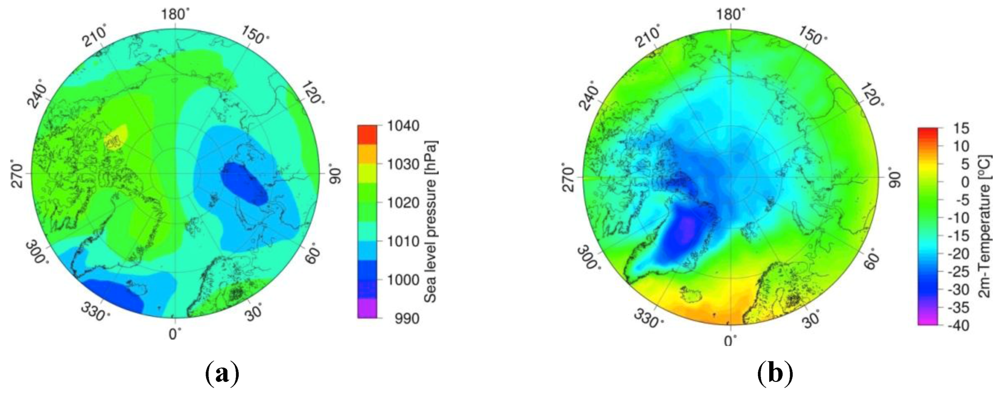

The Spring-Time Boundary Layer in the Central Arctic Observed during PAMARCMiP 2009


Abstract
:1. Introduction
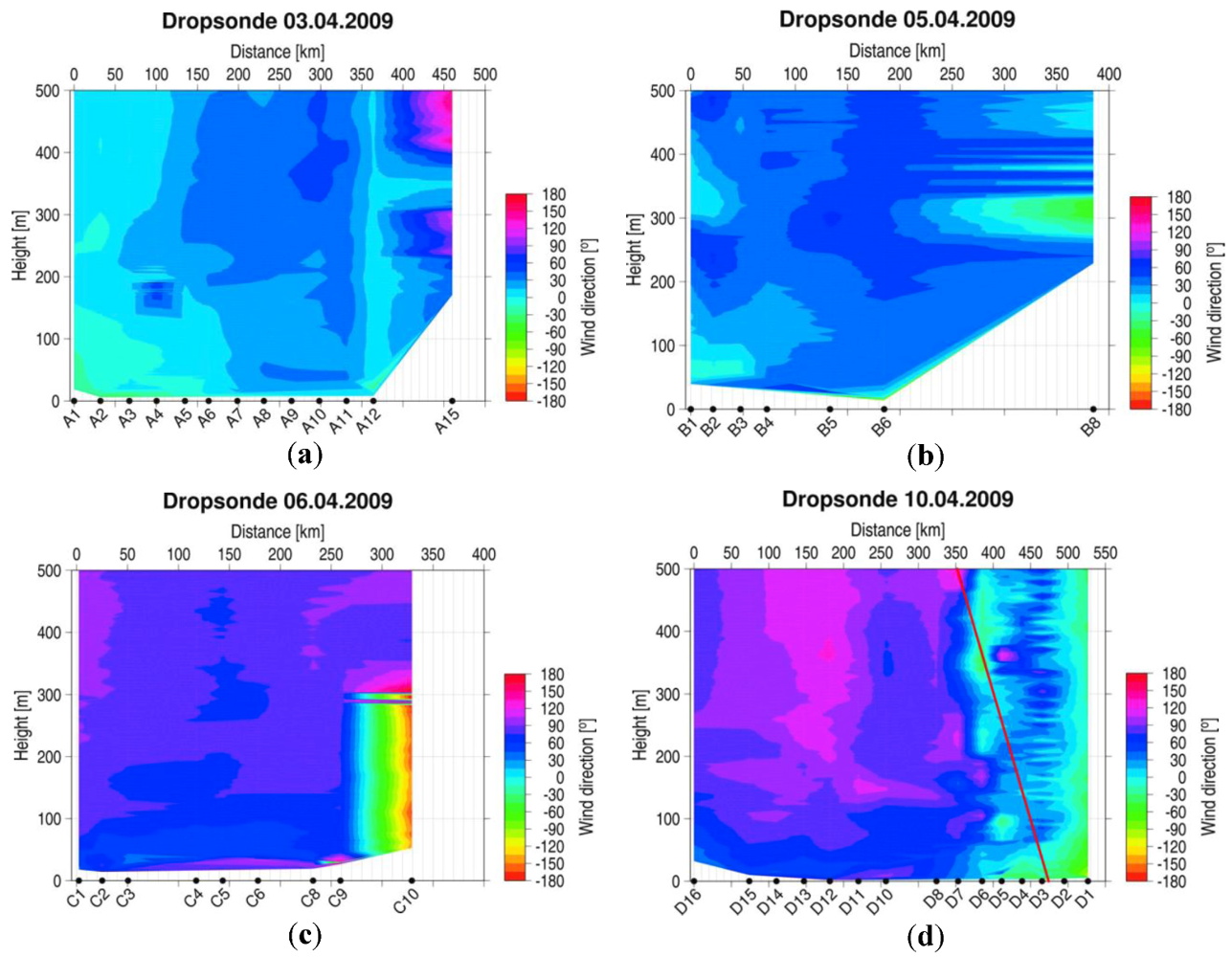
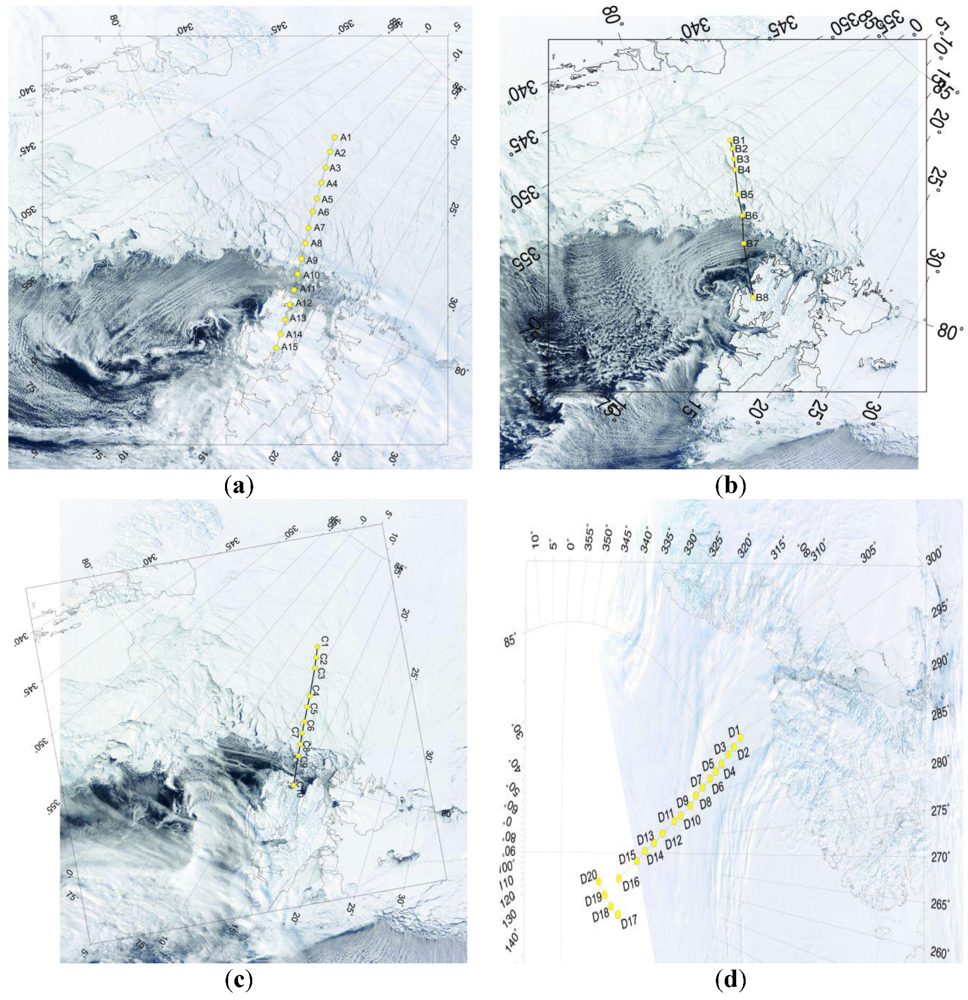
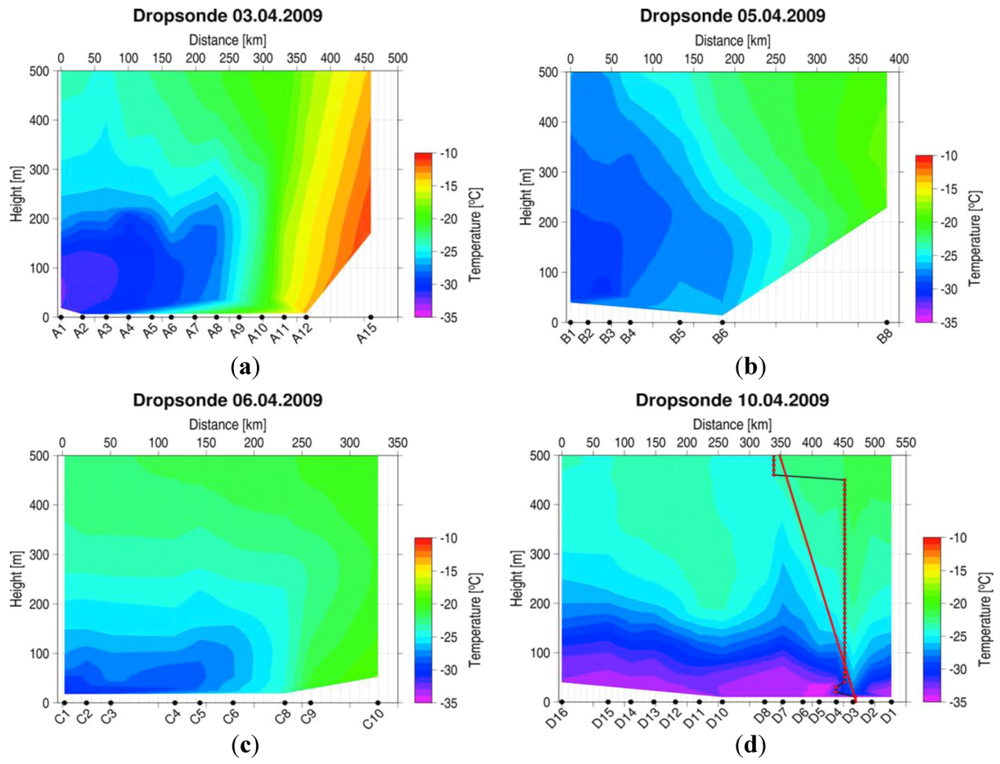
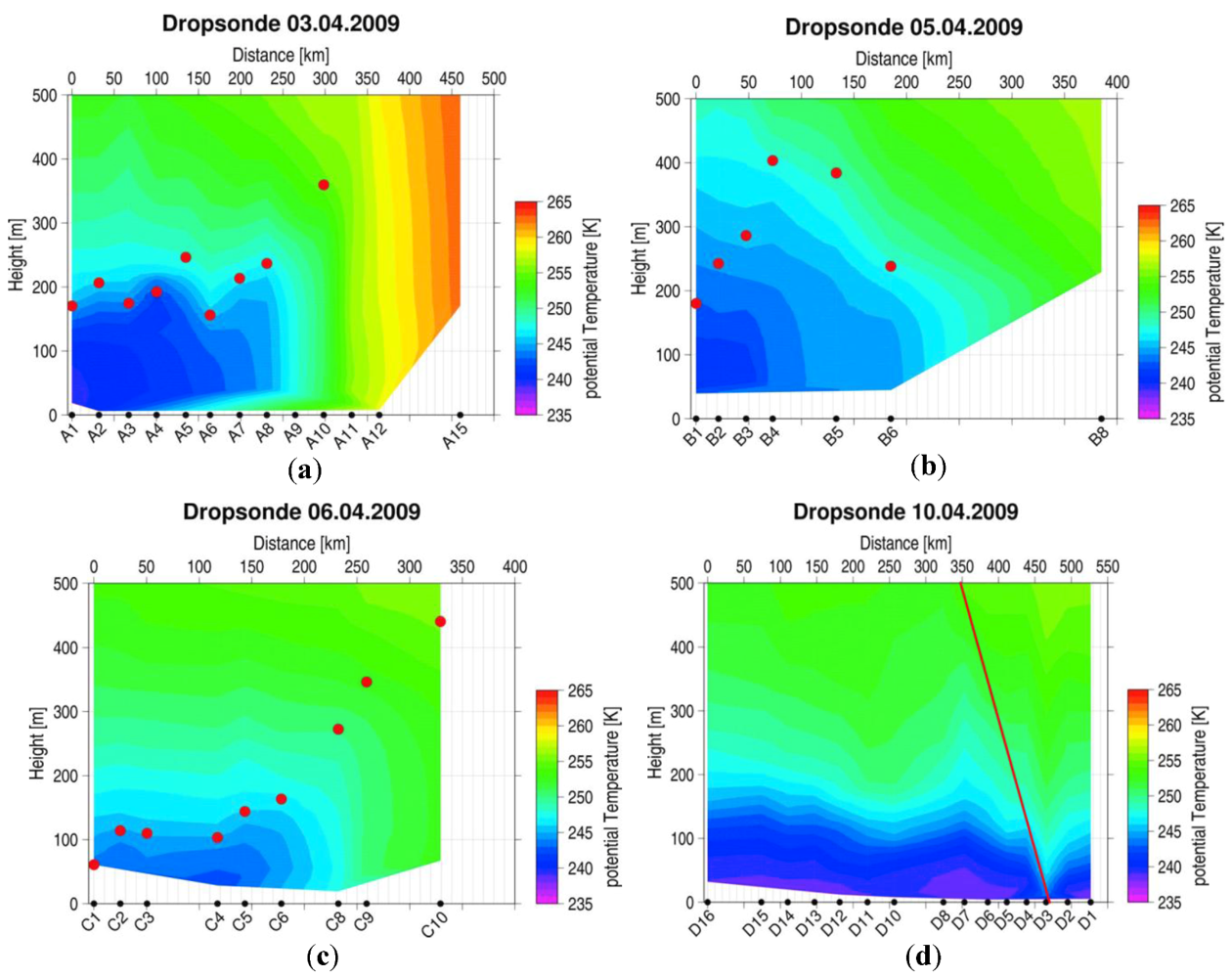
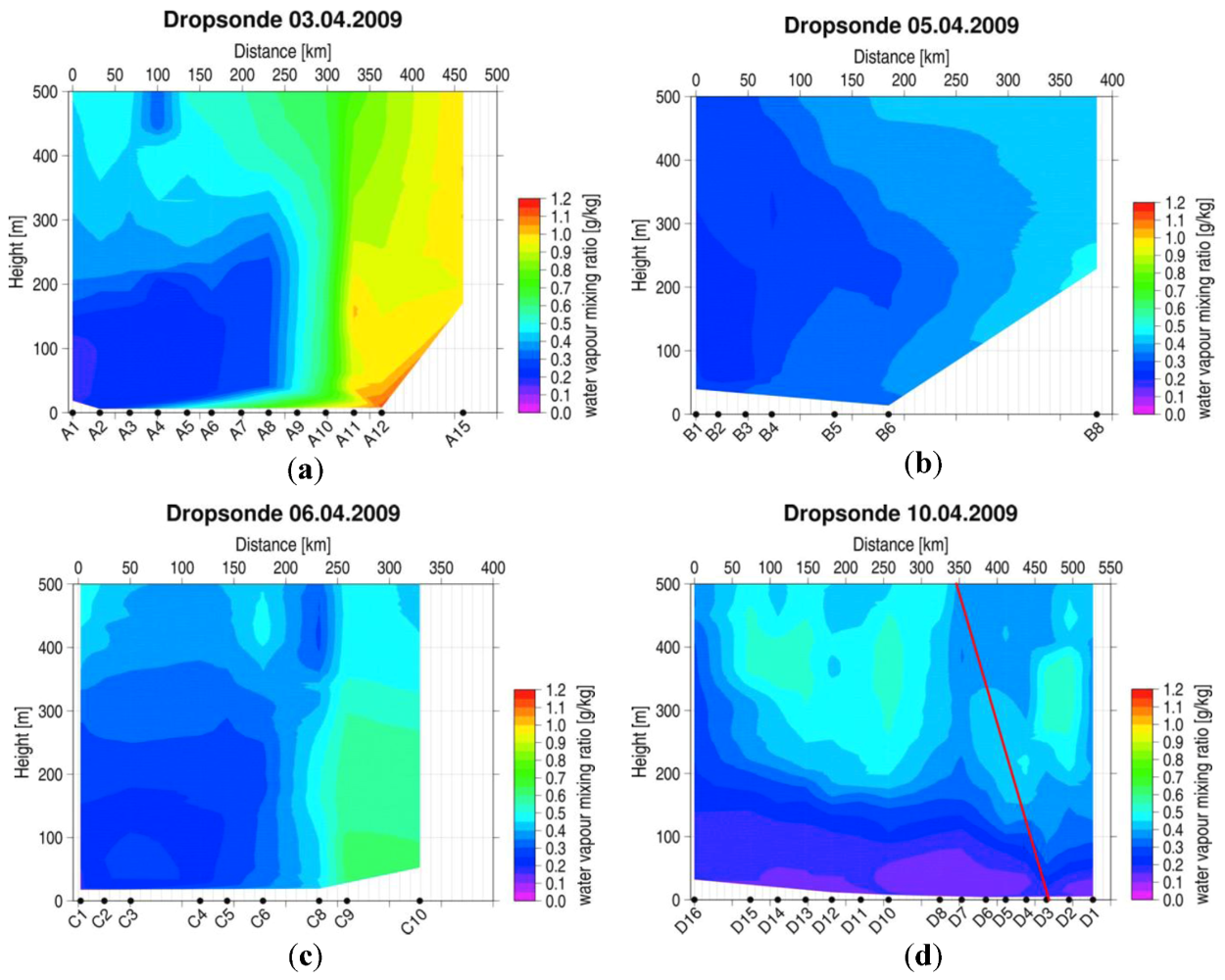
- (A) the AABL above open water
- (B) the AABL above sea ice with a relatively high fraction of open / refrozen leads
- (C) the AABL above sea ice with a relatively low fraction of open / refrozen leads
- (D) the AABL above closed sea ice with a front passing along the flight track.

| dropsonde | time (UTC) | latitude (°N) | longitude (°E) | lidar |
|---|---|---|---|---|
| A1 | 15:47 | 82.58 | 3.72 | - |
| A2 | 15:53 | 82.33 | 4.72 | - |
| A3 | 16:00 | 82.05 | 5.82 | - |
| A4 | 16:07 | 81.78 | 6.81 | - |
| A5 | 16:14 | 81.51 | 7.77 | - |
| A6 | 16:20 | 81.27 | 8.46 | - |
| A7 | 16:27 | 80.99 | 9.35 | - |
| A8 | 16:34 | 80.73 | 10.23 | - |
| A9 | 16:41 | 80.46 | 11.04 | - |
| A10 | 16:48 | 80.18 | 11.79 | - |
| A11 | 16:55 | 79.91 | 12.52 | - |
| A12 | 17:02 | 79.64 | 13.12 | - |
| A13 | 17:09 | 79.36 | 13.64 | - |
| A14 | 17:17 | 79.09 | 14.16 | - |
| A15 | 17:23 | 78.82 | 14.62 | - |
| dropsonde | time (UTC) | latitude (°N) | longitude (°E) | lidar |
|---|---|---|---|---|
| B1 | 13:32 | 80.97 | −3.12 | available |
| B2 | 13:36 | 80.89 | −2.02 | available |
| B3 | 13:43 | 80.78 | −0.77 | available |
| B4 | 13:49 | 80.65 | 0.43 | - |
| B5 | 14:05 | 80.33 | 3.09 | available |
| B6 | 14:18 | 80.07 | 5.40 | - |
| B7 | 14:35 | 79.64 | 7.88 | - |
| B8 | 15:50 | 78.87 | 12.71 | - |
| dropsonde | time (UTC) | latitude (°N) | longitude (°E) | lidar |
|---|---|---|---|---|
| C1 | 12:09 | 82.51 | 7.78 | available |
| C2 | 12:15 | 82.30 | 8.49 | available |
| C3 | 12:21 | 82.10 | 9.14 | - |
| C4 | 12:39 | 81.53 | 10.54 | available |
| C5 | 12:45 | 81.30 | 10.98 | available |
| C6 | 12:53 | 81.01 | 11.57 | available |
| C7 | 12:59 | 80.77 | 12.01 | - |
| C8 | 13:06 | 80.54 | 12.46 | - |
| C9 | 13:12 | 80.31 | 12.89 | - |
| C10 | 13:31 | 79.71 | 13.98 | - |
| dropsonde | time (UTC) | latitude (°N) | longitude (°E) | lidar |
|---|---|---|---|---|
| D1 | 14:17 | 83.98 | −66.01 | - |
| D2 | 14:22 | 84.25 | −67.06 | - |
| D3 | 14:27 | 84.50 | −67.95 | - |
| D4 | 14:33 | 84.72 | −69.05 | - |
| D5 | 14:38 | 84.95 | −70.10 | - |
| D6 | 14:43 | 85.16 | −71.21 | - |
| D7 | 14:48 | 85.43 | −72.46 | - |
| D8 | 14:54 | 85.67 | −73.82 | - |
| D9 | 15:00 | 85.88 | −75.91 | - |
| D10 | 15:05 | 86.21 | −77.94 | - |
| D11 | 15:11 | 86.52 | −79.61 | - |
| D12 | 15:20 | 86.82 | −82.66 | - |
| D13 | 15:27 | 87.08 | −85.80 | - |
| D14 | 15:33 | 87.37 | −89.09 | - |
| D15 | 15:40 | 87.62 | −94.11 | - |
| D16 | 15:54 | 88.10 | −106.53 | - |
| D17 | 18:22 | 87.78 | −125.87 | - |
| D18 | 18:29 | 88.06 | −125.78 | - |
| D19 | 18:36 | 88.36 | −122.77 | - |
| D20 | 18:43 | 88.66 | −117.63 | - |
2. Instrumentation
2.1. Dropsonde System
2.2. Lidar System
2.3. Aerosol Instrumentation
2.4. Ice-Thickness Sensor
2.5. Meteorological Instrumentation

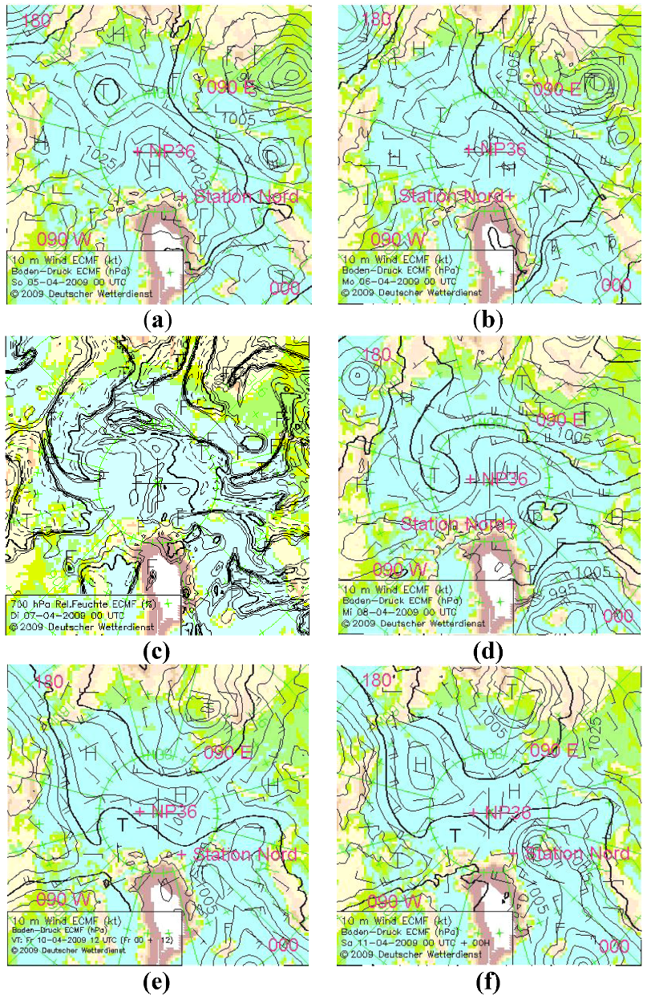
3. Meteorological Situation
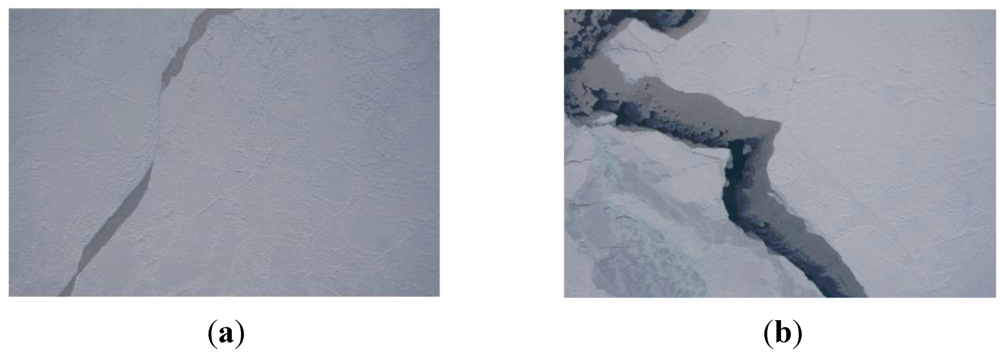
4. Airborne Observations

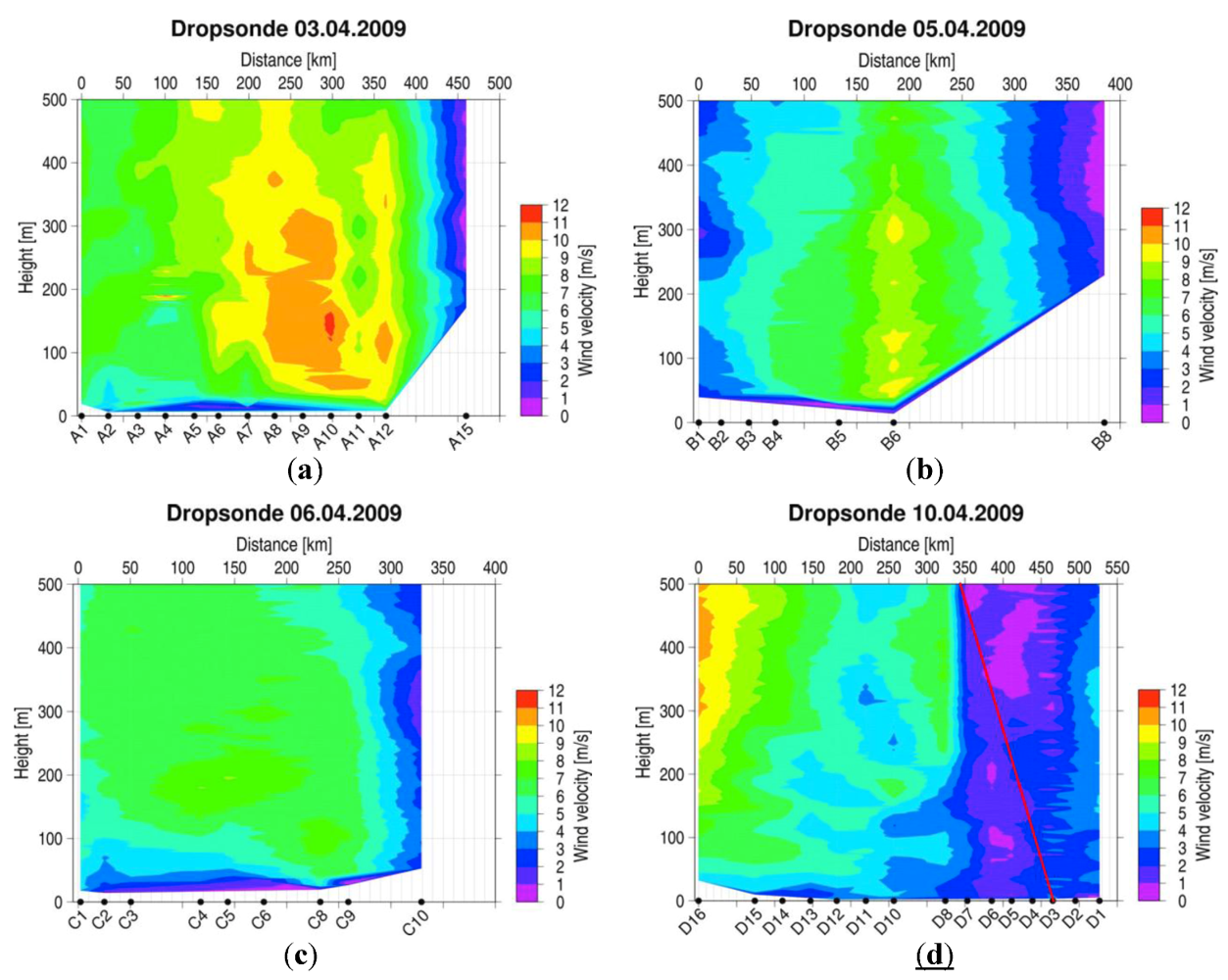
4.1. CASE A: The AABL above Open Water
4.2. CASE B: The AABL above Sea Ice with a Relatively High Fraction of Open/Refrozen Leads
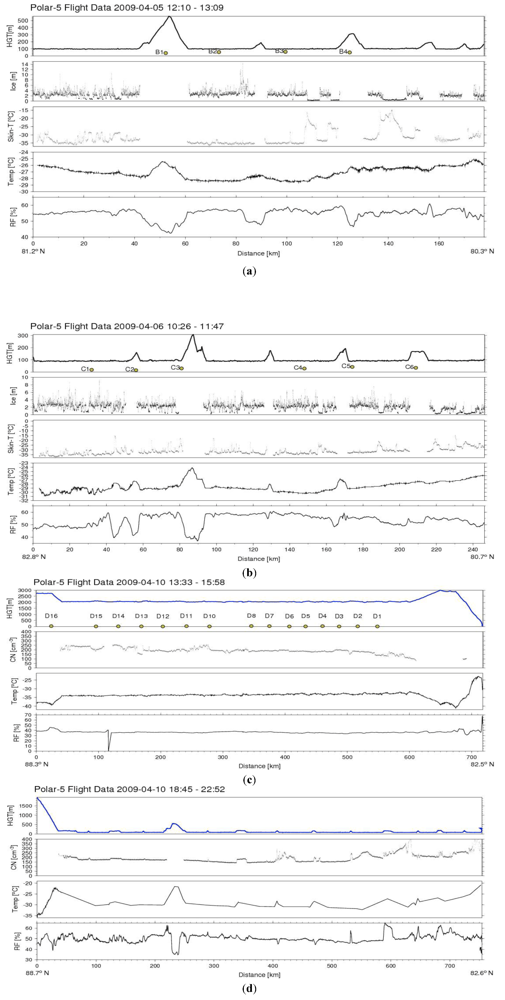
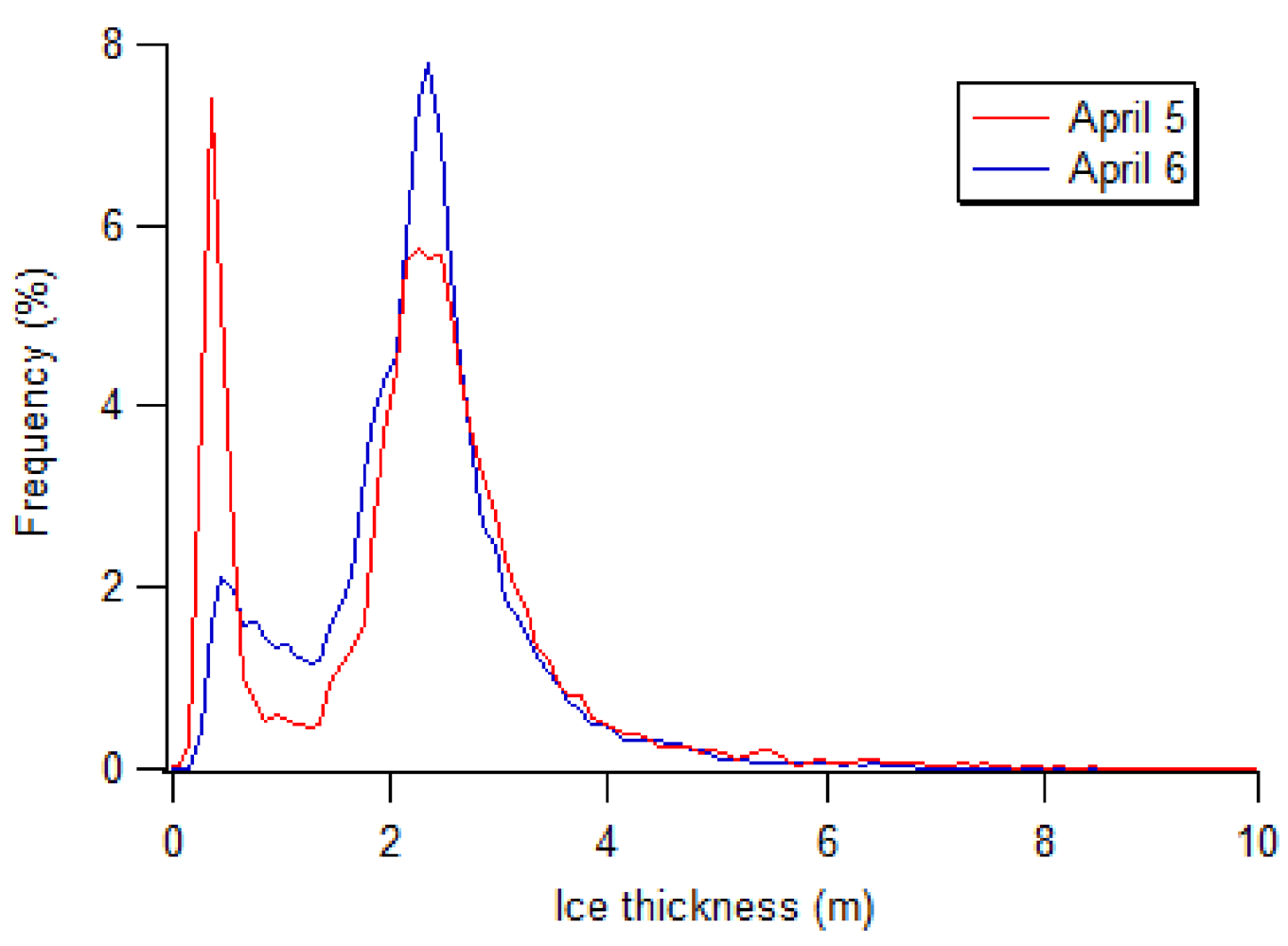
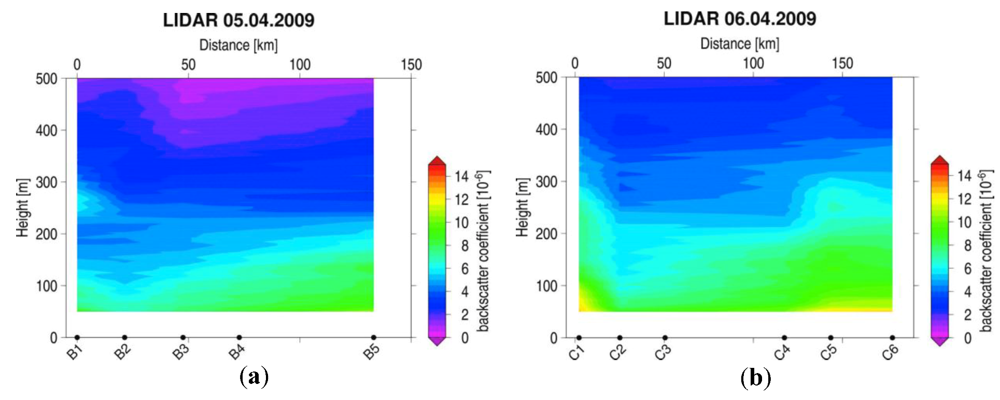
4.3. CASE C: The AABL above Sea Ice with a Relatively Low Fraction of Open Refrozen Leads
4.4. CASE D: The AABL above Closed Sea Ice with a Front Passing along the Flight Track
5. Discussion
5.1. Meteorology
5.2. Aerosol Load in the Central Arctic
6. Conclusions
Acknowledgments
References
- Allison, I.; Beland, M.; Alverson, K.; Bell, R.; Carlson, D.; Danell, K.; Ellis-Evans, C.; Fahrbach, E.; Fanta, E.; Fujii, Y.; Glaser, G.; Goldfarb, L.; Hovelsrud, G.; Huber, J.; Kotlyakov, V.; Krupnik, I.; Lopez-Martinez, J.; Mohr, T.; Qin, D.; Rachold, V.; Rapley, C.; Rogne, O.; Sarukhabian, E.; Summerhayes, C.; Xiao, C. The Scope of Science for the International Polar Year 2007/2008; WMO/TD-No. 1364. World Meteorological Organization: Geneva, Switzerland, 2007; p. 79. [Google Scholar]
- Vance, A.K.; Taylor, J.P.; Hewison, T.J.; Elms, J. Comparison of in situ humidity data from aircraft, dropsonde, and radiosonde. J. Atmos. Ocean. Technol. 2004, 21, 921–932. [Google Scholar] [CrossRef]
- Shupe, M.D.; Uttal, T.; Matrosov, S.Y. Arctic cloud microphysics retrievals from surface-based remote sensors at SHEBA. J. Appl. Meteorol. 2005, 44, 1544–1562. [Google Scholar] [CrossRef]
- Kahl, J.D.W.; Zaitseva, N.A.; Khattatov, V.; Schnell, R.C.; Bacon, D.M.; Bacon, J.; Radionov, V.; Serreze, M.C. Radiosonde observations from the former Soviet “north pole” series of drifting ice stations, 1954–1990. Bull. Am. Meteorolog. Soc. 1999, 80, 2019–2026. [Google Scholar] [CrossRef]
- Beesley, J.A.; Bretherton, C.S.; Jakob, C.; Andreas, E.L.; Intrieri, J.M.; Uttal, T.A. A comparison of cloud and boundary layer variables in the ECMWF forecast model with observations at Surface Heat Budget of the Arctic Ocean (SHEBA) ice camp. J. Geophys. Res. 2000, 105, 12337–12349. [Google Scholar]
- Dethloff, K.; Abegg, C.; Rinke, A.; Hebestadt, I.; Romanov, V.F. Sensitivity of Arctic climate simulations to different boundary-layer parameterizations in a regional climate model. Tellus 2001, 53A, 1–26. [Google Scholar]
- Tjernström, M.; Zagar, M.; Svensson, G.; Cassano, J.J.; Pfeifer, S.; Rinke, A.; Wyser, K.; Dethloff, K.; Jones, C.; Semmler, T.; Shaw, M. Modelling the Arctic boundary layer: An evaluation of six ARCMIP regional-scale models using data from the SHEBA project. Bound. Lay. Meteorol. 2005, 117, 337–381. [Google Scholar] [CrossRef]
- Dorn, W.; Dethloff, K.; Rinke, A. Limitations of a coupled regional climate model in the reproduction of the observed Arctic sea-ice retreat. Cryosphere Discuss. 2012, 6, 1269–1306. [Google Scholar] [CrossRef]
- Curry, J.A.; Ebert, E.E.; Herman, G.F. Mean and turbulence structure of the summertime Arctic cloudy boundary layer. Q.J.R. Meteorol. Soc. 1988, 114, 715–746. [Google Scholar] [CrossRef]
- Brümmer, B. Boundary-layer modification in wintertime cold-air outbreaks from the Arctic sea ice. Bound. Lay. Meteorol. 1996, 80, 109–125. [Google Scholar] [CrossRef]
- Persson, P.O.G.; Fairall, C.W.; Andreas, E.L.; Guest, P.S.; Perovich, D.K. Measurements near the atmospheric surface flux group tower at SHEBA: Near-surface conditions and surface energy budget. J. Geophys. Res. 2002, 107. [Google Scholar] [CrossRef]
- Duynkerke, P.G.; De Roode, S.R. Surface energy balance and turbulence characteristics observed at the SHEBA ice camp during FIRE III. J. Geophys. Res. 2001, 106, 15313–15322. [Google Scholar] [CrossRef]
- Overland, J.E.; McNutt, S.L.; Groves, J.; Salo, S.; Andreas, E.L.; Persson, P.O.G. Regional sensible and radiative heat flux estimates for the winter Arctic during the Surface Heat Budget of the Arctic Ocean (SHEBA) experiment. J. Geophys. Res. 2000, 105, 14093–14102. [Google Scholar] [CrossRef]
- Brümmer, B.; Busack, B.; Hoeber, H.; Kruspe, G. Boundary-layer observations over water and Arctic sea-ice during on-ice air flow. Bound. Lay. Meteorol. 1994, 68, 75–108. [Google Scholar] [CrossRef]
- Curry, J.A.; Hobbs, P.V.; King, M.D.; Randall, D.A.; Minnis, P.; Isaac, G.A.; Pinto, J.O.; Uttal, T.; Bucholtz, A.; Cripe, D.G.; Gerber, H.; Fairall, C.W.; Garrett, T.J.; Hudson, J.; Intrieri, J.M.; Jakob, C.; Jensen, T.; Lawson, P.; Marcotte, D.; Nguyen, L.; Pilewskie, P.; Rangno, A.; Rogers, D.C.; Strawbridge, K.B.; Valero, F.P.J.; Williams, A.G.; Wylie, D. Fire Arctic clouds experiment. Bull. Am. Meteorol. Soc. 2000, 81, 5–29. [Google Scholar]
- Vihma, T.; Hartmann, J.; Lüpkes, C. A case study of an on-ice air flow over the Arctic marginal sea-ice zone. Bound. Lay. Meteorol. 2003, 107, 189–217. [Google Scholar] [CrossRef]
- Zuidema, P.; Baker, B.; Han, Y.; Intrieri, J.; Key, J.; Lawson, P.; Matrosov, S.; Shupe, M.; Stone, R.; Uttal, T. An Arctic springtime mixed-phase cloudy boundary layer observed during SHEBA. J. Atmos. Sci. 2005, 62, 160–176. [Google Scholar] [CrossRef]
- Lüpkes, C.; Schlünzen, K.H. Modelling the Arctic convective boundary-layer with different turbulence parameterizations. Bound. Lay. Meteorol. 1996, 79, 107–130. [Google Scholar] [CrossRef]
- Serreze, M.C.; Maslanik, J.A.; Rheder, M.C.; Schnell, R.C.; Kahl, J.D.; Andreas, E.L. Theoretical heights of buoyant convection above open leads in the winter Arctic pack ice cover. J. Geophys. Res. 1992, 97, 9411–9422. [Google Scholar] [CrossRef]
- Dare, R.A.; Atkinson, B.W. Atmospheric response to spatial variations in concentration and size of polynyas in the Southern ocean sea-ice zone. Bound. Lay. Meteorol. 2000, 94, 65–88. [Google Scholar] [CrossRef]
- Guest, P.S. Measuring turbulent heat fluxes over leads using kites. J. Geophys. Res. 2007, 112. [Google Scholar] [CrossRef]
- Schnell, R.C.; Barry, R.G.; Miles, M.W.; Andreas, E.L.; Radke, L.F.; Brock, C.A.; McCormick, M.C.; Moore, J.L. Lidar detection of leads in Arctic sea ice. Lett. Nat. 1989, 339, 530–532. [Google Scholar] [CrossRef]
- Andreas, E.L.; Cash, B.A. Convective heat transfer over wintertime leads and polynyas. J. Geophys. Res. 1999, 104, 25721–25734. [Google Scholar] [CrossRef]
- Lüpkes, C.; Vihma, T.; Birnbaum, G.; Wacker, U. Influence of leads in sea ice on the temperature of the atmospheric boundary layer during polar night. Geophys. Res. Lett. 2008, 35. [Google Scholar] [CrossRef] [Green Version]
- Stone, R.; Herber, A.; Vitale, V.; Mazzola, M.; Lupi, A.; Schnell, R.; Dutton, E.; Liu, P.; Li, S.-M.; Dethloff, K.; Lampert, A.; Ritter, C.; Stock, M.; Neuber, R.; Maturilli, M. A three-dimensional characterization of Arctic aerosols from airborne sun photometer observations: PAM-ARCMIP—April 2009. J. Geophys. Res. 2010, 115. [Google Scholar] [CrossRef]
- Shaw, G.E. Evidence for a central eurasian source area of Arctic haze in Alaska. Nature 1982, 299, 815–818. [Google Scholar] [CrossRef]
- Warneke, C.; Bahreini, R.; Brioude, J.; Brock, C.A.; de Gouw, J.A.; Fahey, D.W.; Froyd, K.D.; Holloway, J.S.; Midlebrook, A.; Miller, L.; Montzka, S.; Murphy, D.M.; Peischl, J.; Ryerson, T.B.; Schwarz, J.P.; Spackman, J.R.; Veres, P. Biomass burning in Siberia and Kazakhstan as an important source for haze over the Alaskan Arctic in April 2008. Geophys. Res. Lett. 2009, 36. [Google Scholar] [CrossRef]
- Devasthale, A.; Tjernström, M.; Omar, A.H. The vertical distribution of thin features over the Arctic analysed from CALIPSO observations, Part II: Aerosols. Tellus 2011, 63B, 86–95. [Google Scholar]
- Spackman, J.R.; Gao, R.S.; Neff, W.D.; Schwarz, J.P.; Watts, L.A.; Fahey, D.W.; Holloway, J.S.; Ryerson, T.B.; Peischl, J.; Brock, C.A. Aircraft observations of enhancement and depletion of black carbon mass in the springtime Arctic. Atmos. Chem. Phys. 2010, 10, 9667–9680. [Google Scholar] [CrossRef]
- McFarquhar, G.; Ghan, S.; Verlinde, J.; Korolev, A.; Strapp, J.W.; Schmid, B.; Tomlinson, J.M.; Wolde, M.; Brooks, S.D.; Cziczo, D.; Dubey, M.K.; Fan, J.; Flynn, C.; Gultepe, I.; Hubbe, J.; Gilles, M.K.; Laskin, A.; Lawson, P.; Leaitch, W.R.; Liu, P.; Liu, X.; Lubin, D.; Mazzoleni, C.; Macdonald, A.-M.; Moffet, R.C.; Morrison, H.; Ovchinnikov, M.; Shupe, M.D.; Turner, D.D.; Xie, S.; Zelenyuk, A.; Bae, K.; Freer, M.; Glen, A. Indirect and semi-direct aerosol campaign (ISDAC): The impact of Arctic aerosols on clouds. Bull. Amer. Meteorol. Soc. 2011, 92, 183–201. [Google Scholar]
- Jacob, D.J.; Crawford, J.H.; Maring, H.; Clarke, A.D.; Dibb, J.E.; Emmons, L.K.; Ferrare, R.A.; Hostetler, C.A.; Russell, P.B.; Singh, H.B.; Thompson, A.M.; Shaw, G.E.; McCauley, E.; Pederson, J.R.; Fisher, J.A. The Arctic research of the composition of the troposphere from aircraft and satellites (ARCTAS) mission: Design, execution, and first results. Atmos. Chem. Phys. 2010, 10, 5191–5212. [Google Scholar]
- Paatero, J.; Vaattovaara, P.; Vestenius, M.; Meinande, O.; Makkonen, U.; Kivi, R.; Hyvärinen, A.; Asmi, E.; Tjernström, M.; Leck, C. Finnish contribution to the Arctic summer cloud ocean study (ASCOS) expedition, Arctic ocean 2008. Geophysica 2009, 45, 119–146. [Google Scholar]
- Sedlar, J.; Tjernström, M.; Mauritsen, T.; Shupe, M.D.; Brooks, I.M.; Persson, P.O.G.; Birch, C.E.; Leck, C.; Sirevaag, A.; Nicolaus, M. A transitioning Arctic surface energy budget: The impacts of solar zenith angle, surface albedo and cloud radiative forcing. Clim. Dyn. 2011, 37, 1643–1660. [Google Scholar] [CrossRef] [Green Version]
- Persson, P.O.G. Summary of Meteorological Conditions during the Arctic Mechanisms for the Interaction of the Surface and Atmosphere (AMISA) Intensive Observation Periods; NOAA: Silver Spring, MD, USA. Available online: http://www.lib.muohio.edu/multifacet/record/mu3ugb4202658 (accessed on 10 November 2011).
- Stachlewska, I.; Neuber, R.; Lampert, A.; Ritter, C.; Wehrle, G. AMALi—The Airborne Mobile Aerosol Lidar for Arctic research. Atmos. Chem. Phys. 2010, 10, 2947–2963. [Google Scholar]
- Stone, R.S. Monitoring Aerosol Optical Depth at Barrow, Alaska and South Pole: Historical Overview, Recent Results, and Future Goals. In Proceedings of the 9th Workshop Italian Research on Antarctic Atmosphere, Bologna, Italy, 22–24 October 2002; Colacino, M., Ed.; pp. 123–144.
- Haas, C.; Hendricks, S.; Eicken, H.; Herber, A. Synoptic airborne thickness surveys reveal state of Arctic sea ice cover. Geophys. Res. Lett. 2010, 37. [Google Scholar] [CrossRef] [Green Version]
- Haas, C.; Lobach, J.; Hendricks, S.; Rabenstein, L.; Pfaffling, A. Helicopter-borne measurements of sea ice thickness, using a small and lightweight, digital EM system. J. Appl. Geoph. 2009, 67, 234–241. [Google Scholar] [CrossRef] [Green Version]
- Freese, D.; Kottmeier, C. Radiation exchange between stratus clouds and polar marine surfaces. Bound. Lay. Meteorol. 1998, 87, 331–356. [Google Scholar] [CrossRef]
- Wang, K.; Wan, Z.; Wang, P.; Sparrow, M.; Liu, J.; Zhou, X.; Haginoya, S. Estimation of surface long wave radiation and broadband emissivity using moderate resolution imaging spectroradiometer (MODIS) land surface temperature/emissivity products. J. Geophys. Res. 2005. [Google Scholar] [CrossRef]
- Guenther, B.; Xiong, X.; Salomonson, V.V.; Barnes, W.L.; Young, J. On-orbit performance of the earth observing system (EOS) moderate resolution imaging spectroradiometer (MODIS) and the Attendant Level 1-B Data Product. Remote Sens. Environ. 2002, 83, 16–30. [Google Scholar] [CrossRef]
- The Generic Mapping Tools. Available online: http://gmt.soest.hawaii.edu/ (accessed 1 April 2012).
- Paluch, I.R.; Lenschow, D.H.; Wang, Q. Arctic boundary layer in the fall season over open and frozen sea. J. Geophys. Res. 1997, 102, 25955–25971. [Google Scholar]
- Ruffieux, D.; Persson, P.O.G.; Fairall, C.W.; Wolfe, D.E. Ice pack and lead surface energy budget during LEADEX 1992. J. Geophys. Res. 1995, 100, 4593–4612. [Google Scholar]
- Kahl, J.D.W.; Martinez, D.A.; Zaitseva, N.A. Long-term variability in the low-level inversion layer over the Arctic ocean. Int. J. Climatol. 1996, 16, 1297–1313. [Google Scholar]
- Overland, J.E. Meteorology of the Beaufort sea. J. Geophys. Res. 2009, 114. [Google Scholar] [CrossRef]
- Burk, S.D.; Fett, R.W.; Englebretson, R.E. Numerical simulation of cloud plumes emanating from Arctic leads. J. Geophys. Res. 1997, 102, 16,529–16,544. [Google Scholar]
- Lüpkes, C.; Vihma, T.; Birnbaum, G.; Dierer, S.; Garbrecht, T.; Gryanik, V.M.; Gryschka, M.; Hartmann, J.; Heinemann, G.; Kaleschke, L.; Raasch, S.; Savijärvi, H.; Schlünzen, K.H.; Wacker, U. Arctic Climate Change: The ACSYS Decade and Beyond; Springer Science and Business Media: New York, NY, USA, 2012; Volume Chapter 7, pp. 279–324. [Google Scholar]
- Bannehr, L.; Schwiesow, R. A technique to account for the misalignment of pyranometers installed on aircraft. J. Atmos. Ocean. Tech. 1993, 10, 774–777. [Google Scholar] [CrossRef]
- Freese, D. Solar and Terrestrial Radiation Interaction between Arctic Sea Ice and Clouds; Report on Polar Research No. 312; Alfred Wegener Institute: Bremerhaven, Germany, 1999. [Google Scholar]
- Lampert, A.; Ehrlich, A.; Dörnbrack, A.; Jourdan, O.; Gayet, J.-F.; Mioche, G.; Shcherbakov, V.; Ritter, C.; Wendisch, M. Microphysical and radiative characterization of a subvisible midlevel arctic ice cloud by airborne observations—A case study. Atmos. Chem. Phys. 2009, 9, 2647–2661. [Google Scholar]
- Schramm, J.L.; Holland, M.M.; Curry, J.A.; Ebert, E.E. Modeling the thermodynamics of a sea ice thickness distribution 1. Sensitivity to ice thickness resolution. J. Geophys. Res. 1997, 102, 23079–23091. [Google Scholar] [CrossRef]
- Martin, S.; Drucker, R.; Kwok, R.; Holt, B. Estimation of the thin ice thickness and heat flux for the Chukchi Sea Alaskan coast polynya from special sensor microwave/imager data, 1990–2001. J. Geophys. Res. 2004, 109. [Google Scholar] [CrossRef]
- Walter, B.A.; Overland, J.E.; Turet, P. A comparison of satellite-derived and aircraft-measured regional surface sensible heat fluxes over the Beaufort Sea. J. Geophys. Res. 1995, 100, 4585–4591. [Google Scholar] [CrossRef]
- Van den Kroonenberg, A.; Bange, J. Turbulent flux calculation in the polar stable boundary layer: Multiresolution flux decomposition and wavelet analysis. J. Geophys. Res. 2007, 112. [Google Scholar] [CrossRef]
- Tjernström, M.; Leck, C.; Persson, P.O.G.; Jensen, M.L.; Oncley, S.P.; Targino, A. The summertime Arctic atmosphere: Meteorological measurements during the Arctic Ocean Experiment 2001 (AOE-2001). Bull. Am. Meteorol. Soc. 2004, 85, 1305–1321. [Google Scholar] [CrossRef]
- Pinto, J.O. Autumnal mixed-phase cloudy boundary layers in the Arctic. J. Atmos. Sci. 1998, 55, 2016–2038. [Google Scholar] [CrossRef]
- Drüe, C.; Heinemann, G. Airborne investigation of Arctic boundary-layer fronts over the marginal ice zone of the Davis Strait. Bound. Lay. Meteorol. 2001, 101, 261–292. [Google Scholar] [CrossRef]
- Hoffmann, A.; Ritter, C.; Stock, M.; Shiobara, M.; Lampert, A.; Maturilli, M.; Orgis, T.; Neuber, R.; Herber, A. Ground-based lidar measurements from Ny-Ålesund during ASTAR 2007. Atmos. Chem. Phys. 2009, 9, 9059–9081. [Google Scholar] [CrossRef]
- Hoffmann, A.; Osterloh, L.; Stone, R.; Lampert, A.; Ritter, C.; Stock, M.; Tunved, P.; Hennig, T.; Böckmann, C.; Li, S.-M.; Eleftheriadis, K.; Maturilli, M.; Orgis, T.; Herber, A.; Neuber, R.; Dethloff, K. Remote sensing and in-situ measurements of tropospheric aerosol, a PAMARCMiP case study. Atmos. Environ. 2012, 52, 56–66. [Google Scholar] [CrossRef] [Green Version]
- Dutton, E.G.; Deluisi, J.J.; Herbert, G. Shortwave aerosol optical depth of Arctic haze measured on board the NOAA WP-3D during AGASP-II, April 1986. J. Atmos. Chem. 1989, 9, 71–79. [Google Scholar] [CrossRef]
- Hansen, A.D.A.; Novakov, T. Aerosol black carbon measurements in the Arctic haze during AGASP-II. J. Atmos. Chem. 1989, 9, 347–361. [Google Scholar] [CrossRef]
- Orgis, T.; Brand, S.; Schwarz, U.; Handorf, D.; Dethloff, K.; Kurths, J. Influence of interactive stratospheric chemistry on large-scale air mass exchange in a global circulation model. Eur. Phys. J. 174, 257–269.
- Borys, R.D. Studies of ice nucleation by Arctic aerosol on AGASP-II. J. Atmos. Chem. 1989, 9, 169–185. [Google Scholar] [CrossRef]
© 2012 by the authors; licensee MDPI, Basel, Switzerland. This article is an open-access article distributed under the terms and conditions of the Creative Commons Attribution license (http://creativecommons.org/licenses/by/3.0/).
Share and Cite
Lampert, A.; Maturilli, M.; Ritter, C.; Hoffmann, A.; Stock, M.; Herber, A.; Birnbaum, G.; Neuber, R.; Dethloff, K.; Orgis, T.; et al. The Spring-Time Boundary Layer in the Central Arctic Observed during PAMARCMiP 2009. Atmosphere 2012, 3, 320-351. https://doi.org/10.3390/atmos3030320
Lampert A, Maturilli M, Ritter C, Hoffmann A, Stock M, Herber A, Birnbaum G, Neuber R, Dethloff K, Orgis T, et al. The Spring-Time Boundary Layer in the Central Arctic Observed during PAMARCMiP 2009. Atmosphere. 2012; 3(3):320-351. https://doi.org/10.3390/atmos3030320
Chicago/Turabian StyleLampert, Astrid, Marion Maturilli, Christoph Ritter, Anne Hoffmann, Maria Stock, Andreas Herber, Gerit Birnbaum, Roland Neuber, Klaus Dethloff, Thomas Orgis, and et al. 2012. "The Spring-Time Boundary Layer in the Central Arctic Observed during PAMARCMiP 2009" Atmosphere 3, no. 3: 320-351. https://doi.org/10.3390/atmos3030320
APA StyleLampert, A., Maturilli, M., Ritter, C., Hoffmann, A., Stock, M., Herber, A., Birnbaum, G., Neuber, R., Dethloff, K., Orgis, T., Stone, R., Brauner, R., Kässbohrer, J., Haas, C., Makshtas, A., Sokolov, V., & Liu, P. (2012). The Spring-Time Boundary Layer in the Central Arctic Observed during PAMARCMiP 2009. Atmosphere, 3(3), 320-351. https://doi.org/10.3390/atmos3030320