<?xml version="1.0" encoding="UTF-8"?>
<!DOCTYPE article PUBLIC "-//NLM//DTD Journal Publishing DTD v2.3 20070202//EN" "journalpublishing.dtd">
<article xmlns:mml="http://www.w3.org/1998/Math/MathML" xmlns:xlink="http://www.w3.org/1999/xlink" xml:lang="en" article-type="research-article">
  <front>
    <journal-meta>
      <journal-id journal-id-type="publisher-id">atmosphere</journal-id>
      <journal-title>Atmosphere</journal-title>
      <abbrev-journal-title abbrev-type="publisher">Atmosphere</abbrev-journal-title>
      <abbrev-journal-title abbrev-type="pubmed">Atmosphere</abbrev-journal-title>
      <issn pub-type="epub">2073-4433</issn>
      <publisher>
        <publisher-name>MDPI</publisher-name>
      </publisher>
    </journal-meta>
    <article-meta>
      <article-id pub-id-type="doi">10.3390/atmos3010164</article-id>
      <article-id pub-id-type="publisher-id">atmosphere-03-00164</article-id>
      <article-categories>
        <subj-group>
          <subject>Article</subject>
        </subj-group>
      </article-categories>
      <title-group>
        <article-title>Pre-Harvest Sugarcane Burning: Determination of Emission Factors through Laboratory Measurements</article-title>
      </title-group>
      
      <contrib-group>
        <contrib contrib-type="author">
          <name>
            <surname>França</surname>
            <given-names>Daniela de Azeredo</given-names>
          </name>
          <xref rid="af1-atmosphere-03-00164" ref-type="aff">1</xref>
          <xref rid="c1-atmosphere-03-00164" ref-type="corresp">*</xref>
        </contrib>
        <contrib contrib-type="author">
          <name>
            <surname>Longo</surname>
            <given-names>Karla Maria</given-names>
          </name>
          <xref rid="af2-atmosphere-03-00164" ref-type="aff">2</xref>
        </contrib>
        <contrib contrib-type="author">
          <name>
            <surname>Neto</surname>
            <given-names>Turibio Gomes Soares</given-names>
          </name>
          <xref rid="af3-atmosphere-03-00164" ref-type="aff">3</xref>
        </contrib>
        <contrib contrib-type="author">
          <name>
            <surname>Santos</surname>
            <given-names>José Carlos</given-names>
          </name>
          <xref rid="af3-atmosphere-03-00164" ref-type="aff">3</xref>
        </contrib>
        <contrib contrib-type="author">
          <name>
            <surname>Freitas</surname>
            <given-names>Saulo R.</given-names>
          </name>
          <xref rid="af4-atmosphere-03-00164" ref-type="aff">4</xref>
        </contrib>
        <contrib contrib-type="author">
          <name>
            <surname>Rudorff</surname>
            <given-names>Bernardo F. T.</given-names>
          </name>
          <xref rid="af1-atmosphere-03-00164" ref-type="aff">1</xref>
        </contrib>
        <contrib contrib-type="author">
          <name>
            <surname>Cortez</surname>
            <given-names>Ely Vieira</given-names>
          </name>
          <xref rid="af3-atmosphere-03-00164" ref-type="aff">3</xref>
        </contrib>
        <contrib contrib-type="author">
          <name>
            <surname>Anselmo</surname>
            <given-names>Edson</given-names>
          </name>
          <xref rid="af3-atmosphere-03-00164" ref-type="aff">3</xref>
        </contrib>
        <contrib contrib-type="author">
          <name>
            <surname>Carvalho</surname>
            <given-names>João Andrade</given-names>
            <suffix>Jr.</suffix>
          </name>
          <xref rid="af5-atmosphere-03-00164" ref-type="aff">5</xref>
        </contrib>
      </contrib-group>
      <aff id="af1-atmosphere-03-00164"><label>1 </label>Remote Sensing Division (DSR), National Institute for Space Research (INPE), São José dos Campos, SP 12227-010, Brazil; Email: <email>bernardo@dsr.inpe.br</email> </aff>
      <aff id="af2-atmosphere-03-00164"><label>2 </label>Earth System Science Center (CCST), National Institute for Space Research (INPE), São José dos Campos, SP 12227-010, Brazil; Email: <email>karla.longo@inpe.br</email></aff>
      <aff id="af3-atmosphere-03-00164"><label>3 </label>Combustion and Propulsion Associated Laboratory (LCP), National Institute for Space Research (INPE), Cachoeira Paulista, SP 12630-000, Brazil; Email: <email>turibio@lcp.inpe.br</email> (T.G.S.N.); <email>jcarlos@lcp.inpe.br</email> (J.C.S.); <email>evcortez@lcp.inpe.br</email> (E.V.C.); <email>edson@lcp.inpe.br</email> (E.A.)</aff>
      <aff id="af4-atmosphere-03-00164"><label>4 </label>Center for Weather Forecasting and Climate Studies (CPTEC), National Institute for Space Research (INPE), Cachoeira Paulista, SP 12630-000, Brazil; Email: <email>saulo.freitas@cptec.inpe.br</email></aff>
      <aff id="af5-atmosphere-03-00164"><label>5 </label>Energy Department, São Paulo State University (UNESP), Guaratinguetá, SP 12516-410, Brazil; Email: <email>joao.a.carvalho.jr@pq.cnpq.br</email></aff>
      <author-notes>
        <corresp id="c1-atmosphere-03-00164"><label>*</label> Author to whom correspondence should be addressed; Email: <email>franca@dsr.inpe.br</email>; Tel.: +55-12-3208-6742; Fax: +55-12-3208-6488.</corresp>
      </author-notes>
      <pub-date pub-type="epub">
        <day>15</day>
        <month>02</month>
        <year>2012</year>
      </pub-date>
      <pub-date pub-type="collection"><month>03</month>
        <year>2012</year>
      </pub-date>
      <volume>3</volume>
      <issue>1</issue>
      <fpage>164</fpage>
      <lpage>180</lpage>
      <history>
        <date date-type="received">
          <day>02</day>
          <month>01</month>
          <year>2012</year>
        </date>
        <date date-type="rev-recd">
          <day>20</day>
          <month>01</month>
          <year>2012</year>
        </date>
        <date date-type="accepted">
          <day>31</day>
          <month>01</month>
          <year>2012</year>
        </date>
      </history>
      <permissions>
        <copyright-statement>©  2012 by the authors; licensee MDPI, Basel, Switzerland.</copyright-statement>
        <copyright-year>2012</copyright-year>
        <license xmlns:xlink="http://www.w3.org/1999/xlink" license-type="open-access" xlink:href="http://creativecommons.org/licenses/by/3.0/">
          <p>This article is an open-access article distributed under the terms and conditions of the Creative Commons Attribution license (http://creativecommons.org/licenses/by/3.0/).</p>
        </license>
      </permissions>
      <abstract>
        <p>Sugarcane is an important crop for the Brazilian economy and roughly 50% of its production is used to produce ethanol. However, the common practice of pre-harvest burning of sugarcane straw emits particulate material, greenhouse gases, and tropospheric ozone precursors to the atmosphere. Even with policies to eliminate the practice of pre-harvest sugarcane burning in the near future, there is still significant environmental damage. Thus, the generation of reliable inventories of emissions due to this activity is crucial in order to assess their environmental impact. Nevertheless, the official Brazilian emissions inventory does not presently include the contribution from pre-harvest sugarcane burning. In this context, this work aims to determine sugarcane straw burning emission factors for some trace gases and particulate material smaller than 2.5 μm in the laboratory. Excess mixing ratios for CO<sub>2</sub>, CO, NO<sub>X</sub>, UHC (unburned hydrocarbons), and PM<sub>2.5</sub> were measured, allowing the estimation of their respective emission factors. Average estimated values for emission factors (g kg<sup>−1</sup> of burned dry biomass) were 1,303 ± 218 for CO<sub>2</sub>, 65 ± 14 for CO, 1.5 ± 0.4 for NO<sub>X</sub>, 16 ± 6 for UHC, and 2.6 ± 1.6 for PM<sub>2.5</sub>. These emission factors can be used to generate more realistic emission inventories and therefore improve the results of air quality models.</p>
      </abstract>
      <kwd-group>
        <kwd>sugarcane burning</kwd>
        <kwd>emission factors</kwd>
        <kwd>experimental fires</kwd>
        <kwd>CO<sub>2</sub></kwd>
        <kwd>CO</kwd>
        <kwd>NO<sub>X</sub></kwd>
        <kwd>Hydrocarbons</kwd>
        <kwd>PM<sub>2.5</sub></kwd>
      </kwd-group>
    </article-meta>
  </front>
  <body>
    <sec sec-type="intro">
      <title>1. Introduction</title>
      <p>Biomass burning is the principal source of anthropogenic greenhouse gases and aerosols to the atmosphere in South America [<xref ref-type="bibr" rid="B1-atmosphere-03-00164">1</xref>,<xref ref-type="bibr" rid="B2-atmosphere-03-00164">2</xref>,<xref ref-type="bibr" rid="B3-atmosphere-03-00164">3</xref>,<xref ref-type="bibr" rid="B4-atmosphere-03-00164">4</xref>]. In Brazil, activities related to agriculture and extensive livestock grazing contribute significantly to trace gas and particle emissions to the atmosphere, resulting from the use of fire as a land management practice and changes in natural emissions patterns due to changes in land use and land cover. Manual harvesting of sugarcane is an example of a current agricultural practice that uses fire. The burning practice for sugarcane residues varies worldwide. In many countries, such as Brazil, Guatemala, Mexico, and Costa Rica, pre-harvest burning is a common practice. In the United States and the Philippines, sugarcane fields are burned either before or after harvest, but in India, most of the sugarcane residues are usually burned in the field only after harvest due to lack of proper composting techniques [<xref ref-type="bibr" rid="B5-atmosphere-03-00164">5</xref>,<xref ref-type="bibr" rid="B6-atmosphere-03-00164">6</xref>,<xref ref-type="bibr" rid="B7-atmosphere-03-00164">7</xref>,<xref ref-type="bibr" rid="B8-atmosphere-03-00164">8</xref>,<xref ref-type="bibr" rid="B9-atmosphere-03-00164">9</xref>]. The problems related to the pre-harvest burning practice are particularly serious in Brazil as it is the world’s largest producer of sugarcane. This type of burning has been a practice there for hundreds of years to make the manual harvest easier, but has only recently been recognized as an environmental damage and a public health issue.</p>
      <p>Sugarcane is an important crop for the Brazilian economy and roughly 50% of its production is used to produce ethanol [<xref ref-type="bibr" rid="B10-atmosphere-03-00164">10</xref>]. In this country, sugarcane production is located in some states of the South-Central and Northeast regions [<xref ref-type="bibr" rid="B11-atmosphere-03-00164">11</xref>]. The South-Central region comprises the producer states of São Paulo, Goiás, Minas Gerais, Mato Grosso, Mato Grosso do Sul, and Paraná, as well as Rio de Janeiro and Espírito Santo, and is currently responsible for 88% of the sugarcane production. São Paulo state is the largest producer of sugarcane in Brazil and is responsible for almost 60% of its production, with a cultivated area of 5.4 Mha in 2011 [<xref ref-type="bibr" rid="B12-atmosphere-03-00164">12</xref>]. Sugarcane stalks are the raw material for producing sugar or ethanol. The harvest of the stalks can be performed with either green harvest or pre-harvest burning. When stalks are green harvested, the machine cuts the entire aboveground plant and stalks are automatically separated from leaves. When stalks are manually harvested, the leaves need to first be eliminated by burning to make the harvest easier. During the last five years, close to 2 Mha were harvested annually with the pre-harvest burning practice. This practice emits particulate material, greenhouse gases, and tropospheric ozone precursors to the atmosphere, and these pollutants can be transported by moving air masses and affect more remote areas [<xref ref-type="bibr" rid="B3-atmosphere-03-00164">3</xref>,<xref ref-type="bibr" rid="B13-atmosphere-03-00164">13</xref>,<xref ref-type="bibr" rid="B14-atmosphere-03-00164">14</xref>,<xref ref-type="bibr" rid="B15-atmosphere-03-00164">15</xref>,<xref ref-type="bibr" rid="B16-atmosphere-03-00164">16</xref>].</p>
      <p>In São Paulo State, a “Green Ethanol” Protocol is underway since 2007 to eliminate the pre-harvest burning practice by 2014 in most of the land cultivated with sugarcane. In this state, mechanical harvest (green harvest) has significantly increased and, in spite of the rapid sugarcane expansion observed over the last five years, the pre-harvested burned area has not increased and should even be eliminated by 2016 [<xref ref-type="bibr" rid="B17-atmosphere-03-00164">17</xref>]. Efforts to reduce the burning practice have also been recently adopted by other states in the South-Central region of Brazil, such as Rio de Janeiro and Minas Gerais.</p>
      <p>However, even with policies to eliminate the burning practice in the near future, there is still significant environmental damage due to the pre-harvest sugarcane burning practice. In addition, this practice can damage the health of the resident population in the vicinity, making them more susceptible to diseases, above all respiratory ones [<xref ref-type="bibr" rid="B18-atmosphere-03-00164">18</xref>,<xref ref-type="bibr" rid="B19-atmosphere-03-00164">19</xref>]. A larger number of people can be subject to its effects in the event that the dominant winds are directed towards more densely populated areas [<xref ref-type="bibr" rid="B20-atmosphere-03-00164">20</xref>] since many urban areas are typically located next to sugarcane cultivated areas as well as ethanol and bioelectricity plants.</p>
      <p>Therefore, although sugarcane cultivation has assumed great importance for the national economy, especially because of the growing demand for ethanol production in the current decade, it presents a high potential for environmental impact. It is likely that São Paulo State will no longer experience major sugarcane expansion in the near future due to a reduced amount of available land; however, expansion of sugarcane cultivation may be observed in the next decade in the other states of the South-Central region of Brazil. The new investments in sugarcane cultivation for ethanol production should take mechanical harvest into account. However, the pre-harvest burning practice is likely to remain an important issue until effective measures are taken to eliminate this practice. Thus, it is necessary to improve scientific knowledge regarding the impacts of the growth of sugarcane ethanol production in Brazil and generate inventories of greenhouse gas and aerosol emissions associated with this activity. Biomass burning emissions inventories can be derived from the quantity of burned biomass and an emission factor. An estimate of the quantity of burned biomass can be obtained if the aboveground biomass density, combustion factor (fraction of biomass that was actually burned) and burned area are known [<xref ref-type="bibr" rid="B4-atmosphere-03-00164">4</xref>]. The emission factor (EF) represents the quantity of a compound emitted per quantity of dry fuel consumed (g kg<sup>−1</sup>) [<xref ref-type="bibr" rid="B21-atmosphere-03-00164">21</xref>].</p>
      <p>Since the trace gas and particulate matter emission factors depend on the types of biomass and combustion, it is important that specific emission factors are determined and used for each plant species. Andreae and Merlet [<xref ref-type="bibr" rid="B21-atmosphere-03-00164">21</xref>] presented a literature review of the available information about emissions from fires for various biomass types. This knowledge has been updated in more recent studies, such as Christian <italic>et al.</italic> [<xref ref-type="bibr" rid="B22-atmosphere-03-00164">22</xref>] which is concerned with savanna fires, Yokelson <italic>et al.</italic> [<xref ref-type="bibr" rid="B23-atmosphere-03-00164">23</xref>,<xref ref-type="bibr" rid="B24-atmosphere-03-00164">24</xref>] and Soares Neto <italic>et al.</italic> [<xref ref-type="bibr" rid="B25-atmosphere-03-00164">25</xref>,<xref ref-type="bibr" rid="B26-atmosphere-03-00164">26</xref>] which assemble information about fire emissions in tropical vegetation associated with pasture maintenance and deforestation, based on laboratory experiments and field campaigns, and Akagi <italic>et al.</italic> [<xref ref-type="bibr" rid="B27-atmosphere-03-00164">27</xref>] which present emission factors, among other information, for fourteen types of vegetation. Although some studies have treated different aspects of sugarcane straw burning [<xref ref-type="bibr" rid="B28-atmosphere-03-00164">28</xref>,<xref ref-type="bibr" rid="B29-atmosphere-03-00164">29</xref>,<xref ref-type="bibr" rid="B30-atmosphere-03-00164">30</xref>,<xref ref-type="bibr" rid="B31-atmosphere-03-00164">31</xref>,<xref ref-type="bibr" rid="B32-atmosphere-03-00164">32</xref>], specific information about emission factors for species emitted during pre-harvest burning is still scarce, especially specific to Brazil. It is common modeling practice to use the generic emission factors for savanna, pasture or agricultural wastes, such as those provided by Andreae and Merlet [<xref ref-type="bibr" rid="B21-atmosphere-03-00164">21</xref>] and IPCC [<xref ref-type="bibr" rid="B33-atmosphere-03-00164">33</xref>] for the estimation of emissions associated with sugarcane straw burning. Only a few studies about sugarcane emission factors estimation have been published, for example: Le Canut <italic>et al</italic>. [<xref ref-type="bibr" rid="B34-atmosphere-03-00164">34</xref>] (flight measurements in Africa); Yokelson <italic>et al</italic>. [<xref ref-type="bibr" rid="B24-atmosphere-03-00164">24</xref>] (lab measurements in the United States); and Lopes and Carvalho [<xref ref-type="bibr" rid="B35-atmosphere-03-00164">35</xref>] (lab measurements in Brazil). Some limitations of the available measurements are mentioned as follows. Flight measurements such as the Le Canut <italic>et al</italic>. [<xref ref-type="bibr" rid="B34-atmosphere-03-00164">34</xref>] study in Africa tend to sample emissions that are associated with more intense and flaming combustion [<xref ref-type="bibr" rid="B23-atmosphere-03-00164">23</xref>,<xref ref-type="bibr" rid="B24-atmosphere-03-00164">24</xref>]. On the other hand, laboratory measurements could provide higher emission factors (EF) in relation to the previous method and be influenced by some factors as well as the types of instruments and calibrations. This fact could result in distinct values for the same EF. For this reason, it is necessary to compare different measurements, and only a few studies about sugarcane emission factors (EF) currently exist. Furthermore, there are few or no estimates of combustion factors for sugarcane pre-harvest burning available for comparison. Thus, modeling air quality in regions affected by sugarcane emissions is a challenge due to the lack of emission data.</p>
      <p>In this context, the objective of this work is to determine emission factors for the trace gases CO<sub>2</sub>, CO, NO<sub>X</sub>, and UHC (unburned hydrocarbons) emitted during sugarcane straw burning, based on continuous measurements taken under controlled laboratory conditions, with the aim of contributing to the generation of inventories that include emissions of this nature. Similar measurements were also made in this study in order to estimate the emission factor for particulate matter with an aerodynamic diameter equal to or less than 2.5 μm (PM<sub>2.5</sub>)—fine particulates—emitted by sugarcane straw burning, by virtue of its important role as a risk factor for respiratory diseases [<xref ref-type="bibr" rid="B36-atmosphere-03-00164">36</xref>]. This study also aims to improve knowledge about the combustion phases (flaming and smoldering) and their respective durations and emissions of chemical species, since this understanding is important for the improvement of emissions estimations made by means of numerical modeling and, consequently, the prediction of their environmental impacts [<xref ref-type="bibr" rid="B4-atmosphere-03-00164">4</xref>,<xref ref-type="bibr" rid="B25-atmosphere-03-00164">25</xref>].</p>
    </sec>
    <sec sec-type="methods">
      <title>2. Methodology</title>
      <p>This work is comprised of two stages. In the first stage, conducted in November 2009, emission factors for the species CO<sub>2</sub>, CO, NO<sub>X</sub>, and UHC (unburned hydrocarbons) emitted by sugarcane straw burning were estimated from continuous measurements of the respective concentrations made in controlled laboratory conditions. In the second stage, conducted in December 2010, similar experiments were conducted for the sampling of particulate matter with diameters equal to or less than 2.5 μm (PM<sub>2.5</sub>)—fine particulates—and their emission factor was estimated.</p>
      <p>In the first stage of this work, thirteen experiments were conducted. For these, nine sugarcane samples were obtained at the Sugarcane Technology Center (CTC), located in the municipality of Piracicaba, São Paulo, in the southeast region of Brazil. These samples, which included two sugarcane varieties, were collected during a dry weather episode and in different plots, so that the biomass was in an ideal condition for burning and a good representation of its diversity was reached. All the sugarcane cultivars used in this work corresponded to <italic>Saccharum</italic> spp. This species is broadly cultivated in Brazil [<xref ref-type="bibr" rid="B37-atmosphere-03-00164">37</xref>]. </p>
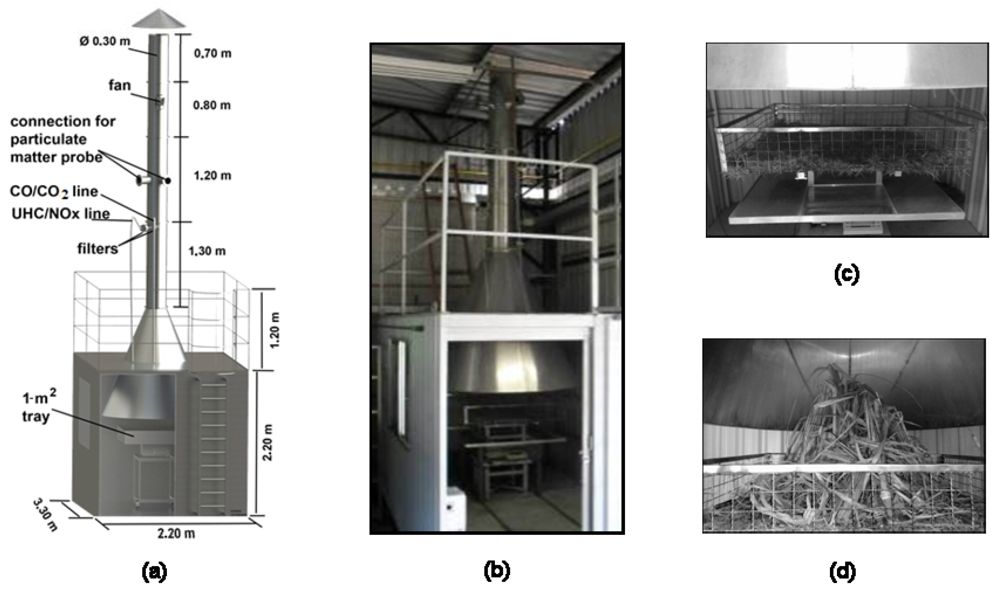
      <p>The experimental device in which the samples were burned was built in a container, as shown in <xref ref-type="fig" rid="atmosphere-03-00164-f001">Figure 1</xref>. This device is the same as the burning apparatus employed by Soares Neto <italic>et al</italic>. [<xref ref-type="bibr" rid="B26-atmosphere-03-00164">26</xref>]. Approximately 2.5 to 7.2 kg of biomass sample, loosely packed on a 1 m<sup>2</sup> burning table assembled in the center of the container, was used for the experiments. This device was placed on a balance that registered the mass loss, below an inverted funnel-like stainless steel hood, which had a 1.6 m diameter base placed 0.3 m above the table to capture all the effluent gases. The burning table was adjusted to a horizontal position and covered by a soil layer. Although the biomass samples representative of sugarcane burned in each experiment were principally constituted of straw, they also contained stems covered with straw, which were placed in a vertical position in the burning tray in an attempt to bring the experimental conditions closer to the real burning conditions in the field (<xref ref-type="fig" rid="atmosphere-03-00164-f001">Figure 1</xref>).</p>
      <fig id="atmosphere-03-00164-f001" position="anchor">
        <label>Figure 1</label>
        <caption>
          <p>(<bold>a</bold>) Illustrative drawing of the combustion chamber and (<bold>b</bold>) interior of the combustion chamber, emphasizing the hood coupled to the chimney and the burning tray positioned on top of the balance [<xref ref-type="bibr" rid="B26-atmosphere-03-00164">26</xref>]; (<bold>c</bold>) soil placed in the burning tray; (<bold>d</bold>) biomass placed in the burning tray.</p>
        </caption>
        <graphic xmlns:xlink="http://www.w3.org/1999/xlink" xlink:href="atmosphere-03-00164-g001.tif"/>
      </fig>
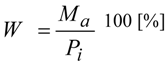
      <p>Quantitative measurements of fuel moisture were available. For each experiment, representative samples were separated and put in a stove at 85 °C to dry until they reached constant weight. This procedure allowed us to obtain the fuel moisture by means of the following equation:</p>
      <disp-formula id="atmosphere-03-00164-i001">
		<inline-graphic xmlns:xlink="http://www.w3.org/1999/xlink" xlink:href="atmosphere-03-00164-i001.tif"/>
		<label>(1)</label>
		</disp-formula>

       <p>in which: <italic>W</italic> = sample water percentage; <italic>M<sub>a</sub></italic> = water mass; <italic>M<sub>a</sub></italic> = <italic>P<sub>i</sub></italic> – <italic>P<sub>f</sub></italic>; <italic>P<sub>i</sub></italic> = initial weight; <italic>P<sub>f</sub></italic> = final weight.</p>
      <p>An axial fan was located in the stack and was controlled by a motor installed outside the stack, in order to force the exhaustion of trace gases, principally in the smoldering stage. A temperature sensor, a Pitot tube, absolute and differential pressure transducers, which were connected to the Pitot tube, and probes for trace gas sampling were also provided. The absolute pressure transducer determined the absolute pressure and the differential pressure transducer determined the dynamic pressure. These two measurements, as well as the temperature measurement, were transmitted to a mass flow controller that calculated the trace gas volume flow rate through the stack during the experiments. The flow rate was corrected to Standard Temperature and Pressure (STP). Two trace gas samples were collected simultaneously by two probes during the burning by a sampling tube where particulates (&gt;1 nm) were retained on glass fiber filters, and water and tar were removed by traps. The first sample, for CO and CO<sub>2</sub> concentration measurements, passed through a trap immersed in isopropyl alcohol, cooled to −35 °C, to remove water and tar. The second sample was used to determine NO<sub>X</sub> and UHC (unburned hydrocarbons) concentrations and passed through a trap with water at 3 °C for water removal. In this case, the tube was made of PFA (Per Fluor Alkoxy), while the CO and CO<sub>2</sub> sample tube was stainless steel. Different sample treatments were necessary due to the working principle of each analyzer. After the treatment, samples passed through specific analyzers (Rosemount Analytical) in which CO<sub>2</sub>, CO, NO<sub>X</sub>, and UHC excess mixing ratios were determined: model 880 A (non dispersive infrared), range 0–5%, calibrated with a 4.6% standard to CO<sub>2</sub>; model 880 A (non dispersive infrared), range 0–10,000 ppm (1%), calibrated with a 9,000 ppm standard to CO; model 951A (chemiluminescent), range 0–250 ppm, calibrated with a 225 ppm standard to NO/NO<sub>X</sub>; and model 880 A (FID), range 0–1,000 ppm, calibrated with a 900 ppm methane standard to UHC. The term unburned hydrocarbons (UHC) is an operational definition of any species detected by the analyzer model 880 A (FID), which determines methane and other non-methane hydrocarbons such as ethene, ethyne, ethane, propene, propyne, propane, and butanes excess mixing ratios, because it does not provide separated measurements by species.</p>
      <p>Concentrations of trace gases and the other process variables were transmitted to a data acquisition system that continuously recorded the measurements during the test with an interval of approximately 1 s. The data saved for each experiment were: time [s], mass [g], CO<sub>2</sub>, CO, UHC and NO<sub>X</sub> concentrations, gas temperature in the chimney [°C], and the volume flow rate of gas in the chimney [m<sup>3</sup> h<sup>−1</sup>]. Each experiment lasted 2 to 7 min from ignition until the end of smoldering phase, depending on the moisture content of the sample. The ignition was carried out with an LPG (liquefied petroleum gas) blowpipe. The ignition period was not taken into account to avoid blowpipe influence on the CO<sub>2</sub> concentration.</p>
      <p>The emission factor (EFx) for these chemical species, in g kg<sup>−1</sup> (grams of species X per kg of burned dried biomass), was calculated according to Equation (2), where: V<sub>Total chimney</sub> = total volume of gas flow through the chimney during the experiment (m<sup>3</sup>); [X] = species X average concentration (molar fraction); M<sub>X</sub> = species X molecular weight (g mol<sup>−1</sup>); m(fuel(dry basis)) = amount of dry fuel consumed (kg); and V<sub>X</sub> = molar volume of gas at Standard Temperature and Pressure (m<sup>3</sup>) (STP) (=0.0224 m<sup>3</sup>).</p>
      <disp-formula id="atmosphere-03-00164-i002">
		<inline-graphic xmlns:xlink="http://www.w3.org/1999/xlink" xlink:href="atmosphere-03-00164-i002.tif"/>
		<label>(2)</label>
		</disp-formula> 
      <p>In the second stage of this work, particulate matter with diameters equal to or less than 2.5 μm (PM<sub>2.5</sub>) was sampled by means of the particulate matter monitor denominated DataRAM 4 (DR-4000 model). This equipment was installed above the ceiling of the container, so that a probe could be attached to the chimney and collect samples of the smoke emitted during burning for the measurement of concentration (μg/m<sup>3</sup>) and particulate matter diameter (μm), as well as the air temperature and relative humidity.</p>
      <p>With the aim of collecting mass concentration measurements, the DataRAM 4 PM monitor is factory calibrated against a gravimetric standard traceable to the National Institute of Standards and Testing (NIST) with a SAE Particles Fine Test (ISO Fine) carried out with the following physical characteristics: mass median aerodynamic particle diameter from 2 to 3 μm; geometric standard deviation of lognormal size distribution equivalent to 2.5; density from 2.60 to 2.65 g/cm<sup>3</sup>; and refractive index corresponding to 1.54. Moreover, the DataRAM 4 is capable of registering the average diameter and fine particles concentration in a continuous way (as much from dust as from smoke or fog, for example). This is made through aerodynamic size selection (PM<sub>2.5</sub>, in this study) and two-wavelength nephelometry. This two-wavelength detection system measures the average volume of particles up to 0.05 μm within a range of 400 mg/m<sup>3</sup> of concentration [<xref ref-type="bibr" rid="B38-atmosphere-03-00164">38</xref>]. The flow heater was used to remove moisture from the sample, eliminating the effects of coagulation and condensation of water vapor on particles and, consequently, avoiding its influence on particle size. Furthermore, a diluter was used in this study. This sample dilution accessory improves the measurements because it can prevent some saturation, leaving more disperse particles and avoiding overestimated results.</p>
      <p>The samples were obtained from around 3 min 10 s to 4 min 30 s. An estimate of the emission factor for PM<sub>2.5</sub>, in g kg<sup>−1</sup> (grams of species X per kg of dry burned biomass), was calculated by means of Equation (3):</p>
      <disp-formula id="atmosphere-03-00164-i003">
		<inline-graphic xmlns:xlink="http://www.w3.org/1999/xlink" xlink:href="atmosphere-03-00164-i003.tif"/>
		<label>(3)</label>
		</disp-formula> 
       <p>in which: [X] = total concentration of species X (mg/m<sup>3</sup>), based on measurements of every 10 s; <italic>V<sub>Total</sub></italic> = total volume of the gas sample which flowed through the chimney during the experiment (m<sup>3</sup>), based on measurements of every 10 s; <italic>m</italic> = mass of consumed fuel on a dry basis (kg).</p>
    </sec>
    <sec sec-type="results">
      <title>3. Results</title>
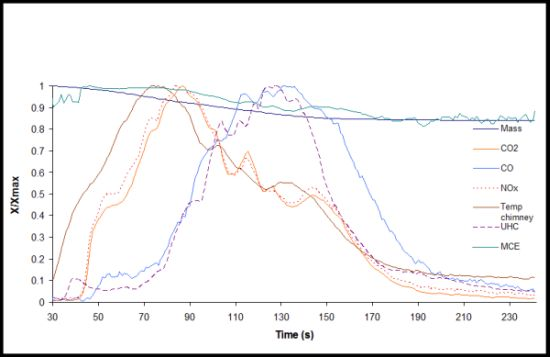
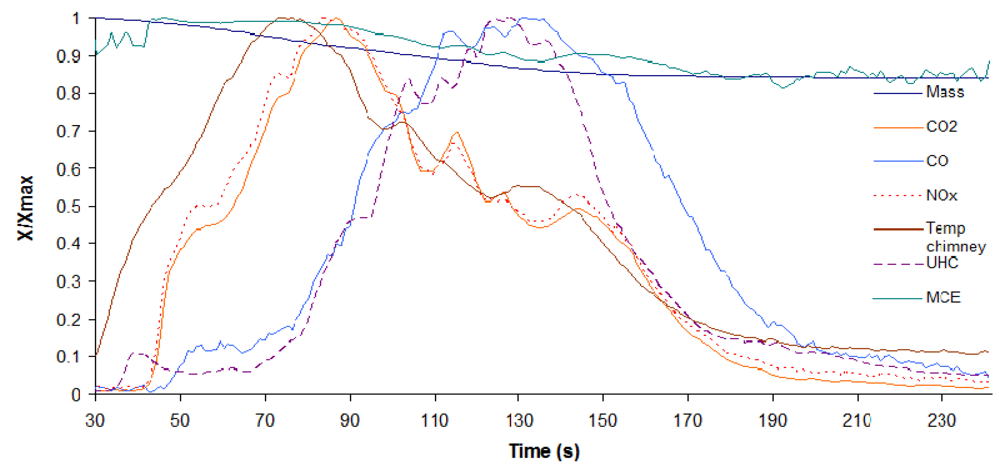
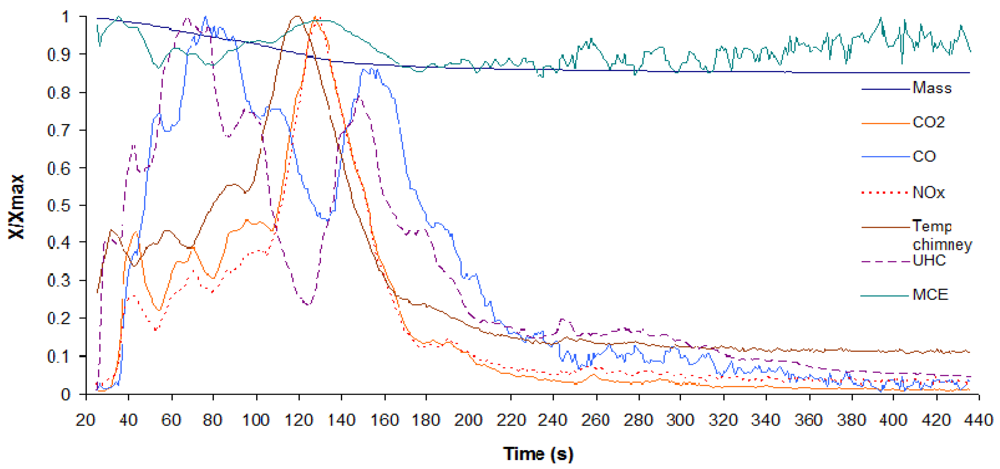
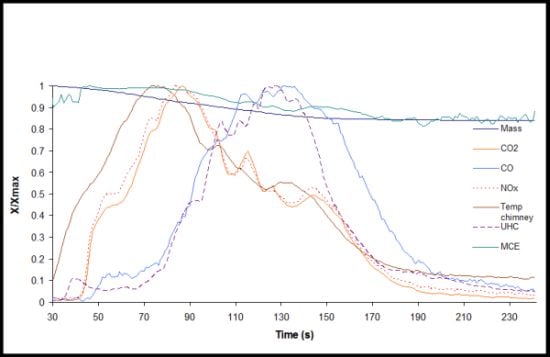
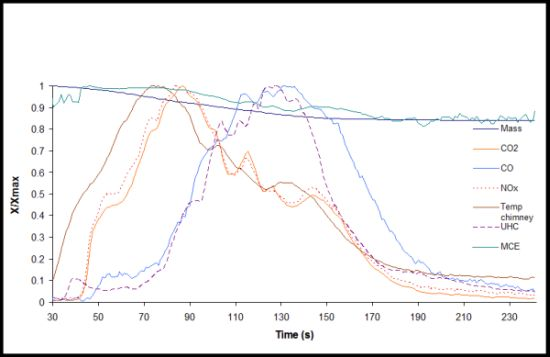
      <p>In each experiment, the phases of the combustion process were recorded. In general, the typical pattern of the combustion process was comprised of the flaming phase followed by the smoldering phase, and smoke was produced with the chemical composition inherent to each of them. In this pattern the emissions originated initially from the flaming phase, during which the largest biomass consumption occurred and a larger quantity of compounds such as CO<sub>2</sub> and NO<sub>X</sub> were generated. On the other hand, the incompletely oxidized compounds, such as CO and UHC, were generated in greatest concentration in the smoldering phase, in accordance with the example shown in <xref ref-type="fig" rid="atmosphere-03-00164-f002">Figure 2</xref>. However, in some cases, an alteration in this pattern was observed due to the higher humidity content of the sample utilized in this experiment. In this case, the smoldering phase preceded the flaming phase, which had a shorter duration, and occurred again at the end of the combustion process, which generally had the longest duration of the entire combustion process, as exemplified in <xref ref-type="fig" rid="atmosphere-03-00164-f003">Figure 3</xref>.</p>
      
      <p>In the experiment presented in <xref ref-type="fig" rid="atmosphere-03-00164-f002">Figure 2</xref>, which exemplified the typical pattern of the combustion process, the percentage of biomass consumed in the flaming stage corresponded to about 60% of the total. On the other hand, the experiment presented in <xref ref-type="fig" rid="atmosphere-03-00164-f003">Figure 3</xref>, which showed the combustion process of the sample with the greatest registered humidity content, the percentage of biomass consumed in the flaming stage corresponded to about 22% of the total.</p>
      <p>In the test shown in <xref ref-type="fig" rid="atmosphere-03-00164-f002">Figure 2</xref>, with well separated combustion stages (flaming and smoldering), average estimated values of emission factors for the flaming stage were 1,011.8 and 14.8 for CO<sub>2</sub> and CO, respectively. On the other hand, average EF values for the smoldering combustion stage corresponded to 1,471.1 and 110.8 for CO<sub>2</sub> and CO, respectively. The increase in the CO EF in a higher proportion during the smoldering phase also occurred for the other tests. <xref ref-type="fig" rid="atmosphere-03-00164-f003">Figure 3</xref> shows a higher and regular modified combustion efficiency (MCE) flaming stage during the combustion process. Normalized mixing ratios were used because these allow comparing mixing ratios from CO<sub>2</sub>, CO, NO<sub>X</sub>, and UHC in the same plot, since their orders of magnitude are different. For example, in the test exposed in <xref ref-type="fig" rid="atmosphere-03-00164-f003">Figure 3</xref>, the NO<sub>X</sub> mixing ratio peak was approximately 38 ppm while the CO mixing ratio peak was about 1,700 ppm.</p>
      <fig id="atmosphere-03-00164-f002" position="anchor">
        <label>Figure 2</label>
        <caption>
          <p>Example of the typical pattern of the combustion process observed in one of the experiments conducted in the laboratory. Normalized data, as a function of time: gas emissions and their relation with the combustion phases.</p>
        </caption>
        <graphic xmlns:xlink="http://www.w3.org/1999/xlink" xlink:href="atmosphere-03-00164-g002.tif"/>
      </fig>
      <fig id="atmosphere-03-00164-f003" position="anchor">
        <label>Figure 3</label>
        <caption>
          <p>Observed pattern of the combustion process of the sample with the greatest registered humidity content. Normalized data, as a function of time: gas emissions and their relation with the combustion phases.</p>
        </caption>
        <graphic xmlns:xlink="http://www.w3.org/1999/xlink" xlink:href="atmosphere-03-00164-g003.tif"/>
      </fig>
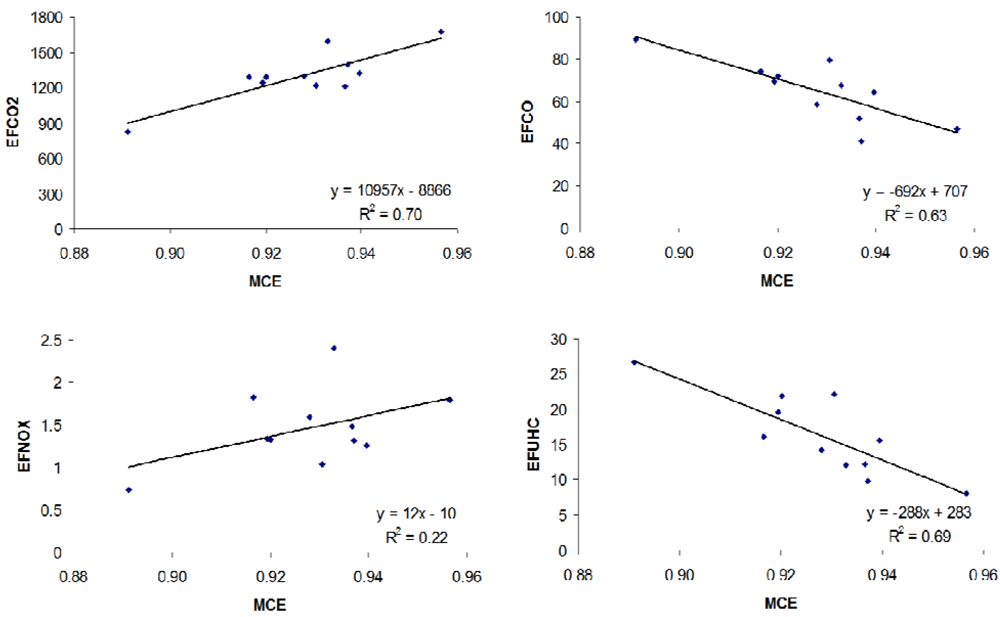
      <p>The MCE, which corresponds to the ratio between the carbon emitted as CO<sub>2</sub> and the carbon emitted as CO<sub>2</sub> + CO (MCE = ΔCO<sub>2</sub>/ΔCO<sub>2</sub> + ΔCO), was also estimated for sugarcane straw burning. The average estimated MCE value (0.928) indicates the predominance of the flaming phase during the combustion process. In <xref ref-type="fig" rid="atmosphere-03-00164-f004">Figure 4</xref>, the relations between the compound emission factors <italic>versus</italic> their respective MCE are shown, which indicate the relative contribution of the flaming and smoldering phases of the combustion process. A typical pattern was observed, with a positive correlation for the compounds produced in the flaming phase of the combustion process (there was an increase in EF values for CO<sub>2</sub> and NO<sub>X</sub> with increased MCE) and a negative correlation for those released in the smoldering phase (there was a decrease in EF values for CO and UHC with increased MCE).</p>
      <fig id="atmosphere-03-00164-f004" position="anchor">
        <label>Figure 4</label>
        <caption>
          <p>Graphical representation of the emission factors (EF) for CO<sub>2</sub>, CO, NO<sub>X</sub>, and UHC <italic>versus</italic> the modified combustion efficiency (MCE).</p>
        </caption>
        <graphic xmlns:xlink="http://www.w3.org/1999/xlink" xlink:href="atmosphere-03-00164-g004.tif"/>
      </fig>
      <p>The average values of the estimated emission factors (g kg<sup>−1</sup> of dry burned biomass) for CO<sub>2</sub>, CO, NO<sub>X</sub>, UHC, and PM<sub>2.5</sub> were 1,303 (±218), 65 (±14), 1.5 (±0.4), 16 (±6), and 2.6 (±1.6), respectively. <xref ref-type="table" rid="atmosphere-03-00164-t001">Table 1</xref> presents a comparison of the results of this study with other data available in the literature. The information provided by Lopes and Carvalho [<xref ref-type="bibr" rid="B35-atmosphere-03-00164">35</xref>] and Yokelson <italic>et al</italic>. [<xref ref-type="bibr" rid="B24-atmosphere-03-00164">24</xref>] was also obtained in laboratory experiments that involved measuring the emissions from burning sugarcane. On the other hand, data provided by Le Canut <italic>et al</italic>. [<xref ref-type="bibr" rid="B34-atmosphere-03-00164">34</xref>] were recorded during a flight through smoke plumes over sugarcane fields.</p>
      
      <p>As shown in <xref ref-type="table" rid="atmosphere-03-00164-t001">Table 1</xref>, the MCE value estimated in this study (0.928) is lower than the values of 0.976 and 0.965 obtained by Yokelson <italic>et al</italic>. [<xref ref-type="bibr" rid="B24-atmosphere-03-00164">24</xref>] and Le Canut <italic>et al</italic>. [<xref ref-type="bibr" rid="B34-atmosphere-03-00164">34</xref>], respectively, which could be related to the higher CO emission factor estimated here in relation to the other studies. As previously mentioned, the significant occurrence of the smoldering phase in some experiments, especially due to the higher humidity content of the utilized sample, could explain the lower value of MCE. This could also explain the more elevated estimated average EF value for CO, since generally fuel with a higher humidity decreases the combustion efficiency, reduces the flaming phase, and causes a smoldering phase before ignition. In addition, it results in an increase of the emission factors for species resulting from incomplete oxidation, such as CO [<xref ref-type="bibr" rid="B39-atmosphere-03-00164">39</xref>].</p>
      <table-wrap id="atmosphere-03-00164-t001" position="anchor">
        <object-id pub-id-type="pii">atmosphere-03-00164-t001_Table 1</object-id>
        <label>Table 1</label>
        <caption>
          <p>Emission factors (g kg<sup>−1</sup> of dry burned biomass) and MCE.</p>
        </caption>
        <table>
          <thead>
            <tr>
              <th align="center" valign="middle">Types of Biomass Burning</th>
              <th align="center" valign="middle">CO<sub>2</sub></th>
              <th align="center" valign="middle">CO</th>
              <th align="center" valign="middle">NO<sub>X</sub></th>
              <th align="center" valign="middle">UHC</th>
              <th align="center" valign="middle">PM<sub>2.5</sub></th>
              <th align="center" valign="middle">MCE</th>
              <th align="center" valign="middle">Reference</th>
            </tr>
          </thead>
          <tbody>
            <tr>
              <td align="center" valign="middle">Sugarcane</td>
              <td align="center" valign="middle">1,303 ± 218</td>
              <td align="center" valign="middle">65 ± 14</td>
              <td align="center" valign="middle">1.5 ± 0.4</td>
              <td align="center" valign="middle">16 ± 6</td>
              <td align="center" valign="middle">-</td>
              <td align="center" valign="middle">0.928</td>
              <td align="center" valign="middle">This work <sup>a,</sup><sup>b</sup></td>
            </tr>
            <tr>
              <td align="center" valign="middle">Sugarcane</td>
              <td align="center" valign="middle">-</td>
              <td align="center" valign="middle">-</td>
              <td align="center" valign="middle">-</td>
              <td align="center" valign="middle">-</td>
              <td align="center" valign="middle">2.6 ± 1.6</td>
              <td align="center" valign="middle">-</td>
              <td align="center" valign="middle">This work <sup>b,c</sup></td>
            </tr>
            <tr>
              <td align="center" valign="middle">Sugarcane</td>
              <td align="center" valign="middle">1,288 ± 167</td>
              <td align="center" valign="middle">28 ± 3</td>
              <td align="center" valign="middle">-</td>
              <td align="center" valign="middle">-</td>
              <td align="center" valign="middle">-</td>
              <td align="center" valign="middle">-</td>
              <td align="center" valign="middle">Lopes and Carvalho [<xref ref-type="bibr" rid="B35-atmosphere-03-00164">35</xref>] <sup>b</sup></td>
            </tr>
            <tr>
              <td align="center" valign="middle">Sugarcane</td>
              <td align="center" valign="middle">1,838</td>
              <td align="center" valign="middle">28.3</td>
              <td align="center" valign="middle">-</td>
              <td align="center" valign="middle">-</td>
              <td align="center" valign="middle">2.17</td>
              <td align="center" valign="middle">0.976</td>
              <td align="center" valign="middle">Yokelson <italic>et al.</italic> [<xref ref-type="bibr" rid="B24-atmosphere-03-00164">24</xref>] <sup>b</sup> </td>
            </tr>
            <tr>
              <td align="center" valign="middle">Sugarcane</td>
              <td align="center" valign="middle">-</td>
              <td align="center" valign="middle">-</td>
              <td align="center" valign="middle">-</td>
              <td align="center" valign="middle">-</td>
              <td align="center" valign="middle">2.8</td>
              <td align="center" valign="middle">0.965</td>
              <td align="center" valign="middle">Le Canut <italic>et al.</italic> [<xref ref-type="bibr" rid="B34-atmosphere-03-00164">34</xref>] <sup>d</sup></td>
            </tr>
            <tr>
              <td align="center" valign="middle">Agricultural Residues</td>
              <td align="center" valign="middle">1,515 ± 177</td>
              <td align="center" valign="middle">92 ± 84</td>
              <td align="center" valign="middle">2.5 ± 1.0</td>
              <td align="center" valign="middle">-</td>
              <td align="center" valign="middle">3.9</td>
              <td align="center" valign="middle">0.943 <sup>e</sup></td>
              <td align="center" valign="middle">Andreae and Merlet [<xref ref-type="bibr" rid="B21-atmosphere-03-00164">21</xref>]</td>
            </tr>
            <tr>
              <td align="center" valign="middle">Agricultural Residues</td>
              <td align="center" valign="middle">1,585 ± 100</td>
              <td align="center" valign="middle">102 ± 33</td>
              <td align="center" valign="middle">3.11 ± 1.57</td>
              <td align="center" valign="middle">-</td>
              <td align="center" valign="middle">6.26 ± 2.36</td>
              <td align="center" valign="middle">0.940 <sup>e</sup></td>
              <td align="center" valign="middle">Akagi <italic>et al.</italic> [<xref ref-type="bibr" rid="B27-atmosphere-03-00164">27</xref>]</td>
            </tr>
          </tbody>
        </table>
        <table-wrap-foot>
        <fn>
        <p><sup>a</sup> first experiments; <sup>b</sup> laboratory measurements; <sup>c</sup> posterior experiments; <sup>d</sup> flight measurements; <sup>e</sup> MCE provided using the reported CO<sub>2</sub> and CO EFs.</p>
        </fn>
        </table-wrap-foot>
      </table-wrap>
      
      <p>Yokelson <italic>et al</italic>. [<xref ref-type="bibr" rid="B24-atmosphere-03-00164">24</xref>] explained that a high MCE was obtained from a laboratory fire that burned at a MCE that was higher than that normally obtained in the field for biomass burning and, in this way, the MCE of a typical sugarcane fire is likely lower and would imply a larger emission factor for PM<sub>2.5</sub>. In that study, the plant material used in the fuel bed corresponded to leaves, twigs, and branches with a diameter of less than 30 mm and did not include the large diameter logs, which would contribute to the emissions measured in the field campaign. Perhaps the use of a burning table covered by a soil layer in our study, as well as biomass samples representative of sugarcane constituted of straw and stems covered with straw in each experiment, resulted in experimental conditions closer to the real burning conditions in the field.</p>
      <p>Moreover, the fuel moistures in our study were higher than that found by Yokelson <italic>et al</italic>. [<xref ref-type="bibr" rid="B24-atmosphere-03-00164">24</xref>], which corresponded to 8.58%. This could result in a lower combustion efficiency and, consequently, in different emission factors and MCE values compared to their study. On the other hand, the MCE observed by Le Canut <italic>et al</italic>. [<xref ref-type="bibr" rid="B34-atmosphere-03-00164">34</xref>] may have been higher because aircraft measurements tend to sample emissions that are associated with more intense/flaming combustion [<xref ref-type="bibr" rid="B24-atmosphere-03-00164">24</xref>]. Some studies have shown that emission factors (EF) for ground-based measurements of smoldering compounds were higher than the EF measured for the same compounds from an aircraft above the same fires. This could be due to weakly lofted smoldering emissions collected by flight measurements, as occurred in the Babbitt <italic>et al</italic>. [<xref ref-type="bibr" rid="B40-atmosphere-03-00164">40</xref>] study, for example [<xref ref-type="bibr" rid="B23-atmosphere-03-00164">23</xref>]. This fact could result in higher values for smoldering compounds from laboratory and field measurements. In this way, the chemistry composition of the smoke measured in the laboratory might be different from flight measurements.</p>
      <p>All studies concerning to sugarcane showed in <xref ref-type="table" rid="atmosphere-03-00164-t001">Table 1</xref> examined pre-harvest burning practices. Le Canut <italic>et al.</italic> [<xref ref-type="bibr" rid="B34-atmosphere-03-00164">34</xref>] study examined pre-harvest burning practices [<xref ref-type="bibr" rid="B41-atmosphere-03-00164">41</xref>] and Yokelson <italic>et al.</italic> [<xref ref-type="bibr" rid="B24-atmosphere-03-00164">24</xref>] and Lopes and Carvalho [<xref ref-type="bibr" rid="B35-atmosphere-03-00164">35</xref>] made reference to the sugarcane pre-harvest burning practice as a broadly used method to separate dried leaves and weeds from the sugarcane and to eliminate pests that could hinder manual harvesting.</p>
      <p>From the consumed mass (dry base, in kg) in each experiment, the combustion factor (fraction of biomass that was actually burned) was also estimated for sugarcane. The estimated value was close to 0.09 for biomass samples comprised of straw and also containing stems covered with straw, in an attempt to bring the experimental conditions closer to the real burning conditions in the field, where the stalks are not affected by the burning, <italic>i.e.</italic>, only dry leaves get burned during an intense but fast fire. It was well represented in the laboratory conditions.</p>
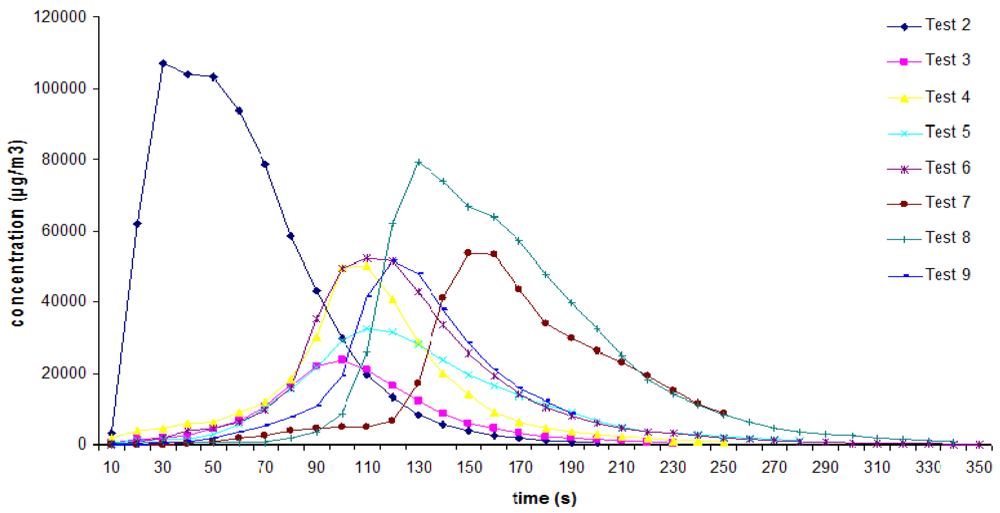
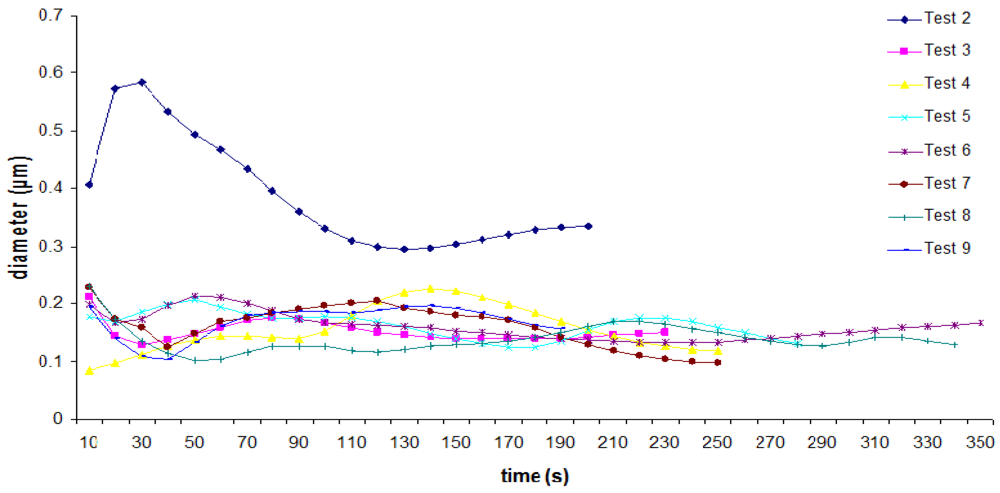
      <p>The particulate matter sampling showed that it was generated in both the flaming and smoldering phases of the combustion process. The variation in concentration (μg/m<sup>3</sup>) and diameter (μm) of the PM<sub>2.5</sub> emitted during the burning of sugarcane straw, recorded in the experiments conducted in 2010, can be observed in <xref ref-type="fig" rid="atmosphere-03-00164-f005">Figure 5</xref> and <xref ref-type="fig" rid="atmosphere-03-00164-f006">Figure 6</xref>.</p>
      <fig id="atmosphere-03-00164-f005" position="anchor">
        <label>Figure 5</label>
        <caption>
          <p>Variation in the average concentration (μg/m<sup>3</sup>) of PM<sub>2.5</sub> emitted during the burning period in the experiments conducted in 2010.</p>
        </caption>
        <graphic xmlns:xlink="http://www.w3.org/1999/xlink" xlink:href="atmosphere-03-00164-g005.tif"/>
      </fig>
      <fig id="atmosphere-03-00164-f006" position="anchor">
        <label>Figure 6</label>
        <caption>
          <p>Variation in the average diameter (μm) of the PM<sub>2.5</sub> emitted during the burning period in the experiments conducted in 2010.</p>
        </caption>
        <graphic xmlns:xlink="http://www.w3.org/1999/xlink" xlink:href="atmosphere-03-00164-g006.tif"/>
      </fig>
      <p><xref ref-type="fig" rid="atmosphere-03-00164-f005">Figure 5</xref> shows the average PM<sub>2.5</sub> concentration, whose highest level was approximately 110,000 μg/m<sup>3</sup> during one of the experiments conducted in 2010. There was a significant increase in the concentration of fine particulates, since background values of around 0.1 μg/m<sup>3</sup> to 2.4 μg/m<sup>3</sup> were recorded before the initiation of the burning. The delay in the increase of emitted particulate matter in Tests 7 and 8 is due to the higher humidity content of their respective samples, which caused a delay in the initiation of the flaming phase in both experiments. This is unlike what occurred with the dry fuels, which burn more easily, as observed in the shape of the curve for Test 2, whose sample contained the lowest humidity content of all the samples (about 17% while the other burn samples’ fuel moistures were higher than 26%, most of them ranged between 30% and 40%) according to <xref ref-type="table" rid="atmosphere-03-00164-t002">Table 2</xref>. Much higher concentrations of particles occurred during Test 2 because more fuel was being consumed in this particular burn during the early stages of the fire compared to all the other studies. The results of this experiment were also used to determine the emission factor for PM<sub>2.5</sub> and that was the reason for the rather large standard deviation observed in <xref ref-type="table" rid="atmosphere-03-00164-t001">Table 1</xref>.</p>
      <table-wrap id="atmosphere-03-00164-t002" position="anchor">
        <object-id pub-id-type="pii">atmosphere-03-00164-t002_Table 2</object-id>
        <label>Table 2</label>
        <caption>
          <p>Fuel moisture content.</p>
        </caption>
        <table>
          <thead>
            <tr>
              <th align="center" valign="middle">Samples</th>
              <th align="center" valign="middle">Fuel Moisture (%)</th>
            </tr>
          </thead>
          <tbody>
            <tr>
              <td align="center" valign="middle">Test 2</td>
              <td align="center" valign="middle">16.60</td>
            </tr>
            <tr>
              <td align="center" valign="middle">Test 3</td>
              <td align="center" valign="middle">33.84</td>
            </tr>
            <tr>
              <td align="center" valign="middle">Test 4</td>
              <td align="center" valign="middle">37.04</td>
            </tr>
            <tr>
              <td align="center" valign="middle">Test 5</td>
              <td align="center" valign="middle">34.59</td>
            </tr>
            <tr>
              <td align="center" valign="middle">Test 6</td>
              <td align="center" valign="middle">37.37</td>
            </tr>
            <tr>
              <td align="center" valign="middle">Test 7</td>
              <td align="center" valign="middle">49.37</td>
            </tr>
            <tr>
              <td align="center" valign="middle">Test 8</td>
              <td align="center" valign="middle">43.32</td>
            </tr>
            <tr>
              <td align="center" valign="middle">Test 9</td>
              <td align="center" valign="middle">26.23</td>
            </tr>
          </tbody>
        </table>
      </table-wrap>
      <p><xref ref-type="fig" rid="atmosphere-03-00164-f006">Figure 6</xref>, on the other hand, shows the variation of the average diameter (μm) of the PM<sub>2.5</sub> emitted during the sugarcane straw burning in the experiments conducted in 2010. On average, diameters of 0.08 to 0.23 μm were recorded. A significant difference is noted in the values of the mean particulate matter diameter recorded during Test 2 compared to the other tests. The larger particle size, whose peak occurred in the flaming phase, must be related to the fact that the humidity content of the sample used in this test was much lower than the humidity content of the other samples.</p>
      <p>The occurrence of the largest PM<sub>2.5</sub> average diameter and concentration in Test 2, especially in the flaming phase, could be related to the fact that in this test the burning was very intense, due to the low humidity content of the utilized sample. Although in many cases higher particulate concentrations and larger particles are associated with low combustion efficiency, in the occurrence of very intense fire, larger particles can be emitted in the flaming phase [<xref ref-type="bibr" rid="B42-atmosphere-03-00164">42</xref>,<xref ref-type="bibr" rid="B43-atmosphere-03-00164">43</xref>]. In this case, due to the higher temperature and combustion rates, a large oxygen loss occurs in the flaming phase due to fuel oxidation, resulting in the emission of more irregular and larger particles [<xref ref-type="bibr" rid="B43-atmosphere-03-00164">43</xref>].</p>
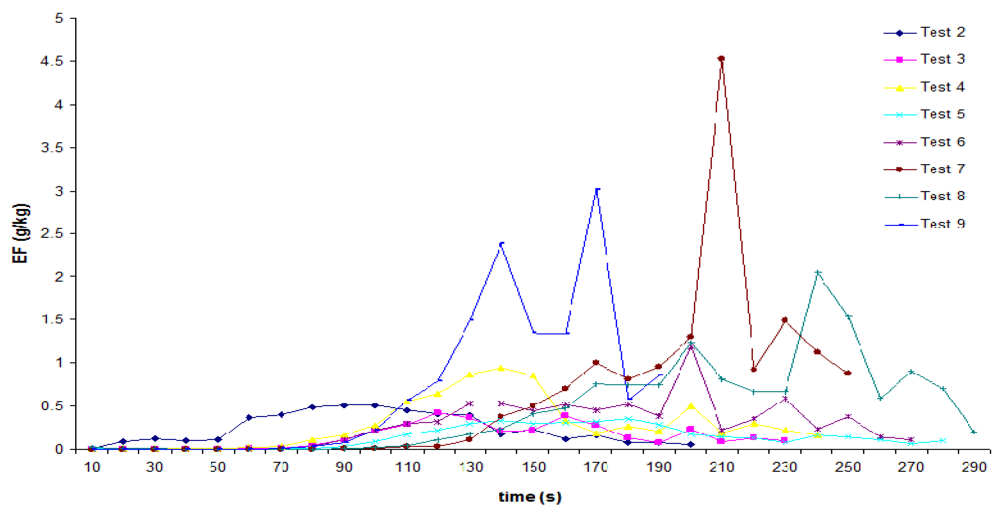
      <p>A significant difference is also noted in the values of the emission factors for PM<sub>2.5</sub> recorded during Test 2 compared to the other tests (<xref ref-type="fig" rid="atmosphere-03-00164-f007">Figure 7</xref>). For all tests, except Test 2, the EF values increased from the start of smoldering stage. However, significant correlations between emission factors for either PM<sub>2.5</sub> or gases and fuel moisture were not observed, despite an influence of fuel moisture on the combustion process behavior has occurred, determining the duration and intensity of the flaming and smoldering phases. Probably, the range of variability of fuel moisture was not broad enough to allow any signal in these correlations, mainly because all samples were collected when the sugarcane was ready to be burned.</p>
      <fig id="atmosphere-03-00164-f007" position="anchor">
        <label>Figure 7</label>
        <caption>
          <p>Real-time emission factors for PM<sub>2.5</sub>.</p>
        </caption>
        <graphic xmlns:xlink="http://www.w3.org/1999/xlink" xlink:href="atmosphere-03-00164-g007.tif"/>
      </fig>
    </sec>
    <sec sec-type="conclusions">
      <title>4. Conclusions</title>
      <p>In this work, emission factors for trace gases and particulate matter and combustion factor for sugarcane straw burning were estimated, and information was obtained about the duration and emission of chemical species during the phases of the combustion process (flaming and smoldering). Average estimated values for emission factors (g kg<sup>−1</sup> of burned dry biomass) were 1,303 ± 218 for CO<sub>2</sub>, 65 ± 14 for CO, 1.5 ± 0.4 for NO<sub>X</sub>, 16 ± 6 for UHC, and 2.6 ± 1.6 for PM<sub>2.5</sub>.</p>
      <p>In general, a good agreement between the results obtained in this study and data found in the literature was observed, especially with relation to the estimated EF values for CO<sub>2</sub> and PM<sub>2.5</sub>. The elevated average MCE value estimated in this study (0.928) indicates the predominance of the flaming phase during the combustion process. Nevertheless, the higher humidity content of some of the utilized samples could have resulted in the lower MCE value estimated in this study in relation to the other studies shown here, since fuels with higher humidity content tend to reduce the combustion efficiency. The higher humidity content of these samples also could have resulted in the obtainment of a higher estimated average EF value for CO in this study in relation to the other studies shown here, due to the addition of the CO emission in the smoldering phase that preceded the flaming phase in each of those experiments. The occurrence of very intense fire, due to the low humidity content of the sample, influenced the size distribution of fine particulate matter and its concentration. Thus, the humidity content of the samples had an important influence on the sugarcane straw combustion process, since it was capable of affecting the intensity and duration of the flaming and smoldering phases, as well as the concentration and diameter of the particulate matter emitted during combustion.</p>
      <p>The experiments permitted the extraction of important information about biomass burning representative of the sugarcane produced in Brazil. Thus, it is expected that the results obtained in this study will be useful for the generation of more realistic emission inventories and, consequently, the improvement of air quality modeling results.</p>
    </sec>
    
  </body>
  <back>
   <ack>
      <title>Acknowledgments</title>
      <p>We thank the National Council for Scientific and Technological Development (CNPq, Brazil) and the São Paulo Research Foundation (FAPESP, Brazil-projects 02/08964-4; 08/04490-4; and 08/56252-0) for financial support. We also thank Luiz Antonio Paes and Luis Clarete, from the Sugarcane Technology Center (CTC), and the members of the Combustion and Propulsion Laboratory (LCP)—Carlos A. dos Santos, Gislaine Matos, Emiliana Amorim, Victor Orui Saito, João Paulo Cruz and Fabiana Ferrari Dias—for all of the support provided during the execution of this work.</p>
    </ack>
    <ref-list>
      <title>References</title>
      <ref id="B1-atmosphere-03-00164">
        <label>1.</label>
        <citation citation-type="book">
          <person-group person-group-type="author">
            <name>
              <surname>Andreae</surname>
              <given-names>M.O.</given-names>
            </name>
          </person-group>
          <article-title>Biomass burning: Its history, use and distribution and its impact on environmental quality and global climate</article-title>
          <source>Global Biomass Burning: Atmospheric, Climatic and Biospheric Implications</source>
          <person-group person-group-type="editor">
            <name>
              <surname>Levine</surname>
              <given-names>J.S.</given-names>
            </name>
          </person-group>
          <publisher-name>MIT Press</publisher-name>
          <publisher-loc>Cambridge, MA, USA</publisher-loc>
          <year>1991</year>
          <fpage>3</fpage>
          <lpage>21</lpage>
        </citation>
      </ref>
      <ref id="B2-atmosphere-03-00164">
        <label>2.</label>
        <citation citation-type="journal">
          <person-group person-group-type="author">
            <name>
              <surname>Artaxo</surname>
              <given-names>P.</given-names>
            </name>
            <name>
              <surname>Martins</surname>
              <given-names>J.</given-names>
            </name>
            <name>
              <surname>Yamasoe</surname>
              <given-names>M.</given-names>
            </name>
            <name>
              <surname>Procópio</surname>
              <given-names>A.</given-names>
            </name>
            <name>
              <surname>Pauliquevis</surname>
              <given-names>T.</given-names>
            </name>
            <name>
              <surname>Andreae</surname>
              <given-names>M.</given-names>
            </name>
            <name>
              <surname>Guyon</surname>
              <given-names>P.</given-names>
            </name>
            <name>
              <surname>Gatti</surname>
              <given-names>L.V.</given-names>
            </name>
            <name>
              <surname>Leal</surname>
              <given-names>A.M.C.</given-names>
            </name>
          </person-group>
          <article-title>Physical and chemical properties of aerosols in the wet and dry season in Rondônia, Amazonia</article-title>
          <source>J. Geophys. Res.</source>
          <year>2002</year>
          <volume>107</volume>
          <fpage>8081</fpage>
          <lpage>8095</lpage>
        <pub-id pub-id-type="doi">10.1029/2001JD000666</pub-id></citation>
      </ref>
      <ref id="B3-atmosphere-03-00164">
        <label>3.</label>
        <citation citation-type="journal">
          <person-group person-group-type="author">
            <name>
              <surname>Freitas</surname>
              <given-names>S.R.</given-names>
            </name>
            <name>
              <surname>Longo</surname>
              <given-names>K.M.</given-names>
            </name>
            <name>
              <surname>Rodrigues</surname>
              <given-names>L.F.</given-names>
            </name>
          </person-group>
          <article-title>Modelagem Numérica da Composição Química da Atmosfera e seus Impactos no Tempo, Clima e Qualidade do Ar</article-title>
          <source>Rev. Bras. Meteorol.</source>
          <year>2009</year>
          <volume>24</volume>
          <fpage>188</fpage>
          <lpage>207</lpage>
          <pub-id pub-id-type="doi">10.1590/S0102-77862009000200008</pub-id>
        </citation>
      </ref>
      <ref id="B4-atmosphere-03-00164">
        <label>4.</label>
        <citation citation-type="book">
          <person-group person-group-type="author">
            <name>
              <surname>Longo</surname>
              <given-names>K.M.</given-names>
            </name>
            <name>
              <surname>Freitas</surname>
              <given-names>S.R.</given-names>
            </name>
            <name>
              <surname>Andreae</surname>
              <given-names>M.O.</given-names>
            </name>
            <name>
              <surname>Yokelson</surname>
              <given-names>R.</given-names>
            </name>
            <name>
              <surname>Artaxo</surname>
              <given-names>P.</given-names>
            </name>
          </person-group>
          <article-title>Biomass burning in Amazonia: Emissions, long-range transport of smoke and its regional and remote impacts</article-title>
          <source>Amazonia and Global Change</source>
          <person-group person-group-type="editor">
            <name>
              <surname>Keller</surname>
              <given-names>M.</given-names>
            </name>
            <name>
              <surname>Bustamante</surname>
              <given-names>M.</given-names>
            </name>
            <name>
              <surname>Gash</surname>
              <given-names>J.</given-names>
            </name>
            <name>
              <surname>Silva Dias</surname>
              <given-names>P.</given-names>
            </name>
          </person-group>
          <publisher-name>American Geophysical Union</publisher-name>
          <publisher-loc>Washington, DC, USA</publisher-loc>
          <year>2009</year>
        </citation>
      </ref>
      <ref id="B5-atmosphere-03-00164">
        <label>5.</label>
        <citation citation-type="web">
          <person-group person-group-type="author">
            <name>
              <surname>Baucum</surname>
              <given-names>L.E.</given-names>
            </name>
            <name>
              <surname>Rice</surname>
              <given-names>R.W.</given-names>
            </name>
          </person-group>
          <source>An Overview of Florida Sugarcane; SS-AGR-232</source>
          <publisher-name>University of Florida IFAS Extension</publisher-name>
          <publisher-loc>Gainesville, FL, USA</publisher-loc>
          <year>1992</year>
          <access-date>(accessed on 30 December 2011)</access-date>
          <comment>Available online:<ext-link xmlns:xlink="http://www.w3.org/1999/xlink" xlink:href="http://edis.ifas.ufl.edu/pdffiles/SC/SC03200.pdf" ext-link-type="uri">http://edis.ifas.ufl.edu/pdffiles/SC/SC03200.pdf</ext-link></comment>
        </citation>
      </ref>
      <ref id="B6-atmosphere-03-00164">
        <label>6.</label>
        <citation citation-type="journal">
          <person-group person-group-type="author">
            <name>
              <surname>Vejar-Cota</surname>
              <given-names>G.</given-names>
            </name>
            <name>
              <surname>Rodriguez-del-Bosque</surname>
              <given-names>L.A.</given-names>
            </name>
            <name>
              <surname>Caro</surname>
              <given-names>A.</given-names>
            </name>
          </person-group>
          <article-title>Impact of sugarcane burning on the stalkborer <italic>diatraea considerate</italic> (Lepidoptera: Crambidae) and its parasitoid <italic>macrocentrus prolificus</italic> (Hymenoptera: Braconidae) in Western Mexico</article-title>
          <source>Southwest Entomol.</source>
          <year>2009</year>
          <volume>34</volume>
          <fpage>213</fpage>
          <lpage>217</lpage>
          <pub-id pub-id-type="doi">10.3958/059.034.0302</pub-id>
        </citation>
      </ref>
      <ref id="B7-atmosphere-03-00164">
        <label>7.</label>
        <citation citation-type="confproc">
          <person-group person-group-type="author">
            <name>
              <surname>Mohan</surname>
              <given-names>P.</given-names>
            </name>
            <name>
              <surname>Ponnusamy</surname>
              <given-names>D.</given-names>
            </name>
          </person-group>
          <article-title>Addressing the Challenges of Sugarcane Trash Decomposition through Effective Microbes</article-title>
          <source>Proceedings of the 2011 International Conference on Food Engineering and Biotechnology</source>
          <publisher-name>IPCBEE</publisher-name>
          <publisher-loc>Singapore</publisher-loc>
          <conf-loc>Bangkok, Thailand</conf-loc>
          <conf-date>7–9 May 2011</conf-date>
          <year>2011</year>
          <volume>9</volume>
          <fpage>229</fpage>
          <lpage>233</lpage>
        </citation>
      </ref>
      <ref id="B8-atmosphere-03-00164">
        <label>8.</label>
        <citation citation-type="web">
         <collab>INSIDECOSTARICA</collab>
           <source>Sugarcane Burning Bothers Alajuela Neighbours</source>
          <day>11</day>
          <month>April</month>
          <year>2011</year>
          <access-date>(accessed on 30 December 2011)</access-date>
          <comment>Available online:<ext-link xmlns:xlink="http://www.w3.org/1999/xlink" xlink:href="http://insidecostarica.com/dailynews/2011/april/11/costarica11041103.htm" ext-link-type="uri">http://insidecostarica.com/dailynews/2011/april/11/costarica11041103.htm</ext-link></comment>
        </citation>
      </ref>
      <ref id="B9-atmosphere-03-00164">
        <label>9.</label>
        <citation citation-type="web">
          <article-title>Resource Efficient Agricultural Production (REAP-Canada)</article-title>
          <source>Ecological Sugarcane Farming: From Sugarcane Monoculture to Agro-Ecological Village</source>
          <access-date>(accessed on 30 December 2011)</access-date>
          <comment>Available online:<ext-link xmlns:xlink="http://www.w3.org/1999/xlink" xlink:href="http://www.reap-canada.com/international_dev_4_3_3.htm" ext-link-type="uri">http://www.reap-canada.com/international_dev_4_3_3.htm</ext-link></comment>
        </citation>
      </ref>
      <ref id="B10-atmosphere-03-00164">
        <label>10.</label>
        <citation citation-type="journal">
          <person-group person-group-type="author">
            <name>
              <surname>Leite</surname>
              <given-names>R.C.C.</given-names>
            </name>
            <name>
              <surname>Leal</surname>
              <given-names>M.R.L.V.</given-names>
            </name>
          </person-group>
          <article-title>O biocombustível no Brasil</article-title>
          <source>Novos Estudos CEBRAP</source>
          <year>2007</year>
          <volume>78</volume>
          <fpage>15</fpage>
          <lpage>21</lpage>
        </citation>
      </ref>
      <ref id="B11-atmosphere-03-00164">
        <label>11.</label>
        <citation citation-type="journal">
          <person-group person-group-type="author">
            <name>
              <surname>Rudorff</surname>
              <given-names>B.F.T.</given-names>
            </name>
            <name>
              <surname>Aguiar</surname>
              <given-names>D.A.</given-names>
            </name>
            <name>
              <surname>Silva</surname>
              <given-names>W.F.</given-names>
            </name>
            <name>
              <surname>Sugawara</surname>
              <given-names>L.M.</given-names>
            </name>
            <name>
              <surname>Adami</surname>
              <given-names>M.</given-names>
            </name>
            <name>
              <surname>Moreira</surname>
              <given-names>M.A.</given-names>
            </name>
          </person-group>
          <article-title>Studies on the rapid expansion of sugarcane for ethanol production in São Paulo State (Brazil) using landsat data</article-title>
          <source>Remote Sens.</source>
          <year>2010</year>
          <volume>2</volume>
          <fpage>1057</fpage>
          <lpage>1076</lpage>
          <pub-id pub-id-type="doi">10.3390/rs2041057</pub-id>
        </citation>
      </ref>
      <ref id="B12-atmosphere-03-00164">
        <label>12.</label>
        <citation citation-type="web">
          <article-title>CANASAT: Sugarcane Crop Mapping in Brazil by Earth Observing Satellite Images</article-title>
          <source>Maps and Graphs</source>
          <year>2011</year>
          <access-date>(accessed on 30 September 2011)</access-date>
          <comment>Available online:<ext-link xmlns:xlink="http://www.w3.org/1999/xlink" xlink:href="http://www.dsr.inpe.br/laf/canasat/en/" ext-link-type="uri">http://www.dsr.inpe.br/laf/canasat/en/</ext-link></comment>
        </citation>
      </ref>
      <ref id="B13-atmosphere-03-00164">
        <label>13.</label>
        <citation citation-type="journal">
          <person-group person-group-type="author">
            <name>
              <surname>Marinho</surname>
              <given-names>E.V.A.</given-names>
            </name>
            <name>
              <surname>Kirchhoff</surname>
              <given-names>V.W.J.H.</given-names>
            </name>
          </person-group>
          <article-title>Projeto fogo: Um experimento para avaliar os efeitos da queimada de cana-de-açúcar na baixa atmosfera</article-title>
          <source>Rev. Bras. Geof.</source>
          <year>1991</year>
          <volume>9</volume>
          <fpage>107</fpage>
          <lpage>119</lpage>
        </citation>
      </ref>
      <ref id="B14-atmosphere-03-00164">
        <label>14.</label>
        <citation citation-type="journal">
          <person-group person-group-type="author">
            <name>
              <surname>Freitas</surname>
              <given-names>S.R.</given-names>
            </name>
            <name>
              <surname>Longo</surname>
              <given-names>K.</given-names>
            </name>
            <name>
              <surname>Silva Dias</surname>
              <given-names>M.</given-names>
            </name>
            <name>
              <surname>Silva Dias</surname>
              <given-names>P.</given-names>
            </name>
            <name>
              <surname>Chatfield</surname>
              <given-names>R.</given-names>
            </name>
            <name>
              <surname>Prins</surname>
              <given-names>E.</given-names>
            </name>
            <name>
              <surname>Artaxo</surname>
              <given-names>P.</given-names>
            </name>
            <name>
              <surname>Grell</surname>
              <given-names>G.</given-names>
            </name>
            <name>
              <surname>Recuero</surname>
              <given-names>F.</given-names>
            </name>
          </person-group>
          <article-title>Monitoring the transport of biomass burning emissions in South America</article-title>
          <source>Environ. Fluid Mech.</source>
          <year>2005</year>
          <volume>5</volume>
          <fpage>135</fpage>
          <lpage>167</lpage>
          <pub-id pub-id-type="doi">10.1007/s10652-005-0243-7</pub-id>
        </citation>
      </ref>
      <ref id="B15-atmosphere-03-00164">
        <label>15.</label>
        <citation citation-type="journal">
          <person-group person-group-type="author">
            <name>
              <surname>Freitas</surname>
              <given-names>S.R.</given-names>
            </name>
            <name>
              <surname>Longo</surname>
              <given-names>K.M.</given-names>
            </name>
            <name>
              <surname>Silva Dias</surname>
              <given-names>M.</given-names>
            </name>
            <name>
              <surname>Chatfield</surname>
              <given-names>R.</given-names>
            </name>
            <name>
              <surname>Silva Dias</surname>
              <given-names>P.</given-names>
            </name>
            <name>
              <surname>Artaxo</surname>
              <given-names>P.</given-names>
            </name>
            <name>
              <surname>Andreae</surname>
              <given-names>M.O.</given-names>
            </name>
            <name>
              <surname>Grell</surname>
              <given-names>G.</given-names>
            </name>
            <name>
              <surname>Rodrigues</surname>
              <given-names>L.F.</given-names>
            </name>
            <name>
              <surname>Fazenda</surname>
              <given-names>A.</given-names>
            </name>
            <etal/>
          </person-group>
          <article-title>The Coupled Aerosol and Tracer Transport model to the Brazilian developments on the Regional Atmospheric Modeling System (CATT-BRAMS)—Part 1: Model description and evaluation</article-title>
          <source>Atmos. Chem. Phys. Discuss.</source>
          <year>2007</year>
          <volume>7</volume>
          <fpage>8525</fpage>
          <lpage>8569</lpage>
          <pub-id pub-id-type="doi">10.5194/acpd-7-8525-2007</pub-id>
        </citation>
      </ref>
      <ref id="B16-atmosphere-03-00164">
        <label>16.</label>
        <citation citation-type="journal">
          <person-group person-group-type="author">
            <name>
              <surname>Longo</surname>
              <given-names>K.M.</given-names>
            </name>
            <name>
              <surname>Freitas</surname>
              <given-names>S.R.</given-names>
            </name>
            <name>
              <surname>Setzer</surname>
              <given-names>A.</given-names>
            </name>
            <name>
              <surname>Prins</surname>
              <given-names>E.</given-names>
            </name>
            <name>
              <surname>Artaxo</surname>
              <given-names>P.</given-names>
            </name>
            <name>
              <surname>Andreae</surname>
              <given-names>M.O.</given-names>
            </name>
          </person-group>
          <article-title>The Coupled Aerosol and Tracer Transport model to the Brazilian developments on the Regional Atmospheric Modeling System (CATT-BRAMS)—Part 2: Model sensitivity to the biomass burning inventories</article-title>
          <source>Atmos. Chem. Phys.</source>
          <year>2010</year>
          <volume>10</volume>
          <fpage>1</fpage>
          <lpage>11</lpage>
        </citation>
      </ref>
      <ref id="B17-atmosphere-03-00164">
        <label>17.</label>
        <citation citation-type="journal">
          <person-group person-group-type="author">
            <name>
              <surname>Aguiar</surname>
              <given-names>D.A.</given-names>
            </name>
            <name>
              <surname>Rudorff</surname>
              <given-names>B.F.T.</given-names>
            </name>
            <name>
              <surname>Silva</surname>
              <given-names>W.F.</given-names>
            </name>
            <name>
              <surname>Adami</surname>
              <given-names>M.</given-names>
            </name>
            <name>
              <surname>Mello</surname>
              <given-names>M.P.</given-names>
            </name>
          </person-group>
          <article-title>Remote sensing images in support of environmental protocol: Monitoring the sugarcane harvest in São Paulo State, Brazil</article-title>
          <source>Remote Sens.</source>
          <year>2011</year>
          <volume>3</volume>
          <fpage>2682</fpage>
          <lpage>2703</lpage>
          <pub-id pub-id-type="doi">10.3390/rs3122682</pub-id>
        </citation>
      </ref>
      <ref id="B18-atmosphere-03-00164">
        <label>18.</label>
        <citation citation-type="journal">
          <person-group person-group-type="author">
            <name>
              <surname>Lopes</surname>
              <given-names>F.S.</given-names>
            </name>
            <name>
              <surname>Ribeiro</surname>
              <given-names>H.</given-names>
            </name>
          </person-group>
          <article-title>Mapeamento de internações hospitalares por problemas respiratórios e possíveis associações à exposição humana aos produtos da queima da palha de cana-de-açúcar no estado de São Paulo</article-title>
          <source>Rev. Bras. Epidemiol.</source>
          <year>2006</year>
          <volume>9</volume>
          <fpage>215</fpage>
          <lpage>225</lpage>
          <pub-id pub-id-type="doi">10.1590/S1415-790X2006000200008</pub-id>
        </citation>
      </ref>
      <ref id="B19-atmosphere-03-00164">
        <label>19.</label>
        <citation citation-type="journal">
          <person-group person-group-type="author">
            <name>
              <surname>Ribeiro</surname>
              <given-names>H.</given-names>
            </name>
          </person-group>
          <article-title>Queimadas de cana-de-açúcar no Brasil: efeitos à saúde respiratória</article-title>
          <source>Rev. Saúde Pública</source>
          <year>2008</year>
          <volume>42</volume>
          <fpage>370</fpage>
          <lpage>376</lpage>
        <pub-id pub-id-type="doi">10.1590/S0034-89102008005000009</pub-id><pub-id pub-id-type="pmid">18327496</pub-id></citation>
      </ref>
      <ref id="B20-atmosphere-03-00164">
        <label>20.</label>
        <citation citation-type="journal">
          <person-group person-group-type="author">
            <name>
              <surname>Ribeiro</surname>
              <given-names>H.</given-names>
            </name>
            <name>
              <surname>Assunção</surname>
              <given-names>J.V.</given-names>
            </name>
          </person-group>
          <article-title>Efeitos das queimadas na saúde humana</article-title>
          <source>Estud. Av.</source>
          <year>2002</year>
          <volume>16</volume>
          <fpage>125</fpage>
          <lpage>148</lpage>
          <pub-id pub-id-type="doi">10.1590/S0103-40142002000100008</pub-id>
        </citation>
      </ref>
      <ref id="B21-atmosphere-03-00164">
        <label>21.</label>
        <citation citation-type="journal">
          <person-group person-group-type="author">
            <name>
              <surname>Andreae</surname>
              <given-names>M.O.</given-names>
            </name>
            <name>
              <surname>Merlet</surname>
              <given-names>P.</given-names>
            </name>
          </person-group>
          <article-title>Emission of trace gases and aerosols from biomass burning</article-title>
          <source>Global Biogeochem. Cycles</source>
          <year>2001</year>
          <volume>15</volume>
          <fpage>955</fpage>
          <lpage>966</lpage>
          <pub-id pub-id-type="doi">10.1029/2000GB001382</pub-id>
        </citation>
      </ref>
      <ref id="B22-atmosphere-03-00164">
        <label>22.</label>
        <citation citation-type="journal">
          <person-group person-group-type="author">
            <name>
              <surname>Christian</surname>
              <given-names>T.J.</given-names>
            </name>
            <name>
              <surname>Kleiss</surname>
              <given-names>B.</given-names>
            </name>
            <name>
              <surname>Yokelson</surname>
              <given-names>R.J.</given-names>
            </name>
            <name>
              <surname>Holzinger</surname>
              <given-names>R.</given-names>
            </name>
            <name>
              <surname>Crutzen</surname>
              <given-names>P.J.</given-names>
            </name>
            <name>
              <surname>Hao</surname>
              <given-names>W.M.</given-names>
            </name>
            <name>
              <surname>Saharjo</surname>
              <given-names>B.H.</given-names>
            </name>
            <name>
              <surname>Ward</surname>
              <given-names>D.E.</given-names>
            </name>
          </person-group>
          <article-title>Comprehensive laboratory measurements of biomass-burning emissions: 1. Emissions from Indonesian, African, and other fuels</article-title>
          <source>J. Geophys. Res.</source>
          <year>2003</year>
          <volume>108</volume>
          <fpage>4719</fpage>
          <lpage>4732</lpage>
        <pub-id pub-id-type="doi">10.1029/2003JD003704</pub-id></citation>
      </ref>
      <ref id="B23-atmosphere-03-00164">
        <label>23.</label>
        <citation citation-type="journal">
          <person-group person-group-type="author">
            <name>
              <surname>Yokelson</surname>
              <given-names>R.J.</given-names>
            </name>
            <name>
              <surname>Karl</surname>
              <given-names>T.G.</given-names>
            </name>
            <name>
              <surname>Artaxo</surname>
              <given-names>P.</given-names>
            </name>
            <name>
              <surname>Blake</surname>
              <given-names>D.R.</given-names>
            </name>
            <name>
              <surname>Christian</surname>
              <given-names>T.J.</given-names>
            </name>
            <name>
              <surname>Griffith</surname>
              <given-names>D.W.T.</given-names>
            </name>
            <name>
              <surname>Guenther</surname>
              <given-names>A.</given-names>
            </name>
            <name>
              <surname>Hao</surname>
              <given-names>W.M.</given-names>
            </name>
          </person-group>
          <article-title>The tropical forest and fire emissions experiment: Overview and airborne fire emission factor measurements</article-title>
          <source>Atmos. Chem. Phys.</source>
          <year>2007</year>
          <volume>7</volume>
          <fpage>5175</fpage>
          <lpage>5196</lpage>
          <pub-id pub-id-type="doi">10.5194/acp-7-5175-2007</pub-id>
        </citation>
      </ref>
      <ref id="B24-atmosphere-03-00164">
        <label>24.</label>
        <citation citation-type="journal">
          <person-group person-group-type="author">
            <name>
              <surname>Yokelson</surname>
              <given-names>R.J.</given-names>
            </name>
            <name>
              <surname>Christian</surname>
              <given-names>T.J.</given-names>
            </name>
            <name>
              <surname>Karl</surname>
              <given-names>T.G.</given-names>
            </name>
            <name>
              <surname>Guenther</surname>
              <given-names>A.</given-names>
            </name>
          </person-group>
          <article-title>The tropical forest and fire emissions experiment: Laboratory fire measurements and synthesis of campaign data</article-title>
          <source>Atmos. Chem. Phys.</source>
          <year>2008</year>
          <volume>8</volume>
          <fpage>3509</fpage>
          <lpage>3527</lpage>
        <pub-id pub-id-type="doi">10.5194/acp-8-3509-2008</pub-id></citation>
      </ref>
      <ref id="B25-atmosphere-03-00164">
        <label>25.</label>
        <citation citation-type="journal">
          <person-group person-group-type="author">
            <name>
              <surname>Neto</surname>
              <given-names>T.G.S.</given-names>
            </name>
            <name>
              <surname>Carvalho</surname>
              <given-names>J.A.</given-names>
              <suffix>Jr.</suffix>
            </name>
            <name>
              <surname>Veras</surname>
              <given-names>C.A.G.</given-names>
            </name>
            <name>
              <surname>Alvarado</surname>
              <given-names>E.C.</given-names>
            </name>
            <name>
              <surname>Gielow</surname>
              <given-names>R.</given-names>
            </name>
            <name>
              <surname>Lincoln</surname>
              <given-names>E.N.</given-names>
            </name>
            <name>
              <surname>Christian</surname>
              <given-names>T.J.</given-names>
            </name>
            <name>
              <surname>Yokelson</surname>
              <given-names>R.J.</given-names>
            </name>
            <name>
              <surname>Santos</surname>
              <given-names>J.C.</given-names>
            </name>
          </person-group>
          <article-title>Biomass consumption and CO<sub>2</sub>, CO and main hydrocarbon gas emissions in an Amazonian forest clearing fire</article-title>
          <source>Atmos. Environ.</source>
          <year>2009</year>
          <volume>43</volume>
          <fpage>438</fpage>
          <lpage>446</lpage>
        <pub-id pub-id-type="doi">10.1016/j.atmosenv.2008.07.063</pub-id></citation>
      </ref>
      <ref id="B26-atmosphere-03-00164">
        <label>26.</label>
        <citation citation-type="journal">
          <person-group person-group-type="author">
            <name>
              <surname>Neto</surname>
              <given-names>T.G.S.</given-names>
            </name>
            <name>
              <surname>Carvalho</surname>
              <given-names>J.A.</given-names>
              <suffix>Jr.</suffix>
            </name>
            <name>
              <surname>Cortez</surname>
              <given-names>E.V.</given-names>
            </name>
            <name>
              <surname>Azevedo</surname>
              <given-names>R.G.</given-names>
            </name>
            <name>
              <surname>Oliveira</surname>
              <given-names>R.A.</given-names>
            </name>
            <name>
              <surname>Fidalgo</surname>
              <given-names>W.R.R.</given-names>
            </name>
            <name>
              <surname>Santos</surname>
              <given-names>J.C.</given-names>
            </name>
          </person-group>
          <article-title>Laboratory evaluation of Amazon forest biomass burning emissions</article-title>
          <source>Atmos. Environ.</source>
          <year>2011</year>
          <volume>45</volume>
          <fpage>7455</fpage>
          <lpage>7461</lpage>
          <pub-id pub-id-type="doi">10.1016/j.atmosenv.2011.05.003</pub-id>
        </citation>
      </ref>
      <ref id="B27-atmosphere-03-00164">
        <label>27.</label>
        <citation citation-type="journal">
          <person-group person-group-type="author">
            <name>
              <surname>Akagi</surname>
              <given-names>S.K.</given-names>
            </name>
            <name>
              <surname>Yokelson</surname>
              <given-names>R.J.</given-names>
            </name>
            <name>
              <surname>Wiedinmyer</surname>
              <given-names>C.</given-names>
            </name>
            <name>
              <surname>Alvarado</surname>
              <given-names>M.J.</given-names>
            </name>
            <name>
              <surname>Reid</surname>
              <given-names>J.S.</given-names>
            </name>
            <name>
              <surname>Karl</surname>
              <given-names>T.</given-names>
            </name>
            <name>
              <surname>Crounse</surname>
              <given-names>J.D.</given-names>
            </name>
            <name>
              <surname>Wennberg</surname>
              <given-names>P.O.</given-names>
            </name>
          </person-group>
          <article-title>Emission factors for open and domestic biomass burning for use in atmospheric models</article-title>
          <source>Atmos. Chem. Phys.</source>
          <year>2011</year>
          <volume>11</volume>
          <fpage>4039</fpage>
          <lpage>4072</lpage>
        <pub-id pub-id-type="doi">10.5194/acp-11-4039-2011</pub-id></citation>
      </ref>
      <ref id="B28-atmosphere-03-00164">
        <label>28.</label>
        <citation citation-type="journal">
          <person-group person-group-type="author">
            <name>
              <surname>Oppenheimer</surname>
              <given-names>C.</given-names>
            </name>
            <name>
              <surname>Tsanev</surname>
              <given-names>V.I.</given-names>
            </name>
            <name>
              <surname>Allen</surname>
              <given-names>A.G.</given-names>
            </name>
            <name>
              <surname>Mc Gonigle</surname>
              <given-names>A.J.S.</given-names>
            </name>
            <name>
              <surname>Cardoso</surname>
              <given-names>A.A.</given-names>
            </name>
            <name>
              <surname>Wiatr</surname>
              <given-names>A.</given-names>
            </name>
            <name>
              <surname>Paterlini</surname>
              <given-names>W.</given-names>
            </name>
            <name>
              <surname>Dias</surname>
              <given-names>C.M.</given-names>
            </name>
          </person-group>
          <article-title>NO<sub>2</sub> Emissions from agricultural burning in São Paulo, Brazil</article-title>
          <source>Environ. Sci. Technol.</source>
          <year>2004</year>
          <volume>38</volume>
          <fpage>4557</fpage>
          <lpage>4561</lpage>
          <pub-id pub-id-type="doi">10.1021/es0496219</pub-id>
        </citation>
      </ref>
      <ref id="B29-atmosphere-03-00164">
        <label>29.</label>
        <citation citation-type="journal">
          <person-group person-group-type="author">
            <name>
              <surname>da Rocha</surname>
              <given-names>G.O.</given-names>
            </name>
            <name>
              <surname>Allen</surname>
              <given-names>A.G.</given-names>
            </name>
            <name>
              <surname>Cardoso</surname>
              <given-names>A.A.</given-names>
            </name>
          </person-group>
          <article-title>Influence of agricultural biomass burning on aerosol size distribution and dry deposition in Southeastern Brazil</article-title>
          <source>Environ. Sci. Technol.</source>
          <year>2005</year>
          <volume>39</volume>
          <fpage>5293</fpage>
          <lpage>5301</lpage>
        <pub-id pub-id-type="doi">10.1021/es048007u</pub-id><pub-id pub-id-type="pmid">16082959</pub-id></citation>
      </ref>
      <ref id="B30-atmosphere-03-00164">
        <label>30.</label>
        <citation citation-type="journal">
          <person-group person-group-type="author">
            <name>
              <surname>Lara</surname>
              <given-names>L.L.</given-names>
            </name>
            <name>
              <surname>Artaxo</surname>
              <given-names>P.</given-names>
            </name>
            <name>
              <surname>Martinelli</surname>
              <given-names>L.A.</given-names>
            </name>
            <name>
              <surname>Camargo</surname>
              <given-names>P.B.</given-names>
            </name>
            <name>
              <surname>Victoria</surname>
              <given-names>R.L.</given-names>
            </name>
            <name>
              <surname>Ferraz</surname>
              <given-names>E.S.B.</given-names>
            </name>
          </person-group>
          <article-title>Properties of aerosols from sugar-cane burning emissions in Southeastern Brazil</article-title>
          <source>Atmos. Environ.</source>
          <year>2005</year>
          <volume>39</volume>
          <fpage>4627</fpage>
          <lpage>4637</lpage>
        <pub-id pub-id-type="doi">10.1016/j.atmosenv.2005.04.026</pub-id></citation>
      </ref>
      <ref id="B31-atmosphere-03-00164">
        <label>31.</label>
        <citation citation-type="journal">
          <person-group person-group-type="author">
            <name>
              <surname>Machado</surname>
              <given-names>C.M.D.</given-names>
            </name>
            <name>
              <surname>Cardoso</surname>
              <given-names>A.A.</given-names>
            </name>
            <name>
              <surname>Allen</surname>
              <given-names>A.G.</given-names>
            </name>
          </person-group>
          <article-title>Atmospheric emission of reactive Nitrogen during biofuel Ethanol production</article-title>
          <source>Environ. Sci. Technol.</source>
          <year>2008</year>
          <volume>42</volume>
          <fpage>381</fpage>
          <lpage>385</lpage>
          <pub-id pub-id-type="doi">10.1021/es070384u</pub-id>
        </citation>
      </ref>
      <ref id="B32-atmosphere-03-00164">
        <label>32.</label>
        <citation citation-type="journal">
          <person-group person-group-type="author">
            <name>
              <surname>Vasconcellos</surname>
              <given-names>P.C.</given-names>
            </name>
            <name>
              <surname>Souza</surname>
              <given-names>D.Z.</given-names>
            </name>
            <name>
              <surname>Sanchez-Ccoyllo</surname>
              <given-names>O.</given-names>
            </name>
            <name>
              <surname>Bustillos</surname>
              <given-names>J.O.V.</given-names>
            </name>
            <name>
              <surname>Lee</surname>
              <given-names>H.</given-names>
            </name>
            <name>
              <surname>Santos</surname>
              <given-names>F.C.</given-names>
            </name>
            <name>
              <surname>Nascimento</surname>
              <given-names>K.H.</given-names>
            </name>
            <name>
              <surname>Araújo</surname>
              <given-names>M.P.</given-names>
            </name>
            <name>
              <surname>Saarnio</surname>
              <given-names>K.</given-names>
            </name>
            <name>
              <surname>Teinilä</surname>
              <given-names>K.</given-names>
            </name>
            <etal/>
          </person-group>
          <article-title>Determination of anthropogenic and biogenic compounds on atmospheric aerosol collected in urban, biomass burning and forest areas in São Paulo, Brazil</article-title>
          <source>Sci. Total Environ.</source>
          <year>2010</year>
          <volume>408</volume>
          <fpage>5836</fpage>
          <lpage>5844</lpage>
        <pub-id pub-id-type="doi">10.1016/j.scitotenv.2010.08.012</pub-id><pub-id pub-id-type="pmid">20843540</pub-id></citation>
      </ref>
      <ref id="B33-atmosphere-03-00164">
        <label>33.</label>
        <citation citation-type="book">
        <collab>IPCC</collab>
           <source>2006 IPCC Guidelines for National Greenhouse Gas Inventories</source>
          <person-group person-group-type="editor">
            <name>
              <surname>Eggleston</surname>
              <given-names>H.S.</given-names>
            </name>
            <name>
              <surname>Buendia</surname>
              <given-names>L.</given-names>
            </name>
            <name>
              <surname>Miwa</surname>
              <given-names>K.</given-names>
            </name>
            <name>
              <surname>Ngara</surname>
              <given-names>T.</given-names>
            </name>
            <name>
              <surname>Tanabe</surname>
              <given-names>K.</given-names>
            </name>
           </person-group>
          <publisher-name>Institute for Global Environmental Strategies (IGES)</publisher-name>
          <publisher-loc>Hayama, Japan</publisher-loc>
          <year>2006</year>
        </citation>
      </ref>
      <ref id="B34-atmosphere-03-00164">
        <label>34.</label>
        <citation citation-type="journal">
          <person-group person-group-type="author">
            <name>
              <surname>le Canut</surname>
              <given-names>P.</given-names>
            </name>
            <name>
              <surname>Andreae</surname>
              <given-names>M.O.</given-names>
            </name>
            <name>
              <surname>Harris</surname>
              <given-names>G.W.</given-names>
            </name>
            <name>
              <surname>Wienhold</surname>
              <given-names>F.G.</given-names>
            </name>
            <name>
              <surname>Zenker</surname>
              <given-names>T.</given-names>
            </name>
          </person-group>
          <article-title>Airborne studies of emissions from savanna fires in southern Africa: 1. Aerosol emissions measured with a laser optical particle counter</article-title>
          <source>J. Geophys. Res.</source>
          <year>1996</year>
          <volume>101</volume>
          <fpage>23615</fpage>
          <lpage>23630</lpage>
        <pub-id pub-id-type="doi">10.1029/95JD02610</pub-id></citation>
      </ref>
      <ref id="B35-atmosphere-03-00164">
        <label>35.</label>
        <citation citation-type="confproc">
          <person-group person-group-type="author">
            <name>
              <surname>Lopes</surname>
              <given-names>M.L.A.</given-names>
            </name>
            <name>
              <surname>Carvalho</surname>
              <given-names>L.R.F.</given-names>
            </name>
          </person-group>
          <article-title>Estimativas de Emissão de Gases Provenientes da Queima de cana-de-açúcar em Escala Regional</article-title>
          <source>Proceedings of the 32<sup>a</sup> Reunião Anual da Sociedade Brasileira de Química</source>
          <conf-loc>Fortaleza, CE, Brazil</conf-loc>
          <conf-date>30 May–2 June 2009</conf-date>
        </citation>
      </ref>
      <ref id="B36-atmosphere-03-00164">
        <label>36.</label>
        <citation citation-type="journal">
          <person-group person-group-type="author">
            <name>
              <surname>Silva</surname>
              <given-names>A.M.C.</given-names>
            </name>
            <name>
              <surname>Mattos</surname>
              <given-names>I.E.</given-names>
            </name>
            <name>
              <surname>Freitas</surname>
              <given-names>S.R.</given-names>
            </name>
            <name>
              <surname>Longo</surname>
              <given-names>K.M.</given-names>
            </name>
            <name>
              <surname>Hacon</surname>
              <given-names>S.S.</given-names>
            </name>
          </person-group>
          <article-title>Material particulado (PM<sub>2.5</sub>) de queima de biomassa e doenças respiratórias no sul da Amazônia brasileira</article-title>
          <source>Rev. Bras. Epidemiol.</source>
          <year>2010</year>
          <volume>13</volume>
          <fpage>337</fpage>
          <lpage>351</lpage>
          <pub-id pub-id-type="doi">10.1590/S1415-790X2010000200015</pub-id>
        </citation>
      </ref>
      <ref id="B37-atmosphere-03-00164">
        <label>37.</label>
        <citation citation-type="journal">
          <person-group person-group-type="author">
            <name>
              <surname>Florentino</surname>
              <given-names>H.O.</given-names>
            </name>
            <name>
              <surname>Moreno</surname>
              <given-names>E.V.</given-names>
            </name>
            <name>
              <surname>Sartori</surname>
              <given-names>M.M.P.</given-names>
            </name>
          </person-group>
          <article-title>Multiobjective optimization of economic balances of sugarcane harvest biomass</article-title>
          <source>Sci. Agric.</source>
          <year>2008</year>
          <volume>65</volume>
          <fpage>561</fpage>
          <lpage>564</lpage>
          <pub-id pub-id-type="doi">10.1590/S0103-90162008000500018</pub-id>
        </citation>
      </ref>
      <ref id="B38-atmosphere-03-00164">
        <label>38.</label>
        <citation citation-type="book">
         <collab>Thermo Electron Corporation</collab>
           <source>MODEL DR-4000 DataRAM 4 Instruction Manual; P/N 100334-00</source>
          <publisher-name>Thermo Electron Corporation</publisher-name>
          <publisher-loc>Franklin, MA, USA</publisher-loc>
          <year>2003</year>
          <fpage>57</fpage>
        </citation>
      </ref>
      <ref id="B39-atmosphere-03-00164">
        <label>39.</label>
        <citation citation-type="journal">
          <person-group person-group-type="author">
            <name>
              <surname>Chen</surname>
              <given-names>L.W.A.</given-names>
            </name>
            <name>
              <surname>Verburg</surname>
              <given-names>P.</given-names>
            </name>
            <name>
              <surname>Shackelford</surname>
              <given-names>A.</given-names>
            </name>
            <name>
              <surname>Zhu</surname>
              <given-names>D.</given-names>
            </name>
            <name>
              <surname>Susfalk</surname>
              <given-names>R.</given-names>
            </name>
            <name>
              <surname>Chow</surname>
              <given-names>J.C.</given-names>
            </name>
            <name>
              <surname>Watson</surname>
              <given-names>J.G.</given-names>
            </name>
          </person-group>
          <article-title>Moisture effects on carbon and nitrogen emission from burning of wildland biomass</article-title>
          <source>Atmos. Chem. Phys.</source>
          <year>2010</year>
          <volume>10</volume>
          <fpage>6617</fpage>
          <lpage>6625</lpage>
        <pub-id pub-id-type="doi">10.5194/acp-10-6617-2010</pub-id></citation>
      </ref>
      <ref id="B40-atmosphere-03-00164">
        <label>40.</label>
        <citation citation-type="confproc">
          <person-group person-group-type="author">
            <name>
              <surname>Babbitt</surname>
              <given-names>R.E.</given-names>
            </name>
            <name>
              <surname>Ward</surname>
              <given-names>D.E.</given-names>
            </name>
            <name>
              <surname>Susott</surname>
              <given-names>R.A.</given-names>
            </name>
            <name>
              <surname>Artaxo</surname>
              <given-names>P.</given-names>
            </name>
            <name>
              <surname>Kaufmann</surname>
              <given-names>J.B.</given-names>
            </name>
          </person-group>
          <article-title>A Comparison of Concurrent Airborne and Ground Based Emissions Generated from Biomass Burning in the Amazon Basin</article-title>
          <source>Proceedings of the Smoke, Clouds, and Radiation-Brazil (SCAR-B)</source>
          <conf-loc>Fortaleza, Brazil</conf-loc>
          <conf-date>4–8 November 1996</conf-date>
          <year>1996</year>
          <fpage>23</fpage>
          <lpage>26</lpage>
        </citation>
      </ref>
      <ref id="B41-atmosphere-03-00164">
        <label>41.</label>
        <citation citation-type="journal">
          <person-group person-group-type="author">
            <name>
              <surname>Koppmann</surname>
              <given-names>R.</given-names>
            </name>
            <name>
              <surname>Khedim</surname>
              <given-names>A.</given-names>
            </name>
            <name>
              <surname>Rudolph</surname>
              <given-names>J.</given-names>
            </name>
            <name>
              <surname>Poppe</surname>
              <given-names>D.</given-names>
            </name>
            <name>
              <surname>Andreae</surname>
              <given-names>M.O.</given-names>
            </name>
            <name>
              <surname>Helas</surname>
              <given-names>G.</given-names>
            </name>
            <name>
              <surname>Welling</surname>
              <given-names>M.</given-names>
            </name>
            <name>
              <surname>Zenker</surname>
              <given-names>T.</given-names>
            </name>
          </person-group>
          <article-title>Emissions of organic trace gases from savanna fires in southern Africa during the 1992 Southern African Fire Atmosphere Research Initiative and their impact on the formation of tropospheric ozone</article-title>
          <source>J. Geophys. Res.</source>
          <year>1997</year>
          <volume>102</volume>
          <fpage>18879</fpage>
          <lpage>18888</lpage>
        <pub-id pub-id-type="doi">10.1029/97JD00845</pub-id></citation>
      </ref>
      <ref id="B42-atmosphere-03-00164">
        <label>42.</label>
        <citation citation-type="book">
          <person-group person-group-type="author">
            <name>
              <surname>Hobbs</surname>
              <given-names>P.V.</given-names>
            </name>
            <name>
              <surname>Reid</surname>
              <given-names>J.S.</given-names>
            </name>
            <name>
              <surname>Herring</surname>
              <given-names>J.A.</given-names>
            </name>
            <name>
              <surname>Nance</surname>
              <given-names>J.D.</given-names>
            </name>
            <name>
              <surname>Weiss</surname>
              <given-names>R.E.</given-names>
            </name>
            <name>
              <surname>Ross</surname>
              <given-names>J.L.</given-names>
            </name>
            <name>
              <surname>Hegg</surname>
              <given-names>D.A.</given-names>
            </name>
            <name>
              <surname>Ottmar</surname>
              <given-names>R.D.</given-names>
            </name>
            <name>
              <surname>Liousse</surname>
              <given-names>C.</given-names>
            </name>
          </person-group>
          <article-title>Particle and trace-gas measurements in smoke from prescribed burns of forest products in the Pacific Northwest</article-title>
          <source>Biomass Burning and Global Change</source>
          <person-group person-group-type="editor">
            <name>
              <surname>Levine</surname>
              <given-names>J.S.</given-names>
            </name>
          </person-group>
          <publisher-name>MIT Press</publisher-name>
          <publisher-loc>New York, NY, USA</publisher-loc>
          <year>1996</year>
          <volume>1</volume>
          <fpage>697</fpage>
          <lpage>715</lpage>
        </citation>
      </ref>
      <ref id="B43-atmosphere-03-00164">
        <label>43.</label>
        <citation citation-type="journal">
          <person-group person-group-type="author">
            <name>
              <surname>Reid</surname>
              <given-names>J.S.</given-names>
            </name>
            <name>
              <surname>Koppmann</surname>
              <given-names>R.</given-names>
            </name>
            <name>
              <surname>Eck</surname>
              <given-names>T.F.</given-names>
            </name>
            <name>
              <surname>Eleuterio</surname>
              <given-names>D.P.</given-names>
            </name>
          </person-group>
          <article-title>A review of biomass burning emissions part II: Intensive physical properties of biomass burning particles</article-title>
          <source>Atmos. Chem. Phys.</source>
          <year>2005</year>
          <volume>5</volume>
          <fpage>799</fpage>
          <lpage>825</lpage>
          <pub-id pub-id-type="doi">10.5194/acp-5-799-2005</pub-id>
        </citation>
      </ref>
    </ref-list>
  </back>
</article>