<?xml version="1.0" encoding="UTF-8"?>
<!DOCTYPE article PUBLIC "-//NLM//DTD Journal Publishing DTD v2.3 20070202//EN" "journalpublishing.dtd">
<article xmlns:mml="http://www.w3.org/1998/Math/MathML" xmlns:xlink="http://www.w3.org/1999/xlink" xml:lang="en" article-type="review-article">
  <front>
    <journal-meta>
      <journal-id journal-id-type="publisher-id">polymers</journal-id>
      <journal-title>Polymers</journal-title>
      <abbrev-journal-title abbrev-type="publisher">Polymers</abbrev-journal-title>
      <abbrev-journal-title abbrev-type="pubmed">polymers</abbrev-journal-title>
      <issn pub-type="epub">2073-4360</issn>
      <publisher>
        <publisher-name>MDPI</publisher-name>
      </publisher>
    </journal-meta>
    <article-meta>
      <article-id pub-id-type="doi">10.3390/polym4041674</article-id>
      <article-id pub-id-type="publisher-id">polymers-04-01674</article-id>
      <article-categories>
        <subj-group>
          <subject>Review</subject>
        </subj-group>
      </article-categories>
      <title-group>
        <article-title>Synthesis and Polymerizability of Atom-Bridged Bicyclic Monomers</article-title>
      </title-group>
      <contrib-group>
        <contrib contrib-type="author">
          <name>
            <surname>Hall</surname>
            <given-names>Henry K.</given-names>
			<suffix>Jr.</suffix>
          </name>
        </contrib>
      </contrib-group>
      <aff id="af1-polymers-04-01674">Department of Chemistry and Biochemistry, University of Arizona, 1306 E University Blvd, Tucson, AZ 85721, USA; E-Mail: <email>hkh@u.arizona.edu</email>; Tel.: +1-520-621-6326; Fax: +1-520-621-8407</aff>
      <pub-date pub-type="epub">
        <day>05</day>
        <month>12</month>
        <year>2012</year>
      </pub-date>
      <pub-date pub-type="collection"><month>12</month>
        <year>2012</year>
      </pub-date>
      <volume>4</volume>
      <issue>4</issue>
      <fpage>1674</fpage>
      <lpage>1686</lpage>
      <history>
        <date date-type="received">
          <day>11</day>
          <month>09</month>
          <year>2012</year>
        </date>
        <date date-type="rev-recd">
          <day>19</day>
          <month>11</month>
          <year>2012</year>
        </date>
        <date date-type="accepted">
          <day>20</day>
          <month>11</month>
          <year>2012</year>
        </date>
      </history>
      <permissions>
        <copyright-statement>©  2012 by the authors; licensee MDPI, Basel, Switzerland.</copyright-statement>
        <copyright-year>2012</copyright-year>
        <license xmlns:xlink="http://www.w3.org/1999/xlink" license-type="open-access" xlink:href="http://creativecommons.org/licenses/by/3.0/">
          <p>This article is an open-access article distributed under the terms and conditions of the Creative Commons Attribution license (http://creativecommons.org/licenses/by/3.0/).</p>
        </license>
      </permissions>
      <abstract>
        <p>The synthesis and polymerizability of atom-bridged bicyclic monomers was surveyed. The monomers included lactams, ureas, urethanes, lactones, carbonates, ethers, acetals, orthoesters, and amines. Despite widely-varying structures, they almost all polymerized to give polymers with monocyclic rings in the chain. The polymerizations are grouped by mechanism: uncoordinated anionic, coordinated anionic, and cationic. </p>
      </abstract>
      <kwd-group>
        <kwd>alicyclic ring-containing polymers</kwd>
        <kwd>anti-Bredt monomers</kwd>
        <kwd>atom-bridged bicyclic monomers</kwd>
        <kwd>ring-opening polymerizations</kwd>
      </kwd-group>
    </article-meta>
  </front>
  <body>
    <sec sec-type="intro">
      <title>1. Introduction</title>
      <p>Ring-opening polymerizations, which convert cyclic monomers into linear polymers, are a major type of polymerization. A recent authoritative treatise [<xref ref-type="bibr" rid="B1-polymers-04-01674">1</xref>] covered ring-opening polymerization of monocyclic monomers; this Review covers ring-opening polymerization of atom-bridged bicyclic monomers. “Atom-bridged” means all three chains connecting the bridgehead atoms contain at least one atom. Bicyclic compounds with bridgehead atoms directly attached to one another will not be considered here because they usually polymerize like monocyclics. Alkene metathesis of bicyclic monomers has been well-reviewed elsewhere and will not be included here. </p>
      <p>The reactions are arranged below according to mechanism:</p>
      <list list-type="simple">
        <list-item>
          <p>UNCOORDINATED ANIONIC POLYMERIZATIONS of lactams, ureas, and urethanes</p>
        </list-item>
        <list-item>
          <p>COORDINATED ANIONIC POLYMERIZATIONS of lactones and carbonates</p>
        </list-item>
        <list-item>
          <p>CATIONIC POLYMERIZATIONS of ethers, acetals, orthoesters and amines</p>
        </list-item>
      </list>
      <p>Although these monomers may appear exotic, they are often synthesized rather easily. Hydrogenation of suitable benzene derivatives followed by cyclization has been used most often. This is easy for industrial research laboratories equipped with high pressure equipment but less so for academic laboratories, perhaps accounting for the limited data in this field.</p>
      <p>All of the syntheses involve the possibility of forming linear polymer directly instead of bicyclic monomer. The synthesis conditions may have to be adjusted to favor the formation of bicyclic monomer. These include dilute solution, high temperature, and other factors. </p>
      <p>Since the polymer structure is usually obvious from the monomer structure, the polymer structure is only given below for the first example and in some later cases where more than one polymer structure is possible.</p>
    </sec>
    <sec sec-type="discussion">
      <title>2. Discussion</title>
      <sec>
        <title>2.1. Lactams (<bold>1–15</bold>)</title>
        <p>Lactams dominate the group of bicyclic monomers which undergo uncoordinated anionic polymerization (<xref ref-type="table" rid="polymers-04-01674-t001">Table 1</xref>). </p>
        <table-wrap id="polymers-04-01674-t001" position="float">
          <object-id pub-id-type="pii">polymers-04-01674-t001_Table 1</object-id>
          <label>Table 1</label>
          <caption>
            <p>Bicyclic lactam monomers <bold>1–15</bold>  [<xref ref-type="bibr" rid="B2-polymers-04-01674">2</xref>,<xref ref-type="bibr" rid="B3-polymers-04-01674">3</xref>,<xref ref-type="bibr" rid="B4-polymers-04-01674">4</xref>,<xref ref-type="bibr" rid="B5-polymers-04-01674">5</xref>,<xref ref-type="bibr" rid="B6-polymers-04-01674">6</xref>,<xref ref-type="bibr" rid="B7-polymers-04-01674">7</xref>,<xref ref-type="bibr" rid="B8-polymers-04-01674">8</xref>,<xref ref-type="bibr" rid="B9-polymers-04-01674">9</xref>,<xref ref-type="bibr" rid="B10-polymers-04-01674">10</xref>,<xref ref-type="bibr" rid="B11-polymers-04-01674">11</xref>,<xref ref-type="bibr" rid="B12-polymers-04-01674">12</xref>,<xref ref-type="bibr" rid="B13-polymers-04-01674">13</xref>].</p>
          </caption>
          <table>
            
            <tbody>
              <tr>
                <td colspan="5" align="left" valign="middle">Bicyclo[2.2.1]heptanes</td>
              </tr>
              <tr>
                <td colspan="3" align="left" valign="middle"><inline-graphic xmlns:xlink="http://www.w3.org/1999/xlink" xlink:href="polymers-04-01674-i001.tif"/></td>
                <td colspan="2" align="left" valign="middle"><inline-graphic xmlns:xlink="http://www.w3.org/1999/xlink" xlink:href="polymers-04-01674-i002.tif"/><break/><inline-graphic xmlns:xlink="http://www.w3.org/1999/xlink" xlink:href="polymers-04-01674-i003.tif"/></td>
              </tr>
              <tr>
                <td colspan="5" align="left" valign="middle">Bicyclo[2.2.2]octanes</td>
              </tr>
              <tr>
                <td colspan="5" align="left" valign="middle"><inline-graphic xmlns:xlink="http://www.w3.org/1999/xlink" xlink:href="polymers-04-01674-i004.tif"/></td>
              </tr>
              <tr>
                <td colspan="2" align="left" valign="middle">Bicyclo[3.2.1]octanes</td>
                <td colspan="2" align="left" valign="middle">Bicyclo[4.1.1]octane</td>
                <td align="left" valign="middle">Bicyclo[3.2.2]nonane</td>
              </tr>
              <tr>
                <td align="left" valign="middle"><inline-graphic xmlns:xlink="http://www.w3.org/1999/xlink" xlink:href="polymers-04-01674-i005.tif"/></td>
                <td align="left" valign="middle"><inline-graphic xmlns:xlink="http://www.w3.org/1999/xlink" xlink:href="polymers-04-01674-i006.tif"/></td>
                <td colspan="2" align="left" valign="middle"><inline-graphic xmlns:xlink="http://www.w3.org/1999/xlink" xlink:href="polymers-04-01674-i007.tif"/></td>
                <td align="left" valign="middle"><inline-graphic xmlns:xlink="http://www.w3.org/1999/xlink" xlink:href="polymers-04-01674-i008.tif"/></td>
              </tr>
              <tr>
                <td colspan="2" align="left" valign="middle">Bicyclo[3.3.1]nonanes</td>
                <td colspan="2" align="left" valign="middle">Bicyclo[4.2.1]nonane</td>
                <td align="left" valign="middle">Bicyclo[4.3.1]decane</td>
              </tr>
              <tr>
                <td colspan="5" align="left" valign="middle"><inline-graphic xmlns:xlink="http://www.w3.org/1999/xlink" xlink:href="polymers-04-01674-i009.tif"/></td>
              </tr>
            </tbody>
          </table>
        </table-wrap>
        <p>Lactam synthesis usually involves removal of a small molecule from an amino acid derivative, often by simply heating the amino acid under vacuum to remove water. Cyclization of an aminoacyl chloride hydrochloride with triethylamine has also been employed. The polymerizations are catalyzed by the lactam anion, assisted by cocatalyst <italic>N</italic>-acyllactam. Bicyclic amides <bold>1</bold>–<bold>15</bold> shown below (except the one in brackets) have been converted to polymers; the polymer is shown for monomer <bold>1 </bold>only.</p>
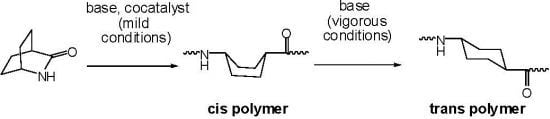
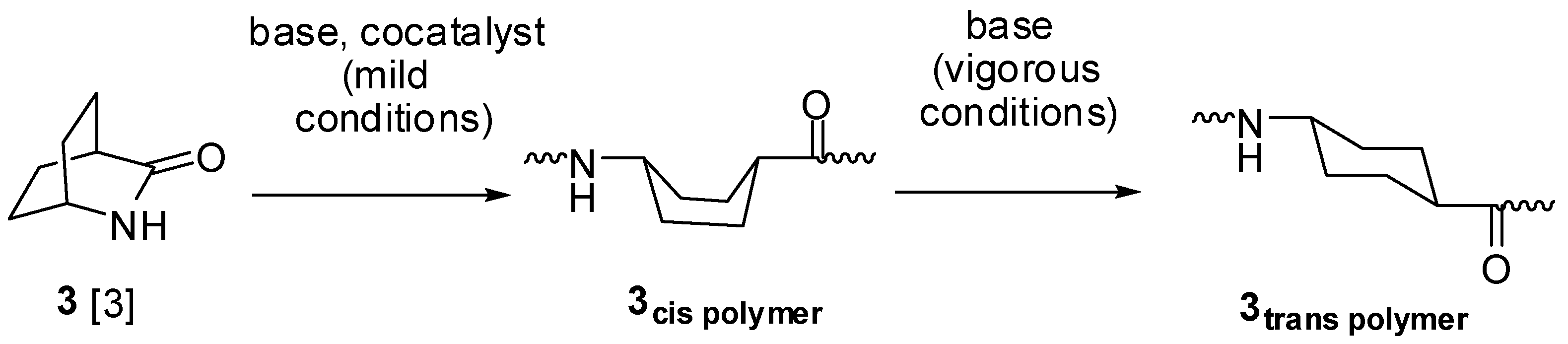
        <p>When the carbonyl group is attached to the ring in the initial polymer, it may be epimerized by the strongly basic lactam anion (<xref ref-type="scheme" rid="polymers-04-01674-scheme1">Scheme I</xref>).</p>
        <fig id="polymers-04-01674-scheme1" position="anchor">
          <object-id pub-id-type="pii">polymers-04-01674-scheme1_Scheme 1</object-id>
          <label>Scheme I</label>
          <caption>
            <p>Ring-opening of bicyclic lactam <bold>3</bold> to give either cis or trans polymer [<xref ref-type="bibr" rid="B3-polymers-04-01674">3</xref>]. </p>
          </caption>
          <graphic xmlns:xlink="http://www.w3.org/1999/xlink" xlink:href="polymers-04-01674-g001.tif"/>
        </fig>
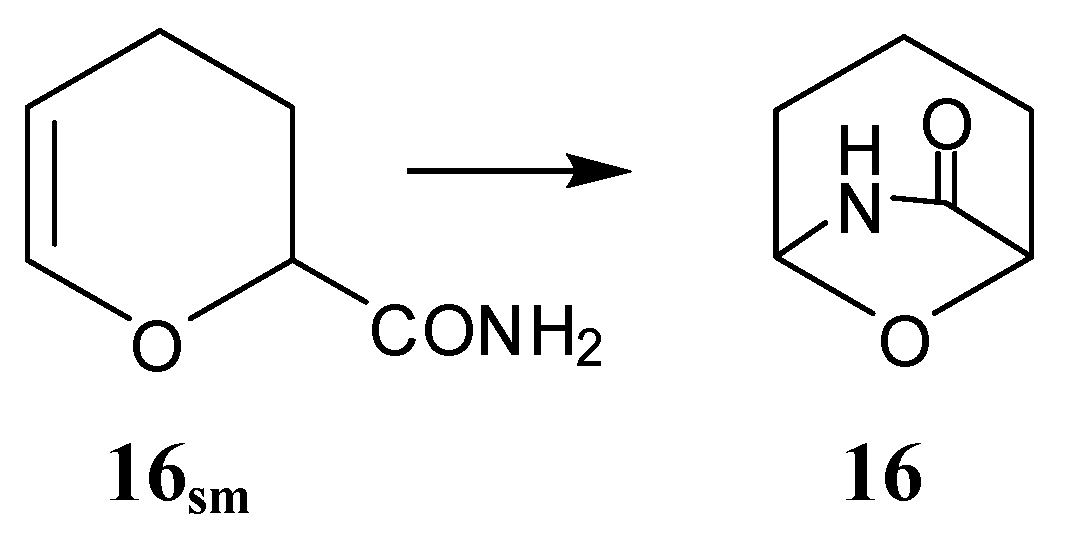
        <p>Oxabicyclic lactam <bold>16</bold> (<xref ref-type="scheme" rid="polymers-04-01674-scheme2">Scheme II</xref>) and derivatives were synthesized from starting material <bold>16</bold><bold><sub>sm</sub></bold> by internal addition of the carboxamide group to the dihydropyran group. Although monomer <bold>16</bold> is both a bicyclic lactam and a bicyclic ether, it has only been polymerized as the former by an anionic mechanism; cationic ether polymerization is excluded because of the basic amide group. This topic has been reviewed [<xref ref-type="bibr" rid="B14-polymers-04-01674">14</xref>,<xref ref-type="bibr" rid="B15-polymers-04-01674">15</xref>,<xref ref-type="bibr" rid="B16-polymers-04-01674">16</xref>].</p>
        <fig id="polymers-04-01674-scheme2" position="anchor">
          <object-id pub-id-type="pii">polymers-04-01674-scheme2_Scheme 2</object-id>
          <label>Scheme II</label>
          <caption>
            <p>Synthesis of bicyclic lactam monomer <bold>16</bold>.</p>
          </caption>
          <graphic xmlns:xlink="http://www.w3.org/1999/xlink" xlink:href="polymers-04-01674-g002.tif"/>
        </fig>
        <p>An especially interesting class of lactam and related <italic>N</italic>-containing monomers contains a bridgehead N next to a carbonyl group. These are greatly destabilized relative to normal amides because the usual N–CO resonance is absent according to Bredt’s Rule, which forbids the occurrence of double bonds at bridgeheads as pointed out by Lukes [<xref ref-type="bibr" rid="B5-polymers-04-01674">5</xref>]. Yakhontov also discussed this problem [<xref ref-type="bibr" rid="B6-polymers-04-01674">6</xref>]. Pracejus [<xref ref-type="bibr" rid="B7-polymers-04-01674">7</xref>] synthesized 1-aza-6,6-dimethylbicyclo[2.2.2]octan-2-one, while recent workers synthesized the parent structure as a salt by a nitrene insertion reaction; the free lactam could not be generated from the salt [<xref ref-type="bibr" rid="B8-polymers-04-01674">8</xref>]. Although polymerization studies were not reported, these anti-Bredt lactams undoubtedly polymerize, being destabilized by their boat form as well as Bredt’s Rule violation. The effect can be offset with an adjacent heteroatom, or in ureas and urethanes; the results of these studies are discussed below.</p>
      </sec>
      <sec>
        <title>2.2. Ureas (<bold>17–23</bold>)</title>
        <p>Bicyclic ureas (<xref ref-type="table" rid="polymers-04-01674-t002">Table 2</xref>) are prepared by carbonylation of the corresponding diamine [<xref ref-type="bibr" rid="B3-polymers-04-01674">3</xref>]. They polymerize anionically. The bicyclo[3.3.1]nonane-<italic>N</italic>-bridgehead ureas <bold>22 </bold>and <bold>23</bold> were stable because of electron donation to the carbonyl by the non-bridgehead N atom [<xref ref-type="bibr" rid="B17-polymers-04-01674">17</xref>,<xref ref-type="bibr" rid="B18-polymers-04-01674">18</xref>]. The molecules adopted a chair-boat conformation, as does bicyclo[3.3.1]non-1-ene. </p>
        <table-wrap id="polymers-04-01674-t002" position="float">
          <object-id pub-id-type="pii">polymers-04-01674-t002_Table 2</object-id>
          <label>Table 2</label>
          <caption>
            <p>Bicyclic urea monomers <bold>17–29</bold> [<xref ref-type="bibr" rid="B3-polymers-04-01674">3</xref>,<xref ref-type="bibr" rid="B4-polymers-04-01674">4</xref>,<xref ref-type="bibr" rid="B11-polymers-04-01674">11</xref>,<xref ref-type="bibr" rid="B17-polymers-04-01674">17</xref>,<xref ref-type="bibr" rid="B18-polymers-04-01674">18</xref>].</p>
          </caption>
          <table>
            
            <tbody>
              <tr>
                <td colspan="2" align="left" valign="middle">Bicyclo[2.2.1]heptane</td>
                <td colspan="3" align="left" valign="middle">Bicyclo[3.2.1]octane</td>
              </tr>
              <tr>
                <td colspan="2" align="left" valign="middle"><inline-graphic xmlns:xlink="http://www.w3.org/1999/xlink" xlink:href="polymers-04-01674-i012.tif"/></td>
                <td colspan="3" align="left" valign="middle"><inline-graphic xmlns:xlink="http://www.w3.org/1999/xlink" xlink:href="polymers-04-01674-i013.tif"/></td>
              </tr>
              <tr>
                <td colspan="2" align="left" valign="middle">Bicyclo[3.2.2]nonanes</td>
                <td colspan="3" align="left" valign="middle">Bicyclo[3.3.1]nonanes</td>
              </tr>
              <tr>
                <td align="left" valign="middle"><inline-graphic xmlns:xlink="http://www.w3.org/1999/xlink" xlink:href="polymers-04-01674-i014.tif"/></td>
                <td align="left" valign="middle"><inline-graphic xmlns:xlink="http://www.w3.org/1999/xlink" xlink:href="polymers-04-01674-i015.tif"/></td>
                <td align="left" valign="middle"><inline-graphic xmlns:xlink="http://www.w3.org/1999/xlink" xlink:href="polymers-04-01674-i016.tif"/></td>
                <td align="left" valign="middle"><inline-graphic xmlns:xlink="http://www.w3.org/1999/xlink" xlink:href="polymers-04-01674-i017.tif"/></td>
                <td align="left" valign="middle"><inline-graphic xmlns:xlink="http://www.w3.org/1999/xlink" xlink:href="polymers-04-01674-i018.tif"/></td>
              </tr>
            </tbody>
          </table>
        </table-wrap>
      </sec>
      <sec>
        <title>2.3. Urethanes(<bold>24–29</bold>)</title>
        <p>Bicyclic urethanes (<xref ref-type="table" rid="polymers-04-01674-t003">Table 3</xref>) are synthesized from amino alcohols with carbonylating agents such as phosgene and diphenyl carbonate [<xref ref-type="bibr" rid="B3-polymers-04-01674">3</xref>]. Attempted cyclizations of 3-hydroxypyrrolidine and 4-hydroxypiperidine failed to yield bicyclic urethanes <bold>24</bold> and <bold>29</bold>, respectively. However, the <italic>N</italic>-bridgehead urethanes <bold>25</bold> and <bold>27 </bold>were sufficiently stable to be isolated because of the resonance stabilization provided by electron donation from the oxygen adjacent to the carbonyl [<xref ref-type="bibr" rid="B19-polymers-04-01674">19</xref>,<xref ref-type="bibr" rid="B20-polymers-04-01674">20</xref>,<xref ref-type="bibr" rid="B21-polymers-04-01674">21</xref>]. This topic has been reviewed [<xref ref-type="bibr" rid="B22-polymers-04-01674">22</xref>].</p>
        <table-wrap id="polymers-04-01674-t003" position="float">
          <object-id pub-id-type="pii">polymers-04-01674-t003_Table 3</object-id>
          <label>Table 3</label>
          <caption>
            <p>Bicyclic urethane monomers <bold>24</bold><bold>–29</bold>  [<xref ref-type="bibr" rid="B3-polymers-04-01674">3</xref>,<xref ref-type="bibr" rid="B19-polymers-04-01674">19</xref>,<xref ref-type="bibr" rid="B20-polymers-04-01674">20</xref>,<xref ref-type="bibr" rid="B21-polymers-04-01674">21</xref>].</p>
          </caption>
          <table>
            
            <tbody>
              <tr>
                <td align="left" valign="middle">Bicyclo[2.2.1]heptane</td>
                <td align="left" valign="middle">Bicyclo[3.2.1]octane</td>
                <td colspan="2" align="left" valign="middle">Bicyclo[3.3.1]nonanes</td>
              </tr>
              <tr>
                <td align="left" valign="middle"><inline-graphic xmlns:xlink="http://www.w3.org/1999/xlink" xlink:href="polymers-04-01674-i019.tif"/></td>
                <td align="left" valign="middle"><inline-graphic xmlns:xlink="http://www.w3.org/1999/xlink" xlink:href="polymers-04-01674-i020.tif"/></td>
                <td align="left" valign="middle"><inline-graphic xmlns:xlink="http://www.w3.org/1999/xlink" xlink:href="polymers-04-01674-i021.tif"/></td>
                <td align="left" valign="middle"><inline-graphic xmlns:xlink="http://www.w3.org/1999/xlink" xlink:href="polymers-04-01674-i022.tif"/></td>
              </tr>
              <tr>
                <td align="left" valign="middle">Bicyclo[3.2.2]nonane</td>
                <td colspan="3" align="left" valign="middle">Bicyclo[2.2.2]octane</td>
              </tr>
              <tr>
                <td align="left" valign="middle"><inline-graphic xmlns:xlink="http://www.w3.org/1999/xlink" xlink:href="polymers-04-01674-i023.tif"/></td>
                <td colspan="3" align="left" valign="middle"><inline-graphic xmlns:xlink="http://www.w3.org/1999/xlink" xlink:href="polymers-04-01674-i024.tif"/></td>
              </tr>
            </tbody>
          </table>
        </table-wrap>
      </sec>
      <sec>
        <title>2.4. Lactones (<bold>30–37</bold>) and Carbonates(<bold>38–39</bold>)</title>
        <p>Lactones (<xref ref-type="table" rid="polymers-04-01674-t004">Table 4</xref>) can undergo “uncoordinated” anionic polymerization, but “coordinated” anionic polymerization, in which the addition of a Lewis acid of a metal like aluminum, tantalum, or titanium provides simultaneous Lewis acid-base activation, is much more selective and does not lead to reshuffling of the polymer chains. The lactone monomers are synthesized by loss of small molecules from hydroxyacids or hydroxyesters. Also in this group are cyclic carbonates, prepared by carbonylation of alicyclic diols. </p>
        <table-wrap id="polymers-04-01674-t004" position="float">
          <object-id pub-id-type="pii">polymers-04-01674-t004_Table 4</object-id>
          <label>Table 4</label>
          <caption>
            <p>Bicyclic lactone and carbonate monomers <bold>30–39</bold>  [<xref ref-type="bibr" rid="B3-polymers-04-01674">3</xref>,<xref ref-type="bibr" rid="B14-polymers-04-01674">14</xref>,<xref ref-type="bibr" rid="B23-polymers-04-01674">23</xref>,<xref ref-type="bibr" rid="B24-polymers-04-01674">24</xref>,<xref ref-type="bibr" rid="B25-polymers-04-01674">25</xref>,<xref ref-type="bibr" rid="B26-polymers-04-01674">26</xref>,<xref ref-type="bibr" rid="B27-polymers-04-01674">27</xref>,<xref ref-type="bibr" rid="B28-polymers-04-01674">28</xref>,<xref ref-type="bibr" rid="B29-polymers-04-01674">29</xref>,<xref ref-type="bibr" rid="B30-polymers-04-01674">30</xref>].</p>
          </caption>
          <table>
            
            <tbody>
              <tr>
                <td colspan="2" align="left" valign="middle">Bicyclo[2.1.1]hexane</td>
                <td colspan="4" align="left" valign="middle">Bicyclo[2.2.2]octanes</td>
              </tr>
              <tr>
                <td colspan="2" align="left" valign="middle"><inline-graphic xmlns:xlink="http://www.w3.org/1999/xlink" xlink:href="polymers-04-01674-i025.tif"/></td>
                <td align="left" valign="middle"><inline-graphic xmlns:xlink="http://www.w3.org/1999/xlink" xlink:href="polymers-04-01674-i026.tif"/></td>
                <td align="left" valign="middle"><inline-graphic xmlns:xlink="http://www.w3.org/1999/xlink" xlink:href="polymers-04-01674-i027.tif"/></td>
                <td align="left" valign="middle"><inline-graphic xmlns:xlink="http://www.w3.org/1999/xlink" xlink:href="polymers-04-01674-i028.tif"/></td>
                <td align="left" valign="middle"><inline-graphic xmlns:xlink="http://www.w3.org/1999/xlink" xlink:href="polymers-04-01674-i029.tif"/></td>
              </tr>
              <tr>
                <td colspan="3" align="left" valign="middle">Bicyclo[3.2.1]octanes</td>
                <td colspan="2" align="left" valign="middle">Bicyclo[3.3.1]nonane</td>
                <td align="left" valign="middle">Bicyclo[3.2.2]nonane</td>
              </tr>
              <tr>
                <td align="left" valign="middle"><inline-graphic xmlns:xlink="http://www.w3.org/1999/xlink" xlink:href="polymers-04-01674-i030.tif"/></td>
                <td align="left" valign="middle"><inline-graphic xmlns:xlink="http://www.w3.org/1999/xlink" xlink:href="polymers-04-01674-i031.tif"/></td>
                <td align="left" valign="middle"><inline-graphic xmlns:xlink="http://www.w3.org/1999/xlink" xlink:href="polymers-04-01674-i032.tif"/></td>
                <td colspan="2" align="left" valign="middle"><inline-graphic xmlns:xlink="http://www.w3.org/1999/xlink" xlink:href="polymers-04-01674-i033.tif"/></td>
                <td align="left" valign="middle"><inline-graphic xmlns:xlink="http://www.w3.org/1999/xlink" xlink:href="polymers-04-01674-i034.tif"/></td>
              </tr>
            </tbody>
          </table>
        </table-wrap>
        <p>The polymer from monomer <bold>31 </bold>retains the cis form when the polymerization is carried out under mild conditions [<xref ref-type="bibr" rid="B3-polymers-04-01674">3</xref>,<xref ref-type="bibr" rid="B24-polymers-04-01674">24</xref>]. Monomer <bold>33</bold> readily gave high polymer while monomer <bold>32 </bold>gave lower molecular weight polymer. Monomer <bold>36</bold> showed a propensity for macrocyclic oligomerization. The bicyclic oxalactone polymers, also stemming from dihydropyrans, have been reviewed [<xref ref-type="bibr" rid="B14-polymers-04-01674">14</xref>,<xref ref-type="bibr" rid="B15-polymers-04-01674">15</xref>,<xref ref-type="bibr" rid="B16-polymers-04-01674">16</xref>].</p>
      </sec>
      <sec>
        <title>2.5. Ethers (<bold>40–43</bold>)</title>
        <p>Ethers (<xref ref-type="table" rid="polymers-04-01674-t005">Table 5</xref>)comprise the first group of oxygen-containing monomers we will consider which undergo cationic polymerization. Their polymerization involves oxonium ion intermediates. This topic has been reviewed [<xref ref-type="bibr" rid="B31-polymers-04-01674">31</xref>]. </p>
        <table-wrap id="polymers-04-01674-t005" position="float">
          <object-id pub-id-type="pii">polymers-04-01674-t005_Table 5</object-id>
          <label>Table 5</label>
          <caption>
            <p>Bicyclic ether monomers <bold>40–43</bold>  [<xref ref-type="bibr" rid="B31-polymers-04-01674">31</xref>,<xref ref-type="bibr" rid="B32-polymers-04-01674">32</xref>,<xref ref-type="bibr" rid="B33-polymers-04-01674">33</xref>,<xref ref-type="bibr" rid="B34-polymers-04-01674">34</xref>,<xref ref-type="bibr" rid="B35-polymers-04-01674">35</xref>,<xref ref-type="bibr" rid="B36-polymers-04-01674">36</xref>].</p>
          </caption>
          <table>
            
            <tbody>
              <tr>
                <td colspan="2" align="left" valign="middle">Bicyclo[2.2.1]heptanes</td>
                <td align="left" valign="middle">Bicyclo[2.2.2]octane</td>
                <td align="left" valign="middle">Bicyclo[3.2.2]heptane</td>
              </tr>
              <tr>
                <td align="left" valign="middle"><inline-graphic xmlns:xlink="http://www.w3.org/1999/xlink" xlink:href="polymers-04-01674-i035.tif"/></td>
                <td align="left" valign="middle"><inline-graphic xmlns:xlink="http://www.w3.org/1999/xlink" xlink:href="polymers-04-01674-i036.tif"/></td>
                <td align="left" valign="middle"><inline-graphic xmlns:xlink="http://www.w3.org/1999/xlink" xlink:href="polymers-04-01674-i037.tif"/></td>
                <td align="left" valign="middle"><inline-graphic xmlns:xlink="http://www.w3.org/1999/xlink" xlink:href="polymers-04-01674-i038.tif"/></td>
              </tr>
            </tbody>
          </table>
        </table-wrap>
        <p>The stereochemistry of these polymerizations, involving nucleophilic displacement on the propagating oxonium ion, is trans. The isomeric 2-methyl-7-oxabicyclo[2.2.1]heptanes gave stereoregular polymers [<xref ref-type="bibr" rid="B32-polymers-04-01674">32</xref>,<xref ref-type="bibr" rid="B33-polymers-04-01674">33</xref>,<xref ref-type="bibr" rid="B34-polymers-04-01674">34</xref>]. </p>
      </sec>
      <sec>
        <title>2.6. Acetals (<bold>44–52</bold>)</title>
        <p>Unsubstituted acetal monomers (<xref ref-type="table" rid="polymers-04-01674-t006">Table 6</xref>) were prepared by syntheses involving malonic ester alkylation followed by acid-catalyzed bicyclization with loss of methanol. Crucial to the success of these reactions was removal of the sensitive acetal by distillation under reduced pressure as it formed [<xref ref-type="bibr" rid="B37-polymers-04-01674">37</xref>,<xref ref-type="bibr" rid="B38-polymers-04-01674">38</xref>,<xref ref-type="bibr" rid="B39-polymers-04-01674">39</xref>,<xref ref-type="bibr" rid="B40-polymers-04-01674">40</xref>]. This topic has been reviewed [<xref ref-type="bibr" rid="B41-polymers-04-01674">41</xref>,<xref ref-type="bibr" rid="B42-polymers-04-01674">42</xref>,<xref ref-type="bibr" rid="B43-polymers-04-01674">43</xref>]. </p>
        <table-wrap id="polymers-04-01674-t006" position="float">
          <object-id pub-id-type="pii">polymers-04-01674-t006_Table 6</object-id>
          <label>Table 6</label>
          <caption>
            <p>Bicyclic acetal monomers <bold>44–49</bold>  [<xref ref-type="bibr" rid="B37-polymers-04-01674">37</xref>,<xref ref-type="bibr" rid="B38-polymers-04-01674">38</xref>,<xref ref-type="bibr" rid="B39-polymers-04-01674">39</xref>,<xref ref-type="bibr" rid="B40-polymers-04-01674">40</xref>,<xref ref-type="bibr" rid="B44-polymers-04-01674">44</xref>,<xref ref-type="bibr" rid="B45-polymers-04-01674">45</xref>].</p>
          </caption>
          <table>
            
            <tbody>
              <tr>
                <td colspan="2" align="left" valign="middle">Bicyclo[2.2.1]heptanes</td>
                <td colspan="2" align="left" valign="middle">Bicyclo[2.2.2]octane</td>
              </tr>
              <tr>
                <td align="left" valign="middle"><inline-graphic xmlns:xlink="http://www.w3.org/1999/xlink" xlink:href="polymers-04-01674-i039.tif"/></td>
                <td align="left" valign="middle"><inline-graphic xmlns:xlink="http://www.w3.org/1999/xlink" xlink:href="polymers-04-01674-i040.tif"/></td>
                <td colspan="2" align="left" valign="middle"><inline-graphic xmlns:xlink="http://www.w3.org/1999/xlink" xlink:href="polymers-04-01674-i041.tif"/></td>
              </tr>
              <tr>
                <td colspan="2" align="left" valign="middle">Bicyclo[3.1.1]heptane</td>
                <td colspan="2" align="left" valign="middle">Bicyclo[3.2.1]octanes</td>
              </tr>
              <tr>
                <td colspan="2" align="left" valign="middle"><inline-graphic xmlns:xlink="http://www.w3.org/1999/xlink" xlink:href="polymers-04-01674-i042.tif"/></td>
                <td align="left" valign="middle"><inline-graphic xmlns:xlink="http://www.w3.org/1999/xlink" xlink:href="polymers-04-01674-i043.tif"/></td>
                <td align="left" valign="middle"><inline-graphic xmlns:xlink="http://www.w3.org/1999/xlink" xlink:href="polymers-04-01674-i044.tif"/></td>
              </tr>
            </tbody>
          </table>
        </table-wrap>
        <p>Unsymmetrical acetals like <bold>45 </bold>can cleave in either or both of two ways (<xref ref-type="scheme" rid="polymers-04-01674-scheme3">Scheme III</xref>).</p>
        <fig id="polymers-04-01674-scheme3" position="anchor">
          <object-id pub-id-type="pii">polymers-04-01674-scheme3_Scheme 3</object-id>
          <label>Scheme III</label>
          <caption>
            <p>Ring-opening of an unsymmetrical acetal.</p>
          </caption>
          <graphic xmlns:xlink="http://www.w3.org/1999/xlink" xlink:href="polymers-04-01674-g003.tif"/>
        </fig>
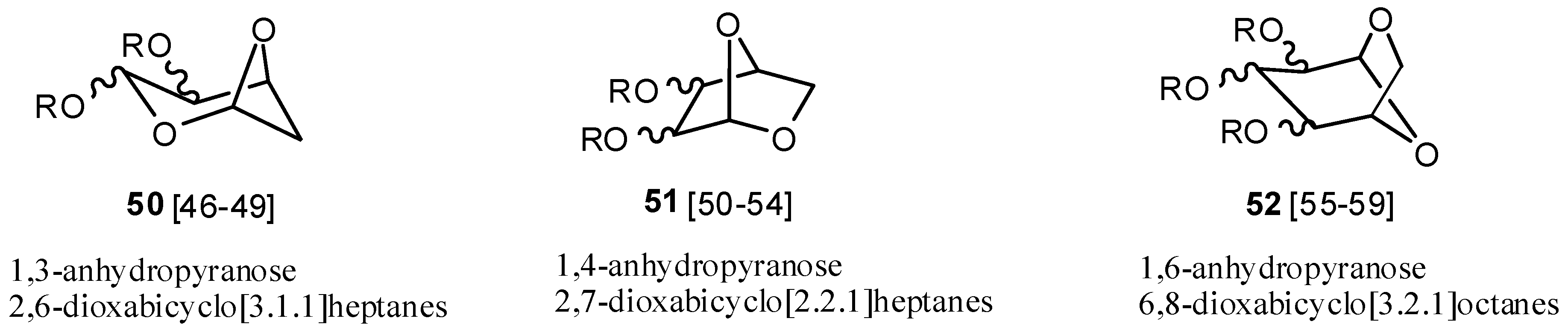
        <p>Although atom-bridged monomers have generally been unsubstituted, the acetals represent a marked exception. Numerous atom-bridged bicyclic acetals like <bold>50</bold>–<bold>52 </bold>derived from sugars (<xref ref-type="scheme" rid="polymers-04-01674-scheme4">Scheme IV</xref>) have been used to synthesize unnatural polysaccharides. Their hydroxyl groups are protected by benzylation or acylation before polymerization and can be removed after polymerization [<xref ref-type="bibr" rid="B46-polymers-04-01674">46</xref>,<xref ref-type="bibr" rid="B47-polymers-04-01674">47</xref>,<xref ref-type="bibr" rid="B48-polymers-04-01674">48</xref>,<xref ref-type="bibr" rid="B49-polymers-04-01674">49</xref>]. These substituents can produce stereoregularity in the oxacarbenium ion polymerization.</p>
        <fig id="polymers-04-01674-scheme4" position="anchor">
          <object-id pub-id-type="pii">polymers-04-01674-scheme4_Scheme 4</object-id>
          <label>Scheme IV</label>
          <caption>
            <p>Bicyclic acetal monomers <bold>50–52</bold> from sugars [<xref ref-type="bibr" rid="B46-polymers-04-01674">46</xref>,<xref ref-type="bibr" rid="B47-polymers-04-01674">47</xref>,<xref ref-type="bibr" rid="B48-polymers-04-01674">48</xref>,<xref ref-type="bibr" rid="B49-polymers-04-01674">49</xref>,<xref ref-type="bibr" rid="B50-polymers-04-01674">50</xref>,<xref ref-type="bibr" rid="B51-polymers-04-01674">51</xref>,<xref ref-type="bibr" rid="B52-polymers-04-01674">52</xref>,<xref ref-type="bibr" rid="B53-polymers-04-01674">53</xref>,<xref ref-type="bibr" rid="B54-polymers-04-01674">54</xref>,<xref ref-type="bibr" rid="B55-polymers-04-01674">55</xref>,<xref ref-type="bibr" rid="B56-polymers-04-01674">56</xref>,<xref ref-type="bibr" rid="B57-polymers-04-01674">57</xref>,<xref ref-type="bibr" rid="B58-polymers-04-01674">58</xref>,<xref ref-type="bibr" rid="B59-polymers-04-01674">59</xref>].</p>
          </caption>
          <graphic xmlns:xlink="http://www.w3.org/1999/xlink" xlink:href="polymers-04-01674-g004.tif"/>
        </fig>
      </sec>
      <sec>
        <title>2.7. Orthoesters (<bold>53–56</bold>)</title>
        <p>Orthoesters (<xref ref-type="table" rid="polymers-04-01674-t007">Table 7</xref>) are the third member of this oxygen group. They are synthesized from condensation of triols with ethyl orthoformate, again removing the bicyclic monomer as it forms [<xref ref-type="bibr" rid="B60-polymers-04-01674">60</xref>,<xref ref-type="bibr" rid="B61-polymers-04-01674">61</xref>,<xref ref-type="bibr" rid="B62-polymers-04-01674">62</xref>,<xref ref-type="bibr" rid="B63-polymers-04-01674">63</xref>,<xref ref-type="bibr" rid="B64-polymers-04-01674">64</xref>,<xref ref-type="bibr" rid="B65-polymers-04-01674">65</xref>]. This topic has been reviewed [<xref ref-type="bibr" rid="B41-polymers-04-01674">41</xref>,<xref ref-type="bibr" rid="B42-polymers-04-01674">42</xref>,<xref ref-type="bibr" rid="B43-polymers-04-01674">43</xref>,<xref ref-type="bibr" rid="B66-polymers-04-01674">66</xref>].</p>
        <table-wrap id="polymers-04-01674-t007" position="float">
          <object-id pub-id-type="pii">polymers-04-01674-t007_Table 7</object-id>
          <label>Table 7</label>
          <caption>
            <p>Bicyclic orthoester monomers <bold>53–56</bold>  [<xref ref-type="bibr" rid="B60-polymers-04-01674">60</xref>,<xref ref-type="bibr" rid="B61-polymers-04-01674">61</xref>,<xref ref-type="bibr" rid="B62-polymers-04-01674">62</xref>,<xref ref-type="bibr" rid="B63-polymers-04-01674">63</xref>,<xref ref-type="bibr" rid="B64-polymers-04-01674">64</xref>,<xref ref-type="bibr" rid="B65-polymers-04-01674">65</xref>,<xref ref-type="bibr" rid="B67-polymers-04-01674">67</xref>].</p>
          </caption>
          <table>
            
            <tbody>
              <tr>
                <td colspan="2" align="left" valign="middle">Bicyclo[2.2.1]heptane</td>
                <td align="left" valign="middle">Bicyclo[3.2.1]octane</td>
                <td align="left" valign="middle">Bicyclo[3.3.1]nonane</td>
              </tr>
              <tr>
                <td align="left" valign="middle"><inline-graphic xmlns:xlink="http://www.w3.org/1999/xlink" xlink:href="polymers-04-01674-i047.tif"/></td>
                <td align="left" valign="middle"><inline-graphic xmlns:xlink="http://www.w3.org/1999/xlink" xlink:href="polymers-04-01674-i048.tif"/></td>
                <td align="left" valign="middle"><inline-graphic xmlns:xlink="http://www.w3.org/1999/xlink" xlink:href="polymers-04-01674-i049.tif"/></td>
                <td align="left" valign="middle"><inline-graphic xmlns:xlink="http://www.w3.org/1999/xlink" xlink:href="polymers-04-01674-i050.tif"/></td>
              </tr>
            </tbody>
          </table>
        </table-wrap>
        <p>For the bicyclic acetals and orthoesters, oxonium ion propagation is still predominant. However, for these monomers, cleavage of the oxonium ion to oxacarbenium ion can lead to loss of stereoregularity [<xref ref-type="bibr" rid="B66-polymers-04-01674">66</xref>]. Moreover, in the many sugar-derived monomers, neighboring group participation by adjacent benzoate or benzyloxy groups plays a role in determining polymer stereochemistry. </p>
      </sec>
      <sec>
        <title>2.8. Amines (<bold>57–58</bold>)</title>
        <p>Finally, bicyclic amines <bold>57 </bold>and <bold>58</bold> (<xref ref-type="table" rid="polymers-04-01674-t008">Table 8</xref>) have also been polymerized cationically via S<sub>N</sub>2 displacements on ammonium ion intermediates [<xref ref-type="bibr" rid="B66-polymers-04-01674">66</xref>]. 1,4-Diazabicyclo[2.2.2]octane (<bold>57</bold>), widely used as a catalyst, is now seen to be a monomer itself.</p>
        <table-wrap id="polymers-04-01674-t008" position="float">
          <object-id pub-id-type="pii">polymers-04-01674-t008_Table 8</object-id>
          <label>Table 8</label>
          <caption>
            <p>Bicyclic amine monomers <bold>57–58</bold>  [<xref ref-type="bibr" rid="B68-polymers-04-01674">68</xref>].</p>
          </caption>
          <table>
            
            <tbody>
              <tr>
                <td align="left" valign="middle">Bicyclo[2.2.2]octane</td>
                <td align="left" valign="middle">Bicyclo[3.2.2]nonane</td>
              </tr>
              <tr>
                <td align="left" valign="middle"><inline-graphic xmlns:xlink="http://www.w3.org/1999/xlink" xlink:href="polymers-04-01674-i051.tif"/></td>
                <td align="left" valign="middle"><inline-graphic xmlns:xlink="http://www.w3.org/1999/xlink" xlink:href="polymers-04-01674-i052.tif"/></td>
              </tr>
            </tbody>
          </table>
        </table-wrap>
      </sec>
      <sec>
        <title>2.9. Attempted Correlations with Monomer Properties</title>
        <sec>
          <title>2.9.1. Infrared</title>
          <p>Carbonyl groups in small rings absorb infrared radiation at much higher frequencies than carbonyls in open chain analogs. However, we determined that the carbonyl absorption did not correlate with polymerizability of monocyclic monomers [<xref ref-type="bibr" rid="B69-polymers-04-01674">69</xref>]. This also proved true for bicyclic monomers [<xref ref-type="bibr" rid="B70-polymers-04-01674">70</xref>]. The higher carbonyl absorption frequency in small rings is attributed to orbital hybridization effects. </p>
        </sec>
        <sec>
          <title>2.9.2. Saponification Rates</title>
          <p>We tried and failed to correlate saponification rates with polymerizability for monocyclic monomers [<xref ref-type="bibr" rid="B71-polymers-04-01674">71</xref>]. Our thought was that strain relief in polymerization might parallel strain relief in saponification reactions. However, no parallel was found [<xref ref-type="bibr" rid="B70-polymers-04-01674">70</xref>]. The same was true for bicyclic monomers [<xref ref-type="bibr" rid="B72-polymers-04-01674">72</xref>]. The reason is that formation of tetrahedral intermediates, not ring opening, is the rate-determining step. </p>
        </sec>
        <sec>
          <title>2.9.3. Dipole Moments</title>
          <p>We noticed that lactones possess much higher dipole moments than their open-chain analogs and wondered whether this factor might be related to polymerization. However, this proved not to be the case [<xref ref-type="bibr" rid="B73-polymers-04-01674">73</xref>]. For example, γ-butyrolactone and δ-valerolactone both have high dipole moments, yet only the latter polymerizes.</p>
        </sec>
        <sec>
          <title>2.9.4. Polymer Properties and Uses</title>
          <p>The physical properties of the polymers described herein have not been investigated to any great extent. Ring-opening polymerization of an atom-bridged-bicyclic monomer gives a linear polymer containing a ring in the chain. This often imparts desirable physical properties to the polymer, including increased melting point and glass transition temperature [<xref ref-type="bibr" rid="B74-polymers-04-01674">74</xref>,<xref ref-type="bibr" rid="B75-polymers-04-01674">75</xref>]. Polymerization of bicyclic ether <bold>41</bold> gives a crystalline polymer melting at 250 °C. while the polymer from tetrahydrofuran melts at 50 °C [<xref ref-type="bibr" rid="B31-polymers-04-01674">31</xref>]. Given that the polymerization mechanisms for the bicyclic and monocyclic monomers are the same, the synthesis of new copolymers can be anticipated. </p>
          <p>The polymers from bicyclic acetals, after deprotection, have been intensively studied as synthetic polysaccharides [<xref ref-type="bibr" rid="B76-polymers-04-01674">76</xref>]. The polymeric orthoesters have been examined as bioerodible materials [<xref ref-type="bibr" rid="B66-polymers-04-01674">66</xref>].</p>
        </sec>
      </sec>
    </sec>
    <sec sec-type="conclusions">
      <title>3. Conclusions</title>
      <p>The polymerizabilities of the atom-bridged bicyclic compounds in this review are listed in <xref ref-type="table" rid="polymers-04-01674-t009">Table 9</xref>. They almost all polymerize! The sole exceptions are bicyclo[3.3.1]nonanes; even here, <italic>N</italic>-bridgehead anti-Bredt lactams do polymerize. </p>
      <table-wrap id="polymers-04-01674-t009" position="float">
        <object-id pub-id-type="pii">polymers-04-01674-t009_Table 9</object-id>
        <label>Table 9</label>
        <caption>
          <p>Polymerizability of bicyclic monomers in this review.</p>
        </caption>
        <table>
<thead>
            <tr>
              <th align="center" valign="middle">Monomer Structure</th>
              <th align="center" valign="middle">Polymerizability</th>
            </tr>
          </thead>
          <tbody>
            <tr>
              <td align="right" valign="middle">Bicyclohexane [2.1.1]</td>
              <td align="center" valign="middle">+</td>
            </tr>
            <tr>
              <td align="right" valign="middle">Bicycloheptane [2.2.1]</td>
              <td align="center" valign="middle">+</td>
            </tr>
            <tr>
              <td align="right" valign="middle">Bicyclooctanes [2.2.2]</td>
              <td align="center" valign="middle">+</td>
            </tr>
            <tr>
              <td align="right" valign="middle">[3.2.1]</td>
              <td align="center" valign="middle">+</td>
            </tr>
            <tr>
              <td align="right" valign="middle">[4.1.1]</td>
              <td align="center" valign="middle">+</td>
            </tr>
            <tr>
              <td align="right" valign="middle">Bicyclononanes [3.3.1]</td>
              <td align="center" valign="middle">±</td>
            </tr>
            <tr>
              <td align="right" valign="middle">[3.2.2]</td>
              <td align="center" valign="middle">+</td>
            </tr>
            <tr>
              <td align="right" valign="middle">[4.2.1]</td>
              <td align="center" valign="middle">+</td>
            </tr>
            <tr>
              <td align="right" valign="middle">Bicyclodecane [4.3.1]</td>
              <td align="center" valign="middle">+</td>
            </tr>
          </tbody>
        </table>
      </table-wrap>
      <p>This surprising generalization requires explanation. For the small ring sizes (three and four members), angle strain and eclipsing interactions are important. For the common ring sizes (five to seven members), eclipsing interactions dominate. Often the six-membered rings in bicyclic monomers are locked into either boat or chair forms (the boat forms of cyclohexane are destabilized by about 8 kcal/mole relative to the chair forms). For larger rings, transannular hydrogen crowding as well as entropic considerations come into play. The monomers described possess combined 5- and 6-membered rings. Although no significant angle strain occurs, ring fusion causes eclipsing H–H repulsions. The cyclohexane rings in many of the monomers are locked into boat forms with strain energies of ~8 kcal/mole. The non-polymerizability of bicyclo[3.3.1]nonanes possessing two stable chair forms supports this line of thought. Second, amide and ester bridges are forced into energetically unfavorable cis conformations. Third, entropic considerations favor polymerization; chain polymers have many more available conformations than the rigid bicyclic monomers. Fourth, the bridgehead N–C=O structure present in the anti-Bredt monomers described above is a powerful driving force for polymerization. Fifth, isomerization of an initially formed <italic>cis</italic>-disubstituted ring to a thermodynamically favored <italic>trans</italic>-disubstituted ring is another driving force in cases where the carbonyl group is attached to the ring and epimerization is permitted. Bicyclic monomers possess these attributes to varying degrees, but the sum is almost always sufficient to cause polymerization. </p>
    </sec>
  </body>
  <back>
    <ack>
      <title>Acknowledgments</title>
      <p>The author greatly acknowledges financial support from NSF-DMR, PRF, DuPont Textile Fibers Department, Pioneering Research Laboratory, and scientific work performed by Robert B. Bates, Anne Padias, and many fine postdoctoral associates and graduate students.</p>
    </ack>
    <ref-list>
      <title>References</title>
      <ref id="B1-polymers-04-01674">
        <label>1.</label>
        <citation citation-type="book">
          <person-group person-group-type="author">
            <name>
              <surname>Dubois</surname>
              <given-names>P.</given-names>
            </name>
            <name>
              <surname>Coulembier</surname>
              <given-names>O.</given-names>
            </name>
            <name>
              <surname>Raquez</surname>
              <given-names>J.-M.</given-names>
            </name>
          </person-group>
          <source>Handbook of Ring-Opening Polymerization</source>
          <publisher-name>Wiley</publisher-name>
          <publisher-loc>New York, NY, USA</publisher-loc>
          <year>2009</year>
        </citation>
      </ref>
      <ref id="B2-polymers-04-01674">
        <label>2.</label>
        <citation citation-type="journal">
          <person-group person-group-type="author">
            <name>
              <surname>Cho</surname>
              <given-names>H.N.</given-names>
            </name>
            <name>
              <surname>Choi</surname>
              <given-names>K.Y.</given-names>
            </name>
            <name>
              <surname>Choi</surname>
              <given-names>S.K.</given-names>
            </name>
          </person-group>
          <article-title>Polymerization of 2-azabicyclo[2.2.1]heptane-3-one</article-title>
          <source>J. Polym. Sci. Polym. Chem. Ed.</source>
          <year>1985</year>
          <volume>23</volume>
          <fpage>623</fpage>
          <lpage>634</lpage>
          <pub-id pub-id-type="doi">10.1002/pol.1985.170230304</pub-id>
        </citation>
      </ref>
      <ref id="B3-polymers-04-01674">
        <label>3.</label>
        <citation citation-type="journal">
          <person-group person-group-type="author">
            <name>
              <surname>Hall</surname>
              <given-names>H.K.</given-names>
              <suffix>Jr.</suffix>
            </name>
          </person-group>
          <article-title>Polymerization and ring strain in bridged bicyclic compounds</article-title>
          <source>J. Am. Chem. Soc.</source>
          <year>1958</year>
          <volume>80</volume>
          <fpage>6412</fpage>
          <lpage>6420</lpage>
          <pub-id pub-id-type="doi">10.1021/ja01556a061</pub-id>
        </citation>
      </ref>
      <ref id="B4-polymers-04-01674">
        <label>4.</label>
        <citation citation-type="journal">
          <person-group person-group-type="author">
            <name>
              <surname>Al-Obeidi</surname>
              <given-names>F.A.</given-names>
            </name>
            <name>
              <surname>Micheli</surname>
              <given-names>B.J.M.</given-names>
            </name>
            <name>
              <surname>Barfield</surname>
              <given-names>M.</given-names>
            </name>
            <name>
              <surname>Padias</surname>
              <given-names>A.B.</given-names>
            </name>
            <name>
              <surname>Wei</surname>
              <given-names>Y.</given-names>
            </name>
            <name>
              <surname>Hall</surname>
              <given-names>H.K.</given-names>
              <suffix>Jr.</suffix>
            </name>
          </person-group>
          <article-title>Synthesis and NMR studies of activated derivatives of <italic>cis</italic>- and <italic>trans</italic>-5-amino-6-oxopiperidine-2-carboxylic acid and the corresponding bicyclic dilactam DBO: Potential building blocks for stereoregular polyamides and peptides</article-title>
          <source>Macromolecules</source>
          <year>1999</year>
          <volume>32</volume>
          <fpage>6507</fpage>
          <lpage>6516</lpage>
          <pub-id pub-id-type="doi">10.1021/ma9903557</pub-id>
        </citation>
      </ref>
      <ref id="B5-polymers-04-01674">
        <label>5.</label>
        <citation citation-type="journal">
          <person-group person-group-type="author">
            <name>
              <surname>Lukes</surname>
              <given-names>R.</given-names>
            </name>
          </person-group>
          <article-title>A new application of Bredt’s rule</article-title>
          <source>Coll. Czech. Chem. Comm.</source>
          <year>1938</year>
          <volume>10</volume>
          <fpage>148</fpage>
          <lpage>152</lpage>
        </citation>
      </ref>
      <ref id="B6-polymers-04-01674">
        <label>6.</label>
        <citation citation-type="journal">
          <person-group person-group-type="author">
            <name>
              <surname>Yakhontov</surname>
              <given-names>L.N.</given-names>
            </name>
            <name>
              <surname>Rubstov</surname>
              <given-names>M.V.</given-names>
            </name>
          </person-group>
          <article-title>Synthesis of 2-quinuclidone</article-title>
          <source>Z. Obsh. Khimi</source>
          <year>1957</year>
          <volume>27</volume>
          <fpage>72</fpage>
          <lpage>77</lpage>
        </citation>
      </ref>
      <ref id="B7-polymers-04-01674">
        <label>7.</label>
        <citation citation-type="journal">
          <person-group person-group-type="author">
            <name>
              <surname>Pracejus</surname>
              <given-names>H.</given-names>
            </name>
          </person-group>
          <article-title>2,2-Dimethyl-6-quinuclidone, a resonance-free amide</article-title>
          <source>Chem. Ber.</source>
          <year>1959</year>
          <volume>92</volume>
          <fpage>988</fpage>
          <lpage>989</lpage>
          <pub-id pub-id-type="doi">10.1002/cber.19590920435</pub-id>
        </citation>
      </ref>
      <ref id="B8-polymers-04-01674">
        <label>8.</label>
        <citation citation-type="journal">
          <person-group person-group-type="author">
            <name>
              <surname>Claydon</surname>
              <given-names>J.</given-names>
            </name>
            <name>
              <surname>Moran</surname>
              <given-names>W.J.</given-names>
            </name>
          </person-group>
          <article-title>The twisted amide 2-quinuclidone</article-title>
          <source>Angew. Chem. Int. Ed.</source>
          <year>2006</year>
          <volume>45</volume>
          <fpage>7118</fpage>
          <lpage>7120</lpage>
          <pub-id pub-id-type="doi">10.1002/anie.200603016</pub-id>
        </citation>
      </ref>
      <ref id="B9-polymers-04-01674">
        <label>9.</label>
        <citation citation-type="journal">
          <person-group person-group-type="author">
            <name>
              <surname>Okada</surname>
              <given-names>M.</given-names>
            </name>
            <name>
              <surname>Sumitomo</surname>
              <given-names>H.</given-names>
            </name>
            <name>
              <surname>Mori</surname>
              <given-names>H.</given-names>
            </name>
            <name>
              <surname>Hall</surname>
              <given-names>H.K.</given-names>
              <suffix>Jr.</suffix>
            </name>
            <name>
              <surname>Chan</surname>
              <given-names>J.H.</given-names>
            </name>
            <name>
              <surname>Bruck</surname>
              <given-names>M.</given-names>
            </name>
          </person-group>
          <article-title>Synthesis and ring-opening polymerization of novel bicyclic oxalactams: 2-Oxa-5-azabicyclo[2.2.2]octan-6-one</article-title>
          <source>J. Polym. Sci. Polym. Chem. Ed.</source>
          <year>1990</year>
          <volume>8</volume>
          <fpage>3251</fpage>
          <lpage>3260</lpage>
        </citation>
      </ref>
      <ref id="B10-polymers-04-01674">
        <label>10.</label>
        <citation citation-type="journal">
          <person-group person-group-type="author">
            <name>
              <surname>Okada</surname>
              <given-names>M.</given-names>
            </name>
            <name>
              <surname>Sumitomo</surname>
              <given-names>H.</given-names>
            </name>
            <name>
              <surname>Sassa</surname>
              <given-names>T.</given-names>
            </name>
            <name>
              <surname>Takai</surname>
              <given-names>M.</given-names>
            </name>
            <name>
              <surname>Hall</surname>
              <given-names>H.K.</given-names>
              <suffix>Jr.</suffix>
            </name>
            <name>
              <surname>Bruck</surname>
              <given-names>M.</given-names>
            </name>
          </person-group>
          <article-title>Synthesis and ring-opening polymerization of novel bicyclic oxalactams, 2-oxa-6-azabicyclo[2.2.2]octan-5-one</article-title>
          <source>Macromolecules</source>
          <year>1990</year>
          <volume>23</volume>
          <fpage>2427</fpage>
          <lpage>2432</lpage>
          <pub-id pub-id-type="doi">10.1021/ma00211a004</pub-id>
        </citation>
      </ref>
      <ref id="B11-polymers-04-01674">
        <label>11.</label>
        <citation citation-type="journal">
          <person-group person-group-type="author">
            <name>
              <surname>Hall</surname>
              <given-names>H.K.</given-names>
              <suffix>Jr.</suffix>
            </name>
          </person-group>
          <article-title>Synthesis and polymerization of atom-bridged bicyclic lactams</article-title>
          <source>J. Am. Chem. Soc.</source>
          <year>1960</year>
          <volume>82</volume>
          <fpage>1209</fpage>
          <lpage>1215</lpage>
          <pub-id pub-id-type="doi">10.1021/ja01490a044</pub-id>
        </citation>
      </ref>
      <ref id="B12-polymers-04-01674">
        <label>12.</label>
        <citation citation-type="journal">
          <person-group person-group-type="author">
            <name>
              <surname>Hall</surname>
              <given-names>H.K.</given-names>
              <suffix>Jr.</suffix>
            </name>
          </person-group>
          <article-title>Synthesis and polymerization of 3-azabicyclo[4.3.1]decan-4-one and 7,7-dimethyl-2-azabicyclo[4.1.1]octan-3-one</article-title>
          <source>J. Org. Chem.</source>
          <year>1963</year>
          <volume>28</volume>
          <fpage>3213</fpage>
          <lpage>3214</lpage>
          <pub-id pub-id-type="doi">10.1021/jo01046a508</pub-id>
        </citation>
      </ref>
      <ref id="B13-polymers-04-01674">
        <label>13.</label>
        <citation citation-type="journal">
          <person-group person-group-type="author">
            <name>
              <surname>Hall</surname>
              <given-names>H.K.</given-names>
              <suffix>Jr.</suffix>
            </name>
            <name>
              <surname>Shaw</surname>
              <given-names>R.A.</given-names>
            </name>
            <name>
              <surname>Deutschmann</surname>
              <given-names>A.</given-names>
              <suffix>Jr.</suffix>
            </name>
          </person-group>
          <article-title>Anti-bredt molecules. 2. 1-azabicyclo[3.3.1]nonan-2-one, a new bicyclic lactam containing bridgehead nitrogen</article-title>
          <source>J. Org. Chem.</source>
          <year>1980</year>
          <volume>45</volume>
          <fpage>3722</fpage>
          <lpage>3724</lpage>
          <pub-id pub-id-type="doi">10.1021/jo01306a038</pub-id>
        </citation>
      </ref>
      <ref id="B14-polymers-04-01674">
        <label>14.</label>
        <citation citation-type="journal">
          <person-group person-group-type="author">
            <name>
              <surname>Okada</surname>
              <given-names>M.</given-names>
            </name>
          </person-group>
          <article-title>Ring-opening polymerization of bicyclic and spiro compounds. Reactivities and polymerization mechanisms</article-title>
          <source>Adv. Polym. Sci.</source>
          <year>1992</year>
          <volume>102</volume>
          <fpage>1</fpage>
          <lpage>46</lpage>
          <pub-id pub-id-type="doi">10.1007/3-540-55090-9_1</pub-id>
        </citation>
      </ref>
      <ref id="B15-polymers-04-01674">
        <label>15.</label>
        <citation citation-type="journal">
          <person-group person-group-type="author">
            <name>
              <surname>Sumitomo</surname>
              <given-names>H.</given-names>
            </name>
            <name>
              <surname>Okada</surname>
              <given-names>M.</given-names>
            </name>
          </person-group>
          <article-title>Ring-opening polymerization of bicyclic acetals, lactones, and lactams</article-title>
          <source>Adv. Polym. Sci.</source>
          <year>1978</year>
          <volume>28</volume>
          <fpage>47</fpage>
          <lpage>82</lpage>
          <pub-id pub-id-type="doi">10.1007/3-540-08885-7_2</pub-id>
        </citation>
      </ref>
      <ref id="B16-polymers-04-01674">
        <label>16.</label>
        <citation citation-type="journal">
          <person-group person-group-type="author">
            <name>
              <surname>Okada</surname>
              <given-names>M.</given-names>
            </name>
            <name>
              <surname>Sumitomo</surname>
              <given-names>H.</given-names>
            </name>
            <name>
              <surname>Atsumi</surname>
              <given-names>M.</given-names>
            </name>
            <name>
              <surname>Hall</surname>
              <given-names>H.K.</given-names>
              <suffix>Jr.</suffix>
            </name>
          </person-group>
          <article-title>Ring-opening polymerization of bicyclic oxalactones and oxalactams</article-title>
          <source>Makromol. Chem. Macromol. Symp.</source>
          <year>1991</year>
          <volume>42-43</volume>
          <fpage>355</fpage>
          <lpage>364</lpage>
          <pub-id pub-id-type="doi">10.1002/masy.19910420129</pub-id>
        </citation>
      </ref>
      <ref id="B17-polymers-04-01674">
        <label>17.</label>
        <citation citation-type="journal">
          <person-group person-group-type="author">
            <name>
              <surname>Hall</surname>
              <given-names>H.K.</given-names>
              <suffix>Jr.</suffix>
            </name>
            <name>
              <surname>Johnson</surname>
              <given-names>R.C.</given-names>
            </name>
          </person-group>
          <article-title>3-Isopropyl-1,3-diazabicyclo[3.3.1]nonan-2-one. A simple bicyclic urea with a bridgehead nitrogen atom</article-title>
          <source>J. Org. Chem.</source>
          <year>1972</year>
          <volume>37</volume>
          <fpage>697</fpage>
          <lpage>699</lpage>
          <pub-id pub-id-type="doi">10.1021/jo00970a004</pub-id>
        </citation>
      </ref>
      <ref id="B18-polymers-04-01674">
        <label>18.</label>
        <citation citation-type="journal">
          <person-group person-group-type="author">
            <name>
              <surname>Hall</surname>
              <given-names>H.K.</given-names>
              <suffix>Jr.</suffix>
            </name>
            <name>
              <surname>Ekuchukwu</surname>
              <given-names>O.E.</given-names>
            </name>
            <name>
              <surname>Deutschmann</surname>
              <given-names>A.</given-names>
              <suffix>Jr.</suffix>
            </name>
            <name>
              <surname>Rose</surname>
              <given-names>C.</given-names>
            </name>
          </person-group>
          <article-title>Anti-bredt molecules. 6. Synthesis and polymerization of 1,3-diazabicyclo[3.3.1]nonan-2-one</article-title>
          <source>Polym. Bull.</source>
          <year>1980</year>
          <volume>3</volume>
          <fpage>375</fpage>
          <lpage>382</lpage>
        </citation>
      </ref>
      <ref id="B19-polymers-04-01674">
        <label>19.</label>
        <citation citation-type="journal">
          <person-group person-group-type="author">
            <name>
              <surname>Hall</surname>
              <given-names>H.K.</given-names>
              <suffix>Jr.</suffix>
            </name>
            <name>
              <surname>El-Shekeil</surname>
              <given-names>A.</given-names>
            </name>
          </person-group>
          <article-title>Anti-bredt molecules. 3. Synthesis of two bicyclic urethanes possessing bridgehead nitrogen</article-title>
          <source>J. Org. Chem.</source>
          <year>1980</year>
          <volume>45</volume>
          <fpage>5325</fpage>
          <lpage>5328</lpage>
          <pub-id pub-id-type="doi">10.1021/jo01314a022</pub-id>
        </citation>
      </ref>
      <ref id="B20-polymers-04-01674">
        <label>20.</label>
        <citation citation-type="journal">
          <person-group person-group-type="author">
            <name>
              <surname>Hall</surname>
              <given-names>H.K.</given-names>
              <suffix>Jr.</suffix>
            </name>
            <name>
              <surname>El-Shekeil</surname>
              <given-names>A.</given-names>
            </name>
          </person-group>
          <article-title>Anti-bredt molecules. 5. Synthesis and polymerization of 1-aza-7-oxabicyclo[3.2.1]octan-7-one</article-title>
          <source>Polym. Bull.</source>
          <year>1980</year>
          <volume>3</volume>
          <fpage>233</fpage>
          <lpage>239</lpage>
          <pub-id pub-id-type="doi">10.1007/BF00291963</pub-id>
        </citation>
      </ref>
      <ref id="B21-polymers-04-01674">
        <label>21.</label>
        <citation citation-type="journal">
          <person-group person-group-type="author">
            <name>
              <surname>Hall</surname>
              <given-names>H.K.</given-names>
              <suffix>Jr.</suffix>
            </name>
            <name>
              <surname>El-Shekeil</surname>
              <given-names>A.</given-names>
            </name>
          </person-group>
          <article-title>Anti-bredt molecules. 4. Polymerization of 1-aza-3-oxabicyclo[3.3.1]nonan-2-one</article-title>
          <source>Polym. Bull.</source>
          <year>1980</year>
          <volume>2</volume>
          <fpage>829</fpage>
          <lpage>836</lpage>
        </citation>
      </ref>
      <ref id="B22-polymers-04-01674">
        <label>22.</label>
        <citation citation-type="journal">
          <person-group person-group-type="author">
            <name>
              <surname>Hall</surname>
              <given-names>H.K.</given-names>
              <suffix>Jr.</suffix>
            </name>
            <name>
              <surname>El-Shekeil</surname>
              <given-names>A.</given-names>
            </name>
          </person-group>
          <article-title>Anti-bredt bridgehead nitrogen compounds in ring-opening polymerization</article-title>
          <source>Chem. Rev.</source>
          <year>1983</year>
          <volume>83</volume>
          <fpage>549</fpage>
          <lpage>555</lpage>
        <pub-id pub-id-type="doi">10.1021/cr00057a004</pub-id></citation>
      </ref>
      <ref id="B23-polymers-04-01674">
        <label>23.</label>
        <citation citation-type="journal">
          <person-group person-group-type="author">
            <name>
              <surname>Hall</surname>
              <given-names>H.K.</given-names>
              <suffix>Jr.</suffix>
            </name>
            <name>
              <surname>Blanchard</surname>
              <given-names>E.P.</given-names>
              <suffix>Jr.</suffix>
            </name>
            <name>
              <surname>Martin</surname>
              <given-names>E.L.</given-names>
            </name>
          </person-group>
          <article-title>Synthesis and polymerization of 2-oxabicyclo[2.1.1] hexan-3-ones (cyclobutane1,3-lactones)</article-title>
          <source>Macromolecules</source>
          <year>1971</year>
          <volume>4</volume>
          <fpage>142</fpage>
          <lpage>146</lpage>
          <pub-id pub-id-type="doi">10.1021/ma60020a002</pub-id>
        </citation>
      </ref>
      <ref id="B24-polymers-04-01674">
        <label>24.</label>
        <citation citation-type="journal">
          <person-group person-group-type="author">
            <name>
              <surname>Ceccarelli</surname>
              <given-names>C.</given-names>
            </name>
            <name>
              <surname>Andruzzi</surname>
              <given-names>F.</given-names>
            </name>
            <name>
              <surname>Paci</surname>
              <given-names>M.</given-names>
            </name>
          </person-group>
          <article-title>NMR spectroscopy of polyesters from 2-oxabicyclo- [2.2.2]octan-3-one</article-title>
          <source>Polymer</source>
          <year>1979</year>
          <volume>20</volume>
          <fpage>605</fpage>
          <lpage>610</lpage>
          <pub-id pub-id-type="doi">10.1016/0032-3861(79)90174-5</pub-id>
        </citation>
      </ref>
      <ref id="B25-polymers-04-01674">
        <label>25.</label>
        <citation citation-type="journal">
          <person-group person-group-type="author">
            <name>
              <surname>Okada</surname>
              <given-names>M.</given-names>
            </name>
            <name>
              <surname>Sumitomo</surname>
              <given-names>H.</given-names>
            </name>
            <name>
              <surname>Yamada</surname>
              <given-names>S.</given-names>
            </name>
            <name>
              <surname>Atsumi</surname>
              <given-names>M.</given-names>
            </name>
            <name>
              <surname>Hall</surname>
              <given-names>H.K.</given-names>
              <suffix>Jr.</suffix>
            </name>
            <name>
              <surname>Chan</surname>
              <given-names>R.J.H.</given-names>
            </name>
            <name>
              <surname>Ortega</surname>
              <given-names>R.B.</given-names>
            </name>
          </person-group>
          <article-title>Synthesis and ring-opening polymerization of bicyclic lactones containing a tetrahydropyran ring. 2,5-Dioxabicyclo[2.2.2]octan-3-one</article-title>
          <source>Macromolecules</source>
          <year>1986</year>
          <volume>19</volume>
          <fpage>953</fpage>
          <lpage>959</lpage>
          <pub-id pub-id-type="doi">10.1021/ma00158a002</pub-id>
        </citation>
      </ref>
      <ref id="B26-polymers-04-01674">
        <label>26.</label>
        <citation citation-type="journal">
          <person-group person-group-type="author">
            <name>
              <surname>Okada</surname>
              <given-names>M.</given-names>
            </name>
            <name>
              <surname>Sumitomo</surname>
              <given-names>H.</given-names>
            </name>
            <name>
              <surname>Atsumi</surname>
              <given-names>M.</given-names>
            </name>
            <name>
              <surname>Hall</surname>
              <given-names>H.K.</given-names>
              <suffix>Jr.</suffix>
            </name>
            <name>
              <surname>Ortega</surname>
              <given-names>R.B.</given-names>
            </name>
          </person-group>
          <article-title>Synthesis and ring-opening polymerization of bicyclic lactones containing a tetrahydropyran ring. 2,6-Dioxabicyclo[2.2.2]octan-3-one</article-title>
          <source>Macromolecules</source>
          <year>1986</year>
          <volume>19</volume>
          <fpage>503</fpage>
          <lpage>509</lpage>
          <pub-id pub-id-type="doi">10.1021/ma00157a001</pub-id>
        </citation>
      </ref>
      <ref id="B27-polymers-04-01674">
        <label>27.</label>
        <citation citation-type="journal">
          <person-group person-group-type="author">
            <name>
              <surname>Okada</surname>
              <given-names>M.</given-names>
            </name>
            <name>
              <surname>Sumitomo</surname>
              <given-names>H.</given-names>
            </name>
            <name>
              <surname>Atsumi</surname>
              <given-names>M.</given-names>
            </name>
            <name>
              <surname>Hall</surname>
              <given-names>H.K.</given-names>
              <suffix>Jr.</suffix>
            </name>
          </person-group>
          <article-title>Synthesis of polyesters having pendant ester groups by ring-opening polymerization of 4-methoxycarbonyl-2,6-dioxabicyclo[2.2.2]octan-3-one</article-title>
          <source>Macromolecules</source>
          <year>1987</year>
          <volume>20</volume>
          <fpage>1199</fpage>
          <lpage>1205</lpage>
          <pub-id pub-id-type="doi">10.1021/ma00172a006</pub-id>
        </citation>
      </ref>
      <ref id="B28-polymers-04-01674">
        <label>28.</label>
        <citation citation-type="journal">
          <person-group person-group-type="author">
            <name>
              <surname>Sandin</surname>
              <given-names>R.B.</given-names>
            </name>
            <name>
              <surname>Rebel</surname>
              <given-names>W.J.</given-names>
            </name>
            <name>
              <surname>Levine</surname>
              <given-names>S.</given-names>
            </name>
          </person-group>
          <article-title>Ring closure of 2,5-dibromoadipic acids</article-title>
          <source>J. Org. Chem.</source>
          <year>1966</year>
          <volume>31</volume>
          <fpage>3879</fpage>
          <lpage>3880</lpage>
          <pub-id pub-id-type="doi">10.1021/jo01349a528</pub-id>
        </citation>
      </ref>
      <ref id="B29-polymers-04-01674">
        <label>29.</label>
        <citation citation-type="patent">
          <person-group person-group-type="author">
            <name>
              <surname>Drumright</surname>
              <given-names>R.E.</given-names>
            </name>
            <name>
              <surname>Harmann</surname>
              <given-names>M.</given-names>
            </name>
            <name>
              <surname>Wolf</surname>
              <given-names>R.</given-names>
            </name>
          </person-group>
          <article-title>Copolymers of Cyclic Esters and Carbonates and Methods for Making Same. PCT</article-title>
          <source>U.S. Patent</source>
          <patent>2002018443</patent>
          <day>7</day>
          <month>June</month>
          <year>2002</year>
        </citation>
      </ref>
      <ref id="B30-polymers-04-01674">
        <label>30.</label>
        <citation citation-type="journal">
          <person-group person-group-type="author">
            <name>
              <surname>Moore</surname>
              <given-names>J.A.</given-names>
            </name>
            <name>
              <surname>Kelly</surname>
              <given-names>J.E.</given-names>
            </name>
          </person-group>
          <article-title>Synthesis and polymerization of 2-oxo-3,8-dioxabicyclo[3.2.1]-octane</article-title>
          <source>J. Polym. Sci. Polym. Lett. Ed.</source>
          <year>1975</year>
          <volume>13</volume>
          <fpage>333</fpage>
          <lpage>336</lpage>
          <pub-id pub-id-type="doi">10.1002/pol.1975.130130603</pub-id>
        </citation>
      </ref>
      <ref id="B31-polymers-04-01674">
        <label>31.</label>
        <citation citation-type="journal">
          <person-group person-group-type="author">
            <name>
              <surname>Wittbecker</surname>
              <given-names>E.L.</given-names>
            </name>
            <name>
              <surname>Hall</surname>
              <given-names>H.K.</given-names>
              <suffix>Jr.</suffix>
            </name>
            <name>
              <surname>Campbell</surname>
              <given-names>T.W.</given-names>
            </name>
          </person-group>
          <article-title>Synthesis and polymerization of bridged bicyclic ethers</article-title>
          <source>J. Am. Chem. Soc.</source>
          <year>1960</year>
          <volume>82</volume>
          <fpage>1218</fpage>
          <lpage>1222</lpage>
        <pub-id pub-id-type="doi">10.1021/ja01490a046</pub-id></citation>
      </ref>
      <ref id="B32-polymers-04-01674">
        <label>32.</label>
        <citation citation-type="journal">
          <person-group person-group-type="author">
            <name>
              <surname>Saegusa</surname>
              <given-names>T.</given-names>
            </name>
            <name>
              <surname>Motoi</surname>
              <given-names>M.</given-names>
            </name>
            <name>
              <surname>Matsumoto</surname>
              <given-names>S.</given-names>
            </name>
            <name>
              <surname>Fujei</surname>
              <given-names>H.</given-names>
            </name>
          </person-group>
          <article-title>Stereochemistry of the ring-opening polymerization of 2-methyl-7-oxabicyclo[2.2.1]heptane</article-title>
          <source>Macromolecules</source>
          <year>1972</year>
          <volume>5</volume>
          <fpage>233</fpage>
          <lpage>236</lpage>
          <pub-id pub-id-type="doi">10.1021/ma60027a001</pub-id>
        </citation>
      </ref>
      <ref id="B33-polymers-04-01674">
        <label>33.</label>
        <citation citation-type="journal">
          <person-group person-group-type="author">
            <name>
              <surname>Baccaredda</surname>
              <given-names>M.</given-names>
            </name>
            <name>
              <surname>Giusti</surname>
              <given-names>P.</given-names>
            </name>
            <name>
              <surname>Andruzzi</surname>
              <given-names>F.</given-names>
            </name>
            <name>
              <surname>Cerrai</surname>
              <given-names>D.</given-names>
            </name>
            <name>
              <surname>DiMaina</surname>
              <given-names>N.</given-names>
            </name>
          </person-group>
          <article-title>PF5-catalyzed polymer of exo-2-methyl-7-oxabicyclo[2.2.1]heptane</article-title>
          <source>J. Polym. Sci. Polym. Symp.</source>
          <year>1970</year>
          <volume>31</volume>
          <fpage>159</fpage>
          <lpage>176</lpage>
        </citation>
      </ref>
      <ref id="B34-polymers-04-01674">
        <label>34.</label>
        <citation citation-type="journal">
          <person-group person-group-type="author">
            <name>
              <surname>Kops</surname>
              <given-names>J.</given-names>
            </name>
            <name>
              <surname>Spanggard</surname>
              <given-names>D.</given-names>
            </name>
          </person-group>
          <article-title>Polymerization of 2-methyl-7-oxabicyclo[2.2.1]heptane</article-title>
          <source>J. Macromol. Sci. Chem.</source>
          <year>1973</year>
          <volume>7</volume>
          <fpage>1455</fpage>
          <lpage>1469</lpage>
          <pub-id pub-id-type="doi">10.1080/10601327308060513</pub-id>
        </citation>
      </ref>
      <ref id="B35-polymers-04-01674">
        <label>35.</label>
        <citation citation-type="journal">
          <person-group person-group-type="author">
            <name>
              <surname>Saegusa</surname>
              <given-names>T.</given-names>
            </name>
            <name>
              <surname>Hadaka</surname>
              <given-names>T.</given-names>
            </name>
            <name>
              <surname>Fujii</surname>
              <given-names>H.</given-names>
            </name>
          </person-group>
          <article-title>Polymer of 2-oxabicyclo[2.2.2]octane</article-title>
          <source>Polym. J.</source>
          <year>1971</year>
          <volume>2</volume>
          <fpage>670</fpage>
          <lpage>671</lpage>
        </citation>
      </ref>
      <ref id="B36-polymers-04-01674">
        <label>36.</label>
        <citation citation-type="journal">
          <person-group person-group-type="author">
            <name>
              <surname>Andruzzi</surname>
              <given-names>F.</given-names>
            </name>
            <name>
              <surname>Ceccarelli</surname>
              <given-names>G.</given-names>
            </name>
            <name>
              <surname>Paci</surname>
              <given-names>M.</given-names>
            </name>
          </person-group>
          <article-title>NMR spectra of poly-3-oxabicyclo[3.2.2]nonane</article-title>
          <source>Polymer</source>
          <year>1980</year>
          <volume>21</volume>
          <fpage>1180</fpage>
          <lpage>1184</lpage>
          <pub-id pub-id-type="doi">10.1016/0032-3861(80)90084-1</pub-id>
        </citation>
      </ref>
      <ref id="B37-polymers-04-01674">
        <label>37.</label>
        <citation citation-type="journal">
          <person-group person-group-type="author">
            <name>
              <surname>Hall</surname>
              <given-names>H.K.</given-names>
              <suffix>Jr.</suffix>
            </name>
            <name>
              <surname>de Blauwe</surname>
              <given-names>F.</given-names>
            </name>
          </person-group>
          <article-title>2,6- And 2,7-dioxabicyclo[2.2.1]heptanes</article-title>
          <source>J. Am. Chem. Soc.</source>
          <year>1975</year>
          <volume>97</volume>
          <fpage>655</fpage>
          <lpage>656</lpage>
        <pub-id pub-id-type="doi">10.1021/ja00836a038</pub-id></citation>
      </ref>
      <ref id="B38-polymers-04-01674">
        <label>38.</label>
        <citation citation-type="journal">
          <person-group person-group-type="author">
            <name>
              <surname>Hall</surname>
              <given-names>H.K.</given-names>
              <suffix>Jr.</suffix>
            </name>
            <name>
              <surname>Carr</surname>
              <given-names>L.J.</given-names>
            </name>
            <name>
              <surname>Kellman</surname>
              <given-names>R.</given-names>
            </name>
            <name>
              <surname>de Blauwe</surname>
              <given-names>F.</given-names>
            </name>
          </person-group>
          <article-title>New ring system. 2,6-Dioxabicyclo[2.2.2]octane, a highly reactive bicyclic acetal</article-title>
          <source>J. Am. Chem. Soc.</source>
          <year>1974</year>
          <volume>96</volume>
          <fpage>7265</fpage>
          <lpage>7269</lpage>
          <pub-id pub-id-type="doi">10.1021/ja00830a015</pub-id>
        </citation>
      </ref>
      <ref id="B39-polymers-04-01674">
        <label>39.</label>
        <citation citation-type="journal">
          <person-group person-group-type="author">
            <name>
              <surname>Hall</surname>
              <given-names>H.K.</given-names>
              <suffix>Jr.</suffix>
            </name>
            <name>
              <surname>de Blauwe</surname>
              <given-names>F.</given-names>
            </name>
            <name>
              <surname>Carr</surname>
              <given-names>L.J.</given-names>
            </name>
            <name>
              <surname>Rao</surname>
              <given-names>V.S.</given-names>
            </name>
            <name>
              <surname>Reddy</surname>
              <given-names>G.S.</given-names>
            </name>
          </person-group>
          <article-title>Synthesis, hydrolytic reactivity, and polymerization of 2,6- and 2,7-dioxabicyclo[2.2.1]heptanes</article-title>
          <source>J. Polym. Sci. Symp.</source>
          <year>1976</year>
          <volume>56</volume>
          <fpage>101</fpage>
          <lpage>115</lpage>
        </citation>
      </ref>
      <ref id="B40-polymers-04-01674">
        <label>40.</label>
        <citation citation-type="journal">
          <person-group person-group-type="author">
            <name>
              <surname>Hall</surname>
              <given-names>H.K.</given-names>
              <suffix>Jr.</suffix>
            </name>
            <name>
              <surname>Steuck</surname>
              <given-names>M.J.</given-names>
            </name>
          </person-group>
          <article-title>Polymerization of 6,8-dioxabicyclo[3.2.1]octane and 3,6,8-trioxabicyclo[3.2.1]octane</article-title>
          <source>J. Polym. Sci. Polym. Chem. Ed.</source>
          <year>1973</year>
          <volume>11</volume>
          <fpage>1035</fpage>
          <lpage>1042</lpage>
          <pub-id pub-id-type="doi">10.1002/pol.1973.170110510</pub-id>
        </citation>
      </ref>
      <ref id="B41-polymers-04-01674">
        <label>41.</label>
        <citation citation-type="book">
          <person-group person-group-type="author">
            <name>
              <surname>Padias</surname>
              <given-names>A.B.</given-names>
            </name>
            <name>
              <surname>Szymanski</surname>
              <given-names>R.</given-names>
            </name>
            <name>
              <surname>Hall</surname>
              <given-names>H.K.</given-names>
              <suffix>Jr.</suffix>
            </name>
          </person-group>
          <article-title>Synthesis and polymerization of atom-bridged bicyclic acetals and orthoesters; A dioxacarbenium ion mechanism for orthoester polymerization</article-title>
          <source>Ring Opening Polymerization</source>
          <person-group person-group-type="editor">
            <name>
              <surname>McGrath</surname>
              <given-names>J.E.</given-names>
            </name>
          </person-group>
          <publisher-name>ACS Symposium Series; American Chemical Society</publisher-name>
          <publisher-loc>Washington, DC, USA</publisher-loc>
          <year>1985</year>
          <fpage>313</fpage>
          <lpage>333</lpage>
          <comment>Chapter 286</comment>
        </citation>
      </ref>
      <ref id="B42-polymers-04-01674">
        <label>42.</label>
        <citation citation-type="journal">
          <person-group person-group-type="author">
            <name>
              <surname>Padias</surname>
              <given-names>A.B.</given-names>
            </name>
            <name>
              <surname>Szymanski</surname>
              <given-names>R.</given-names>
            </name>
            <name>
              <surname>Hall</surname>
              <given-names>H.K.</given-names>
              <suffix>Jr.</suffix>
            </name>
          </person-group>
          <article-title>Synthesis and polymerization of atom-bridged bicyclic acetals and orthoesters: A new mechanism</article-title>
          <source>ACS Polym. Prepr.</source>
          <year>1984</year>
          <volume>25</volume>
          <fpage>258</fpage>
          <lpage>259</lpage>
        </citation>
      </ref>
      <ref id="B43-polymers-04-01674">
        <label>43.</label>
        <citation citation-type="journal">
          <person-group person-group-type="author">
            <name>
              <surname>Yokoyama</surname>
              <given-names>Y.</given-names>
            </name>
            <name>
              <surname>Hall</surname>
              <given-names>H.K.</given-names>
              <suffix>Jr.</suffix>
            </name>
          </person-group>
          <article-title>Ring-opening polymerization of atom-bridged and bond-bridged bicyclic ethers, acetals and orthoester</article-title>
          <source>Adv. Polym. Sci.</source>
          <year>1982</year>
          <volume>42</volume>
          <fpage>107</fpage>
          <lpage>138</lpage>
          <pub-id pub-id-type="doi">10.1007/3-540-10958-7_3</pub-id>
        </citation>
      </ref>
      <ref id="B44-polymers-04-01674">
        <label>44.</label>
        <citation citation-type="patent">
          <person-group person-group-type="author">
            <name>
              <surname>Reich</surname>
              <given-names>W.</given-names>
            </name>
            <name>
              <surname>Schwalm</surname>
              <given-names>R.</given-names>
            </name>
            <name>
              <surname>Haussling</surname>
              <given-names>L.</given-names>
            </name>
            <name>
              <surname>Nuyken</surname>
              <given-names>O.</given-names>
            </name>
            <name>
              <surname>Raether</surname>
              <given-names>R.B.</given-names>
            </name>
          </person-group>
          <article-title>Preparation Method for 2,7-Dioxabicyclo[3.2.1]octane</article-title>
          <source>Ger. Patent</source>
          <patent>DE19710992A1</patent>
          <day>30</day>
          <month>October</month>
          <year>1971</year>
        </citation>
      </ref>
      <ref id="B45-polymers-04-01674">
        <label>45.</label>
        <citation citation-type="patent">
          <person-group person-group-type="author">
            <name>
              <surname>Reich</surname>
              <given-names>W.</given-names>
            </name>
            <name>
              <surname>Schwalm</surname>
              <given-names>R.</given-names>
            </name>
            <name>
              <surname>Haussling</surname>
              <given-names>L.</given-names>
            </name>
            <name>
              <surname>Nuyken</surname>
              <given-names>O.</given-names>
            </name>
            <name>
              <surname>Raether</surname>
              <given-names>R.B.</given-names>
            </name>
          </person-group>
          <article-title>Polymers From 2,7-Dioxa-bicyclo[3.2.1]octane</article-title>
          <source>Ger. Patent</source>
          <patent>DE19614635A1</patent>
          <day>16</day>
          <month>October</month>
          <year>1961</year>
        </citation>
      </ref>
      <ref id="B46-polymers-04-01674">
        <label>46.</label>
        <citation citation-type="journal">
          <person-group person-group-type="author">
            <name>
              <surname>Good</surname>
              <given-names>F.J.</given-names>
              <suffix>Jr.</suffix>
            </name>
            <name>
              <surname>Schuerch</surname>
              <given-names>C.</given-names>
            </name>
          </person-group>
          <article-title>Synthesis of (1→3)-α-D-glucopyranan by stereoregular cationic polymerization of substituted 2,6-dioxabicyclo[3.1.1]heptanes: 1,3-anhydrotri-(p-substituted-benzyl)-β-D-glucopyranoses</article-title>
          <source>Macromolecules</source>
          <year>1985</year>
          <volume>18</volume>
          <fpage>595</fpage>
          <lpage>599</lpage>
          <pub-id pub-id-type="doi">10.1021/ma00146a002</pub-id>
        </citation>
      </ref>
      <ref id="B47-polymers-04-01674">
        <label>47.</label>
        <citation citation-type="journal">
          <person-group person-group-type="author">
            <name>
              <surname>Kong</surname>
              <given-names>F.</given-names>
            </name>
            <name>
              <surname>Schuerch</surname>
              <given-names>C.</given-names>
            </name>
          </person-group>
          <article-title>Synthesis of (1→3)-α-D-mannopyranan by stereoregular cationic polymerization of substituted 2,6-dioxabicyclo[3.1.1]heptanes</article-title>
          <source>Macromolecules</source>
          <year>1984</year>
          <volume>17</volume>
          <fpage>983</fpage>
          <lpage>989</lpage>
          <pub-id pub-id-type="doi">10.1021/ma00135a001</pub-id>
        </citation>
      </ref>
      <ref id="B48-polymers-04-01674">
        <label>48.</label>
        <citation citation-type="journal">
          <person-group person-group-type="author">
            <name>
              <surname>Good</surname>
              <given-names>F.</given-names>
            </name>
            <name>
              <surname>Schuerch</surname>
              <given-names>C.</given-names>
            </name>
          </person-group>
          <article-title>Improved synthesis of substituted 2,6-dioxabicyclo[3.1.1]heptanes: 1,3-anhydro-2,4,6-tri-O-benzyl-2,4,6-tri-O-p-bromobenzyl- and -2,4,6-tri-O-p-methylbenzyl-β-D-glucopyranose</article-title>
          <source>Carbohydr. Res.</source>
          <year>1984</year>
          <volume>125</volume>
          <fpage>165</fpage>
          <lpage>171</lpage>
          <pub-id pub-id-type="doi">10.1016/0008-6215(84)85152-6</pub-id>
        </citation>
      </ref>
      <ref id="B49-polymers-04-01674">
        <label>49.</label>
        <citation citation-type="journal">
          <person-group person-group-type="author">
            <name>
              <surname>Kong</surname>
              <given-names>F.</given-names>
            </name>
            <name>
              <surname>Schuerch</surname>
              <given-names>C.</given-names>
            </name>
          </person-group>
          <article-title>Improved synthesis of substituted 2,6-dioxabicyclo[3.1.1]heptanes: 1,3-anhydro-2,4,6-tri-O-benzyl- and 1,3-anhydro-2,4,6-tri-O-p-bromobenzyl-β-D-mannopyranose</article-title>
          <source>Carbohydr. Res.</source>
          <year>1983</year>
          <volume>112</volume>
          <fpage>141</fpage>
          <lpage>147</lpage>
          <pub-id pub-id-type="doi">10.1016/0008-6215(83)88274-3</pub-id>
        </citation>
      </ref>
      <ref id="B50-polymers-04-01674">
        <label>50.</label>
        <citation citation-type="journal">
          <person-group person-group-type="author">
            <name>
              <surname>Kops</surname>
              <given-names>J.</given-names>
            </name>
            <name>
              <surname>Schuerch</surname>
              <given-names>C.</given-names>
            </name>
          </person-group>
          <article-title>Polymerization of 1,4-Anhydro Sugar Derivative</article-title>
          <source>J. Polym. Sci. C</source>
          <year>1965</year>
          <volume>11</volume>
          <fpage>119</fpage>
          <lpage>138</lpage>
          <pub-id pub-id-type="doi">10.1002/polc.5070110110</pub-id>
        </citation>
      </ref>
      <ref id="B51-polymers-04-01674">
        <label>51.</label>
        <citation citation-type="journal">
          <person-group person-group-type="author">
            <name>
              <surname>Hagino</surname>
              <given-names>A.</given-names>
            </name>
            <name>
              <surname>Yoshida</surname>
              <given-names>S.</given-names>
            </name>
            <name>
              <surname>Shinpuku</surname>
              <given-names>T.</given-names>
            </name>
            <name>
              <surname>Matsuzaki</surname>
              <given-names>K.</given-names>
            </name>
            <name>
              <surname>Uryu</surname>
              <given-names>T.</given-names>
            </name>
          </person-group>
          <article-title>Selective ring-opening polymerization of 1,4-anhydro-α-D-lyxopyranose derivatives and synthesis of stereoregular (1→5)-α-D-lyxofuranan</article-title>
          <source>Macromolecules</source>
          <year>1986</year>
          <volume>19</volume>
          <fpage>1</fpage>
          <lpage>7</lpage>
          <pub-id pub-id-type="doi">10.1021/ma00155a001</pub-id>
        </citation>
      </ref>
      <ref id="B52-polymers-04-01674">
        <label>52.</label>
        <citation citation-type="journal">
          <person-group person-group-type="author">
            <name>
              <surname>Ogawa</surname>
              <given-names>M.</given-names>
            </name>
            <name>
              <surname>Hatanaka</surname>
              <given-names>K.</given-names>
            </name>
            <name>
              <surname>Uryu</surname>
              <given-names>T.</given-names>
            </name>
          </person-group>
          <article-title>Synthesis of a novel cellulose-type hexopyranan 6-deoxy-(1→4)-α-L-talopyranan by selective ring opening polymerization of 1,4-anhydro sugar derivatives</article-title>
          <source>Macromolecules</source>
          <year>1991</year>
          <volume>24</volume>
          <fpage>987</fpage>
          <lpage>992</lpage>
          <pub-id pub-id-type="doi">10.1021/ma00005a004</pub-id>
        </citation>
      </ref>
      <ref id="B53-polymers-04-01674">
        <label>53.</label>
        <citation citation-type="journal">
          <person-group person-group-type="author">
            <name>
              <surname>Uryu</surname>
              <given-names>T.</given-names>
            </name>
            <name>
              <surname>Yamanouchi</surname>
              <given-names>J.</given-names>
            </name>
            <name>
              <surname>Hayashi</surname>
              <given-names>S.</given-names>
            </name>
            <name>
              <surname>Tamaki</surname>
              <given-names>H.</given-names>
            </name>
            <name>
              <surname>Matsuzaki</surname>
              <given-names>K.</given-names>
            </name>
          </person-group>
          <article-title>Selective ring-opening polymerization of 1,4-anhydro-2,3-di-O-benzyl-α-D-xylopyranose and synthesis of stereoregular (1→5)-alpha-D-xylofuranan</article-title>
          <source>Macromolecules</source>
          <year>1983</year>
          <volume>16</volume>
          <fpage>320</fpage>
          <lpage>326</lpage>
          <pub-id pub-id-type="doi">10.1021/ma00236a030</pub-id>
        </citation>
      </ref>
      <ref id="B54-polymers-04-01674">
        <label>54.</label>
        <citation citation-type="journal">
          <person-group person-group-type="author">
            <name>
              <surname>Uryu</surname>
              <given-names>T.</given-names>
            </name>
            <name>
              <surname>Kitano</surname>
              <given-names>K.</given-names>
            </name>
            <name>
              <surname>Ito</surname>
              <given-names>K.</given-names>
            </name>
            <name>
              <surname>Yamanouchi</surname>
              <given-names>J.</given-names>
            </name>
            <name>
              <surname>Matsuzaki</surname>
              <given-names>K.</given-names>
            </name>
          </person-group>
          <article-title>Selective ring-opening polymerization of 1,4-anhydro-α-D-ribopyranose derivatives and synthesis of stereoregular (1→4)-beta-D-ribopyranan</article-title>
          <source>Macromolecules</source>
          <year>1981</year>
          <volume>14</volume>
          <fpage>1</fpage>
          <lpage>9</lpage>
          <pub-id pub-id-type="doi">10.1021/ma50002a001</pub-id>
        </citation>
      </ref>
      <ref id="B55-polymers-04-01674">
        <label>55.</label>
        <citation citation-type="journal">
          <person-group person-group-type="author">
            <name>
              <surname>Kobayashi</surname>
              <given-names>K.</given-names>
            </name>
            <name>
              <surname>Ichikawa</surname>
              <given-names>H.</given-names>
            </name>
            <name>
              <surname>Sumitomo</surname>
              <given-names>H.</given-names>
            </name>
            <name>
              <surname>Schuerch</surname>
              <given-names>C.</given-names>
            </name>
          </person-group>
          <article-title>Sterically controlled ring-opening polymerization of a 1,6-anhydro-beta-D-galactopyranose derivative by neighboring group participation. (1→6)-beta-D-Galactopyranan</article-title>
          <source>Macromolecules</source>
          <year>1988</year>
          <volume>21</volume>
          <fpage>542</fpage>
          <lpage>543</lpage>
          <pub-id pub-id-type="doi">10.1021/ma00180a052</pub-id>
        </citation>
      </ref>
      <ref id="B56-polymers-04-01674">
        <label>56.</label>
        <citation citation-type="journal">
          <person-group person-group-type="author">
            <name>
              <surname>Uryu</surname>
              <given-names>T.</given-names>
            </name>
            <name>
              <surname>Katsuhiro</surname>
              <given-names>I.</given-names>
            </name>
            <name>
              <surname>Kobazashi</surname>
              <given-names>K.-I.</given-names>
            </name>
            <name>
              <surname>Matsuzahi</surname>
              <given-names>K.</given-names>
            </name>
          </person-group>
          <article-title>Spectroscopic studies on key-opening polymerization of 1,6-anhydro-2,3,4-tri-O-benzyl-β-D-glucopyranose</article-title>
          <source>Macromol. Chem. Phys.</source>
          <year>1979</year>
          <volume>180</volume>
          <fpage>1509</fpage>
          <lpage>1519</lpage>
          <pub-id pub-id-type="doi">10.1002/macp.1979.021800610</pub-id>
        </citation>
      </ref>
      <ref id="B57-polymers-04-01674">
        <label>57.</label>
        <citation citation-type="journal">
          <person-group person-group-type="author">
            <name>
              <surname>Uryu</surname>
              <given-names>T.</given-names>
            </name>
            <name>
              <surname>Tachikawa</surname>
              <given-names>H.</given-names>
            </name>
            <name>
              <surname>Ohaku</surname>
              <given-names>K.-I.</given-names>
            </name>
            <name>
              <surname>Terui</surname>
              <given-names>K.</given-names>
            </name>
            <name>
              <surname>Matsuzahi</surname>
              <given-names>K.</given-names>
            </name>
          </person-group>
          <article-title>Synthesis of 2,3,4-tri-O-benzyl-[1→6]-α-D-glucopyranan</article-title>
          <source>Macromol. Chem. Phys.</source>
          <year>1977</year>
          <volume>178</volume>
          <fpage>1929</fpage>
          <lpage>1940</lpage>
          <pub-id pub-id-type="doi">10.1002/macp.1977.021780707</pub-id>
        </citation>
      </ref>
      <ref id="B58-polymers-04-01674">
        <label>58.</label>
        <citation citation-type="journal">
          <person-group person-group-type="author">
            <name>
              <surname>Uryu</surname>
              <given-names>T.</given-names>
            </name>
            <name>
              <surname>Ito</surname>
              <given-names>K.</given-names>
            </name>
            <name>
              <surname>Kobayashi</surname>
              <given-names>K.I.</given-names>
            </name>
            <name>
              <surname>Matsuzaki</surname>
              <given-names>K.</given-names>
            </name>
          </person-group>
          <article-title>Ring opening polymerization of 1,6-anhydro-2,3,4-tri-O-benzyl-β-D-glucopyranose</article-title>
          <source>Makromol. Chem.</source>
          <year>1979</year>
          <volume>180</volume>
          <fpage>1509</fpage>
          <lpage>1519</lpage>
          <pub-id pub-id-type="doi">10.1002/macp.1979.021800610</pub-id>
        </citation>
      </ref>
      <ref id="B59-polymers-04-01674">
        <label>59.</label>
        <citation citation-type="journal">
          <person-group person-group-type="author">
            <name>
              <surname>Uryu</surname>
              <given-names>T.</given-names>
            </name>
            <name>
              <surname>Tachikawa</surname>
              <given-names>H.</given-names>
            </name>
            <name>
              <surname>Ohaku</surname>
              <given-names>K.I.</given-names>
            </name>
            <name>
              <surname>Terui</surname>
              <given-names>K.</given-names>
            </name>
            <name>
              <surname>Matsuzaki</surname>
              <given-names>K.</given-names>
            </name>
          </person-group>
          <article-title>Polymerization of 1,6-anhydro-2,3,4-tri-O-benzyl-β-D-glucopyranose</article-title>
          <source>Makromol. Chem.</source>
          <year>1977</year>
          <volume>178</volume>
          <fpage>1929</fpage>
          <lpage>1940</lpage>
          <pub-id pub-id-type="doi">10.1002/macp.1977.021780707</pub-id>
        </citation>
      </ref>
      <ref id="B60-polymers-04-01674">
        <label>60.</label>
        <citation citation-type="journal">
          <person-group person-group-type="author">
            <name>
              <surname>Hall</surname>
              <given-names>H.K.</given-names>
              <suffix>Jr.</suffix>
            </name>
            <name>
              <surname>de Blauwe</surname>
              <given-names>F.</given-names>
            </name>
            <name>
              <surname>Pyriadi</surname>
              <given-names>T.</given-names>
            </name>
          </person-group>
          <article-title>2,6,7-Trioxabicyclo[2.2.1]heptane</article-title>
          <source>J. Am. Chem. Soc.</source>
          <year>1975</year>
          <volume>97</volume>
          <fpage>3854</fpage>
        </citation>
      </ref>
      <ref id="B61-polymers-04-01674">
        <label>61.</label>
        <citation citation-type="journal">
          <person-group person-group-type="author">
            <name>
              <surname>Hall</surname>
              <given-names>H.K.</given-names>
              <suffix>Jr.</suffix>
            </name>
            <name>
              <surname>Yokoyama</surname>
              <given-names>Y.</given-names>
            </name>
          </person-group>
          <article-title>Polymerization of 2,6,7-trioxabicyclo[2.2.1]heptane with either contraction or expansion</article-title>
          <source>Polym. Bull.</source>
          <year>1980</year>
          <volume>2</volume>
          <fpage>281</fpage>
          <lpage>287</lpage>
          <pub-id pub-id-type="doi">10.1007/BF00282287</pub-id>
        </citation>
      </ref>
      <ref id="B62-polymers-04-01674">
        <label>62.</label>
        <citation citation-type="journal">
          <person-group person-group-type="author">
            <name>
              <surname>Yokoyama</surname>
              <given-names>Y.</given-names>
            </name>
            <name>
              <surname>Padias</surname>
              <given-names>A.B.</given-names>
            </name>
            <name>
              <surname>de Blauwe</surname>
              <given-names>F.</given-names>
            </name>
            <name>
              <surname>Hall</surname>
              <given-names>H.K.</given-names>
              <suffix>Jr.</suffix>
            </name>
          </person-group>
          <article-title>Synthesis and polymerization of 2,6,7-trioxabicyclo[2.2.1]heptane and 1-methyl-2,6,7-trioxabicyclo[2.2.1]heptane</article-title>
          <source>Macromolecules</source>
          <year>1980</year>
          <volume>13</volume>
          <fpage>252</fpage>
          <lpage>261</lpage>
          <pub-id pub-id-type="doi">10.1021/ma60074a010</pub-id>
        </citation>
      </ref>
      <ref id="B63-polymers-04-01674">
        <label>63.</label>
        <citation citation-type="journal">
          <person-group person-group-type="author">
            <name>
              <surname>Yokoyama</surname>
              <given-names>Y.</given-names>
            </name>
            <name>
              <surname>Padias</surname>
              <given-names>A.B.</given-names>
            </name>
            <name>
              <surname>Bratoeff</surname>
              <given-names>E.A.</given-names>
            </name>
            <name>
              <surname>Hall</surname>
              <given-names>H.K.</given-names>
              <suffix>Jr.</suffix>
            </name>
          </person-group>
          <article-title>Synthesis and polymerization of 2,6,7-trioxabicyclo[2.2.2]octane and its derivatives</article-title>
          <source>Macromolecules</source>
          <year>1982</year>
          <volume>15</volume>
          <fpage>11</fpage>
          <lpage>17</lpage>
          <pub-id pub-id-type="doi">10.1021/ma00229a002</pub-id>
        </citation>
      </ref>
      <ref id="B64-polymers-04-01674">
        <label>64.</label>
        <citation citation-type="journal">
          <person-group person-group-type="author">
            <name>
              <surname>Yokoyama</surname>
              <given-names>Y.</given-names>
            </name>
            <name>
              <surname>Hall</surname>
              <given-names>H.K.</given-names>
              <suffix>Jr.</suffix>
            </name>
          </person-group>
          <article-title>Polymerization of 2,7,8-trioxabicyclo[3.2.1]octane and 2,8,9-trioxabicyclo[3.3.1]nonane</article-title>
          <source>J. Polym. Sci. Polym. Chem. Ed.</source>
          <year>1980</year>
          <volume>18</volume>
          <fpage>3133</fpage>
          <lpage>3147</lpage>
          <pub-id pub-id-type="doi">10.1002/pol.1980.170181101</pub-id>
        </citation>
      </ref>
      <ref id="B65-polymers-04-01674">
        <label>65.</label>
        <citation citation-type="journal">
          <person-group person-group-type="author">
            <name>
              <surname>Crank</surname>
              <given-names>G.</given-names>
            </name>
            <name>
              <surname>Eastwood</surname>
              <given-names>F.W.</given-names>
            </name>
          </person-group>
          <article-title>Derivatives of Orthoesters. 1. Bicyclic Orthoesters</article-title>
          <source>Aust. J. Chem.</source>
          <year>1964</year>
          <volume>17</volume>
          <fpage>1385</fpage>
          <lpage>1391</lpage>
          <pub-id pub-id-type="doi">10.1071/CH9641385</pub-id>
        </citation>
      </ref>
      <ref id="B66-polymers-04-01674">
        <label>66.</label>
        <citation citation-type="journal">
          <person-group person-group-type="author">
            <name>
              <surname>Heller</surname>
              <given-names>J.</given-names>
            </name>
            <name>
              <surname>Barr</surname>
              <given-names>J.</given-names>
            </name>
            <name>
              <surname>Ng</surname>
              <given-names>S.Y.</given-names>
            </name>
            <name>
              <surname>Abdellanci</surname>
              <given-names>K.S.</given-names>
            </name>
            <name>
              <surname>Gurry</surname>
              <given-names>R.</given-names>
            </name>
          </person-group>
          <article-title>Poly(orthoesters)</article-title>
          <source>Adv. Drug Deliv. Rev.</source>
          <year>2002</year>
          <volume>547</volume>
          <fpage>1015</fpage>
          <lpage>1039</lpage>
        </citation>
      </ref>
      <ref id="B67-polymers-04-01674">
        <label>67.</label>
        <citation citation-type="journal">
          <person-group person-group-type="author">
            <name>
              <surname>Burt</surname>
              <given-names>R.A.</given-names>
            </name>
            <name>
              <surname>Chiang</surname>
              <given-names>Y.</given-names>
            </name>
            <name>
              <surname>Hall</surname>
              <given-names>H.K.</given-names>
              <suffix>Jr.</suffix>
            </name>
            <name>
              <surname>Kresge</surname>
              <given-names>A.J.</given-names>
            </name>
          </person-group>
          <article-title>The hydrolysis of bicyclic orthoesters in the 2,6,7-trioxabicyclo[2.2.1]heptane series. Confirmation of the absence of strain-relief rate acceleration</article-title>
          <source>J. Am. Chem. Soc.</source>
          <year>1982</year>
          <volume>104</volume>
          <fpage>3687</fpage>
          <lpage>3690</lpage>
        <pub-id pub-id-type="doi">10.1021/ja00377a024</pub-id></citation>
      </ref>
      <ref id="B68-polymers-04-01674">
        <label>68.</label>
        <citation citation-type="journal">
          <person-group person-group-type="author">
            <name>
              <surname>Hall</surname>
              <given-names>H.K.</given-names>
              <suffix>Jr.</suffix>
            </name>
          </person-group>
          <article-title>Polymerization of two atom-bridged bicyclic amines</article-title>
          <source>J. Org. Chem.</source>
          <year>1963</year>
          <volume>28</volume>
          <fpage>223</fpage>
          <lpage>224</lpage>
          <pub-id pub-id-type="doi">10.1021/jo01036a507</pub-id>
        </citation>
      </ref>
      <ref id="B69-polymers-04-01674">
        <label>69.</label>
        <citation citation-type="journal">
          <person-group person-group-type="author">
            <name>
              <surname>Hall</surname>
              <given-names>H.K.</given-names>
              <suffix>Jr.</suffix>
            </name>
            <name>
              <surname>Zbinden</surname>
              <given-names>R.</given-names>
            </name>
          </person-group>
          <article-title>Infrared spectra and strain in cyclic carbonyl compounds</article-title>
          <source>J. Am. Chem. Soc.</source>
          <year>1958</year>
          <volume>80</volume>
          <fpage>6428</fpage>
          <lpage>6432</lpage>
          <pub-id pub-id-type="doi">10.1021/ja01556a063</pub-id>
        </citation>
      </ref>
      <ref id="B70-polymers-04-01674">
        <label>70.</label>
        <citation citation-type="journal">
          <person-group person-group-type="author">
            <name>
              <surname>Zbinden</surname>
              <given-names>R.</given-names>
            </name>
            <name>
              <surname>Hall</surname>
              <given-names>H.K.</given-names>
              <suffix>Jr.</suffix>
            </name>
          </person-group>
          <article-title>Infrared carbonyl and carbon-hydrogen frequencies in bridged bicyclic ketones</article-title>
          <source>J. Am. Chem. Soc.</source>
          <year>1960</year>
          <volume>82</volume>
          <fpage>1215</fpage>
          <lpage>1218</lpage>
          <pub-id pub-id-type="doi">10.1021/ja01490a045</pub-id>
        </citation>
      </ref>
      <ref id="B71-polymers-04-01674">
        <label>71.</label>
        <citation citation-type="journal">
          <person-group person-group-type="author">
            <name>
              <surname>Hall</surname>
              <given-names>H.K.</given-names>
              <suffix>Jr.</suffix>
            </name>
            <name>
              <surname>Brandt</surname>
              <given-names>M.K.</given-names>
            </name>
            <name>
              <surname>Mason</surname>
              <given-names>R.M.</given-names>
            </name>
          </person-group>
          <article-title>Hydrolysis rates and mechanisms of cyclic monomers</article-title>
          <source>J. Am. Chem. Soc.</source>
          <year>1958</year>
          <volume>80</volume>
          <fpage>6420</fpage>
          <lpage>6427</lpage>
        <pub-id pub-id-type="doi">10.1021/ja01556a062</pub-id></citation>
      </ref>
      <ref id="B72-polymers-04-01674">
        <label>72.</label>
        <citation citation-type="journal">
          <person-group person-group-type="author">
            <name>
              <surname>Hall</surname>
              <given-names>H.K.</given-names>
              <suffix>Jr.</suffix>
            </name>
          </person-group>
          <article-title>Mechanisms of hydrolysis of several atom-bridged bicyclic anhydrides, <italic>N</italic>-methylimides and lactone</article-title>
          <source>J. Org. Chem.</source>
          <year>1963</year>
          <volume>28</volume>
          <fpage>2027</fpage>
          <lpage>2029</lpage>
          <pub-id pub-id-type="doi">10.1021/jo01043a019</pub-id>
        </citation>
      </ref>
      <ref id="B73-polymers-04-01674">
        <label>73.</label>
        <citation citation-type="journal">
          <person-group person-group-type="author">
            <name>
              <surname>Lee</surname>
              <given-names>C.M.</given-names>
            </name>
            <name>
              <surname>Kumler</surname>
              <given-names>W.D.</given-names>
            </name>
          </person-group>
          <article-title>Dipole moments and structure of cyclic compounds: Lactones, lactams, anhydrides, carbonates, carbamates, ureides, and imides</article-title>
          <source>J. Org. Chem.</source>
          <year>1963</year>
          <volume>28</volume>
          <fpage>1438</fpage>
          <lpage>1439</lpage>
          <pub-id pub-id-type="doi">10.1021/jo01040a539</pub-id>
        </citation>
      </ref>
      <ref id="B74-polymers-04-01674">
        <label>74.</label>
        <citation citation-type="journal">
          <person-group person-group-type="author">
            <name>
              <surname>Berti</surname>
              <given-names>C.</given-names>
            </name>
            <name>
              <surname>Binassi</surname>
              <given-names>E.</given-names>
            </name>
            <name>
              <surname>Celli</surname>
              <given-names>A.</given-names>
            </name>
            <name>
              <surname>Colonna</surname>
              <given-names>M.</given-names>
            </name>
            <name>
              <surname>Fiorini</surname>
              <given-names>M.</given-names>
            </name>
            <name>
              <surname>Marchese</surname>
              <given-names>P.</given-names>
            </name>
            <name>
              <surname>Marianucci</surname>
              <given-names>E.</given-names>
            </name>
            <name>
              <surname>Gazzano</surname>
              <given-names>M.</given-names>
            </name>
            <name>
              <surname>Di Credico</surname>
              <given-names>F.</given-names>
            </name>
            <name>
              <surname>Brunelle</surname>
              <given-names>D.</given-names>
            </name>
          </person-group>
          <article-title>Poly(1,4-cyclohexylenedimethylene 1,4-cyclohexanedicarboxylate): Influence of stereochemistry of 1,4-cyclohexylene units on the thermal properties</article-title>
          <source>J. Polym. Sci. B Polym. Phys.</source>
          <year>2008</year>
          <volume>46</volume>
          <fpage>619</fpage>
          <lpage>630</lpage>
          <pub-id pub-id-type="doi">10.1002/polb.21397</pub-id>
        </citation>
      </ref>
      <ref id="B75-polymers-04-01674">
        <label>75.</label>
        <citation citation-type="journal">
          <person-group person-group-type="author">
            <name>
              <surname>Liu</surname>
              <given-names>Y.</given-names>
            </name>
            <name>
              <surname>Turner</surname>
              <given-names>S.R.</given-names>
            </name>
          </person-group>
          <article-title>Synthesis and properties of cyclic diester-based aliphatic copolyesters</article-title>
          <source>J. Polym. Sci. A Polym. Chem.</source>
          <year>2010</year>
          <volume>48</volume>
          <fpage>2162</fpage>
          <lpage>2169</lpage>
          <pub-id pub-id-type="doi">10.1002/pola.23985</pub-id>
        </citation>
      </ref>
      <ref id="B76-polymers-04-01674">
        <label>76.</label>
        <citation citation-type="book">
          <person-group person-group-type="author">
            <name>
              <surname>Schuerch</surname>
              <given-names>C.</given-names>
            </name>
          </person-group>
          <article-title>Biomedical applications of synthetic polysaccharides</article-title>
          <source>Polymer and Fiber Science: Recent Advances</source>
          <person-group person-group-type="editor">
            <name>
              <surname>Fornes</surname>
              <given-names>R.E.</given-names>
            </name>
            <name>
              <surname>Gilbert</surname>
              <given-names>R.D.</given-names>
            </name>
            <name>
              <surname>Mark</surname>
              <given-names>H.F.</given-names>
            </name>
          </person-group>
          <publisher-name>Wiley-VCH</publisher-name>
          <publisher-loc>New York, NY, USA</publisher-loc>
          <year>1992</year>
          <fpage>9</fpage>
          <lpage>16</lpage>
        </citation>
      </ref>
    </ref-list>
  </back>
</article>