
<?xml version="1.0" encoding="UTF-8"?>
<!DOCTYPE article PUBLIC "-//NLM//DTD Journal Publishing DTD v2.3 20070202//EN" "journalpublishing.dtd">
<article xmlns:mml="http://www.w3.org/1998/Math/MathML" xmlns:xlink="http://www.w3.org/1999/xlink" xml:lang="en" article-type="review-article">
  <front>
    <journal-meta>
      <journal-id journal-id-type="publisher-id">polymers</journal-id>
      <journal-title>Polymers</journal-title>
      <abbrev-journal-title abbrev-type="publisher">Polymers</abbrev-journal-title>
      <abbrev-journal-title abbrev-type="pubmed">polymers</abbrev-journal-title>
      <issn pub-type="epub">2073-4360</issn>
      <publisher>
        <publisher-name>MDPI</publisher-name>
      </publisher>
    </journal-meta>
    <article-meta>
      <article-id pub-id-type="doi">10.3390/polym4010794</article-id>
      <article-id pub-id-type="publisher-id">polymers-04-00794</article-id>
      <article-categories>
        <subj-group>
          <subject>Review</subject>
        </subj-group>
      </article-categories>
      <title-group>
        <article-title>Polyester Dendrimers</article-title>
      </title-group>
      
      <contrib-group>
        <contrib contrib-type="author">
          <name>
            <surname>Twibanire</surname>
            <given-names>Jean-d’Amour K.</given-names>
          </name>
        </contrib>
        <contrib contrib-type="author">
          <name>
            <surname>Grindley</surname>
            <given-names>T. Bruce</given-names>
          </name>
          <xref rid="c1-polymers-04-00794" ref-type="corresp">*</xref>
        </contrib>
      </contrib-group>
      <aff id="af1-polymers-04-00794">Department of Chemistry, Dalhousie University, 6274 Coburg Road, P.O. Box 15000, Halifax, NS B3H 4R2, Canada; Email: <email>twibanire@dal.ca</email></aff>
      <author-notes>
        <corresp id="c1-polymers-04-00794"><label>*</label> Author  to whom correspondence should be addressed; Email: <email>bruce.grindley@dal.ca</email>; Tel.: +1-902-494-2041; Fax: +1-902-494-1310.</corresp>
      </author-notes>
      <pub-date pub-type="epub">
        <day>07</day>
        <month>03</month>
        <year>2012</year>
      </pub-date>
      <pub-date pub-type="collection">
        <month>03</month>
        <year>2012</year>
      </pub-date>
      <volume>4</volume>
      <issue>1</issue>
      <fpage>794</fpage>
      <lpage>879</lpage>
      <history>
        <date date-type="received">
          <day>29</day>
          <month>01</month>
          <year>2012</year>
        </date>
        <date date-type="rev-recd">
          <day>01</day>
          <month>03</month>
          <year>2012</year>
        </date>
        <date date-type="accepted">
          <day>02</day>
          <month>03</month>
          <year>2012</year>
        </date>
      </history>
      <permissions>
        <copyright-statement>© 2012 by the authors; licensee MDPI, Basel, Switzerland.</copyright-statement>
        <copyright-year>2012</copyright-year>
        <license xmlns:xlink="http://www.w3.org/1999/xlink" license-type="open-access" xlink:href="http://creativecommons.org/licenses/by/3.0/">
          <p>This article is an open-access article distributed under the terms and conditions of the Creative Commons Attribution license (http://creativecommons.org/licenses/by/3.0/).</p>
        </license>
      </permissions>
      <abstract>
        <p>Polyester dendrimers have been comprehensively reviewed starting from their first synthesis in the early 1990s by Hawker and Fréchet. Polyester dendrimers have attracted and continue to attract extensive interest because they are comparatively easy to make and because, whenever they have been tested, they have been found to be non-toxic. A number of different strategies for their synthesis have been examined and the methods employed for formation of the ester bond during dendrimer assembly have been summarized. The newest approaches, including the use of bifunctional orthogonally reacting dendrons and accelerated synthesis have been surveyed.</p>
      </abstract>
      <kwd-group>
        <kwd>dendrimers</kwd>
        <kwd>dendrons</kwd>
        <kwd>hyperbranched polymers</kwd>
        <kwd>polyester dendrimers</kwd>
        <kwd>alternating dendrimers</kwd>
      </kwd-group>
    </article-meta>
  </front>
  <body>
    <sec>
      <title>Abbreviations</title>
      <def-list>
       <def-item><term id="G1">ADH</term><def><p>alcohol dehydrogenase</p></def></def-item>
       <def-item><term id="G2">ADH-LB</term><def><p>alcohol dehydrogenase from <italic>Lactobacillus brevis</italic></p></def></def-item>
       <def-item><term id="G3">ADH-T</term><def><p>alcohol dehydrogenase from <italic>Thermoanaerobacter sp.</italic></p></def></def-item>
       <def-item><term id="G4">ATRP</term><def><p>atom transfer radical polymerization</p></def></def-item>
       <def-item><term id="G5">bis-HMPA </term><def><p>2,2-bis(hydroxymethyl)propanoic acid</p></def></def-item>
       <def-item><term id="G6">BOP</term><def><p>benzotriazole-1-yl-oxy-tris-(dimethylamino)-phosphonium hexafluorophosphate</p></def></def-item>
       <def-item><term id="G7">CCS</term><def><p>core cross-linked star</p></def></def-item>
       <def-item><term id="G8">COMU</term><def><p>1-[(1-(cyano-2-ethoxy-2-oxoethylideneaminooxy)dimethylaminomorpho-linomethylene)] methanaminium hexafluorophosphate</p></def></def-item>
       <def-item><term id="G9">DBU</term><def><p>1,8-diazabicyclo[5.4.0]undec-7-ene</p></def></def-item>
       <def-item><term id="G10">DCC</term><def><p>dicyclohexylcarbodiimide</p></def></def-item>
       <def-item><term id="G11">DEAD</term><def><p>diethyl azodicarboxylate</p></def></def-item>
       <def-item><term id="G12">DIAD</term><def><p>diisopropyl azodicarboxylate</p></def></def-item>
       <def-item><term id="G13">DIEA</term><def><p>diisopropylethylamine</p></def></def-item>
       <def-item><term id="G14">DMAP</term><def><p>4-dimethylaminopyridine</p></def></def-item>
       <def-item><term id="G15">DMPA</term><def><p>2,2-dimethoxy-1,2-diphenylacetophenone</p></def></def-item>
       <def-item><term id="G16">DPPA</term><def><p>diphenylphosphoryl azide</p></def></def-item>
       <def-item><term id="G17">DPTS</term><def><p>4-(dimethylamino)pyridinium <italic>p</italic>-toluenesulfonate</p></def></def-item>
       <def-item><term id="G18">EDCI</term><def><p><italic>N</italic>-(3-dimethylaminopropyl)-<italic>N</italic>'-ethylcarbodiimide hydrochloride</p></def></def-item>
       <def-item><term id="G19">FDLCP</term><def><p>ferroelectric dendritic liquid crystalline polymer</p></def></def-item>
       <def-item><term id="G20">FLCPs</term><def><p>ferroelectric liquid crystalline polymers</p></def></def-item>
       <def-item><term id="G21">HBTU</term><def><p>2-(1<italic>H</italic>-benzotriazole-1-yl)-1,1,3,3-tetramethyluronium hexafluorophosphate</p></def></def-item>
       <def-item><term id="G22">HOBT</term><def><p>1-hydroxybenzotriazole</p></def></def-item>
       <def-item><term id="G23">LCPs</term><def><p>linear crystalline polymers</p></def></def-item>
       <def-item><term id="G24">MTBD</term><def><p>7-methyl-1,5,7-triazabicyclo[4.4.0]dec-5-ene</p></def></def-item>
       <def-item><term id="G25">MOMCl</term><def><p>methoxymethyl chloride</p></def></def-item>
       <def-item><term id="G26">NADPH</term><def><p>nicotinamide adenine dinucleotide phosphate</p></def></def-item>
       <def-item><term id="G27">PAMAM</term><def><p>polyamidoamine</p></def></def-item>
       <def-item><term id="G28">PEO-NH<sub>2</sub></term><def><p>amine functionalized polyethylene oxide</p></def></def-item>
       <def-item><term id="G29">PTP</term><def><p>proton-transfer polymerization</p></def></def-item>
       <def-item><term id="G30">ROP</term><def><p>ring opening polymerization</p></def></def-item>
       <def-item><term id="G31">SCROP</term><def><p>self-condensing ring-opening polymerization</p></def></def-item>
       <def-item><term id="G32">SCVP</term><def><p>self-condensing vinyl polymerization</p></def></def-item>
       <def-item><term id="G33">SEC</term><def><p>size exclusion chromatography</p></def></def-item>
       <def-item><term id="G34">SET-LRP</term><def><p>single electron transfer living radical polymerization</p></def></def-item>
       <def-item><term id="G35">SPECT</term><def><p>single photon emission computed tomography</p></def></def-item>
       <def-item><term id="G36">TATU</term><def><p>2-(1<italic>H</italic>-7-azabenzotriazole-1-yl)-1,1,3,3-tetramethyluronium tetrafluoroborate</p></def></def-item>
       <def-item><term id="G37">TBAF</term><def><p>tetrabutylammonium fluoride</p></def></def-item>
       <def-item><term id="G38">TBDMSCl</term><def><p><italic>tert</italic>-butyldimethylsilyl chloride</p></def></def-item>
       <def-item><term id="G39">TBTU</term><def><p>2-(1<italic>H</italic>-benzotriazole-1-yl)-1,1,3,3-tetramethyluronium tetrafluoroborate</p></def></def-item>
       <def-item><term id="G40">TEA</term><def><p>triethylamine</p></def></def-item>
       <def-item><term id="G41">TPP</term><def><p>triphenylphosphine</p></def></def-item>
       <def-item><term id="G42">TPPH<sub>2</sub></term><def><p>tetraphenylporphyrin</p></def></def-item>
       <def-item><term id="G43">TPPZn</term><def><p>zinc-cored tetraphenylporphyrin</p></def></def-item>
       <def-item><term id="G44">TsEt</term><def><p>2-<italic>p</italic>-toluenesulfonylethyl</p></def></def-item>
      </def-list>
    </sec>
    <sec sec-type="intro">
      <title>1. Introduction</title>
      <p>The first description of molecules that have come to be known as dendrimers appeared in 1978. Vögtle and coworkers made highly branched molecules by exhaustively performing Michael-type reactions of acrylonitrile with an amine followed by the reduction of nitrile groups to primary amines [<xref ref-type="bibr" rid="B1-polymers-04-00794">1</xref>]. When this first generation polyamine was treated with acrylonitrile followed by reduction in the same way, a second generation dendrimer was produced. Further repetition produced higher generation highly branched amines with defined structures [<xref ref-type="bibr" rid="B1-polymers-04-00794">1</xref>]. The field developed slowly through the 1980s. In 1981, Denkewalter <italic>et al.</italic> at Allied Corporation described dendritic polylysine [<xref ref-type="bibr" rid="B2-polymers-04-00794">2</xref>]. A few years later, Tomalia <italic>et al.</italic> reported the synthesis and characterization of the first dendritic family [<xref ref-type="bibr" rid="B3-polymers-04-00794">3</xref>,<xref ref-type="bibr" rid="B4-polymers-04-00794">4</xref>], now commercialized as PAMAM dendrimers. In 1985, Newkome <italic>et al.</italic> reported initial results about the synthesis of tribranched dendritic amides [<xref ref-type="bibr" rid="B5-polymers-04-00794">5</xref>]. Further developments occurred in the late 1980s but the review by Tomalia <italic>et al.</italic> [<xref ref-type="bibr" rid="B6-polymers-04-00794">6</xref>] sparked an explosion of research that has continued to the present, including the first syntheses of polyester dendrimers [<xref ref-type="bibr" rid="B7-polymers-04-00794">7</xref>,<xref ref-type="bibr" rid="B8-polymers-04-00794">8</xref>], the subject of this review. This interest has prompted the publication of at least 3 books [<xref ref-type="bibr" rid="B9-polymers-04-00794">9</xref>,<xref ref-type="bibr" rid="B10-polymers-04-00794">10</xref>,<xref ref-type="bibr" rid="B11-polymers-04-00794">11</xref>] and many review articles, including one in 2000 on polyester dendrimers [<xref ref-type="bibr" rid="B12-polymers-04-00794">12</xref>]. Some of the other recent reviews of dendrimer synthesis, properties, and applications are listed in the bibliography [<xref ref-type="bibr" rid="B13-polymers-04-00794">13</xref>,<xref ref-type="bibr" rid="B14-polymers-04-00794">14</xref>,<xref ref-type="bibr" rid="B15-polymers-04-00794">15</xref>,<xref ref-type="bibr" rid="B16-polymers-04-00794">16</xref>,<xref ref-type="bibr" rid="B17-polymers-04-00794">17</xref>,<xref ref-type="bibr" rid="B18-polymers-04-00794">18</xref>,<xref ref-type="bibr" rid="B19-polymers-04-00794">19</xref>,<xref ref-type="bibr" rid="B20-polymers-04-00794">20</xref>,<xref ref-type="bibr" rid="B21-polymers-04-00794">21</xref>,<xref ref-type="bibr" rid="B22-polymers-04-00794">22</xref>,<xref ref-type="bibr" rid="B23-polymers-04-00794">23</xref>,<xref ref-type="bibr" rid="B24-polymers-04-00794">24</xref>,<xref ref-type="bibr" rid="B25-polymers-04-00794">25</xref>,<xref ref-type="bibr" rid="B26-polymers-04-00794">26</xref>,<xref ref-type="bibr" rid="B27-polymers-04-00794">27</xref>,<xref ref-type="bibr" rid="B28-polymers-04-00794">28</xref>,<xref ref-type="bibr" rid="B29-polymers-04-00794">29</xref>,<xref ref-type="bibr" rid="B30-polymers-04-00794">30</xref>,<xref ref-type="bibr" rid="B31-polymers-04-00794">31</xref>,<xref ref-type="bibr" rid="B32-polymers-04-00794">32</xref>,<xref ref-type="bibr" rid="B33-polymers-04-00794">33</xref>,<xref ref-type="bibr" rid="B34-polymers-04-00794">34</xref>,<xref ref-type="bibr" rid="B35-polymers-04-00794">35</xref>,<xref ref-type="bibr" rid="B36-polymers-04-00794">36</xref>,<xref ref-type="bibr" rid="B37-polymers-04-00794">37</xref>].</p>
      <p>A major incentive for the use of polyester dendrimers as frameworks for biological applications is that whenever they have been tested, they have been found to have low toxicity [<xref ref-type="bibr" rid="B38-polymers-04-00794">38</xref>,<xref ref-type="bibr" rid="B39-polymers-04-00794">39</xref>,<xref ref-type="bibr" rid="B40-polymers-04-00794">40</xref>], unlike many other dendrimers [<xref ref-type="bibr" rid="B33-polymers-04-00794">33</xref>].</p>
      <p>Hyperbranched polymers are branched molecules synthesized under conditions where the resulting structures cannot be precisely defined. Polymers of this type have been known since Berzelius condensed tartaric acid (A<sub>2</sub>B<sub>2</sub> monomer) and glycerol (B<sub>3</sub> monomer) in the 1800s [<xref ref-type="bibr" rid="B41-polymers-04-00794">41</xref>] followed by Watson Smith [<xref ref-type="bibr" rid="B42-polymers-04-00794">42</xref>] and Kienle <italic>et al.</italic> [<xref ref-type="bibr" rid="B41-polymers-04-00794">41</xref>,<xref ref-type="bibr" rid="B43-polymers-04-00794">43</xref>,<xref ref-type="bibr" rid="B44-polymers-04-00794">44</xref>,<xref ref-type="bibr" rid="B45-polymers-04-00794">45</xref>] using phthalic anhydride or phthalic acid (both A<sub>2</sub> monomers) with glycerol. Baekeland developed the first commercial plastics through polymerization of formaldehyde (latent A<sub>2</sub> monomer) and phenol (latent B<sub>3</sub> monomer) [<xref ref-type="bibr" rid="B46-polymers-04-00794">46</xref>,<xref ref-type="bibr" rid="B47-polymers-04-00794">47</xref>]. Hyperbranched polymers from single branched monomers came later. Flory [<xref ref-type="bibr" rid="B48-polymers-04-00794">48</xref>,<xref ref-type="bibr" rid="B49-polymers-04-00794">49</xref>,<xref ref-type="bibr" rid="B50-polymers-04-00794">50</xref>] and Stockmayer [<xref ref-type="bibr" rid="B51-polymers-04-00794">51</xref>] developed theory relating molecular size distributions to the degree of branching in the monomer and in 1952 Flory predicted molecular size distributions if they were made from AB<sub>x</sub>-type monomers [<xref ref-type="bibr" rid="B52-polymers-04-00794">52</xref>] and provided initial examples [<xref ref-type="bibr" rid="B53-polymers-04-00794">53</xref>]. The first synthesis of a hyperbranched polyester from a single monomer was only reported in 1991, when Hawker and Fréchet reported the one-step thermal self-condensation of 3,5-bis(trimethylsilyloxy)benzoyl chloride [<xref ref-type="bibr" rid="B54-polymers-04-00794">54</xref>]. A few years later, Malmström and coworkers presented a hyperbranched aliphatic system based on 2,2-bis(hydroxymethyl)propanoic acid (<bold>1</bold>) as the building block, and 2-ethyl-2-(hydroxymethyl)-l,3-propanediol (<bold>2</bold>) as the core moiety [<xref ref-type="bibr" rid="B55-polymers-04-00794">55</xref>], commercialized as Boltorn℘ dendritic polymers by Perstop. The topic of hyperbranched polymers is very extensive and includes many types of structures including dendronized polymers [<xref ref-type="bibr" rid="B56-polymers-04-00794">56</xref>,<xref ref-type="bibr" rid="B57-polymers-04-00794">57</xref>,<xref ref-type="bibr" rid="B58-polymers-04-00794">58</xref>,<xref ref-type="bibr" rid="B59-polymers-04-00794">59</xref>,<xref ref-type="bibr" rid="B60-polymers-04-00794">60</xref>], dendrigrafts [<xref ref-type="bibr" rid="B61-polymers-04-00794">61</xref>,<xref ref-type="bibr" rid="B62-polymers-04-00794">62</xref>] and other types of structures [<xref ref-type="bibr" rid="B63-polymers-04-00794">63</xref>]. At least one book [<xref ref-type="bibr" rid="B63-polymers-04-00794">63</xref>] and numerous reviews have appeared on this topic [<xref ref-type="bibr" rid="B24-polymers-04-00794">24</xref>,<xref ref-type="bibr" rid="B55-polymers-04-00794">55</xref>,<xref ref-type="bibr" rid="B64-polymers-04-00794">64</xref>,<xref ref-type="bibr" rid="B65-polymers-04-00794">65</xref>,<xref ref-type="bibr" rid="B66-polymers-04-00794">66</xref>,<xref ref-type="bibr" rid="B67-polymers-04-00794">67</xref>,<xref ref-type="bibr" rid="B68-polymers-04-00794">68</xref>,<xref ref-type="bibr" rid="B69-polymers-04-00794">69</xref>,<xref ref-type="bibr" rid="B70-polymers-04-00794">70</xref>,<xref ref-type="bibr" rid="B71-polymers-04-00794">71</xref>,<xref ref-type="bibr" rid="B72-polymers-04-00794">72</xref>,<xref ref-type="bibr" rid="B73-polymers-04-00794">73</xref>,<xref ref-type="bibr" rid="B74-polymers-04-00794">74</xref>], including two recent reviews on hyperbranched polyesters based on 2,2-bis(hydroxymethyl)propanoic acid [<xref ref-type="bibr" rid="B72-polymers-04-00794">72</xref>,<xref ref-type="bibr" rid="B74-polymers-04-00794">74</xref>] and one on hyperbranched aromatic polyesters [<xref ref-type="bibr" rid="B70-polymers-04-00794">70</xref>]. This review will examine polyester dendrimers. Hyperbranched polyesters are closely related and will be discussed briefly but they are adequately described by the recent reviews [<xref ref-type="bibr" rid="B70-polymers-04-00794">70</xref>,<xref ref-type="bibr" rid="B72-polymers-04-00794">72</xref>,<xref ref-type="bibr" rid="B74-polymers-04-00794">74</xref>].</p>
    </sec>
    <sec>
      <title>2. Structure and Synthetic Strategies</title>
      <sec>
        <title>2.1. Dendrimers</title>
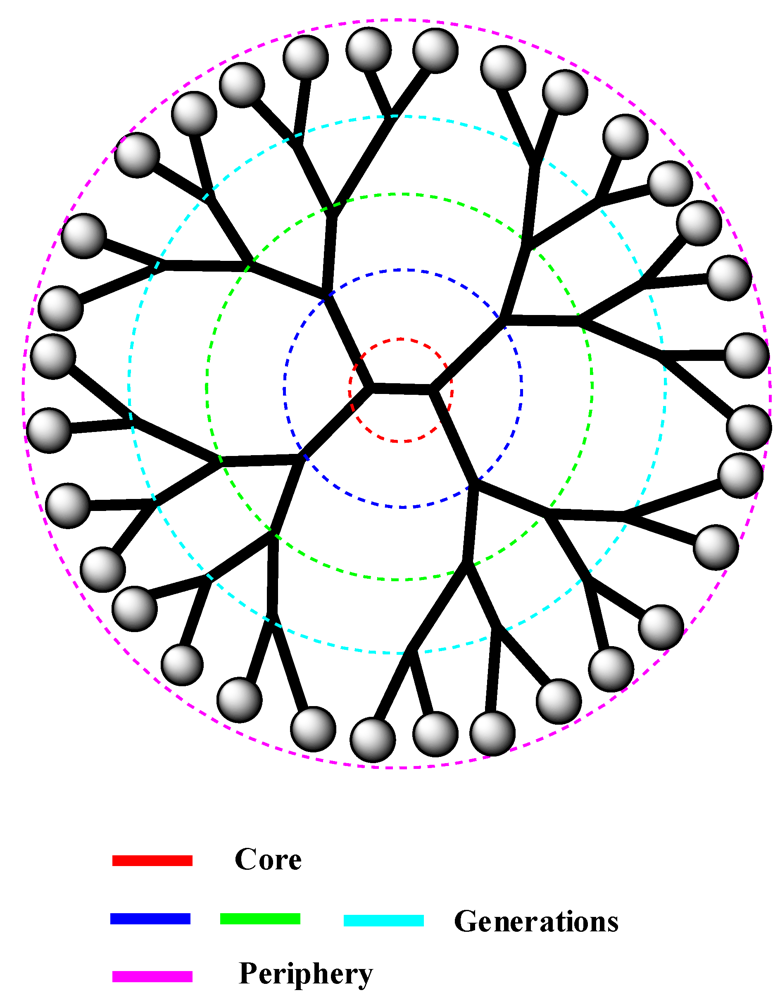
        <p>A dendrimer is a polymeric molecule composed of multiple perfectly branched monomers that elongate radially from a central core, similar to branches of some trees. The dendritic architecture can be divided into three different regions: the core, the interior, and the periphery or end groups (<xref ref-type="fig" rid="polymers-04-00794-f001">Figure 1</xref>). The number of branch points encountered upon moving outward from the core to its periphery defines its generation (G1, G2, G3, <italic>etc.</italic>). These macromolecules are prepared in a stepwise fashion [<xref ref-type="bibr" rid="B4-polymers-04-00794">4</xref>,<xref ref-type="bibr" rid="B75-polymers-04-00794">75</xref>,<xref ref-type="bibr" rid="B76-polymers-04-00794">76</xref>,<xref ref-type="bibr" rid="B77-polymers-04-00794">77</xref>] and therefore, the products are theoretically monodisperse in size. A monodisperse product is extremely desirable not only for synthetic reproducibility, but also for reducing experimental and therapeutic variability [<xref ref-type="bibr" rid="B78-polymers-04-00794">78</xref>,<xref ref-type="bibr" rid="B79-polymers-04-00794">79</xref>]. Vögtle and coworkers have termed perfectly monodisperse dendrimers, cascadanes [<xref ref-type="bibr" rid="B11-polymers-04-00794">11</xref>]. </p>
        <fig id="polymers-04-00794-f001" position="anchor">
          <label>Figure 1</label>
          <caption>
            <p>The architecture of a dendrimer.</p>
          </caption>
          <graphic xmlns:xlink="http://www.w3.org/1999/xlink" xlink:href="polymers-04-00794-g001.tif"/>
        </fig>
        <p>A dendrimer may be based on practically any type of chemistry, the nature of which can determine its solubility, degradability and biological activity if any.</p>
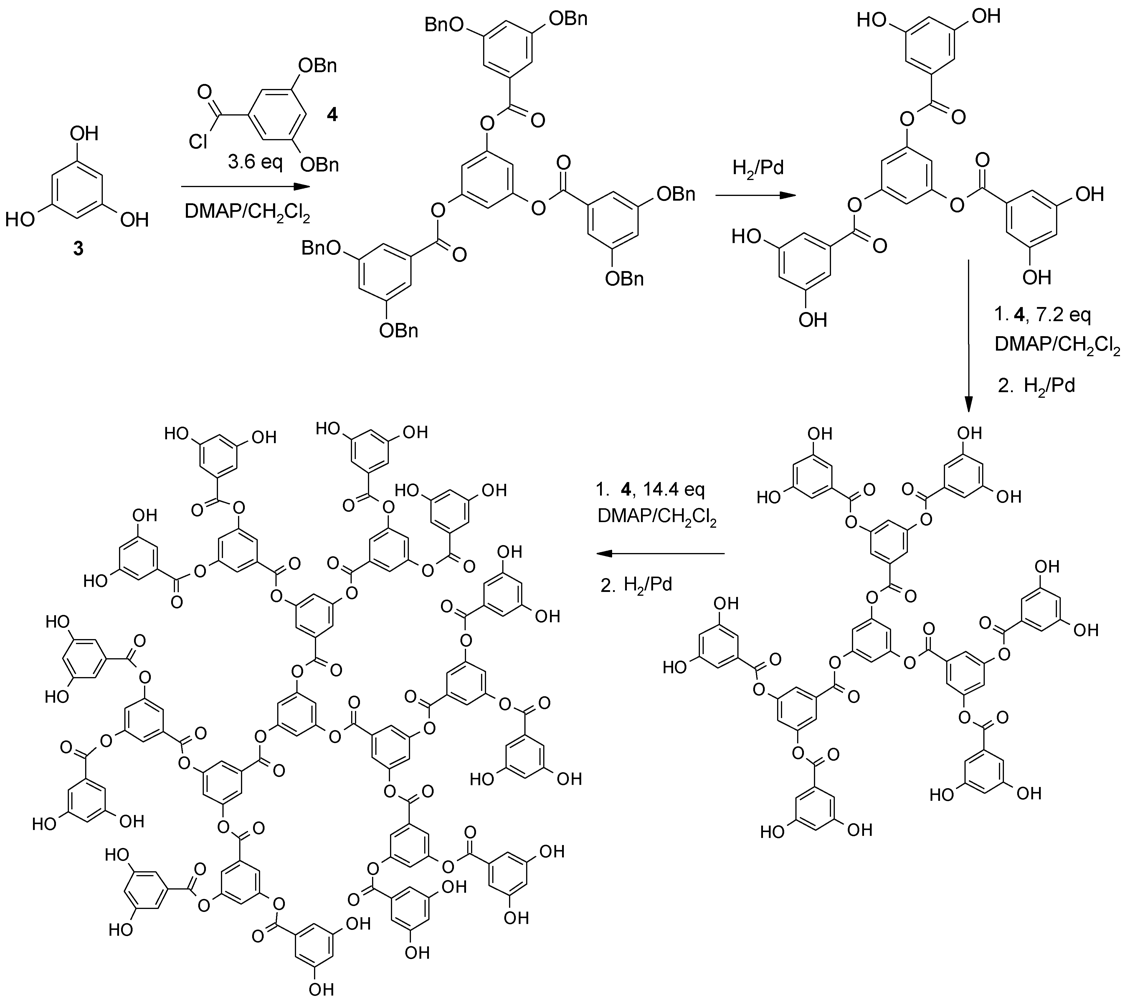
        <p>Two strategies have been formulated for dendrimer synthesis. The divergent approach is more obvious and was used by most of the early workers in the area [<xref ref-type="bibr" rid="B1-polymers-04-00794">1</xref>,<xref ref-type="bibr" rid="B3-polymers-04-00794">3</xref>,<xref ref-type="bibr" rid="B4-polymers-04-00794">4</xref>,<xref ref-type="bibr" rid="B5-polymers-04-00794">5</xref>]. In this method, dendrimers grow outwards from a multifunctional core molecule. The core molecule reacts with monomeric molecules containing one reactive and various dormant groups giving the first generation dendrimer. Then the new periphery of the molecule is activated for reactions with more monomers. The process is repeated several times and a dendrimer is built layer after layer. See <xref ref-type="scheme" rid="polymers-04-00794-f002">Scheme 1</xref> for the first example of polyester dendrimer synthesis using this approach [<xref ref-type="bibr" rid="B80-polymers-04-00794">80</xref>]. The number of functional groups in the outermost layer increases exponentially with the generation number. The synthesis is elaborate and the conversion of the functional groups has to be perfect at each stage in order to guarantee a defect-free product. To prevent side reactions and to force the reaction to completion, excess reagents may be required, which causes problems in the purification of the final product. In addition, steric hindrance increases as the generation level increases so that defects and hence polydispersity increases with generation level.</p>
        <fig id="polymers-04-00794-f002" position="anchor">
          <object-id pub-id-type="pii">polymers-04-00794-scheme1_Scheme 1</object-id>
          <label>Scheme 1</label>
          <caption>
            <p>The first example of the divergent growth approach to polyester dendrimers [<xref ref-type="bibr" rid="B80-polymers-04-00794">80</xref>].</p>
          </caption>
          <graphic xmlns:xlink="http://www.w3.org/1999/xlink" xlink:href="polymers-04-00794-g002.tif"/>
        </fig>
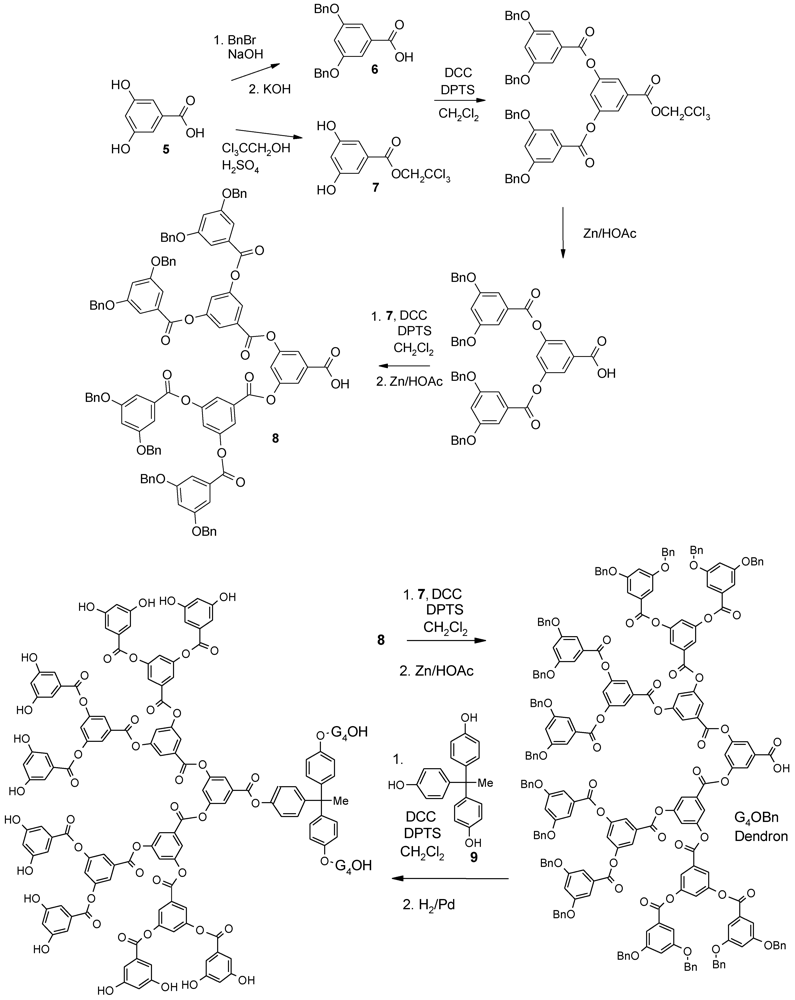
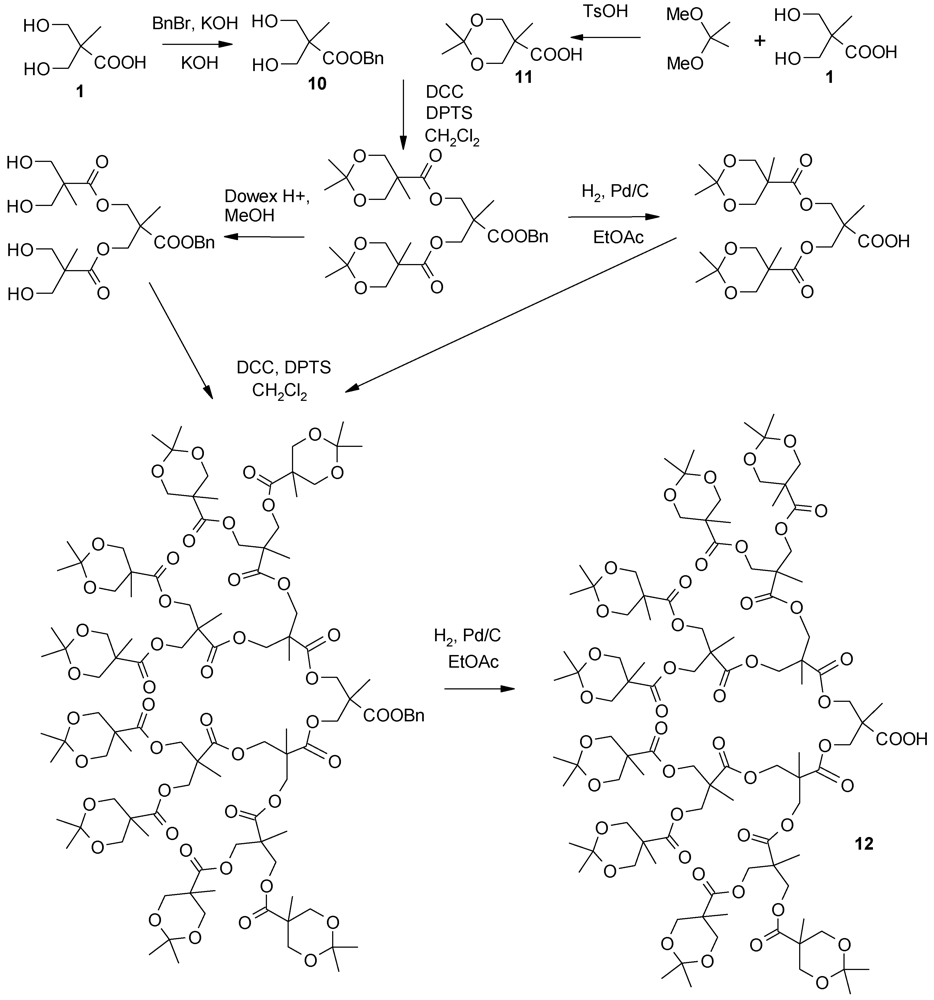
        <p>The second method, the convergent route was developed by Hawker and Fréchet [<xref ref-type="bibr" rid="B77-polymers-04-00794">77</xref>]. In this approach, the units that will be attached to the core, the dendrons, are constructed first. When the growing dendrons have reached the desired size, they are attached to the multifunctional core molecule. This method has several advantages. It is relatively easy to purify the final product and the occurrence of defects in the final structure is minimised. The convergent route provides better structural control since intermediates are purified better at successive stages of the synthesis. However, this method may not allow the formation of high generations, because steric problems may occur in the reactions of the dendrons with the core molecule. <xref ref-type="scheme" rid="polymers-04-00794-f003">Scheme 2</xref>Scheme  illustrates this approach [<xref ref-type="bibr" rid="B8-polymers-04-00794">8</xref>]. Reduction in the number of both synthetic and purification steps in convergent dendrimer synthesis can be achieved if a convergent approach is taken to dendron synthesis rather than the strictly divergent synthesis of the dendron illustrated in <xref ref-type="scheme" rid="polymers-04-00794-f003">Scheme 2</xref>. This approach, termed double exponential growth [<xref ref-type="bibr" rid="B81-polymers-04-00794">81</xref>,<xref ref-type="bibr" rid="B82-polymers-04-00794">82</xref>,<xref ref-type="bibr" rid="B83-polymers-04-00794">83</xref>], is illustrated for polyester dendrimers in <xref ref-type="scheme" rid="polymers-04-00794-f004">Scheme 3</xref> [<xref ref-type="bibr" rid="B84-polymers-04-00794">84</xref>]. In this methodology, both components for formation of the higher generation structure, the polyol and the carboxylic acid for polyester dendrimers, are prepared using a single starting material.</p>
        <fig id="polymers-04-00794-f003" position="anchor">
          <object-id pub-id-type="pii">polymers-04-00794-scheme2_Scheme 2</object-id>
          <label>Scheme 2</label>
          <caption>
            <p>The first convergent synthesis of a deprotected polyester dendrimer [<xref ref-type="bibr" rid="B8-polymers-04-00794">8</xref>].</p>
          </caption>
          <graphic xmlns:xlink="http://www.w3.org/1999/xlink" xlink:href="polymers-04-00794-g003.tif"/>
        </fig>
        <fig id="polymers-04-00794-f004" position="anchor">
          <object-id pub-id-type="pii">polymers-04-00794-scheme3_Scheme 3</object-id>
          <label>Scheme 3</label>
          <caption>
            <p>Double exponential dendron growth [<xref ref-type="bibr" rid="B84-polymers-04-00794">84</xref>].</p>
          </caption>
          <graphic xmlns:xlink="http://www.w3.org/1999/xlink" xlink:href="polymers-04-00794-g004.tif"/>
        </fig>
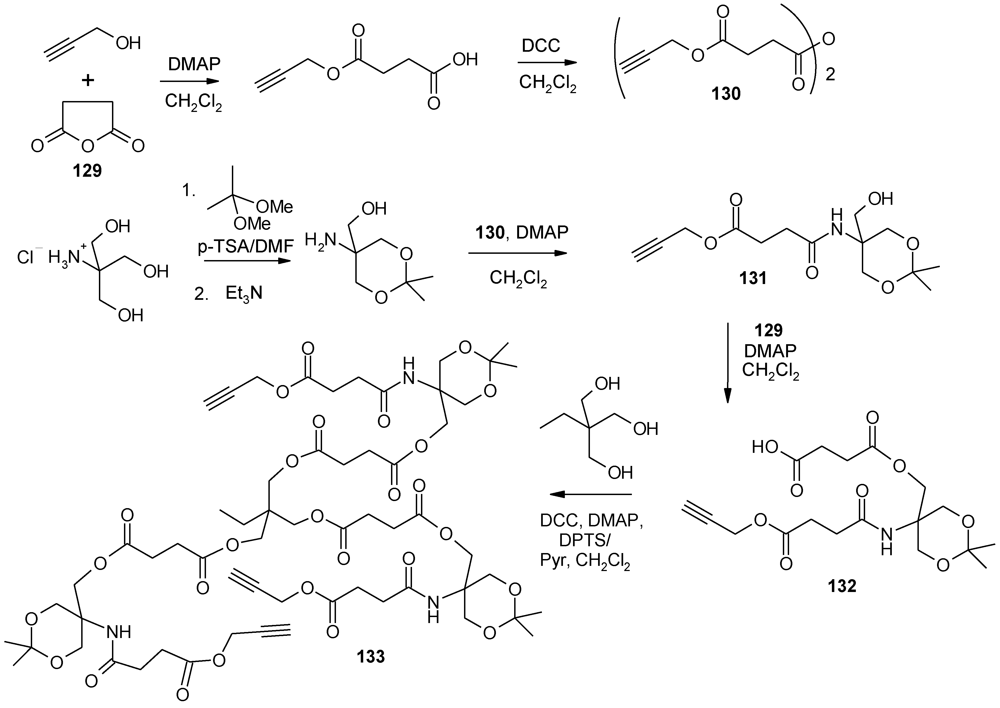
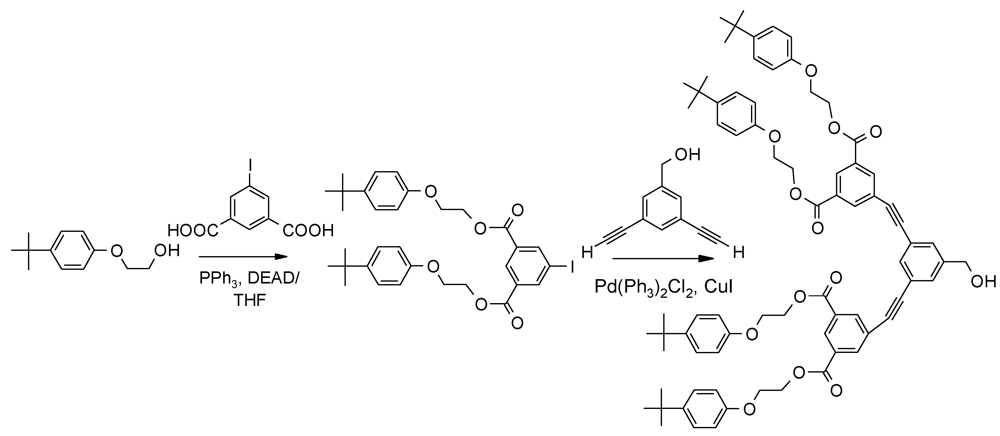
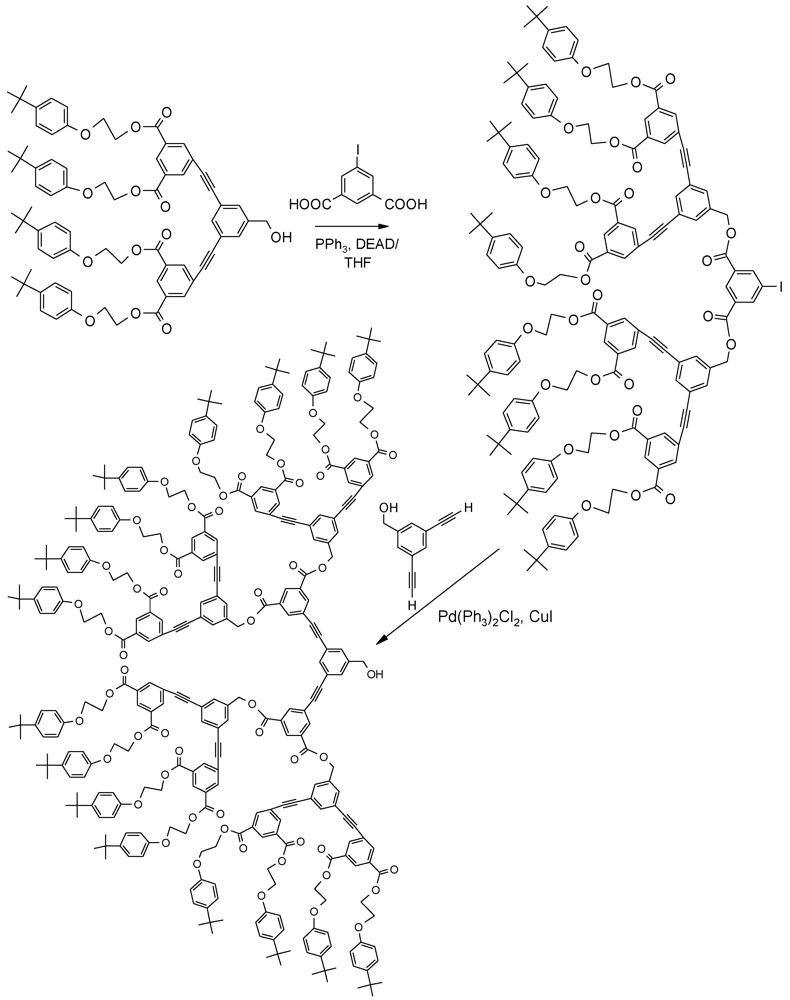
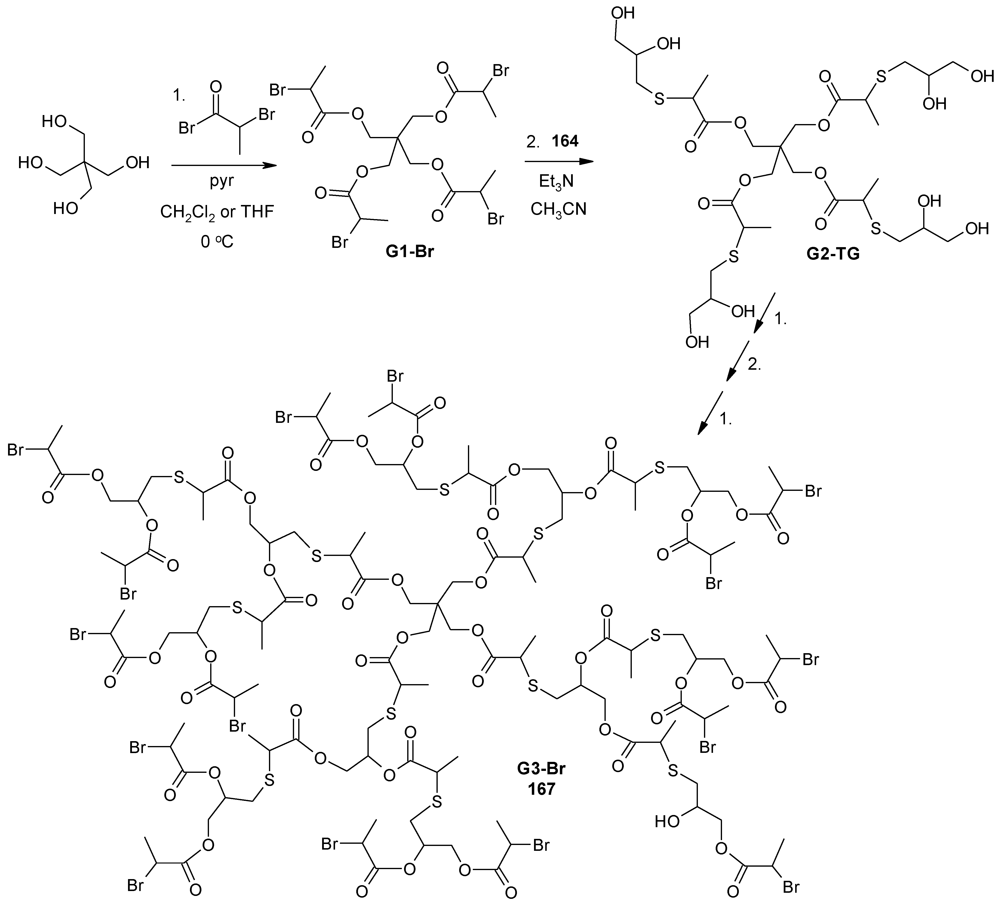
        <p>Different types of dendrimers, called alternating dendrimers here, can be produced if orthogonal coupling methods are used in alternation to produce dendrimers with different functional groups joining alternate dendrons [<xref ref-type="bibr" rid="B40-polymers-04-00794">40</xref>,<xref ref-type="bibr" rid="B73-polymers-04-00794">73</xref>,<xref ref-type="bibr" rid="B85-polymers-04-00794">85</xref>,<xref ref-type="bibr" rid="B86-polymers-04-00794">86</xref>,<xref ref-type="bibr" rid="B87-polymers-04-00794">87</xref>,<xref ref-type="bibr" rid="B88-polymers-04-00794">88</xref>,<xref ref-type="bibr" rid="B89-polymers-04-00794">89</xref>,<xref ref-type="bibr" rid="B90-polymers-04-00794">90</xref>,<xref ref-type="bibr" rid="B91-polymers-04-00794">91</xref>,<xref ref-type="bibr" rid="B92-polymers-04-00794">92</xref>,<xref ref-type="bibr" rid="B93-polymers-04-00794">93</xref>,<xref ref-type="bibr" rid="B94-polymers-04-00794">94</xref>,<xref ref-type="bibr" rid="B95-polymers-04-00794">95</xref>,<xref ref-type="bibr" rid="B96-polymers-04-00794">96</xref>,<xref ref-type="bibr" rid="B97-polymers-04-00794">97</xref>,<xref ref-type="bibr" rid="B98-polymers-04-00794">98</xref>,<xref ref-type="bibr" rid="B99-polymers-04-00794">99</xref>,<xref ref-type="bibr" rid="B100-polymers-04-00794">100</xref>,<xref ref-type="bibr" rid="B101-polymers-04-00794">101</xref>]. The first example of this strategy incorporating ester units, shown in <xref ref-type="scheme" rid="polymers-04-00794-f005">Scheme 4</xref> and <xref ref-type="scheme" rid="polymers-04-00794-f006">Scheme 5</xref>, used the Mitsunobu reaction to form esters [<xref ref-type="bibr" rid="B102-polymers-04-00794">102</xref>] and Sonagashira coupling as its orthogonal partner [<xref ref-type="bibr" rid="B102-polymers-04-00794">102</xref>]. More recent examples of orthogonal coupling in which ester formation is one of the two coupling reactions include the following: ester formation and click reactions [<xref ref-type="bibr" rid="B103-polymers-04-00794">103</xref>], ester formation and thiol-ene reactions [<xref ref-type="bibr" rid="B104-polymers-04-00794">104</xref>,<xref ref-type="bibr" rid="B105-polymers-04-00794">105</xref>], thiol displacement of α-ketohalides and ester formation [<xref ref-type="bibr" rid="B95-polymers-04-00794">95</xref>], ester and amide formation [<xref ref-type="bibr" rid="B106-polymers-04-00794">106</xref>], and thiol-yne reaction and ester formation [<xref ref-type="bibr" rid="B107-polymers-04-00794">107</xref>] (see <xref ref-type="sec" rid="sec4dot4-polymers-04-00794">Section 4.4</xref>).</p>
        
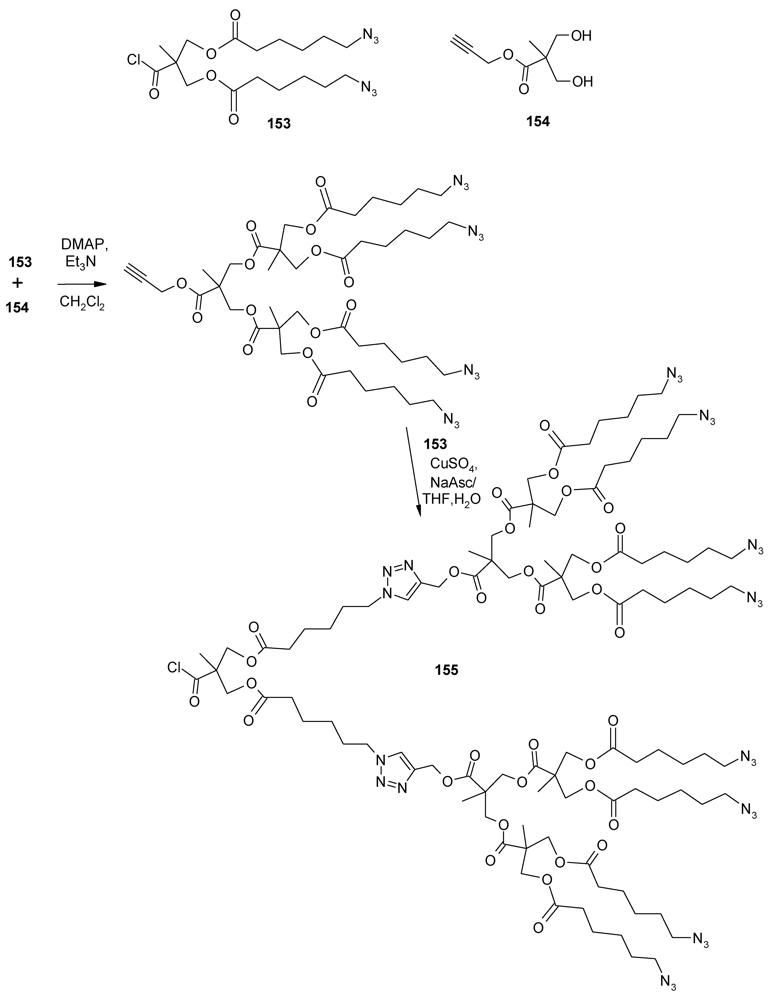
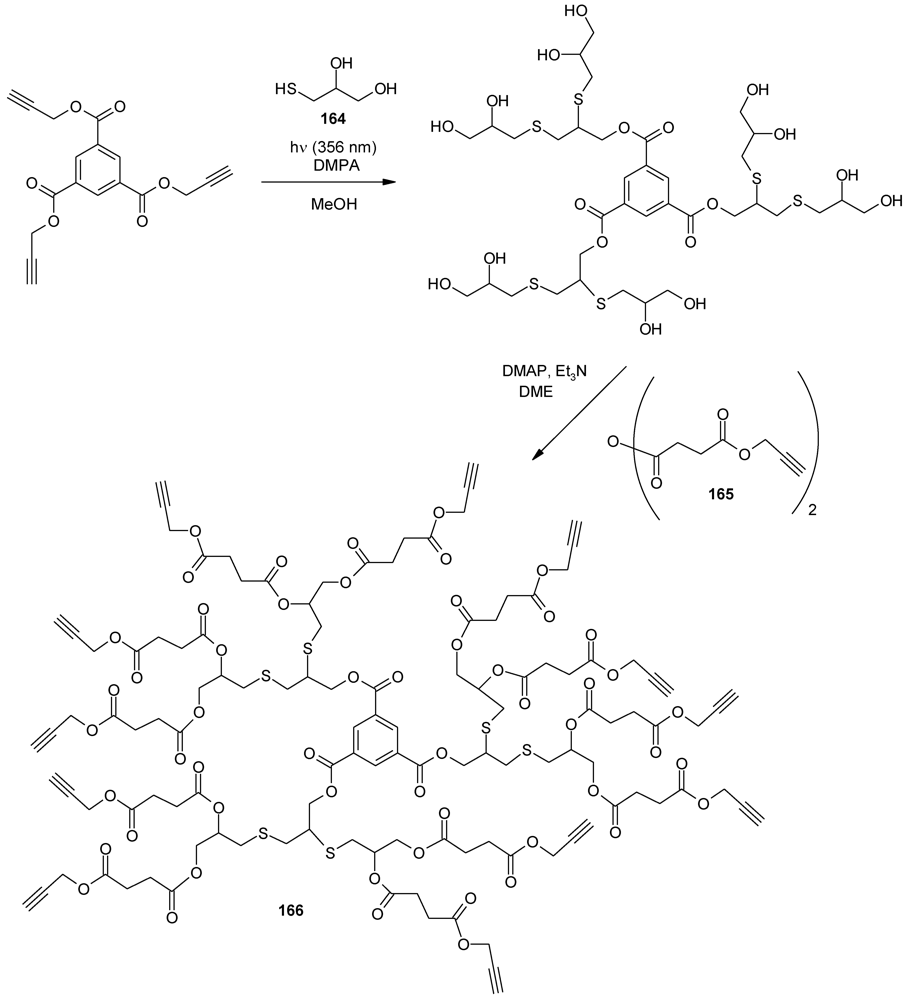
        <p>A variant of this approach can yield dendrimers with a greater number of functional groups on the periphery with fewer synthetic steps if the two orthogonal reactions both employ branched dendrons [<xref ref-type="bibr" rid="B93-polymers-04-00794">93</xref>,<xref ref-type="bibr" rid="B98-polymers-04-00794">98</xref>,<xref ref-type="bibr" rid="B103-polymers-04-00794">103</xref>,<xref ref-type="bibr" rid="B104-polymers-04-00794">104</xref>,<xref ref-type="bibr" rid="B108-polymers-04-00794">108</xref>,<xref ref-type="bibr" rid="B109-polymers-04-00794">109</xref>,<xref ref-type="bibr" rid="B110-polymers-04-00794">110</xref>]. Majoral and coworkers have termed this approach LEGO chemistry [<xref ref-type="bibr" rid="B98-polymers-04-00794">98</xref>]; Antoni <italic>et al.</italic> called this strategy accelerated synthesis [<xref ref-type="bibr" rid="B103-polymers-04-00794">103</xref>]. An example involving ester formation is shown in <xref ref-type="scheme" rid="polymers-04-00794-f007">Scheme 6</xref> [<xref ref-type="bibr" rid="B103-polymers-04-00794">103</xref>].</p>
        <fig id="polymers-04-00794-f005" position="anchor">
          <object-id pub-id-type="pii">polymers-04-00794-scheme4_Scheme 4</object-id>
          <label>Scheme 4</label>
          <caption>
            <p>Formation of the dendron for an alternating polyester dendrimer [<xref ref-type="bibr" rid="B102-polymers-04-00794">102</xref>].</p>
          </caption>
          <graphic xmlns:xlink="http://www.w3.org/1999/xlink" xlink:href="polymers-04-00794-g005.tif"/>
        </fig>
        <fig id="polymers-04-00794-f006" position="anchor">
          <object-id pub-id-type="pii">polymers-04-00794-scheme5_Scheme 5</object-id>
          <label>Scheme 5</label>
          <caption>
            <p>Formation of an alternating polyester dendrimer [<xref ref-type="bibr" rid="B102-polymers-04-00794">102</xref>].</p>
          </caption>
          <graphic xmlns:xlink="http://www.w3.org/1999/xlink" xlink:href="polymers-04-00794-g006.tif"/>
        </fig>
        
        <p>The highly congested branching that occurs in the bulk of the dendrimer interior can have interesting effects on the dendrimer’s conformation. Because dendrimer diameters increase linearly while the number of surface groups increase exponentially with generation number, the space between groups decreases with generation [<xref ref-type="bibr" rid="B111-polymers-04-00794">111</xref>]. For example, at low generations, a dendrimer typically has a floppy, flat structure, but at higher generations (usually &gt; G-4), the polymer adopts a more globular or even spherical conformation [<xref ref-type="bibr" rid="B112-polymers-04-00794">112</xref>] and rigidity increases with generation [<xref ref-type="bibr" rid="B113-polymers-04-00794">113</xref>]. The behaviour of these compounds is complex with backfolding being significant [<xref ref-type="bibr" rid="B114-polymers-04-00794">114</xref>,<xref ref-type="bibr" rid="B115-polymers-04-00794">115</xref>,<xref ref-type="bibr" rid="B116-polymers-04-00794">116</xref>]. </p>
        <fig id="polymers-04-00794-f007" position="anchor">
          <object-id pub-id-type="pii">polymers-04-00794-scheme6_Scheme 6</object-id>
          <label>Scheme 6</label>
          <caption>
            <p>Accelerated synthesis of a G4 polyester dendrimer in four steps by using two different AB<sub>2</sub> dendrons [<xref ref-type="bibr" rid="B103-polymers-04-00794">103</xref>].</p>
          </caption>
          <graphic xmlns:xlink="http://www.w3.org/1999/xlink" xlink:href="polymers-04-00794-g007.tif"/>
        </fig>
      </sec>
      <sec>
        <title>2.2. Hyperbranched Polymers</title>
        <p>Hyperbranched polymers are usually the product of random or non-controlled synthetic procedures. They exhibit an irregular architecture with many defects throughout the structure as a result of incompletely reacted functional groups. Even though they lack the advantages of having well defined structures and molecular weight, hyperbranched polymers are often easily synthesized on a large scale which brings down their cost and makes them important for large-scale and industrial applications. </p>
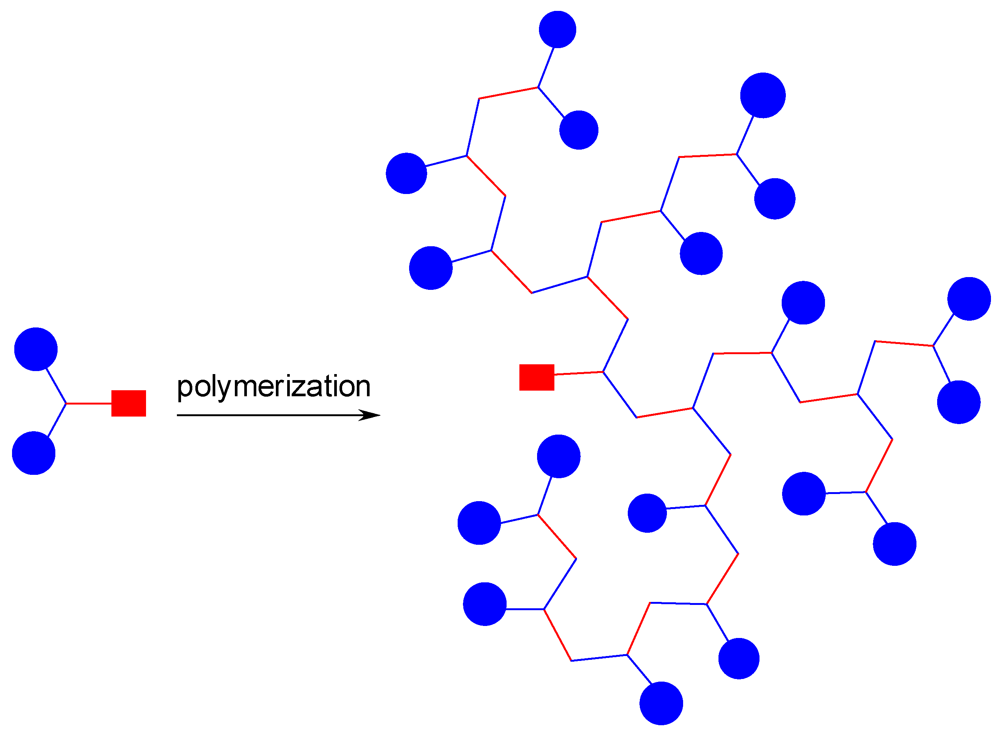
        <p>If dendronized polymers and dendrigrafts are excluded, two broad types of hyperbranched polymers can be defined. One type is obtained using polymerization of a single monomer unit. Many methods have been used for polymerization, including proton-transfer polymerization (PTP) [<xref ref-type="bibr" rid="B117-polymers-04-00794">117</xref>], self-condensing vinyl polymerization (SCVP) [<xref ref-type="bibr" rid="B118-polymers-04-00794">118</xref>], self-condensing ring-opening polymerization (SCROP) [<xref ref-type="bibr" rid="B119-polymers-04-00794">119</xref>], and condensation [<xref ref-type="bibr" rid="B120-polymers-04-00794">120</xref>]. Many of the hyperbranched polyesters reported in the literature have been prepared using a one-pot polycondensation of A<sub>x</sub>B monomers. </p>
        <fig id="polymers-04-00794-f008" position="anchor">
          <object-id pub-id-type="pii">polymers-04-00794-scheme7_Scheme 7</object-id>
          <label>Scheme 7</label>
          <caption>
            <p>An A<sub>2</sub>B monomer polycondensation.</p>
          </caption>
          <graphic xmlns:xlink="http://www.w3.org/1999/xlink" xlink:href="polymers-04-00794-g008.tif"/>
        </fig>
        <p>In this approach toward hyperbranched polymers [<xref ref-type="bibr" rid="B54-polymers-04-00794">54</xref>,<xref ref-type="bibr" rid="B121-polymers-04-00794">121</xref>], monomers containing A functional groups with similar reactivity react with functional group B as shown in <xref ref-type="scheme" rid="polymers-04-00794-f008">Scheme 7</xref>. The final mixture usually contains highly branched polymers having a similar focal point B but with varying molecular weights and varying degree of branching. The use of A<sub>x</sub>B monomers where x is &gt; 2 has also been exploited. As the number of A functionalities in a monomer increases, the degree of branching tends to reduce for steric reasons. Examples include those of Mathias [<xref ref-type="bibr" rid="B122-polymers-04-00794">122</xref>], Hunter [<xref ref-type="bibr" rid="B123-polymers-04-00794">123</xref>], and Yoon [<xref ref-type="bibr" rid="B124-polymers-04-00794">124</xref>] for the use of A<sub>3</sub>B monomers and the work of Miravet and Fréchet for the use of both A<sub>4</sub>B and A<sub>6</sub>B monomers [<xref ref-type="bibr" rid="B125-polymers-04-00794">125</xref>]. This approach can be used without adding core molecules or with added core molecules.</p>
        <fig id="polymers-04-00794-f009" position="anchor">
          <object-id pub-id-type="pii">polymers-04-00794-scheme8_Scheme 8</object-id>
          <label>Scheme 8</label>
          <caption>
            <p>Polycondensation of A<sub>2</sub>B and A<sub>3</sub> monomers with excess A<sub>2</sub>B monomer.</p>
          </caption>
          <graphic xmlns:xlink="http://www.w3.org/1999/xlink" xlink:href="polymers-04-00794-g009.tif"/>
        </fig>
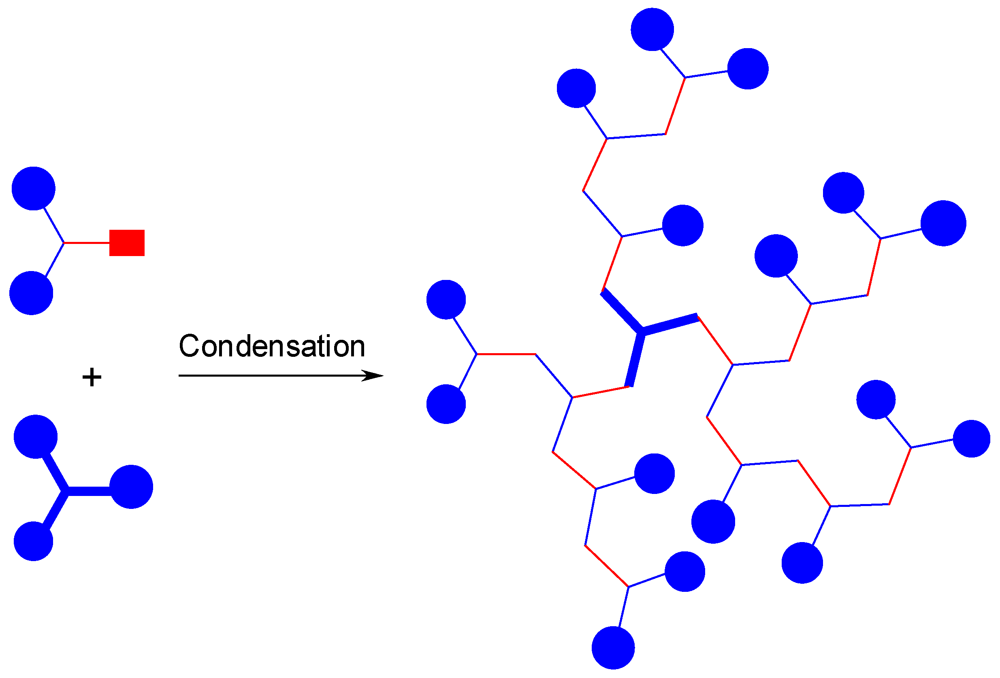
        <p>A second type of hyperbranched polymers is formed by polymerization of two different types of monomers of which, at least one must be branched. Many different combinations are possible including A<sub>2</sub>B<sub>2</sub> + B<sub>3</sub> of Berzelius’ first hyperbranched polymers [<xref ref-type="bibr" rid="B41-polymers-04-00794">41</xref>] and A<sub>2</sub>B + A<sub>3</sub> of the commercial Boltorn hyperbranched polyesters [<xref ref-type="bibr" rid="B55-polymers-04-00794">55</xref>]. In the case of the Boltorn polyesters [<xref ref-type="bibr" rid="B55-polymers-04-00794">55</xref>], the monomers with two functional groups, A<sub>2</sub>B in this case, are used in a large excess so that the next layer of reactive centers can only come from such a monomer. <xref ref-type="scheme" rid="polymers-04-00794-f009">Scheme 8</xref> below illustrates a schematic representation for the polycondensation of A<sub>2</sub>B and A<sub>3</sub> monomers.</p>
        
        <p>Hyperbranched polymers have continued to be the backbone of many industrial processes and over the years, new methodologies for their synthesis have continued to be developed.</p>
      </sec>
    </sec>
    <sec sec-type="methods">
      <title>3. Methods Used for Ester Bond Formation</title>
      <p>The method chosen for ester bond formation during the synthesis of polyester dendrons and dendrimers must not result in cleavage of other functional groups or in transesterification reactions.</p>
      <p>The first method used for ester bond formation in dendrimer synthesis involved the reaction of the carboxylic acid and the alcohol activated by dicyclohexylcarbodiimide (DCC) under mild acid catalysis (<xref ref-type="scheme" rid="polymers-04-00794-f003">Scheme 2</xref>) [<xref ref-type="bibr" rid="B8-polymers-04-00794">8</xref>] and this procedure has been used often. Formation of acid chlorides followed by reaction with the alcohol under mild base activation was also used early (<xref ref-type="scheme" rid="polymers-04-00794-f002">Scheme 1</xref>) [<xref ref-type="bibr" rid="B80-polymers-04-00794">80</xref>] but has only been used occasionally [<xref ref-type="bibr" rid="B103-polymers-04-00794">103</xref>,<xref ref-type="bibr" rid="B126-polymers-04-00794">126</xref>] because the dendron must survive the vigorous conditions used to make the acid chloride.</p>
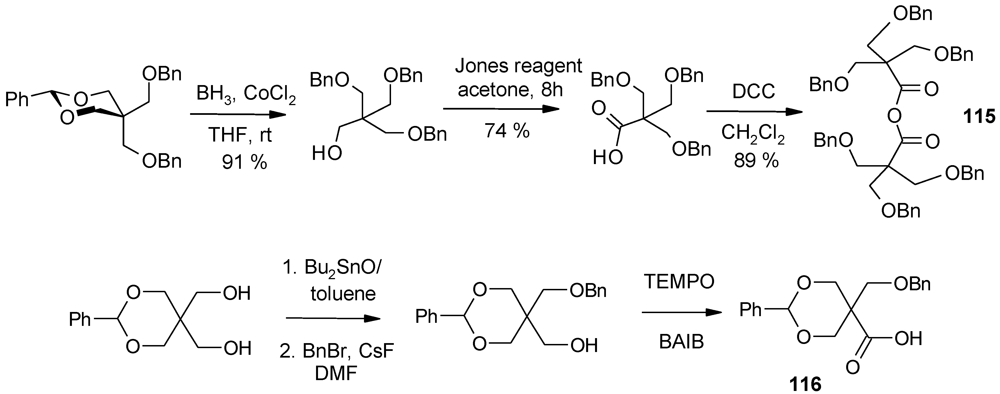
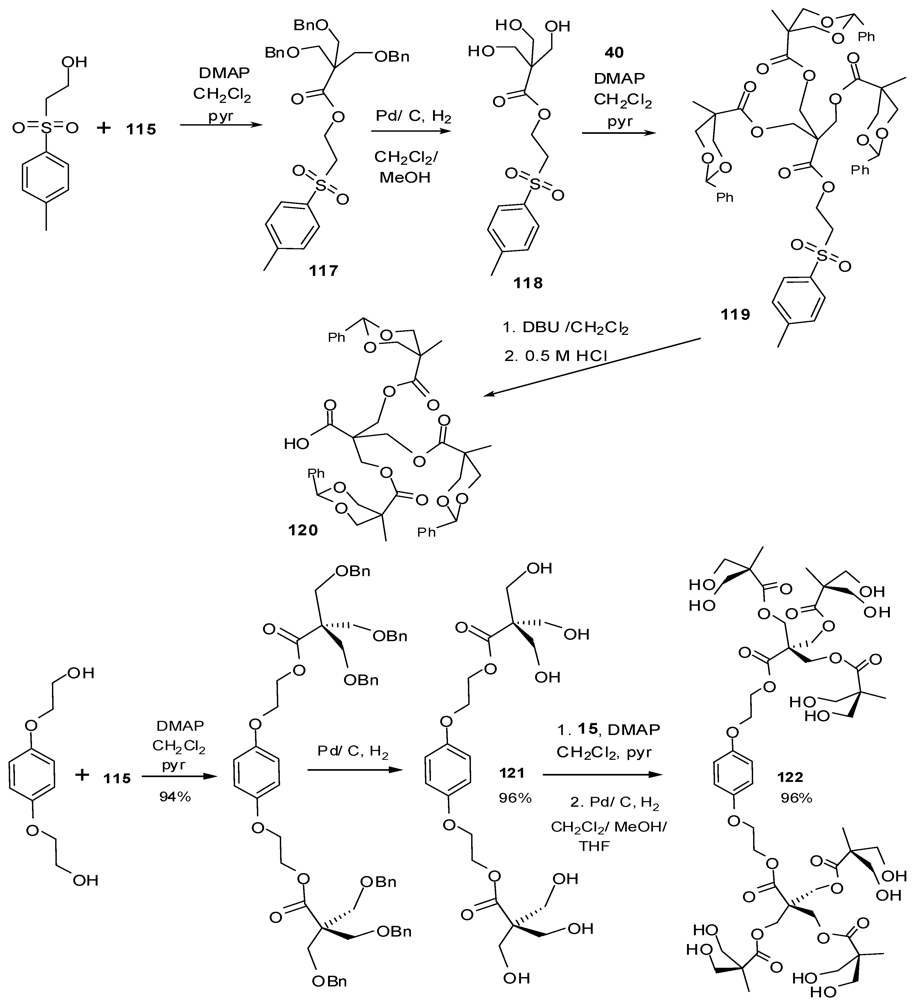
      <p>One of the methods used most often is to convert the alcohol-protected carboxylic acid into the anhydride (<xref ref-type="scheme" rid="polymers-04-00794-f010">Scheme 9</xref>), then react the anhydride with the alcohol in the presence of DMAP or other mildly basic promoters [<xref ref-type="bibr" rid="B127-polymers-04-00794">127</xref>]. The anhydrides of acetal-protected 2,2-bis-(hydroxymethyl)propanoic acid have been used often [<xref ref-type="bibr" rid="B127-polymers-04-00794">127</xref>,<xref ref-type="bibr" rid="B128-polymers-04-00794">128</xref>]. Restricting the mobility of the alcohol-terminated chains through formation of a cyclic acetal decreases steric hindrance during ester formation, allowing facile access to high generation dendrimers [<xref ref-type="bibr" rid="B129-polymers-04-00794">129</xref>]. Using NMR parameters, we have recently established that the configuration of the <italic>O</italic>-benzylidene derivative of 2,2’-bis(hydroxymethyl)propanoic acid is <italic>cis</italic> [<xref ref-type="bibr" rid="B130-polymers-04-00794">130</xref>].</p>
      <fig id="polymers-04-00794-f010" position="anchor">
        <object-id pub-id-type="pii">polymers-04-00794-scheme9_Scheme 9</object-id>
        <label>Scheme 9</label>
        <caption>
          <p>Formation of the anhydride of benzylidene-protected 2,2-bis-(hydroxymethyl)propanoic acid (<bold>14</bold>) [<xref ref-type="bibr" rid="B127-polymers-04-00794">127</xref>].</p>
        </caption>
        <graphic xmlns:xlink="http://www.w3.org/1999/xlink" xlink:href="polymers-04-00794-g010.tif"/>
      </fig>
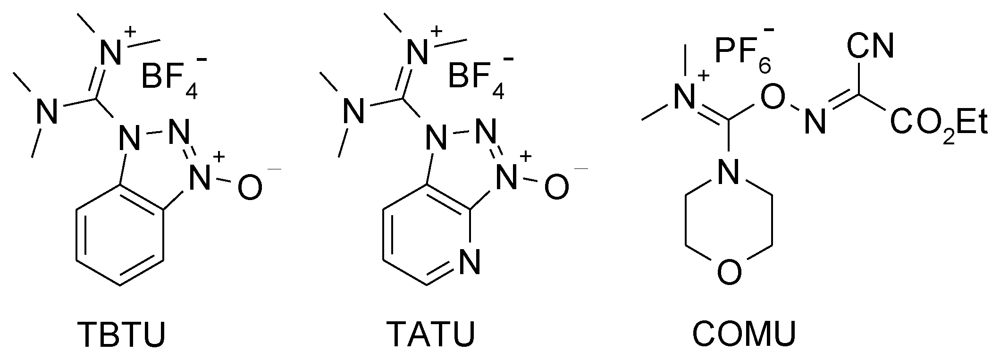
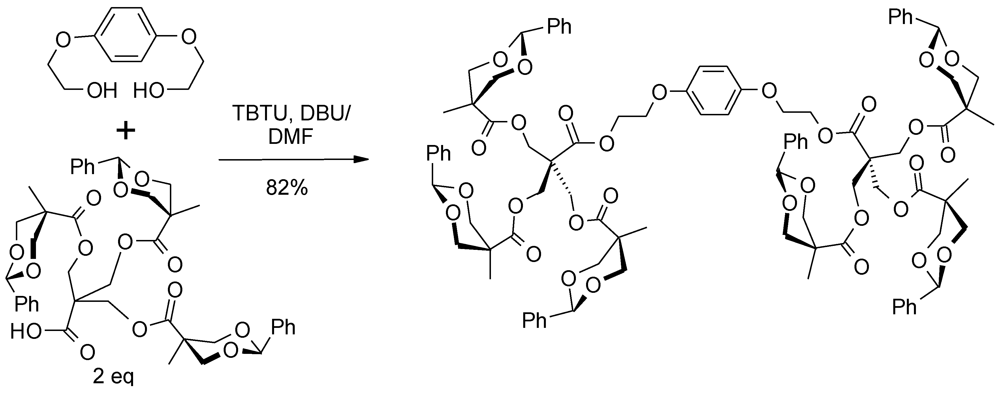
      <p>Two alternatives have been proposed recently. We used the urononium-based coupling agents, TBTU [<xref ref-type="bibr" rid="B131-polymers-04-00794">131</xref>], TATU [<xref ref-type="bibr" rid="B132-polymers-04-00794">132</xref>], and COMU [<xref ref-type="bibr" rid="B133-polymers-04-00794">133</xref>] (See <xref ref-type="fig" rid="polymers-04-00794-f011">Figure 2</xref> for structures), to promote ester formation [<xref ref-type="bibr" rid="B134-polymers-04-00794">134</xref>]. An example is shown in <xref ref-type="scheme" rid="polymers-04-00794-f012">Scheme 10</xref>. This method has the advantage that primary hydroxyls can be selected over secondary by choosing to use TATU or TBTU with a trialkylamine as base. Secondary alcohols react with carboxylic acids using all three uronium-based agents if the stronger base, 1,8-diazabicyclo[5.4.0]undec-7-ene (DBU), is used. Tertiary alcohols form esters only when the promoter is COMU and a still stronger base, 7-methyl-1,5,7-triazabicyclo[4.4.0]dec-5-ene (MTBD), is used [<xref ref-type="bibr" rid="B134-polymers-04-00794">134</xref>].</p>
      <fig id="polymers-04-00794-f011" position="anchor">
        <label>Figure 2</label>
        <caption>
          <p>Structures of uronium-based compounds used to promote ester formation [<xref ref-type="bibr" rid="B134-polymers-04-00794">134</xref>].</p>
        </caption>
        <graphic xmlns:xlink="http://www.w3.org/1999/xlink" xlink:href="polymers-04-00794-g011.tif"/>
      </fig>
      <fig id="polymers-04-00794-f012" position="anchor">
        <object-id pub-id-type="pii">polymers-04-00794-scheme10_Scheme 10</object-id>
        <label>Scheme 10</label>
        <caption>
          <p>Use of an uronium-based promoter for ester bond formation in assembly of a second generation dendrimer [<xref ref-type="bibr" rid="B134-polymers-04-00794">134</xref>].</p>
        </caption>
        <graphic xmlns:xlink="http://www.w3.org/1999/xlink" xlink:href="polymers-04-00794-g012.tif"/>
      </fig>
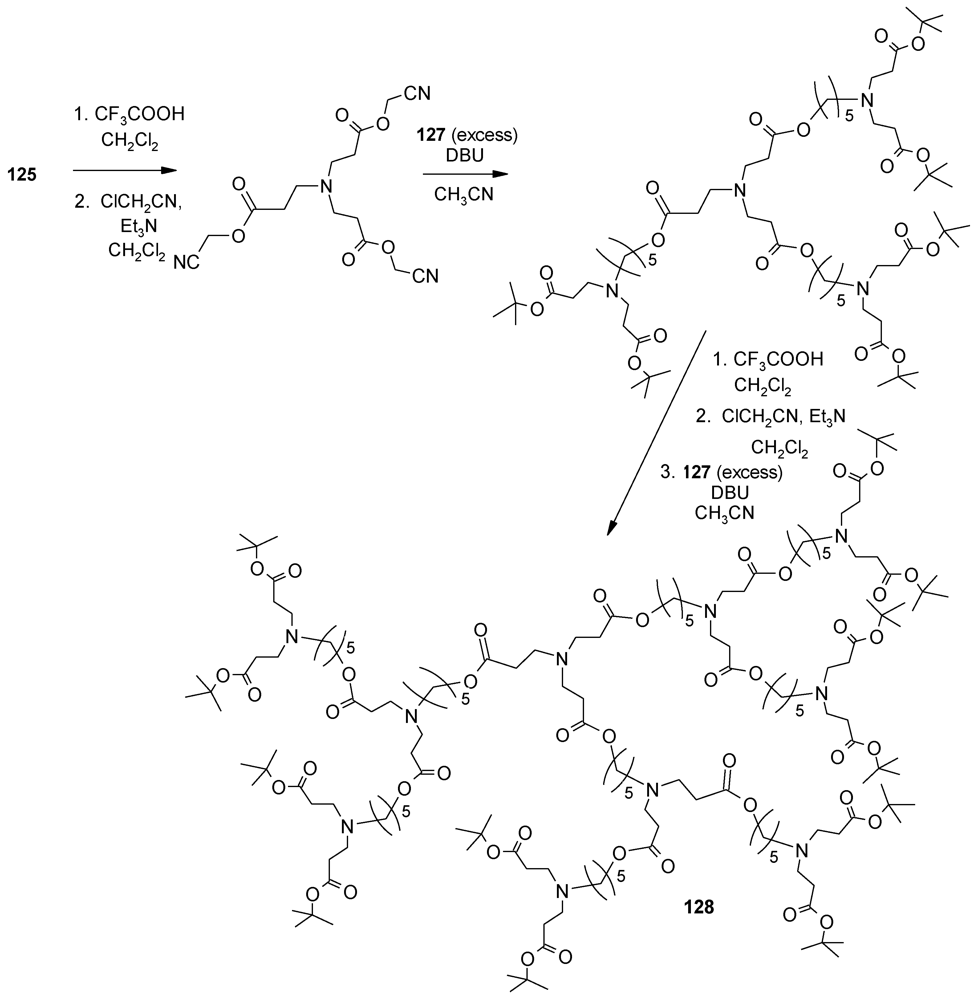
      <p>Bouillon <italic>et al.</italic> have synthesized amine-containing polyester dendrimers by activating the carboxylic acids as cyanomethyl ester intermediates (<xref ref-type="scheme" rid="polymers-04-00794-f013">Scheme 11</xref>) [<xref ref-type="bibr" rid="B135-polymers-04-00794">135</xref>,<xref ref-type="bibr" rid="B136-polymers-04-00794">136</xref>]. This method has been used previously for acylation of ribonucleotide derivatives with <italic>N</italic>-protected amino acids [<xref ref-type="bibr" rid="B137-polymers-04-00794">137</xref>].</p>
      <fig id="polymers-04-00794-f013" position="anchor">
        <object-id pub-id-type="pii">polymers-04-00794-scheme11_Scheme 11</object-id>
        <label>Scheme 11</label>
        <caption>
          <p>Ester formation from carboxylic acids containing tertiary amines [<xref ref-type="bibr" rid="B135-polymers-04-00794">135</xref>].</p>
        </caption>
        <graphic xmlns:xlink="http://www.w3.org/1999/xlink" xlink:href="polymers-04-00794-g013.tif"/>
      </fig>
      <p>As shown in <xref ref-type="scheme" rid="polymers-04-00794-f005">Scheme 4</xref> and <xref ref-type="scheme" rid="polymers-04-00794-f006">Scheme 5</xref>, Zeng and Zimmerman used a Mitsunobu reaction with an aromatic biscarboxylic acid as the nucleophile to form alternating polyester dendrimers [<xref ref-type="bibr" rid="B102-polymers-04-00794">102</xref>].</p>
    </sec>
    <sec>
      <title>4. Advances in the Synthesis of Polyester Dendrons and Dendrimers</title>
      <sec>
        <title>4.1. The Use of 2,2-Bis(Hydroxymethyl)Propanoic Acid-Derived Dendrons</title>
        <p>Ever since its first use for dendrimer formation [<xref ref-type="bibr" rid="B126-polymers-04-00794">126</xref>], one aliphatic building block has been and continues to be the dendron of choice. 2,2-Bis(hydroxymethyl)propanoic acid (<bold>1</bold>) (bis-HMPA) is commercially available at a low cost, and most importantly, the resulting polyester dendrimers are non-toxic and biodegradable [<xref ref-type="bibr" rid="B38-polymers-04-00794">38</xref>], which makes them attractive for biological and drug delivery applications. </p>
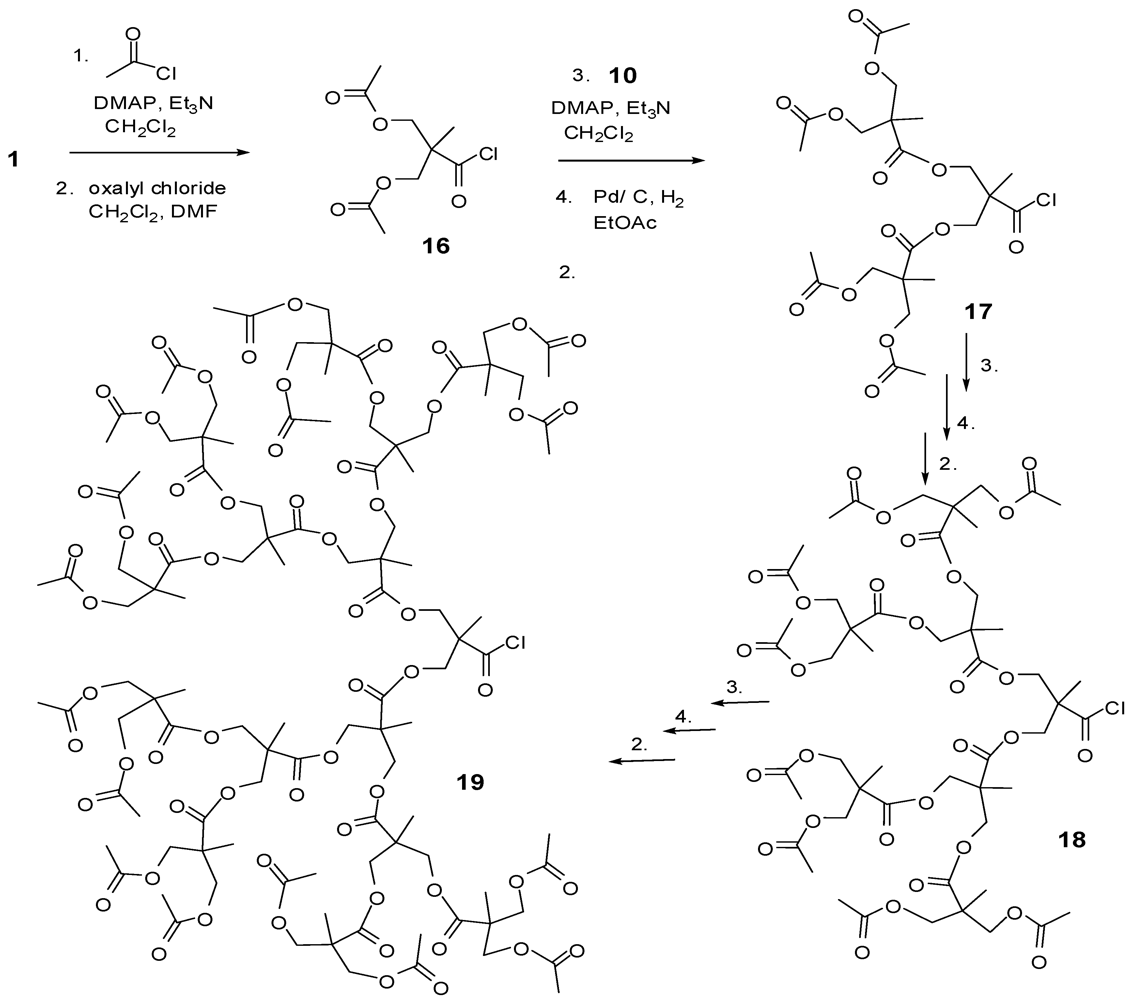
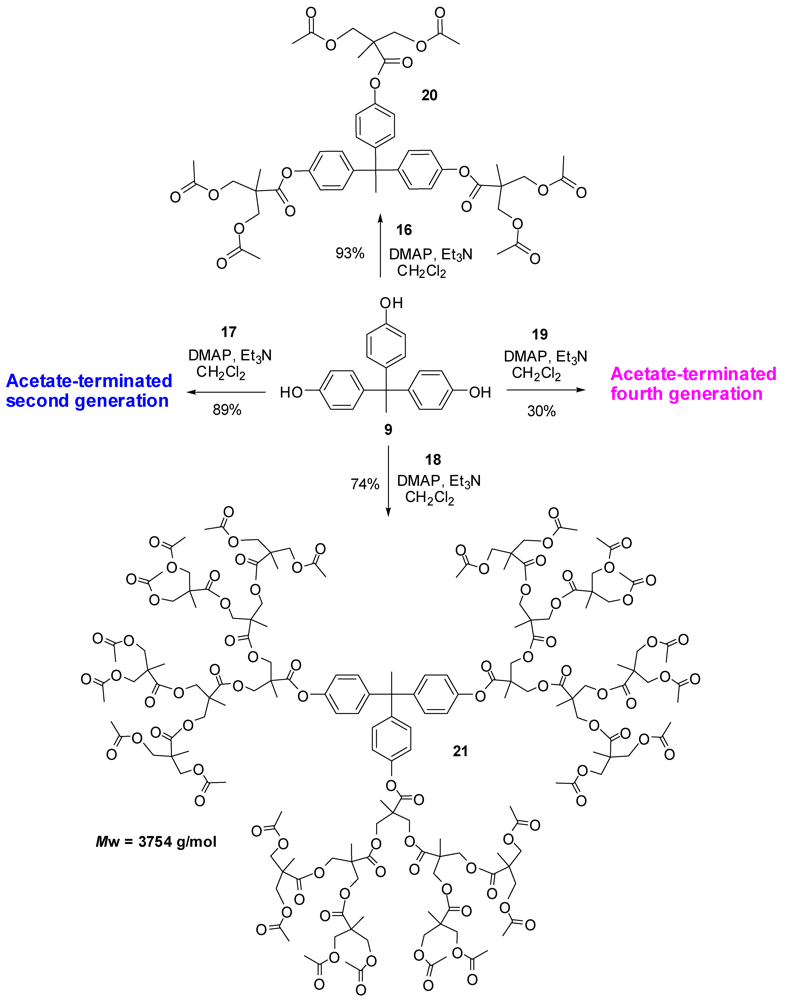
        <p>The first report on the synthesis of aliphatic polyester dendrimers based on <bold>1</bold> was by Ihre, Hult, and Söderlind [<xref ref-type="bibr" rid="B126-polymers-04-00794">126</xref>]. First to fourth generation dendrons were synthesized from <bold>1</bold> by protecting the carboxylic acid as a benzyl ester group and the hydroxyls as acetate esters (<xref ref-type="scheme" rid="polymers-04-00794-f014">Scheme 12</xref>). Esterifications were performed by conversion of the acid into the corresponding acid chloride with oxalyl chloride followed by reaction of the acid chloride with the hydroxyl groups in the presence of triethylamine (TEA) and 4-(dimethylamino)pyridine (DMAP). Deprotection by hydrogenolysis allowed repetition. Acetate-terminated polyester dendrimers with 1,1,1-tris(<italic>p</italic>-hydroxyphenyl)ethane (<bold>9</bold>) as a core were synthesized from generation one to four (<italic>M</italic><sub>w</sub>: 906, 1,856, 3,754, and 7,549 g/mol) by adding the above dendrons in a convergent growth approach (<xref ref-type="scheme" rid="polymers-04-00794-f015">Scheme 13</xref>). The simplicity of the <sup>1</sup>H NMR and <sup>13</sup>C NMR spectra and elemental analyses suggest that pure and monodisperse dendrimers were obtained. However, attempts to selectively remove the acetate groups in order to obtain the corresponding hydroxyl-terminated dendrimers for further chemical surface modification were not successful due to the lack of selectivity in the hydrolysis of the acetate and ester groups. In addition, lower yields were obtained in the final coupling step of the fourth generation dendrons to the core molecule when compared to the coupling steps used to prepare lower generation dendrimers.</p>
        <fig id="polymers-04-00794-f014" position="anchor">
          <object-id pub-id-type="pii">polymers-04-00794-scheme12_Scheme 12</object-id>
          <label>Scheme 12</label>
          <caption>
            <p>Synthetic route to first to fourth generation dendrons [<xref ref-type="bibr" rid="B126-polymers-04-00794">126</xref>].</p>
          </caption>
          <graphic xmlns:xlink="http://www.w3.org/1999/xlink" xlink:href="polymers-04-00794-g014.tif"/>
        </fig>
        <fig id="polymers-04-00794-f015" position="anchor">
          <object-id pub-id-type="pii">polymers-04-00794-scheme13_Scheme 13</object-id>
          <label>Scheme 13</label>
          <caption>
            <p>Synthesis of first to fourth generation acetate-terminated dendrimers [<xref ref-type="bibr" rid="B126-polymers-04-00794">126</xref>].</p>
          </caption>
          <graphic xmlns:xlink="http://www.w3.org/1999/xlink" xlink:href="polymers-04-00794-g015.tif"/>
        </fig>
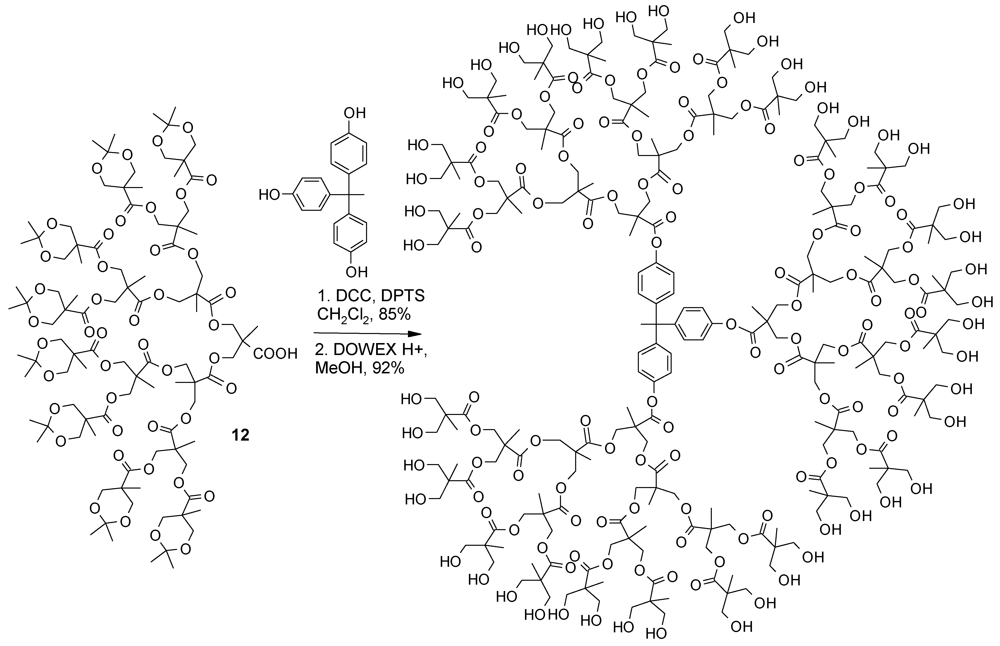
        <p>The problems accompanying acetate protection was remedied two years later by using isopropylidene acetals for protection of the 1,3-propanediol in <bold>1</bold> (see <xref ref-type="scheme" rid="polymers-04-00794-f004">Scheme 3</xref>) [<xref ref-type="bibr" rid="B84-polymers-04-00794">84</xref>]. The six-membered ring acetal is very easily hydrolylized in acid allowing deprotection in the presence of benzyl esters. A further improvement was the use of DCC and 4-(dimethylamino)pyridinium <italic>p</italic>-toluenesulfonate (DPTS) to promote ester formation directly from the hydroxyl and carboxylic acid groups rather than activate the carboxylic acid as the acid chloride. As shown in <xref ref-type="scheme" rid="polymers-04-00794-f016">Scheme 14</xref>, reacting the fourth generation dendron (<bold>12</bold>) with <bold>9</bold> gave a fourth generation polyester dendrimer in good yield. The periphery of the hydroxyl-terminated polyester dendrimer was then functionalized using reactions of its hydroxyl groups with various acid chlorides (benzoyl, octanoyl, and palmitoyl chloride) in the presence of TEA and DMAP in CH<sub>2</sub>Cl<sub>2</sub> to give high yields of monodisperse dendrimers, according to <sup>1</sup>H and <sup>13</sup>C NMR spectra, size exclusion chromatography, and elemental analyses of the products.</p>
        <fig id="polymers-04-00794-f016" position="anchor">
          <object-id pub-id-type="pii">polymers-04-00794-scheme14_Scheme 14</object-id>
          <label>Scheme 14</label>
          <caption>
            <p>Synthesis of fourth generation dendrimer [<xref ref-type="bibr" rid="B84-polymers-04-00794">84</xref>].</p>
          </caption>
          <graphic xmlns:xlink="http://www.w3.org/1999/xlink" xlink:href="polymers-04-00794-g016.tif"/>
        </fig>
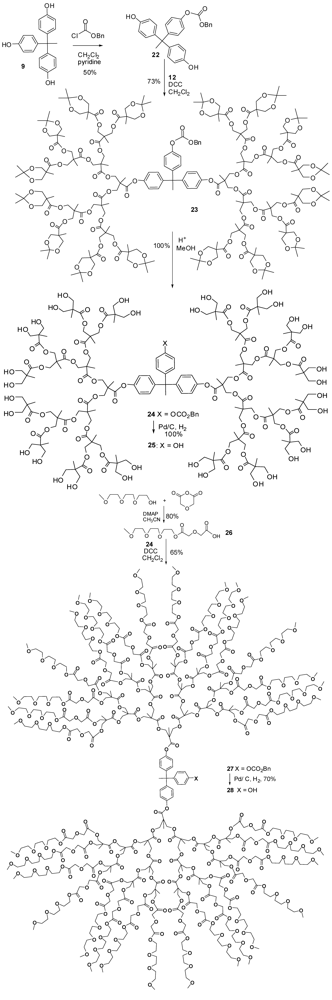
        <p>In order to evaluate this type of non-toxic dendrimer for drug delivery applications, a modified core moiety was prepared by reacting an excess amount of 1,1,1-tris(<italic>p</italic>-hydroxyphenyl)ethane (<bold>9</bold>) with benzyl chloroformate, affording a monoprotected trisphenolic in 50% yield after purification [<xref ref-type="bibr" rid="B138-polymers-04-00794">138</xref>] (<xref ref-type="scheme" rid="polymers-04-00794-f017">Scheme 15</xref>). Reacting this divalent core with two equivalents of the [G-4]-COOH dendron (<bold>12</bold>–<xref ref-type="scheme" rid="polymers-04-00794-f004">Scheme 3</xref>) in the presence of DCC followed by the cleavage of the acetonide groups under mild acidic conditions produced a water soluble system containing 32 free hydroxyl groups on the surface. Finally, the benzyl carbonate group was cleaved by hydrogenolysis to provide the free phenol.</p>
        
        <p>To evaluate the effect of increasing the mass of the dendritic system, a second dendritic model compound was prepared. The preparation involved the surface functionalization of dendrimers <bold>24</bold>/ <bold>25</bold>. </p>
        <fig id="polymers-04-00794-f017" position="anchor">
          <object-id pub-id-type="pii">polymers-04-00794-scheme15_Scheme 15</object-id>
          <label>Scheme 15</label>
          <caption>
            <p>Preparation of a divalent fourth generation polyester dendrimer (first section) and its surface functionalization (second section) [<xref ref-type="bibr" rid="B138-polymers-04-00794">138</xref>].</p>
          </caption>
          <graphic xmlns:xlink="http://www.w3.org/1999/xlink" xlink:href="polymers-04-00794-g017.tif"/>
        </fig>
        <p>For the preparation of these higher molecular mass dendrimers (<bold>27</bold> and <bold>28</bold>), a capping agent <bold>26</bold> consisting of monomethyl ether tri(ethylene glycol) was used, because poly(ethylene glycol) and its derivatives have advantages for biological applications due to their high water solubility and biocompatibility properties [<xref ref-type="bibr" rid="B139-polymers-04-00794">139</xref>]. To couple this moiety to the periphery of the hydroxyl-terminated dendrimer <bold>24</bold>, an acid derivative of the monomethyl ether of tri(ethylene glycol) was prepared by reaction with diglycolic anhydride in the presence of DMAP as the catalyst. An excess of the acid capping agent <bold>26</bold> was then reacted with the polyhydroxylated surface of <bold>24</bold> using DCC as the coupling agent to afford <bold>27</bold>. As earlier, the phenolic protecting group located at the core was removed using hydrogenolysis to give <bold>28</bold> with an exposed free phenol for radio labelling purposes. </p>
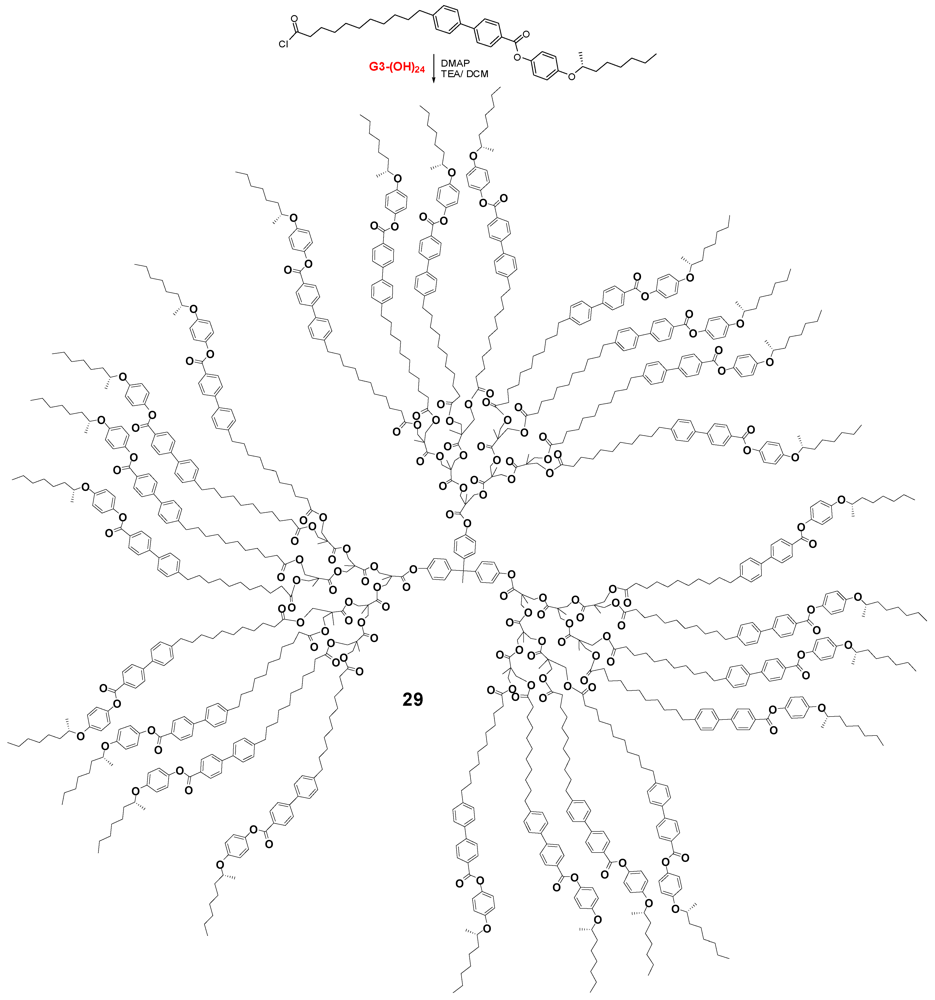
        <p>When conventional mesogenic groups in linear crystalline polymers (LCPs) are replaced by chiral mesogens, ferroelectric liquid crystalline polymers (FLCPs) are obtained [<xref ref-type="bibr" rid="B140-polymers-04-00794">140</xref>,<xref ref-type="bibr" rid="B141-polymers-04-00794">141</xref>,<xref ref-type="bibr" rid="B142-polymers-04-00794">142</xref>]. FLCPs are regarded as important species for optical switching and electrooptical applications [<xref ref-type="bibr" rid="B143-polymers-04-00794">143</xref>,<xref ref-type="bibr" rid="B144-polymers-04-00794">144</xref>]. Because of chain entanglements however, their viscosity is often high which leads to slow switching thereby narrowing the field of their potential practical applications. Knowing that using dendritic structures may result in monodisperse FLCPs and therefore low viscosity and less chain entanglements, Busson <italic>et al.</italic> synthesized and characterized the first ferroelectric dendritic liquid crystalline polymer (FDLCP). In this work [<xref ref-type="bibr" rid="B145-polymers-04-00794">145</xref>], a third generation aliphatic polyester dendrimer, bearing 24 hydroxyl groups on its surface, was functionalized using a ferroelectric mesogen. The mesogenic group, 4"-((<italic>R</italic>)-1-methylheptyloxy)phenyl 4-(4’-(10-(hydroxycarbonyl)decyloxy)-phenyl)benzoate, responsible for realization of the liquid crystalline state, was coupled to the dendritic matrix via an acid chloride reaction as shown in <xref ref-type="scheme" rid="polymers-04-00794-f018">Scheme 16</xref>. The purity and hence the monodispersity of the final compound was established using <sup>1</sup>H NMR spectroscopy and size exclusion chromatography (SEC) measurements. </p>
        
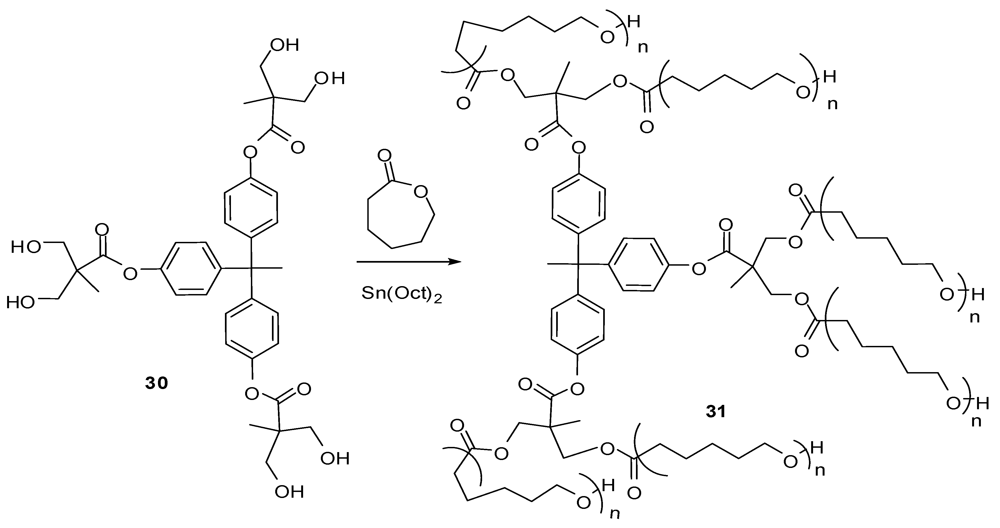
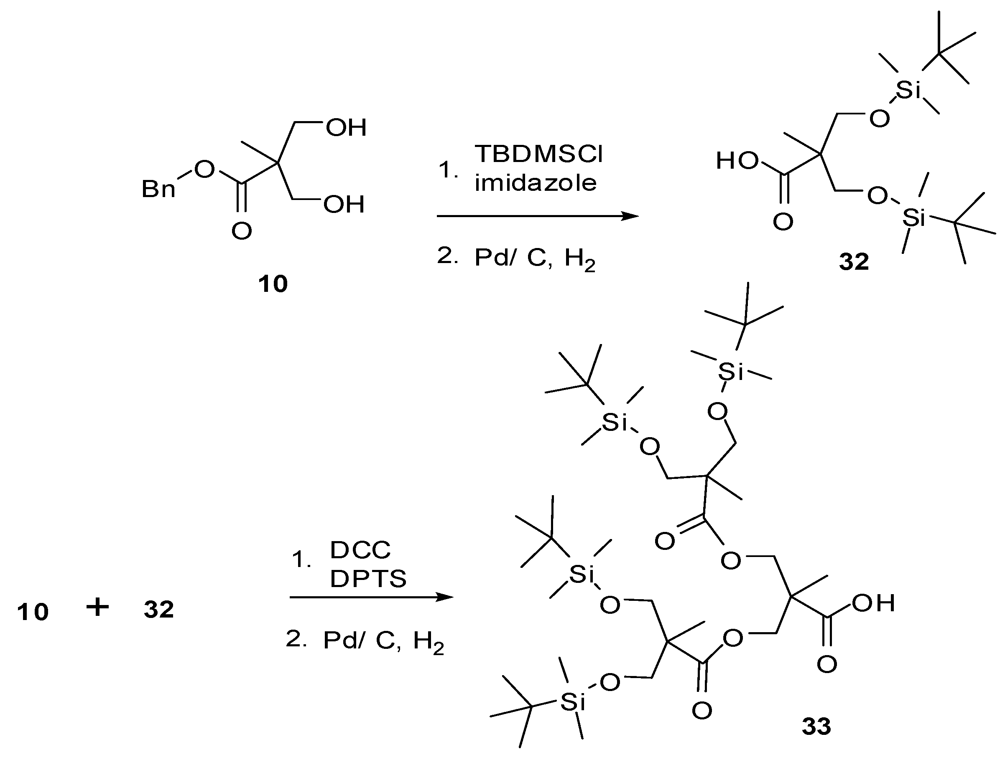
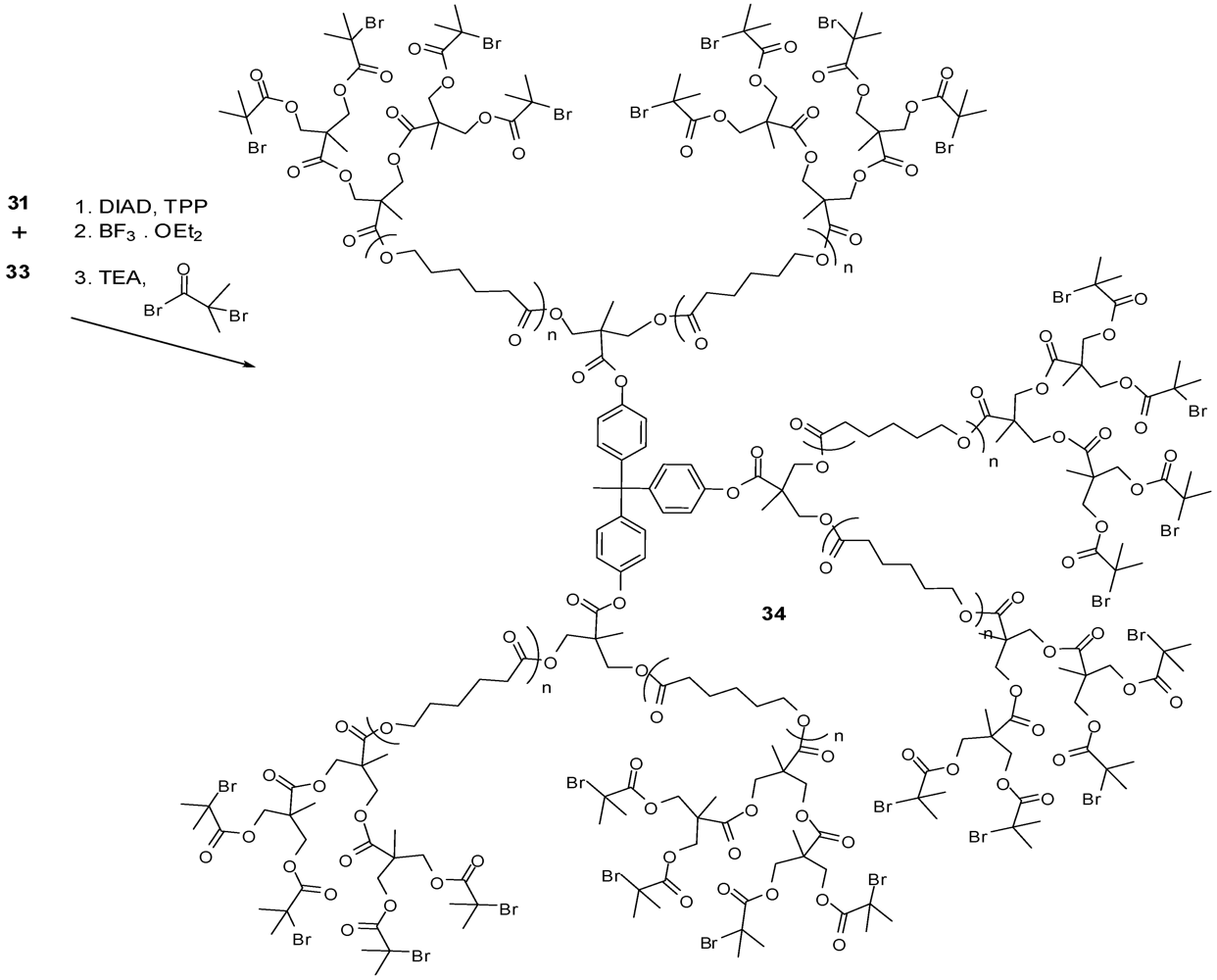
        <p>In 1998, another new type of polyester dendrimer was prepared using a novel approach [<xref ref-type="bibr" rid="B146-polymers-04-00794">146</xref>]. The goal here was to extend the possibilities of dual living polymerizations (either consecutive or concurrent) to encompass new and complex molecular architectures, ultimately leading to structures that may mimic unimolecular polymeric micelles. The type of dendrimers reported in this paper, denoted as dendrimer-like star block copolymers, are described by a radial geometry where the different generations or layers are comprised of high molecular weight polymer emanating from a central core. For their synthesis, 1,1,1-tris(<italic>p</italic>-hydroxyphenyl)ethane (<bold>9</bold>) and <bold>1</bold> were reacted to produce a hexahydroxyl-terminated first generation dendrimer (<bold>30</bold>) which became the functional initiator for the “living” ring opening polymerization (ROP) of <italic>ε</italic>-caprolactone producing a hydroxyl terminated six-arm star polymer with controlled molecular weight (<bold>31</bold>) as shown in <xref ref-type="scheme" rid="polymers-04-00794-f019">Scheme 17</xref>. The arms ends were then capped with dendrons containing activated bromide moieties to furnish “macro-initiators” for atom transfer radical polymerization (ATRP) [<xref ref-type="bibr" rid="B147-polymers-04-00794">147</xref>,<xref ref-type="bibr" rid="B148-polymers-04-00794">148</xref>]. <xref ref-type="scheme" rid="polymers-04-00794-f020">Scheme 18</xref> and <xref ref-type="scheme" rid="polymers-04-00794-f021">Scheme 19</xref> illustrate the synthesis of one of the “micro-initiators”. Methyl methacrylate was polymerized from these macro-initiators in the presence of an organometallic promoter to produce dendrimer-like star polymers with high molecular weights and low polydispersity (&lt;1.2). In addition, amphiphilic character could be introduced by designing different generations as either hydrophobic or hydrophilic. </p>
        <fig id="polymers-04-00794-f018" position="anchor">
          <object-id pub-id-type="pii">polymers-04-00794-scheme16_Scheme 16</object-id>
          <label>Scheme 16</label>
          <caption>
            <p>Synthesis of the first ferroelectric dendritic liquid crystalline polymer [<xref ref-type="bibr" rid="B145-polymers-04-00794">145</xref>].</p>
          </caption>
          <graphic xmlns:xlink="http://www.w3.org/1999/xlink" xlink:href="polymers-04-00794-g018.tif"/>
        </fig>
        <fig id="polymers-04-00794-f019" position="anchor">
          <object-id pub-id-type="pii">polymers-04-00794-scheme17_Scheme 17</object-id>
          <label>Scheme 17</label>
          <caption>
            <p>Ring opening polymerization of <italic>ε</italic>-caprolactone [<xref ref-type="bibr" rid="B146-polymers-04-00794">146</xref>].</p>
          </caption>
          <graphic xmlns:xlink="http://www.w3.org/1999/xlink" xlink:href="polymers-04-00794-g019.tif"/>
        </fig>
        <fig id="polymers-04-00794-f020" position="anchor">
          <object-id pub-id-type="pii">polymers-04-00794-scheme18_Scheme 18</object-id>
          <label>Scheme 18</label>
          <caption>
            <p>Convergent synthesis of the AB<sub>4</sub> dendron [<xref ref-type="bibr" rid="B146-polymers-04-00794">146</xref>]. </p>
          </caption>
          <graphic xmlns:xlink="http://www.w3.org/1999/xlink" xlink:href="polymers-04-00794-g020.tif"/>
        </fig>
        
        <p>While exploring various routes to dendrimers, Annby <italic>et al.</italic> demonstrated that benzylidene-protected bis-HMPA (<bold>14</bold>) was a versatile reagent for the formation of polyester dendrimers [<xref ref-type="bibr" rid="B149-polymers-04-00794">149</xref>]. Polyester dendrimers were prepared up to the fourth generation using even sterically congested cores like pentaerythritol in good yields using DMAP and DCC to promote ester formation. Since then, a number of research groups have utilized the benzylidene-protected bis-HMPA as a convenient building block [<xref ref-type="bibr" rid="B127-polymers-04-00794">127</xref>,<xref ref-type="bibr" rid="B129-polymers-04-00794">129</xref>,<xref ref-type="bibr" rid="B130-polymers-04-00794">130</xref>,<xref ref-type="bibr" rid="B146-polymers-04-00794">146</xref>,<xref ref-type="bibr" rid="B150-polymers-04-00794">150</xref>,<xref ref-type="bibr" rid="B151-polymers-04-00794">151</xref>,<xref ref-type="bibr" rid="B152-polymers-04-00794">152</xref>,<xref ref-type="bibr" rid="B153-polymers-04-00794">153</xref>]. </p>
        <fig id="polymers-04-00794-f021" position="anchor">
          <object-id pub-id-type="pii">polymers-04-00794-scheme19_Scheme 19</object-id>
          <label>Scheme 19</label>
          <caption>
            <p>Synthesis of a dendritic macro-initiator for atom transfer radical polymerization [<xref ref-type="bibr" rid="B146-polymers-04-00794">146</xref>].</p>
          </caption>
          <graphic xmlns:xlink="http://www.w3.org/1999/xlink" xlink:href="polymers-04-00794-g021.tif"/>
        </fig>
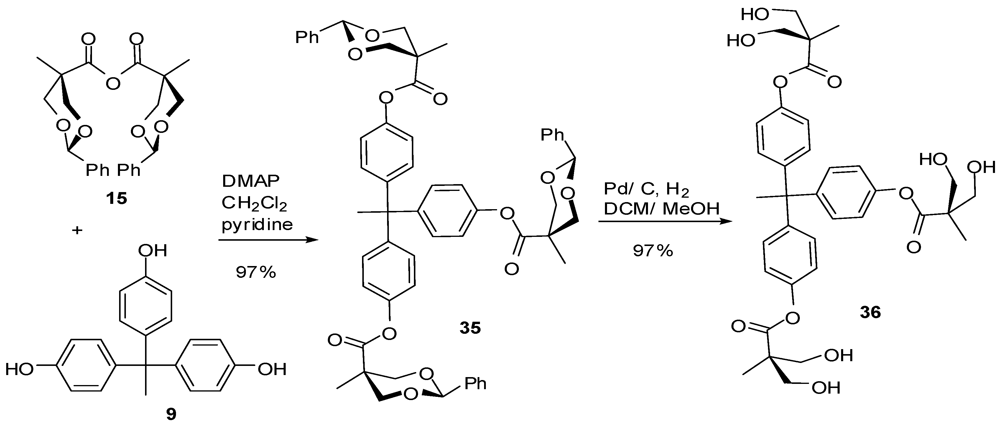
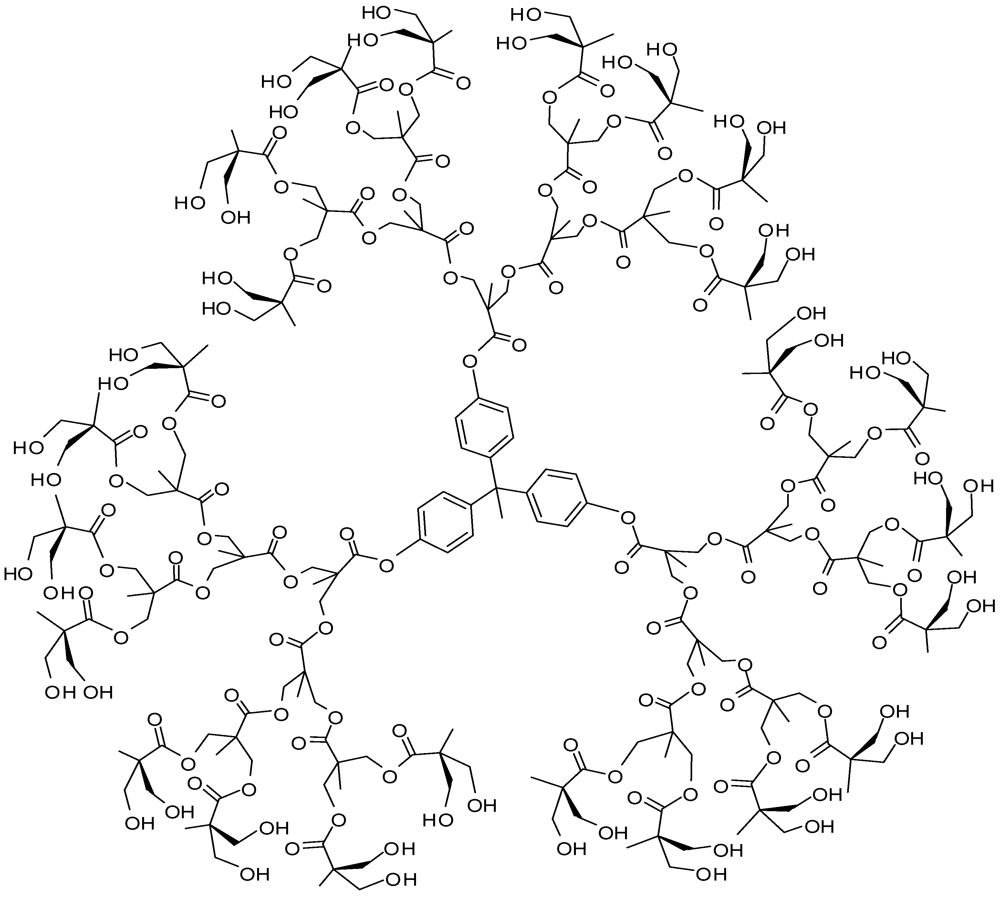
        <p>A significant advance in dendrimer synthesis using <bold>1</bold> occurred when it was discovered that the anhydride of <bold>14</bold> (<bold>15</bold>) could be formed readily by dehydration of the carboxylic acid using DCC [<xref ref-type="bibr" rid="B127-polymers-04-00794">127</xref>]. Its preparation and utilization in the formation of a first generation dendrimer using 1,1,1-tris(<italic>p</italic>-hydroxyphenyl)ethane (<bold>9</bold>) as the core is shown in <xref ref-type="scheme" rid="polymers-04-00794-f022">Scheme 20</xref> [<xref ref-type="bibr" rid="B127-polymers-04-00794">127</xref>]. Repetition of the ester formation and deprotection steps gave up to the sixth generation dendrimer in good yield using this divergent approach (<xref ref-type="fig" rid="polymers-04-00794-f023">Figure 3</xref>) [<xref ref-type="bibr" rid="B127-polymers-04-00794">127</xref>]. In the divergent approach, structural uniformity is usually difficult to maintain, because the number of reactions that must be completed at each step of growth increases exponentially, thus requiring large excesses of reagents. The anhydride method however, unlike others, required only a small excess of reagent to achieve quantitative growth, and only simple solvent extraction or precipitation was sufficient purification to obtain monodisperse dendritic structures up to the sixth generation. The amount of anhydride used was only 1.25 equiv per hydroxyl group. Further evidence of the effectiveness of this route was obtained by Parrott <italic>et al.</italic> who prepared up to eighth generation dendrons using this method achieving yields of &gt;90% at every stage without altering reaction conditions [<xref ref-type="bibr" rid="B129-polymers-04-00794">129</xref>]. </p>
        <fig id="polymers-04-00794-f022" position="anchor">
          <object-id pub-id-type="pii">polymers-04-00794-scheme20_Scheme 20</object-id>
          <label>Scheme 20</label>
          <caption>
            <p>Preparation of first generation dendrimers using benzylidene-protected <bold>1</bold> (<bold>14</bold>) [<xref ref-type="bibr" rid="B127-polymers-04-00794">127</xref>].</p>
          </caption>
          <graphic xmlns:xlink="http://www.w3.org/1999/xlink" xlink:href="polymers-04-00794-g022.tif"/>
        </fig>
        <fig id="polymers-04-00794-f023" position="anchor">
          <label>Figure 3</label>
          <caption>
            <p>Hydroxyl-terminated fourth generation polyester dendrimer [<xref ref-type="bibr" rid="B127-polymers-04-00794">127</xref>].</p>
          </caption>
          <graphic xmlns:xlink="http://www.w3.org/1999/xlink" xlink:href="polymers-04-00794-g023.tif"/>
        </fig>
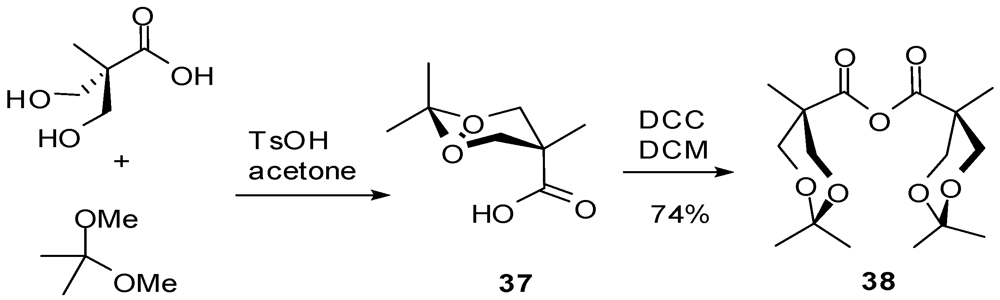
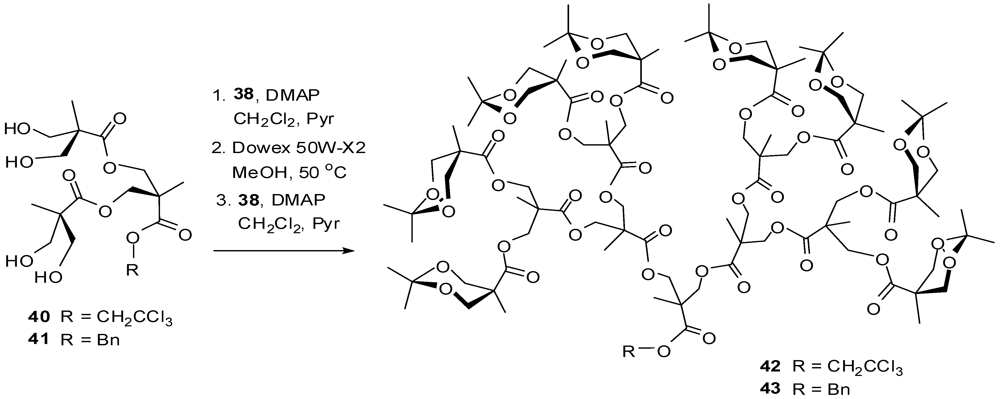
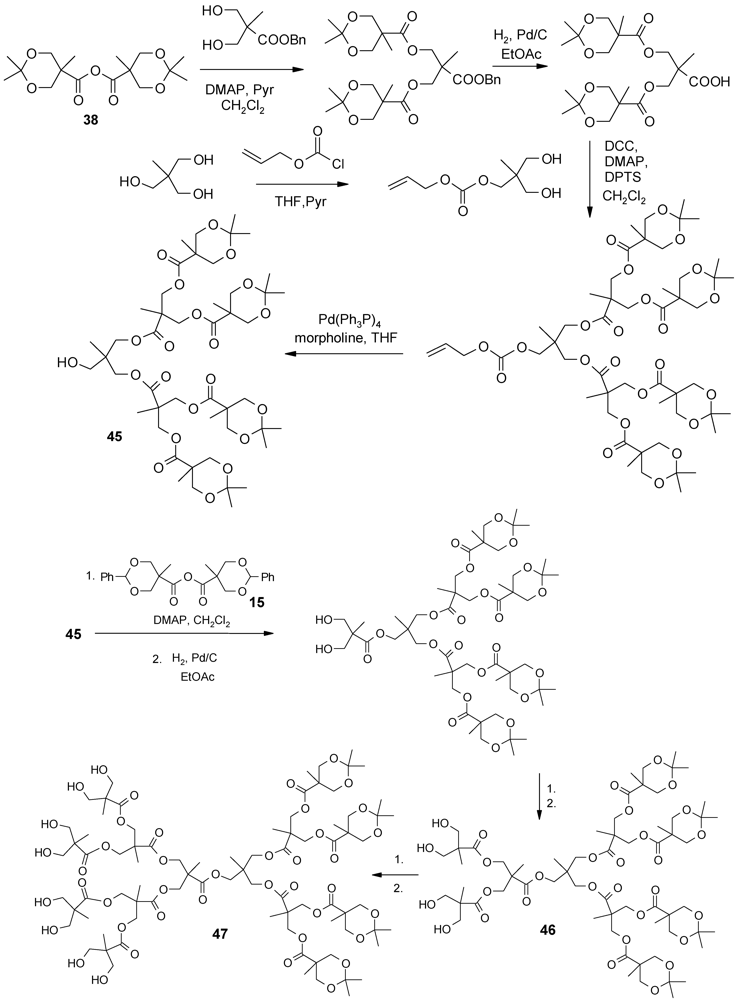
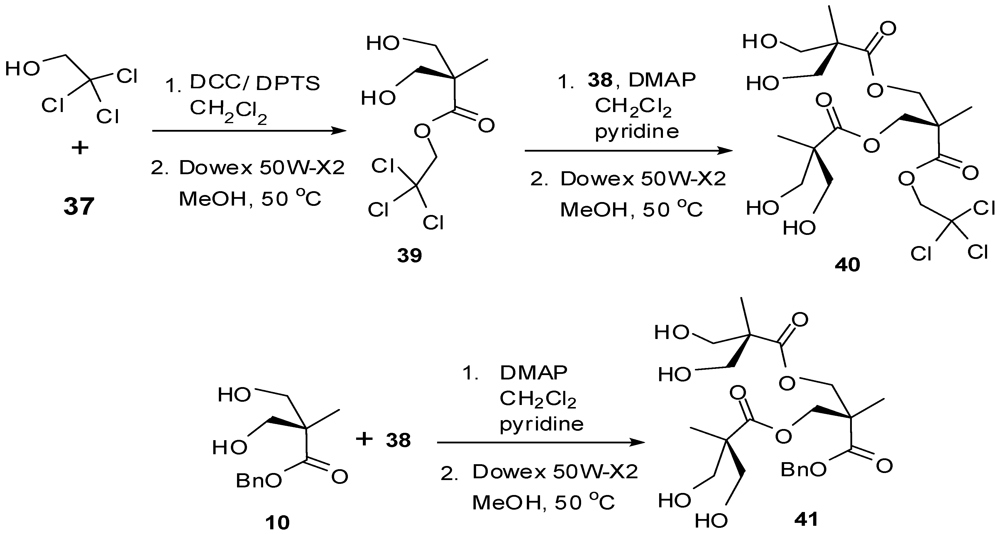
        <p>In efforts to establish a large library comprised of dendritic compounds based on bis-HMPA, Malkoch <italic>et al.</italic> made use of the efficiency of the above anhydride chemistry [<xref ref-type="bibr" rid="B128-polymers-04-00794">128</xref>]. To complement the benzylidene-protected anhydride esterification strategy reported by Fréchet and coworkers [<xref ref-type="bibr" rid="B127-polymers-04-00794">127</xref>], acetonide-protected bis-HMPA anhydride was introduced to combine anhydride chemistry with the use of a benzyl and 2,2,2-trichloroethyl ester-protected focal points (see <xref ref-type="scheme" rid="polymers-04-00794-f024">Scheme 21</xref> and <xref ref-type="scheme" rid="polymers-04-00794-f025">Scheme 22</xref>) [<xref ref-type="bibr" rid="B128-polymers-04-00794">128</xref>]. In the same year, Gillies and Fréchet described the use of the acetonide-protected bis-HMPA anhydride in their synthesis of “bow-tie dendrimers” (see below) [<xref ref-type="bibr" rid="B154-polymers-04-00794">154</xref>]. </p>
        <fig id="polymers-04-00794-f024" position="anchor">
          <object-id pub-id-type="pii">polymers-04-00794-scheme21_Scheme 21</object-id>
          <label>Scheme 21</label>
          <caption>
            <p>Preparation of the acetonide-protected bis-HMPA anhydride [<xref ref-type="bibr" rid="B128-polymers-04-00794">128</xref>].</p>
          </caption>
          <graphic xmlns:xlink="http://www.w3.org/1999/xlink" xlink:href="polymers-04-00794-g024.tif"/>
        </fig>
        <fig id="polymers-04-00794-f025" position="anchor">
          <object-id pub-id-type="pii">polymers-04-00794-scheme22_Scheme 22</object-id>
          <label>Scheme 22</label>
          <caption>
            <p>Preparation of 2,2,2-tris(chloroethyl) ester and benzyl ester protected dendrons [<xref ref-type="bibr" rid="B128-polymers-04-00794">128</xref>].</p>
          </caption>
          <graphic xmlns:xlink="http://www.w3.org/1999/xlink" xlink:href="polymers-04-00794-g025.tif"/>
        </fig>
        <fig id="polymers-04-00794-f026" position="anchor">
          <object-id pub-id-type="pii">polymers-04-00794-scheme23_Scheme 23</object-id>
          <label>Scheme 23</label>
          <caption>
            <p>Preparation of protected fourth generation dendrons [<xref ref-type="bibr" rid="B128-polymers-04-00794">128</xref>].</p>
          </caption>
          <graphic xmlns:xlink="http://www.w3.org/1999/xlink" xlink:href="polymers-04-00794-g026.tif"/>
        </fig>
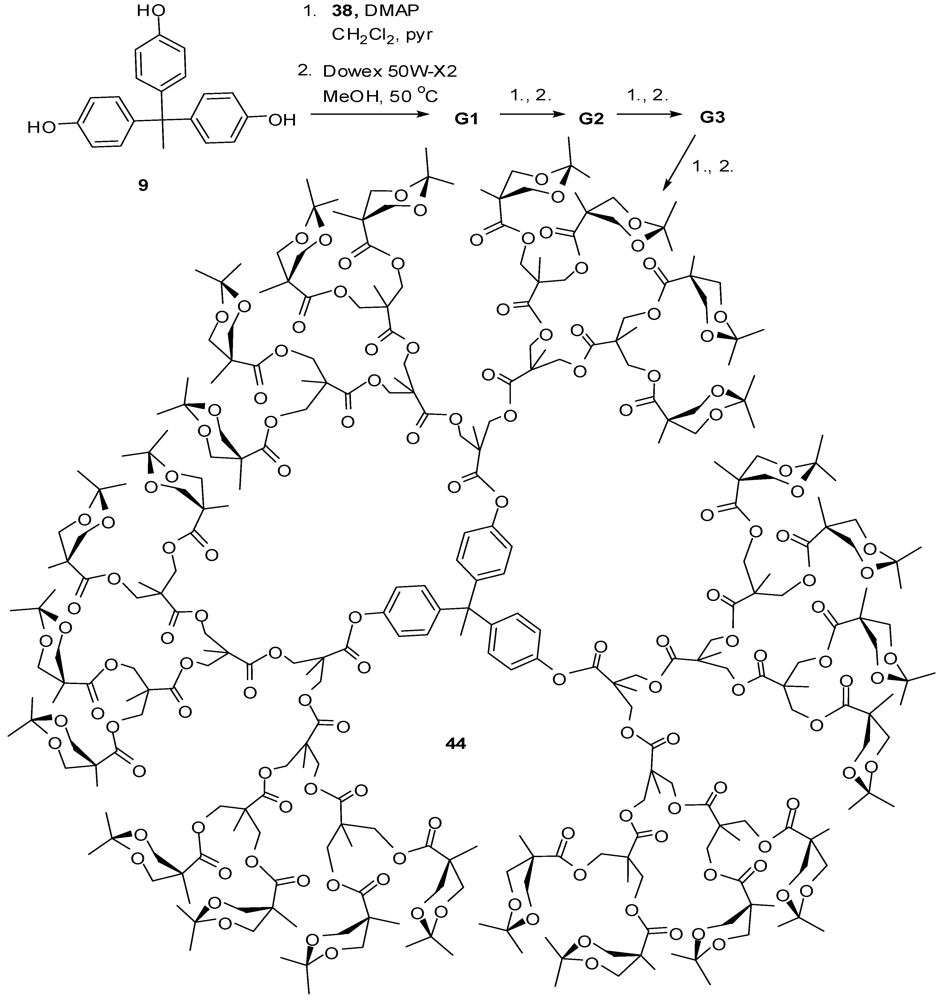
        <p>Three different monodisperse fourth generation acetonide-protected dendrons based on 2,2,2-tris(chloroethyl) ester <bold>47</bold> and benzyl ester <bold>48</bold> as focal points were divergently synthesized in high yields (<xref ref-type="scheme" rid="polymers-04-00794-f026">Scheme 23</xref>) [<xref ref-type="bibr" rid="B128-polymers-04-00794">128</xref>]. In order to demonstrate the versatility of the anhydride chemistry, a fourth generation acetonide-protected polyester dendrimer <bold>52</bold> was also divergently constructed as illustrated in <xref ref-type="scheme" rid="polymers-04-00794-f027">Scheme 24</xref> [<xref ref-type="bibr" rid="B128-polymers-04-00794">128</xref>].</p>
        
        
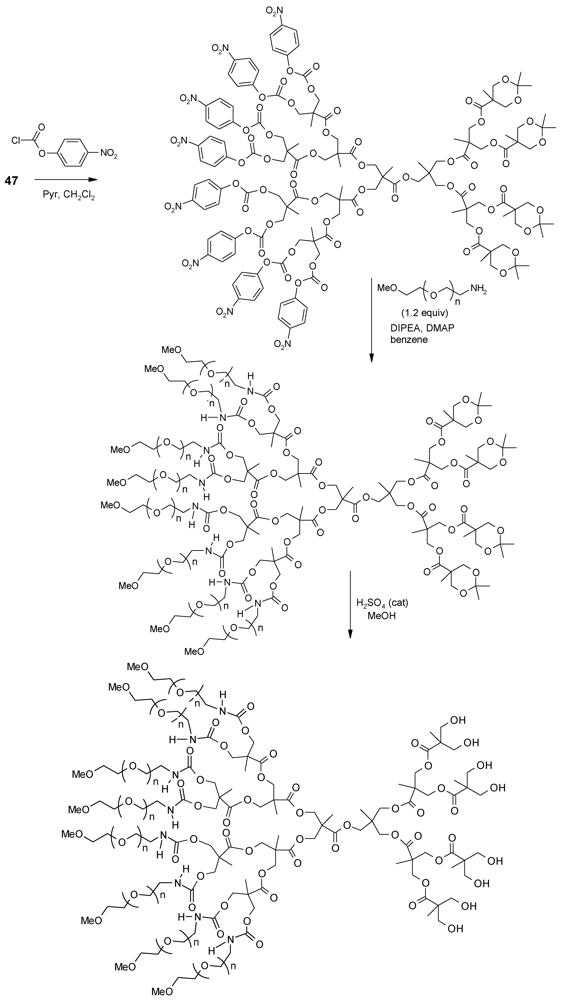
        <p>Gillies and Fréchet described dendrimers with two dendrons orthogonally protected and covalently attached as “bow-tie” dendrons and synthesized the first examples using acetonide-protected bis-HMPA anhydride for synthesis of one-half of the growing dendrimer and benzylidene-protected bis-HMPA for synthesis of the other half (<xref ref-type="scheme" rid="polymers-04-00794-f028">Scheme 25</xref>) [<xref ref-type="bibr" rid="B154-polymers-04-00794">154</xref>]. These authors then attached amine functionalized polyethylene oxide (PEO-NH<sub>2</sub>) to the deprotected half of the dendrimer via reaction with p-nitrophenylcarbonates to form carbamate linkages and cleaved the protecting acetonides to create potential water soluble drug carriers (<xref ref-type="scheme" rid="polymers-04-00794-f029">Scheme 26</xref>) [<xref ref-type="bibr" rid="B154-polymers-04-00794">154</xref>]. Reaction of four PEO-NH<sub>2</sub> samples with molecular weights of 5 to 20 kDa with p-nitrophenylcarbonates derived from <bold>45</bold> and <bold>46</bold> yielded a library of eight compounds with molecular weights of 22 to ~150 kDa [<xref ref-type="bibr" rid="B154-polymers-04-00794">154</xref>].</p>
        <fig id="polymers-04-00794-f027" position="anchor">
          <object-id pub-id-type="pii">polymers-04-00794-scheme24_Scheme 24</object-id>
          <label>Scheme 24</label>
          <caption>
            <p>Divergently-grown acetonide-protected fourth generation dendrimer [<xref ref-type="bibr" rid="B128-polymers-04-00794">128</xref>].</p>
          </caption>
          <graphic xmlns:xlink="http://www.w3.org/1999/xlink" xlink:href="polymers-04-00794-g027.tif"/>
        </fig>
        <fig id="polymers-04-00794-f028" position="anchor">
          <object-id pub-id-type="pii">polymers-04-00794-scheme25_Scheme 25</object-id>
          <label>Scheme 25</label>
          <caption>
            <p>Synthesis of “bow-tie” dendrimers [<xref ref-type="bibr" rid="B154-polymers-04-00794">154</xref>].</p>
          </caption>
          <graphic xmlns:xlink="http://www.w3.org/1999/xlink" xlink:href="polymers-04-00794-g028.tif"/>
        </fig>
        <fig id="polymers-04-00794-f029" position="anchor">
          <object-id pub-id-type="pii">polymers-04-00794-scheme26_Scheme 26</object-id>
          <label>Scheme 26</label>
          <caption>
            <p>Addition of PEG chains to “bow-tie” dendrimers [<xref ref-type="bibr" rid="B154-polymers-04-00794">154</xref>].</p>
          </caption>
          <graphic xmlns:xlink="http://www.w3.org/1999/xlink" xlink:href="polymers-04-00794-g029.tif"/>
        </fig>
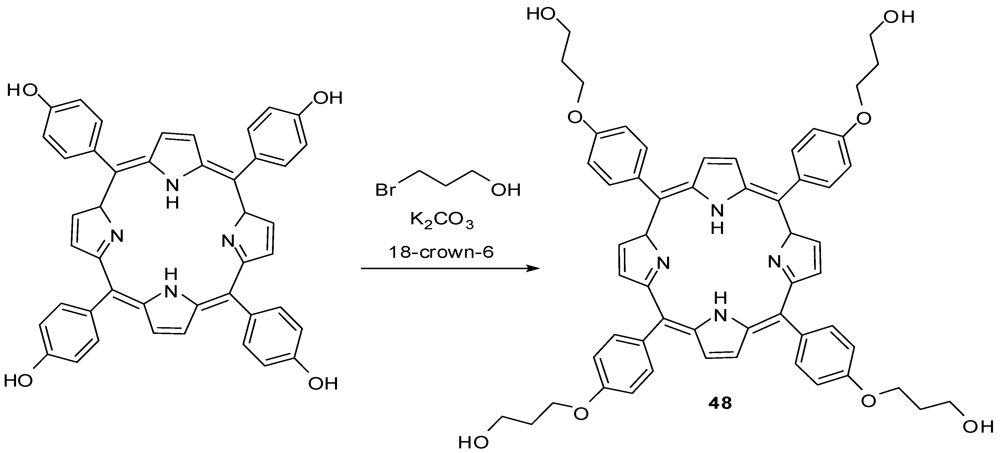
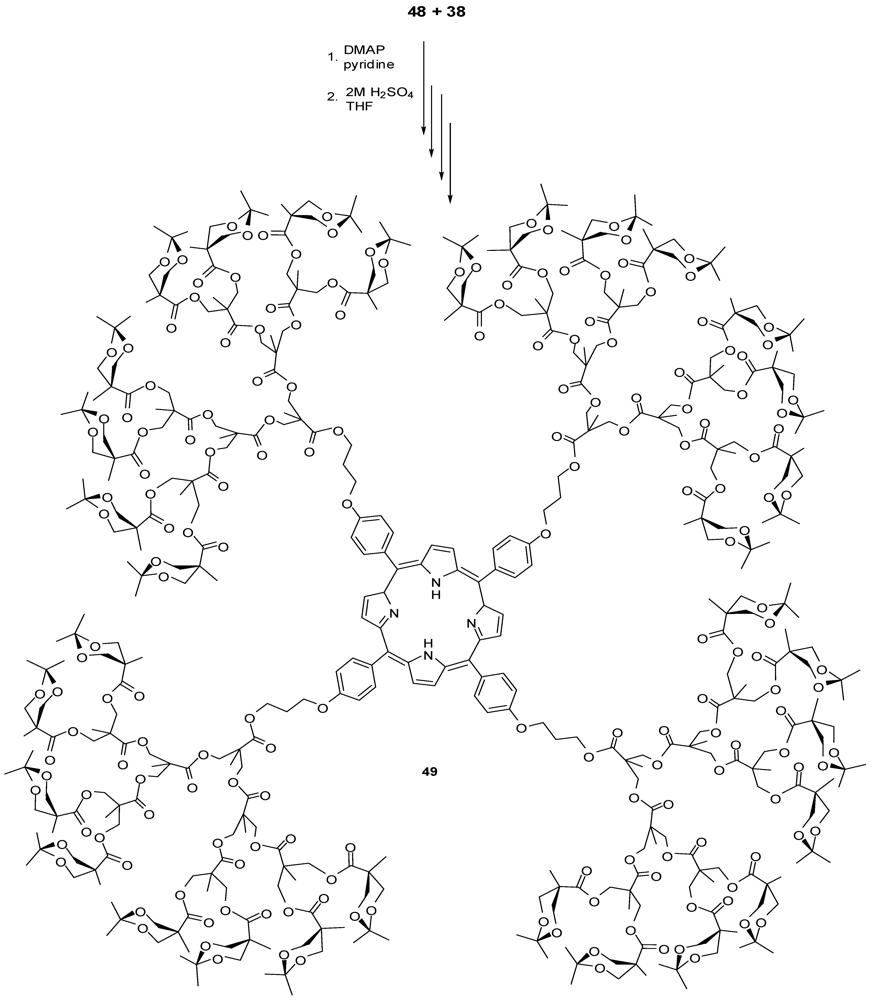
        <p>Two years later, Malmström, Hult and coworkers reported the synthesis and characterization of dendron-coated porphyrins up to the fifth generation [<xref ref-type="bibr" rid="B155-polymers-04-00794">155</xref>]. Here, both free base and zinc-cored tetraphenylporphyrin (TPPH<sub>2</sub> and TPPZn) were used, from which the dendrons were divergently grown using <bold>38</bold>. Porphyrins were selected as core molecules because of their potential applications in many areas [<xref ref-type="bibr" rid="B156-polymers-04-00794">156</xref>,<xref ref-type="bibr" rid="B157-polymers-04-00794">157</xref>,<xref ref-type="bibr" rid="B158-polymers-04-00794">158</xref>,<xref ref-type="bibr" rid="B159-polymers-04-00794">159</xref>]. Reports dealing with porphyrins decorated with dendrimers had previously appeared [<xref ref-type="bibr" rid="B112-polymers-04-00794">112</xref>,<xref ref-type="bibr" rid="B160-polymers-04-00794">160</xref>,<xref ref-type="bibr" rid="B161-polymers-04-00794">161</xref>,<xref ref-type="bibr" rid="B162-polymers-04-00794">162</xref>,<xref ref-type="bibr" rid="B163-polymers-04-00794">163</xref>,<xref ref-type="bibr" rid="B164-polymers-04-00794">164</xref>,<xref ref-type="bibr" rid="B165-polymers-04-00794">165</xref>,<xref ref-type="bibr" rid="B166-polymers-04-00794">166</xref>,<xref ref-type="bibr" rid="B167-polymers-04-00794">167</xref>,<xref ref-type="bibr" rid="B168-polymers-04-00794">168</xref>]. After investigating three different synthetic strategies for this study, it was concluded that a spacer was required to be attached to the porphyrin to increase the hydrolytic stability and allow synthesis of higher generations. Normally, acidic DOWEX-50-X2 resin is used for the deprotection of the acetonide groups, but here the porphyrin core attached irreversibly to the DOWEX-50-X2 resin. A number of various dilute acids were explored for this deprotection but the results from these acidic deprotections showed that the porphyrin phenolic ester linkage also hydrolyzes, hence the need for a spacer. The spacer was added through the reaction of the porphyrin with 1,3-bromopropanol to afford <bold>48</bold> (<xref ref-type="scheme" rid="polymers-04-00794-f030">Scheme 27</xref>). The dendrimers were then grown by subsequent addition of acetonide-protected bis-HMPA followed by deprotection with 2M H<sub>2</sub>SO<sub>4</sub> in tetrahydrofuran. The preparation of a fourth generation free base porphyrin-cored polyester dendrimer of this type is shown in <xref ref-type="scheme" rid="polymers-04-00794-f031">Scheme 28</xref>.</p>
        <fig id="polymers-04-00794-f030" position="anchor">
          <object-id pub-id-type="pii">polymers-04-00794-scheme27_Scheme 27</object-id>
          <label>Scheme 27</label>
          <caption>
            <p>Spacer addition to the porphyrin core [<xref ref-type="bibr" rid="B155-polymers-04-00794">155</xref>].</p>
          </caption>
          <graphic xmlns:xlink="http://www.w3.org/1999/xlink" xlink:href="polymers-04-00794-g030.tif"/>
        </fig>
        
        <p>Dendritic species based on bis-HMPA containing carboranes were reported by both Adronov [<xref ref-type="bibr" rid="B153-polymers-04-00794">153</xref>] and Zharov [<xref ref-type="bibr" rid="B169-polymers-04-00794">169</xref>]. These compounds are of interest because of their potential use for boron neutron capture therapy in the treatment of diseases such as cancer. </p>
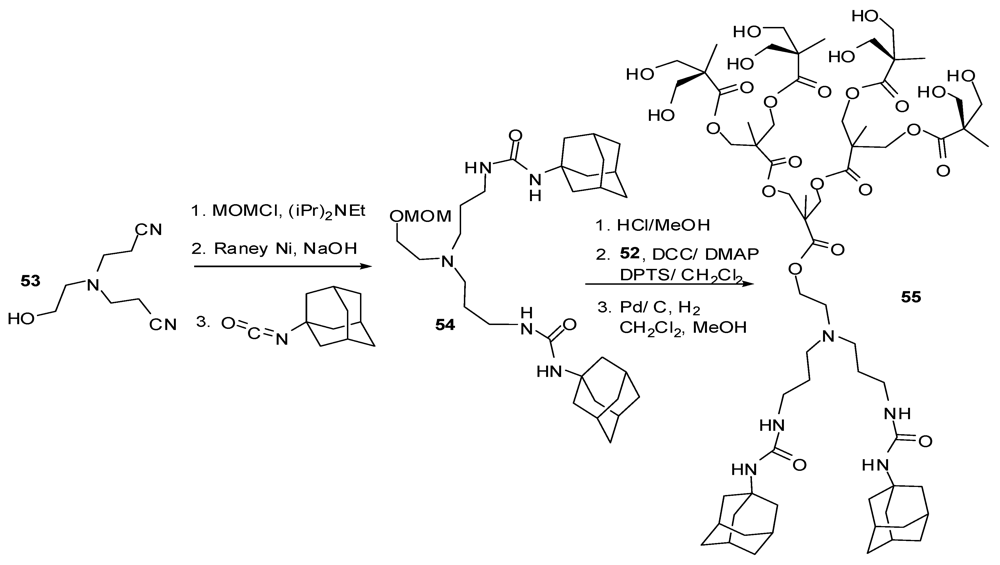
        <p>The noncovalent synthesis of polyester dendritic bow-ties based on anhydrides <bold>15</bold> and <bold>38</bold> using the complementary bis-(adamantylurea)-glycinylurea system [<xref ref-type="bibr" rid="B170-polymers-04-00794">170</xref>,<xref ref-type="bibr" rid="B171-polymers-04-00794">171</xref>] at the focal point of the bow-tie was reported by Gillies and Fréchet (<xref ref-type="scheme" rid="polymers-04-00794-f032">Scheme 29</xref> and <xref ref-type="scheme" rid="polymers-04-00794-f033">Scheme 30</xref>) [<xref ref-type="bibr" rid="B172-polymers-04-00794">172</xref>]. The system allows the possibility of bringing together two orthogonally functionalized dendrons since it is not self-complementary. Self-assembled polyester dendritic bow-ties with various peripheral groups were prepared, and their association constants were measured by <sup>1</sup>H NMR spectroscopy in CDCl<sub>3</sub>. </p>
        <fig id="polymers-04-00794-f031" position="anchor">
          <object-id pub-id-type="pii">polymers-04-00794-scheme28_Scheme 28</object-id>
          <label>Scheme 28</label>
          <caption>
            <p>Divergent construction of a fourth generation (acetonide-protected) free base porphyrin-cored polyester dendrimer [<xref ref-type="bibr" rid="B155-polymers-04-00794">155</xref>].</p>
          </caption>
          <graphic xmlns:xlink="http://www.w3.org/1999/xlink" xlink:href="polymers-04-00794-g031.tif"/>
        </fig>
        <fig id="polymers-04-00794-f032" position="anchor">
          <object-id pub-id-type="pii">polymers-04-00794-scheme29_Scheme 29</object-id>
          <label>Scheme 29</label>
          <caption>
            <p>Divergent growth of a third generation dendron [<xref ref-type="bibr" rid="B172-polymers-04-00794">172</xref>].</p>
          </caption>
          <graphic xmlns:xlink="http://www.w3.org/1999/xlink" xlink:href="polymers-04-00794-g032.tif"/>
        </fig>
        <fig id="polymers-04-00794-f033" position="anchor">
          <object-id pub-id-type="pii">polymers-04-00794-scheme30_Scheme 30</object-id>
          <label>Scheme 30</label>
          <caption>
            <p>Preparation of a bow-tie polyester dendron <bold>55</bold> [<xref ref-type="bibr" rid="B172-polymers-04-00794">172</xref>].</p>
          </caption>
          <graphic xmlns:xlink="http://www.w3.org/1999/xlink" xlink:href="polymers-04-00794-g033.tif"/>
        </fig>
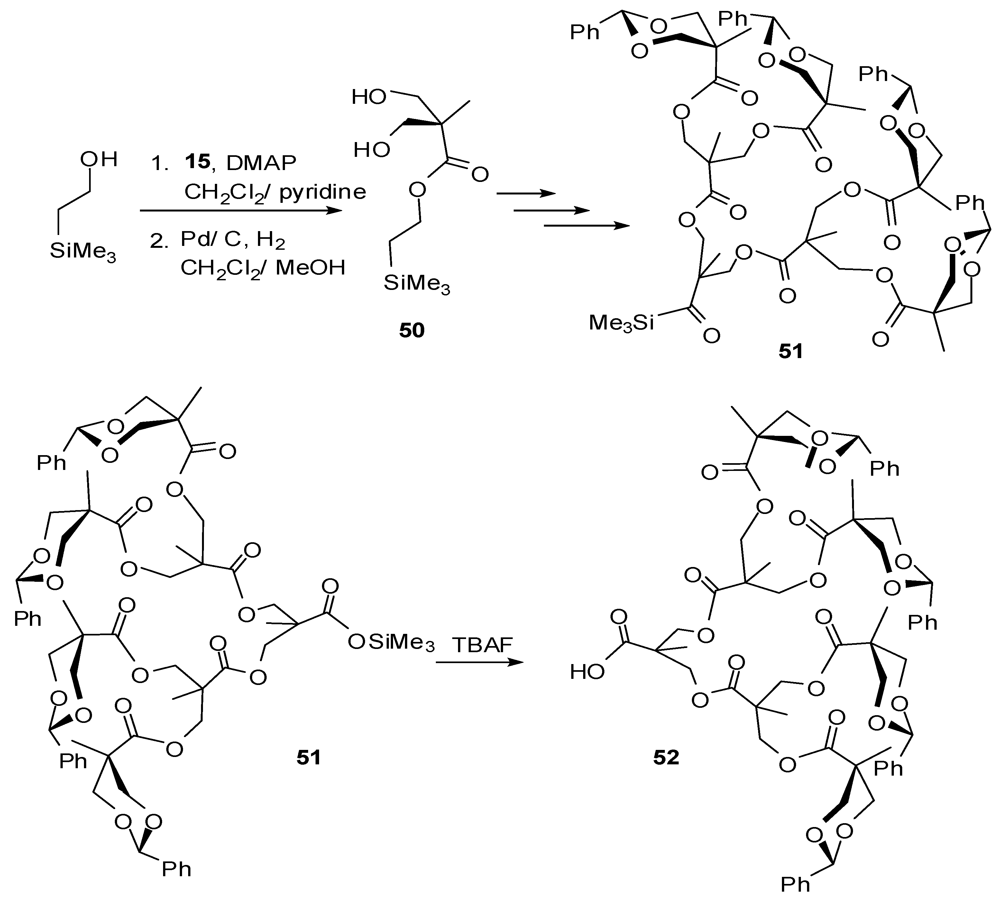
        <p>Initially, a trimethylsilylethyl ester was used as the protecting group for the acid focal point by coupling trimethylsilylethanol with <bold>15</bold>. The removal of the benzylidene acetal protecting group using hydrogenolysis provided <bold>50</bold>. Coupling and deprotection procedures were repeated until dendron 51 was obtained. The trimethylsilylethyl ester protecting group was removed using tetrabutylammonium fluoride (TBAF), yielding acid <bold>52</bold> with four peripheral benzylidene acetals. To synthesize the adamantylurea moiety, the dinitrile <bold>53</bold> [<xref ref-type="bibr" rid="B173-polymers-04-00794">173</xref>] was protected as the MOM ether as shown in <xref ref-type="scheme" rid="polymers-04-00794-f033">Scheme 30</xref>, and then the nitrile groups were reduced to amines using Raney nickel under basic conditions. The amine groups were reacted with adamantyl isocyanate to form bis(adamantylurea) <bold>54</bold>. The MOM protecting group was then removed under acidic conditions and the product was coupled to <bold>52</bold> to provide dendron <bold>55</bold> after deprotection.</p>
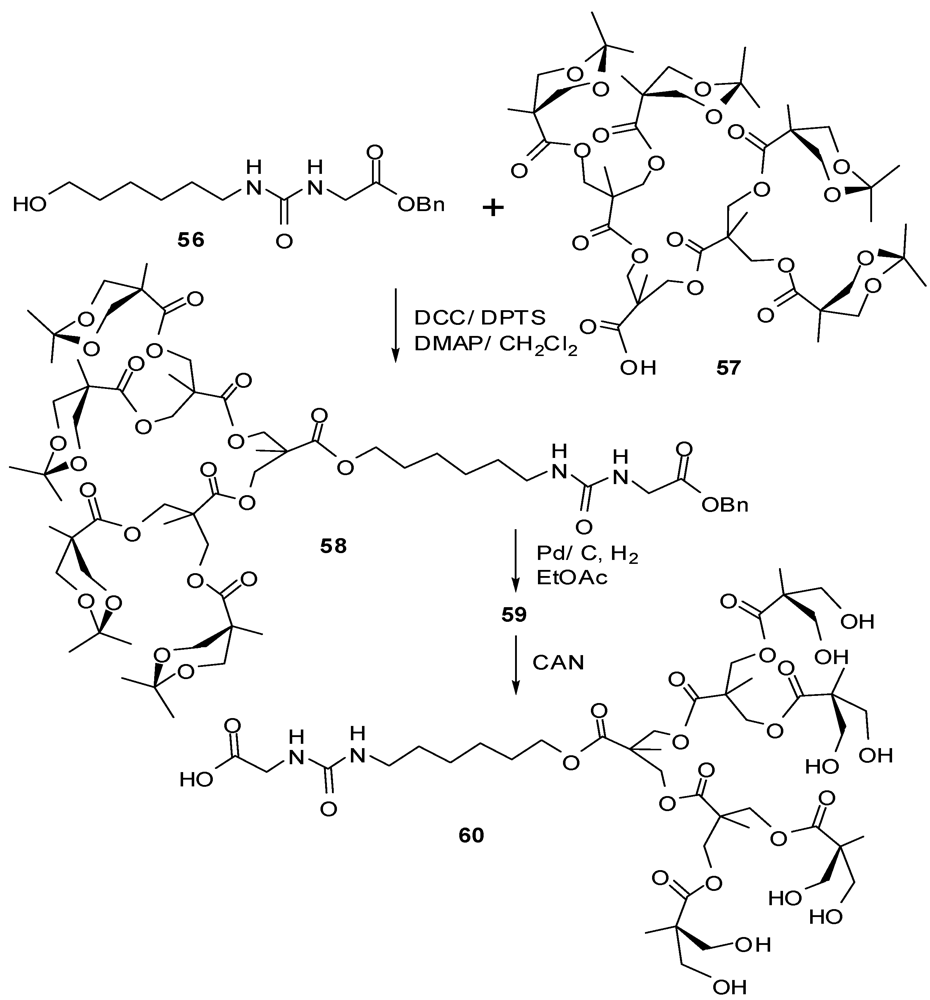
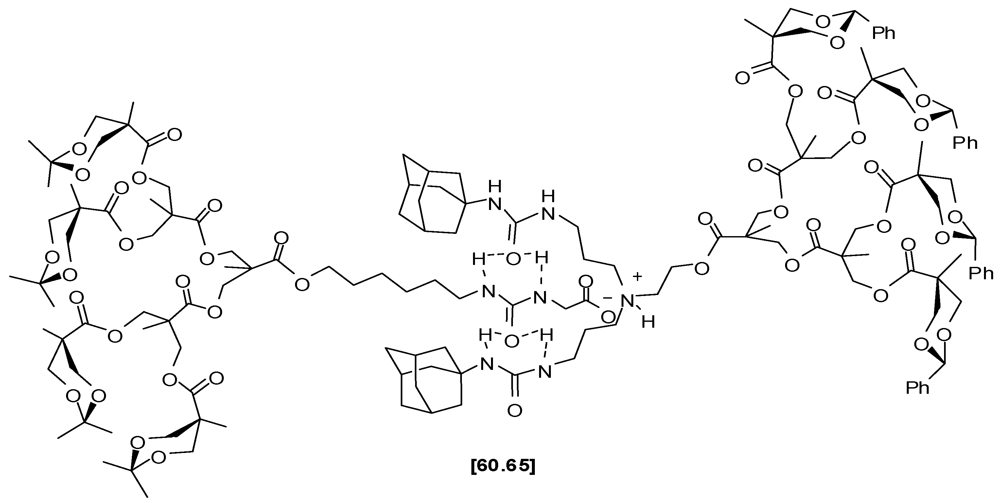
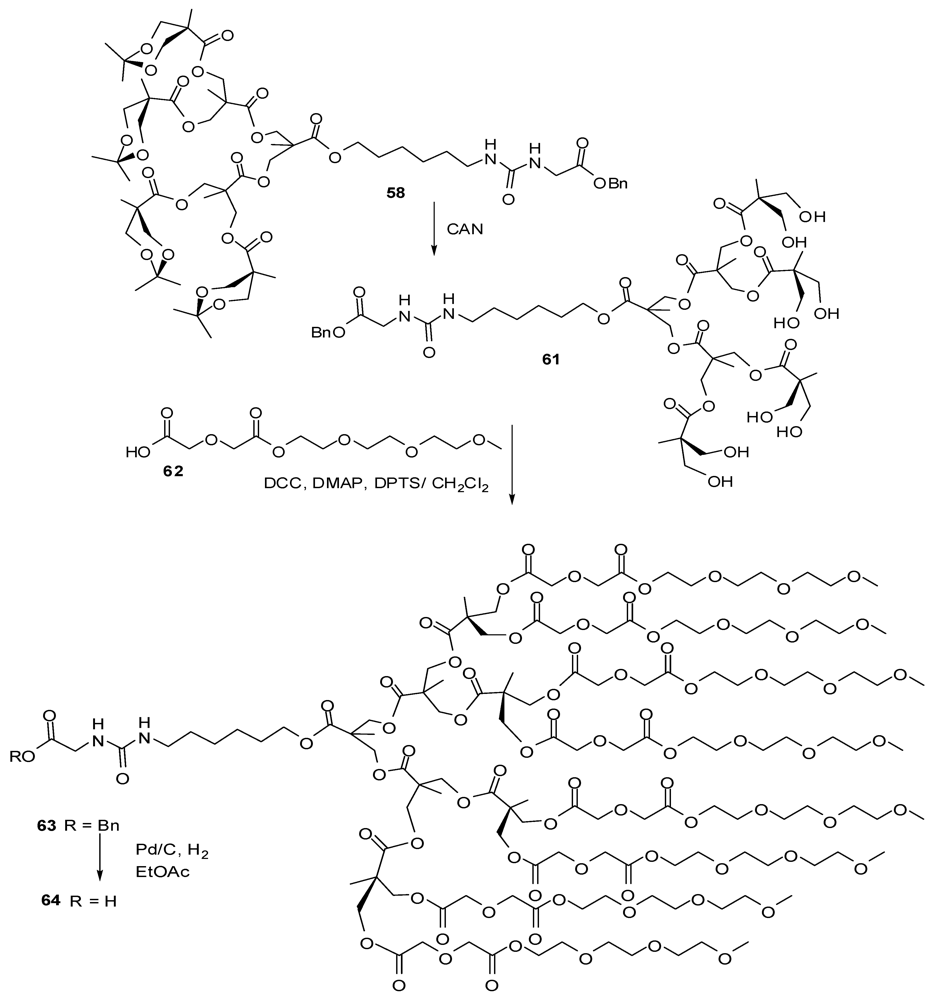
        <p><xref ref-type="scheme" rid="polymers-04-00794-f033">Scheme 30</xref> and <xref ref-type="scheme" rid="polymers-04-00794-f034">Scheme 31</xref> illustrate the chemistry used for further protection of the acid focal point. In addition, oligo(ethylene oxide) units were introduced to the periphery of dendrons such as <bold>61</bold> (<xref ref-type="scheme" rid="polymers-04-00794-f035">Scheme 32</xref> to yield acid <bold>64</bold> after removal of the benzyl ester at the focal point. When equimolar amounts of <bold>60</bold> and the benzylidene-protected version of <bold>55</bold> (<bold>65</bold> not previously drawn) were dissolved in CDCl<sub>3</sub>, the orthogonally-protected parent dendrimer complex [<bold>65</bold> <bold>60</bold>] shown in <xref ref-type="fig" rid="polymers-04-00794-f036">Figure 4</xref> was formed and its structure was confirmed using NMR spectroscopy.</p>
        <fig id="polymers-04-00794-f034" position="anchor">
          <object-id pub-id-type="pii">polymers-04-00794-scheme31_Scheme 31</object-id>
          <label>Scheme 31</label>
          <caption>
            <p>Synthesis of dendron <bold>60</bold> [<xref ref-type="bibr" rid="B172-polymers-04-00794">172</xref>].</p>
          </caption>
          <graphic xmlns:xlink="http://www.w3.org/1999/xlink" xlink:href="polymers-04-00794-g034.tif"/>
        </fig>
        <fig id="polymers-04-00794-f035" position="anchor">
          <object-id pub-id-type="pii">polymers-04-00794-scheme32_Scheme 32</object-id>
          <label>Scheme 32</label>
          <caption>
            <p>Dendron functionalization using oligo(ethylene oxide) units [<xref ref-type="bibr" rid="B172-polymers-04-00794">172</xref>].</p>
          </caption>
          <graphic xmlns:xlink="http://www.w3.org/1999/xlink" xlink:href="polymers-04-00794-g035.tif"/>
        </fig>
        <fig id="polymers-04-00794-f036" position="anchor">
          <label>Figure 4</label>
          <caption>
            <p>Orthogonally-protected parent dendrimer complex [<xref ref-type="bibr" rid="B172-polymers-04-00794">172</xref>].</p>
          </caption>
          <graphic xmlns:xlink="http://www.w3.org/1999/xlink" xlink:href="polymers-04-00794-g036.tif"/>
        </fig>
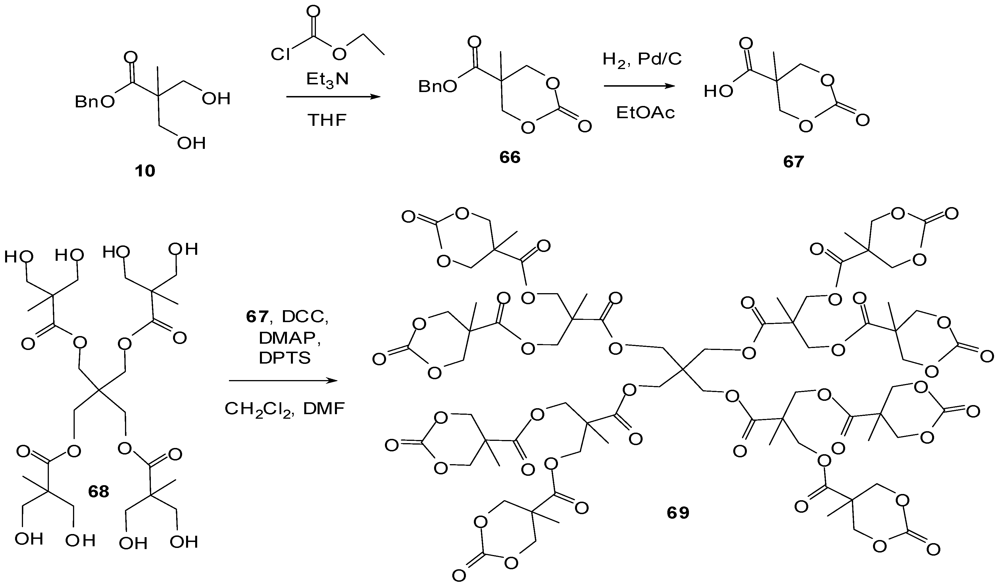
        <p>Another novel development was the use of cyclic carbonates on the periphery of polyester dendrimers [<xref ref-type="bibr" rid="B174-polymers-04-00794">174</xref>]. This functional group reacts with amines [<xref ref-type="bibr" rid="B175-polymers-04-00794">175</xref>], even in water with quantitative yields [<xref ref-type="bibr" rid="B176-polymers-04-00794">176</xref>], to yield bifunctional products. In the reaction, the amine opens the carbonate ring to form a carbamate with liberation of an alcohol that may then be used for a subsequent functionalization step.</p>
        <fig id="polymers-04-00794-f037" position="anchor">
          <object-id pub-id-type="pii">polymers-04-00794-scheme33_Scheme 33</object-id>
          <label>Scheme 33</label>
          <caption>
            <p>Synthesis of [G-2] bis-HMPA dendrimer with a cyclic carbonate periphery [<xref ref-type="bibr" rid="B174-polymers-04-00794">174</xref>].</p>
          </caption>
          <graphic xmlns:xlink="http://www.w3.org/1999/xlink" xlink:href="polymers-04-00794-g037.tif"/>
        </fig>
        <fig id="polymers-04-00794-f038" position="anchor">
          <label>Figure 5</label>
          <caption>
            <p>Second generation dendrimer having a bifunctionalized periphery [<xref ref-type="bibr" rid="B174-polymers-04-00794">174</xref>].</p>
          </caption>
          <graphic xmlns:xlink="http://www.w3.org/1999/xlink" xlink:href="polymers-04-00794-g038.tif"/>
        </fig>
        <p>Two different moieties may be added in immediate succession without any deprotection steps or functional group conversions. To provide a model platform for testing the reaction, dendrimer <bold>68</bold> with eight hydroxyl groups was prepared from pentaerythritol (<xref ref-type="scheme" rid="polymers-04-00794-f037">Scheme 33</xref>). DCC-promoted coupling of <bold>67</bold> and <bold>68</bold> furnished carbonate-bearing dendrimer <bold>69</bold>. Finally, reacting <bold>69</bold> with (MeOH)<sub>2</sub>CHCH<sub>2</sub>NH<sub>2</sub> and then propargyl bromide afforded dendrimer <bold>70</bold> (<xref ref-type="fig" rid="polymers-04-00794-f038">Figure 5</xref>). This is an example of how dendrimers can be precisely designed and functionalized to impart desired properties.</p>
        
        
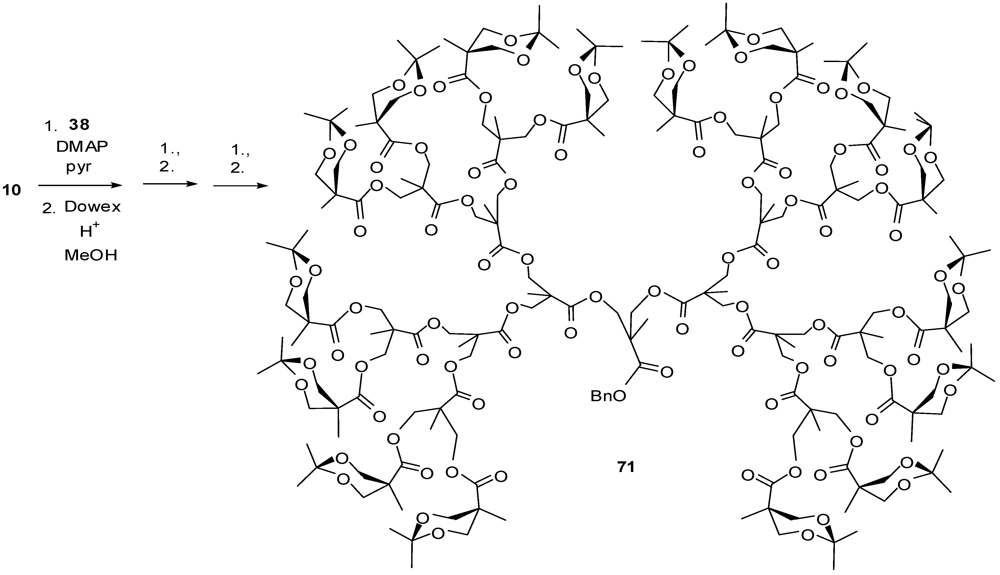
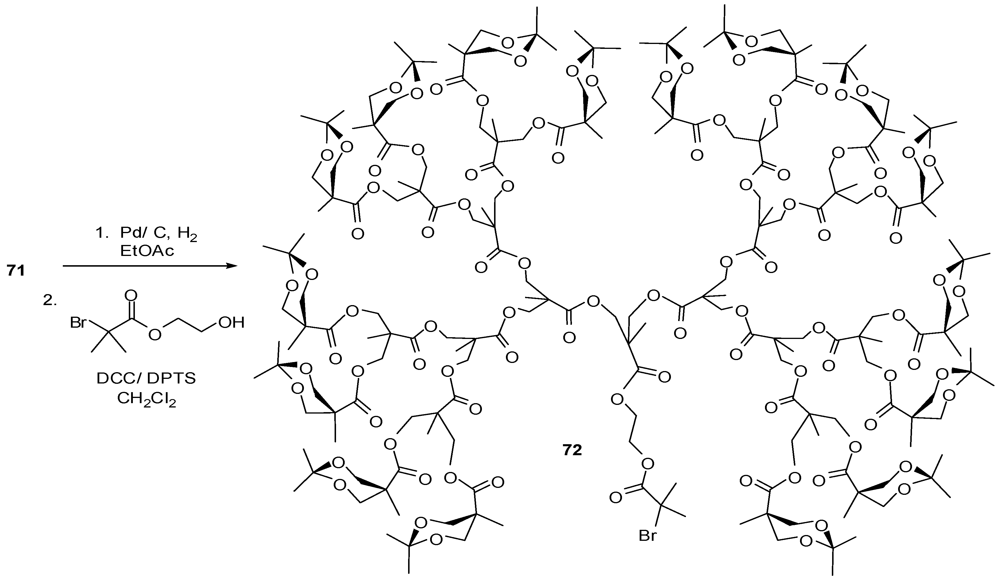
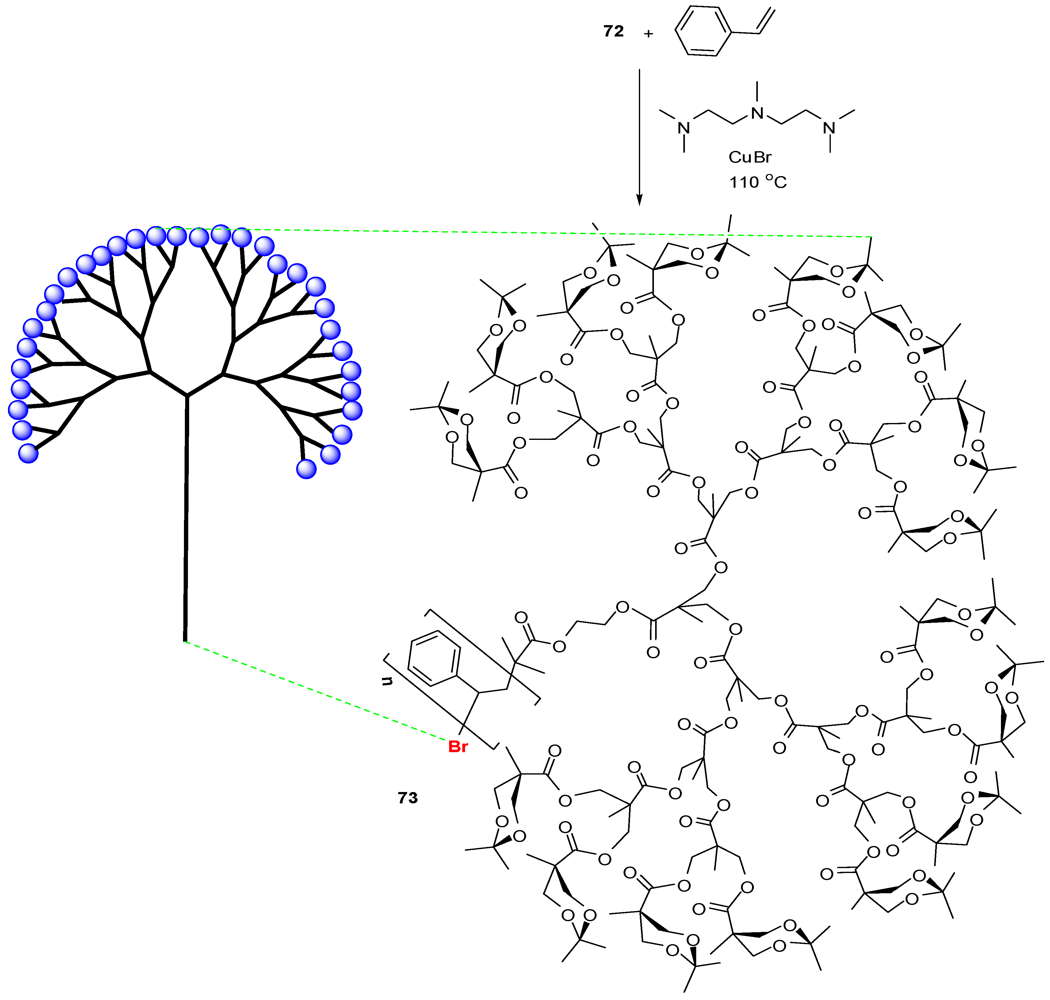
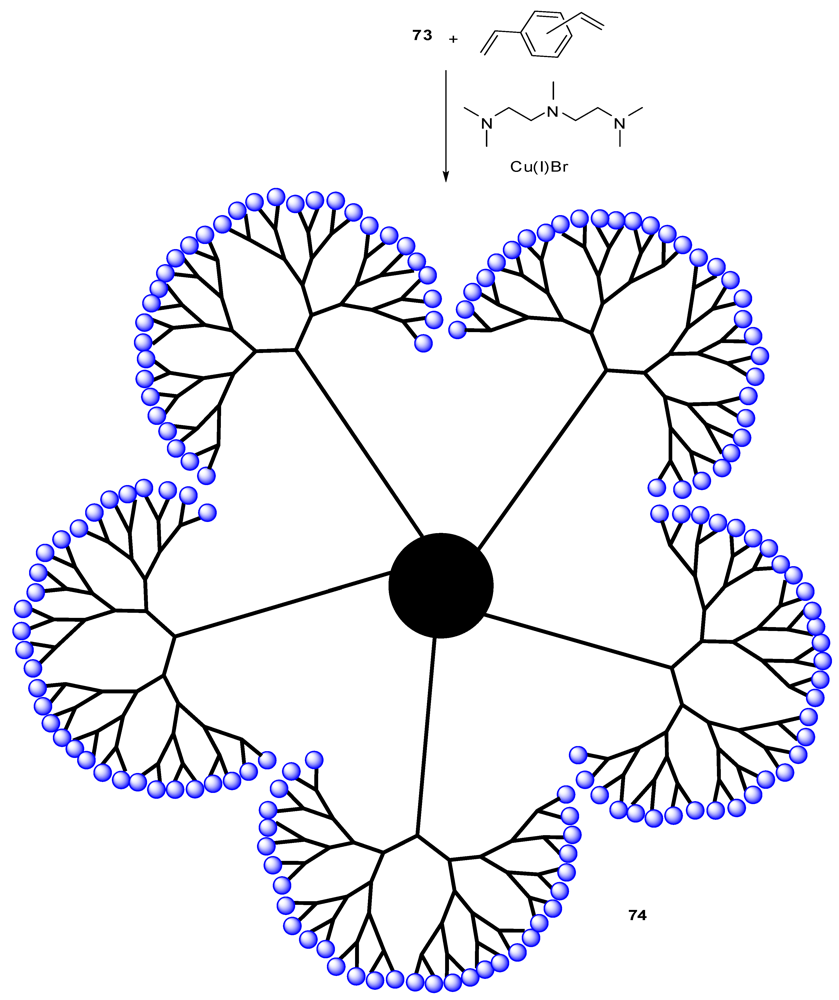
        <p>The coupling of preformed dendrons with bifunctional monomers to form core cross-linked star (CCS) polymers is a versatile strategy which has been widely used [<xref ref-type="bibr" rid="B177-polymers-04-00794">177</xref>,<xref ref-type="bibr" rid="B178-polymers-04-00794">178</xref>,<xref ref-type="bibr" rid="B179-polymers-04-00794">179</xref>,<xref ref-type="bibr" rid="B180-polymers-04-00794">180</xref>,<xref ref-type="bibr" rid="B181-polymers-04-00794">181</xref>,<xref ref-type="bibr" rid="B182-polymers-04-00794">182</xref>,<xref ref-type="bibr" rid="B183-polymers-04-00794">183</xref>,<xref ref-type="bibr" rid="B184-polymers-04-00794">184</xref>]. In order to explore this approach, the so-called “arm first” synthetic strategy, Hawker and coworkers prepared dendrons as functional initiators capable of initiating polymerization by atom transfer radical polymerization (<xref ref-type="scheme" rid="polymers-04-00794-f039">Scheme 34</xref>, <xref ref-type="scheme" rid="polymers-04-00794-f040">Scheme 35</xref>, <xref ref-type="scheme" rid="polymers-04-00794-f041">Scheme 36</xref>, <xref ref-type="scheme" rid="polymers-04-00794-f042">Scheme 37</xref>) [<xref ref-type="bibr" rid="B185-polymers-04-00794">185</xref>]. The synthesis of polyester dendrons up to the fifth generation by the divergent route using <bold>38</bold> is described. Dendrons were then functionalized at the focal point using a single 2-hydroxyethyl 2-bromo-2-methylpropanoate moiety to form dendron functional macroinitiators. A library of highly branched, 3-dimensional, dendron functional CCS polymers were prepared from these macroinitiators by varying generation number and polystyrene chain length, followed by reaction with divinyl benzene, utilizing the “arm first” approach.</p>
        <fig id="polymers-04-00794-f039" position="anchor">
          <object-id pub-id-type="pii">polymers-04-00794-scheme34_Scheme 34</object-id>
          <label>Scheme 34</label>
          <caption>
            <p>Divergent growth of acetonide-protected fifth generation polyester dendron [<xref ref-type="bibr" rid="B185-polymers-04-00794">185</xref>].</p>
          </caption>
          <graphic xmlns:xlink="http://www.w3.org/1999/xlink" xlink:href="polymers-04-00794-g039.tif"/>
        </fig>
        <fig id="polymers-04-00794-f040" position="anchor">
          <object-id pub-id-type="pii">polymers-04-00794-scheme35_Scheme 35</object-id>
          <label>Scheme 35</label>
          <caption>
            <p>Synthesis of fifth generation dendron with initiating moiety for atom transfer radical polymerization at the focal point [<xref ref-type="bibr" rid="B185-polymers-04-00794">185</xref>].</p>
          </caption>
          <graphic xmlns:xlink="http://www.w3.org/1999/xlink" xlink:href="polymers-04-00794-g040.tif"/>
        </fig>
        <fig id="polymers-04-00794-f041" position="anchor">
          <object-id pub-id-type="pii">polymers-04-00794-scheme36_Scheme 36</object-id>
          <label>Scheme 36</label>
          <caption>
            <p>Focal point functionalization using atom transfer radical polymerization [<xref ref-type="bibr" rid="B185-polymers-04-00794">185</xref>].</p>
          </caption>
          <graphic xmlns:xlink="http://www.w3.org/1999/xlink" xlink:href="polymers-04-00794-g041.tif"/>
        </fig>
        <fig id="polymers-04-00794-f042" position="anchor">
          <object-id pub-id-type="pii">polymers-04-00794-scheme37_Scheme 37</object-id>
          <label>Scheme 37</label>
          <caption>
            <p>Preparation of a fifth generation functionalized core cross-linked star (CCS) polymers via the “Arm First” approach [<xref ref-type="bibr" rid="B185-polymers-04-00794">185</xref>].</p>
          </caption>
          <graphic xmlns:xlink="http://www.w3.org/1999/xlink" xlink:href="polymers-04-00794-g042.tif"/>
        </fig>
        <p>Until the work of Sanyal and coworkers was published in 2008 [<xref ref-type="bibr" rid="B186-polymers-04-00794">186</xref>], few reports describing dendrimer synthesis using the Diels-Alder reaction had appeared. However, these reports described the combination of identical dendrons to furnish symmetrical dendrimers [<xref ref-type="bibr" rid="B187-polymers-04-00794">187</xref>,<xref ref-type="bibr" rid="B188-polymers-04-00794">188</xref>]. Sanyal’s work was the first example of the synthesis of segment block dendrimers using the Diels-Alder-based synthetic strategy toward the synthesis of unsymmetrical dendrimers. Here, three generations of furan functionalized polyaryl ether dendrons were reacted with maleimide functionalized polyester dendrons of the same generation to obtain segment block dendrimers in good yields. The thermoreversible nature of these macromolecules was investigated by subjecting them to elevated temperatures in the presence of anthracene as a scavenger diene. Acetonide-protected polyester dendrons were prepared divergently starting from a furan-protected <italic>N</italic>-hydroxypropylmaleimide <bold>74</bold>. Reacting <bold>74</bold> with anhydride <bold>43</bold> in the presence of DMAP produced <bold>75</bold>, which was refluxed in toluene at 110 °C to yield second generation dendron <bold>76</bold> containing the reactive dienophile maleimide group at the focal point. The removal of acetonide-protecting group of compound <bold>75</bold> followed by another coupling step with anhydride <bold>43</bold> furnished <bold>77</bold>, which was also refluxed in toluene to yield <bold>78</bold>, a second generation dienophile. Another round of the three steps from 77 gave a third generation dienophile <bold>80</bold> as shown in <xref ref-type="scheme" rid="polymers-04-00794-f043">Scheme 38</xref>. To prepare the Diels-Alder coupling partners, the acid-functionalized Fréchet dendrons [<xref ref-type="bibr" rid="B189-polymers-04-00794">189</xref>,<xref ref-type="bibr" rid="B190-polymers-04-00794">190</xref>] were coupled with furfuryl alcohol in the presence of DMAP and DCC to yield three generations of furan-functionalized polyaryl ether dendrons in 88%, 90%, and 58% yields, respectively (<xref ref-type="scheme" rid="polymers-04-00794-f044">Scheme 39</xref>).</p>
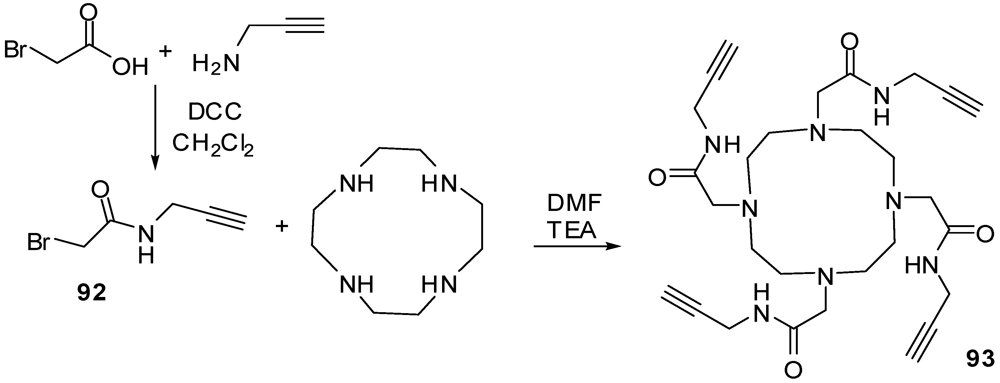
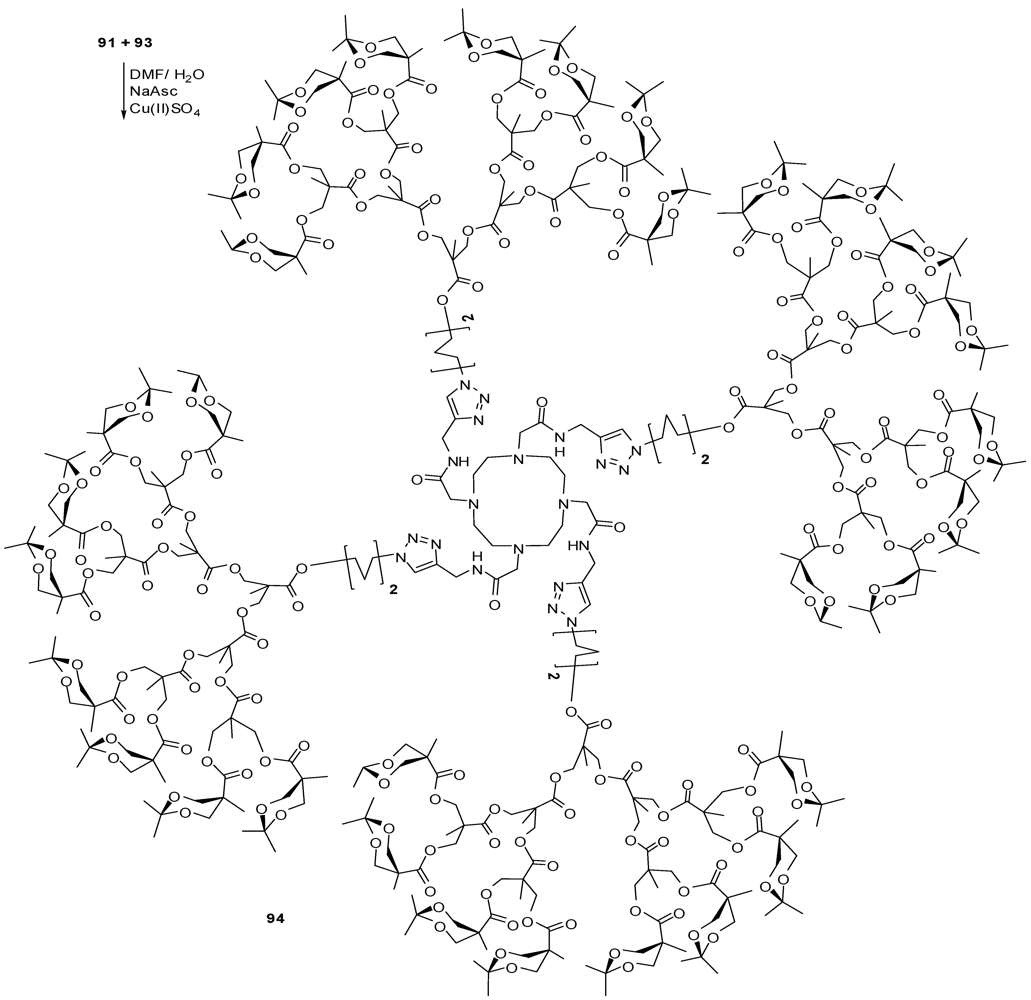
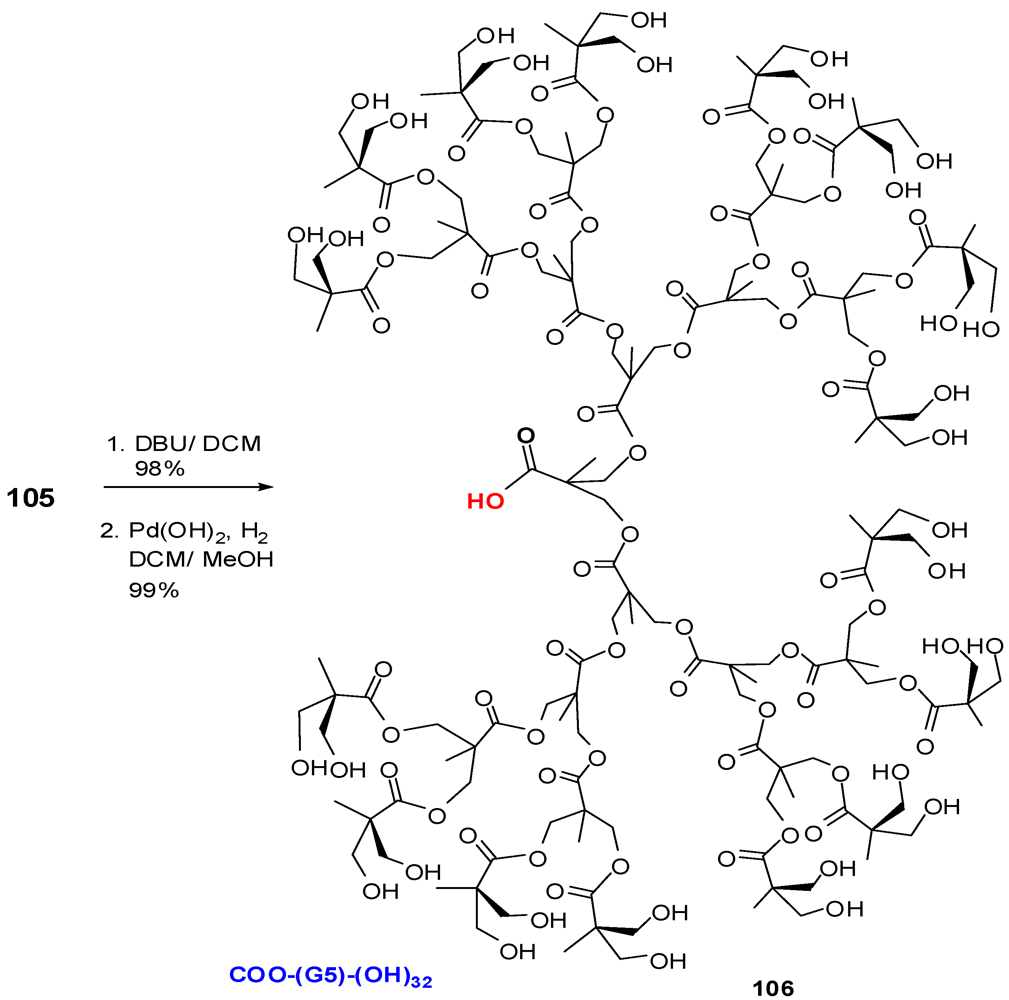
        <fig id="polymers-04-00794-f043" position="anchor">
          <object-id pub-id-type="pii">polymers-04-00794-scheme38_Scheme 38</object-id>
          <label>Scheme 38</label>
          <caption>
            <p>Divergent syntheses of maleimide-functionalized dendrons [<xref ref-type="bibr" rid="B186-polymers-04-00794">186</xref>].</p>
          </caption>
          <graphic xmlns:xlink="http://www.w3.org/1999/xlink" xlink:href="polymers-04-00794-g043.tif"/>
        </fig>
        <fig id="polymers-04-00794-f044" position="anchor">
          <object-id pub-id-type="pii">polymers-04-00794-scheme39_Scheme 39</object-id>
          <label>Scheme 39</label>
          <caption>
            <p>Preparation of diene partners [<xref ref-type="bibr" rid="B186-polymers-04-00794">186</xref>].</p>
          </caption>
          <graphic xmlns:xlink="http://www.w3.org/1999/xlink" xlink:href="polymers-04-00794-g044.tif"/>
        </fig>
        <p>The reaction of furan-functionalized dienes <bold>82–84</bold> with dienophiles <bold>77</bold>, <bold>79</bold>, and <bold>81</bold> in benzene at 85 °C for 24 h afforded the three generations of unsymmetrical dendrimers <bold>85–87</bold> in 98%, 76%, and 79% yields, respectively (see <xref ref-type="fig" rid="polymers-04-00794-f045">Figure 6</xref>). This reagent free Diels-Alder cycloaddition is attractive as the resulting dendrimers are free of impurities such as metals which are usually toxic and therefore problematic in biological applications.</p>
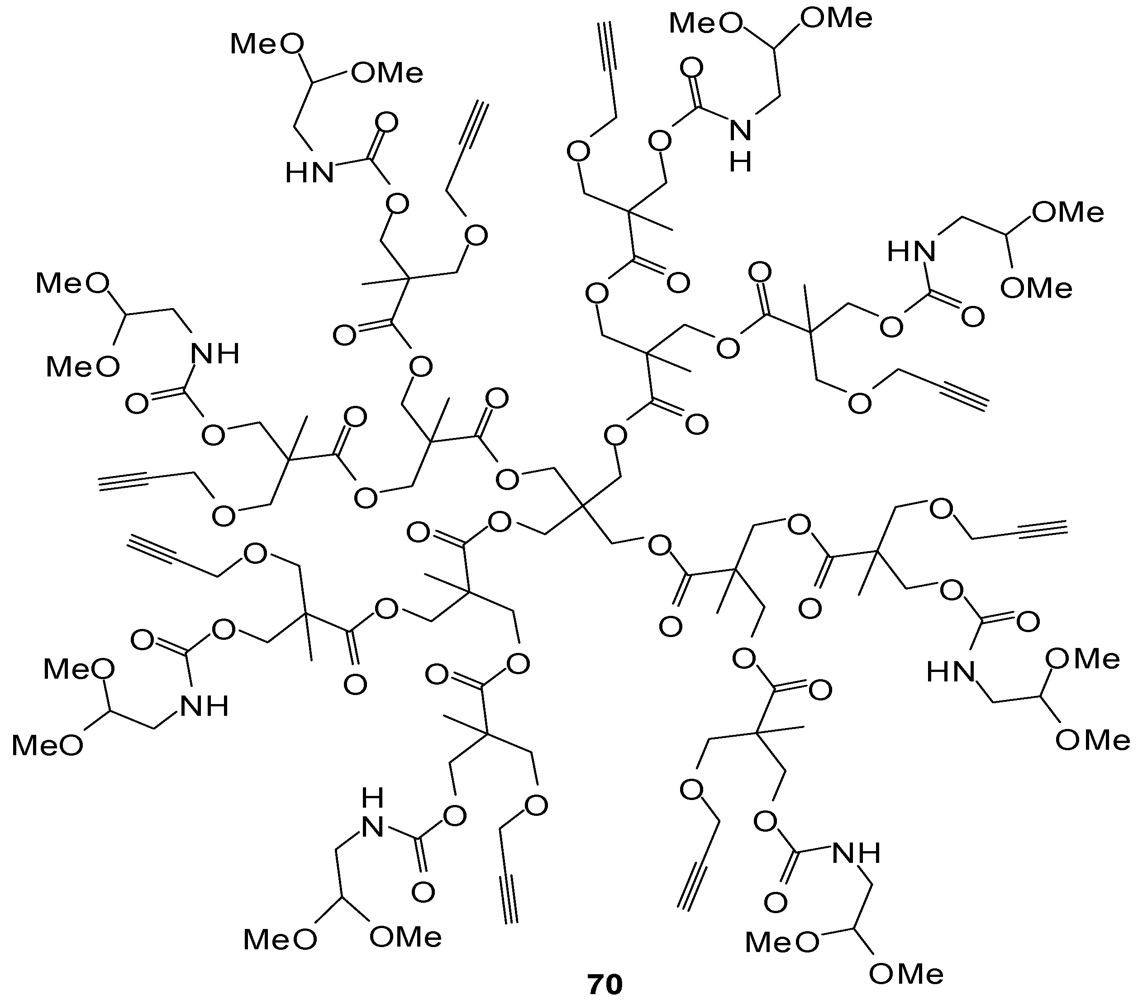
        <fig id="polymers-04-00794-f045" position="anchor">
          <label>Figure 6</label>
          <caption>
            <p>Unsymmetrical dendrimers [<xref ref-type="bibr" rid="B186-polymers-04-00794">186</xref>]. </p>
          </caption>
          <graphic xmlns:xlink="http://www.w3.org/1999/xlink" xlink:href="polymers-04-00794-g045.tif"/>
        </fig>
        <p>Antoni <italic>et al.</italic> prepared azide-terminated bis-HMPA-based polyester dendrons (see <xref ref-type="fig" rid="polymers-04-00794-f046">Figure 7</xref>) up to the fourth generation in order to perform photophysical studies on their products with alkynes [<xref ref-type="bibr" rid="B191-polymers-04-00794">191</xref>]. New dendrimer architectures were produced by the “click reaction” [<xref ref-type="bibr" rid="B192-polymers-04-00794">192</xref>,<xref ref-type="bibr" rid="B193-polymers-04-00794">193</xref>] of these dendrons with a tetravalent alkyne functionalized cyclen core [<xref ref-type="bibr" rid="B191-polymers-04-00794">191</xref>]. The preparation of tetravalent alkyne functional cyclen core is shown in <xref ref-type="scheme" rid="polymers-04-00794-f047">Scheme 40</xref>.</p>
        <fig id="polymers-04-00794-f046" position="anchor">
          <label>Figure 7</label>
          <caption>
            <p>Azide-functionalized polyester dendrons [<xref ref-type="bibr" rid="B191-polymers-04-00794">191</xref>].</p>
          </caption>
          <graphic xmlns:xlink="http://www.w3.org/1999/xlink" xlink:href="polymers-04-00794-g046.tif"/>
        </fig>
        <fig id="polymers-04-00794-f047" position="anchor">
          <object-id pub-id-type="pii">polymers-04-00794-scheme40_Scheme 40</object-id>
          <label>Scheme 40</label>
          <caption>
            <p>Synthesis of a tetravalent alkyne-functionalized cyclen core [<xref ref-type="bibr" rid="B191-polymers-04-00794">191</xref>].</p>
          </caption>
          <graphic xmlns:xlink="http://www.w3.org/1999/xlink" xlink:href="polymers-04-00794-g047.tif"/>
        </fig>
        <p>The preparation of the fourth generation polyester dendrimer is shown in <xref ref-type="scheme" rid="polymers-04-00794-f048">Scheme 41</xref>. These dendrimers are interesting because triazole groups were shown to be stable, intra-locked between the cyclen and dendron wedges. The incorporation of a lanthanide metal ion, europium, into the interior of all cyclen dendrimers was monitored by FT-IR and the photophysical results showed that the proximate triazole acts as both a stable linker and sensitizer, transferring its singlet-singlet excitation in the ultraviolet region (270–290 nm) to the partially filled luminescent lanthanide 4f shell [<xref ref-type="bibr" rid="B191-polymers-04-00794">191</xref>].</p>
        <fig id="polymers-04-00794-f048" position="anchor">
          <object-id pub-id-type="pii">polymers-04-00794-scheme41_Scheme 41</object-id>
          <label>Scheme 41</label>
          <caption>
            <p>Assembly of a fourth generation polyester dendrimer using a click reaction [<xref ref-type="bibr" rid="B191-polymers-04-00794">191</xref>].</p>
          </caption>
          <graphic xmlns:xlink="http://www.w3.org/1999/xlink" xlink:href="polymers-04-00794-g048.tif"/>
        </fig>
        <p>Azobenzene-containing dendrimers [<xref ref-type="bibr" rid="B194-polymers-04-00794">194</xref>] have continued to draw interest because of their optical properties [<xref ref-type="bibr" rid="B195-polymers-04-00794">195</xref>,<xref ref-type="bibr" rid="B196-polymers-04-00794">196</xref>,<xref ref-type="bibr" rid="B197-polymers-04-00794">197</xref>,<xref ref-type="bibr" rid="B198-polymers-04-00794">198</xref>,<xref ref-type="bibr" rid="B199-polymers-04-00794">199</xref>,<xref ref-type="bibr" rid="B200-polymers-04-00794">200</xref>,<xref ref-type="bibr" rid="B201-polymers-04-00794">201</xref>,<xref ref-type="bibr" rid="B202-polymers-04-00794">202</xref>]. Rissanen’s group has shown interest in the synthesis of Janus-type dendrimers having possible non-linear optical properties arising from the non-centrosymmetric structure of chiral azobenzene conjugates. One report describes the synthesis of bisfunctionalized Janus-type polyester dendrimers, which consist of a polar hydroxyl functionalized end, and a photoactive end constructed from donor–acceptor azobenzenes and chiral naproxen units [<xref ref-type="bibr" rid="B203-polymers-04-00794">203</xref>]. An aliphatic polyester skeleton was constructed by reacting monobenzylidene pentaerythritol with the anhydride of acetonide-protected bis-HMPA. Azobenzene moieties, previously reported by the same research group [<xref ref-type="bibr" rid="B204-polymers-04-00794">204</xref>], were chosen to be incorporated as electron donor–acceptor chromophores, since they possess non-linear optical properties [<xref ref-type="bibr" rid="B205-polymers-04-00794">205</xref>]. Shown in <xref ref-type="scheme" rid="polymers-04-00794-f049">Scheme 42</xref> and <xref ref-type="scheme" rid="polymers-04-00794-f050">Scheme 43</xref> are the syntheses of the first and second generations for this type of unsymmetrical dendrimers.</p>
        <fig id="polymers-04-00794-f049" position="anchor">
          <object-id pub-id-type="pii">polymers-04-00794-scheme42_Scheme 42</object-id>
          <label>Scheme 42</label>
          <caption>
            <p>Synthesis of acetonide-protected first generation dendrimer (<bold>95</bold>) [<xref ref-type="bibr" rid="B203-polymers-04-00794">203</xref>].</p>
          </caption>
          <graphic xmlns:xlink="http://www.w3.org/1999/xlink" xlink:href="polymers-04-00794-g049.tif"/>
        </fig>
        <fig id="polymers-04-00794-f050" position="anchor">
          <object-id pub-id-type="pii">polymers-04-00794-scheme43_Scheme 43</object-id>
          <label>Scheme 43</label>
          <caption>
            <p>Synthesis of second generation unsymmetrical polyester dendrimer [<xref ref-type="bibr" rid="B203-polymers-04-00794">203</xref>].</p>
          </caption>
          <graphic xmlns:xlink="http://www.w3.org/1999/xlink" xlink:href="polymers-04-00794-g050.tif"/>
        </fig>
        <p>Parrott <italic>et al.</italic> recently introduced a new carboxylic acid protecting group for the synthesis of polyester dendrons based on bis-HMPA [<xref ref-type="bibr" rid="B129-polymers-04-00794">129</xref>], the 2-<italic>p</italic>-toluenesulfonylethyl group [<xref ref-type="bibr" rid="B129-polymers-04-00794">129</xref>]. Dendrons up to the eighth generation were prepared in excellent yields using benzylidene-protected bis-HMPA as the unit being added as shown in <xref ref-type="scheme" rid="polymers-04-00794-f051">Scheme 44</xref> [<xref ref-type="bibr" rid="B129-polymers-04-00794">129</xref>]. The protecting group was removed under mild conditions with the non-nucleophilic base DBU in dichloromethane (<xref ref-type="scheme" rid="polymers-04-00794-f052">Scheme 45</xref>).</p>
        <fig id="polymers-04-00794-f051" position="anchor">
          <object-id pub-id-type="pii">polymers-04-00794-scheme44_Scheme 44</object-id>
          <label>Scheme 44</label>
          <caption>
            <p>Divergently-grown fifth generation dendron <bold>105</bold> [<xref ref-type="bibr" rid="B129-polymers-04-00794">129</xref>].</p>
          </caption>
          <graphic xmlns:xlink="http://www.w3.org/1999/xlink" xlink:href="polymers-04-00794-g051.tif"/>
        </fig>
        
        <p>This group was interested in the preparation of high generations of well-defined and robust <sup>99m</sup>Tc-labeled dendrimers suitable for single photon emission computed tomography (SPECT) imaging. The γ-emitting <sup>99m</sup>Tc is the most commonly used medical isotope in diagnostic medicine due to its ideal half-life (6 h) and γ-energy (140 keV), low dose burden to patients, and the universal availability of low cost <sup>99</sup>Mo/ <sup>99m</sup>Tc-generators [<xref ref-type="bibr" rid="B206-polymers-04-00794">206</xref>]. A single high-affinity Tc ligand at the core of the dendrimer was desired to ensure that radiolabeling occurs in a well-defined, site-specific manner and at only a single point within the dendrimer skeleton. In addition, the incorporation of the radionuclide was not to significantly affect the overall size, shape, polarity, and mode of interaction of the dendrimer periphery with its external environment so as not to alter the biodistribution of the non- radiolabeled dendrimer.</p>
        <fig id="polymers-04-00794-f052" position="anchor">
          <object-id pub-id-type="pii">polymers-04-00794-scheme45_Scheme 45</object-id>
          <label>Scheme 45</label>
          <caption>
            <p>Deprotection of the periphery and focal point of the 2-<italic>p</italic>-toluenesulfonylethyl protected dendron [<xref ref-type="bibr" rid="B129-polymers-04-00794">129</xref>].</p>
          </caption>
          <graphic xmlns:xlink="http://www.w3.org/1999/xlink" xlink:href="polymers-04-00794-g052.tif"/>
        </fig>
        <fig id="polymers-04-00794-f053" position="anchor">
          <object-id pub-id-type="pii">polymers-04-00794-scheme46_Scheme 46</object-id>
          <label>Scheme 46</label>
          <caption>
            <p>Amidation of the focal point using aminohexyl-functionalized bis(pyridyl)amine ligand [<xref ref-type="bibr" rid="B129-polymers-04-00794">129</xref>].</p>
          </caption>
          <graphic xmlns:xlink="http://www.w3.org/1999/xlink" xlink:href="polymers-04-00794-g053.tif"/>
        </fig>
        <p>Amidation of the deprotected core with an aminoalkyl-functionalized bis(pyridyl)amine ligand allowed the introduction of an extremely efficient single-site chelator <bold>108</bold> for <sup>99m</sup>Tc. Dendron labelling was then accomplished by first converting sodium pertechnetate (Na<sup>99m</sup>TcO<sub>4</sub>) from the <sup>99</sup>Mo/ <sup>99m</sup>Tc-generator to [99mTc(CO)3(H2O)3]<sup>+</sup>. Microwave irradiation of amidated dendrons in the presence of the aqua species at 130 °C gave the desired radiolabelled dendons within 5 min (<xref ref-type="scheme" rid="polymers-04-00794-f054">Scheme 47</xref>). </p>
        <fig id="polymers-04-00794-f054" position="anchor">
          <object-id pub-id-type="pii">polymers-04-00794-scheme47_Scheme 47</object-id>
          <label>Scheme 47</label>
          <caption>
            <p>Direct radiolabelling of dendrons using the tris-aqua species [<sup>99m</sup>Tc(CO)<sub>3</sub>(H<sub>2</sub>O)<sub>3</sub>]<sup>+</sup>[<xref ref-type="bibr" rid="B129-polymers-04-00794">129</xref>].</p>
          </caption>
          <graphic xmlns:xlink="http://www.w3.org/1999/xlink" xlink:href="polymers-04-00794-g054.tif"/>
        </fig>
        <p>The process by which information from a source is converted into symbols to be communicated or information encoding is an important field owing to its potential applications [<xref ref-type="bibr" rid="B207-polymers-04-00794">207</xref>,<xref ref-type="bibr" rid="B208-polymers-04-00794">208</xref>,<xref ref-type="bibr" rid="B209-polymers-04-00794">209</xref>]. While exploring chirality for the development of encodeable macromolecules, which can be read out by simple optical rotation measurements or by enantioselective bioresponse, Heise and coworkers reported the synthesis of encoded dendrimers with defined chiral composition via ‘click’ reactions of enantiopure building blocks [<xref ref-type="bibr" rid="B210-polymers-04-00794">210</xref>]. Heise and coworkers had previously reported the synthesis of copolymers from the enantiomerically pure monomers of (<italic>R</italic>) and (<italic>S</italic>)-<italic>p</italic>-vinylphenylethanol [<xref ref-type="bibr" rid="B211-polymers-04-00794">211</xref>] but copolymers have a disadvantage in that there is uncertainty about the distribution of chiral units along the polymer skeleton. A viable approach was to use dendrimers of well-defined architectures in which orthogonal functionalization encodes a defined optical rotation into the dendrimer by the use of enantiomerically pure (<italic>R</italic>) and (<italic>S</italic>) building blocks. Here, an azide-terminated dendrimer (<xref ref-type="fig" rid="polymers-04-00794-f055">Figure 8</xref>) based on bis-HMPA was divergently constructed as previously described [<xref ref-type="bibr" rid="B212-polymers-04-00794">212</xref>] and functionalized using 1,3-dipolar cycloadditions (click reactions) with different ratios of the matching alkyne functional enantiopure building blocks (<xref ref-type="scheme" rid="polymers-04-00794-f057">Scheme 49</xref>). <xref ref-type="scheme" rid="polymers-04-00794-f056">Scheme 48</xref> shows the selective alcohol dehydrogenase (ADH) reduction of 1-(4-ethynylphenyl)ethanone to give the desired chiral building blocks. When measurements of the optical rotation were taken, it was found that the specific optical rotation of the dendrimers increased linearly with increasing percentage of (<italic>R</italic>) end-groups in the dendrimer, indicating that both (<italic>R</italic>) and (<italic>S</italic>) building blocks had been incorporated into the dendrimer in agreement with the enantiomeric feed ratio.</p>
        <fig id="polymers-04-00794-f055" position="anchor">
          <label>Figure 8</label>
          <caption>
            <p>Azide-terminated third generation dendrimer [<xref ref-type="bibr" rid="B212-polymers-04-00794">212</xref>].</p>
          </caption>
          <graphic xmlns:xlink="http://www.w3.org/1999/xlink" xlink:href="polymers-04-00794-g055.tif"/>
        </fig>
        <fig id="polymers-04-00794-f056" position="anchor">
          <object-id pub-id-type="pii">polymers-04-00794-scheme48_Scheme 48</object-id>
          <label>Scheme 48</label>
          <caption>
            <p>Enzymatic preparation of enantiopure building blocks [<xref ref-type="bibr" rid="B211-polymers-04-00794">211</xref>].</p>
          </caption>
          <graphic xmlns:xlink="http://www.w3.org/1999/xlink" xlink:href="polymers-04-00794-g056.tif"/>
        </fig>
        <fig id="polymers-04-00794-f057" position="anchor">
          <object-id pub-id-type="pii">polymers-04-00794-scheme49_Scheme 49</object-id>
          <label>Scheme 49</label>
          <caption>
            <p>Modification of azide functional dendrimers using different ratios of enantiomers [<xref ref-type="bibr" rid="B210-polymers-04-00794">210</xref>].</p>
          </caption>
          <graphic xmlns:xlink="http://www.w3.org/1999/xlink" xlink:href="polymers-04-00794-g057.tif"/>
        </fig>
      </sec>
      <sec>
        <title>4.2. The Use of Other Aliphatic Dendrons</title>
        <p>Other aliphatic dendrons have been used less often than bis-HMPA. Carnahan and Grinstaff developed tetraol dendrons <bold>113</bold> by esterification of the hydroxyl group of <italic>cis</italic>-5-hydroxy-2-phenyl-1,3-dioxane with succinic or adipic anhydride as shown in <xref ref-type="scheme" rid="polymers-04-00794-f058">Scheme 50</xref> [<xref ref-type="bibr" rid="B213-polymers-04-00794">213</xref>,<xref ref-type="bibr" rid="B214-polymers-04-00794">214</xref>]. Up to fourth generation dendrimers were prepared by DCC-promoted esterification of tetraols <bold>113</bold> with the benzylidene-protected monocarboxylic acid <bold>114</bold>, then deprotection of the latent hydroxyls (<xref ref-type="scheme" rid="polymers-04-00794-f059">Scheme 51</xref>) [<xref ref-type="bibr" rid="B213-polymers-04-00794">213</xref>]. It should be noted that these materials will be diastereomeric mixtures because the plane of symmetry present in the starting material, <italic>cis</italic>-5-hydroxy-2-phenyl-1,3-dioxane, is not present in the dendritic products. Dendrimers were prepared containing only succinic acid, only adipic acid, and mixtures of the two [<xref ref-type="bibr" rid="B214-polymers-04-00794">214</xref>]. The properties of the latter dendrimers rely heavily on the composition of the outer generation layer [<xref ref-type="bibr" rid="B214-polymers-04-00794">214</xref>]. By esterifying the dendrimers with succinic acid monomethylallyl ether, and photochemically polymerizing the alkenes, soft gels were produced [<xref ref-type="bibr" rid="B213-polymers-04-00794">213</xref>]. These materials are used as corneal adhesives [<xref ref-type="bibr" rid="B215-polymers-04-00794">215</xref>,<xref ref-type="bibr" rid="B216-polymers-04-00794">216</xref>] and for cartilage repair [<xref ref-type="bibr" rid="B217-polymers-04-00794">217</xref>,<xref ref-type="bibr" rid="B218-polymers-04-00794">218</xref>].</p>
        <fig id="polymers-04-00794-f058" position="anchor">
          <object-id pub-id-type="pii">polymers-04-00794-scheme50_Scheme 50</object-id>
          <label>Scheme 50</label>
          <caption>
            <p>Preparation of tetraol dendrons [<xref ref-type="bibr" rid="B213-polymers-04-00794">213</xref>,<xref ref-type="bibr" rid="B214-polymers-04-00794">214</xref>].</p>
          </caption>
          <graphic xmlns:xlink="http://www.w3.org/1999/xlink" xlink:href="polymers-04-00794-g058.tif"/>
        </fig>
        <fig id="polymers-04-00794-f059" position="anchor">
          <object-id pub-id-type="pii">polymers-04-00794-scheme51_Scheme 51</object-id>
          <label>Scheme 51</label>
          <caption>
            <p>Synthesis of a third generation dendrimer [<xref ref-type="bibr" rid="B213-polymers-04-00794">213</xref>,<xref ref-type="bibr" rid="B214-polymers-04-00794">214</xref>].</p>
          </caption>
          <graphic xmlns:xlink="http://www.w3.org/1999/xlink" xlink:href="polymers-04-00794-g059.tif"/>
        </fig>
        <p>We have synthesized tribranched dendrons in order to prepare dendrimers that have denser layers than those derived from bis-HMPA (<xref ref-type="scheme" rid="polymers-04-00794-f060">Scheme 52</xref>) [<xref ref-type="bibr" rid="B130-polymers-04-00794">130</xref>,<xref ref-type="bibr" rid="B219-polymers-04-00794">219</xref>]. Polyester dendrimers with denser layers are likely to be longer lived under physiological conditions. As shown in <xref ref-type="scheme" rid="polymers-04-00794-f061">Scheme 53</xref>, we have recently used the TsEt protecting group in the synthesis of a second generation acid dendron [<xref ref-type="bibr" rid="B134-polymers-04-00794">134</xref>]. A tri-branched acid anhydride dendron <bold>115</bold> [<xref ref-type="bibr" rid="B130-polymers-04-00794">130</xref>] was reacted with TsEtOH in the presence of DMAP to give benzyl-protected first generation <bold>117</bold>. Hydrogenolysis then gave <bold>118</bold> in good yield. </p>
        <fig id="polymers-04-00794-f060" position="anchor">
          <object-id pub-id-type="pii">polymers-04-00794-scheme52_Scheme 52</object-id>
          <label>Scheme 52</label>
          <caption>
            <p>Synthesis of tribranched dendrons [<xref ref-type="bibr" rid="B130-polymers-04-00794">130</xref>].</p>
          </caption>
          <graphic xmlns:xlink="http://www.w3.org/1999/xlink" xlink:href="polymers-04-00794-g060.tif"/>
        </fig>
        <fig id="polymers-04-00794-f061" position="anchor">
          <object-id pub-id-type="pii">polymers-04-00794-scheme53_Scheme 53</object-id>
          <label>Scheme 53</label>
          <caption>
            <p>Divergent syntheses of a second generation tribranched dendron and a second generation dendrimer incorporating a tribranched dendron [<xref ref-type="bibr" rid="B130-polymers-04-00794">130</xref>].</p>
          </caption>
          <graphic xmlns:xlink="http://www.w3.org/1999/xlink" xlink:href="polymers-04-00794-g061.tif"/>
        </fig>
        <p>Reacting <bold>117</bold> with benzylidene-protected anhydride <bold>15</bold> followed by deprotection of the focal point using DBU gave the desired acid dendron <bold>120</bold> (<xref ref-type="scheme" rid="polymers-04-00794-f061">Scheme 53</xref>). Using coupling agent 2-(1H-benzotriazole-1-yl)-1,1,3,3-tetramethyluronium tetrafluoroborate (TBTU) [<xref ref-type="bibr" rid="B130-polymers-04-00794">130</xref>] in the presence of an organic base, ester formation between <bold>120</bold> and various alcohols was achieved in good yield [<xref ref-type="bibr" rid="B134-polymers-04-00794">134</xref>]. <xref ref-type="scheme" rid="polymers-04-00794-f061">Scheme 53</xref> also illustrates the preparation of a second generation dendrimer using this approach. Core moiety <bold>121</bold> have also been used to prepare other polyester dendrimers [<xref ref-type="bibr" rid="B130-polymers-04-00794">130</xref>] and compound <bold>122</bold> has also been prepared using a divergent approach. </p>
        <p>Hirayama <italic>et al.</italic> devised a synthesis of polyester dendrimers using benzyl acetoacetate and tert-butyl acrylate or 3-hydroxyacetophenone as starting materials [<xref ref-type="bibr" rid="B220-polymers-04-00794">220</xref>,<xref ref-type="bibr" rid="B221-polymers-04-00794">221</xref>]. Shown in <xref ref-type="scheme" rid="polymers-04-00794-f062">Scheme 54</xref> is the preparation of the AB<sub>2</sub> dendron from the Michael addition of benzyl acetoacetate to two equivalents of tert-butyl acrylate followed by hydrogenolysis of the benzyl group, spontaneous decarboxylation, and reduction of the ketone. <xref ref-type="scheme" rid="polymers-04-00794-f063">Scheme 55</xref> shows the assembly of the dendrimer, which used <bold>123</bold> as bivalent core. Up to the fourth generation dendrimer was prepared with all steps being performed in good yield [<xref ref-type="bibr" rid="B221-polymers-04-00794">221</xref>]. Similar dendrimers were prepared where 3-hydroxyacetophenone and its <italic>tert</italic>-butyldimethylsilyl ether served as the Michael nucleophile [<xref ref-type="bibr" rid="B220-polymers-04-00794">220</xref>]. These compounds were designed as drug delivery systems.</p>
        <fig id="polymers-04-00794-f062" position="anchor">
          <object-id pub-id-type="pii">polymers-04-00794-scheme54_Scheme 54</object-id>
          <label>Scheme 54</label>
          <caption>
            <p>Synthesis of an AB<sub>2</sub> dendron [<xref ref-type="bibr" rid="B221-polymers-04-00794">221</xref>].</p>
          </caption>
          <graphic xmlns:xlink="http://www.w3.org/1999/xlink" xlink:href="polymers-04-00794-g062.tif"/>
        </fig>
        
        <p>Bouillon prepared a series of tertiary amine-containing polyester dendrimers [<xref ref-type="bibr" rid="B136-polymers-04-00794">136</xref>] from the starting materials shown in <xref ref-type="fig" rid="polymers-04-00794-f064">Figure 9</xref>, where <bold>125</bold> is the core and <bold>126</bold> and <bold>127</bold> are the dendrons. The ester bonds were formed by making cyanomethyl esters that react with excess alcohol (the dendron) in the presence of DBU as shown in <xref ref-type="scheme" rid="polymers-04-00794-f065">Scheme 56</xref>. Excess alcohol was removed by reaction with benzoic anhydride after each ester bond forming step (not shown in <xref ref-type="scheme" rid="polymers-04-00794-f065">Scheme 56</xref>) [<xref ref-type="bibr" rid="B136-polymers-04-00794">136</xref>]. Poly(amino)ester dendrimers are particularly attractive as drug delivery systems because the amine functionalities present in the dendrimers can serve as buffers to neutralize the acids generated from ester hydrolysis during dendrimer degradation.</p>
        <fig id="polymers-04-00794-f063" position="anchor">
          <object-id pub-id-type="pii">polymers-04-00794-scheme55_Scheme 55</object-id>
          <label>Scheme 55</label>
          <caption>
            <p>Synthesis of an acetoacetate <italic>tert</italic>-butyl acrylate derived dendrimer [<xref ref-type="bibr" rid="B221-polymers-04-00794">221</xref>].</p>
          </caption>
          <graphic xmlns:xlink="http://www.w3.org/1999/xlink" xlink:href="polymers-04-00794-g063.tif"/>
        </fig>
        <fig id="polymers-04-00794-f064" position="anchor">
          <label>Figure 9</label>
          <caption>
            <p>Starting materials for amine-containing polyester dendrimers [<xref ref-type="bibr" rid="B136-polymers-04-00794">136</xref>].</p>
          </caption>
          <graphic xmlns:xlink="http://www.w3.org/1999/xlink" xlink:href="polymers-04-00794-g064.tif"/>
        </fig>
        <fig id="polymers-04-00794-f065" position="anchor">
          <object-id pub-id-type="pii">polymers-04-00794-scheme56_Scheme 56</object-id>
          <label>Scheme 56</label>
          <caption>
            <p>Synthesis of a second generation amine-containing dendrimer [<xref ref-type="bibr" rid="B136-polymers-04-00794">136</xref>].</p>
          </caption>
          <graphic xmlns:xlink="http://www.w3.org/1999/xlink" xlink:href="polymers-04-00794-g065.tif"/>
        </fig>
        <p>Another interesting development was the synthesis of polyester dendrimers bearing functional groups capable of orthogonal reactions, that is, bifunctional dendrimers [<xref ref-type="bibr" rid="B40-polymers-04-00794">40</xref>]. A complex carboxylic acid bearing a latent diol and an alkyne, an AB<sub>2</sub>C dendron (<bold>132</bold>), was prepared and then esterified with a triol to give a first generation dendrimer bearing three alkyne units and six latent hydroxyls (<bold>133</bold>) (<xref ref-type="scheme" rid="polymers-04-00794-f066">Scheme 57</xref>). The latent hydroxyls were exposed by hydrolysis of the acid-labile six-membered isopropylidene ring with an acidic ion exchange resin, and then the process was repeated twice more with added <bold>132</bold> to give the bifunctional product <bold>135</bold> bearing 21 alkyne groups and 24 hydroxyl groups as shown in <xref ref-type="scheme" rid="polymers-04-00794-f067">Scheme 58</xref> [<xref ref-type="bibr" rid="B40-polymers-04-00794">40</xref>]. The second generation dendrimer <bold>134</bold> was tested for cytotoxicity on a MG-63 osteoblast cell line and found to have no or low toxicity at the concentrations tested. Second and third generation intermediates on the route to <bold>135</bold> were reacted with alkyl azides in click reactions as shown in <xref ref-type="scheme" rid="polymers-04-00794-f068">Scheme 59</xref>. Compound <bold>137</bold>, a candidate for atom transfer radical polymerization (ATRP) was obtained in 77% yield and the second generation analog of <bold>135</bold> was also reacted with an azide derivative of PEG<sub>8000</sub> to yield a hydrogel in good yield. A bifunctional dendrimer having azide and alcohol functionality was also synthesized as outlined in <xref ref-type="scheme" rid="polymers-04-00794-f069">Scheme 60</xref> [<xref ref-type="bibr" rid="B40-polymers-04-00794">40</xref>].</p>
        <fig id="polymers-04-00794-f066" position="anchor">
          <object-id pub-id-type="pii">polymers-04-00794-scheme57_Scheme 57</object-id>
          <label>Scheme 57</label>
          <caption>
            <p>Synthesis of an AB<sub>2</sub>C dendron (<bold>132</bold>) and a first generation dendrimer bearing three alkyne groups and six latent hydroxyls [<xref ref-type="bibr" rid="B40-polymers-04-00794">40</xref>].</p>
          </caption>
          <graphic xmlns:xlink="http://www.w3.org/1999/xlink" xlink:href="polymers-04-00794-g066.tif"/>
        </fig>
        <fig id="polymers-04-00794-f067" position="anchor">
          <object-id pub-id-type="pii">polymers-04-00794-scheme58_Scheme 58</object-id>
          <label>Scheme 58</label>
          <caption>
            <p>Synthesis of the third generation bifunctional dendrimer [<xref ref-type="bibr" rid="B40-polymers-04-00794">40</xref>].</p>
          </caption>
          <graphic xmlns:xlink="http://www.w3.org/1999/xlink" xlink:href="polymers-04-00794-g067.tif"/>
        </fig>
        <fig id="polymers-04-00794-f068" position="anchor">
          <object-id pub-id-type="pii">polymers-04-00794-scheme59_Scheme 59</object-id>
          <label>Scheme 59</label>
          <caption>
            <p>Click reactions of azide-terminated molecules with the bifunctional dendrimers [<xref ref-type="bibr" rid="B40-polymers-04-00794">40</xref>].</p>
          </caption>
          <graphic xmlns:xlink="http://www.w3.org/1999/xlink" xlink:href="polymers-04-00794-g068.tif"/>
        </fig>
        <fig id="polymers-04-00794-f069" position="anchor">
          <object-id pub-id-type="pii">polymers-04-00794-scheme60_Scheme 60</object-id>
          <label>Scheme 60</label>
          <caption>
            <p>Preparation of bifunctional dendrimers bearing azide and alcohol groups [<xref ref-type="bibr" rid="B40-polymers-04-00794">40</xref>].</p>
          </caption>
          <graphic xmlns:xlink="http://www.w3.org/1999/xlink" xlink:href="polymers-04-00794-g069.tif"/>
        </fig>
      </sec>
      <sec>
        <title>4.3. The Use of Aromatic Dendrons</title>
        <p>Aromatic polyester dendrimers were the first polyester dendrimers to be made [<xref ref-type="bibr" rid="B8-polymers-04-00794">8</xref>] and the synthetic route of Hawker and Frechét introduced the convergent approach (<xref ref-type="scheme" rid="polymers-04-00794-f003">Scheme 2</xref>). A similar approach was published by the same authors at about the same time (<xref ref-type="scheme" rid="polymers-04-00794-f070">Scheme 61</xref> and <xref ref-type="scheme" rid="polymers-04-00794-f071">Scheme 62</xref>) [<xref ref-type="bibr" rid="B7-polymers-04-00794">7</xref>]. </p>
        
        <p>The first divergent approach to polyester dendrimers also used aromatic carboxylic acids (see <xref ref-type="scheme" rid="polymers-04-00794-f002">Scheme 1</xref>) [<xref ref-type="bibr" rid="B80-polymers-04-00794">80</xref>].</p>
        <p>Bo <italic>et al.</italic> used methyl 3,5-dihydroxybenzoate to produce an AB<sub>4</sub> dendron (<bold>142</bold>) for the synthesis of aromatic polyester dendrimers as illustrated in <xref ref-type="scheme" rid="polymers-04-00794-f072">Scheme 63</xref> [<xref ref-type="bibr" rid="B222-polymers-04-00794">222</xref>]. They were unable to use benzyl groups for hydroxyl protection when the focal carboxylic acid was protected as a methyl ester because the deprotection conditions for the latter (NaI and AlCl<sub>3</sub> in acetonitrile) also removed the benzyl ethers. They were able to use <bold>142</bold> to make up to fourth generation protected dendrons (<xref ref-type="scheme" rid="polymers-04-00794-f073">Scheme 64</xref>) and, using 1,4-dihydroxybenzene and 1,3,5-trihydroxybenzene as cores, up to third generation dendrimers (<xref ref-type="scheme" rid="polymers-04-00794-f074">Scheme 65</xref>) [<xref ref-type="bibr" rid="B222-polymers-04-00794">222</xref>]. The same group prepared a dendron with a carboxylic acid focal point linked through alkyl ether linkers to carbazole units. Attachment of this dendron to polyester dendrimers terminated in phenolic groups produced dendrimers of interest for their electro-optical properties (<xref ref-type="scheme" rid="polymers-04-00794-f075">Scheme 66</xref>) [<xref ref-type="bibr" rid="B223-polymers-04-00794">223</xref>].</p>
        <fig id="polymers-04-00794-f070" position="anchor">
          <object-id pub-id-type="pii">polymers-04-00794-scheme61_Scheme 61</object-id>
          <label>Scheme 61</label>
          <caption>
            <p>Synthesis of a third generation aromatic polyester dendron [<xref ref-type="bibr" rid="B7-polymers-04-00794">7</xref>].</p>
          </caption>
          <graphic xmlns:xlink="http://www.w3.org/1999/xlink" xlink:href="polymers-04-00794-g070.tif"/>
        </fig>
        <fig id="polymers-04-00794-f071" position="anchor">
          <object-id pub-id-type="pii">polymers-04-00794-scheme62_Scheme 62</object-id>
          <label>Scheme 62</label>
          <caption>
            <p>Synthesis of a third generation aromatic polyester dendrimer [<xref ref-type="bibr" rid="B7-polymers-04-00794">7</xref>].</p>
          </caption>
          <graphic xmlns:xlink="http://www.w3.org/1999/xlink" xlink:href="polymers-04-00794-g071.tif"/>
        </fig>
        <fig id="polymers-04-00794-f072" position="anchor">
          <object-id pub-id-type="pii">polymers-04-00794-scheme63_Scheme 63</object-id>
          <label>Scheme 63</label>
          <caption>
            <p>Synthesis of an AB<sub>4</sub> dendron, its protection as the perbenzoate, and deprotection of the focal point [<xref ref-type="bibr" rid="B222-polymers-04-00794">222</xref>].</p>
          </caption>
          <graphic xmlns:xlink="http://www.w3.org/1999/xlink" xlink:href="polymers-04-00794-g072.tif"/>
        </fig>
        <fig id="polymers-04-00794-f073" position="anchor">
          <object-id pub-id-type="pii">polymers-04-00794-scheme64_Scheme 64</object-id>
          <label>Scheme 64</label>
          <caption>
            <p>Synthesis of a fourth generation protected dendron [<xref ref-type="bibr" rid="B222-polymers-04-00794">222</xref>].</p>
          </caption>
          <graphic xmlns:xlink="http://www.w3.org/1999/xlink" xlink:href="polymers-04-00794-g073.tif"/>
        </fig>
        <fig id="polymers-04-00794-f074" position="anchor">
          <object-id pub-id-type="pii">polymers-04-00794-scheme65_Scheme 65</object-id>
          <label>Scheme 65</label>
          <caption>
            <p>Synthesis of a third generation dendrimer with 4,4'-dihydroxybiphenyl as the core [<xref ref-type="bibr" rid="B222-polymers-04-00794">222</xref>].</p>
          </caption>
          <graphic xmlns:xlink="http://www.w3.org/1999/xlink" xlink:href="polymers-04-00794-g074.tif"/>
        </fig>
        <fig id="polymers-04-00794-f075" position="anchor">
          <object-id pub-id-type="pii">polymers-04-00794-scheme66_Scheme 66</object-id>
          <label>Scheme 66</label>
          <caption>
            <p>Synthesis of a second generation aromatic polyester dendrimer bearing carbazole groups on the periphery [<xref ref-type="bibr" rid="B223-polymers-04-00794">223</xref>].</p>
          </caption>
          <graphic xmlns:xlink="http://www.w3.org/1999/xlink" xlink:href="polymers-04-00794-g075.tif"/>
        </fig>
        <p>Do <italic>et al.</italic> also prepared polyester dendrimers of interest for their optical properties [<xref ref-type="bibr" rid="B224-polymers-04-00794">224</xref>,<xref ref-type="bibr" rid="B225-polymers-04-00794">225</xref>]. They made polyester dendrimers of the type prepared by Hawker and Frechét [<xref ref-type="bibr" rid="B8-polymers-04-00794">8</xref>] (see <xref ref-type="fig" rid="polymers-04-00794-f076">Figure 10</xref>), then added chromophores through Mitsunobu reactions on benzylic alcohols bearing chromophores using the phenolic groups of the dendrimers as nucleophiles. Generation zero to generation three materials were prepared and tested for their optical properties [<xref ref-type="bibr" rid="B224-polymers-04-00794">224</xref>,<xref ref-type="bibr" rid="B225-polymers-04-00794">225</xref>]. The generation one compound showed the best optical non-linearity of the four optical dendrimers. </p>
        <fig id="polymers-04-00794-f076" position="anchor">
          <label>Figure 10</label>
          <caption>
            <p>Optical dendrimers were prepared by using the G0 to G3 (shown on left) polyester dendrimers as nucleophiles in multiple substitutions of the benzylic hydroxyl of the chromophore on the right [<xref ref-type="bibr" rid="B224-polymers-04-00794">224</xref>,<xref ref-type="bibr" rid="B225-polymers-04-00794">225</xref>].</p>
          </caption>
          <graphic xmlns:xlink="http://www.w3.org/1999/xlink" xlink:href="polymers-04-00794-g076.tif"/>
        </fig>
      </sec>
      <sec id="sec4dot4-polymers-04-00794">
        <title>4.4. Alternating Polyester Dendrimers</title>
        <p>A number of polyester dendrimers have been synthesized where the ester linkages alternate with other types of linkages, the orthogonal coupling strategy, since the first example prepared by Zeng and Zimmerman (<xref ref-type="scheme" rid="polymers-04-00794-f005">Scheme 4</xref>) [<xref ref-type="bibr" rid="B102-polymers-04-00794">102</xref>].</p>
        <p>Romagnoli <italic>et al.</italic> prepared ester-amide dendrimers as outlined in <xref ref-type="scheme" rid="polymers-04-00794-f077">Scheme 67</xref>, <xref ref-type="scheme" rid="polymers-04-00794-f078">Scheme 68</xref>, <xref ref-type="scheme" rid="polymers-04-00794-f079">Scheme 69</xref>, <xref ref-type="scheme" rid="polymers-04-00794-f080">Scheme 70</xref> using 1,3-diamino-2-propanol (<bold>147</bold>) and 4-carboxybenzaldehyde (<bold>148</bold>) as starting materials [<xref ref-type="bibr" rid="B106-polymers-04-00794">106</xref>]. They evaluated a number of coupling agents for the amide bond forming steps and found that DPPA was best for the initial coupling of the dendron <bold>149</bold> with <bold>147</bold> (<xref ref-type="scheme" rid="polymers-04-00794-f077">Scheme 67</xref>) but BOP was best for the subsequent coupling reactions (<xref ref-type="scheme" rid="polymers-04-00794-f078">Scheme 68</xref> and <xref ref-type="scheme" rid="polymers-04-00794-f079">Scheme 69</xref>). Most yields in the synthetic sequences were good but the yields in the oxidation of aldehyde to carboxylic acid were moderate with the larger dendrons (<xref ref-type="scheme" rid="polymers-04-00794-f078">Scheme 68</xref> and <xref ref-type="scheme" rid="polymers-04-00794-f079">Scheme 69</xref>).</p>
        <fig id="polymers-04-00794-f077" position="anchor">
          <object-id pub-id-type="pii">polymers-04-00794-scheme67_Scheme 67</object-id>
          <label>Scheme 67</label>
          <caption>
            <p>Preparation of the AB<sub>2</sub> dendron [<xref ref-type="bibr" rid="B106-polymers-04-00794">106</xref>].</p>
          </caption>
          <graphic xmlns:xlink="http://www.w3.org/1999/xlink" xlink:href="polymers-04-00794-g077.tif"/>
        </fig>
        <fig id="polymers-04-00794-f078" position="anchor">
          <object-id pub-id-type="pii">polymers-04-00794-scheme68_Scheme 68</object-id>
          <label>Scheme 68</label>
          <caption>
            <p>Synthesis of the G2 to G3 dendrons [<xref ref-type="bibr" rid="B106-polymers-04-00794">106</xref>].</p>
          </caption>
          <graphic xmlns:xlink="http://www.w3.org/1999/xlink" xlink:href="polymers-04-00794-g078.tif"/>
        </fig>
        <fig id="polymers-04-00794-f079" position="anchor">
          <object-id pub-id-type="pii">polymers-04-00794-scheme69_Scheme 69</object-id>
          <label>Scheme 69</label>
          <caption>
            <p>Preparation of the G2 dendrimer [<xref ref-type="bibr" rid="B106-polymers-04-00794">106</xref>].</p>
          </caption>
          <graphic xmlns:xlink="http://www.w3.org/1999/xlink" xlink:href="polymers-04-00794-g079.tif"/>
        </fig>
        <fig id="polymers-04-00794-f080" position="anchor">
          <object-id pub-id-type="pii">polymers-04-00794-scheme70_Scheme 70</object-id>
          <label>Scheme 70</label>
          <caption>
            <p>Synthesis of a chiral core [<xref ref-type="bibr" rid="B226-polymers-04-00794">226</xref>].</p>
          </caption>
          <graphic xmlns:xlink="http://www.w3.org/1999/xlink" xlink:href="polymers-04-00794-g080.tif"/>
        </fig>
        <p>The same group utilized some of the above dendrons to synthesize chiral dendrimers by replacing the achiral tetraamine core of <bold>151</bold> with a chiral triol (<bold>152</bold>) [<xref ref-type="bibr" rid="B226-polymers-04-00794">226</xref>], synthesized as in <xref ref-type="scheme" rid="polymers-04-00794-f080">Scheme 70</xref> from L-Garner aldehyde (<bold>153</bold>), itself synthesized from serine using the method of Taylor and coworkers [<xref ref-type="bibr" rid="B227-polymers-04-00794">227</xref>]. <xref ref-type="scheme" rid="polymers-04-00794-f081">Scheme 71</xref> shows the reaction with the G2 dendron; dendrimers bearing G1 and G2 dendrons were synthesized by reaction with core 152 and its enantiomer [<xref ref-type="bibr" rid="B226-polymers-04-00794">226</xref>].</p>
        <fig id="polymers-04-00794-f081" position="anchor">
          <object-id pub-id-type="pii">polymers-04-00794-scheme71_Scheme 71</object-id>
          <label>Scheme 71</label>
          <caption>
            <p>Synthesis of a chiral amide-ester dendrimer [<xref ref-type="bibr" rid="B226-polymers-04-00794">226</xref>].</p>
          </caption>
          <graphic xmlns:xlink="http://www.w3.org/1999/xlink" xlink:href="polymers-04-00794-g081.tif"/>
        </fig>
        <p>Antoni <italic>et al.</italic> alternated ester formation with click reactions using two different AB<sub>2</sub> dendrons, <bold>153</bold> and <bold>154</bold>, for the accelerated synthesis of dendrimers as shown in <xref ref-type="scheme" rid="polymers-04-00794-f082">Scheme 72</xref> [<xref ref-type="bibr" rid="B103-polymers-04-00794">103</xref>]. Because these orthogonal reactions did not require any activation or deprotection steps, the preparation of a quite large dendrimer was accomplished very rapidly. Only five steps yielded the fourth generation dendrimer (see <xref ref-type="scheme" rid="polymers-04-00794-f083">Scheme 73</xref>) [<xref ref-type="bibr" rid="B103-polymers-04-00794">103</xref>]. It is surprising that the acid chloride functional group of <bold>153</bold> survived the aqueous THF solution used for the click reaction but other conditions (e.g., DCC) could have been used for the esterification step.</p>
        <fig id="polymers-04-00794-f082" position="anchor">
          <object-id pub-id-type="pii">polymers-04-00794-scheme72_Scheme 72</object-id>
          <label>Scheme 72</label>
          <caption>
            <p>The starting materials and second generation dendron for accelerated synthesis [<xref ref-type="bibr" rid="B103-polymers-04-00794">103</xref>].</p>
          </caption>
          <graphic xmlns:xlink="http://www.w3.org/1999/xlink" xlink:href="polymers-04-00794-g082.tif"/>
        </fig>
        <fig id="polymers-04-00794-f083" position="anchor">
          <object-id pub-id-type="pii">polymers-04-00794-scheme73_Scheme 73</object-id>
          <label>Scheme 73</label>
          <caption>
            <p>A fourth generation dendrimer resulting from accelerated synthesis [<xref ref-type="bibr" rid="B103-polymers-04-00794">103</xref>].</p>
          </caption>
          <graphic xmlns:xlink="http://www.w3.org/1999/xlink" xlink:href="polymers-04-00794-g083.tif"/>
        </fig>
        <p>Montañez utilized AB<sub>2</sub> dendrons that combined ester formation with thiol-ene reactions to provide another approach for the accelerated synthesis of dendrimers [<xref ref-type="bibr" rid="B104-polymers-04-00794">104</xref>]. These authors combined the dendrons shown in <xref ref-type="fig" rid="polymers-04-00794-f084">Figure 11</xref> as shown in <xref ref-type="scheme" rid="polymers-04-00794-f085">Scheme 74</xref>. The thiol-ene reactions were conducted by irradiation with 356 nm light in the presence of the photoinitiator, 2,2-dimethoxy-1,2-diphenylacetophenone (DMPA).</p>
        <fig id="polymers-04-00794-f084" position="anchor">
          <label>Figure 11</label>
          <caption>
            <p>Monomers and cores employed for the synthesis of dendrimers using thiol-ene and esterification reactions [<xref ref-type="bibr" rid="B104-polymers-04-00794">104</xref>].</p>
          </caption>
          <graphic xmlns:xlink="http://www.w3.org/1999/xlink" xlink:href="polymers-04-00794-g084.tif"/>
        </fig>
        <fig id="polymers-04-00794-f085" position="anchor">
          <object-id pub-id-type="pii">polymers-04-00794-scheme74_Scheme 74</object-id>
          <label>Scheme 74</label>
          <caption>
            <p>Synthesis of a second generation dendrimer using thiol-ene and esterification reactions [<xref ref-type="bibr" rid="B104-polymers-04-00794">104</xref>].</p>
          </caption>
          <graphic xmlns:xlink="http://www.w3.org/1999/xlink" xlink:href="polymers-04-00794-g085.tif"/>
        </fig>
        <fig id="polymers-04-00794-f086" position="anchor">
          <object-id pub-id-type="pii">polymers-04-00794-scheme75_Scheme 75</object-id>
          <label>Scheme 75</label>
          <caption>
            <p>Synthesis of a fourth generation dendrimers using thiol-ene and esterification reactions [<xref ref-type="bibr" rid="B104-polymers-04-00794">104</xref>].</p>
          </caption>
          <graphic xmlns:xlink="http://www.w3.org/1999/xlink" xlink:href="polymers-04-00794-g086.tif"/>
        </fig>
        <p>Walter <italic>et al.</italic> developed this theme further by creating a series of macrothiols bearing latent hydroxyls through reduction of dendronized disulfides (see <xref ref-type="scheme" rid="polymers-04-00794-f087">Scheme 76</xref> for one example) [<xref ref-type="bibr" rid="B105-polymers-04-00794">105</xref>]. Dendrimers were obtained through the light-promoted addition of these thiols to core molecules terminating in alkenes. Deprotection of the latent hydroxyls gave a hydroxyl-terminated dendrimer, as shown in <xref ref-type="scheme" rid="polymers-04-00794-f088">Scheme 77</xref> [<xref ref-type="bibr" rid="B105-polymers-04-00794">105</xref>]. These dendrimers can then be reacted further to give products with desired properties. </p>
        
        <fig id="polymers-04-00794-f087" position="anchor">
          <object-id pub-id-type="pii">polymers-04-00794-scheme76_Scheme 76</object-id>
          <label>Scheme 76</label>
          <caption>
            <p>Synthesis of a macrothiol [<xref ref-type="bibr" rid="B105-polymers-04-00794">105</xref>].</p>
          </caption>
          <graphic xmlns:xlink="http://www.w3.org/1999/xlink" xlink:href="polymers-04-00794-g087.tif"/>
        </fig>
        
        <fig id="polymers-04-00794-f088" position="anchor">
          <object-id pub-id-type="pii">polymers-04-00794-scheme77_Scheme 77</object-id>
          <label>Scheme 77</label>
          <caption>
            <p>Thiol-ene reaction of the macrothiol [<xref ref-type="bibr" rid="B105-polymers-04-00794">105</xref>].</p>
          </caption>
          <graphic xmlns:xlink="http://www.w3.org/1999/xlink" xlink:href="polymers-04-00794-g088.tif"/>
        </fig>
        <p>Chen <italic>et al.</italic> described a very efficient alternating convergent dendrimer synthesis where the reaction complementing esterification was photochemically induced addition of a thiol to an alkyne (see <xref ref-type="scheme" rid="polymers-04-00794-f089">Scheme 78</xref> and <xref ref-type="scheme" rid="polymers-04-00794-f090">Scheme 79</xref>) [<xref ref-type="bibr" rid="B107-polymers-04-00794">107</xref>]. Tris-3-propynyl 1,3,5-benzenetricarboxylate served as the starting material and provided a trivalent core. Photochemically-aided addition of 1-thioglycerol (<bold>164</bold>) gave the first generation dendrimer that was esterified with anhydride <bold>165</bold>, terminated by an alkyne. Repetition of these two steps twice gave a dendrimer termed by Chen <italic>et al.</italic>, the third generation dendrimer, although most workers in the area of alternating dendrimers call the product of each addition the next generation. Following this latter convention, we have named the product the sixth generation dendrimer in the title of <xref ref-type="scheme" rid="polymers-04-00794-f090">Scheme 79</xref> and G6 in the Scheme. The thiol-yne addition is very efficient because each step is a double addition, in this case raising the number of peripheral groups by four. Because the 1-thioglycerol used as the thiol was racemic, the resulting dendrimer was a mixture of diastereomers, a disadvantage for characterization. Chen <italic>et al.</italic> went on to add 1-thioglycolic acid to <bold>166</bold>, yielding a dendrimer bearing 24 peripheral carboxylic acid groups [<xref ref-type="bibr" rid="B107-polymers-04-00794">107</xref>]. This compound was shown to bind the anti-cancer drug, cis-dichlorodiammineplatinum(II), effectively.</p>
        <fig id="polymers-04-00794-f089" position="anchor">
          <object-id pub-id-type="pii">polymers-04-00794-scheme78_Scheme 78</object-id>
          <label>Scheme 78</label>
          <caption>
            <p>Convergent synthesis of a second generation dendrimer by alternating thiol-yne reactions with esterification [<xref ref-type="bibr" rid="B107-polymers-04-00794">107</xref>].</p>
          </caption>
          <graphic xmlns:xlink="http://www.w3.org/1999/xlink" xlink:href="polymers-04-00794-g089.tif"/>
        </fig>
        <fig id="polymers-04-00794-f090" position="anchor">
          <object-id pub-id-type="pii">polymers-04-00794-scheme79_Scheme 79</object-id>
          <label>Scheme 79</label>
          <caption>
            <p>Convergent synthesis of a sixth generation dendrimer by alternating thiol-yne reactions with esterification [<xref ref-type="bibr" rid="B107-polymers-04-00794">107</xref>].</p>
          </caption>
          <graphic xmlns:xlink="http://www.w3.org/1999/xlink" xlink:href="polymers-04-00794-g090.tif"/>
        </fig>
        <p>Another approach that yields alternating polyester dendrimers was described by Rosen <italic>et al.</italic> [<xref ref-type="bibr" rid="B95-polymers-04-00794">95</xref>,<xref ref-type="bibr" rid="B228-polymers-04-00794">228</xref>]. The two reactions involved are the displacement of bromide from α-bromo esters by thiols that are also alcohols and esterification of the alcohols by α-bromoacyl bromides (see <xref ref-type="scheme" rid="polymers-04-00794-f091">Scheme 80</xref>).</p>
        <fig id="polymers-04-00794-f091" position="anchor">
          <object-id pub-id-type="pii">polymers-04-00794-scheme80_Scheme 80</object-id>
          <label>Scheme 80</label>
          <caption>
            <p>Synthesis of alternating polyester dendrimers by thiol-α-bromo ester reactions and esterification [<xref ref-type="bibr" rid="B95-polymers-04-00794">95</xref>].</p>
          </caption>
          <graphic xmlns:xlink="http://www.w3.org/1999/xlink" xlink:href="polymers-04-00794-g091.tif"/>
        </fig>
         <fig id="polymers-04-00794-f092" position="anchor">
          <object-id pub-id-type="pii">polymers-04-00794-scheme81_Scheme 81</object-id>
          <label>Scheme 81</label>
          <caption>
            <p>Synthesis of a G3 alternating polyester dendrimer by thiol-α-bromo ester reactions and esterification [<xref ref-type="bibr" rid="B95-polymers-04-00794">95</xref>].</p>
          </caption>
          <graphic xmlns:xlink="http://www.w3.org/1999/xlink" xlink:href="polymers-04-00794-g092.tif"/>
        </fig>
        <p>Yields for the two-step sequence are good, on the order of 85% and up to the G4-Br dendrimer has been produced (see <xref ref-type="scheme" rid="polymers-04-00794-f092">Scheme 81</xref>). These products are also mixtures of diastereomers. Compounds containing α-bromo esters are candidates for single electron transfer living radical polymerization (SET-LRP) and Rosen <italic>et al.</italic> have demonstrated that compounds similar to <bold>167</bold> are effective substrates [<xref ref-type="bibr" rid="B228-polymers-04-00794">228</xref>]. They polymerized low generation dendrimers with methyl acrylate to produce star polymers. Because the termination step of the polymerization is reaction of an acrylate-derived radical with an α-bromoester, the dendritic polymers have dendrimer units at the centre and on the periphery. This three step sequence has been termed a “branch and grow” strategy [<xref ref-type="bibr" rid="B228-polymers-04-00794">228</xref>].</p>
       
      </sec>
    </sec>
    <sec sec-type="conclusions">
      <title>5. Conclusions</title>
      <p>Although many types of structures have been synthesized, the enormous structural diversity of both organic and inorganic chemistry guarantees that there are a huge number of potential novel types of polyester dendrimers yet to be synthesized. The efficient synthesis of dendrimers through orthogonal reactions is just beginning to be studied. Consequently, properties and new potential applications are still essentially unexplored. </p>
    </sec>
  </body>
  <back>
    <ack>
    <title>Acknowledgments</title>
      <p>We thank NSERC for support.</p>
    </ack>
    <ref-list>
      <title>References</title>
      <ref id="B1-polymers-04-00794">
        <label>1.</label>
        <citation citation-type="journal">
          <person-group person-group-type="author">
            <name>
              <surname>Buhleier</surname>
              <given-names>E.</given-names>
            </name>
            <name>
              <surname>Wehner</surname>
              <given-names>W.</given-names>
            </name>
            <name>
              <surname>Vögtle</surname>
              <given-names>F.</given-names>
            </name>
          </person-group>
          <article-title>“Cascade”- and “nonskid-chain-like” syntheses of molecular cavity topologies</article-title>
          <source>Synthesis</source>
          <year>1978</year>
          <volume>1978</volume>
          <fpage>155</fpage>
          <lpage>158</lpage>
        <pub-id pub-id-type="doi">10.1055/s-1978-24702</pub-id></citation>
      </ref>
      <ref id="B2-polymers-04-00794">
        <label>2.</label>
        <citation citation-type="patent">
          <person-group person-group-type="author">
            <name>
              <surname>Denkewalter</surname>
              <given-names>R.G.</given-names>
            </name>
            <name>
              <surname>Kolc</surname>
              <given-names>J.</given-names>
            </name>
            <name>
              <surname>Kukasavage</surname>
              <given-names>W.J.</given-names>
            </name>
          </person-group>
          <article-title>Macromolecular highly branched homogeneous compound based on lysine units</article-title>
          <source>U.S. Patent</source>
          <patent>4289872</patent>
          <day>15</day>
          <month>September</month>
          <year>1981</year>
        </citation>
      </ref>
      <ref id="B3-polymers-04-00794">
        <label>3.</label>
        <citation citation-type="confproc">
          <person-group person-group-type="author">
            <name>
              <surname>Tomalia</surname>
              <given-names>D.A.</given-names>
            </name>
            <name>
              <surname>Dewald</surname>
              <given-names>J.R.</given-names>
            </name>
            <name>
              <surname>Hall</surname>
              <given-names>M.R.</given-names>
            </name>
            <name>
              <surname>Martin</surname>
              <given-names>S.J.</given-names>
            </name>
            <name>
              <surname>Smith</surname>
              <given-names>P.B.</given-names>
            </name>
          </person-group>
          <conf-name>1st International Polymer Conference</conf-name>
          <publisher-name>Society of Polymer Science of Japan</publisher-name>
          <conf-loc>Kyoto, Japan</conf-loc>
          <conf-date>August 1984</conf-date>
          <fpage>65</fpage>
        </citation>
      </ref>
      <ref id="B4-polymers-04-00794">
        <label>4.</label>
        <citation citation-type="journal">
          <person-group person-group-type="author">
            <name>
              <surname>Tomalia</surname>
              <given-names>D.A.</given-names>
            </name>
            <name>
              <surname>Baker</surname>
              <given-names>H.</given-names>
            </name>
            <name>
              <surname>Dewald</surname>
              <given-names>J.</given-names>
            </name>
            <name>
              <surname>Hall</surname>
              <given-names>M.</given-names>
            </name>
            <name>
              <surname>Kallos</surname>
              <given-names>G.</given-names>
            </name>
            <name>
              <surname>Martin</surname>
              <given-names>S.</given-names>
            </name>
            <name>
              <surname>Roeck</surname>
              <given-names>J.</given-names>
            </name>
            <name>
              <surname>Ryder</surname>
              <given-names>J.</given-names>
            </name>
            <name>
              <surname>Smith</surname>
              <given-names>P.</given-names>
            </name>
          </person-group>
          <article-title>A new class of polymers: Starburst-dendritic macromolecules</article-title>
          <source>Polym. J.</source>
          <year>1985</year>
          <volume>17</volume>
          <fpage>117</fpage>
          <lpage>132</lpage>
          <pub-id pub-id-type="doi">10.1295/polymj.17.117</pub-id>
        </citation>
      </ref>
      <ref id="B5-polymers-04-00794">
        <label>5.</label>
        <citation citation-type="journal">
          <person-group person-group-type="author">
            <name>
              <surname>Newkome</surname>
              <given-names>G.R.</given-names>
            </name>
            <name>
              <surname>Yao</surname>
              <given-names>Z.Q.</given-names>
            </name>
            <name>
              <surname>Baker</surname>
              <given-names>G.R.</given-names>
            </name>
            <name>
              <surname>Gupta</surname>
              <given-names>V.K.</given-names>
            </name>
          </person-group>
          <article-title>Micelles. 1. Cascade molecules—A new approach to micelles—A [27]-arborol</article-title>
          <source>J. Org. Chem.</source>
          <year>1985</year>
          <volume>50</volume>
          <fpage>2003</fpage>
          <lpage>2004</lpage>
        <pub-id pub-id-type="doi">10.1021/jo00211a052</pub-id></citation>
      </ref>
      <ref id="B6-polymers-04-00794">
        <label>6.</label>
        <citation citation-type="journal">
          <person-group person-group-type="author">
            <name>
              <surname>Tomalia</surname>
              <given-names>D.A.</given-names>
            </name>
            <name>
              <surname>Naylor</surname>
              <given-names>A.M.</given-names>
            </name>
            <name>
              <surname>Goddard</surname>
              <given-names>W.A.</given-names>
            </name>
          </person-group>
          <article-title>Starburst dendrimers—Molecular-level control of size, shape, surface chemistry, topology, and flexibility from atoms to macroscopic matter</article-title>
          <source>Angew. Chem. Int. Ed.</source>
          <year>1990</year>
          <volume>29</volume>
          <fpage>138</fpage>
          <lpage>175</lpage>
          <pub-id pub-id-type="doi">10.1002/anie.199001381</pub-id>
        </citation>
      </ref>
      <ref id="B7-polymers-04-00794">
        <label>7.</label>
        <citation citation-type="journal">
          <person-group person-group-type="author">
            <name>
              <surname>Hawker</surname>
              <given-names>C.J.</given-names>
            </name>
            <name>
              <surname>Fréchet</surname>
              <given-names>J.M.J.</given-names>
            </name>
          </person-group>
          <article-title>Unusual macromolecular architectures—The convergent growth approach to dendritic polyesters and novel block copolymers</article-title>
          <source>J. Am. Chem. Soc.</source>
          <year>1992</year>
          <volume>114</volume>
          <fpage>8405</fpage>
          <lpage>8413</lpage>
          <pub-id pub-id-type="doi">10.1021/ja00048a009</pub-id>
        </citation>
      </ref>
      <ref id="B8-polymers-04-00794">
        <label>8.</label>
        <citation citation-type="journal">
          <person-group person-group-type="author">
            <name>
              <surname>Hawker</surname>
              <given-names>C.J.</given-names>
            </name>
            <name>
              <surname>Fréchet</surname>
              <given-names>J.M.J.</given-names>
            </name>
          </person-group>
          <article-title>Monodispersed dendritic polyesters with removable chain ends—A versatile approach to globular macromolecules with chemically reversible polarities</article-title>
          <source>J. Chem. Soc. Perkin Trans. 1</source>
          <year>1992</year>
          <fpage>2459</fpage>
          <lpage>2469</lpage>
        </citation>
      </ref>
      <ref id="B9-polymers-04-00794">
        <label>9.</label>
        <citation citation-type="book">
          <person-group person-group-type="author">
            <name>
              <surname>Fréchet</surname>
              <given-names>J.M.J.</given-names>
            </name>
            <name>
              <surname>Tomalia</surname>
              <given-names>D.A.</given-names>
            </name>
          </person-group>
          <source>Dendrimers and Other Dendritic Polymers</source>
          <publisher-name>Wiley</publisher-name>
          <publisher-loc>Hoboken, NJ, USA</publisher-loc>
          <year>2001</year>
          <fpage>647</fpage>
        </citation>
      </ref>
      <ref id="B10-polymers-04-00794">
        <label>10.</label>
        <citation citation-type="book">
          <person-group person-group-type="author">
            <name>
              <surname>Newkome</surname>
              <given-names>G.R.</given-names>
            </name>
            <name>
              <surname>Morefield</surname>
              <given-names>C.N.</given-names>
            </name>
            <name>
              <surname>Vögtle</surname>
              <given-names>F.</given-names>
            </name>
          </person-group>
          <source>Dendritic Molecules: Concepts, Synthesis, Perspectives</source>
          <publisher-name>Wiley-VCH</publisher-name>
          <publisher-loc>New York, NY, USA and Weinheim, Germany</publisher-loc>
          <year>2001</year>
          <fpage>261</fpage>
        </citation>
      </ref>
      <ref id="B11-polymers-04-00794">
        <label>11.</label>
        <citation citation-type="book">
          <person-group person-group-type="author">
            <name>
              <surname>Vögtle</surname>
              <given-names>F.</given-names>
            </name>
            <name>
              <surname>Richardt</surname>
              <given-names>G.</given-names>
            </name>
            <name>
              <surname>Werner</surname>
              <given-names>N.</given-names>
            </name>
          </person-group>
          <source>Dendrimer Chemistry: Concepts, Syntheses, Properties, Applications</source>
          <publisher-name>Wiley-VCH</publisher-name>
          <publisher-loc>Weinheim, Germany</publisher-loc>
          <year>2009</year>
          <fpage>342</fpage>
        </citation>
      </ref>
      <ref id="B12-polymers-04-00794">
        <label>12.</label>
        <citation citation-type="journal">
          <person-group person-group-type="author">
            <name>
              <surname>Nummelin</surname>
              <given-names>S.</given-names>
            </name>
            <name>
              <surname>Skrifvars</surname>
              <given-names>M.</given-names>
            </name>
            <name>
              <surname>Rissanen</surname>
              <given-names>K.</given-names>
            </name>
          </person-group>
          <article-title>Polyester and ester functionalized dendrimers</article-title>
          <source>Topics Curr. Chem.</source>
          <year>2000</year>
          <volume>210</volume>
          <fpage>1</fpage>
          <lpage>67</lpage>
          <pub-id pub-id-type="doi">10.1007/3-540-46577-4_1</pub-id>
        </citation>
      </ref>
      <ref id="B13-polymers-04-00794">
        <label>13.</label>
        <citation citation-type="journal">
          <person-group person-group-type="author">
            <name>
              <surname>Newkome</surname>
              <given-names>G.R.</given-names>
            </name>
            <name>
              <surname>Shreiner</surname>
              <given-names>C.</given-names>
            </name>
          </person-group>
          <article-title>Dendrimers derived from 1 to 3 branching motifs</article-title>
          <source>Chem. Rev.</source>
          <year>2010</year>
          <volume>110</volume>
          <fpage>6338</fpage>
          <lpage>6442</lpage>
          <pub-id pub-id-type="doi">10.1021/cr900341m</pub-id>
        </citation>
      </ref>
      <ref id="B14-polymers-04-00794">
        <label>14.</label>
        <citation citation-type="journal">
          <person-group person-group-type="author">
            <name>
              <surname>Astruc</surname>
              <given-names>D.</given-names>
            </name>
            <name>
              <surname>Boisselier</surname>
              <given-names>E.</given-names>
            </name>
            <name>
              <surname>Ornelas</surname>
              <given-names>C.</given-names>
            </name>
          </person-group>
          <article-title>Dendrimers designed for functions: From physical, photophysical, and supramolecular properties to applications in sensing, catalysis, molecular electronics, photonics, and nanomedicine</article-title>
          <source>Chem. Rev.</source>
          <year>2010</year>
          <volume>110</volume>
          <fpage>1857</fpage>
          <lpage>1959</lpage>
          <pub-id pub-id-type="doi">10.1021/cr900327d</pub-id>
        </citation>
      </ref>
      <ref id="B15-polymers-04-00794">
        <label>15.</label>
        <citation citation-type="journal">
          <person-group person-group-type="author">
            <name>
              <surname>Boas</surname>
              <given-names>U.</given-names>
            </name>
            <name>
              <surname>Heegaard</surname>
              <given-names>P.M.H.</given-names>
            </name>
          </person-group>
          <article-title>Dendrimers in drug research</article-title>
          <source>Chem. Soc. Rev.</source>
          <year>2004</year>
          <volume>33</volume>
          <fpage>43</fpage>
          <lpage>63</lpage>
        <pub-id pub-id-type="doi">10.1039/b309043b</pub-id><pub-id pub-id-type="pmid">14737508</pub-id></citation>
      </ref>
      <ref id="B16-polymers-04-00794">
        <label>16.</label>
        <citation citation-type="journal">
          <person-group person-group-type="author">
            <name>
              <surname>Heegaard</surname>
              <given-names>P.M.H.</given-names>
            </name>
            <name>
              <surname>Boas</surname>
              <given-names>U.</given-names>
            </name>
            <name>
              <surname>Sorensen</surname>
              <given-names>N.S.</given-names>
            </name>
          </person-group>
          <article-title>Dendrimers for vaccine and immunostimulatory uses. A review</article-title>
          <source>Bioconjugate Chem.</source>
          <year>2010</year>
          <volume>21</volume>
          <fpage>405</fpage>
          <lpage>418</lpage>
          <pub-id pub-id-type="doi">10.1021/bc900290d</pub-id>
        </citation>
      </ref>
      <ref id="B17-polymers-04-00794">
        <label>17.</label>
        <citation citation-type="journal">
          <person-group person-group-type="author">
            <name>
              <surname>Fréchet</surname>
              <given-names>J.M.J.</given-names>
            </name>
          </person-group>
          <article-title>Dendrimers and other dendritic macromolecules: From building blocks to functional assemblies in nanoscience and nanotechnology</article-title>
          <source>J. Polym. Sci. Part A</source>
          <year>2003</year>
          <volume>41</volume>
          <fpage>3713</fpage>
          <lpage>3725</lpage>
          <pub-id pub-id-type="doi">10.1002/pola.10952</pub-id>
        </citation>
      </ref>
      <ref id="B18-polymers-04-00794">
        <label>18.</label>
        <citation citation-type="journal">
          <person-group person-group-type="author">
            <name>
              <surname>Grayson</surname>
              <given-names>S.M.</given-names>
            </name>
            <name>
              <surname>Fréchet</surname>
              <given-names>J.M.J.</given-names>
            </name>
          </person-group>
          <article-title>Convergent dendrons and dendrimers: From synthesis to applications</article-title>
          <source>Chem. Rev.</source>
          <year>2001</year>
          <volume>101</volume>
          <fpage>3819</fpage>
          <lpage>3867</lpage>
          <pub-id pub-id-type="doi">10.1021/cr990116h</pub-id>
        </citation>
      </ref>
      <ref id="B19-polymers-04-00794">
        <label>19.</label>
        <citation citation-type="journal">
          <person-group person-group-type="author">
            <name>
              <surname>Menjoge</surname>
              <given-names>A.R.</given-names>
            </name>
            <name>
              <surname>Kannan</surname>
              <given-names>R.M.</given-names>
            </name>
            <name>
              <surname>Tomalia</surname>
              <given-names>D.A.</given-names>
            </name>
          </person-group>
          <article-title>Dendrimer-based drug and imaging conjugates: Design considerations for nanomedical applications</article-title>
          <source>Drug Discov. Today</source>
          <year>2010</year>
          <volume>15</volume>
          <fpage>171</fpage>
          <lpage>185</lpage>
          <pub-id pub-id-type="doi">10.1016/j.drudis.2010.01.009</pub-id>
        </citation>
      </ref>
      <ref id="B20-polymers-04-00794">
        <label>20.</label>
        <citation citation-type="journal">
          <person-group person-group-type="author">
            <name>
              <surname>Tomalia</surname>
              <given-names>D.A.</given-names>
            </name>
          </person-group>
          <article-title>Birth of a new macromolecular architecture: Dendrimers as quantized building blocks for nanoscale synthetic polymer chemistry</article-title>
          <source>Prog. Polym. Sci.</source>
          <year>2005</year>
          <volume>30</volume>
          <fpage>294</fpage>
          <lpage>324</lpage>
          <pub-id pub-id-type="doi">10.1016/j.progpolymsci.2005.01.007</pub-id>
        </citation>
      </ref>
      <ref id="B21-polymers-04-00794">
        <label>21.</label>
        <citation citation-type="journal">
          <person-group person-group-type="author">
            <name>
              <surname>Medina</surname>
              <given-names>S.H.</given-names>
            </name>
            <name>
              <surname>El-Sayed</surname>
              <given-names>M.E.H.</given-names>
            </name>
          </person-group>
          <article-title>Dendrimers as carriers for delivery of chemotherapeutic agents</article-title>
          <source>Chem. Rev.</source>
          <year>2009</year>
          <volume>109</volume>
          <fpage>3141</fpage>
          <lpage>3157</lpage>
          <pub-id pub-id-type="doi">10.1021/cr900174j</pub-id>
        </citation>
      </ref>
      <ref id="B22-polymers-04-00794">
        <label>22.</label>
        <citation citation-type="journal">
          <person-group person-group-type="author">
            <name>
              <surname>Jang</surname>
              <given-names>W.D.</given-names>
            </name>
            <name>
              <surname>Selim</surname>
              <given-names>K.M.K.</given-names>
            </name>
            <name>
              <surname>Lee</surname>
              <given-names>C.H.</given-names>
            </name>
            <name>
              <surname>Kang</surname>
              <given-names>I.K.</given-names>
            </name>
          </person-group>
          <article-title>Bioinspired application of dendrimers: From bio-mimicry to biomedical applications</article-title>
          <source>Prog. Polym. Sci.</source>
          <year>2009</year>
          <volume>34</volume>
          <fpage>1</fpage>
          <lpage>23</lpage>
          <pub-id pub-id-type="doi">10.1016/j.progpolymsci.2008.08.003</pub-id>
        </citation>
      </ref>
      <ref id="B23-polymers-04-00794">
        <label>23.</label>
        <citation citation-type="journal">
          <person-group person-group-type="author">
            <name>
              <surname>Cameron</surname>
              <given-names>D.J.A.</given-names>
            </name>
            <name>
              <surname>Shaver</surname>
              <given-names>M.P.</given-names>
            </name>
          </person-group>
          <article-title>Aliphatic polyester polymer stars: Synthesis, properties and applications in biomedicine and nanotechnology</article-title>
          <source>Chem. Soc. Rev.</source>
          <year>2011</year>
          <volume>40</volume>
          <fpage>1761</fpage>
          <lpage>1776</lpage>
        <pub-id pub-id-type="doi">10.1039/c0cs00091d</pub-id><pub-id pub-id-type="pmid">21082079</pub-id></citation>
      </ref>
      <ref id="B24-polymers-04-00794">
        <label>24.</label>
        <citation citation-type="journal">
          <person-group person-group-type="author">
            <name>
              <surname>Scholl</surname>
              <given-names>M.</given-names>
            </name>
            <name>
              <surname>Kadlecova</surname>
              <given-names>Z.</given-names>
            </name>
            <name>
              <surname>Klok</surname>
              <given-names>H.A.</given-names>
            </name>
          </person-group>
          <article-title>Dendritic and hyperbranched polyamides</article-title>
          <source>Prog. Polym. Sci.</source>
          <year>2009</year>
          <volume>34</volume>
          <fpage>24</fpage>
          <lpage>61</lpage>
          <pub-id pub-id-type="doi">10.1016/j.progpolymsci.2008.09.001</pub-id>
        </citation>
      </ref>
      <ref id="B25-polymers-04-00794">
        <label>25.</label>
        <citation citation-type="journal">
          <person-group person-group-type="author">
            <name>
              <surname>Satija</surname>
              <given-names>J.</given-names>
            </name>
            <name>
              <surname>Sai</surname>
              <given-names>V.V.R.</given-names>
            </name>
            <name>
              <surname>Mukherji</surname>
              <given-names>S.</given-names>
            </name>
          </person-group>
          <article-title>Dendrimers in biosensors: Concept and applications</article-title>
          <source>J. Mater. Chem.</source>
          <year>2011</year>
          <volume>21</volume>
          <fpage>14367</fpage>
          <lpage>14386</lpage>
          <pub-id pub-id-type="doi">10.1039/c1jm10527b</pub-id>
        </citation>
      </ref>
      <ref id="B26-polymers-04-00794">
        <label>26.</label>
        <citation citation-type="journal">
          <person-group person-group-type="author">
            <name>
              <surname>Lin</surname>
              <given-names>Q.M.</given-names>
            </name>
            <name>
              <surname>Jiang</surname>
              <given-names>G.H.</given-names>
            </name>
            <name>
              <surname>Tong</surname>
              <given-names>K.K.</given-names>
            </name>
          </person-group>
          <article-title>Dendrimers in drug-delivery applications</article-title>
          <source>Des. Monomers Polym.</source>
          <year>2010</year>
          <volume>13</volume>
          <fpage>301</fpage>
          <lpage>324</lpage>
          <pub-id pub-id-type="doi">10.1163/138577210X509552</pub-id>
        </citation>
      </ref>
      <ref id="B27-polymers-04-00794">
        <label>27.</label>
        <citation citation-type="journal">
          <person-group person-group-type="author">
            <name>
              <surname>Hourani</surname>
              <given-names>R.</given-names>
            </name>
            <name>
              <surname>Kakkar</surname>
              <given-names>A.</given-names>
            </name>
          </person-group>
          <article-title>Advances in the elegance of chemistry in designing dendrimers</article-title>
          <source>Macromol. Rapid Commun.</source>
          <year>2010</year>
          <volume>31</volume>
          <fpage>947</fpage>
          <lpage>974</lpage>
          <pub-id pub-id-type="doi">10.1002/marc.200900712</pub-id>
        </citation>
      </ref>
      <ref id="B28-polymers-04-00794">
        <label>28.</label>
        <citation citation-type="journal">
          <person-group person-group-type="author">
            <name>
              <surname>Villalonga-Barber</surname>
              <given-names>C.</given-names>
            </name>
            <name>
              <surname>Micha-Screttas</surname>
              <given-names>M.</given-names>
            </name>
            <name>
              <surname>Steele</surname>
              <given-names>B.R.</given-names>
            </name>
            <name>
              <surname>Georgopoulos</surname>
              <given-names>A.</given-names>
            </name>
            <name>
              <surname>Demetzos</surname>
              <given-names>C.</given-names>
            </name>
          </person-group>
          <article-title>Dendrimers as biopharmaceuticals: Synthesis and properties</article-title>
          <source>Curr. Top. Med. Chem.</source>
          <year>2008</year>
          <volume>8</volume>
          <fpage>1294</fpage>
          <lpage>1309</lpage>
          <pub-id pub-id-type="doi">10.2174/156802608785849012</pub-id>
        </citation>
      </ref>
      <ref id="B29-polymers-04-00794">
        <label>29.</label>
        <citation citation-type="journal">
          <person-group person-group-type="author">
            <name>
              <surname>Cheng</surname>
              <given-names>Y.Y.</given-names>
            </name>
            <name>
              <surname>Zhao</surname>
              <given-names>L.B.</given-names>
            </name>
            <name>
              <surname>Li</surname>
              <given-names>Y.W.</given-names>
            </name>
            <name>
              <surname>Xu</surname>
              <given-names>T.W.</given-names>
            </name>
          </person-group>
          <article-title>Design of biocompatible dendrimers for cancer diagnosis and therapy: Current status and future perspectives</article-title>
          <source>Chem. Soc. Rev.</source>
          <year>2011</year>
          <volume>40</volume>
          <fpage>2673</fpage>
          <lpage>2703</lpage>
          <pub-id pub-id-type="doi">10.1039/c0cs00097c</pub-id>
        </citation>
      </ref>
      <ref id="B30-polymers-04-00794">
        <label>30.</label>
        <citation citation-type="journal">
          <person-group person-group-type="author">
            <name>
              <surname>Soliman</surname>
              <given-names>G.M.</given-names>
            </name>
            <name>
              <surname>Sharma</surname>
              <given-names>A.</given-names>
            </name>
            <name>
              <surname>Maysinger</surname>
              <given-names>D.</given-names>
            </name>
            <name>
              <surname>Kakkar</surname>
              <given-names>A.</given-names>
            </name>
          </person-group>
          <article-title>Dendrimers and miktoarm polymers based multivalent nanocarriers for efficient and targeted drug delivery</article-title>
          <source>Chem. Commun.</source>
          <year>2011</year>
          <volume>47</volume>
          <fpage>9572</fpage>
          <lpage>9587</lpage>
        <pub-id pub-id-type="doi">10.1039/c1cc11981h</pub-id></citation>
      </ref>
      <ref id="B31-polymers-04-00794">
        <label>31.</label>
        <citation citation-type="journal">
          <person-group person-group-type="author">
            <name>
              <surname>Wolinsky</surname>
              <given-names>J.B.</given-names>
            </name>
            <name>
              <surname>Grinstaff</surname>
              <given-names>M.W.</given-names>
            </name>
          </person-group>
          <article-title>Therapeutic and diagnostic applications of dendrimers for cancer treatment</article-title>
          <source>Adv. Drug Deliv. Rev.</source>
          <year>2008</year>
          <volume>60</volume>
          <fpage>1037</fpage>
          <lpage>1055</lpage>
          <pub-id pub-id-type="doi">10.1016/j.addr.2008.02.012</pub-id>
        </citation>
      </ref>
      <ref id="B32-polymers-04-00794">
        <label>32.</label>
        <citation citation-type="journal">
          <person-group person-group-type="author">
            <name>
              <surname>Newkome</surname>
              <given-names>G.R.</given-names>
            </name>
            <name>
              <surname>Shreiner</surname>
              <given-names>C.D.</given-names>
            </name>
          </person-group>
          <article-title>Poly(amidoamine), polypropylenimine, and related dendrimers and dendrons possessing different 1 -&gt; 2 branching motifs: An overview of the divergent procedures</article-title>
          <source>Polymer</source>
          <year>2008</year>
          <volume>49</volume>
          <fpage>1</fpage>
          <lpage>173</lpage>
          <pub-id pub-id-type="doi">10.1016/j.polymer.2007.10.021</pub-id>
        </citation>
      </ref>
      <ref id="B33-polymers-04-00794">
        <label>33.</label>
        <citation citation-type="journal">
          <person-group person-group-type="author">
            <name>
              <surname>Jain</surname>
              <given-names>K.</given-names>
            </name>
            <name>
              <surname>Kesharwani</surname>
              <given-names>P.</given-names>
            </name>
            <name>
              <surname>Gupta</surname>
              <given-names>U.</given-names>
            </name>
            <name>
              <surname>Jain</surname>
              <given-names>N.K.</given-names>
            </name>
          </person-group>
          <article-title>Dendrimer toxicity: Let’s meet the challenge</article-title>
          <source>Int. J. Pharm.</source>
          <year>2010</year>
          <volume>394</volume>
          <fpage>122</fpage>
          <lpage>142</lpage>
          <pub-id pub-id-type="doi">10.1016/j.ijpharm.2010.04.027</pub-id>
        </citation>
      </ref>
      <ref id="B34-polymers-04-00794">
        <label>34.</label>
        <citation citation-type="journal">
          <person-group person-group-type="author">
            <name>
              <surname>Nanjwade</surname>
              <given-names>B.K.</given-names>
            </name>
            <name>
              <surname>Bechra</surname>
              <given-names>H.M.</given-names>
            </name>
            <name>
              <surname>Derkar</surname>
              <given-names>G.K.</given-names>
            </name>
            <name>
              <surname>Manvi</surname>
              <given-names>F.V.</given-names>
            </name>
            <name>
              <surname>Nanjwade</surname>
              <given-names>V.K.</given-names>
            </name>
          </person-group>
          <article-title>Dendrimers: Emerging polymers for drug-delivery systems</article-title>
          <source>Eur. J. Pharm. Sci.</source>
          <year>2009</year>
          <volume>38</volume>
          <fpage>185</fpage>
          <lpage>196</lpage>
          <pub-id pub-id-type="doi">10.1016/j.ejps.2009.07.008</pub-id>
        </citation>
      </ref>
      <ref id="B35-polymers-04-00794">
        <label>35.</label>
        <citation citation-type="journal">
          <person-group person-group-type="author">
            <name>
              <surname>Simanek</surname>
              <given-names>E.E.</given-names>
            </name>
            <name>
              <surname>Abdou</surname>
              <given-names>H.</given-names>
            </name>
            <name>
              <surname>Lalwani</surname>
              <given-names>S.</given-names>
            </name>
            <name>
              <surname>Lim</surname>
              <given-names>J.</given-names>
            </name>
            <name>
              <surname>Mintzer</surname>
              <given-names>M.</given-names>
            </name>
            <name>
              <surname>Venditto</surname>
              <given-names>V.J.</given-names>
            </name>
            <name>
              <surname>Vittur</surname>
              <given-names>B.</given-names>
            </name>
          </person-group>
          <article-title>The 8year thicket of triazine dendrimers: Strategies, targets and applications</article-title>
          <source>Proc. R. Soc. A</source>
          <year>2010</year>
          <volume>466</volume>
          <fpage>1445</fpage>
          <lpage>1468</lpage>
          <pub-id pub-id-type="doi">10.1098/rspa.2009.0108</pub-id>
        </citation>
      </ref>
      <ref id="B36-polymers-04-00794">
        <label>36.</label>
        <citation citation-type="journal">
          <person-group person-group-type="author">
            <name>
              <surname>Konkolewicz</surname>
              <given-names>D.</given-names>
            </name>
            <name>
              <surname>Monteiro</surname>
              <given-names>M.J.</given-names>
            </name>
            <name>
              <surname>Perrier</surname>
              <given-names>S.</given-names>
            </name>
          </person-group>
          <article-title>Dendritic and hyperbranched polymers from macromolecular units: Elegant approaches to the synthesis of functional polymers</article-title>
          <source>Macromolecules</source>
          <year>2011</year>
          <volume>44</volume>
          <fpage>7067</fpage>
          <lpage>7087</lpage>
        <pub-id pub-id-type="doi">10.1021/ma200656h</pub-id></citation>
      </ref>
      <ref id="B37-polymers-04-00794">
        <label>37.</label>
        <citation citation-type="journal">
          <person-group person-group-type="author">
            <name>
              <surname>Harvison</surname>
              <given-names>M.A.</given-names>
            </name>
            <name>
              <surname>Lowe</surname>
              <given-names>A.B.</given-names>
            </name>
          </person-group>
          <article-title>Combining RAFT radical polymerization and click/highly efficient coupling chemistries: A powerful strategy for the preparation of novel materials</article-title>
          <source>Macromol. Rapid Commun.</source>
          <year>2011</year>
          <volume>32</volume>
          <fpage>779</fpage>
          <lpage>800</lpage>
          <pub-id pub-id-type="doi">10.1002/marc.201100156</pub-id>
        </citation>
      </ref>
      <ref id="B38-polymers-04-00794">
        <label>38.</label>
        <citation citation-type="journal">
          <person-group person-group-type="author">
            <name>
              <surname>Gillies</surname>
              <given-names>E.R.</given-names>
            </name>
            <name>
              <surname>Dy</surname>
              <given-names>E.</given-names>
            </name>
            <name>
              <surname>Fréchet</surname>
              <given-names>J.M.J.</given-names>
            </name>
            <name>
              <surname>Szoka</surname>
              <given-names>F.C.</given-names>
            </name>
          </person-group>
          <article-title>Biological evaluation of polyester dendrimer: Poly(ethylene oxide) “Bow-Tie” hybrids with tunable molecular weight and architecture</article-title>
          <source>Mol. Pharm.</source>
          <year>2005</year>
          <volume>2</volume>
          <fpage>129</fpage>
          <lpage>138</lpage>
          <pub-id pub-id-type="doi">10.1021/mp049886u</pub-id>
        </citation>
      </ref>
      <ref id="B39-polymers-04-00794">
        <label>39.</label>
        <citation citation-type="journal">
          <person-group person-group-type="author">
            <name>
              <surname>Morgan</surname>
              <given-names>M.T.</given-names>
            </name>
            <name>
              <surname>Carnahan</surname>
              <given-names>M.A.</given-names>
            </name>
            <name>
              <surname>Immoos</surname>
              <given-names>C.E.</given-names>
            </name>
            <name>
              <surname>Ribeiro</surname>
              <given-names>A.A.</given-names>
            </name>
            <name>
              <surname>Finkelstein</surname>
              <given-names>S.</given-names>
            </name>
            <name>
              <surname>Lee</surname>
              <given-names>S.J.</given-names>
            </name>
            <name>
              <surname>Grinstaff</surname>
              <given-names>M.W.</given-names>
            </name>
          </person-group>
          <article-title>Dendritic molecular capsules for hydrophobic compounds</article-title>
          <source>J. Am. Chem. Soc.</source>
          <year>2003</year>
          <volume>125</volume>
          <fpage>15485</fpage>
          <lpage>15489</lpage>
        <pub-id pub-id-type="doi">10.1021/ja0347383</pub-id><pub-id pub-id-type="pmid">14664594</pub-id></citation>
      </ref>
      <ref id="B40-polymers-04-00794">
        <label>40.</label>
        <citation citation-type="journal">
          <person-group person-group-type="author">
            <name>
              <surname>Antoni</surname>
              <given-names>P.</given-names>
            </name>
            <name>
              <surname>Hed</surname>
              <given-names>Y.</given-names>
            </name>
            <name>
              <surname>Nordberg</surname>
              <given-names>A.</given-names>
            </name>
            <name>
              <surname>Nyström</surname>
              <given-names>D.</given-names>
            </name>
            <name>
              <surname>von Holst</surname>
              <given-names>H.</given-names>
            </name>
            <name>
              <surname>Hult</surname>
              <given-names>A.</given-names>
            </name>
            <name>
              <surname>Malkoch</surname>
              <given-names>M.</given-names>
            </name>
          </person-group>
          <article-title>Bifunctional dendrimers: From robust synthesis and accelerated one-pot postfunctionalization strategy to potential applications</article-title>
          <source>Angew. Chem. Int. Ed.</source>
          <year>2009</year>
          <volume>48</volume>
          <fpage>2126</fpage>
          <lpage>2130</lpage>
        <pub-id pub-id-type="doi">10.1002/anie.200804987</pub-id></citation>
      </ref>
      <ref id="B41-polymers-04-00794">
        <label>41.</label>
        <citation citation-type="journal">
          <person-group person-group-type="author">
            <name>
              <surname>Kienle</surname>
              <given-names>R.H.</given-names>
            </name>
            <name>
              <surname>Hovey</surname>
              <given-names>A.G.</given-names>
            </name>
          </person-group>
          <article-title>The polyhydric alcohol-polybasic acid reaction I Glycerol-phthalic anhydride</article-title>
          <source>J. Am. Chem. Soc.</source>
          <year>1929</year>
          <volume>51</volume>
          <fpage>509</fpage>
          <lpage>519</lpage>
          <pub-id pub-id-type="doi">10.1021/ja01377a021</pub-id>
        </citation>
      </ref>
      <ref id="B42-polymers-04-00794">
        <label>42.</label>
        <citation citation-type="journal">
          <person-group person-group-type="author">
            <name>
              <surname>Smith</surname>
              <given-names>W.</given-names>
            </name>
          </person-group>
          <article-title>A new glyceride: Glycerine phthalate</article-title>
          <source>J. Soc. Chem. Ind.</source>
          <year>1901</year>
          <volume>20</volume>
          <fpage>1075</fpage>
          <lpage>1076</lpage>
        </citation>
      </ref>
      <ref id="B43-polymers-04-00794">
        <label>43.</label>
        <citation citation-type="journal">
          <person-group person-group-type="author">
            <name>
              <surname>Kienle</surname>
              <given-names>R.H.</given-names>
            </name>
            <name>
              <surname>van der Meulen</surname>
              <given-names>P.A.</given-names>
            </name>
            <name>
              <surname>Petke</surname>
              <given-names>F.E.</given-names>
            </name>
          </person-group>
          <article-title>Polyhydric alcohol-polybasic acid reaction. III. Further studies of the glycerol-phthalic anhydride reaction</article-title>
          <source>J. Am. Chem. Soc.</source>
          <year>1939</year>
          <volume>61</volume>
          <fpage>2258</fpage>
          <lpage>2268</lpage>
        <pub-id pub-id-type="doi">10.1021/ja01878a001</pub-id></citation>
      </ref>
      <ref id="B44-polymers-04-00794">
        <label>44.</label>
        <citation citation-type="journal">
          <person-group person-group-type="author">
            <name>
              <surname>Kienle</surname>
              <given-names>R.H.</given-names>
            </name>
            <name>
              <surname>van der Meulen</surname>
              <given-names>P.A.</given-names>
            </name>
            <name>
              <surname>Petke</surname>
              <given-names>F.E.</given-names>
            </name>
          </person-group>
          <article-title>Polyhydric alcohol-polybasic acid reaction. IV. Glyceryl phthalate from phthalic acid</article-title>
          <source>J. Am. Chem. Soc.</source>
          <year>1939</year>
          <volume>61</volume>
          <fpage>2268</fpage>
          <lpage>2271</lpage>
        <pub-id pub-id-type="doi">10.1021/ja01878a002</pub-id></citation>
      </ref>
      <ref id="B45-polymers-04-00794">
        <label>45.</label>
        <citation citation-type="journal">
          <person-group person-group-type="author">
            <name>
              <surname>Kienle</surname>
              <given-names>R.H.</given-names>
            </name>
            <name>
              <surname>Petke</surname>
              <given-names>F.E.</given-names>
            </name>
          </person-group>
          <article-title>The polyhydric alcohol-polybasic acid reaction. V. The glyceryl succinate and glyceryl maleate polyesters</article-title>
          <source>J. Am. Chem. Soc.</source>
          <year>1940</year>
          <volume>62</volume>
          <fpage>1053</fpage>
          <lpage>1056</lpage>
          <pub-id pub-id-type="doi">10.1021/ja01862a019</pub-id>
        </citation>
      </ref>
      <ref id="B46-polymers-04-00794">
        <label>46.</label>
        <citation citation-type="journal">
          <person-group person-group-type="author">
            <name>
              <surname>Baekeland</surname>
              <given-names>L.H.</given-names>
            </name>
          </person-group>
          <article-title>The synthesis, constitution, and uses of bakelite</article-title>
          <source>Ind. Eng. Chem.</source>
          <year>1909</year>
          <volume>1</volume>
          <fpage>149</fpage>
          <lpage>161</lpage>
          <pub-id pub-id-type="doi">10.1021/ie50003a004</pub-id>
        </citation>
      </ref>
      <ref id="B47-polymers-04-00794">
        <label>47.</label>
        <citation citation-type="journal">
          <person-group person-group-type="author">
            <name>
              <surname>Baekeland</surname>
              <given-names>L.H.</given-names>
            </name>
            <name>
              <surname>Bender</surname>
              <given-names>H.L.</given-names>
            </name>
          </person-group>
          <article-title>Phenol resins and resinoids</article-title>
          <source>Ind. Eng. Chem.</source>
          <year>1925</year>
          <volume>17</volume>
          <fpage>225</fpage>
          <lpage>237</lpage>
          <pub-id pub-id-type="doi">10.1021/ie50183a002</pub-id>
        </citation>
      </ref>
      <ref id="B48-polymers-04-00794">
        <label>48.</label>
        <citation citation-type="journal">
          <person-group person-group-type="author">
            <name>
              <surname>Flory</surname>
              <given-names>P.J.</given-names>
            </name>
          </person-group>
          <article-title>Molecular size distribution in three dimensional polymers. I. Gelation</article-title>
          <source>J. Am. Chem. Soc.</source>
          <year>1941</year>
          <volume>63</volume>
          <fpage>3083</fpage>
          <lpage>3090</lpage>
          <pub-id pub-id-type="doi">10.1021/ja01856a061</pub-id>
        </citation>
      </ref>
      <ref id="B49-polymers-04-00794">
        <label>49.</label>
        <citation citation-type="journal">
          <person-group person-group-type="author">
            <name>
              <surname>Flory</surname>
              <given-names>P.J.</given-names>
            </name>
          </person-group>
          <article-title>Molecular size distribution in three dimensional polymers. II. Trifunctional branching units</article-title>
          <source>J. Am. Chem. Soc.</source>
          <year>1941</year>
          <volume>63</volume>
          <fpage>3091</fpage>
          <lpage>3096</lpage>
          <pub-id pub-id-type="doi">10.1021/ja01856a062</pub-id>
        </citation>
      </ref>
      <ref id="B50-polymers-04-00794">
        <label>50.</label>
        <citation citation-type="journal">
          <person-group person-group-type="author">
            <name>
              <surname>Flory</surname>
              <given-names>P.J.</given-names>
            </name>
          </person-group>
          <article-title>Molecular size distribution in three dimensional polymers. III. Tetrafunctional branching units</article-title>
          <source>J. Am. Chem. Soc.</source>
          <year>1941</year>
          <volume>63</volume>
          <fpage>3096</fpage>
          <lpage>3100</lpage>
          <pub-id pub-id-type="doi">10.1021/ja01856a063</pub-id>
        </citation>
      </ref>
      <ref id="B51-polymers-04-00794">
        <label>51.</label>
        <citation citation-type="journal">
          <person-group person-group-type="author">
            <name>
              <surname>Stockmayer</surname>
              <given-names>W.H.</given-names>
            </name>
          </person-group>
          <article-title>Theory of molecular size distribution and gel formation in branched-chain polymers</article-title>
          <source>J. Chem. Phys.</source>
          <year>1943</year>
          <volume>11</volume>
          <fpage>45</fpage>
          <lpage>55</lpage>
          <pub-id pub-id-type="doi">10.1063/1.1723803</pub-id>
        </citation>
      </ref>
      <ref id="B52-polymers-04-00794">
        <label>52.</label>
        <citation citation-type="journal">
          <person-group person-group-type="author">
            <name>
              <surname>Flory</surname>
              <given-names>P.J.</given-names>
            </name>
          </person-group>
          <article-title>Molecular size distribution in three dimensional polymers. VI. Branched polymers containing A-R-B<sub>f−1</sub> type units</article-title>
          <source>J. Am. Chem. Soc.</source>
          <year>1952</year>
          <volume>74</volume>
          <fpage>2718</fpage>
          <lpage>2723</lpage>
          <pub-id pub-id-type="doi">10.1021/ja01131a008</pub-id>
        </citation>
      </ref>
      <ref id="B53-polymers-04-00794">
        <label>53.</label>
        <citation citation-type="journal">
          <person-group person-group-type="author">
            <name>
              <surname>Schaefgen</surname>
              <given-names>J.R.</given-names>
            </name>
            <name>
              <surname>Flory</surname>
              <given-names>P.J.</given-names>
            </name>
          </person-group>
          <article-title>Synthesis of multichain polymers and investigation of their viscosities</article-title>
          <source>J. Am. Chem. Soc.</source>
          <year>1948</year>
          <volume>70</volume>
          <fpage>2709</fpage>
          <lpage>2718</lpage>
          <pub-id pub-id-type="doi">10.1021/ja01188a026</pub-id>
        </citation>
      </ref>
      <ref id="B54-polymers-04-00794">
        <label>54.</label>
        <citation citation-type="journal">
          <person-group person-group-type="author">
            <name>
              <surname>Hawker</surname>
              <given-names>C.J.</given-names>
            </name>
            <name>
              <surname>Lee</surname>
              <given-names>R.</given-names>
            </name>
            <name>
              <surname>Fréchet</surname>
              <given-names>J.M.J.</given-names>
            </name>
          </person-group>
          <article-title>One-step synthesis of hyperbranched dendritic polyesters</article-title>
          <source>J. Am. Chem. Soc.</source>
          <year>1991</year>
          <volume>113</volume>
          <fpage>4583</fpage>
          <lpage>4588</lpage>
          <pub-id pub-id-type="doi">10.1021/ja00012a030</pub-id>
        </citation>
      </ref>
      <ref id="B55-polymers-04-00794">
        <label>55.</label>
        <citation citation-type="journal">
          <person-group person-group-type="author">
            <name>
              <surname>Malmström</surname>
              <given-names>E.</given-names>
            </name>
            <name>
              <surname>Johansson</surname>
              <given-names>M.</given-names>
            </name>
            <name>
              <surname>Hult</surname>
              <given-names>A.</given-names>
            </name>
          </person-group>
          <article-title>Hyperbranched aliphatic polyesters</article-title>
          <source>Macromolecules</source>
          <year>1995</year>
          <volume>28</volume>
          <fpage>1698</fpage>
          <lpage>1703</lpage>
          <pub-id pub-id-type="doi">10.1021/ma00109a049</pub-id>
        </citation>
      </ref>
      <ref id="B56-polymers-04-00794">
        <label>56.</label>
        <citation citation-type="journal">
          <person-group person-group-type="author">
            <name>
              <surname>Schlüter</surname>
              <given-names>A.D.</given-names>
            </name>
            <name>
              <surname>Rabe</surname>
              <given-names>J.P.</given-names>
            </name>
          </person-group>
          <article-title>Dendronized polymers: Synthesis, characterization, assembly at interfaces, and manipulation</article-title>
          <source>Angew. Chem. Int. Ed.</source>
          <year>2000</year>
          <volume>39</volume>
          <fpage>864</fpage>
          <lpage>883</lpage>
          <pub-id pub-id-type="doi">10.1002/(SICI)1521-3773(20000303)39:5&lt;864::AID-ANIE864&gt;3.0.CO;2-E</pub-id>
        </citation>
      </ref>
      <ref id="B57-polymers-04-00794">
        <label>57.</label>
        <citation citation-type="journal">
          <person-group person-group-type="author">
            <name>
              <surname>Zhang</surname>
              <given-names>A.</given-names>
            </name>
            <name>
              <surname>Shu</surname>
              <given-names>L.</given-names>
            </name>
            <name>
              <surname>Bo</surname>
              <given-names>Z.</given-names>
            </name>
            <name>
              <surname>Schlüter</surname>
              <given-names>A.D.</given-names>
            </name>
          </person-group>
          <article-title>Dendronized polymers: Recent progress in synthesis</article-title>
          <source>Macromol. Chem. Phys.</source>
          <year>2003</year>
          <volume>204</volume>
          <fpage>328</fpage>
          <lpage>339</lpage>
          <pub-id pub-id-type="doi">10.1002/macp.200290086</pub-id>
        </citation>
      </ref>
      <ref id="B58-polymers-04-00794">
        <label>58.</label>
        <citation citation-type="journal">
          <person-group person-group-type="author">
            <name>
              <surname>Frauenrath</surname>
              <given-names>H.</given-names>
            </name>
          </person-group>
          <article-title>Dendronized polymers—Building a new bridge from molecules to nanoscopic objects</article-title>
          <source>Prog. Polym. Sci.</source>
          <year>2005</year>
          <volume>30</volume>
          <fpage>325</fpage>
          <lpage>384</lpage>
          <pub-id pub-id-type="doi">10.1016/j.progpolymsci.2005.01.011</pub-id>
        </citation>
      </ref>
      <ref id="B59-polymers-04-00794">
        <label>59.</label>
        <citation citation-type="journal">
          <person-group person-group-type="author">
            <name>
              <surname>Zhang</surname>
              <given-names>A.</given-names>
            </name>
          </person-group>
          <article-title>Synthesis, characterization and applications of dendronized polymers</article-title>
          <source>Prog. Chem.</source>
          <year>2005</year>
          <volume>17</volume>
          <fpage>157</fpage>
          <lpage>171</lpage>
        </citation>
      </ref>
      <ref id="B60-polymers-04-00794">
        <label>60.</label>
        <citation citation-type="journal">
          <person-group person-group-type="author">
            <name>
              <surname>Carlmark</surname>
              <given-names>A.</given-names>
            </name>
            <name>
              <surname>Hawker</surname>
              <given-names>C.J.</given-names>
            </name>
            <name>
              <surname>Hult</surname>
              <given-names>A.</given-names>
            </name>
            <name>
              <surname>Malkoch</surname>
              <given-names>M.</given-names>
            </name>
          </person-group>
          <article-title>New methodologies in the construction of dendritic materials</article-title>
          <source>Chem. Soc. Rev.</source>
          <year>2009</year>
          <volume>38</volume>
          <fpage>352</fpage>
          <lpage>362</lpage>
          <pub-id pub-id-type="doi">10.1039/b711745k</pub-id>
        </citation>
      </ref>
      <ref id="B61-polymers-04-00794">
        <label>61.</label>
        <citation citation-type="journal">
          <person-group person-group-type="author">
            <name>
              <surname>Gauthier</surname>
              <given-names>M.</given-names>
            </name>
          </person-group>
          <article-title>Arborescent polymers and other dendrigraft polymers: A journey into structural diversity</article-title>
          <source>J. Polym. Sci. Part A</source>
          <year>2007</year>
          <volume>45</volume>
          <fpage>3803</fpage>
          <lpage>3810</lpage>
          <pub-id pub-id-type="doi">10.1002/pola.22242</pub-id>
        </citation>
      </ref>
      <ref id="B62-polymers-04-00794">
        <label>62.</label>
        <citation citation-type="journal">
          <person-group person-group-type="author">
            <name>
              <surname>Wurm</surname>
              <given-names>F.</given-names>
            </name>
            <name>
              <surname>Frey</surname>
              <given-names>H.</given-names>
            </name>
          </person-group>
          <article-title>Linear-dendritic block copolymers: The state of the art and exciting perspectives</article-title>
          <source>Prog. Polym. Sci.</source>
          <year>2011</year>
          <volume>36</volume>
          <fpage>1</fpage>
          <lpage>52</lpage>
          <pub-id pub-id-type="doi">10.1016/j.progpolymsci.2010.07.009</pub-id>
        </citation>
      </ref>
      <ref id="B63-polymers-04-00794">
        <label>63.</label>
        <citation citation-type="book">
          <person-group person-group-type="author">
            <name>
              <surname>Yan</surname>
              <given-names>D.</given-names>
            </name>
            <name>
              <surname>Gao</surname>
              <given-names>C.</given-names>
            </name>
            <name>
              <surname>Frey</surname>
              <given-names>H.</given-names>
            </name>
          </person-group>
          <source>Hyperbranched Polymers: Synthesis, Properties and Applications</source>
          <publisher-name>John Wiley &amp; Sons</publisher-name>
          <publisher-loc>New York, NY, USA</publisher-loc>
          <year>2011</year>
          <fpage>480</fpage>
        </citation>
      </ref>
      <ref id="B64-polymers-04-00794">
        <label>64.</label>
        <citation citation-type="journal">
          <person-group person-group-type="author">
            <name>
              <surname>Hult</surname>
              <given-names>A.</given-names>
            </name>
            <name>
              <surname>Johansson</surname>
              <given-names>M.</given-names>
            </name>
            <name>
              <surname>Malmström</surname>
              <given-names>E.</given-names>
            </name>
          </person-group>
          <article-title>Hyperbranched polymers</article-title>
          <source>Adv. Polym. Sci.</source>
          <year>1999</year>
          <volume>143</volume>
          <fpage>1</fpage>
          <lpage>34</lpage>
          <pub-id pub-id-type="doi">10.1007/3-540-49780-3_1</pub-id>
        </citation>
      </ref>
      <ref id="B65-polymers-04-00794">
        <label>65.</label>
        <citation citation-type="journal">
          <person-group person-group-type="author">
            <name>
              <surname>Gao</surname>
              <given-names>C.</given-names>
            </name>
            <name>
              <surname>Yan</surname>
              <given-names>D.</given-names>
            </name>
          </person-group>
          <article-title>Hyperbranched polymers: From synthesis to applications</article-title>
          <source>Prog. Polym. Sci.</source>
          <year>2004</year>
          <volume>29</volume>
          <fpage>183</fpage>
          <lpage>275</lpage>
          <pub-id pub-id-type="doi">10.1016/j.progpolymsci.2003.12.002</pub-id>
        </citation>
      </ref>
      <ref id="B66-polymers-04-00794">
        <label>66.</label>
        <citation citation-type="journal">
          <person-group person-group-type="author">
            <name>
              <surname>Voit</surname>
              <given-names>B.</given-names>
            </name>
          </person-group>
          <article-title>Hyperbranched polymers—All problems solved after 15 years of research?</article-title>
          <source>J. Polym. Sci. Part A</source>
          <year>2005</year>
          <volume>43</volume>
          <fpage>2679</fpage>
          <lpage>2699</lpage>
          <pub-id pub-id-type="doi">10.1002/pola.20821</pub-id>
        </citation>
      </ref>
      <ref id="B67-polymers-04-00794">
        <label>67.</label>
        <citation citation-type="journal">
          <person-group person-group-type="author">
            <name>
              <surname>Yates</surname>
              <given-names>C.R.</given-names>
            </name>
            <name>
              <surname>Hayes</surname>
              <given-names>W.</given-names>
            </name>
          </person-group>
          <article-title>Synthesis and applications of hyperbranched polymers</article-title>
          <source>Eur. Polym. J.</source>
          <year>2004</year>
          <volume>40</volume>
          <fpage>1257</fpage>
          <lpage>1281</lpage>
          <pub-id pub-id-type="doi">10.1016/j.eurpolymj.2004.02.007</pub-id>
        </citation>
      </ref>
      <ref id="B68-polymers-04-00794">
        <label>68.</label>
        <citation citation-type="journal">
          <person-group person-group-type="author">
            <name>
              <surname>McKee</surname>
              <given-names>M.G.</given-names>
            </name>
            <name>
              <surname>Unal</surname>
              <given-names>S.</given-names>
            </name>
            <name>
              <surname>Wilkes</surname>
              <given-names>G.L.</given-names>
            </name>
            <name>
              <surname>Long</surname>
              <given-names>T.E.</given-names>
            </name>
          </person-group>
          <article-title>Branched polyesters: Recent advances in synthesis and performance</article-title>
          <source>Prog. Polym. Sci.</source>
          <year>2005</year>
          <volume>30</volume>
          <fpage>507</fpage>
          <lpage>539</lpage>
          <pub-id pub-id-type="doi">10.1016/j.progpolymsci.2005.01.009</pub-id>
        </citation>
      </ref>
      <ref id="B69-polymers-04-00794">
        <label>69.</label>
        <citation citation-type="journal">
          <person-group person-group-type="author">
            <name>
              <surname>Voit</surname>
              <given-names>B.I.</given-names>
            </name>
            <name>
              <surname>Lederer</surname>
              <given-names>A.</given-names>
            </name>
          </person-group>
          <article-title>Hyperbranched and highly branched polymer architectures-synthetic strategies and major characterization aspects</article-title>
          <source>Chem. Rev.</source>
          <year>2009</year>
          <volume>109</volume>
          <fpage>5924</fpage>
          <lpage>5973</lpage>
          <pub-id pub-id-type="doi">10.1021/cr900068q</pub-id>
        </citation>
      </ref>
      <ref id="B70-polymers-04-00794">
        <label>70.</label>
        <citation citation-type="journal">
          <person-group person-group-type="author">
            <name>
              <surname>Zhang</surname>
              <given-names>X.</given-names>
            </name>
          </person-group>
          <article-title>Hyperbranched aromatic polyesters: From synthesis to applications</article-title>
          <source>Prog. Org. Coat.</source>
          <year>2010</year>
          <volume>69</volume>
          <fpage>295</fpage>
          <lpage>309</lpage>
        <pub-id pub-id-type="doi">10.1016/j.porgcoat.2010.08.007</pub-id></citation>
      </ref>
      <ref id="B71-polymers-04-00794">
        <label>71.</label>
        <citation citation-type="journal">
          <person-group person-group-type="author">
            <name>
              <surname>Calderón</surname>
              <given-names>M.</given-names>
            </name>
            <name>
              <surname>Quadir</surname>
              <given-names>M.A.</given-names>
            </name>
            <name>
              <surname>Strumia</surname>
              <given-names>M.</given-names>
            </name>
            <name>
              <surname>Haag</surname>
              <given-names>R.</given-names>
            </name>
          </person-group>
          <article-title>Functional dendritic polymer architectures as stimuli-responsive nanocarriers</article-title>
          <source>Biochimie</source>
          <year>2010</year>
          <volume>92</volume>
          <fpage>1242</fpage>
          <lpage>1251</lpage>
          <pub-id pub-id-type="doi">10.1016/j.biochi.2010.02.017</pub-id>
        </citation>
      </ref>
      <ref id="B72-polymers-04-00794">
        <label>72.</label>
        <citation citation-type="journal">
          <person-group person-group-type="author">
            <name>
              <surname>Žagar</surname>
              <given-names>E.</given-names>
            </name>
            <name>
              <surname>Žigon</surname>
              <given-names>M.</given-names>
            </name>
          </person-group>
          <article-title>Aliphatic hyperbranched polyesters based on 2,2-bis(methylol)propionic acid-Determination of structure, solution and bulk properties</article-title>
          <source>Prog. Polym. Sci.</source>
          <year>2011</year>
          <volume>36</volume>
          <fpage>53</fpage>
          <lpage>88</lpage>
          <pub-id pub-id-type="doi">10.1016/j.progpolymsci.2010.08.004</pub-id>
        </citation>
      </ref>
      <ref id="B73-polymers-04-00794">
        <label>73.</label>
        <citation citation-type="journal">
          <person-group person-group-type="author">
            <name>
              <surname>Binauld</surname>
              <given-names>S.</given-names>
            </name>
            <name>
              <surname>Damiron</surname>
              <given-names>D.</given-names>
            </name>
            <name>
              <surname>Connal</surname>
              <given-names>L.A.</given-names>
            </name>
            <name>
              <surname>Hawker</surname>
              <given-names>C.J.</given-names>
            </name>
            <name>
              <surname>Drockenmuller</surname>
              <given-names>E.</given-names>
            </name>
          </person-group>
          <article-title>Precise synthesis of molecularly defined oligomers and polymers by orthogonal iterative divergent/convergent approaches</article-title>
          <source>Macromol. Rapid Commun.</source>
          <year>2011</year>
          <volume>32</volume>
          <fpage>147</fpage>
          <lpage>168</lpage>
          <pub-id pub-id-type="doi">10.1002/marc.201000548</pub-id>
        </citation>
      </ref>
      <ref id="B74-polymers-04-00794">
        <label>74.</label>
        <citation citation-type="journal">
          <person-group person-group-type="author">
            <name>
              <surname>Zhang</surname>
              <given-names>X.</given-names>
            </name>
          </person-group>
          <article-title>Modifications and applications of hyperbranched aliphatic polyesters based on dimethylolpropionic acid</article-title>
          <source>Polym. Int.</source>
          <year>2011</year>
          <volume>60</volume>
          <fpage>153</fpage>
          <lpage>166</lpage>
          <pub-id pub-id-type="doi">10.1002/pi.2930</pub-id>
        </citation>
      </ref>
      <ref id="B75-polymers-04-00794">
        <label>75.</label>
        <citation citation-type="journal">
          <person-group person-group-type="author">
            <name>
              <surname>Newkome</surname>
              <given-names>G.R.</given-names>
            </name>
            <name>
              <surname>Nayak</surname>
              <given-names>A.</given-names>
            </name>
            <name>
              <surname>Behera</surname>
              <given-names>R.K.</given-names>
            </name>
            <name>
              <surname>Moorefield</surname>
              <given-names>C.N.</given-names>
            </name>
            <name>
              <surname>Baker</surname>
              <given-names>G.R.</given-names>
            </name>
          </person-group>
          <article-title>Chemistry of micelles series. 22. Cascade polymers—synthesis and characterization of 4-directional spherical dendritic macromolecules based on adamantane</article-title>
          <source>J. Org. Chem.</source>
          <year>1992</year>
          <volume>57</volume>
          <fpage>358</fpage>
          <lpage>362</lpage>
        <pub-id pub-id-type="doi">10.1021/jo00027a061</pub-id></citation>
      </ref>
      <ref id="B76-polymers-04-00794">
        <label>76.</label>
        <citation citation-type="journal">
          <person-group person-group-type="author">
            <name>
              <surname>De Brabander-van den Berg</surname>
              <given-names>E.M.M.</given-names>
            </name>
            <name>
              <surname>Meijer</surname>
              <given-names>E.W.</given-names>
            </name>
          </person-group>
          <article-title>Poly(propylene imine) dendrimers:  Large-scale synthesis by hetereogeneously catalyzed hydrogenations</article-title>
          <source>Angew. Chem. Int. Ed.</source>
          <year>1993</year>
          <volume>32</volume>
          <fpage>1308</fpage>
          <lpage>1311</lpage>
          <pub-id pub-id-type="doi">10.1002/anie.199313081</pub-id>
        </citation>
      </ref>
      <ref id="B77-polymers-04-00794">
        <label>77.</label>
        <citation citation-type="journal">
          <person-group person-group-type="author">
            <name>
              <surname>Hawker</surname>
              <given-names>C.J.</given-names>
            </name>
            <name>
              <surname>Fréchet</surname>
              <given-names>J.M.J.</given-names>
            </name>
          </person-group>
          <article-title>Preparation of polymers with controlled molecular architecture—A new convergent approach to dendritic macromolecules</article-title>
          <source>J. Am. Chem. Soc.</source>
          <year>1990</year>
          <volume>112</volume>
          <fpage>7638</fpage>
          <lpage>7647</lpage>
        <pub-id pub-id-type="doi">10.1021/ja00177a027</pub-id></citation>
      </ref>
      <ref id="B78-polymers-04-00794">
        <label>78.</label>
        <citation citation-type="journal">
          <person-group person-group-type="author">
            <name>
              <surname>Gillies</surname>
              <given-names>E.R.</given-names>
            </name>
            <name>
              <surname>Fréchet</surname>
              <given-names>J.M.J.</given-names>
            </name>
          </person-group>
          <article-title>Dendrimers and dendritic polymers in drug delivery</article-title>
          <source>Drug Discov. Today</source>
          <year>2005</year>
          <volume>10</volume>
          <fpage>35</fpage>
          <lpage>43</lpage>
          <pub-id pub-id-type="doi">10.1016/S1359-6446(04)03276-3</pub-id>
        </citation>
      </ref>
      <ref id="B79-polymers-04-00794">
        <label>79.</label>
        <citation citation-type="journal">
          <person-group person-group-type="author">
            <name>
              <surname>Lee</surname>
              <given-names>C.C.</given-names>
            </name>
            <name>
              <surname>Gillies</surname>
              <given-names>E.R.</given-names>
            </name>
            <name>
              <surname>Fox</surname>
              <given-names>M.E.</given-names>
            </name>
            <name>
              <surname>Guillaudeu</surname>
              <given-names>S.J.</given-names>
            </name>
            <name>
              <surname>Fréchet</surname>
              <given-names>J.M.J.</given-names>
            </name>
            <name>
              <surname>Dy</surname>
              <given-names>E.E.</given-names>
            </name>
            <name>
              <surname>Szoka</surname>
              <given-names>F.C.</given-names>
            </name>
          </person-group>
          <article-title>A single dose of doxorubicin-functionalized bow-tie dendrimer cures mice bearing C-26 colon carcinomas</article-title>
          <source>Proc. Nat. Acad. Sci. USA</source>
          <year>2006</year>
          <volume>103</volume>
          <fpage>16649</fpage>
          <lpage>16654</lpage>
        <pub-id pub-id-type="doi">10.1073/pnas.0607705103</pub-id><pub-id pub-id-type="pmid">17075050</pub-id></citation>
      </ref>
      <ref id="B80-polymers-04-00794">
        <label>80.</label>
        <citation citation-type="journal">
          <person-group person-group-type="author">
            <name>
              <surname>Haddleton</surname>
              <given-names>D.M.</given-names>
            </name>
            <name>
              <surname>Sahota</surname>
              <given-names>H.S.</given-names>
            </name>
            <name>
              <surname>Taylor</surname>
              <given-names>P.C.</given-names>
            </name>
            <name>
              <surname>Yeates</surname>
              <given-names>S.G.</given-names>
            </name>
          </person-group>
          <article-title>Synthesis of polyester dendrimers</article-title>
          <source>J. Chem. Soc. Perkin Trans. 1</source>
          <year>1996</year>
          <fpage>649</fpage>
          <lpage>656</lpage>
        </citation>
      </ref>
      <ref id="B81-polymers-04-00794">
        <label>81.</label>
        <citation citation-type="journal">
          <person-group person-group-type="author">
            <name>
              <surname>Kawaguchi</surname>
              <given-names>T.</given-names>
            </name>
            <name>
              <surname>Walker</surname>
              <given-names>K.L.</given-names>
            </name>
            <name>
              <surname>Wilkins</surname>
              <given-names>C.L.</given-names>
            </name>
            <name>
              <surname>Moore</surname>
              <given-names>J.S.</given-names>
            </name>
          </person-group>
          <article-title>Double exponential dendrimer growth</article-title>
          <source>J. Am. Chem. Soc.</source>
          <year>1995</year>
          <volume>117</volume>
          <fpage>2159</fpage>
          <lpage>2165</lpage>
        <pub-id pub-id-type="doi">10.1021/ja00113a005</pub-id></citation>
      </ref>
      <ref id="B82-polymers-04-00794">
        <label>82.</label>
        <citation citation-type="journal">
          <person-group person-group-type="author">
            <name>
              <surname>Klopsch</surname>
              <given-names>R.</given-names>
            </name>
            <name>
              <surname>Franke</surname>
              <given-names>P.</given-names>
            </name>
            <name>
              <surname>Schlüter</surname>
              <given-names>A.-D.</given-names>
            </name>
          </person-group>
          <article-title>Repetitive strategy for exponential growth of hydroxy-functionalized dendrons</article-title>
          <source>Chem. Eur. J.</source>
          <year>1996</year>
          <volume>2</volume>
          <fpage>1330</fpage>
          <lpage>1334</lpage>
          <pub-id pub-id-type="doi">10.1002/chem.19960021021</pub-id>
        </citation>
      </ref>
      <ref id="B83-polymers-04-00794">
        <label>83.</label>
        <citation citation-type="journal">
          <person-group person-group-type="author">
            <name>
              <surname>Ashton</surname>
              <given-names>P.R.</given-names>
            </name>
            <name>
              <surname>Hounsell</surname>
              <given-names>E.F.</given-names>
            </name>
            <name>
              <surname>Jayaraman</surname>
              <given-names>N.</given-names>
            </name>
            <name>
              <surname>Nilsen</surname>
              <given-names>T.M.</given-names>
            </name>
            <name>
              <surname>Spencer</surname>
              <given-names>N.</given-names>
            </name>
            <name>
              <surname>Stoddart</surname>
              <given-names>J.F.</given-names>
            </name>
            <name>
              <surname>Young</surname>
              <given-names>M.</given-names>
            </name>
          </person-group>
          <article-title>Synthesis and biological evaluation of α-D-mannopyranoside-containing dendrimers</article-title>
          <source>J. Org. Chem.</source>
          <year>1998</year>
          <volume>63</volume>
          <fpage>3429</fpage>
          <lpage>3437</lpage>
        <pub-id pub-id-type="doi">10.1021/jo9804184</pub-id></citation>
      </ref>
      <ref id="B84-polymers-04-00794">
        <label>84.</label>
        <citation citation-type="journal">
          <person-group person-group-type="author">
            <name>
              <surname>Ihre</surname>
              <given-names>H.</given-names>
            </name>
            <name>
              <surname>Hult</surname>
              <given-names>A.</given-names>
            </name>
            <name>
              <surname>Fréchet</surname>
              <given-names>J.M.J.</given-names>
            </name>
            <name>
              <surname>Gitsov</surname>
              <given-names>I.</given-names>
            </name>
          </person-group>
          <article-title>Double-stage convergent approach for the synthesis of functionalized dendritic aliphatic polyesters based on 2,2-bis(hydroxymethyl)propionic acid</article-title>
          <source>Macromolecules</source>
          <year>1998</year>
          <volume>31</volume>
          <fpage>4061</fpage>
          <lpage>4068</lpage>
        <pub-id pub-id-type="doi">10.1021/ma9718762</pub-id></citation>
      </ref>
      <ref id="B85-polymers-04-00794">
        <label>85.</label>
        <citation citation-type="journal">
          <person-group person-group-type="author">
            <name>
              <surname>Spindler</surname>
              <given-names>R.</given-names>
            </name>
            <name>
              <surname>Fréchet</surname>
              <given-names>J.M.J.</given-names>
            </name>
          </person-group>
          <article-title>2-Step approach towards the accelerated synthesis of dendritic macromolecules</article-title>
          <source>J. Chem. Soc. Perkin Trans. 1</source>
          <year>1993</year>
          <fpage>913</fpage>
          <lpage>918</lpage>
        </citation>
      </ref>
      <ref id="B86-polymers-04-00794">
        <label>86.</label>
        <citation citation-type="journal">
          <person-group person-group-type="author">
            <name>
              <surname>Xu</surname>
              <given-names>Z.F.</given-names>
            </name>
            <name>
              <surname>Moore</surname>
              <given-names>J.S.</given-names>
            </name>
          </person-group>
          <article-title>Stiff dendritic macromolecules. 3. Rapid construction of large-size phenylacetylene dendrimers up to 12.5 nonometers in molecular diameter</article-title>
          <source>Angew. Chem. Int. Ed. Engl.</source>
          <year>1993</year>
          <volume>32</volume>
          <fpage>1354</fpage>
          <lpage>1357</lpage>
        <pub-id pub-id-type="doi">10.1002/anie.199313541</pub-id></citation>
      </ref>
      <ref id="B87-polymers-04-00794">
        <label>87.</label>
        <citation citation-type="journal">
          <person-group person-group-type="author">
            <name>
              <surname>Zeng</surname>
              <given-names>F.W.</given-names>
            </name>
            <name>
              <surname>Zimmerman</surname>
              <given-names>S.C.</given-names>
            </name>
          </person-group>
          <article-title>Rapid synthesis of dendrimers by an orthogonal coupling strategy</article-title>
          <source>J. Am. Chem. Soc.</source>
          <year>1996</year>
          <volume>118</volume>
          <fpage>5326</fpage>
          <lpage>5327</lpage>
        <pub-id pub-id-type="doi">10.1021/ja960317s</pub-id></citation>
      </ref>
      <ref id="B88-polymers-04-00794">
        <label>88.</label>
        <citation citation-type="journal">
          <person-group person-group-type="author">
            <name>
              <surname>Deb</surname>
              <given-names>S.K.</given-names>
            </name>
            <name>
              <surname>Maddux</surname>
              <given-names>T.M.</given-names>
            </name>
            <name>
              <surname>Yu</surname>
              <given-names>L.P.</given-names>
            </name>
          </person-group>
          <article-title>A simple orthogonal approach to poly(phenylenevinylene) dendrimers</article-title>
          <source>J. Am. Chem. Soc.</source>
          <year>1997</year>
          <volume>119</volume>
          <fpage>9079</fpage>
          <lpage>9080</lpage>
          <pub-id pub-id-type="doi">10.1021/ja971790o</pub-id>
        </citation>
      </ref>
      <ref id="B89-polymers-04-00794">
        <label>89.</label>
        <citation citation-type="journal">
          <person-group person-group-type="author">
            <name>
              <surname>Klopsch</surname>
              <given-names>R.</given-names>
            </name>
            <name>
              <surname>Koch</surname>
              <given-names>S.</given-names>
            </name>
            <name>
              <surname>Schlüter</surname>
              <given-names>A.-D.</given-names>
            </name>
          </person-group>
          <article-title>Amino-functionalized, second-generation dendritic building blocks</article-title>
          <source>Eur. J. Org. Chem.</source>
          <year>1998</year>
          <fpage>1275</fpage>
          <lpage>1283</lpage>
        </citation>
      </ref>
      <ref id="B90-polymers-04-00794">
        <label>90.</label>
        <citation citation-type="journal">
          <person-group person-group-type="author">
            <name>
              <surname>Ingerl</surname>
              <given-names>A.</given-names>
            </name>
            <name>
              <surname>Neubert</surname>
              <given-names>I.</given-names>
            </name>
            <name>
              <surname>Klopsch</surname>
              <given-names>R.</given-names>
            </name>
            <name>
              <surname>Schlüter</surname>
              <given-names>A.D.</given-names>
            </name>
          </person-group>
          <article-title>Hydroxy-functionalized dendritic building blocks</article-title>
          <source>Eur. J. Org. Chem.</source>
          <year>1998</year>
          <fpage>2551</fpage>
          <lpage>2556</lpage>
        </citation>
      </ref>
      <ref id="B91-polymers-04-00794">
        <label>91.</label>
        <citation citation-type="journal">
          <person-group person-group-type="author">
            <name>
              <surname>Ishida</surname>
              <given-names>Y.</given-names>
            </name>
            <name>
              <surname>Jikei</surname>
              <given-names>M.</given-names>
            </name>
            <name>
              <surname>Kakimoto</surname>
              <given-names>M.A.</given-names>
            </name>
          </person-group>
          <article-title>Rapid synthesis of aromatic polyamide dendrimers by an orthogonal and a double-stage convergent approach</article-title>
          <source>Macromolecules</source>
          <year>2000</year>
          <volume>33</volume>
          <fpage>3202</fpage>
          <lpage>3211</lpage>
          <pub-id pub-id-type="doi">10.1021/ma991700v</pub-id>
        </citation>
      </ref>
      <ref id="B92-polymers-04-00794">
        <label>92.</label>
        <citation citation-type="journal">
          <person-group person-group-type="author">
            <name>
              <surname>Burai</surname>
              <given-names>R.</given-names>
            </name>
            <name>
              <surname>Chatwichien</surname>
              <given-names>J.</given-names>
            </name>
            <name>
              <surname>McNaughton</surname>
              <given-names>B.R.</given-names>
            </name>
          </person-group>
          <article-title>A programmable “build-couple” approach to the synthesis of heterofunctionalized polyvalent molecules</article-title>
          <source>Org. Biomol. Chem.</source>
          <year>2011</year>
          <volume>9</volume>
          <fpage>5056</fpage>
          <lpage>5058</lpage>
        <pub-id pub-id-type="doi">10.1039/c1ob05606a</pub-id><pub-id pub-id-type="pmid">21666929</pub-id></citation>
      </ref>
      <ref id="B93-polymers-04-00794">
        <label>93.</label>
        <citation citation-type="journal">
          <person-group person-group-type="author">
            <name>
              <surname>Antoni</surname>
              <given-names>P.</given-names>
            </name>
            <name>
              <surname>Robb</surname>
              <given-names>M.J.</given-names>
            </name>
            <name>
              <surname>Campos</surname>
              <given-names>L.</given-names>
            </name>
            <name>
              <surname>Montanez</surname>
              <given-names>M.</given-names>
            </name>
            <name>
              <surname>Hult</surname>
              <given-names>A.</given-names>
            </name>
            <name>
              <surname>Malmström</surname>
              <given-names>E.</given-names>
            </name>
            <name>
              <surname>Malkoch</surname>
              <given-names>M.</given-names>
            </name>
            <name>
              <surname>Hawker</surname>
              <given-names>C.J.</given-names>
            </name>
          </person-group>
          <article-title>Pushing the limits for thiol-ene and CuAAC reactions: Synthesis of a 6th generation dendrimer in a single day</article-title>
          <source>Macromolecules</source>
          <year>2010</year>
          <volume>43</volume>
          <fpage>6625</fpage>
          <lpage>6631</lpage>
        <pub-id pub-id-type="doi">10.1021/ma101242u</pub-id></citation>
      </ref>
      <ref id="B94-polymers-04-00794">
        <label>94.</label>
        <citation citation-type="journal">
          <person-group person-group-type="author">
            <name>
              <surname>Ma</surname>
              <given-names>X.</given-names>
            </name>
            <name>
              <surname>Tang</surname>
              <given-names>J.</given-names>
            </name>
            <name>
              <surname>Shen</surname>
              <given-names>Y.</given-names>
            </name>
            <name>
              <surname>Fan</surname>
              <given-names>M.</given-names>
            </name>
            <name>
              <surname>Tang</surname>
              <given-names>H.</given-names>
            </name>
            <name>
              <surname>Radosz</surname>
              <given-names>M.</given-names>
            </name>
          </person-group>
          <article-title>Facile synthesis of polyester dendrimers from sequential click coupling of asymmetrical monomers</article-title>
          <source>J. Am. Chem. Soc.</source>
          <year>2009</year>
          <volume>131</volume>
          <fpage>14795</fpage>
          <lpage>14803</lpage>
        <pub-id pub-id-type="doi">10.1021/ja9037406</pub-id><pub-id pub-id-type="pmid">19772342</pub-id></citation>
      </ref>
      <ref id="B95-polymers-04-00794">
        <label>95.</label>
        <citation citation-type="journal">
          <person-group person-group-type="author">
            <name>
              <surname>Rosen</surname>
              <given-names>B.M.</given-names>
            </name>
            <name>
              <surname>Lligadas</surname>
              <given-names>G.</given-names>
            </name>
            <name>
              <surname>Hahn</surname>
              <given-names>C.</given-names>
            </name>
            <name>
              <surname>Percec</surname>
              <given-names>V.</given-names>
            </name>
          </person-group>
          <article-title>Synthesis of dendrimers through divergent iterative thio-bromo “click” chemistry</article-title>
          <source>J. Polym. Sci. Part A</source>
          <year>2009</year>
          <volume>47</volume>
          <fpage>3931</fpage>
          <lpage>3939</lpage>
          <pub-id pub-id-type="doi">10.1002/pola.23519</pub-id>
        </citation>
      </ref>
      <ref id="B96-polymers-04-00794">
        <label>96.</label>
        <citation citation-type="journal">
          <person-group person-group-type="author">
            <name>
              <surname>In</surname>
              <given-names>I.</given-names>
            </name>
            <name>
              <surname>Kim</surname>
              <given-names>S.Y.</given-names>
            </name>
          </person-group>
          <article-title>Orthogonal synthesis of poly(aryl ether amide) dendrons</article-title>
          <source>Macromolecules</source>
          <year>2005</year>
          <volume>38</volume>
          <fpage>9399</fpage>
          <lpage>9401</lpage>
          <pub-id pub-id-type="doi">10.1021/ma051538y</pub-id>
        </citation>
      </ref>
      <ref id="B97-polymers-04-00794">
        <label>97.</label>
        <citation citation-type="journal">
          <person-group person-group-type="author">
            <name>
              <surname>Kozaki</surname>
              <given-names>M.</given-names>
            </name>
            <name>
              <surname>Okada</surname>
              <given-names>K.</given-names>
            </name>
          </person-group>
          <article-title>Snowflake-like dendrimers via site-selective synthesis of dendrons</article-title>
          <source>Org. Lett.</source>
          <year>2004</year>
          <volume>6</volume>
          <fpage>485</fpage>
          <lpage>488</lpage>
          <pub-id pub-id-type="doi">10.1021/ol036011p</pub-id>
        </citation>
      </ref>
      <ref id="B98-polymers-04-00794">
        <label>98.</label>
        <citation citation-type="journal">
          <person-group person-group-type="author">
            <name>
              <surname>Maraval</surname>
              <given-names>V.</given-names>
            </name>
            <name>
              <surname>Pyzowski</surname>
              <given-names>J.</given-names>
            </name>
            <name>
              <surname>Caminade</surname>
              <given-names>A.M.</given-names>
            </name>
            <name>
              <surname>Majoral</surname>
              <given-names>J.P.</given-names>
            </name>
          </person-group>
          <article-title>“Lego” chemistry for the straightforward synthesis of dendrimers</article-title>
          <source>J. Org. Chem.</source>
          <year>2003</year>
          <volume>68</volume>
          <fpage>6043</fpage>
          <lpage>6046</lpage>
        <pub-id pub-id-type="doi">10.1021/jo0344438</pub-id><pub-id pub-id-type="pmid">12868946</pub-id></citation>
      </ref>
      <ref id="B99-polymers-04-00794">
        <label>99.</label>
        <citation citation-type="journal">
          <person-group person-group-type="author">
            <name>
              <surname>Zhang</surname>
              <given-names>W.</given-names>
            </name>
            <name>
              <surname>Nowlan</surname>
              <given-names>D.T.</given-names>
            </name>
            <name>
              <surname>Thomson</surname>
              <given-names>L.M.</given-names>
            </name>
            <name>
              <surname>Lackowski</surname>
              <given-names>W.M.</given-names>
            </name>
            <name>
              <surname>Simanek</surname>
              <given-names>E.E.</given-names>
            </name>
          </person-group>
          <article-title>Orthogonal, convergent syntheses of dendrimers based on melamine with one or two unique surface sites for manipulation</article-title>
          <source>J. Am. Chem. Soc.</source>
          <year>2001</year>
          <volume>123</volume>
          <fpage>8914</fpage>
          <lpage>8922</lpage>
        <pub-id pub-id-type="doi">10.1021/ja0041369</pub-id><pub-id pub-id-type="pmid">11552798</pub-id></citation>
      </ref>
      <ref id="B100-polymers-04-00794">
        <label>100.</label>
        <citation citation-type="journal">
          <person-group person-group-type="author">
            <name>
              <surname>Leu</surname>
              <given-names>C.M.</given-names>
            </name>
            <name>
              <surname>Shu</surname>
              <given-names>C.F.</given-names>
            </name>
            <name>
              <surname>Teng</surname>
              <given-names>C.F.</given-names>
            </name>
            <name>
              <surname>Shiea</surname>
              <given-names>J.</given-names>
            </name>
          </person-group>
          <article-title>Dendritic poly(ether-imide)s: Synthesis, characterization, and modification</article-title>
          <source>Polymer</source>
          <year>2001</year>
          <volume>42</volume>
          <fpage>2339</fpage>
          <lpage>2348</lpage>
        <pub-id pub-id-type="doi">10.1016/S0032-3861(00)00611-X</pub-id></citation>
      </ref>
      <ref id="B101-polymers-04-00794">
        <label>101.</label>
        <citation citation-type="journal">
          <person-group person-group-type="author">
            <name>
              <surname>Wong</surname>
              <given-names>E.H.H.</given-names>
            </name>
            <name>
              <surname>Altintas</surname>
              <given-names>O.</given-names>
            </name>
            <name>
              <surname>Stenzel</surname>
              <given-names>M.H.</given-names>
            </name>
            <name>
              <surname>Barner-Kowollik</surname>
              <given-names>C.</given-names>
            </name>
            <name>
              <surname>Junkers</surname>
              <given-names>T.</given-names>
            </name>
          </person-group>
          <article-title>Nitrone-mediated radical coupling reactions: A new synthetic tool exemplified on dendrimer synthesis</article-title>
          <source>Chem. Commun.</source>
          <year>2011</year>
          <volume>47</volume>
          <fpage>5491</fpage>
          <lpage>5493</lpage>
        <pub-id pub-id-type="doi">10.1039/c1cc10322a</pub-id></citation>
      </ref>
      <ref id="B102-polymers-04-00794">
        <label>102.</label>
        <citation citation-type="journal">
          <person-group person-group-type="author">
            <name>
              <surname>Zeng</surname>
              <given-names>F.</given-names>
            </name>
            <name>
              <surname>Zimmerman</surname>
              <given-names>S.C.</given-names>
            </name>
          </person-group>
          <article-title>Rapid synthesis of dendrimers by an orthogonal coupling strategy</article-title>
          <source>J. Am. Chem. Soc.</source>
          <year>1996</year>
          <volume>118</volume>
          <fpage>5326</fpage>
          <lpage>5327</lpage>
        <pub-id pub-id-type="doi">10.1021/ja960317s</pub-id></citation>
      </ref>
      <ref id="B103-polymers-04-00794">
        <label>103.</label>
        <citation citation-type="journal">
          <person-group person-group-type="author">
            <name>
              <surname>Antoni</surname>
              <given-names>P.</given-names>
            </name>
            <name>
              <surname>Nyström</surname>
              <given-names>D.</given-names>
            </name>
            <name>
              <surname>Hawker</surname>
              <given-names>C.J.</given-names>
            </name>
            <name>
              <surname>Hult</surname>
              <given-names>A.</given-names>
            </name>
            <name>
              <surname>Malkoch</surname>
              <given-names>M.</given-names>
            </name>
          </person-group>
          <article-title>A chemoselective approach for the accelerated synthesis of well-defined dendritic architectures</article-title>
          <source>Chem. Commun.</source>
          <year>2007</year>
          <fpage>2249</fpage>
          <lpage>2251</lpage>
        </citation>
      </ref>
      <ref id="B104-polymers-04-00794">
        <label>104.</label>
        <citation citation-type="journal">
          <person-group person-group-type="author">
            <name>
              <surname>Montañez</surname>
              <given-names>M.I.</given-names>
            </name>
            <name>
              <surname>Campos</surname>
              <given-names>L.M.</given-names>
            </name>
            <name>
              <surname>Antoni</surname>
              <given-names>P.</given-names>
            </name>
            <name>
              <surname>Hed</surname>
              <given-names>Y.</given-names>
            </name>
            <name>
              <surname>Walter</surname>
              <given-names>M.V.</given-names>
            </name>
            <name>
              <surname>Krull</surname>
              <given-names>B.T.</given-names>
            </name>
            <name>
              <surname>Khan</surname>
              <given-names>A.</given-names>
            </name>
            <name>
              <surname>Hult</surname>
              <given-names>A.</given-names>
            </name>
            <name>
              <surname>Hawker</surname>
              <given-names>C.J.</given-names>
            </name>
            <name>
              <surname>Malkoch</surname>
              <given-names>M.</given-names>
            </name>
          </person-group>
          <article-title>Accelerated growth of dendrimers via thiol-ene and esterification reactions</article-title>
          <source>Macromolecules</source>
          <year>2010</year>
          <volume>43</volume>
          <fpage>6004</fpage>
          <lpage>6013</lpage>
        <pub-id pub-id-type="doi">10.1021/ma1009935</pub-id></citation>
      </ref>
      <ref id="B105-polymers-04-00794">
        <label>105.</label>
        <citation citation-type="journal">
          <person-group person-group-type="author">
            <name>
              <surname>Walter</surname>
              <given-names>M.V.</given-names>
            </name>
            <name>
              <surname>Lundberg</surname>
              <given-names>P.</given-names>
            </name>
            <name>
              <surname>Hult</surname>
              <given-names>A.</given-names>
            </name>
            <name>
              <surname>Malkoch</surname>
              <given-names>M.</given-names>
            </name>
          </person-group>
          <article-title>Novel macrothiols for the synthesis of a structurally comprehensive dendritic library using thiol-ene click chemistry</article-title>
          <source>J. Polym. Sci. Part A</source>
          <year>2011</year>
          <volume>49</volume>
          <fpage>2990</fpage>
          <lpage>2995</lpage>
        <pub-id pub-id-type="doi">10.1002/pola.24742</pub-id></citation>
      </ref>
      <ref id="B106-polymers-04-00794">
        <label>106.</label>
        <citation citation-type="journal">
          <person-group person-group-type="author">
            <name>
              <surname>Romagnoli</surname>
              <given-names>B.</given-names>
            </name>
            <name>
              <surname>Ashton</surname>
              <given-names>P.R.</given-names>
            </name>
            <name>
              <surname>Harwood</surname>
              <given-names>L.M.</given-names>
            </name>
            <name>
              <surname>Philp</surname>
              <given-names>D.</given-names>
            </name>
            <name>
              <surname>Price</surname>
              <given-names>D.W.</given-names>
            </name>
            <name>
              <surname>Smith</surname>
              <given-names>M.H.</given-names>
            </name>
            <name>
              <surname>Hayes</surname>
              <given-names>W.</given-names>
            </name>
          </person-group>
          <article-title>Synthesis and properties of polyaromatic dendrimers possessing a repetitive amide-ester coupling sequence</article-title>
          <source>Tetrahedron</source>
          <year>2003</year>
          <volume>59</volume>
          <fpage>3975</fpage>
          <lpage>3988</lpage>
        <pub-id pub-id-type="doi">10.1016/S0040-4020(03)00466-6</pub-id></citation>
      </ref>
      <ref id="B107-polymers-04-00794">
        <label>107.</label>
        <citation citation-type="journal">
          <person-group person-group-type="author">
            <name>
              <surname>Chen</surname>
              <given-names>G.J.</given-names>
            </name>
            <name>
              <surname>Kumar</surname>
              <given-names>J.</given-names>
            </name>
            <name>
              <surname>Gregory</surname>
              <given-names>A.</given-names>
            </name>
            <name>
              <surname>Stenzel</surname>
              <given-names>M.H.</given-names>
            </name>
          </person-group>
          <article-title>Efficient synthesis of dendrimers via a thiol-yne and esterification process and their potential application in the delivery of platinum anti-cancer drugs</article-title>
          <source>Chem. Commun.</source>
          <year>2009</year>
          <fpage>6291</fpage>
          <lpage>6293</lpage>
        </citation>
      </ref>
      <ref id="B108-polymers-04-00794">
        <label>108.</label>
        <citation citation-type="journal">
          <person-group person-group-type="author">
            <name>
              <surname>Maraval</surname>
              <given-names>V.</given-names>
            </name>
            <name>
              <surname>Caminade</surname>
              <given-names>A.M.</given-names>
            </name>
            <name>
              <surname>Majoral</surname>
              <given-names>J.P.</given-names>
            </name>
            <name>
              <surname>Blais</surname>
              <given-names>J.C.</given-names>
            </name>
          </person-group>
          <article-title>Dendrimer design: How to circumvent the dilemma of a reduction of steps or an increase of function multiplicity?</article-title>
          <source>Angew. Chem. Int. Ed.</source>
          <year>2003</year>
          <volume>42</volume>
          <fpage>1822</fpage>
          <lpage>1826</lpage>
        <pub-id pub-id-type="doi">10.1002/anie.200250827</pub-id></citation>
      </ref>
      <ref id="B109-polymers-04-00794">
        <label>109.</label>
        <citation citation-type="journal">
          <person-group person-group-type="author">
            <name>
              <surname>Servin</surname>
              <given-names>P.</given-names>
            </name>
            <name>
              <surname>Rebout</surname>
              <given-names>C.</given-names>
            </name>
            <name>
              <surname>Laurent</surname>
              <given-names>R.</given-names>
            </name>
            <name>
              <surname>Peruzzini</surname>
              <given-names>M.</given-names>
            </name>
            <name>
              <surname>Caminade</surname>
              <given-names>A.M.</given-names>
            </name>
            <name>
              <surname>Majoral</surname>
              <given-names>J.P.</given-names>
            </name>
          </person-group>
          <article-title>Reduced number of steps for the synthesis of dense and highly functionalized dendrimers</article-title>
          <source>Tetrahedron Lett.</source>
          <year>2007</year>
          <volume>48</volume>
          <fpage>579</fpage>
          <lpage>583</lpage>
        <pub-id pub-id-type="doi">10.1016/j.tetlet.2006.11.112</pub-id></citation>
      </ref>
      <ref id="B110-polymers-04-00794">
        <label>110.</label>
        <citation citation-type="journal">
          <person-group person-group-type="author">
            <name>
              <surname>Maraval</surname>
              <given-names>V.</given-names>
            </name>
            <name>
              <surname>Laurent</surname>
              <given-names>R.</given-names>
            </name>
            <name>
              <surname>Marchand</surname>
              <given-names>P.</given-names>
            </name>
            <name>
              <surname>Caminade</surname>
              <given-names>A.M.</given-names>
            </name>
            <name>
              <surname>Majoral</surname>
              <given-names>J.P.</given-names>
            </name>
          </person-group>
          <article-title>Accelerated methods of synthesis of phosphorus-containing dendrimers</article-title>
          <source>J. Organomet. Chem.</source>
          <year>2005</year>
          <volume>690</volume>
          <fpage>2458</fpage>
          <lpage>2471</lpage>
          <pub-id pub-id-type="doi">10.1016/j.jorganchem.2004.10.021</pub-id>
        </citation>
      </ref>
      <ref id="B111-polymers-04-00794">
        <label>111.</label>
        <citation citation-type="journal">
          <person-group person-group-type="author">
            <name>
              <surname>De Gennes</surname>
              <given-names>P.G.</given-names>
            </name>
            <name>
              <surname>Hervet</surname>
              <given-names>H.</given-names>
            </name>
          </person-group>
          <article-title>Statistics of starburst polymers</article-title>
          <source>J. Phys. Lett.</source>
          <year>1983</year>
          <volume>44</volume>
          <fpage>L351</fpage>
          <lpage>L360</lpage>
          <pub-id pub-id-type="doi">10.1051/jphyslet:01983004409035100</pub-id>
        </citation>
      </ref>
      <ref id="B112-polymers-04-00794">
        <label>112.</label>
        <citation citation-type="journal">
          <person-group person-group-type="author">
            <name>
              <surname>Hecht</surname>
              <given-names>S.</given-names>
            </name>
            <name>
              <surname>Fréchet</surname>
              <given-names>J.M.J.</given-names>
            </name>
          </person-group>
          <article-title>Dendritic encapsulation of function: Applying nature’s site isolation principle from biomimetics to materials science</article-title>
          <source>Angew. Chem. Int. Ed.</source>
          <year>2001</year>
          <volume>40</volume>
          <fpage>74</fpage>
          <lpage>91</lpage>
          <pub-id pub-id-type="doi">10.1002/1521-3773(20010105)40:1&lt;74::AID-ANIE74&gt;3.0.CO;2-C</pub-id>
        </citation>
      </ref>
      <ref id="B113-polymers-04-00794">
        <label>113.</label>
        <citation citation-type="journal">
          <person-group person-group-type="author">
            <name>
              <surname>Bosman</surname>
              <given-names>A.W.</given-names>
            </name>
            <name>
              <surname>Janssen</surname>
              <given-names>H.M.</given-names>
            </name>
            <name>
              <surname>Meijer</surname>
              <given-names>E.W.</given-names>
            </name>
          </person-group>
          <article-title>About dendrimers: Structure, physical properties, and applications</article-title>
          <source>Chem. Rev.</source>
          <year>1999</year>
          <volume>99</volume>
          <fpage>1665</fpage>
          <lpage>1688</lpage>
          <pub-id pub-id-type="doi">10.1021/cr970069y</pub-id>
        </citation>
      </ref>
      <ref id="B114-polymers-04-00794">
        <label>114.</label>
        <citation citation-type="journal">
          <person-group person-group-type="author">
            <name>
              <surname>Moreno</surname>
              <given-names>K.X.</given-names>
            </name>
            <name>
              <surname>Simanek</surname>
              <given-names>E.E.</given-names>
            </name>
          </person-group>
          <article-title>Conformational analysis of triazine dendrimers: Using NMR spectroscopy to probe the choreography of a dendrimer’s dance</article-title>
          <source>Macromolecules</source>
          <year>2008</year>
          <volume>41</volume>
          <fpage>4108</fpage>
          <lpage>4114</lpage>
          <pub-id pub-id-type="doi">10.1021/ma702143f</pub-id>
        </citation>
      </ref>
      <ref id="B115-polymers-04-00794">
        <label>115.</label>
        <citation citation-type="journal">
          <person-group person-group-type="author">
            <name>
              <surname>Tanis</surname>
              <given-names>I.</given-names>
            </name>
            <name>
              <surname>Karatasos</surname>
              <given-names>K.</given-names>
            </name>
          </person-group>
          <article-title>Local dynamics and hydrogen bonding in hyperbranched aliphatic polyesters</article-title>
          <source>Macromolecules</source>
          <year>2009</year>
          <volume>42</volume>
          <fpage>9581</fpage>
          <lpage>9591</lpage>
          <pub-id pub-id-type="doi">10.1021/ma901890f</pub-id>
        </citation>
      </ref>
      <ref id="B116-polymers-04-00794">
        <label>116.</label>
        <citation citation-type="journal">
          <person-group person-group-type="author">
            <name>
              <surname>Tanis</surname>
              <given-names>I.</given-names>
            </name>
            <name>
              <surname>Karatasos</surname>
              <given-names>K.</given-names>
            </name>
            <name>
              <surname>Assimopoulou</surname>
              <given-names>A.N.</given-names>
            </name>
            <name>
              <surname>Papageorgiou</surname>
              <given-names>V.P.</given-names>
            </name>
          </person-group>
          <article-title>Modeling of hyperbranched polyesters as hosts for the multifunctional bioactive agent shikonin</article-title>
          <source>Phys. Chem. Chem. Phys.</source>
          <year>2011</year>
          <volume>13</volume>
          <fpage>10808</fpage>
          <lpage>10817</lpage>
        <pub-id pub-id-type="doi">10.1039/c1cp20271e</pub-id><pub-id pub-id-type="pmid">21552640</pub-id></citation>
      </ref>
      <ref id="B117-polymers-04-00794">
        <label>117.</label>
        <citation citation-type="journal">
          <person-group person-group-type="author">
            <name>
              <surname>Chang</surname>
              <given-names>H.T.</given-names>
            </name>
            <name>
              <surname>Fréchet</surname>
              <given-names>J.M.J.</given-names>
            </name>
          </person-group>
          <article-title>Proton-transfer polymerization: A new approach to hyperbranched polymers</article-title>
          <source>J. Am. Chem. Soc.</source>
          <year>1999</year>
          <volume>121</volume>
          <fpage>2313</fpage>
          <lpage>2314</lpage>
        <pub-id pub-id-type="doi">10.1021/ja983797r</pub-id></citation>
      </ref>
      <ref id="B118-polymers-04-00794">
        <label>118.</label>
        <citation citation-type="journal">
          <person-group person-group-type="author">
            <name>
              <surname>Fréchet</surname>
              <given-names>J.M.J.</given-names>
            </name>
            <name>
              <surname>Henmi</surname>
              <given-names>M.</given-names>
            </name>
            <name>
              <surname>Gitsov</surname>
              <given-names>I.</given-names>
            </name>
            <name>
              <surname>Aoshima</surname>
              <given-names>S.</given-names>
            </name>
            <name>
              <surname>Leduc</surname>
              <given-names>M.R.</given-names>
            </name>
            <name>
              <surname>Grubbs</surname>
              <given-names>R.B.</given-names>
            </name>
          </person-group>
          <article-title>Self-condensing vinyl polymerization: An approach to dendritic materials</article-title>
          <source>Science</source>
          <year>1995</year>
          <volume>269</volume>
          <fpage>1080</fpage>
          <lpage>1083</lpage>
        <pub-id pub-id-type="doi">10.1126/science.269.5227.1080</pub-id><pub-id pub-id-type="pmid">17755528</pub-id></citation>
      </ref>
      <ref id="B119-polymers-04-00794">
        <label>119.</label>
        <citation citation-type="journal">
          <person-group person-group-type="author">
            <name>
              <surname>Suzuki</surname>
              <given-names>M.</given-names>
            </name>
            <name>
              <surname>Ii</surname>
              <given-names>A.</given-names>
            </name>
            <name>
              <surname>Saegusa</surname>
              <given-names>T.</given-names>
            </name>
          </person-group>
          <article-title>Multibranching polymerization: Palladium-catalyzed ring-opening polymerization of cyclic carbamate to produce hyperbranched dendritic polyamine</article-title>
          <source>Macromolecules</source>
          <year>1992</year>
          <volume>25</volume>
          <fpage>7071</fpage>
          <lpage>7072</lpage>
          <pub-id pub-id-type="doi">10.1021/ma00051a055</pub-id>
        </citation>
      </ref>
      <ref id="B120-polymers-04-00794">
        <label>120.</label>
        <citation citation-type="journal">
          <person-group person-group-type="author">
            <name>
              <surname>Flory</surname>
              <given-names>P.J.</given-names>
            </name>
          </person-group>
          <article-title>Kinetics of condensation polymerization: The reaction of ethylene glycol with succinic acid</article-title>
          <source>J. Am. Chem. Soc.</source>
          <year>1937</year>
          <volume>59</volume>
          <fpage>466</fpage>
          <lpage>470</lpage>
          <pub-id pub-id-type="doi">10.1021/ja01282a011</pub-id>
        </citation>
      </ref>
      <ref id="B121-polymers-04-00794">
        <label>121.</label>
        <citation citation-type="journal">
          <person-group person-group-type="author">
            <name>
              <surname>Flory</surname>
              <given-names>P.J.</given-names>
            </name>
          </person-group>
          <article-title>Molecular size distribution in three dimensional polymers. 6 branched polymers containing A-R-BF-1 type units</article-title>
          <source>J. Am. Chem. Soc.</source>
          <year>1952</year>
          <volume>74</volume>
          <fpage>2718</fpage>
          <lpage>2723</lpage>
          <pub-id pub-id-type="doi">10.1021/ja01131a008</pub-id>
        </citation>
      </ref>
      <ref id="B122-polymers-04-00794">
        <label>122.</label>
        <citation citation-type="journal">
          <person-group person-group-type="author">
            <name>
              <surname>Mathias</surname>
              <given-names>L.J.</given-names>
            </name>
            <name>
              <surname>Carothers</surname>
              <given-names>T.W.</given-names>
            </name>
          </person-group>
          <article-title>Hyperbranched poly(siloxysilanes)</article-title>
          <source>J. Am. Chem. Soc.</source>
          <year>1991</year>
          <volume>113</volume>
          <fpage>4043</fpage>
          <lpage>4044</lpage>
          <pub-id pub-id-type="doi">10.1021/ja00010a084</pub-id>
        </citation>
      </ref>
      <ref id="B123-polymers-04-00794">
        <label>123.</label>
        <citation citation-type="journal">
          <person-group person-group-type="author">
            <name>
              <surname>Hunter</surname>
              <given-names>W.H.</given-names>
            </name>
            <name>
              <surname>Woollett</surname>
              <given-names>G.H.</given-names>
            </name>
          </person-group>
          <article-title>A catalytic decomposition of certain phenol silver salts. IV. The constitution of the amorphous oxides</article-title>
          <source>J. Am. Chem. Soc.</source>
          <year>1921</year>
          <volume>43</volume>
          <fpage>135</fpage>
          <lpage>151</lpage>
          <pub-id pub-id-type="doi">10.1021/ja01434a018</pub-id>
        </citation>
      </ref>
      <ref id="B124-polymers-04-00794">
        <label>124.</label>
        <citation citation-type="journal">
          <person-group person-group-type="author">
            <name>
              <surname>Yoon</surname>
              <given-names>K.</given-names>
            </name>
            <name>
              <surname>Son</surname>
              <given-names>D.Y.</given-names>
            </name>
          </person-group>
          <article-title>Syntheses of hyperbranched poly(carbosilarylenes)</article-title>
          <source>Macromolecules</source>
          <year>1999</year>
          <volume>32</volume>
          <fpage>5210</fpage>
          <lpage>5216</lpage>
          <pub-id pub-id-type="doi">10.1021/ma9901902</pub-id>
        </citation>
      </ref>
      <ref id="B125-polymers-04-00794">
        <label>125.</label>
        <citation citation-type="journal">
          <person-group person-group-type="author">
            <name>
              <surname>Miravet</surname>
              <given-names>J.F.</given-names>
            </name>
            <name>
              <surname>Fréchet</surname>
              <given-names>J.M.J.</given-names>
            </name>
          </person-group>
          <article-title>New hyperbranched poly(siloxysilanes): Variation of the branching pattern and end-functionalization</article-title>
          <source>Macromolecules</source>
          <year>1998</year>
          <volume>31</volume>
          <fpage>3461</fpage>
          <lpage>3468</lpage>
          <pub-id pub-id-type="doi">10.1021/ma971778g</pub-id>
        </citation>
      </ref>
      <ref id="B126-polymers-04-00794">
        <label>126.</label>
        <citation citation-type="journal">
          <person-group person-group-type="author">
            <name>
              <surname>Ihre</surname>
              <given-names>H.</given-names>
            </name>
            <name>
              <surname>Hult</surname>
              <given-names>A.</given-names>
            </name>
            <name>
              <surname>Söderlind</surname>
              <given-names>E.</given-names>
            </name>
          </person-group>
          <article-title>Synthesis, characterization, and H-1 NMR self-diffusion studies of dendritic aliphatic polyesters based on 2,2-bis(hydroxymethyl)propionic acid and 1,1,1-tris(hydroxyphenyl)ethane</article-title>
          <source>J. Am. Chem. Soc.</source>
          <year>1996</year>
          <volume>118</volume>
          <fpage>6388</fpage>
          <lpage>6395</lpage>
          <pub-id pub-id-type="doi">10.1021/ja954171t</pub-id>
        </citation>
      </ref>
      <ref id="B127-polymers-04-00794">
        <label>127.</label>
        <citation citation-type="journal">
          <person-group person-group-type="author">
            <name>
              <surname>Ihre</surname>
              <given-names>H.</given-names>
            </name>
            <name>
              <surname>Padilla De Jesús</surname>
              <given-names>O.L.</given-names>
            </name>
            <name>
              <surname>Fréchet</surname>
              <given-names>J.M.J.</given-names>
            </name>
          </person-group>
          <article-title>Fast and convenient divergent synthesis of aliphatic ester dendrimers by anhydride coupling</article-title>
          <source>J. Am. Chem. Soc.</source>
          <year>2001</year>
          <volume>123</volume>
          <fpage>5908</fpage>
          <lpage>5917</lpage>
        <pub-id pub-id-type="doi">10.1021/ja010524e</pub-id><pub-id pub-id-type="pmid">11414823</pub-id></citation>
      </ref>
      <ref id="B128-polymers-04-00794">
        <label>128.</label>
        <citation citation-type="journal">
          <person-group person-group-type="author">
            <name>
              <surname>Malkoch</surname>
              <given-names>M.</given-names>
            </name>
            <name>
              <surname>Malmström</surname>
              <given-names>E.</given-names>
            </name>
            <name>
              <surname>Hult</surname>
              <given-names>A.</given-names>
            </name>
          </person-group>
          <article-title>Rapid and efficient synthesis of aliphatic ester dendrons and dendrimers</article-title>
          <source>Macromolecules</source>
          <year>2002</year>
          <volume>35</volume>
          <fpage>8307</fpage>
          <lpage>8314</lpage>
          <pub-id pub-id-type="doi">10.1021/ma0205360</pub-id>
        </citation>
      </ref>
      <ref id="B129-polymers-04-00794">
        <label>129.</label>
        <citation citation-type="journal">
          <person-group person-group-type="author">
            <name>
              <surname>Parrott</surname>
              <given-names>M.C.</given-names>
            </name>
            <name>
              <surname>Benhabbour</surname>
              <given-names>S.R.</given-names>
            </name>
            <name>
              <surname>Saab</surname>
              <given-names>C.</given-names>
            </name>
            <name>
              <surname>Lemon</surname>
              <given-names>J.A.</given-names>
            </name>
            <name>
              <surname>Parker</surname>
              <given-names>S.</given-names>
            </name>
            <name>
              <surname>Valliant</surname>
              <given-names>J.F.</given-names>
            </name>
            <name>
              <surname>Adronov</surname>
              <given-names>A.</given-names>
            </name>
          </person-group>
          <article-title>Synthesis, radiolabeling, and bio-imaging of high-generation polyester dendrimers</article-title>
          <source>J. Am. Chem. Soc.</source>
          <year>2009</year>
          <volume>131</volume>
          <fpage>2906</fpage>
          <lpage>2916</lpage>
        <pub-id pub-id-type="doi">10.1021/ja8078175</pub-id><pub-id pub-id-type="pmid">19239268</pub-id></citation>
      </ref>
      <ref id="B130-polymers-04-00794">
        <label>130.</label>
        <citation citation-type="journal">
          <person-group person-group-type="author">
            <name>
              <surname>Twibanire</surname>
              <given-names>J.K.</given-names>
            </name>
            <name>
              <surname>Al-Mughaid</surname>
              <given-names>H.</given-names>
            </name>
            <name>
              <surname>Grindley</surname>
              <given-names>T.B.</given-names>
            </name>
          </person-group>
          <article-title>Synthesis of new cores and their use in the preparation of polyester dendrimers</article-title>
          <source>Tetrahedron</source>
          <year>2010</year>
          <volume>66</volume>
          <fpage>9602</fpage>
          <lpage>9609</lpage>
        <pub-id pub-id-type="doi">10.1016/j.tet.2010.10.018</pub-id></citation>
      </ref>
      <ref id="B131-polymers-04-00794">
        <label>131.</label>
        <citation citation-type="journal">
          <person-group person-group-type="author">
            <name>
              <surname>Knorr</surname>
              <given-names>R.</given-names>
            </name>
            <name>
              <surname>Trzeciak</surname>
              <given-names>A.</given-names>
            </name>
            <name>
              <surname>Bannwarth</surname>
              <given-names>W.</given-names>
            </name>
            <name>
              <surname>Gillessen</surname>
              <given-names>D.</given-names>
            </name>
          </person-group>
          <article-title>New coupling reagents in peptide chemistry</article-title>
          <source>Tetrahedron Lett.</source>
          <year>1989</year>
          <volume>30</volume>
          <fpage>1927</fpage>
          <lpage>1930</lpage>
        <pub-id pub-id-type="doi">10.1016/S0040-4039(00)99616-3</pub-id></citation>
      </ref>
      <ref id="B132-polymers-04-00794">
        <label>132.</label>
        <citation citation-type="journal">
          <person-group person-group-type="author">
            <name>
              <surname>Carpino</surname>
              <given-names>L.A.</given-names>
            </name>
          </person-group>
          <article-title>1-Hydroxy-7-azabenzotriazole—An efficient peptide coupling additive</article-title>
          <source>J. Am. Chem. Soc.</source>
          <year>1993</year>
          <volume>115</volume>
          <fpage>4397</fpage>
          <lpage>4398</lpage>
          <pub-id pub-id-type="doi">10.1021/ja00063a082</pub-id>
        </citation>
      </ref>
      <ref id="B133-polymers-04-00794">
        <label>133.</label>
        <citation citation-type="journal">
          <person-group person-group-type="author">
            <name>
              <surname>El-Faham</surname>
              <given-names>A.</given-names>
            </name>
            <name>
              <surname>Subirós-Funosas</surname>
              <given-names>R.</given-names>
            </name>
            <name>
              <surname>Prohens</surname>
              <given-names>R.</given-names>
            </name>
            <name>
              <surname>Albericio</surname>
              <given-names>F.</given-names>
            </name>
          </person-group>
          <article-title>Comu: A safer and more effective replacement for benzotriazole-based uronium coupling reagents</article-title>
          <source>Chem. Eur. J.</source>
          <year>2009</year>
          <volume>15</volume>
          <fpage>9404</fpage>
          <lpage>9416</lpage>
        <pub-id pub-id-type="doi">10.1002/chem.200900615</pub-id><pub-id pub-id-type="pmid">19621394</pub-id></citation>
      </ref>
      <ref id="B134-polymers-04-00794">
        <label>134.</label>
        <citation citation-type="journal">
          <person-group person-group-type="author">
            <name>
              <surname>Twibanire</surname>
              <given-names>J.K.</given-names>
            </name>
            <name>
              <surname>Grindley</surname>
              <given-names>T.B.</given-names>
            </name>
          </person-group>
          <article-title>Efficient and controllably selective preparation of esters using uronium-based coupling agents</article-title>
          <source>Org. Lett.</source>
          <year>2011</year>
          <volume>13</volume>
          <fpage>2988</fpage>
          <lpage>2991</lpage>
          <pub-id pub-id-type="doi">10.1021/ol201005s</pub-id>
        </citation>
      </ref>
      <ref id="B135-polymers-04-00794">
        <label>135.</label>
        <citation citation-type="journal">
          <person-group person-group-type="author">
            <name>
              <surname>Bouillon</surname>
              <given-names>C.</given-names>
            </name>
            <name>
              <surname>Quelever</surname>
              <given-names>G.</given-names>
            </name>
            <name>
              <surname>Peng</surname>
              <given-names>L.</given-names>
            </name>
          </person-group>
          <article-title>Efficient synthesis of esters containing tertiary amine functionalities via active cyanomethyl ester intermediates</article-title>
          <source>Tetrahedron Lett.</source>
          <year>2009</year>
          <volume>50</volume>
          <fpage>4346</fpage>
          <lpage>4349</lpage>
          <pub-id pub-id-type="doi">10.1016/j.tetlet.2009.05.034</pub-id>
        </citation>
      </ref>
      <ref id="B136-polymers-04-00794">
        <label>136.</label>
        <citation citation-type="journal">
          <person-group person-group-type="author">
            <name>
              <surname>Bouillon</surname>
              <given-names>C.</given-names>
            </name>
            <name>
              <surname>Tintaru</surname>
              <given-names>A.</given-names>
            </name>
            <name>
              <surname>Monnier</surname>
              <given-names>V.</given-names>
            </name>
            <name>
              <surname>Charles</surname>
              <given-names>L.</given-names>
            </name>
            <name>
              <surname>Quelever</surname>
              <given-names>G.</given-names>
            </name>
            <name>
              <surname>Peng</surname>
              <given-names>L.</given-names>
            </name>
          </person-group>
          <article-title>Synthesis of poly(amino)ester dendrimers via active cyanomethyl ester intermediates</article-title>
          <source>J. Org. Chem.</source>
          <year>2010</year>
          <volume>75</volume>
          <fpage>8685</fpage>
          <lpage>8688</lpage>
        <pub-id pub-id-type="doi">10.1021/jo101739x</pub-id><pub-id pub-id-type="pmid">21082842</pub-id></citation>
      </ref>
      <ref id="B137-polymers-04-00794">
        <label>137.</label>
        <citation citation-type="journal">
          <person-group person-group-type="author">
            <name>
              <surname>Robertson</surname>
              <given-names>S.A.</given-names>
            </name>
            <name>
              <surname>Ellman</surname>
              <given-names>J.A.</given-names>
            </name>
            <name>
              <surname>Schultz</surname>
              <given-names>P.G.</given-names>
            </name>
          </person-group>
          <article-title>A general and efficient route for chemical aminoacylation of transfer-RNAs</article-title>
          <source>J. Am. Chem. Soc.</source>
          <year>1991</year>
          <volume>113</volume>
          <fpage>2722</fpage>
          <lpage>2729</lpage>
          <pub-id pub-id-type="doi">10.1021/ja00007a055</pub-id>
        </citation>
      </ref>
      <ref id="B138-polymers-04-00794">
        <label>138.</label>
        <citation citation-type="journal">
          <person-group person-group-type="author">
            <name>
              <surname>Ihre</surname>
              <given-names>H.R.</given-names>
            </name>
            <name>
              <surname>Padilla De Jesús</surname>
              <given-names>O.L.</given-names>
            </name>
            <name>
              <surname>Szoka</surname>
              <given-names>F.C.</given-names>
            </name>
            <name>
              <surname>Fréchet</surname>
              <given-names>J.M.J.</given-names>
            </name>
          </person-group>
          <article-title>Polyester dendritic systems for drug delivery applications: Design, synthesis, and characterization</article-title>
          <source>Bioconjugate Chem.</source>
          <year>2002</year>
          <volume>13</volume>
          <fpage>443</fpage>
          <lpage>452</lpage>
          <pub-id pub-id-type="doi">10.1021/bc010102u</pub-id>
        </citation>
      </ref>
      <ref id="B139-polymers-04-00794">
        <label>139.</label>
        <citation citation-type="journal">
          <person-group person-group-type="author">
            <name>
              <surname>Greenwald</surname>
              <given-names>R.B.</given-names>
            </name>
            <name>
              <surname>Conover</surname>
              <given-names>C.D.</given-names>
            </name>
            <name>
              <surname>Choe</surname>
              <given-names>Y.H.</given-names>
            </name>
          </person-group>
          <article-title>Poly(ethylene glycol) conjugated drugs and prodrugs: A comprehensive review</article-title>
          <source>Crit. Rev. Ther. Drug Carr. Syst.</source>
          <year>2000</year>
          <volume>17</volume>
          <fpage>101</fpage>
          <lpage>161</lpage>
        </citation>
      </ref>
      <ref id="B140-polymers-04-00794">
        <label>140.</label>
        <citation citation-type="journal">
          <person-group person-group-type="author">
            <name>
              <surname>Kapitza</surname>
              <given-names>H.</given-names>
            </name>
            <name>
              <surname>Zentel</surname>
              <given-names>R.</given-names>
            </name>
            <name>
              <surname>Twieg</surname>
              <given-names>R.J.</given-names>
            </name>
            <name>
              <surname>Nguyen</surname>
              <given-names>C.</given-names>
            </name>
            <name>
              <surname>Vallerien</surname>
              <given-names>S.U.</given-names>
            </name>
            <name>
              <surname>Kremer</surname>
              <given-names>F.</given-names>
            </name>
            <name>
              <surname>Willson</surname>
              <given-names>C.G.</given-names>
            </name>
          </person-group>
          <article-title>Ferroelectric liquid-crystalline polysiloxanes with high spontaneous polarization and possible applications in nonlinear optics</article-title>
          <source>Adv. Mater.</source>
          <year>1990</year>
          <volume>2</volume>
          <fpage>539</fpage>
          <lpage>543</lpage>
        <pub-id pub-id-type="doi">10.1002/adma.19900021106</pub-id></citation>
      </ref>
      <ref id="B141-polymers-04-00794">
        <label>141.</label>
        <citation citation-type="journal">
          <person-group person-group-type="author">
            <name>
              <surname>Keller</surname>
              <given-names>P.</given-names>
            </name>
            <name>
              <surname>Shao</surname>
              <given-names>R.F.</given-names>
            </name>
            <name>
              <surname>Walba</surname>
              <given-names>D.M.</given-names>
            </name>
            <name>
              <surname>Brunet</surname>
              <given-names>M.</given-names>
            </name>
          </person-group>
          <article-title>The first high polarization ferroelectric main-chain liquid-crystalline polymers</article-title>
          <source>Liq. Cryst.</source>
          <year>1995</year>
          <volume>18</volume>
          <fpage>915</fpage>
          <lpage>918</lpage>
          <pub-id pub-id-type="doi">10.1080/02678299508036710</pub-id>
        </citation>
      </ref>
      <ref id="B142-polymers-04-00794">
        <label>142.</label>
        <citation citation-type="journal">
          <person-group person-group-type="author">
            <name>
              <surname>Walba</surname>
              <given-names>D.M.</given-names>
            </name>
            <name>
              <surname>Keller</surname>
              <given-names>P.</given-names>
            </name>
            <name>
              <surname>Shao</surname>
              <given-names>R.F.</given-names>
            </name>
            <name>
              <surname>Clark</surname>
              <given-names>N.A.</given-names>
            </name>
            <name>
              <surname>Hillmyer</surname>
              <given-names>M.</given-names>
            </name>
            <name>
              <surname>Grubbs</surname>
              <given-names>R.H.</given-names>
            </name>
          </person-group>
          <article-title>Main-chain ferroelectric liquid crystal oligomers by acyclic diene metathesis polymerization</article-title>
          <source>J. Am. Chem. Soc.</source>
          <year>1996</year>
          <volume>118</volume>
          <fpage>2740</fpage>
          <lpage>2741</lpage>
        <pub-id pub-id-type="doi">10.1021/ja953779z</pub-id></citation>
      </ref>
      <ref id="B143-polymers-04-00794">
        <label>143.</label>
        <citation citation-type="journal">
          <person-group person-group-type="author">
            <name>
              <surname>Hermann</surname>
              <given-names>D.S.</given-names>
            </name>
            <name>
              <surname>Hult</surname>
              <given-names>A.</given-names>
            </name>
            <name>
              <surname>Komitov</surname>
              <given-names>L.</given-names>
            </name>
            <name>
              <surname>Lagerwall</surname>
              <given-names>S.T.</given-names>
            </name>
            <name>
              <surname>Lindgren</surname>
              <given-names>M.</given-names>
            </name>
          </person-group>
          <article-title>Pyroelectric polymers for nonlinear optics</article-title>
          <source>Ferroelectrics</source>
          <year>1998</year>
          <volume>213</volume>
          <fpage>405</fpage>
          <lpage>415</lpage>
        </citation>
      </ref>
      <ref id="B144-polymers-04-00794">
        <label>144.</label>
        <citation citation-type="journal">
          <person-group person-group-type="author">
            <name>
              <surname>Hermann</surname>
              <given-names>D.S.</given-names>
            </name>
            <name>
              <surname>Hult</surname>
              <given-names>A.</given-names>
            </name>
            <name>
              <surname>Komitov</surname>
              <given-names>L.</given-names>
            </name>
            <name>
              <surname>Lagerwall</surname>
              <given-names>S.T.</given-names>
            </name>
            <name>
              <surname>Sahlen</surname>
              <given-names>F.</given-names>
            </name>
            <name>
              <surname>Trollsås</surname>
              <given-names>M.</given-names>
            </name>
          </person-group>
          <article-title>The influence of chiral strength on the spontaneous polarization and the second-order nonlinear optical susceptibility in ferroelectric liquid crystals</article-title>
          <source>Ferroelectrics</source>
          <year>1998</year>
          <volume>213</volume>
          <fpage>417</fpage>
          <lpage>427</lpage>
        </citation>
      </ref>
      <ref id="B145-polymers-04-00794">
        <label>145.</label>
        <citation citation-type="journal">
          <person-group person-group-type="author">
            <name>
              <surname>Busson</surname>
              <given-names>P.</given-names>
            </name>
            <name>
              <surname>Ihre</surname>
              <given-names>H.</given-names>
            </name>
            <name>
              <surname>Hult</surname>
              <given-names>A.</given-names>
            </name>
          </person-group>
          <article-title>Synthesis of a novel dendritic liquid crystalline polymer showing a ferroelectric SmC* phase</article-title>
          <source>J. Am. Chem. Soc.</source>
          <year>1998</year>
          <volume>120</volume>
          <fpage>9070</fpage>
          <lpage>9071</lpage>
          <pub-id pub-id-type="doi">10.1021/ja9813562</pub-id>
        </citation>
      </ref>
      <ref id="B146-polymers-04-00794">
        <label>146.</label>
        <citation citation-type="journal">
          <person-group person-group-type="author">
            <name>
              <surname>Hedrick</surname>
              <given-names>J.L.</given-names>
            </name>
            <name>
              <surname>Trollsås</surname>
              <given-names>M.</given-names>
            </name>
            <name>
              <surname>Hawker</surname>
              <given-names>C.J.</given-names>
            </name>
            <name>
              <surname>Atthoff</surname>
              <given-names>B.</given-names>
            </name>
            <name>
              <surname>Claesson</surname>
              <given-names>H.</given-names>
            </name>
            <name>
              <surname>Heise</surname>
              <given-names>A.</given-names>
            </name>
            <name>
              <surname>Miller</surname>
              <given-names>R.D.</given-names>
            </name>
            <name>
              <surname>Mecerreyes</surname>
              <given-names>D.</given-names>
            </name>
            <name>
              <surname>Jérôme</surname>
              <given-names>R.</given-names>
            </name>
            <name>
              <surname>Dubois</surname>
              <given-names>P.</given-names>
            </name>
          </person-group>
          <article-title>Dendrimer-like star block and amphiphilic copolymers by combination of ring opening and atom transfer radical polymerization</article-title>
          <source>Macromolecules</source>
          <year>1998</year>
          <volume>31</volume>
          <fpage>8691</fpage>
          <lpage>8705</lpage>
        <pub-id pub-id-type="doi">10.1021/ma980932b</pub-id></citation>
      </ref>
      <ref id="B147-polymers-04-00794">
        <label>147.</label>
        <citation citation-type="journal">
          <person-group person-group-type="author">
            <name>
              <surname>Kato</surname>
              <given-names>M.</given-names>
            </name>
            <name>
              <surname>Kamigaito</surname>
              <given-names>M.</given-names>
            </name>
            <name>
              <surname>Sawamoto</surname>
              <given-names>M.</given-names>
            </name>
            <name>
              <surname>Higashimura</surname>
              <given-names>T.</given-names>
            </name>
          </person-group>
          <article-title>Polymerization of methyl-methacrylate with the carbon-tetrachloride dichlorotris(triphenylphosphine) ruthenium(II) methylaluminum bis(2,6-di-tert-butylphenoxide) initiating system—Possibility of living radical polymerization</article-title>
          <source>Macromolecules</source>
          <year>1995</year>
          <volume>28</volume>
          <fpage>1721</fpage>
          <lpage>1723</lpage>
          <pub-id pub-id-type="doi">10.1021/ma00109a056</pub-id>
        </citation>
      </ref>
      <ref id="B148-polymers-04-00794">
        <label>148.</label>
        <citation citation-type="journal">
          <person-group person-group-type="author">
            <name>
              <surname>Wang</surname>
              <given-names>J.S.</given-names>
            </name>
            <name>
              <surname>Matyjaszewski</surname>
              <given-names>K.</given-names>
            </name>
          </person-group>
          <article-title>Controlled living radical polymerization—Atom-transfer radical polymerization in the presence of transition-metal complexes</article-title>
          <source>J. Am. Chem. Soc.</source>
          <year>1995</year>
          <volume>117</volume>
          <fpage>5614</fpage>
          <lpage>5615</lpage>
          <pub-id pub-id-type="doi">10.1021/ja00125a035</pub-id>
        </citation>
      </ref>
      <ref id="B149-polymers-04-00794">
        <label>149.</label>
        <citation citation-type="journal">
          <person-group person-group-type="author">
            <name>
              <surname>Annby</surname>
              <given-names>U.</given-names>
            </name>
            <name>
              <surname>Malmberg</surname>
              <given-names>M.</given-names>
            </name>
            <name>
              <surname>Pettersson</surname>
              <given-names>B.</given-names>
            </name>
            <name>
              <surname>Rehnberg</surname>
              <given-names>N.</given-names>
            </name>
          </person-group>
          <article-title>Benzylidene protected bis-MPA—A convenient dendrimer building block</article-title>
          <source>Tetrahedron Lett.</source>
          <year>1998</year>
          <volume>39</volume>
          <fpage>3217</fpage>
          <lpage>3220</lpage>
        <pub-id pub-id-type="doi">10.1016/S0040-4039(98)00395-5</pub-id></citation>
      </ref>
      <ref id="B150-polymers-04-00794">
        <label>150.</label>
        <citation citation-type="journal">
          <person-group person-group-type="author">
            <name>
              <surname>Trollsås</surname>
              <given-names>M.</given-names>
            </name>
            <name>
              <surname>Atthoff</surname>
              <given-names>B.</given-names>
            </name>
            <name>
              <surname>Claesson</surname>
              <given-names>H.</given-names>
            </name>
            <name>
              <surname>Hedrick</surname>
              <given-names>J.L.</given-names>
            </name>
          </person-group>
          <article-title>Hyperbranched poly(epsilon-caprolactone)s</article-title>
          <source>Macromolecules</source>
          <year>1998</year>
          <volume>31</volume>
          <fpage>3439</fpage>
          <lpage>3445</lpage>
        <pub-id pub-id-type="doi">10.1021/ma980241f</pub-id></citation>
      </ref>
      <ref id="B151-polymers-04-00794">
        <label>151.</label>
        <citation citation-type="journal">
          <person-group person-group-type="author">
            <name>
              <surname>Hao</surname>
              <given-names>X.J.</given-names>
            </name>
            <name>
              <surname>Nilsson</surname>
              <given-names>C.</given-names>
            </name>
            <name>
              <surname>Jesberger</surname>
              <given-names>M.</given-names>
            </name>
            <name>
              <surname>Stenzel</surname>
              <given-names>M.H.</given-names>
            </name>
            <name>
              <surname>Malmström</surname>
              <given-names>E.</given-names>
            </name>
            <name>
              <surname>Davis</surname>
              <given-names>T.P.</given-names>
            </name>
            <name>
              <surname>Östmark</surname>
              <given-names>E.</given-names>
            </name>
            <name>
              <surname>Barner-Kowollik</surname>
              <given-names>C.</given-names>
            </name>
          </person-group>
          <article-title>Dendrimers as scaffolds for multifunctional reversible addition-fragmentation chain transfer agents: Syntheses and polymerization</article-title>
          <source>J. Polym. Sci. Part A</source>
          <year>2004</year>
          <volume>42</volume>
          <fpage>5877</fpage>
          <lpage>5890</lpage>
        <pub-id pub-id-type="doi">10.1002/pola.20434</pub-id></citation>
      </ref>
      <ref id="B152-polymers-04-00794">
        <label>152.</label>
        <citation citation-type="journal">
          <person-group person-group-type="author">
            <name>
              <surname>Wang</surname>
              <given-names>L.L.</given-names>
            </name>
            <name>
              <surname>Meng</surname>
              <given-names>Z.L.</given-names>
            </name>
            <name>
              <surname>Yu</surname>
              <given-names>Y.L.</given-names>
            </name>
            <name>
              <surname>Meng</surname>
              <given-names>Q.W.</given-names>
            </name>
            <name>
              <surname>Chen</surname>
              <given-names>D.Z.</given-names>
            </name>
          </person-group>
          <article-title>Synthesis of hybrid linear-dendritic block copolymers with carboxylic functional groups for the biomimetic mineralization of calcium carbonate</article-title>
          <source>Polymer</source>
          <year>2008</year>
          <volume>49</volume>
          <fpage>1199</fpage>
          <lpage>1210</lpage>
          <pub-id pub-id-type="doi">10.1016/j.polymer.2008.01.023</pub-id>
        </citation>
      </ref>
      <ref id="B153-polymers-04-00794">
        <label>153.</label>
        <citation citation-type="journal">
          <person-group person-group-type="author">
            <name>
              <surname>Parrott</surname>
              <given-names>M.C.</given-names>
            </name>
            <name>
              <surname>Marchington</surname>
              <given-names>E.B.</given-names>
            </name>
            <name>
              <surname>Valliant</surname>
              <given-names>J.F.</given-names>
            </name>
            <name>
              <surname>Adronov</surname>
              <given-names>A.</given-names>
            </name>
          </person-group>
          <article-title>Synthesis and properties of carborane-functionalized aliphatic polyester dendrimers</article-title>
          <source>J. Am. Chem. Soc.</source>
          <year>2005</year>
          <volume>127</volume>
          <fpage>12081</fpage>
          <lpage>12089</lpage>
        <pub-id pub-id-type="doi">10.1021/ja053730l</pub-id><pub-id pub-id-type="pmid">16117549</pub-id></citation>
      </ref>
      <ref id="B154-polymers-04-00794">
        <label>154.</label>
        <citation citation-type="journal">
          <person-group person-group-type="author">
            <name>
              <surname>Gillies</surname>
              <given-names>E.R.</given-names>
            </name>
            <name>
              <surname>Fréchet</surname>
              <given-names>J.M.J.</given-names>
            </name>
          </person-group>
          <article-title>Designing macromolecules for therapeutic applications: Polyester dendrimer-poly(ethylene oxide) “bow-tie” hybrids with tunable molecular weight and architecture</article-title>
          <source>J. Am. Chem. Soc.</source>
          <year>2002</year>
          <volume>124</volume>
          <fpage>14137</fpage>
          <lpage>14146</lpage>
          <pub-id pub-id-type="doi">10.1021/ja028100n</pub-id>
        </citation>
      </ref>
      <ref id="B155-polymers-04-00794">
        <label>155.</label>
        <citation citation-type="journal">
          <person-group person-group-type="author">
            <name>
              <surname>Vestberg</surname>
              <given-names>R.</given-names>
            </name>
            <name>
              <surname>Nystrom</surname>
              <given-names>A.</given-names>
            </name>
            <name>
              <surname>Lindgren</surname>
              <given-names>M.</given-names>
            </name>
            <name>
              <surname>Malmström</surname>
              <given-names>E.</given-names>
            </name>
            <name>
              <surname>Hult</surname>
              <given-names>A.</given-names>
            </name>
          </person-group>
          <article-title>Porphyrin-cored 2,2-bis(methylol)propionic acid dendrimers</article-title>
          <source>Chem. Mater.</source>
          <year>2004</year>
          <volume>16</volume>
          <fpage>2794</fpage>
          <lpage>2804</lpage>
          <pub-id pub-id-type="doi">10.1021/cm035354e</pub-id>
        </citation>
      </ref>
      <ref id="B156-polymers-04-00794">
        <label>156.</label>
        <citation citation-type="journal">
          <person-group person-group-type="author">
            <name>
              <surname>Nishiyama</surname>
              <given-names>N.</given-names>
            </name>
            <name>
              <surname>Stapert</surname>
              <given-names>H.R.</given-names>
            </name>
            <name>
              <surname>Zhang</surname>
              <given-names>G.D.</given-names>
            </name>
            <name>
              <surname>Takasu</surname>
              <given-names>D.</given-names>
            </name>
            <name>
              <surname>Jiang</surname>
              <given-names>D.L.</given-names>
            </name>
            <name>
              <surname>Nagano</surname>
              <given-names>T.</given-names>
            </name>
            <name>
              <surname>Aida</surname>
              <given-names>T.</given-names>
            </name>
            <name>
              <surname>Kataoka</surname>
              <given-names>K.</given-names>
            </name>
          </person-group>
          <article-title>Light-harvesting ionic dendrimer porphyrins as new photosensitizers for photodynamic therapy</article-title>
          <source>Bioconjugate Chem.</source>
          <year>2003</year>
          <volume>14</volume>
          <fpage>58</fpage>
          <lpage>66</lpage>
          <pub-id pub-id-type="doi">10.1021/bc025597h</pub-id>
        </citation>
      </ref>
      <ref id="B157-polymers-04-00794">
        <label>157.</label>
        <citation citation-type="journal">
          <person-group person-group-type="author">
            <name>
              <surname>Armstrong</surname>
              <given-names>N.R.</given-names>
            </name>
          </person-group>
          <article-title>Phthalocyanines and porphyrins as materials</article-title>
          <source>J. Porphyrins Phthalocyanines</source>
          <year>2000</year>
          <volume>4</volume>
          <fpage>414</fpage>
          <lpage>417</lpage>
          <pub-id pub-id-type="doi">10.1002/(SICI)1099-1409(200006/07)4:4&lt;414::AID-JPP247&gt;3.0.CO;2-B</pub-id>
        </citation>
      </ref>
      <ref id="B158-polymers-04-00794">
        <label>158.</label>
        <citation citation-type="journal">
          <person-group person-group-type="author">
            <name>
              <surname>Krivokapic</surname>
              <given-names>A.</given-names>
            </name>
            <name>
              <surname>Anderson</surname>
              <given-names>H.L.</given-names>
            </name>
            <name>
              <surname>Bourhill</surname>
              <given-names>G.</given-names>
            </name>
            <name>
              <surname>Ives</surname>
              <given-names>R.</given-names>
            </name>
            <name>
              <surname>Clark</surname>
              <given-names>S.</given-names>
            </name>
            <name>
              <surname>McEwan</surname>
              <given-names>K.J.</given-names>
            </name>
          </person-group>
          <article-title>Meso-tetra-alkynyl porphyrins for optical limiting—A survey of group III and IV metal complexes</article-title>
          <source>Adv. Mater.</source>
          <year>2001</year>
          <volume>13</volume>
          <fpage>652</fpage>
          <lpage>656</lpage>
          <pub-id pub-id-type="doi">10.1002/1521-4095(200105)13:9&lt;652::AID-ADMA652&gt;3.0.CO;2-3</pub-id>
        </citation>
      </ref>
      <ref id="B159-polymers-04-00794">
        <label>159.</label>
        <citation citation-type="journal">
          <person-group person-group-type="author">
            <name>
              <surname>Finikova</surname>
              <given-names>O.</given-names>
            </name>
            <name>
              <surname>Galkin</surname>
              <given-names>A.</given-names>
            </name>
            <name>
              <surname>Rozhkov</surname>
              <given-names>V.</given-names>
            </name>
            <name>
              <surname>Cordero</surname>
              <given-names>M.</given-names>
            </name>
            <name>
              <surname>Hagerhall</surname>
              <given-names>C.</given-names>
            </name>
            <name>
              <surname>Vinogradov</surname>
              <given-names>S.</given-names>
            </name>
          </person-group>
          <article-title>Porphyrin and tetrabenzoporphyrin dendrimers: Tunable membrane-impermeable fluorescent pH nanosensors</article-title>
          <source>J. Am. Chem. Soc.</source>
          <year>2003</year>
          <volume>125</volume>
          <fpage>4882</fpage>
          <lpage>4893</lpage>
        <pub-id pub-id-type="doi">10.1021/ja0341687</pub-id><pub-id pub-id-type="pmid">12696908</pub-id></citation>
      </ref>
      <ref id="B160-polymers-04-00794">
        <label>160.</label>
        <citation citation-type="journal">
          <person-group person-group-type="author">
            <name>
              <surname>Pollak</surname>
              <given-names>K.W.</given-names>
            </name>
            <name>
              <surname>Sanford</surname>
              <given-names>E.M.</given-names>
            </name>
            <name>
              <surname>Fréchet</surname>
              <given-names>J.M.J.</given-names>
            </name>
          </person-group>
          <article-title>Comparison of two convergent routes for the preparation of metalloporphyrin-core dendrimers: Direct condensation <italic>vs</italic>. chemical modification</article-title>
          <source>J. Mater. Chem.</source>
          <year>1998</year>
          <volume>8</volume>
          <fpage>519</fpage>
          <lpage>527</lpage>
          <pub-id pub-id-type="doi">10.1039/a705410f</pub-id>
        </citation>
      </ref>
      <ref id="B161-polymers-04-00794">
        <label>161.</label>
        <citation citation-type="journal">
          <person-group person-group-type="author">
            <name>
              <surname>Pollak</surname>
              <given-names>K.W.</given-names>
            </name>
            <name>
              <surname>Leon</surname>
              <given-names>J.W.</given-names>
            </name>
            <name>
              <surname>Fréchet</surname>
              <given-names>J.M.J.</given-names>
            </name>
            <name>
              <surname>Maskus</surname>
              <given-names>M.</given-names>
            </name>
            <name>
              <surname>Abruna</surname>
              <given-names>H.D.</given-names>
            </name>
          </person-group>
          <article-title>Effects of dendrimer generation on site isolation of core moieties: Electrochemical and fluorescence quenching studies with metalloporphyrin core dendrimers</article-title>
          <source>Chem. Mater.</source>
          <year>1998</year>
          <volume>10</volume>
          <fpage>30</fpage>
          <lpage>38</lpage>
          <pub-id pub-id-type="doi">10.1021/cm970312+</pub-id>
        </citation>
      </ref>
      <ref id="B162-polymers-04-00794">
        <label>162.</label>
        <citation citation-type="journal">
          <person-group person-group-type="author">
            <name>
              <surname>Maes</surname>
              <given-names>W.</given-names>
            </name>
            <name>
              <surname>Amabilino</surname>
              <given-names>D.B.</given-names>
            </name>
            <name>
              <surname>Dehaen</surname>
              <given-names>W.</given-names>
            </name>
          </person-group>
          <article-title>Synthesis of novel dendrimers containing pyrimidine units</article-title>
          <source>Tetrahedron</source>
          <year>2003</year>
          <volume>59</volume>
          <fpage>3937</fpage>
          <lpage>3943</lpage>
          <pub-id pub-id-type="doi">10.1016/S0040-4020(03)00462-9</pub-id>
        </citation>
      </ref>
      <ref id="B163-polymers-04-00794">
        <label>163.</label>
        <citation citation-type="journal">
          <person-group person-group-type="author">
            <name>
              <surname>Capitosti</surname>
              <given-names>G.J.</given-names>
            </name>
            <name>
              <surname>Guerrero</surname>
              <given-names>C.D.</given-names>
            </name>
            <name>
              <surname>Binkley</surname>
              <given-names>D.E.</given-names>
            </name>
            <name>
              <surname>Rajesh</surname>
              <given-names>C.S.</given-names>
            </name>
            <name>
              <surname>Modarelli</surname>
              <given-names>D.A.</given-names>
            </name>
          </person-group>
          <article-title>Efficient synthesis of porphyrin-containing, benzoquinone-terminated, rigid polyphenylene dendrimers</article-title>
          <source>J. Org. Chem.</source>
          <year>2003</year>
          <volume>68</volume>
          <fpage>247</fpage>
          <lpage>261</lpage>
        <pub-id pub-id-type="doi">10.1021/jo026520p</pub-id><pub-id pub-id-type="pmid">12530846</pub-id></citation>
      </ref>
      <ref id="B164-polymers-04-00794">
        <label>164.</label>
        <citation citation-type="journal">
          <person-group person-group-type="author">
            <name>
              <surname>Yeow</surname>
              <given-names>E.K.L.</given-names>
            </name>
            <name>
              <surname>Ghiggino</surname>
              <given-names>K.P.</given-names>
            </name>
            <name>
              <surname>Reek</surname>
              <given-names>J.N.H.</given-names>
            </name>
            <name>
              <surname>Crossley</surname>
              <given-names>M.J.</given-names>
            </name>
            <name>
              <surname>Bosman</surname>
              <given-names>A.W.</given-names>
            </name>
            <name>
              <surname>Schenning</surname>
              <given-names>A.</given-names>
            </name>
            <name>
              <surname>Meijer</surname>
              <given-names>E.W.</given-names>
            </name>
          </person-group>
          <article-title>The dynamics of electronic energy transfer in novel multiporphyrin functionalized dendrimers: A time-resolved fluorescence anisotropy</article-title>
          <source>J. Phys. Chem. B</source>
          <year>2000</year>
          <volume>104</volume>
          <fpage>2596</fpage>
          <lpage>2606</lpage>
        <pub-id pub-id-type="doi">10.1021/jp993116u</pub-id></citation>
      </ref>
      <ref id="B165-polymers-04-00794">
        <label>165.</label>
        <citation citation-type="journal">
          <person-group person-group-type="author">
            <name>
              <surname>Rajesh</surname>
              <given-names>C.S.</given-names>
            </name>
            <name>
              <surname>Capitosti</surname>
              <given-names>G.J.</given-names>
            </name>
            <name>
              <surname>Cramer</surname>
              <given-names>S.J.</given-names>
            </name>
            <name>
              <surname>Modarelli</surname>
              <given-names>D.A.</given-names>
            </name>
          </person-group>
          <article-title>Photoinduced electron-transfer within free base and zinc porphyrin containing poly(amide) dendrimers</article-title>
          <source>J. Phys. Chem. B</source>
          <year>2001</year>
          <volume>105</volume>
          <fpage>10175</fpage>
          <lpage>10188</lpage>
        <pub-id pub-id-type="doi">10.1021/jp010575y</pub-id></citation>
      </ref>
      <ref id="B166-polymers-04-00794">
        <label>166.</label>
        <citation citation-type="journal">
          <person-group person-group-type="author">
            <name>
              <surname>Jiang</surname>
              <given-names>D.L.</given-names>
            </name>
            <name>
              <surname>Aida</surname>
              <given-names>T.</given-names>
            </name>
          </person-group>
          <article-title>Morphology-dependent photochemical events in aryl ether dendrimer porphyrins: Cooperation of dendron subunits for singlet energy transduction</article-title>
          <source>J. Am. Chem. Soc.</source>
          <year>1998</year>
          <volume>120</volume>
          <fpage>10895</fpage>
          <lpage>10901</lpage>
          <pub-id pub-id-type="doi">10.1021/ja9823520</pub-id>
        </citation>
      </ref>
      <ref id="B167-polymers-04-00794">
        <label>167.</label>
        <citation citation-type="journal">
          <person-group person-group-type="author">
            <name>
              <surname>Matos</surname>
              <given-names>M.S.</given-names>
            </name>
            <name>
              <surname>Hofkens</surname>
              <given-names>J.</given-names>
            </name>
            <name>
              <surname>Verheijen</surname>
              <given-names>W.</given-names>
            </name>
            <name>
              <surname>De Schryver</surname>
              <given-names>F.C.</given-names>
            </name>
            <name>
              <surname>Hecht</surname>
              <given-names>S.</given-names>
            </name>
            <name>
              <surname>Pollak</surname>
              <given-names>K.W.</given-names>
            </name>
            <name>
              <surname>Fréchet</surname>
              <given-names>J.M.J.</given-names>
            </name>
            <name>
              <surname>Forier</surname>
              <given-names>B.</given-names>
            </name>
            <name>
              <surname>Dehaen</surname>
              <given-names>W.</given-names>
            </name>
          </person-group>
          <article-title>Effect of core structure on photophysical and hydrodynamic properties of porphyrin dendrimers</article-title>
          <source>Macromolecules</source>
          <year>2000</year>
          <volume>33</volume>
          <fpage>2967</fpage>
          <lpage>2973</lpage>
        <pub-id pub-id-type="doi">10.1021/ma991786s</pub-id></citation>
      </ref>
      <ref id="B168-polymers-04-00794">
        <label>168.</label>
        <citation citation-type="journal">
          <person-group person-group-type="author">
            <name>
              <surname>Kimura</surname>
              <given-names>M.</given-names>
            </name>
            <name>
              <surname>Shiba</surname>
              <given-names>T.</given-names>
            </name>
            <name>
              <surname>Yamazaki</surname>
              <given-names>M.</given-names>
            </name>
            <name>
              <surname>Hanabusa</surname>
              <given-names>K.</given-names>
            </name>
            <name>
              <surname>Shirai</surname>
              <given-names>H.</given-names>
            </name>
            <name>
              <surname>Kobayashi</surname>
              <given-names>N.</given-names>
            </name>
          </person-group>
          <article-title>Construction of regulated nanospace around a porphyrin core</article-title>
          <source>J. Am. Chem. Soc.</source>
          <year>2001</year>
          <volume>123</volume>
          <fpage>5636</fpage>
          <lpage>5642</lpage>
        <pub-id pub-id-type="doi">10.1021/ja004312d</pub-id><pub-id pub-id-type="pmid">11403594</pub-id></citation>
      </ref>
      <ref id="B169-polymers-04-00794">
        <label>169.</label>
        <citation citation-type="journal">
          <person-group person-group-type="author">
            <name>
              <surname>Galie</surname>
              <given-names>K.M.</given-names>
            </name>
            <name>
              <surname>Mollard</surname>
              <given-names>A.</given-names>
            </name>
            <name>
              <surname>Zharov</surname>
              <given-names>I.</given-names>
            </name>
          </person-group>
          <article-title>Polyester-based carborane-containing dendrons</article-title>
          <source>Inorg. Chem.</source>
          <year>2006</year>
          <volume>45</volume>
          <fpage>7815</fpage>
          <lpage>7820</lpage>
        <pub-id pub-id-type="doi">10.1021/ic060866r</pub-id><pub-id pub-id-type="pmid">16961373</pub-id></citation>
      </ref>
      <ref id="B170-polymers-04-00794">
        <label>170.</label>
        <citation citation-type="journal">
          <person-group person-group-type="author">
            <name>
              <surname>Baars</surname>
              <given-names>M.</given-names>
            </name>
            <name>
              <surname>Meijer</surname>
              <given-names>E.W.</given-names>
            </name>
          </person-group>
          <article-title>Host-guest chemistry of dendritic molecules</article-title>
          <source>Dendrimers Ii</source>
          <year>2000</year>
          <volume>210</volume>
          <fpage>131</fpage>
          <lpage>182</lpage>
          <pub-id pub-id-type="doi">10.1007/3-540-46577-4_3</pub-id>
        </citation>
      </ref>
      <ref id="B171-polymers-04-00794">
        <label>171.</label>
        <citation citation-type="journal">
          <person-group person-group-type="author">
            <name>
              <surname>Baars</surname>
              <given-names>M.</given-names>
            </name>
            <name>
              <surname>Karlsson</surname>
              <given-names>A.J.</given-names>
            </name>
            <name>
              <surname>Sorokin</surname>
              <given-names>V.</given-names>
            </name>
            <name>
              <surname>de Waal</surname>
              <given-names>B.F.W.</given-names>
            </name>
            <name>
              <surname>Meijer</surname>
              <given-names>E.W.</given-names>
            </name>
          </person-group>
          <article-title>Supramolecular modification of the periphery of dendrimers resulting in rigidity and functionality</article-title>
          <source>Angew. Chem. Int. Ed.</source>
          <year>2000</year>
          <volume>39</volume>
          <fpage>4262</fpage>
          <lpage>4265</lpage>
        <pub-id pub-id-type="doi">10.1002/1521-3773(20001201)39:23&lt;4262::AID-ANIE4262&gt;3.0.CO;2-Y</pub-id></citation>
      </ref>
      <ref id="B172-polymers-04-00794">
        <label>172.</label>
        <citation citation-type="journal">
          <person-group person-group-type="author">
            <name>
              <surname>Gillies</surname>
              <given-names>E.R.</given-names>
            </name>
            <name>
              <surname>Fréchet</surname>
              <given-names>J.M.J.</given-names>
            </name>
          </person-group>
          <article-title>Synthesis and self-assembly of supramolecular dendritic “Bow-Ties”: Effect of peripheral functionality on association constants</article-title>
          <source>J. Org. Chem.</source>
          <year>2004</year>
          <volume>69</volume>
          <fpage>46</fpage>
          <lpage>53</lpage>
          <pub-id pub-id-type="doi">10.1021/jo035329s</pub-id>
        </citation>
      </ref>
      <ref id="B173-polymers-04-00794">
        <label>173.</label>
        <citation citation-type="journal">
          <person-group person-group-type="author">
            <name>
              <surname>Bell</surname>
              <given-names>J.A.</given-names>
            </name>
            <name>
              <surname>Kenworthy</surname>
              <given-names>C.</given-names>
            </name>
          </person-group>
          <article-title>Cyanoethylation of some alkanolamines</article-title>
          <source>Synthesis</source>
          <year>1971</year>
          <fpage>650</fpage>
          <lpage>652</lpage>
        </citation>
      </ref>
      <ref id="B174-polymers-04-00794">
        <label>174.</label>
        <citation citation-type="journal">
          <person-group person-group-type="author">
            <name>
              <surname>Goodwin</surname>
              <given-names>A.P.</given-names>
            </name>
            <name>
              <surname>Lam</surname>
              <given-names>S.S.</given-names>
            </name>
            <name>
              <surname>Fréchet</surname>
              <given-names>J.M.J.</given-names>
            </name>
          </person-group>
          <article-title>Rapid, efficient synthesis of heterobifunctional biodegradable dendrimers</article-title>
          <source>J. Am. Chem. Soc.</source>
          <year>2007</year>
          <volume>129</volume>
          <fpage>6994</fpage>
          <lpage>6995</lpage>
        <pub-id pub-id-type="doi">10.1021/ja071530z</pub-id><pub-id pub-id-type="pmid">17489595</pub-id></citation>
      </ref>
      <ref id="B175-polymers-04-00794">
        <label>175.</label>
        <citation citation-type="journal">
          <person-group person-group-type="author">
            <name>
              <surname>Burgel</surname>
              <given-names>T.</given-names>
            </name>
            <name>
              <surname>Fedtke</surname>
              <given-names>M.</given-names>
            </name>
            <name>
              <surname>Franzke</surname>
              <given-names>M.</given-names>
            </name>
          </person-group>
          <article-title>Reaction of cyclic carbonates with amines—Linear telechelic oligomers</article-title>
          <source>Polym. Bull.</source>
          <year>1993</year>
          <volume>30</volume>
          <fpage>155</fpage>
          <lpage>162</lpage>
          <pub-id pub-id-type="doi">10.1007/BF00296844</pub-id>
        </citation>
      </ref>
      <ref id="B176-polymers-04-00794">
        <label>176.</label>
        <citation citation-type="journal">
          <person-group person-group-type="author">
            <name>
              <surname>Ochiai</surname>
              <given-names>B.</given-names>
            </name>
            <name>
              <surname>Satoh</surname>
              <given-names>Y.</given-names>
            </name>
            <name>
              <surname>Endo</surname>
              <given-names>T.</given-names>
            </name>
          </person-group>
          <article-title>Nucleophilic polyaddition in water based on chemo-selective reaction of cyclic carbonate with amine</article-title>
          <source>Green Chem.</source>
          <year>2005</year>
          <volume>7</volume>
          <fpage>765</fpage>
          <lpage>767</lpage>
          <pub-id pub-id-type="doi">10.1039/b511019j</pub-id>
        </citation>
      </ref>
      <ref id="B177-polymers-04-00794">
        <label>177.</label>
        <citation citation-type="journal">
          <person-group person-group-type="author">
            <name>
              <surname>Gurr</surname>
              <given-names>P.A.</given-names>
            </name>
            <name>
              <surname>Qiao</surname>
              <given-names>G.G.</given-names>
            </name>
            <name>
              <surname>Solomon</surname>
              <given-names>D.H.</given-names>
            </name>
            <name>
              <surname>Harton</surname>
              <given-names>S.E.</given-names>
            </name>
            <name>
              <surname>Spontak</surname>
              <given-names>R.J.</given-names>
            </name>
          </person-group>
          <article-title>Synthesis, characterization, and direct observation of star microgels</article-title>
          <source>Macromolecules</source>
          <year>2003</year>
          <volume>36</volume>
          <fpage>5650</fpage>
          <lpage>5654</lpage>
        <pub-id pub-id-type="doi">10.1021/ma030122m</pub-id></citation>
      </ref>
      <ref id="B178-polymers-04-00794">
        <label>178.</label>
        <citation citation-type="journal">
          <person-group person-group-type="author">
            <name>
              <surname>Bosman</surname>
              <given-names>A.W.</given-names>
            </name>
            <name>
              <surname>Vestberg</surname>
              <given-names>R.</given-names>
            </name>
            <name>
              <surname>Heumann</surname>
              <given-names>A.</given-names>
            </name>
            <name>
              <surname>Fréchet</surname>
              <given-names>J.M.J.</given-names>
            </name>
            <name>
              <surname>Hawker</surname>
              <given-names>C.J.</given-names>
            </name>
          </person-group>
          <article-title>A modular approach toward functionalized three-dimensional macromolecules: From synthetic concepts to practical applications</article-title>
          <source>J. Am. Chem. Soc.</source>
          <year>2003</year>
          <volume>125</volume>
          <fpage>715</fpage>
          <lpage>728</lpage>
        <pub-id pub-id-type="doi">10.1021/ja028392s</pub-id><pub-id pub-id-type="pmid">12526671</pub-id></citation>
      </ref>
      <ref id="B179-polymers-04-00794">
        <label>179.</label>
        <citation citation-type="journal">
          <person-group person-group-type="author">
            <name>
              <surname>Lord</surname>
              <given-names>H.T.</given-names>
            </name>
            <name>
              <surname>Quinn</surname>
              <given-names>J.F.</given-names>
            </name>
            <name>
              <surname>Angus</surname>
              <given-names>S.D.</given-names>
            </name>
            <name>
              <surname>Whittaker</surname>
              <given-names>M.R.</given-names>
            </name>
            <name>
              <surname>Stenzel</surname>
              <given-names>M.H.</given-names>
            </name>
            <name>
              <surname>Davis</surname>
              <given-names>T.P.</given-names>
            </name>
          </person-group>
          <article-title>Microgel stars via reversible addition fragmentation chain transfer (RAFT) polymerisation—A facile route to macroporous membranes, honeycomb patterned thin films and inverse opal substrates</article-title>
          <source>J. Mater. Chem.</source>
          <year>2003</year>
          <volume>13</volume>
          <fpage>2819</fpage>
          <lpage>2824</lpage>
          <pub-id pub-id-type="doi">10.1039/b304208c</pub-id>
        </citation>
      </ref>
      <ref id="B180-polymers-04-00794">
        <label>180.</label>
        <citation citation-type="journal">
          <person-group person-group-type="author">
            <name>
              <surname>Wiltshire</surname>
              <given-names>J.T.</given-names>
            </name>
            <name>
              <surname>Qiao</surname>
              <given-names>G.G.</given-names>
            </name>
          </person-group>
          <article-title>Synthesis of core cross-linked star polymers with adjustable coronal properties</article-title>
          <source>Macromolecules</source>
          <year>2008</year>
          <volume>41</volume>
          <fpage>623</fpage>
          <lpage>631</lpage>
          <pub-id pub-id-type="doi">10.1021/ma071651j</pub-id>
        </citation>
      </ref>
      <ref id="B181-polymers-04-00794">
        <label>181.</label>
        <citation citation-type="journal">
          <person-group person-group-type="author">
            <name>
              <surname>Wiltshire</surname>
              <given-names>J.T.</given-names>
            </name>
            <name>
              <surname>Qiao</surname>
              <given-names>G.G.</given-names>
            </name>
          </person-group>
          <article-title>Selectively degradable core cross-linked star polymers</article-title>
          <source>Macromolecules</source>
          <year>2006</year>
          <volume>39</volume>
          <fpage>9018</fpage>
          <lpage>9027</lpage>
          <pub-id pub-id-type="doi">10.1021/ma0622027</pub-id>
        </citation>
      </ref>
      <ref id="B182-polymers-04-00794">
        <label>182.</label>
        <citation citation-type="journal">
          <person-group person-group-type="author">
            <name>
              <surname>Hawker</surname>
              <given-names>C.J.</given-names>
            </name>
            <name>
              <surname>Wooley</surname>
              <given-names>K.L.</given-names>
            </name>
          </person-group>
          <article-title>The convergence of synthetic organic and polymer chemistries</article-title>
          <source>Science</source>
          <year>2005</year>
          <volume>309</volume>
          <fpage>1200</fpage>
          <lpage>1205</lpage>
        <pub-id pub-id-type="doi">10.1126/science.1109778</pub-id><pub-id pub-id-type="pmid">16109874</pub-id></citation>
      </ref>
      <ref id="B183-polymers-04-00794">
        <label>183.</label>
        <citation citation-type="journal">
          <person-group person-group-type="author">
            <name>
              <surname>Abrol</surname>
              <given-names>S.</given-names>
            </name>
            <name>
              <surname>Kambouris</surname>
              <given-names>P.A.</given-names>
            </name>
            <name>
              <surname>Looney</surname>
              <given-names>M.G.</given-names>
            </name>
            <name>
              <surname>Solomon</surname>
              <given-names>D.H.</given-names>
            </name>
          </person-group>
          <article-title>Studies on microgels. 3. Synthesis using living free radical polymerization</article-title>
          <source>Macromol. Rapid Commun.</source>
          <year>1997</year>
          <volume>18</volume>
          <fpage>755</fpage>
          <lpage>760</lpage>
          <pub-id pub-id-type="doi">10.1002/marc.1997.030180901</pub-id>
        </citation>
      </ref>
      <ref id="B184-polymers-04-00794">
        <label>184.</label>
        <citation citation-type="journal">
          <person-group person-group-type="author">
            <name>
              <surname>Baek</surname>
              <given-names>K.Y.</given-names>
            </name>
            <name>
              <surname>Kamigaito</surname>
              <given-names>M.</given-names>
            </name>
            <name>
              <surname>Sawamoto</surname>
              <given-names>M.</given-names>
            </name>
          </person-group>
          <article-title>Star-shaped polymers by metal-catalyzed living radical polymerization. 1. Design of Ru(II)-based systems and divinyl linking agents</article-title>
          <source>Macromolecules</source>
          <year>2001</year>
          <volume>34</volume>
          <fpage>215</fpage>
          <lpage>221</lpage>
          <pub-id pub-id-type="doi">10.1021/ma000751l</pub-id>
        </citation>
      </ref>
      <ref id="B185-polymers-04-00794">
        <label>185.</label>
        <citation citation-type="journal">
          <person-group person-group-type="author">
            <name>
              <surname>Connal</surname>
              <given-names>L.A.</given-names>
            </name>
            <name>
              <surname>Vestberg</surname>
              <given-names>R.</given-names>
            </name>
            <name>
              <surname>Hawker</surname>
              <given-names>C.J.</given-names>
            </name>
            <name>
              <surname>Qiao</surname>
              <given-names>G.G.</given-names>
            </name>
          </person-group>
          <article-title>Synthesis of dendron functionalized core cross-linked star polymers</article-title>
          <source>Macromolecules</source>
          <year>2007</year>
          <volume>40</volume>
          <fpage>7855</fpage>
          <lpage>7863</lpage>
        <pub-id pub-id-type="doi">10.1021/ma070661h</pub-id></citation>
      </ref>
      <ref id="B186-polymers-04-00794">
        <label>186.</label>
        <citation citation-type="journal">
          <person-group person-group-type="author">
            <name>
              <surname>Kose</surname>
              <given-names>M.M.</given-names>
            </name>
            <name>
              <surname>Yesilbag</surname>
              <given-names>G.</given-names>
            </name>
            <name>
              <surname>Sanyal</surname>
              <given-names>A.</given-names>
            </name>
          </person-group>
          <article-title>Segment block dendrimers via Diels-Alder cycloaddition</article-title>
          <source>Org. Lett.</source>
          <year>2008</year>
          <volume>10</volume>
          <fpage>2353</fpage>
          <lpage>2356</lpage>
          <pub-id pub-id-type="doi">10.1021/ol800553t</pub-id>
        </citation>
      </ref>
      <ref id="B187-polymers-04-00794">
        <label>187.</label>
        <citation citation-type="journal">
          <person-group person-group-type="author">
            <name>
              <surname>McElhanon</surname>
              <given-names>J.R.</given-names>
            </name>
            <name>
              <surname>Wheeler</surname>
              <given-names>D.R.</given-names>
            </name>
          </person-group>
          <article-title>Thermally responsive dendrons and dendrimers based on reversible furan-maleimide Diels-Alder adducts</article-title>
          <source>Org. Lett.</source>
          <year>2001</year>
          <volume>3</volume>
          <fpage>2681</fpage>
          <lpage>2683</lpage>
          <pub-id pub-id-type="doi">10.1021/ol0101281</pub-id>
        </citation>
      </ref>
      <ref id="B188-polymers-04-00794">
        <label>188.</label>
        <citation citation-type="journal">
          <person-group person-group-type="author">
            <name>
              <surname>Szalai</surname>
              <given-names>M.L.</given-names>
            </name>
            <name>
              <surname>McGrath</surname>
              <given-names>D.V.</given-names>
            </name>
            <name>
              <surname>Wheeler</surname>
              <given-names>D.R.</given-names>
            </name>
            <name>
              <surname>Zifer</surname>
              <given-names>T.</given-names>
            </name>
            <name>
              <surname>McElhanon</surname>
              <given-names>J.R.</given-names>
            </name>
          </person-group>
          <article-title>Dendrimers based on thermally reversible furan-maleimide Diels-Alder adducts</article-title>
          <source>Macromolecules</source>
          <year>2007</year>
          <volume>40</volume>
          <fpage>818</fpage>
          <lpage>823</lpage>
        <pub-id pub-id-type="doi">10.1021/ma062093w</pub-id></citation>
      </ref>
      <ref id="B189-polymers-04-00794">
        <label>189.</label>
        <citation citation-type="journal">
          <person-group person-group-type="author">
            <name>
              <surname>Kawa</surname>
              <given-names>M.</given-names>
            </name>
            <name>
              <surname>Fréchet</surname>
              <given-names>J.M.J.</given-names>
            </name>
          </person-group>
          <article-title>Enhanced luminescence of lanthanide within lanthanide-cored dendrimer complexes</article-title>
          <source>Thin Solid Films</source>
          <year>1998</year>
          <volume>331</volume>
          <fpage>259</fpage>
          <lpage>263</lpage>
          <pub-id pub-id-type="doi">10.1016/S0040-6090(98)00928-6</pub-id>
        </citation>
      </ref>
      <ref id="B190-polymers-04-00794">
        <label>190.</label>
        <citation citation-type="journal">
          <person-group person-group-type="author">
            <name>
              <surname>Kawa</surname>
              <given-names>M.</given-names>
            </name>
            <name>
              <surname>Fréchet</surname>
              <given-names>J.M.J.</given-names>
            </name>
          </person-group>
          <article-title>Self-assembled lanthanide-cored dendrimer complexes: Enhancement of the luminescence properties of lanthanide ions through site-isolation and antenna effects</article-title>
          <source>Chem. Mater.</source>
          <year>1998</year>
          <volume>10</volume>
          <fpage>286</fpage>
          <lpage>296</lpage>
          <pub-id pub-id-type="doi">10.1021/cm970441q</pub-id>
        </citation>
      </ref>
      <ref id="B191-polymers-04-00794">
        <label>191.</label>
        <citation citation-type="journal">
          <person-group person-group-type="author">
            <name>
              <surname>Antoni</surname>
              <given-names>P.</given-names>
            </name>
            <name>
              <surname>Malkoch</surname>
              <given-names>M.</given-names>
            </name>
            <name>
              <surname>Vamvounis</surname>
              <given-names>G.</given-names>
            </name>
            <name>
              <surname>Nyström</surname>
              <given-names>D.</given-names>
            </name>
            <name>
              <surname>Nyström</surname>
              <given-names>A.</given-names>
            </name>
            <name>
              <surname>Lindgren</surname>
              <given-names>M.</given-names>
            </name>
            <name>
              <surname>Hult</surname>
              <given-names>A.</given-names>
            </name>
          </person-group>
          <article-title>Europium confined cyclen dendrimers with photophysically active triazoles</article-title>
          <source>J. Mater. Chem.</source>
          <year>2008</year>
          <volume>18</volume>
          <fpage>2545</fpage>
          <lpage>2554</lpage>
          <pub-id pub-id-type="doi">10.1039/b802197j</pub-id>
        </citation>
      </ref>
      <ref id="B192-polymers-04-00794">
        <label>192.</label>
        <citation citation-type="journal">
          <person-group person-group-type="author">
            <name>
              <surname>Tornoe</surname>
              <given-names>C.W.</given-names>
            </name>
            <name>
              <surname>Christensen</surname>
              <given-names>C.</given-names>
            </name>
            <name>
              <surname>Meldal</surname>
              <given-names>M.</given-names>
            </name>
          </person-group>
          <article-title>Peptidotriazoles on solid phase: [1,2,3]-triazoles by regiospecific copper(I)-catalyzed 1,3-dipolar cycloadditions of terminal alkynes to azides</article-title>
          <source>J. Org. Chem.</source>
          <year>2002</year>
          <volume>67</volume>
          <fpage>3057</fpage>
          <lpage>3064</lpage>
        <pub-id pub-id-type="doi">10.1021/jo011148j</pub-id><pub-id pub-id-type="pmid">11975567</pub-id></citation>
      </ref>
      <ref id="B193-polymers-04-00794">
        <label>193.</label>
        <citation citation-type="journal">
          <person-group person-group-type="author">
            <name>
              <surname>Kolb</surname>
              <given-names>H.C.</given-names>
            </name>
            <name>
              <surname>Finn</surname>
              <given-names>M.G.</given-names>
            </name>
            <name>
              <surname>Sharpless</surname>
              <given-names>K.B.</given-names>
            </name>
          </person-group>
          <article-title>Click chemistry: Diverse chemical function from a few good reactions</article-title>
          <source>Angew. Chem. Int. Ed.</source>
          <year>2001</year>
          <volume>40</volume>
          <fpage>2004</fpage>
          <lpage>2021</lpage>
        <pub-id pub-id-type="doi">10.1002/1521-3773(20010601)40:11&lt;2004::AID-ANIE2004&gt;3.0.CO;2-5</pub-id></citation>
      </ref>
      <ref id="B194-polymers-04-00794">
        <label>194.</label>
        <citation citation-type="journal">
          <person-group person-group-type="author">
            <name>
              <surname>Mekelburger</surname>
              <given-names>H.B.</given-names>
            </name>
            <name>
              <surname>Rissanen</surname>
              <given-names>K.</given-names>
            </name>
            <name>
              <surname>Vögtle</surname>
              <given-names>F.</given-names>
            </name>
          </person-group>
          <article-title>Repetitive synthesis of bulky dendrimers—A reversibly photoactive dendrimer with six azobenzene side-chains</article-title>
          <source>Chem. Berichte</source>
          <year>1993</year>
          <volume>126</volume>
          <fpage>1161</fpage>
          <lpage>1169</lpage>
          <pub-id pub-id-type="doi">10.1002/cber.19931260516</pub-id>
        </citation>
      </ref>
      <ref id="B195-polymers-04-00794">
        <label>195.</label>
        <citation citation-type="journal">
          <person-group person-group-type="author">
            <name>
              <surname>Momotake</surname>
              <given-names>A.</given-names>
            </name>
            <name>
              <surname>Arai</surname>
              <given-names>T.</given-names>
            </name>
          </person-group>
          <article-title>Photochemistry and photophysics of stilbene dendrimers and related compounds</article-title>
          <source>J. Photochem. Photobiol. C</source>
          <year>2004</year>
          <volume>5</volume>
          <fpage>1</fpage>
          <lpage>25</lpage>
          <pub-id pub-id-type="doi">10.1016/j.jphotochemrev.2004.01.001</pub-id>
        </citation>
      </ref>
      <ref id="B196-polymers-04-00794">
        <label>196.</label>
        <citation citation-type="journal">
          <person-group person-group-type="author">
            <name>
              <surname>Liao</surname>
              <given-names>L.X.</given-names>
            </name>
            <name>
              <surname>Stellacci</surname>
              <given-names>F.</given-names>
            </name>
            <name>
              <surname>McGrath</surname>
              <given-names>D.V.</given-names>
            </name>
          </person-group>
          <article-title>Photoswitchable flexible and shape-persistent dendrimers: Comparison of the interplay between a photochromic azobenzene core and dendrimer structure</article-title>
          <source>J. Am. Chem. Soc.</source>
          <year>2004</year>
          <volume>126</volume>
          <fpage>2181</fpage>
          <lpage>2185</lpage>
        <pub-id pub-id-type="doi">10.1021/ja036418p</pub-id><pub-id pub-id-type="pmid">14971953</pub-id></citation>
      </ref>
      <ref id="B197-polymers-04-00794">
        <label>197.</label>
        <citation citation-type="journal">
          <person-group person-group-type="author">
            <name>
              <surname>Puntoriero</surname>
              <given-names>F.</given-names>
            </name>
            <name>
              <surname>Ceroni</surname>
              <given-names>P.</given-names>
            </name>
            <name>
              <surname>Balzani</surname>
              <given-names>V.</given-names>
            </name>
            <name>
              <surname>Bergamini</surname>
              <given-names>G.</given-names>
            </name>
            <name>
              <surname>Vögtle</surname>
              <given-names>F.</given-names>
            </name>
          </person-group>
          <article-title>Photoswitchable dendritic hosts: A dendrimer with peripheral azobenzene groups</article-title>
          <source>J. Am. Chem. Soc.</source>
          <year>2007</year>
          <volume>129</volume>
          <fpage>10714</fpage>
          <lpage>10719</lpage>
        <pub-id pub-id-type="doi">10.1021/ja070636r</pub-id><pub-id pub-id-type="pmid">17696531</pub-id></citation>
      </ref>
      <ref id="B198-polymers-04-00794">
        <label>198.</label>
        <citation citation-type="journal">
          <person-group person-group-type="author">
            <name>
              <surname>Gabriel</surname>
              <given-names>C.J.</given-names>
            </name>
            <name>
              <surname>Parquette</surname>
              <given-names>J.R.</given-names>
            </name>
          </person-group>
          <article-title>Expanding dendrons. The photoisomerism of folded azobenzene dendrons</article-title>
          <source>J. Am. Chem. Soc.</source>
          <year>2006</year>
          <volume>128</volume>
          <fpage>13708</fpage>
          <lpage>13709</lpage>
          <pub-id pub-id-type="doi">10.1021/ja066126z</pub-id>
        </citation>
      </ref>
      <ref id="B199-polymers-04-00794">
        <label>199.</label>
        <citation citation-type="journal">
          <person-group person-group-type="author">
            <name>
              <surname>Kumar</surname>
              <given-names>G.S.</given-names>
            </name>
            <name>
              <surname>Neckers</surname>
              <given-names>D.C.</given-names>
            </name>
          </person-group>
          <article-title>Photochemistry of azobenzene-containing polymers</article-title>
          <source>Chem. Rev.</source>
          <year>1989</year>
          <volume>89</volume>
          <fpage>1915</fpage>
          <lpage>1925</lpage>
          <pub-id pub-id-type="doi">10.1021/cr00098a012</pub-id>
        </citation>
      </ref>
      <ref id="B200-polymers-04-00794">
        <label>200.</label>
        <citation citation-type="journal">
          <person-group person-group-type="author">
            <name>
              <surname>Yagai</surname>
              <given-names>S.</given-names>
            </name>
            <name>
              <surname>Karatsu</surname>
              <given-names>T.</given-names>
            </name>
            <name>
              <surname>Kitamura</surname>
              <given-names>A.</given-names>
            </name>
          </person-group>
          <article-title>Photocontrollable self-assembly</article-title>
          <source>Chem. Eur. J.</source>
          <year>2005</year>
          <volume>11</volume>
          <fpage>4054</fpage>
          <lpage>4063</lpage>
        <pub-id pub-id-type="doi">10.1002/chem.200401323</pub-id><pub-id pub-id-type="pmid">15751000</pub-id></citation>
      </ref>
      <ref id="B201-polymers-04-00794">
        <label>201.</label>
        <citation citation-type="journal">
          <person-group person-group-type="author">
            <name>
              <surname>Barrett</surname>
              <given-names>C.J.</given-names>
            </name>
            <name>
              <surname>Mamiya</surname>
              <given-names>J.I.</given-names>
            </name>
            <name>
              <surname>Yager</surname>
              <given-names>K.G.</given-names>
            </name>
            <name>
              <surname>Ikeda</surname>
              <given-names>T.</given-names>
            </name>
          </person-group>
          <article-title>Photo-mechanical effects in azobenzene-containing soft materials</article-title>
          <source>Soft Matter</source>
          <year>2007</year>
          <volume>3</volume>
          <fpage>1249</fpage>
          <lpage>1261</lpage>
          <pub-id pub-id-type="doi">10.1039/b705619b</pub-id>
        </citation>
      </ref>
      <ref id="B202-polymers-04-00794">
        <label>202.</label>
        <citation citation-type="journal">
          <person-group person-group-type="author">
            <name>
              <surname>Yager</surname>
              <given-names>K.G.</given-names>
            </name>
            <name>
              <surname>Barrett</surname>
              <given-names>C.J.</given-names>
            </name>
          </person-group>
          <article-title>Photomechanical surface patterning in azo-polymer materials</article-title>
          <source>Macromolecules</source>
          <year>2006</year>
          <volume>39</volume>
          <fpage>9320</fpage>
          <lpage>9326</lpage>
          <pub-id pub-id-type="doi">10.1021/ma061733s</pub-id>
        </citation>
      </ref>
      <ref id="B203-polymers-04-00794">
        <label>203.</label>
        <citation citation-type="journal">
          <person-group person-group-type="author">
            <name>
              <surname>Tuuttila</surname>
              <given-names>T.</given-names>
            </name>
            <name>
              <surname>Lipsonen</surname>
              <given-names>J.</given-names>
            </name>
            <name>
              <surname>Lahtinen</surname>
              <given-names>M.</given-names>
            </name>
            <name>
              <surname>Huuskonen</surname>
              <given-names>J.</given-names>
            </name>
            <name>
              <surname>Rissanen</surname>
              <given-names>K.</given-names>
            </name>
          </person-group>
          <article-title>Synthesis and characterization of chiral azobenzene dye functionalized Janus dendrimers</article-title>
          <source>Tetrahedron</source>
          <year>2008</year>
          <volume>64</volume>
          <fpage>10590</fpage>
          <lpage>10597</lpage>
          <pub-id pub-id-type="doi">10.1016/j.tet.2008.08.078</pub-id>
        </citation>
      </ref>
      <ref id="B204-polymers-04-00794">
        <label>204.</label>
        <citation citation-type="journal">
          <person-group person-group-type="author">
            <name>
              <surname>Tuuttila</surname>
              <given-names>T.</given-names>
            </name>
            <name>
              <surname>Lipsonen</surname>
              <given-names>J.</given-names>
            </name>
            <name>
              <surname>Huuskonen</surname>
              <given-names>J.</given-names>
            </name>
            <name>
              <surname>Rissanen</surname>
              <given-names>K.</given-names>
            </name>
          </person-group>
          <article-title>Synthesis and characterization of polyene chromophores with hydroxyl functionalization</article-title>
          <source>Dyes Pigment.</source>
          <year>2008</year>
          <volume>77</volume>
          <fpage>357</fpage>
          <lpage>362</lpage>
          <pub-id pub-id-type="doi">10.1016/j.dyepig.2007.06.003</pub-id>
        </citation>
      </ref>
      <ref id="B205-polymers-04-00794">
        <label>205.</label>
        <citation citation-type="journal">
          <person-group person-group-type="author">
            <name>
              <surname>Yokoyama</surname>
              <given-names>S.</given-names>
            </name>
            <name>
              <surname>Nakahama</surname>
              <given-names>T.</given-names>
            </name>
            <name>
              <surname>Otomo</surname>
              <given-names>A.</given-names>
            </name>
            <name>
              <surname>Mashiko</surname>
              <given-names>S.</given-names>
            </name>
          </person-group>
          <article-title>Intermolecular coupling enhancement of the molecular hyperpolarizability in multichromophoric dipolar dendrons</article-title>
          <source>J. Am. Chem. Soc.</source>
          <year>2000</year>
          <volume>122</volume>
          <fpage>3174</fpage>
          <lpage>3181</lpage>
          <pub-id pub-id-type="doi">10.1021/ja993569c</pub-id>
        </citation>
      </ref>
      <ref id="B206-polymers-04-00794">
        <label>206.</label>
        <citation citation-type="journal">
          <person-group person-group-type="author">
            <name>
              <surname>Abram</surname>
              <given-names>U.</given-names>
            </name>
            <name>
              <surname>Alberto</surname>
              <given-names>R.</given-names>
            </name>
          </person-group>
          <article-title>Technetium and rhenium—Coordination chemistry and nuclear medical applications</article-title>
          <source>J. Braz. Chem. Soc.</source>
          <year>2006</year>
          <volume>17</volume>
          <fpage>1486</fpage>
          <lpage>1500</lpage>
          <pub-id pub-id-type="doi">10.1590/S0103-50532006000800004</pub-id>
        </citation>
      </ref>
      <ref id="B207-polymers-04-00794">
        <label>207.</label>
        <citation citation-type="journal">
          <person-group person-group-type="author">
            <name>
              <surname>Kim</surname>
              <given-names>S.K.</given-names>
            </name>
            <name>
              <surname>Lee</surname>
              <given-names>S.B.</given-names>
            </name>
          </person-group>
          <article-title>Highly encoded one-dimensional nanostructures for rapid sensing</article-title>
          <source>J. Mater. Chem.</source>
          <year>2009</year>
          <volume>19</volume>
          <fpage>1381</fpage>
          <lpage>1389</lpage>
          <pub-id pub-id-type="doi">10.1039/b814408g</pub-id>
        </citation>
      </ref>
      <ref id="B208-polymers-04-00794">
        <label>208.</label>
        <citation citation-type="journal">
          <person-group person-group-type="author">
            <name>
              <surname>Finkel</surname>
              <given-names>N.H.</given-names>
            </name>
            <name>
              <surname>Lou</surname>
              <given-names>X.H.</given-names>
            </name>
            <name>
              <surname>Wang</surname>
              <given-names>C.Y.</given-names>
            </name>
            <name>
              <surname>He</surname>
              <given-names>L.</given-names>
            </name>
          </person-group>
          <article-title>Barcoding the microworld</article-title>
          <source>Anal. Chem.</source>
          <year>2004</year>
          <volume>76</volume>
          <fpage>353A</fpage>
          <lpage>359A</lpage>
        </citation>
      </ref>
      <ref id="B209-polymers-04-00794">
        <label>209.</label>
        <citation citation-type="journal">
          <person-group person-group-type="author">
            <name>
              <surname>White</surname>
              <given-names>K.A.</given-names>
            </name>
            <name>
              <surname>Chengelis</surname>
              <given-names>D.A.</given-names>
            </name>
            <name>
              <surname>Gogick</surname>
              <given-names>K.A.</given-names>
            </name>
            <name>
              <surname>Stehman</surname>
              <given-names>J.</given-names>
            </name>
            <name>
              <surname>Rosi</surname>
              <given-names>N.L.</given-names>
            </name>
            <name>
              <surname>Petoud</surname>
              <given-names>S.</given-names>
            </name>
          </person-group>
          <article-title>Near-infrared luminescent lanthanide MOF barcodes</article-title>
          <source>J. Am. Chem. Soc.</source>
          <year>2009</year>
          <volume>131</volume>
          <fpage>18069</fpage>
          <lpage>18071</lpage>
        <pub-id pub-id-type="doi">10.1021/ja907885m</pub-id><pub-id pub-id-type="pmid">19938832</pub-id></citation>
      </ref>
      <ref id="B210-polymers-04-00794">
        <label>210.</label>
        <citation citation-type="journal">
          <person-group person-group-type="author">
            <name>
              <surname>Yeniad</surname>
              <given-names>B.</given-names>
            </name>
            <name>
              <surname>Naik</surname>
              <given-names>H.</given-names>
            </name>
            <name>
              <surname>Amir</surname>
              <given-names>R.J.</given-names>
            </name>
            <name>
              <surname>Koning</surname>
              <given-names>C.E.</given-names>
            </name>
            <name>
              <surname>Hawker</surname>
              <given-names>C.J.</given-names>
            </name>
            <name>
              <surname>Heise</surname>
              <given-names>A.</given-names>
            </name>
          </person-group>
          <article-title>Encoded dendrimers with defined chiral composition via ‘click’ reaction of enantiopure building blocks</article-title>
          <source>Chem. Commun.</source>
          <year>2011</year>
          <volume>47</volume>
          <fpage>9870</fpage>
          <lpage>9872</lpage>
        <pub-id pub-id-type="doi">10.1039/c1cc12434j</pub-id></citation>
      </ref>
      <ref id="B211-polymers-04-00794">
        <label>211.</label>
        <citation citation-type="journal">
          <person-group person-group-type="author">
            <name>
              <surname>Duxbury</surname>
              <given-names>C.J.</given-names>
            </name>
            <name>
              <surname>Hilker</surname>
              <given-names>I.</given-names>
            </name>
            <name>
              <surname>de Wildeman</surname>
              <given-names>S.M.A.</given-names>
            </name>
            <name>
              <surname>Heise</surname>
              <given-names>A.</given-names>
            </name>
          </person-group>
          <article-title>Enzyme-responsive materials: Chirality to program polymer reactivity</article-title>
          <source>Angew. Chem. Int. Ed.</source>
          <year>2007</year>
          <volume>46</volume>
          <fpage>8452</fpage>
          <lpage>8454</lpage>
        <pub-id pub-id-type="doi">10.1002/anie.200702438</pub-id></citation>
      </ref>
      <ref id="B212-polymers-04-00794">
        <label>212.</label>
        <citation citation-type="journal">
          <person-group person-group-type="author">
            <name>
              <surname>Vestberg</surname>
              <given-names>R.</given-names>
            </name>
            <name>
              <surname>Malkoch</surname>
              <given-names>M.</given-names>
            </name>
            <name>
              <surname>Kade</surname>
              <given-names>M.</given-names>
            </name>
            <name>
              <surname>Wu</surname>
              <given-names>P.</given-names>
            </name>
            <name>
              <surname>Fokin</surname>
              <given-names>V.V.</given-names>
            </name>
            <name>
              <surname>Sharpless</surname>
              <given-names>K.B.</given-names>
            </name>
            <name>
              <surname>Drockenmuller</surname>
              <given-names>E.</given-names>
            </name>
            <name>
              <surname>Hawker</surname>
              <given-names>C.J.</given-names>
            </name>
          </person-group>
          <article-title>Role of architecture and molecular weight in the formation of tailor-made ultrathin multilayers using dendritic macromolecules and click chemistry</article-title>
          <source>J. Polym. Sci. Part A</source>
          <year>2007</year>
          <volume>45</volume>
          <fpage>2835</fpage>
          <lpage>2846</lpage>
        </citation>
      </ref>
      <ref id="B213-polymers-04-00794">
        <label>213.</label>
        <citation citation-type="journal">
          <person-group person-group-type="author">
            <name>
              <surname>Carnahan</surname>
              <given-names>M.A.</given-names>
            </name>
            <name>
              <surname>Grinstaff</surname>
              <given-names>M.W.</given-names>
            </name>
          </person-group>
          <article-title>Synthesis and characterization of poly(glycerol-succinic acid) dendrimers</article-title>
          <source>Macromolecules</source>
          <year>2001</year>
          <volume>34</volume>
          <fpage>7648</fpage>
          <lpage>7655</lpage>
        <pub-id pub-id-type="doi">10.1021/ma010848n</pub-id></citation>
      </ref>
      <ref id="B214-polymers-04-00794">
        <label>214.</label>
        <citation citation-type="journal">
          <person-group person-group-type="author">
            <name>
              <surname>Carnahan</surname>
              <given-names>M.A.</given-names>
            </name>
            <name>
              <surname>Grinstaff</surname>
              <given-names>M.W.</given-names>
            </name>
          </person-group>
          <article-title>Synthesis of generational polyester dendrimers derived from glycerol and succinic or adipic acid</article-title>
          <source>Macromolecules</source>
          <year>2006</year>
          <volume>39</volume>
          <fpage>609</fpage>
          <lpage>616</lpage>
          <pub-id pub-id-type="doi">10.1021/ma0518407</pub-id>
        </citation>
      </ref>
      <ref id="B215-polymers-04-00794">
        <label>215.</label>
        <citation citation-type="journal">
          <person-group person-group-type="author">
            <name>
              <surname>Oelker</surname>
              <given-names>A.M.</given-names>
            </name>
            <name>
              <surname>Grinstaff</surname>
              <given-names>M.W.</given-names>
            </name>
          </person-group>
          <article-title>Ophthalmic adhesives: A materials chemistry perspective</article-title>
          <source>J. Mater. Chem.</source>
          <year>2008</year>
          <volume>18</volume>
          <fpage>2521</fpage>
          <lpage>2536</lpage>
          <pub-id pub-id-type="doi">10.1039/b719791h</pub-id>
        </citation>
      </ref>
      <ref id="B216-polymers-04-00794">
        <label>216.</label>
        <citation citation-type="journal">
          <person-group person-group-type="author">
            <name>
              <surname>Oelker</surname>
              <given-names>A.M.</given-names>
            </name>
            <name>
              <surname>Berlin</surname>
              <given-names>J.A.</given-names>
            </name>
            <name>
              <surname>Wathier</surname>
              <given-names>M.</given-names>
            </name>
            <name>
              <surname>Grinstaff</surname>
              <given-names>M.W.</given-names>
            </name>
          </person-group>
          <article-title>Synthesis and characterization of dendron cross-linked PEG hydrogels as corneal adhesives</article-title>
          <source>Biomacromolecules</source>
          <year>2011</year>
          <volume>12</volume>
          <fpage>1658</fpage>
          <lpage>1665</lpage>
          <pub-id pub-id-type="doi">10.1021/bm200039s</pub-id>
        </citation>
      </ref>
      <ref id="B217-polymers-04-00794">
        <label>217.</label>
        <citation citation-type="journal">
          <person-group person-group-type="author">
            <name>
              <surname>Söntjens</surname>
              <given-names>S.H.M.</given-names>
            </name>
            <name>
              <surname>Nettles</surname>
              <given-names>D.L.</given-names>
            </name>
            <name>
              <surname>Carnahan</surname>
              <given-names>M.A.</given-names>
            </name>
            <name>
              <surname>Setton</surname>
              <given-names>L.A.</given-names>
            </name>
            <name>
              <surname>Grinstaff</surname>
              <given-names>M.W.</given-names>
            </name>
          </person-group>
          <article-title>Biodendrimer-based hydrogel scaffolds for cartilage tissue repair</article-title>
          <source>Biomacromolecules</source>
          <year>2006</year>
          <volume>7</volume>
          <fpage>310</fpage>
          <lpage>316</lpage>
          <pub-id pub-id-type="doi">10.1021/bm050663e</pub-id>
        </citation>
      </ref>
      <ref id="B218-polymers-04-00794">
        <label>218.</label>
        <citation citation-type="journal">
          <person-group person-group-type="author">
            <name>
              <surname>Berdahl</surname>
              <given-names>J.P.</given-names>
            </name>
            <name>
              <surname>Johnson</surname>
              <given-names>C.S.</given-names>
            </name>
            <name>
              <surname>Proia</surname>
              <given-names>A.D.</given-names>
            </name>
            <name>
              <surname>Grinstaff</surname>
              <given-names>M.W.</given-names>
            </name>
            <name>
              <surname>Kim</surname>
              <given-names>T.</given-names>
            </name>
          </person-group>
          <article-title>Comparison of sutures and dendritic polymer adhesives for corneal laceration repair in an <italic>in vivo</italic> chicken model</article-title>
          <source>Arch. Ophthalmol.</source>
          <year>2009</year>
          <volume>127</volume>
          <fpage>442</fpage>
          <lpage>447</lpage>
          <pub-id pub-id-type="doi">10.1001/archophthalmol.2008.582</pub-id>
        </citation>
      </ref>
      <ref id="B219-polymers-04-00794">
        <label>219.</label>
        <citation citation-type="other">
          <person-group person-group-type="author">
            <name>
              <surname>Twibanire</surname>
              <given-names>J.K.</given-names>
            </name>
            <name>
              <surname>Al-Mughaid</surname>
              <given-names>H.</given-names>
            </name>
            <name>
              <surname>MacIsaac</surname>
              <given-names>E.</given-names>
            </name>
            <name>
              <surname>Huesis</surname>
              <given-names>M.</given-names>
            </name>
            <name>
              <surname>Grindley</surname>
              <given-names>T.B.</given-names>
            </name>
          </person-group>
          <comment>Unpublished results.</comment>
        </citation>
      </ref>
      <ref id="B220-polymers-04-00794">
        <label>220.</label>
        <citation citation-type="journal">
          <person-group person-group-type="author">
            <name>
              <surname>Hirayama</surname>
              <given-names>Y.</given-names>
            </name>
            <name>
              <surname>Sakamoto</surname>
              <given-names>Y.</given-names>
            </name>
            <name>
              <surname>Yamaguchi</surname>
              <given-names>K.</given-names>
            </name>
            <name>
              <surname>Sakamoto</surname>
              <given-names>S.</given-names>
            </name>
            <name>
              <surname>Iwamura</surname>
              <given-names>M.</given-names>
            </name>
          </person-group>
          <article-title>Synthesis of polyester dendrimers and dendrons starting from Michael reaction of acrylates with 3-hydroxyacetophenone</article-title>
          <source>Tetrahedron Lett.</source>
          <year>2005</year>
          <volume>46</volume>
          <fpage>1027</fpage>
          <lpage>1030</lpage>
          <pub-id pub-id-type="doi">10.1016/j.tetlet.2004.12.004</pub-id>
        </citation>
      </ref>
      <ref id="B221-polymers-04-00794">
        <label>221.</label>
        <citation citation-type="journal">
          <person-group person-group-type="author">
            <name>
              <surname>Hirayama</surname>
              <given-names>Y.</given-names>
            </name>
            <name>
              <surname>Nakamura</surname>
              <given-names>T.</given-names>
            </name>
            <name>
              <surname>Uehara</surname>
              <given-names>S.</given-names>
            </name>
            <name>
              <surname>Sakamoto</surname>
              <given-names>Y.</given-names>
            </name>
            <name>
              <surname>Yamaguchi</surname>
              <given-names>K.</given-names>
            </name>
            <name>
              <surname>Sei</surname>
              <given-names>Y.</given-names>
            </name>
            <name>
              <surname>Iwamura</surname>
              <given-names>M.</given-names>
            </name>
          </person-group>
          <article-title>Synthesis and characterization of polyester dendrimers from acetoacetate and acrylate</article-title>
          <source>Org. Lett.</source>
          <year>2005</year>
          <volume>7</volume>
          <fpage>525</fpage>
          <lpage>528</lpage>
          <pub-id pub-id-type="doi">10.1021/ol0482184</pub-id>
        </citation>
      </ref>
      <ref id="B222-polymers-04-00794">
        <label>222.</label>
        <citation citation-type="journal">
          <person-group person-group-type="author">
            <name>
              <surname>Bo</surname>
              <given-names>Z.S.</given-names>
            </name>
            <name>
              <surname>Zhang</surname>
              <given-names>X.</given-names>
            </name>
            <name>
              <surname>Zhang</surname>
              <given-names>C.M.</given-names>
            </name>
            <name>
              <surname>Wang</surname>
              <given-names>Z.Q.</given-names>
            </name>
            <name>
              <surname>Yang</surname>
              <given-names>M.L.</given-names>
            </name>
            <name>
              <surname>Shen</surname>
              <given-names>J.C.</given-names>
            </name>
            <name>
              <surname>Ji</surname>
              <given-names>Y.P.</given-names>
            </name>
          </person-group>
          <article-title>Rapid synthesis of polyester dendrimers</article-title>
          <source>J. Chem. Soc. Perkin Trans. 1</source>
          <year>1997</year>
          <fpage>2931</fpage>
          <lpage>2935</lpage>
        </citation>
      </ref>
      <ref id="B223-polymers-04-00794">
        <label>223.</label>
        <citation citation-type="journal">
          <person-group person-group-type="author">
            <name>
              <surname>Bo</surname>
              <given-names>Z.S.</given-names>
            </name>
            <name>
              <surname>Zhang</surname>
              <given-names>W.K.</given-names>
            </name>
            <name>
              <surname>Zhang</surname>
              <given-names>X.</given-names>
            </name>
            <name>
              <surname>Zhang</surname>
              <given-names>C.M.</given-names>
            </name>
            <name>
              <surname>Shen</surname>
              <given-names>J.C.</given-names>
            </name>
          </person-group>
          <article-title>Synthesis and properties of polyester dendrimers bearing carbazole groups in their periphery</article-title>
          <source>Macromol. Chem. Phys.</source>
          <year>1998</year>
          <volume>199</volume>
          <fpage>1323</fpage>
          <lpage>1327</lpage>
          <pub-id pub-id-type="doi">10.1002/(SICI)1521-3935(19980701)199:7&lt;1323::AID-MACP1323&gt;3.0.CO;2-J</pub-id>
        </citation>
      </ref>
      <ref id="B224-polymers-04-00794">
        <label>224.</label>
        <citation citation-type="journal">
          <person-group person-group-type="author">
            <name>
              <surname>Do</surname>
              <given-names>J.Y.</given-names>
            </name>
            <name>
              <surname>Park</surname>
              <given-names>S.K.</given-names>
            </name>
            <name>
              <surname>Ju</surname>
              <given-names>J.J.</given-names>
            </name>
            <name>
              <surname>Park</surname>
              <given-names>S.</given-names>
            </name>
            <name>
              <surname>Lee</surname>
              <given-names>M.H.</given-names>
            </name>
          </person-group>
          <article-title>Electro-optic materials: Hyperbranched chromophores attached linear polyimide and dendritic polyesters</article-title>
          <source>Polym. Adv. Technol.</source>
          <year>2005</year>
          <volume>16</volume>
          <fpage>221</fpage>
          <lpage>226</lpage>
          <pub-id pub-id-type="doi">10.1002/pat.554</pub-id>
        </citation>
      </ref>
      <ref id="B225-polymers-04-00794">
        <label>225.</label>
        <citation citation-type="journal">
          <person-group person-group-type="author">
            <name>
              <surname>Do</surname>
              <given-names>J.Y.</given-names>
            </name>
            <name>
              <surname>Jung</surname>
              <given-names>J.J.</given-names>
            </name>
          </person-group>
          <article-title>Polyester dendrimers carrying NLO chromophores: Synthesis and optical characterization</article-title>
          <source>Macromol. Chem. Phys.</source>
          <year>2005</year>
          <volume>206</volume>
          <fpage>1326</fpage>
          <lpage>1331</lpage>
          <pub-id pub-id-type="doi">10.1002/macp.200400547</pub-id>
        </citation>
      </ref>
      <ref id="B226-polymers-04-00794">
        <label>226.</label>
        <citation citation-type="journal">
          <person-group person-group-type="author">
            <name>
              <surname>Romagnoli</surname>
              <given-names>B.</given-names>
            </name>
            <name>
              <surname>van Baal</surname>
              <given-names>I.</given-names>
            </name>
            <name>
              <surname>Price</surname>
              <given-names>D.W.</given-names>
            </name>
            <name>
              <surname>Harwood</surname>
              <given-names>L.M.</given-names>
            </name>
            <name>
              <surname>Hayes</surname>
              <given-names>W.</given-names>
            </name>
          </person-group>
          <article-title>Chiral poly(aromatic amide ester) dendrimers bearing an amino acid derived C-3-symmetric core—Synthesis and properties</article-title>
          <source>Eur. J. Org. Chem.</source>
          <year>2004</year>
          <fpage>4148</fpage>
          <lpage>4157</lpage>
        </citation>
      </ref>
      <ref id="B227-polymers-04-00794">
        <label>227.</label>
        <citation citation-type="journal">
          <person-group person-group-type="author">
            <name>
              <surname>Campbell</surname>
              <given-names>A.D.</given-names>
            </name>
            <name>
              <surname>Raynham</surname>
              <given-names>T.M.</given-names>
            </name>
            <name>
              <surname>Taylor</surname>
              <given-names>R.J.K.</given-names>
            </name>
          </person-group>
          <article-title>A simplified route to the (<italic>R</italic>)-Garner aldehyde and (<italic>S</italic>)-vinyl glycinol</article-title>
          <source>Synthesis</source>
          <year>1998</year>
          <fpage>1707</fpage>
          <lpage>1709</lpage>
        </citation>
      </ref>
      <ref id="B228-polymers-04-00794">
        <label>228.</label>
        <citation citation-type="journal">
          <person-group person-group-type="author">
            <name>
              <surname>Rosen</surname>
              <given-names>B.M.</given-names>
            </name>
            <name>
              <surname>Lligadas</surname>
              <given-names>G.</given-names>
            </name>
            <name>
              <surname>Hahn</surname>
              <given-names>C.</given-names>
            </name>
            <name>
              <surname>Percec</surname>
              <given-names>V.</given-names>
            </name>
          </person-group>
          <article-title>Synthesis of dendritic macromolecules through divergent iterative thio-bromo “click” chemistry and SET-LRP</article-title>
          <source>J. Polym. Sci. Part A</source>
          <year>2009</year>
          <volume>47</volume>
          <fpage>3940</fpage>
          <lpage>3948</lpage>
          <pub-id pub-id-type="doi">10.1002/pola.23518</pub-id>
        </citation>
      </ref>
    </ref-list>
  </back>
</article>