
<?xml version="1.0" encoding="UTF-8"?>
<!DOCTYPE article PUBLIC "-//NLM//DTD Journal Publishing DTD v2.3 20070202//EN" "journalpublishing.dtd">
<article xmlns:mml="http://www.w3.org/1998/Math/MathML" xmlns:xlink="http://www.w3.org/1999/xlink" xml:lang="en" article-type="review-article">
  <front>
    <journal-meta>
      <journal-id journal-id-type="publisher-id">polymers</journal-id>
      <journal-title>Polymers</journal-title>
      <abbrev-journal-title abbrev-type="publisher">Polymers</abbrev-journal-title>
      <abbrev-journal-title abbrev-type="pubmed">polymers</abbrev-journal-title>
      <issn pub-type="epub">2073-4360</issn>
      <publisher>
        <publisher-name>MDPI</publisher-name>
      </publisher>
    </journal-meta>
    <article-meta>
      <article-id pub-id-type="doi">10.3390/polym4010759</article-id>
      <article-id pub-id-type="publisher-id">polymers-04-00759</article-id>
      <article-categories>
        <subj-group>
          <subject>Review</subject>
        </subj-group>
      </article-categories>
      <title-group>
        <article-title>Enzyme Initiated Radical Polymerizations</article-title>
      </title-group>
      
      <contrib-group>
        <contrib contrib-type="author">
          <name>
            <surname>Hollmann</surname>
            <given-names>Frank</given-names>
          </name>
          <xref rid="c1-polymers-04-00759" ref-type="corresp">*</xref>
        </contrib>
        <contrib contrib-type="author">
          <name>
            <surname>Arends</surname>
            <given-names>Isabel W. C. E.</given-names>
          </name>
        </contrib>
      </contrib-group>
      <aff id="af1-polymers-04-00759">Department of Biotechnology, Delft University of Technology, Julianalaan 136, 2628BL Delft, The Netherlands; Email: <email>i.w.c.e.arends@tudelft.nl</email></aff>
      <author-notes>
        <corresp id="c1-polymers-04-00759"><label>*</label> Author  to whom correspondence should be addressed; Email: <email>f.hollmann@tudelft.nl</email>; Tel.: +31-15-27-81957; Fax: +31-15-27-81415.</corresp>
      </author-notes>
      <pub-date pub-type="epub">
        <day>06</day>
        <month>03</month>
        <year>2012</year>
      </pub-date>
      <pub-date pub-type="collection">
        <month>03</month>
        <year>2012</year>
      </pub-date>
      <volume>4</volume>
      <issue>1</issue>
      <fpage>759</fpage>
      <lpage>793</lpage>
      <history>
        <date date-type="received">
          <day>30</day>
          <month>01</month>
          <year>2012</year>
        </date>
        <date date-type="rev-recd">
          <day>27</day>
          <month>02</month>
          <year>2012</year>
        </date>
        <date date-type="accepted">
          <day>28</day>
          <month>02</month>
          <year>2012</year>
        </date>
      </history>
      <permissions>
        <copyright-statement>© 2012 by the authors; licensee MDPI, Basel, Switzerland.</copyright-statement>
        <copyright-year>2012</copyright-year>
        <license xmlns:xlink="http://www.w3.org/1999/xlink" license-type="open-access" xlink:href="http://creativecommons.org/licenses/by/3.0/">
          <p>This article is an open-access article distributed under the terms and conditions of the Creative Commons Attribution license (http://creativecommons.org/licenses/by/3.0/).</p>
        </license>
      </permissions>
      <abstract>
        <p>Biocatalysis is propagating into practically every area of organic chemistry, amongst them radical polymerizations. A review of the recent developments of this dynamic and quickly evolving area of research is presented together with a critical evaluation of its potential to yield novel polymers and/or environmentally more benign synthetic procedures. </p>
      </abstract>
      <kwd-group>
        <kwd>radical polymerization</kwd>
        <kwd>laccase</kwd>
        <kwd>peroxidase</kwd>
        <kwd>biocatalysis</kwd>
      </kwd-group>
    </article-meta>
  </front>
  <body>
    <sec sec-type="intro">
      <title>1. Introduction</title>
      <p>Great aspirations have been put on biocatalysts to make the chemical industry environmentally more benign and sustainable [<xref ref-type="bibr" rid="B1-polymers-04-00759">1</xref>,<xref ref-type="bibr" rid="B2-polymers-04-00759">2</xref>,<xref ref-type="bibr" rid="B3-polymers-04-00759">3</xref>]. Indeed, more and more examples impressively demonstrate the potential of <italic>White Biotechnology</italic> to reduce resource consumption and waste generation [<xref ref-type="bibr" rid="B1-polymers-04-00759">1</xref>,<xref ref-type="bibr" rid="B4-polymers-04-00759">4</xref>,<xref ref-type="bibr" rid="B5-polymers-04-00759">5</xref>,<xref ref-type="bibr" rid="B6-polymers-04-00759">6</xref>]. However, most of the ‘landmark’ examples deal with the synthesis of small, chiral molecules useful for pharmaceuticals <italic>etc</italic>. Traditionally, the wastes generated in this industry are enormous, leaving room for significant improvements [<xref ref-type="bibr" rid="B7-polymers-04-00759">7</xref>]. The global impact, however, is limited by the comparably low production volumes.</p>
      <p>In contrast, polymers are bulk products produced in huge annual quantities. Here, though the saving potential might be lower due to highly optimized ‘traditional’ production schemes, even comparably small improvements may have a dramatic global impact. Hence, it is not astonishing that biocatalysis is also enjoying growing interest in the field of polymers [<xref ref-type="bibr" rid="B8-polymers-04-00759">8</xref>]. One field that has expanded tremendously in the past two decades is the enzyme-initiated radical polymerization of aromatic and vinyl monomers [<xref ref-type="bibr" rid="B8-polymers-04-00759">8</xref>,<xref ref-type="bibr" rid="B9-polymers-04-00759">9</xref>,<xref ref-type="bibr" rid="B10-polymers-04-00759">10</xref>,<xref ref-type="bibr" rid="B11-polymers-04-00759">11</xref>,<xref ref-type="bibr" rid="B12-polymers-04-00759">12</xref>]. In this contribution, we summarize and critically evaluate the past and recent developments in this field also giving an outlook of the future perspectives.</p>
    </sec>
    <sec>
      <title>2. Mechanism(s) of Enzyme Initiated Radical Polymerizations</title>
      <p>Two enzyme classes dominate the field of biocatalytic radical polymerization: peroxidases (EC 1.11.1) and laccases (EC 1.10.3.2). Though quite different with respect to catalytic mechanism and active site structure, both enzyme classes predominantly catalyze hydrogen abstraction reactions yielding radical species to initiate the polymerization reaction. Other enzyme classes such as oxidases or lipoxygenases play only a minor role [<xref ref-type="bibr" rid="B13-polymers-04-00759">13</xref>,<xref ref-type="bibr" rid="B14-polymers-04-00759">14</xref>,<xref ref-type="bibr" rid="B15-polymers-04-00759">15</xref>].</p>
      <sec>
        <title>2.1. Peroxidase-Initiated Polymerizations</title>
        <p>By far the most popular catalysts for the enzymatic initiation of radical polymerization (both of aromatic and vinyl monomers) are the so-called heme peroxidases. Particularly, the peroxidases from horseradish (HRP) and soybean (SBP) have been used most frequently.</p>
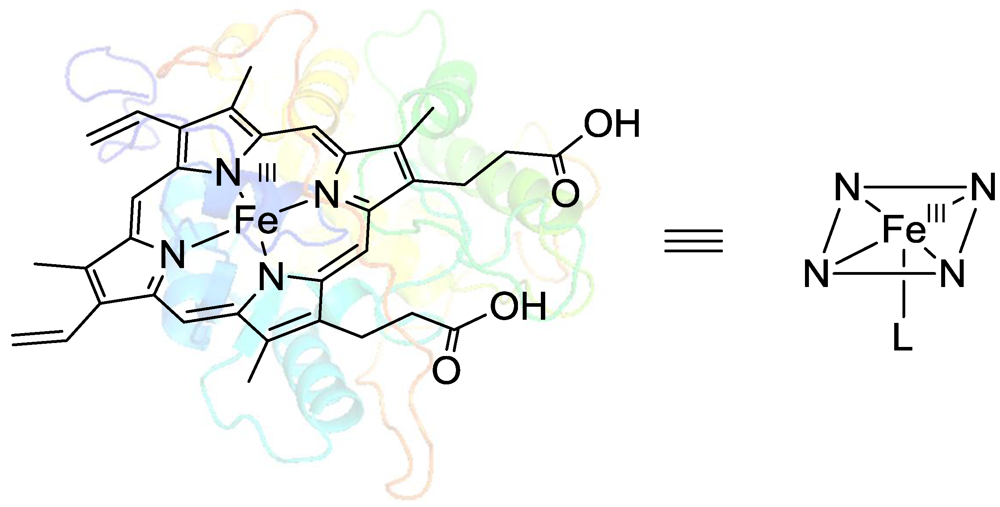
        <p>These peroxidases contain protoporphyrin IX (heme, <xref ref-type="fig" rid="polymers-04-00759-f001">Figure 1</xref>) as prosthetic group with low-spin Fe<sup>III</sup> in the resting state [<xref ref-type="bibr" rid="B16-polymers-04-00759">16</xref>,<xref ref-type="bibr" rid="B17-polymers-04-00759">17</xref>]. </p>
        <fig id="polymers-04-00759-f001" position="anchor">
          <label>Figure 1</label>
          <caption>
            <p>Resting state of heme peroxidases. In the majority of cases L constitutes a histidine ligand.</p>
          </caption>
          <graphic xmlns:xlink="http://www.w3.org/1999/xlink" xlink:href="polymers-04-00759-g001.tif"/>
        </fig>
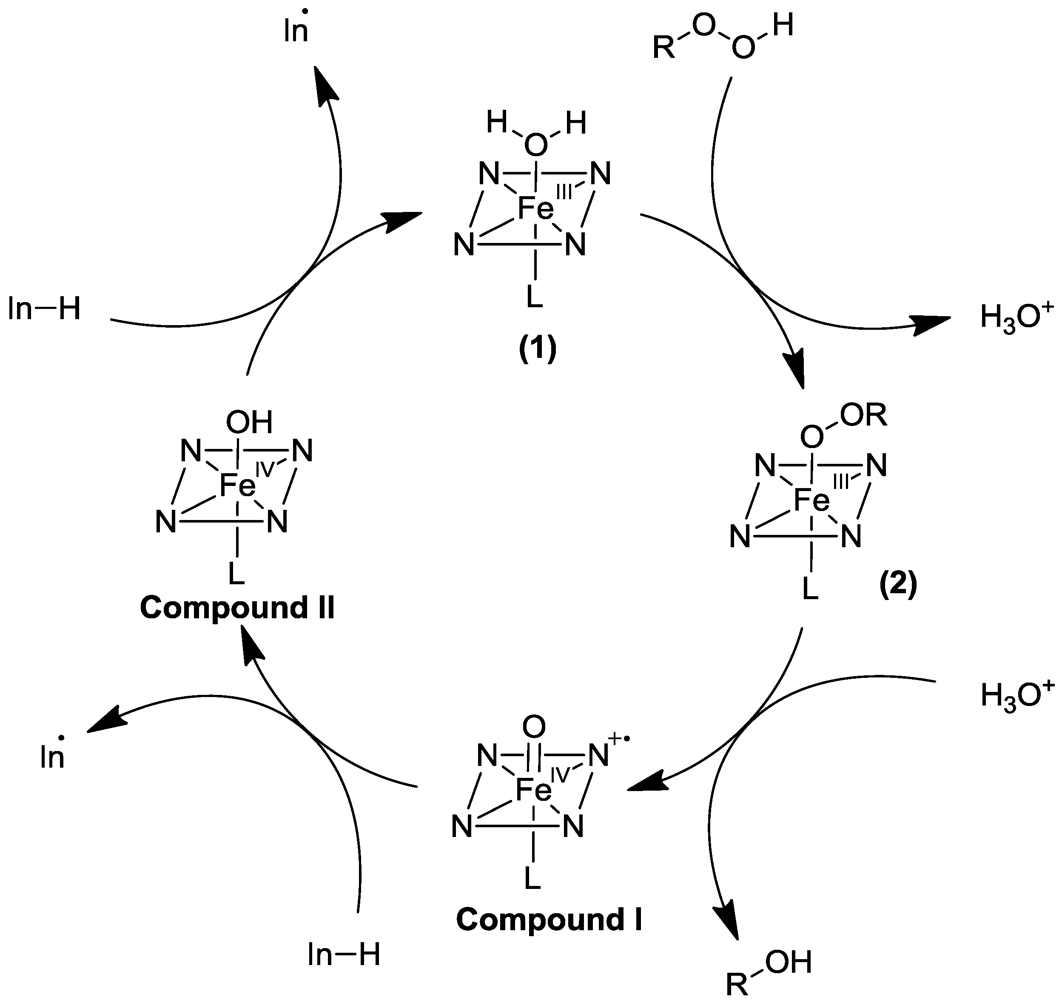
        <p>During the catalytic mechanism (<xref ref-type="fig" rid="polymers-04-00759-f002">Figure 2</xref>) the water ligand (intermediate 1) is substituted by hydrogen peroxide (or other organic hydroperoxides) resulting in a peroxo complex (intermediate 2). Upon heterolytic cleavage of the O-O bond the so-called compound I (Cpd-I) is formed. Cpd-I returns into the resting state by two individual hydrogen abstractions from the reducing substrates (In-H) resulting in the formation of two radical species (In·) which then initiate the polymerization process. Overall, peroxidases function as ‘electron relays’ coupling a two electron transfer step (reduction of peroxides to water or alcohols, respectively) to two subsequent single electron transfer steps. </p>
        
        <p>H<sub>2</sub>O<sub>2</sub> plays an ambivalent role in the peroxidase-initiated polymerization reaction. On the one hand, it serves as oxidant and therefore is essential for the catalytic action. On the other hand, if [H<sub>2</sub>O<sub>2</sub>] is too high, polymerization is inhibited twofold: (<bold>1</bold>) H<sub>2</sub>O<sub>2</sub> is a known inactivator of heme [<xref ref-type="bibr" rid="B18-polymers-04-00759">18</xref>,<xref ref-type="bibr" rid="B19-polymers-04-00759">19</xref>]. It was proposed that in the presence of an excess of H<sub>2</sub>O<sub>2</sub> Cpd-II reacts with another equivalent of H<sub>2</sub>O<sub>2</sub> instead of returning to the resting state. The resulting Cpd-III decomposes along various pathways leading to irreversible enzyme inactivation [<xref ref-type="bibr" rid="B19-polymers-04-00759">19</xref>]. (<bold>2</bold>) A catalase-like activity of peroxidases [<xref ref-type="bibr" rid="B20-polymers-04-00759">20</xref>] at high [H<sub>2</sub>O<sub>2</sub>] results in the generation of O<sub>2</sub> thereby inhibiting the chemical polymerization reaction. This effect has been reported especially for the polymerization of vinyl monomers in form of a lag-phase. During this lag phase, remaining O<sub>2</sub> is consumed, probably by reaction with In. The resulting superoxide anion (O<sub>2</sub><sup>·−</sup>) disproportionates quickly thereby overall accounting for a futile consumption of H<sub>2</sub>O<sub>2</sub> and radical quenching. It should, however, be emphasized that the exact mechanism remains to be elucidated. Polymerization only proceeds if O<sub>2</sub> formed by the catalase-activity has been consumed [<xref ref-type="bibr" rid="B21-polymers-04-00759">21</xref>].</p>
        <fig id="polymers-04-00759-f002" position="anchor">
          <label>Figure 2</label>
          <caption>
            <p>Simplified catalytic mechanism of peroxidase-catalyzed radical formation. In the majority of cases L is a histidine ligand but can also be cysteine.</p>
          </caption>
          <graphic xmlns:xlink="http://www.w3.org/1999/xlink" xlink:href="polymers-04-00759-g002.tif"/>
        </fig>
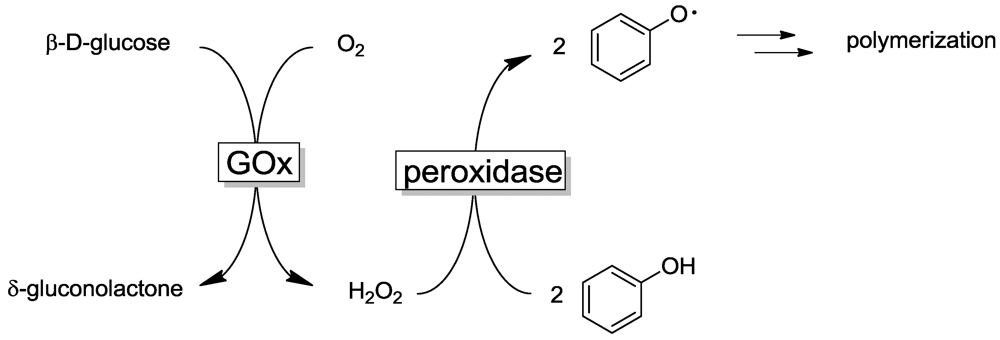
        <p>The usual way of avoiding excess H<sub>2</sub>O<sub>2</sub> is to add H<sub>2</sub>O<sub>2</sub> in several portions, which turns out to be tedious and also bears the danger of leading to a certain degree of irreproducibility. Therefore, a range of <italic>in situ</italic> H<sub>2</sub>O<sub>2 </sub>generation methods have been proposed, [<xref ref-type="bibr" rid="B22-polymers-04-00759">22</xref>,<xref ref-type="bibr" rid="B23-polymers-04-00759">23</xref>,<xref ref-type="bibr" rid="B24-polymers-04-00759">24</xref>] which might be useful also for peroxidase-initiated polymerizations. Indeed Uyama <italic>et al.</italic> and others reported a bienzymatic system for the polymerization of phenols comprising peroxidase as the initiation catalyst and glucose oxidase as <italic>in situ</italic> H<sub>2</sub>O<sub>2</sub> generation catalyst (<xref ref-type="fig" rid="polymers-04-00759-f003">Figure 3</xref>) [<xref ref-type="bibr" rid="B25-polymers-04-00759">25</xref>,<xref ref-type="bibr" rid="B26-polymers-04-00759">26</xref>]. </p>
       
        <p>Interestingly, this system, despite its simplicity, has not found broad proliferation. Possibly, inhibitory effects of O<sub>2</sub> are quite severe in practice.</p>
        <p>A rather unusual <italic>in situ</italic> generation of peroxo species was found accidentally by Samuelson and coworkers [<xref ref-type="bibr" rid="B27-polymers-04-00759">27</xref>]. They found that a dioxane stabilizer (acetyl acetal) spontaneously hydrolyzed under the reaction conditions and was oxidized to peracetic acid, which then served as oxidant to initiate the polymerization of aniline (<xref ref-type="fig" rid="polymers-04-00759-f004">Figure 4</xref>).</p>
         <fig id="polymers-04-00759-f003" position="anchor">
          <label>Figure 3</label>
          <caption>
            <p>Bienzymatic polymerization reaction. Glucose oxidase (GOx) catalyzes the reduction of O<sub>2</sub> to H<sub>2</sub>O<sub>2</sub> which then initiates the polymerization reaction.</p>
          </caption>
          <graphic xmlns:xlink="http://www.w3.org/1999/xlink" xlink:href="polymers-04-00759-g003.tif"/>
        </fig>
        <fig id="polymers-04-00759-f004" position="anchor">
          <label>Figure 4</label>
          <caption>
            <p><italic>In situ</italic> formation of peracetic acid from a solvent stabilizer to initiate horseradish(HRP)-catalyzed polymerizations.</p>
          </caption>
          <graphic xmlns:xlink="http://www.w3.org/1999/xlink" xlink:href="polymers-04-00759-g004.tif"/>
        </fig>
        <p>Nevertheless, portionwise addition of H<sub>2</sub>O<sub>2</sub> remains the most popular procedure to promote peroxidase-initiated polymerizations.</p>
      </sec>
      <sec>
        <title>2.2. Laccase-Initiated Polymerization</title>
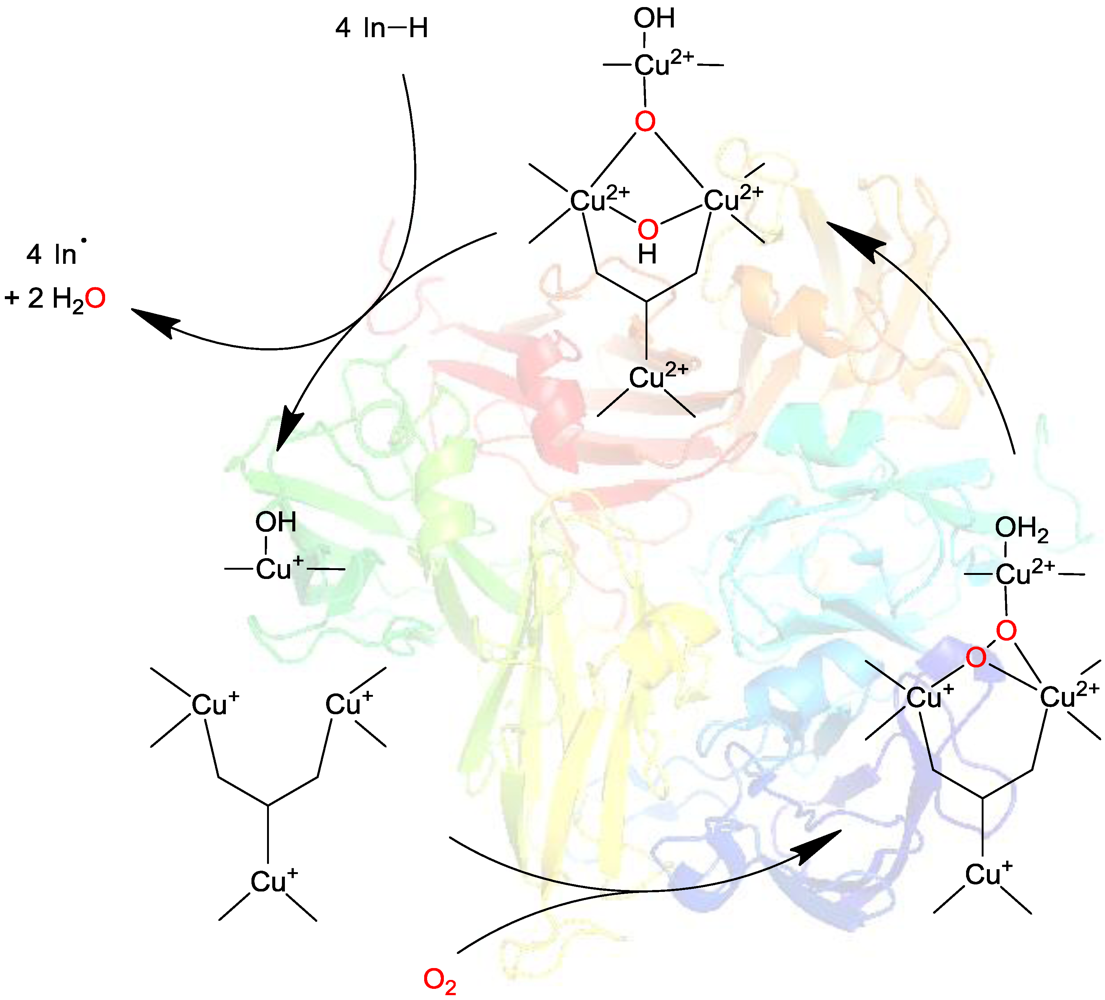
        <p>Laccases (E.C. 1.10.3.2) belong to the so-called blue-copper oxidases predominantly found in fungi but also in plants and insects [<xref ref-type="bibr" rid="B28-polymers-04-00759">28</xref>,<xref ref-type="bibr" rid="B29-polymers-04-00759">29</xref>,<xref ref-type="bibr" rid="B30-polymers-04-00759">30</xref>,<xref ref-type="bibr" rid="B31-polymers-04-00759">31</xref>]. Laccases catalyze hydrogen abstraction reactions from phenolic and related substrates resulting in corresponding phenoxy radicals. They contain four copper ions classified in one T1 copper ion and a T2/T3 cluster. It has been shown that the T1 site is the primary redox center accepting electrons from the electron donors. Thus, the fully oxidized laccase is transformed via four successive, fast single electron transfer (SET) steps into the fully reduced laccase. Molecular oxygen interacts with the fully reduced (T2/T3) cluster via a fast 2-electron-transfer process. The resulting peroxide is tightly bound so that release of H<sub>2</sub>O<sub>2</sub> prior to the second 2-electron-transfer is efficiently prevented. As a result, the fully oxidized form of laccases comprising a μ<sub>3</sub>-oxo-bridged trinuclear (T2/T3) site is formed. This structure is thermodynamically relatively stable and provides the driving force for the overall process and also provides an efficient electron transfer bridge to re-generate the fully reduced state (<xref ref-type="fig" rid="polymers-04-00759-f005">Figure 5</xref>). </p>
        
        <p>Interestingly enough, the number of publications dealing with laccase-initiated polymerization falls back significantly behind peroxidase-initiated polymerization studies. This is astonishing insofar as the laccase-based systems appear to be significantly easier. One apparent advantage is that laccases utilize molecular oxygen instead of hydrogen peroxide as oxidant, but inhibition may prevent widespread use.</p>
        <fig id="polymers-04-00759-f005" position="anchor">
          <label>Figure 5</label>
          <caption>
            <p>Schematic mechanism for laccase-catalyzed radical formation.</p>
          </caption>
          <graphic xmlns:xlink="http://www.w3.org/1999/xlink" xlink:href="polymers-04-00759-g005.tif"/>
        </fig>
      </sec>
      <sec>
        <title>2.3. Laccase-/Peroxidase-Mediator-Systems (LMS/PMS)</title>
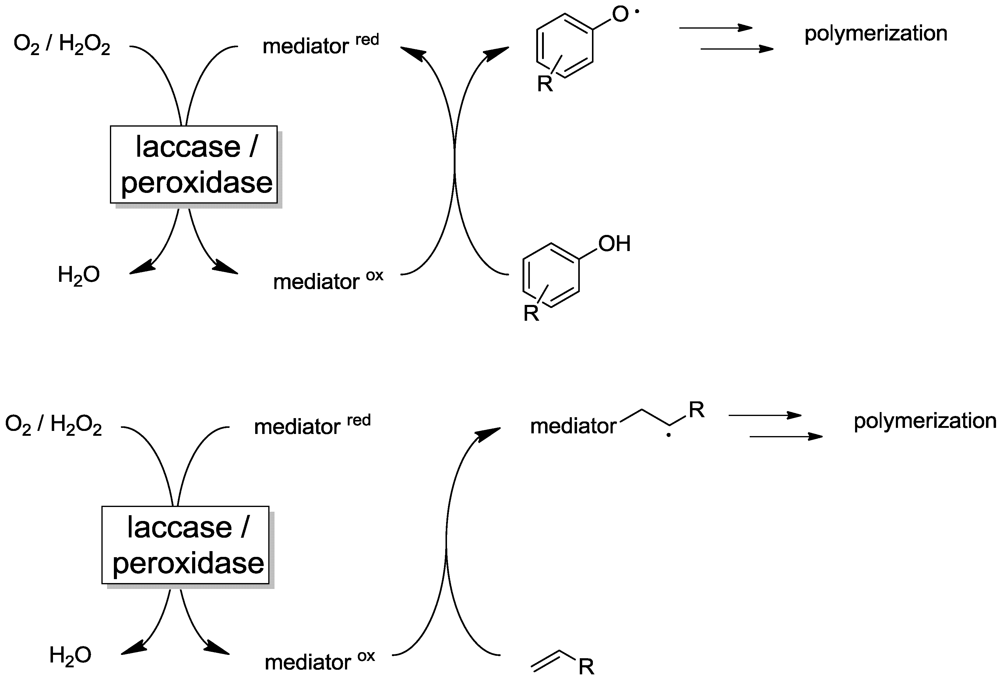
        <p>Often direct oxidation of the monomers is not possible due to unfavorable steric interaction with the enzymes’ active sites and/or due to unfavorable redox potentials. In such cases, initiation of the polymerization reaction may take place by so-called laccase- or peroxidase mediator systems (LMS or PMS, respectively). Here, enzymatic chain initiation does not proceed directly on a monomer molecule but indirectly via a small, oxidizable mediator (<xref ref-type="fig" rid="polymers-04-00759-f006">Figure 6</xref>). Two mechanisms can be distinguished: First, the mediator can serve as radical transfer catalyst without being incorporated into the final product. Phenothiazenes, for example, have been used to initiate the polymerization of sterically demanding phenols, [<xref ref-type="bibr" rid="B32-polymers-04-00759">32</xref>,<xref ref-type="bibr" rid="B33-polymers-04-00759">33</xref>] or ABTS to facilitate pyrrole polymerization [<xref ref-type="bibr" rid="B34-polymers-04-00759">34</xref>,<xref ref-type="bibr" rid="B35-polymers-04-00759">35</xref>]. Also transition metals (e.g., Mn<sup>2+/3+</sup>) [<xref ref-type="bibr" rid="B36-polymers-04-00759">36</xref>] or polyoxometallates [<xref ref-type="bibr" rid="B37-polymers-04-00759">37</xref>] have been reported. Second, the mediator radical itself can initiate chain growth thereby being incorporated into the polymer (see <xref ref-type="sec" rid="sec2dot4-polymers-04-00759">Section 2.4</xref>). This mechanism is the predominant pathway for the polymerization of vinyl monomers with β-diketones representing the mediators of choice (<italic>vide infra</italic>) but may also be applicable for the polymerization of non-phenolic aromatics such as thiophenes [<xref ref-type="bibr" rid="B38-polymers-04-00759">38</xref>].</p>
        <fig id="polymers-04-00759-f006" position="anchor">
          <label>Figure 6</label>
          <caption>
            <p>Schematic representation of laccase mediator systems (LMSs) and peroxidase mediator systems (PMSs) initiated polymerization reactions. <bold>Upper</bold>: the mediator is used as true catalyst transferring the radical to a monomer; <bold>Lower</bold>: the oxidized mediator radical itself initiates the polymerization process and hence is incorporated into the polymer.</p>
          </caption>
          <graphic xmlns:xlink="http://www.w3.org/1999/xlink" xlink:href="polymers-04-00759-g006.tif"/>
        </fig>
      </sec>
      <sec id="sec2dot4-polymers-04-00759">
        <title>2.4. Other Enzyme Systems/Miscellaneous</title>
        <p>Very recently the groups around Bruns [<xref ref-type="bibr" rid="B39-polymers-04-00759">39</xref>] and di Lena [<xref ref-type="bibr" rid="B40-polymers-04-00759">40</xref>,<xref ref-type="bibr" rid="B41-polymers-04-00759">41</xref>] independently reported on biocatalytic atom transfer radical polymerizations.</p>
        <p>Using laccases or heme-enzymes such as catalase of HRP, an ATRP-like polymerization was achieved with ascorbic acid as reductant and α-bromoesters as initiators. Despite the very early stage of development (particularly further mechanistic studies clarifying the initiation reaction are needed), this approach represents already now a very promising biocatalytic alternative to the existing toolbox [<xref ref-type="bibr" rid="B42-polymers-04-00759">42</xref>]. Exciting further developments are expected here in the near future. Noteworthy, this approach also represents the first example(s) of a reductively initiated radical polymerization.</p>
        <p>Ximenes and coworkers reported on the H<sub>2</sub>O<sub>2</sub>-independent Acac oxidation by HRP in the presence of molecular oxygen [<xref ref-type="bibr" rid="B43-polymers-04-00759">43</xref>]. Intermediate formation of Acac<sup>. </sup>and superoxide was postulated, which might potentially be exploited for the initiation of radical polymerizations. If feasible, such a pathway might open up new possibilities while circumventing the limitations of H<sub>2</sub>O<sub>2</sub>-promoted chain initiation reactions mentioned above. It remains to be shown whether such a mechanism might be fruitfully exploited for peroxidase-initiated polymerization reactions.</p>
      </sec>
    </sec>
    <sec>
      <title>3. Controlling the Structure of the Polymers</title>
      <p>Unlike most enzymatic transformations, oxidoreductase-initiated radical polymerizations lack any influence of the biocatalyst on the structure of the final product. Hence, if control over the structure and morphology of the polymer formed is desired, this has to be achieved with a mechanism which does not directly involve the enzyme. In the following some of the strategies generally applied are discussed.</p>
      <sec>
        <title>3.1. Controlling Vinyl Polymerization</title>
        <p>The major concern in vinyl polymerization is to control the polymer weight and polydispersity of the final product. In this respect, most studies have focused on the influence of biocatalyst-, mediator-, and oxidant concentration.</p>
        <p>The biocatalyst concentration directly correlates with the chain initiation rate and thereby influences the number of growing chains in the reaction mixture and competing for the remaining monomers. As a rule of thumb, the higher the biocatalyst concentration the lower the average polymer weight, as demonstrated for peroxidases [<xref ref-type="bibr" rid="B44-polymers-04-00759">44</xref>] and laccases [<xref ref-type="bibr" rid="B45-polymers-04-00759">45</xref>]. At very high enzyme concentration, the initiation rate can be so dominant that only oligomers are formed. Under denaturizing conditions, too low enzyme concentrations manifest in low conversions due to enzyme inactivation [<xref ref-type="bibr" rid="B46-polymers-04-00759">46</xref>].</p>
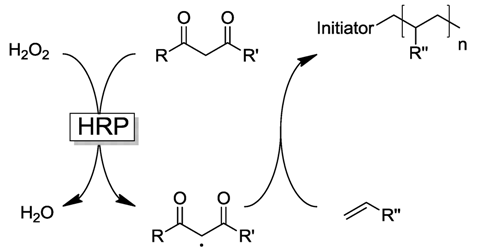
        <p>Like enzyme concentration, choice and concentration of the mediator can have a major impact on the polymer properties. This was demonstrated by Kaplan and coworkers on the HRP-initiated polymerization of styrene and by Marechal and coworkers for the polymerization of acrylamide (<xref ref-type="table" rid="polymers-04-00759-t001">Table 1</xref>) [<xref ref-type="bibr" rid="B47-polymers-04-00759">47</xref>,<xref ref-type="bibr" rid="B48-polymers-04-00759">48</xref>]. </p>
        <table-wrap id="polymers-04-00759-t001" position="anchor">
          <object-id pub-id-type="pii">polymers-04-00759-t001_Table 1</object-id>
          <label>Table 1</label>
          <caption>
            <p>Influence of various β-diketone mediators in the polymer properties.</p>
            <p><inline-graphic xmlns:xlink="http://www.w3.org/1999/xlink" xlink:href="polymers-04-00759-i001.tif"/></p>
          </caption>
          <table>
            <thead>
              <tr>
                <th align="center" valign="middle">Initiator</th>
                <th align="center" valign="middle">Yield [%]</th>
                <th align="center" valign="middle">M<sub>W</sub> [×10<sup>−3</sup> g·mol<sup>−1</sup>]</th>
                <th align="center" valign="middle">PD</th>
              </tr>
            </thead>
            <tbody>
              <tr style="border-bottom: solid thin">
                <td colspan="4" align="left" valign="middle">Styrene polymerization [<xref ref-type="bibr" rid="B47-polymers-04-00759">47</xref>]</td>
              </tr>
              <tr>
                <td align="center" valign="middle">
                  <inline-graphic xmlns:xlink="http://www.w3.org/1999/xlink" xlink:href="polymers-04-00759-i002.tif"/>
                </td>
                <td align="center" valign="middle">17</td>
                <td align="center" valign="middle">27</td>
                <td align="center" valign="middle">2.1</td>
              </tr>
              <tr>
                <td align="center" valign="middle">
                  <inline-graphic xmlns:xlink="http://www.w3.org/1999/xlink" xlink:href="polymers-04-00759-i003.tif"/>
                </td>
                <td align="center" valign="middle">59</td>
                <td align="center" valign="middle">68</td>
                <td align="center" valign="middle">2.0</td>
              </tr>
              <tr>
                <td align="center" valign="middle">
                  <inline-graphic xmlns:xlink="http://www.w3.org/1999/xlink" xlink:href="polymers-04-00759-i004.tif"/>
                </td>
                <td align="center" valign="middle">14</td>
                <td align="center" valign="middle">80</td>
                <td align="center" valign="middle">2.0</td>
              </tr>
              <tr>
                <td align="center" valign="middle">
                  <inline-graphic xmlns:xlink="http://www.w3.org/1999/xlink" xlink:href="polymers-04-00759-i005.tif"/>
                </td>
                <td align="center" valign="middle">14</td>
                <td align="center" valign="middle">97</td>
                <td align="center" valign="middle">2.2</td>
              </tr>
              <tr>
                <td align="center" valign="middle">
                  <inline-graphic xmlns:xlink="http://www.w3.org/1999/xlink" xlink:href="polymers-04-00759-i006.tif"/>
                </td>
                <td align="center" valign="middle">14</td>
                <td align="center" valign="middle">57</td>
                <td align="center" valign="middle">1.6</td>
              </tr>
              <tr style="border-top: solid thin; border-bottom: solid thin">
                <td colspan="4" align="left" valign="middle">Acrylamide polymerization [<xref ref-type="bibr" rid="B48-polymers-04-00759">48</xref>]</td>
              </tr>
              <tr>
                <td align="center" valign="middle">
                  <inline-graphic xmlns:xlink="http://www.w3.org/1999/xlink" xlink:href="polymers-04-00759-i007.tif"/>
                </td>
                <td align="center" valign="middle">93</td>
                <td align="center" valign="middle">124</td>
                <td align="center" valign="middle">2.5</td>
              </tr>
              <tr>
                <td align="center" valign="middle">
                  <inline-graphic xmlns:xlink="http://www.w3.org/1999/xlink" xlink:href="polymers-04-00759-i008.tif"/>
                </td>
                <td align="center" valign="middle">84</td>
                <td align="center" valign="middle">56</td>
                <td align="center" valign="middle">2.9</td>
              </tr>
              <tr>
                <td align="center" valign="middle">
                  <inline-graphic xmlns:xlink="http://www.w3.org/1999/xlink" xlink:href="polymers-04-00759-i009.tif"/>
                </td>
                <td align="center" valign="middle">76</td>
                <td align="center" valign="middle">5</td>
                <td align="center" valign="middle">4.4</td>
              </tr>
              <tr>
                <td align="center" valign="middle">
                  <inline-graphic xmlns:xlink="http://www.w3.org/1999/xlink" xlink:href="polymers-04-00759-i010.tif"/>
                </td>
                <td align="center" valign="middle">72</td>
                <td align="center" valign="middle">27</td>
                <td align="center" valign="middle">3.3</td>
              </tr>
              <tr>
                <td align="center" valign="middle">
                  <inline-graphic xmlns:xlink="http://www.w3.org/1999/xlink" xlink:href="polymers-04-00759-i011.tif"/>
                </td>
                <td align="center" valign="middle">78</td>
                <td align="center" valign="middle">85</td>
                <td align="center" valign="middle">2.7</td>
              </tr>
              <tr>
                <td align="center" valign="middle">
                  <inline-graphic xmlns:xlink="http://www.w3.org/1999/xlink" xlink:href="polymers-04-00759-i012.tif"/>
                </td>
                <td align="center" valign="middle">38</td>
                <td align="center" valign="middle">10.5</td>
                <td align="center" valign="middle">3.9</td>
              </tr>
            </tbody>
          </table>
        </table-wrap>
        <p>So far, detailed studies clarifying the influence of ß-diketone structure on enzyme activity are missing. Most likely, both steric and electronic effects influence the rate of the enzymatic initiation reaction as well as the rate of the chain growth (at least at an early stage of the chain growth).</p>
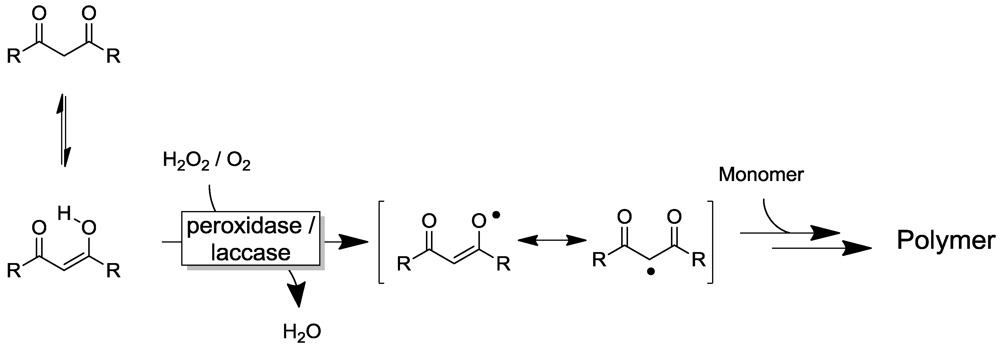
        <p>It is generally assumed that the enol form represents the actual substrate for the enzymatic radical formation reaction (<xref ref-type="fig" rid="polymers-04-00759-f007">Figure 7</xref>) [<xref ref-type="bibr" rid="B49-polymers-04-00759">49</xref>].</p>
        <fig id="polymers-04-00759-f007" position="anchor">
          <label>Figure 7</label>
          <caption>
            <p>β-Diketones as polymerization initiators.</p>
          </caption>
          <graphic xmlns:xlink="http://www.w3.org/1999/xlink" xlink:href="polymers-04-00759-g007.tif"/>
        </fig>
        <p>The state of the keto-enol equilibrium should determine the actual substrate concentration. Hence, high pH values should be beneficial as well as using elevated substrate concentrations. However, these measures may also be counteracted by a decreasing activity of the biocatalyst under these conditions. Principally, electron withdrawing substituents should increase the enzyme rate by shifting the keto-enol equilibrium and lowering the redox potential on the one hand. On the other hand, the resulting radical might be too stable due to very low lying SOMO energy. </p>
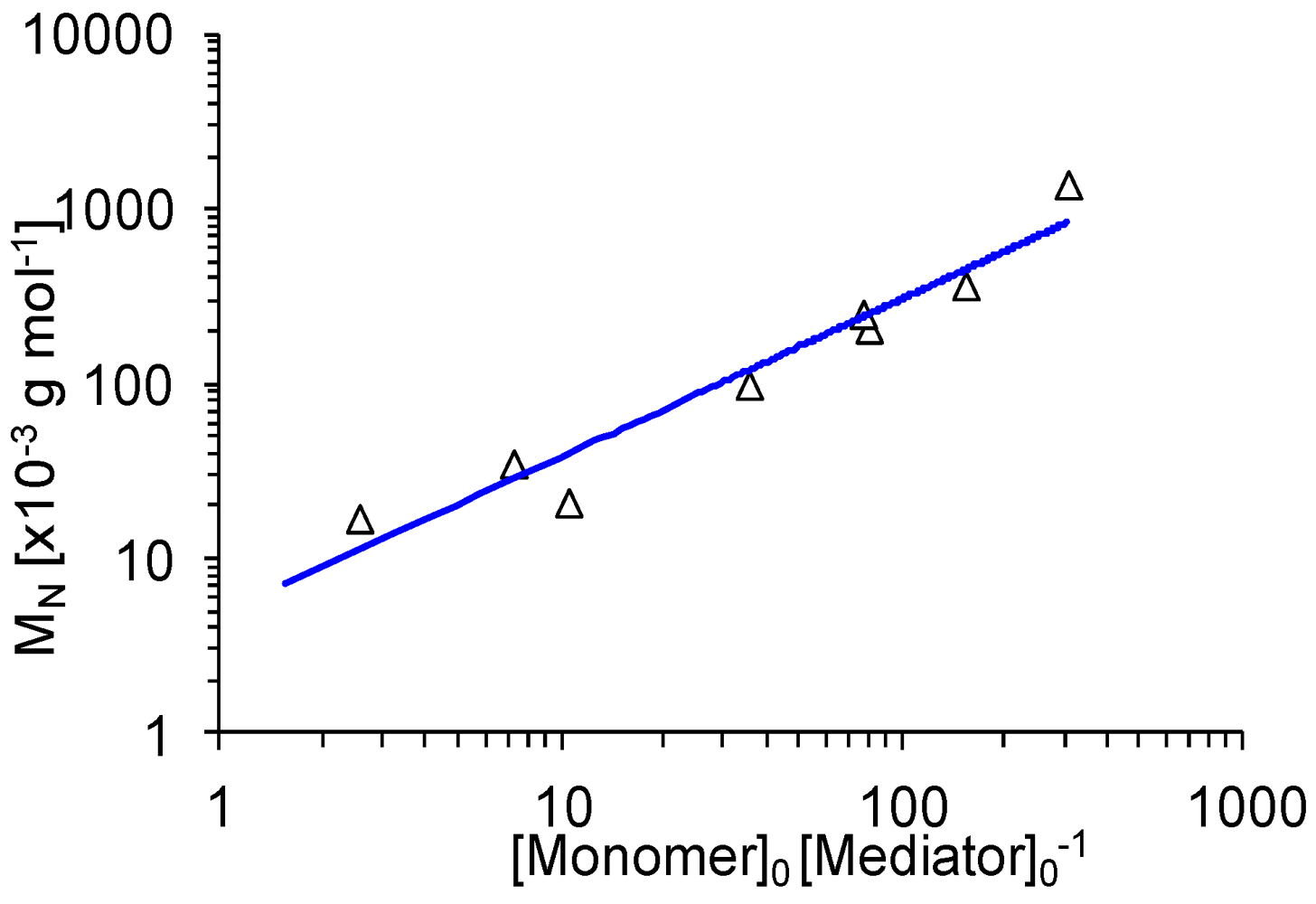
        <p>Obviously, the ratio of monomer to initiator has a strong influence on the average size of the resulting polymer. The number of growing polymer chains, competing for the remaining monomer reservoir, increases with initial initiator concentration (<xref ref-type="fig" rid="polymers-04-00759-f008">Figure 8</xref>) [<xref ref-type="bibr" rid="B44-polymers-04-00759">44</xref>].</p>
        <fig id="polymers-04-00759-f008" position="anchor">
          <label>Figure 8</label>
          <caption>
            <p>Influence of the monomer-mediator ratio on the properties of poly(acrylamide).</p>
          </caption>
          <graphic xmlns:xlink="http://www.w3.org/1999/xlink" xlink:href="polymers-04-00759-g008.tif"/>
        </fig>
        <p>There is an ongoing discussion about the necessity of ß-diketones to initiate the polymerization reaction. Earlier reports on ß-diketone-free polymerization of acrylamide [<xref ref-type="bibr" rid="B13-polymers-04-00759">13</xref>,<xref ref-type="bibr" rid="B50-polymers-04-00759">50</xref>] could not be reproduced by others [<xref ref-type="bibr" rid="B48-polymers-04-00759">48</xref>,<xref ref-type="bibr" rid="B51-polymers-04-00759">51</xref>]. One potential solution of this apparent discrepancy may be found in the very high H<sub>2</sub>O<sub>2</sub> concentration in the mediator-free polymerizations resulting in ‘unusual’ heme-iron species [<xref ref-type="bibr" rid="B19-polymers-04-00759">19</xref>]. Thus, highly reactive peroxidase-species might initiate the polymerization reaction by direct H-atom abstraction from the monomer. Alternatively, oxidative degradation of heme resulting of Fe-release into the reaction medium might account for catalytic, Fenton-like generation of reactive oxygen species (ROS) initiating the polymerization reaction. </p>
        <p>Kobayashi and coworkers reported on the mediator-free direct polymerization of acryl amide using the laccase from <italic>Pycnoporus coccineus</italic> suggesting a simplified polymerization scheme [<xref ref-type="bibr" rid="B52-polymers-04-00759">52</xref>]. Using the laccase from <italic>Myceliophthora thermophilia</italic>, this was not achieved [<xref ref-type="bibr" rid="B14-polymers-04-00759">14</xref>,<xref ref-type="bibr" rid="B45-polymers-04-00759">45</xref>] and a follow-up study validating Kobayashi’s initial study is still missing.</p>
        <p>Particularly when using laccases, molecular oxygen plays an ambivalent role. On the one hand, O<sub>2</sub> serves as stoichiometric oxidant to initiate the polymerization reaction. On the other hand, excess O<sub>2</sub> can also efficiently quench the radical polymerization [<xref ref-type="bibr" rid="B45-polymers-04-00759">45</xref>,<xref ref-type="bibr" rid="B53-polymers-04-00759">53</xref>].</p>
        <p>Recently, Nieto <italic>et al.</italic> reported on an interesting approach to balance the <italic>in situ</italic> O<sub>2</sub> concentration for laccase-initiated polymerization by co-application of glucose oxidase as additional O<sub>2</sub>-consuming reaction [<xref ref-type="bibr" rid="B54-polymers-04-00759">54</xref>]. </p>
      </sec>
      <sec>
        <title>3.2. Controlling Polymerization of Aromatics</title>
        <p>In contrast to the above-mentioned polymerization of vinyl monomers, regioselectivity also plays an important role in the polymerization of phenols and anilines. Hence, many efforts have been directed towards gaining control over the chemo- and regioselectivity of the enzymatic polymerization of phenols and anilines.</p>
        <sec>
          <title>3.2.1. Cosolvents</title>
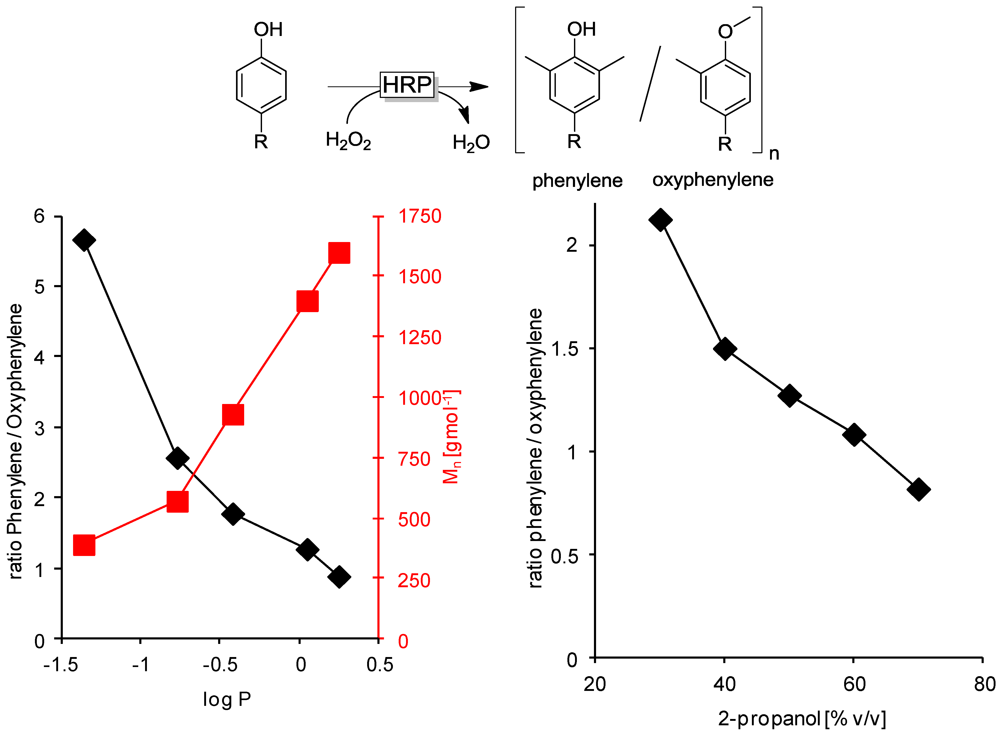
          <p>Also due to the poor aqueous solubility of most aromatic substrates, the influence of co-solvents is frequently addressed [<xref ref-type="bibr" rid="B55-polymers-04-00759">55</xref>,<xref ref-type="bibr" rid="B56-polymers-04-00759">56</xref>]. In some cases significant control over the polymer size and polydispersity has been achieved with organic solvents. For example, Dordick <italic>et al.</italic> observed changes in the average polymer weight of poly(phenol) from 1,000 to over 26,000 g·mol<sup>−1</sup> upon varying the 1,4-dioxane content in the polymerization reactions [<xref ref-type="bibr" rid="B57-polymers-04-00759">57</xref>]. Oguchi <italic>et al.</italic> reported on the HRP-initiated polymerization of phenol in aqueous methanol solutions yielding number average molecular weights up to 5200 g·mol<sup>−1</sup> [<xref ref-type="bibr" rid="B58-polymers-04-00759">58</xref>]. Mita <italic>et al.</italic> have investigated various polar solvents and their influence on the chemoselectivity of the peroxidase-initiated polymerization of phenols (<xref ref-type="fig" rid="polymers-04-00759-f009">Figure 9</xref>) [<xref ref-type="bibr" rid="B59-polymers-04-00759">59</xref>,<xref ref-type="bibr" rid="B60-polymers-04-00759">60</xref>]. Also the hydrophobicity of the starting material had an influence on the C-C <italic>vs.</italic> C-O selectivity: the higher the hydrophobicity, the higher was the C-C- selectivity. Later on the same authors substantiated these results also using laccase as catalyst [<xref ref-type="bibr" rid="B61-polymers-04-00759">61</xref>,<xref ref-type="bibr" rid="B62-polymers-04-00759">62</xref>].</p>
          <fig id="polymers-04-00759-f009" position="anchor">
            <label>Figure 9</label>
            <caption>
              <p>Influence of cosolvent on the peroxidase-initiated polymerization of 4-butylphenol. left: influence of different logPs on the selectivity of the bond formation and polymer weight; right: chemoselectivity at different co-solvent concentrations.</p>
            </caption>
            <graphic xmlns:xlink="http://www.w3.org/1999/xlink" xlink:href="polymers-04-00759-g009.tif"/>
          </fig>
          <p>In addition to classical organic solvents, also ionic liquids have received some attention as cosolvents to increase the solubility of the phenolic monomers. Interestingly, while Sgalla <italic>et al.</italic> [<xref ref-type="bibr" rid="B63-polymers-04-00759">63</xref>]. reported the exclusive formation of dimers using HRP in [BMIM][BF<sub>4</sub>], Eker <italic>et al.</italic> later on reported on the generation of comparably large polymers using the same IL as cosolvent [<xref ref-type="bibr" rid="B64-polymers-04-00759">64</xref>]. Obviously, more research will be necessary to fully understand the effect of ILs as cosolvents to support enzymatic polymerizations [<xref ref-type="bibr" rid="B65-polymers-04-00759">65</xref>].</p>
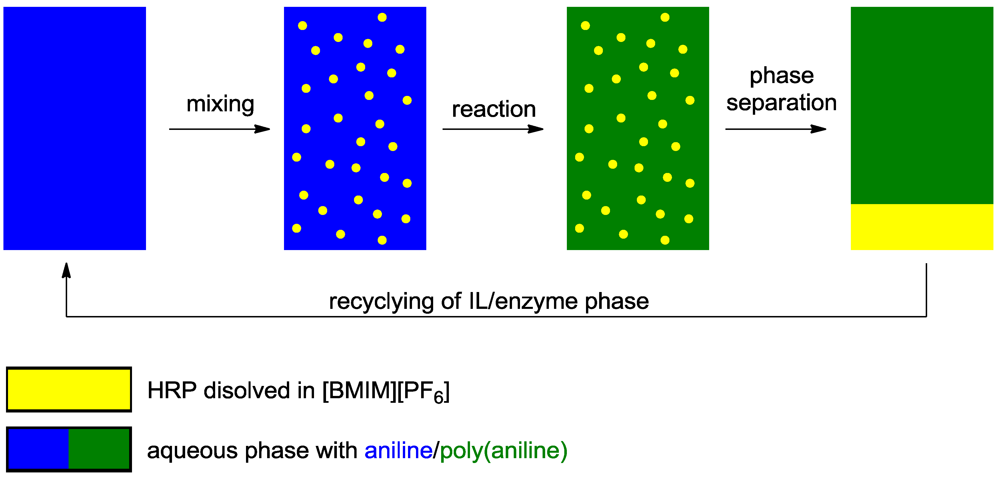
          <p>Ionic liquids can also be used as liquid support for enzyme immobilization as demonstrated by Rumbau <italic>et al.</italic> [<xref ref-type="bibr" rid="B66-polymers-04-00759">66</xref>]. HRP immobilized in [BMIM][PF<sub>6</sub>] was applied in an emulsion polymerization of aniline (using dodecylbenzensulfonate as anionic template, vide infra). After the reaction, the aqueous product phase was separated from the enzyme-containing IL which could be reused at least 5 times without significant changes in the product properties (<xref ref-type="fig" rid="polymers-04-00759-f010">Figure 10</xref>).</p>
          <fig id="polymers-04-00759-f010" position="anchor">
            <label>Figure 10</label>
            <caption>
              <p>[BMIM][PF<sub>6</sub>] as liquid support for the immobilization/recycling of HRP.</p>
            </caption>
            <graphic xmlns:xlink="http://www.w3.org/1999/xlink" xlink:href="polymers-04-00759-g010.tif"/>
          </fig>
          <p>Cyclodextrines have been evaluated as alternatives to organic cosolvents to increase the solubility of hydrophobic phenols [<xref ref-type="bibr" rid="B67-polymers-04-00759">67</xref>,<xref ref-type="bibr" rid="B68-polymers-04-00759">68</xref>,<xref ref-type="bibr" rid="B69-polymers-04-00759">69</xref>]. </p>
          <fig id="polymers-04-00759-f011" position="anchor">
            <label>Figure 11</label>
            <caption>
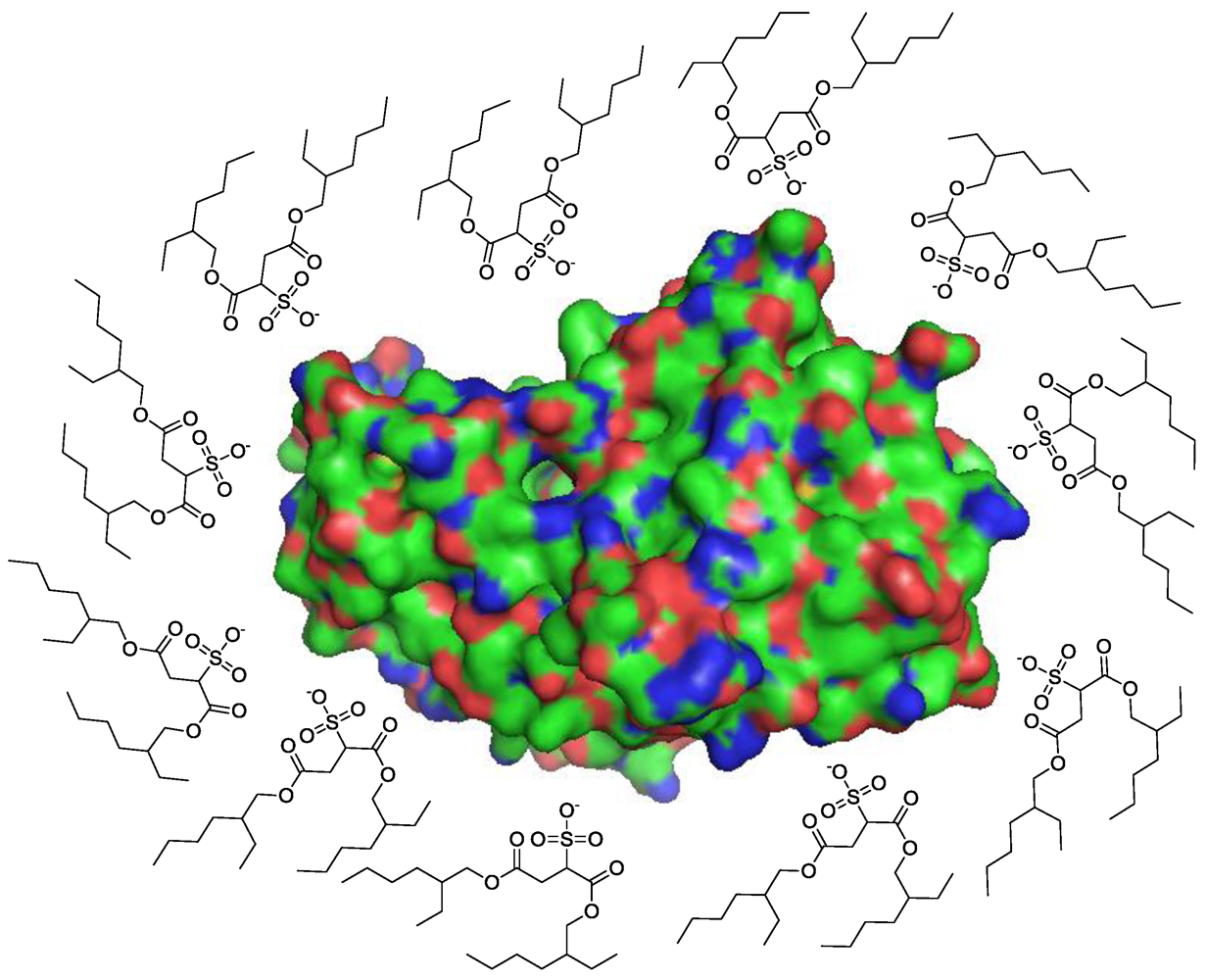
              <p>HRP solubilized in organic solvents by charge compensation/hydrophobization with AOT (anionic surfactant).</p>
            </caption>
            <graphic xmlns:xlink="http://www.w3.org/1999/xlink" xlink:href="polymers-04-00759-g011.tif"/>
          </fig>
          <p>Of course, (almost) non-aqueous reaction media would solve the solubility issue of phenols. Furthermore, anhydrous conditions can significantly alter the outcome of a given enzyme reaction. For example, as early as 1986, Dordick <italic>et al.</italic> reported that HRP catalyzes the depolymerization of lignin model compounds in 95% dioxane whereas under aqueous conditions no depolymerization activity was detectable [<xref ref-type="bibr" rid="B57-polymers-04-00759">57</xref>,<xref ref-type="bibr" rid="B70-polymers-04-00759">70</xref>]. Of course the solubility of native polypeptides in non-aqueous reaction media is practically zero, leading to severe diffusion limitations when using immobilized biocatalysts. However, under certain conditions enzymes can be made organosoluble e.g., by chemical modification (acetylation), [<xref ref-type="bibr" rid="B57-polymers-04-00759">57</xref>,<xref ref-type="bibr" rid="B70-polymers-04-00759">70</xref>] or ion pairing with anionic surfactants [<xref ref-type="bibr" rid="B71-polymers-04-00759">71</xref>] or calixarenes [<xref ref-type="bibr" rid="B72-polymers-04-00759">72</xref>]. For example, Li and coworkers could make HRP soluble in isooctane by ion pairing it with the anionic surfactant aerosol OT (AOT) (<xref ref-type="fig" rid="polymers-04-00759-f011">Figure 11</xref>). The resulting organosoluble HRP was used in the tBuOOH-driven polymerization of hexylphenol [<xref ref-type="bibr" rid="B71-polymers-04-00759">71</xref>].</p>
          
        </sec>
        <sec>
          <title>3.2.2. Templates</title>
          <p>There are a number of investigations in which templates have been used for controlling the chemical structure of polymers synthesized by oxidoreductase-initiated polymerization. Very recently, Walde and Gou gave an excellent overview over the present state of the art [<xref ref-type="bibr" rid="B73-polymers-04-00759">73</xref>], which is why here only a few representative examples are discussed.</p>
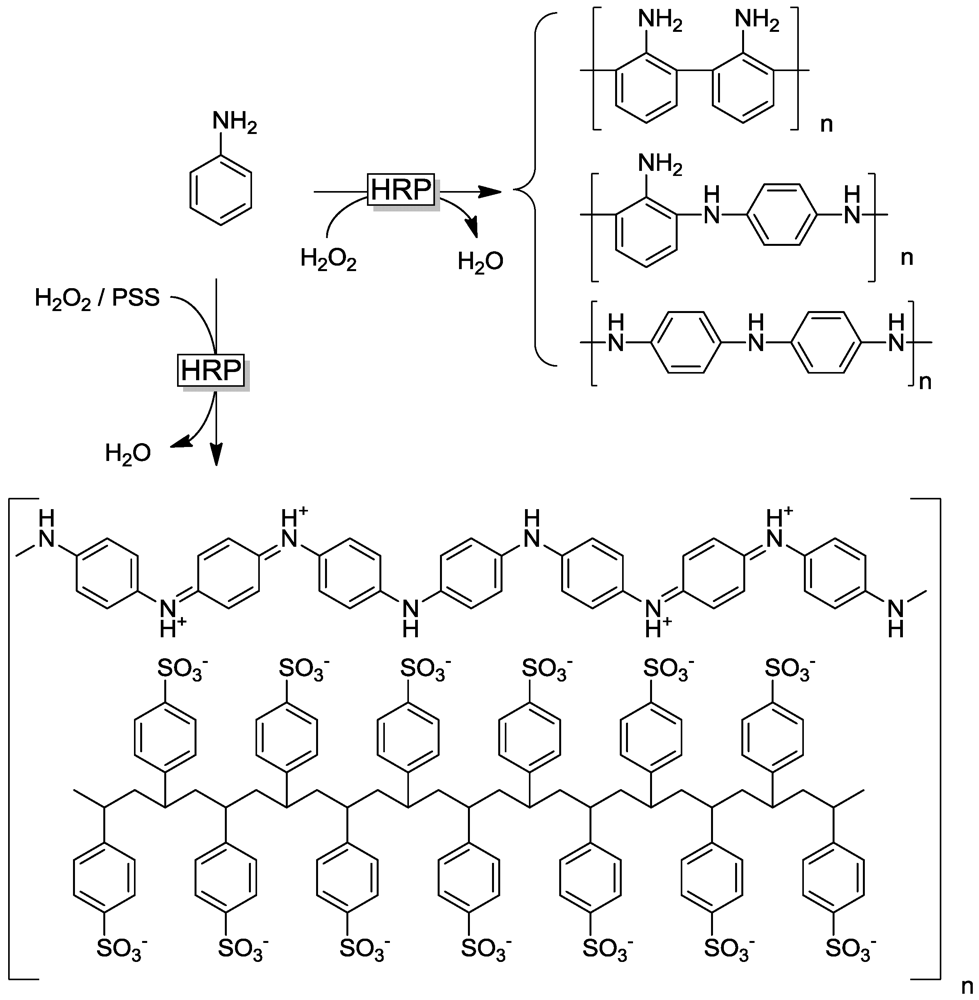
          <p>Poly(styrenesulfonate) (PSS) represents one of the first an most widely applied templates to control polymerizations. Special interest has been paid to the polymerization of aniline to the conducting polymer form (emeraldine). In the absence of a suitable template aniline polymerizes with poor regioselectivity yielding complex, insoluble and non conducting polymers. However, e.g., in the presence of negatively charged PSS (and in the presence of protonated aniline, <italic>i.e.</italic>, at suitable pHs) formation of the conducting emeraldine form is strongly favored (<xref ref-type="fig" rid="polymers-04-00759-f012">Figure 12</xref>) [<xref ref-type="bibr" rid="B27-polymers-04-00759">27</xref>,<xref ref-type="bibr" rid="B73-polymers-04-00759">73</xref>,<xref ref-type="bibr" rid="B74-polymers-04-00759">74</xref>,<xref ref-type="bibr" rid="B75-polymers-04-00759">75</xref>,<xref ref-type="bibr" rid="B76-polymers-04-00759">76</xref>,<xref ref-type="bibr" rid="B77-polymers-04-00759">77</xref>,<xref ref-type="bibr" rid="B78-polymers-04-00759">78</xref>,<xref ref-type="bibr" rid="B79-polymers-04-00759">79</xref>].</p>
          <fig id="polymers-04-00759-f012" position="anchor">
            <label>Figure 12</label>
            <caption>
              <p>Reaction products obtained by radical polymerization (e.g., in the system HRP/H<sub>2</sub>O<sub>2</sub>) of aniline. In the absence of templates (upper) and e.g., using PSS as template.</p>
            </caption>
            <graphic xmlns:xlink="http://www.w3.org/1999/xlink" xlink:href="polymers-04-00759-g012.tif"/>
          </fig>
          <p>Other negatively charged polymers [<xref ref-type="bibr" rid="B80-polymers-04-00759">80</xref>] such as poly(vinylphosphonic acid) [<xref ref-type="bibr" rid="B81-polymers-04-00759">81</xref>] or DNA [<xref ref-type="bibr" rid="B82-polymers-04-00759">82</xref>,<xref ref-type="bibr" rid="B83-polymers-04-00759">83</xref>,<xref ref-type="bibr" rid="B84-polymers-04-00759">84</xref>] have been reported as templates. The templates promote the formation of the electrically conducting emeraldine form of poly(aniline) and significant branching (as in case of in the absence of the templating agent) does not occur. The template is thought to at least partially lead to a proper alignment of the monomers and the growing chain; another role of the negatively charged template is to serve as counter ion (dopant) influencing the charge and conformation of the polyaniline and thereby its electronic properties. In addition, anionic surfactants under emulsion conditions have been reported as templates [<xref ref-type="bibr" rid="B85-polymers-04-00759">85</xref>,<xref ref-type="bibr" rid="B86-polymers-04-00759">86</xref>]. Using PSS as template also proved to be suitable to produce poly(pyrroles) with improved conductiveness [<xref ref-type="bibr" rid="B87-polymers-04-00759">87</xref>].</p>
          <p>Templated polymerization of phenols can be achieved also using uncharged templates such as poly(ethylene glycol) and others [<xref ref-type="bibr" rid="B88-polymers-04-00759">88</xref>,<xref ref-type="bibr" rid="B89-polymers-04-00759">89</xref>,<xref ref-type="bibr" rid="B90-polymers-04-00759">90</xref>,<xref ref-type="bibr" rid="B91-polymers-04-00759">91</xref>,<xref ref-type="bibr" rid="B92-polymers-04-00759">92</xref>]. Probably due to H-bond-mediated phenol-template interactions, a certain degree of regioselectivity favoring phenylene connections over oxyphenylenes was observed [<xref ref-type="bibr" rid="B89-polymers-04-00759">89</xref>,<xref ref-type="bibr" rid="B90-polymers-04-00759">90</xref>,<xref ref-type="bibr" rid="B91-polymers-04-00759">91</xref>]</p>
          <p>Interestingly, using carbon nanotubes as polymerization templates, Liu and coworkers observed oxyphenylene selectivity in the polymerization of phenol [<xref ref-type="bibr" rid="B93-polymers-04-00759">93</xref>].</p>
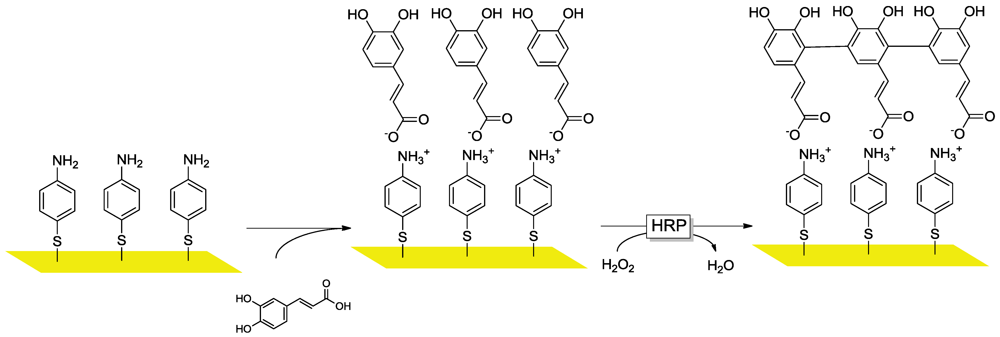
          <p>Another very interesting templating effect was reported by Xu <italic>et al.</italic> who caffeic acid onto a p-aminothiophenol-modified gold surface [<xref ref-type="bibr" rid="B94-polymers-04-00759">94</xref>]. Oriented adsorption of the phenolic monomer was achieved via inonic and H-bond interactions of the substrate with the amino-modified surface. As a result, the laccase- or HRP-initiated polymerization proceeded with very high phenylene selectivity whereas under ‘normal aqueous’ polymerization conditions a mix of phenylene and oxyphenylene connections was observed (<xref ref-type="fig" rid="polymers-04-00759-f013">Figure 13</xref>).</p>
          <fig id="polymers-04-00759-f013" position="anchor">
            <label>Figure 13</label>
            <caption>
              <p>HRP-initiated chemoselective polymerization of caffeic acid templated by a NH<sub>2</sub>-modified Au-electrode.</p>
            </caption>
            <graphic xmlns:xlink="http://www.w3.org/1999/xlink" xlink:href="polymers-04-00759-g013.tif"/>
          </fig>
        </sec>
        <sec>
          <title>3.2.3. Substrate Engineering</title>
          <p>Also the structure of the monomers themselves can significantly influence the selectivity of the polymerization reaction. For example Mita <italic>et al.</italic> [<xref ref-type="bibr" rid="B60-polymers-04-00759">60</xref>] showed that the phenylene content of poly(p-substituted phenols) increased with the hydrophobicity of the substituent. Blocking the o-position of aniline enabled selective polymerization of anilines yielding conductive emeraldines without the need for a template [<xref ref-type="bibr" rid="B27-polymers-04-00759">27</xref>].</p>
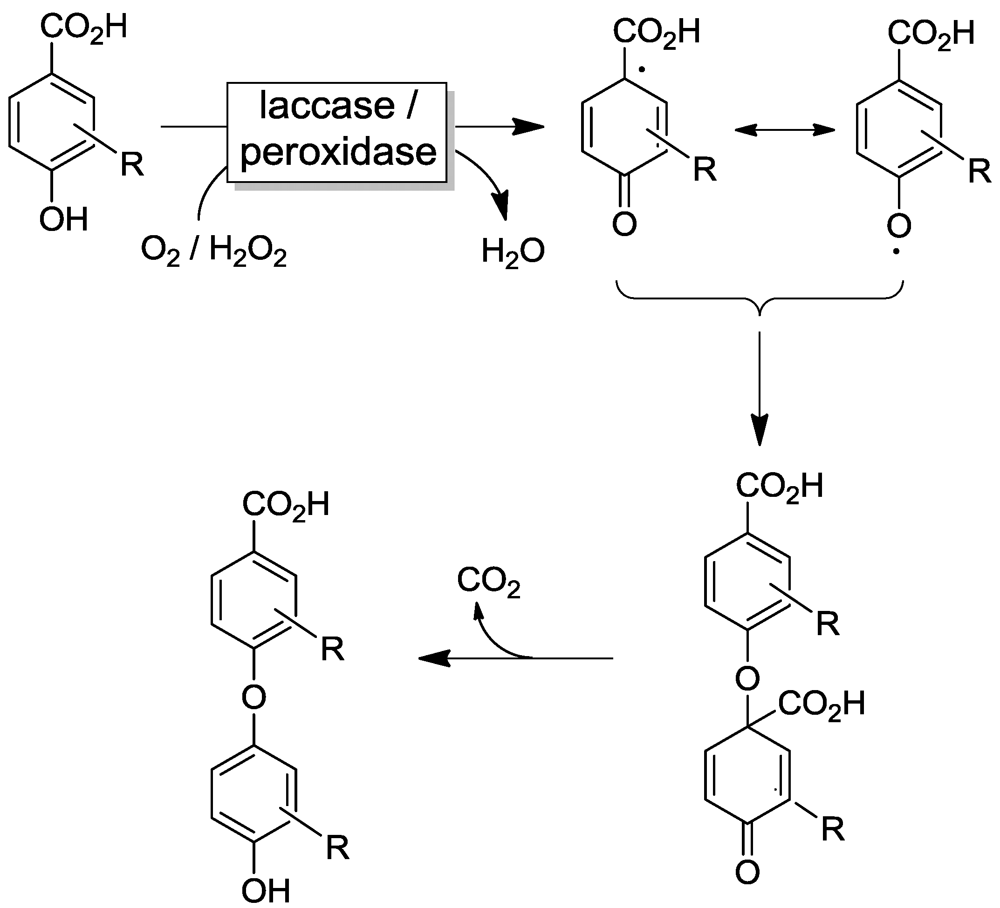
          <p>Another interesting example is the polymerization of <italic>p</italic>-hydroxy benzoic acid (derivates), which proceeds highly regioselectively producing oxyphenylene connections exclusively (<xref ref-type="fig" rid="polymers-04-00759-f014">Figure 14</xref>) [<xref ref-type="bibr" rid="B95-polymers-04-00759">95</xref>].</p>
          <fig id="polymers-04-00759-f014" position="anchor">
            <label>Figure 14</label>
            <caption>
              <p>Proposed regioselective polymerization mechanism for <italic>p</italic>-hydroxy benzoates.</p>
            </caption>
            <graphic xmlns:xlink="http://www.w3.org/1999/xlink" xlink:href="polymers-04-00759-g014.tif"/>
          </fig>
          <fig id="polymers-04-00759-f015" position="anchor">
            <label>Figure 15</label>
            <caption>
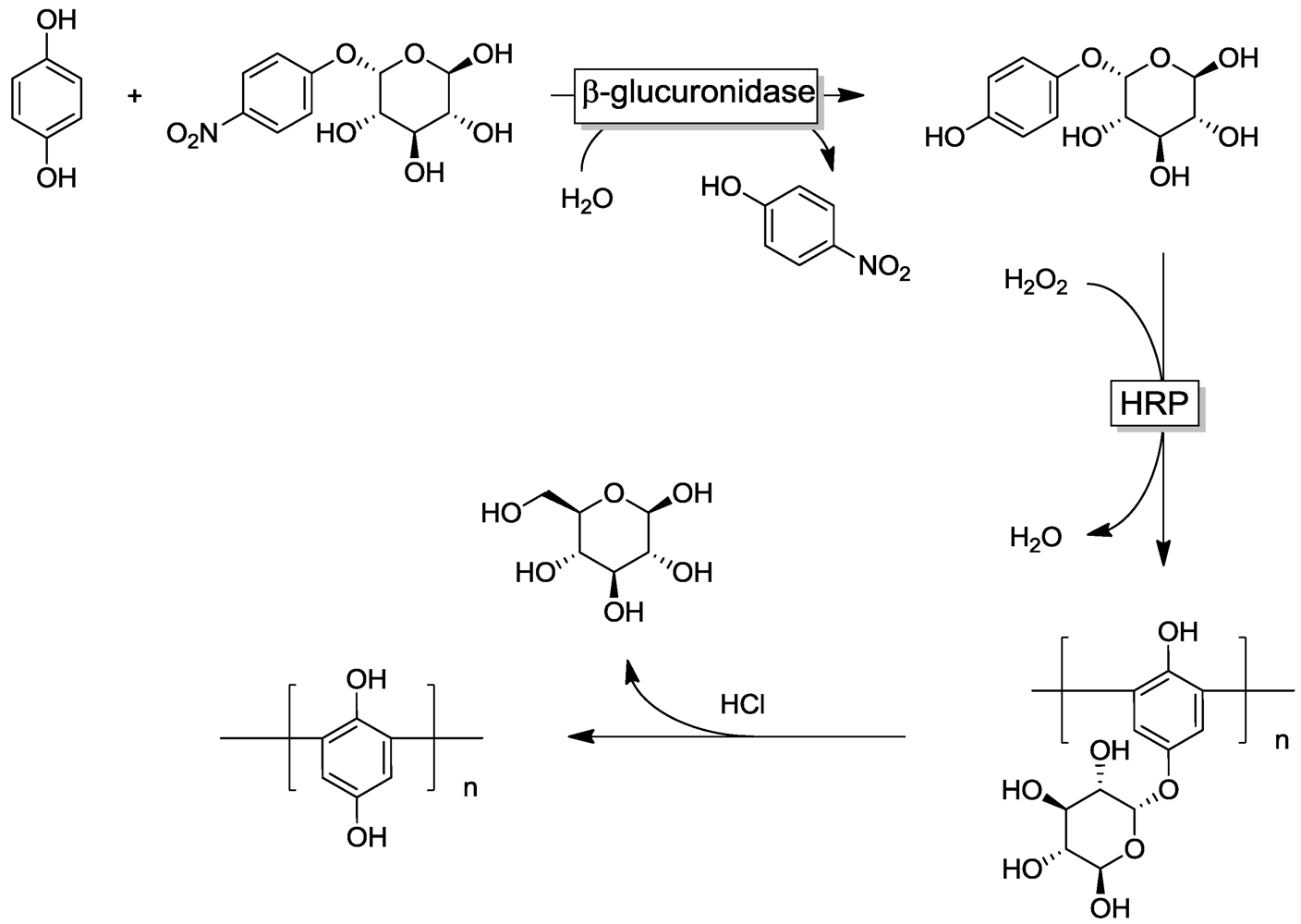
              <p>Multi-enzyme synthesis of poly(hydroquinone).</p>
            </caption>
            <graphic xmlns:xlink="http://www.w3.org/1999/xlink" xlink:href="polymers-04-00759-g015.tif"/>
          </fig>
          <p>Polymerization of catechols and hydroquinones can be tedious due to facile oxidation to the corresponding quinones. This can be overcome by blocking of one of the OH-functionalities as demonstrated by Dordick and coworkers (<xref ref-type="fig" rid="polymers-04-00759-f015">Figure 15</xref>) [<xref ref-type="bibr" rid="B96-polymers-04-00759">96</xref>]. As a result, not only was quinine formation efficiently suppressed but also a high level of <italic>o</italic>-phenylene selectivity achieved. In a similar approach 4-amino phenol was selectively polymerized by reversible blocking of the amino group via imine formation [<xref ref-type="bibr" rid="B97-polymers-04-00759">97</xref>].</p>
          
        </sec>
      </sec>
    </sec>
    <sec>
      <title>4. Selected Examples</title>
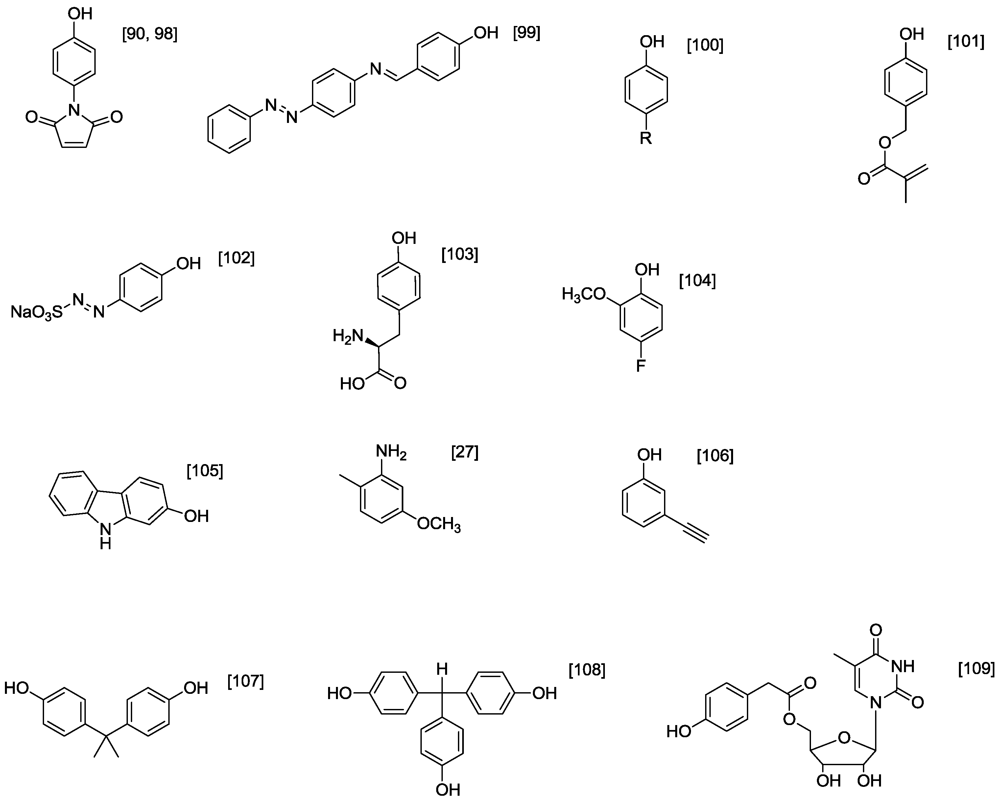
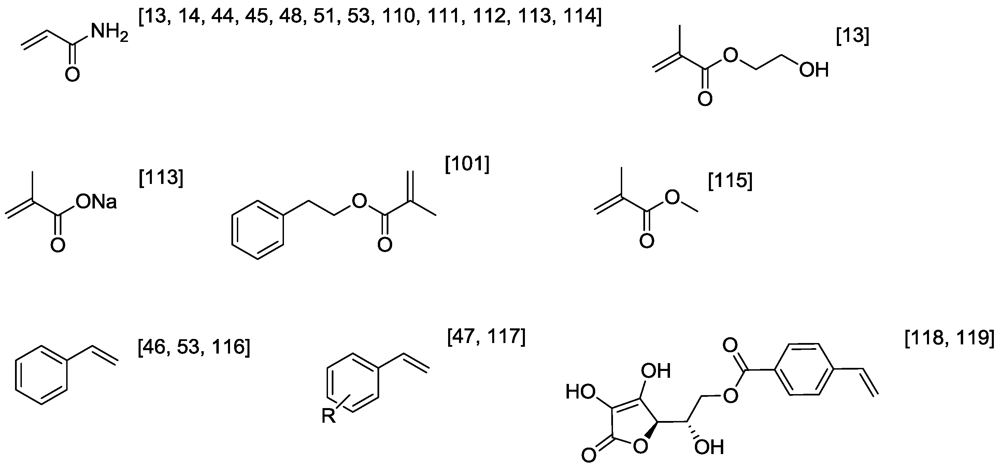
      <p>There is an enormous amount of structurally diverse phenols, anilines and other aromatic monomers, which have been subjected to enzyme-initiated radical polymerization. A representative, but by far not exhaustive selection of the different monomers is given in <xref ref-type="fig" rid="polymers-04-00759-f016">Figure 16</xref> and <xref ref-type="fig" rid="polymers-04-00759-f017">Figure 17</xref>. For a detailed discussion about polymer properties and potential uses, the interested reader is referred to some excellent previous overviews [<xref ref-type="bibr" rid="B8-polymers-04-00759">8</xref>,<xref ref-type="bibr" rid="B9-polymers-04-00759">9</xref>,<xref ref-type="bibr" rid="B10-polymers-04-00759">10</xref>,<xref ref-type="bibr" rid="B11-polymers-04-00759">11</xref>,<xref ref-type="bibr" rid="B12-polymers-04-00759">12</xref>].</p>
      <fig id="polymers-04-00759-f016" position="anchor">
        <label>Figure 16</label>
        <caption>
          <p>Representative (and not exhaustive) selection of phenol monomers polymerized using oxidoreductases. </p>
        </caption>
        <graphic xmlns:xlink="http://www.w3.org/1999/xlink" xlink:href="polymers-04-00759-g016.tif"/>
      </fig>
      <fig id="polymers-04-00759-f017" position="anchor">
        <label>Figure 17</label>
        <caption>
          <p>Representative selection of vinyl monomers polymerized by oxidoreductase catalysis.</p>
        </caption>
        <graphic xmlns:xlink="http://www.w3.org/1999/xlink" xlink:href="polymers-04-00759-g017.tif"/>
      </fig>
      <sec>
        <title>4.1. Polyphenols</title>
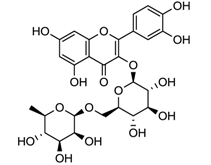
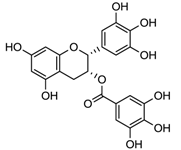
        <p>Flavonoids represent a class of natural secondary metabolites that have found numerous applications in human health products. Especially their antioxidant and radical scavenging activity but also anti microbial properties make this product class interesting. The group around Kobayashi has investigated the production and properties of polymerized polyphenols [<xref ref-type="bibr" rid="B11-polymers-04-00759">11</xref>]. Interestingly, in the majority of these examples, the antioxidant activity (and quite frequently also other health properties) are significantly increased as compared to the monomers. A unifying explanation for this observation is missing so far.</p>
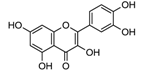
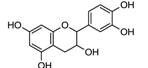
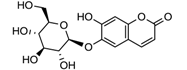
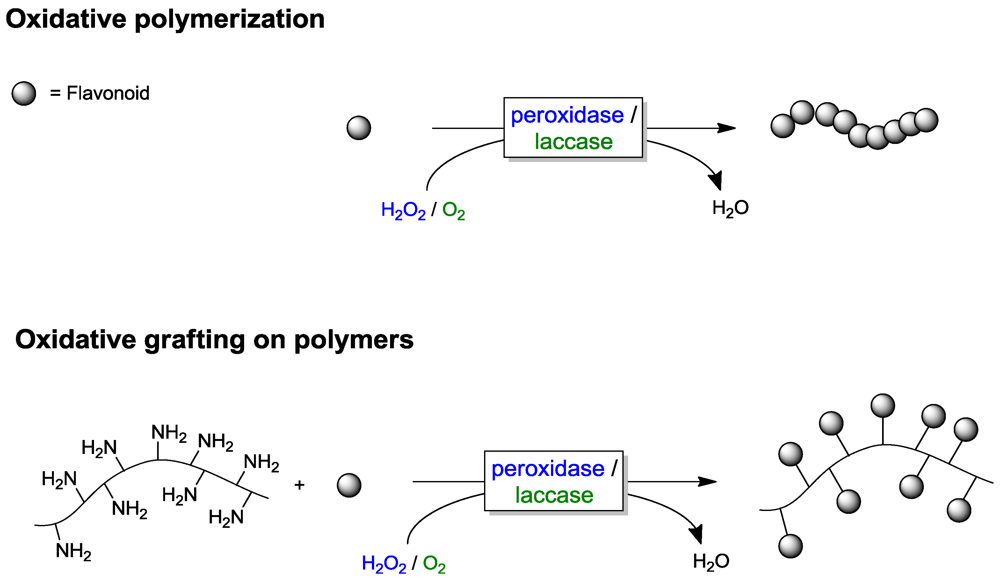
        <p>Early reports dealing with modified flavonids concern the direct laccase- and/or peroxidase-mediated polymerization of the monomers. More recently, oxidative conjugation to other polymers has gained considerable interest (<xref ref-type="fig" rid="polymers-04-00759-f018">Figure 18</xref>). <xref ref-type="table" rid="polymers-04-00759-t002">Table 2</xref> gives an overview over the polymeric products reported.</p>
        <table-wrap id="polymers-04-00759-t002" position="anchor">
          <object-id pub-id-type="pii">polymers-04-00759-t002_Table 2</object-id>
          <label>Table 2</label>
          <caption>
            <p>Flanonoids polymerized for improved antioxidant activity.</p>
          </caption>
          <table>
            <thead>
              <tr>
                <th align="center" valign="middle">monomer</th>
                <th align="center" valign="middle">catalyst</th>
                <th align="center" valign="middle">reference</th>
              </tr>
            </thead>
            <tbody>
              <tr>
                <td rowspan="2" align="center" valign="middle">
                  <inline-graphic xmlns:xlink="http://www.w3.org/1999/xlink" xlink:href="polymers-04-00759-i013.tif"/></td>
                <td align="center" valign="middle">HRP</td>
                <td align="center" valign="middle">[<xref ref-type="bibr" rid="B120-polymers-04-00759">120</xref>]</td>
              </tr>
              <tr>
                <td rowspan="2" align="center" valign="middle">laccase</td>
                <td rowspan="2" align="center" valign="middle">[<xref ref-type="bibr" rid="B121-polymers-04-00759">121</xref>]</td>
              </tr>
              <tr>
                <td align="center" valign="middle">Quercitin</td>
              </tr>
              <tr>
                <td align="center" valign="middle">
                  <inline-graphic xmlns:xlink="http://www.w3.org/1999/xlink" xlink:href="polymers-04-00759-i014.tif"/> </td>
                <td rowspan="2" align="center" valign="middle">laccase</td>
                <td rowspan="2" align="center" valign="middle">[<xref ref-type="bibr" rid="B122-polymers-04-00759">122</xref>,<xref ref-type="bibr" rid="B123-polymers-04-00759">123</xref>,<xref ref-type="bibr" rid="B124-polymers-04-00759">124</xref>]</td>
              </tr>
              <tr>
                <td align="center" valign="middle">Catechin</td>
              </tr>
              <tr>
                <td align="center" valign="middle">
                  <inline-graphic xmlns:xlink="http://www.w3.org/1999/xlink" xlink:href="polymers-04-00759-i015.tif"/></td>
                <td rowspan="2" align="center" valign="middle">laccase</td>
                <td rowspan="2" align="center" valign="middle">[<xref ref-type="bibr" rid="B125-polymers-04-00759">125</xref>,<xref ref-type="bibr" rid="B126-polymers-04-00759">126</xref>]</td>
              </tr>
              <tr>
                <td align="center" valign="middle">Esculin</td>
              </tr>
              <tr>
                <td align="center" valign="middle">
                  <inline-graphic xmlns:xlink="http://www.w3.org/1999/xlink" xlink:href="polymers-04-00759-i016.tif"/></td>
                <td rowspan="2" align="center" valign="middle">laccase</td>
                <td rowspan="2" align="center" valign="middle">[<xref ref-type="bibr" rid="B127-polymers-04-00759">127</xref>,<xref ref-type="bibr" rid="B128-polymers-04-00759">128</xref>]</td>
              </tr>
              <tr>
                <td align="center" valign="middle">Rutin</td>
              </tr>
              <tr>
                <td align="center" valign="middle">
                  <inline-graphic xmlns:xlink="http://www.w3.org/1999/xlink" xlink:href="polymers-04-00759-i017.tif"/></td>
                <td rowspan="2" align="center" valign="middle">laccase</td>
                <td rowspan="2" align="center" valign="middle">[<xref ref-type="bibr" rid="B129-polymers-04-00759">129</xref>]</td>
              </tr>
              <tr>
                <td align="center" valign="middle">Epigallocatechin</td>
              </tr>
            </tbody>
          </table>
        </table-wrap>
        <fig id="polymers-04-00759-f018" position="anchor">
          <label>Figure 18</label>
          <caption>
            <p>Flavonoid-based antioxidant polymers obtained via (upper) radical polymerization of the monomers or (lower) Michael-coupling or Schiff-base formation of the quinone form of the flavonoids to (NH<sub>2</sub>-containing) polymers.</p>
          </caption>
          <graphic xmlns:xlink="http://www.w3.org/1999/xlink" xlink:href="polymers-04-00759-g018.tif"/>
        </fig>
        <p>As mentioned above, the oxidative grafting of flavonoids to polymers is enjoying increased attention especially aiming at functionalized textiles or food applications [<xref ref-type="bibr" rid="B130-polymers-04-00759">130</xref>].</p>
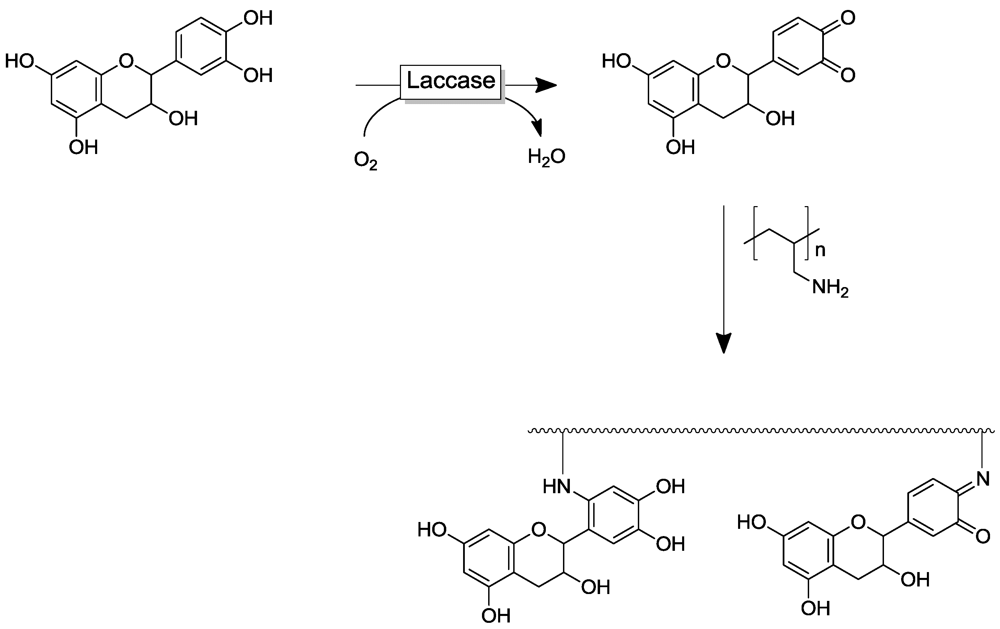
        <p>One of the first examples for this was reported by Kobayashi and coworkers who oxidatively grafted poly(allylamine) with catechin (<xref ref-type="fig" rid="polymers-04-00759-f019">Figure 19</xref>) [<xref ref-type="bibr" rid="B131-polymers-04-00759">131</xref>], which was followed up more recently by Rao and coworkers [<xref ref-type="bibr" rid="B132-polymers-04-00759">132</xref>,<xref ref-type="bibr" rid="B133-polymers-04-00759">133</xref>].</p>
        <fig id="polymers-04-00759-f019" position="anchor">
          <label>Figure 19</label>
          <caption>
            <p>Laccase-catalyzed oxidation of catechin combined with covalent grafting to poly(allylamine).</p>
          </caption>
          <graphic xmlns:xlink="http://www.w3.org/1999/xlink" xlink:href="polymers-04-00759-g019.tif"/>
        </fig>
        <p>Instead of poly(allylamine) also natural polymeric support can be used resulting in a composite with similarly superior antioxidant activity as compared to the catechin monomer. For example gelatin was grafted with catechin [<xref ref-type="bibr" rid="B134-polymers-04-00759">134</xref>]. Wool can also be grafted e.g., with gallates resulting in composites with antioxidant and antimicrobial activity [<xref ref-type="bibr" rid="B135-polymers-04-00759">135</xref>]. When using gallic acid esters, increased water repellence was achieved. Chitosan-composites with gallic acid (derivates) [<xref ref-type="bibr" rid="B136-polymers-04-00759">136</xref>,<xref ref-type="bibr" rid="B137-polymers-04-00759">137</xref>,<xref ref-type="bibr" rid="B138-polymers-04-00759">138</xref>,<xref ref-type="bibr" rid="B139-polymers-04-00759">139</xref>], ferulic acid [<xref ref-type="bibr" rid="B140-polymers-04-00759">140</xref>], flavonoids [<xref ref-type="bibr" rid="B141-polymers-04-00759">141</xref>] exhibit increased antioxidant activity. An interesting extension of this concept is to use amine-functionalized inorganic supports [<xref ref-type="bibr" rid="B142-polymers-04-00759">142</xref>].</p>
        <p>A practical application of this grafting technology may be in the textile and food industry yielding products with antimicrobial activity and modified rheological properties [<xref ref-type="bibr" rid="B130-polymers-04-00759">130</xref>,<xref ref-type="bibr" rid="B138-polymers-04-00759">138</xref>,<xref ref-type="bibr" rid="B139-polymers-04-00759">139</xref>,<xref ref-type="bibr" rid="B143-polymers-04-00759">143</xref>,<xref ref-type="bibr" rid="B144-polymers-04-00759">144</xref>,<xref ref-type="bibr" rid="B145-polymers-04-00759">145</xref>,<xref ref-type="bibr" rid="B146-polymers-04-00759">146</xref>].</p>
      </sec>
      <sec>
        <title>4.2. Polymer Modification</title>
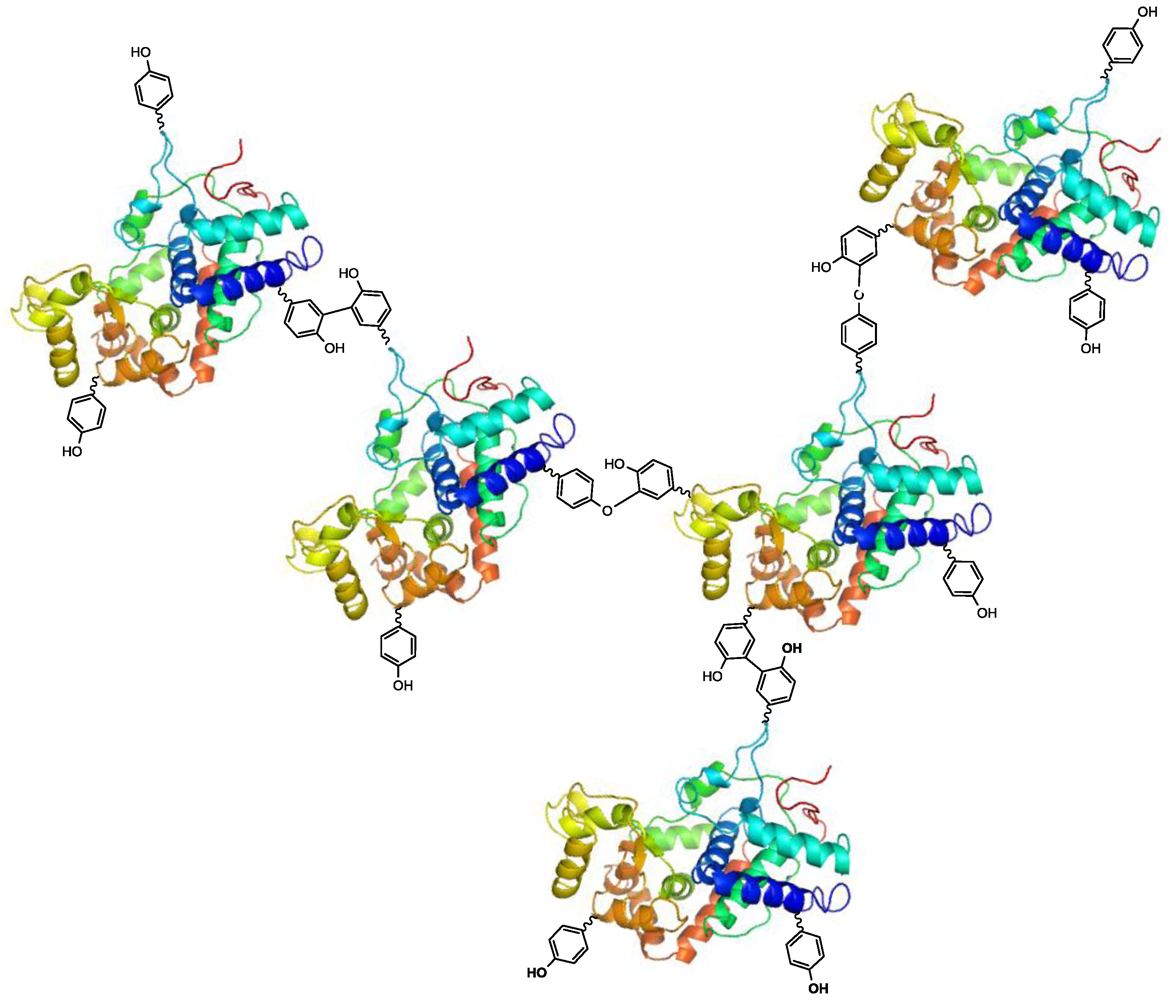
        <p>Oxidoreductase-initiated covalent linkage of phenols has also received considerable interest for the cross-linking of polymers to form biocompatible hydrogels. For example, proteins presenting tyrosine moieties at their surface can be gelled in the presence of laccases or peroxidases/H<sub>2</sub>O<sub>2</sub> (<xref ref-type="fig" rid="polymers-04-00759-f020">Figure 20</xref>) [<xref ref-type="bibr" rid="B147-polymers-04-00759">147</xref>,<xref ref-type="bibr" rid="B148-polymers-04-00759">148</xref>,<xref ref-type="bibr" rid="B149-polymers-04-00759">149</xref>,<xref ref-type="bibr" rid="B150-polymers-04-00759">150</xref>]. </p>
        <fig id="polymers-04-00759-f020" position="anchor">
          <label>Figure 20</label>
          <caption>
            <p>Schematic representation of crosslinked proteins via surface-located aromatic moieties.</p>
          </caption>
          <graphic xmlns:xlink="http://www.w3.org/1999/xlink" xlink:href="polymers-04-00759-g020.tif"/>
        </fig>
        <p>Next to proteins also natural polymers exhibiting phenolic side chains can be gelled enzymatically. For example pectins contain some ferulic acid which can be used for oxidative crosslinking of the pectin chains for irreversible gellation [<xref ref-type="bibr" rid="B151-polymers-04-00759">151</xref>,<xref ref-type="bibr" rid="B152-polymers-04-00759">152</xref>,<xref ref-type="bibr" rid="B153-polymers-04-00759">153</xref>]. However, even if no phenolic side chain is present in the polymer, it may be introduced chemically. In that respect, tyramine has gained some popularity e.g., for the crosslinking of carboxymethyl cellulose [<xref ref-type="bibr" rid="B154-polymers-04-00759">154</xref>], alginate [<xref ref-type="bibr" rid="B155-polymers-04-00759">155</xref>], hyaluronic acid [<xref ref-type="bibr" rid="B156-polymers-04-00759">156</xref>], dextran [<xref ref-type="bibr" rid="B157-polymers-04-00759">157</xref>] or artificial polymers such as Tetronic [<xref ref-type="bibr" rid="B158-polymers-04-00759">158</xref>].</p>
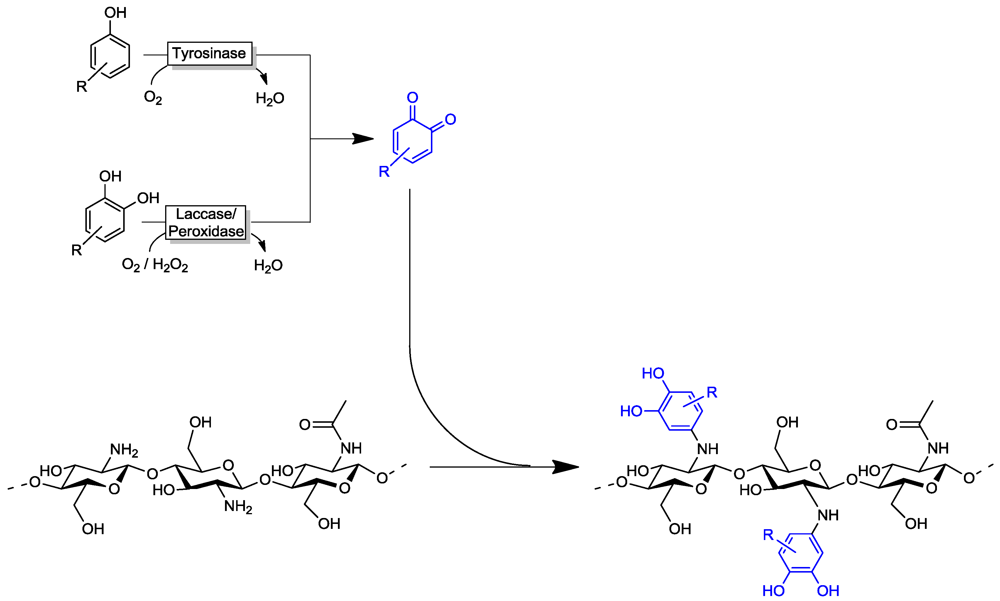
        <p>NH<sub>2</sub>-containing polymers (e.g., chitosan) can be modified with phenolic carboxylic acids via amidation [<xref ref-type="bibr" rid="B159-polymers-04-00759">159</xref>] or directly act in Michael-fashion on enzyme-generated quinones (<xref ref-type="fig" rid="polymers-04-00759-f021">Figure 21</xref>) [<xref ref-type="bibr" rid="B146-polymers-04-00759">146</xref>,<xref ref-type="bibr" rid="B160-polymers-04-00759">160</xref>]. For example, tyrosinases generate reactive quinones from phenols, which can react with chitosan [<xref ref-type="bibr" rid="B141-polymers-04-00759">141</xref>,<xref ref-type="bibr" rid="B145-polymers-04-00759">145</xref>,<xref ref-type="bibr" rid="B160-polymers-04-00759">160</xref>,<xref ref-type="bibr" rid="B161-polymers-04-00759">161</xref>]. Similarly, reactive quinones can be generated using laccases [<xref ref-type="bibr" rid="B140-polymers-04-00759">140</xref>,<xref ref-type="bibr" rid="B146-polymers-04-00759">146</xref>] of peroxidases [<xref ref-type="bibr" rid="B136-polymers-04-00759">136</xref>,<xref ref-type="bibr" rid="B139-polymers-04-00759">139</xref>].</p>
        <fig id="polymers-04-00759-f021" position="anchor">
          <label>Figure 21</label>
          <caption>
            <p>Modification of chitosan with enzyme-generated quinones.</p>
          </caption>
          <graphic xmlns:xlink="http://www.w3.org/1999/xlink" xlink:href="polymers-04-00759-g021.tif"/>
        </fig>
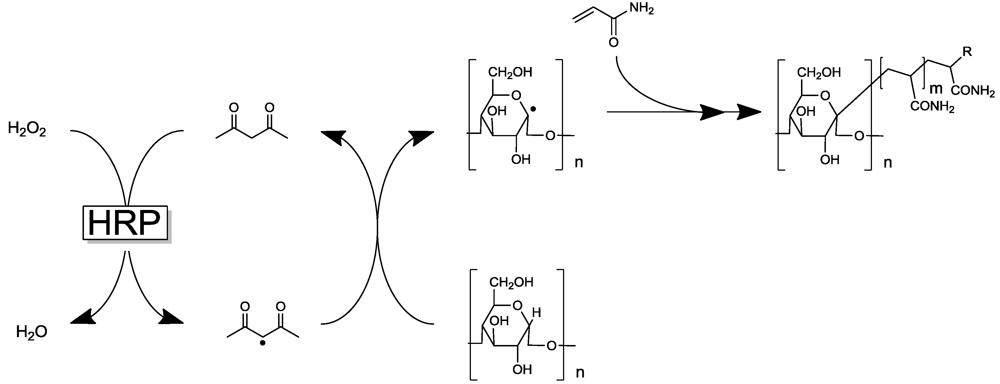
        <p>A very creative application of the system HRP/H<sub>2</sub>O<sub>2</sub>/Acac for graft polymerization of acryl amide on starch was reported recently by Biswas and coworkers [<xref ref-type="bibr" rid="B114-polymers-04-00759">114</xref>]. A biocatalytic alternative route to the established cerium(IV)-based routes to poly(acrylate)-grafted starch with applications as superabsorbersor performance additives in paper making or textile sizing was reported. Under non-optimized conditions grafting efficiencies of up to 65% are reported. The authors suggest covalent attachment of the poly(acrylamide) chain to the starch backbone via H-abstraction at the glycosidic C-atom (<xref ref-type="fig" rid="polymers-04-00759-f022">Figure 22</xref>).</p>
        <fig id="polymers-04-00759-f022" position="anchor">
          <label>Figure 22</label>
          <caption>
            <p>Proposed mechanism for the HRP-initiated poly(acrylamide)-grafting of starch.</p>
          </caption>
          <graphic xmlns:xlink="http://www.w3.org/1999/xlink" xlink:href="polymers-04-00759-g022.tif"/>
        </fig>
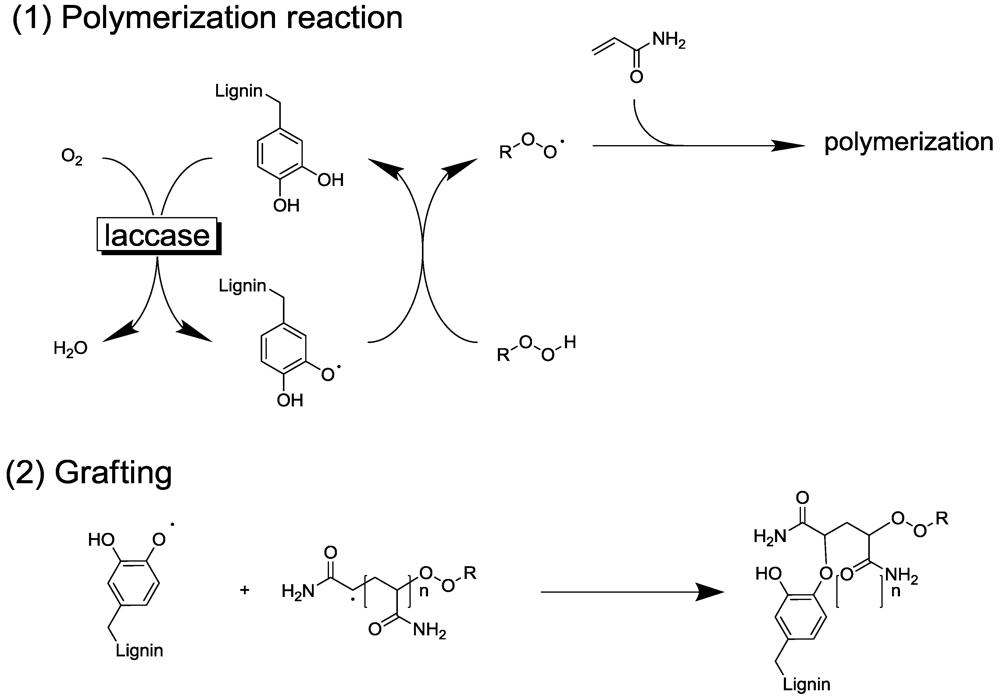
        <p>Poly(acrylamide) grafting onto lignin has been reported in the presence of organic hydroperoxides [<xref ref-type="bibr" rid="B162-polymers-04-00759">162</xref>,<xref ref-type="bibr" rid="B163-polymers-04-00759">163</xref>]. The proposed mechanism (<xref ref-type="fig" rid="polymers-04-00759-f023">Figure 23</xref>.) comprises laccase-catalyzed H-atom abstraction from phenolic lignin residues. The resulting phenoxy radicals interact with the peroxides generation alkoxy- and hydroperoxy-radicals, which are supposed to initiate the acrylamide polymerization process. Grafting of poly(acrylamide) onto lignin is proposed to occur through recombination of the respective radicals.</p>
        <fig id="polymers-04-00759-f023" position="anchor">
          <label>Figure 23</label>
          <caption>
            <p>Proposed mechanism of laccase/hydroperoxide polymerization grafting of acrylamide onto lignin.</p>
          </caption>
          <graphic xmlns:xlink="http://www.w3.org/1999/xlink" xlink:href="polymers-04-00759-g023.tif"/>
        </fig>
      </sec>
      <sec>
        <title>4.3. Artificial Urushi</title>
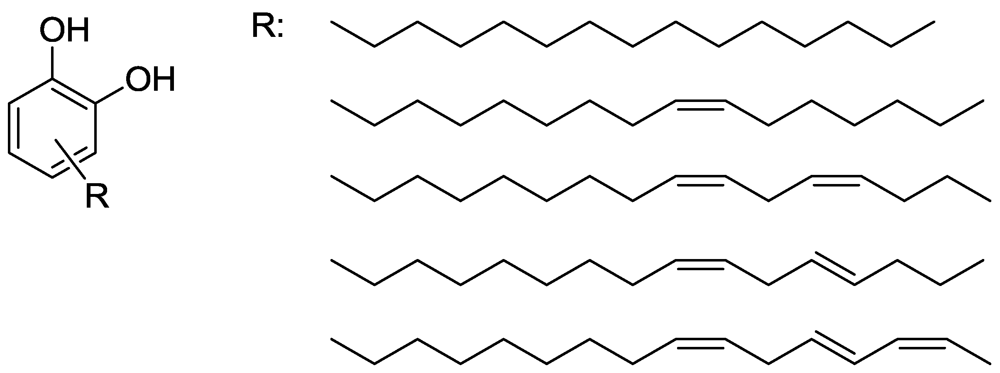
        <p>Urushiols are a class of natural alkyl-substituted phenols and catechols (<xref ref-type="fig" rid="polymers-04-00759-f024">Figure 24</xref>), which in the presence of laccase can polymerize to form Urushi, a natural lacquer used e.g., in traditional Japanese artwork. </p>
        
        <p>Due to its potential as ‘fully renewable and benign’ alternative to chemical formaldehyde-phenol resins, the enzymatic polymerization of urushiols has been thoroughly investigated by the Kobayashi group [<xref ref-type="bibr" rid="B164-polymers-04-00759">164</xref>,<xref ref-type="bibr" rid="B165-polymers-04-00759">165</xref>,<xref ref-type="bibr" rid="B166-polymers-04-00759">166</xref>,<xref ref-type="bibr" rid="B167-polymers-04-00759">167</xref>]. </p>
        <fig id="polymers-04-00759-f024" position="anchor">
          <label>Figure 24</label>
          <caption>
            <p>Structure of urushiol.</p>
          </caption>
          <graphic xmlns:xlink="http://www.w3.org/1999/xlink" xlink:href="polymers-04-00759-g024.tif"/>
        </fig>
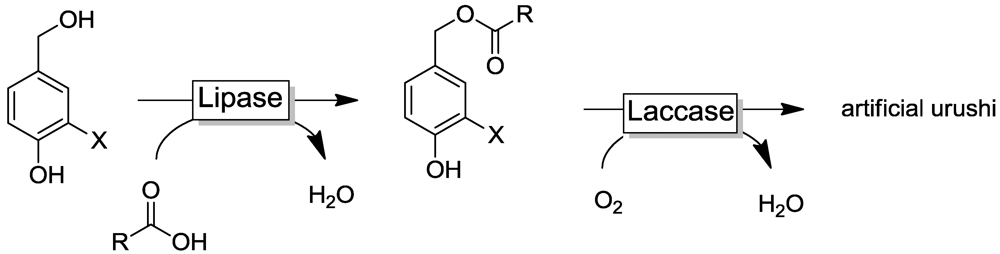
        <p>Synthetic, tailored urushiols have also been proposed by lipase-catalyzed acylation of benzylic OH-groups followed by peroxidase- or laccase-initiated polymerization of the phenol/catechols moiety (<xref ref-type="fig" rid="polymers-04-00759-f025">Figure 25</xref>).</p>
        <fig id="polymers-04-00759-f025" position="anchor">
          <label>Figure 25</label>
          <caption>
            <p>Bienzymatic formation of artificial urushi with tailored properties.</p>
          </caption>
          <graphic xmlns:xlink="http://www.w3.org/1999/xlink" xlink:href="polymers-04-00759-g025.tif"/>
        </fig>
        <p>Cardanols are natural phenols structurally related to urusiols and likewise can be polymerized using laccases of peroxidases [<xref ref-type="bibr" rid="B32-polymers-04-00759">32</xref>,<xref ref-type="bibr" rid="B33-polymers-04-00759">33</xref>,<xref ref-type="bibr" rid="B168-polymers-04-00759">168</xref>,<xref ref-type="bibr" rid="B169-polymers-04-00759">169</xref>,<xref ref-type="bibr" rid="B170-polymers-04-00759">170</xref>]. </p>
      </sec>
      <sec>
        <title>4.4. Selected Examples for Chemoselective Polymerization</title>
        <p>One advantage of oxidoreductase-catalysis that is frequently mentioned is its high selectivity. As mentioned above, so far no examples of stereospecificity have been reported in enzyme initiated polymerization, and are not very likely to come up in the near future. However, there is a range of examples demonstrating chemoselective radical formation, which will be shortly outlined below.</p>
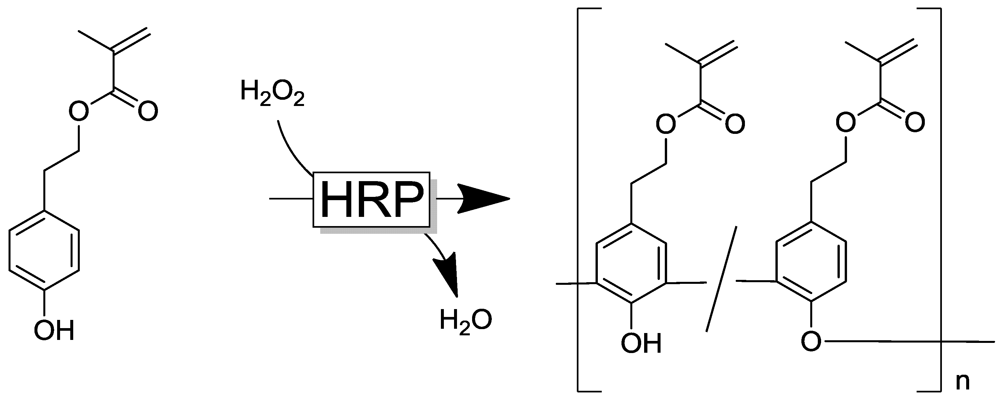
        <p>The selective polymerization of bifunctional monomers containing vinyl and phenol moieties. Generally, laccases and peroxidases act on the phenol part selectively leading to vinyl-substituted poly(phenols) which then are available for further modification (<xref ref-type="fig" rid="polymers-04-00759-f026">Figure 26</xref>) [<xref ref-type="bibr" rid="B68-polymers-04-00759">68</xref>,<xref ref-type="bibr" rid="B101-polymers-04-00759">101</xref>,<xref ref-type="bibr" rid="B171-polymers-04-00759">171</xref>]. </p>
        
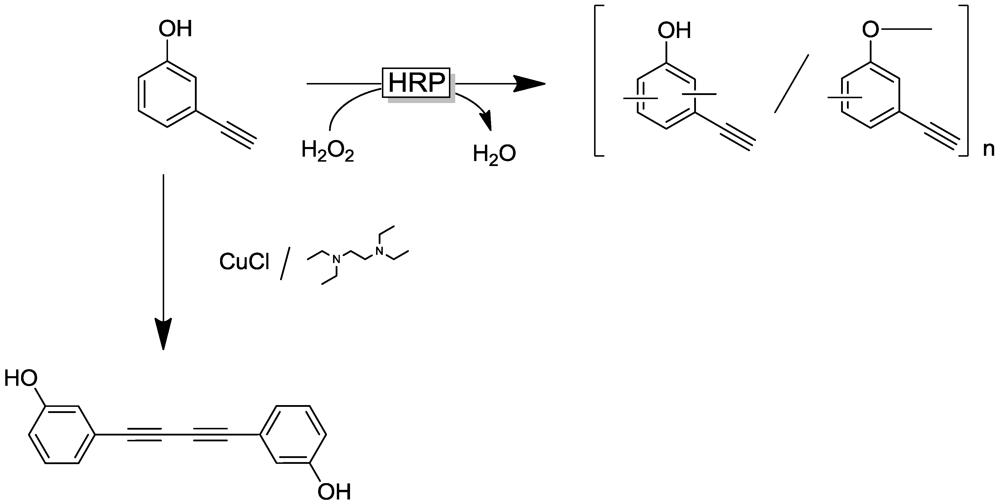
        <p>A very nice example for the potential of biocatalysis as complementary tool to established chemocatalysis was reported using m-ethinylphenol as monomer [<xref ref-type="bibr" rid="B106-polymers-04-00759">106</xref>]. Subjecting this compound to HRP/H<sub>2</sub>O<sub>2</sub>, poly(phenol) formation was the only reaction observed wile leaving the ethinyl group untouched. In contrast, Cu<sup>I</sup> catalysts lead to dimerization via the ethinyl function (<xref ref-type="fig" rid="polymers-04-00759-f027">Figure 27</xref>).</p>
        <fig id="polymers-04-00759-f026" position="anchor">
          <label>Figure 26</label>
          <caption>
            <p>Chemoselective polymerization of bifunctional (phenol/vinyl) monomer units using HRP.</p>
          </caption>
          <graphic xmlns:xlink="http://www.w3.org/1999/xlink" xlink:href="polymers-04-00759-g026.tif"/>
        </fig>
        <fig id="polymers-04-00759-f027" position="anchor">
          <label>Figure 27</label>
          <caption>
            <p>Complementary conversion of m-ethinylphenol using HRP or Cu<sup>I</sup>.</p>
          </caption>
          <graphic xmlns:xlink="http://www.w3.org/1999/xlink" xlink:href="polymers-04-00759-g027.tif"/>
        </fig>
        <p>Another example for chemoselectivity of enzymatic polymerization was reported by Bilici <italic>et al.</italic> [<xref ref-type="bibr" rid="B172-polymers-04-00759">172</xref>]. Here, an aldehyde-bearing catechols was polymerized enzymatically without oxidizing the aldehyde moiety.</p>
      </sec>
      <sec>
        <title>4.5. Phenol Detoxification</title>
        <p>A good portion of the laccase- and peroxidase literature deals with bioremediation and pollutant control [<xref ref-type="bibr" rid="B130-polymers-04-00759">130</xref>,<xref ref-type="bibr" rid="B173-polymers-04-00759">173</xref>,<xref ref-type="bibr" rid="B174-polymers-04-00759">174</xref>,<xref ref-type="bibr" rid="B175-polymers-04-00759">175</xref>]. The removal of phenolics is rather straightforward as these compounds are generally oxidized by the laccases or peroxidases directly [<xref ref-type="bibr" rid="B176-polymers-04-00759">176</xref>]. In most of the cases, the detoxification mechanism is based on the formation of insoluble oligomeric or polymeric products which can then be removed by filtration.</p>
        <p>Hence, various cresols and derivates [<xref ref-type="bibr" rid="B177-polymers-04-00759">177</xref>] can be oxidatively polymerized and thereby reduced in toxicity. Likewise halophenols [<xref ref-type="bibr" rid="B178-polymers-04-00759">178</xref>,<xref ref-type="bibr" rid="B179-polymers-04-00759">179</xref>,<xref ref-type="bibr" rid="B180-polymers-04-00759">180</xref>,<xref ref-type="bibr" rid="B181-polymers-04-00759">181</xref>,<xref ref-type="bibr" rid="B182-polymers-04-00759">182</xref>] bisphenol A, [<xref ref-type="bibr" rid="B183-polymers-04-00759">183</xref>,<xref ref-type="bibr" rid="B184-polymers-04-00759">184</xref>,<xref ref-type="bibr" rid="B185-polymers-04-00759">185</xref>] various hormones and so-called endocrine disrupting compounds [<xref ref-type="bibr" rid="B186-polymers-04-00759">186</xref>,<xref ref-type="bibr" rid="B187-polymers-04-00759">187</xref>,<xref ref-type="bibr" rid="B188-polymers-04-00759">188</xref>] or even TNT [<xref ref-type="bibr" rid="B189-polymers-04-00759">189</xref>,<xref ref-type="bibr" rid="B190-polymers-04-00759">190</xref>] have been reported. Non-phenolic compounds may be ‘inactivated’ using the LMS or PMS strategy [<xref ref-type="bibr" rid="B36-polymers-04-00759">36</xref>,<xref ref-type="bibr" rid="B191-polymers-04-00759">191</xref>,<xref ref-type="bibr" rid="B192-polymers-04-00759">192</xref>,<xref ref-type="bibr" rid="B193-polymers-04-00759">193</xref>,<xref ref-type="bibr" rid="B194-polymers-04-00759">194</xref>,<xref ref-type="bibr" rid="B195-polymers-04-00759">195</xref>,<xref ref-type="bibr" rid="B196-polymers-04-00759">196</xref>,<xref ref-type="bibr" rid="B197-polymers-04-00759">197</xref>,<xref ref-type="bibr" rid="B198-polymers-04-00759">198</xref>]. </p>
      </sec>
    </sec>
    <sec sec-type="conclusions">
      <title>5. Conclusions</title>
      <p>Enzymatic reactions are enjoying increasing attention as alternatives to classical chemical routes. ‘The hallmark of enzyme catalysis is its superior catalytic power and high selectivity under mild reaction conditions’ [<xref ref-type="bibr" rid="B199-polymers-04-00759">199</xref>]. Furthermore, enzyme catalysis generally exhibits high chemo-, regio-, and enantioselectivity. In the context of oxidoreductase initiated radical polymerizations these advantages come into play only to a limited extent. Mostly the role of the enzyme is confined to the generation of a starter radical. Thus, enzyme-initiated polymerizations comprise all characteristics of a classical chemical polymerization. </p>
      <p>Admittedly, enzymatic routes offer various handles to control polymer weight with enzyme concentration being the most efficient one. Furthermore, enzymes are derived from renewable feedstock and therefore can be considered more benign than many classical initiators. Overall, enzyme-initiated polymerization represents a promising alternative approach to the established chemical routes. Implementation on industrial scale will not occur on a short-term due to cost limitations but may eventually result in significantly greener production routes (though a full life cycle analysis will be necessary as enzymatic reactions are not per se greener than their chemical counterparts). Furthermore, it represents another example that enzyme catalysis is not confined to its traditional playgrounds such as chiral molecules.</p>
    </sec>

  </body>
  <back>
   <ack>
   <title>Acknowledgments</title>
      <p>This work was supported by the Marie Curie ITN ‘Biotrains’ (grant agreement number 238531) and the Deutsche Bundesstiftung Umwelt, ChemBioTec (grant agreement number 13253). </p>
   </ack>
   <ref-list>
      <title>References</title>
      <ref id="B1-polymers-04-00759">
        <label>1.</label>
        <citation citation-type="journal">
          <person-group person-group-type="author">
            <name>
              <surname>Wenda</surname>
              <given-names>S.</given-names>
            </name>
            <name>
              <surname>Illner</surname>
              <given-names>S.</given-names>
            </name>
            <name>
              <surname>Mell</surname>
              <given-names>A.</given-names>
            </name>
            <name>
              <surname>Kragl</surname>
              <given-names>U.</given-names>
            </name>
          </person-group>
          <article-title>Industrial biotechnology—The future of green chemistry?</article-title>
          <source>Green Chem.</source>
          <year>2011</year>
          <volume>13</volume>
          <fpage>3007</fpage>
          <lpage>3047</lpage>
          <pub-id pub-id-type="doi">10.1039/c1gc15579b</pub-id>
        </citation>
      </ref>
      <ref id="B2-polymers-04-00759">
        <label>2.</label>
        <citation citation-type="journal">
          <person-group person-group-type="author">
            <name>
              <surname>Hollmann</surname>
              <given-names>F.</given-names>
            </name>
            <name>
              <surname>Arends</surname>
              <given-names>I.W.C.E.</given-names>
            </name>
            <name>
              <surname>Buehler</surname>
              <given-names>K.</given-names>
            </name>
            <name>
              <surname>Schallmey</surname>
              <given-names>A.</given-names>
            </name>
            <name>
              <surname>Buhler</surname>
              <given-names>B.</given-names>
            </name>
          </person-group>
          <article-title>Enzyme-mediated oxidations for the chemist</article-title>
          <source>Green Chem.</source>
          <year>2011</year>
          <volume>13</volume>
          <fpage>226</fpage>
          <lpage>265</lpage>
          <pub-id pub-id-type="doi">10.1039/c0gc00595a</pub-id>
        </citation>
      </ref>
      <ref id="B3-polymers-04-00759">
        <label>3.</label>
        <citation citation-type="journal">
          <person-group person-group-type="author">
            <name>
              <surname>Hollmann</surname>
              <given-names>F.</given-names>
            </name>
            <name>
              <surname>Arends</surname>
              <given-names>I.W.C.E.</given-names>
            </name>
            <name>
              <surname>Holtmann</surname>
              <given-names>D.</given-names>
            </name>
          </person-group>
          <article-title>Enzymatic reductions for the chemist</article-title>
          <source>Green Chem.</source>
          <year>2011</year>
          <volume>13</volume>
          <fpage>2285</fpage>
          <lpage>2313</lpage>
          <pub-id pub-id-type="doi">10.1039/c1gc15424a</pub-id>
        </citation>
      </ref>
      <ref id="B4-polymers-04-00759">
        <label>4.</label>
        <citation citation-type="journal">
          <person-group person-group-type="author">
            <name>
              <surname>Kuhn</surname>
              <given-names>D.</given-names>
            </name>
            <name>
              <surname>Kholiq</surname>
              <given-names>M.A.</given-names>
            </name>
            <name>
              <surname>Heinzle</surname>
              <given-names>E.</given-names>
            </name>
            <name>
              <surname>Bühler</surname>
              <given-names>B.</given-names>
            </name>
            <name>
              <surname>Schmid</surname>
              <given-names>A.</given-names>
            </name>
          </person-group>
          <article-title>Intensification and economic and ecological assessment of a biocatalytic oxyfunctionalization process</article-title>
          <source>Green Chem.</source>
          <year>2010</year>
          <volume>12</volume>
          <fpage>815</fpage>
          <lpage>827</lpage>
          <pub-id pub-id-type="doi">10.1039/b921896c</pub-id>
        </citation>
      </ref>
      <ref id="B5-polymers-04-00759">
        <label>5.</label>
        <citation citation-type="confproc">
          <person-group person-group-type="author">
            <name>
              <surname>Thum</surname>
              <given-names>O.</given-names>
            </name>
            <name>
              <surname>Oxenbøll</surname>
              <given-names>K.M.</given-names>
            </name>
          </person-group>
          <article-title>Biocatalysis: A sustainable process for production of cosmetic ingredients</article-title>
          <source>Proceedings of the International Federation of Societies of Cosmetic Chemists, IFSCC Congress 2006</source>
          <conf-loc>Osaka, Japan</conf-loc>
          <conf-date>16–19 October 2006</conf-date>
        </citation>
      </ref>
      <ref id="B6-polymers-04-00759">
        <label>6.</label>
        <citation citation-type="journal">
          <person-group person-group-type="author">
            <name>
              <surname>Henderson</surname>
              <given-names>R.K.</given-names>
            </name>
            <name>
              <surname>Jiminez-Gonzalez</surname>
              <given-names>C.</given-names>
            </name>
            <name>
              <surname>Preston</surname>
              <given-names>C.</given-names>
            </name>
            <name>
              <surname>Constable</surname>
              <given-names>D.J.C.</given-names>
            </name>
            <name>
              <surname>Woodley</surname>
              <given-names>J.M.</given-names>
            </name>
          </person-group>
          <article-title>EHS &amp; LCA assessment for 7-ACA synthesis A case study for comparing biocatalytic &amp; chemical synthesis</article-title>
          <source>Ind. Biotechnol.</source>
          <year>2008</year>
          <volume>4</volume>
          <fpage>180</fpage>
          <lpage>192</lpage>
          <pub-id pub-id-type="doi">10.1089/ind.2008.4.180</pub-id>
        </citation>
      </ref>
      <ref id="B7-polymers-04-00759">
        <label>7.</label>
        <citation citation-type="journal">
          <person-group person-group-type="author">
            <name>
              <surname>Sheldon</surname>
              <given-names>R.A.</given-names>
            </name>
          </person-group>
          <article-title>E factors, green chemistry and catalysis: An odyssey</article-title>
          <source>Chem. Commun.</source>
          <year>2008</year>
          <fpage>3352</fpage>
          <lpage>3365</lpage>
          <pub-id pub-id-type="doi">10.1039/b803584a</pub-id>
        </citation>
      </ref>
      <ref id="B8-polymers-04-00759">
        <label>8.</label>
        <citation citation-type="journal">
          <person-group person-group-type="author">
            <name>
              <surname>Kobayashi</surname>
              <given-names>S.</given-names>
            </name>
            <name>
              <surname>Makino</surname>
              <given-names>A.</given-names>
            </name>
          </person-group>
          <article-title>Enzymatic polymer synthesis: An opportunity for green polymer chemistry</article-title>
          <source>Chem. Rev.</source>
          <year>2009</year>
          <volume>109</volume>
          <fpage>5288</fpage>
          <lpage>5353</lpage>
          <pub-id pub-id-type="doi">10.1021/cr900165z</pub-id>
        </citation>
      </ref>
      <ref id="B9-polymers-04-00759">
        <label>9.</label>
        <citation citation-type="book">
          <person-group person-group-type="author">
            <name>
              <surname>Uyama</surname>
              <given-names>H.</given-names>
            </name>
            <name>
              <surname>Kobayashi</surname>
              <given-names>S.</given-names>
            </name>
            <name>
              <surname>Ritter</surname>
              <given-names>H.</given-names>
            </name>
            <name>
              <surname>Kaplan</surname>
              <given-names>D.</given-names>
            </name>
          </person-group>
          <article-title>Enzymatic synthesis and properties of polymers from polyphenols</article-title>
          <source>Enzyme-Catalyzed Synthesis of Polymers</source>
          <publisher-name>Springer</publisher-name>
          <publisher-loc>Berlin, Germany and Heidelberg, Germany</publisher-loc>
          <year>2006</year>
          <volume>194</volume>
          <fpage>51</fpage>
          <lpage>67</lpage>
        </citation>
      </ref>
      <ref id="B10-polymers-04-00759">
        <label>10.</label>
        <citation citation-type="journal">
          <person-group person-group-type="author">
            <name>
              <surname>Singh</surname>
              <given-names>A.</given-names>
            </name>
            <name>
              <surname>Kaplan</surname>
              <given-names>D.L.</given-names>
            </name>
          </person-group>
          <article-title>Enzyme-based vinyl polymerization</article-title>
          <source>J. Polym. Environ.</source>
          <year>2002</year>
          <volume>10</volume>
          <fpage>85</fpage>
          <lpage>91</lpage>
          <pub-id pub-id-type="doi">10.1023/A:1021168029840</pub-id>
        </citation>
      </ref>
      <ref id="B11-polymers-04-00759">
        <label>11.</label>
        <citation citation-type="journal">
          <person-group person-group-type="author">
            <name>
              <surname>Uyama</surname>
              <given-names>H.</given-names>
            </name>
          </person-group>
          <article-title>Artificial polymeric flavonoids: Synthesis and applications</article-title>
          <source>Macromol. Biosci.</source>
          <year>2007</year>
          <volume>7</volume>
          <fpage>410</fpage>
          <lpage>422</lpage>
          <pub-id pub-id-type="doi">10.1002/mabi.200700005</pub-id>
        </citation>
      </ref>
      <ref id="B12-polymers-04-00759">
        <label>12.</label>
        <citation citation-type="book">
          <person-group person-group-type="author">
            <name>
              <surname>Reihmann</surname>
              <given-names>M.</given-names>
            </name>
            <name>
              <surname>Ritter</surname>
              <given-names>H.</given-names>
            </name>
          </person-group>
          <article-title>Synthesis of phenol polymers using peroxidases</article-title>
          <source>Enzyme-Catalyzed Synthesis of Polymers</source>
          <person-group person-group-type="editor">
            <name>
              <surname>Kobayashi</surname>
              <given-names>S.</given-names>
            </name>
            <name>
              <surname>Ritter</surname>
              <given-names>H.</given-names>
            </name>
            <name>
              <surname>Kaplan</surname>
              <given-names>D.</given-names>
            </name>
          </person-group>
          <publisher-name>Springer-Verlag</publisher-name>
          <publisher-loc>Berlin, Germany</publisher-loc>
          <year>2006</year>
          <volume>194</volume>
          <fpage>1</fpage>
          <lpage>49</lpage>
        </citation>
      </ref>
      <ref id="B13-polymers-04-00759">
        <label>13.</label>
        <citation citation-type="journal">
          <person-group person-group-type="author">
            <name>
              <surname>Derango</surname>
              <given-names>R.</given-names>
            </name>
            <name>
              <surname>Chiang</surname>
              <given-names>L.-C.</given-names>
            </name>
            <name>
              <surname>Dowbenko</surname>
              <given-names>R.</given-names>
            </name>
            <name>
              <surname>Lasch</surname>
              <given-names>J.</given-names>
            </name>
          </person-group>
          <article-title>Enzyme-mediated polymerization of acrylic monomers</article-title>
          <source>Biotechnol. Technol.</source>
          <year>1992</year>
          <volume>6</volume>
          <fpage>523</fpage>
          <lpage>526</lpage>
        <pub-id pub-id-type="doi">10.1007/BF02447825</pub-id></citation>
      </ref>
      <ref id="B14-polymers-04-00759">
        <label>14.</label>
        <citation citation-type="journal">
          <person-group person-group-type="author">
            <name>
              <surname>Tsujimoto</surname>
              <given-names>T.</given-names>
            </name>
            <name>
              <surname>Uyama</surname>
              <given-names>H.</given-names>
            </name>
            <name>
              <surname>Kobayashi</surname>
              <given-names>S.</given-names>
            </name>
          </person-group>
          <article-title>Polymerization of vinyl monomers using oxidase catalysts</article-title>
          <source>Macromol. Biosci.</source>
          <year>2001</year>
          <volume>1</volume>
          <fpage>228</fpage>
          <lpage>232</lpage>
          <pub-id pub-id-type="doi">10.1002/1616-5195(20010801)1:6&lt;228::AID-MABI228&gt;3.0.CO;2-S</pub-id>
        </citation>
      </ref>
      <ref id="B15-polymers-04-00759">
        <label>15.</label>
        <citation citation-type="journal">
          <person-group person-group-type="author">
            <name>
              <surname>Kausaite</surname>
              <given-names>A.</given-names>
            </name>
            <name>
              <surname>Ramanaviciene</surname>
              <given-names>A.</given-names>
            </name>
            <name>
              <surname>Ramanavicius</surname>
              <given-names>A.</given-names>
            </name>
          </person-group>
          <article-title>Polyaniline synthesis catalysed by glucose oxidase</article-title>
          <source>Polymer</source>
          <year>2009</year>
          <volume>50</volume>
          <fpage>1846</fpage>
          <lpage>1851</lpage>
          <pub-id pub-id-type="doi">10.1016/j.polymer.2009.02.013</pub-id>
        </citation>
      </ref>
      <ref id="B16-polymers-04-00759">
        <label>16.</label>
        <citation citation-type="journal">
          <person-group person-group-type="author">
            <name>
              <surname>Hofrichter</surname>
              <given-names>M.</given-names>
            </name>
            <name>
              <surname>Ullrich</surname>
              <given-names>R.</given-names>
            </name>
            <name>
              <surname>Pecyna</surname>
              <given-names>M.J.</given-names>
            </name>
            <name>
              <surname>Liers</surname>
              <given-names>C.</given-names>
            </name>
            <name>
              <surname>Lundell</surname>
              <given-names>T.</given-names>
            </name>
          </person-group>
          <article-title>New and classic families of secreted fungal heme peroxidases</article-title>
          <source>Appl. Microbiol. Biotechnol.</source>
          <year>2010</year>
          <volume>87</volume>
          <fpage>871</fpage>
          <lpage>897</lpage>
          <pub-id pub-id-type="doi">10.1007/s00253-010-2633-0</pub-id>
        </citation>
      </ref>
      <ref id="B17-polymers-04-00759">
        <label>17.</label>
        <citation citation-type="journal">
          <person-group person-group-type="author">
            <name>
              <surname>Van Rantwijk</surname>
              <given-names>F.</given-names>
            </name>
            <name>
              <surname>Sheldon</surname>
              <given-names>R.A.</given-names>
            </name>
          </person-group>
          <article-title>Selective oxygen transfer catalysed by heme peroxidases: Synthetic and mechanistic aspects</article-title>
          <source>Curr. Opin. Biotechnol.</source>
          <year>2000</year>
          <volume>11</volume>
          <fpage>554</fpage>
          <lpage>564</lpage>
          <pub-id pub-id-type="doi">10.1016/S0958-1669(00)00143-9</pub-id>
        </citation>
      </ref>
      <ref id="B18-polymers-04-00759">
        <label>18.</label>
        <citation citation-type="journal">
          <person-group person-group-type="author">
            <name>
              <surname>Hanson</surname>
              <given-names>R.L.</given-names>
            </name>
            <name>
              <surname>Howell</surname>
              <given-names>J.M.</given-names>
            </name>
            <name>
              <surname>LaPorte</surname>
              <given-names>T.L.</given-names>
            </name>
            <name>
              <surname>Donovan</surname>
              <given-names>M.J.</given-names>
            </name>
            <name>
              <surname>Cazzulino</surname>
              <given-names>D.L.</given-names>
            </name>
            <name>
              <surname>Zannella</surname>
              <given-names>V.</given-names>
            </name>
            <name>
              <surname>Montana</surname>
              <given-names>M.A.</given-names>
            </name>
            <name>
              <surname>Nanduri</surname>
              <given-names>V.B.</given-names>
            </name>
            <name>
              <surname>Schwarz</surname>
              <given-names>S.R.</given-names>
            </name>
            <name>
              <surname>Eiring</surname>
              <given-names>R.F.</given-names>
            </name>
            <etal/>
          </person-group>
          <article-title>Synthesis of allysine ethylene acetal using phenylalanine dehydrogenase from Thermoactinomyces intermedius</article-title>
          <source>Enzym. Microb. Technol.</source>
          <year>2000</year>
          <volume>26</volume>
          <fpage>348</fpage>
          <lpage>358</lpage>
          <pub-id pub-id-type="doi">10.1016/S0141-0229(99)00175-1</pub-id>
        </citation>
      </ref>
      <ref id="B19-polymers-04-00759">
        <label>19.</label>
        <citation citation-type="journal">
          <person-group person-group-type="author">
            <name>
              <surname>Valderrama</surname>
              <given-names>B.</given-names>
            </name>
            <name>
              <surname>Ayala</surname>
              <given-names>M.</given-names>
            </name>
            <name>
              <surname>Vazquez-Duhalt</surname>
              <given-names>R.</given-names>
            </name>
          </person-group>
          <article-title>Suicide inactivation of peroxidases and the challenge of engineering more robust enzymes</article-title>
          <source>Chem. Biol.</source>
          <year>2002</year>
          <volume>9</volume>
          <fpage>555</fpage>
          <lpage>565</lpage>
          <pub-id pub-id-type="doi">10.1016/S1074-5521(02)00149-7</pub-id>
        </citation>
      </ref>
      <ref id="B20-polymers-04-00759">
        <label>20.</label>
        <citation citation-type="journal">
          <person-group person-group-type="author">
            <name>
              <surname>Hiner</surname>
              <given-names>A.N.P.</given-names>
            </name>
            <name>
              <surname>Hernández-Ruiz</surname>
              <given-names>J.</given-names>
            </name>
            <name>
              <surname>Williams</surname>
              <given-names>G.A.</given-names>
            </name>
            <name>
              <surname>Arnao</surname>
              <given-names>M.B.</given-names>
            </name>
            <name>
              <surname>García-Cánovas</surname>
              <given-names>F.</given-names>
            </name>
            <name>
              <surname>Acosta</surname>
              <given-names>M.</given-names>
            </name>
          </person-group>
          <article-title>Catalase-like oxygen production by horseradish peroxidase must predominantly be an enzyme-catalyzed reaction</article-title>
          <source>Arch. Biochem. Biophys.</source>
          <year>2001</year>
          <volume>392</volume>
          <fpage>295</fpage>
          <lpage>302</lpage>
          <pub-id pub-id-type="doi">10.1006/abbi.2001.2460</pub-id>
        </citation>
      </ref>
      <ref id="B21-polymers-04-00759">
        <label>21.</label>
        <citation citation-type="journal">
          <person-group person-group-type="author">
            <name>
              <surname>Collinson</surname>
              <given-names>E.</given-names>
            </name>
            <name>
              <surname>Dainton</surname>
              <given-names>F.S.</given-names>
            </name>
            <name>
              <surname>McNaughton</surname>
              <given-names>G.S.</given-names>
            </name>
          </person-group>
          <article-title>The polymerization of acrylamide in aqueous solution. Part 1.The X- and g-ray initiated reaction</article-title>
          <source>Trans. Faraday Soc.</source>
          <year>1957</year>
          <volume>53</volume>
          <fpage>476</fpage>
          <lpage>488</lpage>
          <pub-id pub-id-type="doi">10.1039/tf9575300476</pub-id>
        </citation>
      </ref>
      <ref id="B22-polymers-04-00759">
        <label>22.</label>
        <citation citation-type="journal">
          <person-group person-group-type="author">
            <name>
              <surname>Hollmann</surname>
              <given-names>F.</given-names>
            </name>
            <name>
              <surname>Arends</surname>
              <given-names>I.W.C.E.</given-names>
            </name>
            <name>
              <surname>Buehler</surname>
              <given-names>K.</given-names>
            </name>
          </person-group>
          <article-title>Biocatalytic redox reactions for organic synthesis: Nonconventional regeneration methods</article-title>
          <source>ChemCatChem</source>
          <year>2010</year>
          <volume>2</volume>
          <fpage>762</fpage>
          <lpage>782</lpage>
          <pub-id pub-id-type="doi">10.1002/cctc.201000069</pub-id>
        </citation>
      </ref>
      <ref id="B23-polymers-04-00759">
        <label>23.</label>
        <citation citation-type="journal">
          <person-group person-group-type="author">
            <name>
              <surname>Churakova</surname>
              <given-names>E.</given-names>
            </name>
            <name>
              <surname>Kluge</surname>
              <given-names>M.</given-names>
            </name>
            <name>
              <surname>Ullrich</surname>
              <given-names>R.</given-names>
            </name>
            <name>
              <surname>Arends</surname>
              <given-names>I.</given-names>
            </name>
            <name>
              <surname>Hofrichter</surname>
              <given-names>M.</given-names>
            </name>
            <name>
              <surname>Hollmann</surname>
              <given-names>F.</given-names>
            </name>
          </person-group>
          <article-title>Specific photobiocatalytic oxyfunctionalization reactions</article-title>
          <source>Angew. Chem. Int. Ed.</source>
          <year>2011</year>
          <volume>50</volume>
          <fpage>10716</fpage>
          <lpage>10719</lpage>
        <pub-id pub-id-type="doi">10.1002/anie.201105308</pub-id></citation>
      </ref>
      <ref id="B24-polymers-04-00759">
        <label>24.</label>
        <citation citation-type="journal">
          <person-group person-group-type="author">
            <name>
              <surname>Perez</surname>
              <given-names>D.I.</given-names>
            </name>
            <name>
              <surname>Mifsud Grau</surname>
              <given-names>M.</given-names>
            </name>
            <name>
              <surname>Arends</surname>
              <given-names>I.W.C.E.</given-names>
            </name>
            <name>
              <surname>Hollmann</surname>
              <given-names>F.</given-names>
            </name>
          </person-group>
          <article-title>Visible light-driven and chloroperoxidase-catalyzed oxygenation reactions</article-title>
          <source>Chem. Commun.</source>
          <year>2009</year>
          <fpage>6848</fpage>
          <lpage>6850</lpage>
        </citation>
      </ref>
      <ref id="B25-polymers-04-00759">
        <label>25.</label>
        <citation citation-type="journal">
          <person-group person-group-type="author">
            <name>
              <surname>Uyama</surname>
              <given-names>H.</given-names>
            </name>
            <name>
              <surname>Kurioka</surname>
              <given-names>H.</given-names>
            </name>
            <name>
              <surname>Kobayashi</surname>
              <given-names>S.</given-names>
            </name>
          </person-group>
          <article-title>Novel bienzymatic catalysis system for oxidative polymerization of phenols</article-title>
          <source>Polym. J.</source>
          <year>1997</year>
          <volume>29</volume>
          <fpage>190</fpage>
          <lpage>192</lpage>
          <pub-id pub-id-type="doi">10.1295/polymj.29.190</pub-id>
        </citation>
      </ref>
      <ref id="B26-polymers-04-00759">
        <label>26.</label>
        <citation citation-type="journal">
          <person-group person-group-type="author">
            <name>
              <surname>Taboada-Puig</surname>
              <given-names>R.</given-names>
            </name>
            <name>
              <surname>Junghanns</surname>
              <given-names>C.</given-names>
            </name>
            <name>
              <surname>Demarche</surname>
              <given-names>P.</given-names>
            </name>
            <name>
              <surname>Moreira</surname>
              <given-names>M.T.</given-names>
            </name>
            <name>
              <surname>Feijoo</surname>
              <given-names>G.</given-names>
            </name>
            <name>
              <surname>Lema</surname>
              <given-names>J.M.</given-names>
            </name>
            <name>
              <surname>Agathos</surname>
              <given-names>S.N.</given-names>
            </name>
          </person-group>
          <article-title>Combined cross-linked enzyme aggregates from versatile peroxidase and glucose oxidase: Production, partial characterization and application for the elimination of endocrine disruptors</article-title>
          <source>Bioresour. Technol.</source>
          <year>2011</year>
          <volume>102</volume>
          <fpage>6593</fpage>
          <lpage>6599</lpage>
        <pub-id pub-id-type="doi">10.1016/j.biortech.2011.03.018</pub-id><pub-id pub-id-type="pmid">21504845</pub-id></citation>
      </ref>
      <ref id="B27-polymers-04-00759">
        <label>27.</label>
        <citation citation-type="journal">
          <person-group person-group-type="author">
            <name>
              <surname>Kim</surname>
              <given-names>S.C.</given-names>
            </name>
            <name>
              <surname>Huh</surname>
              <given-names>P.</given-names>
            </name>
            <name>
              <surname>Kumar</surname>
              <given-names>J.</given-names>
            </name>
            <name>
              <surname>Kim</surname>
              <given-names>B.</given-names>
            </name>
            <name>
              <surname>Lee</surname>
              <given-names>J.O.</given-names>
            </name>
            <name>
              <surname>Bruno</surname>
              <given-names>F.F.</given-names>
            </name>
            <name>
              <surname>Samuelson</surname>
              <given-names>L.A.</given-names>
            </name>
          </person-group>
          <article-title>Synthesis of polyaniline derivatives via biocatalysis</article-title>
          <source>Green Chem.</source>
          <year>2007</year>
          <volume>9</volume>
          <fpage>44</fpage>
          <lpage>48</lpage>
          <pub-id pub-id-type="doi">10.1039/b606839a</pub-id>
        </citation>
      </ref>
      <ref id="B28-polymers-04-00759">
        <label>28.</label>
        <citation citation-type="journal">
          <person-group person-group-type="author">
            <name>
              <surname>Kunamneni</surname>
              <given-names>A.</given-names>
            </name>
            <name>
              <surname>Camarero</surname>
              <given-names>S.</given-names>
            </name>
            <name>
              <surname>Garcia-Burgos</surname>
              <given-names>C.</given-names>
            </name>
            <name>
              <surname>Plou</surname>
              <given-names>F.</given-names>
            </name>
            <name>
              <surname>Ballesteros</surname>
              <given-names>A.</given-names>
            </name>
            <name>
              <surname>Alcalde</surname>
              <given-names>M.</given-names>
            </name>
          </person-group>
          <article-title>Engineering and applications of fungal laccases for organic synthesis</article-title>
          <source>Microb. Cell Factories</source>
          <year>2008</year>
          <volume>7</volume>
          <pub-id pub-id-type="doi">10.1186/1475-2859-7-32</pub-id>
        </citation>
      </ref>
      <ref id="B29-polymers-04-00759">
        <label>29.</label>
        <citation citation-type="journal">
          <person-group person-group-type="author">
            <name>
              <surname>Witayakran</surname>
              <given-names>S.</given-names>
            </name>
            <name>
              <surname>Ragauskas</surname>
              <given-names>A.J.</given-names>
            </name>
          </person-group>
          <article-title>Synthetic applications of laccase in green chemistry</article-title>
          <source>Adv. Synth. Catal.</source>
          <year>2009</year>
          <volume>351</volume>
          <fpage>1187</fpage>
          <lpage>1209</lpage>
          <pub-id pub-id-type="doi">10.1002/adsc.200800775</pub-id>
        </citation>
      </ref>
      <ref id="B30-polymers-04-00759">
        <label>30.</label>
        <citation citation-type="journal">
          <person-group person-group-type="author">
            <name>
              <surname>Riva</surname>
              <given-names>S.</given-names>
            </name>
          </person-group>
          <article-title>Laccases: Blue enzymes for green chemistry</article-title>
          <source>Trends Biotechnol.</source>
          <year>2006</year>
          <volume>24</volume>
          <fpage>219</fpage>
          <lpage>226</lpage>
          <pub-id pub-id-type="doi">10.1016/j.tibtech.2006.03.006</pub-id>
        </citation>
      </ref>
      <ref id="B31-polymers-04-00759">
        <label>31.</label>
        <citation citation-type="journal">
          <person-group person-group-type="author">
            <name>
              <surname>Cañas</surname>
              <given-names>A.I.</given-names>
            </name>
            <name>
              <surname>Camarero</surname>
              <given-names>S.</given-names>
            </name>
          </person-group>
          <article-title>Laccases and their natural mediators: Biotechnological tools for sustainable eco-friendly processes</article-title>
          <source>Biotechnol. Adv.</source>
          <year>2010</year>
          <volume>28</volume>
          <fpage>694</fpage>
          <lpage>705</lpage>
          <pub-id pub-id-type="doi">10.1016/j.biotechadv.2010.05.002</pub-id>
        </citation>
      </ref>
      <ref id="B32-polymers-04-00759">
        <label>32.</label>
        <citation citation-type="journal">
          <person-group person-group-type="author">
            <name>
              <surname>Won</surname>
              <given-names>K.</given-names>
            </name>
            <name>
              <surname>Kim</surname>
              <given-names>Y.H.</given-names>
            </name>
            <name>
              <surname>An</surname>
              <given-names>E.S.</given-names>
            </name>
            <name>
              <surname>Lee</surname>
              <given-names>Y.S.</given-names>
            </name>
            <name>
              <surname>Song</surname>
              <given-names>B.K.</given-names>
            </name>
          </person-group>
          <article-title>Horseradish peroxidase-catalyzed polymerization of cardanol in the presence of redox mediators</article-title>
          <source>Biomacromolecules</source>
          <year>2004</year>
          <volume>5</volume>
          <fpage>1</fpage>
          <lpage>4</lpage>
          <pub-id pub-id-type="doi">10.1021/bm034325u</pub-id>
        </citation>
      </ref>
      <ref id="B33-polymers-04-00759">
        <label>33.</label>
        <citation citation-type="journal">
          <person-group person-group-type="author">
            <name>
              <surname>Chelikani</surname>
              <given-names>R.</given-names>
            </name>
            <name>
              <surname>Kim</surname>
              <given-names>Y.H.</given-names>
            </name>
            <name>
              <surname>Yoon</surname>
              <given-names>D.Y.</given-names>
            </name>
            <name>
              <surname>Kim</surname>
              <given-names>D.S.</given-names>
            </name>
          </person-group>
          <article-title>Enzymatic polymerization of natural anacardic acid and antibiofouling effects of polyanacardic acid coatings</article-title>
          <source>Appl. Biochem. Biotechnol.</source>
          <year>2009</year>
          <volume>157</volume>
          <fpage>263</fpage>
          <lpage>277</lpage>
          <pub-id pub-id-type="doi">10.1007/s12010-008-8284-2</pub-id>
        </citation>
      </ref>
      <ref id="B34-polymers-04-00759">
        <label>34.</label>
        <citation citation-type="journal">
          <person-group person-group-type="author">
            <name>
              <surname>Song</surname>
              <given-names>H.K.</given-names>
            </name>
            <name>
              <surname>Palmore</surname>
              <given-names>G.T.R.</given-names>
            </name>
          </person-group>
          <article-title>Conductive polypyrrole via enzyme catalysis</article-title>
          <source>J. Phys. Chem. B</source>
          <year>2005</year>
          <volume>109</volume>
          <fpage>19278</fpage>
          <lpage>19287</lpage>
        <pub-id pub-id-type="doi">10.1021/jp0514978</pub-id><pub-id pub-id-type="pmid">16853490</pub-id></citation>
      </ref>
      <ref id="B35-polymers-04-00759">
        <label>35.</label>
        <citation citation-type="journal">
          <person-group person-group-type="author">
            <name>
              <surname>Cruz-Silva</surname>
              <given-names>R.</given-names>
            </name>
            <name>
              <surname>Amaro</surname>
              <given-names>E.</given-names>
            </name>
            <name>
              <surname>Escamilla</surname>
              <given-names>A.</given-names>
            </name>
            <name>
              <surname>Nicho</surname>
              <given-names>M.E.</given-names>
            </name>
            <name>
              <surname>Sepulveda-Guzman</surname>
              <given-names>S.</given-names>
            </name>
            <name>
              <surname>Arizmendi</surname>
              <given-names>L.</given-names>
            </name>
            <name>
              <surname>Romero-Garcia</surname>
              <given-names>J.</given-names>
            </name>
            <name>
              <surname>Castillon-Barraza</surname>
              <given-names>F.F.</given-names>
            </name>
            <name>
              <surname>Farias</surname>
              <given-names>M.H.</given-names>
            </name>
          </person-group>
          <article-title>Biocatalytic synthesis of polypyrrole powder, colloids, and films using horseradish peroxidase</article-title>
          <source>J. Colloid Interface Sci.</source>
          <year>2008</year>
          <volume>328</volume>
          <fpage>263</fpage>
          <lpage>269</lpage>
          <pub-id pub-id-type="doi">10.1016/j.jcis.2008.09.021</pub-id>
        </citation>
      </ref>
      <ref id="B36-polymers-04-00759">
        <label>36.</label>
        <citation citation-type="journal">
          <person-group person-group-type="author">
            <name>
              <surname>Eibes</surname>
              <given-names>G.</given-names>
            </name>
            <name>
              <surname>Debernardi</surname>
              <given-names>G.</given-names>
            </name>
            <name>
              <surname>Feijoo</surname>
              <given-names>G.</given-names>
            </name>
            <name>
              <surname>Moreira</surname>
              <given-names>M.T.</given-names>
            </name>
            <name>
              <surname>Lema</surname>
              <given-names>J.M.</given-names>
            </name>
          </person-group>
          <article-title>Oxidation of pharmaceutically active compounds by a ligninolytic fungal peroxidase</article-title>
          <source>Biodegradation</source>
          <year>2011</year>
          <volume>22</volume>
          <fpage>539</fpage>
          <lpage>550</lpage>
          <pub-id pub-id-type="doi">10.1007/s10532-010-9426-0</pub-id>
        </citation>
      </ref>
      <ref id="B37-polymers-04-00759">
        <label>37.</label>
        <citation citation-type="journal">
          <person-group person-group-type="author">
            <name>
              <surname>Kim</surname>
              <given-names>S.</given-names>
            </name>
            <name>
              <surname>Silva</surname>
              <given-names>C.</given-names>
            </name>
            <name>
              <surname>Evtuguin</surname>
              <given-names>D.V.</given-names>
            </name>
            <name>
              <surname>Gamelas</surname>
              <given-names>J.A.F.</given-names>
            </name>
            <name>
              <surname>Cavaco-Paulo</surname>
              <given-names>A.</given-names>
            </name>
          </person-group>
          <article-title>Polyoxometalate/laccase-mediated oxidative polymerization of catechol for textile dyeing</article-title>
          <source>Appl. Microbiol. Biotechnol.</source>
          <year>2011</year>
          <volume>89</volume>
          <fpage>981</fpage>
          <lpage>987</lpage>
          <pub-id pub-id-type="doi">10.1007/s00253-010-2932-5</pub-id>
        </citation>
      </ref>
      <ref id="B38-polymers-04-00759">
        <label>38.</label>
        <citation citation-type="journal">
          <person-group person-group-type="author">
            <name>
              <surname>Nagarajan</surname>
              <given-names>S.</given-names>
            </name>
            <name>
              <surname>Kumar</surname>
              <given-names>J.</given-names>
            </name>
            <name>
              <surname>Bruno</surname>
              <given-names>F.F.</given-names>
            </name>
            <name>
              <surname>Samuelson</surname>
              <given-names>L.A.</given-names>
            </name>
            <name>
              <surname>Nagarajan</surname>
              <given-names>R.</given-names>
            </name>
          </person-group>
          <article-title>Biocatalytically synthesized poly(3,4-ethylenedioxythiophene)</article-title>
          <source>Macromolecules</source>
          <year>2008</year>
          <volume>41</volume>
          <fpage>3049</fpage>
          <lpage>3052</lpage>
        <pub-id pub-id-type="doi">10.1021/ma0717845</pub-id></citation>
      </ref>
      <ref id="B39-polymers-04-00759">
        <label>39.</label>
        <citation citation-type="journal">
          <person-group person-group-type="author">
            <name>
              <surname>Sigg</surname>
              <given-names>S.J.</given-names>
            </name>
            <name>
              <surname>Seidi</surname>
              <given-names>F.</given-names>
            </name>
            <name>
              <surname>Renggli</surname>
              <given-names>K.</given-names>
            </name>
            <name>
              <surname>Silva</surname>
              <given-names>T.B.</given-names>
            </name>
            <name>
              <surname>Kali</surname>
              <given-names>G.</given-names>
            </name>
            <name>
              <surname>Bruns</surname>
              <given-names>N.</given-names>
            </name>
          </person-group>
          <article-title>Horseradish peroxidase as a catalyst for atom transfer radical polymerization</article-title>
          <source>Macromol. Rapid Commun.</source>
          <year>2011</year>
          <volume>32</volume>
          <fpage>1710</fpage>
          <lpage>1715</lpage>
          <pub-id pub-id-type="doi">10.1002/marc.201100349</pub-id>
        </citation>
      </ref>
      <ref id="B40-polymers-04-00759">
        <label>40.</label>
        <citation citation-type="journal">
          <person-group person-group-type="author">
            <name>
              <surname>Ng</surname>
              <given-names>Y.H.</given-names>
            </name>
            <name>
              <surname>di Lena</surname>
              <given-names>F.</given-names>
            </name>
            <name>
              <surname>Chai</surname>
              <given-names>C.L.L.</given-names>
            </name>
          </person-group>
          <article-title>PolyPEGA with predetermined molecular weights from enzyme-mediated radical polymerization in water</article-title>
          <source>Chem. Commun.</source>
          <year>2011</year>
          <volume>47</volume>
          <fpage>6464</fpage>
          <lpage>6466</lpage>
        <pub-id pub-id-type="doi">10.1039/c1cc10989h</pub-id></citation>
      </ref>
      <ref id="B41-polymers-04-00759">
        <label>41.</label>
        <citation citation-type="journal">
          <person-group person-group-type="author">
            <name>
              <surname>Ng</surname>
              <given-names>Y.H.</given-names>
            </name>
            <name>
              <surname>di Lena</surname>
              <given-names>F.</given-names>
            </name>
            <name>
              <surname>Chai</surname>
              <given-names>C.L.L.</given-names>
            </name>
          </person-group>
          <article-title>Metalloenzymatic radical polymerization using alkyl halides as initiators</article-title>
          <source>Polym. Chem.</source>
          <year>2011</year>
          <volume>2</volume>
          <fpage>589</fpage>
          <lpage>594</lpage>
          <pub-id pub-id-type="doi">10.1039/c0py00139b</pub-id>
        </citation>
      </ref>
      <ref id="B42-polymers-04-00759">
        <label>42.</label>
        <citation citation-type="journal">
          <person-group person-group-type="author">
            <name>
              <surname>Tsarevsky</surname>
              <given-names>N.V.</given-names>
            </name>
            <name>
              <surname>Matyjaszewski</surname>
              <given-names>K.</given-names>
            </name>
          </person-group>
          <article-title>“Green” atom transfer radical polymerization: From process design to preparation of well-defined environmentally friendly polymeric materials</article-title>
          <source>Chem. Rev.</source>
          <year>2007</year>
          <volume>107</volume>
          <fpage>2270</fpage>
          <lpage>2299</lpage>
          <pub-id pub-id-type="doi">10.1021/cr050947p</pub-id>
        </citation>
      </ref>
      <ref id="B43-polymers-04-00759">
        <label>43.</label>
        <citation citation-type="journal">
          <person-group person-group-type="author">
            <name>
              <surname>Rodrigues</surname>
              <given-names>A.P.</given-names>
            </name>
            <name>
              <surname>da Fonseca</surname>
              <given-names>L.M.</given-names>
            </name>
            <name>
              <surname>de Faria Oliveira</surname>
              <given-names>O.M.</given-names>
            </name>
            <name>
              <surname>Brunetti</surname>
              <given-names>I.L.</given-names>
            </name>
            <name>
              <surname>Ximenes</surname>
              <given-names>V.F.</given-names>
            </name>
          </person-group>
          <article-title>Oxidation of acetylacetone catalyzed by horseradish peroxidase in the absence of hydrogen peroxide</article-title>
          <source>Biochim. Biophys. Acta</source>
          <year>2006</year>
          <volume>1760</volume>
          <fpage>1755</fpage>
          <lpage>1761</lpage>
        <pub-id pub-id-type="doi">10.1016/j.bbagen.2006.09.008</pub-id><pub-id pub-id-type="pmid">17049421</pub-id></citation>
      </ref>
      <ref id="B44-polymers-04-00759">
        <label>44.</label>
        <citation citation-type="journal">
          <person-group person-group-type="author">
            <name>
              <surname>Durand</surname>
              <given-names>A.</given-names>
            </name>
            <name>
              <surname>Lalot</surname>
              <given-names>T.</given-names>
            </name>
            <name>
              <surname>Brigodiot</surname>
              <given-names>M.</given-names>
            </name>
            <name>
              <surname>Maréchal</surname>
              <given-names>E.</given-names>
            </name>
          </person-group>
          <article-title>Enzyme-mediated radical initiation of acrylamide polymerization: Main characteristics of molecular weight control</article-title>
          <source>Polymer</source>
          <year>2001</year>
          <volume>42</volume>
          <fpage>5515</fpage>
          <lpage>5521</lpage>
          <pub-id pub-id-type="doi">10.1016/S0032-3861(01)00041-6</pub-id>
        </citation>
      </ref>
      <ref id="B45-polymers-04-00759">
        <label>45.</label>
        <citation citation-type="journal">
          <person-group person-group-type="author">
            <name>
              <surname>Hollmann</surname>
              <given-names>F.</given-names>
            </name>
            <name>
              <surname>Gumulya</surname>
              <given-names>Y.</given-names>
            </name>
            <name>
              <surname>Toelle</surname>
              <given-names>C.</given-names>
            </name>
            <name>
              <surname>Liese</surname>
              <given-names>A.</given-names>
            </name>
            <name>
              <surname>Thum</surname>
              <given-names>O.</given-names>
            </name>
          </person-group>
          <article-title>Evaluation of the laccase from myceliophthora thermophila as industrial biocatalyst for polymerization reactions</article-title>
          <source>Macromolecules</source>
          <year>2008</year>
          <volume>41</volume>
          <fpage>8520</fpage>
          <lpage>8524</lpage>
          <pub-id pub-id-type="doi">10.1021/ma801763t</pub-id>
        </citation>
      </ref>
      <ref id="B46-polymers-04-00759">
        <label>46.</label>
        <citation citation-type="journal">
          <person-group person-group-type="author">
            <name>
              <surname>Qi</surname>
              <given-names>G.G.</given-names>
            </name>
            <name>
              <surname>Jones</surname>
              <given-names>C.W.</given-names>
            </name>
            <name>
              <surname>Schork</surname>
              <given-names>F.J.</given-names>
            </name>
          </person-group>
          <article-title>Enzyme-initiated miniemulsion polymerization</article-title>
          <source>Biomacromolecules</source>
          <year>2006</year>
          <volume>7</volume>
          <fpage>2927</fpage>
          <lpage>2930</lpage>
          <pub-id pub-id-type="doi">10.1021/bm0605816</pub-id>
        </citation>
      </ref>
      <ref id="B47-polymers-04-00759">
        <label>47.</label>
        <citation citation-type="journal">
          <person-group person-group-type="author">
            <name>
              <surname>Singh</surname>
              <given-names>A.</given-names>
            </name>
            <name>
              <surname>Ma</surname>
              <given-names>D.</given-names>
            </name>
            <name>
              <surname>Kaplan</surname>
              <given-names>D.L.</given-names>
            </name>
          </person-group>
          <article-title>Enzyme-mediated free radical polymerization of styrene</article-title>
          <source>Biomacromolecules</source>
          <year>2000</year>
          <volume>1</volume>
          <fpage>592</fpage>
          <lpage>596</lpage>
          <pub-id pub-id-type="doi">10.1021/bm005537j</pub-id>
        </citation>
      </ref>
      <ref id="B48-polymers-04-00759">
        <label>48.</label>
        <citation citation-type="journal">
          <person-group person-group-type="author">
            <name>
              <surname>Teixeira</surname>
              <given-names>D.</given-names>
            </name>
            <name>
              <surname>Lalot</surname>
              <given-names>T.</given-names>
            </name>
            <name>
              <surname>Brigodiot</surname>
              <given-names>M.</given-names>
            </name>
            <name>
              <surname>Marechal</surname>
              <given-names>E.</given-names>
            </name>
          </person-group>
          <article-title>β-diketones as key compounds in free-radical polymerization by enzyme-mediated initiation</article-title>
          <source>Macromolecules</source>
          <year>1999</year>
          <volume>32</volume>
          <fpage>70</fpage>
          <lpage>72</lpage>
          <pub-id pub-id-type="doi">10.1021/ma980872+</pub-id>
        </citation>
      </ref>
      <ref id="B49-polymers-04-00759">
        <label>49.</label>
        <citation citation-type="journal">
          <person-group person-group-type="author">
            <name>
              <surname>Baader</surname>
              <given-names>W.J.</given-names>
            </name>
            <name>
              <surname>Bohne</surname>
              <given-names>C.</given-names>
            </name>
            <name>
              <surname>Cilento</surname>
              <given-names>G.</given-names>
            </name>
            <name>
              <surname>Dunford</surname>
              <given-names>H.B.</given-names>
            </name>
          </person-group>
          <article-title>Peroxidase-catalyzed formation of triplet acetone and chemiluminescence from isobutyraldehyde and molecular oxygen</article-title>
          <source>J. Biol. Chem.</source>
          <year>1985</year>
          <volume>260</volume>
          <fpage>10217</fpage>
          <lpage>10225</lpage>
        <pub-id pub-id-type="pmid">4019508</pub-id></citation>
      </ref>
      <ref id="B50-polymers-04-00759">
        <label>50.</label>
        <citation citation-type="journal">
          <person-group person-group-type="author">
            <name>
              <surname>Parravano</surname>
              <given-names>G.</given-names>
            </name>
          </person-group>
          <article-title>Chain reactions induced by enzymic systems</article-title>
          <source>J. Am. Chem. Soc.</source>
          <year>1951</year>
          <volume>73</volume>
          <fpage>183</fpage>
          <lpage>184</lpage>
          <pub-id pub-id-type="doi">10.1021/ja01145a063</pub-id>
        </citation>
      </ref>
      <ref id="B51-polymers-04-00759">
        <label>51.</label>
        <citation citation-type="journal">
          <person-group person-group-type="author">
            <name>
              <surname>Emery</surname>
              <given-names>O.</given-names>
            </name>
            <name>
              <surname>Lalot</surname>
              <given-names>T.</given-names>
            </name>
            <name>
              <surname>Brigodiot</surname>
              <given-names>M.</given-names>
            </name>
            <name>
              <surname>Maréchal</surname>
              <given-names>E.</given-names>
            </name>
          </person-group>
          <article-title>Free-Radical polymerization of acrylamide by horseradish peroxidase-mediated initiation</article-title>
          <source>J. Polym. Sci. A</source>
          <year>1997</year>
          <volume>35</volume>
          <fpage>3331</fpage>
          <lpage>3333</lpage>
          <pub-id pub-id-type="doi">10.1002/(SICI)1099-0518(19971115)35:15&lt;3331::AID-POLA27&gt;3.0.CO;2-B</pub-id>
        </citation>
      </ref>
      <ref id="B52-polymers-04-00759">
        <label>52.</label>
        <citation citation-type="journal">
          <person-group person-group-type="author">
            <name>
              <surname>Ikeda</surname>
              <given-names>R.</given-names>
            </name>
            <name>
              <surname>Tanaka</surname>
              <given-names>H.</given-names>
            </name>
            <name>
              <surname>Uyama</surname>
              <given-names>H.</given-names>
            </name>
            <name>
              <surname>Kobayashi</surname>
              <given-names>S.</given-names>
            </name>
          </person-group>
          <article-title>Laccase-catalyzed polymerization of acrylamide</article-title>
          <source>Macromol. Rapid Commun.</source>
          <year>1998</year>
          <volume>19</volume>
          <fpage>423</fpage>
          <lpage>425</lpage>
          <pub-id pub-id-type="doi">10.1002/(SICI)1521-3927(19980801)19:8&lt;423::AID-MARC423&gt;3.0.CO;2-K</pub-id>
        </citation>
      </ref>
      <ref id="B53-polymers-04-00759">
        <label>53.</label>
        <citation citation-type="journal">
          <person-group person-group-type="author">
            <name>
              <surname>Villarroya</surname>
              <given-names>S.</given-names>
            </name>
            <name>
              <surname>Thurecht</surname>
              <given-names>K.J.</given-names>
            </name>
            <name>
              <surname>Howdle</surname>
              <given-names>S.M.</given-names>
            </name>
          </person-group>
          <article-title>HRP-mediated inverse emulsion polymerisation of acrylamide in supercritical carbon dioxide</article-title>
          <source>Green Chem.</source>
          <year>2008</year>
          <volume>10</volume>
          <fpage>863</fpage>
          <lpage>867</lpage>
          <pub-id pub-id-type="doi">10.1039/b804080j</pub-id>
        </citation>
      </ref>
      <ref id="B54-polymers-04-00759">
        <label>54.</label>
        <citation citation-type="journal">
          <person-group person-group-type="author">
            <name>
              <surname>Nieto</surname>
              <given-names>M.</given-names>
            </name>
            <name>
              <surname>Nardecchia</surname>
              <given-names>S.</given-names>
            </name>
            <name>
              <surname>Peinado</surname>
              <given-names>C.</given-names>
            </name>
            <name>
              <surname>Catalina</surname>
              <given-names>F.</given-names>
            </name>
            <name>
              <surname>Abrusci</surname>
              <given-names>C.</given-names>
            </name>
            <name>
              <surname>Gutierrez</surname>
              <given-names>M.C.</given-names>
            </name>
            <name>
              <surname>Ferrer</surname>
              <given-names>M.L.</given-names>
            </name>
            <name>
              <surname>del Monte</surname>
              <given-names>F.</given-names>
            </name>
          </person-group>
          <article-title>Enzyme-induced graft polymerization for preparation of hydrogels: Synergetic effect of laccase-immobilized-cryogels for pollutants adsorption</article-title>
          <source>Soft Matter</source>
          <year>2010</year>
          <volume>6</volume>
          <fpage>3533</fpage>
          <lpage>3540</lpage>
        <pub-id pub-id-type="doi">10.1039/c0sm00079e</pub-id></citation>
      </ref>
      <ref id="B55-polymers-04-00759">
        <label>55.</label>
        <citation citation-type="journal">
          <person-group person-group-type="author">
            <name>
              <surname>Ayyagari</surname>
              <given-names>M.S.R.</given-names>
            </name>
            <name>
              <surname>Kaplan</surname>
              <given-names>D.L.</given-names>
            </name>
            <name>
              <surname>Chatterjee</surname>
              <given-names>S.</given-names>
            </name>
            <name>
              <surname>Walker</surname>
              <given-names>J.E.</given-names>
            </name>
            <name>
              <surname>Akkara</surname>
              <given-names>J.A.</given-names>
            </name>
          </person-group>
          <article-title>Solvent effects in horseradish peroxidase-catalyzed polyphenol synthesis</article-title>
          <source>Enzym. Microb. Technol.</source>
          <year>2002</year>
          <volume>30</volume>
          <fpage>3</fpage>
          <lpage>9</lpage>
          <pub-id pub-id-type="doi">10.1016/S0141-0229(01)00438-0</pub-id>
        </citation>
      </ref>
      <ref id="B56-polymers-04-00759">
        <label>56.</label>
        <citation citation-type="journal">
          <person-group person-group-type="author">
            <name>
              <surname>Akkara</surname>
              <given-names>J.A.</given-names>
            </name>
            <name>
              <surname>Ayyagari</surname>
              <given-names>M.S.R.</given-names>
            </name>
            <name>
              <surname>Bruno</surname>
              <given-names>F.F.</given-names>
            </name>
          </person-group>
          <article-title>Enzymatic synthesis and modification of polymers in nonaqueous solvents</article-title>
          <source>Trends Biotechnol.</source>
          <year>1999</year>
          <volume>17</volume>
          <fpage>67</fpage>
          <lpage>73</lpage>
          <pub-id pub-id-type="doi">10.1016/S0167-7799(98)01270-0</pub-id>
        </citation>
      </ref>
      <ref id="B57-polymers-04-00759">
        <label>57.</label>
        <citation citation-type="journal">
          <person-group person-group-type="author">
            <name>
              <surname>Dordick</surname>
              <given-names>J.S.</given-names>
            </name>
            <name>
              <surname>Marletta</surname>
              <given-names>M.A.</given-names>
            </name>
            <name>
              <surname>Klibanov</surname>
              <given-names>A.M.</given-names>
            </name>
          </person-group>
          <article-title>Polymerization of phenols catalyzed by peroxidase in nonaqueous media</article-title>
          <source>Biotechnol. Bioeng.</source>
          <year>1987</year>
          <volume>30</volume>
          <fpage>31</fpage>
          <lpage>36</lpage>
          <pub-id pub-id-type="doi">10.1002/bit.260300106</pub-id>
        </citation>
      </ref>
      <ref id="B58-polymers-04-00759">
        <label>58.</label>
        <citation citation-type="journal">
          <person-group person-group-type="author">
            <name>
              <surname>Oguchi</surname>
              <given-names>T.</given-names>
            </name>
            <name>
              <surname>Tawaki</surname>
              <given-names>S.</given-names>
            </name>
            <name>
              <surname>Uyama</surname>
              <given-names>H.</given-names>
            </name>
            <name>
              <surname>Kobayashi</surname>
              <given-names>S.</given-names>
            </name>
          </person-group>
          <article-title>Soluble polyphenol</article-title>
          <source>Macromol. Rapid Commun.</source>
          <year>1999</year>
          <volume>20</volume>
          <fpage>401</fpage>
          <lpage>403</lpage>
          <pub-id pub-id-type="doi">10.1002/(SICI)1521-3927(19990701)20:7&lt;401::AID-MARC401&gt;3.0.CO;2-6</pub-id>
        </citation>
      </ref>
      <ref id="B59-polymers-04-00759">
        <label>59.</label>
        <citation citation-type="journal">
          <person-group person-group-type="author">
            <name>
              <surname>Mita</surname>
              <given-names>N.</given-names>
            </name>
            <name>
              <surname>Maruichi</surname>
              <given-names>N.</given-names>
            </name>
            <name>
              <surname>Tonami</surname>
              <given-names>H.</given-names>
            </name>
            <name>
              <surname>Nagahata</surname>
              <given-names>R.</given-names>
            </name>
            <name>
              <surname>Tawaki</surname>
              <given-names>S.</given-names>
            </name>
            <name>
              <surname>Uyama</surname>
              <given-names>H.</given-names>
            </name>
            <name>
              <surname>Kobayashi</surname>
              <given-names>S.</given-names>
            </name>
          </person-group>
          <article-title>Enzymatic oxidative polymerization of <italic>p-t</italic>-butylphenol and characterization of the product polymer</article-title>
          <source>Bull. Chem. Soc. Jpn.</source>
          <year>2003</year>
          <volume>76</volume>
          <fpage>375</fpage>
          <lpage>379</lpage>
        <pub-id pub-id-type="doi">10.1246/bcsj.76.375</pub-id></citation>
      </ref>
      <ref id="B60-polymers-04-00759">
        <label>60.</label>
        <citation citation-type="journal">
          <person-group person-group-type="author">
            <name>
              <surname>Mita</surname>
              <given-names>N.</given-names>
            </name>
            <name>
              <surname>Tawaki</surname>
              <given-names>S.</given-names>
            </name>
            <name>
              <surname>Uyama</surname>
              <given-names>H.</given-names>
            </name>
            <name>
              <surname>Kobayashi</surname>
              <given-names>S.</given-names>
            </name>
          </person-group>
          <article-title>Structural control in enzymatic oxidative polymerization of phenols with varying the solvent and substituent nature</article-title>
          <source>Chem. Lett.</source>
          <year>2002</year>
          <fpage>402</fpage>
          <lpage>403</lpage>
        </citation>
      </ref>
      <ref id="B61-polymers-04-00759">
        <label>61.</label>
        <citation citation-type="journal">
          <person-group person-group-type="author">
            <name>
              <surname>Mita</surname>
              <given-names>N.</given-names>
            </name>
            <name>
              <surname>Tawaki</surname>
              <given-names>S.</given-names>
            </name>
            <name>
              <surname>Uyama</surname>
              <given-names>H.</given-names>
            </name>
            <name>
              <surname>Kobayashi</surname>
              <given-names>S.</given-names>
            </name>
          </person-group>
          <article-title>Precise structure control of enzymatically synthesized polyphenols</article-title>
          <source>Bull. Chem. Soc. Jpn.</source>
          <year>2004</year>
          <volume>77</volume>
          <fpage>1523</fpage>
          <lpage>1527</lpage>
          <pub-id pub-id-type="doi">10.1246/bcsj.77.1523</pub-id>
        </citation>
      </ref>
      <ref id="B62-polymers-04-00759">
        <label>62.</label>
        <citation citation-type="journal">
          <person-group person-group-type="author">
            <name>
              <surname>Mita</surname>
              <given-names>N.</given-names>
            </name>
            <name>
              <surname>Tawaki</surname>
              <given-names>S.-I.</given-names>
            </name>
            <name>
              <surname>Uyama</surname>
              <given-names>H.</given-names>
            </name>
            <name>
              <surname>Kobayashi</surname>
              <given-names>S.</given-names>
            </name>
          </person-group>
          <article-title>Laccase-catalyzed oxidative polymerization of phenols</article-title>
          <source>Macromol. Biosci.</source>
          <year>2003</year>
          <volume>3</volume>
          <fpage>253</fpage>
          <lpage>257</lpage>
          <pub-id pub-id-type="doi">10.1002/mabi.200390032</pub-id>
        </citation>
      </ref>
      <ref id="B63-polymers-04-00759">
        <label>63.</label>
        <citation citation-type="journal">
          <person-group person-group-type="author">
            <name>
              <surname>Sgalla</surname>
              <given-names>S.</given-names>
            </name>
            <name>
              <surname>Fabrizi</surname>
              <given-names>G.</given-names>
            </name>
            <name>
              <surname>Cacchi</surname>
              <given-names>S.</given-names>
            </name>
            <name>
              <surname>Macone</surname>
              <given-names>A.</given-names>
            </name>
            <name>
              <surname>Bonamore</surname>
              <given-names>A.</given-names>
            </name>
            <name>
              <surname>Boffi</surname>
              <given-names>A.</given-names>
            </name>
          </person-group>
          <article-title>Horseradish peroxidase in ionic liquids: Reactions with water insoluble phenolic substrates</article-title>
          <source>J. Mol. Catal. B</source>
          <year>2007</year>
          <volume>44</volume>
          <fpage>144</fpage>
          <lpage>148</lpage>
          <pub-id pub-id-type="doi">10.1016/j.molcatb.2006.10.002</pub-id>
        </citation>
      </ref>
      <ref id="B64-polymers-04-00759">
        <label>64.</label>
        <citation citation-type="journal">
          <person-group person-group-type="author">
            <name>
              <surname>Eker</surname>
              <given-names>B.</given-names>
            </name>
            <name>
              <surname>Zagorevski</surname>
              <given-names>D.</given-names>
            </name>
            <name>
              <surname>Zhu</surname>
              <given-names>G.Y.</given-names>
            </name>
            <name>
              <surname>Linhardt</surname>
              <given-names>R.J.</given-names>
            </name>
            <name>
              <surname>Dordick</surname>
              <given-names>J.S.</given-names>
            </name>
          </person-group>
          <article-title>Enzymatic polymerization of phenols in room-temperature ionic liquids</article-title>
          <source>J. Mol. Catal. B</source>
          <year>2009</year>
          <volume>59</volume>
          <fpage>177</fpage>
          <lpage>184</lpage>
          <pub-id pub-id-type="doi">10.1016/j.molcatb.2009.02.018</pub-id>
        </citation>
      </ref>
      <ref id="B65-polymers-04-00759">
        <label>65.</label>
        <citation citation-type="journal">
          <person-group person-group-type="author">
            <name>
              <surname>Zaragoza-Gasca</surname>
              <given-names>P.</given-names>
            </name>
            <name>
              <surname>Villamizar-Gálvez</surname>
              <given-names>O.J.</given-names>
            </name>
            <name>
              <surname>García-Arrazola</surname>
              <given-names>R.</given-names>
            </name>
            <name>
              <surname>Gimeno</surname>
              <given-names>M.</given-names>
            </name>
            <name>
              <surname>Bárzana</surname>
              <given-names>E.</given-names>
            </name>
          </person-group>
          <article-title>Use of ionic liquid for the enzyme-catalyzed polymerization of phenols</article-title>
          <source>Polym. Adv. Technol.</source>
          <year>2010</year>
          <volume>21</volume>
          <fpage>454</fpage>
          <lpage>456</lpage>
        </citation>
      </ref>
      <ref id="B66-polymers-04-00759">
        <label>66.</label>
        <citation citation-type="journal">
          <person-group person-group-type="author">
            <name>
              <surname>Rumbau</surname>
              <given-names>V.</given-names>
            </name>
            <name>
              <surname>Marcilla</surname>
              <given-names>R.</given-names>
            </name>
            <name>
              <surname>Ochoteco</surname>
              <given-names>E.</given-names>
            </name>
            <name>
              <surname>Pomposo</surname>
              <given-names>J.A.</given-names>
            </name>
            <name>
              <surname>Mecerreyes</surname>
              <given-names>D.</given-names>
            </name>
          </person-group>
          <article-title>Ionic liquid immobilized enzyme for biocatalytic synthesis of conducting polyaniline</article-title>
          <source>Macromolecules</source>
          <year>2006</year>
          <volume>39</volume>
          <fpage>8547</fpage>
          <lpage>8549</lpage>
          <pub-id pub-id-type="doi">10.1021/ma061196b</pub-id>
        </citation>
      </ref>
      <ref id="B67-polymers-04-00759">
        <label>67.</label>
        <citation citation-type="journal">
          <person-group person-group-type="author">
            <name>
              <surname>Nakamura</surname>
              <given-names>R.</given-names>
            </name>
            <name>
              <surname>Matsushita</surname>
              <given-names>Y.</given-names>
            </name>
            <name>
              <surname>Umemoto</surname>
              <given-names>K.</given-names>
            </name>
            <name>
              <surname>Usuki</surname>
              <given-names>A.</given-names>
            </name>
            <name>
              <surname>Fukushima</surname>
              <given-names>K.</given-names>
            </name>
          </person-group>
          <article-title>Enzymatic polymerization of coniferyl alcohol in the presence of cyclodextrins</article-title>
          <source>Biomacromolecules</source>
          <year>2006</year>
          <volume>7</volume>
          <fpage>1929</fpage>
          <lpage>1934</lpage>
          <pub-id pub-id-type="doi">10.1021/bm060045d</pub-id>
        </citation>
      </ref>
      <ref id="B68-polymers-04-00759">
        <label>68.</label>
        <citation citation-type="journal">
          <person-group person-group-type="author">
            <name>
              <surname>Reihmann</surname>
              <given-names>M.H.</given-names>
            </name>
            <name>
              <surname>Ritter</surname>
              <given-names>H.</given-names>
            </name>
          </person-group>
          <article-title>Oxidative oligomerization of cyclodextrin-complexed bifunctional phenols catalyzed by horseradish peroxidase in water</article-title>
          <source>Macromol. Chem. Phys.</source>
          <year>2000</year>
          <volume>201</volume>
          <fpage>798</fpage>
          <lpage>804</lpage>
          <pub-id pub-id-type="doi">10.1002/(SICI)1521-3935(20000401)201:7&lt;798::AID-MACP798&gt;3.0.CO;2-X</pub-id>
        </citation>
      </ref>
      <ref id="B69-polymers-04-00759">
        <label>69.</label>
        <citation citation-type="journal">
          <person-group person-group-type="author">
            <name>
              <surname>Mita</surname>
              <given-names>N.</given-names>
            </name>
            <name>
              <surname>Tawaki</surname>
              <given-names>S.</given-names>
            </name>
            <name>
              <surname>Uyama</surname>
              <given-names>H.</given-names>
            </name>
            <name>
              <surname>Kobayashi</surname>
              <given-names>S.</given-names>
            </name>
          </person-group>
          <article-title>Enzymatic oxidative polymerization of phenol in an aqueous solution in the presence of a catalytic amount of cyclodextrin</article-title>
          <source>Macromol. Biosci.</source>
          <year>2002</year>
          <volume>2</volume>
          <fpage>127</fpage>
          <lpage>130</lpage>
          <pub-id pub-id-type="doi">10.1002/1616-5195(20020401)2:3&lt;127::AID-MABI127&gt;3.0.CO;2-4</pub-id>
        </citation>
      </ref>
      <ref id="B70-polymers-04-00759">
        <label>70.</label>
        <citation citation-type="journal">
          <person-group person-group-type="author">
            <name>
              <surname>Dordick</surname>
              <given-names>J.S.</given-names>
            </name>
            <name>
              <surname>Marletta</surname>
              <given-names>M.A.</given-names>
            </name>
            <name>
              <surname>Klibanov</surname>
              <given-names>A.M.</given-names>
            </name>
          </person-group>
          <article-title>Peroxidase depolymerize lignin in organic media but not in water</article-title>
          <source>Proc. Natl. Acad. Sci. USA</source>
          <year>1986</year>
          <volume>83</volume>
          <fpage>6255</fpage>
          <lpage>6257</lpage>
        <pub-id pub-id-type="doi">10.1073/pnas.83.17.6255</pub-id><pub-id pub-id-type="pmid">16593748</pub-id></citation>
      </ref>
      <ref id="B71-polymers-04-00759">
        <label>71.</label>
        <citation citation-type="journal">
          <person-group person-group-type="author">
            <name>
              <surname>Angerer</surname>
              <given-names>P.S.</given-names>
            </name>
            <name>
              <surname>Studer</surname>
              <given-names>A.</given-names>
            </name>
            <name>
              <surname>Witholt</surname>
              <given-names>B.</given-names>
            </name>
            <name>
              <surname>Li</surname>
              <given-names>Z.</given-names>
            </name>
          </person-group>
          <article-title>Oxidative polymerization of a substituted phenol with ion-paired horseradish peroxidase in an organic solvent</article-title>
          <source>Macromolecules</source>
          <year>2005</year>
          <volume>38</volume>
          <fpage>6248</fpage>
          <lpage>6250</lpage>
        <pub-id pub-id-type="doi">10.1021/ma050082h</pub-id></citation>
      </ref>
      <ref id="B72-polymers-04-00759">
        <label>72.</label>
        <citation citation-type="journal">
          <person-group person-group-type="author">
            <name>
              <surname>Oshima</surname>
              <given-names>T.</given-names>
            </name>
            <name>
              <surname>Sato</surname>
              <given-names>M.</given-names>
            </name>
            <name>
              <surname>Shikaze</surname>
              <given-names>Y.</given-names>
            </name>
            <name>
              <surname>Ohto</surname>
              <given-names>K.</given-names>
            </name>
            <name>
              <surname>Inoue</surname>
              <given-names>K.</given-names>
            </name>
            <name>
              <surname>Baba</surname>
              <given-names>Y.</given-names>
            </name>
          </person-group>
          <article-title>Enzymatic polymerization of <italic>o</italic>-phenylendiamine with cytochrome <italic>c</italic> activated by a calixarene derivative in organic media</article-title>
          <source>Biochem. Eng. J.</source>
          <year>2007</year>
          <volume>35</volume>
          <fpage>66</fpage>
          <lpage>70</lpage>
          <pub-id pub-id-type="doi">10.1016/j.bej.2006.12.023</pub-id>
        </citation>
      </ref>
      <ref id="B73-polymers-04-00759">
        <label>73.</label>
        <citation citation-type="journal">
          <person-group person-group-type="author">
            <name>
              <surname>Walde</surname>
              <given-names>P.</given-names>
            </name>
            <name>
              <surname>Guo</surname>
              <given-names>Z.W.</given-names>
            </name>
          </person-group>
          <article-title>Enzyme-catalyzed chemical structure-controlling template polymerization</article-title>
          <source>Soft Matter</source>
          <year>2011</year>
          <volume>7</volume>
          <fpage>316</fpage>
          <lpage>331</lpage>
          <pub-id pub-id-type="doi">10.1039/c0sm00259c</pub-id>
        </citation>
      </ref>
      <ref id="B74-polymers-04-00759">
        <label>74.</label>
        <citation citation-type="journal">
          <person-group person-group-type="author">
            <name>
              <surname>Samuelson</surname>
              <given-names>L.A.</given-names>
            </name>
            <name>
              <surname>Anagnostopoulos</surname>
              <given-names>A.</given-names>
            </name>
            <name>
              <surname>Alva</surname>
              <given-names>K.S.</given-names>
            </name>
            <name>
              <surname>Kumar</surname>
              <given-names>J.</given-names>
            </name>
            <name>
              <surname>Tripathy</surname>
              <given-names>S.K.</given-names>
            </name>
          </person-group>
          <article-title>Biologically derived conducting and water soluble polyaniline</article-title>
          <source>Macromolecules</source>
          <year>1998</year>
          <volume>31</volume>
          <fpage>4376</fpage>
          <lpage>4378</lpage>
        <pub-id pub-id-type="doi">10.1021/ma980258y</pub-id></citation>
      </ref>
      <ref id="B75-polymers-04-00759">
        <label>75.</label>
        <citation citation-type="journal">
          <person-group person-group-type="author">
            <name>
              <surname>Nabid</surname>
              <given-names>M.R.</given-names>
            </name>
            <name>
              <surname>Taheri</surname>
              <given-names>S.S.</given-names>
            </name>
            <name>
              <surname>Sedghi</surname>
              <given-names>R.</given-names>
            </name>
            <name>
              <surname>Rezaei</surname>
              <given-names>S.J.T.</given-names>
            </name>
          </person-group>
          <article-title>Synthesis and characterization of chemiluminescent conducting polyluminol via biocatalysis</article-title>
          <source>Macromol. Res.</source>
          <year>2011</year>
          <volume>19</volume>
          <fpage>280</fpage>
          <lpage>285</lpage>
          <pub-id pub-id-type="doi">10.1007/s13233-011-0302-5</pub-id>
        </citation>
      </ref>
      <ref id="B76-polymers-04-00759">
        <label>76.</label>
        <citation citation-type="journal">
          <person-group person-group-type="author">
            <name>
              <surname>Nabid</surname>
              <given-names>M.R.</given-names>
            </name>
            <name>
              <surname>Sedghi</surname>
              <given-names>R.</given-names>
            </name>
            <name>
              <surname>Entezami</surname>
              <given-names>A.A.</given-names>
            </name>
          </person-group>
          <article-title>Enzymatic oxidation of alkoxyanilines for preparation of conducting polymers</article-title>
          <source>J. Appl. Polym. Sci.</source>
          <year>2007</year>
          <volume>103</volume>
          <fpage>3724</fpage>
          <lpage>3729</lpage>
          <pub-id pub-id-type="doi">10.1002/app.25208</pub-id>
        </citation>
      </ref>
      <ref id="B77-polymers-04-00759">
        <label>77.</label>
        <citation citation-type="journal">
          <person-group person-group-type="author">
            <name>
              <surname>Huh</surname>
              <given-names>P.</given-names>
            </name>
            <name>
              <surname>Kim</surname>
              <given-names>S.C.</given-names>
            </name>
            <name>
              <surname>Kim</surname>
              <given-names>Y.</given-names>
            </name>
            <name>
              <surname>Wang</surname>
              <given-names>Y.</given-names>
            </name>
            <name>
              <surname>Singh</surname>
              <given-names>J.</given-names>
            </name>
            <name>
              <surname>Kumar</surname>
              <given-names>J.</given-names>
            </name>
            <name>
              <surname>Samuelson</surname>
              <given-names>L.A.</given-names>
            </name>
            <name>
              <surname>Kim</surname>
              <given-names>B.S.</given-names>
            </name>
            <name>
              <surname>Jo</surname>
              <given-names>N.J.</given-names>
            </name>
            <name>
              <surname>Lee</surname>
              <given-names>J.O.</given-names>
            </name>
          </person-group>
          <article-title>Optical and electrochemical detection of saccharides with poly(aniline-co-3-am nobenzeneboronic acid) prepared from enzymatic polymerization</article-title>
          <source>Biomacromolecules</source>
          <year>2007</year>
          <volume>8</volume>
          <fpage>3602</fpage>
          <lpage>3607</lpage>
          <pub-id pub-id-type="doi">10.1021/bm070421+</pub-id>
        </citation>
      </ref>
      <ref id="B78-polymers-04-00759">
        <label>78.</label>
        <citation citation-type="journal">
          <person-group person-group-type="author">
            <name>
              <surname>Karamyshev</surname>
              <given-names>A.V.</given-names>
            </name>
            <name>
              <surname>Shleev</surname>
              <given-names>S.V.</given-names>
            </name>
            <name>
              <surname>Koroleva</surname>
              <given-names>O.V.</given-names>
            </name>
            <name>
              <surname>Yaropolov</surname>
              <given-names>A.I.</given-names>
            </name>
            <name>
              <surname>Sakharov</surname>
              <given-names>I.Y.</given-names>
            </name>
          </person-group>
          <article-title>Laccase-catalyzed synthesis of conducting polyaniline</article-title>
          <source>Enzym. Microb. Technol.</source>
          <year>2003</year>
          <volume>33</volume>
          <fpage>556</fpage>
          <lpage>564</lpage>
        <pub-id pub-id-type="doi">10.1016/S0141-0229(03)00163-7</pub-id></citation>
      </ref>
      <ref id="B79-polymers-04-00759">
        <label>79.</label>
        <citation citation-type="journal">
          <person-group person-group-type="author">
            <name>
              <surname>Tewari</surname>
              <given-names>A.</given-names>
            </name>
            <name>
              <surname>Kokil</surname>
              <given-names>A.</given-names>
            </name>
            <name>
              <surname>Ravichandran</surname>
              <given-names>S.</given-names>
            </name>
            <name>
              <surname>Nagarajan</surname>
              <given-names>S.</given-names>
            </name>
            <name>
              <surname>Bouldin</surname>
              <given-names>R.</given-names>
            </name>
            <name>
              <surname>Samuelson</surname>
              <given-names>L.A.</given-names>
            </name>
            <name>
              <surname>Nagarajan</surname>
              <given-names>R.</given-names>
            </name>
            <name>
              <surname>Kumar</surname>
              <given-names>J.</given-names>
            </name>
          </person-group>
          <article-title>Soybean peroxidase catalyzed enzymatic synthesis of pyrrole/EDOT copolymers</article-title>
          <source>Macromol. Chem. Phys.</source>
          <year>2010</year>
          <volume>211</volume>
          <fpage>1610</fpage>
          <lpage>1617</lpage>
        <pub-id pub-id-type="doi">10.1002/macp.201000046</pub-id></citation>
      </ref>
      <ref id="B80-polymers-04-00759">
        <label>80.</label>
        <citation citation-type="journal">
          <person-group person-group-type="author">
            <name>
              <surname>Vasil’eva</surname>
              <given-names>I.</given-names>
            </name>
            <name>
              <surname>Morozova</surname>
              <given-names>O.</given-names>
            </name>
            <name>
              <surname>Shumakovich</surname>
              <given-names>G.</given-names>
            </name>
            <name>
              <surname>Yaropolov</surname>
              <given-names>A.</given-names>
            </name>
          </person-group>
          <article-title>Synthesis of electroconductive polyaniline using immobilized laccase</article-title>
          <source>Appl. Biochem. Microbiol.</source>
          <year>2009</year>
          <volume>45</volume>
          <fpage>27</fpage>
          <lpage>30</lpage>
          <pub-id pub-id-type="doi">10.1134/S0003683809010050</pub-id>
        </citation>
      </ref>
      <ref id="B81-polymers-04-00759">
        <label>81.</label>
        <citation citation-type="journal">
          <person-group person-group-type="author">
            <name>
              <surname>Nagarajan</surname>
              <given-names>R.</given-names>
            </name>
            <name>
              <surname>Tripathy</surname>
              <given-names>S.</given-names>
            </name>
            <name>
              <surname>Kumar</surname>
              <given-names>J.</given-names>
            </name>
            <name>
              <surname>Bruno</surname>
              <given-names>F.F.</given-names>
            </name>
            <name>
              <surname>Samuelson</surname>
              <given-names>L.</given-names>
            </name>
          </person-group>
          <article-title>An enzymatically synthesized conducting molecular complex of polyaniline and poly(vinylphosphonic acid)</article-title>
          <source>Macromolecules</source>
          <year>2000</year>
          <volume>33</volume>
          <fpage>9542</fpage>
          <lpage>9547</lpage>
        <pub-id pub-id-type="doi">10.1021/ma000954+</pub-id></citation>
      </ref>
      <ref id="B82-polymers-04-00759">
        <label>82.</label>
        <citation citation-type="journal">
          <person-group person-group-type="author">
            <name>
              <surname>Thiyagarajan</surname>
              <given-names>M.</given-names>
            </name>
            <name>
              <surname>Samuelson</surname>
              <given-names>L.A.</given-names>
            </name>
            <name>
              <surname>Kumar</surname>
              <given-names>J.</given-names>
            </name>
            <name>
              <surname>Cholli</surname>
              <given-names>A.L.</given-names>
            </name>
          </person-group>
          <article-title>Helical conformational specificity of enzymatically synthesized water-soluble conducting polyaniline nanocomposites</article-title>
          <source>J. Am. Chem. Soc.</source>
          <year>2003</year>
          <volume>125</volume>
          <fpage>11502</fpage>
          <lpage>11503</lpage>
        <pub-id pub-id-type="doi">10.1021/ja035414h</pub-id><pub-id pub-id-type="pmid">13129345</pub-id></citation>
      </ref>
      <ref id="B83-polymers-04-00759">
        <label>83.</label>
        <citation citation-type="journal">
          <person-group person-group-type="author">
            <name>
              <surname>Nagarajan</surname>
              <given-names>R.</given-names>
            </name>
            <name>
              <surname>Liu</surname>
              <given-names>W.</given-names>
            </name>
            <name>
              <surname>Kumar</surname>
              <given-names>J.</given-names>
            </name>
            <name>
              <surname>Tripathy</surname>
              <given-names>S.K.</given-names>
            </name>
            <name>
              <surname>Bruno</surname>
              <given-names>F.F.</given-names>
            </name>
            <name>
              <surname>Samuelson</surname>
              <given-names>L.A.</given-names>
            </name>
          </person-group>
          <article-title>Manipulating DNA conformation using intertwined conducting polymer chains</article-title>
          <source>Macromolecules</source>
          <year>2001</year>
          <volume>34</volume>
          <fpage>3921</fpage>
          <lpage>3927</lpage>
        <pub-id pub-id-type="doi">10.1021/ma0021287</pub-id></citation>
      </ref>
      <ref id="B84-polymers-04-00759">
        <label>84.</label>
        <citation citation-type="journal">
          <person-group person-group-type="author">
            <name>
              <surname>Ma</surname>
              <given-names>Y.</given-names>
            </name>
            <name>
              <surname>Zhang</surname>
              <given-names>J.</given-names>
            </name>
            <name>
              <surname>Zhang</surname>
              <given-names>G.</given-names>
            </name>
            <name>
              <surname>He</surname>
              <given-names>H.</given-names>
            </name>
          </person-group>
          <article-title>Polyaniline nanowires on si surfaces fabricated with DNA templates</article-title>
          <source>J. Am. Chem. Soc.</source>
          <year>2004</year>
          <volume>126</volume>
          <fpage>7097</fpage>
          <lpage>7101</lpage>
        <pub-id pub-id-type="doi">10.1021/ja039621t</pub-id><pub-id pub-id-type="pmid">15174880</pub-id></citation>
      </ref>
      <ref id="B85-polymers-04-00759">
        <label>85.</label>
        <citation citation-type="journal">
          <person-group person-group-type="author">
            <name>
              <surname>Streltsov</surname>
              <given-names>A.V.</given-names>
            </name>
            <name>
              <surname>Morozova</surname>
              <given-names>O.V.</given-names>
            </name>
            <name>
              <surname>Arkharova</surname>
              <given-names>N.A.</given-names>
            </name>
            <name>
              <surname>Klechkovskaya</surname>
              <given-names>V.V.</given-names>
            </name>
            <name>
              <surname>Staroverova</surname>
              <given-names>I.N.</given-names>
            </name>
            <name>
              <surname>Shumakovich</surname>
              <given-names>G.P.</given-names>
            </name>
            <name>
              <surname>Yaropolov</surname>
              <given-names>A.I.</given-names>
            </name>
          </person-group>
          <article-title>Synthesis and characterization of conducting polyaniline prepared by laccase-catalyzed method in sodium dodecylbenzenesulfonate micellar solutions</article-title>
          <source>J. Appl. Polym. Sci.</source>
          <year>2009</year>
          <volume>114</volume>
          <fpage>928</fpage>
          <lpage>934</lpage>
        <pub-id pub-id-type="doi">10.1002/app.30591</pub-id></citation>
      </ref>
      <ref id="B86-polymers-04-00759">
        <label>86.</label>
        <citation citation-type="journal">
          <person-group person-group-type="author">
            <name>
              <surname>Streltsov</surname>
              <given-names>A.V.</given-names>
            </name>
            <name>
              <surname>Shumakovich</surname>
              <given-names>G.P.</given-names>
            </name>
            <name>
              <surname>Morozova</surname>
              <given-names>O.V.</given-names>
            </name>
            <name>
              <surname>Gorbacheva</surname>
              <given-names>M.A.</given-names>
            </name>
            <name>
              <surname>Yaropolov</surname>
              <given-names>A.I.</given-names>
            </name>
          </person-group>
          <article-title>Micellar laccase-catalyzed synthesis of electroconductive polyaniline</article-title>
          <source>Appl. Biochem. Microbiol.</source>
          <year>2008</year>
          <volume>44</volume>
          <fpage>264</fpage>
          <lpage>270</lpage>
          <pub-id pub-id-type="doi">10.1134/S000368380803006X</pub-id>
        </citation>
      </ref>
      <ref id="B87-polymers-04-00759">
        <label>87.</label>
        <citation citation-type="journal">
          <person-group person-group-type="author">
            <name>
              <surname>Bouldin</surname>
              <given-names>R.</given-names>
            </name>
            <name>
              <surname>Ravichandran</surname>
              <given-names>S.</given-names>
            </name>
            <name>
              <surname>Kokil</surname>
              <given-names>A.</given-names>
            </name>
            <name>
              <surname>Garhwal</surname>
              <given-names>R.</given-names>
            </name>
            <name>
              <surname>Nagarajan</surname>
              <given-names>S.</given-names>
            </name>
            <name>
              <surname>Kumar</surname>
              <given-names>J.</given-names>
            </name>
            <name>
              <surname>Bruno</surname>
              <given-names>F.F.</given-names>
            </name>
            <name>
              <surname>Samuelson</surname>
              <given-names>L.A.</given-names>
            </name>
            <name>
              <surname>Nagarajan</surname>
              <given-names>R.</given-names>
            </name>
          </person-group>
          <article-title>Synthesis of polypyrrole with fewer structural defects using enzyme catalysis</article-title>
          <source>Synth. Met.</source>
          <year>2011</year>
          <volume>161</volume>
          <fpage>1611</fpage>
          <lpage>1617</lpage>
        <pub-id pub-id-type="doi">10.1016/j.synthmet.2011.05.026</pub-id></citation>
      </ref>
      <ref id="B88-polymers-04-00759">
        <label>88.</label>
        <citation citation-type="journal">
          <person-group person-group-type="author">
            <name>
              <surname>Kim</surname>
              <given-names>Y.J.</given-names>
            </name>
            <name>
              <surname>Shibata</surname>
              <given-names>K.</given-names>
            </name>
            <name>
              <surname>Uyama</surname>
              <given-names>H.</given-names>
            </name>
            <name>
              <surname>Kobayashi</surname>
              <given-names>S.</given-names>
            </name>
          </person-group>
          <article-title>Synthesis of ultrahigh molecular weight phenolic polymers by enzymatic polymerization in the presence of amphiphilic triblock copolymer in water</article-title>
          <source>Polymer</source>
          <year>2008</year>
          <volume>49</volume>
          <fpage>4791</fpage>
          <lpage>4795</lpage>
          <pub-id pub-id-type="doi">10.1016/j.polymer.2008.08.065</pub-id>
        </citation>
      </ref>
      <ref id="B89-polymers-04-00759">
        <label>89.</label>
        <citation citation-type="journal">
          <person-group person-group-type="author">
            <name>
              <surname>Kim</surname>
              <given-names>Y.J.</given-names>
            </name>
            <name>
              <surname>Uyama</surname>
              <given-names>H.</given-names>
            </name>
            <name>
              <surname>Kobayashi</surname>
              <given-names>S.</given-names>
            </name>
          </person-group>
          <article-title>Enzymatic template polymerization of phenol in the presence of water-soluble polymers in an aqueous medium</article-title>
          <source>Polym. J.</source>
          <year>2004</year>
          <volume>36</volume>
          <fpage>992</fpage>
          <lpage>998</lpage>
          <pub-id pub-id-type="doi">10.1295/polymj.36.992</pub-id>
        </citation>
      </ref>
      <ref id="B90-polymers-04-00759">
        <label>90.</label>
        <citation citation-type="journal">
          <person-group person-group-type="author">
            <name>
              <surname>Kim</surname>
              <given-names>Y.J.</given-names>
            </name>
            <name>
              <surname>Uyama</surname>
              <given-names>H.</given-names>
            </name>
            <name>
              <surname>Kobayashi</surname>
              <given-names>S.</given-names>
            </name>
          </person-group>
          <article-title>Peroxidase-catalyzed oxidative polymerization of phenol with a nonionic polymer surfactant template in water</article-title>
          <source>Macromol. Biosci.</source>
          <year>2004</year>
          <volume>4</volume>
          <fpage>497</fpage>
          <lpage>502</lpage>
          <pub-id pub-id-type="doi">10.1002/mabi.200300078</pub-id>
        </citation>
      </ref>
      <ref id="B91-polymers-04-00759">
        <label>91.</label>
        <citation citation-type="journal">
          <person-group person-group-type="author">
            <name>
              <surname>Kim</surname>
              <given-names>Y.J.</given-names>
            </name>
            <name>
              <surname>Uyama</surname>
              <given-names>H.</given-names>
            </name>
            <name>
              <surname>Kobayashi</surname>
              <given-names>S.</given-names>
            </name>
          </person-group>
          <article-title>Regioselective synthesis of poly(phenylene) as a complex with poly(ethylene glycol) by template polymerization of phenol in water</article-title>
          <source>Macromolecules</source>
          <year>2003</year>
          <volume>36</volume>
          <fpage>5058</fpage>
          <lpage>5060</lpage>
          <pub-id pub-id-type="doi">10.1021/ma0342022</pub-id>
        </citation>
      </ref>
      <ref id="B92-polymers-04-00759">
        <label>92.</label>
        <citation citation-type="journal">
          <person-group person-group-type="author">
            <name>
              <surname>Bruno</surname>
              <given-names>F.F.</given-names>
            </name>
            <name>
              <surname>Nagarajan</surname>
              <given-names>R.</given-names>
            </name>
            <name>
              <surname>Stenhouse</surname>
              <given-names>P.</given-names>
            </name>
            <name>
              <surname>Yang</surname>
              <given-names>K.</given-names>
            </name>
            <name>
              <surname>Kumar</surname>
              <given-names>J.</given-names>
            </name>
            <name>
              <surname>Tripathy</surname>
              <given-names>S.K.</given-names>
            </name>
            <name>
              <surname>Samuelson</surname>
              <given-names>L.A.</given-names>
            </name>
          </person-group>
          <article-title>Polymerization of water-soluble conductive polyphenol using horseradish peroxidase</article-title>
          <source>J. Macromol. Sci. Pure Appl. Chem.</source>
          <year>2001</year>
          <volume>38</volume>
          <fpage>1417</fpage>
          <lpage>1426</lpage>
          <pub-id pub-id-type="doi">10.1081/MA-100108395</pub-id>
        </citation>
      </ref>
      <ref id="B93-polymers-04-00759">
        <label>93.</label>
        <citation citation-type="journal">
          <person-group person-group-type="author">
            <name>
              <surname>Peng</surname>
              <given-names>Y.</given-names>
            </name>
            <name>
              <surname>Liu</surname>
              <given-names>H.W.</given-names>
            </name>
            <name>
              <surname>Zhang</surname>
              <given-names>X.Y.</given-names>
            </name>
            <name>
              <surname>Li</surname>
              <given-names>Y.S.</given-names>
            </name>
            <name>
              <surname>Liu</surname>
              <given-names>S.Y.</given-names>
            </name>
          </person-group>
          <article-title>CNT templated regioselective enzymatic polymerization of phenol in water and modification of surface of MWNT thereby</article-title>
          <source>J. Polym. Sci. Pol. Chem.</source>
          <year>2009</year>
          <volume>47</volume>
          <fpage>1627</fpage>
          <lpage>1635</lpage>
          <pub-id pub-id-type="doi">10.1002/pola.23271</pub-id>
        </citation>
      </ref>
      <ref id="B94-polymers-04-00759">
        <label>94.</label>
        <citation citation-type="journal">
          <person-group person-group-type="author">
            <name>
              <surname>Xu</surname>
              <given-names>P.</given-names>
            </name>
            <name>
              <surname>Uyama</surname>
              <given-names>H.</given-names>
            </name>
            <name>
              <surname>Whitten</surname>
              <given-names>J.E.</given-names>
            </name>
            <name>
              <surname>Kobayashi</surname>
              <given-names>S.</given-names>
            </name>
            <name>
              <surname>Kaplan</surname>
              <given-names>D.L.</given-names>
            </name>
          </person-group>
          <article-title>Peroxidase-catalyzed <italic>in situ</italic> polymerization of surface orientated caffeic acid</article-title>
          <source>J. Am. Chem. Soc.</source>
          <year>2005</year>
          <volume>127</volume>
          <fpage>11745</fpage>
          <lpage>11753</lpage>
        <pub-id pub-id-type="doi">10.1021/ja051637r</pub-id><pub-id pub-id-type="pmid">16104752</pub-id></citation>
      </ref>
      <ref id="B95-polymers-04-00759">
        <label>95.</label>
        <citation citation-type="journal">
          <person-group person-group-type="author">
            <name>
              <surname>Ikeda</surname>
              <given-names>R.</given-names>
            </name>
            <name>
              <surname>Sugihara</surname>
              <given-names>J.</given-names>
            </name>
            <name>
              <surname>Uyama</surname>
              <given-names>H.</given-names>
            </name>
            <name>
              <surname>Kobayashi</surname>
              <given-names>S.</given-names>
            </name>
          </person-group>
          <article-title>Enzymatic oxidative polymerization of 4-hydroxybenzoic acid derivatives to poly(phenylene oxide)s</article-title>
          <source>Polym. Int.</source>
          <year>1998</year>
          <volume>47</volume>
          <fpage>295</fpage>
          <lpage>301</lpage>
          <pub-id pub-id-type="doi">10.1002/(SICI)1097-0126(199811)47:3&lt;295::AID-PI7&gt;3.0.CO;2-W</pub-id>
        </citation>
      </ref>
      <ref id="B96-polymers-04-00759">
        <label>96.</label>
        <citation citation-type="journal">
          <person-group person-group-type="author">
            <name>
              <surname>Wang</surname>
              <given-names>P.</given-names>
            </name>
            <name>
              <surname>Martin</surname>
              <given-names>B.D.</given-names>
            </name>
            <name>
              <surname>Parida</surname>
              <given-names>S.</given-names>
            </name>
            <name>
              <surname>Rethwisch</surname>
              <given-names>D.G.</given-names>
            </name>
            <name>
              <surname>Dordick</surname>
              <given-names>J.S.</given-names>
            </name>
          </person-group>
          <article-title>Multienzymic synthesis of poly(hydroquinone) for use as a redox polymer</article-title>
          <source>J. Am. Chem. Soc.</source>
          <year>1995</year>
          <volume>117</volume>
          <fpage>12885</fpage>
          <lpage>12886</lpage>
        <pub-id pub-id-type="doi">10.1021/ja00156a037</pub-id></citation>
      </ref>
      <ref id="B97-polymers-04-00759">
        <label>97.</label>
        <citation citation-type="journal">
          <person-group person-group-type="author">
            <name>
              <surname>Reihmann</surname>
              <given-names>M.H.</given-names>
            </name>
            <name>
              <surname>Ritter</surname>
              <given-names>H.</given-names>
            </name>
          </person-group>
          <article-title>Regioselective HRP-catalyzed polymerization of 4-amino-phenol</article-title>
          <source>J. Macromol. Sci. Pure Appl. Chem.</source>
          <year>2002</year>
          <volume>A39</volume>
          <fpage>1369</fpage>
          <lpage>1382</lpage>
        </citation>
      </ref>
      <ref id="B98-polymers-04-00759">
        <label>98.</label>
        <citation citation-type="journal">
          <person-group person-group-type="author">
            <name>
              <surname>Reihmann</surname>
              <given-names>M.H.</given-names>
            </name>
            <name>
              <surname>Ritter</surname>
              <given-names>H.</given-names>
            </name>
          </person-group>
          <article-title>Oxidative copolymerization of para-functionalized phenols catalyzed by horseradish peroxidase and thermocrosslinking via Diels-Alder and (1+3) cycloaddition</article-title>
          <source>Macromol. Biosci.</source>
          <year>2001</year>
          <volume>1</volume>
          <fpage>170</fpage>
          <lpage>176</lpage>
        </citation>
      </ref>
      <ref id="B99-polymers-04-00759">
        <label>99.</label>
        <citation citation-type="journal">
          <person-group person-group-type="author">
            <name>
              <surname>Turac</surname>
              <given-names>E.</given-names>
            </name>
            <name>
              <surname>Sahmetlioglu</surname>
              <given-names>E.</given-names>
            </name>
          </person-group>
          <article-title>Oxidative polymerization of 4-[(4-phenylazo-phenyimino)-methyl]-phenol catalyzed by horseradish peroxidase</article-title>
          <source>Synth. Met.</source>
          <year>2010</year>
          <volume>160</volume>
          <fpage>169</fpage>
          <lpage>172</lpage>
          <pub-id pub-id-type="doi">10.1016/j.synthmet.2009.10.026</pub-id>
        </citation>
      </ref>
      <ref id="B100-polymers-04-00759">
        <label>100.</label>
        <citation citation-type="journal">
          <person-group person-group-type="author">
            <name>
              <surname>Uyama</surname>
              <given-names>H.</given-names>
            </name>
            <name>
              <surname>Kurioka</surname>
              <given-names>H.</given-names>
            </name>
            <name>
              <surname>Sugihara</surname>
              <given-names>J.</given-names>
            </name>
            <name>
              <surname>Komatsu</surname>
              <given-names>I.</given-names>
            </name>
            <name>
              <surname>Kobayashi</surname>
              <given-names>S.</given-names>
            </name>
          </person-group>
          <article-title>Oxidative polymerization of p-alkylphenols catalyzed by horseradish peroxidase</article-title>
          <source>J. Polym. Sci. Pol. Chem.</source>
          <year>1997</year>
          <volume>35</volume>
          <fpage>1453</fpage>
          <lpage>1459</lpage>
          <pub-id pub-id-type="doi">10.1002/(SICI)1099-0518(199706)35:8&lt;1453::AID-POLA14&gt;3.0.CO;2-6</pub-id>
        </citation>
      </ref>
      <ref id="B101-polymers-04-00759">
        <label>101.</label>
        <citation citation-type="journal">
          <person-group person-group-type="author">
            <name>
              <surname>Uyama</surname>
              <given-names>H.</given-names>
            </name>
            <name>
              <surname>Lohavisavapanich</surname>
              <given-names>C.</given-names>
            </name>
            <name>
              <surname>Ikeda</surname>
              <given-names>R.</given-names>
            </name>
            <name>
              <surname>Kobayashi</surname>
              <given-names>S.</given-names>
            </name>
          </person-group>
          <article-title>Chemoselective polymerization of a phenol derivative having a methacryl group by peroxidase catalyst</article-title>
          <source>Macromolecules</source>
          <year>1998</year>
          <volume>31</volume>
          <fpage>554</fpage>
          <lpage>556</lpage>
        <pub-id pub-id-type="doi">10.1021/ma971510p</pub-id></citation>
      </ref>
      <ref id="B102-polymers-04-00759">
        <label>102.</label>
        <citation citation-type="journal">
          <person-group person-group-type="author">
            <name>
              <surname>Robert</surname>
              <given-names>J.P.</given-names>
            </name>
            <name>
              <surname>Uyama</surname>
              <given-names>H.</given-names>
            </name>
            <name>
              <surname>Kobayashi</surname>
              <given-names>S.</given-names>
            </name>
            <name>
              <surname>Jordan</surname>
              <given-names>R.</given-names>
            </name>
            <name>
              <surname>Nuyken</surname>
              <given-names>O.</given-names>
            </name>
          </person-group>
          <article-title>First diazosulfonate homopolymer by enzymatic polymerization</article-title>
          <source>Macromol. Rapid Commun.</source>
          <year>2003</year>
          <volume>24</volume>
          <fpage>185</fpage>
          <lpage>189</lpage>
          <pub-id pub-id-type="doi">10.1002/marc.200390024</pub-id>
        </citation>
      </ref>
      <ref id="B103-polymers-04-00759">
        <label>103.</label>
        <citation citation-type="journal">
          <person-group person-group-type="author">
            <name>
              <surname>Fukuoka</surname>
              <given-names>T.</given-names>
            </name>
            <name>
              <surname>Tachibana</surname>
              <given-names>Y.</given-names>
            </name>
            <name>
              <surname>Tonami</surname>
              <given-names>H.</given-names>
            </name>
            <name>
              <surname>Uyama</surname>
              <given-names>H.</given-names>
            </name>
            <name>
              <surname>Kobayashi</surname>
              <given-names>S.</given-names>
            </name>
          </person-group>
          <article-title>Enzymatic polymerization of tyrosine derivatives. Peroxidase- and protease-catalyzed synthesis of poly(tyrosine)s with different structures</article-title>
          <source>Biomacromolecules</source>
          <year>2002</year>
          <volume>3</volume>
          <fpage>768</fpage>
          <lpage>774</lpage>
          <pub-id pub-id-type="doi">10.1021/bm020016c</pub-id>
        </citation>
      </ref>
      <ref id="B104-polymers-04-00759">
        <label>104.</label>
        <citation citation-type="journal">
          <person-group person-group-type="author">
            <name>
              <surname>Zaragoza-Gasca</surname>
              <given-names>P.</given-names>
            </name>
            <name>
              <surname>Gimeno</surname>
              <given-names>M.</given-names>
            </name>
            <name>
              <surname>Hernandez</surname>
              <given-names>J.M.</given-names>
            </name>
            <name>
              <surname>Barzana</surname>
              <given-names>E.</given-names>
            </name>
          </person-group>
          <article-title>Novel photoconductive polyfluorophenol synthesized by an enzyme</article-title>
          <source>J. Mol. Catal. B</source>
          <year>2011</year>
          <volume>72</volume>
          <fpage>25</fpage>
          <lpage>27</lpage>
          <pub-id pub-id-type="doi">10.1016/j.molcatb.2011.04.019</pub-id>
        </citation>
      </ref>
      <ref id="B105-polymers-04-00759">
        <label>105.</label>
        <citation citation-type="journal">
          <person-group person-group-type="author">
            <name>
              <surname>Bilici</surname>
              <given-names>A.</given-names>
            </name>
            <name>
              <surname>Kaya</surname>
              <given-names>Ä.</given-names>
            </name>
            <name>
              <surname>Yildirim</surname>
              <given-names>M.</given-names>
            </name>
            <name>
              <surname>Dogan</surname>
              <given-names>F.</given-names>
            </name>
          </person-group>
          <article-title>Enzymatic polymerization of hydroxy-functionalized carbazole monomer</article-title>
          <source>J. Mol. Catal. B</source>
          <year>2010</year>
          <volume>64</volume>
          <fpage>89</fpage>
          <lpage>95</lpage>
          <pub-id pub-id-type="doi">10.1016/j.molcatb.2010.02.007</pub-id>
        </citation>
      </ref>
      <ref id="B106-polymers-04-00759">
        <label>106.</label>
        <citation citation-type="journal">
          <person-group person-group-type="author">
            <name>
              <surname>Tonami</surname>
              <given-names>H.</given-names>
            </name>
            <name>
              <surname>Uyama</surname>
              <given-names>H.</given-names>
            </name>
            <name>
              <surname>Kobayashi</surname>
              <given-names>S.</given-names>
            </name>
            <name>
              <surname>Fujita</surname>
              <given-names>T.</given-names>
            </name>
            <name>
              <surname>Taguchi</surname>
              <given-names>Y.</given-names>
            </name>
            <name>
              <surname>Osada</surname>
              <given-names>K.</given-names>
            </name>
          </person-group>
          <article-title>Chemoselective oxidative polymerization of m-ethynylphenol by peroxidase catalyst to a new reactive polyphenol</article-title>
          <source>Biomacromolecules</source>
          <year>2000</year>
          <volume>1</volume>
          <fpage>149</fpage>
          <lpage>151</lpage>
          <pub-id pub-id-type="doi">10.1021/bm000005o</pub-id>
        </citation>
      </ref>
      <ref id="B107-polymers-04-00759">
        <label>107.</label>
        <citation citation-type="journal">
          <person-group person-group-type="author">
            <name>
              <surname>Kim</surname>
              <given-names>Y.H.</given-names>
            </name>
            <name>
              <surname>An</surname>
              <given-names>E.S.</given-names>
            </name>
            <name>
              <surname>Park</surname>
              <given-names>S.Y.</given-names>
            </name>
            <name>
              <surname>Lee</surname>
              <given-names>J.O.</given-names>
            </name>
            <name>
              <surname>Kim</surname>
              <given-names>J.H.</given-names>
            </name>
            <name>
              <surname>Song</surname>
              <given-names>B.K.</given-names>
            </name>
          </person-group>
          <article-title>Polymerization of bisphenol a using Coprinus cinereus peroxidase (CiP) and its application as a photoresist resin</article-title>
          <source>J. Mol. Catal. B</source>
          <year>2007</year>
          <volume>44</volume>
          <fpage>149</fpage>
          <lpage>154</lpage>
          <pub-id pub-id-type="doi">10.1016/j.molcatb.2006.10.004</pub-id>
        </citation>
      </ref>
      <ref id="B108-polymers-04-00759">
        <label>108.</label>
        <citation citation-type="journal">
          <person-group person-group-type="author">
            <name>
              <surname>Kadota</surname>
              <given-names>J.</given-names>
            </name>
            <name>
              <surname>Fukuoka</surname>
              <given-names>T.</given-names>
            </name>
            <name>
              <surname>Uyama</surname>
              <given-names>H.</given-names>
            </name>
            <name>
              <surname>Hasegawa</surname>
              <given-names>K.</given-names>
            </name>
            <name>
              <surname>Kobayashi</surname>
              <given-names>S.</given-names>
            </name>
          </person-group>
          <article-title>New positive-type photoresists based on enzymatically synthesized polyphenols</article-title>
          <source>Macromol. Rapid Commun.</source>
          <year>2004</year>
          <volume>25</volume>
          <fpage>441</fpage>
          <lpage>444</lpage>
          <pub-id pub-id-type="doi">10.1002/marc.200300045</pub-id>
        </citation>
      </ref>
      <ref id="B109-polymers-04-00759">
        <label>109.</label>
        <citation citation-type="journal">
          <person-group person-group-type="author">
            <name>
              <surname>Wang</surname>
              <given-names>P.</given-names>
            </name>
            <name>
              <surname>Dordick</surname>
              <given-names>J.S.</given-names>
            </name>
          </person-group>
          <article-title>Enzymatic synthesis of unique thymidine-containing polyphenols</article-title>
          <source>Macromolecules</source>
          <year>1998</year>
          <volume>31</volume>
          <fpage>941</fpage>
          <lpage>943</lpage>
          <pub-id pub-id-type="doi">10.1021/ma971465l</pub-id>
        </citation>
      </ref>
      <ref id="B110-polymers-04-00759">
        <label>110.</label>
        <citation citation-type="journal">
          <person-group person-group-type="author">
            <name>
              <surname>Durand</surname>
              <given-names>A.</given-names>
            </name>
            <name>
              <surname>Lalot</surname>
              <given-names>T.</given-names>
            </name>
            <name>
              <surname>Brigodiot</surname>
              <given-names>M.</given-names>
            </name>
            <name>
              <surname>Maréchal</surname>
              <given-names>E.</given-names>
            </name>
          </person-group>
          <article-title>Enzyme-mediated initiation of acrylamide polymerization: Reaction mechanism</article-title>
          <source>Polymer</source>
          <year>2000</year>
          <volume>41</volume>
          <fpage>8183</fpage>
          <lpage>8192</lpage>
        <pub-id pub-id-type="doi">10.1016/S0032-3861(00)00204-4</pub-id></citation>
      </ref>
      <ref id="B111-polymers-04-00759">
        <label>111.</label>
        <citation citation-type="journal">
          <person-group person-group-type="author">
            <name>
              <surname>Lalot</surname>
              <given-names>T.</given-names>
            </name>
            <name>
              <surname>Brigodiot</surname>
              <given-names>M.</given-names>
            </name>
            <name>
              <surname>Maréchal</surname>
              <given-names>E.</given-names>
            </name>
          </person-group>
          <article-title>A kinetic approach to acrylamide radical polymerization by horse radish peroxidase-mediated initiation</article-title>
          <source>Polym. Int.</source>
          <year>1999</year>
          <volume>48</volume>
          <fpage>288</fpage>
          <lpage>292</lpage>
          <pub-id pub-id-type="doi">10.1002/(SICI)1097-0126(199904)48:4&lt;288::AID-PI145&gt;3.0.CO;2-I</pub-id>
        </citation>
      </ref>
      <ref id="B112-polymers-04-00759">
        <label>112.</label>
        <citation citation-type="journal">
          <person-group person-group-type="author">
            <name>
              <surname>Zhao</surname>
              <given-names>Q.</given-names>
            </name>
            <name>
              <surname>Sun</surname>
              <given-names>J.Z.</given-names>
            </name>
            <name>
              <surname>Ren</surname>
              <given-names>H.</given-names>
            </name>
            <name>
              <surname>Zhou</surname>
              <given-names>Q.Y.</given-names>
            </name>
            <name>
              <surname>Lin</surname>
              <given-names>Q.C.</given-names>
            </name>
          </person-group>
          <article-title>Horseradish peroxidase immobilized in macroporous hydrogel for acrylamide polymerization</article-title>
          <source>J. Polym. Sci. Pol. Chem.</source>
          <year>2008</year>
          <volume>46</volume>
          <fpage>2222</fpage>
          <lpage>2232</lpage>
          <pub-id pub-id-type="doi">10.1002/pola.22557</pub-id>
        </citation>
      </ref>
      <ref id="B113-polymers-04-00759">
        <label>113.</label>
        <citation citation-type="journal">
          <person-group person-group-type="author">
            <name>
              <surname>Kalra</surname>
              <given-names>B.</given-names>
            </name>
            <name>
              <surname>Gross</surname>
              <given-names>R.A.</given-names>
            </name>
          </person-group>
          <article-title>HRP-mediated polymerizations of acrylamide and sodium acrylate</article-title>
          <source>Green Chem.</source>
          <year>2002</year>
          <volume>4</volume>
          <fpage>174</fpage>
          <lpage>178</lpage>
          <pub-id pub-id-type="doi">10.1039/b106735b</pub-id>
        </citation>
      </ref>
      <ref id="B114-polymers-04-00759">
        <label>114.</label>
        <citation citation-type="journal">
          <person-group person-group-type="author">
            <name>
              <surname>Shogren</surname>
              <given-names>R.L.</given-names>
            </name>
            <name>
              <surname>Willett</surname>
              <given-names>J.L.</given-names>
            </name>
            <name>
              <surname>Biswas</surname>
              <given-names>A.</given-names>
            </name>
          </person-group>
          <article-title>HRP-mediated synthesis of starch-polyacrylamide graft copolymers</article-title>
          <source>Carbohyd. Polym.</source>
          <year>2009</year>
          <volume>75</volume>
          <fpage>189</fpage>
          <lpage>191</lpage>
          <pub-id pub-id-type="doi">10.1016/j.carbpol.2008.07.004</pub-id>
        </citation>
      </ref>
      <ref id="B115-polymers-04-00759">
        <label>115.</label>
        <citation citation-type="journal">
          <person-group person-group-type="author">
            <name>
              <surname>Kalra</surname>
              <given-names>B.</given-names>
            </name>
            <name>
              <surname>Gross</surname>
              <given-names>R.A.</given-names>
            </name>
          </person-group>
          <article-title>Horseradish peroxidase mediated free radical polymerization of methyl methacrylate</article-title>
          <source>Biomacromolecules</source>
          <year>2000</year>
          <volume>1</volume>
          <fpage>501</fpage>
          <lpage>505</lpage>
          <pub-id pub-id-type="doi">10.1021/bm005576v</pub-id>
        </citation>
      </ref>
      <ref id="B116-polymers-04-00759">
        <label>116.</label>
        <citation citation-type="journal">
          <person-group person-group-type="author">
            <name>
              <surname>Shan</surname>
              <given-names>J.</given-names>
            </name>
            <name>
              <surname>Kitamura</surname>
              <given-names>Y.</given-names>
            </name>
            <name>
              <surname>Yoshizawa</surname>
              <given-names>H.</given-names>
            </name>
          </person-group>
          <article-title>Emulsion polymerization of styrene by horseradish peroxidase-mediated initiation</article-title>
          <source>Colloid Polym. Sci.</source>
          <year>2005</year>
          <volume>284</volume>
          <fpage>108</fpage>
          <lpage>111</lpage>
          <pub-id pub-id-type="doi">10.1007/s00396-005-1354-x</pub-id>
        </citation>
      </ref>
      <ref id="B117-polymers-04-00759">
        <label>117.</label>
        <citation citation-type="journal">
          <person-group person-group-type="author">
            <name>
              <surname>Singh</surname>
              <given-names>A.</given-names>
            </name>
            <name>
              <surname>Roy</surname>
              <given-names>S.</given-names>
            </name>
            <name>
              <surname>Samuelson</surname>
              <given-names>L.</given-names>
            </name>
            <name>
              <surname>Bruno</surname>
              <given-names>F.</given-names>
            </name>
            <name>
              <surname>Nagarajan</surname>
              <given-names>R.</given-names>
            </name>
            <name>
              <surname>Kumar</surname>
              <given-names>J.</given-names>
            </name>
            <name>
              <surname>John</surname>
              <given-names>V.</given-names>
            </name>
            <name>
              <surname>Kaplan</surname>
              <given-names>D.L.</given-names>
            </name>
          </person-group>
          <article-title>Peroxidase, hematin, and pegylated-hematin catalyzed vinyl polymerizations in water</article-title>
          <source>J. Macromol. Sci. A</source>
          <year>2001</year>
          <volume>38</volume>
          <fpage>1219</fpage>
          <lpage>1230</lpage>
          <pub-id pub-id-type="doi">10.1081/MA-100108379</pub-id>
        </citation>
      </ref>
      <ref id="B118-polymers-04-00759">
        <label>118.</label>
        <citation citation-type="journal">
          <person-group person-group-type="author">
            <name>
              <surname>Singh</surname>
              <given-names>A.</given-names>
            </name>
            <name>
              <surname>Kaplan</surname>
              <given-names>D.L.</given-names>
            </name>
          </person-group>
          <article-title>Vitamin C functionalized poly(methyl methacrylate) for free radical scavenging</article-title>
          <source>J. Macromol. Sci. Part A</source>
          <year>2004</year>
          <volume>41</volume>
          <fpage>1377</fpage>
          <lpage>1386</lpage>
          <pub-id pub-id-type="doi">10.1081/MA-200035289</pub-id>
        </citation>
      </ref>
      <ref id="B119-polymers-04-00759">
        <label>119.</label>
        <citation citation-type="journal">
          <person-group person-group-type="author">
            <name>
              <surname>Singh</surname>
              <given-names>A.</given-names>
            </name>
            <name>
              <surname>Kaplan</surname>
              <given-names>D.L.</given-names>
            </name>
          </person-group>
          <article-title>Biocatalytic route to ascorbic acid-modified polymers for free-radical scavenging</article-title>
          <source>Adv. Mat.</source>
          <year>2003</year>
          <volume>15</volume>
          <fpage>1291</fpage>
          <lpage>1294</lpage>
          <pub-id pub-id-type="doi">10.1002/adma.200305104</pub-id>
        </citation>
      </ref>
      <ref id="B120-polymers-04-00759">
        <label>120.</label>
        <citation citation-type="journal">
          <person-group person-group-type="author">
            <name>
              <surname>Bruno</surname>
              <given-names>F.F.</given-names>
            </name>
            <name>
              <surname>Trotta</surname>
              <given-names>A.</given-names>
            </name>
            <name>
              <surname>Fossey</surname>
              <given-names>S.</given-names>
            </name>
            <name>
              <surname>Nagarajan</surname>
              <given-names>S.</given-names>
            </name>
            <name>
              <surname>Nagarajan</surname>
              <given-names>R.</given-names>
            </name>
            <name>
              <surname>Samuelson</surname>
              <given-names>L.A.</given-names>
            </name>
            <name>
              <surname>Kumar</surname>
              <given-names>J.</given-names>
            </name>
          </person-group>
          <article-title>Enzymatic synthesis and characterization of poly quercetin</article-title>
          <source>J. Macromol. Sci. Part A</source>
          <year>2010</year>
          <volume>47</volume>
          <fpage>1191</fpage>
          <lpage>1196</lpage>
          <pub-id pub-id-type="doi">10.1080/10601325.2010.518839</pub-id>
        </citation>
      </ref>
      <ref id="B121-polymers-04-00759">
        <label>121.</label>
        <citation citation-type="journal">
          <person-group person-group-type="author">
            <name>
              <surname>Desentis-Mendoza</surname>
              <given-names>R.M.</given-names>
            </name>
            <name>
              <surname>Hernandez-Sanchez</surname>
              <given-names>H.</given-names>
            </name>
            <name>
              <surname>Moreno</surname>
              <given-names>A.</given-names>
            </name>
            <name>
              <surname>Emilio</surname>
              <given-names>R.D.C.</given-names>
            </name>
            <name>
              <surname>Chel-Guerrero</surname>
              <given-names>L.</given-names>
            </name>
            <name>
              <surname>Tamariz</surname>
              <given-names>J.</given-names>
            </name>
            <name>
              <surname>Jaramillo-Flores</surname>
              <given-names>M.E.</given-names>
            </name>
          </person-group>
          <article-title>Enzymatic polymerization of phenolic compounds using laccase and tyrosinase from Ustilago maydis</article-title>
          <source>Biomacromolecules</source>
          <year>2006</year>
          <volume>7</volume>
          <fpage>1845</fpage>
          <lpage>1854</lpage>
        <pub-id pub-id-type="doi">10.1021/bm060159p</pub-id><pub-id pub-id-type="pmid">16768406</pub-id></citation>
      </ref>
      <ref id="B122-polymers-04-00759">
        <label>122.</label>
        <citation citation-type="journal">
          <person-group person-group-type="author">
            <name>
              <surname>Ma</surname>
              <given-names>H.-L.</given-names>
            </name>
            <name>
              <surname>Kermasha</surname>
              <given-names>S.</given-names>
            </name>
            <name>
              <surname>Gao</surname>
              <given-names>J.-M.</given-names>
            </name>
            <name>
              <surname>Borges</surname>
              <given-names>R.M.</given-names>
            </name>
            <name>
              <surname>Yu</surname>
              <given-names>X.-Z.</given-names>
            </name>
          </person-group>
          <article-title>Laccase-catalyzed oxidation of phenolic compounds in organic media</article-title>
          <source>J. Mol. Catal. B</source>
          <year>2009</year>
          <volume>57</volume>
          <fpage>89</fpage>
          <lpage>95</lpage>
          <pub-id pub-id-type="doi">10.1016/j.molcatb.2008.07.006</pub-id>
        </citation>
      </ref>
      <ref id="B123-polymers-04-00759">
        <label>123.</label>
        <citation citation-type="journal">
          <person-group person-group-type="author">
            <name>
              <surname>Kurisawa</surname>
              <given-names>M.</given-names>
            </name>
            <name>
              <surname>Chung</surname>
              <given-names>J.E.</given-names>
            </name>
            <name>
              <surname>Uyama</surname>
              <given-names>H.</given-names>
            </name>
            <name>
              <surname>Kobayashi</surname>
              <given-names>S.</given-names>
            </name>
          </person-group>
          <article-title>Laccase-catalyzed synthesis and antioxidant property of poly(catechin)</article-title>
          <source>Macromol. Biosci.</source>
          <year>2003</year>
          <volume>3</volume>
          <fpage>758</fpage>
          <lpage>764</lpage>
          <pub-id pub-id-type="doi">10.1002/mabi.200300038</pub-id>
        </citation>
      </ref>
      <ref id="B124-polymers-04-00759">
        <label>124.</label>
        <citation citation-type="journal">
          <person-group person-group-type="author">
            <name>
              <surname>Bruno</surname>
              <given-names>F.F.</given-names>
            </name>
            <name>
              <surname>Nagarajan</surname>
              <given-names>S.</given-names>
            </name>
            <name>
              <surname>Nagarajan</surname>
              <given-names>R.</given-names>
            </name>
            <name>
              <surname>Kumar</surname>
              <given-names>J.</given-names>
            </name>
            <name>
              <surname>Samuelson</surname>
              <given-names>L.A.</given-names>
            </name>
          </person-group>
          <article-title>Biocatalytic synthesis of water-soluble oligo(catechins)</article-title>
          <source>J. Macromol. Sci.</source>
          <year>2005</year>
          <volume>A42</volume>
          <fpage>1547</fpage>
          <lpage>1554</lpage>
        </citation>
      </ref>
      <ref id="B125-polymers-04-00759">
        <label>125.</label>
        <citation citation-type="journal">
          <person-group person-group-type="author">
            <name>
              <surname>Anthoni</surname>
              <given-names>J.</given-names>
            </name>
            <name>
              <surname>Chebil</surname>
              <given-names>L.</given-names>
            </name>
            <name>
              <surname>Lionneton</surname>
              <given-names>F.</given-names>
            </name>
            <name>
              <surname>Magdalou</surname>
              <given-names>J.</given-names>
            </name>
            <name>
              <surname>Humeau</surname>
              <given-names>C.</given-names>
            </name>
            <name>
              <surname>Ghoul</surname>
              <given-names>M.</given-names>
            </name>
          </person-group>
          <article-title>Automated analysis of synthesized oligorutin and oligoesculin by laccase</article-title>
          <source>Can. J. Chem.</source>
          <year>2011</year>
          <volume>89</volume>
          <fpage>964</fpage>
          <lpage>970</lpage>
          <pub-id pub-id-type="doi">10.1139/v11-072</pub-id>
        </citation>
      </ref>
      <ref id="B126-polymers-04-00759">
        <label>126.</label>
        <citation citation-type="journal">
          <person-group person-group-type="author">
            <name>
              <surname>Anthoni</surname>
              <given-names>J.</given-names>
            </name>
            <name>
              <surname>Humeau</surname>
              <given-names>C.</given-names>
            </name>
            <name>
              <surname>Maia</surname>
              <given-names>E.R.</given-names>
            </name>
            <name>
              <surname>Chebil</surname>
              <given-names>L.</given-names>
            </name>
            <name>
              <surname>Engasser</surname>
              <given-names>J.M.</given-names>
            </name>
            <name>
              <surname>Ghoul</surname>
              <given-names>M.</given-names>
            </name>
          </person-group>
          <article-title>Enzymatic synthesis of oligoesculin: Structure and biological activities characterizations</article-title>
          <source>Eur. Food Res. Technol.</source>
          <year>2010</year>
          <volume>231</volume>
          <fpage>571</fpage>
          <lpage>579</lpage>
          <pub-id pub-id-type="doi">10.1007/s00217-010-1298-3</pub-id>
        </citation>
      </ref>
      <ref id="B127-polymers-04-00759">
        <label>127.</label>
        <citation citation-type="journal">
          <person-group person-group-type="author">
            <name>
              <surname>Kurisawa</surname>
              <given-names>M.</given-names>
            </name>
            <name>
              <surname>Chung</surname>
              <given-names>J.E.</given-names>
            </name>
            <name>
              <surname>Uyama</surname>
              <given-names>H.</given-names>
            </name>
            <name>
              <surname>Kobayashi</surname>
              <given-names>S.</given-names>
            </name>
          </person-group>
          <article-title>Enzymatic synthesis and antioxidant properties of poly(rutin)</article-title>
          <source>Biomacromolecules</source>
          <year>2003</year>
          <volume>4</volume>
          <fpage>1394</fpage>
          <lpage>1399</lpage>
          <pub-id pub-id-type="doi">10.1021/bm034136b</pub-id>
        </citation>
      </ref>
      <ref id="B128-polymers-04-00759">
        <label>128.</label>
        <citation citation-type="journal">
          <person-group person-group-type="author">
            <name>
              <surname>Uzan</surname>
              <given-names>E.</given-names>
            </name>
            <name>
              <surname>Portet</surname>
              <given-names>B.</given-names>
            </name>
            <name>
              <surname>Lubrano</surname>
              <given-names>C.</given-names>
            </name>
            <name>
              <surname>Milesi</surname>
              <given-names>S.</given-names>
            </name>
            <name>
              <surname>Favel</surname>
              <given-names>A.</given-names>
            </name>
            <name>
              <surname>Lesage-Meessen</surname>
              <given-names>L.</given-names>
            </name>
            <name>
              <surname>Lomascolo</surname>
              <given-names>A.</given-names>
            </name>
          </person-group>
          <article-title>Pycnoporus laccase-mediated bioconversion of rutin to oligomers suitable for biotechnology applications</article-title>
          <source>Appl. Microbiol. Biotechnol.</source>
          <year>2011</year>
          <volume>90</volume>
          <fpage>97</fpage>
          <lpage>105</lpage>
          <pub-id pub-id-type="doi">10.1007/s00253-010-3075-4</pub-id>
        </citation>
      </ref>
      <ref id="B129-polymers-04-00759">
        <label>129.</label>
        <citation citation-type="journal">
          <person-group person-group-type="author">
            <name>
              <surname>Kurisawa</surname>
              <given-names>M.</given-names>
            </name>
            <name>
              <surname>Chung</surname>
              <given-names>J.E.</given-names>
            </name>
            <name>
              <surname>Uyama</surname>
              <given-names>H.</given-names>
            </name>
            <name>
              <surname>Kobayashi</surname>
              <given-names>S.</given-names>
            </name>
          </person-group>
          <article-title>Oxidative coupling of epigallocatechin gallate amplifies antioxidant activity and inhibits xanthine oxidase activity</article-title>
          <source>Chem. Commun.</source>
          <year>2004</year>
          <fpage>294</fpage>
          <lpage>295</lpage>
        </citation>
      </ref>
      <ref id="B130-polymers-04-00759">
        <label>130.</label>
        <citation citation-type="journal">
          <person-group person-group-type="author">
            <name>
              <surname>Kudanga</surname>
              <given-names>T.</given-names>
            </name>
            <name>
              <surname>Nyanhongo</surname>
              <given-names>G.S.</given-names>
            </name>
            <name>
              <surname>Guebitz</surname>
              <given-names>G.M.</given-names>
            </name>
            <name>
              <surname>Burton</surname>
              <given-names>S.</given-names>
            </name>
          </person-group>
          <article-title>Potential applications of laccase-mediated coupling and grafting reactions: A review</article-title>
          <source>Enzym. Microb. Technol.</source>
          <year>2011</year>
          <volume>48</volume>
          <fpage>195</fpage>
          <lpage>208</lpage>
          <pub-id pub-id-type="doi">10.1016/j.enzmictec.2010.11.007</pub-id>
        </citation>
      </ref>
      <ref id="B131-polymers-04-00759">
        <label>131.</label>
        <citation citation-type="journal">
          <person-group person-group-type="author">
            <name>
              <surname>Chung</surname>
              <given-names>J.E.</given-names>
            </name>
            <name>
              <surname>Kurisawa</surname>
              <given-names>M.</given-names>
            </name>
            <name>
              <surname>Tachibana</surname>
              <given-names>Y.</given-names>
            </name>
            <name>
              <surname>Uyama</surname>
              <given-names>H.</given-names>
            </name>
            <name>
              <surname>Kobayashi</surname>
              <given-names>S.</given-names>
            </name>
          </person-group>
          <article-title>Enzymatic synthesis and antioxidant property of poly(allylamine)-catechin conjugate</article-title>
          <source>Chem. Lett.</source>
          <year>2003</year>
          <volume>32</volume>
          <fpage>620</fpage>
          <lpage>621</lpage>
          <pub-id pub-id-type="doi">10.1246/cl.2003.620</pub-id>
        </citation>
      </ref>
      <ref id="B132-polymers-04-00759">
        <label>132.</label>
        <citation citation-type="journal">
          <person-group person-group-type="author">
            <name>
              <surname>Gogoi</surname>
              <given-names>P.</given-names>
            </name>
            <name>
              <surname>Hazarika</surname>
              <given-names>S.</given-names>
            </name>
            <name>
              <surname>Dutta</surname>
              <given-names>N.N.</given-names>
            </name>
            <name>
              <surname>Rao</surname>
              <given-names>P.G.</given-names>
            </name>
          </person-group>
          <article-title>Kinetics and mechanism on laccase catalyzed synthesis of poly(allylamine)-catechin conjugate</article-title>
          <source>Chem. Eng. J.</source>
          <year>2010</year>
          <volume>163</volume>
          <fpage>86</fpage>
          <lpage>92</lpage>
          <pub-id pub-id-type="doi">10.1016/j.cej.2010.07.020</pub-id>
        </citation>
      </ref>
      <ref id="B133-polymers-04-00759">
        <label>133.</label>
        <citation citation-type="journal">
          <person-group person-group-type="author">
            <name>
              <surname>Gogoi</surname>
              <given-names>P.</given-names>
            </name>
            <name>
              <surname>Hazarika</surname>
              <given-names>S.</given-names>
            </name>
            <name>
              <surname>Dutta</surname>
              <given-names>N.N.</given-names>
            </name>
            <name>
              <surname>Rao</surname>
              <given-names>P.G.</given-names>
            </name>
          </person-group>
          <article-title>Laccase catalysed conjugation of catechin with poly(allylamine): Solvent effect</article-title>
          <source>Chem. Eng. J.</source>
          <year>2009</year>
          <volume>155</volume>
          <fpage>810</fpage>
          <lpage>815</lpage>
          <pub-id pub-id-type="doi">10.1016/j.cej.2009.07.047</pub-id>
        </citation>
      </ref>
      <ref id="B134-polymers-04-00759">
        <label>134.</label>
        <citation citation-type="journal">
          <person-group person-group-type="author">
            <name>
              <surname>Chung</surname>
              <given-names>J.E.</given-names>
            </name>
            <name>
              <surname>Kurisawa</surname>
              <given-names>M.</given-names>
            </name>
            <name>
              <surname>Uyama</surname>
              <given-names>H.</given-names>
            </name>
            <name>
              <surname>Kobayashi</surname>
              <given-names>S.</given-names>
            </name>
          </person-group>
          <article-title>Enzymatic synthesis and antioxidant property of gelatin-catechin conjugates</article-title>
          <source>Biotechnol. Lett.</source>
          <year>2003</year>
          <volume>25</volume>
          <fpage>1993</fpage>
          <lpage>1997</lpage>
          <pub-id pub-id-type="doi">10.1023/B:BILE.0000004391.27564.8e</pub-id>
        </citation>
      </ref>
      <ref id="B135-polymers-04-00759">
        <label>135.</label>
        <citation citation-type="journal">
          <person-group person-group-type="author">
            <name>
              <surname>Gaffar Hossain</surname>
              <given-names>K.M.</given-names>
            </name>
            <name>
              <surname>Díaz González</surname>
              <given-names>M.</given-names>
            </name>
            <name>
              <surname>Monmany</surname>
              <given-names>J.M.D.</given-names>
            </name>
            <name>
              <surname>Tzanov</surname>
              <given-names>T.</given-names>
            </name>
          </person-group>
          <article-title>Effects of alkyl chain lengths of gallates upon enzymatic wool functionalisation</article-title>
          <source>J. Mol. Catal. B</source>
          <year>2010</year>
          <volume>67</volume>
          <fpage>231</fpage>
          <lpage>235</lpage>
          <pub-id pub-id-type="doi">10.1016/j.molcatb.2010.08.011</pub-id>
        </citation>
      </ref>
      <ref id="B136-polymers-04-00759">
        <label>136.</label>
        <citation citation-type="journal">
          <person-group person-group-type="author">
            <name>
              <surname>Vachoud</surname>
              <given-names>L.</given-names>
            </name>
            <name>
              <surname>Chen</surname>
              <given-names>T.</given-names>
            </name>
            <name>
              <surname>Payne</surname>
              <given-names>G.F.</given-names>
            </name>
            <name>
              <surname>Vazquez-Duhalt</surname>
              <given-names>R.</given-names>
            </name>
          </person-group>
          <article-title>Peroxidase catalyzed grafting of gallate esters onto the polysaccharide chitosan</article-title>
          <source>Enzym. Microb. Technol.</source>
          <year>2001</year>
          <volume>29</volume>
          <fpage>380</fpage>
          <lpage>385</lpage>
          <pub-id pub-id-type="doi">10.1016/S0141-0229(01)00404-5</pub-id>
        </citation>
      </ref>
      <ref id="B137-polymers-04-00759">
        <label>137.</label>
        <citation citation-type="journal">
          <person-group person-group-type="author">
            <name>
              <surname>Cho</surname>
              <given-names>Y.S.</given-names>
            </name>
            <name>
              <surname>Kim</surname>
              <given-names>S.K.</given-names>
            </name>
            <name>
              <surname>Ahn</surname>
              <given-names>C.B.</given-names>
            </name>
            <name>
              <surname>Je</surname>
              <given-names>J.Y.</given-names>
            </name>
          </person-group>
          <article-title>Preparation, characterization, and antioxidant properties of gallic acid-grafted-chitosans</article-title>
          <source>Carbohydr. Polym.</source>
          <year>2011</year>
          <volume>83</volume>
          <fpage>1617</fpage>
          <lpage>1622</lpage>
          <pub-id pub-id-type="doi">10.1016/j.carbpol.2010.10.019</pub-id>
        </citation>
      </ref>
      <ref id="B138-polymers-04-00759">
        <label>138.</label>
        <citation citation-type="journal">
          <person-group person-group-type="author">
            <name>
              <surname>Vartiainen</surname>
              <given-names>J.</given-names>
            </name>
            <name>
              <surname>Rättö</surname>
              <given-names>M.</given-names>
            </name>
            <name>
              <surname>Lantto</surname>
              <given-names>R.</given-names>
            </name>
            <name>
              <surname>Nättinen</surname>
              <given-names>K.</given-names>
            </name>
            <name>
              <surname>Hurme</surname>
              <given-names>E.</given-names>
            </name>
          </person-group>
          <article-title>Tyrosinase-catalysed grafting of food-grade gallates to chitosan: Surface properties of novel functional coatings</article-title>
          <source>Packag. Technol. Sci.</source>
          <year>2008</year>
          <volume>21</volume>
          <fpage>317</fpage>
          <lpage>328</lpage>
          <pub-id pub-id-type="doi">10.1002/pts.813</pub-id>
        </citation>
      </ref>
      <ref id="B139-polymers-04-00759">
        <label>139.</label>
        <citation citation-type="journal">
          <person-group person-group-type="author">
            <name>
              <surname>Pasanphan</surname>
              <given-names>W.</given-names>
            </name>
            <name>
              <surname>Buettner</surname>
              <given-names>G.R.</given-names>
            </name>
            <name>
              <surname>Chirachanchai</surname>
              <given-names>S.</given-names>
            </name>
          </person-group>
          <article-title>Chitosan gallate as a novel potential polysaccharide antioxidant: An EPR study</article-title>
          <source>Carbohydr. Res.</source>
          <year>2010</year>
          <volume>345</volume>
          <fpage>132</fpage>
          <lpage>140</lpage>
          <pub-id pub-id-type="doi">10.1016/j.carres.2009.09.038</pub-id>
        </citation>
      </ref>
      <ref id="B140-polymers-04-00759">
        <label>140.</label>
        <citation citation-type="journal">
          <person-group person-group-type="author">
            <name>
              <surname>Aljawish</surname>
              <given-names>A.</given-names>
            </name>
            <name>
              <surname>Chevalot</surname>
              <given-names>I.</given-names>
            </name>
            <name>
              <surname>Piffaut</surname>
              <given-names>B.</given-names>
            </name>
            <name>
              <surname>Rondeau-Mouro</surname>
              <given-names>C.</given-names>
            </name>
            <name>
              <surname>Girardin</surname>
              <given-names>M.</given-names>
            </name>
            <name>
              <surname>Jasniewski</surname>
              <given-names>J.</given-names>
            </name>
            <name>
              <surname>Scher</surname>
              <given-names>J.l.</given-names>
            </name>
            <name>
              <surname>Muniglia</surname>
              <given-names>L.</given-names>
            </name>
          </person-group>
          <article-title>Functionalization of chitosan by laccase-catalyzed oxidation of ferulic acid and ethyl ferulate under heterogeneous reaction conditions</article-title>
          <source>Carbohydr. Polym.</source>
          <year>2012</year>
          <volume>87</volume>
          <fpage>537</fpage>
          <lpage>544</lpage>
        <pub-id pub-id-type="doi">10.1016/j.carbpol.2011.08.016</pub-id></citation>
      </ref>
      <ref id="B141-polymers-04-00759">
        <label>141.</label>
        <citation citation-type="journal">
          <person-group person-group-type="author">
            <name>
              <surname>Sousa</surname>
              <given-names>F.</given-names>
            </name>
            <name>
              <surname>Guebitz</surname>
              <given-names>G.M.</given-names>
            </name>
            <name>
              <surname>Kokol</surname>
              <given-names>V.</given-names>
            </name>
          </person-group>
          <article-title>Antimicrobial and antioxidant properties of chitosan enzymatically functionalized with flavonoids</article-title>
          <source>Proc. Biochem.</source>
          <year>2009</year>
          <volume>44</volume>
          <fpage>749</fpage>
          <lpage>756</lpage>
          <pub-id pub-id-type="doi">10.1016/j.procbio.2009.03.009</pub-id>
        </citation>
      </ref>
      <ref id="B142-polymers-04-00759">
        <label>142.</label>
        <citation citation-type="journal">
          <person-group person-group-type="author">
            <name>
              <surname>Ihara</surname>
              <given-names>N.</given-names>
            </name>
            <name>
              <surname>Kurisawa</surname>
              <given-names>M.</given-names>
            </name>
            <name>
              <surname>Chung</surname>
              <given-names>J.E.</given-names>
            </name>
            <name>
              <surname>Uyama</surname>
              <given-names>H.</given-names>
            </name>
            <name>
              <surname>Kobayashi</surname>
              <given-names>S.</given-names>
            </name>
          </person-group>
          <article-title>Enzymatic synthesis of a catechin conjugate of polyhedral oligomeric silsesquioxane and evaluation of its antioxidant activity</article-title>
          <source>Appl. Microbiol. Biotechnol.</source>
          <year>2005</year>
          <volume>66</volume>
          <fpage>430</fpage>
          <lpage>433</lpage>
          <pub-id pub-id-type="doi">10.1007/s00253-004-1653-z</pub-id>
        </citation>
      </ref>
      <ref id="B143-polymers-04-00759">
        <label>143.</label>
        <citation citation-type="journal">
          <person-group person-group-type="author">
            <name>
              <surname>Kim</surname>
              <given-names>S.</given-names>
            </name>
            <name>
              <surname>Cavaco-Paulo</surname>
              <given-names>A.</given-names>
            </name>
          </person-group>
          <article-title>Laccase-catalysed protein-flavonoid conjugates for flax fibre modification</article-title>
          <source>Appl. Microbiol. Biotechnol.</source>
          <year>2012</year>
          <volume>93</volume>
          <fpage>585</fpage>
          <lpage>600</lpage>
          <pub-id pub-id-type="doi">10.1007/s00253-011-3524-8</pub-id>
        </citation>
      </ref>
      <ref id="B144-polymers-04-00759">
        <label>144.</label>
        <citation citation-type="journal">
          <person-group person-group-type="author">
            <name>
              <surname>Silva</surname>
              <given-names>C.</given-names>
            </name>
            <name>
              <surname>Matama</surname>
              <given-names>T.</given-names>
            </name>
            <name>
              <surname>Kim</surname>
              <given-names>S.</given-names>
            </name>
            <name>
              <surname>Padrao</surname>
              <given-names>J.</given-names>
            </name>
            <name>
              <surname>Nugroho Prasetyo</surname>
              <given-names>E.</given-names>
            </name>
            <name>
              <surname>Kudanga</surname>
              <given-names>T.</given-names>
            </name>
            <name>
              <surname>Nyanhongo</surname>
              <given-names>G.S.</given-names>
            </name>
            <name>
              <surname>Guebitz</surname>
              <given-names>G.M.</given-names>
            </name>
            <name>
              <surname>Casal</surname>
              <given-names>M.</given-names>
            </name>
            <name>
              <surname>Cavaco-Paulo</surname>
              <given-names>A.</given-names>
            </name>
          </person-group>
          <article-title>Antimicrobial and antioxidant linen via laccase-assisted grafting</article-title>
          <source>React. Funct. Polym.</source>
          <year>2011</year>
          <volume>71</volume>
          <fpage>713</fpage>
          <lpage>720</lpage>
          <pub-id pub-id-type="doi">10.1016/j.reactfunctpolym.2011.03.011</pub-id>
        </citation>
      </ref>
      <ref id="B145-polymers-04-00759">
        <label>145.</label>
        <citation citation-type="journal">
          <person-group person-group-type="author">
            <name>
              <surname>Chen</surname>
              <given-names>T.</given-names>
            </name>
            <name>
              <surname>Kumar</surname>
              <given-names>G.</given-names>
            </name>
            <name>
              <surname>Harris</surname>
              <given-names>M.T.</given-names>
            </name>
            <name>
              <surname>Smith</surname>
              <given-names>P.J.</given-names>
            </name>
            <name>
              <surname>Payne</surname>
              <given-names>G.F.</given-names>
            </name>
          </person-group>
          <article-title>Enzymatic grafting of hexyloxyphenol onto chitosan to alter surface and rheological properties</article-title>
          <source>Biotechnol. Bioeng.</source>
          <year>2000</year>
          <volume>70</volume>
          <fpage>564</fpage>
          <lpage>573</lpage>
          <pub-id pub-id-type="doi">10.1002/1097-0290(20001205)70:5&lt;564::AID-BIT11&gt;3.0.CO;2-W</pub-id>
        </citation>
      </ref>
      <ref id="B146-polymers-04-00759">
        <label>146.</label>
        <citation citation-type="journal">
          <person-group person-group-type="author">
            <name>
              <surname>Brzonova</surname>
              <given-names>I.</given-names>
            </name>
            <name>
              <surname>Steiner</surname>
              <given-names>W.</given-names>
            </name>
            <name>
              <surname>Zankel</surname>
              <given-names>A.</given-names>
            </name>
            <name>
              <surname>Nyanhongo</surname>
              <given-names>G.S.</given-names>
            </name>
            <name>
              <surname>Guebitz</surname>
              <given-names>G.M.</given-names>
            </name>
          </person-group>
          <article-title>Enzymatic synthesis of catechol and hydroxyl-carboxic acid functionalized chitosan microspheres for iron overload therapy</article-title>
          <source>Eur. J. Pharm. Biopharm.</source>
          <year>2011</year>
          <volume>79</volume>
          <fpage>294</fpage>
          <lpage>303</lpage>
          <pub-id pub-id-type="doi">10.1016/j.ejpb.2011.04.018</pub-id>
        </citation>
      </ref>
      <ref id="B147-polymers-04-00759">
        <label>147.</label>
        <citation citation-type="journal">
          <person-group person-group-type="author">
            <name>
              <surname>Matheis</surname>
              <given-names>G.</given-names>
            </name>
            <name>
              <surname>Whitaker</surname>
              <given-names>J.R.</given-names>
            </name>
          </person-group>
          <article-title>Peroxidase-catalyzed cross linking of proteins</article-title>
          <source>J. Protein Chem.</source>
          <year>1984</year>
          <volume>3</volume>
          <fpage>35</fpage>
          <lpage>48</lpage>
          <pub-id pub-id-type="doi">10.1007/BF01024835</pub-id>
        </citation>
      </ref>
      <ref id="B148-polymers-04-00759">
        <label>148.</label>
        <citation citation-type="journal">
          <person-group person-group-type="author">
            <name>
              <surname>Oudgenoeg</surname>
              <given-names>G.</given-names>
            </name>
            <name>
              <surname>Hilhorst</surname>
              <given-names>R.</given-names>
            </name>
            <name>
              <surname>Piersma</surname>
              <given-names>S.R.</given-names>
            </name>
            <name>
              <surname>Boeriu</surname>
              <given-names>C.G.</given-names>
            </name>
            <name>
              <surname>Gruppen</surname>
              <given-names>H.</given-names>
            </name>
            <name>
              <surname>Hessing</surname>
              <given-names>M.</given-names>
            </name>
            <name>
              <surname>Voragen</surname>
              <given-names>A.G.J.</given-names>
            </name>
            <name>
              <surname>Laane</surname>
              <given-names>C.</given-names>
            </name>
          </person-group>
          <article-title>Peroxidase-mediated cross-linking of a tyrosine-containing peptide with ferulic acid</article-title>
          <source>J. Agric. Food Chem.</source>
          <year>2001</year>
          <volume>49</volume>
          <fpage>2503</fpage>
          <lpage>2510</lpage>
        <pub-id pub-id-type="doi">10.1021/jf000906o</pub-id><pub-id pub-id-type="pmid">11368627</pub-id></citation>
      </ref>
      <ref id="B149-polymers-04-00759">
        <label>149.</label>
        <citation citation-type="journal">
          <person-group person-group-type="author">
            <name>
              <surname>Mattinen</surname>
              <given-names>M.L.</given-names>
            </name>
            <name>
              <surname>Hellman</surname>
              <given-names>M.</given-names>
            </name>
            <name>
              <surname>Permi</surname>
              <given-names>P.</given-names>
            </name>
            <name>
              <surname>Autio</surname>
              <given-names>K.</given-names>
            </name>
            <name>
              <surname>Kalkkinen</surname>
              <given-names>N.</given-names>
            </name>
            <name>
              <surname>Buchert</surname>
              <given-names>J.</given-names>
            </name>
          </person-group>
          <article-title>Effect of protein structure on laccase-catalyzed protein oligomerization</article-title>
          <source>J. Agric. Food Chem.</source>
          <year>2006</year>
          <volume>54</volume>
          <fpage>8883</fpage>
          <lpage>8890</lpage>
        <pub-id pub-id-type="doi">10.1021/jf062397h</pub-id><pub-id pub-id-type="pmid">17090138</pub-id></citation>
      </ref>
      <ref id="B150-polymers-04-00759">
        <label>150.</label>
        <citation citation-type="journal">
          <person-group person-group-type="author">
            <name>
              <surname>Minamihata</surname>
              <given-names>K.</given-names>
            </name>
            <name>
              <surname>Goto</surname>
              <given-names>M.</given-names>
            </name>
            <name>
              <surname>Kamiya</surname>
              <given-names>N.</given-names>
            </name>
          </person-group>
          <article-title>Site-specific protein cross-linking by peroxidase-catalyzed activation of a tyrosine-containing peptide tag</article-title>
          <source>Bioconjugate Chem.</source>
          <year>2011</year>
          <volume>22</volume>
          <fpage>74</fpage>
          <lpage>81</lpage>
          <pub-id pub-id-type="doi">10.1021/bc1003982</pub-id>
        </citation>
      </ref>
      <ref id="B151-polymers-04-00759">
        <label>151.</label>
        <citation citation-type="journal">
          <person-group person-group-type="author">
            <name>
              <surname>Kuuva</surname>
              <given-names>T.</given-names>
            </name>
            <name>
              <surname>Lantto</surname>
              <given-names>R.</given-names>
            </name>
            <name>
              <surname>Reinikainen</surname>
              <given-names>T.</given-names>
            </name>
            <name>
              <surname>Buchert</surname>
              <given-names>J.</given-names>
            </name>
            <name>
              <surname>Autio</surname>
              <given-names>K.</given-names>
            </name>
          </person-group>
          <article-title>Rheological properties of laccase-induced sugar beet pectin gels</article-title>
          <source>Food Hydrocoll.</source>
          <year>2003</year>
          <volume>17</volume>
          <fpage>679</fpage>
          <lpage>684</lpage>
          <pub-id pub-id-type="doi">10.1016/S0268-005X(03)00034-1</pub-id>
        </citation>
      </ref>
      <ref id="B152-polymers-04-00759">
        <label>152.</label>
        <citation citation-type="journal">
          <person-group person-group-type="author">
            <name>
              <surname>Micard</surname>
              <given-names>V.</given-names>
            </name>
            <name>
              <surname>Thibault</surname>
              <given-names>J.F.</given-names>
            </name>
          </person-group>
          <article-title>Oxidative gelation of sugar-beet pectins: Use of laccases and hydration properties of the cross-linked pectins</article-title>
          <source>Carbohydr. Polym.</source>
          <year>1999</year>
          <volume>39</volume>
          <fpage>265</fpage>
          <lpage>273</lpage>
        <pub-id pub-id-type="doi">10.1016/S0144-8617(99)00012-0</pub-id></citation>
      </ref>
      <ref id="B153-polymers-04-00759">
        <label>153.</label>
        <citation citation-type="journal">
          <person-group person-group-type="author">
            <name>
              <surname>Chen</surname>
              <given-names>B.</given-names>
            </name>
            <name>
              <surname>McClements</surname>
              <given-names>D.J.</given-names>
            </name>
            <name>
              <surname>Gray</surname>
              <given-names>D.A.</given-names>
            </name>
            <name>
              <surname>Decker</surname>
              <given-names>E.A.</given-names>
            </name>
          </person-group>
          <article-title>Stabilization of soybean oil bodies by enzyme (laccase) cross-linking of adsorbed beet pectin coatings</article-title>
          <source>J. Agric. Food Chem.</source>
          <year>2010</year>
          <volume>58</volume>
          <fpage>9259</fpage>
          <lpage>9265</lpage>
        <pub-id pub-id-type="doi">10.1021/jf102082u</pub-id></citation>
      </ref>
      <ref id="B154-polymers-04-00759">
        <label>154.</label>
        <citation citation-type="journal">
          <person-group person-group-type="author">
            <name>
              <surname>Ogushi</surname>
              <given-names>Y.</given-names>
            </name>
            <name>
              <surname>Sakai</surname>
              <given-names>S.</given-names>
            </name>
            <name>
              <surname>Kawakami</surname>
              <given-names>K.</given-names>
            </name>
          </person-group>
          <article-title>Synthesis of enzymatically-gellable carboxymethylcellulose for biomedical applications</article-title>
          <source>J. Biosci. Bioeng.</source>
          <year>2007</year>
          <volume>104</volume>
          <fpage>30</fpage>
          <lpage>33</lpage>
          <pub-id pub-id-type="doi">10.1263/jbb.104.30</pub-id>
        </citation>
      </ref>
      <ref id="B155-polymers-04-00759">
        <label>155.</label>
        <citation citation-type="journal">
          <person-group person-group-type="author">
            <name>
              <surname>Sakai</surname>
              <given-names>S.</given-names>
            </name>
            <name>
              <surname>Hashimoto</surname>
              <given-names>I.</given-names>
            </name>
            <name>
              <surname>Ogushi</surname>
              <given-names>Y.</given-names>
            </name>
            <name>
              <surname>Kawakami</surname>
              <given-names>K.</given-names>
            </name>
          </person-group>
          <article-title>Peroxidase-catalyzed cell encapsulation in subsieve-size capsules of alginate with phenol moieties in water-immiscible fluid dissolving H<sub>2</sub>O<sub>2</sub></article-title>
          <source>Biomacromolecules</source>
          <year>2007</year>
          <volume>8</volume>
          <fpage>2622</fpage>
          <lpage>2626</lpage>
          <pub-id pub-id-type="doi">10.1021/bm070300+</pub-id>
        </citation>
      </ref>
      <ref id="B156-polymers-04-00759">
        <label>156.</label>
        <citation citation-type="journal">
          <person-group person-group-type="author">
            <name>
              <surname>Lee</surname>
              <given-names>F.</given-names>
            </name>
            <name>
              <surname>Chung</surname>
              <given-names>J.E.</given-names>
            </name>
            <name>
              <surname>Kurisawa</surname>
              <given-names>M.</given-names>
            </name>
          </person-group>
          <article-title>An injectable enzymatically crosslinked hyaluronic acid-tyramine hydrogel system with independent tuning of mechanical strength and gelation rate</article-title>
          <source>Soft Matter</source>
          <year>2008</year>
          <volume>4</volume>
          <fpage>880</fpage>
          <lpage>887</lpage>
          <pub-id pub-id-type="doi">10.1039/b719557e</pub-id>
        </citation>
      </ref>
      <ref id="B157-polymers-04-00759">
        <label>157.</label>
        <citation citation-type="journal">
          <person-group person-group-type="author">
            <name>
              <surname>Jin</surname>
              <given-names>R.</given-names>
            </name>
            <name>
              <surname>Hiemstra</surname>
              <given-names>C.</given-names>
            </name>
            <name>
              <surname>Zhong</surname>
              <given-names>Z.Y.</given-names>
            </name>
            <name>
              <surname>Feijen</surname>
              <given-names>J.</given-names>
            </name>
          </person-group>
          <article-title>Enzyme-mediated fast <italic>in situ</italic> formation of hydrogels from dextran-tyramine conjugates</article-title>
          <source>Biomaterials</source>
          <year>2007</year>
          <volume>28</volume>
          <fpage>2791</fpage>
          <lpage>2800</lpage>
          <pub-id pub-id-type="doi">10.1016/j.biomaterials.2007.02.032</pub-id>
        </citation>
      </ref>
      <ref id="B158-polymers-04-00759">
        <label>158.</label>
        <citation citation-type="journal">
          <person-group person-group-type="author">
            <name>
              <surname>Park</surname>
              <given-names>K.M.</given-names>
            </name>
            <name>
              <surname>Shin</surname>
              <given-names>Y.M.</given-names>
            </name>
            <name>
              <surname>Joung</surname>
              <given-names>Y.K.</given-names>
            </name>
            <name>
              <surname>Shin</surname>
              <given-names>H.</given-names>
            </name>
            <name>
              <surname>Park</surname>
              <given-names>K.D.</given-names>
            </name>
          </person-group>
          <article-title><italic>In situ</italic> forming hydrogels based on tyramine conjugated 4-Arm-PPO-PEO via enzymatic oxidative reaction</article-title>
          <source>Biomacromolecules</source>
          <year>2010</year>
          <volume>11</volume>
          <fpage>706</fpage>
          <lpage>712</lpage>
          <pub-id pub-id-type="doi">10.1021/bm9012875</pub-id>
        </citation>
      </ref>
      <ref id="B159-polymers-04-00759">
        <label>159.</label>
        <citation citation-type="journal">
          <person-group person-group-type="author">
            <name>
              <surname>Sakai</surname>
              <given-names>S.</given-names>
            </name>
            <name>
              <surname>Yamada</surname>
              <given-names>Y.</given-names>
            </name>
            <name>
              <surname>Zenke</surname>
              <given-names>T.</given-names>
            </name>
            <name>
              <surname>Kawakami</surname>
              <given-names>K.</given-names>
            </name>
          </person-group>
          <article-title>Novel chitosan derivative soluble at neutral pH and <italic>in</italic><italic> situ</italic> gellable via peroxidase-catalyzed enzymatic reaction</article-title>
          <source>J. Mater. Chem.</source>
          <year>2009</year>
          <volume>19</volume>
          <fpage>230</fpage>
          <lpage>235</lpage>
        <pub-id pub-id-type="doi">10.1039/b812086b</pub-id></citation>
      </ref>
      <ref id="B160-polymers-04-00759">
        <label>160.</label>
        <citation citation-type="journal">
          <person-group person-group-type="author">
            <name>
              <surname>Jayakumar</surname>
              <given-names>R.</given-names>
            </name>
            <name>
              <surname>Prabaharan</surname>
              <given-names>M.</given-names>
            </name>
            <name>
              <surname>Reis</surname>
              <given-names>R.L.</given-names>
            </name>
            <name>
              <surname>Mano</surname>
              <given-names>J.F.</given-names>
            </name>
          </person-group>
          <article-title>Graft copolymerized chitosan—Present status and applications</article-title>
          <source>Carbohydr. Polym.</source>
          <year>2005</year>
          <volume>62</volume>
          <fpage>142</fpage>
          <lpage>158</lpage>
          <pub-id pub-id-type="doi">10.1016/j.carbpol.2005.07.017</pub-id>
        </citation>
      </ref>
      <ref id="B161-polymers-04-00759">
        <label>161.</label>
        <citation citation-type="journal">
          <person-group person-group-type="author">
            <name>
              <surname>Kumar</surname>
              <given-names>G.</given-names>
            </name>
            <name>
              <surname>Smith</surname>
              <given-names>P.J.</given-names>
            </name>
            <name>
              <surname>Payne</surname>
              <given-names>G.F.</given-names>
            </name>
          </person-group>
          <article-title>Enzymatic grafting of a natural product onto chitosan to confer water solubility under basic conditions</article-title>
          <source>Biotechnol. Bioeng.</source>
          <year>1999</year>
          <volume>63</volume>
          <fpage>154</fpage>
          <lpage>165</lpage>
          <pub-id pub-id-type="doi">10.1002/(SICI)1097-0290(19990420)63:2&lt;154::AID-BIT4&gt;3.0.CO;2-R</pub-id>
        </citation>
      </ref>
      <ref id="B162-polymers-04-00759">
        <label>162.</label>
        <citation citation-type="journal">
          <person-group person-group-type="author">
            <name>
              <surname>Mai</surname>
              <given-names>C.</given-names>
            </name>
            <name>
              <surname>Milstein</surname>
              <given-names>O.</given-names>
            </name>
            <name>
              <surname>Hüttermann</surname>
              <given-names>A.</given-names>
            </name>
          </person-group>
          <article-title>Fungal laccase grafts acrylamide onto lignin in presence of peroxides</article-title>
          <source>Appl. Microbiol. Biotechnol.</source>
          <year>1999</year>
          <volume>51</volume>
          <fpage>527</fpage>
          <lpage>531</lpage>
          <pub-id pub-id-type="doi">10.1007/s002530051428</pub-id>
        </citation>
      </ref>
      <ref id="B163-polymers-04-00759">
        <label>163.</label>
        <citation citation-type="journal">
          <person-group person-group-type="author">
            <name>
              <surname>Mai</surname>
              <given-names>C.</given-names>
            </name>
            <name>
              <surname>Milstein</surname>
              <given-names>O.</given-names>
            </name>
            <name>
              <surname>Hüttermann</surname>
              <given-names>A.</given-names>
            </name>
          </person-group>
          <article-title>Chemoenzymatical grafting of acrylamide onto lignin</article-title>
          <source>J. Biotechnol.</source>
          <year>2000</year>
          <volume>79</volume>
          <fpage>173</fpage>
          <lpage>183</lpage>
        <pub-id pub-id-type="doi">10.1016/S0168-1656(00)00230-3</pub-id><pub-id pub-id-type="pmid">10812185</pub-id></citation>
      </ref>
      <ref id="B164-polymers-04-00759">
        <label>164.</label>
        <citation citation-type="journal">
          <person-group person-group-type="author">
            <name>
              <surname>Tsujimoto</surname>
              <given-names>T.</given-names>
            </name>
            <name>
              <surname>Ando</surname>
              <given-names>N.</given-names>
            </name>
            <name>
              <surname>Oyabu</surname>
              <given-names>H.</given-names>
            </name>
            <name>
              <surname>Uyama</surname>
              <given-names>H.</given-names>
            </name>
            <name>
              <surname>Kobayashi</surname>
              <given-names>S.</given-names>
            </name>
          </person-group>
          <article-title>Laccase-catalyzed curing of natural phenolic lipids and product properties</article-title>
          <source>J. Macromol. Sci. A</source>
          <year>2007</year>
          <volume>44</volume>
          <fpage>1055</fpage>
          <lpage>1060</lpage>
          <pub-id pub-id-type="doi">10.1080/10601320701424503</pub-id>
        </citation>
      </ref>
      <ref id="B165-polymers-04-00759">
        <label>165.</label>
        <citation citation-type="journal">
          <person-group person-group-type="author">
            <name>
              <surname>Tsujimoto</surname>
              <given-names>T.</given-names>
            </name>
            <name>
              <surname>Ikeda</surname>
              <given-names>R.</given-names>
            </name>
            <name>
              <surname>Uyama</surname>
              <given-names>H.</given-names>
            </name>
            <name>
              <surname>Kobayashi</surname>
              <given-names>S.</given-names>
            </name>
          </person-group>
          <article-title>Crosslinkable polyphenols from urushiol analogues</article-title>
          <source>Macromol. Chem. Phys.</source>
          <year>2001</year>
          <volume>202</volume>
          <fpage>3420</fpage>
          <lpage>3425</lpage>
          <pub-id pub-id-type="doi">10.1002/1521-3935(20011101)202:17&lt;3420::AID-MACP3420&gt;3.0.CO;2-O</pub-id>
        </citation>
      </ref>
      <ref id="B166-polymers-04-00759">
        <label>166.</label>
        <citation citation-type="journal">
          <person-group person-group-type="author">
            <name>
              <surname>Kobayashi</surname>
              <given-names>S.</given-names>
            </name>
            <name>
              <surname>Uyama</surname>
              <given-names>H.</given-names>
            </name>
            <name>
              <surname>Ikeda</surname>
              <given-names>R.</given-names>
            </name>
          </person-group>
          <article-title>Artificial urushi</article-title>
          <source>Chem. Eur. J.</source>
          <year>2001</year>
          <volume>7</volume>
          <fpage>4755</fpage>
          <lpage>4760</lpage>
        </citation>
      </ref>
      <ref id="B167-polymers-04-00759">
        <label>167.</label>
        <citation citation-type="journal">
          <person-group person-group-type="author">
            <name>
              <surname>Ikeda</surname>
              <given-names>R.</given-names>
            </name>
            <name>
              <surname>Tanaka</surname>
              <given-names>H.</given-names>
            </name>
            <name>
              <surname>Oyabu</surname>
              <given-names>H.</given-names>
            </name>
            <name>
              <surname>Uyama</surname>
              <given-names>H.</given-names>
            </name>
            <name>
              <surname>Kobayashi</surname>
              <given-names>S.</given-names>
            </name>
          </person-group>
          <article-title>Preparation of artificial urushi via an environmentally benign process</article-title>
          <source>Bull. Chem. Soc. Japan</source>
          <year>2001</year>
          <volume>74</volume>
          <fpage>1067</fpage>
          <lpage>1073</lpage>
          <pub-id pub-id-type="doi">10.1246/bcsj.74.1067</pub-id>
        </citation>
      </ref>
      <ref id="B168-polymers-04-00759">
        <label>168.</label>
        <citation citation-type="journal">
          <person-group person-group-type="author">
            <name>
              <surname>Park</surname>
              <given-names>S.Y.</given-names>
            </name>
            <name>
              <surname>Kim</surname>
              <given-names>Y.H.</given-names>
            </name>
            <name>
              <surname>Won</surname>
              <given-names>K.</given-names>
            </name>
            <name>
              <surname>Song</surname>
              <given-names>B.K.</given-names>
            </name>
          </person-group>
          <article-title>Enzymatic synthesis and curing of polycardol from renewable resources</article-title>
          <source>J. Mol. Catal. B.</source>
          <year>2009</year>
          <volume>57</volume>
          <fpage>312</fpage>
          <lpage>316</lpage>
          <pub-id pub-id-type="doi">10.1016/j.molcatb.2008.07.001</pub-id>
        </citation>
      </ref>
      <ref id="B169-polymers-04-00759">
        <label>169.</label>
        <citation citation-type="journal">
          <person-group person-group-type="author">
            <name>
              <surname>Kim</surname>
              <given-names>Y.H.</given-names>
            </name>
            <name>
              <surname>Won</surname>
              <given-names>K.</given-names>
            </name>
            <name>
              <surname>Kwon</surname>
              <given-names>J.M.</given-names>
            </name>
            <name>
              <surname>Jeong</surname>
              <given-names>H.S.</given-names>
            </name>
            <name>
              <surname>Park</surname>
              <given-names>S.Y.</given-names>
            </name>
            <name>
              <surname>An</surname>
              <given-names>E.S.</given-names>
            </name>
            <name>
              <surname>Song</surname>
              <given-names>B.K.</given-names>
            </name>
          </person-group>
          <article-title>Synthesis of polycardanol from a renewable resource using a fungal peroxidase from <italic>Coprinus cinereus</italic></article-title>
          <source>J. Mol. Catal. B</source>
          <year>2005</year>
          <volume>34</volume>
          <fpage>33</fpage>
          <lpage>38</lpage>
          <pub-id pub-id-type="doi">10.1016/j.molcatb.2005.04.005</pub-id>
        </citation>
      </ref>
      <ref id="B170-polymers-04-00759">
        <label>170.</label>
        <citation citation-type="journal">
          <person-group person-group-type="author">
            <name>
              <surname>Kim</surname>
              <given-names>Y.H.</given-names>
            </name>
            <name>
              <surname>An</surname>
              <given-names>E.S.</given-names>
            </name>
            <name>
              <surname>Song</surname>
              <given-names>B.K.</given-names>
            </name>
            <name>
              <surname>Kim</surname>
              <given-names>D.S.</given-names>
            </name>
            <name>
              <surname>Chelikani</surname>
              <given-names>R.</given-names>
            </name>
          </person-group>
          <article-title>Polymerization of cardanol using soybean peroxidase and its potential application as anti-biofilm coating material</article-title>
          <source>Biotechnol. Lett.</source>
          <year>2003</year>
          <volume>25</volume>
          <fpage>1521</fpage>
          <lpage>1524</lpage>
          <pub-id pub-id-type="doi">10.1023/A:1025486617312</pub-id>
        </citation>
      </ref>
      <ref id="B171-polymers-04-00759">
        <label>171.</label>
        <citation citation-type="journal">
          <person-group person-group-type="author">
            <name>
              <surname>Reihmann</surname>
              <given-names>M.H.</given-names>
            </name>
            <name>
              <surname>Ritter</surname>
              <given-names>H.</given-names>
            </name>
          </person-group>
          <article-title>Enzymatically catalyzed synthesis of photocrosslinkable oligophenols</article-title>
          <source>Macromol. Chem. Phys.</source>
          <year>2000</year>
          <volume>201</volume>
          <fpage>1593</fpage>
          <lpage>1597</lpage>
          <pub-id pub-id-type="doi">10.1002/1521-3935(20000901)201:14&lt;1593::AID-MACP1593&gt;3.0.CO;2-D</pub-id>
        </citation>
      </ref>
      <ref id="B172-polymers-04-00759">
        <label>172.</label>
        <citation citation-type="journal">
          <person-group person-group-type="author">
            <name>
              <surname>Bilici</surname>
              <given-names>A.</given-names>
            </name>
            <name>
              <surname>Kaya</surname>
              <given-names>I.</given-names>
            </name>
            <name>
              <surname>Yildirim</surname>
              <given-names>M.</given-names>
            </name>
          </person-group>
          <article-title>Peroxidase-catalyzed synthesis of polyphenols bearing aldehyde units</article-title>
          <source>Des. Monomers Polym.</source>
          <year>2011</year>
          <volume>14</volume>
          <fpage>353</fpage>
          <lpage>366</lpage>
          <pub-id pub-id-type="doi">10.1163/138577211X577213</pub-id>
        </citation>
      </ref>
      <ref id="B173-polymers-04-00759">
        <label>173.</label>
        <citation citation-type="journal">
          <person-group person-group-type="author">
            <name>
              <surname>Majeau</surname>
              <given-names>J.A.</given-names>
            </name>
            <name>
              <surname>Brar</surname>
              <given-names>S.K.</given-names>
            </name>
            <name>
              <surname>Tyagi</surname>
              <given-names>R.D.</given-names>
            </name>
          </person-group>
          <article-title>Laccases for removal of recalcitrant and emerging pollutants</article-title>
          <source>Biores. Technol.</source>
          <year>2010</year>
          <volume>101</volume>
          <fpage>2331</fpage>
          <lpage>2350</lpage>
        <pub-id pub-id-type="doi">10.1016/j.biortech.2009.10.087</pub-id></citation>
      </ref>
      <ref id="B174-polymers-04-00759">
        <label>174.</label>
        <citation citation-type="journal">
          <person-group person-group-type="author">
            <name>
              <surname>Husain</surname>
              <given-names>Q.</given-names>
            </name>
          </person-group>
          <article-title>Peroxidase mediated decolorization and remediation of wastewater containing industrial dyes: A review</article-title>
          <source>Rev. Environ. Sci. Bio Technol.</source>
          <year>2010</year>
          <volume>9</volume>
          <fpage>117</fpage>
          <lpage>140</lpage>
          <pub-id pub-id-type="doi">10.1007/s11157-009-9184-9</pub-id>
        </citation>
      </ref>
      <ref id="B175-polymers-04-00759">
        <label>175.</label>
        <citation citation-type="journal">
          <person-group person-group-type="author">
            <name>
              <surname>Minussi</surname>
              <given-names>R.C.</given-names>
            </name>
            <name>
              <surname>Pastore</surname>
              <given-names>G.M.</given-names>
            </name>
            <name>
              <surname>Duran</surname>
              <given-names>N.</given-names>
            </name>
          </person-group>
          <article-title>Potential applications of laccase in the food industry</article-title>
          <source>Trends Food Sci. Technol.</source>
          <year>2002</year>
          <volume>13</volume>
          <fpage>205</fpage>
          <lpage>216</lpage>
          <pub-id pub-id-type="doi">10.1016/S0924-2244(02)00155-3</pub-id>
        </citation>
      </ref>
      <ref id="B176-polymers-04-00759">
        <label>176.</label>
        <citation citation-type="journal">
          <person-group person-group-type="author">
            <name>
              <surname>Lopez</surname>
              <given-names>C.</given-names>
            </name>
            <name>
              <surname>Moreira</surname>
              <given-names>M.T.</given-names>
            </name>
            <name>
              <surname>Feijoo</surname>
              <given-names>G.</given-names>
            </name>
            <name>
              <surname>Lema</surname>
              <given-names>J.M.</given-names>
            </name>
          </person-group>
          <article-title>Economic comparison of enzymatic reactors and advanced oxidation processes applied to the degradation of phenol as a model compound</article-title>
          <source>Biocatal. Biotransf.</source>
          <year>2011</year>
          <volume>29</volume>
          <fpage>344</fpage>
          <lpage>353</lpage>
        </citation>
      </ref>
      <ref id="B177-polymers-04-00759">
        <label>177.</label>
        <citation citation-type="journal">
          <person-group person-group-type="author">
            <name>
              <surname>Kadhim</surname>
              <given-names>H.</given-names>
            </name>
            <name>
              <surname>Graham</surname>
              <given-names>C.</given-names>
            </name>
            <name>
              <surname>Barratt</surname>
              <given-names>P.</given-names>
            </name>
            <name>
              <surname>Evans</surname>
              <given-names>C.S.</given-names>
            </name>
            <name>
              <surname>Rastall</surname>
              <given-names>R.A.</given-names>
            </name>
          </person-group>
          <article-title>Removal of phenolic compounds in water using Coriolus versicolor grown on wheat bran</article-title>
          <source>Enz. Microb. Technol.</source>
          <year>1999</year>
          <volume>24</volume>
          <fpage>303</fpage>
          <lpage>307</lpage>
          <pub-id pub-id-type="doi">10.1016/S0141-0229(98)00123-9</pub-id>
        </citation>
      </ref>
      <ref id="B178-polymers-04-00759">
        <label>178.</label>
        <citation citation-type="journal">
          <person-group person-group-type="author">
            <name>
              <surname>Uhnakova</surname>
              <given-names>B.</given-names>
            </name>
            <name>
              <surname>Ludwig</surname>
              <given-names>R.</given-names>
            </name>
            <name>
              <surname>Peknicova</surname>
              <given-names>J.</given-names>
            </name>
            <name>
              <surname>Homolka</surname>
              <given-names>L.</given-names>
            </name>
            <name>
              <surname>Lisa</surname>
              <given-names>L.</given-names>
            </name>
            <name>
              <surname>Sulc</surname>
              <given-names>M.</given-names>
            </name>
            <name>
              <surname>Petrickova</surname>
              <given-names>A.</given-names>
            </name>
            <name>
              <surname>Elzeinova</surname>
              <given-names>F.</given-names>
            </name>
            <name>
              <surname>Pelantova</surname>
              <given-names>H.</given-names>
            </name>
            <name>
              <surname>Monti</surname>
              <given-names>D.</given-names>
            </name>
            <etal/>
          </person-group>
          <article-title>Biodegradation of tetrabromobisphenol A by oxidases in basidiomycetous fungi and estrogenic activity of the biotransformation products</article-title>
          <source>Bioresour. Technol.</source>
          <year>2011</year>
          <volume>102</volume>
          <fpage>9409</fpage>
          <lpage>9415</lpage>
        <pub-id pub-id-type="doi">10.1016/j.biortech.2011.07.036</pub-id><pub-id pub-id-type="pmid">21865031</pub-id></citation>
      </ref>
      <ref id="B179-polymers-04-00759">
        <label>179.</label>
        <citation citation-type="journal">
          <person-group person-group-type="author">
            <name>
              <surname>Gaitan</surname>
              <given-names>I.J.</given-names>
            </name>
            <name>
              <surname>Medina</surname>
              <given-names>S.C.</given-names>
            </name>
            <name>
              <surname>Gonzalez</surname>
              <given-names>J.C.</given-names>
            </name>
            <name>
              <surname>Rodriguez</surname>
              <given-names>A.</given-names>
            </name>
            <name>
              <surname>Espejo</surname>
              <given-names>A.J.</given-names>
            </name>
            <name>
              <surname>Osma</surname>
              <given-names>J.F.</given-names>
            </name>
            <name>
              <surname>Sarria</surname>
              <given-names>V.</given-names>
            </name>
            <name>
              <surname>Almeciga-Diaz</surname>
              <given-names>C.J.</given-names>
            </name>
            <name>
              <surname>Sanchez</surname>
              <given-names>O.F.</given-names>
            </name>
          </person-group>
          <article-title>Evaluation of toxicity and degradation of a chlorophenol mixture by the laccase produced by Trametes pubescens</article-title>
          <source>Bioresour. Technol.</source>
          <year>2011</year>
          <volume>102</volume>
          <fpage>3632</fpage>
          <lpage>3635</lpage>
        <pub-id pub-id-type="doi">10.1016/j.biortech.2010.11.040</pub-id><pub-id pub-id-type="pmid">21115244</pub-id></citation>
      </ref>
      <ref id="B180-polymers-04-00759">
        <label>180.</label>
        <citation citation-type="journal">
          <person-group person-group-type="author">
            <name>
              <surname>Lisov</surname>
              <given-names>A.V.</given-names>
            </name>
            <name>
              <surname>Pozhidaeva</surname>
              <given-names>Z.A.</given-names>
            </name>
            <name>
              <surname>Stepanova</surname>
              <given-names>E.V.</given-names>
            </name>
            <name>
              <surname>Koroleva</surname>
              <given-names>O.V.</given-names>
            </name>
            <name>
              <surname>Leontievsky</surname>
              <given-names>A.A.</given-names>
            </name>
          </person-group>
          <article-title>Conversion of polychloronhenols by laccases with 1-hydroxybenzotriazole as a mediator</article-title>
          <source>Appl. Biochem. Microbiol.</source>
          <year>2007</year>
          <volume>43</volume>
          <fpage>616</fpage>
          <lpage>619</lpage>
          <pub-id pub-id-type="doi">10.1134/S0003683807060087</pub-id>
        </citation>
      </ref>
      <ref id="B181-polymers-04-00759">
        <label>181.</label>
        <citation citation-type="journal">
          <person-group person-group-type="author">
            <name>
              <surname>Leontievsky</surname>
              <given-names>A.A.</given-names>
            </name>
            <name>
              <surname>Myasoedova</surname>
              <given-names>N.M.</given-names>
            </name>
            <name>
              <surname>Baskunov</surname>
              <given-names>B.P.</given-names>
            </name>
            <name>
              <surname>Evans</surname>
              <given-names>C.S.</given-names>
            </name>
            <name>
              <surname>Golovleva</surname>
              <given-names>L.A.</given-names>
            </name>
          </person-group>
          <article-title>Transformation of 2,4,6-trichlorophenol by the white rot fungi <italic>Panus tigrinus</italic> and <italic>Coriolus versicolor</italic></article-title>
          <source>Biodegradation</source>
          <year>2000</year>
          <volume>11</volume>
          <fpage>331</fpage>
          <lpage>340</lpage>
          <pub-id pub-id-type="doi">10.1023/A:1011154209569</pub-id>
        </citation>
      </ref>
      <ref id="B182-polymers-04-00759">
        <label>182.</label>
        <citation citation-type="journal">
          <person-group person-group-type="author">
            <name>
              <surname>Schultz</surname>
              <given-names>A.</given-names>
            </name>
            <name>
              <surname>Jonas</surname>
              <given-names>U.</given-names>
            </name>
            <name>
              <surname>Hammer</surname>
              <given-names>E.</given-names>
            </name>
            <name>
              <surname>Schauer</surname>
              <given-names>F.</given-names>
            </name>
          </person-group>
          <article-title>Dehalogenation of chlorinated hydroxybiphenyls by fungal laccase</article-title>
          <source>Appl. Environ. Microbiol.</source>
          <year>2001</year>
          <volume>67</volume>
          <fpage>4377</fpage>
          <lpage>4381</lpage>
          <pub-id pub-id-type="doi">10.1128/AEM.67.9.4377-4381.2001</pub-id>
        </citation>
      </ref>
      <ref id="B183-polymers-04-00759">
        <label>183.</label>
        <citation citation-type="journal">
          <person-group person-group-type="author">
            <name>
              <surname>Watanabe</surname>
              <given-names>C.</given-names>
            </name>
            <name>
              <surname>Kashiwada</surname>
              <given-names>A.</given-names>
            </name>
            <name>
              <surname>Matsuda</surname>
              <given-names>K.</given-names>
            </name>
            <name>
              <surname>Yamada</surname>
              <given-names>K.</given-names>
            </name>
          </person-group>
          <article-title>Soybean peroxidase-catalyzed treatment and removal of BPA and bisphenol derivatives from aqueous solutions</article-title>
          <source>Environ. Prog. Sustain. Energy</source>
          <year>2011</year>
          <volume>30</volume>
          <fpage>81</fpage>
          <lpage>91</lpage>
          <pub-id pub-id-type="doi">10.1002/ep.10453</pub-id>
        </citation>
      </ref>
      <ref id="B184-polymers-04-00759">
        <label>184.</label>
        <citation citation-type="journal">
          <person-group person-group-type="author">
            <name>
              <surname>Fukuda</surname>
              <given-names>T.</given-names>
            </name>
            <name>
              <surname>Uchida</surname>
              <given-names>H.</given-names>
            </name>
            <name>
              <surname>Suzuki</surname>
              <given-names>M.</given-names>
            </name>
            <name>
              <surname>Miyamoto</surname>
              <given-names>H.</given-names>
            </name>
            <name>
              <surname>Morinaga</surname>
              <given-names>H.</given-names>
            </name>
            <name>
              <surname>Nawata</surname>
              <given-names>H.</given-names>
            </name>
            <name>
              <surname>Uwajima</surname>
              <given-names>T.</given-names>
            </name>
          </person-group>
          <article-title>Transformation products of bisphenol A by a recombinant Trametes vilosa laccase and their estrogenic activity</article-title>
          <source>J. Chem. Technol. Biotechnol.</source>
          <year>2004</year>
          <volume>79</volume>
          <fpage>1212</fpage>
          <lpage>1218</lpage>
          <pub-id pub-id-type="doi">10.1002/jctb.1115</pub-id>
        </citation>
      </ref>
      <ref id="B185-polymers-04-00759">
        <label>185.</label>
        <citation citation-type="journal">
          <person-group person-group-type="author">
            <name>
              <surname>Tsutsumi</surname>
              <given-names>Y.</given-names>
            </name>
            <name>
              <surname>Haneda</surname>
              <given-names>T.</given-names>
            </name>
            <name>
              <surname>Nishida</surname>
              <given-names>T.</given-names>
            </name>
          </person-group>
          <article-title>Removal of estrogenic activities of bisphenol A and nonylphenol by oxidative enzymes from lignin-degrading basidiomycetes</article-title>
          <source>Chemosphere</source>
          <year>2001</year>
          <volume>42</volume>
          <fpage>271</fpage>
          <lpage>276</lpage>
          <pub-id pub-id-type="doi">10.1016/S0045-6535(00)00081-3</pub-id>
        </citation>
      </ref>
      <ref id="B186-polymers-04-00759">
        <label>186.</label>
        <citation citation-type="journal">
          <person-group person-group-type="author">
            <name>
              <surname>Lloret</surname>
              <given-names>L.</given-names>
            </name>
            <name>
              <surname>Hollmann</surname>
              <given-names>F.</given-names>
            </name>
            <name>
              <surname>Eibes</surname>
              <given-names>G.</given-names>
            </name>
            <name>
              <surname>Feijoo</surname>
              <given-names>G.</given-names>
            </name>
            <name>
              <surname>Moreira</surname>
              <given-names>M.</given-names>
            </name>
            <name>
              <surname>Lema</surname>
              <given-names>J.</given-names>
            </name>
          </person-group>
          <article-title>Immobilisation of laccase on Eupergit supports and its application for the removal of endocrine disrupting chemicals in a packed-bed reactor</article-title>
          <source>Biodegradation</source>
          <year>2012</year>
          <fpage>1</fpage>
          <lpage>14</lpage>
        </citation>
      </ref>
      <ref id="B187-polymers-04-00759">
        <label>187.</label>
        <citation citation-type="journal">
          <person-group person-group-type="author">
            <name>
              <surname>Lloret</surname>
              <given-names>L.</given-names>
            </name>
            <name>
              <surname>Eibes</surname>
              <given-names>G.</given-names>
            </name>
            <name>
              <surname>Feijoo</surname>
              <given-names>G.</given-names>
            </name>
            <name>
              <surname>Moreira</surname>
              <given-names>M.T.</given-names>
            </name>
            <name>
              <surname>Lema</surname>
              <given-names>J.M.</given-names>
            </name>
            <name>
              <surname>Hollmann</surname>
              <given-names>F.</given-names>
            </name>
          </person-group>
          <article-title>Immobilization of laccase by encapsulation in a sol-gel matrix and its characterization and use for the removal of estrogens</article-title>
          <source>Biotechnol. Prog.</source>
          <year>2011</year>
          <volume>27</volume>
          <fpage>1570</fpage>
          <lpage>1579</lpage>
          <pub-id pub-id-type="doi">10.1002/btpr.694</pub-id>
        </citation>
      </ref>
      <ref id="B188-polymers-04-00759">
        <label>188.</label>
        <citation citation-type="journal">
          <person-group person-group-type="author">
            <name>
              <surname>Lloret</surname>
              <given-names>L.</given-names>
            </name>
            <name>
              <surname>Eibes</surname>
              <given-names>G.</given-names>
            </name>
            <name>
              <surname>Lu-Chau</surname>
              <given-names>T.A.</given-names>
            </name>
            <name>
              <surname>Moreira</surname>
              <given-names>M.T.</given-names>
            </name>
            <name>
              <surname>Feijoo</surname>
              <given-names>G.</given-names>
            </name>
            <name>
              <surname>Lema</surname>
              <given-names>J.M.</given-names>
            </name>
          </person-group>
          <article-title>Laccase-catalyzed degradation of anti-inflammatories and estrogens</article-title>
          <source>Biochem. Eng. J.</source>
          <year>2010</year>
          <volume>51</volume>
          <fpage>124</fpage>
          <lpage>131</lpage>
          <pub-id pub-id-type="doi">10.1016/j.bej.2010.06.005</pub-id>
        </citation>
      </ref>
      <ref id="B189-polymers-04-00759">
        <label>189.</label>
        <citation citation-type="journal">
          <person-group person-group-type="author">
            <name>
              <surname>Wang</surname>
              <given-names>C.J.</given-names>
            </name>
            <name>
              <surname>Thiele</surname>
              <given-names>S.</given-names>
            </name>
            <name>
              <surname>Bollag</surname>
              <given-names>J.M.</given-names>
            </name>
          </person-group>
          <article-title>Interaction of 2,4,6-trinitrotoluene (TNT) and 4-amino-2,6-dinitrotoluene with humic monomers in the presence of oxidative enzymes</article-title>
          <source>Arch. Environ. Contam. Toxicol.</source>
          <year>2002</year>
          <volume>42</volume>
          <fpage>1</fpage>
          <lpage>8</lpage>
          <pub-id pub-id-type="doi">10.1007/s002440010284</pub-id>
        </citation>
      </ref>
      <ref id="B190-polymers-04-00759">
        <label>190.</label>
        <citation citation-type="journal">
          <person-group person-group-type="author">
            <name>
              <surname>Thiele</surname>
              <given-names>S.</given-names>
            </name>
            <name>
              <surname>Fernandes</surname>
              <given-names>E.</given-names>
            </name>
            <name>
              <surname>Bollag</surname>
              <given-names>J.M.</given-names>
            </name>
          </person-group>
          <article-title>Enzymatic transformation and binding of labeled  2,4,6-trinitrotoluene to humic substances during an anaerobic/aerobic incubation</article-title>
          <source>J. Environ. Qual.</source>
          <year>2002</year>
          <volume>31</volume>
          <fpage>437</fpage>
          <lpage>444</lpage>
          <pub-id pub-id-type="doi">10.2134/jeq2002.0437</pub-id>
        </citation>
      </ref>
      <ref id="B191-polymers-04-00759">
        <label>191.</label>
        <citation citation-type="journal">
          <person-group person-group-type="author">
            <name>
              <surname>Collins</surname>
              <given-names>P.J.</given-names>
            </name>
            <name>
              <surname>Kotterman</surname>
              <given-names>M.J.J.</given-names>
            </name>
            <name>
              <surname>Field</surname>
              <given-names>J.A.</given-names>
            </name>
            <name>
              <surname>Dobson</surname>
              <given-names>A.D.W.</given-names>
            </name>
          </person-group>
          <article-title>Oxidation of anthracene and benzo[a]pyrene by laccases from Trametes versicolor</article-title>
          <source>Appl. Environ. Microbiol.</source>
          <year>1996</year>
          <volume>62</volume>
          <fpage>4563</fpage>
          <lpage>4567</lpage>
        <pub-id pub-id-type="pmid">16535468</pub-id></citation>
      </ref>
      <ref id="B192-polymers-04-00759">
        <label>192.</label>
        <citation citation-type="journal">
          <person-group person-group-type="author">
            <name>
              <surname>Zeng</surname>
              <given-names>J.</given-names>
            </name>
            <name>
              <surname>Lin</surname>
              <given-names>X.G.</given-names>
            </name>
            <name>
              <surname>Zhang</surname>
              <given-names>J.</given-names>
            </name>
            <name>
              <surname>Li</surname>
              <given-names>X.Z.</given-names>
            </name>
            <name>
              <surname>Wong</surname>
              <given-names>M.H.</given-names>
            </name>
          </person-group>
          <article-title>Oxidation of polycyclic aromatic hydrocarbons by the bacterial laccase CueO from <italic>E. coli</italic></article-title>
          <source>Appl. Microbiol. Biotechnol.</source>
          <year>2011</year>
          <volume>89</volume>
          <fpage>1841</fpage>
          <lpage>1849</lpage>
          <pub-id pub-id-type="doi">10.1007/s00253-010-3009-1</pub-id>
        </citation>
      </ref>
      <ref id="B193-polymers-04-00759">
        <label>193.</label>
        <citation citation-type="journal">
          <person-group person-group-type="author">
            <name>
              <surname>Wang</surname>
              <given-names>J.Q.</given-names>
            </name>
            <name>
              <surname>Ogata</surname>
              <given-names>M.</given-names>
            </name>
            <name>
              <surname>Hirai</surname>
              <given-names>H.</given-names>
            </name>
            <name>
              <surname>Kawagishi</surname>
              <given-names>H.</given-names>
            </name>
          </person-group>
          <article-title>Detoxification of aflatoxin B(1) by manganese peroxidase from the white-rot fungus <italic>Phanerochaete sordida</italic> YK-624</article-title>
          <source>FEMS Microbiol. Lett.</source>
          <year>2011</year>
          <volume>314</volume>
          <fpage>164</fpage>
          <lpage>169</lpage>
          <pub-id pub-id-type="doi">10.1111/j.1574-6968.2010.02158.x</pub-id>
        </citation>
      </ref>
      <ref id="B194-polymers-04-00759">
        <label>194.</label>
        <citation citation-type="journal">
          <person-group person-group-type="author">
            <name>
              <surname>Eibes</surname>
              <given-names>G.</given-names>
            </name>
            <name>
              <surname>Cajthaml</surname>
              <given-names>T.</given-names>
            </name>
            <name>
              <surname>Moreira</surname>
              <given-names>M.T.</given-names>
            </name>
            <name>
              <surname>Feijoo</surname>
              <given-names>G.</given-names>
            </name>
            <name>
              <surname>Lema</surname>
              <given-names>J.M.</given-names>
            </name>
          </person-group>
          <article-title>Enzymatic degradation of anthracene, dibenzothiophene and pyrene by manganese peroxidase in media containing acetone</article-title>
          <source>Chemosphere</source>
          <year>2006</year>
          <volume>64</volume>
          <fpage>408</fpage>
          <lpage>414</lpage>
          <pub-id pub-id-type="doi">10.1016/j.chemosphere.2005.11.075</pub-id>
        </citation>
      </ref>
      <ref id="B195-polymers-04-00759">
        <label>195.</label>
        <citation citation-type="journal">
          <person-group person-group-type="author">
            <name>
              <surname>Eibes</surname>
              <given-names>G.</given-names>
            </name>
            <name>
              <surname>Lu-Chau</surname>
              <given-names>T.</given-names>
            </name>
            <name>
              <surname>Feijoo</surname>
              <given-names>G.</given-names>
            </name>
            <name>
              <surname>Moreira</surname>
              <given-names>M.T.</given-names>
            </name>
            <name>
              <surname>Lema</surname>
              <given-names>J.M.</given-names>
            </name>
          </person-group>
          <article-title>Complete degradation of anthracene by Manganese Peroxidase in organic solvent mixtures</article-title>
          <source>Enzym. Microb. Technol.</source>
          <year>2005</year>
          <volume>37</volume>
          <fpage>365</fpage>
          <lpage>372</lpage>
          <pub-id pub-id-type="doi">10.1016/j.enzmictec.2004.02.010</pub-id>
        </citation>
      </ref>
      <ref id="B196-polymers-04-00759">
        <label>196.</label>
        <citation citation-type="journal">
          <person-group person-group-type="author">
            <name>
              <surname>Mielgo</surname>
              <given-names>I.</given-names>
            </name>
            <name>
              <surname>Lopez</surname>
              <given-names>C.</given-names>
            </name>
            <name>
              <surname>Moreira</surname>
              <given-names>M.T.</given-names>
            </name>
            <name>
              <surname>Feijoo</surname>
              <given-names>G.</given-names>
            </name>
            <name>
              <surname>Lema</surname>
              <given-names>J.M.</given-names>
            </name>
          </person-group>
          <article-title>Oxidative degradation of azo dyes by manganese peroxidase under optimized conditions</article-title>
          <source>Biotechnol. Prog.</source>
          <year>2003</year>
          <volume>19</volume>
          <fpage>325</fpage>
          <lpage>331</lpage>
          <pub-id pub-id-type="doi">10.1021/bp020136w</pub-id>
        </citation>
      </ref>
      <ref id="B197-polymers-04-00759">
        <label>197.</label>
        <citation citation-type="journal">
          <person-group person-group-type="author">
            <name>
              <surname>Minussi</surname>
              <given-names>R.C.</given-names>
            </name>
            <name>
              <surname>Miranda</surname>
              <given-names>M.A.</given-names>
            </name>
            <name>
              <surname>Silva</surname>
              <given-names>J.A.</given-names>
            </name>
            <name>
              <surname>Ferreira</surname>
              <given-names>C.V.</given-names>
            </name>
            <name>
              <surname>Aoyama</surname>
              <given-names>H.</given-names>
            </name>
            <name>
              <surname>Marangoni</surname>
              <given-names>S.</given-names>
            </name>
            <name>
              <surname>Rotilio</surname>
              <given-names>D.</given-names>
            </name>
            <name>
              <surname>Pastore</surname>
              <given-names>G.M.</given-names>
            </name>
            <name>
              <surname>Duran</surname>
              <given-names>N.</given-names>
            </name>
          </person-group>
          <article-title>Purification, characterization and application of laccase from <italic>Trametes versicolor</italic> for colour and phenolic removal of olive mill wastewater in the presence of 1-hydroxybenzotriazole</article-title>
          <source>Afr. J. Biotechnol.</source>
          <year>2007</year>
          <volume>6</volume>
          <fpage>1248</fpage>
          <lpage>1254</lpage>
        </citation>
      </ref>
      <ref id="B198-polymers-04-00759">
        <label>198.</label>
        <citation citation-type="journal">
          <person-group person-group-type="author">
            <name>
              <surname>Suda</surname>
              <given-names>T.</given-names>
            </name>
            <name>
              <surname>Hata</surname>
              <given-names>T.</given-names>
            </name>
            <name>
              <surname>Kawai</surname>
              <given-names>S.</given-names>
            </name>
            <name>
              <surname>Okamura</surname>
              <given-names>H.</given-names>
            </name>
            <name>
              <surname>Nishida</surname>
              <given-names>T.</given-names>
            </name>
          </person-group>
          <article-title>Treatment of tetracycline antibiotics by laccase in the presence of 1-hydroxybenzotriazole</article-title>
          <source>Bioresour. Technol.</source>
          <year>2012</year>
          <volume>103</volume>
          <fpage>498</fpage>
          <lpage>501</lpage>
        <pub-id pub-id-type="doi">10.1016/j.biortech.2011.10.041</pub-id><pub-id pub-id-type="pmid">22071243</pub-id></citation>
      </ref>
      <ref id="B199-polymers-04-00759">
        <label>199.</label>
        <citation citation-type="journal">
          <person-group person-group-type="author">
            <name>
              <surname>Gross</surname>
              <given-names>R.A.</given-names>
            </name>
            <name>
              <surname>Kumar</surname>
              <given-names>A.</given-names>
            </name>
            <name>
              <surname>Kalra</surname>
              <given-names>B.</given-names>
            </name>
          </person-group>
          <article-title>Polymer synthesis by <italic>in vitro</italic> enzyme catalysis</article-title>
          <source>Chem. Rev.</source>
          <year>2001</year>
          <volume>101</volume>
          <fpage>2097</fpage>
          <lpage>2124</lpage>
        <pub-id pub-id-type="doi">10.1021/cr0002590</pub-id><pub-id pub-id-type="pmid">11710242</pub-id></citation>
      </ref>
    </ref-list>
  </back>
</article>