
<?xml version="1.0" encoding="UTF-8"?>
<!DOCTYPE article PUBLIC "-//NLM//DTD Journal Publishing DTD v2.3 20070202//EN" "journalpublishing.dtd">
<article xmlns:mml="http://www.w3.org/1998/Math/MathML" xmlns:xlink="http://www.w3.org/1999/xlink" xml:lang="en" article-type="review-article">
  <front>
    <journal-meta>
      <journal-id journal-id-type="publisher-id">polymers</journal-id>
      <journal-title>Polymers</journal-title>
      <abbrev-journal-title abbrev-type="publisher">Polymers</abbrev-journal-title>
      <abbrev-journal-title abbrev-type="pubmed">polymers</abbrev-journal-title>
      <issn pub-type="epub">2073-4360</issn>
      <publisher>
        <publisher-name>MDPI</publisher-name>
      </publisher>
    </journal-meta>
    <article-meta>
      <article-id pub-id-type="doi">10.3390/polym4010211</article-id>
      <article-id pub-id-type="publisher-id">polymers-04-00211</article-id>
      <article-categories>
        <subj-group>
          <subject>Review</subject>
        </subj-group>
      </article-categories>
      <title-group>
        <article-title>Internal Dynamics of Dendritic Molecules Probed by Pyrene Excimer Formation</article-title>
      </title-group>
      
      <contrib-group>
        <contrib contrib-type="author">
          <name>
            <surname>Duhamel</surname>
            <given-names>Jean</given-names>
          </name>
         </contrib>
      </contrib-group>
         <aff id="af1-polymers-04-00211">Institute for Polymer Research, Waterloo Institute of Nanotechnology, Department of Chemistry, University of Waterloo, Waterloo, ON N2L 3G1, Canada; Email: <email>jduhamel@uwaterloo.ca</email></aff>
      <pub-date pub-type="epub">
        <day>17</day>
        <month>01</month>
        <year>2012</year>
      </pub-date>
      <pub-date pub-type="collection"><month>03</month>
        <year>2012</year>
      </pub-date>
      <volume>4</volume>
      <issue>1</issue>
      <fpage>211</fpage>
      <lpage>239</lpage>
      <history>
        <date date-type="received">
          <day>05</day>
          <month>12</month>
          <year>2011</year>
        </date>
        <date date-type="rev-recd">
          <day>02</day>
          <month>01</month>
          <year>2012</year>
        </date>
        <date date-type="accepted">
          <day>12</day>
          <month>01</month>
          <year>2012</year>
        </date>
      </history>
      <permissions>
        <copyright-statement>©  2012 by the authors; licensee MDPI, Basel, Switzerland.</copyright-statement>
        <copyright-year>2012</copyright-year>
        <license xmlns:xlink="http://www.w3.org/1999/xlink" license-type="open-access" xlink:href="http://creativecommons.org/licenses/by/3.0/">
          <p>This article is an open-access article distributed under the terms and conditions of the Creative Commons Attribution license (http://creativecommons.org/licenses/by/3.0/).</p>
        </license>
      </permissions>
      <abstract>
        <p>This review exposes the current poor understanding of the internal segmental chain dynamics of dendrimers in solution probed by monitoring the process of excimer formation between pyrene labels covalently attached to the chain ends of dendrimers. The review begins by covering the bases of fluorescence and the kinetics of pyrene excimer formation before describing a procedure based on the Model Free (MF) analysis that is used to analyze quantitatively the fluorescence decays acquired for dendrimers, the ends of which have been fully and covalently labeled with pyrene. Comparison of the various trends obtained by different research groups describing the efficiency of pyrene excimer formation with the generation number of dendrimers illustrates the lack of consensus between the few studies devoted to the topic. One possible reason for this disagreement might reside in the presence of minute amounts of unattached pyrene labels which act as potent fluorescent impurities and affect the analysis of the fluorescence spectra and decays in an uncontrolled manner. The review points out that the MF analysis of the fluorescence decays acquired with pyrene-labeled dendrimers enables one to account for the presence of unattached pyrene and to retrieve information about the internal segmental dynamics of the dendrimer. It provides guidelines that should enable future studies on pyrene-labeled dendrimers to yield results that are more straightforward to interpret.</p>
      </abstract>
      <kwd-group>
        <kwd>pyrene</kwd>
        <kwd>dendrimer</kwd>
        <kwd>fluorescence</kwd>
        <kwd>excimer</kwd>
        <kwd>dynamics</kwd>
      </kwd-group>
    </article-meta>
  </front>
  <body>
    <sec sec-type="intro">
      <title>1. Introduction</title>
      <p>The exquisite level of synthetic control achieved over the molecular architecture of dendrimers, which was demonstrated more than 25 years ago by the preparation of polyamide and poly(amido amine) (PAMAM) dendrimers by Newkome [<xref ref-type="bibr" rid="B1-polymers-04-00211">1</xref>] and Tomalia [<xref ref-type="bibr" rid="B2-polymers-04-00211">2</xref>], respectively, has made these macromolecules key elements in a broad range of applications such as for light harvesting devices [<xref ref-type="bibr" rid="B3-polymers-04-00211">3</xref>,<xref ref-type="bibr" rid="B4-polymers-04-00211">4</xref>], in the biomedical field [<xref ref-type="bibr" rid="B5-polymers-04-00211">5</xref>,<xref ref-type="bibr" rid="B6-polymers-04-00211">6</xref>], for catalysis [<xref ref-type="bibr" rid="B7-polymers-04-00211">7</xref>,<xref ref-type="bibr" rid="B8-polymers-04-00211">8</xref>], or as sensors [<xref ref-type="bibr" rid="B9-polymers-04-00211">9</xref>,<xref ref-type="bibr" rid="B10-polymers-04-00211">10</xref>]. One essential feature afforded by the cascade synthesis of dendrimers [<xref ref-type="bibr" rid="B11-polymers-04-00211">11</xref>] is the exponential increase of both the number of reactive end groups and the dendrimer mass with increasing generation number as ~<italic>f</italic> <sup>G</sup> where <italic>f</italic> and <italic>G</italic> are the branch-juncture multiplicity (<italic>f</italic> &gt; 1) and <italic>G</italic> is the generation number. Since the dendrimer volume increases more slowly with <italic>G</italic> as ~<italic>G</italic><sup>α</sup> with 1.5 &lt; <italic>α</italic> &lt; 3.3 according to a number of studies [<xref ref-type="bibr" rid="B12-polymers-04-00211">12</xref>,<xref ref-type="bibr" rid="B13-polymers-04-00211">13</xref>,<xref ref-type="bibr" rid="B14-polymers-04-00211">14</xref>,<xref ref-type="bibr" rid="B15-polymers-04-00211">15</xref>,<xref ref-type="bibr" rid="B16-polymers-04-00211">16</xref>,<xref ref-type="bibr" rid="B17-polymers-04-00211">17</xref>,<xref ref-type="bibr" rid="B18-polymers-04-00211">18</xref>,<xref ref-type="bibr" rid="B19-polymers-04-00211">19</xref>,<xref ref-type="bibr" rid="B20-polymers-04-00211">20</xref>,<xref ref-type="bibr" rid="B21-polymers-04-00211">21</xref>], the local density of reactive end groups inside the dendrimer and the overall dendrimer density increase with <italic>G</italic>. From a practical standpoint, the increase of the reactive group density with <italic>G</italic> enables the synthetic chemist to use covalent attachment to concentrate molecules of interest like drugs, dyes, or imaging contrast agents in the nanometer-sized volume defined by the dendrimer. From a theoretical standpoint however, the continuous increase in dendrimer density with generation number leads to the prediction that a crossover generation exists where the available free volume inside the dendrimer vanishes. Considering the importance of the end groups for applications, this decrease in free volume with increasing <italic>G</italic> led numerous theoreticians [<xref ref-type="bibr" rid="B12-polymers-04-00211">12</xref>,<xref ref-type="bibr" rid="B13-polymers-04-00211">13</xref>,<xref ref-type="bibr" rid="B14-polymers-04-00211">14</xref>,<xref ref-type="bibr" rid="B15-polymers-04-00211">15</xref>,<xref ref-type="bibr" rid="B16-polymers-04-00211">16</xref>,<xref ref-type="bibr" rid="B17-polymers-04-00211">17</xref>,<xref ref-type="bibr" rid="B18-polymers-04-00211">18</xref>,<xref ref-type="bibr" rid="B19-polymers-04-00211">19</xref>,<xref ref-type="bibr" rid="B20-polymers-04-00211">20</xref>,<xref ref-type="bibr" rid="B21-polymers-04-00211">21</xref>,<xref ref-type="bibr" rid="B22-polymers-04-00211">22</xref>,<xref ref-type="bibr" rid="B23-polymers-04-00211">23</xref>,<xref ref-type="bibr" rid="B24-polymers-04-00211">24</xref>,<xref ref-type="bibr" rid="B25-polymers-04-00211">25</xref>,<xref ref-type="bibr" rid="B26-polymers-04-00211">26</xref>,<xref ref-type="bibr" rid="B27-polymers-04-00211">27</xref>,<xref ref-type="bibr" rid="B28-polymers-04-00211">28</xref>,<xref ref-type="bibr" rid="B29-polymers-04-00211">29</xref>,<xref ref-type="bibr" rid="B30-polymers-04-00211">30</xref>,<xref ref-type="bibr" rid="B31-polymers-04-00211">31</xref>,<xref ref-type="bibr" rid="B32-polymers-04-00211">32</xref>,<xref ref-type="bibr" rid="B33-polymers-04-00211">33</xref>,<xref ref-type="bibr" rid="B34-polymers-04-00211">34</xref>,<xref ref-type="bibr" rid="B35-polymers-04-00211">35</xref>] and experimentalists [<xref ref-type="bibr" rid="B4-polymers-04-00211">4</xref>,<xref ref-type="bibr" rid="B36-polymers-04-00211">36</xref>,<xref ref-type="bibr" rid="B37-polymers-04-00211">37</xref>,<xref ref-type="bibr" rid="B38-polymers-04-00211">38</xref>,<xref ref-type="bibr" rid="B39-polymers-04-00211">39</xref>,<xref ref-type="bibr" rid="B40-polymers-04-00211">40</xref>,<xref ref-type="bibr" rid="B41-polymers-04-00211">41</xref>,<xref ref-type="bibr" rid="B42-polymers-04-00211">42</xref>,<xref ref-type="bibr" rid="B43-polymers-04-00211">43</xref>,<xref ref-type="bibr" rid="B44-polymers-04-00211">44</xref>,<xref ref-type="bibr" rid="B45-polymers-04-00211">45</xref>,<xref ref-type="bibr" rid="B46-polymers-04-00211">46</xref>,<xref ref-type="bibr" rid="B47-polymers-04-00211">47</xref>,<xref ref-type="bibr" rid="B48-polymers-04-00211">48</xref>,<xref ref-type="bibr" rid="B49-polymers-04-00211">49</xref>,<xref ref-type="bibr" rid="B50-polymers-04-00211">50</xref>,<xref ref-type="bibr" rid="B51-polymers-04-00211">51</xref>,<xref ref-type="bibr" rid="B52-polymers-04-00211">52</xref>,<xref ref-type="bibr" rid="B53-polymers-04-00211">53</xref>,<xref ref-type="bibr" rid="B54-polymers-04-00211">54</xref>] to question what became of the end groups in higher generation dendrimers as they might be trapped in the congested dendrimer interior.</p>
      <p>The first theory dealing with this issue was proposed by de Gennes and Hervet (DGH) [<xref ref-type="bibr" rid="B22-polymers-04-00211">22</xref>]. It predicted that dendrimers grow outwardly in a manner that concentrates the end groups in a concentric shell located at the surface of the dendrimer. The prediction of a shell-dense location for the end groups is not entropically favorable however as it leads to a decrease in disorder. A computational study carried out by Lescanec and Muthukumar [<xref ref-type="bibr" rid="B23-polymers-04-00211">23</xref>] 12 years later contradicted the DGH prediction by finding that many terminal ends of a dendrimer do not remain at the dendrimer periphery but rather fold back into the dendrimer interior. Since then, numerous theoretical [<xref ref-type="bibr" rid="B12-polymers-04-00211">12</xref>,<xref ref-type="bibr" rid="B13-polymers-04-00211">13</xref>,<xref ref-type="bibr" rid="B15-polymers-04-00211">15</xref>,<xref ref-type="bibr" rid="B16-polymers-04-00211">16</xref>,<xref ref-type="bibr" rid="B17-polymers-04-00211">17</xref>,<xref ref-type="bibr" rid="B18-polymers-04-00211">18</xref>,<xref ref-type="bibr" rid="B19-polymers-04-00211">19</xref>,<xref ref-type="bibr" rid="B20-polymers-04-00211">20</xref>,<xref ref-type="bibr" rid="B21-polymers-04-00211">21</xref>,<xref ref-type="bibr" rid="B22-polymers-04-00211">22</xref>,<xref ref-type="bibr" rid="B23-polymers-04-00211">23</xref>,<xref ref-type="bibr" rid="B24-polymers-04-00211">24</xref>,<xref ref-type="bibr" rid="B25-polymers-04-00211">25</xref>,<xref ref-type="bibr" rid="B26-polymers-04-00211">26</xref>,<xref ref-type="bibr" rid="B27-polymers-04-00211">27</xref>,<xref ref-type="bibr" rid="B28-polymers-04-00211">28</xref>,<xref ref-type="bibr" rid="B29-polymers-04-00211">29</xref>,<xref ref-type="bibr" rid="B30-polymers-04-00211">30</xref>,<xref ref-type="bibr" rid="B31-polymers-04-00211">31</xref>,<xref ref-type="bibr" rid="B32-polymers-04-00211">32</xref>,<xref ref-type="bibr" rid="B33-polymers-04-00211">33</xref>,<xref ref-type="bibr" rid="B34-polymers-04-00211">34</xref>,<xref ref-type="bibr" rid="B35-polymers-04-00211">35</xref>] and experimental [<xref ref-type="bibr" rid="B4-polymers-04-00211">4</xref>,<xref ref-type="bibr" rid="B36-polymers-04-00211">36</xref>,<xref ref-type="bibr" rid="B37-polymers-04-00211">37</xref>,<xref ref-type="bibr" rid="B38-polymers-04-00211">38</xref>,<xref ref-type="bibr" rid="B39-polymers-04-00211">39</xref>,<xref ref-type="bibr" rid="B40-polymers-04-00211">40</xref>,<xref ref-type="bibr" rid="B41-polymers-04-00211">41</xref>,<xref ref-type="bibr" rid="B42-polymers-04-00211">42</xref>,<xref ref-type="bibr" rid="B43-polymers-04-00211">43</xref>,<xref ref-type="bibr" rid="B44-polymers-04-00211">44</xref>,<xref ref-type="bibr" rid="B45-polymers-04-00211">45</xref>,<xref ref-type="bibr" rid="B46-polymers-04-00211">46</xref>,<xref ref-type="bibr" rid="B47-polymers-04-00211">47</xref>,<xref ref-type="bibr" rid="B48-polymers-04-00211">48</xref>,<xref ref-type="bibr" rid="B49-polymers-04-00211">49</xref>,<xref ref-type="bibr" rid="B50-polymers-04-00211">50</xref>,<xref ref-type="bibr" rid="B51-polymers-04-00211">51</xref>,<xref ref-type="bibr" rid="B52-polymers-04-00211">52</xref>,<xref ref-type="bibr" rid="B53-polymers-04-00211">53</xref>,<xref ref-type="bibr" rid="B54-polymers-04-00211">54</xref>] studies have been conducted which led to the current consensus [<xref ref-type="bibr" rid="B55-polymers-04-00211">55</xref>] that the end groups of dendrimers made of a flexible backbone are distributed throughout the dendrimer interior in a core-dense manner. Only in a few rare studies were the terminal groups found to lay at the dendrimer periphery, when the ends were subject to some repulsive electrostatic forces [<xref ref-type="bibr" rid="B35-polymers-04-00211">35</xref>,<xref ref-type="bibr" rid="B56-polymers-04-00211">56</xref>,<xref ref-type="bibr" rid="B57-polymers-04-00211">57</xref>] or attractive hydrogen-bond interactions [<xref ref-type="bibr" rid="B58-polymers-04-00211">58</xref>] or the dendrimer was made of stiff repeating units [<xref ref-type="bibr" rid="B50-polymers-04-00211">50</xref>].</p>
      <p>While an agreement has been reached about the location of the dendrimer terminal groups, much fewer reports have characterized their large scale motions. Yet, since accessibility of the end groups to the dendrimer surface is a key element in numerous applications with sensing, delivery, or associative purposes, it might actually matter more to determine not whether the end groups are buried in the dendrimer interior but rather, how quickly they can diffuse out of the congested interior to reach the dendrimer surface and achieve their purpose. In short, the long range motions of the dendrimer ends should be characterized. Interestingly, such information is not forthcoming in the scientific literature despite the more than 30,000 papers already published to date and devoted to the study of dendrimers. </p>
      <p>The internal dynamics of dendrimers have been the topic of a number of studies. NMR [<xref ref-type="bibr" rid="B46-polymers-04-00211">46</xref>,<xref ref-type="bibr" rid="B51-polymers-04-00211">51</xref>,<xref ref-type="bibr" rid="B59-polymers-04-00211">59</xref>,<xref ref-type="bibr" rid="B60-polymers-04-00211">60</xref>], neutron scattering [<xref ref-type="bibr" rid="B61-polymers-04-00211">61</xref>,<xref ref-type="bibr" rid="B62-polymers-04-00211">62</xref>,<xref ref-type="bibr" rid="B63-polymers-04-00211">63</xref>], dielectric relaxation spectroscopy [<xref ref-type="bibr" rid="B64-polymers-04-00211">64</xref>,<xref ref-type="bibr" rid="B65-polymers-04-00211">65</xref>], rheology [<xref ref-type="bibr" rid="B66-polymers-04-00211">66</xref>], fluorescence anisotropy [<xref ref-type="bibr" rid="B67-polymers-04-00211">67</xref>], and molecular and Brownian dynamics computation [<xref ref-type="bibr" rid="B68-polymers-04-00211">68</xref>,<xref ref-type="bibr" rid="B69-polymers-04-00211">69</xref>,<xref ref-type="bibr" rid="B70-polymers-04-00211">70</xref>,<xref ref-type="bibr" rid="B71-polymers-04-00211">71</xref>] have provided some information about the mobility of the different segments constituting a dendrimer, generally via the rotational correlation time (<italic>τ</italic><sub>C</sub>) of the segments. The overall conclusion of these studies is that the chain ends are more mobile than the internal segments, and that their rotational correlation time is not much affected by increasing <italic>G</italic> values. However, studies that describe local mobility do not provide information about long range motion. This statement is illustrated by considering a fluorescence resonance energy transfer (FRET) experiment where two dyes are attached at the ends of a DNA helix [<xref ref-type="bibr" rid="B72-polymers-04-00211">72</xref>]. The dyes are locally mobile so that FRET measurements can be conducted, yet the two dyes cannot encounter due to the rigidity of the DNA helix. Thus studies that probe <italic>τ</italic><sub>C</sub> for different segments of dendrimers demonstrate that the chain ends are locally mobile at their position inside the dendrimer, but provide little information about the range and dynamics of their translational displacement which enables the shuttle of the terminal groups from the dendrimer core to its surface. This information can be obtained with techniques that characterize the long range internal dynamics of a macromolecule. One such technique is fluorescence which can be used to probe the process of excimer formation between pyrene fluorophores covalently attached to the terminal ends of a dendrimer, the topic of the present review. Since excimer formation requires that two pyrene units come into direct contact, the extent and rate of excimer formation reflect the internal dynamics of the macromolecule to which the pyrene moieties are covalently attached [<xref ref-type="bibr" rid="B73-polymers-04-00211">73</xref>,<xref ref-type="bibr" rid="B74-polymers-04-00211">74</xref>,<xref ref-type="bibr" rid="B75-polymers-04-00211">75</xref>]. A measure of the extent of excimer formation can be readily determined by acquiring a steady-state fluorescence spectrum of a solution of the pyrene-labeled macromolecule and taking the ratio of the fluorescence intensity of the excimer over that of the monomer, namely the <italic>I</italic><sub>E</sub>/<italic>I</italic><sub>M</sub> ratio [<xref ref-type="bibr" rid="B73-polymers-04-00211">73</xref>,<xref ref-type="bibr" rid="B75-polymers-04-00211">75</xref>,<xref ref-type="bibr" rid="B76-polymers-04-00211">76</xref>]. The <italic>I</italic><sub>E</sub>/<italic>I</italic><sub>M</sub> ratio is often referred to as the coiling index as a large <italic>I</italic><sub>E</sub>/<italic>I</italic><sub>M</sub> ratio indicates that the macromolecule is flexible enough to enable the encounter of two pyrene moieties [<xref ref-type="bibr" rid="B77-polymers-04-00211">77</xref>]. Quantitative analysis of the time-resolved fluorescence decays of the pyrene monomer and excimer yields the rate constant of excimer formation which is a direct measure of the internal dynamics of the macromolecule [<xref ref-type="bibr" rid="B73-polymers-04-00211">73</xref>,<xref ref-type="bibr" rid="B74-polymers-04-00211">74</xref>,<xref ref-type="bibr" rid="B75-polymers-04-00211">75</xref>]. </p>
      <p>Interestingly, whereas the study of the pyrene excimer formation of pyrene-labeled linear polymers has been astonishingly successful at characterizing the internal dynamics of these macromolecules [<xref ref-type="bibr" rid="B73-polymers-04-00211">73</xref>,<xref ref-type="bibr" rid="B74-polymers-04-00211">74</xref>,<xref ref-type="bibr" rid="B75-polymers-04-00211">75</xref>,<xref ref-type="bibr" rid="B78-polymers-04-00211">78</xref>,<xref ref-type="bibr" rid="B79-polymers-04-00211">79</xref>,<xref ref-type="bibr" rid="B80-polymers-04-00211">80</xref>,<xref ref-type="bibr" rid="B81-polymers-04-00211">81</xref>,<xref ref-type="bibr" rid="B82-polymers-04-00211">82</xref>,<xref ref-type="bibr" rid="B83-polymers-04-00211">83</xref>,<xref ref-type="bibr" rid="B84-polymers-04-00211">84</xref>,<xref ref-type="bibr" rid="B85-polymers-04-00211">85</xref>,<xref ref-type="bibr" rid="B86-polymers-04-00211">86</xref>,<xref ref-type="bibr" rid="B87-polymers-04-00211">87</xref>,<xref ref-type="bibr" rid="B88-polymers-04-00211">88</xref>,<xref ref-type="bibr" rid="B89-polymers-04-00211">89</xref>,<xref ref-type="bibr" rid="B90-polymers-04-00211">90</xref>,<xref ref-type="bibr" rid="B91-polymers-04-00211">91</xref>,<xref ref-type="bibr" rid="B92-polymers-04-00211">92</xref>,<xref ref-type="bibr" rid="B93-polymers-04-00211">93</xref>,<xref ref-type="bibr" rid="B94-polymers-04-00211">94</xref>,<xref ref-type="bibr" rid="B95-polymers-04-00211">95</xref>,<xref ref-type="bibr" rid="B96-polymers-04-00211">96</xref>,<xref ref-type="bibr" rid="B97-polymers-04-00211">97</xref>,<xref ref-type="bibr" rid="B98-polymers-04-00211">98</xref>,<xref ref-type="bibr" rid="B99-polymers-04-00211">99</xref>,<xref ref-type="bibr" rid="B100-polymers-04-00211">100</xref>,<xref ref-type="bibr" rid="B101-polymers-04-00211">101</xref>,<xref ref-type="bibr" rid="B102-polymers-04-00211">102</xref>,<xref ref-type="bibr" rid="B103-polymers-04-00211">103</xref>,<xref ref-type="bibr" rid="B104-polymers-04-00211">104</xref>,<xref ref-type="bibr" rid="B105-polymers-04-00211">105</xref>,<xref ref-type="bibr" rid="B106-polymers-04-00211">106</xref>,<xref ref-type="bibr" rid="B107-polymers-04-00211">107</xref>,<xref ref-type="bibr" rid="B108-polymers-04-00211">108</xref>,<xref ref-type="bibr" rid="B109-polymers-04-00211">109</xref>,<xref ref-type="bibr" rid="B110-polymers-04-00211">110</xref>,<xref ref-type="bibr" rid="B111-polymers-04-00211">111</xref>,<xref ref-type="bibr" rid="B112-polymers-04-00211">112</xref>,<xref ref-type="bibr" rid="B113-polymers-04-00211">113</xref>,<xref ref-type="bibr" rid="B114-polymers-04-00211">114</xref>,<xref ref-type="bibr" rid="B115-polymers-04-00211">115</xref>,<xref ref-type="bibr" rid="B116-polymers-04-00211">116</xref>], much fewer pyrene-labeled dendrimers have been prepared to study intramolecular excimer formation [<xref ref-type="bibr" rid="B117-polymers-04-00211">117</xref>,<xref ref-type="bibr" rid="B118-polymers-04-00211">118</xref>,<xref ref-type="bibr" rid="B119-polymers-04-00211">119</xref>,<xref ref-type="bibr" rid="B120-polymers-04-00211">120</xref>,<xref ref-type="bibr" rid="B121-polymers-04-00211">121</xref>,<xref ref-type="bibr" rid="B122-polymers-04-00211">122</xref>,<xref ref-type="bibr" rid="B123-polymers-04-00211">123</xref>,<xref ref-type="bibr" rid="B124-polymers-04-00211">124</xref>,<xref ref-type="bibr" rid="B125-polymers-04-00211">125</xref>,<xref ref-type="bibr" rid="B126-polymers-04-00211">126</xref>,<xref ref-type="bibr" rid="B127-polymers-04-00211">127</xref>,<xref ref-type="bibr" rid="B128-polymers-04-00211">128</xref>,<xref ref-type="bibr" rid="B129-polymers-04-00211">129</xref>,<xref ref-type="bibr" rid="B130-polymers-04-00211">130</xref>,<xref ref-type="bibr" rid="B131-polymers-04-00211">131</xref>,<xref ref-type="bibr" rid="B132-polymers-04-00211">132</xref>,<xref ref-type="bibr" rid="B133-polymers-04-00211">133</xref>,<xref ref-type="bibr" rid="B134-polymers-04-00211">134</xref>]. Surprisingly for such a rather small set of studies, many of these studies yield trends that are, in the opinion of the author, both internally and externally inconsistent and which, if taken at their face value, would lead the non-expert in fluorescence to the erroneous conclusion that pyrene excimer formation cannot be successfully applied to characterize the internal dynamics of dendrimers. For indeed, pyrene excimer formation is a powerful tool to characterize the internal dynamics of any pyrene-labeled macromolecule including dendrimers.</p>
      <p>This review is laid out in the following manner. First, the basic principles of fluorescence and pyrene excimer formation will be introduced. Second, new developments achieved by this laboratory over the past two years in the analysis of the kinetics of pyrene excimer formation will be presented focusing on the study of pyrene end-labeled dendrimers. Third, the parlous state of the current understanding of the process of excimer formation between pyrene pendants covalently attached to the dendrimer terminals will be exposed. Fourth, clear guidelines will be provided on where the field should be heading and how further studies should be conducted.</p>
    </sec>
    <sec>
      <title>2. Fluorescence and Pyrene Excimer Formation</title>
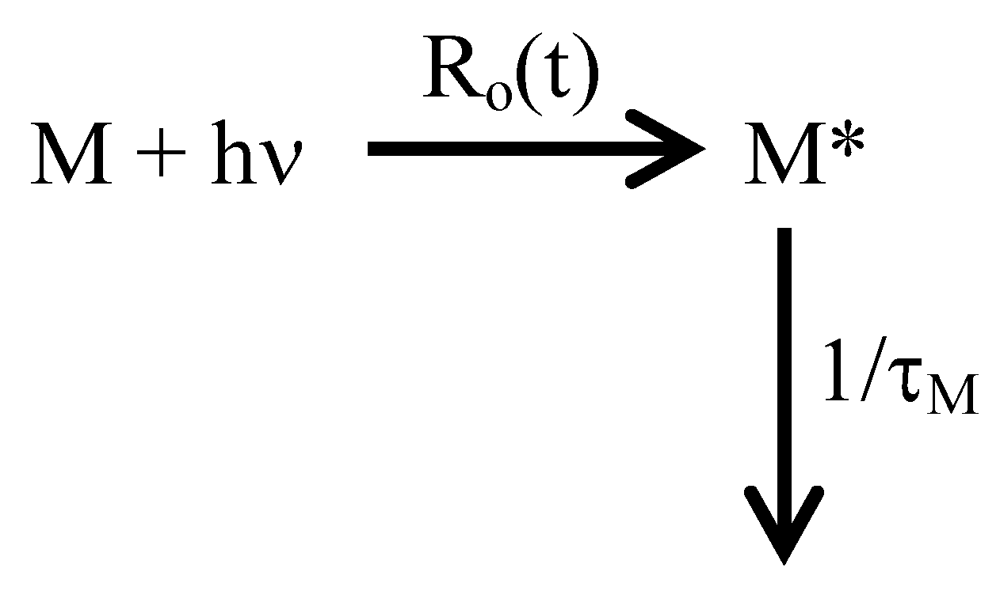
      <p>Webster’s unabridged dictionary defines fluorescence as <italic>the emission of radiation, especially visible light, by a substance during exposure to external radiation, as light or X-rays</italic>. The different photophysical pathways associated with fluorescence have been described in a number of textbooks and they are briefly described hereafter [<xref ref-type="bibr" rid="B135-polymers-04-00211">135</xref>,<xref ref-type="bibr" rid="B136-polymers-04-00211">136</xref>,<xref ref-type="bibr" rid="B137-polymers-04-00211">137</xref>]. Upon absorption of a photon in a process that takes a few femtoseconds, a fluorophore like pyrene gets excited to one of the vibrational levels of its different electronic states. The excited pyrene relaxes then quickly over a few picoseconds to the lowest vibrational level of the first electronic state (S<sub>1</sub>) via internal conversion. The excited fluorophore relaxes to one of the vibrational levels of the ground-state (S<sub>0</sub>) by fluorescence in a process that takes several nanoseconds for most fluorophores and more than 100 nanoseconds for many pyrene derivatives. Because fluorescence occurs on a much longer timescale compared to all other photophysical processes involved, excitation of the fluorophore can be considered to be instantaneous with respects to fluorescence. <xref ref-type="fig" rid="polymers-04-00211-f005">Scheme 1</xref> describes the photophysical processes involved during the fluorescence of a fluorophore (M).</p>
      <fig id="polymers-04-00211-f005" position="anchor">
        <object-id pub-id-type="pii">polymers-04-00211-scheme1_Scheme 1</object-id>
        <label>Scheme 1</label>
        <caption>
          <p>Excitation and emission by fluorescence of a fluorophore M.</p>
        </caption>
        <graphic xmlns:xlink="http://www.w3.org/1999/xlink" xlink:href="polymers-04-00211-g005.tif"/>
      </fig>
      <p>In <xref ref-type="fig" rid="polymers-04-00211-f005">Scheme 1</xref>, the excited fluorophore M* is generated at a rate R<sub>o</sub>(t) and emits fluorescence with its natural lifetime <italic>τ</italic><sub>M</sub>. <italic>τ</italic><sub>M</sub><sup>−1</sup> represents the rate constant describing the relaxation of the excited fluorophore. It includes a radiative (<italic>k</italic><sub>rad</sub>) and a non-radiative (<italic>k</italic><sub>nrad</sub>) component such that <italic>τ</italic><sub>M</sub><sup>−1</sup> = <italic>k</italic><sub>rad</sub> + <italic>k</italic><sub>nrad</sub>. According to <xref ref-type="fig" rid="polymers-04-00211-f005">Scheme 1</xref>, the disappearance of M* as a function of time is described by Equation (1).</p>
      <p><inline-graphic xmlns:xlink="http://www.w3.org/1999/xlink" xlink:href="polymers-04-00211-i001.tif"/></p>
      <p>Solving Equation (1) requires knowledge about whether the fluorescence experiment is conducted with a continuous (steady-state condition, <italic>R</italic><sub>o</sub>(t) = <italic>R</italic><sub>o</sub> which is independent of time, and <italic>d</italic>[M*]/<italic>dt</italic> = 0) or time resolved (<italic>R</italic><sub>o</sub>(t) = <italic>R</italic><sub>o</sub> × <italic>δ</italic>(<italic>t</italic>) where <italic>δ</italic> represent the Dirac function and equals zero for <italic>t</italic> &gt; 0) excitation. In the case of continuous excitation, the total concentration of M* species ([M*]<sub>o</sub>) that were generated is given in Equation (2).</p>
      <p><inline-graphic xmlns:xlink="http://www.w3.org/1999/xlink" xlink:href="polymers-04-00211-i002.tif"/></p>
      <p><italic>R</italic><sub>o</sub> in Equation (2) depends on the absorption of the solution, the lamp intensity, and the geometry of the fluorometer used. Multiplying [<italic>M*</italic>]<sub>o</sub> by the fluorescence quantum yield of the fluorophore (<italic>ϕ</italic> = <italic>k</italic><sub>rad</sub> × <italic>τ</italic><sub>M</sub>) yields the total fluorescence emission <italic>I</italic><sub>F</sub>(M*) given in Equation (3).</p>
      <p><inline-graphic xmlns:xlink="http://www.w3.org/1999/xlink" xlink:href="polymers-04-00211-i003.tif"/></p>
      <p>For the fluorescence intensity to be strictly linearly proportional to [<italic>M</italic>*]<sub>o</sub>, the absorption of the solution needs to be kept below 0.05 to avoid the inner filter effect [<xref ref-type="bibr" rid="B137-polymers-04-00211">137</xref>]. In the case of time-resolved excitation, integration of Equation (1) yields Equation (4).</p>
      <p><inline-graphic xmlns:xlink="http://www.w3.org/1999/xlink" xlink:href="polymers-04-00211-i004.tif"/></p>
      <p>Integration of [<italic>M</italic>*]<sub>(</sub><italic><sub>t</sub></italic><sub>)</sub> from time <italic>t</italic> = 0 to <italic>t</italic>→ ∞ followed by multiplication by <italic>k</italic><sub>rad </sub>yields <italic>I</italic><sub>F</sub>(<italic>M*</italic>) which is given in Equation (5).</p>
      <p><inline-graphic xmlns:xlink="http://www.w3.org/1999/xlink" xlink:href="polymers-04-00211-i005.tif"/></p>
      <p>Comparison of Equations (3) and (5) implies that <italic>R</italic><sub>o</sub> × <italic>τ</italic><sub>M</sub> = [<italic>M</italic>*]<sub>o</sub>. While this is theoretically true and the absolute values of <italic>R</italic><sub>o</sub> can be determined by actinometry, in practice actinometry has been shown to be a demanding technique which sometimes results in large variations in quantum yields, for instance, varying from 0.41 to 0.97 for rhodamine B which is often used as a fluorescence standard [<xref ref-type="bibr" rid="B138-polymers-04-00211">138</xref>]. Consequently, the determination of <italic>R</italic><sub>o</sub> is rarely done and the values of <italic>R</italic><sub>o</sub> and [<italic>M</italic>*]<sub>o</sub> remain unknown in the vast majority of fluorescence studies where the fluorescence intensity depends on the fluorometer and the geometry used for fluorescence detection. This comes from the fact that any fluorescence experiment yields a relative value that is made absolute only after proper calibration against a known quantity. However these derivations illustrate the inherent relationship that exists between the results obtained by steady-state and time-resolved fluorescence. This aspect is taken full advantage of when discussing the kinetics of pyrene excimer formation later.</p>
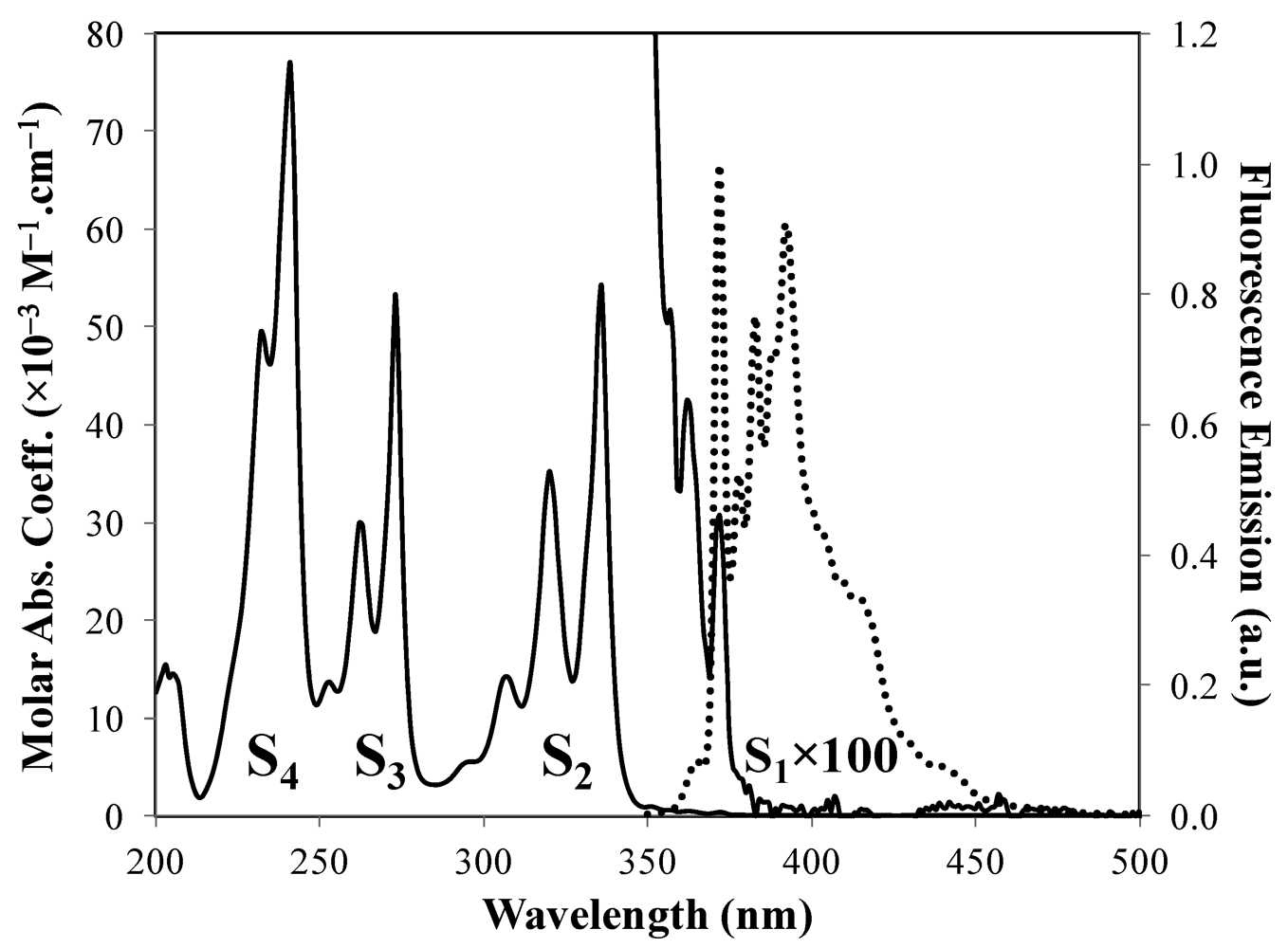
      <p>Excimer formation takes place when an excited fluorophore positioned in contact with a ground-state fluorophore results in the formation of an excited complex called an excimer [<xref ref-type="bibr" rid="B139-polymers-04-00211">139</xref>]. Many aromatic molecules can form an excimer but among them, it is not excessive to say that pyrene has achieved stardom status. This status is largely due to the fact that the 0–0 transition between the lowest vibrational energy levels of the S<sub>0</sub> and S<sub>1</sub> electronic states is symmetry forbidden in the case of pyrene [<xref ref-type="bibr" rid="B140-polymers-04-00211">140</xref>,<xref ref-type="bibr" rid="B141-polymers-04-00211">141</xref>,<xref ref-type="bibr" rid="B142-polymers-04-00211">142</xref>,<xref ref-type="bibr" rid="B143-polymers-04-00211">143</xref>,<xref ref-type="bibr" rid="B144-polymers-04-00211">144</xref>]. As shown in <xref ref-type="fig" rid="polymers-04-00211-f001">Figure 1</xref>, the absence of overlap between the absorption and emission spectra of pyrene demonstrates that little energy transfer can occur between an excited and a ground-state pyrene. Consequently, as an excited pyrene diffuses in solution to encounter a ground-state pyrene, the excitation energy remains localized on the excited pyrene until excimer formation occurs upon contact with a ground-state pyrene. Artefacts due to energy hopping between fluorophores such as with naphthalene [<xref ref-type="bibr" rid="B145-polymers-04-00211">145</xref>] or ethidium bromide [<xref ref-type="bibr" rid="B146-polymers-04-00211">146</xref>] which both exhibit substantial overlap between their absorption and fluorescence spectra are largely absent in the case of pyrene. This represents an enormous advantage when pyrene excimer formation is used to probe the long range internal dynamics of macromolecules as the large local concentration of fluorophores covalently attached to a macromolecule would otherwise induce a delocalization of the excited state due to energy hopping.</p>
      <p>Despite the small molar absorption coefficient of pyrene (<italic>ε</italic><sub>Py</sub>) at the wavelength corresponding to the 0–0 transition (372 nm in <xref ref-type="fig" rid="polymers-04-00211-f001">Figure 1</xref>), pyrene exhibits a relatively large <italic>ε</italic><sub>Py</sub> value for the S<sub>20</sub> transition in the absorption spectrum, usually around 45,000 (±10,000) M<sup>−1</sup>∙cm<sup>−1</sup> depending on the solvent and the type of side group pyrene has been derivatized with. Depending on the pyrene derivative or the solvent being used, the S<sub>20</sub> band is usually located between 335 and 345 nm and excitation at these wavelengths away from the pyrene emission minimizes distortions in the fluorescence spectrum of pyrene due to light scattering. This becomes an added benefit when dealing with pyrene-labeled macromolecules which scatter light due to their large size. </p>
      <fig id="polymers-04-00211-f001" position="anchor">
        <label>Figure 1</label>
        <caption>
          <p>Molar absorption coefficient (solid line) and fluorescence spectrum (dashed line) of pyrene in tetrahydrofuran. For the fluorescence spectrum, [Py] = 2.5 × 10<sup>−6</sup> mol∙L<sup>−1</sup> and <italic>λ</italic><sub>ex</sub> = 335 nm (Absorption and fluorescence spectra acquired by Michael A. Fowler).</p>
        </caption>
        <graphic xmlns:xlink="http://www.w3.org/1999/xlink" xlink:href="polymers-04-00211-g001.tif"/>
        
      </fig>
      
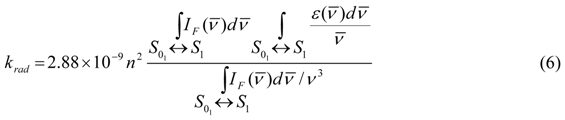
      <p>Equation (6) describes how <italic>k</italic><sub>rad</sub> is related to <italic>ε</italic><sub>Py</sub> [<xref ref-type="bibr" rid="B147-polymers-04-00211">147</xref>], which according to  <xref ref-type="fig" rid="polymers-04-00211-f001">Figure 1</xref>,  takes small values for the S<sub>1</sub> transition. In Equation (6), <italic>n</italic> is the solvent refractive index, <inline-graphic xmlns:xlink="http://www.w3.org/1999/xlink" xlink:href="polymers-04-00211-i016.tif"/> is the wavenumber, and <italic>I</italic><sub>F</sub> is the fluorescence intensity. Based on Equation (6), <italic>k</italic><sub>rad </sub>is small for pyrene so that the lifetime of pyrene is large since <italic>τ</italic><sub>M</sub><sup>−1</sup> = <italic>k</italic><sub>rad</sub> + <italic>k</italic><sub>nrad</sub>. Indeed, pyrene and its derivatives have lifetimes of several hundreds of nanoseconds, much longer than any other aromatic fluorophore. The long lifetime of pyrene provides a long time window through which photophysical phenomena occurring over a few tens of picoseconds to several hundreds of nanoseconds can be probed, a dynamic range covering five orders of magnitude.</p>
      <p><inline-graphic xmlns:xlink="http://www.w3.org/1999/xlink" xlink:href="polymers-04-00211-i006.tif"/></p>
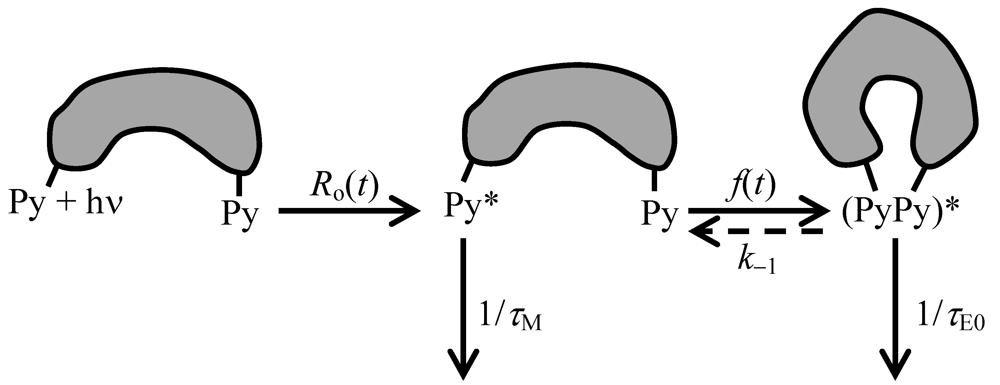
      <p>The kinetics of excimer formation between pyrene labels covalently attached to a macromolecule are described by <xref ref-type="fig" rid="polymers-04-00211-f006">Scheme 2</xref> where the parameters <italic>τ</italic><sub>M</sub> and <italic>τ</italic><sub>E0</sub> represent the lifetime of the pyrene monomer and excimer, respectively. Two temperature regimes have been defined for excimer formation depending on whether a Steven-Ban plot [<xref ref-type="bibr" rid="B148-polymers-04-00211">148</xref>] of the logarithm <italic>Ln</italic>(<italic>I</italic><sub>E</sub>/<italic>I</italic><sub>M</sub>) (where <italic>I</italic><sub>E</sub> and <italic>I</italic><sub>M</sub> are the fluorescence intensity of the pyrene excimer and monomer, respectively) increases or decreases linearly with increasing 1/<italic>T</italic> [<xref ref-type="bibr" rid="B149-polymers-04-00211">149</xref>]. In the high temperature regime, <italic>Ln</italic>(<italic>I</italic><sub>E</sub>/<italic>I</italic><sub>M</sub>) increases with increasing 1/<italic>T</italic> and <italic>k</italic><sub>−1</sub> is large compared to 1/<italic>τ</italic><sub>E0</sub>. In the low temperature regime where <italic>Ln</italic>(<italic>I</italic><sub>E</sub>/<italic>I</italic><sub>M</sub>) decreases with increasing 1/<italic>T</italic>, the excimer dissociation rate constant <italic>k</italic><sub>−1</sub> is small and can be neglected. In the case of pyrene excimer formation, usually <italic>k</italic><sub>−1</sub> can be neglected at temperatures lower than 30 °C so that it is often neglected for experiments carried out at room temperature (<italic>T</italic>≈ 25 °C) [<xref ref-type="bibr" rid="B81-polymers-04-00211">81</xref>]. <xref ref-type="fig" rid="polymers-04-00211-f006">Scheme 2</xref> is referred to as Birks’ scheme in recognition of J.B. Birks who characterized the kinetics of excimer formation for aromatic molecules in solution [<xref ref-type="bibr" rid="B139-polymers-04-00211">139</xref>]. </p>
      <fig id="polymers-04-00211-f006" position="anchor">
        <object-id pub-id-type="pii">polymers-04-00211-scheme2_Scheme 2</object-id>
        <label>Scheme 2</label>
        <caption>
          <p>Excimer formation between pyrene groups covalently attached to a macromolecule.</p>
        </caption>
        <graphic xmlns:xlink="http://www.w3.org/1999/xlink" xlink:href="polymers-04-00211-g006.tif"/>
      </fig>
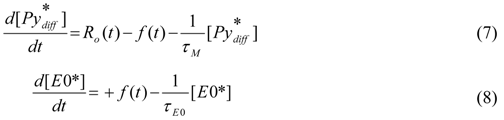
      <p>The rate of excimer formation is given by the function <italic>f</italic>(<italic>t</italic>) which depends on the distribution of distances spanning every two pyrenes [<xref ref-type="bibr" rid="B75-polymers-04-00211">75</xref>,<xref ref-type="bibr" rid="B150-polymers-04-00211">150</xref>]. The time-dependent behavior of the concentration of pyrene monomer and excimer is obtained by integrating Equations (7) and (8) where excimer dissociation has been neglected.</p>
      <p><inline-graphic xmlns:xlink="http://www.w3.org/1999/xlink" xlink:href="polymers-04-00211-i007.tif"/></p>
      <p>The subscript <italic>diff</italic> used in Equation (7) emphasizes that these pyrenes form excimer by diffusion. These differential equations are coupled which implies that any decrease of <inline-graphic xmlns:xlink="http://www.w3.org/1999/xlink" xlink:href="polymers-04-00211-i017.tif"/> in Equation (7) due to excimer formation results in an equivalent increase in [<italic>E0</italic>*] in Equation (7). Integration of Equations (7) and (8) yields the time-dependent concentrations of <inline-graphic xmlns:xlink="http://www.w3.org/1999/xlink" xlink:href="polymers-04-00211-i017.tif"/><sub>(</sub><italic><sub>t</sub></italic><sub>)</sub> and [<italic>E0</italic>*]<sub>(t)</sub>. How this derivation is mathematically handled with the specific application to pyrene-labeled dendrimers is the topic of the next section.</p>
    </sec>
    <sec>
      <title>3. Analysis of the Kinetics of Excimer Formation for Pyrene-Labeled Dendrimers</title>
      <p>In homogeneous solutions, pyrene excimer formation takes place with a rate constant <italic>k</italic><sub>1</sub> (<italic>i.e.</italic>, <italic>f</italic>(<italic>t</italic>) = <italic>k</italic><sub>1</sub> × [<italic>Py</italic>] × <inline-graphic xmlns:xlink="http://www.w3.org/1999/xlink" xlink:href="polymers-04-00211-i017.tif"/> in <xref ref-type="fig" rid="polymers-04-00211-f006">Scheme 2</xref> and in Equations (7) and (8)) [<xref ref-type="bibr" rid="B139-polymers-04-00211">139</xref>]. In that case, the kinetics of excimer formation are simple enough and the dissociation rate constant can actually be recovered from a more detailed analysis than that proposed in Equations (7) and (8). Whereas <inline-graphic xmlns:xlink="http://www.w3.org/1999/xlink" xlink:href="polymers-04-00211-i017.tif"/><sub>(<italic>t</italic>) </sub>would be found to decay monoexponentially if Equation (7) was integrated assuming a function <italic>R</italic><sub>o</sub>(<italic>t</italic>) = <italic>R</italic><sub>o</sub> × <italic>δ</italic>(<italic>t</italic>) (<italic>i.e.</italic>, instantaneous excitation of pyrene), the complete treatment of the kinetics of excimer formation that includes the dissociation rate constant <italic>k</italic><sub>−1</sub> in <xref ref-type="fig" rid="polymers-04-00211-f006">Scheme 2</xref> is described by J.B. Birks yielding a biexponential decay for <inline-graphic xmlns:xlink="http://www.w3.org/1999/xlink" xlink:href="polymers-04-00211-i017.tif"/><sub>(<italic>t</italic>) </sub>[<xref ref-type="bibr" rid="B139-polymers-04-00211">139</xref>]. The contribution to the overall decay of the exponential having the shorter decay time is usually rather small (less than 15% of the total pre-exponential weight) so that the decay of <inline-graphic xmlns:xlink="http://www.w3.org/1999/xlink" xlink:href="polymers-04-00211-i017.tif"/><sub>(</sub><italic><sub>t</sub></italic><sub>) </sub>can be considered to be essentially monoexponential as would be expected for a process where <italic>k</italic><sub>−1</sub> is small compared to <italic>τ</italic><sub>E</sub><sup>−1</sup> in <xref ref-type="fig" rid="polymers-04-00211-f006">Scheme 2</xref> (<italic>i.e.</italic>, the excimer fluoresces more quickly than it can dissociate).</p>

      <p>The first study of intramolecular pyrene excimer formation was reported by Zachariasse in 1976 for a series of <italic>n</italic>-alkanes terminated at both ends with a 1-pyrenemethyl group [<xref ref-type="bibr" rid="B151-polymers-04-00211">151</xref>]. It was followed by numerous others that provided information about the ensemble of conformations adopted by the short alkane chain as it folds to bring its two ends in close proximity to form an excimer [<xref ref-type="bibr" rid="B152-polymers-04-00211">152</xref>,<xref ref-type="bibr" rid="B153-polymers-04-00211">153</xref>,<xref ref-type="bibr" rid="B154-polymers-04-00211">154</xref>,<xref ref-type="bibr" rid="B155-polymers-04-00211">155</xref>,<xref ref-type="bibr" rid="B156-polymers-04-00211">156</xref>,<xref ref-type="bibr" rid="B157-polymers-04-00211">157</xref>,<xref ref-type="bibr" rid="B158-polymers-04-00211">158</xref>,<xref ref-type="bibr" rid="B159-polymers-04-00211">159</xref>,<xref ref-type="bibr" rid="B160-polymers-04-00211">160</xref>]. The scope of these studies was then expanded to include the end-to-end cyclization (EEC) of polymer chains by covalently attaching a pyrenyl group at both ends of a series of poly(ethylene oxide) (Py<sub>2</sub>-PEO) [<xref ref-type="bibr" rid="B78-polymers-04-00211">78</xref>]. These early fluorescence experiments carried out with continuous excitation provided relative information about the EEC rate constant (<italic>k</italic><sub>EEC</sub>). In 1980, Winnik applied the Birks scheme to analyze the fluorescence decays of a series of pyrene end-labeled polystyrenes (Py<sub>2</sub>-PS) and retrieve <italic>k</italic><sub>EEC</sub> quantitatively [<xref ref-type="bibr" rid="B79-polymers-04-00211">79</xref>]. The procedure introduced by Winnik to determine <italic>k</italic><sub>EEC</sub> was then expanded to numerous polymeric backbones such as polydimethylsiloxane [<xref ref-type="bibr" rid="B81-polymers-04-00211">81</xref>,<xref ref-type="bibr" rid="B96-polymers-04-00211">96</xref>,<xref ref-type="bibr" rid="B97-polymers-04-00211">97</xref>], poly(bisphenol A-diethylene glycol carbonate) [<xref ref-type="bibr" rid="B84-polymers-04-00211">84</xref>], poly(tetramethylene oxide) [<xref ref-type="bibr" rid="B86-polymers-04-00211">86</xref>], or poly(ε-caprolactone) [<xref ref-type="bibr" rid="B94-polymers-04-00211">94</xref>]. At about the same time, it was also realized that <italic>k</italic><sub>EEC</sub> provided not only information about the EEC process, but maybe more importantly, also a measure of the long range internal dynamics of the polymer chain. The procedure was further applied to more biologically relevant polymers by attaching dyes other than pyrene to the ends of monodisperse polypeptides of well-defined repeating sequences [<xref ref-type="bibr" rid="B161-polymers-04-00211">161</xref>,<xref ref-type="bibr" rid="B162-polymers-04-00211">162</xref>,<xref ref-type="bibr" rid="B163-polymers-04-00211">163</xref>,<xref ref-type="bibr" rid="B164-polymers-04-00211">164</xref>,<xref ref-type="bibr" rid="B165-polymers-04-00211">165</xref>,<xref ref-type="bibr" rid="B166-polymers-04-00211">166</xref>,<xref ref-type="bibr" rid="B167-polymers-04-00211">167</xref>,<xref ref-type="bibr" rid="B168-polymers-04-00211">168</xref>,<xref ref-type="bibr" rid="B169-polymers-04-00211">169</xref>,<xref ref-type="bibr" rid="B170-polymers-04-00211">170</xref>,<xref ref-type="bibr" rid="B171-polymers-04-00211">171</xref>,<xref ref-type="bibr" rid="B172-polymers-04-00211">172</xref>,<xref ref-type="bibr" rid="B173-polymers-04-00211">173</xref>]. In so doing, <italic>k</italic><sub>EEC</sub> was obtained for these polypeptides by the analysis of fluorescence decays and it was found to yield information about the polypeptide relative chain flexibility.</p>
      <p>The experiments with end-labeled oligomers or polymers dealt with well-defined constructs with a single chain length spanning two pyrenes. In this case, theory predicts that <italic>f</italic>(<italic>t</italic>) in <xref ref-type="fig" rid="polymers-04-00211-f006">Scheme 2</xref> equals <italic>k</italic><sub>EEC</sub> [<xref ref-type="bibr" rid="B174-polymers-04-00211">174</xref>,<xref ref-type="bibr" rid="B175-polymers-04-00211">175</xref>] which was found experimentally to scale as <italic>N</italic><sup>α</sup> with <italic>α</italic> taking values between 0.9 and 1.9 [<xref ref-type="bibr" rid="B74-polymers-04-00211">74</xref>,<xref ref-type="bibr" rid="B81-polymers-04-00211">81</xref>,<xref ref-type="bibr" rid="B84-polymers-04-00211">84</xref>,<xref ref-type="bibr" rid="B85-polymers-04-00211">85</xref>,<xref ref-type="bibr" rid="B170-polymers-04-00211">170</xref>,<xref ref-type="bibr" rid="B171-polymers-04-00211">171</xref>,<xref ref-type="bibr" rid="B172-polymers-04-00211">172</xref>,<xref ref-type="bibr" rid="B173-polymers-04-00211">173</xref>]. In turn, this result implied that <italic>k</italic><sub>EEC</sub> decreases strongly with increasing distance spanning two pyrenes. This had a detrimental consequence for studying macromolecules with more than two pyrene pendants and where the pyrene pendants are separated by more than one chain length, as is the case for pyrene end-labeled dendrimers. In this case, <italic>f</italic>(<italic>t</italic>) is unknown.</p>
      <p>Although <italic>f</italic>(<italic>t</italic>) is undefined, work from this laboratory has proposed a mathematical procedure that provides a quantitative measure of the intramolecular rate constant of excimer formation for pyrene end-labeled dendrimers without the explicit knowledge of <italic>f</italic>(<italic>t</italic>) [<xref ref-type="bibr" rid="B150-polymers-04-00211">150</xref>]. The treatment is based on the observation that although <italic>f</italic>(<italic>t</italic>) is not known, any fluorescence decay can be fitted with a sum of exponentials. Thus the fluorescence decay of the pyrene monomer for a pyrene end-labeled dendrimer can be fitted with Equation (9).</p>
      <p><inline-graphic xmlns:xlink="http://www.w3.org/1999/xlink" xlink:href="polymers-04-00211-i008.tif"/></p>
      <p>In Equation (9), the pre-exponential factors <italic>a</italic><sub>i</sub> are normalized so that their sum equals unity (<inline-graphic xmlns:xlink="http://www.w3.org/1999/xlink" xlink:href="polymers-04-00211-i018.tif"/>). Since <inline-graphic xmlns:xlink="http://www.w3.org/1999/xlink" xlink:href="polymers-04-00211-i017.tif"/><sub>(</sub><italic><sub>t</sub></italic><sub>)</sub> is known, its expression can be used in Equation (7) to determine <italic>f</italic>(<italic>t</italic>) which for times <italic>t</italic> &gt; 0 is given by Equation (10).</p>
      <p><inline-graphic xmlns:xlink="http://www.w3.org/1999/xlink" xlink:href="polymers-04-00211-i009.tif"/></p>
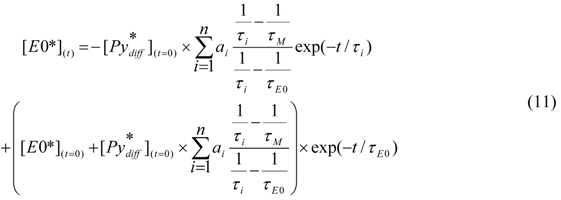
      <p>Equation (10) can then be introduced in Equation (7) to yield the expression of [<italic>E0</italic>*]<sub>(</sub><sub>t)</sub> given in Equation (11). </p>
      <p><inline-graphic xmlns:xlink="http://www.w3.org/1999/xlink" xlink:href="polymers-04-00211-i010.tif"/></p>
      <p>Theoretically, Equations (9) and (11) should be enough to fit the fluorescence decays of, respectively, the pyrene monomer and excimer of any pyrene-labeled macromolecule forming excimer by diffusion. Unfortunately, these equations need to be adjusted to account for two complications that are specific to pyrene-labeled macromolecules in general and dendrimers in particular [<xref ref-type="bibr" rid="B126-polymers-04-00211">126</xref>,<xref ref-type="bibr" rid="B176-polymers-04-00211">176</xref>]. The first complication is due to the unavoidable presence of traces of unattached pyrene label in any pyrene-labeled dendrimer. As will become clear later, the long lifetime and large fluorescence quantum yield of pyrene monomers unattached to the dendrimer constitute a major challenge to the interpretation of the fluorescence results. Second, the high local pyrene concentration inside the congested dendrimer interior does not always enable two pyrenyl units to encounter and adopt the ideal stacking required for excimer formation. The resulting dimers <italic>D</italic>* constituted of poorly stacked pyrenes emit with a lifetime <italic>τ</italic><sub>D</sub> that is different from <italic>τ</italic><sub>E0</sub>. Whereas <italic>τ</italic><sub>E0</sub> takes values between 40 and 70 ns in organic solvents [<xref ref-type="bibr" rid="B139-polymers-04-00211">139</xref>], lifetimes <italic>τ</italic><sub>D</sub> have been obtained that were as short as 2–4 ns [<xref ref-type="bibr" rid="B108-polymers-04-00211">108</xref>,<xref ref-type="bibr" rid="B126-polymers-04-00211">126</xref>] or as long as 100–150 ns [<xref ref-type="bibr" rid="B103-polymers-04-00211">103</xref>,<xref ref-type="bibr" rid="B112-polymers-04-00211">112</xref>,<xref ref-type="bibr" rid="B113-polymers-04-00211">113</xref>,<xref ref-type="bibr" rid="B114-polymers-04-00211">114</xref>,<xref ref-type="bibr" rid="B116-polymers-04-00211">116</xref>].</p>
      <p>To account for the unattached pyrene labels that do not form excimer under the dilute solution conditions used to acquire the fluorescence decays, typically 2.5 × 10<sup>−6</sup> M in pyrene, and emit as free pyrenes would, the concentration <inline-graphic xmlns:xlink="http://www.w3.org/1999/xlink" xlink:href="polymers-04-00211-i032.tif"/><sub>(<italic>t</italic>) </sub>given in Equation (12) is added to Equation (9) to yield Equation (13).</p>

      <p><inline-graphic xmlns:xlink="http://www.w3.org/1999/xlink" xlink:href="polymers-04-00211-i011.tif"/></p>
      <p>Depending on whether the dimers are pre-stacked or formed by diffusion, two expressions for [<italic>D</italic>*]<sub>(</sub><sub>t)</sub> have been derived [<xref ref-type="bibr" rid="B126-polymers-04-00211">126</xref>,<xref ref-type="bibr" rid="B150-polymers-04-00211">150</xref>,<xref ref-type="bibr" rid="B176-polymers-04-00211">176</xref>,<xref ref-type="bibr" rid="B177-polymers-04-00211">177</xref>] from which only the simpler one used to deal with the former type of dimers is given in Equation (14).</p>
      <p><inline-graphic xmlns:xlink="http://www.w3.org/1999/xlink" xlink:href="polymers-04-00211-i012.tif"/></p>
      <p>The overall excimer fluorescence decay combines the contributions from both the pyrene excimer <italic>E*</italic> and excited dimers <italic>D*</italic> by summing both contributions in Equation (15).</p>
      <p><inline-graphic xmlns:xlink="http://www.w3.org/1999/xlink" xlink:href="polymers-04-00211-i013.tif"/></p>
      <p>Equations (13) and (15) can then be used to fit the fluorescence decays of the pyrene monomer and excimer respectively. Because the expressions of <inline-graphic xmlns:xlink="http://www.w3.org/1999/xlink" xlink:href="polymers-04-00211-i017.tif"/><sub>(<italic>t</italic>)</sub>, and [<italic>E0*</italic>]<italic><sub>(t)</sub></italic> were obtained by making no assumption about the nature of <italic>f</italic>(<italic>t</italic>), this type of mathematical treatment used to fit the fuorescence decays has been referred to as the Model Free (MF) analysis [<xref ref-type="bibr" rid="B126-polymers-04-00211">126</xref>,<xref ref-type="bibr" rid="B176-polymers-04-00211">176</xref>,<xref ref-type="bibr" rid="B177-polymers-04-00211">177</xref>].</p>
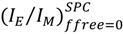
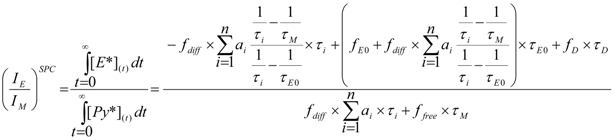
      <p>At first glance, Equations (13) and (15) are sums of exponentials similar to those typically found to fit the fluorescence decays of the pyrene monomer and excimer [<xref ref-type="bibr" rid="B74-polymers-04-00211">74</xref>,<xref ref-type="bibr" rid="B79-polymers-04-00211">79</xref>,<xref ref-type="bibr" rid="B80-polymers-04-00211">80</xref>,<xref ref-type="bibr" rid="B81-polymers-04-00211">81</xref>,<xref ref-type="bibr" rid="B82-polymers-04-00211">82</xref>,<xref ref-type="bibr" rid="B83-polymers-04-00211">83</xref>,<xref ref-type="bibr" rid="B84-polymers-04-00211">84</xref>,<xref ref-type="bibr" rid="B85-polymers-04-00211">85</xref>,<xref ref-type="bibr" rid="B86-polymers-04-00211">86</xref>,<xref ref-type="bibr" rid="B87-polymers-04-00211">87</xref>,<xref ref-type="bibr" rid="B88-polymers-04-00211">88</xref>,<xref ref-type="bibr" rid="B89-polymers-04-00211">89</xref>,<xref ref-type="bibr" rid="B90-polymers-04-00211">90</xref>,<xref ref-type="bibr" rid="B91-polymers-04-00211">91</xref>,<xref ref-type="bibr" rid="B92-polymers-04-00211">92</xref>,<xref ref-type="bibr" rid="B93-polymers-04-00211">93</xref>,<xref ref-type="bibr" rid="B94-polymers-04-00211">94</xref>,<xref ref-type="bibr" rid="B95-polymers-04-00211">95</xref>,<xref ref-type="bibr" rid="B96-polymers-04-00211">96</xref>,<xref ref-type="bibr" rid="B97-polymers-04-00211">97</xref>,<xref ref-type="bibr" rid="B98-polymers-04-00211">98</xref>,<xref ref-type="bibr" rid="B99-polymers-04-00211">99</xref>,<xref ref-type="bibr" rid="B100-polymers-04-00211">100</xref>,<xref ref-type="bibr" rid="B101-polymers-04-00211">101</xref>,<xref ref-type="bibr" rid="B102-polymers-04-00211">102</xref>,<xref ref-type="bibr" rid="B103-polymers-04-00211">103</xref>,<xref ref-type="bibr" rid="B104-polymers-04-00211">104</xref>,<xref ref-type="bibr" rid="B105-polymers-04-00211">105</xref>,<xref ref-type="bibr" rid="B106-polymers-04-00211">106</xref>,<xref ref-type="bibr" rid="B107-polymers-04-00211">107</xref>,<xref ref-type="bibr" rid="B108-polymers-04-00211">108</xref>,<xref ref-type="bibr" rid="B109-polymers-04-00211">109</xref>,<xref ref-type="bibr" rid="B110-polymers-04-00211">110</xref>,<xref ref-type="bibr" rid="B111-polymers-04-00211">111</xref>,<xref ref-type="bibr" rid="B112-polymers-04-00211">112</xref>,<xref ref-type="bibr" rid="B113-polymers-04-00211">113</xref>,<xref ref-type="bibr" rid="B114-polymers-04-00211">114</xref>,<xref ref-type="bibr" rid="B115-polymers-04-00211">115</xref>,<xref ref-type="bibr" rid="B116-polymers-04-00211">116</xref>,<xref ref-type="bibr" rid="B159-polymers-04-00211">159</xref>], although the exact form of the sums of exponentials encountered in the literature is different from that of Equations (13) and (15). As for the other analyses, the monomer and excimer decays are fitted gobally to improve the accuracy on the retrieved parameters [<xref ref-type="bibr" rid="B178-polymers-04-00211">178</xref>,<xref ref-type="bibr" rid="B179-polymers-04-00211">179</xref>,<xref ref-type="bibr" rid="B180-polymers-04-00211">180</xref>]. However, our analysis departs in one important manner from the current art in the way the pre-exponential factors <inline-graphic xmlns:xlink="http://www.w3.org/1999/xlink" xlink:href="polymers-04-00211-i019.tif"/> in Equation (9) and <inline-graphic xmlns:xlink="http://www.w3.org/1999/xlink" xlink:href="polymers-04-00211-i020.tif"/> and <inline-graphic xmlns:xlink="http://www.w3.org/1999/xlink" xlink:href="polymers-04-00211-i021.tif"/> in Equation (11) are being handled because <italic>α</italic><sub>i</sub>, <italic>β</italic><sub>i</sub>, and <italic>γ</italic><sub>i</sub> are not treated as floating parameters in the optimization, but rather are fitted as a function of the decay times <italic>τ</italic><sub>i</sub> and <italic>τ</italic><sub>E0</sub> and the pre-exponential factors <italic>a</italic><sub>i</sub>. As it turns out, analyzing the fluorescence decays of the pyrene monomer and excimer in this manner retrieves the parameters <italic>a</italic><sub>i</sub>, the decay times <italic>τ</italic><sub>i</sub> and <italic>τ</italic><sub>E0</sub>, and the molar fractions <italic>f</italic><sub>diff</sub>, <italic>f</italic><sub>free</sub>, <italic>f</italic><sub>E0</sub>, and <italic>f</italic><sub>D</sub> of the pyrene species <inline-graphic xmlns:xlink="http://www.w3.org/1999/xlink" xlink:href="polymers-04-00211-i017.tif"/>, <inline-graphic xmlns:xlink="http://www.w3.org/1999/xlink" xlink:href="polymers-04-00211-i032.tif"/>, <italic>E0</italic>* and <italic>D*</italic> found in solution with improved accuracy [<xref ref-type="bibr" rid="B126-polymers-04-00211">126</xref>,<xref ref-type="bibr" rid="B150-polymers-04-00211">150</xref>,<xref ref-type="bibr" rid="B176-polymers-04-00211">176</xref>,<xref ref-type="bibr" rid="B177-polymers-04-00211">177</xref>] compared to more traditional analyses [<xref ref-type="bibr" rid="B74-polymers-04-00211">74</xref>,<xref ref-type="bibr" rid="B108-polymers-04-00211">108</xref>,<xref ref-type="bibr" rid="B160-polymers-04-00211">160</xref>]. Furthermore, it also enables the calculation of the ratio <inline-graphic xmlns:xlink="http://www.w3.org/1999/xlink" xlink:href="polymers-04-00211-i022.tif"/> given in Equation (16) which constitutes an absolute measure of the <italic>I</italic><sub>E</sub>/<italic>I</italic><sub>M</sub> ratio obtained by steady-state fluorescence.</p>
      <p><inline-graphic xmlns:xlink="http://www.w3.org/1999/xlink" xlink:href="polymers-04-00211-i014.tif"/>   (16)</p>
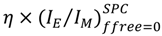
      <p>The <italic>SPC</italic> superscript in Equation (16) reminds the reader that (<italic>I</italic><sub>E</sub>/<italic>I</italic><sub>M</sub>)<sup>SPC</sup> is obtained by time-correlated single photon counting experiments whereas the (<italic>I</italic><sub>E</sub>/<italic>I</italic><sub>M</sub>)<sup>SS</sup> ratio corresponds to the <italic>I</italic><sub>E</sub>/<italic>I</italic><sub>M</sub> ratio obtained from the steady-state fluorescence spectra. In effect, the ratios (<italic>I</italic><sub>E</sub>/<italic>I</italic><sub>M</sub>)<sup>SPC</sup> and (<italic>I</italic><sub>E</sub>/<italic>I</italic><sub>M</sub>)<sup>SS</sup> both represent the extent of excimer formation, the only difference being that the former and latter ratios represent absolute and relative values, respectively. One major advantage of Equation (16) is that the emission due to free pyrene labels can be isolated so that the true <italic>I</italic><sub>E</sub>/<italic>I</italic><sub>M</sub> ratio of a pure pyrene-labeled dendrimer is obtained simply by setting <italic>f</italic><sub>free</sub> in Equation (16) to equal zero to yield <inline-graphic xmlns:xlink="http://www.w3.org/1999/xlink" xlink:href="polymers-04-00211-i023.tif"/>. In turn, <inline-graphic xmlns:xlink="http://www.w3.org/1999/xlink" xlink:href="polymers-04-00211-i023.tif"/> is expected to be proportional to the average rate constant of pyrene excimer formation &lt;<italic>k</italic>&gt; defined hereafter, as has been found in a number of studies [<xref ref-type="bibr" rid="B73-polymers-04-00211">73</xref>,<xref ref-type="bibr" rid="B74-polymers-04-00211">74</xref>,<xref ref-type="bibr" rid="B78-polymers-04-00211">78</xref>,<xref ref-type="bibr" rid="B125-polymers-04-00211">125</xref>,<xref ref-type="bibr" rid="B126-polymers-04-00211">126</xref>,<xref ref-type="bibr" rid="B176-polymers-04-00211">176</xref>]. A discrepancy between <inline-graphic xmlns:xlink="http://www.w3.org/1999/xlink" xlink:href="polymers-04-00211-i023.tif"/> and &lt;<italic>k</italic>&gt; would imply that something is amiss in the analysis. Discrepancies between the ratios (<italic>I</italic><sub>E</sub>/<italic>I</italic><sub>M</sub>)<sup>SPC</sup> and (<italic>I</italic><sub>E</sub>/<italic>I</italic><sub>M</sub>)<sup>SS</sup> and &lt;<italic>k</italic>&gt; typically indicate that some free pyrene is present in solution that has not been accounted for.</p>
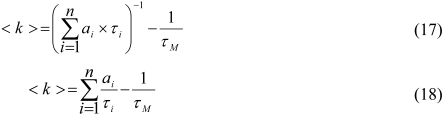
      <p>Finally, a measure of the time scale over which pyrene excimer formation takes place can be obtained from the average excimer formation rate constant &lt;<italic>k</italic>&gt; which can be approximated by two expressions given in Equations (17) and (18).</p>
      <p><inline-graphic xmlns:xlink="http://www.w3.org/1999/xlink" xlink:href="polymers-04-00211-i015.tif"/></p>
      <p>Both equations provide a measure of the rate constant of excimer formation but Equation (18) has been shown to provide more reliable results in at least one instance [<xref ref-type="bibr" rid="B176-polymers-04-00211">176</xref>].</p>
    </sec>
    <sec>
      <title>4. Internal Segmental Dynamics of Pyrene-Labeled Dendrimers</title>
      <p>The ability of dendrimers to bring reactants into close proximity with absolute control over their spacing has made them essential building blocks in the toolbox of photochemists. Fluorescence resonance energy transfer (FRET), energy hopping or migration, and electron transfer between a donor and an acceptor are all photophysical processes whose efficiency depends strongly on the distance between the donor and acceptor [<xref ref-type="bibr" rid="B135-polymers-04-00211">135</xref>,<xref ref-type="bibr" rid="B136-polymers-04-00211">136</xref>,<xref ref-type="bibr" rid="B137-polymers-04-00211">137</xref>]. The design of dendrimers used for this type of applications consists in placing many donors at the dendrimer periphery and a single acceptor molecule at the dendrimer focal point [<xref ref-type="bibr" rid="B3-polymers-04-00211">3</xref>,<xref ref-type="bibr" rid="B36-polymers-04-00211">36</xref>,<xref ref-type="bibr" rid="B39-polymers-04-00211">39</xref>,<xref ref-type="bibr" rid="B40-polymers-04-00211">40</xref>,<xref ref-type="bibr" rid="B41-polymers-04-00211">41</xref>,<xref ref-type="bibr" rid="B42-polymers-04-00211">42</xref>,<xref ref-type="bibr" rid="B43-polymers-04-00211">43</xref>,<xref ref-type="bibr" rid="B44-polymers-04-00211">44</xref>,<xref ref-type="bibr" rid="B120-polymers-04-00211">120</xref>,<xref ref-type="bibr" rid="B121-polymers-04-00211">121</xref>,<xref ref-type="bibr" rid="B122-polymers-04-00211">122</xref>,<xref ref-type="bibr" rid="B123-polymers-04-00211">123</xref>,<xref ref-type="bibr" rid="B125-polymers-04-00211">125</xref>]. As the dendrimer generation increases, the efficiency of the photophysical process of interest decreases according to the increased distance separating the donor from the acceptor [<xref ref-type="bibr" rid="B135-polymers-04-00211">135</xref>,<xref ref-type="bibr" rid="B136-polymers-04-00211">136</xref>,<xref ref-type="bibr" rid="B137-polymers-04-00211">137</xref>]. The efficiency of these photophysical processes is a combination of the reactivity of the reactants towards each other and the internal segmental dynamics of the branches constituting the constructs. However, the time scale over which the photophysical processes take place is usually much faster than that over which segmental diffusive motion occurs due to the small dendrimer size. Furthermore segmental motion of the branches can be completely halted by working with rigid backbones such as those afforded by phenylacetylene or pyrene building blocks [<xref ref-type="bibr" rid="B50-polymers-04-00211">50</xref>,<xref ref-type="bibr" rid="B117-polymers-04-00211">117</xref>,<xref ref-type="bibr" rid="B118-polymers-04-00211">118</xref>,<xref ref-type="bibr" rid="B119-polymers-04-00211">119</xref>].</p>
      <p>The study of the internal segmental dynamics of dendrimers can only be achieved with dendrimers constituted of flexible segments such as those made of a backbone of poly(amido amine) (PAMAM dendrimers), polyamide, poly(benzyl ether), poly(benzyl ester), poly(propylene imine) (PPI dendrimers), or poly(2,2-bis(hydroxymethyl)-propionic acid) to name but a few. Over the years, the synthesis of several pyrene-labeled dendrimers has been reported in the literature [<xref ref-type="bibr" rid="B36-polymers-04-00211">36</xref>,<xref ref-type="bibr" rid="B37-polymers-04-00211">37</xref>,<xref ref-type="bibr" rid="B44-polymers-04-00211">44</xref>,<xref ref-type="bibr" rid="B120-polymers-04-00211">120</xref>,<xref ref-type="bibr" rid="B121-polymers-04-00211">121</xref>,<xref ref-type="bibr" rid="B122-polymers-04-00211">122</xref>,<xref ref-type="bibr" rid="B123-polymers-04-00211">123</xref>,<xref ref-type="bibr" rid="B124-polymers-04-00211">124</xref>,<xref ref-type="bibr" rid="B125-polymers-04-00211">125</xref>,<xref ref-type="bibr" rid="B126-polymers-04-00211">126</xref>,<xref ref-type="bibr" rid="B127-polymers-04-00211">127</xref>,<xref ref-type="bibr" rid="B128-polymers-04-00211">128</xref>,<xref ref-type="bibr" rid="B129-polymers-04-00211">129</xref>,<xref ref-type="bibr" rid="B130-polymers-04-00211">130</xref>,<xref ref-type="bibr" rid="B131-polymers-04-00211">131</xref>,<xref ref-type="bibr" rid="B132-polymers-04-00211">132</xref>,<xref ref-type="bibr" rid="B133-polymers-04-00211">133</xref>,<xref ref-type="bibr" rid="B134-polymers-04-00211">134</xref>], but in many instances, the pyrene-labeled constructs were synthesised as pyrene-labeled dendrons to be attached onto a focal point bearing an acceptor molecule capable of communicating with the pyrenyl pendants [<xref ref-type="bibr" rid="B36-polymers-04-00211">36</xref>,<xref ref-type="bibr" rid="B44-polymers-04-00211">44</xref>,<xref ref-type="bibr" rid="B120-polymers-04-00211">120</xref>,<xref ref-type="bibr" rid="B121-polymers-04-00211">121</xref>,<xref ref-type="bibr" rid="B122-polymers-04-00211">122</xref>,<xref ref-type="bibr" rid="B123-polymers-04-00211">123</xref>]. Consequently, these investigations focused on the photophysical process taking place between the pyrene donor and the acceptor rather than on excimer formation between pyrene pendants covalently attached to the chain ends of dendrimers. In effect, pyrene excimer formation has been investigated in earnest in only seven reports [<xref ref-type="bibr" rid="B44-polymers-04-00211">44</xref>,<xref ref-type="bibr" rid="B120-polymers-04-00211">120</xref>,<xref ref-type="bibr" rid="B126-polymers-04-00211">126</xref>,<xref ref-type="bibr" rid="B127-polymers-04-00211">127</xref>,<xref ref-type="bibr" rid="B128-polymers-04-00211">128</xref>,<xref ref-type="bibr" rid="B130-polymers-04-00211">130</xref>,<xref ref-type="bibr" rid="B134-polymers-04-00211">134</xref>] and the results of these are now described.</p>
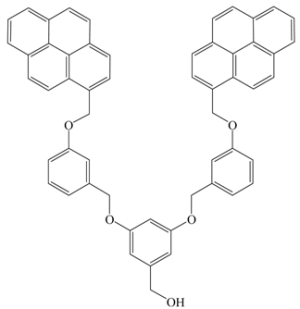
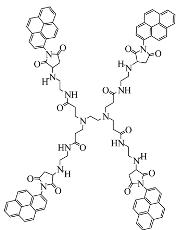
      <p>To date, poly(benzyl ether) dendrimers constitute the dendrimer family that has been the most decorated with pyrenyl groups. However, out of the eight reports presenting data on pyrene-labeled poly(benzyl ether) dendrimers [<xref ref-type="bibr" rid="B36-polymers-04-00211">36</xref>,<xref ref-type="bibr" rid="B37-polymers-04-00211">37</xref>,<xref ref-type="bibr" rid="B44-polymers-04-00211">44</xref>,<xref ref-type="bibr" rid="B120-polymers-04-00211">120</xref>,<xref ref-type="bibr" rid="B121-polymers-04-00211">121</xref>,<xref ref-type="bibr" rid="B122-polymers-04-00211">122</xref>,<xref ref-type="bibr" rid="B123-polymers-04-00211">123</xref>,<xref ref-type="bibr" rid="B124-polymers-04-00211">124</xref>,<xref ref-type="bibr" rid="B125-polymers-04-00211">125</xref>], only two [<xref ref-type="bibr" rid="B44-polymers-04-00211">44</xref>,<xref ref-type="bibr" rid="B120-polymers-04-00211">120</xref>] present some information about the process of pyrene excimer formation, in particular via the ratio (<italic>I</italic><sub>E</sub>/<italic>I</italic><sub>M</sub>)<sup>SS</sup>. Stewart and Fox [<xref ref-type="bibr" rid="B120-polymers-04-00211">120</xref>] chose a 1-pyrenylbenzylether substituent to label a first generation dendrimer (see chemical structure in <xref ref-type="table" rid="polymers-04-00211-t001">Table 1</xref>) whereas Cicchi <italic>et al.</italic> [<xref ref-type="bibr" rid="B44-polymers-04-00211">44</xref>] chose a 1-pyrenebutyltriazol moiety to label generations 1–3 of their poly(benzyl ether) dendrimers (<xref ref-type="table" rid="polymers-04-00211-t001">Table 1</xref>). The finding that excimer formation occurs for these pyrene-labeled poly(benzyl ether) dendrimers in solution actually contradicts the results of three other studies that used either 1-pyrenemethylene [<xref ref-type="bibr" rid="B123-polymers-04-00211">123</xref>] or diarylamino-1-pyrene [<xref ref-type="bibr" rid="B36-polymers-04-00211">36</xref>,<xref ref-type="bibr" rid="B122-polymers-04-00211">122</xref>] to label generation 1–3 dendrimers and reported no pyrene excimer formation. Gu <italic>et al.</italic> [<xref ref-type="bibr" rid="B37-polymers-04-00211">37</xref>] also observed excimer formation when four 1<sup>st</sup> generation poly(benzyl ether) dendrimers labeled with pyrene where covalently attached onto a cyclam core that was introduced as a copper ligand. No fluorescence data was reported in the study by Morales-Espinoza <italic>et al.</italic> [<xref ref-type="bibr" rid="B125-polymers-04-00211">125</xref>]. </p>
      <table-wrap id="polymers-04-00211-t001" position="anchor">
        <object-id pub-id-type="pii">polymers-04-00211-t001_Table 1</object-id>
        <label>Table 1</label>
        <caption>
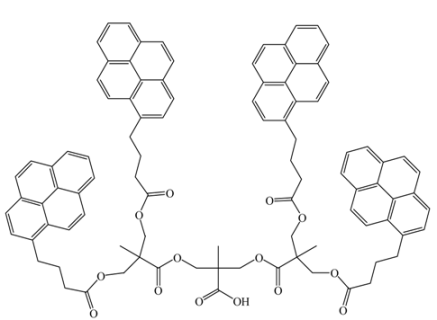
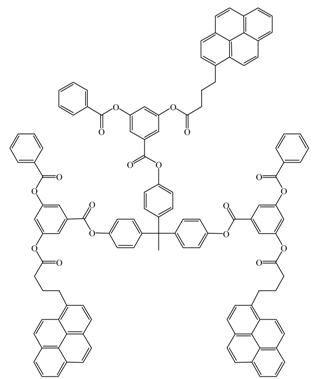
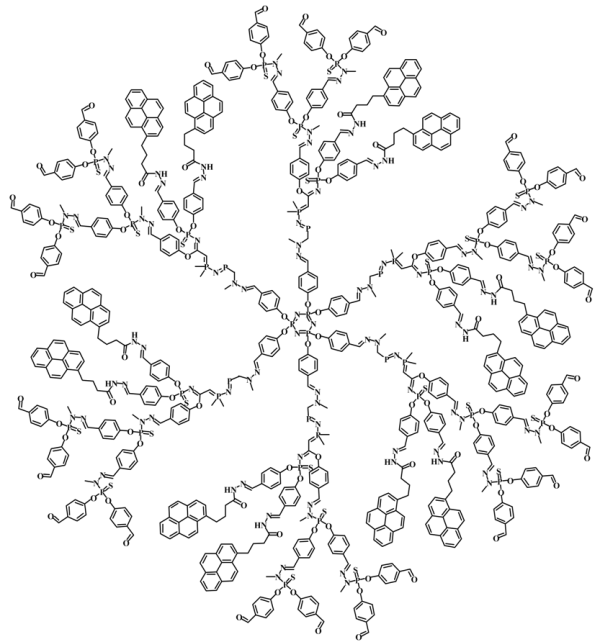
          <p>Chemical structure of the pyrene-labeled dendrimers considered in this review.</p>
        </caption>
        <table rules="all" style="border: solid thin">
 
          <tbody>
            <tr>
              <td align="center" valign="bottom"><inline-graphic xmlns:xlink="http://www.w3.org/1999/xlink" xlink:href="polymers-04-00211-i024.tif"/><break/>Stewart, G.M., <italic>et al.</italic> [<xref ref-type="bibr" rid="B120-polymers-04-00211">120</xref>]</td>
              <td align="center" valign="bottom"><inline-graphic xmlns:xlink="http://www.w3.org/1999/xlink" xlink:href="polymers-04-00211-i025.tif"/><break/>Cicchi, S., <italic>et al.</italic> [<xref ref-type="bibr" rid="B44-polymers-04-00211">44</xref>]</td>
            </tr>
            <tr>
              <td align="center" valign="bottom"><inline-graphic xmlns:xlink="http://www.w3.org/1999/xlink" xlink:href="polymers-04-00211-i026.tif"/><break/>Baker, L.A., <italic>et al.</italic> [<xref ref-type="bibr" rid="B127-polymers-04-00211">127</xref>]</td>
              <td align="center" valign="bottom"><inline-graphic xmlns:xlink="http://www.w3.org/1999/xlink" xlink:href="polymers-04-00211-i027.tif"/><break/>Wang, B.-B., <italic>et al.</italic> [<xref ref-type="bibr" rid="B128-polymers-04-00211">128</xref>]</td>
            </tr>
            <tr>
              <td align="center" valign="bottom"><inline-graphic xmlns:xlink="http://www.w3.org/1999/xlink" xlink:href="polymers-04-00211-i028.tif"/><break/>Yip, J., <italic>et al.</italic> [<xref ref-type="bibr" rid="B126-polymers-04-00211">126</xref>]</td>
              <td align="center" valign="bottom"><inline-graphic xmlns:xlink="http://www.w3.org/1999/xlink" xlink:href="polymers-04-00211-i029.tif"/><break/>Wilken, R., <italic>et al.</italic> [<xref ref-type="bibr" rid="B134-polymers-04-00211">134</xref>]</td>
            </tr>
            <tr>
              <td colspan="2" align="center" valign="bottom"><inline-graphic xmlns:xlink="http://www.w3.org/1999/xlink" xlink:href="polymers-04-00211-i030.tif"/><break/>Brauge, L., <italic>et al.</italic> [<xref ref-type="bibr" rid="B130-polymers-04-00211">130</xref>]</td>
            </tr>
          </tbody>
        </table>
      </table-wrap>
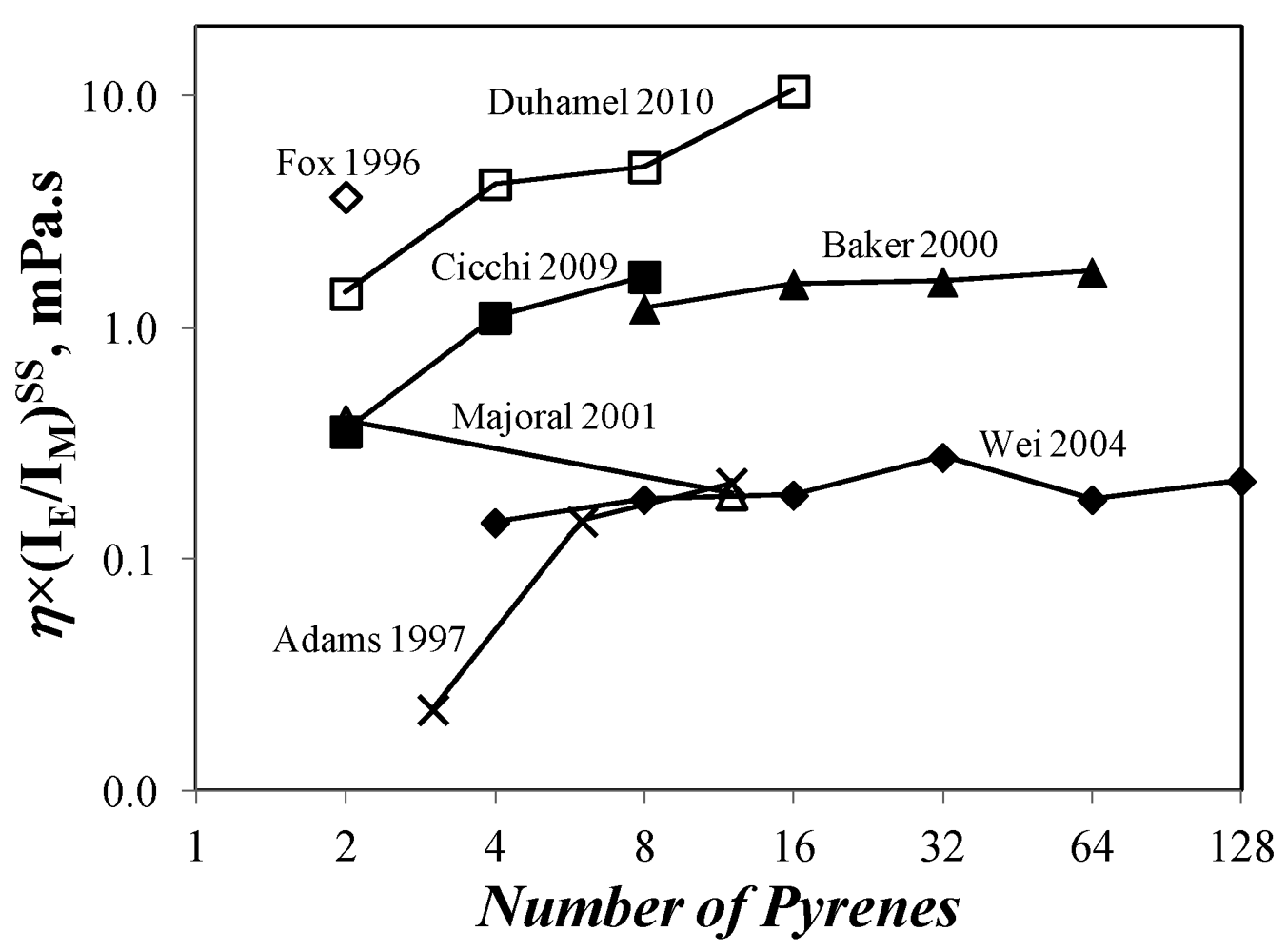
      <p>Considering the two reports where excimer formation was observed for pyrene-labeled poly(benzyl ether) dendrons, the (<italic>I</italic><sub>E</sub>/<italic>I</italic><sub>M</sub>)<sup>SS</sup> ratios corresponding to the fluorescence spectra reported by Stewart and Fox [<xref ref-type="bibr" rid="B120-polymers-04-00211">120</xref>] and Cicchi <italic>et al.</italic> [<xref ref-type="bibr" rid="B44-polymers-04-00211">44</xref>] were determined herein by taking the ratio of the maximum fluorescence intensity of the excimer over that of the pyrene monomer at the 0–0 transition in the fluorescence spectra given in the respective publications. To account for differences in solvent viscosity, these ratios were multiplied by the viscosity of the solvent. The product <italic>η</italic> × (<italic>I</italic><sub>E</sub>/<italic>I</italic><sub>M</sub>) was plotted as a function of the number of pyrenyl pendants found in the dendrimer. The dendrimer prepared by Stewart and Fox [<xref ref-type="bibr" rid="B120-polymers-04-00211">120</xref>] yielded a product <italic>η</italic> × (<italic>I</italic><sub>E</sub>/<italic>I</italic><sub>M</sub>)<sup>SS</sup> that was 10 times larger than the first generation dendrimer prepared by Cicchi <italic>et al.</italic> [<xref ref-type="bibr" rid="B44-polymers-04-00211">44</xref>]. This might be a consequence of the use of a 1-pyrenemethyl versus a 1-pyrenebutyl derivative to label the dendrimers of Stewart and Fox and Cicchi <italic>et al.</italic>, respectively. The overall longer linker used to attach the 1-pyrenebutyl group to the dendrons decreases the local concentration of pyrene inside the dendrimer volume resulting in weaker excimer formation. Also the 0–0 transition is allowed for the 1-pyrenebutyl linker so that <italic>I</italic><sub>M</sub> taken as the fluorescence intensity of the first peak is larger contributing to making (<italic>I</italic><sub>E</sub>/<italic>I</italic><sub>M</sub>)<sup>SS</sup> smaller in the Cicchi <italic>et al.</italic> study. The presence of a methoxi-group in the 1-position of the pyrenyl substituent of the Stewart and Fox study partially restores the symmetry of pyrene, thus making the 0–0 transition symmetry forbidden, decreasing <italic>I</italic><sub>M</sub>, and increasing the (<italic>I</italic><sub>E</sub>/<italic>I</italic><sub>M</sub>)<sup>SS</sup> ratio [<xref ref-type="bibr" rid="B98-polymers-04-00211">98</xref>,<xref ref-type="bibr" rid="B100-polymers-04-00211">100</xref>,<xref ref-type="bibr" rid="B114-polymers-04-00211">114</xref>]. Finally, in the Cicchi <italic>et al.</italic> study, <italic>η</italic> × (<italic>I</italic><sub>E</sub>/<italic>I</italic><sub>M</sub>)<sup>SS</sup> increases continuously with increasing pyrene content.</p>
      <p>An increase in <italic>η</italic> × (<italic>I</italic><sub>E</sub>/<italic>I</italic><sub>M</sub>)<sup>SS</sup> with increasing pyrene content was also found by Duhamel <italic>et al.</italic> [<xref ref-type="bibr" rid="B126-polymers-04-00211">126</xref>] for a series of four poly(2,2-bis(hydroxymethyl)-propionic acid) dendrimers of generations 1–4 which were labeled with 1-pyrenebutyl pendants (<xref ref-type="table" rid="polymers-04-00211-t001">Table 1</xref>). As can be seen in <xref ref-type="fig" rid="polymers-04-00211-f002">Figure 2</xref>, the increase in <italic>η</italic> × (<italic>I</italic><sub>E</sub>/<italic>I</italic><sub>M</sub>)<sup>SS</sup> obtained by Duhamel <italic>et al.</italic> parallels closely the increase observed by Cicchi <italic>et al.</italic> [<xref ref-type="bibr" rid="B44-polymers-04-00211">44</xref>] The larger <italic>η</italic> × (<italic>I</italic><sub>E</sub>/<italic>I</italic><sub>M</sub>)<sup>SS</sup> values obtained in the Duhamel study reflect the more flexible backbone of the poly(2,2-bis(hydroxymethyl)-propionic acid) dendrimers as well as their smaller dimension.</p>
      <fig id="polymers-04-00211-f002" position="anchor">
        <label>Figure 2</label>
        <caption>
          <p>Plot of <italic>η</italic> × (<italic>I</italic><sub>E</sub>/<italic>I</italic><sub>M</sub>)<sup>SS</sup> as a function of the number of pyrenes per dendrimer. (◊) Reference [<xref ref-type="bibr" rid="B120-polymers-04-00211">120</xref>]; (×) Reference [<xref ref-type="bibr" rid="B134-polymers-04-00211">134</xref>] assuming that each chain end of the dendrimer is labeled with a pyrenyl pendant; (▲) Reference [<xref ref-type="bibr" rid="B127-polymers-04-00211">127</xref>]; (∆) Reference [<xref ref-type="bibr" rid="B130-polymers-04-00211">130</xref>], dendrimer in acetonitrile; (♦) Reference [<xref ref-type="bibr" rid="B128-polymers-04-00211">128</xref>]; (■) Reference [<xref ref-type="bibr" rid="B44-polymers-04-00211">44</xref>]; (□) Reference [<xref ref-type="bibr" rid="B126-polymers-04-00211">126</xref>].</p>
        </caption>
        <graphic xmlns:xlink="http://www.w3.org/1999/xlink" xlink:href="polymers-04-00211-g002.tif"/>
      </fig>
      <p>As it turns out, the studies by Duhamel <italic>et al.</italic> and Cicchi <italic>et al.</italic> constitute the only two examples where <italic>η</italic> × (<italic>I</italic><sub>E</sub>/<italic>I</italic><sub>M</sub>)<sup>SS</sup> was found to increase monotonously and substantially with increasing pyrene content for dendrimers where all ends were labelled with pyrene. The PPI dendrimers labeled with 1-pyrenebutyric acid by Baker and Crook [<xref ref-type="bibr" rid="B127-polymers-04-00211">127</xref>] (<xref ref-type="table" rid="polymers-04-00211-t001">Table 1</xref>) showed a much smaller increase of <italic>η</italic> × (<italic>I</italic><sub>E</sub>/<italic>I</italic><sub>M</sub>)<sup>SS</sup> with increasing pyrene content. Similarly, the PAMAM dendrimers labeled with 1-pyrenylsuccinimide groups by Wei <italic>et al.</italic> [<xref ref-type="bibr" rid="B128-polymers-04-00211">128</xref>] (<xref ref-type="table" rid="polymers-04-00211-t001">Table 1</xref>) showed a more or less flat <italic>η</italic> × (<italic>I</italic><sub>E</sub>/<italic>I</italic><sub>M</sub>)<sup>SS</sup> profile with pyrene content with an unexplained spike for the third generation PAMAM dendrimer. The analysis of the fluorescence data obtained with the PPI and PAMAM dendrimers might be affected by the presence of tertiary amines in the dendrimer interior that are known quenchers of pyrene. Also, the pyrene derivative used by Wei <italic>et al.</italic> [<xref ref-type="bibr" rid="B128-polymers-04-00211">128</xref>] bears a nitrogen atom in the 1-position instead of an alkyl group as was used in the Stewart and Fox [<xref ref-type="bibr" rid="B120-polymers-04-00211">120</xref>], Cicchi <italic>et al.</italic> [<xref ref-type="bibr" rid="B44-polymers-04-00211">44</xref>], and Duhamel <italic>et al.</italic> [<xref ref-type="bibr" rid="B126-polymers-04-00211">126</xref>] studies. The presence of a heteroatom or other complex function in the 1-position of pyrene instead of an alkyl chain has been found to profoundly affect the fluorescence of pyrene and should be avoided [<xref ref-type="bibr" rid="B131-polymers-04-00211">131</xref>]. For instance, a PAMAM dendrimer labeled with a pyrene derivative bearing an imine double bond in the 1-position yielded excimer that had a maximum emission located as far as 650 nm in the fluorescence spectrum instead of 480 nm which is typically observed [<xref ref-type="bibr" rid="B133-polymers-04-00211">133</xref>]. With a pyrene label behaving in a manner that is so different from what is known about pyrene excimer formation, the process of excimer formation with this label would have to be fully characterized before any conclusion could be drawn from the fluorescence data obtained with these pyrene-labeled PAMAM dendrimers about their internal segmental dynamics.</p>
      <p>Phosphorus containing dendrimers have been labeled internally with 12 1-pyrenebutyric acid groups by Majoral <italic>et al.</italic> [<xref ref-type="bibr" rid="B130-polymers-04-00211">130</xref>]. The ratio (<italic>I</italic><sub>E</sub>/<italic>I</italic><sub>M</sub>)<sup>SS</sup> of the dendrimer was compared to that of a model compound bearing two pyrene groups in acetonitrile. The product <italic>η</italic> × (<italic>I</italic><sub>E</sub>/<italic>I</italic><sub>M</sub>)<sup>SS</sup> was found to decrease slightly with increasing pyrene content, a trend opposite to that observed by Cicchi <italic>et al.</italic> [<xref ref-type="bibr" rid="B44-polymers-04-00211">44</xref>] and Duhamel <italic>et al.</italic> [<xref ref-type="bibr" rid="B126-polymers-04-00211">126</xref>]. </p>
      <p>The pyrene-labeled poly(benzyl ester) dendrimers prepared by Wilken and Adams [<xref ref-type="bibr" rid="B134-polymers-04-00211">134</xref>] had an ingenious design. The generation 1–3 dendrimers contained the same number of three 1-pyrenebutyric acid groups for each generation. Since the poly(benzyl ester) dendrimers bore the same number of pyrenes equal to 3, <italic>η</italic> × (<italic>I</italic><sub>E</sub>/<italic>I</italic><sub>M</sub>)<sup>SS</sup> for the pyrene-labeled dendrimers prepared by Wilken and Adams were plotted in <xref ref-type="fig" rid="polymers-04-00211-f002">Figure 2</xref> as a function of the number of pyrene groups that would have been found in the fully labeled dendrimers, namely 3, 6, and 12 for the dendrimers of generation 1, 2, and 3. As the dendrimer volume increased with increasing generation, <italic>η</italic> × (<italic>I</italic><sub>E</sub>/<italic>I</italic><sub>M</sub>)<sup>SS</sup> increased with increasing generation number. Since the number of pyrene labels was constant and equal to 3, the increase in <italic>η</italic> × (<italic>I</italic><sub>E</sub>/<italic>I</italic><sub>M</sub>)<sup>SS</sup> with increasing dendrimer volume could only be due to the increased flexibility of the dendrimer arms. But the trend in <italic>η</italic> × (<italic>I</italic><sub>E</sub>/<italic>I</italic><sub>M</sub>)<sup>SS</sup> found by Wilken and Adams [<xref ref-type="bibr" rid="B134-polymers-04-00211">134</xref>] leads to further questions. Indeed, if increasing generation number increases the internal dynamics of dendrimers for small generation numbers, then why would <italic>η</italic> × (<italic>I</italic><sub>E</sub>/<italic>I</italic><sub>M</sub>)<sup>SS</sup> hardly change with generation number for three [<xref ref-type="bibr" rid="B127-polymers-04-00211">127</xref>,<xref ref-type="bibr" rid="B128-polymers-04-00211">128</xref>,<xref ref-type="bibr" rid="B130-polymers-04-00211">130</xref>] out of the seven studies presented in <xref ref-type="fig" rid="polymers-04-00211-f002">Figure 2</xref>?</p>
      <p>The contradicting nature of the trends obtained for <italic>η</italic> × (<italic>I</italic><sub>E</sub>/<italic>I</italic><sub>M</sub>)<sup>SS</sup> in <xref ref-type="fig" rid="polymers-04-00211-f002">Figure 2</xref> by seven different studies are further confirmed by considering the average rate constant of pyrene excimer formation &lt;<italic>k</italic>&gt; which was determined in four of the seven studies by using Equation (17). The trends obtained for <italic>η</italic> × &lt;<italic>k</italic>&gt; are shown in <xref ref-type="fig" rid="polymers-04-00211-f003">Figure 3</xref>. Duhamel <italic>et al.</italic> [<xref ref-type="bibr" rid="B126-polymers-04-00211">126</xref>] and Wilken and Adams [<xref ref-type="bibr" rid="B134-polymers-04-00211">134</xref>] found that the product <italic>η</italic> × &lt;<italic>k</italic>&gt; increased with increasing pyrene content and generation number, respectively. Majoral <italic>et al.</italic> [<xref ref-type="bibr" rid="B131-polymers-04-00211">131</xref>] found a slight increase for <italic>η</italic> × &lt;<italic>k</italic>&gt; as a function of pyrene content, whereas Wei <italic>et al.</italic> [<xref ref-type="bibr" rid="B128-polymers-04-00211">128</xref>] obtained a decreasing <italic>η</italic> × &lt;<italic>k</italic>&gt; product. Obviously the trends shown in <xref ref-type="fig" rid="polymers-04-00211-f003">Figure 3</xref> are inconsistent. This lack of consensus between the different studies is further exposed in <xref ref-type="fig" rid="polymers-04-00211-f004">Figure 4</xref> by noting that <italic>η</italic> × (<italic>I</italic><sub>E</sub>/<italic>I</italic><sub>M</sub>)<sup>SS</sup> and <italic>η</italic> × &lt;<italic>k</italic>&gt; vary with generation number in a manner that is independent of each other. In a log-log plot of <italic>η</italic> × (<italic>I</italic><sub>E</sub>/<italic>I</italic><sub>M</sub>)<sup>SS</sup> versus <italic>η</italic> × &lt;<italic>k</italic>&gt;, Log[<italic>η</italic> × (<italic>I</italic><sub>E</sub>/<italic>I</italic><sub>M</sub>)<sup>SS</sup>] should increase linearly with increasing Log[<italic>η</italic> × &lt;<italic>k</italic>&gt;] with a slope equal to 1.0. Even with the data obtained by Duhamel <italic>et al.</italic> [<xref ref-type="bibr" rid="B125-polymers-04-00211">125</xref>] where Log[<italic>η</italic> × (<italic>I</italic><sub>E</sub>/<italic>I</italic><sub>M</sub>)<sup>SS</sup>] increases linearly with increasing Log[<italic>η</italic> × &lt;<italic>k</italic>&gt;], the slope takes a value of 2.0 which is different from unity. All trends shown in <xref ref-type="fig" rid="polymers-04-00211-f004">Figure 4</xref>. contradict a tenet of pyrene excimer formation that states that (<italic>I</italic><sub>E</sub>/<italic>I</italic><sub>M</sub>)<sup>SS</sup> and &lt;<italic>k</italic>&gt; are two equivalent quantities that should scale in a similar manner and which has been found experimentally in a number of examples [<xref ref-type="bibr" rid="B73-polymers-04-00211">73</xref>,<xref ref-type="bibr" rid="B74-polymers-04-00211">74</xref>,<xref ref-type="bibr" rid="B98-polymers-04-00211">98</xref>].</p>
      <fig id="polymers-04-00211-f003" position="anchor">
        <label>Figure 3</label>
        <caption>
          <p>Plot of <italic>η</italic>× &lt;<italic>k</italic>&gt; as a function of the number of pyrenes per dendrimer. (×) Reference [<xref ref-type="bibr" rid="B134-polymers-04-00211">134</xref>] assuming that each chain end of the dendrimer is labeled with a pyrenyl pendant; (∆) Reference [<xref ref-type="bibr" rid="B130-polymers-04-00211">130</xref>], dendrimer in acetonitrile; (♦) Reference [<xref ref-type="bibr" rid="B128-polymers-04-00211">128</xref>] assuming <italic>τ</italic><sub>M</sub> = 72.6 ns; (□) Reference [<xref ref-type="bibr" rid="B126-polymers-04-00211">126</xref>].</p>
        </caption>
        <graphic xmlns:xlink="http://www.w3.org/1999/xlink" xlink:href="polymers-04-00211-g003.tif"/>
      </fig>
      <fig id="polymers-04-00211-f004" position="anchor">
        <label>Figure 4</label>
        <caption>
          <p>Log-log plot of <italic>η</italic>× (<italic>I</italic><sub>E</sub>/<italic>I</italic><sub>M</sub>)<sup>SS</sup> as a function of <italic>η</italic>× &lt;<italic>k</italic>&gt;. (<bold>×</bold>) Reference [<xref ref-type="bibr" rid="B134-polymers-04-00211">134</xref>]; (∆) Reference [<xref ref-type="bibr" rid="B130-polymers-04-00211">130</xref>], dendrimer in acetonitrile; (♦) Reference [<xref ref-type="bibr" rid="B128-polymers-04-00211">128</xref>]; (□) Reference [<xref ref-type="bibr" rid="B126-polymers-04-00211">126</xref>]; (○) <inline-graphic xmlns:xlink="http://www.w3.org/1999/xlink" xlink:href="polymers-04-00211-i033.tif"/> <italic>versus</italic> &lt;<italic>k</italic>&gt; for Reference [<xref ref-type="bibr" rid="B126-polymers-04-00211">126</xref>].</p>
        </caption>
        <graphic xmlns:xlink="http://www.w3.org/1999/xlink" xlink:href="polymers-04-00211-g004.tif"/>
      </fig>
      <p>Work carried out by this laboratory suggests that the main reason for the inconsistencies exposed in <xref ref-type="fig" rid="polymers-04-00211-f004">Figure 4</xref> for the Duhamel study resides in the presence of unaccounted for free pyrene labels in the solution [<xref ref-type="bibr" rid="B126-polymers-04-00211">126</xref>,<xref ref-type="bibr" rid="B176-polymers-04-00211">176</xref>]. Because excimer formation is so efficient inside pyrene-labeled dendrimers, the fluorescence intensity of the pyrene monomer (<italic>I</italic><sub>M</sub>) is extremely small so that the presence of minute amounts of unattached pyrene labels offsets the (<italic>I</italic><sub>E</sub>/<italic>I</italic><sub>M</sub>)<sup>SS</sup> ratio dramatically. For instance, the presence of 3 mol % of 1-pyrenebutyric acid in the fourth generation of pyrene-labeled poly(2,2-bis(hydroxymethyl)-propionic acid) dendrimer resulted in a 75% drop in the (<italic>I</italic><sub>E</sub>/<italic>I</italic><sub>M</sub>)<sup>SS</sup> ratio [<xref ref-type="bibr" rid="B126-polymers-04-00211">126</xref>]. </p>
      <p>Indeed, analysis of the monomer and excimer fluorescence decays with Equations (13) and (15) yielded an <italic>f</italic><sub>free </sub>value of 0.03 [<xref ref-type="bibr" rid="B126-polymers-04-00211">126</xref>], suggesting that 3 mol% of unattached pyrene label was present in solution. Plotting (<italic>I</italic><sub>E</sub><italic>/I</italic><sub>M</sub>)<sup>SPC</sup> calculated with Equation (16) as a function of generation number led to the same conclusion reached by the analysis of the steady-state fluorescence spectra, namely that the (<italic>I</italic><sub>E</sub><italic>/I</italic><sub>M</sub>)<sup>SPC</sup> value for the 4<sup>th</sup> generation dendrimer was 75% smaller than expected [<xref ref-type="bibr" rid="B126-polymers-04-00211">126</xref>]. However, setting <italic>f</italic><sub>free</sub> = 0 in Equation (16) yielded <inline-graphic xmlns:xlink="http://www.w3.org/1999/xlink" xlink:href="polymers-04-00211-i023.tif"/> which brought the (<italic>I</italic><sub>E</sub>/<italic>I</italic><sub>M</sub>)<sup>SPC</sup> ratio back to its expected value. Purification of the 4<sup>th</sup> generation dendrimer by gel permeation chromatography demonstrated the presence of unattached 1-pyrenebutyric acid and the fluorescence spectrum acquired with the purified dendrimer free of unattached pyrene label yielded the expected (<italic>I</italic><sub>E</sub>/<italic>I</italic><sub>M</sub>)<sup>SS</sup> and (<italic>I</italic><sub>E</sub>/<italic>I</italic><sub>M</sub>)<sup>SPC</sup> ratios in agreement with the <inline-graphic xmlns:xlink="http://www.w3.org/1999/xlink" xlink:href="polymers-04-00211-i023.tif"/> value. </p>
      <p>The effect that a non-zero <italic>f</italic><sub>free </sub>value has on the <italic>I</italic><sub>E</sub>/<italic>I</italic><sub>M</sub> ratio was quantified experimentally by adding known amounts of a fluorescent impurity and comparing the ratios (<italic>I</italic><sub>E</sub>/<italic>I</italic><sub>M</sub>)<italic><sup>SS</sup></italic> and (<italic>I</italic><sub>E</sub>/<italic>I</italic><sub>M</sub>)<italic><sup>SPC</sup></italic> obtained with Equation (16) by applying the MF analysis to the pyrene monomer and excimer decays [<xref ref-type="bibr" rid="B176-polymers-04-00211">176</xref>]. Both the (<italic>I</italic><sub>E</sub>/<italic>I</italic><sub>M</sub>)<italic><sup>SS</sup></italic> and (<italic>I</italic><sub>E</sub>/<italic>I</italic><sub>M</sub>)<italic><sup>SPC</sup></italic> ratios were found to scale in an identical manner decreasing upon addition of a fluorescent impurity, whereas the quantity <inline-graphic xmlns:xlink="http://www.w3.org/1999/xlink" xlink:href="polymers-04-00211-i023.tif"/> remained constant and equal to its original value. This study demonstrated the ability of the MF analysis to probe quantitatively the presence of minute amounts of unattached pyrene label and perhaps more importantly, to account for it by setting <italic>f</italic><sub>free</sub> to equal zero in Equation (16) [<xref ref-type="bibr" rid="B176-polymers-04-00211">176</xref>]. Indeed plotting <inline-graphic xmlns:xlink="http://www.w3.org/1999/xlink" xlink:href="polymers-04-00211-i031.tif"/> as a function of <italic>η</italic> × &lt;<italic>k</italic>&gt; in <xref ref-type="fig" rid="polymers-04-00211-f004">Figure 4</xref> for the pyrene-labeled dendrimers characterized by Duhamel <italic>et al.</italic> [<xref ref-type="bibr" rid="B126-polymers-04-00211">126</xref>] yielded a perfect straight line of slope unity (see hollow circles in <xref ref-type="fig" rid="polymers-04-00211-f004">Figure 4</xref>).</p>
      <p>Whether all trends obtained with pyrene-labeled dendrimers and pertaining to pyrene excimer formation are affected by the presence of unattached pyrene labels remains to be seen, but its detrimental effect has been shown to be so important [<xref ref-type="bibr" rid="B126-polymers-04-00211">126</xref>,<xref ref-type="bibr" rid="B176-polymers-04-00211">176</xref>] that any study aiming at studying the process of pyrene excimer formation in pyrene-labeled dendrimers should pay careful attention to the issue. To date, no study beside that of Duhamel <italic>et al.</italic> [<xref ref-type="bibr" rid="B126-polymers-04-00211">126</xref>] has considered this problem. Furthermore, the MF analysis presented earlier has been shown to be a powerful analytical tool that can detect and account for the presence of residual amount of free pyrene labels and provides quantitative information about the internal segmental dynamics of dendrimers, information that has been elusive up to this date.</p>
      <p>The data obtained by fitting the fluorescence decays for the pyrene-labeled poly(2,2-bis(hydroxymethyl)-propionic acid) dendrimers with the MF analysis resulted in surprisingly simple trends [<xref ref-type="bibr" rid="B126-polymers-04-00211">126</xref>]: Both <inline-graphic xmlns:xlink="http://www.w3.org/1999/xlink" xlink:href="polymers-04-00211-i023.tif"/> and &lt;<italic>k</italic>&gt; were found to increase linearly with increasing generation number. Considering that the mobility of the chain ends has been found to be slightly affected by increasing generation number, these trends led to the conclusion that the pyrene groups did not probe the entire volume of the dendrimer while being excited. Also &lt;<italic>k</italic>&gt; took very large values ranging between 10 and 70 × 10<sup>7</sup> s<sup>−1</sup>, much larger than those found for pyrene end-labeled polymers, reflecting the expected flexibility of the backbone of these dendrimers and their large local pyrene concentration.</p>
    </sec>
    <sec>
      <title>5. Recommendations for Future Studies on the Internal Segmental Dynamics of Pyrene-Labeled Dendrimers and Conclusions</title>

      <p>Considering how complicated it already is to study the process of excimer formation in pyrene-labeled dendrimers (cf. contradicting trends in <xref ref-type="fig" rid="polymers-04-00211-f002">Figure 2</xref>–<xref ref-type="fig" rid="polymers-04-00211-f004">Figure 4</xref>) [<xref ref-type="bibr" rid="B36-polymers-04-00211">36</xref>,<xref ref-type="bibr" rid="B37-polymers-04-00211">37</xref>,<xref ref-type="bibr" rid="B44-polymers-04-00211">44</xref>,<xref ref-type="bibr" rid="B120-polymers-04-00211">120</xref>,<xref ref-type="bibr" rid="B121-polymers-04-00211">121</xref>,<xref ref-type="bibr" rid="B122-polymers-04-00211">122</xref>,<xref ref-type="bibr" rid="B123-polymers-04-00211">123</xref>,<xref ref-type="bibr" rid="B124-polymers-04-00211">124</xref>,<xref ref-type="bibr" rid="B125-polymers-04-00211">125</xref>,<xref ref-type="bibr" rid="B126-polymers-04-00211">126</xref>,<xref ref-type="bibr" rid="B127-polymers-04-00211">127</xref>,<xref ref-type="bibr" rid="B128-polymers-04-00211">128</xref>,<xref ref-type="bibr" rid="B129-polymers-04-00211">129</xref>,<xref ref-type="bibr" rid="B130-polymers-04-00211">130</xref>,<xref ref-type="bibr" rid="B131-polymers-04-00211">131</xref>,<xref ref-type="bibr" rid="B132-polymers-04-00211">132</xref>,<xref ref-type="bibr" rid="B133-polymers-04-00211">133</xref>,<xref ref-type="bibr" rid="B134-polymers-04-00211">134</xref>], studies should focus on dendrimers whose backbone is not expected to quench the excited pyrene or its excimer. Chemical motives that should be avoided at all cost include the tertiary amines such as those found in PAMAM [<xref ref-type="bibr" rid="B128-polymers-04-00211">128</xref>,<xref ref-type="bibr" rid="B129-polymers-04-00211">129</xref>,<xref ref-type="bibr" rid="B133-polymers-04-00211">133</xref>] and PPI [<xref ref-type="bibr" rid="B127-polymers-04-00211">127</xref>] dendrimers which are known quenchers of pyrene. Also, the photophysical properties of pyrene are so sensitive to its substituent in the 1-position that pyrene-labeled dendrimers should be prepared with pyrene derivatives that possess an alkyl spacer which seems to act as an insulator [<xref ref-type="bibr" rid="B131-polymers-04-00211">131</xref>]. In terms of availability, 1-pyrenemethanol, 1-pyrenemethylamine, 1-pyrenebutanol, and 1-pyrenebutyric acid are all suitable pyrene derivatives which are commercially available at a reasonable price. Finally, utmost care should be paid to minimize the presence of unattached pyrene labels, and if possible account for it as is being done with the MF analysis.</p>
      <p>Another advantage of using the MF analysis comes from the fact that quantitative analysis of the fluorescence decays acquired with pyrene-labeled dendrimers is only possible if a mathematical expression exists for <italic>f</italic>(<italic>t</italic>) in <xref ref-type="fig" rid="polymers-04-00211-f006">Scheme 2</xref>. To date, only two mathematical expressions of <italic>f</italic>(<italic>t</italic>) are known to deal with pyrene-labeled macromolecules. If two (and only two) pyrene moieties are covalently attached at two well-defined positions of the macromolecule and if these two positions are separated by a fixed chain length, then <italic>f</italic>(<italic>t</italic>) equals a constant such as <italic>k</italic><sub>EEC</sub> when the pyrenyl groups are attached at the ends of a monodisperse polymer [<xref ref-type="bibr" rid="B73-polymers-04-00211">73</xref>,<xref ref-type="bibr" rid="B74-polymers-04-00211">74</xref>,<xref ref-type="bibr" rid="B174-polymers-04-00211">174</xref>,<xref ref-type="bibr" rid="B175-polymers-04-00211">175</xref>]. When the pyrenyl groups are randomly distributed along a polymer, an expression of <italic>f</italic>(<italic>t</italic>) has been derived by applying the Fluorescence Blob Model (FBM) [<xref ref-type="bibr" rid="B75-polymers-04-00211">75</xref>]. Any other configuration of the pyrene pendants inside the macromolecule requires a specific expression of <italic>f</italic>(<italic>t</italic>) and such an expression has not been derived yet for dendrimers. In this respect, the MF analysis is quite versatile as it applies to any possible distribution of the pyrene pendants covalently attached onto a macromolecule, such as for dendrimers labeled with pyrene at the chain ends. </p>
      <p>Considering the parlous state of the understanding of pyrene excimer formation in pyrene-labeled dendrimers such as illustrated in <xref ref-type="fig" rid="polymers-04-00211-f002">Figure 2</xref>–<xref ref-type="fig" rid="polymers-04-00211-f004">Figure 4</xref>, the scientific community should focus its efforts toward building a clear consensus on how <inline-graphic xmlns:xlink="http://www.w3.org/1999/xlink" xlink:href="polymers-04-00211-i023.tif"/> and &lt;<italic>k</italic>&gt; vary with increasing generation number beginning with dendrimers whose chain ends are fully labeled with pyrenyl pendants. The simpler synthetic protocols associated with the full labeling of the dendrimer terminals should make the preparation of such dendrimers more achievable. In each study, the fluorescence data must be shown to yield internally consistent trends, particularly with respect to <inline-graphic xmlns:xlink="http://www.w3.org/1999/xlink" xlink:href="polymers-04-00211-i023.tif"/> and &lt;<italic>k</italic>&gt; as was done in the study carried out by Duhamel <italic>et al.</italic> Only after such precautions have been taken will a clear consensus emerge on how pyrene excimer formation takes place in pyrene end-labeled dendrimers. In turn, the information retrieved about the long range motion of the chain ends of a dendrimer will prove valuable to predict the time scale over which the chain ends are expected to exchange location between the dendrimer interior and its surface.</p>
    </sec>
  </body>
  <back>
    <ref-list>
      <title>References</title>
      <ref id="B1-polymers-04-00211">
        <label>1.</label>
        <citation citation-type="journal">
          <person-group person-group-type="author">
            <name>
              <surname>Newkome</surname>
              <given-names>G.R.</given-names>
            </name>
            <name>
              <surname>Yao</surname>
              <given-names>Z.</given-names>
            </name>
            <name>
              <surname>Baker</surname>
              <given-names>G.R.</given-names>
            </name>
            <name>
              <surname>Gupta</surname>
              <given-names>V.K.</given-names>
            </name>
          </person-group>
          <article-title>Micelles. Part 1. Cascade molecules: A new approach to micelles. A [27]-arborol</article-title>
          <source>J. Org. Chem.</source>
          <year>1985</year>
          <volume>50</volume>
          <fpage>2003</fpage>
          <lpage>2004</lpage>
          <pub-id pub-id-type="doi">10.1021/jo00211a052</pub-id>
        </citation>
      </ref>
      <ref id="B2-polymers-04-00211">
        <label>2.</label>
        <citation citation-type="journal">
          <person-group person-group-type="author">
            <name>
              <surname>Tomalia</surname>
              <given-names>D.A.</given-names>
            </name>
            <name>
              <surname>Baker</surname>
              <given-names>H.</given-names>
            </name>
            <name>
              <surname>Dewald</surname>
              <given-names>J.</given-names>
            </name>
            <name>
              <surname>Hall</surname>
              <given-names>M.</given-names>
            </name>
            <name>
              <surname>Kallos</surname>
              <given-names>G.</given-names>
            </name>
            <name>
              <surname>Martin</surname>
              <given-names>S.</given-names>
            </name>
            <name>
              <surname>Roeck</surname>
              <given-names>J.</given-names>
            </name>
            <name>
              <surname>Ryder</surname>
              <given-names>J.</given-names>
            </name>
            <name>
              <surname>Smith</surname>
              <given-names>P.</given-names>
            </name>
          </person-group>
          <article-title>A new class of polymers: Starburst-dendritic macromolecules</article-title>
          <source>Polym. J.</source>
          <year>1985</year>
          <volume>17</volume>
          <fpage>117</fpage>
          <lpage>132</lpage>
          <pub-id pub-id-type="doi">10.1295/polymj.17.117</pub-id>
        </citation>
      </ref>
      <ref id="B3-polymers-04-00211">
        <label>3.</label>
        <citation citation-type="journal">
          <person-group person-group-type="author">
            <name>
              <surname>Balzani</surname>
              <given-names>V.</given-names>
            </name>
            <name>
              <surname>Ceroni</surname>
              <given-names>P.</given-names>
            </name>
            <name>
              <surname>Maestri</surname>
              <given-names>M.</given-names>
            </name>
            <name>
              <surname>Saudan</surname>
              <given-names>C.</given-names>
            </name>
            <name>
              <surname>Vicinelli</surname>
              <given-names>V.</given-names>
            </name>
          </person-group>
          <article-title>Luminescent dendrimers. Recent advances</article-title>
          <source>Top. Curr. Chem.</source>
          <year>2003</year>
          <volume>228</volume>
          <fpage>159</fpage>
          <lpage>191</lpage>
          <pub-id pub-id-type="doi">10.1007/b11010</pub-id>
        </citation>
      </ref>
      <ref id="B4-polymers-04-00211">
        <label>4.</label>
        <citation citation-type="journal">
          <person-group person-group-type="author">
            <name>
              <surname>D’Ambruoso</surname>
              <given-names>G.D.</given-names>
            </name>
            <name>
              <surname>McGrath</surname>
              <given-names>D.V.</given-names>
            </name>
          </person-group>
          <article-title>Energy harvesting in synthetic dendrimer materials</article-title>
          <source>Adv. Polym. Sci.</source>
          <year>2008</year>
          <volume>214</volume>
          <fpage>87</fpage>
          <lpage>147</lpage>
        </citation>
      </ref>
      <ref id="B5-polymers-04-00211">
        <label>5.</label>
        <citation citation-type="journal">
          <person-group person-group-type="author">
            <name>
              <surname>Nanjwade</surname>
              <given-names>B.K.</given-names>
            </name>
            <name>
              <surname>Bechra</surname>
              <given-names>H.M.</given-names>
            </name>
            <name>
              <surname>Derkar</surname>
              <given-names>G.K.</given-names>
            </name>
            <name>
              <surname>Manvi</surname>
              <given-names>F.V.</given-names>
            </name>
            <name>
              <surname>Nanjwade</surname>
              <given-names>V.K.</given-names>
            </name>
          </person-group>
          <article-title>Dendrimers: Emerging polymers for drug-delivery systems</article-title>
          <source>Eur. J. Pharma. Sci.</source>
          <year>2009</year>
          <volume>38</volume>
          <fpage>185</fpage>
          <lpage>196</lpage>
          <pub-id pub-id-type="doi">10.1016/j.ejps.2009.07.008</pub-id>
        </citation>
      </ref>
      <ref id="B6-polymers-04-00211">
        <label>6.</label>
        <citation citation-type="journal">
          <person-group person-group-type="author">
            <name>
              <surname>Gillies</surname>
              <given-names>E.R.</given-names>
            </name>
            <name>
              <surname>Fréchet</surname>
              <given-names>J.M.J.</given-names>
            </name>
          </person-group>
          <article-title>Dendrimer and dendritic polymers in drug delivery</article-title>
          <source>Drug Discov. Today</source>
          <year>2005</year>
          <volume>10</volume>
          <fpage>35</fpage>
          <lpage>43</lpage>
          <pub-id pub-id-type="doi">10.1016/S1359-6446(04)03276-3</pub-id>
        </citation>
      </ref>
      <ref id="B7-polymers-04-00211">
        <label>7.</label>
        <citation citation-type="journal">
          <person-group person-group-type="author">
            <name>
              <surname>Helms</surname>
              <given-names>B.</given-names>
            </name>
            <name>
              <surname>Fréchet</surname>
              <given-names>J.M.J.</given-names>
            </name>
          </person-group>
          <article-title>The dendrimer effect in homogeneous catalysis</article-title>
          <source>Adv. Synth. Catal.</source>
          <year>2006</year>
          <volume>348</volume>
          <fpage>1125</fpage>
          <lpage>1148</lpage>
          <pub-id pub-id-type="doi">10.1002/adsc.200606095</pub-id>
        </citation>
      </ref>
      <ref id="B8-polymers-04-00211">
        <label>8.</label>
        <citation citation-type="journal">
          <person-group person-group-type="author">
            <name>
              <surname>Fréchet</surname>
              <given-names>J.M.J.</given-names>
            </name>
          </person-group>
          <article-title>Dendrimers and other dendritic macromolecules: From building blocks to functional assemblies in nanoscience and nanotechnology</article-title>
          <source>J. Polym. Sci. A</source>
          <year>2003</year>
          <volume>41</volume>
          <fpage>3713</fpage>
          <lpage>3725</lpage>
          <pub-id pub-id-type="doi">10.1002/pola.10952</pub-id>
        </citation>
      </ref>
      <ref id="B9-polymers-04-00211">
        <label>9.</label>
        <citation citation-type="journal">
          <person-group person-group-type="author">
            <name>
              <surname>Astruc</surname>
              <given-names>D.</given-names>
            </name>
            <name>
              <surname>Boisselier</surname>
              <given-names>E.</given-names>
            </name>
            <name>
              <surname>Ornelas</surname>
              <given-names>C.</given-names>
            </name>
          </person-group>
          <article-title>Dendrimers designed for functions: From physical, photophysical, and supramolecular properties to applications in sensing, catalysis, molecular electronics, photonics, and nanomedicine</article-title>
          <source>Chem. Rev.</source>
          <year>2010</year>
          <volume>110</volume>
          <fpage>1857</fpage>
          <lpage>1959</lpage>
          <pub-id pub-id-type="doi">10.1021/cr900327d</pub-id>
        </citation>
      </ref>
      <ref id="B10-polymers-04-00211">
        <label>10.</label>
        <citation citation-type="journal">
          <person-group person-group-type="author">
            <name>
              <surname>Hwang</surname>
              <given-names>S.-H.</given-names>
            </name>
            <name>
              <surname>Schreiner</surname>
              <given-names>C.D.</given-names>
            </name>
            <name>
              <surname>Moorefield</surname>
              <given-names>C.N.</given-names>
            </name>
            <name>
              <surname>Newkome</surname>
              <given-names>G.R.</given-names>
            </name>
          </person-group>
          <article-title>Recent progress and applications for metallodendrimers</article-title>
          <source>New J. Chem.</source>
          <year>2007</year>
          <volume>31</volume>
          <fpage>1192</fpage>
          <lpage>1217</lpage>
          <pub-id pub-id-type="doi">10.1039/b612656c</pub-id>
        </citation>
      </ref>
      <ref id="B11-polymers-04-00211">
        <label>11.</label>
        <citation citation-type="journal">
          <person-group person-group-type="author">
            <name>
              <surname>Buhleier</surname>
              <given-names>E.</given-names>
            </name>
            <name>
              <surname>Wehner</surname>
              <given-names>W.</given-names>
            </name>
            <name>
              <surname>Vögtle</surname>
              <given-names>F.</given-names>
            </name>
          </person-group>
          <article-title>“Cascade”- and “nonskid-chain-like” syntheses of molecular cavity topologies</article-title>
          <source>Synthesis</source>
          <year>1978</year>
          <volume>2</volume>
          <fpage>155</fpage>
          <lpage>158</lpage>
        </citation>
      </ref>
      <ref id="B12-polymers-04-00211">
        <label>12.</label>
        <citation citation-type="journal">
          <person-group person-group-type="author">
            <name>
              <surname>Mansfield</surname>
              <given-names>M.L.</given-names>
            </name>
            <name>
              <surname>Klushin</surname>
              <given-names>L.I.</given-names>
            </name>
          </person-group>
          <article-title>Monte carlo studies of dendrimer molecules</article-title>
          <source>Macromolecules</source>
          <year>1993</year>
          <volume>26</volume>
          <fpage>4262</fpage>
          <lpage>4268</lpage>
          <pub-id pub-id-type="doi">10.1021/ma00068a029</pub-id>
        </citation>
      </ref>
      <ref id="B13-polymers-04-00211">
        <label>13.</label>
        <citation citation-type="journal">
          <person-group person-group-type="author">
            <name>
              <surname>Murat</surname>
              <given-names>M.</given-names>
            </name>
            <name>
              <surname>Grest</surname>
              <given-names>G.S.</given-names>
            </name>
          </person-group>
          <article-title>Molecular dynamic study of dendrimer molecules in solvents of varying quality</article-title>
          <source>Macromolecules</source>
          <year>1996</year>
          <volume>29</volume>
          <fpage>1278</fpage>
          <lpage>1285</lpage>
          <pub-id pub-id-type="doi">10.1021/ma951219e</pub-id>
        </citation>
      </ref>
      <ref id="B14-polymers-04-00211">
        <label>14.</label>
        <citation citation-type="journal">
          <person-group person-group-type="author">
            <name>
              <surname>Scherrenberg</surname>
              <given-names>R.</given-names>
            </name>
            <name>
              <surname>Coussens</surname>
              <given-names>B.</given-names>
            </name>
            <name>
              <surname>Vliet</surname>
              <given-names>P.V.</given-names>
            </name>
            <name>
              <surname>Edouard</surname>
              <given-names>G.</given-names>
            </name>
            <name>
              <surname>Brackman</surname>
              <given-names>J.</given-names>
            </name>
            <name>
              <surname>Brabander</surname>
              <given-names>E.D.</given-names>
            </name>
            <name>
              <surname>Mortensen</surname>
              <given-names>K.</given-names>
            </name>
          </person-group>
          <article-title>The molecular characteristics of poly(propyleneimine) dendrimers as studied with small-angle neutron scattering, viscosimetry, and molecular dynamics</article-title>
          <source>Macromolecules</source>
          <year>1998</year>
          <volume>31</volume>
          <fpage>456</fpage>
          <lpage>461</lpage>
        <pub-id pub-id-type="doi">10.1021/ma9618181</pub-id></citation>
      </ref>
      <ref id="B15-polymers-04-00211">
        <label>15.</label>
        <citation citation-type="journal">
          <person-group person-group-type="author">
            <name>
              <surname>Cavallo</surname>
              <given-names>L.</given-names>
            </name>
            <name>
              <surname>Fraternali</surname>
              <given-names>F.</given-names>
            </name>
          </person-group>
          <article-title>A molecular dynamics study of the first five generations of poly(propylene imine) dendrimers modified with <italic>N</italic>-<italic>t</italic>Boc-L-phenylalinine</article-title>
          <source>Chem. Eur. J.</source>
          <year>1998</year>
          <volume>4</volume>
          <fpage>927</fpage>
          <lpage>934</lpage>
          <pub-id pub-id-type="doi">10.1002/(SICI)1521-3765(19980515)4:5&lt;927::AID-CHEM927&gt;3.0.CO;2-W</pub-id>
        </citation>
      </ref>
      <ref id="B16-polymers-04-00211">
        <label>16.</label>
        <citation citation-type="journal">
          <person-group person-group-type="author">
            <name>
              <surname>Mansfield</surname>
              <given-names>M.L.</given-names>
            </name>
          </person-group>
          <article-title>Monte carlo studies of dendrimers. additional results for the diamond lattice model</article-title>
          <source>Macromolecules</source>
          <year>2000</year>
          <volume>33</volume>
          <fpage>8043</fpage>
          <lpage>8049</lpage>
          <pub-id pub-id-type="doi">10.1021/ma981637u</pub-id>
        </citation>
      </ref>
      <ref id="B17-polymers-04-00211">
        <label>17.</label>
        <citation citation-type="journal">
          <person-group person-group-type="author">
            <name>
              <surname>Mansfield</surname>
              <given-names>M.L.</given-names>
            </name>
            <name>
              <surname>Jeong</surname>
              <given-names>M.</given-names>
            </name>
          </person-group>
          <article-title>Simulation of lattice dendrimers by a monte carlo technique with detailed balance</article-title>
          <source>Macromolecules</source>
          <year>2002</year>
          <volume>35</volume>
          <fpage>9794</fpage>
          <lpage>9798</lpage>
          <pub-id pub-id-type="doi">10.1021/ma012229k</pub-id>
        </citation>
      </ref>
      <ref id="B18-polymers-04-00211">
        <label>18.</label>
        <citation citation-type="journal">
          <person-group person-group-type="author">
            <name>
              <surname>Giupponi</surname>
              <given-names>G.</given-names>
            </name>
            <name>
              <surname>Buzza</surname>
              <given-names>D.M.A.</given-names>
            </name>
          </person-group>
          <article-title>A monte carlo simulation scheme for nonideal dendrimers satisfying details balance</article-title>
          <source>Macromolecules</source>
          <year>2002</year>
          <volume>35</volume>
          <fpage>9799</fpage>
          <lpage>9812</lpage>
          <pub-id pub-id-type="doi">10.1021/ma0203851</pub-id>
        </citation>
      </ref>
      <ref id="B19-polymers-04-00211">
        <label>19.</label>
        <citation citation-type="journal">
          <person-group person-group-type="author">
            <name>
              <surname>Pavlov</surname>
              <given-names>G.M.</given-names>
            </name>
            <name>
              <surname>Korneeva</surname>
              <given-names>E.V.</given-names>
            </name>
            <name>
              <surname>Meijer</surname>
              <given-names>E.W.</given-names>
            </name>
          </person-group>
          <article-title>Molecular characteristics of poly(propylene imine) dendrimers as studied with translational diffusion and viscometry</article-title>
          <source>Colloid Polym. Sci.</source>
          <year>2002</year>
          <volume>280</volume>
          <fpage>416</fpage>
          <lpage>423</lpage>
          <pub-id pub-id-type="doi">10.1007/s00396-001-0625-4</pub-id>
        </citation>
      </ref>
      <ref id="B20-polymers-04-00211">
        <label>20.</label>
        <citation citation-type="journal">
          <person-group person-group-type="author">
            <name>
              <surname>Rathgeber</surname>
              <given-names>S.</given-names>
            </name>
            <name>
              <surname>Monkenbush</surname>
              <given-names>M.</given-names>
            </name>
            <name>
              <surname>Kreitschmann</surname>
              <given-names>M.</given-names>
            </name>
            <name>
              <surname>Urban</surname>
              <given-names>V.</given-names>
            </name>
            <name>
              <surname>Brulet</surname>
              <given-names>A.</given-names>
            </name>
          </person-group>
          <article-title>Dynamics of star-burst dendrimers in solution in relation to their structural properties</article-title>
          <source>J. Chem. Phys.</source>
          <year>2002</year>
          <volume>117</volume>
          <fpage>4047</fpage>
          <lpage>4062</lpage>
          <pub-id pub-id-type="doi">10.1063/1.1493771</pub-id>
        </citation>
      </ref>
      <ref id="B21-polymers-04-00211">
        <label>21.</label>
        <citation citation-type="journal">
          <person-group person-group-type="author">
            <name>
              <surname>Rathgeber</surname>
              <given-names>S.</given-names>
            </name>
            <name>
              <surname>Pakula</surname>
              <given-names>T.</given-names>
            </name>
            <name>
              <surname>Urban</surname>
              <given-names>V.</given-names>
            </name>
          </person-group>
          <article-title>Structure of star-burst dendrimers: A comparison between small angle x-ray scattering and computer simulation results</article-title>
          <source>J. Chem. Phys.</source>
          <year>2004</year>
          <volume>121</volume>
          <fpage>3840</fpage>
          <lpage>3853</lpage>
        <pub-id pub-id-type="doi">10.1063/1.1768516</pub-id><pub-id pub-id-type="pmid">15303953</pub-id></citation>
      </ref>
      <ref id="B22-polymers-04-00211">
        <label>22.</label>
        <citation citation-type="journal">
          <person-group person-group-type="author">
            <name>
              <surname>De Gennes</surname>
              <given-names>P.G.</given-names>
            </name>
            <name>
              <surname>Hervet</surname>
              <given-names>H.</given-names>
            </name>
          </person-group>
          <article-title>Statistics of &lt;&lt;Starburst&gt;&gt; polymers</article-title>
          <source>J. Phys. Lett.</source>
          <year>1983</year>
          <volume>44</volume>
          <fpage>351</fpage>
          <lpage>360</lpage>
          <pub-id pub-id-type="doi">10.1051/jphyslet:01983004409035100</pub-id>
        </citation>
      </ref>
      <ref id="B23-polymers-04-00211">
        <label>23.</label>
        <citation citation-type="journal">
          <person-group person-group-type="author">
            <name>
              <surname>Lescanec</surname>
              <given-names>R.L.</given-names>
            </name>
            <name>
              <surname>Muthukumar</surname>
              <given-names>M.</given-names>
            </name>
          </person-group>
          <article-title>Configurational characteristics and scaling behavior of starburst molecules: A computational study</article-title>
          <source>Macromolecules</source>
          <year>1990</year>
          <volume>23</volume>
          <fpage>2280</fpage>
          <lpage>2288</lpage>
          <pub-id pub-id-type="doi">10.1021/ma00210a026</pub-id>
        </citation>
      </ref>
      <ref id="B24-polymers-04-00211">
        <label>24.</label>
        <citation citation-type="journal">
          <person-group person-group-type="author">
            <name>
              <surname>Evmenenko</surname>
              <given-names>G.</given-names>
            </name>
            <name>
              <surname>Bauer</surname>
              <given-names>B.J.</given-names>
            </name>
            <name>
              <surname>Kleppinger</surname>
              <given-names>R.</given-names>
            </name>
            <name>
              <surname>Forier</surname>
              <given-names>B.</given-names>
            </name>
            <name>
              <surname>Dehaen</surname>
              <given-names>W.</given-names>
            </name>
            <name>
              <surname>Amis</surname>
              <given-names>E.J.</given-names>
            </name>
            <name>
              <surname>Mischenko</surname>
              <given-names>N.</given-names>
            </name>
            <name>
              <surname>Reynaers</surname>
              <given-names>H.</given-names>
            </name>
          </person-group>
          <article-title>The influence of molecular architecture and solvent type of the size and structure of poly(benzyl ether) dendrimers by SANS</article-title>
          <source>Macromol. Chem. Phys.</source>
          <year>2001</year>
          <volume>202</volume>
          <fpage>891</fpage>
          <lpage>899</lpage>
        <pub-id pub-id-type="doi">10.1002/1521-3935(20010301)202:6&lt;891::AID-MACP891&gt;3.0.CO;2-K</pub-id></citation>
      </ref>
      <ref id="B25-polymers-04-00211">
        <label>25.</label>
        <citation citation-type="journal">
          <person-group person-group-type="author">
            <name>
              <surname>Rosenfeldt</surname>
              <given-names>S.</given-names>
            </name>
            <name>
              <surname>Dingenouts</surname>
              <given-names>N.</given-names>
            </name>
            <name>
              <surname>Ballauff</surname>
              <given-names>M.</given-names>
            </name>
            <name>
              <surname>Werner</surname>
              <given-names>N.</given-names>
            </name>
            <name>
              <surname>Vögtle</surname>
              <given-names>F.</given-names>
            </name>
            <name>
              <surname>Lindner</surname>
              <given-names>P.</given-names>
            </name>
          </person-group>
          <article-title>Distribution of end groups within a dendritic structure: A sans study including contrast variation</article-title>
          <source>Macromolecules</source>
          <year>2002</year>
          <volume>35</volume>
          <fpage>8098</fpage>
          <lpage>8105</lpage>
        <pub-id pub-id-type="doi">10.1021/ma020585c</pub-id></citation>
      </ref>
      <ref id="B26-polymers-04-00211">
        <label>26.</label>
        <citation citation-type="journal">
          <person-group person-group-type="author">
            <name>
              <surname>Mansfield</surname>
              <given-names>M.L.</given-names>
            </name>
          </person-group>
          <article-title>Dendron segregation in model dendrimers</article-title>
          <source>Polymer</source>
          <year>1994</year>
          <volume>35</volume>
          <fpage>1827</fpage>
          <lpage>1830</lpage>
          <pub-id pub-id-type="doi">10.1016/0032-3861(94)90971-7</pub-id>
        </citation>
      </ref>
      <ref id="B27-polymers-04-00211">
        <label>27.</label>
        <citation citation-type="journal">
          <person-group person-group-type="author">
            <name>
              <surname>Boris</surname>
              <given-names>D.</given-names>
            </name>
            <name>
              <surname>Rubinstein</surname>
              <given-names>M.</given-names>
            </name>
          </person-group>
          <article-title>A self-consistent mean field model of a starburst dendrimer: Dense core <italic>vs.</italic> dense shell</article-title>
          <source>Macromolecules</source>
          <year>1996</year>
          <volume>29</volume>
          <fpage>7251</fpage>
          <lpage>7260</lpage>
          <pub-id pub-id-type="doi">10.1021/ma960397k</pub-id>
        </citation>
      </ref>
      <ref id="B28-polymers-04-00211">
        <label>28.</label>
        <citation citation-type="journal">
          <person-group person-group-type="author">
            <name>
              <surname>Lyulin</surname>
              <given-names>A.V.</given-names>
            </name>
            <name>
              <surname>Davies</surname>
              <given-names>G.R.</given-names>
            </name>
            <name>
              <surname>Adolf</surname>
              <given-names>D.B.</given-names>
            </name>
          </person-group>
          <article-title>Brownian dynamics simulation of dendrimers under shear flow</article-title>
          <source>Macromolecules</source>
          <year>2000</year>
          <volume>33</volume>
          <fpage>3294</fpage>
          <lpage>3304</lpage>
          <pub-id pub-id-type="doi">10.1021/ma992128a</pub-id>
        </citation>
      </ref>
      <ref id="B29-polymers-04-00211">
        <label>29.</label>
        <citation citation-type="journal">
          <person-group person-group-type="author">
            <name>
              <surname>Lyulin</surname>
              <given-names>A.V.</given-names>
            </name>
            <name>
              <surname>Davies</surname>
              <given-names>G.R.</given-names>
            </name>
            <name>
              <surname>Adolf</surname>
              <given-names>D.B.</given-names>
            </name>
          </person-group>
          <article-title>Location of terminal groups of dendrimers: Brownian dynamics simulation</article-title>
          <source>Macromolecules</source>
          <year>2000</year>
          <volume>33</volume>
          <fpage>6899</fpage>
          <lpage>6900</lpage>
          <pub-id pub-id-type="doi">10.1021/ma0003811</pub-id>
        </citation>
      </ref>
      <ref id="B30-polymers-04-00211">
        <label>30.</label>
        <citation citation-type="journal">
          <person-group person-group-type="author">
            <name>
              <surname>Karatasos</surname>
              <given-names>K.</given-names>
            </name>
            <name>
              <surname>Adolf</surname>
              <given-names>D.B.</given-names>
            </name>
            <name>
              <surname>Davies</surname>
              <given-names>G.R.</given-names>
            </name>
          </person-group>
          <article-title>Statistics and dynamics of model dendrimers as studied by molecular dynamics simulations</article-title>
          <source>J. Chem. Phys.</source>
          <year>2001</year>
          <volume>115</volume>
          <fpage>5310</fpage>
          <lpage>5318</lpage>
        <pub-id pub-id-type="doi">10.1063/1.1394207</pub-id></citation>
      </ref>
      <ref id="B31-polymers-04-00211">
        <label>31.</label>
        <citation citation-type="journal">
          <person-group person-group-type="author">
            <name>
              <surname>Zook</surname>
              <given-names>T.C.</given-names>
            </name>
            <name>
              <surname>Pickett</surname>
              <given-names>G.T.</given-names>
            </name>
          </person-group>
          <article-title>Hollow-core dendrimers revisited</article-title>
          <source>Phys. Rev. Lett.</source>
          <year>2003</year>
        </citation>
      </ref>
      <ref id="B32-polymers-04-00211">
        <label>32.</label>
        <citation citation-type="journal">
          <person-group person-group-type="author">
            <name>
              <surname>Harreis</surname>
              <given-names>H.M.</given-names>
            </name>
            <name>
              <surname>Likos</surname>
              <given-names>C.N.</given-names>
            </name>
            <name>
              <surname>Ballauff</surname>
              <given-names>M.</given-names>
            </name>
          </person-group>
          <article-title>Can dendrimers be viewed as compact colloids? A simulation study of the fluctuations in a dendrimer of fourth generation</article-title>
          <source>J. Chem. Phys.</source>
          <year>2003</year>
          <volume>118</volume>
          <fpage>1979</fpage>
          <lpage>1988</lpage>
          <pub-id pub-id-type="doi">10.1063/1.1530577</pub-id>
        </citation>
      </ref>
      <ref id="B33-polymers-04-00211">
        <label>33.</label>
        <citation citation-type="journal">
          <person-group person-group-type="author">
            <name>
              <surname>Timoshenko</surname>
              <given-names>E.G.</given-names>
            </name>
            <name>
              <surname>Kuznetsov</surname>
              <given-names>Y.A.</given-names>
            </name>
            <name>
              <surname>Connolly</surname>
              <given-names>R.</given-names>
            </name>
          </person-group>
          <article-title>Conformations of dendrimers in dilute solutions</article-title>
          <source>J. Chem. Phys.</source>
          <year>2002</year>
          <volume>117</volume>
          <fpage>9050</fpage>
          <lpage>9062</lpage>
          <pub-id pub-id-type="doi">10.1063/1.1514571</pub-id>
        </citation>
      </ref>
      <ref id="B34-polymers-04-00211">
        <label>34.</label>
        <citation citation-type="journal">
          <person-group person-group-type="author">
            <name>
              <surname>Han</surname>
              <given-names>M.</given-names>
            </name>
            <name>
              <surname>Chen</surname>
              <given-names>P.</given-names>
            </name>
            <name>
              <surname>Yang</surname>
              <given-names>X.</given-names>
            </name>
          </person-group>
          <article-title>Molecular dynamics simulation of PAMAM dendrimer in aqueous solution</article-title>
          <source>Polymer</source>
          <year>2005</year>
          <volume>46</volume>
          <fpage>3481</fpage>
          <lpage>3488</lpage>
          <pub-id pub-id-type="doi">10.1016/j.polymer.2005.02.107</pub-id>
        </citation>
      </ref>
      <ref id="B35-polymers-04-00211">
        <label>35.</label>
        <citation citation-type="journal">
          <person-group person-group-type="author">
            <name>
              <surname>Lee</surname>
              <given-names>I.</given-names>
            </name>
            <name>
              <surname>Athey</surname>
              <given-names>B.D.</given-names>
            </name>
            <name>
              <surname>Wetzel</surname>
              <given-names>A.W.</given-names>
            </name>
            <name>
              <surname>Meixner</surname>
              <given-names>W.</given-names>
            </name>
            <name>
              <surname>Baker</surname>
              <given-names>J.R.</given-names>
            </name>
          </person-group>
          <article-title>Structural molecular dynamics studies on polyamidoamine dendrimers for a therapeutic application: Effect of pH and generation</article-title>
          <source>Macromolecules</source>
          <year>2002</year>
          <volume>35</volume>
          <fpage>4510</fpage>
          <lpage>4520</lpage>
        <pub-id pub-id-type="doi">10.1021/ma010354q</pub-id></citation>
      </ref>
      <ref id="B36-polymers-04-00211">
        <label>36.</label>
        <citation citation-type="journal">
          <person-group person-group-type="author">
            <name>
              <surname>Ahn</surname>
              <given-names>T.-S.</given-names>
            </name>
            <name>
              <surname>Nantalaksakul</surname>
              <given-names>A.</given-names>
            </name>
            <name>
              <surname>Dasari</surname>
              <given-names>R.R.</given-names>
            </name>
            <name>
              <surname>Al-Kaysi</surname>
              <given-names>R.O.</given-names>
            </name>
            <name>
              <surname>Müller</surname>
              <given-names>A.M.</given-names>
            </name>
            <name>
              <surname>Thayumanavan</surname>
              <given-names>S.</given-names>
            </name>
            <name>
              <surname>Bardeen</surname>
              <given-names>C.J.</given-names>
            </name>
          </person-group>
          <article-title>Energy and charge transfer dynamics in fully decorated benzyl ether dendrimers and their disubstituted analogues</article-title>
          <source>J. Phys. Chem. B</source>
          <year>2006</year>
          <volume>110</volume>
          <fpage>24331</fpage>
          <lpage>24339</lpage>
        <pub-id pub-id-type="doi">10.1021/jp0649706</pub-id><pub-id pub-id-type="pmid">17134184</pub-id></citation>
      </ref>
      <ref id="B37-polymers-04-00211">
        <label>37.</label>
        <citation citation-type="journal">
          <person-group person-group-type="author">
            <name>
              <surname>Gu</surname>
              <given-names>T.</given-names>
            </name>
            <name>
              <surname>Whitesell</surname>
              <given-names>J.K.</given-names>
            </name>
            <name>
              <surname>Fox</surname>
              <given-names>M.A.</given-names>
            </name>
          </person-group>
          <article-title>Intramolecular charge transfer in 1:1 Cu(II)/pyrenylcyclam dendrimer complexes</article-title>
          <source>J. Phys. Chem. B</source>
          <year>2006</year>
          <volume>110</volume>
          <fpage>25149</fpage>
          <lpage>25152</lpage>
        <pub-id pub-id-type="doi">10.1021/jp0643449</pub-id><pub-id pub-id-type="pmid">17165957</pub-id></citation>
      </ref>
      <ref id="B38-polymers-04-00211">
        <label>38.</label>
        <citation citation-type="journal">
          <person-group person-group-type="author">
            <name>
              <surname>Li</surname>
              <given-names>Y.-Y.</given-names>
            </name>
            <name>
              <surname>Han</surname>
              <given-names>L.</given-names>
            </name>
            <name>
              <surname>Chen</surname>
              <given-names>J.</given-names>
            </name>
            <name>
              <surname>Zheng</surname>
              <given-names>S.</given-names>
            </name>
            <name>
              <surname>Zen</surname>
              <given-names>Y.</given-names>
            </name>
            <name>
              <surname>Li</surname>
              <given-names>Y.</given-names>
            </name>
            <name>
              <surname>Li</surname>
              <given-names>S.</given-names>
            </name>
            <name>
              <surname>Yang</surname>
              <given-names>G.</given-names>
            </name>
          </person-group>
          <article-title>Study on the extent of folding back conformation in poly(aryl ether) dendrimers by intramolecular electron transfer and exciplex formation</article-title>
          <source>Macromolecules</source>
          <year>2007</year>
          <volume>40</volume>
          <fpage>9384</fpage>
          <lpage>9390</lpage>
        <pub-id pub-id-type="doi">10.1021/ma071901w</pub-id></citation>
      </ref>
      <ref id="B39-polymers-04-00211">
        <label>39.</label>
        <citation citation-type="journal">
          <person-group person-group-type="author">
            <name>
              <surname>Denti</surname>
              <given-names>G.</given-names>
            </name>
            <name>
              <surname>Campagna</surname>
              <given-names>S.</given-names>
            </name>
            <name>
              <surname>Serroni</surname>
              <given-names>S.</given-names>
            </name>
            <name>
              <surname>Ciano</surname>
              <given-names>M.</given-names>
            </name>
            <name>
              <surname>Balzani</surname>
              <given-names>V.</given-names>
            </name>
          </person-group>
          <article-title>Decanuclear homo- and heterometallic polypyridine complexes: Syntheses, absorption spectra, luminescence, electrochemical oxidation, and intercomponent energy transfer</article-title>
          <source>J. Am. Chem. Soc.</source>
          <year>1992</year>
          <volume>114</volume>
          <fpage>2944</fpage>
          <lpage>2950</lpage>
          <pub-id pub-id-type="doi">10.1021/ja00034a029</pub-id>
        </citation>
      </ref>
      <ref id="B40-polymers-04-00211">
        <label>40.</label>
        <citation citation-type="journal">
          <person-group person-group-type="author">
            <name>
              <surname>Gilat</surname>
              <given-names>S.L.</given-names>
            </name>
            <name>
              <surname>Adronov</surname>
              <given-names>A.</given-names>
            </name>
            <name>
              <surname>Fréchet</surname>
              <given-names>J.M.J.</given-names>
            </name>
          </person-group>
          <article-title>Light harvesting and energy transfer in novel convergently constructed dendrimers</article-title>
          <source>Angew. Chem. Int. Ed.</source>
          <year>1999</year>
          <volume>38</volume>
          <fpage>1422</fpage>
          <lpage>1427</lpage>
          <pub-id pub-id-type="doi">10.1002/(SICI)1521-3773(19990517)38:10&lt;1422::AID-ANIE1422&gt;3.0.CO;2-V</pub-id>
        </citation>
      </ref>
      <ref id="B41-polymers-04-00211">
        <label>41.</label>
        <citation citation-type="journal">
          <person-group person-group-type="author">
            <name>
              <surname>Adronov</surname>
              <given-names>A.</given-names>
            </name>
            <name>
              <surname>Gilat</surname>
              <given-names>S.L.</given-names>
            </name>
            <name>
              <surname>Fréchet</surname>
              <given-names>J.M.J.</given-names>
            </name>
            <name>
              <surname>Ohta</surname>
              <given-names>K.</given-names>
            </name>
            <name>
              <surname>Neuwahl</surname>
              <given-names>F.V.R.</given-names>
            </name>
            <name>
              <surname>Fleming</surname>
              <given-names>G.R.</given-names>
            </name>
          </person-group>
          <article-title>Light harvesting and energy transfer in laser-dye-labeled poly(aryl ether) dendrimers</article-title>
          <source>J. Am. Chem. Soc.</source>
          <year>2000</year>
          <volume>122</volume>
          <fpage>1175</fpage>
          <lpage>1185</lpage>
        <pub-id pub-id-type="doi">10.1021/ja993272e</pub-id></citation>
      </ref>
      <ref id="B42-polymers-04-00211">
        <label>42.</label>
        <citation citation-type="journal">
          <person-group person-group-type="author">
            <name>
              <surname>Adronov</surname>
              <given-names>A.</given-names>
            </name>
            <name>
              <surname>Fréchet</surname>
              <given-names>J.M.J.</given-names>
            </name>
          </person-group>
          <article-title>Light-harvesting dendrimers</article-title>
          <source>Chem. Commun.</source>
          <year>2000</year>
        </citation>
      </ref>
      <ref id="B43-polymers-04-00211">
        <label>43.</label>
        <citation citation-type="journal">
          <person-group person-group-type="author">
            <name>
              <surname>Chen</surname>
              <given-names>J.</given-names>
            </name>
            <name>
              <surname>Li</surname>
              <given-names>S.</given-names>
            </name>
            <name>
              <surname>Zhang</surname>
              <given-names>L.</given-names>
            </name>
            <name>
              <surname>Liu</surname>
              <given-names>B.</given-names>
            </name>
            <name>
              <surname>Han</surname>
              <given-names>Y.</given-names>
            </name>
            <name>
              <surname>Yang</surname>
              <given-names>G.</given-names>
            </name>
            <name>
              <surname>Li</surname>
              <given-names>Y.</given-names>
            </name>
          </person-group>
          <article-title>Light-harvesting and photoisomerization in benzophenone and norbornadiene-labeled poly(aryl ether) dendrimers via intramolecular triplet energy transfer</article-title>
          <source>J. Am. Chem. Soc.</source>
          <year>2005</year>
          <volume>127</volume>
          <fpage>2165</fpage>
          <lpage>2171</lpage>
        <pub-id pub-id-type="doi">10.1021/ja044800b</pub-id><pub-id pub-id-type="pmid">15713094</pub-id></citation>
      </ref>
      <ref id="B44-polymers-04-00211">
        <label>44.</label>
        <citation citation-type="journal">
          <person-group person-group-type="author">
            <name>
              <surname>Cicchi</surname>
              <given-names>S.</given-names>
            </name>
            <name>
              <surname>Fabbrizzi</surname>
              <given-names>P.</given-names>
            </name>
            <name>
              <surname>Ghini</surname>
              <given-names>G.</given-names>
            </name>
            <name>
              <surname>Brandi</surname>
              <given-names>A.</given-names>
            </name>
            <name>
              <surname>Foggi</surname>
              <given-names>P.</given-names>
            </name>
            <name>
              <surname>Marcelli</surname>
              <given-names>A.</given-names>
            </name>
            <name>
              <surname>Righini</surname>
              <given-names>R.</given-names>
            </name>
            <name>
              <surname>Botta</surname>
              <given-names>C.</given-names>
            </name>
          </person-group>
          <article-title>Pyrene-excimers-based antenna systems</article-title>
          <source>Chem. Eur. J.</source>
          <year>2009</year>
          <volume>15</volume>
          <fpage>754</fpage>
          <lpage>764</lpage>
        <pub-id pub-id-type="doi">10.1002/chem.200801379</pub-id><pub-id pub-id-type="pmid">19053090</pub-id></citation>
      </ref>
      <ref id="B45-polymers-04-00211">
        <label>45.</label>
        <citation citation-type="journal">
          <person-group person-group-type="author">
            <name>
              <surname>Mourey</surname>
              <given-names>T.H.</given-names>
            </name>
            <name>
              <surname>Turner</surname>
              <given-names>S.R.</given-names>
            </name>
            <name>
              <surname>Rubinstein</surname>
              <given-names>M.</given-names>
            </name>
            <name>
              <surname>Fréchet</surname>
              <given-names>J.M.J.</given-names>
            </name>
            <name>
              <surname>Hawker</surname>
              <given-names>C.J.</given-names>
            </name>
            <name>
              <surname>Wooley</surname>
              <given-names>K.L.</given-names>
            </name>
          </person-group>
          <article-title>Unique behavior of dendritic macromolecules: Intrinsic viscosity of polyether dendrimers</article-title>
          <source>Macromolecules</source>
          <year>1992</year>
          <volume>25</volume>
          <fpage>2401</fpage>
          <lpage>2406</lpage>
          <pub-id pub-id-type="doi">10.1021/ma00035a017</pub-id>
        </citation>
      </ref>
      <ref id="B46-polymers-04-00211">
        <label>46.</label>
        <citation citation-type="journal">
          <person-group person-group-type="author">
            <name>
              <surname>Gorman</surname>
              <given-names>C.B.</given-names>
            </name>
            <name>
              <surname>Hager</surname>
              <given-names>M.W.</given-names>
            </name>
            <name>
              <surname>Parkhurst</surname>
              <given-names>B.L.</given-names>
            </name>
            <name>
              <surname>Smith</surname>
              <given-names>J.C.</given-names>
            </name>
          </person-group>
          <article-title>Use of a paramagnetic core to affect longitudinal nuclear relaxation in dendrimers—A tool for probing dendrimer conformation</article-title>
          <source>Macromolecules</source>
          <year>1998</year>
          <volume>31</volume>
          <fpage>815</fpage>
          <lpage>822</lpage>
        <pub-id pub-id-type="doi">10.1021/ma9714979</pub-id></citation>
      </ref>
      <ref id="B47-polymers-04-00211">
        <label>47.</label>
        <citation citation-type="journal">
          <person-group person-group-type="author">
            <name>
              <surname>Wooley</surname>
              <given-names>K.L.</given-names>
            </name>
            <name>
              <surname>Klug</surname>
              <given-names>C.A.</given-names>
            </name>
            <name>
              <surname>Tasaki</surname>
              <given-names>K.</given-names>
            </name>
            <name>
              <surname>Schaefer</surname>
              <given-names>J.</given-names>
            </name>
          </person-group>
          <article-title>Shapes of dendrimers from rotational-echo double-resonance NMR</article-title>
          <source>J. Am. Chem. Soc.</source>
          <year>1997</year>
          <volume>119</volume>
          <fpage>53</fpage>
          <lpage>58</lpage>
          <pub-id pub-id-type="doi">10.1021/ja962285e</pub-id>
        </citation>
      </ref>
      <ref id="B48-polymers-04-00211">
        <label>48.</label>
        <citation citation-type="journal">
          <person-group person-group-type="author">
            <name>
              <surname>Malyarenko</surname>
              <given-names>D.I.</given-names>
            </name>
            <name>
              <surname>Vold</surname>
              <given-names>R.L.</given-names>
            </name>
            <name>
              <surname>Hoaston</surname>
              <given-names>G.L.</given-names>
            </name>
          </person-group>
          <article-title>Solid state deuteron NMR studies of polyamidoamine dendrimer salts. 2. Relaxation and molecular motion</article-title>
          <source>Macromolecules</source>
          <year>2000</year>
          <volume>33</volume>
          <fpage>7508</fpage>
          <lpage>7520</lpage>
          <pub-id pub-id-type="doi">10.1021/ma000921u</pub-id>
        </citation>
      </ref>
      <ref id="B49-polymers-04-00211">
        <label>49.</label>
        <citation citation-type="journal">
          <person-group person-group-type="author">
            <name>
              <surname>Chai</surname>
              <given-names>M.</given-names>
            </name>
            <name>
              <surname>Niu</surname>
              <given-names>Y.</given-names>
            </name>
            <name>
              <surname>Youngs</surname>
              <given-names>W.J.</given-names>
            </name>
            <name>
              <surname>Rinaldi</surname>
              <given-names>P.L.</given-names>
            </name>
          </person-group>
          <article-title>Structure and conformation of DAB dendrimers in solution via multidimensional NMR techniques</article-title>
          <source>J. Am. Chem. Soc.</source>
          <year>2001</year>
          <volume>123</volume>
          <fpage>4670</fpage>
          <lpage>4678</lpage>
        <pub-id pub-id-type="doi">10.1021/ja002824m</pub-id><pub-id pub-id-type="pmid">11457275</pub-id></citation>
      </ref>
      <ref id="B50-polymers-04-00211">
        <label>50.</label>
        <citation citation-type="journal">
          <person-group person-group-type="author">
            <name>
              <surname>Wind</surname>
              <given-names>M.</given-names>
            </name>
            <name>
              <surname>Saalwächter</surname>
              <given-names>K.</given-names>
            </name>
            <name>
              <surname>Wiesler</surname>
              <given-names>U.M.</given-names>
            </name>
            <name>
              <surname>Müllen</surname>
              <given-names>K.</given-names>
            </name>
            <name>
              <surname>Spiess</surname>
              <given-names>H.W.</given-names>
            </name>
          </person-group>
          <article-title>Solid-state NMR investigations of molecular dynamics in polyphenylene dendrimers: Evidence of dense-shell packing</article-title>
          <source>Macromolecules</source>
          <year>2002</year>
          <volume>35</volume>
          <fpage>10071</fpage>
          <lpage>10086</lpage>
        <pub-id pub-id-type="doi">10.1021/ma021283d</pub-id></citation>
      </ref>
      <ref id="B51-polymers-04-00211">
        <label>51.</label>
        <citation citation-type="journal">
          <person-group person-group-type="author">
            <name>
              <surname>Malveau</surname>
              <given-names>C.</given-names>
            </name>
            <name>
              <surname>Baille</surname>
              <given-names>W.E.</given-names>
            </name>
            <name>
              <surname>Zhu</surname>
              <given-names>X.X.</given-names>
            </name>
            <name>
              <surname>Ford</surname>
              <given-names>W.T.</given-names>
            </name>
          </person-group>
          <article-title>Molecular dynamics of hydrophilic poly(propylene imine) dendrimers in aqueous solutions by 1H BNR relaxation</article-title>
          <source>J. Polym. Sci. B</source>
          <year>2003</year>
          <volume>41</volume>
          <fpage>2969</fpage>
          <lpage>2975</lpage>
          <pub-id pub-id-type="doi">10.1002/polb.10584</pub-id>
        </citation>
      </ref>
      <ref id="B52-polymers-04-00211">
        <label>52.</label>
        <citation citation-type="journal">
          <person-group person-group-type="author">
            <name>
              <surname>Prosa</surname>
              <given-names>T.J.</given-names>
            </name>
            <name>
              <surname>Bauer</surname>
              <given-names>B.J.</given-names>
            </name>
            <name>
              <surname>Amis</surname>
              <given-names>E.J.</given-names>
            </name>
            <name>
              <surname>Tomalia</surname>
              <given-names>D.A.</given-names>
            </name>
            <name>
              <surname>Scherrenberg</surname>
              <given-names>R.</given-names>
            </name>
          </person-group>
          <article-title>A SAXS study of the internal structure of dendritic polymer systems</article-title>
          <source>J. Polym. Sci. B</source>
          <year>1997</year>
          <volume>35</volume>
          <fpage>2913</fpage>
          <lpage>2924</lpage>
          <pub-id pub-id-type="doi">10.1002/(SICI)1099-0488(199712)35:17&lt;2913::AID-POLB14&gt;3.0.CO;2-A</pub-id>
        </citation>
      </ref>
      <ref id="B53-polymers-04-00211">
        <label>53.</label>
        <citation citation-type="journal">
          <person-group person-group-type="author">
            <name>
              <surname>Topp</surname>
              <given-names>A.</given-names>
            </name>
            <name>
              <surname>Bauer</surname>
              <given-names>B.J.</given-names>
            </name>
            <name>
              <surname>Klimash</surname>
              <given-names>J.W.</given-names>
            </name>
            <name>
              <surname>Spindler</surname>
              <given-names>R.</given-names>
            </name>
            <name>
              <surname>Tomalia</surname>
              <given-names>D.A.</given-names>
            </name>
            <name>
              <surname>Amis</surname>
              <given-names>E.J.</given-names>
            </name>
          </person-group>
          <article-title>Probing the location of the terminal groups of dendrimers in dilute solution</article-title>
          <source>Macromolecules</source>
          <year>1999</year>
          <volume>32</volume>
          <fpage>7226</fpage>
          <lpage>7231</lpage>
        <pub-id pub-id-type="doi">10.1021/ma990125s</pub-id></citation>
      </ref>
      <ref id="B54-polymers-04-00211">
        <label>54.</label>
        <citation citation-type="journal">
          <person-group person-group-type="author">
            <name>
              <surname>Pötschke</surname>
              <given-names>D.</given-names>
            </name>
            <name>
              <surname>Ballauf</surname>
              <given-names>M.</given-names>
            </name>
            <name>
              <surname>Lindner</surname>
              <given-names>P.</given-names>
            </name>
            <name>
              <surname>Fischer</surname>
              <given-names>M.</given-names>
            </name>
            <name>
              <surname>Vögtle</surname>
              <given-names>F.</given-names>
            </name>
          </person-group>
          <article-title>Analysis of the structure of dendrimers in solution by small-angle neutron scattering including contrast variation</article-title>
          <source>Macromolecules</source>
          <year>1999</year>
          <volume>32</volume>
          <fpage>4079</fpage>
          <lpage>4087</lpage>
          <pub-id pub-id-type="doi">10.1021/ma982027x</pub-id>
        </citation>
      </ref>
      <ref id="B55-polymers-04-00211">
        <label>55.</label>
        <citation citation-type="journal">
          <person-group person-group-type="author">
            <name>
              <surname>Ballauff</surname>
              <given-names>M.</given-names>
            </name>
            <name>
              <surname>Likos</surname>
              <given-names>C.N.</given-names>
            </name>
          </person-group>
          <article-title>Dendrimers in solution: Insight from theory and simulation</article-title>
          <source>Angew. Chem. Int. Ed.</source>
          <year>2004</year>
          <volume>43</volume>
          <fpage>2998</fpage>
          <lpage>3020</lpage>
          <pub-id pub-id-type="doi">10.1002/anie.200300602</pub-id>
        </citation>
      </ref>
      <ref id="B56-polymers-04-00211">
        <label>56.</label>
        <citation citation-type="journal">
          <person-group person-group-type="author">
            <name>
              <surname>Welch</surname>
              <given-names>P.</given-names>
            </name>
            <name>
              <surname>Muthukumar</surname>
              <given-names>M.</given-names>
            </name>
          </person-group>
          <article-title>Tuning the density profile of dendritic polyelectrolytes</article-title>
          <source>Macromolecules</source>
          <year>1998</year>
          <volume>31</volume>
          <fpage>5892</fpage>
          <lpage>5897</lpage>
          <pub-id pub-id-type="doi">10.1021/ma980198w</pub-id>
        </citation>
      </ref>
      <ref id="B57-polymers-04-00211">
        <label>57.</label>
        <citation citation-type="journal">
          <person-group person-group-type="author">
            <name>
              <surname>Lyulin</surname>
              <given-names>S.V.</given-names>
            </name>
            <name>
              <surname>Evers</surname>
              <given-names>L.J.</given-names>
            </name>
            <name>
              <surname>van der Schoot</surname>
              <given-names>P.</given-names>
            </name>
            <name>
              <surname>Darinskii</surname>
              <given-names>A.A.</given-names>
            </name>
            <name>
              <surname>Lyulin</surname>
              <given-names>A.V.</given-names>
            </name>
            <name>
              <surname>Michels</surname>
              <given-names>M.A.J.</given-names>
            </name>
          </person-group>
          <article-title>Effect of solvent quality and electrostatic interactions on size and structure of dendrimers. Brownian dynamics simulation and mean-field theory</article-title>
          <source>Macromolecules</source>
          <year>2004</year>
          <volume>37</volume>
          <fpage>3049</fpage>
          <lpage>3063</lpage>
          <pub-id pub-id-type="doi">10.1021/ma035286h</pub-id>
        </citation>
      </ref>
      <ref id="B58-polymers-04-00211">
        <label>58.</label>
        <citation citation-type="journal">
          <person-group person-group-type="author">
            <name>
              <surname>Bosman</surname>
              <given-names>A.W.</given-names>
            </name>
            <name>
              <surname>Bruining</surname>
              <given-names>M.J.</given-names>
            </name>
            <name>
              <surname>Kooijman</surname>
              <given-names>H.</given-names>
            </name>
            <name>
              <surname>Speck</surname>
              <given-names>A.</given-names>
            </name>
            <name>
              <surname>Janssen</surname>
              <given-names>R.A.J.</given-names>
            </name>
            <name>
              <surname>Meijer</surname>
              <given-names>E.W.</given-names>
            </name>
          </person-group>
          <article-title>Concerning the localization of end groups in dendrimers</article-title>
          <source>J. Am. Chem. Soc.</source>
          <year>1998</year>
          <volume>120</volume>
          <fpage>8547</fpage>
          <lpage>8548</lpage>
        <pub-id pub-id-type="doi">10.1021/ja981626g</pub-id></citation>
      </ref>
      <ref id="B59-polymers-04-00211">
        <label>59.</label>
        <citation citation-type="journal">
          <person-group person-group-type="author">
            <name>
              <surname>Meltzer</surname>
              <given-names>A.D.</given-names>
            </name>
            <name>
              <surname>Tirrell</surname>
              <given-names>D.A.</given-names>
            </name>
            <name>
              <surname>Jones</surname>
              <given-names>A.A.</given-names>
            </name>
            <name>
              <surname>Inglefield</surname>
              <given-names>P.T.</given-names>
            </name>
            <name>
              <surname>Hedstrand</surname>
              <given-names>D.M.</given-names>
            </name>
            <name>
              <surname>Tomalia</surname>
              <given-names>D.A.</given-names>
            </name>
          </person-group>
          <article-title>Chain dynamics in poly(amido amine) dendrimers. A study of 13C NMR relaxation parameters</article-title>
          <source>Macromolecules</source>
          <year>1992</year>
          <volume>25</volume>
          <fpage>4541</fpage>
          <lpage>4548</lpage>
        <pub-id pub-id-type="doi">10.1021/ma00044a013</pub-id></citation>
      </ref>
      <ref id="B60-polymers-04-00211">
        <label>60.</label>
        <citation citation-type="journal">
          <person-group person-group-type="author">
            <name>
              <surname>Meltzer</surname>
              <given-names>A.D.</given-names>
            </name>
            <name>
              <surname>Tirrell</surname>
              <given-names>D.A.</given-names>
            </name>
            <name>
              <surname>Jones</surname>
              <given-names>A.A.</given-names>
            </name>
            <name>
              <surname>Inglefield</surname>
              <given-names>P.T.</given-names>
            </name>
          </person-group>
          <article-title>Chain dynamics in poly(amido amine) dendrimers. A study of 2H NMR relaxation parameters</article-title>
          <source>Macromolecules</source>
          <year>1992</year>
          <volume>25</volume>
          <fpage>4549</fpage>
          <lpage>4552</lpage>
          <pub-id pub-id-type="doi">10.1021/ma00044a014</pub-id>
        </citation>
      </ref>
      <ref id="B61-polymers-04-00211">
        <label>61.</label>
        <citation citation-type="journal">
          <person-group person-group-type="author">
            <name>
              <surname>Rathgeber</surname>
              <given-names>S.</given-names>
            </name>
            <name>
              <surname>Monkenbusch</surname>
              <given-names>M.</given-names>
            </name>
            <name>
              <surname>Hedrick</surname>
              <given-names>J.L.</given-names>
            </name>
            <name>
              <surname>Trolsås</surname>
              <given-names>M.</given-names>
            </name>
            <name>
              <surname>Gast</surname>
              <given-names>A.P.</given-names>
            </name>
          </person-group>
          <article-title>Starlike dendrimers in solutions: Structural properties and internal dynamics</article-title>
          <source>J. Chem. Phys.</source>
          <year>2006</year>
        </citation>
      </ref>
      <ref id="B62-polymers-04-00211">
        <label>62.</label>
        <citation citation-type="journal">
          <person-group person-group-type="author">
            <name>
              <surname>Stark</surname>
              <given-names>B.</given-names>
            </name>
            <name>
              <surname>Stühn</surname>
              <given-names>B.</given-names>
            </name>
            <name>
              <surname>Frey</surname>
              <given-names>H.</given-names>
            </name>
            <name>
              <surname>Lach</surname>
              <given-names>C.</given-names>
            </name>
            <name>
              <surname>Lorenz</surname>
              <given-names>K.</given-names>
            </name>
            <name>
              <surname>Frick</surname>
              <given-names>B.</given-names>
            </name>
          </person-group>
          <article-title>Segmental dynamics in dendrimers with perfluorinated end groups: A study using quasielastic neutron scattering</article-title>
          <source>Macromolecules</source>
          <year>1998</year>
          <volume>31</volume>
          <fpage>5415</fpage>
          <lpage>5423</lpage>
          <pub-id pub-id-type="doi">10.1021/ma9801669</pub-id>
        </citation>
      </ref>
      <ref id="B63-polymers-04-00211">
        <label>63.</label>
        <citation citation-type="journal">
          <person-group person-group-type="author">
            <name>
              <surname>Li</surname>
              <given-names>X.</given-names>
            </name>
            <name>
              <surname>Zamponi</surname>
              <given-names>M.</given-names>
            </name>
            <name>
              <surname>Hong</surname>
              <given-names>K.</given-names>
            </name>
            <name>
              <surname>Porcar</surname>
              <given-names>L.</given-names>
            </name>
            <name>
              <surname>Shew</surname>
              <given-names>C.-Y.</given-names>
            </name>
            <name>
              <surname>Jenkins</surname>
              <given-names>T.</given-names>
            </name>
            <name>
              <surname>Liu</surname>
              <given-names>E.</given-names>
            </name>
            <name>
              <surname>Smith</surname>
              <given-names>G.S.</given-names>
            </name>
            <name>
              <surname>Herwig</surname>
              <given-names>K.W.</given-names>
            </name>
            <name>
              <surname>Liu</surname>
              <given-names>Y.</given-names>
            </name>
            <name>
              <surname>Chen</surname>
              <given-names>W.-R.</given-names>
            </name>
          </person-group>
          <article-title>pH responsiveness of polyelectrolyte dendrimers: A dynamical perspective</article-title>
          <source>Soft Matter</source>
          <year>2011</year>
          <volume>7</volume>
          <fpage>618</fpage>
          <lpage>622</lpage>
        <pub-id pub-id-type="doi">10.1039/c0sm00671h</pub-id></citation>
      </ref>
      <ref id="B64-polymers-04-00211">
        <label>64.</label>
        <citation citation-type="journal">
          <person-group person-group-type="author">
            <name>
              <surname>Emran</surname>
              <given-names>S.K.</given-names>
            </name>
            <name>
              <surname>Newkome</surname>
              <given-names>G.R.</given-names>
            </name>
            <name>
              <surname>Weis</surname>
              <given-names>C.D.</given-names>
            </name>
            <name>
              <surname>Harmon</surname>
              <given-names>J.P.</given-names>
            </name>
          </person-group>
          <article-title>Molecular relaxations in ester-terminated, amine-based dendrimers</article-title>
          <source>J. Polym. Sci. B</source>
          <year>1999</year>
          <volume>37</volume>
          <fpage>2025</fpage>
          <lpage>2038</lpage>
          <pub-id pub-id-type="doi">10.1002/(SICI)1099-0488(19990815)37:16&lt;2025::AID-POLB7&gt;3.0.CO;2-Y</pub-id>
        </citation>
      </ref>
      <ref id="B65-polymers-04-00211">
        <label>65.</label>
        <citation citation-type="journal">
          <person-group person-group-type="author">
            <name>
              <surname>Mijović</surname>
              <given-names>J.</given-names>
            </name>
            <name>
              <surname>Ristić</surname>
              <given-names>S.</given-names>
            </name>
            <name>
              <surname>Kenny</surname>
              <given-names>J.</given-names>
            </name>
          </person-group>
          <article-title>Dynamics of six generations of PAMAM dendrimers as studied by dielectric relaxation spectroscopy</article-title>
          <source>Macromolecules</source>
          <year>2007</year>
          <volume>40</volume>
          <fpage>5212</fpage>
          <lpage>5221</lpage>
          <pub-id pub-id-type="doi">10.1021/ma070624q</pub-id>
        </citation>
      </ref>
      <ref id="B66-polymers-04-00211">
        <label>66.</label>
        <citation citation-type="journal">
          <person-group person-group-type="author">
            <name>
              <surname>Uppuluri</surname>
              <given-names>S.</given-names>
            </name>
            <name>
              <surname>Morrison</surname>
              <given-names>F.A.</given-names>
            </name>
            <name>
              <surname>Dvornic</surname>
              <given-names>P.R.</given-names>
            </name>
          </person-group>
          <article-title>Rheology of dendrimers. 2. Bulk polyamidoamine dendrimers under steady shear, creep, and dynamic oscillatory shear</article-title>
          <source>Macromolecules</source>
          <year>2000</year>
          <volume>33</volume>
          <fpage>2551</fpage>
          <lpage>2560</lpage>
          <pub-id pub-id-type="doi">10.1021/ma990634u</pub-id>
        </citation>
      </ref>
      <ref id="B67-polymers-04-00211">
        <label>67.</label>
        <citation citation-type="journal">
          <person-group person-group-type="author">
            <name>
              <surname>Aumanen</surname>
              <given-names>J.</given-names>
            </name>
            <name>
              <surname>Kesti</surname>
              <given-names>T.</given-names>
            </name>
            <name>
              <surname>Sundström</surname>
              <given-names>V.</given-names>
            </name>
            <name>
              <surname>Teobaldi</surname>
              <given-names>G.</given-names>
            </name>
            <name>
              <surname>Zerbetto</surname>
              <given-names>F.</given-names>
            </name>
            <name>
              <surname>Werner</surname>
              <given-names>N.</given-names>
            </name>
            <name>
              <surname>Richardt</surname>
              <given-names>G.</given-names>
            </name>
            <name>
              <surname>van Heyst</surname>
              <given-names>J.</given-names>
            </name>
            <name>
              <surname>Vögtle</surname>
              <given-names>F.</given-names>
            </name>
            <name>
              <surname>Korppi-Tommola</surname>
              <given-names>J.</given-names>
            </name>
          </person-group>
          <article-title>Internal dynamics and energy transfer in dansylated POPAM dendrimers and their eosin complexes</article-title>
          <source>J. Phys. Chem. B</source>
          <year>2010</year>
          <volume>114</volume>
          <fpage>1548</fpage>
          <lpage>1558</lpage>
        <pub-id pub-id-type="pmid">20058871</pub-id></citation>
      </ref>
      <ref id="B68-polymers-04-00211">
        <label>68.</label>
        <citation citation-type="journal">
          <person-group person-group-type="author">
            <name>
              <surname>Gorman</surname>
              <given-names>C.B.</given-names>
            </name>
            <name>
              <surname>Smith</surname>
              <given-names>J.C.</given-names>
            </name>
          </person-group>
          <article-title>Effect of repeat unit flexibility on dendrimer conformation as studied by atomistic molecular dynamics simulations</article-title>
          <source>Polymer</source>
          <year>2000</year>
          <volume>41</volume>
          <fpage>675</fpage>
          <lpage>683</lpage>
          <pub-id pub-id-type="doi">10.1016/S0032-3861(99)00167-6</pub-id>
        </citation>
      </ref>
      <ref id="B69-polymers-04-00211">
        <label>69.</label>
        <citation citation-type="journal">
          <person-group person-group-type="author">
            <name>
              <surname>Mazo</surname>
              <given-names>M.A.</given-names>
            </name>
            <name>
              <surname>Shamaev</surname>
              <given-names>M.Y.</given-names>
            </name>
            <name>
              <surname>Balabaev</surname>
              <given-names>N.K.</given-names>
            </name>
            <name>
              <surname>Darinskii</surname>
              <given-names>A.A.</given-names>
            </name>
            <name>
              <surname>Neelov</surname>
              <given-names>I.M.</given-names>
            </name>
          </person-group>
          <article-title>Conformational mobility of carbosilane dendrimer: Molecular dynamics simulation</article-title>
          <source>Phys. Chem. Chem. Phys.</source>
          <year>2004</year>
          <volume>6</volume>
          <fpage>1285</fpage>
          <lpage>1289</lpage>
        <pub-id pub-id-type="doi">10.1039/b311131h</pub-id></citation>
      </ref>
      <ref id="B70-polymers-04-00211">
        <label>70.</label>
        <citation citation-type="journal">
          <person-group person-group-type="author">
            <name>
              <surname>Lyulin</surname>
              <given-names>S.V.</given-names>
            </name>
            <name>
              <surname>Darinskii</surname>
              <given-names>A.A.</given-names>
            </name>
            <name>
              <surname>Lyulin</surname>
              <given-names>A.V.</given-names>
            </name>
            <name>
              <surname>Michels</surname>
              <given-names>M.A.J.</given-names>
            </name>
          </person-group>
          <article-title>Computer simulation of the dynamics of neutral and charged dendrimers</article-title>
          <source>Macromolecules</source>
          <year>2004</year>
          <volume>37</volume>
          <fpage>4676</fpage>
          <lpage>4685</lpage>
        <pub-id pub-id-type="doi">10.1021/ma0357927</pub-id></citation>
      </ref>
      <ref id="B71-polymers-04-00211">
        <label>71.</label>
        <citation citation-type="journal">
          <person-group person-group-type="author">
            <name>
              <surname>Markelov</surname>
              <given-names>D.A.</given-names>
            </name>
            <name>
              <surname>Lyulin</surname>
              <given-names>S.V.</given-names>
            </name>
            <name>
              <surname>Gotlib</surname>
              <given-names>Y.Y.</given-names>
            </name>
            <name>
              <surname>Lyulin</surname>
              <given-names>A.V.</given-names>
            </name>
            <name>
              <surname>Matveev</surname>
              <given-names>V.V.</given-names>
            </name>
            <name>
              <surname>Lahderanta</surname>
              <given-names>E.</given-names>
            </name>
            <name>
              <surname>Darinski</surname>
              <given-names>A.A.</given-names>
            </name>
          </person-group>
          <article-title>Orientational mobility and relaxation spectra of dendrimers: Theory and computer simulation</article-title>
          <source>J. Chem. Phys.</source>
          <year>2009</year>
        </citation>
      </ref>
      <ref id="B72-polymers-04-00211">
        <label>72.</label>
        <citation citation-type="journal">
          <person-group person-group-type="author">
            <name>
              <surname>Tuschl</surname>
              <given-names>T.</given-names>
            </name>
            <name>
              <surname>Gohlke</surname>
              <given-names>C.</given-names>
            </name>
            <name>
              <surname>Jovin</surname>
              <given-names>T.M.</given-names>
            </name>
            <name>
              <surname>Westhof</surname>
              <given-names>E.</given-names>
            </name>
            <name>
              <surname>Eckstein</surname>
              <given-names>F.</given-names>
            </name>
          </person-group>
          <article-title>A three-dimensional model for the hammerhead ribozyme based on fluorescence measurements</article-title>
          <source>Science</source>
          <year>1994</year>
          <volume>266</volume>
          <fpage>785</fpage>
          <lpage>789</lpage>
        <pub-id pub-id-type="doi">10.1126/science.7973630</pub-id><pub-id pub-id-type="pmid">7973630</pub-id></citation>
      </ref>
      <ref id="B73-polymers-04-00211">
        <label>73.</label>
        <citation citation-type="journal">
          <person-group person-group-type="author">
            <name>
              <surname>Cuniberti</surname>
              <given-names>C.</given-names>
            </name>
            <name>
              <surname>Perico</surname>
              <given-names>A.</given-names>
            </name>
          </person-group>
          <article-title>Intramolecular diffusion-controlled reactions and polymer dynamics</article-title>
          <source>Prog. Polym. Sci.</source>
          <year>1984</year>
          <volume>10</volume>
          <fpage>271</fpage>
          <lpage>316</lpage>
          <pub-id pub-id-type="doi">10.1016/0079-6700(84)90007-8</pub-id>
        </citation>
      </ref>
      <ref id="B74-polymers-04-00211">
        <label>74.</label>
        <citation citation-type="journal">
          <person-group person-group-type="author">
            <name>
              <surname>Winnik</surname>
              <given-names>M.A.</given-names>
            </name>
          </person-group>
          <article-title>End-to-end cyclization of polymer chains</article-title>
          <source>Acc. Chem. Res.</source>
          <year>1985</year>
          <volume>18</volume>
          <fpage>73</fpage>
          <lpage>79</lpage>
          <pub-id pub-id-type="doi">10.1021/ar00111a002</pub-id>
        </citation>
      </ref>
      <ref id="B75-polymers-04-00211">
        <label>75.</label>
        <citation citation-type="journal">
          <person-group person-group-type="author">
            <name>
              <surname>Duhamel</surname>
              <given-names>J.</given-names>
            </name>
          </person-group>
          <article-title>Polymer chain dynamics in solution probed with a fluorescence blob model</article-title>
          <source>Acc. Chem. Res.</source>
          <year>2006</year>
          <volume>39</volume>
          <fpage>953</fpage>
          <lpage>960</lpage>
          <pub-id pub-id-type="doi">10.1021/ar068096a</pub-id>
        </citation>
      </ref>
      <ref id="B76-polymers-04-00211">
        <label>76.</label>
        <citation citation-type="journal">
          <person-group person-group-type="author">
            <name>
              <surname>Winnik</surname>
              <given-names>F.M.</given-names>
            </name>
          </person-group>
          <article-title>Photophysics of preassociated pyrenes in aqueous polymer solutions and in other organized media</article-title>
          <source>Chem. Rev.</source>
          <year>1993</year>
          <volume>93</volume>
          <fpage>587</fpage>
          <lpage>614</lpage>
        <pub-id pub-id-type="doi">10.1021/cr00018a001</pub-id></citation>
      </ref>
      <ref id="B77-polymers-04-00211">
        <label>77.</label>
        <citation citation-type="journal">
          <person-group person-group-type="author">
            <name>
              <surname>Tjipangandjara</surname>
              <given-names>K.F.</given-names>
            </name>
            <name>
              <surname>Somasundaran</surname>
              <given-names>P.</given-names>
            </name>
          </person-group>
          <article-title>Effects of charges in adsorbed polyacrylic acid conformation on alumina flocculation</article-title>
          <source>Colloids Surf.</source>
          <year>1991</year>
          <volume>55</volume>
          <fpage>245</fpage>
          <lpage>255</lpage>
          <pub-id pub-id-type="doi">10.1016/0166-6622(91)80096-7</pub-id>
        </citation>
      </ref>
      <ref id="B78-polymers-04-00211">
        <label>78.</label>
        <citation citation-type="journal">
          <person-group person-group-type="author">
            <name>
              <surname>Cuniberti</surname>
              <given-names>C.</given-names>
            </name>
            <name>
              <surname>Perico</surname>
              <given-names>A.</given-names>
            </name>
          </person-group>
          <article-title>Intramolecular excimers and microbrownian motion of flexible polymer molecules in solution</article-title>
          <source>Eur. Polym. J.</source>
          <year>1977</year>
          <volume>13</volume>
          <fpage>369</fpage>
          <lpage>374</lpage>
          <pub-id pub-id-type="doi">10.1016/0014-3057(77)90097-0</pub-id>
        </citation>
      </ref>
      <ref id="B79-polymers-04-00211">
        <label>79.</label>
        <citation citation-type="journal">
          <person-group person-group-type="author">
            <name>
              <surname>Winnik</surname>
              <given-names>M.A.</given-names>
            </name>
            <name>
              <surname>Redpath</surname>
              <given-names>T.</given-names>
            </name>
            <name>
              <surname>Richards</surname>
              <given-names>D.H.</given-names>
            </name>
          </person-group>
          <article-title>The dynamics of end-to-end cyclization in polystyrene probed by pyrene excimer formation</article-title>
          <source>Macromolecules</source>
          <year>1980</year>
          <volume>13</volume>
          <fpage>328</fpage>
          <lpage>335</lpage>
          <pub-id pub-id-type="doi">10.1021/ma60074a023</pub-id>
        </citation>
      </ref>
      <ref id="B80-polymers-04-00211">
        <label>80.</label>
        <citation citation-type="journal">
          <person-group person-group-type="author">
            <name>
              <surname>Cheung</surname>
              <given-names>S.-T.</given-names>
            </name>
            <name>
              <surname>Winnik</surname>
              <given-names>M.A.</given-names>
            </name>
            <name>
              <surname>Redpath</surname>
              <given-names>A.E.C.</given-names>
            </name>
          </person-group>
          <article-title>cyclization dynamics of polymers, 5. The effect of solvent on end-to-end cyclization of poly(ethylene oxide) probed by intramolecular pyrene excimer formation</article-title>
          <source>Macromol. Chem. Phys.</source>
          <year>1982</year>
          <volume>183</volume>
          <fpage>1815</fpage>
          <lpage>1824</lpage>
          <pub-id pub-id-type="doi">10.1002/macp.1982.021830720</pub-id>
        </citation>
      </ref>
      <ref id="B81-polymers-04-00211">
        <label>81.</label>
        <citation citation-type="journal">
          <person-group person-group-type="author">
            <name>
              <surname>Svirskaya</surname>
              <given-names>P.</given-names>
            </name>
            <name>
              <surname>Danhelka</surname>
              <given-names>J.</given-names>
            </name>
            <name>
              <surname>Redpath</surname>
              <given-names>A.E.C.</given-names>
            </name>
            <name>
              <surname>Winnik</surname>
              <given-names>M.A.</given-names>
            </name>
          </person-group>
          <article-title>Cyclization dynamics of polymers: 7. Application of the pyrene excimer technique to the internal dynamics of poly(dimethylsiloxane) chains</article-title>
          <source>Polymer</source>
          <year>1983</year>
          <volume>24</volume>
          <fpage>319</fpage>
          <lpage>322</lpage>
          <pub-id pub-id-type="doi">10.1016/0032-3861(83)90270-7</pub-id>
        </citation>
      </ref>
      <ref id="B82-polymers-04-00211">
        <label>82.</label>
        <citation citation-type="journal">
          <person-group person-group-type="author">
            <name>
              <surname>Redpath</surname>
              <given-names>A.E.C.</given-names>
            </name>
            <name>
              <surname>Winnik</surname>
              <given-names>M.A.</given-names>
            </name>
          </person-group>
          <article-title>Temperature dependence of excimer formation between pyrenes at the ends of a polymer in a good solvent. Cyclization dynamics of polymers. 9</article-title>
          <source>J. Am. Chem. Soc.</source>
          <year>1982</year>
          <volume>104</volume>
          <fpage>5604</fpage>
          <lpage>5607</lpage>
        <pub-id pub-id-type="doi">10.1021/ja00385a006</pub-id></citation>
      </ref>
      <ref id="B83-polymers-04-00211">
        <label>83.</label>
        <citation citation-type="journal">
          <person-group person-group-type="author">
            <name>
              <surname>Winnik</surname>
              <given-names>M.A.</given-names>
            </name>
            <name>
              <surname>Redpath</surname>
              <given-names>A.E.C.</given-names>
            </name>
            <name>
              <surname>Paton</surname>
              <given-names>K.</given-names>
            </name>
            <name>
              <surname>Danhelka</surname>
              <given-names>J.</given-names>
            </name>
          </person-group>
          <article-title>Cyclization dynamics of polymers: 10 Synthesis, fractionation, and fluorescent spectroscopy of pyrene end-capped polystyrenes</article-title>
          <source>Polymer</source>
          <year>1984</year>
          <volume>25</volume>
          <fpage>91</fpage>
          <lpage>99</lpage>
          <pub-id pub-id-type="doi">10.1016/0032-3861(84)90272-6</pub-id>
        </citation>
      </ref>
      <ref id="B84-polymers-04-00211">
        <label>84.</label>
        <citation citation-type="journal">
          <person-group person-group-type="author">
            <name>
              <surname>Boileau</surname>
              <given-names>S.</given-names>
            </name>
            <name>
              <surname>Méchin</surname>
              <given-names>F.</given-names>
            </name>
            <name>
              <surname>Martinho</surname>
              <given-names>J.M.G.</given-names>
            </name>
            <name>
              <surname>Winnik</surname>
              <given-names>M.A.</given-names>
            </name>
          </person-group>
          <article-title>End-to-end cyclization of a pyrene end-capped poly(bisphenol A-diethylene glycol carbonate)</article-title>
          <source>Macromolecules</source>
          <year>1989</year>
          <volume>22</volume>
          <fpage>215</fpage>
          <lpage>220</lpage>
        <pub-id pub-id-type="doi">10.1021/ma00191a041</pub-id></citation>
      </ref>
      <ref id="B85-polymers-04-00211">
        <label>85.</label>
        <citation citation-type="journal">
          <person-group person-group-type="author">
            <name>
              <surname>Ghiggino</surname>
              <given-names>K.P.</given-names>
            </name>
            <name>
              <surname>Snare</surname>
              <given-names>M.J.</given-names>
            </name>
            <name>
              <surname>Thistlethwaite</surname>
              <given-names>P.J.</given-names>
            </name>
          </person-group>
          <article-title>Cyclization dynamics in poly(ethylene oxide). chain length and temperature dependence</article-title>
          <source>Eur. Polym. J.</source>
          <year>1985</year>
          <volume>21</volume>
          <fpage>265</fpage>
          <lpage>272</lpage>
          <pub-id pub-id-type="doi">10.1016/0014-3057(85)90230-7</pub-id>
        </citation>
      </ref>
      <ref id="B86-polymers-04-00211">
        <label>86.</label>
        <citation citation-type="journal">
          <person-group person-group-type="author">
            <name>
              <surname>Slomkowski</surname>
              <given-names>S.</given-names>
            </name>
            <name>
              <surname>Winnik</surname>
              <given-names>M.A.</given-names>
            </name>
          </person-group>
          <article-title>fluorescence quenching in pyrene/benzil end-labeled poly(tetramethylene oxide). Cyclization dynamics in polymers 19</article-title>
          <source>Macromolecules</source>
          <year>1986</year>
          <volume>19</volume>
          <fpage>500</fpage>
          <lpage>501</lpage>
          <pub-id pub-id-type="doi">10.1021/ma00156a053</pub-id>
        </citation>
      </ref>
      <ref id="B87-polymers-04-00211">
        <label>87.</label>
        <citation citation-type="journal">
          <person-group person-group-type="author">
            <name>
              <surname>Xu</surname>
              <given-names>H.</given-names>
            </name>
            <name>
              <surname>Martinho</surname>
              <given-names>J.M.G.</given-names>
            </name>
            <name>
              <surname>Winnik</surname>
              <given-names>M.A.</given-names>
            </name>
            <name>
              <surname>Beinert</surname>
              <given-names>G.</given-names>
            </name>
          </person-group>
          <article-title>Transient effects in diffusion-controlled polymer cyclization</article-title>
          <source>Makromol. Chem.</source>
          <year>1989</year>
          <volume>190</volume>
          <fpage>1333</fpage>
          <lpage>1343</lpage>
          <pub-id pub-id-type="doi">10.1002/macp.1989.021900614</pub-id>
        </citation>
      </ref>
      <ref id="B88-polymers-04-00211">
        <label>88.</label>
        <citation citation-type="journal">
          <person-group person-group-type="author">
            <name>
              <surname>Farinha</surname>
              <given-names>J.P.S.</given-names>
            </name>
            <name>
              <surname>Martinho</surname>
              <given-names>J.M.G.</given-names>
            </name>
            <name>
              <surname>Xu</surname>
              <given-names>H.</given-names>
            </name>
            <name>
              <surname>Winnik</surname>
              <given-names>M.A.</given-names>
            </name>
            <name>
              <surname>Quirk</surname>
              <given-names>R.P.</given-names>
            </name>
          </person-group>
          <article-title>Influence of intrachain hydrogen bonding on the cyclization of a polystyrene chain</article-title>
          <source>J. Polym. Sci. Part B</source>
          <year>1994</year>
          <volume>32</volume>
          <fpage>1635</fpage>
          <lpage>1642</lpage>
          <pub-id pub-id-type="doi">10.1002/polb.1994.090320906</pub-id>
        </citation>
      </ref>
      <ref id="B89-polymers-04-00211">
        <label>89.</label>
        <citation citation-type="journal">
          <person-group person-group-type="author">
            <name>
              <surname>Martinho</surname>
              <given-names>J.M.G.</given-names>
            </name>
            <name>
              <surname>Reis e Sousa</surname>
              <given-names>A.T.</given-names>
            </name>
            <name>
              <surname>Winnik</surname>
              <given-names>M.A.</given-names>
            </name>
          </person-group>
          <article-title>Effect of temperature and solvent on the cyclization of a polystyrene chain</article-title>
          <source>Macromolecules</source>
          <year>1993</year>
          <volume>26</volume>
          <fpage>4484</fpage>
          <lpage>4488</lpage>
          <pub-id pub-id-type="doi">10.1021/ma00069a013</pub-id>
        </citation>
      </ref>
      <ref id="B90-polymers-04-00211">
        <label>90.</label>
        <citation citation-type="journal">
          <person-group person-group-type="author">
            <name>
              <surname>Duhamel</surname>
              <given-names>J.</given-names>
            </name>
            <name>
              <surname>Khayakin</surname>
              <given-names>Y.</given-names>
            </name>
            <name>
              <surname>Hu</surname>
              <given-names>Y.Z.</given-names>
            </name>
            <name>
              <surname>Winnik</surname>
              <given-names>M.A.</given-names>
            </name>
            <name>
              <surname>Boileau</surname>
              <given-names>S.</given-names>
            </name>
            <name>
              <surname>Méchin</surname>
              <given-names>F.</given-names>
            </name>
          </person-group>
          <article-title>End-to-end cyclization of a pyrene end-capped poly(bisphenol AF-diethylene glycol carbonate) in solution</article-title>
          <source>Eur. Polym. J.</source>
          <year>1994</year>
          <volume>30</volume>
          <fpage>129</fpage>
          <lpage>134</lpage>
          <pub-id pub-id-type="doi">10.1016/0014-3057(94)90242-9</pub-id>
        </citation>
      </ref>
      <ref id="B91-polymers-04-00211">
        <label>91.</label>
        <citation citation-type="journal">
          <person-group person-group-type="author">
            <name>
              <surname>Lee</surname>
              <given-names>S.</given-names>
            </name>
            <name>
              <surname>Winnik</surname>
              <given-names>M.A.</given-names>
            </name>
          </person-group>
          <article-title>Cyclization rates for two points in the interior of a polymer chain</article-title>
          <source>Macromolecules</source>
          <year>1997</year>
          <volume>30</volume>
          <fpage>2633</fpage>
          <lpage>2641</lpage>
          <pub-id pub-id-type="doi">10.1021/ma961351u</pub-id>
        </citation>
      </ref>
      <ref id="B92-polymers-04-00211">
        <label>92.</label>
        <citation citation-type="journal">
          <person-group person-group-type="author">
            <name>
              <surname>Lee</surname>
              <given-names>S.</given-names>
            </name>
            <name>
              <surname>Duhamel</surname>
              <given-names>J.</given-names>
            </name>
          </person-group>
          <article-title>Monitoring the hydrophobic interactions of internally pyrene-labeled poly(ethylene oxide)s in water by fluorescence spectroscopy</article-title>
          <source>Macromolecules</source>
          <year>1998</year>
          <volume>31</volume>
          <fpage>9193</fpage>
          <lpage>9200</lpage>
          <pub-id pub-id-type="doi">10.1021/ma981160m</pub-id>
        </citation>
      </ref>
      <ref id="B93-polymers-04-00211">
        <label>93.</label>
        <citation citation-type="journal">
          <person-group person-group-type="author">
            <name>
              <surname>Reis e Sousa</surname>
              <given-names>A.T.</given-names>
            </name>
            <name>
              <surname>Castanheira</surname>
              <given-names>E.M.S.</given-names>
            </name>
            <name>
              <surname>Fedorov</surname>
              <given-names>A.</given-names>
            </name>
            <name>
              <surname>Martinho</surname>
              <given-names>J.M.G.</given-names>
            </name>
          </person-group>
          <article-title>Polystyrene cyclization using pyrene excimer formation. Effect of geminate pairs in good solvents</article-title>
          <source>J. Phys. Chem. A</source>
          <year>1998</year>
          <volume>102</volume>
          <fpage>6406</fpage>
          <lpage>6411</lpage>
        <pub-id pub-id-type="doi">10.1021/jp973258t</pub-id></citation>
      </ref>
      <ref id="B94-polymers-04-00211">
        <label>94.</label>
        <citation citation-type="journal">
          <person-group person-group-type="author">
            <name>
              <surname>Picarra</surname>
              <given-names>S.</given-names>
            </name>
            <name>
              <surname>Gomes</surname>
              <given-names>P.T.</given-names>
            </name>
            <name>
              <surname>Martinho</surname>
              <given-names>J.M.G.</given-names>
            </name>
          </person-group>
          <article-title>Fluorescence study of the coil-globule transition of a poly(ε-caprolactone) chain labeled with pyrenes at both ends</article-title>
          <source>Macromolecules</source>
          <year>2000</year>
          <volume>33</volume>
          <fpage>3947</fpage>
          <lpage>3950</lpage>
          <pub-id pub-id-type="doi">10.1021/ma992106o</pub-id>
        </citation>
      </ref>
      <ref id="B95-polymers-04-00211">
        <label>95.</label>
        <citation citation-type="journal">
          <person-group person-group-type="author">
            <name>
              <surname>Farinha</surname>
              <given-names>J.P.S.</given-names>
            </name>
            <name>
              <surname>Picarra</surname>
              <given-names>S.</given-names>
            </name>
            <name>
              <surname>Miesel</surname>
              <given-names>K.</given-names>
            </name>
            <name>
              <surname>Martinho</surname>
              <given-names>J.M.G.</given-names>
            </name>
          </person-group>
          <article-title>Fluorescence study of the coil-globule transition of a PEO chain in toluene</article-title>
          <source>J. Phys. Chem. B</source>
          <year>2001</year>
          <volume>105</volume>
          <fpage>10536</fpage>
          <lpage>10545</lpage>
        <pub-id pub-id-type="doi">10.1021/jp011467e</pub-id></citation>
      </ref>
      <ref id="B96-polymers-04-00211">
        <label>96.</label>
        <citation citation-type="journal">
          <person-group person-group-type="author">
            <name>
              <surname>Kim</surname>
              <given-names>S.D.</given-names>
            </name>
            <name>
              <surname>Torkelson</surname>
              <given-names>J.M.</given-names>
            </name>
          </person-group>
          <article-title>Nanoscale confinement and temperature effects on associative polymers in thin films:  Fluorescence study of a telechelic, pyrene-labeled poly(dimethylsiloxane)</article-title>
          <source>Macromolecules</source>
          <year>2002</year>
          <volume>35</volume>
          <fpage>5943</fpage>
          <lpage>5952</lpage>
        <pub-id pub-id-type="doi">10.1021/ma0200322</pub-id></citation>
      </ref>
      <ref id="B97-polymers-04-00211">
        <label>97.</label>
        <citation citation-type="journal">
          <person-group person-group-type="author">
            <name>
              <surname>Gardinier</surname>
              <given-names>W.E.</given-names>
            </name>
            <name>
              <surname>Bright</surname>
              <given-names>F.V.</given-names>
            </name>
          </person-group>
          <article-title>Temperature-dependent tail-tail dynamics of pyrene-labeled poly(dimethylsiloxane) oligomers dissolved in ethyl acetate</article-title>
          <source>J. Phys. Chem. B</source>
          <year>2005</year>
          <volume>109</volume>
          <fpage>14824</fpage>
          <lpage>14829</lpage>
          <pub-id pub-id-type="doi">10.1021/jp0440939</pub-id>
        </citation>
      </ref>
      <ref id="B98-polymers-04-00211">
        <label>98.</label>
        <citation citation-type="journal">
          <person-group person-group-type="author">
            <name>
              <surname>Ingratta</surname>
              <given-names>M.</given-names>
            </name>
            <name>
              <surname>Hollinger</surname>
              <given-names>J.</given-names>
            </name>
            <name>
              <surname>Duhamel</surname>
              <given-names>J.</given-names>
            </name>
          </person-group>
          <article-title>A case for using randomly labeled polymers to study long-range polymer chain dynamics by fluorescence</article-title>
          <source>J. Am. Chem. Soc.</source>
          <year>2008</year>
          <volume>130</volume>
          <fpage>9420</fpage>
          <lpage>9428</lpage>
        <pub-id pub-id-type="doi">10.1021/ja800897m</pub-id><pub-id pub-id-type="pmid">18582055</pub-id></citation>
      </ref>
      <ref id="B99-polymers-04-00211">
        <label>99.</label>
        <citation citation-type="journal">
          <person-group person-group-type="author">
            <name>
              <surname>Costa</surname>
              <given-names>T.</given-names>
            </name>
            <name>
              <surname>Seixas de Melo</surname>
              <given-names>J.</given-names>
            </name>
            <name>
              <surname>Burrows</surname>
              <given-names>H.D.</given-names>
            </name>
          </person-group>
          <article-title>Fluorescence behavior of a pyrene-end-capped poly(ethylene oxide) in organic solvents and in dioxane-water mixtures</article-title>
          <source>J. Phys. Chem. B</source>
          <year>2009</year>
          <volume>113</volume>
          <fpage>618</fpage>
          <lpage>626</lpage>
        <pub-id pub-id-type="doi">10.1021/jp806555x</pub-id><pub-id pub-id-type="pmid">19115817</pub-id></citation>
      </ref>
      <ref id="B100-polymers-04-00211">
        <label>100.</label>
        <citation citation-type="journal">
          <person-group person-group-type="author">
            <name>
              <surname>Chen</surname>
              <given-names>S.</given-names>
            </name>
            <name>
              <surname>Duhamel</surname>
              <given-names>J.</given-names>
            </name>
            <name>
              <surname>Winnik</surname>
              <given-names>M.A.</given-names>
            </name>
          </person-group>
          <article-title>Probing end-to-end cyclization beyond willemski and fixmann</article-title>
          <source>J. Phys. Chem. B</source>
          <year>2011</year>
          <volume>115</volume>
          <fpage>3289</fpage>
          <lpage>3302</lpage>
        <pub-id pub-id-type="doi">10.1021/jp109528h</pub-id><pub-id pub-id-type="pmid">21405032</pub-id></citation>
      </ref>
      <ref id="B101-polymers-04-00211">
        <label>101.</label>
        <citation citation-type="journal">
          <person-group person-group-type="author">
            <name>
              <surname>Winnik</surname>
              <given-names>M.A.</given-names>
            </name>
            <name>
              <surname>Egan</surname>
              <given-names>L.S.</given-names>
            </name>
            <name>
              <surname>Tencer</surname>
              <given-names>M.</given-names>
            </name>
            <name>
              <surname>Croucher</surname>
              <given-names>M.D.</given-names>
            </name>
          </person-group>
          <article-title>Luminescence studies on sterically stabilized polymer colloid particles: Pyrene excimer formation</article-title>
          <source>Polymer</source>
          <year>1987</year>
          <volume>28</volume>
          <fpage>1553</fpage>
          <lpage>1560</lpage>
          <pub-id pub-id-type="doi">10.1016/0032-3861(87)90357-0</pub-id>
        </citation>
      </ref>
      <ref id="B102-polymers-04-00211">
        <label>102.</label>
        <citation citation-type="journal">
          <person-group person-group-type="author">
            <name>
              <surname>Wang</surname>
              <given-names>F.W.</given-names>
            </name>
            <name>
              <surname>Lowry</surname>
              <given-names>R.E.</given-names>
            </name>
          </person-group>
          <article-title>Excimer fluorescence technique for study of polymer-segment mobility: Applications to pyrene-labelled poly(methyl methacrylate) and poly(methyl acrylate) in solution</article-title>
          <source>Polymer</source>
          <year>1985</year>
          <volume>26</volume>
          <fpage>1046</fpage>
          <lpage>1052</lpage>
          <pub-id pub-id-type="doi">10.1016/0032-3861(85)90227-7</pub-id>
        </citation>
      </ref>
      <ref id="B103-polymers-04-00211">
        <label>103.</label>
        <citation citation-type="journal">
          <person-group person-group-type="author">
            <name>
              <surname>Mathew</surname>
              <given-names>A.</given-names>
            </name>
            <name>
              <surname>Siu</surname>
              <given-names>H.</given-names>
            </name>
            <name>
              <surname>Duhamel</surname>
              <given-names>J.</given-names>
            </name>
          </person-group>
          <article-title>A blob model to study chain folding by fluorescence</article-title>
          <source>Macromolecules</source>
          <year>1999</year>
          <volume>32</volume>
          <fpage>7100</fpage>
          <lpage>7108</lpage>
          <pub-id pub-id-type="doi">10.1021/ma990702c</pub-id>
        </citation>
      </ref>
      <ref id="B104-polymers-04-00211">
        <label>104.</label>
        <citation citation-type="journal">
          <person-group person-group-type="author">
            <name>
              <surname>Kanagalingam</surname>
              <given-names>S.</given-names>
            </name>
            <name>
              <surname>Ngan</surname>
              <given-names>C.F.</given-names>
            </name>
            <name>
              <surname>Duhamel</surname>
              <given-names>J.</given-names>
            </name>
          </person-group>
          <article-title>Effect of solvent quality on the level of association and encounter kinetics of hydrophobic pendants covalently attached onto a water-soluble polymer</article-title>
          <source>Macromolecules</source>
          <year>2002</year>
          <volume>35</volume>
          <fpage>8560</fpage>
          <lpage>8570</lpage>
          <pub-id pub-id-type="doi">10.1021/ma0207428</pub-id>
        </citation>
      </ref>
      <ref id="B105-polymers-04-00211">
        <label>105.</label>
        <citation citation-type="journal">
          <person-group person-group-type="author">
            <name>
              <surname>Kanagalingam</surname>
              <given-names>S.</given-names>
            </name>
            <name>
              <surname>Spartalis</surname>
              <given-names>J.</given-names>
            </name>
            <name>
              <surname>Cao</surname>
              <given-names>T.-C.</given-names>
            </name>
            <name>
              <surname>Duhamel</surname>
              <given-names>J.</given-names>
            </name>
          </person-group>
          <article-title>Scaling relations related to the kinetics of excimer formation between pyrene groups attached onto poly(<italic>N</italic>, <italic>N</italic>-dimethylacrylamide)s</article-title>
          <source>Macromolecules</source>
          <year>2002</year>
          <volume>35</volume>
          <fpage>8571</fpage>
          <lpage>8577</lpage>
          <pub-id pub-id-type="doi">10.1021/ma020784w</pub-id>
        </citation>
      </ref>
      <ref id="B106-polymers-04-00211">
        <label>106.</label>
        <citation citation-type="journal">
          <person-group person-group-type="author">
            <name>
              <surname>Irondi</surname>
              <given-names>K.</given-names>
            </name>
            <name>
              <surname>Zhang</surname>
              <given-names>M.</given-names>
            </name>
            <name>
              <surname>Duhamel</surname>
              <given-names>J.</given-names>
            </name>
          </person-group>
          <article-title>Study of the semidilute solutions of poly(<italic>N</italic>,<italic>N</italic>-dimethylacrylamide) by fluorescence and its implications to the kinetics of coil-to-globule transitions</article-title>
          <source>J. Phys. Chem. B</source>
          <year>2006</year>
          <volume>110</volume>
          <fpage>2628</fpage>
          <lpage>2637</lpage>
        <pub-id pub-id-type="doi">10.1021/jp055596x</pub-id><pub-id pub-id-type="pmid">16471864</pub-id></citation>
      </ref>
      <ref id="B107-polymers-04-00211">
        <label>107.</label>
        <citation citation-type="journal">
          <person-group person-group-type="author">
            <name>
              <surname>Ingratta</surname>
              <given-names>M.</given-names>
            </name>
            <name>
              <surname>Duhamel</surname>
              <given-names>J.</given-names>
            </name>
          </person-group>
          <article-title>Correlating pyrene excimer formation with polymer chain dynamics in solution. Possibilities and limitations</article-title>
          <source>Macromolecules</source>
          <year>2007</year>
          <volume>40</volume>
          <fpage>6647</fpage>
          <lpage>6657</lpage>
          <pub-id pub-id-type="doi">10.1021/ma070368h</pub-id>
        </citation>
      </ref>
      <ref id="B108-polymers-04-00211">
        <label>108.</label>
        <citation citation-type="journal">
          <person-group person-group-type="author">
            <name>
              <surname>Seixas de Melo</surname>
              <given-names>J.</given-names>
            </name>
            <name>
              <surname>Costa</surname>
              <given-names>T.</given-names>
            </name>
            <name>
              <surname>Francisco</surname>
              <given-names>A.</given-names>
            </name>
            <name>
              <surname>Macanita</surname>
              <given-names>A.L.</given-names>
            </name>
            <name>
              <surname>Gago</surname>
              <given-names>S.</given-names>
            </name>
            <name>
              <surname>Goncalves</surname>
              <given-names>I.S.</given-names>
            </name>
          </person-group>
          <article-title>Dynamics of short as compared with long poly(acrylic acid) chains hydrophobically modified with pyrene, as followed by fluorescence techniques</article-title>
          <source>Phys. Chem. Chem. Phys.</source>
          <year>2007</year>
          <volume>9</volume>
          <fpage>1370</fpage>
          <lpage>1385</lpage>
        <pub-id pub-id-type="doi">10.1039/b613382g</pub-id><pub-id pub-id-type="pmid">17347710</pub-id></citation>
      </ref>
      <ref id="B109-polymers-04-00211">
        <label>109.</label>
        <citation citation-type="journal">
          <person-group person-group-type="author">
            <name>
              <surname>Picarra</surname>
              <given-names>S.</given-names>
            </name>
            <name>
              <surname>Relogio</surname>
              <given-names>P.</given-names>
            </name>
            <name>
              <surname>Afonso</surname>
              <given-names>C.A.M.</given-names>
            </name>
            <name>
              <surname>Martinho</surname>
              <given-names>J.M.G.</given-names>
            </name>
            <name>
              <surname>Farinha</surname>
              <given-names>J.P.S.</given-names>
            </name>
          </person-group>
          <article-title>Coil-globule transition of poly(dimethylacrylamide):  Fluorescence and light scattering study</article-title>
          <source>Macromolecules</source>
          <year>2003</year>
          <volume>36</volume>
          <fpage>8119</fpage>
          <lpage>8129</lpage>
          <pub-id pub-id-type="doi">10.1021/ma0345899</pub-id>
        </citation>
      </ref>
      <ref id="B110-polymers-04-00211">
        <label>110.</label>
        <citation citation-type="journal">
          <person-group person-group-type="author">
            <name>
              <surname>Picarra</surname>
              <given-names>S.</given-names>
            </name>
            <name>
              <surname>Duhamel</surname>
              <given-names>J.</given-names>
            </name>
            <name>
              <surname>Fedorov</surname>
              <given-names>A.</given-names>
            </name>
            <name>
              <surname>Martinho</surname>
              <given-names>J.M.G.</given-names>
            </name>
          </person-group>
          <article-title>Coil-globule transition of pyrene-labeled polystyrene in cyclohexane:  Determination of polymer chain radii by fluorescence</article-title>
          <source>J. Phys. Chem. B</source>
          <year>2004</year>
          <volume>108</volume>
          <fpage>12009</fpage>
          <lpage>12015</lpage>
        <pub-id pub-id-type="doi">10.1021/jp048616o</pub-id></citation>
      </ref>
      <ref id="B111-polymers-04-00211">
        <label>111.</label>
        <citation citation-type="journal">
          <person-group person-group-type="author">
            <name>
              <surname>Teertstra</surname>
              <given-names>S.J.</given-names>
            </name>
            <name>
              <surname>Lin</surname>
              <given-names>W.Y.</given-names>
            </name>
            <name>
              <surname>Gauthier</surname>
              <given-names>M.</given-names>
            </name>
            <name>
              <surname>Ingratta</surname>
              <given-names>M.</given-names>
            </name>
            <name>
              <surname>Duhamel</surname>
              <given-names>J.</given-names>
            </name>
          </person-group>
          <article-title>Comparison of the long range polymer chain dynamics of polystyrene and <italic>cis</italic>-polyisoprene using polymers randomly labeled with pyrene</article-title>
          <source>Polymer</source>
          <year>2009</year>
          <volume>50</volume>
          <fpage>5456</fpage>
          <lpage>5466</lpage>
        <pub-id pub-id-type="doi">10.1016/j.polymer.2009.09.036</pub-id></citation>
      </ref>
      <ref id="B112-polymers-04-00211">
        <label>112.</label>
        <citation citation-type="journal">
          <person-group person-group-type="author">
            <name>
              <surname>Ingratta</surname>
              <given-names>M.</given-names>
            </name>
            <name>
              <surname>Duhamel</surname>
              <given-names>J.</given-names>
            </name>
          </person-group>
          <article-title>Effect of viscosity on long-range polymer chain dynamics in solution studied with a fluorescence blob model</article-title>
          <source>Macromolecules</source>
          <year>2009</year>
          <volume>42</volume>
          <fpage>1244</fpage>
          <lpage>1251</lpage>
          <pub-id pub-id-type="doi">10.1021/ma8019738</pub-id>
        </citation>
      </ref>
      <ref id="B113-polymers-04-00211">
        <label>113.</label>
        <citation citation-type="journal">
          <person-group person-group-type="author">
            <name>
              <surname>Ingratta</surname>
              <given-names>M.</given-names>
            </name>
            <name>
              <surname>Duhamel</surname>
              <given-names>J.</given-names>
            </name>
          </person-group>
          <article-title>Effect of time on the rate of long range polymer segmental intramolecular encounters</article-title>
          <source>J. Phys. Chem. B</source>
          <year>2009</year>
          <volume>113</volume>
          <fpage>2284</fpage>
          <lpage>2292</lpage>
          <pub-id pub-id-type="doi">10.1021/jp8082858</pub-id>
        </citation>
      </ref>
      <ref id="B114-polymers-04-00211">
        <label>114.</label>
        <citation citation-type="journal">
          <person-group person-group-type="author">
            <name>
              <surname>Ingratta</surname>
              <given-names>M.</given-names>
            </name>
            <name>
              <surname>Mathew</surname>
              <given-names>M.</given-names>
            </name>
            <name>
              <surname>Duhamel</surname>
              <given-names>J.</given-names>
            </name>
          </person-group>
          <article-title>How switching the substituent of a pyrene derivative from a methyl to a butyl affects the fluorescence response of polystyrene randomly labeled with pyrene</article-title>
          <source>Can. J. Chem.</source>
          <year>2010</year>
          <volume>88</volume>
          <fpage>217</fpage>
          <lpage>227</lpage>
        </citation>
      </ref>
      <ref id="B115-polymers-04-00211">
        <label>115.</label>
        <citation citation-type="journal">
          <person-group person-group-type="author">
            <name>
              <surname>Yip</surname>
              <given-names>J.</given-names>
            </name>
            <name>
              <surname>Duhamel</surname>
              <given-names>J.</given-names>
            </name>
            <name>
              <surname>Qiu</surname>
              <given-names>X.</given-names>
            </name>
            <name>
              <surname>Winnik</surname>
              <given-names>F.M.</given-names>
            </name>
          </person-group>
          <article-title>Fluorescence studies of a series of monodisperse telechelic α,ω-dipyrenyl poly(<italic>N</italic>-isopropylacrylamide)s in ethanol and in water</article-title>
          <source>Can. J. Chem.</source>
          <year>2011</year>
          <volume>89</volume>
          <fpage>163</fpage>
          <lpage>172</lpage>
          <pub-id pub-id-type="doi">10.1139/V10-117</pub-id>
        </citation>
      </ref>
      <ref id="B116-polymers-04-00211">
        <label>116.</label>
        <citation citation-type="journal">
          <person-group person-group-type="author">
            <name>
              <surname>Yip</surname>
              <given-names>J.</given-names>
            </name>
            <name>
              <surname>Duhamel</surname>
              <given-names>J.</given-names>
            </name>
            <name>
              <surname>Qiu</surname>
              <given-names>X.P.</given-names>
            </name>
            <name>
              <surname>Winnik</surname>
              <given-names>F.M.</given-names>
            </name>
          </person-group>
          <article-title>Long-range polymer chain dynamics of pyrene-labelled poly(<italic>N</italic>-isopropylacrylamide)s studied by fluorescence</article-title>
          <source>Macromolecules</source>
          <year>2011</year>
          <volume>44</volume>
          <fpage>5363</fpage>
          <lpage>5372</lpage>
        <pub-id pub-id-type="doi">10.1021/ma2007865</pub-id></citation>
      </ref>
      <ref id="B117-polymers-04-00211">
        <label>117.</label>
        <citation citation-type="journal">
          <person-group person-group-type="author">
            <name>
              <surname>Modrakowski</surname>
              <given-names>C.</given-names>
            </name>
            <name>
              <surname>Camacho Flores</surname>
              <given-names>S.</given-names>
            </name>
            <name>
              <surname>Beinhoff</surname>
              <given-names>M.</given-names>
            </name>
            <name>
              <surname>Schlüter</surname>
              <given-names>A.D.</given-names>
            </name>
          </person-group>
          <article-title>Synthesis of pyrene containing building blocks for dendrimer synthesis</article-title>
          <source>Synthesis</source>
          <year>2001</year>
          <volume>14</volume>
          <fpage>2143</fpage>
          <lpage>2155</lpage>
        </citation>
      </ref>
      <ref id="B118-polymers-04-00211">
        <label>118.</label>
        <citation citation-type="journal">
          <person-group person-group-type="author">
            <name>
              <surname>Figueira-Duarte</surname>
              <given-names>T.M.</given-names>
            </name>
            <name>
              <surname>Simon</surname>
              <given-names>S.C.</given-names>
            </name>
            <name>
              <surname>Wagner</surname>
              <given-names>M.</given-names>
            </name>
            <name>
              <surname>Druzhinin</surname>
              <given-names>S.I.</given-names>
            </name>
            <name>
              <surname>Zachariasse</surname>
              <given-names>K.A.</given-names>
            </name>
            <name>
              <surname>Müllen</surname>
              <given-names>K.</given-names>
            </name>
          </person-group>
          <article-title>Polypyrene dendrimers</article-title>
          <source>Angew. Chem. Int. Ed.</source>
          <year>2008</year>
          <volume>47</volume>
          <fpage>10175</fpage>
          <lpage>10178</lpage>
        <pub-id pub-id-type="doi">10.1002/anie.200803408</pub-id></citation>
      </ref>
      <ref id="B119-polymers-04-00211">
        <label>119.</label>
        <citation citation-type="journal">
          <person-group person-group-type="author">
            <name>
              <surname>Figueira-Duarte</surname>
              <given-names>T.M.</given-names>
            </name>
            <name>
              <surname>Müllen</surname>
              <given-names>K.</given-names>
            </name>
          </person-group>
          <article-title>Pyrene-based materials for organic electronics</article-title>
          <source>Chem. Rev.</source>
          <year>2011</year>
          <volume>111</volume>
          <fpage>7260</fpage>
          <lpage>7314</lpage>
          <pub-id pub-id-type="doi">10.1021/cr100428a</pub-id>
        </citation>
      </ref>
      <ref id="B120-polymers-04-00211">
        <label>120.</label>
        <citation citation-type="journal">
          <person-group person-group-type="author">
            <name>
              <surname>Stewart</surname>
              <given-names>G.M.</given-names>
            </name>
            <name>
              <surname>Fox</surname>
              <given-names>M.A.</given-names>
            </name>
          </person-group>
          <article-title>Fluorophore-labeled dendrons as light harvesting antennae</article-title>
          <source>J. Am. Chem. Soc.</source>
          <year>1996</year>
          <volume>118</volume>
          <fpage>4354</fpage>
          <lpage>4360</lpage>
          <pub-id pub-id-type="doi">10.1021/ja954021i</pub-id>
        </citation>
      </ref>
      <ref id="B121-polymers-04-00211">
        <label>121.</label>
        <citation citation-type="journal">
          <person-group person-group-type="author">
            <name>
              <surname>Giovanella</surname>
              <given-names>U.</given-names>
            </name>
            <name>
              <surname>Mróz</surname>
              <given-names>W.</given-names>
            </name>
            <name>
              <surname>Foggi</surname>
              <given-names>P.</given-names>
            </name>
            <name>
              <surname>Fabbrizzi</surname>
              <given-names>P.</given-names>
            </name>
            <name>
              <surname>Cicchi</surname>
              <given-names>S.</given-names>
            </name>
            <name>
              <surname>Botta</surname>
              <given-names>C.</given-names>
            </name>
          </person-group>
          <article-title>Multi-colour electroluminescence of dendronic antennae containing pyrenes as light harvesters</article-title>
          <source>ChemPhysChem</source>
          <year>2010</year>
          <volume>11</volume>
          <fpage>683</fpage>
          <lpage>688</lpage>
          <pub-id pub-id-type="doi">10.1002/cphc.200900771</pub-id>
        </citation>
      </ref>
      <ref id="B122-polymers-04-00211">
        <label>122.</label>
        <citation citation-type="journal">
          <person-group person-group-type="author">
            <name>
              <surname>Thomas</surname>
              <given-names>R.R.J.</given-names>
            </name>
            <name>
              <surname>Thompson</surname>
              <given-names>A.L.</given-names>
            </name>
            <name>
              <surname>Sivakumar</surname>
              <given-names>A.V.</given-names>
            </name>
            <name>
              <surname>Bardeen</surname>
              <given-names>C.J.</given-names>
            </name>
            <name>
              <surname>Thayumanavan</surname>
              <given-names>S.</given-names>
            </name>
          </person-group>
          <article-title>Energy and electron transfer in bifunctional non-conjugated dendrimers</article-title>
          <source>J. Am. Chem. Soc.</source>
          <year>2005</year>
          <volume>127</volume>
          <fpage>373</fpage>
          <lpage>383</lpage>
        <pub-id pub-id-type="doi">10.1021/ja044778m</pub-id><pub-id pub-id-type="pmid">15631488</pub-id></citation>
      </ref>
      <ref id="B123-polymers-04-00211">
        <label>123.</label>
        <citation citation-type="journal">
          <person-group person-group-type="author">
            <name>
              <surname>Vanjinathan</surname>
              <given-names>M.</given-names>
            </name>
            <name>
              <surname>Lin</surname>
              <given-names>H.-C.</given-names>
            </name>
            <name>
              <surname>Nasar</surname>
              <given-names>A.S.</given-names>
            </name>
          </person-group>
          <article-title>Synthesis, characterization and photophysical properties of DCM-based light-harvesting dendrimers</article-title>
          <source>Macromol. Chem. Phys.</source>
          <year>2011</year>
          <volume>212</volume>
          <fpage>849</fpage>
          <lpage>859</lpage>
          <pub-id pub-id-type="doi">10.1002/macp.201000674</pub-id>
        </citation>
      </ref>
      <ref id="B124-polymers-04-00211">
        <label>124.</label>
        <citation citation-type="journal">
          <person-group person-group-type="author">
            <name>
              <surname>Gu</surname>
              <given-names>T.</given-names>
            </name>
            <name>
              <surname>Whitesell</surname>
              <given-names>J.K.</given-names>
            </name>
            <name>
              <surname>Fox</surname>
              <given-names>M.A.</given-names>
            </name>
          </person-group>
          <article-title>Intramolecular charge transfer in 1:1 Cu(II)/pyrenylcyclam dendrimer complexes</article-title>
          <source>J. Phys. Chem. B</source>
          <year>2006</year>
          <volume>110</volume>
          <fpage>25149</fpage>
          <lpage>25152</lpage>
        <pub-id pub-id-type="doi">10.1021/jp0643449</pub-id><pub-id pub-id-type="pmid">17165957</pub-id></citation>
      </ref>
      <ref id="B125-polymers-04-00211">
        <label>125.</label>
        <citation citation-type="journal">
          <person-group person-group-type="author">
            <name>
              <surname>Morales-Espinoza</surname>
              <given-names>E.G.</given-names>
            </name>
            <name>
              <surname>Lijanova</surname>
              <given-names>I.V.</given-names>
            </name>
            <name>
              <surname>Morales-Saavedra</surname>
              <given-names>O.G.</given-names>
            </name>
            <name>
              <surname>Torres-Zuñiga</surname>
              <given-names>V.</given-names>
            </name>
            <name>
              <surname>Hernandez-Ortega</surname>
              <given-names>S.</given-names>
            </name>
            <name>
              <surname>Martines-Garcia</surname>
              <given-names>M.</given-names>
            </name>
          </person-group>
          <article-title>Synthesis of porphyrin-dendrimers with a pyrene in the periphery and their cubic nonlinear optical properties</article-title>
          <source>Molecules</source>
          <year>2011</year>
          <volume>16</volume>
          <fpage>6950</fpage>
          <lpage>6968</lpage>
        <pub-id pub-id-type="doi">10.3390/molecules16086950</pub-id><pub-id pub-id-type="pmid">21844843</pub-id></citation>
      </ref>
      <ref id="B126-polymers-04-00211">
        <label>126.</label>
        <citation citation-type="journal">
          <person-group person-group-type="author">
            <name>
              <surname>Yip</surname>
              <given-names>J.</given-names>
            </name>
            <name>
              <surname>Duhamel</surname>
              <given-names>J.</given-names>
            </name>
            <name>
              <surname>Bahun</surname>
              <given-names>G.J.</given-names>
            </name>
            <name>
              <surname>Adronov</surname>
              <given-names>A.</given-names>
            </name>
          </person-group>
          <article-title>A study of the branch ends of a series of pyrene-labeled dendrimers based on pyrene excimer formation</article-title>
          <source>J. Phys. Chem. B</source>
          <year>2010</year>
          <volume>114</volume>
          <fpage>10254</fpage>
          <lpage>10265</lpage>
        <pub-id pub-id-type="doi">10.1021/jp9102228</pub-id><pub-id pub-id-type="pmid">20701362</pub-id></citation>
      </ref>
      <ref id="B127-polymers-04-00211">
        <label>127.</label>
        <citation citation-type="journal">
          <person-group person-group-type="author">
            <name>
              <surname>Baker</surname>
              <given-names>L.A.</given-names>
            </name>
            <name>
              <surname>Crooks</surname>
              <given-names>R.M.</given-names>
            </name>
          </person-group>
          <article-title>Photophysical properties of pyrene-functionalized poly(propylene imine) dendrimers</article-title>
          <source>Macromolecules</source>
          <year>2000</year>
          <volume>33</volume>
          <fpage>9034</fpage>
          <lpage>9039</lpage>
          <pub-id pub-id-type="doi">10.1021/ma001379c</pub-id>
        </citation>
      </ref>
      <ref id="B128-polymers-04-00211">
        <label>128.</label>
        <citation citation-type="journal">
          <person-group person-group-type="author">
            <name>
              <surname>Wang</surname>
              <given-names>B.-B.</given-names>
            </name>
            <name>
              <surname>Zhang</surname>
              <given-names>X.</given-names>
            </name>
            <name>
              <surname>Jia</surname>
              <given-names>X.-R.</given-names>
            </name>
            <name>
              <surname>Li</surname>
              <given-names>Z.-C.</given-names>
            </name>
            <name>
              <surname>Ji</surname>
              <given-names>Y.</given-names>
            </name>
            <name>
              <surname>Yang</surname>
              <given-names>L.</given-names>
            </name>
            <name>
              <surname>Wei</surname>
              <given-names>Y.</given-names>
            </name>
          </person-group>
          <article-title>Fluorescence and aggregation behaviour of poly(amidoamine) dendrimers peripherally modified with aromatic fluorophores: The effect of dendritic architecture</article-title>
          <source>J. Am. Chem. Soc.</source>
          <year>2004</year>
          <volume>126</volume>
          <fpage>15180</fpage>
          <lpage>15194</lpage>
        <pub-id pub-id-type="doi">10.1021/ja048219r</pub-id><pub-id pub-id-type="pmid">15548015</pub-id></citation>
      </ref>
      <ref id="B129-polymers-04-00211">
        <label>129.</label>
        <citation citation-type="journal">
          <person-group person-group-type="author">
            <name>
              <surname>Wang</surname>
              <given-names>B.-B.</given-names>
            </name>
            <name>
              <surname>Zhang</surname>
              <given-names>X.</given-names>
            </name>
            <name>
              <surname>Yang</surname>
              <given-names>L.</given-names>
            </name>
            <name>
              <surname>Jia</surname>
              <given-names>X.-R.</given-names>
            </name>
            <name>
              <surname>Ji</surname>
              <given-names>Y.</given-names>
            </name>
            <name>
              <surname>Li</surname>
              <given-names>W.-S.</given-names>
            </name>
            <name>
              <surname>Wei</surname>
              <given-names>Y.</given-names>
            </name>
          </person-group>
          <article-title>Poly(amisoamine) dendrimers bearing electron-donating fluorophores: Fluorescence and electrochemical properties</article-title>
          <source>Polym. Bull.</source>
          <year>2006</year>
          <volume>56</volume>
          <fpage>63</fpage>
          <lpage>74</lpage>
          <pub-id pub-id-type="doi">10.1007/s00289-005-0462-6</pub-id>
        </citation>
      </ref>
      <ref id="B130-polymers-04-00211">
        <label>130.</label>
        <citation citation-type="journal">
          <person-group person-group-type="author">
            <name>
              <surname>Brauge</surname>
              <given-names>L.</given-names>
            </name>
            <name>
              <surname>Caminade</surname>
              <given-names>A.-M.</given-names>
            </name>
            <name>
              <surname>Majoral</surname>
              <given-names>J.-P.</given-names>
            </name>
            <name>
              <surname>Slomkowski</surname>
              <given-names>S.</given-names>
            </name>
            <name>
              <surname>Wolszczak</surname>
              <given-names>M.</given-names>
            </name>
          </person-group>
          <article-title>Segmental mobility in phosphorus-containing dendrimers. studies by fluorescent spectroscopy</article-title>
          <source>Macromolecules</source>
          <year>2001</year>
          <volume>34</volume>
          <fpage>5599</fpage>
          <lpage>5606</lpage>
        <pub-id pub-id-type="doi">10.1021/ma0020077</pub-id></citation>
      </ref>
      <ref id="B131-polymers-04-00211">
        <label>131.</label>
        <citation citation-type="journal">
          <person-group person-group-type="author">
            <name>
              <surname>Brauge</surname>
              <given-names>L.</given-names>
            </name>
            <name>
              <surname>Vériot</surname>
              <given-names>G.</given-names>
            </name>
            <name>
              <surname>Franc</surname>
              <given-names>G.</given-names>
            </name>
            <name>
              <surname>Deloncle</surname>
              <given-names>R.</given-names>
            </name>
            <name>
              <surname>Caminade</surname>
              <given-names>A.-M.</given-names>
            </name>
            <name>
              <surname>Majoral</surname>
              <given-names>J.-P.</given-names>
            </name>
          </person-group>
          <article-title>Synthesis of phosphorus dendrimers bearing chromophoric end groups: Toward organic blue light-emitting diodes</article-title>
          <source>Tetrahedron</source>
          <year>2006</year>
          <volume>62</volume>
          <fpage>11891</fpage>
          <lpage>11899</lpage>
        <pub-id pub-id-type="doi">10.1016/j.tet.2006.09.093</pub-id></citation>
      </ref>
      <ref id="B132-polymers-04-00211">
        <label>132.</label>
        <citation citation-type="journal">
          <person-group person-group-type="author">
            <name>
              <surname>Caminade</surname>
              <given-names>A.-M.</given-names>
            </name>
            <name>
              <surname>Hameau</surname>
              <given-names>A.</given-names>
            </name>
            <name>
              <surname>Turrin</surname>
              <given-names>C.-O.</given-names>
            </name>
            <name>
              <surname>Ianchuk</surname>
              <given-names>M.</given-names>
            </name>
            <name>
              <surname>Delavaux-Nicot</surname>
              <given-names>B.</given-names>
            </name>
            <name>
              <surname>Majoral</surname>
              <given-names>J.-P.</given-names>
            </name>
          </person-group>
          <article-title>fluorescent phosphorus dendrimers and their role in supramolecular interactions</article-title>
          <source>Phosphorus Sulfur</source>
          <year>2011</year>
          <volume>186</volume>
          <fpage>860</fpage>
          <lpage>868</lpage>
          <pub-id pub-id-type="doi">10.1080/10426507.2010.528817</pub-id>
        </citation>
      </ref>
      <ref id="B133-polymers-04-00211">
        <label>133.</label>
        <citation citation-type="journal">
          <person-group person-group-type="author">
            <name>
              <surname>Lekha</surname>
              <given-names>P.K.</given-names>
            </name>
            <name>
              <surname>Prasad</surname>
              <given-names>E.</given-names>
            </name>
          </person-group>
          <article-title>Tunable emission of static excimer in a pyrene-modified polyamidoamine dendrimer aggregate through positive solvatochromism</article-title>
          <source>Chem. Eur. J.</source>
          <year>2011</year>
          <volume>17</volume>
          <fpage>8609</fpage>
          <lpage>8617</lpage>
          <pub-id pub-id-type="doi">10.1002/chem.201100116</pub-id>
        </citation>
      </ref>
      <ref id="B134-polymers-04-00211">
        <label>134.</label>
        <citation citation-type="journal">
          <person-group person-group-type="author">
            <name>
              <surname>Wilken</surname>
              <given-names>R.</given-names>
            </name>
            <name>
              <surname>Adams</surname>
              <given-names>J.</given-names>
            </name>
          </person-group>
          <article-title>End-group dynamics of fluorescently labelled dendrimers</article-title>
          <source>Macromol. Rapid. Commun.</source>
          <year>1997</year>
          <volume>18</volume>
          <fpage>659</fpage>
          <lpage>665</lpage>
          <pub-id pub-id-type="doi">10.1002/marc.1997.030180806</pub-id>
        </citation>
      </ref>
      <ref id="B135-polymers-04-00211">
        <label>135.</label>
        <citation citation-type="book">
          <person-group person-group-type="author">
            <name>
              <surname>Sharma</surname>
              <given-names>A.</given-names>
            </name>
            <name>
              <surname>Schulman</surname>
              <given-names>S.G.</given-names>
            </name>
          </person-group>
          <source>Introduction to Fluorescence Spectroscopy</source>
          <publisher-name>Wiley</publisher-name>
          <publisher-loc>New York, NY, USA</publisher-loc>
          <year>1999</year>
        </citation>
      </ref>
      <ref id="B136-polymers-04-00211">
        <label>136.</label>
        <citation citation-type="book">
          <person-group person-group-type="author">
            <name>
              <surname>Valeur</surname>
              <given-names>B.</given-names>
            </name>
          </person-group>
          <source>Molecular Fluorescence. Principles and Applications</source>
          <publisher-name>Wiley</publisher-name>
          <publisher-loc>New York, NY, USA</publisher-loc>
          <year>2002</year>
        </citation>
      </ref>
      <ref id="B137-polymers-04-00211">
        <label>137.</label>
        <citation citation-type="book">
          <person-group person-group-type="author">
            <name>
              <surname>Lakowicz</surname>
              <given-names>J.R.</given-names>
            </name>
          </person-group>
          <source>Principles of Fluorescence Spectroscopy</source>
          <edition>3rd</edition>
          <publisher-name>Springer</publisher-name>
          <publisher-loc>New York, NY, USA</publisher-loc>
          <year>2006</year>
        </citation>
      </ref>
      <ref id="B138-polymers-04-00211">
        <label>138.</label>
        <citation citation-type="journal">
          <person-group person-group-type="author">
            <name>
              <surname>Karstens</surname>
              <given-names>T.</given-names>
            </name>
            <name>
              <surname>Kobs</surname>
              <given-names>K.</given-names>
            </name>
          </person-group>
          <article-title>Rhodamine B and rhodamine 101 as reference substances for fluorescence quantum yield measurements</article-title>
          <source>J. Phys. Chem.</source>
          <year>1980</year>
          <volume>84</volume>
          <fpage>1871</fpage>
          <lpage>1872</lpage>
          <pub-id pub-id-type="doi">10.1021/j100451a030</pub-id>
        </citation>
      </ref>
      <ref id="B139-polymers-04-00211">
        <label>139.</label>
        <citation citation-type="book">
          <person-group person-group-type="author">
            <name>
              <surname>Birks</surname>
              <given-names>J.B.</given-names>
            </name>
          </person-group>
          <source>Photophysics of Aromatic Molecules</source>
          <publisher-name>Wiley</publisher-name>
          <publisher-loc>New York, NY, USA</publisher-loc>
          <year>1970</year>
          <fpage>301</fpage>
        </citation>
      </ref>
      <ref id="B140-polymers-04-00211">
        <label>140.</label>
        <citation citation-type="journal">
          <person-group person-group-type="author">
            <name>
              <surname>Nakajima</surname>
              <given-names>A.</given-names>
            </name>
          </person-group>
          <article-title>Fluorescence spectra of pyrene in chlorinated aromatic solvents</article-title>
          <source>J. Lumin.</source>
          <year>1976</year>
          <volume>11</volume>
          <fpage>429</fpage>
          <lpage>432</lpage>
          <pub-id pub-id-type="doi">10.1016/0022-2313(76)90027-2</pub-id>
        </citation>
      </ref>
      <ref id="B141-polymers-04-00211">
        <label>141.</label>
        <citation citation-type="journal">
          <person-group person-group-type="author">
            <name>
              <surname>Kalyanasundaram</surname>
              <given-names>K.</given-names>
            </name>
            <name>
              <surname>Thomas</surname>
              <given-names>J.K.</given-names>
            </name>
          </person-group>
          <article-title>Environmental effects on vibronic band intensities in pyrene monomer fluorescence and their application in studies of micellar systems</article-title>
          <source>J. Am. Chem. Soc.</source>
          <year>1977</year>
          <volume>99</volume>
          <fpage>2039</fpage>
          <lpage>2044</lpage>
          <pub-id pub-id-type="doi">10.1021/ja00449a004</pub-id>
        </citation>
      </ref>
      <ref id="B142-polymers-04-00211">
        <label>142.</label>
        <citation citation-type="journal">
          <person-group person-group-type="author">
            <name>
              <surname>Lianos</surname>
              <given-names>P.</given-names>
            </name>
            <name>
              <surname>Georghiou</surname>
              <given-names>S.</given-names>
            </name>
          </person-group>
          <article-title>Solute-solvent interaction and its effect on the vibronic and vibrational structure of pyrene spectra</article-title>
          <source>Photochem. Photobiol.</source>
          <year>1979</year>
          <volume>30</volume>
          <fpage>355</fpage>
          <lpage>362</lpage>
          <pub-id pub-id-type="doi">10.1111/j.1751-1097.1979.tb07368.x</pub-id>
        </citation>
      </ref>
      <ref id="B143-polymers-04-00211">
        <label>143.</label>
        <citation citation-type="journal">
          <person-group person-group-type="author">
            <name>
              <surname>Dong</surname>
              <given-names>D.C.</given-names>
            </name>
            <name>
              <surname>Winnik</surname>
              <given-names>M.A.</given-names>
            </name>
          </person-group>
          <article-title>The Py scale of solvent polarities. Solvent effects on the vibronic fine structure of pyrene fluorescence and empirical correlations with <italic>E</italic>T and <italic>Y</italic> values</article-title>
          <source>Photochem. Photobiol.</source>
          <year>1982</year>
          <volume>35</volume>
          <fpage>17</fpage>
          <lpage>21</lpage>
          <pub-id pub-id-type="doi">10.1111/j.1751-1097.1982.tb03805.x</pub-id>
        </citation>
      </ref>
      <ref id="B144-polymers-04-00211">
        <label>144.</label>
        <citation citation-type="journal">
          <person-group person-group-type="author">
            <name>
              <surname>Dong</surname>
              <given-names>D.C.</given-names>
            </name>
            <name>
              <surname>Winnik</surname>
              <given-names>M.A.</given-names>
            </name>
          </person-group>
          <article-title>The Py scale of solvent polarities</article-title>
          <source>Can. J. Chem.</source>
          <year>1984</year>
          <volume>62</volume>
          <fpage>2560</fpage>
          <lpage>2565</lpage>
          <pub-id pub-id-type="doi">10.1139/v84-437</pub-id>
        </citation>
      </ref>
      <ref id="B145-polymers-04-00211">
        <label>145.</label>
        <citation citation-type="journal">
          <person-group person-group-type="author">
            <name>
              <surname>Jones</surname>
              <given-names>A.</given-names>
            </name>
            <name>
              <surname>Dickson</surname>
              <given-names>T.J.</given-names>
            </name>
            <name>
              <surname>Wilson</surname>
              <given-names>B.E.</given-names>
            </name>
            <name>
              <surname>Duhamel</surname>
              <given-names>J.</given-names>
            </name>
          </person-group>
          <article-title>Fluorescence properties of poly(ethylene terephthalate-<italic>co</italic>-2,6-naphthalene dicarboxylate) with naphthalene contents ranging from 0.01 to 100 mole%</article-title>
          <source>Macromolecules</source>
          <year>1999</year>
          <volume>32</volume>
          <fpage>2956</fpage>
          <lpage>2961</lpage>
        <pub-id pub-id-type="doi">10.1021/ma9811573</pub-id></citation>
      </ref>
      <ref id="B146-polymers-04-00211">
        <label>146.</label>
        <citation citation-type="book">
          <person-group person-group-type="author">
            <name>
              <surname>Genest</surname>
              <given-names>D.</given-names>
            </name>
            <name>
              <surname>Wahl</surname>
              <given-names>P.</given-names>
            </name>
          </person-group>
          <source>Time-Resolved Fluorescence Spectroscopy in Biochemistry and Biology</source>
          <person-group person-group-type="editor">
            <name>
              <surname>Cundall</surname>
              <given-names>R.</given-names>
            </name>
          </person-group>
          <publisher-name>Springer</publisher-name>
          <publisher-loc>Berlin, Germany</publisher-loc>
          <year>1980</year>
          <fpage>523</fpage>
          <lpage>539</lpage>
        </citation>
      </ref>
      <ref id="B147-polymers-04-00211">
        <label>147.</label>
        <citation citation-type="journal">
          <person-group person-group-type="author">
            <name>
              <surname>Strickler</surname>
              <given-names>S.J.</given-names>
            </name>
            <name>
              <surname>Berg</surname>
              <given-names>R.A.</given-names>
            </name>
          </person-group>
          <article-title>Relationship between absorption intensity and fluorescence lifetime of molecules</article-title>
          <source>J. Chem. Phys.</source>
          <year>1962</year>
          <volume>37</volume>
          <fpage>814</fpage>
          <lpage>822</lpage>
          <pub-id pub-id-type="doi">10.1063/1.1733166</pub-id>
        </citation>
      </ref>
      <ref id="B148-polymers-04-00211">
        <label>148.</label>
        <citation citation-type="journal">
          <person-group person-group-type="author">
            <name>
              <surname>Stevens</surname>
              <given-names>B.</given-names>
            </name>
            <name>
              <surname>Ban</surname>
              <given-names>M.I.</given-names>
            </name>
          </person-group>
          <article-title>Spectrophotometric determination of enthalpies and entropies of photoassociation for dissolved aromatic hydrocarbons</article-title>
          <source>Trans. Far. Soc.</source>
          <year>1964</year>
          <volume>60</volume>
          <fpage>1515</fpage>
          <lpage>1523</lpage>
          <pub-id pub-id-type="doi">10.1039/tf9646001515</pub-id>
        </citation>
      </ref>
      <ref id="B149-polymers-04-00211">
        <label>149.</label>
        <citation citation-type="journal">
          <person-group person-group-type="author">
            <name>
              <surname>Zachariasse</surname>
              <given-names>K.A.</given-names>
            </name>
            <name>
              <surname>Duveneck</surname>
              <given-names>G.</given-names>
            </name>
            <name>
              <surname>Busse</surname>
              <given-names>R.</given-names>
            </name>
          </person-group>
          <article-title>Intramolecular excimer formation with 1,3-Di(1-pyrenyl)propane. Decay parameters and influence of viscosity</article-title>
          <source>J. Am. Chem. Soc.</source>
          <year>1984</year>
          <volume>106</volume>
          <fpage>1045</fpage>
          <lpage>1051</lpage>
        <pub-id pub-id-type="doi">10.1021/ja00316a038</pub-id></citation>
      </ref>
      <ref id="B150-polymers-04-00211">
        <label>150.</label>
        <citation citation-type="journal">
          <person-group person-group-type="author">
            <name>
              <surname>Siu</surname>
              <given-names>H.</given-names>
            </name>
            <name>
              <surname>Duhamel</surname>
              <given-names>J.</given-names>
            </name>
          </person-group>
          <article-title>Comparison of the association level of a hydrophobically modified associative polymer obtained from an analysis based on two different models</article-title>
          <source>J. Phys. Chem. B</source>
          <year>2005</year>
          <volume>109</volume>
          <fpage>1770</fpage>
          <lpage>1780</lpage>
        <pub-id pub-id-type="pmid">16851157</pub-id></citation>
      </ref>
      <ref id="B151-polymers-04-00211">
        <label>151.</label>
        <citation citation-type="journal">
          <person-group person-group-type="author">
            <name>
              <surname>Zachariasse</surname>
              <given-names>K.</given-names>
            </name>
            <name>
              <surname>Kühnle</surname>
              <given-names>W.</given-names>
            </name>
          </person-group>
          <article-title>Intramolecular excimers with α,ω-diarylalkanes</article-title>
          <source>Z. Phys. Chem. Neue Fol.</source>
          <year>1976</year>
          <volume>101</volume>
          <fpage>267</fpage>
          <lpage>276</lpage>
          <pub-id pub-id-type="doi">10.1524/zpch.1976.101.1-6.267</pub-id>
        </citation>
      </ref>
      <ref id="B152-polymers-04-00211">
        <label>152.</label>
        <citation citation-type="journal">
          <person-group person-group-type="author">
            <name>
              <surname>Kanaya</surname>
              <given-names>T.</given-names>
            </name>
            <name>
              <surname>Goshiki</surname>
              <given-names>K.</given-names>
            </name>
            <name>
              <surname>Yamamoto</surname>
              <given-names>M.</given-names>
            </name>
            <name>
              <surname>Nishijima</surname>
              <given-names>Y.</given-names>
            </name>
          </person-group>
          <article-title>Intramolecular end-to-end excimer formation of bis((1-pyrenylmethoxy)carbonyl)alkanes. A study of end-to-end collisional frequency on a chain molecule</article-title>
          <source>J. Am. Chem. Soc.</source>
          <year>1982</year>
          <volume>104</volume>
          <fpage>3580</fpage>
          <lpage>3587</lpage>
        <pub-id pub-id-type="doi">10.1021/ja00377a007</pub-id></citation>
      </ref>
      <ref id="B153-polymers-04-00211">
        <label>153.</label>
        <citation citation-type="journal">
          <person-group person-group-type="author">
            <name>
              <surname>Eaton</surname>
              <given-names>D.F.</given-names>
            </name>
            <name>
              <surname>Smart</surname>
              <given-names>B.E.</given-names>
            </name>
          </person-group>
          <article-title>Are fluorocarbon chains “stiffer” than hydrocarbon chains? dynamics of end-to-end cyclization in a C8F16 segment monitored by fluorescence</article-title>
          <source>J. Am. Chem. Soc.</source>
          <year>1990</year>
          <volume>112</volume>
          <fpage>2821</fpage>
          <lpage>2823</lpage>
          <pub-id pub-id-type="doi">10.1021/ja00163a065</pub-id>
        </citation>
      </ref>
      <ref id="B154-polymers-04-00211">
        <label>154.</label>
        <citation citation-type="journal">
          <person-group person-group-type="author">
            <name>
              <surname>Reynders</surname>
              <given-names>P.</given-names>
            </name>
            <name>
              <surname>Kühnle</surname>
              <given-names>W.</given-names>
            </name>
            <name>
              <surname>Zachariasse</surname>
              <given-names>K.A.</given-names>
            </name>
          </person-group>
          <article-title>Ground-state dimers in excimer-forming bichromophoric molecules. 1. Bis(pyrenylcarboxy)alkanes</article-title>
          <source>J. Am. Chem. Soc.</source>
          <year>1990</year>
          <volume>112</volume>
          <fpage>3929</fpage>
          <lpage>3939</lpage>
        <pub-id pub-id-type="doi">10.1021/ja00166a032</pub-id></citation>
      </ref>
      <ref id="B155-polymers-04-00211">
        <label>155.</label>
        <citation citation-type="journal">
          <person-group person-group-type="author">
            <name>
              <surname>Snare</surname>
              <given-names>M.J.</given-names>
            </name>
            <name>
              <surname>Thistlethwaite</surname>
              <given-names>P.J.</given-names>
            </name>
            <name>
              <surname>Ghiggino</surname>
              <given-names>K.P.</given-names>
            </name>
          </person-group>
          <article-title>Kinetic studies of intramolecular excimer formation in dipyrenylalkanes</article-title>
          <source>J. Am. Chem. Soc.</source>
          <year>1983</year>
          <volume>105</volume>
          <fpage>3328</fpage>
          <lpage>3332</lpage>
          <pub-id pub-id-type="doi">10.1021/ja00348a060</pub-id>
        </citation>
      </ref>
      <ref id="B156-polymers-04-00211">
        <label>156.</label>
        <citation citation-type="journal">
          <person-group person-group-type="author">
            <name>
              <surname>Zachariasse</surname>
              <given-names>K.A.</given-names>
            </name>
            <name>
              <surname>Duveneck</surname>
              <given-names>G.</given-names>
            </name>
            <name>
              <surname>Busse</surname>
              <given-names>R.</given-names>
            </name>
          </person-group>
          <article-title>Intramolecular excimer formation with 1,3-Di(1-pyrenyl)propane. Decay parameters and influence of viscosity</article-title>
          <source>J. Am. Chem. Soc.</source>
          <year>1984</year>
          <volume>106</volume>
          <fpage>1045</fpage>
          <lpage>1051</lpage>
          <pub-id pub-id-type="doi">10.1021/ja00316a038</pub-id>
        </citation>
      </ref>
      <ref id="B157-polymers-04-00211">
        <label>157.</label>
        <citation citation-type="journal">
          <person-group person-group-type="author">
            <name>
              <surname>Reynders</surname>
              <given-names>P.</given-names>
            </name>
            <name>
              <surname>Kühnle</surname>
              <given-names>W.</given-names>
            </name>
            <name>
              <surname>Zachariasse</surname>
              <given-names>K.A.</given-names>
            </name>
          </person-group>
          <article-title>Ground-state dimers in excimer-forming bichromophoric molecules. NMR and single-photon-counting data. 2. Racemic and meso dipyrenylpentanes and dipyrenylalkanes</article-title>
          <source>J. Phys. Chem.</source>
          <year>1990</year>
          <volume>94</volume>
          <fpage>4073</fpage>
          <lpage>4082</lpage>
          <pub-id pub-id-type="doi">10.1021/j100373a036</pub-id>
        </citation>
      </ref>
      <ref id="B158-polymers-04-00211">
        <label>158.</label>
        <citation citation-type="journal">
          <person-group person-group-type="author">
            <name>
              <surname>Zachariasse</surname>
              <given-names>K.A.</given-names>
            </name>
            <name>
              <surname>Maçanita</surname>
              <given-names>A.L.</given-names>
            </name>
            <name>
              <surname>Kühnle</surname>
              <given-names>W.</given-names>
            </name>
          </person-group>
          <article-title>chain length dependence of intramolecular excimer formation with 1, <italic>n</italic>-bis(1-pyrenylcarboxy)alkanes for <italic>n</italic> = 1 – 16, 22, and 32</article-title>
          <source>J. Phys. Chem. B</source>
          <year>1999</year>
          <volume>103</volume>
          <fpage>9356</fpage>
          <lpage>9365</lpage>
        <pub-id pub-id-type="doi">10.1021/jp991611k</pub-id></citation>
      </ref>
      <ref id="B159-polymers-04-00211">
        <label>159.</label>
        <citation citation-type="journal">
          <person-group person-group-type="author">
            <name>
              <surname>Pandey</surname>
              <given-names>S.</given-names>
            </name>
            <name>
              <surname>Kane</surname>
              <given-names>M.A.</given-names>
            </name>
            <name>
              <surname>Baker</surname>
              <given-names>G.A.</given-names>
            </name>
            <name>
              <surname>Bright</surname>
              <given-names>F.V.</given-names>
            </name>
            <name>
              <surname>Fürstner</surname>
              <given-names>A.</given-names>
            </name>
            <name>
              <surname>Seidel</surname>
              <given-names>G.</given-names>
            </name>
            <name>
              <surname>Leitner</surname>
              <given-names>W.</given-names>
            </name>
          </person-group>
          <article-title>The photophysics of 6-(1-pyrenyl)hexyl-1,11(1-pyrenyl)undecanoate dissolved in organic liquids and supercritical carbon dioxide: Impact on olefin metathesis</article-title>
          <source>J. Phys. Chem. B</source>
          <year>2002</year>
          <volume>106</volume>
          <fpage>1820</fpage>
          <lpage>1832</lpage>
        <pub-id pub-id-type="doi">10.1021/jp011497h</pub-id></citation>
      </ref>
      <ref id="B160-polymers-04-00211">
        <label>160.</label>
        <citation citation-type="journal">
          <person-group person-group-type="author">
            <name>
              <surname>Maçanita</surname>
              <given-names>A.L.</given-names>
            </name>
            <name>
              <surname>Zachariasse</surname>
              <given-names>K.A.</given-names>
            </name>
          </person-group>
          <article-title>Viscosity dependence of intramolecular excimer formation with 1,5-bis(1-pyrenylcarboxy)pentane in alkane solvents as a function of temperature</article-title>
          <source>J. Phys. Chem. A</source>
          <year>2011</year>
          <volume>115</volume>
          <fpage>3183</fpage>
          <lpage>3195</lpage>
        <pub-id pub-id-type="doi">10.1021/jp111519s</pub-id><pub-id pub-id-type="pmid">21434671</pub-id></citation>
      </ref>
      <ref id="B161-polymers-04-00211">
        <label>161.</label>
        <citation citation-type="journal">
          <person-group person-group-type="author">
            <name>
              <surname>Eaton</surname>
              <given-names>W.A.</given-names>
            </name>
            <name>
              <surname>Muñoz</surname>
              <given-names>V.</given-names>
            </name>
            <name>
              <surname>Hagen</surname>
              <given-names>S.J.</given-names>
            </name>
            <name>
              <surname>Jas</surname>
              <given-names>G.S.</given-names>
            </name>
            <name>
              <surname>Lapidus</surname>
              <given-names>L.J.</given-names>
            </name>
            <name>
              <surname>Henry</surname>
              <given-names>E.R.</given-names>
            </name>
            <name>
              <surname>Hofrichter</surname>
              <given-names>J.</given-names>
            </name>
          </person-group>
          <article-title>Fast kinetics and mechanisms in protein folding</article-title>
          <source>Annu. Rev. Biophys. Biomol. Struct.</source>
          <year>2000</year>
          <volume>29</volume>
          <fpage>327</fpage>
          <lpage>359</lpage>
          <pub-id pub-id-type="doi">10.1146/annurev.biophys.29.1.327</pub-id>
        </citation>
      </ref>
      <ref id="B162-polymers-04-00211">
        <label>162.</label>
        <citation citation-type="journal">
          <person-group person-group-type="author">
            <name>
              <surname>Hagen</surname>
              <given-names>S.J.</given-names>
            </name>
            <name>
              <surname>Hofrichter</surname>
              <given-names>J.</given-names>
            </name>
            <name>
              <surname>Szabo</surname>
              <given-names>A.</given-names>
            </name>
            <name>
              <surname>Eaton</surname>
              <given-names>W.A.</given-names>
            </name>
          </person-group>
          <article-title>Diffusion-limited contact formation in unfolded cytochrome C: Estimating the maximum rate of protein folding</article-title>
          <source>Proc. Natl. Acad. Sci.</source>
          <year>1996</year>
          <volume>93</volume>
          <fpage>11615</fpage>
          <lpage>11617</lpage>
        <pub-id pub-id-type="doi">10.1073/pnas.93.21.11615</pub-id><pub-id pub-id-type="pmid">8876184</pub-id></citation>
      </ref>
      <ref id="B163-polymers-04-00211">
        <label>163.</label>
        <citation citation-type="journal">
          <person-group person-group-type="author">
            <name>
              <surname>McGimpsey</surname>
              <given-names>W.G.</given-names>
            </name>
            <name>
              <surname>Chen</surname>
              <given-names>L.</given-names>
            </name>
            <name>
              <surname>Carraway</surname>
              <given-names>R.</given-names>
            </name>
            <name>
              <surname>Samaniego</surname>
              <given-names>W.N.</given-names>
            </name>
          </person-group>
          <article-title>Singlet-singlet and triplet-triplet energy transfer in bichromophoric peptides</article-title>
          <source>J. Phys. Chem. A</source>
          <year>1999</year>
          <volume>103</volume>
          <fpage>6082</fpage>
          <lpage>6090</lpage>
          <pub-id pub-id-type="doi">10.1021/jp9901592</pub-id>
        </citation>
      </ref>
      <ref id="B164-polymers-04-00211">
        <label>164.</label>
        <citation citation-type="journal">
          <person-group person-group-type="author">
            <name>
              <surname>Möglich</surname>
              <given-names>A.</given-names>
            </name>
            <name>
              <surname>Krieger</surname>
              <given-names>F.</given-names>
            </name>
            <name>
              <surname>Kiefhaber</surname>
              <given-names>T.</given-names>
            </name>
          </person-group>
          <article-title>Molecular basis for the effect of urea and guanidinium chloride on the dynamics of unfolded polypeptide chains</article-title>
          <source>J. Mol. Biol.</source>
          <year>2005</year>
          <volume>345</volume>
          <fpage>153</fpage>
          <lpage>162</lpage>
          <pub-id pub-id-type="doi">10.1016/j.jmb.2004.10.036</pub-id>
        </citation>
      </ref>
      <ref id="B165-polymers-04-00211">
        <label>165.</label>
        <citation citation-type="journal">
          <person-group person-group-type="author">
            <name>
              <surname>Fierz</surname>
              <given-names>B.</given-names>
            </name>
            <name>
              <surname>Satzger</surname>
              <given-names>H.</given-names>
            </name>
            <name>
              <surname>Root</surname>
              <given-names>C.</given-names>
            </name>
            <name>
              <surname>Gich</surname>
              <given-names>P.</given-names>
            </name>
            <name>
              <surname>Zinth</surname>
              <given-names>W.</given-names>
            </name>
            <name>
              <surname>Kiefhaber</surname>
              <given-names>T.</given-names>
            </name>
          </person-group>
          <article-title>Loop formation in unfolded polypeptide chains on the picoseconds to microseconds time scale</article-title>
          <source>Proc. Natl. Acad. Sci. USA</source>
          <year>2007</year>
          <volume>104</volume>
          <fpage>2163</fpage>
          <lpage>2168</lpage>
        <pub-id pub-id-type="doi">10.1073/pnas.0611087104</pub-id><pub-id pub-id-type="pmid">17284588</pub-id></citation>
      </ref>
      <ref id="B166-polymers-04-00211">
        <label>166.</label>
        <citation citation-type="journal">
          <person-group person-group-type="author">
            <name>
              <surname>Möglich</surname>
              <given-names>A.</given-names>
            </name>
            <name>
              <surname>Joder</surname>
              <given-names>K.</given-names>
            </name>
            <name>
              <surname>Kiefhaber</surname>
              <given-names>T.</given-names>
            </name>
          </person-group>
          <article-title>End-to-end distance distributions and intrachain diffusion constants in unfolded polypeptide chains indicate intramolecular hydrogen bond formation</article-title>
          <source>Proc. Natl. Acad. Sci. USA</source>
          <year>2006</year>
          <volume>103</volume>
          <fpage>12394</fpage>
          <lpage>12399</lpage>
        <pub-id pub-id-type="doi">10.1073/pnas.0604748103</pub-id><pub-id pub-id-type="pmid">16894178</pub-id></citation>
      </ref>
      <ref id="B167-polymers-04-00211">
        <label>167.</label>
        <citation citation-type="journal">
          <person-group person-group-type="author">
            <name>
              <surname>Hudgins</surname>
              <given-names>R.R.</given-names>
            </name>
            <name>
              <surname>Huang</surname>
              <given-names>F.</given-names>
            </name>
            <name>
              <surname>Gramlich</surname>
              <given-names>G.</given-names>
            </name>
            <name>
              <surname>Nau</surname>
              <given-names>W.M.</given-names>
            </name>
          </person-group>
          <article-title>A fluorescence-based method for direct measurement of submicrosecond intramolecular contact formation in biopolymers: An exploratory study with polypeptides</article-title>
          <source>J. Am. Chem. Soc.</source>
          <year>2002</year>
          <volume>124</volume>
          <fpage>556</fpage>
          <lpage>564</lpage>
        <pub-id pub-id-type="doi">10.1021/ja010493n</pub-id><pub-id pub-id-type="pmid">11804484</pub-id></citation>
      </ref>
      <ref id="B168-polymers-04-00211">
        <label>168.</label>
        <citation citation-type="journal">
          <person-group person-group-type="author">
            <name>
              <surname>Huang</surname>
              <given-names>F.</given-names>
            </name>
            <name>
              <surname>Hudgins</surname>
              <given-names>R.R.</given-names>
            </name>
            <name>
              <surname>Nau</surname>
              <given-names>W.M.</given-names>
            </name>
          </person-group>
          <article-title>Primary and secondary structure dependence of peptide flexibility assessed by fluorescence-based measurement of end-to-end collision rates</article-title>
          <source>J. Am. Chem. Soc.</source>
          <year>2004</year>
          <volume>126</volume>
          <fpage>16665</fpage>
          <lpage>16675</lpage>
        <pub-id pub-id-type="doi">10.1021/ja0466053</pub-id><pub-id pub-id-type="pmid">15600373</pub-id></citation>
      </ref>
      <ref id="B169-polymers-04-00211">
        <label>169.</label>
        <citation citation-type="journal">
          <person-group person-group-type="author">
            <name>
              <surname>Roccatano</surname>
              <given-names>D.</given-names>
            </name>
            <name>
              <surname>Sahoo</surname>
              <given-names>H.</given-names>
            </name>
            <name>
              <surname>Zacharias</surname>
              <given-names>M.</given-names>
            </name>
            <name>
              <surname>Nau</surname>
              <given-names>W.M.</given-names>
            </name>
          </person-group>
          <article-title>Temperature dependence of looping rates in a short peptide</article-title>
          <source>J. Phys. Chem. B</source>
          <year>2007</year>
          <volume>111</volume>
          <fpage>2639</fpage>
          <lpage>2646</lpage>
        <pub-id pub-id-type="doi">10.1021/jp066418m</pub-id><pub-id pub-id-type="pmid">17302448</pub-id></citation>
      </ref>
      <ref id="B170-polymers-04-00211">
        <label>170.</label>
        <citation citation-type="journal">
          <person-group person-group-type="author">
            <name>
              <surname>Bieri</surname>
              <given-names>O.</given-names>
            </name>
            <name>
              <surname>Wirz</surname>
              <given-names>J.</given-names>
            </name>
            <name>
              <surname>Hellrung</surname>
              <given-names>B.</given-names>
            </name>
            <name>
              <surname>Schutkowski</surname>
              <given-names>M.</given-names>
            </name>
            <name>
              <surname>Drewello</surname>
              <given-names>M.</given-names>
            </name>
            <name>
              <surname>Kiefhaber</surname>
              <given-names>T.</given-names>
            </name>
          </person-group>
          <article-title>The speed limit for protein folding measured by triplet–triplet energy transfer</article-title>
          <source>Proc. Natl. Acad. Sci. USA</source>
          <year>1999</year>
          <volume>96</volume>
          <fpage>9597</fpage>
          <lpage>9601</lpage>
        <pub-id pub-id-type="doi">10.1073/pnas.96.17.9597</pub-id><pub-id pub-id-type="pmid">10449738</pub-id></citation>
      </ref>
      <ref id="B171-polymers-04-00211">
        <label>171.</label>
        <citation citation-type="journal">
          <person-group person-group-type="author">
            <name>
              <surname>Krieger</surname>
              <given-names>F.</given-names>
            </name>
            <name>
              <surname>Fierz</surname>
              <given-names>B.</given-names>
            </name>
            <name>
              <surname>Bieri</surname>
              <given-names>O.</given-names>
            </name>
            <name>
              <surname>Drewello</surname>
              <given-names>M.</given-names>
            </name>
            <name>
              <surname>Kiefhaber</surname>
              <given-names>T.</given-names>
            </name>
          </person-group>
          <article-title>Dynamics of unfolded polypeptide chains as model for the earliest steps in protein folding</article-title>
          <source>J. Mol. Biol.</source>
          <year>2003</year>
          <volume>332</volume>
          <fpage>265</fpage>
          <lpage>274</lpage>
          <pub-id pub-id-type="doi">10.1016/S0022-2836(03)00892-1</pub-id>
        </citation>
      </ref>
      <ref id="B172-polymers-04-00211">
        <label>172.</label>
        <citation citation-type="journal">
          <person-group person-group-type="author">
            <name>
              <surname>Lapidus</surname>
              <given-names>L.J.</given-names>
            </name>
            <name>
              <surname>Eaton</surname>
              <given-names>W.A.</given-names>
            </name>
            <name>
              <surname>Hofrichter</surname>
              <given-names>J.</given-names>
            </name>
          </person-group>
          <article-title>Measuring the rate of intramolecular contact formation in polypeptides</article-title>
          <source>Proc. Natl. Acad. Sci. USA</source>
          <year>2000</year>
          <volume>97</volume>
          <fpage>7220</fpage>
          <lpage>7225</lpage>
        <pub-id pub-id-type="doi">10.1073/pnas.97.13.7220</pub-id><pub-id pub-id-type="pmid">10860987</pub-id></citation>
      </ref>
      <ref id="B173-polymers-04-00211">
        <label>173.</label>
        <citation citation-type="journal">
          <person-group person-group-type="author">
            <name>
              <surname>Neuweiler</surname>
              <given-names>H.</given-names>
            </name>
            <name>
              <surname>Löllmann</surname>
              <given-names>M.</given-names>
            </name>
            <name>
              <surname>Doose</surname>
              <given-names>S.</given-names>
            </name>
            <name>
              <surname>Sauer</surname>
              <given-names>M.</given-names>
            </name>
          </person-group>
          <article-title>Dynamics of unfolded polypeptide chains in crowded environment studied by fluorescence correlation spectroscopy</article-title>
          <source>J. Mol. Biol.</source>
          <year>2007</year>
          <volume>365</volume>
          <fpage>856</fpage>
          <lpage>869</lpage>
          <pub-id pub-id-type="doi">10.1016/j.jmb.2006.10.021</pub-id>
        </citation>
      </ref>
      <ref id="B174-polymers-04-00211">
        <label>174.</label>
        <citation citation-type="journal">
          <person-group person-group-type="author">
            <name>
              <surname>Wilemski</surname>
              <given-names>G.</given-names>
            </name>
            <name>
              <surname>Fixman</surname>
              <given-names>M.</given-names>
            </name>
          </person-group>
          <article-title>Diffusion-controlled intrachain reactions of polymers. I theory</article-title>
          <source>J. Chem. Phys.</source>
          <year>1974</year>
          <volume>60</volume>
          <fpage>866</fpage>
          <lpage>877</lpage>
          <pub-id pub-id-type="doi">10.1063/1.1681162</pub-id>
        </citation>
      </ref>
      <ref id="B175-polymers-04-00211">
        <label>175.</label>
        <citation citation-type="journal">
          <person-group person-group-type="author">
            <name>
              <surname>Wilemski</surname>
              <given-names>G.</given-names>
            </name>
            <name>
              <surname>Fixman</surname>
              <given-names>M.</given-names>
            </name>
          </person-group>
          <article-title>Diffusion-controlled intrachain reactions of polymers. II results for a pair of terminal reactive groups</article-title>
          <source>J. Chem. Phys.</source>
          <year>1974</year>
          <volume>60</volume>
          <fpage>878</fpage>
          <lpage>890</lpage>
          <pub-id pub-id-type="doi">10.1063/1.1681163</pub-id>
        </citation>
      </ref>
      <ref id="B176-polymers-04-00211">
        <label>176.</label>
        <citation citation-type="journal">
          <person-group person-group-type="author">
            <name>
              <surname>Chen</surname>
              <given-names>S.</given-names>
            </name>
            <name>
              <surname>Duhamel</surname>
              <given-names>J.</given-names>
            </name>
            <name>
              <surname>Bahun</surname>
              <given-names>G.</given-names>
            </name>
            <name>
              <surname>Adronov</surname>
              <given-names>A.</given-names>
            </name>
          </person-group>
          <article-title>Effect of fluorescent impurities in the study of pyrene-labeled macromolecules by fluorescence</article-title>
          <source>J. Phys. Chem. B</source>
          <year>2011</year>
          <volume>115</volume>
          <fpage>9921</fpage>
          <lpage>9929</lpage>
        <pub-id pub-id-type="doi">10.1021/jp203124a</pub-id><pub-id pub-id-type="pmid">21800836</pub-id></citation>
      </ref>
      <ref id="B177-polymers-04-00211">
        <label>177.</label>
        <citation citation-type="journal">
          <person-group person-group-type="author">
            <name>
              <surname>Keyes-Baig</surname>
              <given-names>C.</given-names>
            </name>
            <name>
              <surname>Duhamel</surname>
              <given-names>J.</given-names>
            </name>
            <name>
              <surname>Wettig</surname>
              <given-names>S.</given-names>
            </name>
          </person-group>
          <article-title>Characterization of the behavior of a pyrene substituted gemini surfactant in water by fluorescence</article-title>
          <source>Langmuir</source>
          <year>2011</year>
          <volume>27</volume>
          <fpage>3361</fpage>
          <lpage>3371</lpage>
        <pub-id pub-id-type="doi">10.1021/la104820w</pub-id><pub-id pub-id-type="pmid">21341800</pub-id></citation>
      </ref>
      <ref id="B178-polymers-04-00211">
        <label>178.</label>
        <citation citation-type="journal">
          <person-group person-group-type="author">
            <name>
              <surname>Andriessen</surname>
              <given-names>R.</given-names>
            </name>
            <name>
              <surname>Boens</surname>
              <given-names>N.</given-names>
            </name>
            <name>
              <surname>Ameloot</surname>
              <given-names>M.</given-names>
            </name>
            <name>
              <surname>De Schryver</surname>
              <given-names>F.C.</given-names>
            </name>
          </person-group>
          <article-title>Non a priori analysis of fluorescence decay surfaces of excited-state processes. 2. Intermolecular excimer formation of pyrene</article-title>
          <source>J. Phys. Chem.</source>
          <year>1991</year>
          <volume>95</volume>
          <fpage>2047</fpage>
          <lpage>2058</lpage>
        <pub-id pub-id-type="doi">10.1021/j100158a029</pub-id></citation>
      </ref>
      <ref id="B179-polymers-04-00211">
        <label>179.</label>
        <citation citation-type="journal">
          <person-group person-group-type="author">
            <name>
              <surname>Andriessen</surname>
              <given-names>R.</given-names>
            </name>
            <name>
              <surname>Ameloot</surname>
              <given-names>M.</given-names>
            </name>
            <name>
              <surname>Boens</surname>
              <given-names>N.</given-names>
            </name>
            <name>
              <surname>de Schryver</surname>
              <given-names>F.C.</given-names>
            </name>
          </person-group>
          <article-title>Non a priori analysis of fluorescence decay surfaces of excited-state processes. 3. Intermolecular excimer formation of pyrene quenched by iodomethane</article-title>
          <source>J. Phys. Chem.</source>
          <year>1992</year>
          <volume>96</volume>
          <fpage>314</fpage>
          <lpage>326</lpage>
        <pub-id pub-id-type="doi">10.1021/j100180a059</pub-id></citation>
      </ref>
      <ref id="B180-polymers-04-00211">
        <label>180.</label>
        <citation citation-type="journal">
          <person-group person-group-type="author">
            <name>
              <surname>Boens</surname>
              <given-names>N.</given-names>
            </name>
            <name>
              <surname>Ameloot</surname>
              <given-names>M.</given-names>
            </name>
          </person-group>
          <article-title>Compartmental modeling and identifiability analysis in photophysics: Review</article-title>
          <source>Int. J. Quantum Chem.</source>
          <year>2006</year>
          <volume>106</volume>
          <fpage>300</fpage>
          <lpage>315</lpage>
          <pub-id pub-id-type="doi">10.1002/qua.20752</pub-id>
        </citation>
      </ref>
    </ref-list>
  </back>
</article>