
<?xml version="1.0" encoding="UTF-8"?>
<!DOCTYPE article PUBLIC "-//NLM//DTD Journal Publishing DTD v2.3 20070202//EN" "journalpublishing.dtd">
<article xmlns:xlink="http://www.w3.org/1999/xlink" xml:lang="en" article-type="research-article">
<front>
<journal-meta>
<journal-id journal-id-type="publisher-id">Polymers</journal-id>
<journal-title>Polymers</journal-title>
<issn pub-type="epub">2073-4360</issn>
<publisher>
<publisher-name>Molecular Diversity Preservation International (MDPI)</publisher-name></publisher></journal-meta>
<article-meta>
<article-id pub-id-type="doi">10.3390/polym3031458</article-id>
<article-id pub-id-type="publisher-id">polymers-03-01458</article-id>
<article-categories>
<subj-group>
<subject>Article</subject></subj-group></article-categories>
<title-group>
<article-title>A Molecular Antenna Coordination Polymer from Cadmium(II) and 4,4′-Bipyridine Featuring Three Distinct Polymer Strands in the Crystal</article-title></title-group>
<contrib-group>
<contrib contrib-type="author">
<name><surname>Seidel</surname><given-names>Rüdiger W.</given-names></name><xref ref-type="aff" rid="af1-polymers-03-01458"><sup>1</sup></xref><xref ref-type="corresp" rid="c1-polymers-03-01458"><sup>*</sup></xref></contrib>
<contrib contrib-type="author">
<name><surname>Goddard</surname><given-names>Richard</given-names></name><xref ref-type="aff" rid="af2-polymers-03-01458"><sup>2</sup></xref></contrib>
<contrib contrib-type="author">
<name><surname>Zibrowius</surname><given-names>Bodo</given-names></name><xref ref-type="aff" rid="af2-polymers-03-01458"><sup>2</sup></xref></contrib>
<contrib contrib-type="author">
<name><surname>Oppel</surname><given-names>Iris M.</given-names></name><xref ref-type="aff" rid="af3-polymers-03-01458"><sup>3</sup></xref></contrib></contrib-group>
<aff id="af1-polymers-03-01458">
<label>1</label> Lehrstuhl für Analytische Chemie, Ruhr-Universität Bochum, Universitätstrasse 150, 44780 Bochum, Germany</aff>
<aff id="af2-polymers-03-01458">
<label>2</label> Max-Planck-Institut für Kohlenforschung, Kaiser-Wilhelm-Platz 1, 45470 Mülheim an der Ruhr, Germany; E-Mails: <email>goddard@mpi-muelheim.mpg.de</email> (R.G.); <email>zibrowius@mpi-muelheim.mpg.de</email> (B.Z.)</aff>
<aff id="af3-polymers-03-01458">
<label>3</label> Institut für Anorganische Chemie, Rheinisch-Westfälische Technische Hochschule Aachen, Landoltweg 1, 52074 Aachen, Germany; E-Mail: <email>iris.oppel@ac.rwth-aachen.de</email> (I.M.O.)</aff>
<author-notes>
<corresp id="c1-polymers-03-01458">
<label>*</label> Author to whom correspondence should be addressed; E-Mail: <email>Ruediger.Seidel@rub.de</email>; Tel.: +49-234-32-281-94; Fax: +49-234-32-144-20.</corresp></author-notes>
<pub-date pub-type="collection">
<year>2011</year></pub-date>
<pub-date pub-type="epub">
<day>05</day>
<month>09</month>
<year>2011</year></pub-date>
<volume>3</volume>
<issue>3</issue>
<fpage>1458</fpage>
<lpage>1474</lpage>
<history>
<date date-type="received">
<day>26</day>
<month>07</month>
<year>2011</year></date>
<date date-type="rev-recd">
<day>18</day>
<month>08</month>
<year>2011</year></date>
<date date-type="accepted">
<day>31</day>
<month>08</month>
<year>2011</year></date></history>
<permissions>
<copyright-statement>© 2011 by the authors; licensee MDPI, Basel, Switzerland.</copyright-statement>
<copyright-year>2011</copyright-year>
<license>
<p>This article is an open access article distributed under the terms and conditions of the Creative Commons Attribution license (http://creativecommons.org/licenses/by/3.0/).</p></license></permissions>
<abstract>
<p>Reaction of cadmium perchlorate and the prototypical linear bridging ligand 4,4′-bipyridine (4,4′-bipy) in an ethanol/water mixture affords the one-dimensional coordination polymer, [{Cd(<italic>μ</italic>-4,4′-bipy)(4,4′-bipy)<sub>2</sub>(H<sub>2</sub>O)<sub>2</sub>}(ClO<sub>4</sub>)<sub>2</sub> · 2 4,4′-bipy · 4.5 H<sub>2</sub>O]<sub>n</sub> (<bold>1</bold>). The Cd<sup>2+</sup> ions adopt an octahedral coordination sphere and are joined into linear chains by 4,4′-bipy <italic>via</italic> two <italic>trans</italic> coordination sites. The remaining two <italic>trans</italic> sites in the equatorial plane carry terminally monodentate-bound 4,4′-bipy ligands, resulting in a molecular antenna arrangement. The two axial sites of each Cd<sup>2+</sup> ion are occupied by aqua ligands. Compound <bold>1</bold> crystallizes in the non-centrosymmetric, monoclinic space group <italic>C</italic>2 with three similar, crystallographically independent, cationic coordination polymer strands in the unit cell, which essentially differ only in the conformations of the 4,4′-bipyridyl ligands. Consistent with the similarity of the local coordination environments of the three independent Cd atoms in the structure, <sup>113</sup>Cd MAS NMR spectroscopy reveals a single resonance line at 89 ppm.</p></abstract>
<kwd-group>
<kwd>coordination polymer</kwd>
<kwd>crystal engineering</kwd>
<kwd>crystal structure</kwd>
<kwd>cadmium</kwd>
<kwd>4,4′-bipyridine</kwd></kwd-group></article-meta></front>
<body>
<sec sec-type="intro">
<label>1.</label>
<title>Introduction</title>
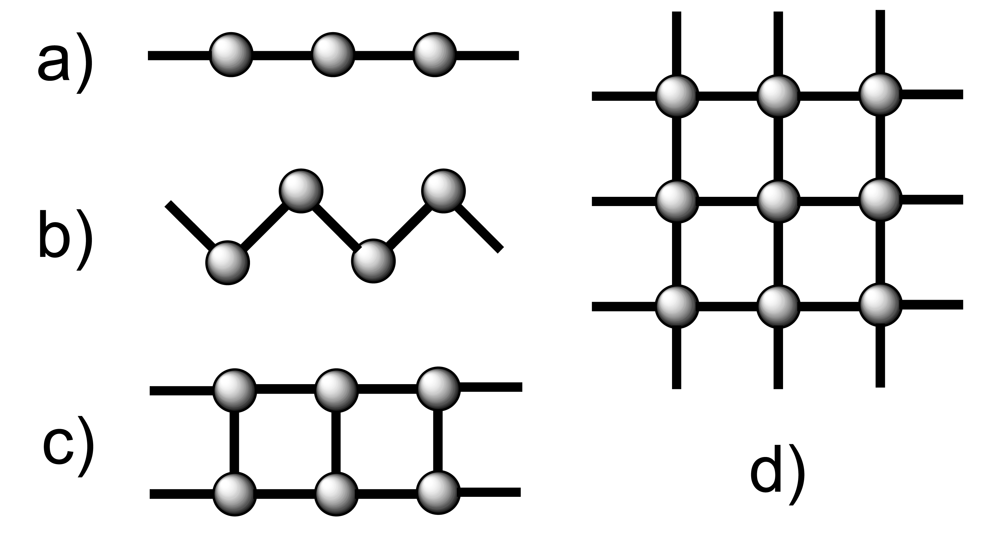
<p>Coordination polymers have attracted increasing attention since the early 1990s. This interest is largely due to their fascinating structures and potential applications in such fields as ion exchange, gas storage, separation, polymerization, heterogeneous catalysis, luminescence, non-linear optics and magnetism [<xref ref-type="bibr" rid="b1-polymers-03-01458">1</xref>-<xref ref-type="bibr" rid="b11-polymers-03-01458">11</xref>]. 4,4′-Bipyridine (4,4′-bipy) is a prototypical <italic>exo</italic>-bidentate, rigid linear bridging ligand and has been widely used in <italic>crystal engineering</italic> of coordination polymers [<xref ref-type="bibr" rid="b12-polymers-03-01458">12</xref>]. It has not only played a crucial role in the advancement of coordination polymers [<xref ref-type="bibr" rid="b13-polymers-03-01458">13</xref>] but also in the development of discrete (0D) metallosupramolecular compounds [<xref ref-type="bibr" rid="b14-polymers-03-01458">14</xref>]. <xref ref-type="fig" rid="f8-polymers-03-01458">Scheme 1</xref> depicts the most common topological motifs in 1D and 2D coordination polymers containing 4,4′-bipy as bridging ligand. 3D coordination networks propagated exclusively by 4,4′-bipy (e.g., diamondoid or 4<sup>2</sup> × 8<sup>2</sup> networks) are relatively few in number in comparison with 1D and 2D coordination polymers formed by this ligand [<xref ref-type="bibr" rid="b12-polymers-03-01458">12</xref>].</p>
<p>Like its lighter group homologue Zn<sup>2+</sup> [<xref ref-type="bibr" rid="b15-polymers-03-01458">15</xref>], Cd<sup>2+</sup> is particularly suited to the synthesis of coordination polymers owing to the lability that is associated with the spherical d<sup>10</sup> electronic configuration. A search of the Cambridge Structural Database (CSD) [<xref ref-type="bibr" rid="b16-polymers-03-01458">16</xref>] via the WebCSD interface [<xref ref-type="bibr" rid="b17-polymers-03-01458">17</xref>] in June 2011 yielded about 250 structures containing Cd<sup>2+</sup> bound to the 4,4′-bipy ligand. If we exclude the potentially structure-determining influence of non-solvent organic molecules [<xref ref-type="bibr" rid="b18-polymers-03-01458">18</xref>,<xref ref-type="bibr" rid="b19-polymers-03-01458">19</xref>] other than 4,4′-bipy, the number of coordination polymers decreases to about a dozen. These include (4,4) square grid (<xref ref-type="fig" rid="f8-polymers-03-01458">Scheme 1(d)</xref>) [<xref ref-type="bibr" rid="b20-polymers-03-01458">20</xref>-<xref ref-type="bibr" rid="b24-polymers-03-01458">24</xref>] and ‘T-shape’ [<xref ref-type="bibr" rid="b20-polymers-03-01458">20</xref>] 2D coordination networks, as well as linear chain (<xref ref-type="fig" rid="f8-polymers-03-01458">Scheme 1(a)</xref>) [<xref ref-type="bibr" rid="b19-polymers-03-01458">19</xref>,<xref ref-type="bibr" rid="b20-polymers-03-01458">20</xref>,<xref ref-type="bibr" rid="b25-polymers-03-01458">25</xref>,<xref ref-type="bibr" rid="b26-polymers-03-01458">26</xref>] and molecular antenna [<xref ref-type="bibr" rid="b19-polymers-03-01458">19</xref>,<xref ref-type="bibr" rid="b21-polymers-03-01458">21</xref>] 1D coordination polymers. The term molecular antenna commonly refers to a 1D coordination polymer with the underlying topology of the linear chain (<xref ref-type="fig" rid="f8-polymers-03-01458">Scheme 1(a)</xref>) bearing two additional, terminally monodentate-bound 4,4′-bipy ligands at each metal node [<xref ref-type="bibr" rid="b19-polymers-03-01458">19</xref>,<xref ref-type="bibr" rid="b21-polymers-03-01458">21</xref>,<xref ref-type="bibr" rid="b27-polymers-03-01458">27</xref>-<xref ref-type="bibr" rid="b34-polymers-03-01458">34</xref>]. Historically, Robson and co-workers were the first to report (4,4) square grids with the composition [{Cd(<italic>μ</italic>-4,4′-bipy)<sub>2</sub>(H<sub>2</sub>O)<sub>2</sub>}X]<sub>n</sub> (X = PF<sub>6</sub><sup>2−</sup>, SiF<sub>6</sub><sup>2−</sup>) [<xref ref-type="bibr" rid="b35-polymers-03-01458">35</xref>]. Dinuclear (0D) ‘H-shape’ complexes of Cd<sup>2+</sup> and 4,4′-bipy, which can be formally regarded as discrete fragments of molecular antenna polymers, have also been reported [<xref ref-type="bibr" rid="b21-polymers-03-01458">21</xref>,<xref ref-type="bibr" rid="b36-polymers-03-01458">36</xref>,<xref ref-type="bibr" rid="b37-polymers-03-01458">37</xref>].</p>
<p>Factors such as the nature of counterions, solvents [<xref ref-type="bibr" rid="b38-polymers-03-01458">38</xref>], metal-ligand ratio and concentrations appear to have a crucial bearing on the final outcome of reactions involving Cd<sup>2+</sup> and 4,4′-bipy, but a survey of known structures reveals no simple rationalization for the structural diversity. We are only aware of one study on solid-state assembly from simple mixtures of cadmium perchlorate and 4,4′bipy. Huang and Xiang reported the 1D coordination polymers [{Cd(<italic>μ</italic>-4,4′-bipy)(4,4′-bipy)<sub>2</sub>(H<sub>2</sub>O)<sub>2</sub>}(ClO<sub>4</sub>)<sub>2</sub> · 2 H<sub>2</sub>O]<sub>n</sub> (molecular antenna) and [{Cd(ClO<sub>4</sub>)<sub>2</sub>(<italic>μ</italic>-4,4′-bipy)(H<sub>2</sub>O)<sub>2</sub> · 4,4′-bipy]<sub>n</sub> (simple linear chain) [<xref ref-type="bibr" rid="b19-polymers-03-01458">19</xref>]. The former was crystallized from a solution of the components in an ethanol/water mixture, whereas the latter was obtained by ethanol-thermal synthesis. A (4,4) square grid constructed from Cd<sup>2+</sup> and 4,4′-bipy, which contains perchlorate counterions, has also been reported [<xref ref-type="bibr" rid="b23-polymers-03-01458">23</xref>]. However, this compound, [Cd(<italic>μ</italic>-4,4′-bpy)<sub>2</sub>(H<sub>2</sub>O)<sub>2</sub>](ClO<sub>4</sub>)<sub>2</sub>(4,4′-bipy)(CH<sub>3</sub>OH)<sub>2</sub>, was not synthesized from cadmium perchlorate but cadmium hypochlorite as the metal source. The perchlorate counterions clearly formed <italic>in situ</italic> by oxidation.</p>
<p>Intrigued by the rich structural chemistry of this class of compounds, we carried out further studies on supramolecular reactions of cadmium perchlorate with 4,4′-bipy. In doing so, we discovered a new example of the molecular antenna 1D coordination polymer, viz. [{Cd(<italic>μ</italic>-4,4′-bipy)(4,4′-bipy)<sub>2</sub>(H<sub>2</sub>O)<sub>2</sub>}(ClO<sub>4</sub>)<sub>2</sub> · 2 4,4′-bipy · 4.5 H<sub>2</sub>O]<sub>n</sub> (<bold>1</bold>). Compound <bold>1</bold> was studied by single-crystal and powder X-ray diffraction (PXRD) methods, <sup>113</sup>Cd and <sup>13</sup>C solid-state NMR, as well as infrared (IR) spectroscopy. In addition, bulk material of solvent-free 4,4′-bipy and its dihydrate were subjected to <sup>13</sup>C solid-state NMR investigations.</p></sec>
<sec sec-type="results|discussion">
<label>2.</label>
<title>Results and Discussion</title>
<sec>
<label>2.1.</label>
<title>Synthesis</title>
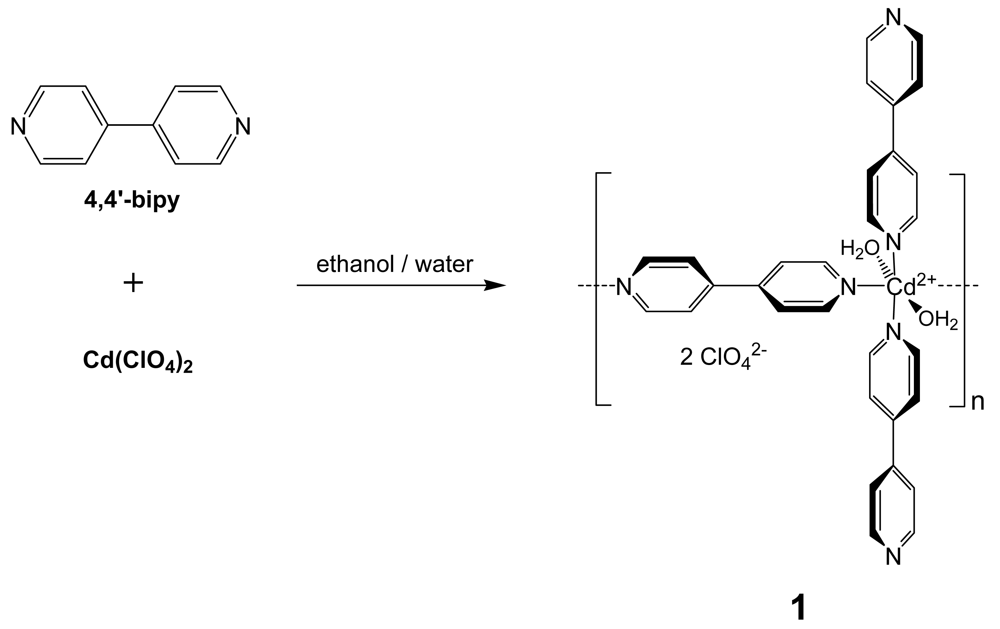
<p>Colorless crystals of compound <bold>1</bold> (<xref ref-type="fig" rid="f1-polymers-03-01458">Figure 1</xref>), suitable for single-crystal X-ray diffraction, were initially obtained when 4,4′-bipy and a semimolar amount of cadium perchlorate were allowed to react in an ethanol/water mixture at room temperature. Single-crystal X-ray analysis revealed a 1D coordination polymer of the molecular antenna type, as illustrated in <xref ref-type="fig" rid="f9-polymers-03-01458">Scheme 2</xref>. The positive charge of the cationic coordination polymer is balanced by two perchlorate ions per formula unit, and two non-coordinating 4,4′-bipy guest molecules are incorporated. A product with the same unit cell dimensions was also obtained from a mixture containing equimolar amounts of reactants. Amounts of <bold>1</bold> suitable for PXRD analysis and solid-state NMR investigations were obtained from a mixture with a 1:4 molar ratio (see Section 3.2). Since <bold>1</bold> was isolated from 1:1, 1:2 and 1:4 molar mixtures of cadmium perchlorate and 4,4′-bipy, it appears that the molecular antenna is a preferred product under various reaction conditions. Using aqueous ethanol containing significantly less water than used in this study, Huang and Xiong obtained the same molecular antenna cationic species [<xref ref-type="bibr" rid="b19-polymers-03-01458">19</xref>] without guest 4,4′-bipy molecules in the crystal. Biradha <italic>et al.</italic> noted that the presence of excess 4,4′-bipy in transition metal coordination polymer synthesis resulted in the formation of molecular antennas [<xref ref-type="bibr" rid="b12-polymers-03-01458">12</xref>], though this is not necessarily the case [<xref ref-type="bibr" rid="b23-polymers-03-01458">23</xref>].</p>
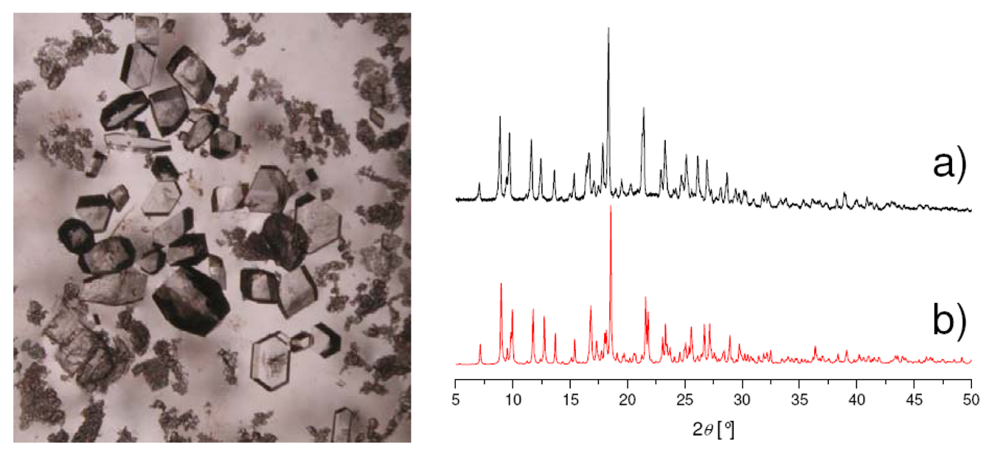
<p>Besides the two non-coordinating guest 4,4′-bipy molecules, compound <bold>1</bold> also contains non-coordinating guest water molecules. Elemental analysis of the bulk material indicates 4.5 H<sub>2</sub>O per formula unit, whereas 3.73 H<sub>2</sub>O per formula unit were estimated by free refinement of the occupancies of some of the water sites during the crystal structure determination (see Section 3.3). Loss of water and/or an imperfect structural model for the severely disordered solvent regions in the crystal of <bold>1</bold> are possible explanations for the discrepancy. It is interesting to note that 4.5 H<sub>2</sub>O per formula unit were also reported on the basis of elemental analysis for the nitrate derivative [<xref ref-type="bibr" rid="b21-polymers-03-01458">21</xref>] of <bold>1</bold>, the coordination polymer framework of which is isostructural to that of <bold>1</bold> (see Section 2.2). PXRD analysis of polycrystalline bulk material indicates that the framework structure of the single-crystal of <bold>1</bold> investigated is representative of the bulk material (<xref ref-type="fig" rid="f1-polymers-03-01458">Figure 1</xref>). According to <sup>13</sup>C solid-state NMR spectroscopy, there is no solvent ethanol in the structure (see Section 2.3).</p>
<p>Most bands in the IR spectrum can be ascribed to vibrations of 4,4′-bipy. The band centered at 621 cm<sup>−1</sup> is tentatively assigned to the in-plane ring deformation of the pyridyl groups. This band is observed at 604 cm<sup>−1</sup> for free pyridine and is characteristically shifted to higher frequencies upon metal coordination [<xref ref-type="bibr" rid="b39-polymers-03-01458">39</xref>]. In compound <bold>1</bold>, this band is expected to represent an overlap arising from coordinating and non-coordinating pyridyl groups. The strong and weak bands at respectively 1,090 and 932 cm<sup>−1</sup> are characteristic for non-coordinating perchlorate ions [<xref ref-type="bibr" rid="b40-polymers-03-01458">40</xref>]. The two broad and weak bands centered at 3,526 and 3,118 cm<sup>−1</sup> are assigned to the OH stretching vibrations of water.</p></sec>
<sec>
<label>2.2.</label>
<title>Description of the Crystal Structure</title>
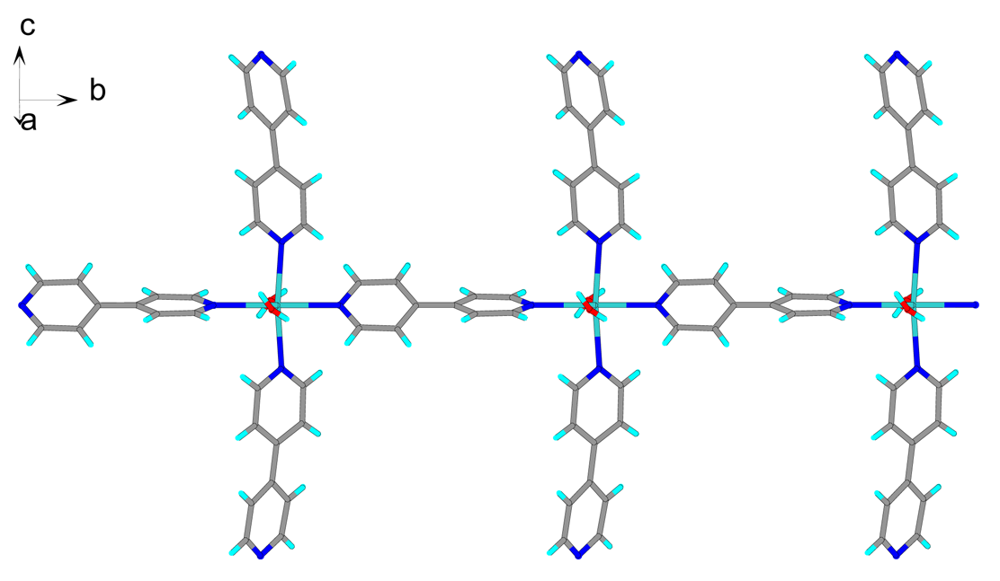
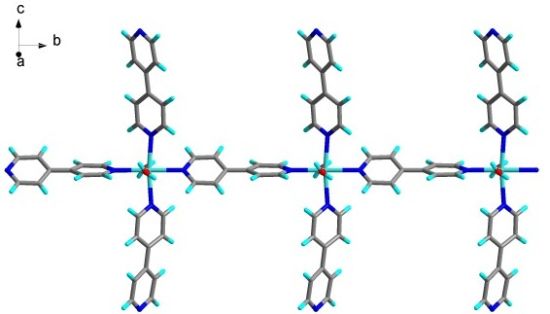
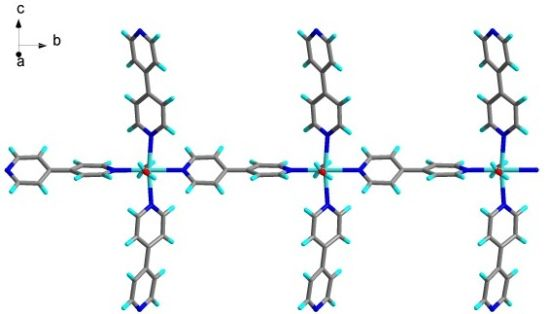
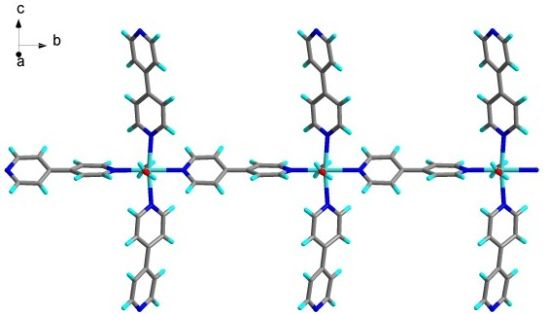
<p><xref ref-type="fig" rid="f2-polymers-03-01458">Figure 2</xref> shows the structure of a single chain of the cationic molecular antenna coordination polymer in <bold>1</bold>. Cd<sup>2+</sup> ions are linked by 4,4′-bipy to form a linear 1D polymeric chain via two <italic>trans</italic> coordination sites. Two terminally monodentate-bound 4,4′-bipy ligands coordinate to two <italic>trans</italic> sites in the equatorial plane of each Cd<sup>2+</sup> node, creating the molecular antenna arrangement. Two aqua ligands in the axial positions complete the octahedral coordination sphere of Cd<sup>2+</sup>. The polymeric chain thus formed contains one crystallographically unique Cd<sup>2+</sup> node. The repeat unit of the cationic coordination polymer is hence formulated as [Cd(<italic>μ</italic>-4,4′-bipy)(4,4′-bipy)<sub>2</sub>(H<sub>2</sub>O)<sub>2</sub>]<sup>2+</sup>, as illustrated in <xref ref-type="fig" rid="f9-polymers-03-01458">Scheme 2</xref>.</p>
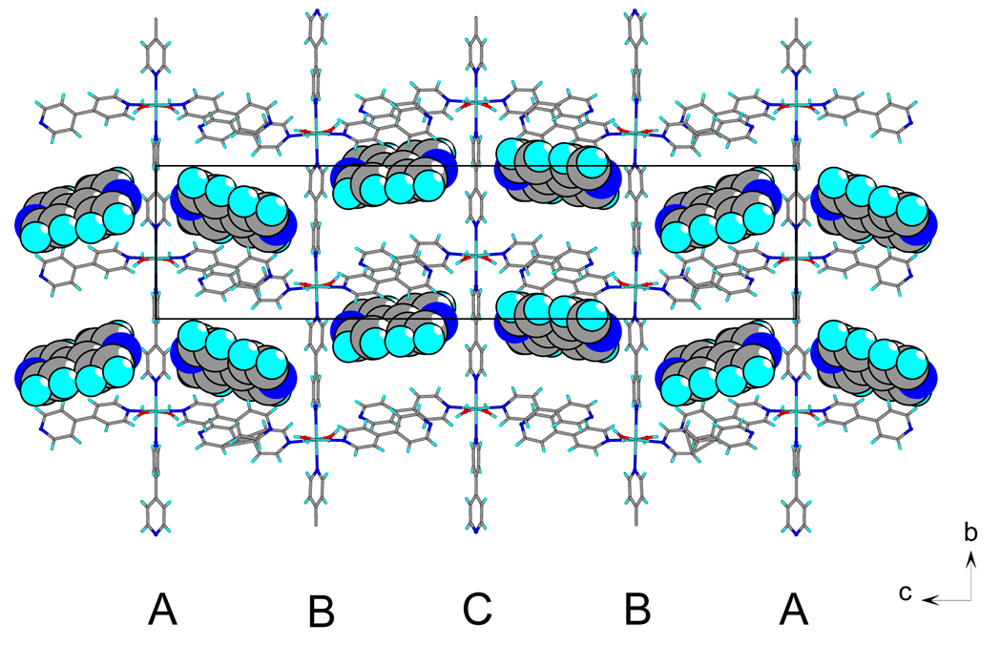
<p><xref ref-type="fig" rid="f3-polymers-03-01458">Figure 3</xref> depicts a packing diagram. In the crystal, the polymeric chains propagate by translational symmetry parallel to the <italic>b</italic> axis direction, with a period corresponding to the <italic>b</italic> lattice parameter [11.8244(3) Å], which thus defines the Cd⋯Cd separation in each chain. The coordination polymers are joined together by O-H⋯N hydrogen bonds exclusively linking aqua ligands to the N atoms of the non-coordinating pyridyl groups of the terminally bound 4,4′-bipy ligands in adjacent polymeric chains. The O-H⋯N distances exhibit typical values in the range of 2.75–2.86 Å. These hydrogen bond interactions extend in the <italic>c</italic> axis direction with a period of <italic>c</italic>/4 (12.38 Å). The hydrogen bond layers so formed lie parallel to the <italic>ac</italic> plane and can be topologically viewed as (4,4)-nets [<xref ref-type="bibr" rid="b41-polymers-03-01458">41</xref>]. Non-coordinating guest 4,4′-bipy molecules occupy the approximately rectangular voids created by the layers (<xref ref-type="fig" rid="f3-polymers-03-01458">Figure 3</xref>). The resulting hydrogen-bonded layers stack along the <italic>a</italic> axis direction with an offset of <italic>b</italic>/2 (5.91 Å). Accommodated guest 4,4′-bipy and solvent water molecules, as well as perchlorate ions, participate in further O-H⋯N and O-H⋯O hydrogen bond interactions, but only between themselves and, except for the guest 4,4′-bipy molecules, via the aqua ligands of the molecular antennas.</p>
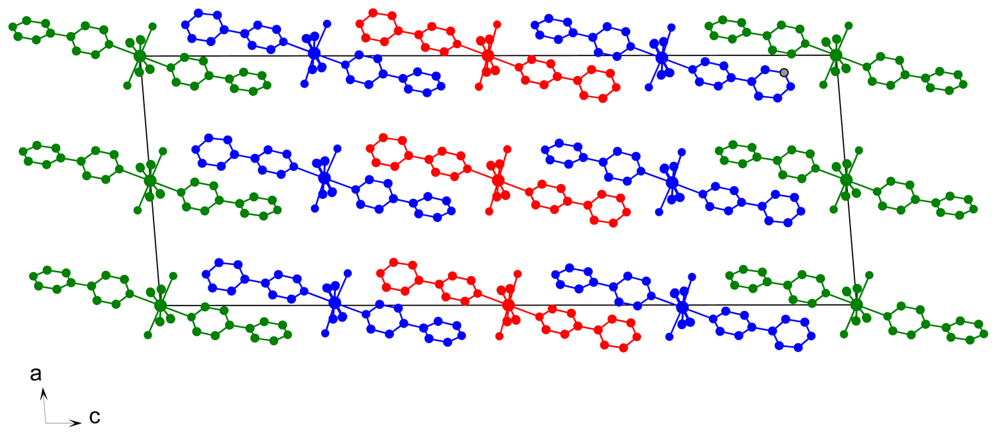
<p>The structure of <bold>1</bold> contains three crystallographically independent coordination polymer strands, labeled A, B and C in <xref ref-type="fig" rid="f3-polymers-03-01458">Figure 3</xref>. <xref ref-type="fig" rid="f4-polymers-03-01458">Figure 4</xref> shows the packing of polymeric chains in the monoclinic <italic>C</italic>-centered unit cell, viewed along the direction of propagation (<italic>i.e.</italic>, the <italic>b</italic> axis direction). Chains A and C run along distinct crystallographic twofold rotation axes parallel to the <italic>b</italic> axis direction, and are related to one another by a <italic>pseudo</italic> translation. This additional symmetry is, however, not fulfilled by the perchlorate anions and guest molecules and is thus regarded as <italic>pseudo</italic> symmetry. Interestingly, the coordination polymer framework of <bold>1</bold> appears to be isostructural to that of the nitrate derivative, [{Cd(<italic>μ</italic>-4,4′-bipy)(4,4′-bipy)<sub>2</sub>(H<sub>2</sub>O)<sub>2</sub>}(NO<sub>3</sub>)<sub>2</sub> · 2 4,4′-bipy · 4.5 H<sub>2</sub>O]<sub>n</sub> (CSD ref. code: YEKQUA) [<xref ref-type="bibr" rid="b21-polymers-03-01458">21</xref>]. This structure has been described with the same space group symmetry and with <italic>a</italic> and <italic>b</italic> lattice parameters similar to those of the monoclinic unit cell of <bold>1</bold>. The <italic>c</italic> lattice parameter of YEKQUA is, however, half of that of <bold>1</bold>. As a result, YEKQUA is a Z′ = 0.5 + 0.5 structure (<italic>vide infra</italic>), as it contains two crystallographically independent polymer strands running along two distinct twofold rotation axes. In this connection, a similar unit cell and space group symmetry was found for a molecular antenna assembled from cobalt(II) nitrate and 4,4′-bipy [<xref ref-type="bibr" rid="b27-polymers-03-01458">27</xref>].</p>
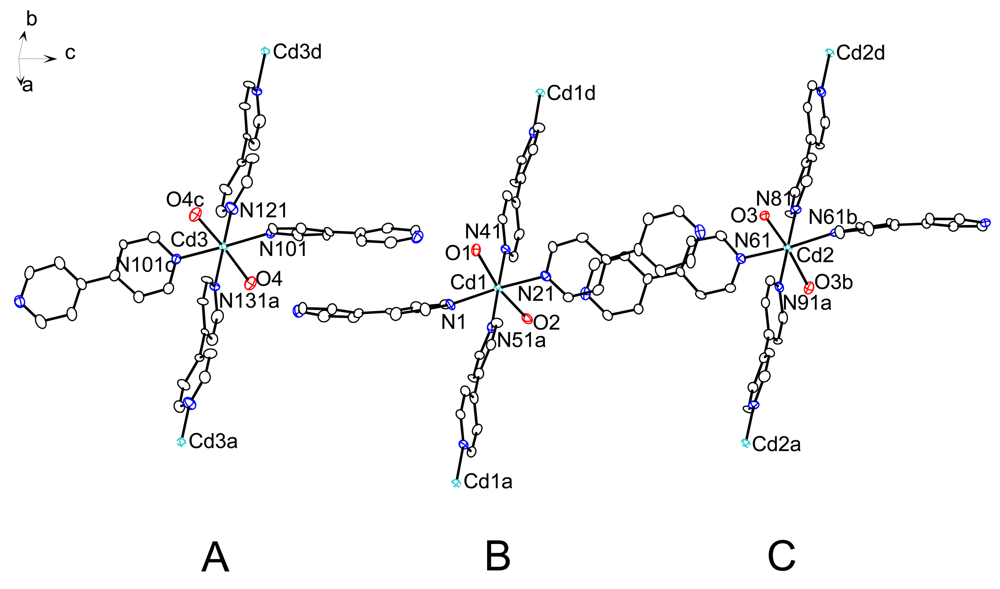
<p><xref ref-type="fig" rid="f5-polymers-03-01458">Figure 5</xref> shows the coordination environment of the three crystallographically unique Cd<sup>2+</sup> ions in <bold>1</bold>, with selected bond lengths and angles given in <xref ref-type="table" rid="t1-polymers-03-01458">Table 1</xref>. Cd1 occupies a general position, whereas Cd2 and Cd3 lie on two distinct crystallographic twofold rotation axes. The Cd coordination spheres can be described as octahedral. The bond lengths and angles about Cd1, Cd2 and Cd3 are essentially comparable, but close inspection reveals subtle differences (<xref ref-type="table" rid="t1-polymers-03-01458">Table 1</xref>). The pyridyl rings adopt a more or less propeller-like configuration about each Cd<sup>2+</sup> ion, and the 4,4′-bipy ligands exhibit the energetically preferred twisted conformation [<xref ref-type="bibr" rid="b42-polymers-03-01458">42</xref>].</p>
<p>We suggest that a <italic>Z</italic>′ = 2 value is appropriate for the crystal structure of <bold>1</bold>. The parameter <italic>Z</italic>′ conventionally denotes the number of formula units in the asymmetric unit [<xref ref-type="bibr" rid="b43-polymers-03-01458">43</xref>]. This implies that <italic>Z</italic>′ crucially depends on the definition of the formula unit. The problem becomes particularly apparent when polymeric structures are described [<xref ref-type="bibr" rid="b44-polymers-03-01458">44</xref>]. As discussed in Section 2.2, the repeat unit of the three chemically identical but crystallographically distinct polymeric chains in <bold>1</bold> is best described by the chemical formula [Cd(<italic>μ</italic>-4,4′-bipy)(4,4′-bipy)<sub>2</sub>(H<sub>2</sub>O)<sub>2</sub>]<sup>2+</sup>. The asymmetric unit of <bold>1</bold> contains one entire and two independent halves of the formula unit, resulting in <italic>Z</italic>′ = 1 + 0.5 + 0.5. Structures such as <bold>1</bold> illustrate the inability of the Z′ parameter to adequately describe all aspects of the crystal packing where Z′ &gt; 1 [<xref ref-type="bibr" rid="b45-polymers-03-01458">45</xref>]. Possible reasons for the formation of Z′ &gt; 1 structures, e.g., packing difficulties and <italic>pseudo</italic> symmetry, have been discussed in the literature [<xref ref-type="bibr" rid="b45-polymers-03-01458">45</xref>,<xref ref-type="bibr" rid="b46-polymers-03-01458">46</xref>]. Considering that twisted biphenyl derivatives are prone to form such structures [<xref ref-type="bibr" rid="b45-polymers-03-01458">45</xref>], the occurrence of three crystallographically distinct polymeric chains in <bold>1</bold> is not particularly surprising. It is perhaps worth noting that both free 4,4′-bipy [<xref ref-type="bibr" rid="b47-polymers-03-01458">47</xref>] and its dihydrate [<xref ref-type="bibr" rid="b48-polymers-03-01458">48</xref>] crystallize with two independent, twisted molecules in the asymmetric unit.</p></sec>
<sec>
<label>2.3.</label>
<title><sup>113</sup>Cd and <sup>13</sup>C Solid-State NMR Spectroscopy</title>
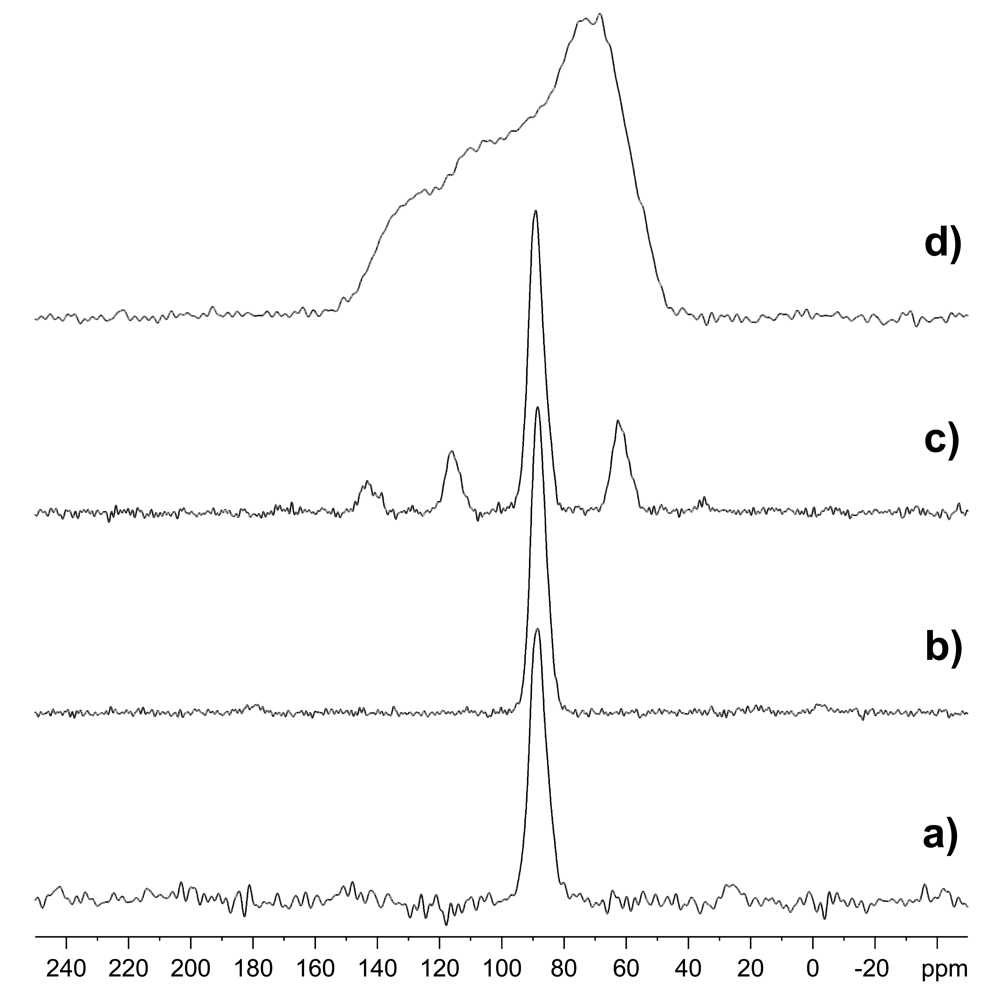
<p>A solid-state <sup>113</sup>Cd NMR analysis of <bold>1</bold> was undertaken in order to gain more insight into the differences in the local environments of the three crystallographically distinct Cd atoms in the crystal structure, shown in <xref ref-type="fig" rid="f5-polymers-03-01458">Figure 5</xref>. Interestingly, the <sup>113</sup>Cd MAS NMR spectra, recorded with and without cross-polarization, show a single line at 89 ppm (fwhh: <italic>ca.</italic> 620 Hz), with weak side bands at medium spinning rates (<xref ref-type="fig" rid="f6-polymers-03-01458">Figure 6</xref>). Clearly, the resolution is insufficient to resolve the independent Cd atoms in the crystal, consistent with the similarity of the local environments of the three independent Cd atoms in the structure. The lack of strong spinning side bands suggests that the anisotropy of the chemical shift is small. Reducing the spinning rate to 3 kHz (<xref ref-type="fig" rid="f6-polymers-03-01458">Figure 6(c)</xref>) resulted in the appearance of intense spinning side bands. The spectrum recorded without spinning shows that the span caused by chemical shift anisotropy in <bold>1</bold> is only about 100 ppm, which is surprisingly small, especially since the coordination sphere of Cd contains four nitrogen and two oxygen atoms. Lipton <italic>et al.</italic>, for example, observed multiple side bands for N<sub>6</sub> coordination environments, due to a three times larger anisotropy [<xref ref-type="bibr" rid="b49-polymers-03-01458">49</xref>]. The chemical shift for <bold>1</bold> lies in the region expected for octahedral coordination complexes with oxygen or nitrogen ligands coordinated to the metal [<xref ref-type="bibr" rid="b50-polymers-03-01458">50</xref>].</p>
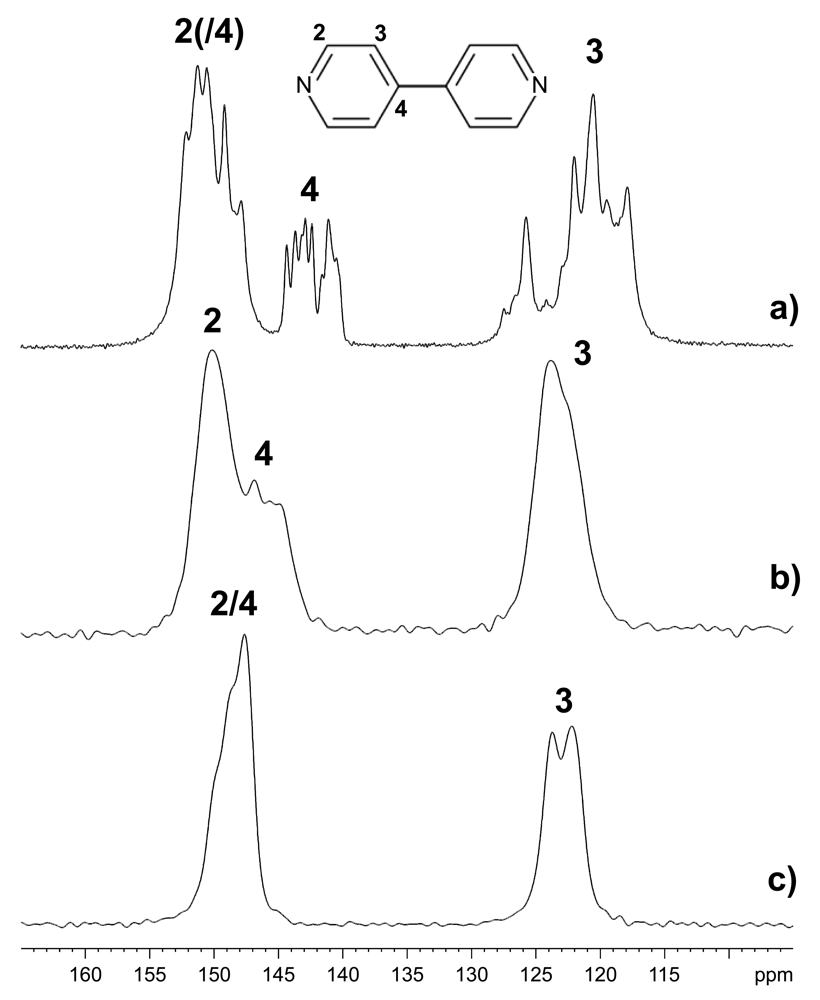
<p>The solid-state <sup>13</sup>C NMR spectrum of <bold>1</bold> is shown in <xref ref-type="fig" rid="f7-polymers-03-01458">Figure 7(a)</xref>. As expected, the spectrum exhibits three groups of lines, which are assigned according to Osborne [<xref ref-type="bibr" rid="b51-polymers-03-01458">51</xref>] (solution NMR) and Braga <italic>et al.</italic> [<xref ref-type="bibr" rid="b52-polymers-03-01458">52</xref>] (solid-state NMR). The spectrum of 4,4′-bipy in <bold>1</bold> is well-resolved, in stark contrast to that obtained for co-crystals containing 4,4′-bipy [<xref ref-type="bibr" rid="b52-polymers-03-01458">52</xref>], pure solid anhydrous 4,4′-bipy (<xref ref-type="fig" rid="f7-polymers-03-01458">Figure 7(b)</xref>) and 4,4′-bipy dihydrate (<xref ref-type="fig" rid="f7-polymers-03-01458">Figure 7(c)</xref>). The ill-resolved lines observed for pure solid anhydrous 4,4′-bipy and 4,4′-bipy dihydrate cannot be due to the formation of amorphous phases, since samples from the same batches were shown to be crystalline by independent PXRD and single-crystal diffraction investigations. It is noteworthy that the aliphatic region of the spectrum shows no signal that could be attributed to ethanol guest molecules, ruling out the presence of ethanol in the disordered regions of the crystal (see Sections 2.1 and 3.1). Although actual assignment of the fine structure in the <sup>13</sup>C solid-state NMR spectrum of <bold>1</bold> was not possible due to the lack of examples suitable for comparison, it is surprising that the lines are remarkably well-resolved in the Cd<sup>2+</sup> coordination polymer. The influence of the coordinating Cd atom on the <sup>13</sup>C chemical shifts of the 4,4′-bipy ligands is remarkable. Studies on simple 4,4′-bipy Cd<sup>2+</sup> complexes containing, for example, one independent molecule in the asymmetric unit would be useful to shed light on this interesting phenomenon.</p></sec></sec>
<sec>
<label>3.</label>
<title>Experimental Section</title>
<sec>
<label>3.1.</label>
<title>General</title>
<p>All starting materials were obtained from commercial sources and used as received. Ethanol was of reagent grade. The IR spectrum was recorded in the range of 4,000–600 cm<sup>−1</sup> on a Bruker Tensor 27 FT-IR spectrometer by using ATR technique. Elemental analysis was carried out at Mikroanalytisches Laboratorium KOLBE in Mülheim an der Ruhr, Germany. <italic>Caution</italic>: perchlorate salts are potentially explosive and should be handled with great care.</p></sec>
<sec>
<label>3.2.</label>
<title>Preparation of <bold>1</bold></title>
<p>Cd(ClO<sub>4</sub>)<sub>2</sub> · 6 H<sub>2</sub>O (105 mg, 0.25 mmol) was dissolved in deionized water (20 mL) and carefully layered with a solution of 4,4′-bipy · 2 H<sub>2</sub>O (192 mg, 1.00 mmol) in 10 mL of ethanol. After standing at room temperature for <italic>ca.</italic> four weeks, while the solvent was allowed to evaporate slowly, colorless crystalline material of <bold>1</bold> was collected and dried on a filter paper. Yield: 128 mg (0.11 mmol, 55% based on 4,4′-bipy · 2 H<sub>2</sub>O). Anal. calcd. for C<sub>50</sub>H<sub>53</sub>Cl<sub>2</sub>N<sub>10</sub>O<sub>14.5</sub>Cd: C: 49.7; H: 4.4; N: 11.6%. Found: C: 49.6; H: 4.3; N: 11.4%. IR: 3526(w), 3118(w), 1599(m), 1535(m), 1489(w), 1408(m), 1323(w), 1221(m), 1090(s), 1061(s), 1003(m), 932(w), 872(w), 860(w), 849(w), 814(m), 800(s), 729(m), 621(s) cm<sup>-1</sup>.</p></sec>
<sec sec-type="methods">
<label>3.3.</label>
<title>Single-Crystal X-Ray Analysis</title>
<p>A crystal was mounted on a MiTeGen cryo loop using perfluoropolyether Fomblin YR-1800 (Alfa Aesar) and placed in the nitrogen cold-gas stream of the diffractometer. The intensity data were measured on a Bruker AXS Proteum X8 diffractometer equipped with a FR591 rotating anode and focusing multilayer optics, using <italic>ω</italic> and <italic>ϕ</italic> scans. The PROTEUM2 software was used to control the diffractometer [<xref ref-type="bibr" rid="b53-polymers-03-01458">53</xref>]. The raw frame data were integrated with the program SAINT [<xref ref-type="bibr" rid="b54-polymers-03-01458">54</xref>]. Scaling and an absorption correction were carried out by Gaussian integration using SADABS [<xref ref-type="bibr" rid="b55-polymers-03-01458">55</xref>]. The crystal structure was solved <italic>ab initio</italic> by charge flipping using SUPERFLIP [<xref ref-type="bibr" rid="b56-polymers-03-01458">56</xref>]. The electron density map so obtained was interpreted with EDMA [<xref ref-type="bibr" rid="b57-polymers-03-01458">57</xref>]. The structural model was completed by difference Fourier syntheses and refined by full-matrix least-squares refinement on <italic>F</italic><sup>2</sup> with SHELXL-97 [<xref ref-type="bibr" rid="b58-polymers-03-01458">58</xref>]. The crystal of <bold>1</bold> studied appeared to be a racemic twin. Refinement of the twin components converged at 0.501(5):0.499(5). Anisotropic displacement parameters were introduced for all non-hydrogen atoms with the exception of some solvent water molecules (<italic>vide infra</italic>). Two of the perchlorate anions each show orientational disorder over two positions. Split models were introduced for both disordered groups and refined with standard similar distance restraints. The highest difference electron density peak is located <italic>ca.</italic> 0.94 Å from Cd1. Carbon-bound hydrogen atoms were placed at geometrically calculated positions and refined with the appropriate riding model. The water hydrogen atoms were located via difference Fourier syntheses and refined with the O-H distances restrained to a target value of 0.84(2) Å. All hydrogen atoms were refined with <italic>U</italic><sub>iso</sub>(H) = 1.2<italic>U</italic><sub>eq</sub>(C,O). Six water sites are statistically occupied; the site occupancy factors were refined freely. Three of these six water sites were refined with isotropic atomic displacement parameters for the oxygen atoms. The hydrogen atoms of the six statistically occupied water sites could not be located in the final difference map, and where not included in the refinement. Calculated intermolecular O⋯O distances indicate that not all of the disordered perchlorate anion and water sites can be occupied simultaneously. The ADDSYM routine of PLATON [<xref ref-type="bibr" rid="b59-polymers-03-01458">59</xref>] detects additional translational symmetry in the coordination polymer framework, which is in fact <italic>pseudo</italic> symmetry (see Section 2.2). Crystal data and refinement details are given in <xref ref-type="table" rid="t2-polymers-03-01458">Table 2</xref>. CCDC 836453 contains the supplementary crystallographic data for this paper, including structure factors. These data can be obtained free of charge from the Cambridge Crystallographic Data Centre via <ext-link xlink:href="www.ccdc.cam.ac.uk/data_request/cif" ext-link-type="uri">www.ccdc.cam.ac.uk/data_request/cif</ext-link>.</p></sec>
<sec>
<label>3.4.</label>
<title>Powder X-Ray Diffraction</title>
<p>The PXRD data for bulk material of compound <bold>1</bold> were collected at room temperature in Debye-Scherrer geometry on a Stoe Stadi P system with a linear position sensitive detector and a focused Cu-K<sub>α1</sub> (λ = 1.54060 Å) incident beam from a curved Ge(111) monochromator. The capillary sample (inner diameter = 0.5 mm) was rotated during the measurement. The WinXPOW software was used to operate the diffractometer [<xref ref-type="bibr" rid="b60-polymers-03-01458">60</xref>]. The theoretical PXRD pattern of <bold>1</bold> was calculated from the single-crystal data with Mercury 2.4 [<xref ref-type="bibr" rid="b61-polymers-03-01458">61</xref>].</p></sec>
<sec>
<label>3.5.</label>
<title>Solid-State NMR Spectroscopy</title>
<p>The solid-state NMR spectra were recorded on a Bruker Avance 500WB spectrometer using a double-bearing standard MAS probe (DVT BL4) at resonance frequencies of 110.9 MHz and 125.8 MHz for <sup>113</sup>Cd and <sup>13</sup>C, respectively. Polycrystalline samples (<italic>ca.</italic> 100 mg), containing naturally abundant <sup>113</sup>Cd and <sup>13</sup>C, were placed in a zirconia rotor. The experimental conditions for the <sup>113</sup>Cd and <sup>13</sup>C CP MAS NMR spectra were as follows: up to 10 kHz spinning rate, 8 s recycle delay, between 2,000 and 20,000 scans, 4 ms contact time, and 4.3 μs <sup>1</sup>H π/2 pulse. Longer recycle delays were used for recording the <sup>13</sup>C CP/MAS NMR spectra of anhydrous 4,4′-bipy and 4,4′-bipy dihydrate. The <sup>113</sup>Cd MAS NMR spectra were measured using single π/3-pulses (3 μs) with a recycle delay of 30 s (2,000–8,000 scans). High-power proton decoupling (cw) was applied for all spectra. The chemical shift was referenced to 1 M aqueous solution of Cd(ClO<sub>4</sub>)<sub>2</sub> and neat TMS in separate rotors for <sup>113</sup>Cd and <sup>13</sup>C, respectively.</p></sec></sec>
<sec sec-type="conclusions">
<label>4.</label>
<title>Conclusions</title>
<p>We have obtained a 1D coordination polymer with a molecular antenna structure by layering a solution of 4,4′-bipy in ethanol onto an aqueous solution of cadmium perchlorate.The compound (<bold>1</bold>) has been structurally characterized by X-ray diffraction methods, solid-state NMR and IR spectroscopy. Several observations are relevant in the context of <italic>crystal engineering</italic>: (a) the bulk material was shown to be homogeneous, with no measurable crystalline impurities; (b) the same compound was isolated from various molar ratios of cadmium perchlorate and 4,4′-bipy, indicating that the molecular antenna is a preferred product; (c) there was no incorporation of ethanol in the sample, although it was present in the reaction solution; (d) the aqua ligands in the coordination polymer only make O-H⋯N hydrogen bonds to the uncoordinated N atoms of coordinated 4,4′-bipy ligands in neighboring strands, even though unbound, guest 4,4′-bipy molecules are clearly available for hydrogen bonding.</p>
<p>According to the single crystal and PXRD studies on the bulk material, <bold>1</bold> crystallizes exclusively in a unit cell containing three distinct strands. <sup>113</sup>Cd MAS NMR spectra recorded with and without cross-polarization exhibit a single line, showing that the individual lines are not resolved because the local environments are very similar. The difference between the three strands can be attributed to the conformations adopted by the 4,4′-bipy ligands. We observed an increased resolution in the solid-state <sup>13</sup>C NMR spectrum of <bold>1</bold> as compared to the spectra of pure crystalline 4,4′-bipy and 4,4′-bipy dihdrate. This phenomenon deserves further investigation.</p></sec></body>
<back>
<sec sec-type="display-objects">
<title>Figures and Tables</title>
<fig id="f1-polymers-03-01458" position="float">
<label>Figure 1.</label>
<caption>
<p>Colorless crystals (left) and PXRD patterns (right) of <bold>1</bold>; <bold>(a)</bold> shows the experimental pattern and <bold>(b)</bold> the theoretical pattern calculated from the single-crystal data.</p></caption>
<graphic xlink:href="polymers-03-01458f1.gif"/></fig>
<fig id="f2-polymers-03-01458" position="float">
<label>Figure 2.</label>
<caption>
<p>Part of a single chain of the cationic coordination polymer in <bold>1</bold>, showing the relationship of the 4,4′-bipy ligands to one another in the molecular antenna coordination polymer.</p></caption>
<graphic xlink:href="polymers-03-01458f2.gif"/></fig>
<fig id="f3-polymers-03-01458" position="float">
<label>Figure 3.</label>
<caption>
<p>Crystal structure of <bold>1</bold> viewed along the <italic>a</italic> axis direction, showing the three independent polymeric chains (A, B, C). Unbound 4,4′-bipy molecules are shown in space filling representation. Counterions and guest water molecules are omitted for clarity.</p></caption>
<graphic xlink:href="polymers-03-01458f3.gif"/></fig>
<fig id="f4-polymers-03-01458" position="float">
<label>Figure 4.</label>
<caption>
<p>Coordination polymer strands in the monoclinic unit cell of <bold>1</bold>, viewed along the <italic>b</italic> axis (A, green; B, blue; C, red). Hydrogen atoms, guest 4,4′-bipy, ClO<sub>4</sub><sup>−</sup> ions and solvent water molecules are omitted for clarity.</p></caption>
<graphic xlink:href="polymers-03-01458f4.gif"/></fig>
<fig id="f5-polymers-03-01458" position="float">
<label>Figure 5.</label>
<caption>
<p>Section of the crystal structure of <bold>1</bold> showing the coordination environments of the three crystallographically independent Cd<sup>2+</sup> ions. The labels A, B and C denote the independent polymeric chain each Cd<sup>2+</sup> ion belongs to (<xref ref-type="fig" rid="f2-polymers-03-01458">Figure 2</xref>). Displacement ellipsoids are drawn at the 50% probability level. Hydrogen atoms are omitted for clarity. Symmetry codes: <bold>(a)</bold> x, −1 + y, z; <bold>(b)</bold> −x, y, 1 −z; <bold>(c)</bold> −x, y, −z; <bold>(d)</bold> x, 1 + y, z.</p></caption>
<graphic xlink:href="polymers-03-01458f5.gif"/></fig>
<fig id="f6-polymers-03-01458" position="float">
<label>Figure 6.</label>
<caption>
<p>Solid-state <sup>113</sup>Cd NMR spectra of <bold>1: (a)</bold> Bloch decay spectrum at 7 kHz MAS frequency, <bold>(b)</bold> CP/MAS spectrum at 10 kHz, <bold>(c)</bold> CP/MAS spectrum at 3 kHz, <bold>(d)</bold> CP spectrum of the stationary sample. Spectra arranged from bottom to top for clarity.</p></caption>
<graphic xlink:href="polymers-03-01458f6.gif"/></fig>
<fig id="f7-polymers-03-01458" position="float">
<label>Figure 7.</label>
<caption>
<p><sup>13</sup>C CP/MAS NMR spectra of <bold>1 (a)</bold>, anhydrous 4,4′-bipy (480 s recycle delay) <bold>(b)</bold> and 4,4′-bipy dihydrate (30 s recycle delay) <bold>(c)</bold>.</p></caption>
<graphic xlink:href="polymers-03-01458f7.gif"/></fig>
<fig id="f8-polymers-03-01458" position="float">
<label>Scheme 1.</label>
<caption>
<p>Most frequently observed topological motifs in coordination polymerspropagated by 4,4′-bipy (black connectors) and metal nodes (large grey spheres): <bold>(a)</bold> linearchain, <bold>(b)</bold> zig-zag chain, <bold>(c)</bold> ladder, <bold>(d)</bold> (4,4) square grid.</p></caption>
<graphic xlink:href="polymers-03-01458f8.gif"/></fig>
<fig id="f9-polymers-03-01458" position="float">
<label>Scheme 2.</label>
<caption>
<p>Formation of the molecular coordination polymer (<bold>1</bold>) from cadmium perchlorate and 4,4′-bipy. Guest water and 4,4′-bipy molecules are omitted for clarity.</p></caption>
<graphic xlink:href="polymers-03-01458f9.gif"/></fig>
<table-wrap id="t1-polymers-03-01458" position="float">
<label>Table 1.</label>
<caption>
<p>Selected bond lengths and angles for <bold>1</bold> (Å,°).</p></caption>
<table frame="hsides" rules="none">
<tbody>
<tr>
<td align="left" valign="top">Cd1-O1</td>
<td align="left" valign="top">2.280(3)</td>
<td align="left" valign="top">Cd2-O3</td>
<td align="left" valign="top">2.320(3)</td>
<td align="left" valign="top">Cd3-O4</td>
<td align="left" valign="top">2.292(4)</td></tr>
<tr>
<td align="left" valign="top">Cd1-O2</td>
<td align="left" valign="top">2.301(3)</td>
<td align="left" valign="top">Cd2-O3b</td>
<td align="left" valign="top">2.320(3)</td>
<td align="left" valign="top">Cd3-O4c</td>
<td align="left" valign="top">2.292(4)</td></tr>
<tr>
<td align="left" valign="top">Cd1-N1</td>
<td align="left" valign="top">2.345(4)</td>
<td align="left" valign="top">Cd2-N61</td>
<td align="left" valign="top">2.354(4)</td>
<td align="left" valign="top">Cd3-N101</td>
<td align="left" valign="top">2.348(4)</td></tr>
<tr>
<td align="left" valign="top">Cd1-N21</td>
<td align="left" valign="top">2.362(4)</td>
<td align="left" valign="top">Cd2-N61b</td>
<td align="left" valign="top">2.354(4)</td>
<td align="left" valign="top">Cd3-N101c</td>
<td align="left" valign="top">2.348(4)</td></tr>
<tr>
<td align="left" valign="top">Cd1-N41</td>
<td align="left" valign="top">2.391(7)</td>
<td align="left" valign="top">Cd2-N81</td>
<td align="left" valign="top">2.315(7)</td>
<td align="left" valign="top">Cd3-N121</td>
<td align="left" valign="top">2.337(8)</td></tr>
<tr>
<td align="left" valign="top">Cd1-N51a</td>
<td align="left" valign="top">2.349(6)</td>
<td align="left" valign="top">Cd2-N91a</td>
<td align="left" valign="top">2.365(9)</td>
<td align="left" valign="top">Cd3-N131a</td>
<td align="left" valign="top">2.409(7)</td></tr>
<tr>
<td align="left" valign="top">O1-Cd1-O2</td>
<td align="left" valign="top">168.1(1)</td>
<td align="left" valign="top">O3b-Cd2-O3</td>
<td align="left" valign="top">168.5(2)</td>
<td align="left" valign="top">O4c-Cd3-O4</td>
<td align="left" valign="top">173.7(3)</td></tr>
<tr>
<td align="left" valign="top">O1-Cd1-N1</td>
<td align="left" valign="top">93.4(1)</td>
<td align="left" valign="top">O3-Cd2-N61</td>
<td align="left" valign="top">94.6(1)</td>
<td align="left" valign="top">O4c-Cd3-N101</td>
<td align="left" valign="top">92.6(1)</td></tr>
<tr>
<td align="left" valign="top">O2-Cd1-N1</td>
<td align="left" valign="top">93.7(1)</td>
<td align="left" valign="top">O3b-Cd2-N61</td>
<td align="left" valign="top">86.2(1)</td>
<td align="left" valign="top">O4-Cd3-N101</td>
<td align="left" valign="top">87.6(1)</td></tr>
<tr>
<td align="left" valign="top">O1-Cd1-N51a</td>
<td align="left" valign="top">95.4(2)</td>
<td align="left" valign="top">O3-Cd2-N91a</td>
<td align="left" valign="top">84.2(1)</td>
<td align="left" valign="top">O4c-Cd3-N131a</td>
<td align="left" valign="top">86.9(1)</td></tr>
<tr>
<td align="left" valign="top">O2-Cd1-N51a</td>
<td align="left" valign="top">94.6(2)</td>
<td align="left" valign="top">O3b-Cd2-N91a</td>
<td align="left" valign="top">84.2(1)</td>
<td align="left" valign="top">O4-Cd3-N131a</td>
<td align="left" valign="top">86.9(1)</td></tr>
<tr>
<td align="left" valign="top">N1-Cd1-N51a</td>
<td align="left" valign="top">86.4(2)</td>
<td align="left" valign="top">N61b-Cd2-N91a</td>
<td align="left" valign="top">93.7(1)</td>
<td align="left" valign="top">N101c-Cd3-N131a</td>
<td align="left" valign="top">91.3(1)</td></tr>
<tr>
<td align="left" valign="top">O1-Cd1-N21</td>
<td align="left" valign="top">87.4(1)</td>
<td align="left" valign="top">O3-Cd2-N61b</td>
<td align="left" valign="top">86.2(1)</td>
<td align="left" valign="top">O4c-Cd3-N101</td>
<td align="left" valign="top">92.6(1)</td></tr>
<tr>
<td align="left" valign="top">O2-Cd1-N21</td>
<td align="left" valign="top">86.5(1)</td>
<td align="left" valign="top">O3b-Cd2-N61b</td>
<td align="left" valign="top">94.6(1)</td>
<td align="left" valign="top">O4-Cd3-N101</td>
<td align="left" valign="top">87.6(1)</td></tr>
<tr>
<td align="left" valign="top">N1-Cd1-N21</td>
<td align="left" valign="top">174.0(2)</td>
<td align="left" valign="top">N61b-Cd2-N61</td>
<td align="left" valign="top">172.7(2)</td>
<td align="left" valign="top">N101-Cd3-N101c</td>
<td align="left" valign="top">177.4(3)</td></tr>
<tr>
<td align="left" valign="top">N51a-Cd1-N21</td>
<td align="left" valign="top">87.6(2)</td>
<td align="left" valign="top">N61b-Cd2-N91a</td>
<td align="left" valign="top">93.7(1)</td>
<td align="left" valign="top">N101-Cd3-N131a</td>
<td align="left" valign="top">91.3(1)</td></tr>
<tr>
<td align="left" valign="top">O1-Cd1-N41</td>
<td align="left" valign="top">86.1(1)</td>
<td align="left" valign="top">N81-Cd2-O3</td>
<td align="left" valign="top">95.8(1)</td>
<td align="left" valign="top">O4c-Cd3-N121</td>
<td align="left" valign="top">93.1(1)</td></tr>
<tr>
<td align="left" valign="top">O2-Cd1-N41</td>
<td align="left" valign="top">84.0(1)</td>
<td align="left" valign="top">N81-Cd2-O3b</td>
<td align="left" valign="top">95.8(1)</td>
<td align="left" valign="top">O4-Cd3-N121</td>
<td align="left" valign="top">93.1(1)</td></tr>
<tr>
<td align="left" valign="top">N1-Cd1-N41</td>
<td align="left" valign="top">93.4(2)</td>
<td align="left" valign="top">N81-Cd2-N61</td>
<td align="left" valign="top">86.3(1)</td>
<td align="left" valign="top">N121-Cd3-N101c</td>
<td align="left" valign="top">88.7(1)</td></tr>
<tr>
<td align="left" valign="top">N51a-Cd1-N41</td>
<td align="left" valign="top">178.5(1)</td>
<td align="left" valign="top">N81-Cd2-N91a</td>
<td align="left" valign="top">180.0</td>
<td align="left" valign="top">N121-Cd3-N131a</td>
<td align="left" valign="top">180.0</td></tr>
<tr>
<td align="left" valign="top">N21-Cd1-N41</td>
<td align="left" valign="top">92.6(2)</td>
<td align="left" valign="top">N81-Cd2-N61b</td>
<td align="left" valign="top">86.3(1)</td>
<td align="left" valign="top">N121-Cd3-N101</td>
<td align="left" valign="top">88.7(1)</td></tr></tbody></table></table-wrap>
<table-wrap id="t2-polymers-03-01458" position="float">
<label>Table 2.</label>
<caption>
<p>Crystal data and refinement details for <bold>1</bold>.</p></caption>
<table frame="hsides" rules="none">
<tbody>
<tr>
<td align="left" valign="top">empirical formula</td>
<td align="left" valign="top">C50H51.46Cl2N10O13.73Cd</td></tr>
<tr>
<td align="left" valign="top"><italic>M</italic><sub>r</sub> (g mol<sup>−1</sup>)</td>
<td align="left" valign="top">1,195.45</td></tr>
<tr>
<td align="left" valign="top"><italic>λ</italic> (Å)</td>
<td align="left" valign="top">1.54178</td></tr>
<tr>
<td align="left" valign="top">crystal size (mm<sup>3</sup>)</td>
<td align="left" valign="top">0.34 × 0.17 × 0.14</td></tr>
<tr>
<td align="left" valign="top">crystal system</td>
<td align="left" valign="top">monoclinic</td></tr>
<tr>
<td align="left" valign="top">space group</td>
<td align="left" valign="top"><italic>C</italic>2</td></tr>
<tr>
<td align="left" valign="top"><italic>T</italic> (K)</td>
<td align="left" valign="top">100(2)</td></tr>
<tr>
<td align="left" valign="top"><italic>a</italic> (Å)</td>
<td align="left" valign="top">17.8198(5)</td></tr>
<tr>
<td align="left" valign="top"><italic>b</italic> (Å)</td>
<td align="left" valign="top">11.8244(3)</td></tr>
<tr>
<td align="left" valign="top"><italic>c</italic> (Å)</td>
<td align="left" valign="top">49.525(1)</td></tr>
<tr>
<td align="left" valign="top"><italic>β</italic> (°)</td>
<td align="left" valign="top">94.655(1)</td></tr>
<tr>
<td align="left" valign="top"><italic>V</italic> (Å<sup>3</sup>)</td>
<td align="left" valign="top">10,401.0(5)</td></tr>
<tr>
<td align="left" valign="top"><italic>Z</italic>, <italic>Z</italic>′</td>
<td align="left" valign="top">8, 2</td></tr>
<tr>
<td align="left" valign="top"><italic>ρ</italic><sub>calc</sub> (g cm<sup>−3</sup>)</td>
<td align="left" valign="top">1.527</td></tr>
<tr>
<td align="left" valign="top"><italic>μ</italic> (mm<sup>−1</sup>)</td>
<td align="left" valign="top">4.954</td></tr>
<tr>
<td align="left" valign="top">2<italic>θ</italic><sub>max</sub> (°)</td>
<td align="left" valign="top">133.38</td></tr>
<tr>
<td align="left" valign="top">reflections collected/unique</td>
<td align="left" valign="top">11,7435/17,707</td></tr>
<tr>
<td align="left" valign="top"><italic>R</italic><sub>int</sub></td>
<td align="left" valign="top">0.0418</td></tr>
<tr>
<td align="left" valign="top">observed data [<italic>I</italic> &gt; <italic>2</italic>σ(<italic>I</italic>)]</td>
<td align="left" valign="top">17,572</td></tr>
<tr>
<td align="left" valign="top">Goodness-of-fit on <italic>F</italic><sup>2</sup></td>
<td align="left" valign="top">1.024</td></tr>
<tr>
<td align="left" valign="top">refined parameters/restraints</td>
<td align="left" valign="top">1,518/247</td></tr>
<tr>
<td align="left" valign="top"><italic>R<sub>1</sub></italic> [<italic>I</italic> &gt; 2σ(<italic>I</italic>)]</td>
<td align="left" valign="top">0.0376</td></tr>
<tr>
<td align="left" valign="top"><italic>wR</italic><sub>2</sub> (all data)</td>
<td align="left" valign="top">0.1087</td></tr>
<tr>
<td align="left" valign="top">residuals (e Å<sup>−3</sup>)</td>
<td align="left" valign="top">0.91/−0.97</td></tr></tbody></table></table-wrap></sec>
<ack>
<p>R.W.S. would like to thank William S. Sheldrick and Christian W. Lehmann for their generous support. Claudia Weidenthaler (Max-Planck-Institut für Kohlenforschung, Department of Hetero-geneous Catalysis) and Jan Dittrich (Ruhr-Universität Bochum, Department of Inorganic Chemistry) are acknowledged for technical assistance with the PXRD analysis and IR spectroscopy, respectively.</p></ack>
<ref-list>
<title>References</title>
<ref id="b1-polymers-03-01458"><label>1.</label><citation citation-type="journal"><person-group person-group-type="author"><name><surname>Robin</surname><given-names>A.Y.</given-names></name><name><surname>Fromm</surname><given-names>K.M.</given-names></name></person-group><article-title>Coordination polymer networks with O- and N-donors: What they are, why and how they are made</article-title><source>Coord. Chem. Rev.</source><year>2006</year><volume>250</volume><fpage>2127</fpage><lpage>2157</lpage><pub-id pub-id-type="doi">10.1016/j.ccr.2006.02.013</pub-id></citation></ref>
<ref id="b2-polymers-03-01458"><label>2.</label><citation citation-type="journal"><person-group person-group-type="author"><name><surname>Hong</surname><given-names>M.</given-names></name></person-group><article-title>Inorganic-organic hybrid coordination polymers: A new frontier for materials research</article-title><source>Cryst. Growth Des.</source><year>2007</year><volume>7</volume><fpage>10</fpage><lpage>14</lpage><pub-id pub-id-type="doi">10.1021/cg068015h</pub-id></citation></ref>
<ref id="b3-polymers-03-01458"><label>3.</label><citation citation-type="journal"><person-group person-group-type="author"><name><surname>Kawano</surname><given-names>M.</given-names></name><name><surname>Fujita</surname><given-names>M.</given-names></name></person-group><article-title>Direct observation of crystalline-state guest exchange in coordination networks</article-title><source>Coord. Chem. Rev.</source><year>2007</year><volume>251</volume><fpage>2592</fpage><lpage>2605</lpage><pub-id pub-id-type="doi">10.1016/j.ccr.2007.07.022</pub-id></citation></ref>
<ref id="b4-polymers-03-01458"><label>4.</label><citation citation-type="journal"><person-group person-group-type="author"><name><surname>Horike</surname><given-names>S.</given-names></name><name><surname>Shimomura</surname><given-names>S.</given-names></name><name><surname>Kitagawa</surname><given-names>S.</given-names></name></person-group><article-title>Soft porous crystals</article-title><source>Nat. Chem.</source><year>2009</year><volume>1</volume><fpage>695</fpage><lpage>704</lpage><pub-id pub-id-type="doi">10.1038/nchem.444</pub-id><pub-id pub-id-type="pmid">21124356</pub-id></citation></ref>
<ref id="b5-polymers-03-01458"><label>5.</label><citation citation-type="journal"><person-group person-group-type="author"><name><surname>Shimomura</surname><given-names>S.</given-names></name><name><surname>Bureekaew</surname><given-names>S.</given-names></name><name><surname>Kitagawa</surname><given-names>S.</given-names></name></person-group><article-title>Porous coordination polymers towards gas technology</article-title><source>Struct. Bond.</source><year>2009</year><volume>132</volume><fpage>51</fpage><lpage>86</lpage></citation></ref>
<ref id="b6-polymers-03-01458"><label>6.</label><citation citation-type="journal"><person-group person-group-type="author"><name><surname>Noro</surname><given-names>S.-I.</given-names></name><name><surname>Kitagawa</surname><given-names>S.</given-names></name><name><surname>Akutagawa</surname><given-names>T.</given-names></name><name><surname>Nakamura</surname><given-names>T.</given-names></name></person-group><article-title>Coordination polymers constructed from transition metal ions and organic N-containing heterocyclic ligands: Crystal structures and microporous properties</article-title><source>Prog. Polym. Sci.</source><year>2009</year><volume>34</volume><fpage>240</fpage><lpage>279</lpage><pub-id pub-id-type="doi">10.1016/j.progpolymsci.2008.09.002</pub-id></citation></ref>
<ref id="b7-polymers-03-01458"><label>7.</label><citation citation-type="journal"><person-group person-group-type="author"><name><surname>Kuppler</surname><given-names>R.J.</given-names></name><name><surname>Timmons</surname><given-names>D.J.</given-names></name><name><surname>Fang</surname><given-names>Q.-R.</given-names></name><name><surname>Lia</surname><given-names>J.-R.</given-names></name><name><surname>Makala</surname><given-names>T.A.</given-names></name><name><surname>Young</surname><given-names>M.D.</given-names></name><name><surname>Yuan</surname><given-names>D.</given-names></name><name><surname>Zhao</surname><given-names>D.</given-names></name><name><surname>Zhuang</surname><given-names>W.</given-names></name><name><surname>Zhou</surname><given-names>H.-C.</given-names></name></person-group><article-title>Potential applications of metal-organic frameworks</article-title><source>Coord. Chem. Rev.</source><year>2009</year><volume>253</volume><fpage>3042</fpage><lpage>3066</lpage><pub-id pub-id-type="doi">10.1016/j.ccr.2009.05.019</pub-id></citation></ref>
<ref id="b8-polymers-03-01458"><label>8.</label><citation citation-type="journal"><person-group person-group-type="author"><name><surname>Farrusseng</surname><given-names>D.</given-names></name><name><surname>Aguado</surname><given-names>S.</given-names></name><name><surname>Pinel</surname><given-names>C.</given-names></name></person-group><article-title>Metal-organic frameworks: Opportunities for catalysis</article-title><source>Angew. Chem. Int. Ed.</source><year>2009</year><volume>48</volume><fpage>7502</fpage><lpage>7513</lpage><pub-id pub-id-type="doi">10.1002/anie.200806063</pub-id></citation></ref>
<ref id="b9-polymers-03-01458"><label>9.</label><citation citation-type="journal"><person-group person-group-type="author"><name><surname>Perry</surname><given-names>J.J.</given-names><suffix>IV</suffix></name><name><surname>Perman</surname><given-names>J.A.</given-names></name><name><surname>Zaworotko</surname><given-names>M.J.</given-names></name></person-group><article-title>Design and synthesis of metal-organic frameworks using metal-organic polyhedra as supermolecular building blocks</article-title><source>Chem. Soc. Rev.</source><year>2009</year><volume>38</volume><fpage>1400</fpage><lpage>1417</lpage><pub-id pub-id-type="doi">10.1039/b807086p</pub-id><pub-id pub-id-type="pmid">19384444</pub-id></citation></ref>
<ref id="b10-polymers-03-01458"><label>10.</label><citation citation-type="journal"><person-group person-group-type="author"><name><surname>Janiak</surname><given-names>C.</given-names></name><name><surname>Vieth</surname><given-names>J.K.</given-names></name></person-group><article-title>MOFs, MILs and more: Concepts, properties and applications for porous coordination networks (PCNs)</article-title><source>New J. Chem.</source><year>2010</year><volume>34</volume><fpage>2366</fpage><lpage>2388</lpage><pub-id pub-id-type="doi">10.1039/c0nj00275e</pub-id></citation></ref>
<ref id="b11-polymers-03-01458"><label>11.</label><citation citation-type="journal"><person-group person-group-type="author"><name><surname>Liu</surname><given-names>T.-F.</given-names></name><name><surname>Lü</surname><given-names>J.</given-names></name><name><surname>Cao</surname><given-names>R.</given-names></name></person-group><article-title>Coordination polymers based on flexible ditopic carboxylate or nitrogen-donor ligands</article-title><source>CrystEngComm</source><year>2010</year><volume>12</volume><fpage>660</fpage><lpage>670</lpage><pub-id pub-id-type="doi">10.1039/b914145f</pub-id></citation></ref>
<ref id="b12-polymers-03-01458"><label>12.</label><citation citation-type="journal"><person-group person-group-type="author"><name><surname>Biradha</surname><given-names>K.</given-names></name><name><surname>Sarkar</surname><given-names>M.</given-names></name><name><surname>Rajput</surname><given-names>L.</given-names></name></person-group><article-title>Crystal engineering of coordination polymers using 4,4′-bipyridine as a bond between transition metal atoms</article-title><source>Chem. Commun.</source><year>2006</year><fpage>4169</fpage><lpage>4179</lpage></citation></ref>
<ref id="b13-polymers-03-01458"><label>13.</label><citation citation-type="journal"><person-group person-group-type="author"><name><surname>Gable</surname><given-names>R.W.</given-names></name><name><surname>Hoskins</surname><given-names>B.F.</given-names></name><name><surname>Robson</surname><given-names>R.</given-names></name></person-group><article-title>A new type of interpenetration involving enmeshed independent square grid sheets. The structure of diaquabis-(4,4′-bipyridine)zinc hexafluorosilicate</article-title><source>J. Chem. Soc. Chem. Commun.</source><year>1990</year><fpage>1677</fpage><lpage>1678</lpage></citation></ref>
<ref id="b14-polymers-03-01458"><label>14.</label><citation citation-type="journal"><person-group person-group-type="author"><name><surname>Fujita</surname><given-names>M.</given-names></name><name><surname>Yazaki</surname><given-names>J.</given-names></name><name><surname>Ogura</surname><given-names>K.</given-names></name></person-group><article-title>Preparation of a macrocyclic polynuclear complex, [(en)Pd(4,4′-bpy)]<sub>4</sub>(NO<sub>3</sub>)<sub>8</sub>, which recognizes an organic molecule in aqueous media</article-title><source>J. Am. Chem. Soc.</source><year>1990</year><volume>112</volume><fpage>5645</fpage><lpage>5648</lpage><pub-id pub-id-type="doi">10.1021/ja00170a042</pub-id></citation></ref>
<ref id="b15-polymers-03-01458"><label>15.</label><citation citation-type="journal"><person-group person-group-type="author"><name><surname>Erxleben</surname><given-names>A.</given-names></name></person-group><article-title>Structures and properties of Zn(II) coordination polymers</article-title><source>Coord. Chem. Rev.</source><year>2003</year><volume>246</volume><fpage>203</fpage><lpage>228</lpage><pub-id pub-id-type="doi">10.1016/S0010-8545(03)00117-6</pub-id></citation></ref>
<ref id="b16-polymers-03-01458"><label>16.</label><citation citation-type="journal"><person-group person-group-type="author"><name><surname>Groom</surname><given-names>C.R.</given-names></name><name><surname>Allen</surname><given-names>F.H.</given-names></name></person-group><article-title>The Cambridge Structural Database: Experimental three-dimensional information on small molecules is a vital resource for interdisciplinary research and learning</article-title><source>WIREs Comput. Mol. Sci.</source><year>2011</year><volume>1</volume><fpage>368</fpage><lpage>376</lpage><pub-id pub-id-type="doi">10.1002/wcms.35</pub-id></citation></ref>
<ref id="b17-polymers-03-01458"><label>17.</label><citation citation-type="journal"><person-group person-group-type="author"><name><surname>Thomas</surname><given-names>I.R.</given-names></name><name><surname>Bruno</surname><given-names>I.J.</given-names></name><name><surname>Cole</surname><given-names>J.C.</given-names></name><name><surname>Macrae</surname><given-names>C.F.</given-names></name><name><surname>Pidcock</surname><given-names>E.</given-names></name><name><surname>Wood</surname><given-names>P.A.</given-names></name></person-group><article-title>WebCSD: The online portal to the Cambridge Structural Database</article-title><source>J. Appl. Cryst.</source><year>2010</year><volume>43</volume><fpage>362</fpage><lpage>366</lpage><pub-id pub-id-type="doi">10.1107/S0021889810000452</pub-id></citation></ref>
<ref id="b18-polymers-03-01458"><label>18.</label><citation citation-type="journal"><person-group person-group-type="author"><name><surname>Fujita</surname><given-names>M.</given-names></name><name><surname>Kwon</surname><given-names>Y.J.</given-names></name><name><surname>Washizu</surname><given-names>S.</given-names></name><name><surname>Ogura</surname><given-names>K.</given-names></name></person-group><article-title>Preparation, clathration ability, and catalysis of a two-dimensional square network material composed of Cadmium(II) and 4,4′-bipyridine</article-title><source>J. Am. Chem. Soc.</source><year>1994</year><volume>116</volume><fpage>1151</fpage><lpage>1152</lpage><pub-id pub-id-type="doi">10.1021/ja00082a055</pub-id></citation></ref>
<ref id="b19-polymers-03-01458"><label>19.</label><citation citation-type="journal"><person-group person-group-type="author"><name><surname>Huang</surname><given-names>S.D.</given-names></name><name><surname>Xiong</surname><given-names>R.-G.</given-names></name></person-group><article-title>Molecular recognition of organic chromosphores by coordination polymers: Design and construction of nonlinear optical supramolecular assemblies</article-title><source>Polyhedron</source><year>1997</year><volume>16</volume><fpage>3929</fpage><lpage>3939</lpage><pub-id pub-id-type="doi">10.1016/S0277-5387(97)00220-9</pub-id></citation></ref>
<ref id="b20-polymers-03-01458"><label>20.</label><citation citation-type="journal"><person-group person-group-type="author"><name><surname>Sampanthar</surname><given-names>J.T.</given-names></name><name><surname>Vittal</surname><given-names>J.J.</given-names></name></person-group><article-title>Reaction of Cd(NO<sub>3</sub>)<sub>2</sub>·4H<sub>2</sub>O with 4,4′-bipyridine (bpy) in MeOH solvent: Synthesis and characterization of T-shaped [Cd(bpy)<sub>1.5</sub>(NO<sub>3</sub>)<sub>2</sub>]·3H<sub>2</sub>O, square grid [Cd(bpy)<sub>2</sub>(H<sub>2</sub>O)<sub>2</sub>](NO<sub>3</sub>)·2.4H<sub>2</sub>O and linear polymeric [Cd(bpy)(H<sub>2</sub>O)<sub>2</sub>(NO<sub>3</sub>)<sub>2</sub>]</article-title><source>Cryst. Eng.</source><year>1999</year><volume>2</volume><fpage>251</fpage><lpage>264</lpage><pub-id pub-id-type="doi">10.1016/S1463-0184(00)00024-1</pub-id></citation></ref>
<ref id="b21-polymers-03-01458"><label>21.</label><citation citation-type="journal"><person-group person-group-type="author"><name><surname>Aoyagi</surname><given-names>M.</given-names></name><name><surname>Biradha</surname><given-names>K.</given-names></name><name><surname>Fujita</surname><given-names>M.</given-names></name></person-group><article-title>Formation of two, one, and zero-dimensional coordination assemblies from Cd(II) ion and 4,4′-bipyridine</article-title><source>Bull. Chem. Soc. Jpn.</source><year>2000</year><volume>73</volume><fpage>1369</fpage><lpage>1373</lpage><pub-id pub-id-type="doi">10.1246/bcsj.73.1369</pub-id></citation></ref>
<ref id="b22-polymers-03-01458"><label>22.</label><citation citation-type="journal"><person-group person-group-type="author"><name><surname>Tong</surname><given-names>M.-L.</given-names></name><name><surname>Zheng</surname><given-names>S.-L.</given-names></name><name><surname>Chen</surname><given-names>X.-M.</given-names></name></person-group><article-title>Synthesis and structures of two-dimensional coordination polymers constructed by metal salts and 4,4′-bipyridine</article-title><source>Polyhedron</source><year>2000</year><volume>19</volume><fpage>1809</fpage><lpage>1814</lpage><pub-id pub-id-type="doi">10.1016/S0277-5387(00)00477-0</pub-id></citation></ref>
<ref id="b23-polymers-03-01458"><label>23.</label><citation citation-type="journal"><person-group person-group-type="author"><name><surname>Jiang</surname><given-names>J.-J.</given-names></name><name><surname>Liu</surname><given-names>Y.-R.</given-names></name><name><surname>Yang</surname><given-names>R.</given-names></name><name><surname>Pan</surname><given-names>M.</given-names></name><name><surname>Cao</surname><given-names>R.</given-names></name><name><surname>Su</surname><given-names>C.-Y.</given-names></name></person-group><article-title>The interplay of coordinative and hydrogen-bonding in directing the [M(4,4′-bpy)<sub>2</sub>(H<sub>2</sub>O)<sub>2</sub>] square-grid networks: Formation of 3D porous framework [Cd(4,4′-bpy)<sub>2</sub>(H<sub>2</sub>O)<sub>2</sub>](ClO<sub>4</sub>)<sub>2</sub>(4,4′-bpy)(CH<sub>3</sub>OH)<sub>2</sub></article-title><source>CrystEngComm</source><year>2008</year><volume>10</volume><fpage>1147</fpage><lpage>1153</lpage><pub-id pub-id-type="doi">10.1039/b719970h</pub-id></citation></ref>
<ref id="b24-polymers-03-01458"><label>24.</label><citation citation-type="journal"><person-group person-group-type="author"><name><surname>Cui</surname><given-names>X.</given-names></name><name><surname>Khlobystov</surname><given-names>A.N.</given-names></name><name><surname>Chen</surname><given-names>X.</given-names></name><name><surname>Marsh</surname><given-names>D.H.</given-names></name><name><surname>Blake</surname><given-names>A.J.</given-names></name><name><surname>Lewis</surname><given-names>W.</given-names></name><name><surname>Champness</surname><given-names>N.R.</given-names></name><name><surname>Roberts</surname><given-names>C.J.</given-names></name><name><surname>Schröder</surname><given-names>M.</given-names></name></person-group><article-title>Dynamic equilibria in solvent-mediated anion, cation and ligand exchange in transition-metal coordination polymers: Solid-state transfer or recrystallisation?</article-title><source>Chem. Eur. J.</source><year>2009</year><volume>15</volume><fpage>8861</fpage><lpage>8873</lpage><pub-id pub-id-type="doi">10.1002/chem.200900796</pub-id><pub-id pub-id-type="pmid">19630015</pub-id></citation></ref>
<ref id="b25-polymers-03-01458"><label>25.</label><citation citation-type="journal"><person-group person-group-type="author"><name><surname>Xiong</surname><given-names>R.-G.</given-names></name><name><surname>Liu</surname><given-names>C.-M.</given-names></name><name><surname>Zuo</surname><given-names>J.-L.</given-names></name><name><surname>You</surname><given-names>X.-Z.</given-names></name></person-group><article-title>Guest-induced dimension change. A novel network intercalation complex: {[Cd(4,4′-bipy)<sub>2</sub>(H<sub>2</sub>O)<sub>2</sub>](CF<sub>3</sub>SO<sub>3</sub>)2(4,4′-bipy)(H<sub>2</sub>O)<sub>2</sub>(C<sub>7</sub>H<sub>8</sub>N<sub>2</sub>O<sub>3</sub>)<sub>2</sub>}<sub>∞</sub></article-title><source>Inorg. Chem. Commun.</source><year>1999</year><volume>2</volume><fpage>292</fpage><lpage>297</lpage><pub-id pub-id-type="doi">10.1016/S1387-7003(99)00069-6</pub-id></citation></ref>
<ref id="b26-polymers-03-01458"><label>26.</label><citation citation-type="journal"><person-group person-group-type="author"><name><surname>Croitor</surname><given-names>L.</given-names></name><name><surname>Coropceanu</surname><given-names>E.B.</given-names></name><name><surname>Jeanneau</surname><given-names>E.</given-names></name><name><surname>Dementiev</surname><given-names>I.V.</given-names></name><name><surname>Goglidze</surname><given-names>T.I.</given-names></name><name><surname>Chumakov</surname><given-names>Y.M.</given-names></name><name><surname>Fonari</surname><given-names>M.S.</given-names></name></person-group><article-title>Anion-induced generation of binuclear and polymeric Cd(II) and Zn(II) coordination compounds with 4,4′-bipyridine and dioxime ligands</article-title><source>Cryst. Growth Des.</source><year>2009</year><volume>9</volume><fpage>5233</fpage><lpage>5243</lpage><pub-id pub-id-type="doi">10.1021/cg900746w</pub-id></citation></ref>
<ref id="b27-polymers-03-01458"><label>27.</label><citation citation-type="journal"><person-group person-group-type="author"><name><surname>Felloni</surname><given-names>M.</given-names></name><name><surname>Blake</surname><given-names>A.J.</given-names></name><name><surname>Champness</surname><given-names>N.R.</given-names></name><name><surname>Hubberstey</surname><given-names>P.</given-names></name><name><surname>Wilson</surname><given-names>C.</given-names></name><name><surname>Schröder</surname><given-names>M.</given-names></name></person-group><article-title>Supramolecular interactions in 4,4′-bipyridine Cobalt(II) nitrate networks</article-title><source>J. Supramol. Chem.</source><year>2002</year><volume>2</volume><fpage>163</fpage><lpage>174</lpage><pub-id pub-id-type="doi">10.1016/S1472-7862(03)00006-6</pub-id></citation></ref>
<ref id="b28-polymers-03-01458"><label>28.</label><citation citation-type="journal"><person-group person-group-type="author"><name><surname>Woodward</surname><given-names>J.D.</given-names></name><name><surname>Backov</surname><given-names>R.</given-names></name><name><surname>Abboud</surname><given-names>K.A.</given-names></name><name><surname>Ohnuki</surname><given-names>H.</given-names></name><name><surname>Meisel</surname><given-names>M.W.</given-names></name><name><surname>Talham</surname><given-names>D.R.</given-names></name></person-group><article-title>Structural, thermal, and magnetic properties of three transition metal-4,4′-bipyridine coordination polymers: [Ni(4,4′-bipy)<sub>3</sub>(H<sub>2</sub>O)2](ClO<sub>4</sub>)<sub>2</sub>·1.4(4,4′-bipy)·3(H<sub>2</sub>O); [Co(4,4′-bipy)<sub>3</sub>(H<sub>2</sub>O)<sub>2</sub>](ClO<sub>4</sub>)<sub>2</sub>·1,4(4,4′-bipy)·3(H<sub>2</sub>O); [Cu(4,4′-bipy)<sub>3</sub>(dmso)<sub>2</sub>](ClO<sub>4</sub>)<sub>2</sub>· 2(4,4′-bipy)</article-title><source>Polyhedron</source><year>2003</year><volume>22</volume><fpage>2821</fpage><lpage>2830</lpage><pub-id pub-id-type="doi">10.1016/S0277-5387(03)00409-1</pub-id></citation></ref>
<ref id="b29-polymers-03-01458"><label>29.</label><citation citation-type="journal"><person-group person-group-type="author"><name><surname>Zhu</surname><given-names>L.-N.</given-names></name><name><surname>Wang</surname><given-names>Q.-L.</given-names></name><name><surname>Wang</surname><given-names>W.-Z.</given-names></name><name><surname>Liao</surname><given-names>D.-Z.</given-names></name><name><surname>Jianga</surname><given-names>Z.-H.</given-names></name><name><surname>Yan</surname><given-names>S.-P.</given-names></name></person-group><article-title>Topological control in coordination polymers by solvent: The synthesis and structure of a novel 1D coordination polymer {[Co(µ-4,4′-bpy)(4,4′-bpy)<sub>2</sub>(NCS)<sub>2</sub>]·2DMF}<sub>n</sub></article-title><source>J. Mol. Struct.</source><year>2003</year><volume>649</volume><fpage>111</fpage><lpage>115</lpage><pub-id pub-id-type="doi">10.1016/S0022-2860(03)00030-9</pub-id></citation></ref>
<ref id="b30-polymers-03-01458"><label>30.</label><citation citation-type="journal"><person-group person-group-type="author"><name><surname>Izarova</surname><given-names>N.V.</given-names></name><name><surname>Sokolova</surname><given-names>M.N.</given-names></name><name><surname>Rothenberger</surname><given-names>A.</given-names></name><name><surname>Ponikiewski</surname><given-names>L.</given-names></name><name><surname>Fenske</surname><given-names>D.</given-names></name><name><surname>Fedin</surname><given-names>V.P.</given-names></name></person-group><article-title>Synthesis and crystal structure of a new metal-organic coordination polymer [Fe(4,4′-bpy)<sub>3</sub>(H<sub>2</sub>O)<sub>2</sub>](PF<sub>6</sub>)2·2(4,4′-bpy)·5 H<sub>2</sub>O with nanosized channels clathrate large organic molecules</article-title><source>C. R. Chim.</source><year>2005</year><volume>8</volume><fpage>1005</fpage><lpage>1010</lpage><pub-id pub-id-type="doi">10.1016/j.crci.2004.11.006</pub-id></citation></ref>
<ref id="b31-polymers-03-01458"><label>31.</label><citation citation-type="journal"><person-group person-group-type="author"><name><surname>Woodward</surname><given-names>J.D.</given-names></name><name><surname>Backov</surname><given-names>R.V.</given-names></name><name><surname>Abbouda</surname><given-names>K.A.</given-names></name><name><surname>Talham</surname><given-names>D.R.</given-names></name></person-group><article-title>Monomers, chains, ladders, and two-dimensional sheets: Structural diversity in six new compounds of Zn(II) with 4,4′-bipyridine</article-title><source>Polyhedron</source><year>2006</year><volume>25</volume><fpage>2605</fpage><lpage>2615</lpage><pub-id pub-id-type="doi">10.1016/j.poly.2006.03.013</pub-id></citation></ref>
<ref id="b32-polymers-03-01458"><label>32.</label><citation citation-type="journal"><person-group person-group-type="author"><name><surname>Jin</surname><given-names>J.</given-names></name><name><surname>Niu</surname><given-names>S.Y.</given-names></name><name><surname>Yang</surname><given-names>G.D.</given-names></name><name><surname>Ye</surname><given-names>L.</given-names></name></person-group><article-title>Hydrothermal synthesis, structural characterization, magnetic and photoelectric properties of two Cobalt(II) coordination polymers</article-title><source>Z. Anorg. Allg. Chem.</source><year>2006</year><volume>632</volume><fpage>2350</fpage><lpage>2354</lpage><pub-id pub-id-type="doi">10.1002/zaac.200600197</pub-id></citation></ref>
<ref id="b33-polymers-03-01458"><label>33.</label><citation citation-type="journal"><person-group person-group-type="author"><name><surname>Luachan</surname><given-names>S.</given-names></name><name><surname>Pakawatchai</surname><given-names>C.</given-names></name><name><surname>Rujiwatra</surname><given-names>A.</given-names></name></person-group><article-title>Hydrothermal crystal growth, structures and thermal properties of Co(II)-4,4′-bipyridine-based coordination polymeric materials</article-title><source>J. Inorg. Organomet. Polym. Mater.</source><year>2007</year><volume>17</volume><fpage>561</fpage><lpage>568</lpage><pub-id pub-id-type="doi">10.1007/s10904-007-9145-0</pub-id></citation></ref>
<ref id="b34-polymers-03-01458"><label>34.</label><citation citation-type="journal"><person-group person-group-type="author"><name><surname>Huang</surname><given-names>Q.</given-names></name><name><surname>Song</surname><given-names>Z.</given-names></name><name><surname>Rao</surname><given-names>X.</given-names></name><name><surname>Shang</surname><given-names>S.</given-names></name></person-group><article-title>Crystal structure of trikis(4,4′-bipyridine)bis(<italic>N</italic>-dimethylformamide)-copper(II) bis(perchlorate)-pyridine (1:2), [Cu(C<sub>10</sub>H<sub>8</sub>N<sub>2</sub>)<sub>3</sub>(C<sub>3</sub>H<sub>7</sub>O)<sub>2</sub>][ClO<sub>4</sub>]<sub>2</sub> · 2C<sub>10</sub>H<sub>8</sub>N<sub>2</sub></article-title><source>Z. Kristallogr. NCS</source><year>2011</year><volume>226</volume><fpage>153</fpage><lpage>155</lpage></citation></ref>
<ref id="b35-polymers-03-01458"><label>35.</label><citation citation-type="journal"><person-group person-group-type="author"><name><surname>Robson</surname><given-names>R.</given-names></name><name><surname>Abrahams</surname><given-names>B.F.</given-names></name><name><surname>Batten</surname><given-names>S.R.</given-names></name><name><surname>Gable</surname><given-names>R.W.</given-names></name><name><surname>Hoskins</surname><given-names>B.F.</given-names></name><name><surname>Liu</surname><given-names>J.</given-names></name></person-group><article-title>Crystal engineering of novel materials composed of infinite two- and three-dimensional frameworks</article-title><source>ACS Symp. Ser.</source><year>1992</year><volume>499</volume><fpage>256</fpage><lpage>273</lpage></citation></ref>
<ref id="b36-polymers-03-01458"><label>36.</label><citation citation-type="journal"><person-group person-group-type="author"><name><surname>Dong</surname><given-names>Y.-B.</given-names></name><name><surname>Smith</surname><given-names>M.D.</given-names></name><name><surname>Layland</surname><given-names>R.C.</given-names></name><name><surname>zur Loye</surname><given-names>H.-C.</given-names></name></person-group><article-title>Novel hydrogen-bonded two- and three-dimensional networks generated from the reaction of metal nitrate hydrates (M = Cd, Co) with the bidentate linear ligand 4,4′-bipyridine</article-title><source>J. Chem. Soc. Dalton Trans.</source><year>2000</year><fpage>775</fpage><lpage>780</lpage></citation></ref>
<ref id="b37-polymers-03-01458"><label>37.</label><citation citation-type="journal"><person-group person-group-type="author"><name><surname>Gao</surname><given-names>J.</given-names></name><name><surname>Wang</surname><given-names>J.</given-names></name><name><surname>Nie</surname><given-names>J.</given-names></name></person-group><article-title><italic>μ</italic>-4,4′-bipyridine-<italic>κ</italic><sup>2</sup><italic>N</italic>:<italic>N</italic>′-bis[triaqua(4,4′-bipyridine-<italic>κN</italic>)cadmium(II)] bis(3-aminobenzoate) bis(perchlorate) dihydrate: A novel supramolecular system constructed by <italic>μ</italic>-<italic>μ</italic> and hydrogen-bonding interactions</article-title><source>Acta Cryst.</source><year>2011</year><volume>C67</volume><fpage>m181</fpage><lpage>m184</lpage></citation></ref>
<ref id="b38-polymers-03-01458"><label>38.</label><citation citation-type="journal"><person-group person-group-type="author"><name><surname>Li</surname><given-names>C.-P.</given-names></name><name><surname>Du</surname><given-names>M.</given-names></name></person-group><article-title>Role of solvents in coordination supramolecular systems</article-title><source>Chem. Commun.</source><year>2011</year><volume>47</volume><fpage>5958</fpage><lpage>5972</lpage><pub-id pub-id-type="doi">10.1039/c1cc10935a</pub-id></citation></ref>
<ref id="b39-polymers-03-01458"><label>39.</label><citation citation-type="book"><person-group person-group-type="author"><name><surname>Nakamoto</surname><given-names>K.</given-names></name></person-group><source>Infrared and Raman Spectra of Inorganic and Coordination Compounds</source><edition>3rd ed.</edition><publisher-name>John Wiley &amp; Sons</publisher-name><publisher-loc>New York, NY, USA</publisher-loc><year>1978</year></citation></ref>
<ref id="b40-polymers-03-01458"><label>40.</label><citation citation-type="journal"><person-group person-group-type="author"><name><surname>Rosenthal</surname><given-names>M.R.</given-names></name></person-group><article-title>The myth of the non-coordinating anion</article-title><source>J. Chem. Educ.</source><year>1973</year><volume>50</volume><fpage>331</fpage><lpage>335</lpage><pub-id pub-id-type="doi">10.1021/ed050p331</pub-id></citation></ref>
<ref id="b41-polymers-03-01458"><label>41.</label><citation citation-type="book"><person-group person-group-type="author"><name><surname>Wells</surname><given-names>A.F.</given-names></name></person-group><source>Three-Dimensional Nets and Polyhedra</source><publisher-name>Wiley</publisher-name><publisher-loc>New York, NY, USA</publisher-loc><year>1977</year></citation></ref>
<ref id="b42-polymers-03-01458"><label>42.</label><citation citation-type="journal"><person-group person-group-type="author"><name><surname>Candana</surname><given-names>M.M.</given-names></name><name><surname>Erogcirclu</surname><given-names>S.</given-names></name><name><surname>Oumlzbeya</surname><given-names>S.</given-names></name><name><surname>Kendi</surname><given-names>E.</given-names></name><name><surname>Kantarci</surname><given-names>Z.</given-names></name></person-group><article-title>Structure and conformation of 4,4′-bipyridine</article-title><source>Spectrosc. Lett.</source><year>1999</year><volume>32</volume><fpage>35</fpage><lpage>45</lpage><pub-id pub-id-type="doi">10.1080/00387019909349965</pub-id></citation></ref>
<ref id="b43-polymers-03-01458"><label>43.</label><citation citation-type="journal"><person-group person-group-type="author"><name><surname>Brock</surname><given-names>C.P.</given-names></name></person-group><article-title>Investigations of the systematics of crystal packing using the Cambridge Structural Database</article-title><source>J. Res. Natl. Inst. Stand. Technol.</source><year>1996</year><volume>101</volume><fpage>321</fpage><lpage>325</lpage><pub-id pub-id-type="doi">10.6028/jres.101.033</pub-id></citation></ref>
<ref id="b44-polymers-03-01458"><label>44.</label><citation citation-type="journal"><person-group person-group-type="author"><name><surname>Anderson</surname><given-names>K.M.</given-names></name><name><surname>Tallentire</surname><given-names>S.E.</given-names></name><name><surname>Probert</surname><given-names>M.R.</given-names></name><name><surname>Goeta</surname><given-names>A.E.</given-names></name><name><surname>Mendis</surname><given-names>B.G.</given-names></name><name><surname>Steed</surname><given-names>J.W.</given-names></name></person-group><article-title>Trimethyltin hydroxide: A Crystallographic and High <italic>Z</italic>′ Curiosity</article-title><source>Cryst. Growth Des.</source><year>2011</year><volume>11</volume><fpage>820</fpage><lpage>826</lpage><pub-id pub-id-type="doi">10.1021/cg101464j</pub-id></citation></ref>
<ref id="b45-polymers-03-01458"><label>45.</label><citation citation-type="journal"><person-group person-group-type="author"><name><surname>Steed</surname><given-names>J.W.</given-names></name></person-group><article-title>Should solid-state molecular packing have to obey the rules of crystallographic symmetry?</article-title><source>CrystEngComm</source><year>2003</year><volume>5</volume><fpage>169</fpage><lpage>179</lpage><pub-id pub-id-type="doi">10.1039/b304631a</pub-id></citation></ref>
<ref id="b46-polymers-03-01458"><label>46.</label><citation citation-type="journal"><person-group person-group-type="author"><name><surname>Desiraju</surname><given-names>G.R.</given-names></name></person-group><article-title>On the presence of multiple molecules in the crystal asymmetric unit (<italic>Z</italic>′ &gt; 1)</article-title><source>CrystEngComm</source><year>2007</year><volume>9</volume><fpage>91</fpage><lpage>92</lpage><pub-id pub-id-type="doi">10.1039/b614933b</pub-id></citation></ref>
<ref id="b47-polymers-03-01458"><label>47.</label><citation citation-type="journal"><person-group person-group-type="author"><name><surname>Boag</surname><given-names>N.M.</given-names></name><name><surname>Coward</surname><given-names>K.M.</given-names></name><name><surname>Jones</surname><given-names>A.C.</given-names></name><name><surname>Pemble</surname><given-names>M.E.</given-names></name><name><surname>Thompson</surname><given-names>J.R.</given-names></name></person-group><article-title>4,4′-Bipyridyl at 203 K</article-title><source>Acta Cryst.</source><year>1999</year><volume>C55</volume><fpage>672</fpage><lpage>674</lpage></citation></ref>
<ref id="b48-polymers-03-01458"><label>48.</label><citation citation-type="journal"><person-group person-group-type="author"><name><surname>Näther</surname><given-names>C.</given-names></name><name><surname>Riedel</surname><given-names>J.</given-names></name><name><surname>Jeß</surname><given-names>I.</given-names></name></person-group><article-title>4,4′-Bipyridine dihydrate at 130 K</article-title><source>Acta Cryst.</source><year>2001</year><volume>C57</volume><fpage>111</fpage><lpage>112</lpage></citation></ref>
<ref id="b49-polymers-03-01458"><label>49.</label><citation citation-type="journal"><person-group person-group-type="author"><name><surname>Lipton</surname><given-names>A.S.</given-names></name><name><surname>Mason</surname><given-names>S.S.</given-names></name><name><surname>Reger</surname><given-names>D.L.</given-names></name><name><surname>Ellis</surname><given-names>P.D.</given-names></name></person-group><article-title><sup>113</sup>Cd shielding tensors of monomeric cadmium compounds containing nitrogen donor atoms. 1. CP/MAS studies on cadmium poly(pyrazolyl)borate complexes having N<sub>4</sub> and N<sub>6</sub> coordination environments</article-title><source>J. Am. Chem. Soc.</source><year>1994</year><volume>116</volume><fpage>10182</fpage><lpage>10187</lpage><pub-id pub-id-type="doi">10.1021/ja00101a043</pub-id></citation></ref>
<ref id="b50-polymers-03-01458"><label>50.</label><citation citation-type="journal"><person-group person-group-type="author"><name><surname>Mennitt</surname><given-names>P.G.</given-names></name><name><surname>Shatlock</surname><given-names>M.P.</given-names></name><name><surname>Bartuska</surname><given-names>V.J.</given-names></name><name><surname>Maciel</surname><given-names>G.E.</given-names></name></person-group><article-title><sup>113</sup>Cd NMR studies of solid Cadmium(II) complexes</article-title><source>J. Phys. Chem.</source><year>1981</year><volume>85</volume><fpage>2087</fpage><lpage>2091</lpage><pub-id pub-id-type="doi">10.1021/j150614a027</pub-id></citation></ref>
<ref id="b51-polymers-03-01458"><label>51.</label><citation citation-type="journal"><person-group person-group-type="author"><name><surname>Osborne</surname><given-names>A.G.</given-names></name></person-group><article-title>Carbon-13 magnetic resonance spectral studies of some bipyridine derivatives</article-title><source>Monatsh. Chem.</source><year>1988</year><volume>119</volume><fpage>1385</fpage><lpage>1395</lpage><pub-id pub-id-type="doi">10.1007/BF00810282</pub-id></citation></ref>
<ref id="b52-polymers-03-01458"><label>52.</label><citation citation-type="journal"><person-group person-group-type="author"><name><surname>Braga</surname><given-names>D.</given-names></name><name><surname>Palladino</surname><given-names>G.</given-names></name><name><surname>Polito</surname><given-names>M.</given-names></name><name><surname>Rubini</surname><given-names>K.</given-names></name><name><surname>Grepioni</surname><given-names>F.</given-names></name><name><surname>Chierotti</surname><given-names>M.R.</given-names></name><name><surname>Gobetto</surname><given-names>R.</given-names></name></person-group><article-title>Three polymorphic forms of the co-crystal 4,4′-bipyridine/pimelic acid and their structural, thermal, and spectroscopic characterization</article-title><source>Chem. Eur. J.</source><year>2008</year><volume>14</volume><fpage>10149</fpage><lpage>10159</lpage><pub-id pub-id-type="doi">10.1002/chem.200801051</pub-id><pub-id pub-id-type="pmid">18803188</pub-id></citation></ref>
<ref id="b53-polymers-03-01458"><label>53.</label><citation citation-type="book"><source>PROTEUM2. v.2.2-0</source><publisher-name>Bruker AXS Inc.</publisher-name><publisher-loc>Madison, WI, USA</publisher-loc><year>2007</year></citation></ref>
<ref id="b54-polymers-03-01458"><label>54.</label><citation citation-type="book"><source>SAINT. V7.46a</source><publisher-name>Bruker AXS Inc.</publisher-name><publisher-loc>Madison, WI, USA</publisher-loc><year>2004</year></citation></ref>
<ref id="b55-polymers-03-01458"><label>55.</label><citation citation-type="book"><person-group person-group-type="author"><name><surname>Sheldrick</surname><given-names>G.M.</given-names></name></person-group><source>SADABS</source><publisher-name>University of Göttingen</publisher-name><publisher-loc>Göttingen, Germany</publisher-loc><year>1996</year></citation></ref>
<ref id="b56-polymers-03-01458"><label>56.</label><citation citation-type="journal"><person-group person-group-type="author"><name><surname>Palatinus</surname><given-names>L.</given-names></name><name><surname>Chapuis</surname><given-names>G.</given-names></name></person-group><article-title><italic>SUPERFLIP</italic>—a computer program for the solution of crystal structures by charge flipping in arbitrary dimensions</article-title><source>J. Appl. Cryst.</source><year>2007</year><volume>40</volume><fpage>786</fpage><lpage>790</lpage><pub-id pub-id-type="doi">10.1107/S0021889807029238</pub-id></citation></ref>
<ref id="b57-polymers-03-01458"><label>57.</label><citation citation-type="journal"><person-group person-group-type="author"><name><surname>van Smaalen</surname><given-names>S.</given-names></name><name><surname>Palatinus</surname><given-names>L.</given-names></name><name><surname>Schneider</surname><given-names>M.</given-names></name></person-group><article-title>The maximum-entropy method in superspace</article-title><source>Acta Cryst.</source><year>2003</year><volume>A59</volume><fpage>459</fpage><lpage>469</lpage></citation></ref>
<ref id="b58-polymers-03-01458"><label>58.</label><citation citation-type="journal"><person-group person-group-type="author"><name><surname>Sheldrick</surname><given-names>G.M.</given-names></name></person-group><article-title>A short history of SHELX</article-title><source>Acta Cryst.</source><year>2008</year><volume>A64</volume><fpage>112</fpage><lpage>122</lpage></citation></ref>
<ref id="b59-polymers-03-01458"><label>59.</label><citation citation-type="journal"><person-group person-group-type="author"><name><surname>Spek</surname><given-names>A.L.</given-names></name></person-group><article-title>Structure validation in chemical crystallography</article-title><source>Acta Cryst.</source><year>2009</year><volume>D65</volume><fpage>148</fpage><lpage>155</lpage></citation></ref>
<ref id="b60-polymers-03-01458"><label>60.</label><citation citation-type="book"><source>WinXPow</source><publisher-name>STOE &amp; Cie GmbH</publisher-name><publisher-loc>Darmstadt, Germany</publisher-loc><year>2004</year></citation></ref>
<ref id="b61-polymers-03-01458"><label>61.</label><citation citation-type="journal"><person-group person-group-type="author"><name><surname>Macrae</surname><given-names>C.F.</given-names></name><name><surname>Edgington</surname><given-names>P.R.</given-names></name><name><surname>McCabe</surname><given-names>P.</given-names></name><name><surname>Pidcock</surname><given-names>E.</given-names></name><name><surname>Shields</surname><given-names>G.P.</given-names></name><name><surname>Taylor</surname><given-names>R.</given-names></name><name><surname>Towler</surname><given-names>M.</given-names></name><name><surname>van de Streek</surname><given-names>J.</given-names></name></person-group><article-title><italic>Mercury</italic>: Visualization and analysis of crystal structures</article-title><source>J. Appl. Cryst.</source><year>2006</year><volume>39</volume><fpage>453</fpage><lpage>457</lpage><pub-id pub-id-type="doi">10.1107/S002188980600731X</pub-id></citation></ref></ref-list></back></article>