<?xml version="1.0" encoding="UTF-8"?>
<!DOCTYPE article PUBLIC "-//NLM//DTD Journal Publishing DTD v2.3 20070202//EN" "journalpublishing.dtd">
<article xmlns:mml="http://www.w3.org/1998/Math/MathML" xmlns:xlink="http://www.w3.org/1999/xlink" xml:lang="en" article-type="other">
  <front>
    <journal-meta>
      <journal-id journal-id-type="publisher-id">crystals</journal-id>
      <journal-title>Crystals</journal-title>
      <abbrev-journal-title abbrev-type="publisher">Crystals</abbrev-journal-title>
      <abbrev-journal-title abbrev-type="pubmed">Crystals</abbrev-journal-title>
      <issn pub-type="epub">2073-4352</issn>
      <publisher>
        <publisher-name>MDPI</publisher-name>
      </publisher>
    </journal-meta>
    <article-meta>
      <article-id pub-id-type="doi">10.3390/cryst2041455</article-id>
      <article-id pub-id-type="publisher-id">crystals-02-01455</article-id>
      <article-categories>
        <subj-group>
          <subject>Short Note</subject>
        </subj-group>
      </article-categories>
      <title-group>
        <article-title>Improved Synthesis and Crystal Structure of Dalcetrapib</article-title>
      </title-group>
      <contrib-group>
        <contrib contrib-type="author">
          <name>
            <surname>Laus</surname>
            <given-names>Gerhard</given-names>
          </name>
          <xref rid="af1-crystals-02-01455" ref-type="aff">1</xref>
          <xref rid="c1-crystals-02-01455" ref-type="corresp">*</xref>
        </contrib>
        <contrib contrib-type="author">
          <name>
            <surname>Kahlenberg</surname>
            <given-names>Volker</given-names>
          </name>
          <xref rid="af2-crystals-02-01455" ref-type="aff">2</xref>
        </contrib>
        <contrib contrib-type="author">
          <name>
            <surname>Richter</surname>
            <given-names>Frank</given-names>
          </name>
          <xref rid="af3-crystals-02-01455" ref-type="aff">3</xref>
        </contrib>
        <contrib contrib-type="author">
          <name>
            <surname>Nerdinger</surname>
            <given-names>Sven</given-names>
          </name>
          <xref rid="af3-crystals-02-01455" ref-type="aff">3</xref>
        </contrib>
        <contrib contrib-type="author">
          <name>
            <surname>Schottenberger</surname>
            <given-names>Herwig</given-names>
          </name>
          <xref rid="af1-crystals-02-01455" ref-type="aff">1</xref>
        </contrib>
      </contrib-group>
      <aff id="af1-crystals-02-01455"><label>1</label> Faculty of Chemistry and Pharmacy, University of Innsbruck, 6020 Innsbruck, Austria; Email: <email>herwig.schottenberger@uibk.ac.at</email></aff>
      <aff id="af2-crystals-02-01455"><label>2</label> Institute of Mineralogy and Petrography, University of Innsbruck, 6020 Innsbruck, Austria; Email: <email>volker.kahlenberg@uibk.ac.at</email></aff>
      <aff id="af3-crystals-02-01455"><label>3</label> Sandoz GmbH, 6250 Kundl, Austria; Email: <email>frank.richter@sandoz.com</email> (F.R.); <email>sven.nerdinger@sandoz.com</email> (S.N.)</aff>
      <author-notes>
        <corresp id="c1-crystals-02-01455"><label>*</label> Author  to whom correspondence should be addressed; Email: <email>gerhard.laus@uibk.ac.at</email>; Tel.: +43-512-507-57080; Fax: +43-512-507-57099.</corresp>
      </author-notes>
      <pub-date pub-type="epub">
        <day>19</day>
        <month>10</month>
        <year>2012</year>
      </pub-date>
      <pub-date pub-type="collection"><month>12</month>
        <year>2012</year>
      </pub-date>
      <volume>2</volume>
      <issue>4</issue>
      <fpage>1455</fpage>
      <lpage>1459</lpage>
      <history>
        <date date-type="received">
          <day>15</day>
          <month>08</month>
          <year>2012</year>
        </date>
        <date date-type="rev-recd">
          <day>05</day>
          <month>09</month>
          <year>2012</year>
        </date>
        <date date-type="accepted">
          <day>14</day>
          <month>09</month>
          <year>2012</year>
        </date>
      </history>
      <permissions>
        <copyright-statement>©  2012 by the authors; licensee MDPI, Basel, Switzerland.</copyright-statement>
        <copyright-year>2012</copyright-year>
        <license xmlns:xlink="http://www.w3.org/1999/xlink" license-type="open-access" xlink:href="http://creativecommons.org/licenses/by/3.0/">
          <p>This article is an open-access article distributed under the terms and conditions of the Creative Commons Attribution license (http://creativecommons.org/licenses/by/3.0/).</p>
        </license>
      </permissions>
      <abstract>
        <p>An improved synthesis of the Cholesteryl Ester Transfer Protein inhibitor dalcetrapib is reported. The precursor disulfide was reduced (a) by Mg/MeOH or (b) by EtSH/DBU/THF. The resulting thiol was acylated (a) by a known procedure or (b) in a one-pot process. Impurities were removed (a) by dithiothreitol (DTT) or (b) by oxidation using H<sub>2</sub>O<sub>2</sub>. Dalcetrapib crystallized in space group <italic>P</italic>2<sub>1</sub>/<italic>c</italic>.</p>
      </abstract>
      <kwd-group>
        <kwd>CETP inhibitor</kwd>
        <kwd>dalcetrapib</kwd>
        <kwd>disulfide</kwd>
        <kwd>thioester</kwd>
      </kwd-group>
    </article-meta>
  </front>
  <body>
    <sec sec-type="intro">
      <title>1. Introduction</title>
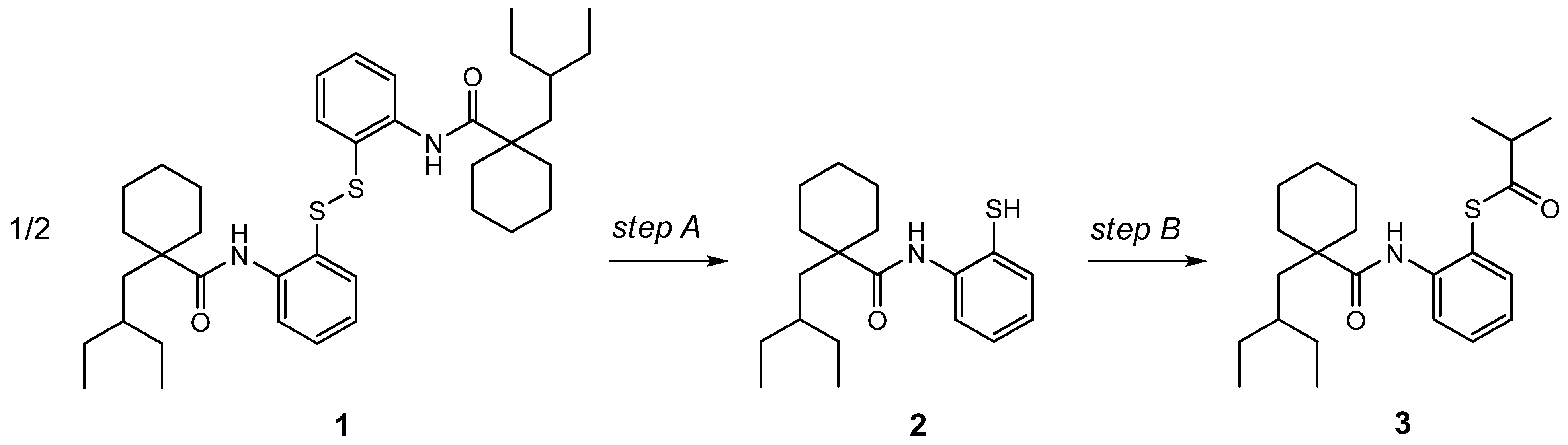
      <p>Cholesteryl Ester Transfer Protein (CETP) inhibitors [<xref ref-type="bibr" rid="B1-crystals-02-01455">1</xref>] are investigated as high density lipoprotein-cholesterol (HDL-C) raising agents with beneficial effects on atherosclerosis. A series of <italic>S</italic>-(2-(acylamino)phenyl) alkanethioates was evaluated, and <italic>S</italic>-(2-((1-(2-ethylbutyl)cyclohexane)carbonyl-amino)phenyl) 2-methylpropanethioate was found to exhibit significant inhibition of CETP activity in animals [<xref ref-type="bibr" rid="B2-crystals-02-01455">2</xref>,<xref ref-type="bibr" rid="B3-crystals-02-01455">3</xref>] and clinical trials [<xref ref-type="bibr" rid="B4-crystals-02-01455">4</xref>,<xref ref-type="bibr" rid="B5-crystals-02-01455">5</xref>]. It was first synthesized by reduction of the disulfide <bold>1</bold> using triphenylphosphine and subsequent acylation of the resulting thiol <bold>2</bold> to give the title compound, dalcetrapib <bold>3</bold> (<xref ref-type="fig" rid="crystals-02-01455-f001">Figure 1</xref>) [<xref ref-type="bibr" rid="B2-crystals-02-01455">2</xref>]. A one-pot process for the preparation of <bold>3</bold> comprising acylation in the presence of a reducing agent such as phosphine, phosphinite, phosphonite, or phosphite was patented [<xref ref-type="bibr" rid="B6-crystals-02-01455">6</xref>].</p>
    </sec>
    <sec sec-type="results">
      <title>2. Results and Discussion</title>
      <p>The synthesis of dalcetrapib involves two key steps (<xref ref-type="fig" rid="crystals-02-01455-f001">Figure 1</xref>): Reduction and acylation. The patented use of phosphorus(III) compounds as reducing agents [<xref ref-type="bibr" rid="B6-crystals-02-01455">6</xref>] showed several disadvantages. The excess phosphines and resulting phosphine oxides are difficult to remove, and we intended to avoid chromatography. Methyl or ethyl phosphites (and the resulting phosphates) are alkylating agents giving rise to thioether byproducts. In addition, a patent-free synthesis was desired.</p>
      <fig id="crystals-02-01455-f001" position="anchor">
        <label>Figure 1</label>
        <caption>
          <p>Synthesis of dalcetrapib (<bold>3</bold>). Step A: reduction; Step B: acylation (see text).</p>
        </caption>
        <graphic xmlns:xlink="http://www.w3.org/1999/xlink" xlink:href="crystals-02-01455-g001.tif"/>
      </fig>
      <p>The reduction of disulfide <bold>1</bold> to thiol <bold>2</bold> using magnesium in methanol [<xref ref-type="bibr" rid="B7-crystals-02-01455">7</xref>] seemed to be a good option for the first step and proceeded smoothly. The thiol is, however, very sensitive to oxygen. The final product dalcetrapib was therefore always contaminated by a few percent of the corresponding disulfide. Purification was effected by treatment with dithiothreitol (DTT), a reagent capable of reducing disulfides and maintaining thiols in the reduced state [<xref ref-type="bibr" rid="B8-crystals-02-01455">8</xref>]. The use of this reagent gave a perfectly pure product. It is, however, rather expensive. Water-soluble phosphines, such as tris(2-carboxyethyl)-phosphine or trisodium tris(3-sulfonatophenyl)phosphine, also worked well for this purpose, but they carry an even steeper price. Consequently, a process was sought which did not require the isolation of the sensitive intermediate <bold>2</bold>. </p>
      <p>A one-pot method to obtain thiol esters directly from disulfides and acyl chlorides in the presence of zinc and aluminum trichloride [<xref ref-type="bibr" rid="B9-crystals-02-01455">9</xref>] was tried, but a new byproduct was observed. Therefore, this route was not pursued further. A thiol-disulfide interchange reaction employing inexpensive ethanethiol in the presence of 1,8-diazabicyclo[5.4.0]undec-7-ene (DBU) was found to produce thiols in a very short time [<xref ref-type="bibr" rid="B10-crystals-02-01455">10</xref>]. This concept has been successfully applied to the one-pot synthesis of dalcetrapib and has been reported by an anonymous author in an online journal [<xref ref-type="bibr" rid="B11-crystals-02-01455">11</xref>]. In our hands, however, a much higher yield was obtained (reported 52%, found 82%). A modified workup was necessary to remove an unidentified impurity beyond the limit of detection.</p>
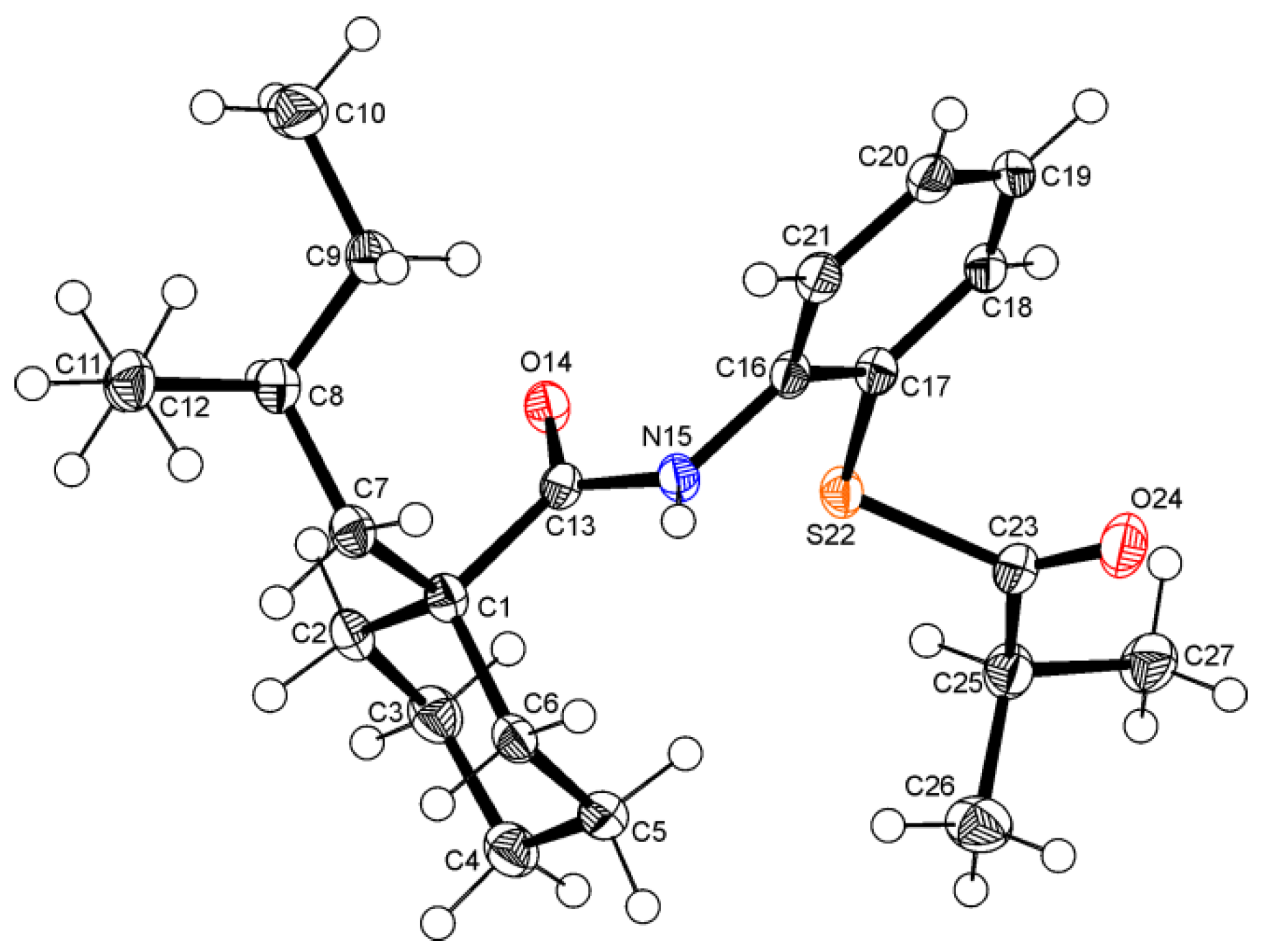
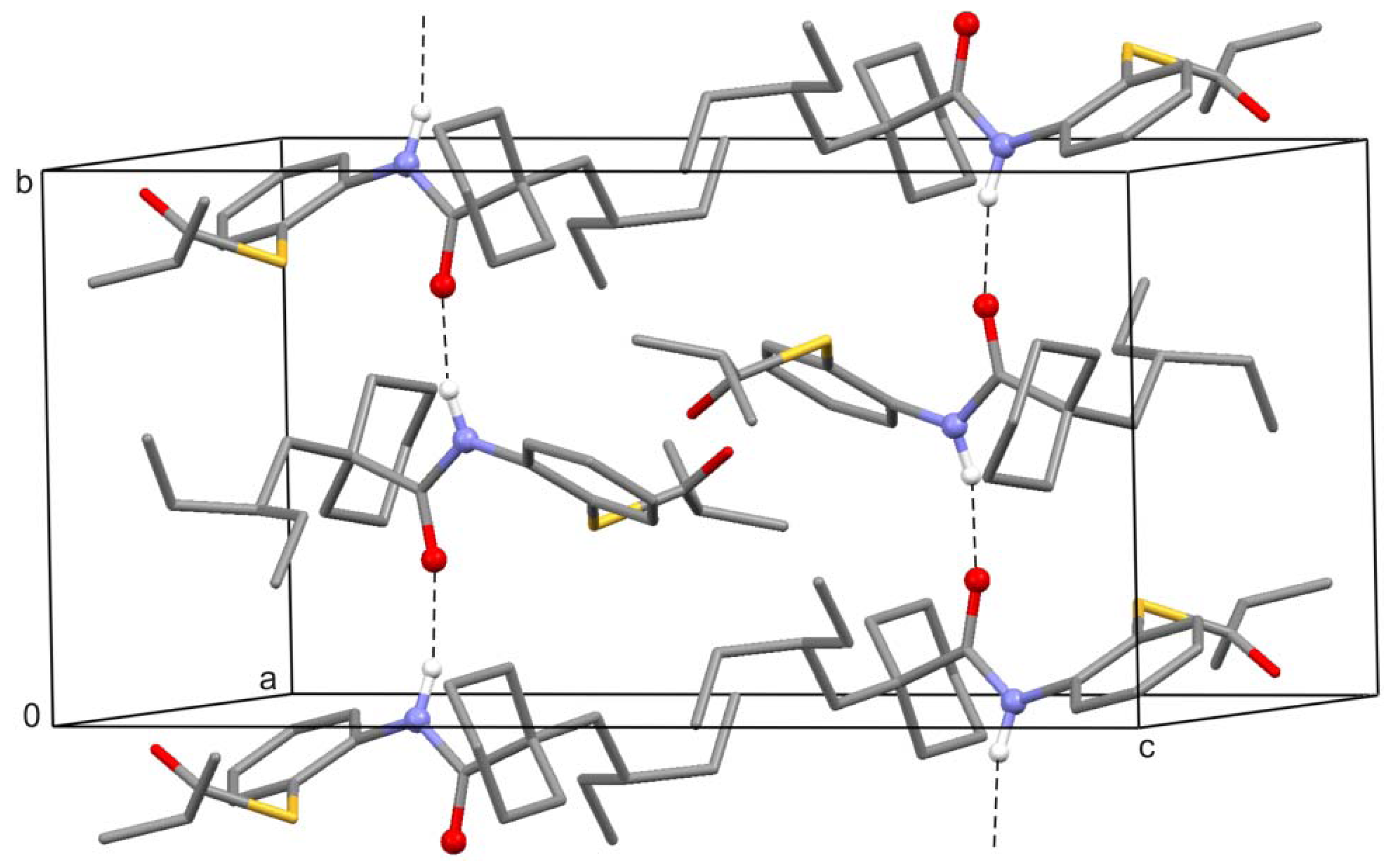
      <p>In the search for polymorphs, crystalline dalcetrapib was obtained from several solvents (ethanol, heptane, tetrahydrofuran). Powder X-ray diffraction showed that they were identical crystalline forms. The molecular structure is shown in <xref ref-type="fig" rid="crystals-02-01455-f002">Figure 2</xref>. The cyclohexane ring adopts a typical chair conformation. The molecules are arranged in chains by N–H...O=C hydrogen bonds in the direction of the crystallographic <italic>b</italic> axis (<xref ref-type="fig" rid="crystals-02-01455-f003">Figure 3</xref>). The pertinent distances are H...O 2.02(2) Å and N...O 2.905(2) Å. The N...H...O angle is 159(2)°.</p>
      <fig id="crystals-02-01455-f002" position="anchor">
        <label>Figure 2</label>
        <caption>
          <p>O<sc>RTEP</sc> plot of dalcetrapib (thermal ellipsoids drawn at the 50% level).</p>
        </caption>
        <graphic xmlns:xlink="http://www.w3.org/1999/xlink" xlink:href="crystals-02-01455-g002.tif"/>
      </fig>
      <fig id="crystals-02-01455-f003" position="anchor">
        <label>Figure 3</label>
        <caption>
          <p>Packing diagram of dalcetrapib (3). Atoms engaged in hydrogen bonding are drawn as balls, and all other hydrogen atoms are omitted for clarity.</p>
        </caption>
        <graphic xmlns:xlink="http://www.w3.org/1999/xlink" xlink:href="crystals-02-01455-g003.tif"/>
      </fig>
    </sec>
    <sec>
      <title>3. Experimental Section</title>
      <p>The disulfide <bold>1</bold> [211513-15-4] has been prepared according to the literature [<xref ref-type="bibr" rid="B2-crystals-02-01455">2</xref>]. <sup>1</sup>H NMR spectra of thiol <bold>2</bold> [211513-21-2] and dalcetrapib <bold>3</bold> [211513-37-0] have been previously published [<xref ref-type="bibr" rid="B2-crystals-02-01455">2</xref>]. </p>
      <sec>
        <title>3.1. Two-Step Synthesis of Dalcetrapib (<bold>3</bold>)</title>
        <p>Mg turnings (1.1 g) were added to a solution of the disulfide <bold>1</bold> (10.0 g) in MeOH (100 mL). The reaction mixture was stirred under argon for 9 h in a water bath to keep the temperature below 50 °C. The solvent was removed and the residue partitioned between 1M HCl (100 mL) and EtOAc (100 mL). The organic phase was washed with brine (60 mL), then dried over MgSO<sub>4</sub>, and taken to dryness to give the thiol <bold>2</bold> as a foul-smelling oil, which solidified overnight (yield 98%). This intermediate was dissolved in anhydrous CH<sub>2</sub>Cl<sub>2</sub> (70 mL). Pyridine (6 mL) was added and, dropwise, isobutyryl chloride (3.4 mL). The mixture was stirred at room temperature for 3 h. After removal of the solvent, the residue was redissolved in EtOAc (100 mL) and washed with H<sub>2</sub>O (100 mL), 1M HCl (100 mL), 1M NaOH (100 mL), and brine (100 mL). The solvent was evaporated, and the crude product was dissolved in Et<sub>2</sub>O (200 mL) and vigorously stirred with a solution of DTT (0.8 g) and NaHCO<sub>3</sub> (0.5 g) in H<sub>2</sub>O (40 mL) at room temperature for 45 min. The organic phase was separated, washed with 1M NaOH (140 mL) and H<sub>2</sub>O (100 mL), and the solvent was evaporated. The residue was dissolved in EtOH (40 mL) and precipitated by slow addition of H<sub>2</sub>O (40 mL) with stirring for 1 h. The crystalline product <bold>3</bold> was filtered off, washed with H<sub>2</sub>O (40 mL), and dried over P<sub>2</sub>O<sub>5</sub> in vacuum. Yield: 77%. The single crystals were obtained by cooling of a hot solution in EtOH (from 80 °C to 20 °C in 3 h).</p>
      </sec>
      <sec>
        <title>3.2. One-Pot Synthesis of Dalcetrapib (<bold>3</bold>)</title>
        <p>Isobutyryl chloride (2.0 mL) was added to a stirred solution of the disulfide <bold>1</bold> (2.0 g), DBU (2.8 mL), and EtSH (0.7 mL) in THF (15 mL) at room temperature. After 10 min, the precipitated DBU hydrochloride was filtered off and washed with Et<sub>2</sub>O (25 mL). The filtrate was stirred with H<sub>2</sub>O (25 mL) for 20 min. The organic phase was shaken with H<sub>2</sub>O (25 mL) and saturated NaHCO<sub>3</sub> solution (25 mL). After removal of the volatiles, the residue was dissolved in heptane/MeOH (20/14 mL) and stirred with 1% H<sub>2</sub>O<sub>2</sub> (6 mL) at 35 °C for 1 h. The organic phase was separated, washed four times with a mixture of MeOH (3 mL) and H<sub>2</sub>O (1 mL), and taken to dryness. The residue was crystallized as described above. Yield: 82%.</p>
      </sec>
      <sec>
        <title>3.3. Spectroscopic and Crystal Structure Data</title>
        <p>Disulfide (<bold>1</bold>): <sup>1</sup>H NMR (300 MHz, CDCl<sub>3</sub>): <italic>δ</italic> 0.70 (t, <italic>J</italic> = 7.3 Hz, 6H), 1.2–1.6 (m, H), 2.0 (m, 2H), 6.91 (Td, <italic>J</italic> = 6.9 Hz, <italic>J</italic> = 1.2 Hz, 1H), 7.12 (dd, <italic>J</italic> = 7.7 Hz, <italic>J</italic> = 1.5 Hz, 1H), 7.41 (Td, <italic>J</italic> = 7.7 Hz, <italic>J</italic> = 1.5 Hz, 1H), 8.48 (dd, <italic>J</italic> = 8.3 Hz, <italic>J</italic> = 1.1 Hz, 1H), 8.59 (br s, 1H) ppm. <sup>13</sup>C NMR (75 MHz, CDCl<sub>3</sub>): <italic>δ</italic> 11.2, 23.5, 26.4, 27.2, 35.4, 36.2, 45.3, 48.3, 120.9, 122.8, 123.9, 132.6, 136.8, 140.3, 175.4 ppm. IR (neat): <italic>ν</italic> 3387 w, 2956 m, 2924 m, 2855 m, 1686 m, 1576 m, 1503 s, 1459 m, 1425 s, 1290 m, 753 s cm<sup>−1</sup>.</p>
        <p>Thiol (<bold>2</bold>): <sup>1</sup>H NMR, see [<xref ref-type="bibr" rid="B2-crystals-02-01455">2</xref>]. <sup>13</sup>C NMR (75 MHz, CDCl<sub>3</sub>): <italic>δ</italic> 11.1, 23.5, 26.4, 27.2, 35.5, 36.3, 45.6, 48.2, 116.5, 121.3, 124.1, 129.7, 135.5, 139.6, 175.2 ppm. IR (neat): <italic>ν</italic> 3377 w, 2957 m, 2927 m, 2869 m, 2850 m, 2507 w, 1644 s, 1507 s, 1459 m, 1439 s, 1287 m, 748 s·cm<sup>−1</sup>.</p>
        <p>Dalcetrapib (<bold>3</bold>): <sup>1</sup>H NMR, see [<xref ref-type="bibr" rid="B2-crystals-02-01455">2</xref>]. <sup>13</sup>C NMR (75 MHz, CDCl<sub>3</sub>): <italic>δ</italic> 11.1, 19.7, 23.4, 26.3, 27.2, 35.6, 36.2, 43.5, 45.7, 48.1, 116.9, 122.1, 124.4, 131.8, 136.4, 140.5, 175.1, 201.5 ppm. IR (neat): <italic>ν</italic> 3302 w, 2965 m, 2922 m, 2862 m, 1697 s, 1644 m, 1506 m, 1475 s, 959 s, 856 m, 754 s cm<sup>−1</sup>.</p>
        <p>Oxford Diffraction Gemini R Ultra diffractometer, Cu-K<italic>α</italic> radiation; <italic>ω</italic> scans; <italic>T</italic> = 100(2) K; <italic>θ</italic><sub>max</sub> = 67.2°; indices: −12 ≤ <italic>h</italic> ≤ 12, −11 ≤ <italic>k</italic> ≤ 10, −21 ≤ <italic>l</italic> ≤ 24; <italic>D</italic><sub>x</sub> = 1.20 g·cm<sup>−3</sup>; 13476 reflections measured, 3624 independent with <italic>R</italic><sub>int</sub> = 0.048, <italic>F</italic>(000) = 848, <italic>μ</italic> = 1.46 mm<sup>−1</sup>. Crystal data for C<sub>23</sub>H<sub>35</sub>NO<sub>2</sub>S (<italic>M</italic> = 389.6 g·mol<sup>−1</sup>). Monoclinic, <italic>P</italic>2<sub>1</sub>/<italic>c</italic>, <italic>a</italic> = 10.7572(3), <italic>b</italic> = 9.7154(3), <italic>c</italic> = 20.5873(6) Å, <italic>β</italic> = 90.003(3)°, <italic>V</italic> = 2151.59(11) Å<sup>3</sup>, <italic>Z</italic> = 4. <italic>R</italic><sub>1</sub> = 0.039 and <italic>wR</italic><sub>2</sub> = 0.089 for 2668 reflections with <italic>I</italic> &gt; 2<italic>σ</italic>(<italic>I</italic>), 251 parameters, <italic>R</italic><sub>1</sub> = 0.058 and <italic>wR</italic><sub>2</sub> = 0.094 for all data; <italic>S</italic> = 0.93; ∆<italic>ρ</italic><sub>max</sub> = 0.21 and ∆<italic>ρ</italic><sub>max</sub> = −0.32 e Å<sup>−3</sup>. CCDC reference number: 895592.</p>
      </sec>
    </sec>
    <sec sec-type="conclusions">
      <title>4. Conclusions</title>
      <p>The new synthetic procedures are superior to the patented processes in terms of purity and yield. Remarkably, the flexible alkyl chains did not exhibit any disorder in the crystal.</p>
    </sec>
  </body>
  <back>
    <ref-list>
      <title>References</title>
      <ref id="B1-crystals-02-01455">
        <label>1.</label>
        <citation citation-type="journal">
          <person-group person-group-type="author">
            <name>
              <surname>Sinclair</surname>
              <given-names>P.J.</given-names>
            </name>
          </person-group>
          <article-title>Emerging topics in atherosclerosis: HDL raising therapies</article-title>
          <source>Annu. Rep. Med. Chem.</source>
          <year>2005</year>
          <volume>40</volume>
          <fpage>71</fpage>
          <lpage>83</lpage>
          <pub-id pub-id-type="doi">10.1016/S0065-7743(05)40005-6</pub-id>
        </citation>
      </ref>
      <ref id="B2-crystals-02-01455">
        <label>2.</label>
        <citation citation-type="journal">
          <person-group person-group-type="author">
            <name>
              <surname>Shinkai</surname>
              <given-names>H.</given-names>
            </name>
            <name>
              <surname>Maeda</surname>
              <given-names>K.</given-names>
            </name>
            <name>
              <surname>Yamasaki</surname>
              <given-names>T.</given-names>
            </name>
            <name>
              <surname>Okamoto</surname>
              <given-names>H.</given-names>
            </name>
            <name>
              <surname>Uchida</surname>
              <given-names>I.</given-names>
            </name>
          </person-group>
          <article-title>Bis(2-(Acylamino)phenyl) disulfides, 2-(acylamino)benzenethiols, and <italic>S</italic>-(2-(acylamino)phenyl) alkanethioates as novel inhibitors of cholesteryl ester transfer protein</article-title>
          <source>J. Med. Chem.</source>
          <year>2000</year>
          <volume>43</volume>
          <fpage>3566</fpage>
          <lpage>3572</lpage>
          <pub-id pub-id-type="doi">10.1021/jm000224s</pub-id>
        </citation>
      </ref>
      <ref id="B3-crystals-02-01455">
        <label>3.</label>
        <citation citation-type="patent">
          <person-group person-group-type="author">
            <name>
              <surname>Sunami</surname>
              <given-names>M.</given-names>
            </name>
            <name>
              <surname>Serigano</surname>
              <given-names>T.</given-names>
            </name>
          </person-group>
          <article-title>Pharmaceutical compositions of CETP inhibitors</article-title>
          <source>Int. Patent WO</source>
          <patent>2004/082593 A2</patent>
          <year>2004</year>
        </citation>
      </ref>
      <ref id="B4-crystals-02-01455">
        <label>4.</label>
        <citation citation-type="journal">
          <person-group person-group-type="author">
            <name>
              <surname>Shinkai</surname>
              <given-names>H.</given-names>
            </name>
          </person-group>
          <article-title>Cholesteryl ester transfer-protein modulator and inhibitors and their potential for the treatment of cardiovascular diseases</article-title>
          <source>Vasc. Health Risk Manag.</source>
          <year>2012</year>
          <volume>8</volume>
          <fpage>323</fpage>
          <lpage>331</lpage>
          <pub-id pub-id-type="doi">10.2147/VHRM.S25238</pub-id>
        </citation>
      </ref>
      <ref id="B5-crystals-02-01455">
        <label>5.</label>
        <citation citation-type="journal">
          <person-group person-group-type="author">
            <name>
              <surname>Luescher</surname>
              <given-names>T.F.</given-names>
            </name>
            <name>
              <surname>Taddei</surname>
              <given-names>S.</given-names>
            </name>
            <name>
              <surname>Kaski</surname>
              <given-names>J.-C.</given-names>
            </name>
            <name>
              <surname>Jukema</surname>
              <given-names>J.W.</given-names>
            </name>
            <name>
              <surname>Kallend</surname>
              <given-names>D.</given-names>
            </name>
            <name>
              <surname>Muenzel</surname>
              <given-names>T.</given-names>
            </name>
            <name>
              <surname>Kastelein</surname>
              <given-names>J.J.P.</given-names>
            </name>
            <name>
              <surname>Deanfield</surname>
              <given-names>J.E.</given-names>
            </name>
          </person-group>
          <article-title>Vascular effects and safety of dalcetrapib in patients with or at risk of coronary heart disease: The dal-VESSEL randomized clinical trial</article-title>
          <source>Eur. Heart J.</source>
          <year>2012</year>
          <volume>33</volume>
          <fpage>857</fpage>
          <lpage>865</lpage>
          <pub-id pub-id-type="doi">10.1093/eurheartj/ehs019</pub-id>
        </citation>
      </ref>
      <ref id="B6-crystals-02-01455">
        <label>6.</label>
        <citation citation-type="patent">
          <person-group person-group-type="author">
            <name>
              <surname>Costello</surname>
              <given-names>D.</given-names>
            </name>
            <name>
              <surname>Harnett</surname>
              <given-names>G.J.</given-names>
            </name>
            <name>
              <surname>Hidber</surname>
              <given-names>P.</given-names>
            </name>
            <name>
              <surname>Hoffmann</surname>
              <given-names>U.</given-names>
            </name>
            <name>
              <surname>McCarthy</surname>
              <given-names>T.</given-names>
            </name>
            <name>
              <surname>Reents</surname>
              <given-names>R.</given-names>
            </name>
            <name>
              <surname>Smith</surname>
              <given-names>D.A.</given-names>
            </name>
            <name>
              <surname>Smyth</surname>
              <given-names>T.</given-names>
            </name>
          </person-group>
          <article-title>Process for the preparation of <italic>S</italic>-2-[1-(2-ethylbutyl)cyclohexylcarbonylamino]phenyl] 2-methylthiopropionate (dalcetrapib) using isobutyric anhydride and a reducing agent</article-title>
          <source>Int. Patent WO</source>
          <patent>2011/000793 A2</patent>
          <year>2011</year>
        </citation>
      </ref>
      <ref id="B7-crystals-02-01455">
        <label>7.</label>
        <citation citation-type="journal">
          <person-group person-group-type="author">
            <name>
              <surname>Sridhar</surname>
              <given-names>M.</given-names>
            </name>
            <name>
              <surname>Vadivel</surname>
              <given-names>S.K.</given-names>
            </name>
            <name>
              <surname>Bhalerao</surname>
              <given-names>U.T.</given-names>
            </name>
          </person-group>
          <article-title>Reduction of symmetric disulfides to thiols using Mg in methanol</article-title>
          <source>Synth. Commun.</source>
          <year>1997</year>
          <volume>27</volume>
          <fpage>1347</fpage>
          <lpage>1350</lpage>
          <pub-id pub-id-type="doi">10.1080/00397919708006063</pub-id>
        </citation>
      </ref>
      <ref id="B8-crystals-02-01455">
        <label>8.</label>
        <citation citation-type="journal">
          <person-group person-group-type="author">
            <name>
              <surname>Cleland</surname>
              <given-names>W.W.</given-names>
            </name>
          </person-group>
          <article-title>Dithiothreitol, a new protective reagent for SH groups</article-title>
          <source>Biochemistry</source>
          <year>1964</year>
          <volume>3</volume>
          <fpage>480</fpage>
          <lpage>482</lpage>
          <pub-id pub-id-type="doi">10.1021/bi00892a002</pub-id>
        </citation>
      </ref>
      <ref id="B9-crystals-02-01455">
        <label>9.</label>
        <citation citation-type="journal">
          <person-group person-group-type="author">
            <name>
              <surname>Lakouraj</surname>
              <given-names>M.M.</given-names>
            </name>
            <name>
              <surname>Movassagh</surname>
              <given-names>B.</given-names>
            </name>
            <name>
              <surname>Fadaei</surname>
              <given-names>Z.</given-names>
            </name>
          </person-group>
          <article-title>Convenient synthesis of thiol esters from acyl chlorides and disulfides using Zn/AlCl<sub>3</sub></article-title>
          <source>Monatsh. Chem.</source>
          <year>2002</year>
          <volume>133</volume>
          <fpage>1085</fpage>
          <lpage>1088</lpage>
          <pub-id pub-id-type="doi">10.1007/s007060200078</pub-id>
        </citation>
      </ref>
      <ref id="B10-crystals-02-01455">
        <label>10.</label>
        <citation citation-type="journal">
          <person-group person-group-type="author">
            <name>
              <surname>Zhu</surname>
              <given-names>N.</given-names>
            </name>
            <name>
              <surname>Zhang</surname>
              <given-names>F.</given-names>
            </name>
            <name>
              <surname>Liu</surname>
              <given-names>G.</given-names>
            </name>
          </person-group>
          <article-title>Dynamic covalent chemistry of disulfides offers a highly efficient synthesis of diverse benzofused nitrogen-sulfur heterocycles in one pot</article-title>
          <source>J. Comb. Chem.</source>
          <year>2010</year>
          <volume>12</volume>
          <fpage>531</fpage>
          <lpage>540</lpage>
          <pub-id pub-id-type="doi">10.1021/cc100042v</pub-id>
        </citation>
      </ref>
      <ref id="B11-crystals-02-01455">
        <label>11.</label>
        <citation citation-type="web">
          <article-title>Anonymous. <italic>S</italic>-[2-({[2-Ethylbutyl)cyclohexyl]carbonyl}amino)phenyl] 2-methylpropanethioate</article-title>
          <access-date>(accessed on 15 October 2012)</access-date>
          <comment>Available online:<ext-link xmlns:xlink="http://www.w3.org/1999/xlink" xlink:href="http://ip.com/IPCOM/000205232" ext-link-type="uri">http://ip.com/IPCOM/000205232</ext-link></comment>
        </citation>
      </ref>
    </ref-list>
  </back>
</article>