<?xml version="1.0" encoding="UTF-8"?>
<!DOCTYPE article PUBLIC "-//NLM//DTD Journal Publishing DTD v2.3 20070202//EN" "journalpublishing.dtd">
<article xmlns:mml="http://www.w3.org/1998/Math/MathML" xmlns:xlink="http://www.w3.org/1999/xlink" xml:lang="en" article-type="research-article">
  <front>
    <journal-meta>
      <journal-id journal-id-type="publisher-id">crystals</journal-id>
      <journal-title>Crystals</journal-title>
      <abbrev-journal-title abbrev-type="publisher">Crystals</abbrev-journal-title>
      <abbrev-journal-title abbrev-type="pubmed">Crystals</abbrev-journal-title>
      <issn pub-type="epub">2073-4352</issn>
      <publisher>
        <publisher-name>MDPI</publisher-name>
      </publisher>
    </journal-meta>
    <article-meta>
      <article-id pub-id-type="doi">10.3390/cryst2030974</article-id>
      <article-id pub-id-type="publisher-id">crystals-02-00974</article-id>
      <article-categories>
        <subj-group>
          <subject>Article</subject>
        </subj-group>
      </article-categories>
      <title-group>
        <article-title>1,5-Diaminopentane As A Structure-Directing Agent for Zincophosphate Networks: Zn<sub>3</sub>(PO<sub>4</sub>)<sub>2</sub>(C<sub>5</sub>H<sub>14</sub>N<sub>2</sub>)<sub>2</sub>·3H<sub>2</sub>O and C<sub>5</sub>H<sub>16</sub>N<sub>2</sub>·Zn<sub>3</sub>(PO<sub>4</sub>)<sub>2</sub>(HPO<sub>4</sub>)·H<sub>2</sub>O </article-title>
      </title-group>
      
      <contrib-group>
        <contrib contrib-type="author">
          <name>
            <surname>Harrison</surname>
            <given-names>William T.A.</given-names>
          </name>
          <xref rid="c1-crystals-02-00974" ref-type="corresp">*</xref>
        </contrib>
        <contrib contrib-type="author">
          <name>
            <surname>Currie</surname>
            <given-names>William R.</given-names>
          </name>
        </contrib>
      </contrib-group>
      <aff id="af1-crystals-02-00974">Department of Chemistry, University of Aberdeen, Meston Walk, Aberdeen AB24 3UE, Scotland, UK; Email: <email>curriedbill@gmail.com</email></aff>
      <author-notes>
        <corresp id="c1-crystals-02-00974"><label>*</label> Author  to whom correspondence should be addressed; Email: <email>w.harrison@abdn.ac.uk</email>; Tel.: +44-1224-272897; Fax: +44-1224-272921.</corresp>
      </author-notes>
      <pub-date pub-type="epub">
        <day>16</day>
        <month>07</month>
        <year>2012</year>
      </pub-date>
      <pub-date pub-type="collection"><month>09</month>
        <year>2012</year>
      </pub-date>
      <volume>2</volume>
      <issue>3</issue>
      <fpage>974</fpage>
      <lpage>983</lpage>
      <history>
        <date date-type="received">
          <day>05</day>
          <month>06</month>
          <year>2012</year>
        </date>
        <date date-type="rev-recd">
          <day>28</day>
          <month>06</month>
          <year>2012</year>
        </date>
        <date date-type="accepted">
          <day>03</day>
          <month>07</month>
          <year>2012</year>
        </date>
      </history>
      <permissions>
        <copyright-statement>©  2012 by the authors; licensee MDPI, Basel, Switzerland.</copyright-statement>
        <copyright-year>2012</copyright-year>
        <license xmlns:xlink="http://www.w3.org/1999/xlink" license-type="open-access" xlink:href="http://creativecommons.org/licenses/by/3.0/">
          <p>This article is an open-access article distributed under the terms and conditions of the Creative Commons Attribution license (http://creativecommons.org/licenses/by/3.0/).</p>
        </license>
      </permissions>
      <abstract>
        <p>The crystal structures of two zincophosphate networks prepared in the presence of 1,5-diaminopentane (dap) are described. In Zn<sub>3</sub>(PO<sub>4</sub>)<sub>2</sub>(C<sub>5</sub>H<sub>14</sub>N<sub>2</sub>)<sub>2</sub>·3H<sub>2</sub>O (<bold>1</bold>) the dap forms Zn–N coordinate bonds to generate an unusual three-dimensional “hybrid” framework constructed from ZnO<sub>3</sub>N, ZnO<sub>2</sub>N<sub>2</sub> and PO<sub>4</sub> tetrahedra with three different types of elongated channels occupied by water molecules. In C<sub>5</sub>H<sub>16</sub>N<sub>2</sub>·Zn<sub>3</sub>(PO<sub>4</sub>)<sub>2</sub>(HPO<sub>4</sub>)·H<sub>2</sub>O; (<bold>2</bold>) the doubly-protonated H<sub>2</sub>dap acts in a more typical way to template double layers of vertex-sharing ZnO<sub>4</sub>, PO<sub>4</sub> and HPO<sub>4</sub> tetrahedra incorporating 10-rings and interacts with the inorganic component <italic>via</italic> N–H O hydrogen bonds. Crystal data: <bold>1</bold> (C<sub>10</sub>H<sub>34</sub>N<sub>4</sub>O<sub>11</sub>P<sub>2</sub>Zn<sub>3</sub>), <italic>M</italic><sub>r</sub> = 644.46, monoclinic, <italic>C</italic>2 (No. 4), <italic>Z</italic> = 4, <italic>a</italic> = 25.302 (7) Å, <italic>b</italic> = 4.9327 (13) Å, <italic>c</italic> = 19.808 (6) Å, β = 107.377 (8)°, <italic>V</italic> = 2359.4 (12) Å<sup>3</sup>, <italic>R</italic>(<italic>F</italic>) = 0.054, <italic>wR</italic>(<italic>F</italic><sup>2</sup>) = 0.139. <bold>2</bold> (C<sub>5</sub>H<sub>19</sub>N<sub>2</sub>O<sub>13</sub>P<sub>3</sub>Zn<sub>3</sub>), <italic>M</italic><sub>r</sub> = 604.24, monoclinic, <italic>P</italic>2<sub>1</sub>/<italic>c</italic> (No. 14), <italic>Z</italic> = 4, <italic>a</italic> = 11.3275 (15) Å, <italic>b</italic> = 8.3235 (11) Å, <italic>c</italic> = 18.588 (2) Å, β = 96.979 (3)°, <italic>V</italic> = 1739.6 (4) Å<sup>3</sup>, <italic>R</italic>(<italic>F</italic>) = 0.056, <italic>wR</italic>(<italic>F</italic><sup>2</sup>) = 0.119. </p>
      </abstract>
      <kwd-group>
        <kwd>zincophosphate</kwd>
        <kwd>framework</kwd>
        <kwd>template</kwd>
        <kwd>hydrogen bonds </kwd>
      </kwd-group>
    </article-meta>
  </front>
  <body>
    <sec sec-type="intro">
      <title>1. Introduction</title>
      <p>Linear-chain alkyl diamines of formula H<sub>2</sub>N(CH<sub>2</sub>)<italic><sub>n</sub></italic>NH<sub>2</sub> are versatile and effective templates for a wide variety of porous inorganic networks incorporating many different metal ions [<xref ref-type="bibr" rid="B1-crystals-02-00974">1</xref>,<xref ref-type="bibr" rid="B2-crystals-02-00974">2</xref>,<xref ref-type="bibr" rid="B3-crystals-02-00974">3</xref>,<xref ref-type="bibr" rid="B4-crystals-02-00974">4</xref>]. As might be expected, the chain length <italic>n</italic> of the methylene groups of the diamine plays an important role in defining the resulting crystal structure: this is demonstrated with diamine-templated zinc phosphates (ZnPOs) and varied structures with <italic>n</italic> = 2 (<italic>i.e</italic>., ethylenediamine) [<xref ref-type="bibr" rid="B5-crystals-02-00974">5</xref>], <italic>n</italic> = 3 [<xref ref-type="bibr" rid="B6-crystals-02-00974">6</xref>], <italic>n</italic> = 4 [<xref ref-type="bibr" rid="B7-crystals-02-00974">7</xref>] and <italic>n</italic> = 6 [<xref ref-type="bibr" rid="B8-crystals-02-00974">8</xref>] have been described. </p>
      <p>As an extension of these studies we now describe the structures of two zincophosphate networks incorporating the <italic>n</italic> = 5 member of this series, 1,5-diaminopentane [H<sub>2</sub>N(CH<sub>2</sub>)<sub>5</sub>NH<sub>2</sub>; C<sub>5</sub>H<sub>14</sub>N<sub>2</sub>; dap], as the structure-directing agent. In Zn<sub>3</sub>(PO<sub>4</sub>)<sub>2</sub>(C<sub>5</sub>H<sub>14</sub>N<sub>2</sub>)<sub>2</sub>·3H<sub>2</sub>O (<bold>1</bold>) the neutral dap molecule bonds directly to the zinc ions as a bridging ligand to generate an unusual structure containing elongated “hybrid” channels containing water molecules, whereas in C<sub>5</sub>H<sub>16</sub>N<sub>2</sub>·Zn<sub>3</sub>(PO<sub>4</sub>)<sub>2</sub>(HPO<sub>4</sub>)·H<sub>2</sub>O; (<bold>2</bold>) doubly-protonated H<sub>2</sub>dap dications help to template a layered ZnPO network <italic>via</italic> N-H O hydrogen bonds. So far as we are aware, there are no other known dap-ZnPO structures, although H<sub>2</sub>dap dications have been shown to template zinc phosphite (containing HPO<sub>3</sub><sup>2−</sup> groups) [<xref ref-type="bibr" rid="B9-crystals-02-00974">9</xref>] and zinc diphosphonate [<xref ref-type="bibr" rid="B10-crystals-02-00974">10</xref>] materials. </p>
    </sec>
    <sec sec-type="results">
      <title>2. Results and Discussion</title>
      <sec>
        <title>2.1. Crystal Structure of Zn<sub>3</sub>(PO<sub>4</sub>)<sub>2</sub>(C<sub>5</sub>H<sub>14</sub>N<sub>2</sub>)<sub>2</sub>·3H<sub>2</sub>O (1)</title>
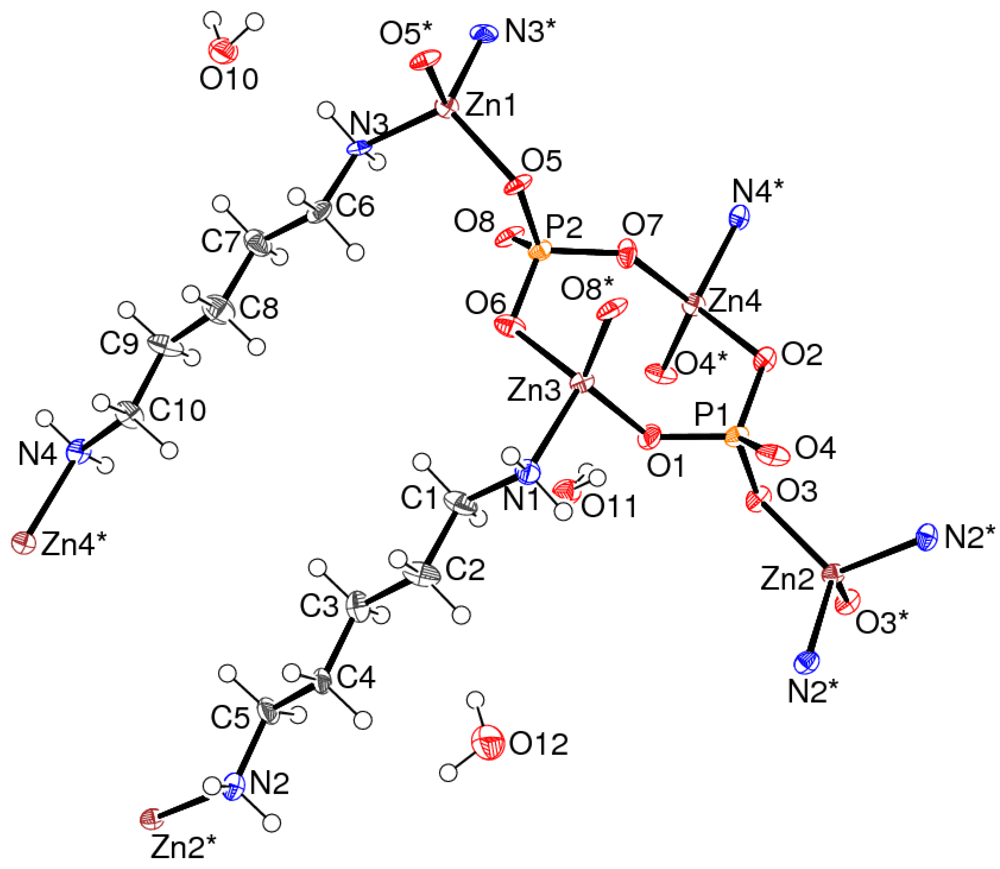
        <p>The asymmetric unit of compound <bold>1</bold> contains four Zn atoms, two P atoms, 11 O atoms (three of which belong to water molecules) and two C<sub>5</sub>H<sub>14</sub>N<sub>2</sub> (dap) molecules (<xref ref-type="fig" rid="crystals-02-00974-f001">Figure 1</xref>). </p>
        <fig id="crystals-02-00974-f001" position="anchor">
          <label>Figure 1</label>
          <caption>
            <p>The asymmetric unit of <bold>1</bold> (50% displacement ellipsoids) expanded to show the Zn coordination spheres. Atoms with a * suffix to their labels are symmetry generated (see <xref ref-type="table" rid="crystals-02-00974-t001">Table 1</xref>). </p>
          </caption>
          <graphic xmlns:xlink="http://www.w3.org/1999/xlink" xlink:href="crystals-02-00974-g001.tif"/>
        </fig>
        <table-wrap id="crystals-02-00974-t001" position="anchor">
          <object-id pub-id-type="pii">crystals-02-00974-t001_Table 1</object-id>
          <label>Table 1</label>
          <caption>
            <p>Selected bond distances (Å) and angles (°) in <bold>1</bold>.</p>
          </caption>
          <table>
            <thead>
              <tr>
                <th align="center" valign="middle">Bond</th>
                <th align="center" valign="middle">Distance</th>
                <th align="center" valign="middle">Bond</th>
                <th align="center" valign="middle">Distance</th>
              </tr>
            </thead>
            <tbody>
              <tr style="border-top: solid thin">
                <td align="center" valign="middle">Zn1-O5</td>
                <td align="center" valign="middle">1.964 (9)</td>
                <td align="center" valign="middle">Zn1-N3</td>
                <td align="center" valign="middle">2.037 (13)</td>
              </tr>
              <tr>
                <td align="center" valign="middle">Zn2-O3</td>
                <td align="center" valign="middle">1.914 (9)</td>
                <td align="center" valign="middle">Zn2-N2#1</td>
                <td align="center" valign="middle">2.027 (11)</td>
              </tr>
              <tr>
                <td align="center" valign="middle">Zn3-O8#2</td>
                <td align="center" valign="middle">1.914 (10)</td>
                <td align="center" valign="middle">Zn3-O1</td>
                <td align="center" valign="middle">1.933 (7)</td>
              </tr>
              <tr>
                <td align="center" valign="middle">Zn3-O6</td>
                <td align="center" valign="middle">1.943 (11)</td>
                <td align="center" valign="middle">Zn3-N1</td>
                <td align="center" valign="middle">2.032 (10)</td>
              </tr>
              <tr>
                <td align="center" valign="middle">Zn4-O2</td>
                <td align="center" valign="middle">1.939 (10)</td>
                <td align="center" valign="middle">Zn4-O7</td>
                <td align="center" valign="middle">1.942 (7)</td>
              </tr>
              <tr>
                <td align="center" valign="middle">Zn4-O4#3</td>
                <td align="center" valign="middle">1.949 (9)</td>
                <td align="center" valign="middle">Zn4-N4#4</td>
                <td align="center" valign="middle">2.055 (10)</td>
              </tr>
              <tr>
                <td align="center" valign="middle">P1-O4</td>
                <td align="center" valign="middle">1.516 (12)</td>
                <td align="center" valign="middle">P1-O2</td>
                <td align="center" valign="middle">1.542 (8)</td>
              </tr>
              <tr>
                <td align="center" valign="middle">P1-O3</td>
                <td align="center" valign="middle">1.543 (8)</td>
                <td align="center" valign="middle">P1-O1</td>
                <td align="center" valign="middle">1.550 (8)</td>
              </tr>
              <tr>
                <td align="center" valign="middle">P2-O5</td>
                <td align="center" valign="middle">1.526 (8)</td>
                <td align="center" valign="middle">P2-O8</td>
                <td align="center" valign="middle">1.537 (13)</td>
              </tr>
              <tr>
                <td align="center" valign="middle">P2-O7</td>
                <td align="center" valign="middle">1.549 (8)</td>
                <td align="center" valign="middle">P2-O6</td>
                <td align="center" valign="middle">1.551 (8)</td>
              </tr>
              <tr style="border-top: solid thin">
                <td align="center" valign="middle">
                  <bold>Bond</bold>
                </td>
                <td align="center" valign="middle">
                  <bold>Angle</bold>
                </td>
                <td align="center" valign="middle">
                  <bold>Bond</bold>
                </td>
                <td align="center" valign="middle">
                  <bold>Angle</bold>
                </td>
              </tr>
              <tr style="border-top: solid thin">
                <td align="center" valign="middle">P1-O1-Zn3</td>
                <td align="center" valign="middle">130.4 (5)</td>
                <td align="center" valign="middle">P1-O2-Zn4</td>
                <td align="center" valign="middle">115.3 (5)</td>
              </tr>
              <tr>
                <td align="center" valign="middle">P1-O3-Zn2</td>
                <td align="center" valign="middle">125.2 (7)</td>
                <td align="center" valign="middle">P1-O4-Zn4#2</td>
                <td align="center" valign="middle">128.2 (6)</td>
              </tr>
              <tr>
                <td align="center" valign="middle">P2-O5-Zn1</td>
                <td align="center" valign="middle">121.7 (7)</td>
                <td align="center" valign="middle">P2-O6-Zn3</td>
                <td align="center" valign="middle">114.3 (5)</td>
              </tr>
              <tr>
                <td align="center" valign="middle">P2-O7-Zn4</td>
                <td align="center" valign="middle">132.6 (6)</td>
                <td align="center" valign="middle">P2-O8-Zn3#3</td>
                <td align="center" valign="middle">128.5 (6)</td>
              </tr>
            </tbody>
          </table>
          <table-wrap-foot>
          <fn>
          <p>Symmetry codes: (#1) ½−<italic>x</italic>, <italic>y</italic>−½, 1−<italic>z</italic>; (#2) <italic>x</italic>, <italic>y</italic>−1, <italic>z</italic>; (#3) <italic>x</italic>, <italic>y</italic>+1, <italic>z</italic>; (#4) <italic>x</italic>−½, <italic>y</italic>−½, <italic>z</italic>.</p>
          </fn>
          </table-wrap-foot>
        </table-wrap>
        
        <p>The zinc ions in <bold>1</bold> adopt two coordination modes: Zn1 and Zn2 (which both lie on crystallographic twofold axes) are coordinated by two O and two N atoms and Zn3 and Zn4 are bonded to three O and one N atom in tetrahedral geometries (<xref ref-type="table" rid="crystals-02-00974-t001">Table 1</xref>). The global mean Zn-O and Zn-N separations are 1.937 Å and 2.038 Å, respectively, which are very similar to the equivalent geometrical data for related compounds [<xref ref-type="bibr" rid="B11-crystals-02-00974">11</xref>]. The XO<sub>4</sub> tetrahedral angular variances, defined as <inline-graphic xmlns:xlink="http://www.w3.org/1999/xlink" xlink:href="crystals-02-00974-i001.tif"/> where ϑ is the O-X-O bond angle (°) [<xref ref-type="bibr" rid="B12-crystals-02-00974">12</xref>], indicate that all the Zn-centred tetrahedra in <bold>1</bold> are significantly distorted: values of 98.4°<sup>2</sup>, 79.8°<sup>2</sup>, 81.2°<sup>2</sup> and 85.9°<sup>2</sup> arise for Zn1, Zn2, Zn3 and Zn4, respectively. All the O atoms also link to an adjacent P atom (mean Zn-O-P = 124.5°) and the N atoms are all parts of neutral dap molecules. Both PO<sub>4</sub> groups in <bold>1</bold> are close to regular tetrahedra (mean P1-O = 1.538 Å, angular variance = 2.7°<sup>2</sup>; mean P2-O = 1.541 Å, angular variance = 1.4°<sup>2</sup>) and all the O atoms link to an adjacent Zn atom, thus there are no terminal or “dangling” P=O or P-OH bonds [<xref ref-type="bibr" rid="B13-crystals-02-00974">13</xref>] in <bold>1</bold>. The geometrical parameters for the two unique dap molecules are unexceptional [<xref ref-type="bibr" rid="B14-crystals-02-00974">14</xref>], and both molecules are in essentially extended conformations (mean absolute values of the N-C-C-C and C-C-C-C torsion angles = 177.6° and 174.7°, respectively).</p>
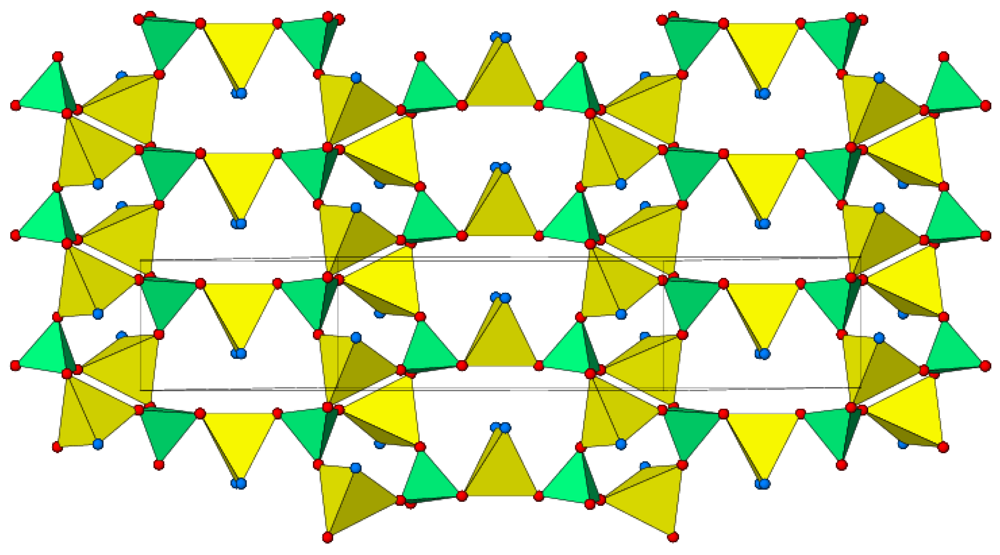
        
        <p>The polyhedral connectivity of the Zn- and P-centred moieties leads to (100) sheets of vertex-sharing tetrahedra (<xref ref-type="fig" rid="crystals-02-00974-f002">Figure 2</xref>), in which there is prefect alternation of the Zn and P nodes (<italic>i.e</italic>., no Zn-O-Zn or P-O-P links). These sheets can be decomposed into four-ring ladders [<xref ref-type="bibr" rid="B15-crystals-02-00974">15</xref>] propagating in [010] built up from the Zn3- and Zn4-centred species and the phosphate groups, with Zn1 and Zn2 (<italic>i.e</italic>., the ZnN<sub>2</sub>O<sub>2</sub> species) providing inter-chain links, as parts of polyhedral 8-rings. For any [010] stack of 8-rings, all the Zn1 (or Zn2) tetrahedra point in the same direction. </p>
        
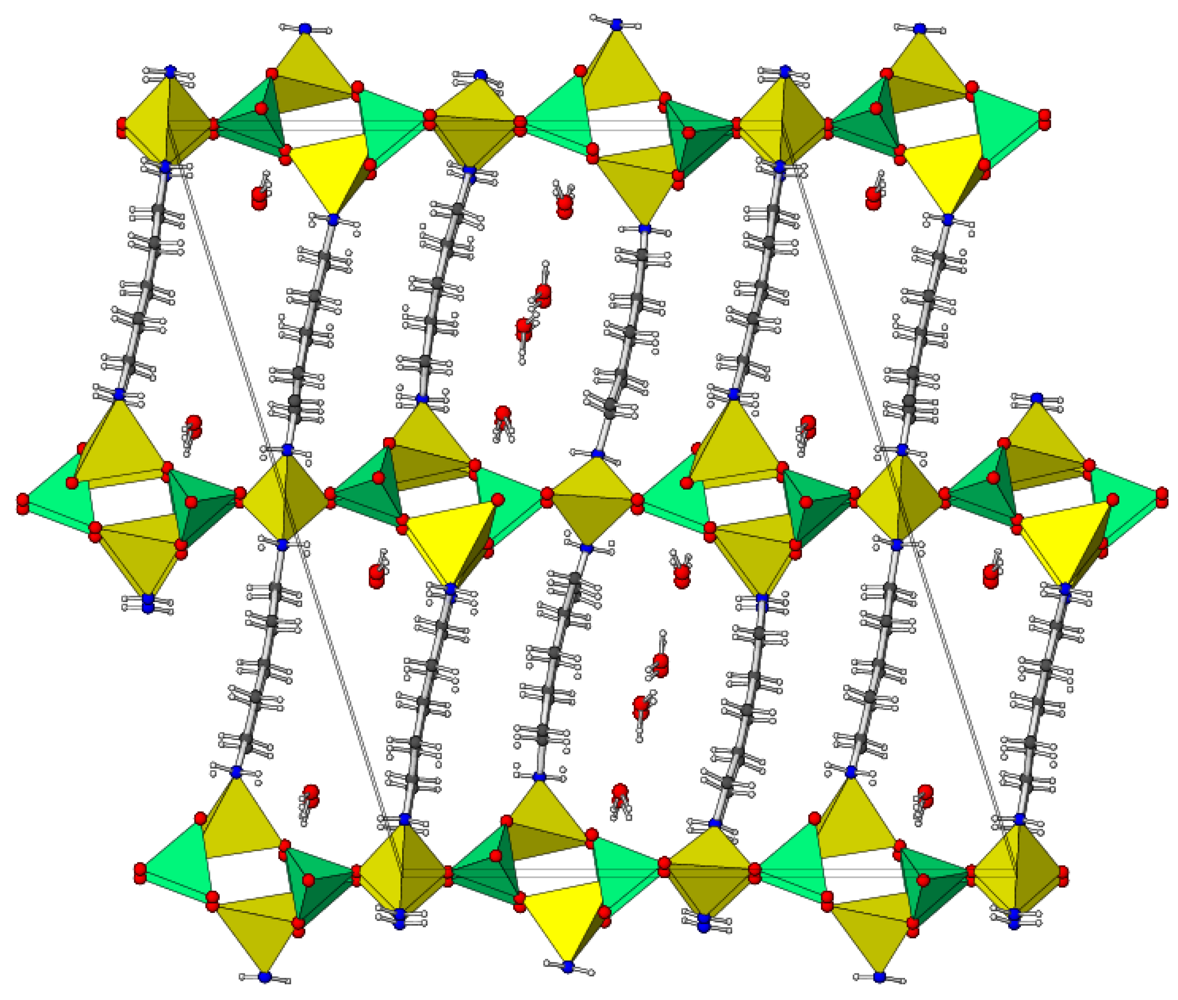
        <p>The dap molecules form bridges (<italic>via</italic> both their N atoms) to the adjacent (100) polyhedral sheets to generate a distinctive porous network (<xref ref-type="fig" rid="crystals-02-00974-f003">Figure 3</xref>), in which elongated [010] channels are bounded by the methylene groups of the dap molecules on their “long” sides and by the ZnPO framework on their “short” sides. Measured atom-to-atom, their dimensions are about 4.5 Å × 11.3 Å. It remarkable that there are three distinct types of channel in this structure: one contains four water molecules per <italic>b</italic> unit-cell repeat distance (type-A), one contains two water molecules (type-B) and the third (type-C) is empty. It is apparent from <xref ref-type="fig" rid="crystals-02-00974-f003">Figure 3</xref> that the type-A channels “bulge out” to accommodate the water molecules and the type-C channels are consequently compressed inwards and are empty.</p>
        <fig id="crystals-02-00974-f002" position="anchor">
          <label>Figure 2</label>
          <caption>
            <p>Part of a (100) tetrahedral sheet in <bold>1</bold>. Color key: Zn tetrahedra yellow, P tetrahedra green, O atoms red, N atoms blue. </p>
          </caption>
          <graphic xmlns:xlink="http://www.w3.org/1999/xlink" xlink:href="crystals-02-00974-g002.tif"/>
          
        </fig>
        <fig id="crystals-02-00974-f003" position="anchor">
          <label>Figure 3</label>
          <caption>
            <p>View approximately down [010] of the unit-cell packing in <bold>1</bold>, showing the three types of elongated channels with different water-molecule occupancies (see text). Color key as for <xref ref-type="fig" rid="crystals-02-00974-f002">Figure 2</xref>; in addition, C dark grey, H white. </p>
          </caption>
          <graphic xmlns:xlink="http://www.w3.org/1999/xlink" xlink:href="crystals-02-00974-g003.tif"/>
        </fig>
        <p>Within the type-A channel, the water molecules interact <italic>via</italic> O-H∙∙∙O hydrogen bonds (<xref ref-type="table" rid="crystals-02-00974-t002">Table 2</xref>), such that a C(2) chain of O12-H6W∙∙∙O12 bonds propagates up the central region of the channel. The other H atom attached to O12 forms a link to O11, which in turn forms two hydrogen bonds to framework O atoms. The -NH<sub>2</sub> groups of the dap molecules form N-H∙∙∙O hydrogen bonds to framework O atoms as well as the water molecules to reinforce this rather intricate network, which occurs in a largely hydrophobic environment. </p>
        <table-wrap id="crystals-02-00974-t002" position="anchor">
          <object-id pub-id-type="pii">crystals-02-00974-t002_Table 2</object-id>
          <label>Table 2</label>
          <caption>
            <p>Hydrogen bond geometries (Å and °) in <bold>1</bold>.</p>
          </caption>
          <table>
            <thead>
              <tr>
                <th align="center" valign="middle">Bond</th>
                <th align="center" valign="middle">D-H</th>
                <th align="center" valign="middle">H∙∙∙A</th>
                <th align="center" valign="middle">D∙∙∙A</th>
                <th align="center" valign="middle">D-H∙∙∙A</th>
              </tr>
            </thead>
            <tbody>
              <tr>
                <td align="center" valign="middle">N1-H1A∙∙∙O11#2</td>
                <td align="center" valign="middle">0.92</td>
                <td align="center" valign="middle">2.24</td>
                <td align="center" valign="middle">3.138 (14)</td>
                <td align="center" valign="middle">164</td>
              </tr>
              <tr>
                <td align="center" valign="middle">N1-H1B∙∙∙O6#2</td>
                <td align="center" valign="middle">0.92</td>
                <td align="center" valign="middle">2.46</td>
                <td align="center" valign="middle">2.981 (16)</td>
                <td align="center" valign="middle">116</td>
              </tr>
              <tr>
                <td align="center" valign="middle">N2-H2C...O3#5</td>
                <td align="center" valign="middle">0.92</td>
                <td align="center" valign="middle">2.30</td>
                <td align="center" valign="middle">3.131 (16)</td>
                <td align="center" valign="middle">149</td>
              </tr>
              <tr>
                <td align="center" valign="middle">N2-H2D...O11#1</td>
                <td align="center" valign="middle">0.92</td>
                <td align="center" valign="middle">2.47</td>
                <td align="center" valign="middle">3.245 (11)</td>
                <td align="center" valign="middle">142</td>
              </tr>
              <tr>
                <td align="center" valign="middle">N2-H2D∙∙∙O3#1</td>
                <td align="center" valign="middle">0.92</td>
                <td align="center" valign="middle">2.58</td>
                <td align="center" valign="middle">3.196 (16)</td>
                <td align="center" valign="middle">125</td>
              </tr>
              <tr>
                <td align="center" valign="middle">N3-H3C∙∙∙O10</td>
                <td align="center" valign="middle">0.92</td>
                <td align="center" valign="middle">2.44</td>
                <td align="center" valign="middle">3.158 (11)</td>
                <td align="center" valign="middle">136</td>
              </tr>
              <tr>
                <td align="center" valign="middle">N3-H3C∙∙∙O5#6</td>
                <td align="center" valign="middle">0.92</td>
                <td align="center" valign="middle">2.49</td>
                <td align="center" valign="middle">3.152 (16)</td>
                <td align="center" valign="middle">129</td>
              </tr>
              <tr>
                <td align="center" valign="middle">N3-H3D∙∙∙O5#3</td>
                <td align="center" valign="middle">0.92</td>
                <td align="center" valign="middle">2.28</td>
                <td align="center" valign="middle">3.081 (17)</td>
                <td align="center" valign="middle">145</td>
              </tr>
              <tr>
                <td align="center" valign="middle">N4-H4D∙∙∙O10#7</td>
                <td align="center" valign="middle">0.92</td>
                <td align="center" valign="middle">2.08</td>
                <td align="center" valign="middle">2.971 (14)</td>
                <td align="center" valign="middle">164</td>
              </tr>
              <tr>
                <td align="center" valign="middle">O10-H1W∙∙∙O7#6</td>
                <td align="center" valign="middle">0.90</td>
                <td align="center" valign="middle">1.89</td>
                <td align="center" valign="middle">2.723 (15)</td>
                <td align="center" valign="middle">152</td>
              </tr>
              <tr>
                <td align="center" valign="middle">O10-H2W∙∙∙O8#8</td>
                <td align="center" valign="middle">0.90</td>
                <td align="center" valign="middle">2.14</td>
                <td align="center" valign="middle">2.928 (11)</td>
                <td align="center" valign="middle">145</td>
              </tr>
              <tr>
                <td align="center" valign="middle">O11-H3W∙∙∙O4#3</td>
                <td align="center" valign="middle">0.91</td>
                <td align="center" valign="middle">2.30</td>
                <td align="center" valign="middle">2.973 (11)</td>
                <td align="center" valign="middle">131</td>
              </tr>
              <tr>
                <td align="center" valign="middle">O11-H4W∙∙∙O1</td>
                <td align="center" valign="middle">0.90</td>
                <td align="center" valign="middle">1.84</td>
                <td align="center" valign="middle">2.734 (15)</td>
                <td align="center" valign="middle">171</td>
              </tr>
              <tr>
                <td align="center" valign="middle">O12-H5W∙∙∙O11#1</td>
                <td align="center" valign="middle">0.90</td>
                <td align="center" valign="middle">2.07</td>
                <td align="center" valign="middle">2.941 (10)</td>
                <td align="center" valign="middle">164</td>
              </tr>
              <tr>
                <td align="center" valign="middle">O12-H6W∙∙∙O12#9</td>
                <td align="center" valign="middle">0.90</td>
                <td align="center" valign="middle">1.97</td>
                <td align="center" valign="middle">2.838 (7)</td>
                <td align="center" valign="middle">160</td>
              </tr>
            </tbody>
          </table>
          <table-wrap-foot>
          <fn>
          <p>Symmetry codes as <xref ref-type="table" rid="crystals-02-00974-t001">Table 1</xref>; additionally: (#5) ½+<italic>x</italic>, <italic>y</italic>−½, <italic>z</italic>; (#6) −<italic>x</italic>, <italic>y</italic>+1, −<italic>z</italic>; (#7) ½−<italic>x</italic>, ½+<italic>y</italic>, −<italic>z</italic>; (#8) −<italic>x</italic>, <italic>y</italic>, −<italic>z</italic>; (#9) ½−<italic>x</italic>, ½+<italic>y</italic>, 1−<italic>z</italic>. </p>
          </fn>
          </table-wrap-foot>
        </table-wrap>
        
      </sec>
      <sec>
        <title>2.2. Crystal Structure of C<sub>5</sub>H<sub>16</sub>N<sub>2</sub>·Zn<sub>3</sub>(PO<sub>4</sub>)<sub>2</sub>(HPO<sub>4</sub>)·H<sub>2</sub>O (2)</title>
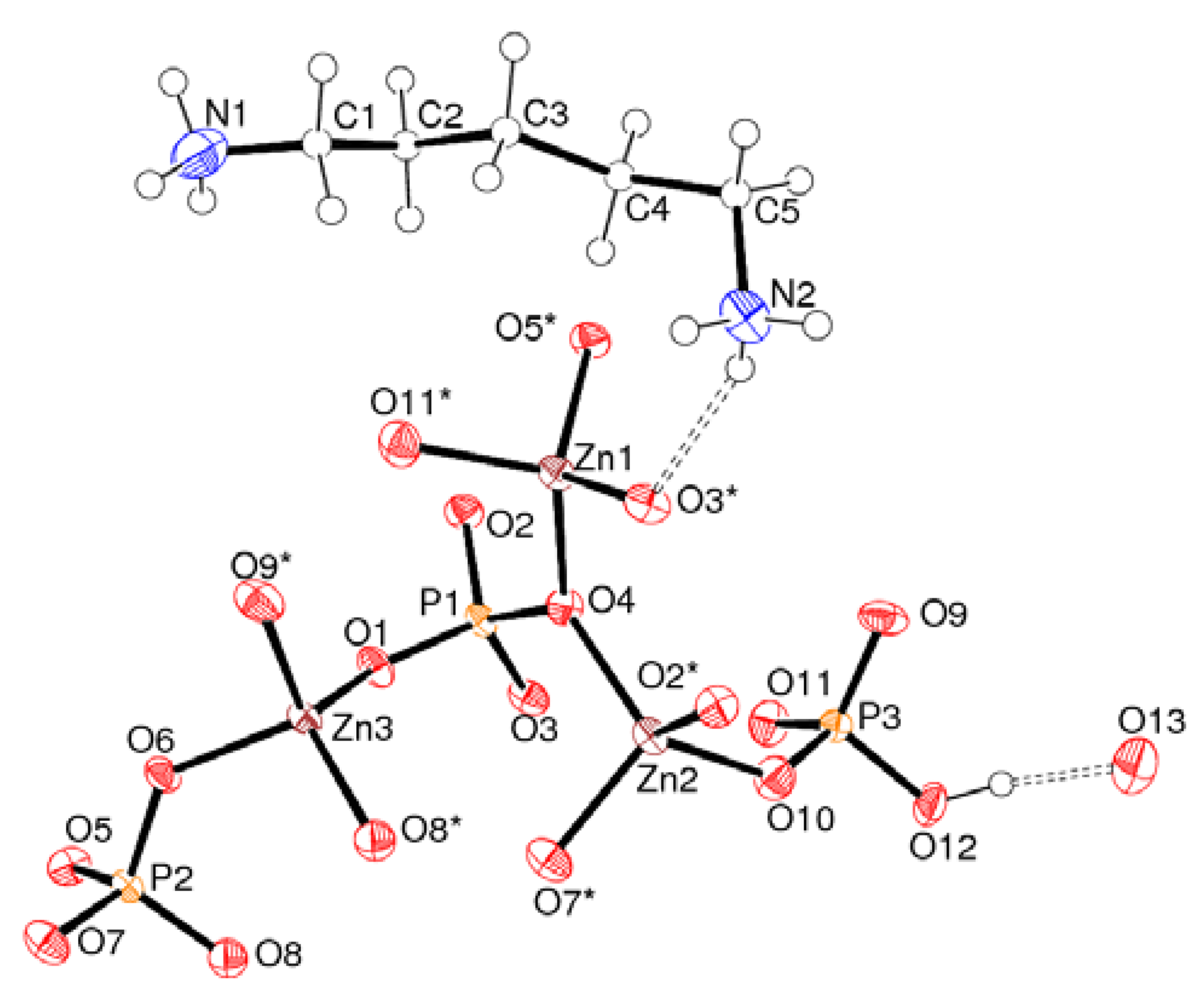
        <p>The asymmetric unit of <bold>2</bold> contains three Zn atoms, two PO<sub>4</sub> groups, one HPO<sub>4</sub> group, a water molecule and a doubly-protonated H<sub>2</sub>dap dication (<xref ref-type="fig" rid="crystals-02-00974-f004">Figure 4</xref>). </p>
        <fig id="crystals-02-00974-f004" position="anchor">
          <label>Figure 4</label>
          <caption>
            <p>The asymmetric unit of <bold>2</bold> (50% displacement ellipsoids; indicative spheres for the C atoms), expanded to show the complete coordination spheres of the zinc atoms. Atoms with a * suffix are symmetry generated (see <xref ref-type="table" rid="crystals-02-00974-t003">Table 3</xref>). The hydrogen bonds are indicated by double-dashed lines. Note the three-coordinate O4 atom and the Zn1-O4-Zn2 bond. </p>
          </caption>
          <graphic xmlns:xlink="http://www.w3.org/1999/xlink" xlink:href="crystals-02-00974-g004.tif"/>
        </fig>
        <p>The three Zn atoms form the centers of ZnO<sub>4</sub> tetrahedra (mean Zn1-O =1.943 Å, mean Zn2-O = 1.939 Å, mean Zn3-O = 1.939 Å). These are somewhat less distorted than the zinc polyhedra in <bold>1</bold> as indicated by the angular variances of 32.2°<sup>2</sup>, 37.4°<sup>2</sup>, and 47.2°<sup>2</sup>, for Zn1, Zn2 and Zn3, respectively. Atoms P1 and P2 (mean P-O = 1.534 Å and 1.536 Å, respectively; angular variances = 2.9°<sup>2</sup> and 2.4°<sup>2</sup>, respectively) are the central atoms of essentially regular phosphate groups and all their O atoms link to nearby zinc atoms. Atom P3 (mean P-O = 1.534 Å, angular variance = 14.9°<sup>2</sup>) forms three links to Zn but also possesses a terminal bond to O12. Its length of 1.587 (4) Å indicates that it must by protonated (<italic>i.e</italic>., a P-OH species) and the corresponding H atom could indeed be located in a difference map. Geometrical data for <bold>2</bold> are summarized in <xref ref-type="table" rid="crystals-02-00974-t003">Table 3</xref>. </p>
        <table-wrap id="crystals-02-00974-t003" position="anchor">
          <object-id pub-id-type="pii">crystals-02-00974-t003_Table 3</object-id>
          <label>Table 3</label>
          <caption>
            <p>Selected geometrical data (Å and °) for <bold>2</bold>.</p>
          </caption>
          <table>
            <thead>
              <tr>
                <th align="center" valign="middle">Bond</th>
                <th align="center" valign="middle">Distance</th>
                <th align="center" valign="middle">Bond</th>
                <th align="center" valign="middle">Distance</th>
              </tr>
            </thead>
            <tbody>
              <tr>
                <td align="center" valign="middle">Zn1-O5#1</td>
                <td align="center" valign="middle">1.908 (4)</td>
                <td align="center" valign="middle">Zn1-O3#2</td>
                <td align="center" valign="middle">1.929 (4)</td>
              </tr>
              <tr>
                <td align="center" valign="middle">Zn1-O11#2</td>
                <td align="center" valign="middle">1.930 (4)</td>
                <td align="center" valign="middle">Zn1-O4</td>
                <td align="center" valign="middle">2.005 (4)</td>
              </tr>
              <tr>
                <td align="center" valign="middle">Zn2-O10</td>
                <td align="center" valign="middle">1.909 (4)</td>
                <td align="center" valign="middle">Zn2-O7#3</td>
                <td align="center" valign="middle">1.929 (4)</td>
              </tr>
              <tr>
                <td align="center" valign="middle">Zn2-O2#2</td>
                <td align="center" valign="middle">1.952 (4)</td>
                <td align="center" valign="middle">Zn2-O4</td>
                <td align="center" valign="middle">1.966 (4)</td>
              </tr>
              <tr>
                <td align="center" valign="middle">Zn3-O1</td>
                <td align="center" valign="middle">1.923 (4)</td>
                <td align="center" valign="middle">Zn3-O9#2</td>
                <td align="center" valign="middle">1.929 (4)</td>
              </tr>
              <tr>
                <td align="center" valign="middle">Zn3-O6</td>
                <td align="center" valign="middle">1.944 (4)</td>
                <td align="center" valign="middle">Zn3-O8#3</td>
                <td align="center" valign="middle">1.959 (4)</td>
              </tr>
              <tr>
                <td align="center" valign="middle">P1-O1</td>
                <td align="center" valign="middle">1.514 (4)</td>
                <td align="center" valign="middle">P1-O2</td>
                <td align="center" valign="middle">1.519 (4)</td>
              </tr>
              <tr>
                <td align="center" valign="middle">P1-O3</td>
                <td align="center" valign="middle">1.530 (4)</td>
                <td align="center" valign="middle">P1-O4</td>
                <td align="center" valign="middle">1.570 (4)</td>
              </tr>
              <tr>
                <td align="center" valign="middle">P2-O5</td>
                <td align="center" valign="middle">1.532 (4)</td>
                <td align="center" valign="middle">P2-O6</td>
                <td align="center" valign="middle">1.537 (4)</td>
              </tr>
              <tr>
                <td align="center" valign="middle">P2-O8</td>
                <td align="center" valign="middle">1.537 (4)</td>
                <td align="center" valign="middle">P2-O7</td>
                <td align="center" valign="middle">1.539 (4)</td>
              </tr>
              <tr>
                <td align="center" valign="middle">P3-O9</td>
                <td align="center" valign="middle">1.509 (4)</td>
                <td align="center" valign="middle">P3-O10</td>
                <td align="center" valign="middle">1.517 (4)</td>
              </tr>
              <tr>
                <td align="center" valign="middle">P3-O11</td>
                <td align="center" valign="middle">1.522 (4)</td>
                <td align="center" valign="middle">P3-O12</td>
                <td align="center" valign="middle">1.588 (4)</td>
              </tr>
              <tr style="border-top: solid thin">
                <td align="center" valign="middle">
                  <bold>Bond</bold>
                </td>
                <td align="center" valign="middle">
                  <bold>Angle</bold>
                </td>
                <td align="center" valign="middle">
                  <bold>Bond</bold>
                </td>
                <td align="center" valign="middle">
                  <bold>Angle</bold>
                </td>
              </tr>
              <tr style="border-top: solid thin">
                <td align="center" valign="middle">P1-O1-Zn3</td>
                <td align="center" valign="middle">139.8 (2)</td>
                <td align="center" valign="middle">P1-O2-Zn2#4</td>
                <td align="center" valign="middle">131.5 (2)</td>
              </tr>
              <tr>
                <td align="center" valign="middle">P1-O3-Zn1#4</td>
                <td align="center" valign="middle">131.2 (2)</td>
                <td align="center" valign="middle">P1-O4-Zn2</td>
                <td align="center" valign="middle">119.0 (2)</td>
              </tr>
              <tr>
                <td align="center" valign="middle">P1-O4-Zn1</td>
                <td align="center" valign="middle">120.1 (2)</td>
                <td align="center" valign="middle">Zn2-O4-Zn1</td>
                <td align="center" valign="middle">118.50 (18)</td>
              </tr>
              <tr>
                <td align="center" valign="middle">P2-O5-Zn1#5</td>
                <td align="center" valign="middle">129.7 (2)</td>
                <td align="center" valign="middle">P2-O6-Zn3</td>
                <td align="center" valign="middle">132.9 (2)</td>
              </tr>
              <tr>
                <td align="center" valign="middle">P2-O7-Zn2#3</td>
                <td align="center" valign="middle">130.5 (2)</td>
                <td align="center" valign="middle">P2-O8-Zn3#3</td>
                <td align="center" valign="middle">132.1 (2)</td>
              </tr>
              <tr>
                <td align="center" valign="middle">P3-O9-Zn3#4</td>
                <td align="center" valign="middle">136.2 (3)</td>
                <td align="center" valign="middle">P3-O10-Zn2</td>
                <td align="center" valign="middle">134.4 (3)</td>
              </tr>
              <tr>
                <td align="center" valign="middle">P3-O11-Zn1#4</td>
                <td align="center" valign="middle">138.6 (3)</td>
                <td align="center" valign="middle">–</td>
                <td align="center" valign="middle">–</td>
              </tr>
            </tbody>
          </table>
          <table-wrap-foot>
          <fn>
          <p>Symmetry codes: (#1) <italic>x</italic>, 3/2−<italic>y</italic>, <italic>z</italic>−½; (#2) 1–<italic>x</italic>, <italic>y</italic>−½, ½−<italic>z</italic>; (#3) 1−<italic>x</italic>, 1−<italic>y</italic>, 1−<italic>z</italic>; (#4) 1−<italic>x</italic>, ½+<italic>y</italic>, ½−<italic>z</italic>; (#5) <italic>x</italic>, 3/2−<italic>y</italic>, ½+<italic>z</italic>. </p>
          </fn>
          </table-wrap-foot>
        </table-wrap>
        
        <p>In the extended structure of <bold>2</bold>, atom O4 plays an important role in the linking of the tetrahedra, as it forms bonds to Zn1, Zn2 and P1 (bond-angle sum = 357.6°). This results in “dimers” of the zinc species (<xref ref-type="fig" rid="crystals-02-00974-f004">Figure 4</xref>), but the Zn-O-Zn connectivity does not extend any further than this [<xref ref-type="bibr" rid="B16-crystals-02-00974">16</xref>]. The mean value of the Zn-O-P bond angle for the other O atoms is 133.7°, almost 10 degrees larger than the corresponding value in <bold>1</bold>. </p>
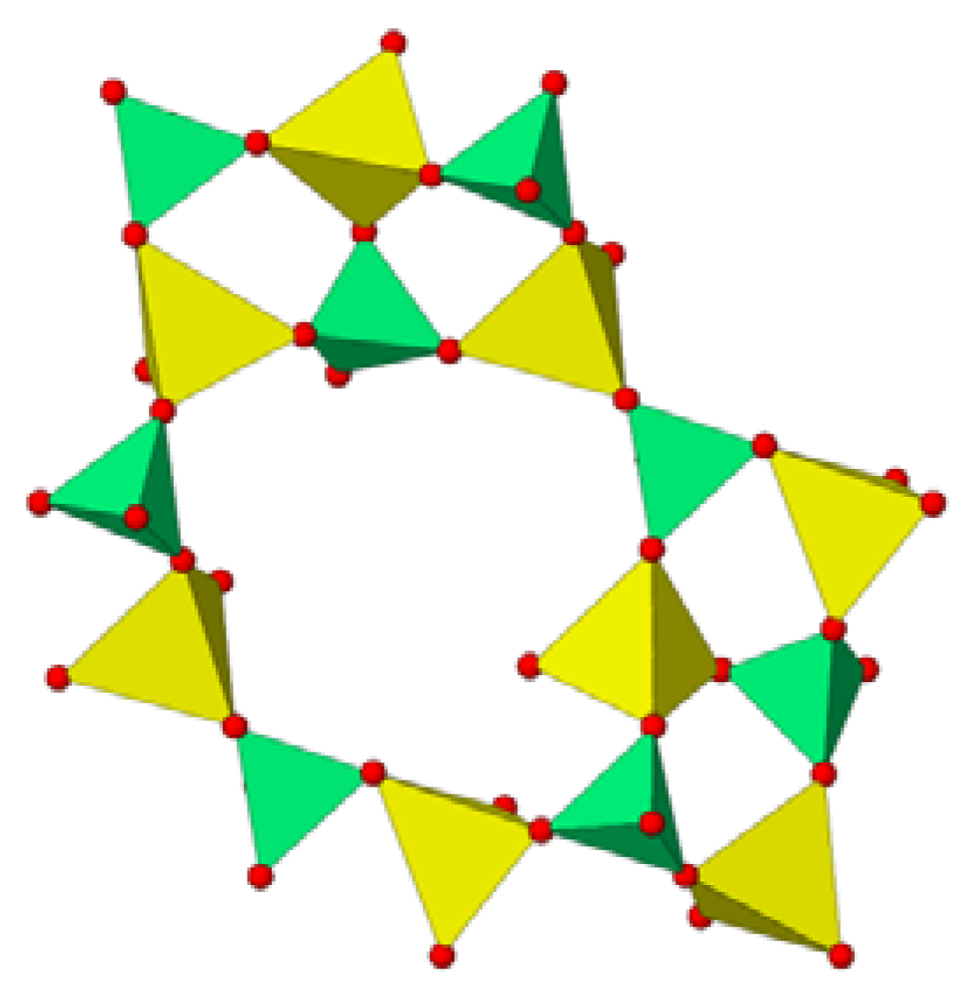
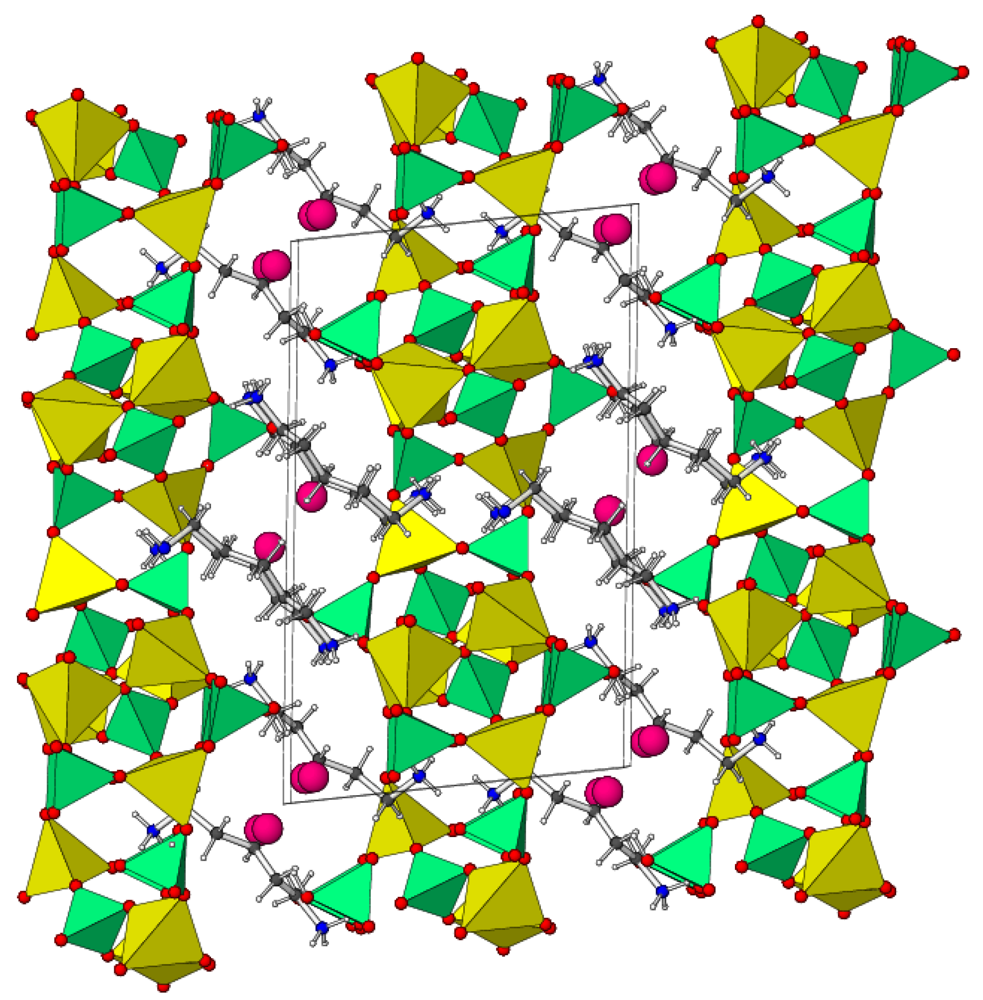
        <p>In the extended structure of <bold>2</bold>, the inorganic layers form infinite (100) sheets containing 4- and 10-rings (<xref ref-type="fig" rid="crystals-02-00974-f005">Figure 5</xref>). The sheets sandwich the H<sub>2</sub>dap cations and the extra-layer water molecule (O13) (<xref ref-type="fig" rid="crystals-02-00974-f006">Figure 6</xref>). The water molecule accepts an O-H∙∙∙O hydrogen bond from the hydrogen phosphate group and also probably forms O-H∙∙∙O links to framework oxygen atoms. The protonated -NH<sub>3</sub><sup>+</sup> groups of the H<sub>2</sub>dap cation form three N-H∙∙∙O hydrogen bonds each (<xref ref-type="table" rid="crystals-02-00974-t004">Table 4</xref>), which is a thoroughly typical bonding mode for a protonated amine in a ZnPO [<xref ref-type="bibr" rid="B5-crystals-02-00974">5</xref>]. The conformation of the carbon chain of the H<sub>2</sub>dap species is somewhat uncertain, but its contorted geometry is clearly different to the extended conformation found for the bridging dap molecules in <bold>1</bold>.</p>
        <table-wrap id="crystals-02-00974-t004" position="anchor">
          <object-id pub-id-type="pii">crystals-02-00974-t004_Table 4</object-id>
          <label>Table 4</label>
          <caption>
            <p>Hydrogen bond geometries (Å and °) in <bold>2</bold>.</p>
          </caption>
          <table>
            <thead>
              <tr>
                <th align="center" valign="middle">Bond</th>
                <th align="center" valign="middle">D-H</th>
                <th align="center" valign="middle">H∙∙∙A</th>
                <th align="center" valign="middle">D∙∙∙A</th>
                <th align="center" valign="middle">D-H∙∙∙A</th>
              </tr>
            </thead>
            <tbody>
              <tr>
                <td align="center" valign="middle">O12-H12∙∙∙O13</td>
                <td align="center" valign="middle">0.93</td>
                <td align="center" valign="middle">1.77</td>
                <td align="center" valign="middle">2.644 (7)</td>
                <td align="center" valign="middle">155</td>
              </tr>
              <tr>
                <td align="center" valign="middle">N1-H1∙∙∙O11#6</td>
                <td align="center" valign="middle">0.89</td>
                <td align="center" valign="middle">2.29</td>
                <td align="center" valign="middle">2.915 (9)</td>
                <td align="center" valign="middle">127</td>
              </tr>
              <tr>
                <td align="center" valign="middle">N1-H2∙∙∙O12#2</td>
                <td align="center" valign="middle">0.89</td>
                <td align="center" valign="middle">2.22</td>
                <td align="center" valign="middle">2.874 (9)</td>
                <td align="center" valign="middle">130</td>
              </tr>
              <tr>
                <td align="center" valign="middle">N1-H3∙∙∙O2#7</td>
                <td align="center" valign="middle">0.89</td>
                <td align="center" valign="middle">1.92</td>
                <td align="center" valign="middle">2.806 (8)</td>
                <td align="center" valign="middle">174</td>
              </tr>
              <tr>
                <td align="center" valign="middle">N2-H4∙∙∙O8#2</td>
                <td align="center" valign="middle">0.89</td>
                <td align="center" valign="middle">1.99</td>
                <td align="center" valign="middle">2.823 (6)</td>
                <td align="center" valign="middle">155</td>
              </tr>
              <tr>
                <td align="center" valign="middle">N2-H5∙∙∙O3#2</td>
                <td align="center" valign="middle">0.89</td>
                <td align="center" valign="middle">2.11</td>
                <td align="center" valign="middle">2.902 (6)</td>
                <td align="center" valign="middle">148</td>
              </tr>
              <tr>
                <td align="center" valign="middle">N2-H6∙∙∙O7#8</td>
                <td align="center" valign="middle">0.89</td>
                <td align="center" valign="middle">2.01</td>
                <td align="center" valign="middle">2.837 (7)</td>
                <td align="center" valign="middle">154</td>
              </tr>
            </tbody>
          </table>
          <table-wrap-foot>
          <fn>
          <p>Symmetry codes as in <xref ref-type="table" rid="crystals-02-00974-t003">Table 3</xref>; additionally: (#6) 1+<italic>x</italic>, <italic>y</italic>–1, <italic>z</italic>; (#7) 2−<italic>x</italic>, <italic>y</italic>−½, ½−<italic>z</italic>; (#8) x, ½−y, z−½. </p>
          </fn>
          </table-wrap-foot>
        </table-wrap>
        <fig id="crystals-02-00974-f005" position="anchor">
          <label>Figure 5</label>
          <caption>
            <p>Fragment of a (100) polyhedral sheet in <bold>2</bold> showing 4-ring and 10-ring loops. </p>
          </caption>
          <graphic xmlns:xlink="http://www.w3.org/1999/xlink" xlink:href="crystals-02-00974-g005.tif"/>
        </fig>
        <fig id="crystals-02-00974-f006" position="anchor">
          <label>Figure 6</label>
          <caption>
            <p>The packing of <bold>2</bold> viewed down [010] showing the (100) inorganic layers sandwiching the organic cations and water molecules (pink spheres); other polyhedron/atom colors as in <xref ref-type="fig" rid="crystals-02-00974-f002">Figure 2</xref> and <xref ref-type="fig" rid="crystals-02-00974-f003">Figure 3</xref>. </p>
          </caption>
          <graphic xmlns:xlink="http://www.w3.org/1999/xlink" xlink:href="crystals-02-00974-g006.tif"/>
        </fig>
        
      </sec>
    </sec>
    <sec>
      <title>3. Experimental Section</title>
      <sec>
        <title>3.1. Synthesis</title>
        <p>Compound <bold>1</bold> was prepared from0.798 g ZnO, 4.9 mL 85% H<sub>3</sub>PO<sub>4</sub>, 1.00 g dap and 10 mL water (Zn:PO<sub>4</sub>:dap ratio = 2:1:2). The components were placed in a 60-mL HDPE bottle and sealed (starting pH ≈ 6.0). The bottle was shaken for five minutes and placed in an 80 °C oven for four days. The bottle was removed from the oven and cooled to room temperature over 30 minutes and the solid product, consisting of colorless plates of <bold>1</bold> accompanied by white and brownish powders was recovered by vacuum filtration and rinsing with water and acetone. Compound <bold>2</bold> was prepared from 0.794 g ZnO, 9.8 mL 85% H<sub>3</sub>PO<sub>4</sub>, 0.51 g dap and 10 mL water (Zn:PO<sub>4</sub>:dap ratio = 2:2:1; starting pH ≈ 2.0) and subjected to the same heating and product recovery protocol. Pale brown blocks of <bold>2</bold> were recovered, accompanied by some white powder. </p>
      </sec>
      <sec>
        <title>3.2. Single-Crystal Data Collection and Analysis</title>
        <p>The single-crystal data for <bold>1</bold> (colorless slab, 0.10 × 0.10 × 0.02 mm) were collected using a Rigaku Saturn CCD diffractometer at 93 K (Mo Kα radiation, <italic>λ</italic> = 0.71073 Å); the data for <bold>2</bold> (pale brown block, 0.40 × 0.30 × 0.24 mm) were collected using a Bruker Kappa APEX II CCD diffractometer (Mo Kα radiation, <italic>λ</italic> = 0.71073 Å) at room temperature. After data reduction, the structures were solved by direct methods with SHELXS and the resulting atomic models were developed and refined against |<italic>F</italic>|<sup>2</sup> with SHELXL [<xref ref-type="bibr" rid="B17-crystals-02-00974">17</xref>]. The “observed data” threshold for calculating the <italic>R</italic>(<italic>F</italic>) residuals was set as <italic>I</italic> &gt; 2σ(<italic>I</italic>). </p>
        <p>For <bold>1</bold>, the C- and N-bound bound H atoms were placed in idealised locations (C-H = 0.99 Å, N-H = 0.92 Å) and refined as riding atoms. The O-bound (water) H atoms were located in difference maps and refined as riding atoms in their as-found relative locations. The constraint <italic>U</italic><sub>iso</sub>(H) = 1.2<italic>U</italic><sub>eq</sub>(carrier) was applied in all cases. The structural model was analysed and validated with PLATON [<xref ref-type="bibr" rid="B18-crystals-02-00974">18</xref>] and full refinement details are given in the deposited cif. PLATON indicated considerable pseudo-symmetry corresponding to space group <italic>C</italic>2/<italic>c</italic>. Trial refinements in this space group, which revealed a number of systematic absence violations, led to essentially the same structure for the framework (albeit with dubious anisotropic displacement parameters) but un-resolvable disorder of the water molecules in the channels. Thus it appears that the symmetry lowering is due to ordering of the water molecules in the channels. </p>
        <p>The methylene chain in the H<sub>2</sub>dap species in <bold>2</bold> was found to be severely disordered although the terminal -NH<sub>3</sub><sup>+</sup> groupings were well defined. The application of C-C bond distance restraints led to a geometrically plausible conformation but this cannot be regarded as certain. The H atoms of the water molecule could not be located from difference maps and may be disordered. The C- and N-bound bound H atoms in <bold>2</bold> were placed in idealised locations (C-H = 0.97 Å, N-H = 0.89 Å) and refined as riding atoms. The P-OH H atom was located in a difference map and refined as riding in its as-found relative location. The constraint <italic>U</italic><sub>iso</sub>(H) = 1.2<italic>U</italic><sub>eq</sub>(carrier) was applied in all cases. Further refinement details are given in the deposited cif. </p>
        <p>Crystal data for <bold>1</bold>: C<sub>10</sub>H<sub>34</sub>N<sub>4</sub>O<sub>11</sub>P<sub>2</sub>Zn<sub>3</sub>, <italic>M</italic><sub>r</sub> = 644.46, monoclinic, <italic>C</italic>2 (No. 4), <italic>Z</italic> = 4, <italic>a</italic> = 25.302 (7) Å, <italic>b</italic> = 4.9327 (13) Å, <italic>c</italic> = 19.808 (6) Å, β = 107.377 (8)°, <italic>V</italic> = 2359.4 (12) Å<sup>3</sup>, <italic>F</italic>(000) = 1320, <italic>T</italic> = 93 (2) K, ρ<sub>calc</sub> = 1.814 g cm<sup>−3</sup>, µ = 3.216 mm<sup>−1</sup>, 7612 reflections recorded (3.4° ≤ 2<italic>θ</italic> ≤ 50.7°; −30 ≤ <italic>h</italic> ≤ 30, −5 ≤ <italic>k</italic> ≤ 3, −23 ≤ <italic>l</italic> ≤ 18), <italic>R</italic><sub>Int</sub> = 0.047, 3310 merged reflections, 2728 with <italic>I</italic> &gt; 2σ(<italic>I</italic>), 273 variable parameters, Flack absolute structure parameter = 0.46 (5), <italic>R</italic>(<italic>F</italic>) = 0.054, <italic>wR</italic>(<italic>F</italic><sup>2</sup>) = 0.139, min./max. Δρ = –1.23, +1.01 <italic>e</italic> Å<sup>−3</sup>. Cambridge Structural Database deposition number: CCDC-883458.</p>
        <p>Crystal data for <bold>2</bold>: C<sub>5</sub>H<sub>19</sub>N<sub>2</sub>O<sub>13</sub>P<sub>3</sub>Zn<sub>3</sub>, <italic>M</italic><sub>r</sub> = 604.24, monoclinic, <italic>P</italic>2<sub>1</sub>/<italic>c</italic> (No. 14), <italic>Z</italic> = 4, <italic>a</italic> = 11.3275 (15) Å, <italic>b</italic> = 8.3235 (11) Å, <italic>c</italic> = 18.588 (2) Å, β = 96.979 (3)°, <italic>V</italic> = 1739.6 (4) Å<sup>3</sup>, <italic>F</italic>(000) = 1208, T = 293 (2) K, ρ<sub>calc</sub> = 2.307 g cm<sup>−3</sup>, μ = 4.447 mm<sup>−1</sup>, 10734 reflections recorded (8.7° ≤ 2<italic>θ</italic> ≤ 60.0°; −14 ≤ <italic>h</italic> ≤ 15, −11 ≤ <italic>k</italic> ≤ 11, −20 ≤ <italic>l</italic> ≤ 26), <italic>R</italic><sub>Int</sub> = 0.076, 4954 merged reflections, 3105 with <italic>I</italic> &gt; 2σ(<italic>I</italic>), 237 variable parameters, <italic>R</italic>(<italic>F</italic>) = 0.056, <italic>wR</italic>(<italic>F</italic><sup>2</sup>) = 0.119, min./max. Δρ = −0.85, +1.97 eÅ<sup>–3</sup>. Cambridge Structural Database deposition number: CCDC-883459.</p>
      </sec>
    </sec>
    <sec sec-type="conclusions">
      <title>4. Conclusions</title>
      <p>The crystal structures of Zn<sub>3</sub>(PO<sub>4</sub>)<sub>2</sub>(C<sub>5</sub>H<sub>14</sub>N<sub>2</sub>)<sub>2</sub>·3H<sub>2</sub>O (<bold>1</bold>) and C<sub>5</sub>H<sub>16</sub>N<sub>2</sub>·Zn<sub>3</sub>(PO<sub>4</sub>)<sub>2</sub>(HPO<sub>4</sub>)·H<sub>2</sub>O (<bold>2</bold>) have been described. The structure of <bold>1</bold> displays some unusual features for ZnPOs including ZnO<sub>2</sub>N<sub>2</sub> and ZnO<sub>3</sub>N polyhedra and un-protonated (neutral) template molecules bonding as bridging ligands. This appears to correlate with the relatively high starting pH for the synthesis of <bold>1</bold>, which would presumably favor the presence of un-protonated organic molecules in solution. The structure of [Zn<sub>4</sub>(HPO<sub>4</sub>)<sub>4</sub>(C<sub>18</sub>H<sub>18</sub>N<sub>4</sub>)<sub>3</sub>]·4H<sub>2</sub>O (C<sub>18</sub>H<sub>18</sub>N<sub>4</sub> = 1,4-bis(<italic>N</italic>-benzimidazolyl)butane) [<xref ref-type="bibr" rid="B11-crystals-02-00974">11</xref>] shares these features, but its overall structure, which features ZnPO chains cross-linked by the ligands, and no obvious channel system, is quite different to that of <bold>1</bold>. The structure of <bold>2</bold>, prepared from a reaction with a lower initial pH, is much more commonplace, and the “multipoint” N–H∙∙∙O hydrogen bonds from the protonated template to the anionic ZnPO sheets have been seen in many other structures [<xref ref-type="bibr" rid="B5-crystals-02-00974">5</xref>]. The triply-bridging O atom in the framework of <bold>2</bold> is also a known feature of porous [<xref ref-type="bibr" rid="B13-crystals-02-00974">13</xref>] and dense (<italic>i.e</italic>., non-templated) [<xref ref-type="bibr" rid="B19-crystals-02-00974">19</xref>] ZnPOs. </p>
    </sec>
  </body>
  <back>
    <ref-list>
      <title>References</title>
      <ref id="B1-crystals-02-00974">
        <label>1.</label>
        <citation citation-type="journal">
          <person-group person-group-type="author">
            <name>
              <surname>Vaidhyanathan</surname>
              <given-names>R.</given-names>
            </name>
            <name>
              <surname>Natarajan</surname>
              <given-names>S.</given-names>
            </name>
          </person-group>
          <article-title>New open-framework layered tin(II) phosphates intercalated with amines</article-title>
          <source>J. Mater. Chem.</source>
          <year>1999</year>
          <volume>9</volume>
          <fpage>1807</fpage>
          <lpage>1811</lpage>
          <pub-id pub-id-type="doi">10.1039/a809682a</pub-id>
        </citation>
      </ref>
      <ref id="B2-crystals-02-00974">
        <label>2.</label>
        <citation citation-type="journal">
          <person-group person-group-type="author">
            <name>
              <surname>Cowley</surname>
              <given-names>A.R.</given-names>
            </name>
            <name>
              <surname>Chippindale</surname>
              <given-names>A.M.</given-names>
            </name>
          </person-group>
          <article-title>Synthesis and characterisation of the first unidimensional cobalt hydrogen phosphate [H<sub>3</sub>N(CH<sub>2</sub>)<sub>3</sub>NH<sub>3</sub>][Co(HPO<sub>4</sub>)<sub>2</sub>]</article-title>
          <source>J. Chem. Soc. Dalton Trans.</source>
          <year>1999</year>
          <volume>13</volume>
          <fpage>2147</fpage>
          <lpage>2149</lpage>
        </citation>
      </ref>
      <ref id="B3-crystals-02-00974">
        <label>3.</label>
        <citation citation-type="journal">
          <person-group person-group-type="author">
            <name>
              <surname>Jouffret</surname>
              <given-names>L.</given-names>
            </name>
            <name>
              <surname>Rivenet</surname>
              <given-names>M.</given-names>
            </name>
            <name>
              <surname>Abraham</surname>
              <given-names>F.</given-names>
            </name>
          </person-group>
          <article-title>A new series of pillared uranyl-vanadates based on uranophane-type sheets in the uranium-vanadium-linear alkyl diamine systems</article-title>
          <source>J. Solid State Chem.</source>
          <year>2010</year>
          <volume>183</volume>
          <fpage>84</fpage>
          <lpage>92</lpage>
          <pub-id pub-id-type="doi">10.1016/j.jssc.2009.10.020</pub-id>
        </citation>
      </ref>
      <ref id="B4-crystals-02-00974">
        <label>4.</label>
        <citation citation-type="journal">
          <person-group person-group-type="author">
            <name>
              <surname>Yang</surname>
              <given-names>W.</given-names>
            </name>
            <name>
              <surname>Li</surname>
              <given-names>J.</given-names>
            </name>
            <name>
              <surname>Xu</surname>
              <given-names>J.</given-names>
            </name>
            <name>
              <surname>Xong</surname>
              <given-names>H.</given-names>
            </name>
            <name>
              <surname>Wang</surname>
              <given-names>L.</given-names>
            </name>
            <name>
              <surname>Yu</surname>
              <given-names>J.</given-names>
            </name>
            <name>
              <surname>Xu</surname>
              <given-names>R.</given-names>
            </name>
          </person-group>
          <article-title>Hydrothermal synthesis of isostructural open-framework manganese and iron borophosphates: Effect of the organic templates in determining the pore shapes</article-title>
          <source>Solid State Sci.</source>
          <year>2011</year>
          <volume>13</volume>
          <fpage>757</fpage>
          <lpage>761</lpage>
          <pub-id pub-id-type="doi">10.1016/j.solidstatesciences.2010.04.007</pub-id>
        </citation>
      </ref>
      <ref id="B5-crystals-02-00974">
        <label>5.</label>
        <citation citation-type="journal">
          <person-group person-group-type="author">
            <name>
              <surname>Chidambaram</surname>
              <given-names>D.</given-names>
            </name>
            <name>
              <surname>Neeraj</surname>
              <given-names>S.</given-names>
            </name>
            <name>
              <surname>Natarajan</surname>
              <given-names>S.</given-names>
            </name>
            <name>
              <surname>Rao</surname>
              <given-names>C.N.R.</given-names>
            </name>
          </person-group>
          <article-title>Open-framework zinc phosphates synthesized in the presence of structure-directing organic amines</article-title>
          <source>J. Solid State Chem.</source>
          <year>1999</year>
          <volume>147</volume>
          <fpage>154</fpage>
          <lpage>169</lpage>
          <pub-id pub-id-type="doi">10.1006/jssc.1999.8206</pub-id>
        </citation>
      </ref>
      <ref id="B6-crystals-02-00974">
        <label>6.</label>
        <citation citation-type="journal">
          <person-group person-group-type="author">
            <name>
              <surname>Chavez</surname>
              <given-names>A.V.</given-names>
            </name>
            <name>
              <surname>Nenoff</surname>
              <given-names>T.M.</given-names>
            </name>
            <name>
              <surname>Hannooman</surname>
              <given-names>L.</given-names>
            </name>
            <name>
              <surname>Harrison</surname>
              <given-names>W.T.A.</given-names>
            </name>
          </person-group>
          <article-title>Tetrahedral-network organo-zincophosphates: Syntheses and structures of (N<sub>2</sub>C<sub>6</sub>H<sub>14</sub>)·Zn(HPO<sub>4</sub>)<sub>2</sub>·H<sub>2</sub>O, H<sub>3</sub>N(CH<sub>2</sub>)<sub>3</sub>NH<sub>3</sub>-Zn<sub>2</sub>(HPO<sub>4</sub>)<sub>3</sub> and (N<sub>2</sub>C<sub>6</sub>H<sub>14</sub>)· Zn<sub>3</sub>(HPO<sub>4</sub>)<sub>4</sub></article-title>
          <source>J. Solid State Chem.</source>
          <year>1999</year>
          <volume>147</volume>
          <fpage>584</fpage>
          <lpage>591</lpage>
          <pub-id pub-id-type="doi">10.1006/jssc.1999.8421</pub-id>
        </citation>
      </ref>
      <ref id="B7-crystals-02-00974">
        <label>7.</label>
        <citation citation-type="journal">
          <person-group person-group-type="author">
            <name>
              <surname>Fu</surname>
              <given-names>R.</given-names>
            </name>
            <name>
              <surname>Hu</surname>
              <given-names>S.</given-names>
            </name>
            <name>
              <surname>Wu</surname>
              <given-names>X.</given-names>
            </name>
          </person-group>
          <article-title>Mix-solvothermal syntheses, characterization, and properties of new zinc diphosphonates with Zn-O-P chains, layers, and 3D frameworks</article-title>
          <source>Cryst. Growth Des.</source>
          <year>2007</year>
          <volume>7</volume>
          <fpage>1134</fpage>
          <lpage>1144</lpage>
          <pub-id pub-id-type="doi">10.1021/cg060833m</pub-id>
        </citation>
      </ref>
      <ref id="B8-crystals-02-00974">
        <label>8.</label>
        <citation citation-type="journal">
          <person-group person-group-type="author">
            <name>
              <surname>Rodgers</surname>
              <given-names>J.A.</given-names>
            </name>
            <name>
              <surname>Harrison</surname>
              <given-names>W.T.A.</given-names>
            </name>
          </person-group>
          <article-title>H<sub>3</sub>N(CH<sub>2</sub>)<sub>6</sub>NH<sub>3</sub>·Zn<sub>4</sub>(PO<sub>4</sub>)<sub>2</sub>(HPO<sub>4</sub>)<sub>2</sub>·3H<sub>2</sub>O: A novel three-dimensional zinc phosphate framework containing 5- and 20-rings</article-title>
          <source>J. Mater. Chem.</source>
          <year>2000</year>
          <volume>10</volume>
          <fpage>2853</fpage>
          <lpage>2856</lpage>
          <pub-id pub-id-type="doi">10.1039/b004994h</pub-id>
        </citation>
      </ref>
      <ref id="B9-crystals-02-00974">
        <label>9.</label>
        <citation citation-type="journal">
          <person-group person-group-type="author">
            <name>
              <surname>Holtby</surname>
              <given-names>A.S.</given-names>
            </name>
            <name>
              <surname>Harrison</surname>
              <given-names>W.T.A.</given-names>
            </name>
            <name>
              <surname>Yilmaz</surname>
              <given-names>V.T.</given-names>
            </name>
            <name>
              <surname>Büyükgüngör</surname>
              <given-names>O.</given-names>
            </name>
          </person-group>
          <article-title>Büyükgüngör, O. New three-dimensional (3,4)-net zincophosphites templated by linear diammonium cations: H<sub>3</sub>N(CH<sub>2</sub>)<sub>5</sub>NH<sub>3</sub>·Zn<sub>3</sub>(HPO<sub>3</sub>)<sub>4</sub> and β-H<sub>3</sub>N(CH<sub>2</sub>)<sub>6</sub>NH<sub>3</sub>·Zn<sub>3</sub>(HPO<sub>3</sub>)<sub>4</sub></article-title>
          <source>Solid State Sci.</source>
          <year>2007</year>
          <volume>9</volume>
          <fpage>149</fpage>
          <lpage>154</lpage>
          <pub-id pub-id-type="doi">10.1016/j.solidstatesciences.2006.11.001</pub-id>
        </citation>
      </ref>
      <ref id="B10-crystals-02-00974">
        <label>10.</label>
        <citation citation-type="journal">
          <person-group person-group-type="author">
            <name>
              <surname>Song</surname>
              <given-names>H.H.</given-names>
            </name>
            <name>
              <surname>Zheng</surname>
              <given-names>L.M.</given-names>
            </name>
            <name>
              <surname>Wang</surname>
              <given-names>Z.</given-names>
            </name>
            <name>
              <surname>Yan</surname>
              <given-names>C.H.</given-names>
            </name>
            <name>
              <surname>Xin</surname>
              <given-names>X.Q.</given-names>
            </name>
          </person-group>
          <article-title>Zinc diphosphonates templated by organic amines: Syntheses and characterizations of [NH<sub>3</sub>(CH<sub>2</sub>)<sub>2</sub>NH<sub>3</sub>]Zn(hedpH<sub>2</sub>)<sub>2</sub>·2H<sub>2</sub>O and [NH<sub>3</sub>(CH<sub>2</sub>)<italic><sub>n</sub></italic>NH<sub>3</sub>]Zn<sub>2</sub>(hedpH)<sub>2</sub>·2H<sub>2</sub>O (<italic>n</italic> = 4, 5, 6) (hedp = 1-hydroxyethylidenediphosphonate)</article-title>
          <source>Inorg. Chem.</source>
          <year>2001</year>
          <volume>40</volume>
          <fpage>5024</fpage>
          <lpage>5029</lpage>
          <pub-id pub-id-type="doi">10.1021/ic010033v</pub-id>
        </citation>
      </ref>
      <ref id="B11-crystals-02-00974">
        <label>11.</label>
        <citation citation-type="journal">
          <person-group person-group-type="author">
            <name>
              <surname>Fan</surname>
              <given-names>J.</given-names>
            </name>
            <name>
              <surname>Hanson</surname>
              <given-names>B.E.</given-names>
            </name>
          </person-group>
          <article-title>Novel zinc phosphate topologies defined by organic ligands</article-title>
          <source>Inorg. Chem.</source>
          <year>2005</year>
          <volume>44</volume>
          <fpage>6998</fpage>
          <lpage>7008</lpage>
          <pub-id pub-id-type="doi">10.1021/ic050314t</pub-id>
        </citation>
      </ref>
      <ref id="B12-crystals-02-00974">
        <label>12.</label>
        <citation citation-type="journal">
          <person-group person-group-type="author">
            <name>
              <surname>Robinson</surname>
              <given-names>K.</given-names>
            </name>
            <name>
              <surname>Gibbs</surname>
              <given-names>G.V.</given-names>
            </name>
            <name>
              <surname>Ribbe</surname>
              <given-names>P.H.</given-names>
            </name>
          </person-group>
          <article-title>Quadratic elongation-quantitative measure of distortion in coordination polyhedra</article-title>
          <source>Science</source>
          <year>1971</year>
          <volume>172</volume>
          <fpage>567</fpage>
          <lpage>570</lpage>
        <pub-id pub-id-type="doi">10.1126/science.172.3983.567</pub-id><pub-id pub-id-type="pmid">17802221</pub-id></citation>
      </ref>
      <ref id="B13-crystals-02-00974">
        <label>13.</label>
        <citation citation-type="journal">
          <person-group person-group-type="author">
            <name>
              <surname>Harrison</surname>
              <given-names>W.T.A.</given-names>
            </name>
            <name>
              <surname>Nenoff</surname>
              <given-names>T.M.</given-names>
            </name>
            <name>
              <surname>Eddy</surname>
              <given-names>M.M.</given-names>
            </name>
            <name>
              <surname>Martin</surname>
              <given-names>T.E.</given-names>
            </name>
            <name>
              <surname>Stucky</surname>
              <given-names>G.D.</given-names>
            </name>
          </person-group>
          <article-title>Organic templates in zincophosphate synthesis-Zn<sub>5</sub>(PO<sub>4</sub>)<sub>2</sub>(HPO<sub>4</sub>)<sub>4</sub>·H<sub>2</sub>O·2H<sub>2</sub>N<sub>2</sub>C<sub>6</sub>H<sub>12</sub> containing two distinct 8-ring channels and Zn<sub>3</sub>(PO<sub>4</sub>)(HPO<sub>4</sub>)<sub>2</sub>·HN<sub>2</sub>C<sub>6</sub>H<sub>12</sub> containing tetrahedral 3-rings and Zn-N bonds</article-title>
          <source>J. Mater. Chem.</source>
          <year>1992</year>
          <volume>2</volume>
          <fpage>1127</fpage>
          <lpage>1134</lpage>
          <pub-id pub-id-type="doi">10.1039/jm9920201127</pub-id>
        </citation>
      </ref>
      <ref id="B14-crystals-02-00974">
        <label>14.</label>
        <citation citation-type="journal">
          <person-group person-group-type="author">
            <name>
              <surname>Belhouchet</surname>
              <given-names>M.</given-names>
            </name>
            <name>
              <surname>Savariault</surname>
              <given-names>J.M.</given-names>
            </name>
            <name>
              <surname>Mhiri</surname>
              <given-names>T.</given-names>
            </name>
          </person-group>
          <article-title>Crystal structure and thermal behavior of two new organic monosulfates NH<sub>3</sub>(CH<sub>2</sub>)<sub>5</sub>NH<sub>3</sub>SO<sub>4</sub>·1.5H<sub>2</sub>O and NH<sub>3</sub>(CH<sub>2</sub>)<sub>9</sub>NH<sub>3</sub>SO<sub>4</sub>·H<sub>2</sub>O</article-title>
          <source>J. Phys. Chem. Solids</source>
          <year>2005</year>
          <volume>66</volume>
          <fpage>1294</fpage>
          <lpage>1301</lpage>
          <pub-id pub-id-type="doi">10.1016/j.jpcs.2005.04.010</pub-id>
        </citation>
      </ref>
      <ref id="B15-crystals-02-00974">
        <label>15.</label>
        <citation citation-type="journal">
          <person-group person-group-type="author">
            <name>
              <surname>Mandal</surname>
              <given-names>S.</given-names>
            </name>
            <name>
              <surname>Natarajan</surname>
              <given-names>S.</given-names>
            </name>
          </person-group>
          <article-title>Solvothermal synthesis and structures of one- and two-dimensional zinc phosphates</article-title>
          <source>Inorg. Chim. Acta</source>
          <year>2004</year>
          <volume>357</volume>
          <fpage>1437</fpage>
          <lpage>1443</lpage>
          <pub-id pub-id-type="doi">10.1016/j.ica.2003.11.001</pub-id>
        </citation>
      </ref>
      <ref id="B16-crystals-02-00974">
        <label>16.</label>
        <citation citation-type="journal">
          <person-group person-group-type="author">
            <name>
              <surname>Harrison</surname>
              <given-names>W.T.A.</given-names>
            </name>
            <name>
              <surname>Rodgers</surname>
              <given-names>J.A.</given-names>
            </name>
            <name>
              <surname>Phillips</surname>
              <given-names>M.L.F.</given-names>
            </name>
            <name>
              <surname>Nenoff</surname>
              <given-names>T.E.</given-names>
            </name>
          </person-group>
          <article-title>In situ template generation for zincophosphate synthesis leading to guanylurea zinc phosphate, C<sub>2</sub>H<sub>7</sub>N<sub>4</sub>O·ZnPO<sub>4</sub>, containing template-to-template N–H·O hydrogen bonds</article-title>
          <source>Solid State Sci.</source>
          <year>2002</year>
          <volume>4</volume>
          <fpage>969</fpage>
          <lpage>972</lpage>
          <pub-id pub-id-type="doi">10.1016/S1293-2558(02)01340-7</pub-id>
        </citation>
      </ref>
      <ref id="B17-crystals-02-00974">
        <label>17.</label>
        <citation citation-type="journal">
          <person-group person-group-type="author">
            <name>
              <surname>Sheldrick</surname>
              <given-names>G.M.</given-names>
            </name>
          </person-group>
          <article-title>A short history of SHELX</article-title>
          <source>Acta Cryst.</source>
          <year>2008</year>
          <volume>A64</volume>
          <fpage>112</fpage>
          <lpage>122</lpage>
        </citation>
      </ref>
      <ref id="B18-crystals-02-00974">
        <label>18.</label>
        <citation citation-type="journal">
          <person-group person-group-type="author">
            <name>
              <surname>Spek</surname>
              <given-names>A.L.</given-names>
            </name>
          </person-group>
          <article-title>Structure validation in chemical crystallography</article-title>
          <source>Acta Cryst.</source>
          <year>2009</year>
          <volume>D65</volume>
          <fpage>148</fpage>
          <lpage>155</lpage>
        </citation>
      </ref>
      <ref id="B19-crystals-02-00974">
        <label>19.</label>
        <citation citation-type="journal">
          <person-group person-group-type="author">
            <name>
              <surname>Nenoff</surname>
              <given-names>T.M.</given-names>
            </name>
            <name>
              <surname>Harrison</surname>
              <given-names>W.T.A.</given-names>
            </name>
            <name>
              <surname>Gier</surname>
              <given-names>T.E.</given-names>
            </name>
            <name>
              <surname>Calabrese</surname>
              <given-names>J.C.</given-names>
            </name>
            <name>
              <surname>Stucky</surname>
              <given-names>G.D.</given-names>
            </name>
          </person-group>
          <article-title>The low-temperature synthesis and characterization of two layered materials containing 3-ring groupings: NaH(ZnPO<sub>4</sub>)<sub>2</sub> and CsH(ZnPO<sub>4</sub>)<sub>2</sub></article-title>
          <source>J. Solid State Chem.</source>
          <year>1993</year>
          <volume>107</volume>
          <fpage>285</fpage>
          <lpage>295</lpage>
        <pub-id pub-id-type="doi">10.1006/jssc.1993.1349</pub-id></citation>
      </ref>
    </ref-list>
  </back>
</article>