<?xml version="1.0" encoding="UTF-8"?>
<!DOCTYPE article PUBLIC "-//NLM//DTD Journal Publishing DTD v2.3 20070202//EN" "journalpublishing.dtd">
<article xmlns:mml="http://www.w3.org/1998/Math/MathML" xmlns:xlink="http://www.w3.org/1999/xlink" xml:lang="en" article-type="research-article">
  <front>
    <journal-meta>
      <journal-id journal-id-type="publisher-id">crystals</journal-id>
      <journal-title>Crystals</journal-title>
      <abbrev-journal-title abbrev-type="publisher">Crystals</abbrev-journal-title>
      <abbrev-journal-title abbrev-type="pubmed">Crystals</abbrev-journal-title>
      <issn pub-type="epub">2073-4352</issn>
      <publisher>
        <publisher-name>MDPI</publisher-name>
      </publisher>
    </journal-meta>
    <article-meta>
      <article-id pub-id-type="doi">10.3390/cryst2031357</article-id>
      <article-id pub-id-type="publisher-id">crystals-02-01357</article-id>
      <article-categories>
        <subj-group>
          <subject>Article</subject>
        </subj-group>
      </article-categories>
      <title-group>
        <article-title>Fluoride Ion as Ligand and Hydrogen Bond Acceptor: Crystal Structures of Two Dinuclear Cu<sup>II</sup> Complexes Built on a Diazecine Template</article-title>
      </title-group>
      <contrib-group>
        <contrib contrib-type="author">
          <name>
            <surname>Olguín</surname>
            <given-names>Juan</given-names>
          </name>
		  <xref rid="af1-crystals-02-01357" ref-type="aff">1</xref>
        </contrib>
        <contrib contrib-type="author">
          <name>
            <surname>Bernès</surname>
            <given-names>Sylvain</given-names>
          </name>
		  <xref rid="af2-crystals-02-01357" ref-type="aff">2</xref>
		  <xref rid="c1-crystals-02-01357" ref-type="corresp">*</xref>
        </contrib>
        <contrib contrib-type="author">
          <name>
            <surname>Gasque</surname>
            <given-names>Laura</given-names>
          </name>
          <xref rid="af3-crystals-02-01357" ref-type="aff">3</xref>
        </contrib>
      </contrib-group>
      <aff id="af1-crystals-02-01357"><label>1</label> School of Chemistry and Chemical Biology, University College Dublin, UCD, Belfield, Dublin 4, Ireland; Email: <email>juan.olguintalavera@ucd.ie</email></aff>
      <aff id="af2-crystals-02-01357"><label>2</label> Facultad de Ciencias Químicas, Universidad Autónoma de Nuevo León, UANL, Av. Universidad S/N, Ciudad Universitaria, San Nicolás de los Garza, Nuevo León, CP 66451, Mexico</aff>
      <aff id="af3-crystals-02-01357"><label>3</label> Facultad de Química, Universidad Nacional Autónoma de México, UNAM, Ciudad Universitaria, Mexico DF, CP 04510, Mexico; Email: <email>gasquel@unam.mx</email></aff>
      <author-notes>
        <corresp id="c1-crystals-02-01357"><label>*</label> Author  to whom correspondence should be addressed; Email: <email>sylvain_bernes@hotmail.com</email>; Tel.: +52-81-8329-4000; Fax: +52-81-8376-2929.</corresp>
      </author-notes>
      <pub-date pub-type="epub">
        <day>18</day>
        <month>09</month>
        <year>2012</year>
      </pub-date>
      <pub-date pub-type="collection"><month>9</month>
        <year>2012</year>
      </pub-date>
      <volume>2</volume>
      <issue>3</issue>
      <fpage>1357</fpage>
      <lpage>1365</lpage>
      <history>
        <date date-type="received">
          <day>02</day>
          <month>07</month>
          <year>2012</year>
        </date>
        <date date-type="rev-recd">
          <day>15</day>
          <month>08</month>
          <year>2012</year>
        </date>
        <date date-type="accepted">
          <day>23</day>
          <month>08</month>
          <year>2012</year>
        </date>
      </history>
      <permissions>
        <copyright-statement>©  2012 by the authors; licensee MDPI, Basel, Switzerland.</copyright-statement>
        <copyright-year>2012</copyright-year>
        <license xmlns:xlink="http://www.w3.org/1999/xlink" license-type="open-access" xlink:href="http://creativecommons.org/licenses/by/3.0/">
          <p>This article is an open-access article distributed under the terms and conditions of the Creative Commons Attribution license (http://creativecommons.org/licenses/by/3.0/).</p>
        </license>
      </permissions>
      <abstract>
        <p>Two dinuclear Cu<sup>II</sup> complexes based on a diazecine ligand were characterized by X-ray diffraction, one of which includes the rare Cu<sup>II</sup>–F bond, resulting from dissociation of a BF<sub>4</sub><sup>−</sup> ion. The F<sup>−</sup> ligands actively participate in the crystal structure, behaving as acceptors for hydrogen bonding.</p>
      </abstract>
      <kwd-group>
        <kwd>copper</kwd>
        <kwd>diazecine</kwd>
        <kwd>hydrogen bond</kwd>
      </kwd-group>
    </article-meta>
  </front>
  <body>
    <sec sec-type="intro">
      <title>1. Introduction</title>
      <p>Relatively few coordination Cu<sup>II</sup> complexes with coordinated fluoride ion [<xref ref-type="bibr" rid="B1-crystals-02-01357">1</xref>] are described in the literature, compared to the solid-state materials bearing a Cu<sup>II</sup>–F bond, which draw attention due to their particular magnetic properties [<xref ref-type="bibr" rid="B2-crystals-02-01357">2</xref>,<xref ref-type="bibr" rid="B3-crystals-02-01357">3</xref>]. Several qualitatively different approaches have been described for obtaining them. While the most direct method is the use of sparingly soluble CuF<sub>2</sub> as starting material [<xref ref-type="bibr" rid="B4-crystals-02-01357">4</xref>,<xref ref-type="bibr" rid="B5-crystals-02-01357">5</xref>,<xref ref-type="bibr" rid="B6-crystals-02-01357">6</xref>], in most cases, the fluoride ion has come from an anion such as BF<sub>4</sub><sup>−</sup> or PF<sub>6</sub><sup>−</sup>. The decomposition of BF<sub>4</sub><sup>−</sup> to yield complexes, described by Reedijk <italic>et al</italic>. as early as 1974 [<xref ref-type="bibr" rid="B7-crystals-02-01357">7</xref>], was later exploited in several groups for the preparation of a variety of coordination complexes with terminal or bridged fluoride ligands, with different transition metal ions [<xref ref-type="bibr" rid="B8-crystals-02-01357">8</xref>,<xref ref-type="bibr" rid="B9-crystals-02-01357">9</xref>,<xref ref-type="bibr" rid="B10-crystals-02-01357">10</xref>,<xref ref-type="bibr" rid="B11-crystals-02-01357">11</xref>,<xref ref-type="bibr" rid="B12-crystals-02-01357">12</xref>,<xref ref-type="bibr" rid="B13-crystals-02-01357">13</xref>,<xref ref-type="bibr" rid="B14-crystals-02-01357">14</xref>]. Several authors have described obtaining fluorido complexes “adventitiously” [<xref ref-type="bibr" rid="B15-crystals-02-01357">15</xref>] or in purpose [<xref ref-type="bibr" rid="B16-crystals-02-01357">16</xref>] when utilizing BF<sub>4</sub><sup>−</sup> salts as metal sources, initially with Cu [<xref ref-type="bibr" rid="B9-crystals-02-01357">9</xref>], and more recently with Cd [<xref ref-type="bibr" rid="B17-crystals-02-01357">17</xref>], Zn [<xref ref-type="bibr" rid="B17-crystals-02-01357">17</xref>], Cr [<xref ref-type="bibr" rid="B18-crystals-02-01357">18</xref>] and Fe [<xref ref-type="bibr" rid="B19-crystals-02-01357">19</xref>].</p>
      <p>However, very little has been said about the factors promoting the incorporation of a F<sup>−</sup> ligand from the dissociation of BF<sub>4</sub><sup>−</sup> or PF<sub>6</sub><sup>−</sup> anions, and apart from Reedijk’s early report [<xref ref-type="bibr" rid="B20-crystals-02-01357">20</xref>] the corresponding mechanism remains virtually unexplored. Some authors claimed that bulky, very basic ligands [<xref ref-type="bibr" rid="B21-crystals-02-01357">21</xref>], as well as the use of alcohols as solvent [<xref ref-type="bibr" rid="B16-crystals-02-01357">16</xref>] promote dissociation of BF<sub>4</sub><sup>−</sup> and PF<sub>6</sub><sup>−</sup>. In several instances, complexes bearing a Cu<sup>II</sup>–F bond have resulted from exposure to oxygen of Cu<sup>I</sup> complexes with BF<sub>4</sub><sup>−</sup>[<xref ref-type="bibr" rid="B22-crystals-02-01357">22</xref>] or PF<sub>6</sub><sup>− </sup>[<xref ref-type="bibr" rid="B23-crystals-02-01357">23</xref>,<xref ref-type="bibr" rid="B24-crystals-02-01357">24</xref>,<xref ref-type="bibr" rid="B25-crystals-02-01357">25</xref>] as counterions. It also seems that presence of sterically crowded and electron rich ligands, pointed out by Straub as essential for the formation of low-coordinate Cu<sup>I</sup> species [<xref ref-type="bibr" rid="B23-crystals-02-01357">23</xref>], could promote the dissociation of the fluoroanions and/or the stabilization of the coordinated fluoride.</p>
      <p>In this context, we would like to contribute with the X-ray study of a couple of closely related dinuclear Cu<sup>II</sup> complexes, in which a BF<sub>4</sub><sup>−</sup> ion is the F<sup>−</sup> source for the formation of Cu<sup>II</sup>–F bonds. The present study is of limited interest from a synthetic point of view, because of reproducibility and separation issues we were unable to address. However, this work clearly shows that X-ray diffraction allows the accurate assignment of F<sup>−</sup> sites in the coordination sphere, and that this ligand is distinguishable from other potential ligands having almost similar scattering power, OH<sup>−</sup> and H<sub>2</sub>O, providing that each ligand affords a specific hydrogen bond pattern in the resulting crystal structure.</p>
    </sec>
    <sec sec-type="results">
      <title>2. Results and Discussion</title>
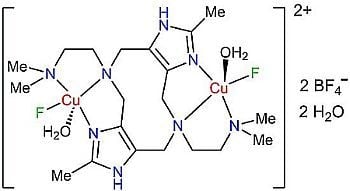
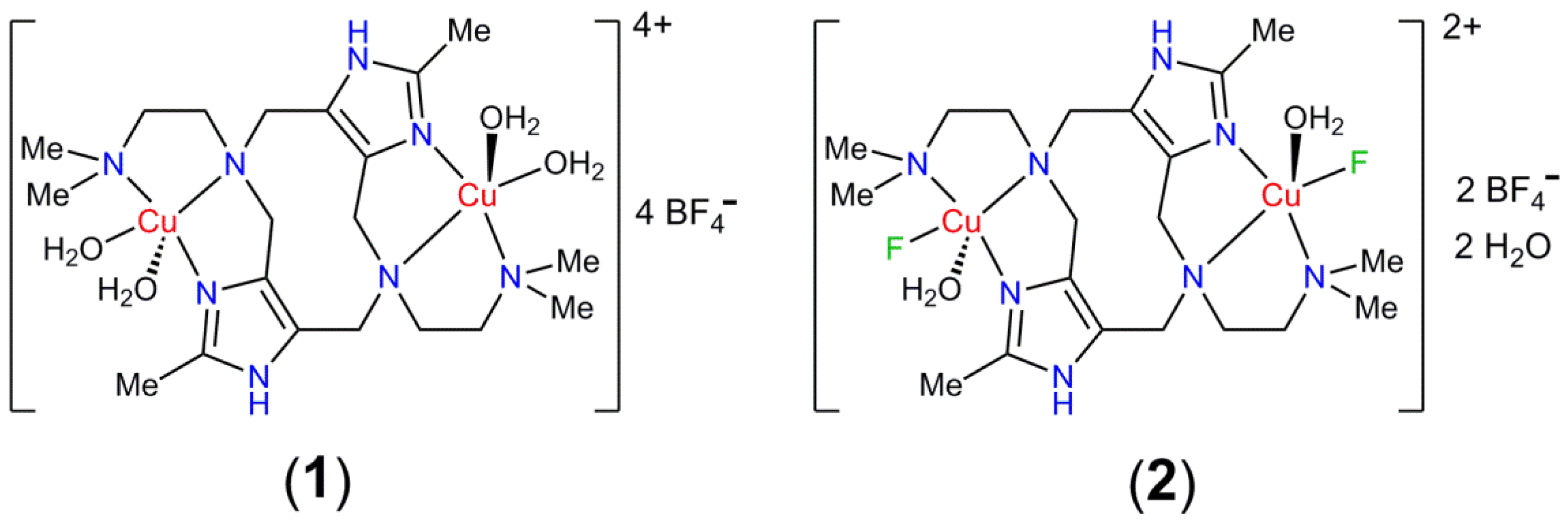
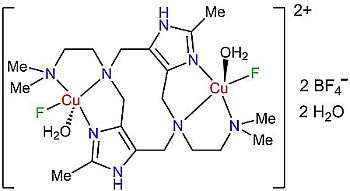
      <p>Both complexes are based on the octahydro[<xref ref-type="bibr" rid="B4-crystals-02-01357">4</xref>,<xref ref-type="bibr" rid="B5-crystals-02-01357">5</xref>]diimidazo[1,6]diazecine cyclic framework, abbreviated <italic>dimeim</italic> hereafter. This ligand has proven excellent for yielding di-copper complexes with a variety of counterions [<xref ref-type="bibr" rid="B26-crystals-02-01357">26</xref>,<xref ref-type="bibr" rid="B27-crystals-02-01357">27</xref>,<xref ref-type="bibr" rid="B28-crystals-02-01357">28</xref>]. By reacting 2:1 equivalents of Cu(BF<sub>4</sub>)<sub>2</sub>·6H<sub>2</sub>O and <italic>dimeim</italic> in methanol, we obtained the expected complex, [Cu<sub>2</sub>(H<sub>2</sub>O)<sub>4</sub>(<italic>dimeim</italic>)](BF<sub>4</sub>)<sub>4</sub> (<bold>1</bold>, see <xref ref-type="fig" rid="crystals-02-01357-f001">Figure 1</xref>), a deep-blue compound initially intended for a study about the influence of the counterion on the magnetic properties of the cation. However, the very first crop of crystalline material contained light-blue small crystals, for which analytical data and X-ray crystallography gave a different formula, [Cu<sub>2</sub>(H<sub>2</sub>O)<sub>2</sub>(F)<sub>2</sub>(<italic>dimeim</italic>)](BF<sub>4</sub>)<sub>2</sub>·2H<sub>2</sub>O (<bold>2</bold>, see <xref ref-type="fig" rid="crystals-02-01357-f001">Figure 1</xref>). The relative yields for <bold>1</bold> and <bold>2</bold> varied from synthesis attempts, and a satisfactory separation could not be achieved. However, on the basis of their colors, suitable single crystals for <bold>1</bold> and <bold>2</bold> were picked from the raw material, and their crystal structures determined.</p>
      <fig id="crystals-02-01357-f001" position="anchor">
        <label>Figure 1</label>
        <caption>
          <p>Complexes <bold>1</bold> and <bold>2</bold> characterized by X-ray diffraction.</p>
        </caption>
        <graphic xmlns:xlink="http://www.w3.org/1999/xlink" xlink:href="crystals-02-01357-g001.tif"/>
      </fig>
      <p>Numerous studies [<xref ref-type="bibr" rid="B26-crystals-02-01357">26</xref>,<xref ref-type="bibr" rid="B27-crystals-02-01357">27</xref>,<xref ref-type="bibr" rid="B28-crystals-02-01357">28</xref>,<xref ref-type="bibr" rid="B29-crystals-02-01357">29</xref>,<xref ref-type="bibr" rid="B30-crystals-02-01357">30</xref>] carried out during the last ten years showed that the central 10-membered diazecine heterocycle of these compounds is systematically stabilized as a <italic>C</italic><sub>2h</sub> skewed boat-chair-boat conformer. Such a rigid, highly symmetrical conformation strongly favors the formation of centrosymmetric binuclear coordination compounds, using diazecine and imidazole N atoms as coordination sites [<xref ref-type="bibr" rid="B26-crystals-02-01357">26</xref>,<xref ref-type="bibr" rid="B27-crystals-02-01357">27</xref>,<xref ref-type="bibr" rid="B28-crystals-02-01357">28</xref>,<xref ref-type="bibr" rid="B29-crystals-02-01357">29</xref>,<xref ref-type="bibr" rid="B30-crystals-02-01357">30</xref>]. This rule is again observed for <bold>1</bold> and <bold>2</bold>, two binuclear complexes with five-coordinate Cu<sup>II</sup> centers.</p>
      <sec>
        <title>2.1. [Cu<sub>2</sub>(H<sub>2</sub>O)<sub>4</sub>(<italic>dimeim</italic>)](BF<sub>4</sub>)<sub>4</sub> (1)</title>
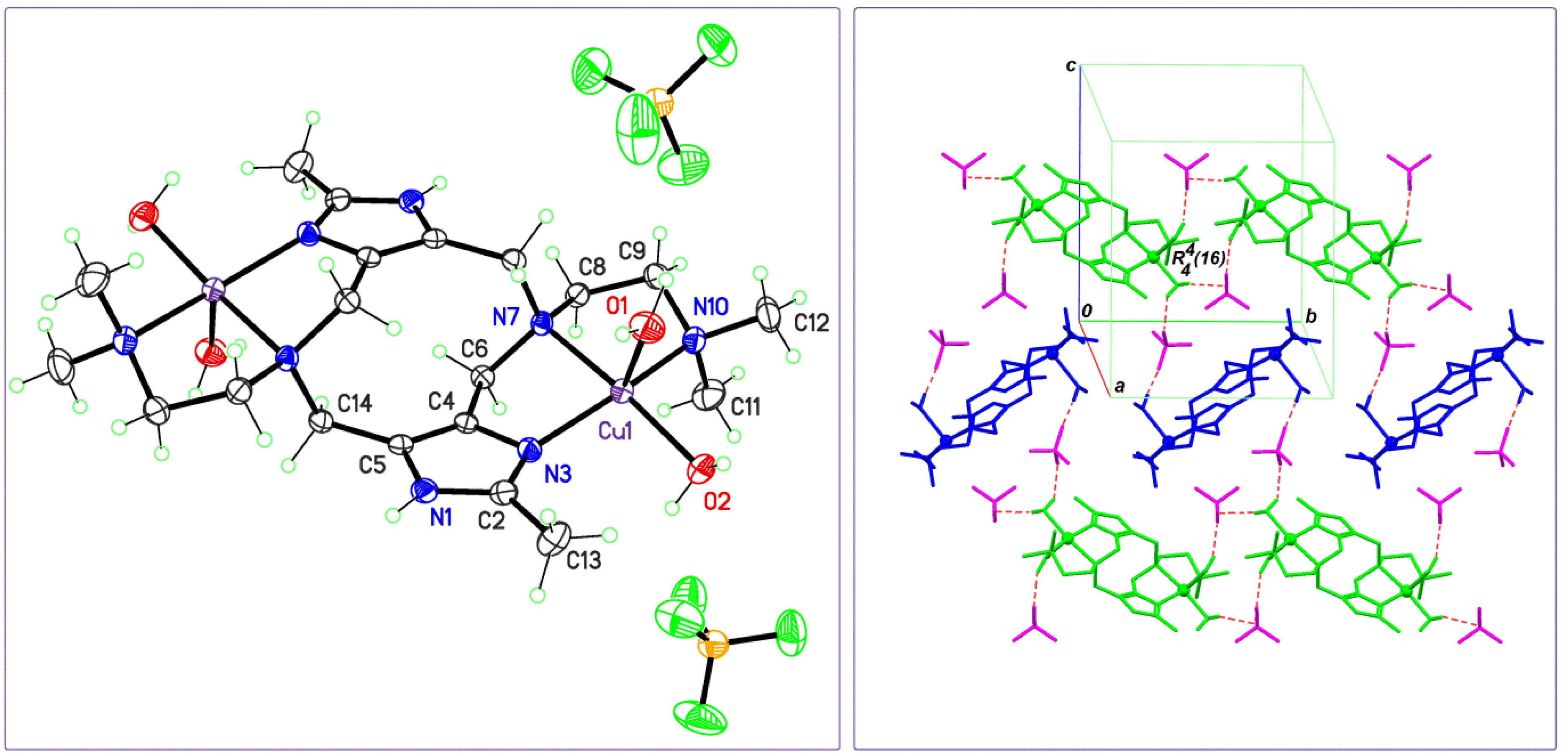
        <p>The major complex crystallizes with four BF<sub>4</sub><sup>−</sup> anions and two independent half-cations in the asymmetric unit, each one completed to a full [Cu<sub>2</sub>(H<sub>2</sub>O)<sub>4</sub>(<italic>dimeim</italic>)]<sup>4+</sup> cation through inversion centers (<xref ref-type="fig" rid="crystals-02-01357-f002">Figure 2</xref>). The same arrangement in a similar triclinic cell for the ClO<sub>4</sub><sup>−</sup> salt of the same cation has been recently characterized [<xref ref-type="bibr" rid="B30-crystals-02-01357">30</xref>], while a monoclinic polymorph of this compound, with an asymmetric unit containing a single [Cu<sub>2</sub>(H<sub>2</sub>O)<sub>4</sub>(<italic>dimeim</italic>)](ClO<sub>4</sub>)<sub>4</sub> formula, was previously reported [<xref ref-type="bibr" rid="B28-crystals-02-01357">28</xref>]. These three closely related structures share a virtually identical conformation for the cation and present identical coordination geometries. In the crystal of <bold>1</bold>, a fit between independent cations gives a r.m.s. deviation which is less than 0.1 Å. The coordination sphere of the metal centers is closer to a square pyramidal (SP) geometry (<italic>t</italic><sub>Cu1</sub> = 0.16, <italic>t</italic><sub>Cu2</sub> = 0.05) with the apical positions occupied by water molecules. As expected, the angle restrictions induced by the chelate rings in the basal coordination planes (e.g., N3, N7, N10, O2 for Cu1; see <xref ref-type="fig" rid="crystals-02-01357-f002">Figure 2</xref>) push the metal from the base, by 0.246 Ǻ (Cu1) or 0.212 Ǻ (Cu2). In the crystal, cations and BF<sub>4</sub><sup>−</sup> ions are held together by OH···F hydrogen bonds involving coordinated water molecules as donor groups (<xref ref-type="table" rid="crystals-02-01357-t001">Table 1</xref> and <xref ref-type="fig" rid="crystals-02-01357-f002">Figure 2</xref>). The resulting supramolecular structure is dominated by the formation of a <italic>R</italic><sub>4</sub><sup>4</sup>(16) ring motif [<xref ref-type="bibr" rid="B31-crystals-02-01357">31</xref>], which, interestingly, was also present in both polymorphs of the ClO<sub>4</sub><sup>−</sup> salt [<xref ref-type="bibr" rid="B28-crystals-02-01357">28</xref>,<xref ref-type="bibr" rid="B30-crystals-02-01357">30</xref>].</p>
        <fig id="crystals-02-01357-f002" position="anchor">
          <label>Figure 2</label>
          <caption>
            <p>Left: <italic>ORTEP</italic>-like view of one cation and two anions in complex <bold>1</bold>; Right: Part of the crystal structure of <bold>1</bold>. Green and blue cations are based on Cu1 and Cu2, respectively. Dashed bonds represent the strongest hydrogen bonds formed between the coordinated water molecules and the BF<sub>4</sub><sup>−</sup> ions (see <xref ref-type="table" rid="crystals-02-01357-t001">Table 1</xref>).</p>
          </caption>
          <graphic xmlns:xlink="http://www.w3.org/1999/xlink" xlink:href="crystals-02-01357-g002.tif"/>
        </fig>
      </sec>
      <sec>
        <title>2.2. [Cu<sub>2</sub>(H<sub>2</sub>O)<sub>2</sub>(F)<sub>2</sub>(<italic>dimeim</italic>)](BF<sub>4</sub>)<sub>2</sub>·2H<sub>2</sub>O (2)</title>
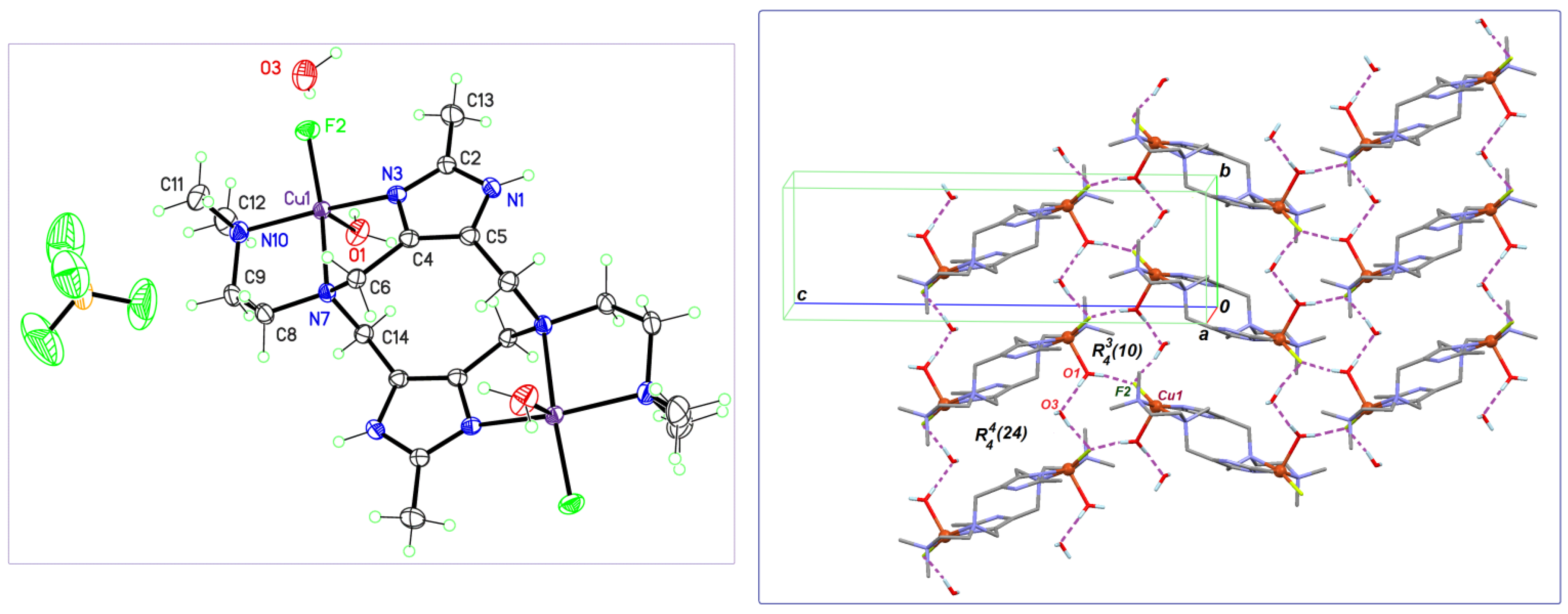
        <p>Complex <bold>2</bold> derives directly from <bold>1</bold>, by substitution of two coordinated water molecules in the basal planes by two F<sup>−</sup> ions, affording cation [Cu<sub>2</sub>(H<sub>2</sub>O)<sub>2</sub>(F)<sub>2</sub>(<italic>dimeim</italic>)]<sup>2+</sup>. Substituted water molecules are still present in the crystal, but now as lattice water molecules. Because of the charge drop for the cationic species, the formula is completed by two BF<sub>4</sub><sup>−</sup> anions. The propensity of the diazecine cycle to be centrosymmetric is reflected in the composition of the asymmetric unit of <bold>2</bold>, limited to a half chemical formula (<xref ref-type="fig" rid="crystals-02-01357-f003">Figure 3</xref>).</p>
        <fig id="crystals-02-01357-f003" position="anchor">
          <label>Figure 3</label>
          <caption>
            <p>Left: One cation, one anion, and one lattice water molecule in the crystal of <bold>2</bold>. Right: Part of the crystal structure of <bold>2</bold>, showing the main <italic>R</italic> ring motifs. BF<sub>4</sub><sup>−</sup> anions as well as C– and N– bonded H atoms have been omitted for clarity. Dashed lines represent O1–H11···F2, O1–H12···O3, and O3–H32···F2 hydrogen bonds (see <xref ref-type="table" rid="crystals-02-01357-t001">Table 1</xref>).</p>
          </caption>
          <graphic xmlns:xlink="http://www.w3.org/1999/xlink" xlink:href="crystals-02-01357-g003.tif"/>
        </fig>
        <p>Despite the substitution, the coordination of the metal center remains almost unchanged compared to <bold>1</bold>, with a square pyramidal geometry characterized by <italic>t</italic><sub>Cu</sub> = 0.03 and a deviation of Cu from the basal plane of 0.30 Å. The Cu–F bond length, 1.912(2) Å, is difficult to support, because few X-ray structures of Cu<sup>II</sup> coordination complexes including such a bond have been reported so far. This bond length is however consistent with those found in available SP complexes with a basal Cu–F bond, 1.888 Å [<xref ref-type="bibr" rid="B15-crystals-02-01357">15</xref>], 1.916 Å [<xref ref-type="bibr" rid="B16-crystals-02-01357">16</xref>], and 1.902–1.932 Å [<xref ref-type="bibr" rid="B32-crystals-02-01357">32</xref>]. Moreover, the definite proof of the presence of a Cu–F bond should be sought rather in the bond trans to the Cu–F bond. The Cu–N7 distance, 2.111(3) Å, is slightly larger than the expected distance, 2.053 Å, as spotted by MOGUL [<xref ref-type="bibr" rid="B33-crystals-02-01357">33</xref>] on the basis of 15 hits. The corresponding bond length in the non-fluorinated complex <bold>1</bold>, is, for instance, Cu1–N7 = 2.088(4) Å and Cu2–N27 = 2.073(4) Å. The lengthening of the Cu–N7 bond in complex <bold>2</bold> should thus be regarded as a consequence of the difference in trans influence of the F<sup>−</sup> ligand compared to H<sub>2</sub>O.</p>
        <p>As in <bold>1</bold>, the crystal structure in <bold>2</bold> is dominated by hydrogen bonds involving water molecules and F<sup>−</sup> ions, although, in contrast to <bold>1</bold>, the most efficient acceptor in <bold>2</bold> is the F<sup>−</sup> ligand coordinated to the metal center, F2 (see <xref ref-type="table" rid="crystals-02-01357-t001">Table 1</xref>). Corresponding hydrogen bonds use the coordinated water molecule (O1) as well as the lattice water molecule (O3) as donor groups, and may be considered as strong interactions, with non bonding H···F distances of <italic>ca</italic>. 1.80 Å, and O–H···F angles close to 180°. It is worth noting that he upper limit for very strong H···F interactions in coordination chemistry is around OH···F = 1.74(3) Å [<xref ref-type="bibr" rid="B15-crystals-02-01357">15</xref>]. Based on these contacts, a 2D supramolecular structure is formed for compound <bold>2</bold>. First, <italic>R</italic><sub>4</sub><sup>3</sup>(10) ring motifs are formed between cations and free water molecules, and edge-sharing motifs propagate in the [010] direction. The second base vector for the building of the 2D network is [001], and involves the same constituents to form <italic>R</italic><sub>4</sub><sup>4</sup>(24) large rings (<xref ref-type="fig" rid="crystals-02-01357-f003">Figure 3</xref>). The lattice water molecule O3 is common to both <italic>R</italic> motifs, and should thus be seen as an essential component in the stabilization of the observed crystal structure.</p>
        <table-wrap id="crystals-02-01357-t001" position="anchor">
          <object-id pub-id-type="pii">crystals-02-01357-t001_Table 1</object-id>
          <label>Table 1</label>
          <caption>
            <p>Main hydrogen bonds in complexes <bold>1</bold> and <bold>2</bold> involving water molecules as donor groups and F<sup>−</sup> or lattice water as acceptor groups. Weak N–H···F contacts present in the crystal structures are not displayed in the table and may be found in the CIF deposited as supplementary material.</p>
          </caption>
          <table>
            <thead>
              <tr>
                <th align="left" valign="middle">O–H</th>
                <th align="left" valign="middle">Acceptor (F or O)</th>
                <th align="left" valign="middle">O–H (Å)</th>
                <th align="left" valign="middle">H···<italic>A</italic> (Å)</th>
                <th align="left" valign="middle">O···<italic>A</italic> (Å)</th>
                <th align="left" valign="middle">O–H···<italic>A</italic> angle (°)</th>
                <th align="left" valign="middle">Symmetry for <italic>A</italic></th>
              </tr>
            </thead>
            <tbody>
              <tr>
                <td colspan="7" align="left" valign="middle">
                  <bold>[Cu<sub>2</sub>(H<sub>2</sub>O)<sub>4</sub>(<italic>dimeim</italic>)](BF<sub>4</sub>)<sub>4</sub> (1)</bold>
                </td>
              </tr>
              <tr>
                <td align="left" valign="middle">O1–H1B</td>
                <td align="left" valign="middle">F6</td>
                <td align="left" valign="middle">0.848(10)</td>
                <td align="left" valign="middle">2.23(4)</td>
                <td align="left" valign="middle">2.979(9)</td>
                <td align="left" valign="middle">147(7)</td>
                <td align="left" valign="middle"><italic>x</italic>, <italic>y</italic>, <italic>z</italic></td>
              </tr>
              <tr>
                <td align="left" valign="middle">O1–H1C</td>
                <td align="left" valign="middle">F14</td>
                <td align="left" valign="middle">0.848(10)</td>
                <td align="left" valign="middle">2.030(15)</td>
                <td align="left" valign="middle">2.870(7)</td>
                <td align="left" valign="middle">171(6)</td>
                <td align="left" valign="middle"><italic>x</italic>, <italic>y</italic>, <italic>z</italic></td>
              </tr>
              <tr>
                <td align="left" valign="middle">O2–H2B</td>
                <td align="left" valign="middle">F10</td>
                <td align="left" valign="middle">0.846(10)</td>
                <td align="left" valign="middle">1.96(5)</td>
                <td align="left" valign="middle">2.643(6)</td>
                <td align="left" valign="middle">137(7)</td>
                <td align="left" valign="middle"><italic>x</italic>, <italic>y</italic>, <italic>z</italic></td>
              </tr>
              <tr>
                <td align="left" valign="middle">O2–H2C</td>
                <td align="left" valign="middle">F5</td>
                <td align="left" valign="middle">0.845(10)</td>
                <td align="left" valign="middle">2.11(4)</td>
                <td align="left" valign="middle">2.858(8)</td>
                <td align="left" valign="middle">148(7)</td>
                <td align="left" valign="middle">1 − <italic>x</italic>, 1 − <italic>y</italic>, 1 − <italic>z</italic></td>
              </tr>
              <tr>
                <td align="left" valign="middle">O21–H21B</td>
                <td align="left" valign="middle">F2</td>
                <td align="left" valign="middle">0.847(10)</td>
                <td align="left" valign="middle">2.29(3)</td>
                <td align="left" valign="middle">3.109(10)</td>
                <td align="left" valign="middle">162(8)</td>
                <td align="left" valign="middle">2 − <italic>x</italic>, 2 − <italic>y</italic>, −<italic>z</italic></td>
              </tr>
              <tr>
                <td align="left" valign="middle">O21–H21C</td>
                <td align="left" valign="middle">F9</td>
                <td align="left" valign="middle">0.848(10)</td>
                <td align="left" valign="middle">2.08(2)</td>
                <td align="left" valign="middle">2.908(8)</td>
                <td align="left" valign="middle">164(7)</td>
                <td align="left" valign="middle">2 − <italic>x</italic>, 1 − <italic>y</italic>, −<italic>z</italic></td>
              </tr>
              <tr>
                <td align="left" valign="middle">O22–H22B</td>
                <td align="left" valign="middle">F15</td>
                <td align="left" valign="middle">0.848(10)</td>
                <td align="left" valign="middle">2.08(4)</td>
                <td align="left" valign="middle">2.857(6)</td>
                <td align="left" valign="middle">152(7)</td>
                <td align="left" valign="middle">2 − <italic>x</italic>, 1 − <italic>y</italic>, 1 − <italic>z</italic></td>
              </tr>
              <tr>
                <td align="left" valign="middle">O22–H22C</td>
                <td align="left" valign="middle">F3</td>
                <td align="left" valign="middle">0.849(10)</td>
                <td align="left" valign="middle">1.782(18)</td>
                <td align="left" valign="middle">2.624(9)</td>
                <td align="left" valign="middle">172(7)</td>
                <td align="left" valign="middle"><italic>x</italic>, <italic>y</italic>, <italic>z</italic></td>
              </tr>
              <tr>
                <td colspan="7" align="left" valign="middle">
                  <bold>[Cu<sub>2</sub>(H<sub>2</sub>O)<sub>2</sub>(F)<sub>2</sub>(<italic>dimeim</italic>)](BF<sub>4</sub>)<sub>2</sub>·2H<sub>2</sub>O (2)</bold>
                </td>
              </tr>
              <tr>
                <td align="left" valign="middle">O1–H11</td>
                <td align="left" valign="middle">F2</td>
                <td align="left" valign="middle">0.848(10)</td>
                <td align="left" valign="middle">1.798(15)</td>
                <td align="left" valign="middle">2.635(3)</td>
                <td align="left" valign="middle">169(5)</td>
                <td align="left" valign="middle">−<italic>x</italic>, <italic>y</italic>− 1/2, −<italic>z</italic>+ 1/2</td>
              </tr>
              <tr>
                <td align="left" valign="middle">O1–H12</td>
                <td align="left" valign="middle">O3</td>
                <td align="left" valign="middle">0.846(10)</td>
                <td align="left" valign="middle">1.873(12)</td>
                <td align="left" valign="middle">2.716(4)</td>
                <td align="left" valign="middle">174(5)</td>
                <td align="left" valign="middle"><italic>x</italic>, <italic>y</italic>− 1, <italic>z</italic></td>
              </tr>
              <tr>
                <td align="left" valign="middle">O3–H31</td>
                <td align="left" valign="middle">F14</td>
                <td align="left" valign="middle">0.845(10)</td>
                <td align="left" valign="middle">1.911(19)</td>
                <td align="left" valign="middle">2.736(6)</td>
                <td align="left" valign="middle">165(6)</td>
                <td align="left" valign="middle"><italic>x</italic>− 1, <italic>y</italic>− 1, <italic>z</italic></td>
              </tr>
              <tr>
                <td align="left" valign="middle">O3–H32</td>
                <td align="left" valign="middle">F2</td>
                <td align="left" valign="middle">0.847(10)</td>
                <td align="left" valign="middle">1.804(13)</td>
                <td align="left" valign="middle">2.644(4)</td>
                <td align="left" valign="middle">171(5)</td>
                <td align="left" valign="middle"><italic>x</italic>, <italic>y</italic>, <italic>z</italic></td>
              </tr>
            </tbody>
          </table>
        </table-wrap>
      </sec>
    </sec>
    <sec>
      <title>3. Experimental Section</title>
      <p>Synthesis of the complexes. The ligand <italic>dimeim</italic> was prepared as previously described [<xref ref-type="bibr" rid="B26-crystals-02-01357">26</xref>]. To 50 mL of a methanolic solution containing two mmol of Cu(BF<sub>4</sub>)<sub>2</sub>·6H<sub>2</sub>O, one mmol of solid <italic>dimeim</italic> was added in several portions, which dissolved upon coordination. Small light blue crystals of <bold>2</bold> were collected after one day, calculated analysis for [Cu<sub>2</sub>(H<sub>2</sub>O)<sub>2</sub>(F)<sub>2</sub>(<italic>dimeim</italic>)](BF<sub>4</sub>)<sub>2</sub>·2H<sub>2</sub>O: C, 30.05; H, 5.55; N, 14.02%. Found: C, 30.46; H, 5.85; N, 14.27%. Deep blue crystals of <bold>1</bold> were collected after a few days. Calculated analysis for [Cu<sub>2</sub>(H<sub>2</sub>O)<sub>4</sub>(<italic>dimeim</italic>)](BF<sub>4</sub>)<sub>4</sub>: C, 25.69; H, 4.74; N, 11.99%. Found: C, 25.38; H, 4.74; N, 11.93%.</p>
      <p>X-ray diffraction. Data for complexes <bold>1</bold> and <bold>2</bold> were collected at room temperature on a Bruker P4 diffractometer [<xref ref-type="bibr" rid="B34-crystals-02-01357">34</xref>] using the Mo-K<italic>α</italic> radiation (<xref ref-type="table" rid="crystals-02-01357-t002">Table 2</xref>). Raw data were corrected for absorption effects [<xref ref-type="bibr" rid="B35-crystals-02-01357">35</xref>] and the structures refined with the SHELX programs [<xref ref-type="bibr" rid="B36-crystals-02-01357">36</xref>]. Although sample for <bold>2</bold> was a rather long crystal not uniformly irradiated during data collection, a reduction of the sample size was not intended, because very few single crystals were available. However, we assume that absorption correction for <bold>2</bold> is still reliable (<italic>R</italic><sub>int</sub> = 0.028). Accurate determination of sites occupied by H atoms was critical for water molecules, in order to discriminate F<sup>−</sup> and water molecules (and possibly OH<sup>−</sup> groups, assuming that hydroxyl groups could be present in the reaction media). All water H atoms in both complexes were thus assigned from difference maps, and refined with free coordinates, although soft restraints were applied to O–H bond lengths and H···H separations, 0.85(1) and 1.34(1) Å, respectively. Sensible orientations for water molecules are obtained in the final models, since all O–H groups are engaged in efficient hydrogen bonds. On the other hand, in the case of <bold>2</bold>, final difference map is featureless in the vicinity of the coordinated fluoride site, corroborating that Cu–F bonds have been formed, rather than Cu–OH or Cu–OH<sub>2</sub> bonds. CIF data, including structure factors, are deposited as supplementary material.</p>
      <table-wrap id="crystals-02-01357-t002" position="anchor">
        <object-id pub-id-type="pii">crystals-02-01357-t002_Table 2</object-id>
        <label>Table 2</label>
        <caption>
          <p>Crystal data for complexes <bold>1</bold> and <bold>2</bold>.</p>
        </caption>
        <table>
          <thead>
            <tr>
              <th align="left" valign="middle">Compound</th>
              <th align="left" valign="middle">1</th>
              <th align="left" valign="middle">2</th>
            </tr>
          </thead>
          <tbody>
            <tr>
              <td align="left" valign="middle">Empirical formula</td>
              <td align="left" valign="middle">C<sub>20</sub>H<sub>44</sub>B<sub>4</sub>Cu<sub>2</sub>F<sub>16</sub>N<sub>8</sub>O<sub>4</sub></td>
              <td align="left" valign="middle">C<sub>20</sub>H<sub>44</sub>B<sub>2</sub>Cu<sub>2</sub>F<sub>10</sub>N<sub>8</sub>O<sub>4</sub></td>
            </tr>
            <tr>
              <td align="left" valign="middle">Formula weight</td>
              <td align="left" valign="middle">934.95</td>
              <td align="left" valign="middle">799.33</td>
            </tr>
            <tr>
              <td align="left" valign="middle">Color, habit</td>
              <td align="left" valign="middle">blue prism</td>
              <td align="left" valign="middle">blue prism</td>
            </tr>
            <tr>
              <td align="left" valign="middle">Crystal size [mm]</td>
              <td align="left" valign="middle">0.40 × 0.40 × 0.20</td>
              <td align="left" valign="middle">0.68 × 0.20 × 0.12</td>
            </tr>
            <tr>
              <td align="left" valign="middle">Space group</td>
              <td align="left" valign="middle"><italic>P</italic>-1</td>
              <td align="left" valign="middle"><italic>P</italic>2<sub>1</sub>/<italic>c</italic></td>
            </tr>
            <tr>
              <td align="left" valign="middle"><italic>a</italic> [Ǻ]</td>
              <td align="left" valign="middle">9.455(2)</td>
              <td align="left" valign="middle">10.4816(9)</td>
            </tr>
            <tr>
              <td align="left" valign="middle"><italic>b</italic> [Ǻ]</td>
              <td align="left" valign="middle">12.0445(17)</td>
              <td align="left" valign="middle">7.0223(7)</td>
            </tr>
            <tr>
              <td align="left" valign="middle"><italic>c</italic> [Ǻ]</td>
              <td align="left" valign="middle">16.493(2)</td>
              <td align="left" valign="middle">22.732(3)</td>
            </tr>
            <tr>
              <td align="left" valign="middle"><italic>α</italic> [°]</td>
              <td align="left" valign="middle">87.469(10)</td>
              <td align="left" valign="middle">-</td>
            </tr>
            <tr>
              <td align="left" valign="middle"><italic>β</italic> [°]</td>
              <td align="left" valign="middle">83.061(14)</td>
              <td align="left" valign="middle">95.913(8)</td>
            </tr>
            <tr>
              <td align="left" valign="middle"><italic>γ</italic>[°]</td>
              <td align="left" valign="middle">75.465(14)</td>
              <td align="left" valign="middle">-</td>
            </tr>
            <tr>
              <td align="left" valign="middle"><italic>V</italic> (Ǻ<sup>3</sup>)</td>
              <td align="left" valign="middle">1804.7(5)</td>
              <td align="left" valign="middle">1664.3(3)</td>
            </tr>
            <tr>
              <td align="left" valign="middle">
                <italic>Z</italic>
              </td>
              <td align="left" valign="middle">2</td>
              <td align="left" valign="middle">2</td>
            </tr>
            <tr>
              <td align="left" valign="middle"><italic>ρ</italic><sub>calcd.</sub> [g·cm<sup>−3</sup>]</td>
              <td align="left" valign="middle">1.721</td>
              <td align="left" valign="middle">1.595</td>
            </tr>
            <tr>
              <td align="left" valign="middle"><italic>μ</italic> [mm<sup>−1</sup>]</td>
              <td align="left" valign="middle">1.303</td>
              <td align="left" valign="middle">1.374</td>
            </tr>
            <tr>
              <td align="left" valign="middle">2<italic>θ</italic> range [°]</td>
              <td align="left" valign="middle">4–52.5</td>
              <td align="left" valign="middle">4–50</td>
            </tr>
            <tr>
              <td align="left" valign="middle">Reflections collected</td>
              <td align="left" valign="middle">14469</td>
              <td align="left" valign="middle">5831</td>
            </tr>
            <tr>
              <td align="left" valign="middle">Independent reflections (<italic>R</italic><sub>int</sub>)</td>
              <td align="left" valign="middle">7246 (0.031)</td>
              <td align="left" valign="middle">2924 (0.028)</td>
            </tr>
            <tr>
              <td align="left" valign="middle">Transmission factors [min., max.]</td>
              <td align="left" valign="middle">0.310–0.356</td>
              <td align="left" valign="middle">0.244–0.296</td>
            </tr>
            <tr>
              <td align="left" valign="middle">Final <italic>R</italic> indices [<italic>I </italic>≥ 2<italic>σ</italic>(<italic>I</italic>)] <italic>R</italic><sub>1</sub>,<italic>wR</italic><sub>2</sub></td>
              <td align="left" valign="middle">0.063, 0.173</td>
              <td align="left" valign="middle">0.042, 0.113</td>
            </tr>
            <tr>
              <td align="left" valign="middle">Final <italic>R</italic> indices (all data) <italic>R</italic><sub>1</sub>,<italic>wR</italic><sub>2</sub></td>
              <td align="left" valign="middle">0.075, 0.181</td>
              <td align="left" valign="middle">0.058, 0.128</td>
            </tr>
            <tr>
              <td align="left" valign="middle">Goodness-of-fit on <italic>F</italic><sup>2</sup></td>
              <td align="left" valign="middle">1.118</td>
              <td align="left" valign="middle">1.055</td>
            </tr>
            <tr>
              <td align="left" valign="middle">Data/restraints/parameters</td>
              <td align="left" valign="middle">7246/12/517</td>
              <td align="left" valign="middle">2924/6/224</td>
            </tr>
            <tr>
              <td align="left" valign="middle">Largest difference peak/hole [e Ǻ<sup>−3</sup>]</td>
              <td align="left" valign="middle">0.87, −0.52</td>
              <td align="left" valign="middle">0.75, −0.78</td>
            </tr>
          </tbody>
        </table>
      </table-wrap>
    </sec>
    <sec sec-type="conclusions">
      <title>4. Conclusions</title>
      <p>In conclusion, substitution of basal water by F<sup>−</sup> ligand in complex <bold>1</bold>, and concomitant release of water to form the hydrate <bold>2</bold>, allows the stabilization of a crystal structure featuring strong intermolecular hydrogen bonds between coordinated and free water molecules and the fluoride ligands, which also act as acceptors for hydrogen bonding.</p>
    </sec>
  </body>
  <back>
    <ack>
      <title>Acknowledgments</title>
      <p>Thanks are given to the Consejo Superior de Investigaciones Científicas (CSIC) of Spain for the award of a license for the use of the Cambridge Crystallographic Data Base (CSD).</p>
    </ack>
    <ref-list>
      <title>References and Notes</title>
      <ref id="B1-crystals-02-01357">
        <label>1.</label>
		<note><p>Although following the IUPAC rules the coordinated F<sup>−</sup> anion should be named “fluorido”, we prefer to follow the common practice of naming this ligand “fluoride” throughout this paper.</p></note>
      </ref>
      <ref id="B2-crystals-02-01357">
        <label>2.</label>
        <citation citation-type="journal">
          <person-group person-group-type="author">
            <name>
              <surname>Conner</surname>
              <given-names>M.</given-names>
            </name>
            <name>
              <surname>McConnell</surname>
              <given-names>A.</given-names>
            </name>
            <name>
              <surname>Schlueter</surname>
              <given-names>J.</given-names>
            </name>
            <name>
              <surname>Manson</surname>
              <given-names>J.</given-names>
            </name>
          </person-group>
          <article-title>Structural and magnetic properties of copper(II) coordination polymers containing fluoride-based anions and ancillary organic ligands</article-title>
          <source>J. Low Temp. Phys.</source>
          <year>2006</year>
          <volume>142</volume>
          <fpage>273</fpage>
          <lpage>278</lpage>
          <pub-id pub-id-type="doi">10.1007/BF02679507</pub-id>
        </citation>
      </ref>
      <ref id="B3-crystals-02-01357">
        <label>3.</label>
        <citation citation-type="journal">
          <person-group person-group-type="author">
            <name>
              <surname>Manson</surname>
              <given-names>J.L.</given-names>
            </name>
            <name>
              <surname>Schlueter</surname>
              <given-names>J.A.</given-names>
            </name>
            <name>
              <surname>Funk</surname>
              <given-names>K.A.</given-names>
            </name>
            <name>
              <surname>Southerland</surname>
              <given-names>H.I.</given-names>
            </name>
            <name>
              <surname>Twamley</surname>
              <given-names>B.</given-names>
            </name>
            <name>
              <surname>Lancaster</surname>
              <given-names>T.</given-names>
            </name>
            <name>
              <surname>Blundell</surname>
              <given-names>S.J.</given-names>
            </name>
            <name>
              <surname>Baker</surname>
              <given-names>P.J.</given-names>
            </name>
            <name>
              <surname>Pratt</surname>
              <given-names>F.L.</given-names>
            </name>
            <name>
              <surname>Singleton</surname>
              <given-names>J.</given-names>
            </name>
            <etal/>
          </person-group>
          <article-title>Strong H···F hydrogen bonds as synthons in polymeric quantum magnets: Structural, magnetic, and theoretical characterization of [Cu(HF<sub>2</sub>)(pyrazine)<sub>2</sub>]SbF<sub>6</sub>, [Cu<sub>2</sub>F(HF)(HF<sub>2</sub>)(pyrazine)<sub>4</sub>](SbF<sub>6</sub>)<sub>2</sub>, and [CuAg(H<sub>3</sub>F<sub>4</sub>)(pyrazine)<sub>5</sub>](SbF<sub>6</sub>)<sub>2</sub></article-title>
          <source>J. Am. Chem. Soc.</source>
          <year>2009</year>
          <volume>131</volume>
          <fpage>6733</fpage>
          <lpage>6747</lpage>
        <pub-id pub-id-type="doi">10.1021/ja808761d</pub-id><pub-id pub-id-type="pmid">19290599</pub-id></citation>
      </ref>
      <ref id="B4-crystals-02-01357">
        <label>4.</label>
        <citation citation-type="journal">
          <person-group person-group-type="author">
            <name>
              <surname>Emsley</surname>
              <given-names>J.</given-names>
            </name>
            <name>
              <surname>Reza</surname>
              <given-names>N.M.</given-names>
            </name>
            <name>
              <surname>Dawes</surname>
              <given-names>H.M.</given-names>
            </name>
            <name>
              <surname>Hursthouse</surname>
              <given-names>M.B.</given-names>
            </name>
          </person-group>
          <article-title>Diaquadifluorobis(nicotinamide) copper(II) tetrahydrate: Hydrogen bonding between ligand fluoride and lattice water</article-title>
          <source>J. Chem. Soc. Dalton Trans.</source>
          <year>1986</year>
          <fpage>313</fpage>
          <lpage>316</lpage>
        </citation>
      </ref>
      <ref id="B5-crystals-02-01357">
        <label>5.</label>
        <citation citation-type="journal">
          <person-group person-group-type="author">
            <name>
              <surname>Emsley</surname>
              <given-names>J.</given-names>
            </name>
            <name>
              <surname>Arif</surname>
              <given-names>M.</given-names>
            </name>
            <name>
              <surname>Bates</surname>
              <given-names>P.A.</given-names>
            </name>
            <name>
              <surname>Hursthouse</surname>
              <given-names>M.B.</given-names>
            </name>
          </person-group>
          <article-title>Aqua(2,2'-bipyridyl)difluorocopper(II) dihydrate: X-ray structure reveals short hydrogen bonds and other unusual features</article-title>
          <source>J. Chem. Soc. Dalton Trans.</source>
          <year>1987</year>
          <fpage>2397</fpage>
          <lpage>2399</lpage>
        </citation>
      </ref>
      <ref id="B6-crystals-02-01357">
        <label>6.</label>
        <citation citation-type="journal">
          <person-group person-group-type="author">
            <name>
              <surname>Mokuolu</surname>
              <given-names>Q.F.</given-names>
            </name>
            <name>
              <surname>Foguet-Albiol</surname>
              <given-names>D.</given-names>
            </name>
            <name>
              <surname>Jones</surname>
              <given-names>L.F.</given-names>
            </name>
            <name>
              <surname>Wolowska</surname>
              <given-names>J.</given-names>
            </name>
            <name>
              <surname>Kowalczyk</surname>
              <given-names>R.M.</given-names>
            </name>
            <name>
              <surname>Kilner</surname>
              <given-names>C.A.</given-names>
            </name>
            <name>
              <surname>Christou</surname>
              <given-names>G.</given-names>
            </name>
            <name>
              <surname>McGowan</surname>
              <given-names>P.C.</given-names>
            </name>
            <name>
              <surname>Halcrow</surname>
              <given-names>M.A.</given-names>
            </name>
          </person-group>
          <article-title>Four copper(II) pyrazolido complexes derived from reactions of 3{5}-substituted pyrazoles with CuF<sub>2</sub> or Cu(OH)<sub>2</sub></article-title>
          <source>Dalton Trans.</source>
          <year>2007</year>
          <fpage>1392</fpage>
          <lpage>1399</lpage>
        </citation>
      </ref>
      <ref id="B7-crystals-02-01357">
        <label>7.</label>
        <citation citation-type="journal">
          <person-group person-group-type="author">
            <name>
              <surname>Guichelaar</surname>
              <given-names>M.A.</given-names>
            </name>
            <name>
              <surname>Van Hest</surname>
              <given-names>J.A.M.</given-names>
            </name>
            <name>
              <surname>Reedijk</surname>
              <given-names>J.</given-names>
            </name>
          </person-group>
          <article-title>Formation of solid fluoride complexes from metal(II) tetrafluoroborates</article-title>
          <source>Inorg. Nucl. Chem. Lett.</source>
          <year>1974</year>
          <volume>10</volume>
          <fpage>999</fpage>
          <lpage>1004</lpage>
          <pub-id pub-id-type="doi">10.1016/0020-1650(74)80027-9</pub-id>
        </citation>
      </ref>
      <ref id="B8-crystals-02-01357">
        <label>8.</label>
        <citation citation-type="journal">
          <person-group person-group-type="author">
            <name>
              <surname>Van Rijn</surname>
              <given-names>J.</given-names>
            </name>
            <name>
              <surname>Reedijk</surname>
              <given-names>J.</given-names>
            </name>
            <name>
              <surname>Dartmann</surname>
              <given-names>M.</given-names>
            </name>
            <name>
              <surname>Krebs</surname>
              <given-names>B.</given-names>
            </name>
          </person-group>
          <article-title>Copper(I) and copper(II) compounds of a dinucleating, octadentate tetrakisbenzimidazole ligand. Crystal and molecular structures of three dihalogeno{1,8-bis[bis(1'-methylbenzimidazol-2'-ylmethyl)amino]-3,6-dioxaoctane}dicopper(II) bis(anion) compounds (halogen = F, Cl, or Br; anion = BF<sub>4</sub>, CF<sub>3</sub>SO<sub>3</sub>, or Cl)</article-title>
          <source>J. Chem. Soc. Dalton Trans.</source>
          <year>1987</year>
          <fpage>2579</fpage>
          <lpage>2593</lpage>
        </citation>
      </ref>
      <ref id="B9-crystals-02-01357">
        <label>9.</label>
        <citation citation-type="journal">
          <person-group person-group-type="author">
            <name>
              <surname>Van Albada</surname>
              <given-names>G.A.</given-names>
            </name>
            <name>
              <surname>Roubeau</surname>
              <given-names>O.</given-names>
            </name>
            <name>
              <surname>Mutikainen</surname>
              <given-names>I.</given-names>
            </name>
            <name>
              <surname>Turpeinen</surname>
              <given-names>U.</given-names>
            </name>
            <name>
              <surname>Reedijk</surname>
              <given-names>J.</given-names>
            </name>
          </person-group>
          <article-title>A unique methoxo- and fluoro-bridged triangular trinuclear Cu(II) species linked in a lattice via mononuclear Cu(II) units. Synthesis, X-ray structure and magnetism of [Cu<sub>4</sub>(2-aminopyrimidine)<sub>6</sub>(μ<sub>3</sub>-OCH<sub>3</sub>)<sub>2</sub>(μ-F)<sub>3</sub>(F)<sub>2</sub>](BF<sub>4</sub>)</article-title>
          <source>New J. Chem.</source>
          <year>2003</year>
          <volume>27</volume>
          <fpage>1693</fpage>
          <lpage>1697</lpage>
          <pub-id pub-id-type="doi">10.1039/b304979e</pub-id>
        </citation>
      </ref>
      <ref id="B10-crystals-02-01357">
        <label>10.</label>
        <citation citation-type="journal">
          <person-group person-group-type="author">
            <name>
              <surname>Casellas</surname>
              <given-names>H.</given-names>
            </name>
            <name>
              <surname>Pevec</surname>
              <given-names>A.</given-names>
            </name>
            <name>
              <surname>Kozlevčar</surname>
              <given-names>B.</given-names>
            </name>
            <name>
              <surname>Gamez</surname>
              <given-names>P.</given-names>
            </name>
            <name>
              <surname>Reedijk</surname>
              <given-names>J.</given-names>
            </name>
          </person-group>
          <article-title>An unprecedented μ<sub>4</sub>-SiF<sub>6</sub><sup>2−</sup>-bridged supramolecular polymer consisting of bis-μ-F<sup>−</sup> bridged dinuclear Cu(II) dications</article-title>
          <source>Polyhedron</source>
          <year>2005</year>
          <volume>24</volume>
          <fpage>1549</fpage>
          <lpage>1554</lpage>
          <pub-id pub-id-type="doi">10.1016/j.poly.2005.04.011</pub-id>
        </citation>
      </ref>
      <ref id="B11-crystals-02-01357">
        <label>11.</label>
        <citation citation-type="journal">
          <person-group person-group-type="author">
            <name>
              <surname>Keij</surname>
              <given-names>F.S.</given-names>
            </name>
            <name>
              <surname>De Graaff</surname>
              <given-names>R.A.G.</given-names>
            </name>
            <name>
              <surname>Haasnoot</surname>
              <given-names>J.G.</given-names>
            </name>
            <name>
              <surname>Oosterling</surname>
              <given-names>A.J.</given-names>
            </name>
            <name>
              <surname>Pedersen</surname>
              <given-names>E.</given-names>
            </name>
            <name>
              <surname>Reedijk</surname>
              <given-names>J.</given-names>
            </name>
          </person-group>
          <article-title>The first difluoro-bridged copper chain, and alternating zig-zag, stabilized by a unique intrachain hydrogen bond system. Crystal and molecular structure of <italic>Catena</italic>-poly[di-µ-fluoro-bis(3-methyl-4-ethyl-5-phenylpyrazole)copper(II)]</article-title>
          <source>J. Chem. Soc. Chem. Commun.</source>
          <year>1988</year>
          <fpage>423</fpage>
          <lpage>425</lpage>
        </citation>
      </ref>
      <ref id="B12-crystals-02-01357">
        <label>12.</label>
        <citation citation-type="journal">
          <person-group person-group-type="author">
            <name>
              <surname>Keij</surname>
              <given-names>F.S.</given-names>
            </name>
            <name>
              <surname>De Graaff</surname>
              <given-names>R.A.G.</given-names>
            </name>
            <name>
              <surname>Haasnoot</surname>
              <given-names>J.G.</given-names>
            </name>
            <name>
              <surname>Reedijk</surname>
              <given-names>J.</given-names>
            </name>
            <name>
              <surname>Pedersen</surname>
              <given-names>E.</given-names>
            </name>
          </person-group>
          <article-title>An unusual hexafluorosilicato-bridged chain compound; crystal structure of catena-(μ-Hexafluorosilicato)-tetrakis(5-phenylpyrazole)copper(II)</article-title>
          <source>Inorg. Chim. Acta</source>
          <year>1989</year>
          <volume>156</volume>
          <fpage>65</fpage>
          <lpage>70</lpage>
          <pub-id pub-id-type="doi">10.1016/S0020-1693(00)90369-4</pub-id>
        </citation>
      </ref>
      <ref id="B13-crystals-02-01357">
        <label>13.</label>
        <citation citation-type="journal">
          <person-group person-group-type="author">
            <name>
              <surname>Oosterling</surname>
              <given-names>A.J.</given-names>
            </name>
            <name>
              <surname>De Graaff</surname>
              <given-names>R.A.G.</given-names>
            </name>
            <name>
              <surname>Haasnoot</surname>
              <given-names>J.G.</given-names>
            </name>
            <name>
              <surname>Keij</surname>
              <given-names>F.S.</given-names>
            </name>
            <name>
              <surname>Reedijk</surname>
              <given-names>J.</given-names>
            </name>
            <name>
              <surname>Pedersen</surname>
              <given-names>E.</given-names>
            </name>
          </person-group>
          <article-title>Spectroscopic and magnetic identification of difluoro-bridged zigzag copper chains with substituted 5-phenylpyrazole ligands. Structural identification of catena-poly [bis(3-methyl-4-ethyl-5-phenylpyrazole)copper-di-μ-fluoro]</article-title>
          <source>Inorg. Chim. Acta</source>
          <year>1989</year>
          <volume>163</volume>
          <fpage>53</fpage>
          <lpage>58</lpage>
          <pub-id pub-id-type="doi">10.1016/S0020-1693(00)87141-8</pub-id>
        </citation>
      </ref>
      <ref id="B14-crystals-02-01357">
        <label>14.</label>
        <citation citation-type="journal">
          <person-group person-group-type="author">
            <name>
              <surname>Almesåker</surname>
              <given-names>A.</given-names>
            </name>
            <name>
              <surname>Gamez</surname>
              <given-names>P.</given-names>
            </name>
            <name>
              <surname>Reedijk</surname>
              <given-names>J.</given-names>
            </name>
            <name>
              <surname>Scott</surname>
              <given-names>J.L.</given-names>
            </name>
            <name>
              <surname>Spiccia</surname>
              <given-names>L.</given-names>
            </name>
            <name>
              <surname>Teat</surname>
              <given-names>S.J.</given-names>
            </name>
          </person-group>
          <article-title>Stabilisation of a very short Cu-F bond within the protected cavity of a copper(II) compound from a tris(2-aminoethyl)amine derivative</article-title>
          <source>Dalton Trans.</source>
          <year>2009</year>
          <fpage>4077</fpage>
          <lpage>4080</lpage>
        </citation>
      </ref>
      <ref id="B15-crystals-02-01357">
        <label>15.</label>
        <citation citation-type="journal">
          <person-group person-group-type="author">
            <name>
              <surname>Barlow</surname>
              <given-names>S.J.</given-names>
            </name>
            <name>
              <surname>Hill</surname>
              <given-names>S.J.</given-names>
            </name>
            <name>
              <surname>Hocking</surname>
              <given-names>J.E.</given-names>
            </name>
            <name>
              <surname>Hubberstey</surname>
              <given-names>P.</given-names>
            </name>
            <name>
              <surname>Li</surname>
              <given-names>W.-S.</given-names>
            </name>
          </person-group>
          <article-title>Crystal and molecular structure of [{Cu(pmdien)F(H<sub>2</sub>O)}<sub>2</sub>][BF<sub>4</sub>]<sub>2</sub> (pmdien = <italic>N</italic>,<italic>N</italic>,<italic>N</italic>′,<italic>N</italic>″,<italic>N</italic>″-pentamethyldiethylenetriamine): A novel dimeric cation with extremely short O-H···F interactions</article-title>
          <source>J. Chem. Soc. Dalton Trans.</source>
          <year>1997</year>
          <fpage>4701</fpage>
          <lpage>4704</lpage>
        </citation>
      </ref>
      <ref id="B16-crystals-02-01357">
        <label>16.</label>
        <citation citation-type="journal">
          <person-group person-group-type="author">
            <name>
              <surname>Ackermann</surname>
              <given-names>J.</given-names>
            </name>
            <name>
              <surname>Meyer</surname>
              <given-names>F.</given-names>
            </name>
            <name>
              <surname>Pritzkow</surname>
              <given-names>H.</given-names>
            </name>
          </person-group>
          <article-title>Compartmental pyrazolate ligands providing two adjacent tris(pyridylalkyl)amine-type binding pockets and their dicopper(II) fluoride complexes featuring extremely short intramolecular O-H···F bridges</article-title>
          <source>Inorg. Chim. Acta</source>
          <year>2004</year>
          <volume>357</volume>
          <fpage>3703</fpage>
          <lpage>3711</lpage>
          <pub-id pub-id-type="doi">10.1016/j.ica.2004.04.023</pub-id>
        </citation>
      </ref>
      <ref id="B17-crystals-02-01357">
        <label>17.</label>
        <citation citation-type="journal">
          <person-group person-group-type="author">
            <name>
              <surname>Tomat</surname>
              <given-names>E.</given-names>
            </name>
            <name>
              <surname>Cuesta</surname>
              <given-names>L.</given-names>
            </name>
            <name>
              <surname>Lynch</surname>
              <given-names>V.M.</given-names>
            </name>
            <name>
              <surname>Sessler</surname>
              <given-names>J.L.</given-names>
            </name>
          </person-group>
          <article-title>Binuclear fluoro-bridged zinc and cadmium complexes of a Schiff base expanded porphyrin: Fluoride abstraction from the tetrafluoroborate anion</article-title>
          <source>Inorg. Chem.</source>
          <year>2007</year>
          <volume>46</volume>
          <fpage>6224</fpage>
          <lpage>6226</lpage>
          <pub-id pub-id-type="doi">10.1021/ic700933p</pub-id>
        </citation>
      </ref>
      <ref id="B18-crystals-02-01357">
        <label>18.</label>
        <citation citation-type="journal">
          <person-group person-group-type="author">
            <name>
              <surname>Zhu</surname>
              <given-names>Q.</given-names>
            </name>
            <name>
              <surname>Nelson</surname>
              <given-names>K.J.</given-names>
            </name>
            <name>
              <surname>Shum</surname>
              <given-names>W.W.</given-names>
            </name>
            <name>
              <surname>DiPasquale</surname>
              <given-names>A.</given-names>
            </name>
            <name>
              <surname>Rheingold</surname>
              <given-names>A.L.</given-names>
            </name>
            <name>
              <surname>Miller</surname>
              <given-names>J.S.</given-names>
            </name>
          </person-group>
          <article-title>Preparation and structure of [Cr<sub>2</sub><sup>III</sup>F<sub>3</sub>(TPyA)<sub>2</sub>](BF<sub>4</sub>)<sub>3</sub> [TPyA = tris(2-pyridylmethyl)amine] possessing terminal and bridging fluorides</article-title>
          <source>Inorg. Chim. Acta</source>
          <year>2009</year>
          <volume>362</volume>
          <fpage>595</fpage>
          <lpage>598</lpage>
          <pub-id pub-id-type="doi">10.1016/j.ica.2008.04.015</pub-id>
        </citation>
      </ref>
      <ref id="B19-crystals-02-01357">
        <label>19.</label>
        <citation citation-type="journal">
          <person-group person-group-type="author">
            <name>
              <surname>Min</surname>
              <given-names>K.S.</given-names>
            </name>
            <name>
              <surname>Arif</surname>
              <given-names>A.M.</given-names>
            </name>
            <name>
              <surname>Miller</surname>
              <given-names>J.S.</given-names>
            </name>
          </person-group>
          <article-title>Synthesis, structure and magnetic properties of an oxo-bridged dinuclear iron(III) complex [(TPyA)FFe<sup>III</sup>OFe<sup>III</sup>F(TPyA)](BF<sub>4</sub>)<sub>2</sub>·0.5MeOH (TPyA = tris(2-pyridylmethyl)amine) containing the FFe<sup>III</sup>OFe<sup>III</sup>F linkage</article-title>
          <source>Inorg. Chim. Acta</source>
          <year>2007</year>
          <volume>360</volume>
          <fpage>1854</fpage>
          <lpage>1858</lpage>
          <pub-id pub-id-type="doi">10.1016/j.ica.2006.09.020</pub-id>
        </citation>
      </ref>
      <ref id="B20-crystals-02-01357">
        <label>20.</label>
        <citation citation-type="journal">
          <person-group person-group-type="author">
            <name>
              <surname>Reedijk</surname>
              <given-names>J.</given-names>
            </name>
          </person-group>
          <article-title>Formation of fluoride-containing coordination compounds by decomposition of transition-metal tetrafluoroborates</article-title>
          <source>Comments Inorg. Chem.</source>
          <year>1982</year>
          <volume>1</volume>
          <fpage>379</fpage>
          <lpage>389</lpage>
          <pub-id pub-id-type="doi">10.1080/02603598208078105</pub-id>
        </citation>
      </ref>
      <ref id="B21-crystals-02-01357">
        <label>21.</label>
        <citation citation-type="journal">
          <person-group person-group-type="author">
            <name>
              <surname>Reedijk</surname>
              <given-names>J.</given-names>
            </name>
            <name>
              <surname>Jansen</surname>
              <given-names>J.C.</given-names>
            </name>
            <name>
              <surname>Van Koningsveld</surname>
              <given-names>H.</given-names>
            </name>
            <name>
              <surname>Van Kralingen</surname>
              <given-names>C.G.</given-names>
            </name>
          </person-group>
          <article-title>Synthesis, structure, and spectroscopic and magnetic properties of a new class of dimeric, fluoro-bridged high-spin cobalt(II) compounds containing substituted-pyrazole ligands</article-title>
          <source>Inorg. Chem.</source>
          <year>1978</year>
          <volume>17</volume>
          <fpage>1990</fpage>
          <lpage>1994</lpage>
          <pub-id pub-id-type="doi">10.1021/ic50185a060</pub-id>
        </citation>
      </ref>
      <ref id="B22-crystals-02-01357">
        <label>22.</label>
        <citation citation-type="journal">
          <person-group person-group-type="author">
            <name>
              <surname>Manzur</surname>
              <given-names>J.</given-names>
            </name>
            <name>
              <surname>Vega</surname>
              <given-names>A.</given-names>
            </name>
            <name>
              <surname>García</surname>
              <given-names>A.M.</given-names>
            </name>
            <name>
              <surname>Acuña</surname>
              <given-names>C.</given-names>
            </name>
            <name>
              <surname>Sieger</surname>
              <given-names>M.</given-names>
            </name>
            <name>
              <surname>Sarkar</surname>
              <given-names>B.</given-names>
            </name>
            <name>
              <surname>Niemeyer</surname>
              <given-names>M.</given-names>
            </name>
            <name>
              <surname>Lissner</surname>
              <given-names>F.</given-names>
            </name>
            <name>
              <surname>Schleid</surname>
              <given-names>T.</given-names>
            </name>
            <name>
              <surname>Kaim</surname>
              <given-names>W.</given-names>
            </name>
          </person-group>
          <article-title>Coordination Alternatives In Dinuclear Bis(Pyridin-2-Ylalkyl)Benzylaminecopper(II) Complexes With OH-, RO-, F-, Or Cl- Bridges: Experimental Structures And DFT preferences</article-title>
          <source>Eur. J. Inorg. Chem.</source>
          <year>2007</year>
          <fpage>5500</fpage>
          <lpage>5510</lpage>
        </citation>
      </ref>
      <ref id="B23-crystals-02-01357">
        <label>23.</label>
        <citation citation-type="journal">
          <person-group person-group-type="author">
            <name>
              <surname>Straub</surname>
              <given-names>B.F.</given-names>
            </name>
            <name>
              <surname>Rominger</surname>
              <given-names>F.</given-names>
            </name>
            <name>
              <surname>Hofmann</surname>
              <given-names>P.</given-names>
            </name>
          </person-group>
          <article-title>A trigonal planar μ<sub>3</sub>-fluorido coinage metal complex from a dicationic (diphosphinomethane)copper(I) dimer: syntheses, structures, and bonding</article-title>
          <source>Inorg. Chem.</source>
          <year>2000</year>
          <volume>39</volume>
          <fpage>2113</fpage>
          <lpage>2119</lpage>
          <pub-id pub-id-type="doi">10.1021/ic991173w</pub-id>
        </citation>
      </ref>
      <ref id="B24-crystals-02-01357">
        <label>24.</label>
        <citation citation-type="journal">
          <person-group person-group-type="author">
            <name>
              <surname>Schatz</surname>
              <given-names>M.</given-names>
            </name>
            <name>
              <surname>Becker</surname>
              <given-names>M.</given-names>
            </name>
            <name>
              <surname>Thaler</surname>
              <given-names>F.</given-names>
            </name>
            <name>
              <surname>Hampel</surname>
              <given-names>F.</given-names>
            </name>
            <name>
              <surname>Schindler</surname>
              <given-names>S.</given-names>
            </name>
            <name>
              <surname>Jacobson</surname>
              <given-names>R.R.</given-names>
            </name>
            <name>
              <surname>Tyeklár</surname>
              <given-names>Z.</given-names>
            </name>
            <name>
              <surname>Murthy</surname>
              <given-names>N.N.</given-names>
            </name>
            <name>
              <surname>Ghosh</surname>
              <given-names>P.</given-names>
            </name>
            <name>
              <surname>Chen</surname>
              <given-names>Q.</given-names>
            </name>
            <name>
              <surname>Zubieta</surname>
              <given-names>J.</given-names>
            </name>
            <name>
              <surname>Karlin</surname>
              <given-names>K.D.</given-names>
            </name>
          </person-group>
          <article-title>Copper(I) complexes, copper(I)/O<sub>2</sub> reactivity, and copper(II) complex adducts, with a series of tetradentate tripyridylalkylamine tripodal ligands</article-title>
          <source>Inorg. Chem.</source>
          <year>2001</year>
          <volume>40</volume>
          <fpage>2312</fpage>
          <lpage>2322</lpage>
        <pub-id pub-id-type="doi">10.1021/ic000924n</pub-id><pub-id pub-id-type="pmid">11327908</pub-id></citation>
      </ref>
      <ref id="B25-crystals-02-01357">
        <label>25.</label>
        <citation citation-type="journal">
          <person-group person-group-type="author">
            <name>
              <surname>Jacobson</surname>
              <given-names>R.R.</given-names>
            </name>
            <name>
              <surname>Tyeklár</surname>
              <given-names>Z.</given-names>
            </name>
            <name>
              <surname>Karlin</surname>
              <given-names>K.D.</given-names>
            </name>
            <name>
              <surname>Zubieta</surname>
              <given-names>J.</given-names>
            </name>
          </person-group>
          <article-title>Fluoride as a terminal and bridging ligand for copper: Isolation and X-ray crystallographic characterization of copper monomeric and dimeric complexes [Cu<sup>II</sup>(TMPA)F]<sub>n</sub><sup>n</sup><sup>+</sup> (n = 1 or 2; TMPA = tris[(2-pyridyl)methyl]amine)</article-title>
          <source>Inorg. Chem.</source>
          <year>1991</year>
          <volume>30</volume>
          <fpage>2035</fpage>
          <lpage>2040</lpage>
          <pub-id pub-id-type="doi">10.1021/ic00009a017</pub-id>
        </citation>
      </ref>
      <ref id="B26-crystals-02-01357">
        <label>26.</label>
        <citation citation-type="journal">
          <person-group person-group-type="author">
            <name>
              <surname>Gasque</surname>
              <given-names>L.</given-names>
            </name>
            <name>
              <surname>Olguín</surname>
              <given-names>J.</given-names>
            </name>
            <name>
              <surname>Bernès</surname>
              <given-names>S.</given-names>
            </name>
          </person-group>
          <article-title>[μ-2,8-Dimethyl-5,11-bis(dimethylaminoethyl)-1,4,5,6,7,10,11,12-octahydrodiimidazo[4,5-h;4,5-c][1,6]diazecine]bis[aquacopper(II)] diacetate hexahydrate</article-title>
          <source>Acta Crystallogr.</source>
          <year>2005</year>
          <volume>E61</volume>
          <fpage>m274</fpage>
          <lpage>m276</lpage>
        </citation>
      </ref>
      <ref id="B27-crystals-02-01357">
        <label>27.</label>
        <citation citation-type="journal">
          <person-group person-group-type="author">
            <name>
              <surname>Gasque</surname>
              <given-names>L.</given-names>
            </name>
            <name>
              <surname>Mijangos</surname>
              <given-names>E.</given-names>
            </name>
            <name>
              <surname>Ortiz-Frade</surname>
              <given-names>L.</given-names>
            </name>
          </person-group>
          <article-title>[μ-5,11-Bis(dimethylethyleneamino)-2,8-dimethyl-1,4,5,6,7,10,11,12-octahydroimidazo[4,5-h]imidazo[4,5-c][1,6]diazecine]bis[aquasulfatocopper(II)] hexahydrate: A dinuclear copper sulfate complex based on a diazecine ligand</article-title>
          <source>Acta Crystallogr.</source>
          <year>2005</year>
          <volume>E61</volume>
          <fpage>m673</fpage>
          <lpage>m676</lpage>
        </citation>
      </ref>
      <ref id="B28-crystals-02-01357">
        <label>28.</label>
        <citation citation-type="journal">
          <person-group person-group-type="author">
            <name>
              <surname>Gasque</surname>
              <given-names>L.</given-names>
            </name>
            <name>
              <surname>Ugalde-Saldívar</surname>
              <given-names>V.M.</given-names>
            </name>
            <name>
              <surname>Membrillo</surname>
              <given-names>I.</given-names>
            </name>
            <name>
              <surname>Olguín</surname>
              <given-names>J.</given-names>
            </name>
            <name>
              <surname>Mijangos</surname>
              <given-names>E.</given-names>
            </name>
            <name>
              <surname>Bernès</surname>
              <given-names>S.</given-names>
            </name>
            <name>
              <surname>González</surname>
              <given-names>I.</given-names>
            </name>
          </person-group>
          <article-title>A dicopper complex with distant metal centers. Structure, magnetic properties, electrochemistry and catecholase activity</article-title>
          <source>J. Inorg. Biochem.</source>
          <year>2008</year>
          <volume>102</volume>
          <fpage>1227</fpage>
          <lpage>1235</lpage>
          <pub-id pub-id-type="doi">10.1016/j.jinorgbio.2007.12.032</pub-id>
        </citation>
      </ref>
      <ref id="B29-crystals-02-01357">
        <label>29.</label>
        <citation citation-type="journal">
          <person-group person-group-type="author">
            <name>
              <surname>Driessen</surname>
              <given-names>W.L.</given-names>
            </name>
            <name>
              <surname>Rehorst</surname>
              <given-names>D.</given-names>
            </name>
            <name>
              <surname>Reedijk</surname>
              <given-names>J.</given-names>
            </name>
            <name>
              <surname>Mutikainen</surname>
              <given-names>I.</given-names>
            </name>
            <name>
              <surname>Turpeinen</surname>
              <given-names>U.</given-names>
            </name>
          </person-group>
          <article-title>Copper(II) compounds of some rigid dinucleating bis-amine-bis-imidazole ligands</article-title>
          <source>Inorg. Chim. Acta</source>
          <year>2005</year>
          <volume>358</volume>
          <fpage>2167</fpage>
          <lpage>2173</lpage>
          <pub-id pub-id-type="doi">10.1016/j.ica.2004.03.062</pub-id>
        </citation>
      </ref>
      <ref id="B30-crystals-02-01357">
        <label>30.</label>
        <citation citation-type="journal">
          <person-group person-group-type="author">
            <name>
              <surname>Mautner</surname>
              <given-names>F.A.</given-names>
            </name>
            <name>
              <surname>Grebowicz</surname>
              <given-names>J.</given-names>
            </name>
            <name>
              <surname>Deifik</surname>
              <given-names>P.J.</given-names>
            </name>
            <name>
              <surname>Perkins</surname>
              <given-names>R.S.</given-names>
            </name>
            <name>
              <surname>Massoud</surname>
              <given-names>S.S.</given-names>
            </name>
          </person-group>
          <article-title>Structural characterization of copper(II) complexes based on a new 10-membered binucleating 1,6-diazecine ligand</article-title>
          <source>J. Mol. Struct.</source>
          <year>2009</year>
          <volume>933</volume>
          <fpage>69</fpage>
          <lpage>76</lpage>
          <pub-id pub-id-type="doi">10.1016/j.molstruc.2009.05.059</pub-id>
        </citation>
      </ref>
      <ref id="B31-crystals-02-01357">
        <label>31.</label>
        <citation citation-type="journal">
          <person-group person-group-type="author">
            <name>
              <surname>Etter</surname>
              <given-names>M.C.</given-names>
            </name>
          </person-group>
          <article-title>Encoding and decoding hydrogen-bond patterns of organic compounds</article-title>
          <source>Acc. Chem. Res.</source>
          <year>1990</year>
          <volume>23</volume>
          <fpage>120</fpage>
          <lpage>126</lpage>
          <pub-id pub-id-type="doi">10.1021/ar00172a005</pub-id>
        </citation>
      </ref>
      <ref id="B32-crystals-02-01357">
        <label>32.</label>
        <citation citation-type="journal">
          <person-group person-group-type="author">
            <name>
              <surname>Borrás</surname>
              <given-names>J.</given-names>
            </name>
            <name>
              <surname>Alzuet</surname>
              <given-names>G.</given-names>
            </name>
            <name>
              <surname>González-Alvarez</surname>
              <given-names>M.</given-names>
            </name>
            <name>
              <surname>García-Giménez</surname>
              <given-names>J.L.</given-names>
            </name>
            <name>
              <surname>Macías</surname>
              <given-names>B.</given-names>
            </name>
            <name>
              <surname>Liu-González</surname>
              <given-names>M.</given-names>
            </name>
          </person-group>
          <article-title>Efficient DNA cleavage induced by copper(II) complexes of hydrolysis derivatives of 2,4,6-Tri(2-pyridyl)-1,3,5-triazine in the presence of reducing agents</article-title>
          <source>Eur. J. Inorg. Chem.</source>
          <year>2007</year>
          <fpage>822</fpage>
          <lpage>834</lpage>
        </citation>
      </ref>
      <ref id="B33-crystals-02-01357">
        <label>33.</label>
        <citation citation-type="journal">
          <person-group person-group-type="author">
            <name>
              <surname>Bruno</surname>
              <given-names>I.J.</given-names>
            </name>
            <name>
              <surname>Cole</surname>
              <given-names>J.C.</given-names>
            </name>
            <name>
              <surname>Kessler</surname>
              <given-names>M.</given-names>
            </name>
            <name>
              <surname>Luo</surname>
              <given-names>J.</given-names>
            </name>
            <name>
              <surname>Motherwell</surname>
              <given-names>W.D.S.</given-names>
            </name>
            <name>
              <surname>Purkis</surname>
              <given-names>L.H.</given-names>
            </name>
            <name>
              <surname>Smith</surname>
              <given-names>B.R.</given-names>
            </name>
            <name>
              <surname>Taylor</surname>
              <given-names>R.</given-names>
            </name>
            <name>
              <surname>Cooper</surname>
              <given-names>R.I.</given-names>
            </name>
            <name>
              <surname>Harris</surname>
              <given-names>S.E.</given-names>
            </name>
            <name>
              <surname>Orpen</surname>
              <given-names>A.G.</given-names>
            </name>
          </person-group>
          <article-title>Retrieval of crystallographically-derived molecular geometry information</article-title>
          <source>J. Chem. Inf. Comput. Sci.</source>
          <year>2004</year>
          <volume>44</volume>
          <fpage>2133</fpage>
          <lpage>144</lpage>
          <pub-id pub-id-type="doi">10.1021/ci049780b</pub-id>
        </citation>
      </ref>
      <ref id="B34-crystals-02-01357">
        <label>34.</label>
        <citation citation-type="book">
		<collab>Siemens</collab>
          <source>XSCANS</source>
          <publisher-name>Siemens Analytical X-ray Instruments Inc.</publisher-name>
          <publisher-loc>Madison, WI, USA</publisher-loc>
          <year>1996</year>
        </citation>
      </ref>
      <ref id="B35-crystals-02-01357">
        <label>35.</label>
        <citation citation-type="journal">
          <person-group person-group-type="author">
            <name>
              <surname>North</surname>
              <given-names>A.C.T.</given-names>
            </name>
            <name>
              <surname>Phillips</surname>
              <given-names>D.C.</given-names>
            </name>
            <name>
              <surname>Mathews</surname>
              <given-names>F.S.</given-names>
            </name>
          </person-group>
          <article-title>A semi-empirical method of absorption correction</article-title>
          <source>Acta Crystallogr.</source>
          <year>1968</year>
          <volume>A24</volume>
          <fpage>351</fpage>
          <lpage>359</lpage>
        </citation>
      </ref>
      <ref id="B36-crystals-02-01357">
        <label>36.</label>
        <citation citation-type="journal">
          <person-group person-group-type="author">
            <name>
              <surname>Sheldrick</surname>
              <given-names>G.M.</given-names>
            </name>
          </person-group>
          <article-title>A short history of SHELX</article-title>
          <source>Acta Crystallogr.</source>
          <year>2008</year>
          <volume>A64</volume>
          <fpage>112</fpage>
          <lpage>122</lpage>
        </citation>
      </ref>
    </ref-list>
  </back>
</article>