<?xml version="1.0" encoding="UTF-8"?>
<!DOCTYPE article PUBLIC "-//NLM//DTD Journal Publishing DTD v2.3 20070202//EN" "journalpublishing.dtd">
<article xmlns:mml="http://www.w3.org/1998/Math/MathML" xmlns:xlink="http://www.w3.org/1999/xlink" xml:lang="en" article-type="research-article">
  <front>
    <journal-meta>
      <journal-id journal-id-type="publisher-id">crystals</journal-id>
      <journal-title>Crystals</journal-title>
      <abbrev-journal-title abbrev-type="publisher">Crystals</abbrev-journal-title>
      <abbrev-journal-title abbrev-type="pubmed">Crystals</abbrev-journal-title>
      <issn pub-type="epub">2073-4352</issn>
      <publisher>
        <publisher-name>MDPI</publisher-name>
      </publisher>
    </journal-meta>
    <article-meta>
      <article-id pub-id-type="doi">10.3390/cryst2031283</article-id>
      <article-id pub-id-type="publisher-id">crystals-02-01283</article-id>
      <article-categories>
        <subj-group>
          <subject>Article</subject>
        </subj-group>
      </article-categories>
      <title-group>
        <article-title>Structural and Electrical Properties of the τ-(P-<italic>S</italic>,<italic>S</italic>-DMEDT-TTF)<sub>2</sub> (AuCl<sub>2</sub>) (AuCl<sub>2</sub>)<italic><sub>y</sub></italic> Compound with (<italic>y</italic> ≈ 0.9)</article-title>
      </title-group>
      <contrib-group>
        <contrib contrib-type="author">
          <name>
            <surname>Psycharis</surname>
            <given-names>Vassilis</given-names>
          </name>
          <xref rid="af1-crystals-02-01283" ref-type="aff">1</xref>
          <xref rid="c1-crystals-02-01283" ref-type="corresp">*</xref>
        </contrib>
        <contrib contrib-type="author">
          <name>
            <surname>Mousdis</surname>
            <given-names>George A.</given-names>
          </name>
          <xref rid="af2-crystals-02-01283" ref-type="aff">2</xref>
        </contrib>
        <contrib contrib-type="author">
          <name>
            <surname>Murata</surname>
            <given-names>Keizo</given-names>
          </name>
          <xref rid="af3-crystals-02-01283" ref-type="aff">3</xref>
        </contrib>
        <contrib contrib-type="author">
          <name>
            <surname>Papavassiliou</surname>
            <given-names>George C.</given-names>
          </name>
          <xref rid="af2-crystals-02-01283" ref-type="aff">2</xref>
        </contrib>
      </contrib-group>
      <aff id="af1-crystals-02-01283"><label>1 </label>Institute of Advanced Materials, Physicochemical Processes, Nanotechnology and Microsystems, Department of Materials Science, National Centre for Scientific Research (NCSR) “Demokritos”, Aghia Paraskevi Attikis 153 10, Greece</aff>
      <aff id="af2-crystals-02-01283"><label>2 </label>Theoretical and Physical Chemistry Institute, National Hellenic Research Foundation, Athens 11635, Greece; Email: <email>gmousdis@eie.gr</email> (G.A.M.); <email>pseria@eie.gr</email> (G.C.P.)</aff>
      <aff id="af3-crystals-02-01283"><label>3 </label>Department of Physics, Graduate School of Science, Osaka City University, Sumiyoshi-ku, Osaka 558-8585, Japan; Email: <email>muratak@sci.osaka-cu.ac.jp</email></aff>
      <author-notes>
        <corresp id="c1-crystals-02-01283"><label>*</label> Author to whom correspondence should be addressed; Email: <email>vpsychar@ims.demokritos.gr</email>; Tel.: +30-210-650-3346; Fax: +30-210-651-9430.</corresp>
      </author-notes>
      <pub-date pub-type="epub">
        <day>03</day>
        <month>09</month>
        <year>2012</year>
      </pub-date>
      <pub-date pub-type="collection">
        <month>09</month>
        <year>2012</year>
      </pub-date>
      <volume>2</volume>
      <issue>3</issue>
      <fpage>1283</fpage>
      <lpage>1290</lpage>
      <history>
        <date date-type="received">
          <day>24</day>
          <month>05</month>
          <year>2012</year>
        </date>
        <date date-type="rev-recd">
          <day>06</day>
          <month>07</month>
          <year>2012</year>
        </date>
        <date date-type="accepted">
          <day>16</day>
          <month>08</month>
          <year>2012</year>
        </date>
      </history>
      <permissions>
        <copyright-statement>© 2012 by the authors; licensee MDPI, Basel, Switzerland.</copyright-statement>
        <copyright-year>2012</copyright-year>
        <license xmlns:xlink="http://www.w3.org/1999/xlink" license-type="open-access" xlink:href="http://creativecommons.org/licenses/by/3.0/">
          <p>This article is an open-access article distributed under the terms and conditions of the Creative Commons Attribution license (http://creativecommons.org/licenses/by/3.0/).</p>
        </license>
      </permissions>
      <abstract>
        <p>The compound τ-(P-<italic>S</italic>,<italic>S</italic>-DMEDT-TTF)<sub>2</sub>(AuCl<sub>2</sub>) (AuCl<sub>2</sub>)<sub>y</sub> (where P-<italic>S</italic>,<italic>S</italic>-DMEDT-TTF is the compound pyrazino-(<italic>S</italic>,<italic>S</italic>)-dimethyl-ethylenedithio-tetrathiofulvale) crystallizes in the non-centrosymmetric space group <italic>I-42d</italic>, with a = 7.3260(1) Å and c = 67.5487(12) Å (RT data) and remains tetragonal in the temperature range from RT to 100 K. This compound is a quasi-two-dimensional material and the relation of the lattice of the order part of the structure created by the donor molecules with that of the disordered anion lattice revealed by intense diffusion streaks give a value of <italic>y</italic> ≈ 0.9. In contrast to the Br and I analogs or the related compounds which contain the compound ethylenedioxy-<italic>S</italic>,<italic>S</italic>-dimethylenedithiotetrathiafulvalene (abbreviated as EDO-<italic>S</italic>,<italic>S-</italic>DMEDT-TTF) as donor and which exhibit anisotropic metallic behavior down to low temperature, this compound is anisotropic semiconductor in the same temperature range. The appearance of satellites on the diffraction images recorded below 110 K indicates a structural change. Resistivity measurements show that this material is a semiconductor with anisotropy σ<sub>a</sub>/σ<sub>c</sub> of <italic>ca.</italic> 400–1400 at room temperature. </p>
      </abstract>
      <kwd-group>
        <kwd>organic semiconductor</kwd>
        <kwd>quasi-two-dimensional</kwd>
        <kwd>crystal structure</kwd>
        <kwd>diffusion intensity</kwd>
        <kwd>low temperature diffraction</kwd>
      </kwd-group>
    </article-meta>
  </front>
  <body>
    <sec sec-type="intro">
      <title>1. Introduction</title>
      <p>During recent years, a number of τ-phase conductors based on P-<italic>SS-</italic>DMEDT-TTF(<bold>1</bold>) and EDO-<italic>SS-</italic>DMEDT-TTF(<bold>2</bold>) molecules (<xref ref-type="fig" rid="crystals-02-01283-f001">Figure 1</xref>) have been prepared and studied (see references [<xref ref-type="bibr" rid="B1-crystals-02-01283">1</xref>,<xref ref-type="bibr" rid="B2-crystals-02-01283">2</xref>,<xref ref-type="bibr" rid="B3-crystals-02-01283">3</xref>,<xref ref-type="bibr" rid="B4-crystals-02-01283">4</xref>,<xref ref-type="bibr" rid="B5-crystals-02-01283">5</xref>,<xref ref-type="bibr" rid="B6-crystals-02-01283">6</xref>,<xref ref-type="bibr" rid="B7-crystals-02-01283">7</xref>,<xref ref-type="bibr" rid="B8-crystals-02-01283">8</xref>,<xref ref-type="bibr" rid="B9-crystals-02-01283">9</xref>,<xref ref-type="bibr" rid="B10-crystals-02-01283">10</xref>,<xref ref-type="bibr" rid="B11-crystals-02-01283">11</xref>]). Their general formulas are τ-(P-<italic>S</italic>,<italic>S</italic>-DMEDT-TTF)<sub>2</sub>(AuX<sub>2</sub>) (AuX<sub>2</sub>)<italic><sub>y</sub></italic> (abbreviated as <bold>1</bold>X) and τ-(EDO-<italic>S</italic>,<italic>S</italic>-DMEDT-TTF)<sub>2</sub>(AuX<sub>2</sub>) (AuX<sub>2</sub>)<italic><sub>y</sub></italic> (abbreviated as <bold>2</bold>X) with X = Cl, Br, I and <italic>y</italic>~0.75. P-<italic>S</italic>,<italic>S-</italic>DMEDT-TTF stands for pyrazino-(<italic>S</italic>,<italic>S</italic>)-dimethyl-ethylenedithio-tetrathiofulvale and EDO-<italic>S</italic>,<italic>S</italic>-DMEDT-TTF for ethylenedioxy-<italic>S</italic>,<italic>S</italic>-dimethylenedithiotetrathiafulvalene. Crystals of these complexes are composed of layers consisting of organic cation radicals and ordered linear anions (AuX<sub>2</sub>), forming a unit cell of the tetragonal system. These layers are separated by disordered anions (AuX<sub>2</sub>)<italic><sub>y</sub></italic> (see [<xref ref-type="bibr" rid="B1-crystals-02-01283">1</xref>,<xref ref-type="bibr" rid="B2-crystals-02-01283">2</xref>,<xref ref-type="bibr" rid="B3-crystals-02-01283">3</xref>]). The value of <italic>y</italic> determines the area of the Fermi surface (FS), which decreases with increasing binding. A star shaped Fermi surface results from the fourfold symmetry of the molecules packing. While the a–b plane is metallic (conducting) the interplane electrical transport displays an unusual nonmetallic behavior over the whole temperature range. This behavior contrast with what is observed in most quasi-two-dimensional (Q2D) organic compounds, where a <italic>T</italic><sup>2</sup> behavior at low <italic>T</italic>, is followed by a nonmetallic behavior at higher temperatures. Except for the anisotropic conductivity, these quasi-two-dimensional (q-2D) organic–inorganic hybrid systems exhibit some other interesting phenomena, including weak ferromagnetic behavior, large negative magnetoresistance, giant Shubnikov-de Hass oscillations, a plateau of Hall resistance reminiscent of quantum Hall-effect, and chiral surface states. Crystals of 2X, 1Br and 1I exhibit anisotropic metallic behavior down to low temperature values. <bold>1</bold>Br and <bold>1</bold>I [<xref ref-type="bibr" rid="B1-crystals-02-01283">1</xref>] at around 4 K show a resistivity minimum associated with a maximum value of the mean free path of charge carriers and negative magnetoresistance which are usually considered as signatures of weak localization effect in 2D electronic systems and have been attributed to probable structural disorder. In the <bold>2</bold>Br system, in addition to the semiconducting behavior below 50 K, Shubnikov-de Hass oscillations with two different frequencies have been observed and have been considered as a prediction of the existence of two FSs which is probably explained with a 2a × 2b lattice transformation of the unit cell [<xref ref-type="bibr" rid="B9-crystals-02-01283">9</xref>]. In addition, from a systematic study of <bold>2</bold>Br a dependence of band filing and of the electric properties on heat treatment of samples with all the measured samples has been revealed to show a 2a × 2b supercell, as well as aging dependence of the electric properties for <bold>2</bold>I [<xref ref-type="bibr" rid="B4-crystals-02-01283">4</xref>]. Taking into account the dependence of the properties on the structure of these type of materials, a structural and electrical properties study of τ-(P-<italic>S</italic>,<italic>S</italic>-DMEDT-TTF)<sub>2</sub>(AuCl<sub>2</sub>) (AuCl<sub>2</sub>)<italic><sub>y</sub></italic> (abbreviated as <bold>1</bold>Cl) compound is presented in this paper. In contrast to other compounds 2X, 1Br and 1I, this compound exhibits anisotropic semiconducting behavior down to low temperatures. </p>
      <fig id="crystals-02-01283-f001" position="anchor">
        <label>Figure 1</label>
        <caption>
          <p>Two modifications of the <italic>S</italic>,<italic>S</italic>-dimethyl-bis(ethylene)dithio-tetrathiafulvalene molecule. Two of sulfur atoms of the ethylenedithio moiety have been replaced by nitrogen in (<bold>1</bold>) and oxygen in (<bold>2</bold>).</p>
        </caption>
        <graphic xmlns:xlink="http://www.w3.org/1999/xlink" xlink:href="crystals-02-01283-g001.tif"/>
      </fig>
    </sec>
    <sec sec-type="results">
      <title>2. Results and Discussion</title>
      <sec>
        <title>2.1. Crystal Structure and Diffusion Scattering</title>
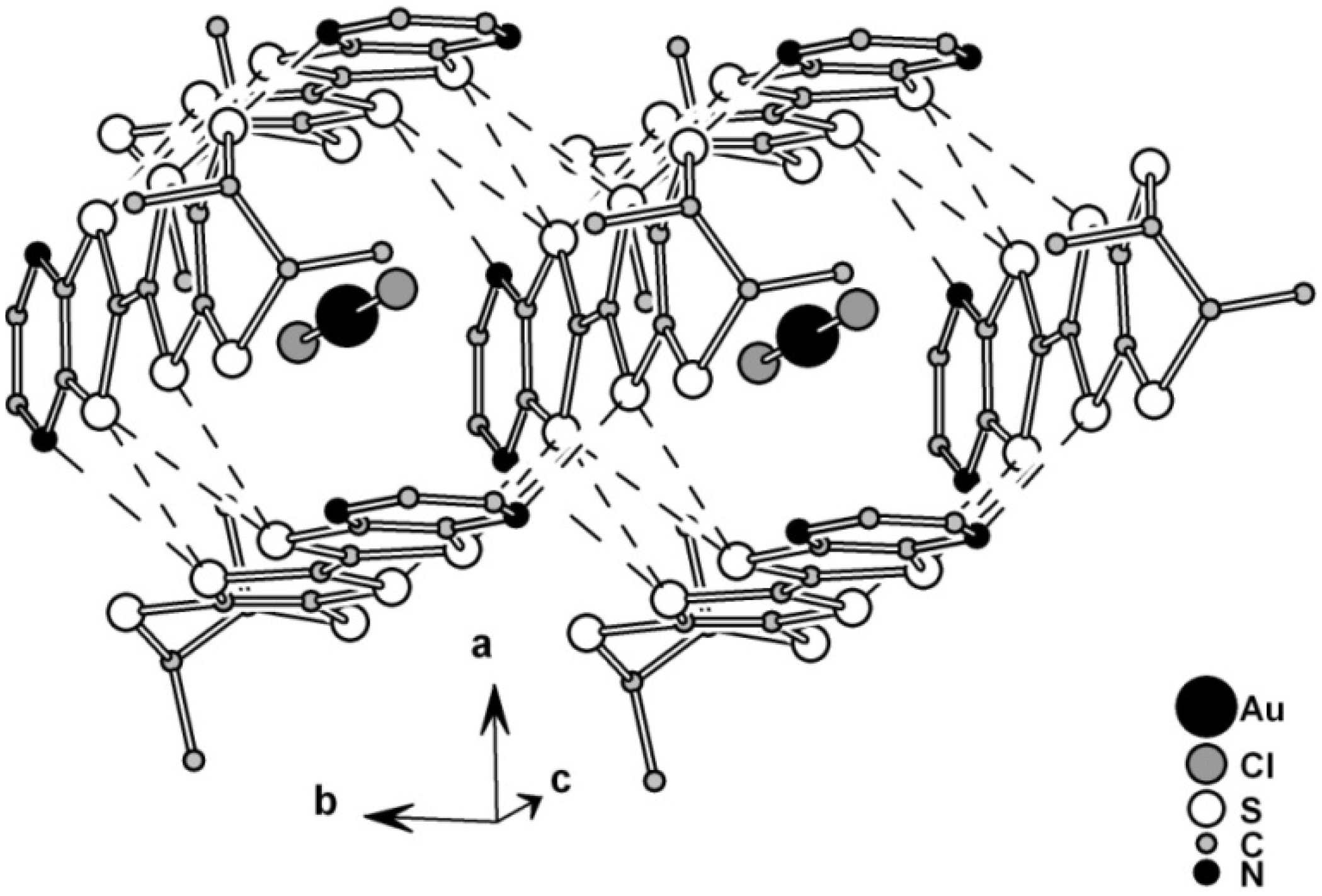
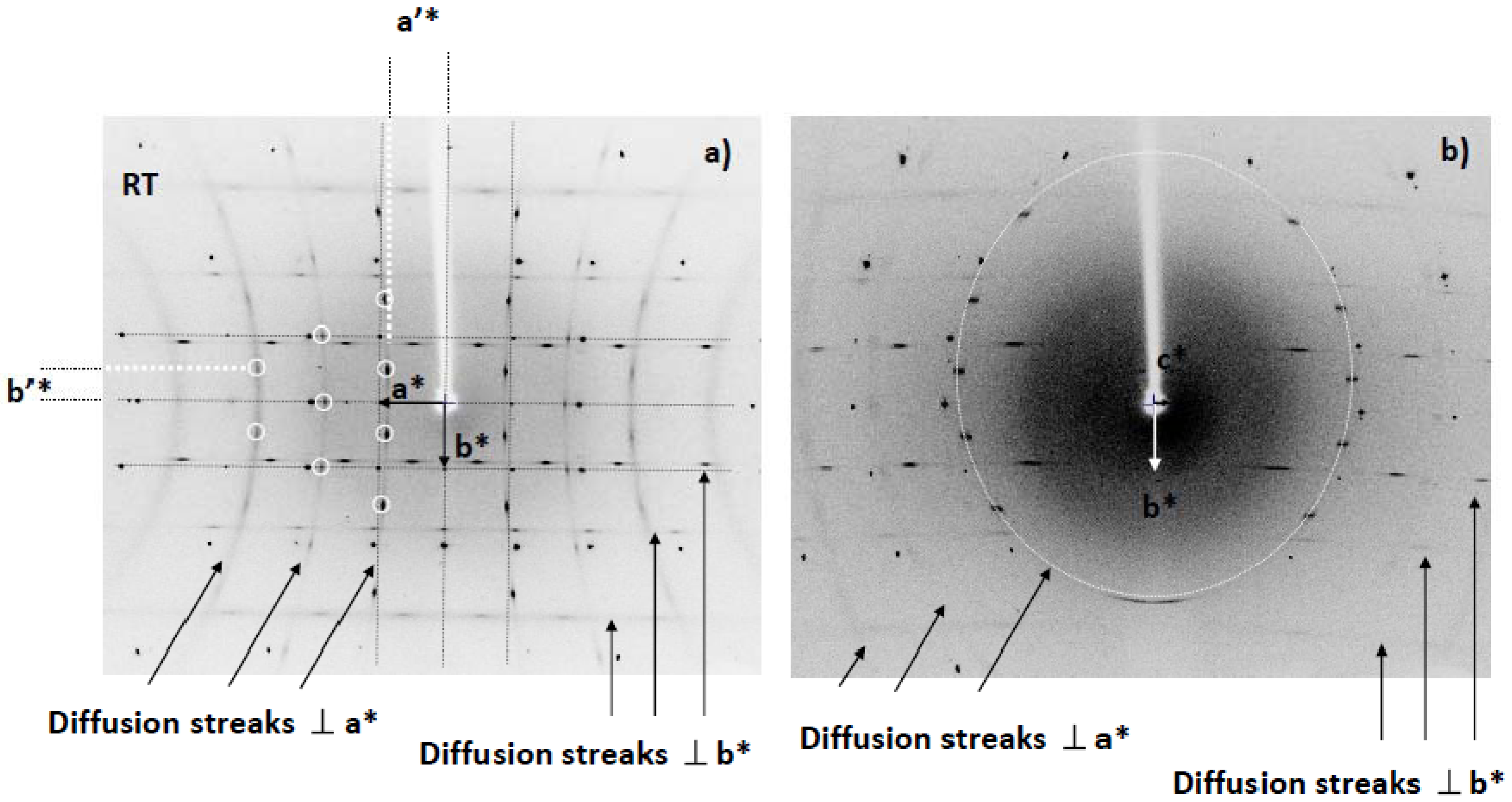
        <p>The synthesis and the crystallization of the compound <bold>1</bold>Cl have been performed by the usual electrochemical oxidation method which is further described in [<xref ref-type="bibr" rid="B1-crystals-02-01283">1</xref>]. As referred in the experimental section, data collection with the Rigaku R-AXIS SPIDER Image Plate diffractometer using graphite monochromated radiation have revealed, in addition to the Bragg peaks, diffusion streaks characteristic for a series of these type of compounds and especially for those containing linear metal halides [<xref ref-type="bibr" rid="B12-crystals-02-01283">12</xref>,<xref ref-type="bibr" rid="B13-crystals-02-01283">13</xref>]. The compound <bold>1</bold>Cl crystallizes in the non centrosymetric space group, <italic>I-42d </italic>and is isostructural with the <bold>1</bold>Br analogue [<xref ref-type="bibr" rid="B1-crystals-02-01283">1</xref>]. The unit cell contains eight donor molecules <bold>1</bold>, 4 ordered anions and approximately other 3.5 anions in disordered positions, with an arrangement characteristic of the τ-phase [<xref ref-type="bibr" rid="B9-crystals-02-01283">9</xref>]. More specifically the features of the diffuse streaks and the spots on them resemble that of τ-(EDO-<italic>S</italic>,<italic>S</italic>-DMEDT-TTF)<sub>2</sub> (AuBr<sub>2</sub>)<sub>1</sub> (AuBr<sub>2</sub>)<italic><sub>y</sub></italic> [<xref ref-type="bibr" rid="B10-crystals-02-01283">10</xref>]. The ordered part of the structure consists of a 2D layer [parallel to the (001) plane] formed by the donor molecules with their long axes parallel and their average plane normal to each other, forming in this way the characteristic tetragonal lattice of τ-phase (<xref ref-type="fig" rid="crystals-02-01283-f002">Figure 2</xref>). There are intermolecular contacts (<xref ref-type="table" rid="crystals-02-01283-t001">Table 1</xref>, Figure S1) of S∙∙∙S type in the range from 3.478 Å to 3.523 Å and one S∙∙∙N type of 3.311 Å at RT, which are smaller than or close to the sum of the Van der Waals radii (3.70 Å and 3.35 Å respectively). The values of S∙∙∙S contacts at 260 K are smaller (3.463 Å–3.512 Å) and that of S∙∙∙N contact is slightly higher (3.33 Å). The ordered anions reside in the cavities of the tetragonal donor lattice (<xref ref-type="fig" rid="crystals-02-01283-f002">Figure 2</xref>). Calculations of difference Fourier maps during the structure solution process give electron density with appreciable values to be spread along the a or b crystallographic axis and in between the 2D donor layers, which is possible to be modeled with disordered AuCl<sub>2</sub> anions, “smeared” all along the b axis as in the case of the anions in other τ-phases [<xref ref-type="bibr" rid="B11-crystals-02-01283">11</xref>]. As is mentioned in [<xref ref-type="bibr" rid="B10-crystals-02-01283">10</xref>], these disordered chains of AuCl<sub>2</sub> anions are the origin of the intense diffusion streaks which are recorded on the diffraction images (<xref ref-type="fig" rid="crystals-02-01283-f003">Figure 3</xref>).</p>
        <p>The spots observed on the diffusion streaks which are normal to a* or b* reciprocal cell axes respectively, (<xref ref-type="fig" rid="crystals-02-01283-f003">Figure 3</xref>a) have been interpreted [<xref ref-type="bibr" rid="B10-crystals-02-01283">10</xref>] as two independent reciprocal lattices which are related by a 2 fold axis normal to the plane of the image of <xref ref-type="fig" rid="crystals-02-01283-f003">Figure 3</xref>a. As it is easily recognized by the arrangement of spots in white circles (<xref ref-type="fig" rid="crystals-02-01283-f003">Figure 3</xref>a), the extinction rule is that of a face-centered lattice. The two lattices of the anions have dimensions (8.1/7.33) a (=1/a’*) × 2b (=1/b’*) b or 2a × (8.1/7.33) b, and if there are no defects of anions in both lattices the y value of the disordered anions per formula unit is ≈0.9 (=7.33/8.1). <xref ref-type="fig" rid="crystals-02-01283-f003">Figure 3</xref>b shows the diffusion streaks as they have been recorded when the X-ray beams falls on the crystal parallel to the a* axis and the arrangement of the spots on them supports the interpretation of a face centered lattice. </p>
        <fig id="crystals-02-01283-f002" position="anchor">
          <label>Figure 2</label>
          <caption>
            <p>Arrangement of donor molecules in the 2D layer as seen almost parallel to the <bold>c</bold> axis. The dotted lines indicate the S∙∙∙S and S∙∙∙N intermolecular contacts. The positions of ordered AuCl<sub>2</sub><sup>_</sup> anions are also shown. </p>
          </caption>
          <graphic xmlns:xlink="http://www.w3.org/1999/xlink" xlink:href="crystals-02-01283-g002.tif"/>
        </fig>
        <table-wrap id="crystals-02-01283-t001" position="anchor">
          <object-id pub-id-type="pii">crystals-02-01283-t001_Table 1</object-id>
          <label>Table 1</label>
          <caption>
            <p>S∙∙∙S and S∙∙∙N intermolecular contacts. (For the numbering scheme of atoms see Table-S1 and Figure-S1, supplementary material). </p>
          </caption>
          <table rules="all" style="border: solid thin">
            <thead>
              <tr>
                <th align="center" valign="middle">Intermolecular contacts</th>
                <th align="center" valign="middle">RT Length (Å)</th>
                <th align="center" valign="middle">260 K Length (Å)</th>
              </tr>
            </thead>
            <tbody>
              <tr>
                <td align="center" valign="middle">S(2)∙∙∙N(1) <sup>†</sup><sup>,</sup>*</td>
                <td align="center" valign="middle">3.311(9)</td>
                <td align="center" valign="middle">3.33(1)</td>
              </tr>
              <tr>
                <td align="center" valign="middle">S(2)∙∙∙S(3) <sup>†</sup><sup>,</sup>*</td>
                <td align="center" valign="middle">3.478(3)</td>
                <td align="center" valign="middle">3.469(3)</td>
              </tr>
              <tr>
                <td align="center" valign="middle">S(3)∙∙∙S(3) <sup>†</sup><sup>,</sup>*</td>
                <td align="center" valign="middle">3.523(3)</td>
                <td align="center" valign="middle">3.512(3)</td>
              </tr>
              <tr>
                <td align="center" valign="middle">S(3)∙∙∙S(2) <sup>†</sup><sup>,</sup>*</td>
                <td align="center" valign="middle">3.483(3)</td>
                <td align="center" valign="middle">3.463(3)</td>
              </tr>
            </tbody>
          </table>
		  <table-wrap-foot>
		  <fn>
        <p>* Symmetry transformations used to generate equivalent atoms; <sup>†</sup>: −<italic>y</italic>, 1 + <italic>x</italic>, −<italic>z</italic>.</p>
		</fn>
		  </table-wrap-foot>
        </table-wrap>
        <fig id="crystals-02-01283-f003" position="anchor">
          <label>Figure 3</label>
          <caption>
            <p>Diffusion streaks recorded on diffraction images with the X-ray beam parallel to the c* reciprocal lattice axis, (<bold>a</bold>) and parallel to the a* reciprocal lattice axis, (<bold>b</bold>). </p>
          </caption>
          <graphic xmlns:xlink="http://www.w3.org/1999/xlink" xlink:href="crystals-02-01283-g003.tif"/>
        </fig>
        <fig id="crystals-02-01283-f004" position="anchor">
          <label>Figure 4</label>
          <caption>
            <p>Diffraction images recorded with the X-ray beam parallel to the c* at different temperatures. </p>
          </caption>
          <graphic xmlns:xlink="http://www.w3.org/1999/xlink" xlink:href="crystals-02-01283-g004.tif"/>
        </fig>
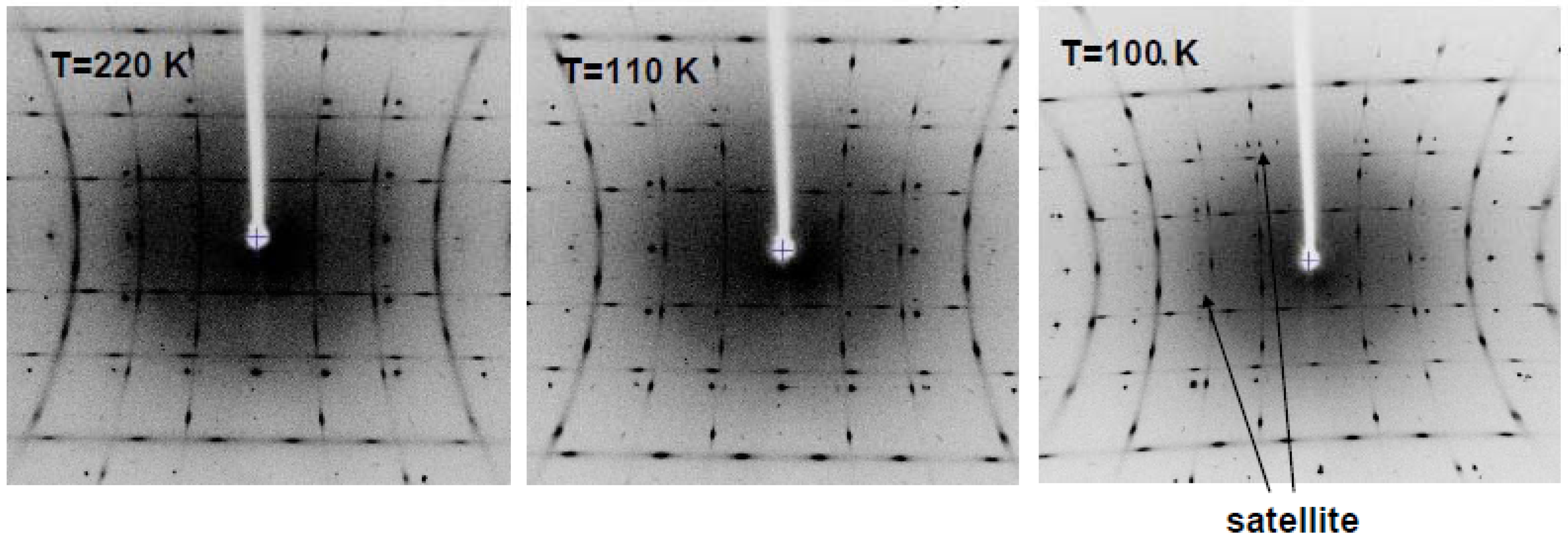
        <p>The images show the same features down to 110 K |(<xref ref-type="fig" rid="crystals-02-01283-f004">Figure 4</xref>), where satellite peaks start to appear, which are clearly seen at the temperature of 100 K. These satellite peaks are clearly between the Bragg peaks which correspond to the ordered part of the structure (usually the “conducting” layer) and not on the diffusion lines which come from disordered AuCl<sub>2</sub> anions. This observation indicates that the probable origin of these satellites is a modulation of the ordered donor-anion part of the structure. The modulation wavelength is estimated to be approximately 5 × a* (or 5 × b*). Satellites between Bragg peaks have also been observed in an analogous system [<xref ref-type="bibr" rid="B10-crystals-02-01283">10</xref>] and have been interpreted as a transition that couples the anionic layer with the conducting one. Our current measurements are not enough to support a more rigorous interpretation and farther experimental study is needed. </p>
      </sec>
      <sec>
        <title>2.2. Electrical Behavior</title>
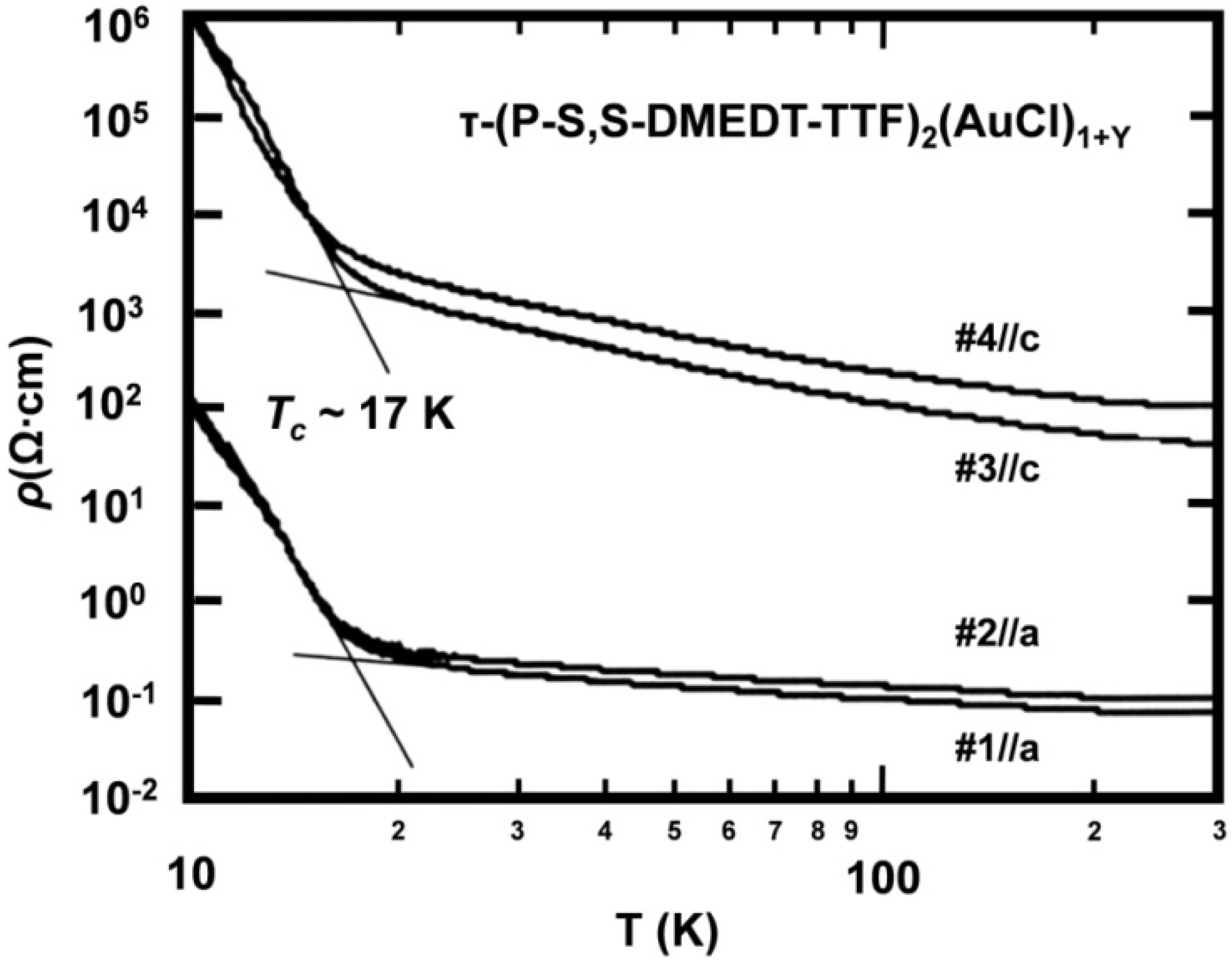
        <p>The results of the electrical measurements reported have been obtained from four crystals (No. 1–4) with the current parallel to a- or to c-axis. It was found that the room temperature values are σ<sub>a</sub> = 10.89, σ<sub>a</sub> = 13.87, σ<sub>c</sub> = 0.023 and σ<sub>c</sub> = 0.01 S cm<sup>−1</sup>, for the crystals 1,2,3 and 4, respectively. This means that the anisotropy σ<sub>a</sub>/σ<sub>c</sub> is <italic>ca</italic><italic>.</italic> 400–1400 at room temperature. <xref ref-type="fig" rid="crystals-02-01283-f005">Figure 5</xref> shows the temperature dependence of resistivity of three samples. In all cases the crystals exhibit an increase of resistivity with the decreasing of temperature, <italic>i.e.</italic>, a semiconducting behavior, with activation energy of <italic>ca </italic>18 meV. In all cases the gradients of ρ change at <italic>ca</italic> 17 K. Also, it was found that under a magnetic field of 5 T the resistivity decreases as the temperature decreases. </p>
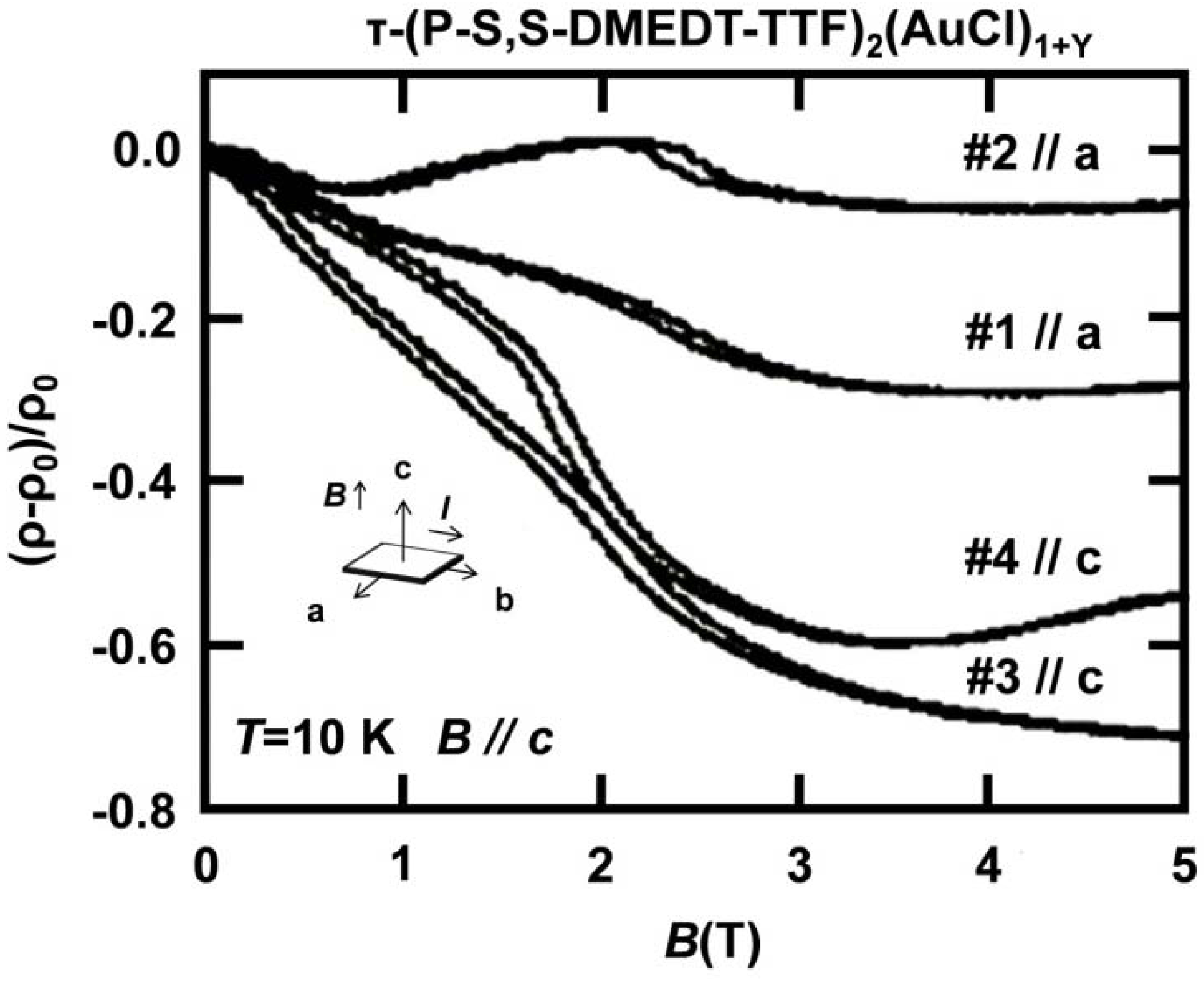
        <p><xref ref-type="fig" rid="crystals-02-01283-f006">Figure 6</xref> shows the magnetic field dependence of ρ<sub>a</sub> and ρ<sub>c</sub> at 10 K. One can see that the magnetoresistance becomes negative by increasing the magnetic field. It is expected to become more negative at lower temperatures as in the cases of similar metallic crystals of τ-phase [<xref ref-type="bibr" rid="B3-crystals-02-01283">3</xref>]. The magnetically hysteretic electronic properties at low temperature and a sudden appearance of negative magnetoresistance seem to suggest a close relation of these phenomena to electron correlation and magnetism (See [<xref ref-type="bibr" rid="B3-crystals-02-01283">3</xref>,<xref ref-type="bibr" rid="B4-crystals-02-01283">4</xref>,<xref ref-type="bibr" rid="B6-crystals-02-01283">6</xref>,<xref ref-type="bibr" rid="B7-crystals-02-01283">7</xref>]).</p>
        <fig id="crystals-02-01283-f005" position="anchor">
          <label>Figure 5</label>
          <caption>
            <p>Temperature dependence of ρ<sub>a</sub> and ρ<sub>c</sub>.</p>
          </caption>
          <graphic xmlns:xlink="http://www.w3.org/1999/xlink" xlink:href="crystals-02-01283-g005.tif"/>
        </fig>
        <fig id="crystals-02-01283-f006" position="anchor">
          <label>Figure 6</label>
          <caption>
            <p>Magnetic field dependence of ρ<sub>a</sub> and ρ<sub>c</sub>.</p>
          </caption>
          <graphic xmlns:xlink="http://www.w3.org/1999/xlink" xlink:href="crystals-02-01283-g006.tif"/>
        </fig>
      </sec>
    </sec>
    <sec>
      <title>3. Experimental Section</title>
      <p>Crystals of the compound were prepared by methods reported in [<xref ref-type="bibr" rid="B1-crystals-02-01283">1</xref>,<xref ref-type="bibr" rid="B3-crystals-02-01283">3</xref>] for AuBr<sub>2</sub>–analog using <italic>n</italic>-Bu<sub>4</sub>NAuCl<sub>2</sub> instead of <italic>n</italic>-Bu<sub>4</sub>NAuBr<sub>2</sub>.</p>
      <p>A black crystal with dimensions 0.06, 0.5, 0.63 mm glued on a fiber, was used for all data collections. Diffraction measurements were made on a Rigaku R-AXIS SPIDER Image Plate diffractometer using graphite monochromated Mo Kα or Cu Kα radiation. Data collection (ω-scans) and processing (cell refinement, data reduction and Empirical or numerical absorption correction for the Cu Ka data) were performed using the CrystalClear program package [<xref ref-type="bibr" rid="B14-crystals-02-01283">14</xref>]. The low temperature data were collected using the cryogenic Crystal Cooler System X-sream 2000, Rigaku/MSC. Two data sets were analyzed, one recorded at RT (Mo Kα radiation) and the other at 260 K (Cu Ka). Important crystallographic data and refinement details for both data sets are listed in Table S1. Further crystallographic information is given as supplementary material (Tables S2–S5 contain atom positions, bond length and bond angles for both data sets and in Figure 1S the numbering scheme of atoms and the intermolecular contacts are presented). Because of the diffusion streaks recorded on the diffraction images only the Bragg peaks from the ordered part of the structure were integrated and used for structure analysis. The structures were solved by direct methods using SHELXS-97 [<xref ref-type="bibr" rid="B15-crystals-02-01283">15</xref>] and refined by full-matrix least-squares techniques on F<sup>2</sup> using SHELXL-97 [<xref ref-type="bibr" rid="B16-crystals-02-01283">16</xref>]. Hydrogen atoms were introduced in calculated positions as riding on bonded atoms. All non-H atoms were refined anisotropically.</p>
      <p>Resistivity measurements were performed on single on single crystal making contacts with Au paste and Au wires of 10 µm, using the instrumentation reported in [<xref ref-type="bibr" rid="B5-crystals-02-01283">5</xref>,<xref ref-type="bibr" rid="B6-crystals-02-01283">6</xref>].</p>
    </sec>
    <sec sec-type="conclusions">
      <title>4. Conclusions</title>
      <p>The compound τ-(P-<italic>S</italic>,<italic>S</italic>-DMEDT-TTF)<sub>2</sub>(AuCl<sub>2</sub>) (AuCl<sub>2</sub>)<italic><sub>y</sub></italic> shows a q-2D semiconducting behavior from RT to 10 K, a completely different behavior from the <bold>1</bold>Br analogue compound which is a quasi 2D conductor at least at low temperatures. For a deeper understanding of this difference further work is underway and especially crystallographic, in order to explain the structural origin of the satellite peaks observed at temperatures below 110 K. </p>
    </sec>
  </body>
  <back>
    <notes>
      <title>Conflict of Interest</title>
      <p>The authors declare no conflict of interest. </p>
    </notes>
    <ref-list>
      <title>References</title>
      <ref id="B1-crystals-02-01283">
        <label>1.</label>
        <citation citation-type="journal">
          <person-group person-group-type="author">
            <name>
              <surname>Zambounis</surname>
              <given-names>J.S.</given-names>
            </name>
            <name>
              <surname>Pfeiffer</surname>
              <given-names>J.</given-names>
            </name>
            <name>
              <surname>Papavassiliou</surname>
              <given-names>G.C.</given-names>
            </name>
            <name>
              <surname>Lagouvardos</surname>
              <given-names>D.J.</given-names>
            </name>
            <name>
              <surname>Terzis</surname>
              <given-names>A.</given-names>
            </name>
            <name>
              <surname>Raptopoulou</surname>
              <given-names>C.P.</given-names>
            </name>
            <name>
              <surname>Delhaès</surname>
              <given-names>P.</given-names>
            </name>
            <name>
              <surname>Ducasse</surname>
              <given-names>L.</given-names>
            </name>
            <name>
              <surname>Fortune</surname>
              <given-names>N.A.</given-names>
            </name>
            <name>
              <surname>Murata</surname>
              <given-names>K.</given-names>
            </name>
          </person-group>
          <article-title>Structural and physical properties of the organic metal τ-(P-(<italic>S</italic>,<italic>S</italic>)-DMEDT-TTF)<sub>2</sub>(AuBr<sub>2</sub>)<sub>1</sub>(AuBr<sub>2</sub>)<sub>−0.75</sub></article-title>
          <source>Solid State Commun.</source>
          <year>1995</year>
          <volume>95</volume>
          <fpage>211</fpage>
          <lpage>215</lpage>
        <pub-id pub-id-type="doi">10.1016/0038-1098(95)00231-6</pub-id></citation>
      </ref>
      <ref id="B2-crystals-02-01283">
        <label>2.</label>
        <citation citation-type="journal">
          <person-group person-group-type="author">
            <name>
              <surname>Papavassiliou</surname>
              <given-names>G.C.</given-names>
            </name>
            <name>
              <surname>Lagouvardos</surname>
              <given-names>D.J.</given-names>
            </name>
            <name>
              <surname>Zambounis</surname>
              <given-names>J.S.</given-names>
            </name>
            <name>
              <surname>Terzis</surname>
              <given-names>A.</given-names>
            </name>
            <name>
              <surname>Raptopoulou</surname>
              <given-names>C.P.</given-names>
            </name>
            <name>
              <surname>Murata</surname>
              <given-names>K.</given-names>
            </name>
            <name>
              <surname>Shirakawa</surname>
              <given-names>N.</given-names>
            </name>
            <name>
              <surname>Ducasse</surname>
              <given-names>L.</given-names>
            </name>
            <name>
              <surname>Delhaes</surname>
              <given-names>P.</given-names>
            </name>
          </person-group>
          <article-title>Structural and physical properties of τ-(EDO-<italic>S</italic>,<italic>S</italic>-DMEDT-TTF)<sub>2</sub>(AuBr<sub>2</sub>)<sub>y</sub></article-title>
          <source>Mol. Cryst. Liq. Cryst. Sci. Technol. Sect.</source>
          <year>1996</year>
          <volume>285</volume>
          <fpage>83</fpage>
          <lpage>88</lpage>
          <pub-id pub-id-type="doi">10.1080/10587259608030782</pub-id>
        </citation>
      </ref>
      <ref id="B3-crystals-02-01283">
        <label>3.</label>
        <citation citation-type="journal">
          <person-group person-group-type="author">
            <name>
              <surname>Storr</surname>
              <given-names>K.</given-names>
            </name>
            <name>
              <surname>Balicas</surname>
              <given-names>L.</given-names>
            </name>
            <name>
              <surname>Brooks</surname>
              <given-names>J.S.</given-names>
            </name>
            <name>
              <surname>Graf</surname>
              <given-names>D.</given-names>
            </name>
            <name>
              <surname>Papavassiliou</surname>
              <given-names>G.C.</given-names>
            </name>
          </person-group>
          <article-title>Magnetic-Field-Dependent interplay between incoherent and fermi liquid transport mechanisms in low-dimensional tau-phase organic conductors</article-title>
          <source>Phys. Rev. B</source>
          <year>2001</year>
          <volume>64</volume>
          <pub-id pub-id-type="doi">10.1103/PhysRevB.64.045107</pub-id>
        </citation>
      </ref>
      <ref id="B4-crystals-02-01283">
        <label>4.</label>
        <citation citation-type="journal">
          <person-group person-group-type="author">
            <name>
              <surname>Yoshino</surname>
              <given-names>H.</given-names>
            </name>
            <name>
              <surname>Murata</surname>
              <given-names>K.</given-names>
            </name>
            <name>
              <surname>Nakanishi</surname>
              <given-names>T.</given-names>
            </name>
            <name>
              <surname>Li</surname>
              <given-names>L.</given-names>
            </name>
            <name>
              <surname>Choi</surname>
              <given-names>E.S.</given-names>
            </name>
            <name>
              <surname>Graf</surname>
              <given-names>D.</given-names>
            </name>
            <name>
              <surname>Brooks</surname>
              <given-names>J.S.</given-names>
            </name>
            <name>
              <surname>Nogami</surname>
              <given-names>Y.</given-names>
            </name>
            <name>
              <surname>Papavassiliou</surname>
              <given-names>G.C.</given-names>
            </name>
          </person-group>
          <article-title>Determination of band-filling change in the two-dimensional organic conductor, τ-(EDO-<italic>S</italic>,<italic>S</italic>-DMEDT-TTF)<sub>2</sub>(AuBr<sub>2</sub>)(<sub>1 + <italic>y</italic></sub>), (<italic>y</italic> ≤ 0.875) by the quantum oscillation of magnetoresistance</article-title>
          <source>J. Phys. Soc. Jpn.</source>
          <year>2005</year>
          <volume>74</volume>
          <fpage>417</fpage>
          <lpage>424</lpage>
          <pub-id pub-id-type="doi">10.1143/JPSJ.74.417</pub-id>
        </citation>
      </ref>
      <ref id="B5-crystals-02-01283">
        <label>5.</label>
        <citation citation-type="journal">
          <person-group person-group-type="author">
            <name>
              <surname>Konoike</surname>
              <given-names>T.</given-names>
            </name>
            <name>
              <surname>Iwashita</surname>
              <given-names>K.</given-names>
            </name>
            <name>
              <surname>Yoshino</surname>
              <given-names>H.</given-names>
            </name>
            <name>
              <surname>Murata</surname>
              <given-names>K.</given-names>
            </name>
            <name>
              <surname>Sasaki</surname>
              <given-names>T.</given-names>
            </name>
            <name>
              <surname>Papavassiliou</surname>
              <given-names>G.C. </given-names>
            </name>
          </person-group>
          <article-title>Shubnikov-De haas oscillations in the two-dimensional organic conductor τ-(EDO-<italic>S</italic>,<italic>S</italic>-DMEDT-TTF)<sub>2</sub> (AuBr<sub>2</sub>)(<sub>1 + <italic>y</italic></sub>) (<italic>y</italic> similar to 0.75)</article-title>
          <source>Phys. Rev. B</source>
          <year>2002</year>
          <volume>66</volume>
          <pub-id pub-id-type="doi">10.1103/PhysRevB.66.245308</pub-id>
        </citation>
      </ref>
      <ref id="B6-crystals-02-01283">
        <label>6.</label>
        <citation citation-type="journal">
          <person-group person-group-type="author">
            <name>
              <surname>Nakanishi</surname>
              <given-names>T.</given-names>
            </name>
            <name>
              <surname>Yasuzuka</surname>
              <given-names>S.</given-names>
            </name>
            <name>
              <surname>Yoshino</surname>
              <given-names>H.</given-names>
            </name>
            <name>
              <surname>Fujiwara</surname>
              <given-names>H.</given-names>
            </name>
            <name>
              <surname>Sugimoto</surname>
              <given-names>T.</given-names>
            </name>
            <name>
              <surname>Nishio</surname>
              <given-names>Y.</given-names>
            </name>
            <name>
              <surname>Kajita</surname>
              <given-names>K.</given-names>
            </name>
            <name>
              <surname>Anyfantis</surname>
              <given-names>G.A.</given-names>
            </name>
            <name>
              <surname>Papavassiliou</surname>
              <given-names>G.C.</given-names>
            </name>
            <name>
              <surname>Murata</surname>
              <given-names>K.</given-names>
            </name>
          </person-group>
          <article-title>Magnetic ground state of quasi-two-dimensional organic conductor, τ-(EDO-<italic>S</italic>,<italic>S</italic>-DMEDT-TTF)<sub>2</sub>(AuCl<sub>2</sub>)<sub>1 + s<italic>y</italic></sub></article-title>
          <source>J. Phys. Confer. Ser.</source>
          <year>2006</year>
          <volume>51</volume>
          <fpage>3437</fpage>
        </citation>
      </ref>
      <ref id="B7-crystals-02-01283">
        <label>7.</label>
        <citation citation-type="journal">
          <person-group person-group-type="author">
            <name>
              <surname>Papavassiliou</surname>
              <given-names>G.C.</given-names>
            </name>
            <name>
              <surname>Mousdis</surname>
              <given-names>G.A.</given-names>
            </name>
            <name>
              <surname>Anyfantis</surname>
              <given-names>G.C.</given-names>
            </name>
            <name>
              <surname>Murata</surname>
              <given-names>K.</given-names>
            </name>
            <name>
              <surname>Li</surname>
              <given-names>L.</given-names>
            </name>
            <name>
              <surname>Yoshino</surname>
              <given-names>H.</given-names>
            </name>
            <name>
              <surname>Tajima</surname>
              <given-names>H.</given-names>
            </name>
            <name>
              <surname>Konoike</surname>
              <given-names>T.</given-names>
            </name>
            <name>
              <surname>Brooks</surname>
              <given-names>J.S.</given-names>
            </name>
            <name>
              <surname>Graf</surname>
              <given-names>D.</given-names>
            </name>
			<etal/>
          </person-group>
          <article-title>Structural and physical properties of tau-(EDO-<italic>S</italic>,<italic>S</italic>-DMEDT-TTF)<sub>2</sub>(AUBr<sub>2</sub>)<sub>1+<italic>y</italic></sub> and tau-(P-<italic>S</italic>,<italic>S</italic>-DMEDT-TTF)<sub>2</sub>(AUBr<sub>2</sub>)<sub>1+<italic>y</italic></sub></article-title>
          <source>Z. Naturforsch.</source>
          <year>2004</year>
          <volume>59a</volume>
          <fpage>952</fpage>
          <lpage>956</lpage>
        </citation>
      </ref>
      <ref id="B8-crystals-02-01283">
        <label>8.</label>
        <citation citation-type="journal">
          <person-group person-group-type="author">
            <name>
              <surname>Graf</surname>
              <given-names>D.</given-names>
            </name>
            <name>
              <surname>Choi</surname>
              <given-names>E.S.</given-names>
            </name>
            <name>
              <surname>Brooks</surname>
              <given-names>J.S.</given-names>
            </name>
            <name>
              <surname>Harrison</surname>
              <given-names>N.</given-names>
            </name>
            <name>
              <surname>Murata</surname>
              <given-names>K.</given-names>
            </name>
            <name>
              <surname>Konoike</surname>
              <given-names>T.</given-names>
            </name>
            <name>
              <surname>Mousdis</surname>
              <given-names>G.A.</given-names>
            </name>
            <name>
              <surname>Papavassiliou</surname>
              <given-names>G.C.</given-names>
            </name>
          </person-group>
          <article-title>Magnetization, thermoelectric, and pressure studies of the magnetic-field-induced metal-insulator transition in tau-phase organic conductors</article-title>
          <source>Phys. Rev. B</source>
          <year>2005</year>
          <volume>71</volume>
          <pub-id pub-id-type="doi">10.1103/PhysRevB.71.045117</pub-id>
        </citation>
      </ref>
      <ref id="B9-crystals-02-01283">
        <label>9.</label>
        <citation citation-type="journal">
          <person-group person-group-type="author">
            <name>
              <surname>Papavassiliou</surname>
              <given-names>G.C.</given-names>
            </name>
            <name>
              <surname>Murata</surname>
              <given-names>K.</given-names>
            </name>
            <name>
              <surname>Ulmet</surname>
              <given-names>J.P.</given-names>
            </name>
            <name>
              <surname>Terzis</surname>
              <given-names>A.</given-names>
            </name>
            <name>
              <surname>Mousdis</surname>
              <given-names>G.A.</given-names>
            </name>
            <name>
              <surname>Yoshino</surname>
              <given-names>H.</given-names>
            </name>
            <name>
              <surname>Akihiro Oda</surname>
              <given-names>A.</given-names>
            </name>
            <name>
              <surname>Vignolles</surname>
              <given-names>D.</given-names>
            </name>
            <name>
              <surname>Raptopoulou</surname>
              <given-names>C.P.</given-names>
            </name>
          </person-group>
          <article-title>Organic conductors of τ-phase</article-title>
          <source>Synth. Met.</source>
          <year>1999</year>
          <volume>103</volume>
          <fpage>1921</fpage>
          <lpage>1922</lpage>
          <pub-id pub-id-type="doi">10.1016/S0379-6779(98)00629-8</pub-id>
        </citation>
      </ref>
      <ref id="B10-crystals-02-01283">
        <label>10.</label>
        <citation citation-type="journal">
          <person-group person-group-type="author">
            <name>
              <surname>Konoike</surname>
              <given-names>T.</given-names>
            </name>
            <name>
              <surname>Iwashita</surname>
              <given-names>K.-I.</given-names>
            </name>
            <name>
              <surname>Nakano</surname>
              <given-names>I.</given-names>
            </name>
            <name>
              <surname>Yoshino</surname>
              <given-names>H.</given-names>
            </name>
            <name>
              <surname>Sasaki</surname>
              <given-names>T.</given-names>
            </name>
            <name>
              <surname>Nogami</surname>
              <given-names>Y.</given-names>
            </name>
            <name>
              <surname>Brooks</surname>
              <given-names>J.S.</given-names>
            </name>
            <name>
              <surname>Graf</surname>
              <given-names>D.</given-names>
            </name>
            <name>
              <surname>Mielke</surname>
              <given-names>C.H.</given-names>
            </name>
            <name>
              <surname>Papavassiliou</surname>
              <given-names>G.C.</given-names>
            </name>
          </person-group>
          <article-title>Shubnikov-De Haas oscillations and Fermi surface of τ-phase conductors</article-title>
          <source>Physica E</source>
          <year>2003</year>
          <volume>18</volume>
          <fpage>188</fpage>
          <lpage>189</lpage>
          <pub-id pub-id-type="doi">10.1016/S1386-9477(02)01004-4</pub-id>
        </citation>
      </ref>
      <ref id="B11-crystals-02-01283">
        <label>11.</label>
        <citation citation-type="book">
          <person-group person-group-type="author">
            <name>
              <surname>Papavassiliou</surname>
              <given-names>G.C.</given-names>
            </name>
            <name>
              <surname>Lagouvardos</surname>
              <given-names>D.J.</given-names>
            </name>
            <name>
              <surname>Kakoussis</surname>
              <given-names>V.C.</given-names>
            </name>
            <name>
              <surname>Mousdis</surname>
              <given-names>G.A.</given-names>
            </name>
            <name>
              <surname>Terzis</surname>
              <given-names>A.</given-names>
            </name>
            <name>
              <surname>Hountas</surname>
              <given-names>A.</given-names>
            </name>
            <name>
              <surname>Hilti</surname>
              <given-names>B.</given-names>
            </name>
            <name>
              <surname>Mayer</surname>
              <given-names>C.W.</given-names>
            </name>
            <name>
              <surname>Zambounis</surname>
              <given-names>J.S.</given-names>
            </name>
            <name>
              <surname>Pfeiffer</surname>
              <given-names>J.</given-names>
            </name>
            <etal/>
          </person-group>
          <source>Organic Superconductivity</source>
          <publisher-name>Plenum Press</publisher-name>
          <publisher-loc>New York, NY, USA</publisher-loc>
          <year>1990</year>
          <fpage>535</fpage>
          <lpage>540</lpage>
        </citation>
      </ref>
      <ref id="B12-crystals-02-01283">
        <label>12.</label>
        <citation citation-type="journal">
          <person-group person-group-type="author">
            <name>
              <surname>Lamfers</surname>
              <given-names>H.K.</given-names>
            </name>
            <name>
              <surname>Meetsma</surname>
              <given-names>A.</given-names>
            </name>
            <name>
              <surname>van Smaalen</surname>
              <given-names>S.</given-names>
            </name>
            <name>
              <surname>de Boer</surname>
              <given-names>J.L.</given-names>
            </name>
            <name>
              <surname>Huml</surname>
              <given-names>K.</given-names>
            </name>
          </person-group>
          <article-title>Disorder in the commensurate intergrowth compound C<sub>1</sub>TET-TTF(AuI<sub>2</sub>)<sub>0.8</sub></article-title>
          <source>Phys. Rev. B</source>
          <year>1994</year>
          <volume>50</volume>
          <fpage>15697</fpage>
          <lpage>15706</lpage>
        <pub-id pub-id-type="doi">10.1103/PhysRevB.50.15697</pub-id></citation>
      </ref>
      <ref id="B13-crystals-02-01283">
        <label>13.</label>
        <citation citation-type="journal">
          <person-group person-group-type="author">
            <name>
              <surname>Kawamoto</surname>
              <given-names>T.</given-names>
            </name>
            <name>
              <surname>Mori</surname>
              <given-names>T.</given-names>
            </name>
            <name>
              <surname>Takimiya</surname>
              <given-names>K.</given-names>
            </name>
            <name>
              <surname>Kataoka</surname>
              <given-names>Y.</given-names>
            </name>
            <name>
              <surname>Aso</surname>
              <given-names>Y.</given-names>
            </name>
            <name>
              <surname>Otsubo</surname>
              <given-names>T.</given-names>
            </name>
          </person-group>
          <article-title>Organic superconductor with an incommensurate anion structure: (MDT-TSF)(AuI<sub>2</sub>)<sub>0.44</sub></article-title>
          <source>Phys. Rev. B</source>
          <year>2002</year>
          <volume>65</volume>
          <fpage>140508:1</fpage>
          <lpage>140508:4</lpage>
        </citation>
      </ref>
      <ref id="B14-crystals-02-01283">
        <label>14.</label>
        <citation citation-type="other">
          <source>Rigaku/MSC</source>
          <publisher-name>Rigaku/MSC Inc.</publisher-name>
          <publisher-loc>The Woodlands, TX, USA</publisher-loc>
          <year>2005</year>
        </citation>
      </ref>
      <ref id="B15-crystals-02-01283">
        <label>15.</label>
        <citation citation-type="book">
          <person-group person-group-type="author">
            <name>
              <surname>Sheldrick</surname>
              <given-names>G.M.</given-names>
            </name>
          </person-group>
          <source>SHELXS-97, Program for Solution of Crystal Structures</source>
          <publisher-name>University of Göttingen</publisher-name>
          <publisher-loc>Göttingen, Germany</publisher-loc>
          <year>1997</year>
        </citation>
      </ref>
      <ref id="B16-crystals-02-01283">
        <label>16.</label>
        <citation citation-type="book">
          <person-group person-group-type="author">
            <name>
              <surname>Sheldrick</surname>
              <given-names>G.M.</given-names>
            </name>
          </person-group>
          <source>SHELXL-97, Program for Refinement of Crystal Structures</source>
          <publisher-name>University of Göttingen</publisher-name>
          <publisher-loc>Göttingen, Germany</publisher-loc>
          <year>1997</year>
        </citation>
      </ref>
    </ref-list>
  </back>
</article>