<?xml version="1.0" encoding="UTF-8"?>
<!DOCTYPE article PUBLIC "-//NLM//DTD Journal Publishing DTD v2.3 20070202//EN" "journalpublishing.dtd">
<article xmlns:mml="http://www.w3.org/1998/Math/MathML" xmlns:xlink="http://www.w3.org/1999/xlink" xml:lang="en" article-type="review-article">
  <front>
    <journal-meta>
      <journal-id journal-id-type="publisher-id">crystals</journal-id>
      <journal-title>Crystals</journal-title>
      <abbrev-journal-title abbrev-type="publisher">Crystals</abbrev-journal-title>
      <abbrev-journal-title abbrev-type="pubmed">Crystals</abbrev-journal-title>
      <issn pub-type="epub">2073-4352</issn>
      <publisher>
        <publisher-name>MDPI</publisher-name>
      </publisher>
    </journal-meta>
    <article-meta>
      <article-id pub-id-type="doi">10.3390/cryst2031261</article-id>
      <article-id pub-id-type="publisher-id">crystals-02-01261</article-id>
      <article-categories>
        <subj-group>
          <subject>Review</subject>
        </subj-group>
      </article-categories>
      <title-group>
        <article-title>Electronic Principles of Hydrogen Incorporation and Dynamics in Metal Hydrides</article-title>
      </title-group>
	  <contrib-group>
        <contrib contrib-type="author">
          <name>
            <surname>Ivanović</surname>
            <given-names>Nenad</given-names>
          </name>
        </contrib>
        <contrib contrib-type="author">
          <name>
            <surname>Novaković</surname>
            <given-names>Nikola</given-names>
          </name>
        </contrib>
        <contrib contrib-type="author">
          <name>
            <surname>Radisavljević</surname>
            <given-names>Ivana</given-names>
          </name>
        </contrib>
        <contrib contrib-type="author">
          <name>
            <surname>Matović</surname>
            <given-names>Ljiljana</given-names>
          </name>
        </contrib>
        <contrib contrib-type="author">
          <name>
            <surname>Novaković</surname>
            <given-names>Jasmina Grbović</given-names>
          </name>
          <xref rid="c1-crystals-02-01261" ref-type="corresp">*</xref>
        </contrib>
      </contrib-group>
      
      <aff id="af1-crystals-02-01261">Vinča Institute of Nuclear Sciences, University of Belgrade, 11001 Belgrade, Serbia; Email: <email>nivanov@vinca.rs</email> (N.I.); <email>novnik@vinca.rs</email> (N.N.); <email>iva@vinca.rs</email> (I.R.); <email>ljiljam@vinca.rs</email> (L.M.)</aff>
      <author-notes>
        <corresp id="c1-crystals-02-01261"><label>*</label> Author to whom correspondence should be addressed; Email: <email>jasnag@vinca.rs</email>; Tel.: +381-11-3408-552; Fax: +381-11-3408-224.</corresp>
      </author-notes>
      <pub-date pub-type="epub">
        <day>30</day>
        <month>08</month>
        <year>2012</year>
      </pub-date>
      <pub-date pub-type="collection">
	  <month>09</month>
        <year>2012</year>
      </pub-date>
      <volume>2</volume>
      <issue>3</issue>
      <fpage>1261</fpage>
      <lpage>1282</lpage>
      <history>
        <date date-type="received">
          <day>20</day>
          <month>03</month>
          <year>2012</year>
        </date>
        <date date-type="rev-recd">
          <day>14</day>
          <month>07</month>
          <year>2012</year>
        </date>
        <date date-type="accepted">
          <day>18</day>
          <month>07</month>
          <year>2012</year>
        </date>
      </history>
      <permissions>
        <copyright-statement>©  2012 by the authors; licensee MDPI, Basel, Switzerland.</copyright-statement>
        <copyright-year>2012</copyright-year>
        <license xmlns:xlink="http://www.w3.org/1999/xlink" license-type="open-access" xlink:href="http://creativecommons.org/licenses/by/3.0/">
          <p>This article is an open-access article distributed under the terms and conditions of the Creative Commons Attribution license (<uri>http://creativecommons.org/licenses/by/3.0/</uri>).</p>
        </license>
      </permissions>
      <abstract>
        <p>An approach to various metal hydrides based on electronic principles is presented. The effective medium theory (EMT) is used to illustrate fundamental aspects of metal-hydrogen interaction and clarify the most important processes taking place during the interaction. The elaboration is extended using the numerous existing results of experiment and calculations, as well as using some new material. In particular, the absorption/desorption of H in the Mg/MgH<sub>2</sub> system is analyzed in detail, and all relevant initial structures and processes explained. Reasons for the high stability and slow sorption in this system are noted, and possible solutions proposed. The role of the transition-metal impurities in MgH<sub>2</sub> is briefly discussed, and some interesting phenomena, observed in complex intermetallic compounds, are mentioned. The principle mechanism governing the Li-amide/imide transformation is also discussed. Latterly, some perspectives for the metal-hydrides investigation from the electronic point of view are elucidated.</p>
      </abstract>
      <kwd-group>
        <kwd>hydrogen storage</kwd>
        <kwd>metal hydrides</kwd>
        <kwd>MgH<sub>2</sub></kwd>
        <kwd>complex hydrides</kwd>
        <kwd>Li-amide/imide</kwd>
        <kwd>electronic structure</kwd>
        <kwd><italic>ab initio</italic> calculation</kwd>
        <kwd>DFT</kwd>
        <kwd>sorption kinetics</kwd>
        <kwd>catalysts </kwd>
      </kwd-group>
    </article-meta>
  </front>
  <body>
    <sec sec-type="intro">
      <title>1. Introduction</title>
      <p>Metal hydrides represent promising technology for cleaner, cheaper and more efficient energy production [<xref ref-type="bibr" rid="B1-crystals-02-01261">1</xref>,<xref ref-type="bibr" rid="B2-crystals-02-01261">2</xref>,<xref ref-type="bibr" rid="B3-crystals-02-01261">3</xref>,<xref ref-type="bibr" rid="B4-crystals-02-01261">4</xref>,<xref ref-type="bibr" rid="B5-crystals-02-01261">5</xref>,<xref ref-type="bibr" rid="B6-crystals-02-01261">6</xref>,<xref ref-type="bibr" rid="B7-crystals-02-01261">7</xref>,<xref ref-type="bibr" rid="B8-crystals-02-01261">8</xref>,<xref ref-type="bibr" rid="B9-crystals-02-01261">9</xref>,<xref ref-type="bibr" rid="B10-crystals-02-01261">10</xref>,<xref ref-type="bibr" rid="B11-crystals-02-01261">11</xref>,<xref ref-type="bibr" rid="B12-crystals-02-01261">12</xref>,<xref ref-type="bibr" rid="B13-crystals-02-01261">13</xref>,<xref ref-type="bibr" rid="B14-crystals-02-01261">14</xref>]. They are also systems of considerable theoretical interest [<xref ref-type="bibr" rid="B15-crystals-02-01261">15</xref>,<xref ref-type="bibr" rid="B16-crystals-02-01261">16</xref>,<xref ref-type="bibr" rid="B17-crystals-02-01261">17</xref>,<xref ref-type="bibr" rid="B18-crystals-02-01261">18</xref>,<xref ref-type="bibr" rid="B19-crystals-02-01261">19</xref>,<xref ref-type="bibr" rid="B20-crystals-02-01261">20</xref>,<xref ref-type="bibr" rid="B21-crystals-02-01261">21</xref>,<xref ref-type="bibr" rid="B22-crystals-02-01261">22</xref>,<xref ref-type="bibr" rid="B23-crystals-02-01261">23</xref>,<xref ref-type="bibr" rid="B24-crystals-02-01261">24</xref>,<xref ref-type="bibr" rid="B25-crystals-02-01261">25</xref>] convenient for investigation of fundamental interactions that are expected to be important in new complex materials [<xref ref-type="bibr" rid="B26-crystals-02-01261">26</xref>,<xref ref-type="bibr" rid="B27-crystals-02-01261">27</xref>,<xref ref-type="bibr" rid="B28-crystals-02-01261">28</xref>,<xref ref-type="bibr" rid="B29-crystals-02-01261">29</xref>,<xref ref-type="bibr" rid="B30-crystals-02-01261">30</xref>,<xref ref-type="bibr" rid="B31-crystals-02-01261">31</xref>,<xref ref-type="bibr" rid="B32-crystals-02-01261">32</xref>]. Although significant experimental and theoretical work has been devoted to the study of metal hydrides, some of their fundamental features, such as details of valence and conduction bands and energy gap structures, the charge transfer and the charge distribution, the origin and the importance of various contributions to the bonding between metal and hydrogen (M–H) and hydrogen and hydrogen (H–H), are not yet fully clarified. A complete elaboration of these topics from the first principles is indispensable for understanding of H-behavior in metallic systems in general. Moreover, extensive data about metal hydrides have been obtained and explained using various, and sometimes contradictory, concepts [<xref ref-type="bibr" rid="B15-crystals-02-01261">15</xref>,<xref ref-type="bibr" rid="B16-crystals-02-01261">16</xref>,<xref ref-type="bibr" rid="B17-crystals-02-01261">17</xref>,<xref ref-type="bibr" rid="B18-crystals-02-01261">18</xref>,<xref ref-type="bibr" rid="B20-crystals-02-01261">20</xref>,<xref ref-type="bibr" rid="B21-crystals-02-01261">21</xref>,<xref ref-type="bibr" rid="B22-crystals-02-01261">22</xref>,<xref ref-type="bibr" rid="B23-crystals-02-01261">23</xref>,<xref ref-type="bibr" rid="B24-crystals-02-01261">24</xref>,<xref ref-type="bibr" rid="B25-crystals-02-01261">25</xref>,<xref ref-type="bibr" rid="B26-crystals-02-01261">26</xref>,<xref ref-type="bibr" rid="B33-crystals-02-01261">33</xref>,<xref ref-type="bibr" rid="B34-crystals-02-01261">34</xref>,<xref ref-type="bibr" rid="B35-crystals-02-01261">35</xref>,<xref ref-type="bibr" rid="B36-crystals-02-01261">36</xref>,<xref ref-type="bibr" rid="B37-crystals-02-01261">37</xref>,<xref ref-type="bibr" rid="B38-crystals-02-01261">38</xref>,<xref ref-type="bibr" rid="B39-crystals-02-01261">39</xref>,<xref ref-type="bibr" rid="B26-crystals-02-01261">26</xref>,<xref ref-type="bibr" rid="B33-crystals-02-01261">33</xref>]. However, a coherent approach valid for all metal hydrides is still missing. To better illustrate these points, we will focus attention on one of the most investigated M–H systems, MgH<sub>2</sub>, and extend the elaboration with some instructive and interesting examples found for other metal hydrides.</p>
      <p>Due to its high hydrogen capacity by weight (7.6 wt.%) and its low cost, MgH<sub>2</sub> is considered to be a promising candidate for hydrogen storage applications. However, several disadvantages, like the high temperature of sorption, plateau pressure of 1 bar at 552 K, and slow sorption kinetics, prevent its practical use [<xref ref-type="bibr" rid="B1-crystals-02-01261">1</xref>,<xref ref-type="bibr" rid="B2-crystals-02-01261">2</xref>,<xref ref-type="bibr" rid="B40-crystals-02-01261">40</xref>]. To overcome these drawbacks, it is necessary to understand the nature of bonding and mechanisms that govern hydrogen behavior in magnesium-based hydrides. Even though detailed experimental and theoretical [<xref ref-type="bibr" rid="B3-crystals-02-01261">3</xref>,<xref ref-type="bibr" rid="B4-crystals-02-01261">4</xref>,<xref ref-type="bibr" rid="B5-crystals-02-01261">5</xref>,<xref ref-type="bibr" rid="B6-crystals-02-01261">6</xref>,<xref ref-type="bibr" rid="B7-crystals-02-01261">7</xref>,<xref ref-type="bibr" rid="B8-crystals-02-01261">8</xref>,<xref ref-type="bibr" rid="B34-crystals-02-01261">34</xref>,<xref ref-type="bibr" rid="B40-crystals-02-01261">40</xref>,<xref ref-type="bibr" rid="B41-crystals-02-01261">41</xref>,<xref ref-type="bibr" rid="B42-crystals-02-01261">42</xref>,<xref ref-type="bibr" rid="B43-crystals-02-01261">43</xref>,<xref ref-type="bibr" rid="B44-crystals-02-01261">44</xref>,<xref ref-type="bibr" rid="B45-crystals-02-01261">45</xref>,<xref ref-type="bibr" rid="B46-crystals-02-01261">46</xref>,<xref ref-type="bibr" rid="B47-crystals-02-01261">47</xref>,<xref ref-type="bibr" rid="B48-crystals-02-01261">48</xref>,<xref ref-type="bibr" rid="B49-crystals-02-01261">49</xref>,<xref ref-type="bibr" rid="B50-crystals-02-01261">50</xref>,<xref ref-type="bibr" rid="B51-crystals-02-01261">51</xref>,<xref ref-type="bibr" rid="B52-crystals-02-01261">52</xref>,<xref ref-type="bibr" rid="B8-crystals-02-01261">8</xref>,<xref ref-type="bibr" rid="B34-crystals-02-01261">34</xref>,<xref ref-type="bibr" rid="B40-crystals-02-01261">40</xref>] studies have been performed on these tasks, sorption kinetics has not yet been understood, since the Mg-H interaction is strongly influenced by the synthesis method and the presence of additives. For instance, ball milling [<xref ref-type="bibr" rid="B3-crystals-02-01261">3</xref>,<xref ref-type="bibr" rid="B4-crystals-02-01261">4</xref>,<xref ref-type="bibr" rid="B5-crystals-02-01261">5</xref>,<xref ref-type="bibr" rid="B6-crystals-02-01261">6</xref>,<xref ref-type="bibr" rid="B7-crystals-02-01261">7</xref>,<xref ref-type="bibr" rid="B8-crystals-02-01261">8</xref>,<xref ref-type="bibr" rid="B42-crystals-02-01261">42</xref>,<xref ref-type="bibr" rid="B43-crystals-02-01261">43</xref>] causes mechanical deformation, surface modification, and metastable phase formation, and generally promotes the solid-gas reaction: defect zones may accelerate the diffusion of hydrogen, and defect clusters may lower the barrier for nucleation of MgH<sub>2</sub>. Addition of metals [<xref ref-type="bibr" rid="B53-crystals-02-01261">53</xref>,<xref ref-type="bibr" rid="B54-crystals-02-01261">54</xref>], transition metals [<xref ref-type="bibr" rid="B3-crystals-02-01261">3</xref>,<xref ref-type="bibr" rid="B4-crystals-02-01261">4</xref>,<xref ref-type="bibr" rid="B6-crystals-02-01261">6</xref>,<xref ref-type="bibr" rid="B7-crystals-02-01261">7</xref>,<xref ref-type="bibr" rid="B8-crystals-02-01261">8</xref>,<xref ref-type="bibr" rid="B41-crystals-02-01261">41</xref>,<xref ref-type="bibr" rid="B44-crystals-02-01261">44</xref>,<xref ref-type="bibr" rid="B55-crystals-02-01261">55</xref>,<xref ref-type="bibr" rid="B56-crystals-02-01261">56</xref>,<xref ref-type="bibr" rid="B57-crystals-02-01261">57</xref>,<xref ref-type="bibr" rid="B58-crystals-02-01261">58</xref>,<xref ref-type="bibr" rid="B59-crystals-02-01261">59</xref>,<xref ref-type="bibr" rid="B60-crystals-02-01261">60</xref>,<xref ref-type="bibr" rid="B61-crystals-02-01261">61</xref>,<xref ref-type="bibr" rid="B62-crystals-02-01261">62</xref>,<xref ref-type="bibr" rid="B8-crystals-02-01261">8</xref>,<xref ref-type="bibr" rid="B41-crystals-02-01261">41</xref>,<xref ref-type="bibr" rid="B44-crystals-02-01261">44</xref>,<xref ref-type="bibr" rid="B55-crystals-02-01261">55</xref>], metal oxides [<xref ref-type="bibr" rid="B61-crystals-02-01261">61</xref>,<xref ref-type="bibr" rid="B62-crystals-02-01261">62</xref>,<xref ref-type="bibr" rid="B63-crystals-02-01261">63</xref>], or intermetallic compounds [<xref ref-type="bibr" rid="B62-crystals-02-01261">62</xref>,<xref ref-type="bibr" rid="B64-crystals-02-01261">64</xref>] as catalysts to mechanically milled MgH<sub>2</sub>, usually decreases its thermal stability and decomposition temperature and enhances sorption kinetics. Since nanosized powders are specific systems with properties controlled by their dimensions, they have been recognized as a possible solution for the problem of hydrogen sorption kinetics [<xref ref-type="bibr" rid="B7-crystals-02-01261">7</xref>,<xref ref-type="bibr" rid="B10-crystals-02-01261">10</xref>]. However, dealing with nanomaterials has its difficulties regarding exact characterization [<xref ref-type="bibr" rid="B45-crystals-02-01261">45</xref>]. Obviously, it is important to correlate the specific type of defects, their concentration and distribution in MgH<sub>2</sub>, and induced changes of H-dynamics and sorption properties. One attempt was to improve the sorption properties by heavy ions [<xref ref-type="bibr" rid="B45-crystals-02-01261">45</xref>,<xref ref-type="bibr" rid="B46-crystals-02-01261">46</xref>] and ultrasonic irradiation [<xref ref-type="bibr" rid="B52-crystals-02-01261">52</xref>].</p>
      <p>However, the electronic aspects of these numerous and versatile phenomena induced in MgH<sub>2</sub> by various treatments have not yet been completely resolved, even though a large number of theoretical and computational investigations [<xref ref-type="bibr" rid="B42-crystals-02-01261">42</xref>,<xref ref-type="bibr" rid="B44-crystals-02-01261">44</xref>,<xref ref-type="bibr" rid="B48-crystals-02-01261">48</xref>,<xref ref-type="bibr" rid="B49-crystals-02-01261">49</xref>,<xref ref-type="bibr" rid="B50-crystals-02-01261">50</xref>,<xref ref-type="bibr" rid="B51-crystals-02-01261">51</xref>,<xref ref-type="bibr" rid="B65-crystals-02-01261">65</xref>,<xref ref-type="bibr" rid="B66-crystals-02-01261">66</xref>,<xref ref-type="bibr" rid="B67-crystals-02-01261">67</xref>,<xref ref-type="bibr" rid="B68-crystals-02-01261">68</xref>,<xref ref-type="bibr" rid="B69-crystals-02-01261">69</xref>,<xref ref-type="bibr" rid="B70-crystals-02-01261">70</xref>,<xref ref-type="bibr" rid="B71-crystals-02-01261">71</xref>,<xref ref-type="bibr" rid="B72-crystals-02-01261">72</xref>,<xref ref-type="bibr" rid="B51-crystals-02-01261">51</xref>,<xref ref-type="bibr" rid="B65-crystals-02-01261">65</xref>] have been reported. In one such early report, the Born-Mayer type of calculations of the MgH<sub>2</sub> lattice energy was performed, assuming that the compound was purely ionic [<xref ref-type="bibr" rid="B19-crystals-02-01261">19</xref>]. The obtained cohesion was larger than experimentally observed which is an indication of the covalent bonding contribution to MgH<sub>2</sub> [<xref ref-type="bibr" rid="B49-crystals-02-01261">49</xref>]. Although each of the aforementioned calculations [<xref ref-type="bibr" rid="B42-crystals-02-01261">42</xref>,<xref ref-type="bibr" rid="B44-crystals-02-01261">44</xref>,<xref ref-type="bibr" rid="B48-crystals-02-01261">48</xref>,<xref ref-type="bibr" rid="B49-crystals-02-01261">49</xref>,<xref ref-type="bibr" rid="B50-crystals-02-01261">50</xref>,<xref ref-type="bibr" rid="B51-crystals-02-01261">51</xref>,<xref ref-type="bibr" rid="B65-crystals-02-01261">65</xref>,<xref ref-type="bibr" rid="B66-crystals-02-01261">66</xref>,<xref ref-type="bibr" rid="B67-crystals-02-01261">67</xref>,<xref ref-type="bibr" rid="B68-crystals-02-01261">68</xref>,<xref ref-type="bibr" rid="B69-crystals-02-01261">69</xref>,<xref ref-type="bibr" rid="B70-crystals-02-01261">70</xref>,<xref ref-type="bibr" rid="B71-crystals-02-01261">71</xref>,<xref ref-type="bibr" rid="B72-crystals-02-01261">72</xref>,<xref ref-type="bibr" rid="B51-crystals-02-01261">51</xref>,<xref ref-type="bibr" rid="B65-crystals-02-01261">65</xref>] give some information, a complete and coherent explanation of numerous experimental findings has not been found. </p>
      <p>In this paper we have made an attempt to elaborate a general and straightforward procedure for understanding the most important processes appearing during the metal-hydrogen interaction, at a fundamental, electronic level. For that purpose we extended our previous experimental [<xref ref-type="bibr" rid="B33-crystals-02-01261">33</xref>,<xref ref-type="bibr" rid="B44-crystals-02-01261">44</xref>,<xref ref-type="bibr" rid="B45-crystals-02-01261">45</xref>], and known numerical [<xref ref-type="bibr" rid="B20-crystals-02-01261">20</xref>,<xref ref-type="bibr" rid="B23-crystals-02-01261">23</xref>,<xref ref-type="bibr" rid="B32-crystals-02-01261">32</xref>,<xref ref-type="bibr" rid="B44-crystals-02-01261">44</xref>,<xref ref-type="bibr" rid="B65-crystals-02-01261">65</xref>] results by first-principle calculations of the electronic structures of various metal hydrides using the Full Potential Augmented Plane Waves extended (FP-APW+lo) and the Full Potential Linearized Augmented Plane Waves (FP-LAPW+LO) with addition of local orbitals methods, as implemented in the WIEN2k software package [<xref ref-type="bibr" rid="B73-crystals-02-01261">73</xref>], and the pseudopotentials method, as implemented in Abinit software package.</p>
      <p>Along with our results we have provided a concise overview of the existing experimental and theoretical knowledge that, we believe, supports the subject matter of this paper in the most appropriate manner. We insist more on a clear and consistent approach, than on details of a huge amount of experimental and theoretical data existing for metal hydrides. </p>
    </sec>
    <sec sec-type="results">
      <title>2. Results and Discussion</title>
      <sec>
        <title>2.1. The Basic Features of the Metal-Hydrogen Interaction</title>
        <p>It is instructive to start considerations of metal–hydrogen (M–H) interaction using concepts simple enough to afford a clear physical picture, but at the same time accurate enough to provide results of significant interest. Such a starting point could be the Effective Medium Theory (EMT) [<xref ref-type="bibr" rid="B74-crystals-02-01261">74</xref>]. The basic idea of EMT is to replace, in the first approximation, the energy change of an atom (molecule, cluster) interacting with an inhomogenous host, with the energy change Δ<italic>E</italic><sub>hom</sub> valid if it is embedded in a homogenous electron gas of density <italic>ρ</italic><sub>o</sub> equal to the density of the host <italic>ρ</italic><sub>h</sub> at the embedding position. Then, if necessary, corrections accounting for the specific features of the <italic>ρ</italic><sub>h</sub>, embedding system characteristics, and their interaction should be introduced. This approach offers numerous advantages:</p>
        <list>
          <list-item>
            <p>• ΔE<sub>hom</sub>(<italic>ρ</italic>) can be calculated for a particular atom (molecule, cluster) and tabulated, which has been done for numerous atoms [<xref ref-type="bibr" rid="B75-crystals-02-01261">75</xref>,<xref ref-type="bibr" rid="B76-crystals-02-01261">76</xref>].</p>
          </list-item>
          <list-item>
            <p>• The mentioned corrections of the host and the embedding system due to various perturbations including their interaction can, in most cases, be obtained by a rather simple procedure [<xref ref-type="bibr" rid="B74-crystals-02-01261">74</xref>,<xref ref-type="bibr" rid="B75-crystals-02-01261">75</xref>,<xref ref-type="bibr" rid="B77-crystals-02-01261">77</xref>].</p>
          </list-item>
          <list-item>
            <p>• The EMT is based on the Density Functional Theory (DFT), so its results could be easily related to the results of the state-of-art computations, especially in Local Density Approximation (LDA), although the relations to other approximations for exchange-correlation interaction have been made [<xref ref-type="bibr" rid="B75-crystals-02-01261">75</xref>].</p>
          </list-item>
        </list>
        <p>However, most important of all, the approach offers a clear insight into various physical processes taking place during the host-embedding system (in our case M–H) interaction at the electronic level. This particular insight is not always obvious from the results of extensive first-principle calculations. To illustrate this point, we will mention here the most interesting general results that model has provided for the M–H interaction, as well as some specific results for the particular aspect of this interaction, which will be elaborated in more detail in the chapters that follow.</p>
        <fig id="crystals-02-01261-f001" position="anchor">
          <label>Figure 1</label>
          <caption>
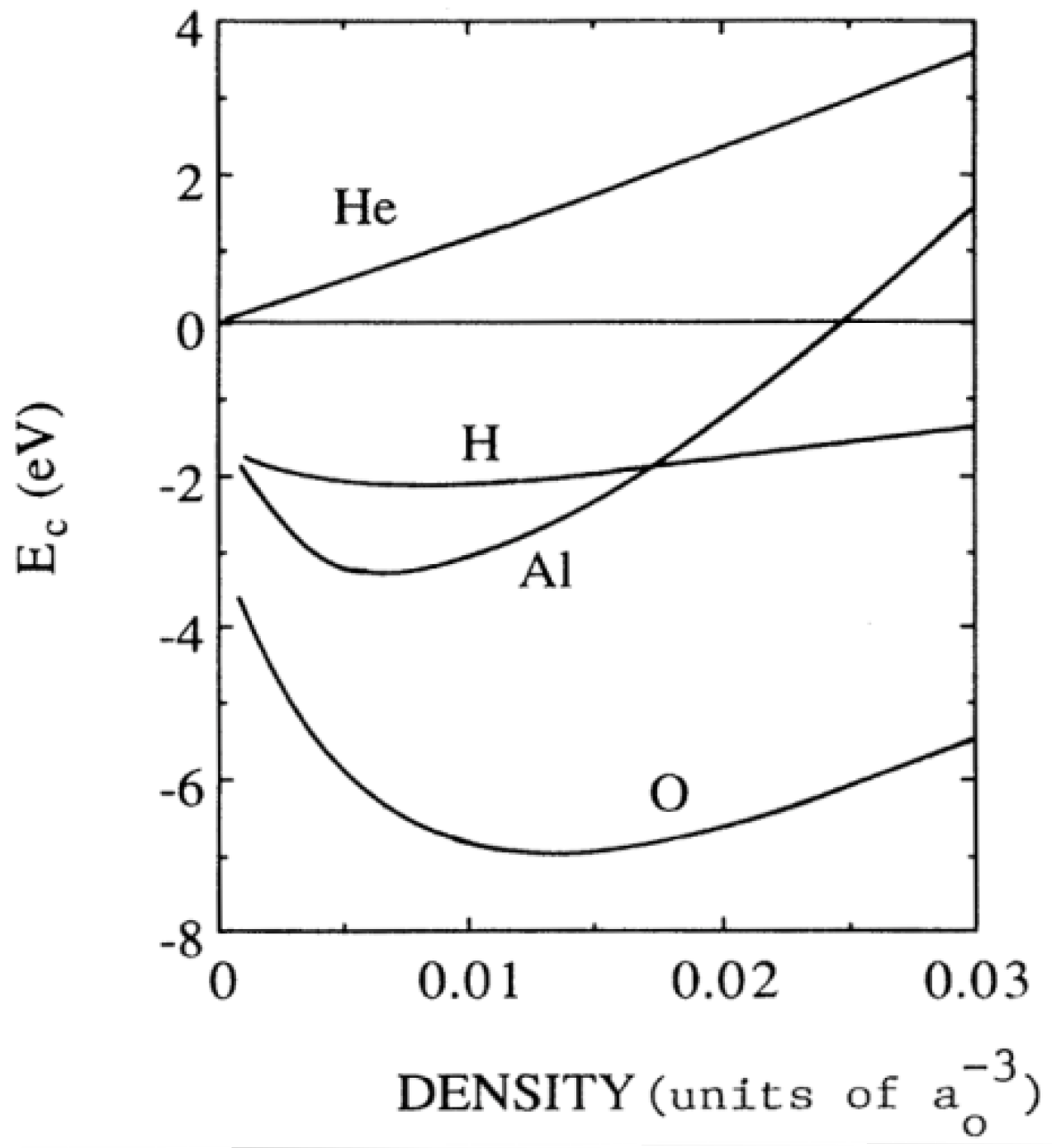
            <p>Principle sketch of the energy change of H atom embedded in the homogenous electron gas of various densities, Δ<italic>E</italic><sub>hom</sub>(<italic>ρ</italic>), and the corresponding cohesion energy Δ<italic>E</italic><sub>coh</sub>(<italic>ρ</italic>), obtained by appropriate corrections [<xref ref-type="bibr" rid="B75-crystals-02-01261">75</xref>].</p>
          </caption>
          <graphic xmlns:xlink="http://www.w3.org/1999/xlink" xlink:href="crystals-02-01261-g001.tif"/>
        </fig>
        <list>
          <list-item>
            <p>1. The most significant contribution to Δ<italic>E</italic><sub>coh</sub>(<italic>ρ</italic>) comes from the tendency of H to form a negative ion, so the models based on covalency or similar concepts are inappropriate for the description of M–H interaction.</p>
          </list-item>
          <list-item>
            <p>2. As the electron affinity of H (<italic>A</italic><sub>H</sub>) is smaller than the metal work function (<italic>φ</italic><sub>M</sub>), H goes to the neutral atom limit far from the metal surface (if H–H→H<sub>2</sub> recombination does not take place)</p>
          </list-item>
          <list-item>
            <p>3. The minimum of Δ<italic>E</italic><sub>hom</sub>(<italic>ρ</italic>) for H is placed in the ρ range between 0.002 a.u. [<xref ref-type="bibr" rid="B74-crystals-02-01261">74</xref>], 0.0055 a.u. [<xref ref-type="bibr" rid="B75-crystals-02-01261">75</xref>] and 0.012 a.u. [<xref ref-type="bibr" rid="B70-crystals-02-01261">70</xref>], so one can expect that H will prefer to occupy the positions with electron densities in that range, or as close as possible to it. This means that H<sub>2</sub> may approach the more open and low electron density metallic surfaces closer (in general bcc closer than fcc [<xref ref-type="bibr" rid="B74-crystals-02-01261">74</xref>], in particular the hypothetic (100) of the fcc Mg closer than the (0001) of the hcp Mg [<xref ref-type="bibr" rid="B77-crystals-02-01261">77</xref>]), and experience smaller adsorption barriers. For instance the adsorption barrier for H on Al surface is deeper and more distant from the surface than for Mg, and it almost vanishes for low electron density Na surface [<xref ref-type="bibr" rid="B74-crystals-02-01261">74</xref>].</p>
          </list-item>
        </list>
        <p>The Δ<italic>E</italic><sub>hom</sub>(<italic>ρ</italic>) dependence also predicts that H will prefer the most open structures inside the metals, e.g., octahedral interstices in fcc and hcp, and tetrahedral interstices in bcc structures, and that higher diffusion barriers could be more relevant in fcc or hcp than in bcc metals, due to the larger <italic>ρ</italic> at the saddle point in the denser structures [<xref ref-type="bibr" rid="B78-crystals-02-01261">78</xref>]. For the same reasons, H will be instable in the high electron density bulk of Al, and be of about the same stability in the Mg bulk as on its surface, and much more stable in the bulk than on the surface of Na, explaining the low solubility of H in Al, and the quite different behavior of H in Mg and Na.</p>
        <p>Obviously, the EMT offers a quite general and transparent picture of processes during the M–H interaction, predicting the H (and H<sub>2</sub>) behavior close to, and on the particular metallic surface, as well as in the bulk. In the following sections we will consider these processes in more detail using also the results of more accurate calculations and experiment.</p>
      </sec>
      <sec>
        <title>2.2. H<sub>2</sub> Adsorption and Dissociation of H<sub>2</sub> on Mg (0001) Surface</title>
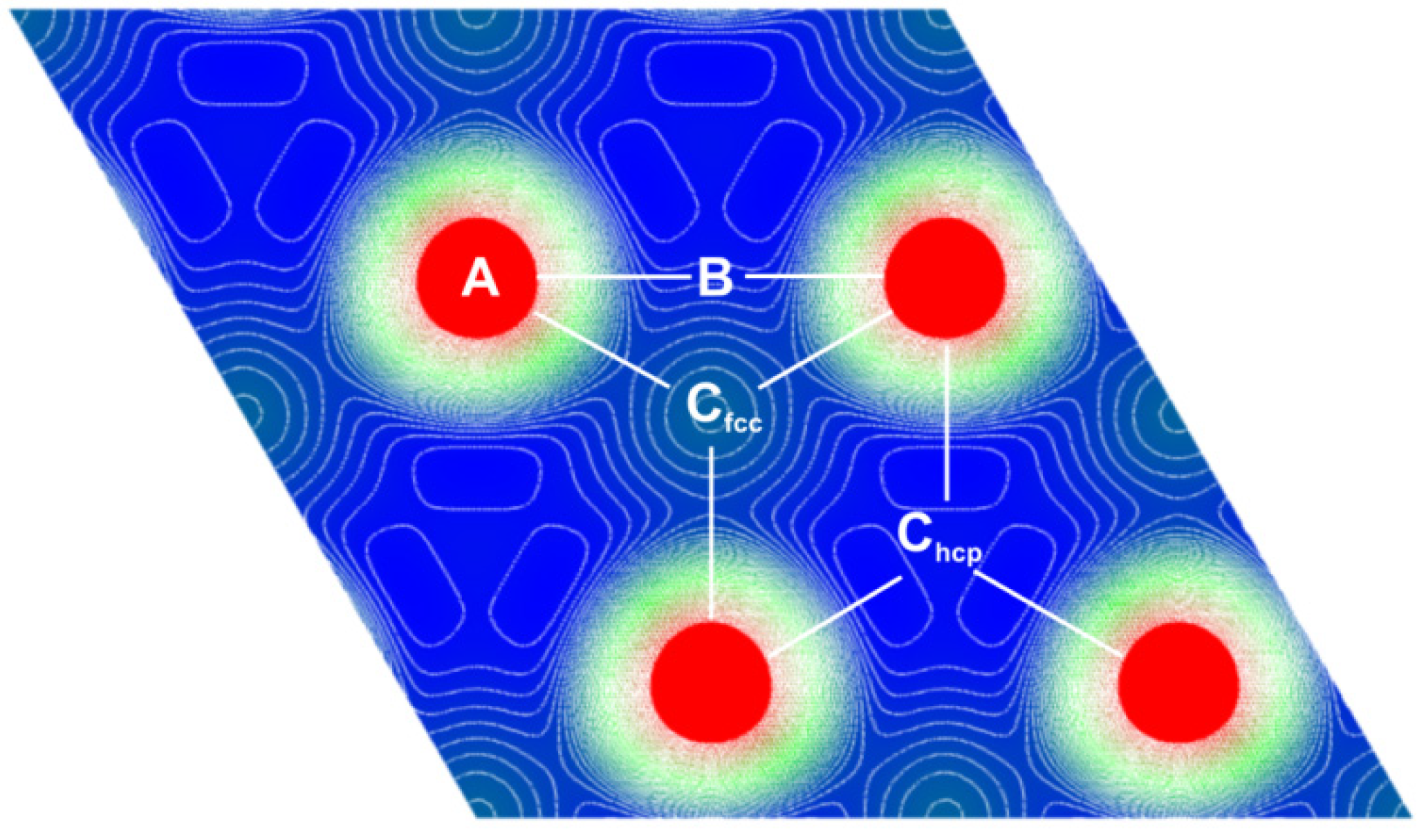
        <p>One large success of EMT, was the explanation of H<sub>2</sub> adsorption and dissociation on the hcp Mg (0001) surface [<xref ref-type="bibr" rid="B77-crystals-02-01261">77</xref>]. To illustrate this, charge distribution on the Mg (0001) surface calculated by the pseudopotentials method as implemented in the Abinit package [<xref ref-type="bibr" rid="B79-crystals-02-01261">79</xref>] is presented in <xref ref-type="fig" rid="crystals-02-01261-f002">Figure 2</xref>. The results of EMT can be briefly presented as follows:</p>
        <list>
          <list-item>
            <p>• There is an activation barrier for H<sub>2</sub> adsorption on the Mg (0001) surface, which directs it toward the atom (A) (above the Mg atom) position, where H<sub>2</sub> is placed parallel to the surface. The adsorption barrier arises because the H<sub>2</sub> interaction with the surface charge starts to weaken the H–H bond before H–Mg bonding appears. This produces the first “delay” in the H absorption kinetics on the Mg (0001) surface.</p>
          </list-item>
          <list-item>
            <p>• Dissociation of H<sub>2</sub> at the (A) position is hindered with another activation barrier (of about 0.5 eV), but H<sub>2</sub> is almost free to move above the surface toward the bridge (B) site above the line connecting two neighboring surface Mg atoms. This produces the second “delay” in the H absorption kinetics on the Mg (0001) surface.</p>
          </list-item>
          <list-item>
            <p>• Dissociation barrier at the (B) position is quite low (about 0.1 eV, producing the third “delay” in the H absorption kinetics on the Mg (0001) surface), and after dissociation, one H atom goes into the surface C<sub>fcc</sub> site, and the other into the surface C<sub>hcp</sub> site, and then quickly move into the first neighboring unoccupied C<sub>fcc</sub> site (producing the fourth “delay” in the H absorption kinetics on the Mg (0001) surface), which is energetically most favorable for H adsorption. These C<sub>fcc</sub> sites are the starting positions for H diffusion into the bulk of Mg metal.</p>
          </list-item>
        </list>
		<fig id="crystals-02-01261-f002" position="anchor">
          <label>Figure 2</label>
          <caption>
            <p>The charge distribution on the Mg (0001) surface calculated using the pseudopotentials method (Abinit). The characteristic positions on the surface are denoted: atop-(A), bridge-(B), Center fcc-(C<sub>fcc</sub>) and hcp-(C<sub>hcp</sub>).</p>
          </caption>
          <graphic xmlns:xlink="http://www.w3.org/1999/xlink" xlink:href="crystals-02-01261-g002.tif"/>
        </fig>
        
        <p>It has been established [<xref ref-type="bibr" rid="B77-crystals-02-01261">77</xref>] that dissociation of H<sub>2</sub> depends on the filling of its antibonding resonant state, and this filling depends on the nature and amount of the surface electron density, and its extension above the surface, explaining quite simply the above mentioned positioning of H<sub>2</sub> (and H) and their behavior on the Mg (0001), and generally, any other surface.</p>
        <p>The results of more accurate calculations [<xref ref-type="bibr" rid="B67-crystals-02-01261">67</xref>,<xref ref-type="bibr" rid="B79-crystals-02-01261">79</xref>,<xref ref-type="bibr" rid="B80-crystals-02-01261">80</xref>] and experiments [<xref ref-type="bibr" rid="B81-crystals-02-01261">81</xref>,<xref ref-type="bibr" rid="B82-crystals-02-01261">82</xref>] support the presented picture, even though some values are a bit different. For instance, distance of H<sub>2</sub> dissociation (also at (B) position) from the Mg (0001) surface was obtained in [<xref ref-type="bibr" rid="B67-crystals-02-01261">67</xref>] to be <italic>d</italic><sub>dis</sub> = 1.02 Å, and the dissociation barrier <italic>E</italic><sub>dis</sub> = 1.05 eV, is in good agreement with experiment [<xref ref-type="bibr" rid="B81-crystals-02-01261">81</xref>]. The analyses of the results have shown that a major discrepancy arises from the LDA approximation of the exchange-correlation potential used in EMT, and some control calculations in [<xref ref-type="bibr" rid="B67-crystals-02-01261">67</xref>]. The calculations also confirm the C<sub>fcc</sub> positions as the final state for the H adsorption on the Mg (0001) surface.</p>
      </sec>
      <sec>
        <title>2.3. H Diffusion into the Bulk of Mg, and Hydrides Phase Formation</title>
        <p>After dissociation of H<sub>2</sub> and accommodation of H at the most convenient surface positions, H diffuses into the bulk of Mg metal. The EMT predicts that H is going to search for the positions inside the hcp structure of Mg with the most appropriate <italic>ρ</italic> value, which are the octahedral interstices. </p>
		<fig id="crystals-02-01261-f003" position="anchor">
          <label>Figure 3</label>
          <caption>
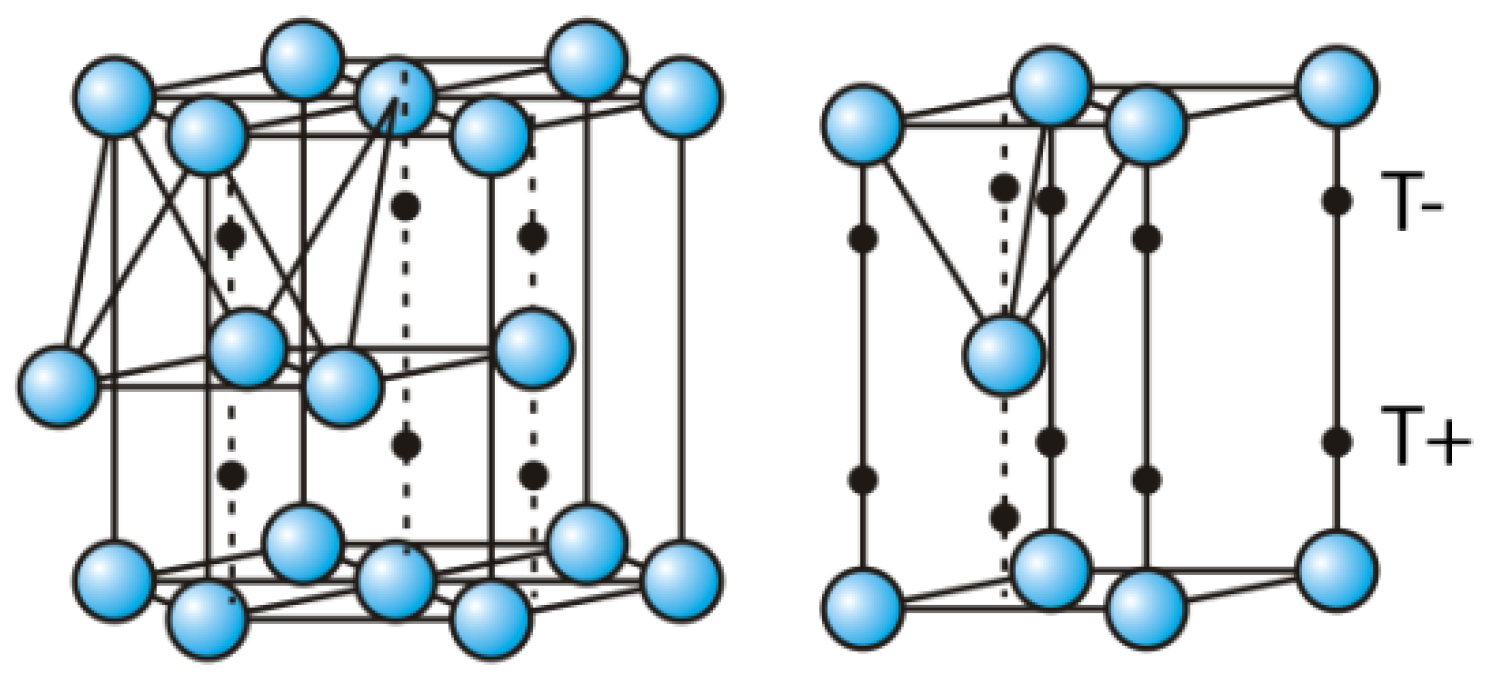
            <p>Crystal structure of hcp-Mg with octahedral and tetrahedral interstitial cites denoted. Wurtzite structure is a hcp derived structure with only half the (T+ or T−) tetragonal sites populated. Similarly, CdI<sub>2 </sub>differs from NiAs structure having only half of the octahedral sites populated.</p>
          </caption>
          <graphic xmlns:xlink="http://www.w3.org/1999/xlink" xlink:href="crystals-02-01261-g003.tif"/>
        </fig>
        
        <p>As the H concentration increases during hydrogenation, it is very important to establish positions of its further incorporation into the Mg crystal lattice. This pattern of H-accommodation into the Mg lattice, which influences the kinetics of H absorption and probability for various hydride phases formation was the subject of several investigations [<xref ref-type="bibr" rid="B37-crystals-02-01261">37</xref>,<xref ref-type="bibr" rid="B50-crystals-02-01261">50</xref>,<xref ref-type="bibr" rid="B65-crystals-02-01261">65</xref>,<xref ref-type="bibr" rid="B66-crystals-02-01261">66</xref>]. <italic>Ab initio</italic> calculations of Schimmel <italic>et al.</italic> [<xref ref-type="bibr" rid="B50-crystals-02-01261">50</xref>] suggest that hydrogen diffuses through the Mg metal phase, jumping between octahedral and/or tetrahedral interstitials, and that for large Mg particles and low temperatures, hydrogen diffusion is not expected to be the limiting factor of H kinetics. According to our investigations [<xref ref-type="bibr" rid="B65-crystals-02-01261">65</xref>], the H incorporation into the Mg crystal lattice proceeds as follows:</p>
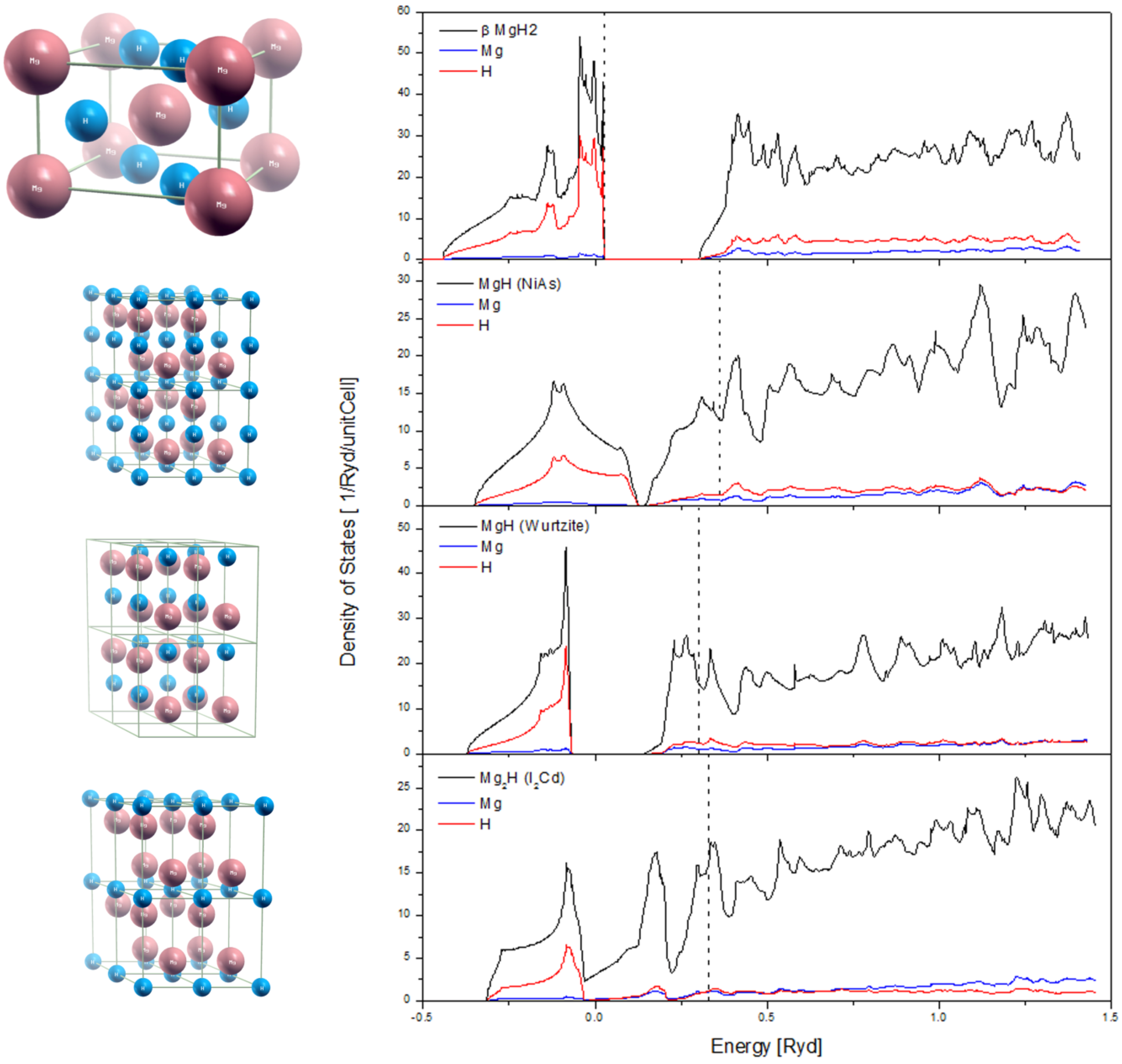
        <p>After H has populated the first sub-surface row of octahedral interstices, it diffuses toward, not the first, but the next neighbouring row of octahedral interstices in an attempt to form an ordered Mg<sub>2</sub>H structure of the CdI<sub>2</sub> structure type (<xref ref-type="fig" rid="crystals-02-01261-f004">Figure 4</xref>a), which is, although thermodynamically slightly unstable, with enthalpy of formation of about Δ<italic>H</italic>≈ 22 kJ/mol H<sub>2</sub>, the most stable structure in the composition range (Mg:H = 2:1).</p>
        <p>Among several possible ordered structures in the concentration range (Mg:H = 1:1), the most stable (although thermodynamically slightly unstable, with enthalpy of formation also about Δ<italic>H</italic> ≈ 22 kJ/molH<sub>2</sub>) is the rutile structure containing two H-vacancies, indicating that the structural phase transition between the hcp lattice of Mg-metal and the bcc Mg sublattice of the rutile structure of MgH<sub>2</sub> takes place in this concentration range, or just below it. Indication of structural changes in this concentration range, manifested through the abrupt change of the Mg-H bond lengths were also noticed by the Mg-H clusters calculations [<xref ref-type="bibr" rid="B83-crystals-02-01261">83</xref>]. By analyzing the structure of the competing phases DOS’s in this concentration range (<xref ref-type="fig" rid="crystals-02-01261-f004">Figure 4</xref>), one can see that the metastable Wurtzite structure is much more similar to the final rutile MgH<sub>2</sub> structure. This suggests that the transformation path of hcp-Mg to rutile MgH<sub>2</sub>, upon hydrogenation, is not predisposed solely by thermodynamic conditions, and that some particular steps of the process could be controlled by appropriate (perhaps symmetry induced) transformation of electronic structure. The substoichiometric Mg-H rutile structures becomes thermodynamically stable at the concentration range of about Mg:H = 3:2, with enthalpy of formation of Mg<sub>3</sub>H<sub>2</sub> of Δ<italic>H</italic>≈ −14 kJ/molH<sub>2</sub>.</p>
		<fig id="crystals-02-01261-f004" position="anchor">
          <label>Figure 4</label>
          <caption>
            <p>Crystal structure, and Density of states (DOS), of (top to bottom): rutile MgH<sub>2</sub>, MgH with NiAs structure, MgH with Wurtzite structure and Mg<sub>2</sub>H with CdI<sub>2</sub> crystal structure (red spheres: Mg; blue spheres: H atoms).</p>
          </caption>
          <graphic xmlns:xlink="http://www.w3.org/1999/xlink" xlink:href="crystals-02-01261-g004.tif"/>
        </fig>
        
        <p>The presented results provide quite a detailed picture of the most important stages of the Mg structure transformation during hydrogenation. If true, they imply some serious consequences on H absorption kinetics. For instance, the finding that H prefers accommodation in particular (almost) ordered structures, that some of them are not the most convenient thermodynamically, and that they cannot be reached using stohastic diffusion paths (as proposed in [<xref ref-type="bibr" rid="B37-crystals-02-01261">37</xref>,<xref ref-type="bibr" rid="B50-crystals-02-01261">50</xref>]), imposes strong limitations on H absorption kinetics. Also, the same discards all kinetic models of H absorption which consider the movement of the Mg/MgH<sub>2</sub> interface as the limiting step, because this interface does not form until at least (if ever) the Mg:H = 1:1 concentration range. Of course, the mentioned calculations have been performed at <italic>T</italic> = 0 K, they do not include the zero point, anharmonicity, and perhaps the quantum tunneling effects, which all could be important for hydrogen behavior.</p>
        <p>The processes connecting the particular steps considered above also have not been explicitly accounted for, and some more knowledge about them could be obtained from the reverse process of MgH<sub>2</sub> dehydrogenation that is addressed in the next chapter.</p>
      </sec>
      <sec>
        <title>2.4. Desorption of H (H<sub>2</sub>) from MgH<sub>2</sub>, and Its Decomposition during Dehydrogenation</title>
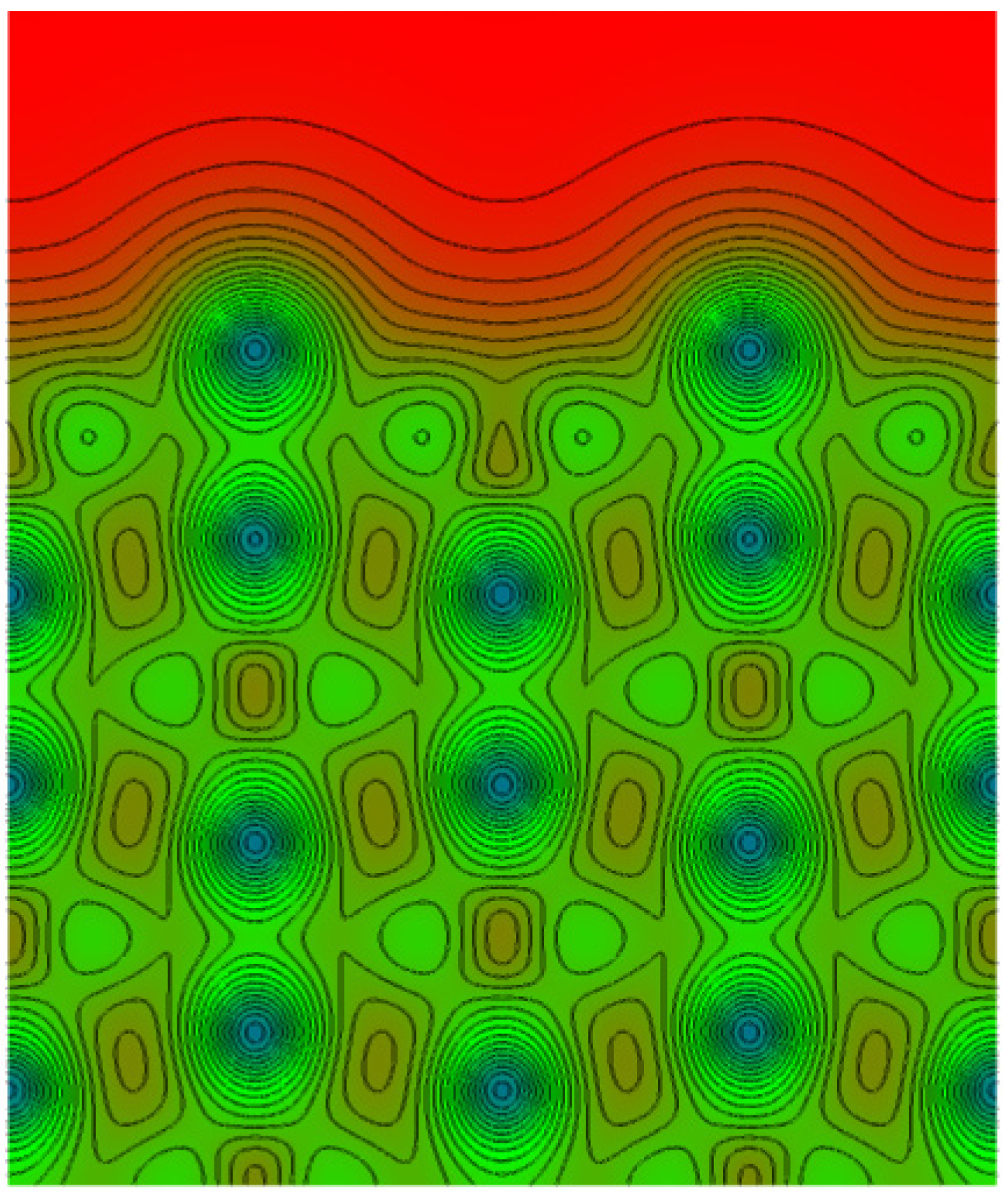
        <p>We shall start the analysis of the MgH<sub>2</sub> dehydrogenation process by investigation of H (H<sub>2</sub>) desorption from the most stable MgH<sub>2</sub> (110) and MgH<sub>2</sub> (001) surfaces. The structure and charge density distribution of the MgH<sub>2</sub> (110) surface system is presented in <xref ref-type="fig" rid="crystals-02-01261-f005">Figure 5</xref></p>
        <fig id="crystals-02-01261-f005" position="anchor">
          <label>Figure 5</label>
          <caption>
            <p>Structure and valence charge density of the MgH<sub>2</sub> (110) surface system. The cross-section through the plane perpendicular to (110) surface plane (original (001)) is presented. Red-Green-Blue color scale was used, ranging from red for low to blue for high electron density.</p>
          </caption>
          <graphic xmlns:xlink="http://www.w3.org/1999/xlink" xlink:href="crystals-02-01261-g005.tif"/>
        </fig>
        <p>The activation barrier for H desorption was calculated [<xref ref-type="bibr" rid="B84-crystals-02-01261">84</xref>] to be about 1.78 eV for the MgH<sub>2</sub> (110), and about 2.8 eV for the (001) surface Similar activation energies for H desorption from both considered surfaces were found also in [<xref ref-type="bibr" rid="B85-crystals-02-01261">85</xref>]. </p>
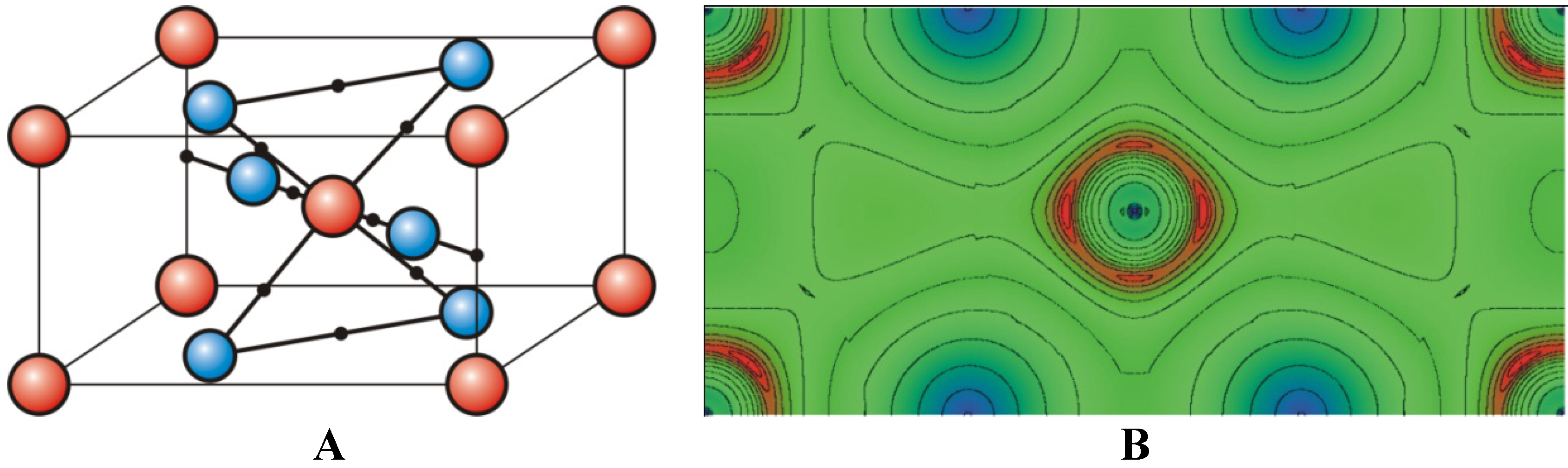
        <p>These energies are higher than those obtained for various H vacancies formations, ranging from 1.3 to 1.6 eV [<xref ref-type="bibr" rid="B86-crystals-02-01261">86</xref>], diffusion on the MgH<sub>2</sub> (110) surface (ranging from 0.15 to 0.80 eV), and from the surface into the bulk (ranging from 0.45 to 0.70 eV). Despite somewhat larger values obtained for defects formation and diffusion in [<xref ref-type="bibr" rid="B87-crystals-02-01261">87</xref>], it is H desorption from the MgH<sub>2</sub> surfaces that is usually considered [<xref ref-type="bibr" rid="B88-crystals-02-01261">88</xref>,<xref ref-type="bibr" rid="B89-crystals-02-01261">89</xref>] as the rate-limiting step for dehydrogenation process of MgH<sub>2</sub>. The common, and to a great extent, correct explanation for this is a strong ionic interaction between Mg and H. But, as can be seen in <xref ref-type="fig" rid="crystals-02-01261-f006">Figure 6</xref>a, besides the bonding between Mg (red spheres) and H (blue spheres), H–H bonding interaction also exists in the system (see also <xref ref-type="fig" rid="crystals-02-01261-f003">Figure 3</xref>b in [<xref ref-type="bibr" rid="B84-crystals-02-01261">84</xref>]). It is also clearly visible in <xref ref-type="fig" rid="crystals-02-01261-f006">Figure 6</xref>b, in the (110) crystallographic plane. The bonding H–H interaction is a rare appearance in metal hydrides, which certainly considerably hampers the H desorption kinetics from MgH<sub>2</sub>.</p>
        <fig id="crystals-02-01261-f006" position="anchor">
          <label>Figure 6</label>
          <caption>
            <p>(<bold>a</bold>) The unit cell of the MgH<sub>2</sub> rutile structure with bond critical points [<xref ref-type="bibr" rid="B90-crystals-02-01261">90</xref>] denoted as small black spheres. Mg-red spheres, H-blue spheres. (<bold>b</bold>) The valence charge distribution in the bulk MgH<sub>2</sub> (110) crystallographic plane.</p>
          </caption>
          <graphic xmlns:xlink="http://www.w3.org/1999/xlink" xlink:href="crystals-02-01261-g006.tif"/>
        </fig>
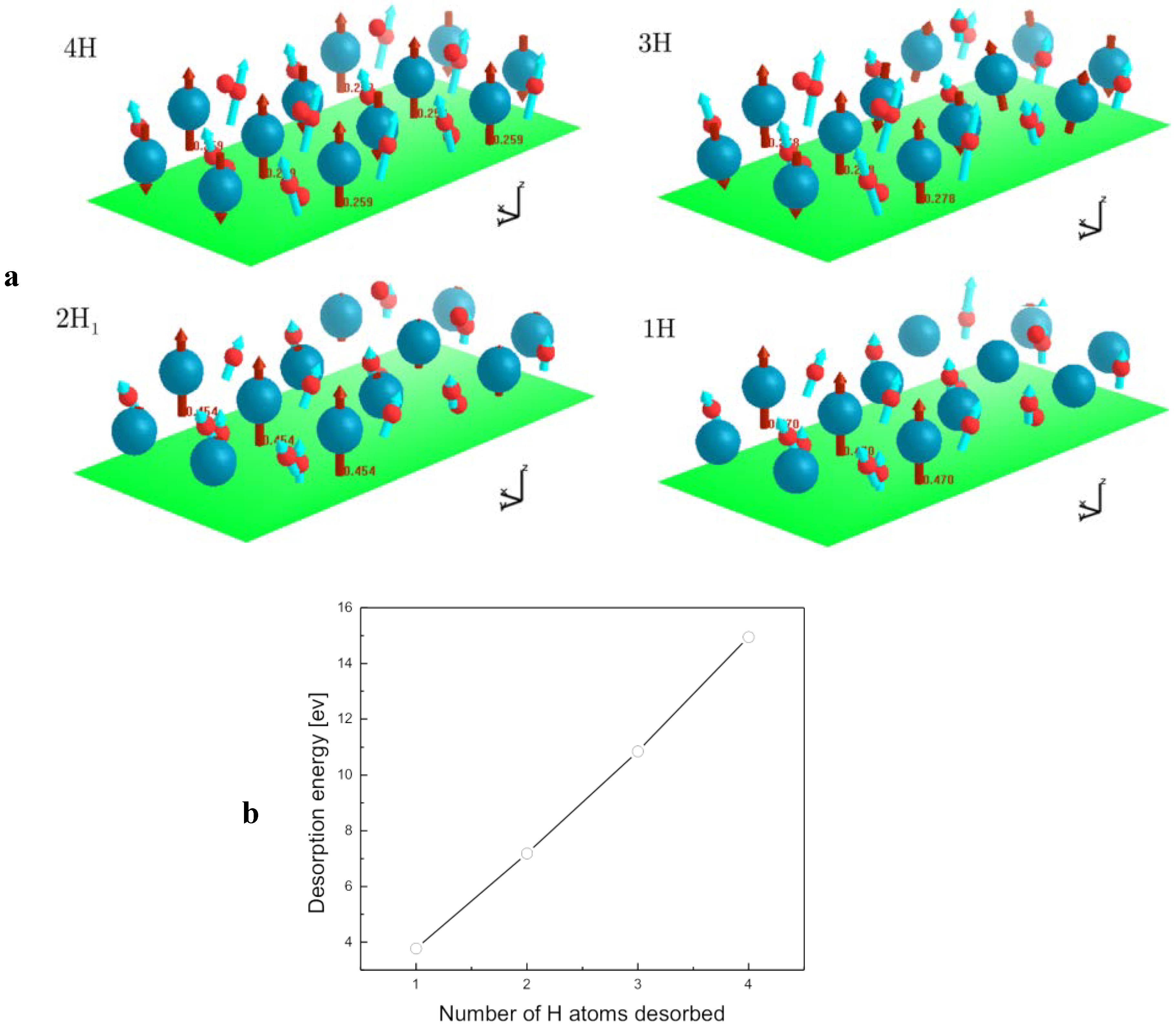
        <p>It should be also remembered that conditions on the MgH<sub>2</sub> desorption surface changes substantially during the process, both due to depletion of the surface, and, in a more severe way, due to the structural phase transitions which should be expected for concentrations around Mg:H = 1:1 and below. One attempt in this direction is presented in <xref ref-type="fig" rid="crystals-02-01261-f007">Figure 7</xref>a,b, illustrating the H-desorption from the MgH<sub>2</sub> (110) surface, and the energy changes of the (fully relaxed) surface during the particular stages of the process.</p>
        <fig id="crystals-02-01261-f007" position="anchor">
          <label>Figure 7</label>
          <caption>
            <p>(<bold>a</bold>) Illustration of successive H desorption from the MgH<sub>2</sub>(110) surface; (<bold>b</bold>) Desorption energy change of the relaxed MgH<sub>2</sub>(110) surface during the H desorption (blue spheres: Mg; red spheres: H atoms; arrows: directions and intensities of relaxation). </p>
          </caption>
          <graphic xmlns:xlink="http://www.w3.org/1999/xlink" xlink:href="crystals-02-01261-g007.tif"/>
        </fig>
        <p>Although all mentioned [<xref ref-type="bibr" rid="B80-crystals-02-01261">80</xref>,<xref ref-type="bibr" rid="B82-crystals-02-01261">82</xref>,<xref ref-type="bibr" rid="B85-crystals-02-01261">85</xref>,<xref ref-type="bibr" rid="B86-crystals-02-01261">86</xref>,<xref ref-type="bibr" rid="B87-crystals-02-01261">87</xref>,<xref ref-type="bibr" rid="B88-crystals-02-01261">88</xref>,<xref ref-type="bibr" rid="B89-crystals-02-01261">89</xref>,<xref ref-type="bibr" rid="B91-crystals-02-01261">91</xref>,<xref ref-type="bibr" rid="B92-crystals-02-01261">92</xref>] and other numerous investigations deal with only some particular aspects of the process (e.g., distinct points on the MgH<sub>2</sub> dehydrogenation curve), they are accurate enough to justify the expectation that the entire process (as well as the process of Mg hydrogenation) will be resolved “from the first principles” in the near future. Also, the investigations have “located’’ the main obstacles that should be resolved in the further attempts to improve the performances of the Mg-H system. Some possibilities for that are discussed in the following chapter.</p>
      </sec>
      <sec>
        <title>2.5. Possibilities for Improvement of the Mg/MgH<sub>2</sub> Hydrogenation/Dehydrogenation Performances</title>
        <p>As we mentioned previously, practical applications of metal hydrides for H storage require strict conditions to be fulfilled [<xref ref-type="bibr" rid="B1-crystals-02-01261">1</xref>,<xref ref-type="bibr" rid="B2-crystals-02-01261">2</xref>,<xref ref-type="bibr" rid="B5-crystals-02-01261">5</xref>,<xref ref-type="bibr" rid="B9-crystals-02-01261">9</xref>,<xref ref-type="bibr" rid="B10-crystals-02-01261">10</xref>,<xref ref-type="bibr" rid="B11-crystals-02-01261">11</xref>,<xref ref-type="bibr" rid="B12-crystals-02-01261">12</xref>,<xref ref-type="bibr" rid="B13-crystals-02-01261">13</xref>,<xref ref-type="bibr" rid="B14-crystals-02-01261">14</xref>]: H absorption/desorption at moderate temperatures and pressures, reversibility of cycling, material stability under operating conditions, large H-uptake, low weight, reasonable price, and so on. Obviously, it is difficult to find the material that can satisfy all these requirements at the same time, and for that reason a huge amount of various systems have been investigated. </p>
        <p>The most improvements have come from the catalytic approaches, in which the size of the MgH<sub>2</sub> particles have been reduced down to the nanometer dimensions (increasing the surface/volume ratio), their surface made more active and (or) the bulk less ordered by introduction of defects of various kinds, and by adding various elements to the system, molecules and compounds [<xref ref-type="bibr" rid="B3-crystals-02-01261">3</xref>,<xref ref-type="bibr" rid="B4-crystals-02-01261">4</xref>,<xref ref-type="bibr" rid="B6-crystals-02-01261">6</xref>,<xref ref-type="bibr" rid="B7-crystals-02-01261">7</xref>,<xref ref-type="bibr" rid="B8-crystals-02-01261">8</xref>,<xref ref-type="bibr" rid="B41-crystals-02-01261">41</xref>,<xref ref-type="bibr" rid="B44-crystals-02-01261">44</xref>,<xref ref-type="bibr" rid="B53-crystals-02-01261">53</xref>,<xref ref-type="bibr" rid="B54-crystals-02-01261">54</xref>,<xref ref-type="bibr" rid="B55-crystals-02-01261">55</xref>,<xref ref-type="bibr" rid="B56-crystals-02-01261">56</xref>,<xref ref-type="bibr" rid="B57-crystals-02-01261">57</xref>,<xref ref-type="bibr" rid="B58-crystals-02-01261">58</xref>,<xref ref-type="bibr" rid="B59-crystals-02-01261">59</xref>,<xref ref-type="bibr" rid="B60-crystals-02-01261">60</xref>,<xref ref-type="bibr" rid="B61-crystals-02-01261">61</xref>,<xref ref-type="bibr" rid="B62-crystals-02-01261">62</xref>,<xref ref-type="bibr" rid="B63-crystals-02-01261">63</xref>,<xref ref-type="bibr" rid="B64-crystals-02-01261">64</xref>,<xref ref-type="bibr" rid="B93-crystals-02-01261">93</xref>,<xref ref-type="bibr" rid="B94-crystals-02-01261">94</xref>]. All above mentioned approaches could be understood and its particular relation to H-behavior resolved and established from the electronic structure point of view. The influence of more open, or more dense, metal surfaces and bulk structures on H accommodation has been briefly mentioned in previous chapters, and the importance of surface defects has been also recognized [<xref ref-type="bibr" rid="B77-crystals-02-01261">77</xref>]. Simply speaking, any dilution of the metal structure (for instance with defects) would in principle lead to a charge density structure which is more convenient for H accommodation, and its trapping [<xref ref-type="bibr" rid="B78-crystals-02-01261">78</xref>]. If the diffusion barrier between different defects or between defects and interstices is lower than between the interstices themselves, defects could facilitate H mobility in the system, but the opposite scenario is also possible.</p>
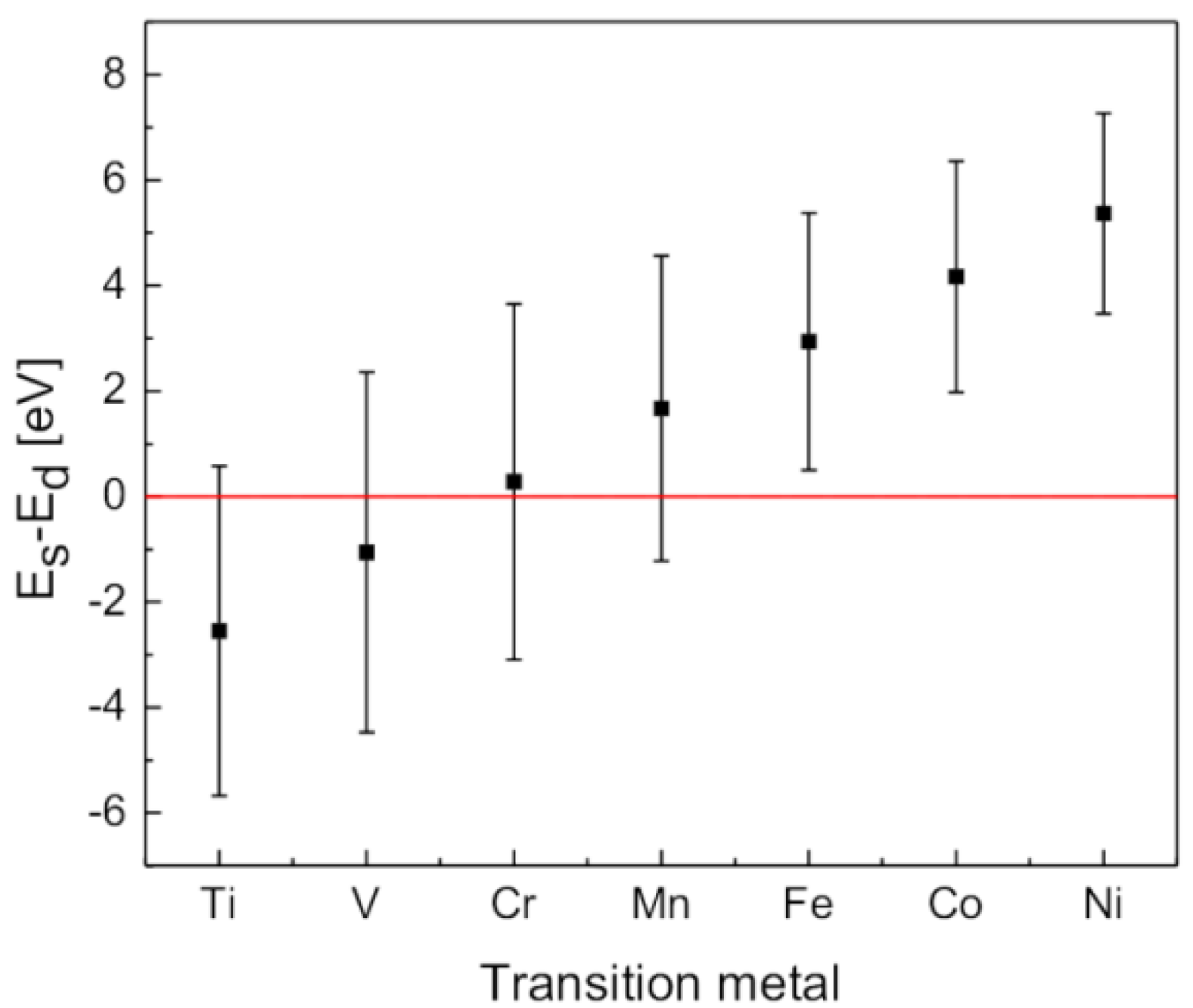
        <p>Although it is generally true for all defects, the effects of impurity atoms on H-behavior in the system depend essentially on their electronic structure. Here we will briefly outline the influence of transition metal (TM) impurities on the Mg/MgH<sub>2</sub> system properties. Extensive experimental [<xref ref-type="bibr" rid="B3-crystals-02-01261">3</xref>,<xref ref-type="bibr" rid="B4-crystals-02-01261">4</xref>,<xref ref-type="bibr" rid="B6-crystals-02-01261">6</xref>,<xref ref-type="bibr" rid="B7-crystals-02-01261">7</xref>,<xref ref-type="bibr" rid="B8-crystals-02-01261">8</xref>,<xref ref-type="bibr" rid="B44-crystals-02-01261">44</xref>,<xref ref-type="bibr" rid="B55-crystals-02-01261">55</xref>,<xref ref-type="bibr" rid="B56-crystals-02-01261">56</xref>,<xref ref-type="bibr" rid="B57-crystals-02-01261">57</xref>,<xref ref-type="bibr" rid="B58-crystals-02-01261">58</xref>,<xref ref-type="bibr" rid="B59-crystals-02-01261">59</xref>,<xref ref-type="bibr" rid="B60-crystals-02-01261">60</xref>,<xref ref-type="bibr" rid="B61-crystals-02-01261">61</xref>,<xref ref-type="bibr" rid="B62-crystals-02-01261">62</xref>,<xref ref-type="bibr" rid="B8-crystals-02-01261">8</xref>,<xref ref-type="bibr" rid="B44-crystals-02-01261">44</xref>,<xref ref-type="bibr" rid="B55-crystals-02-01261">55</xref>] and theoretical (computational) [<xref ref-type="bibr" rid="B21-crystals-02-01261">21</xref>,<xref ref-type="bibr" rid="B44-crystals-02-01261">44</xref>,<xref ref-type="bibr" rid="B67-crystals-02-01261">67</xref>,<xref ref-type="bibr" rid="B68-crystals-02-01261">68</xref>,<xref ref-type="bibr" rid="B69-crystals-02-01261">69</xref>,<xref ref-type="bibr" rid="B70-crystals-02-01261">70</xref>,<xref ref-type="bibr" rid="B71-crystals-02-01261">71</xref>,<xref ref-type="bibr" rid="B72-crystals-02-01261">72</xref>,<xref ref-type="bibr" rid="B91-crystals-02-01261">91</xref>,<xref ref-type="bibr" rid="B93-crystals-02-01261">93</xref>,<xref ref-type="bibr" rid="B94-crystals-02-01261">94</xref>,<xref ref-type="bibr" rid="B95-crystals-02-01261">95</xref>,<xref ref-type="bibr" rid="B96-crystals-02-01261">96</xref>,<xref ref-type="bibr" rid="B97-crystals-02-01261">97</xref>,<xref ref-type="bibr" rid="B98-crystals-02-01261">98</xref>,<xref ref-type="bibr" rid="B72-crystals-02-01261">72</xref>,<xref ref-type="bibr" rid="B91-crystals-02-01261">91</xref>,<xref ref-type="bibr" rid="B93-crystals-02-01261">93</xref>] investigations have been devoted to the subject, and the importance of the TM(d)–H(s) interaction for the TM catalytic properties [<xref ref-type="bibr" rid="B67-crystals-02-01261">67</xref>,<xref ref-type="bibr" rid="B71-crystals-02-01261">71</xref>,<xref ref-type="bibr" rid="B72-crystals-02-01261">72</xref>,<xref ref-type="bibr" rid="B93-crystals-02-01261">93</xref>,<xref ref-type="bibr" rid="B95-crystals-02-01261">95</xref>,<xref ref-type="bibr" rid="B96-crystals-02-01261">96</xref>] established. To illustrate this, the difference between the center of the TM 3d-band and H(s) level, and its position relative to the 3d-band [<xref ref-type="bibr" rid="B99-crystals-02-01261">99</xref>], are presented in <xref ref-type="fig" rid="crystals-02-01261-f008">Figure 8</xref>. The figure shows how the H(s) level taken as a zero energy level, enters and leaves the 3d band while moving along the series.</p>
        <p>The consequence of such behavior is an increase of electron density around TM impurity, and therefore an increase of strength of TM–H bonding (reflected in the shortening of the TM–H bond). The trend is visible while moving from Ti to Fe, and eventually could be violated if magnetic interaction in the system becomes important [<xref ref-type="bibr" rid="B70-crystals-02-01261">70</xref>,<xref ref-type="bibr" rid="B91-crystals-02-01261">91</xref>]. Further filling of the d-band going from Co to Ni and on (Cu, Zn) leads to gradual movement of Fermi level (<italic>E</italic><sub>F</sub>) away from the center of the d-band, and the ongoing population of the H(s*) anti-bonding level. This leads to weakening of the TM–H interaction and to expansion of the TM–H bond length [<xref ref-type="bibr" rid="B70-crystals-02-01261">70</xref>]. The existence of such a clear trend implies that single TM impurity could not satisfy all requirements (adsorption, dissociation, diffusion into and from the bulk and desorption) necessary to improve the H-sorption kinetics of the Mg/MgH<sub>2</sub> system. Indeed, both experimental (for instance [<xref ref-type="bibr" rid="B4-crystals-02-01261">4</xref>] and [<xref ref-type="bibr" rid="B59-crystals-02-01261">59</xref>]), and calculation results are often inconsistent. For instance, in ref. [<xref ref-type="bibr" rid="B4-crystals-02-01261">4</xref>] it has been found that among the TM of the 3d-series Ti and V improve the most, and Ni the least, both absorption and desorption properties of Mg/MgH<sub>2</sub> among the TM of the 3d-series, and [<xref ref-type="bibr" rid="B59-crystals-02-01261">59</xref>] claims that Ni is a much better catalyst than Fe and Co. A recent computational study [<xref ref-type="bibr" rid="B93-crystals-02-01261">93</xref>] predicts that all 3d TM when absorbed at the Mg (0001) surface induce dissociation of H<sub>2</sub>, but that Ti and V provide much slower H-absorption kinetics, than for instance Mn, Fe and Co.</p>
        <p>The reason for these discrepancies could be major differences in performed experimental conditions (milling time and energy, particle size, formation of stable TM–Hydrides and other “parasitic” phases, <italic>etc.</italic>), measuring techniques and conditions and the used computational methods.</p>
		<fig id="crystals-02-01261-f008" position="anchor">
          <label>Figure 8</label>
          <caption>
            <p>Dependence of the relative position of the 3d-band zone center and the H(s) level, and the half of the d-band width along the 3d-series.</p>
          </caption>
          <graphic xmlns:xlink="http://www.w3.org/1999/xlink" xlink:href="crystals-02-01261-g008.tif"/>
        </fig>
        
        <p>However, the fact that all details of the catalytic mechanism of TM in Mg/MgH<sub>2</sub> are still not adequately explained also deserves consideration. For instance, it has been found [<xref ref-type="bibr" rid="B71-crystals-02-01261">71</xref>] that catalytic properties of TM in Mg–H clusters strongly depend on its environment (edge, surface, or bulk) in different ways for different TM impurities. It has been also shown [<xref ref-type="bibr" rid="B70-crystals-02-01261">70</xref>,<xref ref-type="bibr" rid="B72-crystals-02-01261">72</xref>] that TM impurities exhibit a different behavior in different crystal structures of the Mg–H system</p>
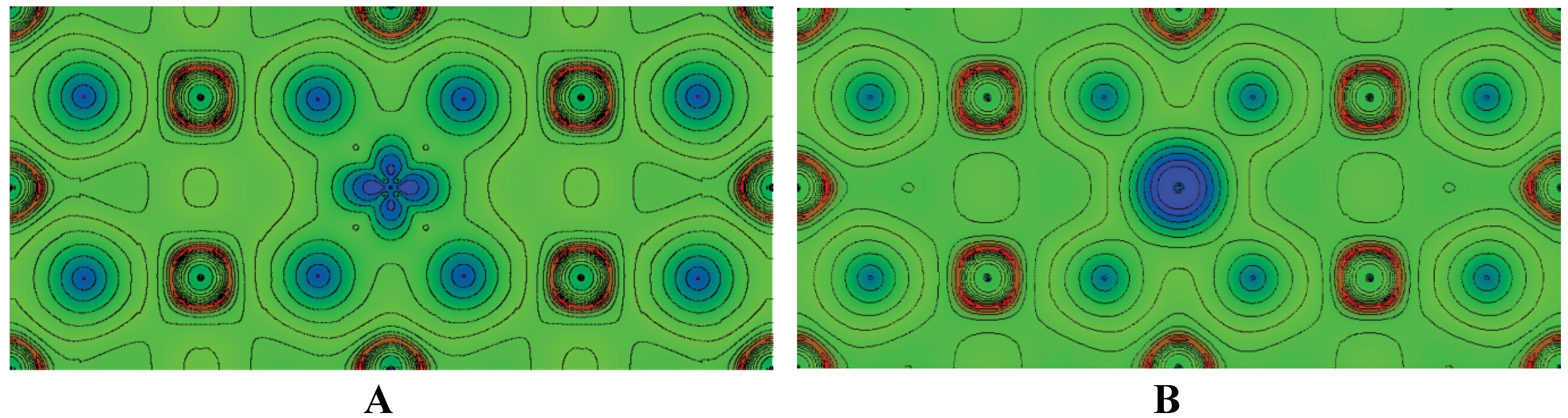
        <p>An interesting insight in influence of Ti and Co impurity (10 wt.%) on the MgH<sub>2</sub> rutile structure is presented in [<xref ref-type="bibr" rid="B72-crystals-02-01261">72</xref>,<xref ref-type="bibr" rid="B91-crystals-02-01261">91</xref>]. In <xref ref-type="fig" rid="crystals-02-01261-f009">Figure 9</xref>, the valence charge distributions around Ti and Co impurity in (110) plane are presented.</p>
        <p>The charge distributions around Ti and Co atoms are quite different, both being of predominantly t<sub>2g</sub> character. Around Ti it is however directed between the neighboring H atoms, and around Co it is more spherical, with significant contribution of charge directed toward the H atoms. Both Ti and Co interact with four neighboring H atoms in (110) plane, but also in (−1−10) plane where the interaction is extended from the two nearest neighbor H toward the two H in the third coordination of TM. In <xref ref-type="table" rid="crystals-02-01261-t001">Table 1</xref>, one can see that Co–H bond length is shorter than Ti–H one, but that Co destabilize the MgH<sub>2</sub> structure more than Ti. It has been also found that magnetic interaction in the MgH<sub>2</sub>:Co system affords an important contribution to the ground state energy of the system.</p>
		<fig id="crystals-02-01261-f009" position="anchor">
          <label>Figure 9</label>
          <caption>
            <p>Valence charge density of (<bold>a</bold>) MgH<sub>2</sub>:Ti and (<bold>b</bold>) of MgH<sub>2</sub>:Co in (110) plane.</p>
          </caption>
          <graphic xmlns:xlink="http://www.w3.org/1999/xlink" xlink:href="crystals-02-01261-g009.tif"/>
        </fig>
        
        <table-wrap id="crystals-02-01261-t001" position="anchor">
          <object-id pub-id-type="pii">crystals-02-01261-t001_Table 1</object-id>
          <label>Table 1</label>
          <caption>
            <p>Calculated results of structural optimization, total energies, and heats of formation, of MgH<sub>2</sub>, MgH<sub>2</sub>:Ti, MgH<sub>2</sub>:Co.</p>
          </caption>
          <table>
            <thead>
              <tr>
                <th rowspan="2" align="center" valign="middle">Compound</th>
                <th colspan="5" align="center" valign="middle" style="border-bottom:solid thin">Distances [Å]</th>
                <th rowspan="2" align="center" valign="middle">
                  <italic>E</italic>
                  <sub>tot</sub>
                </th>
                <th rowspan="2" align="center" valign="middle">Δ
                <italic>H</italic></th>
              </tr>
              <tr>
                <th align="center" valign="middle">Atom</th>
                <th align="center" valign="middle">nn H4</th>
                <th align="center" valign="middle">nn H2</th>
                <th align="center" valign="middle">nn Mg</th>
                <th align="center" valign="middle">nnn H</th>
              </tr>
            </thead>
            <tbody>
              <tr>
                <td align="center" valign="middle">MgH<sub>2</sub></td>
                <td align="center" valign="middle">Mg</td>
                <td align="center" valign="middle">1.952</td>
                <td align="center" valign="middle">1.953</td>
                <td align="center" valign="middle">3.019</td>
                <td align="center" valign="middle">3.424</td>
                <td align="center" valign="middle">−806.08</td>
                <td align="center" valign="middle">−69.51</td>
              </tr>
              <tr>
                <td align="center" valign="middle">MgH<sub>2</sub>:Ti</td>
                <td align="center" valign="middle">Ti</td>
                <td align="center" valign="middle">1.916</td>
                <td align="center" valign="middle">1.905</td>
                <td align="center" valign="middle">3.041</td>
                <td align="center" valign="middle">3.440</td>
                <td align="center" valign="middle">−7755.53</td>
                <td align="center" valign="middle">−60.64</td>
              </tr>
              <tr>
                <td align="center" valign="middle">MgH<sub>2</sub>:Co</td>
                <td align="center" valign="middle">Co</td>
                <td align="center" valign="middle">1.789</td>
                <td align="center" valign="middle">1.802</td>
                <td align="center" valign="middle">3.025</td>
                <td align="center" valign="middle">3.458</td>
                <td align="center" valign="middle">−8834.79</td>
                <td align="center" valign="middle">−53.23</td>
              </tr>
            </tbody>
          </table>
		  <table-wrap-foot><fn><p>nn: nearest neighbor; nnn: next nearest neighbor.</p></fn></table-wrap-foot>
        </table-wrap>
        <p>One possible explanation why Co destabilizes MgH<sub>2</sub> more than Ti could be that strong local TM–H interaction weakens the rest of the bonds in the compound due to the strong localization of the valence charge in the first coordination of TM more around Co than around Ti. If this hypothesis is correct, it should be reflected in the H-desorption kinetics from these systems which, after the initial acceleration, could slow down for the H-poor phases.</p>
        <p>It should be mentioned here that a consistent explanation of TM hydrides formation and stability is challenging in itself [<xref ref-type="bibr" rid="B21-crystals-02-01261">21</xref>,<xref ref-type="bibr" rid="B91-crystals-02-01261">91</xref>,<xref ref-type="bibr" rid="B96-crystals-02-01261">96</xref>], and this is particularly true for hydrides of complex intermetallic compounds [<xref ref-type="bibr" rid="B100-crystals-02-01261">100</xref>,<xref ref-type="bibr" rid="B101-crystals-02-01261">101</xref>,<xref ref-type="bibr" rid="B102-crystals-02-01261">102</xref>,<xref ref-type="bibr" rid="B103-crystals-02-01261">103</xref>].</p>
        <p>The established fact that some local structures inside the very same unit cell of the complex compounds of the Ti<sub>2</sub>Ni structure type are much more susceptible to H absorption than others [<xref ref-type="bibr" rid="B104-crystals-02-01261">104</xref>,<xref ref-type="bibr" rid="B105-crystals-02-01261">105</xref>], should be due to remarkably different charge topology observed at different lattice positions in some of these systems [<xref ref-type="bibr" rid="B106-crystals-02-01261">106</xref>].</p>
        <p>Although the large specific weight prevent their practical applications as H-storage materials, the fact that their electronic properties, and consequently the environment for H-uptake could be altered considerably inside the same structure by changing the constitutive elements of the compound [<xref ref-type="bibr" rid="B107-crystals-02-01261">107</xref>,<xref ref-type="bibr" rid="B108-crystals-02-01261">108</xref>], provides a valuable example of how to adjust the local electronic charge distribution inside a complicated system, which could be of importance for understanding another type of complex hydrides presented in the next chapter.</p>
      </sec>
      <sec>
        <title>2.6. Few Words about “Modern” Complex Hydrides</title>
        <p>After the first encouraging results with alanates [<xref ref-type="bibr" rid="B27-crystals-02-01261">27</xref>,<xref ref-type="bibr" rid="B28-crystals-02-01261">28</xref>,<xref ref-type="bibr" rid="B29-crystals-02-01261">29</xref>], a large variety of complex metal hydrides [<xref ref-type="bibr" rid="B25-crystals-02-01261">25</xref>,<xref ref-type="bibr" rid="B30-crystals-02-01261">30</xref>,<xref ref-type="bibr" rid="B31-crystals-02-01261">31</xref>,<xref ref-type="bibr" rid="B32-crystals-02-01261">32</xref>,<xref ref-type="bibr" rid="B107-crystals-02-01261">107</xref>,<xref ref-type="bibr" rid="B108-crystals-02-01261">108</xref>,<xref ref-type="bibr" rid="B109-crystals-02-01261">109</xref>,<xref ref-type="bibr" rid="B110-crystals-02-01261">110</xref>,<xref ref-type="bibr" rid="B111-crystals-02-01261">111</xref>,<xref ref-type="bibr" rid="B112-crystals-02-01261">112</xref>,<xref ref-type="bibr" rid="B32-crystals-02-01261">32</xref>,<xref ref-type="bibr" rid="B107-crystals-02-01261">107</xref>] have been considered as potential candidates for hydrogen storage. These are usually materials with complicated crystal structures in which H is accommodated in specific clusters or molecules. In these materials the process of H absorption/desorption is often accompanied and promoted by structural phase transitions, improving the kinetics, and enabling the processes to take place under favorable thermodynamic conditions. Together with the small specific weight and large hydrogen uptake, this makes these materials (various alanates, amides-imides, borohydrides <italic>etc</italic>.) promising candidates for practical applications. As a representative of kind, we will shortly consider the reversible LiNH<sub>2</sub> (Li-amide) to Li<sub>2</sub>NH (Li-imide) transformation, which recently attracted considerable interest in the scientific community [<xref ref-type="bibr" rid="B30-crystals-02-01261">30</xref>,<xref ref-type="bibr" rid="B31-crystals-02-01261">31</xref>,<xref ref-type="bibr" rid="B32-crystals-02-01261">32</xref>,<xref ref-type="bibr" rid="B109-crystals-02-01261">109</xref>,<xref ref-type="bibr" rid="B113-crystals-02-01261">113</xref>].</p>
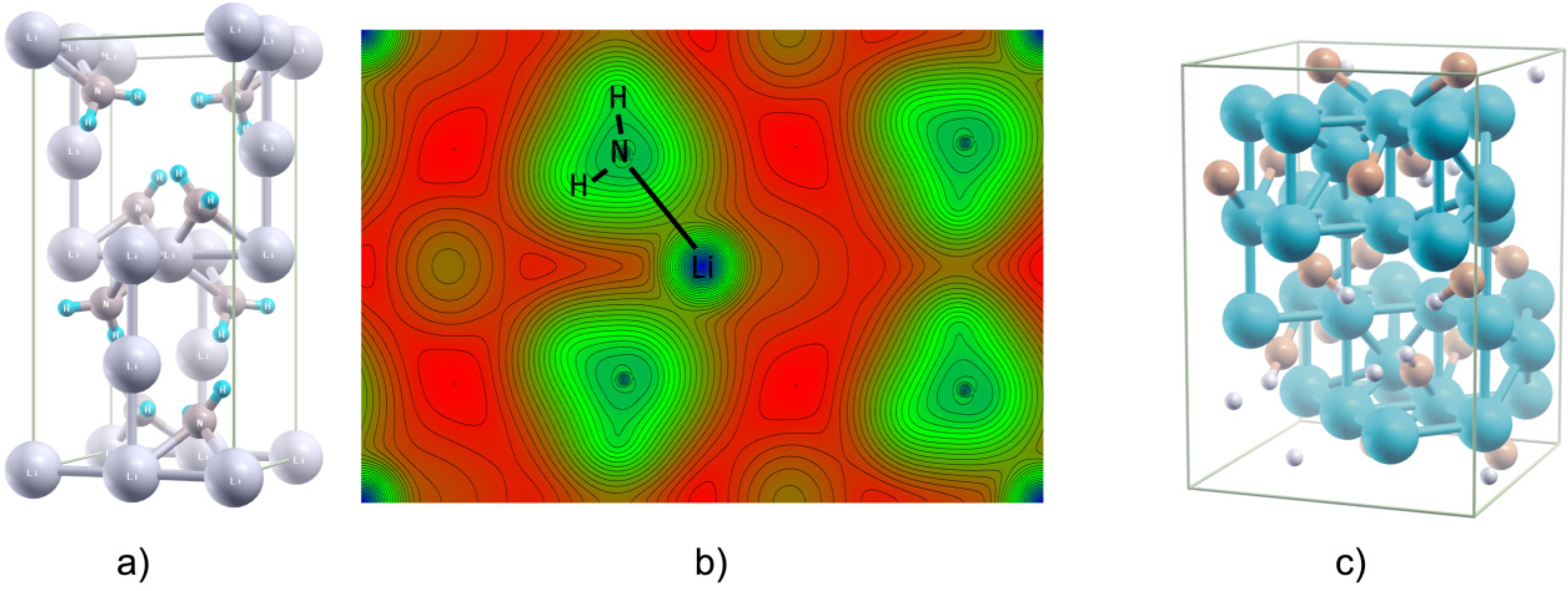
        <p>In <xref ref-type="fig" rid="crystals-02-01261-f010">Figure 10</xref>a the LiNH<sub>2</sub> crystal structure (space group I-4), in <xref ref-type="fig" rid="crystals-02-01261-f010">Figure 10</xref>b the charge distribution in the LiNH<sub>2</sub> (110) plane and in <xref ref-type="fig" rid="crystals-02-01261-f010">Figure 10</xref>c, one of the several possible Li<sub>2</sub>NH crystal structures (space group Im2m) is presented.</p>
        <fig id="crystals-02-01261-f010" position="anchor">
          <label>Figure 10</label>
          <caption>
            <p>(<bold>a</bold>) the LiNH<sub>2</sub> crystal structure (space group I-4) (grey spheres: Li; red spheres: N; blue spheres: H atoms); (<bold>b</bold>) the charge distribution in the LiNH<sub>2</sub> (110) plane; (<bold>c</bold>) one of the several possible Li<sub>2</sub>NH crystal structures (space group Im2m) (blue spheres: Li; red spheres: N; grey spheres: H atoms).</p>
          </caption>
          <graphic xmlns:xlink="http://www.w3.org/1999/xlink" xlink:href="crystals-02-01261-g010.tif"/>
        </fig>
        <p>It has been found [<xref ref-type="bibr" rid="B32-crystals-02-01261">32</xref>] that LiNH<sub>2</sub> crystal structure induces considerable elongation of the Li-N bond in LiNH<sub>2</sub> molecule, which increase energy of the molecule, and soften some of the molecular vibrational modes. This makes detachment of H fast at temperatures around 250 °C [<xref ref-type="bibr" rid="B30-crystals-02-01261">30</xref>] (which are likely to be lower by addition of suitable impurities, like Mg [<xref ref-type="bibr" rid="B31-crystals-02-01261">31</xref>]), and structure changes to Li<sub>2</sub>NH. The ground state structure of Li<sub>2</sub>NH was a subject of considerable debate, and it seems [<xref ref-type="bibr" rid="B26-crystals-02-01261">26</xref>] that quantum effects enable the H-diffusion among available crystal positions stabilizing the Fd-3m structure at low temperatures, which changes into anti-fluorite Fm-3m phase at about 360 K [<xref ref-type="bibr" rid="B114-crystals-02-01261">114</xref>]. Perhaps the same effect is responsible for the existence of numerous metastable phases [<xref ref-type="bibr" rid="B113-crystals-02-01261">113</xref>] with very close ground state energies, which could also play a role in the Li-amide/imide transformation process, opening numerous channels for hydrogen desorption. Similar mechanisms were found also in some other “modern” complex hydrides, encouraging investigation of structures and structural transformations, which could manage H sorption, and not just follow it.</p>
      </sec>
    </sec>
    <sec>
      <title>3. Summary and Perspectives</title>
      <p>In this article we have made an attempt to describe numerous phenomena observed in metal hydrides by means of electronic structure and interactions. The major intention was to provide a clear, as simple as possible (“...but not simpler” A. Einstein) physical picture rather than quoting numerous, sometimes complicated details of experiments, theory and computations. For this reason, we have started with the Effective Medium Theory (EMT), of Nørskov <italic>et al</italic>. [<xref ref-type="bibr" rid="B97-crystals-02-01261">97</xref>], which gives a simple, transparent and in many cases quite accurate explanation of H-behavior in metallic systems. The theory shows in a straightforward manner how the charge density distribution of the metal host influence H<sub>2</sub> adsorption, dissociation, H positioning on the surface, its diffusion into the bulk and accommodation in specific crystal structures (like interstices). </p>
      <p>As the theory relies on charge density properties alone, it enables one to predict H interaction with any physical entity (surface, defect, impurity,...), if principle features of the charge density are somehow determined, which is of great help in explaining numerous experimental findings that exist for metal hydrides. </p>
      <p>Moreover, in cases where this simple theory is not good enough, it gives direction for improvement, taking into account the perturbations induced by H–Host interaction, ions polarizabilities, specific energy level interactions, and so on. Although most of the calculation results presented in this article have been obtained by <italic>ab initio</italic> calculations, EMT and other “simple” theories (such as the tight-binding theory), they are indispensable for the explanation of real physical system results.</p>
      <p>Concerning specific metal hydrides, the most attention is given to the Mg–H system. This is considered to be among the most perspective ones, with a huge amount of various data, which allowed us to illustrate our approach to metal hydrides in a detailed and consistent manner. We briefly analyze all stages of Mg–H interaction using ours and other authors results (H<sub>2</sub> absorption and dissociation on the Mg (0001) surface, H positioning on the surface, its diffusion and accommodation in the bulk, formation of various (meta) stable phases and <italic>vice versa</italic>, H desorption from the MgH<sub>2</sub> surface and further dehydrogenation) . In this way, all relevant steps of H absorption/desorption in Mg/MgH<sub>2</sub> system and their role in H sorption kinetics have been explained from the first principles.</p>
      <p>One of these opportunities, alloying with 3d transition metal (TM) elements, is explored in some detail, pointing out the importance of relative position and the width of the 3d band in interaction with H(s) bonding and antibonding state. We also mention the fact that the strength of the TM–H interaction in MgH<sub>2</sub> is not directly correlated with the stability of the corresponding TM hydrides. The remarkable property of some complex intermetallic compounds, which absorb H around particular positions in the crystal lattice having homogenous charge distribution (low electric field gradient, EFG), but not around the others positions in the very same unit cell having highly inhomogenous charge distribution (large EFG), has also been reported. Although these compounds are not promising candidates for H-storage applications, the observed phenomenon helps us to learn how to design unique systems where H will be placed into one type of crystallographic sites, and swiftly moved along the network of the other type of crystallographic positions.</p>
      <p>Several interesting results were found concerning “modern” complex hydrides (alanates, amides/imides, borohydrides), and they are explained from the point of view of hydrogen sorption driven (or simply accompanied) by structural phase transformations.</p>
      <p>This article offers an approach for further investigation and improvement of metal hydrides properties based on fundamental principles of electronic structures and interactions. We expect that the other perspective metal-hydrogen systems and phenomena observed in them will be treated in a similar way as the Mg–H system, e.g., by investigating the electronic structure of all the relevant stages and processes in them. As could be seen from the examples given in this article, but also from the numerous stated references, knowledge how the charge density features influence H-behavior, and how we could adjust it, in principle already exists. However, many details of the metal–hydrogen interaction still need to be explored, particularly for complex hydrides with many atoms per unit cell, and in cases where the phase transitions are essential for understanding the process.</p>
      <p>The necessary tools are already available. The new generation of synchrotron installations provides photon sources of tremendous brightness over a broad range of frequencies, introducing new measuring techniques in real time. Development of microscopy with atomic resolution, and new improved neutron sources also gives hope for better experimental results.</p>
      <p>Computation methods have also made significant progress, not only owing to the faster machines and improved codes, but also due to some original approaches to results interpretation. Bader analysis of the charge distribution topology have already provided some interesting results, for instance that LiH has significantly different distribution of bond critical points than other alkali metal hydrides, explaining its quite different macroscopic characteristics, and that bonding points exist between certain pairs of H in MgH<sub>2</sub>, giving additional reasons for high barrier of H desorption. A similar scenario is true for the electron localization function (ELF) and crystal orbital Hamilton population (COHP) methods, which provided several illuminating results about metal hydrides.</p>
      <p>Bearing in mind all the information presented, it is reasonable to expect that existing knowledge and possibilities to improve it will afford progress in metal hydride design in the near future, significant enough to facilitate their practical applications.</p>
    </sec>
  </body>
  <back><ack>
      <title>Acknowledgments</title>
      <p>This paper is financially supported by Serbian Ministry of Education and Science under grant III45012 </p>
    </ack>
    <notes>
      <title>Conflict of Interest</title>
      <p>The authors declare no conflict of interest. </p>
    </notes>
    <ref-list>
      <title>References</title>
      <ref id="B1-crystals-02-01261">
        <label>1.</label>
        <citation citation-type="journal">
          <person-group person-group-type="author">
            <name>
              <surname>Schlapbach</surname>
              <given-names>L.</given-names>
            </name>
            <name>
              <surname>Zuttel</surname>
              <given-names>A.</given-names>
            </name>
          </person-group>
          <article-title>Hydrogen-storage materials for mobile applications</article-title>
          <source>Nature</source>
          <year>2001</year>
          <volume>414</volume>
          <fpage>353</fpage>
          <lpage>358</lpage>
          <pub-id pub-id-type="doi">10.1038/35104634</pub-id>
        </citation>
      </ref>
      <ref id="B2-crystals-02-01261">
        <label>2.</label>
        <citation citation-type="journal">
          <person-group person-group-type="author">
            <name>
              <surname>Zuttel</surname>
              <given-names>A.</given-names>
            </name>
          </person-group>
          <article-title>Materials for hydrogen storage</article-title>
          <source>Mater. Today</source>
          <year>2003</year>
          <volume>6</volume>
          <fpage>24</fpage>
          <lpage>33</lpage>
          <pub-id pub-id-type="doi">10.1016/S1369-7021(03)00922-2</pub-id>
        </citation>
      </ref>
      <ref id="B3-crystals-02-01261">
        <label>3.</label>
        <citation citation-type="journal">
          <person-group person-group-type="author">
            <name>
              <surname>Bobet</surname>
              <given-names>J.-L.</given-names>
            </name>
            <name>
              <surname>Even</surname>
              <given-names>C.</given-names>
            </name>
            <name>
              <surname>Nakamura</surname>
              <given-names>Y.</given-names>
            </name>
            <name>
              <surname>Akiba</surname>
              <given-names>E.</given-names>
            </name>
            <name>
              <surname>Darriet</surname>
              <given-names>B.</given-names>
            </name>
          </person-group>
          <article-title>Synthesis of magnesium and titanium hydride via reactive mechanical alloying. Influence of 3D-metal addition on MgH<sub>2</sub> synthesize</article-title>
          <source>J. Alloys Compounds</source>
          <year>2000</year>
          <volume>298</volume>
          <fpage>279</fpage>
          <lpage>284</lpage>
          <pub-id pub-id-type="doi">10.1016/S0925-8388(99)00628-3</pub-id>
        </citation>
      </ref>
      <ref id="B4-crystals-02-01261">
        <label>4.</label>
        <citation citation-type="journal">
          <person-group person-group-type="author">
            <name>
              <surname>Liang</surname>
              <given-names>G.</given-names>
            </name>
            <name>
              <surname>Huot</surname>
              <given-names>J.</given-names>
            </name>
            <name>
              <surname>van Neste</surname>
              <given-names>A.</given-names>
            </name>
            <name>
              <surname>Schulz</surname>
              <given-names>R.</given-names>
            </name>
          </person-group>
          <article-title>Catalytic effect of transition metals on hydrogen sorption in nanocrystalline ball milled MgH<sub>2</sub>-Tm (Tm = Ti, V, Mn, Fe and Ni) systems</article-title>
          <source>J. Alloys Compounds</source>
          <year>1999</year>
          <volume>292</volume>
          <fpage>247</fpage>
          <lpage>252</lpage>
          <pub-id pub-id-type="doi">10.1016/S0925-8388(99)00442-9</pub-id>
        </citation>
      </ref>
      <ref id="B5-crystals-02-01261">
        <label>5.</label>
        <citation citation-type="journal">
          <person-group person-group-type="author">
            <name>
              <surname>Jain</surname>
              <given-names>I.P.</given-names>
            </name>
            <name>
              <surname>Lal</surname>
              <given-names>Ch.</given-names>
            </name>
            <name>
              <surname>Jain</surname>
              <given-names>A.</given-names>
            </name>
          </person-group>
          <article-title>Hydrogen storage in Mg: A most promising material</article-title>
          <source>Int. J. Hydrogen Energy</source>
          <year>2010</year>
          <volume>35</volume>
          <fpage>5133</fpage>
          <lpage>5144</lpage>
        <pub-id pub-id-type="doi">10.1016/j.ijhydene.2009.08.088</pub-id></citation>
      </ref>
      <ref id="B6-crystals-02-01261">
        <label>6.</label>
        <citation citation-type="journal">
          <person-group person-group-type="author">
            <name>
              <surname>Liang</surname>
              <given-names>G.</given-names>
            </name>
            <name>
              <surname>Schulz</surname>
              <given-names>R.</given-names>
            </name>
          </person-group>
          <article-title>Synthesis of Mg-Ti alloy by mechanical alloying</article-title>
          <source>J. Mater. Sci.</source>
          <year>2003</year>
          <volume>38</volume>
          <fpage>1179</fpage>
          <lpage>1184</lpage>
          <pub-id pub-id-type="doi">10.1023/A:1022889100360</pub-id>
        </citation>
      </ref>
      <ref id="B7-crystals-02-01261">
        <label>7.</label>
        <citation citation-type="journal">
          <person-group person-group-type="author">
            <name>
              <surname>Zaluski</surname>
              <given-names>L.</given-names>
            </name>
            <name>
              <surname>Zaluska</surname>
              <given-names>A.</given-names>
            </name>
            <name>
              <surname>Strom-Olsen</surname>
              <given-names>J.O.</given-names>
            </name>
          </person-group>
          <article-title>Nanocrystalline metal hydrides</article-title>
          <source>J. Alloys Compounds</source>
          <year>1997</year>
          <volume>253–254</volume>
          <fpage>70</fpage>
          <lpage>79</lpage>
          <pub-id pub-id-type="doi">10.1016/S0925-8388(96)02985-4</pub-id>
        </citation>
      </ref>
      <ref id="B8-crystals-02-01261">
        <label>8.</label>
        <citation citation-type="journal">
          <person-group person-group-type="author">
            <name>
              <surname>Bassetti</surname>
              <given-names>A.</given-names>
            </name>
            <name>
              <surname>Bonetti</surname>
              <given-names>E.</given-names>
            </name>
            <name>
              <surname>Pasquini</surname>
              <given-names>L.</given-names>
            </name>
            <name>
              <surname>Montone</surname>
              <given-names>A.</given-names>
            </name>
            <name>
              <surname>Grbovic</surname>
              <given-names>J.</given-names>
            </name>
            <name>
              <surname>Vittori Antisari</surname>
              <given-names>M.</given-names>
            </name>
          </person-group>
          <article-title>Hydrogen desorption from ball milled MgH<sub>2</sub> catalyzed with Fe</article-title>
          <source>Eur. Phys. J. B</source>
          <year>2005</year>
          <volume>43</volume>
          <fpage>19</fpage>
          <lpage>27</lpage>
          <pub-id pub-id-type="doi">10.1140/epjb/e2005-00023-9</pub-id>
        </citation>
      </ref>
      <ref id="B9-crystals-02-01261">
        <label>9.</label>
        <citation citation-type="book">
          <person-group person-group-type="author">
            <name>
              <surname>Gupta</surname>
              <given-names>R.B.</given-names>
            </name>
          </person-group>
          <source>Hydrogen Fuel Production Transport and Storage</source>
          <edition>1st</edition>
          <publisher-name>CRC Press</publisher-name>
          <publisher-loc>Boca Raton, FL, USA</publisher-loc>
          <year>2009</year>
        </citation>
      </ref>
      <ref id="B10-crystals-02-01261">
        <label>10.</label>
        <citation citation-type="book">
          <person-group person-group-type="author">
            <name>
              <surname>Varin</surname>
              <given-names>R.A.</given-names>
            </name>
            <name>
              <surname>Czujko</surname>
              <given-names>T.</given-names>
            </name>
            <name>
              <surname>Wronski</surname>
              <given-names>Z.S.</given-names>
            </name>
          </person-group>
          <source>Nanomaterials for Solid State Hydrogen Storage,1st ed.</source>
          <publisher-name>Springer Science Bussines Media</publisher-name>
          <publisher-loc>New York, NY, USA</publisher-loc>
          <year>2009</year>
        </citation>
      </ref>
      <ref id="B11-crystals-02-01261">
        <label>11.</label>
        <citation citation-type="book">
          <person-group person-group-type="author">
            <name>
              <surname>Hirscher</surname>
              <given-names>M.</given-names>
            </name>
          </person-group>
          <source>Handbook of Hydrogen Storage: New Materials for Future Energy Storage</source>
          <edition>1st</edition>
          <publisher-name>Wiley-VCH Verlag GmbH &amp; Co. KgaA</publisher-name>
          <publisher-loc>Weinheim, Germany</publisher-loc>
          <year>2010</year>
        </citation>
      </ref>
      <ref id="B12-crystals-02-01261">
        <label>12.</label>
        <citation citation-type="book">
          <person-group person-group-type="author">
            <name>
              <surname>Walker</surname>
              <given-names>G.</given-names>
            </name>
          </person-group>
          <article-title>Solid-state hydrogen storage</article-title>
          <source>Materials and Chemistry</source>
          <edition>1st</edition>
          <publisher-name>Woodhead Publishing Limited</publisher-name>
          <publisher-loc>Cambridge, UK</publisher-loc>
          <year>2008</year>
        </citation>
      </ref>
      <ref id="B13-crystals-02-01261">
        <label>13.</label>
        <citation citation-type="book">
          <person-group person-group-type="author">
            <name>
              <surname>Fukai</surname>
              <given-names>Y.</given-names>
            </name>
          </person-group>
          <source>The Metal–Hydrogen System</source>
          <edition>2nd</edition>
          <publisher-name>Springer</publisher-name>
          <publisher-loc>Berlin, Germany</publisher-loc>
          <year>2005</year>
        </citation>
      </ref>
      <ref id="B14-crystals-02-01261">
        <label>14.</label>
        <citation citation-type="book">
          <person-group person-group-type="author">
            <name>
              <surname>Borgschulte</surname>
              <given-names>A.</given-names>
            </name>
            <name>
              <surname>Schlapbach</surname>
              <given-names>L.</given-names>
            </name>
          </person-group>
          <source>Hydrogen as A Future Energy Carrier</source>
          <edition>1st</edition>
          <person-group person-group-type="editor">
            <name>
              <surname>Zuttel</surname>
              <given-names>A.</given-names>
            </name>
          </person-group>
          <publisher-name>Wiley-VCH Verlag GmbH &amp; Co. KgaA</publisher-name>
          <publisher-loc>Weinheim, Germany</publisher-loc>
          <year>2008</year>
        </citation>
      </ref>
      <ref id="B15-crystals-02-01261">
        <label>15.</label>
        <citation citation-type="journal">
          <person-group person-group-type="author">
            <name>
              <surname>Bowman</surname>
              <given-names>R.C.</given-names>
            </name>
          </person-group>
          <article-title>Cohesive energies of the alkali hydrides and deuterides</article-title>
          <source>J. Phys. Chem.</source>
          <year>1971</year>
          <volume>75</volume>
          <fpage>1251</fpage>
          <lpage>1255</lpage>
          <pub-id pub-id-type="doi">10.1021/j100679a014</pub-id>
        </citation>
      </ref>
      <ref id="B16-crystals-02-01261">
        <label>16.</label>
        <citation citation-type="journal">
          <person-group person-group-type="author">
            <name>
              <surname>Luaña</surname>
              <given-names>V.</given-names>
            </name>
            <name>
              <surname>Pueyo</surname>
              <given-names>L.</given-names>
            </name>
          </person-group>
          <article-title>Simulation of ionic crystals: The <italic>ab initio</italic> perturbed-ion method and application to alkali hydrides and halides</article-title>
          <source>Phys. Rev. B</source>
          <year>1990</year>
          <volume>41</volume>
          <fpage>3800</fpage>
          <lpage>3814</lpage>
          <pub-id pub-id-type="doi">10.1103/PhysRevB.41.3800</pub-id>
        </citation>
      </ref>
      <ref id="B17-crystals-02-01261">
        <label>17.</label>
        <citation citation-type="journal">
          <person-group person-group-type="author">
            <name>
              <surname>Wolverton</surname>
              <given-names>C.</given-names>
            </name>
            <name>
              <surname>Ozoliņš</surname>
              <given-names>V.</given-names>
            </name>
            <name>
              <surname>Asta</surname>
              <given-names>M.</given-names>
            </name>
          </person-group>
          <article-title>Hydrogen in aluminum: First-principles calculations of structure and thermodynamics</article-title>
          <source>Phys. Rev. B</source>
          <year>2004</year>
          <volume>69</volume>
          <fpage>144109:1</fpage>
          <lpage>144109:16</lpage>
        </citation>
      </ref>
      <ref id="B18-crystals-02-01261">
        <label>18.</label>
        <citation citation-type="journal">
          <person-group person-group-type="author">
            <name>
              <surname>Vidal-Valat</surname>
              <given-names>G.</given-names>
            </name>
            <name>
              <surname>Vidal</surname>
              <given-names>J.-P.</given-names>
            </name>
            <name>
              <surname>Kurki-Suonio</surname>
              <given-names>K.</given-names>
            </name>
            <name>
              <surname>Kurki-Suonio</surname>
              <given-names>R.</given-names>
            </name>
          </person-group>
          <article-title>Evidence on the breakdown of the Born-Oppenheimer approximation in the charge density of crystalline 7LiH/D</article-title>
          <source>Acta Cryst.</source>
          <year>1992</year>
          <volume>A48</volume>
          <fpage>46</fpage>
          <lpage>60</lpage>
        </citation>
      </ref>
      <ref id="B19-crystals-02-01261">
        <label>19.</label>
        <citation citation-type="journal">
          <person-group person-group-type="author">
            <name>
              <surname>Blat</surname>
              <given-names>D.K.</given-names>
            </name>
            <name>
              <surname>Zein</surname>
              <given-names>N.E.</given-names>
            </name>
            <name>
              <surname>Zinenko</surname>
              <given-names>V.I.</given-names>
            </name>
          </person-group>
          <article-title>Calculations of phonon frequencies and dielectric constants of alkali hydrides via the density functional method</article-title>
          <source>J. Phys. Condens. Matter</source>
          <year>1991</year>
          <volume>3</volume>
          <fpage>5515</fpage>
          <lpage>5524</lpage>
          <pub-id pub-id-type="doi">10.1088/0953-8984/3/29/006</pub-id>
        </citation>
      </ref>
      <ref id="B20-crystals-02-01261">
        <label>20.</label>
        <citation citation-type="journal">
          <person-group person-group-type="author">
            <name>
              <surname>Ivanović</surname>
              <given-names>N.</given-names>
            </name>
            <name>
              <surname>Novaković</surname>
              <given-names>N.</given-names>
            </name>
            <name>
              <surname>Colognesi</surname>
              <given-names>D.</given-names>
            </name>
            <name>
              <surname>Radisavljević</surname>
              <given-names>I.</given-names>
            </name>
            <name>
              <surname>Ostojić</surname>
              <given-names>S.</given-names>
            </name>
          </person-group>
          <article-title>Electronic principles of some trends in properties of metallic hydrides</article-title>
          <source>Int. J. Mod. Phys. B</source>
          <year>2010</year>
          <volume>24</volume>
          <fpage>703</fpage>
          <lpage>710</lpage>
        <pub-id pub-id-type="doi">10.1142/S0217979210064320</pub-id></citation>
      </ref>
      <ref id="B21-crystals-02-01261">
        <label>21.</label>
        <citation citation-type="journal">
          <person-group person-group-type="author">
            <name>
              <surname>Smithson</surname>
              <given-names>H.</given-names>
            </name>
            <name>
              <surname>Marianetti</surname>
              <given-names>C.A.</given-names>
            </name>
            <name>
              <surname>Morgan</surname>
              <given-names>D.</given-names>
            </name>
            <name>
              <surname>van der Ven</surname>
              <given-names>A.</given-names>
            </name>
            <name>
              <surname>Predith</surname>
              <given-names>A.</given-names>
            </name>
            <name>
              <surname>Ceder</surname>
              <given-names>G.</given-names>
            </name>
          </person-group>
          <article-title>First-principles study of the stability and electronic structure of metal hydrides</article-title>
          <source>Phys. Rev. B</source>
          <year>2002</year>
          <volume>66</volume>
          <fpage>144107:1</fpage>
          <lpage>144107:10</lpage>
        </citation>
      </ref>
      <ref id="B22-crystals-02-01261">
        <label>22.</label>
        <citation citation-type="journal">
          <person-group person-group-type="author">
            <name>
              <surname>Lebegue</surname>
              <given-names>S.</given-names>
            </name>
            <name>
              <surname>Alouani</surname>
              <given-names>M.</given-names>
            </name>
            <name>
              <surname>Arnuad</surname>
              <given-names>B.</given-names>
            </name>
            <name>
              <surname>Pickett</surname>
              <given-names>W.E.</given-names>
            </name>
          </person-group>
          <article-title>Pressure-induced simultaneous metal-insulator and structural-phase transitions in LiH: A quasiparticle study</article-title>
          <source>Europhys. Lett.</source>
          <year>2003</year>
          <volume>63</volume>
          <fpage>562</fpage>
          <lpage>568</lpage>
          <pub-id pub-id-type="doi">10.1209/epl/i2003-00562-1</pub-id>
        </citation>
      </ref>
      <ref id="B23-crystals-02-01261">
        <label>23.</label>
        <citation citation-type="journal">
          <person-group person-group-type="author">
            <name>
              <surname>Novaković</surname>
              <given-names>N.</given-names>
            </name>
            <name>
              <surname>Radisavljević</surname>
              <given-names>I.</given-names>
            </name>
            <name>
              <surname>Colognesi</surname>
              <given-names>D.</given-names>
            </name>
            <name>
              <surname>Ostojić</surname>
              <given-names>S.</given-names>
            </name>
            <name>
              <surname>Ivanović</surname>
              <given-names>N.</given-names>
            </name>
          </person-group>
          <article-title>First principle calculations of alkali hydride electronic structures</article-title>
          <source>J. Phys. Condens. Matter</source>
          <year>2007</year>
          <volume>19</volume>
          <fpage>406211:1</fpage>
          <lpage>406211:14</lpage>
        </citation>
      </ref>
      <ref id="B24-crystals-02-01261">
        <label>24.</label>
        <citation citation-type="thesis">
          <person-group person-group-type="author">
            <name>
              <surname>Vajeeston</surname>
              <given-names>P.</given-names>
            </name>
          </person-group>
          <article-title>Theoretical Modeling of Hydrides</article-title>
          <source>Ph.D. Thesis</source>
          <publisher-name>University of Oslo</publisher-name>
          <publisher-loc>Oslo, Norway</publisher-loc>
          <year>2004</year>
        </citation>
      </ref>
      <ref id="B25-crystals-02-01261">
        <label>25.</label>
        <citation citation-type="journal">
          <person-group person-group-type="author">
            <name>
              <surname>Ravindran</surname>
              <given-names>P.</given-names>
            </name>
            <name>
              <surname>Vajeeston</surname>
              <given-names>P.</given-names>
            </name>
            <name>
              <surname>Fjellvåg</surname>
              <given-names>H.</given-names>
            </name>
            <name>
              <surname>Kjekshus</surname>
              <given-names>A.</given-names>
            </name>
          </person-group>
          <article-title>Chemical-bonding and high-pressure studies on hydrogen-storage materials</article-title>
          <source>Comput. Mater. Sci.</source>
          <year>2004</year>
          <volume>30</volume>
          <fpage>349</fpage>
          <lpage>357</lpage>
          <pub-id pub-id-type="doi">10.1016/j.commatsci.2004.02.025</pub-id>
        </citation>
      </ref>
      <ref id="B26-crystals-02-01261">
        <label>26.</label>
        <citation citation-type="journal">
          <person-group person-group-type="author">
            <name>
              <surname>Ceriotti</surname>
              <given-names>M.</given-names>
            </name>
            <name>
              <surname>Miceli</surname>
              <given-names>G.</given-names>
            </name>
            <name>
              <surname>Pietropaolo</surname>
              <given-names>A.</given-names>
            </name>
            <name>
              <surname>Colognesi</surname>
              <given-names>D.</given-names>
            </name>
            <name>
              <surname>Nale</surname>
              <given-names>A.</given-names>
            </name>
            <name>
              <surname>Catti</surname>
              <given-names>M.</given-names>
            </name>
            <name>
              <surname>Bernasconi</surname>
              <given-names>M.</given-names>
            </name>
            <name>
              <surname>Parrinello</surname>
              <given-names>M.</given-names>
            </name>
          </person-group>
          <article-title>Nuclear quantum effects in <italic>ab initio</italic> dynamics: Theory and experiments for lithium imide</article-title>
          <source>Phys. Rev. B</source>
          <year>2010</year>
          <volume>82</volume>
          <fpage>174306:1</fpage>
          <lpage>174306:5</lpage>
        </citation>
      </ref>
      <ref id="B27-crystals-02-01261">
        <label>27.</label>
        <citation citation-type="journal">
          <person-group person-group-type="author">
            <name>
              <surname>Bogdanović</surname>
              <given-names>B.</given-names>
            </name>
            <name>
              <surname>Schwickardi</surname>
              <given-names>M.</given-names>
            </name>
          </person-group>
          <article-title>Ti-doped alkali metal aluminium hydrides as potential novel reversible hydrogen storage materials</article-title>
          <source>J. Alloys Compounds</source>
          <year>1997</year>
          <volume>253–254</volume>
          <fpage>1</fpage>
          <lpage>9</lpage>
          <pub-id pub-id-type="doi">10.1016/S0925-8388(96)03049-6</pub-id>
        </citation>
      </ref>
      <ref id="B28-crystals-02-01261">
        <label>28.</label>
        <citation citation-type="journal">
          <person-group person-group-type="author">
            <name>
              <surname>Bogdanović</surname>
              <given-names>B.</given-names>
            </name>
            <name>
              <surname>Brand</surname>
              <given-names>R.A.</given-names>
            </name>
            <name>
              <surname>Marjanović</surname>
              <given-names>A.</given-names>
            </name>
            <name>
              <surname>Schwickardi</surname>
              <given-names>M.</given-names>
            </name>
            <name>
              <surname>Tölle</surname>
              <given-names>J.</given-names>
            </name>
          </person-group>
          <article-title>Metal-doped sodium aluminium hydrides as potential new hydrogen storage materials</article-title>
          <source>J. Alloys Compounds</source>
          <year>2000</year>
          <volume>302</volume>
          <fpage>36</fpage>
          <lpage>58</lpage>
          <pub-id pub-id-type="doi">10.1016/S0925-8388(99)00663-5</pub-id>
        </citation>
      </ref>
      <ref id="B29-crystals-02-01261">
        <label>29.</label>
        <citation citation-type="journal">
          <person-group person-group-type="author">
            <name>
              <surname>Vajeeston</surname>
              <given-names>P.</given-names>
            </name>
            <name>
              <surname>Ravindran</surname>
              <given-names>P.</given-names>
            </name>
            <name>
              <surname>Vidya</surname>
              <given-names>R.</given-names>
            </name>
            <name>
              <surname>Fjellvåg</surname>
              <given-names>H.</given-names>
            </name>
            <name>
              <surname>Kjekshus</surname>
              <given-names>A.</given-names>
            </name>
          </person-group>
          <article-title>Pressure-induced phase of NaAlH4: A potential candidate for hydrogen storage?</article-title>
          <source>Appl. Phys. Lett.</source>
          <year>2003</year>
          <volume>82</volume>
          <fpage>2257</fpage>
          <lpage>2259</lpage>
        <pub-id pub-id-type="doi">10.1063/1.1566086</pub-id></citation>
      </ref>
      <ref id="B30-crystals-02-01261">
        <label>30.</label>
        <citation citation-type="journal">
          <person-group person-group-type="author">
            <name>
              <surname>Chen</surname>
              <given-names>P.</given-names>
            </name>
            <name>
              <surname>Xiong</surname>
              <given-names>Z.</given-names>
            </name>
            <name>
              <surname>Luo</surname>
              <given-names>J.</given-names>
            </name>
            <name>
              <surname>Lin</surname>
              <given-names>J.</given-names>
            </name>
            <name>
              <surname>Tan</surname>
              <given-names>K.L.</given-names>
            </name>
          </person-group>
          <article-title>Interaction of hydrogen with metal nitrides and imides</article-title>
          <source>Nature</source>
          <year>2002</year>
          <volume>420</volume>
          <fpage>302</fpage>
          <lpage>304</lpage>
        <pub-id pub-id-type="doi">10.1038/nature01210</pub-id><pub-id pub-id-type="pmid">12447436</pub-id></citation>
      </ref>
      <ref id="B31-crystals-02-01261">
        <label>31.</label>
        <citation citation-type="journal">
          <person-group person-group-type="author">
            <name>
              <surname>Luo</surname>
              <given-names>W.</given-names>
            </name>
            <name>
              <surname>Rönnebro</surname>
              <given-names>E.</given-names>
            </name>
          </person-group>
          <article-title>Towards a viable hydrogen storage system for transportation application</article-title>
          <source>J. Alloys Compounds</source>
          <year>2005</year>
          <volume>404–406</volume>
          <fpage>392</fpage>
          <lpage>359</lpage>
          <pub-id pub-id-type="doi">10.1016/j.jallcom.2005.01.131</pub-id>
        </citation>
      </ref>
      <ref id="B32-crystals-02-01261">
        <label>32.</label>
        <citation citation-type="journal">
          <person-group person-group-type="author">
            <name>
              <surname>Ivanović</surname>
              <given-names>N.</given-names>
            </name>
            <name>
              <surname>Radisavljević</surname>
              <given-names>I.</given-names>
            </name>
            <name>
              <surname>Novaković</surname>
              <given-names>N.</given-names>
            </name>
            <name>
              <surname>Manasijević</surname>
              <given-names>M.</given-names>
            </name>
            <name>
              <surname>Colognesi</surname>
              <given-names>D.</given-names>
            </name>
          </person-group>
          <article-title>Calculations of molecular structures and processes important for hydrogen behaviour in the Li-amide/imide system</article-title>
          <source>Acta Phys. Pol.</source>
          <year>2011</year>
          <volume>119</volume>
          <fpage>242</fpage>
          <lpage>245</lpage>
        </citation>
      </ref>
      <ref id="B33-crystals-02-01261">
        <label>33.</label>
        <citation citation-type="journal">
          <person-group person-group-type="author">
            <name>
              <surname>Dyck</surname>
              <given-names>W.</given-names>
            </name>
            <name>
              <surname>Jex</surname>
              <given-names>H.</given-names>
            </name>
          </person-group>
          <article-title>Lattice dynamics of alakali hydrides and deuterides with the NaCl type structure</article-title>
          <source>J. Phys. C Solid State Phys.</source>
          <year>1981</year>
          <volume>14</volume>
          <fpage>4193</fpage>
          <lpage>4215</lpage>
          <pub-id pub-id-type="doi">10.1088/0022-3719/14/29/008</pub-id>
        </citation>
      </ref>
      <ref id="B34-crystals-02-01261">
        <label>34.</label>
        <citation citation-type="journal">
          <person-group person-group-type="author">
            <name>
              <surname>Yu</surname>
              <given-names>R.</given-names>
            </name>
            <name>
              <surname>Lam</surname>
              <given-names>P.K.</given-names>
            </name>
          </person-group>
          <article-title>Electronic and structural properties of MgH<sub>2</sub></article-title>
          <source>Phys. Rev. B</source>
          <year>1988</year>
          <volume>37</volume>
          <fpage>8730</fpage>
          <lpage>8737</lpage>
          <pub-id pub-id-type="doi">10.1103/PhysRevB.37.8730</pub-id>
        </citation>
      </ref>
      <ref id="B35-crystals-02-01261">
        <label>35.</label>
        <citation citation-type="journal">
          <person-group person-group-type="author">
            <name>
              <surname>Kunz</surname>
              <given-names>A.B.</given-names>
            </name>
            <name>
              <surname>Mickish</surname>
              <given-names>D.J.</given-names>
            </name>
          </person-group>
          <article-title>Electronic structure of LiH and NaH</article-title>
          <source>Phys. Rev. B</source>
          <year>1975</year>
          <volume>11</volume>
          <fpage>1700</fpage>
          <lpage>1704</lpage>
        <pub-id pub-id-type="doi">10.1103/PhysRevB.11.1700</pub-id></citation>
      </ref>
      <ref id="B36-crystals-02-01261">
        <label>36.</label>
        <citation citation-type="journal">
          <person-group person-group-type="author">
            <name>
              <surname>Grosso</surname>
              <given-names>G.</given-names>
            </name>
            <name>
              <surname>Parravicini</surname>
              <given-names>G.P.</given-names>
            </name>
          </person-group>
          <article-title>Hartree-Fock energy bands by the orthogonalized-plane-wave method: Lithium hydride results</article-title>
          <source>Phys. Rev. B</source>
          <year>1979</year>
          <volume>20</volume>
          <fpage>2366</fpage>
          <lpage>2372</lpage>
        <pub-id pub-id-type="doi">10.1103/PhysRevB.20.2366</pub-id></citation>
      </ref>
      <ref id="B37-crystals-02-01261">
        <label>37.</label>
        <citation citation-type="journal">
          <person-group person-group-type="author">
            <name>
              <surname>Zeng</surname>
              <given-names>K.</given-names>
            </name>
            <name>
              <surname>Klassen</surname>
              <given-names>T.</given-names>
            </name>
            <name>
              <surname>Oelerich</surname>
              <given-names>W.</given-names>
            </name>
            <name>
              <surname>Bormann</surname>
              <given-names>R.</given-names>
            </name>
          </person-group>
          <article-title>Critical assessment and thermodynamic modeling of the Mg–H system</article-title>
          <source>Int. J. Hydrogen Energy</source>
          <year>1999</year>
          <volume>24</volume>
          <fpage>989</fpage>
          <lpage>1004</lpage>
        <pub-id pub-id-type="doi">10.1016/S0360-3199(98)00132-3</pub-id></citation>
      </ref>
      <ref id="B38-crystals-02-01261">
        <label>38.</label>
        <citation citation-type="journal">
          <person-group person-group-type="author">
            <name>
              <surname>Miademma</surname>
              <given-names>A.R.</given-names>
            </name>
          </person-group>
          <article-title>The electronegativity parameter for transition metals: Heat of formation and charge transfer in alloys</article-title>
          <source>J. Less Common Metals</source>
          <year>1973</year>
          <volume>32</volume>
          <fpage>117</fpage>
          <lpage>136</lpage>
          <pub-id pub-id-type="doi">10.1016/0022-5088(73)90078-7</pub-id>
        </citation>
      </ref>
      <ref id="B39-crystals-02-01261">
        <label>39.</label>
        <citation citation-type="journal">
          <person-group person-group-type="author">
            <name>
              <surname>Rao</surname>
              <given-names>B.K.</given-names>
            </name>
            <name>
              <surname>Jena</surname>
              <given-names>P.</given-names>
            </name>
          </person-group>
          <article-title>Switendick criterion for stable hydrides</article-title>
          <source>Phys. Rev. B</source>
          <year>1985</year>
          <volume>31</volume>
          <fpage>6726</fpage>
          <lpage>6730</lpage>
          <pub-id pub-id-type="doi">10.1103/PhysRevB.31.6726</pub-id>
        </citation>
      </ref>
      <ref id="B40-crystals-02-01261">
        <label>40.</label>
        <citation citation-type="journal">
          <person-group person-group-type="author">
            <name>
              <surname>Sakintuna</surname>
              <given-names>B.</given-names>
            </name>
            <name>
              <surname>Lamari-Darkrim</surname>
              <given-names>F.</given-names>
            </name>
            <name>
              <surname>Hirscher</surname>
              <given-names>M.</given-names>
            </name>
          </person-group>
          <article-title>Metal hydride materials for solid hydrogen storage: A review</article-title>
          <source>Int. J. Hydrogen Energy</source>
          <year>2007</year>
          <volume>32</volume>
          <fpage>1121</fpage>
          <lpage>1140</lpage>
        <pub-id pub-id-type="doi">10.1016/j.ijhydene.2006.11.022</pub-id></citation>
      </ref>
      <ref id="B41-crystals-02-01261">
        <label>41.</label>
        <citation citation-type="journal">
          <person-group person-group-type="author">
            <name>
              <surname>Bazzanella</surname>
              <given-names>N.</given-names>
            </name>
            <name>
              <surname>Checchetto</surname>
              <given-names>R.</given-names>
            </name>
            <name>
              <surname>Miotello</surname>
              <given-names>A.</given-names>
            </name>
          </person-group>
          <article-title>Catalytic effect on hydrogen desorption in Nb-doped microcrystalline MgH<sub>2</sub></article-title>
          <source>Appl. Phys. Lett.</source>
          <year>2004</year>
          <volume>85</volume>
          <fpage>5212</fpage>
          <lpage>5214</lpage>
          <pub-id pub-id-type="doi">10.1063/1.1829155</pub-id>
        </citation>
      </ref>
      <ref id="B42-crystals-02-01261">
        <label>42.</label>
        <citation citation-type="journal">
          <person-group person-group-type="author">
            <name>
              <surname>Schimmel</surname>
              <given-names>H.G.</given-names>
            </name>
            <name>
              <surname>Johnson</surname>
              <given-names>M.R.</given-names>
            </name>
            <name>
              <surname>Kearley</surname>
              <given-names>G.J.</given-names>
            </name>
            <name>
              <surname>Ramirez-Cuesta</surname>
              <given-names>A.J.</given-names>
            </name>
            <name>
              <surname>Huot</surname>
              <given-names>J.</given-names>
            </name>
            <name>
              <surname>Mulder</surname>
              <given-names>F.M.</given-names>
            </name>
          </person-group>
          <article-title>Structural information on ball milled magnesium hydride from vibrational spectroscopy and <italic>ab initio</italic> calculations</article-title>
          <source>J. Alloys Compounds</source>
          <year>2005</year>
          <volume>393</volume>
          <fpage>1</fpage>
          <lpage>4</lpage>
          <pub-id pub-id-type="doi">10.1016/j.jallcom.2004.08.102</pub-id>
        </citation>
      </ref>
      <ref id="B43-crystals-02-01261">
        <label>43.</label>
        <citation citation-type="journal">
          <person-group person-group-type="author">
            <name>
              <surname>Gross</surname>
              <given-names>K.J.</given-names>
            </name>
            <name>
              <surname>Chartouni</surname>
              <given-names>D.</given-names>
            </name>
            <name>
              <surname>Leroy</surname>
              <given-names>E.</given-names>
            </name>
            <name>
              <surname>Zuttel</surname>
              <given-names>A.</given-names>
            </name>
            <name>
              <surname>Schlapbach</surname>
              <given-names>L.</given-names>
            </name>
          </person-group>
          <article-title>Mechanically milled Mg composites for hydrogen storage: The relationship between morphology and kinetics</article-title>
          <source>J. Alloys Compounds</source>
          <year>1998</year>
          <volume>269</volume>
          <fpage>259</fpage>
          <lpage>270</lpage>
          <pub-id pub-id-type="doi">10.1016/S0925-8388(97)00627-0</pub-id>
        </citation>
      </ref>
      <ref id="B44-crystals-02-01261">
        <label>44.</label>
        <citation citation-type="journal">
          <person-group person-group-type="author">
            <name>
              <surname>Grbović Novaković</surname>
              <given-names>J.</given-names>
            </name>
            <name>
              <surname>Brdarić</surname>
              <given-names>T.</given-names>
            </name>
            <name>
              <surname>Novaković</surname>
              <given-names>N.</given-names>
            </name>
            <name>
              <surname>Matović</surname>
              <given-names>Lj.</given-names>
            </name>
            <name>
              <surname>Montone</surname>
              <given-names>A.</given-names>
            </name>
            <name>
              <surname>Mentus</surname>
              <given-names>S.</given-names>
            </name>
          </person-group>
          <article-title>Experimental and theoretical investigation of hydrogen storage magnesium based composites</article-title>
          <source>Mat. Sci. Forum</source>
          <year>2007</year>
          <volume>555</volume>
          <fpage>343</fpage>
          <lpage>348</lpage>
          <pub-id pub-id-type="doi">10.4028/www.scientific.net/MSF.555.343</pub-id>
        </citation>
      </ref>
      <ref id="B45-crystals-02-01261">
        <label>45.</label>
        <citation citation-type="journal">
          <person-group person-group-type="author">
            <name>
              <surname>Matović</surname>
              <given-names>Lj.</given-names>
            </name>
            <name>
              <surname>Novaković</surname>
              <given-names>N.</given-names>
            </name>
            <name>
              <surname>Kurko</surname>
              <given-names>S.</given-names>
            </name>
            <name>
              <surname>Šiljegović</surname>
              <given-names>M.</given-names>
            </name>
            <name>
              <surname>Matović</surname>
              <given-names>B.</given-names>
            </name>
            <name>
              <surname>Romčević</surname>
              <given-names>N.</given-names>
            </name>
            <name>
              <surname>Kačarević-Popović</surname>
              <given-names>Z.</given-names>
            </name>
            <name>
              <surname>Ivanović</surname>
              <given-names>N.</given-names>
            </name>
            <name>
              <surname>Grbović Novaković</surname>
              <given-names>J.</given-names>
            </name>
          </person-group>
          <article-title>Structural destabilisation of MgH<sub>2</sub> obtained by heavy ion irradiation</article-title>
          <source>Int. J. Hydrogen Energy</source>
          <year>2009</year>
          <volume>34</volume>
          <fpage>7275</fpage>
          <lpage>7282</lpage>
        <pub-id pub-id-type="doi">10.1016/j.ijhydene.2009.06.081</pub-id></citation>
      </ref>
      <ref id="B46-crystals-02-01261">
        <label>46.</label>
        <citation citation-type="journal">
          <person-group person-group-type="author">
            <name>
              <surname>Grbović Novaković</surname>
              <given-names>J.</given-names>
            </name>
            <name>
              <surname>Matović</surname>
              <given-names>Lj.</given-names>
            </name>
            <name>
              <surname>Milovanović</surname>
              <given-names>S.</given-names>
            </name>
            <name>
              <surname>Drvendžija</surname>
              <given-names>M.</given-names>
            </name>
            <name>
              <surname>Novaković</surname>
              <given-names>N.</given-names>
            </name>
            <name>
              <surname>Rajnović</surname>
              <given-names>D.</given-names>
            </name>
            <name>
              <surname>Šiljegović</surname>
              <given-names>M.</given-names>
            </name>
            <name>
              <surname>Kačarević-Popović</surname>
              <given-names>Z.</given-names>
            </name>
            <name>
              <surname>Ivanović</surname>
              <given-names>N.</given-names>
            </name>
          </person-group>
          <article-title>Changes of hydrogen storage properties of MgH<sub>2</sub> induced by heavy ion irradiation</article-title>
          <source>Int. J. Hydrogen Energy</source>
          <year>2008</year>
          <volume>33</volume>
          <fpage>1876</fpage>
          <lpage>1879</lpage>
        <pub-id pub-id-type="doi">10.1016/j.ijhydene.2008.02.008</pub-id></citation>
      </ref>
      <ref id="B47-crystals-02-01261">
        <label>47.</label>
        <citation citation-type="journal">
          <person-group person-group-type="author">
            <name>
              <surname>Westerwaal</surname>
              <given-names>R.J.</given-names>
            </name>
            <name>
              <surname>Broedersz</surname>
              <given-names>C.P.</given-names>
            </name>
            <name>
              <surname>Gremaud</surname>
              <given-names>R.</given-names>
            </name>
            <name>
              <surname>Slaman</surname>
              <given-names>M.</given-names>
            </name>
            <name>
              <surname>Borgschulte</surname>
              <given-names>A.</given-names>
            </name>
            <name>
              <surname>Lohstroh</surname>
              <given-names>W.</given-names>
            </name>
            <name>
              <surname>Tscherisch</surname>
              <given-names>K.G.</given-names>
            </name>
            <name>
              <surname>Fleischhauer</surname>
              <given-names>H.P.</given-names>
            </name>
            <name>
              <surname>Dam</surname>
              <given-names>B.</given-names>
            </name>
            <name>
              <surname>Griessen</surname>
              <given-names>R.</given-names>
            </name>
          </person-group>
          <article-title>Study of the hydride forming process of <italic>in situ</italic> grown MgH<sub>2</sub> thin films by activated reactive evaporation</article-title>
          <source>Thin Solid Films</source>
          <year>2008</year>
          <volume>516</volume>
          <fpage>4351</fpage>
          <lpage>4359</lpage>
        <pub-id pub-id-type="doi">10.1016/j.tsf.2007.12.163</pub-id></citation>
      </ref>
      <ref id="B48-crystals-02-01261">
        <label>48.</label>
        <citation citation-type="journal">
          <person-group person-group-type="author">
            <name>
              <surname>Stander</surname>
              <given-names>C.M.</given-names>
            </name>
            <name>
              <surname>Pacey</surname>
              <given-names>R.A.</given-names>
            </name>
          </person-group>
          <article-title>The lattice energy of magnesium hydride</article-title>
          <source>J. Phys. Chem. Solid</source>
          <year>1978</year>
          <volume>39</volume>
          <fpage>829</fpage>
          <lpage>832</lpage>
          <pub-id pub-id-type="doi">10.1016/0022-3697(78)90140-3</pub-id>
        </citation>
      </ref>
      <ref id="B49-crystals-02-01261">
        <label>49.</label>
        <citation citation-type="journal">
          <person-group person-group-type="author">
            <name>
              <surname>Noritake</surname>
              <given-names>T.</given-names>
            </name>
            <name>
              <surname>Aoki</surname>
              <given-names>M.</given-names>
            </name>
            <name>
              <surname>Towata</surname>
              <given-names>S.</given-names>
            </name>
            <name>
              <surname>Seno</surname>
              <given-names>Y.</given-names>
            </name>
            <name>
              <surname>Hirose</surname>
              <given-names>Y.</given-names>
            </name>
            <name>
              <surname>Nishibori</surname>
              <given-names>E.</given-names>
            </name>
            <name>
              <surname>Takata</surname>
              <given-names>M.</given-names>
            </name>
            <name>
              <surname>Sakata</surname>
              <given-names>M.</given-names>
            </name>
          </person-group>
          <article-title>Chemical bonding of hydrogen in MgH<sub>2</sub></article-title>
          <source>Appl. Phys. Lett.</source>
          <year>2002</year>
          <volume>81</volume>
          <fpage>2008</fpage>
          <lpage>2010</lpage>
        <pub-id pub-id-type="doi">10.1063/1.1506007</pub-id></citation>
      </ref>
      <ref id="B50-crystals-02-01261">
        <label>50.</label>
        <citation citation-type="journal">
          <person-group person-group-type="author">
            <name>
              <surname>Schimmel</surname>
              <given-names>H.G.</given-names>
            </name>
            <name>
              <surname>Kearley</surname>
              <given-names>G.J.</given-names>
            </name>
            <name>
              <surname>Huot</surname>
              <given-names>J.</given-names>
            </name>
            <name>
              <surname>Mulder</surname>
              <given-names>F.M.</given-names>
            </name>
          </person-group>
          <article-title>Hydrogen diffusion in magnesium metal (α phase) studied by <italic>ab initio</italic> computer simulations</article-title>
          <source>J. Alloys Compounds</source>
          <year>2005</year>
          <volume>404–406</volume>
          <fpage>235</fpage>
          <lpage>237</lpage>
        </citation>
      </ref>
      <ref id="B51-crystals-02-01261">
        <label>51.</label>
        <citation citation-type="journal">
          <person-group person-group-type="author">
            <name>
              <surname>Kelkar</surname>
              <given-names>T.</given-names>
            </name>
            <name>
              <surname>Kanhere</surname>
              <given-names>D.G.</given-names>
            </name>
            <name>
              <surname>Pal</surname>
              <given-names>S.</given-names>
            </name>
          </person-group>
          <article-title>First principles calculations of thermal equations of state and thermodynamical properties of MgH<sub>2</sub> at finite temperatures</article-title>
          <source>Comput. Mat. Sci.</source>
          <year>2008</year>
          <volume>42</volume>
          <fpage>510</fpage>
          <lpage>516</lpage>
        <pub-id pub-id-type="doi">10.1016/j.commatsci.2007.08.014</pub-id></citation>
      </ref>
      <ref id="B52-crystals-02-01261">
        <label>52.</label>
        <citation citation-type="journal">
          <person-group person-group-type="author">
            <name>
              <surname>Ares</surname>
              <given-names>J.R.</given-names>
            </name>
            <name>
              <surname>Leardini</surname>
              <given-names>F.</given-names>
            </name>
            <name>
              <surname>Díaz-Chao</surname>
              <given-names>P.</given-names>
            </name>
            <name>
              <surname>Bodega</surname>
              <given-names>J.</given-names>
            </name>
            <name>
              <surname>Fernández</surname>
              <given-names>J.F.</given-names>
            </name>
            <name>
              <surname>Ferrer</surname>
              <given-names>I.J.</given-names>
            </name>
            <name>
              <surname>Sánchez</surname>
              <given-names>C.</given-names>
            </name>
          </person-group>
          <article-title>Ultrasonic irradiation as a tool to modify the H-desorption from hydrides: MgH<sub>2</sub> suspended in decane</article-title>
          <source>Ultrason. Sonochem.</source>
          <year>2009</year>
          <volume>16</volume>
          <fpage>810</fpage>
          <lpage>816</lpage>
        <pub-id pub-id-type="doi">10.1016/j.ultsonch.2009.03.004</pub-id><pub-id pub-id-type="pmid">19349203</pub-id></citation>
      </ref>
      <ref id="B53-crystals-02-01261">
        <label>53.</label>
        <citation citation-type="journal">
          <person-group person-group-type="author">
            <name>
              <surname>Imamura</surname>
              <given-names>H.</given-names>
            </name>
            <name>
              <surname>Yoshihara</surname>
              <given-names>K.</given-names>
            </name>
            <name>
              <surname>Yoo</surname>
              <given-names>M.</given-names>
            </name>
            <name>
              <surname>Kitazawa</surname>
              <given-names>I.</given-names>
            </name>
            <name>
              <surname>Sakata</surname>
              <given-names>Y.</given-names>
            </name>
            <name>
              <surname>Ooshima</surname>
              <given-names>S.</given-names>
            </name>
          </person-group>
          <article-title>Dehydriding of Sn/MgH<sub>2</sub> nanocomposite formed by ball milling of MgH<sub>2</sub> with Sn</article-title>
          <source>Int. J. Hydrogen Energy</source>
          <year>2007</year>
          <volume>32</volume>
          <fpage>4191</fpage>
          <lpage>4194</lpage>
          <pub-id pub-id-type="doi">10.1016/j.ijhydene.2007.05.035</pub-id>
        </citation>
      </ref>
      <ref id="B54-crystals-02-01261">
        <label>54.</label>
        <citation citation-type="journal">
          <person-group person-group-type="author">
            <name>
              <surname>Pfrommer</surname>
              <given-names>B.</given-names>
            </name>
            <name>
              <surname>Elasässer</surname>
              <given-names>C.</given-names>
            </name>
            <name>
              <surname>Fähnle</surname>
              <given-names>M.</given-names>
            </name>
          </person-group>
          <article-title>Possibility of Li–Mg and Al–Mg hydrides being metallic</article-title>
          <source>Phys. Rev. B</source>
          <year>1994</year>
          <volume>50</volume>
          <fpage>5089</fpage>
          <lpage>5093</lpage>
        <pub-id pub-id-type="doi">10.1103/PhysRevB.50.5089</pub-id></citation>
      </ref>
      <ref id="B55-crystals-02-01261">
        <label>55.</label>
        <citation citation-type="journal">
          <person-group person-group-type="author">
            <name>
              <surname>Montone</surname>
              <given-names>A.</given-names>
            </name>
            <name>
              <surname>Grbović</surname>
              <given-names>J.</given-names>
            </name>
            <name>
              <surname>Stamenković</surname>
              <given-names>Lj.</given-names>
            </name>
            <name>
              <surname>Fiorini</surname>
              <given-names>A.L.</given-names>
            </name>
            <name>
              <surname>Pasquini</surname>
              <given-names>L.</given-names>
            </name>
            <name>
              <surname>Bonetti</surname>
              <given-names>E.</given-names>
            </name>
            <name>
              <surname>Vittori Antisari</surname>
              <given-names>M.</given-names>
            </name>
          </person-group>
          <article-title>Desorption Behaviour in Nanostructured MgH<sub>2</sub>–Co</article-title>
          <source>Mater. Sci. Forum</source>
          <year>2006</year>
          <volume>518</volume>
          <fpage>79</fpage>
          <lpage>84</lpage>
          <pub-id pub-id-type="doi">10.4028/www.scientific.net/MSF.518.79</pub-id>
        </citation>
      </ref>
      <ref id="B56-crystals-02-01261">
        <label>56.</label>
        <citation citation-type="journal">
          <person-group person-group-type="author">
            <name>
              <surname>Berlouis</surname>
              <given-names>L.E.A.</given-names>
            </name>
            <name>
              <surname>Cabrera</surname>
              <given-names>E.</given-names>
            </name>
            <name>
              <surname>Hall-Barientos</surname>
              <given-names>E.</given-names>
            </name>
            <name>
              <surname>Hall</surname>
              <given-names>P.J.</given-names>
            </name>
            <name>
              <surname>Dodd</surname>
              <given-names>S.B.</given-names>
            </name>
            <name>
              <surname>Morris</surname>
              <given-names>S.</given-names>
            </name>
            <name>
              <surname>Imam</surname>
              <given-names>M.A.</given-names>
            </name>
          </person-group>
          <article-title>Thermal analysis investigation of hydriding properties of nanocrystalline Mg–Ni- and Mg–Fe-based alloys prepared by high-energy ball milling</article-title>
          <source>J. Mater. Res.</source>
          <year>2001</year>
          <volume>16</volume>
          <fpage>45</fpage>
          <lpage>57</lpage>
        <pub-id pub-id-type="doi">10.1557/JMR.2001.0012</pub-id></citation>
      </ref>
      <ref id="B57-crystals-02-01261">
        <label>57.</label>
        <citation citation-type="journal">
          <person-group person-group-type="author">
            <name>
              <surname>Montone</surname>
              <given-names>A.</given-names>
            </name>
            <name>
              <surname>Grbović</surname>
              <given-names>J.</given-names>
            </name>
            <name>
              <surname>Vittori Antisari</surname>
              <given-names>M.</given-names>
            </name>
            <name>
              <surname>Bassetti</surname>
              <given-names>A.</given-names>
            </name>
            <name>
              <surname>Bonetti</surname>
              <given-names>E.</given-names>
            </name>
            <name>
              <surname>Fiorini</surname>
              <given-names>A.L.</given-names>
            </name>
            <name>
              <surname>Pasquini</surname>
              <given-names>L.</given-names>
            </name>
            <name>
              <surname>Mirenghi</surname>
              <given-names>L.</given-names>
            </name>
            <name>
              <surname>Rotolo</surname>
              <given-names>P.</given-names>
            </name>
          </person-group>
          <article-title>Nano-micro MgH<sub>2</sub>–Mg<sub>2</sub>NiH<sub>4</sub> composites: Tayloring a multichannel system with selected hydrogen sorption properties</article-title>
          <source>Int. J. Hydrogen Energy</source>
          <year>2007</year>
          <volume>32</volume>
          <fpage>2026</fpage>
          <lpage>2934</lpage>
        </citation>
      </ref>
      <ref id="B58-crystals-02-01261">
        <label>58.</label>
        <citation citation-type="journal">
          <person-group person-group-type="author">
            <name>
              <surname>Bassetti</surname>
              <given-names>A.</given-names>
            </name>
            <name>
              <surname>Bonetti</surname>
              <given-names>E.</given-names>
            </name>
            <name>
              <surname>Fiorini</surname>
              <given-names>A.L.</given-names>
            </name>
            <name>
              <surname>Grbovic</surname>
              <given-names>J.</given-names>
            </name>
            <name>
              <surname>Montone</surname>
              <given-names>A.</given-names>
            </name>
            <name>
              <surname>Pasquini</surname>
              <given-names>L.</given-names>
            </name>
            <name>
              <surname>Vittori Antisari</surname>
              <given-names>M.</given-names>
            </name>
          </person-group>
          <article-title>Microstructure and hydrogen desorption in nanostructured MgH<sub>2</sub>–Fe</article-title>
          <source>Mater. Sci. Forum</source>
          <year>2004</year>
          <volume>453-454</volume>
          <fpage>205</fpage>
          <lpage>212</lpage>
          <pub-id pub-id-type="doi">10.4028/www.scientific.net/MSF.453-454.205</pub-id>
        </citation>
      </ref>
      <ref id="B59-crystals-02-01261">
        <label>59.</label>
        <citation citation-type="journal">
          <person-group person-group-type="author">
            <name>
              <surname>Hanada</surname>
              <given-names>N.</given-names>
            </name>
            <name>
              <surname>Ichikava</surname>
              <given-names>T.</given-names>
            </name>
            <name>
              <surname>Fujii</surname>
              <given-names>H.</given-names>
            </name>
          </person-group>
          <article-title>Catalytic effect of nanoparticle 3d-transition metals on hydrogen storage properties in magnesium hydride MgH<sub>2</sub> prepared by mechanical milling</article-title>
          <source>J. Phys. Chem. B</source>
          <year>2005</year>
          <volume>109</volume>
          <fpage>7188</fpage>
          <lpage>7194</lpage>
        <pub-id pub-id-type="doi">10.1021/jp044576c</pub-id><pub-id pub-id-type="pmid">16851820</pub-id></citation>
      </ref>
      <ref id="B60-crystals-02-01261">
        <label>60.</label>
        <citation citation-type="journal">
          <person-group person-group-type="author">
            <name>
              <surname>Bobet</surname>
              <given-names>J.-L.</given-names>
            </name>
            <name>
              <surname>Akiba</surname>
              <given-names>E.</given-names>
            </name>
            <name>
              <surname>Nakamura</surname>
              <given-names>Y.</given-names>
            </name>
            <name>
              <surname>Darrie</surname>
              <given-names>B.</given-names>
            </name>
          </person-group>
          <article-title>Study of Mg–<italic>M</italic> (<italic>M</italic> = Co, Ni and Fe) mixture elaborated by reactive mechanical alloying—Hydrogen sorption properties</article-title>
          <source>Int. J. Hydrogen Energy</source>
          <year>2000</year>
          <volume>25</volume>
          <fpage>987</fpage>
          <lpage>996</lpage>
          <pub-id pub-id-type="doi">10.1016/S0360-3199(00)00002-1</pub-id>
        </citation>
      </ref>
      <ref id="B61-crystals-02-01261">
        <label>61.</label>
        <citation citation-type="journal">
          <person-group person-group-type="author">
            <name>
              <surname>Oelerich</surname>
              <given-names>W.</given-names>
            </name>
            <name>
              <surname>Klassen</surname>
              <given-names>T.</given-names>
            </name>
            <name>
              <surname>Bormann</surname>
              <given-names>R.</given-names>
            </name>
          </person-group>
          <article-title>Comparison of the catalytic effects of V, V<sub>2</sub>O<sub>5</sub>, VN and VC on the hydrogen sorption of nanocrystalline Mg</article-title>
          <source>J. Alloys Compounds</source>
          <year>2001</year>
          <volume>322</volume>
          <fpage>L5</fpage>
          <lpage>L9</lpage>
          <pub-id pub-id-type="doi">10.1016/S0925-8388(01)01173-2</pub-id>
        </citation>
      </ref>
      <ref id="B62-crystals-02-01261">
        <label>62.</label>
        <citation citation-type="journal">
          <person-group person-group-type="author">
            <name>
              <surname>Gulicovski</surname>
              <given-names>J.</given-names>
            </name>
            <name>
              <surname>Rašković-Lovre</surname>
              <given-names>Ž.</given-names>
            </name>
            <name>
              <surname>Kurko</surname>
              <given-names>S.</given-names>
            </name>
            <name>
              <surname>Vujasin</surname>
              <given-names>R.</given-names>
            </name>
            <name>
              <surname>Jovanović</surname>
              <given-names>Z.</given-names>
            </name>
            <name>
              <surname>Matović</surname>
              <given-names>Lj.</given-names>
            </name>
            <name>
              <surname>Grbović Novaković</surname>
              <given-names>J.</given-names>
            </name>
          </person-group>
          <article-title>Influence of vacant CeO<sub>2</sub> nanostructured ceramics on MgH<sub>2</sub> hydrogen desorption properties</article-title>
          <source>Ceram. Int.</source>
          <year>2012</year>
          <volume>38</volume>
          <fpage>1181</fpage>
          <lpage>1186</lpage>
        <pub-id pub-id-type="doi">10.1016/j.ceramint.2011.08.047</pub-id></citation>
      </ref>
      <ref id="B63-crystals-02-01261">
        <label>63.</label>
        <citation citation-type="journal">
          <person-group person-group-type="author">
            <name>
              <surname>Aguey-Zinsou</surname>
              <given-names>K.-F.</given-names>
            </name>
            <name>
              <surname>Ares Fernandez</surname>
              <given-names>J.R.</given-names>
            </name>
            <name>
              <surname>Klassen</surname>
              <given-names>T.</given-names>
            </name>
            <name>
              <surname>Bormann</surname>
              <given-names>R.</given-names>
            </name>
          </person-group>
          <article-title>Effect of Nb<sub>2</sub>O<sub>5</sub> on MgH<sub>2</sub> properties during mechanical milling</article-title>
          <source>Int. J. Hydrogen Energy</source>
          <year>2007</year>
          <volume>32</volume>
          <fpage>2400</fpage>
          <lpage>2407</lpage>
          <pub-id pub-id-type="doi">10.1016/j.ijhydene.2006.10.068</pub-id>
        </citation>
      </ref>
      <ref id="B64-crystals-02-01261">
        <label>64.</label>
        <citation citation-type="journal">
          <person-group person-group-type="author">
            <name>
              <surname>Sun</surname>
              <given-names>D.</given-names>
            </name>
            <name>
              <surname>Gingl</surname>
              <given-names>F.</given-names>
            </name>
            <name>
              <surname>Enoki</surname>
              <given-names>H.</given-names>
            </name>
            <name>
              <surname>Ross</surname>
              <given-names>D.K.</given-names>
            </name>
            <name>
              <surname>Akiba</surname>
              <given-names>E.</given-names>
            </name>
          </person-group>
          <article-title>Phase components of the sintered Mg–<italic>X</italic> wt.% LaNi<sub>5</sub> (<italic>X</italic> = 20–50) composites and their hydrogenation properties</article-title>
          <source>Acta Mater.</source>
          <year>2000</year>
          <volume>48</volume>
          <fpage>2363</fpage>
          <lpage>2372</lpage>
        <pub-id pub-id-type="doi">10.1016/S1359-6454(00)00021-5</pub-id></citation>
      </ref>
      <ref id="B65-crystals-02-01261">
        <label>65.</label>
        <citation citation-type="journal">
          <person-group person-group-type="author">
            <name>
              <surname>Novaković</surname>
              <given-names>N.</given-names>
            </name>
            <name>
              <surname>Matović</surname>
              <given-names>Lj.</given-names>
            </name>
            <name>
              <surname>Grbović Novaković</surname>
              <given-names>J.</given-names>
            </name>
            <name>
              <surname>Manasijević</surname>
              <given-names>M.</given-names>
            </name>
            <name>
              <surname>Ivanović</surname>
              <given-names>N.</given-names>
            </name>
          </person-group>
          <article-title><italic>Ab Initio</italic> Study of MgH<sub>2</sub> Formation</article-title>
          <source>Mater. Sci. Eng. B</source>
          <year>2009</year>
          <volume>165</volume>
          <fpage>235</fpage>
          <lpage>238</lpage>
          <pub-id pub-id-type="doi">10.1016/j.mseb.2009.06.015</pub-id>
        </citation>
      </ref>
      <ref id="B66-crystals-02-01261">
        <label>66.</label>
        <citation citation-type="journal">
          <person-group person-group-type="author">
            <name>
              <surname>Borgschulte</surname>
              <given-names>A.</given-names>
            </name>
            <name>
              <surname>Gremaud</surname>
              <given-names>R.</given-names>
            </name>
            <name>
              <surname>Griessen</surname>
              <given-names>R.</given-names>
            </name>
          </person-group>
          <article-title>Interplay of diffusion and dissociation mechanisms during hydrogen absorption in metals</article-title>
          <source>Phys. Rev. B</source>
          <year>2008</year>
          <volume>78</volume>
          <fpage>094106:1</fpage>
          <lpage>094106:16</lpage>
        </citation>
      </ref>
      <ref id="B67-crystals-02-01261">
        <label>67.</label>
        <citation citation-type="journal">
          <person-group person-group-type="author">
            <name>
              <surname>Du</surname>
              <given-names>A.J.</given-names>
            </name>
            <name>
              <surname>Smith</surname>
              <given-names>S.C.</given-names>
            </name>
            <name>
              <surname>Yao</surname>
              <given-names>X.D.</given-names>
            </name>
            <name>
              <surname>Lu</surname>
              <given-names>G.Q.</given-names>
            </name>
          </person-group>
          <article-title>The role of Ti as a catalyst for the dissociation of hydrogen on a Mg (0001) Surface</article-title>
          <source>J. Phys. Chem. B</source>
          <year>2005</year>
          <volume>109</volume>
          <fpage>18037</fpage>
          <lpage>18041</lpage>
        <pub-id pub-id-type="doi">10.1021/jp052804c</pub-id><pub-id pub-id-type="pmid">16853316</pub-id></citation>
      </ref>
      <ref id="B68-crystals-02-01261">
        <label>68.</label>
        <citation citation-type="journal">
          <person-group person-group-type="author">
            <name>
              <surname>Song</surname>
              <given-names>Y.</given-names>
            </name>
            <name>
              <surname>Guo</surname>
              <given-names>Z.X.</given-names>
            </name>
            <name>
              <surname>Yang</surname>
              <given-names>R.</given-names>
            </name>
          </person-group>
          <article-title>Influence of selected alloying elements on the stability of magnesium dihydride for hydrogen storage applications: A first principle investigation</article-title>
          <source>Phys. Rev. B</source>
          <year>2004</year>
          <volume>69</volume>
          <fpage>094205:1</fpage>
          <lpage>094205:11</lpage>
        </citation>
      </ref>
      <ref id="B69-crystals-02-01261">
        <label>69.</label>
        <citation citation-type="journal">
          <person-group person-group-type="author">
            <name>
              <surname>Shang</surname>
              <given-names>C.X.</given-names>
            </name>
            <name>
              <surname>Bououdina</surname>
              <given-names>M.</given-names>
            </name>
            <name>
              <surname>Song</surname>
              <given-names>Y.</given-names>
            </name>
            <name>
              <surname>Guo</surname>
              <given-names>Z.X.</given-names>
            </name>
          </person-group>
          <article-title>Mechanical alloying and electronic simulations of (MgH<sub>2</sub>–<italic>M</italic>) systems (<italic>M</italic> = Al, Ti, Fe, Ni, Cu and Nb) for hydrogen storage</article-title>
          <source>Int. J. Hydrogen Energy</source>
          <year>2004</year>
          <volume>29</volume>
          <fpage>73</fpage>
          <lpage>80</lpage>
          <pub-id pub-id-type="doi">10.1016/S0360-3199(03)00045-4</pub-id>
        </citation>
      </ref>
      <ref id="B70-crystals-02-01261">
        <label>70.</label>
        <citation citation-type="journal">
          <person-group person-group-type="author">
            <name>
              <surname>Vegge</surname>
              <given-names>T.</given-names>
            </name>
            <name>
              <surname>Hedegaard-Jensen</surname>
              <given-names>L.S.</given-names>
            </name>
            <name>
              <surname>Bonde</surname>
              <given-names>J.</given-names>
            </name>
            <name>
              <surname>Munter</surname>
              <given-names>T.R.</given-names>
            </name>
            <name>
              <surname>Norskov</surname>
              <given-names>J.K.</given-names>
            </name>
          </person-group>
          <article-title>Trends in hydride formation energies for magnesium-3d transition metal alloys</article-title>
          <source>J. Alloys Compounds</source>
          <year>2005</year>
          <volume>386</volume>
          <fpage>1</fpage>
          <lpage>7</lpage>
          <pub-id pub-id-type="doi">10.1016/j.jallcom.2004.03.143</pub-id>
        </citation>
      </ref>
      <ref id="B71-crystals-02-01261">
        <label>71.</label>
        <citation citation-type="journal">
          <person-group person-group-type="author">
            <name>
              <surname>Larsson</surname>
              <given-names>P.</given-names>
            </name>
            <name>
              <surname>Moyses Araújo</surname>
              <given-names>C.</given-names>
            </name>
            <name>
              <surname>Larsson</surname>
              <given-names>J.A.</given-names>
            </name>
            <name>
              <surname>Jena</surname>
              <given-names>P.</given-names>
            </name>
            <name>
              <surname>Ahuja</surname>
              <given-names>R.</given-names>
            </name>
          </person-group>
          <article-title>Role of catalysts in dehydrogenation of MgH<sub>2</sub> nanoclusters</article-title>
          <source>Proc. Natl. Acad. Sci. USA</source>
          <year>2008</year>
          <volume>105</volume>
          <fpage>8227</fpage>
          <lpage>8231</lpage>
        <pub-id pub-id-type="doi">10.1073/pnas.0711743105</pub-id><pub-id pub-id-type="pmid">18550815</pub-id></citation>
      </ref>
      <ref id="B72-crystals-02-01261">
        <label>72.</label>
        <citation citation-type="journal">
          <person-group person-group-type="author">
            <name>
              <surname>Novaković</surname>
              <given-names>N.</given-names>
            </name>
            <name>
              <surname>Grbović Novaković</surname>
              <given-names>J.</given-names>
            </name>
            <name>
              <surname>Matović</surname>
              <given-names>Lj.</given-names>
            </name>
            <name>
              <surname>Manasijević</surname>
              <given-names>M.</given-names>
            </name>
            <name>
              <surname>Radisavljević</surname>
              <given-names>I.</given-names>
            </name>
            <name>
              <surname>Paskaš-Mamula</surname>
              <given-names>B.</given-names>
            </name>
            <name>
              <surname>Ivanović</surname>
              <given-names>N.</given-names>
            </name>
          </person-group>
          <article-title><italic>Ab initio</italic> calculations of MgH<sub>2</sub>, MgH<sub>2</sub>:Ti and MgH<sub>2</sub>:Co compounds</article-title>
          <source>Int. J. Hydrogen Energy</source>
          <year>2010</year>
          <volume>35</volume>
          <fpage>598</fpage>
          <lpage>608</lpage>
        <pub-id pub-id-type="doi">10.1016/j.ijhydene.2009.11.003</pub-id></citation>
      </ref>
      <ref id="B73-crystals-02-01261">
        <label>73.</label>
        <citation citation-type="book">
          <person-group person-group-type="author">
            <name>
              <surname>Blaha</surname>
              <given-names>P.</given-names>
            </name>
            <name>
              <surname>Schwarz</surname>
              <given-names>K.</given-names>
            </name>
            <name>
              <surname>Madsen</surname>
              <given-names>G.K.H.</given-names>
            </name>
            <name>
              <surname>Kvasnicka</surname>
              <given-names>D.</given-names>
            </name>
            <name>
              <surname>Luitz</surname>
              <given-names>J.</given-names>
            </name>
          </person-group>
          <source>WIEN2k, An Augmented Plane Wave+Local Orbitals Program for Calculating Crystal Properties</source>
          <publisher-name>Karlheinz Schwarz, Techn. Universtät</publisher-name>
          <publisher-loc>Wien, Austria</publisher-loc>
          <year>2001</year>
        </citation>
      </ref>
      <ref id="B74-crystals-02-01261">
        <label>74.</label>
        <citation citation-type="journal">
          <person-group person-group-type="author">
            <name>
              <surname>Nørskov</surname>
              <given-names>J.L.</given-names>
            </name>
            <name>
              <surname>Lang</surname>
              <given-names>N.D.</given-names>
            </name>
          </person-group>
          <article-title>Effective-medium theory of chemical binding: Application to chemisorptions</article-title>
          <source>Phys. Rev. B</source>
          <year>1980</year>
          <volume>21</volume>
          <fpage>2131</fpage>
          <lpage>2136</lpage>
        <pub-id pub-id-type="doi">10.1103/PhysRevB.21.2131</pub-id></citation>
      </ref>
      <ref id="B75-crystals-02-01261">
        <label>75.</label>
        <citation citation-type="journal">
          <person-group person-group-type="author">
            <name>
              <surname>Puska</surname>
              <given-names>M.J.</given-names>
            </name>
            <name>
              <surname>Nieminen</surname>
              <given-names>R.M.</given-names>
            </name>
          </person-group>
          <article-title>Atoms embedded in an electron gas: Beyond the local-density approximation</article-title>
          <source>Phys. Rev. B</source>
          <year>1991</year>
          <volume>43</volume>
          <fpage>12221</fpage>
          <lpage>12233</lpage>
        <pub-id pub-id-type="doi">10.1103/PhysRevB.43.12221</pub-id></citation>
      </ref>
      <ref id="B76-crystals-02-01261">
        <label>76.</label>
        <citation citation-type="book">
          <person-group person-group-type="author">
            <name>
              <surname>Nieminen</surname>
              <given-names>R.M.</given-names>
            </name>
            <name>
              <surname>Puska</surname>
              <given-names>M.J.</given-names>
            </name>
            <name>
              <surname>Mannienen</surname>
              <given-names>M.</given-names>
            </name>
          </person-group>
          <source>Many-Atom Interactions in Solids (Springer Proceedings in Physics)</source>
          <publisher-name>Springer-Verlang</publisher-name>
          <publisher-loc>Berlin/Heidelberg, Germany</publisher-loc>
          <year>1990</year>
          <volume>48</volume>
        </citation>
      </ref>
      <ref id="B77-crystals-02-01261">
        <label>77.</label>
        <citation citation-type="journal">
          <person-group person-group-type="author">
            <name>
              <surname>Nørskov</surname>
              <given-names>J.K.</given-names>
            </name>
            <name>
              <surname>Houmøller</surname>
              <given-names>A.</given-names>
            </name>
            <name>
              <surname>Johansson</surname>
              <given-names>P.K.</given-names>
            </name>
            <name>
              <surname>Lundquist</surname>
              <given-names>B.I.</given-names>
            </name>
          </person-group>
          <article-title>Adsorption and dissociation of H2 on Mg surface</article-title>
          <source>Phys. Rev. Lett.</source>
          <year>1981</year>
          <volume>46</volume>
          <fpage>257</fpage>
          <lpage>260</lpage>
        <pub-id pub-id-type="doi">10.1103/PhysRevLett.46.257</pub-id></citation>
      </ref>
      <ref id="B78-crystals-02-01261">
        <label>78.</label>
        <citation citation-type="journal">
          <person-group person-group-type="author">
            <name>
              <surname>Nørskov</surname>
              <given-names>J.K.</given-names>
            </name>
            <name>
              <surname>Besenbacher</surname>
              <given-names>F.</given-names>
            </name>
            <name>
              <surname>Bøttiger</surname>
              <given-names>J.</given-names>
            </name>
            <name>
              <surname>Nielsen</surname>
              <given-names>B.B.</given-names>
            </name>
            <name>
              <surname>Pisarev</surname>
              <given-names>A.A.</given-names>
            </name>
          </person-group>
          <article-title>Interaction of hydrogen with defects in metals: Interplay between theory and experiment</article-title>
          <source>Phys. Rev. Lett.</source>
          <year>1982</year>
          <volume>49</volume>
          <fpage>1420</fpage>
          <lpage>1423</lpage>
        <pub-id pub-id-type="doi">10.1103/PhysRevLett.49.1420</pub-id></citation>
      </ref>
      <ref id="B79-crystals-02-01261">
        <label>79.</label>
        <citation citation-type="journal">
          <person-group person-group-type="author">
            <name>
              <surname>Gonze</surname>
              <given-names>X.</given-names>
            </name>
            <name>
              <surname>Amadon</surname>
              <given-names>B.</given-names>
            </name>
            <name>
              <surname>Anglade</surname>
              <given-names>P.-M.</given-names>
            </name>
            <name>
              <surname>Beuken</surname>
              <given-names>J.-M.</given-names>
            </name>
            <name>
              <surname>Bottin</surname>
              <given-names>F.</given-names>
            </name>
            <name>
              <surname>Boulanger</surname>
              <given-names>P.</given-names>
            </name>
            <name>
              <surname>Bruneval</surname>
              <given-names>F.</given-names>
            </name>
            <name>
              <surname>Caliste</surname>
              <given-names>D.</given-names>
            </name>
            <name>
              <surname>Caracas</surname>
              <given-names>R.</given-names>
            </name>
            <name>
              <surname>Cote</surname>
              <given-names>M.</given-names>
            </name>
            <etal/>
          </person-group>
          <article-title>ABINIT: First-principles approach of materials and nanosystem properties</article-title>
          <source>Comp. Phys. Commun.</source>
          <year>2009</year>
          <volume>180</volume>
          <fpage>2582</fpage>
          <lpage>2615</lpage>
          <pub-id pub-id-type="doi">10.1016/j.cpc.2009.07.007</pub-id>
        </citation>
      </ref>
      <ref id="B80-crystals-02-01261">
        <label>80.</label>
        <citation citation-type="journal">
          <person-group person-group-type="author">
            <name>
              <surname>Wu</surname>
              <given-names>G.</given-names>
            </name>
            <name>
              <surname>Liu</surname>
              <given-names>S.</given-names>
            </name>
            <name>
              <surname>Zhang</surname>
              <given-names>J.</given-names>
            </name>
            <name>
              <surname>Wu</surname>
              <given-names>Y.</given-names>
            </name>
            <name>
              <surname>Chou</surname>
              <given-names>K.</given-names>
            </name>
            <name>
              <surname>Bao</surname>
              <given-names>X.</given-names>
            </name>
          </person-group>
          <article-title>Density functional theory study on hydrogenation mechanism in catalyst-activated Mg (0001) surface</article-title>
          <source>Trans. Nonferrous Met. Soc. China</source>
          <year>2009</year>
          <volume>19</volume>
          <fpage>383</fpage>
          <lpage>388</lpage>
          <pub-id pub-id-type="doi">10.1016/S1003-6326(08)60282-4</pub-id>
        </citation>
      </ref>
      <ref id="B81-crystals-02-01261">
        <label>81.</label>
        <citation citation-type="journal">
          <person-group person-group-type="author">
            <name>
              <surname>Sprunger</surname>
              <given-names>P.T.</given-names>
            </name>
            <name>
              <surname>Plummer</surname>
              <given-names>E.W.</given-names>
            </name>
          </person-group>
          <article-title>An experimental study of the interaction of hydrogen with the Mg (0001) surface</article-title>
          <source>Chem. Phys. Lett.</source>
          <year>1991</year>
          <volume>187</volume>
          <fpage>559</fpage>
          <lpage>564</lpage>
          <pub-id pub-id-type="doi">10.1016/0009-2614(91)90436-D</pub-id>
        </citation>
      </ref>
      <ref id="B82-crystals-02-01261">
        <label>82.</label>
        <citation citation-type="journal">
          <person-group person-group-type="author">
            <name>
              <surname>Johansson</surname>
              <given-names>M.</given-names>
            </name>
            <name>
              <surname>Ostenfeld</surname>
              <given-names>C.W.</given-names>
            </name>
            <name>
              <surname>Chorkendorff</surname>
              <given-names>I.</given-names>
            </name>
          </person-group>
          <article-title>Adsorption of hydrogen on clean and modified magnesium films</article-title>
          <source>Phys. Rev. B</source>
          <year>2006</year>
          <volume>74</volume>
          <fpage>193408:1</fpage>
          <lpage>193408:4</lpage>
        </citation>
      </ref>
      <ref id="B83-crystals-02-01261">
        <label>83.</label>
        <citation citation-type="journal">
          <person-group person-group-type="author">
            <name>
              <surname>Cheung</surname>
              <given-names>S.</given-names>
            </name>
            <name>
              <surname>Deng</surname>
              <given-names>W.-Q.</given-names>
            </name>
            <name>
              <surname>van Duin</surname>
              <given-names>A.C.T.</given-names>
            </name>
            <name>
              <surname>Goddard</surname>
              <given-names>W.A.</given-names>
              <suffix>III.</suffix>
            </name>
          </person-group>
          <article-title>ReaxFFMgH reactive force field for magnesium hydride systems</article-title>
          <source>J. Phys. Chem. A</source>
          <year>2005</year>
          <volume>109</volume>
          <fpage>851</fpage>
          <lpage>859</lpage>
        <pub-id pub-id-type="doi">10.1021/jp0460184</pub-id><pub-id pub-id-type="pmid">16838956</pub-id></citation>
      </ref>
      <ref id="B84-crystals-02-01261">
        <label>84.</label>
        <citation citation-type="journal">
          <person-group person-group-type="author">
            <name>
              <surname>Du</surname>
              <given-names>A.J.</given-names>
            </name>
            <name>
              <surname>Smith</surname>
              <given-names>S.C.</given-names>
            </name>
            <name>
              <surname>Yao</surname>
              <given-names>X.D.</given-names>
            </name>
            <name>
              <surname>Lu</surname>
              <given-names>G.Q.</given-names>
            </name>
          </person-group>
          <article-title><italic>Ab initio</italic> studies of hydrogen desorption from low index magnesium hydride surface</article-title>
          <source>Surf. Sci.</source>
          <year>2006</year>
          <volume>600</volume>
          <fpage>1854</fpage>
          <lpage>1859</lpage>
          <pub-id pub-id-type="doi">10.1016/j.susc.2006.02.019</pub-id>
        </citation>
      </ref>
      <ref id="B85-crystals-02-01261">
        <label>85.</label>
        <citation citation-type="journal">
          <person-group person-group-type="author">
            <name>
              <surname>Du</surname>
              <given-names>A.J.</given-names>
            </name>
            <name>
              <surname>Smith</surname>
              <given-names>S.C.</given-names>
            </name>
            <name>
              <surname>Lu</surname>
              <given-names>G.Q.</given-names>
            </name>
          </person-group>
          <article-title>First-principle studies of the formation and diffusion of hydrogen vacancies in magnesium hydride</article-title>
          <source>J. Phys. Chem. C</source>
          <year>2007</year>
          <volume>111</volume>
          <fpage>8360</fpage>
          <lpage>8365</lpage>
        <pub-id pub-id-type="doi">10.1021/jp072191z</pub-id></citation>
      </ref>
      <ref id="B86-crystals-02-01261">
        <label>86.</label>
        <citation citation-type="journal">
          <person-group person-group-type="author">
            <name>
              <surname>Wu</surname>
              <given-names>G.</given-names>
            </name>
            <name>
              <surname>Zhang</surname>
              <given-names>J.</given-names>
            </name>
            <name>
              <surname>Li</surname>
              <given-names>Q.</given-names>
            </name>
            <name>
              <surname>Wu</surname>
              <given-names>Y.</given-names>
            </name>
            <name>
              <surname>Chou</surname>
              <given-names>K.</given-names>
            </name>
            <name>
              <surname>Bao</surname>
              <given-names>X.</given-names>
            </name>
          </person-group>
          <article-title>Dehydrogenation kinetics of magnesium hydride investigated by DFT and experiment</article-title>
          <source>Comput. Mater. Sci.</source>
          <year>2010</year>
          <volume>49</volume>
          <fpage>S144</fpage>
          <lpage>S149</lpage>
        <pub-id pub-id-type="doi">10.1016/j.commatsci.2010.02.048</pub-id></citation>
      </ref>
      <ref id="B87-crystals-02-01261">
        <label>87.</label>
        <citation citation-type="journal">
          <person-group person-group-type="author">
            <name>
              <surname>Park</surname>
              <given-names>M.S.</given-names>
            </name>
            <name>
              <surname>Janotti</surname>
              <given-names>A.</given-names>
            </name>
            <name>
              <surname>van de Walle</surname>
              <given-names>C.G.</given-names>
            </name>
          </person-group>
          <article-title>Formation and migration of charged native point defects in MgH<sub>2</sub>: First-principles calculations</article-title>
          <source>Phys. Rev. B</source>
          <year>2009</year>
          <volume>80</volume>
          <fpage>064102:1</fpage>
          <lpage>064102:5</lpage>
        </citation>
      </ref>
      <ref id="B88-crystals-02-01261">
        <label>88.</label>
        <citation citation-type="journal">
          <person-group person-group-type="author">
            <name>
              <surname>Fernandez</surname>
              <given-names>J.F.</given-names>
            </name>
            <name>
              <surname>Sanchez</surname>
              <given-names>C.R.</given-names>
            </name>
          </person-group>
          <article-title>Rate determining step in the absorption and desorption of hydrogen by magnesium</article-title>
          <source>J. Alloys Compounds</source>
          <year>2002</year>
          <volume>340</volume>
          <fpage>189</fpage>
          <lpage>198</lpage>
          <pub-id pub-id-type="doi">10.1016/S0925-8388(02)00120-2</pub-id>
        </citation>
      </ref>
      <ref id="B89-crystals-02-01261">
        <label>89.</label>
        <citation citation-type="journal">
          <person-group person-group-type="author">
            <name>
              <surname>Huot</surname>
              <given-names>J.</given-names>
            </name>
            <name>
              <surname>Liang</surname>
              <given-names>G.</given-names>
            </name>
            <name>
              <surname>Baily</surname>
              <given-names>S.</given-names>
            </name>
            <name>
              <surname>van Neste</surname>
              <given-names>A.</given-names>
            </name>
            <name>
              <surname>Schulz</surname>
              <given-names>R.</given-names>
            </name>
          </person-group>
          <article-title>Structural study and hydrogen sorption kinetics of ball-milled magnesium hydride</article-title>
          <source>J. Alloys Compounds</source>
          <year>1999</year>
          <volume>293–295</volume>
          <fpage>495</fpage>
          <lpage>500</lpage>
        </citation>
      </ref>
      <ref id="B90-crystals-02-01261">
        <label>90.</label>
        <citation citation-type="book">
          <person-group person-group-type="author">
            <name>
              <surname>Bader</surname>
              <given-names>R.F.W.</given-names>
            </name>
          </person-group>
          <source>Atoms in Molecules: A Quantum Theory</source>
          <edition>1st</edition>
          <publisher-name>Oxford University Press</publisher-name>
          <publisher-loc>New York, NY, USA</publisher-loc>
          <year>1994</year>
        </citation>
      </ref>
      <ref id="B91-crystals-02-01261">
        <label>91.</label>
        <citation citation-type="thesis">
          <person-group person-group-type="author">
            <name>
              <surname>Novaković</surname>
              <given-names>N.</given-names>
            </name>
          </person-group>
          <article-title><italic>Ab initio</italic> Study of Alkali, Alkali-earth, and Transition Metals Hydrides’ properties</article-title>
          <source>Ph.D. Thesis (in Serbian)</source>
          <publisher-name>Faculty of Physics, University of Belgrade</publisher-name>
          <publisher-loc>Belgrade, Serbia</publisher-loc>
          <year>2010</year>
        </citation>
      </ref>
      <ref id="B92-crystals-02-01261">
        <label>92.</label>
        <citation citation-type="thesis">
          <person-group person-group-type="author">
            <name>
              <surname>Milanović</surname>
              <given-names>I.</given-names>
            </name>
          </person-group>
          <article-title>A theoretical study of surface effects on desorption kinetics o hydrogen from MgH<sub>2</sub></article-title>
          <source>Master Thesis (in Serbian)</source>
          <publisher-name>Faculty of Physical Chemistry, University of Belgrade</publisher-name>
          <publisher-loc>Belgrade, Serbia</publisher-loc>
          <year>2011</year>
        </citation>
      </ref>
      <ref id="B93-crystals-02-01261">
        <label>93.</label>
        <citation citation-type="journal">
          <person-group person-group-type="author">
            <name>
              <surname>Kurko</surname>
              <given-names>S.</given-names>
            </name>
            <name>
              <surname>Paskaš-Mamula</surname>
              <given-names>B.</given-names>
            </name>
            <name>
              <surname>Matović</surname>
              <given-names>L.J.</given-names>
            </name>
            <name>
              <surname>Grbović Novaković</surname>
              <given-names>J.</given-names>
            </name>
            <name>
              <surname>Novaković</surname>
              <given-names>N.</given-names>
            </name>
          </person-group>
          <article-title>The influence of boron doping concentration on MgH<sub>2</sub> electron structure</article-title>
          <source>Acta Phys. Pol. A</source>
          <year>2011</year>
          <volume>120</volume>
          <fpage>238</fpage>
          <lpage>241</lpage>
        </citation>
      </ref>
      <ref id="B94-crystals-02-01261">
        <label>94.</label>
        <citation citation-type="journal">
          <person-group person-group-type="author">
            <name>
              <surname>Kurko</surname>
              <given-names>S.</given-names>
            </name>
            <name>
              <surname>Matović</surname>
              <given-names>L.J.</given-names>
            </name>
            <name>
              <surname>Novaković</surname>
              <given-names>N.</given-names>
            </name>
            <name>
              <surname>Matović</surname>
              <given-names>B.</given-names>
            </name>
            <name>
              <surname>Jovanović</surname>
              <given-names>Z.</given-names>
            </name>
            <name>
              <surname>Paskaš-Mamula</surname>
              <given-names>B.</given-names>
            </name>
            <name>
              <surname>Grbović Novaković</surname>
              <given-names>J.</given-names>
            </name>
          </person-group>
          <article-title>Changes of hydrogen storage properties of MgH<sub>2</sub> induced by boron ion irradiation</article-title>
          <source>Int. J. Hydrogen Energy</source>
          <year>2011</year>
          <volume>36</volume>
          <fpage>1184</fpage>
          <lpage>1189</lpage>
        <pub-id pub-id-type="doi">10.1016/j.ijhydene.2010.06.091</pub-id></citation>
      </ref>
      <ref id="B95-crystals-02-01261">
        <label>95.</label>
        <citation citation-type="journal">
          <person-group person-group-type="author">
            <name>
              <surname>Kecik</surname>
              <given-names>D.</given-names>
            </name>
            <name>
              <surname>Aydinal</surname>
              <given-names>M.K.</given-names>
            </name>
          </person-group>
          <article-title>Density functional and dynamics study of the dissociative adsorption of hydrogen on Mg (0001) surface</article-title>
          <source>Surf. Sci.</source>
          <year>2009</year>
          <volume>603</volume>
          <fpage>304</fpage>
          <lpage>310</lpage>
          <pub-id pub-id-type="doi">10.1016/j.susc.2008.11.017</pub-id>
        </citation>
      </ref>
      <ref id="B96-crystals-02-01261">
        <label>96.</label>
        <citation citation-type="journal">
          <person-group person-group-type="author">
            <name>
              <surname>Gellat</surname>
              <given-names>C.D.</given-names>
              <suffix>Jr.</suffix>
            </name>
            <name>
              <surname>Ehrenreich</surname>
              <given-names>H.</given-names>
            </name>
            <name>
              <surname>Weis</surname>
              <given-names>J.A.</given-names>
            </name>
          </person-group>
          <article-title>Transition-metal hydrides: Electronic structure and the heats of formation</article-title>
          <source>Phys. Rev. B</source>
          <year>1978</year>
          <volume>17</volume>
          <fpage>1940</fpage>
          <lpage>1957</lpage>
        <pub-id pub-id-type="doi">10.1103/PhysRevB.17.1940</pub-id></citation>
      </ref>
      <ref id="B97-crystals-02-01261">
        <label>97.</label>
        <citation citation-type="journal">
          <person-group person-group-type="author">
            <name>
              <surname>Nørskov</surname>
              <given-names>J.K.</given-names>
            </name>
            <name>
              <surname>Besenbacher</surname>
              <given-names>F.</given-names>
            </name>
          </person-group>
          <article-title>Theory of hydrogen interaction with metals</article-title>
          <source>J. Less-Common Metals</source>
          <year>1987</year>
          <volume>130</volume>
          <fpage>475</fpage>
          <lpage>490</lpage>
        <pub-id pub-id-type="doi">10.1016/0022-5088(87)90145-7</pub-id></citation>
      </ref>
      <ref id="B98-crystals-02-01261">
        <label>98.</label>
        <citation citation-type="journal">
          <person-group person-group-type="author">
            <name>
              <surname>Hammer</surname>
              <given-names>B.</given-names>
            </name>
            <name>
              <surname>Nørskov</surname>
              <given-names>J.K.</given-names>
            </name>
          </person-group>
          <article-title>Electronic factors determining the reactivity of metal surfaces</article-title>
          <source>Surf. Sci.</source>
          <year>1995</year>
          <volume>343</volume>
          <fpage>211</fpage>
          <lpage>220</lpage>
        <pub-id pub-id-type="doi">10.1016/0039-6028(96)80007-0</pub-id></citation>
      </ref>
      <ref id="B99-crystals-02-01261">
        <label>99.</label>
        <citation citation-type="book">
          <person-group person-group-type="author">
            <name>
              <surname>Harrison</surname>
              <given-names>W.A.</given-names>
            </name>
          </person-group>
          <source>Elementary Electronic Structure</source>
          <publisher-name>World Scientific</publisher-name>
          <publisher-loc>Singapore</publisher-loc>
          <year>1999</year>
          <fpage>539</fpage>
        </citation>
      </ref>
      <ref id="B100-crystals-02-01261">
        <label>100.</label>
        <citation citation-type="journal">
          <person-group person-group-type="author">
            <name>
              <surname>Van Essen</surname>
              <given-names>R.M.</given-names>
            </name>
            <name>
              <surname>Buschow</surname>
              <given-names>K.H.J.</given-names>
            </name>
          </person-group>
          <article-title>Hydrigen absorption in various zirconium and hafnium based intermetallic compounds</article-title>
          <source>J. Less-Common Metals</source>
          <year>1979</year>
          <volume>64</volume>
          <fpage>277</fpage>
          <lpage>284</lpage>
        <pub-id pub-id-type="doi">10.1016/0022-5088(79)90178-4</pub-id></citation>
      </ref>
      <ref id="B101-crystals-02-01261">
        <label>101.</label>
        <citation citation-type="journal">
          <person-group person-group-type="author">
            <name>
              <surname>Kadir</surname>
              <given-names>K.</given-names>
            </name>
            <name>
              <surname>Sakai</surname>
              <given-names>T.</given-names>
            </name>
            <name>
              <surname>Uehara</surname>
              <given-names>I.</given-names>
            </name>
          </person-group>
          <article-title>Synthesis and structure determination of a new series of hydrogen storage alloys: <italic>R</italic>Mg<sub>2</sub>Ni<sub>9</sub> (<italic>R</italic> = La, Ce, Pr, Nd, Sm and Gd) build from MgNi<sub>2</sub> laves-type layers alternating with AB<sub>5</sub> layer</article-title>
          <source>J. Alloys Compounds</source>
          <year>1997</year>
          <volume>257</volume>
          <fpage>115</fpage>
          <lpage>121</lpage>
          <pub-id pub-id-type="doi">10.1016/S0925-8388(96)03132-5</pub-id>
        </citation>
      </ref>
      <ref id="B102-crystals-02-01261">
        <label>102.</label>
        <citation citation-type="journal">
          <person-group person-group-type="author">
            <name>
              <surname>Tatsumi</surname>
              <given-names>K.</given-names>
            </name>
            <name>
              <surname>Tanaka</surname>
              <given-names>I.</given-names>
            </name>
            <name>
              <surname>Inui</surname>
              <given-names>H.</given-names>
            </name>
            <name>
              <surname>Tanaka</surname>
              <given-names>K.</given-names>
            </name>
            <name>
              <surname>Yamaguchi</surname>
              <given-names>M.</given-names>
            </name>
            <name>
              <surname>Adachi</surname>
              <given-names>H.</given-names>
            </name>
          </person-group>
          <article-title>Atomic structures and energetics of LaNi<sub>5</sub>-H solid solution and hydrides</article-title>
          <source>Phys. Rev. B</source>
          <year>2001</year>
          <volume>64</volume>
          <fpage>184105:1</fpage>
          <lpage>184105:10</lpage>
        </citation>
      </ref>
      <ref id="B103-crystals-02-01261">
        <label>103.</label>
        <citation citation-type="journal">
          <person-group person-group-type="author">
            <name>
              <surname>Riabov</surname>
              <given-names>A.B.</given-names>
            </name>
            <name>
              <surname>Yartys</surname>
              <given-names>V.A.</given-names>
            </name>
          </person-group>
          <article-title>An interrelation of RH<italic>x</italic> coordination and H ordering in the structures of intermetalic hydrides</article-title>
          <source>J. Alloys Compounds</source>
          <year>2002</year>
          <volume>330–332</volume>
          <fpage>234</fpage>
          <lpage>240</lpage>
          <pub-id pub-id-type="doi">10.1016/S0925-8388(01)01672-3</pub-id>
        </citation>
      </ref>
      <ref id="B104-crystals-02-01261">
        <label>104.</label>
        <citation citation-type="journal">
          <person-group person-group-type="author">
            <name>
              <surname>Soubeyroux</surname>
              <given-names>J.L.</given-names>
            </name>
            <name>
              <surname>Fruchart</surname>
              <given-names>D.</given-names>
            </name>
            <name>
              <surname>Derdour</surname>
              <given-names>S.</given-names>
            </name>
            <name>
              <surname>Vuillet</surname>
              <given-names>P.</given-names>
            </name>
            <name>
              <surname>Rouault</surname>
              <given-names>A.</given-names>
            </name>
          </person-group>
          <article-title>Localization of hydrogen (deuterium) in Hf<sub>2</sub>FeD<sub>x</sub> (<italic>x</italic> = 0–5)</article-title>
          <source>J. Less-Common Metals</source>
          <year>1987</year>
          <volume>129</volume>
          <fpage>187</fpage>
          <lpage>195</lpage>
          <pub-id pub-id-type="doi">10.1016/0022-5088(87)90047-6</pub-id>
        </citation>
      </ref>
      <ref id="B105-crystals-02-01261">
        <label>105.</label>
        <citation citation-type="journal">
          <person-group person-group-type="author">
            <name>
              <surname>Vuillet</surname>
              <given-names>P.</given-names>
            </name>
            <name>
              <surname>Teisseron</surname>
              <given-names>G.</given-names>
            </name>
            <name>
              <surname>Oddou</surname>
              <given-names>J.L.</given-names>
            </name>
            <name>
              <surname>Jeandey</surname>
              <given-names>C.</given-names>
            </name>
            <name>
              <surname>Yaouanc</surname>
              <given-names>A.</given-names>
            </name>
          </person-group>
          <article-title>Changes in the crystallographic and magnetic properties of Hf<sub>2</sub>Fe on hydrogen absorption</article-title>
          <source>J. Less-Common Metals</source>
          <year>1984</year>
          <volume>104</volume>
          <fpage>13</fpage>
          <lpage>20</lpage>
          <pub-id pub-id-type="doi">10.1016/0022-5088(84)90431-4</pub-id>
        </citation>
      </ref>
      <ref id="B106-crystals-02-01261">
        <label>106.</label>
        <citation citation-type="journal">
          <person-group person-group-type="author">
            <name>
              <surname>Ivanović</surname>
              <given-names>N.</given-names>
            </name>
            <name>
              <surname>Rodić</surname>
              <given-names>D.</given-names>
            </name>
            <name>
              <surname>Koteski</surname>
              <given-names>V.</given-names>
            </name>
            <name>
              <surname>Radisavljević</surname>
              <given-names>I.</given-names>
            </name>
            <name>
              <surname>Novaković</surname>
              <given-names>N.</given-names>
            </name>
            <name>
              <surname>Marjanović</surname>
              <given-names>D.</given-names>
            </name>
            <name>
              <surname>Manasijević</surname>
              <given-names>M.</given-names>
            </name>
            <name>
              <surname>Koički</surname>
              <given-names>S.</given-names>
            </name>
          </person-group>
          <article-title>Cluster approach to the Ti<sub>2</sub>Ni structure type</article-title>
          <source>Acta Crystallogr. B</source>
          <year>2006</year>
          <volume>62</volume>
          <fpage>1</fpage>
          <lpage>8</lpage>
        <pub-id pub-id-type="doi">10.1107/S010876810503764X</pub-id><pub-id pub-id-type="pmid">16434787</pub-id></citation>
      </ref>
      <ref id="B107-crystals-02-01261">
        <label>107.</label>
        <citation citation-type="journal">
          <person-group person-group-type="author">
            <name>
              <surname>Cekić</surname>
              <given-names>B.</given-names>
            </name>
            <name>
              <surname>Ivanović</surname>
              <given-names>N.</given-names>
            </name>
            <name>
              <surname>Koteski</surname>
              <given-names>V.</given-names>
            </name>
            <name>
              <surname>Koički</surname>
              <given-names>S.</given-names>
            </name>
            <name>
              <surname>Manasijević</surname>
              <given-names>M.</given-names>
            </name>
          </person-group>
          <article-title>The electronic structure of Hf<sub>2</sub>Co: Perturbed angular correlation study and first principle calculations</article-title>
          <source>J. Phys. Condens. Matter</source>
          <year>2004</year>
          <volume>16</volume>
          <fpage>3015</fpage>
          <lpage>3026</lpage>
        <pub-id pub-id-type="doi">10.1088/0953-8984/16/18/002</pub-id></citation>
      </ref>
      <ref id="B108-crystals-02-01261">
        <label>108.</label>
        <citation citation-type="journal">
          <person-group person-group-type="author">
            <name>
              <surname>Koteski</surname>
              <given-names>V.</given-names>
            </name>
            <name>
              <surname>Ivanović</surname>
              <given-names>N.</given-names>
            </name>
            <name>
              <surname>Cekić</surname>
              <given-names>B.</given-names>
            </name>
            <name>
              <surname>Milošević</surname>
              <given-names>Z.</given-names>
            </name>
          </person-group>
          <article-title>FP-LAPW study of Hf<sub>2</sub>Ni: Structure, electronic properties and electric field gradients</article-title>
          <source>J. Phys. Soc. Jpn.</source>
          <year>2004</year>
          <volume>73</volume>
          <fpage>2158</fpage>
          <lpage>2163</lpage>
          <pub-id pub-id-type="doi">10.1143/JPSJ.73.2158</pub-id>
        </citation>
      </ref>
      <ref id="B109-crystals-02-01261">
        <label>109.</label>
        <citation citation-type="journal">
          <person-group person-group-type="author">
            <name>
              <surname>Akbarzadeh</surname>
              <given-names>A.R.</given-names>
            </name>
            <name>
              <surname>Ozoliņš</surname>
              <given-names>V.</given-names>
            </name>
            <name>
              <surname>Wolverton</surname>
              <given-names>C.</given-names>
            </name>
          </person-group>
          <article-title>First-principles determination of multicomponent hydride phase diagrams: Application to the Li–Mg–N–H system</article-title>
          <source>Adv. Mater.</source>
          <year>2007</year>
          <volume>19</volume>
          <fpage>3233</fpage>
          <lpage>3239</lpage>
          <pub-id pub-id-type="doi">10.1002/adma.200700843</pub-id>
        </citation>
      </ref>
      <ref id="B110-crystals-02-01261">
        <label>110.</label>
        <citation citation-type="journal">
          <person-group person-group-type="author">
            <name>
              <surname>Vajeeston</surname>
              <given-names>P.</given-names>
            </name>
            <name>
              <surname>Ravindran</surname>
              <given-names>P.</given-names>
            </name>
            <name>
              <surname>Kjekshus</surname>
              <given-names>A.</given-names>
            </name>
            <name>
              <surname>Fjellvåg</surname>
              <given-names>H.</given-names>
            </name>
          </person-group>
          <article-title>Theoretical modeling of hydrogen storage materials: Prediction of structure, chemical bond character, and high-pressure behaviour</article-title>
          <source>J. Alloys Compounds</source>
          <year>2005</year>
          <volume>404–406</volume>
          <fpage>377</fpage>
          <lpage>383</lpage>
        </citation>
      </ref>
      <ref id="B111-crystals-02-01261">
        <label>111.</label>
        <citation citation-type="journal">
          <person-group person-group-type="author">
            <name>
              <surname>Ravindran</surname>
              <given-names>P.</given-names>
            </name>
            <name>
              <surname>Vajeeston</surname>
              <given-names>P.</given-names>
            </name>
            <name>
              <surname>Vidja</surname>
              <given-names>R.</given-names>
            </name>
            <name>
              <surname>Fjellvåg</surname>
              <given-names>H.</given-names>
            </name>
            <name>
              <surname>Kjekshus</surname>
              <given-names>A.</given-names>
            </name>
          </person-group>
          <article-title>Modeling of hydrogen storage materials by density-functional calculations</article-title>
          <source>J. Power Sources</source>
          <year>2006</year>
          <volume>159</volume>
          <fpage>88</fpage>
          <lpage>99</lpage>
        <pub-id pub-id-type="doi">10.1016/j.jpowsour.2006.04.060</pub-id></citation>
      </ref>
      <ref id="B112-crystals-02-01261">
        <label>112.</label>
        <citation citation-type="journal">
          <person-group person-group-type="author">
            <name>
              <surname>Kim</surname>
              <given-names>K.C.</given-names>
            </name>
            <name>
              <surname>Sholl</surname>
              <given-names>D.S.</given-names>
            </name>
          </person-group>
          <article-title>Crystal structures and thermodinamic investigation of LiK(BH<sub>4</sub>)<sub>2</sub>, KBH<sub>4</sub>, NaBH<sub>4</sub>, from first principle calculations</article-title>
          <source>J. Phys. Chem. C</source>
          <year>2010</year>
          <volume>114</volume>
          <fpage>678</fpage>
          <lpage>686</lpage>
        <pub-id pub-id-type="doi">10.1021/jp909120p</pub-id></citation>
      </ref>
      <ref id="B113-crystals-02-01261">
        <label>113.</label>
        <citation citation-type="journal">
          <person-group person-group-type="author">
            <name>
              <surname>Hector</surname>
              <given-names>L.G.</given-names>
              <suffix>Jr.</suffix>
            </name>
            <name>
              <surname>Herbst</surname>
              <given-names>J.F.</given-names>
            </name>
          </person-group>
          <article-title>Density functional theory for hydrogen storage materials: successes and opportunities</article-title>
          <source>J. Phys. Condens. Matter</source>
          <year>2008</year>
          <volume>20</volume>
          <fpage>064229:1</fpage>
          <lpage>064229:11</lpage>
        </citation>
      </ref>
      <ref id="B114-crystals-02-01261">
        <label>114.</label>
        <citation citation-type="journal">
          <person-group person-group-type="author">
            <name>
              <surname>Balogh</surname>
              <given-names>M.P.</given-names>
            </name>
            <name>
              <surname>Jones</surname>
              <given-names>C.Y.</given-names>
            </name>
            <name>
              <surname>Herbst</surname>
              <given-names>J.F.</given-names>
            </name>
            <name>
              <surname>Hector</surname>
              <given-names>L.G.</given-names>
              <suffix>Jr.</suffix>
            </name>
            <name>
              <surname>Kundrat</surname>
              <given-names>M.</given-names>
            </name>
          </person-group>
          <article-title>Crystal structures and phase transformation of deuterated lithium imide, Li<sub>2</sub>ND</article-title>
          <source>J. Alloys Compounds</source>
          <year>2006</year>
          <volume>420</volume>
          <fpage>326</fpage>
          <lpage>336</lpage>
          <pub-id pub-id-type="doi">10.1016/j.jallcom.2005.11.018</pub-id>
        </citation>
      </ref>
    </ref-list>
  </back>
</article>