<?xml version="1.0" encoding="UTF-8"?>
<!DOCTYPE article PUBLIC "-//NLM//DTD Journal Publishing DTD v2.3 20070202//EN" "journalpublishing.dtd">
<article xmlns:mml="http://www.w3.org/1998/Math/MathML" xmlns:xlink="http://www.w3.org/1999/xlink" xml:lang="en" article-type="other">
  <front>
    <journal-meta>
      <journal-id journal-id-type="publisher-id">crystals</journal-id>
      <journal-title>Crystals</journal-title>
      <abbrev-journal-title abbrev-type="publisher">Crystals</abbrev-journal-title>
      <abbrev-journal-title abbrev-type="pubmed">Crystals</abbrev-journal-title>
      <issn pub-type="epub">2073-4352</issn>
      <publisher>
        <publisher-name>MDPI</publisher-name>
      </publisher>
    </journal-meta>
    <article-meta>
      <article-id pub-id-type="doi">10.3390/cryst2031253</article-id>
      <article-id pub-id-type="publisher-id">crystals-02-01253</article-id>
      <article-categories>
        <subj-group>
          <subject>Short Note</subject>
        </subj-group>
      </article-categories>
      <title-group>
        <article-title>[Pr<sub>2</sub>(pdc)<sub>3</sub>(Hpdc)(H<sub>2</sub>O)<sub>4</sub>]<italic><sub>n</sub></italic>·<italic>n</italic>(H3hp)·8<italic>n</italic>(H<sub>2</sub>O), a One-Dimensional Coordination Polymer Containing PrO<sub>6</sub>N<sub>3</sub> Tri-Capped Trigonal Prisms and PrO<sub>8</sub>N Mono-Capped Square Anti-Prisms (H<sub>2</sub>pdc = Pyridine 2,6-Dicarboxylic Acid, C<sub>7</sub>H<sub>5</sub>NO<sub>4</sub>; 3hp = 3-Hydroxy Pyridine, C<sub>5</sub>H<sub>5</sub>NO) </article-title>
      </title-group>
      
      <contrib-group>
        <contrib contrib-type="author">
          <name>
            <surname>Sharif</surname>
            <given-names>Shahzad</given-names>
          </name>
          <xref rid="af1-crystals-02-01253" ref-type="aff">1</xref>
          <xref rid="c1-crystals-02-01253" ref-type="corresp">*</xref>
        </contrib>
        <contrib contrib-type="author">
          <name>
            <surname>Sahin</surname>
            <given-names>Onur</given-names>
          </name>
          <xref rid="af2-crystals-02-01253" ref-type="aff">2</xref>
        </contrib>
        <contrib contrib-type="author">
          <name>
            <surname>Khan</surname>
            <given-names>Islam Ullah</given-names>
          </name>
          <xref rid="af1-crystals-02-01253" ref-type="aff">1</xref>
          <xref rid="c1-crystals-02-01253" ref-type="corresp">*</xref>
        </contrib>
        <contrib contrib-type="author">
          <name>
            <surname>Büyükgüngör</surname>
            <given-names>Orhan</given-names>
          </name>
          <xref rid="af2-crystals-02-01253" ref-type="aff">2</xref>
        </contrib>
        <contrib contrib-type="author">
          <name>
            <surname>Harrison</surname>
            <given-names>William T. A.</given-names>
          </name>
          <xref rid="af3-crystals-02-01253" ref-type="aff">3</xref>
          <xref rid="c1-crystals-02-01253" ref-type="corresp">*</xref>
        </contrib>
      </contrib-group>
      <aff id="af1-crystals-02-01253"><label>1 </label>Materials Chemistry Laboratory, Department of Chemistry, Government College University, Lahore-54000, Pakistan</aff>
      <aff id="af2-crystals-02-01253"><label>2 </label>Department of Physics, Faculty of Arts and Sciences, Ondokuz Mayıs University, Samsun, Turkey; Email: <email>onurs@omu.edu.tr</email> (O.S.); <email>orhanb@omu.edu.tr</email> (O.B.)</aff>
      <aff id="af3-crystals-02-01253"><label>3 </label>Department of Chemistry, University of Aberdeen, Meston Walk, Aberdeen AB24 3UE, UK</aff>
      <author-notes>
        <corresp id="c1-crystals-02-01253"><label>*</label> Authors  to whom correspondence should be addressed; Email: <email>mssharif@gcu.edu.pk</email> (S.S.); <email>iuklodhi@yahoo.com</email> (I.U.K.); <email>w.harrison@abdn.ac.uk</email> (W.T.A.H.); Tel.: +92-3454579334 (S.S.); +92-042-99213338 (I.U.K.); +44-1224-272897 (W.T.A.H.); Fax: +44-1224-272921 (W.T.A.H.).</corresp>
      </author-notes>
      <pub-date pub-type="epub">
        <day>27</day>
        <month>08</month>
        <year>2012</year>
      </pub-date>
      <pub-date pub-type="collection">
        <month>09</month>
        <year>2012</year>
      </pub-date>
      <volume>2</volume>
      <issue>3</issue>
      <fpage>1253</fpage>
      <lpage>1260</lpage>
      <history>
        <date date-type="received">
          <day>15</day>
          <month>05</month>
          <year>2012</year>
        </date>
        <date date-type="rev-recd">
          <day>08</day>
          <month>06</month>
          <year>2012</year>
        </date>
        <date date-type="accepted">
          <day>06</day>
          <month>07</month>
          <year>2012</year>
        </date>
      </history>
      <permissions>
        <copyright-statement>© 2012 by the authors; licensee MDPI, Basel, Switzerland.</copyright-statement>
        <copyright-year>2012</copyright-year>
        <license xmlns:xlink="http://www.w3.org/1999/xlink" license-type="open-access" xlink:href="http://creativecommons.org/licenses/by/3.0/">
          <p>This article is an open-access article distributed under the terms and conditions of the Creative Commons Attribution license (http://creativecommons.org/licenses/by/3.0/).</p>
        </license>
      </permissions>
      <abstract>
        <p>The synthesis, structure and some properties of the one-dimensional coordination polymer, [Pr<sub>2</sub>(pdc)<sub>3</sub>(Hpdc)]<italic><sub>n</sub></italic>·<italic>n</italic>(H3hp)·8<italic>n</italic>(H<sub>2</sub>O), (H<sub>2</sub>pdc = pyridine 2,6-dicarboxylic acid, C<sub>7</sub>H<sub>5</sub>NO<sub>4</sub>; 3hp = 3-hydroxypyridine, C<sub>5</sub>H<sub>5</sub>NO) are described. One of the Pr<sup>3+</sup> ions is coordinated by two O,N,O-tridentate pdc<sup>2−</sup> ligands and one tridentate Hpdc<sup>−</sup> anion to generate a fairly regular PrO<sub>6</sub>N<sub>3</sub> tri-capped trigonal prism, with the N atoms acting as the caps. The second Pr<sup>3+</sup> ion is coordinated by one tridentate pdc<sup>2−</sup> dianion, four water molecules and two monodentate bridging pdc<sup>2−</sup> ligands to result in a PrO<sub>8</sub>N coordination polyhedron that approximates to a mono-capped square-anti-prism. The ligands bridge the metal-atom nodes into a chain, which extends in the [100] direction. The H3hp<sup>+</sup> cation and uncoordinated water molecules occupy the inter-chain regions and an N–H⋯O and numerous O–H⋯O hydrogen bonds consolidate the structure. The H3hp<sup>+</sup> species appears to intercalate between pendant pdc rings to consolidate the polymeric structure. Crystal data: <bold>1</bold> (C<sub>33</sub>H<sub>43</sub>N<sub>5</sub>O<sub>29</sub>Pr<sub>2</sub>), <italic>M</italic><sub>r</sub> = 1255.54, triclinic, <inline-graphic xmlns:xlink="http://www.w3.org/1999/xlink" xlink:href="crystals-02-01253-i001.tif"/> (No. 2), <italic>Z</italic> = 2, <italic>a</italic> = 13.2567(1) Å, <italic>b</italic> = 13.6304(2) Å, <italic>c</italic> = 13.6409(2) Å, <italic>α</italic> = 89.695(1)°, <italic>β</italic> = 63.049(1)°, <italic>γ</italic> = 86.105(1)°, <italic>V</italic> = 2191.16(5) Å<sup>3</sup>, <italic>R</italic>(<italic>F</italic>) = 0.033, <italic>wR</italic>(<italic>F</italic><sup>2</sup>) = 0.084.</p>
      </abstract>
      <kwd-group>
        <kwd>one-dimensional coordination polymer</kwd>
        <kwd>nine-coordination</kwd>
        <kwd>praseodymium</kwd>
        <kwd>intercalation</kwd>
      </kwd-group>
    </article-meta>
  </front>
  <body>
    <sec sec-type="intro">
      <title>1. Introduction</title>
      <p>Coordination polymers with potentially useful physical properties such as sorption and catalytic activity can be produced by careful choice of ligands, metal ions, the solvent and the pH of the solution [<xref ref-type="bibr" rid="B1-crystals-02-01253">1</xref>,<xref ref-type="bibr" rid="B2-crystals-02-01253">2</xref>,<xref ref-type="bibr" rid="B3-crystals-02-01253">3</xref>]. Pyridine-2,6-dicaboxylic acid (H<sub>2</sub>pdc, C<sub>7</sub>H<sub>5</sub>NO<sub>4</sub>) is a versatile ligand that can chelate to, or bridge between, metal ions and can furnish different types of infinite-chain polymers [<xref ref-type="bibr" rid="B4-crystals-02-01253">4</xref>,<xref ref-type="bibr" rid="B5-crystals-02-01253">5</xref>,<xref ref-type="bibr" rid="B6-crystals-02-01253">6</xref>,<xref ref-type="bibr" rid="B7-crystals-02-01253">7</xref>]. As an extension of such studies, we now describe the solution-phase synthesis, crystal structure and characterization of the title compound, [Pr<sub>2</sub>(pdc)<sub>3</sub>(Hpdc)]<italic><sub>n</sub></italic>·<italic>n</italic>(C<sub>5</sub>H<sub>6</sub>NO)·8<italic>n</italic>(H<sub>2</sub>O), <bold>1</bold>, in which the two Pr<sup>3+</sup> ions have very different coordination geometries. Previously reported complexes containing Pr<sup>3+</sup> and de-protonated ligands derived from H<sub>2</sub>pdc include [Pr(pdc)(Hpdc)(H<sub>2</sub>O)<sub>2</sub>]<italic><sub>n</sub></italic>·<italic>n</italic>H<sub>2</sub>O [<xref ref-type="bibr" rid="B8-crystals-02-01253">8</xref>], [Pr<sub>2</sub>(pdc)<sub>3</sub>(H<sub>2</sub>O)<sub>3</sub>]<italic><sub>n</sub></italic>·<italic>n</italic>H<sub>2</sub>O [<xref ref-type="bibr" rid="B9-crystals-02-01253">9</xref>], [Pr<sub>3</sub>(pdc)<sub>4</sub>(Hpdc)(H<sub>2</sub>O)<sub>8</sub>]<italic><sub>n</sub></italic>·8<italic>n</italic>H<sub>2</sub>O [<xref ref-type="bibr" rid="B9-crystals-02-01253">9</xref>]. These show various ligand and water bonding modes to the metals, but all of them lead to nine-coordinate polyhedra for the metal atoms and the bridging ligands lead to infinite chains in the crystal. </p>
    </sec>
    <sec sec-type="results">
      <title>2. Results and Discussion</title>
      <sec>
        <title>2.1. Crystal Structure of 1</title>
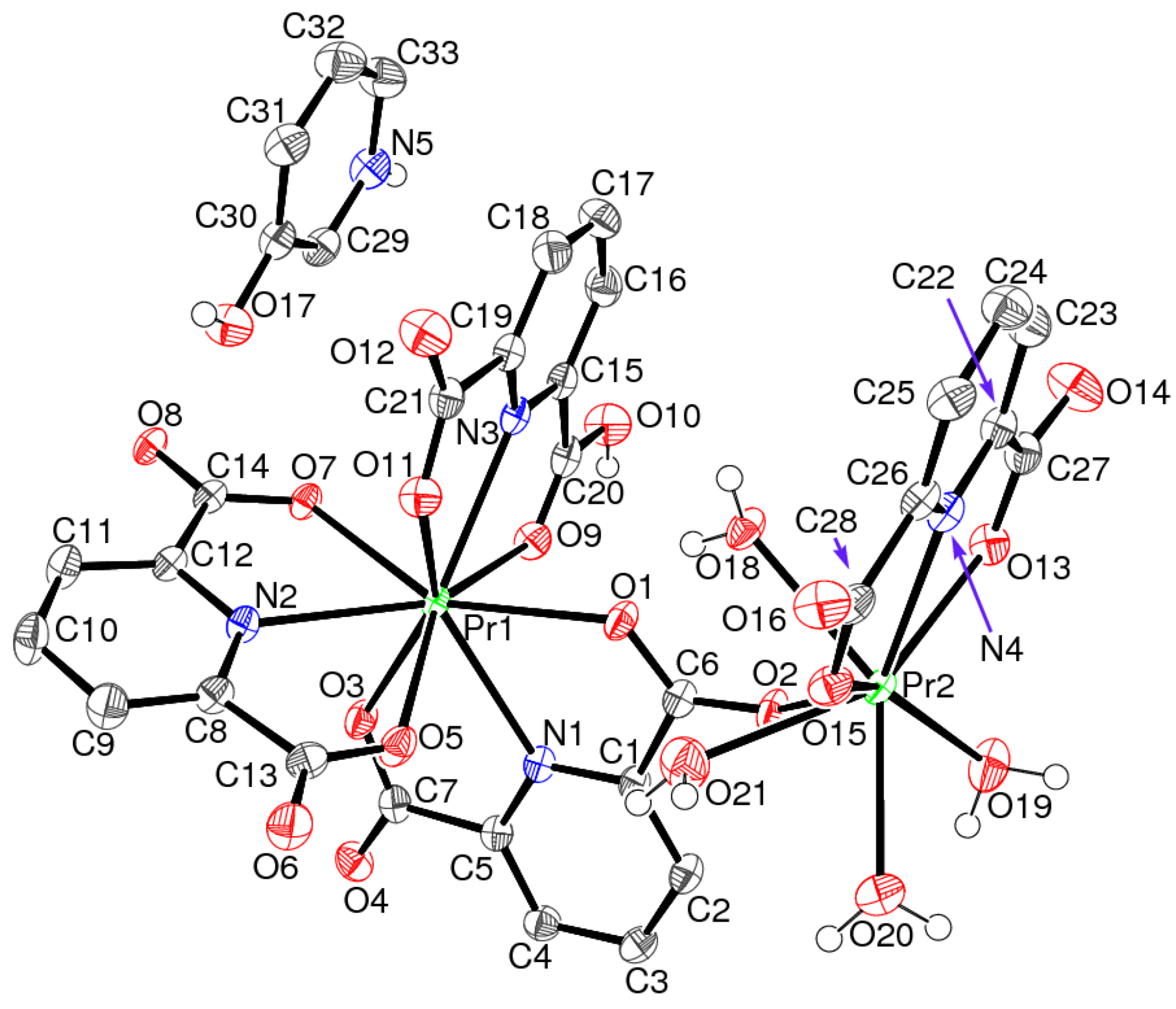
        <p>Compound <bold>1</bold> is a one-dimensional coordination polymer: The asymmetric unit contains two Pr<sup>3+</sup> cations, three doubly-deprotonated (C<sub>7</sub>H<sub>3</sub>NO<sub>4</sub>)<sup>2−</sup> (pdc<sup>2−</sup>) dianions, one singly-deprotonated (C<sub>7</sub>H<sub>4</sub>NO<sub>4</sub>)<sup>−</sup> (Hpdc<sup>−</sup>) anion, one 3-hydroxylpyridinium (H3hp<sup>+</sup>) cation and twelve water molecules (<xref ref-type="fig" rid="crystals-02-01253-f001">Figure 1</xref>). </p>
        
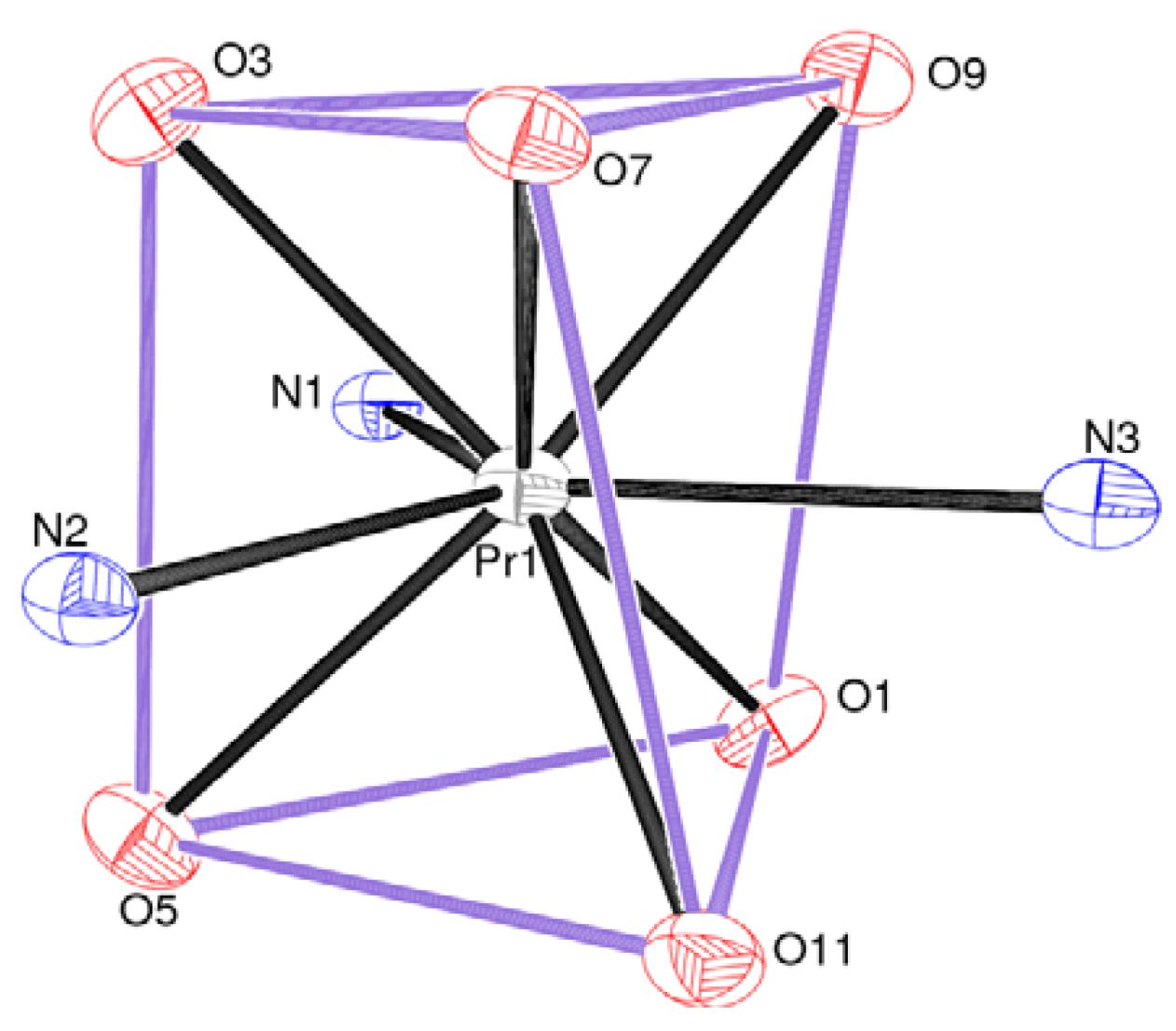
        <p>The coordination geometries of the praseodymium ions in <bold>1</bold> are very different: Pr1 is coordinated by two O,N,O-tridentate pdc<sup>2−</sup> dianions and the O,N,O-tridentate Hpdc<sup>−</sup> anion to generate a fairly regular tri-capped trigonal prismatic PrO<sub>6</sub>N<sub>3</sub> coordination geometry with the N atoms serving as the caps protruding through the prismatic side-faces (<xref ref-type="fig" rid="crystals-02-01253-f002">Figure 2</xref>). Each ligand forms one Pr–O bond to the “top” triangular face and one to the bottom as well as the metal–nitrogen bond. The dihedral angle between the O1/O5/O11 and O3/O7/O9 triangular faces is 5.00(18)° and the metal ion is displaced by 1.6622(14) Å from the first triplet of O atoms and by −1.7184(14) Å from the second. The Pr–N bond lengths (<xref ref-type="table" rid="crystals-02-01253-t001">Table 1</xref>) (mean = 2.606 Å) are longer than all but one of the Pr–O bonds (mean = 2.510 Å).</p>
        <fig id="crystals-02-01253-f001" position="anchor">
          <label>Figure 1</label>
          <caption>
            <p>The asymmetric unit of <bold>1</bold> (50% displacement ellipsoids). The uncoordinated water molecules and the C-bound H atoms are omitted for clarity. </p>
          </caption>
          <graphic xmlns:xlink="http://www.w3.org/1999/xlink" xlink:href="crystals-02-01253-g001.tif"/>
        </fig>
        <fig id="crystals-02-01253-f002" position="anchor">
          <label>Figure 2</label>
          <caption>
            <p>Detail of <bold>1</bold> showing the tri-capped trigonal prismatic coordination of Pr1 (50% displacement ellipsoids). The orchid-colored lines indicate the trigonal prism of O atoms.</p>
          </caption>
          <graphic xmlns:xlink="http://www.w3.org/1999/xlink" xlink:href="crystals-02-01253-g002.tif"/>
        </fig>
        <table-wrap id="crystals-02-01253-t001" position="anchor">
          <object-id pub-id-type="pii">crystals-02-01253-t001_Table 1</object-id>
          <label>Table 1</label>
          <caption>
            <p>Selected bond-distances (Å) in <bold>1</bold>.</p>
          </caption>
          <table>
            <tbody>
              <tr>
                <td align="center" valign="middle">Pr1–O7</td>
                <td align="center" valign="middle">2.469(2)</td>
                <td align="center" valign="middle">Pr1–O11</td>
                <td align="center" valign="middle">2.472(2)</td>
              </tr>
              <tr>
                <td align="center" valign="middle">Pr1–O5</td>
                <td align="center" valign="middle">2.499(2)</td>
                <td align="center" valign="middle">Pr1–O3</td>
                <td align="center" valign="middle">2.501(2)</td>
              </tr>
              <tr>
                <td align="center" valign="middle">Pr1–O1</td>
                <td align="center" valign="middle">2.518(2)</td>
                <td align="center" valign="middle">Pr1–O9</td>
                <td align="center" valign="middle">2.601(2)</td>
              </tr>
              <tr>
                <td align="center" valign="middle">Pr1–N2</td>
                <td align="center" valign="middle">2.594(3)</td>
                <td align="center" valign="middle">Pr1–N1</td>
                <td align="center" valign="middle">2.604(3)</td>
              </tr>
              <tr>
                <td align="center" valign="middle">Pr1–N3</td>
                <td align="center" valign="middle">2.620(3)</td>
                <td align="center" valign="middle"> </td>
                <td align="center" valign="middle"> </td>
              </tr>
              <tr>
                <td align="center" valign="middle">Pr2–O8 <sup>#1</sup></td>
                <td align="center" valign="middle">2.448(2)</td>
                <td align="center" valign="middle">Pr2–O2</td>
                <td align="center" valign="middle">2.469(2)</td>
              </tr>
              <tr>
                <td align="center" valign="middle">Pr2–O15</td>
                <td align="center" valign="middle">2.477(2)</td>
                <td align="center" valign="middle">Pr2–O13</td>
                <td align="center" valign="middle">2.489(2)</td>
              </tr>
              <tr>
                <td align="center" valign="middle">Pr2–O19</td>
                <td align="center" valign="middle">2.490(3)</td>
                <td align="center" valign="middle">Pr2–O20</td>
                <td align="center" valign="middle">2.501(3)</td>
              </tr>
              <tr>
                <td align="center" valign="middle">Pr2–O18</td>
                <td align="center" valign="middle">2.525(2)</td>
                <td align="center" valign="middle">Pr2–O21</td>
                <td align="center" valign="middle">2.582(3)</td>
              </tr>
              <tr>
                <td align="center" valign="middle">Pr2–N4</td>
                <td align="center" valign="middle">2.604(3)</td>
                <td align="center" valign="middle"> </td>
                <td align="center" valign="middle"> </td>
              </tr>
            </tbody>
          </table>
          <table-wrap-foot><fn><p>Symmetry code: <sup>#1</sup><italic>x</italic> – 1, <italic>y</italic>, <italic>z</italic>.</p></fn></table-wrap-foot>
        </table-wrap>
        
        
        <p>The geometrical parameters for the three chelating ligands (containing atoms N1, N2 and N3) are similar to those in related structures [<xref ref-type="bibr" rid="B6-crystals-02-01253">6</xref>] and all the carboxylate groups are close to coplanar with their attached rings. The presence of the (un-removed) carboxylate proton in the N3-containing mono-ion is clearly indicated in terms of the C20–O10 and C20–O9 bond lengths of 1.291(4) Å and 1.231(4) Å, respectively. </p>
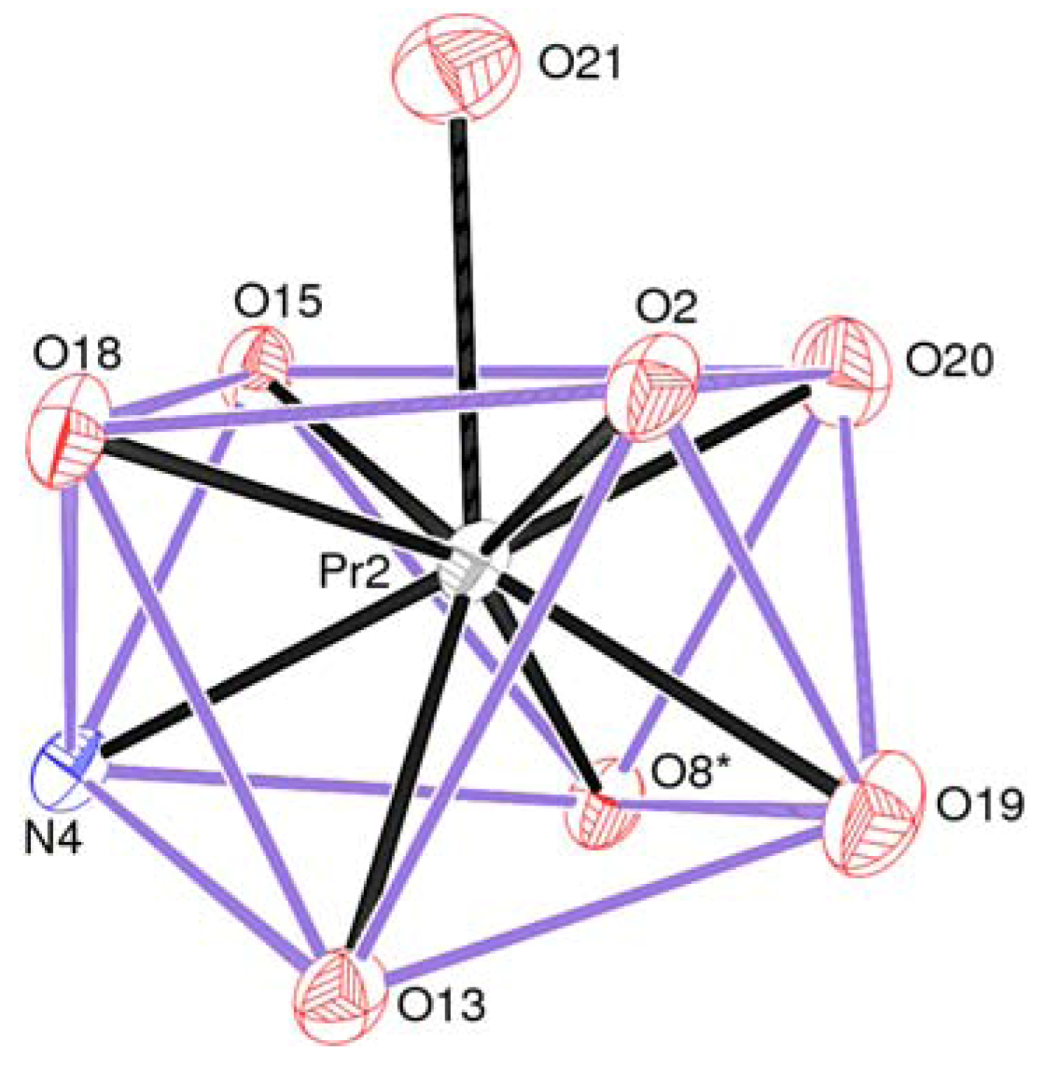
        <p>The Pr2 species in <bold>1</bold> is coordinated by an O,N,O-tridentate pdc<sup>2−</sup> dianion (containing N4), four water molecules and two bridging monodentate-O pdc<sup>−</sup> species to generate a PrO<sub>8</sub>N coordination polyhedron that approximates to a mono-capped square anti-prism (<xref ref-type="fig" rid="crystals-02-01253-f003">Figure 3</xref>). The mean Pr–O separation is 2.498 Å and the four longer bonds are to the water molecules, although the differences are very small. The capping atom, O21, is part of a water molecule and protrudes through the O2/O15/O18/O20 square face of the anti-prism. The dihedral angle between this face and the O8/O13/O19/N4 face is 6.79(13)° and Pr2 is displaced from the two faces by −0.9083(13) Å and 1.5041(13) Å, respectively. </p>
        <fig id="crystals-02-01253-f003" position="anchor">
          <label>Figure 3</label>
          <caption>
            <p>Detail of <bold>1</bold> (50% displacement ellipsoids) showing the mono-capped square anti-prismatic coordination of Pr2. O18, O19, O20 and O21 are parts of water molecules. The orchid lines indicate the square anti-prism. O8<bold>*</bold> is generated by the symmetry operation (<italic>x</italic> − 1, <italic>y</italic>, <italic>z</italic>).</p>
          </caption>
          <graphic xmlns:xlink="http://www.w3.org/1999/xlink" xlink:href="crystals-02-01253-g003.tif"/>
        </fig>
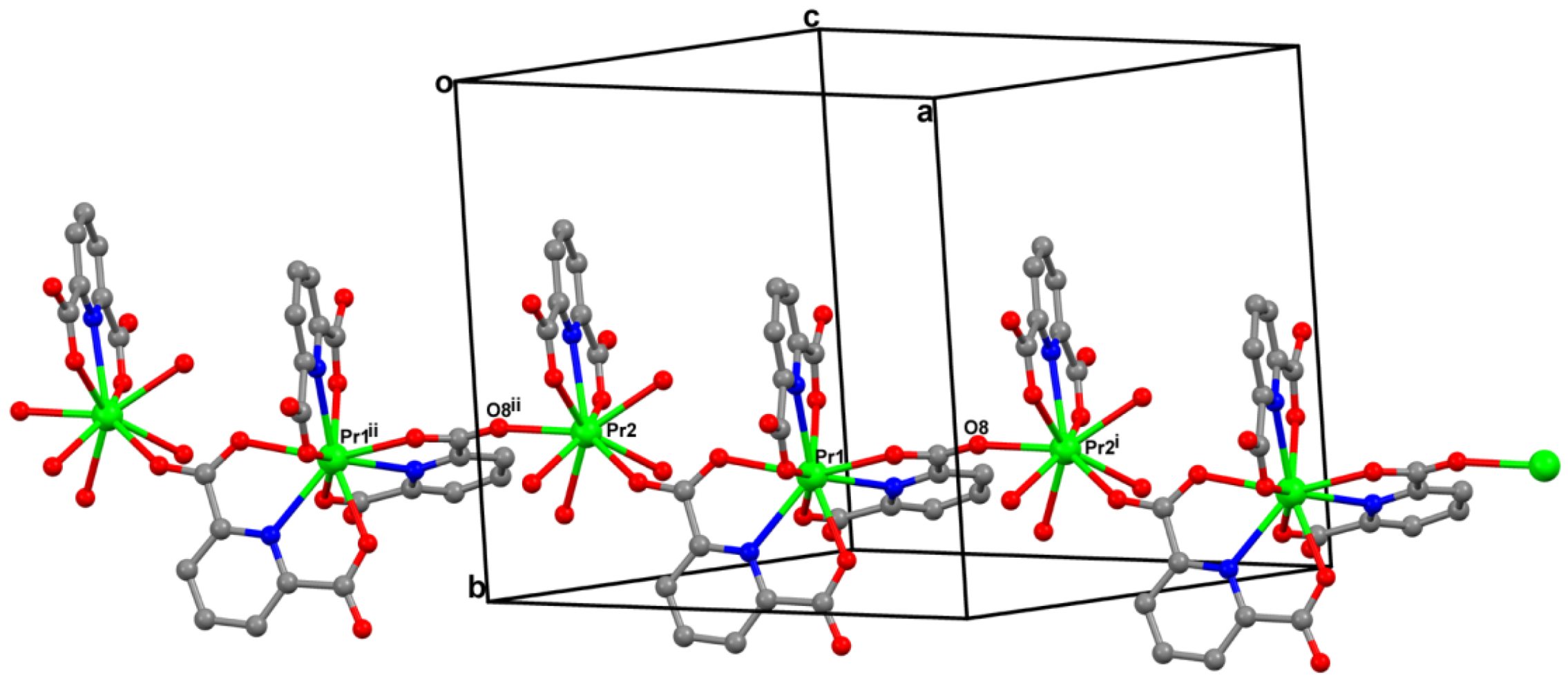
        <p>The bridging N1- and N2-containing pdc<sup>2−</sup> dianions lead to infinite chains of alternating Pr1- and Pr2-centred polyhedra, which propagate in [100] (<xref ref-type="fig" rid="crystals-02-01253-f004">Figure 4</xref>). The Pr1⋯Pr2 separations are 6.4122(3) Å (via the N1 ligand) and 6.9775(3) Å (via the N2 ligand). </p>
        <fig id="crystals-02-01253-f004" position="anchor">
          <label>Figure 4</label>
          <caption>
            <p>Fragment of a [100] chain of alternating Pr1- and Pr2-centred polyhedra in <bold>1</bold>.</p>
          </caption>
          <graphic xmlns:xlink="http://www.w3.org/1999/xlink" xlink:href="crystals-02-01253-g004.tif"/>
        </fig>
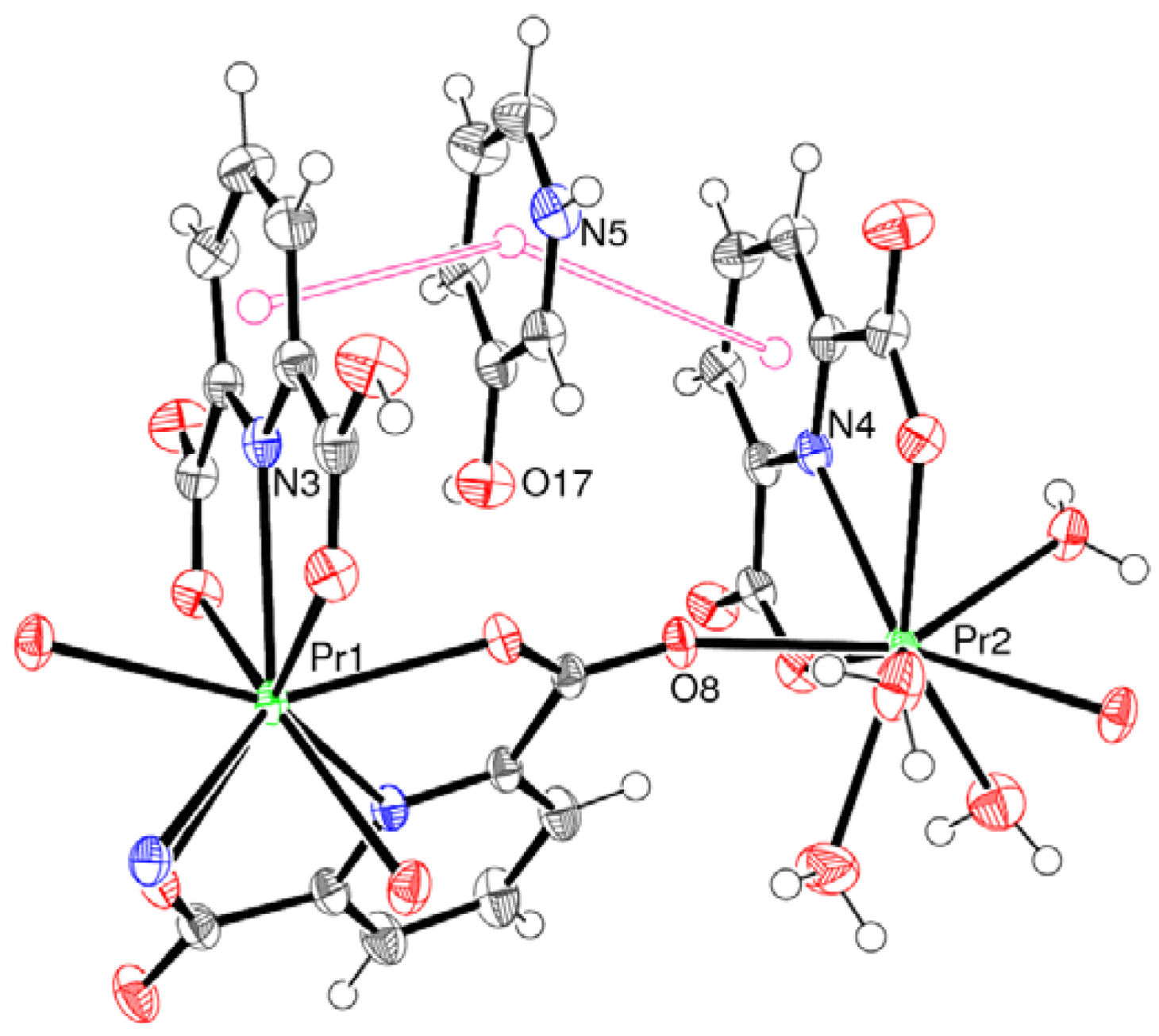
        <p>To complete the structure of <bold>1</bold>, an N–H⋯O and numerous O–H⋯O and hydrogen bonds occur (see supplementary materials for a full list). The 3-hydroxypyridinium (H3hp<sup>+</sup>) cation appears to play a significant role in establishing the structure of 1. As well as forming N–H⋯O and O–H⋯O hydrogen bonds, which serve to crosslink the [100] chains, it participates in two aromatic π–π stacking interactions (<xref ref-type="fig" rid="crystals-02-01253-f005">Figure 5</xref>). This might be described as an “intercalation” of the H3hp<sup>+</sup> species between the two pendant ligands (N3 attached to Pr1 and N4 attached to Pr2) of the alternating metal atoms in the chain. </p>
        <fig id="crystals-02-01253-f005" position="anchor">
          <label>Figure 5</label>
          <caption>
            <p>Fragment of the structure of <bold>1</bold> showing the π–π stacking interactions (open pink lines) of the “intercalated” H3hp<sup>+</sup> cation: The separations of its ring centroid with those of the N3- and N4-containing rings (indicated by pink spheres) are 3.596(2) Å and 3.647(3) Å, respectively.</p>
          </caption>
          <graphic xmlns:xlink="http://www.w3.org/1999/xlink" xlink:href="crystals-02-01253-g005.tif"/>
        </fig>
      </sec>
      <sec>
        <title>2.2. Thermal Analysis</title>
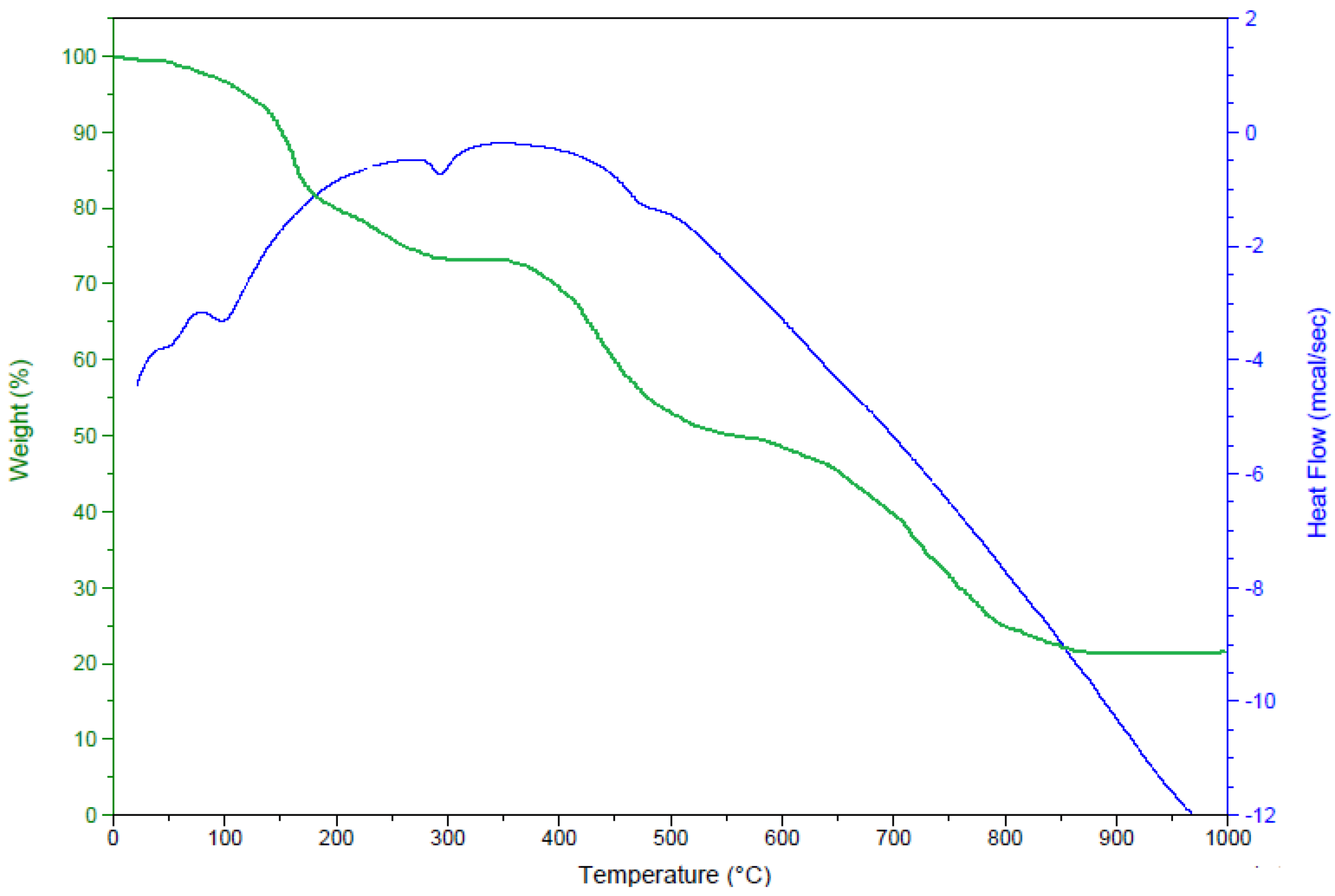
        <p>The TGA results (<xref ref-type="fig" rid="crystals-02-01253-f006">Figure 6</xref>) are consistent with the stoichiometry of the crystal: The first weight loss of about 17.8% (calculated value 17.2%) corresponds to the loss of the four coordinated and eight non-coordinated water molecules between 75 and 190 °C. The second weight loss of 7.6% up to 280 °C results from the removal of the 3-hydroxypyridinum ion (calcd. 7.2%). The third weight loss of about 49.4% is due to successive release of decomposition products from the pyridine dicarboxylate anions (calcd. 49.1%), yielding Pr<sub>2</sub>O<sub>3</sub> as the final product (25.3% residual weight; calc. 26.5%).</p>
        <fig id="crystals-02-01253-f006" position="anchor">
          <label>Figure 6</label>
          <caption>
            <p>TGA trace for <bold>1</bold>.</p>
          </caption>
          <graphic xmlns:xlink="http://www.w3.org/1999/xlink" xlink:href="crystals-02-01253-g006.tif"/>
        </fig>
      </sec>
    </sec>
    <sec>
      <title>3. Experimental Section</title>
      <sec>
        <title>3.1. Instrumental</title>
        <p>The C, H, N elemental analysis was carried out with a Vario Micro Cube (Elementar, Germany). IR data (KBr pellet) were recorded on a Perkin–Elmer FTIR 180 spectrophotometer over the range 4000–400 cm<sup>−1</sup>. TGA data (25–1000 °C) were recorded under continuous nitrogen flow, with a ramp-rate of 10 °C·min<sup>−1</sup> using a SDT Q600 instrument (TA Instruments, USA). </p>
      </sec>
      <sec>
        <title>3.2. Synthesis</title>
        <p>A mixture of pyridine 2,6-dicarboxylic acid (84 mg, 0.5 mmol), 3-hydroxypyridine (45 mg, 0.5 mmol), PrCl<sub>3</sub>·6H<sub>2</sub>O (45 mg, 0.125 mmol) and 0.2 mL formic acid and 7 mL distilled water was sealed in a 23 mL Teflon-lined autoclave and heated to 170 °C for 12 h and cooled to room temperature at 30 °C·h<sup>−1</sup> to yield a green solution. Green needles of <bold>1</bold> slowly grew as the water evaporated over two weeks and were recovered by vacuum filtration, rinsing with water and dried at room temperature. Analysis (%) calc. for C<sub>33</sub>H<sub>43</sub>N<sub>5</sub>O<sub>29</sub>Pr<sub>2</sub>: N 5.58; C 31.54; H 3.43; Found: N 5.69; C 31.73; H 3.61. Yield <italic>ca</italic>. 65%. IR (cm<sup>−1</sup>): 3572–3288 (broad, strong) water O–H stretch; 1630 <italic>ν</italic><sub>asym</sub>(C=O); 1415, 1359 <italic>ν</italic><sub>sym</sub>(C=O).</p>
      </sec>
      <sec>
        <title>3.3. Single-Crystal Data Collection and Analysis</title>
        <p>The single-crystal data for <bold>1</bold> (green needle 0.40 × 0.05 × 0.05 mm) were collected using a Bruker Kappa APEX II [<xref ref-type="bibr" rid="B10-crystals-02-01253">10</xref>] CCD diffractometer (graphite monochromated Mo K<italic>α</italic> radiation, <italic>λ</italic> = 0.71073 Å) at room temperature. Data reduction with SAINT [<xref ref-type="bibr" rid="B10-crystals-02-01253">10</xref>] then proceeded and the structure was solved by direct methods with SHELXS [<xref ref-type="bibr" rid="B11-crystals-02-01253">11</xref>]. The resulting atomic model was developed and refined against |<italic>F</italic>|<sup>2</sup> with SHELXL [<xref ref-type="bibr" rid="B11-crystals-02-01253">11</xref>] and the “observed data” threshold for calculating the <italic>R</italic>(<italic>F</italic>) residuals was set as <italic>I</italic> &gt; 2σ(<italic>I</italic>). The C- and N-bound bound H atoms were placed in idealised locations (C–H = 0.96–0.97 Å, N–H = 0.86 Å) and refined as riding atoms. The O-bound H atoms were located in difference maps and refined as riding atoms in their as-found relative locations. The constraint <italic>U</italic><sub>iso</sub>(H) = 1.2<italic>U</italic><sub>eq</sub>(carrier) was applied in all cases. The structural model was analysed and validated with PLATON [<xref ref-type="bibr" rid="B12-crystals-02-01253">12</xref>] and full refinement details are given in the deposited cif. </p>
        <p>Crystal data for <bold>1</bold>: C<sub>33</sub>H<sub>43</sub>N<sub>5</sub>O<sub>29</sub>Pr<sub>2</sub>, <italic>M</italic><sub>r</sub> = 1255.54, triclinic, (No. 2), <italic>Z</italic> = 2, <italic>a</italic> = 13.2567(1) Å, <italic>b</italic> = 13.6304(2) Å, <italic>c</italic> = 13.6409(2) Å, <italic>α</italic> = 89.695(1)°, <italic>β</italic> = 63.049(1)°, <italic>γ</italic> = 86.105(1)°, <italic>V</italic> = 2191.16(5) Å<sup>3</sup>, <italic>F</italic>(000) = 1252, <italic>T</italic> = 293(2) K, <italic>ρ</italic><sub>calc</sub> = 1.903 g·cm<sup>−3</sup>, <italic>μ</italic> = 2.304 mm<sup>−1</sup>, 18565 reflections recorded (6.0° ≤ 2<italic>θ</italic> ≤ 55.0°; −17 ≤ <italic>h</italic> ≤ 16, −17 ≤ <italic>k</italic> ≤ 17, −17 ≤ <italic>l</italic> ≤ 17), <italic>R</italic><sub>Int</sub> = 0.021, 9996 merged reflections, 8617 with <italic>I</italic> &gt; 2σ(<italic>I</italic>), 622 variable parameters, <italic>R</italic>(<italic>F</italic>) = 0.033, <italic>wR</italic>(<italic>F</italic><sup>2</sup>) = 0.084, <italic>w</italic> = 1/[σ<sup>2</sup>(<italic>F</italic><sub>o</sub><sup>2</sup>) + (0.0392<italic>P</italic>)<sup>2</sup> + 3.8222<italic>P</italic>], where <italic>P</italic> = (<italic>F</italic><sub>o</sub><sup>2</sup> + 2<italic>F</italic><sub>c</sub><sup>2</sup>)/3, min./max. ∆<italic>ρ</italic> = −1.06, +2.32 <italic>e</italic> Å<sup>−3</sup>. Cambridge Structural Database deposition number: CCDC-885694.</p>
      </sec>
    </sec>
    <sec sec-type="conclusions">
      <title>4. Conclusions</title>
      <p>The synthesis and crystal structure of the title one-dimensional coordination polymer have been described, in which the coordination polyhedra of the two nine-coordinate praseodymium ions are very different. The “guest” 3-hydroxypyridinium cation appears to play an important role in establishing the structure in terms of inter-chain hydrogen bonds and intra-chain intercalated π–π stacking interactions. </p>
    </sec>
  </body>
  <back>
    <ref-list>
      <title>References</title>
      <ref id="B1-crystals-02-01253">
        <label>1.</label>
        <citation citation-type="journal">
          <person-group person-group-type="author">
            <name>
              <surname>Dong</surname>
              <given-names>Y.B.</given-names>
            </name>
            <name>
              <surname>Xu</surname>
              <given-names>H.X.</given-names>
            </name>
            <name>
              <surname>Ma</surname>
              <given-names>J.P.</given-names>
            </name>
            <name>
              <surname>Huang</surname>
              <given-names>R.Q.</given-names>
            </name>
          </person-group>
          <article-title>Silver(I) coordination polymers based on a nano-sized bent bis(3-acetylenylphenyl-(4-cyanophenyl))oxadiazole ligand: The role of ligand isomerism and the templating effect of polyatomic anions and solvent intermediates</article-title>
          <source>Inorg. Chem.</source>
          <year>2006</year>
          <volume>45</volume>
          <fpage>3325</fpage>
          <lpage>3343</lpage>
          <pub-id pub-id-type="doi">10.1021/ic052158w</pub-id>
        </citation>
      </ref>
      <ref id="B2-crystals-02-01253">
        <label>2.</label>
        <citation citation-type="journal">
          <person-group person-group-type="author">
            <name>
              <surname>Shimpi</surname>
              <given-names>M.R.</given-names>
            </name>
            <name>
              <surname>SeethaLekshmi</surname>
              <given-names>N.</given-names>
            </name>
            <name>
              <surname>Pedireddi</surname>
              <given-names>V.R.</given-names>
            </name>
          </person-group>
          <article-title>Supramolecular architecture in some 4-halophenylboronic acids</article-title>
          <source>Cryst. Growth Des.</source>
          <year>2007</year>
          <volume>7</volume>
          <fpage>1958</fpage>
          <lpage>1963</lpage>
          <pub-id pub-id-type="doi">10.1021/cg060863p</pub-id>
        </citation>
      </ref>
      <ref id="B3-crystals-02-01253">
        <label>3.</label>
        <citation citation-type="journal">
          <person-group person-group-type="author">
            <name>
              <surname>Fan</surname>
              <given-names>L.</given-names>
            </name>
            <name>
              <surname>Wang</surname>
              <given-names>E.</given-names>
            </name>
            <name>
              <surname>Li</surname>
              <given-names>Y.</given-names>
            </name>
            <name>
              <surname>An</surname>
              <given-names>H.</given-names>
            </name>
            <name>
              <surname>Xiao</surname>
              <given-names>D.</given-names>
            </name>
            <name>
              <surname>Wang</surname>
              <given-names>X.</given-names>
            </name>
          </person-group>
          <article-title>Wells-Dawson anion, a useful building block to construct one-dimensional chain as a chelate ligand coordinating with transition metal cations</article-title>
          <source>J. Mol. Struct.</source>
          <year>2007</year>
          <volume>841</volume>
          <fpage>28</fpage>
          <lpage>33</lpage>
          <pub-id pub-id-type="doi">10.1016/j.molstruc.2006.11.059</pub-id>
        </citation>
      </ref>
      <ref id="B4-crystals-02-01253">
        <label>4.</label>
        <citation citation-type="journal">
          <person-group person-group-type="author">
            <name>
              <surname>Albada</surname>
              <given-names>G.A.V.</given-names>
            </name>
            <name>
              <surname>Gorter</surname>
              <given-names>S.</given-names>
            </name>
            <name>
              <surname>Reedijk</surname>
              <given-names>J.</given-names>
            </name>
          </person-group>
          <article-title>Synthesis, spectral characterization and X-ray structure of aquasodium triaquabis(pyridine-2,6-dicarboxyl-diato)samariate trihydrate, an unique bis-pdc compound, with a sheet-type structure stabilised by sodium ions in each direction</article-title>
          <source>Polyhedron</source>
          <year>1999</year>
          <volume>18</volume>
          <fpage>1821</fpage>
          <lpage>1824</lpage>
          <pub-id pub-id-type="doi">10.1016/S0277-5387(99)00061-3</pub-id>
        </citation>
      </ref>
      <ref id="B5-crystals-02-01253">
        <label>5.</label>
        <citation citation-type="journal">
          <person-group person-group-type="author">
            <name>
              <surname>Prasad</surname>
              <given-names>T.K.</given-names>
            </name>
            <name>
              <surname>Rajasekharan</surname>
              <given-names>M.V.</given-names>
            </name>
          </person-group>
          <article-title>A novel water octamer in Ce(dipic)<sub>2</sub>(H<sub>2</sub>O)<sub>3</sub>·4H<sub>2</sub>O: Crystallographic, thermal, and theoretical studies</article-title>
          <source>Cryst. Growth Des.</source>
          <year>2006</year>
          <volume>6</volume>
          <fpage>488</fpage>
          <lpage>491</lpage>
        <pub-id pub-id-type="doi">10.1021/cg050417m</pub-id></citation>
      </ref>
      <ref id="B6-crystals-02-01253">
        <label>6.</label>
        <citation citation-type="journal">
          <person-group person-group-type="author">
            <name>
              <surname>Hamacek</surname>
              <given-names>J.</given-names>
            </name>
            <name>
              <surname>Zebret</surname>
              <given-names>S.</given-names>
            </name>
            <name>
              <surname>Bernardinelli</surname>
              <given-names>G.</given-names>
            </name>
          </person-group>
          <article-title>Supramolecular structure of the polymeric Eu(III) complex with pyridine-2,6-dicarboxylic acid</article-title>
          <source>Polyhedron</source>
          <year>2009</year>
          <volume>28</volume>
          <fpage>2179</fpage>
          <lpage>2182</lpage>
          <pub-id pub-id-type="doi">10.1016/j.poly.2009.04.011</pub-id>
        </citation>
      </ref>
      <ref id="B7-crystals-02-01253">
        <label>7.</label>
        <citation citation-type="journal">
          <person-group person-group-type="author">
            <name>
              <surname>Park</surname>
              <given-names>K.K.</given-names>
            </name>
            <name>
              <surname>Kwon</surname>
              <given-names>T.R.</given-names>
            </name>
            <name>
              <surname>Park</surname>
              <given-names>Y.J.</given-names>
            </name>
            <name>
              <surname>Jung</surname>
              <given-names>E.C.</given-names>
            </name>
            <name>
              <surname>Kim</surname>
              <given-names>W.H.</given-names>
            </name>
          </person-group>
          <article-title>Ternary complex formation of Eu(III) and Am(III) with pyridine-2,6-dicarboxylate in aqueous solutions</article-title>
          <source>J. Alloy Compd.</source>
          <year>2007</year>
          <volume>444</volume>
          <fpage>677</fpage>
          <lpage>682</lpage>
          <pub-id pub-id-type="doi">10.1016/j.jallcom.2007.03.073</pub-id>
        </citation>
      </ref>
      <ref id="B8-crystals-02-01253">
        <label>8.</label>
        <citation citation-type="journal">
          <person-group person-group-type="author">
            <name>
              <surname>Ghosh</surname>
              <given-names>S.K.</given-names>
            </name>
            <name>
              <surname>Bharadwaj</surname>
              <given-names>P.K.</given-names>
            </name>
          </person-group>
          <article-title>Coexistence of water dimer and hexamer clusters in 3D metal-organic framework structures of Ce(III) and Pr(III) with pyridine-2,6-dicarboxylic acid</article-title>
          <source>Inorg. Chem.</source>
          <year>2003</year>
          <volume>42</volume>
          <fpage>8250</fpage>
          <lpage>8254</lpage>
          <pub-id pub-id-type="doi">10.1021/ic034976z</pub-id>
        </citation>
      </ref>
      <ref id="B9-crystals-02-01253">
        <label>9.</label>
        <citation citation-type="journal">
          <person-group person-group-type="author">
            <name>
              <surname>Zhao</surname>
              <given-names>B.</given-names>
            </name>
            <name>
              <surname>Yi</surname>
              <given-names>L.</given-names>
            </name>
            <name>
              <surname>Dai</surname>
              <given-names>Y.</given-names>
            </name>
            <name>
              <surname>Chen</surname>
              <given-names>X.-Y.</given-names>
            </name>
            <name>
              <surname>Cheng</surname>
              <given-names>P.</given-names>
            </name>
            <name>
              <surname>Liao</surname>
              <given-names>D.-Z.</given-names>
            </name>
            <name>
              <surname>Yan</surname>
              <given-names>S.-P.</given-names>
            </name>
            <name>
              <surname>Jiang</surname>
              <given-names>Z.-H.</given-names>
            </name>
          </person-group>
          <article-title>Systematic investigation of the hydrothermal syntheses of Pr(III)-PDA (PDA = pyridine-2,6-dicarboxylate anion) metal-organic frameworks</article-title>
          <source>Inorg. Chem.</source>
          <year>2005</year>
          <volume>44</volume>
          <fpage>911</fpage>
          <lpage>920</lpage>
        <pub-id pub-id-type="doi">10.1021/ic049498m</pub-id><pub-id pub-id-type="pmid">15859268</pub-id></citation>
      </ref>
      <ref id="B10-crystals-02-01253">
        <label>10.</label>
        <citation citation-type="other">
          <source>APEX-II and SAINT</source>
          <publisher-name>Bruker AXS Inc.</publisher-name>
          <publisher-loc>Madison, WI, USA</publisher-loc>
        </citation>
      </ref>
      <ref id="B11-crystals-02-01253">
        <label>11.</label>
        <citation citation-type="journal">
          <person-group person-group-type="author">
            <name>
              <surname>Sheldrick</surname>
              <given-names>G.M.</given-names>
            </name>
          </person-group>
          <article-title>A short history of SHELX</article-title>
          <source>Acta Cryst.</source>
          <year>2008</year>
          <volume>A64</volume>
          <fpage>112</fpage>
          <lpage>122</lpage>
        </citation>
      </ref>
      <ref id="B12-crystals-02-01253">
        <label>12.</label>
        <citation citation-type="journal">
          <person-group person-group-type="author">
            <name>
              <surname>Spek</surname>
              <given-names>A.L.</given-names>
            </name>
          </person-group>
          <article-title>Structure validation in chemical crystallography</article-title>
          <source>Acta Cryst.</source>
          <year>2009</year>
          <volume>D65</volume>
          <fpage>148</fpage>
          <lpage>155</lpage>
        </citation>
      </ref>
    </ref-list>
  </back>
</article>