
<?xml version="1.0" encoding="UTF-8"?>
<!DOCTYPE article PUBLIC "-//NLM//DTD Journal Publishing DTD v2.3 20070202//EN" "journalpublishing.dtd">
<article xmlns:mml="http://www.w3.org/1998/Math/MathML" xmlns:xlink="http://www.w3.org/1999/xlink" xml:lang="en" article-type="review-article">
  <front>
    <journal-meta>
      <journal-id journal-id-type="publisher-id">crystals</journal-id>
      <journal-title>Crystals</journal-title>
      <abbrev-journal-title abbrev-type="publisher">Crystals</abbrev-journal-title>
      <abbrev-journal-title abbrev-type="pubmed">Crystals</abbrev-journal-title>
      <issn pub-type="epub">2073-4352</issn>
      <publisher>
        <publisher-name>MDPI</publisher-name>
      </publisher>
    </journal-meta>
    <article-meta>
      <article-id pub-id-type="doi">10.3390/cryst2020413</article-id>
      <article-id pub-id-type="publisher-id">crystals-02-00413</article-id>
      <article-categories>
        <subj-group>
          <subject>Review</subject>
        </subj-group>
      </article-categories>
      <title-group>
        <article-title>Moderate Temperature Dense Phase Hydrogen Storage Materials within the US Department of Energy (DOE) H<sub>2</sub> Storage Program: Trends toward Future Development</article-title>
      </title-group>
      
      <contrib-group>
        <contrib contrib-type="author">
          <name>
            <surname>McWhorter</surname>
            <given-names>Scott</given-names>
          </name>
          <xref rid="af1-crystals-02-00413" ref-type="aff">1</xref>
          <xref rid="fn1-crystals-02-00413" ref-type="fn">†</xref>
        </contrib>
        <contrib contrib-type="author">
          <name>
            <surname>O’Malley</surname>
            <given-names>Kathleen</given-names>
          </name>
          <xref rid="af2-crystals-02-00413" ref-type="aff">2</xref>
        </contrib>
        <contrib contrib-type="author">
          <name>
            <surname>Adams</surname>
            <given-names>Jesse</given-names>
          </name>
          <xref rid="af3-crystals-02-00413" ref-type="aff">3</xref>
        </contrib>
        <contrib contrib-type="author">
          <name>
            <surname>Ordaz</surname>
            <given-names>Grace</given-names>
          </name>
          <xref rid="af4-crystals-02-00413" ref-type="aff">4</xref>
        </contrib>
        <contrib contrib-type="author">
          <name>
            <surname>Randolph</surname>
            <given-names>Katie</given-names>
          </name>
          <xref rid="af3-crystals-02-00413" ref-type="aff">3</xref>
        </contrib>
        <contrib contrib-type="author">
          <name>
            <surname>Stetson</surname>
            <given-names>Ned T.</given-names>
          </name>
          <xref rid="af4-crystals-02-00413" ref-type="aff">4</xref>
          <xref rid="c1-crystals-02-00413" ref-type="corresp">*</xref>
        </contrib>
      </contrib-group>
      <aff id="af1-crystals-02-00413"><label>1 </label>Savannah River National Laboratory, Aiken, SC 29808, USA; Email: <email>christopher.mcwhorter@ee.doe.gov</email> </aff>
      <aff id="af2-crystals-02-00413"><label>2 </label>SRA International, Fairfax, VA 22033, USA; Email: <email>kathleen.o’malley@ee.doe.gov</email> </aff>
      <aff id="af3-crystals-02-00413"><label>3 </label>Fuel Cell Technologies Program-Golden Field Office, US Department of Energy, 1617 Cole Boulevard, Golden, CO 80401, USA; Email: <email>jesse.adams@go.doe.gov</email> (J.A.); <email>katie.randolph@go.doe.gov</email> (K.R.)</aff>
      <aff id="af4-crystals-02-00413"><label>4 </label>Fuel Cell Technologies Program, US Department of Energy, 1000 Independence Avenue SW, Washington, DC 20585, USA; Email: <email>grace.ordaz@ee.doe.gov</email> </aff>
	  <author-notes>
        <fn id="fn1-crystals-02-00413">
          <label>† </label>
          <p>Current address: Fuel Cell Technologies Program, US Department of Energy, 1000 Independence Avenue SW, Washington, DC 20585, USA. </p>
        </fn>
        <corresp id="c1-crystals-02-00413"><label>*</label> Author  to whom correspondence should be addressed; Email: <email>ned.stetson@ee.doe.gov</email>; Tel.: +1-202-586-9995; Fax: +1-202-586-9811.</corresp>
      </author-notes>
      <pub-date pub-type="epub">
        <day>10</day>
        <month>05</month>
        <year>2012</year>
      </pub-date>
      <pub-date pub-type="collection">
        <month>06</month>
		<year>2012</year>
      </pub-date>
      <volume>2</volume>
      <issue>2</issue>
      <fpage>413</fpage>
      <lpage>445</lpage>
      <history>
        <date date-type="received">
          <day>20</day>
          <month>03</month>
          <year>2012</year>
        </date>
        <date date-type="rev-recd">
          <day>20</day>
          <month>04</month>
          <year>2012</year>
        </date>
        <date date-type="accepted">
          <day>23</day>
          <month>04</month>
          <year>2012</year>
        </date>
      </history>
      <permissions>
        <copyright-statement>© 2012 by the authors; licensee MDPI, Basel, Switzerland.</copyright-statement>
        <copyright-year>2012</copyright-year>
        <license xmlns:xlink="http://www.w3.org/1999/xlink" license-type="open-access" xlink:href="http://creativecommons.org/licenses/by/3.0/">
          <p>This article is an open-access article distributed under the terms and conditions of the Creative Commons Attribution license (http://creativecommons.org/licenses/by/3.0/).</p>
        </license>
      </permissions>
      <abstract>
        <p>Hydrogen has many positive attributes that make it a viable choice to augment the current portfolio of combustion-based fuels, especially when considering reducing pollution and greenhouse gas (GHG) emissions. However, conventional methods of storing H<sub>2</sub> via high-pressure or liquid H<sub>2</sub> do not provide long-term economic solutions for many applications, especially emerging applications such as man-portable or stationary power. Hydrogen storage in materials has the potential to meet the performance and cost demands, however, further developments are needed to address the thermodynamics and kinetics of H<sub>2</sub> uptake and release. Therefore, the US Department of Energy (DOE) initiated three Centers of Excellence focused on developing H<sub>2</sub> storage materials that could meet the stringent performance requirements for on-board vehicular applications. In this review, we have summarized the developments that occurred as a result of the efforts of the Metal Hydride and Chemical Hydrogen Storage Centers of Excellence on materials that bind hydrogen through ionic and covalent linkages and thus could provide moderate temperature, dense phase H<sub>2</sub> storage options for a wide range of emerging Proton Exchange Membrane Fuel Cell (PEM FC) applications. </p>
      </abstract>
      <kwd-group>
        <kwd>hydrogen storage</kwd>
        <kwd>metal hydrides</kwd>
        <kwd>chemical hydrogen storage</kwd>
        <kwd>review</kwd>
        <kwd>applications</kwd>
        <kwd>intermetallic compounds</kwd>
        <kwd>complex hydrides</kwd>
        <kwd>PEM fuel cells </kwd>
      </kwd-group>
    </article-meta>
  </front>
  <body>
    <sec sec-type="intro">
      <title>1. Introduction</title>
      <p>Hydrogen is a near ideal energy carrier that can be used to fuel the economy while reducing our nation’s dependence on fossil fuels, diversifying renewable and sustainable energy sources and significantly reducing pollution and greenhouse gas emissions. Currently, hydrogen is commercially produced from natural gas by means of chemical processing including steam methane reforming, partial oxidation and/or autothermal reforming; although, it has the potential to be produced from a diverse portfolio of domestic renewable resources such as biomass, hydro, wind and solar [<xref ref-type="bibr" rid="B1-crystals-02-00413">1</xref>]. It contains more chemical energy per unit mass than any hydrocarbon fuel; however, it is the lightest of all elements and behaves as an ideal gas at room temperature so that its energy density is particularly low and, thus, is problematic to store effectively in small volumes. Consequently, one of the primary barriers to commercialization of hydrogen fuel cell technologies for portable, stationary and transportation applications is the efficient storage of hydrogen. </p>
      <p>Existing technologies allow the storage of hydrogen through the modification of its physical state as a high pressure gas or cryogenic liquid; however, these options have technical and practical challenges, especially when considering emerging commercial markets. Compression can be used to increase the energy density with the use of robust pressure vessels; however at the expense of significant weight and cost penalties [<xref ref-type="bibr" rid="B2-crystals-02-00413">2</xref>]. For instance, analysis of 35 MPa and 70 MPa Type IV composite cylinders that use high strength carbon fiber (CF) reinforcement to reduce cylinder weight for automotive applications indicates hydrogen system capacities of 5.5 and 5.2 wt.% H<sub>2</sub> and 17.6 and 26.3 g-H<sub>2</sub>/L, at a cost of ~$15/k·Wh and $19/k·Wh, respectively [<xref ref-type="bibr" rid="B3-crystals-02-00413">3</xref>,<xref ref-type="bibr" rid="B4-crystals-02-00413">4</xref>]. Comparatively, the 70 MPa requires ~10% more CF than the 35 MPa system to withstand the higher pressure which adds an additional ~$3/k·Wh in cost. Likewise, the compression of hydrogen accounts for a ~10–15% loss in energy content which further decreases the overall efficiency of the system [<xref ref-type="bibr" rid="B2-crystals-02-00413">2</xref>].</p>
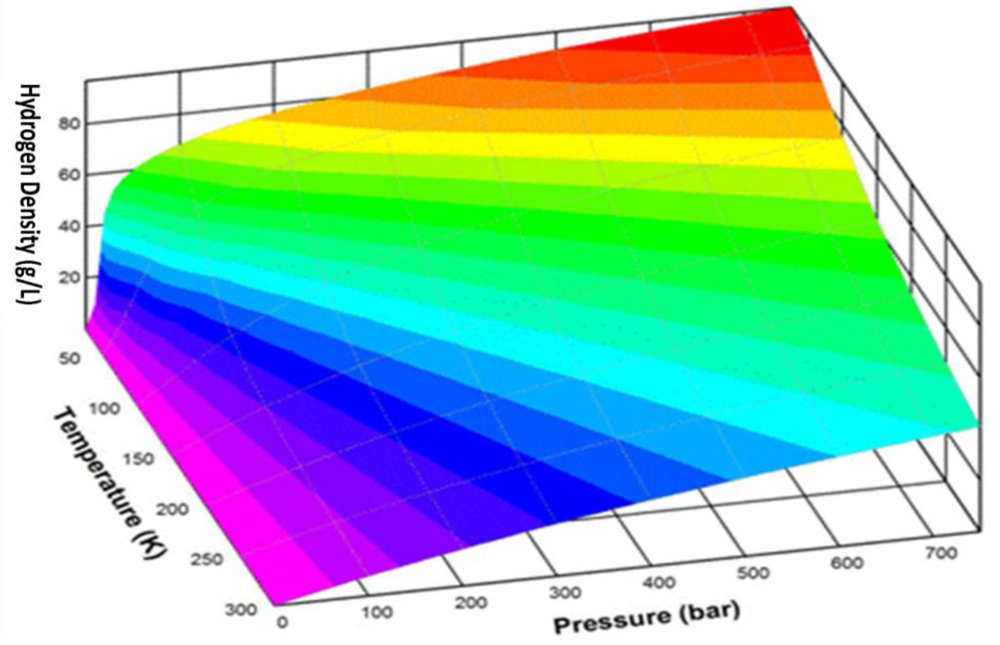
      <p>Alternatively, lower temperatures can be used to increase the energy density of hydrogen as a liquid or cryo-compressed fluid. Hydrogen is a liquid at its boiling point of 20 K with a density of approximately 71 grams per liter. Further increases in density are expected with the application of cryogenic temperatures and pressure as observed in <xref ref-type="fig" rid="crystals-02-00413-f001">Figure 1</xref>. However, each technology requires well insulated and expensive cryogenic storage vessels to prevent boil-off and maximize dormancy (<italic>i.e</italic>., length of time the hydrogen can be stored without loss). Moreover, the liquefaction process is energy intensive and consumes approximately ~25–30% of the energy content of the stored hydrogen [<xref ref-type="bibr" rid="B2-crystals-02-00413">2</xref>]. </p>
      <fig id="crystals-02-00413-f001" position="anchor">
        <label>Figure 1</label>
        <caption>
          <p>Plot of hydrogen density as a function of pressure and temperature.</p>
        </caption>
        <graphic xmlns:xlink="http://www.w3.org/1999/xlink" xlink:href="crystals-02-00413-g001.tif"/>
      </fig>
      <p>When considering hydrogen storage options for emerging applications, each application must be regarded individually as each has its own distinct set of performance criteria. For example, for a stationary back-up power application that may well sit dormant at a remote location for months prior to being used; dormancy, quick start-up, gravimetric capacity, ease of refill and cost might be critical issues; whereas, for a man-portable power application, such as a rechargeable battery extender; size (<italic>i.e</italic>., gravimetric and volumetric capacities), cost and ease of use might be the greatest factors. In comparison, one of the most challenging applications, transportation, has very rigorous performance requirements with respect to weight, volume, start-up, rate of refill, transient operation, cost and a number of other performance criteria [<xref ref-type="bibr" rid="B5-crystals-02-00413">5</xref>]. Nevertheless, traditional hydrogen storage alone cannot meet the performance criteria for all applications.</p>
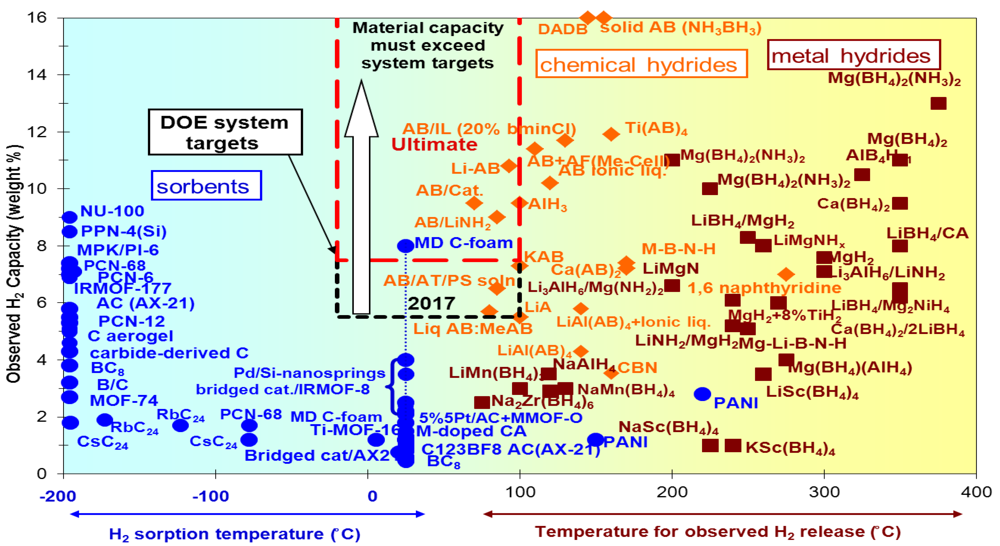
      <p>Despite the demanding challenges, the U.S. government and stakeholders realize that hydrogen storage represents a key enabling technology for the emergence of hydrogen fuel cells as an alternative energy source and have initiated intense research on materials-based solutions. The U.S. Department of Energy’s (DOE) Hydrogen Storage sub-program supports research and development of materials and technologies to address the barriers for compact, lightweight and inexpensive storage of hydrogen. The goal of the sub-program is to develop and demonstrate a portfolio of viable hydrogen storage technologies for transportation and early market fuel cell applications such as stationary power, backup power and material handling equipment. In response to the 2003 Hydrogen Fuel Initiative that placed a greater emphasis on R&amp;D funding for hydrogen fuel cell vehicles, the DOE initiated the National Hydrogen Storage Project, which included three centers of excellence as well as independent projects, to accelerate the development of hydrogen storage materials that would allow for hydrogen storage systems capable of meeting DOE performance targets [<xref ref-type="bibr" rid="B5-crystals-02-00413">5</xref>]. The centers of excellence involved multidisciplinary teams of academic, industrial and federal laboratory partners with focused efforts in three main groups of hydrogen storage materials (1) reversible metal hydrides; (2) chemical hydrogen storage and (3) high surface area sorbents. The first category of materials, the reversible metal hydrides, is generally characterized by the reactions of metals, nonmetals and alloys with hydrogen under moderate temperatures and pressures through combinations of metallic, ionic and/or covalent bonding (<italic>i.e</italic>., chemical bonding). The second group, chemical hydrogen storage, are a class of storage compounds containing large quantities of chemically bound hydrogen that can be released by heating (<italic>i.e</italic>., thermolysis) or reactions with other materials (e.g., hydrolysis reactions) and typically must be regenerated using separate processing steps after desorption of the hydrogen. The third group, comprised mainly of highly porous solids, utilizes high surface area materials (e.g., activated carbons, metal-organic frameworks, <italic>etc</italic>.) to bind dihydrogen through van der Waals interactions at low temperatures, generally lower than 273 K. From an applications perspective, the most significant difference between the three groups of materials is their operational temperature (see <xref ref-type="fig" rid="crystals-02-00413-f002">Figure 2</xref>), which is mainly determined by the differences in bonding types (<italic>i.e</italic>., chemical <italic>vs</italic>. physisorption), where most applications will have an operational temperature range that requires the storage to function at ambient or moderate temperatures. Both metal hydrides and chemical hydrogen storage materials, for that matter, typically require heating (<italic>i.e</italic>., 340 K–500 K) for thermal decomposition and subsequent hydrogen release due to their relatively high chemical stability. However, several thermodynamic factors, such as reaction pressure, enthalpy (Δ<italic>H</italic>) and entropy (Δ<italic>S</italic>), ultimately influence the equilibrium temperature requirements for decomposition and are described by the van’t Hoff Equation. In contrast, most sorbent materials possess room temperature heats of adsorption that are too weak (e.g., &lt;10 kJ/mol) for significant binding of hydrogen which necessitates the use of colder temperatures (<italic>i.e</italic>., &lt;77 K) to store meaningful quantities of hydrogen (<italic>i.e</italic>., ~4–8 wt.% H<sub>2</sub>). Efforts to increase the heats of adsorption for these materials have included metal doping of carbonaceous materials, and while promising results have been reported, material synthesis and sorption measurements have suffered from irreproducibility and the ability to validate results [<xref ref-type="bibr" rid="B6-crystals-02-00413">6</xref>,<xref ref-type="bibr" rid="B7-crystals-02-00413">7</xref>,<xref ref-type="bibr" rid="B8-crystals-02-00413">8</xref>]. As operation at (or near) ambient temperatures and pressures is highly desirable across all applications, a focus of the R&amp;D is on developing materials with suitable hydrogen bonding enthalpies (<italic>i.e</italic>., ~17–35 kJ/mol H<sub>2</sub>) that can provide energy efficient hydrogen storage platforms. </p>
      <fig id="crystals-02-00413-f002" position="anchor">
        <label>Figure 2</label>
        <caption>
          <p>Plot of hydrogen storage materials as a function of observed temperature release or sorption. Dashed lines denotes DOE 2017 and Ultimate targets.</p>
        </caption>
        <graphic xmlns:xlink="http://www.w3.org/1999/xlink" xlink:href="crystals-02-00413-g002.tif"/>
      </fig>
      <p>Recognizing that there has been vast accounts of research across all groups of hydrogen storage materials, this article is not meant to be a comprehensive review of all materials research, but rather, an attempt to summarize the research conducted through the Metal Hydride Center of Excellence (MHCoE) and Chemical Hydrogen Storage Center of Excellence (CHSCoE) on moderate temperature, condensed phase hydrogen storage materials (<italic>i.e</italic>., metal and chemical hydrides) in the context of relevant applications. Additionally, we will identify improvements in material properties realized through crystal structure characterization/modification and trends for future research. </p>
    </sec>
    <sec>
      <title>2. Moderate Temperature Condensed Phase Hydrogen Storage Materials</title>
      <p>Chemical compounds are formed by the combination of two or more atoms in a lower potential energy state than the separated atoms, thus implying a net attractive force between the atoms. It is these bonding forces in chemical and metal hydrides that impart the characteristics that demonstrate impressive gravimetric and volumetric hydrogen density in the moderate temperature condensed phase hydrogen storage materials. A convenient approach to describing these types of hydride materials is according to bonding forces which typically bin into three groups: (1) ionic hydrides; (2) covalent hydrides and (3) interstitial hydrides. </p>
      <p>Ionic hydrides are the “true salts” that are usually binary compounds where the hydrogen atom is bound to an extremely electropositive metal that normally conforms to the structure MH or MH<sub>2</sub>, where M = Group I or II metal cations such as Ca, Li, Na or K. These compounds tend to be quite thermally stable towards hydrogen decomposition, while are very reactive with water and other strong bases. Covalent hydrides encompass compounds such as sodium borohydride, ammonia borane (AB), aluminum hydride, and hydrocarbons, <italic>etc</italic>., where the bonding is highly localized between the hydrogen and the central element (e.g., Al, B, Mg, C, N, <italic>etc</italic>.). These compounds are known to contain large quantities of chemically bound hydrogen (<italic>i.e</italic>., up to 20 wt.%) that can be released at elevated temperatures either by thermolysis or by reaction with other compounds (e.g., hydrolysis reactions). The interstitial hydrides, also known as intermetallic hydrides, are a unique group of hydride materials in that their bonding is normally considered metallic and the hydrogen atoms can reside in the interstices within the metal or alloy framework forming non-stoichiometric compounds that follow the form of A<italic><sub>n</sub></italic>B<italic><sub>m</sub></italic>. These hydride materials are characteristically reversible over a range of temperatures (<italic>i.e</italic>., ~290 K–500 K) depending on the specific composition. However, interstitial hydrides are typically composed of transition metals and, subsequently, contain a low mass fraction of hydrogen of only a few percent. While the discovery of intermetallic hydrides is credited with stimulating extensive development of materials-based hydrogen storage, to date relatively few have been commercialized for Proton Exchange Membrane Fuel Cell (PEM FC) applications but rather primarily in nickel-metal hydride battery applications. Advanced research into chemical and metal hydrogen storage materials has focused mainly on materials that exhibit ionic and covalent bonding characteristics. However, these stronger bonding characteristics can lead to thermodynamically stable compounds that can require problematic heat management schemes in practical systems. For instance, a hydrogen storage reaction with an enthalpy of formation of 50 kJ/mol H<sub>2</sub> and equilibrium pressure of approximately 10 MPa, would require ~420 kW of cooling for a 5 min refill of 5.0 kg H<sub>2</sub> assuming that PEM fuel cell waste heat can be used for desorption and no energy is consumed to dissipate the heat ejected during refueling, while the same reaction at Δ<italic>H</italic> = 20 kJ/mol would only require approximately 170 kW of cooling for the same 5 min refill. Needless to say, much of the current materials-based hydrogen storage research has focused on manipulation of the material’s thermodynamic stability or alternative materials that are virtually thermal-neutral (<italic>i.e</italic>., exothermic release compounds). In the following sections we review research advancements in materials that have the greatest potential to meet the current hydrogen storage performance targets [<xref ref-type="bibr" rid="B5-crystals-02-00413">5</xref>] as observed by the US DOE Metal Hydride and Chemical Hydrogen Storage Centers of Excellence.</p>
      <sec>
        <title>2.1. Metal Hydrides</title>
        <p>Metal hydrides, conceptually, have the ability to be the simplest method of storing hydrogen through the reaction of H<sub>2</sub> with a metal or metal alloy (M) to form a metal hydride (MH<sub>x</sub>):</p>
        <disp-formula id="crystals-02-00413-i001">
		<inline-graphic xmlns:xlink="http://www.w3.org/1999/xlink" xlink:href="crystals-02-00413-i001.tif"/>
		<label>(1)</label>
		</disp-formula>

        <p>As mentioned in the previous section, early work in metal hydrides from the early 1970s [<xref ref-type="bibr" rid="B9-crystals-02-00413">9</xref>] concentrated mainly on intermetallic hydrides, such as LaNi<sub>5</sub> and TiFe, that demonstrated very reasonable absorption/desorption kinetics but suffered from low intrinsic gravimetric capacities of ~2 wt.%. Yet, numerous attempts to modify capacities while maintaining reasonable kinetics via polymetallic compositions with lightweight metals proved to be unsuccessful. Subsequent research focused on complex metal hydrides, especially following the discovery by Bogdanovic and Schwickardi [<xref ref-type="bibr" rid="B10-crystals-02-00413">10</xref>] that demonstrated the ability of titanium catalysts to decrease the desorption temperature of sodium alanate while rendering it reversible, albeit at moderately high pressures (<italic>i.e</italic>., ~60–150 bar) in addition to long-term cycling capacity degradation. </p>
        <p>Complex metal hydrides are an interesting class of hydrogen storage compounds made up of low-Z Group I and II metal cations (e.g., Ca, Li, Na, Mg, <italic>etc</italic>.) bonded to complex anions that contain central atoms covalently bound to two or more hydrogen atoms (e.g., amides, borohydrides and alanates), which consequently exhibit exceptional gravimetric and volumetric capacities. This class contains both strong covalent bonding and ionic/covalent-type bonds resulting in higher thermodynamic stabilities along with lower equilibrium hydrogen pressures. However, due to the engineering challenges associated with developing a hydrogen storage system around a highly thermodynamically stable material in addition to the particularly slow hydrogen absorption/desorption kinetics observed in these materials; the use of these compounds has been limited in practical applications. Thus, the focus of research within the MHCoE was to develop novel materials exploiting metal hydride bonding characteristics that would meet the automotive performance requirements as well as being appropriate for emerging PEM FC applications.</p>
        <sec>
          <title>2.1.1. Complex Anionic Hydrides</title>
          <p>Work within the MHCoE on complex anionic hydrides focused on the synthesis and characterization of high weight capacity materials that contain well-defined chemical moieties, in particular, alanates (<italic>i.e</italic>., AlH<sub>4</sub><sup>–</sup>, AlH<sub>6</sub><sup>3–</sup>), amides/imides (NH<sub>2</sub><sup>–</sup>/NH<sup>–2</sup>) and borohydrides (BH<sub>4</sub><sup>–</sup>). Early on in the MHCoE, work was performed on the alanates (<italic>i.e</italic>., NaAlH<sub>4</sub>, Na<sub>2</sub>LiAlH<sub>6</sub>, K<sub>2</sub>LiAlH<sub>6</sub>, <italic>etc</italic>.) which showed appreciable reversible gravimetric hydrogen capacities, albeit at decomposition temperatures and pressures outside of the operational window for a PEM FC [<xref ref-type="bibr" rid="B11-crystals-02-00413">11</xref>]. Also, since engineering assessments within the MHCoE suggested that the hydrogen storage system balance-of-plant could account for at least 50% of the mass and volume of the system, efforts shifted towards higher weight percent materials, namely the borohydrides. </p>
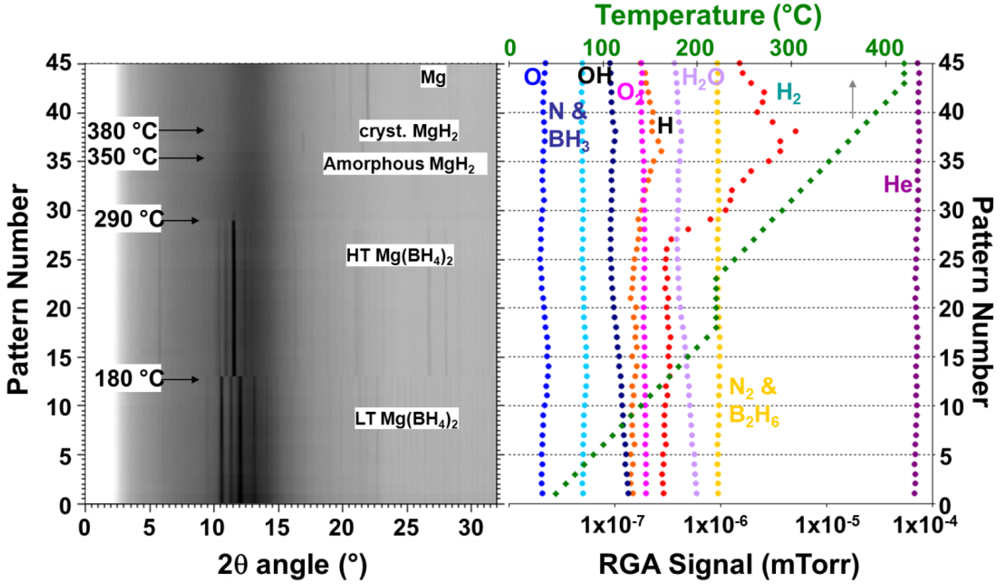
          <p>Complex borohydrides have the potential to deliver some of the highest hydrogen storage capacities of many of the H<sub>2</sub> storage compounds as shown in <xref ref-type="table" rid="crystals-02-00413-t001">Table 1</xref>. Magnesium borohydride, in particular, can deliver an exceptional 14.9 wt.% H<sub>2</sub> as demonstrated initially by Konopolev, who reported on the synthesis and desorption properties in a 1980 publication [<xref ref-type="bibr" rid="B12-crystals-02-00413">12</xref>]. Mg(BH<sub>4</sub>)<sub>2</sub> was synthesized in 80% yield from the combination of NaBH<sub>4</sub> and MgCl<sub>2</sub> in boiling ethanol and observed hydrogen desorption above 590 K with a Δ<italic>H</italic> of ~53 kJ/mol H<sub>2</sub>, however, relatively little was known about the desorption pathway nor the reaction reversibility. Through the MHCoE, Zhao <italic>et al.</italic> [<xref ref-type="bibr" rid="B13-crystals-02-00413">13</xref>,<xref ref-type="bibr" rid="B14-crystals-02-00413">14</xref>,<xref ref-type="bibr" rid="B15-crystals-02-00413">15</xref>], studied the correlation between crystal structure and hydrogen desorption dynamics. <xref ref-type="fig" rid="crystals-02-00413-f003">Figure 3</xref> shows a combined in-situ XRD and RGA spectra of the desorption of Mg(BH<sub>4</sub>)<sub>2</sub>. In doing so, they were able to identify a stepwise dehydrogenation of Mg(BH<sub>4</sub>)<sub>2</sub> to MgB<sub>2</sub> [<xref ref-type="table" rid="crystals-02-00413-t001">Table 1</xref>, reactions 8a–c] that delivered 12 wt.% H<sub>2</sub> at a very reasonable Δ<italic>H</italic> of ~40 kJ/mol H<sub>2</sub> and additionally determined the formation of an intermediate magnesium polyborane (MgB<sub>12</sub>H<sub>12</sub>) species. Identification of the intermediate MgB<sub>12</sub>H<sub>12</sub> <italic>closo</italic>-structure proved to be very significant towards discovering potential pathways for a reversible Mg(BH<sub>4</sub>)<sub>2</sub> material system as this polyborane structure was suggested as to be both a kinetic and thermodynamic barrier to reversibility.</p>
          <fig id="crystals-02-00413-f003" position="anchor">
            <label>Figure 3</label>
            <caption>
              <p>Overlay of <italic>in situ</italic> XRD and RGA curves of Mg(BH<sub>4</sub>)<sub>2</sub> decomposition. Adapted with permission from [<xref ref-type="bibr" rid="B14-crystals-02-00413">14</xref>].</p>
            </caption>
            <graphic xmlns:xlink="http://www.w3.org/1999/xlink" xlink:href="crystals-02-00413-g003.tif"/>
          </fig>
          <table-wrap id="crystals-02-00413-t001" position="anchor">
            <object-id pub-id-type="pii">crystals-02-00413-t001_Table 1</object-id>
            <label>Table 1</label>
            <caption>
              <p>Highlights of capacity and thermodynamic data for hydrogen storage materials investigated through the Metal Hydride Center of Excellence (MHCoE) and Chemical Hydrogen Storage Center of Excellence (CHSCoE). All data for <italic>T</italic><sub>des</sub> (units of K) and Δ<italic>H</italic><sub>des</sub> (units of kJ/mol H<sub>2</sub>) are taken from experimental measurements unless otherwise noted. <sup>a</sup> Cumulative, based on NH<sub>3</sub>BH<sub>3</sub>; <sup>b</sup> Calculated; and <sup>c</sup> Estimated from DSC.</p>
            </caption>
            <table>
              <thead>
                <tr align="center">
                  <th valign="middle">Rxn. No.</th>
                  <th valign="middle">Hydrogen release reaction</th>
                  <th valign="middle">wt.% H<sub>2</sub></th>
                  <th valign="middle">g- H<sub>2</sub>/L</th>
                  <th valign="middle">Reversible</th>
                  <th valign="middle">
                    <italic>T</italic><sub>des</sub>
                  </th>
                  <th valign="middle">∆
                  <italic>H</italic><sub>des</sub></th>
                  <th valign="middle">Cycling</th>
                  <th valign="middle">Ref.</th>
                </tr>
              </thead>
              <tbody>
                <tr align="center">
                  <td valign="middle">1</td>
                  <td valign="middle">2Al(BH<sub>4</sub>)<sub>3</sub> + B<sub>2</sub>H<sub>6</sub> ↔ 2AlB<sub>4</sub>H<sub>11</sub> + 4H<sub>2</sub></td>
                  <td valign="middle">13.5</td>
                  <td valign="middle"/>
                  <td valign="middle">Y</td>
                  <td valign="middle">493</td>
                  <td valign="middle"/>
                  <td valign="middle"/>
                  <td valign="middle">
				  [<xref ref-type="bibr" rid="B14-crystals-02-00413">14</xref>]</td>
                </tr>
                <tr align="center">
                  <td valign="middle">2</td>
                  <td valign="middle">4LiBH<sub>4</sub> + 5Mg<sub>2</sub>NiH<sub>4</sub> ↔ 2MgNi<sub>2.5</sub>B<sub>2</sub> + 4LiH + 8MgH<sub>2</sub> + 8H<sub>2</sub></td>
                  <td valign="middle">6.5</td>
                  <td valign="middle"/>
                  <td valign="middle">Y</td>
                  <td valign="middle">693</td>
                  <td valign="middle">15</td>
                  <td valign="middle">10</td>
                  <td valign="middle">[<xref ref-type="bibr" rid="B16-crystals-02-00413">16</xref>]</td>
                </tr>
                <tr align="center">
                  <td valign="middle">3 <sup>a</sup></td>
                  <td valign="middle">3LiAlH<sub>4</sub> ↔ Li<sub>3</sub>AlH<sub>6</sub> + 2Al + 3H<sub>2</sub></td>
                  <td valign="middle">5.3</td>
                  <td valign="middle">74</td>
                  <td valign="middle">Y</td>
                  <td valign="middle">353–453</td>
                  <td valign="middle">−10</td>
                  <td valign="middle">5</td>
                  <td rowspan="2" valign="middle">[<xref ref-type="bibr" rid="B17-crystals-02-00413">17</xref>,<xref ref-type="bibr" rid="B18-crystals-02-00413">18</xref>]</td>
                </tr>
                <tr align="center">
                  <td valign="middle">3 <sup>b</sup></td>
                  <td valign="middle">Li<sub>3</sub>AlH<sub>6</sub> ↔ 3LiH + Al + 
                  <inline-graphic xmlns:xlink="http://www.w3.org/1999/xlink" xlink:href="crystals-02-00413-i007.tif"/>H<sub>2</sub></td>
                  <td valign="middle">2.6</td>
                  <td valign="middle"/>
                  <td valign="middle">Y</td>
                  <td valign="middle"/>
                  <td valign="middle">25</td>
                  <td valign="middle"/>
                </tr>
                <tr align="center">
                  <td valign="middle">4</td>
                  <td valign="middle">Ti-doped LiAlH<sub>4</sub></td>
                  <td valign="middle">~7</td>
                  <td valign="middle"/>
                  <td valign="middle"/>
                  <td valign="middle">353–453</td>
                  <td valign="middle"/>
                  <td valign="middle">3</td>
                  <td valign="middle">[<xref ref-type="bibr" rid="B17-crystals-02-00413">17</xref>]</td>
                </tr>
                <tr align="center">
                  <td valign="middle">5</td>
                  <td valign="middle">2AlH<sub>3</sub> → 2AlH<sub>2</sub> + H<sub>2</sub></td>
                  <td valign="middle">10</td>
                  <td valign="middle">147</td>
                  <td valign="middle">N</td>
                  <td valign="middle">398–448</td>
                  <td valign="middle">7.6</td>
                  <td valign="middle"/>
                  <td valign="middle">[<xref ref-type="bibr" rid="B19-crystals-02-00413">19</xref>,<xref ref-type="bibr" rid="B20-crystals-02-00413">20</xref>]</td>
                </tr>
                <tr align="center">
                  <td valign="middle">6 <sup>a</sup></td>
                  <td valign="middle">NaAl<sub>4</sub> ↔ <inline-graphic xmlns:xlink="http://www.w3.org/1999/xlink" xlink:href="crystals-02-00413-i006.tif"/>Na<sub>3</sub>AlH<sub>6</sub> + <inline-graphic xmlns:xlink="http://www.w3.org/1999/xlink" xlink:href="crystals-02-00413-i007.tif"/>Al + H<sub>2</sub></td>
                  <td valign="middle">4</td>
                  <td valign="middle">80</td>
                  <td valign="middle">Y</td>
                  <td valign="middle">393</td>
                  <td valign="middle">37</td>
                  <td valign="middle">100</td>
                  <td rowspan="2" valign="middle">[<xref ref-type="bibr" rid="B18-crystals-02-00413">18</xref>,<xref ref-type="bibr" rid="B21-crystals-02-00413">21</xref>,<xref ref-type="bibr" rid="B22-crystals-02-00413">22</xref>]</td>
                </tr>
                <tr align="center">
                  <td valign="middle">6 <sup>b</sup></td>
                  <td valign="middle">Na<sub>3</sub>Al<sub>6</sub> ↔ 3NaH + Al + 
                  <inline-graphic xmlns:xlink="http://www.w3.org/1999/xlink" xlink:href="crystals-02-00413-i009.tif"/>H<sub>2</sub></td>
                  <td valign="middle">1.9</td>
                  <td valign="middle">43</td>
                  <td valign="middle">Y</td>
                  <td valign="middle">453</td>
                  <td valign="middle">47</td>
                  <td valign="middle"> </td>
                </tr>
                <tr align="center">
                  <td valign="middle">7</td>
                  <td valign="middle">LiH + 2LiNH<sub>3</sub> + KBH<sub>4</sub> → Li<sub>3</sub>BN<sub>2</sub> + KH + 4H<sub>2</sub></td>
                  <td valign="middle">7.48 <sup>b</sup></td>
                  <td valign="middle"/>
                  <td valign="middle"/>
                  <td valign="middle">508 <sup>b</sup></td>
                  <td valign="middle">43.61 <sup>b</sup></td>
                  <td valign="middle"/>
                  <td valign="middle">[<xref ref-type="bibr" rid="B23-crystals-02-00413">23</xref>]</td>
                </tr>
                <tr align="center">
                  <td valign="middle">8 <sup>a</sup></td>
                  <td valign="middle">6Mg(BH<sub>4</sub>)<sub>2</sub> → 5MgH<sub>2</sub> + Mg(B<sub>12</sub>H<sub>12</sub>) + 13H<sub>2</sub>↑</td>
                  <td valign="middle"/>
                  <td valign="middle"/>
                  <td valign="middle"/>
                  <td valign="middle"/>
                  <td valign="middle"/>
                  <td valign="middle"/>
                  <td valign="middle"/>
                </tr>
                <tr align="center">
                  <td valign="middle">8 <sup>b</sup></td>
                  <td valign="middle">5MgH<sub>2</sub> + Mg(B<sub>12</sub>H<sub>12</sub>) → 5Mg + 5H<sub>2</sub>↑ + Mg(B<sub>12</sub>H<sub>12</sub>)</td>
                  <td valign="middle">12</td>
                  <td valign="middle">147</td>
                  <td valign="middle">Y</td>
                  <td valign="middle">673, 803</td>
                  <td valign="middle">41</td>
                  <td valign="middle">2</td>
                  <td valign="middle">[<xref ref-type="bibr" rid="B17-crystals-02-00413">17</xref>,<xref ref-type="bibr" rid="B24-crystals-02-00413">24</xref>]</td>
                </tr>
                <tr align="center">
                  <td valign="middle">8 <sup>c</sup></td>
                  <td valign="middle">5Mg + Mg(B<sub>12</sub>H<sub>12</sub>) → 6MgB<sub>2</sub> + 6H<sub>2</sub>↑</td>
                  <td valign="middle"/>
                  <td valign="middle"/>
                  <td valign="middle"/>
                  <td valign="middle"/>
                  <td valign="middle"/>
                  <td valign="middle"/>
                  <td valign="middle"/>
                </tr>
                <tr align="center">
                  <td valign="middle">9 <sup>a</sup></td>
                  <td valign="middle">3Ca(BH<sub>4</sub>)<sub>2</sub> → CaB<sub>6</sub> + 2CaH<sub>2</sub> + 10H<sub>2</sub></td>
                  <td rowspan="2" valign="middle">9.5</td>
                  <td rowspan="2" valign="middle">108</td>
                  <td rowspan="2" valign="middle">Y</td>
                  <td rowspan="2" valign="middle">573–623</td>
                  <td rowspan="2" valign="middle">41.4 <sup>b</sup></td>
                  <td valign="middle"/>
                  <td rowspan="2" valign="middle">[<xref ref-type="bibr" rid="B25-crystals-02-00413">25</xref>,<xref ref-type="bibr" rid="B26-crystals-02-00413">26</xref>]</td>
                </tr>
                <tr align="center">
                  <td valign="middle">9 <sup>b</sup></td>
                  <td valign="middle">CaB<sub>6</sub> + 2CaH<sub>2</sub> → 3Ca(BH<sub>4</sub>)<sub>2</sub></td>
                  <td valign="middle"/>
                </tr>
                <tr align="center">
                  <td valign="middle">10</td>
                  <td valign="middle">Li<sub>3</sub>N + 2H<sub>2</sub> ↔ Li<sub>2</sub>NH + LiH + H<sub>2</sub> ↔ LiNH<sub>2</sub> + 2LiH</td>
                  <td valign="middle">11.5</td>
                  <td valign="middle"/>
                  <td valign="middle">Y</td>
                  <td valign="middle">528</td>
                  <td valign="middle"/>
                  <td valign="middle"/>
                  <td valign="middle">[<xref ref-type="bibr" rid="B27-crystals-02-00413">27</xref>]</td>
                </tr>
                <tr align="center">
                  <td valign="middle">11</td>
                  <td valign="middle">2LiNH<sub>2</sub> + MgH<sub>2</sub> → Mg(NH<sub>2</sub>)<sub>2</sub> + 2LiH ↔ MgLi(NH<sub>2</sub>) + 2H<sub>2</sub>↑</td>
                  <td valign="middle">5</td>
                  <td valign="middle">70</td>
                  <td valign="middle">Potential</td>
                  <td valign="middle"/>
                  <td valign="middle">41.8</td>
                  <td valign="middle">264 cycles; 23% loss in capacity</td>
                  <td valign="middle">[<xref ref-type="bibr" rid="B18-crystals-02-00413">18</xref>]</td>
                </tr>
                <tr align="center">
                  <td valign="middle">12</td>
                  <td valign="middle">MgH<sub>2</sub> + LiNH<sub>2</sub> → LiMgN + 2H<sub>2</sub>↑</td>
                  <td valign="middle">8.2</td>
                  <td valign="middle"/>
                  <td valign="middle">Y</td>
                  <td valign="middle">525,543</td>
                  <td valign="middle">33–38</td>
                  <td valign="middle"/>
                  <td valign="middle">[<xref ref-type="bibr" rid="B28-crystals-02-00413">28</xref>]</td>
                </tr>
                <tr align="center">
                  <td valign="middle">13 <sup>a</sup></td>
                  <td valign="middle">LiNH<sub>2</sub> + MgH<sub>2</sub> → <inline-graphic xmlns:xlink="http://www.w3.org/1999/xlink" xlink:href="crystals-02-00413-i008.tif"/>Mg(NH<sub>2</sub>)<sub>2</sub> + <inline-graphic xmlns:xlink="http://www.w3.org/1999/xlink" xlink:href="crystals-02-00413-i008.tif"/>MgH<sub>2</sub> + LiH ↔ <inline-graphic xmlns:xlink="http://www.w3.org/1999/xlink" xlink:href="crystals-02-00413-i008.tif"/>Li<sub>2</sub>Mg(NH<sub>2</sub>)<sub>2</sub> + <inline-graphic xmlns:xlink="http://www.w3.org/1999/xlink" xlink:href="crystals-02-00413-i008.tif"/>MgH<sub>2</sub> ↔ LiMgN</td>
                  <td rowspan="2" valign="middle">6.5</td>
                  <td rowspan="2" valign="middle">107</td>
                  <td rowspan="2" valign="middle">Y</td>
                  <td valign="middle"/>
                  <td valign="middle"/>
                  <td rowspan="2" valign="middle">10</td>
                  <td rowspan="2" valign="middle">[<xref ref-type="bibr" rid="B18-crystals-02-00413">18</xref>]</td>
                </tr>
                <tr align="center">
                  <td valign="middle">13 <sup>b</sup></td>
                  <td valign="middle"><inline-graphic xmlns:xlink="http://www.w3.org/1999/xlink" xlink:href="crystals-02-00413-i008.tif"/>Mg(NH<sub>2</sub>)<sub>2</sub> + <inline-graphic xmlns:xlink="http://www.w3.org/1999/xlink" xlink:href="crystals-02-00413-i008.tif"/>MgH<sub>2</sub> + LiH ↔ <inline-graphic xmlns:xlink="http://www.w3.org/1999/xlink" xlink:href="crystals-02-00413-i008.tif"/>Li<sub>2</sub>Mg(NH<sub>2</sub>)<sub>2</sub> + <inline-graphic xmlns:xlink="http://www.w3.org/1999/xlink" xlink:href="crystals-02-00413-i008.tif"/>MgH<sub>2</sub> ↔ LiMgN</td>
                  <td valign="middle"/>
                  <td valign="middle"/>
                </tr>
                <tr align="center">
                  <td valign="middle">14</td>
                  <td valign="middle">Nano-confined MgH<sub>2</sub>\carbon aerogel</td>
                  <td valign="middle">9–16</td>
                  <td valign="middle"/>
                  <td valign="middle"/>
                  <td valign="middle"/>
                  <td valign="middle">42</td>
                  <td valign="middle">4</td>
                  <td valign="middle">[<xref ref-type="bibr" rid="B17-crystals-02-00413">17</xref>]</td>
                </tr>
                <tr align="center">
                  <td valign="middle">15</td>
                  <td valign="middle">2MgH<sub>2</sub> + Mg(NH<sub>2</sub>)<sub>2</sub> → Mg<sub>3</sub>N<sub>2</sub> + 4H<sub>2</sub></td>
                  <td valign="middle">7.4 <sup>b</sup></td>
                  <td valign="middle"/>
                  <td valign="middle"/>
                  <td valign="middle">453 <sup>b</sup></td>
                  <td valign="middle">26 <sup>b</sup></td>
                  <td valign="middle"/>
                  <td valign="middle">[<xref ref-type="bibr" rid="B23-crystals-02-00413">23</xref>]</td>
                </tr>
                <tr align="center">
                  <td valign="middle">16 <sup>a</sup></td>
                  <td valign="middle">xNH<sub>3</sub>BH<sub>3</sub> → [NH<sub>2</sub>BH<sub>2</sub>]<sub>x</sub> + (x-1)H<sub>2</sub></td>
                  <td valign="middle">6.5</td>
                  <td valign="middle"/>
                  <td valign="middle"/>
                  <td valign="middle">373</td>
                  <td valign="middle">−21.7</td>
                  <td valign="middle"/>
                  <td rowspan="3" valign="middle">[<xref ref-type="bibr" rid="B29-crystals-02-00413">29</xref>,<xref ref-type="bibr" rid="B30-crystals-02-00413">30</xref>,<xref ref-type="bibr" rid="B31-crystals-02-00413">31</xref>]</td>
                </tr>
                <tr align="center">
                  <td valign="middle">16 <sup>b</sup></td>
                  <td valign="middle">[NH<sub>2</sub>BH<sub>2</sub>]<sub>x</sub>→ [NHBH]<sub>x</sub> + H<sub>2</sub></td>
                  <td valign="middle">6.9</td>
                  <td valign="middle"> </td>
                  <td valign="middle">N</td>
                  <td valign="middle">423</td>
                  <td valign="middle">−(23.9–15.4)</td>
                  <td valign="middle"> </td>
                </tr>
                <tr align="center">
                  <td valign="middle">16 <sup>c</sup></td>
                  <td valign="middle">[NHBH]<sub>x</sub> → BN<sub>x</sub> + H<sub>2</sub></td>
                  <td valign="middle"/>
                  <td valign="middle">96 <sup>a</sup></td>
                  <td valign="middle"/>
                  <td valign="middle">&gt;823</td>
                  <td valign="middle"/>
                  <td valign="middle"/>
                </tr>
                <tr align="center">
                  <td valign="middle">17</td>
                  <td valign="middle">Ca(NH<sub>2</sub>BH<sub>3</sub>)<sub>2</sub> ↔ CaBN + H<sub>2</sub></td>
                  <td valign="middle">7.5</td>
                  <td valign="middle">50 <sup>c</sup></td>
                  <td valign="middle">N</td>
                  <td valign="middle">443</td>
                  <td valign="middle">3.5</td>
                  <td valign="middle"> </td>
                  <td valign="middle">[<xref ref-type="bibr" rid="B32-crystals-02-00413">32</xref>,<xref ref-type="bibr" rid="B33-crystals-02-00413">33</xref>]</td>
                </tr>
                <tr align="center">
                  <td valign="middle">18</td>
                  <td valign="middle">LiNH<sub>2</sub>BH<sub>3</sub> ↔ LiBNH<sub>x</sub> + H<sub>2</sub></td>
                  <td valign="middle">10.9</td>
                  <td valign="middle">52</td>
                  <td valign="middle">N</td>
                  <td valign="middle">~403</td>
                  <td valign="middle">~(-2)</td>
                  <td valign="middle"/>
                  <td valign="middle">[<xref ref-type="bibr" rid="B34-crystals-02-00413">34</xref>,<xref ref-type="bibr" rid="B35-crystals-02-00413">35</xref>]</td>
                </tr>
                <tr align="center">
                  <td valign="middle">19</td>
                  <td valign="middle">NaNH<sub>2</sub>BH<sub>3</sub> ↔ NaBNH<sub>2</sub> + H<sub>2</sub></td>
                  <td valign="middle">7.6</td>
                  <td valign="middle">43</td>
                  <td valign="middle">N</td>
                  <td valign="middle">~353</td>
                  <td valign="middle">-(2-5)</td>
                  <td valign="middle"> </td>
                  <td valign="middle">[<xref ref-type="bibr" rid="B34-crystals-02-00413">34</xref>,<xref ref-type="bibr" rid="B35-crystals-02-00413">35</xref>]</td>
                </tr>
                <tr align="center">
                  <td valign="middle">20</td>
                  <td valign="middle">cycle CBN → NH-BH + 3H<sub>2</sub></td>
                  <td valign="middle">5–7</td>
                  <td valign="middle"/>
                  <td valign="middle">Potential</td>
                  <td valign="middle"/>
                  <td valign="middle">27.9</td>
                  <td valign="middle"/>
                  <td valign="middle">[<xref ref-type="bibr" rid="B36-crystals-02-00413">36</xref>,<xref ref-type="bibr" rid="B37-crystals-02-00413">37</xref>]</td>
                </tr>
              </tbody>
            </table>
			</table-wrap>
          
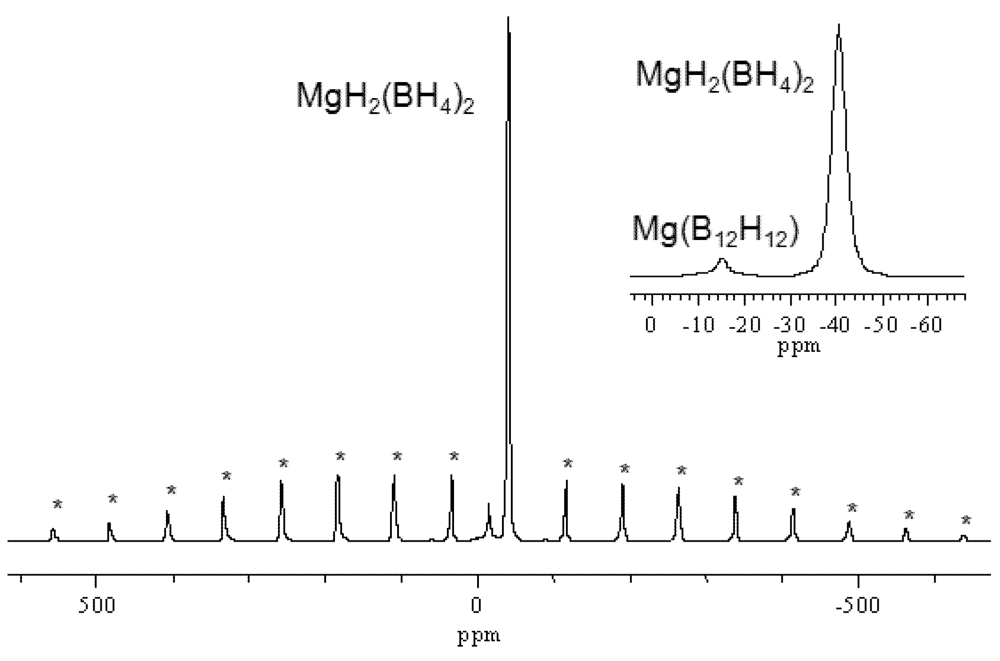
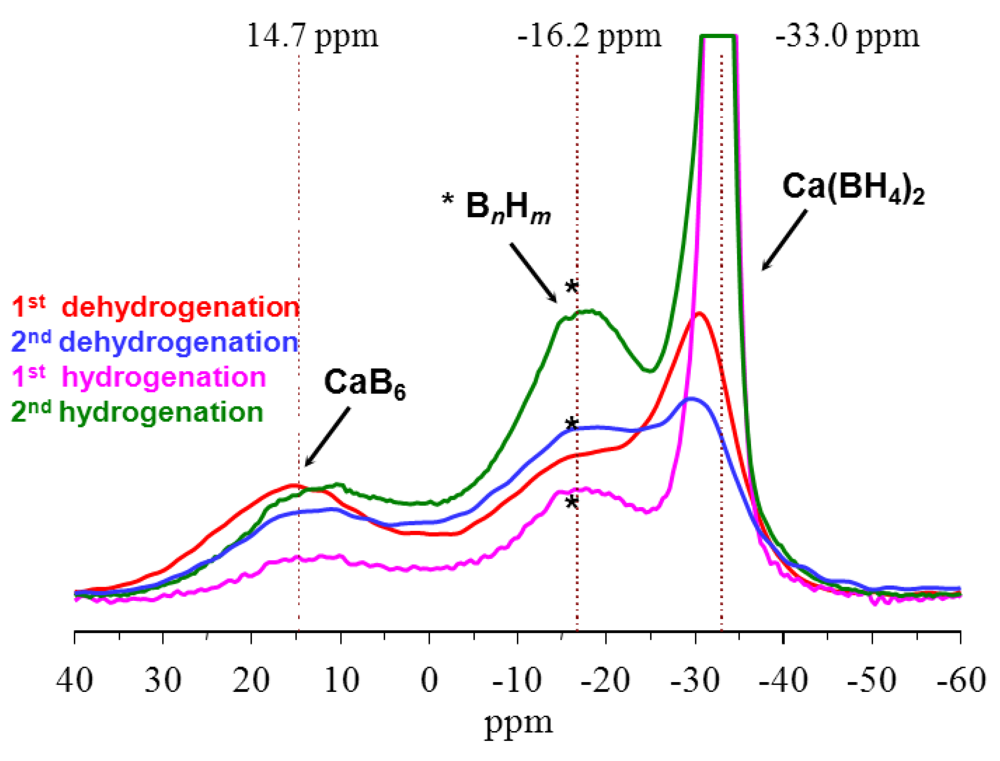
		  <p>Reversibility of Mg(BH<sub>4</sub>)<sub>2</sub> was further evaluated by Jensen <italic>et al</italic>. as they demonstrated conditions under which MgB<sub>2</sub> could be hydrogenated to Mg(BH<sub>4</sub>)<sub>2</sub> in ~75% yield [<xref ref-type="bibr" rid="B17-crystals-02-00413">17</xref>,<xref ref-type="bibr" rid="B24-crystals-02-00413">24</xref>]. MgB<sub>2</sub> was hydrogenated to Mg(BH<sub>4</sub>)<sub>2</sub> at 950 bar at 673 K and subsequent desorption of the product at 800 K yielded 11.4 wt.% H<sub>2</sub> with &lt;5% converted to MgB<sub>12</sub>H<sub>12</sub> as confirmed by the peak at −15 ppm using magic angle spinning (MAS) <sup>11</sup>B nuclear magnetic resonance (NMR) spectroscopy (<xref ref-type="fig" rid="crystals-02-00413-f004">Figure 4</xref>). Subsequent reports by Jensen et al. have demonstrated cycling of 12 wt.% at 803 K [<xref ref-type="bibr" rid="B38-crystals-02-00413">38</xref>]. Attempts to lower the hydrogenation temperature through addition of oxidative additives (<italic>i.e</italic>., NiCl<sub>2</sub>, FeCl<sub>3</sub>, TiCl<sub>3</sub>, <italic>etc</italic>.) had no effect. However, these results demonstrated the plausibility of a reversible high capacity borohydride material that has the potential to meet the stringent performance demands for automotive applications, as well as, being adaptable for emerging fuel cell applications.</p>
          <fig id="crystals-02-00413-f004" position="anchor">
            <label>Figure 4</label>
            <caption>
              <p><sup>11</sup>B MAS-NMR spectra of synthesized Mg(BH<sub>4</sub>)<sub>2</sub> at 950 bar and 673 K. Inset highlights formation of Mg(B<sub>12</sub>H<sub>12</sub>) at −15 ppm. Asterisked peaks are spinning side bands. Adapted with permission from 
			  [<xref ref-type="bibr" rid="B17-crystals-02-00413">17</xref>].</p>
            </caption>
            <graphic xmlns:xlink="http://www.w3.org/1999/xlink" xlink:href="crystals-02-00413-g004.tif"/>
          </fig>
          <p>Calcium borohydride, Ca(BH<sub>4</sub>)<sub>2</sub>, also received considerable attention within the MHCoE as it has the potential to reversibly release 9.5 wt.% H<sub>2</sub> through reactions 9a-b in <xref ref-type="table" rid="crystals-02-00413-t001">Table 1</xref>. Investigations into the H<sub>2</sub> cycling behavior of Ca(BH<sub>4</sub>)<sub>2</sub> showed a continual decrease in Ca(BH<sub>4</sub>)<sub>2</sub> starting material (<xref ref-type="fig" rid="crystals-02-00413-f005">Figure 5</xref>) which suggested the formation of a thermally stable intermediate compound as in the decomposition reaction theoretically predicted by Ozolins <italic>et al.</italic> [<xref ref-type="bibr" rid="B25-crystals-02-00413">25</xref>]. <sup>11</sup>B MAS NMR studies of cycled Ca(BH<sub>4</sub>)<sub>2</sub> (<xref ref-type="fig" rid="crystals-02-00413-f006">Figure 6</xref>) verified the formation a CaB<sub>12</sub>H<sub>12</sub> intermediate after comparison with other metal salt dodecahydro-<italic>closo</italic>-dodecaborate NMR spectra [<xref ref-type="bibr" rid="B39-crystals-02-00413">39</xref>,<xref ref-type="bibr" rid="B40-crystals-02-00413">40</xref>,<xref ref-type="bibr" rid="B41-crystals-02-00413">41</xref>]. Further efforts focused on understanding the stability and the possibility of lowering the ΔH<sub>dec</sub> for hydrogen release from CaB<sub>12</sub>H<sub>12</sub> through destabilization experiments [<xref ref-type="bibr" rid="B41-crystals-02-00413">41</xref>].</p>
          <fig id="crystals-02-00413-f005" position="anchor">
            <label>Figure 5</label>
            <caption>
              <p>Desorption/adsorption plots of cycling capacity loss for Ca(BH<sub>4</sub>)<sub>2</sub>. Adapted with permission from [<xref ref-type="bibr" rid="B39-crystals-02-00413">39</xref>].</p>
            </caption>
            <graphic xmlns:xlink="http://www.w3.org/1999/xlink" xlink:href="crystals-02-00413-g005.tif"/>
          </fig>
          <fig id="crystals-02-00413-f006" position="anchor">
            <label>Figure 6</label>
            <caption>
              <p><sup>11</sup>B MAS-NMR spectra of Ca(BH<sub>4</sub>)<sub>2</sub> thermal cycling. The peak at −18 ppm was assigned to B<sub>12</sub>H<sub>12</sub> after comparison to reference K<sub>2</sub>B<sub>12</sub>H<sub>12</sub>. Adapted with permission from [<xref ref-type="bibr" rid="B39-crystals-02-00413">39</xref>].</p>
            </caption>
            <graphic xmlns:xlink="http://www.w3.org/1999/xlink" xlink:href="crystals-02-00413-g006.tif"/>
          </fig>
        </sec>
        <sec>
          <title>2.1.2. Complex Amide/Imide Hydrides</title>
          <p>Lithiated amide/imide hydrides are another class of hydrogen storage materials with the potential to deliver high capacity at reasonable pressures; however, as observed for many complex materials, the temperature required to release hydrogen at reasonable pressures is too high for practical applications. Interest in amide/imide materials was stimulated by the report from Chen <italic>et al.</italic> [<xref ref-type="bibr" rid="B27-crystals-02-00413">27</xref>] that &gt;10 wt.% H<sub>2</sub> could be reversibly desorbed from Li<sub>3</sub>N in two steps [<xref ref-type="table" rid="crystals-02-00413-t001">Table 1</xref>, reaction 10]. However, the plateau pressure for the first step in the reaction is only 0.01 bar at 528 K which is below the operational pressure required for a PEM FC (<italic>i.e</italic>., 5 bar), thus future studies primarily focused on the lithium imide (<italic>i.e</italic>., Li<sub>2</sub>NH) reaction. At least fifteen different amide/imide related materials were investigated during the course of the MHCoE; however, for brevity, the two most prominent systems (<italic>i.e</italic>., 2 LiNH<sub>2</sub> + MgH<sub>2</sub> and LiMgN) will be described.</p>
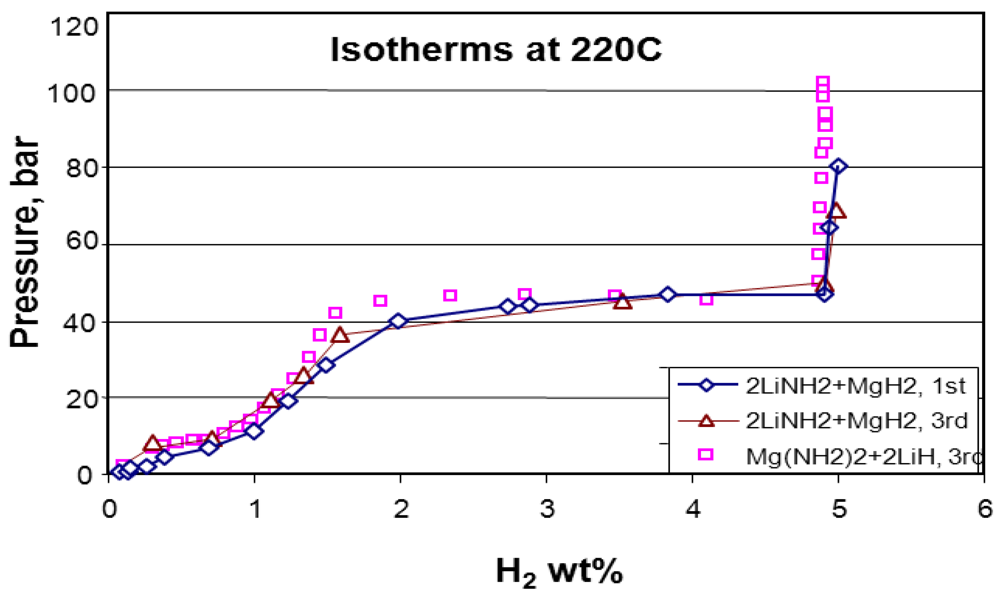
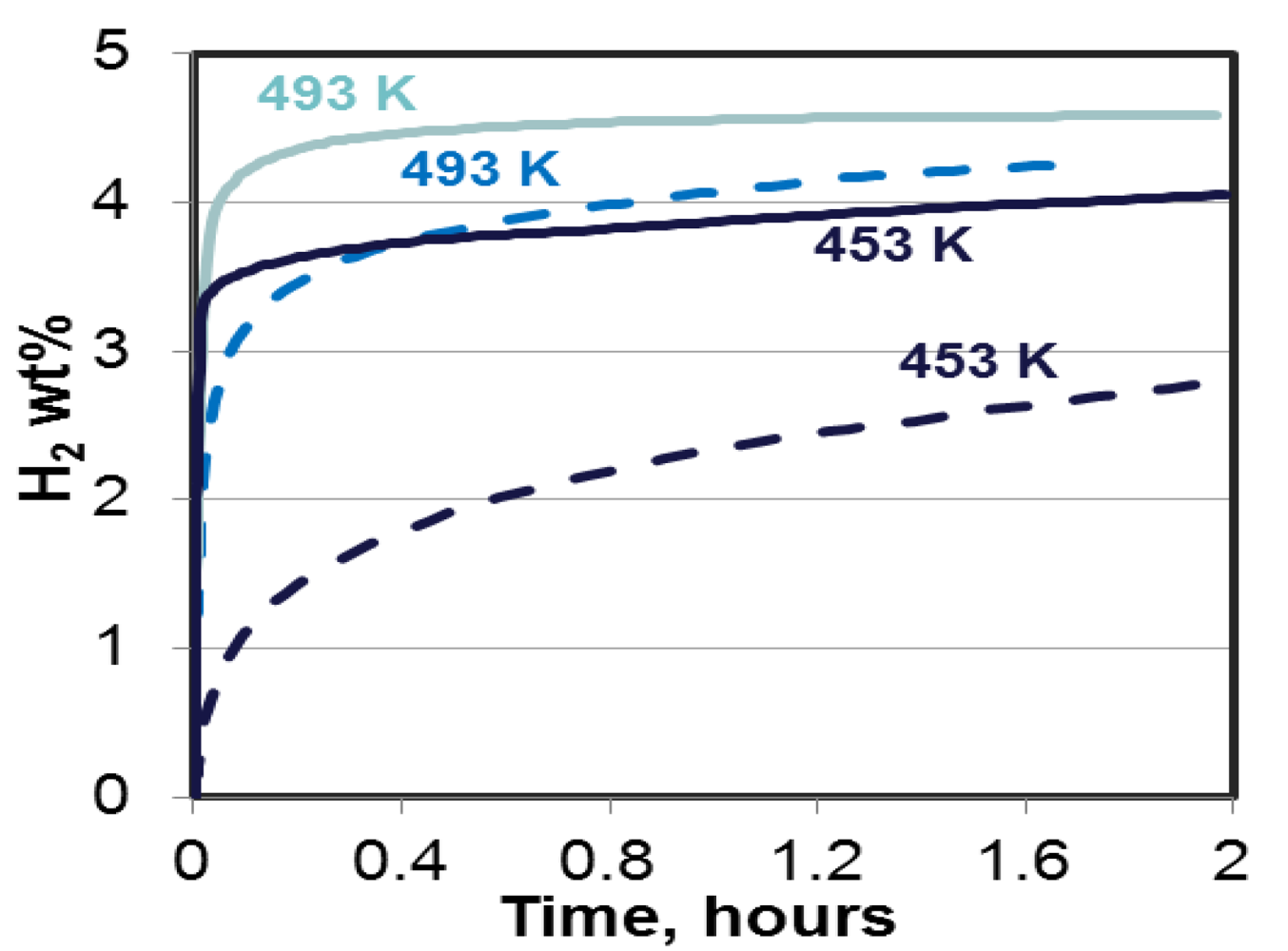
          <p>Initial studies within the MHCoE were focused on lowering the temperature of the Li<sub>2</sub>NH desorption reaction through destabilization methodologies. Luo <italic>et al.</italic> [<xref ref-type="bibr" rid="B42-crystals-02-00413">42</xref>,<xref ref-type="bibr" rid="B43-crystals-02-00413">43</xref>] used a partial substitution of Li with Mg by ball milling a 2:1 molar ratio of LiNH<sub>2</sub> and MgH<sub>2</sub> [<xref ref-type="table" rid="crystals-02-00413-t001">Table 1</xref>, reaction 11] which reversibly desorbed ~5.2 wt.% H<sub>2</sub> at 493 K and 30 bar (Δ<italic>H</italic> = 39 kJ/mol H<sub>2</sub>) as shown in the PCT (<xref ref-type="fig" rid="crystals-02-00413-f007">Figure 7</xref>), which is a substantial increase in the plateau pressure compared to [<xref ref-type="bibr" rid="B27-crystals-02-00413">27</xref>]. Cyclic stability testing of this material indicated ~23% H<sub>2</sub> capacity loss after 264 cycles; presumably due to loss of N through ammonia release. Moreover, the addition of catalytic additives, such as KH, significantly increased the H<sub>2</sub> release kinetics of this system (<xref ref-type="fig" rid="crystals-02-00413-f008">Figure 8</xref>), allowing the desorption temperature to be lowered closer to the operational temperature range for a PEM FC (<italic>i.e</italic>., 353 K–393 K) which is thought to occur through the formation of K-N species after diffusion of K<sup>+</sup> into the imide and amide phase boundaries; consequently weakening the amide and imide bonds [<xref ref-type="bibr" rid="B44-crystals-02-00413">44</xref>]. </p>
          <fig id="crystals-02-00413-f007" position="anchor">
            <label>Figure 7</label>
            <caption>
              <p>Cyclic pressure-composition isotherms of 2LiNH<sub>2</sub> + MgH<sub>2</sub> at 493 K. Adapted with permission from [<xref ref-type="bibr" rid="B43-crystals-02-00413">43</xref>].</p>
            </caption>
            <graphic xmlns:xlink="http://www.w3.org/1999/xlink" xlink:href="crystals-02-00413-g007.tif"/>
          </fig>
          <fig id="crystals-02-00413-f008" position="anchor">
            <label>Figure 8</label>
            <caption>
              <p>Dehydrogenation isotherms showing the effect of KH additives on the kinetics of LiNH<sub>2</sub>/MgH<sub>2</sub>. Solid lines = 4 mol% KH and dash lines = no KH. Adapted with permission [<xref ref-type="bibr" rid="B39-crystals-02-00413">39</xref>].</p>
            </caption>
            <graphic xmlns:xlink="http://www.w3.org/1999/xlink" xlink:href="crystals-02-00413-g008.tif"/>
          </fig>
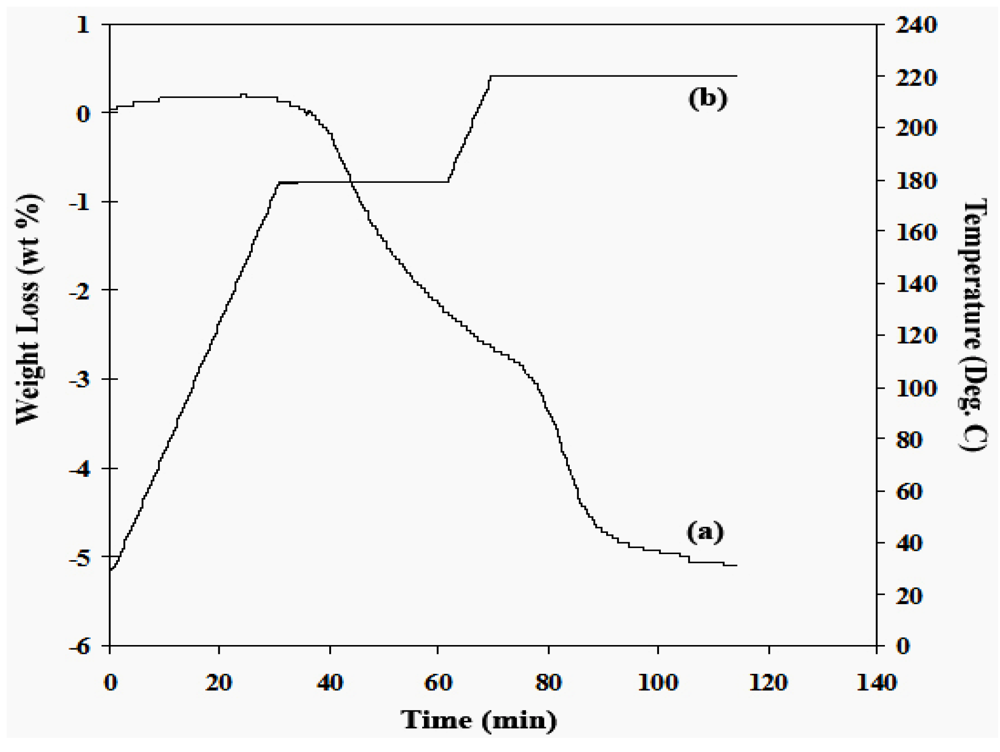
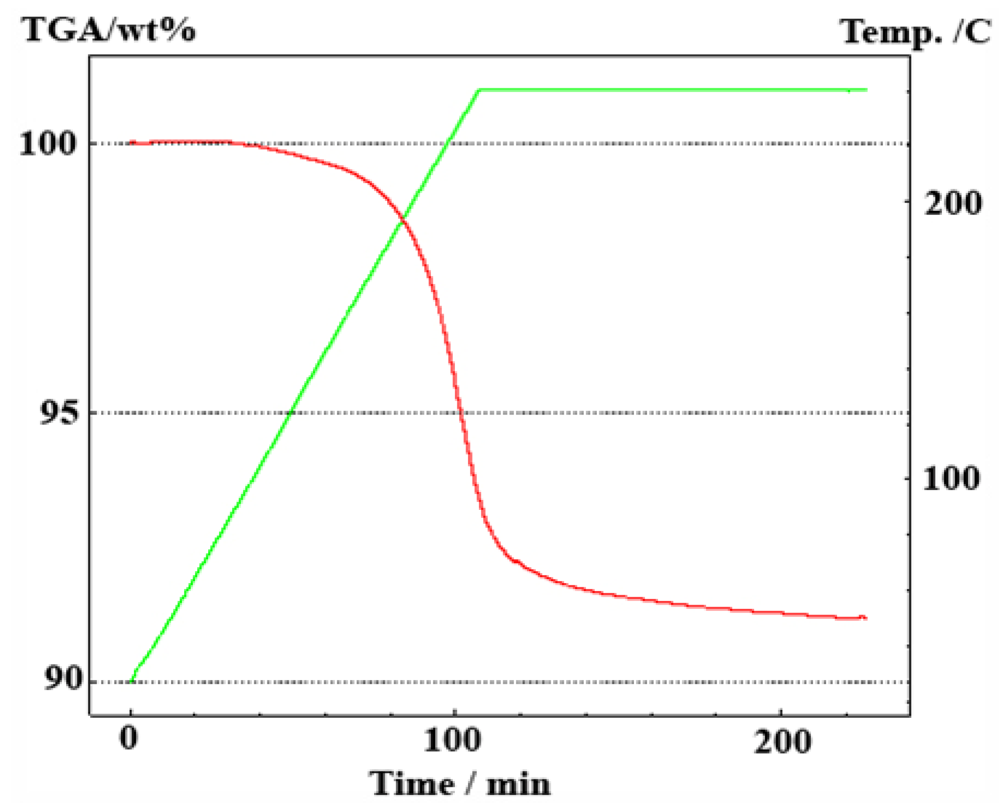
          <p>Another prominent amide/imide reaction was discovered empirically by Fang <italic>et al.</italic> [<xref ref-type="bibr" rid="B45-crystals-02-00413">45</xref>] by simply adjusting the molar ratio of reactants in the LiNH<sub>2</sub>/MgH<sub>2</sub> system. First principle calculations predicted that a 1:1 LiNH<sub>2</sub>:MgH<sub>2</sub> molar ratio would react [<xref ref-type="table" rid="crystals-02-00413-t001">Table 1</xref>, reaction 12] to evolve 2 moles of H<sub>2</sub>(8.2 wt.% H<sub>2</sub>) and produce LiMgN which could be reversibly cycled with a Δ<italic>H</italic> ≈ 32 kJ/mol H<sub>2</sub> [<xref ref-type="bibr" rid="B46-crystals-02-00413">46</xref>,<xref ref-type="bibr" rid="B47-crystals-02-00413">47</xref>]. Initial experiments to rehydrogenate the LiMgN product indicated only ~5 wt.% H<sub>2</sub> uptake at 513 K and 138 bar as shown by TGA analysis (<xref ref-type="fig" rid="crystals-02-00413-f009">Figure 9</xref>). The thermal gravimetric analysis (TGA) curve also suggested that the reaction was a two-step process in contrast to what was originally predicted in reaction 14. XRD and TGA analysis of the hydrogenated species of reaction 12 indicated partial hydrogenation, the researchers presumed the incomplete hydrogenation was kinetically limited and attempted to adjust the adsorption/desorption kinetics by addition of a known catalyst for hydrogen storage reactions, TiCl<sub>3</sub>. The addition of 4 wt.% of TiCl<sub>3</sub> to LiMgN allows almost complete rehydrogenation to 8.0 wt.% H<sub>2</sub> as determined by the TGA curve in <xref ref-type="fig" rid="crystals-02-00413-f010">Figure 10</xref> of the subsequent dehydrogenation of Ti-catalyzed LiMgN at 513 K, which is a considerable improvement over the non-catalyzed case. Further XRD and FTIR analysis of the adsorption/desorption reaction products supported a two-step reversible reaction shown in reactions 13a-b of <xref ref-type="table" rid="crystals-02-00413-t001">Table 1</xref>. However, long term cycling of the reaction still needs to be examined.</p>
          <fig id="crystals-02-00413-f009" position="anchor">
            <label>Figure 9</label>
            <caption>
              <p>TGA curve for uncatalyzed LiMgN after hydrogenation at 513 K and 138 bar. Adapted with permission from [<xref ref-type="bibr" rid="B45-crystals-02-00413">45</xref>].</p>
            </caption>
            <graphic xmlns:xlink="http://www.w3.org/1999/xlink" xlink:href="crystals-02-00413-g009.tif"/>
          </fig>
          <fig id="crystals-02-00413-f010" position="anchor">
            <label>Figure 10</label>
            <caption>
              <p>TGA curve of the dehydrogenation of ball-milled/jar rolled Ti-catalyzed LiMgN after hydrogenation at 433 K and 138 bar. Adapted with permission from [<xref ref-type="bibr" rid="B28-crystals-02-00413">28</xref>].</p>
            </caption>
            <graphic xmlns:xlink="http://www.w3.org/1999/xlink" xlink:href="crystals-02-00413-g010.tif"/>
          </fig>
          <p>An issue related to the use of all amide/imide materials is the release of NH<sub>3</sub> during the desorption reaction as this represents both a loss of material during reaction that cannot be recovered and an impurity with sizable detrimental effects on PEM FC membrane materials even at trace concentrations (<italic>i.e</italic>., &lt;1 ppm/v). As such, NH<sub>3</sub> impurities in the desorbed H<sub>2</sub> gas from the Li-Mg-N-H systems were measured and estimated by Luo <italic>et al.</italic> [<xref ref-type="bibr" rid="B48-crystals-02-00413">48</xref>]. The measurements showed that NH<sub>3</sub> concentrations increased with the desorption temperature, from 180 ppm/v at 453 K to 720 ppm/v at 513 K. Additionally, after 270 cycles, the authors determined that NH<sub>3</sub>-formation during desorption accounted for ~7% of the capacity loss due to the loss of nitrogen during cycling. Thus, before these materials can be used in practical hydrogen storage systems, more effort must be focused on reducing or mitigating NH<sub>3</sub> formation in the dehydrogenation reactions. </p>
        </sec>
        <sec>
          <title>2.1.3. Aluminum Hydride (Alane)</title>
          <p>Aluminum hydride, AlH<sub>3</sub>, is a well characterized hydrogen storage material with a gravimetric capacity of 10 wt.% H<sub>2</sub> and volumetric capacity of 149 g-H<sub>2</sub>/L through an endothermic dehydrogenation reaction [<xref ref-type="table" rid="crystals-02-00413-t001">Table 1</xref>, reaction 5]. It is a thermodynamically unstable but kinetically stabilized material that can deliver more than 0.01 g-H<sub>2</sub>-s<sup>−1</sup>kg<sup>−1</sup> above 385 K. However, direct hydrogenation of aluminum to alane requires over 10<sup>5</sup> bars of hydrogen pressure at room temperature and traditional organometallic routes are economically impractical for large scale implementation of this material [<xref ref-type="bibr" rid="B49-crystals-02-00413">49</xref>], thus the focus of the MHCoE with respect to alane was towards developing a cost and energy effective regeneration method. The approaches considered within the MHCoE were (1) an organometallic adduct-assisted process and (2) a non-aqueous electrochemical process.</p>
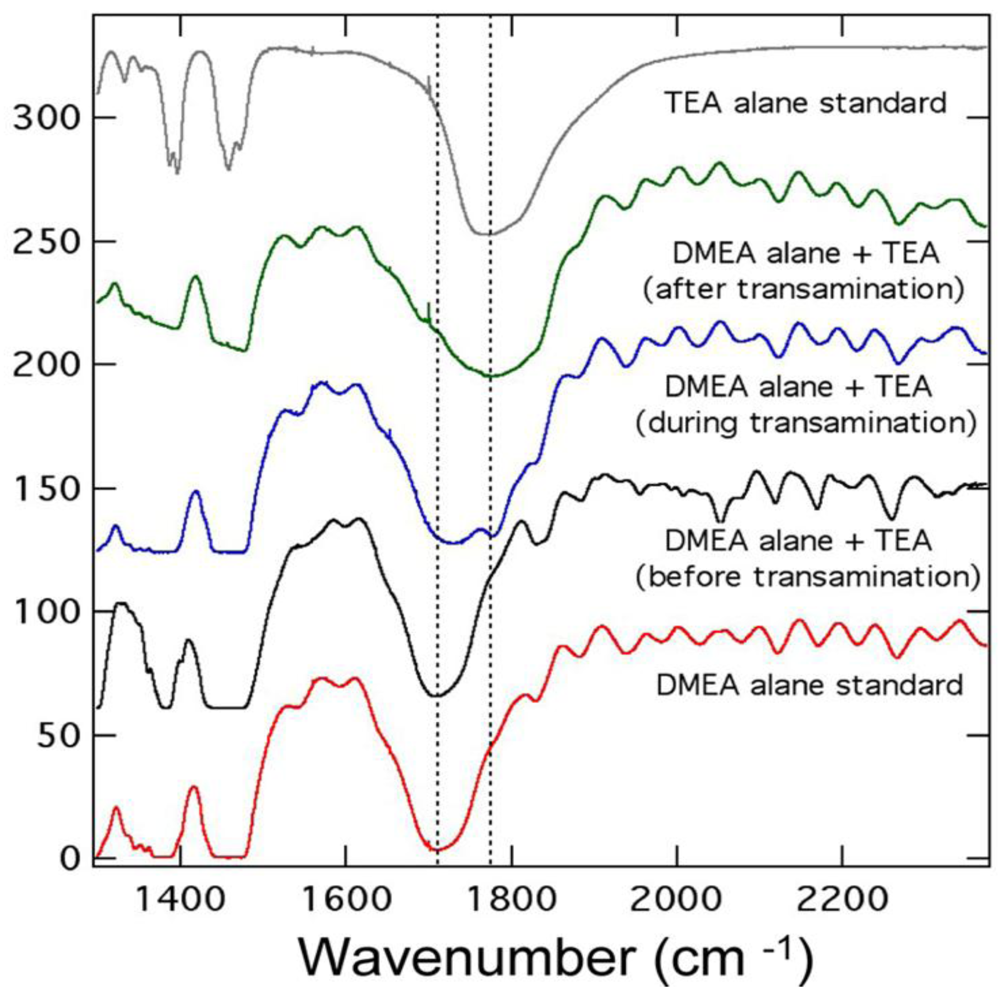
          <p>Graetz <italic>et al.</italic> investigated a method for forming alane through a multi-step organometallic adduct-assisted process [<xref ref-type="bibr" rid="B19-crystals-02-00413">19</xref>,<xref ref-type="bibr" rid="B50-crystals-02-00413">50</xref>]. In general, the process involves (1) the formation of an adduct-intermediate hydride phase by direct hydrogenation and (2) then the decomposition of the intermediate phase to recover the pure hydride. In preliminary work on adduct-assisted process, a Ti-doped triethyleneamine (TEDA)–AlH<sub>3</sub> adduct regeneration scheme was demonstrated to be low-temperature, low-pressure and reversible; however, the TEDA-AlH<sub>3</sub> adduct was particularly stable so that attempts to recover the AlH<sub>3</sub> product thermally resulted in large quantities of H<sub>2</sub> being desorbed as well, thus lowering the efficiency of the overall process. Consequently, formation of the complex from a less stable adduct (<italic>i.e</italic>., lower boiling point) proved unsuccessful as well. An alternative approach to circumvent this problem was to form the adduct-complex with a moderately stable adduct (dimethylethylamine, DMEA) and then convert (<italic>i.e</italic>., transaminate) the adduct-complex to a form that was easily recoverable by thermal means. This approach was successfully demonstrated experimentally in three steps as shown in Equations 12–14 and followed via vibrational spectroscopy, shown in <xref ref-type="fig" rid="crystals-02-00413-f011">Figure 11</xref>. The Ti-catalyzed DMEA-AlH<sub>3</sub> adduct is formed [Equation 2] under mild pressure (65–70 bar) at a 50% yield followed by transamination [Equation 3] with triethylamine (TEA) at 328 K and 1 bar and finally the TEA is desorbed at 343 K and partial vacuum [Equation 4] to give the AlH<sub>3</sub> product in &lt;80% yield from the TEA. The FTIR spectra in <xref ref-type="fig" rid="crystals-02-00413-f011">Figure 11</xref> show the distinct shift in peaks of the Al-H stretch during the transamination from DMEA to TEA. All reagents except Al and H<sub>2</sub> are expected to be recovered and recycled. However, a significant drawback of the method was the energy required to execute the chemical processing steps as Ahluwalia <italic>et al.</italic> found the well-to-tank energy efficiency (WTTE) to be only 24% [<xref ref-type="bibr" rid="B4-crystals-02-00413">4</xref>,<xref ref-type="bibr" rid="B51-crystals-02-00413">51</xref>], although the WTTE increases to 42% if low temperature waste heat can be used. Yet, this still falls short of the 70% WTTE needed for alane to meet the DOE well-to-powerplant efficiency target of 60% for off-board regenerable materials [<xref ref-type="bibr" rid="B5-crystals-02-00413">5</xref>] after factoring in the predicted onboard efficiency of alane (<italic>i.e</italic>., 85%) [<xref ref-type="bibr" rid="B51-crystals-02-00413">51</xref>].</p>
          <p>
            <italic>Adduct Formation:</italic>
          </p>
          <disp-formula id="crystals-02-00413-i002">
		<inline-graphic xmlns:xlink="http://www.w3.org/1999/xlink" xlink:href="crystals-02-00413-i002.tif"/>
		<label>(2)</label>
		</disp-formula>
          <p>
            <italic>Transamination:</italic>
          </p>
          <disp-formula id="crystals-02-00413-i003">
		<inline-graphic xmlns:xlink="http://www.w3.org/1999/xlink" xlink:href="crystals-02-00413-i003.tif"/>
		<label>(3)</label>
		</disp-formula>
          <p>
            <italic>Separation/Recovery:</italic>
          </p>
          <disp-formula id="crystals-02-00413-i004">
		<inline-graphic xmlns:xlink="http://www.w3.org/1999/xlink" xlink:href="crystals-02-00413-i004.tif"/>
		<label>(4)</label>
		</disp-formula>
          <fig id="crystals-02-00413-f011" position="anchor">
            <label>Figure 11</label>
            <caption>
              <p>FTIR spectra of the transamination of triethylamine (TEA) and dimethylethylamine (DMEA) alane adducts at various stages of the process. Adapted with permission from 
			  [<xref ref-type="bibr" rid="B50-crystals-02-00413">50</xref>].</p>
            </caption>
            <graphic xmlns:xlink="http://www.w3.org/1999/xlink" xlink:href="crystals-02-00413-g011.tif"/>
          </fig>
          
		  <p>Another approach to regenerate alane was explored by Zidan <italic>et al.</italic> [<xref ref-type="bibr" rid="B52-crystals-02-00413">52</xref>,<xref ref-type="bibr" rid="B53-crystals-02-00413">53</xref>]. This process uses electrolytic potential to replace the high hydrogen pressure potential and increase the hydrogen activity to drive the chemical reactions and yield high purity AlH<sub>3</sub>. The idea is described by Faraday’s Equation [Equation 5] where E is the electrical potential, <italic>F</italic> is Faraday’s constant, <italic>R</italic> is the gas constant, <italic>T</italic> is temperature and <italic>P</italic> is the hydrogen pressure.</p>
          <disp-formula id="crystals-02-00413-i005">
		  <inline-graphic xmlns:xlink="http://www.w3.org/1999/xlink" xlink:href="crystals-02-00413-i005.tif"/>
		  <label>(2)</label>
		  </disp-formula>
          <p>Since the electrolytic potential scales as the natural log of pressure, the thermodynamic requirements can be met with a reasonably low voltage. The electrolysis reaction is carried out in an electrolytic solution of a complex alanate (<italic>i.e</italic>., NaAlH<sub>4</sub>) dissolved in a polar, aprotic solvent such as THF. A constant potential is used to drive the formation of alane and an alkali halide, NaH, from the alanate electrolyte. The starting alanate is regenerated by direct hydrogenation of the spent Al metal with the byproduct NaH. Assuming high yield of the alane, the process should notionally cost the heat of formation of NaAlH<sub>4</sub>, which is −115 kJ/mol. However, empirically, recovery of pure alane at 100% yield has not been demonstrated with this reaction and also energy losses through processes of adduct separation have been observed. More recently, the same group demonstrated yield and efficiency improvements with the use of lithium alanate in DME as the electrolyte (demonstrated by Jensen <italic>et al</italic>. [<xref ref-type="bibr" rid="B54-crystals-02-00413">54</xref>]) and the introduction of LiCl as an electro-catalytic additive [<xref ref-type="bibr" rid="B53-crystals-02-00413">53</xref>].</p>
        </sec>
        <sec>
          <title>2.1.4. Destabilized Hydrides</title>
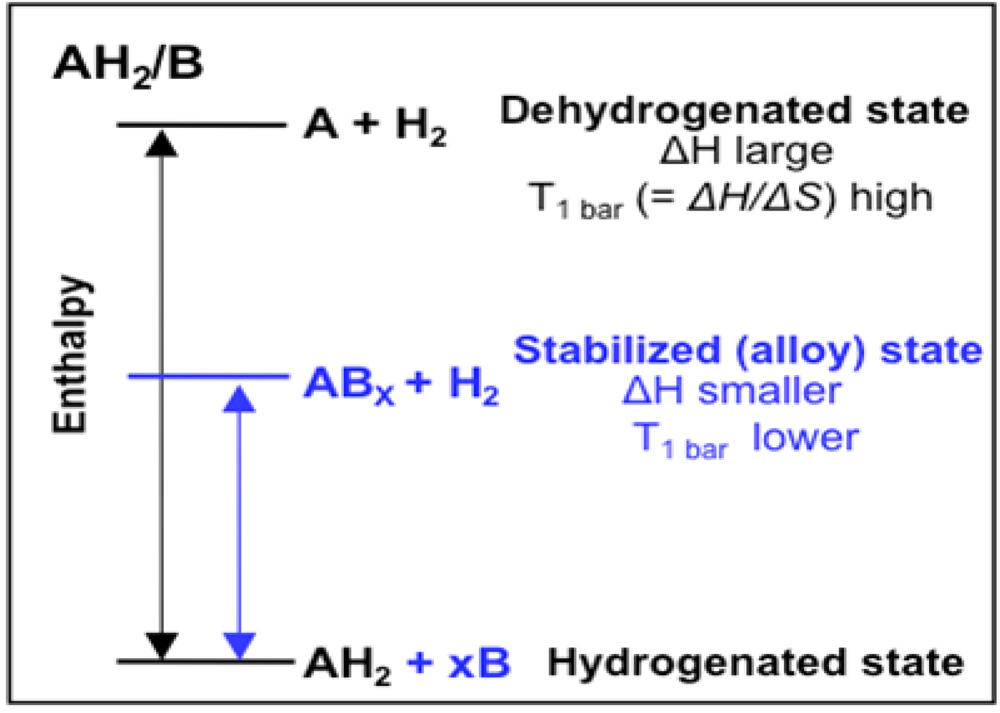
          <p>Another concept that was explored within the MHCoE to improve dehydrogenation thermodynamics involved incorporating a second species into the reaction of a thermodynamically stable complex hydride (<xref ref-type="fig" rid="crystals-02-00413-f012">Figure 12</xref>) also called “destabilization”. It is worth pointing out that the individual compounds are not destabilized but rather the overall reaction is destabilized by decomposing to a more stable alloy thus requiring less energy for decomposition. During the MHCoE, many new destabilized hydride material systems were explored both computationally [<xref ref-type="bibr" rid="B46-crystals-02-00413">46</xref>,<xref ref-type="bibr" rid="B47-crystals-02-00413">47</xref>,<xref ref-type="bibr" rid="B55-crystals-02-00413">55</xref>,<xref ref-type="bibr" rid="B56-crystals-02-00413">56</xref>,<xref ref-type="bibr" rid="B57-crystals-02-00413">57</xref>,<xref ref-type="bibr" rid="B58-crystals-02-00413">58</xref>,<xref ref-type="bibr" rid="B59-crystals-02-00413">59</xref>] and experimentally (e.g., LiBH<sub>4</sub>/MgF<sub>2</sub>, LiBH<sub>4</sub>/MgCl<sub>2</sub>, LiNH<sub>2</sub>/MgH<sub>2</sub>, LiBH<sub>4</sub>/Mg<sub>2</sub>NiH<sub>4</sub>, <italic>etc</italic>.) [<xref ref-type="bibr" rid="B18-crystals-02-00413">18</xref>,<xref ref-type="bibr" rid="B45-crystals-02-00413">45</xref>,<xref ref-type="bibr" rid="B57-crystals-02-00413">57</xref>,<xref ref-type="bibr" rid="B60-crystals-02-00413">60</xref>,<xref ref-type="bibr" rid="B61-crystals-02-00413">61</xref>,<xref ref-type="bibr" rid="B62-crystals-02-00413">62</xref>,<xref ref-type="bibr" rid="B63-crystals-02-00413">63</xref>,<xref ref-type="bibr" rid="B64-crystals-02-00413">64</xref>,<xref ref-type="bibr" rid="B65-crystals-02-00413">65</xref>,<xref ref-type="bibr" rid="B66-crystals-02-00413">66</xref>,<xref ref-type="bibr" rid="B67-crystals-02-00413">67</xref>,<xref ref-type="bibr" rid="B68-crystals-02-00413">68</xref>,<xref ref-type="bibr" rid="B69-crystals-02-00413">69</xref>,<xref ref-type="bibr" rid="B70-crystals-02-00413">70</xref>,<xref ref-type="bibr" rid="B71-crystals-02-00413">71</xref>,<xref ref-type="bibr" rid="B72-crystals-02-00413">72</xref>,<xref ref-type="bibr" rid="B73-crystals-02-00413">73</xref>]; however, we will briefly highlight an example and discuss implications for further research.</p>
          <fig id="crystals-02-00413-f012" position="anchor">
            <label>Figure 12</label>
            <caption>
              <p>Schematic representation of the destabilization concept. Adapted with permission from [<xref ref-type="bibr" rid="B16-crystals-02-00413">16</xref>].</p>
            </caption>
            <graphic xmlns:xlink="http://www.w3.org/1999/xlink" xlink:href="crystals-02-00413-g012.tif"/>
          </fig>
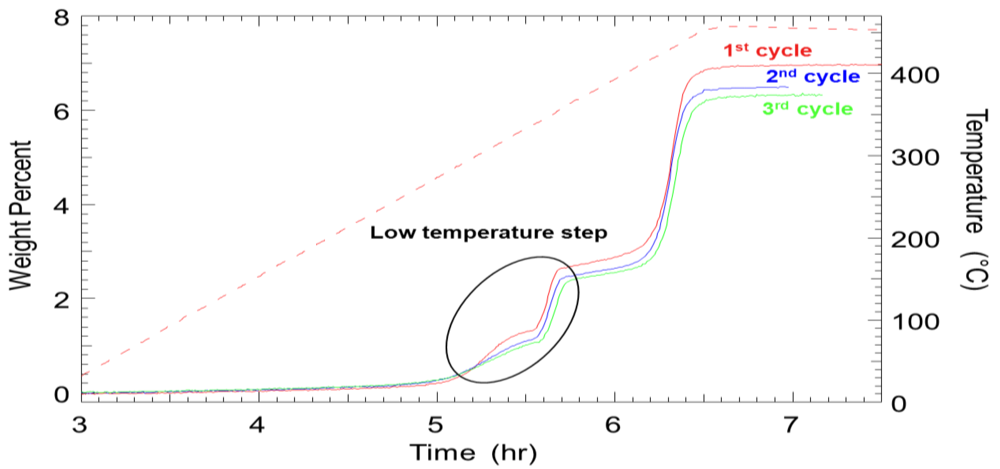
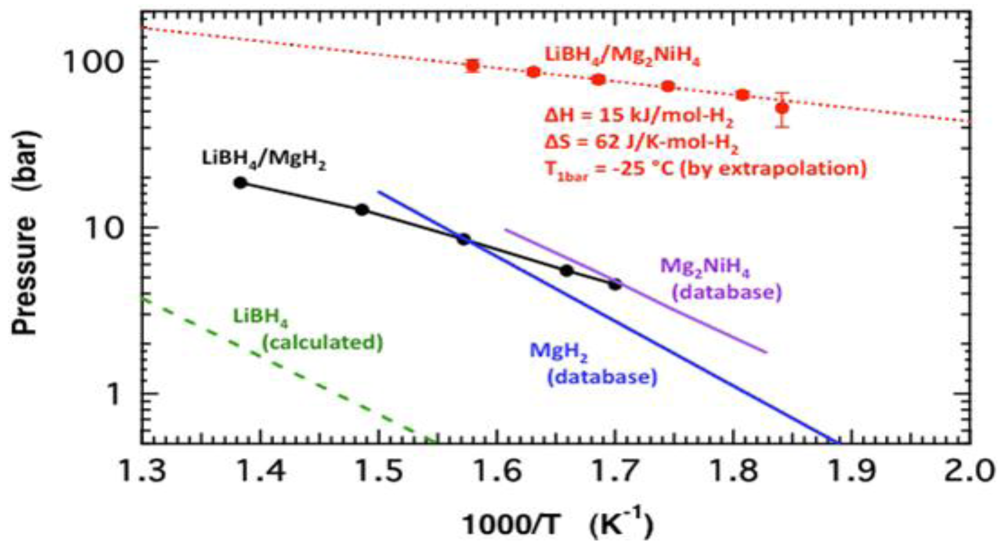
          <p>Vajo <italic>et al.</italic> [<xref ref-type="bibr" rid="B16-crystals-02-00413">16</xref>,<xref ref-type="bibr" rid="B67-crystals-02-00413">67</xref>] demonstrated a remarkable “destabilized” material system in LiBH<sub>4</sub>/Mg<sub>2</sub>NiH<sub>4</sub>. The reaction revealed many new features contradictory to the individual complex compounds such as full reversibility, low enthalpy and entropy and reaction through a unique low-temperature kinetic pathway. The dehydrogenation of the destabilized mixture is shown in <xref ref-type="fig" rid="crystals-02-00413-f013">Figure 13</xref> and the complete dehydrogenation reaction is shown in <xref ref-type="table" rid="crystals-02-00413-t001">Table 1</xref>, reaction 2. This reaction releases 6.5 wt.% H<sub>2</sub> on a total material basis and as <xref ref-type="fig" rid="crystals-02-00413-f013">Figure 13</xref> shows, the dehydrogenation occurs at temperatures lower than the individual pure components (<italic>i.e</italic>., LiBH<sub>4</sub> or Mg<sub>2</sub>NiH4) begin to desorb significant quantities of H<sub>2</sub> (<italic>i.e</italic>., ~598 K) and indicates a new hydrogen release pathway that likely occurs through reaction of the individual components rather than sequential release and reaction of the components as observed in other destabilized material systems [<xref ref-type="bibr" rid="B16-crystals-02-00413">16</xref>]. The enhanced kinetics of the system allowed it’s equilibrium to be characterized over a wider temperature range as shown in <xref ref-type="fig" rid="crystals-02-00413-f014">Figure 14</xref>. This system demonstrated the lowest thermodynamic properties of any reversible complex hydride with a Δ<italic>H</italic> = 15 kJ/mol H<sub>2</sub> and Δ<italic>S</italic> = 62 J/K-mol H<sub>2</sub>, however the capacity for the low temperature step (<italic>i.e</italic>., 2.6 wt.% H<sub>2</sub>) is too low for practical use on-board vehicles.</p>
          <fig id="crystals-02-00413-f013" position="anchor">
            <label>Figure 13</label>
            <caption>
              <p>Dehydrogenation cycling curves of the LiBH<sub>4</sub>/Mg<sub>2</sub>NiH<sub>4</sub> destabilized system. The circled portion highlights the low temperature step not observed in the pure component dehydrogenation. Adapted with permission from [<xref ref-type="bibr" rid="B16-crystals-02-00413">16</xref>].</p>
            </caption>
            <graphic xmlns:xlink="http://www.w3.org/1999/xlink" xlink:href="crystals-02-00413-g013.tif"/>
          </fig>
          <p>Although this approach has proven to be effective in tuning the thermodynamic properties of complex hydrides, the weight penalty of adding a second species can reduce the gravimetric capacity of these systems unless all species added contain H<sub>2</sub> (<italic>i.e</italic>., MgH<sub>2</sub>/LiBH<sub>4</sub>). Also, as these systems involve two or more hydrides with multiple potential reaction pathways, judicious choice of the hydride combinations is needed that allows extremely fast kinetics which facilitates almost simultaneous decomposition and avoids thermodynamic “sinks”.</p>
          <fig id="crystals-02-00413-f014" position="anchor">
            <label>Figure 14</label>
            <caption>
              <p>van’t Hoff plots of LiBH<sub>4</sub>, MgNiH<sub>4</sub> and MgH<sub>2</sub> destabilized systems. Adapted with permission from [<xref ref-type="bibr" rid="B16-crystals-02-00413">16</xref>].</p>
            </caption>
            <graphic xmlns:xlink="http://www.w3.org/1999/xlink" xlink:href="crystals-02-00413-g014.tif"/>
          </fig>
          
		</sec>
        <sec id="sec2dot1dot5-crystals-02-00413">
          <title>2.1.5. Computational Guidance of Metal Hydride Development</title>
          <p>Computational studies were an integrated function of each of the experimental endeavors within the MHCoE. First-principles methods such as Prototype Electrostatic Ground State [<xref ref-type="bibr" rid="B74-crystals-02-00413">74</xref>] were developed and used to predict new crystalline materials and their thermodynamic properties, as well as provide validation of experimental results. It is estimated that computational methods allowed such rapid screening that over twenty million reactions were assessed for favorable hydrogen release properties over the duration of the Center [<xref ref-type="bibr" rid="B23-crystals-02-00413">23</xref>,<xref ref-type="bibr" rid="B25-crystals-02-00413">25</xref>,<xref ref-type="bibr" rid="B46-crystals-02-00413">46</xref>,<xref ref-type="bibr" rid="B47-crystals-02-00413">47</xref>,<xref ref-type="bibr" rid="B55-crystals-02-00413">55</xref>,<xref ref-type="bibr" rid="B56-crystals-02-00413">56</xref>,<xref ref-type="bibr" rid="B57-crystals-02-00413">57</xref>,<xref ref-type="bibr" rid="B59-crystals-02-00413">59</xref>,<xref ref-type="bibr" rid="B74-crystals-02-00413">74</xref>,<xref ref-type="bibr" rid="B75-crystals-02-00413">75</xref>,<xref ref-type="bibr" rid="B76-crystals-02-00413">76</xref>]. For example, during the course of the Center interest had turned to Ca(BH<sub>4</sub>)<sub>2</sub> as a potential high capacity material; however the true structure of the complex hydride was unknown. The traditional approach was lengthy to implement using a database method to iteratively search for all possible materials with the same general formula and reduce that set down to possible matches based on lowest ground state crystal structure alone, an approach that did not account for the complex electrostatic interactions that define the crystal structure of these compounds. A more logical rapid screening approach was implemented by Majzoub <italic>et al.</italic> [<xref ref-type="bibr" rid="B74-crystals-02-00413">74</xref>] that incorporated their understanding that the complex anionic materials are dominated by electrostatic interactions. By treating the complex materials as rigid units and performing a global minimization of electrostatic interactions over the crystal unit, an optimized set of crystal structures based on total energy calculations is provided that can guide or validate experimental determinations. This method was applied to many different materials screened and developed within the MHCoE. For further information on the details of the computational efforts within the MHCoE, the reader is directed to the annual progress reports published by the DOE FCT program [<xref ref-type="bibr" rid="B77-crystals-02-00413">77</xref>].</p>
        </sec>
        <sec>
          <title>2.1.6. Summary and Research Trends</title>
          <p>Significant progress was made over the five year tenure of the MHCoE to improve thermodynamics, adsorption/desorption kinetics and reversibility of metal hydride materials. Materials with exceptional gravimetric and volumetric capacities were demonstrated that make these materials attractive candidates across all hydrogen fuel cell applications. Tremendous efforts were focused on developing materials that can meet the thermodynamic requirements for automotive applications in particular; however, kinetic barriers and cyclic stability still limit their incorporation into practical applications. </p>
          <p>Thus, current research in metal hydride material systems is focused predominantly on four distinct areas: (1) exploring new ways to alter reaction pathways to reduce thermodynamic “sinks”; (2) exploring novel destabilization combinations to improve thermodynamic and kinetic properties while also using lightweight materials to improve capacities; (3) understanding the influence and correlation of additives and catalysts on crystal structures and reaction steps; and (4) discovering and applying new nanostructural approaches to improve kinetics and thermodynamics by improving diffusion pathways and limiting formation of unwanted material phases.</p>
        </sec>
      </sec>
      <sec>
        <title>2.2. Regenerable Chemical Hydrogen Storage Materials</title>
        <p>As mentioned previously, chemical hydrogen storage materials are a class of storage compounds containing large quantities of chemically bound hydrogen that can be released by heating (<italic>i.e</italic>., thermolysis) or reactions with other materials (e.g., hydrolysis reactions) which typically must be regenerated (<italic>i.e</italic>., off-board) using separate processing steps after desorption of the hydrogen. Despite demonstrating notable hydrogen storage material properties (<italic>i.e</italic>., high gravimetric capacities, fast desorption kinetics, room temperature operation, <italic>etc</italic>.), the widespread, high volume use of these materials requires a cost effective means of regenerating the fuel from the spent material. There are however “single use” low power applications that can be potentially viable if the fuel can be produced and spent fuel disposed in both sustainable and economic methods. </p>
        <p>Chemical hydrogen storage materials vary considerably in physical phases including pure-component liquids, solutions, slurries and solids, therefore careful consideration of the impacts to the overall system operation and performance should be given prior to material selection. Paramount to this is the manner in which the various chemicals release hydrogen. Basically the CHSCoE explored four approaches to releasing hydrogen from covalent compounds, hydrolysis, thermolysis, catalysis and a combination thereof. During its pursuit of the optimum chemical hydrogen storage material, the trade-offs of each approach’s effect on the overall system were also considered. For example, endothermic release materials such as the heterocyclic compounds (<italic>i.e</italic>., <italic>n</italic>-ethyl carbazole, cyclohexane, decalin, <italic>etc</italic>.), require heat and/or expensive Pt-based catalysts to release H<sub>2</sub> in sufficient amounts; this reduces the overall efficiency of the system since useable hydrogen is burned to provide the heat and the catalysts require specialized reactors that adds significant system mass. In contrast, exothermic release reactions, such as the thermolysis of AB, should not require supplementary sources of energy to drive the release reaction since the heat of reaction drives the release once initiated. However engineered controls, for instance flow reactors, generally must be used to mitigate the risk of a “run-away” reaction, leading to increasing rates of hydrogen desorption and temperature. Another considerable factor is fuel stability. The endothermic materials have inherent thermal stability and are stable at extreme ambient temperatures (<italic>i.e</italic>., ≤333 K); however, the exothermic materials could start to release hydrogen and initiate a “run-away” scenario. For slurries and solids, transporting the fuel within the on-board fuel reactor system can be complicated, requiring specialized pumps or augers that are inclined to clog [<xref ref-type="bibr" rid="B78-crystals-02-00413">78</xref>]. Also, it is important to keep in mind especially for slurries and solutions, the capacity penalties associated with the solvent volume and mass. Thus, research and development of chemical hydrogen storage materials is carried out in order to understand the mechanisms that allow control and proper tuning of thermodynamics and kinetics required to meet all of the storage system level requirements (e.g., capacities, operating temperature, cost, <italic>etc</italic>.) for emerging PEM FC applications. </p>
        <p>The DOE CHSCoE investigated hundreds of candidate materials that had the potential to meet the DOE system performance targets [<xref ref-type="bibr" rid="B5-crystals-02-00413">5</xref>]. In order to optimize gravimetric and volumetric material capacities, research within the CHSCoE was ultimately focused to compounds that contained elements of low atomic numbers such as B, C, N, <italic>etc</italic>. that have a high H molecular ratio such as borane amines that contain up to ~20 wt.% H<sub>2</sub> on a material basis. However, not all compounds demonstrated the potential to be regenerated either off-board via a chemical process or directly with hydrogen. Consequently, only those materials that received significant attention for their potential to be regeneration or rehydrogenated will be discussed in this review. Nonetheless, the reader is directed to the many accounts of research on materials that showed significant capacities which might be of value for “single use” applications [<xref ref-type="bibr" rid="B29-crystals-02-00413">29</xref>]. </p>
        <sec>
          <title>2.2.1. Ammonia Borane</title>
          <p>Much of the research within the CHSCoE focused on AB (nNH<sub>3</sub>BH<sub>3</sub>) and its derivatives as they demonstrated high capacities and rapid kinetics of hydrogen release. Thermolysis of solid AB is believed to proceed through a series of step-wise reactions [<xref ref-type="table" rid="crystals-02-00413-t001">Table 1</xref>, reactions 16a–c] with each delivering one equivalent of hydrogen per mole of AB to deliver ~17 wt.% H<sub>2</sub> at 423 K. The decomposition is characterized by an induction, nucleation then growth mechanistic pathway, whereas the solid-state AB reactions have demonstrated 180 min induction period and required up to 360 min to release only ~0.8 H<sub>2</sub>-equivalents at 358 K [<xref ref-type="bibr" rid="B79-crystals-02-00413">79</xref>,<xref ref-type="bibr" rid="B80-crystals-02-00413">80</xref>]. Autrey <italic>et al.</italic> used <sup>11</sup>B MAS-NMR to gain fundamental insight into the hydrogen release pathways from solid AB and observed the formation of new species, such as the diammoniate of diborane (DADB), during different isothermal desorptions, including the induction phase [<xref ref-type="bibr" rid="B81-crystals-02-00413">81</xref>]. This information gave insight into approaches to reduce the induction period for hydrogen release at lower temperatures. For example, addition of 5 wt.% DADB to AB was demonstrated to reduce the induction period by &gt;75% compared to neat AB heated at 353 K. However, during dehydrogenation of solid AB, the material is inclined to foam and evolves significant quantities of gas phase impurities (e.g., ammonia, borazine and diborane) and research within the center was directed to resolve these issues, identify approaches to minimize foaming and additives to minimize impurities in solid AB [<xref ref-type="bibr" rid="B34-crystals-02-00413">34</xref>,<xref ref-type="bibr" rid="B82-crystals-02-00413">82</xref>]. The CHSCoE also investigated solubilized AB materials that involved liquid based compositions that could effectively utilize catalysts to reduce the temperature of hydrogen release while maintaining hydrogen capacity above 2 equivalents of H<sub>2</sub>.</p>
          <p>Alternative approaches to thermal dehydrogenation of solid AB are solution-based catalysis and ionic liquid enhancements. Numerous examples of catalytically amended AB were demonstrated over the course of the CHSCoE. Homogenous catalysis efforts included Lewis acids [<xref ref-type="bibr" rid="B83-crystals-02-00413">83</xref>], non-nucleophilic bases (<italic>i.e</italic>., Proton Sponge) [<xref ref-type="bibr" rid="B84-crystals-02-00413">84</xref>], and various transition metals [<xref ref-type="bibr" rid="B83-crystals-02-00413">83</xref>,<xref ref-type="bibr" rid="B85-crystals-02-00413">85</xref>,<xref ref-type="bibr" rid="B86-crystals-02-00413">86</xref>,<xref ref-type="bibr" rid="B87-crystals-02-00413">87</xref>,<xref ref-type="bibr" rid="B88-crystals-02-00413">88</xref>]. One of the most effective homogenous catalysts was demonstrated by Baker <italic>et al.</italic> [<xref ref-type="bibr" rid="B89-crystals-02-00413">89</xref>] using nickel N-heterocyclic carbene (Ni-NHC) complex generated through an <italic>in situ</italic> reaction with bis(cyclooctadiene)Ni(0). Addition of a 25 wt.% solution of AB in diglyme to the active catalyst (Ni-NHC) rapidly evolved 3 equivalents of H<sub>2</sub> at 333 K in 150 min which is a 20-fold increase in activity when compared to the uncatalyzed reaction. While homogenous catalysts have demonstrated moderate success in changing the thermodynamics and kinetics of AB thermolysis, they could be rather problematic in an engineered system due to the complicated separation and recovery from spent fuel. Therefore, efforts turned towards discovering a heterogeneous catalyst for the dehydrogenation of AB.</p>
          <p>Burrell <italic>et al.</italic> investigated the use of transition metal heterogeneous catalysts for the dehydrogenation of AB in non-aqueous media at temperatures below the standard PEM FC operating conditions (<italic>i.e</italic>., &lt;343 K) [<xref ref-type="bibr" rid="B30-crystals-02-00413">30</xref>,<xref ref-type="bibr" rid="B32-crystals-02-00413">32</xref>,<xref ref-type="bibr" rid="B90-crystals-02-00413">90</xref>]. Platinum, palladium and ruthenium demonstrated catalytic activity, with the strongest activity observed for platinum [<xref ref-type="bibr" rid="B90-crystals-02-00413">90</xref>]. At 343 K, only approximately half of the 3 equivalents of H<sub>2</sub> were extracted after 120 min, but more than 2 equivalents were extracted when the temperature was increased to 383 K. Additionally, non-precious metal base catalysts were screened that showed high release rates and extracted greater than 9 wt.% H<sub>2</sub> at 343 K in <xref ref-type="fig" rid="crystals-02-00413-f015">Figure 15</xref> [<xref ref-type="bibr" rid="B30-crystals-02-00413">30</xref>]. However, in both cases the solvents reduced the capacity of useable H<sub>2</sub> to less than 7 wt.% and generated insoluble solid products that deposited on the active sites of the catalysts that led to these activities being discontinued within the center. </p>
          <fig id="crystals-02-00413-f015" position="anchor">
            <label>Figure 15</label>
            <caption>
              <p>H<sub>2</sub> release measurements of ammonia borane (AB) using heterogeneous catalysts deposited on oxide particles. Adapted with permission from [<xref ref-type="bibr" rid="B29-crystals-02-00413">29</xref>].</p>
            </caption>
            <graphic xmlns:xlink="http://www.w3.org/1999/xlink" xlink:href="crystals-02-00413-g015.tif"/>
          </fig>
          <p>Ionic liquids (ILs) were found to be promising solvents and activating media to promote the rate and extent of H<sub>2</sub> extraction from AB. Sneddon <italic>et al.</italic> demonstrated the unique attributes of ILs for activating AB by reacting 1-butyl-3-methylimidazolium chloride (bmimCl) with AB (50:50 wt.%) at 358 K [<xref ref-type="bibr" rid="B31-crystals-02-00413">31</xref>,<xref ref-type="bibr" rid="B91-crystals-02-00413">91</xref>]. The AB-IL mixture exhibited no induction period and released 1.0 H<sub>2</sub>-equivalent in 67 min and 2.2 H<sub>2</sub>-equivalents total over 330 min which compares very favorably to thermolysis of AB at the same temperature releasing ~0.8 H<sub>2</sub>-equivalents after 360 min and an 180 min induction period. It was also shown that moderate increases in temperature significantly enhanced the H<sub>2</sub> release rate. For example, the 50:50 wt.% AB:IL solution held at 383 K release 1.0 H<sub>2</sub>-equivalents in 5 min and 2.2 H<sub>2</sub>-equivalents in just 20 min Solid-state and solution <sup>11</sup>B NMR studies indicate that the IL promotes conversion of AB into its more reactive ionic DADB form which dramatically improves the H<sub>2</sub> release rate. It was also noted that reducing the IL concentration to 20 wt.% still released 2.0 H<sub>2</sub>-equivalents in 52 min at 393 K, which equates to 11.4 wt.% H<sub>2</sub> on a material basis at steady-state. Moreover, Burrell <italic>et al.</italic> reported that H<sub>2</sub> produced from the AB/IL mixtures contained only trace levels of borazine with no detectable levels of diborane as determined by IR spectroscopy [<xref ref-type="bibr" rid="B30-crystals-02-00413">30</xref>]. </p>
          <p>Additional increases in the activity of AB/IL systems were demonstrated using catalysts and additives such as transition metals [<xref ref-type="bibr" rid="B88-crystals-02-00413">88</xref>] and non-nucleophilic bases [<xref ref-type="bibr" rid="B84-crystals-02-00413">84</xref>]. For example, Baker <italic>et al.</italic> investigated the influence of various homo- and heterogeneous transition metal catalysts on the dehydrogenation selectivity and rate. As shown in <xref ref-type="fig" rid="crystals-02-00413-f016">Figure 16</xref>, all catalyst systems tested showed marked improvement over the baseline system (<italic>i.e</italic>., 50:50 wt.% AB:IL). The study also observed a relationship between the pairing of IL and metal catalyst as preferential coordination of the IL to the catalyst metal centers can lead to different decomposition pathways that can influence the final reaction products. </p>
          <fig id="crystals-02-00413-f016" position="anchor">
            <label>Figure 16</label>
            <caption>
              <p>H<sub>2</sub> release measurements of catalyzed AB (150 mg) and IL[bmim][Cl] (150 mg) with 5 mol% of each catalyst. Adapted with permission from [<xref ref-type="bibr" rid="B31-crystals-02-00413">31</xref>].</p>
            </caption>
            <graphic xmlns:xlink="http://www.w3.org/1999/xlink" xlink:href="crystals-02-00413-g016.tif"/>
          </fig>
          <p>Balancing the need to realize a reasonable dehydrogenation rate at low temperatures with the need for a stable material is a challenge for this and most hydrogen release systems. While the combinations of AB/IL/catalysts and additives that were demonstrated through the CHSCoE are promising, challenges remain in maintaining soluble reaction products in IL systems, especially when more than 1 H<sub>2</sub>-equivalent is released at high AB concentrations. Aardahl <italic>et al.</italic> [<xref ref-type="bibr" rid="B92-crystals-02-00413">92</xref>] estimated that in order to reach a 6 wt.% H<sub>2</sub>-system basis, a minimum of 2.0 H<sub>2</sub>-equivalents must be released from a solution containing a 50:50 wt.% AB/IL solution. Since 50:50 wt.% AB/IL solutions are approaching the solubility limit for AB in IL, maximizing H<sub>2</sub> release from these becomes extremely important. Furthermore, challenges with system reactor design when using heterogeneous catalysts or separation of catalyst from spent fuel with homogeneous catalysts will require careful optimization of fuel form and catalyst. It is useful to note that the engineering challenges of chemical hydrogen storage materials-based systems are being addressed within the Hydrogen Storage Engineering Center of Excellence and detailed information regarding the status of these systems have been reported [<xref ref-type="bibr" rid="B93-crystals-02-00413">93</xref>].</p>
        </sec>
        <sec>
          <title>2.2.2. Regeneration of Spent AB</title>
          <p>While there was significant progress towards dehydrogenation of AB within the CHSCoE, regeneration of the spent fuel is arguably the most important aspect for AB to become a practical solution for PEMFC applications. Several iterations of AB regeneration reactions have been at least partially demonstrated on the bench starting from the spent fuel polyborazylene (PB) [<xref ref-type="bibr" rid="B29-crystals-02-00413">29</xref>,<xref ref-type="bibr" rid="B32-crystals-02-00413">32</xref>,<xref ref-type="bibr" rid="B87-crystals-02-00413">87</xref>, ,<xref ref-type="bibr" rid="B94-crystals-02-00413">94</xref>,<xref ref-type="bibr" rid="B95-crystals-02-00413">95</xref>,<xref ref-type="bibr" rid="B96-crystals-02-00413">96</xref>]. Perhaps the most promising, especially from an overall processing perspective, was reported by Sutton <italic>et al.</italic> [<xref ref-type="bibr" rid="B95-crystals-02-00413">95</xref>]. A simple one-pot regeneration scheme (<xref ref-type="fig" rid="crystals-02-00413-f017">Figure 17</xref>) was demonstrated that reacts hydrazine (H<sub>2</sub>NNH<sub>2</sub>) with spent fuel (<italic>i.e</italic>., PB) in liquid ammonia at 313 K to give a quantitative conversion to AB (99%). However, cost and efficiency analyses showed that although the hydrazine one-pot method reduces processing costs, it is dominated by the cost and efficiency of producing hydrazine to such an extent that for this method to be practical, the energy intensity of the most efficient hydrazine production process would need to be reduced by 80% [<xref ref-type="bibr" rid="B4-crystals-02-00413">4</xref>,<xref ref-type="bibr" rid="B97-crystals-02-00413">97</xref>]. </p>
          <fig id="crystals-02-00413-f017" position="anchor">
            <label>Figure 17</label>
            <caption>
              <p>Schematic representation of a simple one-pot AB regeneration using hydrazine.Adapted with permission from [<xref ref-type="bibr" rid="B29-crystals-02-00413">29</xref>].</p>
            </caption>
            <graphic xmlns:xlink="http://www.w3.org/1999/xlink" xlink:href="crystals-02-00413-g017.tif"/>
          </fig>
        </sec>
        <sec>
          <title>2.2.3. Metal Amidoboranes</title>
          <p>A novel class of materials identified by the CHSCoE for continued research is the metal amidoboranes [<xref ref-type="bibr" rid="B29-crystals-02-00413">29</xref>]. Similar to the concept of destabilized complex hydrides, metal amidoboranes exchange one or more of the hydrogen atoms in AB with a metal to potentially decrease the enthalpy of decomposition, reduce the formation of volatile impurities and improve the rate of hydrogen release. For example, Burrell <italic>et al.</italic> reported the synthesis of Ca(NH<sub>2</sub>BH<sub>3</sub>)<sub>2</sub> from the reaction of calcium hydride and AB in THF [<xref ref-type="table" rid="crystals-02-00413-t001">Table 1</xref>, reaction 17] [<xref ref-type="bibr" rid="B33-crystals-02-00413">33</xref>]. Investigation of the desorption properties of the Ca-amidoborane revealed that the compound released up to 3.6 H<sub>2</sub>-equivalents (7.2 wt.% H<sub>2</sub>) at 443 K, in contrast to thermolysis of solid AB that releases ~2.0 H<sub>2</sub>-equivalents at any temperature above 393 K. This was attributed to the endothermic release pathway of Ca(NH<sub>2</sub>BH<sub>3</sub>)<sub>2</sub> that was estimated to have a dehydrogenation enthalpy of 3.5 kJ/mol-H<sub>2</sub>. In comparison, thermolytic release from lithium amidoborane [<xref ref-type="table" rid="crystals-02-00413-t001">Table 1</xref>, reaction 18] was found to give 10.9 wt.% H<sub>2</sub> and the sodium analogue [<xref ref-type="table" rid="crystals-02-00413-t001">Table 1</xref>, reaction 19] delivered 7.5 wt.% H<sub>2</sub> at 364 K [<xref ref-type="bibr" rid="B35-crystals-02-00413">35</xref>]. A large range of compounds synthesized from lightweight metals including the alkali [<xref ref-type="bibr" rid="B35-crystals-02-00413">35</xref>,<xref ref-type="bibr" rid="B98-crystals-02-00413">98</xref>,<xref ref-type="bibr" rid="B99-crystals-02-00413">99</xref>] and alkaline earth metals [<xref ref-type="bibr" rid="B33-crystals-02-00413">33</xref>,<xref ref-type="bibr" rid="B98-crystals-02-00413">98</xref>] have shown encouraging release rates and enthalpies compared to solid AB thermolysis. Unfortunately, all the metal amidoboranes investigated to date have been too exothermic and not able to uptake H<sub>2</sub> at reasonable pressures or temperatures for on-board regeneration. However, the results demonstrate that the thermodynamic and kinetic properties can be tuned from those of solid AB using this approach and provide promise for future research.</p>
        </sec>
        <sec>
          <title>2.2.4. Cyclo-CBN Compounds</title>
          <p>Another class of promising materials towards a reversible chemical hydrogen storage system are boron and nitrogen doped organic (C-B-N) compounds that couple the exothermic H<sub>2</sub> release from B-N bonds with the endothermic H<sub>2</sub> release from C-C bonds to create compounds that may be tailored to undergo dehydrogenation with <italic>ΔG ≈</italic> 0 [<xref ref-type="table" rid="crystals-02-00413-t001">Table 1</xref>, reaction 20] [<xref ref-type="bibr" rid="B36-crystals-02-00413">36</xref>,<xref ref-type="bibr" rid="B37-crystals-02-00413">37</xref>,<xref ref-type="bibr" rid="B100-crystals-02-00413">100</xref>]. Liu <italic>et al.</italic> are investigating the use of BN-heterocyclic analogues of cyclohexane to reversibly uptake/release H<sub>2</sub> as shown in <xref ref-type="fig" rid="crystals-02-00413-f018">Figure 18</xref>. In fact, computational studies have suggested that the release of three H<sub>2</sub> molecules from the parent molecule (reaction 3 in <xref ref-type="fig" rid="crystals-02-00413-f018">Figure 18</xref>), 1,2-azaborine, exhibits thermodynamics that are conducive to a reversible system with Δ<italic>G ≈</italic> 8.0 kJ/mol-H<sub>2</sub> (<italic>i.e</italic>., 1.9 kcal/mol-H<sub>2</sub>) with the potential to release 7.1 wt.% H<sub>2</sub> [<xref ref-type="bibr" rid="B36-crystals-02-00413">36</xref>]. Synthetically, the parent material is a challenge to prepare, however regeneration of a <italic>t</italic>-butyl analogue of the spent fuel, 1,2-dihydro-1,2-azaborine, was demonstrated under relatively mild conditions to give the charged fuel which has the potential to deliver 4.1 wt.% H<sub>2</sub>. Additional research is needed to discover catalysts that will dehydrogenate both the B-N and C-C bonds to increase the practical capacity of these materials. However, initial results demonstrate that these materials do indeed show the propensity to release H<sub>2</sub> at near thermoneutral conditions.</p>
          <fig id="crystals-02-00413-f018" position="anchor">
            <label>Figure 18</label>
            <caption>
              <p>Regeneration of C-B-N spent fuel and predicted thermodynamics. Adapted with permission from [<xref ref-type="bibr" rid="B37-crystals-02-00413">37</xref>].</p>
            </caption>
            <graphic xmlns:xlink="http://www.w3.org/1999/xlink" xlink:href="crystals-02-00413-g018.tif"/>
          </fig>
        </sec>
        <sec>
          <title>2.2.5. Computational Guidance of Chemical Hydrogen Storage Systems</title>
          <p>As discussed in <xref ref-type="sec" rid="sec2dot1dot5-crystals-02-00413">Section 2.1.5</xref>, a key attribute of the Center’s approach involved the integration and guidance of experimental efforts with computational chemistry. In particular, computational chemistry provided distinct direction in cases where there were potentially hundreds or thousands of chemical pathways, which considerably accelerated progress in the areas of catalyst development, thermodynamic tailoring and development of regeneration chemistries. To support engineering assessments of various material or regeneration choices, first principles approaches were used to predict physical properties of reagents, intermediates and products that were previously unknown [<xref ref-type="bibr" rid="B36-crystals-02-00413">36</xref>,<xref ref-type="bibr" rid="B37-crystals-02-00413">37</xref>,<xref ref-type="bibr" rid="B83-crystals-02-00413">83</xref>,<xref ref-type="bibr" rid="B94-crystals-02-00413">94</xref>,<xref ref-type="bibr" rid="B95-crystals-02-00413">95</xref>,<xref ref-type="bibr" rid="B101-crystals-02-00413">101</xref>]. Also, parameters such as heats of vaporization and heats of formation/dehydrogenation were determined computationally to determine process heat requirements. For more detailed discussions of specific examples of computational efforts, the readers are directed to the various project reports and presentations given through the US DOE FCT annual progress reports and annual merit review proceedings [<xref ref-type="bibr" rid="B29-crystals-02-00413">29</xref>,<xref ref-type="bibr" rid="B101-crystals-02-00413">101</xref>,<xref ref-type="bibr" rid="B102-crystals-02-00413">102</xref>].</p>
        </sec>
        <sec>
          <title>2.2.6. Summary and Research Trends</title>
          <p>As ascertained from this very small “snapshot” of materials research within the CHSCoE, the Center made substantial progress in identifying and developing covalent chemical compounds with promising H<sub>2</sub> capacities, H<sub>2</sub> release properties and understanding the mechanistic pathways that control H<sub>2</sub> release. In addition, the CHSCoE made significant progress in exploring ways to regenerate the spent fuel. Although materials that meet many of the DOE system targets have been identified, a material that satisfies all the targets simultaneously has not been found; however the results from the Center do point toward promising approaches for future R&amp;D on chemical hydrogen storage materials.</p>
          <p>Accordingly, research in chemical hydrogen storage material systems continues to be focused around the following four topics; (1) investigations of new reversible materials that allow near thermoneutral H<sub>2</sub> release and regenerated by addition of H<sub>2</sub> under moderate conditions; (2) development of H<sub>2</sub> dense complete fluid systems that maintain liquid phase for the complete fuel cycle and can meet the needs for a range of PEM FC applications (<italic>i.e</italic>., man-portable to automotive); (3) additives or catalysts that can eliminate dehydrogenation impurities; and (4) inexpensive and energy efficient regeneration schemes for off-board renewable materials. </p>
        </sec>
      </sec>
    </sec>
    <sec sec-type="conclusions">
      <title>3. Conclusions</title>
      <p>As conventional methods of storing H<sub>2</sub> are not considered to be long-term solutions to meet the challenging H<sub>2</sub> storage requirements for many of the emerging PEM FC applications, considerable efforts have been directed at developing advanced materials-based H<sub>2</sub> storage that show great potential to provide cost effective, dense sources of H<sub>2</sub>. The DOE initiated three centers of excellence that focused on accelerating advancements in hydrogen storage material to meet the DOE H<sub>2</sub> storage system-level performance targets that are based on achieving similar performance and cost levels as current gasoline fuel storage for light-duty vehicles. While significant progress has been made across all material platforms including metal hydrides, chemical hydrogen storage materials and cryosorbents, none currently satisfy all of the stringent performance requirements for the most demanding applications, such as providing on-board vehicle storage to deliver greater than 300 miles driving range across a diverse vehicle platform while maintaining passenger and cargo space requirements. However, a number of these materials in their current state could possibly meet the demands for emerging PEM FC applications such as man-portable or emergency back-up power that might have less demanding storage performance requirements. Many of these applications will have practical operational requirements that necessitate the storage function at ambient or moderate temperature, which most likely limits the useage of cryosorbents to applications that can manage bulkier vacuum vessels and tolerate dormancy, such as on-board vehicle storage. This review summarized advancements from the MHCoE and CHSCoE in H<sub>2</sub> storage materials that show the potential to densely bind and release hydrogen at moderate temperatures. Common among the materials investigated in both Centers was: (1) the need to reduce temperatures for H<sub>2</sub> uptake and release; (2) understanding the influence of additives and catalysts; (3) discovering material combinations that allow on-board regeneration by the addition of H<sub>2</sub> at moderate temperatures and pressures; and (4) determining conditions that minimize the formation of impurities in the released H<sub>2</sub>. </p>
    </sec>
   
	</body>
	<back>
     <notes>
      <title>Conflict of Interest</title>
      <p>The authors declare no conflict of interest. </p>
    </notes>
	<ref-list>
      <title>References</title>
      <ref id="B1-crystals-02-00413">
        <label>1.</label>
        <citation citation-type="web">
          <collab>DOE</collab>
          <article-title>Office of Energy Efficiency and Renewable Energy Hydrogen, Fuel Cell Technologies Program Multi-year Research, Development and Demonstration Plan: Planned Program Activities for 2005–2015</article-title>
          <access-date>(accessed on 4 May 2012)</access-date>
          <comment>Available online:<ext-link xmlns:xlink="http://www.w3.org/1999/xlink" xlink:href="http://www1.eere.energy.gov/hydrogenandfuelcells/ mypp/index.html" ext-link-type="uri">http://www1.eere.energy.gov/hydrogenandfuelcells/ mypp/index.html</ext-link></comment>
        </citation>
      </ref>
      <ref id="B2-crystals-02-00413">
        <label>2.</label>
        <citation citation-type="journal">
          <person-group person-group-type="author">
            <name>
              <surname>Ahluwalia</surname>
              <given-names>R.K.</given-names>
            </name>
            <name>
              <surname>Hua</surname>
              <given-names>T.Q.</given-names>
            </name>
            <name>
              <surname>Peng</surname>
              <given-names>J.-K.</given-names>
            </name>
          </person-group>
          <article-title>Fuel cycle efficiencies of different automotive on-board hydrogen storage options</article-title>
          <source>Int. J. Hydrog. Energy</source>
          <year>2007</year>
          <volume>32</volume>
          <fpage>3592</fpage>
          <lpage>3602</lpage>
          <pub-id pub-id-type="doi">10.1016/j.ijhydene.2007.03.021</pub-id>
        </citation>
      </ref>
      <ref id="B3-crystals-02-00413">
        <label>3.</label>
        <citation citation-type="web">
          <person-group person-group-type="author">
            <name>
              <surname>Ahluwalia</surname>
              <given-names>R.</given-names>
            </name>
            <name>
              <surname>Hua</surname>
              <given-names>T.</given-names>
            </name>
            <name>
              <surname>Peng</surname>
              <given-names>J.-K.</given-names>
            </name>
            <name>
              <surname>Kumar</surname>
              <given-names>R.</given-names>
            </name>
          </person-group>
          <article-title>System Level Analysis of Hydrogen Storage Options</article-title>
          <source>Proceedings of the 2008 U.S. DOE Hydrogen Program Annual Merit Review</source>
          <conf-loc>Arlington, VA, USA</conf-loc>
          <conf-date>9–13 June 2008</conf-date>
          <access-date>(accessed on 4 May 2012)</access-date>
          <comment>Available online:<ext-link xmlns:xlink="http://www.w3.org/1999/xlink" xlink:href="http://www.hydrogen.energy.gov/ pdfs/review08/st_2_ahluwalia.pdf" ext-link-type="uri">http://www.hydrogen.energy.gov/ pdfs/review08/st_2_ahluwalia.pdf</ext-link></comment>
        </citation>
      </ref>
      <ref id="B4-crystals-02-00413">
        <label>4.</label>
        <citation citation-type="journal">
          <person-group person-group-type="author">
            <name>
              <surname>Ahluwalia</surname>
              <given-names>R.K.</given-names>
            </name>
            <name>
              <surname>Hua</surname>
              <given-names>T.Q.</given-names>
            </name>
            <name>
              <surname>Peng</surname>
              <given-names>J.-K.</given-names>
            </name>
          </person-group>
          <article-title>On-board and off-board performance of hydrogen storage options for light-duty vehicles</article-title>
          <source>Int. J. Hydrog. Energy</source>
          <year>2011</year>
          <volume>37</volume>
          <fpage>2891</fpage>
          <lpage>2910</lpage>
        </citation>
      </ref>
      <ref id="B5-crystals-02-00413">
        <label>5.</label>
        <citation citation-type="web">
          <article-title>US DOE Targets for Onboard Hydrogen Storage Systems for Light-Duty Vehicles</article-title>
          <access-date>(accessed on 4 May 2012)</access-date>
          <comment>Available online:<ext-link xmlns:xlink="http://www.w3.org/1999/xlink" xlink:href="http://www1.eere.energy.gov/hydrogenandfuelcells/storage/pdfs/targets_onboard_hydro_storage.pdf" ext-link-type="uri">http://www1.eere.energy.gov/hydrogenandfuelcells/storage/pdfs/targets_onboard_hydro_storage.pdf</ext-link></comment>
        </citation>
      </ref>
      <ref id="B6-crystals-02-00413">
        <label>6.</label>
        <citation citation-type="journal">
          <person-group person-group-type="author">
            <name>
              <surname>Bourlinos</surname>
              <given-names>A.B.</given-names>
            </name>
            <name>
              <surname>Steriotis</surname>
              <given-names>T.A.</given-names>
            </name>
            <name>
              <surname>Karakassides</surname>
              <given-names>M.</given-names>
            </name>
            <name>
              <surname>Sanakis</surname>
              <given-names>Y.</given-names>
            </name>
            <name>
              <surname>Tzitzios</surname>
              <given-names>V.</given-names>
            </name>
            <name>
              <surname>Trapalis</surname>
              <given-names>C.</given-names>
            </name>
            <name>
              <surname>Kouvelos</surname>
              <given-names>E.</given-names>
            </name>
            <name>
              <surname>Stubos</surname>
              <given-names>A.</given-names>
            </name>
          </person-group>
          <article-title>Synthesis, characterization and gas sorption properties of a molecularly-derived graphite oxide-like foam</article-title>
          <source>Carbon</source>
          <year>2007</year>
          <volume>45</volume>
          <fpage>852</fpage>
          <lpage>857</lpage>
        <pub-id pub-id-type="doi">10.1016/j.carbon.2006.11.008</pub-id></citation>
      </ref>
      <ref id="B7-crystals-02-00413">
        <label>7.</label>
        <citation citation-type="web">
          <person-group person-group-type="author">
            <name>
              <surname>Miller</surname>
              <given-names>M.A.</given-names>
            </name>
            <name>
              <surname>Page</surname>
              <given-names>R.</given-names>
            </name>
          </person-group>
          <article-title>National Testing Laboratory for Solid-State Hydrogen Storage Technologies</article-title>
          <source>Proceedings of the 2008 U.S. DOE Hydrogen Program Annual Merit Review</source>
          <conf-loc>Washington, DC, USA</conf-loc>
          <conf-date>9–13 June 2008</conf-date>
          <access-date>(accessed 4 May 2012)</access-date>
          <comment>Available online:<ext-link xmlns:xlink="http://www.w3.org/1999/xlink" xlink:href="http://www.hydrogen.energy.gov/ pdfs/review08/st_28_miller.pdf" ext-link-type="uri">http://www.hydrogen.energy.gov/ pdfs/review08/st_28_miller.pdf</ext-link></comment>
        </citation>
      </ref>
      <ref id="B8-crystals-02-00413">
        <label>8.</label>
        <citation citation-type="web">
          <person-group person-group-type="author">
            <name>
              <surname>Miller</surname>
              <given-names>M.A.</given-names>
            </name>
            <name>
              <surname>Page</surname>
              <given-names>R.</given-names>
            </name>
          </person-group>
          <article-title>National Testing Laboratory for Solid-State Hydrogen Storage Technologies</article-title>
          <source>Proceedings of the 2009 U.S. DOE Hydrogen Program Annual Merit Review</source>
          <conf-loc>Washington, DC, USA</conf-loc>
          <conf-date>18–22 May 2009</conf-date>
          <access-date>(accessed 4 May 2012)</access-date>
          <comment>Available online:<ext-link xmlns:xlink="http://www.w3.org/1999/xlink" xlink:href="http://www.hydrogen.energy.gov/ pdfs/review09/stp_45_miller.pdf" ext-link-type="uri">http://www.hydrogen.energy.gov/ pdfs/review09/stp_45_miller.pdf</ext-link></comment>
        </citation>
      </ref>
      <ref id="B9-crystals-02-00413">
        <label>9.</label>
        <citation citation-type="journal">
          <person-group person-group-type="author">
            <name>
              <surname>Van Vancht</surname>
              <given-names>J.H.N.</given-names>
            </name>
            <name>
              <surname>Kuijpers</surname>
              <given-names>F.A.</given-names>
            </name>
            <name>
              <surname>Bruning</surname>
              <given-names>H.C.A.M.</given-names>
            </name>
          </person-group>
          <article-title>Reversible room-temperature absorption of large quantities of hydrogen by intermetallic compounds</article-title>
          <source>Philips Res. Rep.</source>
          <year>1970</year>
          <volume>25</volume>
          <fpage>133</fpage>
          <lpage>146</lpage>
        </citation>
      </ref>
      <ref id="B10-crystals-02-00413">
        <label>10.</label>
        <citation citation-type="journal">
          <person-group person-group-type="author">
            <name>
              <surname>Bogdanovic</surname>
              <given-names>B.</given-names>
            </name>
            <name>
              <surname>Schwickardi</surname>
              <given-names>M.</given-names>
            </name>
          </person-group>
          <article-title>Ti-doped alkali metal aluminum hydrides as potential novel reversible hydrogen storage materials</article-title>
          <source>J. Alloys Compd.</source>
          <year>1997</year>
          <volume>253–254</volume>
          <fpage>1</fpage>
          <lpage>9</lpage>
        </citation>
      </ref>
      <ref id="B11-crystals-02-00413">
        <label>11.</label>
        <citation citation-type="journal">
          <person-group person-group-type="author">
            <name>
              <surname>Satyapal</surname>
              <given-names>S.</given-names>
            </name>
            <name>
              <surname>Petrovic</surname>
              <given-names>J.</given-names>
            </name>
            <name>
              <surname>Read</surname>
              <given-names>C.</given-names>
            </name>
            <name>
              <surname>Thomas</surname>
              <given-names>G.</given-names>
            </name>
            <name>
              <surname>Ordaz</surname>
              <given-names>G.</given-names>
            </name>
          </person-group>
          <article-title>The U.S. department of energy’s national hydrogen storage project: Progress towards meeting hydrogen-powered vehicle requirements</article-title>
          <source>Catal. Today</source>
          <year>2007</year>
          <volume>120</volume>
          <fpage>246</fpage>
          <lpage>256</lpage>
        <pub-id pub-id-type="doi">10.1016/j.cattod.2006.09.022</pub-id></citation>
      </ref>
      <ref id="B12-crystals-02-00413">
        <label>12.</label>
        <citation citation-type="journal">
          <person-group person-group-type="author">
            <name>
              <surname>Konoplev</surname>
              <given-names>V.N.</given-names>
            </name>
          </person-group>
          <article-title>Synthesis of magnesium tetrahydroborate</article-title>
          <source>Zhurnal Neorganicheskoi Khimii</source>
          <year>1980</year>
          <volume>25</volume>
          <fpage>1737</fpage>
          <lpage>1740</lpage>
        </citation>
      </ref>
      <ref id="B13-crystals-02-00413">
        <label>13.</label>
        <citation citation-type="journal">
          <person-group person-group-type="author">
            <name>
              <surname>Soloveichik</surname>
              <given-names>G.L.</given-names>
            </name>
            <name>
              <surname>Gao</surname>
              <given-names>Y.</given-names>
            </name>
            <name>
              <surname>Rijssenbeek</surname>
              <given-names>J.</given-names>
            </name>
            <name>
              <surname>Andrus</surname>
              <given-names>M.</given-names>
            </name>
            <name>
              <surname>Kniajanski</surname>
              <given-names>S.</given-names>
            </name>
            <name>
              <surname>Bowman</surname>
              <given-names>J.</given-names>
              <suffix>R.C.</suffix>
            </name>
            <name>
              <surname>Hwang</surname>
              <given-names>S.-J.</given-names>
            </name>
            <name>
              <surname>Zhao</surname>
              <given-names>J.-C.</given-names>
            </name>
          </person-group>
          <article-title>Magnesium borohydride as a hydrogen storage material: Properties and dehydrogenation pathway of unsolvated Mg(BH<sub>4</sub>)<sub>2</sub></article-title>
          <source>Int. J. Hydrog. Energy</source>
          <year>2009</year>
          <volume>34</volume>
          <fpage>916</fpage>
          <lpage>928</lpage>
        <pub-id pub-id-type="doi">10.1016/j.ijhydene.2008.11.016</pub-id></citation>
      </ref>
      <ref id="B14-crystals-02-00413">
        <label>14.</label>
        <citation citation-type="web">
          <person-group person-group-type="author">
            <name>
              <surname>Zhao</surname>
              <given-names>J.-C.</given-names>
            </name>
            <name>
              <surname>Andrus</surname>
              <given-names>M.</given-names>
            </name>
            <name>
              <surname>Cui</surname>
              <given-names>J.</given-names>
            </name>
            <name>
              <surname>Gao</surname>
              <given-names>Y.</given-names>
            </name>
            <name>
              <surname>Kniajanski</surname>
              <given-names>S.</given-names>
            </name>
            <name>
              <surname>Lemmon</surname>
              <given-names>J.</given-names>
            </name>
            <name>
              <surname>Raber</surname>
              <given-names>T.</given-names>
            </name>
            <name>
              <surname>Rijssenbeek</surname>
              <given-names>J.</given-names>
            </name>
            <name>
              <surname>Rubinsztajn</surname>
              <given-names>G.</given-names>
            </name>
            <name>
              <surname>Soloveichik</surname>
              <given-names>G.L.</given-names>
            </name>
          </person-group>
          <article-title>Lightweight Intermetallics for Hydrogen Storage</article-title>
          <source>Proceedings of the 2007 U.S. DOE Hydrogen Program Annual Merit Review</source>
          <conf-loc>Washington, DC, USA</conf-loc>
          <conf-date>14–18 May 2007</conf-date>
          <access-date>(accessed on 4 May 2012)</access-date>
          <comment>Available online:<ext-link xmlns:xlink="http://www.w3.org/1999/xlink" xlink:href="http://www.hydrogen.energy.gov/pdfs/review07/ st_16_zhao.pdf" ext-link-type="uri">http://www.hydrogen.energy.gov/pdfs/review07/ st_16_zhao.pdf</ext-link></comment>
        </citation>
      </ref>
      <ref id="B15-crystals-02-00413">
        <label>15.</label>
        <citation citation-type="web">
          <person-group person-group-type="author">
            <name>
              <surname>Zhao</surname>
              <given-names>J.-C.</given-names>
            </name>
            <name>
              <surname>Cui</surname>
              <given-names>J.</given-names>
            </name>
            <name>
              <surname>Gao</surname>
              <given-names>Y.</given-names>
            </name>
            <name>
              <surname>Kniajanski</surname>
              <given-names>S.</given-names>
            </name>
            <name>
              <surname>Lemmon</surname>
              <given-names>J.</given-names>
            </name>
            <name>
              <surname>Raber</surname>
              <given-names>T.</given-names>
            </name>
            <name>
              <surname>Rijssenbeek</surname>
              <given-names>J.</given-names>
            </name>
            <name>
              <surname>Rubinsztajn</surname>
              <given-names>G.</given-names>
            </name>
            <name>
              <surname>Soloveichik</surname>
              <given-names>G.L.</given-names>
            </name>
          </person-group>
          <article-title>Lightweight Intermetallics for Hydrogen Storage</article-title>
          <source>Proceedings of the 2008 U.S. DOE Hydrogen Program Annual Merit Review</source>
          <conf-loc>Washington, DC, USA</conf-loc>
          <conf-date>9–13 June 2008</conf-date>
          <access-date>(accessed on 4 May 2012)</access-date>
          <comment>Available online:<ext-link xmlns:xlink="http://www.w3.org/1999/xlink" xlink:href="http://www.hydrogen.energy.gov/pdfs/review08/stp_22_zhao.pdf" ext-link-type="uri">http://www.hydrogen.energy.gov/pdfs/review08/stp_22_zhao.pdf</ext-link></comment>
        </citation>
      </ref>
      <ref id="B16-crystals-02-00413">
        <label>16.</label>
        <citation citation-type="web">
          <person-group person-group-type="author">
            <name>
              <surname>Liu</surname>
              <given-names>P.</given-names>
            </name>
            <name>
              <surname>Vajo</surname>
              <given-names>J.</given-names>
            </name>
          </person-group>
          <article-title>Thermodynamically Tuned Nanophase Materials for Reversible Hydrogen Storage</article-title>
          <source>Proceedings of the 2010 U.S. DOE Hydrogen Program Annual Merit Review</source>
          <conf-loc>Washington, DC, USA</conf-loc>
          <conf-date>7–11 June 2010</conf-date>
          <access-date>(accessed on 4 May 2012)</access-date>
          <comment>Available online:<ext-link xmlns:xlink="http://www.w3.org/1999/xlink" xlink:href="http://www.hydrogen.energy.gov/ pdfs/review10/st065_liu_2010_p_web.pdf" ext-link-type="uri">http://www.hydrogen.energy.gov/ pdfs/review10/st065_liu_2010_p_web.pdf</ext-link></comment>
        </citation>
      </ref>
      <ref id="B17-crystals-02-00413">
        <label>17.</label>
        <citation citation-type="web">
          <person-group person-group-type="author">
            <name>
              <surname>Jensen</surname>
              <given-names>C.</given-names>
            </name>
            <name>
              <surname>McGrady</surname>
              <given-names>S.</given-names>
            </name>
          </person-group>
          <article-title>Fundamental Studies of Advanced, High-Capacity Reversible Metal Hydrides</article-title>
          <source>Proceedings of the 2009 U.S. DOE Hydrogen Program Annual Merit Review</source>
          <conf-loc>Washington, DC, USA</conf-loc>
          <conf-date>18–22 May 2009</conf-date>
          <access-date>(accessed on 4 May 20112)</access-date>
          <comment>Available online:<ext-link xmlns:xlink="http://www.w3.org/1999/xlink" xlink:href="http://www.hydrogen.energy.gov/ pdfs/review09/st_07_jensen.pdf" ext-link-type="uri">http://www.hydrogen.energy.gov/ pdfs/review09/st_07_jensen.pdf</ext-link></comment>
        </citation>
      </ref>
      <ref id="B18-crystals-02-00413">
        <label>18.</label>
        <citation citation-type="web">
          <person-group person-group-type="author">
            <name>
              <surname>Klebanoff</surname>
              <given-names>L.</given-names>
            </name>
            <name>
              <surname>Keller</surname>
              <given-names>J.</given-names>
            </name>
          </person-group>
          <article-title>5-Year Review of Metal Hydride Center of Excellence</article-title>
          <source>Proceedings of the 2010 U.S. DOE Hydrogen Program Annual Merit Review</source>
          <conf-loc>Washington, DC, USA</conf-loc>
          <conf-date>7–11 June 2010</conf-date>
          <access-date>(accessed on 4 May 2012)</access-date>
          <comment>Available online:<ext-link xmlns:xlink="http://www.w3.org/1999/xlink" xlink:href="http://www.hydrogen.energy.gov/pdfs/review10/st029_klebanoff_ 2010_o_web.pdf" ext-link-type="uri">http://www.hydrogen.energy.gov/pdfs/review10/st029_klebanoff_ 2010_o_web.pdf</ext-link></comment>
        </citation>
      </ref>
      <ref id="B19-crystals-02-00413">
        <label>19.</label>
        <citation citation-type="web">
          <person-group person-group-type="author">
            <name>
              <surname>Graetz</surname>
              <given-names>J.</given-names>
            </name>
            <name>
              <surname>Wegrzyn</surname>
              <given-names>J.</given-names>
            </name>
            <name>
              <surname>Johnson</surname>
              <given-names>J.K.</given-names>
            </name>
            <name>
              <surname>Celebi</surname>
              <given-names>Y.</given-names>
            </name>
            <name>
              <surname>Zhou</surname>
              <given-names>W.M.</given-names>
            </name>
            <name>
              <surname>Reilly</surname>
              <given-names>J.</given-names>
            </name>
          </person-group>
          <article-title>Aluminum Hydride Regeneration</article-title>
          <source>Proceedings of the 2010 U.S. DOE Hydrogen Program Annual Merit Review</source>
          <conf-loc>Washington, DC, USA</conf-loc>
          <conf-date>7–11 June 2010</conf-date>
          <access-date>(accessed on 4 May 2012)</access-date>
          <comment>Available online:<ext-link xmlns:xlink="http://www.w3.org/1999/xlink" xlink:href="http://www.hydrogen.energy.gov/ pdfs/review10/st034_graetz_2010_o_web.pdf" ext-link-type="uri">http://www.hydrogen.energy.gov/ pdfs/review10/st034_graetz_2010_o_web.pdf</ext-link></comment>
        </citation>
      </ref>
      <ref id="B20-crystals-02-00413">
        <label>20.</label>
        <citation citation-type="journal">
          <person-group person-group-type="author">
            <name>
              <surname>Graetz</surname>
              <given-names>J.</given-names>
            </name>
            <name>
              <surname>Reilly</surname>
              <given-names>J.J.</given-names>
            </name>
          </person-group>
          <article-title>Kinetically stabilized hydrogen storage materials</article-title>
          <source>Scr. Mater.</source>
          <year>2007</year>
          <volume>56</volume>
          <fpage>835</fpage>
          <lpage>839</lpage>
          <pub-id pub-id-type="doi">10.1016/j.scriptamat.2007.01.007</pub-id>
        </citation>
      </ref>
      <ref id="B21-crystals-02-00413">
        <label>21.</label>
        <citation citation-type="journal">
          <person-group person-group-type="author">
            <name>
              <surname>Bogdanovic</surname>
              <given-names>B.</given-names>
            </name>
            <name>
              <surname>Brand</surname>
              <given-names>R.A.</given-names>
            </name>
            <name>
              <surname>Marjanovic</surname>
              <given-names>A.</given-names>
            </name>
            <name>
              <surname>Schwickardi</surname>
              <given-names>M.</given-names>
            </name>
            <name>
              <surname>Tolle</surname>
              <given-names>J.</given-names>
            </name>
          </person-group>
          <article-title>Metal doped sodium aluminum hydrides as potential new hydrogen storage materials</article-title>
          <source>J. Alloys Comp.</source>
          <year>2000</year>
          <volume>302</volume>
          <fpage>36</fpage>
          <lpage>58</lpage>
          <pub-id pub-id-type="doi">10.1016/S0925-8388(99)00663-5</pub-id>
        </citation>
      </ref>
      <ref id="B22-crystals-02-00413">
        <label>22.</label>
        <citation citation-type="journal">
          <person-group person-group-type="author">
            <name>
              <surname>Bogdanovic</surname>
              <given-names>B.</given-names>
            </name>
            <name>
              <surname>Eberle</surname>
              <given-names>U.</given-names>
            </name>
            <name>
              <surname>Felderhoff</surname>
              <given-names>M.</given-names>
            </name>
            <name>
              <surname>Schuth</surname>
              <given-names>F.</given-names>
            </name>
          </person-group>
          <article-title>Complex aluminum hydrides</article-title>
          <source>Scr. Mater.</source>
          <year>2007</year>
          <volume>56</volume>
          <fpage>813</fpage>
          <lpage>816</lpage>
        <pub-id pub-id-type="doi">10.1016/j.scriptamat.2007.01.004</pub-id></citation>
      </ref>
      <ref id="B23-crystals-02-00413">
        <label>23.</label>
        <citation citation-type="web">
          <person-group person-group-type="author">
            <name>
              <surname>Johnson</surname>
              <given-names>J.K.</given-names>
            </name>
            <name>
              <surname>Sholl</surname>
              <given-names>D.S.</given-names>
            </name>
          </person-group>
          <article-title>First-Principles Modeling of Hydrogen Storage in Metal Hydride Systems</article-title>
          <source>Proceedings of the 2010 U.S. DOE Hydrogen Program Annual Merit Review</source>
          <conf-loc>Washington, DC, USA</conf-loc>
          <conf-date>7–11 June 2010</conf-date>
          <access-date>(accessed on 4 May 2012)</access-date>
          <comment>Available online:<ext-link xmlns:xlink="http://www.w3.org/1999/xlink" xlink:href="http://www.hydrogen.energy.gov/ pdfs/review10/st064_johnson_2010_p_web.pdf" ext-link-type="uri">http://www.hydrogen.energy.gov/ pdfs/review10/st064_johnson_2010_p_web.pdf</ext-link></comment>
        </citation>
      </ref>
      <ref id="B24-crystals-02-00413">
        <label>24.</label>
        <citation citation-type="journal">
          <person-group person-group-type="author">
            <name>
              <surname>Severa</surname>
              <given-names>G.</given-names>
            </name>
            <name>
              <surname>Ronnebro</surname>
              <given-names>E.</given-names>
            </name>
            <name>
              <surname>Jensen</surname>
              <given-names>C.M.</given-names>
            </name>
          </person-group>
          <article-title>Direct hydrogenation of magnesium boride to magnesium borohydride: Demonstration of &gt;11 weight percent reversible hydrogen storage</article-title>
          <source>Chem. Commun.</source>
          <year>2010</year>
          <volume>46</volume>
          <fpage>421</fpage>
          <lpage>423</lpage>
        <pub-id pub-id-type="doi">10.1039/b921205a</pub-id></citation>
      </ref>
      <ref id="B25-crystals-02-00413">
        <label>25.</label>
        <citation citation-type="journal">
          <person-group person-group-type="author">
            <name>
              <surname>Ozolins</surname>
              <given-names>V.</given-names>
            </name>
            <name>
              <surname>Majzoub</surname>
              <given-names>E.H.</given-names>
            </name>
            <name>
              <surname>Wolverton</surname>
              <given-names>C.</given-names>
            </name>
          </person-group>
          <article-title>First-principles prediction of thermodynamically reversible hydrogen storage reactions in the Li-Mg-Ca-B-H system</article-title>
          <source>J. Am. Chem. Soc.</source>
          <year>2009</year>
          <volume>131</volume>
          <fpage>230</fpage>
          <lpage>237</lpage>
        <pub-id pub-id-type="doi">10.1021/ja8066429</pub-id><pub-id pub-id-type="pmid">19072157</pub-id></citation>
      </ref>
      <ref id="B26-crystals-02-00413">
        <label>26.</label>
        <citation citation-type="journal">
          <person-group person-group-type="author">
            <name>
              <surname>Ronnebro</surname>
              <given-names>E.</given-names>
            </name>
            <name>
              <surname>Majzoub</surname>
              <given-names>E.H.</given-names>
            </name>
          </person-group>
          <article-title>Calcium borohydride for hydrogen storage: Catalysis and reversibility</article-title>
          <source>J. Phys. Chem. B</source>
          <year>2007</year>
          <volume>111</volume>
          <fpage>12045</fpage>
          <lpage>12047</lpage>
          <pub-id pub-id-type="doi">10.1021/jp0764541</pub-id>
        </citation>
      </ref>
      <ref id="B27-crystals-02-00413">
        <label>27.</label>
        <citation citation-type="journal">
          <person-group person-group-type="author">
            <name>
              <surname>Chen</surname>
              <given-names>P.</given-names>
            </name>
            <name>
              <surname>Xiong</surname>
              <given-names>Z.T.</given-names>
            </name>
            <name>
              <surname>Luo</surname>
              <given-names>J.Z.</given-names>
            </name>
            <name>
              <surname>Lin</surname>
              <given-names>J.Y.</given-names>
            </name>
            <name>
              <surname>Tan</surname>
              <given-names>K.L.</given-names>
            </name>
          </person-group>
          <article-title>Interaction of hydrogen with metal nitrides and imides</article-title>
          <source>Nature</source>
          <year>2002</year>
          <volume>420</volume>
          <fpage>302</fpage>
          <lpage>303</lpage>
        <pub-id pub-id-type="doi">10.1038/nature01210</pub-id><pub-id pub-id-type="pmid">12447436</pub-id></citation>
      </ref>
      <ref id="B28-crystals-02-00413">
        <label>28.</label>
        <citation citation-type="web">
          <person-group person-group-type="author">
            <name>
              <surname>Fang</surname>
              <given-names>Z.Z.</given-names>
            </name>
            <name>
              <surname>Sohn</surname>
              <given-names>H.Y.</given-names>
            </name>
          </person-group>
          <article-title>Discovery of H<sub>2</sub> Storage Materials: LiMgN and Ng-Ti-H</article-title>
          <source>Proceedings of the 2010 U.S. DOE Hydrogen Program Annual Merit Review</source>
          <conf-loc>Washington, DC, USA</conf-loc>
          <conf-date>June 7–11 2010</conf-date>
          <access-date>(accessed on 4 May 2012)</access-date>
          <comment>Available online:<ext-link xmlns:xlink="http://www.w3.org/1999/xlink" xlink:href="http://www.hydrogen.energy.gov/pdfs/review10/st062_fang _2010 _p_web.pdf" ext-link-type="uri">http://www.hydrogen.energy.gov/pdfs/review10/st062_fang _2010 _p_web.pdf</ext-link></comment>
        </citation>
      </ref>
      <ref id="B29-crystals-02-00413">
        <label>29.</label>
        <citation citation-type="web">
          <person-group person-group-type="author">
            <name>
              <surname>Ott</surname>
              <given-names>K.</given-names>
            </name>
          </person-group>
          <article-title>2010 Overview and Wrapup: DOE Chemical Hydrogen Storage Center of Excellence</article-title>
          <source>Proceedings of the 2010 U.S. DOE Hydrogen Program Annual Merit Review</source>
          <conf-loc>Washington, DC, USA</conf-loc>
          <conf-date>7–11 June 2010</conf-date>
          <access-date>(accessed on 4 May 2012)</access-date>
          <comment>Available online:<ext-link xmlns:xlink="http://www.w3.org/1999/xlink" xlink:href="http://www.hydrogen.energy.gov/pdfs/review10/ st036_ott_2010_o_web.pdf" ext-link-type="uri">http://www.hydrogen.energy.gov/pdfs/review10/ st036_ott_2010_o_web.pdf</ext-link></comment>
        </citation>
      </ref>
      <ref id="B30-crystals-02-00413">
        <label>30.</label>
        <citation citation-type="web">
          <person-group person-group-type="author">
            <name>
              <surname>Nakagawa</surname>
              <given-names>T.</given-names>
            </name>
            <name>
              <surname>Shrestha</surname>
              <given-names>R.</given-names>
            </name>
            <name>
              <surname>Davis</surname>
              <given-names>B.</given-names>
            </name>
            <name>
              <surname>Diyabalanage</surname>
              <given-names>H.</given-names>
            </name>
            <name>
              <surname>Burrell</surname>
              <given-names>A.</given-names>
            </name>
            <name>
              <surname>Henson</surname>
              <given-names>N.</given-names>
            </name>
            <name>
              <surname>Semelsberger</surname>
              <given-names>T.</given-names>
            </name>
            <name>
              <surname>Stephens</surname>
              <given-names>F.</given-names>
            </name>
            <name>
              <surname>Gordon</surname>
              <given-names>J.</given-names>
            </name>
            <name>
              <surname>Ott</surname>
              <given-names>K.</given-names>
            </name>
            <etal/>
          </person-group>
          <article-title>Chemical Hydrogen Storage R&amp;D at Los Alamos National Laboratory</article-title>
          <source>Proceedings of the 2010 U.S. DOE Hydrogen Program  Annual Merit Review</source>
          <conf-loc>Washington, DC, USA</conf-loc>
          <conf-date>7–11 June 2010</conf-date>
          <access-date>(accessed on 4 May 2012)</access-date>
          <comment>Available online:<ext-link xmlns:xlink="http://www.w3.org/1999/xlink" xlink:href="http://www.hydrogen.energy.gov/pdfs/review10/st040_burrell_2010_o_web.pdf" ext-link-type="uri">http://www.hydrogen.energy.gov/pdfs/review10/st040_burrell_2010_o_web.pdf</ext-link></comment>
        </citation>
      </ref>
      <ref id="B31-crystals-02-00413">
        <label>31.</label>
        <citation citation-type="web">
          <person-group person-group-type="author">
            <name>
              <surname>Sneddon</surname>
              <given-names>L.</given-names>
            </name>
          </person-group>
          <article-title>Amineborane-Based Chemical Hydrogen Storage</article-title>
          <source>Proceedings of the 2010 U.S. DOE Hydrogen Program Annual Merit Review</source>
          <conf-loc>Washington, DC, USA</conf-loc>
          <conf-date>7–11 June 2010</conf-date>
          <access-date>(accessed on 4 May 2012)</access-date>
          <comment>Available online:<ext-link xmlns:xlink="http://www.w3.org/1999/xlink" xlink:href="http://www.hydrogen.energy.gov/pdfs/review10/st039_sneddon_2010_o_ web.pdf" ext-link-type="uri">http://www.hydrogen.energy.gov/pdfs/review10/st039_sneddon_2010_o_ web.pdf</ext-link></comment>
        </citation>
      </ref>
      <ref id="B32-crystals-02-00413">
        <label>32.</label>
        <citation citation-type="web">
          <person-group person-group-type="author">
            <name>
              <surname>Burrell</surname>
              <given-names>A.K.</given-names>
            </name>
            <name>
              <surname>Shrestha</surname>
              <given-names>R.P.</given-names>
            </name>
            <name>
              <surname>Davis</surname>
              <given-names>B.</given-names>
            </name>
            <name>
              <surname>Diyabalanage</surname>
              <given-names>H.V.K.</given-names>
            </name>
            <name>
              <surname>Henson</surname>
              <given-names>N.</given-names>
            </name>
            <name>
              <surname>Inbody</surname>
              <given-names>M.</given-names>
            </name>
            <name>
              <surname>John</surname>
              <given-names>K.</given-names>
            </name>
            <name>
              <surname>Semelsberger</surname>
              <given-names>T.A.</given-names>
            </name>
            <name>
              <surname>Stephens</surname>
              <given-names>F.</given-names>
            </name>
            <name>
              <surname>Gordon</surname>
              <given-names>J.</given-names>
            </name>
            <etal/>
          </person-group>
          <article-title>Chemical Hydrogen Storage R&amp;D at Los Alamos National Laboratory</article-title>
          <source>Proceedings of the 2009 U.S. DOE Hydrogen Program Annual Merit Review</source>
          <conf-loc>Arlington, VA, USA</conf-loc>
          <conf-date>18–22 May 2009</conf-date>
          <access-date>(accessed on 4 May 2012)</access-date>
          <comment>Available online:<ext-link xmlns:xlink="http://www.w3.org/1999/xlink" xlink:href="http://www.hydrogen.energygov/pdfs/review09/st_17_burrell.pdf" ext-link-type="uri">http://www.hydrogen.energygov/pdfs/review09/st_17_burrell.pdf</ext-link></comment>
        </citation>
      </ref>
      <ref id="B33-crystals-02-00413">
        <label>33.</label>
        <citation citation-type="journal">
          <person-group person-group-type="author">
            <name>
              <surname>Diyabalanage</surname>
              <given-names>H.V.K.</given-names>
            </name>
            <name>
              <surname>Shrestha</surname>
              <given-names>R.P.</given-names>
            </name>
            <name>
              <surname>Semelsberger</surname>
              <given-names>T.A.</given-names>
            </name>
            <name>
              <surname>Scott</surname>
              <given-names>B.L.</given-names>
            </name>
            <name>
              <surname>Bowden</surname>
              <given-names>M.E.</given-names>
            </name>
            <name>
              <surname>Davis</surname>
              <given-names>B.L.</given-names>
            </name>
            <name>
              <surname>Burrell</surname>
              <given-names>A.K.</given-names>
            </name>
          </person-group>
          <article-title>Calcium amidotrihydroborate: A hydrogen storage material</article-title>
          <source>Angew. Chem. Int. Ed.</source>
          <year>2007</year>
          <volume>46</volume>
          <fpage>8995</fpage>
          <lpage>8997</lpage>
        <pub-id pub-id-type="doi">10.1002/anie.200702240</pub-id></citation>
      </ref>
      <ref id="B34-crystals-02-00413">
        <label>34.</label>
        <citation citation-type="web">
          <person-group person-group-type="author">
            <name>
              <surname>Autrey</surname>
              <given-names>T.</given-names>
            </name>
          </person-group>
          <article-title>PNNL Progress as Part of the Chemical Hydrogen Storage Center of Excellence</article-title>
          <source>Proceedings of the 2009 U.S. DOE Hydrogen Program Annual Merit Review</source>
          <conf-loc>Arlington, VA, USA</conf-loc>
          <conf-date>18–22 May 2009</conf-date>
          <access-date>(accessed on 4 May 2012)</access-date>
          <comment>Available online:<ext-link xmlns:xlink="http://www.w3.org/1999/xlink" xlink:href="http://www.hydrogen.energy.gov/pdfs/review09/ st_18_autrey.pdf" ext-link-type="uri">http://www.hydrogen.energy.gov/pdfs/review09/ st_18_autrey.pdf</ext-link></comment>
        </citation>
      </ref>
      <ref id="B35-crystals-02-00413">
        <label>35.</label>
        <citation citation-type="journal">
          <person-group person-group-type="author">
            <name>
              <surname>Xiong</surname>
              <given-names>Z.</given-names>
            </name>
            <name>
              <surname>Yong</surname>
              <given-names>C.K.</given-names>
            </name>
            <name>
              <surname>Wu</surname>
              <given-names>G.</given-names>
            </name>
            <name>
              <surname>Chen</surname>
              <given-names>P.</given-names>
            </name>
            <name>
              <surname>Shaw</surname>
              <given-names>W.</given-names>
            </name>
            <name>
              <surname>Karkamkar</surname>
              <given-names>A.</given-names>
            </name>
            <name>
              <surname>Autrey</surname>
              <given-names>T.</given-names>
            </name>
            <name>
              <surname>Jones</surname>
              <given-names>M.O.</given-names>
            </name>
            <name>
              <surname>Johnson</surname>
              <given-names>S.R.</given-names>
            </name>
            <name>
              <surname>Edwards</surname>
              <given-names>P.P.</given-names>
            </name>
            <name>
              <surname>David</surname>
              <given-names>W.I.F.</given-names>
            </name>
          </person-group>
          <article-title>High-capacity hydrogen storage in lithium and sodium amidoboranes</article-title>
          <source>Nat. Mater.</source>
          <year>2008</year>
          <volume>7</volume>
          <fpage>138</fpage>
          <lpage>141</lpage>
          <pub-id pub-id-type="doi">10.1038/nmat2081</pub-id>
        </citation>
      </ref>
      <ref id="B36-crystals-02-00413">
        <label>36.</label>
        <citation citation-type="journal">
          <person-group person-group-type="author">
            <name>
              <surname>Campbell</surname>
              <given-names>P.G.</given-names>
            </name>
            <name>
              <surname>Zakharov</surname>
              <given-names>L.N.</given-names>
            </name>
            <name>
              <surname>Grant</surname>
              <given-names>D.J.</given-names>
            </name>
            <name>
              <surname>Dixon</surname>
              <given-names>D.A.</given-names>
            </name>
            <name>
              <surname>Liu</surname>
              <given-names>S.-Y.</given-names>
            </name>
          </person-group>
          <article-title>Hydrogen storage by boron-nitrogen heterocycles: A simple route for spent fuel regeneration</article-title>
          <source>J. Am. Chem. Soc.</source>
          <year>2010</year>
          <volume>132</volume>
          <fpage>3289</fpage>
          <lpage>3291</lpage>
        <pub-id pub-id-type="doi">10.1021/ja9106622</pub-id><pub-id pub-id-type="pmid">20214402</pub-id></citation>
      </ref>
      <ref id="B37-crystals-02-00413">
        <label>37.</label>
        <citation citation-type="web">
          <person-group person-group-type="author">
            <name>
              <surname>Liu</surname>
              <given-names>S.-Y.</given-names>
            </name>
          </person-group>
          <article-title>Hydrogen Storage by Novel CBN Heterocycle Materials</article-title>
          <source>Proceedings of the 2010 U.S. DOE Hydrogen Program Annual Merit Review</source>
          <conf-loc>Washington, DC, USA</conf-loc>
          <conf-date>7–11 June 2010</conf-date>
          <access-date>(accessed on 4 May 2012)</access-date>
          <comment>Available online:<ext-link xmlns:xlink="http://www.w3.org/1999/xlink" xlink:href="http://www.hydrogen.energy.gov/pdfs/review10/st038_liu_2010_o_web.pdf" ext-link-type="uri">http://www.hydrogen.energy.gov/pdfs/review10/st038_liu_2010_o_web.pdf</ext-link></comment>
        </citation>
      </ref>
      <ref id="B38-crystals-02-00413">
        <label>38.</label>
        <citation citation-type="web">
          <person-group person-group-type="author">
            <name>
              <surname>Jensen</surname>
              <given-names>C.</given-names>
            </name>
            <name>
              <surname>McGrady</surname>
              <given-names>S.</given-names>
            </name>
          </person-group>
          <article-title>Advanced, High-Capacity Reversible Metal Hydrides</article-title>
          <source>Proceedings of the 2010 U.S. DOE Hydrogen Program Annual Merit Review</source>
          <conf-loc>Washington, DC, USA</conf-loc>
          <conf-date>7–11 June 2010</conf-date>
          <access-date>(accessed on 4 May 2012)</access-date>
          <comment>Available online:<ext-link xmlns:xlink="http://www.w3.org/1999/xlink" xlink:href="http://www.hydrogen.energy.gov/pdfs/review10/st031_jensen_2010 _o_web.pdf" ext-link-type="uri">http://www.hydrogen.energy.gov/pdfs/review10/st031_jensen_2010 _o_web.pdf</ext-link></comment>
        </citation>
      </ref>
      <ref id="B39-crystals-02-00413">
        <label>39.</label>
        <citation citation-type="web">
          <person-group person-group-type="author">
            <name>
              <surname>Allendorf</surname>
              <given-names>M.</given-names>
            </name>
            <name>
              <surname>Majzoub</surname>
              <given-names>E.H.</given-names>
            </name>
            <name>
              <surname>Stavila</surname>
              <given-names>V.</given-names>
            </name>
          </person-group>
          <article-title>Discovery and Development of Metal Hydrides for Reversible On-board Hydrogen Storage</article-title>
          <source>Proceedings of the 2009 U.S. DOE Annual Merit Review</source>
          <conf-loc>Washington, DC, USA</conf-loc>
          <conf-date>18–22 May 2009</conf-date>
          <access-date>(accessed on 4 May 2012)</access-date>
          <comment>Available online:<ext-link xmlns:xlink="http://www.w3.org/1999/xlink" xlink:href="http://www.hydrogen. energy.gov/pdfs/review09/st_03_allendorf.pdf" ext-link-type="uri">http://www.hydrogen. energy.gov/pdfs/review09/st_03_allendorf.pdf</ext-link></comment>
        </citation>
      </ref>
      <ref id="B40-crystals-02-00413">
        <label>40.</label>
        <citation citation-type="web">
          <article-title>Discovery and Development of Metal Hydrides for Reversible On-board Hydrogen Storage</article-title>
          <source>Proceedings of the 2010 U.S. DOE Annual Merit Review</source>
          <publisher-name>Washington, DC, USA</publisher-name>
          <publisher-loc>7–11 June 2010</publisher-loc>
          <access-date>(accessed on 4 May 2012)</access-date>
          <comment>Available online:<ext-link xmlns:xlink="http://www.w3.org/1999/xlink" xlink:href="http://www.hydrogen.energy.gov/pdfs/review10/st033_allendorf_2010_o_web.pdf" ext-link-type="uri">http://www.hydrogen.energy.gov/pdfs/review10/st033_allendorf_2010_o_web.pdf</ext-link></comment>
        </citation>
      </ref>
      <ref id="B41-crystals-02-00413">
        <label>41.</label>
        <citation citation-type="journal">
          <person-group person-group-type="author">
            <name>
              <surname>Stavila</surname>
              <given-names>V.</given-names>
            </name>
            <name>
              <surname>Her</surname>
              <given-names>J.-H.</given-names>
            </name>
            <name>
              <surname>Zhou</surname>
              <given-names>W.</given-names>
            </name>
            <name>
              <surname>Hwang</surname>
              <given-names>S.-J.</given-names>
            </name>
            <name>
              <surname>Kim</surname>
              <given-names>C.</given-names>
            </name>
            <name>
              <surname>Ottley</surname>
              <given-names>L.A.M.</given-names>
            </name>
            <name>
              <surname>Udovic</surname>
              <given-names>T.J.</given-names>
            </name>
          </person-group>
          <article-title>Probing the structure, stability and hydrogen storage properties of calcium dodecahydro-closo-dodecaborate</article-title>
          <source>J. Solid State Chem.</source>
          <year>2010</year>
          <volume>183</volume>
          <fpage>1133</fpage>
          <lpage>1140</lpage>
        <pub-id pub-id-type="doi">10.1016/j.jssc.2010.03.026</pub-id></citation>
      </ref>
      <ref id="B42-crystals-02-00413">
        <label>42.</label>
        <citation citation-type="journal">
          <person-group person-group-type="author">
            <name>
              <surname>Luo</surname>
              <given-names>W.</given-names>
            </name>
            <name>
              <surname>Ronnebro</surname>
              <given-names>E.</given-names>
            </name>
          </person-group>
          <article-title>Towards a viable hydrogen storage system for transportation application</article-title>
          <source>J Alloys Compd.</source>
          <year>2005</year>
          <volume>404–406</volume>
          <fpage>392</fpage>
          <lpage>395</lpage>
        </citation>
      </ref>
      <ref id="B43-crystals-02-00413">
        <label>43.</label>
        <citation citation-type="web">
          <person-group person-group-type="author">
            <name>
              <surname>Klebanoff</surname>
              <given-names>L.</given-names>
            </name>
            <name>
              <surname>Keller</surname>
              <given-names>J.</given-names>
            </name>
          </person-group>
          <article-title>Metal Hydride Center of Excellence Overview</article-title>
          <source>Proceedings of the 2006 U.S. DOE Annual Merit Review</source>
          <conf-loc>Washington, DC, USA</conf-loc>
          <conf-date>16–19 May 2006</conf-date>
          <access-date>(accessed on 4 May 2012)</access-date>
          <comment>Available online:<ext-link xmlns:xlink="http://www.w3.org/1999/xlink" xlink:href="http://www.hydrogen.energy.gov/pdfs/review06/st_13_klebanoff.pdf" ext-link-type="uri">http://www.hydrogen.energy.gov/pdfs/review06/st_13_klebanoff.pdf</ext-link></comment>
        </citation>
      </ref>
      <ref id="B44-crystals-02-00413">
        <label>44.</label>
        <citation citation-type="journal">
          <person-group person-group-type="author">
            <name>
              <surname>Wang</surname>
              <given-names>J.</given-names>
            </name>
            <name>
              <surname>Liu</surname>
              <given-names>T.</given-names>
            </name>
            <name>
              <surname>Wu</surname>
              <given-names>G.</given-names>
            </name>
            <name>
              <surname>Li</surname>
              <given-names>W.</given-names>
            </name>
            <name>
              <surname>Liu</surname>
              <given-names>Y.</given-names>
            </name>
            <name>
              <surname>Araujo</surname>
              <given-names>C.M.</given-names>
            </name>
            <name>
              <surname>Scheicher</surname>
              <given-names>R.H.</given-names>
            </name>
            <name>
              <surname>Blomqvist</surname>
              <given-names>A.</given-names>
            </name>
            <name>
              <surname>Ahuja</surname>
              <given-names>R.</given-names>
            </name>
            <name>
              <surname>Xiong</surname>
              <given-names>Z.</given-names>
            </name>
            <etal/>
          </person-group>
          <article-title>Potassium-modified Mg(NH<sub>2</sub>)<sub>2</sub>/2LiH system for hydrogen storage</article-title>
          <source>Angew.Chem. Int. Ed.</source>
          <year>2009</year>
          <volume>48</volume>
          <fpage>5828</fpage>
          <lpage>5832</lpage>
        <pub-id pub-id-type="doi">10.1002/anie.200805264</pub-id></citation>
      </ref>
      <ref id="B45-crystals-02-00413">
        <label>45.</label>
        <citation citation-type="journal">
          <person-group person-group-type="author">
            <name>
              <surname>Lu</surname>
              <given-names>J.</given-names>
            </name>
            <name>
              <surname>Fang</surname>
              <given-names>Z.Z.</given-names>
            </name>
            <name>
              <surname>Choi</surname>
              <given-names>Y.J.</given-names>
            </name>
            <name>
              <surname>Sohn</surname>
              <given-names>H.Y.</given-names>
            </name>
          </person-group>
          <article-title>Potential of binary lithium magnesium nitride for hydrogen storage applications</article-title>
          <source>J. Phys. Chem. C</source>
          <year>2007</year>
          <volume>111</volume>
          <fpage>12129</fpage>
          <lpage>12134</lpage>
          <pub-id pub-id-type="doi">10.1021/jp0733724</pub-id>
        </citation>
      </ref>
      <ref id="B46-crystals-02-00413">
        <label>46.</label>
        <citation citation-type="journal">
          <person-group person-group-type="author">
            <name>
              <surname>Alapati</surname>
              <given-names>S.V.</given-names>
            </name>
            <name>
              <surname>Johnson</surname>
              <given-names>J.K.</given-names>
            </name>
            <name>
              <surname>Sholl</surname>
              <given-names>D.S.</given-names>
            </name>
          </person-group>
          <article-title>Identification of destabilized metal hydrides for hydrogen storage using first principles calculations</article-title>
          <source>J. Phys. Chem. B</source>
          <year>2006</year>
          <volume>110</volume>
          <fpage>8769</fpage>
          <lpage>8776</lpage>
          <pub-id pub-id-type="doi">10.1021/jp060482m</pub-id>
        </citation>
      </ref>
      <ref id="B47-crystals-02-00413">
        <label>47.</label>
        <citation citation-type="journal">
          <person-group person-group-type="author">
            <name>
              <surname>Alapati</surname>
              <given-names>S.V.</given-names>
            </name>
            <name>
              <surname>Johnson</surname>
              <given-names>J.K.</given-names>
            </name>
            <name>
              <surname>Sholl</surname>
              <given-names>D.S.</given-names>
            </name>
          </person-group>
          <article-title>Using first principles calculations to identify new destabilized metal hydride reactions for reversible hydrogen storage</article-title>
          <source>Phys. Chem. Chem. Phys.</source>
          <year>2007</year>
          <volume>9</volume>
          <fpage>1438</fpage>
          <lpage>1452</lpage>
        <pub-id pub-id-type="doi">10.1039/b617927d</pub-id><pub-id pub-id-type="pmid">17356751</pub-id></citation>
      </ref>
      <ref id="B48-crystals-02-00413">
        <label>48.</label>
        <citation citation-type="journal">
          <person-group person-group-type="author">
            <name>
              <surname>Luo</surname>
              <given-names>W.</given-names>
            </name>
            <name>
              <surname>Wang</surname>
              <given-names>J.</given-names>
            </name>
            <name>
              <surname>Stewart</surname>
              <given-names>K.</given-names>
            </name>
            <name>
              <surname>Clift</surname>
              <given-names>M.</given-names>
            </name>
            <name>
              <surname>Gross</surname>
              <given-names>K.</given-names>
            </name>
          </person-group>
          <article-title>Li-Mg-N-H: Recent investigations and development</article-title>
          <source>J. Alloys Compd.</source>
          <year>2007</year>
          <volume>446–447</volume>
          <fpage>336</fpage>
          <lpage>341</lpage>
        </citation>
      </ref>
      <ref id="B49-crystals-02-00413">
        <label>49.</label>
        <citation citation-type="journal">
          <person-group person-group-type="author">
            <name>
              <surname>Graetz</surname>
              <given-names>J.</given-names>
            </name>
            <name>
              <surname>Chaudhuri</surname>
              <given-names>S.</given-names>
            </name>
            <name>
              <surname>Lee</surname>
              <given-names>Y.</given-names>
            </name>
            <name>
              <surname>Vogt</surname>
              <given-names>T.</given-names>
            </name>
            <name>
              <surname>Reilly</surname>
              <given-names>J.J.</given-names>
            </name>
          </person-group>
          <article-title>Pressure-indued structural and electronic changes in alpha-AlH<sub>3</sub></article-title>
          <source>Phys. Rev. B</source>
          <year>2006</year>
          <volume>74</volume>
          <fpage>214114</fpage>
          <lpage>214120</lpage>
          <pub-id pub-id-type="doi">10.1103/PhysRevB.74.214114</pub-id>
        </citation>
      </ref>
      <ref id="B50-crystals-02-00413">
        <label>50.</label>
        <citation citation-type="journal">
          <person-group person-group-type="author">
            <name>
              <surname>Graetz</surname>
              <given-names>J.</given-names>
            </name>
          </person-group>
          <article-title>New approaches to hydrogen storage</article-title>
          <source>Chem. Soc. Rev.</source>
          <year>2009</year>
          <volume>38</volume>
          <fpage>73</fpage>
          <lpage>82</lpage>
          <pub-id pub-id-type="doi">10.1039/b718842k</pub-id>
        </citation>
      </ref>
      <ref id="B51-crystals-02-00413">
        <label>51.</label>
        <citation citation-type="web">
          <person-group person-group-type="author">
            <name>
              <surname>Ahluwalia</surname>
              <given-names>R.</given-names>
            </name>
            <name>
              <surname>Hua</surname>
              <given-names>T.</given-names>
            </name>
            <name>
              <surname>Peng</surname>
              <given-names>J.-K.</given-names>
            </name>
            <name>
              <surname>Kumar</surname>
              <given-names>R.</given-names>
            </name>
          </person-group>
          <article-title>System Level Analysis of Hydrogen Storage Options</article-title>
          <source>Proceedings of the 2011 U.S. DOE Hydrogen Program Annual Merit Review</source>
          <conf-loc>Arlington, VA, USA</conf-loc>
          <conf-date>9–13 May 2011</conf-date>
          <access-date>(accessed on 4 May 2012)</access-date>
          <comment>Available online:<ext-link xmlns:xlink="http://www.w3.org/1999/xlink" xlink:href="http://www.hydrogen.energy.gov/pdfs/ review11/st001_ahluwalia_2011_o.pdf" ext-link-type="uri">http://www.hydrogen.energy.gov/pdfs/ review11/st001_ahluwalia_2011_o.pdf</ext-link></comment>
        </citation>
      </ref>
      <ref id="B52-crystals-02-00413">
        <label>52.</label>
        <citation citation-type="journal">
          <person-group person-group-type="author">
            <name>
              <surname>Zidan</surname>
              <given-names>R.</given-names>
            </name>
            <name>
              <surname>Garcia-Diaz</surname>
              <given-names>B.L.</given-names>
            </name>
            <name>
              <surname>Fewox</surname>
              <given-names>C.S.</given-names>
            </name>
            <name>
              <surname>Stowe</surname>
              <given-names>A.C.</given-names>
            </name>
            <name>
              <surname>Gray</surname>
              <given-names>J.R.</given-names>
            </name>
            <name>
              <surname>Harter</surname>
              <given-names>A.G.</given-names>
            </name>
          </person-group>
          <article-title>Aluminum hydride: A reversible material for hydrogen storage</article-title>
          <source>Chem. Commun.</source>
          <year>2009</year>
          <pub-id pub-id-type="doi">10.1039/B901878F</pub-id>
        </citation>
      </ref>
      <ref id="B53-crystals-02-00413">
        <label>53.</label>
        <citation citation-type="web">
          <person-group person-group-type="author">
            <name>
              <surname>Zidan</surname>
              <given-names>R.</given-names>
            </name>
            <name>
              <surname>Garcia-Diaz</surname>
              <given-names>B.L.</given-names>
            </name>
            <name>
              <surname>Martinez-Rodriguez</surname>
              <given-names>M.</given-names>
            </name>
            <name>
              <surname>Teprovich</surname>
              <given-names>J.</given-names>
            </name>
          </person-group>
          <article-title>Electrochemical Reversible Formation of Alane</article-title>
          <source>Proceedings of the 2010 U.S. DOE Hydrogen Program Annual Merit Review</source>
          <conf-loc>Washington, DC, USA</conf-loc>
          <conf-date>7–11 June 2010</conf-date>
          <access-date>(accessed on 4 May 2012)</access-date>
          <comment>Available online:<ext-link xmlns:xlink="http://www.w3.org/1999/xlink" xlink:href="http://hydrogen.energy.gov/ pdfs/review10/st063_zidan_2010_p_web.pdf" ext-link-type="uri">http://hydrogen.energy.gov/ pdfs/review10/st063_zidan_2010_p_web.pdf</ext-link></comment>
        </citation>
      </ref>
      <ref id="B54-crystals-02-00413">
        <label>54.</label>
        <citation citation-type="web">
          <person-group person-group-type="author">
            <name>
              <surname>Jensen</surname>
              <given-names>C.M.</given-names>
            </name>
            <name>
              <surname>McGrady</surname>
              <given-names>S.</given-names>
            </name>
          </person-group>
          <article-title>Fundamental Studies of Advanced, High-Capacity Reversible Metal Hydrides</article-title>
          <source>Proceedings of the 2009 U.S. DOE Annual Merit Review</source>
          <conf-loc>Washington, DC, USA</conf-loc>
          <conf-date>18–22 May 2009</conf-date>
          <access-date>(accessed on 4 May 2012)</access-date>
          <comment>Available online:<ext-link xmlns:xlink="http://www.w3.org/1999/xlink" xlink:href="http://www.hydrogen.energy.gov/pdfs/review09/st_ 07_jensen.pdf" ext-link-type="uri">http://www.hydrogen.energy.gov/pdfs/review09/st_ 07_jensen.pdf</ext-link></comment>
        </citation>
      </ref>
      <ref id="B55-crystals-02-00413">
        <label>55.</label>
        <citation citation-type="journal">
          <person-group person-group-type="author">
            <name>
              <surname>Alapati</surname>
              <given-names>S.V.</given-names>
            </name>
            <name>
              <surname>Johnson</surname>
              <given-names>J.K.</given-names>
            </name>
            <name>
              <surname>Sholl</surname>
              <given-names>D.S.</given-names>
            </name>
          </person-group>
          <article-title>Firist princilples screening of destabilized metal hydrides for high capacity H<sub>2</sub> storage using scandium</article-title>
          <source>J. Alloys Compd.</source>
          <year>2007</year>
          <volume>446–447</volume>
          <fpage>23</fpage>
          <lpage>27</lpage>
        </citation>
      </ref>
      <ref id="B56-crystals-02-00413">
        <label>56.</label>
        <citation citation-type="journal">
          <person-group person-group-type="author">
            <name>
              <surname>Alapati</surname>
              <given-names>S.V.</given-names>
            </name>
            <name>
              <surname>Johnson</surname>
              <given-names>J.K.</given-names>
            </name>
            <name>
              <surname>Sholl</surname>
              <given-names>D.S.</given-names>
            </name>
          </person-group>
          <article-title>Stability analysis of doped materials for reversible hydrogen storage in destabilized metal hydrides</article-title>
          <source>Phys. Rev. B</source>
          <year>2007</year>
          <volume>76</volume>
          <fpage>104108</fpage>
          <pub-id pub-id-type="doi">10.1103/PhysRevB.76.104108</pub-id>
        </citation>
      </ref>
      <ref id="B57-crystals-02-00413">
        <label>57.</label>
        <citation citation-type="journal">
          <person-group person-group-type="author">
            <name>
              <surname>Wu</surname>
              <given-names>H.</given-names>
            </name>
            <name>
              <surname>Zhou</surname>
              <given-names>W.</given-names>
            </name>
            <name>
              <surname>Udovic</surname>
              <given-names>T.J.</given-names>
            </name>
            <name>
              <surname>Rush</surname>
              <given-names>J.J.</given-names>
            </name>
            <name>
              <surname>Hartman</surname>
              <given-names>M.R.</given-names>
            </name>
            <name>
              <surname>Bowman</surname>
              <given-names>J.</given-names>
              <suffix>R.C.</suffix>
            </name>
            <name>
              <surname>Vajo</surname>
              <given-names>J.J.</given-names>
            </name>
          </person-group>
          <article-title>Neutron vibrational spectroscopy and first-principles study of novel ternary hydrides: Li<sub>4</sub>Si<sub>2</sub>H(D) and Li<sub>4</sub>Ge<sub>2</sub>H(D): Electronic structure and lattice dynamics</article-title>
          <source>Phys. Rev. B</source>
          <year>2007</year>
          <volume>76</volume>
          <fpage>224301</fpage>
          <lpage>224306</lpage>
        <pub-id pub-id-type="doi">10.1103/PhysRevB.76.224301</pub-id></citation>
      </ref>
      <ref id="B58-crystals-02-00413">
        <label>58.</label>
        <citation citation-type="journal">
          <person-group person-group-type="author">
            <name>
              <surname>Zarkevich</surname>
              <given-names>N.A.</given-names>
            </name>
            <name>
              <surname>Johnson</surname>
              <given-names>D.D.</given-names>
            </name>
          </person-group>
          <article-title>Comment on Structural stability of complex hydrides: LiBH<sub>4</sub> revisited</article-title>
          <source>Phys. Rev. Lett.</source>
          <year>2006</year>
          <volume>97</volume>
          <fpage>119601</fpage>
          <lpage>119605</lpage>
          <pub-id pub-id-type="doi">10.1103/PhysRevLett.97.119601</pub-id>
        </citation>
      </ref>
      <ref id="B59-crystals-02-00413">
        <label>59.</label>
        <citation citation-type="journal">
          <person-group person-group-type="author">
            <name>
              <surname>Zarkevich</surname>
              <given-names>N.A.</given-names>
            </name>
            <name>
              <surname>Tan</surname>
              <given-names>T.L.</given-names>
            </name>
            <name>
              <surname>Johnson</surname>
              <given-names>D.D.</given-names>
            </name>
          </person-group>
          <article-title>First-priniciples prediction of phase-segregating alloy phase diagrams and a rapid design estimates of their transition temperatures</article-title>
          <source>Phys. Rev. B</source>
          <year>2007</year>
          <volume>75</volume>
          <fpage>104203</fpage>
          <lpage>104212</lpage>
        <pub-id pub-id-type="doi">10.1103/PhysRevB.75.104203</pub-id></citation>
      </ref>
      <ref id="B60-crystals-02-00413">
        <label>60.</label>
        <citation citation-type="journal">
          <person-group person-group-type="author">
            <name>
              <surname>Bowman</surname>
              <given-names>J.R.C.</given-names>
            </name>
            <name>
              <surname>Hwang</surname>
              <given-names>S.-J.</given-names>
            </name>
            <name>
              <surname>Ahn</surname>
              <given-names>C.C.</given-names>
            </name>
            <name>
              <surname>Vajo</surname>
              <given-names>J.J.</given-names>
            </name>
          </person-group>
          <article-title>NMR and X-ray diffraction studies of phases in the destabilized LiH-Si system</article-title>
          <source>Mater. Res. Soc. Symp. Proc.</source>
          <year>2005</year>
          <volume>837</volume>
          <fpage>N3.6.1</fpage>
        </citation>
      </ref>
      <ref id="B61-crystals-02-00413">
        <label>61.</label>
        <citation citation-type="journal">
          <person-group person-group-type="author">
            <name>
              <surname>Dai</surname>
              <given-names>B.</given-names>
            </name>
            <name>
              <surname>Rankin</surname>
              <given-names>R.B.</given-names>
            </name>
            <name>
              <surname>Johnson</surname>
              <given-names>J.K.</given-names>
            </name>
            <name>
              <surname>Allendorf</surname>
              <given-names>M.D.</given-names>
            </name>
            <name>
              <surname>Sholl</surname>
              <given-names>D.S.</given-names>
            </name>
            <name>
              <surname>Zarkevich</surname>
              <given-names>N.A.</given-names>
            </name>
            <name>
              <surname>Johnson</surname>
              <given-names>D.D.</given-names>
            </name>
          </person-group>
          <article-title>Influence of surface reactions on complex hydride reversibility</article-title>
          <source>J. Phys. Chem. C</source>
          <year>2008</year>
          <volume>112</volume>
          <fpage>18270</fpage>
          <lpage>18279</lpage>
        <pub-id pub-id-type="doi">10.1021/jp807162k</pub-id></citation>
      </ref>
      <ref id="B62-crystals-02-00413">
        <label>62.</label>
        <citation citation-type="journal">
          <person-group person-group-type="author">
            <name>
              <surname>Kelly</surname>
              <given-names>S.T.</given-names>
            </name>
            <name>
              <surname>Clemens</surname>
              <given-names>B.M.</given-names>
            </name>
            <name>
              <surname>Van Atta</surname>
              <given-names>S.L.</given-names>
            </name>
            <name>
              <surname>Vajo</surname>
              <given-names>J.J.</given-names>
            </name>
            <name>
              <surname>Olson</surname>
              <given-names>G.L.</given-names>
            </name>
          </person-group>
          <article-title>Kinetic limitations of the Mg<sub>2</sub>Si system for reversible hydrogen storage</article-title>
          <source>Nanotechnology</source>
          <year>2009</year>
          <volume>20</volume>
          <fpage>204011</fpage>
          <lpage>204017</lpage>
          <pub-id pub-id-type="doi">10.1088/0957-4484/20/20/204011</pub-id>
        </citation>
      </ref>
      <ref id="B63-crystals-02-00413">
        <label>63.</label>
        <citation citation-type="journal">
          <person-group person-group-type="author">
            <name>
              <surname>Lu</surname>
              <given-names>J.</given-names>
            </name>
            <name>
              <surname>Choi</surname>
              <given-names>Y.J.</given-names>
            </name>
            <name>
              <surname>Fang</surname>
              <given-names>Z.Z.</given-names>
            </name>
            <name>
              <surname>Sohn</surname>
              <given-names>H.Y.</given-names>
            </name>
          </person-group>
          <article-title>Effect of milling intensity on the formation of LiMgN from the dehydrogenation of LiNH<sub>2</sub>-MgH<sub>2</sub> (1:1) mixture</article-title>
          <source>J. Power Sources</source>
          <year>2010</year>
          <volume>195</volume>
          <fpage>1992</fpage>
          <lpage>1997</lpage>
        <pub-id pub-id-type="doi">10.1016/j.jpowsour.2009.10.032</pub-id></citation>
      </ref>
      <ref id="B64-crystals-02-00413">
        <label>64.</label>
        <citation citation-type="journal">
          <person-group person-group-type="author">
            <name>
              <surname>Lu</surname>
              <given-names>J.</given-names>
            </name>
            <name>
              <surname>Fang</surname>
              <given-names>Z.Z.</given-names>
            </name>
            <name>
              <surname>Sohn</surname>
              <given-names>H.Y.</given-names>
            </name>
          </person-group>
          <article-title>A new Li-Al-N-H system for reversible hydrogen storage</article-title>
          <source>J. Phys. Chem. B</source>
          <year>2006</year>
          <volume>110</volume>
          <fpage>14236</fpage>
          <lpage>14239</lpage>
        <pub-id pub-id-type="doi">10.1021/jp061764p</pub-id><pub-id pub-id-type="pmid">16854126</pub-id></citation>
      </ref>
      <ref id="B65-crystals-02-00413">
        <label>65.</label>
        <citation citation-type="journal">
          <person-group person-group-type="author">
            <name>
              <surname>Lu</surname>
              <given-names>J.</given-names>
            </name>
            <name>
              <surname>Fang</surname>
              <given-names>Z.Z.</given-names>
            </name>
            <name>
              <surname>Sohn</surname>
              <given-names>H.Y.</given-names>
            </name>
            <name>
              <surname>Bowman</surname>
              <given-names>J.R.C.</given-names>
            </name>
            <name>
              <surname>Hwang</surname>
              <given-names>S.-J.</given-names>
            </name>
          </person-group>
          <article-title>Potential and reaction mechanism of Li-Mg-Al-N-H system for reversible hydrogen storage</article-title>
          <source>J. Phys. Chem. C</source>
          <year>2007</year>
          <volume>111</volume>
          <fpage>16686</fpage>
          <lpage>16692</lpage>
          <pub-id pub-id-type="doi">10.1021/jp074814e</pub-id>
        </citation>
      </ref>
      <ref id="B66-crystals-02-00413">
        <label>66.</label>
        <citation citation-type="journal">
          <person-group person-group-type="author">
            <name>
              <surname>Purewal</surname>
              <given-names>J.</given-names>
            </name>
            <name>
              <surname>Hwang</surname>
              <given-names>S.-J.</given-names>
            </name>
            <name>
              <surname>Bowman</surname>
              <given-names>J.R.C.</given-names>
            </name>
            <name>
              <surname>Ronnebro</surname>
              <given-names>E.</given-names>
            </name>
            <name>
              <surname>Fultz</surname>
              <given-names>B.</given-names>
            </name>
            <name>
              <surname>Ahn</surname>
              <given-names>C.</given-names>
            </name>
          </person-group>
          <article-title>Hydrogen sorption behavior of the ScH<sub>2</sub>-LiBH<sub>4</sub> system: Experimental assessment of chemical destabilization effects</article-title>
          <source>J. Phys. Chem. C</source>
          <year>2008</year>
          <volume>112</volume>
          <fpage>8481</fpage>
          <lpage>8485</lpage>
        <pub-id pub-id-type="doi">10.1021/jp800486n</pub-id></citation>
      </ref>
      <ref id="B67-crystals-02-00413">
        <label>67.</label>
        <citation citation-type="journal">
          <person-group person-group-type="author">
            <name>
              <surname>Vajo</surname>
              <given-names>J.J.</given-names>
            </name>
            <name>
              <surname>Li</surname>
              <given-names>W.</given-names>
            </name>
            <name>
              <surname>Liu</surname>
              <given-names>P.</given-names>
            </name>
          </person-group>
          <article-title>Thermodynamic and kinetic destabilization in LiBH<sub>4</sub>/Mg<sub>2</sub>NiH<sub>4</sub>: promise for borohydride-based hydrogen storage</article-title>
          <source>Chem. Commun.</source>
          <year>2010</year>
          <volume>46</volume>
          <fpage>6687</fpage>
          <lpage>6689</lpage>
          <pub-id pub-id-type="doi">10.1039/c0cc01026j</pub-id>
        </citation>
      </ref>
      <ref id="B68-crystals-02-00413">
        <label>68.</label>
        <citation citation-type="journal">
          <person-group person-group-type="author">
            <name>
              <surname>Vajo</surname>
              <given-names>J.J.</given-names>
            </name>
            <name>
              <surname>Olson</surname>
              <given-names>G.L.</given-names>
            </name>
          </person-group>
          <article-title>Hydrogen storage in destabilized chemical systems</article-title>
          <source>Scr. Mater.</source>
          <year>2007</year>
          <volume>56</volume>
          <fpage>829</fpage>
          <lpage>834</lpage>
          <pub-id pub-id-type="doi">10.1016/j.scriptamat.2007.01.002</pub-id>
        </citation>
      </ref>
      <ref id="B69-crystals-02-00413">
        <label>69.</label>
        <citation citation-type="journal">
          <person-group person-group-type="author">
            <name>
              <surname>Vajo</surname>
              <given-names>J.J.</given-names>
            </name>
            <name>
              <surname>Salguero</surname>
              <given-names>T.T.</given-names>
            </name>
            <name>
              <surname>Gross</surname>
              <given-names>A.F.</given-names>
            </name>
            <name>
              <surname>Skeith</surname>
              <given-names>S.L.</given-names>
            </name>
            <name>
              <surname>Olson</surname>
              <given-names>G.L.</given-names>
            </name>
          </person-group>
          <article-title>Destabilization strategies and kinetics challenges in light metal hydride systems</article-title>
          <source>J. Alloys Compd.</source>
          <year>2007</year>
          <volume>446–447</volume>
          <fpage>409</fpage>
          <lpage>414</lpage>
        </citation>
      </ref>
      <ref id="B70-crystals-02-00413">
        <label>70.</label>
        <citation citation-type="journal">
          <person-group person-group-type="author">
            <name>
              <surname>Vajo</surname>
              <given-names>J.J.</given-names>
            </name>
            <name>
              <surname>Skeith</surname>
              <given-names>S.L.</given-names>
            </name>
          </person-group>
          <article-title>Reversible storage of hydrogen in destabilized LiBH<sub>4</sub></article-title>
          <source>J. Phys. Chem. B</source>
          <year>2005</year>
          <volume>109</volume>
          <fpage>3719</fpage>
          <lpage>3722</lpage>
          <pub-id pub-id-type="doi">10.1021/jp040769o</pub-id>
        </citation>
      </ref>
      <ref id="B71-crystals-02-00413">
        <label>71.</label>
        <citation citation-type="journal">
          <person-group person-group-type="author">
            <name>
              <surname>Wang</surname>
              <given-names>L.-L.</given-names>
            </name>
            <name>
              <surname>Graham</surname>
              <given-names>D.D.</given-names>
            </name>
            <name>
              <surname>Robertson</surname>
              <given-names>I.M.</given-names>
            </name>
            <name>
              <surname>Johnson</surname>
              <given-names>D.D.</given-names>
            </name>
          </person-group>
          <article-title>On the reversibility of hydrogen-storage reactions in Ca(BH<sub>4</sub>)<sub>2</sub>: Characterization via experiment and theory</article-title>
          <source>J. Phys. Chem. C</source>
          <year>2009</year>
          <volume>113</volume>
          <fpage>20088</fpage>
          <lpage>20096</lpage>
        <pub-id pub-id-type="doi">10.1021/jp906660v</pub-id></citation>
      </ref>
      <ref id="B72-crystals-02-00413">
        <label>72.</label>
        <citation citation-type="journal">
          <person-group person-group-type="author">
            <name>
              <surname>Wu</surname>
              <given-names>H.</given-names>
            </name>
            <name>
              <surname>Zhou</surname>
              <given-names>W.</given-names>
            </name>
            <name>
              <surname>Udovic</surname>
              <given-names>T.J.</given-names>
            </name>
            <name>
              <surname>Rush</surname>
              <given-names>J.J.</given-names>
            </name>
          </person-group>
          <article-title>Hydrogen storage in a novel destabilized hydride system, Ca<sub>2</sub>SiH<sub>x</sub>: Effects of amorphization</article-title>
          <source>Chem. Mater.</source>
          <year>2007</year>
          <volume>19</volume>
          <fpage>329</fpage>
          <lpage>334</lpage>
          <pub-id pub-id-type="doi">10.1021/cm062274c</pub-id>
        </citation>
      </ref>
      <ref id="B73-crystals-02-00413">
        <label>73.</label>
        <citation citation-type="journal">
          <person-group person-group-type="author">
            <name>
              <surname>Wu</surname>
              <given-names>H.</given-names>
            </name>
            <name>
              <surname>Zhou</surname>
              <given-names>W.</given-names>
            </name>
            <name>
              <surname>Udovic</surname>
              <given-names>T.J.</given-names>
            </name>
            <name>
              <surname>Rush</surname>
              <given-names>J.J.</given-names>
            </name>
          </person-group>
          <article-title>Structure and hydrogenation properties of the ternary alloys Ca<sub>2</sub>–<sub><italic>x</italic></sub>Mg<sub><italic>x</italic></sub>Si (0 &lt; <italic>x</italic> &lt; 1)</article-title>
          <source>J. Alloys Compd.</source>
          <year>2007</year>
          <volume>446–447</volume>
          <fpage>101</fpage>
          <lpage>105</lpage>
        </citation>
      </ref>
      <ref id="B74-crystals-02-00413">
        <label>74.</label>
        <citation citation-type="journal">
          <person-group person-group-type="author">
            <name>
              <surname>Majzoub</surname>
              <given-names>E.H.</given-names>
            </name>
            <name>
              <surname>Ozolins</surname>
              <given-names>V.</given-names>
            </name>
          </person-group>
          <article-title>Prototype electrostatic ground state approach to predicting crystal structures of ionic compounds: Applications to hydrogen storage materials</article-title>
          <source>Phys. Rev. B</source>
          <year>2008</year>
          <volume>77</volume>
          <fpage>104111</fpage>
          <lpage>104115</lpage>
          <pub-id pub-id-type="doi">10.1103/PhysRevB.77.104111</pub-id>
        </citation>
      </ref>
      <ref id="B75-crystals-02-00413">
        <label>75.</label>
        <citation citation-type="journal">
          <person-group person-group-type="author">
            <name>
              <surname>Majzoub</surname>
              <given-names>E.H.</given-names>
            </name>
            <name>
              <surname>Ronnebro</surname>
              <given-names>E.</given-names>
            </name>
          </person-group>
          <article-title>Crystal structures of calcium borohydride: Theory and experiment</article-title>
          <source>J. Phys. Chem. C</source>
          <year>2009</year>
          <volume>113</volume>
          <fpage>3352</fpage>
          <lpage>3358</lpage>
          <pub-id pub-id-type="doi">10.1021/jp8064322</pub-id>
        </citation>
      </ref>
      <ref id="B76-crystals-02-00413">
        <label>76.</label>
        <citation citation-type="journal">
          <person-group person-group-type="author">
            <name>
              <surname>Zarkevich</surname>
              <given-names>N.A.</given-names>
            </name>
            <name>
              <surname>Johnson</surname>
              <given-names>D.D.</given-names>
            </name>
          </person-group>
          <article-title>Predicting enthalpies of molecular substances: Application to LiBH<sub>4</sub></article-title>
          <source>Phys. Rev. B</source>
          <year>2008</year>
          <volume>100</volume>
          <fpage>040601</fpage>
          <lpage>040604</lpage>
          <pub-id pub-id-type="doi">10.1103/PhysRevLett.100.040601</pub-id>
        </citation>
      </ref>
      <ref id="B77-crystals-02-00413">
        <label>77.</label>
        <citation citation-type="web">
          <article-title>Annual Progress Report for the DOE Hydrogen Program</article-title>
          <access-date>(accessed on 17 February 2012)</access-date>
          <comment>Available online:<ext-link xmlns:xlink="http://www.w3.org/1999/xlink" xlink:href="http://www.hydrogen.energy.gov/annual_progress.html" ext-link-type="uri">http://www.hydrogen.energy.gov/annual_progress.html</ext-link></comment>
        </citation>
      </ref>
      <ref id="B78-crystals-02-00413">
        <label>78.</label>
        <citation citation-type="web">
          <person-group person-group-type="author">
            <name>
              <surname>Holladay</surname>
              <given-names>J.D.</given-names>
            </name>
            <name>
              <surname>Brooks</surname>
              <given-names>K.P.</given-names>
            </name>
            <name>
              <surname>Ronnebro</surname>
              <given-names>E.</given-names>
            </name>
            <name>
              <surname>Simmons</surname>
              <given-names>K.L.</given-names>
            </name>
            <name>
              <surname>Weimar</surname>
              <given-names>M.R.</given-names>
            </name>
          </person-group>
          <article-title>2011 Annual Progress Report for the DOE Hydrogen Program</article-title>
          <access-date>(accessed on 4 May 2012)</access-date>
          <comment>Available online:<ext-link xmlns:xlink="http://www.w3.org/1999/xlink" xlink:href="http://www.hydrogen.energy.gov/ pdfs/progress11/iv_d_6_holladay_2011.pdf" ext-link-type="uri">http://www.hydrogen.energy.gov/ pdfs/progress11/iv_d_6_holladay_2011.pdf</ext-link></comment>
        </citation>
      </ref>
      <ref id="B79-crystals-02-00413">
        <label>79.</label>
        <citation citation-type="journal">
          <person-group person-group-type="author">
            <name>
              <surname>Baumann</surname>
              <given-names>J.</given-names>
            </name>
            <name>
              <surname>Baitalow</surname>
              <given-names>F.</given-names>
            </name>
            <name>
              <surname>Wolf</surname>
              <given-names>G.</given-names>
            </name>
          </person-group>
          <article-title>Thermal decomposition of polymeric aminoborane (H<sub>2</sub>BNH<sub>2</sub>)<sub>x</sub> under hydrogen release</article-title>
          <source>Thermochim. Acta</source>
          <year>2005</year>
          <volume>430</volume>
          <fpage>9</fpage>
          <lpage>14</lpage>
          <pub-id pub-id-type="doi">10.1016/j.tca.2004.12.002</pub-id>
        </citation>
      </ref>
      <ref id="B80-crystals-02-00413">
        <label>80.</label>
        <citation citation-type="journal">
          <person-group person-group-type="author">
            <name>
              <surname>Wolf</surname>
              <given-names>G.</given-names>
            </name>
            <name>
              <surname>Baumann</surname>
              <given-names>J.</given-names>
            </name>
            <name>
              <surname>Baitalow</surname>
              <given-names>F.</given-names>
            </name>
            <name>
              <surname>Hoffmann</surname>
              <given-names>F.P.</given-names>
            </name>
          </person-group>
          <article-title>Calorimetric Process Monitoring of Thermal decomposition of B-N-H compounds</article-title>
          <source>Thermochim. Acta</source>
          <year>2000</year>
          <volume>343</volume>
          <fpage>19</fpage>
          <lpage>25</lpage>
          <pub-id pub-id-type="doi">10.1016/S0040-6031(99)00365-2</pub-id>
        </citation>
      </ref>
      <ref id="B81-crystals-02-00413">
        <label>81.</label>
        <citation citation-type="journal">
          <person-group person-group-type="author">
            <name>
              <surname>Stowe</surname>
              <given-names>A.C.</given-names>
            </name>
            <name>
              <surname>Shaw</surname>
              <given-names>W.J.</given-names>
            </name>
            <name>
              <surname>Linehan</surname>
              <given-names>J.C.</given-names>
            </name>
            <name>
              <surname>Schmid</surname>
              <given-names>B.</given-names>
            </name>
            <name>
              <surname>Autrey</surname>
              <given-names>T.</given-names>
            </name>
          </person-group>
          <article-title>Situ solid state <sup>11</sup>B MAS-NMR studies of the thermal decomposition of ammonia borane: Mechanistic studies of the hydrogen release pathways from a solid state hydrogen storage material</article-title>
          <source>Phys. Chem. Chem. Phys.</source>
          <year>2007</year>
          <volume>9</volume>
          <fpage>1831</fpage>
          <lpage>1836</lpage>
        <pub-id pub-id-type="doi">10.1039/b617781f</pub-id><pub-id pub-id-type="pmid">17415495</pub-id></citation>
      </ref>
      <ref id="B82-crystals-02-00413">
        <label>82.</label>
        <citation citation-type="web">
          <person-group person-group-type="author">
            <name>
              <surname>Aardahl</surname>
              <given-names>C.L.</given-names>
            </name>
            <name>
              <surname>Autrey</surname>
              <given-names>T.</given-names>
            </name>
            <name>
              <surname>Camaioni</surname>
              <given-names>D.</given-names>
            </name>
            <name>
              <surname>Dubois</surname>
              <given-names>D.</given-names>
            </name>
            <name>
              <surname>Linehan</surname>
              <given-names>J.C.</given-names>
            </name>
            <name>
              <surname>Karkamkar</surname>
              <given-names>A.</given-names>
            </name>
            <name>
              <surname>Rassat</surname>
              <given-names>S.D.</given-names>
            </name>
            <name>
              <surname>Zheng</surname>
              <given-names>R.</given-names>
            </name>
            <name>
              <surname>Shaw</surname>
              <given-names>W.</given-names>
            </name>
            <name>
              <surname>Li</surname>
              <given-names>J.</given-names>
            </name>
            <etal/>
          </person-group>
          <article-title>2009 Annual Progress Report for the DOE Hydrogen Program</article-title>
          <access-date>(accessed on 4 May 2012)</access-date>
          <comment>Available online:<ext-link xmlns:xlink="http://www.w3.org/1999/xlink" xlink:href="http://www.hydrogen.energy.gov/pdfs/progress09/iv_b_1d_autry.pdf" ext-link-type="uri">http://www.hydrogen.energy.gov/pdfs/progress09/iv_b_1d_autry.pdf</ext-link></comment>
        </citation>
      </ref>
      <ref id="B83-crystals-02-00413">
        <label>83.</label>
        <citation citation-type="journal">
          <person-group person-group-type="author">
            <name>
              <surname>Stephens</surname>
              <given-names>F.H.</given-names>
            </name>
            <name>
              <surname>Baker</surname>
              <given-names>R.T.</given-names>
            </name>
            <name>
              <surname>Matus</surname>
              <given-names>M.H.</given-names>
            </name>
            <name>
              <surname>Grant</surname>
              <given-names>D.J.</given-names>
            </name>
            <name>
              <surname>Dixon</surname>
              <given-names>D.A.</given-names>
            </name>
          </person-group>
          <article-title>Acid initiation of ammonia-borane dehydrogenation for hydrogen storage</article-title>
          <source>Angew. Chem. Int. Ed.</source>
          <year>2007</year>
          <volume>46</volume>
          <fpage>746</fpage>
          <lpage>749</lpage>
          <pub-id pub-id-type="doi">10.1002/anie.200603285</pub-id>
        </citation>
      </ref>
      <ref id="B84-crystals-02-00413">
        <label>84.</label>
        <citation citation-type="journal">
          <person-group person-group-type="author">
            <name>
              <surname>Himmelberger</surname>
              <given-names>D.W.</given-names>
            </name>
            <name>
              <surname>Yoon</surname>
              <given-names>C.W.</given-names>
            </name>
            <name>
              <surname>Bluhm</surname>
              <given-names>M.E.</given-names>
            </name>
            <name>
              <surname>Carroll</surname>
              <given-names>P.J.</given-names>
            </name>
            <name>
              <surname>Sneddon</surname>
              <given-names>L.G.</given-names>
            </name>
          </person-group>
          <article-title>Base-promoted ammonia borane hydrogen release</article-title>
          <source>J. Am. Chem. Soc.</source>
          <year>2009</year>
          <volume>131</volume>
          <fpage>14101</fpage>
          <lpage>14110</lpage>
        <pub-id pub-id-type="doi">10.1021/ja905015x</pub-id><pub-id pub-id-type="pmid">19746973</pub-id></citation>
      </ref>
      <ref id="B85-crystals-02-00413">
        <label>85.</label>
        <citation citation-type="journal">
          <person-group person-group-type="author">
            <name>
              <surname>Denney</surname>
              <given-names>M.C.</given-names>
            </name>
            <name>
              <surname>Pons</surname>
              <given-names>V.</given-names>
            </name>
            <name>
              <surname>Hebden</surname>
              <given-names>T.J.</given-names>
            </name>
            <name>
              <surname>Keinekey</surname>
              <given-names>D.M.</given-names>
            </name>
            <name>
              <surname>Goldberg</surname>
              <given-names>K.I.</given-names>
            </name>
          </person-group>
          <article-title>Efficient catalysis of ammonia borane dehydrogenation</article-title>
          <source>J. Am. Chem. Soc.</source>
          <year>2006</year>
          <volume>128</volume>
          <fpage>12048</fpage>
          <lpage>12049</lpage>
          <pub-id pub-id-type="doi">10.1021/ja062419g</pub-id>
        </citation>
      </ref>
      <ref id="B86-crystals-02-00413">
        <label>86.</label>
        <citation citation-type="journal">
          <person-group person-group-type="author">
            <name>
              <surname>Fulton</surname>
              <given-names>J.L.</given-names>
            </name>
            <name>
              <surname>Linehan</surname>
              <given-names>J.C.</given-names>
            </name>
            <name>
              <surname>Autrey</surname>
              <given-names>T.</given-names>
            </name>
            <name>
              <surname>Balasubramanian</surname>
              <given-names>M.</given-names>
            </name>
            <name>
              <surname>Chen</surname>
              <given-names>Y.</given-names>
            </name>
            <name>
              <surname>Szymczak</surname>
              <given-names>N.K.</given-names>
            </name>
          </person-group>
          <article-title>When is a Nanoparticle a Cluster? An operando EXAFS Study of Amine BoraneDehydrocoupling by Rh<sub>4–6</sub> Clusters</article-title>
          <source>J. Am. Chem. Soc.</source>
          <year>2007</year>
          <volume>129</volume>
          <fpage>11936</fpage>
          <lpage>11949</lpage>
        <pub-id pub-id-type="doi">10.1021/ja073331l</pub-id><pub-id pub-id-type="pmid">17824610</pub-id></citation>
      </ref>
      <ref id="B87-crystals-02-00413">
        <label>87.</label>
        <citation citation-type="web">
          <person-group person-group-type="author">
            <name>
              <surname>Sneddon</surname>
              <given-names>L.</given-names>
            </name>
          </person-group>
          <article-title>Amineborane-Based Chemical Hydrogen Storage</article-title>
          <source>Proceedings of the 2007 U.S. DOE Hydrogen Program Annual Merit Review</source>
          <conf-loc>Washington, DC, USA</conf-loc>
          <conf-date>14–18 May 2007</conf-date>
          <access-date>(accessed on 4 May 2012)</access-date>
          <comment>Available online:<ext-link xmlns:xlink="http://www.w3.org/1999/xlink" xlink:href="http://www.hydrogen.energy.gov/pdfs/review07/st_27_sneddon.pdf" ext-link-type="uri">http://www.hydrogen.energy.gov/pdfs/review07/st_27_sneddon.pdf</ext-link></comment>
        </citation>
      </ref>
      <ref id="B88-crystals-02-00413">
        <label>88.</label>
        <citation citation-type="journal">
          <person-group person-group-type="author">
            <name>
              <surname>Wright</surname>
              <given-names>W.R.H.</given-names>
            </name>
            <name>
              <surname>Berkeley</surname>
              <given-names>E.R.</given-names>
            </name>
            <name>
              <surname>Alden</surname>
              <given-names>L.R.</given-names>
            </name>
            <name>
              <surname>Baker</surname>
              <given-names>R.T.</given-names>
            </name>
            <name>
              <surname>Sneddon</surname>
              <given-names>L.G.</given-names>
            </name>
          </person-group>
          <article-title>Transition metal catalysed ammonia-borane dehydrogenation in ionic liquids</article-title>
          <source>Chem. Commun.</source>
          <year>2011</year>
          <volume>47</volume>
          <fpage>3177</fpage>
          <lpage>3179</lpage>
        <pub-id pub-id-type="doi">10.1039/c0cc05408a</pub-id></citation>
      </ref>
      <ref id="B89-crystals-02-00413">
        <label>89.</label>
        <citation citation-type="journal">
          <person-group person-group-type="author">
            <name>
              <surname>Keaton</surname>
              <given-names>R.J.</given-names>
            </name>
            <name>
              <surname>Blacquiere</surname>
              <given-names>J.M.</given-names>
            </name>
            <name>
              <surname>Baker</surname>
              <given-names>R.T.</given-names>
            </name>
          </person-group>
          <article-title>Base metal catalyzed dehydrogenation of ammonia-borane for chemical hydrogen storage</article-title>
          <source>J. Am. Chem. Soc.</source>
          <year>2007</year>
          <volume>129</volume>
          <fpage>1844</fpage>
          <lpage>1845</lpage>
          <pub-id pub-id-type="doi">10.1021/ja066860i</pub-id>
        </citation>
      </ref>
      <ref id="B90-crystals-02-00413">
        <label>90.</label>
        <citation citation-type="journal">
          <person-group person-group-type="author">
            <name>
              <surname>Shrestha</surname>
              <given-names>R.P.</given-names>
            </name>
            <name>
              <surname>Diyabalanage</surname>
              <given-names>H.V.K.</given-names>
            </name>
            <name>
              <surname>Semelsberger</surname>
              <given-names>T.A.</given-names>
            </name>
            <name>
              <surname>Ott</surname>
              <given-names>K.C.</given-names>
            </name>
            <name>
              <surname>Burrell</surname>
              <given-names>A.K.</given-names>
            </name>
          </person-group>
          <article-title>Catalytic dehydrogenation of ammonia borane in non-aqueous medium</article-title>
          <source>Int. J. Hydrog. Energy</source>
          <year>2009</year>
          <volume>34</volume>
          <fpage>2616</fpage>
          <lpage>2621</lpage>
        <pub-id pub-id-type="doi">10.1016/j.ijhydene.2009.01.014</pub-id></citation>
      </ref>
      <ref id="B91-crystals-02-00413">
        <label>91.</label>
        <citation citation-type="journal">
          <person-group person-group-type="author">
            <name>
              <surname>Himmelberger</surname>
              <given-names>D.W.</given-names>
            </name>
            <name>
              <surname>Alden</surname>
              <given-names>L.R.</given-names>
            </name>
            <name>
              <surname>Bluhm</surname>
              <given-names>M.E.</given-names>
            </name>
            <name>
              <surname>Sneddon</surname>
              <given-names>L.G.</given-names>
            </name>
          </person-group>
          <article-title>Ammonia boran hydrogen release in ionic liquids</article-title>
          <source>Inorg.Chem.</source>
          <year>2009</year>
          <volume>48</volume>
          <fpage>9883</fpage>
          <lpage>9889</lpage>
        <pub-id pub-id-type="doi">10.1021/ic901560h</pub-id><pub-id pub-id-type="pmid">19769390</pub-id></citation>
      </ref>
      <ref id="B92-crystals-02-00413">
        <label>92.</label>
        <citation citation-type="journal">
          <person-group person-group-type="author">
            <name>
              <surname>Aardahl</surname>
              <given-names>C.L.</given-names>
            </name>
            <name>
              <surname>Rassat</surname>
              <given-names>S.D.</given-names>
            </name>
          </person-group>
          <article-title>Overview of systems considerations for on-board chemical hydrogen storage</article-title>
          <source>Int. J. Hydrog. Energy</source>
          <year>2009</year>
          <volume>34</volume>
          <fpage>6676</fpage>
          <lpage>6683</lpage>
          <pub-id pub-id-type="doi">10.1016/j.ijhydene.2009.06.009</pub-id>
        </citation>
      </ref>
      <ref id="B93-crystals-02-00413">
        <label>93.</label>
        <citation citation-type="web">
          <person-group person-group-type="author">
            <name>
              <surname>Semelsberger</surname>
              <given-names>T.A.</given-names>
            </name>
            <name>
              <surname>Burrell</surname>
              <given-names>T.</given-names>
            </name>
            <name>
              <surname>Rockward</surname>
              <given-names>T.</given-names>
            </name>
            <name>
              <surname>Brosha</surname>
              <given-names>R.</given-names>
            </name>
            <name>
              <surname>Tafoya</surname>
              <given-names>J.</given-names>
            </name>
            <name>
              <surname>Purdy</surname>
              <given-names>G.</given-names>
            </name>
            <name>
              <surname>Nakagawa</surname>
              <given-names>T.</given-names>
            </name>
            <name>
              <surname>Davis</surname>
              <given-names>B.</given-names>
            </name>
          </person-group>
          <article-title>Chemical Hydride Rate Modeling, Validation and System Demonstration</article-title>
          <source>Proceedings of the 2011 U.S. DOE Hydrogen Program Annual Merit Review</source>
          <conf-loc>Arlington, VA, USA</conf-loc>
          <conf-date>9–13 May 2011</conf-date>
          <access-date>(accessed on 4 May 2012)</access-date>
          <comment>Available online:<ext-link xmlns:xlink="http://www.w3.org/1999/xlink" xlink:href="http://www.hydrogen.energy.gov/pdfs/review11/ st007_semelsberger_2011_o.pdf" ext-link-type="uri">http://www.hydrogen.energy.gov/pdfs/review11/ st007_semelsberger_2011_o.pdf</ext-link></comment>
        </citation>
      </ref>
      <ref id="B94-crystals-02-00413">
        <label>94.</label>
        <citation citation-type="journal">
          <person-group person-group-type="author">
            <name>
              <surname>Davis</surname>
              <given-names>B.L.</given-names>
            </name>
            <name>
              <surname>Dixon</surname>
              <given-names>D.A.</given-names>
            </name>
            <name>
              <surname>Garner</surname>
              <given-names>E.B.</given-names>
            </name>
            <name>
              <surname>Gordon</surname>
              <given-names>J.C.</given-names>
            </name>
            <name>
              <surname>Matus</surname>
              <given-names>M.H.</given-names>
            </name>
            <name>
              <surname>Scott</surname>
              <given-names>B.</given-names>
            </name>
            <name>
              <surname>Stephens</surname>
              <given-names>F.H.</given-names>
            </name>
          </person-group>
          <article-title>Efficient regeneration of partially spent ammonia borane fuel</article-title>
          <source>Angew. Chem.</source>
          <year>2009</year>
          <volume>121</volume>
          <fpage>6944</fpage>
          <lpage>6948</lpage>
          <pub-id pub-id-type="doi">10.1002/ange.200900680</pub-id>
        </citation>
      </ref>
      <ref id="B95-crystals-02-00413">
        <label>95.</label>
        <citation citation-type="journal">
          <person-group person-group-type="author">
            <name>
              <surname>Sutton</surname>
              <given-names>A.D.</given-names>
            </name>
            <name>
              <surname>Burrell</surname>
              <given-names>A.K.</given-names>
            </name>
            <name>
              <surname>Dixon</surname>
              <given-names>D.A.</given-names>
            </name>
            <name>
              <surname>Garner</surname>
              <given-names>E.B.</given-names>
            </name>
            <name>
              <surname>Gordon</surname>
              <given-names>J.C.</given-names>
            </name>
            <name>
              <surname>Nakagawa</surname>
              <given-names>K.C.</given-names>
            </name>
            <name>
              <surname>Ott</surname>
              <given-names>K.C.</given-names>
            </name>
            <name>
              <surname>Robinson</surname>
              <given-names>J.P.</given-names>
            </name>
            <name>
              <surname>Vasiliu</surname>
              <given-names>M.</given-names>
            </name>
          </person-group>
          <article-title>Regeneration of ammonia borane spent fuel by direct reaction with hydrazine and liquid ammonia</article-title>
          <source>Science</source>
          <year>2011</year>
          <volume>331</volume>
          <fpage>1426</fpage>
          <lpage>1429</lpage>
        <pub-id pub-id-type="doi">10.1126/science.1199003</pub-id><pub-id pub-id-type="pmid">21415349</pub-id></citation>
      </ref>
      <ref id="B96-crystals-02-00413">
        <label>96.</label>
        <citation citation-type="journal">
          <person-group person-group-type="author">
            <name>
              <surname>Sutton</surname>
              <given-names>A.D.</given-names>
            </name>
            <name>
              <surname>Davis</surname>
              <given-names>B.L.</given-names>
            </name>
            <name>
              <surname>Bhattacharyya</surname>
              <given-names>K.X.</given-names>
            </name>
            <name>
              <surname>Ellis</surname>
              <given-names>B.D.</given-names>
            </name>
            <name>
              <surname>Gordon</surname>
              <given-names>J.C.</given-names>
            </name>
            <name>
              <surname>Power</surname>
              <given-names>P.P.</given-names>
            </name>
          </person-group>
          <article-title>Recycle of tin thiolate compounds relevant to ammonia-borane regeneration</article-title>
          <source>Chem. Commun.</source>
          <year>2010</year>
          <volume>46</volume>
          <fpage>148</fpage>
          <lpage>149</lpage>
        <pub-id pub-id-type="doi">10.1039/b919383a</pub-id></citation>
      </ref>
      <ref id="B97-crystals-02-00413">
        <label>97.</label>
        <citation citation-type="web">
          <person-group person-group-type="author">
            <name>
              <surname>Ahluwalia</surname>
              <given-names>R.K.</given-names>
            </name>
            <name>
              <surname>Hua</surname>
              <given-names>T.Q.</given-names>
            </name>
            <name>
              <surname>Peng</surname>
              <given-names>J.-K.</given-names>
            </name>
            <name>
              <surname>Kumar</surname>
              <given-names>R.</given-names>
            </name>
          </person-group>
          <article-title>2011 Annual Progress Report for the DOE Hydrogen Program</article-title>
          <access-date>(accessed on 4 May 2012)</access-date>
          <comment>Available online:<ext-link xmlns:xlink="http://www.w3.org/1999/xlink" xlink:href="http://www.hydrogen.energy.gov/pdfs/progress11/iv_e_2_ahluwalia_2011.pdf" ext-link-type="uri">http://www.hydrogen.energy.gov/pdfs/progress11/iv_e_2_ahluwalia_2011.pdf</ext-link></comment>
        </citation>
      </ref>
      <ref id="B98-crystals-02-00413">
        <label>98.</label>
        <citation citation-type="journal">
          <person-group person-group-type="author">
            <name>
              <surname>Wu</surname>
              <given-names>H.</given-names>
            </name>
            <name>
              <surname>Zhou</surname>
              <given-names>W.</given-names>
            </name>
            <name>
              <surname>Yildirim</surname>
              <given-names>T.</given-names>
            </name>
          </person-group>
          <article-title>Alkali and alkaline-earth metal amidoboranes: Structure, crystal chemistry, and hydrogen storage propertie</article-title>
          <source>J. Am. Chem. Soc.</source>
          <year>2008</year>
          <volume>130</volume>
          <fpage>14834</fpage>
          <lpage>14839</lpage>
        <pub-id pub-id-type="doi">10.1021/ja806243f</pub-id><pub-id pub-id-type="pmid">18847204</pub-id></citation>
      </ref>
      <ref id="B99-crystals-02-00413">
        <label>99.</label>
        <citation citation-type="journal">
          <person-group person-group-type="author">
            <name>
              <surname>Xiong</surname>
              <given-names>Z.</given-names>
            </name>
            <name>
              <surname>Chua</surname>
              <given-names>Y.S.</given-names>
            </name>
            <name>
              <surname>Wu</surname>
              <given-names>G.</given-names>
            </name>
            <name>
              <surname>Xu</surname>
              <given-names>W.</given-names>
            </name>
            <name>
              <surname>Chen</surname>
              <given-names>P.</given-names>
            </name>
            <name>
              <surname>Shaw</surname>
              <given-names>W.</given-names>
            </name>
            <name>
              <surname>Karkamkar</surname>
              <given-names>A.</given-names>
            </name>
            <name>
              <surname>Linehan</surname>
              <given-names>J.C.</given-names>
            </name>
            <name>
              <surname>Smurthwaite</surname>
              <given-names>T.</given-names>
            </name>
            <name>
              <surname>Autrey</surname>
              <given-names>T.</given-names>
            </name>
          </person-group>
          <article-title>Interaction of lithium hydride and ammonia borane in THF</article-title>
          <source>Chem. Commun.</source>
          <year>2008</year>
          <pub-id pub-id-type="doi">10.1039/B812576G</pub-id>
        </citation>
      </ref>
      <ref id="B100-crystals-02-00413">
        <label>100.</label>
        <citation citation-type="journal">
          <person-group person-group-type="author">
            <name>
              <surname>Marwitz</surname>
              <given-names>A.J.V.</given-names>
            </name>
            <name>
              <surname>Matus</surname>
              <given-names>M.H.</given-names>
            </name>
            <name>
              <surname>Zakharov</surname>
              <given-names>L.N.</given-names>
            </name>
            <name>
              <surname>Dixon</surname>
              <given-names>D.A.</given-names>
            </name>
            <name>
              <surname>Liu</surname>
              <given-names>S.-Y.</given-names>
            </name>
          </person-group>
          <article-title>A hybrid organic/inorganic benzene</article-title>
          <source>Angew. Chem. Int. Ed.</source>
          <year>2009</year>
          <volume>48</volume>
          <fpage>973</fpage>
          <lpage>977</lpage>
          <pub-id pub-id-type="doi">10.1002/anie.200805554</pub-id>
        </citation>
      </ref>
      <ref id="B101-crystals-02-00413">
        <label>101.</label>
        <citation citation-type="web">
          <person-group person-group-type="author">
            <name>
              <surname>Arduengo</surname>
              <given-names>A.J.</given-names>
            </name>
            <name>
              <surname>Dixon</surname>
              <given-names>D.A.</given-names>
            </name>
          </person-group>
          <article-title>Main Group Element and Organic Chemistry for Hydrogen Storage and Activation</article-title>
          <source>Proceedings of the 2010 U.S. DOE Hydrogen Program Annual Merit Review</source>
          <conf-loc>Arlington, VA, USA</conf-loc>
          <conf-date>7–11 June 2010</conf-date>
          <access-date>(accessed on 4 May 2012)</access-date>
          <comment>Available online:<ext-link xmlns:xlink="http://www.w3.org/1999/xlink" xlink:href="http://www.hydrogen.energy.gov/pdfs/r eview10/st060_dixon_2010_p_web.pdf" ext-link-type="uri">http://www.hydrogen.energy.gov/pdfs/review10/st060_dixon_2010_p_web.pdf</ext-link></comment>
        </citation>
      </ref>
      <ref id="B102-crystals-02-00413">
        <label>102.</label>
        <citation citation-type="web">
          <person-group person-group-type="author">
            <name>
              <surname>Arduengo</surname>
              <given-names>A.J.</given-names>
            </name>
            <name>
              <surname>Dixon</surname>
              <given-names>D.A.</given-names>
            </name>
          </person-group>
          <article-title>2009 Annual Progress Report for the DOE Hydrogen Program</article-title>
          <access-date>(accessed on 4 May 2012)</access-date>
          <comment>Available online:<ext-link xmlns:xlink="http://www.w3.org/1999/xlink" xlink:href="http://www.hydrogen.energy.gov/pdfs/progress09/iv_b_1e_dixon.pdf" ext-link-type="uri">http://www.hydrogen.energy.gov/pdfs/progress09/iv_b_1e_dixon.pdf</ext-link></comment>
        </citation>
      </ref>
    </ref-list>
  </back>
</article>