
<?xml version="1.0" encoding="UTF-8"?>
<!DOCTYPE article PUBLIC "-//NLM//DTD Journal Publishing DTD v2.3 20070202//EN" "journalpublishing.dtd">
<article xmlns:mml="http://www.w3.org/1998/Math/MathML" xmlns:xlink="http://www.w3.org/1999/xlink" xml:lang="en" article-type="rapid-communication">
  <front>
    <journal-meta>
      <journal-id journal-id-type="publisher-id">crystals</journal-id>
      <journal-title>Crystals</journal-title>
      <abbrev-journal-title abbrev-type="publisher">Crystals</abbrev-journal-title>
      <abbrev-journal-title abbrev-type="pubmed">Crystals</abbrev-journal-title>
      <issn pub-type="epub">2073-4352</issn>
      <publisher>
        <publisher-name>MDPI</publisher-name>
      </publisher>
    </journal-meta>
    <article-meta>
      <article-id pub-id-type="doi">10.3390/cryst2010105</article-id>
      <article-id pub-id-type="publisher-id">crystals-02-00105</article-id>
      <article-categories>
        <subj-group>
          <subject>Communication</subject>
        </subj-group>
      </article-categories>
      <title-group>
        <article-title>The Molecular Structure of 1,2:5,6-Di-<italic>O</italic>-isopropylidene-3-<italic>O</italic>-toluenesulfonyl-α-d-glucofuranose</article-title>
      </title-group>
      <contrib-group>
        <contrib contrib-type="author">
          <name>
            <surname>Mamat</surname>
            <given-names>Constantin</given-names>
          </name>
          <xref rid="af1-crystals-02-00105" ref-type="aff">1</xref>
          <xref rid="c1-crystals-02-00105" ref-type="corresp">*</xref>
		  </contrib>
		  <contrib contrib-type="author">
          <name>
		  <surname>Peppel</surname>
		  <given-names>Tim</given-names> 
		  </name>
		  <xref rid="af2-crystals-02-00105" ref-type="aff">2</xref>
		   </contrib>
		   <contrib contrib-type="author">
          <name>
            <surname>Köckerling</surname>
		  <given-names>Martin</given-names>
		  </name>
		  <xref rid="af3-crystals-02-00105" ref-type="aff">3</xref>
		</contrib>
      </contrib-group>
      <aff id="af1-crystals-02-00105"><label>1 </label>Institut für Radiopharmazie, Helmholtz-Zentrum Dresden-Rossendorf, Bautzner Landstraße 400, D‑01328 Dresden, Germany</aff>
      <aff id="af2-crystals-02-00105"><label>2 </label>Leibniz Institut für Katalyse e.V. an der Universität Rostock, Albert-Einstein-Straße 29a, D‑18059 Rostock, Germany; Email: <email>tim.peppel@catalysis.de</email></aff>
      <aff id="af3-crystals-02-00105"><label>3 </label>Institut für Chemie, Anorganische Festkörperchemie, Albert-Einstein-Straße 3a, D-18059 Rostock, Germany; Email: Martin.<email>Koeckerling@uni-rostock.de</email></aff>
	   <author-notes>
        <corresp id="c1-crystals-02-00105"><label>*</label> Author to whom correspondence should be addressed; Email: <email>c.mamat@hzdr.de</email>; Tel.: +49-351-260 2805; Fax: +49-351-260 3232.</corresp>
      </author-notes>
      <pub-date pub-type="epub">
        <day>29</day>
        <month>02</month>
        <year>2012</year>
      </pub-date>
      <pub-date pub-type="collection"><month>03</month>
        <year>2012</year>
      </pub-date>
      <volume>2</volume>
      <issue>1</issue>
      <fpage>105</fpage>
      <lpage>109</lpage>
      <history>
        <date date-type="received">
          <day>05</day>
          <month>12</month>
          <year>2011</year>
        </date>
        <date date-type="rev-recd">
          <day>16</day>
          <month>02</month>
          <year>2012</year>
        </date>
        <date date-type="accepted">
          <day>20</day>
          <month>02</month>
          <year>2012</year>
        </date>
      </history>
      <permissions>
        <copyright-statement>© 2012 by the authors; licensee MDPI, Basel, Switzerland.</copyright-statement>
        <copyright-year>2012</copyright-year>
        <license xmlns:xlink="http://www.w3.org/1999/xlink" license-type="open-access" xlink:href="http://creativecommons.org/licenses/by/3.0/">
          <p>This article is an open-access article distributed under the terms and conditions of the Creative Commons Attribution license (http://creativecommons.org/licenses/by/3.0/).</p>
        </license>
      </permissions>
      <abstract>
        <p>The crystal and molecular structure of 1,2:5,6-di-<italic>O</italic>-isopropylidene-3-<italic>O</italic>-toluenesulfonyl-α-D-glucofuranose is reported. This compound crystallizes from a petroleum ether/ethyl acetate mixture with the chiral orthorhombic space group P2<sub>1</sub>2<sub>1</sub>2<sub>1</sub> with four molecules in the unit cell. The unit cell parameters are: <italic>a</italic> = 9.7945(7) Å, <italic>b</italic> = 10.1945(7) Å, <italic>c</italic> = 21.306(1) Å, and <italic>V</italic> = 2127.4(2) Å<sup>3</sup>. No classical hydrogen bonds were found. Bond lengths and angles of this tosylated glucofuranose derivative are typical.</p>
      </abstract>
      <kwd-group>
        <kwd>carbohydrates</kwd>
        <kwd>glucose</kwd>
        <kwd>tosylation</kwd>
      </kwd-group>
    </article-meta>
  </front>
  <body>
    <sec sec-type="intro">
      <title>1. Introduction</title>
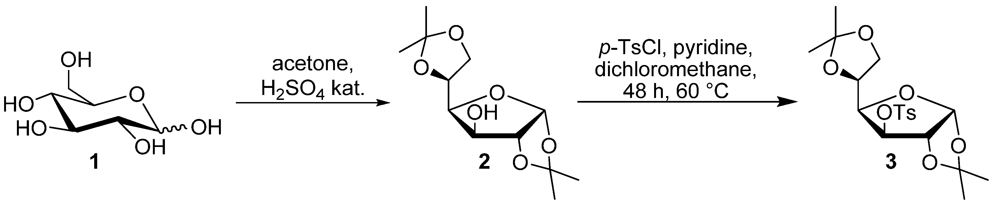
      <p>Monosaccharides with good leaving groups like mesylate, tosylate or nosylate play a major role for the introduction of various functional groups, as building blocks for the formation of di- and oligosugars, as chiral pool materials or for the preparation of bioactive glycoconjugates [<xref ref-type="bibr" rid="B1-crystals-02-00105">1</xref>]. This offers the possibility for the preparation of rare carbohydrate derivatives. For this purpose, protected carbohydrate building blocks like carbohydrate <bold>2</bold> were prepared from D-glucose (<bold>1</bold>) with the potential for the convenient selective introduction of sulfonate leaving groups in high yields under mild basic conditions. Thus, D-glucose (<bold>1</bold>) is protected with two isopropylidene moieties in the first step [<xref ref-type="bibr" rid="B2-crystals-02-00105">2</xref>]. Next, the introduction of the tosylate leaving group occurs under basic conditions [<xref ref-type="bibr" rid="B3-crystals-02-00105">3</xref>]. Interestingly, in subsequent reactions the replacement of the tosyl leaving group against the resulting functional group proceeds under inversion of the configuration of the respective carbon atom C-3 (Walden-inversion) in most of the cases [<xref ref-type="bibr" rid="B4-crystals-02-00105">4</xref>]. In addition, side reactions like eliminations were observed as well [<xref ref-type="bibr" rid="B5-crystals-02-00105">5</xref>].</p>
    </sec>
    <sec sec-type="results">
      <title>2. Results and Discussion</title>
      <p>The introduction of isopropylidene protecting groups under acid catalysis occurs chemoselectively and the 1,2:5,6-diisopropylidene-α-D-glucose (<bold>2</bold>) as furanose form was prepared in high yields [<xref ref-type="bibr" rid="B2-crystals-02-00105">2</xref>]. Treatment of glucose <bold>2</bold> with <italic>p</italic>-TsCl in the presence of pyridine as base afforded the desired carbohydrate building block <bold>3</bold> in a high yield of 78% (<xref ref-type="fig" rid="crystals-02-00105-f001">Figure 1</xref>). Crystals of <bold>3</bold> were grown during the purification step from a saturated petroleum ether/ethyl acetate solution.</p>
      <fig id="crystals-02-00105-f001" position="anchor">
        <label>Figure 1</label>
        <caption>
          <p>The synthesis of tosylated glucose derivative <bold>3</bold>.</p>
        </caption>
        <graphic xmlns:xlink="http://www.w3.org/1999/xlink" xlink:href="crystals-02-00105-g001.tif"/>
      </fig>
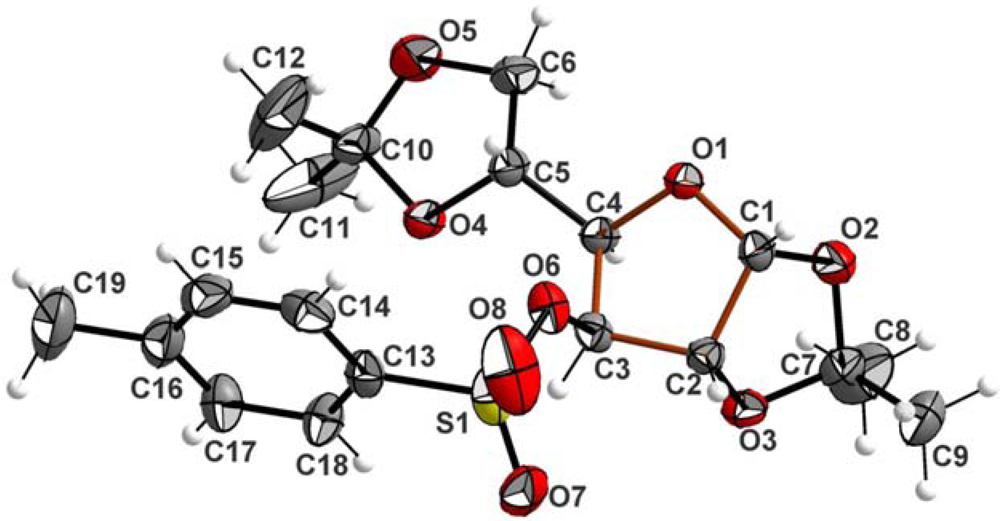
      <p>The crystal and instrumental parameters of the structure determination are summarized in <xref ref-type="table" rid="crystals-02-00105-t001">Table 1</xref>. The drawing of the molecular structure of compound <bold>3</bold> with the used atom-labeling scheme is shown in <xref ref-type="fig" rid="crystals-02-00105-f002">Figure 2</xref>. The displacement thermal ellipsoids are drawn at the 30% probability level. Selected bond lengths and angles comprising the key features of 1,2:5,6-di-<italic>O</italic>-isopropylidene-3-<italic>O</italic>-toluenesulfonyl-α-D-glucofuranose (<bold>3</bold>) are given in <xref ref-type="table" rid="crystals-02-00105-t002">Table 2</xref>.</p>
	    <fig id="crystals-02-00105-f002" position="anchor">
        <label>Figure 2</label>
        <caption>
          <p>A view of molecule <bold>3</bold> showing the atom-labeling scheme. Displacement ellipsoids are drawn at the 30% probability level.</p>
        </caption>
        <graphic xmlns:xlink="http://www.w3.org/1999/xlink" xlink:href="crystals-02-00105-g002.tif"/>
      </fig>
     <table-wrap id="crystals-02-00105-t001" position="float">
        <object-id pub-id-type="pii">crystals-02-00105-t001_Table 1</object-id>
        <label>Table 1</label>
        <caption>
          <p>Crystal data and structure refinement parameters for compound <bold>3</bold>.</p>
        </caption>
        <table>
		 <thead>
            <tr>
              <th colspan="2" align="center" valign="middle">Crystal data</th>
              <th colspan="2" align="center" valign="middle">Refinement</th>
            </tr>
          </thead>
          <tbody>
            <tr style="border-top:solid thin">
              <td align="left" valign="middle">Formula</td>
              <td align="left" valign="middle">C<sub>19</sub>H<sub>26</sub>O<sub>8</sub>S</td>
              <td align="left" valign="middle">Refinement method</td>
              <td align="left" valign="middle">Full-matrix least-</td>
            </tr>
            <tr>
              <td align="left" valign="middle">Formula weight</td>
              <td align="left" valign="middle">414.48 g·mol<sup>−1</sup></td>
              <td align="left" valign="middle"> </td>
              <td align="left" valign="middle">squares on <italic>F</italic><sup>2</sup></td>
            </tr>
            <tr>
              <td align="left" valign="middle">Temperature</td>
              <td align="left" valign="middle">173(2) K</td>
              <td align="left" valign="middle">Data/restraints/parameters</td>
              <td align="left" valign="middle">6469/0/254</td>
            </tr>
            <tr>
              <td align="left" valign="middle">Wavelength</td>
              <td align="left" valign="middle">0.71073 Å</td>
              <td align="left" valign="middle">Measured reflections</td>
              <td align="left" valign="middle">18550</td>
            </tr>
            <tr>
              <td align="left" valign="middle">Crystal system</td>
              <td align="left" valign="middle">orthorhombic</td>
              <td align="left" valign="middle">Goodness-of-fit on <italic>F</italic><sup>2</sup></td>
              <td align="left" valign="middle">1.032</td>
            </tr>
            <tr>
              <td align="left" valign="middle">Space group</td>
              <td align="left" valign="middle">P2<sub>1</sub>2<sub>1</sub>2<sub>1</sub></td>
              <td align="left" valign="middle">Final <italic>R</italic> indices</td>
              <td align="left" valign="middle"><italic>R<sub>1</sub></italic> = 0.0509</td>
            </tr>
            <tr>
              <td align="left" valign="middle">Unit cell dimensions</td>
              <td align="left" valign="middle"><italic>a</italic> = 9.7945(7) Å</td>
              <td align="left" valign="middle">[<italic>I</italic> &gt; 2σ(<italic>I</italic>)]</td>
              <td align="left" valign="middle"><italic>wR<sub>2</sub></italic> = 0.1238</td>
            </tr>
            <tr>
              <td align="left" valign="middle"> </td>
              <td align="left" valign="middle"><italic>b</italic> = 10.1945(7) Å</td>
              <td align="left" valign="middle"><italic>R</italic> indices (all data)</td>
              <td align="left" valign="middle"><italic>R<sub>1</sub></italic> = 0.0660</td>
            </tr>
            <tr>
              <td align="left" valign="middle"> </td>
              <td align="left" valign="middle"><italic>c</italic> = 21.306(1) Å</td>
              <td align="left" valign="middle"> </td>
              <td align="left" valign="middle"><italic>wR<sub>2</sub></italic> = 0.1357</td>
            </tr>
            <tr>
              <td align="left" valign="middle">Volume</td>
              <td align="left" valign="middle">2127.4(2) Å<sup>3</sup></td>
              <td align="left" valign="middle">Largest diff. peak/hole</td>
              <td align="left" valign="middle">0.417/−0.375 eÅ<sup>−3</sup></td>
            </tr>
            <tr>
              <td align="left" valign="middle">Z</td>
              <td align="left" valign="middle">4</td>
              <td align="left" valign="middle"> </td>
              <td align="left" valign="middle"> </td>
            </tr>
            <tr>
              <td align="left" valign="middle">Density (calcd.)</td>
              <td align="left" valign="middle">1.294 g·cm<sup>−3</sup></td>
              <td align="left" valign="middle"> </td>
              <td align="left" valign="middle"> </td>
            </tr>
            <tr>
              <td align="left" valign="middle">Absorption coefficient</td>
              <td align="left" valign="middle">0.193 mm<sup>−1</sup></td>
              <td align="left" valign="middle"> </td>
              <td align="left" valign="middle"> </td>
            </tr>
            <tr>
              <td align="left" valign="middle">F(000)</td>
              <td align="left" valign="middle">880</td>
              <td align="left" valign="middle"> </td>
              <td align="left" valign="middle"> </td>
            </tr>
            <tr>
              <td align="left" valign="middle">Crystal size</td>
              <td align="left" valign="middle">0.70 × 0.22 × 0.11 mm<sup>3</sup></td>
              <td align="left" valign="middle"> </td>
              <td align="left" valign="middle"> </td>
            </tr>
          </tbody>
  </table>
      </table-wrap>
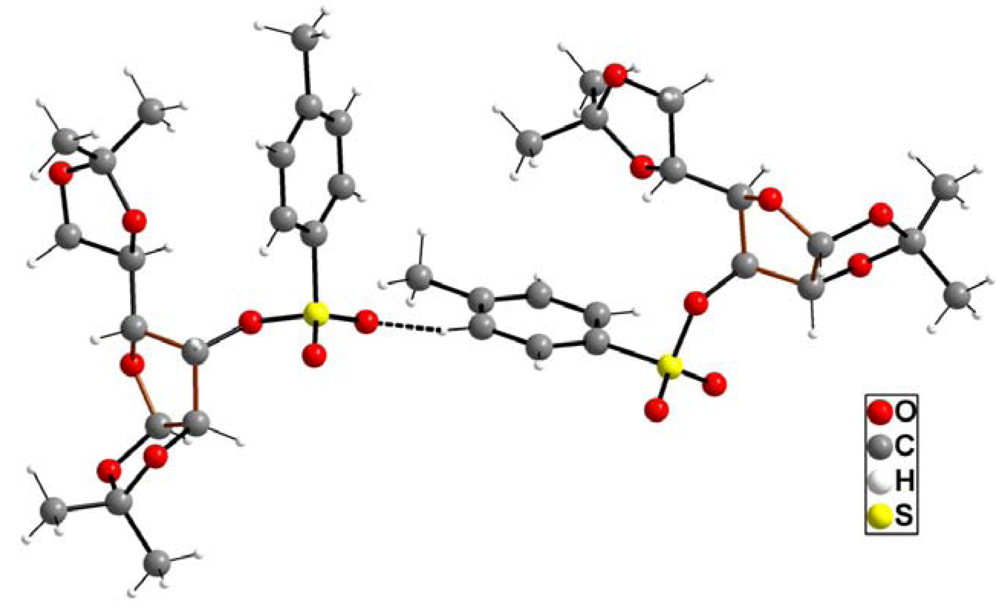
       <fig id="crystals-02-00105-f003" position="anchor">
        <label>Figure 3</label>
        <caption>
          <p>View of two neighboring molecules in <bold>3</bold> with the shortest intermolecular contact drawn as a dashed line.</p>
        </caption>
        <graphic xmlns:xlink="http://www.w3.org/1999/xlink" xlink:href="crystals-02-00105-g003.tif"/>
      </fig>
    <p>In the title compound, the conformation of the furanose ring is fixed by the two isopropylidene protecting groups. Each of the protecting groups form a five membered ring with the furanose skeleton. The first group is attached to O2 (C1) and O3 (C2), both carbon atoms have the R configuration. The second isopropylidene protecting group is attached to O4 (C5) and O5 (C6). The atom C3 has S configuration, whereas C4 is R-configured. The furanose ring has a distorted envelope conformation, in which C1, C2, C3 and O1 are located almost in a plane, and atom C4 is the one out of this plane. The (C1, C2, C3, O1) plane has a dihedral angle of 35.5° relative to the mean plane through O1, C4 and C3. <xref ref-type="fig" rid="crystals-02-00105-f002">Figure 2</xref> shows, that atom C11, which is part of the isopropylidene group attached to O4 and O5, has an unusual ratio of the anisotropic displacement parameters. Attempts to use split positions did not improve the model. Therefore, it is concluded that the various energetically very close positions of this methyl group, as averaged over all the unit cells of the used crystal, are best described by a cigar-type ellipsoid.</p>
      <p>Between the molecules there are no classical hydrogen bonds, because all the O-bonded H atoms are substituted by protecting and leaving groups, respectively. The shortest intermolecular contact is between O8 and H14A (C14) of the neighboring molecule at an O−C distance of 2.941(4) Å. <xref ref-type="fig" rid="crystals-02-00105-f003">Figure 3</xref> shows the two adjacent molecules with this short intermolecular contact.</p>
 <table-wrap id="crystals-02-00105-t002" position="float">
        <object-id pub-id-type="pii">crystals-02-00105-t002_Table 2</object-id>
        <label>Table 2</label>
        <caption>
          <p>Selected interatomic distances [Å] in <bold>3</bold>.</p>
        </caption>
        <table>
          <thead>
            <tr>
              <th align="center" valign="middle">atoms</th>
              <th align="center" valign="middle">distance</th>
              <th align="center" valign="middle">atoms</th>
              <th align="center" valign="middle">Distance</th>
            </tr>
          </thead>
          <tbody>
            <tr style="border-top:solid thin">
              <td align="center" valign="middle">O1–C1</td>
              <td align="center" valign="middle">1.439(2)</td>
              <td align="center" valign="middle">S1–O7</td>
              <td align="center" valign="middle">1.431(2)</td>
            </tr>
            <tr>
              <td align="center" valign="middle">O1–C4</td>
              <td align="center" valign="middle">1.407(2)</td>
              <td align="center" valign="middle">S1–O8</td>
              <td align="center" valign="middle">1.418(2)</td>
            </tr>
            <tr>
              <td align="center" valign="middle">C1–C2</td>
              <td align="center" valign="middle">1.518(2)</td>
              <td align="center" valign="middle">S1–C1</td>
              <td align="center" valign="middle">1.748(2)</td>
            </tr>
            <tr>
              <td align="center" valign="middle">C2–C3</td>
              <td align="center" valign="middle">1.526(2)</td>
              <td align="center" valign="middle">C5–C6</td>
              <td align="center" valign="middle">1.508(3)</td>
            </tr>
            <tr>
              <td align="center" valign="middle">C3–C4</td>
              <td align="center" valign="middle">1.538(2)</td>
              <td align="center" valign="middle">C5–O2</td>
              <td align="center" valign="middle">1.420(2)</td>
            </tr>
            <tr>
              <td align="center" valign="middle">C1–C5</td>
              <td align="center" valign="middle">1.506(3)</td>
              <td align="center" valign="middle">C6–O3</td>
              <td align="center" valign="middle">1.394(3)</td>
            </tr>
            <tr>
              <td align="center" valign="middle">C2–O4</td>
              <td align="center" valign="middle">1.451(2)</td>
              <td align="center" valign="middle">C7–O2</td>
              <td align="center" valign="middle">1.437(2)</td>
            </tr>
            <tr>
              <td align="center" valign="middle">C3–O5</td>
              <td align="center" valign="middle">1.415(2)</td>
              <td align="center" valign="middle">C7–O3</td>
              <td align="center" valign="middle">1.406(3)</td>
            </tr>
            <tr>
              <td align="center" valign="middle">C4–O6</td>
              <td align="center" valign="middle">1.406(2)</td>
              <td align="center" valign="middle">C17–O5</td>
              <td align="center" valign="middle">1.427(3)</td>
            </tr>
            <tr>
              <td align="center" valign="middle">S1–O4</td>
              <td align="center" valign="middle">1.588(2)</td>
              <td align="center" valign="middle">C17–O6</td>
              <td align="center" valign="middle">1.431(3)</td>
            </tr>
          </tbody>
  </table>
      </table-wrap>
     </sec>
    <sec>
      <title>3. Experimental Section</title>
      <sec>
        <title>3.1. General</title>
        <p>NMR spectra were recorded on a Varian Inova-400 spectrometer and chemical shifts of the <sup>1</sup>H and <sup>13</sup>C spectra were reported in parts per million (ppm) using the solvent shifts. The melting point was determined on a Galen III (Cambridge Instruments) melting point apparatus (Leica, Vienna, Austria) and is uncorrected.</p>
      </sec>
      <sec>
        <title>3.2. Synthesis of Compound 3</title>
        <p>1,2:5,6-Di-<italic>O</italic>-isopropylidene-α-D-glucofuranose (2.16 g, 8.3 mmol) was dissolved in pyridine (20 mL) and <italic>p</italic>-toluenesulfonyl chloride (2.6 g, 13.6 mmol) dissolved in anhydrous dichloromethane (20 mL) was added at ambient temperature. The resulting mixture was stirred 48 h at 60 °C. Afterwards, the organic solvents were removed, the residue was dissolved in dichloromethane (20 mL) and washed with saturated hydrogen carbonate solution (20 mL). The organic layer was separated and dried over Na<sub>2</sub>SO<sub>4</sub>. Purification was done via column chromatography (petroleum ether/ethyl acetate = 15:1→10:1) to yield <bold>3</bold> as colourless solid (2.68 g, 78%). m.p. 121 °C. <sup>1</sup>H NMR (400 MHz, C<sub>6</sub>D<sub>6</sub>): <italic>δ</italic> 0.96 (s, 6H, <sup>i</sup>Pr-CH<sub>3</sub>), 1.10 (s, 3H,<sup> i</sup>Pr-CH<sub>3</sub>), 1.28 (s, 3H, <sup>i</sup>Pr-CH<sub>3</sub>), 1.82 (s, 3H, Tos-CH<sub>3</sub>), 3.84 (dd, <sup>2</sup><italic>J</italic> = 8.6 Hz, <sup>3</sup><italic>J</italic> = 6.3 Hz, 1H, H-6b), 3.96 (dd, <sup>2</sup><italic>J</italic> = 8.6 Hz, <sup>3</sup><italic>J</italic> = 4.7 Hz, 1H, H-6a), 4.07–4.12 (m, 1H, H-5), 4.25 (dd, <sup>3</sup><italic>J</italic> = 8.0 Hz, <sup>3</sup><italic>J</italic> = 2.8 Hz, 1H, H-4), 4.90 (d, <sup>3</sup><italic>J</italic> = 3.6 Hz, 1H, H-2), 5.02 (d, <sup>3</sup><italic>J</italic> = 2.8 Hz, 1H, H-3), 5.66 (d, <sup>3</sup><italic>J</italic> = 3.6 Hz, 1H, H-1), 6.67 (d, <sup>3</sup><italic>J</italic> = 8.2 Hz, 2H, H-o), 7.76 (d, <sup>3</sup><italic>J</italic> = 8.2 Hz, 2H, H-m). <sup>13</sup>C NMR (101 MHz, C<sub>6</sub>D<sub>6</sub>): <italic>δ</italic> 21.1 (Tos-CH<sub>3</sub>), 24.7, 25.0, 26.7 (3 × <sup>i</sup>Pr-CH<sub>3</sub>), 26.8 (<sup>i</sup>Pr-CH<sub>3</sub>), 67.4 (C-6), 72.3 (C-5), 80.4 (C-4), 82.7 (C-3), 84.1 (C-2), 105.6 (C-1), 109.1, 112.3 (2 × <sup>i</sup>Pr-C<sub>quart</sub>), 128.8 (C-m), 129.7 (C-o), 133.8 (C-i), 144.5 (C-p).</p>
      </sec>
      <sec>
        <title>3.3. Data Collection and Refinement</title>
        <p>Crystallographic data were collected with a Bruker-Nonius Apex-X8 CCD-diffractometer with monochromatic Mo–<italic>K</italic>α radiation (<italic>λ</italic> = 0.71073 Å) and a CCD detector. Preliminary data of the unit cell dimensions were obtained from the reflex positions of 36 frames, measured in three different directions of the reciprocal space. After completion of the data measurements the reflex intensities were corrected for Lorentz, polarization and absorption effects. The structure was solved by direct methods using SHELXS-97 and refined against <italic>F</italic><sup>2</sup> on all data by full-matrix least-squares methods using SHELXL-97(2) [<xref ref-type="bibr" rid="B6-crystals-02-00105">6</xref>,<xref ref-type="bibr" rid="B7-crystals-02-00105">7</xref>]. All non-hydrogen atoms were refined anisotropically; all hydrogen atoms bonded to carbon atoms were placed on geometrically calculated positions and refined using riding models. Crystallographic data has been deposited with the Cambridge Crystallographic Data Centre, CCDC-855989. It can be retrieved free of charge through deposit@ccdc.cam.ac.uk or <uri>http://www.ccdc.cam.ac.uk.</uri></p>
      </sec>
    </sec>
    <sec sec-type="conclusions">
      <title>4. Conclusions</title>
      <p>The crystal and molecular structure of the title compound is reported. These data represent a crystallographically characterized example of tosylated carbohydrate building blocks.</p>
    </sec>
  </body>
  <back>
    <ref-list>
      <title>References and Notes</title>
      <ref id="B1-crystals-02-00105">
        <label>1.</label>
        <citation citation-type="book">
          <person-group person-group-type="author">
            <name>
              <surname>Lindhorst</surname>
              <given-names>T.K.</given-names>
            </name>
          </person-group>
          <source>Essentials of Carbohydrate Chemistry and Biochemistry</source>
          <edition>2nd</edition>
          <publisher-name>Wiley-VCH</publisher-name>
          <publisher-loc>Weinheim, Germany</publisher-loc>
          <year>2003</year>
        </citation>
      </ref>
      <ref id="B2-crystals-02-00105">
        <label>2.</label>
        <citation citation-type="journal">
          <person-group person-group-type="author">
            <name>
              <surname>Einhorn</surname>
              <given-names>C.</given-names>
            </name>
            <name>
              <surname>Luche</surname>
              <given-names>J.-L.</given-names>
            </name>
          </person-group>
          <article-title>Ready preparation of sugar acetals under ultrasonic irradiation</article-title>
          <source>Carbohydrate Res.</source>
          <year>1986</year>
          <volume>155</volume>
          <fpage>258</fpage>
          <lpage>261</lpage>
          <pub-id pub-id-type="doi">10.1016/S0008-6215(00)90155-1</pub-id>
        </citation>
      </ref>
      <ref id="B3-crystals-02-00105">
        <label>3.</label>
        <citation citation-type="journal">
          <person-group person-group-type="author">
            <name>
              <surname>Freudenberg</surname>
              <given-names>K.</given-names>
            </name>
            <name>
              <surname>Ivers</surname>
              <given-names>O. </given-names>
            </name>
          </person-group>
          <article-title>Synthesen gemischt-acylierter Halogen-zucker</article-title>
          <source>Ber. Deut. Chem. Gesellsch. (A and B Series)</source>
          <year>1922</year>
          <volume>55</volume>
          <fpage>929</fpage>
          <lpage>941</lpage>
          <pub-id pub-id-type="doi">10.1002/cber.19220550416</pub-id>
        </citation>
      </ref>
      <ref id="B4-crystals-02-00105">
        <label>4.</label>
        <citation citation-type="book">
          <person-group person-group-type="author">
            <name>
              <surname>Boons</surname>
              <given-names>G.-J.</given-names>
            </name>
            <name>
              <surname>Hale</surname>
              <given-names>K.</given-names>
            </name>
          </person-group>
          <source>Organic Synthesis with Carbohydrates</source>
          <edition>1st</edition>
          <publisher-name>Sheffield Academic Press</publisher-name>
          <publisher-loc>Sheffield, UK</publisher-loc>
          <year>2000</year>
        </citation>
      </ref>
      <ref id="B5-crystals-02-00105">
        <label>5.</label>
        <citation citation-type="journal">
          <person-group person-group-type="author">
            <name>
              <surname>Horton</surname>
              <given-names>D.</given-names>
            </name>
            <name>
              <surname>Roski</surname>
              <given-names>J.P.</given-names>
            </name>
            <name>
              <surname>Norris</surname>
              <given-names>P. </given-names>
            </name>
          </person-group>
          <article-title>Cycloaddition of Cyclopentadiene to 3-Deoxy-1,2:5,6-di-<italic>O</italic>-isopropylidene-α-d-<italic>erythro</italic>-hex-3-enofuranose. Synthesis and Representative Chemistry of 1,6-Anhydro-2,3-dideoxy-β-d-<italic>glycero</italic>-hex-2-enopyran-4-ulose (“Isolevoglucosenone”)</article-title>
          <source>J. Org. Chem.</source>
          <year>1996</year>
          <volume>61</volume>
          <fpage>3783</fpage>
          <lpage>3793</lpage>
          <pub-id pub-id-type="doi">10.1021/jo960032y</pub-id>
        </citation>
      </ref>
      <ref id="B6-crystals-02-00105">
        <label>6.</label>
        <citation citation-type="book">
          <person-group person-group-type="author">
            <name>
              <surname>Sheldrick</surname>
              <given-names>G.M.</given-names>
            </name>
          </person-group>
          <source>SHELXS/L-97, Programs for the Solution and Refinement of Crystal Structures</source>
          <publisher-name>University of Göttingen</publisher-name>
          <publisher-loc>Göttingen, Germany</publisher-loc>
          <year>1997</year>
        </citation>
      </ref>
      <ref id="B7-crystals-02-00105">
        <label>7.</label>
        <citation citation-type="journal">
          <person-group person-group-type="author">
            <name>
              <surname>Sheldrick</surname>
              <given-names>G.M.</given-names>
            </name>
          </person-group>
          <article-title>A short history of <italic>SHELX.</italic></article-title>
          <source>Acta Cryst.</source>
          <year>2008</year>
          <volume>A64</volume>
          <fpage>112</fpage>
          <lpage>122</lpage>
        </citation>
      </ref>
    </ref-list>
  </back>
</article>