
<?xml version="1.0" encoding="UTF-8"?>
<!DOCTYPE article PUBLIC "-//NLM//DTD Journal Publishing DTD v2.3 20070202//EN" "journalpublishing.dtd">
<article xmlns:mml="http://www.w3.org/1998/Math/MathML" xmlns:xlink="http://www.w3.org/1999/xlink" xml:lang="en" article-type="research-article">
<front>
<journal-meta>
<journal-id journal-id-type="publisher-id">Crystals</journal-id>
<journal-title>Crystals</journal-title>
<issn pub-type="epub">2073-4352</issn>
<publisher>
<publisher-name>Molecular Diversity Preservation International (MDPI)</publisher-name></publisher></journal-meta>
<article-meta>
<article-id pub-id-type="doi">10.3390/cryst1030087</article-id>
<article-id pub-id-type="publisher-id">crystals-01-00087</article-id>
<article-categories>
<subj-group>
<subject>Article</subject></subj-group></article-categories>
<title-group>
<article-title>New Compounds with [As<sub>7</sub>]<sup>3−</sup> Clusters: Synthesis and Crystal Structures of the Zintl Phases Cs<sub>2</sub>NaAs<sub>7</sub>, Cs<sub>4</sub>ZnAs<sub>14</sub> and Cs<sub>4</sub>CdAs<sub>14</sub></article-title></title-group>
<contrib-group>
<contrib contrib-type="author">
<name><surname>He</surname><given-names>Hua</given-names></name></contrib>
<contrib contrib-type="author">
<name><surname>Tyson</surname><given-names>Chauntae</given-names></name></contrib>
<contrib contrib-type="author">
<name><surname>Bobev</surname><given-names>Svilen</given-names></name><xref ref-type="corresp" rid="c1-crystals-01-00087"><sup>*</sup></xref></contrib>
<aff id="af1-crystals-01-00087">Department of Chemistry and Biochemistry, University of Delaware, Newark, Delaware 19716, USA; E-Mails: <email>nancyhe@udel.edu</email> (H.H.); <email>ctyson@udel.edu</email> (C.T.)</aff></contrib-group>
<author-notes>
<corresp id="c1-crystals-01-00087">
<label>*</label> Author to whom correspondence should be addressed; E-Mail: <email>bobev@udel.edu</email>; Tel.: +1-302-831-8720; Fax: +1-302-831-6335.</corresp></author-notes>
<pub-date pub-type="collection">
<year>2011</year></pub-date>
<pub-date pub-type="epub">
<day>28</day>
<month>06</month>
<year>2011</year></pub-date>
<volume>1</volume>
<issue>3</issue>
<fpage>87</fpage>
<lpage>98</lpage>
<history>
<date date-type="received">
<day>27</day>
<month>05</month>
<year>2011</year></date>
<date date-type="rev-recd">
<day>16</day>
<month>06</month>
<year>2011</year></date>
<date date-type="accepted">
<day>21</day>
<month>06</month>
<year>2011</year></date></history>
<permissions>
<copyright-statement>© 2011 by the authors; licensee MDPI, Basel, Switzerland.</copyright-statement>
<copyright-year>2011</copyright-year>
<license>
<p>This article is an open access article distributed under the terms and conditions of the Creative Commons Attribution license (http://creativecommons.org/licenses/by/3.0/).</p></license></permissions>
<abstract>
<p>Three new cluster compounds, Cs<sub>2</sub>NaAs<sub>7</sub>, Cs<sub>4</sub>ZnAs<sub>14</sub>, and Cs<sub>4</sub>CdAs<sub>14</sub> were obtained from high temperature reactions. Their structures feature heptaarsenide [As<sub>7</sub>]<sup>3−</sup> anions, where the clusters in Cs<sub>4</sub>ZnAs<sub>14</sub> and Cs<sub>4</sub>CdAs<sub>14</sub> are dimerized by the linkers Zn and Cd, respectively. The bonding characteristics of these clusters are discussed and compared. Band structure calculation on Cs<sub>2</sub>NaAs<sub>7</sub> suggests that this compound is a semiconductor with an energy gap of <italic>circa</italic> 1.6 eV, which is in consistent with the dark red color of the crystals.</p></abstract>
<kwd-group>
<kwd>cluster</kwd>
<kwd>arsenic</kwd>
<kwd>Zintl compound</kwd>
<kwd>crystal structure</kwd></kwd-group></article-meta></front>
<body>
<sec sec-type="intro">
<label>1.</label>
<title>Introduction</title>
<p>The typical Zintl phases are compounds formed between the alkali or alkaline-earth metals and the metalloids from group 13, 14, or 15 [<xref ref-type="bibr" rid="b1-crystals-01-00087">1</xref>]. The chemical bonding in such systems could be rationalized following the Zintl-Klemm concept [<xref ref-type="bibr" rid="b2-crystals-01-00087">2</xref>], which assumes that the electropositive elements act as electron donors (becoming spectator cations), while the electronegative counterparts form covalent bonds to obtain closed-shell electronic configurations. In recent years the field has been expanded to include some d-metals, as well as the nominally divalent Eu and Yb from the lanthanide family. Such materials, e.g., Yb<sub>14</sub>MnSb<sub>11</sub> [<xref ref-type="bibr" rid="b3-crystals-01-00087">3</xref>], Ca<italic><sub>x</sub></italic>Yb<sub>1−</sub><italic><sub>x</sub></italic>Zn<sub>2</sub>Sb<sub>2</sub> [<xref ref-type="bibr" rid="b4-crystals-01-00087">4</xref>], and EuZn<sub>2</sub>Sb<sub>2</sub> [<xref ref-type="bibr" rid="b5-crystals-01-00087">5</xref>], among others, have received recognition for their potential in thermoelectric energy conversion [<xref ref-type="bibr" rid="b6-crystals-01-00087">6</xref>]. There has also been a lasting research interest in cluster-like Zintl ions [<xref ref-type="bibr" rid="b7-crystals-01-00087">7</xref>], which is primarily instigated from the fundamental understanding of their bonding characteristics [<xref ref-type="bibr" rid="b7-crystals-01-00087">7</xref>,<xref ref-type="bibr" rid="b8-crystals-01-00087">8</xref>], as well as the novel properties offered by materials based on cluster assemblies [<xref ref-type="bibr" rid="b9-crystals-01-00087">9</xref>-<xref ref-type="bibr" rid="b13-crystals-01-00087">13</xref>].</p>
<p>In this article, we report three new Zintl compounds, Cs<sub>2</sub>NaAs<sub>7</sub>, Cs<sub>4</sub>ZnAs<sub>14</sub> and Cs<sub>4</sub>CdAs<sub>14</sub> all of which feature the nortricyclane-like [As<sub>7</sub>]<sup>3−</sup> clusters. In Cs<sub>2</sub>NaAs<sub>7</sub> (formally [Cs<sup>+</sup>]<sub>2</sub>[Na<sup>+</sup>][As<sub>7</sub>]<sup>3−</sup>) the [As<sub>7</sub>]<sup>3−</sup> polyanions are discrete and “solvated” by Cs<sup>+</sup> and Na<sup>+</sup> cations, while Cs<sub>4</sub>ZnAs<sub>14</sub>, and Cs<sub>4</sub>CdAs<sub>14</sub> (formally [Cs<sup>+</sup>]<sub>4</sub>[Zn<sup>2+</sup>]{[As<sub>7</sub>]<sup>3−</sup>}<sub>2</sub> and [Cs<sup>+</sup>]<sub>4</sub>[Cd<sup>2+</sup>]{[As<sub>7</sub>]<sup>3−</sup>}<sub>2</sub>) are better viewed as containing larger heteroatomic [As<sub>7</sub>-Zn-As<sub>7</sub>]<sup>4−</sup> and [As<sub>7</sub>-Cd-As<sub>7</sub>]<sup>4−</sup> units, respectively. The latter can be considered as being made of two [As<sub>7</sub>]<sup>3−</sup> species, bridged by tetrahedrally coordinated Zn and Cd atoms. The crystal structures and the bonding characteristics of the three compounds are presented, alongside with a discussion on the electronic structure of Cs<sub>2</sub>NaAs<sub>7</sub>, calculated using the LMTO method [<xref ref-type="bibr" rid="b14-crystals-01-00087">14</xref>-<xref ref-type="bibr" rid="b16-crystals-01-00087">16</xref>].</p></sec>
<sec sec-type="results|discussion">
<label>2.</label>
<title>Results and Discussion</title>
<p>Cs<sub>2</sub>NaAs<sub>7</sub> crystallizes in a monoclinic crystal system with space group <italic>P</italic>2<sub>1</sub>/<italic>c</italic> (No. 14, Pearson symbol <italic>mP</italic>40). Important crystallographic information pertaining to the structure is given in <xref ref-type="table" rid="t1-crystals-01-00087">Table 1</xref>. Although it has identical formula to <italic>A</italic><sub>3</sub>As<sub>7</sub> (A = Li, Na, K, Rb, Cs) [<xref ref-type="bibr" rid="b17-crystals-01-00087">17</xref>-<xref ref-type="bibr" rid="b19-crystals-01-00087">19</xref>], it is not isostructural to any of the above-mentioned binary compounds. In Cs<sub>2</sub>NaAs<sub>7</sub>, which is a true ternary phase, Cs and Na atoms are ordered on different crystallographic sites.</p>
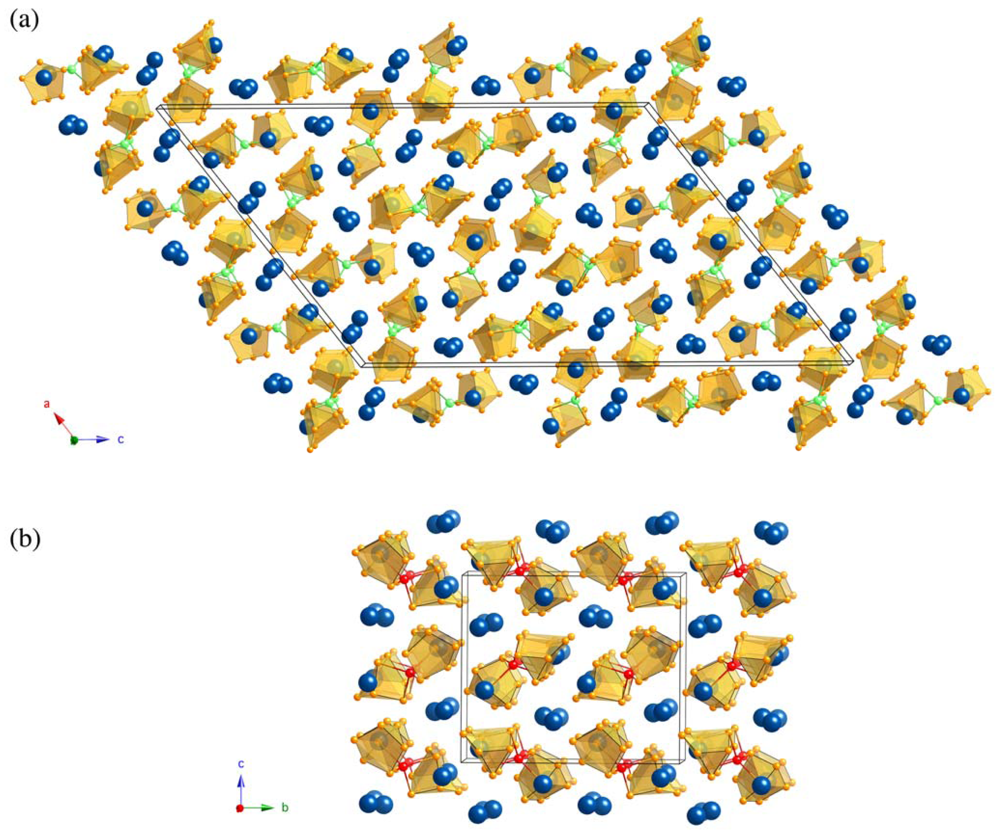
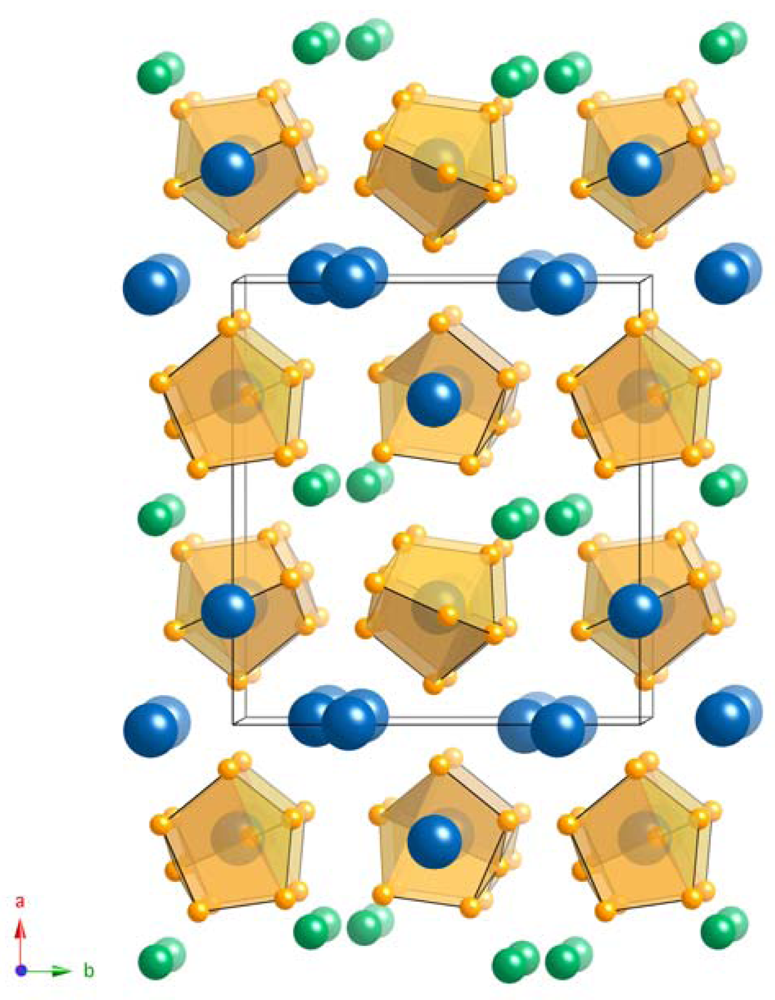
<p>The packing of the [As<sub>7</sub>]<sup>3−</sup> clusters resembles <italic>fcc</italic> arrangement with Cs2<sup>+</sup> cations residing in the octahedral holes left between the clusters, and Cs1<sup>+</sup> and Na<sup>+</sup> cations in the tetrahedral holes, respectively (<xref ref-type="fig" rid="f1-crystals-01-00087">Figure 1</xref>). Such anion packing (<italic>ABCABC</italic>) is the same as in the structure of Cs<sub>3</sub>As<sub>7</sub> [<xref ref-type="bibr" rid="b19-crystals-01-00087">19</xref>], which is distinct from the double hexagonal close packing (<italic>ABAC</italic>) in K<sub>3</sub>As<sub>7</sub> [<xref ref-type="bibr" rid="b19-crystals-01-00087">19</xref>] and the hexagonal close packing (ABAB) in Rb<sub>3</sub>As<sub>7</sub> [<xref ref-type="bibr" rid="b19-crystals-01-00087">19</xref>].</p>
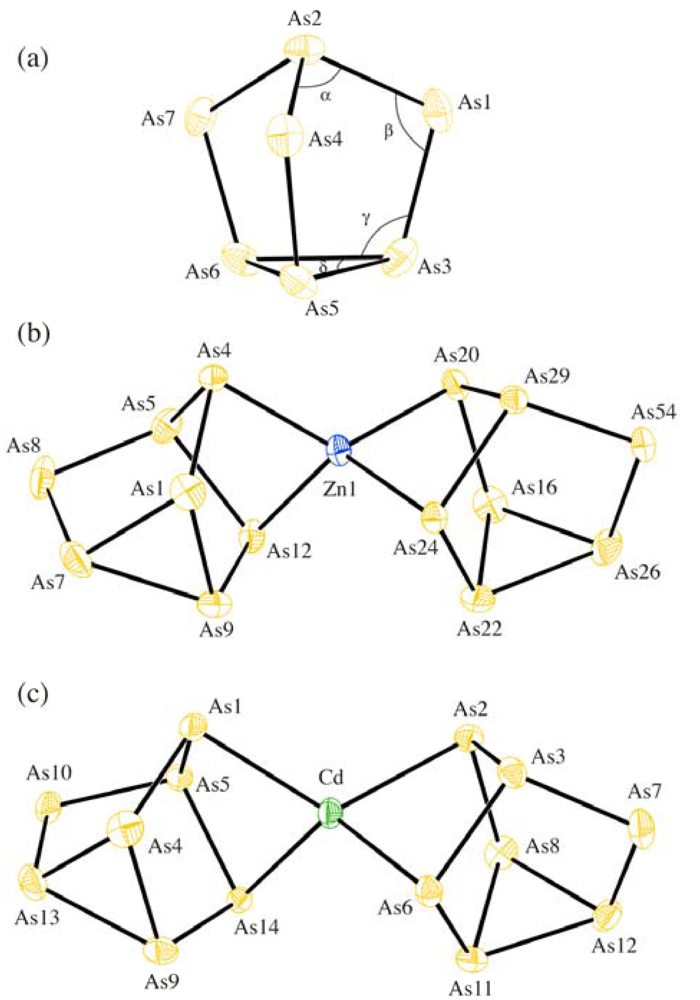
<p>Cs<sub>4</sub>ZnAs<sub>14</sub> and Cs<sub>4</sub>CdAs<sub>14</sub> also crystallize with the same monoclinic space group <italic>P</italic>2<sub>1</sub>/<italic>c</italic> (No. 14), but their structures are different (<xref ref-type="table" rid="t1-crystals-01-00087">Table 1</xref> and <xref ref-type="fig" rid="f2-crystals-01-00087">Figure 2</xref>). Notably, despite the same formulae, they are not isostructural to each other, with Cs<sub>4</sub>ZnAs<sub>14</sub> having a four-times larger repeating unit (Pearson symbol <italic>mP</italic>304) than Cs<sub>4</sub>CdAs<sub>14</sub> (Pearson symbol <italic>mP</italic>76). The detailed descriptions of each structure follow.</p>
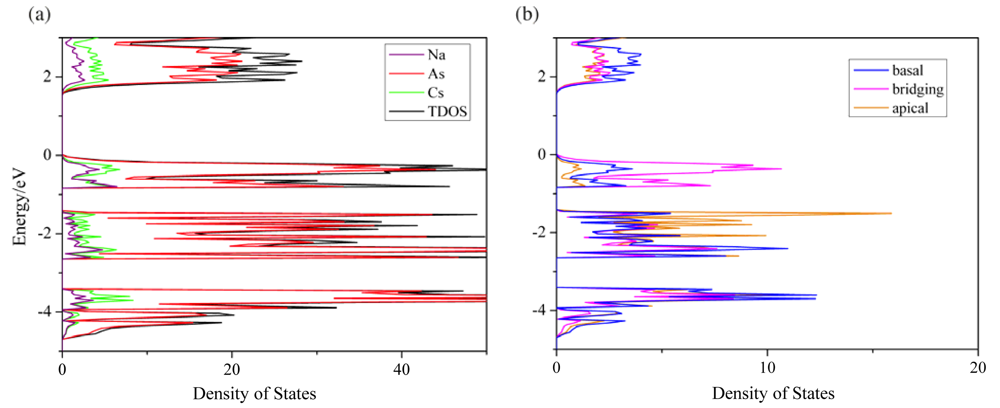
<p>As already mentioned, the structure of Cs2NaAs7 features isolated nortricyclane-like (or birdcagelike) [As<sub>7</sub>]<sup>3−</sup> clusters, with Cs<sup>+</sup> and Na<sup>+</sup> cations filling the space between them. The As–As distances (<xref ref-type="table" rid="t2-crystals-01-00087">Table 2</xref>) could be grouped into three sets based on their length: set <italic>A</italic>, 2.4799(17)-2.5139(19) Å, which comprises the longest bonds, found between the As atoms of the triangular base (As3, As5, As6); the intermediate set <italic>B</italic>, which accounts for the bonds between the apical As (As2) and the three As atoms at the “waist” of the cluster (As1, As4, As7), ranging from 2.4042(18) to 2.4237(17) Å; and set <italic>C</italic>, which encompasses the shortest As–As contacts (2.3411(18)-2.348(2) Å), observed between the three basal As atoms and the three atoms in the waist (<xref ref-type="fig" rid="f3-crystals-01-00087">Figure 3(a)</xref>). Such distribution of bond distances seems to be a signature of all [As<sub>7</sub>]<sup>3−</sup> cluster anions, as it is noted in the binary intermetallic compounds <italic>A</italic><sub>3</sub>As<sub>7</sub> (<italic>A</italic> = Li, Na, K, Rb, Cs) [<xref ref-type="bibr" rid="b17-crystals-01-00087">17</xref>-<xref ref-type="bibr" rid="b19-crystals-01-00087">19</xref>], as well as the compounds [Li(NH<sub>3</sub>)<sub>4</sub>]<sub>3</sub>As<sub>7</sub>·NH<sub>3</sub> [<xref ref-type="bibr" rid="b20-crystals-01-00087">20</xref>], [Rb(18-crown-6)]<sub>3</sub>As<sub>7</sub>·8NH<sub>3</sub> [<xref ref-type="bibr" rid="b20-crystals-01-00087">20</xref>], and Cs<sub>3</sub>As<sub>7</sub>·6NH<sub>3</sub> [<xref ref-type="bibr" rid="b20-crystals-01-00087">20</xref>], which are crystallized from liquid ammonia solutions. The bond angles are also characteristic, with α, β, γ, and δ (<xref ref-type="fig" rid="f3-crystals-01-00087">Figure 3(a)</xref>) close to 101°, 99°, 105°, and 60°, respectively. These metric parameters are comparable with the corresponding angles in the above-mentioned compounds [<xref ref-type="bibr" rid="b17-crystals-01-00087">17</xref>-<xref ref-type="bibr" rid="b20-crystals-01-00087">20</xref>]. Following the Zintl-Klemm concept [<xref ref-type="bibr" rid="b2-crystals-01-00087">2</xref>], the formal charges in the [As<sub>7</sub>]<sup>3−</sup> clusters can be assigned as (3<italic>b</italic>-As<sup>0</sup>)<sub>4</sub>(2<italic>b</italic>-As<sup>−</sup>)<sub>3</sub>, and the Cs<sub>2</sub>NaAs<sub>7</sub> formula can be readily rationalized as [Cs<sup>+</sup>]<sub>2</sub>[Na<sup>+</sup>][As<sub>7</sub>]3<sup>−</sup> Electronic band structure calculations confirm this reasoning.</p>
<p>Cs<sup>4</sup>ZnAs<sub>14</sub> crystallizes with an unusually large unit cell for an intermetallic compound (<italic>V</italic> = 10309.9(14) Å<sup>3</sup>) and the structure is devoid of any disorder. The structure contains four crystallographically independent [ZnAs<sub>14</sub>]<sup>4−</sup> polyanions, which are made up of tetrahedral Zn atoms, bridging two [As<sub>7</sub>]<sup>3−</sup> clusters (<xref ref-type="fig" rid="f3-crystals-01-00087">Figure 3(b)</xref>). The structural complexity is apparently caused by the intricate orientation and packing of the [ZnAs<sub>14</sub>]<sup>4−</sup> units. Interestingly, all the As atoms bonded to Zn are the 2-bonded As atoms at the waist of the [As7]<sup>3–</sup> “birdcage”, wherein they could be assigned as negatively charged (the remaining As atoms are 3-bonded, and thus, with a formal charge 0). The same bonding features have also been revealed for the cluster compounds which have the similar structural motif, e.g., [K(2,2,2-crypt)]<sub>3</sub>[In(P<sub>7</sub>)<sub>2</sub>]·3.5py [<xref ref-type="bibr" rid="b21-crystals-01-00087">21</xref>], [K(2,2,2-crypt)]<sub>4</sub>Zn<italic>E</italic><sub>14</sub>(<italic>E</italic> = P, As) [<xref ref-type="bibr" rid="b22-crystals-01-00087">22</xref>], and [K(2,2,2-crypt)]<sub>4</sub>CdP<sub>14</sub>·6py [<xref ref-type="bibr" rid="b22-crystals-01-00087">22</xref>]. The Zn–As bond distances fall in the range 2.514 to 2.598 Å, comparing well with the sum of their covalent radii [<xref ref-type="bibr" rid="b23-crystals-01-00087">23</xref>], as well as with the corresponding distances found in other Zintl compounds with Zn-As bonding such as Ba<sub>2</sub>ZnAs<sub>2</sub> [<xref ref-type="bibr" rid="b24-crystals-01-00087">24</xref>], Eu<sub>11</sub>Zn<sub>6</sub>As<sub>12</sub> [<xref ref-type="bibr" rid="b25-crystals-01-00087">25</xref>], and RbZn<sub>4</sub>As<sub>3</sub> [<xref ref-type="bibr" rid="b26-crystals-01-00087">26</xref>].</p>
<p>Another interesting observation is the geometric distortion of the [As<sub>7</sub>]<sup>3−</sup> moiety of the [ZnAs<sub>14</sub>]<sup>4−</sup> anion compared to the isolated [As<sub>7</sub>]<sup>3−</sup>. Although the nortricyclane-like topology essentially remains intact, the “bidentate” coordination of the [As<sub>7</sub>]<sup>3−</sup> ligand to the Zn atom induces some changes. For example, with a reference to the [Zn(1)As<sub>14</sub>]<sup>4−</sup> species, the α angles involving the chelating As atoms significantly decrease (∠As4-As5-As12 = 94.256° and ∠As20-As29-As24 = 94.193°), concomitant with the slight increase of the bond distances (0.02-0.04 Å). On the other hand, the distances between the apical As and the bridging As atoms that are not bonded to Zn decrease (As5−As8 = 2.379 Å, As29−As54 = 2.365 Å) to a degree that they fall in the range of distances for the shortest set <italic>C</italic> (<xref ref-type="table" rid="t3-crystals-01-00087">Table 3</xref>). Similar distortion is observed for all the eight [As<sub>7</sub>]<sup>3–</sup> subunits, which again, are not symmetry-equivalent to each other. Examples in which the insertion of transition metals leads to more significant changes to the [<italic>Pn</italic><sub>7</sub>]<sup>3–</sup> cluster are also known from the organometallic literature. For instance, in the [<italic>E</italic><sub>7</sub><italic>M</italic>(CO)3]<sup>3−</sup> clusters (<italic>E</italic> = P, As, Sb and <italic>M</italic> = Cr, Mo, W) [<xref ref-type="bibr" rid="b27-crystals-01-00087">27</xref>,<xref ref-type="bibr" rid="b28-crystals-01-00087">28</xref>], the nortricyclane-like <italic>E</italic><sub>7</sub><sup>3−</sup> fragments transformed into norbornadiene-like clusters due to the four bonds between the transition metal and two of the bridging and two of the basal pnictogens. More profound change has been noted in [Sb<sub>7</sub>Ni<sub>3</sub>(CO)<sub>3</sub>]<sup>3–</sup> [<xref ref-type="bibr" rid="b29-crystals-01-00087">29</xref>], where the Sb<sub>7</sub><sup>3–</sup> is bonded to three Ni atoms, forming a 10-vertex <italic>nido</italic> cluster.</p>
<p>Cs<sub>4</sub>CdAs<sub>14</sub> crystallizes with the same space group as Cs<sub>4</sub>ZnAs<sub>14</sub>, however, with only one [CdAs<sub>14</sub>]<sup>4−</sup> polyanion in the asymmetric unit. The Cd atoms are tetrahedrally bonded to the As atoms from two adjacent [As<sub>7</sub>]<sup>3−</sup> clusters, with average Cd–As distance of 2.757 Å, which is just slightly larger than the sum of their covalent radii (<italic>r</italic><sub>Cd</sub> = 1.38 Å; <italic>r</italic><sub>As</sub> = 1.21 Å) [<xref ref-type="bibr" rid="b23-crystals-01-00087">23</xref>]. In both Cs<sub>4</sub>ZnAs<sub>14</sub> and Cs<sub>4</sub>CdAs<sub>14</sub>, the [ZnAs<sub>14</sub>]<sup>4–</sup> and [CdAs<sub>14</sub>]<sup>4–</sup> anions form a simple cubic array (very distorted in the case of Cs<sub>4</sub>ZnAs<sub>14</sub>). Compared with the ZnAs<sub>4</sub> tetrahedra in the analogous [ZnAs<sub>14</sub>]<sup>4−</sup> motif of Cs<sub>4</sub>ZnAs<sub>14</sub>, the CdAs<sub>4</sub> tetrahedra are more distorted. This can be seen from an inspection of the As-Cd-As angles, which deviate more from the ideal 109.5° tetrahedral angle. The [As<sub>7</sub>]<sup>3–</sup> units experience similar geometric distortion due to the “bidentate” coordination to Cd; however, comparison of the corresponding distances (<xref ref-type="table" rid="t3-crystals-01-00087">Table 3</xref>) and angles reveals that the distortion in [CdAs<sub>14</sub>]<sup>4−</sup> is less pronounced. This is understandable since the longer Cd–As distances would naturally allow more flexibility.</p>
<p>Following the above discussion, the electron count in both Cs<sub>4</sub>ZnAs<sub>14</sub> and Cs<sub>4</sub>CdAs<sub>14</sub> could be assigned in the same way: (Cs<sup>+</sup>)<sub>4</sub>(4<italic>b</italic>-Zn<sup>2−</sup>)(3<italic>b</italic>-As<sup>0</sup>)<sub>12</sub>(2<italic>b</italic>-As<sup>−</sup>)<sub>2</sub> and (Cs<sup>+</sup>)<sub>4</sub>(4<italic>b</italic>-Cd<sup>2−</sup>)(3<italic>b</italic>-As<sup>0</sup>)<sub>12</sub>(2<italic>b</italic>-As<sup>−</sup>)<sub>2</sub>, which is in consistent with the Zintl formalism [<xref ref-type="bibr" rid="b2-crystals-01-00087">2</xref>]. Exaggerating the ionicity of the Zn–As and Cd–As interactions, the formula units can also be broken down as [Cs<sup>+</sup>]<sub>4</sub>[Zn<sup>2+</sup>]{[As<sub>7</sub>]<sup>3−</sup>}<sub>2</sub> and [Cs<sup>+</sup>]<sub>4</sub>[Cd<sup>2+</sup>]{[As<sub>7</sub>]<sup>3−</sup>}<sub>2</sub>, respectively.</p>
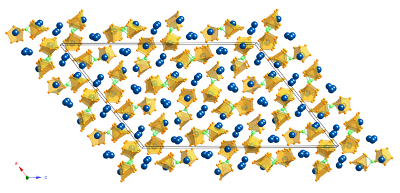
<p>The electronic structure of Cs<sub>2</sub>NaAs<sub>7</sub> was calculated using the LMTO method [<xref ref-type="bibr" rid="b14-crystals-01-00087">14</xref>-<xref ref-type="bibr" rid="b16-crystals-01-00087">16</xref>] and the plot of the total and partial density of states is shown in <xref ref-type="fig" rid="f4-crystals-01-00087">Figure 4(a)</xref>. A band-gap in the order of 1.6 eV is noticeable from the plot, suggesting that Cs2NaAs7 should be an intrinsic semiconductor. Note that the LMTO method usually underestimates the band-gap, this value actually agrees very well with the dark red color of the crystals. Due to the low symmetry and very complex structures of Cs<sub>4</sub>ZnAs<sub>14</sub> and Cs<sub>4</sub>CdAs<sub>14</sub>, the electronic structures for neither were carried out; the appearance of their crystals also suggested semiconducting behavior with a band-gap in the visible range.</p>
<p>Analyzing the electronic structure of Cs<sub>2</sub>NaAs<sub>7</sub>, one can readily see that the states below the Fermi level in the range from −5 to 0 eV (set as the Fermi level) are predominately contributed from As <italic>p</italic> orbitals, with only a small admixture of states from the alkali metals, in agreement with the Zintl formalism. In the vicinity of the Fermi level, however, the contributions of the three different types of As atoms differ very much, as seen from <xref ref-type="fig" rid="f4-crystals-01-00087">Figure 4(b)</xref>. The apical As atom has almost negligible partial DOS, while the contribution from the As atoms at the bridging position (waist of the cluster) is significant in this energy window. Such characteristics of the electronic structure should indicate different chemical and physical properties of As atoms at different positions, <italic>i.e.</italic>, chemical reactivity.</p></sec>
<sec>
<label>3.</label>
<title>Experimental Section</title>
<p>All manipulations involving the alkali metals were performed either inside an argon-filled glove box with controlled moisture/oxygen levels or under vacuum. Crystals of Cs<sub>2</sub>NaAs<sub>7</sub>, Cs<sub>4</sub>ZnAs<sub>14</sub>, and Cs<sub>4</sub>CdAs<sub>14</sub> were all identified from reactions originally aimed at the pnictide clathrates Cs<sub>8</sub>Zn<sub>18</sub>As<sub>28</sub>, Cs<sub>8</sub>Cd<sub>18</sub>As<sub>28</sub> or the mixed-cation variant Na<sub>6</sub>Cs<sub>2</sub>Zn<sub>18</sub>As<sub>28</sub>. In the typical reactions, the elements (Na/Cs/Ca/Zn/Cd/As, purchased from either Alfa Aesar or Aldrich with the stated purity higher than 99.9%, used as received) with the desired stoichiometric ratio were loaded into niobium ampoules. The niobium ampoules were arc-welded under high purity Ar and then jacketed within fused silica tubes, which were subsequently flame-sealed under vacuum. The reaction mixtures were heated up to 500 °C in a programmable furnace, and equilibrated for 1 week before being slowly cooled to room temperature. The dark red crystals of Cs<sub>2</sub>NaAs<sub>7</sub> were initially identified as a byproduct of a reaction with starting elements Na, Cs, Zn, and As, carried out as described above. The major product was CsZn<sub>4</sub>As<sub>3</sub> [<xref ref-type="bibr" rid="b26-crystals-01-00087">26</xref>], with Zn<sub>3</sub>As<sub>2</sub> [<xref ref-type="bibr" rid="b30-crystals-01-00087">30</xref>] and Cs<sub>2</sub>NaAs<sub>7</sub> as side products. Cs<sub>2</sub>NaAs<sub>7</sub> can be made as phase pure material from stoichiometric mixture without Zn.</p>
<p>From an analogous reaction with starting elements Na, Cs, Cd, and As, Cs<sub>4</sub>CdAs<sub>14</sub> was initially identified, together with Cs<sub>8</sub>Cd<sub>18</sub>As<sub>28</sub> [<xref ref-type="bibr" rid="b31-crystals-01-00087">31</xref>], NaCd<sub>4</sub>As<sub>3</sub> [<xref ref-type="bibr" rid="b26-crystals-01-00087">26</xref>], and CdAs<sub>2</sub> [<xref ref-type="bibr" rid="b32-crystals-01-00087">32</xref>]. The differentiation from the other phases was possible due to the red color and transparent habit of the crystals. Cs<sub>4</sub>ZnAs<sub>14</sub> was originally obtained from a reaction loaded as Ca<sub>16</sub>Cs<sub>8</sub>Zn<sub>58.67</sub>As<sub>77.33</sub>, and subjected to the above-described heat treatment. The dark red crystals in this reaction were identified as Cs<sub>4</sub>ZnAs<sub>14</sub>, between the black crystals of CaZn<sub>2</sub>As<sub>2</sub> [<xref ref-type="bibr" rid="b33-crystals-01-00087">33</xref>] and the silvery ones of Zn<sub>3</sub>As<sub>2</sub> [<xref ref-type="bibr" rid="b30-crystals-01-00087">30</xref>]. After the structures and the compositions were established from single-crystal diffraction work, Cs<sub>4</sub>CdAs<sub>14</sub> and Cs<sub>4</sub>ZnAs<sub>14</sub> were synthesized in high yield from the corresponding stoichiometric reactions.</p>
<p>All three compounds degraded quickly upon exposure to air.</p>
<p>The crystal structures of the title compounds were established using single-crystal X-ray diffraction. The diffraction data were collected on a Bruker SMART CCD-based diffractometer using monochromated Mo Kα<sub>1</sub> radiation. Crystals were cut to suitable dimensions (&lt;100 μm) under a microscope and then mounted on glass fiber with Paratone-N oil. The fiber was then quickly transferred to the goniometer of the diffractometer, where a cold nitrogen stream (200(2) K) was used to harden the oil in order to protect the crystals from being oxidized. Full spheres of data were collected in four batch runs with a frame width of 0.3° for ω and θ. Integration of the intensity data was done with SAINT program [<xref ref-type="bibr" rid="b34-crystals-01-00087">34</xref>], and semi-empirical absorption correction based on equivalents was applied with the SADABS code [<xref ref-type="bibr" rid="b35-crystals-01-00087">35</xref>]. The structures were solved by direct method and refined to convergence by full matrix least squares on <italic>F</italic><sup>2</sup> using the SHELXTL package [<xref ref-type="bibr" rid="b36-crystals-01-00087">36</xref>]. The atomic coordinates were standardized with the aid of the Structure TIDY [<xref ref-type="bibr" rid="b37-crystals-01-00087">37</xref>]. In the last refinement cycles, all atoms were treated with anisotropic displacement parameters. Tables with selected refinement parameters and the atomic coordinates and equivalent isotropic displacement parameters are submitted as <xref ref-type="fn" rid="fn1-crystals-01-00087">electronic supplementary information</xref>. Selected crystal data and refinement parameters are given in <xref ref-type="table" rid="t1-crystals-01-00087">Table 1</xref>; important bond distances and angles are listed in <xref ref-type="table" rid="t2-crystals-01-00087">Table 2</xref> and <xref ref-type="table" rid="t3-crystals-01-00087">Table 3</xref>. CIFs have also been deposited with Fachinformationszentrum Karlsruhe, 76344 Eggenstein-Leopoldshafen, Germany, (fax: (49) 7247-808-666; e-mail: <email>crysdata@fiz.karlsruhe.de</email>)—depository numbers CSD-423080 for Cs<sub>4</sub>NaAs<sub>7</sub>, CSD-423081 for Cs<sub>4</sub>CdAs<sub>14</sub>, and CSD-423082 for Cs<sub>4</sub>CdAs<sub>14</sub>.</p>
<p>The Stuttgart TB-LMTO 4.7 code [<xref ref-type="bibr" rid="b38-crystals-01-00087">38</xref>], which employs the tight-binding linear muffin-tin orbital (TB-LMTO) method [<xref ref-type="bibr" rid="b14-crystals-01-00087">14</xref>-<xref ref-type="bibr" rid="b16-crystals-01-00087">16</xref>], was used to calculate the band structures of Cs<sub>2</sub>NaAs<sub>7</sub>. In this program, local density approximation (LDA) was used to treat exchange and correlation [<xref ref-type="bibr" rid="b39-crystals-01-00087">39</xref>]. All relativistic effects except for spin-orbital coupling were taken into account by scalar relativistic approximation [<xref ref-type="bibr" rid="b40-crystals-01-00087">40</xref>]. Due to the limited computing resources, Cs<sub>4</sub>CdAs<sub>14</sub> and Cs<sub>4</sub>ZnAs<sub>14</sub> (very complex and large structures) could not be treated. For the calculation of Cs<sub>2</sub>NaAs<sub>7</sub>, the basis set included the 6<italic>s</italic>, 6<italic>p</italic>, 5<italic>d</italic> and 4<italic>f</italic> orbitals for Cs, 3<italic>s</italic>, 3<italic>p</italic> and 3<italic>d</italic> orbitals for Na, and 4<italic>s</italic>, 4<italic>p</italic> and 4<italic>d</italic> orbitals for As. The 6<italic>p</italic>, 5<italic>d</italic> and 4<italic>f</italic> orbitals of Cs, 3<italic>p</italic> and 3<italic>d</italic> orbitals of Na, and 4<italic>d</italic> orbital of As were treated with the downfolding technique [<xref ref-type="bibr" rid="b41-crystals-01-00087">41</xref>]. The total and partial density of states were plotted with the Fermi level set as a reference at 0 eV.</p></sec>
<sec sec-type="conclusions">
<label>4.</label>
<title>Conclusions</title>
<p>Three new Zintl phases Cs<sub>2</sub>NaAs<sub>7</sub>, Cs<sub>4</sub>ZnAs<sub>14</sub> and Cs<sub>4</sub>CdAs<sub>14</sub> have been synthesized via high temperature reactions. The structure of Cs<sub>2</sub>NaAs<sub>7</sub> features the nortricyclane-like cluster [As<sub>7</sub>]<sup>3−</sup>, while the structures of the latter two contain very large [ZnAs<sub>14</sub>]<sup>4−</sup> and [CdAs<sub>14</sub>]<sup>4−</sup> anions, which are composed of two [As<sub>7</sub>]<sup>3−</sup> units, linked by 4-coordinated Zn or Cd. Band structure calculations confirm the intrinsic semiconductor with a size of band-gap consistent with the dark red color of the crystals.</p></sec></body>
<back>
<sec sec-type="display-objects">
<title>Figures and Tables</title>
<fig id="f1-crystals-01-00087" position="float">
<label>Figure 1.</label>
<caption>
<p>A schematic presentation of the crystal structure of Cs<sub>2</sub>NaAs<sub>7</sub>. Color code: As—orange; Cs—dark blue; Na—green. The [As<sub>7</sub>]<sup>3−</sup> clusters are depicted in polyhedral representation. The structure is projected approximately down the <italic>c</italic>-axis and the unit cell is outlined.</p></caption>
<graphic xlink:href="crystals-01-00087f1.gif"/></fig>
<fig id="f2-crystals-01-00087" position="float">
<label>Figure 2.</label>
<caption>
<p>Schematic presentations of the crystal structures of <bold>(a)</bold> Cs<sub>4</sub>ZnAs<sub>14</sub>, and <bold>(b)</bold> Cs<sub>4</sub>CdAs<sub>14</sub>. Color codes: As—orange; Cs—blue; Zn—light green; Cd—red. The [As<sub>7</sub>]<sup>3–</sup> clusters are depicted as translucent polyhedra, and the Zn–As and Cd–As bonds are highlighted. Unit cells and projection directions are outlined.</p></caption>
<graphic xlink:href="crystals-01-00087f2.gif"/></fig>
<fig id="f3-crystals-01-00087" position="float">
<label>Figure 3.</label>
<caption>
<p>Representations of the [As<sub>7</sub>]<sup>3−</sup> clusters in Cs<sub>2</sub>NaAs<sub>7</sub> (<bold>a</bold>), [Zn(1)As<sub>14</sub>]<sup>4−</sup> clusters in Cs<sub>4</sub>ZnAs<sub>14</sub> (<bold>b</bold>), and the [CdAs<sub>14</sub>]<sup>4−</sup> clusters in Cs<sub>4</sub>CdAs<sub>14</sub> (<bold>c</bold>) with thermal ellipsoids, all drawn at the 50% probability level.</p></caption>
<graphic xlink:href="crystals-01-00087f3.gif"/></fig>
<fig id="f4-crystals-01-00087" position="float">
<label>Figure 4.</label>
<caption>
<p><bold>(a)</bold> Total and partial density of states (DOS) for Cs<sub>2</sub>NaAs<sub>7</sub>. <bold>(b)</bold> Comparison of the average DOS of the different As atoms (see text for details).</p></caption>
<graphic xlink:href="crystals-01-00087f4.gif"/></fig>
<table-wrap id="t1-crystals-01-00087" position="float">
<label>Table 1.</label>
<caption>
<p>Selected crystal data and structure refinement parameters for Cs<sub>2</sub>NaAs<sub>7</sub>, Cs<sub>4</sub>ZnAs<sub>14</sub>, and Cs<sub>4</sub>CdAs<sub>14</sub>.</p></caption>
<table frame="hsides" rules="none">
<tbody>
<tr>
<td colspan="2" align="left" valign="top">Empirical formula</td>
<td align="center" valign="top">Cs<sub>2</sub>NaAs<sub>7</sub></td>
<td align="center" valign="top">Cs<sub>4</sub>ZnAs<sub>14</sub></td>
<td align="center" valign="top">Cs<sub>4</sub>CdAs<sub>14</sub></td></tr>
<tr>
<td colspan="2" align="left" valign="top">Formula weight</td>
<td align="center" valign="top">813.25</td>
<td align="center" valign="top">1645.89</td>
<td align="center" valign="top">1692.92</td></tr>
<tr>
<td colspan="2" align="left" valign="top">Space group, <italic>Z</italic></td>
<td align="center" valign="top"><italic>P</italic>2<sub>1</sub>/<italic>c</italic>, 4</td>
<td align="center" valign="top"><italic>P</italic>2<sub>1</sub>/<italic>c</italic>, 16</td>
<td align="center" valign="top"><italic>P</italic>2<sub>1</sub>/<italic>c</italic>, 4</td></tr>
<tr>
<td colspan="2" align="left" valign="top">Temperature</td>
<td align="center" valign="top"/>
<td align="center" valign="top">200(2) K</td>
<td align="center" valign="top"/></tr>
<tr>
<td colspan="2" align="left" valign="top">Wavelength</td>
<td align="center" valign="top"/>
<td align="center" valign="top">Mo <italic>K</italic>α, 0.71073 Å</td>
<td align="center" valign="top"/></tr>
<tr>
<td align="left" valign="top">Cell parameters</td>
<td align="left" valign="top"><italic>a</italic> (Å)</td>
<td align="center" valign="top">11.7671(18)</td>
<td align="center" valign="top">29.067(2)</td>
<td align="center" valign="top">10.608(3)</td></tr>
<tr>
<td align="left" valign="top"/>
<td align="left" valign="top"><italic>b</italic> (Å)</td>
<td align="center" valign="top">10.8528(17)</td>
<td align="center" valign="top">10.4714(8)</td>
<td align="center" valign="top">16.761(5)</td></tr>
<tr>
<td align="left" valign="top"/>
<td align="left" valign="top"><italic>c</italic> (Å)</td>
<td align="center" valign="top">10.2115(15)</td>
<td align="center" valign="top">43.039(3)</td>
<td align="center" valign="top">14.363(4)</td></tr>
<tr>
<td align="left" valign="top"/>
<td align="left" valign="top"><italic>β</italic> (°)</td>
<td align="center" valign="top">90.213(3)</td>
<td align="center" valign="top">128.0920(10)</td>
<td align="center" valign="top">91.785(5)</td></tr>
<tr>
<td align="left" valign="top"/>
<td align="left" valign="top"><italic>V</italic> (Å<sup>3</sup>)</td>
<td align="center" valign="top">1304.1(3)</td>
<td align="center" valign="top">10309.9(14)</td>
<td align="center" valign="top">2552.6(12)</td></tr>
<tr>
<td colspan="2" align="left" valign="top">Calculated density (g/cm<sup>3</sup>)</td>
<td align="center" valign="top">4.142</td>
<td align="center" valign="top">4.241</td>
<td align="center" valign="top">4.405</td></tr>
<tr>
<td colspan="2" align="left" valign="top">Absorption coefficient (cm<sup>−1</sup>)</td>
<td align="center" valign="top">231.94</td>
<td align="center" valign="top">243.43</td>
<td align="center" valign="top">244.74</td></tr>
<tr>
<td colspan="2" align="left" valign="top">Crystal size (mm<sup>3</sup>)</td>
<td align="center" valign="top">0.044 × 0.030 × 0.028</td>
<td align="center" valign="top">0.068 × 0.049 × 0.023</td>
<td align="center" valign="top">0.080 × 0.060 × 0.040</td></tr>
<tr>
<td colspan="2" align="left" valign="top">Goodness-of-fit on <italic>F</italic><sup>2</sup></td>
<td align="center" valign="top">1.001</td>
<td align="center" valign="top">0.979</td>
<td align="center" valign="top">0.981</td></tr>
<tr>
<td colspan="2" align="left" valign="top">R (<italic>I</italic> &gt; 2σ<sub>I</sub>)<xref ref-type="table-fn" rid="tfn1-crystals-01-00087">a</xref></td>
<td align="center" valign="top">0.0441</td>
<td align="center" valign="top">0.0436</td>
<td align="center" valign="top">0.0320</td></tr>
<tr>
<td colspan="2" align="left" valign="top">w<italic>R</italic><sub>2</sub> (<italic>I</italic> &gt; 2σ<sub>I</sub>)<xref ref-type="table-fn" rid="tfn1-crystals-01-00087">a</xref></td>
<td align="center" valign="top">0.0678</td>
<td align="center" valign="top">0.0737</td>
<td align="center" valign="top">0.0554</td></tr>
<tr>
<td colspan="2" align="left" valign="top">Largest diff. peak/hole (e<sup>−</sup>/Å<sup>3</sup>)</td>
<td align="center" valign="top">1.172/−1.055</td>
<td align="center" valign="top">1.260/−1.463</td>
<td align="center" valign="top">1.012/−0.822</td></tr>
<tr>
<td colspan="2" align="left" valign="top">Weight coefficient, <italic>A/B</italic><xref ref-type="table-fn" rid="tfn1-crystals-01-00087">a</xref></td>
<td align="center" valign="top">0.0189/0</td>
<td align="center" valign="top">0/17.2682</td>
<td align="center" valign="top">0.0208/0</td></tr></tbody></table>
<table-wrap-foot><fn id="tfn1-crystals-01-00087">
<label>a</label>
<p><italic>R<sub>1</sub></italic> = Σ| |<italic>F</italic><sub>o</sub>|−|F<sub>c</sub>| |/Σ|<italic>F</italic><sub>o</sub>|, w<italic>R</italic><sub>2</sub> = {Σ[<italic>w</italic>(<italic>F</italic><sub>o</sub><sup>2</sup>−<italic>F</italic><sub>c</sub><sup>2</sup>)<sup>2</sup>]/ Σ[<italic>w</italic>(<italic>F</italic><sub>o</sub><sup>2</sup>)<sup>2</sup>]}<sup>1/2</sup>, where <italic>w</italic> = 1/[σ<sup>2</sup><italic>F</italic><sub>o</sub><sup>2</sup>+(<italic>AP</italic>)<sup>2</sup>+<italic>BP</italic>], and <italic>P</italic> = (<italic>F</italic><sub>o</sub><sup>2</sup>+2<italic>F</italic><sub>c</sub><sup>2</sup>)/3.</p></fn><fn id="tfn2-crystals-01-00087">
<p><italic>A</italic> and <italic>B</italic> are weight coefficients.</p></fn></table-wrap-foot></table-wrap>
<table-wrap id="t2-crystals-01-00087" position="float">
<label>Table 2.</label>
<caption>
<p>Selected bond distances (Å) and bond angles (°) in Cs<sub>2</sub>NaAs<sub>7</sub>.</p></caption>
<table frame="hsides" rules="none">
<thead>
<tr>
<th align="left" valign="top">Atom pair</th>
<th align="left" valign="top">Distance</th>
<th align="left" valign="top">Angle label</th>
<th align="left" valign="top">Angle</th></tr></thead>
<tbody>
<tr>
<td align="left" valign="top">As2–As1</td>
<td align="left" valign="top">2.4042(18)</td>
<td align="left" valign="top">As1-As2-As4</td>
<td align="left" valign="top">100.76(6)</td></tr>
<tr>
<td align="left" valign="top">As2–As4</td>
<td align="left" valign="top">2.4237(17)</td>
<td align="left" valign="top">As1-As2-As7</td>
<td align="left" valign="top">102.56(6)</td></tr>
<tr>
<td align="left" valign="top">As2–As7</td>
<td align="left" valign="top">2.4050(18)</td>
<td align="left" valign="top">As4-As2-As7</td>
<td align="left" valign="top">101.38(6)</td></tr>
<tr>
<td align="left" valign="top">As1–As3</td>
<td align="left" valign="top">2.348(2)</td>
<td align="left" valign="top">As2-As1-As3</td>
<td align="left" valign="top">98.97(6)</td></tr>
<tr>
<td align="left" valign="top">As4–As5</td>
<td align="left" valign="top">2.3411(18)</td>
<td align="left" valign="top">As2-As4-As5</td>
<td align="left" valign="top">98.90(6)</td></tr>
<tr>
<td align="left" valign="top">As7–As6</td>
<td align="left" valign="top">2.3465(19)</td>
<td align="left" valign="top">As2-As7-As6</td>
<td align="left" valign="top">98.45(6)</td></tr>
<tr>
<td align="left" valign="top">As3–As5</td>
<td align="left" valign="top">2.5139(19)</td>
<td align="left" valign="top">As3-As5-As6</td>
<td align="left" valign="top">59.98(5)</td></tr>
<tr>
<td align="left" valign="top">As3–As6</td>
<td align="left" valign="top">2.4964(19)</td>
<td align="left" valign="top">As5-As6-As3</td>
<td align="left" valign="top">60.68(5)</td></tr>
<tr>
<td align="left" valign="top">As5–As6</td>
<td align="left" valign="top">2.4799(17)</td>
<td align="left" valign="top">As6-As3-As5</td>
<td align="left" valign="top">59.33(5)</td></tr></tbody></table></table-wrap>
<table-wrap id="t3-crystals-01-00087" position="float">
<label>Table 3.</label>
<caption>
<p>Selected bond distances (Å) in Cs<sub>4</sub>ZnAs<sub>14</sub> and Cs<sub>4</sub>CdAs<sub>14</sub>.</p></caption>
<table frame="hsides" rules="none">
<thead>
<tr>
<th align="left" valign="top">Atom pair</th>
<th align="left" valign="top">Distance</th>
<th align="left" valign="top">Atom pair</th>
<th align="left" valign="top">Distance</th></tr>
<tr>
<th colspan="4" valign="bottom">
<hr/></th></tr>
<tr>
<th align="left" valign="top"><bold>Cs<sub>4</sub>ZnAs<sub>14</sub></bold></th>
<th align="left" valign="top"/>
<th align="left" valign="top"><bold>Cs<sub>4</sub>CdAs<sub>14</sub></bold></th>
<th align="left" valign="top"/></tr></thead>
<tbody>
<tr>
<td align="left" valign="top">Zn1-tetrahedron</td>
<td align="left" valign="top"/>
<td align="left" valign="top">Cd-tetrahedron</td>
<td align="left" valign="top"/></tr>
<tr>
<td align="left" valign="top">Zn1–As4</td>
<td align="left" valign="top">2.534(2)</td>
<td align="left" valign="top">Cd–As2</td>
<td align="left" valign="top">2.7364(10)</td></tr>
<tr>
<td align="left" valign="top">Zn1–As12</td>
<td align="left" valign="top">2.590(2)</td>
<td align="left" valign="top">Cd–As6</td>
<td align="left" valign="top">2.7736(10)</td></tr>
<tr>
<td align="left" valign="top">Zn1–As20</td>
<td align="left" valign="top">2.560(2)</td>
<td align="left" valign="top">Cd–As1</td>
<td align="left" valign="top">2.6957(9)</td></tr>
<tr>
<td align="left" valign="top">Zn1–As24</td>
<td align="left" valign="top">2.560(2)</td>
<td align="left" valign="top">Cd–As14</td>
<td align="left" valign="top">2.8241(11)</td></tr>
<tr>
<td align="left" valign="top">“birdcage” 1</td>
<td align="left" valign="top"/>
<td align="left" valign="top">“birdcage” 1</td>
<td align="left" valign="top"/></tr>
<tr>
<td align="left" valign="top">As5–As4</td>
<td align="left" valign="top">2.441(2)</td>
<td align="left" valign="top">As3–As2</td>
<td align="left" valign="top">2.4339(11)</td></tr>
<tr>
<td align="left" valign="top">As5–As8</td>
<td align="left" valign="top">2.379(2)</td>
<td align="left" valign="top">As3–As6</td>
<td align="left" valign="top">2.4281(11)</td></tr>
<tr>
<td align="left" valign="top">As5–As12</td>
<td align="left" valign="top">2.425(2)</td>
<td align="left" valign="top">As3–As7</td>
<td align="left" valign="top">2.3741(11)</td></tr>
<tr>
<td align="left" valign="top">As4–As1</td>
<td align="left" valign="top">2.381(2)</td>
<td align="left" valign="top">As2–As8</td>
<td align="left" valign="top">2.3801(11)</td></tr>
<tr>
<td align="left" valign="top">As8–As7</td>
<td align="left" valign="top">2.363(3)</td>
<td align="left" valign="top">As6–As11</td>
<td align="left" valign="top">2.3775(12)</td></tr>
<tr>
<td align="left" valign="top">As12–As9</td>
<td align="left" valign="top">2.373(2)</td>
<td align="left" valign="top">As7–As12</td>
<td align="left" valign="top">2.3547(11)</td></tr>
<tr>
<td align="left" valign="top">As1–As7</td>
<td align="left" valign="top">2.479(2)</td>
<td align="left" valign="top">As8–As11</td>
<td align="left" valign="top">2.5025(11)</td></tr>
<tr>
<td align="left" valign="top">As1–As9</td>
<td align="left" valign="top">2.498(2)</td>
<td align="left" valign="top">As8–As12</td>
<td align="left" valign="top">2.5021(11)</td></tr>
<tr>
<td align="left" valign="top">As7–As9</td>
<td align="left" valign="top">2.463(2)</td>
<td align="left" valign="top">As11–As12</td>
<td align="left" valign="top">2.4545(12)</td></tr>
<tr>
<td align="left" valign="top">“birdcage” 2</td>
<td align="left" valign="top"/>
<td align="left" valign="top">“birdcage” 2</td>
<td align="left" valign="top"/></tr>
<tr>
<td align="left" valign="top">As29–As20</td>
<td align="left" valign="top">2.4395(19)</td>
<td align="left" valign="top">As5–As1</td>
<td align="left" valign="top">2.4236(10)</td></tr>
<tr>
<td align="left" valign="top">As29–As24</td>
<td align="left" valign="top">2.425(2)</td>
<td align="left" valign="top">As5–As10</td>
<td align="left" valign="top">2.3873(11)</td></tr>
<tr>
<td align="left" valign="top">As29–As54</td>
<td align="left" valign="top">2.365(2)</td>
<td align="left" valign="top">As5–As14</td>
<td align="left" valign="top">2.4332(11)</td></tr>
<tr>
<td align="left" valign="top">As20–As16</td>
<td align="left" valign="top">2.368(2)</td>
<td align="left" valign="top">As1–As4</td>
<td align="left" valign="top">2.3951(11)</td></tr>
<tr>
<td align="left" valign="top">As24–As22</td>
<td align="left" valign="top">2.386(2)</td>
<td align="left" valign="top">As10–As13</td>
<td align="left" valign="top">2.3656(12)</td></tr>
<tr>
<td align="left" valign="top">As54–As26</td>
<td align="left" valign="top">2.361(2)</td>
<td align="left" valign="top">As14–As9</td>
<td align="left" valign="top">2.3760(11)</td></tr>
<tr>
<td align="left" valign="top">As16–As22</td>
<td align="left" valign="top">2.503(2)</td>
<td align="left" valign="top">As4–As13</td>
<td align="left" valign="top">2.4721(12)</td></tr>
<tr>
<td align="left" valign="top">As16–As26</td>
<td align="left" valign="top">2.489(2)</td>
<td align="left" valign="top">As4–As9</td>
<td align="left" valign="top">2.5090(11)</td></tr>
<tr>
<td align="left" valign="top">As22–As26</td>
<td align="left" valign="top">2.453(2)</td>
<td align="left" valign="top">As13–As9</td>
<td align="left" valign="top">2.4694(11)</td></tr></tbody></table></table-wrap></sec>
<ack>
<p>Svilen Bobev acknowledges financial support from the US Department of Energy through a grant (DE-SC0001360).</p></ack>
<ref-list>
<title>References</title>
<ref id="b1-crystals-01-00087"><label>1.</label><citation citation-type="journal"><person-group person-group-type="author"><name><surname>Zintl</surname><given-names>E.</given-names></name></person-group><article-title>Intermetallische Verbindungen</article-title><source>Angew. Chem.</source><year>1939</year><volume>52</volume><fpage>1</fpage><lpage>6</lpage><pub-id pub-id-type="doi">10.1002/ange.19390520102</pub-id></citation></ref>
<ref id="b2-crystals-01-00087"><label>2.</label><citation citation-type="journal"><person-group person-group-type="author"><name><surname>Schäfer</surname><given-names>H.</given-names></name><name><surname>Eisenman.</surname><given-names>B.</given-names></name><name><surname>Müller</surname><given-names>W.</given-names></name></person-group><article-title>Zintl Phases-Transitions between Metallic and Ionic Bonding</article-title><source>Angew. Chem. Int. Ed.</source><year>1973</year><volume>12</volume><fpage>694</fpage><lpage>712</lpage><pub-id pub-id-type="doi">10.1002/anie.197306941</pub-id></citation></ref>
<ref id="b3-crystals-01-00087"><label>3.</label><citation citation-type="journal"><person-group person-group-type="author"><name><surname>Kauzlarich</surname><given-names>S.M.</given-names></name><name><surname>Brown</surname><given-names>S.R.</given-names></name><name><surname>Snyder</surname><given-names>G.J.</given-names></name></person-group><article-title>Zintl Phases for Thermoelectric Devices</article-title><source>Dalton Trans.</source><year>2007</year><fpage>2099</fpage><lpage>2107</lpage></citation></ref>
<ref id="b4-crystals-01-00087"><label>4.</label><citation citation-type="journal"><person-group person-group-type="author"><name><surname>Brown</surname><given-names>S.R.</given-names></name><name><surname>Kauzlarich</surname><given-names>S.M.</given-names></name><name><surname>Gascoin</surname><given-names>F.</given-names></name><name><surname>Snyder</surname><given-names>G.J.</given-names></name></person-group><article-title>Yb<sub>14</sub>MnSb<sub>11</sub>: New High Efficiency Thermoelectric Material for Power Generation</article-title><source>Chem. Mater.</source><year>2006</year><volume>18</volume><fpage>1873</fpage><lpage>1877</lpage><pub-id pub-id-type="doi">10.1021/cm060261t</pub-id></citation></ref>
<ref id="b5-crystals-01-00087"><label>5.</label><citation citation-type="journal"><person-group person-group-type="author"><name><surname>Gascoin</surname><given-names>F.</given-names></name><name><surname>Ottensmann</surname><given-names>S.</given-names></name><name><surname>Stark</surname><given-names>D.</given-names></name><name><surname>Haile</surname><given-names>S.M.</given-names></name><name><surname>Snyder</surname><given-names>G.J.</given-names></name></person-group><article-title>Zintl Phases as Thermoelectric Materials: Tuned Transport Properties of the Compounds Ca<sub>x</sub>Yb<sub>1-x</sub>Zn<sub>2</sub>Sb<sub>2</sub></article-title><source>Adv. Funct. Mater.</source><year>2005</year><volume>15</volume><fpage>1860</fpage><lpage>1864</lpage><pub-id pub-id-type="doi">10.1002/adfm.200500043</pub-id></citation></ref>
<ref id="b6-crystals-01-00087"><label>6.</label><citation citation-type="journal"><person-group person-group-type="author"><name><surname>Zhang</surname><given-names>H.</given-names></name><name><surname>Zhao</surname><given-names>J.-T.</given-names></name><name><surname>Grin</surname><given-names>Y.</given-names></name><name><surname>Wang</surname><given-names>X.-J.</given-names></name><name><surname>Tang</surname><given-names>M.-B.</given-names></name><name><surname>Man</surname><given-names>Z.-Y.</given-names></name><name><surname>Chen</surname><given-names>H.-H.</given-names></name><name><surname>Yang</surname><given-names>X.-X.</given-names></name></person-group><article-title>A New Type of Thermoelectric Material, EuZn<sub>2</sub>Sb<sub>2</sub></article-title><source>J. Chem. Phys.</source><year>2008</year><volume>129</volume><fpage>164713</fpage><pub-id pub-id-type="doi">10.1063/1.3001608</pub-id><pub-id pub-id-type="pmid">19045304</pub-id></citation></ref>
<ref id="b7-crystals-01-00087"><label>7.</label><citation citation-type="book"><person-group person-group-type="author"><name><surname>Kolis</surname><given-names>J.W.</given-names></name><name><surname>Young</surname><given-names>D.M.</given-names></name></person-group><article-title>Molecular Transition Metal Complexes of Zintl Ions</article-title><source>Chemistry, Structure, and Bonding of Zintl Phases and Ions</source><person-group person-group-type="editor"><name><surname>Kauzlarich</surname><given-names>S.M.</given-names></name></person-group><publisher-name>VCH</publisher-name><publisher-loc>New York, NY, USA</publisher-loc><year>1996</year><fpage>225</fpage><lpage>244</lpage></citation></ref>
<ref id="b8-crystals-01-00087"><label>8.</label><citation citation-type="journal"><person-group person-group-type="author"><name><surname>Corbett</surname><given-names>J.D.</given-names></name></person-group><article-title>Polyatomic Zintl Anions of the Post-Transition Elements</article-title><source>Chem. Rev.</source><year>1985</year><volume>85</volume><fpage>383</fpage><lpage>397</lpage><pub-id pub-id-type="doi">10.1021/cr00069a003</pub-id></citation></ref>
<ref id="b9-crystals-01-00087"><label>9.</label><citation citation-type="journal"><person-group person-group-type="author"><name><surname>Sun</surname><given-names>D.</given-names></name><name><surname>Riley</surname><given-names>A.E.</given-names></name><name><surname>Cadby</surname><given-names>A.J.</given-names></name><name><surname>Richman</surname><given-names>E.K.</given-names></name><name><surname>Korlann</surname><given-names>S.D.</given-names></name><name><surname>Tolbert</surname><given-names>S.H.</given-names></name></person-group><article-title>Hexagonal Nanoporous Germanium through Surfactant-Driven Self-Assembly of Zintl Clusters</article-title><source>Nature</source><year>2006</year><volume>441</volume><fpage>1126</fpage><lpage>1130</lpage><pub-id pub-id-type="doi">10.1038/nature04891</pub-id><pub-id pub-id-type="pmid">16810251</pub-id></citation></ref>
<ref id="b10-crystals-01-00087"><label>10.</label><citation citation-type="journal"><person-group person-group-type="author"><name><surname>Korlann</surname><given-names>S.D.</given-names></name><name><surname>Riley</surname><given-names>A.E.</given-names></name><name><surname>Mun</surname><given-names>B.S.</given-names></name><name><surname>Tolbert</surname><given-names>S.H.</given-names></name></person-group><article-title>Chemical Tuning of the Electronic Properties of Nanostructured Semiconductor Films Formed through Surfactant Templating of Zintl Cluster</article-title><source>J. Phys. Chem. C</source><year>2009</year><volume>113</volume><fpage>7697</fpage><lpage>7705</lpage><pub-id pub-id-type="doi">10.1021/jp806857v</pub-id></citation></ref>
<ref id="b11-crystals-01-00087"><label>11.</label><citation citation-type="journal"><person-group person-group-type="author"><name><surname>Moses</surname><given-names>M.J.</given-names></name><name><surname>Fettinger</surname><given-names>J.C.</given-names></name><name><surname>Eichhorn</surname><given-names>B.W.</given-names></name></person-group><article-title>Interpenetrating As<sub>20</sub> Fullerene and Ni<sub>12</sub> Icosahedra in the Onion-Skin [As@Ni<sub>12</sub>@As<sub>20</sub>]<sup>3−</sup> Ion</article-title><source>Science</source><year>2003</year><volume>300</volume><fpage>778</fpage><lpage>780</lpage><pub-id pub-id-type="doi">10.1126/science.1082342</pub-id><pub-id pub-id-type="pmid">12730596</pub-id></citation></ref>
<ref id="b12-crystals-01-00087"><label>12.</label><citation citation-type="journal"><person-group person-group-type="author"><name><surname>Esenturk</surname><given-names>E.N.</given-names></name><name><surname>Fettinger</surname><given-names>J.C.</given-names></name><name><surname>Eichhorn</surname><given-names>B.W.</given-names></name></person-group><article-title>The Pb<sub>12</sub><sup>2−</sup> and Pb<sub>10</sub><sup>2−</sup> Zintl Ions and the M@ Pb<sub>12</sub><sup>2−</sup> and M@ Pb<sub>10</sub><sup>2−</sup> Cluster Series Where M = Ni, Pd, Pt</article-title><source>J. Am. Chem. Soc.</source><year>2006</year><volume>128</volume><fpage>9178</fpage><lpage>9186</lpage><pub-id pub-id-type="doi">10.1021/ja061842m</pub-id><pub-id pub-id-type="pmid">16834391</pub-id></citation></ref>
<ref id="b13-crystals-01-00087"><label>13.</label><citation citation-type="journal"><person-group person-group-type="author"><name><surname>Hull</surname><given-names>M.W.</given-names></name><name><surname>Sevov</surname><given-names>S.C.</given-names></name></person-group><article-title>Functionalization of Nine-Atom Deltahedral Zintl Ions with Organic Substituents: Detailed Studies of the Reactions</article-title><source>J. Am. Chem. Soc.</source><year>2009</year><volume>131</volume><fpage>9026</fpage><lpage>9037</lpage><pub-id pub-id-type="doi">10.1021/ja9025962</pub-id><pub-id pub-id-type="pmid">19496567</pub-id></citation></ref>
<ref id="b14-crystals-01-00087"><label>14.</label><citation citation-type="journal"><person-group person-group-type="author"><name><surname>Andersen</surname><given-names>O.K.</given-names></name></person-group><article-title>Linear Methods in Band Theory</article-title><source>Phys. Rev. B</source><year>1975</year><volume>12</volume><fpage>3060</fpage><lpage>3083</lpage><pub-id pub-id-type="doi">10.1103/PhysRevB.12.3060</pub-id></citation></ref>
<ref id="b15-crystals-01-00087"><label>15.</label><citation citation-type="journal"><person-group person-group-type="author"><name><surname>Andersen</surname><given-names>O.K.</given-names></name><name><surname>Jepsen</surname><given-names>O.</given-names></name></person-group><article-title>Explicit, First-Principles Tight-Binding Theory</article-title><source>Phys. Rev. Lett.</source><year>1984</year><volume>53</volume><fpage>2571</fpage><lpage>2574</lpage><pub-id pub-id-type="doi">10.1103/PhysRevLett.53.2571</pub-id></citation></ref>
<ref id="b16-crystals-01-00087"><label>16.</label><citation citation-type="journal"><person-group person-group-type="author"><name><surname>Andersen</surname><given-names>O.K.</given-names></name><name><surname>Pawlowska</surname><given-names>Z.</given-names></name><name><surname>Jepsen</surname><given-names>O.</given-names></name></person-group><article-title>Illustration of the Linear Muffin-Tin Orbital Tight-Binding Representation: Compact Orbitals and Charge Density in Si</article-title><source>Phys. Rev. B</source><year>1986</year><volume>34</volume><fpage>5253</fpage><lpage>5269</lpage><pub-id pub-id-type="doi">10.1103/PhysRevB.34.5253</pub-id></citation></ref>
<ref id="b17-crystals-01-00087"><label>17.</label><citation citation-type="journal"><person-group person-group-type="author"><name><surname>Hönle</surname><given-names>W.</given-names></name><name><surname>Buresch</surname><given-names>J.</given-names></name><name><surname>Peters</surname><given-names>K.</given-names></name><name><surname>Chang</surname><given-names>J.-H.</given-names></name><name><surname>von Schnering</surname><given-names>H.G.</given-names></name></person-group><article-title>Crystal structure of the low-temperature modification of trilithium heptaarsenide, LT-Li<sub>3</sub>As<sub>7</sub></article-title><source>Z. Kristallogr.</source><year>2002</year><volume>217</volume><fpage>485</fpage><lpage>486</lpage></citation></ref>
<ref id="b18-crystals-01-00087"><label>18.</label><citation citation-type="journal"><person-group person-group-type="author"><name><surname>Hönle</surname><given-names>W.</given-names></name><name><surname>Buresch</surname><given-names>J.</given-names></name><name><surname>Peters</surname><given-names>K.</given-names></name><name><surname>Chang</surname><given-names>J.-H.</given-names></name><name><surname>von Schnering</surname><given-names>H.G.</given-names></name></person-group><article-title>Crystal structure of the low- temperature modification of trisodium heptaarsenide, LT-Na<sub>3</sub>As<sub>7</sub></article-title><source>Z. Kristallogr.</source><year>2002</year><volume>217</volume><fpage>487</fpage><lpage>488</lpage></citation></ref>
<ref id="b19-crystals-01-00087"><label>19.</label><citation citation-type="journal"><person-group person-group-type="author"><name><surname>Emmerling</surname><given-names>F.</given-names></name><name><surname>Röhr</surname><given-names>C.</given-names></name></person-group><article-title>Alkali Metal Arsenides A<sub>3</sub>As<sub>7</sub> and AAs (A = K, Rb, Cs). Preparation, Crystal Structure, Vibrational Spectroscopy</article-title><source>Z. Naturforsch.</source><year>2002</year><volume>57b</volume><fpage>963</fpage><lpage>975</lpage></citation></ref>
<ref id="b20-crystals-01-00087"><label>20.</label><citation citation-type="journal"><person-group person-group-type="author"><name><surname>Hanauer</surname><given-names>T.</given-names></name><name><surname>Grothe</surname><given-names>M.</given-names></name><name><surname>Reil</surname><given-names>M.</given-names></name><name><surname>Korber</surname><given-names>N.</given-names></name></person-group><article-title>Syntheses and Crystal Structures of Four New Ammoniates with Heptaarsenide (As<sub>7</sub><sup>3−</sup>) Anioins</article-title><source>Helv. Chim. Acta</source><year>2005</year><volume>88</volume><fpage>950</fpage><lpage>961</lpage><pub-id pub-id-type="doi">10.1002/hlca.200590088</pub-id></citation></ref>
<ref id="b21-crystals-01-00087"><label>21.</label><citation citation-type="journal"><person-group person-group-type="author"><name><surname>Knapp</surname><given-names>C.M.</given-names></name><name><surname>Large</surname><given-names>J.S.</given-names></name><name><surname>Rees</surname><given-names>N.H.</given-names></name><name><surname>Goicoechea</surname><given-names>J.M.</given-names></name></person-group><article-title>A Versatile Salt-Metathesis Route to Heteroatomic Clusters Derived from Phosphorus and Arsenic Zintl Anions</article-title><source>Dalton Trans.</source><year>2011</year><volume>40</volume><fpage>735</fpage><lpage>745</lpage><pub-id pub-id-type="doi">10.1039/c0dt00918k</pub-id><pub-id pub-id-type="pmid">21127820</pub-id></citation></ref>
<ref id="b22-crystals-01-00087"><label>22.</label><citation citation-type="journal"><person-group person-group-type="author"><name><surname>Knapp</surname><given-names>C.M.</given-names></name><name><surname>Zhou</surname><given-names>B.</given-names></name><name><surname>Denning</surname><given-names>M.S.</given-names></name><name><surname>Rees</surname><given-names>N.H.</given-names></name><name><surname>Goicoechea</surname><given-names>J.M.</given-names></name></person-group><article-title>Reactivity Studies of Group 15 Zintl Ions towards Homoleptic Post-Transition Metal Organometallics: a ‘Bottom-up’ Approach to Bimetallic Molecular</article-title><source>Dalton Trans.</source><year>2010</year><volume>39</volume><fpage>426</fpage><lpage>436</lpage><pub-id pub-id-type="doi">10.1039/b911544g</pub-id></citation></ref>
<ref id="b23-crystals-01-00087"><label>23.</label><citation citation-type="book"><person-group person-group-type="author"><name><surname>Pauling</surname><given-names>L.</given-names></name></person-group><source>The Nature of the Chemical Bond</source><edition>3rd ed.</edition><publisher-name>Cornell University Press</publisher-name><publisher-loc>Ithaca, NY, USA</publisher-loc><year>1960</year><fpage>400</fpage><lpage>404</lpage></citation></ref>
<ref id="b24-crystals-01-00087"><label>24.</label><citation citation-type="journal"><person-group person-group-type="author"><name><surname>Saparov</surname><given-names>B.</given-names></name><name><surname>Bobev</surname><given-names>S.</given-names></name></person-group><article-title>Isolated <inline-formula><mml:math id="mm1" display="inline"><mml:semantics id="sm1"><mml:mrow><mml:msup><mml:mrow><mml:mmultiscripts><mml:mrow><mml:mrow><mml:mo stretchy="false">[</mml:mo><mml:mrow><mml:msub><mml:mtext mathvariant="italic">ZnPn</mml:mtext><mml:mn>2</mml:mn></mml:msub></mml:mrow><mml:mo stretchy="false">]</mml:mo></mml:mrow></mml:mrow><mml:mprescripts/><mml:mo>∞</mml:mo><mml:mn>1</mml:mn></mml:mmultiscripts></mml:mrow><mml:mrow><mml:mn>4</mml:mn><mml:mo>−</mml:mo></mml:mrow></mml:msup></mml:mrow></mml:semantics></mml:math></inline-formula> Chains in the Zintl Phases Ba<sub>2</sub>Zn<italic>Pn</italic><sub>2</sub> (<italic>Pn</italic> = As, Sb, Bi) – Synthesis, Structure, and Bonding</article-title><source>Inorg. Chem.</source><year>2010</year><volume>49</volume><fpage>5173</fpage><lpage>5179</lpage><pub-id pub-id-type="doi">10.1021/ic100296x</pub-id><pub-id pub-id-type="pmid">20426404</pub-id></citation></ref>
<ref id="b25-crystals-01-00087"><label>25.</label><citation citation-type="journal"><person-group person-group-type="author"><name><surname>Saparov</surname><given-names>B.</given-names></name><name><surname>Bobev</surname><given-names>S.</given-names></name></person-group><article-title>Undecaeuropium hexazinc dodecaarsenide</article-title><source>Acta Crystallogr.</source><year>2010</year><volume>E66</volume><fpage>i24</fpage></citation></ref>
<ref id="b26-crystals-01-00087"><label>26.</label><citation citation-type="journal"><person-group person-group-type="author"><name><surname>He</surname><given-names>H.</given-names></name><name><surname>Tyson</surname><given-names>C.</given-names></name><name><surname>Bobev</surname><given-names>S.</given-names></name></person-group><article-title>8-coordinated Arsenic in the Zintl Phases RbCd<sub>4</sub>As<sub>3</sub> and RbZn<sub>4</sub>As<sub>3</sub>. Synthesis and Structural Characterization</article-title><source>Inorg. Chem.</source><year>2011</year><comment>submitted for publication</comment></citation></ref>
<ref id="b27-crystals-01-00087"><label>27.</label><citation citation-type="journal"><person-group person-group-type="author"><name><surname>Eichhorn</surname><given-names>B.W.</given-names></name><name><surname>Haushalter</surname><given-names>R.C.</given-names></name><name><surname>Huffman</surname><given-names>J.C.</given-names></name></person-group><article-title>Insertion of Cr(CO)<sub>3</sub> into As<sub>7</sub><sup>3–</sup> to Form [As<sub>7</sub>Cr(CO)<sub>3</sub>]<sup>3–</sup>: An Inorganic Nortricyclane-to-Norbornadiene Conversion</article-title><source>Angew. Chem. Int. Ed.</source><year>1989</year><volume>28</volume><fpage>1032</fpage><lpage>1033</lpage><pub-id pub-id-type="doi">10.1002/anie.198910321</pub-id></citation></ref>
<ref id="b28-crystals-01-00087"><label>28.</label><citation citation-type="journal"><person-group person-group-type="author"><name><surname>Charles</surname><given-names>S.</given-names></name><name><surname>Eichhorn</surname><given-names>B.W.</given-names></name><name><surname>Rheingold</surname><given-names>A.L.</given-names></name><name><surname>Bott</surname><given-names>S.G.</given-names></name></person-group><article-title>Synthesis, Structure, and Properties of the [<italic>E</italic><sub>7</sub><italic>M</italic>(CO)<sub>3</sub>]<sup>3−</sup> Complexes Where <italic>E</italic> = P, As, Sb and <italic>M</italic> = Cr, Mo, W</article-title><source>J. Am. Chem. Soc.</source><year>1994</year><volume>116</volume><fpage>8077</fpage><lpage>8086</lpage><pub-id pub-id-type="doi">10.1021/ja00097a014</pub-id></citation></ref>
<ref id="b29-crystals-01-00087"><label>29.</label><citation citation-type="journal"><person-group person-group-type="author"><name><surname>Charles</surname><given-names>S.</given-names></name><name><surname>Eichhorn</surname><given-names>B.W.</given-names></name><name><surname>Bott</surname><given-names>S.G.</given-names></name></person-group><article-title>Synthesis and Structure of [Sb<sub>7</sub>Ni<sub>3</sub>(CO)<sub>3</sub>]<sup>3−</sup>: A New Structural Type for <italic>nido</italic> 10-Vertex Polyhedral Clusters</article-title><source>J. Am. Chem. Soc.</source><year>1993</year><volume>115</volume><fpage>5837</fpage><lpage>5838</lpage><pub-id pub-id-type="doi">10.1021/ja00066a067</pub-id></citation></ref>
<ref id="b30-crystals-01-00087"><label>30.</label><citation citation-type="journal"><person-group person-group-type="author"><name><surname>Weglowski</surname><given-names>S.</given-names></name><name><surname>Lukaszewicz</surname><given-names>K.</given-names></name></person-group><article-title>The Crystal Structure of Zinc Arsenide polymorphic modifications α-Zn<sub>3</sub>As<sub>2</sub> and α'-Zn<sub>3</sub>As<sub>2</sub></article-title><source>Bull. Acad. Polon. Sci. Ser. Sci. Chim.</source><year>1968</year><volume>16</volume><fpage>177</fpage><lpage>182</lpage></citation></ref>
<ref id="b31-crystals-01-00087"><label>31.</label><citation citation-type="journal"><person-group person-group-type="author"><name><surname>He</surname><given-names>H.</given-names></name><name><surname>Bobev</surname><given-names>S.</given-names></name></person-group><article-title>type-I clathrate Cs<sub>8</sub>Cd<sub>18</sub>As<sub>28</sub>, space group <italic>Pm</italic>3̄<italic>n</italic>, <italic>a</italic> = 11.3281(5) Å</article-title><comment>Unpublished results</comment><year>2011</year></citation></ref>
<ref id="b32-crystals-01-00087"><label>32.</label><citation citation-type="journal"><person-group person-group-type="author"><name><surname>Cervinka</surname><given-names>L.</given-names></name><name><surname>Hruby</surname><given-names>A.</given-names></name></person-group><article-title>The Crystal Structure of CdAs<sub>2</sub></article-title><source>Acta Crystallogr.</source><year>1970</year><volume>26B</volume><fpage>457</fpage><lpage>458</lpage></citation></ref>
<ref id="b33-crystals-01-00087"><label>33.</label><citation citation-type="journal"><person-group person-group-type="author"><name><surname>Klüfers</surname><given-names>P.</given-names></name><name><surname>Mewis</surname><given-names>A.</given-names></name></person-group><article-title>AB<sub>2</sub>X<sub>2</sub> – Verbindungen im CaAl<sub>2</sub>Si<sub>2</sub>-typ. III. Zur Struktur der Verbindungen CaZn<sub>2</sub>P<sub>2</sub>, CaCd<sub>2</sub>P<sub>2</sub>, CaZn<sub>2</sub>As<sub>2</sub>, und CaCd<sub>2</sub>As<sub>2</sub></article-title><source>Z. Naturforsch.</source><year>1977</year><volume>32b</volume><fpage>753</fpage><lpage>756</lpage></citation></ref>
<ref id="b34-crystals-01-00087"><label>34.</label><citation citation-type="book"><source>SAINT NT</source><comment>Version 6.45</comment><publisher-name>Bruker Analytical X-ray Systems, Inc.</publisher-name><publisher-loc>Madison, WI, USA</publisher-loc><year>2003</year></citation></ref>
<ref id="b35-crystals-01-00087"><label>35.</label><citation citation-type="book"><person-group person-group-type="author"><name><surname>Sheldrick</surname><given-names>G.M.</given-names></name></person-group><source>SADABS</source><publisher-name>University of Göttingen</publisher-name><publisher-loc>Göttingen, Germany</publisher-loc><year>2003</year></citation></ref>
<ref id="b36-crystals-01-00087"><label>36.</label><citation citation-type="book"><person-group person-group-type="author"><name><surname>Sheldrick</surname><given-names>G.M.</given-names></name></person-group><source>SHELXTL</source><publisher-name>University of Göttingen</publisher-name><publisher-loc>Göttingen, Germany</publisher-loc><year>2001</year></citation></ref>
<ref id="b37-crystals-01-00087"><label>37.</label><citation citation-type="journal"><person-group person-group-type="author"><name><surname>Gelato</surname><given-names>L.M.</given-names></name><name><surname>Parthe</surname><given-names>E.</given-names></name></person-group><article-title>Structure Tidy - a Computer Program to Standardize Crystal Structure Data</article-title><source>J. Appl. Crystallogr.</source><year>1987</year><volume>20</volume><fpage>139</fpage><lpage>146</lpage><pub-id pub-id-type="doi">10.1107/S0021889887086965</pub-id></citation></ref>
<ref id="b38-crystals-01-00087"><label>38.</label><citation citation-type="book"><person-group person-group-type="author"><name><surname>Jepsen</surname><given-names>O.</given-names></name><name><surname>Andersen</surname><given-names>O.K.</given-names></name></person-group><source>TB-LMTO-ASA Program</source><comment>version 4.7</comment><publisher-name>Max-Planck-Institut für Festkörperforschung</publisher-name><publisher-loc>Stuttgart, Germany</publisher-loc><year>1998</year></citation></ref>
<ref id="b39-crystals-01-00087"><label>39.</label><citation citation-type="journal"><person-group person-group-type="author"><name><surname>von Barth</surname><given-names>U.</given-names></name><name><surname>Hedin</surname><given-names>L.</given-names></name></person-group><article-title>Local Exchange-Correlation Potential for Spin Polarized Case 1</article-title><source>J. Phys. C: Solid State Phys.</source><year>1972</year><volume>5</volume><fpage>1629</fpage><lpage>1642</lpage><pub-id pub-id-type="doi">10.1088/0022-3719/5/13/012</pub-id></citation></ref>
<ref id="b40-crystals-01-00087"><label>40.</label><citation citation-type="journal"><person-group person-group-type="author"><name><surname>Koelling</surname><given-names>D.D.</given-names></name><name><surname>Harmon</surname><given-names>B.N.</given-names></name></person-group><article-title>Technique for Relativistic Spin-Polarized Calculations</article-title><source>J. Phys. C Solid State Phys.</source><year>1977</year><volume>10</volume><fpage>3107</fpage><lpage>3114</lpage><pub-id pub-id-type="doi">10.1088/0022-3719/10/16/019</pub-id></citation></ref>
<ref id="b41-crystals-01-00087"><label>41.</label><citation citation-type="journal"><person-group person-group-type="author"><name><surname>Lambrecht</surname><given-names>W.R.L.</given-names></name><name><surname>Andersen</surname><given-names>O.K.</given-names></name></person-group><article-title>Minimal Basis-Sets in the Linear Muffin-Tin Orbital Method – Application to the Diamond-Structure Crystals C, Si, and Ge</article-title><source>Phys. Rev. B: Condens. Matter</source><year>1986</year><volume>34</volume><fpage>2439</fpage><lpage>2449</lpage><pub-id pub-id-type="doi">10.1103/PhysRevB.34.2439</pub-id></citation></ref></ref-list>
<fn-group><fn id="fn1-crystals-01-00087" fn-type="supplementary-material">
<p><bold>Supplementary Material:</bold> Supplementary data associated with this article can be found in the online version at doi: 10.3390/cryst1030087.</p></fn></fn-group></back></article>