
<?xml version="1.0" encoding="UTF-8"?>
<!DOCTYPE article PUBLIC "-//NLM//DTD Journal Publishing DTD v2.3 20070202//EN" "journalpublishing.dtd">
<article xmlns:xlink="http://www.w3.org/1999/xlink" xml:lang="en" article-type="research-article">
<front>
<journal-meta>
<journal-id journal-id-type="publisher-id">Crystals</journal-id>
<journal-title>Crystals</journal-title>
<issn pub-type="epub">2073-4352</issn>
<publisher>
<publisher-name>Molecular Diversity Preservation International (MDPI)</publisher-name></publisher></journal-meta>
<article-meta>
<article-id pub-id-type="doi">10.3390/cryst1030163</article-id>
<article-id pub-id-type="publisher-id">crystals-01-00163</article-id>
<article-categories>
<subj-group>
<subject>Article</subject></subj-group></article-categories>
<title-group>
<article-title>Crystal Structure of the <italic>N</italic>-Benzyloxycarbonyl-alanyl-phenylalanyl-methyl Ester: The Importance of the H-Bonding Pattern</article-title></title-group>
<contrib-group>
<contrib contrib-type="author">
<name><surname>Alfonso</surname><given-names>Ignacio</given-names></name><xref ref-type="aff" rid="af1-crystals-01-00163"><sup>1</sup></xref><xref ref-type="corresp" rid="c1-crystals-01-00163"><sup>*</sup></xref></contrib>
<contrib contrib-type="author">
<name><surname>Bolte</surname><given-names>Michael</given-names></name><xref ref-type="aff" rid="af2-crystals-01-00163"><sup>2</sup></xref></contrib>
<contrib contrib-type="author">
<name><surname>Burguete</surname><given-names>M. Isabel</given-names></name><xref ref-type="aff" rid="af3-crystals-01-00163"><sup>3</sup></xref></contrib>
<contrib contrib-type="author">
<name><surname>Luis</surname><given-names>Santiago V.</given-names></name><xref ref-type="aff" rid="af3-crystals-01-00163"><sup>3</sup></xref><xref ref-type="corresp" rid="c1-crystals-01-00163"><sup>*</sup></xref></contrib></contrib-group>
<aff id="af1-crystals-01-00163">
<label>1</label> Departamento de Química Biológica y Modelización Molecular, Instituto de Quimica Avanzada de Cataluña (IQAC-CSIC), Jordi Girona 18-26, E-08034 Barcelona, Spain</aff>
<aff id="af2-crystals-01-00163">
<label>2</label> Institut für Anorganische Chemie, J.-W.-Goethe-Universität, Max-von-Laue-Str.7, D-60438 Frankfurt/Main, Germany</aff>
<aff id="af3-crystals-01-00163">
<label>3</label> Departamento de Química Inorgánica y Orgánica, Universidad Jaume I, Avenida Sos Baynat, s/n, E-12071, Castellón, Spain</aff>
<author-notes>
<corresp id="c1-crystals-01-00163">
<label>*</label> Author to whom correspondence should be addressed; E-Mails: <email>ignacio.alfonso@iqac.csic.es</email> (I.A.); <email>luiss@uji.es</email> (S.V.L.); Tel.: +34 934006100 (I.A.); +34 964728239 (S.V.L.).</corresp></author-notes>
<pub-date pub-type="collection">
<year>2011</year></pub-date>
<pub-date pub-type="epub">
<day>22</day>
<month>08</month>
<year>2011</year></pub-date>
<volume>1</volume>
<issue>3</issue>
<fpage>163</fpage>
<lpage>170</lpage>
<history>
<date date-type="received">
<day>15</day>
<month>07</month>
<year>2011</year></date>
<date date-type="rev-recd">
<day>15</day>
<month>08</month>
<year>2011</year></date>
<date date-type="accepted">
<day>19</day>
<month>08</month>
<year>2011</year></date></history>
<permissions>
<copyright-statement>© 2011 by the authors, licensee MDPI, Basel, Switzerland.</copyright-statement>
<copyright-year>2011</copyright-year>
<license>
<p>This article is an open access article distributed under the terms and conditions of the Creative Commons Attribution license (http://creativecommons.org/licenses/by/3.0/).</p></license></permissions>
<abstract>
<p>Large crystals of the methyl ester of the <italic>N</italic>-α-benzyloxycarbonyl protected Ala-Phe dipeptide (Z-AF-OMe) were obtained after the very slow evaporation of a solution of the corresponding carboxylic acid (Z-AF-OH) in methanol containing an excess of HCl. The structure was confirmed by single crystal X-ray diffraction data. It crystallizes in the orthorhombic space group <italic>P</italic>2<sub>1</sub>2<sub>1</sub>2<sub>1</sub> with unit cell dimensions a = 5.0655(6) Å, b = 8.4614(8) Å, c = 46.856(5) Å, V = 2008.3(4) Å<sup>3</sup>, Z = 4. In the crystal, the molecules form hydrogen bonded chains running along the a axis of the unit cell. Other secondary interactions are also discussed.</p></abstract>
<kwd-group>
<kwd>peptides</kwd>
<kwd>alanylphenylalanyl derivative</kwd>
<kwd>crystal structure</kwd>
<kwd>hydrogen bond</kwd></kwd-group></article-meta></front>
<body>
<sec sec-type="intro">
<label>1.</label>
<title>Introduction</title>
<p>The study of the assembly of small peptidic sequences is a very interesting research topic because it serves to create simple models of the non-covalent interactions found in more complicated peptides and proteins [<xref ref-type="bibr" rid="b1-crystals-01-00163">1</xref>]. In this regard, crystallographic studies on simple short peptidic sequences have shown the formation of supramolecular structures in the solid state which resemble the interaction patterns found in helices [<xref ref-type="bibr" rid="b2-crystals-01-00163">2</xref>-<xref ref-type="bibr" rid="b4-crystals-01-00163">4</xref>], sheets [<xref ref-type="bibr" rid="b5-crystals-01-00163">5</xref>-<xref ref-type="bibr" rid="b7-crystals-01-00163">7</xref>] and turns [<xref ref-type="bibr" rid="b8-crystals-01-00163">8</xref>,<xref ref-type="bibr" rid="b9-crystals-01-00163">9</xref>]. These structural patterns are normally stabilized by the synergic action of weak, non-covalent interactions such as H-bonds, electrostatic, aromatic face to face or edge to face and van der Waals contacts [<xref ref-type="bibr" rid="b10-crystals-01-00163">10</xref>,<xref ref-type="bibr" rid="b11-crystals-01-00163">11</xref>]. The advantages of using small model peptides are the ease of preparation at large scale through well described synthetic methodologies [<xref ref-type="bibr" rid="b12-crystals-01-00163">12</xref>], as well as the possibility of using a broader set of crystallization conditions, not suitable for more elaborate peptides and proteins [<xref ref-type="bibr" rid="b13-crystals-01-00163">13</xref>,<xref ref-type="bibr" rid="b14-crystals-01-00163">14</xref>]. Moreover, an understanding of the forces ruling the formation of supramolecular aggregates in the solid state is extremely useful for the controlled assembly of simple peptidic sequences at the nanometric scale, with important applications in the preparation of nanomaterials [<xref ref-type="bibr" rid="b15-crystals-01-00163">15</xref>-<xref ref-type="bibr" rid="b17-crystals-01-00163">17</xref>].</p>
<p>During our ongoing research program in the field of pseudopeptidic compounds [<xref ref-type="bibr" rid="b18-crystals-01-00163">18</xref>,<xref ref-type="bibr" rid="b19-crystals-01-00163">19</xref>], we became interested in the self-aggregation process of the molecules through non-covalent interactions [<xref ref-type="bibr" rid="b20-crystals-01-00163">20</xref>-<xref ref-type="bibr" rid="b22-crystals-01-00163">22</xref>]. Within this field, the peptidic sequence Z-AF-OH appeared as an interesting target for molecular recognition by synthetic pseudopeptidic macrocycles [<xref ref-type="bibr" rid="b23-crystals-01-00163">23</xref>]. The deep study of the binding phenomena showed that this sequence is able to self-aggregate through H-bonding interactions both in solution and in the solid state [<xref ref-type="bibr" rid="b23-crystals-01-00163">23</xref>]. Here we report on the solid state structure of a closely related dipeptide (Z-AF- OMe) where the possibility of one of the H-bonding contacts found in the crystal structure of Z-AF-OH has been eliminated.</p></sec>
<sec sec-type="results|discussion">
<label>2.</label>
<title>Results and Discussion</title>
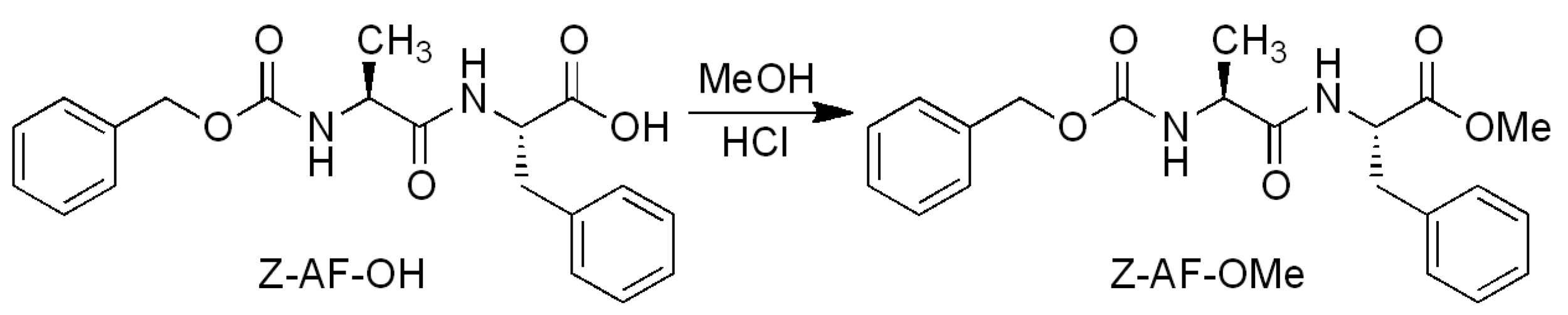
<p>During our research on the supramolecular chemistry of simple pseudopeptidic compounds [<xref ref-type="bibr" rid="b18-crystals-01-00163">18</xref>-<xref ref-type="bibr" rid="b23-crystals-01-00163">23</xref>], we screened the crystallization conditions of several different <italic>N</italic>-protected dipeptide sequences. Thus, we observed that when the Z-AF-OH dipeptide was placed in a MeOH solution containing an excess of 12 N HCl, large crystals appeared after very long time (several months). Surprisingly, the X-ray diffraction analysis of these crystals unambiguously showed that they contained the corresponding methyl ester dipeptide (Z-AF-OMe) most likely produced by the acid-catalyzed esterification of the initial carboxylic acid-terminated compound (<xref ref-type="fig" rid="f6-crystals-01-00163">Scheme 1</xref>).</p>
<sec>
<title>Crystal Structure Determination</title>
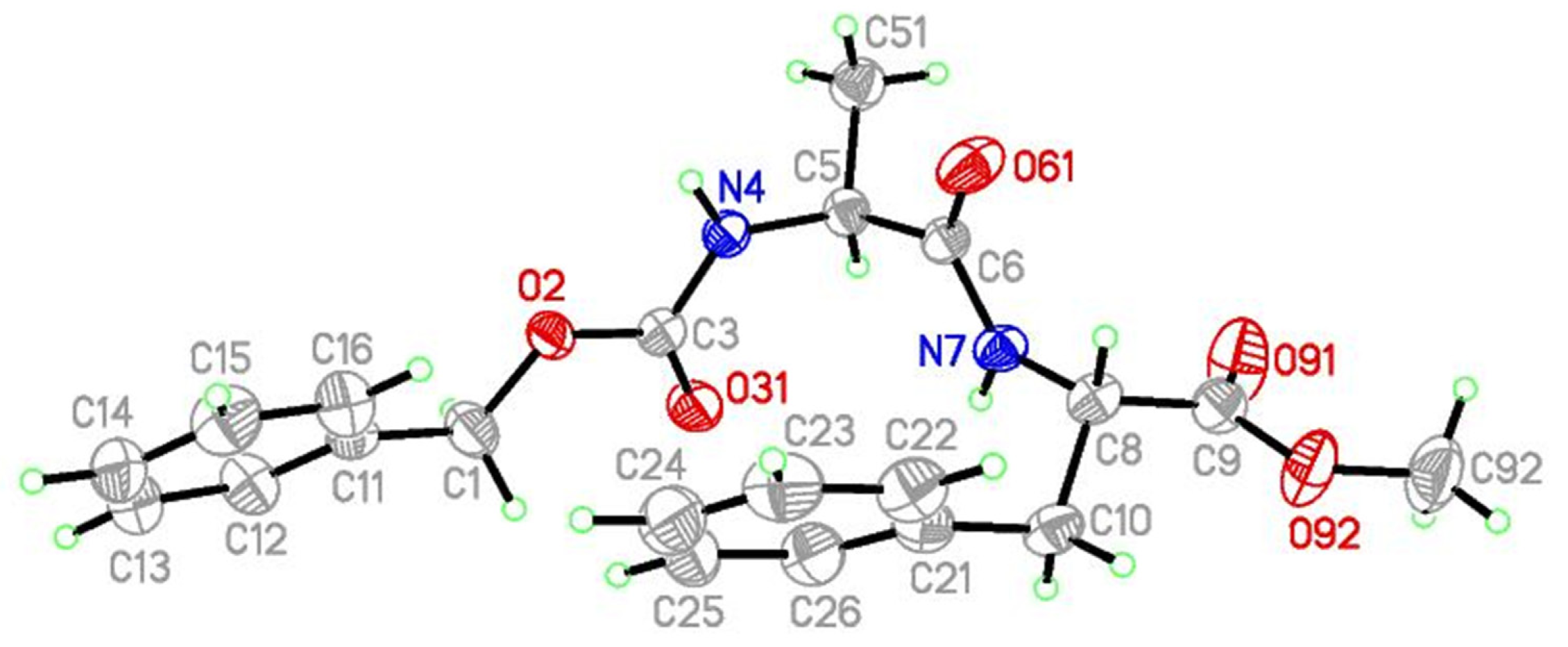
<p>The molecular structure of the title compound, along with the atom-numbering scheme, is depicted in <xref ref-type="fig" rid="f1-crystals-01-00163">Figure 1</xref>. Bond lengths and angles are in the usual ranges. The uretane and amide moieties adopt a <italic>trans</italic> conformation with torsion angles O2-C3-N4-C5 = 178.9(3)° and C5-C6-N7-C8 = −174.8(3)°. The peptide units are essentially planar (r.m.s. deviation is 0.025Å for O2, C3, O31, N4, H4, C5 as well as for C5, C6, O61, N7, H7, C8) and enclose a dihedral angle of 71.89(19)°. Further characteristic torsion angles describing the backbone conformation are given in the following <xref ref-type="table" rid="t1-crystals-01-00163">Table 1</xref>.</p>
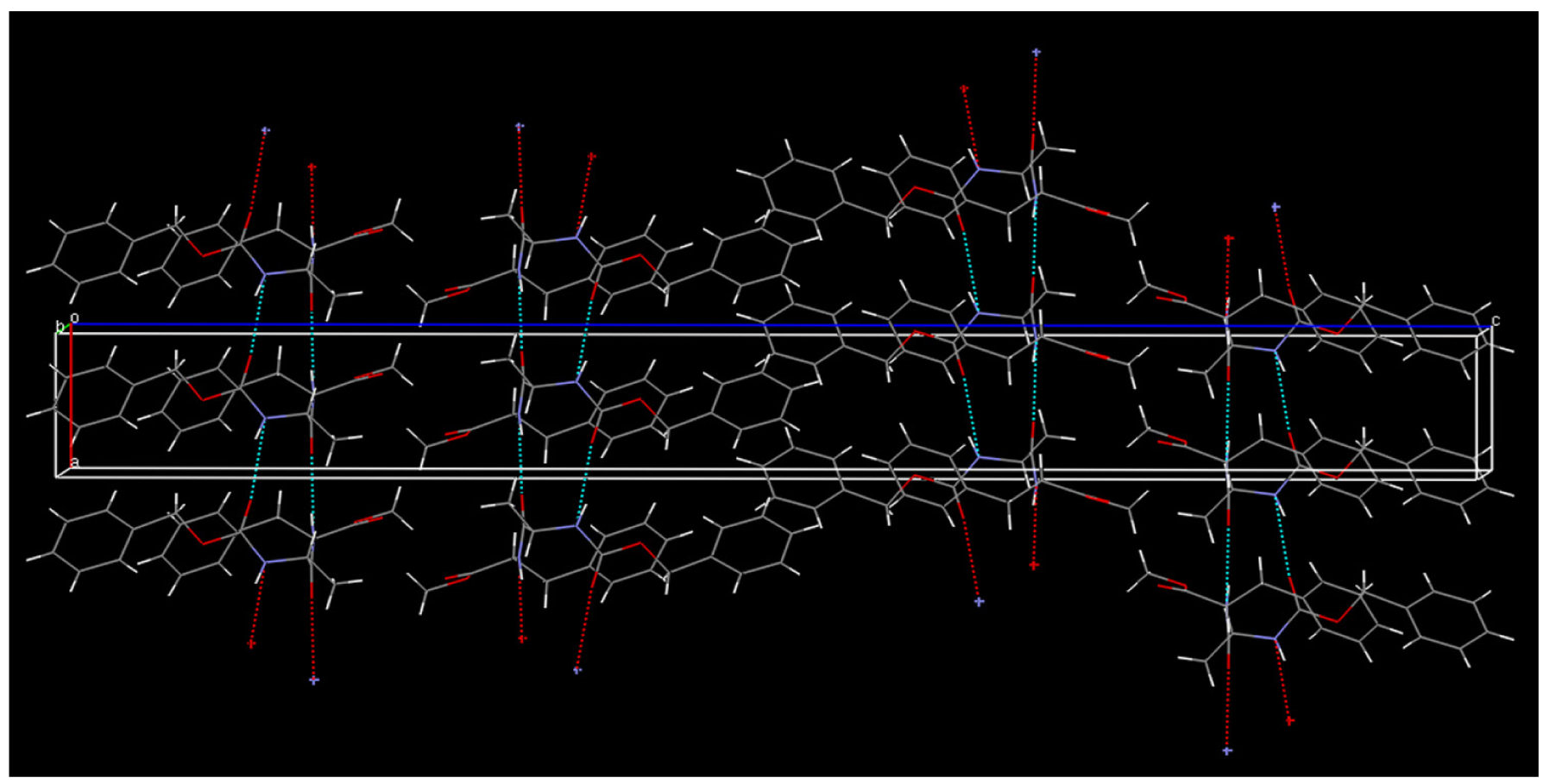
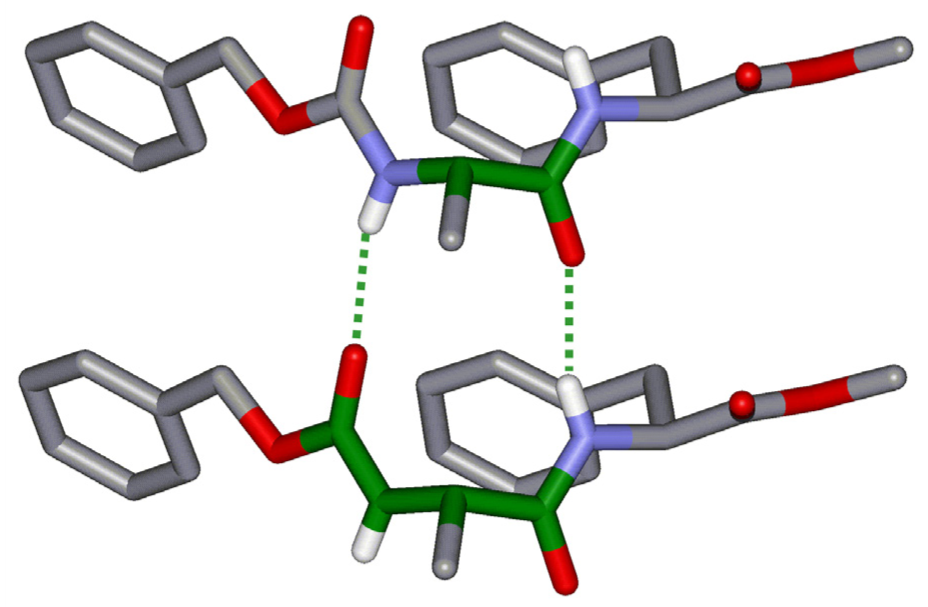
<p>The crystal packing is stabilized by intermolecular N-H⋯O=C hydrogen bonds (<xref ref-type="table" rid="t2-crystals-01-00163">Table 2</xref>). Those H-bonds involve the interaction of the amide hydrogen of the peptide bond with the carbonyl oxygen of the same group in a second molecule and that of the uretane hydrogen with the carbonyl oxygen of the uretane group in another molecule. Two molecules form an R<sup>2</sup><sub>2</sub>(12) ring (<xref ref-type="fig" rid="f2-crystals-01-00163">Figure 2</xref>) [<xref ref-type="bibr" rid="b24-crystals-01-00163">24</xref>]. These entities are further connected to chains running along the a axis (<xref ref-type="fig" rid="f3-crystals-01-00163">Figure 3</xref>). Additional aryl-aryl contacts of the edge-to-face type between the phenyl groups of the Phe side chains and those of the Z groups are established along the c axis (<xref ref-type="fig" rid="f3-crystals-01-00163">Figure 3</xref>). The C15-H15⋯cog(C11,C12,C13,C14,C15,C16) distance is 3.021 Å.</p>
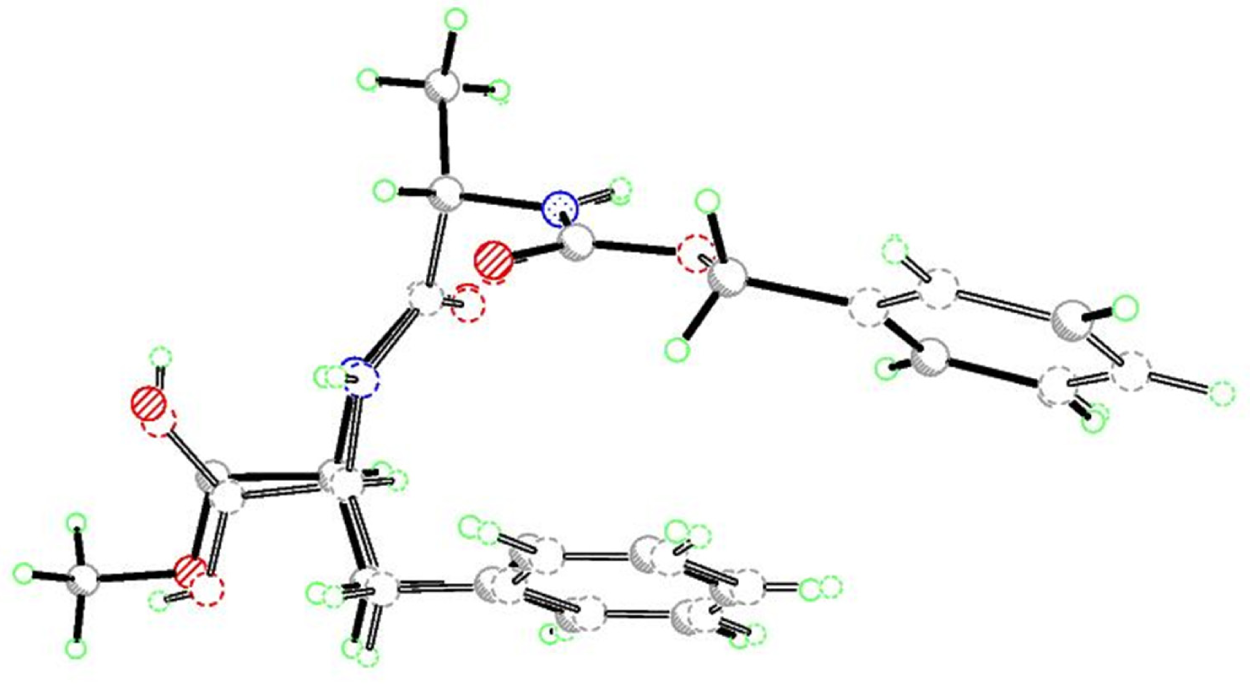
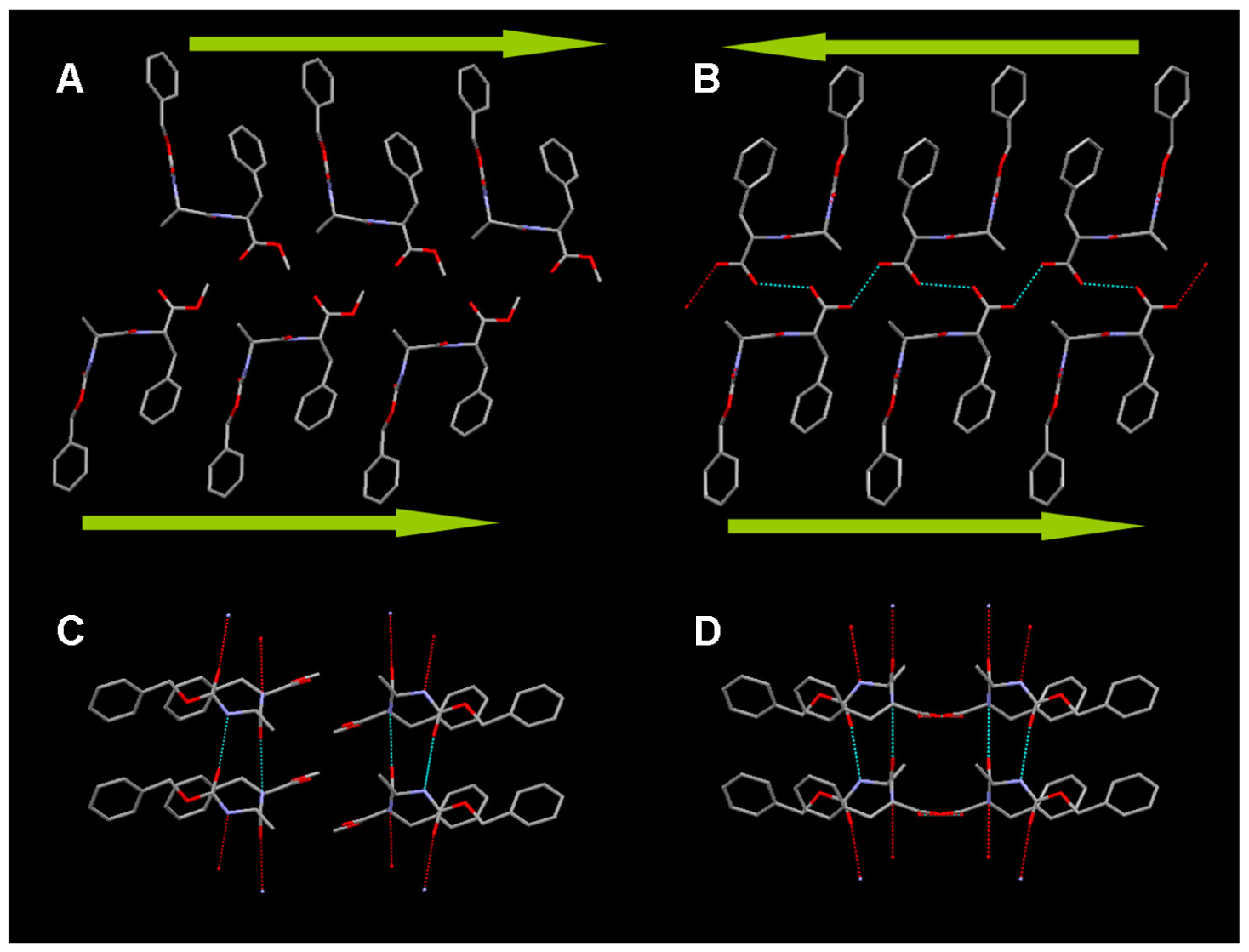
<p>As previously commented, it is interesting to note that a similar compound in which the ester methyl group of the title compound is substituted by an H atom (Z-AF-OH), has exactly the same molecular conformation [<xref ref-type="bibr" rid="b23-crystals-01-00163">23</xref>]. A least-squares fit of the two molecules is shown in <xref ref-type="fig" rid="f4-crystals-01-00163">Figure 4</xref>. Besides, also in this case, a similar H-bonding network implicating the amide and uretane groups was found in the solid state. This H-bonding network is also responsible for the self-assembling of Z-AF-OH in solution [<xref ref-type="bibr" rid="b23-crystals-01-00163">23</xref>] and resembles that observed in natural β-sheet peptidic motives [<xref ref-type="bibr" rid="b5-crystals-01-00163">5</xref>-<xref ref-type="bibr" rid="b7-crystals-01-00163">7</xref>]. In both cases—the Z-AF-OH and the Z-AF-OMe compounds—the assembly can be described as a straight parallel β-sheet [<xref ref-type="bibr" rid="b25-crystals-01-00163">25</xref>], without any twist between the backbond strands along the H-bonding direction, often found in related <italic>N</italic>-protected dipeptides [<xref ref-type="bibr" rid="b26-crystals-01-00163">26</xref>]. However, in the crystals of Z-AF-OH, we had observed additional intermolecular H bonding interactions between the carboxylic acids that are not possible in the methyl ester compound Z-AF-OMe. A further comparative study between the two crystals is shown in <xref ref-type="fig" rid="f5-crystals-01-00163">Figure 5</xref>. The relative disposition of the peptidic backbones is parallel in Z-AF-OMe while anti-parallel in Z-AF-OH, with respect to the N to C termini direction (see green arrows in <xref ref-type="fig" rid="f5-crystals-01-00163">Figure 5 A,B</xref>). This difference is due to the H-bonding interactions observed between the COOH groups of Z-AF-OH, which are obviously absent in the corresponding methyl ester. However, the same N-H⋯O=C interactions within the backbones are present in both structures. The absence of the H-bonds implicating COOH in the title compound (Z-AF-OMe) produced a shift between the planes of the backbone strands (<xref ref-type="fig" rid="f5-crystals-01-00163">Figure 5C</xref>) which were perfectly aligned in the case of the original Z-AF-OH compound (<xref ref-type="fig" rid="f5-crystals-01-00163">Figure 5D</xref>). Thus, the presence or absence of interactions along the peptidic backbone direction is reflected in the alignment of the strands and in their relative senses (parallel or antiparallel), while retaining essentially the same conformation of the dipeptide.</p></sec></sec>
<sec>
<label>3.</label>
<title>Experimental Section</title>
<sec sec-type="methods">
<title>X-ray Data Collection and Structure Refinement</title>
<p>Crystallographic data were recorded on a STOE IPDS-II diffractometer [<xref ref-type="bibr" rid="b27-crystals-01-00163">27</xref>] using Mo Kα radiation (λ = 0.71073 Å) at <italic>T</italic> = 173 K. The structure was solved by direct methods [<xref ref-type="bibr" rid="b28-crystals-01-00163">28</xref>] and refined by full- matrix least-squares using SHELXL-97 against F<sup>2</sup> using all data [<xref ref-type="bibr" rid="b28-crystals-01-00163">28</xref>]. All non-H atoms were refined anisotropically. H atoms were positioned geometrically at distances of 0.95 Å (aromatic CH), 0.98 Å (methyl groups), 0.99 Å (methylene group) and 1.00 Å (tertiary CH) from the parent C atoms; a riding model was used during the refinement process and the U<sub>iso</sub>(H) values were constrained to be 1.2 Ueq(C) or 1.5 Ueq(methyl C). The H atoms bonded to N were freely refined. Due to the absence of anomalous scatterers, the absolute structure could not be determined and was set according to the absolute configuration of the starting materials.</p>
<p>CCDC reference number: CCDC 832036. Copies of the data can be obtained, free of charge, on application to CHGC, 12 Union Road, Cambridge CB2 1EZ, UK (fax: +44 1223 336033 or e-mail: <email>deposit@ccdc.cam.ac.uk</email>).</p>
<p>Crystal data. C<sub>21</sub>H<sub>24</sub>N<sub>2</sub>O<sub>5</sub>, 384.42 g mol<sup>−1</sup>. Orthorhombic, <italic>P</italic>2<sub>1</sub><italic>2</italic><sub>1</sub><italic>2</italic><sub>1</sub> (no. 19), <italic>a</italic> = 5.0655(6) Å, <italic>b</italic> = 8.4614(8) Å, <italic>c</italic> = 46.856(5) Å, <italic>V =</italic> 2008.3 Å<sup>3</sup>, <italic>Z</italic> = 4. Diffractometer IPDS-II, Stoe Darmstadt; Mo-K<sub>α</sub> (graphite monochromator, <italic>λ</italic> = 0.71.073 Å); T = 173(2) K; 3.48° ≤ 2<italic>θ</italic> ≤ 50.48°; −6 ≤ h ≤ 6, −9 ≤ k ≤ 10, −55 ≤ l ≤ 56; <italic>ρ</italic><sub>calc</sub> = 1.271 g cm<sup>−3</sup>; 14035 reflections measured of which 2159 were symmetrically independent; R<sub>int</sub> = 0.1054; F(000) = 816; μ = 0.091 mm<sup>−1</sup>. 261 refined parameters; R values: R<sub>1</sub>/wR<sub>2</sub> for 1182 reflections with [I<sub>0</sub>&gt; 2<italic>σ</italic>(I<sub>0</sub>)]: 0.0416 / 0.0603, for all data: 0.0910 / 0.0697; S<sub>all</sub> = 0.730; Δρ(min/max): −0.178 eÅ<sup>−3</sup> / 0.156 eÅ<sup>−3</sup>.</p></sec></sec>
<sec sec-type="conclusions">
<label>4.</label>
<title>Conclusions</title>
<p>The crystal structure of an <italic>N</italic>-benzyloxycarbonyl-protected dipeptide derivative bearing a methyl ester on its carboxylic terminus (Z-AF-OMe) has been determined. The compound showed a very similar structure to that of its parent carboxylic dipeptide Z-AF-OH, in spite of lacking the favorable H bonding interactions between COOH groups. The results highlight the main role played by the H bonds of the type N-H⋯O=C implicating the peptidic backbone as responsible for the conformation and the self-assembly of the molecules. Other secondary contacts could be acting in the alignment of the strands and in their final disposition into parallel or antiparallel fashion.</p></sec></body>
<back>
<sec sec-type="display-objects">
<title>Figures and Tables</title>
<fig id="f1-crystals-01-00163" position="float">
<label>Figure 1.</label>
<caption>
<p>Perspective view of Z-AF-OMe with displacement ellipsoids at the 50% probability level.</p></caption>
<graphic xlink:href="crystals-01-00163f1.gif"/></fig>
<fig id="f2-crystals-01-00163" position="float">
<label>Figure 2.</label>
<caption>
<p>Representation of two H-bonded molecules of Z-AF-OMe forming a R<sup>2</sup><sub>2</sub>(12) ring, highlighted in green. Non-polar H-bonds are omitted for clarity.</p></caption>
<graphic xlink:href="crystals-01-00163f2.gif"/></fig>
<fig id="f3-crystals-01-00163" position="float">
<label>Figure 3.</label>
<caption>
<p>A packing diagram of Z-AF-OMe with view onto the ac plane. Hydrogen bonds are drawn as dashed lines.</p></caption>
<graphic xlink:href="crystals-01-00163f3.gif"/></fig>
<fig id="f4-crystals-01-00163" position="float">
<label>Figure 4.</label>
<caption>
<p>A least-squares fit of the title compound (Z-AF-OMe, full bonds) with <italic>N</italic>-((Benzyloxy)carbonyl)alanylphenylalanine (Z-AF-OH, open bonds).</p></caption>
<graphic xlink:href="crystals-01-00163f4.gif"/></fig>
<fig id="f5-crystals-01-00163" position="float">
<label>Figure 5.</label>
<caption>
<p>Intermolecular contacts found in the solid state for Z-AF-OMe (A,C) and Z-AF-OH (B, D). H atoms have been omitted for clarity and H bonds are shown as dashed lines.</p></caption>
<graphic xlink:href="crystals-01-00163f5.gif"/></fig>
<fig id="f6-crystals-01-00163" position="float">
<label>Scheme 1.</label>
<caption>
<p>Acid-catalyzed formation of Z-AF-OMe.</p></caption>
<graphic xlink:href="crystals-01-00163f6.gif"/></fig>
<table-wrap id="t1-crystals-01-00163" position="float">
<label>Table 1.</label>
<caption>
<p>Selected torsion angles for (Z-AF-OMe) [°].</p></caption>
<table frame="box" rules="all">
<tbody>
<tr>
<td align="left" valign="top">C3-N4-C5-C6</td>
<td align="center" valign="top">−104.6(4)°</td></tr>
<tr>
<td align="left" valign="top">N4-C5-C6-N7</td>
<td align="center" valign="top">101.0(4)°</td></tr>
<tr>
<td align="left" valign="top">C6-N7-C8-C9</td>
<td align="center" valign="top">−115.2(4)°</td></tr>
<tr>
<td align="left" valign="top">N7-C8-C9-O92</td>
<td align="center" valign="top">−172.1(3)°</td></tr>
<tr>
<td align="left" valign="top">N7-C8-C10-C21</td>
<td align="center" valign="top">−58.3(4)°</td></tr>
<tr>
<td align="left" valign="top">C8-C10-C21-C22</td>
<td align="center" valign="top">−83.5(5)°</td></tr>
<tr>
<td align="left" valign="top">C8-C10-C21-C26</td>
<td align="center" valign="top">96.5(5)°</td></tr>
<tr>
<td align="left" valign="top">C1-O2-C3-N4</td>
<td align="center" valign="top">172.7(3)°</td></tr>
<tr>
<td align="left" valign="top">Dihedral angle between the two aromatic rings</td>
<td align="center" valign="top">12.6(2)°</td></tr></tbody></table></table-wrap>
<table-wrap id="t2-crystals-01-00163" position="float">
<label>Table 2.</label>
<caption>
<p>Hydrogen bonds for (Z-AF-OMe) [Å and °].</p></caption>
<table frame="box" rules="all">
<thead>
<tr>
<th align="center" valign="top">D-H…A</th>
<th align="center" valign="top">d(D-H)</th>
<th align="center" valign="top">d(H…A)</th>
<th align="center" valign="top">d(D…A)</th>
<th align="center" valign="top">&lt;(DHA)</th></tr></thead>
<tbody>
<tr>
<td align="center" valign="top">N(4)-H(4)…O(31)#1</td>
<td align="center" valign="top">0.85(3)</td>
<td align="center" valign="top">2.09(3)</td>
<td align="center" valign="top">2.904(4)</td>
<td align="center" valign="top">161(3)</td></tr>
<tr>
<td align="center" valign="top">N(7)-H(7)…O(61)#2</td>
<td align="center" valign="top">0.84(4)</td>
<td align="center" valign="top">2.05(4)</td>
<td align="center" valign="top">2.848(4)</td>
<td align="center" valign="top">159(3)</td></tr></tbody></table>
<table-wrap-foot><fn id="tfn1-crystals-01-00163">
<p>Symmetry transformations used to generate equivalent atoms: #1 x−1, y, z, #2 x+1, y, z.</p></fn></table-wrap-foot></table-wrap></sec>
<ack>
<p>The authors gratefully acknowledge the financial support from the Spanish Ministry of Science and Innovation, MICINN (CTQ2009-14366-C02 project).</p></ack>
<ref-list>
<title>References</title>
<ref id="b1-crystals-01-00163"><label>1.</label><citation citation-type="journal"><person-group person-group-type="author"><name><surname>Kool</surname><given-names>E.T.</given-names></name><name><surname>Waters</surname><given-names>M.L.</given-names></name></person-group><article-title>The model student: what chemical model systems can teach us about biology</article-title><source>Nat. Chem. Biol.</source><year>2007</year><volume>3</volume><fpage>70</fpage><lpage>73</lpage><pub-id pub-id-type="doi">10.1038/nchembio0207-70</pub-id><pub-id pub-id-type="pmid">17235337</pub-id></citation></ref>
<ref id="b2-crystals-01-00163"><label>2.</label><citation citation-type="journal"><person-group person-group-type="author"><name><surname>Kantharaju</surname></name><name><surname>Raghothama</surname><given-names>S.</given-names></name><name><surname>Aravinda</surname><given-names>S.</given-names></name><name><surname>Shamala</surname><given-names>N.</given-names></name><name><surname>Balaram</surname><given-names>P.</given-names></name></person-group><article-title>Helical conformations of hexapeptides containing N-terminus diproline segments</article-title><source>Biopolymers</source><year>2010</year><volume>94</volume><fpage>360</fpage><lpage>370</lpage><pub-id pub-id-type="doi">10.1002/bip.21395</pub-id><pub-id pub-id-type="pmid">20108314</pub-id></citation></ref>
<ref id="b3-crystals-01-00163"><label>3.</label><citation citation-type="journal"><person-group person-group-type="author"><name><surname>Guha</surname><given-names>S.</given-names></name><name><surname>Drew</surname><given-names>M.G.B.</given-names></name><name><surname>Banerjee</surname><given-names>A.</given-names></name></person-group><article-title>A New Molecular Scaffold for the Formation of Supramolecular Peptide Double Helices: The Crystallographic Insight</article-title><source>Org. Lett.</source><year>2007</year><volume>9</volume><fpage>1347</fpage><lpage>1350</lpage><pub-id pub-id-type="doi">10.1021/ol0701870</pub-id><pub-id pub-id-type="pmid">17346055</pub-id></citation></ref>
<ref id="b4-crystals-01-00163"><label>4.</label><citation citation-type="journal"><person-group person-group-type="author"><name><surname>Görbitz</surname><given-names>C.H.</given-names></name></person-group><article-title>Nanotubes from hydrophobic dipeptides: pore size regulation through side chain substitution</article-title><source>New J. Chem.</source><year>2003</year><volume>37</volume><fpage>1789</fpage><lpage>1793</lpage></citation></ref>
<ref id="b5-crystals-01-00163"><label>5.</label><citation citation-type="journal"><person-group person-group-type="author"><name><surname>Akazome</surname><given-names>M.</given-names></name><name><surname>Senda</surname><given-names>K.</given-names></name><name><surname>Ogura</surname><given-names>K.</given-names></name></person-group><article-title>Sheet Structure of an L,D-Dipeptide Aggregate: Inclusion Compounds of (<italic>S</italic>)-Phenylglycyl-(<italic>R</italic>)-phenylglycine with Amides</article-title><source>J. Org. Chem.</source><year>2002</year><volume>67</volume><fpage>8885</fpage><lpage>8889</lpage><pub-id pub-id-type="doi">10.1021/jo0204451</pub-id><pub-id pub-id-type="pmid">12467403</pub-id></citation></ref>
<ref id="b6-crystals-01-00163"><label>6.</label><citation citation-type="journal"><person-group person-group-type="author"><name><surname>Kundu</surname><given-names>S.K.</given-names></name><name><surname>Mazumdar</surname><given-names>P.A.</given-names></name><name><surname>Das</surname><given-names>A.K.</given-names></name><name><surname>Bertolasi</surname><given-names>V.</given-names></name><name><surname>Pramanik</surname><given-names>A.</given-names></name></person-group><article-title>Parallel β-sheet assemblage in a model dipeptide: an X-ray diffraction study</article-title><source>J. Chem. Soc., Perkin Trans. 2</source><year>2002</year><fpage>1602</fpage><lpage>1604</lpage></citation></ref>
<ref id="b7-crystals-01-00163"><label>7.</label><citation citation-type="journal"><person-group person-group-type="author"><name><surname>Antolić</surname><given-names>S.</given-names></name><name><surname>Teichert</surname><given-names>M.</given-names></name><name><surname>Sheldrick</surname><given-names>G.</given-names></name><name><surname>Kojić-Prodic</surname><given-names>B.</given-names></name><name><surname>Čudić</surname><given-names>M.</given-names></name><name><surname>Horvat</surname><given-names>Š</given-names></name></person-group><article-title>Structure and molecular modelling of protected dipeptide fragment (Boc-Phe-Leu-OBzl) of enkephalin</article-title><source>Acta Cryst.</source><year>1999</year><volume>B55</volume><fpage>975</fpage><lpage>984</lpage></citation></ref>
<ref id="b8-crystals-01-00163"><label>8.</label><citation citation-type="journal"><person-group person-group-type="author"><name><surname>Jana</surname><given-names>P.</given-names></name><name><surname>Naity</surname><given-names>S.</given-names></name><name><surname>Maity</surname><given-names>S.K.</given-names></name><name><surname>Haldar</surname><given-names>D.</given-names></name></person-group><article-title>A new peptide motif in the formation of supramolecular helices</article-title><source>Chem. Commun.</source><year>2011</year><volume>47</volume><fpage>2092</fpage><lpage>2094</lpage><pub-id pub-id-type="doi">10.1039/c0cc04244g</pub-id></citation></ref>
<ref id="b9-crystals-01-00163"><label>9.</label><citation citation-type="journal"><person-group person-group-type="author"><name><surname>De Poli</surname><given-names>M.</given-names></name><name><surname>Moretto</surname><given-names>A.</given-names></name><name><surname>Crisma</surname><given-names>M.</given-names></name><name><surname>Peggion</surname><given-names>C.</given-names></name><name><surname>Formaggio</surname><given-names>F.</given-names></name><name><surname>Kaptein</surname><given-names>B.</given-names></name><name><surname>Broxterman</surname><given-names>Q.B.</given-names></name><name><surname>Toniolo</surname><given-names>C.</given-names></name></person-group><article-title>Is the Backbone Conformation of Cα-Methyl Proline Restricted to a Single Region?</article-title><source>Chem. Eur. J.</source><year>2009</year><volume>15</volume><fpage>8015</fpage><lpage>8025</lpage><pub-id pub-id-type="doi">10.1002/chem.200900688</pub-id><pub-id pub-id-type="pmid">19579242</pub-id></citation></ref>
<ref id="b10-crystals-01-00163"><label>10.</label><citation citation-type="journal"><person-group person-group-type="author"><name><surname>Görbitz</surname><given-names>C.H.</given-names></name></person-group><article-title>Microporous Organic Materials from Hydrophobic Dipeptides</article-title><source>Chem. Eur. J.</source><year>2007</year><volume>13</volume><fpage>1022</fpage><lpage>1031</lpage><pub-id pub-id-type="doi">10.1002/chem.200601427</pub-id><pub-id pub-id-type="pmid">17200919</pub-id></citation></ref>
<ref id="b11-crystals-01-00163"><label>11.</label><citation citation-type="journal"><person-group person-group-type="author"><name><surname>Görbitz</surname><given-names>C.H.</given-names></name></person-group><article-title>Peptide Structures</article-title><source>Curr. Opin. Solid State Mater. Sci.</source><year>2002</year><volume>6</volume><fpage>109</fpage><lpage>116</lpage><pub-id pub-id-type="doi">10.1016/S1359-0286(02)00044-X</pub-id></citation></ref>
<ref id="b12-crystals-01-00163"><label>12.</label><citation citation-type="book"><person-group person-group-type="author"><name><surname>Lloyd-Williams</surname><given-names>P.</given-names></name><name><surname>Albericio</surname><given-names>F.</given-names></name><name><surname>Giralt</surname><given-names>E.</given-names></name></person-group><source>Chemical Approaches to the Synthesis of Peptides and Proteins</source><publisher-name>CCR Press</publisher-name><publisher-loc>Boca Raton, FL, USA</publisher-loc><year>1997</year></citation></ref>
<ref id="b13-crystals-01-00163"><label>13.</label><citation citation-type="journal"><person-group person-group-type="author"><name><surname>Kolev</surname><given-names>T.</given-names></name><name><surname>Spiteller</surname><given-names>M.</given-names></name><name><surname>Koleva</surname><given-names>B.</given-names></name></person-group><article-title>Spectroscopic and structural elucidation of amino acid derivatives and small peptides: experimental and theoretical tools</article-title><source>Amino Acids</source><year>2010</year><volume>38</volume><fpage>45</fpage><lpage>50</lpage><pub-id pub-id-type="doi">10.1007/s00726-008-0220-9</pub-id><pub-id pub-id-type="pmid">19083080</pub-id></citation></ref>
<ref id="b14-crystals-01-00163"><label>14.</label><citation citation-type="journal"><person-group person-group-type="author"><name><surname>Grey</surname><given-names>J.L.</given-names></name><name><surname>Thompson</surname><given-names>D.H.</given-names></name></person-group><article-title>Challenges and opportunities for new protein crystallization strategies in structure-based drug design</article-title><source>Expert Opin. Drug Discover.</source><year>2010</year><volume>11</volume><fpage>1039</fpage><lpage>1045</lpage></citation></ref>
<ref id="b15-crystals-01-00163"><label>15.</label><citation citation-type="journal"><person-group person-group-type="author"><name><surname>Görbitz</surname><given-names>C.H.</given-names></name><name><surname>Rise</surname><given-names>F.</given-names></name></person-group><article-title>Template-directed supramolecular assembly of a new type of nanoporous peptide-based material</article-title><source>J. Pept. Sci.</source><year>2008</year><volume>14</volume><fpage>210</fpage><lpage>216</lpage><pub-id pub-id-type="doi">10.1002/psc.985</pub-id><pub-id pub-id-type="pmid">18181231</pub-id></citation></ref>
<ref id="b16-crystals-01-00163"><label>16.</label><citation citation-type="journal"><person-group person-group-type="author"><name><surname>Gorbitz</surname><given-names>C.H.</given-names></name></person-group><article-title>The structure of nanotubes formed by diphenylalanine, the core recognition motif of Alzheimer's β-amyloid polypeptide</article-title><source>Chem. Commun.</source><year>2006</year><fpage>2332</fpage><lpage>2334</lpage></citation></ref>
<ref id="b17-crystals-01-00163"><label>17.</label><citation citation-type="journal"><person-group person-group-type="author"><name><surname>Reches</surname><given-names>M.</given-names></name><name><surname>Gazit</surname><given-names>E.</given-names></name></person-group><article-title>Casting Metal Nanowires Within Discrete Self-Assembled Peptide Nanotubes</article-title><source>Science</source><year>2003</year><volume>300</volume><fpage>625</fpage><lpage>628</lpage><pub-id pub-id-type="doi">10.1126/science.1082387</pub-id><pub-id pub-id-type="pmid">12714741</pub-id></citation></ref>
<ref id="b18-crystals-01-00163"><label>18.</label><citation citation-type="journal"><person-group person-group-type="author"><name><surname>Alfonso</surname><given-names>I.</given-names></name><name><surname>Burguete</surname><given-names>M.I.</given-names></name><name><surname>Galindo</surname><given-names>F.</given-names></name><name><surname>Luis</surname><given-names>S.V.</given-names></name><name><surname>Vigara</surname><given-names>L.</given-names></name></person-group><article-title>Unraveling the Molecular Recognition of Amino Acid Derivatives by a Pseudopeptidic Macrocycle: ESI-MS, NMR, Fluorescence, and Modeling Studies</article-title><source>J. Org. Chem.</source><year>2009</year><volume>74</volume><fpage>6130</fpage><lpage>6142</lpage><pub-id pub-id-type="doi">10.1021/jo900983q</pub-id><pub-id pub-id-type="pmid">19606887</pub-id></citation></ref>
<ref id="b19-crystals-01-00163"><label>19.</label><citation citation-type="journal"><person-group person-group-type="author"><name><surname>Alfonso</surname><given-names>I.</given-names></name><name><surname>Bolte</surname><given-names>M.</given-names></name><name><surname>Bru</surname><given-names>M.</given-names></name><name><surname>Burguete</surname><given-names>M.I.</given-names></name><name><surname>Luis</surname><given-names>S.V.</given-names></name><name><surname>Rubio</surname><given-names>J.</given-names></name></person-group><article-title>Supramolecular Control for the Modular Synthesis of Pseudopeptidic Macrocycles through an Anion-Templated Reaction</article-title><source>J. Am. Chem. Soc.</source><year>2008</year><volume>130</volume><fpage>6137</fpage><lpage>6144</lpage><pub-id pub-id-type="doi">10.1021/ja710132c</pub-id><pub-id pub-id-type="pmid">18402442</pub-id></citation></ref>
<ref id="b20-crystals-01-00163"><label>20.</label><citation citation-type="journal"><person-group person-group-type="author"><name><surname>Becerril</surname><given-names>J.</given-names></name><name><surname>Bolte</surname><given-names>M.</given-names></name><name><surname>Burguete</surname><given-names>M.I.</given-names></name><name><surname>Escorihuela</surname><given-names>J.</given-names></name><name><surname>Galindo</surname><given-names>F.</given-names></name><name><surname>Luis</surname><given-names>S.V.</given-names></name></person-group><article-title>A simple peptidomimetic that self-associates on the solid state to form a nanoporous architecture containing π-channels</article-title><source>CrystEngComm</source><year>2010</year><volume>12</volume><fpage>1711</fpage><lpage>1725</lpage></citation></ref>
<ref id="b21-crystals-01-00163"><label>21.</label><citation citation-type="journal"><person-group person-group-type="author"><name><surname>Alfonso</surname><given-names>I.</given-names></name><name><surname>Bru</surname><given-names>M.</given-names></name><name><surname>Burguete</surname><given-names>M.I.</given-names></name><name><surname>García-Verdugo</surname><given-names>E.</given-names></name><name><surname>Luis</surname><given-names>S.V.</given-names></name></person-group><article-title>Structural Diversity in the Self-Assembly of Pseudopeptidic Macrocycles</article-title><source>Chem. Eur. J.</source><year>2010</year><volume>16</volume><fpage>1246</fpage><lpage>1255</lpage><pub-id pub-id-type="doi">10.1002/chem.200902196</pub-id><pub-id pub-id-type="pmid">19998438</pub-id></citation></ref>
<ref id="b22-crystals-01-00163"><label>22.</label><citation citation-type="journal"><person-group person-group-type="author"><name><surname>Alfonso</surname><given-names>I.</given-names></name><name><surname>Bolte</surname><given-names>M.</given-names></name><name><surname>Bru</surname><given-names>M.</given-names></name><name><surname>Burguete</surname><given-names>M.I.</given-names></name><name><surname>Luis</surname><given-names>S.V.</given-names></name></person-group><article-title>Crystal structures of the HCl salts of pseudopeptidic macrocycles display “knobs into holes” hydrophobic interactions between the aliphatic side chains</article-title><source>CrystEngComm</source><year>2009</year><volume>11</volume><fpage>735</fpage><lpage>738</lpage><pub-id pub-id-type="doi">10.1039/b821772f</pub-id></citation></ref>
<ref id="b23-crystals-01-00163"><label>23.</label><citation citation-type="journal"><person-group person-group-type="author"><name><surname>Alfonso</surname><given-names>I.</given-names></name><name><surname>Bolte</surname><given-names>M.</given-names></name><name><surname>Bru</surname><given-names>M.</given-names></name><name><surname>Burguete</surname><given-names>M.I.</given-names></name><name><surname>Luis</surname><given-names>S.V.</given-names></name><name><surname>Vicent</surname><given-names>C.</given-names></name></person-group><article-title>Molecular recognition of <italic>N</italic>-protected dipeptides by pseudopeptidic macrocycles: a comparative study of the supramolecular complexes by ESI-MS and NMR</article-title><source>Org. Biomol. Chem.</source><year>2010</year><volume>8</volume><fpage>1329</fpage><lpage>2199</lpage><pub-id pub-id-type="doi">10.1039/b924981h</pub-id><pub-id pub-id-type="pmid">20204204</pub-id></citation></ref>
<ref id="b24-crystals-01-00163"><label>24.</label><citation citation-type="journal"><person-group person-group-type="author"><name><surname>Bernstein</surname><given-names>J.</given-names></name><name><surname>Davis</surname><given-names>R.E.</given-names></name><name><surname>Shimoni</surname><given-names>L.</given-names></name><name><surname>Chang</surname><given-names>N.-L.</given-names></name></person-group><article-title>Patterns in Hydrogen Bonding: Functionality and Graph Set Analysis in Crystals</article-title><source>Angew. Chem. Int. Ed. Engl.</source><year>1995</year><volume>34</volume><fpage>1555</fpage><lpage>1573</lpage><pub-id pub-id-type="doi">10.1002/anie.199515551</pub-id></citation></ref>
<ref id="b25-crystals-01-00163"><label>25.</label><citation citation-type="journal"><person-group person-group-type="author"><name><surname>Gerhardt</surname><given-names>W.W.</given-names></name><name><surname>Weck</surname><given-names>M.</given-names></name></person-group><article-title>Investigations of Metal-Coordinated Peptides as Supramolecular Synthons</article-title><source>J. Org. Chem.</source><year>2006</year><volume>71</volume><fpage>6333</fpage><lpage>6341</lpage><pub-id pub-id-type="doi">10.1021/jo060395q</pub-id><pub-id pub-id-type="pmid">16901113</pub-id></citation></ref>
<ref id="b26-crystals-01-00163"><label>26.</label><citation citation-type="journal"><person-group person-group-type="author"><name><surname>Jacobsen</surname><given-names>Ø.</given-names></name><name><surname>Gebreslasie</surname><given-names>H.G.</given-names></name><name><surname>Klaveness</surname><given-names>J.</given-names></name><name><surname>Rongveda</surname><given-names>P.</given-names></name><name><surname>Görbitz</surname><given-names>C.H.</given-names></name></person-group><article-title><italic>N</italic>-(tert-Butoxycarbonyl)-L-valyl-L-valine methyl ester: a twisted parallel b-sheet in the crystal structure of a protected dipeptide</article-title><source>Acta Cryst.</source><year>2011</year><volume>C67</volume><fpage>o278</fpage><lpage>o282</lpage></citation></ref>
<ref id="b27-crystals-01-00163"><label>27.</label><citation citation-type="book"><person-group person-group-type="author"><collab>Stoe &amp; Cie</collab></person-group><source>X-Area. Area-Detector Control and Integration Software</source><publisher-name>Stoe &amp; Cie</publisher-name><publisher-loc>Darmstadt, Germany</publisher-loc><year>2001</year></citation></ref>
<ref id="b28-crystals-01-00163"><label>28.</label><citation citation-type="journal"><person-group person-group-type="author"><name><surname>Sheldrick</surname><given-names>G.M.</given-names></name></person-group><article-title>A short history of SHELX</article-title><source>Acta Cryst.</source><year>2008</year><volume>A64</volume><fpage>112</fpage><lpage>122</lpage></citation></ref></ref-list></back></article>