
<?xml version="1.0" encoding="UTF-8"?>
<!DOCTYPE article PUBLIC "-//NLM//DTD Journal Publishing DTD v2.3 20070202//EN" "journalpublishing.dtd">
<article xmlns:xlink="http://www.w3.org/1999/xlink" xml:lang="en" article-type="research-article">
<front>
<journal-meta>
<journal-id journal-id-type="publisher-id">Crystals</journal-id>
<journal-title>Crystals</journal-title>
<issn pub-type="epub">2073-4352</issn>
<publisher>
<publisher-name>Molecular Diversity Preservation International (MDPI)</publisher-name></publisher></journal-meta>
<article-meta>
<article-id pub-id-type="doi">10.3390/cryst1020069</article-id>
<article-id pub-id-type="publisher-id">crystals-01-00069</article-id>
<article-categories>
<subj-group>
<subject>Article</subject></subj-group></article-categories>
<title-group>
<article-title>Structures of Benzenesulfonylamino-3-(4-benzenesulfonyloxy-phenyl)-propionic acid and 2-(toluene-4-sulfonylamino)-3-[4-(toluene-4-sulponyl-oxy)-phenyl]-propionic acid: Variations in L-tyrosine Backbone Conformation, Intramolecular Aromatic π–π Stacking and Short C–H⋯O Interactions</article-title></title-group>
<contrib-group>
<contrib contrib-type="author">
<name><surname>Khan</surname><given-names>Muneeb Kayat</given-names></name><xref ref-type="aff" rid="af1-crystals-01-00069"><sup>1</sup></xref><xref ref-type="corresp" rid="c1-crystals-01-00069"><sup>*</sup></xref></contrib>
<contrib contrib-type="author">
<name><surname>Khan</surname><given-names>Islam Ullah</given-names></name><xref ref-type="aff" rid="af1-crystals-01-00069"><sup>1</sup></xref><xref ref-type="corresp" rid="c1-crystals-01-00069"><sup>*</sup></xref></contrib>
<contrib contrib-type="author">
<name><surname>Arshad</surname><given-names>Muhammad Nadeem</given-names></name><xref ref-type="aff" rid="af2-crystals-01-00069"><sup>2</sup></xref></contrib>
<contrib contrib-type="author">
<name><surname>Rafique</surname><given-names>H. M.</given-names></name><xref ref-type="aff" rid="af2-crystals-01-00069"><sup>2</sup></xref></contrib>
<contrib contrib-type="author">
<name><surname>Harrison</surname><given-names>William T. A.</given-names></name><xref ref-type="aff" rid="af3-crystals-01-00069"><sup>3</sup></xref><xref ref-type="corresp" rid="c1-crystals-01-00069"><sup>*</sup></xref></contrib></contrib-group>
<aff id="af1-crystals-01-00069">
<label>1</label> Materials Chemistry laboratory, Department of Chemistry, Government College University, Lahore-54000, Pakistan</aff>
<aff id="af2-crystals-01-00069">
<label>2</label> X-ray Diffraction and Crystallography Laboratory, Department of Physics, School of Physical Sciences, University of the Punjab, Quaid-e-Azam Campus, Lahore-54590, Pakistan</aff>
<aff id="af3-crystals-01-00069">
<label>3</label> Department of Chemistry, University of Aberdeen, Aberdeen AB24 3UE, Scotland, UK</aff>
<author-notes>
<corresp id="c1-crystals-01-00069">
<label>*</label> Authors to whom correspondence should be addressed; E-Mails: <email>koolmuneeb@yahoo.com</email> (M.H.K.); <email>iukhan@gcu.edu.pk</email> (I.U.K.); <email>w.harrison@abdn.ac.uk</email> (W.T.A.H.); Tel.: +92-331-4248092 (M.H.K.); + 92-42-111-000-010 Ext. 262 (I.U.K.); +44-1224-272897 (W.T.A.H.).</corresp></author-notes>
<pub-date pub-type="collection">
<year>2011</year></pub-date>
<pub-date pub-type="epub">
<day>14</day>
<month>06</month>
<year>2011</year></pub-date>
<volume>1</volume>
<issue>2</issue>
<fpage>69</fpage>
<lpage>77</lpage>
<history>
<date date-type="received">
<day>26</day>
<month>04</month>
<year>2011</year></date>
<date date-type="rev-recd">
<day>08</day>
<month>06</month>
<year>2011</year></date>
<date date-type="accepted">
<day>10</day>
<month>06</month>
<year>2011</year></date></history>
<permissions>
<copyright-statement>© 2011 by the authors; licensee MDPI, Basel, Switzerland.</copyright-statement>
<copyright-year>2011</copyright-year>
<license>
<p>This article is an open access article distributed under the terms and conditions of the Creative Commons Attribution license (http://creativecommons.org/licenses/by/3.0/).</p></license></permissions>
<abstract>
<p>The syntheses and crystal structures of benzenesulfonylamino-3-(4-benzenesulfonyloxy-phenyl)-propionic acid (<bold>1</bold>) and 2-(toluene-4-sulfonylamino)-3-[4-(toluene-4-sulponyloxy)-phenyl]-propionic acid (<bold>2</bold>) are described. The L-tyrosine cores of the molecules show significant conformational differences. In <bold>1</bold>, both organic molecules show intramolecular aromatic π–π stacking and in <bold>2</bold> a very short intermolecular C<sup>α</sup>–H⋯O interaction is seen. The structures of <bold>1</bold> and <bold>2</bold> are compared with those of related materials. Crystal data: <bold>1</bold><sub>2</sub>·H<sub>2</sub>O·MeOH [2(C<sub>21</sub>H<sub>19</sub>NO7S<sub>2</sub>)·H<sub>2</sub>O·CH<sub>4</sub>O], <italic>M</italic><sub>r</sub> = 973.04, monoclinic, <italic>P</italic>2<sub>1</sub> (No. 4), <italic>a</italic> = 8.0078 (4) Å, <italic>b</italic> = 34.0704 (16) Å, <italic>c</italic> = 8.5506 (3) Å, β = 94.239 (3)°, <italic>V</italic> = 2326.47 (18) Å<sup>3</sup>, <italic>Z</italic> = 2, <italic>T</italic> = 296 K, <italic>R</italic>(<italic>F</italic>) = 0.062, <italic>wR</italic>(<italic>F</italic><sup>2</sup>) = 0.157, <bold>2</bold>·H<sub>2</sub>O(C<sub>23</sub>H<sub>25</sub>NO7S<sub>2</sub>·H<sub>2</sub>O), <italic>M</italic><sub>r</sub> = 507.56, monoclinic, <italic>P</italic>2<sub>1</sub> (No. 4), <italic>a</italic> = 5.7171 (7) Å, <italic>b</italic> = 24.359 (3) Å, <italic>c</italic> = 9.1043 (10) Å, β = 104.563 (6)°, <italic>V</italic> = 1227.2 (2) Å<sup>3</sup>, <italic>Z</italic> = 2, <italic>T</italic> = 296 K, <italic>R</italic>(<italic>F</italic>) = 0.055, <italic>wR</italic>(<italic>F</italic><sup>2</sup>) = 0.092.</p></abstract>
<kwd-group>
<kwd>L-tyrosine</kwd>
<kwd>green chemistry</kwd>
<kwd>torsion angles</kwd>
<kwd>C–H⋯O interactions</kwd></kwd-group></article-meta></front>
<body>
<sec sec-type="intro">
<label>1.</label>
<title>Introduction</title>
<p>Tyrosine (C<sub>9</sub>H<sub>11</sub>NO<sub>3</sub>) is one of the non-essential amino acids, which has been found as a constituent of naturally occurring proteins [<xref ref-type="bibr" rid="b1-crystals-01-00069">1</xref>,<xref ref-type="bibr" rid="b2-crystals-01-00069">2</xref>]. The crystal structures of chiral L-tyrosine and racemic DL-tyrosine were reported nearly 40 years ago, with both found to crystallize in their zwitterionic forms. The chiral form (space group <italic>P</italic>2<sub>1</sub>2<sub>1</sub>2<sub>1</sub>) [<xref ref-type="bibr" rid="b3-crystals-01-00069">3</xref>] features intermolecular N–H⋯O<sub>c</sub> and N–H⋯O<sub>h</sub> (c = carboxyl, h = hydroxyl) hydrogen bonds as well as O–H⋯O<sub>h</sub> links, which generate a three-dimensional network in the crystal. Although it was not identified at the time, a very short intermolecular C–H⋯O<sub>c</sub> link (H⋯O = 2.36 Å, compared to the van der Waals' contact distance of about 2.72 Å) arising from the stereogenic (chiral) α carbon atom also occurs [<xref ref-type="bibr" rid="b3-crystals-01-00069">3</xref>]. This is now recognized as an important general interaction in amino acids, peptides and even proteins [<xref ref-type="bibr" rid="b4-crystals-01-00069">4</xref>,<xref ref-type="bibr" rid="b5-crystals-01-00069">5</xref>]. There is no possibility of aromatic π–π stacking in L-tyrosine, as the minimum separation of aromatic ring centroids is greater than 4.51 Å. In the racemic DL-tyrosine crystal structure [<xref ref-type="bibr" rid="b6-crystals-01-00069">6</xref>] (space group <italic>Pna</italic>2<sub>1</sub>), the zwitterions are linked by the same types of hydrogen bond, although the N–H⋯O<sub>h</sub> bond is notably longer (H⋯O = 2.31 Å). Again, a three-dimensional array of molecules is generated by the hydrogen bonds and an intermolecular C–H⋯O<sub>c</sub> link also occurs: the equivalent α C atom is again involved, although the H⋯O separation of 2.54 Å is significantly longer than that in the chiral form.</p>
<p>The crystal structures of various acylated L-tyrosine derivatives (containing C–N–C bonds) have been reported, including N-acetyl-L-tyrosine [<xref ref-type="bibr" rid="b7-crystals-01-00069">7</xref>], N-acetyl-L-phenylalanyl-L-tyrosine [<xref ref-type="bibr" rid="b8-crystals-01-00069">8</xref>] and (<italic>R</italic>)-2-(2-(5-fluoro-2,4-dioxo-3,4-dihydropyrimidin-1(2H)-yl)acetamido)-3-(4-hydroxyphenyl)-propanoic acid dimethylformamide solvate [<xref ref-type="bibr" rid="b9-crystals-01-00069">9</xref>]. It is notable that intermolecular C–H⋯O interactions from the α-carbon atom occur in the first and third of these, with H⋯O = 2.57 and 2.30 Å, respectively.</p>
<p>In this paper, we report the syntheses and crystal structures of benzenesulfonylamino-3-(4-benzenesulfonyloxy-phenyl)-propionic acid (<bold>1</bold>) (see <xref ref-type="fig" rid="f1-crystals-01-00069">Figure 1</xref> below) and 2-(toluene-4-sulfonylamino)-3-[4-(toluene-4-sulponyloxy)-phenyl]-propionic acid (<bold>2</bold>), in which the L-tyrosine core is substituted at both its N and O<sub>h</sub> atoms. Their structures are compared to those of the related compounds noted above.</p></sec>
<sec sec-type="results|discussion">
<label>2.</label>
<title>Results and Discussion</title>
<sec>
<label>2.1.</label>
<title>Structure of <bold>1</bold></title>
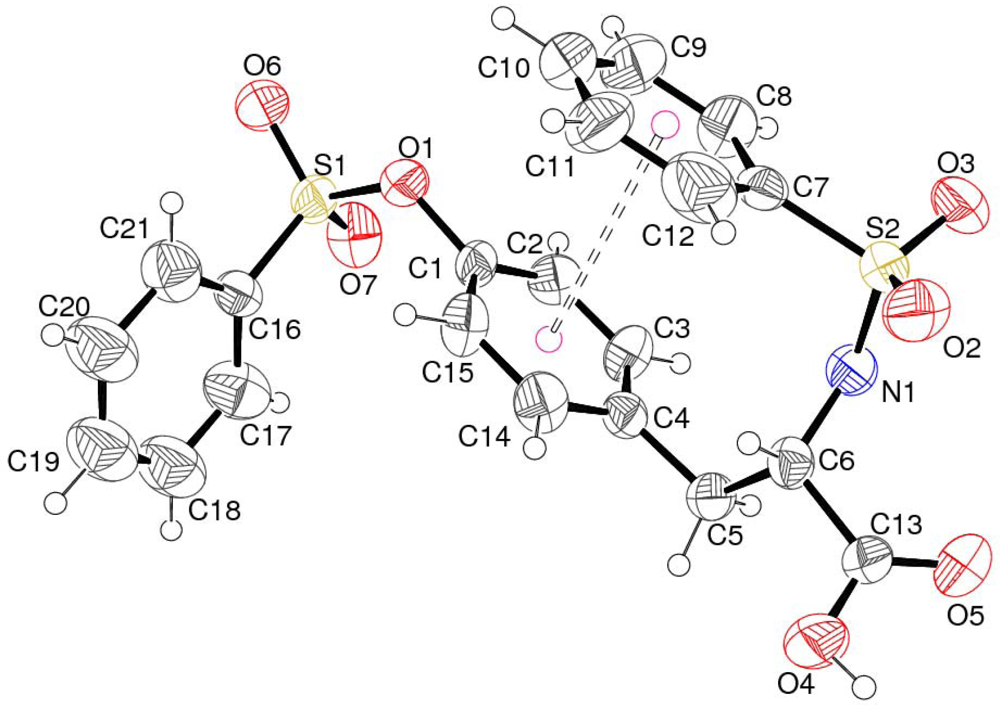
<p>The asymmetric unit of <bold>1</bold><sub>2</sub>·H<sub>2</sub>O·MeOH consists of two organic molecules (<bold>1A</bold> containing N1 and <bold>1B</bold> containing N2), accompanied by one molecule of water and one molecule of methanol, which is consistent with the mixed solvent used for recrystallization (see Experimental section). <bold>1</bold> has arisen from the reaction of L-tyrosine with two molecules of benzene sulfonyl chloride to form new S–N and S–O bonds in the product [<xref ref-type="bibr" rid="b10-crystals-01-00069">10</xref>]. It is notable that there are no other compounds containing L-tyrosine with an equivalent S–N bond in the Cambridge Structural Database (version 5.32 of November 2010 with two updates) [<xref ref-type="bibr" rid="b11-crystals-01-00069">11</xref>]. The transferrable hydrogen atoms (acidic protons) are clearly located on atoms O4 and O12, <italic>i.e.</italic> the molecules of <bold>1</bold> are not zwitterions. The absolute structure of <bold>1</bold><sub>2</sub>·H<sub>2</sub>O·MeOH is well established based on the refined value of −0.03 (8) of the Flack absolute structure parameter [<xref ref-type="bibr" rid="b12-crystals-01-00069">12</xref>] and the <italic>S</italic> configurations of the stereogenic atoms in <bold>1</bold> (C6 in molecule A and C27 in molecule B) are consistent with that of the equivalent carbon atom in L-tyrosine itself [<xref ref-type="bibr" rid="b3-crystals-01-00069">3</xref>]. In order to simplify the comparison of <bold>1</bold> with related structures, we will designate atom-sets C13, C6, C5 and C4 (molecule A) and C34, C27, C26 and C25 (molecule B) as Ca, Cα, Cβ and Cγ, respectively.</p>
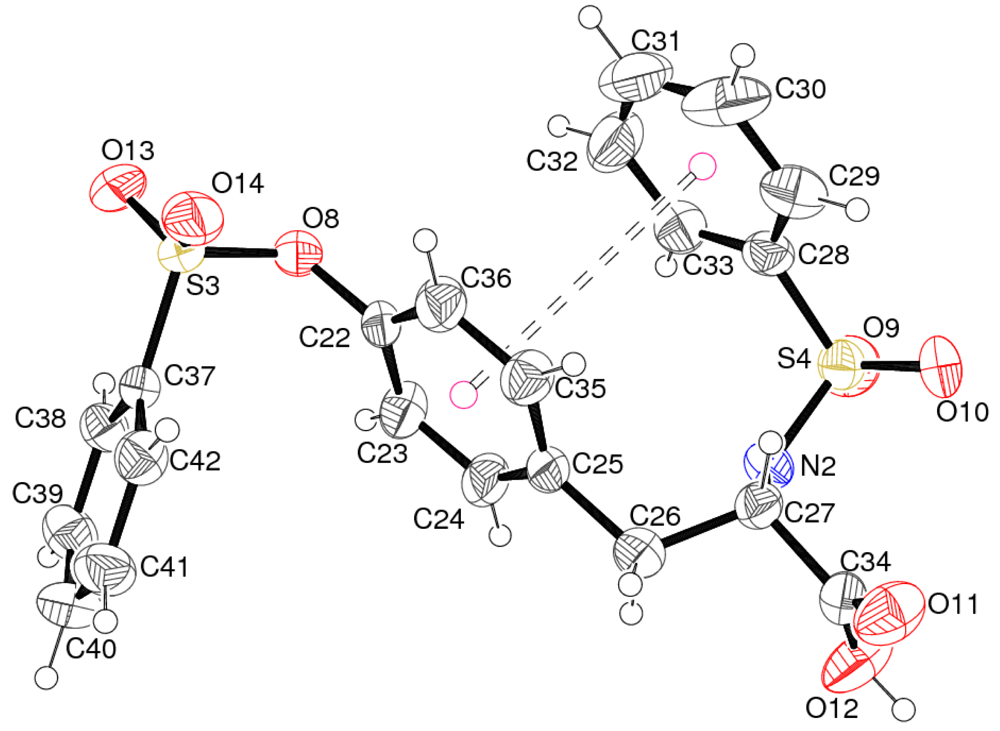
<p>Key torsion angles for the amino-acid cores of the molecules are as follows: in <bold>1A</bold>, the conformation of the S–N–Cα–Cβ bond is substantially twisted from nominal <italic>gauche</italic> [torsion angle = 140.5 (4)°] whilst the N–Cα–Cβ–Cγ [−67.6 (6)°] series is closer to being <italic>gauche</italic>. The Ca–Cα–Cβ–Cγ torsion angle is close to <italic>anti</italic> [170.2 (5)°] as is the N–Cα–Ca–O(H) torsion angle of 166.0 (5)°. In <bold>1B</bold>, the conformation of the S–N–Cα–Cβ bond is even more twisted from <italic>gauche</italic> [torsion angle = 146.9 (4)°] whilst N–Cα–Cβ–Cγ [−59.7 (6)°] is almost ideally <italic>gauche</italic>. The Ca–Cα–Cβ–Cγ torsion angle is close to <italic>anti</italic> [178.3 (5)°], and compares well to the equivalent value for molecule A. However, the N–Cα–Ca–O(H) torsion angle of −37.4 (6)° indicates a completely different conformation, as compared to molecule A. This is backed up by the dihedral angles of 80.4 (5)° between C34/O11/12 and C26/C27/N2 in molecule B and 65.2 (5)° for the equivalent atoms in molecule A. The torsion angles in <bold>1A</bold> are similar to those in <bold>2</bold> (<italic>vide infra</italic>) but quite different to those in related N-acylated L-tyrosine derivatives (<xref ref-type="table" rid="t1-crystals-01-00069">Table 1</xref>) and in L-tyrosine and DL-tyrosine.</p>
<p>The dihedral angles between the mean planes of the central C1/C2/C3/C4/C14/C15 aromatic ring and the terminal C7–C12 and C16–C21 rings in <bold>1A</bold> are 7.9 (2)° and 60.1 (2)°, respectively. The dihedral angle between the terminal rings is 66.9 (2)°. Equivalent values for <bold>1B</bold> for the C22/C23/C24/C25/C35/C36, C28–C33 and C37–C42 rings are 6.1 (2)°, 53.5 (2)° and 58.33 (19)°, respectively. The molecular conformation of <bold>1A</bold> (<xref ref-type="fig" rid="f2-crystals-01-00069">Figure 2</xref>) leads to a striking intramolecular aromatic π–π stacking interaction between the C1/C2/C3/C4/C14/C15 and C7–C12 rings, with a centroid–centroid separation of 3.807 (3) Å. In <bold>1B</bold>, which has a broadly similar overall shape (<xref ref-type="fig" rid="f3-crystals-01-00069">Figure 3</xref>), the separation between the equivalent rings is significantly longer at 4.067 (3) Å, which must indicate a much weaker interaction. A similar situation has been seen in a series of isostructural 5-phenyl-2-(benzalhydrazonyl)-1,3,4-thiadiazoles [<xref ref-type="bibr" rid="b13-crystals-01-00069">13</xref>], in which some compounds show much shorter centroid–centroid separations than others.</p>
<p>In the crystal of <bold>1</bold>, the components are linked by N–H⋯O and O–H⋯O hydrogen bonds (<xref ref-type="table" rid="t2-crystals-01-00069">Table 2</xref>). Qne of the N–H⋯O links is to a C=O (carboxylic acid) acceptor oxygen atom and the other is to a sulfonyl O atom. Both –OH groups of the carboxylic acids form hydrogen bonds to the solvent molecules (one to a water O atom and one to a methanol O atom). In terms of the C6–H6 and C27–H27 groupings (<italic>i.e.</italic>, the α carbon atoms), the first of these has a distant H⋯O contact to a sulfonyl O atom (2.63 Å) whereas the second does not have any possible acceptor atoms within 3.5 Å.</p>
<p>Finally, the solvent molecules form further O–H⋯O links and overall a two-dimensional network lying parallel to (010) arises. With this diversity of hydrogen-bond types observed in the structure, it is hard to draw conclusions as to the preferred hydrogen bonding modes of the organic molecule in <bold>1</bold>, although the very short C<sup>α</sup>–H⋯O link noted in the introduction is not present. Any intermolecular aromatic π–π stacking must be very weak, with a minimum centroid–centroid separation of greater than 4.06 Å.</p></sec>
<sec>
<label>2.2.</label>
<title>Structure of <bold>2</bold></title>
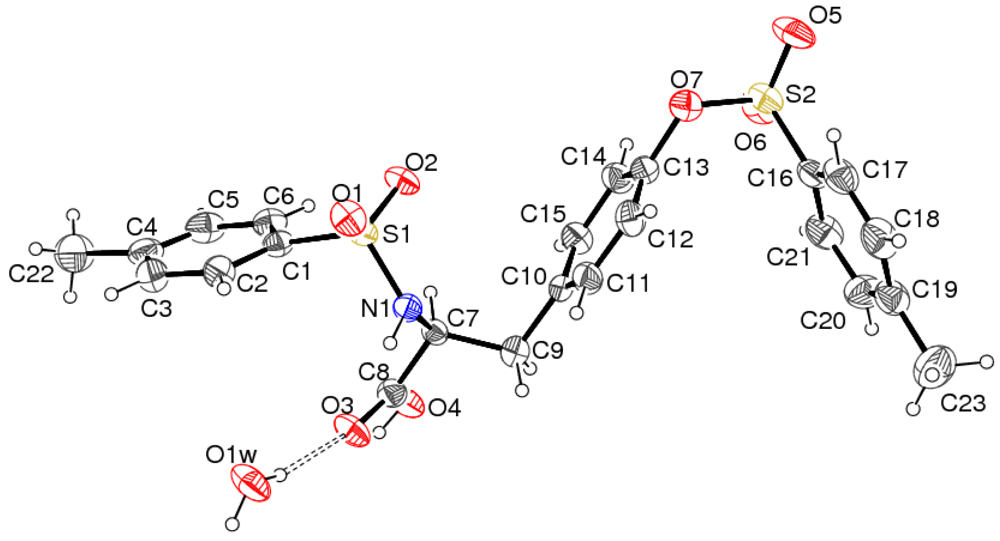
<p>The crystal structure of <bold>2</bold>·H<sub>2</sub>O (<xref ref-type="fig" rid="f4-crystals-01-00069">Figure 4</xref>) shows that L-tyrosine has reacted with two equivalents of 4-toluenesulfonyl chloride to form the S1–N1 and S2–O7 bonds in the product and that a water molecule of crystallization is present. The S-configuration of the C7 stereogenic center [refined value of the Flack absolute structure parameter = −0.01 (7)] is consistent with that of the L-tyrosine starting material and the bond lengths and angles in <bold>2</bold> may be regarded as normal. The molecule of <bold>2</bold> is non-zwitterionic, <italic>i.e.</italic> the proton is clearly attached to O4 and not to N1, as also seen for related molecules [<xref ref-type="bibr" rid="b5-crystals-01-00069">5</xref>-<xref ref-type="bibr" rid="b7-crystals-01-00069">7</xref>]. In order to simplify the comparison with related structures, atoms C8, C7 C9 and C10 in <bold>2</bold> are referred to as Ca, Cα, Cβ and Cγ, respectively.</p>
<p>The conformation of the S1–N1–Cα–Cβ bond in <bold>2</bold> is close to <italic>gauche</italic> [torsion angle = 129.7 (3)°] as is N1–Cα–Cβ–Cγ [−61.1 (5)°] whereas that of Ca–Cα–Cβ–Cγ is close to anti [174.4 (4)°]. The N1–Cα–Ca–O4 torsion angle of 165.3 (3)° indicates that the –OH group of the carboxylic acid is close to <italic>anti</italic> with respect to the NH group. These torsion angles are broadly similar to the situation in molecule <bold>1A</bold> but different to those of other L-tyrosine derivatives (<xref ref-type="table" rid="t1-crystals-01-00069">Table 1</xref>).</p>
<p>The dihedral angles between the mean planes of the central C10–C15 aromatic ring and the terminal C1–C6 and C16–C21 rings are 44.8 (2)° and 56.1 (2)°, respectively. The dihedral angle between the terminal rings is 81.4 (2)°. Their relative orientations, which are completely different to the conformations of molecules <bold>1A</bold> and <bold>1B</bold> in <bold>1</bold> indicate that no intramolecular aromatic π–π stacking interactions can occur in <bold>2</bold>.</p>
<p>In the crystal, the molecules are linked by N–H⋯O and O–H⋯O hydrogen bonds. The N–H⋯O (see <xref ref-type="table" rid="t3-crystals-01-00069">Table 3</xref> for atom labels and symmetry codes) hydrogen bond links the organic molecules into C(5) chains propagating in the [100] direction. The carboxylic acid forms an O–H⋯O bond to the water molecule and the water molecule forms two further O–H⋯O links; one of the acceptors is the C=O bond of the carboxylic acid, the other is part of a sulfonyl group. Together, these bonds generate a three-dimensional network. An extremely short intermolecular C–H⋯O bond (2.34 Å) from the α-carbon atom occurs in <bold>2</bold>, as does a longer C–H⋯O interaction from C9 (the β carbon atom). There are no aromatic π–π stacking interactions in the crystal of <bold>2</bold>, the shortest centroid–centroid separation being longer than 4.5 Å.</p></sec></sec>
<sec>
<label>3.</label>
<title>Experimental Section</title>
<sec>
<label>3.1.</label>
<title>Syntheses</title>
<p>All reagents were purchased from commercial sources and used without further purification and compound <bold>1</bold> was synthesized following the “green” literature method [<xref ref-type="bibr" rid="b10-crystals-01-00069">10</xref>]. L-Tyrosine (0.50 g, 5.52 mmol) was dissolved in 15 mL of 1 M Na<sub>2</sub>CO<sub>3</sub> solution. Benzene sulfonyl chloride (1.41 mL, 11.04 mmol) was suspended in the solution with stirring at room temperature. The pH was maintained at 8–9 until a clear solution resulted. Then, the pH was adjusted to 1–2, using 1 M HCl solution. The white precipitate obtained was filtered, washed with distilled water, dried and recrystallized from methanol and water (98:2 v/v) to yield colorless blocks. Calc. (obs.) analysis (%) for <bold>1</bold> (C<sub>21</sub>H<sub>19</sub>NO<sub>7</sub>S<sub>2</sub>): C 54.65 (54.65), H 4.15 (4.15), N 3.04 (3.03), S 13.90 (13.90).</p>
<p>To prepare compound <bold>2</bold>, L-tyrosine (0.50 g, 5.52 mmol) was dissolved in 15 ml of 1 M Na<sub>2</sub>CO<sub>3</sub> solution and 4-toluenesulfonyl chloride (2.1 g, 11.03 mmol) was suspended in the solution with stirring at room temperature. The pH was maintained at 8–9 until the consumption of suspended 4-toluenesulfonyl chloride, to yield a clear solution and the pH was adjusted to 1–2, using 1 M HCl solution. The white precipitate obtained was filtered, washed with distilled water, dried and recrystallized from methanol and water (98:2 v/v) to yield colorless blocks. Calc. (obs.) analysis (%) for 2 (C<sub>23</sub>H<sub>25</sub>NO<sub>7</sub>S<sub>2</sub>): C 56.20 (56.43), H 5.13 (4.75), N 2.85 (2.86), S 13.05 (13.10).</p></sec>
<sec sec-type="methods">
<label>3.2.</label>
<title>Data collections and refinements</title>
<p>Intensity data for the solvated crystals of <bold>1</bold> and <bold>2</bold> were collected at 296 K using a Bruker Kappa APEXII CCD diffractometer. The unit-cell refinements and data reductions were carried out with SAINT [<xref ref-type="bibr" rid="b14-crystals-01-00069">14</xref>]. The structures were solved by direct methods with SHELXS-97 and the atomic models refined against ∣<italic>F</italic>∣<sup>2</sup> with SHELXL-97 [<xref ref-type="bibr" rid="b15-crystals-01-00069">15</xref>]. The “observed data” criterion for calculating the <italic>R</italic>(<italic>F</italic>) residuals was set as <italic>I</italic> &gt; 2σ(<italic>I</italic>). The carbon-bound H atoms were geometrically placed and refined as riding atoms with <italic>U</italic><sub>iso</sub>(H) = 1.2–1.5<italic>U</italic><sub>eq</sub>(C). The methyl groups were allowed to rotate, but not to tip, to best fit the electron density. The O- and N-bond H atoms were located in difference maps and refined as riding atoms in their as-found relative positions with <italic>U</italic><sub>iso</sub>(H) = 1.2<italic>U</italic><sub>eq</sub>(carrier). Because of the poor data to parameter ratio for <bold>1</bold>, some of the benzene rings were modeled as rigid hexagons. The molecular graphics were generated with ORTEP-3 for Windows [<xref ref-type="bibr" rid="b16-crystals-01-00069">16</xref>] and the molecular geometries were analyzed with the aid of PLATON [<xref ref-type="bibr" rid="b17-crystals-01-00069">17</xref>].</p>
<p>Crystal data for <bold>1</bold><sub>2</sub>·H<sub>2</sub>O·MeOH [2(C<sub>21</sub>H<sub>19</sub>NO<sub>7</sub>S<sub>2</sub>)·H<sub>2</sub>O·CH<sub>4</sub>O]: colorless block, 0.47 × 0.28 × 0.21 mm, <italic>M</italic><sub>r</sub> = 973.04, monoclinic, <italic>P</italic>2<sub>1</sub> (No. 4), <italic>a</italic> = 8.0078 (4) Å, <italic>b</italic> = 34.0704 (16) Å, <italic>c</italic> = 8.5506 (3) Å, β = 94.239 (3)°, <italic>V</italic> = 2326.47 (18) Å<sup>3</sup>, <italic>Z</italic> = 2, <italic>T</italic> = 296, K, ρ<sub>calc</sub> = 1.389 g cm<sup>−3</sup>, μ = 0.276 mm<sup>−1</sup>, <italic>T</italic><sub>min</sub> = 0.881, <italic>T</italic><sub>max</sub> = 0.944, 22507 reflections measured (−10 ≤ <italic>h</italic> ≤ 9, −45 ≤ <italic>k</italic> ≤ 27, −8 ≤ <italic>l</italic> ≤ 11; 5.98° ≤ 2θ ≤ 57.00°), R<sub>Int</sub> = 0.048, 8822 merged reflections, 5884 with <italic>I</italic> &gt; 2σ(<italic>I</italic>), 536 parameters, <italic>R</italic>(<italic>F</italic>) = 0.062, <italic>wR</italic>(<italic>F</italic><sup>2</sup>) = 0.157, <italic>S</italic> (goodness of fit) = 1.031, Flack parameter = −0.03 (8), <italic>w</italic> = 1/[σ<sup>2</sup>(<italic>F</italic><sub>o</sub><sup>2</sup>) + 0.0669<italic>P</italic><sup>2</sup> + 0.9056<italic>P</italic>], where <italic>P</italic> = (<italic>F</italic><sub>o</sub><sup>2</sup> + 2 <italic>F</italic><sub>c</sub><sup>2</sup>)/3, min./max. Δρ = −0.29, +0.57 e Å<sup>−3</sup>, Cambridge Database deposition number: CCDC-822154.</p>
<p>Crystal data for <bold>2</bold>·H<sub>2</sub>O (C<sub>23</sub>H<sub>25</sub>NO7S<sub>2</sub>·H<sub>2</sub>O): colorless block, 0.19 × 0.18 × 0.09 mm, <italic>M</italic><sub>r</sub> = 507.56, monoclinic, <italic>P</italic>2<sub>1</sub> (No. 4), <italic>a</italic> = 5.7171 (7) Å, <italic>b</italic> = 24.359 (3) Å, <italic>c</italic> = 9.1043 (10) Å, β = 104.563 (6)°, <italic>V</italic> = 1227.2 (2) Å<sup>3</sup>, <italic>Z</italic> = 2, <italic>T</italic> = 296 K, ρ<sub>calc</sub> = 1.374 g cm<sup>−3</sup>, μ = 0.265 mm<sup>−1</sup>, <italic>T</italic><sub>min</sub> = 0.00, <italic>T</italic><sub>max</sub> = 0.00, 13467 reflections measured (−7 ≤ <italic>h</italic> ≤ 7, −32 ≤ <italic>k</italic> ≤ 32, −12 ≤ <italic>l</italic> ≤ 12; 4.62° ≤ 2θ ≤ 56.68°), <italic>R</italic><sub>Int</sub> = 0.062, 5594 merged reflections, 2508 with <italic>I</italic> &gt; 2σ(<italic>I</italic>), 323 parameters, <italic>R</italic>(<italic>F</italic>) = 0.055, <italic>wR</italic>(<italic>F</italic><sup>2</sup>) = 0.092), <italic>S</italic> (goodness of fit) = 0.953, Flack parameter = −0.01 (7), <italic>w</italic> = 1/[σ<sup>2</sup>(<italic>F</italic><sub>o</sub><sup>2</sup>) + 0.0218<italic>P</italic><sup>2</sup>], where <italic>P</italic> = (<italic>F</italic><sub>o</sub><sup>2</sup> + 2 <italic>F</italic><sub>c</sub><sup>2</sup>)/3, min./max. Δρ = −0.17, +0.18 <italic>e</italic> Å<sup>-3</sup>, Cambridge Database deposition number: CCDC-822155.</p></sec></sec>
<sec sec-type="conclusions">
<label>4.</label>
<title>Conclusions</title>
<p>We have structurally characterized two doubly-substituted L-tyrosine derivatives, prepared by a “green” synthesis. The change from benzene-sulfonyl to toluene-sulfonyl substituents leads to totally different molecular conformations in the respective crystals: the benzene compound (<bold>1</bold>) displays a folded conformation stabilized by intramolecular π–π stacking in both asymmetric molecules, whereas the toluene-sulfonyl compound adopts an “extended” conformation. The toluene sulfonyl (<bold>2</bold>) derivative displays a very short intermolecular C<sup>α</sup>–H⋯O interaction in its crystal structure, in common with L-tyrosine and DL-tyrosine, whereas the benzene derivative does not. Both crystal structures contain N–H⋯O and O–H⋯O hydrogen bonds linking the tyrosine and the solvent molecules.</p></sec></body>
<back>
<sec sec-type="display-objects">
<title>Figures and Tables</title>
<fig id="f1-crystals-01-00069" position="float">
<label>Figure 1.</label>
<caption>
<p>Structures of <bold>1</bold> and <bold>2</bold></p></caption>
<graphic xlink:href="crystals-01-00069f1.gif"/></fig>
<fig id="f2-crystals-01-00069" position="float">
<label>Figure 2.</label>
<caption>
<p>The molecular structure of molecule <bold>1A</bold> showing 40% displacement ellipsoids. The intramolecular π–π stacking interaction is indicated by a double-dashed line.</p></caption>
<graphic xlink:href="crystals-01-00069f2.gif"/></fig>
<fig id="f3-crystals-01-00069" position="float">
<label>Figure 3.</label>
<caption>
<p>The molecular structure of molecule <bold>1B</bold> showing 50% displacement ellipsoids. The intramolecular π–π stacking interaction is indicated by a double-dashed line.</p></caption>
<graphic xlink:href="crystals-01-00069f3.gif"/></fig>
<fig id="f4-crystals-01-00069" position="float">
<label>Figure 4.</label>
<caption>
<p>The molecular structure of <bold>2</bold>·H<sub>2</sub>O showing 40% displacement ellipsoids. The O–H⋯O hydrogen bond is indicated by a double-dashed line.</p></caption>
<graphic xlink:href="crystals-01-00069f4.gif"/></fig>
<table-wrap id="t1-crystals-01-00069" position="float">
<label>Table 1.</label>
<caption>
<p>Key torsion angles (°) in <bold>1</bold>, <bold>2</bold> and related compounds.</p></caption>
<table frame="box" rules="all">
<tbody>
<tr>
<td colspan="4" align="left" valign="top">S–N–Cα–Cβ or C–N–Cα–Cβ</td></tr>
<tr>
<td align="left" valign="top"><bold>1a</bold></td>
<td align="left" valign="top">140.5 (4)</td>
<td align="left" valign="top"><bold>1b</bold></td>
<td align="left" valign="top">146.9 (4)</td></tr>
<tr>
<td align="left" valign="top"><bold>2</bold></td>
<td align="left" valign="top">129.7 (3)</td>
<td align="left" valign="top"><bold>3</bold></td>
<td align="left" valign="top">−176.6</td></tr>
<tr>
<td align="left" valign="top"><bold>4</bold></td>
<td align="left" valign="top">−171.1</td>
<td align="left" valign="top"><bold>5</bold></td>
<td align="left" valign="top">−68.6</td></tr>
<tr>
<td colspan="4" align="left" valign="top">N–Cα–Cβ–Cγ</td></tr>
<tr>
<td align="left" valign="top"><bold>1a</bold></td>
<td align="left" valign="top">−67.6 (6)</td>
<td align="left" valign="top"><bold>1b</bold></td>
<td align="left" valign="top">−59.7 (6)</td></tr>
<tr>
<td align="left" valign="top"><bold>2</bold></td>
<td align="left" valign="top">−61.1 (5)</td>
<td align="left" valign="top"><bold>3</bold></td>
<td align="left" valign="top">−71.5</td></tr>
<tr>
<td align="left" valign="top"><bold>4</bold></td>
<td align="left" valign="top">−179.8</td>
<td align="left" valign="top"><bold>5</bold></td>
<td align="left" valign="top">−60.5</td></tr>
<tr>
<td align="left" valign="top"><bold>6</bold></td>
<td align="left" valign="top">69.3</td>
<td align="left" valign="top"><bold>7</bold></td>
<td align="left" valign="top">−69.7</td></tr>
<tr>
<td colspan="4" align="left" valign="top">Ca–Cα–Cβ–Cγ</td></tr>
<tr>
<td align="left" valign="top"><bold>1a</bold></td>
<td align="left" valign="top">170.2 (5)</td>
<td align="left" valign="top"><bold>1b</bold></td>
<td align="left" valign="top">178.3 (5)</td></tr>
<tr>
<td align="left" valign="top"><bold>2</bold></td>
<td align="left" valign="top">174.4 (4)</td>
<td align="left" valign="top"><bold>3</bold></td>
<td align="left" valign="top">165.6</td></tr>
<tr>
<td align="left" valign="top"><bold>4</bold></td>
<td align="left" valign="top">58.2</td>
<td align="left" valign="top"><bold>5</bold></td>
<td align="left" valign="top">64.6</td></tr>
<tr>
<td align="left" valign="top"><bold>6</bold></td>
<td align="left" valign="top">−53.1</td>
<td align="left" valign="top"><bold>7</bold></td>
<td align="left" valign="top">52.5</td></tr>
<tr>
<td colspan="4" align="left" valign="top">N–Cα–Ca–OH</td></tr>
<tr>
<td align="left" valign="top"><bold>1a</bold></td>
<td align="left" valign="top">166.0 (5)</td>
<td align="left" valign="top"><bold>1b</bold></td>
<td align="left" valign="top">−37.4 (6)</td></tr>
<tr>
<td align="left" valign="top"><bold>2</bold></td>
<td align="left" valign="top">165.3 (3)</td>
<td align="left" valign="top"><bold>3</bold></td>
<td align="left" valign="top">−28.7</td></tr>
<tr>
<td align="left" valign="top"><bold>4</bold></td>
<td align="left" valign="top">−46.9</td>
<td align="left" valign="top"><bold>5</bold></td>
<td align="left" valign="top">170.0</td></tr></tbody></table>
<table-wrap-foot><fn id="tfn1-crystals-01-00069">
<p><bold>3</bold> = N-acetyl-L-tyrosine (ref. <xref ref-type="bibr" rid="b7-crystals-01-00069">7</xref>). Standard uncertainty (s.u.) for angles ≈ 0.2°; <bold>4</bold> = N-acetyl-L-phenylalanyl-L-tyrosine (ref. <xref ref-type="bibr" rid="b8-crystals-01-00069">8</xref>). S.u. for angles ≈ 0.4°; <bold>5</bold> = (<italic>R</italic>)-2-(2-(5-fluoro-2,4-dioxo-3,4-dihydropyrimidin-1(2H)-yl)acetamido)-3-(4-hydroxyphenyl)-propanoic acid dimethylformamide solvate (ref. <xref ref-type="bibr" rid="b9-crystals-01-00069">9</xref>). S.u. for angles ≈ 0.2°; <bold>6</bold> = L-tyrosine (ref. <xref ref-type="bibr" rid="b3-crystals-01-00069">3</xref>). S.u. for angles ≈ 0.5°; <bold>7</bold> = DL-tyrosine (ref. <xref ref-type="bibr" rid="b6-crystals-01-00069">6</xref>). S.u. for angles ≈ 0.5°.</p></fn></table-wrap-foot></table-wrap>
<table-wrap id="t2-crystals-01-00069" position="float">
<label>Table 2.</label>
<caption>
<p>Hydrogen bonds in <bold>1</bold>.</p></caption>
<table frame="box" rules="all">
<tbody>
<tr>
<td align="left" valign="top">N1–H1N⋯O11</td>
<td align="left" valign="top">0.87 (4)</td>
<td align="left" valign="top">2.06 (4)</td>
<td align="left" valign="top">2.922 (6)</td>
<td align="left" valign="top">168 (5)</td></tr>
<tr>
<td align="left" valign="top">N2–H2N⋯O14<xref ref-type="table-fn" rid="tfn3-crystals-01-00069">i</xref></td>
<td align="left" valign="top">0.87 (4)</td>
<td align="left" valign="top">2.10 (4)</td>
<td align="left" valign="top">2.925 (6)</td>
<td align="left" valign="top">160 (4)</td></tr>
<tr>
<td align="left" valign="top">O4–H4O⋯O15<xref ref-type="table-fn" rid="tfn4-crystals-01-00069">ii</xref></td>
<td align="left" valign="top">0.82</td>
<td align="left" valign="top">1.95</td>
<td align="left" valign="top">2.702 (6)</td>
<td align="left" valign="top">153</td></tr>
<tr>
<td align="left" valign="top">O12–H12O⋯O1W</td>
<td align="left" valign="top">0.82</td>
<td align="left" valign="top">1.75</td>
<td align="left" valign="top">2.547 (7)</td>
<td align="left" valign="top">164</td></tr>
<tr>
<td align="left" valign="top">O15–H15A⋯O10</td>
<td align="left" valign="top">0.82</td>
<td align="left" valign="top">2.07</td>
<td align="left" valign="top">2.817 (6)</td>
<td align="left" valign="top">151</td></tr>
<tr>
<td align="left" valign="top">O1W–H1WA⋯O5<xref ref-type="table-fn" rid="tfn3-crystals-01-00069">i</xref></td>
<td align="left" valign="top">0.88 (5)</td>
<td align="left" valign="top">2.08 (6)</td>
<td align="left" valign="top">2.847 (7)</td>
<td align="left" valign="top">146 (6)</td></tr>
<tr>
<td align="left" valign="top">O1W–H1WB⋯O15<xref ref-type="table-fn" rid="tfn5-crystals-01-00069">iii</xref></td>
<td align="left" valign="top">0.87 (5)</td>
<td align="left" valign="top">2.14 (5)</td>
<td align="left" valign="top">2.998 (7)</td>
<td align="left" valign="top">172 (7)</td></tr></tbody></table>
<table-wrap-foot><fn id="tfn2-crystals-01-00069">
<p>The four values refer to the <italic>D</italic>–H, H⋯<italic>A</italic>, <italic>D</italic>⋯<italic>A</italic> separations (Å) and the D–H⋯A angle (°), respectively (also in <xref ref-type="table" rid="t3-crystals-01-00069">Table 3</xref>). Symmetry codes:</p></fn><fn id="tfn3-crystals-01-00069">
<label>(i)</label>
<p><italic>x</italic>, <italic>y</italic>, <italic>z</italic>−1;</p></fn><fn id="tfn4-crystals-01-00069">
<label>(ii)</label>
<p><italic>x</italic>, <italic>y</italic>, <italic>z</italic>+1;</p></fn><fn id="tfn5-crystals-01-00069">
<label>(iii)</label>
<p><italic>x</italic>+1, <italic>y</italic>, <italic>z</italic>.</p></fn></table-wrap-foot></table-wrap>
<table-wrap id="t3-crystals-01-00069" position="float">
<label>Table 3.</label>
<caption>
<p>Hydrogen bonds in <bold>2</bold>.</p></caption>
<table frame="box" rules="all">
<tbody>
<tr>
<td align="left" valign="top">N1–H1N⋯O11</td>
<td align="left" valign="top">0.87 (4)</td>
<td align="left" valign="top">2.06 (4)</td>
<td align="left" valign="top">2.922 (6)</td>
<td align="left" valign="top">168 (5)</td></tr>
<tr>
<td align="left" valign="top">N1–H1N⋯O4<xref ref-type="table-fn" rid="tfn7-crystals-01-00069">i</xref></td>
<td align="left" valign="top">0.89 (4)</td>
<td align="left" valign="top">2.41 (4)</td>
<td align="left" valign="top">3.241 (5)</td>
<td align="left" valign="top">156 (3)</td></tr>
<tr>
<td align="left" valign="top">O4–H4O⋯O1W<xref ref-type="table-fn" rid="tfn8-crystals-01-00069">ii</xref></td>
<td align="left" valign="top">0.82 (5)</td>
<td align="left" valign="top">1.80 (5)</td>
<td align="left" valign="top">2.557 (4)</td>
<td align="left" valign="top">153 (6)</td></tr>
<tr>
<td align="left" valign="top">O1W–H1WA⋯O2<xref ref-type="table-fn" rid="tfn9-crystals-01-00069">iii</xref></td>
<td align="left" valign="top">0.818 (18)</td>
<td align="left" valign="top">2.04 (2)</td>
<td align="left" valign="top">2.842 (3)</td>
<td align="left" valign="top">166 (5)</td></tr>
<tr>
<td align="left" valign="top">O1W–H1WB⋯O3</td>
<td align="left" valign="top">0.82 (4)</td>
<td align="left" valign="top">2.06 (5)</td>
<td align="left" valign="top">2.864 (4)</td>
<td align="left" valign="top">165 (5)</td></tr>
<tr>
<td align="left" valign="top">C7–H7⋯O1<xref ref-type="table-fn" rid="tfn8-crystals-01-00069">ii</xref></td>
<td align="left" valign="top">0.98</td>
<td align="left" valign="top">2.34</td>
<td align="left" valign="top">3.260 (5)</td>
<td align="left" valign="top">156</td></tr>
<tr>
<td align="left" valign="top">C9–H9A⋯O6<xref ref-type="table-fn" rid="tfn9-crystals-01-00069">iii</xref></td>
<td align="left" valign="top">0.97</td>
<td align="left" valign="top">2.59</td>
<td align="left" valign="top">3.468 (5)</td>
<td align="left" valign="top">150</td></tr></tbody></table>
<table-wrap-foot><fn id="tfn6-crystals-01-00069">
<p>Symmetry codes:</p></fn><fn id="tfn7-crystals-01-00069">
<label>(i)</label>
<p><italic>x</italic>−1, <italic>y</italic>, <italic>z</italic>;</p></fn><fn id="tfn8-crystals-01-00069">
<label>(ii)</label>
<p><italic>x</italic>+1, <italic>y</italic>, <italic>z</italic>;</p></fn><fn id="tfn9-crystals-01-00069">
<label>(iii)</label>
<p><italic>x</italic>, <italic>y</italic>, <italic>z</italic>+1.</p></fn></table-wrap-foot></table-wrap></sec>
<ack>
<p>The authors thank Sohail Anjum Shahzad for his discussion regarding this article and also acknowledge the Higher Education Commission of Pakistan for providing a grant under the project strengthening the Materials Chemistry Laboratory at GC University, Lahore.</p></ack>
<ref-list>
<title>References and Notes</title>
<ref id="b1-crystals-01-00069"><label>1.</label><citation citation-type="journal"><person-group person-group-type="author"><name><surname>Eagle</surname><given-names>H.</given-names></name><name><surname>Piez</surname><given-names>K.A.</given-names></name><name><surname>Fleishman</surname><given-names>R.</given-names></name></person-group><article-title>The utilization of phenylalanine and tyrosine for protein synthesis by human cells in tissue culture</article-title><source>J. Biol. Chem.</source><year>1957</year><volume>228</volume><fpage>847</fpage><lpage>861</lpage><pub-id pub-id-type="pmid">13475365</pub-id></citation></ref>
<ref id="b2-crystals-01-00069"><label>2.</label><citation citation-type="journal"><person-group person-group-type="author"><name><surname>Ip</surname><given-names>C.</given-names></name><name><surname>Harper</surname><given-names>A.E.</given-names></name></person-group><article-title>Protein-synthesis in liver, muscle and brain of rats fed a high tyrosine low protein diet</article-title><source>J. Nutr.</source><year>1975</year><volume>105</volume><fpage>885</fpage><lpage>893</lpage><pub-id pub-id-type="pmid">1138033</pub-id></citation></ref>
<ref id="b3-crystals-01-00069"><label>3.</label><citation citation-type="journal"><person-group person-group-type="author"><name><surname>Mostad</surname><given-names>A.</given-names></name><name><surname>Nissen</surname><given-names>H.M.</given-names></name><name><surname>Romming</surname><given-names>C.</given-names></name></person-group><article-title>Crystal structure of L-tyrosine</article-title><source>Acta Chem. Scand.</source><year>1972</year><volume>26</volume><fpage>3819</fpage><lpage>3833</lpage><pub-id pub-id-type="doi">10.3891/acta.chem.scand.26-3819</pub-id><pub-id pub-id-type="pmid">4654042</pub-id></citation></ref>
<ref id="b4-crystals-01-00069"><label>4.</label><citation citation-type="journal"><person-group person-group-type="author"><name><surname>Jeffrey</surname><given-names>G.A.</given-names></name><name><surname>Maluszynska</surname><given-names>H.</given-names></name></person-group><article-title>A survey of hydrogen bond geometries in the crystal structures of amino acids</article-title><source>Int. J. Biol. Macromol.</source><year>1982</year><volume>4</volume><fpage>173</fpage><lpage>185</lpage><pub-id pub-id-type="doi">10.1016/0141-8130(82)90048-4</pub-id></citation></ref>
<ref id="b5-crystals-01-00069"><label>5.</label><citation citation-type="journal"><person-group person-group-type="author"><name><surname>Scheiner</surname><given-names>S.</given-names></name><name><surname>Kar</surname><given-names>T.</given-names></name><name><surname>Gu</surname><given-names>Y.</given-names></name></person-group><article-title>Strength of the C<sup>α</sup>H⋯O hydrogen bond of amino acid residues</article-title><source>J. Biol. Chem.</source><year>2001</year><volume>276</volume><fpage>9832</fpage><lpage>9837</lpage><pub-id pub-id-type="doi">10.1074/jbc.M010770200</pub-id><pub-id pub-id-type="pmid">11152477</pub-id></citation></ref>
<ref id="b6-crystals-01-00069"><label>6.</label><citation citation-type="journal"><person-group person-group-type="author"><name><surname>Mostad</surname><given-names>A.</given-names></name><name><surname>Romming</surname><given-names>C.</given-names></name></person-group><article-title>Crystal-structure of DL-tyrosine</article-title><source>Acta Chem. Scand.</source><year>1973</year><volume>27</volume><fpage>401</fpage><lpage>410</lpage><pub-id pub-id-type="doi">10.3891/acta.chem.scand.27-0401</pub-id></citation></ref>
<ref id="b7-crystals-01-00069"><label>7.</label><citation citation-type="journal"><person-group person-group-type="author"><name><surname>Koszelak</surname><given-names>S.N.</given-names></name><name><surname>van der Helm</surname><given-names>D.</given-names></name></person-group><article-title><italic>N</italic>-acetyl-L-tyrosine</article-title><source>Acta Cryst.</source><year>1981</year><volume>B37</volume><fpage>1122</fpage><lpage>1124</lpage></citation></ref>
<ref id="b8-crystals-01-00069"><label>8.</label><citation citation-type="journal"><person-group person-group-type="author"><name><surname>Stenkamp</surname><given-names>R.E.</given-names></name><name><surname>Jensen</surname><given-names>L.H.</given-names></name></person-group><article-title>The crystal structure of pepsin substrate: <italic>N</italic>-acetyl-L-phenyl-alanyl-L-tyrosine</article-title><source>Acta Cryst.</source><year>1973</year><volume>B29</volume><fpage>2872</fpage><lpage>2878</lpage></citation></ref>
<ref id="b9-crystals-01-00069"><label>9.</label><citation citation-type="journal"><person-group person-group-type="author"><name><surname>Yan</surname><given-names>X.</given-names></name><name><surname>Hu</surname><given-names>M.</given-names></name><name><surname>Miao</surname><given-names>Q.</given-names></name><name><surname>Wang</surname><given-names>S.</given-names></name><name><surname>Zhao</surname><given-names>K.</given-names></name></person-group><article-title>The synthesis and anticancer activities of peptide 5-fluorouracil derivatives</article-title><source>J. Chem. Res.</source><year>2009</year><fpage>261</fpage><lpage>264</lpage></citation></ref>
<ref id="b10-crystals-01-00069"><label>10.</label><citation citation-type="journal"><person-group person-group-type="author"><name><surname>Deng</surname><given-names>X.</given-names></name><name><surname>Mani</surname><given-names>N.S.</given-names></name></person-group><article-title>A facile, environmentally benign sulfonamide synthesis in water</article-title><source>Green Chem.</source><year>2006</year><volume>8</volume><fpage>835</fpage><lpage>838</lpage><pub-id pub-id-type="doi">10.1039/b606127c</pub-id></citation></ref>
<ref id="b11-crystals-01-00069"><label>11.</label><citation citation-type="journal"><person-group person-group-type="author"><name><surname>Allen</surname><given-names>F.H.</given-names></name><name><surname>Motherwell</surname><given-names>W.D.S.</given-names></name></person-group><article-title>Applications of the Cambridge Structural Database in organic chemistry and crystal chemistry</article-title><source>Acta Cryst.</source><year>2002</year><volume>B58</volume><fpage>407</fpage><lpage>422</lpage></citation></ref>
<ref id="b12-crystals-01-00069"><label>12.</label><citation citation-type="journal"><person-group person-group-type="author"><name><surname>Flack</surname><given-names>H.D.</given-names></name></person-group><article-title>On enantiomorph–polarity estimation</article-title><source>Acta Cryst.</source><year>1983</year><volume>A39</volume><fpage>876</fpage><lpage>881</lpage></citation></ref>
<ref id="b13-crystals-01-00069"><label>13.</label><citation citation-type="journal"><person-group person-group-type="author"><name><surname>Carvalho</surname><given-names>S.M.</given-names></name><name><surname>Harrison</surname><given-names>W.T.A.</given-names></name><name><surname>Fraga</surname><given-names>C.A.M.</given-names></name><name><surname>da Silva</surname><given-names>E.F.</given-names></name><name><surname>Wardell</surname><given-names>J.L.</given-names></name><name><surname>Wardell</surname><given-names>S.M.S.V.</given-names></name></person-group><article-title>3-Phenyl-2-(benzalhydrazonyl)-1,3,4-thiadiazoles, potential trypanocidal agents: consistent dimer formation <italic>via</italic> N–H⋯N intermolecular hydrogen bonds</article-title><source>Zeit Krist.</source><year>2009</year><volume>224</volume><fpage>598</fpage><lpage>606</lpage><pub-id pub-id-type="doi">10.1524/zkri.2009.1203</pub-id></citation></ref>
<ref id="b14-crystals-01-00069"><label>14.</label><citation citation-type="book"><source>SAINT data reduction software</source><publisher-name>Bruker AXS Inc.</publisher-name><publisher-loc>Madison, Wisconsin, USA</publisher-loc><year>1997</year></citation></ref>
<ref id="b15-crystals-01-00069"><label>15.</label><citation citation-type="journal"><person-group person-group-type="author"><name><surname>Sheldrick</surname><given-names>G.M.</given-names></name></person-group><article-title>A short history of SHELX</article-title><source>Acta Cryst.</source><year>2008</year><volume>A64</volume><fpage>112</fpage><lpage>122</lpage></citation></ref>
<ref id="b16-crystals-01-00069"><label>16.</label><citation citation-type="journal"><person-group person-group-type="author"><name><surname>Farrugia</surname><given-names>L.J.</given-names></name></person-group><article-title><italic>ORTEP</italic>-3 for Windows - a version of <italic>ORTEP</italic>-III with a Graphical User Interface (GUI)</article-title><source>J. Appl Cryst.</source><year>1997</year><volume>30</volume><fpage>565</fpage></citation></ref>
<ref id="b17-crystals-01-00069"><label>17.</label><citation citation-type="journal"><person-group person-group-type="author"><name><surname>Spek</surname><given-names>A.L.</given-names></name></person-group><article-title>Structure validation in chemical crystallography</article-title><source>Acta Cryst.</source><year>2009</year><volume>D65</volume><fpage>148</fpage><lpage>155</lpage></citation></ref></ref-list></back></article>