<?xml version="1.0" encoding="UTF-8"?>
<!DOCTYPE article PUBLIC "-//NLM//DTD Journal Publishing DTD v2.3 20070202//EN" "journalpublishing.dtd">
<article xmlns:xlink="http://www.w3.org/1999/xlink" xml:lang="en" article-type="research-article">
<front>
<journal-meta>
<journal-id journal-id-type="publisher-id">Crystals</journal-id>
<journal-title>Crystals</journal-title>
<issn pub-type="epub">2073-4352</issn>
<publisher>
<publisher-name>Molecular Diversity Preservation International (MDPI)</publisher-name></publisher></journal-meta>
<article-meta>
<article-id pub-id-type="doi">10.3390/cryst1020059</article-id>
<article-id pub-id-type="publisher-id">crystals-01-00059</article-id>
<article-categories>
<subj-group>
<subject>Article</subject></subj-group></article-categories>
<title-group>
<article-title>Barium Oxalates Combined with Oxo-Anions and Organic Cations: Syntheses and Structures of Ba<sub>2</sub>(C<sub>2</sub>O<sub>4</sub>)(H<sub>2</sub>PO<sub>3</sub>)<sub>2</sub> and C<sub>2</sub>H<sub>10</sub>N<sub>2</sub>·Ba(H<sub>2</sub>O)<sub>2</sub>(HC<sub>2</sub>O<sub>4</sub>)<sub>4</sub></article-title></title-group>
<contrib-group>
<contrib contrib-type="author">
<name><surname>Iveson</surname><given-names>Samuel J.</given-names></name></contrib>
<contrib contrib-type="author">
<name><surname>Johnston</surname><given-names>Chloe B.</given-names></name></contrib>
<contrib contrib-type="author">
<name><surname>Harrison</surname><given-names>William T.A.</given-names></name><xref ref-type="corresp" rid="c1-crystals-01-00059"><sup>*</sup></xref></contrib>
<aff id="af1-crystals-01-00059">Department of Chemistry, University of Aberdeen, Meston Walk, Aberdeen AB24 3UE, Scotland, UK</aff></contrib-group>
<author-notes>
<corresp id="c1-crystals-01-00059">
<label>*</label> Author to whom correspondence should be addressed; E-Mail: <email>w.harrison@abdn.ac.uk</email>; Tel.: +44-1224-272897; Fax: +44-1224-272921.</corresp></author-notes>
<pub-date pub-type="collection">
<year>2011</year></pub-date>
<pub-date pub-type="epub">
<day>08</day>
<month>06</month>
<year>2011</year></pub-date>
<volume>1</volume>
<issue>2</issue>
<fpage>59</fpage>
<lpage>68</lpage>
<history>
<date date-type="received">
<day>25</day>
<month>05</month>
<year>2011</year></date>
<date date-type="rev-recd">
<day>01</day>
<month>06</month>
<year>2011</year></date>
<date date-type="accepted">
<day>07</day>
<month>06</month>
<year>2011</year></date></history>
<permissions>
<copyright-statement>© 2011 by the authors; licensee MDPI, Basel, Switzerland.</copyright-statement>
<copyright-year>2011</copyright-year>
<license>
<p>This article is an open access article distributed under the terms and conditions of the Creative Commons Attribution license (http://creativecommons.org/licenses/by/3.0/).</p></license></permissions>
<abstract>
<p>The syntheses and single-crystal structures of Ba<sub>2</sub>(C<sub>2</sub>O<sub>4</sub>)(H<sub>2</sub>PO<sub>3</sub>)<sub>2</sub> (<bold>1</bold>) and C<sub>2</sub>H<sub>10</sub>N<sub>2</sub>·Ba(H<sub>2</sub>O)<sub>2</sub>(HC<sub>2</sub>O<sub>4</sub>)<sub>4</sub> (<bold>2</bold>) are described. Compound <bold>1</bold> is a three-dimensional mixed-anion framework containing BaO<sub>9</sub> coordination polyhedra, which approximate to monocapped square anti-prisms: the connectivity of the BaO<sub>9</sub> units via edges and triangular faces leads to a sheet structure. The oxalate ion in <bold>1</bold> is substantially twisted about its C–C bond [dihedral angle between the CO<sub>2</sub> groups = 33.8 (3)°]. Compound <bold>2</bold> is a molecular salt containing ethylenediammonium dications and [Ba(HC<sub>2</sub>O<sub>4</sub>)<sub>4</sub>(H<sub>2</sub>O)<sub>2</sub>]<sup>2–</sup> dianions, which are linked by O–H⋯O and N–H⋯O hydrogen bonds. The BaO<sub>10</sub> coordination polyhedron can be described as a distorted pentagonal anti-prism. Crystal data: <bold>1</bold> (C<sub>2</sub>H<sub>4</sub>Ba<sub>2</sub>O<sub>10</sub>P<sub>2</sub>), <italic>M</italic><sub>r</sub> = 524.68, monoclinic, <italic>C</italic>2/<italic>c</italic> (No. 15), <italic>Z</italic> = 4, <italic>a</italic> = 12.3829 (3) Å, <italic>b</italic> = 7.9124 (2) Å, <italic>c</italic> = 11.0858 (3) Å, β = 114.788 (2)°, <italic>V</italic> = 986.10 (4) Å<sup>3</sup>, <italic>R</italic>(<italic>F</italic>) = 0.016, <italic>wR</italic>(<italic>F</italic><sup>2</sup>) = 0.040. <bold>2</bold> (C<sub>10</sub>H<sub>18</sub>BaN<sub>2</sub>O<sub>10</sub>), <italic>M</italic><sub>r</sub> = 591.60, monoclinic, <italic>C</italic>2/<italic>m</italic> (No. 12), <italic>Z</italic> = 2, <italic>a</italic> = 12.7393 (7) Å, <italic>b</italic> = 13.0111 (7) Å, <italic>c</italic> = 5.6050 (3) Å, β = 104.208 (4)°, <italic>V</italic> = 900.62 (8) Å<sup>3</sup>, <italic>R</italic>(<italic>F</italic>) = 0.027, <italic>wR</italic>(<italic>F</italic><sup>2</sup>) = 0.054.</p></abstract>
<kwd-group>
<kwd>barium</kwd>
<kwd>oxalate</kwd>
<kwd>crystal structure</kwd>
<kwd>polyhedra</kwd>
<kwd>hydrogen bonding</kwd></kwd-group></article-meta></front>
<body>
<sec sec-type="intro">
<label>1.</label>
<title>Introduction</title>
<p>Hydrated barium oxalates including Ba(C<sub>2</sub>O<sub>4</sub>)·½H<sub>2</sub>O [<xref ref-type="bibr" rid="b1-crystals-01-00059">1</xref>], Ba(C<sub>2</sub>O<sub>4</sub>)·H<sub>2</sub>O [<xref ref-type="bibr" rid="b2-crystals-01-00059">2</xref>], Ba(C<sub>2</sub>O<sub>4</sub>)·2H<sub>2</sub>O [<xref ref-type="bibr" rid="b3-crystals-01-00059">3</xref>] and Ba(C<sub>2</sub>O<sub>4</sub>)·3½H<sub>2</sub>O [<xref ref-type="bibr" rid="b4-crystals-01-00059">4</xref>], which feature various bridging and coordination modes of the oxalate ions, are a well studied family of inorganic compounds [<xref ref-type="bibr" rid="b5-crystals-01-00059">5</xref>]. Of particular interest is the topotactic dehydration of Ba(C<sub>2</sub>O<sub>4</sub>)(H<sub>2</sub>C<sub>2</sub>O<sub>4</sub>)·2H<sub>2</sub>O to yield the polymorphs α-Ba(C<sub>2</sub>O<sub>4</sub>)(H<sub>2</sub>C<sub>2</sub>O<sub>4</sub>) and β-Ba(C<sub>2</sub>O<sub>4</sub>)(H<sub>2</sub>C<sub>2</sub>O<sub>4</sub>), which serves as a model system for this type of reaction [<xref ref-type="bibr" rid="b6-crystals-01-00059">6</xref>,<xref ref-type="bibr" rid="b7-crystals-01-00059">7</xref>]. Barium oxalate is used to prepare barium titanyl oxalate, which is an important molecular precursor to barium titanate, BaTiO<sub>3</sub> [<xref ref-type="bibr" rid="b8-crystals-01-00059">8</xref>]. A more exotic application for barium oxalates is to impart a green color to pyrotechnics [<xref ref-type="bibr" rid="b9-crystals-01-00059">9</xref>]. A quite different crystallochemical aspect of the oxalate ion is its structural role in forming organically-templated oxalate/oxo-anion open frameworks such as C<sub>4</sub>H<sub>12</sub>N<sub>2</sub>· [Fe<sub>4</sub>(HPO<sub>3</sub>)<sub>2</sub>(C<sub>2</sub>O<sub>4</sub>)<sub>3</sub>] [<xref ref-type="bibr" rid="b10-crystals-01-00059">10</xref>] or C<sub>6</sub>H<sub>14</sub>N<sub>2</sub>·[In<sub>2</sub>(HPO<sub>3</sub>)<sub>3</sub>(C<sub>2</sub>O<sub>4</sub>)] [<xref ref-type="bibr" rid="b11-crystals-01-00059">11</xref>].</p>
<p>Although these types of metal–mixed-anion frameworks have been reported for a number of transition and main-group metals and rare earths [<xref ref-type="bibr" rid="b12-crystals-01-00059">12</xref>], similar studies of barium oxalates either in combination with oxo-anions such as hydrogen phosphite or with organic cations are in their infancy. In this paper, we describe the syntheses and crystal structures of two new representative compounds in this family, namely Ba<sub>2</sub>(C<sub>2</sub>O<sub>4</sub>)(H<sub>2</sub>PO<sub>3</sub>)<sub>2</sub> (<bold>1</bold>) and C<sub>2</sub>H<sub>10</sub>N<sub>2</sub>·Ba(H<sub>2</sub>O)<sub>2</sub>(HC<sub>2</sub>O<sub>4</sub>)<sub>4</sub> (<bold>2</bold>).</p></sec>
<sec sec-type="results|discussion">
<label>2.</label>
<title>Results and Discussion</title>
<sec>
<label>2.1.</label>
<title>Crystal structure of Ba<sub>2</sub>(C<sub>2</sub>O<sub>4</sub>)(H<sub>2</sub>PO<sub>3</sub>)<sub>2</sub> (<bold>1</bold>)</title>
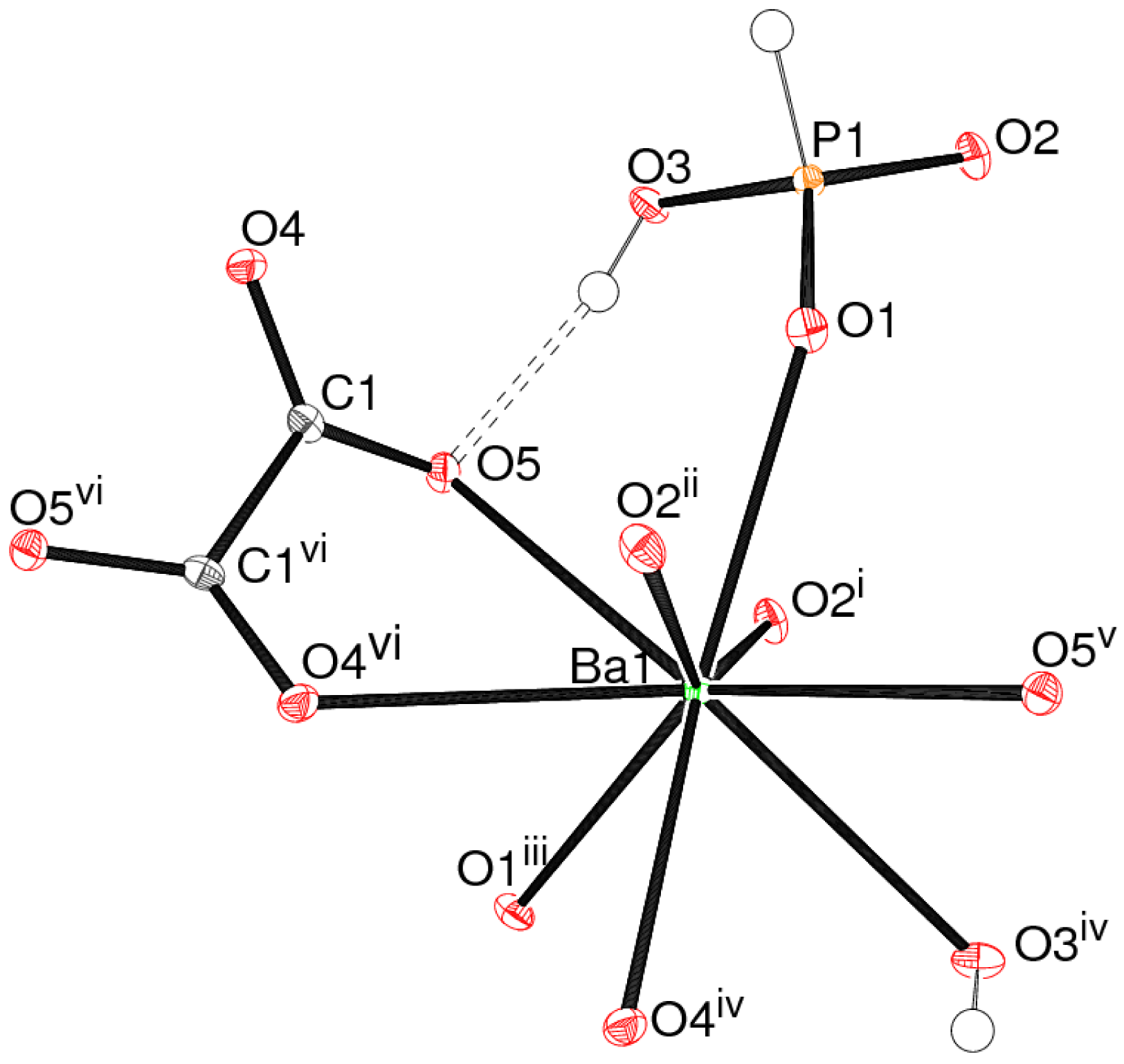
<p>The asymmetric unit of <bold>1</bold> (<xref ref-type="fig" rid="f1-crystals-01-00059">Figure 1</xref>) contains a barium cation, an (H<sub>2</sub>PO<sub>3</sub>)<sup>–</sup> dihydrogen phosphite (dhp) ion and half an oxalate ion: the latter is completed by crystallographic 2-fold symmetry.</p>
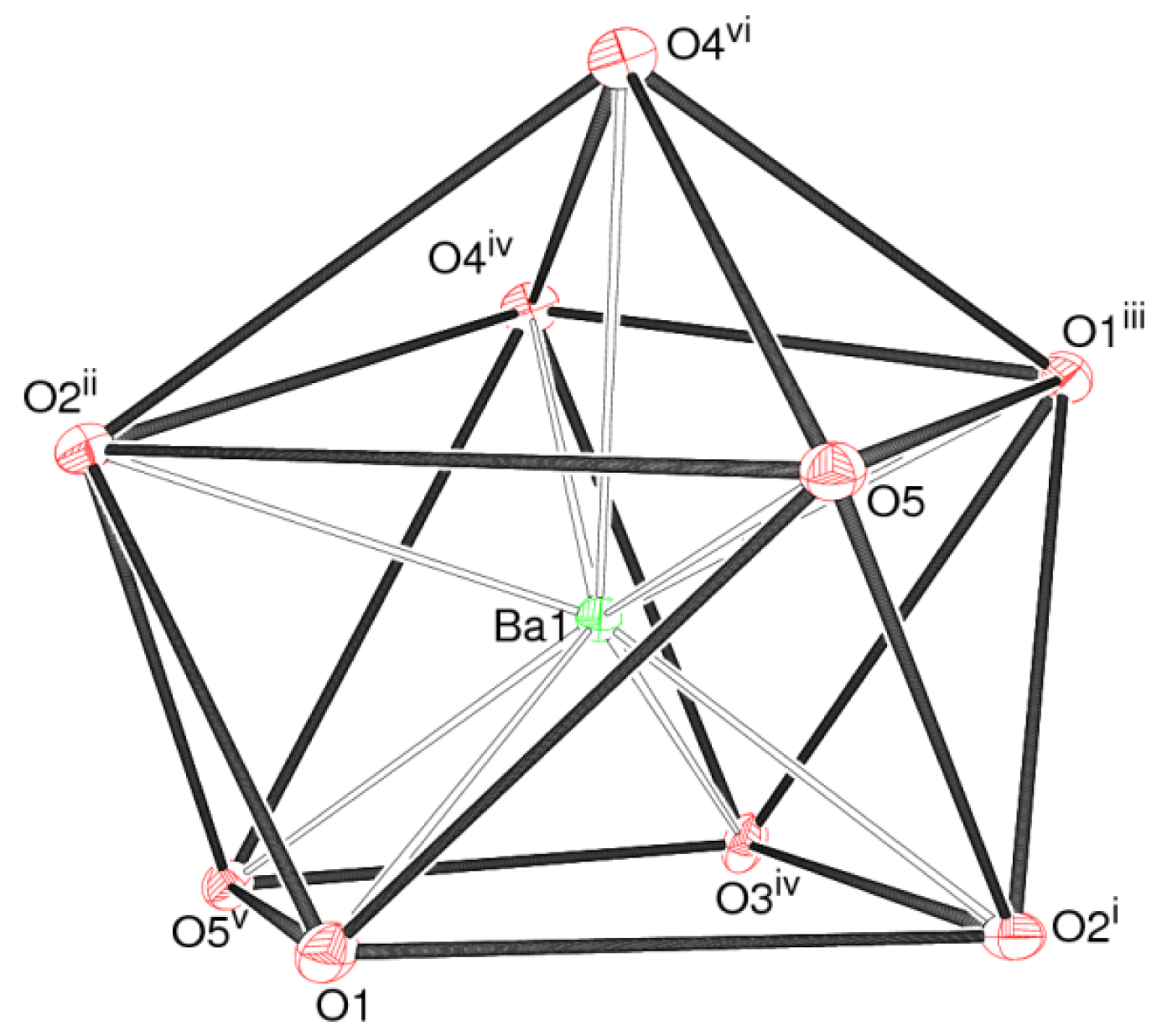
<p>The barium ion in <bold>1</bold> is coordinated by nine oxygen atoms, with a mean Ba–O separation of 2.824 Å (<xref ref-type="table" rid="t1-crystals-01-00059">Table 1</xref>): the next-nearest O atom is over 3.9 Å from the metal ion. The bond valence sum (BVS) value for Ba1, as calculated by the Brown-Altermatt formalism [<xref ref-type="bibr" rid="b13-crystals-01-00059">13</xref>], is 2.16, compared to an expected value of 2.00. Four of the O atoms are parts of oxalate ions and five are from adjacent dhp ions. The polyhedral geometry of the metal ion (<xref ref-type="fig" rid="f2-crystals-01-00059">Figure 2</xref>) is quite well described as a monocapped square anti-prism [<xref ref-type="bibr" rid="b14-crystals-01-00059">14</xref>], with O1/O2<sup>i</sup>/O3<sup>iv</sup>/O5<sup>v</sup> (see <xref ref-type="table" rid="t1-crystals-01-00059">Table 1</xref> for symmetry codes) forming one square face (r.m.s. deviation = 0.045 Å) and O1<sup>iii</sup>/O2<sup>ii</sup>/O4<sup>iv</sup>/O5 (r.m.s. deviation = 0.097 Å) the other: the dihedral angle between the two mean planes is 10.78 (6)°. Atom O4<sup>vi</sup> projects through the second of these faces to provide the cap. The Ba atom is displaced by 1.4843 (9) Å from the first plane and by −1.1191 (8) Å from the second.</p>
<p>The dhp anion in <bold>1</bold> adopts its normal tetrahedral geometry [<xref ref-type="bibr" rid="b15-crystals-01-00059">15</xref>]: the phosphorus(III) atom is displaced by 0.4268 (13) Å from its three attached O atoms and the fourth vertex is occupied by the P–H grouping. The P1–O3 bond length is substantially longer than the other two P–O bonds, due to its protonation: the P–OH group forms an O–H⋯O hydrogen bond to an acceptor oxalate O atom (<xref ref-type="fig" rid="f1-crystals-01-00059">Figure 1</xref>, <xref ref-type="table" rid="t1-crystals-01-00059">Table 1</xref>). As usual, the P–H vertex does not participate in hydrogen bonding interactions [<xref ref-type="bibr" rid="b16-crystals-01-00059">16</xref>].</p>
<p>The C–O bonds in the oxalate dianion in <bold>1</bold> show slightly different lengths, possibly due to packing effects or because O5 is the hydrogen-bond acceptor. The dihedral angle between the two −CO<sub>2</sub> groups is 33.8 (3)°, indicating a substantial degree of twisting about the central C–C bond. Oxalate ions in crystal structures are more commonly close to planar [<xref ref-type="bibr" rid="b17-crystals-01-00059">17</xref>], although a similar degree of twist has long been known in (NH<sub>4</sub>)<sub>2</sub>(C<sub>2</sub>O<sub>4</sub>)·H<sub>2</sub>O [<xref ref-type="bibr" rid="b18-crystals-01-00059">18</xref>]. Interestingly, this twisting renders the isolated oxalate ion an enantiomorphous (chiral) object [<xref ref-type="bibr" rid="b19-crystals-01-00059">19</xref>], with local <italic>C</italic><sub>2</sub> symmetry. This 2-fold symmetry is crystallographically imposed for the oxalate ion in <bold>1</bold>, but of course, the presence of crystallographic inversion symmetry in space group <italic>C</italic>2/<italic>c</italic> leads to a racemic overall structure. The C–C bond length is <bold>1</bold> is notably long at 1.550 (5) Å, a feature also seen in the ammonium compound [<xref ref-type="bibr" rid="b18-crystals-01-00059">18</xref>].</p>
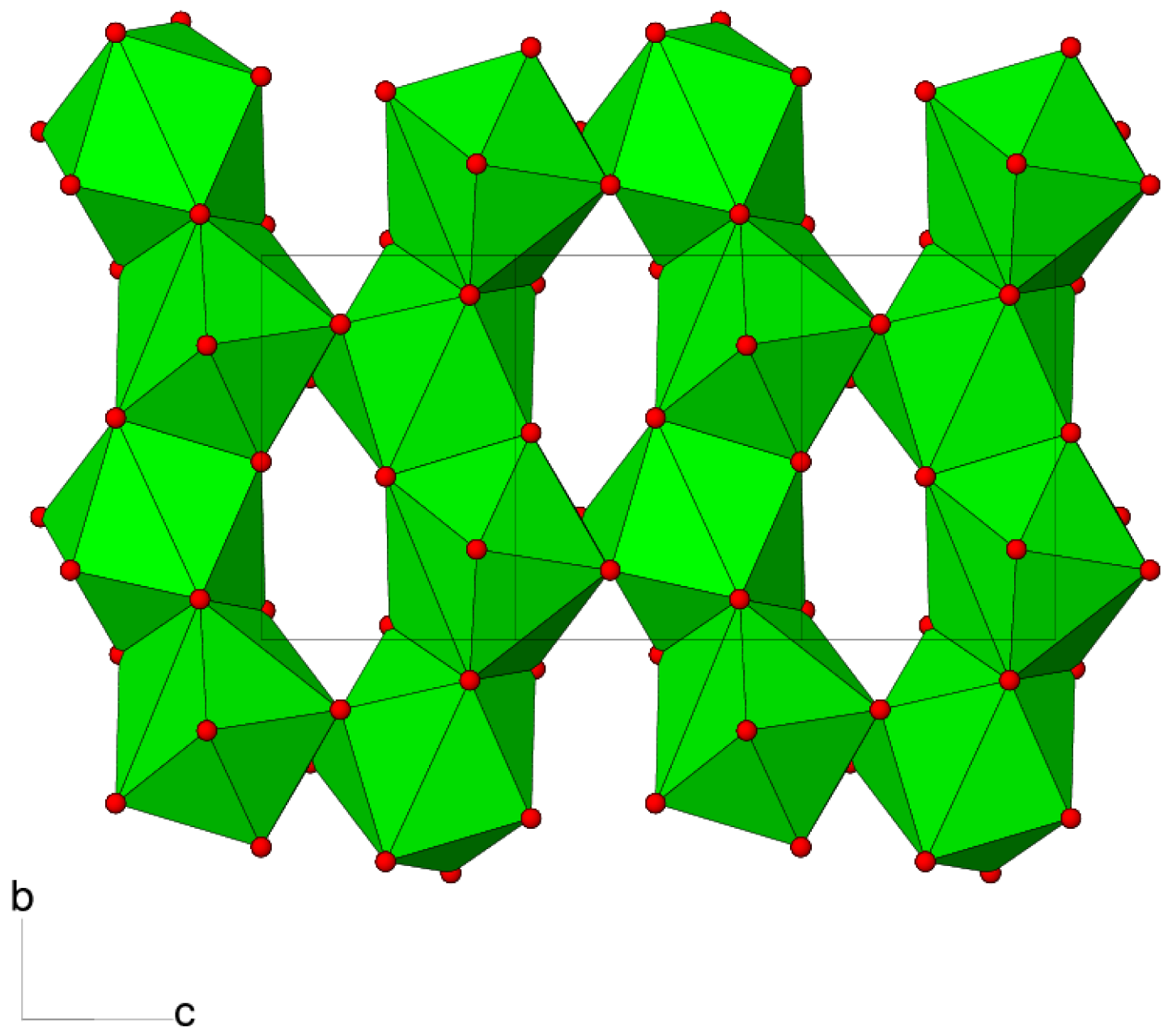
<p>The connectivity of the polyhedral building units in <bold>1</bold> leads to a three-dimensional framework constructed from BaO<sub>9</sub>, H<sub>2</sub>PO<sub>3</sub> and C<sub>2</sub>O<sub>4</sub> building blocks. Considered by themselves, the BaO<sub>9</sub> polyhedra share both edges (via O4/O4) in the <italic>c</italic> direction and faces (via O1/O2/O5) in the <italic>b</italic> direction to generate (100) sheets (<xref ref-type="fig" rid="f3-crystals-01-00059">Figure 3</xref>). The oxalate ions and dhp ions complete the packing to generate a dense three-dimensional network, without any indication of channels or pores.</p></sec>
<sec>
<label>2.2.</label>
<title>Structure of C<sub>2</sub>H<sub>10</sub>N<sub>2</sub>·Ba(H<sub>2</sub>O)<sub>2</sub>(HC<sub>2</sub>O<sub>4</sub>)<sub>4</sub> (2)</title>
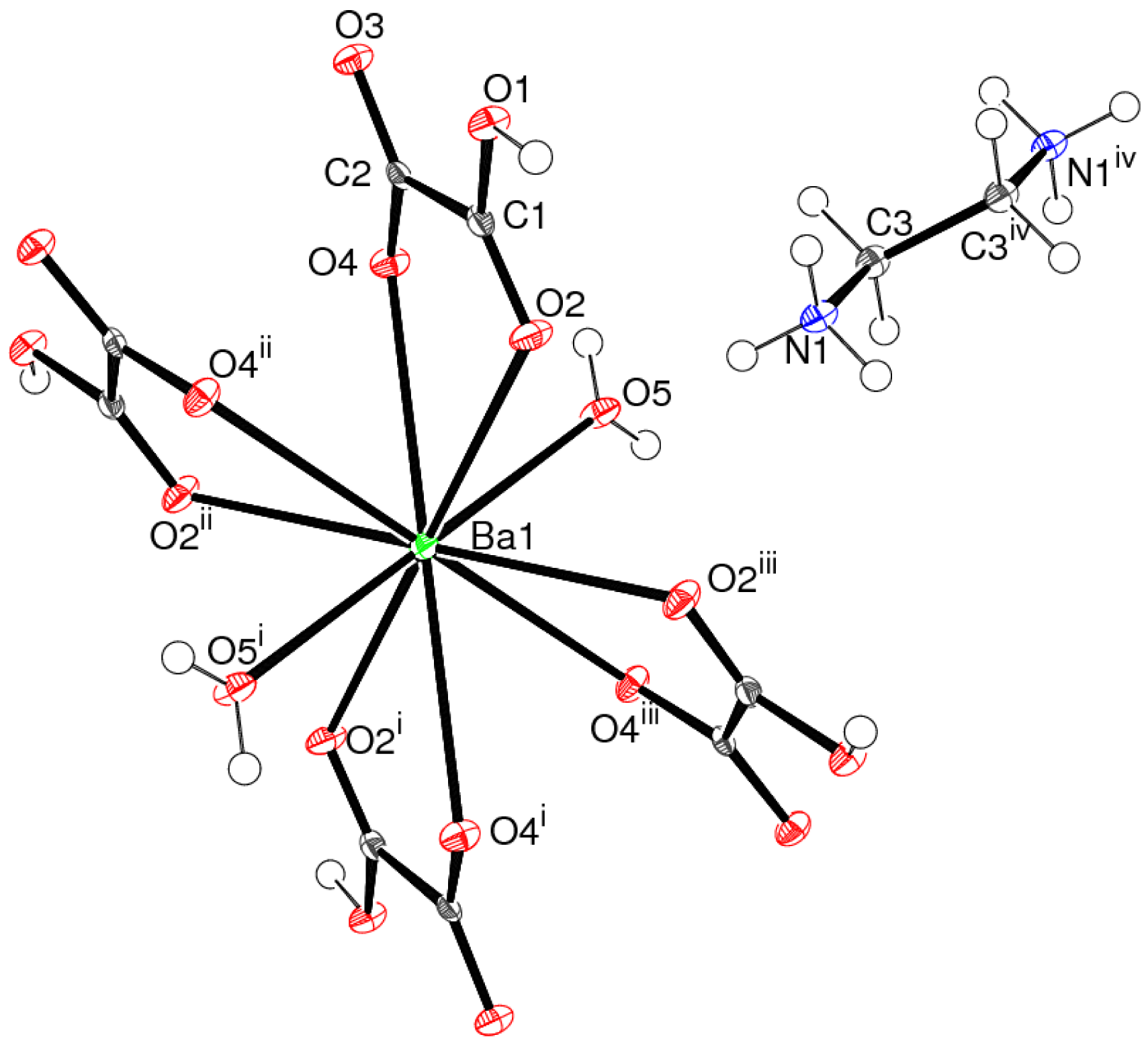
<p>Compound <bold>2</bold> (<xref ref-type="fig" rid="f4-crystals-01-00059">Figure 4</xref>) is a molecular salt built up from a barium ion lying on a special position at the origin with 2/<italic>m</italic> site symmetry, an (HC<sub>2</sub>O<sub>4</sub>)<sup>–</sup> hydrogen oxalate monoanion, a water molecule (O atom site symmetry <italic>m</italic>) and half a [C<sub>2</sub>H<sub>10</sub>N<sub>2</sub>]<sup>2+</sup> ethylenediammonium cation, with both the N and the C atom lying on a crystallographic mirror plane. The complete organic cation is completed by inversion symmetry.</p>
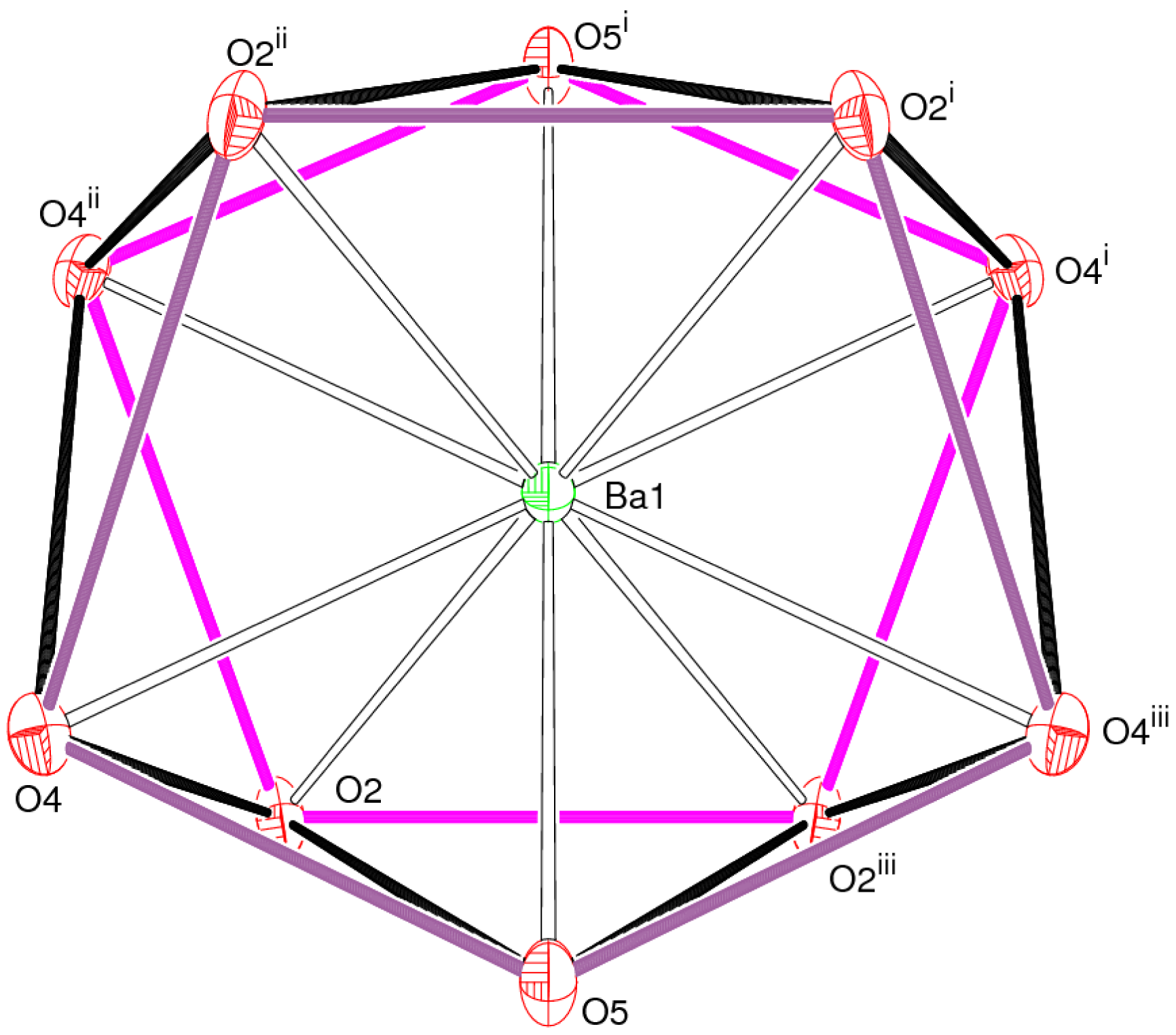
<p>The barium ion in <bold>2</bold> is 10-coordinated by four bidentate hydrogen oxalate anions and two water molecules (<xref ref-type="table" rid="t2-crystals-01-00059">Table 2</xref>) as a [Ba(H<sub>2</sub>O)<sub>2</sub>(HC<sub>2</sub>O<sub>4</sub>)<sub>4</sub>]<sup>2–</sup> dianion: the mean Ba–O separation is 2.867 Å and BVS(Ba1) = 2.12 The polyhedral geometry about the metal ion can be described as a pentagonal antiprism [<xref ref-type="bibr" rid="b20-crystals-01-00059">20</xref>] (<xref ref-type="fig" rid="f5-crystals-01-00059">Figure 5</xref>), although the pentagonal faces are significantly puckered into envelopes with O5 at the flap position pointing away from the barium ion. The dihedral angle between the mean planes is constrained by symmetry to be zero and Ba is displaced from each plane by 1.271 (2) Å.</p>
<p>The hydrogen oxalate ion is <bold>2</bold> is almost planar, as indicated by the C1/O1/O2–C2/O3/O4 dihedral angle of 1.0 (3)°. Unlike the case in <bold>1</bold>, the oxalate C–C bond length in <bold>2</bold> of 1.501 (7) Å is quite typical for a carbon–carbon single bond. The [C<sub>2</sub>H<sub>10</sub>N<sub>2</sub>]<sup>2+</sup> ethyl enedi ammonium ion in <bold>2</bold> shows no unusual features; the N–C–C–N torsion angle is constrained by symmetry to be −180°.</p>
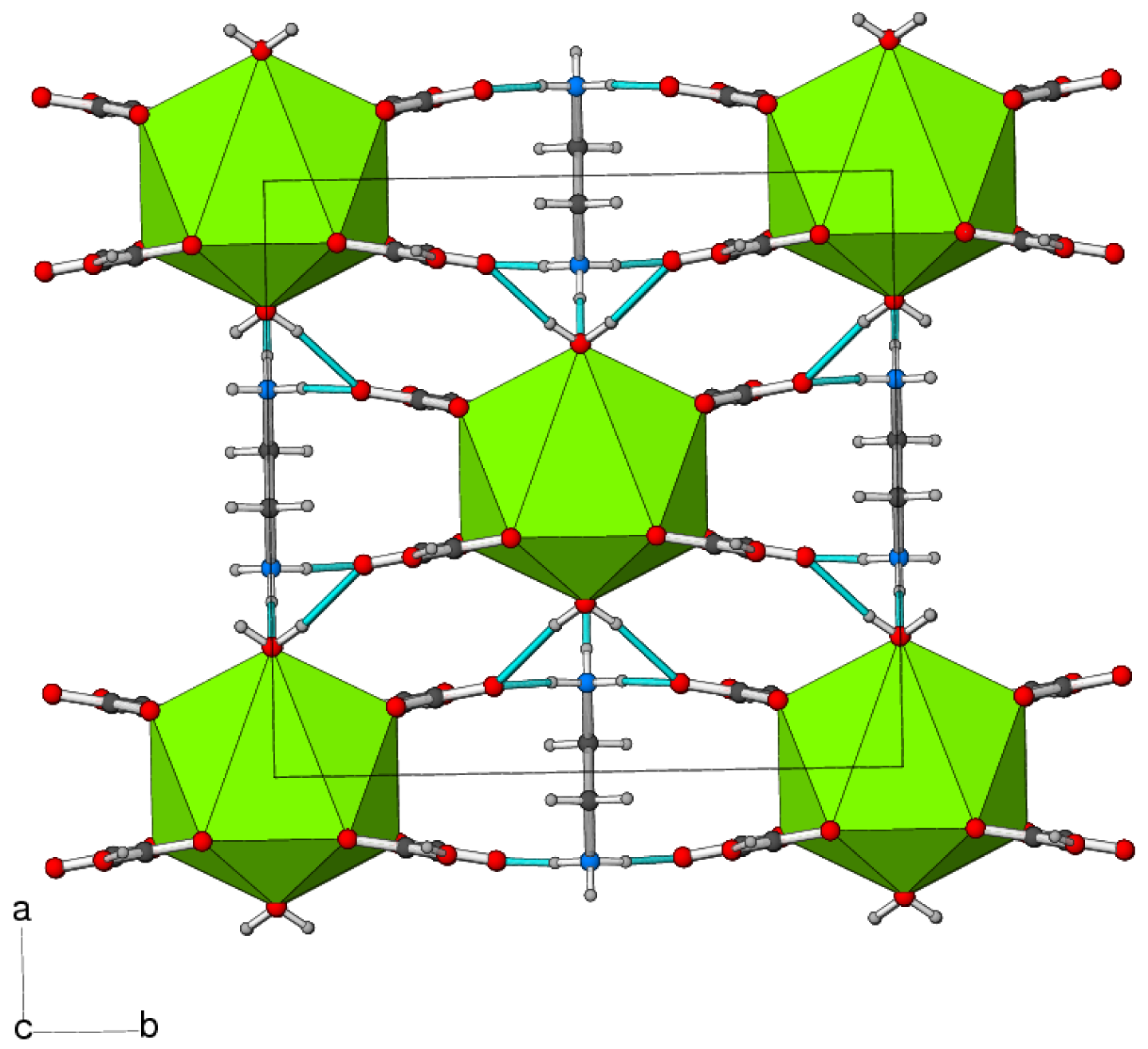
<p>In the crystal of <bold>2</bold>, the components are linked by N–H⋯O and O–H⋯O hydrogen bonds (<xref ref-type="table" rid="t2-crystals-01-00059">Table 2</xref>, <xref ref-type="fig" rid="f6-crystals-01-00059">Figure 6</xref>). The length of the O–H bond (1.00 Å) of the hydrogen oxalate anion is slightly longer than expected, which may correlate with its participation in a strong hydrogen bond. Similar O–H bond lengths have been seen in related compounds [<xref ref-type="bibr" rid="b21-crystals-01-00059">21</xref>]. Overall, this leads to a connectivity of the complex anions in the <italic>ab</italic> plane with the N–H⋯O bonds serving to link the anions in the <italic>c</italic> direction.</p></sec></sec>
<sec>
<label>3.</label>
<title>Experimental Section</title>
<p>Compound <bold>1</bold> was prepared from 2.77 g BaC<sub>2</sub>O<sub>4</sub>, 3.6 g H<sub>3</sub>PO<sub>3</sub>, and 1.3 mL diethylamine in 20 mL of water. The components were placed in a PTFE bottle, shaken well to form a milky slurry, and placed in an oven at 80 °C for two days. Product recovery by vacuum filtration yielded colorless blocks and bars of <bold>1</bold>. IR (KBr, cm<sup>−1</sup>): 2461w, 2157w, 2017w, 1589vs, 1309s, 1221m, 1156m, 1068m, 892m, 771m, 662w. The band at 2461 cm<sup>−1</sup> is the characteristic phosphite P–H stretch [<xref ref-type="bibr" rid="b22-crystals-01-00059">22</xref>] and the various bands in the region 900–1200 cm<sup>−1</sup> have been associated with PO<sub>3</sub> modes [<xref ref-type="bibr" rid="b22-crystals-01-00059">22</xref>]. The bands at 771, 1309 and 1589 cm<sup>−1</sup> probably correspond to the δ(O–C–O), ν<sub>sym</sub>(COO) and ν<sub>asym</sub>(COO) deformations respectively of the oxalate −CO<sub>2</sub> groups [<xref ref-type="bibr" rid="b23-crystals-01-00059">23</xref>]. The X-ray powder pattern for <bold>1</bold> could be matched to a simulation of the single-crystal structure, indicating phase purity.</p>
<p>Compound <bold>2</bold> was prepared by the same procedure, with ethylenediamine (2.0 mL) replacing diethylamine. Product recovery as above led to a mass of small colorless blocks and rods of <bold>2</bold>. IR (KBr, cm<sup>−1</sup>): ∼3200m, 1583s, 1303m, 1217m, 1150m, 1063s, 887m, 772w. The characteristic 772, 1303 and 1583 cm<sup>−1</sup> oxalate bands are assigned as above. Powder diffraction indicated that the product was almost phase pure with possibly a trace of barium oxalate.</p>
<p>The single-crystal data for <bold>1</bold> and <bold>2</bold> were collected on a Nonius KappaCCD diffractometer (graphite monochromated Mo Kα radiation, λ = 0.71073 Å) at 120 K. Data reduction with DENZO/HKL [<xref ref-type="bibr" rid="b24-crystals-01-00059">24</xref>] then routinely proceeded in each case and empirical (multi-scan) absorption corrections were applied with SADABS [<xref ref-type="bibr" rid="b25-crystals-01-00059">25</xref>], as summarized in the paragraphs below. For <bold>1</bold>, the structure was solved by direct methods with SHELXS in space group <italic>C</italic>2/<italic>c</italic> and the atomic model refined against |<italic>F</italic>|<sup>2</sup> with SHELXL [<xref ref-type="bibr" rid="b26-crystals-01-00059">26</xref>]. For <bold>2</bold>, attempts to solve the structure in space group <italic>C</italic>2/<italic>m</italic> either by direct methods or Patterson maps were not successful and lower symmetry space groups were tried. The structure solved easily in space group <italic>Cm</italic> but a symmetry check with PLATON [<xref ref-type="bibr" rid="b27-crystals-01-00059">27</xref>] indicated that <italic>C</italic>2/<italic>m</italic> was the most appropriate symmetry and the atomic model was transformed to the latter space group. Full-matrix least-squares refinement then proceeded as for <bold>1</bold>. The “observed data” threshold for calculating the <italic>R</italic>(<italic>F</italic>) residuals was set as <italic>I</italic> &gt; 2σ(I). For <bold>1</bold>, the H atoms were located in difference maps and freely refined with the constraint <italic>U</italic><sub>iso</sub>(H) = 1.2<italic>U</italic><sub>eq</sub>(carrier) applied. For <bold>2</bold>, the H atoms of the organic cation were geometrically placed (C–H = 0.97, N–H = 0.89 Å) and refined as riding atoms. The water and oxalate H atoms were located in difference maps and refined as riding atoms in their as-found relative positions. The constraint <italic>U</italic><sub>iso</sub>(H) = 1.2<italic>U</italic><sub>eq</sub>(carrier) was applied in all cases. Full details are given in the deposited cifs.</p>
<p>Crystal data for <bold>1</bold>: colorless block, 0.09 × 0.06 × 0.05 mm, C<sub>2</sub>H<sub>4</sub>Ba<sub>2</sub>O<sub>10</sub>P<sub>2</sub>, <italic>M</italic><sub>r</sub> = 531.38, monoclinic, <italic>C</italic>2/<italic>c</italic> (No. 15), <italic>a</italic> = 12.3829 (3) Å, <italic>b =</italic> 7.9124 (2) Å, <italic>c</italic> = 11.0858 (3) Å, β = 114.788 (2)°, <italic>V</italic> = 986.10 (4) Å<sup>3</sup>, <italic>Z</italic> = 4, <italic>F</italic>(000) = 952, <italic>T</italic> = 120 K, ρ<sub>calc</sub> = 3.534 g cm<sup>−3</sup>, μ = 8.304 mm<sup>−1</sup>, <italic>T</italic><sub>min</sub> = 0.522, <italic>T</italic><sub>max</sub> = 0.682, 5117 reflections measured (−16 ≤ <italic>h</italic> ≤ 15, −10 ≤ <italic>k</italic> ≤ 10, −14 ≤ <italic>l</italic> ≤ 14; 6.30° ≤ 2θ ≤ 54.98°), <italic>R</italic><sub>Int</sub> = 0.034, 1133 merged reflections, 1115 with <italic>I</italic> &gt; 2σ(<italic>I</italic>), 79 parameters, <italic>R</italic>(<italic>F</italic>) = 0.016, <italic>wR</italic>(<italic>F</italic><sup>2</sup>) = 0.040, <italic>S</italic> (goodness-of-fit) = 1.143, <italic>w</italic> = 1/[σ<sup>2</sup>(<italic>F</italic><sub>o</sub><sup>2</sup>) + 3.6002<italic>P</italic>], where <italic>P</italic> = (<italic>F</italic><sub>o</sub><sup>2</sup> + 2 <italic>F</italic><sub>c</sub><sup>2</sup>)/3, min./max. Δρ = −0.53, +0.59 <italic>e</italic> Å<sup>−3</sup>. Cambridge Database deposition number: CSD-826099.</p>
<p>Crystal data for <bold>2</bold>: colorless block, 0.12 × 0.08 × 0.05 mm, C<sub>10</sub>H<sub>18</sub>BaN<sub>2</sub>O<sub>18</sub>, <italic>M</italic><sub>r</sub> = 591.6, monoclinic, <italic>C</italic>2/<italic>m</italic> (No. 12), <italic>a</italic> = 12.7393 (7) Å, <italic>b</italic> = 13.0111 (7) Å, <italic>c</italic> = 5.6050 (3) Å, β = 104.208 (4)°, <italic>V</italic> = 900.62 (8) Å<sup>3</sup>, <italic>Z</italic> = 2, <italic>F</italic>(000) = 584, <italic>T</italic> = 120 K, ρ<sub>calc</sub> = 2.182 g cm<sup>−3</sup>, μ = 2.310 mm<sup>−1</sup>, <italic>T</italic><sub>min</sub> = 0.769, <italic>T</italic><sub>max</sub> = 0.893, 5144 reflections measured (−15 ≤ <italic>h</italic> ≤ 16, −16 ≤ <italic>k</italic> ≤ 16, −7 ≤ <italic>l</italic> ≤ 7; 6.26° ≤ 2θ ≤ 55.02°), <italic>R</italic><sub>Int</sub> = 0.048, 1084 merged reflections, 1056 with <italic>I</italic> &gt; 2σ(<italic>I</italic>), 77 parameters, <italic>R</italic>(<italic>F</italic>) = 0.027, <italic>wR</italic>(<italic>F</italic><sup>2</sup>) = 0.054, <italic>S</italic> (goodness-of-fit) = 1.091, <italic>w</italic> = 1/[σ<sup>2</sup>(<italic>F</italic><sub>o</sub><sup>2</sup>) + 0.0083<italic>P</italic><sup>2</sup> + 2.0292<italic>P</italic>], where <italic>P</italic> = (<italic>F</italic><sub>o</sub><sup>2</sup> + 2 <italic>F</italic><sub>c</sub><sup>2</sup>)/3, min./max. Δρ = −0.69, +0.78 <italic>e</italic> Å<sup>−3</sup>. Cambridge Database deposition number: CSD-826100.</p></sec>
<sec sec-type="conclusions">
<label>4.</label>
<title>Conclusions</title>
<p>We have prepared and structurally characterized the new phases Ba<sub>2</sub>(C<sub>2</sub>O<sub>4</sub>)(H<sub>2</sub>PO<sub>3</sub>)<sub>2</sub> and C<sub>2</sub>H<sub>10</sub>N<sub>2</sub>·Ba(H<sub>2</sub>O)<sub>2</sub>(HC<sub>2</sub>O<sub>4</sub>)<sub>4</sub>. So far as we can ascertain, they are the first examples of barium oxalates in combination with oxo-anions or organic cations. The deposition of the oxalate ion in <bold>1</bold> is notably twisted, whereas it is almost planar in <bold>2</bold>. The barium ions show different, distinctive coordination polyhedra in these structures. The number of crystal structures containing nine- and ten-coordinate barium complexes in the Cambridge Structural Database (version 5.32 of November 2010 with two updates) [<xref ref-type="bibr" rid="b28-crystals-01-00059">28</xref>] is almost the same, at 73 and 75, respectively.</p></sec></body>
<back>
<sec sec-type="display-objects">
<title>Figures and Tables</title>
<fig id="f1-crystals-01-00059" position="float">
<label>Figure 1.</label>
<caption>
<p>A fragment of <bold>1</bold> showing 50% displacement ellipsoids for the non-hydrogen atoms. The O–H⋯O hydrogen bond is shown as a double-dashed line. See <xref ref-type="table" rid="t1-crystals-01-00059">Table 1</xref> for symmetry codes.</p></caption>
<graphic xlink:href="crystals-01-00059f1.gif"/></fig>
<fig id="f2-crystals-01-00059" position="float">
<label>Figure 2.</label>
<caption>
<p>The monocapped square anti-prismatic barium-ion coordination polyhedron in <bold>1</bold>. See <xref ref-type="table" rid="t1-crystals-01-00059">Table 1</xref> for symmetry codes.</p></caption>
<graphic xlink:href="crystals-01-00059f2.gif"/></fig>
<fig id="f3-crystals-01-00059" position="float">
<label>Figure 3.</label>
<caption>
<p>Polyhedral view of the (100) sheets of BaO<sub>9</sub> polyhedra in <bold>1</bold>.</p></caption>
<graphic xlink:href="crystals-01-00059f3.gif"/></fig>
<fig id="f4-crystals-01-00059" position="float">
<label>Figure 4.</label>
<caption>
<p>The molecular structure of <bold>2</bold> showing 50% displacement ellipsoids. Symmetry codes: (i) −<italic>x</italic>, −<italic>y</italic>, −<italic>z</italic>; (ii) −<italic>x</italic>, <italic>y</italic>, −<italic>z</italic>; (iii) <italic>x</italic>, −<italic>y</italic>, <italic>z</italic>; (iv) 1−<italic>x</italic>, −<italic>y</italic>, 1−<italic>z</italic>.</p></caption>
<graphic xlink:href="crystals-01-00059f4.gif"/></fig>
<fig id="f5-crystals-01-00059" position="float">
<label>Figure 5.</label>
<caption>
<p>The pentagonal antiprismatic BaO<sub>10</sub> coordination polyhedron in <bold>2</bold> showing 50% displacement ellipsoids. The lilac and fuchsia lines delineate the top and bottom pentagonal faces, respectively. Symmetry codes as in <xref ref-type="fig" rid="f4-crystals-01-00059">Figure 4</xref>.</p></caption>
<graphic xlink:href="crystals-01-00059f5.gif"/></fig>
<fig id="f6-crystals-01-00059" position="float">
<label>Figure 6.</label>
<caption>
<p>The unit-cell packing for 2 with the BaO<sub>10</sub> groups shown as green polyhedra and the H⋯O segments of the hydrogen bonds highlighted in cyan.</p></caption>
<graphic xlink:href="crystals-01-00059f6.gif"/></fig>
<table-wrap id="t1-crystals-01-00059" position="float">
<label>Table 1.</label>
<caption>
<p>Selected geometrical data (Å, °) for <bold>1</bold>.</p></caption>
<table frame="box" rules="all">
<tbody>
<tr>
<td align="left" valign="top">Ba1–O2<xref ref-type="table-fn" rid="tfn2-crystals-01-00059">i</xref></td>
<td align="left" valign="top">2.6927 (18)</td>
<td align="left" valign="top">Ba1–O1</td>
<td align="left" valign="top">2.7322 (18)</td></tr>
<tr>
<td align="left" valign="top">Ba1–O2<xref ref-type="table-fn" rid="tfn3-crystals-01-00059">ii</xref></td>
<td align="left" valign="top">2.7519 (18)</td>
<td align="left" valign="top">Ba1–O1<xref ref-type="table-fn" rid="tfn4-crystals-01-00059">iii</xref></td>
<td align="left" valign="top">2.7894 (18)</td></tr>
<tr>
<td align="left" valign="top">Ba1–O4<xref ref-type="table-fn" rid="tfn5-crystals-01-00059">iv</xref></td>
<td align="left" valign="top">2.7929 (19)</td>
<td align="left" valign="top">Ba1–O5</td>
<td align="left" valign="top">2.8818 (17)</td></tr>
<tr>
<td align="left" valign="top">Ba1–O5<xref ref-type="table-fn" rid="tfn6-crystals-01-00059">v</xref></td>
<td align="left" valign="top">2.9101 (18)</td>
<td align="left" valign="top">Ba1–O4<xref ref-type="table-fn" rid="tfn7-crystals-01-00059">vi</xref></td>
<td align="left" valign="top">2.9202 (18)</td></tr>
<tr>
<td align="left" valign="top">Ba1–O3<xref ref-type="table-fn" rid="tfn5-crystals-01-00059">iv</xref></td>
<td align="left" valign="top">2.9453 (19)</td>
<td align="left" valign="top">P1–O2</td>
<td align="left" valign="top">1.5013 (17)</td></tr>
<tr>
<td align="left" valign="top">P1–O1</td>
<td align="left" valign="top">1.5015 (19)</td>
<td align="left" valign="top">P1–O3</td>
<td align="left" valign="top">1.595 (2)</td></tr>
<tr>
<td align="left" valign="top">P1–H1</td>
<td align="left" valign="top">1.25 (3)</td>
<td align="left" valign="top">C1–O4</td>
<td align="left" valign="top">1.244 (3)</td></tr>
<tr>
<td align="left" valign="top">C1–O5</td>
<td align="left" valign="top">1.269 (3)</td>
<td align="left" valign="top">C1–C1<xref ref-type="table-fn" rid="tfn7-crystals-01-00059">vi</xref></td>
<td align="left" valign="top">1.550 (5)</td></tr></tbody></table>
<table frame="box" rules="all">
<tbody>
<tr>
<td align="left" valign="top">O2–P1–O1</td>
<td align="left" valign="top">117.92 (10)</td>
<td align="left" valign="top">O2–P1–O3</td>
<td align="left" valign="top">108.92 (11)</td></tr>
<tr>
<td align="left" valign="top">O1–P1–O3</td>
<td align="left" valign="top">110.65 (11)</td>
<td align="left" valign="top">O4–C1–O5</td>
<td align="left" valign="top">126.5 (2)</td></tr>
<tr>
<td align="left" valign="top">O4–C1–C1<xref ref-type="table-fn" rid="tfn7-crystals-01-00059">vi</xref></td>
<td align="left" valign="top">117.0 (2)</td>
<td align="left" valign="top">O5–C1–C1<xref ref-type="table-fn" rid="tfn7-crystals-01-00059">vi</xref></td>
<td align="left" valign="top">116.3 (3)</td></tr></tbody></table>
<table frame="box" rules="all">
<tbody>
<tr>
<td align="left" valign="top">O3–H2⋯O5</td>
<td align="left" valign="top">0.79 (4)</td>
<td align="left" valign="top">1.87 (4)</td>
<td align="left" valign="top">2.647 (3)</td>
<td align="left" valign="top">168 (3)</td></tr></tbody></table>
<table-wrap-foot><fn id="tfn1-crystals-01-00059">
<p>Symmetry codes:</p></fn><fn id="tfn2-crystals-01-00059">
<label>(i)</label>
<p>½−<italic>x</italic>, ½−<italic>y</italic>, 1−<italic>z</italic>;</p></fn><fn id="tfn3-crystals-01-00059">
<label>(ii)</label>
<p><italic>x</italic>, 1−<italic>y</italic>, ½+<italic>z</italic>;</p></fn><fn id="tfn4-crystals-01-00059">
<label>(iii)</label>
<p>½−<italic>x</italic>, <italic>y</italic>−½, 1½−<italic>z</italic>;</p></fn><fn id="tfn5-crystals-01-00059">
<label>(iv)</label>
<p>½+<italic>x</italic>, ½−<italic>y</italic>, ½+<italic>z</italic>;</p></fn><fn id="tfn6-crystals-01-00059">
<label>(v)</label>
<p>½−<italic>x</italic>, ½+<italic>y</italic>, 1½−<italic>z</italic>;</p></fn><fn id="tfn7-crystals-01-00059">
<label>(vi)</label>
<p>−<italic>x</italic>, <italic>y</italic>, 1½−<italic>z</italic>.</p></fn></table-wrap-foot></table-wrap>
<table-wrap id="t2-crystals-01-00059" position="float">
<label>Table 2.</label>
<caption>
<p>Selected geometrical data (Å, °) for <bold>2</bold>.</p></caption>
<table frame="box" rules="all">
<tbody>
<tr>
<td align="left" valign="top">Ba1–O5</td>
<td align="left" valign="top">2.781 (2)</td>
<td align="left" valign="top">Ba1–O2</td>
<td align="left" valign="top">2.8178 (17)</td></tr>
<tr>
<td align="left" valign="top">Ba1–O4</td>
<td align="left" valign="top">2.9586 (17)</td>
<td align="left" valign="top">C1–O2</td>
<td align="left" valign="top">1.215 (3)</td></tr>
<tr>
<td align="left" valign="top">C1–O1</td>
<td align="left" valign="top">1.301 (3)</td>
<td align="left" valign="top">C1–C2</td>
<td align="left" valign="top">1.548 (2)</td></tr>
<tr>
<td align="left" valign="top">C2–O3</td>
<td align="left" valign="top">1.240 (3)</td>
<td align="left" valign="top">C2–O4</td>
<td align="left" valign="top">1.265 (3)</td></tr>
<tr>
<td align="left" valign="top">C3–N1</td>
<td align="left" valign="top">1.493 (5)</td>
<td align="left" valign="top">C3–C3<xref ref-type="table-fn" rid="tfn9-crystals-01-00059">iv</xref></td>
<td align="left" valign="top">1.501 (7)</td></tr></tbody></table>
<table frame="box" rules="all">
<tbody>
<tr>
<td align="left" valign="top">O2–C1–O1</td>
<td align="left" valign="top">125.6 (2</td>
<td align="left" valign="top">O2–C1–C2</td>
<td align="left" valign="top">121.4 (2)</td></tr>
<tr>
<td align="left" valign="top">O1–C1–C2</td>
<td align="left" valign="top">113.0 (2)</td>
<td align="left" valign="top">O3–C2–O4</td>
<td align="left" valign="top">127.2 (2)</td></tr>
<tr>
<td align="left" valign="top">O3–C2–C1</td>
<td align="left" valign="top">118.3 (2)</td>
<td align="left" valign="top">O4–C2–C1</td>
<td align="left" valign="top">114.4 (2)</td></tr>
<tr>
<td align="left" valign="top">N1–C3–C3<xref ref-type="table-fn" rid="tfn9-crystals-01-00059">iv</xref></td>
<td align="left" valign="top">109.5 (4)</td>
<td align="left" valign="top"/>
<td align="left" valign="top"/></tr></tbody></table>
<table frame="box" rules="all">
<tbody>
<tr>
<td align="left" valign="top">O1–H1⋯O4<xref ref-type="table-fn" rid="tfn10-crystals-01-00059">v</xref></td>
<td align="left" valign="top">1.00</td>
<td align="left" valign="top">1.50</td>
<td align="left" valign="top">2.504 (2)</td>
<td align="left" valign="top">176</td></tr>
<tr>
<td align="left" valign="top">O5–H5⋯O3<xref ref-type="table-fn" rid="tfn12-crystals-01-00059">vii</xref></td>
<td align="left" valign="top">0.85</td>
<td align="left" valign="top">2.00</td>
<td align="left" valign="top">2.841 (2)</td>
<td align="left" valign="top">172</td></tr>
<tr>
<td align="left" valign="top">N1–H2⋯O5</td>
<td align="left" valign="top">0.89</td>
<td align="left" valign="top">1.99</td>
<td align="left" valign="top">2.824 (4)</td>
<td align="left" valign="top">156</td></tr>
<tr>
<td align="left" valign="top">N1–H3⋯O3<xref ref-type="table-fn" rid="tfn11-crystals-01-00059">vi</xref></td>
<td align="left" valign="top">0.89</td>
<td align="left" valign="top">1.98</td>
<td align="left" valign="top">2.839 (3)</td>
<td align="left" valign="top">163</td></tr>
<tr>
<td align="left" valign="top">N1–H3⋯O1<xref ref-type="table-fn" rid="tfn11-crystals-01-00059">vi</xref></td>
<td align="left" valign="top">0.89</td>
<td align="left" valign="top">2.40</td>
<td align="left" valign="top">2.9765 (17)</td>
<td align="left" valign="top">123</td></tr></tbody></table>
<table-wrap-foot><fn id="tfn8-crystals-01-00059">
<p>Symmetry codes:</p></fn><fn id="tfn9-crystals-01-00059">
<label>(iv)</label>
<p>1−<italic>x</italic>, −<italic>y</italic>, 1−<italic>z</italic>;</p></fn><fn id="tfn10-crystals-01-00059">
<label>(v)</label>
<p><italic>x</italic>, <italic>y</italic>, 1+<italic>z</italic>;</p></fn><fn id="tfn11-crystals-01-00059">
<label>(vi)</label>
<p>½−<italic>x</italic>, ½−<italic>y</italic>, 1−<italic>z</italic>;</p></fn><fn id="tfn12-crystals-01-00059">
<label>(vii)</label>
<p>½−<italic>z</italic>, ½−<italic>y</italic>, −<italic>z</italic>.</p></fn></table-wrap-foot></table-wrap></sec>
<ack>
<p>We thank the EPSRC national Crystallography Service (University of Southampton, England) for the X-ray data collections.</p></ack>
<ref-list>
<title>References and Notes</title>
<ref id="b1-crystals-01-00059"><label>1.</label><citation citation-type="journal"><person-group person-group-type="author"><name><surname>Mutin</surname><given-names>J.-C.</given-names></name><name><surname>Dusausoy</surname><given-names>Y.</given-names></name><name><surname>Protas</surname><given-names>J.</given-names></name></person-group><article-title>Structural description of endothermic decompositions in the form solid-1 → solid-2 + gas 1. Crystal structure of barium oxalate, 2BaC<sub>2</sub>O<sub>4</sub>·H<sub>2</sub>O</article-title><source>J. So/id State Chem.</source><year>1981</year><volume>36</volume><fpage>356</fpage><lpage>364</lpage><pub-id pub-id-type="doi">10.1016/0022-4596(81)90447-3</pub-id></citation></ref>
<ref id="b2-crystals-01-00059"><label>2.</label><citation citation-type="journal"><person-group person-group-type="author"><name><surname>Mutin</surname><given-names>J.-C.</given-names></name><name><surname>Aubry</surname><given-names>A.</given-names></name><name><surname>Bertrand</surname><given-names>G.</given-names></name><name><surname>Joly</surname><given-names>E.</given-names></name><name><surname>Protas</surname><given-names>J.</given-names></name></person-group><article-title>Determination of crystal-structure of BaC<sub>2</sub>O<sub>4</sub>·H<sub>2</sub>O</article-title><source>C. R. Acad. Sci. (Paris), Ser. C.</source><year>1974</year><volume>278</volume><fpage>1001</fpage><lpage>1004</lpage></citation></ref>
<ref id="b3-crystals-01-00059"><label>3.</label><citation citation-type="journal"><person-group person-group-type="author"><name><surname>Mutin</surname><given-names>J.-C.</given-names></name><name><surname>Courtois</surname><given-names>A.</given-names></name><name><surname>Bertrand</surname><given-names>G.</given-names></name><name><surname>Protas</surname><given-names>J.</given-names></name><name><surname>Watelle-Marion</surname><given-names>G.</given-names></name></person-group><article-title>Determination of crystal-structure of BaC<sub>2</sub>O<sub>4</sub>·2H<sub>2</sub>O</article-title><source>C. R. Acad. Sci. (Paris), Ser. C.</source><year>1971</year><volume>273</volume><fpage>1512</fpage></citation></ref>
<ref id="b4-crystals-01-00059"><label>4.</label><citation citation-type="journal"><person-group person-group-type="author"><name><surname>Neder</surname><given-names>R.</given-names></name><name><surname>Burghammer</surname><given-names>M.</given-names></name><name><surname>Schulz</surname><given-names>H.</given-names></name><name><surname>Christensen</surname><given-names>A.N.</given-names></name><name><surname>Krane</surname><given-names>H.G.</given-names></name><name><surname>Bell</surname><given-names>A.M.T.</given-names></name><name><surname>Hewat</surname><given-names>A.W.</given-names></name><name><surname>Altomare</surname><given-names>A.</given-names></name></person-group><article-title>Crystal structure determination of BaC<sub>2</sub>O<sub>4</sub>·3.5H<sub>2</sub>O/D<sub>2</sub>O</article-title><source>Zeit. Kristallogr.</source><year>1997</year><volume>212</volume><fpage>305</fpage><lpage>309</lpage><pub-id pub-id-type="doi">10.1524/zkri.1997.212.4.305</pub-id></citation></ref>
<ref id="b5-crystals-01-00059"><label>5.</label><citation citation-type="journal"><person-group person-group-type="author"><name><surname>Borel</surname><given-names>C.</given-names></name><name><surname>Ghazzali</surname><given-names>M.</given-names></name><name><surname>Langer</surname><given-names>V.</given-names></name><name><surname>Ohrstrom</surname><given-names>L.</given-names></name></person-group><article-title>Network analysis of barium oxalates Ba(C<sub>2</sub>O<sub>4</sub>)<italic><sub>m</sub></italic>(HC<sub>2</sub>O<sub>4</sub>)<italic><sub>n</sub></italic>(H<sub>2</sub>C<sub>2</sub>O<sub>4</sub>)<italic><sub>p</sub></italic>(H<sub>2</sub>O)<italic><sub>q</sub></italic>, including the new, uniform, five-connected loh net</article-title><source>Inorg. Chem. Commun.</source><year>2009</year><volume>12</volume><fpage>105</fpage><lpage>108</lpage><pub-id pub-id-type="doi">10.1016/j.inoche.2008.11.013</pub-id></citation></ref>
<ref id="b6-crystals-01-00059"><label>6.</label><citation citation-type="journal"><person-group person-group-type="author"><name><surname>Mutin</surname><given-names>J.-C.</given-names></name><name><surname>Watelle</surname><given-names>G.</given-names></name><name><surname>Dusausoy</surname><given-names>Y.</given-names></name></person-group><article-title>Study of a lacunary solid phase I—thermodynamic and crystallographic characteristics of its formation</article-title><source>J. Solid State Chem.</source><year>1979</year><volume>27</volume><fpage>407</fpage><lpage>421</lpage><pub-id pub-id-type="doi">10.1016/0022-4596(79)90183-X</pub-id></citation></ref>
<ref id="b7-crystals-01-00059"><label>7.</label><citation citation-type="journal"><person-group person-group-type="author"><name><surname>Mutin</surname><given-names>J.-C.</given-names></name><name><surname>Watelle</surname><given-names>G.</given-names></name></person-group><article-title>Study of a lacunary solid phase II—morphological and kinetic characteristics of its formation</article-title><source>J. Solid State Chem.</source><year>1979</year><volume>28</volume><fpage>1</fpage><lpage>12</lpage><pub-id pub-id-type="doi">10.1016/0022-4596(79)90052-5</pub-id></citation></ref>
<ref id="b8-crystals-01-00059"><label>8.</label><citation citation-type="journal"><person-group person-group-type="author"><name><surname>Jung</surname><given-names>W.-S.</given-names></name><name><surname>Min</surname><given-names>B.-K.</given-names></name><name><surname>Park</surname><given-names>J.</given-names></name><name><surname>Yoon</surname><given-names>D.-H.</given-names></name></person-group><article-title>Formation mechanism of barium titanate by thermal decomposition of barium titanyl oxalate</article-title><source>Ceram. Int.</source><year>2011</year><volume>37</volume><fpage>669</fpage><lpage>672</lpage><pub-id pub-id-type="doi">10.1016/j.ceramint.2010.09.056</pub-id></citation></ref>
<ref id="b9-crystals-01-00059"><label>9.</label><citation citation-type="book"><person-group person-group-type="author"><name><surname>Kosanke</surname><given-names>K.</given-names></name><name><surname>Kosanke</surname><given-names>B.J.</given-names></name><name><surname>von Maltitz</surname><given-names>I.</given-names></name><name><surname>Sturman</surname><given-names>B.</given-names></name><name><surname>Shimizu</surname><given-names>T.</given-names></name><name><surname>Wilson</surname><given-names>M.A.</given-names></name><name><surname>Kubota</surname><given-names>N.</given-names></name><name><surname>Jennings-White</surname><given-names>C.</given-names></name><name><surname>Chapman</surname><given-names>D.</given-names></name></person-group><source>Pyrotechnic Chemistry</source><publisher-name>Journal of Pyrotechnics, Inc.</publisher-name><publisher-loc>Whitewater, CO, USA</publisher-loc><year>2004</year><comment>Chapter 14</comment><fpage>10</fpage></citation></ref>
<ref id="b10-crystals-01-00059"><label>10.</label><citation citation-type="journal"><person-group person-group-type="author"><name><surname>Mandal</surname><given-names>S.</given-names></name><name><surname>Pati</surname><given-names>S.K.</given-names></name><name><surname>Green</surname><given-names>M.A.</given-names></name><name><surname>Natarajan</surname><given-names>S.</given-names></name></person-group><article-title>Inorganic–organic hybrid compounds: synthesis, structure, and magnetic properties of the first organically templated iron oxalate-phosphite, [C<sub>4</sub>N<sub>2</sub>H<sub>12</sub>[Fe<sub>4</sub><sup>II</sup>(HPO<sub>3</sub>)<sub>2</sub>(C2O<sub>4</sub>)<sub>3</sub>], possessing infinite Fe–O–Fe chains</article-title><source>Chem. Mater.</source><year>2005</year><volume>17</volume><fpage>2912</fpage><lpage>2917</lpage><pub-id pub-id-type="doi">10.1021/cm0501968</pub-id></citation></ref>
<ref id="b11-crystals-01-00059"><label>11.</label><citation citation-type="journal"><person-group person-group-type="author"><name><surname>Li</surname><given-names>H.</given-names></name><name><surname>Zhang</surname><given-names>L.</given-names></name><name><surname>Liu</surname><given-names>L.</given-names></name><name><surname>Jiang</surname><given-names>T.</given-names></name><name><surname>Yu</surname><given-names>Y.</given-names></name><name><surname>Li</surname><given-names>G.</given-names></name><name><surname>Huo</surname><given-names>Q.</given-names></name><name><surname>Liu</surname><given-names>Y.</given-names></name></person-group><article-title>Organic template-directed indium phosphite-oxalate hybrid material: synthesis and characterization of a novel 3D [C<sub>6</sub>H<sub>14</sub>N<sub>2</sub>][In<sub>2</sub>(HPO<sub>3</sub>)<sub>3</sub>(C<sub>2</sub>O<sub>4</sub>)] compound with intersecting channels</article-title><source>Inorg. Chem. Commun.</source><year>2009</year><volume>12</volume><fpage>1020</fpage><lpage>1023</lpage><pub-id pub-id-type="doi">10.1016/j.inoche.2009.08.011</pub-id></citation></ref>
<ref id="b12-crystals-01-00059"><label>12.</label><citation citation-type="journal"><person-group person-group-type="author"><name><surname>Zhu</surname><given-names>Y.</given-names></name><name><surname>Sun</surname><given-names>Z.</given-names></name><name><surname>Zhao</surname><given-names>Y.</given-names></name><name><surname>Zhang</surname><given-names>J.</given-names></name><name><surname>Lu</surname><given-names>X.</given-names></name><name><surname>Zhang</surname><given-names>N.</given-names></name><name><surname>Liu</surname><given-names>L.</given-names></name><name><surname>Tong</surname><given-names>F.</given-names></name></person-group><article-title>Synthesis, crystal structures and luminescence properties of lanthanide oxalatophosphonates with a three dimensional framework structure</article-title><source>New J. Chem.</source><year>2009</year><volume>33</volume><fpage>119</fpage><lpage>124</lpage><pub-id pub-id-type="doi">10.1039/b814400a</pub-id></citation></ref>
<ref id="b13-crystals-01-00059"><label>13.</label><citation citation-type="journal"><person-group person-group-type="author"><name><surname>Brown</surname><given-names>I.D.</given-names></name><name><surname>Altermatt</surname><given-names>D.</given-names></name></person-group><article-title>Bond-valence parameters obtained from a systematic analysis of the Inorganic Crystal Structure Database</article-title><source>Acta Cryst.</source><year>1985</year><volume>B41</volume><fpage>244</fpage><lpage>247</lpage></citation></ref>
<ref id="b14-crystals-01-00059"><label>14.</label><citation citation-type="journal"><person-group person-group-type="author"><name><surname>Ruiz-Martínez</surname><given-names>A.</given-names></name><name><surname>Casanova</surname><given-names>D.</given-names></name><name><surname>Alvarez</surname><given-names>S.</given-names></name></person-group><article-title>Polyhedral structures with an odd number of vertices: nine-atom clusters and supramolecular architectures</article-title><source>Dalton Trans.</source><year>2008</year><fpage>2583</fpage><lpage>2591</lpage></citation></ref>
<ref id="b15-crystals-01-00059"><label>15.</label><citation citation-type="journal"><person-group person-group-type="author"><name><surname>Corbridge</surname><given-names>D.E.C.</given-names></name></person-group><article-title>The crystal structure of magnesium phosphite hexahydrate, MgHPO<sub>3</sub>·6H<sub>2</sub>O</article-title><source>Acta Cryst.</source><year>1956</year><volume>9</volume><fpage>991</fpage><lpage>994</lpage><pub-id pub-id-type="doi">10.1107/S0365110X56002886</pub-id></citation></ref>
<ref id="b16-crystals-01-00059"><label>16.</label><citation citation-type="journal"><person-group person-group-type="author"><name><surname>Powell</surname><given-names>D.R.</given-names></name><name><surname>Smith</surname><given-names>S.K.</given-names></name><name><surname>Farrar</surname><given-names>T.C.</given-names></name><name><surname>Ross</surname><given-names>F.K.</given-names></name></person-group><article-title>Neutron and X-ray diffraction study of magnesium phosphite hexahydrate, [Mg(H<sub>2</sub>O)<sub>6</sub>]<sup>2+</sup>[HPO<sub>3</sub>]<sup>2–</sup></article-title><source>Acta Cryst.</source><year>1994</year><volume>C50</volume><fpage>342</fpage><lpage>346</lpage></citation></ref>
<ref id="b17-crystals-01-00059"><label>17.</label><citation citation-type="journal"><person-group person-group-type="author"><name><surname>Dewar</surname><given-names>M.J.S.</given-names></name><name><surname>Zheng</surname><given-names>Y.-J.</given-names></name></person-group><article-title>Structure of the oxalate ion</article-title><source>J. Mol. Struct. Theochem</source><year>1990</year><volume>209</volume><fpage>157</fpage><lpage>162</lpage><pub-id pub-id-type="doi">10.1016/0166-1280(90)85053-P</pub-id></citation></ref>
<ref id="b18-crystals-01-00059"><label>18.</label><citation citation-type="journal"><person-group person-group-type="author"><name><surname>Robertson</surname><given-names>J.H.</given-names></name></person-group><article-title>Ammonium oxalate monohydrate: structure refinement at 30 K</article-title><source>Acta Cryst.</source><year>1965</year><volume>18</volume><fpage>410</fpage><lpage>417</lpage><pub-id pub-id-type="doi">10.1107/S0365110X65000919</pub-id></citation></ref>
<ref id="b19-crystals-01-00059"><label>19.</label><citation citation-type="journal"><person-group person-group-type="author"><name><surname>Robertson</surname><given-names>J.H.</given-names></name></person-group><article-title>Enantiomorphism of the oxalate ion in ammonium oxalate monohydrate</article-title><source>Acta Cryst.</source><year>1965</year><volume>18</volume><fpage>417</fpage><lpage>419</lpage><pub-id pub-id-type="doi">10.1107/S0365110X65000920</pub-id></citation></ref>
<ref id="b20-crystals-01-00059"><label>20.</label><citation citation-type="journal"><person-group person-group-type="author"><name><surname>Green</surname><given-names>E.A.</given-names></name><name><surname>Daux</surname><given-names>W.L.</given-names></name><name><surname>Smith</surname><given-names>G.M.</given-names></name><name><surname>Wudl</surname><given-names>F.</given-names></name></person-group><article-title>Coordination complexes of groups 1 and 2. Potassium O,O′-catecholdiacetate</article-title><source>J. Am. Chem. Soc.</source><year>1975</year><volume>97</volume><fpage>6689</fpage><lpage>6692</lpage><pub-id pub-id-type="doi">10.1021/ja00856a016</pub-id></citation></ref>
<ref id="b21-crystals-01-00059"><label>21.</label><citation citation-type="journal"><person-group person-group-type="author"><name><surname>Fernandes</surname><given-names>N.G.</given-names></name><name><surname>Tellgren</surname><given-names>R.</given-names></name></person-group><article-title>Ammonium hydrogen oxalate hemihydrate: X-ray and neutron diffraction studies</article-title><source>Acta Cryst.</source><year>1989</year><volume>C45</volume><fpage>499</fpage><lpage>504</lpage></citation></ref>
<ref id="b22-crystals-01-00059"><label>22.</label><citation citation-type="journal"><person-group person-group-type="author"><name><surname>Scott</surname><given-names>K.J.</given-names></name><name><surname>Zhang</surname><given-names>Y.</given-names></name><name><surname>Clearfield</surname><given-names>A.</given-names></name></person-group><article-title>The synthesis and characterization of lanthanum phosphite phenylphosphonate mixed derivatives</article-title><source>Polyhedron</source><year>1994</year><volume>13</volume><fpage>1291</fpage><lpage>1300</lpage><pub-id pub-id-type="doi">10.1016/S0277-5387(00)80262-4</pub-id></citation></ref>
<ref id="b23-crystals-01-00059"><label>23.</label><citation citation-type="journal"><person-group person-group-type="author"><name><surname>Trpkovska</surname><given-names>M.</given-names></name><name><surname>Šoptrajanov</surname><given-names>B.</given-names></name><name><surname>Pejov</surname><given-names>L.</given-names></name></person-group><article-title>Reinvestigation of the infrared spectra of calcium oxalate monohydrate and its partially deuterated analogues</article-title><source>Bull. Chem. Technol. Macedonia</source><year>2002</year><volume>21</volume><fpage>111</fpage><lpage>116</lpage></citation></ref>
<ref id="b24-crystals-01-00059"><label>24.</label><citation citation-type="book"><person-group person-group-type="author"><name><surname>Otwinowski</surname><given-names>Z.</given-names></name><name><surname>Minor</surname><given-names>W.</given-names></name></person-group><source>Processing of X-ray Diffraction Data Collected in Oscillation Mode. Methods in Enzymology</source><person-group person-group-type="editor"><name><surname>Carter</surname><given-names>C.W.</given-names><suffix>Jr.</suffix></name><name><surname>Sweet</surname><given-names>R.M.</given-names></name></person-group><publisher-name>Academic Press</publisher-name><publisher-loc>New York, NY, USA</publisher-loc><year>1997</year><volume>276</volume><comment>Macromolecular Crystallography, part A</comment><fpage>307</fpage><lpage>326</lpage></citation></ref>
<ref id="b25-crystals-01-00059"><label>25.</label><citation citation-type="book"><person-group person-group-type="author"><name><surname>Sheldrick</surname><given-names>G.M.</given-names></name></person-group><source>SADABS: Program for Empirical Absorption Correction of Area Detector Data</source><publisher-name>University of Göttingen</publisher-name><publisher-loc>Göttingen, Germany</publisher-loc><year>1996</year></citation></ref>
<ref id="b26-crystals-01-00059"><label>26.</label><citation citation-type="journal"><person-group person-group-type="author"><name><surname>Sheldrick</surname><given-names>G.M.</given-names></name></person-group><article-title>A short history of SHELX</article-title><source>Acta Cryst.</source><year>2008</year><volume>A64</volume><fpage>112</fpage><lpage>122</lpage></citation></ref>
<ref id="b27-crystals-01-00059"><label>27.</label><citation citation-type="journal"><person-group person-group-type="author"><name><surname>Spek</surname><given-names>A.L.</given-names></name></person-group><article-title>Structure validation in chemical crystallography</article-title><source>Acta Cryst.</source><year>2009</year><volume>D65</volume><fpage>148</fpage><lpage>155</lpage></citation></ref>
<ref id="b28-crystals-01-00059"><label>28.</label><citation citation-type="journal"><person-group person-group-type="author"><name><surname>Allen</surname><given-names>F.H.</given-names></name><name><surname>Motherwell</surname><given-names>W.D.S.</given-names></name></person-group><article-title>Applications of the Cambridge Structural Database in organic chemistry and crystal chemistry</article-title><source>Acta Cryst.</source><year>2002</year><volume>B58</volume><fpage>407</fpage><lpage>422</lpage></citation></ref></ref-list></back></article>