


Abstract
The reported catalytic system demonstrates the possibility of efficient mass production of 3-hydroxybutyric acid (3-HBA) from inexpensive raw materials. The direct coupling of propylene oxide, water, and CO was catalyzed by 1-butyl-3-methylimidazolium cobalt tetracarbonyl ([Bmim][Co(CO)4]) ionic liquid to form 3-HBA with >99% conversion (49% selectivity) under mild conditions.
1. Introduction
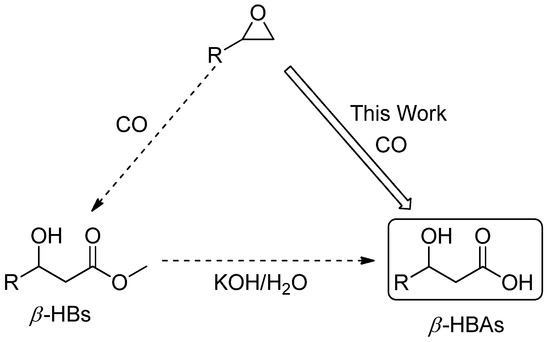
β-Hydroxy carboxylic acids are one of the key intermediates in the production of poly(β-hydroxy carboxylic acids), α,β-unsaturated acids, 1,3-alkanediols, β-hydroxyesters, β-hydroxyamides, β-hydroxyaldehydes, and 1,3-dicarboxylic acids [1,2]. They have also been used as a starting material in many pharmaceutical industries for the production of antibiotics, flavors, vitamins, and pheromones [3,4,5]. In addition, some of their derivatives exhibit antimicrobial, antiviral, and insecticidal activities [6,7,8]. To date, various methods, including the acid hydrolysis of biosynthetically produced poly(3-hydroxybutyrate), sharpless epoxidation and hydroxylation of allylic alcohols, and enantioselective reduction of 3-ketoesters [9,10,11], can be used to synthesize β-hydroxybutyric acid (β-HBA), which is one of the representative derivatives of β-hydroxy carboxylic acids. Recently, Roo et al. reported the long term acid methanolysis of biosynthetically prepared poly(hydroxybutyrates) (PHBs) to produce 3-hydroxybutyrate followed by saponification (KOH/H2O) to produce 3-hydroxybutyric acid (3-HBA) [12]. Although these methods can produce enantiomeric β-HBA, some common drawbacks such as high substrate cost, the requirement of expensive metal catalysts, and complicated synthetic procedures have led to the development of alternate facile synthetic routes (Scheme 1).
Scheme 1.
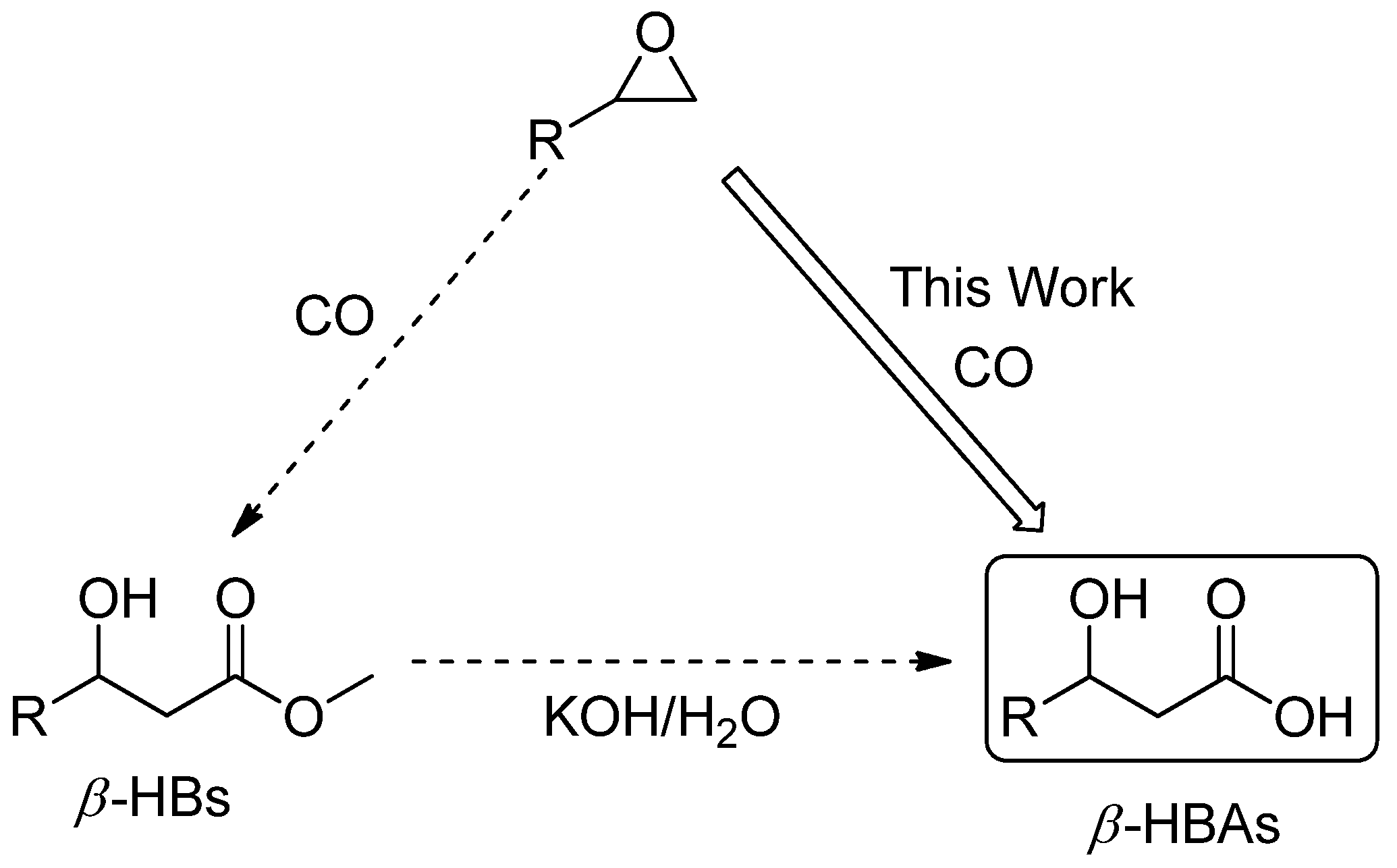
Synthetic routes of β-hydroxybutyric acids (β-HBAs) from epoxides.
Interestingly, an imidazole-based cobalt carbonyl ionic liquid (IL) catalyst [1-butyl-3-methylimidazolium tetracarbonylcobaltate ([Bmim][Co(CO)4])] has received great attention for epoxide ring-opening carbonylation [13]. By using the [Bmim][Co(CO)4] and methanol, we recently reported the direct conversion of propylene oxide (PO) to methyl 3-hydroxybutyrate [14]. Since this epoxide carbonylation is simple, efficient and inexpensive, we envisaged that the target compound β-HBA, can be directly produced if the same carbonylation is performed in water medium (Scheme 1). Herein, we report, for the first time, the efficient direct coupling of PO with water and carbon monoxide to produce 3-HBA using the [Bmim][Co(CO)4] catalyst under mild condition.
2. Results and Discussion
The use of a non-metallic quaternary cobaltate IL [Bmim][Co(CO)4] with imidazole as a promotor has received increased attention for epoxide carbonylation because of its high catalytic ability, high miscibility in PO, and high stability under carbonylation. The IL, [Bmim][Co(CO)4], was prepared by following a reported procedure (Scheme 2) and characterized using standard spectroscopic techniques (Figures S2 and S3) [14].
Scheme 2.
Synthesis of C. (i) 1-butylchloride, CH3CN, 80 °C, 48 h (ii) K[Co(CO)4], MeOH, 0.5 MPa of CO, 25 °C, 24 h. (a) 1-methylimidazole, (b) 1-butyl-3-methylimidazolium chloride and (c) 1-butyl-3-methylimidazolium cobalt tetracarbonyl.
The carbonylation of PO to 3-HBA catalyzed by C was performed in a 100 mL stainless steel tube reactor, and the results are shown in Table 1. Initially, carbonylation was performed in water at 75 °C under 4 MPa of CO for 24 h. However, due to the poor miscibility of PO in water, only 0.7% conversion was observed (entry 1). Therefore, we attempted to identify a suitable solvent that has high miscibility with water and dissolves PO and the catalyst. 1,2-dimethoxyethane (DME) is a well-known solvent for PO carbonylation. Moreover, the donicity of DME increases the solubility of the catalyst, and its high miscibility with water renders it as a suitable solvent for PO carbonylation.
Table 1.
Catalytic ring-opening carbonylation of PO using [Bmim][Co(CO)4] complex and imidazole as a promotor a.
Carbonylation experiments were later performed in a mixed solvent system (DME:H2O) (entries 2–11). Product formation was monitored by LC-MS analysis, which showed the formation of 3-HBA and 2-HPHB (Figure S4). A conversion of 57% was observed in entry 2 with major products [3-HBA (42%) and 2-HPHB (31%)] and minor products [acetone (14%) and 1,2-PD (13%)]. The formation of 1,2-PD and acetone could be explained by performing a blank reaction under controlled reaction conditions (entries 3–5). As shown in entry 3, when the reaction was performed at 75 °C without any catalyst and CO, it resulted in a conversion of 63% with the predominant formation of 1,2-PD and acetone. The result indicated that the formation of side products, namely 1,2-PD and acetone, was not attributed to the catalyst, which could be directly formed by the nucleophilic attack of water on PO at a higher temperature. Under similar conditions, the reaction was performed under 4 MPa of CO to investigate side product formation (entry 4), and the same result as that of entry 3 was observed. Another blank reaction performed by decreasing the temperature from 75 to 40 °C under an argon atmosphere did not result in acetone formation, which indicated that acetone formation was completely reduced (entry 5) when carbonylation was performed at a lower temperature. Under this reaction condition, carbonylation was performed in the presence of the catalyst, resulting in only 2% PO conversion (entry 6). Therefore, for the efficient production of 3-HBA, the carbonylation temperature should be maintained at 75 °C or above. Since the aim of this study was to synthesize 3-HBA, we attempted to reduce the formation of 2-HPHB by adjusting the promoter (imidazole) ratio during carbonylation (entries 7 and 8). When PO carbonylation was performed without promoter (entry 7) and with excess promoter (entry 8), a decrease in PO conversion was observed while maintaining the ratio of 3-HBA and 2-HPHB. The result clearly indicated that 2-HPHB was formed by the nucleophilic attack of activated 1,2-PD, which is unavoidable at this stage. To optimize catalytic efficiency, carbonylation was performed at 75 °C under 6 MPa of CO by only varying the reaction time (entries 9–11), resulting in >99% conversion with 49% selectivity of 3-HBA (TON mol of 3-HBA/mol of C = 50, entry 11).
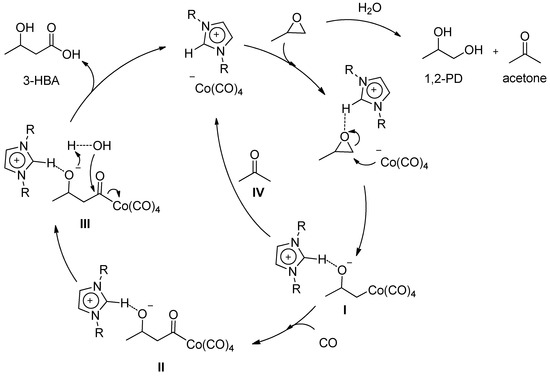
Based on our understanding and the available literature [13,14], we propose a possible catalytic cycle for the carbonylation of PO to 3-HBA, including the formation of the side products catalyzed by C (Figure 1). The imidazolium acidic proton activates PO followed by ring opening via the nucleophilic attack of [Co(CO)4]− at the less-hindered carbon atom to form an imidazolium alkoxide and cobalt-alkyl bond (I). At a higher pressure, the available CO undergoes a rapid migratory insertion between cobalt-alkyl bonds to form an intermediate (II), which further undergoes intermolecular addition with water to form 3-HBA and regenerate the catalyst C. If the CO insertion is slowed down in I, it can undergo β-hydride elimination followed by enolate protonation and tautomerization to form acetone (IV) as a side product (Table 1). However, at higher temperatures, the available PO directly reacts with water to form 1,2-PD and acetone as unavoidable side products.
Figure 1.
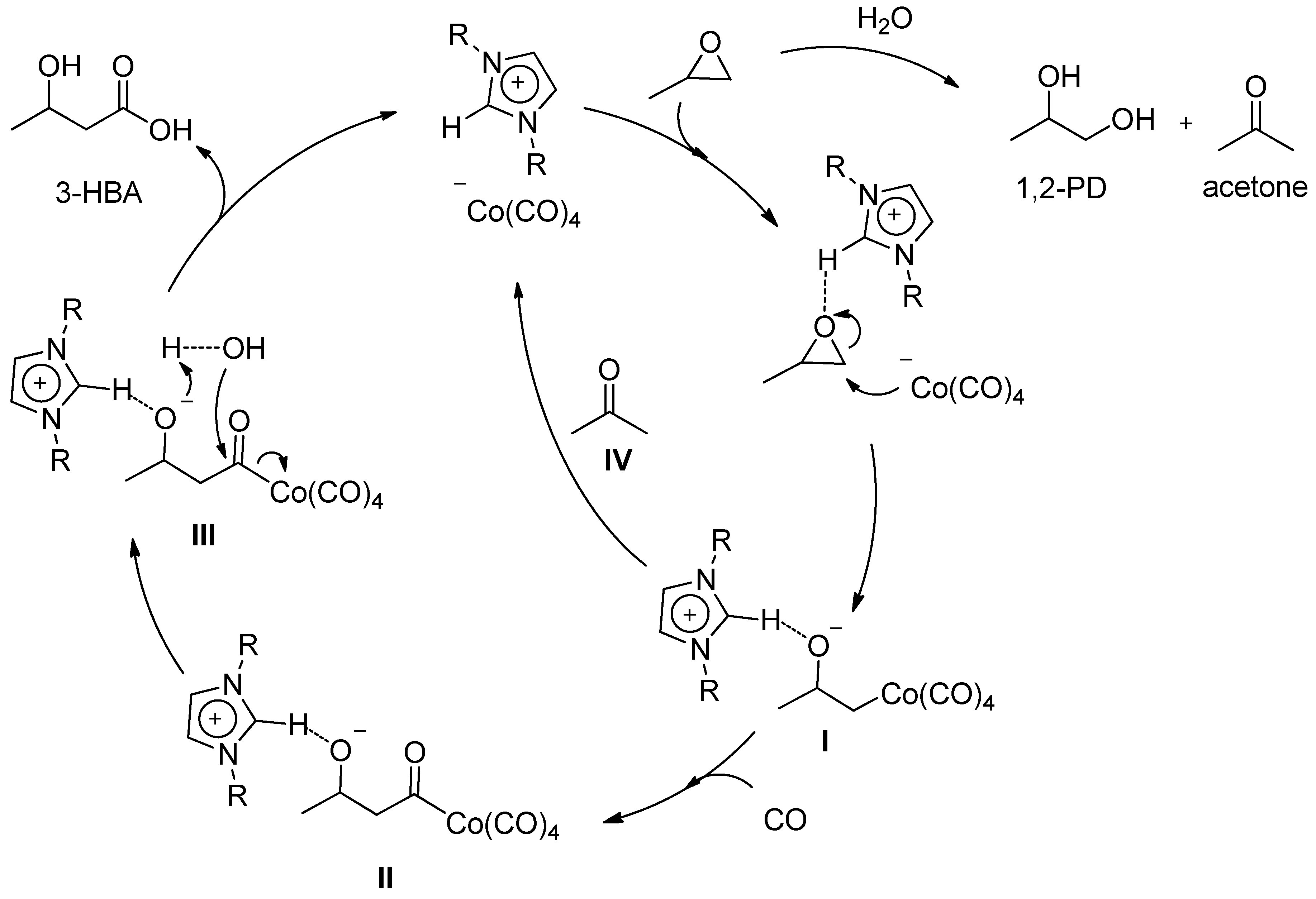
Proposed mechanism for the formation of 3-HBA and side products (1,2-PD and acetone).
3. Experimental Section
3.1. General Considerations and Physical Measurements
All manipulations of air- and water-sensitive compounds were carried out using glovebox or standard Schlenk line techniques under an argon atmosphere. Chemicals 1-methyl-imidazole, anhydrous methanol, Tetrahydrofuran (THF), DME, Propylene oxide (PO) and 1-butylchloride were purchased from Sigma-Aldrich Co., (St. Louis, MO, USA). THF and DME were freshly distilled over sodium/benzoquinone, and methanol was distilled over Mg/I under a nitrogen atmosphere before use. PO was distilled over CaH2 under a nitrogen atmosphere. KCo(CO)4 and [Bmim][Co(CO)4] were synthesized according to a previously reported procedure [14]. Deuterated solvents were purchased from Cambridge Isotope Laboratories, Inc. (Andover, MA, USA). Research-grade carbon monoxide was purchased from Sinyang Gas Company (Paju-si, Republic of Korea) with 99.995% purity and used as received. 1H NMR spectra were recorded on a Bruker AscendTM 400 spectrometer (400 and 100 MHz) (ASCEND III HD; Bruker, Rheinstetten, Germany), and chemical shifts were referenced to TMS. FT-IR measurements were carried out on a Nicolet iS 50 (Thermo Fisher Scientific, Waltham, MA, USA) spectrometer. LC-MS measurements were performed on an Agilent 6130 Single Quadrupole LC/MS spectrometer (Santa clara, CA, USA). All carbonylation reactions were performed in a 100 mL stainless steel tube reactor fitted with a pressure gauge and pressure release valve. All carbonylation reactions were set up and run in a well-ventilated fume hood equipped with a carbon monoxide detector (see MSDS for the proper handling of CO). PO conversion, 3-HBA, 2-hydroxypropyl-3(2-hydroxypropyl)butanoate (2-HPHB), 1,2-propanediol (1,2-PD), and acetone were quantified by 1H-NMR spectroscopy using naphthalene as an internal standard.
3.2. Synthesis of 1-Butyl-3-methylimidazolium Cobalt TetraCarbonyl [Bmim][Co(CO)4] [14] (C)
In a glovebox, the tube reactor was equipped with a stir-bar and charged with KCo(CO)4 (0.298 g, 1.418 mmol) and [Bmim]Cl (2) (0.247 g, 1.417 mmol) in 10 mL MeOH. After removal from the glove box, the reactor was cooled to 0 °C and purged with 0.2 MPa of CO. Then, the reactor was pressurized with 0.5 MPa of CO and stirred at 25 °C for 24 h. Subsequently, the reactor was cooled to room temperature, and CO gas was slowly vented. The light yellow solution was transferred to a 50 mL Schlenk flask under a N2 atmosphere, and all volatiles were removed under vacuum to obtain a bluish oil with white precipitates. This resulting crude was dissolved in THF and filtered; all volatiles were removed under vacuum to yield a bluish green oil and stored at −20 °C in the glove box. Yield = 0.462 g, 1H NMR (400 MHz, CDCl3) δ [ppm] = 8.97 (s, 1H, imd-NCHN), 7.42 (s, 2H imd-NCHCHN), 4.28 (s, 2H, NCH2), 4.06 (s, 3H, NCH3), 1.93 (m, 2H, NCCH2), 1.42 (m, 2H, CH3CH2), 0.99 (m, 3H, CCH3). IR = 1890 cm−1.
3.3. Epoxide Ring-Opening Carbonylation
A 100 mL stainless steel tube reactor was dried overnight and vacuumed for 4 h. In a glove box, it was equipped with a magnetic stir bar and charged with the corresponding amount of C, imidazole and PO in 2 mL of DME. Upon removal from the glove box, the tube reactor was cooled to 0 °C and purged with 0.5 MPa of CO, and the desired amount of nitrogen-bubbled water (oxygen-free) was added. Then, the reactor was immediately pressurized with CO to a desired pressure at room temperature and heated to the indicated temperature. After the reaction, the reactor was cooled to room temperature, and CO gas was slowly vented. The crude sample was filtered through Celite, weighed, and analyzed by 1H-NMR spectroscopy in CDCl3.
4. Conclusions
In this study, we demonstrated that the [Bmim][Co(CO)4] IL successfully catalyzed the direct coupling of PO, water, and CO to form 3-HBA with 49% selectivity. This is an easy and unique procedure to produce 3-HBA. The catalyst exhibited excellent activity with the maximal conversion of 3-HBA under mild condition with the TON of 50. Further experiments to increase 3-HBA formation and suppress the formation of 2-HPHB and 1,2-PD are currently underway.
Supplementary Materials
The following are available online at http://www.mdpi.com/2073-4344/7/8/228/s1. Figure S1. FT-IR spectrum of KCo(CO)4 in THF solution, Figure S2. 1H-NMR spectrum of C, Figure S3. FT-IR spectrum of C in THF solution, Figure S4. LC-MS spectrum of 3-HBA, Figure S5. 1H-NMR spectrum of entry 2.
Acknowledgments
We acknowledge the financial support by C1 Gas Refinery Program through the National Research Foundation of Korea (NRF) funded by the Ministry of Science, ICT & Future Planning (2015M3D3A1A01064879).
Author Contributions
Senkuttuvan Rajendiran performed the experiments; Senkuttuvan Rajendiran and Sungho Yoon analyzed the data and wrote the manuscript.
Conflicts of Interest
The authors declare no competing financial interests.
References
- Corma, A.; Iborra, S.; Velty, A. Chemical routes for the transformation of biomass into chemicals. Chem. Rev. 2007, 107, 2411–2502. [Google Scholar] [CrossRef] [Scilit] [PubMed]
- Della Pina, C.; Falletta, E.; Rossi, M. A green approach to chemical building blocks. The case of 3-hydroxypropanoic acid. Green Chem. 2011, 13, 1624–1632. [Google Scholar] [CrossRef] [Scilit]
- Chiba, T.; Nakai, T. A Synthetic Approach to (+)−Thienamycin from Methyl (R)-3-Hydroxybutanoate—A New Entry to (3r,4r)-3-[(R)-1-Hydroxyethyl]-4-Acetoxy-2-Azetidinone. Chem. Lett. 1985, 14, 651–654. [Google Scholar] [CrossRef] [Scilit]
- Seebach, D.; Albert, M.; Arvidsson, P.I.; Rueping, M.; Schreiber, J.V. From the biopolymer PHB to biological investigations of unnatural beta- and gamma-peptides. Chimia 2001, 55, 345–353. [Google Scholar]
- Ren, Q.; Ruth, K.; Thony-Meyer, L.; Zinn, M. Enatiomerically pure hydroxycarboxylic acids: Current approaches and future perspectives. Appl. Microbiol. Biotechnol. 2010, 87, 41–52. [Google Scholar] [CrossRef] [Scilit] [PubMed]
- Peypoux, F.; Bonmatin, J.M.; Wallach, J. Recent trends in the biochemistry of surfactin. Appl. Microbiol. Biotechnol. 1999, 51, 553–563. [Google Scholar] [CrossRef] [Scilit] [PubMed]
- Shiraki, M.; Endo, T.; Saito, T. Fermentative production of (R)-(−)-3-hydroxybutyrate using 3-hydroxybutyrate dehydrogenase null mutant of Ralstonia eutropha and recombinant Escherichia coli. J. Biosci. Bioeng. 2006, 102, 529–534. [Google Scholar] [CrossRef] [Scilit] [PubMed]
- Tokiwa, Y.; Ugwu, C.U. Biotechnological production of (R)-3-hydroxybutyric acid monomer. J. Biotechnol. 2007, 132, 264–272. [Google Scholar] [CrossRef] [Scilit] [PubMed]
- Chen, G.Q.; Wu, Q. The application of polyhydroxyalkanoates as tissue engineering materials. Biomaterials 2005, 26, 6565–6578. [Google Scholar] [CrossRef] [Scilit] [PubMed]
- Brown, H.C.; Ramachandran, P.V. The Boron Approach to Asymmetric-Synthesis. Pure Appl. Chem. 1991, 63, 307–316. [Google Scholar] [CrossRef] [Scilit]
- Noyori, R.; Kitamura, M.; Ohkuma, T. Toward efficient asymmetric hydrogenation: Architectural and functional engineering of chiral molecular catalysts. Proc. Natl. Acad. Sci. USA 2004, 101, 5356–5362. [Google Scholar] [CrossRef] [Scilit] [PubMed]
- De Roo, G.; Kellerhals, M.B.; Ren, Q.; Witholt, B.; Kessler, B. Production of chiral R-3-hydroxyalkanoic acids and R-3-hydroxyalkanoic acid methylesters via hydrolytic degradation of polyhydroxyalkanoate synthesized by pseudomonads. Biotechnol. Bioeng. 2002, 77, 717–722. [Google Scholar] [CrossRef] [Scilit] [PubMed]
- Guo, Z.M.; Wang, H.S.; Lv, Z.G.; Wang, Z.H.; Nie, T.; Zhang, W.W. Catalytic performance of [Bmim][Co(CO)(4)] functional ionic liquids for preparation of 1,3-propanediol by coupling of hydroesterification-hydrogenation from ethylene oxide. J. Organomet. Chem. 2011, 696, 3668–3672. [Google Scholar] [CrossRef] [Scilit]
- Rajendiran, S.; Park, K.; Lee, K.; Yoon, S. Ionic-Liquid-Based Heterogeneous Covalent Triazine Framework Cobalt Catalyst for the Direct Synthesis of Methyl 3-Hydroxybutyrate from Propylene Oxide. Inorg. Chem. 2017, 56, 7270–7277. [Google Scholar] [CrossRef] [Scilit] [PubMed]




© 2017 by the authors. Licensee MDPI, Basel, Switzerland. This article is an open access article distributed under the terms and conditions of the Creative Commons Attribution (CC BY) license (http://creativecommons.org/licenses/by/4.0/).