<?xml version="1.0" encoding="UTF-8"?>
<!DOCTYPE article PUBLIC "-//NLM//DTD Journal Publishing DTD v2.3 20070202//EN" "journalpublishing.dtd">
<article xmlns:mml="http://www.w3.org/1998/Math/MathML" xmlns:xlink="http://www.w3.org/1999/xlink" xml:lang="en" article-type="research-article">
  <front>
    <journal-meta>
      <journal-id journal-id-type="publisher-id">catalysts</journal-id>
      <journal-title>Catalysts</journal-title>
      <abbrev-journal-title abbrev-type="publisher">Catalysts</abbrev-journal-title>
      <abbrev-journal-title abbrev-type="pubmed">Catalysts</abbrev-journal-title>
      <issn pub-type="epub">2073-4344</issn>
      <publisher>
        <publisher-name>MDPI</publisher-name>
      </publisher>
    </journal-meta>
    <article-meta>
      <article-id pub-id-type="doi">10.3390/catal3010219</article-id>
      <article-id pub-id-type="publisher-id">catalysts-03-00219</article-id>
      <article-categories>
        <subj-group>
          <subject>Article</subject>
        </subj-group>
      </article-categories>
      <title-group>
        <article-title>Photocatalytic Oxidation Processes for Toluene Oxidation over TiO<sub>2</sub> Catalysts</article-title>
      </title-group>
      <contrib-group>
        <contrib contrib-type="author">
          <name>
            <surname>Einaga</surname>
            <given-names>Hisahiro</given-names>
          </name>
          <xref rid="c1-catalysts-03-00219" ref-type="corresp">*</xref>
        </contrib>
        <contrib contrib-type="author">
          <name>
            <surname>Mochiduki</surname>
            <given-names>Keisuke</given-names>
          </name>
        </contrib>
        <contrib contrib-type="author">
          <name>
            <surname>Teraoka</surname>
            <given-names>Yasutake</given-names>
          </name>
        </contrib>
      </contrib-group>
      <aff id="af1-catalysts-03-00219">Department of Energy and Material Sciences, Faculty of Engineering Sciences, Kyushu University, Kasuga, Fukuoka 816-8580, Japan; E-Mails: <email>mochizuki.k03@city.fukuoka.lg.jp</email> (K.M.); <email>teraoka.yasutake.329@m.kyushu-u.ac.jp</email> (Y.T.)</aff>
      <author-notes>
        <corresp id="c1-catalysts-03-00219"><label>*</label> Author  to whom correspondence should be addressed; E-Mail: <email>einaga.hisahiro.399@m.kyushu-u.ac.jp</email>; Tel.: +81-92-583-7525; Fax: +81-92-583-8853.</corresp>
      </author-notes>
      <pub-date pub-type="epub">
        <day>04</day>
        <month>03</month>
        <year>2013</year>
      </pub-date>
      <pub-date pub-type="collection"><month>03</month>
        <year>2013</year>
      </pub-date>
      <volume>3</volume>
      <issue>1</issue>
      <fpage>219</fpage>
      <lpage>231</lpage>
      <history>
        <date date-type="received">
          <day>23</day>
          <month>11</month>
          <year>2012</year>
        </date>
        <date date-type="rev-recd">
          <day>05</day>
          <month>01</month>
          <year>2013</year>
        </date>
        <date date-type="accepted">
          <day>05</day>
          <month>02</month>
          <year>2013</year>
        </date>
      </history>
      <permissions>
        <copyright-statement>© 2013 by the authors; licensee MDPI, Basel, Switzerland.</copyright-statement>
        <copyright-year>2013</copyright-year>
        <license xmlns:xlink="http://www.w3.org/1999/xlink" license-type="open-access" xlink:href="http://creativecommons.org/licenses/by/3.0/">
          <p>This article is an open access article distributed under the terms and conditions of the Creative Commons Attribution license (http://creativecommons.org/licenses/by/3.0/).</p>
        </license>
      </permissions>
      <abstract>
        <p>Gas-solid heterogeneous photooxidation of toluene over TiO<sub>2</sub> catalyst was studied to investigate the factors controlling the catalytic activities. The toluene photooxidation behavior on TiO<sub>2</sub> was strongly affected by the formation and oxidation behavior of intermediate compounds on TiO<sub>2</sub>, and their accumulation decreased the reaction rate for toluene photooxidation. The formation and oxidation behavior of the byproduct compounds depended on the initial concentration of toluene and water vapor. <italic>In situ</italic> Fourier transform infrared (FTIR) studies revealed that water vapor promoted the cleavage of the aromatic ring and facilitated CO<sub>2</sub> formation. At the reaction temperature of 300 K, the deposition of Pt on TiO<sub>2</sub> suppressed CO formation, whereas catalytic activity was decreased due to the increase in the amount of intermediate compounds. On the other hand, Pt/TiO<sub>2</sub> showed higher activity than TiO<sub>2</sub> at 353 K, in spite of the increase of the intermediate compounds.</p>
      </abstract>
      <kwd-group>
        <kwd>titanium dioxide</kwd>
        <kwd>photocatalytic reaction</kwd>
        <kwd>oxidation</kwd>
        <kwd>toluene</kwd>
      </kwd-group>
    </article-meta>
  </front>
  <body>
    <sec sec-type="intro">
      <title>1. Introduction</title>
      <p>Control of air quality is still one of the important topics in the research area of environmental science and technology. Photocatalytic oxidation (PCO) processes have been extensively studied for air quality control when the target compounds are CO, NO, volatile organic compounds (VOCs) and bioaerosols in closed environment [<xref ref-type="bibr" rid="B1-catalysts-03-00219">1</xref>,<xref ref-type="bibr" rid="B2-catalysts-03-00219">2</xref>,<xref ref-type="bibr" rid="B3-catalysts-03-00219">3</xref>,<xref ref-type="bibr" rid="B4-catalysts-03-00219">4</xref>,<xref ref-type="bibr" rid="B5-catalysts-03-00219">5</xref>]. PCO is effective for the control of these compounds, especially under their diluted conditions. In the case of VOC removal from polluted air, TiO<sub>2</sub> catalysts have been generally used because of their high activities, high safety and low cost. The photooxidation behavior of various kinds of organic compounds, including aromatic compounds on near UV irradiated TiO<sub>2</sub> catalysts, has been clarified [<xref ref-type="bibr" rid="B6-catalysts-03-00219">6</xref>,<xref ref-type="bibr" rid="B7-catalysts-03-00219">7</xref>,<xref ref-type="bibr" rid="B8-catalysts-03-00219">8</xref>,<xref ref-type="bibr" rid="B9-catalysts-03-00219">9</xref>,<xref ref-type="bibr" rid="B10-catalysts-03-00219">10</xref>,<xref ref-type="bibr" rid="B11-catalysts-03-00219">11</xref>,<xref ref-type="bibr" rid="B12-catalysts-03-00219">12</xref>,<xref ref-type="bibr" rid="B13-catalysts-03-00219">13</xref>,<xref ref-type="bibr" rid="B14-catalysts-03-00219">14</xref>,<xref ref-type="bibr" rid="B15-catalysts-03-00219">15</xref>,<xref ref-type="bibr" rid="B16-catalysts-03-00219">16</xref>,<xref ref-type="bibr" rid="B17-catalysts-03-00219">17</xref>,<xref ref-type="bibr" rid="B18-catalysts-03-00219">18</xref>,<xref ref-type="bibr" rid="B19-catalysts-03-00219">19</xref>].</p>
      <p>It has been generally accepted that the factors controlling photocatalytic activities involve the efficiency for electron-hole pair generation and their separation, formation of active oxygen species on the TiO<sub>2</sub> surface and their reaction with organic compounds adsorbed on the surface [<xref ref-type="bibr" rid="B1-catalysts-03-00219">1</xref>,<xref ref-type="bibr" rid="B19-catalysts-03-00219">19</xref>]. Therefore, many efforts have been made to improve the photocatalytic properties of TiO<sub>2</sub> catalysts by controlling their crystallinity, band gaps and surface area. The other catalyst-modification methods are metal doping/deposition in/on the TiO<sub>2</sub> catalyst surface [<xref ref-type="bibr" rid="B20-catalysts-03-00219">20</xref>,<xref ref-type="bibr" rid="B21-catalysts-03-00219">21</xref>]. Deposition of Pt metals on TiO<sub>2</sub> was effective in improving the rate for VOC photooxidation when the photoreaction was conducted with heating processes [<xref ref-type="bibr" rid="B22-catalysts-03-00219">22</xref>,<xref ref-type="bibr" rid="B23-catalysts-03-00219">23</xref>].</p>
      <p>We have carried out the photocatalytic oxidation of hydrocarbons with TiO<sub>2</sub> to investigate their photooxidation behavior by using a gas-solid heterogeneous flow system [<xref ref-type="bibr" rid="B24-catalysts-03-00219">24</xref>,<xref ref-type="bibr" rid="B25-catalysts-03-00219">25</xref>,<xref ref-type="bibr" rid="B26-catalysts-03-00219">26</xref>,<xref ref-type="bibr" rid="B27-catalysts-03-00219">27</xref>,<xref ref-type="bibr" rid="B28-catalysts-03-00219">28</xref>]. Benzene and toluene were oxidized to CO<sub>2</sub> on TiO<sub>2</sub> under near-UV irradiation; the TiO<sub>2</sub> catalysts suffered from severe deactivation when aromatic compounds were used as the substrate under their high concentrations or dry conditions [<xref ref-type="bibr" rid="B7-catalysts-03-00219">7</xref>,<xref ref-type="bibr" rid="B9-catalysts-03-00219">9</xref>]. Under these conditions, intermediate compounds, including oxygen-containing species and carbonaceous materials, were generally formed on the TiO<sub>2</sub> catalyst surface, which covered catalytic active sites, inhibiting the adsorption and oxidation of toluene on the sites. On the basis of these findings, we have suggested that the formation and oxidation behavior of such intermediate compounds is also one of the important factors that controls the photocatalytic activities [<xref ref-type="bibr" rid="B26-catalysts-03-00219">26</xref>].</p>
      <p>We herein report the photocatalytic oxidation of toluene over TiO<sub>2</sub> catalysts by focusing on the formation and oxidation behavior of intermediate compounds on the catalyst surface. The amount of intermediate compounds on TiO<sub>2</sub> was compared under various conditions to investigate the relationship between the photooxidation behavior of toluene and that of intermediate compounds in detail. We also conducted <italic>in situ</italic> Fourier transform infrared (FTIR) spectroscopic studies for toluene photooxidation on TiO<sub>2</sub> to reveal the effect of water vapor on the behavior of toluene and the intermediate compounds.</p>
    </sec>
    <sec sec-type="results">
      <title>2. Results and Discussion</title>
      <sec id="sec2dot1-catalysts-03-00219">
        <title>2.1. Photooxidation Behavior of Toluene on TiO<sub>2</sub></title>
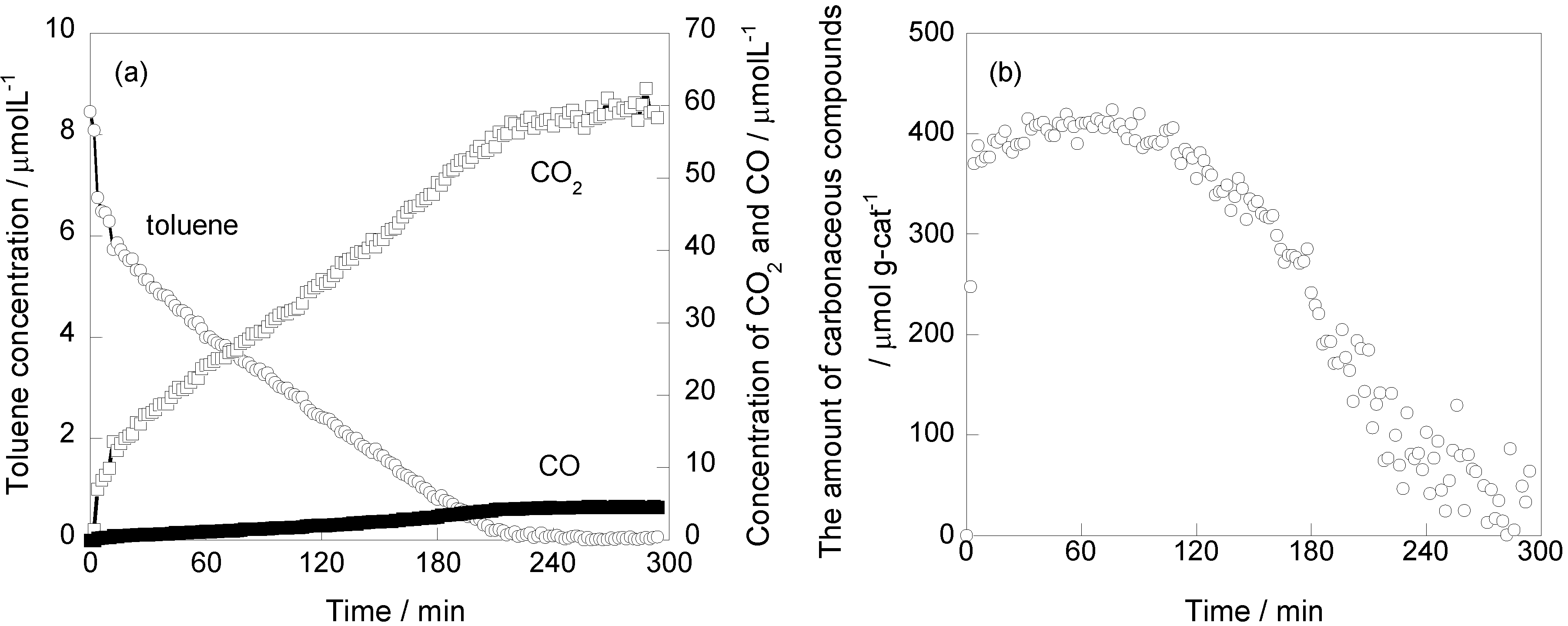
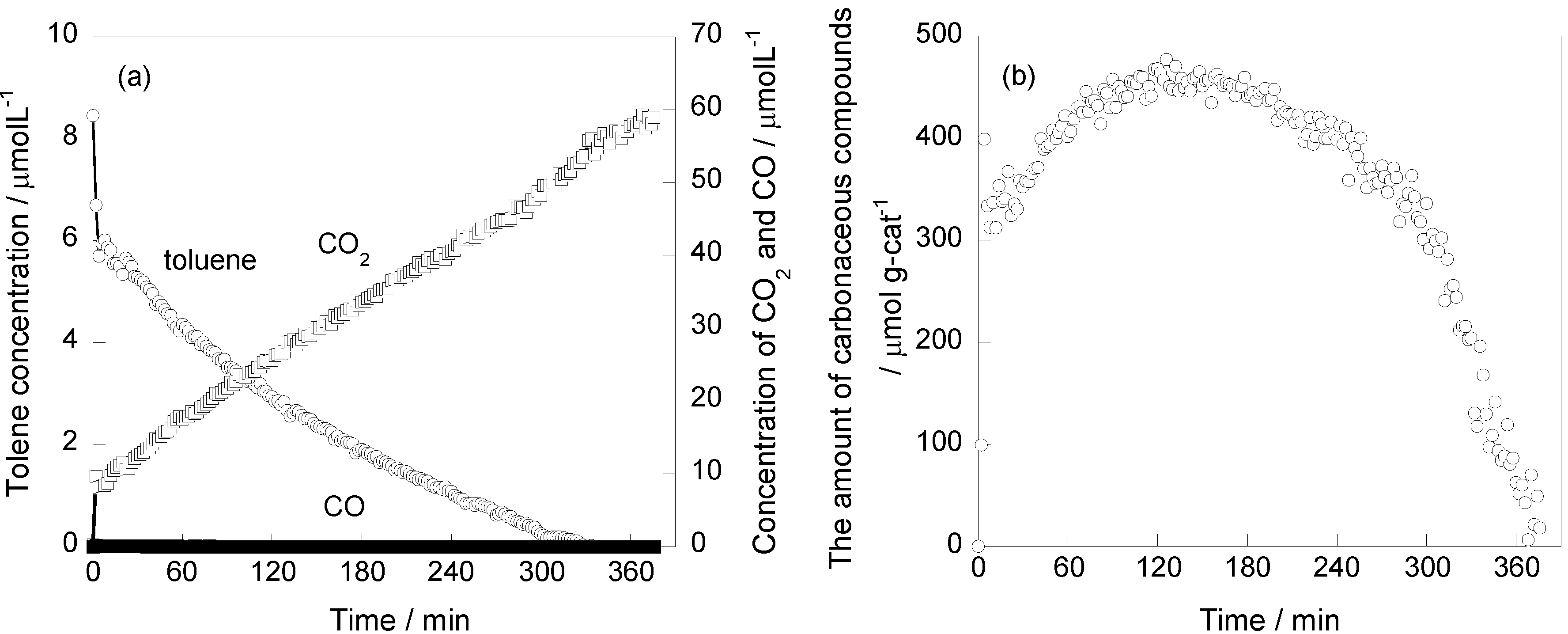
        <p><xref ref-type="fig" rid="catalysts-03-00219-f001">Figure 1</xref>a shows the time course for toluene photooxidation with TiO<sub>2</sub> under humid condition ([toluene]<sub>0</sub> = 8.4 μmol/L (210 ppmv), [H<sub>2</sub>O] = 1.0%) with a circulation system at 300 K. After the adsorption-desorption equilibrium was achieved in dark, photoirradiation was started for the TiO<sub>2</sub> catalyst. Toluene was oxidized on TiO<sub>2</sub> to form CO<sub>2</sub> and CO without an induction period on irradiation. Toluene concentration rapidly decreased in the initial period (~4 min), and then, the reaction rate decreased to a constant value until gaseous toluene was almost completely consumed. The formation of these intermediate compounds on TiO<sub>2</sub> in toluene photooxidation has been reported and the oxygen-containing byproducts, such as benzoic acid and benzaldehyde, have been identified [<xref ref-type="bibr" rid="B15-catalysts-03-00219">15</xref>]. The formation of carbonaceous species was also confirmed by browning of TiO<sub>2</sub> catalyst during the toluene photooxidation. <xref ref-type="fig" rid="catalysts-03-00219-f001">Figure 1</xref>b shows the time course for the changes in the amount of byproduct compounds on TiO<sub>2</sub>, which can be estimated from the balance between the amount of toluene consumption and that of CO<italic><sub>x</sub></italic> formation, as expressed by Equation (1), where V and W are the volume of the circulation system and catalyst mass. This estimation was valid, because no other C-containing byproducts were observed in gas phase with our system, indicating that the byproducts were presented on the catalyst surface.
        <disp-formula id="catalysts-03-00219-i001">
         <inline-graphic xmlns:xlink="http://www.w3.org/1999/xlink" xlink:href="catalysts-03-00219-i001.tif"/>
         <label>(1)</label>
         </disp-formula></p>
        <fig id="catalysts-03-00219-f001" position="float">
          <label>Figure 1</label>
          <caption>
            <p>Time course for toluene photooxidation with TiO<sub>2</sub>. (<bold>a</bold>) Changes in concentration of toluene, CO<sub>2</sub> and CO; (<bold>b</bold>) Changes in the amount of intermediate compounds on TiO<sub>2</sub>. [toluene]<sub>0</sub> = 8.4 μmol/L, [H<sub>2</sub>O] = 1.0%, [O<sub>2</sub>] = 20%.</p>
          </caption>
          <graphic xmlns:xlink="http://www.w3.org/1999/xlink" xlink:href="catalysts-03-00219-g001.tif"/>
        </fig>
        <p>The amount of byproduct compounds greatly increased in the initial period. The amount reached the maximum at 76 min, where the amount of byproducts and the C-density on TiO<sub>2</sub> were estimated to be 423 μmol/g-catalyst and 4.7 C-atom/nm<sup>2</sup>, respectively, indicating that the catalysts were significantly covered by the intermediate compounds. Comparison of the behavior of intermediate compounds with that of toluene indicates that the build-up of the byproducts caused the decrease in the reaction rate by blocking the catalyst active sites in the initial period. The intermediate compounds then gradually decreased with time, and their amount reached almost zero after 300 min, indicating that these compounds were further oxidized to CO<sub>2</sub> and CO during the reaction.</p>
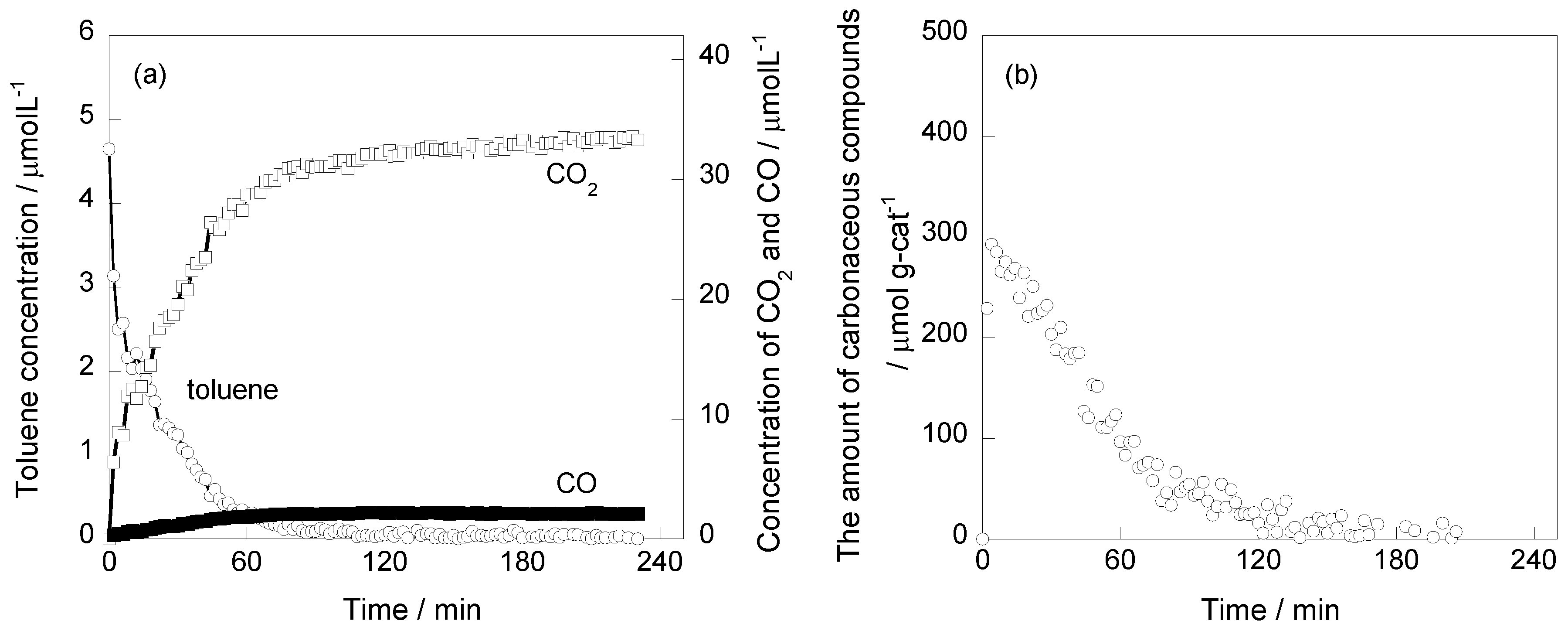
        <p>The formation behavior for these intermediate compounds greatly depended on the initial concentration of toluene in gas phase. When the toluene concentration was decreased to 4.2 μmol/L (<xref ref-type="fig" rid="catalysts-03-00219-f002">Figure 2</xref>a), the toluene concentration monotonically decreased with time on photoirradiation. In this case, a similar trend was observed in the initial period of the reaction: the rate for toluene photooxidation significantly decreased due to the formation of intermediate compounds on TiO<sub>2</sub> (<xref ref-type="fig" rid="catalysts-03-00219-f002">Figure 2</xref>b). However, the amount of intermediate compounds was lower and decreased monotonically with time.</p>
        <fig id="catalysts-03-00219-f002" position="float">
          <label>Figure 2</label>
          <caption>
            <p>Time course for toluene photooxidation with TiO<sub>2</sub>. (<bold>a</bold>) Changes in concentration of toluene, CO<sub>2</sub> and CO; (<bold>b</bold>) Changes in the amount of intermediate compounds on TiO<sub>2</sub>. [toluene]<sub>0</sub> = 4.6 μmol/L, [H<sub>2</sub>O] = 1.0%, [O<sub>2</sub>] = 20%.</p>
          </caption>
          <graphic xmlns:xlink="http://www.w3.org/1999/xlink" xlink:href="catalysts-03-00219-g002.tif"/>
        </fig>
        <p>It has been reported that the rate of toluene photooxidation on TiO<sub>2</sub> catalyst can be fitted to Langmuir-Hinshelwood (L-H) kinetics, Equation (2), where <italic>k</italic> and <italic>K</italic> are a constant and the equilibrium constant for toluene adsorption on TiO<sub>2</sub>, respectively [<xref ref-type="bibr" rid="B16-catalysts-03-00219">16</xref>]:
        <disp-formula id="catalysts-03-00219-i002">
         <inline-graphic xmlns:xlink="http://www.w3.org/1999/xlink" xlink:href="catalysts-03-00219-i002.tif"/>
         <label>(2)</label>
         </disp-formula></p>
        <p>In the present study, however, the decay in toluene concentration was not fitted to the kinetic equation. This discrepancy was ascribed to the reaction condition. When the intermediate compounds were formed on TiO<sub>2</sub> surface, the catalytic active sites were poisoned by these compounds, and the fraction of surface coverage of toluene (<italic>θ</italic> in Equation (3)) decreased. Hence, the reaction rate did not obey the L-H kinetics under the condition where the catalyst surface was significantly covered with the intermediate compounds.
        <disp-formula id="catalysts-03-00219-i003">
         <inline-graphic xmlns:xlink="http://www.w3.org/1999/xlink" xlink:href="catalysts-03-00219-i003.tif"/>
         <label>(3)</label>
         </disp-formula></p>
        <p>The formation mechanism of the intermediate compounds on TiO<sub>2</sub> in toluene photooxidation has been already studied by many groups [<xref ref-type="bibr" rid="B10-catalysts-03-00219">10</xref>,<xref ref-type="bibr" rid="B11-catalysts-03-00219">11</xref>,<xref ref-type="bibr" rid="B13-catalysts-03-00219">13</xref>,<xref ref-type="bibr" rid="B15-catalysts-03-00219">15</xref>]. It is well accepted that electron-hole pairs photoformed on TiO<sub>2</sub> diffused to surface sites and generated active oxygen species [<xref ref-type="bibr" rid="B1-catalysts-03-00219">1</xref>,<xref ref-type="bibr" rid="B2-catalysts-03-00219">2</xref>]. So, the highly-reactive species attacked the aromatic ring of toluene to form organic radicals, which were then oxidized by molecular O<sub>2</sub> to peroxy radicals, leading to the formation of ring-opening compounds. The methyl groups were also oxidized by the active oxygen species to form benzoic acid. When toluene concentration increased, the intermediate radicals also reacted with toluene to form dimerized species, which were then transformed to oligomeric and polymeric species in the presence of toluene. They were the first step for the formation of carbonaceous materials on TiO<sub>2</sub>. As mentioned above, however, these compounds were further oxidized to CO<sub>2</sub> and CO under photoirradiation.</p>
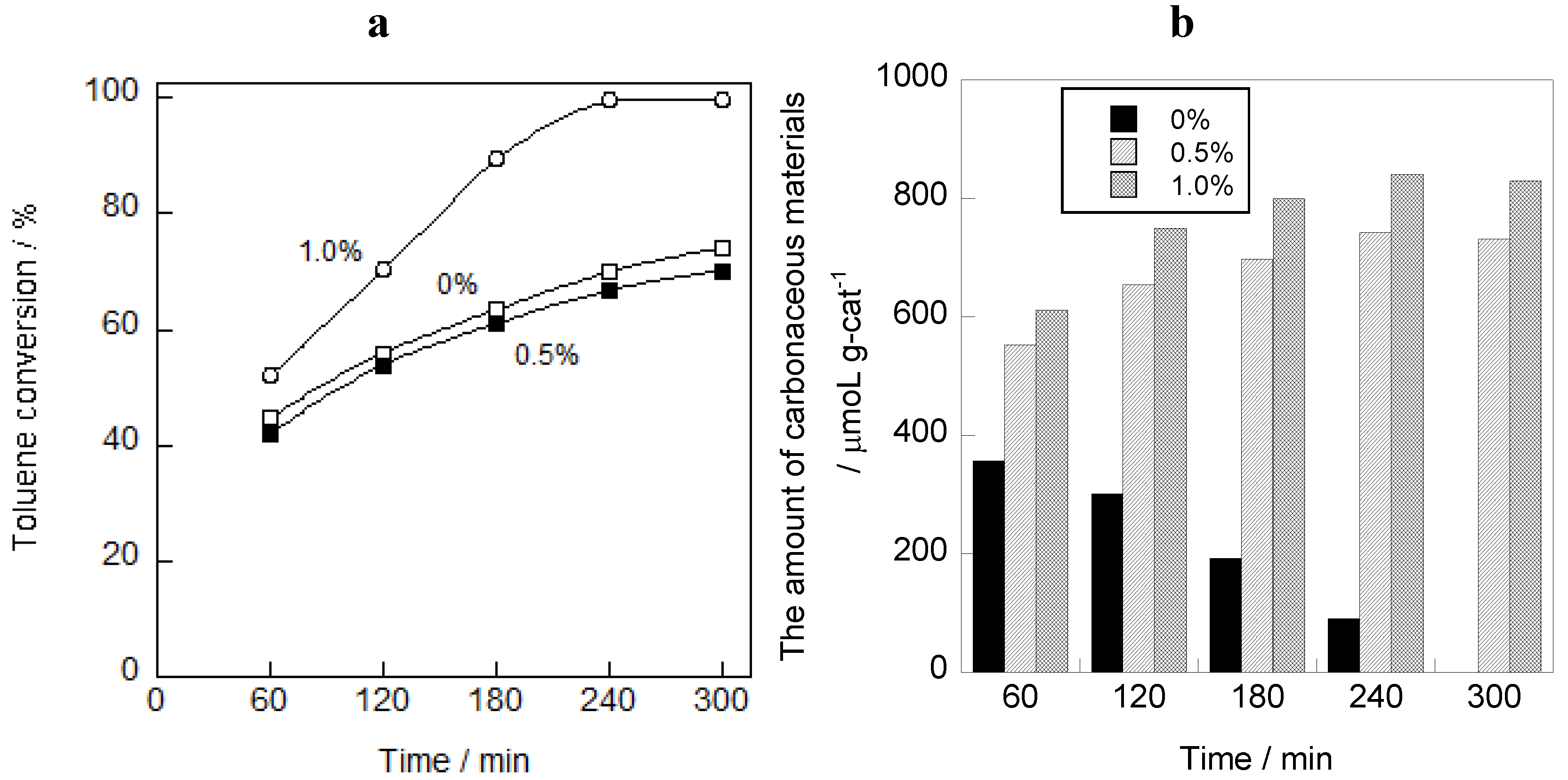
        <p>The formation behavior of the intermediate compounds was also greatly affected by the concentration of water vapor in gas phase, as reported earlier [<xref ref-type="bibr" rid="B9-catalysts-03-00219">9</xref>]. <xref ref-type="fig" rid="catalysts-03-00219-f003">Figure 3</xref> compares the time course plots for toluene conversion, CO<italic><sub>x</sub></italic> formation and the amount of byproduct compounds on TiO<sub>2</sub> under different humidity conditions. Water vapor in reaction gas have both positive and negative effects on toluene photooxidation. As a positive effect, water vapor inhibited the build-up of intermediate compounds on TiO<sub>2</sub>, giving rise to the increase in toluene photooxidation activity [<xref ref-type="bibr" rid="B24-catalysts-03-00219">24</xref>,<xref ref-type="bibr" rid="B26-catalysts-03-00219">26</xref>]. On the other hand, it inhibited the adsorption of toluene on the TiO<sub>2</sub> surface, leading to the decrease in toluene photooxidation activity. At the concentration of 0.5%, the two effects competed, and the former effect was prominent at 1.0%. The positive effect of water vapor was explained in terms of radical species: OH radicals were formed on the TiO<sub>2</sub> surface by photoirradiation in the presence of water vapor. However, this mechanism has been questioned because of the low reactivity of OH radicals on TiO<sub>2</sub> [<xref ref-type="bibr" rid="B29-catalysts-03-00219">29</xref>]. In addition, no evidence was obtained for the formation of OH radicals on the gas-solid heterogeneous TiO<sub>2</sub> photooxidation system. Further investigation should be conducted to reveal the reaction mechanism.</p>
        <fig id="catalysts-03-00219-f003" position="float">
          <label>Figure 3</label>
          <caption>
            <p>Effect of humidity on toluene photooxidation with TiO<sub>2</sub>. (<bold>a</bold>) Time course for toluene conversion; (<bold>b</bold>) Changes in the amount of intermediate compounds on TiO<sub>2</sub>. [toluene]<sub>0</sub> = 8.4 μmol/L, [O<sub>2</sub>] = 20%.</p>
          </caption>
          <graphic xmlns:xlink="http://www.w3.org/1999/xlink" xlink:href="catalysts-03-00219-g003.tif"/>
        </fig>
      </sec>
      <sec>
        <title>2.2. <italic>In Situ</italic> FTIR Studies for Toluene Photooxidation</title>
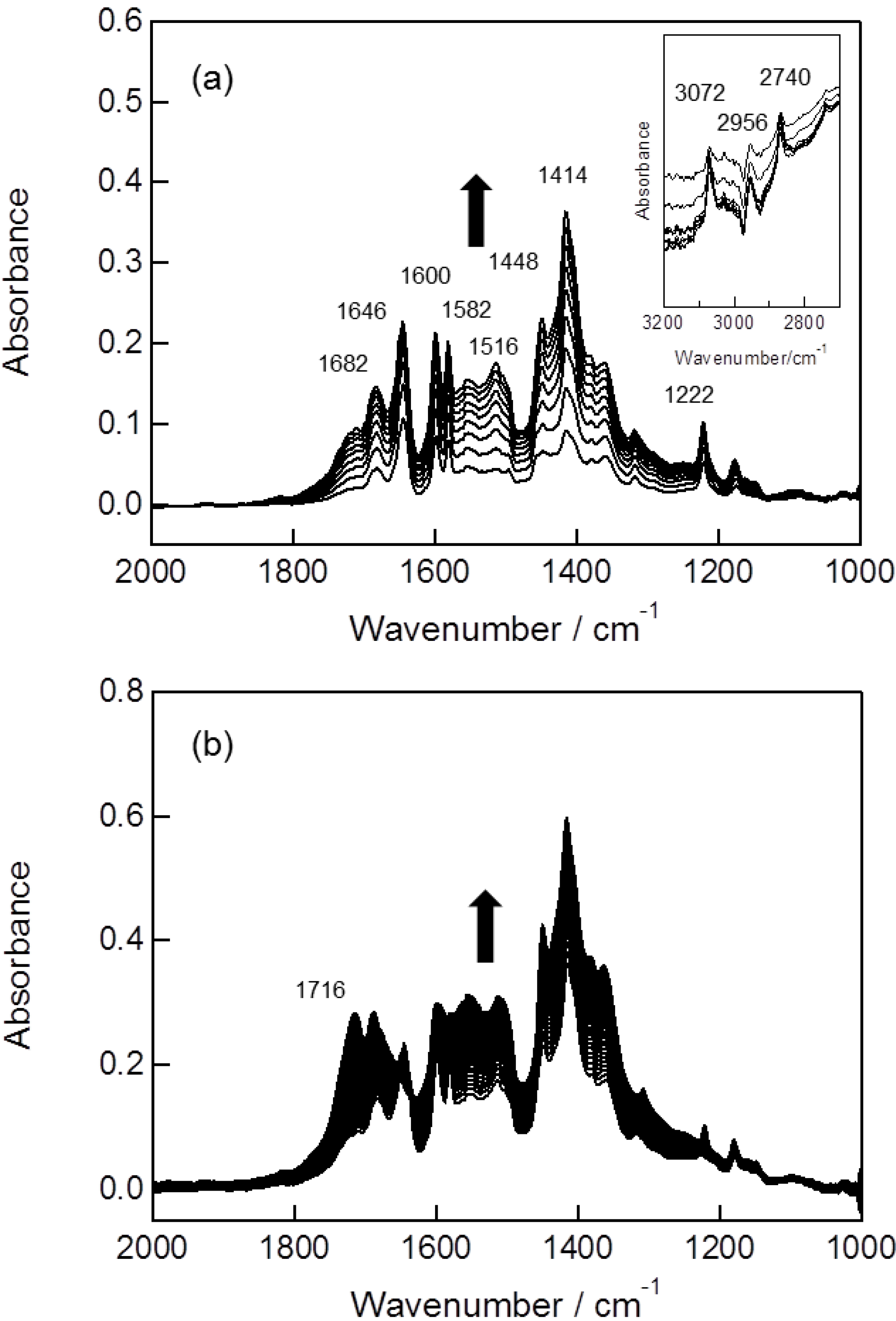
        <p><italic>In situ</italic> FTIR studies were conducted to pursue the photooxidation behavior of toluene on TiO<sub>2</sub> and, especially, to investigate the effect of water vapor on toluene photooxidation. <xref ref-type="fig" rid="catalysts-03-00219-f004">Figure 4</xref> shows the changes in FTIR spectra of intermediate compounds on TiO<sub>2</sub> during toluene photooxidation in air in the absence of water vapor. Here, it should be noted that the reaction rate was much lower than that in <xref ref-type="fig" rid="catalysts-03-00219-f001">Figure 1</xref>, because the catalyst weight was much lower (see Experimental Section). In the toluene photooxidation ([toluene]<sub>0</sub> = 30 ppm), the bands appeared in the wavenumber range 1000–2000 cm<sup>−1</sup> (<xref ref-type="fig" rid="catalysts-03-00219-f004">Figure 4</xref>a). In the initial period of reaction (0~5 h), the bands due to various kinds of intermediate compounds were observed. The bands at 1222, 1582, 1646 and 1682 cm<sup>−1</sup> were assignable to benzaldehyde [<xref ref-type="bibr" rid="B30-catalysts-03-00219">30</xref>,<xref ref-type="bibr" rid="B31-catalysts-03-00219">31</xref>,<xref ref-type="bibr" rid="B32-catalysts-03-00219">32</xref>,<xref ref-type="bibr" rid="B33-catalysts-03-00219">33</xref>,<xref ref-type="bibr" rid="B34-catalysts-03-00219">34</xref>]. The strong band at 1414 cm<sup>−1</sup> and the bands at 1448 and 1516 cm<sup>−1</sup> were assignable to adsorbed benzoic acid on TiO<sub>2</sub> [<xref ref-type="bibr" rid="B30-catalysts-03-00219">30</xref>,<xref ref-type="bibr" rid="B31-catalysts-03-00219">31</xref>,<xref ref-type="bibr" rid="B32-catalysts-03-00219">32</xref>,<xref ref-type="bibr" rid="B33-catalysts-03-00219">33</xref>,<xref ref-type="bibr" rid="B34-catalysts-03-00219">34</xref>]. The formation of these oxygen-containing compounds indicated that the active oxygen species attacked toluene and the intermediate compounds on the catalyst surface. In a prolonged reaction, the intensities of these bands increased with time, implying that the intermediate compounds were continuously accumulated on the TiO<sub>2</sub> catalyst surface (<xref ref-type="fig" rid="catalysts-03-00219-f004">Figure 4</xref>b). These behaviors were consistent with those observed for catalytic reactions described in <xref ref-type="sec" rid="sec2dot1-catalysts-03-00219">Section 2.1</xref>. Then, the bands in the range of 1680–1720 cm<sup>−1</sup>, which were assignable to C=O stretchings, increased in their intensities. The appearance of the band at 1716 cm<sup>−1</sup> due to aliphatic C=O groups indicated that aromatic ring cleavage occurred for the byproduct compounds. The bands at 2740, 2956 and 3072 cm<sup>−1</sup> appeared, and their intensities increased with time, indicating that aromatic and aliphatic C−H groups were present in the intermediate compounds.</p>
        <fig id="catalysts-03-00219-f004" position="float">
          <label>Figure 4</label>
          <caption>
            <p>Fourier transform infrared (FTIR) spectral changes in TiO<sub>2</sub> catalyst surface during toluene photooxidation under dry condition. Spectra were taken at 0.5 h intervals. (<bold>a</bold>) 1–5 h, (<bold>b</bold>) 5.5–40 h [toluene]<sub>0</sub> = 0.12 μmol/L, [O<sub>2</sub>] = 20%.</p>
          </caption>
          <graphic xmlns:xlink="http://www.w3.org/1999/xlink" xlink:href="catalysts-03-00219-g004.tif"/>
        </fig>
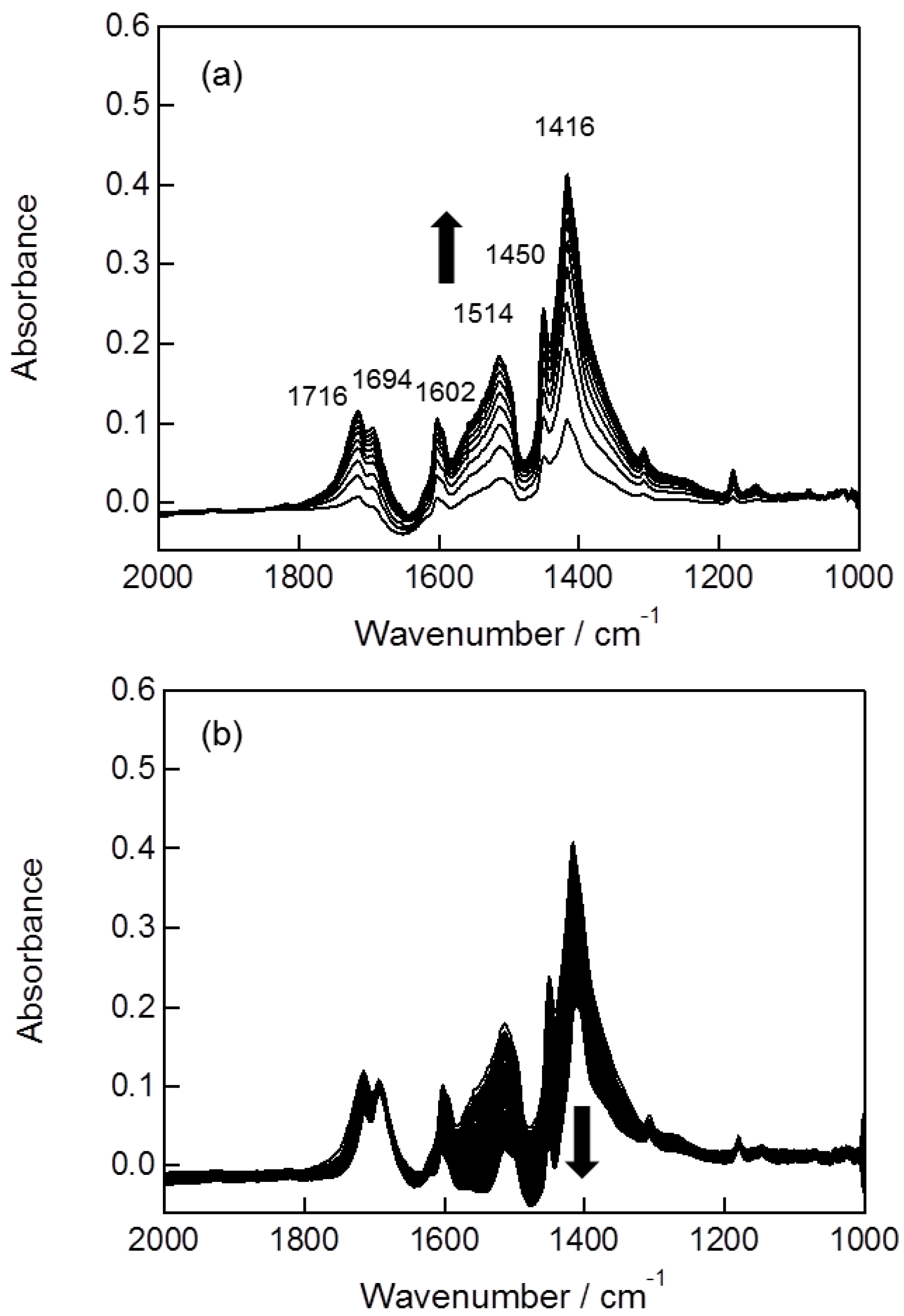
        <p>On the other hand, the intermediate compounds formed on TiO<sub>2</sub> in the presence of H<sub>2</sub>O ([toluene] = 0.12 μmol/L (30 ppmv), [H<sub>2</sub>O] = 1.0%) were much different, as shown in <xref ref-type="fig" rid="catalysts-03-00219-f005">Figure 5</xref>. After photoirradiation, the bands due to intermediate compounds were also observed. Although the bands due to the adsorbed benzoic acid (1416, 1450, 1514 and 1602 cm<sup>−1</sup>) were observed, the bands due to benzaldehyde were not detected, indicating that the oxidation of benzaldehyde to benzoic acid was promoted by the presence of water vapor. The difference was more prominent for the band of aliphatic C=O groups (1716 cm<sup>−1</sup>). The band appeared in the initial period in the presence of water vapor, in marked contrast with the reaction in the absence of water vapor, where there was an induction period for the appearance of the band. Therefore, benzene ring-cleavage immediately proceeded when water vapor was present in the reaction gas. The intensities of these bands increased with time until 5 h, and then, the intensities decreased with time, indicating that these intermediate compounds were oxidized CO<sub>2</sub> and CO under photoirradiation in the presence of water vapor.</p>
        <p>In the toluene photooxidation, active oxygen species photoformed on the TiO<sub>2</sub> oxidize methyl group to form benzaldehyde and benzoic acid. The oxidation of aromatic rings gives rise to the formation of phenols or cleavage of the aromatic rings, which is the first step for complete oxidation to CO<sub>2</sub>. The findings described above show that the presence of water vapor promoted the sequential oxidizing of benzaldehyde to benzoic acid and the cleavage of aromatic rings. Therefore, the accumulation of the intermediate compounds was greatly suppressed by the presence of water vapor.</p>
      <fig id="catalysts-03-00219-f005" position="float">
          <label>Figure 5</label>
          <caption>
            <p>FTIR spectral changes in TiO<sub>2</sub> catalyst surface during toluene photooxidation under humid condition. Spectra were taken at 0.5 h intervals. (<bold>a</bold>) 1–5 h; (<bold>b</bold>) 5.5–40 h. [toluene]<sub>0</sub> = 0.12 μmol/L, [O<sub>2</sub>] = 20%. [H<sub>2</sub>O] = 1.0%.</p>
          </caption>
          <graphic xmlns:xlink="http://www.w3.org/1999/xlink" xlink:href="catalysts-03-00219-g005.tif"/>
        </fig>
        </sec>
      <sec>
        <title>2.3. Effect of Pt Deposition and Catalyst Heating</title>
        <p>Platinization of TiO<sub>2</sub> is one of the effective methods to improve the photocatalytic oxidation activities, because it is reported to suppress the recombination of the electron-hole pair formed by photoirradiation in TiO<sub>2</sub>. In the case of benzene oxidation, the deposition of Pt did not change the rate for benzene photooxidation on TiO<sub>2</sub> [<xref ref-type="bibr" rid="B25-catalysts-03-00219">25</xref>]. <xref ref-type="fig" rid="catalysts-03-00219-f006">Figure 6</xref> shows time course plots for toluene conversion, CO<italic><sub>x</sub></italic> formation and the amount of intermediate compounds on Pt/TiO<sub>2</sub> catalyst. Toluene concentration monotonically decreased with time, and the profile was similar to that with TiO<sub>2</sub> (<xref ref-type="fig" rid="catalysts-03-00219-f001">Figure 1</xref>). However, the amount of intermediate compounds formed on Pt/TiO<sub>2</sub> was much larger than that on TiO<sub>2</sub>. Pt/TiO<sub>2</sub> catalyst showed lower activity than TiO<sub>2</sub> due to the increase in the amount of intermediate compounds on the catalyst. The intermediate compounds existed on the catalyst even after toluene was completely consumed (300~360 min). Thus, deposition of Pt on TiO<sub>2</sub> promoted the formation of intermediate compounds at room temperature.</p>
        <fig id="catalysts-03-00219-f006" position="float">
          <label>Figure 6</label>
          <caption>
            <p>Time course for toluene photooxidation with Pt/TiO<sub>2</sub>. (<bold>a</bold>) Changes in concentration of toluene, CO<sub>2</sub> and CO; (<bold>b</bold>) Changes in the amount of intermediate compounds on Pt/TiO<sub>2</sub>. [toluene]<sub>0</sub> = 8.4 μmol/L, [H<sub>2</sub>O] = 1.0%, [O<sub>2</sub>] = 20%.</p>
          </caption>
          <graphic xmlns:xlink="http://www.w3.org/1999/xlink" xlink:href="catalysts-03-00219-g006.tif"/>
        </fig>
        <p>On the other hand, CO formation was greatly suppressed when the Pt/TiO<sub>2</sub> catalyst was used for the reaction. CO was in all cases detected in toluene photooxidation on TiO<sub>2</sub> catalyst, even when the reaction conditions were variously changed. However, CO concentration greatly decreased with Pt/TiO<sub>2</sub> catalyst. This behavior was ascribed to the facile oxidation of CO oxidation on Pt/TiO<sub>2</sub>. The byproduct CO was oxidized on Pt sites under photoirradiation at room temperature [<xref ref-type="bibr" rid="B35-catalysts-03-00219">35</xref>]. This finding also indicates that the Pt sites were not significantly poisoned by the intermediate compounds, and thus, they can contribute to the CO photooxidation.</p>
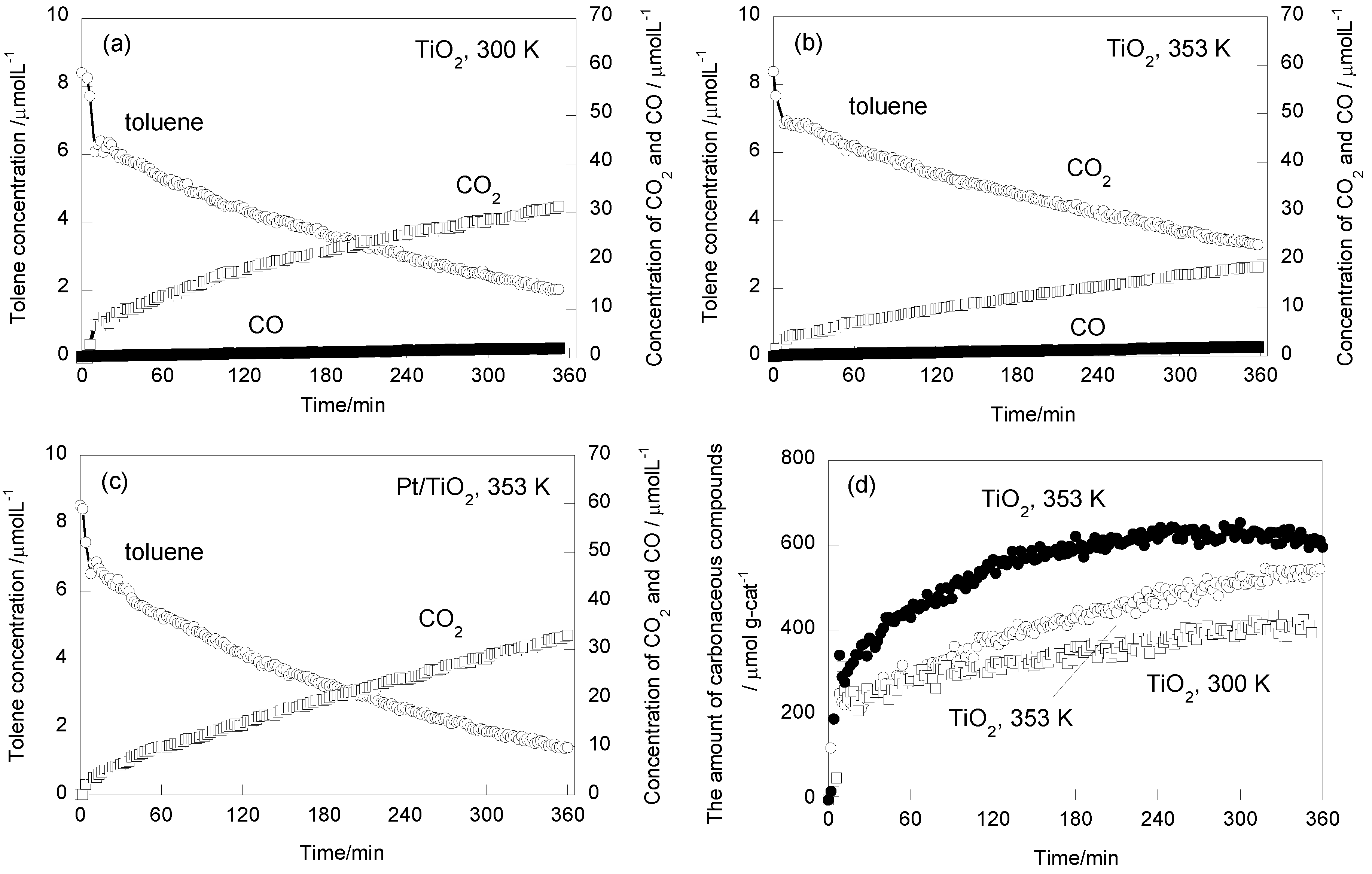
        <p>In our circulation recycling system, Pt/TiO<sub>2</sub> catalysts were effective under briefly heated condition. <xref ref-type="fig" rid="catalysts-03-00219-f007">Figure 7</xref> shows time course plots for toluene photooxidation over TiO<sub>2</sub> and platinized catalyst (1 wt%-Pt/TiO<sub>2</sub>) at 353 K. Here, the reaction rate was much lower than that in <xref ref-type="fig" rid="catalysts-03-00219-f001">Figure 1</xref>, because a different kind of photochemical reactor was used for toluene photooxidation (see Experimental Section). Photocatalytic activity of TiO<sub>2</sub> decreased and the amount of intermediate compounds increased by heating the catalyst up to 353 K. This behavior was ascribed to the decrease in H<sub>2</sub>O adsorption capacity of TiO<sub>2</sub> at elevated temperature, which resulted in the promotion of the accumulation of intermediate compounds on TiO<sub>2</sub>. On the other hand, Pt deposition on TiO<sub>2</sub> increased the toluene photooxidation at the same reaction temperature, although the amount of intermediate compounds formed on Pt/TiO<sub>2</sub> was larger than that on TiO<sub>2</sub>. Pt/TiO<sub>2</sub> catalyst was also effective for suppression of CO formation at 353 K, because CO concentration was lower than the detection limit (&lt;3 ppm).</p>
        <fig id="catalysts-03-00219-f007" position="float">
          <label>Figure 7</label>
          <caption>
            <p>Time course for toluene photooxidation with TiO<sub>2</sub> and Pt/TiO<sub>2</sub>. (<bold>a</bold>) Changes in concentration of toluene, CO<sub>2</sub> and CO on TiO<sub>2</sub> at 300 K; (<bold>b</bold>) on TiO<sub>2</sub> at 353 K and (<bold>c</bold>) on Pt/TiO<sub>2</sub> at 353 K; (<bold>d</bold>) Changes in the amount of intermediate compounds on TiO<sub>2</sub> and Pt/TiO<sub>2</sub>. [toluene]<sub>0</sub> = 8.4 μmol/L, [H<sub>2</sub>O] = 1.0%, [O<sub>2</sub>] = 20%.</p>
          </caption>
          <graphic xmlns:xlink="http://www.w3.org/1999/xlink" xlink:href="catalysts-03-00219-g007.tif"/>
        </fig>
      </sec>
    </sec>
    <sec>
      <title>3. Experimental Section</title>
      <sec>
        <title>3.1. Catalyst Materials</title>
        <p>Commercially available TiO<sub>2</sub> (P25; Nippon Aerosil Co. Ltd.; Tokyo, Japan) supplied from Catalysis Society of Japan as JRC-TIO-4) was used as catalyst and precursor of Pt/TiO<sub>2</sub> catalyst. The BET surface area was 54 m<sup>2</sup>/g. Pt deposition on TiO<sub>2</sub> was carried out by the photodeposition method, according to the procedure reported earlier [<xref ref-type="bibr" rid="B25-catalysts-03-00219">25</xref>,<xref ref-type="bibr" rid="B35-catalysts-03-00219">35</xref>]. The Pt loading was 1.0 wt%. CO chemisorption measurements revealed that Pt dispersion of Pt/TiO<sub>2</sub> was 16%. </p>
      </sec>
      <sec>
        <title>3.2. Photocatalytic Test Reaction</title>
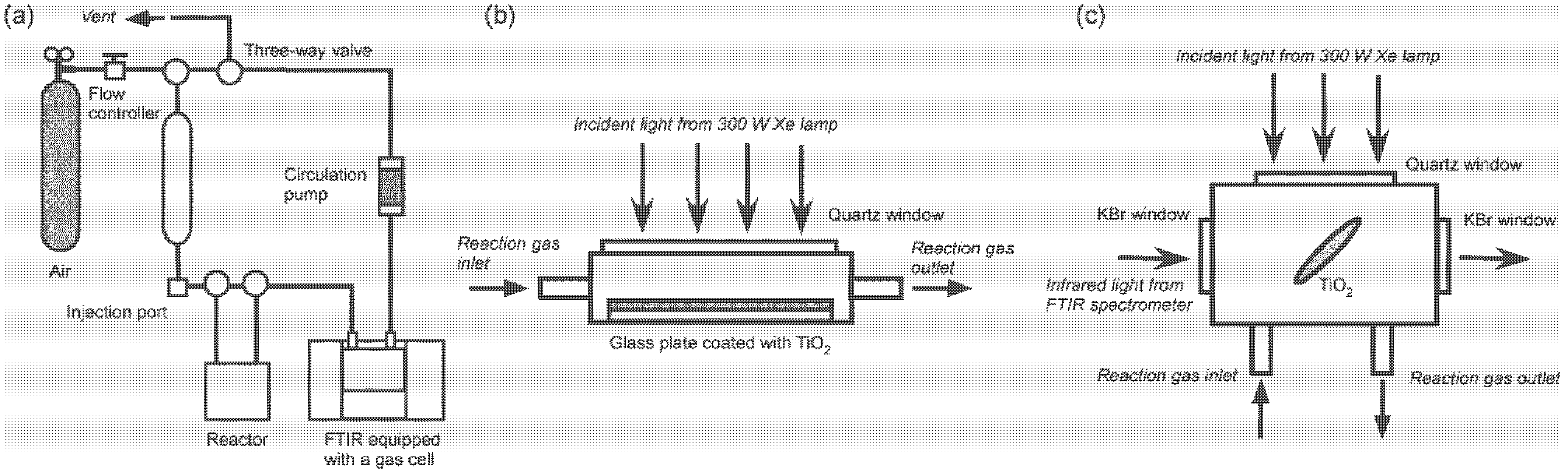
        <p>Photoreactions were carried out with a circulation system (<xref ref-type="fig" rid="catalysts-03-00219-f008">Figure 8</xref>a). The total volume of the system was 3.5 L. The photochemical reactor was fabricated from a Pyrex glass tube with a quartz glass window and contained a square-shaped glass plate (50 mm × 45 mm) (<xref ref-type="fig" rid="catalysts-03-00219-f008">Figure 8</xref>b). The catalyst was coated on one side of the glass plate from an aqueous slurry of catalyst powder and dried at 383 K. Catalyst weight on the plate was 0.10 g. Photoirradiation was carried out for the catalyst through the quartz glass window by a 300 W Xe lamp equipped with a UV-30 cut filter (λ &gt; 300 nm). Reaction gases were prepared by mixing toluene vapor with pure air. When reactions were carried out under humidified conditions, toluene and water vapor were introduced to the reaction gases with a syringe from the injection port. The reaction temperature was around 295 K. As a pretreatment, the catalyst was photoirradiated in air to decompose the organic impurities adsorbed on the TiO<sub>2</sub> surface. After the gas-solid adsorption equilibrium of the substrate was achieved in the reactor, photoirradiation was started. The circulating flow rate was 2.0 L/min. Concentrations of toluene, CO<sub>2</sub> and CO were simultaneously determined by an FTIR spectrometer (PerkinElmer Spectrum One) equipped with a gas cell (2.4 m path length, 0.20 L volume).</p>
        <fig id="catalysts-03-00219-f008" position="float">
          <label>Figure 8</label>
          <caption>
            <p>Schematic of photocatalytic reaction system and equipment for catalytic reaction and FTIR measurement. (<bold>a</bold>) Photocatalytic system; (<bold>b</bold>) reactor for toluene photooxidation and (<bold>c</bold>) <italic>in-situ</italic> FTIR cell.</p>
          </caption>
          <graphic xmlns:xlink="http://www.w3.org/1999/xlink" xlink:href="catalysts-03-00219-g008.tif"/>
        </fig>
        <p>In the case of catalytic toluene photooxidation under heated condition, a photochemical reactor with a cylindrical shape was used. The catalysts were loaded on a glass plate with the area of 9 cm<sup>2</sup> (3 cm × 3 cm) and then mounted in the photochemical reactor. A ceramic heater was contacted with the bottom side of the reactor to control the reaction temperature. This system can identify organic byproduct at the ppm level. Carbon balance was defined as 7-times the amount of the CO<sub>2</sub> (and CO) formed and divided by the amount of toluene reacted.</p>
      </sec>
      <sec>
        <title>3.3. FTIR Studies</title>
        <p>FTIR spectra of catalysts were measured on an FTIR spectrometer (PerkinElmer Spectrum One) equipped with a TGS detector and an <italic>in situ</italic> FTIR cell, which was connected to the circulation recycling system described above. The cell had a quartz glass window on the top and a set of connectors to allow reaction gases to flow through the cell (<xref ref-type="fig" rid="catalysts-03-00219-f008">Figure 8</xref>c). On both sides of the cell, KBr windows were placed. TiO<sub>2</sub> samples were pressed into thin disk (20 mm <italic>Ф</italic> in diameter) and placed in the cell. Photoirradiation was carried out with a 300 W Xe lamp equipped with a UV-30 cut filter from the quartz window. The catalyst sample was photoirradiated through the quartz window. FTIR spectra were taken from the KBr windows. Prior to the FTIR measurements, the catalyst sample was photoirradiated in humidified air.</p>
      </sec>
    </sec>
    <sec sec-type="conclusions">
      <title>4. Conclusions</title>
      <p>In this study, we investigated the toluene oxidation behavior on photoirradiated TiO<sub>2</sub> by using a circulation recycling system with a near-UV light source (λ &gt; 300 nm). The amount of intermediate compounds on TiO<sub>2</sub> was estimated, and their formation/oxidation behavior was compared with toluene photooxidation behavior. Water vapor in the reaction gas promoted the oxidation of these intermediate compounds to CO<sub>2</sub> and CO. FTIR studies showed that various kinds of oxygen-containing byproducts were formed in toluene photooxidation. The aliphatic C=O groups were formed without an induction period in the presence of water vapor, whereas there was a much longer induction period for their formation, revealing that the cleavage of the aromatic ring was promoted in the presence of water vapor. In the present system, deposition of Pt particles on TiO<sub>2</sub> has a detrimental effect on toluene photooxidation activity at room temperature (300 K). The amount of intermediate compounds on Pt/TiO<sub>2</sub> was higher than that with TiO<sub>2</sub> catalyst, and the rate for their oxidation to CO<sub>2</sub> was much lower. However, Pt deposition was effective for suppression of CO formation. When the catalyst was heated at 353 K, Pt/TiO<sub>2</sub> showed higher activity for toluene photooxidation than TiO<sub>2</sub>, although the intermediate compounds also increased by Pt deposition. </p>
    </sec>
  </body>
  <back>
    <notes>
      <title>Conflict of Interest</title>
      <p>The authors declare no conflict of interest. </p>
    </notes>
    <ref-list>
      <title>References</title>
      <ref id="B1-catalysts-03-00219">
        <label>1.</label>
        <citation citation-type="journal">
          <person-group person-group-type="author">
            <name>
              <surname>Linsebigler</surname>
              <given-names>A.L.</given-names>
            </name>
            <name>
              <surname>Lu</surname>
              <given-names>G.</given-names>
            </name>
            <name>
              <surname>Yates</surname>
              <given-names>J.T.</given-names>
              <suffix>Jr.</suffix>
            </name>
          </person-group>
          <article-title>Photocatalysis on TiO<sub>2</sub> surfaces: Principles, mechanisms, and selected results</article-title>
          <source>Chem. Rev.</source>
          <year>1995</year>
          <volume>95</volume>
          <fpage>735</fpage>
          <lpage>758</lpage>
          <pub-id pub-id-type="doi">10.1021/cr00035a013</pub-id>
        </citation>
      </ref>
      <ref id="B2-catalysts-03-00219">
        <label>2.</label>
        <citation citation-type="journal">
          <person-group person-group-type="author">
            <name>
              <surname>Hoffman</surname>
              <given-names>M.R.</given-names>
            </name>
            <name>
              <surname>Martin</surname>
              <given-names>S.T.</given-names>
            </name>
            <name>
              <surname>Choi</surname>
              <given-names>W.Y.</given-names>
            </name>
            <name>
              <surname>Bahnemann</surname>
              <given-names>D.W.</given-names>
            </name>
          </person-group>
          <article-title>Environmental applications of semiconductor photocatalysis</article-title>
          <source>Chem. Rev.</source>
          <year>1995</year>
          <volume>95</volume>
          <fpage>69</fpage>
          <lpage>96</lpage>
        <pub-id pub-id-type="doi">10.1021/cr00033a004</pub-id></citation>
      </ref>
      <ref id="B3-catalysts-03-00219">
        <label>3.</label>
        <citation citation-type="journal">
          <person-group person-group-type="author">
            <name>
              <surname>Agrios</surname>
              <given-names>A.G.</given-names>
            </name>
            <name>
              <surname>Pichat</surname>
              <given-names>P.</given-names>
            </name>
          </person-group>
          <article-title>State of the art and perspectives on materials and applications of photocatalysis over TiO<sub>2</sub></article-title>
          <source>J. Appl. Electrochem.</source>
          <year>2005</year>
          <volume>35</volume>
          <fpage>655</fpage>
          <lpage>663</lpage>
          <pub-id pub-id-type="doi">10.1007/s10800-005-1627-6</pub-id>
        </citation>
      </ref>
      <ref id="B4-catalysts-03-00219">
        <label>4.</label>
        <citation citation-type="journal">
          <person-group person-group-type="author">
            <name>
              <surname>Chen</surname>
              <given-names>X.</given-names>
            </name>
            <name>
              <surname>Mao</surname>
              <given-names>S.S.</given-names>
            </name>
          </person-group>
          <article-title>Titanium dioxide nanomaterials: Synthesis, properties, modifications, and applications</article-title>
          <source>Chem. Rev.</source>
          <year>2007</year>
          <volume>107</volume>
          <fpage>2891</fpage>
          <lpage>2959</lpage>
          <pub-id pub-id-type="doi">10.1021/cr0500535</pub-id>
        </citation>
      </ref>
      <ref id="B5-catalysts-03-00219">
        <label>5.</label>
        <citation citation-type="journal">
          <person-group person-group-type="author">
            <name>
              <surname>Ollis</surname>
              <given-names>D.F.</given-names>
            </name>
          </person-group>
          <article-title>Photocatalytic purification and remediation of contaminated air and water</article-title>
          <source>C. R. Acad. Sci. Ser.</source>
          <year>2000</year>
          <volume>3</volume>
          <fpage>405</fpage>
          <lpage>411</lpage>
        </citation>
      </ref>
      <ref id="B6-catalysts-03-00219">
        <label>6.</label>
        <citation citation-type="journal">
          <person-group person-group-type="author">
            <name>
              <surname>Wang</surname>
              <given-names>S.</given-names>
            </name>
            <name>
              <surname>Ang</surname>
              <given-names>H.M.</given-names>
            </name>
            <name>
              <surname>Tade</surname>
              <given-names>M.O.</given-names>
            </name>
          </person-group>
          <article-title>Volatile organic compounds in indoor environment and photocatalytic oxidation: State of the art</article-title>
          <source>Environ. Int.</source>
          <year>2007</year>
          <volume>33</volume>
          <fpage>694</fpage>
          <lpage>705</lpage>
          <pub-id pub-id-type="doi">10.1016/j.envint.2007.02.011</pub-id>
        </citation>
      </ref>
      <ref id="B7-catalysts-03-00219">
        <label>7.</label>
        <citation citation-type="journal">
          <person-group person-group-type="author">
            <name>
              <surname>Ibusuki</surname>
              <given-names>T.</given-names>
            </name>
            <name>
              <surname>Takeuchi</surname>
              <given-names>K.</given-names>
            </name>
          </person-group>
          <article-title>Toluene oxidation on U.V.-irradiated titanium dioxide with and without O<sub>2</sub>, NO<sub>2</sub> or H<sub>2</sub>O at ambient temperature</article-title>
          <source>Atmos. Environ.</source>
          <year>1986</year>
          <volume>20</volume>
          <fpage>1711</fpage>
          <lpage>1715</lpage>
          <pub-id pub-id-type="doi">10.1016/0004-6981(86)90119-8</pub-id>
        </citation>
      </ref>
      <ref id="B8-catalysts-03-00219">
        <label>8.</label>
        <citation citation-type="journal">
          <person-group person-group-type="author">
            <name>
              <surname>Obee</surname>
              <given-names>T.N.</given-names>
            </name>
            <name>
              <surname>Brown</surname>
              <given-names>R.T.</given-names>
            </name>
          </person-group>
          <article-title>TiO<sub>2</sub> photocatalysis for indoor air applications: effects of humidity and trace contaminant levels on the oxidation rates of formaldehyde, toluene, and 1,3-butadiene</article-title>
          <source>Environ. Sci. Technol.</source>
          <year>1995</year>
          <volume>29</volume>
          <fpage>1223</fpage>
          <lpage>1231</lpage>
          <pub-id pub-id-type="doi">10.1021/es00005a013</pub-id>
        </citation>
      </ref>
      <ref id="B9-catalysts-03-00219">
        <label>9.</label>
        <citation citation-type="journal">
          <person-group person-group-type="author">
            <name>
              <surname>Ameen</surname>
              <given-names>M.M.</given-names>
            </name>
            <name>
              <surname>Raupp</surname>
              <given-names>G.B.</given-names>
            </name>
          </person-group>
          <article-title>Reversible catalyst deactivation in the photocatalytic oxidation of dilute <italic>O</italic>-xylene in air</article-title>
          <source>J. Catal.</source>
          <year>1999</year>
          <volume>184</volume>
          <fpage>112</fpage>
          <lpage>122</lpage>
          <pub-id pub-id-type="doi">10.1006/jcat.1999.2442</pub-id>
        </citation>
      </ref>
      <ref id="B10-catalysts-03-00219">
        <label>10.</label>
        <citation citation-type="journal">
          <person-group person-group-type="author">
            <name>
              <surname>Cao</surname>
              <given-names>L.X.</given-names>
            </name>
            <name>
              <surname>Gao</surname>
              <given-names>Z.</given-names>
            </name>
            <name>
              <surname>Suib</surname>
              <given-names>S.L.</given-names>
            </name>
            <name>
              <surname>Obee</surname>
              <given-names>T.N.</given-names>
            </name>
            <name>
              <surname>Hay</surname>
              <given-names>S.O.</given-names>
            </name>
            <name>
              <surname>Freihaut</surname>
              <given-names>J.D.</given-names>
            </name>
          </person-group>
          <article-title>Photocatalytic oxidation of toluene on nanoscale TiO<sub>2</sub> catalysts: Studies of deactivation and regeneration</article-title>
          <source>J. Catal.</source>
          <year>1999</year>
          <volume>184</volume>
          <fpage>112</fpage>
          <lpage>122</lpage>
          <pub-id pub-id-type="doi">10.1006/jcat.1999.2442</pub-id>
        </citation>
      </ref>
      <ref id="B11-catalysts-03-00219">
        <label>11.</label>
        <citation citation-type="journal">
          <person-group person-group-type="author">
            <name>
              <surname>D'Hennezel</surname>
              <given-names>O.</given-names>
            </name>
            <name>
              <surname>Pichat</surname>
              <given-names>P.</given-names>
            </name>
            <name>
              <surname>Ollis</surname>
              <given-names>D.F.</given-names>
            </name>
          </person-group>
          <article-title>Benzene and toluene gas-phase photocatalytic degradation over H<sub>2</sub>O and HCL pretreated TiO<sub>2</sub> by-products and mechanisms</article-title>
          <source>J. Photochem. Photobiol. A</source>
          <year>1998</year>
          <volume>118</volume>
          <fpage>197</fpage>
          <lpage>204</lpage>
          <pub-id pub-id-type="doi">10.1016/S1010-6030(98)00366-9</pub-id>
        </citation>
      </ref>
      <ref id="B12-catalysts-03-00219">
        <label>12.</label>
        <citation citation-type="journal">
          <person-group person-group-type="author">
            <name>
              <surname>Mendez-Roman</surname>
              <given-names>R.</given-names>
            </name>
            <name>
              <surname>Cardona-Martinez</surname>
              <given-names>N.</given-names>
            </name>
          </person-group>
          <article-title>Relationship between the formation of surface species and catalyst deactivation during the gas-phase photocatalytic oxidation of toluene</article-title>
          <source>Catal. Today</source>
          <year>1998</year>
          <volume>40</volume>
          <fpage>353</fpage>
          <lpage>365</lpage>
          <pub-id pub-id-type="doi">10.1016/S0920-5861(98)00064-9</pub-id>
        </citation>
      </ref>
      <ref id="B13-catalysts-03-00219">
        <label>13.</label>
        <citation citation-type="journal">
          <person-group person-group-type="author">
            <name>
              <surname>Maira</surname>
              <given-names>A.J.</given-names>
            </name>
            <name>
              <surname>Coronado</surname>
              <given-names>J.M.</given-names>
            </name>
            <name>
              <surname>Augugliaro</surname>
              <given-names>V.</given-names>
            </name>
            <name>
              <surname>Yeung</surname>
              <given-names>K.L.</given-names>
            </name>
            <name>
              <surname>Conesa</surname>
              <given-names>J.C.</given-names>
            </name>
            <name>
              <surname>Soria</surname>
              <given-names>J.</given-names>
            </name>
          </person-group>
          <article-title>Fourier transform infrared study of the performance of nanostructured TiO<sub>2</sub> particles for the photocatalytic oxidation of gaseous toluene</article-title>
          <source>J. Catal.</source>
          <year>2001</year>
          <volume>202</volume>
          <fpage>413</fpage>
          <lpage>420</lpage>
        <pub-id pub-id-type="doi">10.1006/jcat.2001.3301</pub-id></citation>
      </ref>
      <ref id="B14-catalysts-03-00219">
        <label>14.</label>
        <citation citation-type="journal">
          <person-group person-group-type="author">
            <name>
              <surname>Marci</surname>
              <given-names>G.</given-names>
            </name>
            <name>
              <surname>Addamo</surname>
              <given-names>M.</given-names>
            </name>
            <name>
              <surname>Augugliaro</surname>
              <given-names>V.</given-names>
            </name>
            <name>
              <surname>Coluccia</surname>
              <given-names>S.</given-names>
            </name>
            <name>
              <surname>García-López</surname>
              <given-names>E.</given-names>
            </name>
            <name>
              <surname>Loddo</surname>
              <given-names>V.</given-names>
            </name>
            <name>
              <surname>Martra</surname>
              <given-names>G.</given-names>
            </name>
            <name>
              <surname>Palmisano</surname>
              <given-names>L.</given-names>
            </name>
            <name>
              <surname>Schiavello</surname>
              <given-names>M.</given-names>
            </name>
          </person-group>
          <article-title>Photocatalytic oxidation of toluene on irradiated TiO<sub>2</sub>: Comparison of degradation performance in humidified air, in water and in water containing a zwitterionic surfactant</article-title>
          <source>J. Photochem. Photobiol. A</source>
          <year>2003</year>
          <volume>160</volume>
          <fpage>105</fpage>
          <lpage>114</lpage>
          <pub-id pub-id-type="doi">10.1016/S1010-6030(03)00228-4</pub-id>
        </citation>
      </ref>
      <ref id="B15-catalysts-03-00219">
        <label>15.</label>
        <citation citation-type="journal">
          <person-group person-group-type="author">
            <name>
              <surname>Blount</surname>
              <given-names>M.C.</given-names>
            </name>
            <name>
              <surname>Falconer</surname>
              <given-names>J.L.</given-names>
            </name>
          </person-group>
          <article-title>Steady-state surface species during toluene photocatalysis</article-title>
          <source>Appl. Catal. B</source>
          <year>2002</year>
          <volume>139</volume>
          <fpage>39</fpage>
          <lpage>50</lpage>
        </citation>
      </ref>
      <ref id="B16-catalysts-03-00219">
        <label>16.</label>
        <citation citation-type="journal">
          <person-group person-group-type="author">
            <name>
              <surname>Debono</surname>
              <given-names>O.</given-names>
            </name>
            <name>
              <surname>Thevenet</surname>
              <given-names>F.</given-names>
            </name>
            <name>
              <surname>Gravejat</surname>
              <given-names>P.</given-names>
            </name>
            <name>
              <surname>Hequet</surname>
              <given-names>V.</given-names>
            </name>
            <name>
              <surname>Raillard</surname>
              <given-names>C.</given-names>
            </name>
            <name>
              <surname>Lecoq</surname>
              <given-names>L.</given-names>
            </name>
            <name>
              <surname>Locoge</surname>
              <given-names>N.</given-names>
            </name>
          </person-group>
          <article-title>Toluene photocatalytic oxidation at ppbv levels: Kinetic investigation and carbon balance determination</article-title>
          <source>Appl. Catal. B</source>
          <year>2011</year>
          <volume>106</volume>
          <fpage>600</fpage>
          <lpage>608</lpage>
          <pub-id pub-id-type="doi">10.1016/j.apcatb.2011.06.021</pub-id>
        </citation>
      </ref>
      <ref id="B17-catalysts-03-00219">
        <label>17.</label>
        <citation citation-type="journal">
          <person-group person-group-type="author">
            <name>
              <surname>Vildozo</surname>
              <given-names>D.</given-names>
            </name>
            <name>
              <surname>Portel</surname>
              <given-names>R.</given-names>
            </name>
            <name>
              <surname>Ferronato</surname>
              <given-names>C.</given-names>
            </name>
            <name>
              <surname>Chovelon</surname>
              <given-names>J.M.</given-names>
            </name>
          </person-group>
          <article-title>Photocatalytic oxidation of 2-propanol/toluene binary mixtures at indoor air concentration levels</article-title>
          <source>Appl. Catal. B</source>
          <year>2011</year>
          <volume>107</volume>
          <fpage>347</fpage>
          <lpage>354</lpage>
          <pub-id pub-id-type="doi">10.1016/j.apcatb.2011.07.035</pub-id>
        </citation>
      </ref>
      <ref id="B18-catalysts-03-00219">
        <label>18.</label>
        <citation citation-type="journal">
          <person-group person-group-type="author">
            <name>
              <surname>Sleiman</surname>
              <given-names>M.</given-names>
            </name>
            <name>
              <surname>Conchon</surname>
              <given-names>P.</given-names>
            </name>
            <name>
              <surname>Ferronato</surname>
              <given-names>C.</given-names>
            </name>
            <name>
              <surname>Chovelon</surname>
              <given-names>J.M.</given-names>
            </name>
          </person-group>
          <article-title>Photocatalytic oxidation of toluene at indoor air levels (ppbv): Towards a better assessment of conversion, reaction intermediates and mineralization</article-title>
          <source>Appl. Catal. B</source>
          <year>2009</year>
          <volume>86</volume>
          <fpage>159</fpage>
          <lpage>165</lpage>
          <pub-id pub-id-type="doi">10.1016/j.apcatb.2008.08.003</pub-id>
        </citation>
      </ref>
      <ref id="B19-catalysts-03-00219">
        <label>19.</label>
        <citation citation-type="journal">
          <person-group person-group-type="author">
            <name>
              <surname>Thompson</surname>
              <given-names>T.L.</given-names>
            </name>
            <name>
              <surname>Yates</surname>
              <given-names>J.T.</given-names>
              <suffix>Jr.</suffix>
            </name>
          </person-group>
          <article-title>TiO<sub>2</sub>-based photocatalysis: Surface defects, oxygen and charge transfer</article-title>
          <source>Top. Catal.</source>
          <year>2005</year>
          <volume>35</volume>
          <fpage>197</fpage>
          <lpage>210</lpage>
          <pub-id pub-id-type="doi">10.1007/s11244-005-3825-1</pub-id>
        </citation>
      </ref>
      <ref id="B20-catalysts-03-00219">
        <label>20.</label>
        <citation citation-type="journal">
          <person-group person-group-type="author">
            <name>
              <surname>Thompson</surname>
              <given-names>T.L.</given-names>
            </name>
            <name>
              <surname>Yates</surname>
              <given-names>J.T.</given-names>
              <suffix>Jr.</suffix>
            </name>
          </person-group>
          <article-title>Surface science studies of the photoactivation of TiO<sub>2</sub>-new photochemical processes</article-title>
          <source>Chem. Rev.</source>
          <year>2006</year>
          <volume>106</volume>
          <fpage>4428</fpage>
          <lpage>4453</lpage>
          <pub-id pub-id-type="doi">10.1021/cr050172k</pub-id>
        </citation>
      </ref>
      <ref id="B21-catalysts-03-00219">
        <label>21.</label>
        <citation citation-type="journal">
          <person-group person-group-type="author">
            <name>
              <surname>Henderson</surname>
              <given-names>M.A.</given-names>
            </name>
          </person-group>
          <article-title>A surface science perspective on TiO<sub>2</sub> photocatalysis</article-title>
          <source>Surf. Sci. Rep.</source>
          <year>2011</year>
          <volume>66</volume>
          <fpage>185</fpage>
          <lpage>297</lpage>
          <pub-id pub-id-type="doi">10.1016/j.surfrep.2011.01.001</pub-id>
        </citation>
      </ref>
      <ref id="B22-catalysts-03-00219">
        <label>22.</label>
        <citation citation-type="journal">
          <person-group person-group-type="author">
            <name>
              <surname>Fu</surname>
              <given-names>X.Z.</given-names>
            </name>
            <name>
              <surname>Zeltner</surname>
              <given-names>W.A.</given-names>
            </name>
            <name>
              <surname>Anderson</surname>
              <given-names>M.A.</given-names>
            </name>
          </person-group>
          <article-title>The gas-phase photocatalytic mineralization of benzene on porous titania-based catalysts</article-title>
          <source>Appl. Catal. B</source>
          <year>1995</year>
          <volume>6</volume>
          <fpage>209</fpage>
          <lpage>224</lpage>
          <pub-id pub-id-type="doi">10.1016/0926-3373(95)00017-8</pub-id>
        </citation>
      </ref>
      <ref id="B23-catalysts-03-00219">
        <label>23.</label>
        <citation citation-type="journal">
          <person-group person-group-type="author">
            <name>
              <surname>Li</surname>
              <given-names>Y.</given-names>
            </name>
            <name>
              <surname>Huang</surname>
              <given-names>J.C.</given-names>
            </name>
            <name>
              <surname>Peng</surname>
              <given-names>T.</given-names>
            </name>
            <name>
              <surname>Xu</surname>
              <given-names>J.</given-names>
            </name>
            <name>
              <surname>Zhao</surname>
              <given-names>X.J.</given-names>
            </name>
          </person-group>
          <article-title>Photothermocatalytic synergetic effect leads to high efficient detoxification of benzene on TiO<sub>2</sub> and Pt/TiO<sub>2</sub> nanocomposite</article-title>
          <source>ChemCatChem</source>
          <year>2010</year>
          <volume>2</volume>
          <fpage>1082</fpage>
          <lpage>1087</lpage>
          <pub-id pub-id-type="doi">10.1002/cctc.201000085</pub-id>
        </citation>
      </ref>
      <ref id="B24-catalysts-03-00219">
        <label>24.</label>
        <citation citation-type="journal">
          <person-group person-group-type="author">
            <name>
              <surname>Einaga</surname>
              <given-names>H.</given-names>
            </name>
            <name>
              <surname>Futamura</surname>
              <given-names>S.</given-names>
            </name>
            <name>
              <surname>Ibusuki</surname>
              <given-names>T.</given-names>
            </name>
          </person-group>
          <article-title>Photocatalytic decomposition of benzene over TiO<sub>2</sub> in a humidified airstream</article-title>
          <source>Phys. Chem. Chem. Phys.</source>
          <year>1999</year>
          <volume>1</volume>
          <fpage>4903</fpage>
          <lpage>4908</lpage>
          <pub-id pub-id-type="doi">10.1039/a906214i</pub-id>
        </citation>
      </ref>
      <ref id="B25-catalysts-03-00219">
        <label>25.</label>
        <citation citation-type="journal">
          <person-group person-group-type="author">
            <name>
              <surname>Einaga</surname>
              <given-names>H.</given-names>
            </name>
            <name>
              <surname>Futamura</surname>
              <given-names>S.</given-names>
            </name>
            <name>
              <surname>Ibusuki</surname>
              <given-names>T.</given-names>
            </name>
          </person-group>
          <article-title>Complete oxidation of benzene in gas phase by platinized titania photocatalysts</article-title>
          <source>Environ. Sci. Technol.</source>
          <year>2001</year>
          <volume>35</volume>
          <fpage>1880</fpage>
          <lpage>1884</lpage>
        <pub-id pub-id-type="doi">10.1021/es001690+</pub-id><pub-id pub-id-type="pmid">11355208</pub-id></citation>
      </ref>
      <ref id="B26-catalysts-03-00219">
        <label>26.</label>
        <citation citation-type="journal">
          <person-group person-group-type="author">
            <name>
              <surname>Einaga</surname>
              <given-names>H.</given-names>
            </name>
            <name>
              <surname>Futamura</surname>
              <given-names>S.</given-names>
            </name>
            <name>
              <surname>Ibusuki</surname>
              <given-names>T.</given-names>
            </name>
          </person-group>
          <article-title>Heterogeneous photocatalytic oxidation of benzene, toluene, cyclohexene and cyclohexane in humidified air, comparison of decomposition behavior on photoirradiated TiO<sub>2</sub> catalyst</article-title>
          <source>Appl. Catal. B</source>
          <year>2002</year>
          <volume>38</volume>
          <fpage>215</fpage>
          <lpage>225</lpage>
          <pub-id pub-id-type="doi">10.1016/S0926-3373(02)00056-5</pub-id>
        </citation>
      </ref>
      <ref id="B27-catalysts-03-00219">
        <label>27.</label>
        <citation citation-type="journal">
          <person-group person-group-type="author">
            <name>
              <surname>Einaga</surname>
              <given-names>H.</given-names>
            </name>
            <name>
              <surname>Ibusuki</surname>
              <given-names>T.</given-names>
            </name>
            <name>
              <surname>Futamura</surname>
              <given-names>S.</given-names>
            </name>
          </person-group>
          <article-title>Improvement of catalyst durability by deposition of Rh on TiO<sub>2</sub> in photooxidation of aromatic compounds</article-title>
          <source>Environ. Sci. Technol.</source>
          <year>2004</year>
          <volume>38</volume>
          <fpage>285</fpage>
          <lpage>289</lpage>
          <pub-id pub-id-type="doi">10.1021/es034336v</pub-id>
        </citation>
      </ref>
      <ref id="B28-catalysts-03-00219">
        <label>28.</label>
        <citation citation-type="journal">
          <person-group person-group-type="author">
            <name>
              <surname>Einaga</surname>
              <given-names>H.</given-names>
            </name>
            <name>
              <surname>Ibusuki</surname>
              <given-names>T.</given-names>
            </name>
            <name>
              <surname>Futamura</surname>
              <given-names>S.</given-names>
            </name>
          </person-group>
          <article-title>Photocatalytic oxidation of benzene in air</article-title>
          <source>J. Solar Energy Eng.</source>
          <year>2004</year>
          <volume>126</volume>
          <fpage>789</fpage>
          <lpage>793</lpage>
          <pub-id pub-id-type="doi">10.1115/1.1687402</pub-id>
        </citation>
      </ref>
      <ref id="B29-catalysts-03-00219">
        <label>29.</label>
        <citation citation-type="journal">
          <person-group person-group-type="author">
            <name>
              <surname>Suh</surname>
              <given-names>M.</given-names>
            </name>
            <name>
              <surname>Bagus</surname>
              <given-names>P.S.</given-names>
            </name>
            <name>
              <surname>Pak</surname>
              <given-names>S.</given-names>
            </name>
            <name>
              <surname>Rosynek</surname>
              <given-names>M.P.</given-names>
            </name>
            <name>
              <surname>Lunsford</surname>
              <given-names>J.H.</given-names>
            </name>
          </person-group>
          <article-title>Reactions of hydroxyl radicals on titania, silica, alumina, and gold surfaces</article-title>
          <source>J. Phys. Chem. B</source>
          <year>2000</year>
          <volume>104</volume>
          <fpage>2736</fpage>
          <lpage>2742</lpage>
          <pub-id pub-id-type="doi">10.1021/jp993653e</pub-id>
        </citation>
      </ref>
      <ref id="B30-catalysts-03-00219">
        <label>30.</label>
        <citation citation-type="journal">
          <person-group person-group-type="author">
            <name>
              <surname>Hernández-Alonso</surname>
              <given-names>M.D.</given-names>
            </name>
            <name>
              <surname>Tejedor-Tejedor</surname>
              <given-names>I.</given-names>
            </name>
            <name>
              <surname>Coronado</surname>
              <given-names>J.M.</given-names>
            </name>
            <name>
              <surname>Anderson</surname>
              <given-names>M.A.</given-names>
            </name>
          </person-group>
          <article-title>Operando FTIR study of the photocatalytic oxidation of methylcyclohexane and toluene in air over TiO<sub>2</sub>-ZrO<sub>2</sub> thin films: Influence of the aromaticity of the target molecule on deactivation</article-title>
          <source>Appl. Catal. B</source>
          <year>2011</year>
          <volume>101</volume>
          <fpage>283</fpage>
          <lpage>293</lpage>
          <pub-id pub-id-type="doi">10.1016/j.apcatb.2010.09.029</pub-id>
        </citation>
      </ref>
      <ref id="B31-catalysts-03-00219">
        <label>31.</label>
        <citation citation-type="journal">
          <person-group person-group-type="author">
            <name>
              <surname>Li</surname>
              <given-names>X.</given-names>
            </name>
            <name>
              <surname>Zhu</surname>
              <given-names>Z.</given-names>
            </name>
            <name>
              <surname>Zhao</surname>
              <given-names>Q.</given-names>
            </name>
            <name>
              <surname>Liu</surname>
              <given-names>S.</given-names>
            </name>
          </person-group>
          <article-title>FT-IR study of the photocatalytic degradation of gaseous toluene over UV-irradiated TiO<sub>2</sub> microballs: Enhanced performance by hydrothermal treatment in alkaline solution</article-title>
          <source>Appl. Surf. Sci.</source>
          <year>2011</year>
          <volume>257</volume>
          <fpage>4709</fpage>
          <lpage>4714</lpage>
        <pub-id pub-id-type="doi">10.1016/j.apsusc.2010.12.133</pub-id></citation>
      </ref>
      <ref id="B32-catalysts-03-00219">
        <label>32.</label>
        <citation citation-type="journal">
          <person-group person-group-type="author">
            <name>
              <surname>Augugliaro</surname>
              <given-names>V.</given-names>
            </name>
            <name>
              <surname>Coluccia</surname>
              <given-names>S.</given-names>
            </name>
            <name>
              <surname>Loddo</surname>
              <given-names>V.</given-names>
            </name>
            <name>
              <surname>Marchese</surname>
              <given-names>L.</given-names>
            </name>
            <name>
              <surname>Martra</surname>
              <given-names>G.</given-names>
            </name>
            <name>
              <surname>Palmisano</surname>
              <given-names>L.</given-names>
            </name>
            <name>
              <surname>Schiavello</surname>
              <given-names>M.</given-names>
            </name>
          </person-group>
          <article-title>Photocatalytic Oxidation of Gaseous Toluene on Anatase TiO<sub>2</sub> Catalyst: Mechanistic Aspects and FT-IR Investigation</article-title>
          <source>Appl. Catal. B</source>
          <year>1999</year>
          <volume>20</volume>
          <fpage>15</fpage>
          <lpage>27</lpage>
          <pub-id pub-id-type="doi">10.1016/S0926-3373(98)00088-5</pub-id>
        </citation>
      </ref>
      <ref id="B33-catalysts-03-00219">
        <label>33.</label>
        <citation citation-type="journal">
          <person-group person-group-type="author">
            <name>
              <surname>Martra</surname>
              <given-names>G.</given-names>
            </name>
            <name>
              <surname>Coluccia</surname>
              <given-names>S.</given-names>
            </name>
            <name>
              <surname>Marchese</surname>
              <given-names>L.</given-names>
            </name>
            <name>
              <surname>Augugliaro</surname>
              <given-names>V.</given-names>
            </name>
            <name>
              <surname>Loddo</surname>
              <given-names>V.</given-names>
            </name>
            <name>
              <surname>Palmisano</surname>
              <given-names>L.</given-names>
            </name>
            <name>
              <surname>Schiavello</surname>
              <given-names>M.</given-names>
            </name>
          </person-group>
          <article-title>The role of H<sub>2</sub>O in the photocatalytic oxidation of toluene in vapour phase on anatase TiO<sub>2</sub> catalyst a FTIR study</article-title>
          <source>Catal. Today</source>
          <year>1999</year>
          <volume>53</volume>
          <fpage>695</fpage>
          <lpage>702</lpage>
          <pub-id pub-id-type="doi">10.1016/S0920-5861(99)00156-X</pub-id>
        </citation>
      </ref>
      <ref id="B34-catalysts-03-00219">
        <label>34.</label>
        <citation citation-type="journal">
          <person-group person-group-type="author">
            <name>
              <surname>Deveau</surname>
              <given-names>P.A.</given-names>
            </name>
            <name>
              <surname>Arsac</surname>
              <given-names>F.</given-names>
            </name>
            <name>
              <surname>Thivel</surname>
              <given-names>P.X.</given-names>
            </name>
            <name>
              <surname>Ferronato</surname>
              <given-names>C.</given-names>
            </name>
            <name>
              <surname>Delpech</surname>
              <given-names>F.</given-names>
            </name>
            <name>
              <surname>Chovelon</surname>
              <given-names>J.M.</given-names>
            </name>
            <name>
              <surname>Kaluzny</surname>
              <given-names>P.</given-names>
            </name>
            <name>
              <surname>Monnetd</surname>
              <given-names>C.</given-names>
            </name>
          </person-group>
          <article-title>Different methods in TiO<sub>2</sub> photodegradation mechanism studies: Gaseous and TiO<sub>2</sub>-adsorbed phases</article-title>
          <source>J. Hazard. Mater.</source>
          <year>2007</year>
          <volume>144</volume>
          <fpage>692</fpage>
          <lpage>697</lpage>
          <pub-id pub-id-type="doi">10.1016/j.jhazmat.2007.01.097</pub-id>
        </citation>
      </ref>
      <ref id="B35-catalysts-03-00219">
        <label>35.</label>
        <citation citation-type="journal">
          <person-group person-group-type="author">
            <name>
              <surname>Einaga</surname>
              <given-names>H.</given-names>
            </name>
            <name>
              <surname>Harada</surname>
              <given-names>M.</given-names>
            </name>
            <name>
              <surname>Futamura</surname>
              <given-names>S.</given-names>
            </name>
            <name>
              <surname>Ibusuki</surname>
              <given-names>T.</given-names>
            </name>
          </person-group>
          <article-title>Generation of active sites for CO photooxidation on TiO<sub>2</sub> by platinum deposition</article-title>
          <source>J. Phys. Chem. B</source>
          <year>2003</year>
          <volume>107</volume>
          <fpage>9290</fpage>
          <lpage>9297</lpage>
        <pub-id pub-id-type="doi">10.1021/jp0343638</pub-id></citation>
      </ref>
    </ref-list>
  </back>
</article>