
<?xml version="1.0" encoding="UTF-8"?>
<!DOCTYPE article PUBLIC "-//NLM//DTD Journal Publishing DTD v2.3 20070202//EN" "journalpublishing.dtd">
<article xmlns:mml="http://www.w3.org/1998/Math/MathML" xmlns:xlink="http://www.w3.org/1999/xlink" xml:lang="en" article-type="rapid-communication">
  <front>
    <journal-meta>
      <journal-id journal-id-type="publisher-id">catalysts</journal-id>
      <journal-title>Catalysts</journal-title>
      <abbrev-journal-title abbrev-type="publisher">Catalysts</abbrev-journal-title>
      <abbrev-journal-title abbrev-type="pubmed">Catalysts</abbrev-journal-title>
      <issn pub-type="epub">2073-4344</issn>
      <publisher>
        <publisher-name>MDPI</publisher-name>
      </publisher>
    </journal-meta>
    <article-meta>
      <article-id pub-id-type="doi">10.3390/catal2040412</article-id>
      <article-id pub-id-type="publisher-id">catalysts-02-00412</article-id>
      <article-categories>
        <subj-group>
          <subject>Communication</subject>
        </subj-group>
      </article-categories>
      <title-group>
        <article-title>Alcohol Dehydrogenation with a Dual Site Ruthenium, Boron Catalyst Occurs at Ruthenium</article-title>

      </title-group>
      
      <contrib-group>
        <contrib contrib-type="author">
          <name>
            <surname>Lu</surname>
            <given-names>Zhiyao</given-names>
          </name>
        </contrib>
        <contrib contrib-type="author">
          <name>
            <surname>Malinoski</surname>
            <given-names>Brock</given-names>
          </name>
        </contrib>
        <contrib contrib-type="author">
          <name>
            <surname>Flores</surname>
            <given-names>Ana V.</given-names>
          </name>
        </contrib>
        <contrib contrib-type="author">
          <name>
            <surname>Conley</surname>
            <given-names>Brian L.</given-names>
          </name>
        </contrib>
        <contrib contrib-type="author">
          <name>
            <surname>Guess</surname>
            <given-names>Denver</given-names>
          </name>
        </contrib>
        <contrib contrib-type="author">
          <name>
            <surname>Williams</surname>
            <given-names>Travis J.</given-names>
          </name>
          <xref rid="c1-catalysts-02-00412" ref-type="corresp">*</xref>
        </contrib>
      </contrib-group>
     <aff id="af1-catalysts-02-00412">Loker Hydrocarbon Research Institute and Department of Chemistry, University of Southern California, Los Angeles, CA 90089-1661, USA</aff>
      <author-notes>
        <corresp id="c1-catalysts-02-00412"><label>*</label> Author  to whom correspondence should be addressed; Email: <email>travisw@usc.edu</email> </corresp>
      </author-notes>
      <pub-date pub-type="epub">
        <day>11</day>
        <month>10</month>
        <year>2012</year>
      </pub-date>
      <pub-date pub-type="collection"><month>12</month>
        <year>2012</year>
      </pub-date>
      <volume>2</volume>
      <issue>4</issue>
      <fpage>412</fpage>
      <lpage>421</lpage>
      <history>
        <date date-type="received">
          <day>14</day>
          <month>06</month>
          <year>2012</year>
        </date>
        <date date-type="rev-recd">
          <day>27</day>
          <month>08</month>
          <year>2012</year>
        </date>
        <date date-type="accepted">
          <day>05</day>
          <month>09</month>
          <year>2012</year>
        </date>
      </history>
      <permissions>
        <copyright-statement>©  2012 by the authors; licensee MDPI, Basel, Switzerland.</copyright-statement>
        <copyright-year>2012</copyright-year>
        <license xmlns:xlink="http://www.w3.org/1999/xlink" license-type="open-access" xlink:href="http://creativecommons.org/licenses/by/3.0/">
          <p>This article is an open-access article distributed under the terms and conditions of the Creative Commons Attribution license (http://creativecommons.org/licenses/by/3.0/).</p>
        </license>
      </permissions>
      <abstract>
        <p>The complex [(κ<sup>3</sup>-(<italic>N</italic>,<italic>N</italic>,<italic>O</italic>-py<sub>2</sub>B(Me)OH)Ru(NCMe)<sub>3</sub>]<sup>+</sup> TfO<sup>−</sup> (<bold>1</bold>) is a catalyst for transfer dehydrogenation of alcohols, which was designed to function through a cooperative transition state in which reactivity was split between boron and ruthenium. We show here both stoichiometric and catalytic evidence to support that in the case of alcohol oxidation, the mechanism most likely involves reactivity only at the ruthenium center.</p>
      </abstract>
      <kwd-group>
        <kwd>bifunctional catalyst</kwd>
        <kwd>oxidation</kwd>
        <kwd>hydride abstraction</kwd>
        <kwd>mechanism</kwd>
      </kwd-group>
    </article-meta>
  </front>
  <body>
    <sec sec-type="intro">
      <title>1. Introduction</title>
      <p>Dual site catalysts possess two active sites that cooperate to enable the formation and/or cleavage of functional groups that cannot be manipulated easily or selectively with single-site systems. Dual site catalysis involving ruthenium has been of high interest, particularly ligand-metal bifunctional catalysis wherein a proton in the ligand directs cleavage and formation of bonds to hydrogen [<xref ref-type="bibr" rid="B1-catalysts-02-00412">1</xref>,<xref ref-type="bibr" rid="B2-catalysts-02-00412">2</xref>,<xref ref-type="bibr" rid="B3-catalysts-02-00412">3</xref>,<xref ref-type="bibr" rid="B4-catalysts-02-00412">4</xref>]. Among other applications, such systems are of great research interest because of their potential for enabling formation and utilization of hydrogen [<xref ref-type="bibr" rid="B5-catalysts-02-00412">5</xref>,<xref ref-type="bibr" rid="B6-catalysts-02-00412">6</xref>,<xref ref-type="bibr" rid="B7-catalysts-02-00412">7</xref>].</p>
      <p>Our group is developing bifunctional catalysts for manipulating hydride groups, e.g., C–H and other X–H bonds [<xref ref-type="bibr" rid="B8-catalysts-02-00412">8</xref>]. In our ongoing efforts we have recently reported a dual site ruthenium, boron complex (<bold>1</bold>) that has diverse oxidative reactivity [<xref ref-type="bibr" rid="B9-catalysts-02-00412">9</xref>], and in its synthesis uncovered a remarkable agostic interaction, which defines a very rare sample of an acetonitrile ligand being replaced by C–H bond [<xref ref-type="bibr" rid="B10-catalysts-02-00412">10</xref>,<xref ref-type="bibr" rid="B11-catalysts-02-00412">11</xref>]. This complex highlighted important potential synergy between the reactivity of the boron and ruthenium centers. More recently we have found that <bold>1</bold> is among the most robust and efficient homogeneous systems for ammonia borane dehydrogenation [<xref ref-type="bibr" rid="B12-catalysts-02-00412">12</xref>,<xref ref-type="bibr" rid="B13-catalysts-02-00412">13</xref>,<xref ref-type="bibr" rid="B14-catalysts-02-00412">14</xref>], which makes it a candidate for commercialization as a hydrogen storage system [<xref ref-type="bibr" rid="B15-catalysts-02-00412">15</xref>].</p>
      <p>We report here on the mechanism of alcohol oxidation with <bold>1</bold>. Because mechanistic understanding is empowering for the development of new catalytic methods [<xref ref-type="bibr" rid="B16-catalysts-02-00412">16</xref>,<xref ref-type="bibr" rid="B17-catalysts-02-00412">17</xref>], we aim to understand <bold>1</bold> so that we and other might more effectively harness its remarkable reactivity. Here we will present evidence to show that, by contrast to the system’s original design, this catalyst’s oxidation of alcohols to ketones involves bond forming and breaking at only the ruthenium center.</p>
      <sec>
        <title>Design of a Dual Site Ruthenium, Boron Catalyst</title>
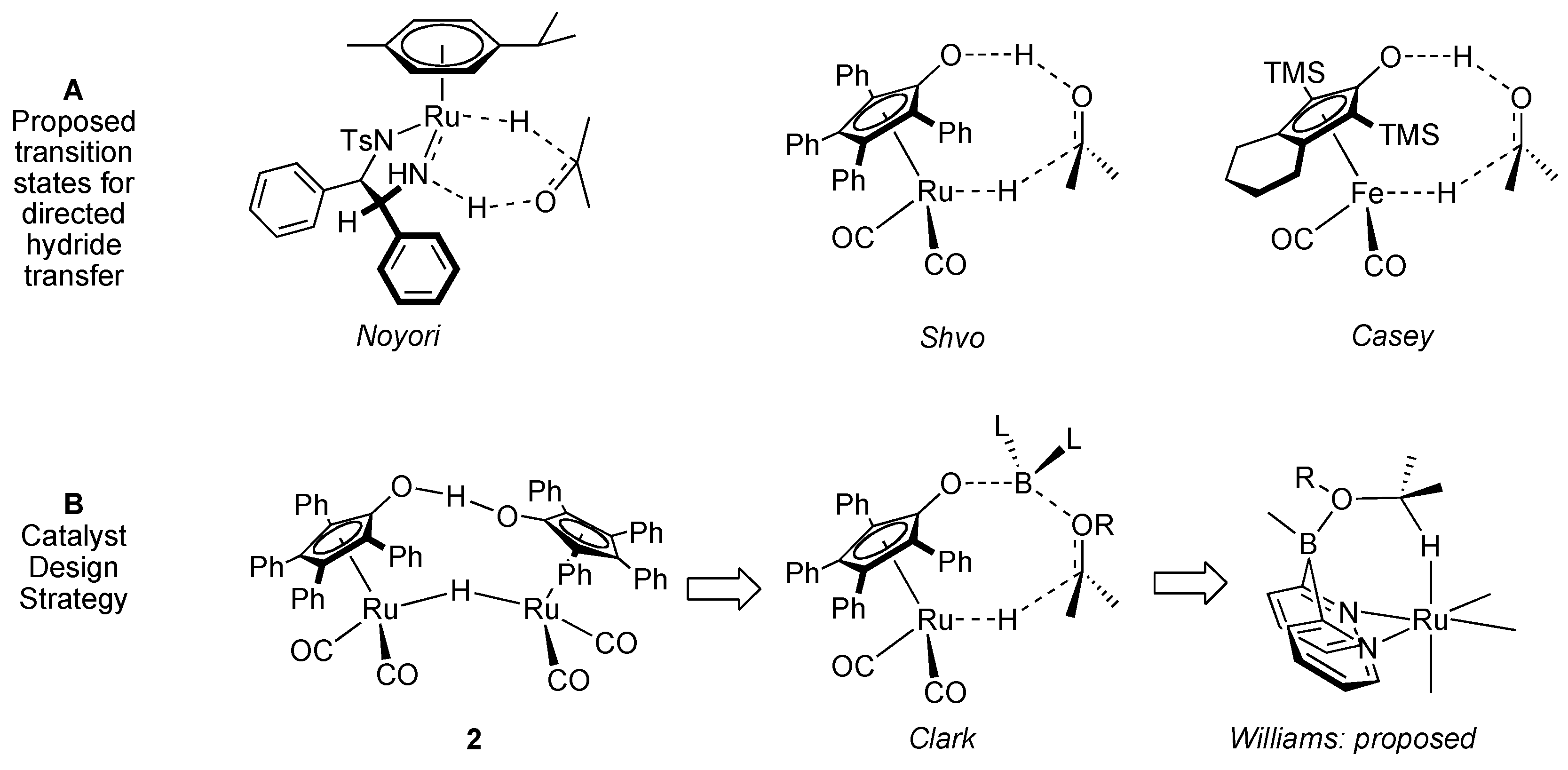
        <p>Our general design strategy to affect selective hydride manipulation is to devise catalysts that have two active sites that can work in concert to position and oxidize a particular substrate. Such a strategy is used prolifically in ligand, metal bifunctional catalysts, such as those pioneered by Noyori [<xref ref-type="bibr" rid="B18-catalysts-02-00412">18</xref>] and Shvo [<xref ref-type="bibr" rid="B19-catalysts-02-00412">19</xref>,<xref ref-type="bibr" rid="B20-catalysts-02-00412">20</xref>,<xref ref-type="bibr" rid="B21-catalysts-02-00412">21</xref>,<xref ref-type="bibr" rid="B22-catalysts-02-00412">22</xref>] (<xref ref-type="fig" rid="catalysts-02-00412-f001">Figure 1</xref>). In these systems, a hydrogen bond is used to position a protic substrate with a C–H bond in the proximity of a ruthenium center, from which the hydrogen group is abstracted. </p>
        <fig id="catalysts-02-00412-f001" position="anchor">
          <label>Figure 1</label>
          <caption>
            <p>Coordination-directed hydride transfer.</p>
          </caption>
          <graphic xmlns:xlink="http://www.w3.org/1999/xlink" xlink:href="catalysts-02-00412-g001.tif"/>
        </fig>
        <p>Our general strategy of devising a catalyst with a built-in Lewis acid to direct the metal to a particular substrate is analogous to these. Along these lines, the Shvo mechanism is similar to the Noyori systems and has been studied previously by Shvo [<xref ref-type="bibr" rid="B23-catalysts-02-00412">23</xref>], Casey [<xref ref-type="bibr" rid="B24-catalysts-02-00412">24</xref>,<xref ref-type="bibr" rid="B25-catalysts-02-00412">25</xref>], Bäckvall [<xref ref-type="bibr" rid="B6-catalysts-02-00412">6</xref>,<xref ref-type="bibr" rid="B26-catalysts-02-00412">26</xref>,<xref ref-type="bibr" rid="B27-catalysts-02-00412">27</xref>] us [<xref ref-type="bibr" rid="B28-catalysts-02-00412">28</xref>], and others. Alcohol oxidation with <bold>1</bold> has isotope effects on both C–<italic>H</italic> (<italic>k</italic><sub>H</sub>/<italic>k</italic><sub>D</sub> = 2.6) and O–<italic>H</italic>(<italic>k</italic><sub>H</sub>/<italic>k</italic><sub>D</sub> = 1.8), which indicates that both of these hydrogen atoms are transferred in (or possibly before) the rate-determining transition state (<xref ref-type="fig" rid="catalysts-02-00412-f001">Figure 1</xref>A) [<xref ref-type="bibr" rid="B27-catalysts-02-00412">27</xref>]. Further, <bold>1</bold>-catalyzed oxidation of 1-phenylethanol has a Hammett ρ value of −0.9, which is larger than expected for a transition state involving β-hydride elimination (ρ = −0.43) [<xref ref-type="bibr" rid="B29-catalysts-02-00412">29</xref>] or free-radical hydrogen atom transfer (ρ = −0.3) [<xref ref-type="bibr" rid="B30-catalysts-02-00412">30</xref>].</p>
        <p>Our design is to replace the hydrogen atom in the Shvo transition state with a boron atom (<xref ref-type="fig" rid="catalysts-02-00412-f001">Figure 1</xref>B) [<xref ref-type="bibr" rid="B31-catalysts-02-00412">31</xref>]. By replacing the proton in the transition state with a Lewis acid, we propose to enable abstraction of hydrides from groups other than alcohols [<xref ref-type="bibr" rid="B28-catalysts-02-00412">28</xref>]. Our first plan to prepare a dual site ruthenium, boron hydride transfer catalyst was to functionalize Shvo’s catalyst with a boronic ester as sketched in <bold>4</bold> (<xref ref-type="fig" rid="catalysts-02-00412-f005">Scheme 1</xref>) [<xref ref-type="bibr" rid="B32-catalysts-02-00412">32</xref>]. Along these lines, Tim Clark has realized such a transition state with the Shvo scaffold in reduction chemistry, and has reported that <bold>5</bold> will catalyze aldehyde and aldimine hydroboration with a transition state such as <bold>4</bold> [<xref ref-type="bibr" rid="B33-catalysts-02-00412">33</xref>]. By contrast, we have not been able to observe oxidative chemistry with the Shvo system in the presence of pinacol borane. </p>
        <fig id="catalysts-02-00412-f005" position="anchor">
          <object-id pub-id-type="pii">catalysts-02-00412-scheme1_Scheme 1</object-id>
          <label>Scheme 1</label>
          <caption>
            <p>A boron-functionalized homolog of the Shvo catalyst.</p>
          </caption>
          <graphic xmlns:xlink="http://www.w3.org/1999/xlink" xlink:href="catalysts-02-00412-g005.tif"/>
        </fig>
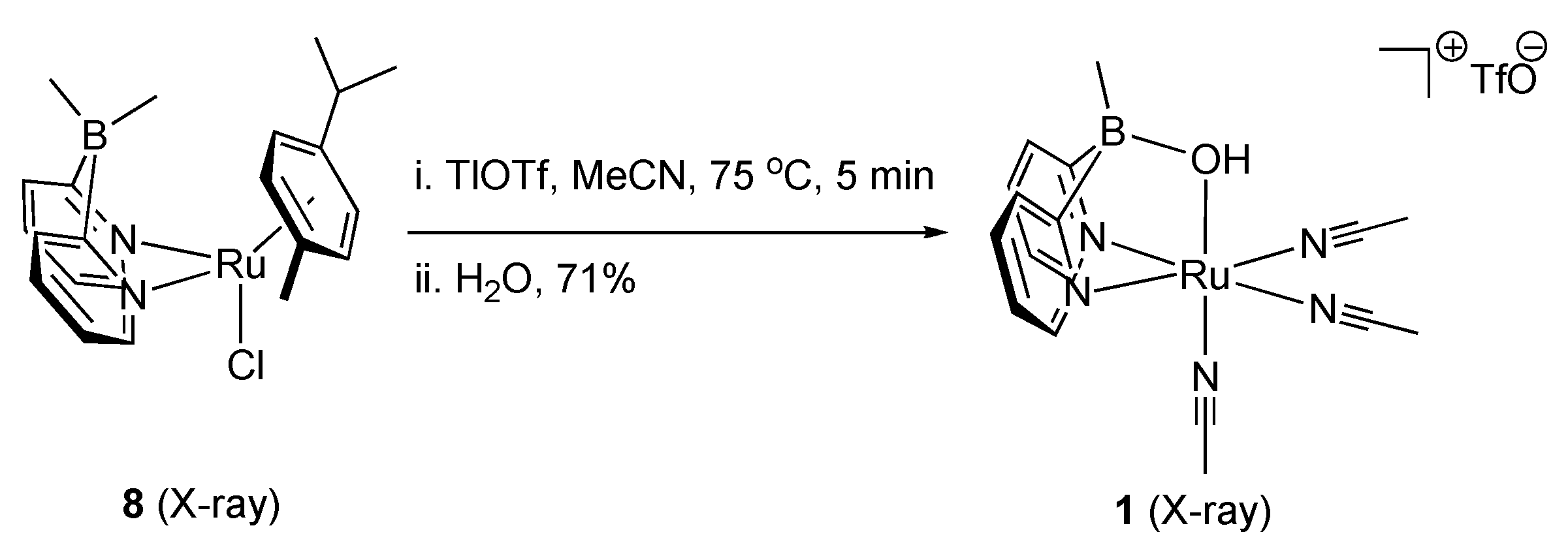
        <p>To overcome the apparent limitations of the Shvo system for catalytic, boron-directed oxidation, we prepared dual-site ruthenium, boron complexes <bold>8</bold> and <bold>1</bold> (<xref ref-type="fig" rid="catalysts-02-00412-f006">Scheme 2</xref>) [<xref ref-type="bibr" rid="B9-catalysts-02-00412">9</xref>]. which are characterized by X-ray crystallography [<xref ref-type="bibr" rid="B34-catalysts-02-00412">34</xref>]. Our mechanistic design for dual site oxidation chemistry with these is sketched in <xref ref-type="fig" rid="catalysts-02-00412-f007">Scheme 3</xref>C. In this plan, <bold>1</bold> will substitute an alcohol substrate for its bridging hydroxyl group, which will be driven by the formation of water. The result will be a bridging alkoxide (<bold>12</bold>), which we proposed should rearrange to enable hydride abstraction from the pendant alkoxyborate through a transition state akin to <bold>12</bold> to give a ruthenium hydride and ketone product (<bold>13</bold>). </p>
        <fig id="catalysts-02-00412-f006" position="anchor">
          <object-id pub-id-type="pii">catalysts-02-00412-scheme2_Scheme 2</object-id>
          <label>Scheme 2</label>
          <caption>
            <p>Dual site ruthenium, boron complexes.</p>
          </caption>
          <graphic xmlns:xlink="http://www.w3.org/1999/xlink" xlink:href="catalysts-02-00412-g006.tif"/>
        </fig>
        
      </sec>
    </sec>
    <sec sec-type="results">
      <title>2. Results and Discussion</title>
      <sec>
        <title>2.1. Stoichiometric Studies</title>
        <p>C–H bond cleavage steps of three likely candidates for the mechanism of alcohol oxidation with <bold>1</bold> are sketched in <xref ref-type="fig" rid="catalysts-02-00412-f007">Scheme 3</xref>. They include (A) a β-hydride elimination from a coordinated alkoxide. This type of mechanism is common for transfer dehydrogenation of alcohols with phosphine-ligated ruthenium(II) catalysts [<xref ref-type="bibr" rid="B29-catalysts-02-00412">29</xref>,<xref ref-type="bibr" rid="B35-catalysts-02-00412">35</xref>]. A second possibility (B) is a Shvo-like mechanism wherein the bridging hydroxyl directs the alkoxide to the metal center [<xref ref-type="bibr" rid="B24-catalysts-02-00412">24</xref>,<xref ref-type="bibr" rid="B36-catalysts-02-00412">36</xref>]. Our designed mechanism (C) is also possible. </p>
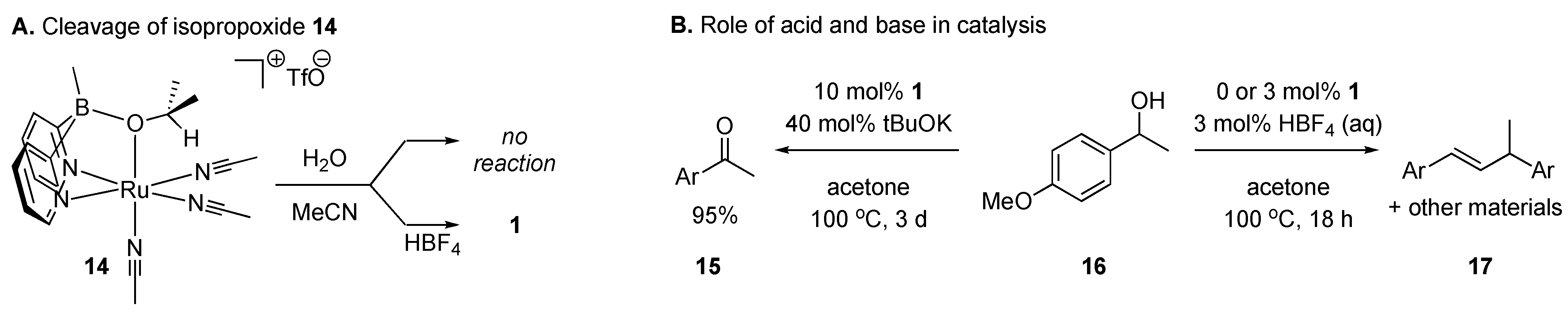
        <p>Our stoichiometric studies of this mechanism revealed key insights into the reactivity of the proposed intermediates (<xref ref-type="fig" rid="catalysts-02-00412-f008">Scheme 4</xref>A). First we observed that substitution of the hydroxide bridge of <bold>1</bold> is slow: heating <bold>1</bold> in isopropanol did not result in hydroxide substitution at neutral pH. Conversely, the desired bridged isopropoxy complex <bold>14</bold> (independently prepared) is inert to reaction with neutral water in acetonitrile solution. This exchange is facile, however, in the presence of aqueous acid. Treatment of alcohol <bold>1</bold><bold>6</bold> with <bold>1</bold> results in divergent outcomes depending on conditions (<xref ref-type="fig" rid="catalysts-02-00412-f008">Scheme 4</xref>B): when the catalyst is activated with acid, no oxidative pathways are observed. In these conditions, we see elimination and apparent carbocation chemistry with or without <bold>1</bold>. In the presence of base, however, selective and high yielding oxidation of the alcohol to the corresponding ketone is possible (with concurrent formation of iPrOH-<italic>d</italic><sub>6</sub>). Taken together, these observations indicate that <bold>1</bold>’s μ-OH group is not labile under the conditions of alcohol oxidation catalysis.</p>
        <fig id="catalysts-02-00412-f007" position="anchor">
          <object-id pub-id-type="pii">catalysts-02-00412-scheme3_Scheme 3</object-id>
          <label>Scheme 3</label>
          <caption>
            <p>Mechanisms for base-mediated oxidation with <bold>1</bold>.</p>
          </caption>
          <graphic xmlns:xlink="http://www.w3.org/1999/xlink" xlink:href="catalysts-02-00412-g007.tif"/>
        </fig>
        <fig id="catalysts-02-00412-f008" position="anchor">
          <object-id pub-id-type="pii">catalysts-02-00412-scheme4_Scheme 4</object-id>
          <label>Scheme 4</label>
          <caption>
            <p>Labiality of μ-ORgroups in <bold>1</bold>: Roles of acid and base.</p>
          </caption>
          <graphic xmlns:xlink="http://www.w3.org/1999/xlink" xlink:href="catalysts-02-00412-g008.tif"/>
        </fig>
      </sec>
      <sec>
        <title>2.2. Catalytic Studies</title>
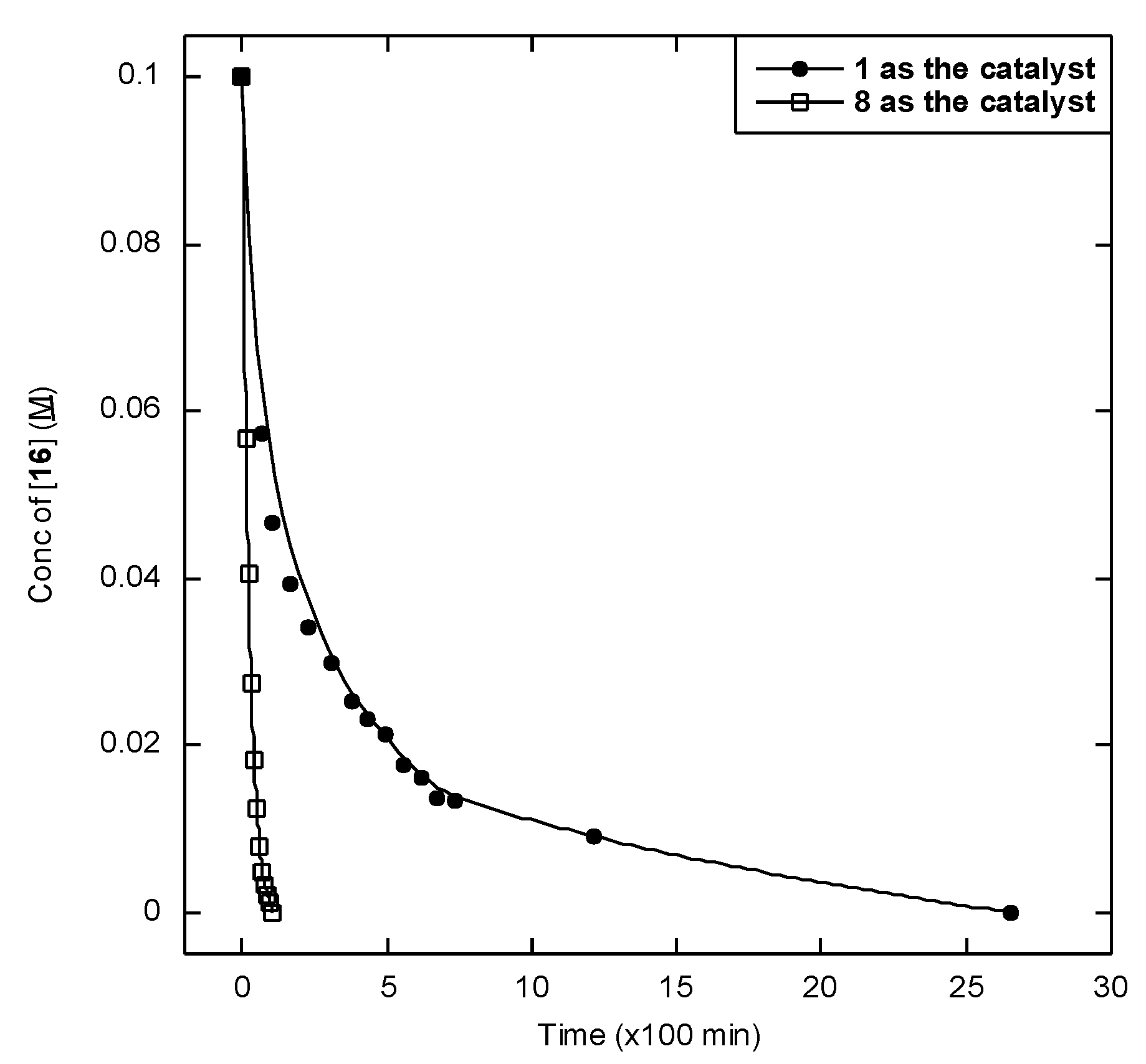
        <p>In catalytic experiments, we have shown that cymene adduct <bold>8</bold> is a more reactive catalyst for alcohol oxidation than <bold>1 </bold>(<xref ref-type="fig" rid="catalysts-02-00412-f002">Figure 2</xref>). This provides further data refuting a (B) or (C) class mechanism: a class (B) mechanism would require the presence of the μ-OH group of <bold>1</bold>, and a class (C) mechanism would necessitate a free Lewis acid site on boron. Neither of these is available in catalyst precursor <bold>8</bold>, yet alcohol oxidation with <bold>8</bold> is far faster than alcohol oxidation with <bold>1</bold> under analogous conditions.</p>
        
        <p>In analyzing the above data, one must consider a scenario in which a methylborate group in <bold>8</bold> is cleaved in the course of the reaction to reveal a boron hydroxide or a free Lewis acid. To test this hypothesis, we compared the <sup>11</sup>B NMR chemical shifts of the materials formed in situ at the conclusion of the reaction of <bold>8</bold> with <bold>16</bold> with the <sup>11</sup>B chemical shifts of <bold>8</bold> and <bold>1</bold>. The catalytic species in this reaction appear to speciate into three boron-containing moieties, which appear at <sup>11</sup>B δ = −14.1, −14.7, and −15.4 ppm. By comparison, the corresponding <sup>11</sup>B NMR chemical shifts for <bold>8</bold> and <bold>1</bold> are −12.0 and −8.1 ppm in acetone, respectively. Thus, because the <sup>11</sup>B species of this reaction are upfield of <bold>8</bold> and <bold>1</bold> is downfield, we surmise that if a methylborate group is cleaved in <bold>8</bold> in the course of this reaction, it is not converted to a boron hydroxide.</p>
        <fig id="catalysts-02-00412-f002" position="anchor">
          <label>Figure 2</label>
          <caption>
            <p>Oxidation of <bold>16</bold> (10 μL, 71 μmol) by <bold>1</bold> (4.1 mg, 8.7 μmol, 12 mol%) and <bold>8</bold> (4.6 mg, 8.7 μmol, 12 mol%) in acetone<italic>-d</italic><sub>6</sub> (0.7 mL) in the presence of potassium <italic>tert</italic>-butoxide (1.6 mg, 14 μmol, 20 mol%) at 100 °C in a sealed J-Young tube. Points are plotted for the concentration of <bold>16</bold> <italic>vs</italic>. time, where circles and squares respectively represent reactions catalyzed by <bold>8</bold> and <bold>1</bold>.</p>
          </caption>
          <graphic xmlns:xlink="http://www.w3.org/1999/xlink" xlink:href="catalysts-02-00412-g002.tif"/>
        </fig>
      </sec>
    </sec>
    <sec sec-type="methods">
      <title>3. Experimental</title>
      <sec sec-type="methods">
        <title>3.1. General Procedures</title>
        <p>All air and water sensitive procedures were carried out either in a Vacuum Atmosphere glove box under nitrogen (0.5–10 ppm O<sub>2</sub> for all manipulations) or using standard Schlenk techniques under nitrogen. Deuterated NMR solvents were purchased from Cambridge Isotopes Laboratories. Benzene-<italic>d</italic><sub>6</sub> and acetonitrile-<italic>d</italic><sub>3</sub> were dried over sodium benzophenone ketyl and calcium hydride, respectively, and distilled prior to use. Anhydrous iPrOH was distilled from NaOiPr, stirred over molecular sieves and silica gel for 20 h, then filtered through a Millipore filter prior to use. Shvo’s catalyst was purchased from Strem Chemicals. <sup>1</sup>H and <sup>11</sup>B NMR spectra were obtained on a Varian 600 spectrometer (600 MHz in <sup>1</sup>H, 192 MHz in <sup>11</sup>B) with chemical shifts reported in units of ppm. All <sup>1</sup>H chemical shifts are referenced to the residual <sup>1</sup>H solvent (relative to TMS). All <sup>11</sup>B chemical shifts are referenced to a BF<sub>3</sub>-OEt<sub>2</sub> in diglyme in a co-axial external standard (0 ppm). NMR spectra were taken in 8” J-Young tubes (Wilmad) with Teflon valve plugs. The NMR tubes were shaken vigorously for several minutes with chlorotrimethylsilane then dried in vacuo on a Schlenk line prior to use. Compound <bold>1</bold> and <bold>8</bold> were synthesized according to our published procedure [<xref ref-type="bibr" rid="B4-catalysts-02-00412">4</xref>].</p>
      </sec>
      <sec>
        <title>3.2. Trisacetonitrile μ-Isopropoxy Ruthenium Triflate 14</title>
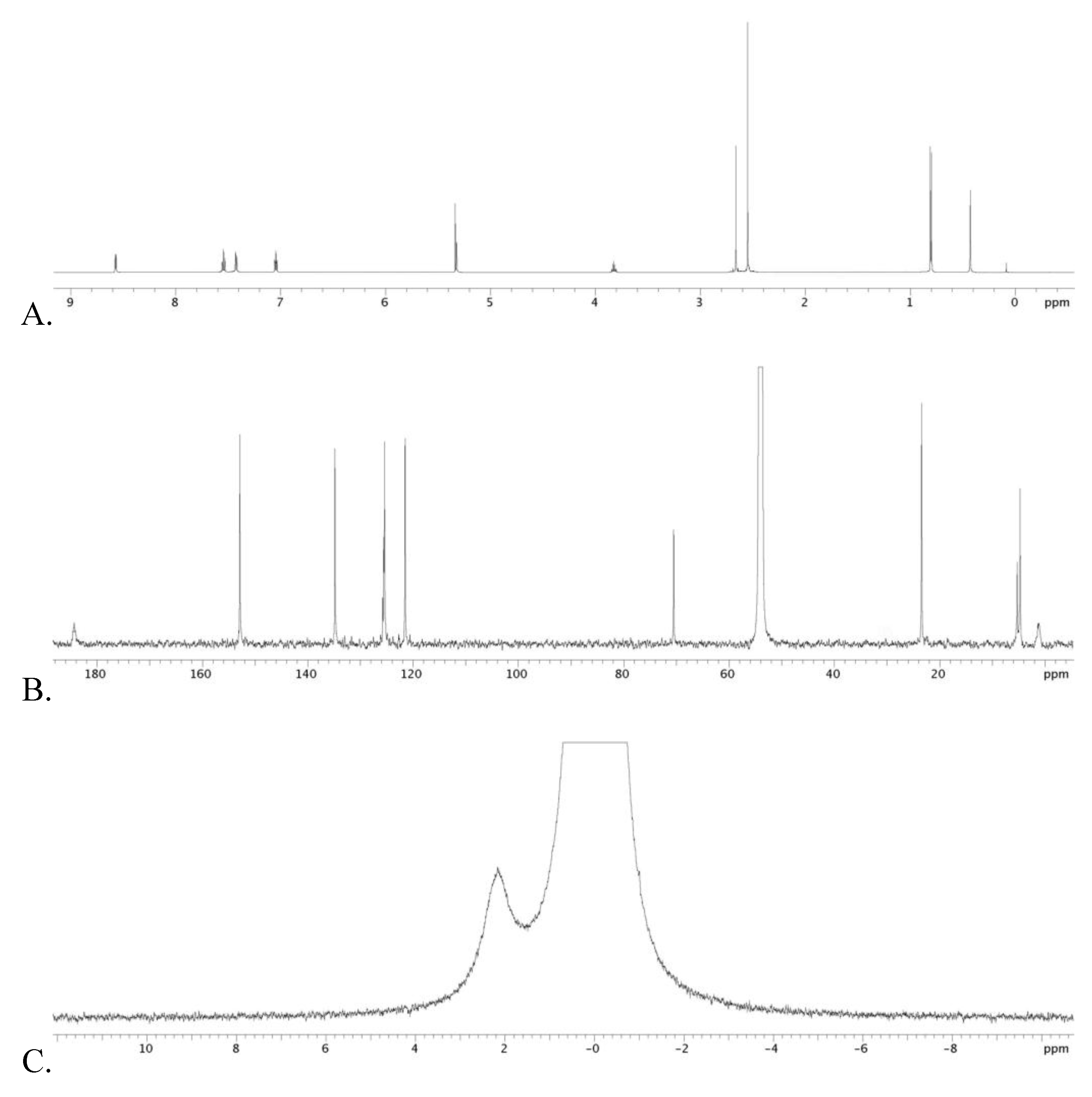
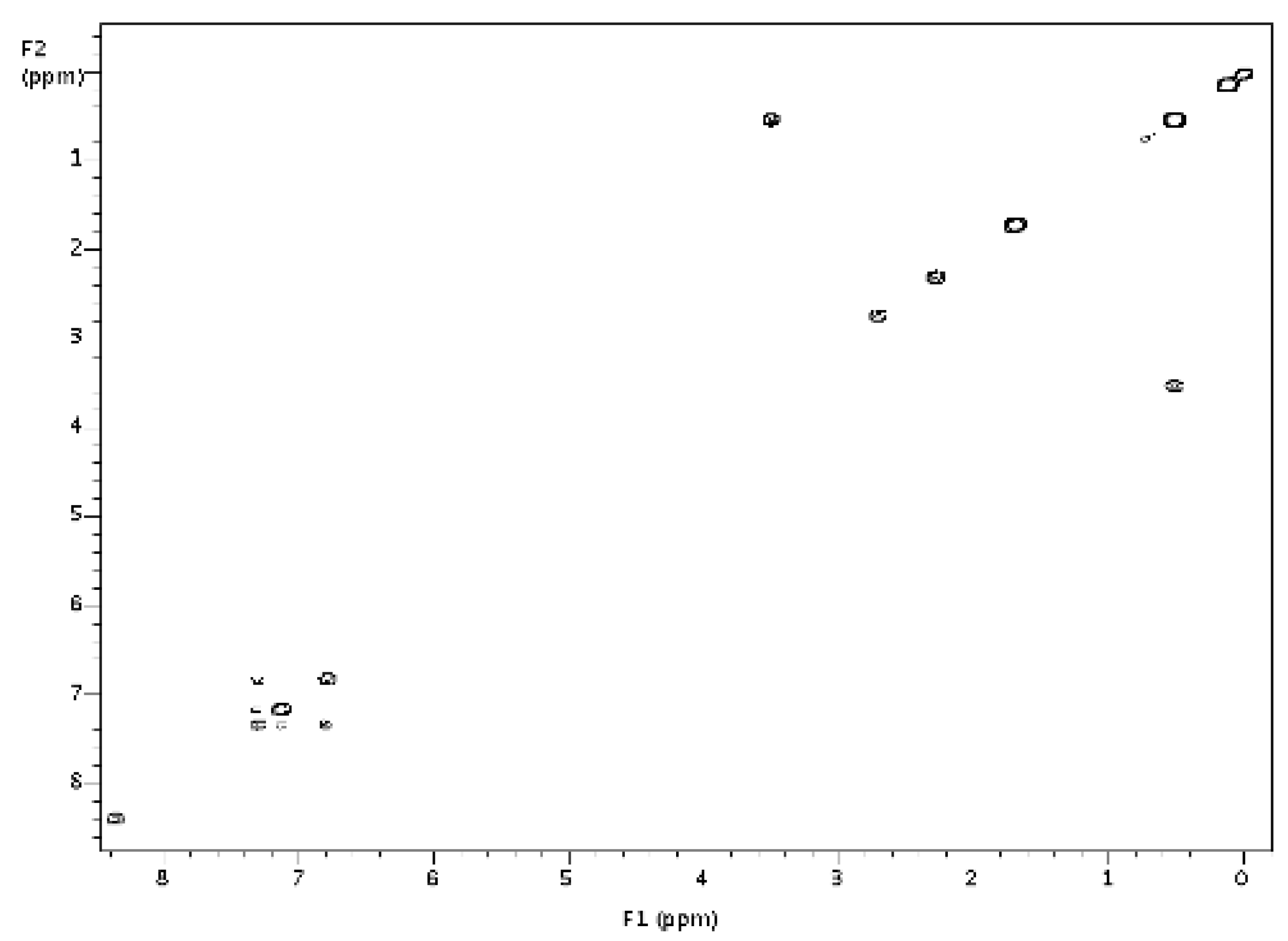
        <p><bold>14</bold> was generated <italic>in situ</italic> according to the following procedure. In a glove box, <bold>1</bold> (10.0 mg, 11 μmol) was dissolved in dichloromethane (0.6 mL) in a 8 inch J-Young tube that had been pre-treated with chlorotrimethylsilane. Silane residue had been removed under reduced pressure before use. Trifluoroacetic anhydride (5.0 μL, 38 μmol, 2.0 eq.(molar equivalents)) was added to the tube. The mixture was then heated to 60 °C for 20 h and cooled to room temperature, then anhydrous iPrOH (7.3 μL, 96 μmol, 5 eq) was added to the J-Young tube in the glove box. The reaction mixture was heated at 60 °C for 20 h. All volatiles were removed under reduced pressure on the Schlenk line. Recrystallization from dichloromethane/hexane yielded a pale yellow solid 2.3 mg (21%) (see <xref ref-type="fig" rid="catalysts-02-00412-f003">Figure 3</xref> and, <xref ref-type="fig" rid="catalysts-02-00412-f004">Figure 4</xref> for NMR spectra).</p>
        
       
        <p><sup>1</sup>H NMR (600 MHz in dichloromethane-<italic>d</italic><sub>2</sub> at 25 °C): δ = 8.57 (d, pyridyl 2H, <italic>J</italic> = 5.6 Hz), 7.59 (dt, pyridyl 2H, <italic>J</italic> = 1.6, 7.6 Hz), 7.39 (d, pyridyl 2H, <italic>J</italic> = 7.8 Hz), 7.07 (dt, pyridyl 2H, <italic>J</italic> = 1.6, 6.6 Hz), 3.82 (m, (CH<sub>3</sub>)<sub>2</sub>C<italic>H</italic>-O, 1H), 2.66 (s, C<italic>H</italic><sub>3</sub>CN axial, 3H), 2.55 (s, C<italic>H</italic><sub>3</sub>CN equatorial, 6H), 0.80 (d, (C<italic>H<sub>3</sub></italic>)<sub>2</sub>CH–O 6H, <italic>J</italic> = 6.4 Hz), 0.43 (s, C<italic>H<sub>3</sub></italic>–B 3H). <sup>13</sup>C{<sup>1</sup>H} NMR (150.84 MHz in dichloromethane-<italic>d</italic><sub>2</sub> at 25 °C) δ = 184.33 (broad s, ipso pyridyl-B), 152.87 (pyridyl), 134.81 (pyridyl), 125.73 (axial CH<sub>3</sub><italic>C</italic>N), 125.53 (equatorial CH<sub>3</sub><italic>C</italic>N), 125.39 (pyridyl), 121,48 (pyridyl), 70.49 ((CH<sub>3</sub>)<sub>2</sub><italic>C</italic>H–O), 23.42 ((<italic>C</italic>H<sub>3</sub>)<sub>2</sub>CH–O), 5.27 (axial <italic>C</italic>H<sub>3</sub>CN), 4.70 (equatorial <italic>C</italic>H<sub>3</sub>CN), 1.33 (broad s, <italic>C</italic>H<sub>3</sub>-B). <sup>11</sup>B{<sup>1</sup>H} (192 MHz in dichloromethane-<italic>d</italic><sub>2</sub> at 50 °C): δ = 2.17.</p>
        <fig id="catalysts-02-00412-f003" position="anchor">
          <label>Figure 3</label>
          <caption>
            <p>Graphical spectra for <bold>14</bold>. A, B and C are <sup>1</sup>H, <sup>13</sup>C and <sup>11</sup>B NMR spectral data, respectively. The bigger peak in <sup>11</sup>B spectrum corresponds to a BF<sub>3</sub> etherate standard.</p>
          </caption>
          <graphic xmlns:xlink="http://www.w3.org/1999/xlink" xlink:href="catalysts-02-00412-g003.tif"/>
        </fig>
         <fig id="catalysts-02-00412-f004" position="anchor">
          <label>Figure 4</label>
          <caption>
            <p>Graphical <sup>1</sup>H-<sup>1</sup>H COSY spectrum for <bold>14</bold>.</p>
          </caption>
          <graphic xmlns:xlink="http://www.w3.org/1999/xlink" xlink:href="catalysts-02-00412-g004.tif"/>
        </fig>
      </sec>
      <sec>
        <title>3.3. Diarylbutene 17</title>
        <p>A mixture of 1.8 μL <bold>16</bold> (13 μmol), 0.6 μL HBF<sub>4</sub> (4.2 μmol) and 2.4 mg <bold>1</bold> (4.2 μmol) was dissolved in 0.6 mL acetonitrile-<italic>d</italic><sub>3</sub> in a sealed J-Young tube. The tube was then heated in a regulated oil bath at 100 °C for 18 h. The structure of <bold>17</bold> was determined based on NMR data and previously reported reference [<xref ref-type="bibr" rid="B37-catalysts-02-00412">37</xref>].</p>
      </sec>
    </sec>
    <sec sec-type="conclusions">
      <title>4. Conclusions</title>
      <p>In sum, we present here evidence that <bold>1</bold>-catalyzed oxidation of secondary alcohols is most likely to be happening through a mechanism that does not involve simultaneous participation of both boron and ruthenium in the way we originally proposed. This is supported by two key observations: (1) In a stoichiometric experiment wherein the requisite intermediate for a class (C) mechanism is prepared in isolation, it cannot be converted to the necessary product at an appreciable rate; (2) In a catalytic experiment, we see that the synthetic precursor to the proposed dual site catalyst is far more reactive in alcohol oxidation than the proposed catalyst itself. This reactivity shows that a pathway such as those shown in classes (B) and (C) are probably high energy relative to one that involves only the ruthenium active site. </p>
      <p>Ongoing work in our lab involves mechanistic elucidation of reactions in which both a late metal and acidic site on the catalyst are involved, such as ammonia borane dehydrogenation with <bold>1</bold> [<xref ref-type="bibr" rid="B15-catalysts-02-00412">15</xref>] and the Shvo system [<xref ref-type="bibr" rid="B38-catalysts-02-00412">38</xref>,<xref ref-type="bibr" rid="B39-catalysts-02-00412">39</xref>], and new reaction development around a dual site catalyst motif.</p>
    </sec>
  
  </body>
  <back>
    <ack>
      <title>Acknowledgments</title>
      <p>This work was sponsored by the National Science Foundation (CHE-1054910) and the Hydrocarbon Research Foundation. We are grateful to the National Science Foundation (DBI-0821671, CHE-0840366), the National Institutes of Health (1 S10 RR25432), and the University of Southern California for their sponsorship of NMR spectrometers at USC. MB, AVF, and DG acknowledge fellowship support from the USC Undergraduate Research Associates Program.</p>
    </ack>
    <ref-list>
      <title>References and Notes</title>
      <ref id="B1-catalysts-02-00412">
        <label>1.</label>
        <citation citation-type="journal">
          <person-group person-group-type="author">
            <name>
              <surname>Shvo</surname>
              <given-names>Y.</given-names>
            </name>
            <name>
              <surname>Czarkie</surname>
              <given-names>D.</given-names>
            </name>
            <name>
              <surname>Rahamim</surname>
              <given-names>Y.</given-names>
            </name>
          </person-group>
          <article-title>A new group of ruthenium complexes: structure and catalysis</article-title>
          <source>J. Am. Chem. Soc.</source>
          <year>1986</year>
          <volume>108</volume>
          <fpage>7400</fpage>
          <lpage>7402</lpage>
          <pub-id pub-id-type="doi">10.1021/ja00283a041</pub-id>
        </citation>
      </ref>
      <ref id="B2-catalysts-02-00412">
        <label>2.</label>
        <citation citation-type="journal">
          <person-group person-group-type="author">
            <name>
              <surname>Noyori</surname>
              <given-names>S.</given-names>
            </name>
            <name>
              <surname>Hashiguchi</surname>
              <given-names>S.</given-names>
            </name>
          </person-group>
          <article-title>Asymmetric transfer hydrogenation catalyzed by chiral ruthenium complexes</article-title>
          <source>Acc. Chem. Res.</source>
          <year>2007</year>
          <volume>30</volume>
          <fpage>97</fpage>
          <lpage>102</lpage>
        </citation>
      </ref>
      <ref id="B3-catalysts-02-00412">
        <label>3.</label>
        <citation citation-type="journal">
          <person-group person-group-type="author">
            <name>
              <surname>Uematsu</surname>
              <given-names>N.</given-names>
            </name>
            <name>
              <surname>Fujii</surname>
              <given-names>A.</given-names>
            </name>
            <name>
              <surname>Hashiguchi</surname>
              <given-names>S.</given-names>
            </name>
            <name>
              <surname>Ikariya</surname>
              <given-names>T.</given-names>
            </name>
            <name>
              <surname>Noyori</surname>
              <given-names>R.</given-names>
            </name>
          </person-group>
          <article-title>Asymmetric transfer hydrogenation of imines</article-title>
          <source>J. Am. Chem. Soc.</source>
          <year>1996</year>
          <volume>118</volume>
          <fpage>4916</fpage>
          <lpage>4917</lpage>
          <pub-id pub-id-type="doi">10.1021/ja960364k</pub-id>
        </citation>
      </ref>
      <ref id="B4-catalysts-02-00412">
        <label>4.</label>
        <citation citation-type="journal">
          <person-group person-group-type="author">
            <name>
              <surname>Gunanathan</surname>
              <given-names>C.</given-names>
            </name>
            <name>
              <surname>Ben-David</surname>
              <given-names>Y.</given-names>
            </name>
            <name>
              <surname>Milstein</surname>
              <given-names>D.</given-names>
            </name>
          </person-group>
          <article-title>Direct synthesis of amides from alcohols and amines with liberation of H<sub>2</sub></article-title>
          <source>Science</source>
          <year>2007</year>
          <volume>317</volume>
          <fpage>790</fpage>
          <lpage>792</lpage>
          <pub-id pub-id-type="doi">10.1126/science.1145295</pub-id>
        </citation>
      </ref>
      <ref id="B5-catalysts-02-00412">
        <label>5.</label>
        <citation citation-type="journal">
          <person-group person-group-type="author">
            <name>
              <surname>Deno</surname>
              <given-names>N.C.</given-names>
            </name>
            <name>
              <surname>Peterson</surname>
              <given-names>H.J.</given-names>
            </name>
            <name>
              <surname>Saines</surname>
              <given-names>G.S.</given-names>
            </name>
          </person-group>
          <article-title>The hydride-transfer reaction</article-title>
          <source>Chem. Rev.</source>
          <year>1960</year>
          <volume>60</volume>
          <fpage>7</fpage>
          <lpage>14</lpage>
          <pub-id pub-id-type="doi">10.1021/cr60203a002</pub-id>
        </citation>
      </ref>
      <ref id="B6-catalysts-02-00412">
        <label>6.</label>
        <citation citation-type="journal">
          <person-group person-group-type="author">
            <name>
              <surname>Bäckvall</surname>
              <given-names>J.-E.</given-names>
            </name>
          </person-group>
          <article-title>Transition metal hydrides as active intermediates in hydrogen transfer reactions</article-title>
          <source>J. Organomet. Chem.</source>
          <year>2002</year>
          <volume>652</volume>
          <fpage>105</fpage>
          <lpage>111</lpage>
          <pub-id pub-id-type="doi">10.1016/S0022-328X(02)01316-5</pub-id>
        </citation>
      </ref>
      <ref id="B7-catalysts-02-00412">
        <label>7.</label>
        <citation citation-type="journal">
          <person-group person-group-type="author">
            <name>
              <surname>Li</surname>
              <given-names>Z.</given-names>
            </name>
            <name>
              <surname>Bohle</surname>
              <given-names>D.S.</given-names>
            </name>
            <name>
              <surname>Li</surname>
              <given-names>C.-J.</given-names>
            </name>
          </person-group>
          <article-title>Cu-catalyzed cross-dehydrogenative coupling: a versatile strategy for C–C bond formations via the oxidative activation of sp3 C–H bonds</article-title>
          <source>Proc. Natl. Acad. Sci. USA.</source>
          <year>2006</year>
          <volume>103</volume>
          <fpage>8928</fpage>
          <lpage>8933</lpage>
          <pub-id pub-id-type="doi">10.1073/pnas.0601687103</pub-id>
        </citation>
      </ref>
      <ref id="B8-catalysts-02-00412">
        <label>8.</label>
        <citation citation-type="journal">
          <person-group person-group-type="author">
            <name>
              <surname>Conley</surname>
              <given-names>B.L.</given-names>
            </name>
            <name>
              <surname>Williams</surname>
              <given-names>T.J.</given-names>
            </name>
          </person-group>
          <article-title>Dual site catalysts for hydride manipulations</article-title>
          <source>Comments Inorg. Chem.</source>
          <year>2012</year>
          <volume>32</volume>
          <fpage>195</fpage>
          <lpage>218</lpage>
        </citation>
      </ref>
      <ref id="B9-catalysts-02-00412">
        <label>9.</label>
        <citation citation-type="journal">
          <person-group person-group-type="author">
            <name>
              <surname>Conley</surname>
              <given-names>B.L.</given-names>
            </name>
            <name>
              <surname>Williams</surname>
              <given-names>T.J.</given-names>
            </name>
          </person-group>
          <article-title>Thermochemistry and molecular structure of a remarkable agostic interaction in a heterobifunctional ruthenium−boron complex</article-title>
          <source>J. Am. Chem. Soc.</source>
          <year>2010</year>
          <volume>132</volume>
          <fpage>1764</fpage>
          <lpage>1765</lpage>
          <pub-id pub-id-type="doi">10.1021/ja909858a</pub-id>
        </citation>
      </ref>
      <ref id="B10-catalysts-02-00412">
        <label>10.</label>
        <citation citation-type="journal">
          <person-group person-group-type="author">
            <name>
              <surname>Brookhart</surname>
              <given-names>M.</given-names>
            </name>
            <name>
              <surname>Green</surname>
              <given-names>M.L.H.</given-names>
            </name>
            <name>
              <surname>Parkin</surname>
              <given-names>G.</given-names>
            </name>
          </person-group>
          <article-title>Coordination chemistry of saturated molecules special feature: agostic interactions in transition metal compounds</article-title>
          <source>Proc. Natl. Acad. Sci. USA.</source>
          <year>2007</year>
          <volume>104</volume>
          <fpage>6908</fpage>
          <lpage>6914</lpage>
        <pub-id pub-id-type="doi">10.1073/pnas.0610747104</pub-id><pub-id pub-id-type="pmid">17442749</pub-id></citation>
      </ref>
      <ref id="B11-catalysts-02-00412">
        <label>11.</label>
        <citation citation-type="journal">
          <person-group person-group-type="author">
            <name>
              <surname>Crabtree</surname>
              <given-names>R.H.</given-names>
            </name>
          </person-group>
          <article-title>The organometallic chemistry of alkanes</article-title>
          <source>Chem. Rev.</source>
          <year>1985</year>
          <volume>85</volume>
          <fpage>245</fpage>
          <lpage>269</lpage>
          <pub-id pub-id-type="doi">10.1021/cr00068a002</pub-id>
        </citation>
      </ref>
      <ref id="B12-catalysts-02-00412">
        <label>12.</label>
        <citation citation-type="journal">
          <person-group person-group-type="author">
            <name>
              <surname>Jiang</surname>
              <given-names>H.L.</given-names>
            </name>
            <name>
              <surname>Xu</surname>
              <given-names>Q.</given-names>
            </name>
          </person-group>
          <article-title>Catalytic hydrolysis of ammonia borane for chemical hydrogen storage</article-title>
          <source>Catal. Today</source>
          <year>2011</year>
          <volume>170</volume>
          <fpage>56</fpage>
          <lpage>63</lpage>
          <pub-id pub-id-type="doi">10.1016/j.cattod.2010.09.019</pub-id>
        </citation>
      </ref>
      <ref id="B13-catalysts-02-00412">
        <label>13.</label>
        <citation citation-type="journal">
          <person-group person-group-type="author">
            <name>
              <surname>Denney</surname>
              <given-names>M.C.</given-names>
            </name>
            <name>
              <surname>Pons</surname>
              <given-names>V.</given-names>
            </name>
            <name>
              <surname>Hebden</surname>
              <given-names>T.J.</given-names>
            </name>
            <name>
              <surname>Heinekey</surname>
              <given-names>D.M.</given-names>
            </name>
            <name>
              <surname>Goldberg</surname>
              <given-names>K.I.</given-names>
            </name>
          </person-group>
          <article-title>Efficient catalysis of ammonia borane dehydrogenation</article-title>
          <source>J. Am. Chem. Soc.</source>
          <year>2006</year>
          <volume>128</volume>
          <fpage>12048</fpage>
          <lpage>12049</lpage>
          <pub-id pub-id-type="doi">10.1021/ja062419g</pub-id>
        </citation>
      </ref>
      <ref id="B14-catalysts-02-00412">
        <label>14.</label>
        <citation citation-type="journal">
          <person-group person-group-type="author">
            <name>
              <surname>Dietrich</surname>
              <given-names>B.L.</given-names>
            </name>
            <name>
              <surname>Goldberg</surname>
              <given-names>K.I.</given-names>
            </name>
            <name>
              <surname>Heinekey</surname>
              <given-names>D.M.</given-names>
            </name>
            <name>
              <surname>Autrey</surname>
              <given-names>T.</given-names>
            </name>
            <name>
              <surname>Linehan</surname>
              <given-names>J.C.</given-names>
            </name>
          </person-group>
          <article-title>Iridium-catalyzed dehydrogenation of substituted amine boranes: kinetics, thermodynamics, and implications for hydrogen storage</article-title>
          <source>Inorg. Chem.</source>
          <year>2008</year>
          <volume>47</volume>
          <fpage>8583</fpage>
          <lpage>8585</lpage>
        <pub-id pub-id-type="doi">10.1021/ic801161g</pub-id><pub-id pub-id-type="pmid">18785732</pub-id></citation>
      </ref>
      <ref id="B15-catalysts-02-00412">
        <label>15.</label>
        <citation citation-type="journal">
          <person-group person-group-type="author">
            <name>
              <surname>Conley</surname>
              <given-names>B.L.</given-names>
            </name>
            <name>
              <surname>Guess</surname>
              <given-names>D.</given-names>
            </name>
            <name>
              <surname>Williams</surname>
              <given-names>T.J.</given-names>
            </name>
          </person-group>
          <article-title>A robust, air-stable, reusable ruthenium catalyst for dehydrogenation of ammonia borane</article-title>
          <source>J. Am. Chem. Soc.</source>
          <year>2011</year>
          <volume>133</volume>
          <fpage>14212</fpage>
          <lpage>14215</lpage>
          <pub-id pub-id-type="doi">10.1021/ja2058154</pub-id>
        </citation>
      </ref>
      <ref id="B16-catalysts-02-00412">
        <label>16.</label>
        <citation citation-type="journal">
          <person-group person-group-type="author">
            <name>
              <surname>Comas-Vives</surname>
              <given-names>A.</given-names>
            </name>
            <name>
              <surname>Ujague</surname>
              <given-names>G.</given-names>
            </name>
            <name>
              <surname>Lledós</surname>
              <given-names>A.</given-names>
            </name>
          </person-group>
          <article-title>Hydrogen transfer to ketones catalyzed by Shvo's ruthenium hydride complex: a mechanistic insight</article-title>
          <source>Organometallics</source>
          <year>2007</year>
          <volume>26</volume>
          <fpage>4135</fpage>
          <lpage>4144</lpage>
          <pub-id pub-id-type="doi">10.1021/om7004832</pub-id>
        </citation>
      </ref>
      <ref id="B17-catalysts-02-00412">
        <label>17.</label>
        <citation citation-type="journal">
          <person-group person-group-type="author">
            <name>
              <surname>Romero</surname>
              <given-names>I.</given-names>
            </name>
            <name>
              <surname>Rodríguez</surname>
              <given-names>M.</given-names>
            </name>
            <name>
              <surname>Sens</surname>
              <given-names>C.</given-names>
            </name>
            <name>
              <surname>Mola</surname>
              <given-names>J.</given-names>
            </name>
            <name>
              <surname>Kollipara</surname>
              <given-names>M.R.</given-names>
            </name>
            <name>
              <surname>Francàs</surname>
              <given-names>L.</given-names>
            </name>
            <name>
              <surname>Mas-Marza</surname>
              <given-names>E.</given-names>
            </name>
            <name>
              <surname>Escriche</surname>
              <given-names>L.</given-names>
            </name>
            <name>
              <surname>Llobet</surname>
              <given-names>A.</given-names>
            </name>
          </person-group>
          <article-title>Ru complexes that can catalytically oxidize water to molecular dioxygen</article-title>
          <source>Inorg. Chem.</source>
          <year>2008</year>
          <volume>47</volume>
          <fpage>1824</fpage>
          <lpage>1834</lpage>
        <pub-id pub-id-type="doi">10.1021/ic700911y</pub-id><pub-id pub-id-type="pmid">18330973</pub-id></citation>
      </ref>
      <ref id="B18-catalysts-02-00412">
        <label>18.</label>
        <citation citation-type="journal">
          <person-group person-group-type="author">
            <name>
              <surname>Noyori</surname>
              <given-names>R.</given-names>
            </name>
            <name>
              <surname>Sandoval</surname>
              <given-names>C.A.</given-names>
            </name>
            <name>
              <surname>Muñiz</surname>
              <given-names>K.</given-names>
            </name>
            <name>
              <surname>Ohkuma</surname>
              <given-names>T.</given-names>
            </name>
          </person-group>
          <article-title>Metal–ligand bifunctional catalysis for asymmetric hydrogenation</article-title>
          <source>Phil. Trans. R. Soc. A</source>
          <year>2005</year>
          <volume>363</volume>
          <fpage>901</fpage>
          <lpage>912</lpage>
          <pub-id pub-id-type="doi">10.1098/rsta.2004.1536</pub-id>
        </citation>
      </ref>
      <ref id="B19-catalysts-02-00412">
        <label>19.</label>
        <citation citation-type="journal">
          <person-group person-group-type="author">
            <name>
              <surname>Conley</surname>
              <given-names>B.L.</given-names>
            </name>
            <name>
              <surname>Pennington-Boggio</surname>
              <given-names>M.K.</given-names>
            </name>
            <name>
              <surname>Boz</surname>
              <given-names>E.</given-names>
            </name>
            <name>
              <surname>Williams</surname>
              <given-names>T.J.</given-names>
            </name>
          </person-group>
          <article-title>Discovery, applications, and catalytic mechanisms of Shvo’s catalyst</article-title>
          <source>Chem. Rev.</source>
          <year>2010</year>
          <volume>110</volume>
          <fpage>2294</fpage>
          <lpage>2312</lpage>
          <pub-id pub-id-type="doi">10.1021/cr9003133</pub-id>
        </citation>
      </ref>
      <ref id="B20-catalysts-02-00412">
        <label>20.</label>
        <citation citation-type="journal">
          <person-group person-group-type="author">
            <name>
              <surname>Karvembu</surname>
              <given-names>R.</given-names>
            </name>
            <name>
              <surname>Prabhakaran</surname>
              <given-names>R.</given-names>
            </name>
            <name>
              <surname>Natarajan</surname>
              <given-names>K.</given-names>
            </name>
          </person-group>
          <article-title>Shvo’s diruthenium complex: a robust catalyst</article-title>
          <source>Coord. Chem. Rev.</source>
          <year>2005</year>
          <volume>249</volume>
          <fpage>911</fpage>
          <lpage>918</lpage>
          <pub-id pub-id-type="doi">10.1016/j.ccr.2004.09.025</pub-id>
        </citation>
      </ref>
      <ref id="B21-catalysts-02-00412">
        <label>21.</label>
        <citation citation-type="journal">
          <person-group person-group-type="author">
            <name>
              <surname>Samec</surname>
              <given-names>J.S.M.</given-names>
            </name>
            <name>
              <surname>Bäckvall</surname>
              <given-names>J.-E.</given-names>
            </name>
            <name>
              <surname>Andersson</surname>
              <given-names>P.G.</given-names>
            </name>
            <name>
              <surname>Brandt</surname>
              <given-names>P.</given-names>
            </name>
          </person-group>
          <article-title>Mechanistic aspects of transition metal-catalyzed hydrogen transfer reactions</article-title>
          <source>Chem. Soc. Rev.</source>
          <year>2006</year>
          <volume>35</volume>
          <fpage>237</fpage>
          <lpage>248</lpage>
        <pub-id pub-id-type="pmid">16505918</pub-id><pub-id pub-id-type="doi">10.1039/b515269k</pub-id></citation>
      </ref>
      <ref id="B22-catalysts-02-00412">
        <label>22.</label>
        <citation citation-type="journal">
          <person-group person-group-type="author">
            <name>
              <surname>Casey</surname>
              <given-names>C.P.</given-names>
            </name>
            <name>
              <surname>Guan</surname>
              <given-names>H.</given-names>
            </name>
          </person-group>
          <article-title>Cyclopentadienone iron alcohol complexes: synthesis, reactivity, and implications for the mechanism of iron-catalyzed hydrogenation of aldehydes</article-title>
          <source>J. Am. Chem. Soc.</source>
          <year>2009</year>
          <volume>131</volume>
          <fpage>2499</fpage>
          <lpage>2507</lpage>
          <pub-id pub-id-type="doi">10.1021/ja808683z</pub-id>
        </citation>
      </ref>
      <ref id="B23-catalysts-02-00412">
        <label>23.</label>
        <citation citation-type="journal">
          <person-group person-group-type="author">
            <name>
              <surname>Blum</surname>
              <given-names>Y.</given-names>
            </name>
            <name>
              <surname>Czarkie</surname>
              <given-names>D.</given-names>
            </name>
            <name>
              <surname>Rahamim</surname>
              <given-names>Y.</given-names>
            </name>
            <name>
              <surname>Shvo</surname>
              <given-names>Y.</given-names>
            </name>
          </person-group>
          <article-title>(Cyclopentadienone)ruthenium carbonyl complexes - a new class of homogeneous hydrogenation catalysts</article-title>
          <source>Organometallics</source>
          <year>1985</year>
          <volume>4</volume>
          <fpage>1459</fpage>
          <lpage>1461</lpage>
          <pub-id pub-id-type="doi">10.1021/om00127a027</pub-id>
        </citation>
      </ref>
      <ref id="B24-catalysts-02-00412">
        <label>24.</label>
        <citation citation-type="journal">
          <person-group person-group-type="author">
            <name>
              <surname>Casey</surname>
              <given-names>C.P.</given-names>
            </name>
            <name>
              <surname>Beetner</surname>
              <given-names>S.E.</given-names>
            </name>
            <name>
              <surname>Johnson</surname>
              <given-names>J.B.</given-names>
            </name>
          </person-group>
          <article-title>Spectroscopic determination of hydrogenation rates and intermediates during carbonyl hydrogenation catalyzed by Shvo’s hydroxycyclopentadienyl diruthenium hydride agrees with kinetic modeling based on independently measured rates of elementary reactions</article-title>
          <source>J. Am. Chem. Soc.</source>
          <year>2008</year>
          <volume>130</volume>
          <fpage>2285</fpage>
          <lpage>2295</lpage>
        <pub-id pub-id-type="pmid">18215043</pub-id><pub-id pub-id-type="doi">10.1021/ja077525c</pub-id></citation>
      </ref>
      <ref id="B25-catalysts-02-00412">
        <label>25.</label>
        <citation citation-type="journal">
          <person-group person-group-type="author">
            <name>
              <surname>Casey</surname>
              <given-names>C.P.</given-names>
            </name>
            <name>
              <surname>Singer</surname>
              <given-names>S.W.</given-names>
            </name>
            <name>
              <surname>Powell</surname>
              <given-names>D.R.</given-names>
            </name>
            <name>
              <surname>Hayashi</surname>
              <given-names>R.K.</given-names>
            </name>
            <name>
              <surname>Kavana</surname>
              <given-names>M.</given-names>
            </name>
          </person-group>
          <article-title>Hydrogen transfer to carbonyls and imines from a hydroxycyclopentadienyl ruthenium hydride: Evidence for concerted hydride and proton transfer</article-title>
          <source>J. Am. Chem. Soc.</source>
          <year>2001</year>
          <volume>123</volume>
          <fpage>1090</fpage>
          <lpage>1100</lpage>
          <pub-id pub-id-type="doi">10.1021/ja002177z</pub-id>
        </citation>
      </ref>
      <ref id="B26-catalysts-02-00412">
        <label>26.</label>
        <citation citation-type="journal">
          <person-group person-group-type="author">
            <name>
              <surname>Almeida</surname>
              <given-names>M.L.S.</given-names>
            </name>
            <name>
              <surname>Beller</surname>
              <given-names>M.</given-names>
            </name>
            <name>
              <surname>Wang</surname>
              <given-names>G.-Z.</given-names>
            </name>
            <name>
              <surname>Bäckvall</surname>
              <given-names>J.-E.</given-names>
            </name>
          </person-group>
          <article-title>Ruthenium(II)-catalyzed oppenauer-type oxidation of secondary alcohols</article-title>
          <source>Chem. Eur. J.</source>
          <year>1996</year>
          <volume>2</volume>
          <fpage>1533</fpage>
          <lpage>1536</lpage>
          <pub-id pub-id-type="doi">10.1002/chem.19960021210</pub-id>
        </citation>
      </ref>
      <ref id="B27-catalysts-02-00412">
        <label>27.</label>
        <citation citation-type="journal">
          <person-group person-group-type="author">
            <name>
              <surname>Johnson</surname>
              <given-names>J.B.</given-names>
            </name>
            <name>
              <surname>Bäckvall</surname>
              <given-names>J.-E.</given-names>
            </name>
          </person-group>
          <article-title>Mechanism of ruthenium-catalyzed hydrogen transfer reactions. concerted transfer of OH and CH hydrogens from an alcohol to a (cyclopentadienone)ruthenium complex</article-title>
          <source>J. Org. Chem.</source>
          <year>2003</year>
          <volume>68</volume>
          <fpage>7681</fpage>
          <lpage>7684</lpage>
          <pub-id pub-id-type="doi">10.1021/jo034634a</pub-id>
        </citation>
      </ref>
      <ref id="B28-catalysts-02-00412">
        <label>28.</label>
        <citation citation-type="journal">
          <person-group person-group-type="author">
            <name>
              <surname>Thorson</surname>
              <given-names>M.K.</given-names>
            </name>
            <name>
              <surname>Klinkel</surname>
              <given-names>K.L.</given-names>
            </name>
            <name>
              <surname>Wang</surname>
              <given-names>J.</given-names>
            </name>
            <name>
              <surname>Williams</surname>
              <given-names>T.J.</given-names>
            </name>
          </person-group>
          <article-title>Mechanism of hydride abstraction by cyclopentadienone-ligated carbonylmetal complexes (M = Ru, Fe)</article-title>
          <source>Eur. J. Inorg. Chem.</source>
          <year>2009</year>
          <fpage>295</fpage>
          <lpage>302</lpage>
        </citation>
      </ref>
      <ref id="B29-catalysts-02-00412">
        <label>29.</label>
        <citation citation-type="journal">
          <person-group person-group-type="author">
            <name>
              <surname>Kaneda</surname>
              <given-names>K.</given-names>
            </name>
            <name>
              <surname>Mori</surname>
              <given-names>K.</given-names>
            </name>
            <name>
              <surname>Hara</surname>
              <given-names>T.</given-names>
            </name>
            <name>
              <surname>Mizugaki</surname>
              <given-names>T.</given-names>
            </name>
            <name>
              <surname>Ebitani</surname>
              <given-names>K.</given-names>
            </name>
          </person-group>
          <article-title>Design of hydroxyapatite-bound transition metal catalysts for environmentally-benign organic syntheses</article-title>
          <source>Catal. Surv. Asia</source>
          <year>2004</year>
          <volume>8</volume>
          <fpage>231</fpage>
          <lpage>239</lpage>
          <pub-id pub-id-type="doi">10.1007/s10563-004-9114-3</pub-id>
        </citation>
      </ref>
      <ref id="B30-catalysts-02-00412">
        <label>30.</label>
        <citation citation-type="journal">
          <person-group person-group-type="author">
            <name>
              <surname>Vijayasri</surname>
              <given-names>K.</given-names>
            </name>
            <name>
              <surname>Rajaram</surname>
              <given-names>J.</given-names>
            </name>
            <name>
              <surname>Kuriacose</surname>
              <given-names>J.C.</given-names>
            </name>
           </person-group>
          <article-title>Ruthenium(III)-catalysed oxidation of secondary alcohols by N-methylmorpholine N-oxide (NMO)</article-title>
          <source>J. Mol. Cat.</source>
          <year>1987</year>
          <volume>333</volume>
          <fpage>203</fpage>
          <lpage>217</lpage>
        </citation>
      </ref>
      <ref id="B31-catalysts-02-00412">
        <label>31.</label>
        <citation citation-type="journal">
          <person-group person-group-type="author">
            <name>
              <surname>Casey</surname>
              <given-names>C.P.</given-names>
            </name>
            <name>
              <surname>Johnson</surname>
              <given-names>J.B.</given-names>
            </name>
            <name>
              <surname>Singer</surname>
              <given-names>S.W.</given-names>
            </name>
            <name>
              <surname>Cui</surname>
              <given-names>Q.</given-names>
            </name>
          </person-group>
          <article-title>Hydrogen elimination from a hydroxycyclopentadienyl ruthenium(II) hydride: Study of hydrogen activation in a ligand−metal bifunctional hydrogenation catalyst</article-title>
          <source>J. Am. Chem. Soc.</source>
          <year>2005</year>
          <volume>127</volume>
          <fpage>3100</fpage>
          <lpage>3109</lpage>
          <pub-id pub-id-type="doi">10.1021/ja043460r</pub-id>
        </citation>
      </ref>
      <ref id="B32-catalysts-02-00412">
        <label>32.</label>
        <citation citation-type="journal">
          <person-group person-group-type="author">
            <name>
              <surname>Koren-Selfridge</surname>
              <given-names>L.</given-names>
            </name>
            <name>
              <surname>Query</surname>
              <given-names>I.P.</given-names>
            </name>
            <name>
              <surname>Hanson</surname>
              <given-names>J.A.</given-names>
            </name>
            <name>
              <surname>Isley</surname>
              <given-names>N.A.</given-names>
            </name>
            <name>
              <surname>Guzei</surname>
              <given-names>I.A.</given-names>
            </name>
            <name>
              <surname>Clark</surname>
              <given-names>T.B.</given-names>
            </name>
          </person-group>
          <article-title>Synthesis of ruthenium boryl analogues of the Shvo metal−ligand bifunctional catalyst</article-title>
          <source>Organometallics</source>
          <year>2010</year>
          <volume>29</volume>
          <fpage>3896</fpage>
          <lpage>3900</lpage>
          <pub-id pub-id-type="doi">10.1021/om1005808</pub-id>
        </citation>
      </ref>
      <ref id="B33-catalysts-02-00412">
        <label>33.</label>
        <citation citation-type="journal">
          <person-group person-group-type="author">
            <name>
              <surname>Koren-Selfridge</surname>
              <given-names>L.</given-names>
            </name>
            <name>
              <surname>Londino</surname>
              <given-names>H.N.</given-names>
            </name>
            <name>
              <surname>Vellucci</surname>
              <given-names>J.K.</given-names>
            </name>
            <name>
              <surname>Simmons</surname>
              <given-names>B.L.</given-names>
            </name>
            <name>
              <surname>Casey</surname>
              <given-names>C.P.</given-names>
            </name>
            <name>
              <surname>Clark</surname>
              <given-names>T.B.</given-names>
            </name>
          </person-group>
          <article-title>A boron-substituted analogue of the Shvo hydrogenation catalyst: catalytic hydroboration of aldehydes, imines, and ketones</article-title>
          <source>Organometallics</source>
          <year>2009</year>
          <volume>28</volume>
          <fpage>2085</fpage>
          <lpage>2090</lpage>
        <pub-id pub-id-type="doi">10.1021/om801228m</pub-id></citation>
      </ref>
      <ref id="B34-catalysts-02-00412">
        <label>34.</label>
        <citation citation-type="web">
          <article-title>CCDC 738031 and 738030 contain supplementary crystallographic data for compounds <bold>8</bold> and <bold>1</bold> respectively</article-title>
          <comment>Available online:<ext-link xmlns:xlink="http://www.w3.org/1999/xlink" xlink:href="http://www.ccdc.cam.ac.uk/data_request/cif" ext-link-type="uri">http://www.ccdc.cam.ac.uk/data_request/cif</ext-link></comment>
          <comment>These data can be obtained free of charge from The Cambridge Crystallographic Data Centre</comment>
        </citation>
      </ref>
      <ref id="B35-catalysts-02-00412">
        <label>35.</label>
        <citation citation-type="journal">
          <person-group person-group-type="author">
            <name>
              <surname>Martín-Mature</surname>
              <given-names>B.</given-names>
            </name>
            <name>
              <surname>Åberg</surname>
              <given-names>J.B.</given-names>
            </name>
            <name>
              <surname>Edin</surname>
              <given-names>M.</given-names>
            </name>
            <name>
              <surname>Bäckvall</surname>
              <given-names>J.-E.</given-names>
            </name>
          </person-group>
          <article-title>Racemization of secondary alcohols catalyzed by cyclopentadienylruthenium complexes: Evidence for an alkoxide pathway by fast β-hydride elimination–readdition</article-title>
          <source>Chem. Eur. J.</source>
          <year>2007</year>
          <volume>13</volume>
          <fpage>6063</fpage>
          <lpage>6072</lpage>
          <pub-id pub-id-type="doi">10.1002/chem.200700373</pub-id>
        </citation>
      </ref>
      <ref id="B36-catalysts-02-00412">
        <label>36.</label>
        <citation citation-type="book">
          <person-group person-group-type="author">
            <name>
              <surname>Takao</surname>
              <given-names>I.</given-names>
            </name>
            <name>
              <surname>Masakatsu</surname>
              <given-names>S.</given-names>
            </name>
          </person-group>
          <source>Bifunctional Molecular Catalysis</source>
          <edition>1st</edition>
          <publisher-name>Springer</publisher-name>
          <publisher-loc>Berlin, Germany</publisher-loc>
          <year>2011</year>
          <volume>37</volume>
        </citation>
      </ref>
      <ref id="B37-catalysts-02-00412">
        <label>37.</label>
        <citation citation-type="journal">
          <person-group person-group-type="author">
            <name>
              <surname>Das</surname>
              <given-names>R.N.</given-names>
            </name>
            <name>
              <surname>Sarma</surname>
              <given-names>K</given-names>
            </name>
            <name>
              <surname>Pathak</surname>
              <given-names>M.G.</given-names>
            </name>
            <name>
              <surname>Goswami</surname>
              <given-names>A.</given-names>
            </name>
          </person-group>
          <article-title>Silica-supported KHSO<sub>4</sub>: an efficient system for activation of aromatic terminal olefins</article-title>
          <source>Synlett</source>
          <year>2010</year>
          <fpage>2908</fpage>
          <lpage>2912</lpage>
        </citation>
      </ref>
      <ref id="B38-catalysts-02-00412">
        <label>38.</label>
        <citation citation-type="journal">
          <person-group person-group-type="author">
            <name>
              <surname>Conley</surname>
              <given-names>B.L.</given-names>
            </name>
            <name>
              <surname>Williams</surname>
              <given-names>T.J.</given-names>
            </name>
          </person-group>
          <article-title>Dehydrogenation of ammonia-borane by Shvo’s catalyst</article-title>
          <source>Chem. Commun.</source>
          <year>2010</year>
          <fpage>4815</fpage>
          <lpage>4817</lpage>
        </citation>
      </ref>
      <ref id="B39-catalysts-02-00412">
        <label>39.</label>
        <citation citation-type="journal">
          <person-group person-group-type="author">
            <name>
              <surname>Lu</surname>
              <given-names>Y.</given-names>
            </name>
            <name>
              <surname>Conley</surname>
              <given-names>B.L.</given-names>
            </name>
            <name>
              <surname>Williams</surname>
              <given-names>T.J.</given-names>
            </name>
          </person-group>
          <article-title>A three-Stage mechanistic model for ammonia–borane dehydrogenation by Shvo’s catalyst</article-title>
          <source>Organometallics.</source>
          <year>2012</year>
          <volume>31</volume>
        </citation>
      </ref>
    </ref-list>
  </back>
</article>