<?xml version="1.0" encoding="UTF-8"?>
<!DOCTYPE article PUBLIC "-//NLM//DTD Journal Publishing DTD v2.3 20070202//EN" "journalpublishing.dtd">
<article xmlns:mml="http://www.w3.org/1998/Math/MathML" xmlns:xlink="http://www.w3.org/1999/xlink" xml:lang="en" article-type="research-article">
  <front>
    <journal-meta>
      <journal-id journal-id-type="publisher-id">catalysts</journal-id>
      <journal-title>Catalysts</journal-title>
      <abbrev-journal-title abbrev-type="publisher">Catalysts</abbrev-journal-title>
      <abbrev-journal-title abbrev-type="pubmed">Catalysts</abbrev-journal-title>
      <issn pub-type="epub">2073-4344</issn>
      <publisher>
        <publisher-name>MDPI</publisher-name>
      </publisher>
    </journal-meta>
    <article-meta>
      <article-id pub-id-type="doi">10.3390/catal2030344</article-id>
      <article-id pub-id-type="publisher-id">catalysts-02-00344</article-id>
      <article-categories>
        <subj-group>
          <subject>Article</subject>
        </subj-group>
      </article-categories>
      <title-group>
        <article-title>Catalytic Effect of Nb<sub>2</sub>O<sub>5 </sub>in MgH<sub>2</sub>-Nb<sub>2</sub>O<sub>5 </sub>Ball-Milled Composites </article-title>
      </title-group>
      <contrib-group>
        <contrib contrib-type="author">
          <name>
            <surname>Ma</surname>
            <given-names>Tao</given-names>
          </name>
          <xref rid="af1-catalysts-02-00344" ref-type="aff">1</xref>
        </contrib>
        <contrib contrib-type="author">
          <name>
            <surname>Isobe</surname>
            <given-names>Shigehito</given-names>
          </name>
          <xref rid="af1-catalysts-02-00344" ref-type="aff">1</xref>
          <xref rid="af2-catalysts-02-00344" ref-type="aff">2</xref>
          <xref rid="c1-catalysts-02-00344" ref-type="corresp">*</xref>
        </contrib>
        <contrib contrib-type="author">
          <name>
            <surname>Wang</surname>
            <given-names>Yongming</given-names>
          </name>
          <xref rid="af1-catalysts-02-00344" ref-type="aff">1</xref>
        </contrib>
        <contrib contrib-type="author">
          <name>
            <surname>Hashimoto</surname>
            <given-names>Naoyuki</given-names>
          </name>
          <xref rid="af1-catalysts-02-00344" ref-type="aff">1</xref>
        </contrib>
        <contrib contrib-type="author">
          <name>
            <surname>Ohnuki</surname>
            <given-names>Somei</given-names>
          </name>
          <xref rid="c1-catalysts-02-00344" ref-type="corresp">1 </xref>
        </contrib>
      </contrib-group>
      <aff id="af1-catalysts-02-00344"><label>1</label> Graduate School of Engineering, Hokkaido University, N-13, W-8, Sapporo 060-8628, Japan; Email: <email>matao1984@hotmail.com</email> (T.M.); <email>wang@eng.hokudai.ac.jp</email> (Y.W.); <email>hasimoto@eng.hokudai.ac.jp</email> (N.H.); <email>ohnuki@eng.hokudai.ac.jp</email> (S.O.) </aff>
      <aff id="af2-catalysts-02-00344"><label>2</label> Research Department, Creative Research Instituion, Hokkaido University, N-21, W-10, Sapporo 001-0021, Japan </aff>
      <author-notes>
        <corresp id="c1-catalysts-02-00344"><label>*</label> Author to whom correspondence should be addressed; Email: <email>isobe@eng.hokudai.ac.jp</email> </corresp>
      </author-notes>
      <pub-date pub-type="epub">
        <day>10</day>
        <month>09</month>
        <year>2012</year>
      </pub-date>
      <pub-date pub-type="collection"><month>09</month>
        <year>2012</year>
      </pub-date>
      <volume>2</volume>
      <issue>3</issue>
      <fpage>344</fpage>
      <lpage>351</lpage>
      <history>
        <date date-type="received">
          <day>23</day>
          <month>07</month>
          <year>2012</year>
        </date>
        <date date-type="rev-recd">
          <day>15</day>
          <month>08</month>
          <year>2012</year>
        </date>
        <date date-type="accepted">
          <day>29</day>
          <month>08</month>
          <year>2012</year>
        </date>
      </history>
      <permissions>
        <copyright-statement>©  2012 by the authors; licensee MDPI, Basel, Switzerland.</copyright-statement>
        <copyright-year>2012</copyright-year>
        <license xmlns:xlink="http://www.w3.org/1999/xlink" license-type="open-access" xlink:href="http://creativecommons.org/licenses/by/3.0/">
          <p>This article is an open-access article distributed under the terms and conditions of the Creative Commons Attribution license (http://creativecommons.org/licenses/by/3.0/).</p>
        </license>
      </permissions>
      <abstract>
        <p>We report a study on the desorption properties, crystallography and chemical state of MgH<sub>2 </sub>and 1 mol% Nb<sub>2</sub>O<sub>5 </sub>ball-milled composites. Desorption temperatures of the composites decreased with increase of ball-milling time. Size of MgH<sub>2 </sub>crystallites decreased during ball-milling. Reduction of Nb<sub>2</sub>O<sub>5 </sub>after ball-milling was confirmed by tracing the chemical state of Nb and was further supported by TEM observation. The reduced phases may act as more effective catalysts improving the desorption properties. </p>
      </abstract>
      <kwd-group>
        <kwd>MgH<sub>2</sub></kwd>
        <kwd>Nb<sub>2</sub>O<sub>5</sub></kwd>
        <kwd>catalytic effect</kwd>
        <kwd>ball-milling </kwd>
      </kwd-group>
    </article-meta>
  </front>
  <body>
    <sec sec-type="intro">
      <title>1. Introduction</title>
      <p>Facing the energy crisis as we are in the 21st century, many contributions have been made to develop new energy resources. Hydrogen is a promising alternative energy carrier that has been highly regarded because of its prominent advantages such as high energy density (142 MJ/kg [<xref ref-type="bibr" rid="B1-catalysts-02-00344">1</xref>]), great variety of potential sources, light weight, and environmental friendliness. Besides the application of hydrogen energy, many kinds of hydrogen storage materials have been studied in the past decades, such as lithium compounds [<xref ref-type="bibr" rid="B2-catalysts-02-00344">2</xref>,<xref ref-type="bibr" rid="B3-catalysts-02-00344">3</xref>], ammonia borane [<xref ref-type="bibr" rid="B4-catalysts-02-00344">4</xref>,<xref ref-type="bibr" rid="B5-catalysts-02-00344">5</xref>], as well as the hydrides of light metals [<xref ref-type="bibr" rid="B6-catalysts-02-00344">6</xref>,<xref ref-type="bibr" rid="B7-catalysts-02-00344">7</xref>]. Magnesium hydride is one of promising candidates for hydrogen storage materials due to its high hydrogen capacity (7.6 wt%), which fulfills the ultimate target of 7.5 wt% [<xref ref-type="bibr" rid="B8-catalysts-02-00344">8</xref>] set by the Department of Energy, USA. However, the absorption and desorption reaction of Mg/MgH<sub>2 </sub>itself is too slow. Recently, scientists found out that the composite of MgH<sub>2 </sub>and transition metal compounds prepared by ball-milling showed improved kinetics for both hydrogen absorption and desorption [<xref ref-type="bibr" rid="B9-catalysts-02-00344">9</xref>,<xref ref-type="bibr" rid="B10-catalysts-02-00344">10</xref>,<xref ref-type="bibr" rid="B11-catalysts-02-00344">11</xref>,<xref ref-type="bibr" rid="B12-catalysts-02-00344">12</xref>,<xref ref-type="bibr" rid="B13-catalysts-02-00344">13</xref>], which can be seen as a good indicator for practical application. Barkhordarian <italic>et al</italic>. reported that Nb<sub>2</sub>O<sub>5 </sub>had a superior catalytic effect for absorption and desorption, compared to other metal oxide catalysts. The magnesium hydride catalyzed with 0.5 mol% Nb<sub>2</sub>O<sub>5 </sub>and ball-milled for 100 h finished full desorption within 90 s under vacuum conditions at 300 °C. The desorbed products could also absorb roughly 7 wt% of hydrogen within 60 s under 8.4 bar of hydrogen at 300 °C [<xref ref-type="bibr" rid="B12-catalysts-02-00344">12</xref>]. Hanada <italic>et al</italic>. reported that the composite, MgH<sub>2 </sub>with 1 mol% Nb<sub>2</sub>O<sub>5 </sub>milled for 20 h, was able to absorb ∼4.5 wt% of hydrogen after full desorption even at room temperature, under a pressure lower than 1.0 MPa within 15 s [<xref ref-type="bibr" rid="B13-catalysts-02-00344">13</xref>]. The exciting achievements reflect a glorious prospect for future application. </p>
      <p>On the other hand, the catalytic mechanism of Nb<sub>2</sub>O<sub>5 </sub>has also been well investigated. According to the progress so far, the potential mechanism may rest in some aspects. The first possibility should be the refinement of the material size. In the recent Transmission Electron Microscope (TEM) observations on MgH<sub>2</sub>-Nb<sub>2</sub>O<sub>5 </sub>ball-milled composites, the size of both the hydride and the additive was found to be within nanoscale. The refinement of size and the consequently homogeneous distribution may lead to the fast kinetics [<xref ref-type="bibr" rid="B14-catalysts-02-00344">14</xref>,<xref ref-type="bibr" rid="B15-catalysts-02-00344">15</xref>]. The second possibility comes to the phase changes of Nb<sub>2</sub>O<sub>5 </sub>brought by high energy ball-milling. Hanada <italic>et al. </italic>performed X-ray absorption spectroscopy for investigating the valences of metal oxide additives. The results showed that Nb<sub>2</sub>O<sub>5 </sub>had been reduced by ball-milling with MgH<sub>2 </sub>for 20 h. Therefore, they suggested that the improvement of desorption properties was caused by the catalytic effect of reduced niobium oxides [<xref ref-type="bibr" rid="B16-catalysts-02-00344">16</xref>]. Meanwhile, some complex compounds, such as MgNb<sub>2</sub>O<sub>3.67</sub>, have been discovered by another group [<xref ref-type="bibr" rid="B15-catalysts-02-00344">15</xref>]. Finally, the increased defects in the ball-milled composites may act as the hydrogen pathway facilitating the transportation of hydrogen. Friedrichs <italic>et al</italic>. proposed their “pathway” model, in which Mg-Nb-O ternary phases diffuse through MgH<sub>2 </sub>and form a pathway for hydrogen desorption [<xref ref-type="bibr" rid="B17-catalysts-02-00344">17</xref>]. However, the completion of the exact mechanism in MgH<sub>2</sub>-Nb<sub>2</sub>O<sub>5 </sub>needs more effort and investigation. </p>
      <p>In the present work, we did a series of ball-milling using MgH<sub>2 </sub>and 1 mol% Nb<sub>2</sub>O<sub>5 </sub>composites. The desorption properties were evaluated by the Thermal Desorption Spectroscopy (TDS). Moreover, the crystallography and chemical state were investigated in order to discuss the catalytic mechanism. </p>
    </sec>
    <sec sec-type="results">
      <title>2. Results and Discussion</title>
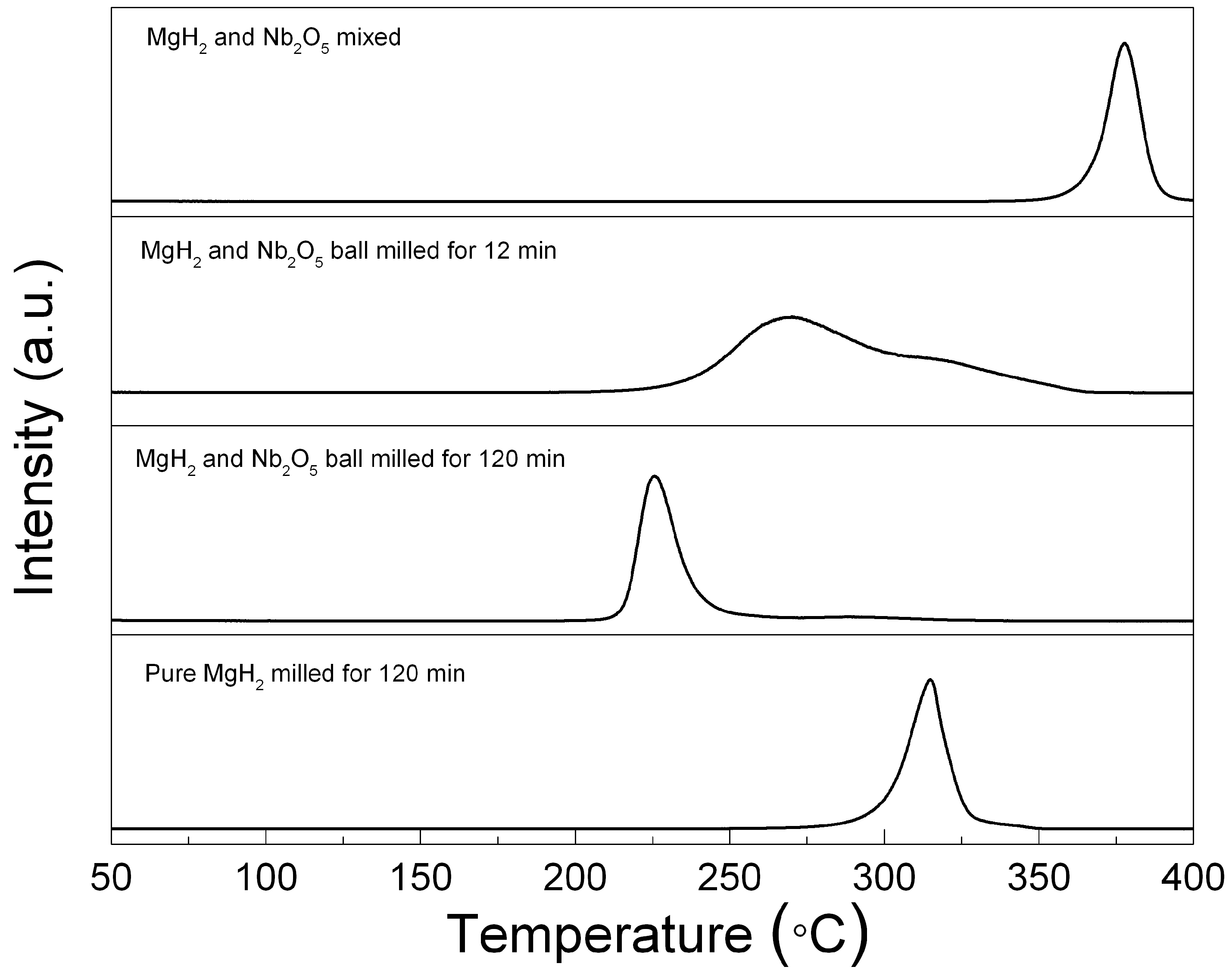
      <p>Thermal desorption properties of the ball-milled compositesare shown in <xref ref-type="fig" rid="catalysts-02-00344-f001">Figure 1</xref>. The peak temperatures of desorption for the composites ball-milled for 0 min (hand mixed), 12 min, 120 min, as well as the pure MgH<sub>2</sub> ball-milled for 120 min turned out to be 378 °C, 268 °C, 226 °C and 315 °C, respectively. It can be seen that the desorption properties have been improved with the increase of ball-milling time. This milling time dependence reveals the fact that the catalytic effect can be activated gradually by ball-milling. In the sample milled for 12 min, a very wide peak with a shoulder around 310 °C was obtained. It suggests that Nb<sub>2</sub>O<sub>5 </sub>in the sample is not well-distributed yet, so that only parts of the sample have been affected by the catalyst during thermal desorption. On the other hand, bycomparing the catalyzed and pure MgH<sub>2 </sub>ball-milled for 120 min, we can see a decrease of 89 °C in the peak temperature. This significant improvement of the desorption properties should be ascribed to the addition of Nb<sub>2</sub>O<sub>5</sub>. </p>
      <fig id="catalysts-02-00344-f001" position="anchor">
        <label>Figure 1</label>
        <caption>
          <p>Profiles of TDS of hydrogen for the hand mixed and ball-milled samples. </p>
        </caption>
        <graphic xmlns:xlink="http://www.w3.org/1999/xlink" xlink:href="catalysts-02-00344-g001.tif"/>
      </fig>
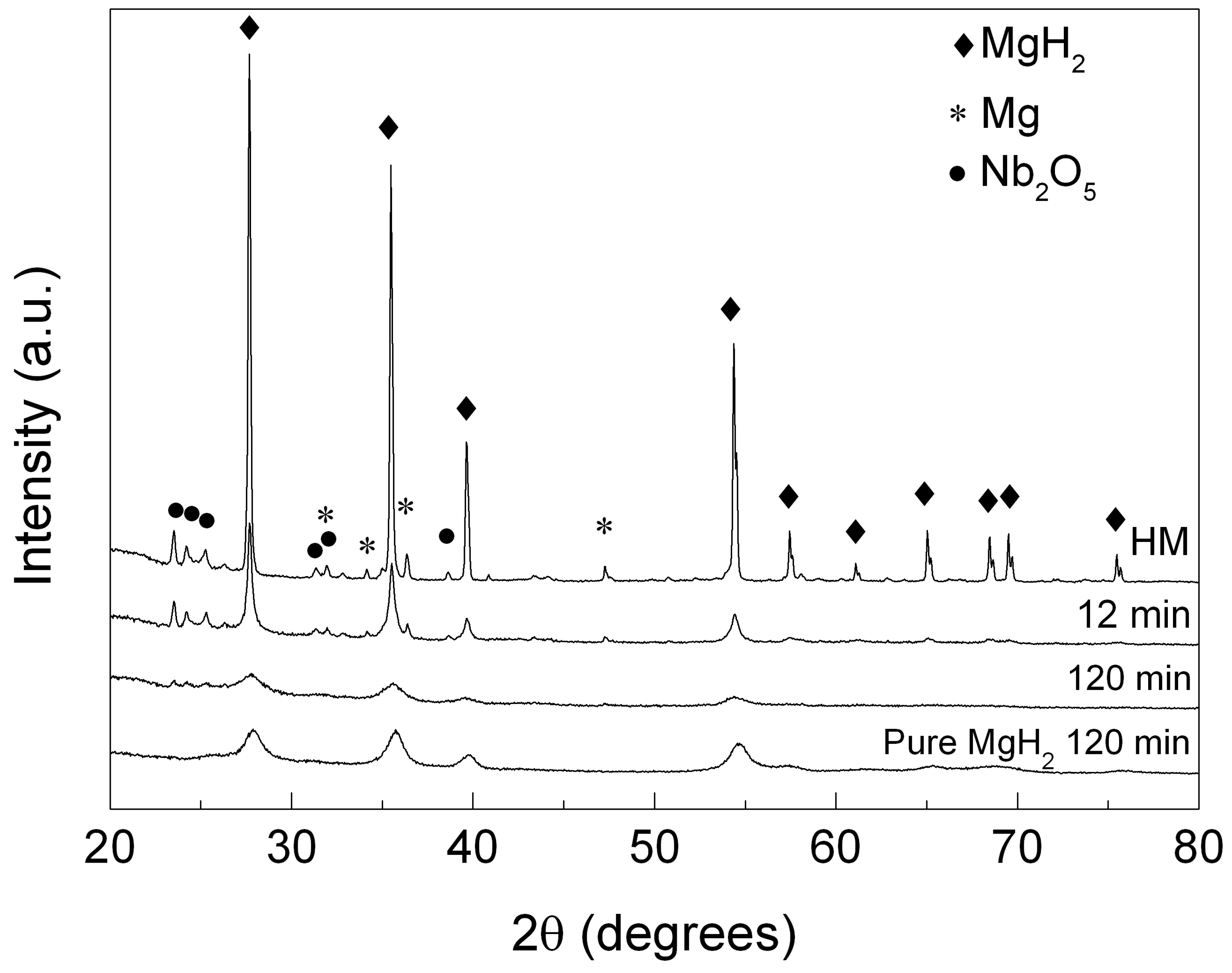
      <p>The XRD patterns of the samples were obtained in order to evaluate the crystalline information, as presented in <xref ref-type="fig" rid="catalysts-02-00344-f002">Figure 2</xref>. The peaks widened and the intensity drastically decreased after the samples were milled for a long time. It indicates that the crystallites become smaller during ball-milling. This refinement of size may suggest a better distribution of catalyst in the samples, leading to an improvement on the catalytic effect. The size of crystallites can be estimated using Sherrer Equation: </p>
      <p><disp-formula id="catalysts-02-00344-i001"><inline-graphic xmlns:xlink="http://www.w3.org/1999/xlink" xlink:href="catalysts-02-00344-i001.tif"/><label>(1)</label></disp-formula></p>
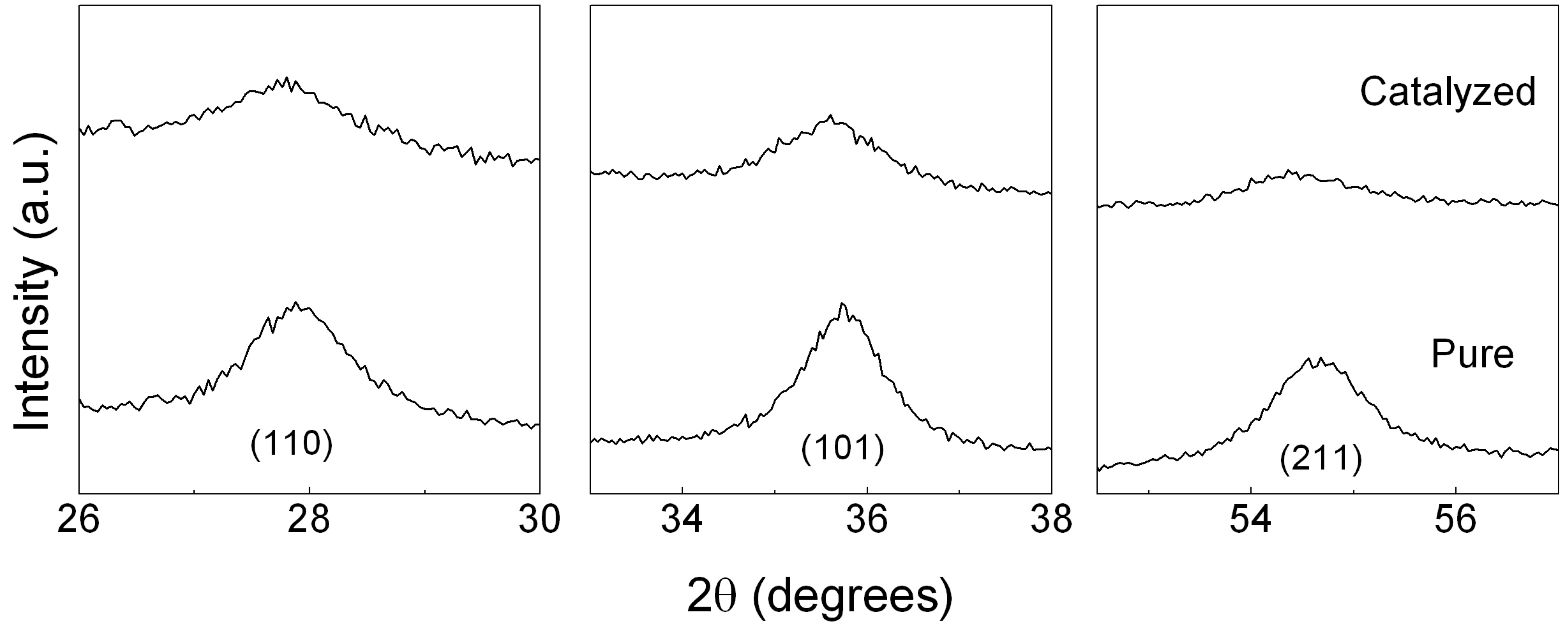
      <p>where <italic>K</italic> is the shape factor, typically 0.89, <italic>λ</italic> is the X-ray wavelength, 1.54 Å for Cu radiation, <italic>β</italic> is the full width at half maximum (FWHM), <italic>θ</italic> is the Bragg angle, and <italic>τ</italic> is the mean size of the crystallites [<xref ref-type="bibr" rid="B18-catalysts-02-00344">18</xref>]. We selected the three strongest peaks of the catalyzed and pure MgH<sub>2 </sub>milled for 120 min, shown in <xref ref-type="fig" rid="catalysts-02-00344-f003">Figure 3</xref>, to apply the equation and listed the results in <xref ref-type="table" rid="catalysts-02-00344-t001">Table 1</xref>. It can be seen that the crystalline size of the catalyzed composites is a little smaller than the pure MgH<sub>2 </sub>after ball-milling. It seems Nb<sub>2</sub>O<sub>5 </sub>with ceramic feature acts as abrasive facilitating the refinement of MgH<sub>2</sub>. However, the difference of several ten angstroms is not so sufficient to bring the obvious improvement on the desorption properties. There should be other more essential factors. </p>
      <fig id="catalysts-02-00344-f002" position="anchor">
        <label>Figure 2</label>
        <caption>
          <p>X-ray diffraction profiles of the hand mixed and ball-milled samples. </p>
        </caption>
        <graphic xmlns:xlink="http://www.w3.org/1999/xlink" xlink:href="catalysts-02-00344-g002.tif"/>
      </fig>
      <fig id="catalysts-02-00344-f003" position="anchor">
        <label>Figure 3</label>
        <caption>
          <p>Three strongest peaks of XRD pattern for the catalyzed and pure MgH<sub>2 </sub>milled for 120 min. </p>
        </caption>
        <graphic xmlns:xlink="http://www.w3.org/1999/xlink" xlink:href="catalysts-02-00344-g003.tif"/>
      </fig>
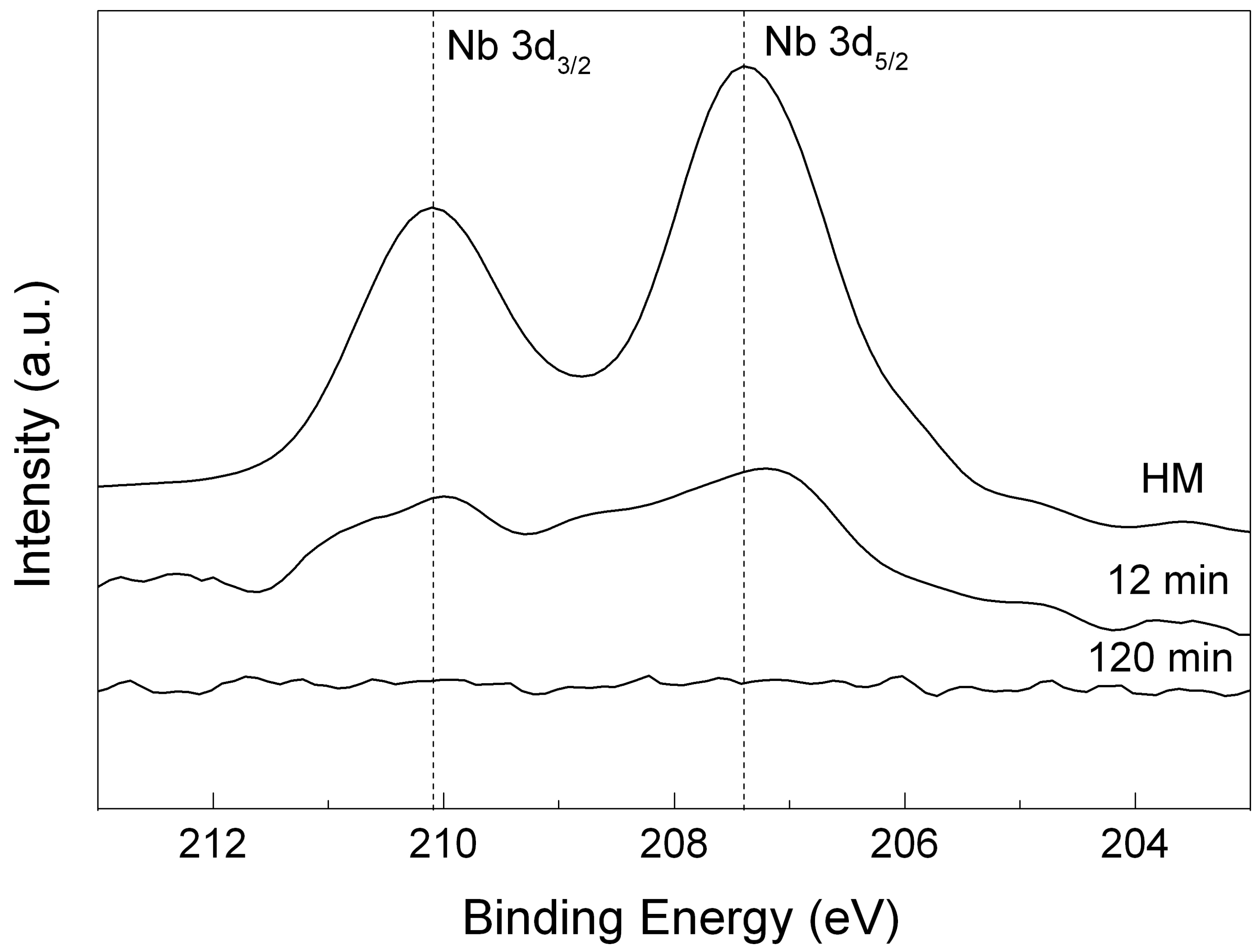
      <p>In order to clarify the mechanism of catalytic effect, XPS measurements were carried out to evaluate the chemical state of Nb on the surface of the catalyst. Niobium 3d spectra were drawn in <xref ref-type="fig" rid="catalysts-02-00344-f004">Figure 4</xref>. An obvious decrease of the signal was presented in the composites milled for 12 min, while the signal completely disappeared after the composites were milled for 120 min. The phenomena could be explained as the milled MgH<sub>2 </sub>particles gradually covered the surface of Nb<sub>2</sub>O<sub>5</sub>, preventing the detector from getting enough signal from inside. Yet it still can be seen that the peaks in the composites that was milled for 12 min broadened evidently, and the apex slightly shifted to the lower energy side. It provides the evidence that the chemical state of Nb in this sample has changed. Perhaps new phases, at least on the surface, have been generated during ball-milling, in which the valence of Nb is less than +5, because of the decrease in binding energy. In another word, Nb<sub>2</sub>O<sub>5 </sub>has been partially reduced during ball-milling. The detailed analysis on peak separation has been reported in another article, which concluded theexistence of a certain or a complication of Nb<sub>2</sub>O<sub>5</sub><sub>−</sub><sub>x</sub> phase(s) that may act as a more effective catalystto improve the kinetics of desorption [<xref ref-type="bibr" rid="B19-catalysts-02-00344">19</xref>]. In our previous work, we have confirmed that hydrogen desorption started on the interface between MgH<sub>2 </sub>and Nb<sub>2</sub>O<sub>5</sub>, where hydrogen was recombined and released with the assistance of the essential catalyst on the surface of Nb<sub>2</sub>O<sub>5</sub> [<xref ref-type="bibr" rid="B20-catalysts-02-00344">20</xref>]. Confirmation of the reduction of Nb<sub>2</sub>O<sub>5 </sub>reasserts and supports the above mechanism of desorption. The reduced phases on the catalyst surface are likely to be the essential catalyst facilitating the completion of desorption.</p>
      <table-wrap id="catalysts-02-00344-t001" position="anchor">
        <object-id pub-id-type="pii">catalysts-02-00344-t001_Table 1</object-id>
        <label>Table 1</label>
        <caption>
          <p>Crystalline size (<italic>τ</italic>;in Å) of catalyzed and pure MgH<sub>2 </sub>ball-milled for 120 min. </p>
        </caption>
<table>
 <thead>
  <tr>
    <th colspan="4" align="center" valign="middle" style="border-bottom:solid thin">Catalyzed </th>
    <th colspan="4" align="center" valign="middle" style="border-bottom:solid thin">Pure</th>
  </tr>
  <tr>
    <th align="center" valign="middle">Plane</th>
    <th align="center" valign="middle">2
      <italic>θ</italic>(°)</th>
    <th align="center" valign="middle">FWHM (°)</th>
    <th align="center" valign="middle"><italic>τ</italic> (Å) </th>
    <th align="center" valign="middle">Plane</th>
    <th align="center" valign="middle">2
      <italic>θ</italic>(°)</th>
    <th align="center" valign="middle">FWHM (°) </th>
    <th align="center" valign="middle"><italic>τ</italic> (Å)</th>
  </tr>
  </thead>
  <tbody>
  <tr>
    <td align="center" valign="middle">(110)     </td>
    <td align="center" valign="middle">28.0</td>
    <td align="center" valign="middle">1.26</td>
    <td align="center" valign="middle">73.9</td>
    <td align="center" valign="middle">(110)</td>
    <td align="center" valign="middle">27.9 </td>
    <td align="center" valign="middle">0.813 </td>
    <td align="center" valign="middle">103</td>
  </tr>
  <tr>
    <td align="center" valign="middle">(101)     </td>
    <td align="center" valign="middle">35.8</td>
    <td align="center" valign="middle">1.35</td>
    <td align="center" valign="middle">72.8</td>
    <td align="center" valign="middle">(101)</td>
    <td align="center" valign="middle">35.7 </td>
    <td align="center" valign="middle">0.795</td>
    <td align="center" valign="middle">104</td>
  </tr>
  <tr>
    <td align="center" valign="middle">(211)       </td>
    <td align="center" valign="middle">54.6</td>
    <td align="center" valign="middle">1.32</td>
    <td align="center" valign="middle">78.5</td>
    <td align="center" valign="middle">(211)</td>
    <td align="center" valign="middle">54.6</td>
    <td align="center" valign="middle">0.839</td>
    <td align="center" valign="middle">105</td>
  </tr>
 </tbody>
</table>
      </table-wrap>
      <fig id="catalysts-02-00344-f004" position="anchor">
        <label>Figure 4</label>
        <caption>
          <p>XPS spectra of Nb3d for the catalyzed samples. </p>
        </caption>
        <graphic xmlns:xlink="http://www.w3.org/1999/xlink" xlink:href="catalysts-02-00344-g004.tif"/>
      </fig>
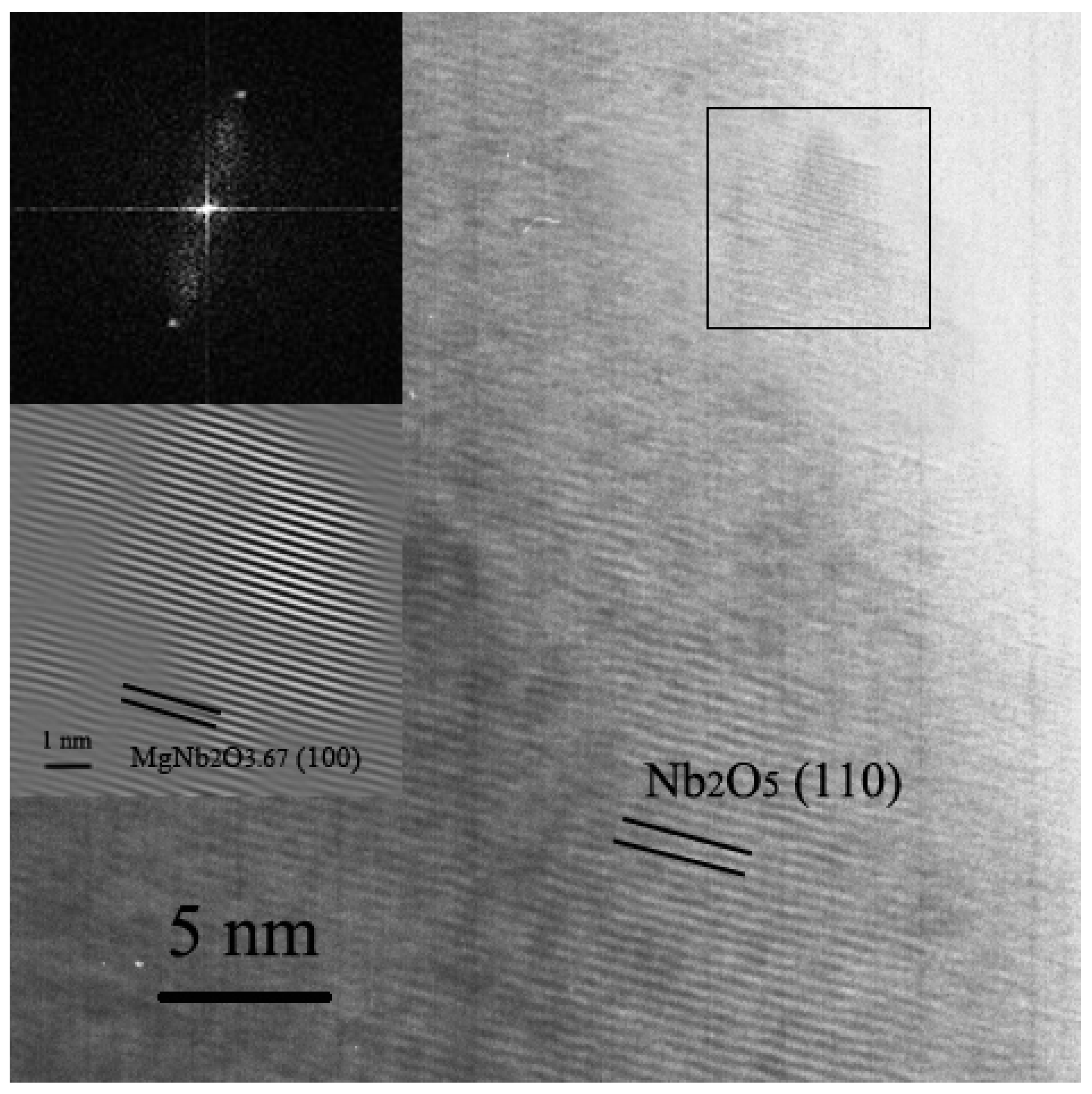
      <p>Taking advantage of high resolution electron microscopy, we were able to find out one possible state of the reduced niobium phases. The lattice image of Nb<sub>2</sub>O<sub>5 </sub>particle in the composites milled for 120 min is shown in <xref ref-type="fig" rid="catalysts-02-00344-f005">Figure 5</xref>. When we performed the fast Fourier transformation (FFT) and the inverse fast Fourier transformation (IFFT) on the selected area near the edge of Nb<sub>2</sub>O<sub>5 </sub>particle, we obtained the lattice image with the d-spacing of 2.13Å, which matches the value of MgNb<sub>2</sub>O<sub>3.67</sub> (100). The existence of this ternary phase has also been reported elsewhere [<xref ref-type="bibr" rid="B15-catalysts-02-00344">15</xref>,<xref ref-type="bibr" rid="B21-catalysts-02-00344">21</xref>]. Nevertheless, the results so far still can not draw a clear conclusion on the catalytic effect of this ternary phase. Further investigation on the phase change of Nb<sub>2</sub>O<sub>5 </sub>is still on the way in order to make a clear understanding on the mechanism of the catalytic effect in Nb<sub>2</sub>O<sub>5 </sub>catalyzed MgH<sub>2 </sub>composites. </p>
      <fig id="catalysts-02-00344-f005" position="anchor">
        <label>Figure 5</label>
        <caption>
          <p>High resolution image of Nb<sub>2</sub>O<sub>5 </sub>catalyzed MgH<sub>2 </sub>composites ball-milled for 120 min. The insets are the FFT and IFFT images obtained from the selected area, marked by the square. </p>
        </caption>
        <graphic xmlns:xlink="http://www.w3.org/1999/xlink" xlink:href="catalysts-02-00344-g005.tif"/>
      </fig>
    </sec>
    <sec sec-type="methods">
      <title>3. Experimental Procedures</title>
      <p>MgH<sub>2</sub> (98%, from Alfa Aesar) and Nb<sub>2</sub>O<sub>5</sub> (99.99%, ∼1µm, from Kojundo chemical Laboratory) powder were used as purchased. Ball-milling was performed using a Fritsch P7 device. Mixtures of 300 mg MgH<sub>2 </sub>and 1 mol% Nb<sub>2</sub>O<sub>5 </sub>were ball-milled with 20 steel balls (7 mm in diameter) for 12 min and 120 min. The ball-to-powder ratio was set to 100:1. The hydrogen pressure inside the milling spotwas 1 MPa and the rotating speed was 400 rpm. Pure MgH<sub>2 </sub>powder was also ball-milled for 120 min under the same condition. Hand-mixed (HM) sample with the same composition was prepared using agate mortar. The desorption properties were examined by thermal desorption spectroscopy (TDS) with a heating rate of 1 °C/min under a highly pure helium flow. X-ray diffraction (XRD) was performed using JEOL JDX-3500 powder diffractometer with Cu <italic>K</italic><italic><sub>α</sub></italic> radiation. X-ray Photoelectron Spectroscopy (XPS) was carried out using a JPS-90MX photoelectron spectrometer with Mg <italic>K</italic><italic><sub>α</sub></italic> radiation. The energy scale of the spectrometer was calibrated by setting oxygen (O1s) peak to 532 eV. TEM observationwas performed under a 1250 kV High Voltage Electron Microscope (JEM-ARM1300). Plastic bag method [<xref ref-type="bibr" rid="B22-catalysts-02-00344">22</xref>] was used to prevent oxidation of the sample during transport into the TEM instruments. </p>
    </sec>
    <sec sec-type="conclusions">
      <title>4. Conclusions</title>
      <p>In summary, we performed a study on the Nb<sub>2</sub>O<sub>5 </sub>catalyzed MgH<sub>2 </sub>ball-milled composites, as well as the pure MgH<sub>2 </sub>which serves for comparison. Improved desorption properties were reached by ball-milling with the presence of Nb<sub>2</sub>O<sub>5</sub>. Especially the peak temperature of the catalyzed composites milled for 120 min was decreased to 226 °C, even 89 °C lower than the pure MgH<sub>2 </sub>milled for the same duration. XRD spectra indicated a refinement of crystallites during ball-milling, suggesting a better distribution of Nb<sub>2</sub>O<sub>5 </sub>in the composites. The estimation of crystalline size using Sherrer equation showed Nb<sub>2</sub>O<sub>5 </sub>as ceramics acts as abrasive facilitating the size decreasing of MgH<sub>2</sub>. Reduction of Nb<sub>2</sub>O<sub>5 </sub>was confirmed by tracing the chemical state of Nb in the samples, arising the possibility that the reduced phases act as more effective catalysts to improve the desorption properties. We were able to find MgNb<sub>2</sub>O<sub>3</sub><sub>.</sub><sub>67 </sub>existing near the edge of Nb<sub>2</sub>O<sub>5 </sub>particle via TEM, providing further evidence for the reduction of Nb<sub>2</sub>O<sub>5 </sub>and raising the further investigation on the phase transition of Nb<sub>2</sub>O<sub>5 </sub>during ball-milling. </p>
    </sec>
  </body>
  <back>
    <ack>
      <title>Acknowledgments</title>
      <p>This work has been partially supported by HYDRO STAR (NEDO) and L-station (Hokkaido University). </p>
    </ack>
    <ref-list>
      <title>References</title>
      <ref id="B1-catalysts-02-00344">
        <label>1.</label>
        <citation citation-type="journal">
          <person-group person-group-type="author">
            <name>
              <surname>Jain</surname>
              <given-names>I.</given-names>
            </name>
            <name>
              <surname>Jain</surname>
              <given-names>P.</given-names>
            </name>
            <name>
              <surname>Jain</surname>
              <given-names>A.</given-names>
            </name>
          </person-group>
          <article-title>Novel hydrogen storage materials: A review of lightweight comlex hydrides</article-title>
          <source>J. Alloy. Compd.</source>
          <year>2010</year>
          <volume>503</volume>
          <fpage>303</fpage>
          <lpage>339</lpage>
          <pub-id pub-id-type="doi">10.1016/j.jallcom.2010.04.250</pub-id>
        </citation>
      </ref>
      <ref id="B2-catalysts-02-00344">
        <label>2.</label>
        <citation citation-type="journal">
          <person-group person-group-type="author">
            <name>
              <surname>Chen</surname>
              <given-names>P.</given-names>
            </name>
            <name>
              <surname>Xiong</surname>
              <given-names>Z.</given-names>
            </name>
            <name>
              <surname>Luo</surname>
              <given-names>J.</given-names>
            </name>
            <name>
              <surname>Lin</surname>
              <given-names>J.</given-names>
            </name>
            <name>
              <surname>Tan</surname>
              <given-names>K.L.</given-names>
            </name>
          </person-group>
          <article-title>Interaction of hydrogen with metal nitrides and imides</article-title>
          <source>Nature</source>
          <year>2002</year>
          <volume>420</volume>
          <fpage>302</fpage>
          <lpage>304</lpage>
          <pub-id pub-id-type="doi">10.1038/nature01210</pub-id>
        </citation>
      </ref>
      <ref id="B3-catalysts-02-00344">
        <label>3.</label>
        <citation citation-type="journal">
          <person-group person-group-type="author">
            <name>
              <surname>Chen</surname>
              <given-names>P.</given-names>
            </name>
            <name>
              <surname>Xiong</surname>
              <given-names>Z.</given-names>
            </name>
            <name>
              <surname>Luo</surname>
              <given-names>J.</given-names>
            </name>
            <name>
              <surname>Lin</surname>
              <given-names>J.</given-names>
            </name>
            <name>
              <surname>Tan</surname>
              <given-names>K.L.</given-names>
            </name>
          </person-group>
          <article-title>Nteraction between lithium amide and lithium hydride</article-title>
          <source>J. Phys. Chem. B</source>
          <year>2003</year>
          <volume>107</volume>
          <fpage>10967</fpage>
          <lpage>10970</lpage>
          <pub-id pub-id-type="doi">10.1021/jp034149j</pub-id>
        </citation>
      </ref>
      <ref id="B4-catalysts-02-00344">
        <label>4.</label>
        <citation citation-type="journal">
          <person-group person-group-type="author">
            <name>
              <surname>Hu</surname>
              <given-names>M.G.</given-names>
            </name>
            <name>
              <surname>Geanangel</surname>
              <given-names>R.A.</given-names>
            </name>
            <name>
              <surname>Wendlandt</surname>
              <given-names>W.W.</given-names>
            </name>
          </person-group>
          <article-title>The thermal decomposition of ammonia borane</article-title>
          <source>Thermochim. Acta</source>
          <year>1978</year>
          <volume>23</volume>
          <fpage>249</fpage>
          <lpage>255</lpage>
          <pub-id pub-id-type="doi">10.1016/0040-6031(78)85066-7</pub-id>
        </citation>
      </ref>
      <ref id="B5-catalysts-02-00344">
        <label>5.</label>
        <citation citation-type="journal">
          <person-group person-group-type="author">
            <name>
              <surname>Stephens</surname>
              <given-names>F.H.</given-names>
            </name>
            <name>
              <surname>Pons</surname>
              <given-names>V.</given-names>
            </name>
            <name>
              <surname>Baker</surname>
              <given-names>R.T.</given-names>
            </name>
          </person-group>
          <article-title>Ammonia-borane: The hydrogen source par excellence?</article-title>
          <source>Dalton Trans.</source>
          <year>2007</year>
          <pub-id pub-id-type="doi">10.1039/B703053C</pub-id>
        </citation>
      </ref>
      <ref id="B6-catalysts-02-00344">
        <label>6.</label>
        <citation citation-type="journal">
          <person-group person-group-type="author">
            <name>
              <surname>Selvam</surname>
              <given-names>P.</given-names>
            </name>
            <name>
              <surname>Viswanathan</surname>
              <given-names>B.</given-names>
            </name>
            <name>
              <surname>Swamy</surname>
              <given-names>C.S.</given-names>
            </name>
            <name>
              <surname>Srinivasan</surname>
              <given-names>V.</given-names>
            </name>
          </person-group>
          <article-title>Magnesium &amp; magnesium alloy hydride</article-title>
          <source>Int. J. Hydrogen Energ.</source>
          <year>1986</year>
          <volume>11</volume>
          <fpage>169</fpage>
          <lpage>192</lpage>
          <pub-id pub-id-type="doi">10.1016/0360-3199(86)90082-0</pub-id>
        </citation>
      </ref>
      <ref id="B7-catalysts-02-00344">
        <label>7.</label>
        <citation citation-type="journal">
          <person-group person-group-type="author">
            <name>
              <surname>Jason</surname>
              <given-names>G.</given-names>
            </name>
            <name>
              <surname>James</surname>
              <given-names>J.R.</given-names>
            </name>
          </person-group>
          <article-title>Thermodynamics of the <italic>α</italic>, <italic>β</italic> and <italic>γ</italic> polymorphs of AlH<sub>3</sub></article-title>
          <source>J. Alloy. Compd.</source>
          <year>2006</year>
          <volume>424</volume>
          <fpage>262</fpage>
          <lpage>265</lpage>
          <pub-id pub-id-type="doi">10.1016/j.jallcom.2005.11.086</pub-id>
        </citation>
      </ref>
      <ref id="B8-catalysts-02-00344">
        <label>8.</label>
        <citation citation-type="web">
          <article-title>Targets for Onboard Hydrogen Storage Systems for Light-Duty Vehicles</article-title>
          <access-date>(accessed on 3 September 2012)</access-date>
          <comment>Available online:<ext-link xmlns:xlink="http://www.w3.org/1999/xlink" xlink:href="http://www1.eere.energy.gov/hydrogenandfuelcells/storage/pdfs/targets onboard hydro storage explanation.pdf" ext-link-type="uri">http://www1.eere.energy.gov/hydrogenandfuelcells/storage/pdfs/targets onboard hydro storage explanation.pdf</ext-link></comment>
        </citation>
      </ref>
      <ref id="B9-catalysts-02-00344">
        <label>9.</label>
        <citation citation-type="journal">
          <person-group person-group-type="author">
            <name>
              <surname>Barkhordarian</surname>
              <given-names>G.</given-names>
            </name>
            <name>
              <surname>Klassen</surname>
              <given-names>T.</given-names>
            </name>
            <name>
              <surname>Bormann</surname>
              <given-names>R.</given-names>
            </name>
          </person-group>
          <article-title>Fast hydrogen sorption kinetics of nanocrystalline Mg using Nb<sub>2</sub>O<sub>5 </sub>as catalyst</article-title>
          <source>Scripta Mater.</source>
          <year>2003</year>
          <volume>49</volume>
          <fpage>213</fpage>
          <lpage>217</lpage>
          <pub-id pub-id-type="doi">10.1016/S1359-6462(03)00259-8</pub-id>
        </citation>
      </ref>
      <ref id="B10-catalysts-02-00344">
        <label>10.</label>
        <citation citation-type="journal">
          <person-group person-group-type="author">
            <name>
              <surname>Jin</surname>
              <given-names>S.A.</given-names>
            </name>
            <name>
              <surname>Shim</surname>
              <given-names>J.H.</given-names>
            </name>
            <name>
              <surname>Cho</surname>
              <given-names>Y.W.</given-names>
            </name>
            <name>
              <surname>Yi</surname>
              <given-names>K.W.</given-names>
            </name>
          </person-group>
          <article-title>Dehydrogenation and hydrogenation characteristics of MgH<sub>2 </sub>with transition metal fluorides</article-title>
          <source>J. Power Sources</source>
          <year>2007</year>
          <volume>172</volume>
          <fpage>859</fpage>
          <lpage>862</lpage>
          <pub-id pub-id-type="doi">10.1016/j.jpowsour.2007.04.090</pub-id>
        </citation>
      </ref>
      <ref id="B11-catalysts-02-00344">
        <label>11.</label>
        <citation citation-type="journal">
          <person-group person-group-type="author">
            <name>
              <surname>Borgschulte</surname>
              <given-names>A.</given-names>
            </name>
            <name>
              <surname>Bösenberg</surname>
              <given-names>U.</given-names>
            </name>
            <name>
              <surname>Barkhordarian</surname>
              <given-names>G.</given-names>
            </name>
            <name>
              <surname>Dornheim</surname>
              <given-names>M.</given-names>
            </name>
            <name>
              <surname>Bormann</surname>
              <given-names>R.</given-names>
            </name>
          </person-group>
          <article-title>Enhanced hydrogen sorption kinetics of magnesium by destabilized MgH<sub>2</sub></article-title>
          <source>Catal. Today</source>
          <year>2007</year>
          <volume>120</volume>
          <fpage>262</fpage>
          <lpage>269</lpage>
          <pub-id pub-id-type="doi">10.1016/j.cattod.2006.09.031</pub-id>
        </citation>
      </ref>
      <ref id="B12-catalysts-02-00344">
        <label>12.</label>
        <citation citation-type="journal">
          <person-group person-group-type="author">
            <name>
              <surname>Barkhordarian</surname>
              <given-names>G.</given-names>
            </name>
            <name>
              <surname>Klassen</surname>
              <given-names>T.</given-names>
            </name>
            <name>
              <surname>Bormann</surname>
              <given-names>R.</given-names>
            </name>
          </person-group>
          <article-title>Kinetic investigation of the effect of milling time on the hydrogen sorption reaction of magnesium catalyzed with different Nb<sub>2</sub>O<sub>5 </sub>contents</article-title>
          <source>J. Alloy. Compd.</source>
          <year>2006</year>
          <volume>407</volume>
          <fpage>249</fpage>
          <lpage>255</lpage>
          <pub-id pub-id-type="doi">10.1016/j.jallcom.2005.05.037</pub-id>
        </citation>
      </ref>
      <ref id="B13-catalysts-02-00344">
        <label>13.</label>
        <citation citation-type="journal">
          <person-group person-group-type="author">
            <name>
              <surname>Hanada</surname>
              <given-names>N.</given-names>
            </name>
            <name>
              <surname>Ichikawa</surname>
              <given-names>T.</given-names>
            </name>
            <name>
              <surname>Hino</surname>
              <given-names>S.</given-names>
            </name>
            <name>
              <surname>Fujii</surname>
              <given-names>H.</given-names>
            </name>
          </person-group>
          <article-title>Remarkable improvement of hydrogen sorption kinetics in magnesium catalyzed with Nb<sub>2</sub>O<sub>5</sub></article-title>
          <source>J. Alloy. Compd.</source>
          <year>2006</year>
          <volume>420</volume>
          <fpage>46</fpage>
          <lpage>49</lpage>
          <pub-id pub-id-type="doi">10.1016/j.jallcom.2005.08.084</pub-id>
        </citation>
      </ref>
      <ref id="B14-catalysts-02-00344">
        <label>14.</label>
        <citation citation-type="journal">
          <person-group person-group-type="author">
            <name>
              <surname>Hanada</surname>
              <given-names>N.</given-names>
            </name>
            <name>
              <surname>Hirotoshi</surname>
              <given-names>E.</given-names>
            </name>
            <name>
              <surname>Ichikawa</surname>
              <given-names>T.</given-names>
            </name>
            <name>
              <surname>Akiba</surname>
              <given-names>E.</given-names>
            </name>
            <name>
              <surname>Fujii</surname>
              <given-names>H.</given-names>
            </name>
          </person-group>
          <article-title>SEM and TEM characterization of magnesium hydride catalyzed with Ni nano-particle or Nb<sub>2</sub>O<sub>5</sub></article-title>
          <source>J. Alloy. Compd.</source>
          <year>2008</year>
          <volume>450</volume>
          <fpage>395</fpage>
          <lpage>399</lpage>
          <pub-id pub-id-type="doi">10.1016/j.jallcom.2006.10.128</pub-id>
        </citation>
      </ref>
      <ref id="B15-catalysts-02-00344">
        <label>15.</label>
        <citation citation-type="journal">
          <person-group person-group-type="author">
            <name>
              <surname>Porcu</surname>
              <given-names>M.</given-names>
            </name>
            <name>
              <surname>Petford-Long</surname>
              <given-names>A.</given-names>
            </name>
            <name>
              <surname>Sykes</surname>
              <given-names>J.</given-names>
            </name>
          </person-group>
          <article-title>TEM studies of Nb<sub>2</sub>O<sub>5 </sub>catalyst in ball-milled MgH<sub>2 </sub>for hydrogen storage</article-title>
          <source>J. Alloy. Compd.</source>
          <year>2008</year>
          <volume>453</volume>
          <fpage>341</fpage>
          <lpage>346</lpage>
          <pub-id pub-id-type="doi">10.1016/j.jallcom.2006.11.147</pub-id>
        </citation>
      </ref>
      <ref id="B16-catalysts-02-00344">
        <label>16.</label>
        <citation citation-type="journal">
          <person-group person-group-type="author">
            <name>
              <surname>Hanada</surname>
              <given-names>N.</given-names>
            </name>
            <name>
              <surname>Ichikawa</surname>
              <given-names>T.</given-names>
            </name>
            <name>
              <surname>Isobe</surname>
              <given-names>S.</given-names>
            </name>
            <name>
              <surname>Nakagawa</surname>
              <given-names>T.</given-names>
            </name>
            <name>
              <surname>Tokoyoda</surname>
              <given-names>K.</given-names>
            </name>
            <name>
              <surname>Honma</surname>
              <given-names>T.</given-names>
            </name>
            <name>
              <surname>Fujii</surname>
              <given-names>H.</given-names>
            </name>
            <name>
              <surname>Kojima</surname>
              <given-names>Y.</given-names>
            </name>
          </person-group>
          <article-title>X-ray absorption spectroscopic study on valence state and local atomic structure of transition metal oxides doped in MgH<sub>2</sub></article-title>
          <source>J. Phys. Chem. C</source>
          <year>2009</year>
          <volume>113</volume>
          <fpage>13450</fpage>
          <lpage>13455</lpage>
        <pub-id pub-id-type="doi">10.1021/jp901859f</pub-id></citation>
      </ref>
      <ref id="B17-catalysts-02-00344">
        <label>17.</label>
        <citation citation-type="journal">
          <person-group person-group-type="author">
            <name>
              <surname>Friedrichs</surname>
              <given-names>O.</given-names>
            </name>
            <name>
              <surname>Sánchez-López</surname>
              <given-names>J.</given-names>
            </name>
            <name>
              <surname>López-Cartes</surname>
              <given-names>C.</given-names>
            </name>
            <name>
              <surname>Dornheim</surname>
              <given-names>M.</given-names>
            </name>
            <name>
              <surname>Klassen</surname>
              <given-names>T.</given-names>
            </name>
            <name>
              <surname>Bormann</surname>
              <given-names>R.</given-names>
            </name>
            <name>
              <surname>Fernández</surname>
              <given-names>A.</given-names>
            </name>
          </person-group>
          <article-title>Chemical and microstructural study of the oxygen passivation behaviour of nanocrystalline Mg and MgH<sub>2</sub></article-title>
          <source>Appl. Surf. Sci.</source>
          <year>2006</year>
          <volume>252</volume>
          <fpage>2334</fpage>
          <lpage>2345</lpage>
          <pub-id pub-id-type="doi">10.1016/j.apsusc.2005.04.018</pub-id>
        </citation>
      </ref>
      <ref id="B18-catalysts-02-00344">
        <label>18.</label>
        <citation citation-type="book">
          <person-group person-group-type="author">
            <name>
              <surname>Cullity</surname>
              <given-names>B.</given-names>
            </name>
            <name>
              <surname>Stock</surname>
              <given-names>S.</given-names>
            </name>
          </person-group>
          <source>Elements of X-ray Diffraction</source>
          <edition>3rd</edition>
          <publisher-name>Prentice-Hall Inc.</publisher-name>
          <publisher-loc>Upper Saddle River, NJ, USA</publisher-loc>
          <year>2001</year>
        </citation>
      </ref>
      <ref id="B19-catalysts-02-00344">
        <label>19.</label>
        <citation citation-type="journal">
          <person-group person-group-type="author">
            <name>
              <surname>Ma</surname>
              <given-names>T.</given-names>
            </name>
            <name>
              <surname>Isobe</surname>
              <given-names>S.</given-names>
            </name>
            <name>
              <surname>Morita</surname>
              <given-names>E.</given-names>
            </name>
            <name>
              <surname>Wang</surname>
              <given-names>Y.</given-names>
            </name>
            <name>
              <surname>Hashimoto</surname>
              <given-names>N.</given-names>
            </name>
            <name>
              <surname>Ohnuki</surname>
              <given-names>S.</given-names>
            </name>
            <name>
              <surname>Kimura</surname>
              <given-names>T.</given-names>
            </name>
            <name>
              <surname>Ichikawa</surname>
              <given-names>T.</given-names>
            </name>
            <name>
              <surname>Kojima</surname>
              <given-names>Y.</given-names>
            </name>
          </person-group>
          <article-title>Correlation between kinetics and chemical bonding state of catalyst surface in catalyzed magnesium hydride</article-title>
          <source>Int. J. Hydrog. Energy</source>
          <year>2011</year>
          <volume>36</volume>
          <fpage>12319</fpage>
          <lpage>12323</lpage>
          <pub-id pub-id-type="doi">10.1016/j.ijhydene.2011.07.011</pub-id>
        </citation>
      </ref>
      <ref id="B20-catalysts-02-00344">
        <label>20.</label>
        <citation citation-type="journal">
          <person-group person-group-type="author">
            <name>
              <surname>Isobe</surname>
              <given-names>S.</given-names>
            </name>
            <name>
              <surname>Ono</surname>
              <given-names>A.</given-names>
            </name>
            <name>
              <surname>Yao</surname>
              <given-names>H.</given-names>
            </name>
            <name>
              <surname>Wang</surname>
              <given-names>Y.</given-names>
            </name>
            <name>
              <surname>Hashimoto</surname>
              <given-names>N.</given-names>
            </name>
            <name>
              <surname>Ohnuki</surname>
              <given-names>S.</given-names>
            </name>
          </person-group>
          <article-title>Study on reaction mechanism of dehydrogenation of magnesium hydride by in situ transmission electron microscopy</article-title>
          <source>Appl. Phys. Lett.</source>
          <year>2010</year>
          <volume>96</volume>
          <fpage>223109</fpage>
          <pub-id pub-id-type="doi">10.1063/1.3442910</pub-id>
        </citation>
      </ref>
      <ref id="B21-catalysts-02-00344">
        <label>21.</label>
        <citation citation-type="journal">
          <person-group person-group-type="author">
            <name>
              <surname>Friedrichs</surname>
              <given-names>O.</given-names>
            </name>
            <name>
              <surname>Aguey-Zinsou</surname>
              <given-names>F.</given-names>
            </name>
            <name>
              <surname>Fernánchez</surname>
              <given-names>J.R.A.</given-names>
            </name>
            <name>
              <surname>Sánchez-López</surname>
              <given-names>J.</given-names>
            </name>
            <name>
              <surname>Justo</surname>
              <given-names>A.</given-names>
            </name>
            <name>
              <surname>Klassen</surname>
              <given-names>T.</given-names>
            </name>
            <name>
              <surname>Bormann</surname>
              <given-names>R.</given-names>
            </name>
            <name>
              <surname>Fernández</surname>
              <given-names>A.</given-names>
            </name>
          </person-group>
          <article-title>MgH<sub>2 </sub>with Nb<sub>2</sub>O<sub>5 </sub>as additive, for hydrogen storage: Chemical, structural and kinetic behavior with heating</article-title>
          <source>Acta Mater.</source>
          <year>2006</year>
          <volume>54</volume>
          <fpage>105</fpage>
          <lpage>110</lpage>
          <pub-id pub-id-type="doi">10.1016/j.actamat.2005.08.024</pub-id>
        </citation>
      </ref>
      <ref id="B22-catalysts-02-00344">
        <label>22.</label>
        <citation citation-type="journal">
          <person-group person-group-type="author">
            <name>
              <surname>Yao</surname>
              <given-names>H.</given-names>
            </name>
            <name>
              <surname>Isobe</surname>
              <given-names>S.</given-names>
            </name>
            <name>
              <surname>Wang</surname>
              <given-names>Y.</given-names>
            </name>
            <name>
              <surname>Hashimoto</surname>
              <given-names>N.</given-names>
            </name>
            <name>
              <surname>Ohnuki</surname>
              <given-names>S.</given-names>
            </name>
          </person-group>
          <article-title>Plastic bag method for active sample loading into transmission electron microscope</article-title>
          <source>J. Electron Microsc.</source>
          <year>2011</year>
          <volume>60</volume>
          <fpage>375</fpage>
          <lpage>378</lpage>
          <pub-id pub-id-type="doi">10.1093/jmicro/dfr072</pub-id>
        </citation>
      </ref>
    </ref-list>
  </back>
</article>