
<?xml version="1.0" encoding="UTF-8"?>
<!DOCTYPE article PUBLIC "-//NLM//DTD Journal Publishing DTD v2.3 20070202//EN" "journalpublishing.dtd">
<article xmlns:mml="http://www.w3.org/1998/Math/MathML" xmlns:xlink="http://www.w3.org/1999/xlink" xml:lang="en" article-type="research-article">
  <front>
    <journal-meta>
      <journal-id journal-id-type="publisher-id">catalysts</journal-id>
      <journal-title>Catalysts</journal-title>
      <abbrev-journal-title abbrev-type="publisher">Catalysts</abbrev-journal-title>
      <abbrev-journal-title abbrev-type="pubmed">Catalysts</abbrev-journal-title>
      <issn pub-type="epub">2073-4344</issn>
      <publisher>
        <publisher-name>MDPI</publisher-name>
      </publisher>
    </journal-meta>
    <article-meta>
      <article-id pub-id-type="doi">10.3390/catal2030330</article-id>
      <article-id pub-id-type="publisher-id">catalysts-02-00330</article-id>
      <article-categories>
        <subj-group>
          <subject>Article</subject>
        </subj-group>
      </article-categories>
      <title-group>
        <article-title>Superior MgH<sub>2</sub> Kinetics with MgO Addition: A Tribological Effect</article-title>
      </title-group>
      <contrib-group>
        <contrib contrib-type="author">
          <name>
            <surname>Ares-Fernández</surname>
            <given-names>José-Ramón</given-names>
          </name>
          <xref rid="af1-catalysts-02-00330" ref-type="aff">1</xref>
        </contrib>
        <contrib contrib-type="author">
          <name>
            <surname>Aguey-Zinsou</surname>
            <given-names>Kondo-Francois</given-names>
          </name>
          <xref rid="af2-catalysts-02-00330" ref-type="aff">2</xref>
          <xref rid="c1-catalysts-02-00330" ref-type="corresp">*</xref>
        </contrib>
      </contrib-group>
      <aff id="af1-catalysts-02-00330"><label>1 </label>Mire Group, Department of Physics of Materials, Universidad Autonoma de Madrid, Cantoblanco 28049, Madrid, Spain; Email: <email>joser.ares@uam.es</email> </aff>
      <aff id="af2-catalysts-02-00330"><label>2 </label>MERLin group, School of Chemical Engineering, The University of New South Wales, Sydney NSW 2052, Australia</aff>
      <author-notes>
        <corresp id="c1-catalysts-02-00330"><label>*</label> Author to whom correspondence should be addressed; Email: <email>f.aguey@unsw.edu.au</email>; Tel.: +61-2-9385-7970; Fax: +61-2-9385-5966.</corresp>
      </author-notes>
      <pub-date pub-type="epub">
        <day>13</day>
        <month>08</month>
        <year>2012</year>
      </pub-date>
      <pub-date pub-type="collection">
        <month>09</month>
        <year>2012</year>
      </pub-date>
      <volume>2</volume>
      <issue>3</issue>
      <fpage>330</fpage>
      <lpage>343</lpage>
      <history>
        <date date-type="received">
          <day>17</day>
          <month>07</month>
          <year>2012</year>
        </date>
        <date date-type="rev-recd">
          <day>26</day>
          <month>07</month>
          <year>2012</year>
        </date>
        <date date-type="accepted">
          <day>31</day>
          <month>07</month>
          <year>2012</year>
        </date>
      </history>
      <permissions>
        <copyright-statement>© 2012 by the authors; licensee MDPI, Basel, Switzerland.</copyright-statement>
        <copyright-year>2012</copyright-year>
        <license xmlns:xlink="http://www.w3.org/1999/xlink" license-type="open-access" xlink:href="http://creativecommons.org/licenses/by/3.0/">
          <p>This article is an open-access article distributed under the terms and conditions of the Creative Commons Attribution license (http://creativecommons.org/licenses/by/3.0/).</p>
        </license>
      </permissions>
      <abstract>
        <p>The kinetics of hydrogen absorption/desorption in magnesium can be improved without any catalysis assistance and MgO was found to be more effective than the best catalyst reported so far, <italic>i.e.</italic>, Nb<sub>2</sub>O<sub>5</sub>. Herein, a quantitative analysis of the hydrogen kinetics in magnesium modified with MgO was performed in order to identify possible rate controlling mechanisms. While hydrogen absorption was found to be diffusion controlled as commonly reported, hydrogen desorption evolved from nucleation and growth to an interface controlled process depending on the desorption temperature. Comparison with the effect of Nb<sub>2</sub>O<sub>5</sub> indicates that similar rate limiting steps occur regardless of the oxide additive. These findings are reconciled by considering the tribological effect of solid oxide additives, as a correlation between oxides electronegativity and improvement in hydrogen kinetics was found. Such a correlation clearly highlights the mechanical effect of solid oxides in facilitating the grinding and stabilisation of small magnesium particles for efficient and fast hydrogen kinetics.</p>
      </abstract>
      <kwd-group>
        <kwd>magnesium</kwd>
        <kwd>hydrogen storage</kwd>
        <kwd>metal oxides</kwd>
        <kwd>lubricious oxides</kwd>
        <kwd>electronegativity</kwd>
        <kwd>tribology</kwd>
      </kwd-group>
    </article-meta>
  </front>
  <body>
    <sec sec-type="intro">
      <title>1. Introduction</title>
      <p>Magnesium has been the centre of extensive investigations for its potential use as a medium for storing hydrogen on board vehicles because it is an abundant and low cost metal that can store up to 7.6 mass % of hydrogen [<xref ref-type="bibr" rid="B1-catalysts-02-00330">1</xref>,<xref ref-type="bibr" rid="B2-catalysts-02-00330">2</xref>]. However, the practical use of magnesium as a hydrogen store has always been restrained by the high stability of its hydride (Δ<italic>H</italic><sup>300 °C</sup><sub>des</sub> = −74 kJ.mol<sup>−1</sup> H<sub>2</sub>) and poor kinetics when it comes to release or absorb hydrogen [<xref ref-type="bibr" rid="B3-catalysts-02-00330">3</xref>,<xref ref-type="bibr" rid="B4-catalysts-02-00330">4</xref>].</p>
      <p>Over the last decades, multiple attempts have aimed at solving these problems through alloying methods targeting the thermodynamic issues, <italic>i.e.</italic>, reduce hydride stability, and/or catalyst addition addressing the kinetic problems [<xref ref-type="bibr" rid="B2-catalysts-02-00330">2</xref>,<xref ref-type="bibr" rid="B5-catalysts-02-00330">5</xref>]. When considering hydrogen kinetics in magnesium, two main hypotheses are generally accepted with respect to the mechanisms limiting hydrogen absorption/desorption rates. During absorption the reaction rate is controlled by the diffusion of hydrogen through the hydride phase (β-MgH<sub>2</sub>), whereas during desorption the reaction is controlled by the nucleation and growth of the magnesium phase [<xref ref-type="bibr" rid="B5-catalysts-02-00330">5</xref>]. To some extent, the use of mechanical milling has alleviated a number of the problems related to kinetics, and allowed fast hydrogen absorption/desorption kinetics, e.g., full hydrogen desorption in 30 min instead of hours at a temperature of 300 °C [<xref ref-type="bibr" rid="B4-catalysts-02-00330">4</xref>,<xref ref-type="bibr" rid="B6-catalysts-02-00330">6</xref>]. The reduction of particle size achieved upon mechanical milling (inducing shorter hydrogen diffusion paths) as well as the formation of fresh surfaces free from an oxide layer may explain such an improvement. Several groups have also advanced the formation of a nanostructure upon mechanical milling as a possible ground for the kinetics improvements [<xref ref-type="bibr" rid="B7-catalysts-02-00330">7</xref>,<xref ref-type="bibr" rid="B8-catalysts-02-00330">8</xref>,<xref ref-type="bibr" rid="B9-catalysts-02-00330">9</xref>]; however some investigations have shown that the nanostructure and associated strain and grain boundary defects may not play a crucial role in the overall kinetic enhancement observed [<xref ref-type="bibr" rid="B10-catalysts-02-00330">10</xref>,<xref ref-type="bibr" rid="B11-catalysts-02-00330">11</xref>,<xref ref-type="bibr" rid="B12-catalysts-02-00330">12</xref>]. The high temperature of 300 °C required for hydrogen absorption/desorption leads to strain relaxation and defects annihilation.</p>
      <p>Further improvement in kinetics have also been obtained upon the addition of transition metals such as Cr, V, Nb and their respective oxides during the milling process, with now hydrogen desorption occurring in a few minutes at temperatures above 250 °C [<xref ref-type="bibr" rid="B13-catalysts-02-00330">13</xref>,<xref ref-type="bibr" rid="B14-catalysts-02-00330">14</xref>,<xref ref-type="bibr" rid="B15-catalysts-02-00330">15</xref>,<xref ref-type="bibr" rid="B16-catalysts-02-00330">16</xref>,<xref ref-type="bibr" rid="B17-catalysts-02-00330">17</xref>]. Analysis of the kinetics obtained revealed a potential shift of the step limiting the desorption from the nucleation and growth of the magnesium phase to an interface controlled process, whereby the hydrogen desorption is controlled by the diffusion of hydrogen through the magnesium phase [<xref ref-type="bibr" rid="B18-catalysts-02-00330">18</xref>,<xref ref-type="bibr" rid="B19-catalysts-02-00330">19</xref>]. Transition metals would reduce the energy barrier for the desorption of hydrogen by acting as gateways facilitating hydrogen adsorption/desorption at the surface of magnesium and/or enhancing the hydrogen dissociation/recombination processes at the magnesium surface [<xref ref-type="bibr" rid="B4-catalysts-02-00330">4</xref>,<xref ref-type="bibr" rid="B19-catalysts-02-00330">19</xref>,<xref ref-type="bibr" rid="B20-catalysts-02-00330">20</xref>]. </p>
      <p>If in the case of transition metals, the formation of an intermediate hydride phase could explain the enhancement in kinetics observed, the role of transition metal oxides is however still controversial. Although these transition metal oxides would be partially reduced by magnesium upon heating and lead to oxygen defective surface sites supposedly acting as active sites for hydrogen dissociation/recombination [<xref ref-type="bibr" rid="B10-catalysts-02-00330">10</xref>,<xref ref-type="bibr" rid="B21-catalysts-02-00330">21</xref>]; the activity of transition metal oxides as hydrogenation catalysts has not been reported in the literature. For example, Nb<sub>2</sub>O<sub>5</sub> is known as an acid catalyst and a promoter reinforcing the catalytic performances of metals such as molybdenum used for the dehydrogenation of alkanes [<xref ref-type="bibr" rid="B22-catalysts-02-00330">22</xref>,<xref ref-type="bibr" rid="B23-catalysts-02-00330">23</xref>]. However, the ability of niobium oxides in splitting/recombining hydrogen molecules at rates sufficiently high to speed up hydrogen kinetics in magnesium as previously claimed is unknown [<xref ref-type="bibr" rid="B24-catalysts-02-00330">24</xref>,<xref ref-type="bibr" rid="B25-catalysts-02-00330">25</xref>]. The possible role of Nb<sub>2</sub>O<sub>5</sub> acting as a pathway for hydrogen diffusion within the magnesium matrix is similarly controversial [<xref ref-type="bibr" rid="B26-catalysts-02-00330">26</xref>,<xref ref-type="bibr" rid="B27-catalysts-02-00330">27</xref>,<xref ref-type="bibr" rid="B28-catalysts-02-00330">28</xref>]. Some metal oxides such as WO<sub>3</sub>, MoO<sub>3</sub>, V<sub>2</sub>O<sub>5</sub>, capable of forming a so-called hydrogen bronze phase have been shown to be good proton conductors [<xref ref-type="bibr" rid="B21-catalysts-02-00330">21</xref>,<xref ref-type="bibr" rid="B29-catalysts-02-00330">29</xref>,<xref ref-type="bibr" rid="B30-catalysts-02-00330">30</xref>,<xref ref-type="bibr" rid="B31-catalysts-02-00330">31</xref>], however a noble catalyst is needed at the surface of the oxide to split hydrogen [<xref ref-type="bibr" rid="B29-catalysts-02-00330">29</xref>,<xref ref-type="bibr" rid="B30-catalysts-02-00330">30</xref>]. </p>
      <p>Recently, we have shown that in fact there is no need for transition metals and catalysis to effectively enhance the kinetics of hydrogen absorption/desorption in magnesium. By simply adding a diamond powder or MgO during mechanical milling to MgH<sub>2</sub>, it was possible to achieve hydrogen kinetics similar to those observed upon transition metal additions [<xref ref-type="bibr" rid="B32-catalysts-02-00330">32</xref>,<xref ref-type="bibr" rid="B33-catalysts-02-00330">33</xref>]. In this case, the improvement of hydrogen kinetics cannot be explained by the formation of new active phases, catalytic or chemical effects. Diamond is totally inert toward hydrogen and MgO is usually avoided as it inhibits hydrogen absorption/desorption [<xref ref-type="bibr" rid="B34-catalysts-02-00330">34</xref>]. These results opened new pathways and models toward the use of non-transition metals as effective promoters of hydrogen kinetics in magnesium. We proposed a new hypothesis whereby MgO would act as a dispersive agent during mechanical milling leading to an efficient particle size reduction and stabilisation and therefore enhanced hydrogen kinetics due to small diffusion paths [<xref ref-type="bibr" rid="B32-catalysts-02-00330">32</xref>]. However, similarities of the hydrogen kinetic curves obtained with transition metal oxides and MgO point toward more correlation between the effects of these oxides at the macroscopic level. Herein, we present a more detailed analysis of the hydrogen kinetics of MgH<sub>2</sub> modified with MgO and propose a novel description rationalising the effects observed with all metal oxides.</p>
    </sec>
    <sec>
      <title>2. Material and Methods</title>
      <p>MgH<sub>2</sub> powder (95%, 20–60 µm) was purchased from Goldschmidt AG. MgO powder (99.99%, 0.5–30 µm) was purchased from Sigma–Aldrich. MgH<sub>2</sub> was milled in a ceramic vial to reduce the problems associated with the contamination from the milling tools. Lower contamination occurs in ceramic vials compared to stainless steel vials [<xref ref-type="bibr" rid="B35-catalysts-02-00330">35</xref>]. MgH<sub>2</sub> was milled with 10 wt% of MgO on a Frischt P5 planetary mill hosted in a glove box under Ar atmosphere. The milling was carried out for 100 h with a 300 mL ceramic vial containing 10 g of MgH<sub>2</sub> and 100 g of zirconium oxide balls (Ø 10 mm, 3 g). To clarify the effect of oxidation on the milling process and hydrogen desorption, 10 g of MgH<sub>2</sub> powder was pre-oxidised in air for 1 h before milling in order to build-up the oxide layer at the surface of MgH<sub>2</sub> particles [<xref ref-type="bibr" rid="B27-catalysts-02-00330">27</xref>,<xref ref-type="bibr" rid="B36-catalysts-02-00330">36</xref>]. Pre-oxidised MgH<sub>2</sub> was then milled under the conditions described above. </p>
      <p>Once milled for 100 h, 100 mg of powder was loaded in a hermetically sealed sample holder and hydrogen kinetic measurements were carried-out with a Sievert apparatus designed by HERA Hydrogen Storage Systems. The measurements were performed at 300 °C and under 1 MPa of hydrogen for absorption and 0.1 kPa for desorption. High purity hydrogen was used (99.999%). DSC measurements were performed with a DSC 404 C Pegasus from Netzsch. The measurements were carried out under a flow of high purity Ar (50 mL min<sup>−1</sup>) with a heating rate of 5 °C min<sup>−1</sup> from 25 °C to 500 °C.</p>
    </sec>
    <sec sec-type="results">
      <title>3. Results and Discussions</title>
      <sec>
        <title>3.1. Oxidation Effect on Hydrogen Desorption</title>
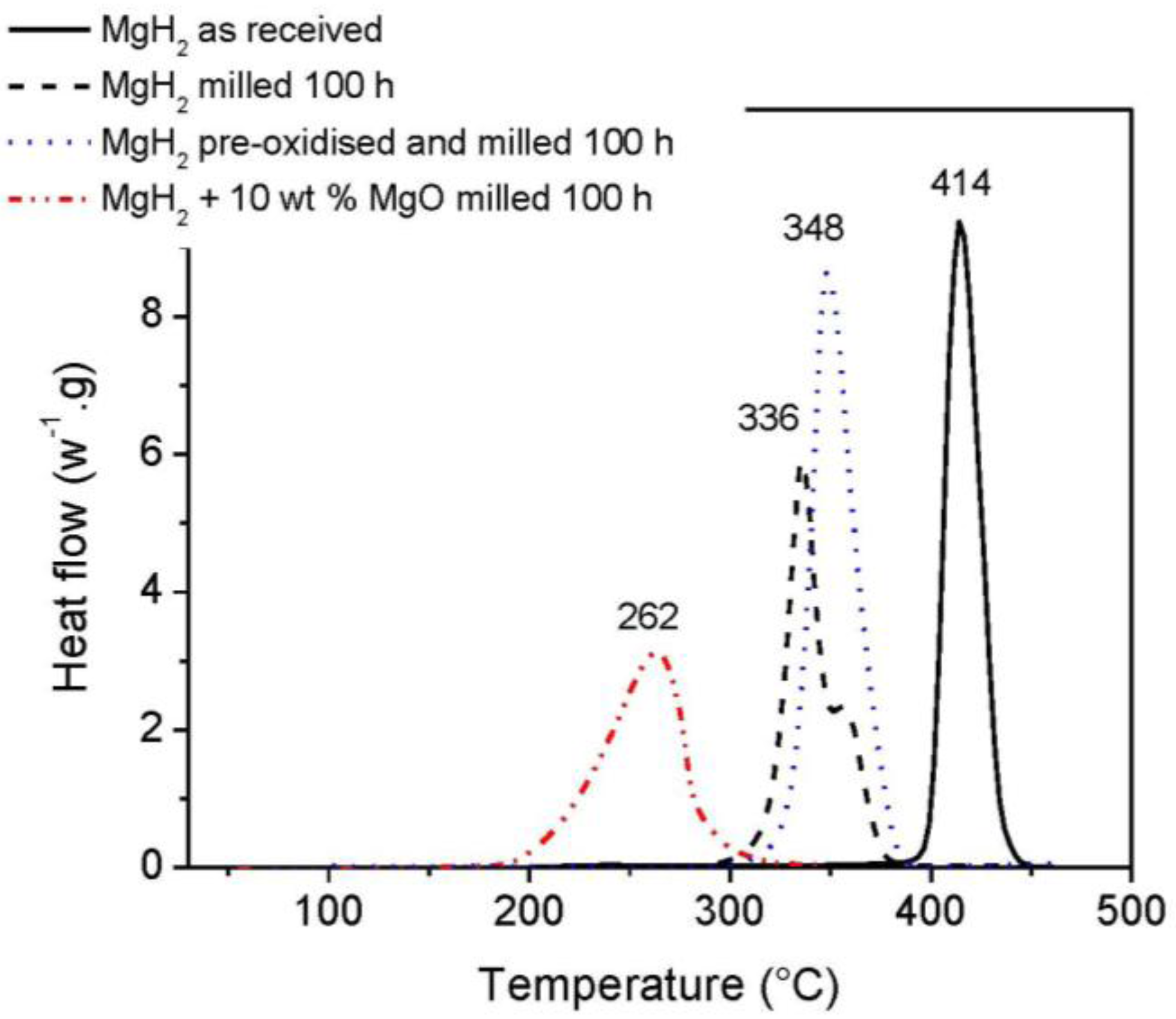
        <p>To outline the effect of mechanical milling and the additional effects of MgO, the materials were characterised by DSC measurements. As shown <xref ref-type="fig" rid="catalysts-02-00330-f001">Figure 1</xref>, as-received MgH<sub>2</sub> released hydrogen in a single endothermic peak at 414 °C. Upon milling MgH<sub>2</sub>, the hydrogen desorption temperature was reduced to 336 °C. However, a significant decrease of the hydrogen desorption temperature was obtained when MgH<sub>2</sub> was milled with MgO as the desorption peak shifted from 336 °C to 262 °C. In our previous report, such a drastic improvement of hydrogen desorption was related to an important reduction in the size of MgH<sub>2</sub> particles as MgO would act as a process control agent facilitating the grinding of MgH<sub>2</sub> particles [<xref ref-type="bibr" rid="B32-catalysts-02-00330">32</xref>]. Further investigations on the potential effect of MgO have raised the possibility of a defective oxide layer at the surface of MgH<sub>2</sub> particles catalysing the splitting/recombination of hydrogen [<xref ref-type="bibr" rid="B37-catalysts-02-00330">37</xref>]. However, such a hypothesis challenges common assumptions as an oxide layer would seriously impede hydrogen absorption/desorption. In fact, pre-oxidising MgH<sub>2</sub> before milling in an attempt to enhance the number of potential oxygen vacancies resulted in poor hydrogen desorption characteristics as demonstrated by the DSC measurement carried out after milling (<xref ref-type="fig" rid="catalysts-02-00330-f001">Figure 1</xref>). In this case, it is most likely that the oxide layer generated during the pre-oxidation of MgH<sub>2</sub> still inhibits hydrogen desorption despites the high energy involved in the milling process and the possibility of forming fresh surfaces and defective surface sites facilitating the desorption of hydrogen. Other investigations have also found similar results with hydrogen kinetics deteriorating as an oxide layer is allowed to grow at the surface of MgH<sub>2</sub> particles [<xref ref-type="bibr" rid="B27-catalysts-02-00330">27</xref>,<xref ref-type="bibr" rid="B34-catalysts-02-00330">34</xref>]. Although hydrogen could strongly absorb at defective oxide sites and dissociate, such a heterolytic dissociation would most likely result in the formation of surface hydroxyls that would be further reduced upon heating [<xref ref-type="bibr" rid="B38-catalysts-02-00330">38</xref>,<xref ref-type="bibr" rid="B39-catalysts-02-00330">39</xref>,<xref ref-type="bibr" rid="B40-catalysts-02-00330">40</xref>]. Accordingly, a catalytic activity of MgO should not be expected.</p>
        <fig id="catalysts-02-00330-f001" position="anchor">
          <label>Figure 1</label>
          <caption>
            <p>DSC curves of MgH<sub>2</sub> as-received, MgH<sub>2</sub> and MgH<sub>2</sub> pre-oxidised in air after milling and MgH<sub>2</sub> after milling with MgO. The lower intensity of the peak for MgH<sub>2</sub> milled with 10 wt % MgO as compared to pure MgH<sub>2</sub> milled is due to the lower amount of the sample loaded in the instrument.</p>
          </caption>
          <graphic xmlns:xlink="http://www.w3.org/1999/xlink" xlink:href="catalysts-02-00330-g001.tif"/>
        </fig>
      </sec>
      <sec>
        <title>3.2. Kinetics and Rate Limiting Steps</title>
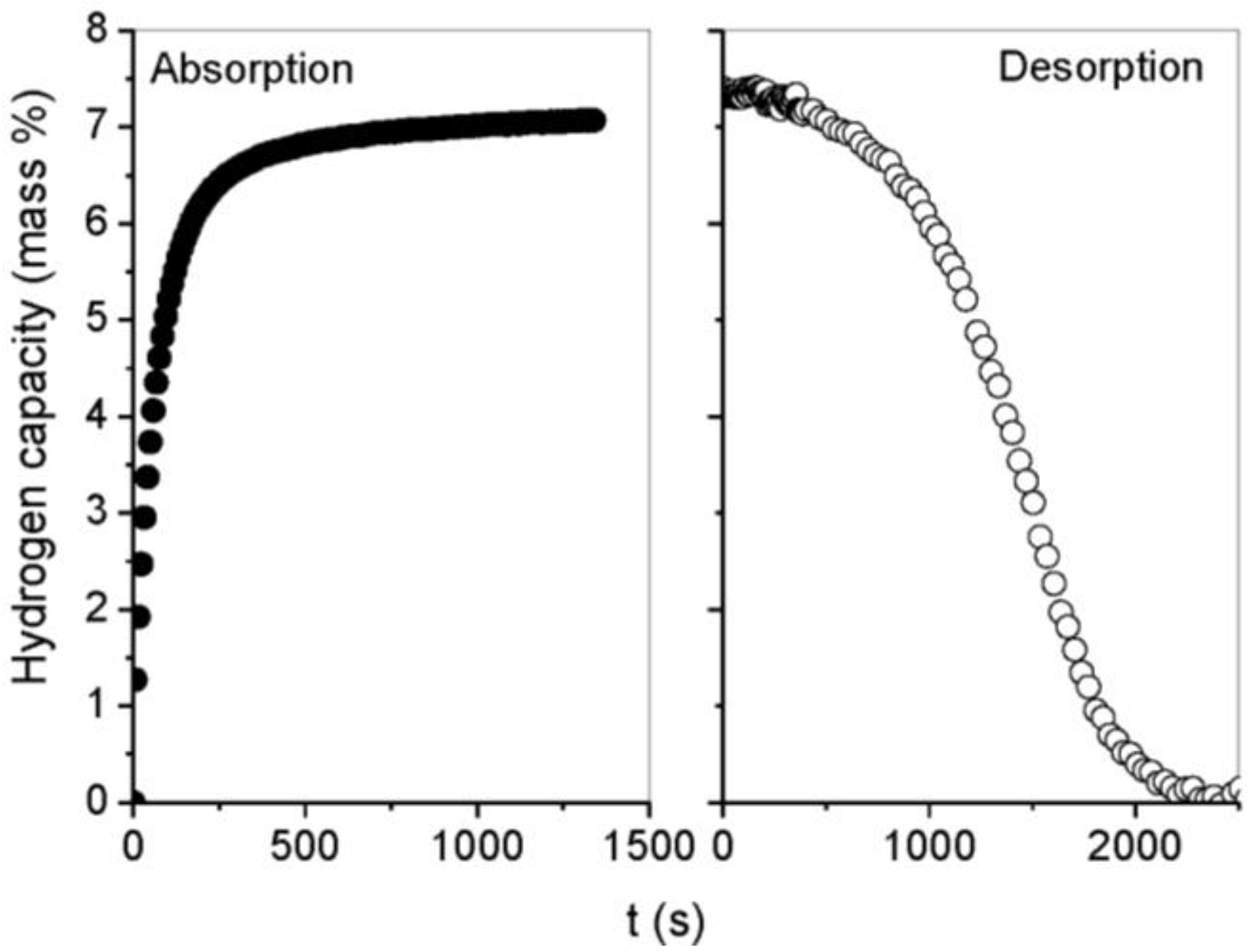
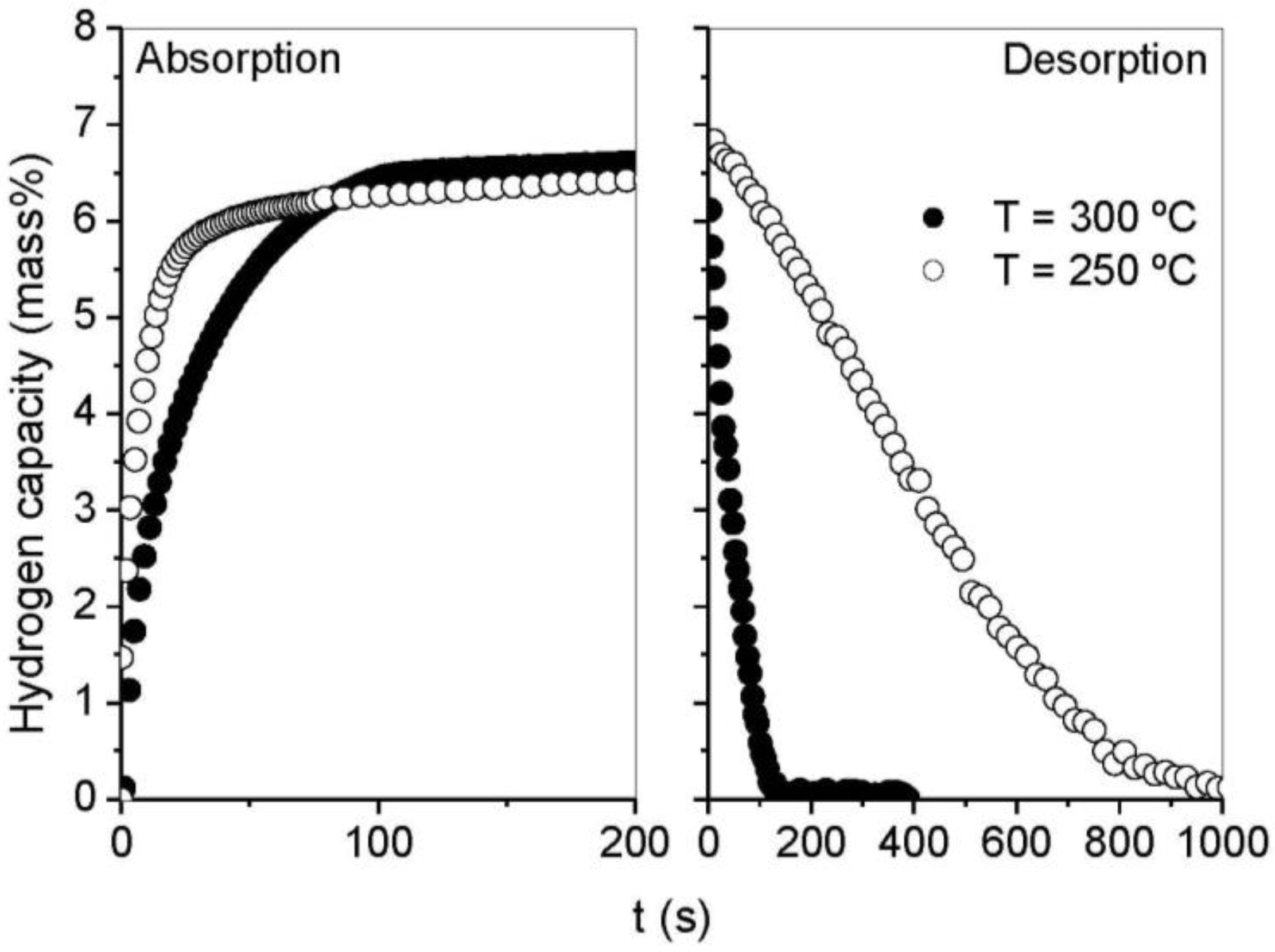
        <p><xref ref-type="fig" rid="catalysts-02-00330-f002">Figure 2</xref> shows the hydrogen kinetics of MgH<sub>2</sub> milled for 100 h at 300 °C. As previously reported, hydrogen absorption is faster than desorption with ~30 min necessary to desorb MgH<sub>2</sub> whereas only ~8 min are required to complete the absorption process up to 90% of the total capacity. Hydrogen kinetics were drastically improved when MgH<sub>2</sub> was milled with MgO (<xref ref-type="fig" rid="catalysts-02-00330-f003">Figure 3</xref>). Hydrogen absorption and desorption could be achieved in less than 100 s at 300 °C. At a lower temperature of 250 °C, full absorption was also completed in less than 200 s, and a fast desorption rate with full hydrogen release occurring in less than 800 s was still achievable. However, below 250 °C the desorption rate of hydrogen drastically decreased and no significant release of hydrogen could be observed in agreement with the DSC measurements. It is noteworthy that the shape of hydrogen absorption curves was not influenced by the temperature or the addition of MgO. Conversely, the hydrogen desorption curves evolved from a sigmoidal shape for milled MgH<sub>2</sub> to a non-sigmoidal curve when MgO was used as a milling additive. </p>
        <fig id="catalysts-02-00330-f002" position="anchor">
          <label>Figure 2</label>
          <caption>
            <p>Hydrogen absorption/desorption curves at 300 °C for MgH<sub>2</sub> milled for 100 h.</p>
          </caption>
          <graphic xmlns:xlink="http://www.w3.org/1999/xlink" xlink:href="catalysts-02-00330-g002.tif"/>
        </fig>
        <fig id="catalysts-02-00330-f003" position="anchor">
          <label>Figure 3</label>
          <caption>
            <p>Hydrogen absorption/desorption curves at 300 °C and 250 °C for MgH<sub>2</sub> milled with MgO.</p>
          </caption>
          <graphic xmlns:xlink="http://www.w3.org/1999/xlink" xlink:href="catalysts-02-00330-g003.tif"/>
        </fig>
        <p>In order to identify possible mechanisms governing the hydrogen kinetics of MgH<sub>2</sub> modified with MgO and better understand the improvements observed, the kinetic curves obtained under isothermal conditions were fitted using the general equation for solid-state reactions [<xref ref-type="bibr" rid="B41-catalysts-02-00330">41</xref>]: </p>
        <p><disp-formula id="catalysts-02-00330-i001">
          <inline-graphic xmlns:xlink="http://www.w3.org/1999/xlink" xlink:href="catalysts-02-00330-i001.tif"/>
          <label>(1)</label>
          </disp-formula></p>
        <p>where <italic>α</italic> is the fraction reacted in time <italic>t</italic>, <italic>k</italic> = <italic>k</italic>(<italic>T</italic>,<italic>P</italic>,<italic>r</italic>) is the reaction rate and <italic>G</italic>(<italic>α</italic>) is a functiondepending on the mechanism controlling the reaction. The main theoretical functions <italic>G</italic>(<italic>α</italic>) are summarized in <xref ref-type="table" rid="catalysts-02-00330-t001">Table 1</xref> and grouped according to four major reaction mechanisms governed by: (i) the surface; (ii) the nucleation and growth of the new phase; (iii) the reaction at the new phase/shrinking core interface with the interface reaction proceeding at constant velocity; and (iv) the reaction at the new phase/shrinking core interface with the interface reaction controlled by diffusion. In order to facilitate the fitting of the hydrogen curves measured and ease the distinction of reaction mechanisms, the method of Hancok and Sharp was used [<xref ref-type="bibr" rid="B42-catalysts-02-00330">42</xref>]. Since nucleation and growth processes in condensed systems follow the almost universal Equation (2), the method consists of plotting ln(−ln(1 − α)) <italic>vs.</italic> ln(<italic>t</italic>).</p>
        <p><disp-formula id="catalysts-02-00330-i002">
          <inline-graphic xmlns:xlink="http://www.w3.org/1999/xlink" xlink:href="catalysts-02-00330-i002.tif"/>
          <label>(2)</label>
          </disp-formula></p>
        <p>where <italic>B</italic> is a constant that depends on the nucleation frequency and linear rate of the grain growth, and <italic>m</italic> is a constant that varies according to the geometry of the system.</p>
        <p><disp-formula id="catalysts-02-00330-i003">
          <inline-graphic xmlns:xlink="http://www.w3.org/1999/xlink" xlink:href="catalysts-02-00330-i003.tif"/>
          <label>(3)</label>
          </disp-formula></p>
        <p>upon plotting Equation (3), the determination of <italic>m </italic>allows the identification of the reaction mechanism by comparison with tabulated theoretical values (<xref ref-type="table" rid="catalysts-02-00330-t001">Table 1</xref>).</p>
        <table-wrap id="catalysts-02-00330-t001" position="anchor">
          <object-id pub-id-type="pii">catalysts-02-00330-t001_Table 1</object-id>
          <label>Table 1</label>
          <caption>
            <p>Summary of main model functions describing solid-gas kinetics.</p>
          </caption>
          <table rules="all">
            <thead>
              <tr>
                <th align="left" valign="middle">Mechanism</th>
                <th align="center" valign="middle">Functional time dependence G(α)</th>
                <th align="center" valign="middle">
                  <italic>m</italic>
                </th>
              </tr>
            </thead>
            <tbody>
              <tr>
                <td colspan="3" align="left" valign="middle">Surface control</td>
              </tr>
              <tr>
                <td align="left" valign="middle">S<sub>1</sub></td>
                <td align="center" valign="middle">α</td>
                <td align="center" valign="middle">1.24</td>
              </tr>
              <tr>
                <td colspan="3" align="left" valign="middle">Random nucleation and growth (Avrami equations)</td>
              </tr>
              <tr>
                <td align="left" valign="middle">A<sub>1</sub></td>
                <td align="center" valign="middle">−ln(1 − α)<sup>1/4</sup></td>
                <td align="center" valign="middle">4.00</td>
              </tr>
              <tr>
                <td align="left" valign="middle">A<sub>2</sub></td>
                <td align="center" valign="middle">−ln(1 − α)<sup>1/3</sup></td>
                <td align="center" valign="middle">3.00</td>
              </tr>
              <tr>
                <td align="left" valign="middle">A<sub>3</sub></td>
                <td align="center" valign="middle">−ln(1 − α)<sup>2/5</sup></td>
                <td align="center" valign="middle">2.50</td>
              </tr>
              <tr>
                <td align="left" valign="middle">A<sub>4</sub></td>
                <td align="center" valign="middle">−ln(1 − α)<sup>1/2</sup></td>
                <td align="center" valign="middle">2.00</td>
              </tr>
              <tr>
                <td align="left" valign="middle">A<sub>5</sub></td>
                <td align="center" valign="middle">−ln(1 − α)<sup>2/3</sup></td>
                <td align="center" valign="middle">1.50</td>
              </tr>
              <tr>
                <td colspan="3" align="left" valign="middle">Shrinking Core with constant velocity: controlled by interface reaction</td>
              </tr>
              <tr>
                <td align="left" valign="middle">IP<sub>2</sub>–contracting surface</td>
                <td align="center" valign="middle">1 − (1 − α)<sup>1/2</sup></td>
                <td align="center" valign="middle">1.11</td>
              </tr>
              <tr>
                <td align="left" valign="middle">IP<sub>3</sub>–contracting volume</td>
                <td align="center" valign="middle">1 − (1 − α)<sup>1/3</sup></td>
                <td align="center" valign="middle">1.07</td>
              </tr>
              <tr>
                <td colspan="3" align="left" valign="middle">Shrinking Core with decelerating velocity: controlled by diffusion</td>
              </tr>
              <tr>
                <td align="left" valign="middle">D<sub>1</sub>-1-D diffusion</td>
                <td align="center" valign="middle">α<sup>2</sup></td>
                <td align="center" valign="middle">0.62</td>
              </tr>
              <tr>
                <td align="left" valign="middle">D<sub>2</sub>-2-D diffusion</td>
                <td align="center" valign="middle">(1 − α)ln(1 − α) + α</td>
                <td align="center" valign="middle">0.57</td>
              </tr>
              <tr>
                <td align="left" valign="middle">D<sub>3</sub>-Jander, 3-D diffusion</td>
                <td align="center" valign="middle">(1 −(1 − α)<sup>1/3</sup>)<sup>2</sup></td>
                <td align="center" valign="middle">0.54</td>
              </tr>
            </tbody>
          </table>
        </table-wrap>
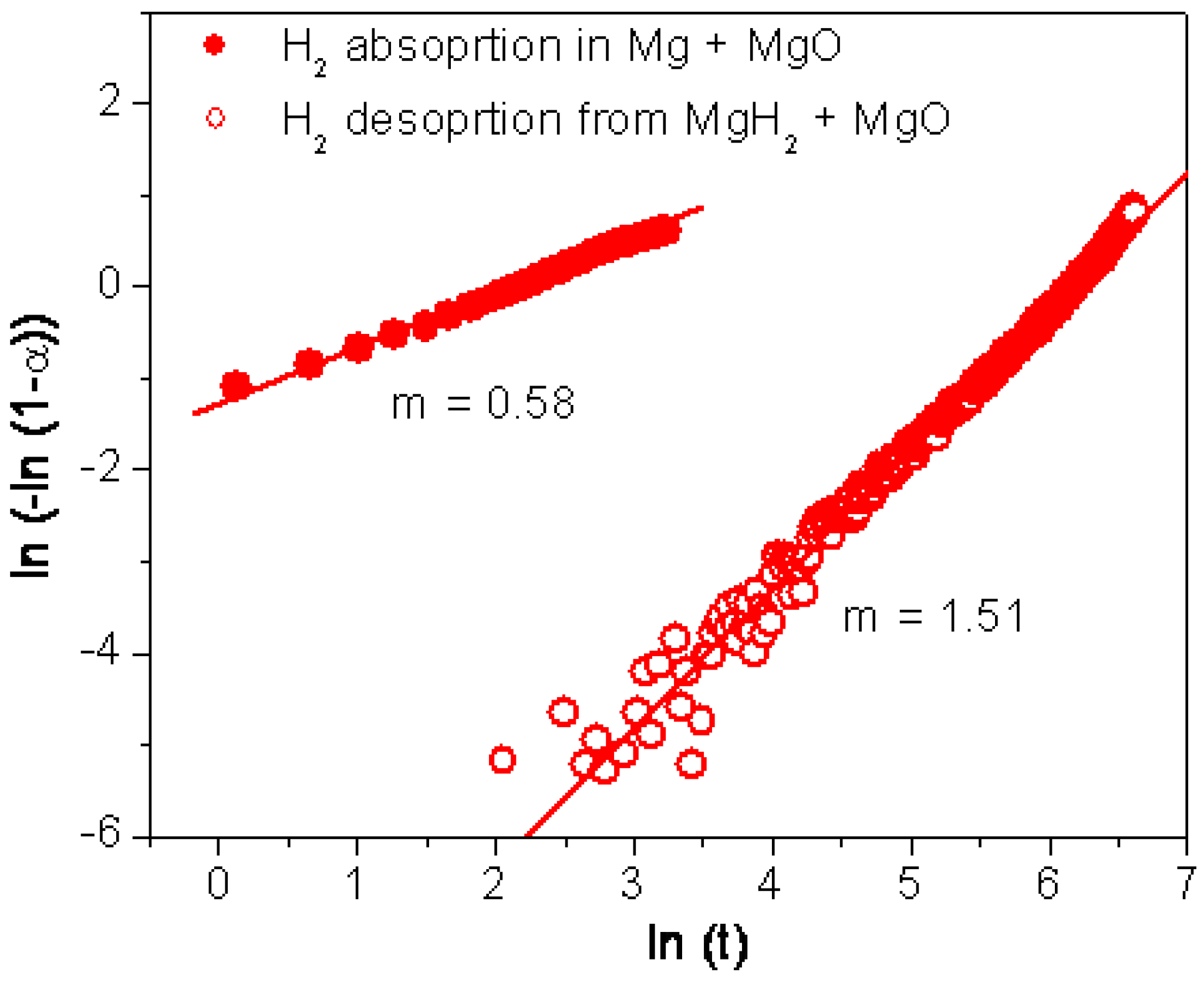
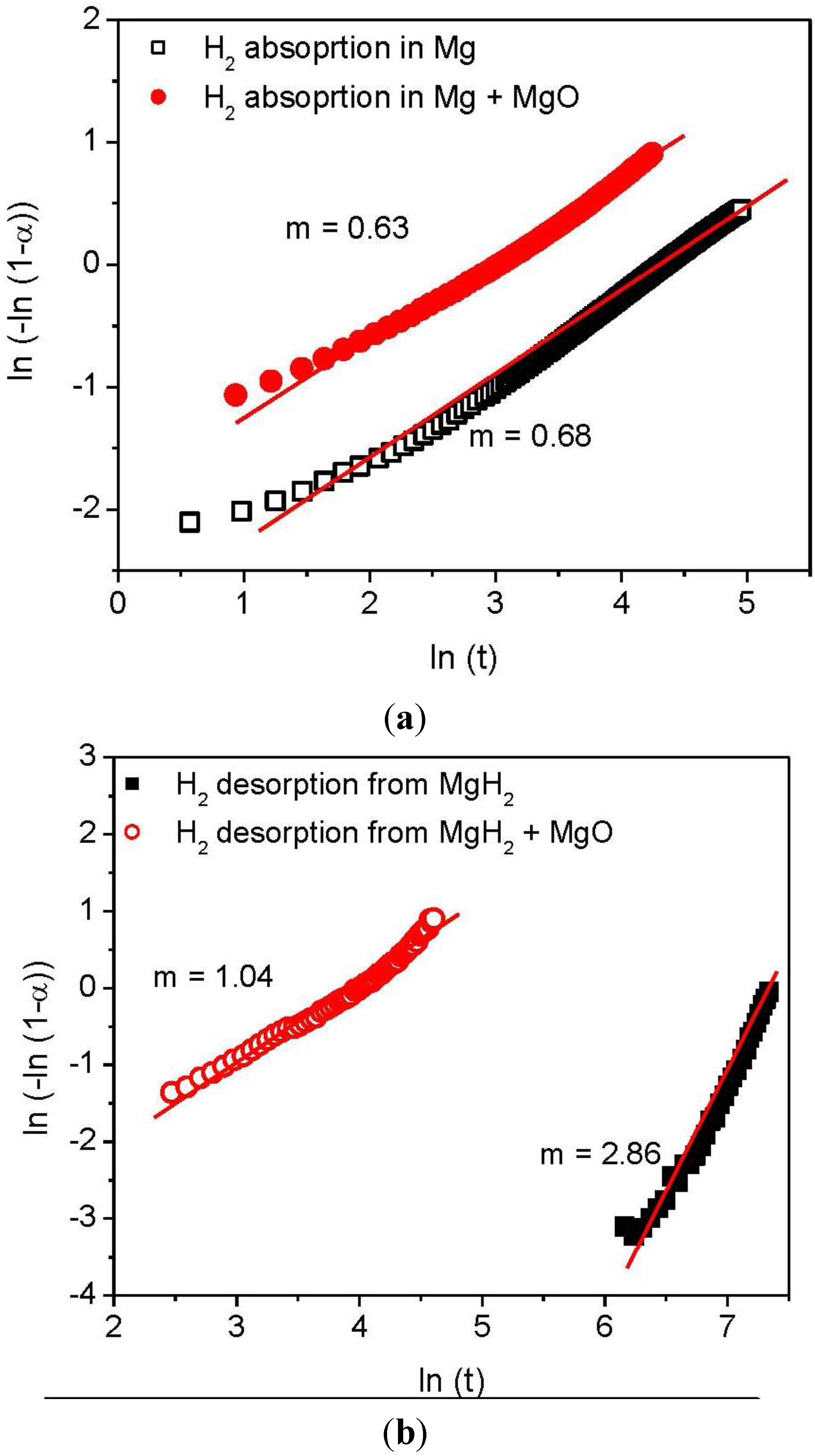
        <p><xref ref-type="fig" rid="catalysts-02-00330-f004">Figure 4</xref> shows the fits for the hydrogen absorption and desorption kinetic curves obtained for Mg and Mg milled with MgO. In both cases, a slope close to 0.62 for the absorption kinetic indicates that the absorption process was controlled by the diffusion of hydrogen into MgH<sub>2</sub> in a one dimensional process. Despite the low diffusion coefficient of hydrogen in the MgH<sub>2</sub> phase, such behaviour is possibly due to the high temperatures and pressures used to perform the absorptions. However, upon hydrogen desorption different slopes of 1.04 and 2.86 were obtained for MgH<sub>2</sub> and MgH<sub>2</sub> milled with MgO, respectively. This would indicate a shift from a mechanism where hydrogen desorption is controlled by the nucleation and growth of the Mg phase to a desorption process controlled by the Mg/MgH<sub>2</sub> interface as the MgH<sub>2</sub> core is shrinking. It is widely accepted that the hydrogen desorption of milled MgH<sub>2</sub> follows a nucleation and growth process [<xref ref-type="bibr" rid="B5-catalysts-02-00330">5</xref>,<xref ref-type="bibr" rid="B6-catalysts-02-00330">6</xref>]. Accordingly, the results obtained for milled MgH<sub>2</sub> are in agreement with the general trends observed.</p>
        <fig id="catalysts-02-00330-f004" position="anchor">
          <label>Figure 4</label>
          <caption>
            <p>Plot of ln(ln(1 − α)) <italic>vs</italic>. ln(<italic>t</italic>) for the hydrogen absorption/desorption curves obtained at 300 °C for MgH<sub>2</sub> milled with and without MgO.</p>
          </caption>
          <graphic xmlns:xlink="http://www.w3.org/1999/xlink" xlink:href="catalysts-02-00330-g004.tif"/>
        </fig>
        <p>As the temperature for hydrogen absorption/desorption in MgH<sub>2</sub> milled with MgO is decreased to 250 °C, the hydrogen absorption kinetic was found to be once again controlled by the diffusion of hydrogen, however hydrogen desorption shifted back to a reaction mechanism controlled by a nucleation and growth process (<xref ref-type="fig" rid="catalysts-02-00330-f005">Figure 5</xref>). At such a low temperature, the energy provided may not be sufficient to overcome the activation energy required for the nucleation of the magnesium phase. Therefore, the mechanism would be controlled again by nucleation and growth instead of interface control. Liang <italic>et al.</italic> reported similar findings with hydrogen desorption from MgH<sub>2</sub> modified with 5 at% of V shifting from a nucleation and growth process to a interface process for temperatures above 250 °C [<xref ref-type="bibr" rid="B19-catalysts-02-00330">19</xref>]. In this case, the shift observed was explained by the catalytic activity of V taking place above 250 °C by reducing the barrier for nucleation and thus making hydrogen desorption occurring at low driving forces. However, with MgH<sub>2</sub> modified with MgO, it is unlikely that MgO would catalyse the recombination of hydrogen and thus the nucleation of a magnesium phase as previously discussed. The shift in controlling mechanisms observed would therefore correspond to the energy required to effectively recombine hydrogen at the surface of milled MgH<sub>2</sub>. After milling, magnesium showed smaller particle sizes and increased specific surface area resulting in a higher density of nucleation sites. As a significant reduction of activation energy for hydrogen desorption has been observed for decreasing particles sizes [<xref ref-type="bibr" rid="B43-catalysts-02-00330">43</xref>], the smaller particles generated upon milling MgH<sub>2</sub> with MgO would result in faster hydrogen kinetics and depending on the driving forces different reaction mechanisms. </p>
        <fig id="catalysts-02-00330-f005" position="anchor">
          <label>Figure 5</label>
          <caption>
            <p>Plot of ln(ln(1 − α)) <italic>vs</italic>. ln(<italic>t</italic>) for the hydrogen absorption/desorption curves obtained at 250 °C for MgH<sub>2</sub> milled with MgO.</p>
          </caption>
          <graphic xmlns:xlink="http://www.w3.org/1999/xlink" xlink:href="catalysts-02-00330-g005.tif"/>
        </fig>
        <p>It is also striking that the rate limiting steps identified for MgH<sub>2</sub> milled with MgO are similar to those observed with MgH<sub>2</sub> modified with the best known catalyst, <italic>i.e.</italic>, Nb<sub>2</sub>O<sub>5</sub> [<xref ref-type="bibr" rid="B24-catalysts-02-00330">24</xref>]. At the macroscopic level, hydrogen desorption at 300 °C would proceed through an Mg/MgH<sub>2</sub> interface-controlled growth process regardless the additive (<xref ref-type="table" rid="catalysts-02-00330-t002">Table 2</xref>). The hypothesis can be made that the use of MgO resulted in a better grinding process leading to smaller particle/crystal sizes and thus faster kinetics. However, comparison of the physical properties of the materials obtained in both cases does not revealed any significant differences in terms of particle and crystallite sizes (<xref ref-type="table" rid="catalysts-02-00330-t002">Table 2</xref>). Accordingly, such a finding contradicts current assumptions whereby Nb<sub>2</sub>O<sub>5</sub> is considered to as a catalyst reducing the barriers for nucleation and thus facilitating hydrogen desorption at low driving forces [<xref ref-type="bibr" rid="B25-catalysts-02-00330">25</xref>,<xref ref-type="bibr" rid="B27-catalysts-02-00330">27</xref>]. The formation of mixed phases of Mg<italic><sub>x</sub></italic>Nb<italic><sub>y</sub></italic>O acting as pathways for hydrogen diffusion with the formation of metastable niobium hydride phases reducing the activation energy of the Mg/MgH<sub>2</sub> transition is another possibility [<xref ref-type="bibr" rid="B27-catalysts-02-00330">27</xref>]. Alike Nb<sub>2</sub>O<sub>5</sub>, MgO would also be reduced by MgH<sub>2</sub> upon heating to form new oxide phases. However MgO would not generate nucleation points of partial oxides that could induce the interface controlled mechanism observed with MgO and/or Nb<sub>2</sub>O<sub>5</sub>. It is noteworthy that the addition of Nb<sub>2</sub>O<sub>5</sub> to MgH<sub>2</sub> with fully optimised hydrogen kinetics does not lead to further kinetic improvements. Once fast hydrogen kinetics have been reached at 250 °C by effectively reducing particle size during the milling process, any catalyst addition could not further enhance the hydrogen kinetics [<xref ref-type="bibr" rid="B44-catalysts-02-00330">44</xref>]. Accordingly, if the modification of MgH<sub>2</sub> with MgO or Nb<sub>2</sub>O<sub>5</sub> has led to a final material with equivalent properties, a possible catalytic effect of Nb<sub>2</sub>O<sub>5</sub> would be mirror in comparison to other potential effects such as particle size.</p>
        <table-wrap id="catalysts-02-00330-t002" position="anchor">
          <object-id pub-id-type="pii">catalysts-02-00330-t002_Table 2</object-id>
          <label>Table 2</label>
          <caption>
            <p>Rate limiting steps for hydrogen absorption/desorption in magnesium upon modification with MgO and Nb<sub>2</sub>O<sub>5</sub>.</p>
          </caption>
          <table>
            <thead>
              <tr>
                <th align="left" valign="middle"> </th>
                <th align="center" valign="middle">MgH<sub>2</sub> [<xref ref-type="bibr" rid="B6-catalysts-02-00330">6</xref>,<xref ref-type="bibr" rid="B32-catalysts-02-00330">32</xref>,<xref ref-type="bibr" rid="B44-catalysts-02-00330">44</xref>]</th>
                <th colspan="2" align="center" valign="middle">MgH<sub>2</sub> + MgO [<xref ref-type="bibr" rid="B32-catalysts-02-00330">32</xref>]</th>
                <th align="center" valign="middle">MgH<sub>2 </sub>+ Nb<sub>2</sub>O<sub>5</sub> [<xref ref-type="bibr" rid="B18-catalysts-02-00330">18</xref>,<xref ref-type="bibr" rid="B44-catalysts-02-00330">44</xref>]</th>
              </tr>
            </thead>
            <tbody>
              <tr>
                <td align="left" valign="middle">Particle size (µm)</td>
                <td align="center" valign="middle">1 ± 0.5</td>
                <td colspan="2" align="center" valign="middle">0.4 ± 0.3</td>
                <td align="center" valign="middle">0.5 ± 0.3</td>
              </tr>
              <tr>
                <td align="left" valign="middle">Surface area (m<sup>2</sup>·g<sup>−1</sup>)</td>
                <td align="center" valign="middle">9.9</td>
                <td colspan="2" align="center" valign="middle">-</td>
                <td align="center" valign="middle">22.4</td>
              </tr>
              <tr>
                <td align="left" valign="middle">Crystallite size (nm) </td>
                <td align="center" valign="middle">79</td>
                <td colspan="2" align="center" valign="middle">86</td>
                <td align="center" valign="middle">83</td>
              </tr>
              <tr>
                <td colspan="5" align="left" valign="middle">Absorption at 300 °C (250 °C)</td>
              </tr>
              <tr style="border-top: solid thin">
                <td align="left" valign="middle">Rate constant (s<sup>−1</sup>)</td>
                <td align="center" valign="middle">0.00068</td>
                <td colspan="2" align="center" valign="middle">0.0027 (0.0052)</td>
                <td align="center" valign="middle">-</td>
              </tr>
              <tr>
                <td align="left" valign="middle">Rate limiting step</td>
                <td align="center" valign="middle">Diffusion</td>
                <td colspan="2" align="center" valign="middle">Diffusion (Diffusion)</td>
                <td align="center" valign="middle">Diffusion</td>
              </tr>
              <tr>
                <td colspan="5" align="left" valign="middle">Desorption at 300 °C (250 °C)</td>
              </tr>
              <tr style="border-top: solid thin">
                <td align="left" valign="middle">Rate constant (s<sup>−1</sup>)</td>
                <td colspan="2" align="center" valign="middle">0.00065</td>
                <td align="center" valign="middle">0.0055 (0.0207)</td>
                <td align="center" valign="middle">-</td>
              </tr>
              <tr>
                <td align="left" valign="middle">Rate limiting step</td>
                <td colspan="2" align="center" valign="middle">Nucleation and growth</td>
                <td align="center" valign="middle">Shrinking core controlled by interface(Nucleation and growth)</td>
                <td align="center" valign="middle">Shrinking core controlled by interface</td>
              </tr>
            </tbody>
          </table>
        </table-wrap>
      </sec>
      <sec>
        <title>3.3. Rationalisation of the Effect of Oxides</title>
        <p>In the light of these findings, alternative explanations should be advanced to describe the role of the oxides used to improve the hydrogen kinetics of Mg/MgH<sub>2</sub>. In the initial model of Klassen <italic>et al</italic>., it is proposed that only transition metal oxides comprising defective oxide sites and high valance state metals capable of high electrons exchange rate during catalysis are suitable for improving Mg/MgH<sub>2</sub> kinetics [<xref ref-type="bibr" rid="B15-catalysts-02-00330">15</xref>,<xref ref-type="bibr" rid="B25-catalysts-02-00330">25</xref>]. If such model can in part explain a potential contribution of transition metal oxides in improving the kinetics of the hydrogen absorption/desorption process, it fails to describe the positive effect of TiO<sub>2</sub>, MgO and other non-transition metals oxides. </p>
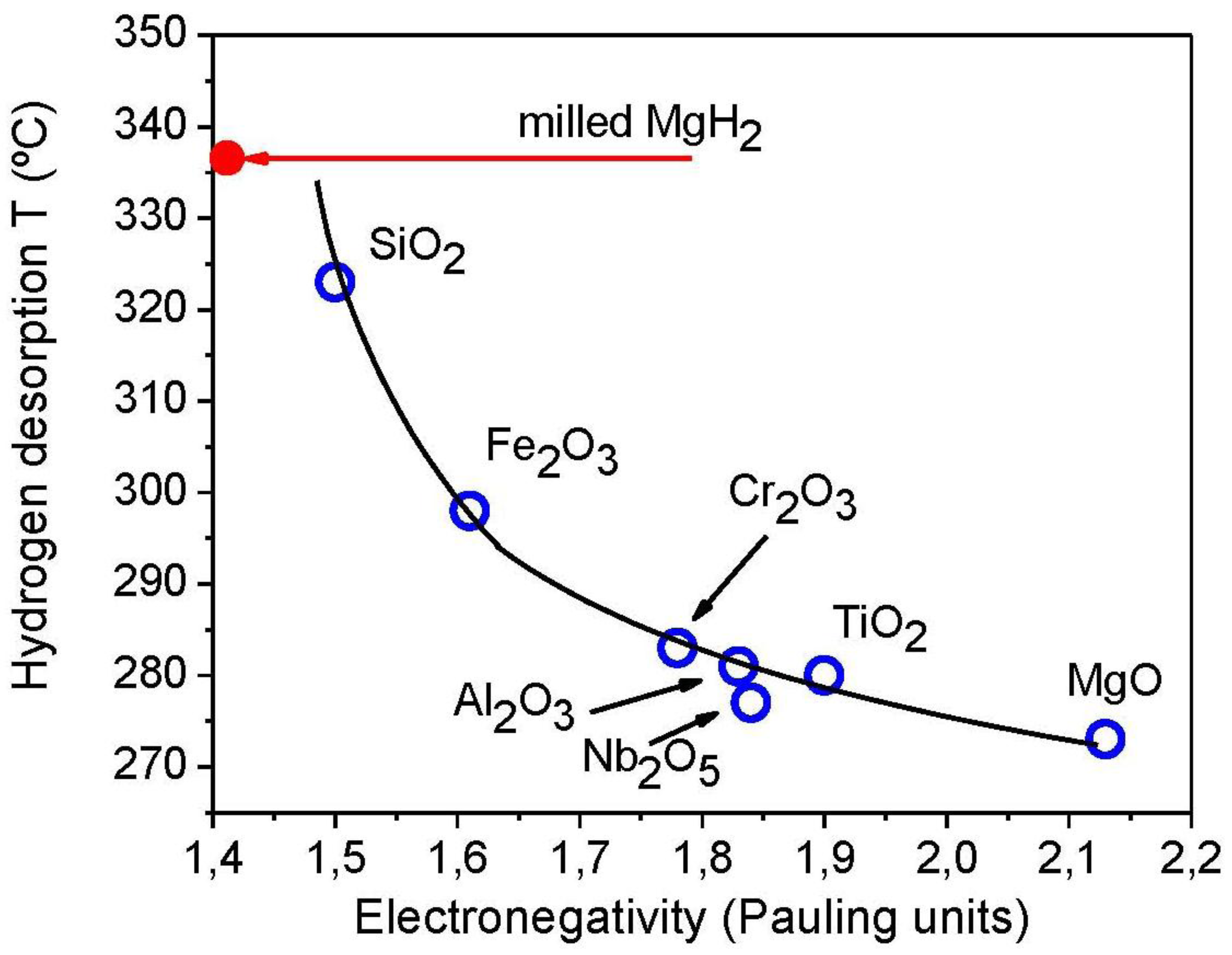
        <p>In our early investigations, we have reported that non transition metal oxides such as Al<sub>2</sub>O<sub>3</sub> were also good at improving the hydrogen kinetics of Mg/MgH<sub>2</sub> [<xref ref-type="bibr" rid="B45-catalysts-02-00330">45</xref>]. We also found that upon Nb<sub>2</sub>O<sub>5</sub> addition to MgH<sub>2</sub> during the milling process a significant improvement of the grinding process was achieved [<xref ref-type="bibr" rid="B44-catalysts-02-00330">44</xref>]. Taking into account the poor ability of metal oxides such as SiO<sub>2</sub> to enhance the hydrogen kinetics of Mg [<xref ref-type="bibr" rid="B45-catalysts-02-00330">45</xref>], and considering the mechanical effect of metal oxides in facilitating the grinding and stabilisation of small MgH<sub>2</sub> particles a correlation was found between the potency of a metal oxide in improving hydrogen kinetics in Mg and the nature of the metal-oxygen bond (<xref ref-type="fig" rid="catalysts-02-00330-f006">Figure 6</xref>). Depending on the electronegativity of solid oxides envisaged lower hydrogen desorption temperatures were obtained for oxides of higher electronegativity such as MgO. Such a correlation is comprehensible when considering the processes occurring during high energy ball milling. As MgH<sub>2</sub> particles are initially fractured, the generation of fresh surfaces would result in an excess of surface energy leading to particles agglomeration and cold welding upon balls impact. Hence depending on the experimental conditions, the milling process would become quickly inefficient in reducing particle sizes when the equilibrium between cold-welding and fracturing is established [<xref ref-type="bibr" rid="B32-catalysts-02-00330">32</xref>,<xref ref-type="bibr" rid="B44-catalysts-02-00330">44</xref>]. To delay this equilibrium and reach the smallest possible particle size, process control agents such as polar, non-polar organic solvents or polymers maintaining a low friction are usually employed to reduce agglomeration and cold-welding [<xref ref-type="bibr" rid="B46-catalysts-02-00330">46</xref>]. However, such additives are known to be relatively inefficient with MgH<sub>2</sub> as they quickly degrade and lead to severe carbon contamination due to the high temperatures, <italic>i.e.</italic>, &gt;500 °C, locally generated during milling processes. At such high temperatures, oxides such as TiO<sub>2</sub> and MgO are known to be effective lubricants providing low frictions coefficients to sliding tribological interfaces [<xref ref-type="bibr" rid="B47-catalysts-02-00330">47</xref>]. In a recently proposed model, Erdemir reported a correlation between friction coefficients and electronegativity [<xref ref-type="bibr" rid="B48-catalysts-02-00330">48</xref>]. The higher the electronegativity of a solid oxide is, the lower the friction coefficient would be. As metal oxides of higher electronegativity hold their bonding electrons more tightly and have a lower tendency to chemically bind with their neighbouring oxides, Erdemir found that higher electronegativity would lead to lower shearing at the interface of sliding oxide particles and thus lower friction coefficients. The favourable tribological properties of highly electronegative oxides would explain the correlation obtained with respect to the hydrogen kinetics of MgH<sub>2</sub> milled with oxides.</p>
        <fig id="catalysts-02-00330-f006" position="anchor">
          <label>Figure 6</label>
          <caption>
            <p>Correlation between the desorption temperature of hydrogen from MgH<sub>2</sub> achieved upon oxide addition during milling and the electronegativity of the oxide additives.</p>
          </caption>
          <graphic xmlns:xlink="http://www.w3.org/1999/xlink" xlink:href="catalysts-02-00330-g006.tif"/>
        </fig>
        <p>At high temperatures, as the oxide layer is depleted from the particle surface by wear, the surface of MgH<sub>2</sub> particles would be oxidised to some extend at sliding interfaces. Accordingly, the mechanical process of MgH<sub>2</sub> with solid oxides could involve the sliding of two oxidised surfaces: that of the partially oxidised MgH<sub>2</sub> particles and the metal oxide additive. The formation of MgO observed during the milling process of MgH<sub>2</sub> with Nb<sub>2</sub>O<sub>5</sub>, for example [<xref ref-type="bibr" rid="B26-catalysts-02-00330">26</xref>], would corroborate the existence of such an interface. As Nb<sub>2</sub>O<sub>5</sub> is replaced by more electronegative oxides showing higher friction coefficients, efficient reduction of MgH<sub>2</sub> particle size upon milling would thus become possible. Such a correlation clearly corroborates our observations as the use of MgO having the highest electronegativity of all metal oxides investigated so far led to the most advanced hydrogen kinetics in Mg. It also explains why a simple pre-oxidation of MgH<sub>2</sub> prior to mechanical milling did not help in reducing particle sizes and improving hydrogen kinetics. Furthermore, the correlation found is a clear indicator of the mechanical effect of solid oxides in facilitating the grinding process of MgH<sub>2</sub> and fast hydrogen kinetics through particle size reduction and stabilisation. Although further work is needed to establish the levels of “catalytic/mechanical” contribution of solid oxides to the hydrogen kinetics of magnesium, the correlation found evidently highlights the potential of particle size reduction as a mean for finally controlling the properties of the Mg/MgH<sub>2</sub> system and we are currently exploring the potential of such a route [<xref ref-type="bibr" rid="B49-catalysts-02-00330">49</xref>]. </p>
      </sec>
    </sec>
    <sec sec-type="conclusions">
      <title>4. Conclusions</title>
      <p>Addition of MgO to MgH<sub>2</sub> during the milling process led to a significant improvement of hydrogen kinetics with absorption/desorption rates as fast as those reported with the best catalyst found so far, <italic>i.e.</italic>, Nb<sub>2</sub>O<sub>5</sub>. Quantitative analysis of the hydrogen kinetic curves obtained for MgH<sub>2</sub> milled with MgO revealed that hydrogen absorption is diffusion controlled, whereas hydrogen desorption shifted from the typical nucleation and growth process characterising pristine MgH<sub>2</sub> to an interface controlled process. Such modifications in desorption behaviour also observed upon Nb<sub>2</sub>O<sub>5</sub> addition has previously been regarded as an indicator of the catalytic behaviour of Nb<sub>2</sub>O<sub>5</sub>. Although contradictory in first instance, since MgO is unable to catalyse the reaction of hydrogen with magnesium, these results can be reconciled by considering the tribological effects of solid oxides during the milling process of MgH<sub>2</sub>. Hence, a correlation between the electronegativity of metal oxides and achievable hydrogen desorption was found. The higher the oxide electronegativity, the lower the hydrogen desorption temperature. Such a correlation can be explained by the lower friction coefficient involved at the interface of solid oxides of high electronegativity reflecting effective gridding processes. Furthermore, the correlation found clearly points toward the mechanical effect of solid oxides in facilitating the grinding of MgH<sub>2</sub> and the stabilisation of small particles sizes capable of fast hydrogen kinetics due to the shorter diffusion paths involved. </p>
    </sec>
  </body>
  <back>
    <ack>
      <title>Acknowledgments</title>
      <p>This research was under the Australian Research Council’s <italic>Discovery Projects</italic> funding scheme (project DP1095209) and supported by the Spanish Ministry of Science and Innovation, under the contract MICINN-MAT2011-22780 and Comunidad de Madrid under the contract CG10-UAM/ENE-5245.</p>
    </ack>
    <ref-list>
      <title>References</title>
      <ref id="B1-catalysts-02-00330">
        <label>1.</label>
        <citation citation-type="journal">
          <person-group person-group-type="author">
            <name>
              <surname>Niemann</surname>
              <given-names>M.U.</given-names>
            </name>
            <name>
              <surname>Srinivasan</surname>
              <given-names>S.S.</given-names>
            </name>
            <name>
              <surname>Phani</surname>
              <given-names>A.R.</given-names>
            </name>
            <name>
              <surname>Kumar</surname>
              <given-names>A.</given-names>
            </name>
            <name>
              <surname>Goswami</surname>
              <given-names>D.Y.</given-names>
            </name>
            <name>
              <surname>Stefanakos</surname>
              <given-names>E.K. </given-names>
            </name>
          </person-group>
          <article-title>Nanomaterials for hydrogen storage applications: A review</article-title>
          <source>J. Nanomater.</source>
          <year>2008</year>
          <volume>2008</volume>
          <fpage>950967:1</fpage>
          <lpage>950967:9</lpage>
        </citation>
      </ref>
      <ref id="B2-catalysts-02-00330">
        <label>2.</label>
        <citation citation-type="journal">
          <person-group person-group-type="author">
            <name>
              <surname>Sakintuna</surname>
              <given-names>B.</given-names>
            </name>
            <name>
              <surname>Lamari-Darkrim</surname>
              <given-names>F.</given-names>
            </name>
            <name>
              <surname>Hirscher</surname>
              <given-names>M.</given-names>
            </name>
          </person-group>
          <article-title>Metal hydride materials for solid hydrogen storage: A review</article-title>
          <source>Int. J. Hydr. Energy</source>
          <year>2007</year>
          <volume>32</volume>
          <fpage>1121</fpage>
          <lpage>1140</lpage>
          <pub-id pub-id-type="doi">10.1016/j.ijhydene.2006.11.022</pub-id>
        </citation>
      </ref>
      <ref id="B3-catalysts-02-00330">
        <label>3.</label>
        <citation citation-type="journal">
          <person-group person-group-type="author">
            <name>
              <surname>Bogdanovic</surname>
              <given-names>B.</given-names>
            </name>
          </person-group>
          <article-title>Catalytic synthesis of organo-lithium and organomagnesium compounds and of lithium and magnesium hydrides—Applications in organic-synthesis and hydrogen storage</article-title>
          <source>Angew. Chem. Int. Ed.</source>
          <year>1985</year>
          <volume>24</volume>
          <fpage>262</fpage>
          <lpage>273</lpage>
          <pub-id pub-id-type="doi">10.1002/anie.198502621</pub-id>
        </citation>
      </ref>
      <ref id="B4-catalysts-02-00330">
        <label>4.</label>
        <citation citation-type="journal">
          <person-group person-group-type="author">
            <name>
              <surname>Huot</surname>
              <given-names>J.</given-names>
            </name>
            <name>
              <surname>Liang</surname>
              <given-names>G.</given-names>
            </name>
            <name>
              <surname>Schulz</surname>
              <given-names>R.</given-names>
            </name>
          </person-group>
          <article-title>Mechanically alloyed metal hydride systems</article-title>
          <source>Appl. Phys. Mater. Sci. Proc.</source>
          <year>2001</year>
          <volume>72</volume>
          <fpage>187</fpage>
          <lpage>195</lpage>
          <pub-id pub-id-type="doi">10.1007/s003390100772</pub-id>
        </citation>
      </ref>
      <ref id="B5-catalysts-02-00330">
        <label>5.</label>
        <citation citation-type="journal">
          <person-group person-group-type="author">
            <name>
              <surname>Aguey-Zinsou</surname>
              <given-names>K.F.</given-names>
            </name>
            <name>
              <surname>Ares-Fernandez</surname>
              <given-names>J.R.</given-names>
            </name>
          </person-group>
          <article-title>Hydrogen in magnesium: New perspectives toward functional stores</article-title>
          <source>Energy Environ. Sci.</source>
          <year>2010</year>
          <volume>3</volume>
          <fpage>526</fpage>
          <lpage>543</lpage>
          <pub-id pub-id-type="doi">10.1039/b921645f</pub-id>
        </citation>
      </ref>
      <ref id="B6-catalysts-02-00330">
        <label>6.</label>
        <citation citation-type="journal">
          <person-group person-group-type="author">
            <name>
              <surname>Huot</surname>
              <given-names>J.</given-names>
            </name>
            <name>
              <surname>Liang</surname>
              <given-names>G.</given-names>
            </name>
            <name>
              <surname>Boily</surname>
              <given-names>S.</given-names>
            </name>
            <name>
              <surname>van Neste</surname>
              <given-names>A.</given-names>
            </name>
            <name>
              <surname>Schulz</surname>
              <given-names>R.</given-names>
            </name>
          </person-group>
          <article-title>Structural study and hydrogen sorption kinetics of ball-milled magnesium hydride</article-title>
          <source>J. Alloy. Compd.</source>
          <year>1999</year>
          <volume>293</volume>
          <fpage>495</fpage>
          <lpage>500</lpage>
          <pub-id pub-id-type="doi">10.1016/S0925-8388(99)00474-0</pub-id>
        </citation>
      </ref>
      <ref id="B7-catalysts-02-00330">
        <label>7.</label>
        <citation citation-type="journal">
          <person-group person-group-type="author">
            <name>
              <surname>Schulz</surname>
              <given-names>R.</given-names>
            </name>
            <name>
              <surname>Huot</surname>
              <given-names>J.</given-names>
            </name>
            <name>
              <surname>Liang</surname>
              <given-names>G.</given-names>
            </name>
            <name>
              <surname>Boily</surname>
              <given-names>S.</given-names>
            </name>
            <name>
              <surname>Lalande</surname>
              <given-names>G.</given-names>
            </name>
            <name>
              <surname>Denis</surname>
              <given-names>M.C.</given-names>
            </name>
            <name>
              <surname>Dodelet</surname>
              <given-names>J.P.</given-names>
            </name>
          </person-group>
          <article-title>Recent developments in the applications of nanocrystalline materials to hydrogen technologies</article-title>
          <source>Mater. Sci. Eng.</source>
          <year>1999</year>
          <volume>267</volume>
          <fpage>240</fpage>
          <lpage>245</lpage>
          <pub-id pub-id-type="doi">10.1016/S0921-5093(99)00098-2</pub-id>
        </citation>
      </ref>
      <ref id="B8-catalysts-02-00330">
        <label>8.</label>
        <citation citation-type="journal">
          <person-group person-group-type="author">
            <name>
              <surname>Klassen</surname>
              <given-names>T.</given-names>
            </name>
            <name>
              <surname>Bohn</surname>
              <given-names>R.</given-names>
            </name>
            <name>
              <surname>Fanta</surname>
              <given-names>G.</given-names>
            </name>
            <name>
              <surname>Oelerich</surname>
              <given-names>W.</given-names>
            </name>
            <name>
              <surname>Eigen</surname>
              <given-names>N.</given-names>
            </name>
            <name>
              <surname>Gartner</surname>
              <given-names>F.</given-names>
            </name>
            <name>
              <surname>Aust</surname>
              <given-names>E.</given-names>
            </name>
            <name>
              <surname>Bormann</surname>
              <given-names>R.</given-names>
            </name>
            <name>
              <surname>Kreye</surname>
              <given-names>H.</given-names>
            </name>
          </person-group>
          <article-title>Tailoring nanocrystalline materials towards potential applications</article-title>
          <source>Z. Für Metall.</source>
          <year>2003</year>
          <volume>94</volume>
          <fpage>610</fpage>
          <lpage>614</lpage>
        </citation>
      </ref>
      <ref id="B9-catalysts-02-00330">
        <label>9.</label>
        <citation citation-type="journal">
          <person-group person-group-type="author">
            <name>
              <surname>Zaluska</surname>
              <given-names>A.</given-names>
            </name>
            <name>
              <surname>Zaluski</surname>
              <given-names>L.</given-names>
            </name>
            <name>
              <surname>Strom-Olsen</surname>
              <given-names>J.O.</given-names>
            </name>
          </person-group>
          <article-title>Nanocrystalline magnesium for hydrogen storage</article-title>
          <source>J. Alloy. Compd.</source>
          <year>1999</year>
          <volume>288</volume>
          <fpage>217</fpage>
          <lpage>225</lpage>
          <pub-id pub-id-type="doi">10.1016/S0925-8388(99)00073-0</pub-id>
        </citation>
      </ref>
      <ref id="B10-catalysts-02-00330">
        <label>10.</label>
        <citation citation-type="journal">
          <person-group person-group-type="author">
            <name>
              <surname>Friedrichs</surname>
              <given-names>O.</given-names>
            </name>
            <name>
              <surname>Aguey-Zinsou</surname>
              <given-names>F.</given-names>
            </name>
            <name>
              <surname>Fernandez</surname>
              <given-names>J.R.A.</given-names>
            </name>
            <name>
              <surname>Sanchez-Lopez</surname>
              <given-names>J.C.</given-names>
            </name>
            <name>
              <surname>Justo</surname>
              <given-names>A.</given-names>
            </name>
            <name>
              <surname>Klassen</surname>
              <given-names>T.</given-names>
            </name>
            <name>
              <surname>Bormann</surname>
              <given-names>R.</given-names>
            </name>
            <name>
              <surname>Fernández</surname>
              <given-names>A.</given-names>
            </name>
          </person-group>
          <article-title>MgH<sub>2</sub> with Nb<sub>2</sub>O<sub>5</sub> as additive, for hydrogen storage: Chemical, structural and kinetic behavior with heating</article-title>
          <source>Acta Mater.</source>
          <year>2006</year>
          <volume>54</volume>
          <fpage>105</fpage>
          <lpage>110</lpage>
        <pub-id pub-id-type="doi">10.1016/j.actamat.2005.08.024</pub-id></citation>
      </ref>
      <ref id="B11-catalysts-02-00330">
        <label>11.</label>
        <citation citation-type="journal">
          <person-group person-group-type="author">
            <name>
              <surname>Schimmel</surname>
              <given-names>H.G.</given-names>
            </name>
            <name>
              <surname>Johnson</surname>
              <given-names>M.R.</given-names>
            </name>
            <name>
              <surname>Kearley</surname>
              <given-names>G.J.</given-names>
            </name>
            <name>
              <surname>Ramirez-Cuesta</surname>
              <given-names>A.J.</given-names>
            </name>
            <name>
              <surname>Huot</surname>
              <given-names>J.</given-names>
            </name>
            <name>
              <surname>Mulder</surname>
              <given-names>F.M.</given-names>
            </name>
          </person-group>
          <article-title>The vibrational spectrum of magnesium hydride from inelastic neutron scattering and density functional theory</article-title>
          <source>Mater. Sci. Eng.</source>
          <year>2004</year>
          <volume>108</volume>
          <fpage>38</fpage>
          <lpage>41</lpage>
          <pub-id pub-id-type="doi">10.1016/j.mseb.2003.10.035</pub-id>
        </citation>
      </ref>
      <ref id="B12-catalysts-02-00330">
        <label>12.</label>
        <citation citation-type="journal">
          <person-group person-group-type="author">
            <name>
              <surname>Schimmel</surname>
              <given-names>H.G.</given-names>
            </name>
            <name>
              <surname>Johnson</surname>
              <given-names>M.R.</given-names>
            </name>
            <name>
              <surname>Kearley</surname>
              <given-names>G.J.</given-names>
            </name>
            <name>
              <surname>Ramirez-Cuesta</surname>
              <given-names>A.J.</given-names>
            </name>
            <name>
              <surname>Huot</surname>
              <given-names>J.</given-names>
            </name>
            <name>
              <surname>Mulder</surname>
              <given-names>F.M.</given-names>
            </name>
          </person-group>
          <article-title>Structural information on ball milled magnesium hydride from vibrational spectroscopy and <italic>ab-initio</italic> calculations</article-title>
          <source>J. Alloy. Compd.</source>
          <year>2005</year>
          <volume>393</volume>
          <fpage>1</fpage>
          <lpage>4</lpage>
          <pub-id pub-id-type="doi">10.1016/j.jallcom.2004.08.102</pub-id>
        </citation>
      </ref>
      <ref id="B13-catalysts-02-00330">
        <label>13.</label>
        <citation citation-type="journal">
          <person-group person-group-type="author">
            <name>
              <surname>Huot</surname>
              <given-names>J.</given-names>
            </name>
            <name>
              <surname>Pelletier</surname>
              <given-names>J.F.</given-names>
            </name>
            <name>
              <surname>Lurio</surname>
              <given-names>L.B.</given-names>
            </name>
            <name>
              <surname>Sutton</surname>
              <given-names>M.</given-names>
            </name>
            <name>
              <surname>Schulz</surname>
              <given-names>R.</given-names>
            </name>
          </person-group>
          <article-title>Investigation of dehydrogenation mechanism of MgH<sub>2</sub>-Nb nanocomposites</article-title>
          <source>J. Alloy. Compd.</source>
          <year>2003</year>
          <volume>348</volume>
          <fpage>319</fpage>
          <lpage>324</lpage>
          <pub-id pub-id-type="doi">10.1016/S0925-8388(02)00839-3</pub-id>
        </citation>
      </ref>
      <ref id="B14-catalysts-02-00330">
        <label>14.</label>
        <citation citation-type="journal">
          <person-group person-group-type="author">
            <name>
              <surname>Schimmel</surname>
              <given-names>H.G.</given-names>
            </name>
            <name>
              <surname>Huot</surname>
              <given-names>J.</given-names>
            </name>
            <name>
              <surname>Chapon</surname>
              <given-names>L.C.</given-names>
            </name>
            <name>
              <surname>Tichelaar</surname>
              <given-names>F.D.</given-names>
            </name>
            <name>
              <surname>Mulder</surname>
              <given-names>F.M.</given-names>
            </name>
          </person-group>
          <article-title>Hydrogen cycling of niobium and vanadium catalyzed nanostructured magnesium</article-title>
          <source>J. Am. Chem. Soc.</source>
          <year>2005</year>
          <volume>127</volume>
          <fpage>14348</fpage>
          <lpage>14354</lpage>
        <pub-id pub-id-type="doi">10.1021/ja051508a</pub-id><pub-id pub-id-type="pmid">16218629</pub-id></citation>
      </ref>
      <ref id="B15-catalysts-02-00330">
        <label>15.</label>
        <citation citation-type="journal">
          <person-group person-group-type="author">
            <name>
              <surname>Oelerich</surname>
              <given-names>W.</given-names>
            </name>
            <name>
              <surname>Klassen</surname>
              <given-names>T.</given-names>
            </name>
            <name>
              <surname>Bormann</surname>
              <given-names>R.</given-names>
            </name>
          </person-group>
          <article-title>Metal oxides as catalysts for improved hydrogen sorption in nanocrystalline Mg-based materials</article-title>
          <source>J. Alloy. Compd.</source>
          <year>2001</year>
          <volume>315</volume>
          <fpage>237</fpage>
          <lpage>242</lpage>
          <pub-id pub-id-type="doi">10.1016/S0925-8388(00)01284-6</pub-id>
        </citation>
      </ref>
      <ref id="B16-catalysts-02-00330">
        <label>16.</label>
        <citation citation-type="journal">
          <person-group person-group-type="author">
            <name>
              <surname>Song</surname>
              <given-names>M.Y.</given-names>
            </name>
            <name>
              <surname>Bobet</surname>
              <given-names>J.L.</given-names>
            </name>
            <name>
              <surname>Darriet</surname>
              <given-names>B.</given-names>
            </name>
          </person-group>
          <article-title>Improvement in hydrogen sorption properties of Mg by reactive mechanical grinding with Cr<sub>2</sub>O<sub>3</sub>, Al<sub>2</sub>O<sub>3</sub> and CeO<sub>2</sub></article-title>
          <source>J. Alloy. Compd.</source>
          <year>2002</year>
          <volume>340</volume>
          <fpage>256</fpage>
          <lpage>262</lpage>
          <pub-id pub-id-type="doi">10.1016/S0925-8388(02)00019-1</pub-id>
        </citation>
      </ref>
      <ref id="B17-catalysts-02-00330">
        <label>17.</label>
        <citation citation-type="journal">
          <person-group person-group-type="author">
            <name>
              <surname>Yan</surname>
              <given-names>Y.G.</given-names>
            </name>
            <name>
              <surname>Chen</surname>
              <given-names>Y.G.</given-names>
            </name>
            <name>
              <surname>Liang</surname>
              <given-names>H.</given-names>
            </name>
            <name>
              <surname>Wu</surname>
              <given-names>C.L.</given-names>
            </name>
            <name>
              <surname>Tao</surname>
              <given-names>M.D.</given-names>
            </name>
          </person-group>
          <article-title>Hydrogen storage properties of V30-Ti-Cr-Fe alloys</article-title>
          <source>J. Alloy. Compd.</source>
          <year>2007</year>
          <volume>427</volume>
          <fpage>110</fpage>
          <lpage>114</lpage>
          <pub-id pub-id-type="doi">10.1016/j.jallcom.2006.02.056</pub-id>
        </citation>
      </ref>
      <ref id="B18-catalysts-02-00330">
        <label>18.</label>
        <citation citation-type="journal">
          <person-group person-group-type="author">
            <name>
              <surname>Barkhordarian</surname>
              <given-names>G.</given-names>
            </name>
            <name>
              <surname>Klassen</surname>
              <given-names>T.</given-names>
            </name>
            <name>
              <surname>Bormann</surname>
              <given-names>R.</given-names>
            </name>
          </person-group>
          <article-title>Kinetic investigation of the effect of milling time on the hydrogen sorption reaction of magnesium catalyzed with different Nb<sub>2</sub>O<sub>5</sub> contents</article-title>
          <source>J. Alloy. Compd.</source>
          <year>2006</year>
          <volume>407</volume>
          <fpage>249</fpage>
          <lpage>255</lpage>
          <pub-id pub-id-type="doi">10.1016/j.jallcom.2005.05.037</pub-id>
        </citation>
      </ref>
      <ref id="B19-catalysts-02-00330">
        <label>19.</label>
        <citation citation-type="journal">
          <person-group person-group-type="author">
            <name>
              <surname>Liang</surname>
              <given-names>G.</given-names>
            </name>
            <name>
              <surname>Huot</surname>
              <given-names>J.</given-names>
            </name>
            <name>
              <surname>Boily</surname>
              <given-names>S.</given-names>
            </name>
            <name>
              <surname>van Neste</surname>
              <given-names>A.</given-names>
            </name>
            <name>
              <surname>Schulz</surname>
              <given-names>R.</given-names>
            </name>
          </person-group>
          <article-title>Hydrogen storage properties of the mechanically milled MgH<sub>2</sub>-V nanocomposite</article-title>
          <source>J. Alloy. Compd.</source>
          <year>1999</year>
          <volume>291</volume>
          <fpage>295</fpage>
          <lpage>299</lpage>
          <pub-id pub-id-type="doi">10.1016/S0925-8388(99)00268-6</pub-id>
        </citation>
      </ref>
      <ref id="B20-catalysts-02-00330">
        <label>20.</label>
        <citation citation-type="journal">
          <person-group person-group-type="author">
            <name>
              <surname>Bazzanella</surname>
              <given-names>N.</given-names>
            </name>
            <name>
              <surname>Checchetto</surname>
              <given-names>R.</given-names>
            </name>
            <name>
              <surname>Miotello</surname>
              <given-names>A.</given-names>
            </name>
          </person-group>
          <article-title>Catalytic effect on hydrogen desorption in Nb-doped microcrystalline MgH<sub>2</sub></article-title>
          <source>Appl. Phys. Lett.</source>
          <year>2004</year>
          <volume>85</volume>
          <fpage>5212</fpage>
          <lpage>5214</lpage>
        <pub-id pub-id-type="doi">10.1063/1.1829155</pub-id></citation>
      </ref>
      <ref id="B21-catalysts-02-00330">
        <label>21.</label>
        <citation citation-type="journal">
          <person-group person-group-type="author">
            <name>
              <surname>Dolci</surname>
              <given-names>F.</given-names>
            </name>
            <name>
              <surname>Di Chio</surname>
              <given-names>M.</given-names>
            </name>
            <name>
              <surname>Baricco</surname>
              <given-names>M.</given-names>
            </name>
            <name>
              <surname>Giamello</surname>
              <given-names>E.</given-names>
            </name>
          </person-group>
          <article-title>Niobium pentoxide as promoter in the mixed MgH<sub>2</sub>/Nb<sub>2</sub>O<sub>5</sub> system for hydrogen storage: A multitechnique investigation of the H-2 uptake</article-title>
          <source>J. Mater. Sci.</source>
          <year>2007</year>
          <volume>42</volume>
          <fpage>7180</fpage>
          <lpage>7185</lpage>
        <pub-id pub-id-type="doi">10.1007/s10853-007-1567-0</pub-id></citation>
      </ref>
      <ref id="B22-catalysts-02-00330">
        <label>22.</label>
        <citation citation-type="journal">
          <person-group person-group-type="author">
            <name>
              <surname>Iizuka</surname>
              <given-names>T.</given-names>
            </name>
            <name>
              <surname>Ogasawara</surname>
              <given-names>K.</given-names>
            </name>
            <name>
              <surname>Tanabe</surname>
              <given-names>K.</given-names>
            </name>
          </person-group>
          <article-title>Acidic and catalytic properties of niobium pentaoxide</article-title>
          <source>Bull. Chem. Soc. Jpn.</source>
          <year>1983</year>
          <volume>56</volume>
          <fpage>2927</fpage>
          <lpage>2931</lpage>
          <pub-id pub-id-type="doi">10.1246/bcsj.56.2927</pub-id>
        </citation>
      </ref>
      <ref id="B23-catalysts-02-00330">
        <label>23.</label>
        <citation citation-type="journal">
          <person-group person-group-type="author">
            <name>
              <surname>Ziolek</surname>
              <given-names>M.</given-names>
            </name>
            <name>
              <surname>Sobczak</surname>
              <given-names>I.</given-names>
            </name>
            <name>
              <surname>Lewandowska</surname>
              <given-names>A.</given-names>
            </name>
            <name>
              <surname>Nowak</surname>
              <given-names>I.</given-names>
            </name>
            <name>
              <surname>Decyk</surname>
              <given-names>P.</given-names>
            </name>
            <name>
              <surname>Renn</surname>
              <given-names>M.</given-names>
            </name>
            <name>
              <surname>Jankowska</surname>
              <given-names>B.</given-names>
            </name>
          </person-group>
          <article-title>Oxidative properties of niobium-containing mesoporous silica catalysts</article-title>
          <source>Catal. Today</source>
          <year>2001</year>
          <volume>70</volume>
          <fpage>169</fpage>
          <lpage>181</lpage>
        <pub-id pub-id-type="doi">10.1016/S0920-5861(01)00416-3</pub-id></citation>
      </ref>
      <ref id="B24-catalysts-02-00330">
        <label>24.</label>
        <citation citation-type="journal">
          <person-group person-group-type="author">
            <name>
              <surname>Barkhordarian</surname>
              <given-names>G.</given-names>
            </name>
            <name>
              <surname>Klassen</surname>
              <given-names>T.</given-names>
            </name>
            <name>
              <surname>Bormann</surname>
              <given-names>R.</given-names>
            </name>
          </person-group>
          <article-title>Effect of Nb<sub>2</sub>O<sub>5</sub> content on hydrogen reaction kinetics of Mg</article-title>
          <source>J. Alloy. Compd.</source>
          <year>2004</year>
          <volume>364</volume>
          <fpage>242</fpage>
          <lpage>246</lpage>
          <pub-id pub-id-type="doi">10.1016/S0925-8388(03)00530-9</pub-id>
        </citation>
      </ref>
      <ref id="B25-catalysts-02-00330">
        <label>25.</label>
        <citation citation-type="journal">
          <person-group person-group-type="author">
            <name>
              <surname>Barkhordarian</surname>
              <given-names>G.</given-names>
            </name>
            <name>
              <surname>Klassen</surname>
              <given-names>T.</given-names>
            </name>
            <name>
              <surname>Bormann</surname>
              <given-names>R.</given-names>
            </name>
          </person-group>
          <article-title>Catalytic mechanism of transition-metal compounds on Mg hydrogen sorption reaction</article-title>
          <source>J. Phys. Chem.</source>
          <year>2006</year>
          <volume>110</volume>
          <fpage>11020</fpage>
          <lpage>11024</lpage>
        </citation>
      </ref>
      <ref id="B26-catalysts-02-00330">
        <label>26.</label>
        <citation citation-type="journal">
          <person-group person-group-type="author">
            <name>
              <surname>Friedrichs</surname>
              <given-names>O.</given-names>
            </name>
            <name>
              <surname>Martinez-Martinez</surname>
              <given-names>D.</given-names>
            </name>
            <name>
              <surname>Guilera</surname>
              <given-names>G.</given-names>
            </name>
            <name>
              <surname>Lopez</surname>
              <given-names>J.C.S.</given-names>
            </name>
            <name>
              <surname>Fernandez</surname>
              <given-names>A.</given-names>
            </name>
          </person-group>
          <article-title><italic>In situ</italic> energy-dispersive XAS and XRD study of the superior hydrogen storage system MgH<sub>2</sub>/Nb<sub>2</sub>O<sub>5</sub></article-title>
          <source>J. Phys. Chem.</source>
          <year>2007</year>
          <volume>111</volume>
          <fpage>10700</fpage>
          <lpage>10706</lpage>
        </citation>
      </ref>
      <ref id="B27-catalysts-02-00330">
        <label>27.</label>
        <citation citation-type="journal">
          <person-group person-group-type="author">
            <name>
              <surname>Friedrichs</surname>
              <given-names>O.</given-names>
            </name>
            <name>
              <surname>Sanchez-Lopez</surname>
              <given-names>J.C.</given-names>
            </name>
            <name>
              <surname>Lopez-Cartes</surname>
              <given-names>C.</given-names>
            </name>
            <name>
              <surname>Klassen</surname>
              <given-names>T.</given-names>
            </name>
            <name>
              <surname>Bormann</surname>
              <given-names>R.</given-names>
            </name>
            <name>
              <surname>Fernandez</surname>
              <given-names>A.</given-names>
            </name>
          </person-group>
          <article-title>Nb<sub>2</sub>O<sub>5</sub> “pathway effect” on hydrogen sorption in Mg</article-title>
          <source>J. Phys. Chem.</source>
          <year>2006</year>
          <volume>110</volume>
          <fpage>7845</fpage>
          <lpage>7850</lpage>
        </citation>
      </ref>
      <ref id="B28-catalysts-02-00330">
        <label>28.</label>
        <citation citation-type="journal">
          <person-group person-group-type="author">
            <name>
              <surname>Aurora</surname>
              <given-names>A.</given-names>
            </name>
            <name>
              <surname>Mancini</surname>
              <given-names>M.R.</given-names>
            </name>
            <name>
              <surname>Gattia</surname>
              <given-names>D.M.</given-names>
            </name>
            <name>
              <surname>Montone</surname>
              <given-names>A.</given-names>
            </name>
            <name>
              <surname>Pilloni</surname>
              <given-names>L.</given-names>
            </name>
            <name>
              <surname>Todini</surname>
              <given-names>E.</given-names>
            </name>
            <name>
              <surname>Antisari</surname>
              <given-names>M.V.</given-names>
            </name>
          </person-group>
          <article-title>Microstructural and kinetic investigation of hydrogen sorption reaction of MgH<sub>2</sub>/Nb<sub>2</sub>O<sub>5</sub> nanopowders</article-title>
          <source>Mater. Manuf. Proc.</source>
          <year>2009</year>
          <volume>24</volume>
          <fpage>1058</fpage>
          <lpage>1063</lpage>
          <pub-id pub-id-type="doi">10.1080/10426910903022361</pub-id>
        </citation>
      </ref>
      <ref id="B29-catalysts-02-00330">
        <label>29.</label>
        <citation citation-type="journal">
          <person-group person-group-type="author">
            <name>
              <surname>Noh</surname>
              <given-names>H.</given-names>
            </name>
            <name>
              <surname>Wang</surname>
              <given-names>D.</given-names>
            </name>
            <name>
              <surname>Luo</surname>
              <given-names>S.</given-names>
            </name>
            <name>
              <surname>Flanagan</surname>
              <given-names>T.B.</given-names>
            </name>
            <name>
              <surname>Balasubramaniam</surname>
              <given-names>R.</given-names>
            </name>
            <name>
              <surname>Sakamoto</surname>
              <given-names>Y.</given-names>
            </name>
          </person-group>
          <article-title>Hydrogen bronze formation within Pd/MoO<sub>3</sub> composites</article-title>
          <source>J. Phys. Chem.</source>
          <year>2004</year>
          <volume>108</volume>
          <fpage>310</fpage>
          <lpage>319</lpage>
        </citation>
      </ref>
      <ref id="B30-catalysts-02-00330">
        <label>30.</label>
        <citation citation-type="journal">
          <person-group person-group-type="author">
            <name>
              <surname>Sakaguchi</surname>
              <given-names>H.</given-names>
            </name>
            <name>
              <surname>Shirai</surname>
              <given-names>H.</given-names>
            </name>
            <name>
              <surname>Tanaka</surname>
              <given-names>H.</given-names>
            </name>
            <name>
              <surname>Adachi</surname>
              <given-names>G.Y.</given-names>
            </name>
          </person-group>
          <article-title>Hydrogen permeation characteristics for oxide/metal multilayered films</article-title>
          <source>Chem. Mater.</source>
          <year>1995</year>
          <volume>7</volume>
          <fpage>137</fpage>
          <lpage>141</lpage>
          <pub-id pub-id-type="doi">10.1021/cm00049a021</pub-id>
        </citation>
      </ref>
      <ref id="B31-catalysts-02-00330">
        <label>31.</label>
        <citation citation-type="journal">
          <person-group person-group-type="author">
            <name>
              <surname>Shirai</surname>
              <given-names>H.</given-names>
            </name>
            <name>
              <surname>Tanaka</surname>
              <given-names>H.</given-names>
            </name>
            <name>
              <surname>Sakaguchi</surname>
              <given-names>H.</given-names>
            </name>
            <name>
              <surname>Adachi</surname>
              <given-names>G.</given-names>
            </name>
          </person-group>
          <article-title>Hydrogen permeation characteristics for oxide/metal multilayered films</article-title>
          <source>J. Phys. Chem.</source>
          <year>1993</year>
          <volume>97</volume>
          <fpage>6007</fpage>
          <lpage>6010</lpage>
        <pub-id pub-id-type="doi">10.1021/j100124a037</pub-id></citation>
      </ref>
      <ref id="B32-catalysts-02-00330">
        <label>32.</label>
        <citation citation-type="journal">
          <person-group person-group-type="author">
            <name>
              <surname>Aguey-Zinsou</surname>
              <given-names>K.F.</given-names>
            </name>
            <name>
              <surname>Fernandez</surname>
              <given-names>J.R.A.</given-names>
            </name>
            <name>
              <surname>Klassen</surname>
              <given-names>T.</given-names>
            </name>
            <name>
              <surname>Bormann</surname>
              <given-names>R.</given-names>
            </name>
          </person-group>
          <article-title>Using MgO to improve the (de)hydriding properties of magnesium</article-title>
          <source>Mater. Res. Bull.</source>
          <year>2006</year>
          <volume>41</volume>
          <fpage>1118</fpage>
          <lpage>1126</lpage>
          <pub-id pub-id-type="doi">10.1016/j.materresbull.2005.11.011</pub-id>
        </citation>
      </ref>
      <ref id="B33-catalysts-02-00330">
        <label>33.</label>
        <citation citation-type="book">
          <person-group person-group-type="author">
            <name>
              <surname>Aguey-Zinsou</surname>
              <given-names>K.F.</given-names>
            </name>
            <name>
              <surname>Ares</surname>
              <given-names>J.R.</given-names>
            </name>
            <name>
              <surname>Klassen</surname>
              <given-names>T.</given-names>
            </name>
            <name>
              <surname>Bormann</surname>
              <given-names>R.</given-names>
            </name>
          </person-group>
          <source>Production of Magnesium/Magnesium Alloy Powder Hydride Containing Hydrogen Storage Material for Power Supply of Technical Devices, Comprises Grinding the Magnesium Hydride Powder and Diamond Powder under Hydrogen Atmosphere</source>
          <publisher-name>GKSS Forschungszentrum Geesthacht Gmbh</publisher-name>
          <publisher-loc>Geesthacht, Germany</publisher-loc>
          <year>2006</year>
        </citation>
      </ref>
      <ref id="B34-catalysts-02-00330">
        <label>34.</label>
        <citation citation-type="journal">
          <person-group person-group-type="author">
            <name>
              <surname>Dehouche</surname>
              <given-names>Z.</given-names>
            </name>
            <name>
              <surname>Goyette</surname>
              <given-names>J.</given-names>
            </name>
            <name>
              <surname>Bose</surname>
              <given-names>T.K.</given-names>
            </name>
            <name>
              <surname>Huot</surname>
              <given-names>J.</given-names>
            </name>
            <name>
              <surname>Schulz</surname>
              <given-names>R.</given-names>
            </name>
          </person-group>
          <article-title>Sensitivity of nanocrystalline MgH<sub>2</sub>-V hydride composite to the carbon monoxide during a long-term cycling</article-title>
          <source>Nano Lett.</source>
          <year>2001</year>
          <volume>1</volume>
          <fpage>175</fpage>
          <lpage>178</lpage>
          <pub-id pub-id-type="doi">10.1021/nl010005+</pub-id>
        </citation>
      </ref>
      <ref id="B35-catalysts-02-00330">
        <label>35.</label>
        <citation citation-type="journal">
          <person-group person-group-type="author">
            <name>
              <surname>Ares</surname>
              <given-names>J.R.</given-names>
            </name>
            <name>
              <surname>Aguey-Zinsou</surname>
              <given-names>K.F.</given-names>
            </name>
            <name>
              <surname>Klassen</surname>
              <given-names>T.</given-names>
            </name>
            <name>
              <surname>Bormann</surname>
              <given-names>R.</given-names>
            </name>
          </person-group>
          <article-title>Influence of impurities on the milling process of MgH<sub>2</sub></article-title>
          <source>J. Alloy. Compd.</source>
          <year>2007</year>
          <volume>434</volume>
          <fpage>729</fpage>
          <lpage>733</lpage>
          <pub-id pub-id-type="doi">10.1016/j.jallcom.2006.08.132</pub-id>
        </citation>
      </ref>
      <ref id="B36-catalysts-02-00330">
        <label>36.</label>
        <citation citation-type="journal">
          <person-group person-group-type="author">
            <name>
              <surname>Friedrichs</surname>
              <given-names>O.</given-names>
            </name>
            <name>
              <surname>Sanchez-Lopez</surname>
              <given-names>J.C.</given-names>
            </name>
            <name>
              <surname>Lopez-Cartes</surname>
              <given-names>C.</given-names>
            </name>
            <name>
              <surname>Dornheim</surname>
              <given-names>M.</given-names>
            </name>
            <name>
              <surname>Klassen</surname>
              <given-names>T.</given-names>
            </name>
            <name>
              <surname>Bormann</surname>
              <given-names>R.</given-names>
            </name>
            <name>
              <surname>Fernández</surname>
              <given-names>A.</given-names>
            </name>
          </person-group>
          <article-title>Chemical and microstructural study of the oxygen passivation behaviour of nanocrystalline Mg and MgH<sub>2</sub></article-title>
          <source>Appl. Surf. Sci.</source>
          <year>2006</year>
          <volume>252</volume>
          <fpage>2334</fpage>
          <lpage>2345</lpage>
        <pub-id pub-id-type="doi">10.1016/j.apsusc.2005.04.018</pub-id></citation>
      </ref>
      <ref id="B37-catalysts-02-00330">
        <label>37.</label>
        <citation citation-type="journal">
          <person-group person-group-type="author">
            <name>
              <surname>Borgschulte</surname>
              <given-names>A.</given-names>
            </name>
            <name>
              <surname>Bielmann</surname>
              <given-names>M.</given-names>
            </name>
            <name>
              <surname>Zuttel</surname>
              <given-names>A.</given-names>
            </name>
            <name>
              <surname>Barkhordarian</surname>
              <given-names>G.</given-names>
            </name>
            <name>
              <surname>Dornheim</surname>
              <given-names>M.</given-names>
            </name>
            <name>
              <surname>Bormann</surname>
              <given-names>R.</given-names>
            </name>
          </person-group>
          <article-title>Hydrogen dissociation on oxide covered MgH<sub>2</sub> by catalytically active vacancies</article-title>
          <source>Appl. Surf. Sci.</source>
          <year>2008</year>
          <volume>254</volume>
          <fpage>2377</fpage>
          <lpage>2384</lpage>
        <pub-id pub-id-type="doi">10.1016/j.apsusc.2007.09.069</pub-id></citation>
      </ref>
      <ref id="B38-catalysts-02-00330">
        <label>38.</label>
        <citation citation-type="journal">
          <person-group person-group-type="author">
            <name>
              <surname>Paganini</surname>
              <given-names>M.C.</given-names>
            </name>
            <name>
              <surname>Chiesa</surname>
              <given-names>M.</given-names>
            </name>
            <name>
              <surname>Giamello</surname>
              <given-names>E.</given-names>
            </name>
            <name>
              <surname>Coluccia</surname>
              <given-names>S.</given-names>
            </name>
            <name>
              <surname>Martra</surname>
              <given-names>G.</given-names>
            </name>
            <name>
              <surname>Murphy</surname>
              <given-names>D.M.</given-names>
            </name>
            <name>
              <surname>Pacchioni</surname>
              <given-names>G.</given-names>
            </name>
          </person-group>
          <article-title>Colour centres at the surface of alkali-earth oxides. A new hypothesis on the location of surface electron traps</article-title>
          <source>Surf. Sci.</source>
          <year>1999</year>
          <volume>421</volume>
          <fpage>246</fpage>
          <lpage>262</lpage>
          <pub-id pub-id-type="doi">10.1016/S0039-6028(98)00795-X</pub-id>
        </citation>
      </ref>
      <ref id="B39-catalysts-02-00330">
        <label>39.</label>
        <citation citation-type="journal">
          <person-group person-group-type="author">
            <name>
              <surname>Sterrer</surname>
              <given-names>M.</given-names>
            </name>
            <name>
              <surname>Berger</surname>
              <given-names>T.</given-names>
            </name>
            <name>
              <surname>Diwald</surname>
              <given-names>O.</given-names>
            </name>
            <name>
              <surname>Knozinger</surname>
              <given-names>E.</given-names>
            </name>
            <name>
              <surname>Sushko</surname>
              <given-names>P.V.</given-names>
            </name>
            <name>
              <surname>Shluger</surname>
              <given-names>A.L.</given-names>
            </name>
          </person-group>
          <article-title>Chemistry at corners and edges: Generation and adsorption of H atoms on the surface of MgO nanocubes</article-title>
          <source>J. Chem. Phys.</source>
          <year>2005</year>
          <volume>123</volume>
          <fpage>064714:1</fpage>
          <lpage>064714:7</lpage>
        </citation>
      </ref>
      <ref id="B40-catalysts-02-00330">
        <label>40.</label>
        <citation citation-type="journal">
          <person-group person-group-type="author">
            <name>
              <surname>Diwald</surname>
              <given-names>O.</given-names>
            </name>
            <name>
              <surname>Hofmann</surname>
              <given-names>P.</given-names>
            </name>
            <name>
              <surname>Knozinger</surname>
              <given-names>E.</given-names>
            </name>
          </person-group>
          <article-title>H-2 chemisorption and consecutive UV stimulated surface reactions on nanostructured MgO</article-title>
          <source>Phys. Chem. Chem. Phys.</source>
          <year>1999</year>
          <volume>1</volume>
          <fpage>713</fpage>
          <lpage>721</lpage>
        <pub-id pub-id-type="doi">10.1039/a808447e</pub-id></citation>
      </ref>
      <ref id="B41-catalysts-02-00330">
        <label>41.</label>
        <citation citation-type="journal">
          <person-group person-group-type="author">
            <name>
              <surname>Mintz</surname>
              <given-names>M.H.</given-names>
            </name>
            <name>
              <surname>Zeiri</surname>
              <given-names>Y.</given-names>
            </name>
          </person-group>
          <article-title>Hydriding kinetics of powders</article-title>
          <source>J. Alloy. Compd.</source>
          <year>1995</year>
          <volume>216</volume>
          <fpage>159</fpage>
          <lpage>175</lpage>
          <pub-id pub-id-type="doi">10.1016/0925-8388(94)01269-N</pub-id>
        </citation>
      </ref>
      <ref id="B42-catalysts-02-00330">
        <label>42.</label>
        <citation citation-type="journal">
          <person-group person-group-type="author">
            <name>
              <surname>Hancock</surname>
              <given-names>J.D.</given-names>
            </name>
            <name>
              <surname>Sharp</surname>
              <given-names>J.H.</given-names>
            </name>
          </person-group>
          <article-title>Method of comparing solid-state kinetic data and its application to decomposition of kaolinite, brucite, and BaCO<sub>3</sub></article-title>
          <source>J. Am. Ceram. Soc.</source>
          <year>1972</year>
          <volume>55</volume>
          <fpage>74</fpage>
          <lpage>77</lpage>
          <pub-id pub-id-type="doi">10.1111/j.1151-2916.1972.tb11213.x</pub-id>
        </citation>
      </ref>
      <ref id="B43-catalysts-02-00330">
        <label>43.</label>
        <citation citation-type="journal">
          <person-group person-group-type="author">
            <name>
              <surname>Li</surname>
              <given-names>W.Y.</given-names>
            </name>
            <name>
              <surname>Li</surname>
              <given-names>C.S.</given-names>
            </name>
            <name>
              <surname>Ma</surname>
              <given-names>H.</given-names>
            </name>
            <name>
              <surname>Chen</surname>
              <given-names>J.</given-names>
            </name>
          </person-group>
          <article-title>Magnesium nanowires: Enhanced kinetics for hydrogen absorption and desorption</article-title>
          <source>J. Am. Chem. Soc.</source>
          <year>2007</year>
          <volume>129</volume>
          <fpage>6710</fpage>
          <lpage>6711</lpage>
          <pub-id pub-id-type="doi">10.1021/ja071323z</pub-id>
        </citation>
      </ref>
      <ref id="B44-catalysts-02-00330">
        <label>44.</label>
        <citation citation-type="journal">
          <person-group person-group-type="author">
            <name>
              <surname>Aguey-Zinsou</surname>
              <given-names>K.F.</given-names>
            </name>
            <name>
              <surname>Fernandez</surname>
              <given-names>J.R.A.</given-names>
            </name>
            <name>
              <surname>Klassen</surname>
              <given-names>T.</given-names>
            </name>
            <name>
              <surname>Bormann</surname>
              <given-names>R.</given-names>
            </name>
          </person-group>
          <article-title>Effect of Nb<sub>2</sub>O<sub>5</sub> on MgH<sub>2</sub> properties during mechanical milling</article-title>
          <source>Int. J. Hydr. Energy</source>
          <year>2007</year>
          <volume>32</volume>
          <fpage>2400</fpage>
          <lpage>2407</lpage>
          <pub-id pub-id-type="doi">10.1016/j.ijhydene.2006.10.068</pub-id>
        </citation>
      </ref>
      <ref id="B45-catalysts-02-00330">
        <label>45.</label>
        <citation citation-type="journal">
          <person-group person-group-type="author">
            <name>
              <surname>Aguey-Zinsou</surname>
              <given-names>K.F.</given-names>
            </name>
            <name>
              <surname>Nicolaisen</surname>
              <given-names>T.</given-names>
            </name>
            <name>
              <surname>Fernandez</surname>
              <given-names>J.R.A.</given-names>
            </name>
            <name>
              <surname>Klassen</surname>
              <given-names>T.</given-names>
            </name>
            <name>
              <surname>Bormann</surname>
              <given-names>R.</given-names>
            </name>
          </person-group>
          <article-title>Effect of nanosized oxides on MgH<sub>2</sub> (de)hydriding kinetics</article-title>
          <source>J. Alloy. Compd.</source>
          <year>2007</year>
          <volume>434</volume>
          <fpage>738</fpage>
          <lpage>742</lpage>
          <pub-id pub-id-type="doi">10.1016/j.jallcom.2006.08.137</pub-id>
        </citation>
      </ref>
      <ref id="B46-catalysts-02-00330">
        <label>46.</label>
        <citation citation-type="journal">
          <person-group person-group-type="author">
            <name>
              <surname>Suryanarayana</surname>
              <given-names>C.</given-names>
            </name>
          </person-group>
          <article-title>Mechanical alloying and milling</article-title>
          <source>Prog. Mater. Sci.</source>
          <year>2001</year>
          <volume>46</volume>
          <fpage>1</fpage>
          <lpage>184</lpage>
          <pub-id pub-id-type="doi">10.1016/S0079-6425(99)00010-9</pub-id>
        </citation>
      </ref>
      <ref id="B47-catalysts-02-00330">
        <label>47.</label>
        <citation citation-type="journal">
          <person-group person-group-type="author">
            <name>
              <surname>Erdemir</surname>
              <given-names>A.</given-names>
            </name>
          </person-group>
          <article-title>A crystal-chemical approach to lubrication by solid oxides</article-title>
          <source>Tribol. Lett.</source>
          <year>2000</year>
          <volume>8</volume>
          <fpage>97</fpage>
          <lpage>102</lpage>
          <pub-id pub-id-type="doi">10.1023/A:1019183101329</pub-id>
        </citation>
      </ref>
      <ref id="B48-catalysts-02-00330">
        <label>48.</label>
        <citation citation-type="journal">
          <person-group person-group-type="author">
            <name>
              <surname>Erdemir</surname>
              <given-names>A.</given-names>
            </name>
            <name>
              <surname>Li</surname>
              <given-names>S.H.</given-names>
            </name>
            <name>
              <surname>Jin</surname>
              <given-names>Y.S.</given-names>
            </name>
          </person-group>
          <article-title>Relation of certain quantum chemical parameters to lubrication behavior of solid oxides</article-title>
          <source>Int. J. Mol. Sci.</source>
          <year>2005</year>
          <volume>6</volume>
          <fpage>203</fpage>
          <lpage>218</lpage>
          <pub-id pub-id-type="doi">10.3390/i6060203</pub-id>
        </citation>
      </ref>
      <ref id="B49-catalysts-02-00330">
        <label>49.</label>
        <citation citation-type="journal">
          <person-group person-group-type="author">
            <name>
              <surname>Aguey-Zinsou</surname>
              <given-names>K.F.</given-names>
            </name>
            <name>
              <surname>Ares-Fernandez</surname>
              <given-names>J.R.</given-names>
            </name>
          </person-group>
          <article-title>Synthesis of colloidal magnesium: A near room temperature store for hydrogen</article-title>
          <source>Chem. Mater.</source>
          <year>2008</year>
          <volume>20</volume>
          <fpage>376</fpage>
          <lpage>378</lpage>
          <pub-id pub-id-type="doi">10.1021/cm702897f</pub-id>
        </citation>
      </ref>
    </ref-list>
  </back>
</article>