
<?xml version="1.0" encoding="UTF-8"?>
<!DOCTYPE article PUBLIC "-//NLM//DTD Journal Publishing DTD v2.3 20070202//EN" "journalpublishing.dtd">
<article xmlns:xlink="http://www.w3.org/1999/xlink" xml:lang="en" article-type="review-article">
<front>
<journal-meta>
<journal-id journal-id-type="publisher-id">Catalysts</journal-id>
<journal-title>Catalysts</journal-title>
<issn pub-type="epub">2073-4344</issn>
<publisher>
<publisher-name>Molecular Diversity Preservation International (MDPI)</publisher-name></publisher></journal-meta>
<article-meta>
<article-id pub-id-type="doi">10.3390/catal1010003</article-id>
<article-id pub-id-type="publisher-id">catalysts-01-00003</article-id>
<article-categories>
<subj-group>
<subject>Review</subject></subj-group></article-categories>
<title-group>
<article-title>Atomically Monodisperse Gold Nanoclusters Catalysts with Precise Core-Shell Structure</article-title></title-group>
<contrib-group>
<contrib contrib-type="author">
<name><surname>Zhu</surname><given-names>Yan</given-names></name><xref ref-type="aff" rid="af1-catalysts-01-00003"><sup>1</sup></xref><xref ref-type="aff" rid="af2-catalysts-01-00003"><sup>2</sup></xref><xref ref-type="corresp" rid="c1-catalysts-01-00003"><sup>*</sup></xref></contrib>
<contrib contrib-type="author">
<name><surname>Jin</surname><given-names>Rongchao</given-names></name><xref ref-type="aff" rid="af2-catalysts-01-00003"><sup>2</sup></xref></contrib>
<contrib contrib-type="author">
<name><surname>Sun</surname><given-names>Yuhan</given-names></name><xref ref-type="aff" rid="af1-catalysts-01-00003"><sup>1</sup></xref><xref ref-type="corresp" rid="c1-catalysts-01-00003"><sup>*</sup></xref></contrib></contrib-group>
<aff id="af1-catalysts-01-00003">
<label>1</label> Low Carbon Conversion Center, Shanghai Advanced Research Institute, Chinese Academy Sciences, Shanghai 201203, China</aff>
<aff id="af2-catalysts-01-00003">
<label>2</label> Department of Chemistry, Carnegie Mellon University, Pittsburgh, PA 15213, USA; E-Mail: <email>rongchao@andrew.cmu.edu</email></aff>
<author-notes>
<corresp id="c1-catalysts-01-00003">
<label>*</label> Author to whom correspondence should be addressed; E-Mails: <email>zhuyan@andrew.cmu.edu</email> (Y.Z.); <email>sunyh@sari.ac.cn</email> (Y.S.).</corresp></author-notes>
<pub-date pub-type="collection">
<year>2011</year></pub-date>
<pub-date pub-type="epub">
<day>07</day>
<month>09</month>
<year>2011</year></pub-date>
<volume>1</volume>
<issue>1</issue>
<fpage>3</fpage>
<lpage>17</lpage>
<history>
<date date-type="received">
<day>26</day>
<month>07</month>
<year>2011</year></date>
<date date-type="rev-recd">
<day>26</day>
<month>08</month>
<year>2011</year></date>
<date date-type="accepted">
<day>29</day>
<month>08</month>
<year>2011</year></date></history>
<permissions>
<copyright-statement>© 2011 by the authors; licensee MDPI, Basel, Switzerland.</copyright-statement>
<copyright-year>2011</copyright-year>
<license>
<p>This article is an open access article distributed under the terms and conditions of the Creative Commons Attribution license (http://creativecommons.org/licenses/by/3.0/).</p></license></permissions>
<abstract>
<p>The emphasis of this review is atomically monodisperse Au<italic><sub>n</sub></italic> nanoclusters catalysts (<italic>n</italic> = number of metal atom in cluster) that are ideally composed of an exact number of metal atoms. Au<italic><sub>n</sub></italic> which range in size from a dozen to a few hundred atoms are particularly promising for nanocatalysis due to their unique core-shell structure and non-metallic electronic properties. Au<italic><sub>n</sub></italic> nanoclusters catalysts have been demonstrated to exhibit excellent catalytic activity in hydrogenation and oxidation processes. Such unique properties of Au<italic><sub>n</sub></italic> significantly promote molecule activation by enhancing adsorption energy of reactant molecules on catalyst surface. The structural determination of Au<italic><sub>n</sub></italic> nanoclusters allows for a precise correlation of particle structure with catalytic properties and also permits the identification of catalytically active sites on the gold particle at an atomic level. By learning these fundamental principles, one would ultimately be able to design new types of highly active and highly selective gold nanocluster catalysts for a variety of catalytic processes.</p></abstract>
<kwd-group>
<kwd>Au<italic><sub>n</sub></italic> nanoclusters</kwd>
<kwd>core-shell</kwd>
<kwd>atomically monodisperse</kwd>
<kwd>structure-catalysis</kwd></kwd-group></article-meta></front>
<body>
<sec sec-type="intro">
<label>1.</label>
<title>Introduction</title>
<p>Gold was initially considered to be catalytically inactive for a long time [<xref ref-type="bibr" rid="b1-catalysts-01-00003">1</xref>,<xref ref-type="bibr" rid="b2-catalysts-01-00003">2</xref>]. This changed when gold was seen in the context of the nanometric scale, which has indeed shown it to have excellent catalytic activity as a homogeneous or a heterogeneous catalyst [<xref ref-type="bibr" rid="b3-catalysts-01-00003">3</xref>-<xref ref-type="bibr" rid="b12-catalysts-01-00003">12</xref>]. The comprehensive reviews and books about gold nanoparticles as catalysts have appeared, which cover many important aspects related to preparation of gold catalysts and their catalytic properties [<xref ref-type="bibr" rid="b13-catalysts-01-00003">13</xref>-<xref ref-type="bibr" rid="b19-catalysts-01-00003">19</xref>]. However, almost all of the current studies only give rise to an ensemble average of the catalytic performance due to the structural polydispersity and heterogeneity of conventional nanoparticles catalysts. Although significant efforts have been invested in preparing well defined nanoparticles, fundamental nanocatalysis research still lags significantly behind. Due to the size dispersity of conventional nanoparticles, it is not possible to achieve an in-depth understanding of the origin of the size-dependence of nanogold catalysts; moreover, it is impossible to identify the catalytically active species in nanoparticle catalysis.</p>
<p>Therefore, it is of paramount importance to attain atomically precise gold nanoparticles and use such nanoparticles as well defined catalysts. By solving their atomic structure of the nanoparticles, one will be able to precisely correlate the catalytic properties with the exact atomic structure of the nanoparticles and to learn what controls the surface activation, surface active site structure and catalytic mechanism. Atomically monodisperse gold nanoclusters (referred to as Au<italic><sub>n</sub></italic>, <italic>n</italic> = number of metal atom in particle, <italic>n</italic> ranging from a dozen to hundreds) are ideally composed of an exact number of gold atoms and are unique and vastly different from their larger counterparts—gold nanocrystals (typically 3–100 nm). Small Au<italic><sub>n</sub></italic> nanoclusters (n &lt; 100) behave like molecules and exhibit strong quantum confinement effects; relatively larger ones (100 &lt; n &lt;200) exhibit intermediate properties between molecular behavior and metallic properties [<xref ref-type="bibr" rid="b20-catalysts-01-00003">20</xref>]. Overall, the non-metallic behavior of Au<italic><sub>n</sub></italic> in both size regimes is particularly important for nanocatalysis. More importantly, on the basis of their atom packing structures and unique electronic properties, one could indeed study a precise correlation of structural properties with catalytic properties, identify the catalytically active sites on the gold particle and unravel the nature of gold catalysis [<xref ref-type="bibr" rid="b21-catalysts-01-00003">21</xref>-<xref ref-type="bibr" rid="b27-catalysts-01-00003">27</xref>]. This has long been an important task in nanocatalysis [<xref ref-type="bibr" rid="b28-catalysts-01-00003">28</xref>-<xref ref-type="bibr" rid="b36-catalysts-01-00003">36</xref>].</p>
<p>The emphasis of the review will be on the preparation of monodisperse gold nanocluster catalysts and precise structure-catalytic activity relationships, the investigation of which is currently being actively pursued.</p></sec>
<sec>
<label>2.</label>
<title>Atomic Structure of Gold Nanoclusters</title>
<p>The atom packing structures of Au<italic><sub>n</sub></italic> nanoclusters are critical for understanding the catalytic properties of nanoclusters and theoretical modeling of mechanistic steps. The synthesis of gold nanoclusters in solution phase has been developed, including the electrophoretic separation [<xref ref-type="bibr" rid="b37-catalysts-01-00003">37</xref>,<xref ref-type="bibr" rid="b38-catalysts-01-00003">38</xref>], the kinetic control approach [<xref ref-type="bibr" rid="b39-catalysts-01-00003">39</xref>,<xref ref-type="bibr" rid="b40-catalysts-01-00003">40</xref>], and the thiol etching method [<xref ref-type="bibr" rid="b41-catalysts-01-00003">41</xref>,<xref ref-type="bibr" rid="b42-catalysts-01-00003">42</xref>]. Interestingly, these structures of Au<italic><sub>n</sub></italic> nanoclusters do not resemble the face-centered cubic (fcc) structure of their larger counterparts: gold nanocrystals or bulk gold. Firstly, the structural model emerged from the density functional calculation provides a glimpse into a prevailing structural concept with an atomically Au/ligand interface and compact gold core [<xref ref-type="bibr" rid="b43-catalysts-01-00003">43</xref>-<xref ref-type="bibr" rid="b57-catalysts-01-00003">57</xref>].</p>
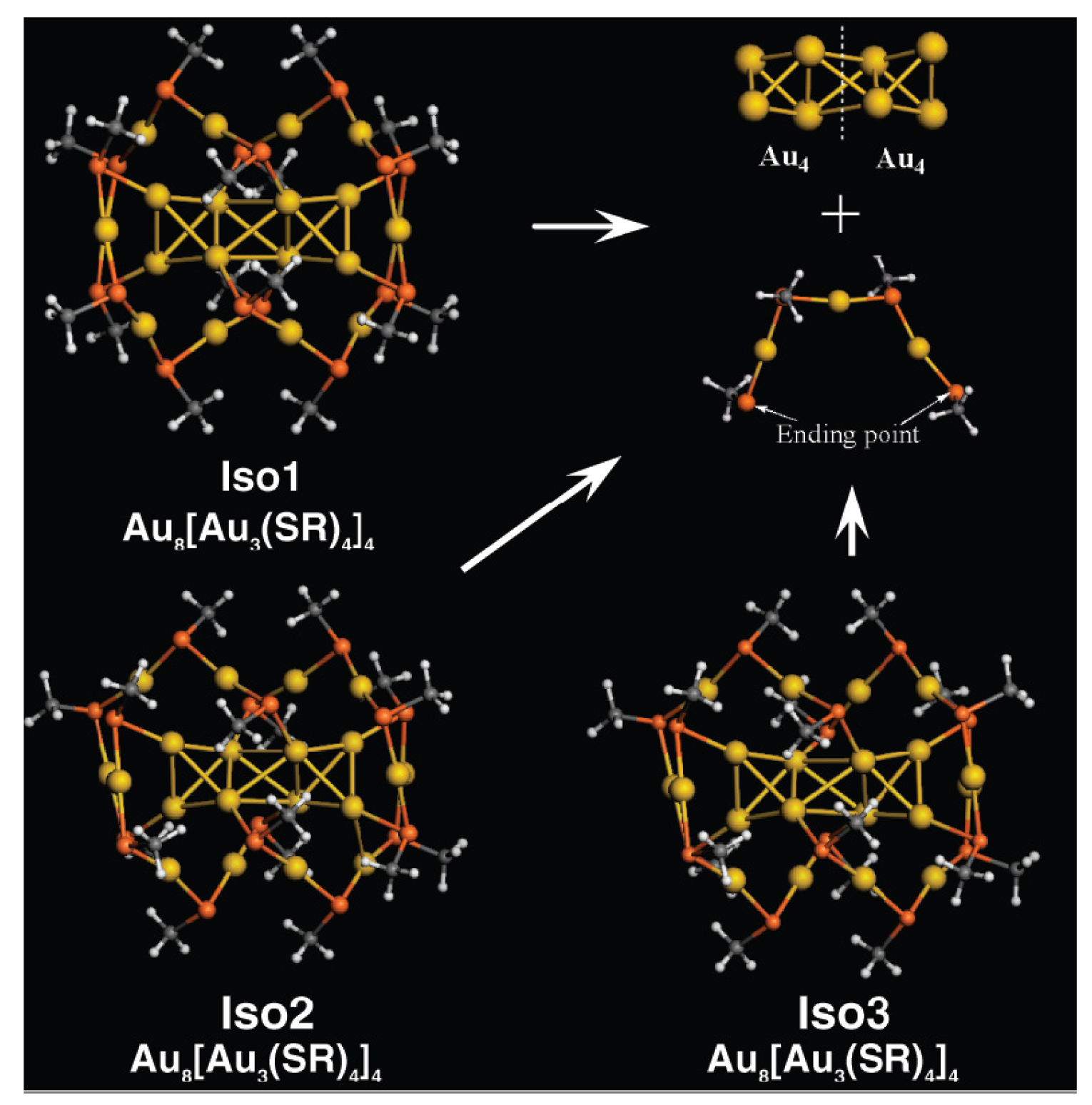
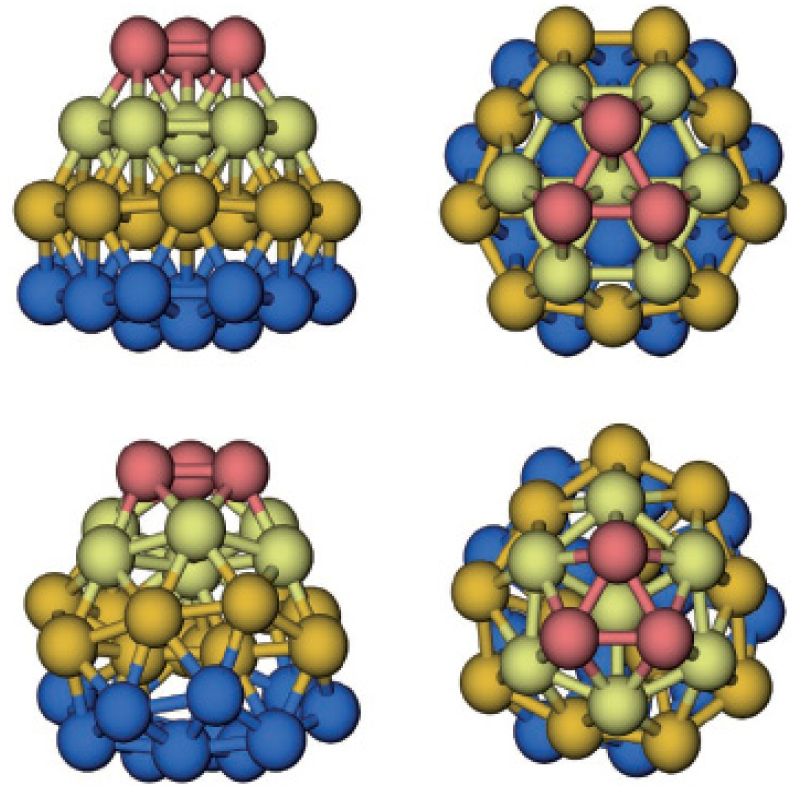
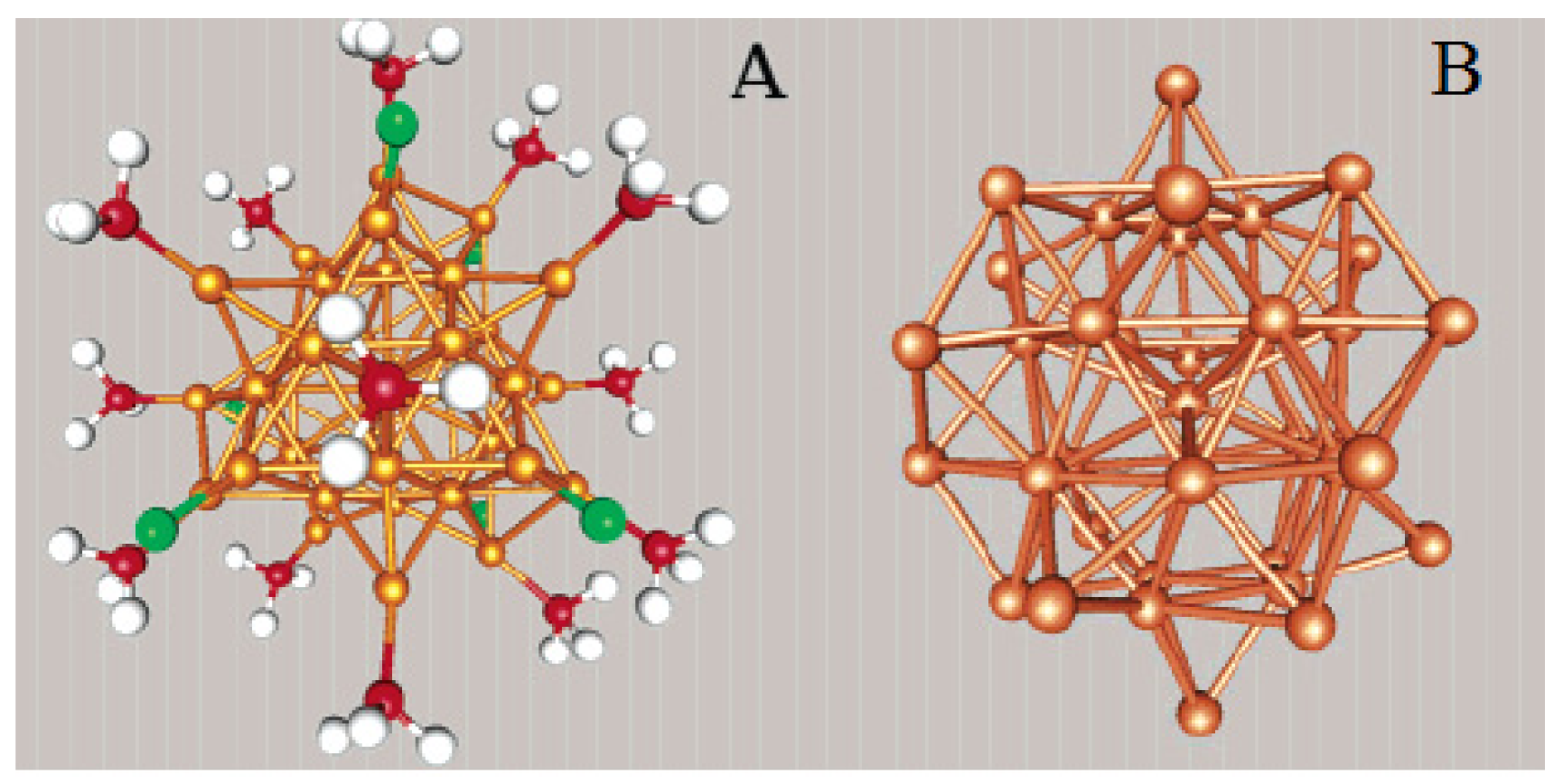
<p>The early theoretical studies confirmed that Au<sub>16</sub> and Au<sub>20</sub> clusters have tetrahedral structures. Au<sub>20</sub> cluster contains a prolate Au<sub>8</sub> core and four level-3 extended staple motifs -RS-Au-RS-Au-RS-Au-RS-. This highly stable cluster may represent a structural evolution of thiolate protected gold clusters from the homoleptic core-free structure to the core-stacked structure (<xref ref-type="fig" rid="f1-catalysts-01-00003">Figure 1</xref>) [<xref ref-type="bibr" rid="b58-catalysts-01-00003">58</xref>]. The geometry of Au<sub>16</sub> is derived from the <italic>T</italic><sub>d</sub>-symmetric Au<sub>20</sub> by removing the four vertex atoms and allowing for an outward relaxation of the 4 face-centered atoms [<xref ref-type="bibr" rid="b59-catalysts-01-00003">59</xref>]. Au<sub>34</sub> cluster has been predicted for a C<sub>3</sub> structure constructured from a more symmetric C<sub>3</sub><italic><sub>v</sub></italic> geometry via a twist (see <xref ref-type="fig" rid="f2-catalysts-01-00003">Figure 2</xref>) [<xref ref-type="bibr" rid="b60-catalysts-01-00003">60</xref>]. Au<sub>39</sub> cluster has an approximate D3 point group symmetry, with the gold atoms forming a hexagonal antiprismatic cage, filled by one bulk-coordinated gold atom (<xref ref-type="fig" rid="f3-catalysts-01-00003">Figure 3</xref>) [<xref ref-type="bibr" rid="b61-catalysts-01-00003">61</xref>].</p>
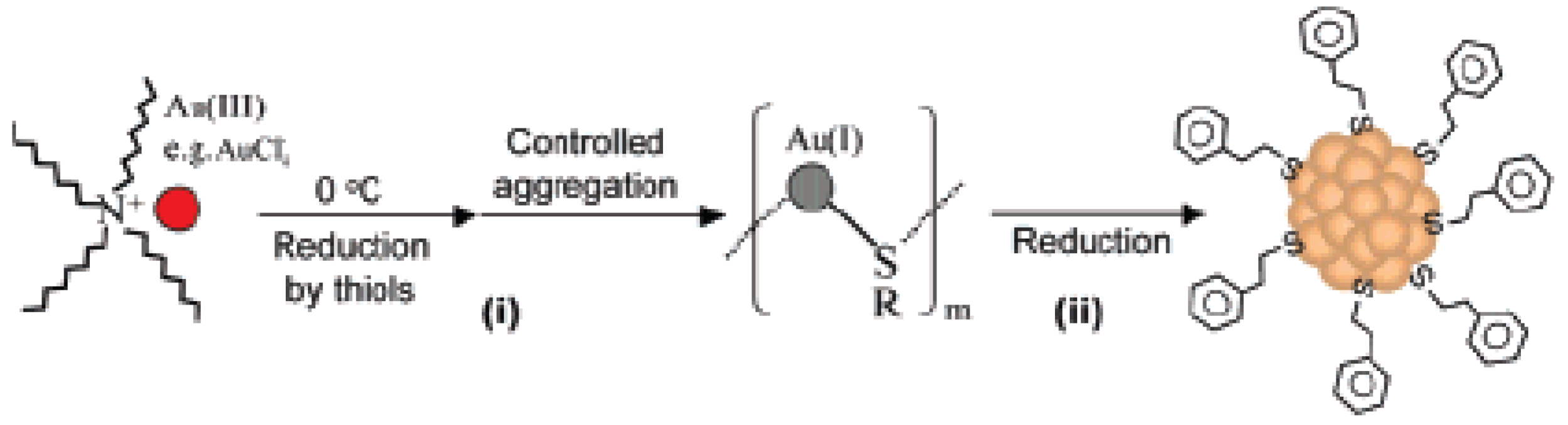
<p>The true monodispersity of Au<italic><sub>n</sub></italic> nanoclusters allows us to grow single crystals and determines their total structures by X-ray crystallography [<xref ref-type="bibr" rid="b62-catalysts-01-00003">62</xref>-<xref ref-type="bibr" rid="b65-catalysts-01-00003">65</xref>]. By carefully controlling the experimental conditions of the nanocluster synthesis, a specific chemical environment is created, which leads to exclusive formation of atomically precise, one-sized Au<italic><sub>n</sub></italic> nanoclusters in high yield and high purity. The experimental breakthroughs focus on the crystal structures of three Au<italic><sub>n</sub></italic>(SR)<italic><sub>m</sub></italic> nanoclusters, including Au<sub>102</sub>(S-C<sub>6</sub>H<sub>4</sub>-p-COOH)<sub>44</sub>, Au<sub>25</sub>(SC<sub>2</sub>H<sub>4</sub>Ph)<sub>18</sub>, and Au<sub>38</sub>(SC<sub>2</sub>H<sub>4</sub>Ph)<sub>24</sub>. We start with the smallest Au<sub>25</sub>(SR)<sub>18</sub> cluster. The control kinetics toward the synthesis of one-sized Au<sub>25</sub> cluster involves two steps (<xref ref-type="fig" rid="f4-catalysts-01-00003">Figure 4</xref>): (i) the reduction of Au(III) to Au(I) by thiols, forming an intermediate of Au-(I):SR complexes; and (ii) further reduction of Au(I) to Au(0) by a strong reducing agent (NaBH<sub>4</sub>). The control over the reaction temperature (0 °C) and stirring condition can generate a particular aggregation state of the Au(I):SR intermediates that leads to the exclusive formation of Au<sub>25</sub> nanoclusters [<xref ref-type="bibr" rid="b39-catalysts-01-00003">39</xref>].</p>
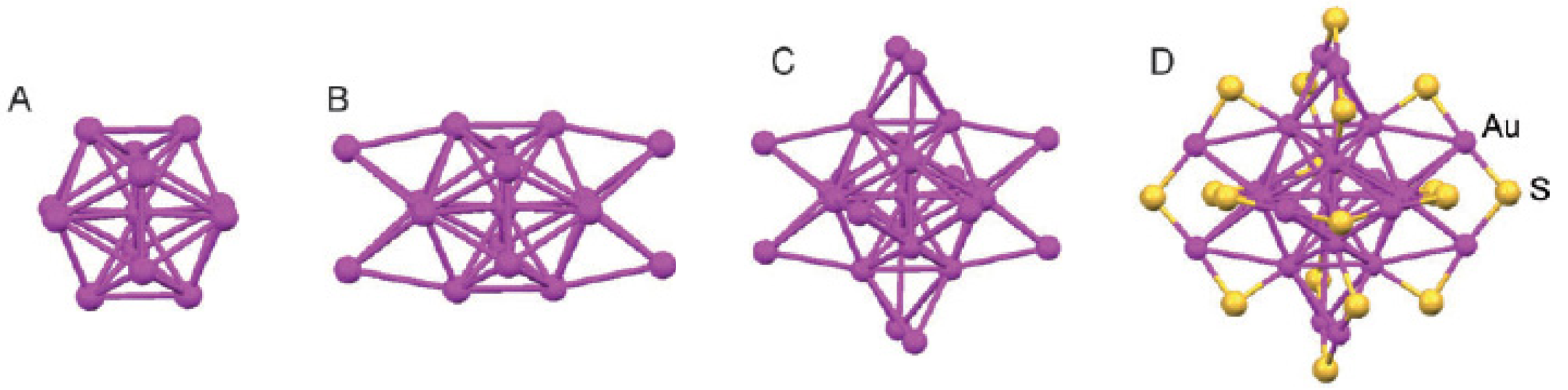
<p>X-ray crystallographic analysis shows that the Au<sub>25</sub> nanocluster features a centered icosahedral Au<sub>13</sub> core (<xref ref-type="fig" rid="f5-catalysts-01-00003">Figure 5(A)</xref>), further capped by a second shell comprised of the remaining 12 Au atoms [<xref ref-type="bibr" rid="b64-catalysts-01-00003">64</xref>]. Viewed along the three mutually perpendicular <italic>C</italic><sub>2</sub> axes of the icosahedron, the 12 exterior Au atoms form six pairs and are situated around the ±x, ±y, and ±z axes, respectively (<xref ref-type="fig" rid="f5-catalysts-01-00003">Figure 5(B)</xref>). Another view of the Au<sub>25</sub>(SR)<sub>18</sub> structure is an Au<sub>13</sub> icosahedral kernel capped by six staple motifs of –S(R)–Au–S(R)–Au–S(R)– along the ±x, ±y, and ±z axes (<xref ref-type="fig" rid="f5-catalysts-01-00003">Figure 5(C)</xref>). Apparently, the 12 exterior Au atoms form an open shell on the Au<sub>13</sub> icosahedron. An icosahedron has 20 triangular faces (Au<sub>3</sub>), but only 12 of them are face-capped, which leaves eight Au<sub>3</sub> triangular faces uncapped. The entire Au<sub>25</sub> cluster is protected by 18 −SR ligands. The charge state (<italic>q</italic> = −1, 0) of [Au<sub>25</sub>(SR)<sub>18</sub>]<italic><sup>q</sup></italic> does not affect the atomic structure of the cluster [<xref ref-type="bibr" rid="b66-catalysts-01-00003">66</xref>,<xref ref-type="bibr" rid="b67-catalysts-01-00003">67</xref>].</p>
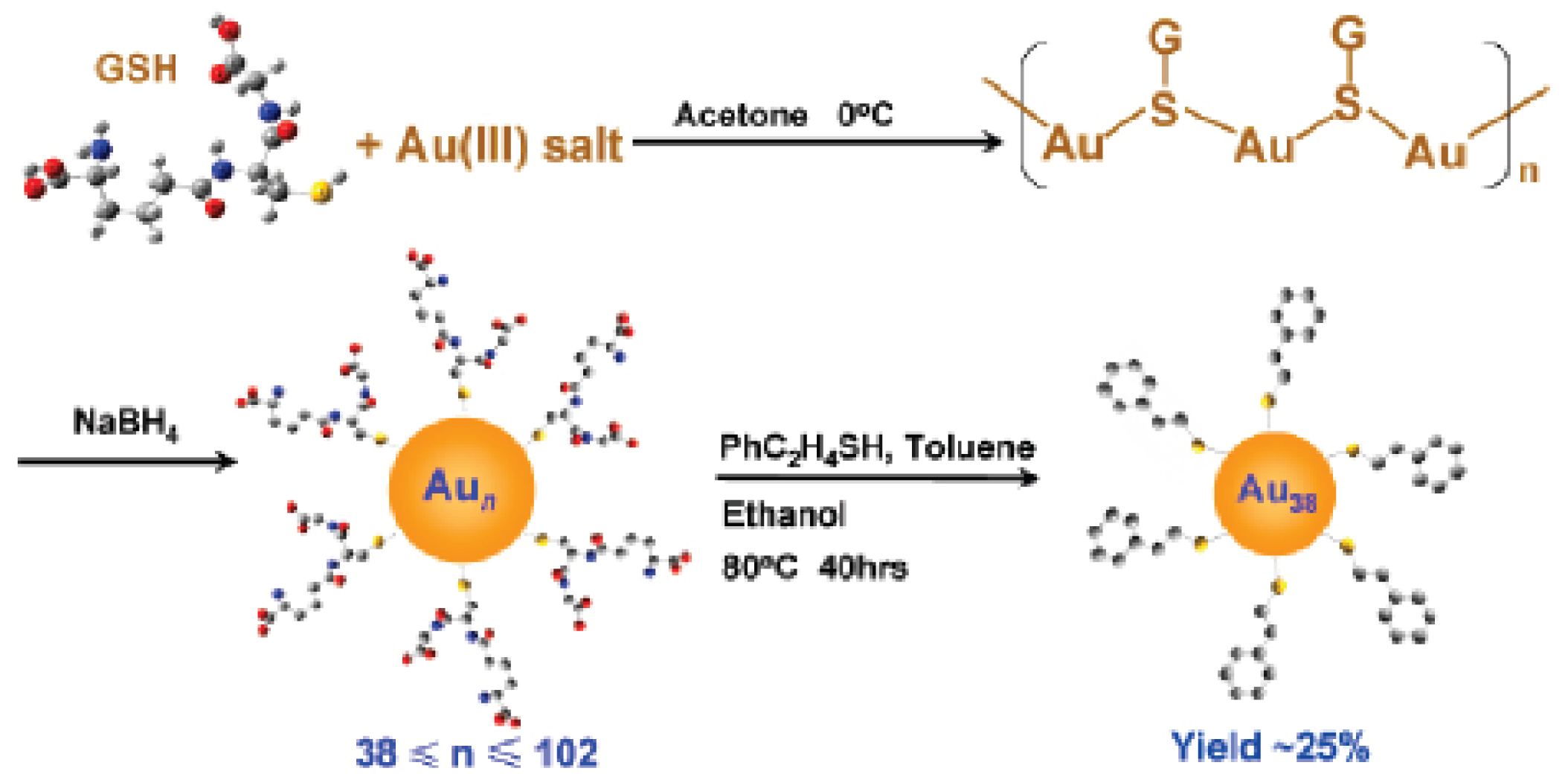
<p>The next size is the 38-atom Au<sub>38</sub>(SR)<sub>24</sub> [<xref ref-type="bibr" rid="b65-catalysts-01-00003">65</xref>,<xref ref-type="bibr" rid="b68-catalysts-01-00003">68</xref>]. The high yield synthesis of monodisperse Au<sub>38</sub> nanoclusters involves two main steps (<xref ref-type="fig" rid="f6-catalysts-01-00003">Figure 6</xref>): first, glutathionate (-SG) protected polydisperse Au<italic><sub>n</sub></italic> clusters (<italic>n</italic> ranging from 38 to 102) are synthesized by reducing Au(I)-SG in acetone; subsequently, the size-mixed Au<italic><sub>n</sub></italic> clusters react with excess phenylethylthiol (PhC<sub>2</sub>H<sub>4</sub>SH) for 40 h at 80 °C, which leads to Au<sub>38</sub>(SC<sub>2</sub>H<sub>4</sub>Ph)<sub>24</sub> clusters of molecular purity.</p>
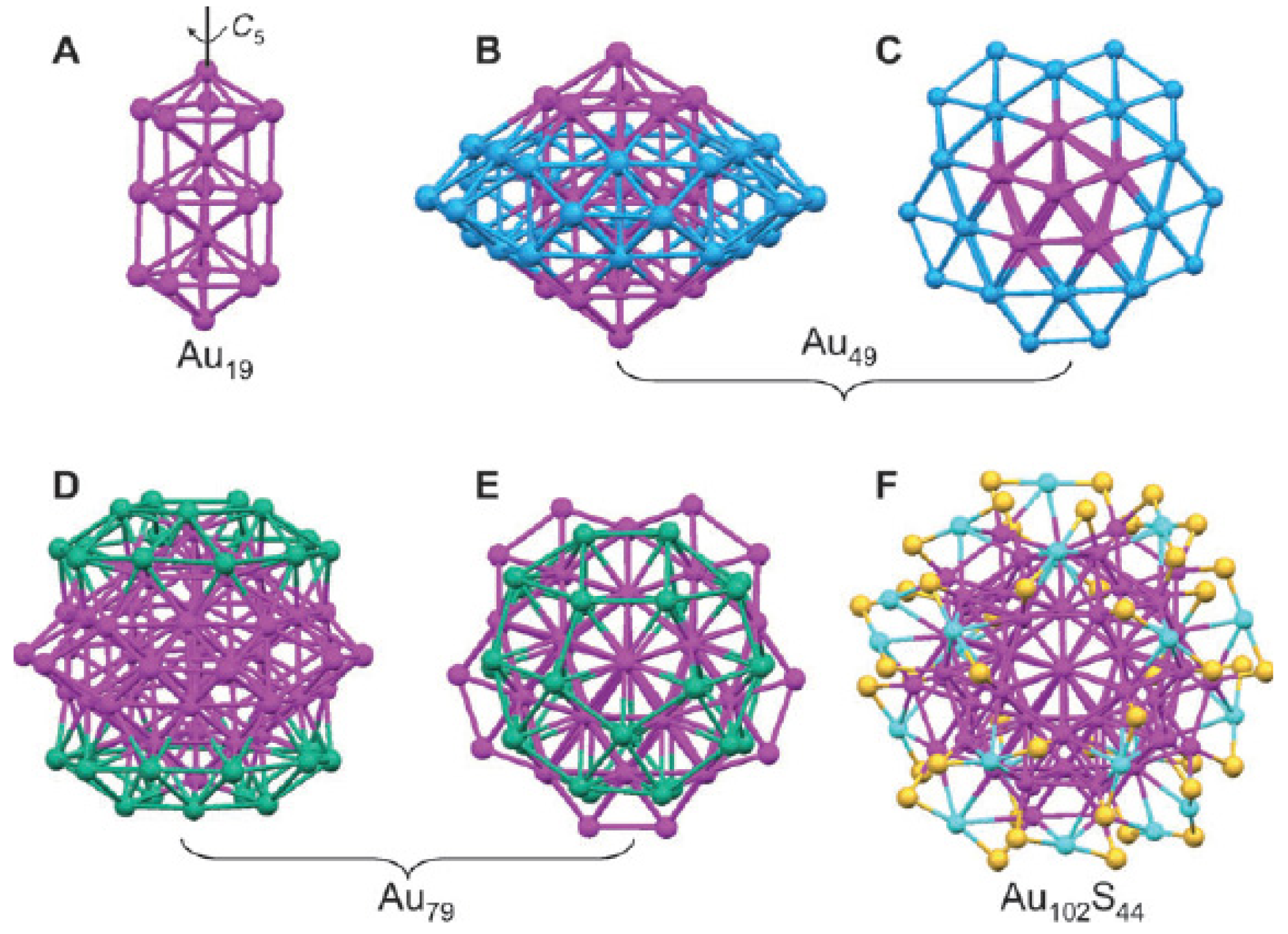
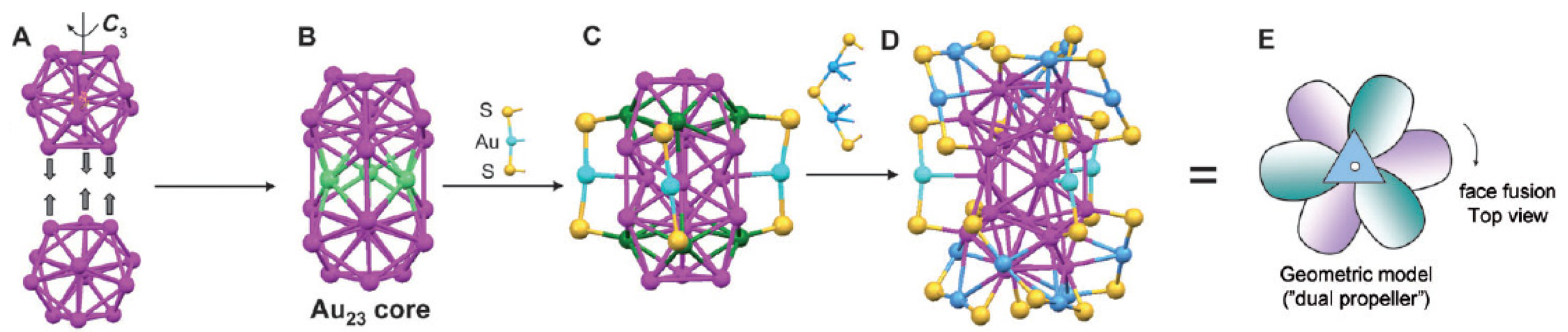
<p>The core of Au<sub>38</sub>(SR)<sub>24</sub> is a face-fused biicosahedral Au<sub>23</sub> (13 + 13 − 3 = 23) (<xref ref-type="fig" rid="f7-catalysts-01-00003">Figure 7(A)</xref>) [<xref ref-type="bibr" rid="b65-catalysts-01-00003">65</xref>]. The fusion of the two icosahedra occurs along a common <italic>C</italic><sub>3</sub> axis. Note that the way the structure is anatomized does not necessarily mean the real growth mechanism of the cluster. The Au<sub>23</sub> rod is structurally strengthened by three monomeric -SR-Au-RS- staples (<xref ref-type="fig" rid="f7-catalysts-01-00003">Figure 7(C)</xref>). Then, the top icosa-hedron is further capped by three -SR-Au-SR-Au-RS- dimeric staples, which are arranged in a rotative fashion, resembling a tri-blade “fan” or “propeller” (<xref ref-type="fig" rid="f7-catalysts-01-00003">Figure 7(D) and (E)</xref>). A similar arrangement of the other three staples is found on the bottom icosahedron, but the bottom “propeller” rotates by approximately 60° relative to the top one, forming a staggered dual-propeller configuration. In fact, the entire cluster is chiral due to the rotative arrangement of the dimeric staples. A larger Au<italic><sub>n</sub></italic>(SR)<italic><sub>m</sub></italic> nanocluster is Au<sub>102</sub>(SR)<sub>44</sub> [<xref ref-type="bibr" rid="b62-catalysts-01-00003">62</xref>,<xref ref-type="bibr" rid="b69-catalysts-01-00003">69</xref>]. The gold particles were coated with p-MBA and crystallized from a solution containing 40% methanol, 300 mM sodium chloride, and 100 mM sodium acetate, at pH 2.5. Interestingly, this cluster has a truncated Au<sub>49</sub> Marks decahedral kernel (<xref ref-type="fig" rid="f8-catalysts-01-00003">Figure 8B and C</xref>), which is based on a fivefold symmetric 19-atom kernel (<xref ref-type="fig" rid="f8-catalysts-01-00003">Figure 8(A)</xref>). The Au<sub>49</sub> kernel is further capped by two 15-atom caps at the top/bottom, respectively (<xref ref-type="fig" rid="f8-catalysts-01-00003">Figure 8(D) and (E)</xref>). The resultant Au<sub>79</sub> kernel is capped by five -SR-Au-SR- monomeric staples on the top and another five at the bottom, and nine monomers and two dimers (-SR-Au-SR-Au-SR-) at the waist. The arrangement of 13 gold atoms at the waist (from nine monomers and two dimers, 9 + 2 × 2 = 13) destroys the fivefold symmetry of the entire Au<sub>102</sub> cluster, so Au<sub>102</sub> cluster has two chiral isomers.</p></sec>
<sec>
<label>3.</label>
<title>Catalytic Performance of Atomically Precise Gold Nanocluters</title>
<p>Such nanoclusters provide a new opportunity for unraveling catalysis at an atomic level. The catalytic activity has been explained by various complementary mechanisms, such as charging effects, geometric fluxionality, particle-size-dependent metal-insulator transition and electronic quantum size effects [<xref ref-type="bibr" rid="b70-catalysts-01-00003">70</xref>-<xref ref-type="bibr" rid="b76-catalysts-01-00003">76</xref>]. The theoretical investigations of the catalytic activity of these small gold nanoclusters (up to a few tens of atoms) were studied a decade ago [<xref ref-type="bibr" rid="b29-catalysts-01-00003">29</xref>,<xref ref-type="bibr" rid="b75-catalysts-01-00003">75</xref>]. Density functional calculations showed that the gold particle sizes fall into a region where quantum size effects are expected to dominate the reactivity of gold. Hakkinen <italic>et al.</italic> showed, by considering a series of structurally well-defined gold clusters with diameter between 1.2 and 2.4 nm, that electronic quantum size effects, particularly the magnitude of HOMO-LUMO energy gap, have a decisive role in activated-form of the nanocatalysts [<xref ref-type="bibr" rid="b70-catalysts-01-00003">70</xref>].</p>
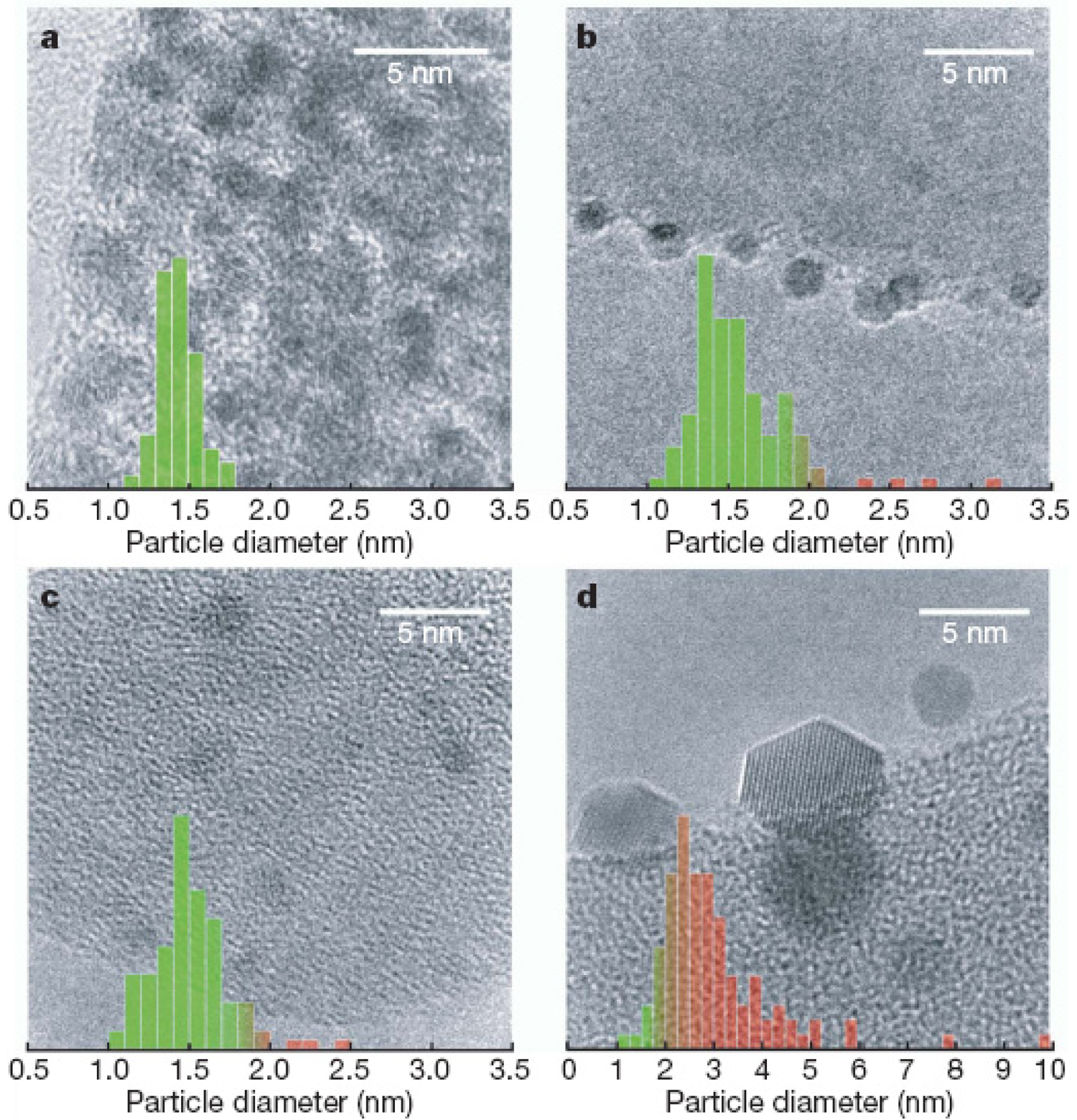
<p>The experiments have given strong indications of the catalytic activity of supersmall well-defined gold clusters. Recently, Turner <italic>et al.</italic> [<xref ref-type="bibr" rid="b77-catalysts-01-00003">77</xref>] reported the selective oxidation of styrene with O<sub>2</sub> by nanocatalysts derived from solution phase protected Au<sub>55</sub> clusters and found the activity of Au<sub>55</sub> nanocatalyst was super to that of Au nanocrystals (&gt;3 nm). A sharp size threshold in catalytic activity was found such that that, when fed with O<sub>2</sub> alone, the catalytic activity is quenched for Au particles with diameters greater than or equal to 2 nm (<xref ref-type="fig" rid="f10-catalysts-01-00003">Figure 10(d)</xref>). Since the crystal structure of Au<sub>55</sub> cluster has been utterly unknown so far, it is not easy to correlate structural properties with catalytic properties.</p>
<p>Tsukuda <italic>et al.</italic> studied the effect of electronic structures of Au clusters on aerotic oxidation catalysis [<xref ref-type="bibr" rid="b78-catalysts-01-00003">78</xref>-<xref ref-type="bibr" rid="b80-catalysts-01-00003">80</xref>]. The catalytic activity is enhanced with increasing electron density on the Au core. They proposed that electron transfer from the anionic gold core into LUMO(π*) of O<sub>2</sub> forms superoxo- or peroxo-like species, which may play an essential role in the oxidation of alcohol (<xref ref-type="fig" rid="f11-catalysts-01-00003">Figure 11</xref>). This work provides a principle for the synthesis of aerobic oxidation catalysts based on the electronic structures of Au clusters and more electronic charge should be deposited into the high-lying orbitals of Au clusters by doping with electropositive elements or by interaction with nucleophilic sites of stabilizing molecules.</p>
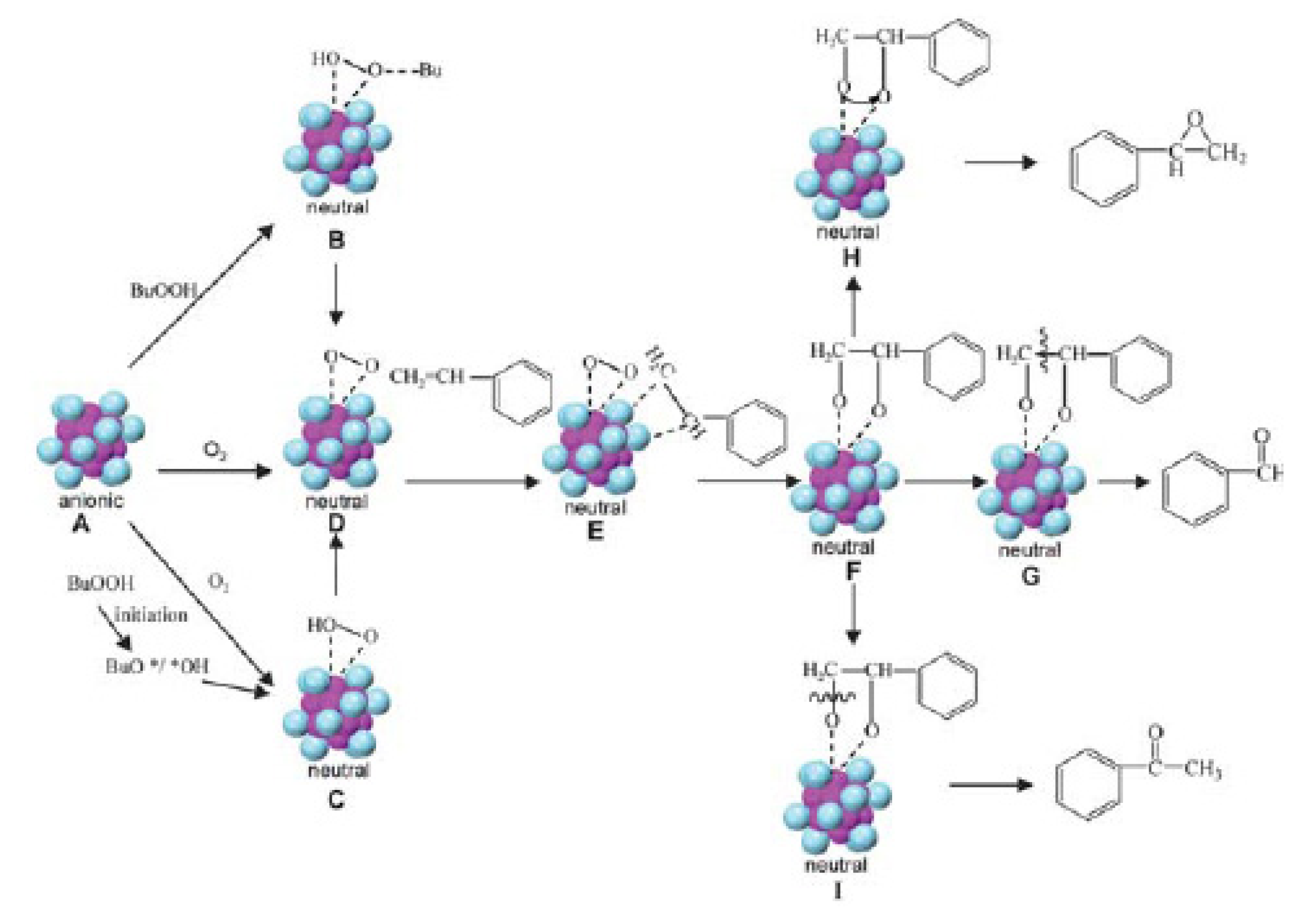
<p>Recently, Jin <italic>et al.</italic> reported the Au<italic><sub>n</sub></italic>(SR)<italic><sub>m</sub></italic> nanocluster catalysts for selective oxidation of styrene using three robust supersmall Au<italic><sub>n</sub></italic> nanoclusters, including Au<sub>25</sub> (1.0 nm), Au<sub>38</sub> (1.3 nm) and Au<sub>144</sub> (1.6 nm) [<xref ref-type="bibr" rid="b23-catalysts-01-00003">23</xref>,<xref ref-type="bibr" rid="b26-catalysts-01-00003">26</xref>]. The catalytic activity of Au<italic><sub>n</sub></italic> nanocluster catalysts exhibits a strong dependence on size (<italic>n</italic>); the smaller Au<italic><sub>n</sub></italic>(SR)<italic><sub>m</sub></italic> nanoclusters give rise to a much higher catalytic activity. Among the three sizes, Au<sub>25</sub> nanocluster catalyst shows the highest conversion of styrene, followed by Au<sub>38</sub> and Au<sub>144</sub>. The effect of thiolate ligands was investigated and found that the ligands do not affect the catalytic activity and selectivity. Therefore, the catalysis of Aun(SR)m nanoclusters are mainly determined by the gold core rather than by ligands shell. A mechanism has been proposed for selective oxidation of styrene catalyzed by Au<sub>25</sub>(SR)<sub>18</sub> nanoclusters (<xref ref-type="fig" rid="f12-catalysts-01-00003">Figure 12</xref>) [<xref ref-type="bibr" rid="b26-catalysts-01-00003">26</xref>]. The three oxidant systems were investigated: (a) TBHP (<italic>tert</italic>-butyl hydroperoxide) as the oxidant; (b) TBHP as an initiator and O<sub>2</sub> as the main oxidant; (c) O<sub>2</sub> as the oxidant [<xref ref-type="bibr" rid="b26-catalysts-01-00003">26</xref>]. The three different oxidant systems can undergo different reaction pathways to activate the oxidants and generate a common peroxyformate intermediate Au<sub>25</sub>-O<sub>2(ad)</sub> (species D). In the case of TBHP as the oxidant, interaction of anionic Au<sub>25</sub> (species A) with TBHP forms a hydroperoxy species B, and then species B loses one H<sub>2</sub>O molecule and rearranges to form the Au<sub>25</sub>-O<sub>2(ad)</sub> species D. In the case of TBHP as an initiator and O<sub>2</sub> as a main oxidant, initiation of TBHP forms species BuO*/*OH and hence activates O<sub>2</sub> to form the superoxo- like O<sub>2</sub>*. The O<sub>2</sub>* is proposed to adsorb <italic>via</italic> a side-on fashion to the gold surface with two partial Au-O bonds to produce a low-barrier transition state species C, and then the peroxo-like species C transforms to the Au<sub>25</sub>-O<sub>2(ad)</sub> species D. In the case of sole O<sub>2</sub> as oxidant, O<sub>2</sub> may directly attack the Au<sub>13</sub> core to form the Au<sub>25</sub>-O<sub>2(ad)</sub> species D. The presence of partial positive charges on the surface gold atoms of the Au<sub>12</sub> shell should greatly facilitate activation of the nucleophilic C=C group of styrene (species E) since the positive Au atoms at the shell are electrophilic. Then the activated C=C bond reacts with the O<sub>2(ad)</sub> species through side-by-side interaction on the Au<sub>25</sub> surface sites, leading to species F. Subsequently, the catalytic selectivity is triggered by the dissociation and rearrangement in three competing pathways that lead to the three products. The formation of benzaldehyde is from the breaking of the C–C bond (species G); the epoxide is created by the transfer of oxygen to the olefinic bond to form a metalloepoxy intermediate (species H); and acetophenone is produced by the breaking of the C–O bond (species I). Finally, the oxidized [Au<sub>25</sub>(SR)<sub>18</sub>]<sup>0</sup> catalyst can be reduced to the anionic [Au<sub>25</sub>(SR)<sub>18</sub>]<sup>−</sup> by gaining an electron when the C=C bond leaves the Au<sub>25</sub> cluster, hence, one catalytic cycle is completed [<xref ref-type="bibr" rid="b26-catalysts-01-00003">26</xref>].</p>
<p>Tsukuda <italic>et al.</italic> [<xref ref-type="bibr" rid="b22-catalysts-01-00003">22</xref>] immobilized Au<sub>25</sub>(SR)<sub>18</sub> nanoclusters on a hydroxyapatite support for the selective oxidation of styrene in toluene solvent. They achieved a 100% conversion of styrene and 92% selectivity to the epoxide product. These results demonstrate that atomically monodisperse Au<italic><sub>n</sub></italic> nanocluster catalysts exhibit excellent catalytic activity in the selective oxidation processes.</p>
<p>Au<italic><sub>n</sub></italic> nanolcusters catalysts have also made significant advances in selective hydrogenation processes. Herein, Au<sub>25</sub> nanocluster is chosen as a model for a discussion of selective hydrogenation. The crystal structures of [Au<sub>25</sub>(SR)<sub>18</sub>]<italic><sup>q</sup></italic> (<italic>q</italic> = −1, 0) show a core–shell type structure: a Au<sub>13</sub> icosahedral core and an exterior Au<sub>12</sub> shell. The charge distribution on the Au<sub>13</sub> core and the Au<sub>12</sub> shell is quite different: the Au<sub>13</sub> core possesses eight (when <italic>q</italic> = −1) or seven (q = 0) delocalized valence electrons originated from Au(6s). These electrons are primarily distributed within the Au<sub>13</sub> core, whereas the Au<sub>12</sub> shell bears positive charges due to bonding with thiolates and electron transfer from gold to sulfur. The electron-rich Au<sub>13</sub> core should facilitate electrophilic bands activation, such as C=O, accompanied by conversion of [Au<sub>25</sub>(SR)<sub>18</sub>]<sup>−</sup> to neutral [Au<sub>25</sub>(SR)<sub>18</sub>]<sup>0</sup>. An Au<sub>12</sub> shell with low-coordination charater should adsorpt and dissociate H<sub>2</sub>.</p>
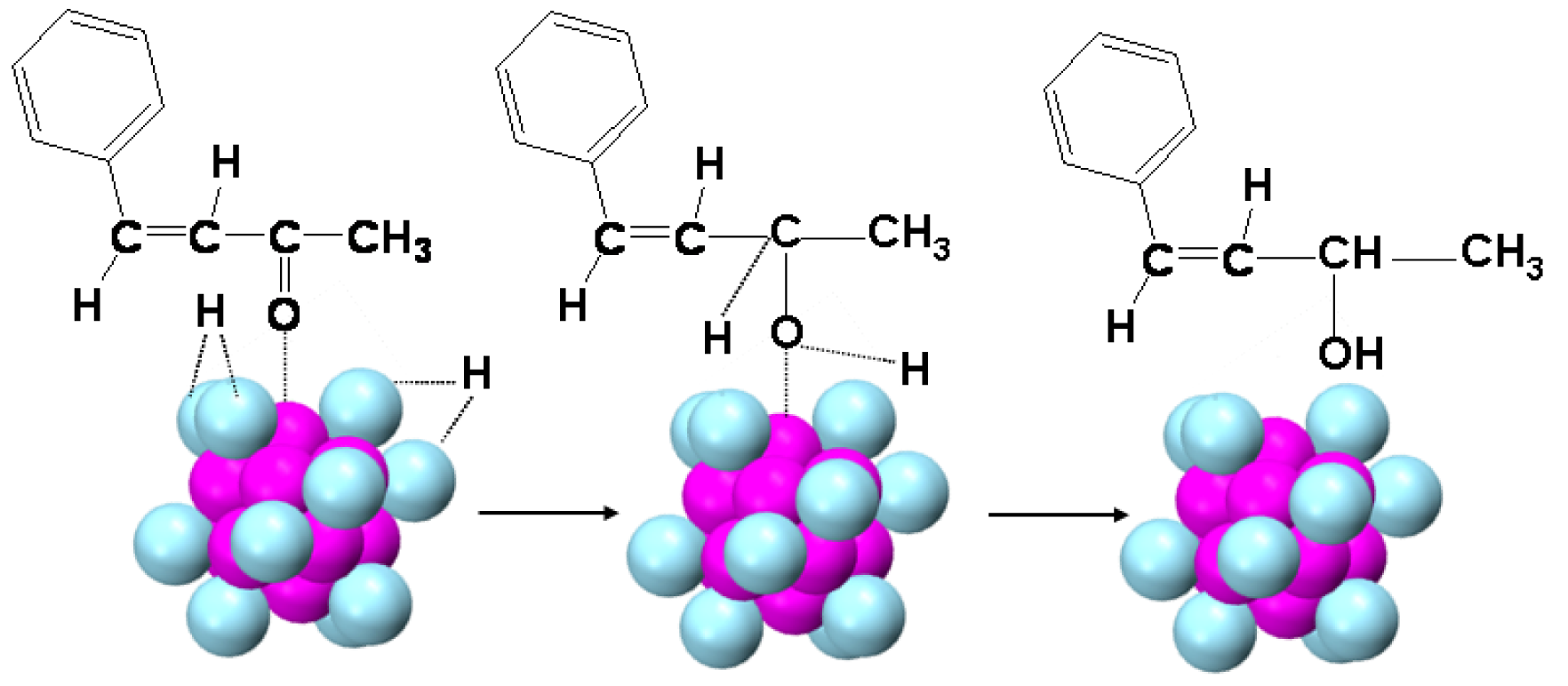
<p>Selective hydrogenation of α,β-unsaturated ketones/aldehydes, conventional supported gold nanoparticle catalysts have been demonstrated to be capable of selective hydrogenation of α,β-unsaturated ketones to produce predominant α,β-unsaturated alcohols but with side products of saturated ketones from C=C hydrogenation as well as saturated alcohols from further hydrogenation. Although conventional gold nanoparticles can achieve high conversion and selectivity of the unsaturated alcohol in the hydrogenation of α,β-unsaturated ketones, a ∼100% selectivity for the unsaturated alcohol has not been achieved [<xref ref-type="bibr" rid="b21-catalysts-01-00003">21</xref>]. Using Au<sub>25</sub>(SR)<sub>18</sub> nanoclusters as hydrogenation catalysts, selective hydrogenation of the C=O bond in α,β-unsaturated ketones (or aldehydes) with 100% selectivity for α,β-unsaturated alcohols can be obtained. The extraordinary selectivity and activity of Au<sub>25</sub> catalysts correlate with the electronic structure of the Au<sub>25</sub> nanocluster and its nonclosed Au<sub>12</sub> exterior shell. The volcano-like eight uncapped Au<sub>3</sub> faces of the icosahedron from the exposure of Au<sub>13</sub> core should favor adsorption of the C=O group by interaction of the active site with the O atom of the C=O group (see <xref ref-type="fig" rid="f13-catalysts-01-00003">Figure 13</xref>). Subsequently, the weakly nucleophilic hydrogen attacks the activated C=O group, and then form the unsaturated alcohol product. The surface Au atoms with low-coordination character, coordination number N = 3, should provide a favorable environment for the adsorption and dissociation of H<sub>2</sub>, and H<sub>2</sub> dissociation should occur on the gold atoms of the exterior shell (<xref ref-type="fig" rid="f13-catalysts-01-00003">Figure 13</xref>) [<xref ref-type="bibr" rid="b21-catalysts-01-00003">21</xref>]. The electron-rich Au<sub>13</sub> core has no ability to active C=C bond in α,β- unsaturated ketone at mild temperatures, therefore there are no side products from the hydrogenation of C=C in α,β-unsaturated ketone.</p></sec>
<sec sec-type="conclusions">
<label>4.</label>
<title>Conclusions</title>
<p>These Au<italic><sub>n</sub></italic> catalyst examples demonstrate the huge power of atomically precise Au<italic><sub>n</sub></italic> nanocatalysts for achieving super selective oxidation and hydrogenation performance and atomically precise structure-property relationships. Au<italic><sub>n</sub></italic> nanoclusters possess a unique core-shell structure—an electron-rich core with delocalized valence electrons and an electron-deficient shell. Such nanoclusters will not only provide further insight into the nature of gold nanocatalysis at an atomic level, but also promote the exploration of new chemical processes with Au<italic><sub>n</sub></italic> as well-defined, highly efficient catalysts. Au<italic><sub>n</sub></italic> nanocluster catalysts will ultimately bring gold nanocatalysis to an exciting new level.</p></sec></body>
<back>
<sec sec-type="display-objects">
<title>Figures</title>
<fig id="f1-catalysts-01-00003" position="float">
<label>Figure 1.</label>
<caption>
<p>Structures of Au<sub>20</sub> cluster and structural decomposition of the Au<sub>8</sub> core and four level-3 staple motifs [<xref ref-type="bibr" rid="b58-catalysts-01-00003">58</xref>].</p></caption>
<graphic xlink:href="catalysts-01-00003f1.gif"/></fig>
<fig id="f2-catalysts-01-00003" position="float">
<label>Figure 2.</label>
<caption>
<p>Two views of Au<sub>34</sub> cluster with C<italic><sub>3v</sub></italic> symmetry and C<italic><sub>3</sub></italic> symmetry [<xref ref-type="bibr" rid="b60-catalysts-01-00003">60</xref>].</p></caption>
<graphic xlink:href="catalysts-01-00003f2.gif"/></fig>
<fig id="f3-catalysts-01-00003" position="float">
<label>Figure 3.</label>
<caption>
<p>(<bold>A</bold>) The structure of Au<sub>39</sub> cluster; and (<bold>B</bold>) Au core of Au<sub>39</sub> [<xref ref-type="bibr" rid="b61-catalysts-01-00003">61</xref>].</p></caption>
<graphic xlink:href="catalysts-01-00003f3.gif"/></fig>
<fig id="f4-catalysts-01-00003" position="float">
<label>Figure 4.</label>
<caption>
<p>The preparation of Au<sub>25</sub> nanoclusters [<xref ref-type="bibr" rid="b39-catalysts-01-00003">39</xref>].</p></caption>
<graphic xlink:href="catalysts-01-00003f4.gif"/></fig>
<fig id="f5-catalysts-01-00003" position="float">
<label>Figure 5.</label>
<caption>
<p>Anatomy of the atom packing structure of Au<sub>25</sub>(SR)<sub>18</sub> nanocluster [<xref ref-type="bibr" rid="b64-catalysts-01-00003">64</xref>].</p></caption>
<graphic xlink:href="catalysts-01-00003f5.gif"/></fig>
<fig id="f6-catalysts-01-00003" position="float">
<label>Figure 6.</label>
<caption>
<p>A two-step procedure for synthesizing monodisperse Au<sub>38</sub>(SC<sub>2</sub>H<sub>4</sub>Ph)<sub>24</sub> clusters in high yield [<xref ref-type="bibr" rid="b68-catalysts-01-00003">68</xref>].</p></caption>
<graphic xlink:href="catalysts-01-00003f6.gif"/></fig>
<fig id="f7-catalysts-01-00003" position="float">
<label>Figure 7.</label>
<caption>
<p>Anatomy of the atom packing structure of Au<sub>38</sub>(SR)<sub>24</sub> nanocluster [<xref ref-type="bibr" rid="b65-catalysts-01-00003">65</xref>].</p></caption>
<graphic xlink:href="catalysts-01-00003f7.gif"/></fig>
<fig id="f8-catalysts-01-00003" position="float">
<label>Figure 8.</label>
<caption>
<p>Anatory of Au<sub>102</sub>(SR)<sub>44</sub> structure: (<bold>A</bold>) fivefold symmetric 19-atom (Au<sub>19</sub>) kernel; (<bold>B</bold>,<bold>C</bold>) side and top views of Au<sub>49</sub> Marks decahedron; (<bold>D</bold>,<bold>E</bold>) side and top views of Au<sub>79</sub> kernel; (<bold>F</bold>) overall framework of Au<sub>102</sub>S<sub>44</sub> (R groups are omitted for clarity) [<xref ref-type="bibr" rid="b69-catalysts-01-00003">69</xref>].</p></caption>
<graphic xlink:href="catalysts-01-00003f8.gif"/></fig>
<fig id="f9-catalysts-01-00003" position="float">
<label>Figure 9.</label>
<caption>
<p>Atomic structure for the most favorable energy profile for O<sub>2</sub> dissociation on Au<sub>38</sub> cluster [<xref ref-type="bibr" rid="b75-catalysts-01-00003">75</xref>].</p></caption>
<graphic xlink:href="catalysts-01-00003f9.gif"/></fig>
<fig id="f10-catalysts-01-00003" position="float">
<label>Figure 10.</label>
<caption>
<p>TEM images of overlaid with corresponding particle size distribution for Au<sub>55</sub> nanocluster [<xref ref-type="bibr" rid="b77-catalysts-01-00003">77</xref>].</p></caption>
<graphic xlink:href="catalysts-01-00003f10.gif"/></fig>
<fig id="f11-catalysts-01-00003" position="float">
<label>Figure 11.</label>
<caption>
<p>Mechanism for the activation of molecular oxygen by Au cluster [<xref ref-type="bibr" rid="b78-catalysts-01-00003">78</xref>].</p></caption>
<graphic xlink:href="catalysts-01-00003f11.gif"/></fig>
<fig id="f12-catalysts-01-00003" position="float">
<label>Figure 12.</label>
<caption>
<p>The proposed mechanism of selective oxidation of styrene catalyzed by [Au<sub>25</sub>(SR)<sub>18</sub>]<sub>q</sub> clusters [<xref ref-type="bibr" rid="b26-catalysts-01-00003">26</xref>].</p></caption>
<graphic xlink:href="catalysts-01-00003f12.gif"/></fig>
<fig id="f13-catalysts-01-00003" position="float">
<label>Figure 13.</label>
<caption>
<p>Proposed mechanism of Au<sub>25</sub>(SR)<sub>18</sub> nanocatalysis for the chemoselective hydrogenation of α,β-unsaturated ketone to unsaturated alcohol (pink: Au atoms of the core, blue: Au atoms of the shell [<xref ref-type="bibr" rid="b21-catalysts-01-00003">21</xref>].</p></caption>
<graphic xlink:href="catalysts-01-00003f13.gif"/></fig></sec>
<ref-list>
<title>References</title>
<ref id="b1-catalysts-01-00003"><label>1.</label><citation citation-type="journal"><person-group person-group-type="author"><name><surname>Armer</surname><given-names>B.</given-names></name><name><surname>Schmidbaur</surname><given-names>H.</given-names></name></person-group><article-title>Organogoldchemie</article-title><source>Angew. Chem.</source><year>1970</year><volume>82</volume><fpage>120</fpage><lpage>133</lpage><pub-id pub-id-type="doi">10.1002/ange.19700820304</pub-id></citation></ref>
<ref id="b2-catalysts-01-00003"><label>2.</label><citation citation-type="journal"><person-group person-group-type="author"><name><surname>Bond</surname><given-names>G.C.</given-names></name></person-group><article-title>The catalytic properties of gold</article-title><source>Gold Bull.</source><year>1972</year><volume>5</volume><fpage>11</fpage><lpage>13</lpage><pub-id pub-id-type="doi">10.1007/BF03215149</pub-id></citation></ref>
<ref id="b3-catalysts-01-00003"><label>3.</label><citation citation-type="journal"><person-group person-group-type="author"><name><surname>Bond</surname><given-names>G.C.</given-names></name><name><surname>Sermon</surname><given-names>P.A.</given-names></name><name><surname>Webb</surname><given-names>G.</given-names></name><name><surname>Buchanan</surname><given-names>D.A.</given-names></name><name><surname>Well</surname><given-names>P.B.</given-names></name></person-group><article-title>Hydrogenation over supported gold catalysts</article-title><source>J. Chem. Soc. Chem. Commun.</source><year>1973</year><fpage>444</fpage><lpage>445</lpage></citation></ref>
<ref id="b4-catalysts-01-00003"><label>4.</label><citation citation-type="journal"><person-group person-group-type="author"><name><surname>Hutchings</surname><given-names>G.J.</given-names></name></person-group><article-title>Vapor phase hydrochlorination of acetylene: Correction of catalysis activity of supported metal chloride catalysts</article-title><source>J. Catal.</source><year>1985</year><volume>96</volume><fpage>292</fpage><lpage>295</lpage><pub-id pub-id-type="doi">10.1016/0021-9517(85)90383-5</pub-id></citation></ref>
<ref id="b5-catalysts-01-00003"><label>5.</label><citation citation-type="journal"><person-group person-group-type="author"><name><surname>Hayashi</surname><given-names>T.</given-names></name><name><surname>Tanaka</surname><given-names>K.</given-names></name><name><surname>Haruta</surname><given-names>M.</given-names></name></person-group><article-title>Selective vapor-phase epoxidation of propylene over Au/TiO2 catalysts in the presence of oxygen and hydrogen</article-title><source>J. Catal.</source><year>1998</year><volume>178</volume><fpage>566</fpage><lpage>575</lpage><pub-id pub-id-type="doi">10.1006/jcat.1998.2157</pub-id></citation></ref>
<ref id="b6-catalysts-01-00003"><label>6.</label><citation citation-type="journal"><person-group person-group-type="author"><name><surname>Hashmi</surname><given-names>A.S.K.</given-names></name><name><surname>Schwarz</surname><given-names>L.</given-names></name><name><surname>Choi</surname><given-names>J.H.</given-names></name><name><surname>Frost</surname><given-names>T.M.</given-names></name></person-group><article-title>Eine neue Gold-katalysierte C–C Bindungknupfung</article-title><source>Angew. Chem.</source><year>2000</year><volume>112</volume><fpage>2382</fpage><lpage>2385</lpage><pub-id pub-id-type="doi">10.1002/1521-3757(20000703)112:13&lt;2382::AID-ANGE2382&gt;3.0.CO;2-R</pub-id></citation></ref>
<ref id="b7-catalysts-01-00003"><label>7.</label><citation citation-type="journal"><person-group person-group-type="author"><name><surname>Guzman</surname><given-names>J.</given-names></name><name><surname>Gates</surname><given-names>B.C.</given-names></name></person-group><article-title>Catalysis by supported gold: Correlation between catalytic activity for CO oxidation and oxidation states of gold</article-title><source>J. Am. Chem. Soc.</source><year>2004</year><volume>126</volume><fpage>2672</fpage><lpage>2673</lpage><pub-id pub-id-type="doi">10.1021/ja039426e</pub-id><pub-id pub-id-type="pmid">14995163</pub-id></citation></ref>
<ref id="b8-catalysts-01-00003"><label>8.</label><citation citation-type="journal"><person-group person-group-type="author"><name><surname>Min</surname><given-names>B.K.</given-names></name><name><surname>Friend</surname><given-names>C.M.</given-names></name></person-group><article-title>Heterogeneous gold-based catalysis for green chemistry: Low-temperature CO oxidation and propene oxidation</article-title><source>Chem. Rev.</source><year>2007</year><volume>107</volume><fpage>2709</fpage><lpage>2724</lpage><pub-id pub-id-type="doi">10.1021/cr050954d</pub-id><pub-id pub-id-type="pmid">17564483</pub-id></citation></ref>
<ref id="b9-catalysts-01-00003"><label>9.</label><citation citation-type="journal"><person-group person-group-type="author"><name><surname>Della</surname><given-names>P.C.</given-names></name><name><surname>Falletta</surname><given-names>E.</given-names></name><name><surname>Prati</surname><given-names>L.</given-names></name><name><surname>Rossi</surname><given-names>M.</given-names></name></person-group><article-title>Selective oxidation using gold</article-title><source>Chem. Soc. Rev.</source><year>2008</year><volume>37</volume><fpage>2077</fpage><lpage>2095</lpage><pub-id pub-id-type="doi">10.1039/b707319b</pub-id><pub-id pub-id-type="pmid">18762847</pub-id></citation></ref>
<ref id="b10-catalysts-01-00003"><label>10.</label><citation citation-type="journal"><person-group person-group-type="author"><name><surname>Chen</surname><given-names>M.S.</given-names></name><name><surname>Kumar</surname><given-names>D.</given-names></name><name><surname>Yi</surname><given-names>C.W.</given-names></name><name><surname>Goodman</surname><given-names>D.W.</given-names></name></person-group><article-title>The promotional effect of gold in catalysis by palladium-gold</article-title><source>Science</source><year>2005</year><volume>310</volume><fpage>291</fpage><lpage>293</lpage><pub-id pub-id-type="doi">10.1126/science.1115800</pub-id><pub-id pub-id-type="pmid">16224016</pub-id></citation></ref>
<ref id="b11-catalysts-01-00003"><label>11.</label><citation citation-type="journal"><person-group person-group-type="author"><name><surname>Grirrane</surname><given-names>A.</given-names></name><name><surname>Corma</surname><given-names>A.</given-names></name><name><surname>Garcia</surname><given-names>H.</given-names></name></person-group><article-title>Gold-catalyzed synthesis of aromatic azo compounds from anilines and nitroaromatics</article-title><source>Science</source><year>2008</year><volume>322</volume><fpage>1661</fpage><lpage>1664</lpage><pub-id pub-id-type="doi">10.1126/science.1166401</pub-id><pub-id pub-id-type="pmid">19074342</pub-id></citation></ref>
<ref id="b12-catalysts-01-00003"><label>12.</label><citation citation-type="journal"><person-group person-group-type="author"><name><surname>Fang</surname><given-names>W.H.</given-names></name><name><surname>Chen</surname><given-names>J.S.</given-names></name><name><surname>Zhang</surname><given-names>Q.H.</given-names></name><name><surname>Deng</surname><given-names>W.P.</given-names></name><name><surname>Wang</surname><given-names>Y.</given-names></name></person-group><article-title>Hydrotalcite-supported gold catalyst for the oxidant-free dehydrogenation of benzyl alcohol: Studies on support and gold size effect</article-title><source>Chem. Eur. J.</source><year>2011</year><volume>17</volume><fpage>1247</fpage><lpage>1256</lpage><pub-id pub-id-type="doi">10.1002/chem.201002469</pub-id><pub-id pub-id-type="pmid">21243691</pub-id></citation></ref>
<ref id="b13-catalysts-01-00003"><label>13.</label><citation citation-type="book"><person-group person-group-type="author"><name><surname>Bond</surname><given-names>G.C.</given-names></name><name><surname>Louis</surname><given-names>C.</given-names></name><name><surname>Thompson</surname><given-names>D.T.</given-names></name><name><surname>Hutchings</surname><given-names>G.J.</given-names></name></person-group><source>Catalysis by Gold</source><publisher-name>Imperial College</publisher-name><publisher-loc>London, UK</publisher-loc><year>2006</year></citation></ref>
<ref id="b14-catalysts-01-00003"><label>14.</label><citation citation-type="book"><person-group person-group-type="author"><name><surname>Heiz</surname><given-names>U.</given-names></name><name><surname>Landman</surname><given-names>U.</given-names></name></person-group><source>Nanocatalysis</source><publisher-name>Spring</publisher-name><publisher-loc>New York, NY, USA</publisher-loc><year>2007</year></citation></ref>
<ref id="b15-catalysts-01-00003"><label>15.</label><citation citation-type="journal"><person-group person-group-type="author"><name><surname>Hashmi</surname><given-names>A.S.K.</given-names></name><name><surname>Hutching</surname><given-names>G.J.</given-names></name></person-group><article-title>Gold catalysis</article-title><source>Angew. Chem. Int. Ed.</source><year>2006</year><volume>45</volume><fpage>7896</fpage><lpage>7936</lpage><pub-id pub-id-type="doi">10.1002/anie.200602454</pub-id></citation></ref>
<ref id="b16-catalysts-01-00003"><label>16.</label><citation citation-type="journal"><person-group person-group-type="author"><name><surname>Jimenez-Nunez</surname><given-names>E.</given-names></name><name><surname>Echavarren</surname><given-names>A.M.</given-names></name></person-group><article-title>Molecular diversity through gold catalysis with alkynes</article-title><source>Chem. Commun.</source><year>2007</year><fpage>333</fpage><lpage>346</lpage></citation></ref>
<ref id="b17-catalysts-01-00003"><label>17.</label><citation citation-type="journal"><person-group person-group-type="author"><name><surname>Corma</surname><given-names>A.</given-names></name><name><surname>Garcia</surname><given-names>H.</given-names></name></person-group><article-title>Supported gold nanoparticles as catalysts for organic reactions</article-title><source>Chem. Soc. Rev.</source><year>2008</year><volume>37</volume><fpage>2096</fpage><lpage>2126</lpage><pub-id pub-id-type="doi">10.1039/b707314n</pub-id><pub-id pub-id-type="pmid">18762848</pub-id></citation></ref>
<ref id="b18-catalysts-01-00003"><label>18.</label><citation citation-type="journal"><person-group person-group-type="author"><name><surname>Daniel</surname><given-names>M.C.</given-names></name><name><surname>Didier</surname><given-names>A.</given-names></name></person-group><article-title>Gold nanoparticles: Assembly, supramolecular chemistry, quantum-size-related properties, and applications toward biology, catalysis and nanotechnology</article-title><source>Chem. Rev.</source><year>2004</year><volume>104</volume><fpage>293</fpage><lpage>346</lpage><pub-id pub-id-type="doi">10.1021/cr030698+</pub-id><pub-id pub-id-type="pmid">14719978</pub-id></citation></ref>
<ref id="b19-catalysts-01-00003"><label>19.</label><citation citation-type="journal"><person-group person-group-type="author"><name><surname>Ma</surname><given-names>Z.</given-names></name><name><surname>Dai</surname><given-names>S.</given-names></name></person-group><article-title>Design of novel structured gold nanocatalysts</article-title><source>ACS Catal.</source><year>2011</year><volume>1</volume><fpage>805</fpage><lpage>818</lpage><pub-id pub-id-type="doi">10.1021/cs200100w</pub-id></citation></ref>
<ref id="b20-catalysts-01-00003"><label>20.</label><citation citation-type="journal"><person-group person-group-type="author"><name><surname>Jin</surname><given-names>R.C.</given-names></name><name><surname>Qian</surname><given-names>H.F.</given-names></name><name><surname>Zhu</surname><given-names>Y.</given-names></name><name><surname>Das</surname><given-names>A.</given-names></name></person-group><article-title>Atomically precise nanoparticles: A new frontier in nanoscience</article-title><source>J. Nanosci. Lett.</source><year>2010</year><volume>1</volume><fpage>72</fpage><lpage>86</lpage></citation></ref>
<ref id="b21-catalysts-01-00003"><label>21.</label><citation citation-type="journal"><person-group person-group-type="author"><name><surname>Zhu</surname><given-names>Y.</given-names></name><name><surname>Qian</surname><given-names>H.F.</given-names></name><name><surname>Drake</surname><given-names>B.A.</given-names></name><name><surname>Jin</surname><given-names>R.C.</given-names></name></person-group><article-title>Atomically precise Au<sub>25</sub>(SR)<sub>18</sub> nanoparticles as catalysts for selective hydrogenation of α,β-unsaturated ketones and aldehydes</article-title><source>Angew. Chem. Int. Ed.</source><year>2010</year><volume>49</volume><fpage>1295</fpage><lpage>1298</lpage><pub-id pub-id-type="doi">10.1002/anie.200906249</pub-id></citation></ref>
<ref id="b22-catalysts-01-00003"><label>22.</label><citation citation-type="journal"><person-group person-group-type="author"><name><surname>Liu</surname><given-names>Y.</given-names></name><name><surname>Tsunoyama</surname><given-names>H.</given-names></name><name><surname>Akita</surname><given-names>T.</given-names></name><name><surname>Tsukuda</surname><given-names>T.</given-names></name></person-group><article-title>Efficient and selective epoxidation of styrene with TBHP catalyzed by Au25 clusters on hydroxyapatite</article-title><source>Chem. Commun.</source><year>2010</year><volume>46</volume><fpage>550</fpage><lpage>552</lpage><pub-id pub-id-type="doi">10.1039/b921082b</pub-id></citation></ref>
<ref id="b23-catalysts-01-00003"><label>23.</label><citation citation-type="journal"><person-group person-group-type="author"><name><surname>Zhu</surname><given-names>Y.</given-names></name><name><surname>Qian</surname><given-names>H.F.</given-names></name><name><surname>Zhu</surname><given-names>M.Z.</given-names></name><name><surname>Jin</surname><given-names>R.C.</given-names></name></person-group><article-title>Thiolate-protected Au<italic><sub>n</sub></italic> nanoclusters as catalysts for selective oxidation and hydrogenation processes</article-title><source>Adv. Mater.</source><year>2010</year><volume>22</volume><fpage>1915</fpage><lpage>1920</lpage><pub-id pub-id-type="doi">10.1002/adma.200903934</pub-id><pub-id pub-id-type="pmid">20526994</pub-id></citation></ref>
<ref id="b24-catalysts-01-00003"><label>24.</label><citation citation-type="journal"><person-group person-group-type="author"><name><surname>Zhu</surname><given-names>Y.</given-names></name><name><surname>Wu</surname><given-names>Z.K.</given-names></name><name><surname>Gayathri</surname><given-names>C.</given-names></name><name><surname>Qian</surname><given-names>H.F.</given-names></name><name><surname>Gil</surname><given-names>R.R.</given-names></name><name><surname>Jin</surname><given-names>R.C.</given-names></name></person-group><article-title>Exploring stereoselectivity of Au<sub>25</sub> nanoparticle catalyst for hydrogenation of cyclic ketone</article-title><source>J. Catal.</source><year>2010</year><volume>271</volume><fpage>155</fpage><lpage>160</lpage><pub-id pub-id-type="doi">10.1016/j.jcat.2010.02.027</pub-id></citation></ref>
<ref id="b25-catalysts-01-00003"><label>25.</label><citation citation-type="journal"><person-group person-group-type="author"><name><surname>Qian</surname><given-names>H.F.</given-names></name><name><surname>Barry</surname><given-names>E.</given-names></name><name><surname>Zhu</surname><given-names>Y.</given-names></name><name><surname>Jin</surname><given-names>R.C.</given-names></name></person-group><article-title>Doping 25-atom and 38-atom gold nanoclusters with palladium</article-title><source>Acta Phys. Chim. Sin.</source><year>2011</year><volume>27</volume><fpage>513</fpage><lpage>519</lpage></citation></ref>
<ref id="b26-catalysts-01-00003"><label>26.</label><citation citation-type="journal"><person-group person-group-type="author"><name><surname>Zhu</surname><given-names>Y.</given-names></name><name><surname>Qian</surname><given-names>H.F.</given-names></name><name><surname>Jin</surname><given-names>R.C.</given-names></name></person-group><article-title>An atomic-level strategy for unraveling gold nanocatalysis from the perspective of Au<italic><sub>n</sub></italic>(SR)<italic><sub>m</sub></italic> nanoclusters</article-title><source>Chem. Eur. J.</source><year>2010</year><volume>16</volume><fpage>11455</fpage><lpage>11462</lpage><pub-id pub-id-type="doi">10.1002/chem.201001086</pub-id><pub-id pub-id-type="pmid">20715207</pub-id></citation></ref>
<ref id="b27-catalysts-01-00003"><label>27.</label><citation citation-type="journal"><person-group person-group-type="author"><name><surname>Zhu</surname><given-names>Y.</given-names></name><name><surname>Qian</surname><given-names>H.F.</given-names></name><name><surname>Jin</surname><given-names>R.C.</given-names></name></person-group><article-title>A comparison of the catalytic properties of atomically precise, 25-atom gold nanospheres and nanorods</article-title><source>Chin. J. Catal.</source><year>2011</year><volume>32</volume><fpage>1145</fpage><lpage>1150</lpage></citation></ref>
<ref id="b28-catalysts-01-00003"><label>28.</label><citation citation-type="book"><person-group person-group-type="author"><name><surname>Somaijai</surname><given-names>G.A.</given-names></name></person-group><source>Introduction to Surface Chemistry and Catalysis</source><publisher-name>Wiley</publisher-name><publisher-loc>New York, NY, USA</publisher-loc><year>1994</year></citation></ref>
<ref id="b29-catalysts-01-00003"><label>29.</label><citation citation-type="journal"><person-group person-group-type="author"><name><surname>Sanchez</surname><given-names>A.</given-names></name><name><surname>Abbet</surname><given-names>S.</given-names></name><name><surname>Heiz</surname><given-names>U.</given-names></name><name><surname>Schneider</surname><given-names>W.D.</given-names></name><name><surname>Hakkinen</surname><given-names>H.</given-names></name><name><surname>Barnett</surname><given-names>R.N.</given-names></name><name><surname>Landman</surname><given-names>U.</given-names></name></person-group><article-title>When gold is not noble: Nanoscale gold catalysts</article-title><source>J. Phys. Chem. A</source><year>1999</year><volume>103</volume><fpage>9573</fpage><lpage>9578</lpage><pub-id pub-id-type="doi">10.1021/jp9935992</pub-id></citation></ref>
<ref id="b30-catalysts-01-00003"><label>30.</label><citation citation-type="journal"><person-group person-group-type="author"><name><surname>Haruta</surname><given-names>M.</given-names></name><name><surname>Date</surname><given-names>M.</given-names></name></person-group><article-title>Advances in the catalysis of Au nanoparticles</article-title><source>Appl. Catal. A</source><year>2001</year><volume>222</volume><fpage>427</fpage><lpage>437</lpage><pub-id pub-id-type="doi">10.1016/S0926-860X(01)00847-X</pub-id></citation></ref>
<ref id="b31-catalysts-01-00003"><label>31.</label><citation citation-type="journal"><person-group person-group-type="author"><name><surname>Meyer</surname><given-names>R.</given-names></name><name><surname>Lemire</surname><given-names>C.</given-names></name><name><surname>Shaikhutdinov</surname><given-names>Sh.K.</given-names></name><name><surname>Freund</surname><given-names>H.J.</given-names></name></person-group><article-title>Surface chemistry of catalysis by gold</article-title><source>Gold. Bull.</source><year>2004</year><volume>37</volume><fpage>72</fpage><lpage>124</lpage><pub-id pub-id-type="doi">10.1007/BF03215519</pub-id></citation></ref>
<ref id="b32-catalysts-01-00003"><label>32.</label><citation citation-type="journal"><person-group person-group-type="author"><name><surname>Maye</surname><given-names>M.M.</given-names></name><name><surname>Luo</surname><given-names>J.</given-names></name><name><surname>Han</surname><given-names>J.</given-names></name><name><surname>Kariuki</surname><given-names>N.N.</given-names></name><name><surname>Zhong</surname><given-names>C.J.</given-names></name></person-group><article-title>Synthesis, processing, assembly and activation of core-shell structural gold nanoparticle catalysts</article-title><source>Gold. Bull.</source><year>2003</year><volume>36</volume><fpage>75</fpage><lpage>82</lpage><pub-id pub-id-type="doi">10.1007/BF03215494</pub-id></citation></ref>
<ref id="b33-catalysts-01-00003"><label>33.</label><citation citation-type="journal"><person-group person-group-type="author"><name><surname>Herzing</surname><given-names>A.A.</given-names></name><name><surname>Kiely</surname><given-names>C.J.</given-names></name><name><surname>Carley</surname><given-names>A.F.</given-names></name><name><surname>Lond</surname><given-names>P.</given-names></name><name><surname>Hutchings</surname><given-names>G.J.</given-names></name></person-group><article-title>Identification of active gold nanoclusters on iron oxide supports for CO oxidation</article-title><source>Science</source><year>2008</year><volume>321</volume><fpage>1331</fpage><lpage>1335</lpage><pub-id pub-id-type="doi">10.1126/science.1159639</pub-id><pub-id pub-id-type="pmid">18772433</pub-id></citation></ref>
<ref id="b34-catalysts-01-00003"><label>34.</label><citation citation-type="journal"><person-group person-group-type="author"><name><surname>Murakami</surname><given-names>Y.</given-names></name><name><surname>Konishi</surname><given-names>K.</given-names></name></person-group><article-title>Remarkable co-catalyst effect of gold nanoclusters on olefin oxidation catalyzed by a manganese-porphyrin complex</article-title><source>J. Am. Chem. Soc.</source><year>2007</year><volume>129</volume><fpage>14401</fpage><lpage>14407</lpage><pub-id pub-id-type="doi">10.1021/ja075051b</pub-id><pub-id pub-id-type="pmid">17967018</pub-id></citation></ref>
<ref id="b35-catalysts-01-00003"><label>35.</label><citation citation-type="journal"><person-group person-group-type="author"><name><surname>Fierro-Gonzalez</surname><given-names>J.C.</given-names></name><name><surname>Gates</surname><given-names>B.C.</given-names></name></person-group><article-title>Catalysis by gold dispersed on supports: The importance of cationic gold</article-title><source>Chem. Soc. Rev.</source><year>2008</year><volume>37</volume><fpage>2127</fpage><lpage>2134</lpage><pub-id pub-id-type="doi">10.1039/b707944n</pub-id><pub-id pub-id-type="pmid">18762849</pub-id></citation></ref>
<ref id="b36-catalysts-01-00003"><label>36.</label><citation citation-type="journal"><person-group person-group-type="author"><name><surname>Grabow</surname><given-names>L.C.</given-names></name><name><surname>Mavrikakis</surname><given-names>M.</given-names></name></person-group><article-title>Nanocatalysis beyond the gold-rush era</article-title><source>Angew. Chem. Int. Ed.</source><year>2008</year><volume>47</volume><fpage>7390</fpage><lpage>7392</lpage><pub-id pub-id-type="doi">10.1002/anie.200802592</pub-id></citation></ref>
<ref id="b37-catalysts-01-00003"><label>37.</label><citation citation-type="journal"><person-group person-group-type="author"><name><surname>Negishi</surname><given-names>Y.</given-names></name><name><surname>Nobusada</surname><given-names>K.</given-names></name><name><surname>Tsukuda</surname><given-names>T.</given-names></name></person-group><article-title>Glutathione-protected gold revisited: Bridging the gap between gold(I)-thiolate complexed and thiolate-protected gold nanocrystals</article-title><source>J. Am. Chem. Soc.</source><year>2005</year><volume>127</volume><fpage>5261</fpage><lpage>5270</lpage><pub-id pub-id-type="doi">10.1021/ja042218h</pub-id><pub-id pub-id-type="pmid">15810862</pub-id></citation></ref>
<ref id="b38-catalysts-01-00003"><label>38.</label><citation citation-type="journal"><person-group person-group-type="author"><name><surname>Schaaff</surname><given-names>T.G.</given-names></name><name><surname>Knight</surname><given-names>G.</given-names></name><name><surname>Shafigullin</surname><given-names>M.N.</given-names></name><name><surname>Borkman</surname><given-names>R.F.</given-names></name><name><surname>Whetten</surname><given-names>R.L.</given-names></name></person-group><article-title>Isolation and selected properties of a 10.4 kDa gold: Glutathione cluster compound</article-title><source>J. Phys. Chem. B</source><year>1998</year><volume>102</volume><fpage>10643</fpage><lpage>10636</lpage><pub-id pub-id-type="doi">10.1021/jp9830528</pub-id></citation></ref>
<ref id="b39-catalysts-01-00003"><label>39.</label><citation citation-type="journal"><person-group person-group-type="author"><name><surname>Zhu</surname><given-names>M.</given-names></name><name><surname>Lanni</surname><given-names>E.</given-names></name><name><surname>Garg</surname><given-names>N.</given-names></name><name><surname>Bier</surname><given-names>M.E.</given-names></name><name><surname>Jin</surname><given-names>R.C.</given-names></name></person-group><article-title>Kinetically controlled, high-yield synthesis of Au<sub>25</sub> cluster</article-title><source>J. Am. Chem. Soc.</source><year>2008</year><volume>130</volume><fpage>1138</fpage><lpage>1139</lpage><pub-id pub-id-type="doi">10.1021/ja0782448</pub-id><pub-id pub-id-type="pmid">18183983</pub-id></citation></ref>
<ref id="b40-catalysts-01-00003"><label>40.</label><citation citation-type="journal"><person-group person-group-type="author"><name><surname>Wu</surname><given-names>Z.K.</given-names></name><name><surname>MacDonald</surname><given-names>M.A.</given-names></name><name><surname>Chen</surname><given-names>J.</given-names></name><name><surname>Zhang</surname><given-names>P.</given-names></name><name><surname>Jin</surname><given-names>R.C.</given-names></name></person-group><article-title>Kinetic control and thermodynamic selection in the synthesis of atomically precise gold nanoclusters</article-title><source>J. Am. Chem. Soc.</source><year>2011</year><volume>133</volume><fpage>9670</fpage><lpage>9673</lpage><pub-id pub-id-type="doi">10.1021/ja2028102</pub-id><pub-id pub-id-type="pmid">21634375</pub-id></citation></ref>
<ref id="b41-catalysts-01-00003"><label>41.</label><citation citation-type="journal"><person-group person-group-type="author"><name><surname>Tchaaff</surname><given-names>T.G.</given-names></name><name><surname>Whetten</surname><given-names>R.L.</given-names></name></person-group><article-title>Controlled etching of Au:SR clusters compounds</article-title><source>J. Phys. Chem. B</source><year>1999</year><volume>103</volume><fpage>9394</fpage><lpage>9396</lpage><pub-id pub-id-type="doi">10.1021/jp993229d</pub-id></citation></ref>
<ref id="b42-catalysts-01-00003"><label>42.</label><citation citation-type="journal"><person-group person-group-type="author"><name><surname>Chaki</surname><given-names>K.</given-names></name><name><surname>Negishi</surname><given-names>Y.</given-names></name><name><surname>Tsunoyama</surname><given-names>H.</given-names></name><name><surname>Shichibu</surname><given-names>Y.</given-names></name><name><surname>Tsukuda</surname><given-names>T.</given-names></name></person-group><article-title>Ubiquitous 8 and 29 kDa gold:alkanethiolate cluster compounds: Mass-spectrometric determination of molecular formulas and structuralimplications</article-title><source>J. Am. Chem. Soc.</source><year>2008</year><volume>130</volume><fpage>8608</fpage><lpage>8610</lpage><pub-id pub-id-type="doi">10.1021/ja8005379</pub-id><pub-id pub-id-type="pmid">18547044</pub-id></citation></ref>
<ref id="b43-catalysts-01-00003"><label>43.</label><citation citation-type="journal"><person-group person-group-type="author"><name><surname>Hakkinen</surname><given-names>H.</given-names></name></person-group><article-title>Atomic and electronic structure of gold clusters: Understanding flakes, cages and superatoms from simple concerpts</article-title><source>Chem. Soc. Rev.</source><year>2008</year><volume>37</volume><fpage>1847</fpage><lpage>1859</lpage><pub-id pub-id-type="doi">10.1039/b717686b</pub-id><pub-id pub-id-type="pmid">18762834</pub-id></citation></ref>
<ref id="b44-catalysts-01-00003"><label>44.</label><citation citation-type="journal"><person-group person-group-type="author"><name><surname>Gilb</surname><given-names>S.</given-names></name><name><surname>Weis</surname><given-names>P.</given-names></name><name><surname>Furche</surname><given-names>F.</given-names></name><name><surname>Ahlrichs</surname><given-names>R.</given-names></name><name><surname>Kappes</surname><given-names>M.M.</given-names></name></person-group><article-title>Structure of small gold cluster cations (Au<sup>+</sup><sub>n</sub>, n &lt; 14): Ion mobility measurements versus density functional calculations</article-title><source>J. Chem. Phys.</source><year>2002</year><volume>116</volume><fpage>4094</fpage><lpage>4101</lpage><pub-id pub-id-type="doi">10.1063/1.1445121</pub-id></citation></ref>
<ref id="b45-catalysts-01-00003"><label>45.</label><citation citation-type="journal"><person-group person-group-type="author"><name><surname>Li</surname><given-names>J.</given-names></name><name><surname>Li</surname><given-names>X.</given-names></name><name><surname>Zhai</surname><given-names>H.J.</given-names></name><name><surname>Wang</surname><given-names>L.S.</given-names></name></person-group><article-title>Au20: A tetrahedral cluster</article-title><source>Science</source><year>2003</year><volume>299</volume><fpage>864</fpage><lpage>867</lpage><pub-id pub-id-type="doi">10.1126/science.1079879</pub-id><pub-id pub-id-type="pmid">12574622</pub-id></citation></ref>
<ref id="b46-catalysts-01-00003"><label>46.</label><citation citation-type="journal"><person-group person-group-type="author"><name><surname>Yoon</surname><given-names>B.</given-names></name><name><surname>Koskinen</surname><given-names>P.</given-names></name><name><surname>Huber</surname><given-names>B.</given-names></name><name><surname>Kostko</surname><given-names>O.</given-names></name><name><surname>Issendorff</surname><given-names>B.V.</given-names></name><name><surname>Hakkinen</surname><given-names>H.</given-names></name><name><surname>Moseler</surname><given-names>M.</given-names></name><name><surname>Landman</surname><given-names>U.</given-names></name></person-group><article-title>Size-dependent structural evolution and chemical reactivity of gold clusters</article-title><source>Chem. Phys. Chem.</source><year>2007</year><volume>8</volume><fpage>157</fpage><lpage>161</lpage><pub-id pub-id-type="doi">10.1002/cphc.200600524</pub-id><pub-id pub-id-type="pmid">17131433</pub-id></citation></ref>
<ref id="b47-catalysts-01-00003"><label>47.</label><citation citation-type="journal"><person-group person-group-type="author"><name><surname>Kondo</surname><given-names>Y.</given-names></name><name><surname>Takayanagi</surname><given-names>K.</given-names></name></person-group><article-title>Synthesis and characterization of helical multi-shell gold nanowires</article-title><source>Science</source><year>2000</year><volume>289</volume><fpage>606</fpage><lpage>608</lpage><pub-id pub-id-type="doi">10.1126/science.289.5479.606</pub-id><pub-id pub-id-type="pmid">10915620</pub-id></citation></ref>
<ref id="b48-catalysts-01-00003"><label>48.</label><citation citation-type="journal"><person-group person-group-type="author"><name><surname>Price</surname><given-names>R.</given-names></name><name><surname>Whetten</surname><given-names>R.L.</given-names></name></person-group><article-title>Structure of a thiol monolayer-protected gold nanoparticle at 1.1 Å resolution</article-title><source>Science</source><year>2007</year><volume>318</volume><fpage>407</fpage><lpage>408</lpage><pub-id pub-id-type="doi">10.1126/science.1150176</pub-id><pub-id pub-id-type="pmid">17947573</pub-id></citation></ref>
<ref id="b49-catalysts-01-00003"><label>49.</label><citation citation-type="journal"><person-group person-group-type="author"><name><surname>Akola</surname><given-names>J.</given-names></name><name><surname>Walter</surname><given-names>M.</given-names></name><name><surname>Whetten</surname><given-names>R.L.</given-names></name><name><surname>Hakkinen</surname><given-names>H.</given-names></name><name><surname>Gronbeck</surname><given-names>H.</given-names></name></person-group><article-title>On the structure of thiolate-protected Au<sub>25</sub></article-title><source>J. Am. Chem. Soc.</source><year>2008</year><volume>130</volume><fpage>3756</fpage><lpage>3757</lpage><pub-id pub-id-type="doi">10.1021/ja800594p</pub-id><pub-id pub-id-type="pmid">18321117</pub-id></citation></ref>
<ref id="b50-catalysts-01-00003"><label>50.</label><citation citation-type="journal"><person-group person-group-type="author"><name><surname>Walter</surname><given-names>M.</given-names></name><name><surname>Akola</surname><given-names>J.</given-names></name><name><surname>Lopez-Acevedo</surname><given-names>O.</given-names></name><name><surname>Jadzinsky</surname><given-names>P.D.</given-names></name><name><surname>Calero</surname><given-names>G.</given-names></name><name><surname>Ackerson</surname><given-names>C.J.</given-names></name><name><surname>Whetten</surname><given-names>R.L.</given-names></name><name><surname>Gronberk</surname><given-names>H.</given-names></name><name><surname>Hakkinen</surname><given-names>H.</given-names></name></person-group><article-title>A unified view of liang-protected gold clusters as superatom complexs</article-title><source>Proc. Natl. Acad. Sci. USA</source><year>2008</year><volume>105</volume><fpage>9157</fpage><lpage>9162</lpage><pub-id pub-id-type="doi">10.1073/pnas.0801001105</pub-id><pub-id pub-id-type="pmid">18599443</pub-id></citation></ref>
<ref id="b51-catalysts-01-00003"><label>51.</label><citation citation-type="journal"><person-group person-group-type="author"><name><surname>Jiang</surname><given-names>D.E.</given-names></name><name><surname>Chen</surname><given-names>W.</given-names></name><name><surname>Whetten</surname><given-names>R.L.</given-names></name><name><surname>Chen</surname><given-names>Z.F.</given-names></name></person-group><article-title>What protect the core when the thiolated Au cluster is extremely small</article-title><source>J. Phys. Chem. C</source><year>2009</year><volume>113</volume><fpage>16983</fpage><lpage>16987</lpage><pub-id pub-id-type="doi">10.1021/jp906823d</pub-id></citation></ref>
<ref id="b52-catalysts-01-00003"><label>52.</label><citation citation-type="journal"><person-group person-group-type="author"><name><surname>Lopez-Acevedo</surname><given-names>O.</given-names></name><name><surname>Akola</surname><given-names>J.</given-names></name><name><surname>Whetten</surname><given-names>R.L.</given-names></name><name><surname>Gronbech</surname><given-names>H.</given-names></name><name><surname>Hakkinen</surname><given-names>H.</given-names></name></person-group><article-title>Structure and bonding in the ubiquitous icosuhedral metallic gold cluster Au<sub>144</sub>(SR)<sub>60</sub></article-title><source>J. Phys. Chem. C</source><year>2009</year><volume>113</volume><fpage>5035</fpage><lpage>5038</lpage><pub-id pub-id-type="doi">10.1021/jp8115098</pub-id></citation></ref>
<ref id="b53-catalysts-01-00003"><label>53.</label><citation citation-type="journal"><person-group person-group-type="author"><name><surname>Schrid</surname><given-names>G.</given-names></name></person-group><article-title>The relevance of shape and size of Au<sub>55</sub> clusters</article-title><source>Chem. Soc. Rev.</source><year>2008</year><volume>37</volume><fpage>1909</fpage><lpage>1930</lpage><pub-id pub-id-type="doi">10.1039/b713631p</pub-id><pub-id pub-id-type="pmid">18762839</pub-id></citation></ref>
<ref id="b54-catalysts-01-00003"><label>54.</label><citation citation-type="journal"><person-group person-group-type="author"><name><surname>Jin</surname><given-names>R.C.</given-names></name></person-group><article-title>Quantum sized, thiolate-protected gold nanoclusters</article-title><source>Nanoscale</source><year>2010</year><volume>2</volume><fpage>343</fpage><lpage>362</lpage><pub-id pub-id-type="doi">10.1039/b9nr00160c</pub-id><pub-id pub-id-type="pmid">20644816</pub-id></citation></ref>
<ref id="b55-catalysts-01-00003"><label>55.</label><citation citation-type="journal"><person-group person-group-type="author"><name><surname>Shichibu</surname><given-names>Y.</given-names></name><name><surname>Negishi</surname><given-names>Y.</given-names></name><name><surname>Watanabe</surname><given-names>T.</given-names></name><name><surname>Chaki</surname><given-names>N.K.</given-names></name><name><surname>Kawaguchi</surname><given-names>H.</given-names></name><name><surname>Tsukuda</surname><given-names>T.</given-names></name></person-group><article-title>Biicosahedral gold clusters [Au<sub>25</sub>(PPh<sub>3</sub>)<sub>10</sub>(SC<sub>n</sub>H<sub>2n+1</sub>)<sub>5</sub>Cl<sub>2</sub>]<sup>2+</sup> (n = 2–18): A stepping stone to cluster-assembled materials</article-title><source>J. Phys. Chem. C</source><year>2007</year><volume>111</volume><fpage>7845</fpage><lpage>7847</lpage><pub-id pub-id-type="doi">10.1021/jp073101t</pub-id></citation></ref>
<ref id="b56-catalysts-01-00003"><label>56.</label><citation citation-type="journal"><person-group person-group-type="author"><name><surname>Wen</surname><given-names>F.</given-names></name><name><surname>Englert</surname><given-names>U.</given-names></name><name><surname>Gutrath</surname><given-names>B.</given-names></name><name><surname>Simon</surname><given-names>U.</given-names></name></person-group><article-title>Crystal structure, electrochemical and optical properties of [Au<sub>9</sub>(PPh<sub>3</sub>)<sub>8</sub>](NO<sub>3</sub>)<sub>3</sub></article-title><source>Eur. J. Inorg. Chem.</source><year>2008</year><fpage>106</fpage><lpage>111</lpage></citation></ref>
<ref id="b57-catalysts-01-00003"><label>57.</label><citation citation-type="journal"><person-group person-group-type="author"><name><surname>Johansson</surname><given-names>M.P.</given-names></name><name><surname>Sundholm</surname><given-names>D.</given-names></name><name><surname>Vaara</surname><given-names>J.</given-names></name></person-group><article-title>Au32: A 24-carat golden fullerene</article-title><source>Angew. Chem. Int. Ed.</source><year>2004</year><volume>43</volume><fpage>2678</fpage><lpage>2681</lpage><pub-id pub-id-type="doi">10.1002/anie.200453986</pub-id></citation></ref>
<ref id="b58-catalysts-01-00003"><label>58.</label><citation citation-type="journal"><person-group person-group-type="author"><name><surname>Pei</surname><given-names>Y.</given-names></name><name><surname>Gao</surname><given-names>Y.</given-names></name><name><surname>Shao</surname><given-names>N.</given-names></name><name><surname>Zeng</surname><given-names>X.C.</given-names></name></person-group><article-title>Thiolate-pretected Au<sub>20</sub>(SR)<sub>16</sub> cluster: Prolate Au<sub>8</sub> core with new [Au<sub>3</sub>(SR)<sub>4</sub>] staple motif</article-title><source>J. Am. Chem. Soc.</source><year>2009</year><volume>131</volume><fpage>13619</fpage><lpage>13621</lpage><pub-id pub-id-type="doi">10.1021/ja905359b</pub-id><pub-id pub-id-type="pmid">19725501</pub-id></citation></ref>
<ref id="b59-catalysts-01-00003"><label>59.</label><citation citation-type="journal"><person-group person-group-type="author"><name><surname>Walter</surname><given-names>M.</given-names></name><name><surname>Hakkinen</surname><given-names>H.</given-names></name></person-group><article-title>A hollow tetrahedral cage of hexadecagold dianion provides a robust backbone for a tuneable sub-nanometer oxidation and reduction agent <italic>via</italic> endohedral doping</article-title><source>Phys. Chem. Chem. Phys.</source><year>2006</year><volume>8</volume><fpage>5407</fpage><lpage>5411</lpage><pub-id pub-id-type="doi">10.1039/b612221c</pub-id><pub-id pub-id-type="pmid">17119647</pub-id></citation></ref>
<ref id="b60-catalysts-01-00003"><label>60.</label><citation citation-type="journal"><person-group person-group-type="author"><name><surname>Lechtken</surname><given-names>A.</given-names></name><name><surname>Schooss</surname><given-names>D.</given-names></name><name><surname>Stairs</surname><given-names>J.R.</given-names></name><name><surname>Blom</surname><given-names>M.N.</given-names></name><name><surname>Furche</surname><given-names>F.</given-names></name><name><surname>Morgner</surname><given-names>N.</given-names></name><name><surname>Kostko</surname><given-names>B.</given-names></name><name><surname>Kappes</surname><given-names>M.M.</given-names></name></person-group><article-title>Au<sub>34</sub><sup>−</sup>: A chrial gold cluster</article-title><source>Angew. Chem. Int. Ed.</source><year>2007</year><volume>46</volume><fpage>2944</fpage><lpage>2948</lpage><pub-id pub-id-type="doi">10.1002/anie.200604760</pub-id></citation></ref>
<ref id="b61-catalysts-01-00003"><label>61.</label><citation citation-type="journal"><person-group person-group-type="author"><name><surname>Hakkinen</surname><given-names>H.</given-names></name><name><surname>Walter</surname><given-names>M.</given-names></name><name><surname>Gronbeck</surname><given-names>H.</given-names></name></person-group><article-title>Divide and protect: Capping gold nanoclusters with molecular gold-thiolate rings</article-title><source>J. Phys. Chem. B</source><year>2006</year><volume>110</volume><fpage>9927</fpage><lpage>9931</lpage><pub-id pub-id-type="pmid">16706449</pub-id></citation></ref>
<ref id="b62-catalysts-01-00003"><label>62.</label><citation citation-type="journal"><person-group person-group-type="author"><name><surname>Pablo</surname><given-names>D.</given-names></name><name><surname>Jadzinsky</surname><given-names>P.D.</given-names></name><name><surname>Guillermo Calero</surname><given-names>G.</given-names></name><name><surname>Christopher</surname><given-names>J.</given-names></name><name><surname>Ackerson</surname><given-names>C.J.</given-names></name><name><surname>Bushnell</surname><given-names>D.A.</given-names></name><name><surname>Kornberg</surname><given-names>R.D.</given-names></name></person-group><article-title>Structure of a thiol monolayer-protected gold nanoparticle at 1.1 A resolution</article-title><source>Science</source><year>2007</year><volume>318</volume><fpage>430</fpage><lpage>433</lpage><pub-id pub-id-type="doi">10.1126/science.1148624</pub-id><pub-id pub-id-type="pmid">17947577</pub-id></citation></ref>
<ref id="b63-catalysts-01-00003"><label>63.</label><citation citation-type="journal"><person-group person-group-type="author"><name><surname>Mednikov</surname><given-names>E.G.</given-names></name><name><surname>Dahl</surname><given-names>L.F.</given-names></name></person-group><article-title>Crystallographically proven nanometer-sized gold thiolate cluster Au<sub>102</sub>(SR)<sub>44</sub>: Its unexpected molecular anatomy and resulting stereochemical and bonding consequences</article-title><source>Small</source><year>2008</year><volume>4</volume><fpage>534</fpage><lpage>537</lpage><pub-id pub-id-type="doi">10.1002/smll.200800051</pub-id><pub-id pub-id-type="pmid">18491360</pub-id></citation></ref>
<ref id="b64-catalysts-01-00003"><label>64.</label><citation citation-type="journal"><person-group person-group-type="author"><name><surname>Zhu</surname><given-names>M.Z.</given-names></name><name><surname>Aikens</surname><given-names>C.M.</given-names></name><name><surname>Hollander</surname><given-names>F.J.</given-names></name><name><surname>George</surname><given-names>C.</given-names></name><name><surname>Schatz</surname><given-names>G.C.</given-names></name><name><surname>Jin</surname><given-names>R.C.</given-names></name></person-group><article-title>Correlating the crystal structure of a thiol-protected Au<sub>25</sub> cluster and optical properties</article-title><source>J. Am. Chem. Soc.</source><year>2008</year><volume>130</volume><fpage>5883</fpage><lpage>5885</lpage><pub-id pub-id-type="doi">10.1021/ja801173r</pub-id><pub-id pub-id-type="pmid">18407639</pub-id></citation></ref>
<ref id="b65-catalysts-01-00003"><label>65.</label><citation citation-type="journal"><person-group person-group-type="author"><name><surname>Qian</surname><given-names>H.F.</given-names></name><name><surname>Eckenhoff</surname><given-names>W.T.</given-names></name><name><surname>Zhu</surname><given-names>Y.</given-names></name><name><surname>Pintauer</surname><given-names>T.</given-names></name><name><surname>Jin</surname><given-names>R.C.</given-names></name></person-group><article-title>Total structure determination of thiolate-protected Au<sub>38</sub> nanoparticles</article-title><source>J. Am. Chem. Soc.</source><year>2010</year><volume>132</volume><fpage>8280</fpage><lpage>8281</lpage><pub-id pub-id-type="doi">10.1021/ja103592z</pub-id><pub-id pub-id-type="pmid">20515047</pub-id></citation></ref>
<ref id="b66-catalysts-01-00003"><label>66.</label><citation citation-type="journal"><person-group person-group-type="author"><name><surname>Zhu</surname><given-names>M.Z.</given-names></name><name><surname>Aikens</surname><given-names>C.M.</given-names></name><name><surname>Hendrich</surname><given-names>M.P.</given-names></name><name><surname>Gupta</surname><given-names>R.</given-names></name><name><surname>Qian</surname><given-names>H.F.</given-names></name><name><surname>Schatz</surname><given-names>G.C.</given-names></name><name><surname>Jin</surname><given-names>R.C.</given-names></name></person-group><article-title>Reversible switching of magnetism in thiolate-protected Au<sub>25</sub> superatoms</article-title><source>J. Am. Chem. Soc.</source><year>2009</year><volume>131</volume><fpage>2490</fpage><lpage>2492</lpage><pub-id pub-id-type="doi">10.1021/ja809157f</pub-id><pub-id pub-id-type="pmid">19178295</pub-id></citation></ref>
<ref id="b67-catalysts-01-00003"><label>67.</label><citation citation-type="journal"><person-group person-group-type="author"><name><surname>Zhu</surname><given-names>M.Z.</given-names></name><name><surname>Eckenhoff</surname><given-names>W.T.</given-names></name><name><surname>Pintauer</surname><given-names>T.</given-names></name><name><surname>Jin</surname><given-names>R.C.</given-names></name></person-group><article-title>Conversion of anionic [Au<sub>25</sub>(SCH<sub>2</sub>CH<sub>2</sub>Ph)<sub>18</sub>]<sup>−</sup> cluster to charge neutral cluster <italic>via</italic> air oxidation</article-title><source>J. Phys. Chem. C</source><year>2008</year><volume>112</volume><fpage>14221</fpage><lpage>14224</lpage><pub-id pub-id-type="doi">10.1021/jp805786p</pub-id></citation></ref>
<ref id="b68-catalysts-01-00003"><label>68.</label><citation citation-type="journal"><person-group person-group-type="author"><name><surname>Qian</surname><given-names>H.F.</given-names></name><name><surname>Zhu</surname><given-names>Y.</given-names></name><name><surname>Jin</surname><given-names>R.C.</given-names></name></person-group><article-title>Size-focusing synthesis, optical and electrochemical properties of monodisperse Au<sub>38</sub>(SC<sub>2</sub>H<sub>4</sub>Ph)<sub>24</sub> nanoclusters</article-title><source>ACS Nano</source><year>2009</year><volume>3</volume><fpage>3795</fpage><lpage>3803</lpage><pub-id pub-id-type="doi">10.1021/nn901137h</pub-id><pub-id pub-id-type="pmid">19860401</pub-id></citation></ref>
<ref id="b69-catalysts-01-00003"><label>69.</label><citation citation-type="journal"><person-group person-group-type="author"><name><surname>Jin</surname><given-names>R.C.</given-names></name><name><surname>Zhu</surname><given-names>Y.</given-names></name><name><surname>Qian</surname><given-names>H.F.</given-names></name></person-group><article-title>Quantum-size gold nanoclusters: Bridging the gap between organometallic and nanocrystals</article-title><source>Chem. Eur. J.</source><year>2011</year><volume>17</volume><fpage>6584</fpage><lpage>6593</lpage><pub-id pub-id-type="doi">10.1002/chem.201002390</pub-id><pub-id pub-id-type="pmid">21590819</pub-id></citation></ref>
<ref id="b70-catalysts-01-00003"><label>70.</label><citation citation-type="journal"><person-group person-group-type="author"><name><surname>Lopez-Acevedo</surname><given-names>O.</given-names></name><name><surname>Kacprzak</surname><given-names>K.A.</given-names></name><name><surname>Akola</surname><given-names>J.</given-names></name><name><surname>Hakkinen</surname><given-names>H.</given-names></name></person-group><article-title>Quantum size effects in ambient CO oxidation catalysed bu ligand-protected gold clusters</article-title><source>Nat. Chem.</source><year>2010</year><volume>2</volume><fpage>329</fpage><lpage>334</lpage><pub-id pub-id-type="doi">10.1038/nchem.589</pub-id><pub-id pub-id-type="pmid">21124516</pub-id></citation></ref>
<ref id="b71-catalysts-01-00003"><label>71.</label><citation citation-type="journal"><person-group person-group-type="author"><name><surname>Yoon</surname><given-names>B.</given-names></name></person-group><article-title>Charging effects on bonding and catalyzed oxidation of CO on Au8 clusters on MgO</article-title><source>Science</source><year>2005</year><volume>307</volume><fpage>403</fpage><lpage>407</lpage><pub-id pub-id-type="doi">10.1126/science.1104168</pub-id><pub-id pub-id-type="pmid">15662008</pub-id></citation></ref>
<ref id="b72-catalysts-01-00003"><label>72.</label><citation citation-type="journal"><person-group person-group-type="author"><name><surname>Kacprzak</surname><given-names>K.A.</given-names></name><name><surname>Akola</surname><given-names>J.</given-names></name><name><surname>Hakkinen</surname><given-names>H.</given-names></name></person-group><article-title>First-principes simulations of hydrogen peroxide formation catalyzed by small neutral gold clusters</article-title><source>Phys. Chem. Chem. Phys.</source><year>2009</year><volume>11</volume><fpage>6359</fpage><lpage>6364</lpage><pub-id pub-id-type="doi">10.1039/b822765a</pub-id><pub-id pub-id-type="pmid">19809667</pub-id></citation></ref>
<ref id="b73-catalysts-01-00003"><label>73.</label><citation citation-type="journal"><person-group person-group-type="author"><name><surname>Prestianni</surname><given-names>A.</given-names></name><name><surname>Martorana</surname><given-names>A.</given-names></name><name><surname>Ciofini</surname><given-names>H.</given-names></name><name><surname>Labat</surname><given-names>F.</given-names></name><name><surname>Adamo</surname><given-names>C.</given-names></name></person-group><article-title>CO oxidation on cationic gold clusters: A theoretical study</article-title><source>J. Phys. Chem. C</source><year>2008</year><volume>112</volume><fpage>18061</fpage><lpage>18066</lpage><pub-id pub-id-type="doi">10.1021/jp8062959</pub-id></citation></ref>
<ref id="b74-catalysts-01-00003"><label>74.</label><citation citation-type="journal"><person-group person-group-type="author"><name><surname>Remediakis</surname><given-names>I.N.</given-names></name><name><surname>Lopez</surname><given-names>N.</given-names></name><name><surname>Norskov</surname><given-names>J.K.</given-names></name></person-group><article-title>CO oxidation on rutile-supported Au nanoparticles</article-title><source>Angew. Chem. Int. Ed.</source><year>2005</year><volume>44</volume><fpage>1824</fpage><lpage>1826</lpage><pub-id pub-id-type="doi">10.1002/anie.200461699</pub-id></citation></ref>
<ref id="b75-catalysts-01-00003"><label>75.</label><citation citation-type="journal"><person-group person-group-type="author"><name><surname>Roldan</surname><given-names>A.</given-names></name><name><surname>Gonzalez</surname><given-names>S.</given-names></name><name><surname>Ricart</surname><given-names>J.M.</given-names></name><name><surname>Illas</surname><given-names>F.</given-names></name></person-group><article-title>Critical size for O<sub>2</sub> dissociation by Au nanoparticles</article-title><source>Chemphyschem</source><year>2009</year><volume>10</volume><fpage>248</fpage><lpage>351</lpage></citation></ref>
<ref id="b76-catalysts-01-00003"><label>76.</label><citation citation-type="journal"><person-group person-group-type="author"><name><surname>Corma</surname><given-names>A.</given-names></name><name><surname>Boronat</surname><given-names>M.</given-names></name><name><surname>Gonzalez</surname><given-names>S.</given-names></name><name><surname>Illas</surname><given-names>F.</given-names></name></person-group><article-title>On the activation of molecular hydrogen by gold: A theoretical approximation to the nature of potential active sites</article-title><source>Chem. Commun.</source><year>2007</year><fpage>3371</fpage><lpage>3373</lpage></citation></ref>
<ref id="b77-catalysts-01-00003"><label>77.</label><citation citation-type="journal"><person-group person-group-type="author"><name><surname>Turner</surname><given-names>M.</given-names></name><name><surname>Golovko</surname><given-names>V.B.</given-names></name><name><surname>Vaughan</surname><given-names>O.P.H.</given-names></name><name><surname>Abdulkin</surname><given-names>P.</given-names></name><name><surname>Murcia</surname><given-names>A.B.</given-names></name><name><surname>Tikhov</surname><given-names>M.S.</given-names></name><name><surname>Johnson</surname><given-names>B.F.G.</given-names></name><name><surname>Lambert</surname><given-names>R.M.</given-names></name></person-group><article-title>Selective oxidation with dioxygen by gold nanoparticle catalysts derived from 55-atom clusters</article-title><source>Nature</source><year>2008</year><volume>454</volume><fpage>981</fpage><lpage>983</lpage><pub-id pub-id-type="doi">10.1038/nature07194</pub-id><pub-id pub-id-type="pmid">18719586</pub-id></citation></ref>
<ref id="b78-catalysts-01-00003"><label>78.</label><citation citation-type="journal"><person-group person-group-type="author"><name><surname>Tsunoyama</surname><given-names>H.</given-names></name><name><surname>Ichikuni</surname><given-names>N.</given-names></name><name><surname>Sakurai</surname><given-names>H.</given-names></name><name><surname>Tsukuda</surname><given-names>T.</given-names></name></person-group><article-title>Effect of electronic structures of Au clusters stabilized by poly(<italic>N</italic>-vinyl-2-pyrrolidone) on aerobic oxidation catalysis</article-title><source>J. Am. Chem. Soc.</source><year>2009</year><volume>131</volume><fpage>7086</fpage><lpage>7093</lpage><pub-id pub-id-type="doi">10.1021/ja810045y</pub-id><pub-id pub-id-type="pmid">19408934</pub-id></citation></ref>
<ref id="b79-catalysts-01-00003"><label>79.</label><citation citation-type="journal"><person-group person-group-type="author"><name><surname>Liu</surname><given-names>Y.</given-names></name><name><surname>Tsunoyama</surname><given-names>H.</given-names></name><name><surname>Akita</surname><given-names>T.</given-names></name><name><surname>Xie</surname><given-names>S.</given-names></name><name><surname>Tsukuda</surname><given-names>T.</given-names></name></person-group><article-title>Aerobic oxidation of cyclohexane catalyzed by size-controlled Au clusters on hydroxyapatite: Size effect in the sub-2 nm regime</article-title><source>ACS Catal.</source><year>2011</year><volume>1</volume><fpage>2</fpage><lpage>6</lpage><pub-id pub-id-type="doi">10.1021/cs100043j</pub-id></citation></ref>
<ref id="b80-catalysts-01-00003"><label>80.</label><citation citation-type="journal"><person-group person-group-type="author"><name><surname>Tsunoyama</surname><given-names>H.</given-names></name><name><surname>Sakurai</surname><given-names>H.</given-names></name><name><surname>Negishi</surname><given-names>Y.</given-names></name><name><surname>Tsukuda</surname><given-names>T.</given-names></name></person-group><article-title>Size-specific catalytic activity of polymer-stabilized gold nanoclusters for aerobic alcohol oxidation in water</article-title><source>J. Am. Chem. Soc.</source><year>2005</year><volume>127</volume><fpage>9374</fpage><lpage>9375</lpage><pub-id pub-id-type="doi">10.1021/ja052161e</pub-id><pub-id pub-id-type="pmid">15984857</pub-id></citation></ref></ref-list></back></article>