
<?xml version="1.0" encoding="UTF-8"?>
<!DOCTYPE article PUBLIC "-//NLM//DTD Journal Publishing DTD v2.3 20070202//EN" "journalpublishing.dtd">
<article xmlns:mml="http://www.w3.org/1998/Math/MathML" xmlns:xlink="http://www.w3.org/1999/xlink" xml:lang="en" article-type="research-article">
  <front>
    <journal-meta>
      <journal-id journal-id-type="publisher-id">toxins</journal-id>
      <journal-title>Toxins</journal-title>
      <abbrev-journal-title abbrev-type="publisher">Toxins</abbrev-journal-title>
      <abbrev-journal-title abbrev-type="pubmed">Toxins</abbrev-journal-title>
      <issn pub-type="epub">2072-6651</issn>
      <publisher>
        <publisher-name>MDPI</publisher-name>
      </publisher>
    </journal-meta>
    <article-meta>
      <article-id pub-id-type="doi">10.3390/toxins4121552</article-id>
      <article-id pub-id-type="publisher-id">toxins-04-01552</article-id>
      <article-categories>
        <subj-group>
          <subject>Article</subject>
        </subj-group>
      </article-categories>
      <title-group>
        <article-title>Binding of Hanatoxin to the Voltage Sensor of Kv2.1</article-title>
      </title-group>
	  <contrib-group>
        <contrib contrib-type="author">
          <name>
            <surname>Chen</surname>
            <given-names>Rong</given-names>
          </name>
          <xref rid="c1-toxins-04-01552" ref-type="corresp">*</xref>
        </contrib>
        <contrib contrib-type="author">
          <name>
            <surname>Robinson</surname>
            <given-names>Anna</given-names>
          </name>
        </contrib>
        <contrib contrib-type="author">
          <name>
            <surname>Chung</surname>
            <given-names>Shin-Ho</given-names>
          </name>
        </contrib>
      </contrib-group>
      
      <aff id="af1-toxins-04-01552">Research School of Biology, Australian National University, Canberra, ACT 0200, Australia; E-Mails: <email>anna.robinson@anu.edu.au</email> (A.R.); <email>shin-ho.chung@anu.edu.au</email> (S.-H.C.)</aff>
      <author-notes>
        <corresp id="c1-toxins-04-01552"><label>*</label> Author to whom correspondence should be addressed; E-Mail: <email>rong.chen@anu.edu.au</email>; Tel.: +61-2-6125-4337; Fax: +61-2-6125-0739.</corresp>
      </author-notes>
      <pub-date pub-type="epub">
        <day>18</day>
        <month>12</month>
        <year>2012</year>
      </pub-date>
      <pub-date pub-type="collection">
	  <month>12</month>
        <year>2012</year>
      </pub-date>
      <volume>4</volume>
      <issue>12</issue>
      <fpage>1552</fpage>
      <lpage>1564</lpage>
      <history>
        <date date-type="received">
          <day>26</day>
          <month>11</month>
          <year>2012</year>
        </date>
        <date date-type="rev-recd">
          <day>10</day>
          <month>12</month>
          <year>2012</year>
        </date>
        <date date-type="accepted">
          <day>14</day>
          <month>12</month>
          <year>2012</year>
        </date>
      </history>
      <permissions>
        <copyright-statement>© 2012 by the authors; licensee MDPI, Basel, Switzerland.</copyright-statement>
        <copyright-year>2012</copyright-year>
        <license xmlns:xlink="http://www.w3.org/1999/xlink" license-type="open-access" xlink:href="http://creativecommons.org/licenses/by/3.0/">
          <p>This article is an open-access article distributed under the terms and conditions of the Creative Commons Attribution license (<uri>http://creativecommons.org/licenses/by/3.0/</uri>).</p>
        </license>
      </permissions>
      <abstract>
        <p>Hanatoxin 1 (HaTx1) is a polypeptide toxin isolated from spider venoms. HaTx1 inhibits the voltage-gated potassium channel kv2.1 potently with nanomolar affinities. Its receptor site has been shown to contain the S3b-S4a paddle of the voltage sensor (VS). Here, the binding of HaTx1 to the VSs of human Kv2.1 in the open and resting states are examined using a molecular docking method and molecular dynamics. Molecular docking calculations predict two distinct binding modes for the VS in the resting state. In the two binding modes, the toxin binds the S3b-S4a from S2 and S3 helices, or from S1 and S4 helices. Both modes are found to be stable when embedded in a lipid bilayer. Only the mode in which the toxin binds the S3b-S4a paddle from S2 and S3 helices is consistent with mutagenesis experiments, and considered to be correct. The toxin is then docked to the VS in the open state, and the toxin-VS interactions are found to be less favorable. Computational mutagenesis calculations performed on F278R and E281K mutant VSs show that the mutations may reduce toxin binding affinity by weakening the non-bonded interactions between the toxin and the VS. Overall, our calculations reproduce a wide range of experimental data, and suggest that HaTx1 binds to the S3b-S4a paddle of Kv2.1 from S2 and S3 helices.</p>
      </abstract>
      <kwd-group>
        <kwd>hanatoxin</kwd>
        <kwd>Kv2.1</kwd>
        <kwd>voltage sensor</kwd>
        <kwd>gating modifier toxin</kwd>
        <kwd>molecular dynamics</kwd>
      </kwd-group>
    </article-meta>
  </front>
  <body>
    <sec sec-type="intro">
      <title>1. Introduction</title>
      <p>Many gating modifier toxins isolated from animal venoms interfere with the gating mechanisms of biological ion channels such as voltage-gated potassium (Kv) channels. For example, various spider toxins are believed to partition into the membrane [<xref ref-type="bibr" rid="B1-toxins-04-01552">1</xref>,<xref ref-type="bibr" rid="B2-toxins-04-01552">2</xref>,<xref ref-type="bibr" rid="B3-toxins-04-01552">3</xref>,<xref ref-type="bibr" rid="B4-toxins-04-01552">4</xref>], bind to the voltage sensor (VS) of the channel, which is formed by S1–S4 helices, and interfere with channel gating [<xref ref-type="bibr" rid="B5-toxins-04-01552">5</xref>]. Conformational changes of the VS that are required for opening the channel are presumably hindered by the toxin. The toxins may bind to and stabilize the channel in the resting state, such that the channel becomes harder to open [<xref ref-type="bibr" rid="B6-toxins-04-01552">6</xref>]. In the presence of the toxin, the channel can still open but a stronger depolarization is required, thus shifting the voltage-activity curve to the right [<xref ref-type="bibr" rid="B5-toxins-04-01552">5</xref>]. </p>
      <p>Hanatoxin 1 (HaTx1) [<xref ref-type="bibr" rid="B7-toxins-04-01552">7</xref>], <italic>Scodra griseipes</italic> toxin 1 (SGTx1) [<xref ref-type="bibr" rid="B8-toxins-04-01552">8</xref>], the voltage sensor toxin 1 (VSTx1) [<xref ref-type="bibr" rid="B9-toxins-04-01552">9</xref>], heteropodatoxin 2 (HpTx2) [<xref ref-type="bibr" rid="B10-toxins-04-01552">10</xref>] and phrixotoxin (PaTx) [<xref ref-type="bibr" rid="B11-toxins-04-01552">11</xref>], all isolated from spider venoms, are some of the most well characterized gating-modifier toxins to date [<xref ref-type="bibr" rid="B5-toxins-04-01552">5</xref>]. All these toxins are polypeptides consisting of 25–40 amino acids. HaTx1 inhibits both Kv2.1 and Kv4.2 channels effectively at a concentration of 500 nM [<xref ref-type="bibr" rid="B7-toxins-04-01552">7</xref>], but does not inhibit the archeabacterial Kv channel KvAP [<xref ref-type="bibr" rid="B12-toxins-04-01552">12</xref>], whereas VSTx1 selectively binds KvAP but not Kv2.1 [<xref ref-type="bibr" rid="B12-toxins-04-01552">12</xref>]. In contrast, HpTx2 and PaTx are selective inhibitors of Kv4 channels [<xref ref-type="bibr" rid="B11-toxins-04-01552">11</xref>,<xref ref-type="bibr" rid="B13-toxins-04-01552">13</xref>]. The toxin backbones are interconnected by three disulfide bonds forming the inhibitor cysteine knot motif [<xref ref-type="bibr" rid="B14-toxins-04-01552">14</xref>]. The solution structures of these toxins suggest that a hydrophobic patch primarily formed by phenylalanine, methionine and tryptophan residues is conserved, although the size and shape of this patch varies [<xref ref-type="bibr" rid="B2-toxins-04-01552">2</xref>,<xref ref-type="bibr" rid="B15-toxins-04-01552">15</xref>,<xref ref-type="bibr" rid="B16-toxins-04-01552">16</xref>]. This hydrophobic patch, together with the polar segment encompassing it, is believed to be critical for toxin binding [<xref ref-type="bibr" rid="B3-toxins-04-01552">3</xref>,<xref ref-type="bibr" rid="B5-toxins-04-01552">5</xref>,<xref ref-type="bibr" rid="B17-toxins-04-01552">17</xref>]. The detailed process by which one of the gating-modifier toxins penetrates into the membrane has been examined using molecular dynamics (MD) simulations [<xref ref-type="bibr" rid="B18-toxins-04-01552">18</xref>,<xref ref-type="bibr" rid="B19-toxins-04-01552">19</xref>,<xref ref-type="bibr" rid="B20-toxins-04-01552">20</xref>,<xref ref-type="bibr" rid="B21-toxins-04-01552">21</xref>]. These showed that the hydrophobic patch of the toxin interacts with the core of bilayer, while its polar region retains attractive bonds with lipid head groups and water molecules. </p>
      <p>Since the discovery of HaTx1 in 1995 [<xref ref-type="bibr" rid="B7-toxins-04-01552">7</xref>], the modes of interactions between the VS and several gating modifier toxins have been studied extensively using mutagenesis techniques [<xref ref-type="bibr" rid="B5-toxins-04-01552">5</xref>,<xref ref-type="bibr" rid="B6-toxins-04-01552">6</xref>,<xref ref-type="bibr" rid="B22-toxins-04-01552">22</xref>,<xref ref-type="bibr" rid="B23-toxins-04-01552">23</xref>,<xref ref-type="bibr" rid="B24-toxins-04-01552">24</xref>,<xref ref-type="bibr" rid="B25-toxins-04-01552">25</xref>]. Experiments performed on Kv2.1 have identified a number of important residues, primarily located on the S3 helix of the VS, that are likely involved in the binding of HaTx1 [<xref ref-type="bibr" rid="B23-toxins-04-01552">23</xref>,<xref ref-type="bibr" rid="B24-toxins-04-01552">24</xref>,<xref ref-type="bibr" rid="B25-toxins-04-01552">25</xref>]. In particular, the substitution of the glutamate residue at position 277 of rat Kv2.1 with lysine or tyrosine, or the phenylalanine residue at position 274 with arginine or glycine, causes a large reduction in the affinity of HaTx1 [<xref ref-type="bibr" rid="B24-toxins-04-01552">24</xref>]. These two residues are located on S3b, Glu277 near the polar heads of the lipid bilayer facing the extracellular space and Phe274 further below, near the hydrophobic core of the membrane. HaTx1 thus appears to penetrate partially into the membrane, with its hydrophobic patch interacting with the binding groove near S3. The hydrophobic residues from the toxin and the VS form hydrophobic clusters, while the basic residues from the toxin make hydrogen bonds and salt bridges with acidic residues from the VS. While Kv2.1 binds gating modifiers primarily through the S3 helix, the prokaryotic Kv channel KvAP may bind VSTx1 primarily through the S4 helix [<xref ref-type="bibr" rid="B12-toxins-04-01552">12</xref>]. This suggests that VSTx1 and HaTx1 bind to different regions of the VS domain. </p>
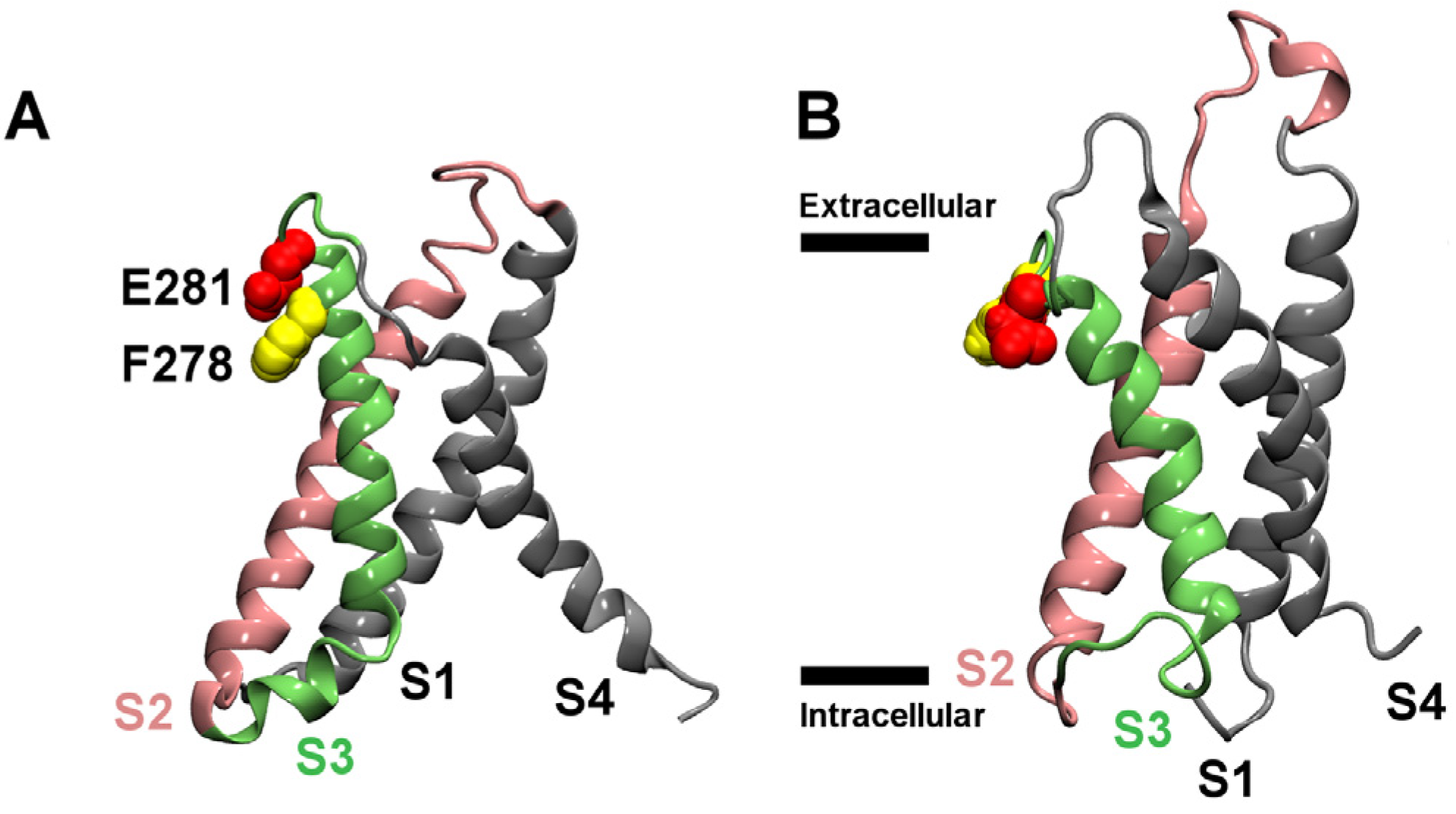
      <p>Here we examine the binding of HaTx1 to the VSs of Kv2.1 in the open (VS<sub>O</sub>) and resting (VS<sub>R</sub>) states, using a molecular docking method and MD simulations. The model structures of the VS in the resting and open states are displayed in <xref ref-type="fig" rid="toxins-04-01552-f001">Figure 1</xref>. The positions of two helices, S3 and S4, are noticeably different between the resting state and open state conformations. In the open state, the S3 helix is moved inward, whereas the S4 helix is moved further outward. We use molecular docking to predict possible binding modes between the toxin and the VS<sub>R</sub>, which provides the best receptor site for the toxin. Each of the distinct binding modes predicted are subsequently equilibrated in a lipid bilayer and a box of explicit water for 50 ns, and the mode consistent with experiment is considered to be correct. The toxin is then docked to the VS<sub>O</sub> assuming an orientation similar to that in the correct binding mode of HaTx1-VS<sub>R</sub>. The calculations suggest that HaTx1 bind to its primary receptor site, the S3b-S4a paddle [<xref ref-type="bibr" rid="B24-toxins-04-01552">24</xref>], from S2 and S3 helices.</p>
      <fig id="toxins-04-01552-f001" position="float">
        <label>Figure 1</label>
        <caption>
          <p>Homology models of the voltage sensors (VSs) of Kv2.1 in the resting (<bold>A</bold>) and open (<bold>B</bold>) states. The side chains of two key residues in the periplasmic segment of the S3 helix, Phe278 and Glu281, are highlighted. In (<bold>B</bold>), the boundary of the membrane is indicated with horizontal bars.</p>
        </caption>
        <graphic xmlns:xlink="http://www.w3.org/1999/xlink" xlink:href="toxins-04-01552-g001.tif"/>
      </fig>
    </sec>
    <sec sec-type="results">
      <title>2. Results and Discussion</title>
      <sec>
        <title>2.1. Binding to the VS<sub>R</sub></title>
        <p>First we examine the binding of HaTx1 to the isolated VS of Kv2.1 in the resting state. The isolated VS rather than the full channel with the pore domain attached is used for computational efficiency, because the pore domain is not required for toxin binding [<xref ref-type="bibr" rid="B26-toxins-04-01552">26</xref>] and isolated VS domains are stable when incorporated into lipid bilayers [<xref ref-type="bibr" rid="B27-toxins-04-01552">27</xref>]. </p>
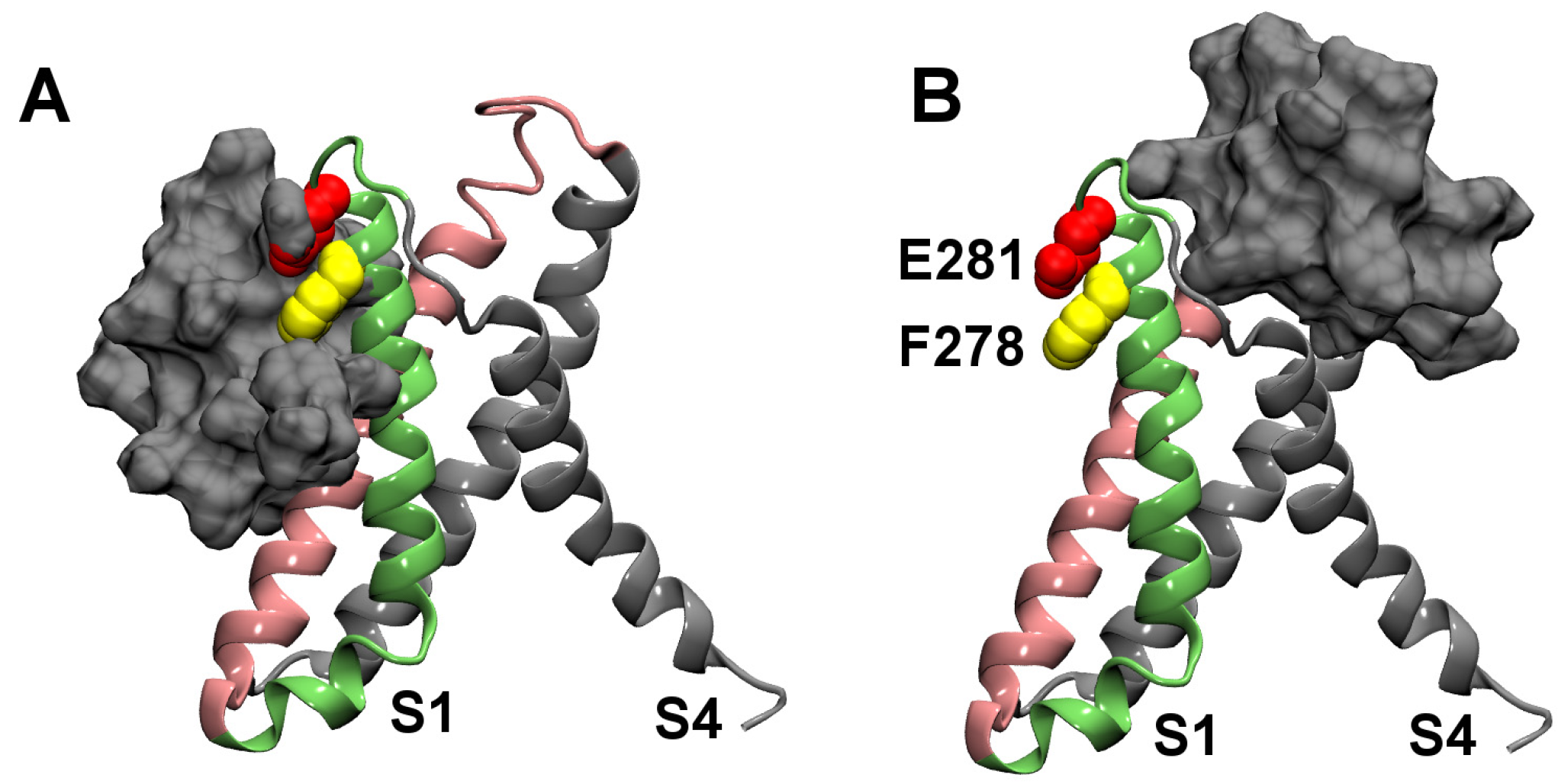
        <p>Two distinct binding modes, as displayed in <xref ref-type="fig" rid="toxins-04-01552-f002">Figure 2</xref>, are predicted by molecular docking calculations. In the first binding mode, HaTx1 binds to the periplasmic half of the VS<sub>R</sub> from S2 and S3 helices (<xref ref-type="fig" rid="toxins-04-01552-f002">Figure 2</xref>A), whereas in the second binding mode, the toxin binds to the VS<sub>R</sub> from S1 and S4 helices (<xref ref-type="fig" rid="toxins-04-01552-f002">Figure 2</xref>B). These two binding modes represent the only two orientations by which HaTx1 can bind the extracellular segment of VS<sub>R</sub>. The two key residues Phe278 and Glu281, corresponding to Phe274 and Glu281 in rat Kv2.1, are in close proximity to the toxin in the first binding mode, but they are far away from the toxin in the second binding mode. In both binding modes, the functional surface of HaTx1 consists of six hydrophobic residues, Leu5, Phe6, Phe23, Trp30, Phe32 and Phe34, corresponding to the key residues of the closely related toxin SGTx1 determined experimentally [<xref ref-type="bibr" rid="B17-toxins-04-01552">17</xref>]. The second binding mode is consistent with that observed for VSTx1 and KvAP in the multiscale simulations of Wee <italic>et al</italic>. [<xref ref-type="bibr" rid="B21-toxins-04-01552">21</xref>]. However, HaTx1 and VSTx1 may bind to different regions of the VS [<xref ref-type="bibr" rid="B12-toxins-04-01552">12</xref>]. The first binding mode is more consistent with mutagenesis data, and therefore is more likely to be the correct binding mode. Subsequent MD simulations performed on the two binding modes support this proposal.</p>
        <fig id="toxins-04-01552-f002" position="float">
          <label>Figure 2</label>
          <caption>
            <p>The two distinct binding modes of HaTx1 and the resting state VS of Kv2.1 predicted from molecular docking calculations. Molecular surface of HaTx1 is shown in silver. </p>
          </caption>
          <graphic xmlns:xlink="http://www.w3.org/1999/xlink" xlink:href="toxins-04-01552-g002.tif"/>
        </fig>
        <p>Since the molecular docking calculations are performed in the absence of membrane, water and ions, it is important to equilibrate the structures predicted in a more realistic environment. The two structures of HaTx1-VS<sub>R</sub> are embedded in a lipid bilayer and a box of explicit water and ions, and subsequently simulated for 50 ns each using MD without restraints, as described in the Methods section. </p>
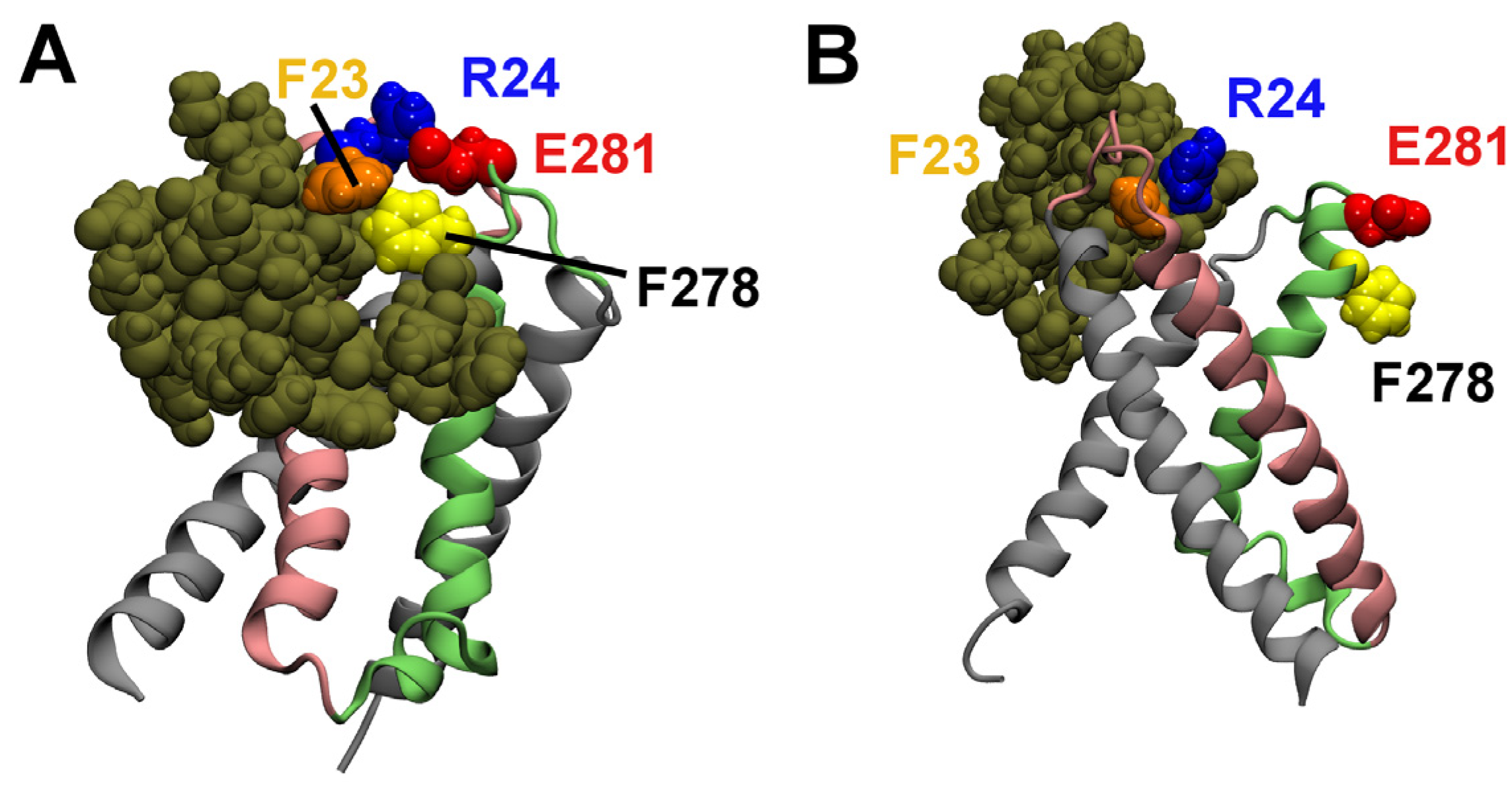
        <p>The initial complexes determined from docking, when embedded in the lipid bilayer, reveal that the toxin is partially buried in the hydrophobic core of the bilayer. In the first binding mode, the center of mass (COM) of HaTx1, located 6 Å above the center of the bilayer at the start of the simulation, shifts upward by about 6 Å over the simulation period of 50 ns. About half of the toxin remains buried in the lipids at the end of the simulation. In the second binding mode, the distance between the COM of HaTx1 and the bilayer center along the bilayer normal (18–19 Å) does not change significantly during the equilibration. The overall architecture of the VS<sub>R</sub> is rigid in both binding modes, with the maximum RMSD of the backbone atoms of the VS<sub>R</sub> with respect to the starting structure being less than 3 Å. </p>
        <p>The positions of HaTx1 relative to the VS<sub>R</sub> of Kv2.1 after the equilibration are shown in <xref ref-type="fig" rid="toxins-04-01552-f003">Figure 3</xref>. Water molecules, ions and lipids are not shown in the figure. In the first binding mode, the VS residue Glu281 is observed to form a salt bridge with the toxin residue Arg24 (<xref ref-type="fig" rid="toxins-04-01552-f003">Figure 3</xref>A). Here, a salt bridge is considered to be formed if the distance is ≤ 4 Å between a side-chain oxygen of an acidic residue and a side-chain nitrogen of a basic residue [<xref ref-type="bibr" rid="B28-toxins-04-01552">28</xref>]. In addition, the VS residue Phe278 forms hydrophobic interactions with the phenylalanine residue at position 23 of HaTx1. The distance between HaTx1 Trp30 and the center of the bilayer fluctuates around an average of 6 Å over the last 10 ns. This is in reasonable agreement with experimental measurements which suggest that Trp30 is about 8.5 Å from the bilayer center on the binding of HaTx1 to membranes [<xref ref-type="bibr" rid="B6-toxins-04-01552">6</xref>]. In the second binding mode, the toxin does not move toward Phe278 and Glu281 of the VS during the simulation period of 50 ns, and no salt bridge between the VS and toxin is observed. Therefore, the first binding mode is more consistent with mutagenesis experiments, and is considered to be correct.</p>
        <fig id="toxins-04-01552-f003" position="float">
          <label>Figure 3</label>
          <caption>
            <p>HaTx1 bound to the resting state VS of Kv2.1 after 50 ns of molecular dynamics (MD) simulation. The two possible binding modes are shown. Toxin molecule is in tan. The side chains of two toxin residues, Phe23 and Arg24, and two VS residues, Phe278 and Glu281, are highlighted. </p>
          </caption>
          <graphic xmlns:xlink="http://www.w3.org/1999/xlink" xlink:href="toxins-04-01552-g003.tif"/>
        </fig>
      </sec>
      <sec>
        <title>2.2. Binding to the VS<sub>O</sub></title>
        <p>Experimentally it has been shown that HaTx1 binds to the VS of Kv2.1 in both open and resting states, but the binding to the open state is less energetically favorable [<xref ref-type="bibr" rid="B6-toxins-04-01552">6</xref>]. If the binding mode of HaTx1-VS<sub>R</sub> shown in <xref ref-type="fig" rid="toxins-04-01552-f003">Figure 3</xref>A were correct, less favorable toxin-VS interactions should be formed if the open conformation of the VS were used in the docking. Following this hypothesis, we perform docking calculations of HaTx1 with the VS<sub>O</sub> of Kv2.1. The complex in which the position of HaTx1 relative to the VS is similar to that in <xref ref-type="fig" rid="toxins-04-01552-f003">Figure 3</xref>A is selected for subsequent MD simulations. </p>
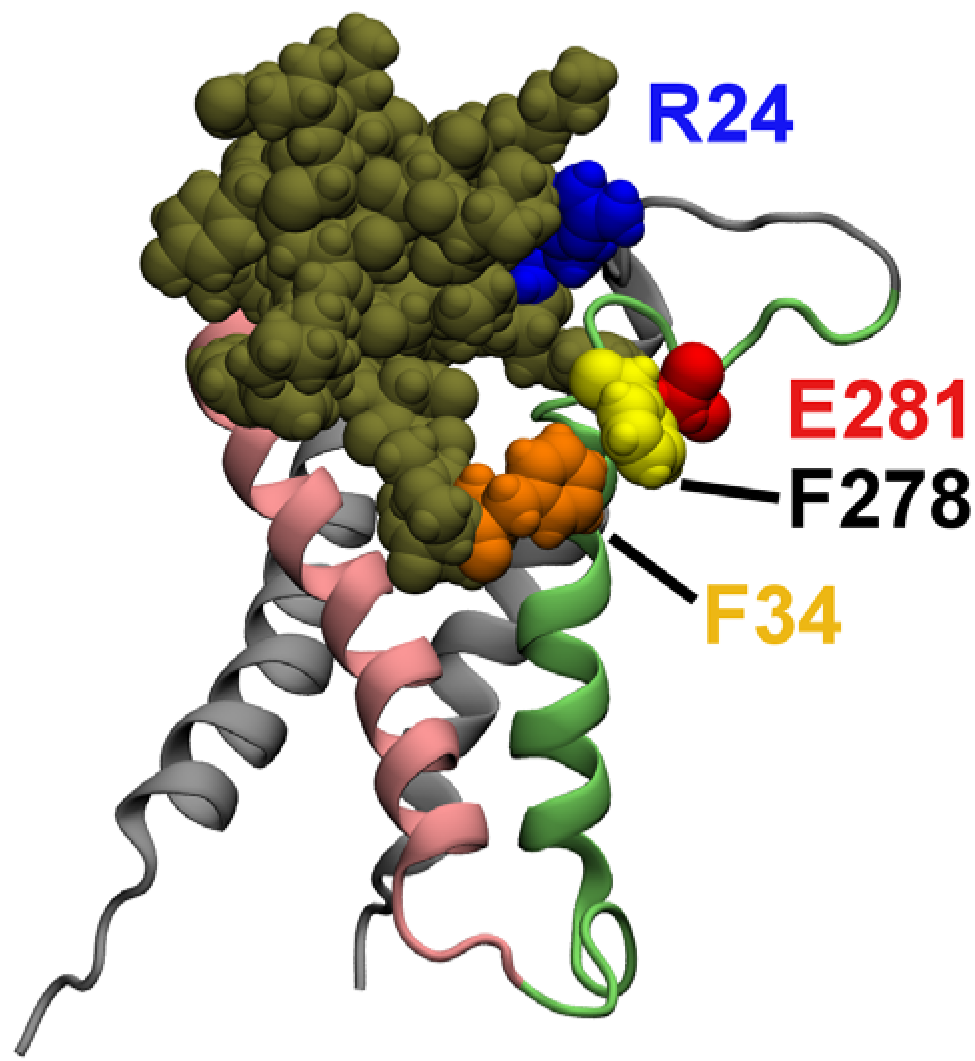
        <p><xref ref-type="fig" rid="toxins-04-01552-f004">Figure 4</xref> displays the structure of HaTx1 bound to the VS<sub>O</sub> after 50 ns of simulation. The VS residue Glu281 does not form a salt bridge with the toxin residue Arg24, although the VS residue Phe278 interacts favorably with the toxin residue Phe34. The residue Trp30 of HaTx1 is about 9.5 Å from the center of the bilayer, comparable to the value of 8.5 Å determined experimentally [<xref ref-type="bibr" rid="B6-toxins-04-01552">6</xref>]. Without a salt bridge, the interactions in the toxin-VS<sub>O </sub>complex are less favorable than that in the toxin-VS<sub>R</sub> complex. This would predict that HaTx1 binds more strongly to the VS<sub>R</sub>, which is consistent with experiment [<xref ref-type="bibr" rid="B6-toxins-04-01552">6</xref>].</p>
        <fig id="toxins-04-01552-f004" position="float">
          <label>Figure 4</label>
          <caption>
            <p>HaTx1 bound to the open state VS of Kv2.1 after 50 ns of MD simulation. Two toxin residues, Phe34 and Arg24, and two VS residues, Phe278 and Glu281, are highlighted.</p>
          </caption>
          <graphic xmlns:xlink="http://www.w3.org/1999/xlink" xlink:href="toxins-04-01552-g004.tif"/>
        </fig>
      </sec>
      <sec>
        <title>2.3. Computational Mutagenesis</title>
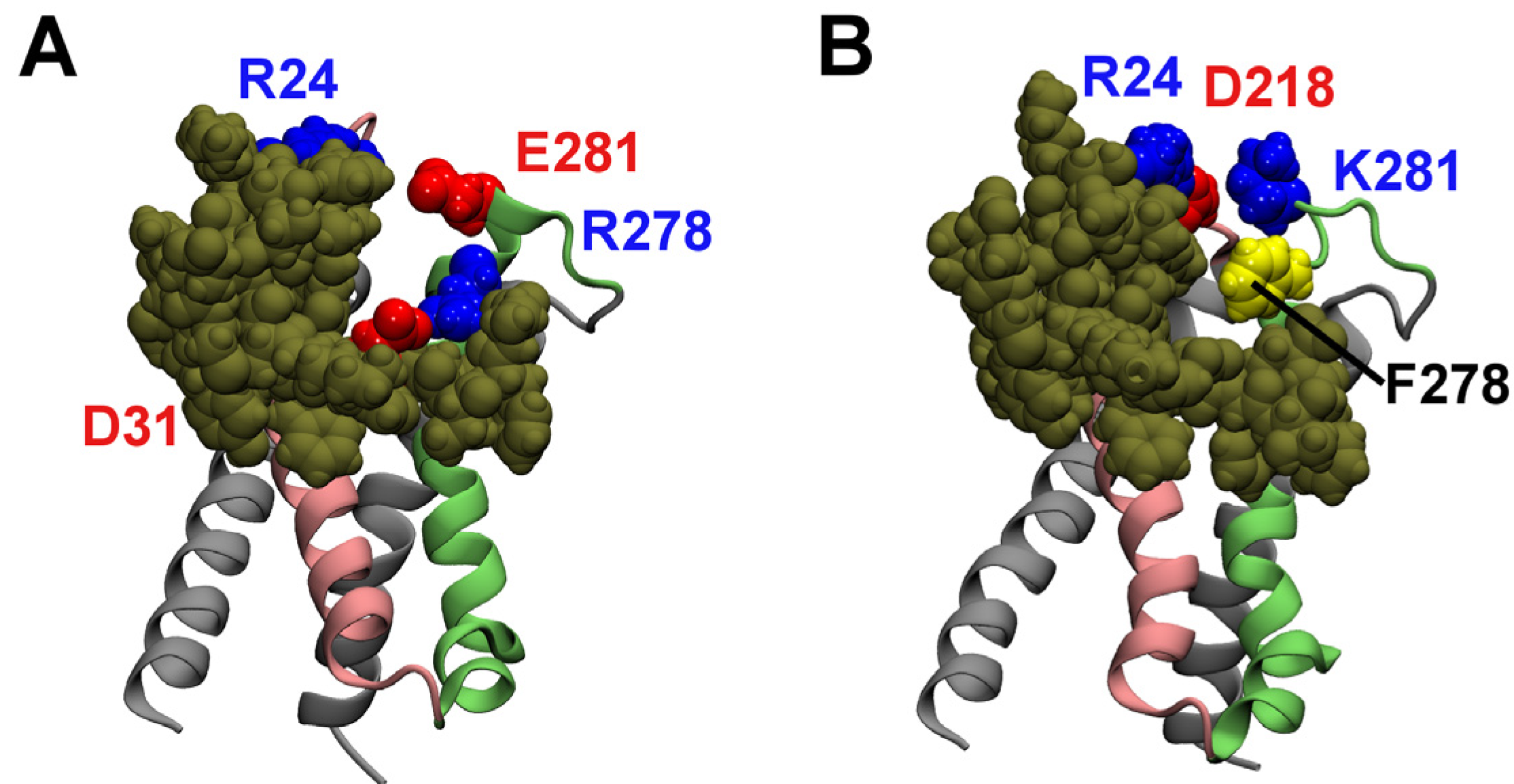
        <p>If the model of HaTx1-VS<sub>R</sub> shown in <xref ref-type="fig" rid="toxins-04-01552-f003">Figure 3</xref>A were representative of the binding of HaTx1 to Kv2.1 in real systems, the model should be able to reproduce the effect of single mutation to the VS on toxin binding observed experimentally. The F278R and E281K mutations have been shown experimentally to cause the largest effect on the binding affinity of HaTx1 [<xref ref-type="bibr" rid="B24-toxins-04-01552">24</xref>]. Therefore, we perform two single mutations, F278R and E281K, to the HaTx1-VS<sub>R</sub> complex shown in <xref ref-type="fig" rid="toxins-04-01552-f003">Figure 3</xref>A. The mutant complexes are subsequently simulated for 20 ns without restraints.</p>
        <p>The complex of HaTx1-F278R VS<sub>R</sub> after 20 ns of simulation is shown in <xref ref-type="fig" rid="toxins-04-01552-f005">Figure 5</xref>A. The position of HaTx1 relative to the F278R VS<sub>R</sub> is similar to that observed before the mutation. In this complex, the salt bridge Arg24–Glu281 is broken. However, a new salt bridge, Asp31–Arg278 is formed. The complex of HaTx1-E281K VS<sub>R</sub> after 20 ns of simulation is shown in <xref ref-type="fig" rid="toxins-04-01552-f005">Figure 5</xref>B. Again, HaTx1 remains bound to the mutant VS after the equilibration. Similar to the HaTx1-F278R VS<sub>R </sub>complex, the salt bridge Arg24–Glu281 is broken but an equivalent salt bridge (Arg24–Asp218) is formed in the complex HaTx1-E281K VS<sub>R</sub>. Thus, the overall strength of electrostatic interactions between the toxin and the VS<sub>R</sub> appears to be similar between the wild type and mutant VSs. </p>
        <fig id="toxins-04-01552-f005" position="float">
          <label>Figure 5</label>
          <caption>
            <p>HaTx1 bound to the F278R (<bold>A</bold>) and E281K (<bold>B</bold>) mutant VSs of Kv2.1 in the resting state after 20 ns of simulation.</p>
          </caption>
          <graphic xmlns:xlink="http://www.w3.org/1999/xlink" xlink:href="toxins-04-01552-g005.tif"/>
        </fig>
        <p>To quantify the strength of non-polar interactions between the toxin and the wild type and mutant VSs, we calculate the solvent accessible surface area (SASA) of the interface between the toxin and the VS. SASA is widely used to estimate the non-polar component of solvation free energies in the empirical methods Molecular Mechanic/Poisson-Boltzmann Surface Area (MM/PBSA) and Molecular Mechanic/Generalized Born Surface Area (MM/GBSA) for estimating free energies of ligand binding [<xref ref-type="bibr" rid="B29-toxins-04-01552">29</xref>,<xref ref-type="bibr" rid="B30-toxins-04-01552">30</xref>]. Results tabulated in <xref ref-type="table" rid="toxins-04-01552-t001">Table 1</xref> show that SASA of HaTx1-VS<sub>R</sub> is 790 Å<sup>2</sup>, which is significantly higher than the values of 690 Å<sup>2</sup> for HaTx1-F278R VS<sub>R</sub> and 750 Å<sup>2</sup> for HaTx1-E281K VS<sub>R</sub>. The SASA values are monotonically related to the corresponding free energies of binding inferred from experimental data (<xref ref-type="table" rid="toxins-04-01552-t001">Table 1</xref>), with a linear correlation coefficient of −0.9. However, such a correlation does not demonstrate that the toxin binds the mutant VSs less strongly, because SASA only approximates one component of the free energy of binding. Other components such as entropy, internal energies of the toxin and VS, VS-lipid interactions, toxin-lipid interactions and polar non-bonded interactions between the toxin-VS, may not cancel out between the wild type and mutant VSs. We have attempted to derive the potential of mean force profile for the toxin binding and calculate the dissociation constant <italic>K</italic><sub>d</sub>, but found that the convergence of the profile is poor within the time scale accessible to us. Nevertheless, calculations of SASA indicate that non-polar interactions between the toxin and the VS are weakened by the mutations. </p>
        <p>It is possible that HaTx1 binds to the wild type and mutant VSs of Kv2.1 equally strongly, but the ability of HaTx1 to inhibit the movement of the VS is significantly reduced due to the different interactions formed between the toxin and mutant VSs. Such uncoupling of binding from activity has already been demonstrated in the binding of scorpion β-toxin Css4 to sodium channels [<xref ref-type="bibr" rid="B31-toxins-04-01552">31</xref>]. As shown in the binding modes of HaTx1 to the mutant VSs displayed in <xref ref-type="fig" rid="toxins-04-01552-f005">Figure 5</xref>, both mutations interrupt the salt bridge formed by Glu281 of the voltage sensor. We therefore cannot rule out the possibility that the F278R and E281K mutations disrupt toxin activity by interrupting the Arg24–Glu281 salt bridge formed in the HaTx1-wild type VS complex. Future binding assay experiments should help clarify this issue. </p>

		<table-wrap id="toxins-04-01552-t001" position="float">
          <object-id pub-id-type="pii">toxins-04-01552-t001_Table 1</object-id>
          <label>Table 1</label>
          <caption>
            <p>The solvent accessible surface area (SASA) of the binding interface between HaTx1 and the wild type (WT) and mutant VSs of Kv2.1 in the resting state.</p>
          </caption>
          <table>
            <thead>
              <tr>
                <th align="center" valign="middle">VS</th>
                <th align="center" valign="middle">SASA (Å<sup>2</sup>)</th>
                <th align="center" valign="middle">Δ<italic>G</italic><sub>bind</sub> (kT)</th>
              </tr>
            </thead>
            <tbody>
              <tr>
                <td align="center" valign="middle">WT</td>
                <td align="center" valign="middle">790 ± 20</td>
                <td align="center" valign="middle">−16.1</td>
              </tr>
              <tr>
                <td align="center" valign="middle">F278R</td>
                <td align="center" valign="middle">690 ± 27</td>
                <td align="center" valign="middle">−9.7</td>
              </tr>
              <tr>
                <td align="center" valign="middle">E281K</td>
                <td align="center" valign="middle">751 ± 53</td>
                <td align="center" valign="middle">−11.0</td>
              </tr>
            </tbody>
          </table>
		  <table-wrap-foot><fn><p>Δ<italic>G</italic><sub>bind</sub> is calculated as Δ<italic>G</italic><sub>bind</sub> = <italic>kT</italic> ln(<italic>K</italic><sub>d</sub>/<italic>C</italic><sub>0</sub>), where <italic>C</italic><sub>0</sub> is 1 M. The dissociation constant <italic>K</italic><sub>d</sub> values are 103 nM, 61.6 μM and 17.3 μM for WT, F278R and E281K mutants, respectively [<xref ref-type="bibr" rid="B24-toxins-04-01552">24</xref>].</p></fn></table-wrap-foot>
        </table-wrap>
      </sec>
      <sec>
        <title>2.4. Membrane Partition</title>
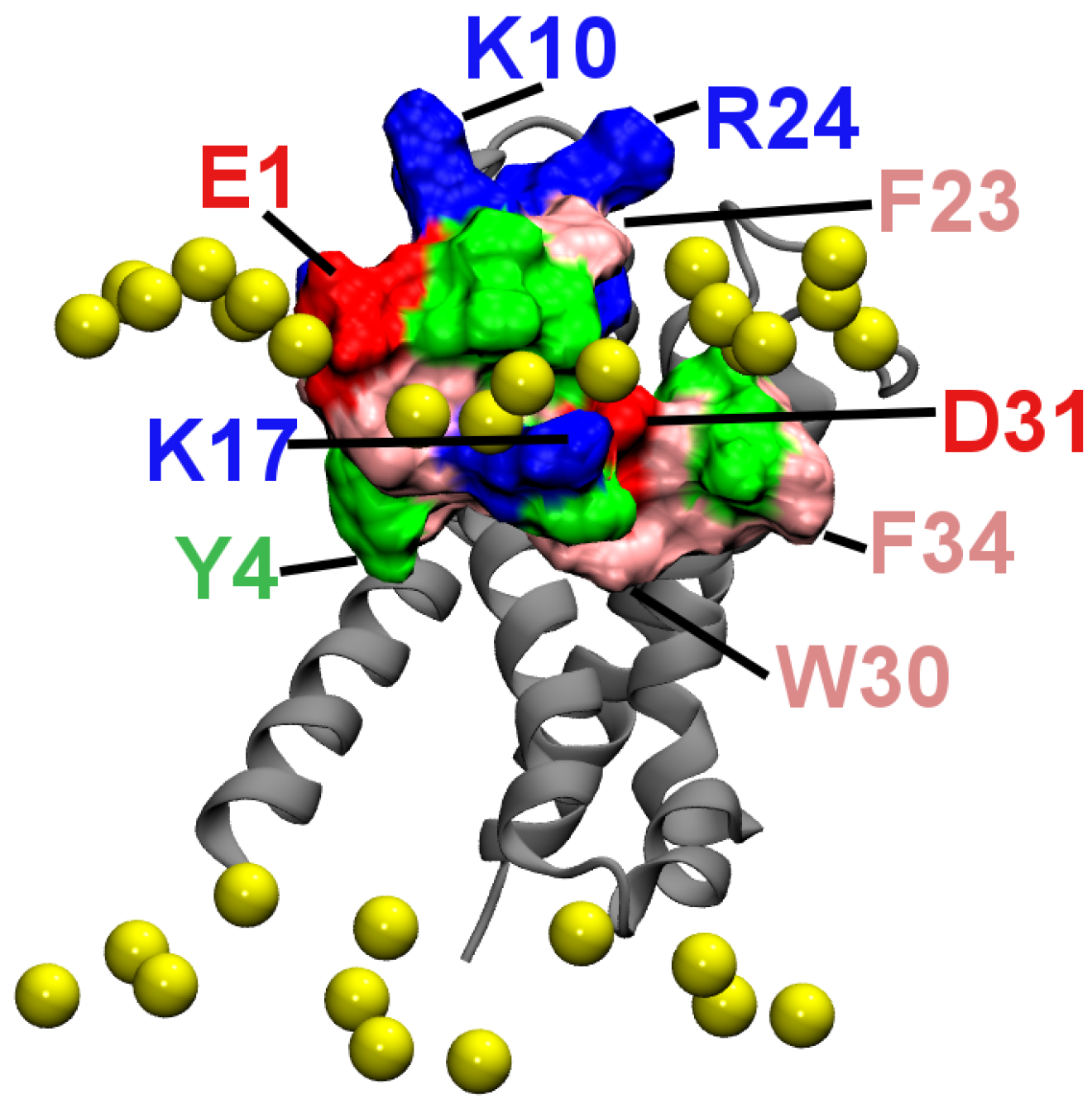
        <p><xref ref-type="fig" rid="toxins-04-01552-f006">Figure 6</xref> shows the position of HaTx1 relative to lipid head groups in the simulation corresponding to that in <xref ref-type="fig" rid="toxins-04-01552-f003">Figure 3</xref>A. It is seen that several hydrophobic residues, including Tyr4, Trp30 and Phe34 penetrate into the hydrophobic core of the bilayer, whereas the charged residues Glu1, Lys17 and Asp31 are located in the polar head group region. By forming favorable hydrophobic interactions with lipid tails and hydrogen bonds with lipid head groups, the toxin-VS<sub>R</sub> complex is stabilized in the bilayer. About half of the toxin is buried in the lipids and the other half in the water phase. The membrane partition of HaTx1 observed here is consistent with that observed experimentally for various similar gating modifier toxins such as VSTx1 [<xref ref-type="bibr" rid="B1-toxins-04-01552">1</xref>], SGTx1 [<xref ref-type="bibr" rid="B3-toxins-04-01552">3</xref>], HaTx1 [<xref ref-type="bibr" rid="B6-toxins-04-01552">6</xref>], and GsMTx4 [<xref ref-type="bibr" rid="B32-toxins-04-01552">32</xref>]. In the bound complex, the hydrophobic patch of HaTx1 consisting of residues Leu5, Phe6, Phe23, Trp30, Phe32 and Phe34 is interacting primarily with the VS and not the lipids. This patch is nearly parallel to the bilayer normal. However, it should be perpendicular to the bilayer normal and parallel to the bilayer plane on the binding of HaTx1 to pure lipid bilayers according to previous computational studies of closely related toxins [<xref ref-type="bibr" rid="B19-toxins-04-01552">19</xref>,<xref ref-type="bibr" rid="B20-toxins-04-01552">20</xref>]. Therefore, a membrane-bound HaTx1 would need to reorient on binding to the VS. </p>
        <fig id="toxins-04-01552-f006" position="float">
          <label>Figure 6</label>
          <caption>
            <p>The position of HaTx1 relative to lipids in the simulation corresponding to that of <xref ref-type="fig" rid="toxins-04-01552-f003">Figure 3</xref>A. The phosphorus atoms of lipids near the toxin are shown as yellow spheres, and the backbone of the VS as silver ribbons. </p>
          </caption>
          <graphic xmlns:xlink="http://www.w3.org/1999/xlink" xlink:href="toxins-04-01552-g006.tif"/>
        </fig>
        <p>In the previous computational studies of scorpion α- and β-toxins [<xref ref-type="bibr" rid="B33-toxins-04-01552">33</xref>,<xref ref-type="bibr" rid="B34-toxins-04-01552">34</xref>], which are gating modifiers of voltage gated sodium (Nav) channels, both scorpion α- and β-toxins do not partition into membranes on binding. The differences in the membrane partition abilities of HaTx1 and scorpion toxins may be related to the distinct function of these toxins. Scorpion β-toxins shift the voltage-activity curve of Nav channels to the left, such that the channel requires less depolarized potentials to open [<xref ref-type="bibr" rid="B35-toxins-04-01552">35</xref>]. In contrast, HaTx1 shifts the voltage-activity curve of Kv2.1 to the right, such that the channel opening requires stronger depolarization [<xref ref-type="bibr" rid="B7-toxins-04-01552">7</xref>]. It is known that the VS<sub>R</sub> especially the S4 helix is more buried in the membrane compared to the VS<sub>O</sub> [<xref ref-type="bibr" rid="B36-toxins-04-01552">36</xref>,<xref ref-type="bibr" rid="B37-toxins-04-01552">37</xref>]. Thus, membrane partitioning may be required for HaTx1, because the toxin has to bind the resting state VS within the membrane.</p>
      </sec>
    </sec>
    <sec sec-type="methods">
      <title>3. Methods</title>
      <sec>
        <title>3.1. Initial Structures</title>
        <p>HaTx1 binds the most potently to the VS in the resting state [<xref ref-type="bibr" rid="B6-toxins-04-01552">6</xref>]. Homology models are generated for the VS of Kv2.1 in the open and resting states, using the automated homology modeling server SWISS-MODEL [<xref ref-type="bibr" rid="B38-toxins-04-01552">38</xref>,<xref ref-type="bibr" rid="B39-toxins-04-01552">39</xref>,<xref ref-type="bibr" rid="B40-toxins-04-01552">40</xref>]. The sequence of <italic>Homo sapiens</italic> Kv2.1 is obtained from the NCBI protein database (NCBI entry NP_004966.1). The model of Kv1.2 in the resting state [<xref ref-type="bibr" rid="B41-toxins-04-01552">41</xref>] and the crystal structure of Kv1.2 in the open state (PDB ID: 3LUT) [<xref ref-type="bibr" rid="B42-toxins-04-01552">42</xref>,<xref ref-type="bibr" rid="B43-toxins-04-01552">43</xref>] are used as templates. The sequence identity between the VSs of Kv1.2 and Kv2.1 is ~40%, above 30% that is required for reliable homology models to be generated [<xref ref-type="bibr" rid="B44-toxins-04-01552">44</xref>]. The solution structure 1D1H [<xref ref-type="bibr" rid="B15-toxins-04-01552">15</xref>] is used for HaTx1.</p>
      </sec>
      <sec>
        <title>3.2. Molecular Docking</title>
        <p>We use the rigid-body molecular docking program ZDOCK 3.0.1 [<xref ref-type="bibr" rid="B45-toxins-04-01552">45</xref>] to survey possible binding modes of HaTx1 and the VSs of Kv2.1. Each docking calculation generates 500 structures. The structures in which the toxin is located in the cytoplasmic half of the VS are eliminated, because HaTx1 binds to the periplasmic segment of the VS according to experiment [<xref ref-type="bibr" rid="B6-toxins-04-01552">6</xref>]. Subsequently cluster analysis with a toxin backbone RMSD cutoff of 20 Å is performed on the remaining structures to identify distinct binding modes by HaTx1.</p>
      </sec>
      <sec>
        <title>3.3. Molecular Dynamics Simulations</title>
        <p>The bound complexes predicted by molecular docking are embedded in a POPC (2-oleoyl-1-palmitoyl-<italic>sn</italic>-glycero-3-phosphocholine) bilayer solvated with a rectangular box of explicit water and 0.2 M KCl. The simulation boxes, 70–80 Å in each dimension, contained approximately 160 lipids, 32 K<sup>+</sup>/Cl<sup>−</sup> ions and 8500 water molecules. Each system is then equilibrated for 50 ns without restraints. </p>
        <p>All MD simulations are performed using NAMD 2.8 [<xref ref-type="bibr" rid="B46-toxins-04-01552">46</xref>], with periodic boundary conditions and a 2-fs time step. The CHARMM27/CMAP force field for proteins [<xref ref-type="bibr" rid="B47-toxins-04-01552">47</xref>,<xref ref-type="bibr" rid="B48-toxins-04-01552">48</xref>], C36 force field for lipids [<xref ref-type="bibr" rid="B49-toxins-04-01552">49</xref>] and the TIP3P model for water [<xref ref-type="bibr" rid="B50-toxins-04-01552">50</xref>] are used. The switch and cutoff distances for short-range interactions are 8.0 Å and 12.0 Å, respectively. The particle mesh Ewald method is used to describe long-range electrostatic interactions, with a maximum grid spacing of 1.0 Å. The SHAKE [<xref ref-type="bibr" rid="B51-toxins-04-01552">51</xref>] and SETTLE [<xref ref-type="bibr" rid="B52-toxins-04-01552">52</xref>] algorithms are used to keep the bond lengths in the system rigid. The short-range nonbonded interactions and the long-range electrostatic forces are computed every one and two steps, respectively. The Langevin dynamics and the Nosé-Hoover Langevin Piston method [<xref ref-type="bibr" rid="B53-toxins-04-01552">53</xref>] are used for maintaining a temperature of 300 K and a pressure of 1 bar on average in the system. Trajectories are saved every 20 ps for analysis. Molecular graphics are generated using VMD [<xref ref-type="bibr" rid="B54-toxins-04-01552">54</xref>].</p>
      </sec>
    </sec>
    <sec sec-type="conclusions">
      <title>4. Conclusions</title>
      <p>In this work using a combination of molecular docking methods and molecular dynamics simulations, models of HaTx1 bound to the VS of human Kv2.1 in the open and resting states are constructed. The models reproduce a wide range of experimental observations, including the relative affinity of HaTx1 for the VS in the open and resting states, and the reduction in toxin affinity due to mutations to two key residues (Phe278 and Glu281) of the VS. It is found that HaTx1 binds to its primary receptor site S3b-S4a paddle from S2 and S3 helices.</p>
    </sec>
    
  </body>
  <back><ack>
      <title>Acknowledgments</title>
      <p>This research was undertaken on the NCI National Facility in Canberra, Australia, which is supported by the Australian Commonwealth Government. This work was supported by the National Health and Medical Research Council of Australia. </p>
    </ack>
    <notes>
      <title>Conflict of Interest</title>
      <p>The authors declare no conflict of interest.</p>
    </notes>
    <ref-list>
      <title>References</title>
      <ref id="B1-toxins-04-01552">
        <label>1.</label>
        <citation citation-type="journal">
          <person-group person-group-type="author">
            <name>
              <surname>Lee</surname>
              <given-names>S.Y.</given-names>
            </name>
            <name>
              <surname>MacKinnon</surname>
              <given-names>R.</given-names>
            </name>
          </person-group>
          <article-title>A membrane-access mechanism of ion channel inhibition by voltage sensor toxins from spider venom</article-title>
          <source>Nature</source>
          <year>2004</year>
          <volume>430</volume>
          <fpage>232</fpage>
          <lpage>235</lpage>
        <pub-id pub-id-type="doi">10.1038/nature02632</pub-id><pub-id pub-id-type="pmid">15241419</pub-id></citation>
      </ref>
      <ref id="B2-toxins-04-01552">
        <label>2.</label>
        <citation citation-type="journal">
          <person-group person-group-type="author">
            <name>
              <surname>Jung</surname>
              <given-names>H.J.</given-names>
            </name>
            <name>
              <surname>Lee</surname>
              <given-names>J.Y.</given-names>
            </name>
            <name>
              <surname>Kim</surname>
              <given-names>S.H.</given-names>
            </name>
            <name>
              <surname>Eu</surname>
              <given-names>Y.J.</given-names>
            </name>
            <name>
              <surname>Shin</surname>
              <given-names>S.Y.</given-names>
            </name>
            <name>
              <surname>Milescu</surname>
              <given-names>M.</given-names>
            </name>
            <name>
              <surname>Swartz</surname>
              <given-names>K.J.</given-names>
            </name>
            <name>
              <surname>Kim</surname>
              <given-names>J.I.</given-names>
            </name>
          </person-group>
          <article-title>Solution structure and lipid membrane partitioning of VSTx1, an inhibitor of the KvAP potassium channel</article-title>
          <source>Biochemistry</source>
          <year>2005</year>
          <volume>44</volume>
          <fpage>6015</fpage>
          <lpage>6023</lpage>
        <pub-id pub-id-type="doi">10.1021/bi0477034</pub-id><pub-id pub-id-type="pmid">15835890</pub-id></citation>
      </ref>
      <ref id="B3-toxins-04-01552">
        <label>3.</label>
        <citation citation-type="journal">
          <person-group person-group-type="author">
            <name>
              <surname>Milescu</surname>
              <given-names>M.</given-names>
            </name>
            <name>
              <surname>Vobecky</surname>
              <given-names>J.</given-names>
            </name>
            <name>
              <surname>Roh</surname>
              <given-names>S.H.</given-names>
            </name>
            <name>
              <surname>Kim</surname>
              <given-names>S.H.</given-names>
            </name>
            <name>
              <surname>Jung</surname>
              <given-names>H.J.</given-names>
            </name>
            <name>
              <surname>Kim</surname>
              <given-names>J.I.</given-names>
            </name>
            <name>
              <surname>Swartz</surname>
              <given-names>K.J.</given-names>
            </name>
          </person-group>
          <article-title>Tarantula toxins interact with voltage sensors within lipid membranes</article-title>
          <source>J. Gen. Physiol.</source>
          <year>2007</year>
          <volume>130</volume>
          <fpage>497</fpage>
          <lpage>511</lpage>
          <pub-id pub-id-type="doi">10.1085/jgp.200709869</pub-id>
        </citation>
      </ref>
      <ref id="B4-toxins-04-01552">
        <label>4.</label>
        <citation citation-type="journal">
          <person-group person-group-type="author">
            <name>
              <surname>Milescu</surname>
              <given-names>M.</given-names>
            </name>
            <name>
              <surname>Bosmans</surname>
              <given-names>F.</given-names>
            </name>
            <name>
              <surname>Lee</surname>
              <given-names>S.</given-names>
            </name>
            <name>
              <surname>Alabi</surname>
              <given-names>A.A.</given-names>
            </name>
            <name>
              <surname>Kim</surname>
              <given-names>J.I.</given-names>
            </name>
            <name>
              <surname>Swartz</surname>
              <given-names>K.J.</given-names>
            </name>
          </person-group>
          <article-title>Interactions between lipids and voltage sensor paddles detected with tarantula toxins</article-title>
          <source>Nat. Struct. Mol. Biol.</source>
          <year>2009</year>
          <volume>16</volume>
          <fpage>1080</fpage>
          <lpage>1085</lpage>
        <pub-id pub-id-type="doi">10.1038/nsmb.1679</pub-id><pub-id pub-id-type="pmid">19783984</pub-id></citation>
      </ref>
      <ref id="B5-toxins-04-01552">
        <label>5.</label>
        <citation citation-type="journal">
          <person-group person-group-type="author">
            <name>
              <surname>Swartz</surname>
              <given-names>K.J.</given-names>
            </name>
          </person-group>
          <article-title>Tarantula toxins interacting with voltage sensors in potassium channels</article-title>
          <source>Toxicon</source>
          <year>2007</year>
          <volume>49</volume>
          <fpage>213</fpage>
          <lpage>230</lpage>
          <pub-id pub-id-type="doi">10.1016/j.toxicon.2006.09.024</pub-id>
        </citation>
      </ref>
      <ref id="B6-toxins-04-01552">
        <label>6.</label>
        <citation citation-type="journal">
          <person-group person-group-type="author">
            <name>
              <surname>Phillips</surname>
              <given-names>L.R.</given-names>
            </name>
            <name>
              <surname>Milescu</surname>
              <given-names>M.</given-names>
            </name>
            <name>
              <surname>Li-Smerin</surname>
              <given-names>Y.Y.</given-names>
            </name>
            <name>
              <surname>Mindell</surname>
              <given-names>J.A.</given-names>
            </name>
            <name>
              <surname>Kim</surname>
              <given-names>J.I.</given-names>
            </name>
            <name>
              <surname>Swartz</surname>
              <given-names>K.J.</given-names>
            </name>
          </person-group>
          <article-title>Voltage-sensor activation with a tarantula toxin as cargo</article-title>
          <source>Nature</source>
          <year>2005</year>
          <volume>436</volume>
          <fpage>857</fpage>
          <lpage>860</lpage>
        <pub-id pub-id-type="pmid">16094370</pub-id><pub-id pub-id-type="doi">10.1038/nature03873</pub-id></citation>
      </ref>
      <ref id="B7-toxins-04-01552">
        <label>7.</label>
        <citation citation-type="journal">
          <person-group person-group-type="author">
            <name>
              <surname>Swartz</surname>
              <given-names>K.J.</given-names>
            </name>
            <name>
              <surname>MacKinnon</surname>
              <given-names>R.</given-names>
            </name>
          </person-group>
          <article-title>An inhibitor of the Kv2.1 potassium channel isolated from the venom of a Chilean tarantula</article-title>
          <source>Neuron</source>
          <year>1995</year>
          <volume>15</volume>
          <fpage>941</fpage>
          <lpage>949</lpage>
          <pub-id pub-id-type="doi">10.1016/0896-6273(95)90184-1</pub-id>
        </citation>
      </ref>
      <ref id="B8-toxins-04-01552">
        <label>8.</label>
        <citation citation-type="journal">
          <person-group person-group-type="author">
            <name>
              <surname>Marvin</surname>
              <given-names>L.</given-names>
            </name>
            <name>
              <surname>De</surname>
              <given-names>E.</given-names>
            </name>
            <name>
              <surname>Cosette</surname>
              <given-names>P.</given-names>
            </name>
            <name>
              <surname>Gagnon</surname>
              <given-names>J.</given-names>
            </name>
            <name>
              <surname>Molle</surname>
              <given-names>G.</given-names>
            </name>
            <name>
              <surname>Lange</surname>
              <given-names>C.</given-names>
            </name>
          </person-group>
          <article-title>Isolation, amino acid sequence and functional assays of SGTx1. The first toxin purified from the venom of the spider <italic>scodra griseipes</italic></article-title>
          <source>Eur. J. Biochem.</source>
          <year>1999</year>
          <volume>265</volume>
          <fpage>572</fpage>
          <lpage>579</lpage>
          <pub-id pub-id-type="doi">10.1046/j.1432-1327.1999.00726.x</pub-id>
        </citation>
      </ref>
      <ref id="B9-toxins-04-01552">
        <label>9.</label>
        <citation citation-type="journal">
          <person-group person-group-type="author">
            <name>
              <surname>Ruta</surname>
              <given-names>V.</given-names>
            </name>
            <name>
              <surname>Jiang</surname>
              <given-names>Y.</given-names>
            </name>
            <name>
              <surname>Lee</surname>
              <given-names>A.</given-names>
            </name>
            <name>
              <surname>Chen</surname>
              <given-names>J.</given-names>
            </name>
            <name>
              <surname>MacKinnon</surname>
              <given-names>R.</given-names>
            </name>
          </person-group>
          <article-title>Functional analysis of an archaebacterial voltage-dependent K<sup>+</sup> channel</article-title>
          <source>Nature</source>
          <year>2003</year>
          <volume>422</volume>
          <fpage>180</fpage>
          <lpage>185</lpage>
        <pub-id pub-id-type="doi">10.1038/nature01473</pub-id><pub-id pub-id-type="pmid">12629550</pub-id></citation>
      </ref>
      <ref id="B10-toxins-04-01552">
        <label>10.</label>
        <citation citation-type="journal">
          <person-group person-group-type="author">
            <name>
              <surname>Sanguinetti</surname>
              <given-names>M.C.</given-names>
            </name>
            <name>
              <surname>Johnson</surname>
              <given-names>J.H.</given-names>
            </name>
            <name>
              <surname>Hammerland</surname>
              <given-names>L.G.</given-names>
            </name>
            <name>
              <surname>Kelbaugh</surname>
              <given-names>P.R.</given-names>
            </name>
            <name>
              <surname>Volkmann</surname>
              <given-names>R.A.</given-names>
            </name>
            <name>
              <surname>Saccomano</surname>
              <given-names>N.A.</given-names>
            </name>
            <name>
              <surname>Mueller</surname>
              <given-names>A.L.</given-names>
            </name>
          </person-group>
          <article-title>Heteropodatoxins: Peptides isolated from spider venom that block Kv4.2 potassium channels</article-title>
          <source>Mol. Pharmacol.</source>
          <year>1997</year>
          <volume>51</volume>
          <fpage>491</fpage>
          <lpage>498</lpage>
        <pub-id pub-id-type="pmid">9058605</pub-id></citation>
      </ref>
      <ref id="B11-toxins-04-01552">
        <label>11.</label>
        <citation citation-type="journal">
          <person-group person-group-type="author">
            <name>
              <surname>Diochot</surname>
              <given-names>S.</given-names>
            </name>
            <name>
              <surname>Drici</surname>
              <given-names>M.D.</given-names>
            </name>
            <name>
              <surname>Moinier</surname>
              <given-names>D.</given-names>
            </name>
            <name>
              <surname>Fink</surname>
              <given-names>M.</given-names>
            </name>
            <name>
              <surname>Lazdunski</surname>
              <given-names>M.</given-names>
            </name>
          </person-group>
          <article-title>Effects of phrixotoxins on the Kv4 family of potassium channels and implications for the role of <italic>I</italic><sub>to1</sub> in cardiac electrogenesis</article-title>
          <source>Br. J. Pharmacol.</source>
          <year>1999</year>
          <volume>126</volume>
          <fpage>251</fpage>
          <lpage>263</lpage>
          <pub-id pub-id-type="doi">10.1038/sj.bjp.0702283</pub-id>
        </citation>
      </ref>
      <ref id="B12-toxins-04-01552">
        <label>12.</label>
        <citation citation-type="journal">
          <person-group person-group-type="author">
            <name>
              <surname>Alabi</surname>
              <given-names>A.A.</given-names>
            </name>
            <name>
              <surname>Bahamonde</surname>
              <given-names>M.I.</given-names>
            </name>
            <name>
              <surname>Jung</surname>
              <given-names>H.J.</given-names>
            </name>
            <name>
              <surname>Kim</surname>
              <given-names>J.I.</given-names>
            </name>
            <name>
              <surname>Swartz</surname>
              <given-names>K.J.</given-names>
            </name>
          </person-group>
          <article-title>Portability of paddle motif function and pharmacology in voltage sensors</article-title>
          <source>Nature</source>
          <year>2007</year>
          <volume>450</volume>
          <fpage>370</fpage>
          <lpage>376</lpage>
        <pub-id pub-id-type="pmid">18004375</pub-id><pub-id pub-id-type="doi">10.1038/nature06266</pub-id></citation>
      </ref>
      <ref id="B13-toxins-04-01552">
        <label>13.</label>
        <citation citation-type="journal">
          <person-group person-group-type="author">
            <name>
              <surname>Zarayskiy</surname>
              <given-names>V.V.</given-names>
            </name>
            <name>
              <surname>Balasubramanian</surname>
              <given-names>G.</given-names>
            </name>
            <name>
              <surname>Bondarenko</surname>
              <given-names>V.E.</given-names>
            </name>
            <name>
              <surname>Morales</surname>
              <given-names>M.J.</given-names>
            </name>
          </person-group>
          <article-title><italic>Heteropoda</italic> toxin 2 is a gating modifier toxin specific for voltage-gated K<sup>+</sup> channels of the Kv4 family</article-title>
          <source>Toxicon</source>
          <year>2005</year>
          <volume>45</volume>
          <fpage>431</fpage>
          <lpage>442</lpage>
          <pub-id pub-id-type="doi">10.1016/j.toxicon.2004.11.015</pub-id>
        </citation>
      </ref>
      <ref id="B14-toxins-04-01552">
        <label>14.</label>
        <citation citation-type="journal">
          <person-group person-group-type="author">
            <name>
              <surname>Norton</surname>
              <given-names>R.S.</given-names>
            </name>
            <name>
              <surname>Pallaghy</surname>
              <given-names>P.K.</given-names>
            </name>
          </person-group>
          <article-title>The cystine knot structure of ion channel toxins and related polypeptides</article-title>
          <source>Toxicon</source>
          <year>1998</year>
          <volume>36</volume>
          <fpage>1573</fpage>
          <lpage>1583</lpage>
          <pub-id pub-id-type="doi">10.1016/S0041-0101(98)00149-4</pub-id>
        </citation>
      </ref>
      <ref id="B15-toxins-04-01552">
        <label>15.</label>
        <citation citation-type="journal">
          <person-group person-group-type="author">
            <name>
              <surname>Takahashi</surname>
              <given-names>H.</given-names>
            </name>
            <name>
              <surname>Kim</surname>
              <given-names>J.I.</given-names>
            </name>
            <name>
              <surname>Min</surname>
              <given-names>H.J.</given-names>
            </name>
            <name>
              <surname>Sato</surname>
              <given-names>K.</given-names>
            </name>
            <name>
              <surname>Swartz</surname>
              <given-names>K.J.</given-names>
            </name>
            <name>
              <surname>Shimada</surname>
              <given-names>I.</given-names>
            </name>
          </person-group>
          <article-title>Solution structure of hanatoxin1, a gating modifier of voltage-dependent K<sup>+</sup> channels: Common surface features of gating modifier toxins</article-title>
          <source>J. Mol. Biol.</source>
          <year>2000</year>
          <volume>297</volume>
          <fpage>771</fpage>
          <lpage>780</lpage>
          <pub-id pub-id-type="doi">10.1006/jmbi.2000.3609</pub-id>
        </citation>
      </ref>
      <ref id="B16-toxins-04-01552">
        <label>16.</label>
        <citation citation-type="journal">
          <person-group person-group-type="author">
            <name>
              <surname>Lee</surname>
              <given-names>C.W.</given-names>
            </name>
            <name>
              <surname>Kim</surname>
              <given-names>S.</given-names>
            </name>
            <name>
              <surname>Roh</surname>
              <given-names>S.H.</given-names>
            </name>
            <name>
              <surname>Endoh</surname>
              <given-names>H.</given-names>
            </name>
            <name>
              <surname>Kodera</surname>
              <given-names>Y.</given-names>
            </name>
            <name>
              <surname>Maeda</surname>
              <given-names>T.</given-names>
            </name>
            <name>
              <surname>Kohno</surname>
              <given-names>T.</given-names>
            </name>
            <name>
              <surname>Wang</surname>
              <given-names>J.M.</given-names>
            </name>
            <name>
              <surname>Swartz</surname>
              <given-names>K.J.</given-names>
            </name>
            <name>
              <surname>Kim</surname>
              <given-names>J.I.</given-names>
            </name>
          </person-group>
          <article-title>Solution structure and functional characterization of SGTx1, a modifier of Kv2.1 channel gating</article-title>
          <source>Biochemistry</source>
          <year>2004</year>
          <volume>43</volume>
          <fpage>890</fpage>
          <lpage>897</lpage>
        <pub-id pub-id-type="pmid">14744131</pub-id><pub-id pub-id-type="doi">10.1021/bi0353373</pub-id></citation>
      </ref>
      <ref id="B17-toxins-04-01552">
        <label>17.</label>
        <citation citation-type="journal">
          <person-group person-group-type="author">
            <name>
              <surname>Wang</surname>
              <given-names>J.M.</given-names>
            </name>
            <name>
              <surname>Roh</surname>
              <given-names>S.H.</given-names>
            </name>
            <name>
              <surname>Kim</surname>
              <given-names>S.</given-names>
            </name>
            <name>
              <surname>Lee</surname>
              <given-names>C.W.</given-names>
            </name>
            <name>
              <surname>Kim</surname>
              <given-names>J.I.</given-names>
            </name>
            <name>
              <surname>Swartz</surname>
              <given-names>K.J.</given-names>
            </name>
          </person-group>
          <article-title>Molecular surface of tarantula toxins interacting with voltage sensors in K<sub>V</sub> channels</article-title>
          <source>J. Gen. Physiol.</source>
          <year>2004</year>
          <volume>123</volume>
          <fpage>455</fpage>
          <lpage>467</lpage>
          <pub-id pub-id-type="doi">10.1085/jgp.200309005</pub-id>
        </citation>
      </ref>
      <ref id="B18-toxins-04-01552">
        <label>18.</label>
        <citation citation-type="journal">
          <person-group person-group-type="author">
            <name>
              <surname>Nishizawa</surname>
              <given-names>M.</given-names>
            </name>
            <name>
              <surname>Nishizawa</surname>
              <given-names>K.</given-names>
            </name>
          </person-group>
          <article-title>Interaction between K<sup>+</sup> channel gate modifier hanatoxin and lipid bilayer membranes analyzed by molecular dynamics simulation</article-title>
          <source>Eur. Biophys. J.</source>
          <year>2006</year>
          <volume>35</volume>
          <fpage>373</fpage>
          <lpage>381</lpage>
          <pub-id pub-id-type="doi">10.1007/s00249-006-0044-z</pub-id>
        </citation>
      </ref>
      <ref id="B19-toxins-04-01552">
        <label>19.</label>
        <citation citation-type="journal">
          <person-group person-group-type="author">
            <name>
              <surname>Wee</surname>
              <given-names>C.L.</given-names>
            </name>
            <name>
              <surname>Bemporad</surname>
              <given-names>D.</given-names>
            </name>
            <name>
              <surname>Sands</surname>
              <given-names>Z.A.</given-names>
            </name>
            <name>
              <surname>Gavaghan</surname>
              <given-names>D.</given-names>
            </name>
            <name>
              <surname>Sansom</surname>
              <given-names>M.S.P.</given-names>
            </name>
          </person-group>
          <article-title>SGTx1, a Kv channel gating-modifier toxin, binds to the interfacial region of lipid bilayers</article-title>
          <source>Biophys. J.</source>
          <year>2007</year>
          <volume>92</volume>
          <fpage>L07</fpage>
          <lpage>L09</lpage>
          <pub-id pub-id-type="doi">10.1529/biophysj.106.098681</pub-id>
        </citation>
      </ref>
      <ref id="B20-toxins-04-01552">
        <label>20.</label>
        <citation citation-type="journal">
          <person-group person-group-type="author">
            <name>
              <surname>Bemporad</surname>
              <given-names>D.</given-names>
            </name>
            <name>
              <surname>Sands</surname>
              <given-names>Z.A.</given-names>
            </name>
            <name>
              <surname>Wee</surname>
              <given-names>C.L.</given-names>
            </name>
            <name>
              <surname>Grottesi</surname>
              <given-names>A.</given-names>
            </name>
            <name>
              <surname>Sansom</surname>
              <given-names>M.S. P.</given-names>
            </name>
          </person-group>
          <article-title>Vstx1, a modifier of Kv channel gating, localizes to the interfacial region of lipid bilayers</article-title>
          <source>Biochemistry</source>
          <year>2006</year>
          <volume>45</volume>
          <fpage>11844</fpage>
          <lpage>11855</lpage>
          <pub-id pub-id-type="doi">10.1021/bi061111z</pub-id>
        </citation>
      </ref>
      <ref id="B21-toxins-04-01552">
        <label>21.</label>
        <citation citation-type="journal">
          <person-group person-group-type="author">
            <name>
              <surname>Wee</surname>
              <given-names>C.L.</given-names>
            </name>
            <name>
              <surname>Gavaghan</surname>
              <given-names>D.</given-names>
            </name>
            <name>
              <surname>Sansom</surname>
              <given-names>M.S.P.</given-names>
            </name>
          </person-group>
          <article-title>Interactions between a voltage sensor and a toxin via multiscale simulations</article-title>
          <source>Biophys. J.</source>
          <year>2010</year>
          <volume>98</volume>
          <fpage>1558</fpage>
          <lpage>1565</lpage>
          <pub-id pub-id-type="doi">10.1016/j.bpj.2009.12.4321</pub-id>
        </citation>
      </ref>
      <ref id="B22-toxins-04-01552">
        <label>22.</label>
        <citation citation-type="journal">
          <person-group person-group-type="author">
            <name>
              <surname>Swartz</surname>
              <given-names>K.J.</given-names>
            </name>
            <name>
              <surname>MacKinnon</surname>
              <given-names>R.</given-names>
            </name>
          </person-group>
          <article-title>Hanatoxin modifies the gating of a voltage-dependent K+ channel through multiple binding sites</article-title>
          <source>Neuron</source>
          <year>1997</year>
          <volume>18</volume>
          <fpage>665</fpage>
          <lpage>673</lpage>
          <pub-id pub-id-type="doi">10.1016/S0896-6273(00)80306-2</pub-id>
        </citation>
      </ref>
      <ref id="B23-toxins-04-01552">
        <label>23.</label>
        <citation citation-type="journal">
          <person-group person-group-type="author">
            <name>
              <surname>Swartz</surname>
              <given-names>K.J.</given-names>
            </name>
            <name>
              <surname>MacKinnon</surname>
              <given-names>R.</given-names>
            </name>
          </person-group>
          <article-title>Mapping the receptor site for hanatoxin, a gating modifier of voltage-dependent K<sup>+</sup> channels</article-title>
          <source>Neuron</source>
          <year>1997</year>
          <volume>18</volume>
          <fpage>675</fpage>
          <lpage>682</lpage>
          <pub-id pub-id-type="doi">10.1016/S0896-6273(00)80307-4</pub-id>
        </citation>
      </ref>
      <ref id="B24-toxins-04-01552">
        <label>24.</label>
        <citation citation-type="journal">
          <person-group person-group-type="author">
            <name>
              <surname>Li-Smerin</surname>
              <given-names>Y.</given-names>
            </name>
            <name>
              <surname>Swartz</surname>
              <given-names>K.J.</given-names>
            </name>
          </person-group>
          <article-title>Localization and molecular determinants of the hanatoxin receptors on the voltage-sensing domains of a K<sup>+</sup> channel</article-title>
          <source>J. Gen. Physiol.</source>
          <year>2000</year>
          <volume>115</volume>
          <fpage>673</fpage>
          <lpage>684</lpage>
          <pub-id pub-id-type="doi">10.1085/jgp.115.6.673</pub-id>
        </citation>
      </ref>
      <ref id="B25-toxins-04-01552">
        <label>25.</label>
        <citation citation-type="journal">
          <person-group person-group-type="author">
            <name>
              <surname>Li-Smerin</surname>
              <given-names>Y.</given-names>
            </name>
            <name>
              <surname>Swartz</surname>
              <given-names>K.J.</given-names>
            </name>
          </person-group>
          <article-title>Helical structure of the COOH terminus of S3 and its contribution to the gating modifier toxin receptor in voltage-gated ion channels</article-title>
          <source>J. Gen. Physiol.</source>
          <year>2001</year>
          <volume>117</volume>
          <fpage>205</fpage>
          <lpage>217</lpage>
          <pub-id pub-id-type="doi">10.1085/jgp.117.3.205</pub-id>
        </citation>
      </ref>
      <ref id="B26-toxins-04-01552">
        <label>26.</label>
        <citation citation-type="journal">
          <person-group person-group-type="author">
            <name>
              <surname>Ruta</surname>
              <given-names>V.</given-names>
            </name>
            <name>
              <surname>MacKinnon</surname>
              <given-names>R.</given-names>
            </name>
          </person-group>
          <article-title>Localization of the voltage-sensor toxin receptor on KvAP</article-title>
          <source>Biochemistry</source>
          <year>2004</year>
          <volume>43</volume>
          <fpage>10071</fpage>
          <lpage>10079</lpage>
          <pub-id pub-id-type="doi">10.1021/bi049463y</pub-id>
        </citation>
      </ref>
      <ref id="B27-toxins-04-01552">
        <label>27.</label>
        <citation citation-type="journal">
          <person-group person-group-type="author">
            <name>
              <surname>Chakrapani</surname>
              <given-names>S.</given-names>
            </name>
            <name>
              <surname>Cuello</surname>
              <given-names>L.G.</given-names>
            </name>
            <name>
              <surname>Cortes</surname>
              <given-names>D.M.</given-names>
            </name>
            <name>
              <surname>Perozo</surname>
              <given-names>E.</given-names>
            </name>
          </person-group>
          <article-title>Structural dynamics of an isolated voltage-sensor domain in a lipid bilayer</article-title>
          <source>Structure</source>
          <year>2008</year>
          <volume>16</volume>
          <fpage>398</fpage>
          <lpage>409</lpage>
          <pub-id pub-id-type="doi">10.1016/j.str.2007.12.015</pub-id>
        </citation>
      </ref>
      <ref id="B28-toxins-04-01552">
        <label>28.</label>
        <citation citation-type="journal">
          <person-group person-group-type="author">
            <name>
              <surname>Kumar</surname>
              <given-names>S.</given-names>
            </name>
            <name>
              <surname>Nussinov</surname>
              <given-names>R.</given-names>
            </name>
          </person-group>
          <article-title>Close-range electrostatic interactions in proteins</article-title>
          <source>ChemBioChem</source>
          <year>2002</year>
          <volume>3</volume>
          <fpage>604</fpage>
          <lpage>617</lpage>
          <pub-id pub-id-type="doi">10.1002/1439-7633(20020703)3:7&lt;604::AID-CBIC604&gt;3.0.CO;2-X</pub-id>
        </citation>
      </ref>
      <ref id="B29-toxins-04-01552">
        <label>29.</label>
        <citation citation-type="journal">
          <person-group person-group-type="author">
            <name>
              <surname>Kollman</surname>
              <given-names>P.A.</given-names>
            </name>
            <name>
              <surname>Massova</surname>
              <given-names>I.</given-names>
            </name>
            <name>
              <surname>Reyes</surname>
              <given-names>C.</given-names>
            </name>
            <name>
              <surname>Kuhn</surname>
              <given-names>B.</given-names>
            </name>
            <name>
              <surname>Huo</surname>
              <given-names>S.</given-names>
            </name>
            <name>
              <surname>Chong</surname>
              <given-names>L.</given-names>
            </name>
            <name>
              <surname>Lee</surname>
              <given-names>M.</given-names>
            </name>
            <name>
              <surname>Lee</surname>
              <given-names>T.</given-names>
            </name>
            <name>
              <surname>Duan</surname>
              <given-names>Y.</given-names>
            </name>
            <name>
              <surname>Wang</surname>
              <given-names>W.</given-names>
            </name>
            <etal/>
          </person-group>
          <article-title>Calculating structures and free energies of complex molecules: Combining molecular mechanics and continuum models</article-title>
          <source>Acc. Chem. Res.</source>
          <year>2000</year>
          <volume>33</volume>
          <fpage>889</fpage>
          <lpage>897</lpage>
          <pub-id pub-id-type="doi">10.1021/ar000033j</pub-id>
        </citation>
      </ref>
      <ref id="B30-toxins-04-01552">
        <label>30.</label>
        <citation citation-type="journal">
          <person-group person-group-type="author">
            <name>
              <surname>Wang</surname>
              <given-names>J.M.</given-names>
            </name>
            <name>
              <surname>Hou</surname>
              <given-names>T.J.</given-names>
            </name>
            <name>
              <surname>Xu</surname>
              <given-names>X.J.</given-names>
            </name>
          </person-group>
          <article-title>Recent advances in free energy calculations with a combination of molecular mechanics and continuum models</article-title>
          <source>Curr. Comput. Aided Drug Des.</source>
          <year>2006</year>
          <volume>2</volume>
          <fpage>287</fpage>
          <lpage>306</lpage>
          <pub-id pub-id-type="doi">10.2174/157340906778226454</pub-id>
        </citation>
      </ref>
      <ref id="B31-toxins-04-01552">
        <label>31.</label>
        <citation citation-type="journal">
          <person-group person-group-type="author">
            <name>
              <surname>Cohen</surname>
              <given-names>L.</given-names>
            </name>
            <name>
              <surname>Karbat</surname>
              <given-names>I.</given-names>
            </name>
            <name>
              <surname>Gilles</surname>
              <given-names>N.</given-names>
            </name>
            <name>
              <surname>Ilan</surname>
              <given-names>N.</given-names>
            </name>
            <name>
              <surname>Benveniste</surname>
              <given-names>M.</given-names>
            </name>
            <name>
              <surname>Gordon</surname>
              <given-names>D.</given-names>
            </name>
            <name>
              <surname>Gurevitz</surname>
              <given-names>M.</given-names>
            </name>
          </person-group>
          <article-title>Common features in the functional surface of scorpion β-toxins and elements that confer specificity for insect and mammalian voltage-gated sodium channels</article-title>
          <source>J. Biol. Chem.</source>
          <year>2005</year>
          <volume>280</volume>
          <fpage>5045</fpage>
          <lpage>5053</lpage>
        <pub-id pub-id-type="pmid">15569679</pub-id></citation>
      </ref>
      <ref id="B32-toxins-04-01552">
        <label>32.</label>
        <citation citation-type="journal">
          <person-group person-group-type="author">
            <name>
              <surname>Posokhov</surname>
              <given-names>Y.O.</given-names>
            </name>
            <name>
              <surname>Gottlieb</surname>
              <given-names>P.A.</given-names>
            </name>
            <name>
              <surname>Morales</surname>
              <given-names>M.J.</given-names>
            </name>
            <name>
              <surname>Sachs</surname>
              <given-names>F.</given-names>
            </name>
            <name>
              <surname>Ladokhin</surname>
              <given-names>A.S.</given-names>
            </name>
          </person-group>
          <article-title>Is lipid bilayer binding a common property of inhibitor cysteine knot ion-channel blockers?</article-title>
          <source>Biophys. J.</source>
          <year>2007</year>
          <volume>93</volume>
          <fpage>L20</fpage>
          <lpage>L22</lpage>
          <pub-id pub-id-type="doi">10.1529/biophysj.107.112375</pub-id>
        </citation>
      </ref>
      <ref id="B33-toxins-04-01552">
        <label>33.</label>
        <citation citation-type="journal">
          <person-group person-group-type="author">
            <name>
              <surname>Chen</surname>
              <given-names>R.</given-names>
            </name>
            <name>
              <surname>Chung</surname>
              <given-names>S.H.</given-names>
            </name>
          </person-group>
          <article-title>Conserved functional surface of anti-mammalian scorpion β-toxins</article-title>
          <source>J. Phys. Chem. B</source>
          <year>2012</year>
          <volume>116</volume>
          <fpage>4796</fpage>
          <lpage>4800</lpage>
          <pub-id pub-id-type="doi">10.1021/jp300127j</pub-id>
        </citation>
      </ref>
      <ref id="B34-toxins-04-01552">
        <label>34.</label>
        <citation citation-type="journal">
          <person-group person-group-type="author">
            <name>
              <surname>Chen</surname>
              <given-names>R.</given-names>
            </name>
            <name>
              <surname>Chung</surname>
              <given-names>S.H.</given-names>
            </name>
          </person-group>
          <article-title>Binding modes and functional surface of anti-mammalian scorpion α-toxins to sodium channels</article-title>
          <source>Biochemistry</source>
          <year>2012</year>
          <volume>51</volume>
          <fpage>7775</fpage>
          <lpage>7782</lpage>
          <pub-id pub-id-type="doi">10.1021/bi300776g</pub-id>
        </citation>
      </ref>
      <ref id="B35-toxins-04-01552">
        <label>35.</label>
        <citation citation-type="journal">
          <person-group person-group-type="author">
            <name>
              <surname>Cestèle</surname>
              <given-names>S.</given-names>
            </name>
            <name>
              <surname>Qu</surname>
              <given-names>Y.</given-names>
            </name>
            <name>
              <surname>Rogers</surname>
              <given-names>J.C.</given-names>
            </name>
            <name>
              <surname>Rochat</surname>
              <given-names>H.</given-names>
            </name>
            <name>
              <surname>Scheuer</surname>
              <given-names>T.</given-names>
            </name>
            <name>
              <surname>Catterall</surname>
              <given-names>W.A.</given-names>
            </name>
          </person-group>
          <article-title>Voltage sensor-trapping: Enhanced activation of sodium channels by β-scorpion toxin bound to the S3-S4 loop in domain II</article-title>
          <source>Neuron</source>
          <year>1998</year>
          <volume>21</volume>
          <fpage>919</fpage>
          <lpage>931</lpage>
          <pub-id pub-id-type="doi">10.1016/S0896-6273(00)80606-6</pub-id>
        </citation>
      </ref>
      <ref id="B36-toxins-04-01552">
        <label>36.</label>
        <citation citation-type="journal">
          <person-group person-group-type="author">
            <name>
              <surname>Jensen</surname>
              <given-names>M.Ø.</given-names>
            </name>
            <name>
              <surname>Jogini</surname>
              <given-names>V.</given-names>
            </name>
            <name>
              <surname>Borhani</surname>
              <given-names>D.W.</given-names>
            </name>
            <name>
              <surname>Leffler</surname>
              <given-names>A.E.</given-names>
            </name>
            <name>
              <surname>Dror</surname>
              <given-names>R.O.</given-names>
            </name>
            <name>
              <surname>Shaw</surname>
              <given-names>D.E.</given-names>
            </name>
          </person-group>
          <article-title>Mechanism of voltage gating in potassium channels</article-title>
          <source>Science</source>
          <year>2012</year>
          <volume>336</volume>
          <fpage>229</fpage>
          <lpage>233</lpage>
          <pub-id pub-id-type="doi">10.1126/science.1216533</pub-id>
        </citation>
      </ref>
      <ref id="B37-toxins-04-01552">
        <label>37.</label>
        <citation citation-type="journal">
          <person-group person-group-type="author">
            <name>
              <surname>Amaral</surname>
              <given-names>C.</given-names>
            </name>
            <name>
              <surname>Carnevale</surname>
              <given-names>V.</given-names>
            </name>
            <name>
              <surname>Klein</surname>
              <given-names>M.L.</given-names>
            </name>
            <name>
              <surname>Treptow</surname>
              <given-names>W.</given-names>
            </name>
          </person-group>
          <article-title>Exploring conformational states of the bacterial voltage-gated sodium channel NavAb via molecular dynamics simulations</article-title>
          <source>Proc. Natl. Acad. Sci. USA</source>
          <year>2012</year>
          <pub-id pub-id-type="doi">10.1073/pnas.1218087109</pub-id>
        </citation>
      </ref>
      <ref id="B38-toxins-04-01552">
        <label>38.</label>
        <citation citation-type="journal">
          <person-group person-group-type="author">
            <name>
              <surname>Guex</surname>
              <given-names>N.</given-names>
            </name>
            <name>
              <surname>Peitsch</surname>
              <given-names>M.C.</given-names>
            </name>
          </person-group>
          <article-title>SWISS-MODEL and the Swiss-PdbViewer: An environment for comparative protein modeling</article-title>
          <source>Electrophoresis</source>
          <year>1997</year>
          <volume>18</volume>
          <fpage>2714</fpage>
          <lpage>2723</lpage>
          <pub-id pub-id-type="doi">10.1002/elps.1150181505</pub-id>
        </citation>
      </ref>
      <ref id="B39-toxins-04-01552">
        <label>39.</label>
        <citation citation-type="journal">
          <person-group person-group-type="author">
            <name>
              <surname>Schwede</surname>
              <given-names>T.</given-names>
            </name>
            <name>
              <surname>Kopp</surname>
              <given-names>J.</given-names>
            </name>
            <name>
              <surname>Guex</surname>
              <given-names>N.</given-names>
            </name>
            <name>
              <surname>Peitsch</surname>
              <given-names>M.C.</given-names>
            </name>
          </person-group>
          <article-title>SWISS-MODEL: An automated protein homology-modeling server</article-title>
          <source>Nucleic Acids Res.</source>
          <year>2003</year>
          <volume>31</volume>
          <fpage>3381</fpage>
          <lpage>3385</lpage>
          <pub-id pub-id-type="doi">10.1093/nar/gkg520</pub-id>
        </citation>
      </ref>
      <ref id="B40-toxins-04-01552">
        <label>40.</label>
        <citation citation-type="journal">
          <person-group person-group-type="author">
            <name>
              <surname>Arnold</surname>
              <given-names>K.</given-names>
            </name>
            <name>
              <surname>Bordoli</surname>
              <given-names>L.</given-names>
            </name>
            <name>
              <surname>Kopp</surname>
              <given-names>J.</given-names>
            </name>
            <name>
              <surname>Schwede</surname>
              <given-names>T.</given-names>
            </name>
          </person-group>
          <article-title>The SWISS-MODEL Workspace: A web-based environment for protein structure homology modeling</article-title>
          <source>Bioinformatics</source>
          <year>2006</year>
          <volume>22</volume>
          <fpage>195</fpage>
          <lpage>201</lpage>
          <pub-id pub-id-type="doi">10.1093/bioinformatics/bti770</pub-id>
        </citation>
      </ref>
      <ref id="B41-toxins-04-01552">
        <label>41.</label>
        <citation citation-type="journal">
          <person-group person-group-type="author">
            <name>
              <surname>Pathak</surname>
              <given-names>M.M.</given-names>
            </name>
            <name>
              <surname>Yarov-Yarovoy</surname>
              <given-names>V.</given-names>
            </name>
            <name>
              <surname>Agarwal</surname>
              <given-names>G.</given-names>
            </name>
            <name>
              <surname>Roux</surname>
              <given-names>B.</given-names>
            </name>
            <name>
              <surname>Barth</surname>
              <given-names>P.</given-names>
            </name>
            <name>
              <surname>Kohout</surname>
              <given-names>S.</given-names>
            </name>
            <name>
              <surname>Tombola</surname>
              <given-names>F.</given-names>
            </name>
            <name>
              <surname>Isacoff</surname>
              <given-names>E.Y.</given-names>
            </name>
          </person-group>
          <article-title>Closing in on the resting state of the Shaker K<sup>+</sup> channel</article-title>
          <source>Neuron</source>
          <year>2007</year>
          <volume>56</volume>
          <fpage>124</fpage>
          <lpage>140</lpage>
          <pub-id pub-id-type="doi">10.1016/j.neuron.2007.09.023</pub-id>
        </citation>
      </ref>
      <ref id="B42-toxins-04-01552">
        <label>42.</label>
        <citation citation-type="journal">
          <person-group person-group-type="author">
            <name>
              <surname>Long</surname>
              <given-names>S.B.</given-names>
            </name>
            <name>
              <surname>Campbell</surname>
              <given-names>E.B.</given-names>
            </name>
            <name>
              <surname>Mackinnon</surname>
              <given-names>R.</given-names>
            </name>
          </person-group>
          <article-title>Crystal structure of a mammalian voltage-dependent <italic>Shaker</italic> family K<sup>+</sup> channel</article-title>
          <source>Science</source>
          <year>2005</year>
          <volume>309</volume>
          <fpage>897</fpage>
          <lpage>903</lpage>
          <pub-id pub-id-type="doi">10.1126/science.1116269</pub-id>
        </citation>
      </ref>
      <ref id="B43-toxins-04-01552">
        <label>43.</label>
        <citation citation-type="journal">
          <person-group person-group-type="author">
            <name>
              <surname>Chen</surname>
              <given-names>X.</given-names>
            </name>
            <name>
              <surname>Wang</surname>
              <given-names>Q.</given-names>
            </name>
            <name>
              <surname>Ni</surname>
              <given-names>F.</given-names>
            </name>
            <name>
              <surname>Ma</surname>
              <given-names>J.</given-names>
            </name>
          </person-group>
          <article-title>Structure of the full-length Shaker potassium channel Kv1.2 by normal-mode-based X-ray crystallographic refinement</article-title>
          <source>Proc. Natl. Acad. Sci. USA</source>
          <year>2010</year>
          <volume>107</volume>
          <fpage>11352</fpage>
          <lpage>11357</lpage>
          <pub-id pub-id-type="doi">10.1073/pnas.1000142107</pub-id>
        </citation>
      </ref>
      <ref id="B44-toxins-04-01552">
        <label>44.</label>
        <citation citation-type="journal">
          <person-group person-group-type="author">
            <name>
              <surname>Hillisch</surname>
              <given-names>A.</given-names>
            </name>
            <name>
              <surname>Pineda</surname>
              <given-names>L.F.</given-names>
            </name>
            <name>
              <surname>Hilgenfeld</surname>
              <given-names>R.</given-names>
            </name>
          </person-group>
          <article-title>Utility of homology models in the drug discovery process</article-title>
          <source>Drug Discov. Today</source>
          <year>2004</year>
          <volume>9</volume>
          <fpage>659</fpage>
          <lpage>669</lpage>
          <pub-id pub-id-type="doi">10.1016/S1359-6446(04)03196-4</pub-id>
        </citation>
      </ref>
      <ref id="B45-toxins-04-01552">
        <label>45.</label>
        <citation citation-type="journal">
          <person-group person-group-type="author">
            <name>
              <surname>Mintseris</surname>
              <given-names>J.</given-names>
            </name>
            <name>
              <surname>Pierce</surname>
              <given-names>B.</given-names>
            </name>
            <name>
              <surname>Wiehe</surname>
              <given-names>K.</given-names>
            </name>
            <name>
              <surname>Anderson</surname>
              <given-names>R.</given-names>
            </name>
            <name>
              <surname>Chen</surname>
              <given-names>R.</given-names>
            </name>
            <name>
              <surname>Weng</surname>
              <given-names>Z.</given-names>
            </name>
          </person-group>
          <article-title>Integrating statistical pair potentials into protein complex prediction</article-title>
          <source>Proteins</source>
          <year>2007</year>
          <volume>69</volume>
          <fpage>511</fpage>
          <lpage>520</lpage>
          <pub-id pub-id-type="doi">10.1002/prot.21502</pub-id>
        </citation>
      </ref>
      <ref id="B46-toxins-04-01552">
        <label>46.</label>
        <citation citation-type="journal">
          <person-group person-group-type="author">
            <name>
              <surname>Phillips</surname>
              <given-names>J.C.</given-names>
            </name>
            <name>
              <surname>Braun</surname>
              <given-names>R.</given-names>
            </name>
            <name>
              <surname>Wang</surname>
              <given-names>W.</given-names>
            </name>
            <name>
              <surname>Gumbart</surname>
              <given-names>J.</given-names>
            </name>
            <name>
              <surname>Tajkhorshid</surname>
              <given-names>E.</given-names>
            </name>
            <name>
              <surname>Villa</surname>
              <given-names>E.</given-names>
            </name>
            <name>
              <surname>Chipot</surname>
              <given-names>C.</given-names>
            </name>
            <name>
              <surname>Skeel</surname>
              <given-names>R.D.</given-names>
            </name>
            <name>
              <surname>Kalé</surname>
              <given-names>L.</given-names>
            </name>
            <name>
              <surname>Schulten</surname>
              <given-names>K.</given-names>
            </name>
          </person-group>
          <article-title>Scalable molecular dynamics with NAMD</article-title>
          <source>J. Comput. Chem.</source>
          <year>2005</year>
          <volume>26</volume>
          <fpage>1781</fpage>
          <lpage>1802</lpage>
          <pub-id pub-id-type="doi">10.1002/jcc.20289</pub-id>
        </citation>
      </ref>
      <ref id="B47-toxins-04-01552">
        <label>47.</label>
        <citation citation-type="journal">
          <person-group person-group-type="author">
            <name>
              <surname>MacKerell</surname>
              <given-names>A.D.</given-names>
            </name>
            <name>
              <surname>Bashford</surname>
              <given-names>D.</given-names>
            </name>
            <name>
              <surname>Bellott</surname>
              <given-names>M.</given-names>
            </name>
            <name>
              <surname>Dunbrack</surname>
              <given-names>R.L.</given-names>
            </name>
            <name>
              <surname>Evanseck</surname>
              <given-names>J.D.</given-names>
            </name>
            <name>
              <surname>Field</surname>
              <given-names>M.J.</given-names>
            </name>
            <name>
              <surname>Fischer</surname>
              <given-names>S.</given-names>
            </name>
            <name>
              <surname>Gao</surname>
              <given-names>J.</given-names>
            </name>
            <name>
              <surname>Guo</surname>
              <given-names>H.</given-names>
            </name>
            <name>
              <surname>Ha</surname>
              <given-names>S.</given-names>
            </name>
            <etal/>
          </person-group>
          <article-title>All-atom empirical potential for molecular modeling and dynamics studies of proteins</article-title>
          <source>J. Phys. Chem. B</source>
          <year>1998</year>
          <volume>102</volume>
          <fpage>3586</fpage>
          <lpage>3616</lpage>
        <pub-id pub-id-type="doi">10.1021/jp973084f</pub-id></citation>
      </ref>
      <ref id="B48-toxins-04-01552">
        <label>48.</label>
        <citation citation-type="journal">
          <person-group person-group-type="author">
            <name>
              <surname>MacKerell</surname>
              <given-names>A.D.</given-names>
            </name>
            <name>
              <surname>Feig</surname>
              <given-names>M.</given-names>
            </name>
            <name>
              <surname>Brooks</surname>
              <given-names>C.L.</given-names>
            </name>
          </person-group>
          <article-title>Extending the treatment of backbone energetics in protein force fields: Limitations of gas-phase quantum mechanics in reproducing protein conformational distributions in molecular dynamics simulations</article-title>
          <source>J. Comput. Chem.</source>
          <year>2004</year>
          <volume>25</volume>
          <fpage>1400</fpage>
          <lpage>1415</lpage>
          <pub-id pub-id-type="doi">10.1002/jcc.20065</pub-id>
        </citation>
      </ref>
      <ref id="B49-toxins-04-01552">
        <label>49.</label>
        <citation citation-type="journal">
          <person-group person-group-type="author">
            <name>
              <surname>Klauda</surname>
              <given-names>J.B.</given-names>
            </name>
            <name>
              <surname>Venable</surname>
              <given-names>R.M.</given-names>
            </name>
            <name>
              <surname>Freites</surname>
              <given-names>J.A.</given-names>
            </name>
            <name>
              <surname>O’Connor</surname>
              <given-names>J.W.</given-names>
            </name>
            <name>
              <surname>Tobias</surname>
              <given-names>D.J.</given-names>
            </name>
            <name>
              <surname>Mondragon-Ramirez</surname>
              <given-names>C.</given-names>
            </name>
            <name>
              <surname>Vorobyov</surname>
              <given-names>I.</given-names>
            </name>
            <name>
              <surname>MacKerell</surname>
              <given-names>A.D.</given-names>
              <suffix>Jr.</suffix>
            </name>
            <name>
              <surname>Pastor</surname>
              <given-names>R.W.</given-names>
            </name>
          </person-group>
          <article-title>Update of the CHARMM all-atom additive force field for lipids: Validation on six lipid types</article-title>
          <source>J. Phys. Chem. B</source>
          <year>2010</year>
          <volume>114</volume>
          <fpage>7830</fpage>
          <lpage>7843</lpage>
        <pub-id pub-id-type="doi">10.1021/jp101759q</pub-id><pub-id pub-id-type="pmid">20496934</pub-id></citation>
      </ref>
      <ref id="B50-toxins-04-01552">
        <label>50.</label>
        <citation citation-type="journal">
          <person-group person-group-type="author">
            <name>
              <surname>Jorgensen</surname>
              <given-names>W.L.</given-names>
            </name>
            <name>
              <surname>Chandrasekhar</surname>
              <given-names>J.</given-names>
            </name>
            <name>
              <surname>Madura</surname>
              <given-names>J.D.</given-names>
            </name>
            <name>
              <surname>Impey</surname>
              <given-names>R.W.</given-names>
            </name>
            <name>
              <surname>Klein</surname>
              <given-names>M.L.</given-names>
            </name>
          </person-group>
          <article-title>Comparison of simple potential functions for simulating liquid water</article-title>
          <source>J. Chem. Phys.</source>
          <year>1982</year>
          <volume>79</volume>
          <fpage>926</fpage>
          <lpage>935</lpage>
        </citation>
      </ref>
      <ref id="B51-toxins-04-01552">
        <label>51.</label>
        <citation citation-type="journal">
          <person-group person-group-type="author">
            <name>
              <surname>Ryckaert</surname>
              <given-names>J.P.</given-names>
            </name>
            <name>
              <surname>Ciccotti</surname>
              <given-names>G.</given-names>
            </name>
            <name>
              <surname>Berendsen</surname>
              <given-names>H.J.C.</given-names>
            </name>
          </person-group>
          <article-title>Numerical integration of the cartesian equations of motion of a system with constraints: Molecular dynamics of <italic>n</italic>-alkanes</article-title>
          <source>J. Comput. Phys.</source>
          <year>1977</year>
          <volume>23</volume>
          <fpage>327</fpage>
          <lpage>341</lpage>
          <pub-id pub-id-type="doi">10.1016/0021-9991(77)90098-5</pub-id>
        </citation>
      </ref>
      <ref id="B52-toxins-04-01552">
        <label>52.</label>
        <citation citation-type="journal">
          <person-group person-group-type="author">
            <name>
              <surname>Miyamoto</surname>
              <given-names>S.</given-names>
            </name>
            <name>
              <surname>Kollman</surname>
              <given-names>P.A.</given-names>
            </name>
          </person-group>
          <article-title>SETTLE: An analytical version of the SHAKE and RATTLE algorithm for rigid water models</article-title>
          <source>J. Comput. Chem.</source>
          <year>1992</year>
          <volume>13</volume>
          <fpage>952</fpage>
          <lpage>962</lpage>
          <pub-id pub-id-type="doi">10.1002/jcc.540130805</pub-id>
        </citation>
      </ref>
      <ref id="B53-toxins-04-01552">
        <label>53.</label>
        <citation citation-type="journal">
          <person-group person-group-type="author">
            <name>
              <surname>Martyna</surname>
              <given-names>G.J.</given-names>
            </name>
            <name>
              <surname>Tobias</surname>
              <given-names>D.J.</given-names>
            </name>
            <name>
              <surname>Klein</surname>
              <given-names>M.L.</given-names>
            </name>
          </person-group>
          <article-title>Constant pressure molecular dynamics algorithms</article-title>
          <source>J. Chem. Phys.</source>
          <year>1994</year>
          <volume>101</volume>
          <fpage>4177</fpage>
          <lpage>4189</lpage>
          <pub-id pub-id-type="doi">10.1063/1.467468</pub-id>
        </citation>
      </ref>
      <ref id="B54-toxins-04-01552">
        <label>54.</label>
        <citation citation-type="journal">
          <person-group person-group-type="author">
            <name>
              <surname>Humphrey</surname>
              <given-names>W.</given-names>
            </name>
            <name>
              <surname>Dalke</surname>
              <given-names>A.</given-names>
            </name>
            <name>
              <surname>Schulten</surname>
              <given-names>K.</given-names>
            </name>
          </person-group>
          <article-title>VMD: Visual molecular dynamics</article-title>
          <source>J. Mol. Graph.</source>
          <year>1996</year>
          <volume>14</volume>
          <fpage>33</fpage>
          <lpage>38</lpage>
          <pub-id pub-id-type="doi">10.1016/0263-7855(96)00018-5</pub-id>
        </citation>
      </ref>
    </ref-list>
  </back>
</article>