
<?xml version="1.0" encoding="UTF-8"?>
<!DOCTYPE article PUBLIC "-//NLM//DTD Journal Publishing DTD v2.3 20070202//EN" "journalpublishing.dtd">
<article xmlns:mml="http://www.w3.org/1998/Math/MathML" xmlns:xlink="http://www.w3.org/1999/xlink" xml:lang="en" article-type="research-article">
<front>
<journal-meta>
<journal-id journal-id-type="publisher-id">REMSE</journal-id>
<journal-title>Remote Sensing</journal-title>
<issn pub-type="epub">2072-4292</issn>
<publisher>
<publisher-name>Molecular Diversity Preservation International (MDPI)</publisher-name></publisher></journal-meta>
<article-meta>
<article-id pub-id-type="doi">10.3390/rs4051232</article-id>
<article-id pub-id-type="publisher-id">remotesensing-04-01232</article-id>
<article-categories>
<subj-group>
<subject>Article</subject></subj-group></article-categories>
<title-group>
<article-title>Improving Landslide Forecasting Using ASCAT-Derived Soil Moisture Data: A Case Study of the Torgiovannetto Landslide in Central Italy</article-title></title-group>
<contrib-group>
<contrib contrib-type="author">
<name><surname>Brocca</surname><given-names>Luca</given-names></name><xref ref-type="aff" rid="af1-remotesensing-04-01232"><sup>1</sup></xref><xref ref-type="corresp" rid="c1-remotesensing-04-01232"><sup>*</sup></xref></contrib>
<contrib contrib-type="author">
<name><surname>Ponziani</surname><given-names>Francesco</given-names></name><xref ref-type="aff" rid="af2-remotesensing-04-01232"><sup>2</sup></xref></contrib>
<contrib contrib-type="author">
<name><surname>Moramarco</surname><given-names>Tommaso</given-names></name><xref ref-type="aff" rid="af1-remotesensing-04-01232"><sup>1</sup></xref></contrib>
<contrib contrib-type="author">
<name><surname>Melone</surname><given-names>Florisa</given-names></name><xref ref-type="aff" rid="af1-remotesensing-04-01232"><sup>1</sup></xref></contrib>
<contrib contrib-type="author">
<name><surname>Berni</surname><given-names>Nicola</given-names></name><xref ref-type="aff" rid="af2-remotesensing-04-01232"><sup>2</sup></xref></contrib>
<contrib contrib-type="author">
<name><surname>Wagner</surname><given-names>Wolfgang</given-names></name><xref ref-type="aff" rid="af3-remotesensing-04-01232"><sup>3</sup></xref></contrib></contrib-group>
<aff id="af1-remotesensing-04-01232">
<label>1</label> Research Institute for Geo-Hydrological Protection, National Research Council, I-06128 Perugia, Italy; E-Mails: <email>tommaso.moramarco@irpi.cnr.it</email> (T.M.); <email>florisa.melone@irpi.cnr.it</email> (F.M.)</aff>
<aff id="af2-remotesensing-04-01232">
<label>2</label> Umbria Region Functional Centre, I-006121 Foligno (PG), Italy; E-Mails: <email>fponziani@regione.umbria.it</email> (F.P.); <email>nberni@regione.umbria.it</email> (N.B.)</aff>
<aff id="af3-remotesensing-04-01232">
<label>3</label> Institute of Photogrammetry and Remote Sensing, Vienna University of Technology, A-1040 Vienna, Austria; E-Mail: <email>ww@ipf.tuwien.ac.at</email></aff>
<author-notes>
<corresp id="c1-remotesensing-04-01232">
<label>*</label>Author to whom correspondence should be addressed; E-Mail: <email>luca.brocca@irpi.cnr.it</email>; Tel.: +39-075-5014-418; Fax: +39-075-5014-420.</corresp></author-notes>
<pub-date pub-type="collection">
<year>2012</year></pub-date>
<pub-date pub-type="epub">
<day>04</day>
<month>05</month>
<year>2012</year></pub-date>
<volume>4</volume>
<issue>5</issue>
<fpage>1232</fpage>
<lpage>1244</lpage>
<history>
<date date-type="received">
<day>09</day>
<month>03</month>
<year>2012</year></date>
<date date-type="rev-recd">
<day>27</day>
<month>04</month>
<year>2012</year></date>
<date date-type="accepted">
<day>28</day>
<month>04</month>
<year>2012</year></date></history>
<copyright-statement>© 2012 by the authors; licensee MDPI, Basel, Switzerland.</copyright-statement>
<copyright-year>2012</copyright-year>
<license>
<p>This article is an open access article distributed under the terms and conditions of the Creative Commons Attribution license (<ext-link xlink:href="http://creativecommons.org/licenses/by/3.0/" ext-link-type="uri">http://creativecommons.org/licenses/by/3.0/</ext-link>).</p></license>
<abstract>
<p>Predicting the spatial and temporal occurrence of rainfall triggered landslides represents an important scientific and operational issue due to the high threat that they pose to human life and property. This study investigates the relationship between rainfall, soil moisture conditions and landslide movement by using recorded movements of a rock slope located in central Italy, the Torgiovannetto landslide. This landslide is a very large rock slide, threatening county and state roads. Data acquired by a network of extensometers and a meteorological station clearly indicate that the movements of the unstable wedge, first detected in 2003, are still proceeding and the alternate phases of quiescence and reactivation are associated with rainfall patterns. By using a multiple linear regression approach, the opening of the tension cracks (as recorded by the extensometers) as a function of rainfall and soil moisture conditions prior the occurrence of rainfall, are predicted for the period 2007–2009. Specifically, soil moisture indicators are obtained through the Soil Water Index, SWI, a product derived by the Advanced SCATterometer (ASCAT) on board the MetOp (Meteorological Operational) satellite and by an Antecedent Precipitation Index, API. Results indicate that the regression performance (in terms of correlation coefficient, r) significantly enhances if an indicator of the soil moisture conditions is included. Specifically, r is equal to 0.40 when only rainfall is used as a predictor variable and increases to r = 0.68 and r = 0.85 if the API and the SWI are used respectively. Therefore, the coarse spatial resolution (25 km) of satellite data notwithstanding, the ASCAT SWI is found to be very useful for the prediction of landslide movements on a local scale. These findings, although valid for a specific area, present new opportunities for the effective use of satellite-derived soil moisture estimates to improve landslide forecasting.</p></abstract>
<kwd-group>
<kwd>soil moisture</kwd>
<kwd>shallow landslides</kwd>
<kwd>remote sensing</kwd>
<kwd>ASCAT</kwd></kwd-group></article-meta></front>
<body>
<sec sec-type="intro">
<label>1.</label>
<title>Introduction</title>
<p>Landslides are a frequent and widespread geomorphological phenomenon that can cause the loss of human life and damage to property worldwide, and Italy is one of the countries most prone to landslide risk [<xref ref-type="bibr" rid="b1-remotesensing-04-01232">1</xref>,<xref ref-type="bibr" rid="b2-remotesensing-04-01232">2</xref>]. Therefore, predicting the spatial-temporal occurrence of landslides represents an important scientific and operational issue [<xref ref-type="bibr" rid="b3-remotesensing-04-01232">3</xref>–<xref ref-type="bibr" rid="b5-remotesensing-04-01232">5</xref>]. Many studies have provided a static representation of landslide susceptibility by mapping the areas with higher probability of occurrence based on geologic, morphologic, soil and land use characteristics (e.g., [<xref ref-type="bibr" rid="b6-remotesensing-04-01232">6</xref>]). Other works have investigated the temporal initiation of landslides as a function of rainfall, <italic>i.e.</italic>, through the use of rainfall intensity-duration curves (e.g., [<xref ref-type="bibr" rid="b7-remotesensing-04-01232">7</xref>–<xref ref-type="bibr" rid="b11-remotesensing-04-01232">11</xref>]). However, the prediction of both the spatial and temporal occurrence of landslides still remains a complex task. Recently, physically-based models simulating the soil wetting dynamic response to spatial-temporal rainfall variability in complex terrain have been developed in order to enhance the predictability of shallow landslides [<xref ref-type="bibr" rid="b5-remotesensing-04-01232">5</xref>,<xref ref-type="bibr" rid="b12-remotesensing-04-01232">12</xref>–<xref ref-type="bibr" rid="b17-remotesensing-04-01232">17</xref>]. These studies have highlighted that rainfall alone is not adequate to identify slope instability and that the initial soil moisture conditions play a significant role in the triggering of shallow landslides (e.g., [<xref ref-type="bibr" rid="b8-remotesensing-04-01232">8</xref>, <xref ref-type="bibr" rid="b18-remotesensing-04-01232">18</xref>–<xref ref-type="bibr" rid="b20-remotesensing-04-01232">20</xref>]). Godt <italic>et al.</italic> [<xref ref-type="bibr" rid="b21-remotesensing-04-01232">21</xref>] argued that the landslide-triggering rainfall must be considered in terms of its relationship with antecedent rainfall. For example, a heavy rainfall event within a dry period is not likely to be able to trigger shallow landslides, whereas the opposite is true for low rainfall within a wet period. Moreover, Pelletier <italic>et al.</italic> [<xref ref-type="bibr" rid="b22-remotesensing-04-01232">22</xref>], among others [<xref ref-type="bibr" rid="b16-remotesensing-04-01232">16</xref>,<xref ref-type="bibr" rid="b23-remotesensing-04-01232">23</xref>], recommended replacing the antecedent precipitation indices with actual soil moisture observations because these two quantities are frequently poorly correlated (e.g., [<xref ref-type="bibr" rid="b24-remotesensing-04-01232">24</xref>–<xref ref-type="bibr" rid="b26-remotesensing-04-01232">26</xref>]).</p>
<p>Some recent studies have investigated the linkage between soil moisture and landslide occurrence by using, besides modeling [<xref ref-type="bibr" rid="b3-remotesensing-04-01232">3</xref>,<xref ref-type="bibr" rid="b24-remotesensing-04-01232">24</xref>], soil moisture data derived by <italic>in-situ</italic> [<xref ref-type="bibr" rid="b15-remotesensing-04-01232">15</xref>,<xref ref-type="bibr" rid="b27-remotesensing-04-01232">27</xref>–<xref ref-type="bibr" rid="b30-remotesensing-04-01232">30</xref>] and satellite sensors [<xref ref-type="bibr" rid="b23-remotesensing-04-01232">23</xref>,<xref ref-type="bibr" rid="b31-remotesensing-04-01232">31</xref>,<xref ref-type="bibr" rid="b32-remotesensing-04-01232">32</xref>]. In particular, Hawke and McConchie [<xref ref-type="bibr" rid="b30-remotesensing-04-01232">30</xref>] investigated the relationship between rainfall, soil moisture observations, piezometric head and landslide occurrences in a small area (Lake Tutira catchment) of New Zealand, which has episodically been affected by extensive land sliding. After a period of extremely high antecedent moisture conditions, a slope failure took place in an area close to the monitoring network. It was observed that the slope failure occurred when maximum soil moisture conditions, though not maximum pore-water pressures, were recorded. By using satellite-derived surface soil moisture data (obtained by the Advanced Microwave Scanning Radiometer, AMSR), Ray and Jacobs [<xref ref-type="bibr" rid="b31-remotesensing-04-01232">31</xref>] also detected a strong relationship between landslide events, rainfall and soil moisture conditions. Ponziani <italic>et al.</italic> [<xref ref-type="bibr" rid="b3-remotesensing-04-01232">3</xref>] analyzed the role of the antecedent soil moisture conditions for landslide triggering at regional scale (∼8,400 km<sup>2</sup>) by using a landslide inventory and applying a soil water balance model in a recent study in the Umbria Region, central Italy. Soil moisture conditions were found to be as important as event rainfall intensity for the initiation of landslides even though the issues of accuracy and completeness of the landslide inventory prevented the authors from achieving more general conclusions (see also [<xref ref-type="bibr" rid="b28-remotesensing-04-01232">28</xref>]). This analysis set the basis for the implementation of an operative early warning system for landslide risk prevention in the area that makes use of rainfall and soil moisture thresholds ([<xref ref-type="bibr" rid="b3-remotesensing-04-01232">3</xref>], <ext-link xlink:href="http://www.cfumbria.it/" ext-link-type="uri">http://www.cfumbria.it/</ext-link>).</p>
<p>In this regional early warning system, great attention is paid to landslides located near urban and touristic areas. Among them, the Torgiovannetto landslide, located near the famous town of Assisi, has been equipped with an extensometer monitoring network. The network has been operating since 2005 after a very large slide involving a 140,000 m<sup>3</sup> wedge occurred in 2003. A meteorological station for monitoring rainfall and air temperature with half-hourly temporal resolution is also in operation. Measurements have shown that the upper part of the slope is still subject to movements that are associated with periods of high rainfall [<xref ref-type="bibr" rid="b33-remotesensing-04-01232">33</xref>]. This could be explained by the increase of pore pressures (due to rainfall) in the rock mass causing a reduction of the shear strength along the stratification planes [<xref ref-type="bibr" rid="b34-remotesensing-04-01232">34</xref>]. However, Graziani <italic>et al.</italic> [<xref ref-type="bibr" rid="b33-remotesensing-04-01232">33</xref>] observed that during dry periods, the rapid increase of the water level in the fractures alone is not sufficient to re-activate sliding.</p>
<p>On this basis, the purpose of the present work is to evaluate the capability of satellite-derived soil moisture estimates to predict Torgiovannetto landslide movements by using a simple multiple linear regression analysis. In particular, satellite soil moisture data obtained through the Advanced SCATterometer (ASCAT) on board the MetOp (Meteorological Operational) satellite are used for the assessment of wetness conditions. For a comparison, an Antecedent Precipitation Index, usually employed as indicator of wetness conditions, is also considered. The half-hourly rainfall observations, together with the crack opening data derived by the extensometer network, have been employed. The study period ranges from October 2007 to June 2009.</p></sec>
<sec sec-type="methods">
<label>2.</label>
<title>Study Area and Data Set</title>
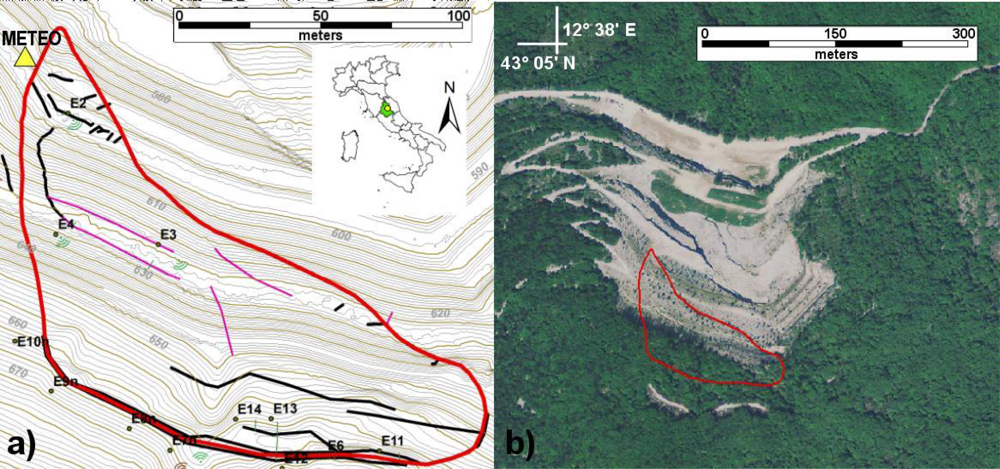
<p>The Torgiovannetto rock slope is located in an abandoned stone quarry close to the town of Assisi in central Italy. <xref ref-type="fig" rid="f1-remotesensing-04-01232">Figure 1(a)</xref> shows the morphology of the quarry area with the location of the extensometers network and of the meteorological station, while <xref ref-type="fig" rid="f1-remotesensing-04-01232">Figures 1(b)</xref> shows the aerial view of the quarry. The main front of the quarry, oriented approximately along the SE-NW direction, has an average dip of about 38°. In this area, the rock mass is composed of regular stratifications of limestone, with intercalations of thin, weak clay layers [<xref ref-type="bibr" rid="b34-remotesensing-04-01232">34</xref>]. Due to the orientation of the bedding planes (almost parallel to the quarry front) and to the presence of the weak clay layers between the hard calcareous strata, the upper part of the slope is in marginal stability conditions [<xref ref-type="bibr" rid="b33-remotesensing-04-01232">33</xref>]. A limited number of slope failures have been reported on several occasions, and several tension cracks running parallel to the quarry face have been observed on the upper part of the slope. Based on inclinometer measurements, the sliding surface is sharply localized at the top of a highly fractured zone at a depth of ∼12 m.</p>
<p>The monitoring network is composed of 13 extensometers, 5 inclinometers and a meteorological station (see <xref ref-type="fig" rid="f1-remotesensing-04-01232">Figure 1(a)</xref>). In fact, due to the potential for catastrophic failure that could affect a suburban road passing close to the quarry, the Umbria regional Civil Protection Centre is responsible for the alert procedure based on the rate of opening of cracks. Depending on the extensometer, the thresholds of crack opening rates are either 0.5 or 1 mm/day.</p>
<sec>
<title>ASCAT Soil Water Index Product</title>
<p>The Advanced SCATterometer (ASCAT) is a real-aperture radar instrument successfully launched on board the MetOp satellite in 2006 that measures radar backscatter at C-band (5.255 GHz) in VV polarization. The spatial resolution of ASCAT is 25 km (resampled at 12.5 km) and, for Western Europe, measurements are generally obtained at least once a day. The surface soil moisture product is retrieved from the ASCAT backscatter measurements using a time series-based change detection approach previously developed for the ERS-1/2 scatterometer by Wagner <italic>et al.</italic> [<xref ref-type="bibr" rid="b35-remotesensing-04-01232">35</xref>]. In this approach soil moisture is considered to have a linear relationship to backscatter in the decibel space, while the surface roughness is assumed to have a constant contribution in time. By knowing the typical yearly vegetation cycle and how it influences the backscatter-incidence angle relationship for each location on the Earth, the vegetation effects are removed [<xref ref-type="bibr" rid="b36-remotesensing-04-01232">36</xref>], revealing the soil moisture variations. The derived surface soil moisture product (corresponding to a depth of 2–3 cm) ranges between 0% (dry) and 100% (wet) and is available for the period 2007–2010. Validation studies of the ASCAT soil moisture products assessed their reliability for estimating both <italic>in-situ</italic> and modeled soil moisture observations across different regions in Europe [<xref ref-type="bibr" rid="b37-remotesensing-04-01232">37</xref>–<xref ref-type="bibr" rid="b40-remotesensing-04-01232">40</xref>], Africa [<xref ref-type="bibr" rid="b41-remotesensing-04-01232">41</xref>] and Asia [<xref ref-type="bibr" rid="b42-remotesensing-04-01232">42</xref>], thus addressing their use for practical applications. In particular, it was found that the ASCAT soil moisture product has fewer problems in mountainous regions in Europe than other products [<xref ref-type="bibr" rid="b40-remotesensing-04-01232">40</xref>], a significant aspect of its application in terms of landslides prediction.</p>
<p>However, for many applications (including shallow landslide prediction), the knowledge of soil moisture for a very thin surface layer is not sufficient. In this study, the semi-empirical approach (also known as exponential filter) proposed by Wagner <italic>et al.</italic> [<xref ref-type="bibr" rid="b35-remotesensing-04-01232">35</xref>] is adopted to obtain a root-zone soil moisture product (SWI, Soil Water Index) that depends on a single parameter, <italic>T</italic> (characteristic time length) representing the time scale of soil moisture variation. In this study, the Soil Water Index, <italic>SWI<sub>T</sub></italic>, indicates that it is a function of the <italic>T</italic> parameter. The recursive formulation of the method relies on [<xref ref-type="bibr" rid="b35-remotesensing-04-01232">35</xref>,<xref ref-type="bibr" rid="b37-remotesensing-04-01232">37</xref>]:
<disp-formula id="FD1">
<label>(1)</label>
<mml:math id="mm1" display="block">
<mml:mrow>
<mml:msub>
<mml:mrow>
<mml:mi mathvariant="italic">SWI</mml:mi></mml:mrow>
<mml:mi>T</mml:mi></mml:msub>
<mml:mrow>
<mml:mo>(</mml:mo>
<mml:mrow>
<mml:msubsup>
<mml:mrow>
<mml:mi>t</mml:mi></mml:mrow>
<mml:mi>n</mml:mi>
<mml:mrow/></mml:msubsup></mml:mrow>
<mml:mo>)</mml:mo></mml:mrow>
<mml:mo>=</mml:mo>
<mml:msub>
<mml:mrow>
<mml:mi mathvariant="italic">SWI</mml:mi></mml:mrow>
<mml:mi>T</mml:mi></mml:msub>
<mml:mrow>
<mml:mo>(</mml:mo>
<mml:mrow>
<mml:msubsup>
<mml:mrow>
<mml:mi>t</mml:mi></mml:mrow>
<mml:mrow>
<mml:mi>n</mml:mi>
<mml:mo>−</mml:mo>
<mml:mn>1</mml:mn></mml:mrow>
<mml:mrow/></mml:msubsup></mml:mrow>
<mml:mo>)</mml:mo></mml:mrow>
<mml:mo>+</mml:mo>
<mml:msub>
<mml:mi>K</mml:mi>
<mml:mi>n</mml:mi></mml:msub>
<mml:mrow>
<mml:mo>[</mml:mo>
<mml:mrow>
<mml:msub>
<mml:mrow>
<mml:mi>m</mml:mi></mml:mrow>
<mml:mi>s</mml:mi></mml:msub>
<mml:mrow>
<mml:mo>(</mml:mo>
<mml:mrow>
<mml:msub>
<mml:mrow>
<mml:mi>t</mml:mi></mml:mrow>
<mml:mi>n</mml:mi></mml:msub></mml:mrow>
<mml:mo>)</mml:mo></mml:mrow>
<mml:mo>−</mml:mo>
<mml:msub>
<mml:mrow>
<mml:mi mathvariant="italic">SWI</mml:mi></mml:mrow>
<mml:mi>T</mml:mi></mml:msub>
<mml:mrow>
<mml:mo>(</mml:mo>
<mml:mrow>
<mml:msubsup>
<mml:mrow>
<mml:mi>t</mml:mi></mml:mrow>
<mml:mrow>
<mml:mi>n</mml:mi>
<mml:mo>−</mml:mo>
<mml:mn>1</mml:mn></mml:mrow>
<mml:mrow/></mml:msubsup></mml:mrow>
<mml:mo>)</mml:mo></mml:mrow></mml:mrow>
<mml:mo>]</mml:mo></mml:mrow></mml:mrow></mml:math></disp-formula>where <italic>m<sub>s</sub></italic>(<italic>t<sub>n</sub></italic>) is the surface soil moisture product observed by the satellite sensor and <italic>t<sub>n</sub></italic> is the acquisition time of <italic>m<sub>s</sub></italic>(<italic>t<sub>n</sub></italic>). The gain <italic>K<sub>n</sub></italic> at time <italic>t<sub>n</sub></italic> is given by (in a recursive form):
<disp-formula id="FD2">
<label>(2)</label>
<mml:math id="mm2" display="block">
<mml:mrow>
<mml:msubsup>
<mml:mrow>
<mml:mi>K</mml:mi></mml:mrow>
<mml:mi>n</mml:mi>
<mml:mrow/></mml:msubsup>
<mml:mo>=</mml:mo>
<mml:mfrac>
<mml:mrow>
<mml:msubsup>
<mml:mrow>
<mml:mi>K</mml:mi></mml:mrow>
<mml:mrow>
<mml:mi>n</mml:mi>
<mml:mo>−</mml:mo>
<mml:mn>1</mml:mn></mml:mrow>
<mml:mrow/></mml:msubsup></mml:mrow>
<mml:mrow>
<mml:msubsup>
<mml:mrow>
<mml:mi>K</mml:mi></mml:mrow>
<mml:mrow>
<mml:mi>n</mml:mi>
<mml:mo>−</mml:mo>
<mml:mn>1</mml:mn></mml:mrow>
<mml:mrow/></mml:msubsup>
<mml:mo>+</mml:mo>
<mml:msup>
<mml:mrow>
<mml:mi>e</mml:mi></mml:mrow>
<mml:mrow>
<mml:mo>−</mml:mo>
<mml:mrow>
<mml:mo>(</mml:mo>
<mml:mrow>
<mml:mfrac>
<mml:mrow>
<mml:msub>
<mml:mrow>
<mml:mi>t</mml:mi></mml:mrow>
<mml:mi>n</mml:mi></mml:msub>
<mml:mo>−</mml:mo>
<mml:msub>
<mml:mrow>
<mml:mi>t</mml:mi></mml:mrow>
<mml:mrow>
<mml:mi>n</mml:mi>
<mml:mo>−</mml:mo>
<mml:mn>1</mml:mn></mml:mrow></mml:msub></mml:mrow>
<mml:mi>T</mml:mi></mml:mfrac></mml:mrow>
<mml:mo>)</mml:mo></mml:mrow></mml:mrow></mml:msup></mml:mrow></mml:mfrac></mml:mrow></mml:math></disp-formula>and it ranges between 0 and 1. For the initialization of this filter, <italic>K<sub>1</sub></italic> and <italic>SWI<sub>T</sub></italic>(<italic>t</italic><sub>1</sub>) were set to 1 and <italic>m<sub>s</sub></italic>(<italic>t</italic><sub>1</sub>), respectively [<xref ref-type="bibr" rid="b37-remotesensing-04-01232">37</xref>]. The reader is referred to Wagner <italic>et al.</italic> [<xref ref-type="bibr" rid="b35-remotesensing-04-01232">35</xref>] for a detailed description of the ASCAT retrieval algorithm and the exponential filter approach.</p></sec></sec>
<sec sec-type="methods">
<label>3.</label>
<title>Methods</title>
<p>In this study, the movement of the Torgiovannetto landslide related to different rainfall events is investigated by using a multiple linear regression analysis following a similar approach applied by Brocca <italic>et al.</italic> [<xref ref-type="bibr" rid="b26-remotesensing-04-01232">26</xref>,<xref ref-type="bibr" rid="b43-remotesensing-04-01232">43</xref>] for flood estimation. This approach estimates the role of rainfall and soil moisture conditions on the landslide movement for a sequence of rainfall events and is applied to evaluate the possible improvement that can be obtained by using satellite-derived soil moisture data. The multiple regression model is thus mainly used as a diagnostic tool and not as a predictive tool (even though it could be also be applied for this purpose).</p>
<p>At the beginning, the sequence of rainfall events is extracted from the time series of hourly rainfall observations. In particular, an event starts at the time when rainfall becomes greater than zero and its ending is determined as the time when a period of 6 hours with negligible cumulated rainfall occurs (&lt;1 mm). Next, the significant rainfall events, <italic>i.e.</italic>, the ones exceeding a rainfall threshold of 10 mm are selected. Secondly, several variables are inferred for each rainfall events, and used as predictors in the multiple linear regression equation. In particular, the maximum rainfall for durations from 1 to 48 hours along with the mean and the total rainfall values are considered. The initial soil moisture values derived by the ASCAT <italic>SWI<sub>T</sub></italic> and an Antecedent Precipitation Index, <italic>API<sub>N</sub></italic>, computed as the rainfall cumulated for <italic>N</italic> days before the start of a specific event, are then employed as estimators of the Antecedent Wetness Conditions, AWCs. Finally, the extensometer crack aperture, <italic>dH</italic>, computed as the difference between the recorded displacement between the end and the start of each rainfall event, is considered as the predictand. Generally, the multiple linear regression equation can be written as:
<disp-formula id="FD3">
<label>(3)</label>
<mml:math id="mm3" display="block">
<mml:mrow>
<mml:mrow>
<mml:mi>d</mml:mi>
<mml:mover accent="true">
<mml:mi>H</mml:mi>
<mml:mo>^</mml:mo></mml:mover></mml:mrow>
<mml:mo>=</mml:mo>
<mml:msub>
<mml:mrow>
<mml:mi>β</mml:mi></mml:mrow>
<mml:mn>0</mml:mn></mml:msub>
<mml:mo>+</mml:mo>
<mml:munderover>
<mml:mo>∑</mml:mo>
<mml:mrow>
<mml:mi>i</mml:mi>
<mml:mo>=</mml:mo>
<mml:mn>1</mml:mn></mml:mrow>
<mml:mi>n</mml:mi></mml:munderover>
<mml:mrow>
<mml:msub>
<mml:mrow>
<mml:mi>β</mml:mi></mml:mrow>
<mml:mi>i</mml:mi></mml:msub>
<mml:msub>
<mml:mrow>
<mml:mi>X</mml:mi></mml:mrow>
<mml:mi>i</mml:mi></mml:msub></mml:mrow></mml:mrow></mml:math></disp-formula>where <italic>dĤ</italic> is the estimated extensometer crack aperture, <italic>X<sub>i</sub></italic> are the predictors variables (rainfall characteristics and AWCs) and <italic>β</italic> are the regression coefficients that can be estimated by applying the least-square method, <italic>i.e.</italic>, minimizing the Root Mean Square Error, RMSE, between the observed, <italic>dH</italic>, and the estimated, <italic>dĤ</italic>, crack aperture values. The stepwise regression analysis employed several attempts to select the best predictors, <italic>i.e.</italic>, the ones providing the highest performance in terms of RMSE.</p></sec>
<sec sec-type="results">
<label>4.</label>
<title>Results</title>
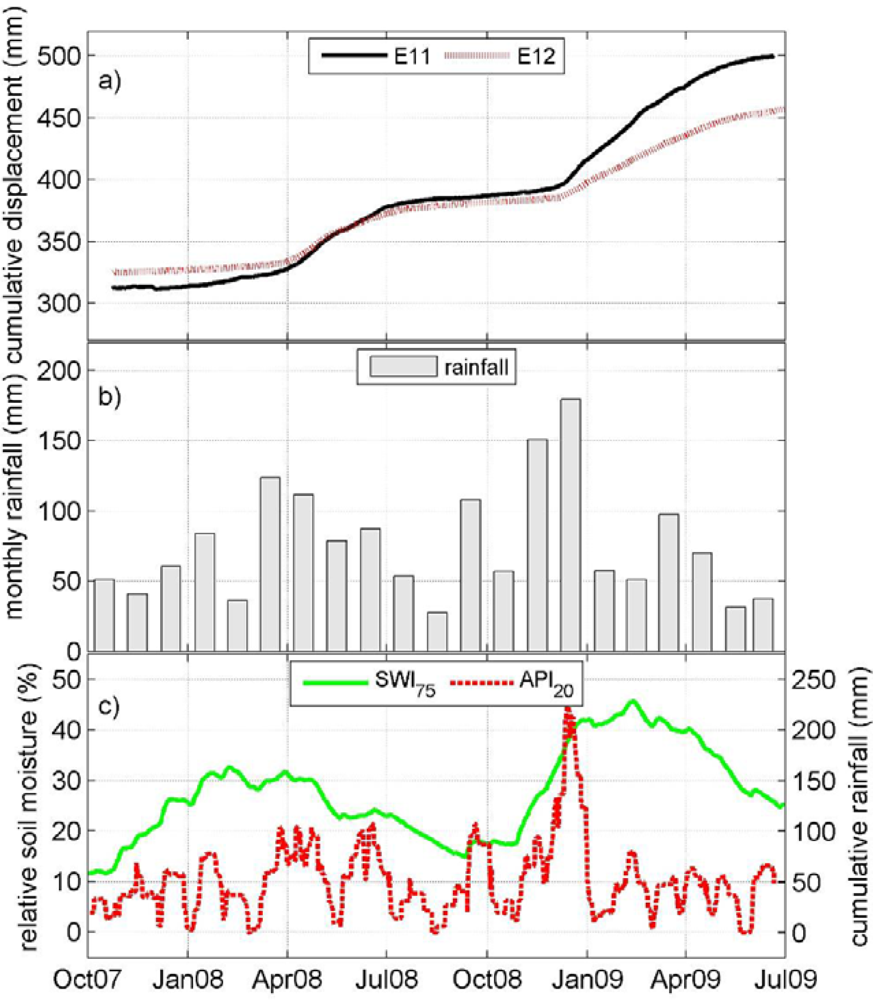
<p>A preliminary analysis to evaluate the reliability and quality of the displacements recorded by the extensometers was carried out. Specifically, the time series of the 13 extensometers were visually compared and the E11 and E12 extensometers, located at the top of the slope (see <xref ref-type="fig" rid="f1-remotesensing-04-01232">Figure 1(a)</xref>) close to the main fracture of the quarry area, were found to be the two most reliable sensors. We note that these two sensors show very little noise in the data and no gap in the study period. Other extensometers are installed on minor fractures and, as expected, they were found to be less representative of the movement of the main wedge. <xref ref-type="fig" rid="f2-remotesensing-04-01232">Figure 2(a)</xref> displays the time series of the displacements for the E11 and E12 extensometers, showing a very similar pattern with the higher rates in the winter-spring seasons and the lowest values in summer, thus clearly related to the rainfall [<xref ref-type="bibr" rid="b33-remotesensing-04-01232">33</xref>] and soil moisture pattern (see <xref ref-type="fig" rid="f2-remotesensing-04-01232">Figure 2(b,c)</xref>).</p>
<p>The total displacements are equal to ∼190 and ∼130 mm for the E11 and E12 sensor, respectively, corresponding to an opening rate of ∼0.30 and ∼0.20 mm/day. As we are mainly interested in showing the relative relation between crack aperture, rainfall and soil moisture conditions, the values recorded by a single extensometer, E11, are chosen and used in the following analysis because it historically shows the higher displacement rate with the longest recording history. We note that the results obtained with the extensometer E12 (not shown here) are found to be quite similar.</p>
<p>By applying the above described procedure, 46 rainfall events were extracted in the period 2007–2009 whose main features are reported in <xref ref-type="table" rid="t1-remotesensing-04-01232">Table 1</xref> in terms of rainfall and AWCs along with the observed values of the crack aperture for the E11 extensometer. As a first step, the optimal values for the <italic>T</italic> and <italic>N</italic> parameters are computed by maximizing the correlation coefficient, r, of the <italic>SWI<sub>T</sub></italic> (for the pixel containing the study area) and <italic>API<sub>N</sub></italic> time series with the observed crack aperture data. The estimated values (<italic>T</italic> = 75 and <italic>N</italic> = 20 days) have a physical meaning because they represent a high storage capacity of the soil layer that influences the slope movements, as can be expected for this particular type of rock slope for which the movement is expected to be related to deep soil layers [<xref ref-type="bibr" rid="b33-remotesensing-04-01232">33</xref>,<xref ref-type="bibr" rid="b34-remotesensing-04-01232">34</xref>]. It should be noted that the soil moisture values should not be interpreted as the actual values observed in the slope but only as indicators of the wetness state of the slope that can be used to predict its movements. As a second step, the best rainfall and AWC predictors, <italic>X<sub>i</sub></italic>, are obtained through a stepwise regression analysis and taking account of the cross-correlation between the predictors to assure the well-posedness of the inverse problem. The optimal predictors are found to be: (1) the maximum rainfall value over a duration of 1 hour, <italic>P<sub>max-1h</sub></italic>, (2) the total rainfall of the event, <italic>P<sub>tot</sub></italic>; (3) the <italic>API<sub>20</sub></italic> and (4) the <italic>SWI<sub>75</sub></italic>.</p>
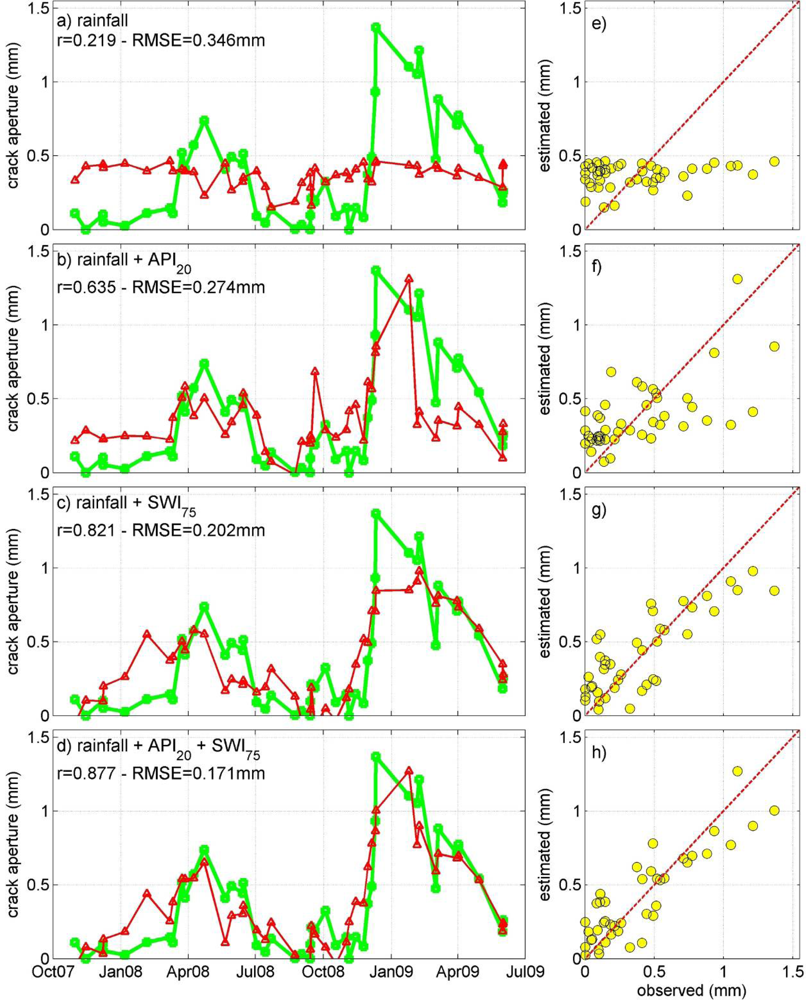
<p>Subsequently, different configurations of the best model (<italic>i.e.</italic>, the one with all 4 best predictors) are analyzed with the aim of understanding the different impact of rainfall and soil moisture conditions on the landslide movement. The first configuration uses only the rainfall variables (<italic>P<sub>max-1h</sub></italic> and <italic>P<sub>tot</sub></italic>) as predictors, the second and the third configurations use the rainfall variables together with the <italic>API<sub>20</sub></italic> and the <italic>SWI<sub>75</sub></italic>, respectively; and the last configuration uses all the predictors. <xref ref-type="fig" rid="f3-remotesensing-04-01232">Figure 3</xref> shows the results for all the configurations in terms of time series of the observed and estimated crack aperture, the scatter plots are also displayed to better visualize the regression performance. For the first configuration (<xref ref-type="fig" rid="f3-remotesensing-04-01232">Figure 3(a,e)</xref>), the estimated crack aperture poorly follows the rainfall pattern with significant underestimation of large values; the obtained r and RMSE are equal to 0.219 and 0.346 mm, respectively. By considering also the <italic>API<sub>20</sub></italic> (<xref ref-type="fig" rid="f3-remotesensing-04-01232">Figure 3(b,f)</xref>), results significantly improve (r = 0.635) with a better reproduction of the seasonal magnitude of crack aperture. A further significant improvement is obtained when the <italic>SWI<sub>75</sub></italic> (<xref ref-type="fig" rid="f3-remotesensing-04-01232">Figure 3(c,g)</xref>, r = 0.821) is adopted as estimators of the AWCs. For this case a slight overestimation in the period January–March 2008 and underestimation in the period December 2008–February 2009 can be observed whereas for the same periods the <italic>API<sub>20</sub></italic> provides a better agreement with observations. Consequently, if the <italic>API<sub>20</sub></italic> and the <italic>SWI<sub>75</sub></italic> are considered together with rainfall variables (<xref ref-type="fig" rid="f3-remotesensing-04-01232">Figure 3(d,h)</xref>), the accordance between the observed and estimated crack aperture is reasonably good for the whole period resulting in r = 0.877 and RMSE = 0.171 mm. Additionally, the disagreement between the observed and estimated crack aperture might be due to the non linearity of the infiltration and evaporation process that would affect the relation between rainfall, soil moisture and the landslide movement while in this first study a linear model has been tested.</p>
<p>Finally, by analyzing the standardized coefficients of the linear regression, <italic>i.e.</italic>, the coefficients obtained after all regression variables (independent and dependent) are set to have a mean of zero and a standard deviation of one, the relative weight of each predictor can be quantitatively determined. For the configurations 2–3, for which rainfall variables and a single AWC indicator are used, the most important factor is always represented by the AWC predictors (<italic>API<sub>20</sub></italic> and <italic>SWI<sub>75</sub></italic>); in the configuration 4 (with all the predictors) the standardized coefficients are found to be equal to 0.13, 0.04, 0.36 and 0.74 for <italic>P<sub>max-1h</sub></italic>, <italic>P<sub>tot</sub></italic>; <italic>API<sub>20</sub></italic> and <italic>SWI<sub>75</sub></italic>, respectively. Specifically, the <italic>SWI<sub>75</sub></italic> is the most significant predictor with a weight ∼50% and ∼80% higher than the <italic>API<sub>20</sub></italic> and <italic>P<sub>max-1h</sub></italic>, respectively. On the other hand, in configuration 4, the standard deviations of the coefficients are found to be similar with values ranging between 0.085 and 0.092.</p></sec>
<sec sec-type="conclusions">
<label>5.</label>
<title>Conclusions</title>
<p>The influence of rainfall and soil moisture conditions in the estimation of the movements of a well monitored slope located in central Italy, the Torgiovannetto landslide, has been investigated here. The results of the multiple regression analysis clearly indicate that ASCAT-derived soil moisture estimates can be effectively used to predict the crack aperture of the slope with reasonable accuracy (r = 0.821). A lower accuracy is obtained with the Antecedent Precipitation Index, thus confirming the need to employ actual soil moisture observations to reach a high reliability (e.g., [<xref ref-type="bibr" rid="b22-remotesensing-04-01232">22</xref>]). We note that, even considering the encouraging results shown here, the coarse spatial resolution of ASCAT data (25 km) could represent a significant limitation in the attempt to predict small scale landslide movements and this aspect needs further analysis. The regression model implemented in this study, coupled with a quantitative precipitation forecast obtained by numerical weather prediction models, can be used to predict the crack aperture of the Torgiovannetto slope in an operational context even though it is only based on a simple empirical relationship.</p>
<p>On the basis of these encouraging results, the use of more complex physically-based models linking the rainfall and soil moisture conditions with the landslide movement will be the object of future investigations. Moreover, the availability of ASCAT satellite soil moisture data on a global scale presents new opportunities for the integration of this data set in landslide forecasting systems. However, the results of this study are only valid for this specific investigated case study and further studies analyzing the relationship between rainfall, soil moisture and landslide movement in different regions are needed in order to generalize these findings.</p></sec></body>
<back>
<ack>
<p>The authors wish to thank the Umbria Region and the University of Florence for providing most of the analyzed data. We thank also Eng. Marco Stelluti for the preparation of <xref ref-type="fig" rid="f1-remotesensing-04-01232">Figure 1</xref>. This work has been partly funded by the GMSM project supported by the Austrian Space Applications Programme (ASAP).</p></ack>
<ref-list>
<title>References</title>
<ref id="b1-remotesensing-04-01232"><label>1.</label><citation citation-type="journal"><person-group person-group-type="author"><name><surname>Guzzetti</surname><given-names>F.</given-names></name><name><surname>Reichenbach</surname><given-names>P.</given-names></name><name><surname>Cardinali</surname><given-names>M.</given-names></name><name><surname>Ardizzone</surname><given-names>F.</given-names></name><name><surname>Galli</surname><given-names>M.</given-names></name></person-group><article-title>The impact of landslides in the Umbria region, central Italy</article-title><source>Nat. Hazards Earth Syst. Sci</source><year>2003</year><volume>3</volume><fpage>469</fpage><lpage>486</lpage><pub-id pub-id-type="doi">10.5194/nhess-3-469-2003</pub-id></citation></ref>
<ref id="b2-remotesensing-04-01232"><label>2.</label><citation citation-type="journal"><person-group person-group-type="author"><name><surname>Guzzetti</surname><given-names>F.</given-names></name><name><surname>Stark</surname><given-names>C.P.</given-names></name><name><surname>Salvati</surname><given-names>P.</given-names></name></person-group><article-title>Evaluation of flood and landslide risk to the population of Italy</article-title><source>Environ. Manage</source><year>2005</year><volume>36</volume><fpage>15</fpage><lpage>36</lpage><pub-id pub-id-type="doi">10.1007/s00267-003-0257-1</pub-id><pub-id pub-id-type="pmid">15983861</pub-id></citation></ref>
<ref id="b3-remotesensing-04-01232"><label>3.</label><citation citation-type="journal"><person-group person-group-type="author"><name><surname>Ponziani</surname><given-names>F.</given-names></name><name><surname>Pandolfo</surname><given-names>C.</given-names></name><name><surname>Stelluti</surname><given-names>M.</given-names></name><name><surname>Berni</surname><given-names>N.</given-names></name><name><surname>Brocca</surname><given-names>L.</given-names></name><name><surname>Moramarco</surname><given-names>T.</given-names></name></person-group><article-title>Assessment of rainfall thresholds and soil moisture modeling for operational hydrogeological risk prevention in the Umbria region (central Italy)</article-title><source>Landslides</source><year>2012</year><pub-id pub-id-type="doi">10.1007/s10346-011-0287-3</pub-id></citation></ref>
<ref id="b4-remotesensing-04-01232"><label>4.</label><citation citation-type="journal"><person-group person-group-type="author"><name><surname>Ray</surname><given-names>R.L.</given-names></name><name><surname>Jacobs</surname><given-names>J.M.</given-names></name><name><surname>Ballestero</surname><given-names>T.P.</given-names></name></person-group><article-title>Regional landslide susceptibility: Spatiotemporal variations under dynamic soil moisture conditions</article-title><source>Natural Hazards</source><year>2011</year><volume>59</volume><fpage>1317</fpage><lpage>1337</lpage><pub-id pub-id-type="doi">10.1007/s11069-011-9834-4</pub-id></citation></ref>
<ref id="b5-remotesensing-04-01232"><label>5.</label><citation citation-type="journal"><person-group person-group-type="author"><name><surname>Ren</surname><given-names>D.</given-names></name><name><surname>Fu</surname><given-names>R.</given-names></name><name><surname>Leslie</surname><given-names>L.M.</given-names></name><name><surname>Dickinson</surname><given-names>R.E.</given-names></name></person-group><article-title>Predicting storm-triggered landslides</article-title><source>Bull. Am. Meteorol. Soc</source><year>2011</year><volume>92</volume><fpage>129</fpage><lpage>139</lpage><pub-id pub-id-type="doi">10.1175/2010BAMS3017.1</pub-id></citation></ref>
<ref id="b6-remotesensing-04-01232"><label>6.</label><citation citation-type="journal"><person-group person-group-type="author"><name><surname>Guzzetti</surname><given-names>F.</given-names></name><name><surname>Carrara</surname><given-names>A.</given-names></name><name><surname>Cardinali</surname><given-names>M.</given-names></name><name><surname>Reichenbach</surname><given-names>P.</given-names></name></person-group><article-title>Landslide hazard evaluation: A review of current techniques and their application in a multi-scale study, central Italy</article-title><source>Geomorphology</source><year>1999</year><volume>31</volume><fpage>181</fpage><lpage>216</lpage><pub-id pub-id-type="doi">10.1016/S0169-555X(99)00078-1</pub-id></citation></ref>
<ref id="b7-remotesensing-04-01232"><label>7.</label><citation citation-type="journal"><person-group person-group-type="author"><name><surname>Caine</surname><given-names>N.</given-names></name></person-group><article-title>The rainfall intensity: Duration control of shallow landslides and debris flows</article-title><source>Geografiska Annaler A</source><year>1980</year><volume>62</volume><fpage>23</fpage><lpage>27</lpage><pub-id pub-id-type="doi">10.2307/520449</pub-id></citation></ref>
<ref id="b8-remotesensing-04-01232"><label>8.</label><citation citation-type="journal"><person-group person-group-type="author"><name><surname>Glade</surname><given-names>T.</given-names></name><name><surname>Crozier</surname><given-names>M.</given-names></name><name><surname>Smith</surname><given-names>P.</given-names></name></person-group><article-title>Applying probability determination to refine landslide-triggering rainfall thresholds using an empirical ‘antecedent daily rainfall model’</article-title><source>Pure Appl. Geophys</source><year>2000</year><volume>157</volume><fpage>1059</fpage><lpage>1079</lpage><pub-id pub-id-type="doi">10.1007/s000240050017</pub-id></citation></ref>
<ref id="b9-remotesensing-04-01232"><label>9.</label><citation citation-type="journal"><person-group person-group-type="author"><name><surname>Guzzetti</surname><given-names>F.</given-names></name><name><surname>Peruccacci</surname><given-names>S.</given-names></name><name><surname>Rossi</surname><given-names>M.</given-names></name><name><surname>Stark</surname><given-names>C.P.</given-names></name></person-group><article-title>Rainfall thresholds for the initiation of landslides in central and southern Europe</article-title><source>Meteorol. Atmos. Phys</source><year>2007</year><volume>98</volume><fpage>239</fpage><lpage>267</lpage><pub-id pub-id-type="doi">10.1007/s00703-007-0262-7</pub-id></citation></ref>
<ref id="b10-remotesensing-04-01232"><label>10.</label><citation citation-type="journal"><person-group person-group-type="author"><name><surname>Guzzetti</surname><given-names>F.</given-names></name><name><surname>Peruccacci</surname><given-names>S.</given-names></name><name><surname>Rossi</surname><given-names>M.</given-names></name><name><surname>Stark</surname><given-names>C.P.</given-names></name></person-group><article-title>The rainfall intensity-duration control of shallow landslides and debris flows: an update</article-title><source>Landslides</source><year>2008</year><volume>5</volume><fpage>3</fpage><lpage>17</lpage><pub-id pub-id-type="doi">10.1007/s10346-007-0112-1</pub-id></citation></ref>
<ref id="b11-remotesensing-04-01232"><label>11.</label><citation citation-type="journal"><person-group person-group-type="author"><name><surname>Brunetti</surname><given-names>M.T.</given-names></name><name><surname>Peruccacci</surname><given-names>S.</given-names></name><name><surname>Rossi</surname><given-names>M.</given-names></name><name><surname>Luciani</surname><given-names>S.</given-names></name><name><surname>Valigi</surname><given-names>D.</given-names></name><name><surname>Guzzetti</surname><given-names>F.</given-names></name></person-group><article-title>Rainfall thresholds for the possible occurrence of landslides in Italy</article-title><source>Nat. Hazards Earth Syst. Sci</source><year>2010</year><volume>10</volume><fpage>447</fpage><lpage>458</lpage><pub-id pub-id-type="doi">10.5194/nhess-10-447-2010</pub-id></citation></ref>
<ref id="b12-remotesensing-04-01232"><label>12.</label><citation citation-type="journal"><person-group person-group-type="author"><name><surname>Iverson</surname><given-names>R.M.</given-names></name></person-group><article-title>Landslide triggering by rain infiltration</article-title><source>Water Resour. Res</source><year>2000</year><volume>36</volume><fpage>1897</fpage><lpage>1910</lpage><pub-id pub-id-type="doi">10.1029/2000WR900090</pub-id></citation></ref>
<ref id="b13-remotesensing-04-01232"><label>13.</label><citation citation-type="book"><person-group person-group-type="author"><name><surname>Baum</surname><given-names>R.L.</given-names></name><name><surname>Savage</surname><given-names>W.Z.</given-names></name><name><surname>Godt</surname><given-names>J.W.</given-names></name></person-group><source>TRIGRS—A Fortran Program for Transient Rainfall Infiltration and Grid-Based Regional Slope-Stability Analysis</source><comment>Version 2.0; US Geological Survey Open-File Report 1159;</comment><publisher-name>USGS Central Region Geologic Hazards Team</publisher-name><publisher-loc>Denver, CO, USA</publisher-loc><year>2008</year><fpage>75</fpage></citation></ref>
<ref id="b14-remotesensing-04-01232"><label>14.</label><citation citation-type="journal"><person-group person-group-type="author"><name><surname>Capparelli</surname><given-names>G.</given-names></name><name><surname>Versace</surname><given-names>P.</given-names></name></person-group><article-title>FLaIR and SUSHI: Two mathematical models for early warning of landslides induced by rainfall</article-title><source>Landslides</source><year>2010</year><volume>8</volume><fpage>67</fpage><lpage>79</lpage></citation></ref>
<ref id="b15-remotesensing-04-01232"><label>15.</label><citation citation-type="journal"><person-group person-group-type="author"><name><surname>Greco</surname><given-names>R.</given-names></name><name><surname>Guida</surname><given-names>A.</given-names></name><name><surname>Damiano</surname><given-names>E.</given-names></name><name><surname>Olivares</surname><given-names>L.</given-names></name></person-group><article-title>Soil water content and suction monitoring in model slopes for shallow flowslides early warning applications</article-title><source>Phys. Chem. Earth</source><year>2010</year><volume>35</volume><fpage>127</fpage><lpage>136</lpage><pub-id pub-id-type="doi">10.1016/j.pce.2009.12.003</pub-id></citation></ref>
<ref id="b16-remotesensing-04-01232"><label>16.</label><citation citation-type="journal"><person-group person-group-type="author"><name><surname>Segoni</surname><given-names>S.</given-names></name><name><surname>Leoni</surname><given-names>L.</given-names></name><name><surname>Benedetti</surname><given-names>A.I.</given-names></name><name><surname>Catani</surname><given-names>F.</given-names></name><name><surname>Righini</surname><given-names>G.</given-names></name><name><surname>Falorni</surname><given-names>G.</given-names></name><name><surname>Gabellani</surname><given-names>S.</given-names></name><name><surname>Rudari</surname><given-names>R.</given-names></name><name><surname>Silvestro</surname><given-names>F.</given-names></name><name><surname>Rebora</surname><given-names>N.</given-names></name></person-group><article-title>Towards a definition of a real-time forecasting network for rainfall induced shallow landslides</article-title><source>Nat. Hazards Earth Syst. Sci</source><year>2010</year><volume>9</volume><fpage>2119</fpage><lpage>2133</lpage></citation></ref>
<ref id="b17-remotesensing-04-01232"><label>17.</label><citation citation-type="journal"><person-group person-group-type="author"><name><surname>Liao</surname><given-names>Z.</given-names></name><name><surname>Hong</surname><given-names>Y.</given-names></name><name><surname>Kirschbaum</surname><given-names>D.</given-names></name><name><surname>Adler</surname><given-names>R.</given-names></name><name><surname>Gourley</surname><given-names>J.J.</given-names></name><name><surname>Wooten</surname><given-names>R.</given-names></name></person-group><article-title>Evaluation of TRIGRS (Transient Rainfall Infiltration and Grid-based Regional Slope-Stability Analysis)’s predictive skill for hurricane-triggered landslides: A case study in Macon county, North Carolina</article-title><source>Natural Hazards</source><year>2011</year><volume>43</volume><fpage>245</fpage><lpage>256</lpage></citation></ref>
<ref id="b18-remotesensing-04-01232"><label>18.</label><citation citation-type="journal"><person-group person-group-type="author"><name><surname>Crozier</surname><given-names>M.J.</given-names></name></person-group><article-title>Prediction of rainfall-triggered landslides: A test of the antecedent water status model</article-title><source>Earth Surf. Process Landf</source><year>1999</year><volume>24</volume><fpage>825</fpage><lpage>833</lpage><pub-id pub-id-type="doi">10.1002/(SICI)1096-9837(199908)24:9&lt;825::AID-ESP14&gt;3.0.CO;2-M</pub-id></citation></ref>
<ref id="b19-remotesensing-04-01232"><label>19.</label><citation citation-type="journal"><person-group person-group-type="author"><name><surname>Capparelli</surname><given-names>G.</given-names></name><name><surname>Tiranti</surname><given-names>D.</given-names></name></person-group><article-title>Application of the MoniFLaIR early warning system for rainfall-induced landslides in Piedmont region (Italy)</article-title><source>Landslides</source><year>2010</year><volume>7</volume><fpage>401</fpage><lpage>410</lpage><pub-id pub-id-type="doi">10.1007/s10346-009-0189-9</pub-id></citation></ref>
<ref id="b20-remotesensing-04-01232"><label>20.</label><citation citation-type="journal"><person-group person-group-type="author"><name><surname>Tsai</surname><given-names>T.-L.</given-names></name><name><surname>Chen</surname><given-names>H-F.</given-names></name></person-group><article-title>Effects of degree of saturation on shallow landslides triggered by rainfall</article-title><source>Environ. Earth Sci</source><year>2010</year><volume>59</volume><fpage>1285</fpage><lpage>1295</lpage><pub-id pub-id-type="doi">10.1007/s12665-009-0116-3</pub-id></citation></ref>
<ref id="b21-remotesensing-04-01232"><label>21.</label><citation citation-type="journal"><person-group person-group-type="author"><name><surname>Godt</surname><given-names>J.W.</given-names></name><name><surname>Baum</surname><given-names>R.L.</given-names></name><name><surname>Chleborad</surname><given-names>A.F.</given-names></name></person-group><article-title>Rainfall characteristics for shallow landsliding in Seattle, Washington, USA</article-title><source>Earth Surf. Processes Landf</source><year>2006</year><volume>31</volume><fpage>97</fpage><lpage>110</lpage><pub-id pub-id-type="doi">10.1002/esp.1237</pub-id></citation></ref>
<ref id="b22-remotesensing-04-01232"><label>22.</label><citation citation-type="journal"><person-group person-group-type="author"><name><surname>Pelletier</surname><given-names>J.D.</given-names></name><name><surname>Malamud</surname><given-names>B.D.</given-names></name><name><surname>Blodgett</surname><given-names>T.</given-names></name><name><surname>Turcotte</surname><given-names>D.L.</given-names></name></person-group><article-title>Scale-invariance of soil moisture variability and its implications for the frequency-size distribution of landslides</article-title><source>Eng. Geol</source><year>1997</year><volume>48</volume><fpage>255</fpage><lpage>268</lpage><pub-id pub-id-type="doi">10.1016/S0013-7952(97)00041-0</pub-id></citation></ref>
<ref id="b23-remotesensing-04-01232"><label>23.</label><citation citation-type="journal"><person-group person-group-type="author"><name><surname>Ray</surname><given-names>R.L.</given-names></name><name><surname>Jacobs</surname><given-names>J.M.</given-names></name><name><surname>Cosh</surname><given-names>M.H.</given-names></name></person-group><article-title>Landslide susceptibility mapping using downscaled AMSR-E soil moisture: A case study from Cleveland Corral, California, US</article-title><source>Remote Sens. Environ</source><year>2010</year><volume>114</volume><fpage>2624</fpage><lpage>2636</lpage><pub-id pub-id-type="doi">10.1016/j.rse.2010.05.033</pub-id></citation></ref>
<ref id="b24-remotesensing-04-01232"><label>24.</label><citation citation-type="journal"><person-group person-group-type="author"><name><surname>Pfister</surname><given-names>L.</given-names></name><name><surname>Drogue</surname><given-names>G.</given-names></name><name><surname>El Idrissi</surname><given-names>A.</given-names></name><name><surname>Humbert</surname><given-names>J.</given-names></name><name><surname>Iffly</surname><given-names>J.F.</given-names></name><name><surname>Matgen</surname><given-names>P.</given-names></name><name><surname>Hoffmann</surname><given-names>L.</given-names></name></person-group><article-title>Predicting peak discharge through empirical relationships between rainfall, groundwater level and basin humidity in the Alzette River basin (Grand-Duchy of Luxembourg)</article-title><source>J. Hydrol. Hydromech</source><year>2003</year><volume>51</volume><fpage>210</fpage><lpage>220</lpage></citation></ref>
<ref id="b25-remotesensing-04-01232"><label>25.</label><citation citation-type="book"><person-group person-group-type="author"><name><surname>Brocca</surname><given-names>L.</given-names></name><name><surname>Melone</surname><given-names>F.</given-names></name><name><surname>Moramarco</surname><given-names>T.</given-names></name></person-group><article-title>Empirical and Conceptual Approaches for Soil Moisture Estimation in View of Event-Based Rainfall-Runoff Modeling</article-title><source>Progress in Surface and Subsurface Water Studies at the Plot and Small Basin Scale</source><person-group person-group-type="editor"><name><surname>Maraga</surname><given-names>F.</given-names></name><name><surname>Arattano</surname><given-names>M.</given-names></name></person-group><comment>IHP-VI; Technical Documents in Hydrology;</comment><publisher-name>UNESCO</publisher-name><publisher-loc>Paris, France</publisher-loc><year>2005</year><volume>77</volume><fpage>1</fpage><lpage>8</lpage></citation></ref>
<ref id="b26-remotesensing-04-01232"><label>26.</label><citation citation-type="journal"><person-group person-group-type="author"><name><surname>Brocca</surname><given-names>L.</given-names></name><name><surname>Melone</surname><given-names>F.</given-names></name><name><surname>Moramarco</surname><given-names>T.</given-names></name></person-group><article-title>On the estimation of antecedent wetness condition in rainfall-runoff modelling</article-title><source>Hydrol. Processes</source><year>2008</year><volume>22</volume><fpage>629</fpage><lpage>642</lpage><pub-id pub-id-type="doi">10.1002/hyp.6629</pub-id></citation></ref>
<ref id="b27-remotesensing-04-01232"><label>27.</label><citation citation-type="journal"><person-group person-group-type="author"><name><surname>Brocca</surname><given-names>L.</given-names></name><name><surname>Galli</surname><given-names>M.</given-names></name><name><surname>Stelluti</surname><given-names>M.</given-names></name></person-group><article-title>Preliminary analysis of distributed in situ soil moisture measurements</article-title><source>Adv. Geosci</source><year>2005</year><volume>2</volume><fpage>81</fpage><lpage>86</lpage><pub-id pub-id-type="doi">10.5194/adgeo-2-81-2005</pub-id></citation></ref>
<ref id="b28-remotesensing-04-01232"><label>28.</label><citation citation-type="journal"><person-group person-group-type="author"><name><surname>Baum</surname><given-names>R.L.</given-names></name><name><surname>Godt</surname><given-names>J.W.</given-names></name></person-group><article-title>Early warning of rainfall-induced shallow landslides and debris flows in the USA</article-title><source>Landslides</source><year>2009</year><volume>7</volume><fpage>259</fpage><lpage>272</lpage></citation></ref>
<ref id="b29-remotesensing-04-01232"><label>29.</label><citation citation-type="journal"><person-group person-group-type="author"><name><surname>Harris</surname><given-names>S.J.</given-names></name><name><surname>Orense</surname><given-names>R.P.</given-names></name><name><surname>Itoh</surname><given-names>K.</given-names></name></person-group><article-title>Back analyses of rainfall-induced slope failure in Northland Allochthon formation</article-title><source>Landslides</source><year>2011</year><pub-id pub-id-type="doi">10.1007/s10346-011-0309-1</pub-id></citation></ref>
<ref id="b30-remotesensing-04-01232"><label>30.</label><citation citation-type="journal"><person-group person-group-type="author"><name><surname>Hawke</surname><given-names>R.</given-names></name><name><surname>McConchie</surname><given-names>J.</given-names></name></person-group><article-title><italic>In situ</italic> measurement of soil moisture and pore-water pressures in an ‘incipient’ landslide: Lake Tutira, New Zealand</article-title><source>J. Environ. Manage</source><year>2011</year><volume>92</volume><fpage>266</fpage><lpage>274</lpage><pub-id pub-id-type="doi">10.1016/j.jenvman.2009.05.035</pub-id><pub-id pub-id-type="pmid">19926207</pub-id></citation></ref>
<ref id="b31-remotesensing-04-01232"><label>31.</label><citation citation-type="journal"><person-group person-group-type="author"><name><surname>Ray</surname><given-names>R.L.</given-names></name><name><surname>Jacobs</surname><given-names>J.M.</given-names></name></person-group><article-title>Relationships among remotely soil moisture, precipitation and landslide events</article-title><source>Natural Hazards</source><year>2007</year><volume>43</volume><fpage>211</fpage><lpage>222</lpage><pub-id pub-id-type="doi">10.1007/s11069-006-9095-9</pub-id></citation></ref>
<ref id="b32-remotesensing-04-01232"><label>32.</label><citation citation-type="confproc"><person-group person-group-type="author"><name><surname>Teng</surname><given-names>B.</given-names></name><name><surname>Kirschbaum</surname><given-names>D.B.</given-names></name><name><surname>Hong</surname><given-names>Y.</given-names></name><name><surname>Adler</surname><given-names>R.</given-names></name></person-group><article-title>Improving Global Landslide Algorithm Forecasting with Satellite Soil Moisture Data</article-title><conf-name>Presented at AGU Fall Meeting</conf-name><conf-loc>San Francisco, CA, USA</conf-loc><conf-date>15–19 December 2008</conf-date></citation></ref>
<ref id="b33-remotesensing-04-01232"><label>33.</label><citation citation-type="confproc"><person-group person-group-type="author"><name><surname>Graziani</surname><given-names>A.</given-names></name><name><surname>Rotonda</surname><given-names>T.</given-names></name><name><surname>Tommasi</surname><given-names>P.</given-names></name></person-group><article-title>Stability and Deformation Mode of Rock Slide along Interbeds Reactivated by Rainfall</article-title><conf-name>Proceedings of the First Italian Workshop on Landslides</conf-name><conf-loc>Naples, Italy</conf-loc><conf-date>8–10 June 2009</conf-date><fpage>62</fpage><lpage>71</lpage></citation></ref>
<ref id="b34-remotesensing-04-01232"><label>34.</label><citation citation-type="journal"><person-group person-group-type="author"><name><surname>Salciarini</surname><given-names>D.</given-names></name><name><surname>Tamagnini</surname><given-names>C.</given-names></name><name><surname>Conversini</surname><given-names>P.</given-names></name></person-group><article-title>Discrete element modeling of debris-avalanche impact on earthfill barriers</article-title><source>Phys. Chem. Earth</source><year>2010</year><volume>35</volume><fpage>172</fpage><lpage>181</lpage><pub-id pub-id-type="doi">10.1016/j.pce.2009.05.002</pub-id></citation></ref>
<ref id="b35-remotesensing-04-01232"><label>35.</label><citation citation-type="journal"><person-group person-group-type="author"><name><surname>Wagner</surname><given-names>W.</given-names></name><name><surname>Lemoine</surname><given-names>G.</given-names></name><name><surname>Rott</surname><given-names>H.</given-names></name></person-group><article-title>A method for estimating soil moisture from ERS scatterometer and soil data</article-title><source>Remote Sens. Environ</source><year>1999</year><volume>70</volume><fpage>191</fpage><lpage>207</lpage><pub-id pub-id-type="doi">10.1016/S0034-4257(99)00036-X</pub-id></citation></ref>
<ref id="b36-remotesensing-04-01232"><label>36.</label><citation citation-type="journal"><person-group person-group-type="author"><name><surname>Wagner</surname><given-names>W.</given-names></name><name><surname>Lemoine</surname><given-names>G.</given-names></name><name><surname>Borgeaud</surname><given-names>M.</given-names></name><name><surname>Rott</surname><given-names>H.</given-names></name></person-group><article-title>A study of vegetation cover effects on ERS scatterometer data</article-title><source>IEEE Trans. Geosci. Remote Sens</source><year>1999</year><volume>37</volume><fpage>938</fpage><lpage>948</lpage><pub-id pub-id-type="doi">10.1109/36.752212</pub-id></citation></ref>
<ref id="b37-remotesensing-04-01232"><label>37.</label><citation citation-type="journal"><person-group person-group-type="author"><name><surname>Albergel</surname><given-names>C.</given-names></name><name><surname>Rüdiger</surname><given-names>C.</given-names></name><name><surname>Carrer</surname><given-names>D.</given-names></name><name><surname>Calvet</surname><given-names>J.C.</given-names></name><name><surname>Fritz</surname><given-names>N.</given-names></name><name><surname>Naeimi</surname><given-names>V.</given-names></name><name><surname>Bartalis</surname><given-names>Z.</given-names></name><name><surname>Hasenauer</surname><given-names>S.</given-names></name></person-group><article-title>An evaluation of ASCAT surface soil moisture products with <italic>in-situ</italic> observations in southwestern France</article-title><source>Hydrol. Earth Syst. Sci</source><year>2009</year><volume>13</volume><fpage>115</fpage><lpage>124</lpage><pub-id pub-id-type="doi">10.5194/hess-13-115-2009</pub-id></citation></ref>
<ref id="b38-remotesensing-04-01232"><label>38.</label><citation citation-type="journal"><person-group person-group-type="author"><name><surname>Brocca</surname><given-names>L.</given-names></name><name><surname>Melone</surname><given-names>F.</given-names></name><name><surname>Moramarco</surname><given-names>T.</given-names></name><name><surname>Wagner</surname><given-names>W.</given-names></name><name><surname>Hasenauer</surname><given-names>S.</given-names></name></person-group><article-title>ASCAT soil wetness index validation through <italic>in-situ</italic> and modeled soil moisture data in central Italy</article-title><source>Remote Sens. Environ</source><year>2010</year><volume>114</volume><fpage>2745</fpage><lpage>2755</lpage><pub-id pub-id-type="doi">10.1016/j.rse.2010.06.009</pub-id></citation></ref>
<ref id="b39-remotesensing-04-01232"><label>39.</label><citation citation-type="journal"><person-group person-group-type="author"><name><surname>Brocca</surname><given-names>L.</given-names></name><name><surname>Hasenauer</surname><given-names>S.</given-names></name><name><surname>Lacava</surname><given-names>T.</given-names></name><name><surname>Melone</surname><given-names>F.</given-names></name><name><surname>Moramarco</surname><given-names>T.</given-names></name><name><surname>Wagner</surname><given-names>W.</given-names></name><name><surname>Dorigo</surname><given-names>W.</given-names></name><name><surname>Matgen</surname><given-names>P.</given-names></name><name><surname>Martínez-Fernández</surname><given-names>J.</given-names></name><name><surname>Llorens</surname><given-names>P.</given-names></name><etal/></person-group><article-title>Soil moisture estimation through ASCAT and AMSR-E sensors: an intercomparison and validation study across Europe</article-title><source>Remote Sens. Environ</source><year>2011</year><volume>115</volume><fpage>3390</fpage><lpage>3408</lpage><pub-id pub-id-type="doi">10.1016/j.rse.2011.08.003</pub-id></citation></ref>
<ref id="b40-remotesensing-04-01232"><label>40.</label><citation citation-type="journal"><person-group person-group-type="author"><name><surname>Parrens</surname><given-names>M.</given-names></name><name><surname>Zakharova</surname><given-names>E.</given-names></name><name><surname>Lafont</surname><given-names>S.</given-names></name><name><surname>Calvet</surname><given-names>J.-C.</given-names></name><name><surname>Kerr</surname><given-names>Y.</given-names></name><name><surname>Wagner</surname><given-names>W.</given-names></name><name><surname>Wigneron</surname><given-names>J.-P.</given-names></name></person-group><article-title>Comparing soil moisture retrievals from SMOS and ASCAT over France</article-title><source>Hydrol. Earth Syst. Sci</source><year>2012</year><volume>16</volume><fpage>423</fpage><lpage>440</lpage><pub-id pub-id-type="doi">10.5194/hess-16-423-2012</pub-id></citation></ref>
<ref id="b41-remotesensing-04-01232"><label>41.</label><citation citation-type="journal"><person-group person-group-type="author"><name><surname>Sinclair</surname><given-names>S.</given-names></name><name><surname>Pegram</surname><given-names>G.G.S.</given-names></name></person-group><article-title>A comparison of ASCAT and modelled soil moisture over South Africa, using TOPKAPI in land surface mode</article-title><source>Hydrol. Earth Syst. Sci</source><year>2010</year><volume>14</volume><fpage>613</fpage><lpage>626</lpage><pub-id pub-id-type="doi">10.5194/hess-14-613-2010</pub-id></citation></ref>
<ref id="b42-remotesensing-04-01232"><label>42.</label><citation citation-type="journal"><person-group person-group-type="author"><name><surname>Su</surname><given-names>Z.</given-names></name><name><surname>Wen</surname><given-names>J.</given-names></name><name><surname>Dente</surname><given-names>L.</given-names></name><name><surname>van der Velde</surname><given-names>R.</given-names></name><name><surname>Wang</surname><given-names>L.</given-names></name><name><surname>Ma</surname><given-names>Y.</given-names></name><name><surname>Yang</surname><given-names>K.</given-names></name><name><surname>Hu</surname><given-names>Z.</given-names></name></person-group><article-title>The Tibetan Plateau observatory of plateau scale soil moisture and soil temperature (Tibet-Obs) for quantifying uncertainties in coarse resolution satellite and model products</article-title><source>Hydrol. Earth Syst. Sci</source><year>2011</year><volume>15</volume><fpage>2303</fpage><lpage>2316</lpage><pub-id pub-id-type="doi">10.5194/hess-15-2303-2011</pub-id></citation></ref>
<ref id="b43-remotesensing-04-01232"><label>43.</label><citation citation-type="journal"><person-group person-group-type="author"><name><surname>Brocca</surname><given-names>L.</given-names></name><name><surname>Melone</surname><given-names>F.</given-names></name><name><surname>Moramarco</surname><given-names>T.</given-names></name><name><surname>Morbidelli</surname><given-names>R.</given-names></name></person-group><article-title>Antecedent wetness conditions based on ERS scatterometer data</article-title><source>J. Hydrol</source><year>2009</year><volume>364</volume><fpage>73</fpage><lpage>87</lpage><pub-id pub-id-type="doi">10.1016/j.jhydrol.2008.10.007</pub-id></citation></ref></ref-list>
<sec sec-type="display-objects">
<title>Figures and Table</title>
<fig id="f1-remotesensing-04-01232" position="float">
<label>Figure 1.</label>
<caption>
<p>(<bold>a</bold>) Map of the Torgiovannetto landslide area (contour lines = 2 m) with tracers of the major discontinuities, the boundary of the landslide, the location of the extensometer network (E) and the meteorological station (METEO). (<bold>b</bold>) Aerial view of the quarry.</p></caption>
<graphic xlink:href="remotesensing-04-01232f1.gif"/></fig>
<fig id="f2-remotesensing-04-01232" position="float">
<label>Figure 2.</label>
<caption>
<p>Time series of: (<bold>a</bold>) cumulative displacements recorded by the E11 and E12 extensometers located at the top of the slope (see <xref ref-type="fig" rid="f1-remotesensing-04-01232">Figure 1</xref>), (<bold>b</bold>) monthly rainfall, and (<bold>c</bold>) relative soil moisture obtained by the ASCAT Soil Water Index, <italic>SWI<sub>T</sub></italic>, with <italic>T</italic> = 75 days and the Antecedent Precipitation Index, <italic>API<sub>N</sub></italic>, with <italic>N</italic> = 20 days.</p></caption>
<graphic xlink:href="remotesensing-04-01232f2.gif"/></fig>
<fig id="f3-remotesensing-04-01232" position="float">
<label>Figure 3.</label>
<caption>
<p>Comparison between observed (circles) and estimated (triangles) crack aperture from the beginning to the end of the selected rainfall events: (<bold>a–d</bold>) time series, and (<bold>e–h</bold>) scatter plots (r: correlation coefficient, RMSE: root mean square error). The predictors are: (a,e) rainfall variables (<italic>i.e.</italic>, total rainfall and maximum rainfall for duration of 1 h; (b,f) rainfall and Antecedent Precipitation Index, <italic>API<sub>N</sub></italic>, with <italic>N</italic>=20 days; (c,g) rainfall and ASCAT Soil Water Index, <italic>SWI<sub>T</sub></italic>, with <italic>T</italic> = 75 days; (d,h) rainfall, <italic>API<sub>20</sub></italic> and <italic>SWI<sub>75</sub></italic>.</p></caption>
<graphic xlink:href="remotesensing-04-01232f3.gif"/></fig>
<table-wrap id="t1-remotesensing-04-01232" position="float">
<label>Table 1.</label>
<caption>
<p>Main characteristics of the selected rainfall events with the best predictors used in the multiple regression analysis (<italic>P<sub>max-1h</sub></italic>: maximum rainfall over a duration of 1 hour, <italic>P<sub>tot</sub></italic>: total rainfall, <italic>SWI<sub>75</sub></italic>: ASCAT Soil Water Index with <italic>T</italic> = 75 days, <italic>API<sub>20</sub></italic>: Antecedent Precipitation Index with <italic>N</italic> = 20 days, <italic>dH</italic>: crack aperture).</p></caption>
<table frame="hsides" rules="groups">
<thead>
<tr>
<th align="center" valign="middle"><bold>Date</bold></th>
<th align="center" valign="middle"><bold>Duration (h)</bold></th>
<th align="center" valign="middle"><bold>P<sub>max-1h</sub> (mm)</bold></th>
<th align="center" valign="middle"><bold>P<sub>tot</sub> (mm)</bold></th>
<th align="center" valign="middle"><bold><italic>SWI</italic></bold><italic><sub>75</sub></italic> <bold>(%)</bold></th>
<th align="center" valign="middle"><bold><italic>API</italic></bold><italic><sub>20</sub></italic> <bold>(mm)</bold></th>
<th align="center" valign="middle"><bold><italic>dH</italic></bold> <bold>(mm)</bold></th></tr></thead>
<tbody>
<tr>
<td align="center" valign="top">07-10-30 17:30</td>
<td align="center" valign="top">6.5</td>
<td align="center" valign="top">6.6</td>
<td align="center" valign="top">14.7</td>
<td align="center" valign="top">15.3</td>
<td align="center" valign="top">37.8</td>
<td align="center" valign="top">0.109</td></tr>
<tr>
<td align="center" valign="top">07-11-14 08:00</td>
<td align="center" valign="top">10.5</td>
<td align="center" valign="top">4.0</td>
<td align="center" valign="top">28.8</td>
<td align="center" valign="top">18.7</td>
<td align="center" valign="top">68.9</td>
<td align="center" valign="top">0.000</td></tr>
<tr>
<td align="center" valign="top">07-12-07 17:30</td>
<td align="center" valign="top">7.5</td>
<td align="center" valign="top">1.8</td>
<td align="center" valign="top">13.8</td>
<td align="center" valign="top">22.0</td>
<td align="center" valign="top">21.4</td>
<td align="center" valign="top">0.101</td></tr>
<tr>
<td align="center" valign="top">07-12-08 04:30</td>
<td align="center" valign="top">10.0</td>
<td align="center" valign="top">3.6</td>
<td align="center" valign="top">21.2</td>
<td align="center" valign="top">22.8</td>
<td align="center" valign="top">42.6</td>
<td align="center" valign="top">0.052</td></tr>
<tr>
<td align="center" valign="top">08-01-06 08:00</td>
<td align="center" valign="top">12.0</td>
<td align="center" valign="top">1.4</td>
<td align="center" valign="top">12.4</td>
<td align="center" valign="top">27.1</td>
<td align="center" valign="top">22.0</td>
<td align="center" valign="top">0.025</td></tr>
<tr>
<td align="center" valign="top">08-02-04 23:30</td>
<td align="center" valign="top">6.5</td>
<td align="center" valign="top">4.2</td>
<td align="center" valign="top">18.2</td>
<td align="center" valign="top">32.9</td>
<td align="center" valign="top">41.9</td>
<td align="center" valign="top">0.111</td></tr>
<tr>
<td align="center" valign="top">08-03-07 05:00</td>
<td align="center" valign="top">12.0</td>
<td align="center" valign="top">1.6</td>
<td align="center" valign="top">20.8</td>
<td align="center" valign="top">28.8</td>
<td align="center" valign="top">33.4</td>
<td align="center" valign="top">0.145</td></tr>
<tr>
<td align="center" valign="top">08-03-11 02:00</td>
<td align="center" valign="top">10.0</td>
<td align="center" valign="top">3.6</td>
<td align="center" valign="top">13.0</td>
<td align="center" valign="top">29.8</td>
<td align="center" valign="top">54.6</td>
<td align="center" valign="top">0.109</td></tr>
<tr>
<td align="center" valign="top">08-03-23 10:00</td>
<td align="center" valign="top">13.0</td>
<td align="center" valign="top">4.0</td>
<td align="center" valign="top">21.2</td>
<td align="center" valign="top">31.2</td>
<td align="center" valign="top">97.6</td>
<td align="center" valign="top">0.520</td></tr>
<tr>
<td align="center" valign="top">08-03-27 17:00</td>
<td align="center" valign="top">4.5</td>
<td align="center" valign="top">3.4</td>
<td align="center" valign="top">10.6</td>
<td align="center" valign="top">31.5</td>
<td align="center" valign="top">90.6</td>
<td align="center" valign="top">0.413</td></tr>
<tr>
<td align="center" valign="top">08-04-08 15:00</td>
<td align="center" valign="top">11.0</td>
<td align="center" valign="top">6.2</td>
<td align="center" valign="top">34.0</td>
<td align="center" valign="top">30.3</td>
<td align="center" valign="top">105.3</td>
<td align="center" valign="top">0.573</td></tr>
<tr>
<td align="center" valign="top">08-04-22 14:30</td>
<td align="center" valign="top">3.5</td>
<td align="center" valign="top">10.8</td>
<td align="center" valign="top">12.6</td>
<td align="center" valign="top">30.6</td>
<td align="center" valign="top">104.6</td>
<td align="center" valign="top">0.739</td></tr>
<tr>
<td align="center" valign="top">08-05-21 01:00</td>
<td align="center" valign="top">12.5</td>
<td align="center" valign="top">2.4</td>
<td align="center" valign="top">21.8</td>
<td align="center" valign="top">22.4</td>
<td align="center" valign="top">44.6</td>
<td align="center" valign="top">0.411</td></tr>
<tr>
<td align="center" valign="top">08-05-29 18:30</td>
<td align="center" valign="top">1.5</td>
<td align="center" valign="top">9.5</td>
<td align="center" valign="top">15.1</td>
<td align="center" valign="top">22.2</td>
<td align="center" valign="top">73.3</td>
<td align="center" valign="top">0.492</td></tr>
<tr>
<td align="center" valign="top">08-06-13 16:30</td>
<td align="center" valign="top">3.0</td>
<td align="center" valign="top">6.6</td>
<td align="center" valign="top">12.0</td>
<td align="center" valign="top">23.1</td>
<td align="center" valign="top">79.8</td>
<td align="center" valign="top">0.444</td></tr>
<tr>
<td align="center" valign="top">08-06-14 10:30</td>
<td align="center" valign="top">7.0</td>
<td align="center" valign="top">6.0</td>
<td align="center" valign="top">17.2</td>
<td align="center" valign="top">23.3</td>
<td align="center" valign="top">103.2</td>
<td align="center" valign="top">0.513</td></tr>
<tr>
<td align="center" valign="top">08-07-02 14:30</td>
<td align="center" valign="top">4.5</td>
<td align="center" valign="top">3.8</td>
<td align="center" valign="top">14.4</td>
<td align="center" valign="top">22.6</td>
<td align="center" valign="top">60.8</td>
<td align="center" valign="top">0.090</td></tr>
<tr>
<td align="center" valign="top">08-07-14 12:30</td>
<td align="center" valign="top">2.5</td>
<td align="center" valign="top">8.4</td>
<td align="center" valign="top">14.2</td>
<td align="center" valign="top">21.4</td>
<td align="center" valign="top">29.0</td>
<td align="center" valign="top">0.045</td></tr>
<tr>
<td align="center" valign="top">08-07-22 00:00</td>
<td align="center" valign="top">5.5</td>
<td align="center" valign="top">15.2</td>
<td align="center" valign="top">21.8</td>
<td align="center" valign="top">20.3</td>
<td align="center" valign="top">53.6</td>
<td align="center" valign="top">0.136</td></tr>
<tr>
<td align="center" valign="top">08-08-23 14:30</td>
<td align="center" valign="top">3.0</td>
<td align="center" valign="top">13.4</td>
<td align="center" valign="top">20.6</td>
<td align="center" valign="top">16.1</td>
<td align="center" valign="top">27.6</td>
<td align="center" valign="top">0.003</td></tr>
<tr>
<td align="center" valign="top">08-09-01 15:30</td>
<td align="center" valign="top">6.0</td>
<td align="center" valign="top">7.6</td>
<td align="center" valign="top">17.4</td>
<td align="center" valign="top">14.8</td>
<td align="center" valign="top">45.0</td>
<td align="center" valign="top">0.032</td></tr>
<tr>
<td align="center" valign="top">08-09-12 19:30</td>
<td align="center" valign="top">5.5</td>
<td align="center" valign="top">5.2</td>
<td align="center" valign="top">21.8</td>
<td align="center" valign="top">14.1</td>
<td align="center" valign="top">42.5</td>
<td align="center" valign="top">0.001</td></tr>
<tr>
<td align="center" valign="top">08-09-13 09:30</td>
<td align="center" valign="top">3.0</td>
<td align="center" valign="top">9.2</td>
<td align="center" valign="top">19.6</td>
<td align="center" valign="top">15.8</td>
<td align="center" valign="top">62.1</td>
<td align="center" valign="top">0.097</td></tr>
<tr>
<td align="center" valign="top">08-09-14 17:00</td>
<td align="center" valign="top">1.0</td>
<td align="center" valign="top">15.1</td>
<td align="center" valign="top">25.6</td>
<td align="center" valign="top">16.2</td>
<td align="center" valign="top">89.9</td>
<td align="center" valign="top">0.212</td></tr>
<tr>
<td align="center" valign="top">08-09-19 08:00</td>
<td align="center" valign="top">9.0</td>
<td align="center" valign="top">2.6</td>
<td align="center" valign="top">10.8</td>
<td align="center" valign="top">17.4</td>
<td align="center" valign="top">107.3</td>
<td align="center" valign="top">0.190</td></tr>
<tr>
<td align="center" valign="top">08-10-03 21:30</td>
<td align="center" valign="top">6.0</td>
<td align="center" valign="top">7.6</td>
<td align="center" valign="top">18.8</td>
<td align="center" valign="top">16.9</td>
<td align="center" valign="top">62.7</td>
<td align="center" valign="top">0.324</td></tr>
<tr>
<td align="center" valign="top">08-10-17 18:00</td>
<td align="center" valign="top">2.5</td>
<td align="center" valign="top">4.8</td>
<td align="center" valign="top">12.6</td>
<td align="center" valign="top">17.1</td>
<td align="center" valign="top">32.1</td>
<td align="center" valign="top">0.090</td></tr>
<tr>
<td align="center" valign="top">08-11-01 00:30</td>
<td align="center" valign="top">15.0</td>
<td align="center" valign="top">5.0</td>
<td align="center" valign="top">20.8</td>
<td align="center" valign="top">19.9</td>
<td align="center" valign="top">58.2</td>
<td align="center" valign="top">0.147</td></tr>
<tr>
<td align="center" valign="top">08-11-04 17:30</td>
<td align="center" valign="top">6.5</td>
<td align="center" valign="top">6.2</td>
<td align="center" valign="top">14.8</td>
<td align="center" valign="top">21.9</td>
<td align="center" valign="top">75.8</td>
<td align="center" valign="top">0.000</td></tr>
<tr>
<td align="center" valign="top">08-11-13 12:30</td>
<td align="center" valign="top">5.5</td>
<td align="center" valign="top">4.2</td>
<td align="center" valign="top">23.0</td>
<td align="center" valign="top">26.4</td>
<td align="center" valign="top">92.5</td>
<td align="center" valign="top">0.146</td></tr>
<tr>
<td align="center" valign="top">08-11-24 12:30</td>
<td align="center" valign="top">21.0</td>
<td align="center" valign="top">4.0</td>
<td align="center" valign="top">39.2</td>
<td align="center" valign="top">28.8</td>
<td align="center" valign="top">75.2</td>
<td align="center" valign="top">0.084</td></tr>
<tr>
<td align="center" valign="top">08-11-30 02:00</td>
<td align="center" valign="top">5.5</td>
<td align="center" valign="top">5.8</td>
<td align="center" valign="top">11.0</td>
<td align="center" valign="top">31.7</td>
<td align="center" valign="top">105.6</td>
<td align="center" valign="top">0.374</td></tr>
<tr>
<td align="center" valign="top">08-12-05 12:30</td>
<td align="center" valign="top">6.0</td>
<td align="center" valign="top">8.2</td>
<td align="center" valign="top">24.4</td>
<td align="center" valign="top">34.5</td>
<td align="center" valign="top">129.6</td>
<td align="center" valign="top">0.491</td></tr>
<tr>
<td align="center" valign="top">08-12-10 02:30</td>
<td align="center" valign="top">11.5</td>
<td align="center" valign="top">2.8</td>
<td align="center" valign="top">27.6</td>
<td align="center" valign="top">36.6</td>
<td align="center" valign="top">164.6</td>
<td align="center" valign="top">0.933</td></tr>
<tr>
<td align="center" valign="top">08-12-10 22:30</td>
<td align="center" valign="top">13.0</td>
<td align="center" valign="top">4.2</td>
<td align="center" valign="top">43.8</td>
<td align="center" valign="top">39.2</td>
<td align="center" valign="top">208.4</td>
<td align="center" valign="top">1.369</td></tr>
<tr>
<td align="center" valign="top">09-01-24 20:30</td>
<td align="center" valign="top">13.5</td>
<td align="center" valign="top">1.2</td>
<td align="center" valign="top">15.4</td>
<td align="center" valign="top">43.8</td>
<td align="center" valign="top">228.2</td>
<td align="center" valign="top">1.102</td></tr>
<tr>
<td align="center" valign="top">09-02-04 16:00</td>
<td align="center" valign="top">13.0</td>
<td align="center" valign="top">1.8</td>
<td align="center" valign="top">11.6</td>
<td align="center" valign="top">46.8</td>
<td align="center" valign="top">40.8</td>
<td align="center" valign="top">1.054</td></tr>
<tr>
<td align="center" valign="top">09-02-07 13:30</td>
<td align="center" valign="top">6.5</td>
<td align="center" valign="top">2.2</td>
<td align="center" valign="top">13.2</td>
<td align="center" valign="top">46.2</td>
<td align="center" valign="top">61.8</td>
<td align="center" valign="top">1.213</td></tr>
<tr>
<td align="center" valign="top">09-03-02 05:00</td>
<td align="center" valign="top">9.0</td>
<td align="center" valign="top">1.8</td>
<td align="center" valign="top">10.8</td>
<td align="center" valign="top">41.3</td>
<td align="center" valign="top">17.2</td>
<td align="center" valign="top">0.477</td></tr>
<tr>
<td align="center" valign="top">09-03-05 06:30</td>
<td align="center" valign="top">8.0</td>
<td align="center" valign="top">2.6</td>
<td align="center" valign="top">10.2</td>
<td align="center" valign="top">42.5</td>
<td align="center" valign="top">42.4</td>
<td align="center" valign="top">0.881</td></tr>
<tr>
<td align="center" valign="top">09-03-30 20:30</td>
<td align="center" valign="top">1.5</td>
<td align="center" valign="top">5.0</td>
<td align="center" valign="top">11.8</td>
<td align="center" valign="top">40.1</td>
<td align="center" valign="top">46.0</td>
<td align="center" valign="top">0.710</td></tr>
<tr>
<td align="center" valign="top">09-04-01 21:30</td>
<td align="center" valign="top">5.0</td>
<td align="center" valign="top">2.6</td>
<td align="center" valign="top">10.2</td>
<td align="center" valign="top">40.3</td>
<td align="center" valign="top">60.0</td>
<td align="center" valign="top">0.773</td></tr>
<tr>
<td align="center" valign="top">09-04-29 14:00</td>
<td align="center" valign="top">5.5</td>
<td align="center" valign="top">5.4</td>
<td align="center" valign="top">11.6</td>
<td align="center" valign="top">34.5</td>
<td align="center" valign="top">49.2</td>
<td align="center" valign="top">0.543</td></tr>
<tr>
<td align="center" valign="top">09-05-31 10:00</td>
<td align="center" valign="top">2.5</td>
<td align="center" valign="top">8.4</td>
<td align="center" valign="top">13.0</td>
<td align="center" valign="top">26.0</td>
<td align="center" valign="top">18.0</td>
<td align="center" valign="top">0.183</td></tr>
<tr>
<td align="center" valign="top">09-05-31 15:30</td>
<td align="center" valign="top">10.5</td>
<td align="center" valign="top">2.2</td>
<td align="center" valign="top">13.2</td>
<td align="center" valign="top">26.0</td>
<td align="center" valign="top">31.2</td>
<td align="center" valign="top">0.239</td></tr>
<tr>
<td align="center" valign="top">09-06-01 04:30</td>
<td align="center" valign="top">13.5</td>
<td align="center" valign="top">2.0</td>
<td align="center" valign="top">17.0</td>
<td align="center" valign="top">26.5</td>
<td align="center" valign="top">48.6</td>
<td align="center" valign="top">0.260</td></tr></tbody></table></table-wrap></sec></back></article>