<?xml version="1.0" encoding="UTF-8"?>
<!DOCTYPE article PUBLIC "-//NLM//DTD Journal Publishing DTD v2.3 20070202//EN" "journalpublishing.dtd">
<article xmlns:mml="http://www.w3.org/1998/Math/MathML" xmlns:xlink="http://www.w3.org/1999/xlink" xml:lang="en" article-type="research-article">
  <front>
    <journal-meta>
      <journal-id journal-id-type="publisher-id">sustainability</journal-id>
      <journal-title>Sustainability</journal-title>
      <abbrev-journal-title abbrev-type="publisher">Sustainability</abbrev-journal-title>
      <abbrev-journal-title abbrev-type="pubmed">Sustainability</abbrev-journal-title>
      <issn pub-type="epub">2071-1050</issn>
      <publisher>
        <publisher-name>MDPI</publisher-name>
      </publisher>
    </journal-meta>
    <article-meta>
      <article-id pub-id-type="doi">10.3390/su5010338</article-id>
      <article-id pub-id-type="publisher-id">sustainability-05-00338</article-id>
      <article-categories>
        <subj-group>
          <subject>Article</subject>
        </subj-group>
      </article-categories>
      <title-group>
        <article-title>On-Farm Diversity of Date Palm <italic>(Phoenix dactylifera L)</italic> in Sudan: A Potential Genetic Resources Conservation Strategy</article-title>
      </title-group>
      
      <contrib-group>
        <contrib contrib-type="author">
          <name>
            <surname>Ezebilo</surname>
            <given-names>Eugene E.</given-names>
          </name>
          <xref rid="af1-sustainability-05-00338" ref-type="aff">1</xref>
          <xref rid="c1-sustainability-05-00338" ref-type="corresp">*</xref>
        </contrib>
        <contrib contrib-type="author">
          <name>
            <surname>Elsafi</surname>
            <given-names>Mohammed</given-names>
          </name>
          <xref rid="af2-sustainability-05-00338" ref-type="aff">2</xref>
        </contrib>
        <contrib contrib-type="author">
          <name>
            <surname>Garkava-Gustavsson</surname>
            <given-names>Larisa</given-names>
          </name>
          <xref rid="af2-sustainability-05-00338" ref-type="aff">2</xref>
        </contrib>
      </contrib-group>
      <aff id="af1-sustainability-05-00338"><label>1 </label>Southern Swedish Forest Research Centre, Swedish University of Agricultural Sciences, Box 49, 23053 Alnarp, Sweden</aff>
      <aff id="af2-sustainability-05-00338"><label>2 </label>Department of Plant Breeding and Biotechnology, Swedish University of Agricultural Sciences, Balsgård, Fjälkestadsvägen 459, 29194 Kristianstad, Sweden; E-Mails: <email>moaoe_nger@yahoo.com</email> (M.E.); <email>larisa.gustavsson@slu.se</email> (L.G.-G.)</aff>
	  <author-notes>
        <corresp id="c1-sustainability-05-00338"><label>*</label> Author to whom correspondence should be addressed; E-Mail: <email>eugene.ezebilo@slu.se</email>; Tel.: +46-40415197; Fax: +46-40462325.</corresp>
      </author-notes>
      <pub-date pub-type="epub">
        <day>22</day>
        <month>01</month>
        <year>2013</year>
      </pub-date>
      <pub-date pub-type="collection"> <month>01</month>
        <year>2013</year>
      </pub-date>
      <volume>5</volume>
      <issue>1</issue>
      <fpage>338</fpage>
      <lpage>356</lpage>
      <history>
        <date date-type="received">
          <day>17</day>
          <month>12</month>
          <year>2012</year>
        </date>
        <date date-type="rev-recd">
          <day>16</day>
          <month>01</month>
          <year>2013</year>
        </date>
        <date date-type="accepted">
          <day>17</day>
          <month>01</month>
          <year>2013</year>
        </date>
      </history>
      <permissions>
        <copyright-statement>© 2013 by the authors; licensee MDPI, Basel, Switzerland.</copyright-statement>
        <copyright-year>2013</copyright-year>
        <license xmlns:xlink="http://www.w3.org/1999/xlink" license-type="open-access" xlink:href="http://creativecommons.org/licenses/by/3.0/">
          <p>This article is an open-access article distributed under the terms and conditions of the Creative Commons Attribution license (http://creativecommons.org/licenses/by/3.0/).</p>
        </license>
      </permissions>
      <abstract>
        <p>Although the main goal of traditional farming is to produce food, it can play an important role in conservation of genetic resources. This paper reports a study, which explored the diversity of date palm (<italic>Phoenix dactylifera</italic> L.) cultivars grown by farmers and their preferences for different cultivars. The possibilities of using farms as sites for conserving genetic resources are discussed. The data for the study were collected from personal interviews that involved randomly selected date palm farmers in the Northern State and River Nile State, Sudan. Ordered and binary logit models were used to account for possible factors influencing the diversity of cultivars grown by farmers and preferences for different cultivars, respectively. The results showed that the cultivars grown by the respondents vary widely. On average, the Northern State respondents grew twice the number of cultivars as those in the River Nile State. Of all the date palm cultivars, the Barakawi was the most preferred. The diversity of the cultivars grown by the respondents and their preferences were mainly influenced by factors, such as farm location, drought, uses of date palm, years of farming experience, education, income from date palm and household size. The findings will help in designing a more sustainable date palm breeding program, as well as a genetic resources conservation strategy.</p>
      </abstract>
      <kwd-group>
        <kwd>Date palm (<italic>Phoenix dactylifera</italic> L.)</kwd>
        <kwd>biodiversity management</kwd>
        <kwd>genetic resources conservation</kwd>
        <kwd>logit regression model</kwd>
        <kwd>preferences</kwd>
        <kwd>sustainability</kwd>
        <kwd>utility</kwd>
      </kwd-group>
    </article-meta>
  </front>
  <body>
    <sec sec-type="intro">
      <title>1. Introduction</title>
      <p>Date palm (<italic>Phoenix dactylifera</italic> L.) is one of the most important tree crops in desert areas of Northern Africa, Southern Asia and the Middle East [<xref ref-type="bibr" rid="B1-sustainability-05-00338">1</xref>]. It is a multipurpose tree that provides food, materials for shelter, fuel and timber products in a harsh environment, where only few plants can grow [<xref ref-type="bibr" rid="B2-sustainability-05-00338">2</xref>]. Date palm fruit is a good source of carbohydrates, fiber, minerals and vitamins, as well as having anti-mutagenic and anti-carcinogenic properties [<xref ref-type="bibr" rid="B3-sustainability-05-00338">3</xref>,<xref ref-type="bibr" rid="B4-sustainability-05-00338">4</xref>,<xref ref-type="bibr" rid="B5-sustainability-05-00338">5</xref>]. Date palm has varied medicinal uses. For example, the fruit is a good astringent remedy for intestinal problems. Syrups and pastes produced from date palm fruits are administered against colds, sore throat and bronchial cough, as well as to help relieve fever and abdominal aches; the roots are used for treating toothache [<xref ref-type="bibr" rid="B6-sustainability-05-00338">6</xref>]. Date palms often contribute in creating a microclimate in the desert environment that encourages the growth of cover crops and vegetables to sustain local people and their livestock. Its leaves are used for making mats, hats, trays and baskets, as well as fencing and livestock feeds [<xref ref-type="bibr" rid="B7-sustainability-05-00338">7</xref>]. Considering the multipurpose uses of date palm, it suffices to say that it has the potential to contribute in several ways to the sustainability of integrated farming systems and food security [<xref ref-type="bibr" rid="B8-sustainability-05-00338">8</xref>].</p>
      <p>Plant breeders often face problems associated with developing viable crop varieties acceptable to farmers, partly because of inadequate understanding concerning the reasons farmers choose the varieties they grow [<xref ref-type="bibr" rid="B9-sustainability-05-00338">9</xref>]. It is important to have knowledge of farmer varietal choice, because it can help plant breeders and agricultural extension services to better serve the needs of farmers, as well as contribute to collaboration between farmers and plant breeders [<xref ref-type="bibr" rid="B10-sustainability-05-00338">10</xref>]. Farmer varietal choice is often based on the performance of different varieties in various environmental conditions [<xref ref-type="bibr" rid="B11-sustainability-05-00338">11</xref>]. Most small-scale farmers often grow more than one crop variety as a way of reducing risks associated with unpredictable weather and the incidence of pests and diseases [<xref ref-type="bibr" rid="B12-sustainability-05-00338">12</xref>]. There are several published studies regarding farmers’ choice of crop varieties. For example, in a study of the adoption and impact of dual-purpose cowpea among farmers in semi-arid region of Nigeria, Abdullahi [<xref ref-type="bibr" rid="B13-sustainability-05-00338">13</xref>] found that cowpea farmers grow both short-cycle and long-cycle cowpea varieties. In a study of Malian farmers choice of traditional sorghum varieties in terms of one and more than one variety and short-cycle or long-cycle varieties, [<xref ref-type="bibr" rid="B10-sustainability-05-00338">10</xref>] found that farmers grow a combination of short-cycle and long-cycle varieties to optimize yield, yield stability and post-harvest traits, such as taste. In a review of farmer genetic resources Jarvis [<xref ref-type="bibr" rid="B14-sustainability-05-00338">14</xref>] and others found that farmers who have more wealth were more likely to cultivate more varieties than farmers who have less wealth. Friis-Hansen [<xref ref-type="bibr" rid="B15-sustainability-05-00338">15</xref>] and Sthapit studied the choice of sorghum varieties among migrant Gogo farmers in Tanzania and found that choice of varieties is influenced by ethnicity. In a study of Mexican maize farmers Louette [<xref ref-type="bibr" rid="B16-sustainability-05-00338">16</xref>] and others found that choice of varieties is influenced by household seed source.</p>
      <p>The loss of biodiversity has serious consequences for species, ecosystem services and people who depend on environmental and natural resources for their livelihoods [<xref ref-type="bibr" rid="B17-sustainability-05-00338">17</xref>,<xref ref-type="bibr" rid="B18-sustainability-05-00338">18</xref>]. For example, 12% of bird species, 25% of the mammals and 32% of the amphibians living in tropical forests are threatened with extinction over the next century [<xref ref-type="bibr" rid="B19-sustainability-05-00338">19</xref>]. Thus, biodiversity conservation has become an important global issue [<xref ref-type="bibr" rid="B20-sustainability-05-00338">20</xref>]. Although the main goal of traditional agricultural farms is to produce foods to meet the demands of the teeming population, it can also play an important role in conserving genetic resources on farms [<xref ref-type="bibr" rid="B21-sustainability-05-00338">21</xref>]. Thus, it is important to have knowledge of the diversity of crop varieties grown by farmers. The effectiveness of a genetic resources conservation strategy, especially over the long-term, depends on how agricultural environment is managed. For example, if date palm farmers choose to grow only one cultivar over time, it may lead to the extinction of other cultivars. This implies that the cooperation of farmers is required for genetic resources conservation efforts to be more effective, because their livelihood activities often have impacts on genetic resources [<xref ref-type="bibr" rid="B22-sustainability-05-00338">22</xref>,<xref ref-type="bibr" rid="B23-sustainability-05-00338">23</xref>]. Thus, it is important to have knowledge about a genetic resources conservation strategy that can sustain the livelihoods of farmers, as well as help conserve genetic resources.</p>
      <p>Historically, there have been many date palm cultivars in northern Sudan, but some are either threatened or are on the verge of extinction [<xref ref-type="bibr" rid="B24-sustainability-05-00338">24</xref>,<xref ref-type="bibr" rid="B25-sustainability-05-00338">25</xref>]. Date palm is the most important fruit tree in northern Sudan, where it has been grown for more than 3000 years [<xref ref-type="bibr" rid="B26-sustainability-05-00338">26</xref>]. Although most of the date palm farms are located around the Nile River bank, some are found in oasis areas in northern parts of Kordofan and Darfur, respectively [<xref ref-type="bibr" rid="B27-sustainability-05-00338">27</xref>]. The number of date palm trees in northern Sudan is estimated to be between five and six million [<xref ref-type="bibr" rid="B28-sustainability-05-00338">28</xref>], and many date palm cultivars abound in the region [<xref ref-type="bibr" rid="B29-sustainability-05-00338">29</xref>,<xref ref-type="bibr" rid="B30-sustainability-05-00338">30</xref>]. Date palm fruits are often eaten fresh, and they can be fermented to produce alcohol or vinegar. Date palm contributes to the livelihoods of some people in northern Sudan, as well as playing an important role in the cultural heritage of the people. Although plant breeding programs and agricultural extension services are in place, the opinions of farmers are rarely sought. The knowledge of farmers’ preferences and demand for different date palm cultivars are important for designing a sustainable genetic resources conservation strategy, but do not often receive much attention in Sudan. The farmers’ preferences and demand for different cultivars should provide plant breeders with more understanding of the date palm cultivars that are more acceptable to farmers, as well as help in decisions concerning date palm cultivars that should be improved. This study has two major aims. The first is to examine the diversity of date palm cultivars on farms and possible factors influencing the number of different cultivars grown by farmers. The second aim is to explore the farmers’ preferences for the different cultivars and factors influencing their preferences. The study involves date palm farmers in the Northern State and River Nile State, Sudan.</p>
    </sec>
    <sec>
      <title>2. Materials and Methods</title>
      <sec>
        <title>2.1. Survey Design and Data Collection</title>
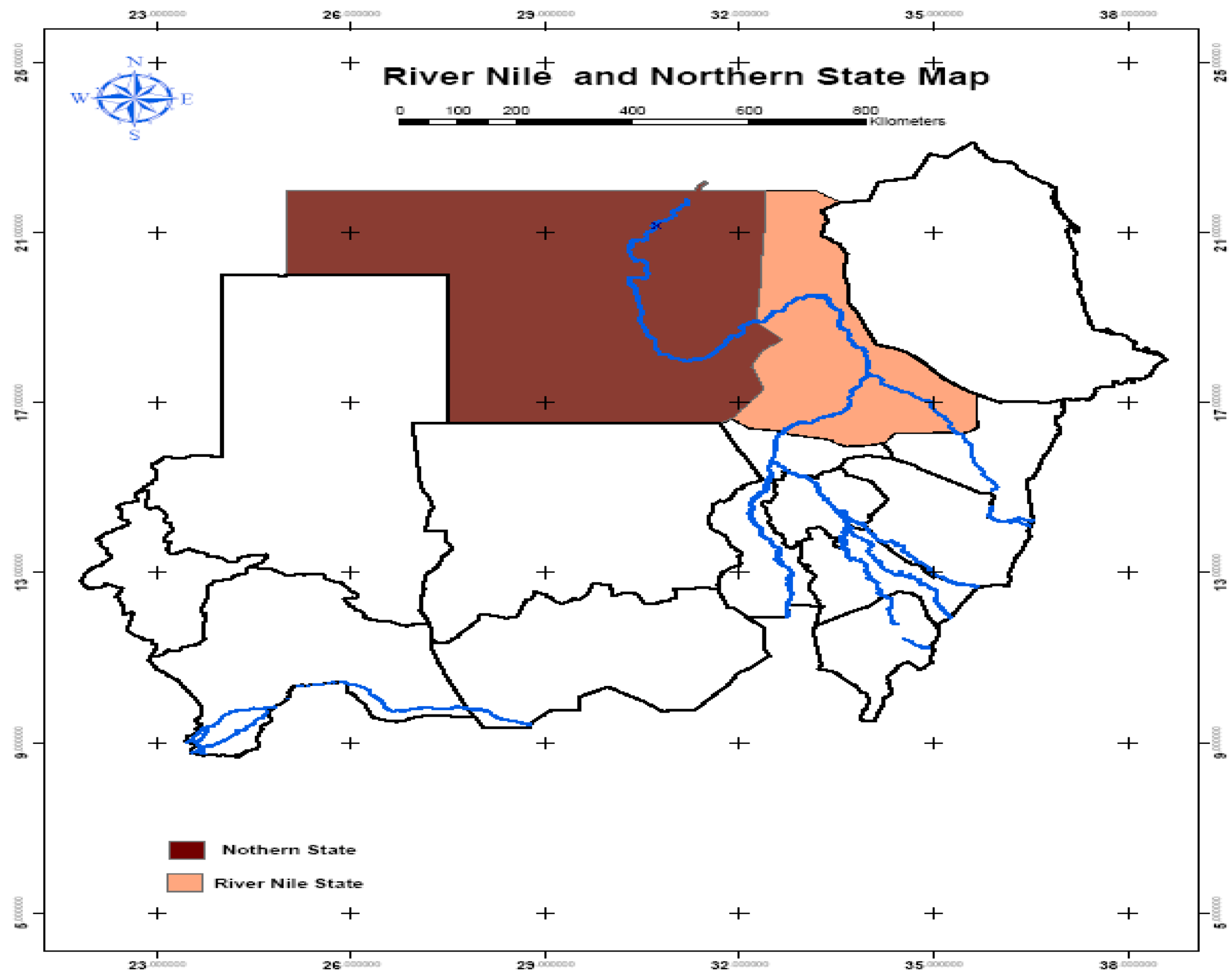
        <p>The data collection was made by means of personal interviews. The questionnaire used for the interview was designed through group discussions and pre-testing. The group consisted of scientists whose works were relevant to date palm production in Sudan, survey design and agricultural extension services in Sudan. After the initial group discussions, a questionnaire was drafted and was sent to each member of the group. They were asked to comment on any difficulty encountered in interpreting the questions and to suggest ways of improving the draft. Some issues were raised, which led to further discussions with members of the group. The questionnaire drafts were sent to some officials of the Ministry of Agriculture in Sudan, who were asked to comment and suggest ways of improving the questionnaire. Their comments and suggestions led to the modification of the questionnaire draft. To test the questionnaire, 10 date palm farmers were interviewed, and the questionnaire was further modified to capture the concerns raised by the farmers during the pre-test survey. The final questionnaire used for the interviews comprised of closed-ended and open-ended questions. The main survey was conducted in June and July 2010 in two states, namely the River Nile State and the Northern State (see <xref ref-type="fig" rid="sustainability-05-00338-f001">Figure 1</xref>). The two states were chosen because most date palm farms are found there. The states were divided into localities that are officially recognized in Sudan. One hundred and thirty-one date palm farmers in the Northern State were randomly selected, while 84 farmers were randomly selected in the River Nile State. In total, 215 date palm farmers were interviewed. The number of farmers that were interviewed in the Northern State was more than that of the River Nile State, because there are more date palm farms in the Northern State.</p>
        <fig id="sustainability-05-00338-f001" position="float">
          <label>Figure 1</label>
          <caption>
            <p>Map of Sudan showing location of River Nile State and Northern State.</p>
          </caption>
          <graphic xmlns:xlink="http://www.w3.org/1999/xlink" xlink:href="sustainability-05-00338-g001.tif"/>
        </fig>
      </sec>
      <sec>
        <title>2.2. The Diversity of Date Palm Cultivars and Preferences Questions</title>
        <p>After explaining the motives behind the survey and assuring the selected farmers about the confidentiality of their responses, the respondents were asked to give the names and number of different date palm cultivars they grow on their farms and to mention the cultivar they most prefer. They were asked a series of socio-economic questions (education, income from date palm, household size, farmland size and number of years they have been involved in date farming). The respondents were asked about the main threat (e.g., pests and diseases and drought) to date palm on their farms and whether the date palm harvested from their farms is mainly for family use.</p>
      </sec>
      <sec>
        <title>2.3. Conceptual Framework</title>
        <p>The Northern State and River Nile State in Sudan are typical examples where the welfare of people is based on a mixture of market priced goods from date palm (e.g., fruits, timber, fuel wood and animal feed) and non-market priced goods and services from date palm, such as microclimate regulation, biodiversity and cultural identity. There are different date palm cultivars, and each has its own specific traits and potentials. Some might have the potential of producing many fruits in a short time period, while it might take a longer time for others to produce fruit. Furthermore, some cultivars might have the potential of withstanding biotic stress, such as pests and diseases, as well as abiotic stress, such as soil acidity and drought. Fruit from some cultivars might have better taste and better storage capacity than fruit from other cultivars. This implies that the choice of date palm cultivars by a farmer reflects the benefits that he or she expects to get from the cultivar. A risk-neutral farmer is more likely to grow only one date palm cultivar that gives the greatest benefits [<xref ref-type="bibr" rid="B31-sustainability-05-00338">31</xref>]. However, many small-scale farmers especially in Africa are risk-averse and tend to grow many cultivars on their farms as a way of reducing costs associated with crop failures [<xref ref-type="bibr" rid="B32-sustainability-05-00338">32</xref>]. The utility <italic>U</italic> that the respondent gets from a date palm cultivar will depend on the yield <italic>y</italic>, which is often influenced by both biotic and abiotic factors; locality <italic>l</italic> (<italic>i.e.</italic>, location of the farm), quality of produce from the cultivar, <italic>q</italic>, and personal attributes of the respondent, <italic>s</italic>:
		
		<disp-formula id="sustainability-05-00338-i001">
		<inline-graphic xmlns:xlink="http://www.w3.org/1999/xlink" xlink:href="sustainability-05-00338-i001.tif"/>
		<label>(1)</label>
		</disp-formula>
		</p>
        <p>The numbers of different date palm cultivars that the respondent grows in his or her farm was explored in this study. Overall, the respondents grew between one to six different cultivars. Assuming that the respondent chooses to grow only one date palm cultivar on the farm, this implies that:
		
		<disp-formula id="sustainability-05-00338-i002">
		<inline-graphic xmlns:xlink="http://www.w3.org/1999/xlink" xlink:href="sustainability-05-00338-i002.tif"/>
		<label>(2)</label>
		</disp-formula>
		
		where <italic>U<sub>c</sub></italic> is the utility the respondent gets for growing one cultivar and <italic>U<sub>d</sub></italic> is the utility for growing more than one cultivar. If the number of date palm cultivars (1, 2, 3, 4, 5 and 6) grown on the farm is considered as a possible choice by the respondent, it is expected that he or she will choose the alternative that has the maximum expected utility among the alternatives. The respondent’s expected utility for growing one cultivar can be expressed as:
		
		<disp-formula id="sustainability-05-00338-i003">
		<inline-graphic xmlns:xlink="http://www.w3.org/1999/xlink" xlink:href="sustainability-05-00338-i003.tif"/>
		<label>(3)</label>
		</disp-formula>
		
		where <italic>E</italic>(<italic>U<sub>c</sub></italic>) is the expected utility of the alternative <italic>c</italic>, (<italic>i.e.</italic>, one date palm cultivar) to the respondent.</p>
      </sec>
      <sec>
        <title>2.4. Econometric Model</title>
        <sec>
          <title>2.4.1. The Ordered Logit Model</title>
          <p>In this study, the respondent was asked about the number of date palm cultivars he or she grows. For the analysis of the factors influencing the number of different cultivars grown on the farm, the number was classified as:</p>
          <list list-type="simple">
            <list-item>
             <p>One or two cultivars was classified as ‘1–2’ cultivars and coded 0.</p>
			</list-item>
			<list-item>
             <p>Three or four cultivars was classified as ‘3–4’ cultivars and coded 1.</p>
            </list-item>
            <list-item>
              <p>Five or six cultivars was classified as ‘5–6’ and coded 2.</p>
            </list-item>
          </list>
          <p>The new classification should not have statistically significant effects on the results. This is because eight percent of all the respondents reported that they grew one cultivar, and it was eight percent for those who grew six cultivars. In other words, these subsamples seem to be too small to be used independently for the analysis. The number of date palm cultivars that the respondent grew is discrete and has more than two outcomes (dependent variables). This implies that the binary choice model is not suitable for the analysis of the data. An extension of the binary model, such as multinomial and ordered choice models that allow for more than two dependent variables, can be used for the analysis [<xref ref-type="bibr" rid="B33-sustainability-05-00338">33</xref>,<xref ref-type="bibr" rid="B34-sustainability-05-00338">34</xref>]. The multinomial model is often used for modeling unordered dependent variables, while the ordered choice model is more suitable for ordered dependent variables. In this study, it is assumed that the dependent variables are ordered; thus, the ordered choice model was used for the analysis of data. The ordered regression model has a restrictive assumption called the Parallel Regression Assumption (PRA). This suggests that the relationship between each pair of the dependent variable is the same [<xref ref-type="bibr" rid="B35-sustainability-05-00338">35</xref>], <italic>i.e.</italic>, the coefficients of the independent variable that describe the relationship between the lowest and all the higher classes of the dependent variable are the same as those that describe the relationship between the next lowest class and all higher classes. The Brant test can be used to evaluate whether the estimated model is in line with the PRA [<xref ref-type="bibr" rid="B36-sustainability-05-00338">36</xref>]. The null hypothesis is that there is no difference in the coefficients between the models. Thus, a not statistically significant result implies that the PRA has not been violated. In this study, the result of the Brant test shows that the chi-squared statistic is 6.64 and the <italic>p</italic> value is 0.675. This implies that the PRA has not been violated; thus, the use of the ordered regression model for the data analysis in this study is justified. </p>
          <p>To explore whether the ordered probit model is more suitable for the analysis of the data, the Lagrange multiplier test was conducted [<xref ref-type="bibr" rid="B37-sustainability-05-00338">37</xref>]. The Lagrange multiplier statistic (test statistic) was greater than the critical value of chi-squared. Thus, the hypothesis regarding the existence of normal distribution in the error term of the probit model was rejected at the one percent statistically significant level. This implies that the assumption required to use the probit could not be satisfied; thus, the ordered logit model was used in the analysis. Let the number of cultivars, <italic>CULTIVAR<sub>n</sub></italic>, grown by the respondent be an ordered response, taking on values of {0, 1, 2}. The ordered model for <italic>CULTIVAR<sub>n</sub></italic> can be derived from a latent variable [<xref ref-type="bibr" rid="B36-sustainability-05-00338">36</xref>]. Assuming that a latent (unobservable) variable, <inline-graphic xmlns:xlink="http://www.w3.org/1999/xlink" xlink:href="sustainability-05-00338-i010.tif"/>, is determined by:
		  
		  <disp-formula id="sustainability-05-00338-i004">
		  <inline-graphic xmlns:xlink="http://www.w3.org/1999/xlink" xlink:href="sustainability-05-00338-i004.tif"/>
		  <label>(4)</label>
		  </disp-formula>

		  where <italic>m</italic> is a vector of independent variable, <italic>β</italic> is the vector of the parameter to be estimated and <italic>ε</italic> is the error term, which is assumed to be independently and identically distributed according to the logistic function [<xref ref-type="bibr" rid="B36-sustainability-05-00338">36</xref>]. Let <italic>μ</italic><sub>0</sub> &lt; <italic>μ</italic><sub>1</sub> &lt; <italic>μ</italic><sub>2</sub> be unknown cut-off points (threshold parameters), and the latent variable, <inline-graphic xmlns:xlink="http://www.w3.org/1999/xlink" xlink:href="sustainability-05-00338-i010.tif"/>, can be censored as:
		  
		  <disp-formula id="sustainability-05-00338-i005">
		  <inline-graphic xmlns:xlink="http://www.w3.org/1999/xlink" xlink:href="sustainability-05-00338-i005.tif"/>
		  <label>(5)</label>
		  </disp-formula>

		  where <italic>CULTIVAR<sub>n</sub></italic> is the observed counterpart to <inline-graphic xmlns:xlink="http://www.w3.org/1999/xlink" xlink:href="sustainability-05-00338-i010.tif"/> and <italic>μ</italic><sub>0</sub>, <italic>μ</italic><sub>1</sub>, <italic>μ</italic><sub>2</sub> are estimated cut-off points. The probability that the respondent grows a number of cultivars <italic>j</italic> on his or her farm is:
		  
		  <disp-formula id="sustainability-05-00338-i006">
		  <inline-graphic xmlns:xlink="http://www.w3.org/1999/xlink" xlink:href="sustainability-05-00338-i006.tif"/>
		  <label>(6)</label>
		  </disp-formula>

		  where <italic>F</italic> is the cumulative distribution function of the logistic random variable.</p>
          <p>The variance inflation factors for each independent variable included in this study did not exceed 6. This indicates that multicollinearity [<xref ref-type="bibr" rid="B38-sustainability-05-00338">38</xref>] is not a serious problem in the estimated models. The ordered logit regression model was estimated using LIMDEP NLOGIT version 4.0.1 statistical package (Econometric Software Inc., New York, USA), and the factors influencing the number of different date palm cultivars grown by the respondents were analyzed. The following effects (in parenthesis) of independent variables (see <xref ref-type="table" rid="sustainability-05-00338-t001">Table 1</xref>) on the number of different cultivars grown are expected:</p>
          <p>Number of years in farming (+)</p>
          <p>People who have many years in date palm farming should be more experienced and familiar with farming in the face of an unpredictable environment [<xref ref-type="bibr" rid="B39-sustainability-05-00338">39</xref>]. Thus, they are likely to grow different cultivars as a measure of reducing the risks of crop failures.</p>
          <p>Income from date palm (+)</p>
          <p>Date palm fruit varies with regard to quality, such as taste and color; so does market demand. To meet the ever changing market demand, farmers who have more money from date palm are likely to grow different cultivars to help sustain the revenue they get from date palm [<xref ref-type="bibr" rid="B40-sustainability-05-00338">40</xref>].</p>
          <p>Pests and diseases (+)</p>
          <p>Pests and diseases comprise one of the main constraints threatening date palm production [<xref ref-type="bibr" rid="B41-sustainability-05-00338">41</xref>]. Farmers threatened by pests and diseases are likely to grow different cultivars that are resistant to both field and storage pests to help reduce losses.</p>
          <p>Farm location (–)</p>
          <p>Many crop varieties are often found in areas where the growing of the crop has been the tradition of the people [<xref ref-type="bibr" rid="B42-sustainability-05-00338">42</xref>]. The growing of date palm is a tradition to the people of the Northern State in comparison to those of the River Nile State. Thus, farmers from the River Nile State are not likely to grow many different cultivars.</p>
		  <table-wrap id="sustainability-05-00338-t001" position="float">
            <object-id pub-id-type="pii">sustainability-05-00338-t001_Table 1</object-id>
            <label>Table 1</label>
            <caption>
              <p>Description of variables used in statistical analysis.</p>
            </caption>
            <table>
              <thead>
                <tr>
                  <th align="center" valign="middle">Variable</th>
                  <th align="center" valign="middle">Description</th>
                  <th align="center" valign="middle">%</th>
                  <th align="center" valign="middle">Mean</th>
                  <th align="center" valign="middle">SD</th>
                  <th align="center" valign="middle">Min</th>
                  <th align="center" valign="middle">Max</th>
                </tr>
              </thead>
              <tbody>
                <tr>
                  <td align="center" valign="middle">
                    <italic>CULTIVAR<sub>n</sub></italic>
                  </td>
                  <td align="center" valign="middle">Number of date palm cultivars grown by the respondent</td>
                  <td align="center" valign="middle"> </td>
                  <td align="center" valign="middle"> </td>
                  <td align="center" valign="middle"> </td>
                  <td align="center" valign="middle"> </td>
                  <td align="center" valign="middle"> </td>
                </tr>
                <tr>
                  <td align="center" valign="middle"> </td>
                  <td align="center" valign="middle">1 – 2 = 0</td>
                  <td align="center" valign="middle">34.9</td>
                  <td align="center" valign="middle"> </td>
                  <td align="center" valign="middle"> </td>
                  <td align="center" valign="middle"> </td>
                  <td align="center" valign="middle"> </td>
                </tr>
                <tr>
                  <td align="center" valign="middle"> </td>
                  <td align="center" valign="middle">3 – 4 = 1</td>
                  <td align="center" valign="middle">47.9</td>
                  <td align="center" valign="middle"> </td>
                  <td align="center" valign="middle"> </td>
                  <td align="center" valign="middle"> </td>
                  <td align="center" valign="middle"> </td>
                </tr>
                <tr>
                  <td align="center" valign="middle"> </td>
                  <td align="center" valign="middle">5 – 6 = 2</td>
                  <td align="center" valign="middle">17.2</td>
                  <td align="center" valign="middle"> </td>
                  <td align="center" valign="middle"> </td>
                  <td align="center" valign="middle"> </td>
                  <td align="center" valign="middle"> </td>
                </tr>
                <tr>
                  <td align="center" valign="middle">
                    <italic>BARKAWI<sub>p</sub></italic>
                  </td>
                  <td align="center" valign="middle">Barakawi is the most preferred cultivar</td>
                  <td align="center" valign="middle"> </td>
                  <td align="center" valign="middle"> </td>
                  <td align="center" valign="middle"> </td>
                  <td align="center" valign="middle"> </td>
                  <td align="center" valign="middle"> </td>
                </tr>
                <tr>
                  <td align="center" valign="middle"> </td>
                  <td align="center" valign="middle">yes = 1</td>
                  <td align="center" valign="middle"> </td>
                  <td align="center" valign="middle">0.59</td>
                  <td align="center" valign="middle">0.49</td>
                  <td align="center" valign="middle">0</td>
                  <td align="center" valign="middle">1</td>
                </tr>
                <tr>
                  <td align="center" valign="middle"> </td>
                  <td align="center" valign="middle">no = 0</td>
                  <td align="center" valign="middle"> </td>
                  <td align="center" valign="middle"> </td>
                  <td align="center" valign="middle"> </td>
                  <td align="center" valign="middle"> </td>
                  <td align="center" valign="middle"> </td>
                </tr>
                <tr>
                  <td align="center" valign="middle">YEARS</td>
                  <td align="center" valign="middle">Number of years the respondent has been growing dates</td>
                  <td align="center" valign="middle"> </td>
                  <td align="center" valign="middle">30.9</td>
                  <td align="center" valign="middle">14.0</td>
                  <td align="center" valign="middle">5</td>
                  <td align="center" valign="middle">68</td>
                </tr>
                <tr>
                  <td align="center" valign="middle">INCOME</td>
                  <td align="center" valign="middle">Disposable income from date palm (in x 1,000 SDG)</td>
                  <td align="center" valign="middle"> </td>
                  <td align="center" valign="middle">19.5</td>
                  <td align="center" valign="middle">78.4</td>
                  <td align="center" valign="middle">0</td>
                  <td align="center" valign="middle">1000</td>
                </tr>
                <tr>
                  <td align="center" valign="middle">PESTS</td>
                  <td align="center" valign="middle">Diseases and pests threaten the respondent’s date farm</td>
                  <td align="center" valign="middle"> </td>
                  <td align="center" valign="middle"> </td>
                  <td align="center" valign="middle"> </td>
                  <td align="center" valign="middle"> </td>
                  <td align="center" valign="middle"> </td>
                </tr>
                <tr>
                  <td align="center" valign="middle"> </td>
                  <td align="center" valign="middle">yes = 1</td>
                  <td align="center" valign="middle"> </td>
                  <td align="center" valign="middle">0.52</td>
                  <td align="center" valign="middle">0.50</td>
                  <td align="center" valign="middle">0</td>
                  <td align="center" valign="middle">1</td>
                </tr>
                <tr>
                  <td align="center" valign="middle"> </td>
                  <td align="center" valign="middle">no = 0</td>
                  <td align="center" valign="middle"> </td>
                  <td align="center" valign="middle"> </td>
                  <td align="center" valign="middle"> </td>
                  <td align="center" valign="middle"> </td>
                  <td align="center" valign="middle"> </td>
                </tr>
                <tr>
                  <td align="center" valign="middle">LOCATION</td>
                  <td align="center" valign="middle">The respondent farm is located in the River Nile State</td>
                  <td align="center" valign="middle"> </td>
                  <td align="center" valign="middle"> </td>
                  <td align="center" valign="middle"> </td>
                  <td align="center" valign="middle"> </td>
                  <td align="center" valign="middle"> </td>
                </tr>
                <tr>
                  <td align="center" valign="middle"> </td>
                  <td align="center" valign="middle">yes = 1</td>
                  <td align="center" valign="middle"> </td>
                  <td align="center" valign="middle">0.37</td>
                  <td align="center" valign="middle">0.48</td>
                  <td align="center" valign="middle">0</td>
                  <td align="center" valign="middle">1</td>
                </tr>
                <tr>
                  <td align="center" valign="middle"> </td>
                  <td align="center" valign="middle">no = 0</td>
                  <td align="center" valign="middle"> </td>
                  <td align="center" valign="middle"> </td>
                  <td align="center" valign="middle"> </td>
                  <td align="center" valign="middle"> </td>
                  <td align="center" valign="middle"> </td>
                </tr>
                <tr>
                  <td align="center" valign="middle">USES</td>
                  <td align="center" valign="middle">Date palm products are mainly for household consumption</td>
                  <td align="center" valign="middle"> </td>
                  <td align="center" valign="middle"> </td>
                  <td align="center" valign="middle"> </td>
                  <td align="center" valign="middle"> </td>
                  <td align="center" valign="middle"> </td>
                </tr>
                <tr>
                  <td align="center" valign="middle"> </td>
                  <td align="center" valign="middle">yes = 1</td>
                  <td align="center" valign="middle"> </td>
                  <td align="center" valign="middle">0.62</td>
                  <td align="center" valign="middle">0.49</td>
                  <td align="center" valign="middle">0</td>
                  <td align="center" valign="middle">1</td>
                </tr>
                <tr>
                  <td align="center" valign="middle"> </td>
                  <td align="center" valign="middle">no = 0</td>
                  <td align="center" valign="middle"> </td>
                  <td align="center" valign="middle"> </td>
                  <td align="center" valign="middle"> </td>
                  <td align="center" valign="middle"> </td>
                  <td align="center" valign="middle"> </td>
                </tr>
                <tr>
                  <td align="center" valign="middle">DROUGHT</td>
                  <td align="center" valign="middle">Drought threatens the respondent’s date farm</td>
                  <td align="center" valign="middle"> </td>
                  <td align="center" valign="middle"> </td>
                  <td align="center" valign="middle"> </td>
                  <td align="center" valign="middle"> </td>
                  <td align="center" valign="middle"> </td>
                </tr>
                <tr>
                  <td align="center" valign="middle"> </td>
                  <td align="center" valign="middle">yes = 1</td>
                  <td align="center" valign="middle"> </td>
                  <td align="center" valign="middle">0.44</td>
                  <td align="center" valign="middle">0.50</td>
                  <td align="center" valign="middle">0</td>
                  <td align="center" valign="middle">1</td>
                </tr>
                <tr>
                  <td align="center" valign="middle"> </td>
                  <td align="center" valign="middle">no = 0</td>
                  <td align="center" valign="middle"> </td>
                  <td align="center" valign="middle"> </td>
                  <td align="center" valign="middle"> </td>
                  <td align="center" valign="middle"> </td>
                  <td align="center" valign="middle"> </td>
                </tr>
                <tr>
                  <td align="center" valign="middle">EDU</td>
                  <td align="center" valign="middle">The respondent has at least a high school education</td>
                  <td align="center" valign="middle"> </td>
                  <td align="center" valign="middle">0.63</td>
                  <td align="center" valign="middle">0.48</td>
                  <td align="center" valign="middle">0</td>
                  <td align="center" valign="middle">1</td>
                </tr>
                <tr>
                  <td align="center" valign="middle"> </td>
                  <td align="center" valign="middle">yes = 1</td>
                  <td align="center" valign="middle"> </td>
                  <td align="center" valign="middle"> </td>
                  <td align="center" valign="middle"> </td>
                  <td align="center" valign="middle"> </td>
                  <td align="center" valign="middle"> </td>
                </tr>
                <tr>
                  <td align="center" valign="middle"> </td>
                  <td align="center" valign="middle">no = 0</td>
                  <td align="center" valign="middle"> </td>
                  <td align="center" valign="middle"> </td>
                  <td align="center" valign="middle"> </td>
                  <td align="center" valign="middle"> </td>
                  <td align="center" valign="middle"> </td>
                </tr>
                <tr>
                  <td align="center" valign="middle">HH_SIZE</td>
                  <td align="center" valign="middle">The respondent’s household size is ≥ the average (7 persons) of the whole sample</td>
                  <td align="center" valign="middle"> </td>
                  <td align="center" valign="middle"> </td>
                  <td align="center" valign="middle"> </td>
                  <td align="center" valign="middle"> </td>
                  <td align="center" valign="middle"> </td>
                </tr>
                <tr>
                  <td align="center" valign="middle"> </td>
                  <td align="center" valign="middle">yes = 1</td>
                  <td align="center" valign="middle"> </td>
                  <td align="center" valign="middle">0.53</td>
                  <td align="center" valign="middle">0.50</td>
                  <td align="center" valign="middle">0</td>
                  <td align="center" valign="middle">1</td>
                </tr>
                <tr>
                  <td align="center" valign="middle"> </td>
                  <td align="center" valign="middle">no = 0</td>
                  <td align="center" valign="middle"> </td>
                  <td align="center" valign="middle"> </td>
                  <td align="center" valign="middle"> </td>
                  <td align="center" valign="middle"> </td>
                  <td align="center" valign="middle"> </td>
                </tr>
                <tr>
                  <td align="center" valign="middle">FARM SIZE</td>
                  <td align="center" valign="middle">The respondent’s farmland size is ≥ the median (4 hectares) of the whole sample</td>
                  <td align="center" valign="middle"> </td>
                  <td align="center" valign="middle"> </td>
                  <td align="center" valign="middle"> </td>
                  <td align="center" valign="middle"> </td>
                  <td align="center" valign="middle"> </td>
                </tr>
                <tr>
                  <td align="center" valign="middle"> </td>
                  <td align="center" valign="middle">yes = 1</td>
                  <td align="center" valign="middle"> </td>
                  <td align="center" valign="middle">0.58</td>
                  <td align="center" valign="middle">0.49</td>
                  <td align="center" valign="middle">0</td>
                  <td align="center" valign="middle">1</td>
                </tr>
                <tr>
                  <td align="center" valign="middle"> </td>
                  <td align="center" valign="middle">no = 0</td>
                  <td align="center" valign="middle"> </td>
                  <td align="center" valign="middle"> </td>
                  <td align="center" valign="middle"> </td>
                  <td align="center" valign="middle"> </td>
                  <td align="center" valign="middle"> </td>
                </tr>
              </tbody>
            </table>
			<table-wrap-foot><fn>
			<p>SGD is Sudanese Pound. 1 US Dollars = 4.40 SGD.</p>
		</fn></table-wrap-foot>
			</table-wrap>


          <p>Uses of date palm produce (+)</p>
          <p>Date palm fruits are of varied tastes [<xref ref-type="bibr" rid="B30-sustainability-05-00338">30</xref>]. People who mainly grow fruit trees for their own consumption often like to explore different tastes of the fruit and are likely to grow different cultivars. </p>
          <p>Drought (+)</p>
          <p>Inadequate water threatens food security [<xref ref-type="bibr" rid="B43-sustainability-05-00338">43</xref>]; thus, date palm farmers threatened by drought are likely to grow different cultivars, such as early and late maturing cultivars, to help sustain their livelihoods. </p>
          <p>Education (+)</p>
          <p>People who have more formal education should be more informed about the potential benefits associated with the growing of different cultivars of crop [<xref ref-type="bibr" rid="B44-sustainability-05-00338">44</xref>]. Thus, they are likely to grow different date palm cultivars.</p>
          <p>Household size (+)</p>
          <p>The more persons there are in a household, the more likely they are to collect seeds from different sources, which should encourage the growing of different date palm cultivars [<xref ref-type="bibr" rid="B16-sustainability-05-00338">16</xref>]</p>
          <p>Farmland size (–)</p>
          <p>Larger farmland encourages large-scale farming in which monoculture (<italic>i.e.</italic>, growing of only one crop type) is often practiced to maximize revenue [<xref ref-type="bibr" rid="B31-sustainability-05-00338">31</xref>]. This implies that date palm farmers who have larger farmland are not likely to grow different cultivars.</p>
        </sec>
        <sec>
          <title>2.4.2. The Binary Logit Model</title>
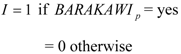
          <p>Of all the date palm cultivars grown by the farmers, about 60% of the respondents reported that the Barakawi is the most preferred cultivar. Thus, it becomes interesting to explore the factors influencing the respondent’s preferences for the Barakawi. As in equation (1), the utility the respondent gets from Barakawi will depend on yield, locality, quality of produce from the cultivar and the personal attributes of the respondent. Assuming that 1 is Barakawi and 0 is other date palm cultivars, this implies that: 
		 
		 <disp-formula id="sustainability-05-00338-i007">
		 <inline-graphic xmlns:xlink="http://www.w3.org/1999/xlink" xlink:href="sustainability-05-00338-i007.tif"/>
		 <label>(7)</label>
		 </disp-formula>

		  where <italic>U</italic><sub>1</sub> is the utility that the respondent gets from Barakawi and <italic>U</italic><sub>0</sub> is the utility from other cultivars. Considering the binary nature of this arrangement, (<italic>i.e.</italic>, Barakawi = 1, 0 = other cultivars), the respondent’s preferences can be explored using the binary choice model. Because the respondent preference for Barakawi, <italic>BARAKAWI<sub>p</sub></italic>, is latent (<italic>i.e.</italic>, not observable), therefore, let <italic>I</italic> be the indicator variable, so that:
		  
		  <disp-formula id="sustainability-05-00338-i008">
		 <inline-graphic xmlns:xlink="http://www.w3.org/1999/xlink" xlink:href="sustainability-05-00338-i008.tif"/>
		 <label>(8)</label>
		 </disp-formula>

		  The probability <italic>P</italic> that the Barakawi is the most preferred cultivar is:
		  
		  <disp-formula id="sustainability-05-00338-i009">
		 <inline-graphic xmlns:xlink="http://www.w3.org/1999/xlink" xlink:href="sustainability-05-00338-i009.tif"/>
		 <label>(9)</label>
		 </disp-formula>

		  where <italic>t</italic> = <italic>mβ</italic>.</p>
          <p>Using the Lagrange multiplier test, the hypothesis regarding the existence of normal distribution in the error term of the probit model was rejected at the 0.01% statistically significant level. Thus, the binary logit model was applied in the analysis. The binary logit model was estimated using LIMDEP NLOGIT version 4.0.1 statistical package (Econometric Software Inc., New York, USA), and the factors influencing the respondent’s preference for Barakawi cultivar were analyzed (see <xref ref-type="table" rid="sustainability-05-00338-t004">Table 4</xref>). The variables that were used in the analysis are presented in <xref ref-type="table" rid="sustainability-05-00338-t001">Table 1</xref>.</p>
          </sec>
      </sec>
    </sec>
    <sec sec-type="results">
      <title>3. Results</title>
      <sec>
        <title>3.1. Diversity of Date Palm Cultivars Grown on Farms</title>
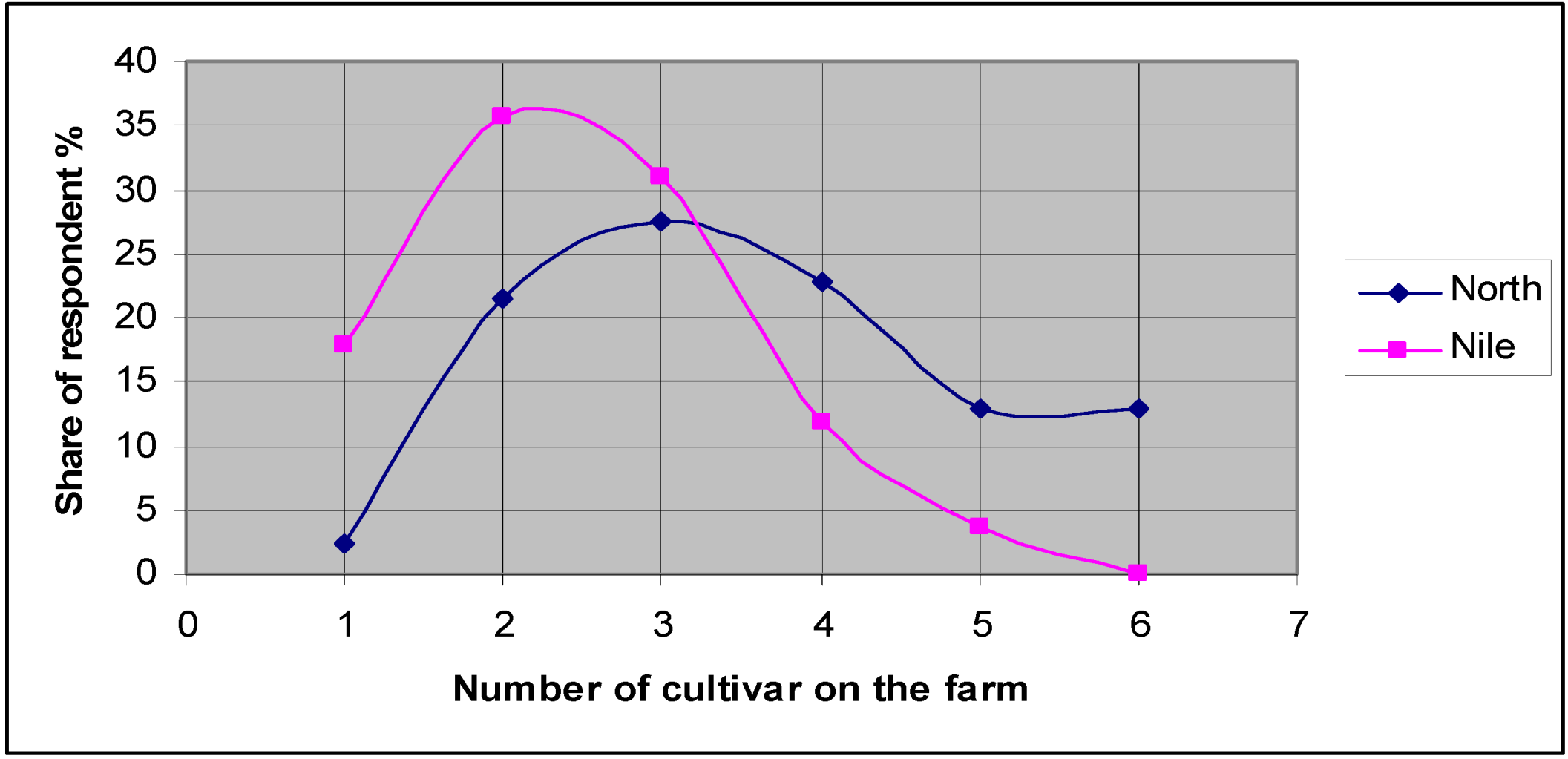
        <p>All the people selected for the survey agreed to be interviewed. However, of all the 215 respondents, only 202 (94%) answered all the questions that are relevant to the present paper. Thus, the 202 observations were used for the analyses. Approximately 48% of the respondents grew between three to four different date palm cultivars, while 17% grew five to six cultivars. On average, date palm contributes SDG 19,500 (US$ 4,431.8) to household income annually. Approximately 52% and 44% of the respondents reported that pests and diseases and drought, respectively, threaten their date palm production (see <xref ref-type="table" rid="sustainability-05-00338-t001">Table 1</xref>). The respondents in the Northern State grew between one to six cultivars, while it was one to five for those in the River Nile State (see <xref ref-type="fig" rid="sustainability-05-00338-f002">Figure 2</xref>). On average, the respondents in the River Nile State grew 2.2 cultivars, while it was 3.9 for those in the Northern State.</p>
        <fig id="sustainability-05-00338-f002" position="float">
          <label>Figure 2</label>
          <caption>
            <p>Number of date palm cultivars grown by the respondents.</p>
          </caption>
          <graphic xmlns:xlink="http://www.w3.org/1999/xlink" xlink:href="sustainability-05-00338-g002.tif"/>
        </fig>
        <p>To examine the factors that might have influenced the number of cultivars grown by the respondent, an ordered logit model was estimated (see, <xref ref-type="table" rid="sustainability-05-00338-t002">Table 2</xref>). The result of the log likelihood ratio test is statistically significant. This shows that the model has a relatively good fit. The median farmland size and average household size were used in the model, because there is a high correlation between farmland size and income, as well as between household size and the number of years in farming. The coefficients associated with the number of years in date palm farming, income from date palm, uses of date palm produce, drought and education had positive and statistically significant effects on the number of cultivars grown. The coefficients associated with farm location and household size had negative and statistically significant effects. The results imply that the respondents who have many years in date palm farming, earn more money from date palm, use date palm produce for household consumption, perceive drought as the main threat to date palm and have at least a high school education were more likely to grow different date palm cultivars. The respondents whose date palm farms are located in the River Nile State and have seven or more persons in their households were less likely to grow many different cultivars. In terms of marginal effect, the coefficients associated with farm location, uses of date palm produce, education and drought had the highest marginal effects (-0.21, 0.17, 0.09 and 0.09, respectively). In other words, the respondents whose farms are in the River Nile State were 21% less likely to grow many different date palm cultivars. The respondents who mainly use date palm for family consumption, have at least high school education and perceived drought as threat were 9 to 17% more likely to grow many different date palm cultivars. The results of the marginal effects show that farm location, uses of date palm, education and drought are the most important variables in predicting the number of date palm cultivars grown by farmers. The coefficients associated with diseases and pests and farmland size were not statistically significant.</p>
        <table-wrap id="sustainability-05-00338-t002" position="float">
          <object-id pub-id-type="pii">sustainability-05-00338-t002_Table 2</object-id>
          <label>Table 2</label>
          <caption>
            <p>Ordered logit model result for factors influencing diversity of cultivars grown.</p>
          </caption>
          <table>
  <thead>
              <tr>
                <th align="left" valign="middle">Variable </th>
                <th align="center" valign="middle">Coefficient </th>
                <th align="center" valign="middle">Marginal effect</th>
              </tr>
  </thead>
  <tbody>
              <tr>
                <td rowspan="2" align="left" valign="middle">Constant</td>
                <td align="center" valign="middle">−2.292</td>
                <td rowspan="2" align="center" valign="middle">[−1.601]</td>
              </tr>
              <tr>
                <td align="center" valign="middle">(1.432)</td>
              </tr>
              <tr>
                <td rowspan="2" align="left" valign="middle">YEARS</td>
                <td align="center" valign="middle">0.048</td>
                <td align="center" valign="middle">0.003</td>
              </tr>
              <tr>
                <td align="center" valign="middle">(0.017)</td>
                <td align="center" valign="middle">[2.755]***</td>
              </tr>
              <tr>
                <td rowspan="2" align="left" valign="middle">INCOME</td>
                <td align="center" valign="middle">0.001</td>
                <td align="center" valign="middle">0.0001</td>
              </tr>
              <tr>
                <td align="center" valign="middle">(0.0005)</td>
                <td align="center" valign="middle">[2.264]**</td>
              </tr>
              <tr>
                <td rowspan="2" align="left" valign="middle">PESTS</td>
                <td align="center" valign="middle">1.392</td>
                <td align="center" valign="middle">0.095</td>
              </tr>
              <tr>
                <td align="center" valign="middle">(0.915)</td>
                <td align="center" valign="middle">[1.522]</td>
              </tr>
              <tr>
                <td rowspan="2" align="left" valign="middle">LOCATION</td>
                <td align="center" valign="middle">−2.084</td>
                <td align="center" valign="middle">−0.209</td>
              </tr>
              <tr>
                <td align="center" valign="middle">(0.481)</td>
                <td align="center" valign="middle">[−4.332]****</td>
              </tr>
              <tr>
                <td rowspan="2" align="left" valign="middle">USES</td>
                <td align="center" valign="middle">1.848</td>
                <td align="center" valign="middle">0.173</td>
              </tr>
              <tr>
                <td align="center" valign="middle">(0.443)</td>
                <td align="center" valign="middle">[4.175]****</td>
              </tr>
              <tr>
                <td rowspan="2" align="left" valign="middle">DROUGHT</td>
                <td align="center" valign="middle">1.854</td>
                <td align="center" valign="middle">0.086</td>
              </tr>
              <tr>
                <td align="center" valign="middle">(0.959)</td>
                <td align="center" valign="middle">[1.934]**</td>
              </tr>
              <tr>
                <td rowspan="2" align="left" valign="middle">EDU</td>
                <td align="center" valign="middle">1.051</td>
                <td align="center" valign="middle">0.089</td>
              </tr>
              <tr>
                <td align="center" valign="middle">(0.545)</td>
                <td align="center" valign="middle">[1.930]**</td>
              </tr>
              <tr>
                <td rowspan="2" align="left" valign="middle">HH_SIZE</td>
                <td align="center" valign="middle">−0.837</td>
                <td align="center" valign="middle">−0.052</td>
              </tr>
              <tr>
                <td align="center" valign="middle">(0.452)</td>
                <td align="center" valign="middle">[−1.851]*</td>
              </tr>
              <tr>
                <td rowspan="2" align="left" valign="middle">FARM SIZE</td>
                <td align="center" valign="middle">0.555</td>
                <td align="center" valign="middle">0.040</td>
              </tr>
              <tr>
                <td align="center" valign="middle">(0.817)</td>
                <td align="center" valign="middle">[0.679]</td>
              </tr>
              <tr>
                <td rowspan="2" align="left" valign="middle">Cut-point 1</td>
                <td align="center" valign="middle">4.234</td>
                <td align="center" valign="middle"> </td>
              </tr>
              <tr>
                <td align="center" valign="middle">(0.353)</td>
                <td align="center" valign="middle">[11.988]****</td>
              </tr>
              <tr>
                <td align="left" valign="middle">LogL</td>
                <td align="center" valign="middle">−140.551</td>
                <td align="center" valign="middle"> </td>
              </tr>
              <tr>
                <td align="left" valign="middle">Restricted LogL</td>
                <td align="center" valign="middle">−206.229</td>
                <td align="center" valign="middle"> </td>
              </tr>
              <tr>
                <td align="left" valign="middle">McFadden Pseudo R<sup>2</sup></td>
                <td align="center" valign="middle">0.318</td>
                <td align="center" valign="middle"> </td>
              </tr>
              <tr>
                <td align="left" valign="middle">Chi-squared statistic</td>
                <td align="center" valign="middle">131.356</td>
                <td align="center" valign="middle"> </td>
              </tr>
              <tr>
                <td align="left" valign="middle">Prob[Chi-squared &gt; value]</td>
                <td align="center" valign="middle">0.0000000</td>
                <td align="center" valign="middle"> </td>
              </tr>
              <tr>
                <td align="left" valign="middle">Number of observations</td>
                <td align="center" valign="middle">202</td>
                <td align="center" valign="middle"> </td>
              </tr>
  </tbody>
          </table>
		  <table-wrap-foot><fn>
			<p>*,**,***,**** represent 0.1, 0.05, 0.01 and 0.001 levels of statistical significance, respectively. Standard error is in parenthesis, while t-value is in square bracket. Marginal effects for discrete independent variables were calculated as the difference in the expected value of the dependent variable when the independent variable of interest takes the value zero and when it takes the value one, while marginal effects for continuous independent variables were calculated at the mean of the independent variable of interest [<xref ref-type="bibr" rid="B37-sustainability-05-00338">37</xref>]. The marginal effects presented are for <italic>j</italic> = 1. </p>
		</fn></table-wrap-foot>
		  </table-wrap>
        
      </sec>
      <sec>
        <title>3.2. Preferences for the Date Palm Cultivars</title>
        <p>Of all the date palm cultivars, the Barakawi was the most preferred by the Northern State respondents, followed by Gondaila, while Kulma was the least preferred. For the case of the River Nile State respondents, Wad Khateeb was the most preferred, followed by Wad Laggai, while Amdokan-Skot and Barri-Sagaai were the least preferred; see <xref ref-type="table" rid="sustainability-05-00338-t003">Table 3</xref>. To examine the factors that might have influenced the respondent’s preferences for the Barakawi cultivar, a binary logit model was estimated (see, <xref ref-type="table" rid="sustainability-05-00338-t004">Table 4</xref>). The result of the log likelihood ratio test is statistically significant, and approximately 77% of the respondents were correctly predicted to be in the group to which they actually belonged by the estimated model. This shows that the model has a good fit. The coefficients associated with the number of years in date palm farming, income from date palm and farm location had negative and statistically significant effects on preferences for the Barakawi.</p>
        <table-wrap id="sustainability-05-00338-t003" position="float">
          <object-id pub-id-type="pii">sustainability-05-00338-t003_Table 3</object-id>
          <label>Table 3</label>
          <caption>
            <p>Respondent’s preferences for different cultivars.</p>
          </caption>
          <table>
  <thead>
              <tr>
                <th align="left" valign="middle"> </th>
                <th colspan="2" align="center" valign="middle">Respondent %</th>
              </tr>
              <tr>
                <th align="left" valign="middle">Most preferred cultivar</th>
                <th align="center" valign="middle">Northern State</th>
                <th align="center" valign="middle">River Nile State</th>
              </tr>
  </thead>
  <tbody>
              <tr>
                <td align="left" valign="middle">Barakawi</td>
                <td align="center" valign="middle">82.4</td>
                <td align="center" valign="middle">17.8</td>
              </tr>
              <tr>
                <td align="left" valign="middle">Wad Khateeb</td>
                <td align="center" valign="middle">-</td>
                <td align="center" valign="middle">39.3</td>
              </tr>
              <tr>
                <td align="left" valign="middle">Amdokan-Skot</td>
                <td align="center" valign="middle">-</td>
                <td align="center" valign="middle">1.2</td>
              </tr>
              <tr>
                <td align="left" valign="middle">Barri-Sagaai</td>
                <td align="center" valign="middle">-</td>
                <td align="center" valign="middle">1.2</td>
              </tr>
              <tr>
                <td align="left" valign="middle">Kulma</td>
                <td align="center" valign="middle">0.8</td>
                <td align="center" valign="middle">-</td>
              </tr>
              <tr>
                <td align="left" valign="middle">Wad Laggi</td>
                <td align="center" valign="middle">2.3</td>
                <td align="center" valign="middle">27.4</td>
              </tr>
              <tr>
                <td align="left" valign="middle">Abdel Rahim</td>
                <td align="center" valign="middle">-</td>
                <td align="center" valign="middle">3.6</td>
              </tr>
              <tr>
                <td align="left" valign="middle">Gondaila</td>
                <td align="center" valign="middle">14.5</td>
                <td align="center" valign="middle">3.6</td>
              </tr>
              <tr>
                <td align="left" valign="middle">Jaw</td>
                <td align="center" valign="middle">-</td>
                <td align="center" valign="middle">5.9</td>
              </tr>
  </tbody>
          </table>
		  </table-wrap>
        <p>The coefficient associated with household size had positive and statistically significant effect. The results imply that the respondents who have many years in date palm farming, have more money from date palm and whose date palm farms are located in the River Nile State were less likely to choose the Barakawi cultivar. The respondents who have seven or more persons in their households were more likely to choose the Barakawi. In terms of marginal effect, the coefficients associated with farm location and household size had the highest marginal effects (–0.65 and 0.29, respectively). In other words, the respondents whose farm is in the River Nile State were 65% less likely to choose the Barakawi cultivar, while the respondents who have seven or more persons in their households were 29% more likely to choose the Barakawi. This reveals that farm location and household size are the most important variables in predicting farmers’ preferences for the Barakawi cultivar. The coefficients associated with diseases and pests, date palm uses, drought, education and farmland size were not statistically significant.</p>
		
		<table-wrap id="sustainability-05-00338-t004" position="float">
            <object-id pub-id-type="pii">sustainability-05-00338-t004_Table 4</object-id>
            <label>Table 4</label>
            <caption>
              <p>Binary logit model result of factors influencing preferences for Barakawi cultivar.</p>
            </caption>
            <table>
  <thead>
    <tr align="center">
      <th valign="middle">Variable</th>
                  <th valign="middle">Coefficient</th>
                  <th valign="middle">Marginal effect</th>
                </tr>
  </thead>
  <tbody>
                <tr>
                  <td align="left" valign="middle">Constant</td>
                  <td align="center" valign="middle">2.467</td>
                  <td align="center" valign="middle"> </td>
                </tr>
                <tr>
                  <td align="left" valign="middle"> </td>
                  <td align="center" valign="middle">(1.679)</td>
                  <td align="center" valign="middle">[1.469]</td>
                </tr>
                <tr>
                  <td align="left" valign="middle">YEARS</td>
                  <td align="center" valign="middle">−0.078</td>
                  <td align="center" valign="middle">−0.018</td>
                </tr>
                <tr>
                  <td align="left" valign="middle"> </td>
                  <td align="center" valign="middle">(0.024)</td>
                  <td align="center" valign="middle">[−3.451]****</td>
                </tr>
                <tr>
                  <td align="left" valign="middle">INCOME</td>
                  <td align="center" valign="middle">−0.004</td>
                  <td align="center" valign="middle">−0.0009</td>
                </tr>
                <tr>
                  <td align="left" valign="middle"> </td>
                  <td align="center" valign="middle">(0.0009)</td>
                  <td align="center" valign="middle">[−4.857]****</td>
                </tr>
                <tr>
                  <td align="left" valign="middle">PESTS</td>
                  <td align="center" valign="middle">0.526</td>
                  <td align="center" valign="middle">0.114</td>
                </tr>
                <tr>
                  <td align="left" valign="middle"> </td>
                  <td align="center" valign="middle">(0.970)</td>
                  <td align="center" valign="middle">[0.542]</td>
                </tr>
                <tr>
                  <td align="left" valign="middle">LOCATION</td>
                  <td align="center" valign="middle">−3.111</td>
                  <td align="center" valign="middle">−0.649</td>
                </tr>
                <tr>
                  <td align="left" valign="middle"> </td>
                  <td align="center" valign="middle">(0.626)</td>
                  <td align="center" valign="middle">[−4.969]****</td>
                </tr>
                <tr>
                  <td align="left" valign="middle">USES</td>
                  <td align="center" valign="middle">0.388</td>
                  <td align="center" valign="middle">0.085</td>
                </tr>
                <tr>
                  <td align="left" valign="middle"> </td>
                  <td align="center" valign="middle">(0.519)</td>
                  <td align="center" valign="middle">[0.747]</td>
                </tr>
                <tr>
                  <td align="left" valign="middle">DROUGHT</td>
                  <td align="center" valign="middle">0.415</td>
                  <td align="center" valign="middle">0.096</td>
                </tr>
                <tr>
                  <td align="left" valign="middle"> </td>
                  <td align="center" valign="middle">(1.034)</td>
                  <td align="center" valign="middle">[0.401]</td>
                </tr>
                <tr>
                  <td align="left" valign="middle">EDU</td>
                  <td align="center" valign="middle">0.515</td>
                  <td align="center" valign="middle">0.109</td>
                </tr>
                <tr>
                  <td align="left" valign="middle"> </td>
                  <td align="center" valign="middle">(0.632)</td>
                  <td align="center" valign="middle">[0.815]</td>
                </tr>
                <tr>
                  <td align="left" valign="middle">HH_SIZE</td>
                  <td align="center" valign="middle">1.477</td>
                  <td align="center" valign="middle">0.292</td>
                </tr>
                <tr>
                  <td align="left" valign="middle"> </td>
                  <td align="center" valign="middle">(0.596)</td>
                  <td align="center" valign="middle">[2.479]**</td>
                </tr>
                <tr>
                  <td align="left" valign="middle">FARM SIZE</td>
                  <td align="center" valign="middle">0.200</td>
                  <td align="center" valign="middle">0.043</td>
                </tr>
                <tr>
                  <td align="left" valign="middle"> </td>
                  <td align="center" valign="middle">(0.955)</td>
                  <td align="center" valign="middle">[0.210]</td>
                </tr>
                <tr>
                  <td align="left" valign="middle">LogL</td>
                  <td align="center" valign="middle">−71.865</td>
                  <td align="center" valign="middle"> </td>
                </tr>
                <tr>
                  <td align="left" valign="middle">Restricted LogL</td>
                  <td align="center" valign="middle">−136.537</td>
                  <td align="center" valign="middle"> </td>
                </tr>
                <tr>
                  <td align="left" valign="middle">McFadden Pseudo R<sup>2</sup></td>
                  <td align="center" valign="middle">0.474</td>
                  <td align="center" valign="middle"> </td>
                </tr>
                <tr>
                  <td align="left" valign="middle">Chi-squared statistic</td>
                  <td align="center" valign="middle">129.344</td>
                  <td align="center" valign="middle"> </td>
                </tr>
                <tr>
                  <td align="left" valign="middle">Prob[Chi-squared &gt; value]</td>
                  <td align="center" valign="middle">0.0000000</td>
                  <td align="center" valign="middle"> </td>
                </tr>
                <tr>
                  <td align="left" valign="middle">% correctly predicted</td>
                  <td align="center" valign="middle">76.733</td>
                  <td align="center" valign="middle"> </td>
                </tr>
                <tr>
                  <td align="left" valign="middle">Number of observations</td>
                  <td align="center" valign="middle">202</td>
                  <td align="center" valign="middle"> </td>
                </tr>
  </tbody>
            </table>
			<table-wrap-foot><fn>
			<p>**,**** represent 0.05, and 0.001 levels of statistical significance, respectively. Standard error is in parenthesis, while t-value is in square bracket. Marginal effects for discrete independent variables were calculated as the difference in the expected value of the dependent variable when the independent variable of interest takes the value zero and when it takes the value one, while marginal effects for continuous independent variables were calculated at the mean of the independent variable of interest [<xref ref-type="bibr" rid="B37-sustainability-05-00338">37</xref>]. </p>
		</fn></table-wrap-foot>
		  </table-wrap>
        
        
      </sec>
    </sec>
    <sec sec-type="discussion">
      <title>4. Discussion and Conclusions</title>
      <p>The findings of this study revealed that the date palm cultivar grown by date palm farmers in northern Sudan is diverse. This implies that date palm farms in Sudan can serve as sites for conserving genetic resources along with fulfilling the primary aim of food production. The respondents in the Northern State generally grew more different cultivars than those in the River Nile State. This reflects the relative importance of the diversity of cultivars to the two groups and suggests that if farmers in the Northern State are motivated, they may be willing to participate in genetic resources conservation. However, it is important to be more cautious in designing such a strategy. Because having different cultivars on a farm can help lower the risks of total crop failure in the event of natural disasters, the farmers have a greater incentive to grow many different cultivars. Similar findings have been reported in other study by Asrat [<xref ref-type="bibr" rid="B21-sustainability-05-00338">21</xref>] and others. In their study of farmers’ preferences and the driving forces behind crop varieties choices, they found that farmers are willing to forgo extra income or yield to obtain a more stable and environmentally adaptable crop variety. It is not surprising that most of the Northern State respondents preferred the Barakawi cultivar, while most of the River Nile State respondents preferred the Wad Khateeb cultivar. This is because the Barakawi originated from the Northern State, while the Wad Khateeb is traditionally grown in the River Nile State [<xref ref-type="bibr" rid="B25-sustainability-05-00338">25</xref>]. This reflects the importance of farm location and tradition with regards to the preferences for cultivars. Similar findings have been reported in another study by Friis-Hansen and Sthapit [<xref ref-type="bibr" rid="B15-sustainability-05-00338">15</xref>]. They found that in Tanzania, the Gogo farmers, from an originally sorghum growing region, grow more than two times the number of varieties in comparison with the farmers from maize growing regions. On the other hand, it is not surprising that, on average, the Barakawi cultivar was the most preferred by all the respondents. This may be because the cultivar is more tolerant to some diseases in comparison with other date palm cultivars grown. It also has the potential for longer time storage, and it is traditionally used as food in the event of a long distance journey. </p>
      <p>The findings of the study show that the most important factors to be considered in designing a genetic resources conservation strategy include farm location, uses of date palm produce, drought and education. Since the respondents in the River Nile State were less likely to grow many different cultivars, it may be that the cultivars available to the farmers in this State are not as diverse as those in the Northern State. Thus, farmers in the River Nile State have lesser incentive to grow many different cultivars. This suggests the importance of making more cultivars adapted to the environmental condition of the State more available to the farmers. Availability of more cultivars should motivate more farmers to grow different cultivars. People who grow date palm mainly for family consumption often have different tastes and are likely to grow different cultivars to meet their demand. Similar findings have been reported in another study by Lacy and others [<xref ref-type="bibr" rid="B10-sustainability-05-00338">10</xref>]. They found that subsistence farmers grow varieties of crops that have different tastes. This implies that if people who mainly grow date palm for family consumption get access to different cultivars with marked differences in quality attributes, they are likely to grow diverse date palm cultivars. Thus, these group of people need to be considered in designing a genetic resource conservation strategy.</p>
      <p>The results of the study further support the proposition that the growing of different cultivars in drought prone areas could help farmers lower the risks of losing the whole crop. This is not surprising, because drought is one of the problems faced by date palm farmers in Sudan. Similar results have been reported in other studies by Elshibli and Korpelainen [<xref ref-type="bibr" rid="B24-sustainability-05-00338">24</xref>,<xref ref-type="bibr" rid="B25-sustainability-05-00338">25</xref>]; Elsafi. In their study of the population genetics of date palms in Sudan, Elshibli and Korpelainen [<xref ref-type="bibr" rid="B24-sustainability-05-00338">24</xref>] found that drought is a major constraint for date palm production in Sudan. Elsafi [<xref ref-type="bibr" rid="B25-sustainability-05-00338">25</xref>] studied the status of conservation of date palm genetic resources in Northern Sudan and found that drought often leads to economic losses to date palm farmers. This indicates the importance of drought in motivating farmers to grow diverse cultivars and suggests that, if more drought tolerant cultivars that have varied quality attributes are accessible to farmers, they would be willing to grow different cultivars. This implies that drought tolerance requires special attention in a future plant breeding program. Formal education provides people with more understanding regarding the future benefits of any activity they delve into and increases their awareness. Furthermore, date palm farmers with formal education stand a better chance in understanding the importance of growing different cultivars. Thus, they were more likely to grow different date palm cultivars on their farms. The finding collaborates with previous studies [<xref ref-type="bibr" rid="B44-sustainability-05-00338">44</xref>,<xref ref-type="bibr" rid="B45-sustainability-05-00338">45</xref>]. In a study of local perceptions of community forestry near a national park in southern Nigeria, Ezebilo [<xref ref-type="bibr" rid="B44-sustainability-05-00338">44</xref>] found that people who have formal education were more willing to participate in community forest activities; Layton and Siikamäki [<xref ref-type="bibr" rid="B45-sustainability-05-00338">45</xref>] found that landowners with some forestry education are more likely to participate in a conservation program. This suggests that if date palm farmers get more access to formal education that focuses more on agriculture, they may be more willing to grow different cultivars.</p>
      <p>The findings of this study reflect the importance of years of experience with regards to growing different date palm cultivars. This indicates that the more experience one has regarding risks and benefits associated with farming, the more one would be willing to grow different cultivars. A similar result has been reported in other studies by [<xref ref-type="bibr" rid="B21-sustainability-05-00338">21</xref>,<xref ref-type="bibr" rid="B39-sustainability-05-00338">39</xref>]. Asrat and others found that years of farming experience is one of the major factors influencing household preferences for crop varieties; [<xref ref-type="bibr" rid="B39-sustainability-05-00338">39</xref>] Wossink and Van Wenum found that the past experience people had in a conservation program influences their willingness to participate in other conservation related programs. This suggests that the more the benefits date palm farmers get from growing different cultivars for the past years, the more they would be willing to grow different cultivars. This implies that in the course of introducing an on-farm genetic resources conservation strategy, it is important to target farmers who have many years of experience, because they often serve as a role model for other farmers. Thus, if they adopt the conservation strategy, other farmers are likely to adopt it. The findings further support the proposition that people often engage in livelihood activities that benefits them. It reveals that respondents who have more money from date palm may be getting more benefits in growing different cultivars. Similar results have been reported in other studies [<xref ref-type="bibr" rid="B14-sustainability-05-00338">14</xref>,<xref ref-type="bibr" rid="B46-sustainability-05-00338">46</xref>]. In their study of social, cultural and economic factors and crop genetic diversity, Jarvis and others [<xref ref-type="bibr" rid="B14-sustainability-05-00338">14</xref>] found that richer farmers are more likely to grow many crop varieties. Ezebilo [<xref ref-type="bibr" rid="B46-sustainability-05-00338">46</xref>] found that forest owning hunters were more involved in improving game habitat in Sweden, because they expect to get more benefits in the forest environment than other stakeholders. This indicates that farmers who have more money from date palm may be willing to participate in on-farm genetic resources conservation, because this group of farmers often likes trying new ideas. Unexpectedly, the respondents who have seven or more persons in their households were less likely to grow many date palm cultivars. This is contrary to the findings of Louette and others [<xref ref-type="bibr" rid="B16-sustainability-05-00338">16</xref>]. It could be that the benefits that households get from growing different cultivars increases at a decreasing rate (<italic>i.e</italic>., decreasing marginal value) [<xref ref-type="bibr" rid="B47-sustainability-05-00338">47</xref>]. This implies that the more the diversity of the date palm cultivars grown by a household, the lesser the unit value, and consequently, the household that has at least seven persons (<italic>i.e</italic>., the average household size of all the respondents) will less likely grow different cultivars.</p>
      <p>For the case of the respondents preferences for the Barakawi cultivar, farm location and household size are the most important factors to be considered, since the cultivar originated from the Northern State and, thus, should thrive better in the state. This suggests that the respondents from the River Nile State may not expect to get much benefit from Barakawi. On the other hand, the products from Barakawi have good storage quality, which means that it is often available throughout the year for use by households. This explains the reason larger households prefer the Barakawi. It could be that the Barakawi cultivar does not produce fruits as much as other cultivars; thus, the respondents who have many years in farming and those who have more money from date palm were less likely to choose the cultivar. This may be that they do not expect to get much benefit from growing the Barakawi cultivar.</p>
      <p>The findings of the present study suggest that the success of an on-farm genetic resources conservation strategy will depend on the ability of the strategy to promote food production, as well as conservation of genetic resources. Thus, the collaboration of farmers is required for the conservation strategy to be effective and sustainable. The farmers, especially those in the Northern State of Sudan, have been growing many different date palm cultivars on their farms, which show that they are aware about the benefits associated with the growing of diverse cultivars. Thus, their experiences in managing many different cultivars on farms are central to developing a strategy that integrates food production and conservation of genetic resources. Farmers differ with regards to their needs and aspirations. This implies that for the strategy to be very effective, it should have the potential to meet the expectations of the different farmers and other stakeholders, such as plant breeders and agricultural extension agents. To motivate farmers in growing different date palm cultivars, one could provide facilities that give farmers more access to different cultivars that have the potential to adapt to varying environmental conditions. More drought resistant cultivars should be provided, as well as cultivars with varied distinct qualities. It is important that farmers get more knowledge regarding the importance of the conservation of genetic resources. The findings should help in the planning and designing of a more sustainable genetic resources conservation strategy, which is more acceptable to farmers, as well as helping in promoting collaboration between farmers and plant breeders.</p>
    </sec>
    
  </body>
  <back>
  <ack>
      <title>Acknowledgments</title>
      <p>The authors would like to thank all date palm farmers in the Northern State and the River Nile State, Sudan, who sacrificed their valuable time to attend the interviews. </p>
    </ack>
    <notes>
      <title>Conflict of Interest</title>
      <p>The authors declare no conflict of interest.</p>
    </notes>
    <ref-list>
      <title>References</title>
      <ref id="B1-sustainability-05-00338">
        <label>1.</label>
        <citation citation-type="journal">
          <person-group person-group-type="author">
            <name>
              <surname>Hodel</surname>
              <given-names>D.R.</given-names>
            </name>
            <name>
              <surname>Pittenger</surname>
              <given-names>D.R.</given-names>
            </name>
          </person-group>
          <article-title>Studies on the establishment of date palm (<italic>Phoenix dactylylifera</italic>) offshoots. Part1. Observations on root development and leaf growth</article-title>
          <source>Palms</source>
          <year>2003</year>
          <volume>47</volume>
          <fpage>201</fpage>
          <lpage>205</lpage>
        </citation>
      </ref>
      <ref id="B2-sustainability-05-00338">
        <label>2.</label>
        <citation citation-type="book">
          <person-group person-group-type="author">
            <name>
              <surname>Zaid</surname>
              <given-names>A.</given-names>
            </name>
          </person-group>
          <source>Date Palm Cultivation; FAO Plant Production and Protection, Food and Agriculture Organization; Paper No. 156</source>
          <publisher-name>United Nations</publisher-name>
          <publisher-loc>Rome, Italy</publisher-loc>
          <year>1999</year>
        </citation>
      </ref>
      <ref id="B3-sustainability-05-00338">
        <label>3.</label>
        <citation citation-type="journal">
          <person-group person-group-type="author">
            <name>
              <surname>Al-Farsi</surname>
              <given-names>M.</given-names>
            </name>
            <name>
              <surname>Alasalvar</surname>
              <given-names>C.</given-names>
            </name>
            <name>
              <surname>Morris</surname>
              <given-names>A.</given-names>
            </name>
            <name>
              <surname>Barron</surname>
              <given-names>M.</given-names>
            </name>
            <name>
              <surname>Shahidi</surname>
              <given-names>F.</given-names>
            </name>
          </person-group>
          <article-title>Compositional and sensory characteristics of three native sundried date (<italic>Phoenix dactylifera</italic> L.) varieties grown in Oman</article-title>
          <source>J. Agr. Food Chem.</source>
          <year>2005</year>
          <volume>53</volume>
          <fpage>7586</fpage>
          <lpage>7591</lpage>
        <pub-id pub-id-type="doi">10.1021/jf050578y</pub-id></citation>
      </ref>
      <ref id="B4-sustainability-05-00338">
        <label>4.</label>
        <citation citation-type="journal">
          <person-group person-group-type="author">
            <name>
              <surname>Ishurd</surname>
              <given-names>O.</given-names>
            </name>
            <name>
              <surname>Kennedy</surname>
              <given-names>J.F.</given-names>
            </name>
          </person-group>
          <article-title>The anti-cancer activity of polysaccharide prepared from Libyan dates (<italic>Phoenix dactylifera</italic> L)</article-title>
          <source>Carbohydr. Polym.</source>
          <year>2005</year>
          <volume>59</volume>
          <fpage>531</fpage>
          <lpage>535</lpage>
          <pub-id pub-id-type="doi">10.1016/j.carbpol.2004.11.004</pub-id>
        </citation>
      </ref>
      <ref id="B5-sustainability-05-00338">
        <label>5.</label>
        <citation citation-type="journal">
          <person-group person-group-type="author">
            <name>
              <surname>Vayalill</surname>
              <given-names>P.K.</given-names>
            </name>
          </person-group>
          <article-title>Antioxidant and antimutagenic properties of aqueous extract of date fruit (<italic>Phoenix dactylifera</italic> L. Arecaceae)</article-title>
          <source>J. Agr. Food Chem.</source>
          <year>2002</year>
          <volume>50</volume>
          <fpage>610</fpage>
          <lpage>617</lpage>
        <pub-id pub-id-type="doi">10.1021/jf010716t</pub-id></citation>
      </ref>
      <ref id="B6-sustainability-05-00338">
        <label>6.</label>
        <citation citation-type="journal">
          <person-group person-group-type="author">
            <name>
              <surname>Al-Shahib</surname>
              <given-names>W.</given-names>
            </name>
            <name>
              <surname>Marshall</surname>
              <given-names>R.J.</given-names>
            </name>
          </person-group>
          <article-title>The fruit of the date palm: It’s possible use as the best food for the future</article-title>
          <source>Int. J. Food Sci. Nutri.</source>
          <year>2003</year>
          <volume>54</volume>
          <fpage>247</fpage>
          <lpage>259</lpage>
          <pub-id pub-id-type="doi">10.1080/09637480120091982</pub-id>
        </citation>
      </ref>
      <ref id="B7-sustainability-05-00338">
        <label>7.</label>
        <citation citation-type="journal">
          <person-group person-group-type="author">
            <name>
              <surname>El Hadrami</surname>
              <given-names>A.</given-names>
            </name>
            <name>
              <surname>Al-Khayri</surname>
              <given-names>J.M.</given-names>
            </name>
          </person-group>
          <article-title>Socioeconomic and traditional importance of date palm</article-title>
          <source>Emir. J. Food Agric.</source>
          <year>2012</year>
          <volume>24</volume>
          <fpage>371</fpage>
          <lpage>385</lpage>
        </citation>
      </ref>
      <ref id="B8-sustainability-05-00338">
        <label>8.</label>
        <citation citation-type="journal">
          <person-group person-group-type="author">
            <name>
              <surname>Chowdhury</surname>
              <given-names>M.S.H.</given-names>
            </name>
            <name>
              <surname>Halim</surname>
              <given-names>A.</given-names>
            </name>
            <name>
              <surname>Mohammed</surname>
              <given-names>N.</given-names>
            </name>
            <name>
              <surname>Haque</surname>
              <given-names>F.</given-names>
            </name>
            <name>
              <surname>Koike</surname>
              <given-names>M.</given-names>
            </name>
          </person-group>
          <article-title>Traditional utilization of wild date palm (<italic>Phoenix</italic> <italic>sylvestris</italic>) in rural Bangladesh: an approach to sustainable biodiversity management</article-title>
          <source>J. Forestry Res.</source>
          <year>2008</year>
          <volume>19</volume>
          <fpage>245</fpage>
          <lpage>251</lpage>
          <pub-id pub-id-type="doi">10.1007/s11676-008-0036-1</pub-id>
        </citation>
      </ref>
      <ref id="B9-sustainability-05-00338">
        <label>9.</label>
        <citation citation-type="journal">
          <person-group person-group-type="author">
            <name>
              <surname>Vom Brocke</surname>
              <given-names>K.</given-names>
            </name>
            <name>
              <surname>Weltzien</surname>
              <given-names>E.</given-names>
            </name>
            <name>
              <surname>Christinck</surname>
              <given-names>A.</given-names>
            </name>
            <name>
              <surname>Presterl</surname>
              <given-names>T.</given-names>
            </name>
            <name>
              <surname>Geiger</surname>
              <given-names>H.H.</given-names>
            </name>
          </person-group>
          <article-title>Effects of farmers’ seed management on performance and adaptation of pearl millet in Rajasthan, India</article-title>
          <source>Euphytica</source>
          <year>2003</year>
          <volume>130</volume>
          <fpage>267</fpage>
          <lpage>280</lpage>
          <pub-id pub-id-type="doi">10.1023/A:1022830925717</pub-id>
        </citation>
      </ref>
      <ref id="B10-sustainability-05-00338">
        <label>10.</label>
        <citation citation-type="journal">
          <person-group person-group-type="author">
            <name>
              <surname>Lacy</surname>
              <given-names>S.M.</given-names>
            </name>
            <name>
              <surname>Cleveland</surname>
              <given-names>D.A.</given-names>
            </name>
            <name>
              <surname>Soleri</surname>
              <given-names>D.</given-names>
            </name>
          </person-group>
          <article-title>Farmer choice of sorghum varieties in southern Mali</article-title>
          <source>Hum. Ecol.</source>
          <year>2006</year>
          <volume>34</volume>
          <fpage>331</fpage>
          <lpage>353</lpage>
        <pub-id pub-id-type="doi">10.1007/s10745-006-9021-5</pub-id></citation>
      </ref>
      <ref id="B11-sustainability-05-00338">
        <label>11.</label>
        <citation citation-type="book">
          <person-group person-group-type="author">
            <name>
              <surname>Simmonds</surname>
              <given-names>N.W.</given-names>
            </name>
            <name>
              <surname>Smart</surname>
              <given-names>J.</given-names>
            </name>
          </person-group>
          <source>Principles of Crop Improvement</source>
          <publisher-name>Blackwell Science Ltd.</publisher-name>
          <publisher-loc>Oxford, UK</publisher-loc>
          <year>1999</year>
        </citation>
      </ref>
      <ref id="B12-sustainability-05-00338">
        <label>12.</label>
        <citation citation-type="book">
          <person-group person-group-type="author">
            <name>
              <surname>Smale</surname>
              <given-names>M.</given-names>
            </name>
          </person-group>
          <article-title>Economics Perspectives on Collaborative Plant Breeding for Conservation of Genetic Diversity on Farm</article-title>
          <source>Farmers, Scientists and Plant Breeding: Integrating Knowledge and Practice</source>
          <person-group person-group-type="editor">
            <name>
              <surname>Cleveland</surname>
              <given-names>D.A.</given-names>
            </name>
            <name>
              <surname>Soleri</surname>
              <given-names>D.</given-names>
            </name>
          </person-group>
          <publisher-name>CAB International</publisher-name>
          <publisher-loc>Oxon, UK</publisher-loc>
          <year>2002</year>
        </citation>
      </ref>
      <ref id="B13-sustainability-05-00338">
        <label>13.</label>
        <citation citation-type="web">
          <person-group person-group-type="author">
            <name>
              <surname>Abdullahi</surname>
              <given-names>A.A.</given-names>
            </name>
          </person-group>
          <source>Adoption and Impact of Dry-season Dual-purpose Cowpea in the Nigerian Semiarid Region</source>
          <publisher-name>CGIAR</publisher-name>
          <publisher-loc>Nairobi, Kenya</publisher-loc>
          <year>2006</year>
          <access-date>(accessed on 12 March 2012)</access-date>
          <comment>Available online:<ext-link xmlns:xlink="http://www.w3.org/1999/xlink" xlink:href="http://www.solutions-site.org" ext-link-type="uri">http://www.solutions-site.org</ext-link></comment>
        </citation>
      </ref>
      <ref id="B14-sustainability-05-00338">
        <label>14.</label>
        <citation citation-type="book">
          <person-group person-group-type="author">
            <name>
              <surname>Jarvis</surname>
              <given-names>D.</given-names>
            </name>
            <name>
              <surname>Meyer</surname>
              <given-names>L.</given-names>
            </name>
            <name>
              <surname>Klemick</surname>
              <given-names>H.</given-names>
            </name>
            <name>
              <surname>Guarino</surname>
              <given-names>L.</given-names>
            </name>
            <name>
              <surname>Smale</surname>
              <given-names>M.</given-names>
            </name>
            <name>
              <surname>Brown</surname>
              <given-names>A.H.D.</given-names>
            </name>
            <name>
              <surname>Sadiki</surname>
              <given-names>M.</given-names>
            </name>
            <name>
              <surname> Sthapit</surname>
              <given-names>B.</given-names>
            </name>
            <name>
              <surname>Hodgkin</surname>
              <given-names>T.</given-names>
            </name>
          </person-group>
          <article-title>Social, cultural and economic factors and crop genetic diversity</article-title>
          <source>A Training Guide for in-situ Conservation. On-Farm Version 1</source>
          <person-group person-group-type="editor">
            <name>
              <surname>Jarvis</surname>
              <given-names>D.</given-names>
            </name>
            <name>
              <surname>Meyer</surname>
              <given-names>L.</given-names>
            </name>
            <name>
              <surname>Klemick</surname>
              <given-names>H.</given-names>
            </name>
            <name>
              <surname>Guarino</surname>
              <given-names>L.</given-names>
            </name>
            <name>
              <surname>Smale</surname>
              <given-names>M.</given-names>
            </name>
            <name>
              <surname>Brown</surname>
              <given-names>A.H.D.</given-names>
            </name>
            <name>
              <surname>Sadiki</surname>
              <given-names>M.</given-names>
            </name>
            <name>
              <surname>Sthapit</surname>
              <given-names>B.</given-names>
            </name>
            <name>
              <surname>Hodgkin</surname>
              <given-names>T.</given-names>
            </name>
          </person-group>
          <publisher-name>International Plant Genetic Resources Institute</publisher-name>
          <publisher-loc>Rome, Italy</publisher-loc>
          <year>2000</year>
        </citation>
      </ref>
      <ref id="B15-sustainability-05-00338">
        <label>15.</label>
        <citation citation-type="book">
          <person-group person-group-type="author">
            <name>
              <surname>Friis-Hansen</surname>
              <given-names>E.</given-names>
            </name>
            <name>
              <surname>Sthapit</surname>
              <given-names>B.</given-names>
            </name>
          </person-group>
          <article-title>Concepts and Rationale of Participatory Approaches to Conservation and Use of Plant Genetic Resources</article-title>
          <source>Participatory Approaches to the Conservation and Use of Plant Genetic Resources</source>
          <person-group person-group-type="editor">
            <name>
              <surname>Friis-Hansen</surname>
              <given-names>E.</given-names>
            </name>
            <name>
              <surname>Sthapit</surname>
              <given-names>B.</given-names>
            </name>
          </person-group>
          <publisher-name>International Plant Genetic Resources Institute</publisher-name>
          <publisher-loc>Rome, Italy</publisher-loc>
          <year>2000</year>
        </citation>
      </ref>
      <ref id="B16-sustainability-05-00338">
        <label>16.</label>
        <citation citation-type="journal">
          <person-group person-group-type="author">
            <name>
              <surname>Louette</surname>
              <given-names>D.</given-names>
            </name>
            <name>
              <surname>Charrier</surname>
              <given-names>A.</given-names>
            </name>
            <name>
              <surname>Berthaud</surname>
              <given-names>J.</given-names>
            </name>
          </person-group>
          <article-title><italic>In situ</italic> conservation of maize in Mexico: Genetic diversity and maize seed management in a traditional community</article-title>
          <source>Econ. Bot.</source>
          <year>1997</year>
          <volume>51</volume>
          <fpage>20</fpage>
          <lpage>38</lpage>
        <pub-id pub-id-type="doi">10.1007/BF02910401</pub-id></citation>
      </ref>
      <ref id="B17-sustainability-05-00338">
        <label>17.</label>
        <citation citation-type="journal">
          <person-group person-group-type="author">
            <name>
              <surname>Searchinger</surname>
              <given-names>T.</given-names>
            </name>
            <name>
              <surname>Heimlich</surname>
              <given-names>R.</given-names>
            </name>
            <name>
              <surname>Houghton</surname>
              <given-names>R.A.</given-names>
            </name>
            <name>
              <surname>Dong</surname>
              <given-names>F.</given-names>
            </name>
            <name>
              <surname>Elobeid</surname>
              <given-names>A.</given-names>
            </name>
            <name>
              <surname>Fabiosa</surname>
              <given-names>J.</given-names>
            </name>
            <name>
              <surname>Tokgoz</surname>
              <given-names>S.</given-names>
            </name>
            <name>
              <surname>Hayes</surname>
              <given-names>D.</given-names>
            </name>
            <name>
              <surname>Yu</surname>
              <given-names>T.H.</given-names>
            </name>
          </person-group>
          <article-title>Use of U.S. croplands for biofuels increases greenhouse gases through emissions from land-use change</article-title>
          <source>Science</source>
          <year>2008</year>
          <volume>319</volume>
          <fpage>1238</fpage>
          <lpage>1240</lpage>
        <pub-id pub-id-type="doi">10.1126/science.1151861</pub-id><pub-id pub-id-type="pmid">18258860</pub-id></citation>
      </ref>
      <ref id="B18-sustainability-05-00338">
        <label>18.</label>
        <citation citation-type="journal">
          <person-group person-group-type="author">
            <name>
              <surname>Chapin</surname>
              <given-names>F.S.</given-names>
            </name>
            <name>
              <surname>Zavaleta</surname>
              <given-names>E.S.</given-names>
            </name>
            <name>
              <surname>Eviner</surname>
              <given-names>V.T.</given-names>
            </name>
            <name>
              <surname>Naylor</surname>
              <given-names>R.L.</given-names>
            </name>
            <name>
              <surname>Vitousek</surname>
              <given-names>P.M.</given-names>
            </name>
            <name>
              <surname>Reynolds</surname>
              <given-names>H.</given-names>
            </name>
            <name>
              <surname>Hooper</surname>
              <given-names>D.U.</given-names>
            </name>
            <name>
              <surname>Lavorel</surname>
              <given-names>S.</given-names>
            </name>
            <name>
              <surname>Sala</surname>
              <given-names>O.E.</given-names>
            </name>
            <name>
              <surname>Hobbie</surname>
              <given-names>S.E.</given-names>
            </name>
            <etal/>
          </person-group>
          <article-title>Consequences of changing biodiversity</article-title>
          <source>Nature</source>
          <year>2000</year>
          <volume>405</volume>
          <fpage>234</fpage>
          <lpage>242</lpage>
        <pub-id pub-id-type="doi">10.1038/35012241</pub-id><pub-id pub-id-type="pmid">10821284</pub-id></citation>
      </ref>
      <ref id="B19-sustainability-05-00338">
        <label>19.</label>
        <citation citation-type="book">
          <collab>World Resources Institute</collab>
          <source>Forest Clearing and Forest Cover in the Humid Tropical Forest Biome: 2000–2005</source>
          <publisher-name>WRI</publisher-name>
          <publisher-loc>Washington, DC, USA</publisher-loc>
          <year>2005</year>
        </citation>
      </ref>
      <ref id="B20-sustainability-05-00338">
        <label>20.</label>
        <citation citation-type="thesis">
          <person-group person-group-type="author">
            <name>
              <surname>Ezebilo</surname>
              <given-names>E.E.</given-names>
            </name>
          </person-group>
          <article-title>Nature Conservation in a Tropical Rainforest: Economics, Local Participation and Sustainability</article-title>
          <source>PhD Thesis</source>
          <publisher-name>Southern Swedish Forest Research Centre, Swedish University of Agricultural Sciences</publisher-name>
          <publisher-loc>Alnarp, Sweden</publisher-loc>
          <year>2010</year>
        </citation>
      </ref>
      <ref id="B21-sustainability-05-00338">
        <label>21.</label>
        <citation citation-type="journal">
          <person-group person-group-type="author">
            <name>
              <surname>Asrat</surname>
              <given-names>S.</given-names>
            </name>
            <name>
              <surname>Yesuf</surname>
              <given-names>M.</given-names>
            </name>
            <name>
              <surname>Carlsson</surname>
              <given-names>F.</given-names>
            </name>
            <name>
              <surname>Wale</surname>
              <given-names>E.</given-names>
            </name>
          </person-group>
          <article-title>Farmers’ preferences for crop variety traits: Lessons for on-farm conservation and technology adoption</article-title>
          <source>Ecol. Econ.</source>
          <year>2010</year>
          <volume>69</volume>
          <fpage>2394</fpage>
          <lpage>2401</lpage>
          <pub-id pub-id-type="doi">10.1016/j.ecolecon.2010.07.006</pub-id>
        </citation>
      </ref>
      <ref id="B22-sustainability-05-00338">
        <label>22.</label>
        <citation citation-type="book">
          <person-group person-group-type="author">
            <name>
              <surname>Ceccarelli</surname>
              <given-names>S.</given-names>
            </name>
            <name>
              <surname>Grando</surname>
              <given-names>S.</given-names>
            </name>
          </person-group>
          <article-title>Plant Breeding with Farmers Requires Testing the Assumptions of Conventional Plant Breeding: Lessons from the ICARDA Barley Program</article-title>
          <source>Farmers, Scientists and Plant Breeding: Integrating Knowledge and Practice</source>
          <person-group person-group-type="editor">
            <name>
              <surname>Cleveland</surname>
              <given-names>D.A.</given-names>
            </name>
            <name>
              <surname>Soleri</surname>
              <given-names>D.</given-names>
            </name>
          </person-group>
          <publisher-name>CAB International</publisher-name>
          <publisher-loc>Wallingford, Oxon, UK</publisher-loc>
          <year>2002</year>
        </citation>
      </ref>
      <ref id="B23-sustainability-05-00338">
        <label>23.</label>
        <citation citation-type="journal">
          <person-group person-group-type="author">
            <name>
              <surname>Ezebilo</surname>
              <given-names>E.E.</given-names>
            </name>
          </person-group>
          <article-title>Conservation of a leafy vegetable important for communities in the Nigerian rainforest</article-title>
          <source>Forest Ecol. Manag.</source>
          <year>2010</year>
          <volume>259</volume>
          <fpage>1660</fpage>
          <lpage>1665</lpage>
          <pub-id pub-id-type="doi">10.1016/j.foreco.2010.01.044</pub-id>
        </citation>
      </ref>
      <ref id="B24-sustainability-05-00338">
        <label>24.</label>
        <citation citation-type="journal">
          <person-group person-group-type="author">
            <name>
              <surname>Elshibli</surname>
              <given-names>S.</given-names>
            </name>
            <name>
              <surname>Korpelainen</surname>
              <given-names>H.</given-names>
            </name>
          </person-group>
          <article-title>Microsatellite markers reveal high genetic diversity in date palm (<italic>Phoenix dactylifera</italic> L.) germplasm from Sudan</article-title>
          <source>Genetica</source>
          <year>2008</year>
          <volume>134</volume>
          <fpage>251</fpage>
          <lpage>260</lpage>
        <pub-id pub-id-type="doi">10.1007/s10709-007-9232-8</pub-id><pub-id pub-id-type="pmid">18046509</pub-id></citation>
      </ref>
      <ref id="B25-sustainability-05-00338">
        <label>25.</label>
        <citation citation-type="thesis">
          <person-group person-group-type="author">
            <name>
              <surname>Elsafi</surname>
              <given-names>M.</given-names>
            </name>
          </person-group>
          <article-title>Study on the On-farm Diversity of Local Date Palm (Phoenix dactylifera L.) Genetic Resources in Northern Region of Sudan</article-title>
          <source>MSc Thesis</source>
          <publisher-name>Department of Plant Breeding and Biotechnology, Swedish University of Agricultural Sciences</publisher-name>
          <publisher-loc>Alnarp, Sweden</publisher-loc>
          <year>2012</year>
        </citation>
      </ref>
      <ref id="B26-sustainability-05-00338">
        <label>26.</label>
        <citation citation-type="book">
          <person-group person-group-type="author">
            <name>
              <surname>Osman</surname>
              <given-names>A.M.A.</given-names>
            </name>
          </person-group>
          <article-title>Development of Date Palm Culture in Republic of Sudan. Paper presented at a Workshop on Date Palm Culture and Dates Production in Republic of Sudan</article-title>
          <publisher-name>Date Palm Research and Development Network</publisher-name>
          <publisher-loc>Khartoum, Sudan</publisher-loc>
          <comment>17–22 August 2001</comment>
        </citation>
      </ref>
      <ref id="B27-sustainability-05-00338">
        <label>27.</label>
        <citation citation-type="book">
          <person-group person-group-type="author">
            <name>
              <surname>Yousif</surname>
              <given-names>A.A.</given-names>
            </name>
          </person-group>
          <source>The Date Palm</source>
          <publisher-name>Khartoum University Press</publisher-name>
          <publisher-loc>Khartoum, Sudan</publisher-loc>
          <year>1995</year>
          <volume>Volume 1</volume>
          <fpage>273</fpage>
          <lpage>280</lpage>
        </citation>
      </ref>
      <ref id="B28-sustainability-05-00338">
        <label>28.</label>
        <citation citation-type="thesis">
          <person-group person-group-type="author">
            <name>
              <surname>Baballa</surname>
              <given-names>A.M.</given-names>
            </name>
          </person-group>
          <article-title>The Characterization of Dry Date Palm in the River Nile State</article-title>
          <source>MSc Thesis</source>
          <publisher-name>University of Wadi Elneel</publisher-name>
          <publisher-loc>Wadi Elneel, Sudan</publisher-loc>
          <year>2002</year>
        </citation>
      </ref>
      <ref id="B29-sustainability-05-00338">
        <label>29.</label>
        <citation citation-type="journal">
          <person-group person-group-type="author">
            <name>
              <surname>Osman</surname>
              <given-names>A.M.A.</given-names>
            </name>
            <name>
              <surname>Boulos</surname>
              <given-names>N.N.</given-names>
            </name>
          </person-group>
          <article-title>Evaluation of some Sudanese date cultivars</article-title>
          <source>Acta Hortic.</source>
          <year>1978</year>
          <volume>84</volume>
          <fpage>185</fpage>
          <lpage>190</lpage>
        </citation>
      </ref>
      <ref id="B30-sustainability-05-00338">
        <label>30.</label>
        <citation citation-type="journal">
          <person-group person-group-type="author">
            <name>
              <surname>Elshibli</surname>
              <given-names>S.</given-names>
            </name>
            <name>
              <surname>Korpelainen</surname>
              <given-names>H.</given-names>
            </name>
          </person-group>
          <article-title>Biodiversity of date palms (Phoenix dactylifera L.) in Sudan: chemical, morphological and DNA polymorphisms of selected cultivars</article-title>
          <source>PGRU</source>
          <year>2009</year>
          <volume>7</volume>
          <fpage>194</fpage>
          <lpage>203</lpage>
        <pub-id pub-id-type="doi">10.1017/S1479262108197489</pub-id></citation>
      </ref>
      <ref id="B31-sustainability-05-00338">
        <label>31.</label>
        <citation citation-type="book">
          <person-group person-group-type="author">
            <name>
              <surname>Casavant</surname>
              <given-names>K.L.</given-names>
            </name>
            <name>
              <surname>Infanger</surname>
              <given-names>C.L.</given-names>
            </name>
            <name>
              <surname>Bridges</surname>
              <given-names>D.E.</given-names>
            </name>
          </person-group>
          <source>Agricultural Economics and Management</source>
          <publisher-name>Prentice-Hall International Ltd.</publisher-name>
          <publisher-loc>London, UK</publisher-loc>
          <year>1999</year>
        </citation>
      </ref>
      <ref id="B32-sustainability-05-00338">
        <label>32.</label>
        <citation citation-type="book">
          <person-group person-group-type="author">
            <name>
              <surname>Anderson</surname>
              <given-names>J.R.</given-names>
            </name>
            <name>
              <surname>Dillon</surname>
              <given-names>J.L.</given-names>
            </name>
          </person-group>
          <source>Risk Analysis in Dryland Farming Systems</source>
          <publisher-name>Food and Agriculture Organization of the United Nations</publisher-name>
          <publisher-loc>Rome, Italy</publisher-loc>
          <year>1992</year>
        </citation>
      </ref>
      <ref id="B33-sustainability-05-00338">
        <label>33.</label>
        <citation citation-type="journal">
          <person-group person-group-type="author">
            <name>
              <surname>McElvey</surname>
              <given-names>R.</given-names>
            </name>
            <name>
              <surname>Zavoina</surname>
              <given-names>W.A.</given-names>
            </name>
          </person-group>
          <article-title>Statistical model for the analysis of ordered level dependent variables</article-title>
          <source>J. Math. Sociol.</source>
          <year>1975</year>
          <volume>4</volume>
          <fpage>102</fpage>
          <lpage>120</lpage>
        </citation>
      </ref>
      <ref id="B34-sustainability-05-00338">
        <label>34.</label>
        <citation citation-type="journal">
          <person-group person-group-type="author">
            <name>
              <surname>McCullagh</surname>
              <given-names>P.</given-names>
            </name>
          </person-group>
          <article-title>Regression models for ordered data</article-title>
          <source>J. R. Stat. Soc. Ser. B</source>
          <year>1980</year>
          <volume>42</volume>
          <fpage>109</fpage>
          <lpage>142</lpage>
        </citation>
      </ref>
      <ref id="B35-sustainability-05-00338">
        <label>35.</label>
        <citation citation-type="book">
          <person-group person-group-type="author">
            <name>
              <surname>Harrell</surname>
              <given-names>F.E.</given-names>
              <suffix>Jr.</suffix>
            </name>
          </person-group>
          <source>Regression Modelling Strategies: With Applications to Linear Models, Logistic Regression and Survival Analysis</source>
          <publisher-name>Springer</publisher-name>
          <publisher-loc>New York, NY, USA</publisher-loc>
          <year>2001</year>
        </citation>
      </ref>
      <ref id="B36-sustainability-05-00338">
        <label>36.</label>
        <citation citation-type="book">
          <person-group person-group-type="author">
            <name>
              <surname>Greene</surname>
              <given-names>W.H.</given-names>
            </name>
            <name>
              <surname>Hensher</surname>
              <given-names>D.A.</given-names>
            </name>
          </person-group>
          <source>Modeling Ordered Choices</source>
          <publisher-name>Cambridge University Press</publisher-name>
          <publisher-loc>Cambridge, UK</publisher-loc>
          <year>2009</year>
        </citation>
      </ref>
      <ref id="B37-sustainability-05-00338">
        <label>37.</label>
        <citation citation-type="book">
          <person-group person-group-type="author">
            <name>
              <surname>Greene</surname>
              <given-names>W.H.</given-names>
            </name>
          </person-group>
          <source>Econometric Analysis</source>
          <edition>5th</edition>
          <publisher-name>Prentice Hall</publisher-name>
          <publisher-loc>Upper Saddle River, NJ, USA</publisher-loc>
          <year>2003</year>
        </citation>
      </ref>
      <ref id="B38-sustainability-05-00338">
        <label>38.</label>
        <citation citation-type="book">
          <person-group person-group-type="author">
            <name>
              <surname>Chatterjee</surname>
              <given-names>S.</given-names>
            </name>
            <name>
              <surname>Price</surname>
              <given-names>B.</given-names>
            </name>
          </person-group>
          <source>Regression Analysis by Example</source>
          <publisher-name>Wiley</publisher-name>
          <publisher-loc>New York, NY, USA</publisher-loc>
          <year>1991</year>
        </citation>
      </ref>
      <ref id="B39-sustainability-05-00338">
        <label>39.</label>
        <citation citation-type="journal">
          <person-group person-group-type="author">
            <name>
              <surname>Wossink</surname>
              <given-names>G.A.A.</given-names>
            </name>
            <name>
              <surname>van Wenum</surname>
              <given-names>J.H.</given-names>
            </name>
          </person-group>
          <article-title>Biodiversity conservation by farmers: analysis of actual and contingent participation</article-title>
          <source>Eur. Rev. Agric. Econ.</source>
          <year>2003</year>
          <volume>30</volume>
          <fpage>461</fpage>
          <lpage>485</lpage>
          <pub-id pub-id-type="doi">10.1093/erae/30.4.461</pub-id>
        </citation>
      </ref>
      <ref id="B40-sustainability-05-00338">
        <label>40.</label>
        <citation citation-type="journal">
          <person-group person-group-type="author">
            <name>
              <surname>Ezebilo</surname>
              <given-names>E.E.</given-names>
            </name>
          </person-group>
          <article-title>Local participation in forest and biodiversity conservation in a Nigerian rain forest</article-title>
          <source>Int. J. Sust. Dev. World</source>
          <year>2011</year>
          <volume>18</volume>
          <fpage>42</fpage>
          <lpage>47</lpage>
          <pub-id pub-id-type="doi">10.1080/13504509.2011.544389</pub-id>
        </citation>
      </ref>
      <ref id="B41-sustainability-05-00338">
        <label>41.</label>
        <citation citation-type="book">
          <person-group person-group-type="author">
            <name>
              <surname>Zaid</surname>
              <given-names>A.</given-names>
            </name>
            <name>
              <surname>de Wet</surname>
              <given-names>P.F.</given-names>
            </name>
            <name>
              <surname>Djebri</surname>
              <given-names>M.</given-names>
            </name>
            <name>
              <surname>Oihabi</surname>
              <given-names>A.</given-names>
            </name>
          </person-group>
          <article-title>Diseases and Pests of Date Palm</article-title>
          <source>Date Palm Cultivation</source>
          <person-group person-group-type="editor">
            <name>
              <surname>Zaid</surname>
              <given-names>A.</given-names>
            </name>
          </person-group>
          <publisher-name>Food and Agriculture Organisation of the United Nations</publisher-name>
          <publisher-loc>Rome</publisher-loc>
          <year>2002</year>
          <fpage>227</fpage>
          <lpage>242</lpage>
          <comment>FAO Plant Production and Protection, Paper No. 56</comment>
        </citation>
      </ref>
      <ref id="B42-sustainability-05-00338">
        <label>42.</label>
        <citation citation-type="journal">
          <person-group person-group-type="author">
            <name>
              <surname>Vodouhe</surname>
              <given-names>R.</given-names>
            </name>
            <name>
              <surname>Dansi</surname>
              <given-names>A.</given-names>
            </name>
            <name>
              <surname>Avohou</surname>
              <given-names>H.T.</given-names>
            </name>
            <name>
              <surname>Kpeki</surname>
              <given-names>B.</given-names>
            </name>
            <name>
              <surname>Azihou</surname>
              <given-names>F.</given-names>
            </name>
          </person-group>
          <article-title>Plant domestication and its contribution to in situ conservation of genetic resources in Benin</article-title>
          <source>IJBC</source>
          <year>2011</year>
          <volume>3</volume>
          <fpage>40</fpage>
          <lpage>56</lpage>
        </citation>
      </ref>
      <ref id="B43-sustainability-05-00338">
        <label>43.</label>
        <citation citation-type="book">
          <collab>United Nations Environmental Programme–UNEP</collab>
          <article-title>Natural Diseases and Desertification</article-title>
          <source>Sudan–Post–Conflict Environmental Assessment</source>
          <publisher-name>UNEP</publisher-name>
          <publisher-loc>Nairobi, Kenya</publisher-loc>
          <year>2007</year>
          <fpage>56</fpage>
          <lpage>69</lpage>
        </citation>
      </ref>
      <ref id="B44-sustainability-05-00338">
        <label>44.</label>
        <citation citation-type="journal">
          <person-group person-group-type="author">
            <name>
              <surname>Ezebilo</surname>
              <given-names>E.E.</given-names>
            </name>
          </person-group>
          <article-title>Community forestry as perceived by local people around cross river national park, Nigeria</article-title>
          <source>Environ. Manage.</source>
          <year>2012</year>
          <volume>49</volume>
          <fpage>207</fpage>
          <lpage>218</lpage>
          <pub-id pub-id-type="doi">10.1007/s00267-011-9765-6</pub-id>
        </citation>
      </ref>
      <ref id="B45-sustainability-05-00338">
        <label>45.</label>
        <citation citation-type="journal">
          <person-group person-group-type="author">
            <name>
              <surname>Layton</surname>
              <given-names>D.F.</given-names>
            </name>
            <name>
              <surname>Siikamäki</surname>
              <given-names>J.</given-names>
            </name>
          </person-group>
          <article-title>Payments for ecosystem services programs: predicting landowner enrollment and opportunity cost using a beta-binomial model</article-title>
          <source>Environ. Resour. Econ.</source>
          <year>2009</year>
          <volume>44</volume>
          <fpage>415</fpage>
          <lpage>439</lpage>
          <pub-id pub-id-type="doi">10.1007/s10640-009-9293-5</pub-id>
        </citation>
      </ref>
      <ref id="B46-sustainability-05-00338">
        <label>46.</label>
        <citation citation-type="journal">
          <person-group person-group-type="author">
            <name>
              <surname>Ezebilo</surname>
              <given-names>E.E.</given-names>
            </name>
          </person-group>
          <article-title>Forest stakeholder participation in improving game habitat in Swedish forests</article-title>
          <source>Sustainability</source>
          <year>2012</year>
          <volume>4</volume>
          <fpage>1580</fpage>
          <lpage>1595</lpage>
          <pub-id pub-id-type="doi">10.3390/su4071580</pub-id>
        </citation>
      </ref>
      <ref id="B47-sustainability-05-00338">
        <label>47.</label>
        <citation citation-type="book">
          <person-group person-group-type="author">
            <name>
              <surname>Gravelle</surname>
              <given-names>H.</given-names>
            </name>
            <name>
              <surname>Rees</surname>
              <given-names>R.</given-names>
            </name>
          </person-group>
          <source>Microeconomics</source>
          <publisher-name>Pearson Education Ltd.</publisher-name>
          <publisher-loc>Essex, UK</publisher-loc>
          <year>2004</year>
        </citation>
      </ref>
    </ref-list>
  </back>
</article>