
<?xml version="1.0" encoding="UTF-8"?>
<!DOCTYPE article PUBLIC "-//NLM//DTD Journal Publishing DTD v2.3 20070202//EN" "journalpublishing.dtd">
<article xmlns:mml="http://www.w3.org/1998/Math/MathML" xmlns:xlink="http://www.w3.org/1999/xlink" xml:lang="en" article-type="review-article">
  <front>
    <journal-meta>
      <journal-id journal-id-type="publisher-id">sustainability</journal-id>
      <journal-title>Sustainability</journal-title>
      <abbrev-journal-title abbrev-type="publisher">Sustainability</abbrev-journal-title>
      <abbrev-journal-title abbrev-type="pubmed">Sustainability</abbrev-journal-title>
      <issn pub-type="epub">2071-1050</issn>
      <publisher>
        <publisher-name>MDPI</publisher-name>
      </publisher>
    </journal-meta>
    <article-meta>
      <article-id pub-id-type="doi">10.3390/su5010163</article-id>
      <article-id pub-id-type="publisher-id">sustainability-05-00163</article-id>
      <article-categories>
        <subj-group>
          <subject>Review</subject>
        </subj-group>
      </article-categories>
      <title-group>
        <article-title>Extinction or Survival? Behavioral Flexibility in Response to Environmental Change in the African Striped Mouse <italic>Rhabdomys</italic></article-title>
      </title-group>
	  <contrib-group>
        <contrib contrib-type="author">
          <name>
            <surname>Rymer</surname>
            <given-names>Tasmin L.</given-names>
          </name>
          <xref rid="af1-sustainability-05-00163" ref-type="aff">1</xref>
          <xref rid="af2-sustainability-05-00163" ref-type="aff">2</xref>
          <xref rid="c1-sustainability-05-00163" ref-type="corresp">*</xref>
        </contrib>
        <contrib contrib-type="author">
          <name>
            <surname>Pillay</surname>
            <given-names>Neville</given-names>
          </name>
          <xref rid="af1-sustainability-05-00163" ref-type="aff">1</xref>
        </contrib>
        <contrib contrib-type="author">
          <name>
            <surname>Schradin</surname>
            <given-names>Carsten</given-names>
          </name>
          <xref rid="af1-sustainability-05-00163" ref-type="aff">1</xref>
          <xref rid="af3-sustainability-05-00163" ref-type="aff">3</xref>
          <xref rid="af4-sustainability-05-00163" ref-type="aff">4</xref>
        </contrib>
      </contrib-group>
      
      <aff id="af1-sustainability-05-00163"><label>1 </label>School of Animal, Plant and Environmental Sciences, University of the Witwatersrand, Private Bag 3, WITS 2050, South Africa; E-Mail: <email>Neville.Pillay@wits.ac.za</email></aff>
      <aff id="af2-sustainability-05-00163"><label>2 </label>School of Marine and Tropical Biology, James Cook University, P. O. Box 6811, Cairns, QLD 4870, Australia; E-Mail: <email>Tasmin.Rymer@jcu.edu.au</email></aff>
      <aff id="af3-sustainability-05-00163"><label>3 </label>Université de Strasbourg, IPHC-DEPE, 23 rue Becqueret, 67087 Strasbourg, France</aff>
      <aff id="af4-sustainability-05-00163"><label>4 </label>CNRS, UMR7178, 67087 Strasbourg, France; E-Mail: <email>carsten.schradin@iphc.cnrs.fr</email></aff>
      <author-notes>
        <corresp id="c1-sustainability-05-00163"><label>*</label> Author to whom correspondence should be addressed; E-Mail: <email>Tasmin.Rymer@jcu.edu.au</email>; Tel.: +61-7-4042-1629; Fax: +61-0-7-4042-1319.</corresp>
      </author-notes>
      <pub-date pub-type="epub">
        <day>14</day>
        <month>01</month>
        <year>2013</year>
      </pub-date>
      <pub-date pub-type="collection">
	  <month>01</month>
        <year>2013</year>
      </pub-date>
      <volume>5</volume>
      <issue>1</issue>
      <fpage>163</fpage>
      <lpage>186</lpage>
      <history>
        <date date-type="received">
          <day>29</day>
          <month>10</month>
          <year>2012</year>
        </date>
        <date date-type="rev-recd">
          <day>02</day>
          <month>01</month>
          <year>2013</year>
        </date>
        <date date-type="accepted">
          <day>04</day>
          <month>01</month>
          <year>2013</year>
        </date>
      </history>
      <permissions>
        <copyright-statement>© 2013 by the authors; licensee MDPI, Basel, Switzerland.</copyright-statement>
        <copyright-year>2013</copyright-year>
        <license xmlns:xlink="http://www.w3.org/1999/xlink" license-type="open-access" xlink:href="http://creativecommons.org/licenses/by/3.0/">
          <p>This article is an open-access article distributed under the terms and conditions of the Creative Commons Attribution license (<uri>http://creativecommons.org/licenses/by/3.0/</uri>).</p>
        </license>
      </permissions>
      <abstract>
        <p>The rapid rate of anthropogenic-related climate change is expected to severely impact ecosystems and their constituent organisms, leading to mass extinction. A rapid adaptive response of animals to such change could be due to reversible phenotypic flexibility, including behavioral flexibility. Our model, the African striped mouse <italic>Rhabdomys</italic>, is a small rodent widely distributed in southern Africa. The desert-living species <italic>R. pumilio</italic> displays social flexibility, whereby individuals switch their social organization in response to prevailing conditions, potentially allowing for persistence in rapidly changing environments. Individuals of the species from the moist grasslands (<italic>R. dilectus</italic>) show some flexible traits, but opportunities to utilize this potential are apparently not realized. The climate in southern Africa is predicted to become drier, making both desert and grassland species vulnerable to environmental change. Based on realized or potential social flexibility in striped mice, we provide three (not mutually exclusive) scenarios that consider: (i) extinction of the desert species as its habitat changes; (ii) range expansion and utilization of pre-existing adaptations of the desert species to displace the current grassland species; and (iii) grassland species exploiting their potential flexibility (behavioral adaptation) and surviving in their current habitat. Behavioral flexibility is costly but could allow species to persist in rapidly changing environments.</p>
      </abstract>
      <kwd-group>
        <kwd>adaptation</kwd>
        <kwd>anthropogenic impact</kwd>
        <kwd>behavioral flexibility</kwd>
        <kwd>climate change</kwd>
        <kwd>intra-specific variation in social organization</kwd>
        <kwd>phenotypic flexibility</kwd>
        <kwd>phenotypic plasticity</kwd>
        <kwd>
          <italic>Rhabdomys</italic>
        </kwd>
        <kwd>social flexibility</kwd>
      </kwd-group>
    </article-meta>
  </front>
  <body>
    <sec sec-type="intro">
      <title>1. Introduction</title>
      <p>The earth’s climate has changed multiple times at different time scales in the past, ranging from thousands to millions of years. Milankovitch’s cycles describe the collective effects of changes in the Earth’s movements upon its climate at predictable intervals of 10,000 to100,000 years [<xref ref-type="bibr" rid="B1-sustainability-05-00163">1</xref>], providing an important pacemaker for natural global climatic change over long time periods. Additionally, climate change occurs at different rates and periodicity (e.g., sporadically <italic>vs.</italic> cyclically) within this climatic oscillation, making climate change a constant feature of life on earth. When change is very slow (over many generations), individuals of a species can respond through evolutionary adaptation [<xref ref-type="bibr" rid="B2-sustainability-05-00163">2</xref>]. For example, animals can respond to changing conditions phenologically/physiologically (e.g., by changing the timing of life cycles [<xref ref-type="bibr" rid="B3-sustainability-05-00163">3</xref>]). Alternately, when change is very rapid and occurs during the lifetime of an individual, some individuals could respond through phenotypic plasticity [<xref ref-type="bibr" rid="B4-sustainability-05-00163">4</xref>]. For example, animal species can change morphologically (e.g., changes in tarsus length in collared flycatchers <italic>Ficedula albicollis</italic> [<xref ref-type="bibr" rid="B5-sustainability-05-00163">5</xref>]), behaviorally (e.g., migrating/shifting range [<xref ref-type="bibr" rid="B6-sustainability-05-00163">6</xref>]), or perhaps a combination of these (e.g., thermoregulatory behavior inhibits selection for changing thermal physiology in lizards <italic>Anolis cristatellus</italic> [<xref ref-type="bibr" rid="B7-sustainability-05-00163">7</xref>] but promotes morphological adaptation to facilitate locomotion, depending on the prevailing substrate [<xref ref-type="bibr" rid="B8-sustainability-05-00163">8</xref>]). In many species, organ size can change flexibly as a response to environmental changes, which can optimize energy acquisition [<xref ref-type="bibr" rid="B9-sustainability-05-00163">9</xref>]. Acclimatization to changing climatic conditions [<xref ref-type="bibr" rid="B10-sustainability-05-00163">10</xref>], as well as learning [<xref ref-type="bibr" rid="B11-sustainability-05-00163">11</xref>] are other important examples.</p>
      <p>We are currently experiencing climate change that is unprecedented in the earth’s history, both in terms of the rapidity [<xref ref-type="bibr" rid="B12-sustainability-05-00163">12</xref>] and unpredictability of change (e.g., abrupt changes [<xref ref-type="bibr" rid="B13-sustainability-05-00163">13</xref>]), largely due to anthropogenic induced global warming. The rapid rate of current climate change is expected to severely impact ecosystems and their constituent organisms [<xref ref-type="bibr" rid="B14-sustainability-05-00163">14</xref>]. Coupled with other types of human-induced rapid environmental change, such as habitat loss/fragmentation, over-harvesting, pollution and the spread of invasive/exotic species, climate change will expose species to novel and unpredictable conditions [<xref ref-type="bibr" rid="B15-sustainability-05-00163">15</xref>], which will test the limits of their survival capability. This is why current climate change has been associated with increased probability of extinction [<xref ref-type="bibr" rid="B16-sustainability-05-00163">16</xref>]. For example, large scale global warming has shifted the growth optimum of <italic>Batrachochytrium dendrobatidis</italic> (a pathogenic chytrid fungus of amphibians), resulting in the disappearance (presumed extinction) of 73 species (67%) of harlequin frogs <italic>Atelopus</italic> sp. from Costa Rica in the last 25 years [<xref ref-type="bibr" rid="B17-sustainability-05-00163">17</xref>].</p>
      <p>Those species that respond adaptively to change are of particular importance for scientific scrutiny to understand how species can cope with rapid, abrupt changes and thus avoid extinction. In this paper, we review how animal species displaying phenotypic flexibility have the potential to respond adaptively to and persist in rapidly changing environments. We review the mechanisms that underlie phenotypic flexibility, focusing particularly on behavioral flexibility. Our studies of the African striped mouse <italic>Rhabdomys</italic> spp. have been most revealing of how this taxon alters its behavior in response to prevailing environmental conditions, thereby making it a suitable model organism to understand flexibility as an adaptation to rapidly changing environments.</p>
      <p>We first place our review in a broader context by defining terms and concepts that distinguish between alternative responses (<xref ref-type="table" rid="sustainability-05-00163-t001">Table 1</xref>) to predictable, long-term changes and rapid, short-term changes (<xref ref-type="table" rid="sustainability-05-00163-t002">Table 2</xref>). Specifically, we define the concepts of adaptation and phenotypic flexibility, in particular behavioral flexibility (<xref ref-type="table" rid="sustainability-05-00163-t001">Table 1</xref>). We then discuss how flexibility evolves and highlight the selection pressures that drive the expression of a flexible response when species encounter novel, unpredictable conditions. We show how behavioral flexibility promotes species persistence during periods of unpredictable, extreme environmental change, using the striped mouse as a model. Finally, we provide scenarios for the responses of striped mice to impending aridification in their geographic distribution in southern Africa.</p>
      </sec>
    <sec>
      <title>2. Species Response to Environmental Change: Adaptation and Phenotypic Flexibility</title>
      <sec>
        <title>2.1. Adaptation</title>
        <p>Evolutionary adaptation is a process where a species’ gene pool changes over multiple generations through selection working on variations and mutations in gene frequencies ([<xref ref-type="bibr" rid="B18-sustainability-05-00163">18</xref>], <xref ref-type="table" rid="sustainability-05-00163-t001">Table 1</xref>). The local environment exerts selection pressure on traits that confer a fitness advantage to the organisms inhabiting that environment, such that individuals will show at least “partial adaptation” to that environment [<xref ref-type="bibr" rid="B19-sustainability-05-00163">19</xref>]. Although adaptation occurs over long time periods, it is nonetheless a dynamic process since—on a large time scale—environments change constantly. At least some individuals of a species must be able to respond to changing environments (adapt) or that species risks extinction.</p>
        <p>The operational definition of evolutionary adaptation is contentious, however, and requires a distinction between the origin and maintenance of a trait, both of which can be adaptive [<xref ref-type="bibr" rid="B18-sustainability-05-00163">18</xref>]. While the phenotypic expression of a trait may remain constant (maintenance) because of current selection pressures, the trait might have arisen (originated) in response to different selection pressures. For example, Balmford <italic>et al.</italic> [<xref ref-type="bibr" rid="B20-sustainability-05-00163">20</xref>] suggest that tail streamers in some birds evolved due to their aerodynamic efficiency, but may now be maintained through sexual selection (<italic>i.e.</italic>, female choice for long tail streamers). In contrast, a trait might be maintained because of evolutionary constraints (genetic or ontogenetic) imposed by selection (e.g., phylogenetic inertia; [<xref ref-type="bibr" rid="B21-sustainability-05-00163">21</xref>]). However, if species encounter new and unpredictable disturbances, they might not mount an appropriate response because of an inability to genetically adapt rapidly to these perturbations [<xref ref-type="bibr" rid="B22-sustainability-05-00163">22</xref>], resulting in species extinction [<xref ref-type="bibr" rid="B23-sustainability-05-00163">23</xref>,<xref ref-type="bibr" rid="B24-sustainability-05-00163">24</xref>].</p>
        <p>While evolutionary adaptation is expected to occur over long time periods [<xref ref-type="bibr" rid="B18-sustainability-05-00163">18</xref>], Stockwell <italic>et al.</italic> [<xref ref-type="bibr" rid="B25-sustainability-05-00163">25</xref>] argue that adaptive responses can also occur over extremely short time scales, a concept known as contemporary evolution. Numerous plant and animal species show contemporary evolution in response to human-induced disturbance. For example, the yellow monkey flower <italic>Mimulus guttatus</italic> in California rapidly evolved a tolerance to copper, allowing it to exploit mined areas where competition from other plants was minimal [<xref ref-type="bibr" rid="B26-sustainability-05-00163">26</xref>]. Similarly, within 7–23 generations, diamondback moths <italic>Plutella xylostella</italic> showed a 66-fold resistance to <italic>Bacillus thuringiensis</italic>, a biological pesticide [<xref ref-type="bibr" rid="B27-sustainability-05-00163">27</xref>]. </p>
		<table-wrap id="sustainability-05-00163-t001" position="float">
        <object-id pub-id-type="pii">sustainability-05-00163-t001_Table 1</object-id>
        <label>Table 1</label>
        <caption>
          <p>Definitions of evolution terms.</p>
        </caption>
        <table style="border:solid thin">
  <tbody>
            <tr>
              <td align="left" valign="middle">
                <bold>Term</bold>
              </td>
              <td align="left" valign="middle">
                <bold>Definition</bold>
              </td>
            </tr>
            <tr>
              <td align="left" valign="top">
                <bold><italic>Evolutionary adaptation</italic> </bold>
              </td>
              <td align="left" valign="top">Changes in gene frequencies at the population level over multiple generations [<xref ref-type="bibr" rid="B18-sustainability-05-00163">18</xref>] that increases species survival over time.</td>
            </tr>
            <tr>
              <td align="left" valign="top"><bold><italic>Phenotypic plasticity</italic> </bold> </td>
              <td align="left" valign="top">The ability of an individual genotype to produce alternative phenotypes (morphological, behavioral, physiological) in response to prevailing environmental conditions [<xref ref-type="bibr" rid="B4-sustainability-05-00163">4</xref>]. There are two forms of phenotypic plasticity: developmental plasticity and phenotypic flexibility.</td>
            </tr>
            <tr>
              <td align="left" valign="top">
                <bold>
                  <italic>Developmental plasticity</italic>
                </bold>
              </td>
              <td align="left" valign="top">Irreversible phenotypic variation originating early in development due to organizational effects and results in variation between individuals with a similar genotype [<xref ref-type="bibr" rid="B9-sustainability-05-00163">9</xref>]. Developmental plasticity can manifest in one of two ways: inherent resilience and adaptive resilience.</td>
            </tr>
            <tr>
              <td align="left" valign="top">
                <bold>
                  <italic>Phenotypic flexibility</italic>
                </bold>
              </td>
              <td align="left" valign="top">Originates during an individual’s lifetime due to activational effects and results in reversible phenotypic variation in response to changing environmental conditions [<xref ref-type="bibr" rid="B28-sustainability-05-00163">28</xref>].</td>
            </tr>
            <tr>
              <td align="left" valign="top">
                <bold>
                  <italic>Behavioral flexibility</italic>
                </bold>
              </td>
              <td align="left" valign="top">Considers phenotypic flexibility of behavioral traits. It is the ability of an individual to alter its behavior reversibly in response to changing environmental conditions [<xref ref-type="bibr" rid="B29-sustainability-05-00163">29</xref>].</td>
            </tr>
            <tr>
              <td align="left" valign="top">
                <bold>
                  <italic>Adaptive resilience</italic>
                </bold>
              </td>
              <td align="left" valign="top">The ability of an organism to modify its phenotype <italic>under stable, predictable</italic> (<xref ref-type="table" rid="sustainability-05-00163-t002">Table 2</xref>)<italic>, but fluctuating/dynamic circumstances</italic> due to <italic>prior experience</italic> [<xref ref-type="bibr" rid="B30-sustainability-05-00163">30</xref>,<xref ref-type="bibr" rid="B31-sustainability-05-00163">31</xref>]. Here, an individual’s genotype expresses variable phenotypes, in which genes have “biased” expression [<xref ref-type="bibr" rid="B32-sustainability-05-00163">32</xref>], in response to changing environments, resulting in widening of the reaction norm [<xref ref-type="bibr" rid="B33-sustainability-05-00163">33</xref>]. Although similar to inherent resilience, in adaptive resilience, gene expression is relaxed and <italic>facultative</italic> based on prevailing environmental conditions [<xref ref-type="bibr" rid="B32-sustainability-05-00163">32</xref>]. For example, in spade foot toad <italic>Scaphiopus</italic> species, tadpoles develop into one of two morphs: carnivore morphs feeding on shrimps develop a short gut whereas omnivores feeding on detritus have longer guts [<xref ref-type="bibr" rid="B34-sustainability-05-00163">34</xref>].</td>
            </tr>
            <tr>
              <td align="left" valign="top">
                <bold>
                  <italic>Inherent resilience</italic>
                </bold>
              </td>
              <td align="left" valign="top">The ability of an organism to modify its phenotype <italic>under normal circumstances</italic> [<xref ref-type="bibr" rid="B35-sustainability-05-00163">35</xref>]. This plasticity is possible because alternative alleles, controlled by a single genetic locus, express different phenotypes that may confer different benefits at particular times (<italic>i.e.,</italic> genetic polymorphism [<xref ref-type="bibr" rid="B36-sustainability-05-00163">36</xref>]). For example, in populations of Atlantic salmon <italic>Salmo salar</italic>, males develop either “bourgeois” or “sneaker” tactics, depending on the timing of sexual maturity and their body size [<xref ref-type="bibr" rid="B37-sustainability-05-00163">37</xref>]. Inherent resilience is thus a fixed attribute of an individual.</td>
            </tr>
  </tbody>
        </table>
      </table-wrap>
      <table-wrap id="sustainability-05-00163-t002" position="float">
        <object-id pub-id-type="pii">sustainability-05-00163-t002_Table 2</object-id>
        <label>Table 2</label>
        <caption>
          <p>Definitions of environmental terms.</p>
        </caption>
        <table style="border:solid thin">
  <tbody>
            <tr>
              <td colspan="2" align="left" valign="middle">The definitions of various terms, in particular “stability” and “predictability”, to explain patterns of variability have often been vague and differ significantly between authors [<xref ref-type="bibr" rid="B38-sustainability-05-00163">38</xref>]. We use the following definitions:</td>
            </tr>
            <tr>
              <td align="left" valign="middle">
                <bold>Term</bold>
              </td>
              <td align="left" valign="middle">
                <bold>Definition</bold>
              </td>
            </tr>
            <tr>
              <td align="left" valign="top">
                <bold>
                  <italic>Homogeneous environments</italic>
                </bold>
              </td>
              <td align="left" valign="top">Maintain a constant suite of environmental and ecological characteristics with no distinguishable gradient of variation (e.g., some parts wetter or drier than others [<xref ref-type="bibr" rid="B39-sustainability-05-00163">39</xref>]) in time or space [<xref ref-type="bibr" rid="B40-sustainability-05-00163">40</xref>].</td>
            </tr>
            <tr>
              <td align="left" valign="top">
                <bold>
                  <italic>Heterogeneous environments</italic>
                </bold>
              </td>
              <td align="left" valign="top">Show variation/disturbance over a spatial and/or temporal scale [<xref ref-type="bibr" rid="B40-sustainability-05-00163">40</xref>].</td>
            </tr>
            <tr>
              <td align="left" valign="top">
                <bold>
                  <italic>Stable, predictable environments</italic>
                </bold>
              </td>
              <td align="left" valign="top">Spatially and temporally homogeneous over the course of many generations, have low levels of disturbance (e.g., species invasions), promote evolutionary adaptation and are sustainable (e.g., through species coexistence) over long time periods.</td>
            </tr>
            <tr>
              <td align="left" valign="top">
                <bold>
                  <italic>Sustainable environments</italic>
                </bold>
              </td>
              <td align="left" valign="top">Maintain their characteristic organismal diversity, biogeochemical cycling and productivity through a series of normal/cyclical environmental perturbations [<xref ref-type="bibr" rid="B41-sustainability-05-00163">41</xref>].</td>
            </tr>
            <tr>
              <td align="left" valign="top">
                <bold>
                  <italic>Unstable, predictable environments</italic>
                </bold>
              </td>
              <td align="left" valign="top">Spatially and/or temporally heterogeneous, with seasonal/cyclical changes experienced by <italic>populations</italic> over multiple generations, such that species show phenotypic plasticity in response to change.</td>
            </tr>
            <tr>
              <td align="left" valign="top">
                <bold>
                  <italic>Unstable, unpredictable environments</italic>
                </bold>
              </td>
              <td align="left" valign="top">Spatially and/or temporally heterogeneous, with random, rare or sporadic environmental changes experienced by <italic>an individual</italic> over the course of its lifetime, such that species show phenotypic flexibility and, as a result, may only be sustainable in the short-term, if at all.</td>
            </tr>
  </tbody>
        </table>
      </table-wrap>
    
      </sec>
      <sec>
        <title>2.2. Phenotypic Plasticity, Developmental Plasticity and Phenotypic Flexibility</title>
        <p>Whereas species adapt evolutionarily through changes in their gene pool [<xref ref-type="bibr" rid="B25-sustainability-05-00163">25</xref>], individuals adapt through plasticity adaptation [<xref ref-type="bibr" rid="B42-sustainability-05-00163">42</xref>], better known as phenotypic plasticity (<xref ref-type="table" rid="sustainability-05-00163-t001">Table 1</xref>), which incorporates both one-off trait shifts (e.g., change in time of metamorphosis) and reversible lifetime trait shifts. The ability to change phenotypically is a direct function of the environmental constraints placed on the individual [<xref ref-type="bibr" rid="B9-sustainability-05-00163">9</xref>]. Below, we discuss how phenotypic plasticity arises and we distinguish between non-reversible (developmental plasticity) and reversible (phenotypic flexibility) changes and how these are dependent on the type of hormonal action (organizational <italic>vs.</italic> activational [<xref ref-type="bibr" rid="B43-sustainability-05-00163">43</xref>]).</p>
        <p>Developmental plasticity (<xref ref-type="table" rid="sustainability-05-00163-t001">Table 1</xref>) is the ability of a single genotype to manipulate or change its associated ontogenetic processes [<xref ref-type="bibr" rid="B44-sustainability-05-00163">44</xref>], thereby resulting in the irreversible expression of multiple behavioral, morphological and/or physiological phenotypes in response to prevailing environmental conditions [<xref ref-type="bibr" rid="B4-sustainability-05-00163">4</xref>]. Developmental plasticity is usually brought about by organizational effects during which a specific set of environmental cues triggers the activation of associated genetic mechanisms or programs [<xref ref-type="bibr" rid="B45-sustainability-05-00163">45</xref>], either with (developmental conversion [<xref ref-type="bibr" rid="B45-sustainability-05-00163">45</xref>]) or without (phenotypic accommodation [<xref ref-type="bibr" rid="B46-sustainability-05-00163">46</xref>]) alteration of the genotype [<xref ref-type="bibr" rid="B47-sustainability-05-00163">47</xref>]. Organizational effects act during early critical periods (perinatal), creating permanent changes in the neural substrates that underlie behavioral expression [<xref ref-type="bibr" rid="B48-sustainability-05-00163">48</xref>], allowing for the expression of the most appropriate phenotype to the prevailing conditions at birth or early thereafter. Developmental plasticity can manifest in one of two ways, either as an inherent resilience or as an adaptive resilience ([<xref ref-type="bibr" rid="B49-sustainability-05-00163">49</xref>], <xref ref-type="table" rid="sustainability-05-00163-t001">Table 1</xref>).</p>
        <p>How phenotypic expression is altered without changes in the genotype is an active area of research. Important recent developments in the studies of genetic inheritance have suggested possible mediators of developmental plasticity. Epigenetic mechanisms (e.g., DNA methylation) can alter gene expression, without impacting the underlying genetic make-up (reviewed in [<xref ref-type="bibr" rid="B50-sustainability-05-00163">50</xref>]), and may be phylogenetically conserved [<xref ref-type="bibr" rid="B51-sustainability-05-00163">51</xref>]. Another possible mechanism is stochastic gene expression (also termed gene expression “noise”), which can cause phenotypic variation, regardless of the underlying genetic environment [<xref ref-type="bibr" rid="B52-sustainability-05-00163">52</xref>].</p>
        <p>Phenotypic flexibility (another type of phenotypic plasticity; <xref ref-type="table" rid="sustainability-05-00163-t001">Table 1</xref>) encompasses all reversible phenotypic changes that occur within an individual’s lifetime in response to changing environmental conditions [<xref ref-type="bibr" rid="B28-sustainability-05-00163">28</xref>]. In contrast to developmental plasticity, phenotypic flexibility is driven by activational effects, which result in the expression of the most appropriate phenotype when the individual reaches adulthood. Importantly, individuals can respond to episodic or abrupt environmental changes by switching between phenotypes. The behavioral and physiological changes that occur in response to these disruptions are apparently controlled by the endocrine system [<xref ref-type="bibr" rid="B53-sustainability-05-00163">53</xref>], allowing individuals within a population to switch between phenotypes, depending on prevailing conditions. However, the degree of plasticity may be phylogenetically constrained (<italic>i.e</italic>., phylogenetic conservatism [<xref ref-type="bibr" rid="B54-sustainability-05-00163">54</xref>]) by the genetic mechanisms underlying the expression of these traits. In other words, organisms might be constrained in their current ability to respond to changing environmental conditions because they inherit traits that were adaptive in ancestral environments [<xref ref-type="bibr" rid="B55-sustainability-05-00163">55</xref>].</p>
      </sec>
    </sec>
    <sec>
      <title>3. Behavioral Flexibility</title>
      <p>It is important to distinguish behavioral flexibility (<xref ref-type="table" rid="sustainability-05-00163-t001">Table 1</xref>), which occurs when individuals change their behavior in response to changing environmental conditions [<xref ref-type="bibr" rid="B29-sustainability-05-00163">29</xref>], from other forms of behavioral variation [<xref ref-type="bibr" rid="B56-sustainability-05-00163">56</xref>]. Behavioral flexibility is characterized by observing variation in behavior within individuals, whereas other forms of behavioral variation consider differences between individuals (either genetic variation [<xref ref-type="bibr" rid="B57-sustainability-05-00163">57</xref>] or developmental plasticity). Activational hormonal effects and learning are two main mechanisms mediating behavioral flexibility. Activational effects are usually transient and reversible, serving to alter behavioral state in adulthood through modification of previously organized neural pathways [<xref ref-type="bibr" rid="B48-sustainability-05-00163">48</xref>], whereas learning is a process of modifying behavior through accumulated lifetime experience in response to environmental stimuli [<xref ref-type="bibr" rid="B58-sustainability-05-00163">58</xref>]. Species that are most likely to show behavioral flexibility, such as primates [<xref ref-type="bibr" rid="B59-sustainability-05-00163">59</xref>], tend to have bigger brains relative to body size [<xref ref-type="bibr" rid="B60-sustainability-05-00163">60</xref>] and/or have a greater tendency to display innovative behaviors [<xref ref-type="bibr" rid="B61-sustainability-05-00163">61</xref>]. These species also demonstrate a greater propensity to learn and acquire information from others [<xref ref-type="bibr" rid="B59-sustainability-05-00163">59</xref>]. </p>
      <p>Behavioral flexibility is advantageous under spatial and/or temporal heterogeneity ([<xref ref-type="bibr" rid="B58-sustainability-05-00163">58</xref>,<xref ref-type="bibr" rid="B62-sustainability-05-00163">62</xref>], <xref ref-type="table" rid="sustainability-05-00163-t002">Table 2</xref>) and evolves when the fitness benefits outweigh the costs [<xref ref-type="bibr" rid="B63-sustainability-05-00163">63</xref>]. For example, many species of tadpoles change their activity levels in response to increased perceived predation risk [<xref ref-type="bibr" rid="B64-sustainability-05-00163">64</xref>] and the number of predators in a system can fluctuate depending on a variety of other environmental factors (e.g., intraguild predation [<xref ref-type="bibr" rid="B65-sustainability-05-00163">65</xref>]). Therefore, in the face of environmental change, species that show flexible responses are likely to persist [<xref ref-type="bibr" rid="B66-sustainability-05-00163">66</xref>,<xref ref-type="bibr" rid="B67-sustainability-05-00163">67</xref>]. In fact, a greater disturbance is likely to promote the production of an even greater phenotypic response [<xref ref-type="bibr" rid="B68-sustainability-05-00163">68</xref>]. Species that are less flexible are more likely to emigrate [<xref ref-type="bibr" rid="B69-sustainability-05-00163">69</xref>] or, if they cannot respond, become extinct.</p>
    </sec>
    <sec>
      <title>4. Social Flexibility: A Unique Type of Behavioral Flexibility</title>
      <p>Social flexibility is a form of behavioral flexibility. It is characterized by the ability of individuals of both sexes within a population to switch between alternative reproductive and social tactics, depending on prevailing environmental and social conditions, causing the entire social system to change because of changing social interactions between individuals [<xref ref-type="bibr" rid="B70-sustainability-05-00163">70</xref>]. Thus, social flexibility is observed at the <italic>population</italic> level, due to <italic>individual</italic> flexibility in the social tactics of both sexes. This flexibility is possible because activational effects, and their associated neuroendocrine responses, drive the expression of alternative traits. Social flexibility is not based on genetic polymorphisms, but is rather a function of a fixed set of decision rules that all individuals follow under a given set of circumstances (genetic monomorphism [<xref ref-type="bibr" rid="B71-sustainability-05-00163">71</xref>]). In other words, both sexes of a population follow a single strategy and, depending on environmental conditions, switch between tactics, such as living alone or in groups. Environmental conditions determine the fitness consequences of adopting a particular tactic [<xref ref-type="bibr" rid="B70-sustainability-05-00163">70</xref>]. Because it occurs in a number of animals, including insects (e.g., burying beetles <italic>Nicrophorus vespilloides</italic> [<xref ref-type="bibr" rid="B72-sustainability-05-00163">72</xref>,<xref ref-type="bibr" rid="B73-sustainability-05-00163">73</xref>]), birds (e.g., dunnocks <italic>Prunella modularis</italic> [<xref ref-type="bibr" rid="B74-sustainability-05-00163">74</xref>]), and several species of rodents [<xref ref-type="bibr" rid="B70-sustainability-05-00163">70</xref>,<xref ref-type="bibr" rid="B75-sustainability-05-00163">75</xref>,<xref ref-type="bibr" rid="B76-sustainability-05-00163">76</xref>,<xref ref-type="bibr" rid="B77-sustainability-05-00163">77</xref>], social flexibility provides a unique opportunity for considering how species respond to environmental change.</p>
    </sec>
    <sec>
      <title>5. The Striped Mouse <italic>Rhabdomys</italic>: A Case Study</title>
      <sec>
        <title>5.1. Taxonomy and Distribution</title>
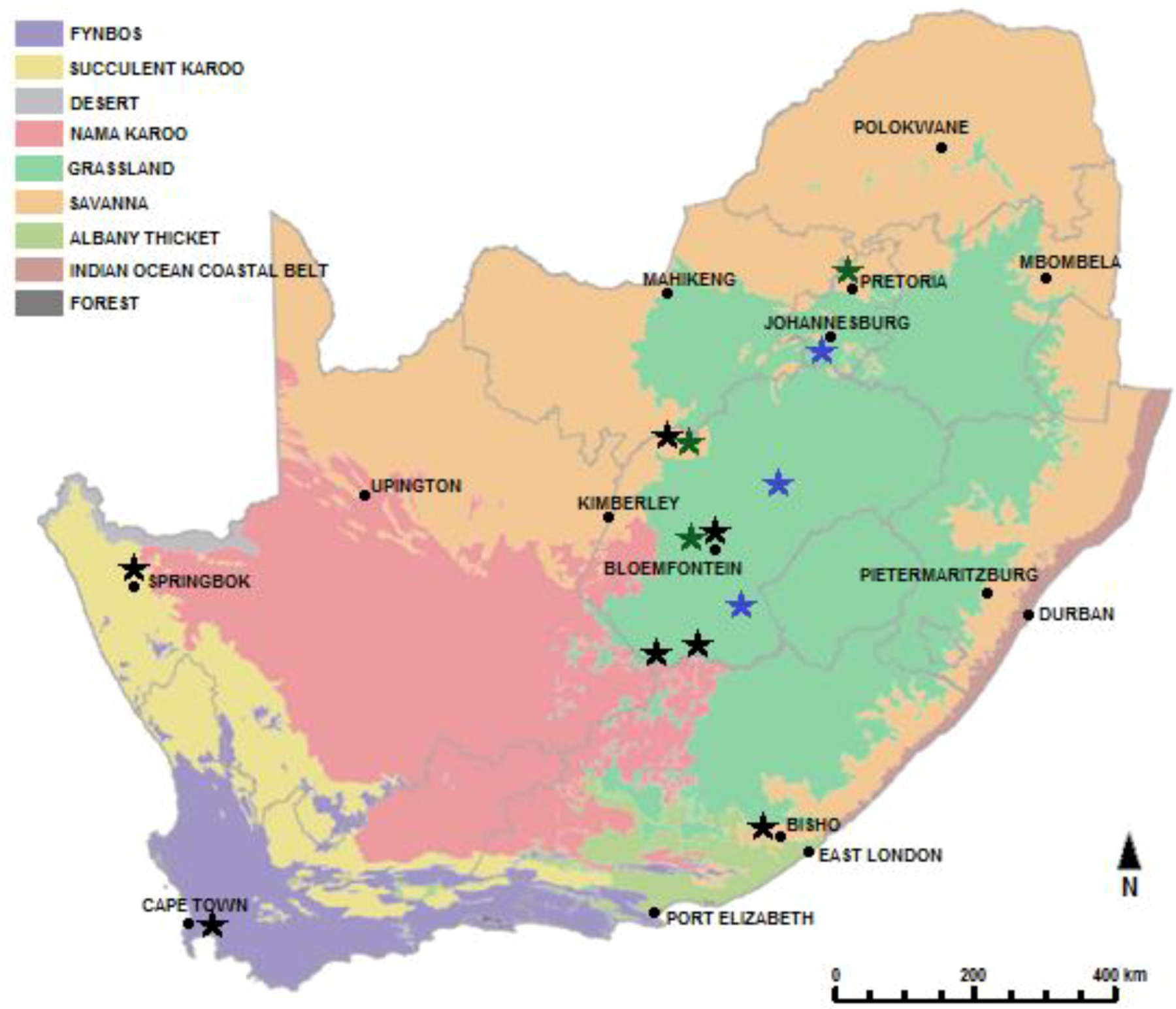
        <p>To contextualize our review, it is necessary to provide information about the ecology and general biology of our study model. <italic>Rhabdomys</italic> is a small (±40 g) diurnal, murid rodent, widely distributed across southern Africa [<xref ref-type="bibr" rid="B78-sustainability-05-00163">78</xref>], occurring in many different biomes, including the arid, semi-arid western parts, the south-western Cape fynbos and eastern grassland areas in the hinterland and eastern regions (<xref ref-type="fig" rid="sustainability-05-00163-f001">Figure 1</xref>). Striped mice are opportunistic omnivores and their diet varies geographically, comprising, for example, <italic>Acacia</italic> pods, roots and invertebrates (worms and snails) in the Eastern Cape Province [<xref ref-type="bibr" rid="B79-sustainability-05-00163">79</xref>], succulents (e.g., <italic>Zygophyllum retrofractum</italic>) and <italic>Acacia</italic> seeds, floral parts of newly emergent flowers and insects in the arid Succulent Karoo in the Northern Cape Province [<xref ref-type="bibr" rid="B80-sustainability-05-00163">80</xref>].</p>
        <p>Originally described as monospecific, the genus is now regarded as comprising of at least two separate species: <italic>Rhabdomys pumilio</italic> in the largely western regions and <italic>Rhabdomys dilectus</italic> (with two subspecies <italic>R. d. dilectus</italic> and <italic>R. d. chakae</italic>) in the eastern regions of South Africa [<xref ref-type="bibr" rid="B81-sustainability-05-00163">81</xref>]. A taxonomic revision is currently proposed for <italic>R. pumilio</italic>, which would effectively split this species into three separate species (<italic>R. pumilio</italic>, <italic>R. intermedius</italic> and <italic>R. bechuanae</italic> [<xref ref-type="bibr" rid="B82-sustainability-05-00163">82</xref>]). Our long-term studies on striped mice from the arid Succulent Karoo of South Africa correspond with the currently recognized <italic>R. pumilio</italic> (proposed to remain as <italic>R. pumilio</italic>; <xref ref-type="fig" rid="sustainability-05-00163-f001">Figure 1</xref>), while our studies on striped mice from the grasslands in Gauteng correspond with the currently recognized <italic>R. d. chakae</italic> and <italic>R. d. dilectus</italic>. <italic>R. d. dilectus</italic> occurs primarily in warm, stable grassland/savanna environments, while <italic>R. d. chakae</italic> occurs in colder, more humid environments [<xref ref-type="bibr" rid="B83-sustainability-05-00163">83</xref>] (<xref ref-type="fig" rid="sustainability-05-00163-f001">Figure 1</xref>).</p>
		<fig id="sustainability-05-00163-f001" position="float">
          <label>Figure 1</label>
          <caption>
            <p>Biomes of South Africa (adapted from [<xref ref-type="bibr" rid="B84-sustainability-05-00163">84</xref>]), indicating an influence of a west-east rainfall gradient. Ongoing aridification will cause a spread of drier conditions in an easterly direction. <italic>Rhabdomys</italic> spp. has been recorded from four of the major biomes (Succulent Karoo, Fynbos, Grassland and Savanna). Colored stars indicate the localities of <italic>Rhabdomys</italic> spp. (green = <italic>R. d. dilectus</italic>; blue = <italic>R. d. chakae</italic>; black = <italic>R. pumilio</italic>) that we have selected for study.</p>
          </caption>
          <graphic xmlns:xlink="http://www.w3.org/1999/xlink" xlink:href="sustainability-05-00163-g001.tif"/>
        </fig>
        
        <p>Our field site for studies on <italic>R. pumilio</italic> is located in Goegap Nature Reserve (Northern Cape Province), in the arid Succulent Karoo. The area receives an average of 160 mm of rainfall per year, mainly in the winter months (June–August [<xref ref-type="bibr" rid="B85-sustainability-05-00163">85</xref>]), and is characterized by large, open, sandy areas interspersed with patchily distributed <italic>Zygophyllum retrofractum</italic> bushes and other small succulents, providing striped mice with a stable year-round food supply [<xref ref-type="bibr" rid="B80-sustainability-05-00163">80</xref>]. The eastern grassland and savanna regions, where <italic>R. d. dilectus</italic> and <italic>R. d. chakae</italic> originate experience 700–1,000 mm of summer rainfall [<xref ref-type="bibr" rid="B86-sustainability-05-00163">86</xref>], with a gradual increase in rainfall moving from west to east [<xref ref-type="bibr" rid="B87-sustainability-05-00163">87</xref>]. The vegetation consists primarily of various grass species that provide cover, with few open areas [<xref ref-type="bibr" rid="B88-sustainability-05-00163">88</xref>]. <italic>Rhabdomys</italic> does not eat grass [<xref ref-type="bibr" rid="B79-sustainability-05-00163">79</xref>], so these areas do not offer a stable year round food supply [<xref ref-type="bibr" rid="B89-sustainability-05-00163">89</xref>]. In contrast to <italic>R. dilectus</italic>, which may breed for seven months in a year [<xref ref-type="bibr" rid="B90-sustainability-05-00163">90</xref>], <italic>R. pumilio</italic> has a shorter breeding season of approximately three months (October to December) that coincides with the onset of the spring rains and newly emergent plant growth [<xref ref-type="bibr" rid="B91-sustainability-05-00163">91</xref>].</p>
        <sec>
          <title>Behavior</title>
          <p>The two <italic>Rhabdomys</italic> species differ significantly in several behaviors. <italic>R. pumilio</italic> shows a bolder personality type in captivity than <italic>R. d. chakae</italic>, spending more time investigating novel objects [<xref ref-type="bibr" rid="B92-sustainability-05-00163">92</xref>] and showing lower levels of anxiety [<xref ref-type="bibr" rid="B93-sustainability-05-00163">93</xref>]. Both <italic>Rhabdomys</italic> species show paternal care in captivity, but only <italic>R. pumilio</italic> shows paternal care in nature [<xref ref-type="bibr" rid="B94-sustainability-05-00163">94</xref>]. Because these species occur in different habitats and are genetically different, their behavioral differences appear to reflect adaptive variation in response to historical and current environmental constraints, suggesting evolutionary adaptation in response to their environments [<xref ref-type="bibr" rid="B82-sustainability-05-00163">82</xref>,<xref ref-type="bibr" rid="B95-sustainability-05-00163">95</xref>].</p>
        </sec>
        <sec>
          <title>Sociality</title>
          <p><italic>R. pumilio</italic> from the arid Succulent Karoo is typically group-living and nests in <italic>Zygophyllum retrofractum</italic> bushes that are patchily distributed, leading to strong interspecific competition with other small mammals for preferred nesting sites [<xref ref-type="bibr" rid="B96-sustainability-05-00163">96</xref>]. As population density increases, limited availability of free territories forces closely related adult females to breed communally in groups of up to four individuals, joined by one adult breeding male originating from another group [<xref ref-type="bibr" rid="B80-sustainability-05-00163">80</xref>]. Groups can contain up to 30 adult individuals of both sexes, including the breeding adults and non-breeding philopatric adult offspring [<xref ref-type="bibr" rid="B80-sustainability-05-00163">80</xref>]. Living in groups offers advantages, such as huddling (social thermoregulation) to decrease energetic costs [<xref ref-type="bibr" rid="B97-sustainability-05-00163">97</xref>] and successful defense of the communal nest and surrounding territory [<xref ref-type="bibr" rid="B98-sustainability-05-00163">98</xref>]. Dominant territorial males provide paternal care, which helps reduce the maternal workload [<xref ref-type="bibr" rid="B94-sustainability-05-00163">94</xref>] and promotes better growth of the pups [<xref ref-type="bibr" rid="B99-sustainability-05-00163">99</xref>].</p>
          <p>In contrast to <italic>R. pumilio</italic>, both subspecies of <italic>R. dilectus</italic> are solitary [<xref ref-type="bibr" rid="B100-sustainability-05-00163">100</xref>]. Both sexes maintain intrasexually exclusive territories, and males overlap the territories of several females [<xref ref-type="bibr" rid="B101-sustainability-05-00163">101</xref>,<xref ref-type="bibr" rid="B102-sustainability-05-00163">102</xref>]. The home range size of <italic>R. d. chakae</italic> is 6 (females) to 10 (males) times larger than that of <italic>R. pumilio</italic> [<xref ref-type="bibr" rid="B86-sustainability-05-00163">86</xref>]. There are four explanations for solitary living in grassland striped mice [<xref ref-type="bibr" rid="B89-sustainability-05-00163">89</xref>]. (1) Differences in home range reflect food availability and the need to search large distances for food [<xref ref-type="bibr" rid="B80-sustainability-05-00163">80</xref>,<xref ref-type="bibr" rid="B86-sustainability-05-00163">86</xref>]. (2) Lower population densities and thus availability of free territories into which individuals can emigrate to avoid reproductive competition. (3) The period of reproductive competition [<xref ref-type="bibr" rid="B103-sustainability-05-00163">103</xref>] is more than twice as long in <italic>R. dilectus</italic> (7 months [<xref ref-type="bibr" rid="B90-sustainability-05-00163">90</xref>]) than in <italic>R. pumilio</italic> (3 months [<xref ref-type="bibr" rid="B91-sustainability-05-00163">91</xref>]), increasing the benefits of early dispersal. 4) Grass provides a thermal buffer for striped mice in grasslands, such that they do not experience such extreme temperature fluctuations as their desert-dwelling counterparts.</p>
        </sec>
        <sec>
          <title>Social Flexibility in <italic>R. pumilio</italic></title>
          <p>Both male and female <italic>R. pumilio</italic> demonstrate flexibility in their social behavior. Females switch between two alternative reproductive tactics—solitary and communal breeding [<xref ref-type="bibr" rid="B103-sustainability-05-00163">103</xref>], depending on population density and its link to the availability of free territories [<xref ref-type="bibr" rid="B80-sustainability-05-00163">80</xref>]. When population density decreases, largely because of high mortality after the long, dry non-breeding season, high quality territories become available, and females switch to solitary nesting to minimize the costs associated with reproductive competition in the form of female-female aggression [<xref ref-type="bibr" rid="B104-sustainability-05-00163">104</xref>] and the risk of infanticide [<xref ref-type="bibr" rid="B103-sustainability-05-00163">103</xref>]. Females are capable of switching back and forth between reproductive tactics [<xref ref-type="bibr" rid="B103-sustainability-05-00163">103</xref>], maximizing their reproductive success in response to prevailing environmental conditions.</p>
          <p>Female tactics determine male tactics, with males adopting one of three tactics: territorial dominant breeding; solitary roaming; or socially philopatric [<xref ref-type="bibr" rid="B105-sustainability-05-00163">105</xref>]. Territorial breeding males are the largest, heaviest males [<xref ref-type="bibr" rid="B105-sustainability-05-00163">105</xref>], are better at winning territorial encounters [<xref ref-type="bibr" rid="B98-sustainability-05-00163">98</xref>] and can defend a territory and a group of communally breeding females. Roaming breeding males are smaller, solitary and possibly more aggressive, do not cohabit with females and hence do not show paternal care [<xref ref-type="bibr" rid="B105-sustainability-05-00163">105</xref>]. Males adopt this roaming tactic during periods of low population density when females nest alone, in order to capitalize on matings, or if all groups of communally breeding females are defended by larger breeding males. Philopatric males are the smallest and lightest, originating from the litters produced in the previous breeding season [<xref ref-type="bibr" rid="B80-sustainability-05-00163">80</xref>]. They are reproductively suppressed by the dominant male [<xref ref-type="bibr" rid="B106-sustainability-05-00163">106</xref>] and assist group-living females by providing alloparental care [<xref ref-type="bibr" rid="B80-sustainability-05-00163">80</xref>]. Philopatric adult males do not generally reproduce within their natal group, although they may solicit copulations from neighboring non-related females [<xref ref-type="bibr" rid="B107-sustainability-05-00163">107</xref>]. Males follow a single strategy for expressing different tactics that is mediated by hormone levels and, depending on the environment, can be conditional depending on relative body mass or may represent a mixed tactic with equal fitness payoffs [<xref ref-type="bibr" rid="B70-sustainability-05-00163">70</xref>,<xref ref-type="bibr" rid="B71-sustainability-05-00163">71</xref>]. Both males and females can switch between social and solitary tactics reversibly.</p>
          <p><italic>R. pumilio</italic> appears to be resilient to change. The Succulent Karoo is a harsh environment [<xref ref-type="bibr" rid="B80-sustainability-05-00163">80</xref>] with daily fluctuations in temperature, annual fluctuations in rainfall, including periods of severe droughts, and associated significant changes in food availability. However, while these fluctuations may not be predictable in the short-term, they occur with sufficient regularity to allow for an evolutionary adaptation. This has led to the selection of a genotype that can express multiple phenotypes (alternative reproductive tactics) in response to the prevailing environmental conditions (<italic>i.e.</italic>, a broad reaction norm for behavioral flexibility [<xref ref-type="bibr" rid="B70-sustainability-05-00163">70</xref>]). At an individual level, striped mice alter their own reproductive tactics in response to prevailing social and environmental conditions based on a single strategy [<xref ref-type="bibr" rid="B71-sustainability-05-00163">71</xref>]. However, the underlying set of decisions and rules governing the expression of the various tactics may be fixed through selection.</p>
        </sec>
      </sec>
    </sec>
    <sec>
      <title>6. The Value of Social Flexibility for <italic>Rhabdomys</italic></title>
      <p>Social flexibility allows for survival under changing environmental conditions. However, we need to consider how social flexibility operates at the individual and population levels to assess its contribution to survival. At the individual level, switching between social tactics is mediated by the endocrine system [<xref ref-type="bibr" rid="B53-sustainability-05-00163">53</xref>]. Hormones can alter physiological and behavioral responses [<xref ref-type="bibr" rid="B108-sustainability-05-00163">108</xref>], enabling individuals to switch between behavioral phenotypes. These patterns of hormonal secretion are sensitive to changes in environmental conditions. In <italic>R. pumilio</italic>, the three alternative male reproductive tactics are associated with changes in sex steroid hormones, in particular, testosterone, prolactin and corticosterone [<xref ref-type="bibr" rid="B105-sustainability-05-00163">105</xref>,<xref ref-type="bibr" rid="B109-sustainability-05-00163">109</xref>]. Philopatric males that leave their group increase their testosterone levels while at the same time decreasing their corticosterone levels, and philopatrics and roamers males that become paternal territorial breeders additionally increase their prolactin levels [<xref ref-type="bibr" rid="B110-sustainability-05-00163">110</xref>]. However, patterns of hormonal secretion can also be influenced during the early neonatal environment by the mother (<italic>i.e</italic>., maternal effects [<xref ref-type="bibr" rid="B108-sustainability-05-00163">108</xref>]), which influence behavior. In <italic>R. pumilio</italic>, solitary breeding females provide 1½ times more care to their young than paired females, resulting in their sons showing higher levels of paternal care as adults [<xref ref-type="bibr" rid="B111-sustainability-05-00163">111</xref>].</p>
      <p>Although the decision rules for switching tactics are fixed in <italic>R. pumilio</italic>, decisions made at the individual level impact the population through social interactions, which cause changes in conspecific behavior [<xref ref-type="bibr" rid="B70-sustainability-05-00163">70</xref>]. Behavioral interactions, in turn, impact on how the population is organized (e.g., solitary <italic>vs.</italic> group-living), which then impacts individual decision making, resulting in a cyclical process that occurs regardless of the type and intensity of environmental disturbance. Group-living, and its associated energy savings due to huddling, increase <italic>R. pumilio</italic> survival during periods of food shortage (drought), whereas solitary living maximizes individual reproductive success after periods of increased mortality due to high food shortage, such that populations can recover quickly.</p>
      <p>The evolved endocrine mechanisms that facilitate social flexibility will allow <italic>R. pumilio</italic> to respond to changing conditions faster than evolutionary adaptation ([<xref ref-type="bibr" rid="B18-sustainability-05-00163">18</xref>,<xref ref-type="bibr" rid="B70-sustainability-05-00163">70</xref>], <xref ref-type="table" rid="sustainability-05-00163-t001">Table 1</xref>). Moreover, since decisions made by individuals affect and are affected by the social organisation of the population, the spatial and temporal variability of population level effects (e.g., population size, reproductive tactics of some of the opposite sex) regulate decisions made by individuals, which are dynamic and reversible. The underlying strategies themselves are under selection pressure by the fitness consequences of the chosen tactics under the prevailing conditions. Therefore, social flexibility in <italic>R. pumilio</italic> might allow for its survival and persistence in unsustainable environments that experience unpredictable change [<xref ref-type="bibr" rid="B77-sustainability-05-00163">77</xref>].</p>
    </sec>
    <sec>
      <title>7. Social Flexibility in <italic>R. dilectus</italic>?</title>
      <p>Unlike <italic>R. pumilio</italic>, relatively little is known about the level of social flexibility of <italic>R. dilectus</italic> in its natural (moist grassland) habitats, but we have some evidence of behavioral flexibility from our captive studies. Although male <italic>R. dilectus</italic> show paternal care in the laboratory [<xref ref-type="bibr" rid="B94-sustainability-05-00163">94</xref>], the opportunity to show paternal care has not yet been demonstrated in nature, because males do not associate with females post mating. Thus, paternal behavior may be plesiomorphic in the genus and most likely arose in a desert-living ancestor similar to <italic>R. pumilio</italic> [<xref ref-type="bibr" rid="B81-sustainability-05-00163">81</xref>], where paternal care would be adaptive because of the advantages that the father provides for offspring development [<xref ref-type="bibr" rid="B99-sustainability-05-00163">99</xref>]. The occurrence of paternal care in captivity nonetheless suggests that male <italic>R. dilectus</italic> have the potential for displaying this behavior in nature, should conditions become appropriate for its expression (e.g., males remain with females post mating).</p>
      <p><italic>R. dilectus</italic> is more anxious than <italic>R. pumilio</italic> in open spaces, decreasing levels of exploratory behavior and increasing thigmotaxic responses [<xref ref-type="bibr" rid="B93-sustainability-05-00163">93</xref>], thereby displaying a comparatively shy personality. <italic>R. pumilio</italic> is bolder, preferring open spaces [<xref ref-type="bibr" rid="B93-sustainability-05-00163">93</xref>]. These differences between the species are also reflected in responses to novel food, with <italic>R. dilectus</italic> showing a slower response than <italic>R. pumilio</italic> [<xref ref-type="bibr" rid="B92-sustainability-05-00163">92</xref>]. The behavior of both species in open spaces and to novel environments is not fixed, however. We showed in a recent study that exploratory behavior in both species is modified by interspecific cross-fostering (<italic>i.e</italic>., offspring of one species raised by foster parents of the other species [<xref ref-type="bibr" rid="B93-sustainability-05-00163">93</xref>]). Interestingly, fostered striped mice of both species showed levels of exploratory behavior and anxiety intermediate to their biological and foster parents, demonstrating that exploratory behavior is flexible and influenced by an interplay of genetic predisposition and conditions during the early (ontogenetic) environment.</p>
      <p>Our ongoing research into the social behavior of <italic>R. dilectus</italic> has revealed some unexpected findings. Same-sex dyadic encounters comprising unrelated females were largely amicable [<xref ref-type="bibr" rid="B112-sustainability-05-00163">112</xref>] and triads of related females form long-term stable groups [<xref ref-type="bibr" rid="B113-sustainability-05-00163">113</xref>], indicating a level of tolerance contrary to their solitary lifestyles in nature. Thus, <italic>R. dilectus</italic> females might have the potential to form communally breeding groups, regardless of whether or not they are related. Despite these tolerances, there is some indication of reproductive suppression among non-related females housed in close proximity (<italic>i.e</italic>., visual, auditory and olfactory contact, but no physical contact): dominant females increased their reproductive output and subordinates spent more time attending their pups [<xref ref-type="bibr" rid="B114-sustainability-05-00163">114</xref>].</p>
      <p>The distribution of <italic>R. dilectus</italic> covers a vast geographic area in southern Africa, occurring in four different biomes (<xref ref-type="fig" rid="sustainability-05-00163-f001">Figure 1</xref>), yet populations of the two subspecies <italic>R. d. dilectus</italic> and <italic>R. d. chakae</italic> show remarkably similar general activity patterns and exploratory behavior in captivity [<xref ref-type="bibr" rid="B112-sustainability-05-00163">112</xref>], and social organization in nature [<xref ref-type="bibr" rid="B86-sustainability-05-00163">86</xref>,<xref ref-type="bibr" rid="B100-sustainability-05-00163">100</xref>], despite occurring far apart geographically and in areas differing significantly in rainfall. Since the grasslands of South Africa are comparatively stable environments [<xref ref-type="bibr" rid="B83-sustainability-05-00163">83</xref>], it is possible that selection has favored relatively similar genotypes across a wide range of habitats.</p>
      <p>The similarities in behavior in a number of populations of the <italic>R. dilectus</italic> subspecies indicate resilience to change, or stabilizing selection for behaviors that are optimal for striped mice in grasslands. If social flexibility indicates an ability to respond to unpredictable environmental change, the question that then emerges is: can <italic>R. dilectus</italic> display social flexibility? Behavioral flexibility and social tolerance are evident in this taxon but we do not know the extent and limits of this flexibility nor do we have a thorough understanding of the mechanisms underpinning flexibility in this species.</p>
    </sec>
    <sec>
      <title>8. Scenarios for Survival and Persistence of <italic>Rhabdomys</italic> during Impending Aridification in Southern Africa</title>
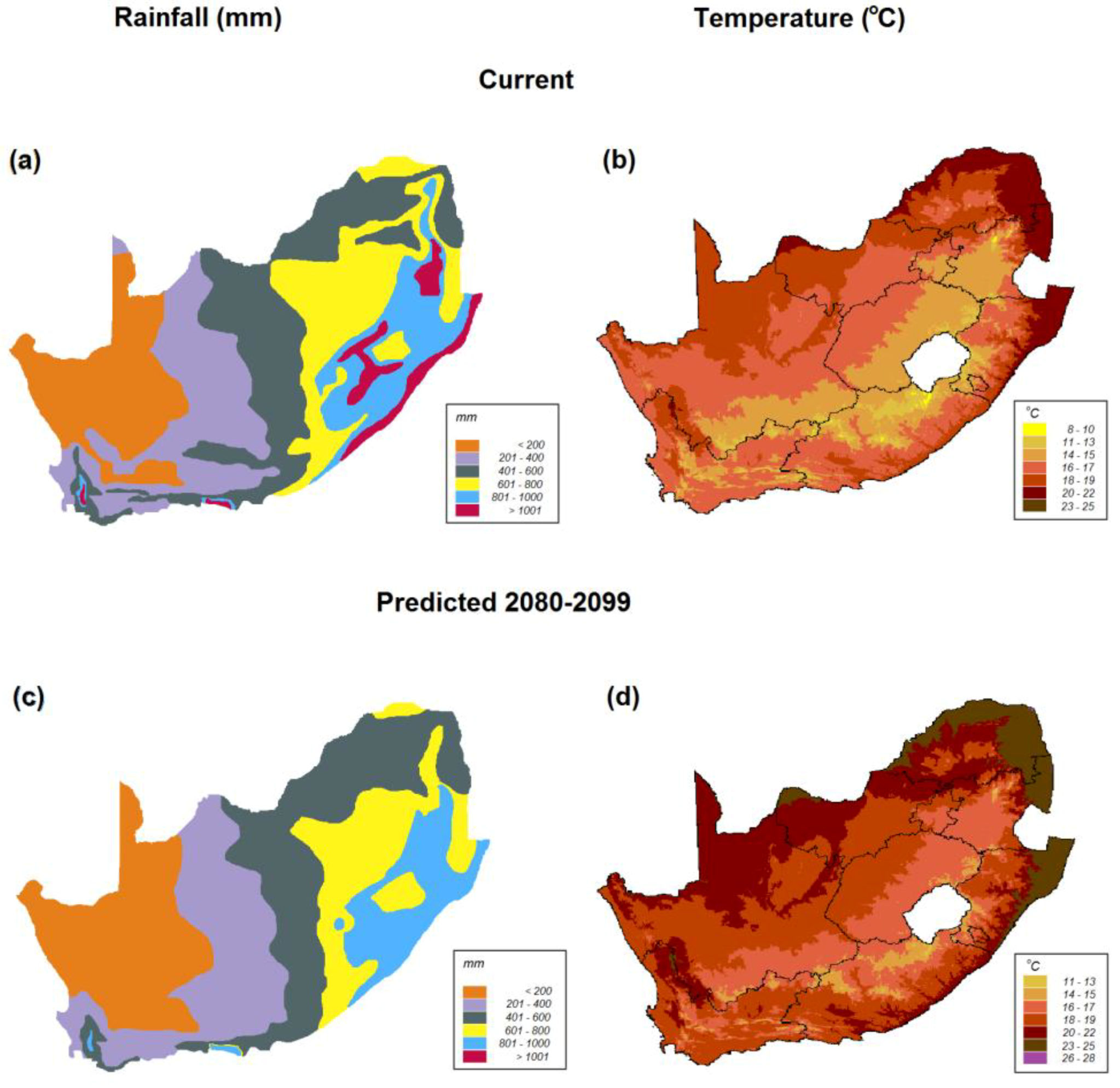
      <p>Southern Africa is predicted to become warmer (increase by at least 4 °C) and drier (decrease in annual precipitation by 10–20%) by the end of the century (<xref ref-type="fig" rid="sustainability-05-00163-f002">Figure 2</xref>), resulting in increased risk of drought [<xref ref-type="bibr" rid="B115-sustainability-05-00163">115</xref>]. Based on our long-term research of <italic>Rhabdomys</italic> spp reviewed above, we provide three scenarios about the persistence of its constituent taxa under predicted environmental change. As the majority of climate change models (e.g., HadAM3H, [<xref ref-type="bibr" rid="B116-sustainability-05-00163">116</xref>]; IPCC A1B, [<xref ref-type="bibr" rid="B115-sustainability-05-00163">115</xref>]; RCM, [<xref ref-type="bibr" rid="B117-sustainability-05-00163">117</xref>]) predict conditions far into the future, we chose to follow a similar convention by using the Africa-specific model from Collier <italic>et al</italic>. [<xref ref-type="bibr" rid="B115-sustainability-05-00163">115</xref>]. Our three scenarios relating to either extinction, range shift or persistence are in accordance with the predicted pace of climate change (modeled at [<xref ref-type="bibr" rid="B118-sustainability-05-00163">118</xref>] using the SRES_A1B emission scenario). These scenarios have heuristic value when viewed separately, but they are not mutually exclusive because there is a strong likelihood that all may occur simultaneously.</p>
      <fig id="sustainability-05-00163-f002" position="float">
        <label>Figure 2</label>
        <caption>
          <p>Mean annual precipitation [<xref ref-type="bibr" rid="B119-sustainability-05-00163">119</xref>] (isohyets, mm) and temperature [<xref ref-type="bibr" rid="B120-sustainability-05-00163">120</xref>] (isotherms, °C) in South Africa currently (<bold>a</bold> and <bold>b</bold>), and as a consequence of predicted changes by 2080–2099 [<xref ref-type="bibr" rid="B115-sustainability-05-00163">115</xref>] resulting in a 20% decrease in mean annual precipitation and 4 °C increase in mean annual temperature (<bold>c</bold> and <bold>d</bold>), leading to increased aridification in an easterly direction.</p>
        </caption>
        <graphic xmlns:xlink="http://www.w3.org/1999/xlink" xlink:href="sustainability-05-00163-g002.tif"/>
      </fig>
      <sec>
        <title>8.1. Scenario 1. R. pumilio Will become Extinct in Its Current Arid Distribution</title>
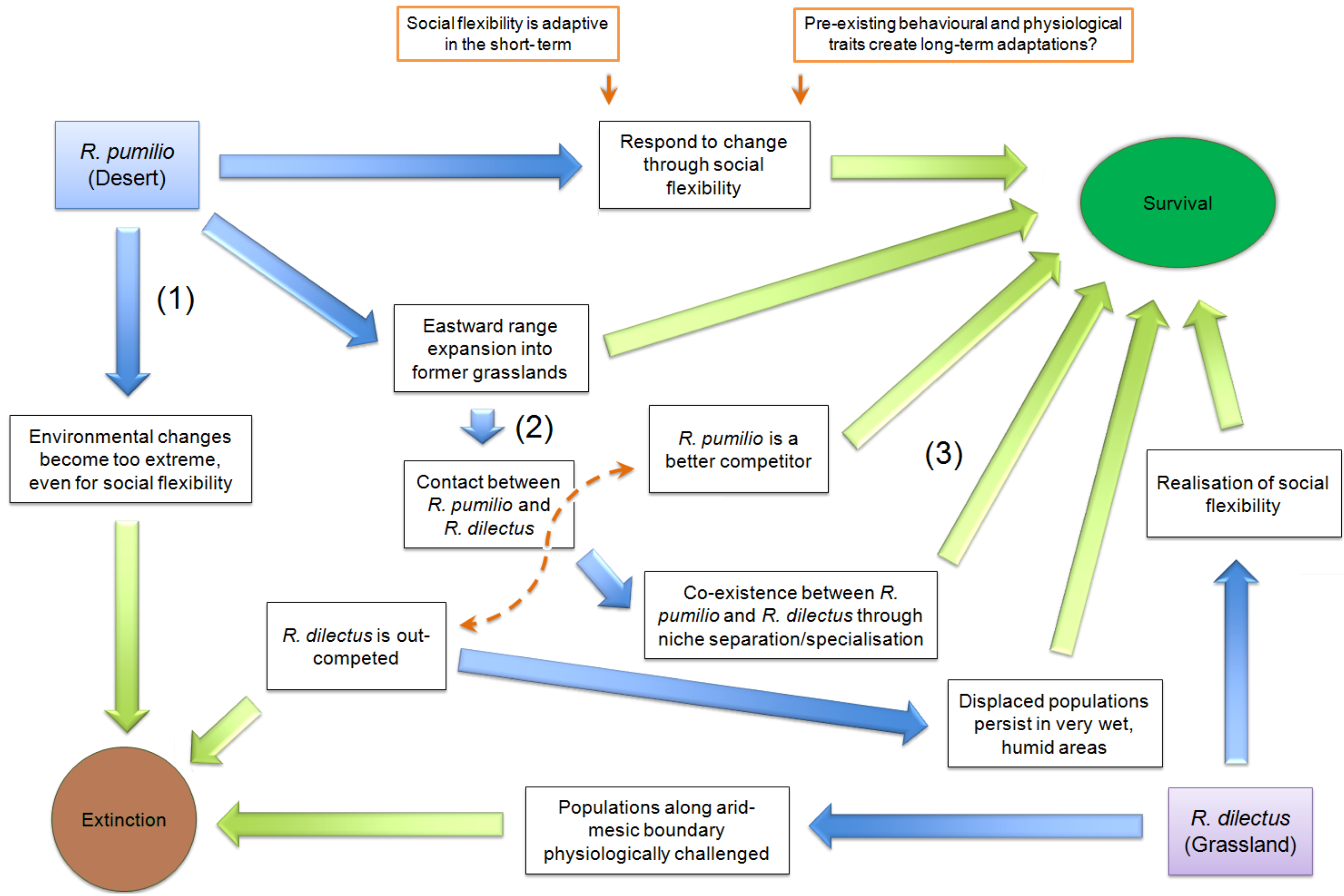
        <p>During an extreme drought event in 2003, no rainfall occurred during the normal rainy season (May–July) and 99% of the striped mice died, bringing the study population close to extinction [<xref ref-type="bibr" rid="B91-sustainability-05-00163">91</xref>]. In addition, Bush Karoo rats <italic>Parotomys unisulcatus</italic> became locally extinct at our 40ha field site [<xref ref-type="bibr" rid="B96-sustainability-05-00163">96</xref>], while whistling rats <italic>P. littledalei</italic> became totally extinct in our study area (Goegap Nature Reserve, 25,000 ha). The drought impacted striped mice in at least three ways. Firstly, predation likely increased, possibly because starvation and loss of body condition impairs physical and cognitive performance [<xref ref-type="bibr" rid="B121-sustainability-05-00163">121</xref>]. Secondly, associated with a lack of food, body condition was poor and striped mice had lower fat reserves, which resulted in very high mortality [<xref ref-type="bibr" rid="B91-sustainability-05-00163">91</xref>], maybe due to freezing to death during cold nights. Thirdly, insufficient food might have caused starvation. If droughts increase in frequency and intensity in the future, there is the possibility of extinction of other small mammal species, including <italic>R. pumilio</italic> (<xref ref-type="fig" rid="sustainability-05-00163-f003">Figure 3</xref>).</p>
        <fig id="sustainability-05-00163-f003" position="float">
          <label>Figure 3</label>
          <caption>
            <p>Potential survival and extinction scenarios for two species of the African striped mouse <italic>Rhabdomys</italic> sp. based on predicted climate change in South Africa. Both species face the possibility of extinction under extreme conditions (1 and 2) but can survive should one or both utilize their potential for social flexibility or range shift (2 and 3).</p>
          </caption>
          <graphic xmlns:xlink="http://www.w3.org/1999/xlink" xlink:href="sustainability-05-00163-g003.tif"/>
        </fig>
        <p>The arid Succulent Karoo habitat of <italic>R. pumilio</italic> receives the majority of its annual rain in winter, following which <italic>R. pumilio</italic> loses approximately 12% of its body mass during the hot, dry summer [<xref ref-type="bibr" rid="B99-sustainability-05-00163">99</xref>]. Increased temperatures in summer would likely result in increased mortality in <italic>R. pumilio</italic>, because food resources would become limited due to decreased water availability, leading to starvation. Decreased length of the rainy season would also influence newly emergent spring plant growth, which <italic>R. pumilio</italic> requires to recover its body weight and to meet the energy demands of lactation. Although <italic>R. pumilio</italic> is reliant on the onset of the spring rains to initiate breeding, they can delay breeding until new plant growth occurs and can then respond quickly to initiate reproduction [<xref ref-type="bibr" rid="B91-sustainability-05-00163">91</xref>]. However, if the rains are delayed for extended periods, <italic>R. pumilio</italic> might be unable to recover enough lost body mass to initiate breeding, resulting in population decline and possibly local extinction (<xref ref-type="fig" rid="sustainability-05-00163-f003">Figure 3</xref>). Similarly, the Western Cape is also predicted to become drier, which, together with increased air temperatures particularly in summer, is likely to result in increased plant water stress [<xref ref-type="bibr" rid="B122-sustainability-05-00163">122</xref>]. Eighteen percent of fynbos species are predicted to become extinct and 42% are predicted to show range reductions [<xref ref-type="bibr" rid="B122-sustainability-05-00163">122</xref>]. Drier conditions could influence newly emergent spring plant growth, as seen in the Succulent Karoo, which could also cause delayed reproduction in striped mice in the Cape region. Thus, while social flexibility and alternative social and reproductive tactics provide <italic>R. pumilio</italic> with an adaptation to change, should these changes become too extreme, individuals (and possibly populations) of this species are unlikely to survive.</p>
      </sec>
      <sec>
        <title>8.2. Scenario 2. R. pumilio Will Displace R. dilectus in the East of Southern Africa</title>
        <p>Since phenotypes have the potential to respond to change without a corresponding change in the genotype, social flexibility may enable survival and persistence until an evolutionary adaptation can occur [<xref ref-type="bibr" rid="B9-sustainability-05-00163">9</xref>]. Therefore, <italic>R. pumilio</italic> might be able to cope with further aridification in the west. In addition, the eastern regions are less likely to experience as intense aridification as the western regions [<xref ref-type="bibr" rid="B123-sustainability-05-00163">123</xref>]. Since <italic>Rhabdomys</italic> apparently originated in the historical arid western open shrubland vegetation of southern Africa, and from there colonized the moist eastern regions secondarily [<xref ref-type="bibr" rid="B83-sustainability-05-00163">83</xref>], we suggest that <italic>R. pumilio</italic> may also respond by shifting its range further east, occupying habitats that will likely become similar to what they currently experience (<xref ref-type="fig" rid="sustainability-05-00163-f003">Figure 3</xref>). The various <italic>Rhabdomys</italic> species are associated with specific vegetation types [<xref ref-type="bibr" rid="B82-sustainability-05-00163">82</xref>,<xref ref-type="bibr" rid="B95-sustainability-05-00163">95</xref>], and general aridification in an easterly direction will have a corresponding impact on the vegetation of the different biomes. Its adaptation to arid habitats, together with its bolder personality type, lower levels of anxiety [<xref ref-type="bibr" rid="B93-sustainability-05-00163">93</xref>] and the socially flexible phenotype [<xref ref-type="bibr" rid="B70-sustainability-05-00163">70</xref>] could result in <italic>R. pumilio</italic> displacing both <italic>R. dilectus</italic> sister taxa, forcing them either into extinction or displacing them into the more northern and eastern parts of South Africa (<xref ref-type="fig" rid="sustainability-05-00163-f003">Figure 3</xref>). Finally, since <italic>R. d. dilectus</italic> occupies the warmer, more stable grasslands, while <italic>R. d. chakae</italic> occupies more humid, cooler environments [<xref ref-type="bibr" rid="B83-sustainability-05-00163">83</xref>], we suggest that <italic>R. d. dilectus</italic> is more likely to persist and displace its sister subspecies, as the general drying trend will limit the niches available for <italic>R. d. chakae.</italic></p>
      </sec>
      <sec>
        <title>8.3. Scenario 3. R. dilectus Is Socially Flexible, Allowing for Continued Survival and Persistence</title>
        <p>Interestingly, in captivity, both <italic>R. dilectus</italic> subspecies display the potential for behavioral flexibility, including developing a bolder personality type [<xref ref-type="bibr" rid="B93-sustainability-05-00163">93</xref>], social tolerance among females [<xref ref-type="bibr" rid="B113-sustainability-05-00163">113</xref>] and males displaying paternal care [<xref ref-type="bibr" rid="B94-sustainability-05-00163">94</xref>]. Moreover, the flexible responses appear to reflect ancestral traits fully developed in the arid-adapted <italic>R. pumilio</italic>, elements of which have been retained in <italic>R. dilectus</italic>. For example, the intermediate levels of exploratory behavior shown by striped mice raised by foster parents of the other species [<xref ref-type="bibr" rid="B93-sustainability-05-00163">93</xref>], indicates that exploratory behavior is flexible and influenced by the early (ontogenetic) environment, and is possibly mediated by activational effects. Whether the taxon can exploit this potential for flexibility under rapidly changing conditions, however, is unknown. Assuming that <italic>R. dilectus</italic> survives through displaying behavioral flexibility and <italic>R. pumilio</italic> shifts eastwards, the two species could coexist in the mid northern parts of South Africa (<xref ref-type="fig" rid="sustainability-05-00163-f003">Figure 3</xref>) because of niche separation/specialization [<xref ref-type="bibr" rid="B83-sustainability-05-00163">83</xref>].</p>
      </sec>
    </sec>
    <sec sec-type="conclusions">
      <title>9. Conclusions</title>
      <p>Our study organism, <italic>Rhabdomys pumilio,</italic> displays an ability to switch social tactics (<italic>i.e</italic>., social flexibility), which is a form of behavioral flexibility. Behavioral flexibility is an adaptive response that can promote species persistence in the face of unpredictable, unstable and novel environmental change. Such flexibility possibly contributes to the persistence of <italic>R. pumilio</italic> currently in arid habitats and could result in range expansion because of predicted habitat change (aridification) and severe human-induced rapid environmental change in southern Africa. Whether other species of <italic>Rhabdomys</italic> are able to mount a similar response is unknown and will determine their survival or extinction in their current habitats. The extent to which plasticity and flexibility in other traits are important for survival is another important topic to study. We expect that physiologically flexibility, such as acclimatization and reduction of resting metabolic rate, can be important to survive drought periods. Further, organ sizes (e.g., respirometry, digestive) might change significantly, as observed in other species [<xref ref-type="bibr" rid="B9-sustainability-05-00163">9</xref>], and facilitate adaptation to a changing environment. Thus, while social flexibility is very important for striped mice to respond to change, other mechanisms might be additionally at play.</p>
      <p>Behavioral flexibility is costly since it relies on the development and maintenance of neural structures that are involved in learning and memory [<xref ref-type="bibr" rid="B124-sustainability-05-00163">124</xref>] or maintenance of sensory and response pathways involved in inducing a plastic response [<xref ref-type="bibr" rid="B58-sustainability-05-00163">58</xref>]. The ability to display flexibility is thus expected to show evolutionary trade-offs with other fitness-related traits, and the costs of behavioral flexibility might be incurred regardless of whether or not flexibility is expressed [<xref ref-type="bibr" rid="B58-sustainability-05-00163">58</xref>]. However, since phenotypes are likely to change in response to environmental disturbance without a corresponding change in the genotype [<xref ref-type="bibr" rid="B9-sustainability-05-00163">9</xref>], survival and persistence is possible in the short-term, which would overcome the costs associated with demonstrating phenotypic flexibility. In the long-term, specific phenotypic traits could become fixed through evolutionary adaptation, although the role of phenotypic plasticity in evolutionary diversity is generally debated [<xref ref-type="bibr" rid="B4-sustainability-05-00163">4</xref>].</p>
      <p>Several studies address the possibility of species adaptation to global change via evolutionary adaptation (evolutionary rescue [<xref ref-type="bibr" rid="B125-sustainability-05-00163">125</xref>]) and others model the extinction risk for populations [<xref ref-type="bibr" rid="B126-sustainability-05-00163">126</xref>,<xref ref-type="bibr" rid="B127-sustainability-05-00163">127</xref>]. However, how individuals will persist in the face of change is currently unknown. Ultimately, the survival, reproduction and extinction of <italic>populations</italic> and species are dependent on the probability of survival of <italic>individuals</italic>, a topic that has received little, if any, attention. Since the survival of individuals is determined by their ability to adapt and respond to change, there needs to be an understanding of the limits to phenotypic adaptation, such as starvation and reduced physical and cognitive ability, if we are to understand whether populations as a whole can respond to environmental change.</p>
      <p>Using the different species of <italic>Rhabdomys</italic> as models, we outlined here that animal species with phenotypic flexibility, in particular social (behavioral) flexibility, are more likely to survive rapid environmental changes. Although the scenarios presented are specific to our model, we suggest that these could apply to other taxa with distributions encompassing many different environments/biomes. Future studies should investigate whether social flexibility is a toolkit for survival in other species, as well as how the absence of social flexibility could be a constraint for survival under anthropogenic climate change.</p>
    </sec>
    
  </body>
  <back><ack>
      <title>Acknowledgments</title>
      <p>Our research was funded by the Swiss National Science Foundation, the German Science Foundation, the National Research Foundation, South Africa, the Zürcher Hochschulve-rein, the Vontobel-Stiftung, the Holcim-Stiftung, the Claude Leon Harris Foundation, the Julius Klaus-Stiftung, the Schweizer Akademie der Naturwissenschaften, the Ethologische Gesellschaft, the Helene-BieberFonds, the University of the Witwatersrand and the University of Zurich. We thank Luke Duncan for commenting on an earlier version of the manuscript.</p>
    </ack>
    <notes>
      <title>Conflict of Interest</title>
      <p>The authors declare no conflict of interest.</p>
    </notes>
    <ref-list>
      <title>References</title>
      <ref id="B1-sustainability-05-00163">
        <label>1.</label>
        <citation citation-type="journal">
          <person-group person-group-type="author">
            <name>
              <surname>Zidanšek</surname>
              <given-names>A.</given-names>
            </name>
            <name>
              <surname>Blinc</surname>
              <given-names>R.</given-names>
            </name>
            <name>
              <surname>Jeglič</surname>
              <given-names>A.</given-names>
            </name>
            <name>
              <surname>Kabashi</surname>
              <given-names>S.</given-names>
            </name>
            <name>
              <surname>Bekteshi</surname>
              <given-names>S.</given-names>
            </name>
            <name>
              <surname>Šlaus</surname>
              <given-names>I.</given-names>
            </name>
          </person-group>
          <article-title>Climate changes, biofuels and the sustainable future</article-title>
          <source>Int. J. Hydrogen Energ.</source>
          <year>2009</year>
          <volume>34</volume>
          <fpage>6980</fpage>
          <lpage>6983</lpage>
        <pub-id pub-id-type="doi">10.1016/j.ijhydene.2008.11.004</pub-id></citation>
      </ref>
      <ref id="B2-sustainability-05-00163">
        <label>2.</label>
        <citation citation-type="journal">
          <person-group person-group-type="author">
            <name>
              <surname>Hoffmann</surname>
              <given-names>A.A.</given-names>
            </name>
            <name>
              <surname>Sgrò</surname>
              <given-names>C.M.</given-names>
            </name>
          </person-group>
          <article-title>Climate change and evolutionary adaptation</article-title>
          <source>Nature</source>
          <year>2011</year>
          <volume>470</volume>
          <fpage>479</fpage>
          <lpage>485</lpage>
          <pub-id pub-id-type="doi">10.1038/nature09670</pub-id>
        </citation>
      </ref>
      <ref id="B3-sustainability-05-00163">
        <label>3.</label>
        <citation citation-type="journal">
          <person-group person-group-type="author">
            <name>
              <surname>Thackeray</surname>
              <given-names>S.J.</given-names>
            </name>
            <name>
              <surname>Sparks</surname>
              <given-names>T.H.</given-names>
            </name>
            <name>
              <surname>Frederiksen</surname>
              <given-names>M.</given-names>
            </name>
            <name>
              <surname>Burthes</surname>
              <given-names>S.</given-names>
            </name>
            <name>
              <surname>Bacon</surname>
              <given-names>P.J.</given-names>
            </name>
            <name>
              <surname>Bell</surname>
              <given-names>J.R.</given-names>
            </name>
            <name>
              <surname>Botham</surname>
              <given-names>M.C.</given-names>
            </name>
            <name>
              <surname>Brereton</surname>
              <given-names>T.M.</given-names>
            </name>
            <name>
              <surname>Bright</surname>
              <given-names>P.W.</given-names>
            </name>
            <name>
              <surname>Carvalhos</surname>
              <given-names>L.</given-names>
            </name>
            <etal/>
          </person-group>
          <article-title>Trophic level asynchrony in rates of phonological change for marine, freshwater and terrestrial environments</article-title>
          <source>Glob. Change Biol.</source>
          <year>2010</year>
          <volume>16</volume>
          <fpage>3304</fpage>
          <lpage>3313</lpage>
          <pub-id pub-id-type="doi">10.1111/j.1365-2486.2010.02165.x</pub-id>
        </citation>
      </ref>
      <ref id="B4-sustainability-05-00163">
        <label>4.</label>
        <citation citation-type="journal">
          <person-group person-group-type="author">
            <name>
              <surname>West-Eberhard</surname>
              <given-names>M.J.</given-names>
            </name>
          </person-group>
          <article-title>Phenotypic plasticity and the origins of diversity</article-title>
          <source>Annu. Rev. Ecol. Syst.</source>
          <year>1989</year>
          <volume>20</volume>
          <fpage>249</fpage>
          <lpage>278</lpage>
        <pub-id pub-id-type="doi">10.1146/annurev.es.20.110189.001341</pub-id></citation>
      </ref>
      <ref id="B5-sustainability-05-00163">
        <label>5.</label>
        <citation citation-type="journal">
          <person-group person-group-type="author">
            <name>
              <surname>Przybylo</surname>
              <given-names>R.</given-names>
            </name>
            <name>
              <surname>Sheldon</surname>
              <given-names>B.C.</given-names>
            </name>
            <name>
              <surname>Merilä</surname>
              <given-names>J.</given-names>
            </name>
          </person-group>
          <article-title>Climate effects on breeding and morphology: Evidence for phenotypic plasticity</article-title>
          <source>J. Anim. Ecol.</source>
          <year>2000</year>
          <volume>69</volume>
          <fpage>395</fpage>
          <lpage>403</lpage>
          <pub-id pub-id-type="doi">10.1046/j.1365-2656.2000.00401.x</pub-id>
        </citation>
      </ref>
      <ref id="B6-sustainability-05-00163">
        <label>6.</label>
        <citation citation-type="journal">
          <person-group person-group-type="author">
            <name>
              <surname>Chen</surname>
              <given-names>I-C.</given-names>
            </name>
            <name>
              <surname>Hill</surname>
              <given-names>J.K.</given-names>
            </name>
            <name>
              <surname>Ohlemüller</surname>
              <given-names>R.</given-names>
            </name>
            <name>
              <surname>Roy</surname>
              <given-names>D.B.</given-names>
            </name>
            <name>
              <surname>Thomas</surname>
              <given-names>C.D.</given-names>
            </name>
          </person-group>
          <article-title>Rapid range shifts of species associated with high levels of climate warming</article-title>
          <source>Science</source>
          <year>2011</year>
          <volume>333</volume>
          <fpage>1024</fpage>
          <lpage>1026</lpage>
          <pub-id pub-id-type="doi">10.1126/science.1206432</pub-id>
        </citation>
      </ref>
      <ref id="B7-sustainability-05-00163">
        <label>7.</label>
        <citation citation-type="journal">
          <person-group person-group-type="author">
            <name>
              <surname>Huey</surname>
              <given-names>R.B.</given-names>
            </name>
            <name>
              <surname>Hertz</surname>
              <given-names>P.E.</given-names>
            </name>
            <name>
              <surname>Sinervo</surname>
              <given-names>B.</given-names>
            </name>
          </person-group>
          <article-title>Behavioral drive versus behavioral inertia in evolution: A null model approach</article-title>
          <source>Am. Nat.</source>
          <year>2003</year>
          <volume>161</volume>
          <fpage>357</fpage>
          <lpage>366</lpage>
          <pub-id pub-id-type="doi">10.1086/346135</pub-id>
        </citation>
      </ref>
      <ref id="B8-sustainability-05-00163">
        <label>8.</label>
        <citation citation-type="journal">
          <person-group person-group-type="author">
            <name>
              <surname>Sinervo</surname>
              <given-names>B.</given-names>
            </name>
            <name>
              <surname>Losos</surname>
              <given-names>J.B.</given-names>
            </name>
          </person-group>
          <article-title>Walking the tight rope: arboreal sprint performance among <italic>Scleroporus occidentalis</italic> lizard populations</article-title>
          <source>Ecology</source>
          <year>1991</year>
          <volume>72</volume>
          <fpage>1225</fpage>
          <lpage>1233</lpage>
          <pub-id pub-id-type="doi">10.2307/1941096</pub-id>
        </citation>
      </ref>
      <ref id="B9-sustainability-05-00163">
        <label>9.</label>
        <citation citation-type="book">
          <person-group person-group-type="author">
            <name>
              <surname>Piersma</surname>
              <given-names>T.</given-names>
            </name>
            <name>
              <surname>van Gils</surname>
              <given-names>J.A.</given-names>
            </name>
          </person-group>
          <source>The Flexible Phenotype—A Body-Centred Integration of Ecology, Physiology and Behaviour</source>
          <publisher-name>Oxford University Press</publisher-name>
          <publisher-loc>Oxford, UK</publisher-loc>
          <year>2010</year>
        </citation>
      </ref>
      <ref id="B10-sustainability-05-00163">
        <label>10.</label>
        <citation citation-type="journal">
          <person-group person-group-type="author">
            <name>
              <surname>Wilson</surname>
              <given-names>R.S.</given-names>
            </name>
            <name>
              <surname>Franklin</surname>
              <given-names>C.E.</given-names>
            </name>
          </person-group>
          <article-title>Testing the beneficial acclimation hypothesis</article-title>
          <source>Trends Ecol. Evol.</source>
          <year>2002</year>
          <volume>17</volume>
          <fpage>66</fpage>
          <lpage>70</lpage>
          <pub-id pub-id-type="doi">10.1016/S0169-5347(01)02384-9</pub-id>
        </citation>
      </ref>
      <ref id="B11-sustainability-05-00163">
        <label>11.</label>
        <citation citation-type="journal">
          <person-group person-group-type="author">
            <name>
              <surname>Magistretti</surname>
              <given-names>P.J.</given-names>
            </name>
          </person-group>
          <article-title>Neuron-glia metabolic coupling and plasticity</article-title>
          <source>J. Exp. Biol.</source>
          <year>2006</year>
          <volume>209</volume>
          <fpage>2304</fpage>
          <lpage>2311</lpage>
          <pub-id pub-id-type="doi">10.1242/jeb.02208</pub-id>
        </citation>
      </ref>
      <ref id="B12-sustainability-05-00163">
        <label>12.</label>
        <citation citation-type="journal">
          <person-group person-group-type="author">
            <name>
              <surname>Etterson</surname>
              <given-names>J.R.</given-names>
            </name>
            <name>
              <surname>Shaw</surname>
              <given-names>R.G.</given-names>
            </name>
          </person-group>
          <article-title>Constraint to adaptive evolution in response to global warming</article-title>
          <source>Science</source>
          <year>2001</year>
          <volume>294</volume>
          <fpage>151</fpage>
          <lpage>154</lpage>
          <pub-id pub-id-type="doi">10.1126/science.1063656</pub-id>
        </citation>
      </ref>
      <ref id="B13-sustainability-05-00163">
        <label>13.</label>
        <citation citation-type="journal">
          <person-group person-group-type="author">
            <name>
              <surname>Alley</surname>
              <given-names>R.B.</given-names>
            </name>
            <name>
              <surname>Marotzke</surname>
              <given-names>J.</given-names>
            </name>
            <name>
              <surname>Nordhaus</surname>
              <given-names>W.D.</given-names>
            </name>
            <name>
              <surname>Overpeck</surname>
              <given-names>J.T.</given-names>
            </name>
            <name>
              <surname>Peteet</surname>
              <given-names>D.M.</given-names>
            </name>
            <name>
              <surname>Pielke</surname>
              <given-names>R.A.</given-names>
              <suffix>Jr.</suffix>
            </name>
            <name>
              <surname>Pierrehumbert</surname>
              <given-names>R.T.</given-names>
            </name>
            <name>
              <surname>Rhines</surname>
              <given-names>P.B.</given-names>
            </name>
            <name>
              <surname>Stocker</surname>
              <given-names>T.F.</given-names>
            </name>
            <name>
              <surname>Talley</surname>
              <given-names>L.D.</given-names>
            </name>
            <name>
              <surname>Wallace</surname>
              <given-names>J.M.</given-names>
            </name>
          </person-group>
          <article-title>Abrupt climate change</article-title>
          <source>Science</source>
          <year>2003</year>
          <volume>299</volume>
          <fpage>2005</fpage>
          <lpage>2010</lpage>
        <pub-id pub-id-type="doi">10.1126/science.1081056</pub-id><pub-id pub-id-type="pmid">12663908</pub-id></citation>
      </ref>
      <ref id="B14-sustainability-05-00163">
        <label>14.</label>
        <citation citation-type="journal">
          <person-group person-group-type="author">
            <name>
              <surname>Friedlingstein</surname>
              <given-names>P.</given-names>
            </name>
          </person-group>
          <article-title>A steep road to climate stabilization</article-title>
          <source>Nature</source>
          <year>2008</year>
          <volume>451</volume>
          <fpage>297</fpage>
          <lpage>298</lpage>
          <pub-id pub-id-type="doi">10.1038/nature06593</pub-id>
        </citation>
      </ref>
      <ref id="B15-sustainability-05-00163">
        <label>15.</label>
        <citation citation-type="journal">
          <person-group person-group-type="author">
            <name>
              <surname>Sih</surname>
              <given-names>A.</given-names>
            </name>
            <name>
              <surname>Ferrari</surname>
              <given-names>M.C.O.</given-names>
            </name>
            <name>
              <surname>Harris</surname>
              <given-names>D.J.</given-names>
            </name>
          </person-group>
          <article-title>Evolution and behavioural responses to human-induced rapid environmental change</article-title>
          <source>Evol. Appl.</source>
          <year>2011</year>
          <volume>4</volume>
          <fpage>367</fpage>
          <lpage>387</lpage>
          <pub-id pub-id-type="doi">10.1111/j.1752-4571.2010.00166.x</pub-id>
        </citation>
      </ref>
      <ref id="B16-sustainability-05-00163">
        <label>16.</label>
        <citation citation-type="journal">
          <person-group person-group-type="author">
            <name>
              <surname>McLaughlin</surname>
              <given-names>J.F.</given-names>
            </name>
            <name>
              <surname>Hellmann</surname>
              <given-names>J.J.</given-names>
            </name>
            <name>
              <surname>Boggs</surname>
              <given-names>C.L.</given-names>
            </name>
            <name>
              <surname>Ehrlich</surname>
              <given-names>P.R.</given-names>
            </name>
          </person-group>
          <article-title>Climate change hastens population extinctions</article-title>
          <source>Proc. Natl. Acad. Sci. USA</source>
          <year>2002</year>
          <volume>99</volume>
          <fpage>6070</fpage>
          <lpage>6074</lpage>
        <pub-id pub-id-type="doi">10.1073/pnas.052131199</pub-id><pub-id pub-id-type="pmid">11972020</pub-id></citation>
      </ref>
      <ref id="B17-sustainability-05-00163">
        <label>17.</label>
        <citation citation-type="journal">
          <person-group person-group-type="author">
            <name>
              <surname>Pounds</surname>
              <given-names>J.A.</given-names>
            </name>
            <name>
              <surname>Bustamante</surname>
              <given-names>M.R.</given-names>
            </name>
            <name>
              <surname>Coloma</surname>
              <given-names>L.A.</given-names>
            </name>
            <name>
              <surname>Consuegra</surname>
              <given-names>J.A.</given-names>
            </name>
            <name>
              <surname>Fogden</surname>
              <given-names>M.P.L.</given-names>
            </name>
            <name>
              <surname>Foster</surname>
              <given-names>P.N.</given-names>
            </name>
            <name>
              <surname>La Marca</surname>
              <given-names>E.</given-names>
            </name>
            <name>
              <surname>Masters</surname>
              <given-names>K.L.</given-names>
            </name>
            <name>
              <surname>Merino-Viteri</surname>
              <given-names>A.</given-names>
            </name>
            <name>
              <surname>Puschendorf</surname>
              <given-names>R.</given-names>
            </name>
            <etal/>
          </person-group>
          <article-title>Widespread amphibian extinctions from epidemic disease driven by global warming</article-title>
          <source>Nature</source>
          <year>2006</year>
          <volume>439</volume>
          <fpage>161</fpage>
          <lpage>167</lpage>
        <pub-id pub-id-type="doi">10.1038/nature04246</pub-id><pub-id pub-id-type="pmid">16407945</pub-id></citation>
      </ref>
      <ref id="B18-sustainability-05-00163">
        <label>18.</label>
        <citation citation-type="journal">
          <person-group person-group-type="author">
            <name>
              <surname>Rezende</surname>
              <given-names>E.L.</given-names>
            </name>
            <name>
              <surname>Diniz-Filho</surname>
              <given-names>J.A.</given-names>
            </name>
          </person-group>
          <article-title>Phylogenetic analyses: Comparing species to infer adaptations and physiological mechanisms</article-title>
          <source>Compr. Physiol.</source>
          <year>2012</year>
          <volume>2</volume>
          <fpage>639</fpage>
          <lpage>674</lpage>
        </citation>
      </ref>
      <ref id="B19-sustainability-05-00163">
        <label>19.</label>
        <citation citation-type="book">
          <person-group person-group-type="author">
            <name>
              <surname>Schluter</surname>
              <given-names>D.</given-names>
            </name>
          </person-group>
          <source>The Ecology of Adaptive Radiation</source>
          <publisher-name>Oxford University Press</publisher-name>
          <publisher-loc>Oxford, UK</publisher-loc>
          <year>2000</year>
        </citation>
      </ref>
      <ref id="B20-sustainability-05-00163">
        <label>20.</label>
        <citation citation-type="journal">
          <person-group person-group-type="author">
            <name>
              <surname>Balmford</surname>
              <given-names>A.</given-names>
            </name>
            <name>
              <surname>Thomas</surname>
              <given-names>A.L.R.</given-names>
            </name>
            <name>
              <surname>Jones</surname>
              <given-names>I.L.</given-names>
            </name>
          </person-group>
          <article-title>Aerodynamics and the evolution of long tails in birds</article-title>
          <source>Nature</source>
          <year>1993</year>
          <volume>361</volume>
          <fpage>628</fpage>
          <lpage>631</lpage>
          <pub-id pub-id-type="doi">10.1038/361628a0</pub-id>
        </citation>
      </ref>
      <ref id="B21-sustainability-05-00163">
        <label>21.</label>
        <citation citation-type="journal">
          <person-group person-group-type="author">
            <name>
              <surname>Garland</surname>
              <given-names>T.Jnr.</given-names>
            </name>
            <name>
              <surname>Carter</surname>
              <given-names>P.A.</given-names>
            </name>
          </person-group>
          <article-title>Evolutionary Physiology</article-title>
          <source>Annu. Rev. Physiol.</source>
          <year>1994</year>
          <volume>56</volume>
          <fpage>579</fpage>
          <lpage>621</lpage>
          <pub-id pub-id-type="doi">10.1146/annurev.ph.56.030194.003051</pub-id>
        </citation>
      </ref>
      <ref id="B22-sustainability-05-00163">
        <label>22.</label>
        <citation citation-type="book">
          <person-group person-group-type="author">
            <name>
              <surname>Huntley</surname>
              <given-names>B.</given-names>
            </name>
          </person-group>
          <article-title>The dynamic response of plants to environmental change and the resulting risks of extinction</article-title>
          <source>Conservation in a Changing World</source>
          <person-group person-group-type="editor">
            <name>
              <surname>Mace</surname>
              <given-names>G.M.</given-names>
            </name>
            <name>
              <surname>Balmford</surname>
              <given-names>A.</given-names>
            </name>
            <name>
              <surname>Ginsberg</surname>
              <given-names>J.R.</given-names>
            </name>
          </person-group>
          <publisher-name>Cambridge University Press</publisher-name>
          <publisher-loc>Cambridge, UK</publisher-loc>
          <year>1998</year>
          <fpage>69</fpage>
          <lpage>85</lpage>
        </citation>
      </ref>
      <ref id="B23-sustainability-05-00163">
        <label>23.</label>
        <citation citation-type="journal">
          <person-group person-group-type="author">
            <name>
              <surname>Jaeger</surname>
              <given-names>R.G.</given-names>
            </name>
          </person-group>
          <article-title>Potential extinction through competition between two species of terrestrial salamanders</article-title>
          <source>Evolution</source>
          <year>1970</year>
          <volume>24</volume>
          <fpage>632</fpage>
          <lpage>642</lpage>
          <pub-id pub-id-type="doi">10.2307/2406842</pub-id>
        </citation>
      </ref>
      <ref id="B24-sustainability-05-00163">
        <label>24.</label>
        <citation citation-type="journal">
          <person-group person-group-type="author">
            <name>
              <surname>Hendry</surname>
              <given-names>A.P.</given-names>
            </name>
            <name>
              <surname>Farrugia</surname>
              <given-names>T.J.</given-names>
            </name>
            <name>
              <surname>Kinnison</surname>
              <given-names>M.T.</given-names>
            </name>
          </person-group>
          <article-title>Human influences on rates of phenotypic change in wild animal populations</article-title>
          <source>Mol. Ecol.</source>
          <year>2008</year>
          <volume>17</volume>
          <fpage>20</fpage>
          <lpage>29</lpage>
          <pub-id pub-id-type="doi">10.1111/j.1365-294X.2007.03428.x</pub-id>
        </citation>
      </ref>
      <ref id="B25-sustainability-05-00163">
        <label>25.</label>
        <citation citation-type="journal">
          <person-group person-group-type="author">
            <name>
              <surname>Stockwell</surname>
              <given-names>C.A.</given-names>
            </name>
            <name>
              <surname>Hendry</surname>
              <given-names>A.P.</given-names>
            </name>
            <name>
              <surname>Kinnison</surname>
              <given-names>M.T.</given-names>
            </name>
          </person-group>
          <article-title>Contemporary evolution meets conservation biology</article-title>
          <source>Trends Ecol. Evol.</source>
          <year>2003</year>
          <volume>18</volume>
          <fpage>94</fpage>
          <lpage>101</lpage>
          <pub-id pub-id-type="doi">10.1016/S0169-5347(02)00044-7</pub-id>
        </citation>
      </ref>
      <ref id="B26-sustainability-05-00163">
        <label>26.</label>
        <citation citation-type="journal">
          <person-group person-group-type="author">
            <name>
              <surname>McNair</surname>
              <given-names>M.R.</given-names>
            </name>
          </person-group>
          <article-title>Heavy metal tolerance in plants: a model evolutionary system</article-title>
          <source>Trends Ecol. Evol.</source>
          <year>1987</year>
          <volume>2</volume>
          <fpage>354</fpage>
          <lpage>359</lpage>
          <pub-id pub-id-type="doi">10.1016/0169-5347(87)90135-2</pub-id>
        </citation>
      </ref>
      <ref id="B27-sustainability-05-00163">
        <label>27.</label>
        <citation citation-type="journal">
          <person-group person-group-type="author">
            <name>
              <surname>Tabashnik</surname>
              <given-names>B.E.</given-names>
            </name>
          </person-group>
          <article-title>Evolution of resistance to Bacillus thuringiensis</article-title>
          <source>Annu. Rev. Entomol.</source>
          <year>1994</year>
          <volume>39</volume>
          <fpage>47</fpage>
          <lpage>79</lpage>
          <pub-id pub-id-type="doi">10.1146/annurev.en.39.010194.000403</pub-id>
        </citation>
      </ref>
      <ref id="B28-sustainability-05-00163">
        <label>28.</label>
        <citation citation-type="journal">
          <person-group person-group-type="author">
            <name>
              <surname>Piersma</surname>
              <given-names>T.</given-names>
            </name>
            <name>
              <surname>Lindström</surname>
              <given-names>Å.</given-names>
            </name>
          </person-group>
          <article-title>Rapid reversible changes in organ size as a component of adaptive behaviour</article-title>
          <source>Trends Ecol. Evol.</source>
          <year>1997</year>
          <volume>12</volume>
          <fpage>134</fpage>
          <lpage>138</lpage>
          <pub-id pub-id-type="doi">10.1016/S0169-5347(97)01003-3</pub-id>
        </citation>
      </ref>
      <ref id="B29-sustainability-05-00163">
        <label>29.</label>
        <citation citation-type="journal">
          <person-group person-group-type="author">
            <name>
              <surname>Gordon</surname>
              <given-names>D.M.</given-names>
            </name>
          </person-group>
          <article-title>Behavioral flexibility and the foraging ecology of seed-eating ants</article-title>
          <source>Am. Nat.</source>
          <year>1991</year>
          <volume>138</volume>
          <fpage>379</fpage>
          <lpage>411</lpage>
        <pub-id pub-id-type="doi">10.1086/285223</pub-id></citation>
      </ref>
      <ref id="B30-sustainability-05-00163">
        <label>30.</label>
        <citation citation-type="journal">
          <person-group person-group-type="author">
            <name>
              <surname>Stearns</surname>
              <given-names>S.C.</given-names>
            </name>
          </person-group>
          <article-title>The evolutionary significance of phenotypic plasticity</article-title>
          <source>Bioscience</source>
          <year>1989</year>
          <volume>39</volume>
          <fpage>436</fpage>
          <lpage>445</lpage>
          <pub-id pub-id-type="doi">10.2307/1311135</pub-id>
        </citation>
      </ref>
      <ref id="B31-sustainability-05-00163">
        <label>31.</label>
        <citation citation-type="journal">
          <person-group person-group-type="author">
            <name>
              <surname>Scheiner</surname>
              <given-names>S.M.</given-names>
            </name>
          </person-group>
          <article-title>Genetics and evolution of phenotypic plasticity</article-title>
          <source>Annu. Rev. Ecol. Syst.</source>
          <year>1993</year>
          <volume>24</volume>
          <fpage>35</fpage>
          <lpage>68</lpage>
        <pub-id pub-id-type="doi">10.1146/annurev.es.24.110193.000343</pub-id></citation>
      </ref>
      <ref id="B32-sustainability-05-00163">
        <label>32.</label>
        <citation citation-type="journal">
          <person-group person-group-type="author">
            <name>
              <surname>Leichty</surname>
              <given-names>A.R.</given-names>
            </name>
            <name>
              <surname>Pfennig</surname>
              <given-names>D.W.</given-names>
            </name>
            <name>
              <surname>Jones</surname>
              <given-names>C.D.</given-names>
            </name>
            <name>
              <surname>Pfennig</surname>
              <given-names>K.S.</given-names>
            </name>
          </person-group>
          <article-title>Relaxed genetic constraint is ancestral to the evolution of phenotypic plasticity</article-title>
          <source>Integr. Comp. Biol.</source>
          <year>2012</year>
          <volume>52</volume>
          <fpage>16</fpage>
          <lpage>30</lpage>
          <pub-id pub-id-type="doi">10.1093/icb/ics049</pub-id>
        </citation>
      </ref>
      <ref id="B33-sustainability-05-00163">
        <label>33.</label>
        <citation citation-type="journal">
          <person-group person-group-type="author">
            <name>
              <surname>Via</surname>
              <given-names>S.</given-names>
            </name>
            <name>
              <surname>Gomulkiewicz</surname>
              <given-names>R.</given-names>
            </name>
            <name>
              <surname>De Jong</surname>
              <given-names>G.</given-names>
            </name>
            <name>
              <surname>Scheiner</surname>
              <given-names>S.M.</given-names>
            </name>
            <name>
              <surname>Schlichting</surname>
              <given-names>C.D.</given-names>
            </name>
            <name>
              <surname>van Tienderen</surname>
              <given-names>P.H.</given-names>
            </name>
          </person-group>
          <article-title>Adaptive phenotypic plasticity: consensus and controversy</article-title>
          <source>Trends Ecol. Evol.</source>
          <year>1995</year>
          <volume>10</volume>
          <fpage>212</fpage>
          <lpage>217</lpage>
          <pub-id pub-id-type="doi">10.1016/S0169-5347(00)89061-8</pub-id>
        </citation>
      </ref>
      <ref id="B34-sustainability-05-00163">
        <label>34.</label>
        <citation citation-type="journal">
          <person-group person-group-type="author">
            <name>
              <surname>Ledón-Rettig</surname>
              <given-names>C.C.</given-names>
            </name>
            <name>
              <surname>Pfennig</surname>
              <given-names>D.W.</given-names>
            </name>
            <name>
              <surname>Nasconde-Yoder</surname>
              <given-names>N.</given-names>
            </name>
          </person-group>
          <article-title>Ancestral variation and the potential for genetic accommodation in larval amphibians: Implications for the evolution of novel feeding strategies</article-title>
          <source>Evol. Dev.</source>
          <year>2008</year>
          <volume>10</volume>
          <fpage>316</fpage>
          <lpage>325</lpage>
          <pub-id pub-id-type="doi">10.1111/j.1525-142X.2008.00240.x</pub-id>
        </citation>
      </ref>
      <ref id="B35-sustainability-05-00163">
        <label>35.</label>
        <citation citation-type="journal">
          <person-group person-group-type="author">
            <name>
              <surname>Rose</surname>
              <given-names>A.</given-names>
            </name>
          </person-group>
          <article-title>Defining and measuring economic resilience to disasters</article-title>
          <source>Dis. Prev. Manage.</source>
          <year>2004</year>
          <volume>13</volume>
          <fpage>307</fpage>
          <lpage>314</lpage>
        <pub-id pub-id-type="doi">10.1108/09653560410556528</pub-id></citation>
      </ref>
      <ref id="B36-sustainability-05-00163">
        <label>36.</label>
        <citation citation-type="journal">
          <person-group person-group-type="author">
            <name>
              <surname>Potts</surname>
              <given-names>R.</given-names>
            </name>
          </person-group>
          <article-title>Variability selection in hominid evolution</article-title>
          <source>Evol. Anthropol.</source>
          <year>1998</year>
          <volume>7</volume>
          <fpage>81</fpage>
          <lpage>96</lpage>
          <pub-id pub-id-type="doi">10.1002/(SICI)1520-6505(1998)7:3&lt;81::AID-EVAN3&gt;3.0.CO;2-A</pub-id>
        </citation>
      </ref>
      <ref id="B37-sustainability-05-00163">
        <label>37.</label>
        <citation citation-type="journal">
          <person-group person-group-type="author">
            <name>
              <surname>Páez</surname>
              <given-names>D.J.</given-names>
            </name>
            <name>
              <surname>Bernatchez</surname>
              <given-names>L.</given-names>
            </name>
            <name>
              <surname>Dodson</surname>
              <given-names>J.J.</given-names>
            </name>
          </person-group>
          <article-title>Alternative life histories in the Atlantic salmon: Genetic covariances within the sneaker sexual tactic in males</article-title>
          <source>Proc. Roy. Soc. (London) B</source>
          <year>2011</year>
          <volume>278</volume>
          <fpage>2150</fpage>
          <lpage>2158</lpage>
          <pub-id pub-id-type="doi">10.1098/rspb.2010.2045</pub-id>
        </citation>
      </ref>
      <ref id="B38-sustainability-05-00163">
        <label>38.</label>
        <citation citation-type="journal">
          <person-group person-group-type="author">
            <name>
              <surname>Colwell</surname>
              <given-names>R.K.</given-names>
            </name>
          </person-group>
          <article-title>Predictability, constancy, and contingency of periodic phenomena</article-title>
          <source>Ecology</source>
          <year>1974</year>
          <volume>55</volume>
          <fpage>1148</fpage>
          <lpage>1153</lpage>
          <pub-id pub-id-type="doi">10.2307/1940366</pub-id>
        </citation>
      </ref>
      <ref id="B39-sustainability-05-00163">
        <label>39.</label>
        <citation citation-type="journal">
          <person-group person-group-type="author">
            <name>
              <surname>Zonneveld</surname>
              <given-names>I.S.</given-names>
            </name>
          </person-group>
          <article-title>The land unit—A fundamental concept in landscape ecology, and its applications</article-title>
          <source>Landscape Ecol.</source>
          <year>1989</year>
          <volume>3</volume>
          <fpage>67</fpage>
          <lpage>86</lpage>
          <pub-id pub-id-type="doi">10.1007/BF00131171</pub-id>
        </citation>
      </ref>
      <ref id="B40-sustainability-05-00163">
        <label>40.</label>
        <citation citation-type="book">
          <person-group person-group-type="author">
            <name>
              <surname>Wiens</surname>
              <given-names>J.A.</given-names>
            </name>
          </person-group>
          <article-title>Chapter 2: Ecological heterogeneity: an ontogeny of concepts and approaches</article-title>
          <source>The Ecological Consequences of Heterogeneity</source>
          <person-group person-group-type="editor">
            <name>
              <surname>Hutchings</surname>
              <given-names>M.J.</given-names>
            </name>
            <name>
              <surname>John</surname>
              <given-names>E.A.</given-names>
            </name>
            <name>
              <surname>Stewart</surname>
              <given-names>A.J.A.</given-names>
            </name>
          </person-group>
          <publisher-name>Blackwell Science</publisher-name>
          <publisher-loc>Oxford, UK</publisher-loc>
          <year>2000</year>
          <fpage>9</fpage>
          <lpage>31</lpage>
        </citation>
      </ref>
      <ref id="B41-sustainability-05-00163">
        <label>41.</label>
        <citation citation-type="journal">
          <person-group person-group-type="author">
            <name>
              <surname>Chapin</surname>
              <given-names>F.S.</given-names>
              <suffix>III.</suffix>
            </name>
            <name>
              <surname>Torn</surname>
              <given-names>M.S.</given-names>
            </name>
            <name>
              <surname>Tateno</surname>
              <given-names>M.</given-names>
            </name>
          </person-group>
          <article-title>Principles of ecosystem sustainability</article-title>
          <source>Am. Nat.</source>
          <year>1996</year>
          <volume>148</volume>
          <fpage>1016</fpage>
          <lpage>1037</lpage>
        <pub-id pub-id-type="doi">10.1086/285969</pub-id></citation>
      </ref>
      <ref id="B42-sustainability-05-00163">
        <label>42.</label>
        <citation citation-type="journal">
          <person-group person-group-type="author">
            <name>
              <surname>Breed</surname>
              <given-names>M.F.</given-names>
            </name>
            <name>
              <surname>Ottewell</surname>
              <given-names>K.M.</given-names>
            </name>
            <name>
              <surname>Gardner</surname>
              <given-names>M.G.</given-names>
            </name>
            <name>
              <surname>Lowe</surname>
              <given-names>A.J.</given-names>
            </name>
          </person-group>
          <article-title>Clarifying climate change adaptation responses for scattered trees in modified landscapes</article-title>
          <source>J. Appl. Ecol.</source>
          <year>2011</year>
          <volume>48</volume>
          <fpage>637</fpage>
          <lpage>641</lpage>
          <pub-id pub-id-type="doi">10.1111/j.1365-2664.2011.01969.x</pub-id>
        </citation>
      </ref>
      <ref id="B43-sustainability-05-00163">
        <label>43.</label>
        <citation citation-type="journal">
          <person-group person-group-type="author">
            <name>
              <surname>Hau</surname>
              <given-names>M.</given-names>
            </name>
          </person-group>
          <article-title>Regulation of male traits by testosterone: implications for the evolution of vertebrate life histories</article-title>
          <source>BioEssays</source>
          <year>2007</year>
          <volume>29</volume>
          <fpage>133</fpage>
          <lpage>144</lpage>
          <pub-id pub-id-type="doi">10.1002/bies.20524</pub-id>
        </citation>
      </ref>
      <ref id="B44-sustainability-05-00163">
        <label>44.</label>
        <citation citation-type="journal">
          <person-group person-group-type="author">
            <name>
              <surname>Moczek</surname>
              <given-names>A.P.</given-names>
            </name>
            <name>
              <surname>Sultan</surname>
              <given-names>S.</given-names>
            </name>
            <name>
              <surname>Foster</surname>
              <given-names>S.</given-names>
            </name>
            <name>
              <surname>Ledón-Rettig</surname>
              <given-names>C.</given-names>
            </name>
            <name>
              <surname>Dworkin</surname>
              <given-names>I.</given-names>
            </name>
            <name>
              <surname>Nijhout</surname>
              <given-names>H.F.</given-names>
            </name>
            <name>
              <surname>Abouheif</surname>
              <given-names>E.</given-names>
            </name>
            <name>
              <surname>Pfennig</surname>
              <given-names>D.W.</given-names>
            </name>
          </person-group>
          <article-title>The role of developmental plasticity in evolutionary innovation</article-title>
          <source>Proc. Roy. Soc. (London) B</source>
          <year>2011</year>
          <volume>278</volume>
          <fpage>2705</fpage>
          <lpage>2713</lpage>
        <pub-id pub-id-type="doi">10.1098/rspb.2011.0971</pub-id></citation>
      </ref>
      <ref id="B45-sustainability-05-00163">
        <label>45.</label>
        <citation citation-type="journal">
          <person-group person-group-type="author">
            <name>
              <surname>Smith-Gill</surname>
              <given-names>S.J.</given-names>
            </name>
          </person-group>
          <article-title>Developmental plasticity: developmental conversion versus phenotypic modulation</article-title>
          <source>Am. Zool.</source>
          <year>1983</year>
          <volume>23</volume>
          <fpage>47</fpage>
          <lpage>55</lpage>
        </citation>
      </ref>
      <ref id="B46-sustainability-05-00163">
        <label>46.</label>
        <citation citation-type="journal">
          <person-group person-group-type="author">
            <name>
              <surname>West-Eberhard</surname>
              <given-names>M.J.</given-names>
            </name>
          </person-group>
          <article-title>Phenotypic accommodation: adaptive innovation due to developmental plasticity</article-title>
          <source>J. Exp. Zool. B</source>
          <year>2005</year>
          <volume>304</volume>
          <fpage>610</fpage>
          <lpage>618</lpage>
          <pub-id pub-id-type="doi">10.1002/jez.b.21071</pub-id>
        </citation>
      </ref>
      <ref id="B47-sustainability-05-00163">
        <label>47.</label>
        <citation citation-type="journal">
          <person-group person-group-type="author">
            <name>
              <surname>Gienapp</surname>
              <given-names>P.</given-names>
            </name>
            <name>
              <surname>Teplitsky</surname>
              <given-names>C.</given-names>
            </name>
            <name>
              <surname>Alho</surname>
              <given-names>S.</given-names>
            </name>
            <name>
              <surname>Mills</surname>
              <given-names>J.A.</given-names>
            </name>
            <name>
              <surname>Merilä</surname>
              <given-names>J.</given-names>
            </name>
          </person-group>
          <article-title>Climate change and evolution: Disentangling environmental and genetic responses</article-title>
          <source>Mol. Ecol.</source>
          <year>2008</year>
          <volume>17</volume>
          <fpage>167</fpage>
          <lpage>178</lpage>
          <pub-id pub-id-type="doi">10.1111/j.1365-294X.2007.03413.x</pub-id>
        </citation>
      </ref>
      <ref id="B48-sustainability-05-00163">
        <label>48.</label>
        <citation citation-type="journal">
          <person-group person-group-type="author">
            <name>
              <surname>Elekonich</surname>
              <given-names>M.M.</given-names>
            </name>
            <name>
              <surname>Robinson</surname>
              <given-names>G.E.</given-names>
            </name>
          </person-group>
          <article-title>Organizational and activational effects of hormones on insect behavior</article-title>
          <source>J. Insect Physiol.</source>
          <year>2000</year>
          <volume>46</volume>
          <fpage>1509</fpage>
          <lpage>1515</lpage>
          <pub-id pub-id-type="doi">10.1016/S0022-1910(00)00101-3</pub-id>
        </citation>
      </ref>
      <ref id="B49-sustainability-05-00163">
        <label>49.</label>
        <citation citation-type="journal">
          <person-group person-group-type="author">
            <name>
              <surname>Zhou</surname>
              <given-names>H.</given-names>
            </name>
            <name>
              <surname>Wang</surname>
              <given-names>J.</given-names>
            </name>
            <name>
              <surname>Wan</surname>
              <given-names>J.</given-names>
            </name>
            <name>
              <surname>Jia</surname>
              <given-names>H.</given-names>
            </name>
          </person-group>
          <article-title>Resilience to natural hazards: a geographic perspective</article-title>
          <source>Nat. Hazards</source>
          <year>2010</year>
          <volume>53</volume>
          <fpage>21</fpage>
          <lpage>41</lpage>
          <pub-id pub-id-type="doi">10.1007/s11069-009-9407-y</pub-id>
        </citation>
      </ref>
      <ref id="B50-sustainability-05-00163">
        <label>50.</label>
        <citation citation-type="journal">
          <person-group person-group-type="author">
            <name>
              <surname>Champagne</surname>
              <given-names>F.A.</given-names>
            </name>
          </person-group>
          <article-title>Epigenetic influence of social experience across the lifespan</article-title>
          <source>Dev. Psychobiol.</source>
          <year>2010</year>
          <volume>52</volume>
          <fpage>299</fpage>
          <lpage>311</lpage>
          <pub-id pub-id-type="doi">10.1002/dev.20436</pub-id>
        </citation>
      </ref>
      <ref id="B51-sustainability-05-00163">
        <label>51.</label>
        <citation citation-type="journal">
          <person-group person-group-type="author">
            <name>
              <surname>Vasanthi</surname>
              <given-names>D.</given-names>
            </name>
            <name>
              <surname>Mishra</surname>
              <given-names>R.K.</given-names>
            </name>
          </person-group>
          <article-title>Epigenetic regulation of genes during development: A conserved theme from flies to mammals</article-title>
          <source>J. Genet. Genomics</source>
          <year>2008</year>
          <volume>35</volume>
          <fpage>413</fpage>
          <lpage>429</lpage>
          <pub-id pub-id-type="doi">10.1016/S1673-8527(08)60059-4</pub-id>
        </citation>
      </ref>
      <ref id="B52-sustainability-05-00163">
        <label>52.</label>
        <citation citation-type="journal">
          <person-group person-group-type="author">
            <name>
              <surname>Munsky</surname>
              <given-names>B.</given-names>
            </name>
            <name>
              <surname>Neuert</surname>
              <given-names>G.</given-names>
            </name>
            <name>
              <surname>van Oudenaarden</surname>
              <given-names>A.</given-names>
            </name>
          </person-group>
          <article-title>Using gene expression noise to understand gene regulation</article-title>
          <source>Science</source>
          <year>2012</year>
          <volume>336</volume>
          <fpage>183</fpage>
          <lpage>187</lpage>
          <pub-id pub-id-type="doi">10.1126/science.1216379</pub-id>
        </citation>
      </ref>
      <ref id="B53-sustainability-05-00163">
        <label>53.</label>
        <citation citation-type="journal">
          <person-group person-group-type="author">
            <name>
              <surname>Wingfield</surname>
              <given-names>J.C.</given-names>
            </name>
          </person-group>
          <article-title>Control of behavioural strategies for capricious environments</article-title>
          <source>Anim. Behav.</source>
          <year>2003</year>
          <volume>66</volume>
          <fpage>807</fpage>
          <lpage>816</lpage>
          <pub-id pub-id-type="doi">10.1006/anbe.2003.2298</pub-id>
        </citation>
      </ref>
      <ref id="B54-sustainability-05-00163">
        <label>54.</label>
        <citation citation-type="journal">
          <person-group person-group-type="author">
            <name>
              <surname>Diniz-Filho</surname>
              <given-names>J.A.F.</given-names>
            </name>
            <name>
              <surname>Bini</surname>
              <given-names>L.M.</given-names>
            </name>
          </person-group>
          <article-title>Macroecology, global change and the shadow of forgotten ancestors</article-title>
          <source>Global Ecol. Biogeogr.</source>
          <year>2008</year>
          <volume>17</volume>
          <fpage>11</fpage>
          <lpage>17</lpage>
        </citation>
      </ref>
      <ref id="B55-sustainability-05-00163">
        <label>55.</label>
        <citation citation-type="journal">
          <person-group person-group-type="author">
            <name>
              <surname>Poisot</surname>
              <given-names>T.</given-names>
            </name>
            <name>
              <surname>Bever</surname>
              <given-names>J.D.</given-names>
            </name>
            <name>
              <surname>Nemri</surname>
              <given-names>A.</given-names>
            </name>
            <name>
              <surname>Thrall</surname>
              <given-names>P.H.</given-names>
            </name>
            <name>
              <surname>Hochberg</surname>
              <given-names>M.E.</given-names>
            </name>
          </person-group>
          <article-title>A conceptual framework for the evolution of ecological specialisation</article-title>
          <source>Ecol. Lett.</source>
          <year>2011</year>
          <volume>14</volume>
          <fpage>841</fpage>
          <lpage>851</lpage>
          <pub-id pub-id-type="doi">10.1111/j.1461-0248.2011.01645.x</pub-id>
        </citation>
      </ref>
      <ref id="B56-sustainability-05-00163">
        <label>56.</label>
        <citation citation-type="journal">
          <person-group person-group-type="author">
            <name>
              <surname>Rhen</surname>
              <given-names>T.</given-names>
            </name>
            <name>
              <surname>Crews</surname>
              <given-names>D.</given-names>
            </name>
          </person-group>
          <article-title>Variation in reproductive behaviour within a sex: Neural systems and endocrine activation</article-title>
          <source>J. Neuroendocrinol.</source>
          <year>2002</year>
          <volume>14</volume>
          <fpage>517</fpage>
          <lpage>531</lpage>
          <pub-id pub-id-type="doi">10.1046/j.1365-2826.2002.00820.x</pub-id>
        </citation>
      </ref>
      <ref id="B57-sustainability-05-00163">
        <label>57.</label>
        <citation citation-type="journal">
          <person-group person-group-type="author">
            <name>
              <surname>Duckworth</surname>
              <given-names>R.A.</given-names>
            </name>
          </person-group>
          <article-title>The role of behavior in evolution: a search for mechanism</article-title>
          <source>Evol. Ecol.</source>
          <year>2009</year>
          <volume>23</volume>
          <fpage>513</fpage>
          <lpage>531</lpage>
          <pub-id pub-id-type="doi">10.1007/s10682-008-9252-6</pub-id>
        </citation>
      </ref>
      <ref id="B58-sustainability-05-00163">
        <label>58.</label>
        <citation citation-type="journal">
          <person-group person-group-type="author">
            <name>
              <surname>Mery</surname>
              <given-names>F.</given-names>
            </name>
            <name>
              <surname>Burns</surname>
              <given-names>J.G.</given-names>
            </name>
          </person-group>
          <article-title>Behavioural plasticity: an interaction between evolution and experience</article-title>
          <source>Evol. Ecol.</source>
          <year>2010</year>
          <volume>24</volume>
          <fpage>571</fpage>
          <lpage>583</lpage>
          <pub-id pub-id-type="doi">10.1007/s10682-009-9336-y</pub-id>
        </citation>
      </ref>
      <ref id="B59-sustainability-05-00163">
        <label>59.</label>
        <citation citation-type="journal">
          <person-group person-group-type="author">
            <name>
              <surname>Reader</surname>
              <given-names>S.M.</given-names>
            </name>
            <name>
              <surname>Laland</surname>
              <given-names>K.N.</given-names>
            </name>
          </person-group>
          <article-title>Social intelligence, innovation, and enhanced brain size in primates</article-title>
          <source>P. Natl. Acad. Sci. USA</source>
          <year>2002</year>
          <volume>99</volume>
          <fpage>4436</fpage>
          <lpage>4441</lpage>
          <pub-id pub-id-type="doi">10.1073/pnas.062041299</pub-id>
        </citation>
      </ref>
      <ref id="B60-sustainability-05-00163">
        <label>60.</label>
        <citation citation-type="journal">
          <person-group person-group-type="author">
            <name>
              <surname>Sol</surname>
              <given-names>D.</given-names>
            </name>
            <name>
              <surname>Duncan</surname>
              <given-names>R.P.</given-names>
            </name>
            <name>
              <surname>Blackburn</surname>
              <given-names>T.M.</given-names>
            </name>
            <name>
              <surname>Cassey</surname>
              <given-names>P.</given-names>
            </name>
            <name>
              <surname>Lefebvre</surname>
              <given-names>L.</given-names>
            </name>
          </person-group>
          <article-title>Big brains, enhanced cognition, and response of birds to novel environments</article-title>
          <source>P. Natl. Acad. Sci. USA</source>
          <year>2005</year>
          <volume>102</volume>
          <fpage>5460</fpage>
          <lpage>5465</lpage>
        <pub-id pub-id-type="doi">10.1073/pnas.0408145102</pub-id></citation>
      </ref>
      <ref id="B61-sustainability-05-00163">
        <label>61.</label>
        <citation citation-type="journal">
          <person-group person-group-type="author">
            <name>
              <surname>Sol</surname>
              <given-names>D.</given-names>
            </name>
            <name>
              <surname>Timmermans</surname>
              <given-names>S.</given-names>
            </name>
            <name>
              <surname>Lefebvre</surname>
              <given-names>L.</given-names>
            </name>
          </person-group>
          <article-title>Behavioural flexibility and invasion success in birds</article-title>
          <source>Anim. Behav.</source>
          <year>2002</year>
          <volume>63</volume>
          <fpage>495</fpage>
          <lpage>502</lpage>
          <pub-id pub-id-type="doi">10.1006/anbe.2001.1953</pub-id>
        </citation>
      </ref>
      <ref id="B62-sustainability-05-00163">
        <label>62.</label>
        <citation citation-type="book">
          <person-group person-group-type="author">
            <name>
              <surname>Berrigan</surname>
              <given-names>D.</given-names>
            </name>
            <name>
              <surname>Scheiner</surname>
              <given-names>S.M.</given-names>
            </name>
          </person-group>
          <article-title>Modeling the Evolution of Phenotypic Plasticity</article-title>
          <source>Phenotypic Plasticity: Functional and Conceptual Approaches</source>
          <person-group person-group-type="editor">
            <name>
              <surname>DeWitt</surname>
              <given-names>T.J.</given-names>
            </name>
            <name>
              <surname>Scheiner</surname>
              <given-names>S.M.</given-names>
            </name>
          </person-group>
          <publisher-name>Oxford University Press</publisher-name>
          <publisher-loc>Oxford, UK</publisher-loc>
          <year>2004</year>
          <fpage>82</fpage>
          <lpage>97</lpage>
        </citation>
      </ref>
      <ref id="B63-sustainability-05-00163">
        <label>63.</label>
        <citation citation-type="book">
          <person-group person-group-type="author">
            <name>
              <surname>Stearns</surname>
              <given-names>S.C.</given-names>
            </name>
          </person-group>
          <source>The Evolution of Life Histories</source>
          <publisher-name>Oxford University Press</publisher-name>
          <publisher-loc>Oxford, UK</publisher-loc>
          <year>1992</year>
        </citation>
      </ref>
      <ref id="B64-sustainability-05-00163">
        <label>64.</label>
        <citation citation-type="journal">
          <person-group person-group-type="author">
            <name>
              <surname>Relyea</surname>
              <given-names>R.A.</given-names>
            </name>
          </person-group>
          <article-title>The relationship between predation risk and antipredator responses in larval anurans</article-title>
          <source>Ecology</source>
          <year>2001</year>
          <volume>82</volume>
          <fpage>541</fpage>
          <lpage>554</lpage>
          <pub-id pub-id-type="doi">10.1890/0012-9658(2001)082[0541:TRBPRA]2.0.CO;2</pub-id>
        </citation>
      </ref>
      <ref id="B65-sustainability-05-00163">
        <label>65.</label>
        <citation citation-type="journal">
          <person-group person-group-type="author">
            <name>
              <surname>Lucas</surname>
              <given-names>É.</given-names>
            </name>
            <name>
              <surname>Coderre</surname>
              <given-names>D.</given-names>
            </name>
            <name>
              <surname>Brodeur</surname>
              <given-names>J.</given-names>
            </name>
          </person-group>
          <article-title>Intraguild predation among aphid predators: characterization and influence of extraguild prey density</article-title>
          <source>Ecology</source>
          <year>1998</year>
          <volume>79</volume>
          <fpage>1084</fpage>
          <lpage>1092</lpage>
          <pub-id pub-id-type="doi">10.1890/0012-9658(1998)079[1084:IPAAPC]2.0.CO;2</pub-id>
        </citation>
      </ref>
      <ref id="B66-sustainability-05-00163">
        <label>66.</label>
        <citation citation-type="journal">
          <person-group person-group-type="author">
            <name>
              <surname>Bürger</surname>
              <given-names>R.</given-names>
            </name>
            <name>
              <surname>Lynch</surname>
              <given-names>M.</given-names>
            </name>
          </person-group>
          <article-title>Evolution and extinction in a changing environment: A quantitative-genetic analysis</article-title>
          <source>Evolution</source>
          <year>1995</year>
          <volume>49</volume>
          <fpage>151</fpage>
          <lpage>163</lpage>
          <pub-id pub-id-type="doi">10.2307/2410301</pub-id>
        </citation>
      </ref>
      <ref id="B67-sustainability-05-00163">
        <label>67.</label>
        <citation citation-type="journal">
          <person-group person-group-type="author">
            <name>
              <surname>Kinnison</surname>
              <given-names>M.T.</given-names>
            </name>
            <name>
              <surname>Hairston</surname>
              <given-names>N.G.</given-names>
              <suffix>Jnr.</suffix>
            </name>
          </person-group>
          <article-title>Eco-evolutionary conservation biology: Contemporary evolution and the dynamics of persistence</article-title>
          <source>Funct. Ecol.</source>
          <year>2007</year>
          <volume>21</volume>
          <fpage>441</fpage>
          <lpage>454</lpage>
        </citation>
      </ref>
      <ref id="B68-sustainability-05-00163">
        <label>68.</label>
        <citation citation-type="book">
          <person-group person-group-type="author">
            <name>
              <surname>West-Eberhard</surname>
              <given-names>M.J.</given-names>
            </name>
          </person-group>
          <source>Developmental Plasticity and the Origin of Species Differences</source>
          <publisher-name>Oxford University Press</publisher-name>
          <publisher-loc>Oxford, UK</publisher-loc>
          <year>2003</year>
        </citation>
      </ref>
      <ref id="B69-sustainability-05-00163">
        <label>69.</label>
        <citation citation-type="journal">
          <person-group person-group-type="author">
            <name>
              <surname>Sol</surname>
              <given-names>D.</given-names>
            </name>
            <name>
              <surname>Lefebvre</surname>
              <given-names>L.</given-names>
            </name>
            <name>
              <surname>Rodriguez-Teijeiro</surname>
              <given-names>J.D.</given-names>
            </name>
          </person-group>
          <article-title>Brain size, innovative propensity and migratory behaviour in temperate Palearctic birds</article-title>
          <source>Proc. Roy. Soc. (London) B</source>
          <year>2005</year>
          <volume>272</volume>
          <fpage>1433</fpage>
          <lpage>1441</lpage>
          <pub-id pub-id-type="doi">10.1098/rspb.2005.3099</pub-id>
        </citation>
      </ref>
      <ref id="B70-sustainability-05-00163">
        <label>70.</label>
        <citation citation-type="journal">
          <person-group person-group-type="author">
            <name>
              <surname>Schradin</surname>
              <given-names>C.</given-names>
            </name>
            <name>
              <surname>Lindholm</surname>
              <given-names>A.K.</given-names>
            </name>
            <name>
              <surname>Johannesen</surname>
              <given-names>J.</given-names>
            </name>
            <name>
              <surname>Schoepf</surname>
              <given-names>I.</given-names>
            </name>
            <name>
              <surname>Yuen</surname>
              <given-names>C-H.</given-names>
            </name>
            <name>
              <surname>König</surname>
              <given-names>B.</given-names>
            </name>
            <name>
              <surname>Pillay</surname>
              <given-names>N.</given-names>
            </name>
          </person-group>
          <article-title>Social flexibility and social evolution in mammals: a case study of the African striped mouse (Rhabdomys pumilio)</article-title>
          <source>Mol. Ecol.</source>
          <year>2012</year>
          <volume>21</volume>
          <fpage>541</fpage>
          <lpage>553</lpage>
        <pub-id pub-id-type="doi">10.1111/j.1365-294X.2011.05256.x</pub-id><pub-id pub-id-type="pmid">21883591</pub-id></citation>
      </ref>
      <ref id="B71-sustainability-05-00163">
        <label>71.</label>
        <citation citation-type="journal">
          <person-group person-group-type="author">
            <name>
              <surname>Schradin</surname>
              <given-names>C.</given-names>
            </name>
            <name>
              <surname>Lindholm</surname>
              <given-names>A.K.</given-names>
            </name>
          </person-group>
          <article-title>Relative fitness of alternative male reproductive tactics in a mammal varies between years</article-title>
          <source>J. Anim. Ecol.</source>
          <year>2011</year>
          <volume>80</volume>
          <fpage>908</fpage>
          <lpage>917</lpage>
          <pub-id pub-id-type="doi">10.1111/j.1365-2656.2011.01831.x</pub-id>
        </citation>
      </ref>
      <ref id="B72-sustainability-05-00163">
        <label>72.</label>
        <citation citation-type="journal">
          <person-group person-group-type="author">
            <name>
              <surname>Eggert</surname>
              <given-names>A.-K.</given-names>
            </name>
          </person-group>
          <article-title>Alternative male mate-finding tactics in burying beetles</article-title>
          <source>Behav. Ecol.</source>
          <year>1992</year>
          <volume>3</volume>
          <fpage>243</fpage>
          <lpage>254</lpage>
        <pub-id pub-id-type="doi">10.1093/beheco/3.3.243</pub-id></citation>
      </ref>
      <ref id="B73-sustainability-05-00163">
        <label>73.</label>
        <citation citation-type="journal">
          <person-group person-group-type="author">
            <name>
              <surname>Müller</surname>
              <given-names>J.F.</given-names>
            </name>
            <name>
              <surname>Braunisch</surname>
              <given-names>V.</given-names>
            </name>
            <name>
              <surname>Hwang</surname>
              <given-names>W.</given-names>
            </name>
            <name>
              <surname>Eggert</surname>
              <given-names>A.-K.</given-names>
            </name>
          </person-group>
          <article-title>Alternative tactics and individual reproductive success in natural associations of the burying beetle, Nicrophorus vespilloides</article-title>
          <source>Behav. Ecol.</source>
          <year>2006</year>
          <volume>18</volume>
          <fpage>196</fpage>
          <lpage>203</lpage>
          <pub-id pub-id-type="doi">10.1093/beheco/arl073</pub-id>
        </citation>
      </ref>
      <ref id="B74-sustainability-05-00163">
        <label>74.</label>
        <citation citation-type="book">
          <person-group person-group-type="author">
            <name>
              <surname>Davies</surname>
              <given-names>N.B.</given-names>
            </name>
          </person-group>
          <source>Dunnock Behaviour and Social Evolution</source>
          <publisher-name>Oxford University Press</publisher-name>
          <publisher-loc>Oxford, UK</publisher-loc>
          <year>1992</year>
        </citation>
      </ref>
      <ref id="B75-sustainability-05-00163">
        <label>75.</label>
        <citation citation-type="book">
          <person-group person-group-type="author">
            <name>
              <surname>Berry</surname>
              <given-names>R.J.</given-names>
            </name>
            <name>
              <surname>Tattersall</surname>
              <given-names>F.H.</given-names>
            </name>
            <name>
              <surname>Hurst</surname>
              <given-names>J.</given-names>
            </name>
          </person-group>
          <article-title>Genus Mus</article-title>
          <source>Mammals of the British Isles Handbook</source>
          <edition>4th</edition>
          <person-group person-group-type="editor">
            <name>
              <surname>Harris</surname>
              <given-names>S.</given-names>
            </name>
            <name>
              <surname>Yalden</surname>
              <given-names>D.W.</given-names>
            </name>
          </person-group>
          <publisher-name>The Mammal Society</publisher-name>
          <publisher-loc>Southampton, UK</publisher-loc>
          <year>2008</year>
          <fpage>141</fpage>
          <lpage>149</lpage>
        </citation>
      </ref>
      <ref id="B76-sustainability-05-00163">
        <label>76.</label>
        <citation citation-type="journal">
          <person-group person-group-type="author">
            <name>
              <surname>McGuire</surname>
              <given-names>B.</given-names>
            </name>
            <name>
              <surname>Getz</surname>
              <given-names>L.L.</given-names>
            </name>
          </person-group>
          <article-title>The nature and frequency of social interactions among free-living prairie voles (Microtus ochrogaster)</article-title>
          <source>Behav. Ecol. Sociobiol.</source>
          <year>1998</year>
          <volume>43</volume>
          <fpage>271</fpage>
          <lpage>279</lpage>
          <pub-id pub-id-type="doi">10.1007/s002650050491</pub-id>
        </citation>
      </ref>
      <ref id="B77-sustainability-05-00163">
        <label>77.</label>
        <citation citation-type="journal">
          <person-group person-group-type="author">
            <name>
              <surname>Randall</surname>
              <given-names>J.A.</given-names>
            </name>
            <name>
              <surname>Rogovin</surname>
              <given-names>K.</given-names>
            </name>
            <name>
              <surname>Parker</surname>
              <given-names>P.G.</given-names>
            </name>
            <name>
              <surname>Eimes</surname>
              <given-names>J.A.</given-names>
            </name>
          </person-group>
          <article-title>Flexible social structure of a desert rodent, Rhombomys opimus: philopatry, kinship, and ecological constraints</article-title>
          <source>Behav. Ecol.</source>
          <year>2005</year>
          <volume>16</volume>
          <fpage>961</fpage>
          <lpage>973</lpage>
          <pub-id pub-id-type="doi">10.1093/beheco/ari078</pub-id>
        </citation>
      </ref>
      <ref id="B78-sustainability-05-00163">
        <label>78.</label>
        <citation citation-type="book">
          <person-group person-group-type="author">
            <name>
              <surname>Skinner</surname>
              <given-names>J.D.</given-names>
            </name>
            <name>
              <surname>Chimimba</surname>
              <given-names>C.T.</given-names>
            </name>
          </person-group>
          <source>The Mammals of the Southern African Subregion</source>
          <publisher-name>Cambridge University Press</publisher-name>
          <publisher-loc>Cape Town, South Africa</publisher-loc>
          <year>2005</year>
        </citation>
      </ref>
      <ref id="B79-sustainability-05-00163">
        <label>79.</label>
        <citation citation-type="journal">
          <person-group person-group-type="author">
            <name>
              <surname>Perrin</surname>
              <given-names>M.R.</given-names>
            </name>
          </person-group>
          <article-title>The feeding habits of two coexisting rodents, <italic>Rhabdomys pumilio</italic> (Sparrman, 1784) and Otomys irroratus Brants 1827 in relation to rainfall and reproduction</article-title>
          <source>Acta Oecol.</source>
          <year>1980</year>
          <volume>1</volume>
          <fpage>71</fpage>
          <lpage>89</lpage>
        </citation>
      </ref>
      <ref id="B80-sustainability-05-00163">
        <label>80.</label>
        <citation citation-type="journal">
          <person-group person-group-type="author">
            <name>
              <surname>Schradin</surname>
              <given-names>C.</given-names>
            </name>
            <name>
              <surname>Pillay</surname>
              <given-names>N.</given-names>
            </name>
          </person-group>
          <article-title>The striped mouse (<italic>Rhabdomys pumilio</italic>) from the Succulent Karoo, South Africa: A territorial group-living solitary forager with communal breeding and helpers at the nest</article-title>
          <source>J. Comp. Psychol.</source>
          <year>2004</year>
          <volume>118</volume>
          <fpage>37</fpage>
          <lpage>47</lpage>
          <pub-id pub-id-type="doi">10.1037/0735-7036.118.1.37</pub-id>
        </citation>
      </ref>
      <ref id="B81-sustainability-05-00163">
        <label>81.</label>
        <citation citation-type="journal">
          <person-group person-group-type="author">
            <name>
              <surname>Rambau</surname>
              <given-names>R.V.</given-names>
            </name>
            <name>
              <surname>Robinson</surname>
              <given-names>T.J.</given-names>
            </name>
            <name>
              <surname>Stanyon</surname>
              <given-names>R.</given-names>
            </name>
          </person-group>
          <article-title>Molecular genetics of <italic>Rhabdomys pumilio</italic> subspecies boundaries: mtDNA phylogeography and karyotypic analysis by fluorescence <italic>in situ</italic> hybridization</article-title>
          <source>Mol. Phylogenet. Evol.</source>
          <year>2003</year>
          <volume>28</volume>
          <fpage>564</fpage>
          <lpage>575</lpage>
          <pub-id pub-id-type="doi">10.1016/S1055-7903(03)00058-7</pub-id>
        </citation>
      </ref>
      <ref id="B82-sustainability-05-00163">
        <label>82.</label>
        <citation citation-type="journal">
          <person-group person-group-type="author">
            <name>
              <surname>Du Toit</surname>
              <given-names>N.</given-names>
            </name>
            <name>
              <surname>van Vuuren</surname>
              <given-names>B.J.</given-names>
            </name>
            <name>
              <surname>Matthee</surname>
              <given-names>S.</given-names>
            </name>
            <name>
              <surname>Matthee</surname>
              <given-names>C.A.</given-names>
            </name>
          </person-group>
          <article-title>Biome specificity of distinct genetic lineages within the four-striped mouse <italic>Rhabdomys pumilio</italic> (Rodentia: Muridae) from Southern Africa with implications for taxonomy</article-title>
          <source>Mol. Phylogenet. Evol.</source>
          <year>2012</year>
          <volume>65</volume>
          <fpage>75</fpage>
          <lpage>86</lpage>
          <pub-id pub-id-type="doi">10.1016/j.ympev.2012.05.036</pub-id>
        </citation>
      </ref>
      <ref id="B83-sustainability-05-00163">
        <label>83.</label>
        <citation citation-type="journal">
          <person-group person-group-type="author">
            <name>
              <surname>Meynard</surname>
              <given-names>C.N.</given-names>
            </name>
            <name>
              <surname>Pillay</surname>
              <given-names>N.</given-names>
            </name>
            <name>
              <surname>Perrigault</surname>
              <given-names>M.</given-names>
            </name>
            <name>
              <surname>Caminade</surname>
              <given-names>P.</given-names>
            </name>
            <name>
              <surname>Ganem</surname>
              <given-names>G.</given-names>
            </name>
          </person-group>
          <article-title>Evidence of environmental niche differentiation in the striped mouse (<italic>Rhabdomys</italic> sp.): Inference from its current distribution in southern Africa</article-title>
          <source>Ecol. Evol.</source>
          <year>2012</year>
          <volume>2</volume>
          <fpage>1008</fpage>
          <lpage>1023</lpage>
          <pub-id pub-id-type="doi">10.1002/ece3.219</pub-id>
        </citation>
      </ref>
      <ref id="B84-sustainability-05-00163">
        <label>84.</label>
        <citation citation-type="journal">
          <person-group person-group-type="author">
            <name>
              <surname>Mucina</surname>
              <given-names>L.</given-names>
            </name>
            <name>
              <surname>Rutherford</surname>
              <given-names>M.C.</given-names>
            </name>
          </person-group>
          <article-title>The Vegetation of South Africa, Lesotho and Swaziland</article-title>
          <source>Strelitzia</source>
          <year>2006</year>
          <volume>19</volume>
          <fpage>540</fpage>
          <lpage>567</lpage>
        </citation>
      </ref>
      <ref id="B85-sustainability-05-00163">
        <label>85.</label>
        <citation citation-type="journal">
          <person-group person-group-type="author">
            <name>
              <surname>Jackson</surname>
              <given-names>T.P.</given-names>
            </name>
          </person-group>
          <article-title>The social organization and breeding system of Brants’ whistling rat (<italic>Parotomys brantsii</italic>)</article-title>
          <source>J. Zool.</source>
          <year>1999</year>
          <volume>247</volume>
          <fpage>323</fpage>
          <lpage>331</lpage>
          <pub-id pub-id-type="doi">10.1111/j.1469-7998.1999.tb00995.x</pub-id>
        </citation>
      </ref>
      <ref id="B86-sustainability-05-00163">
        <label>86.</label>
        <citation citation-type="journal">
          <person-group person-group-type="author">
            <name>
              <surname>Schradin</surname>
              <given-names>C.</given-names>
            </name>
            <name>
              <surname>Pillay</surname>
              <given-names>N.</given-names>
            </name>
          </person-group>
          <article-title>Intraspecific variation in the spatial and social organization of the African striped mouse</article-title>
          <source>J. Mammal.</source>
          <year>2005</year>
          <volume>86</volume>
          <fpage>99</fpage>
          <lpage>107</lpage>
          <pub-id pub-id-type="doi">10.1644/1545-1542(2005)086&lt;0099:IVITSA&gt;2.0.CO;2</pub-id>
        </citation>
      </ref>
      <ref id="B87-sustainability-05-00163">
        <label>87.</label>
        <citation citation-type="book">
          <person-group person-group-type="author">
            <name>
              <surname>Lynch</surname>
              <given-names>C.D.</given-names>
            </name>
          </person-group>
          <source>The Mammals of the Orange Free State</source>
          <publisher-name>National Museum Bloemfontein</publisher-name>
          <publisher-loc>Bloemfontein, South Africa</publisher-loc>
          <year>1983</year>
        </citation>
      </ref>
      <ref id="B88-sustainability-05-00163">
        <label>88.</label>
        <citation citation-type="journal">
          <person-group person-group-type="author">
            <name>
              <surname>Taylor</surname>
              <given-names>K.D.</given-names>
            </name>
            <name>
              <surname>Green</surname>
              <given-names>M.G.</given-names>
            </name>
          </person-group>
          <article-title>The influence of rainfall on diet and reproduction in four African rodent species</article-title>
          <source>J. Zool.</source>
          <year>1976</year>
          <volume>180</volume>
          <fpage>367</fpage>
          <lpage>389</lpage>
          <pub-id pub-id-type="doi">10.1111/j.1469-7998.1976.tb04683.x</pub-id>
        </citation>
      </ref>
      <ref id="B89-sustainability-05-00163">
        <label>89.</label>
        <citation citation-type="journal">
          <person-group person-group-type="author">
            <name>
              <surname>Schradin</surname>
              <given-names>C.</given-names>
            </name>
          </person-group>
          <article-title>When to live alone and when to live in groups: ecological determinants of sociality in the African striped mouse (<italic>Rhabdomys pumilio</italic>, Sparrman, 1784)</article-title>
          <source>Belg. J. Zool.</source>
          <year>2005</year>
          <volume>135</volume>
          <fpage>77</fpage>
          <lpage>82</lpage>
        </citation>
      </ref>
      <ref id="B90-sustainability-05-00163">
        <label>90.</label>
        <citation citation-type="book">
          <person-group person-group-type="author">
            <name>
              <surname>Willan</surname>
              <given-names>K.</given-names>
            </name>
            <name>
              <surname>Meester</surname>
              <given-names>J.</given-names>
            </name>
          </person-group>
          <article-title>Life-History Styles of Southern African <italic>Mastomys natalensis</italic>, <italic>Otomys irroratus</italic> and <italic>Rhabdomys pumilio</italic> (Mammalia, Rodentia)</article-title>
          <source>Alternative Life-History Styles of Animals</source>
          <person-group person-group-type="editor">
            <name>
              <surname>Bruton</surname>
              <given-names>M.N.</given-names>
            </name>
          </person-group>
          <publisher-name>Kluwer Academic Publishers</publisher-name>
          <publisher-loc>Dordrecht, The Netherlands</publisher-loc>
          <year>1989</year>
          <fpage>421</fpage>
          <lpage>439</lpage>
        </citation>
      </ref>
      <ref id="B91-sustainability-05-00163">
        <label>91.</label>
        <citation citation-type="journal">
          <person-group person-group-type="author">
            <name>
              <surname>Schradin</surname>
              <given-names>C.</given-names>
            </name>
            <name>
              <surname>Schubert</surname>
              <given-names>M.</given-names>
            </name>
            <name>
              <surname>Pillay</surname>
              <given-names>N.</given-names>
            </name>
          </person-group>
          <article-title>Winter huddling groups in the striped mouse</article-title>
          <source>Can. J. Zoolog.</source>
          <year>2006</year>
          <volume>117</volume>
          <fpage>317</fpage>
          <lpage>324</lpage>
        </citation>
      </ref>
      <ref id="B92-sustainability-05-00163">
        <label>92.</label>
        <citation citation-type="journal">
          <person-group person-group-type="author">
            <name>
              <surname>Rymer</surname>
              <given-names>T.</given-names>
            </name>
            <name>
              <surname>Schradin</surname>
              <given-names>C.</given-names>
            </name>
            <name>
              <surname>Pillay</surname>
              <given-names>N.</given-names>
            </name>
          </person-group>
          <article-title>Social transmission of information about novel food in two populations of the African striped mouse, <italic>Rhabdomys pumilio</italic></article-title>
          <source>Anim. Behav.</source>
          <year>2008</year>
          <volume>76</volume>
          <fpage>1297</fpage>
          <lpage>1304</lpage>
          <pub-id pub-id-type="doi">10.1016/j.anbehav.2008.06.014</pub-id>
        </citation>
      </ref>
      <ref id="B93-sustainability-05-00163">
        <label>93.</label>
        <citation citation-type="journal">
          <person-group person-group-type="author">
            <name>
              <surname>Rymer</surname>
              <given-names>T.L.</given-names>
            </name>
            <name>
              <surname>Pillay</surname>
              <given-names>N.</given-names>
            </name>
          </person-group>
          <article-title>The development of exploratory behaviour in the African striped mouse <italic>Rhabdomys</italic> reflects a gene x environment compromise</article-title>
          <source>Behav. Genet.</source>
          <year>2012</year>
          <volume>42</volume>
          <fpage>845</fpage>
          <lpage>856</lpage>
          <pub-id pub-id-type="doi">10.1007/s10519-012-9555-9</pub-id>
        </citation>
      </ref>
      <ref id="B94-sustainability-05-00163">
        <label>94.</label>
        <citation citation-type="journal">
          <person-group person-group-type="author">
            <name>
              <surname>Schradin</surname>
              <given-names>C.</given-names>
            </name>
            <name>
              <surname>Pillay</surname>
              <given-names>N.</given-names>
            </name>
          </person-group>
          <article-title>Paternal care in the social and diurnal striped mouse (<italic>Rhabdomys pumilio</italic>): Laboratory and field evidence</article-title>
          <source>J. Comp. Psychol.</source>
          <year>2003</year>
          <volume>117</volume>
          <fpage>317</fpage>
          <lpage>324</lpage>
          <pub-id pub-id-type="doi">10.1037/0735-7036.117.3.317</pub-id>
        </citation>
      </ref>
      <ref id="B95-sustainability-05-00163">
        <label>95.</label>
        <citation citation-type="journal">
          <person-group person-group-type="author">
            <name>
              <surname>Ganem</surname>
              <given-names>G.</given-names>
            </name>
            <name>
              <surname>Meynard</surname>
              <given-names>C.N.</given-names>
            </name>
            <name>
              <surname>Perigault</surname>
              <given-names>M.</given-names>
            </name>
            <name>
              <surname>Lancaster</surname>
              <given-names>J.</given-names>
            </name>
            <name>
              <surname>Edwards</surname>
              <given-names>S.</given-names>
            </name>
            <name>
              <surname>Caminade</surname>
              <given-names>P.</given-names>
            </name>
            <name>
              <surname>Watson</surname>
              <given-names>J.</given-names>
            </name>
            <name>
              <surname>Pillay</surname>
              <given-names>N.</given-names>
            </name>
          </person-group>
          <article-title>Environmental correlates and co-occurrence of three mitochondrial lineages of striped mice (<italic>Rhabdomys</italic>) in the Free State Province (South Africa)</article-title>
          <source>Acta Oecol.</source>
          <year>2012</year>
          <volume>42</volume>
          <fpage>30</fpage>
          <lpage>40</lpage>
          <pub-id pub-id-type="doi">10.1016/j.actao.2012.01.003</pub-id>
        </citation>
      </ref>
      <ref id="B96-sustainability-05-00163">
        <label>96.</label>
        <citation citation-type="journal">
          <person-group person-group-type="author">
            <name>
              <surname>Schradin</surname>
              <given-names>C.</given-names>
            </name>
          </person-group>
          <article-title>Nest-site competition in two diurnal rodents from the Succulent Karoo of South Africa</article-title>
          <source>J. Mammal.</source>
          <year>2005</year>
          <volume>86</volume>
          <fpage>757</fpage>
          <lpage>762</lpage>
          <pub-id pub-id-type="doi">10.1644/1545-1542(2005)086[0757:NCITDR]2.0.CO;2</pub-id>
        </citation>
      </ref>
      <ref id="B97-sustainability-05-00163">
        <label>97.</label>
        <citation citation-type="journal">
          <person-group person-group-type="author">
            <name>
              <surname>Scantlebury</surname>
              <given-names>M.</given-names>
            </name>
            <name>
              <surname>Bennett</surname>
              <given-names>N.C.</given-names>
            </name>
            <name>
              <surname>Speakman</surname>
              <given-names>J.R.</given-names>
            </name>
            <name>
              <surname>Pillay</surname>
              <given-names>N.</given-names>
            </name>
            <name>
              <surname>Schradin</surname>
              <given-names>C.</given-names>
            </name>
          </person-group>
          <article-title>Huddling in groups leads to daily energy savings in free-living African four-striped grass mice, <italic>Rhabdomys pumilio</italic></article-title>
          <source>Funct. Ecol.</source>
          <year>2006</year>
          <volume>20</volume>
          <fpage>166</fpage>
          <lpage>173</lpage>
          <pub-id pub-id-type="doi">10.1111/j.1365-2435.2006.01074.x</pub-id>
        </citation>
      </ref>
      <ref id="B98-sustainability-05-00163">
        <label>98.</label>
        <citation citation-type="journal">
          <person-group person-group-type="author">
            <name>
              <surname>Schradin</surname>
              <given-names>C.</given-names>
            </name>
          </person-group>
          <article-title>Territorial defense in a group living solitary forager: who, where, against whom?</article-title>
          <source>Beha. Ecol. Sociobiol.</source>
          <year>2004</year>
          <volume>55</volume>
          <fpage>439</fpage>
          <lpage>446</lpage>
          <pub-id pub-id-type="doi">10.1007/s00265-003-0733-x</pub-id>
        </citation>
      </ref>
      <ref id="B99-sustainability-05-00163">
        <label>99.</label>
        <citation citation-type="journal">
          <person-group person-group-type="author">
            <name>
              <surname>Schradin</surname>
              <given-names>C.</given-names>
            </name>
            <name>
              <surname>Pillay</surname>
              <given-names>N.</given-names>
            </name>
          </person-group>
          <article-title>The influence of the father on offspring development in the striped mouse</article-title>
          <source>Behav. Ecol.</source>
          <year>2005</year>
          <volume>16</volume>
          <fpage>450</fpage>
          <lpage>455</lpage>
          <pub-id pub-id-type="doi">10.1093/beheco/ari015</pub-id>
        </citation>
      </ref>
      <ref id="B100-sustainability-05-00163">
        <label>100.</label>
        <citation citation-type="thesis">
          <person-group person-group-type="author">
            <name>
              <surname>Brooks</surname>
              <given-names>P.M.</given-names>
            </name>
          </person-group>
          <article-title>The Ecology of the Four-Striped Field Mouse, <italic>Rhabdomys pumilio</italic> (Sparrman, 1784), with Particular Reference to a Population on the Van Riebeeck Nature Reserve, Pretoria</article-title>
          <source>PhD dissertation</source>
          <publisher-name>University of Pretoria</publisher-name>
          <publisher-loc>South Africa</publisher-loc>
          <year>1974</year>
        </citation>
      </ref>
      <ref id="B101-sustainability-05-00163">
        <label>101.</label>
        <citation citation-type="journal">
          <person-group person-group-type="author">
            <name>
              <surname>Brooks</surname>
              <given-names>P.M.</given-names>
            </name>
          </person-group>
          <article-title>Aspects of the reproduction, growth and development of the four-striped mouse, <italic>Rhabdomys pumilio</italic> (Sparrman, 1784)</article-title>
          <source>Mammalia</source>
          <year>1982</year>
          <volume>46</volume>
          <fpage>53</fpage>
          <lpage>64</lpage>
        </citation>
      </ref>
      <ref id="B102-sustainability-05-00163">
        <label>102.</label>
        <citation citation-type="journal">
          <person-group person-group-type="author">
            <name>
              <surname>Schradin</surname>
              <given-names>C.</given-names>
            </name>
            <name>
              <surname>Pillay</surname>
              <given-names>N.</given-names>
            </name>
          </person-group>
          <article-title>Demography of the striped mouse (<italic>Rhabdomys pumilio</italic>) in the Succulent Karoo</article-title>
          <source>Mamm. Biol.</source>
          <year>2005</year>
          <volume>70</volume>
          <fpage>84</fpage>
          <lpage>92</lpage>
          <pub-id pub-id-type="doi">10.1016/j.mambio.2004.06.004</pub-id>
        </citation>
      </ref>
      <ref id="B103-sustainability-05-00163">
        <label>103.</label>
        <citation citation-type="journal">
          <person-group person-group-type="author">
            <name>
              <surname>Schradin</surname>
              <given-names>C.</given-names>
            </name>
            <name>
              <surname>König</surname>
              <given-names>B.</given-names>
            </name>
            <name>
              <surname>Pillay</surname>
              <given-names>N.</given-names>
            </name>
          </person-group>
          <article-title>Reproductive competition favours solitary living while ecological constraints impose group-living in African striped mice</article-title>
          <source>J. Anim. Ecol.</source>
          <year>2010</year>
          <volume>79</volume>
          <fpage>515</fpage>
          <lpage>521</lpage>
          <pub-id pub-id-type="doi">10.1111/j.1365-2656.2009.01651.x</pub-id>
        </citation>
      </ref>
      <ref id="B104-sustainability-05-00163">
        <label>104.</label>
        <citation citation-type="journal">
          <person-group person-group-type="author">
            <name>
              <surname>Schubert</surname>
              <given-names>M.</given-names>
            </name>
            <name>
              <surname>Pillay</surname>
              <given-names>N.</given-names>
            </name>
            <name>
              <surname>Schradin</surname>
              <given-names>C.</given-names>
            </name>
          </person-group>
          <article-title>Parental and alloparental care in a polygynous mammal</article-title>
          <source>J. Mammal.</source>
          <year>2009</year>
          <volume>90</volume>
          <fpage>724</fpage>
          <lpage>731</lpage>
          <pub-id pub-id-type="doi">10.1644/08-MAMM-A-175R1.1</pub-id>
        </citation>
      </ref>
      <ref id="B105-sustainability-05-00163">
        <label>105.</label>
        <citation citation-type="journal">
          <person-group person-group-type="author">
            <name>
              <surname>Schradin</surname>
              <given-names>C.</given-names>
            </name>
            <name>
              <surname>Scantlebury</surname>
              <given-names>M.</given-names>
            </name>
            <name>
              <surname>Pillay</surname>
              <given-names>N.</given-names>
            </name>
            <name>
              <surname>König</surname>
              <given-names>B.</given-names>
            </name>
          </person-group>
          <article-title>Testosterone levels in dominant sociable males are lower than in solitary roamers: Physiological differences between three male reproductive tactics in a socially flexible mammal</article-title>
          <source>Am. Nat.</source>
          <year>2009</year>
          <volume>173</volume>
          <fpage>376</fpage>
          <lpage>388</lpage>
          <pub-id pub-id-type="doi">10.1086/596535</pub-id>
        </citation>
      </ref>
      <ref id="B106-sustainability-05-00163">
        <label>106.</label>
        <citation citation-type="journal">
          <person-group person-group-type="author">
            <name>
              <surname>Schradin</surname>
              <given-names>C.</given-names>
            </name>
            <name>
              <surname>Schneider</surname>
              <given-names>C.</given-names>
            </name>
            <name>
              <surname>Yuen</surname>
              <given-names>C.H.</given-names>
            </name>
          </person-group>
          <article-title>Age at puberty in male African striped mice: the impact of food, population density and the presence of the father</article-title>
          <source>Funct. Ecol.</source>
          <year>2009</year>
          <volume>23</volume>
          <fpage>1004</fpage>
          <lpage>1013</lpage>
          <pub-id pub-id-type="doi">10.1111/j.1365-2435.2009.01569.x</pub-id>
        </citation>
      </ref>
      <ref id="B107-sustainability-05-00163">
        <label>107.</label>
        <citation citation-type="journal">
          <person-group person-group-type="author">
            <name>
              <surname>Schradin</surname>
              <given-names>C.</given-names>
            </name>
            <name>
              <surname>Schneider</surname>
              <given-names>C.</given-names>
            </name>
            <name>
              <surname>Lindholm</surname>
              <given-names>A.K.</given-names>
            </name>
          </person-group>
          <article-title>The nasty neighbour in the striped mouse (<italic>Rhabdomys pumilio</italic>) steals paternity and elicits aggression</article-title>
          <source>Front. Zool.</source>
          <year>2010</year>
          <volume>7</volume>
          <fpage>19</fpage>
          <pub-id pub-id-type="doi">10.1186/1742-9994-7-19</pub-id>
        </citation>
      </ref>
      <ref id="B108-sustainability-05-00163">
        <label>108.</label>
        <citation citation-type="journal">
          <person-group person-group-type="author">
            <name>
              <surname>Meylan</surname>
              <given-names>S.</given-names>
            </name>
            <name>
              <surname>Miles</surname>
              <given-names>D.B.</given-names>
            </name>
            <name>
              <surname>Clobert</surname>
              <given-names>J.</given-names>
            </name>
          </person-group>
          <article-title>Hormonally mediated maternal effects, individual strategy and global change</article-title>
          <source>Phil. Trans. R. Soc. B</source>
          <year>2012</year>
          <volume>367</volume>
          <fpage>1647</fpage>
          <lpage>1664</lpage>
          <pub-id pub-id-type="doi">10.1098/rstb.2012.0020</pub-id>
        </citation>
      </ref>
      <ref id="B109-sustainability-05-00163">
        <label>109.</label>
        <citation citation-type="journal">
          <person-group person-group-type="author">
            <name>
              <surname>Schradin</surname>
              <given-names>C.</given-names>
            </name>
          </person-group>
          <article-title>Differences in prolactin levels between three alternative male reproductive tactics in striped mice (<italic>Rhabdomys pumilio</italic>)</article-title>
          <source>P. Roy. Soc. Lond. B Bio.</source>
          <year>2008</year>
          <volume>275</volume>
          <fpage>1047</fpage>
          <lpage>1052</lpage>
          <pub-id pub-id-type="doi">10.1098/rspb.2008.0004</pub-id>
        </citation>
      </ref>
      <ref id="B110-sustainability-05-00163">
        <label>110.</label>
        <citation citation-type="journal">
          <person-group person-group-type="author">
            <name>
              <surname>Schradin</surname>
              <given-names>C.</given-names>
            </name>
            <name>
              <surname>Yuen</surname>
              <given-names>C.-H.</given-names>
            </name>
          </person-group>
          <article-title>Hormone levels of male African striped mice change as they switch between alternative reproductive tactics</article-title>
          <source>Horm. Behav.</source>
          <year>2011</year>
          <volume>60</volume>
          <fpage>676</fpage>
          <lpage>680</lpage>
          <pub-id pub-id-type="doi">10.1016/j.yhbeh.2011.09.002</pub-id>
        </citation>
      </ref>
      <ref id="B111-sustainability-05-00163">
        <label>111.</label>
        <citation citation-type="journal">
          <person-group person-group-type="author">
            <name>
              <surname>Rymer</surname>
              <given-names>T.L.</given-names>
            </name>
            <name>
              <surname>Pillay</surname>
              <given-names>N.</given-names>
            </name>
          </person-group>
          <article-title>The influence of the early rearing environment on the development of paternal care in African striped mice</article-title>
          <source>Ethology</source>
          <year>2011</year>
          <volume>117</volume>
          <fpage>284</fpage>
          <lpage>293</lpage>
          <pub-id pub-id-type="doi">10.1111/j.1439-0310.2011.01873.x</pub-id>
        </citation>
      </ref>
      <ref id="B112-sustainability-05-00163">
        <label>112.</label>
        <citation citation-type="thesis">
          <person-group person-group-type="author">
            <name>
              <surname>Mackay</surname>
              <given-names>M.K.</given-names>
            </name>
          </person-group>
          <article-title>The Behaviour of two Sub-Species of the Striped Mouse <italic>Rhabdomys</italic>: The Role of Phylogeny and the Environment</article-title>
          <source>MSc dissertation</source>
          <publisher-name>University of the Witwatersrand</publisher-name>
          <publisher-loc>South Africa</publisher-loc>
          <year>2011</year>
        </citation>
      </ref>
      <ref id="B113-sustainability-05-00163">
        <label>113.</label>
        <citation citation-type="journal">
          <person-group person-group-type="author">
            <name>
              <surname>Schradin</surname>
              <given-names>C.</given-names>
            </name>
            <name>
              <surname>Kinahan</surname>
              <given-names>A.A.</given-names>
            </name>
            <name>
              <surname>Pillay</surname>
              <given-names>N.</given-names>
            </name>
          </person-group>
          <article-title>Cooperative breeding in groups of synchroneously mating females and evolution of large testes to avoid sperm depletion in African striped mice</article-title>
          <source>Biol. Reprod.</source>
          <year>2009</year>
          <volume>81</volume>
          <fpage>111</fpage>
          <lpage>117</lpage>
          <pub-id pub-id-type="doi">10.1095/biolreprod.108.075838</pub-id>
        </citation>
      </ref>
      <ref id="B114-sustainability-05-00163">
        <label>114.</label>
        <citation citation-type="journal">
          <person-group person-group-type="author">
            <name>
              <surname>Kinahan</surname>
              <given-names>A.A.</given-names>
            </name>
            <name>
              <surname>Pillay</surname>
              <given-names>N.</given-names>
            </name>
          </person-group>
          <article-title>Dominance status influences female reproductive strategy in a territorial African rodent Rhabdomys pumilio</article-title>
          <source>Behav. Ecol. Sociobiol.</source>
          <year>2008</year>
          <volume>62</volume>
          <fpage>579</fpage>
          <lpage>587</lpage>
          <pub-id pub-id-type="doi">10.1007/s00265-007-0482-3</pub-id>
        </citation>
      </ref>
      <ref id="B115-sustainability-05-00163">
        <label>115.</label>
        <citation citation-type="journal">
          <person-group person-group-type="author">
            <name>
              <surname>Collier</surname>
              <given-names>P.</given-names>
            </name>
            <name>
              <surname>Conway</surname>
              <given-names>G.</given-names>
            </name>
            <name>
              <surname>Venables</surname>
              <given-names>T.</given-names>
            </name>
          </person-group>
          <article-title>Climate change and Africa</article-title>
          <source>Oxford Rev. Econ. Pol.</source>
          <year>2008</year>
          <volume>24</volume>
          <fpage>337</fpage>
          <lpage>353</lpage>
          <pub-id pub-id-type="doi">10.1093/oxrep/grn019</pub-id>
        </citation>
      </ref>
      <ref id="B116-sustainability-05-00163">
        <label>116.</label>
        <citation citation-type="book">
          <person-group person-group-type="author">
            <name>
              <surname>Hudson</surname>
              <given-names>D.A.</given-names>
            </name>
            <name>
              <surname>Jones</surname>
              <given-names>R.G.</given-names>
            </name>
          </person-group>
          <source>Simulations of Present-Day and Future Climate over Southern Africa  using HadAM3H; Hadley Cent. Tech. Note 38</source>
          <publisher-name>The Meteorological Office</publisher-name>
          <publisher-loc>Exeter, UK</publisher-loc>
          <year>2002</year>
        </citation>
      </ref>
      <ref id="B117-sustainability-05-00163">
        <label>117.</label>
        <citation citation-type="journal">
          <person-group person-group-type="author">
            <name>
              <surname>Schär</surname>
              <given-names>C.</given-names>
            </name>
            <name>
              <surname>Vidale</surname>
              <given-names>P.L.</given-names>
            </name>
            <name>
              <surname>Lüthi</surname>
              <given-names>D.</given-names>
            </name>
            <name>
              <surname>Frei</surname>
              <given-names>C.</given-names>
            </name>
            <name>
              <surname>Häberli</surname>
              <given-names>C.</given-names>
            </name>
            <name>
              <surname>Liniger</surname>
              <given-names>M.A.</given-names>
            </name>
            <name>
              <surname>Appenzeller</surname>
              <given-names>C.</given-names>
            </name>
          </person-group>
          <article-title>The role of increasing temperature variability in European summer heatwaves</article-title>
          <source>Nature</source>
          <year>2004</year>
          <volume>427</volume>
          <fpage>332</fpage>
          <lpage>336</lpage>
        <pub-id pub-id-type="doi">10.1038/nature02300</pub-id><pub-id pub-id-type="pmid">14716318</pub-id></citation>
      </ref>
      <ref id="B118-sustainability-05-00163">
        <label>118.</label>
        <citation citation-type="web">
          <article-title>Tropical Data Hub</article-title>
          <source>Wallace Initiative</source>
          
          <comment>Available online:<ext-link xmlns:xlink="http://www.w3.org/1999/xlink" xlink:href="http://wallaceinitiative.org/wallace/demo/taxonomies" ext-link-type="uri">http://wallaceinitiative.org/wallace/demo/taxonomies</ext-link></comment>
		  <access-date>(accessed on 19 October 2012)</access-date>
        </citation>
      </ref>
      <ref id="B119-sustainability-05-00163">
        <label>119.</label>
        <citation citation-type="web">
          <person-group person-group-type="author">
            <name>
              <surname>Uploader</surname>
              <given-names>S.</given-names>
            </name>
          </person-group>
          <article-title>Settlement on Agricultural Ground</article-title>
          
          <comment>Available online:<ext-link xmlns:xlink="http://www.w3.org/1999/xlink" xlink:href="http://cnx.org/content/m22344/1" ext-link-type="uri">http://cnx.org/content/m22344/1</ext-link></comment>
		  <access-date>(accessed on 14 October 2012)</access-date>
        </citation>
      </ref>
      <ref id="B120-sustainability-05-00163">
        <label>120.</label>
        <citation citation-type="web">
          <article-title>Department of Environmental Affairs and Tourism. About South Africa</article-title>
          
          <comment>Available online:<ext-link xmlns:xlink="http://www.w3.org/1999/xlink" xlink:href="http://www.calflora.net/southafrica/temperature.html" ext-link-type="uri">http://www.calflora.net/southafrica/temperature.html</ext-link></comment>
		  <access-date>(accessed on 19 October 2012)</access-date>
        </citation>
      </ref>
      <ref id="B121-sustainability-05-00163">
        <label>121.</label>
        <citation citation-type="journal">
          <person-group person-group-type="author">
            <name>
              <surname>Green</surname>
              <given-names>M.W.</given-names>
            </name>
            <name>
              <surname>Rogers</surname>
              <given-names>P.J.</given-names>
            </name>
            <name>
              <surname>Ellman</surname>
              <given-names>N.A.</given-names>
            </name>
            <name>
              <surname>Gatenby</surname>
              <given-names>S.J.</given-names>
            </name>
          </person-group>
          <article-title>Impairment of cognitive performance associated with dieting and high levels of dietary restraint</article-title>
          <source>Physiol. Behav.</source>
          <year>1994</year>
          <volume>55</volume>
          <fpage>447</fpage>
          <lpage>452</lpage>
          <pub-id pub-id-type="doi">10.1016/0031-9384(94)90099-X</pub-id>
        </citation>
      </ref>
      <ref id="B122-sustainability-05-00163">
        <label>122.</label>
        <citation citation-type="journal">
          <person-group person-group-type="author">
            <name>
              <surname>Midgley</surname>
              <given-names>G.F.</given-names>
            </name>
            <name>
              <surname>Hannah</surname>
              <given-names>L.</given-names>
            </name>
            <name>
              <surname>Millar</surname>
              <given-names>D.</given-names>
            </name>
            <name>
              <surname>Thuiller</surname>
              <given-names>W.</given-names>
            </name>
            <name>
              <surname>Booth</surname>
              <given-names>A.</given-names>
            </name>
          </person-group>
          <article-title>Developing regional and species-level assessments of climate change impacts on biodiversity in the Cape Floristic Region</article-title>
          <source>Biol. Conserv.</source>
          <year>2003</year>
          <volume>112</volume>
          <fpage>87</fpage>
          <lpage>97</lpage>
          <pub-id pub-id-type="doi">10.1016/S0006-3207(02)00414-7</pub-id>
        </citation>
      </ref>
      <ref id="B123-sustainability-05-00163">
        <label>123.</label>
        <citation citation-type="journal">
          <person-group person-group-type="author">
            <name>
              <surname>Van Jaarsveld</surname>
              <given-names>A.S.</given-names>
            </name>
            <name>
              <surname>Chown</surname>
              <given-names>S.L.</given-names>
            </name>
          </person-group>
          <article-title>Climate change and its impacts in South Africa</article-title>
          <source>Trends Ecol. Evol.</source>
          <year>2001</year>
          <volume>16</volume>
          <fpage>13</fpage>
          <lpage>14</lpage>
          <pub-id pub-id-type="doi">10.1016/S0169-5347(00)02037-1</pub-id>
        </citation>
      </ref>
      <ref id="B124-sustainability-05-00163">
        <label>124.</label>
        <citation citation-type="journal">
          <person-group person-group-type="author">
            <name>
              <surname>Dukas</surname>
              <given-names>R.</given-names>
            </name>
          </person-group>
          <article-title>Costs of memory: Ideas and predictions</article-title>
          <source>J. Theor. Biol.</source>
          <year>1999</year>
          <volume>197</volume>
          <fpage>41</fpage>
          <lpage>50</lpage>
          <pub-id pub-id-type="doi">10.1006/jtbi.1998.0856</pub-id>
        </citation>
      </ref>
      <ref id="B125-sustainability-05-00163">
        <label>125.</label>
        <citation citation-type="journal">
          <person-group person-group-type="author">
            <name>
              <surname>Gonzalez</surname>
              <given-names>A.</given-names>
            </name>
            <name>
              <surname>Ronce</surname>
              <given-names>O.</given-names>
            </name>
            <name>
              <surname>Ferriere</surname>
              <given-names>R.</given-names>
            </name>
            <name>
              <surname>Hochberg</surname>
              <given-names>M.E.</given-names>
            </name>
          </person-group>
          <article-title>Evolutionary rescue: an emerging focus at the intersection between ecology and evolution</article-title>
          <source>Phil. Trans. R. Soc. B</source>
          <year>2012</year>
          <fpage>368</fpage>
        </citation>
      </ref>
      <ref id="B126-sustainability-05-00163">
        <label>126.</label>
        <citation citation-type="journal">
          <person-group person-group-type="author">
            <name>
              <surname>Purvis</surname>
              <given-names>A.</given-names>
            </name>
            <name>
              <surname>Gittleman</surname>
              <given-names>J.L.</given-names>
            </name>
            <name>
              <surname>Cowlishaw</surname>
              <given-names>G.</given-names>
            </name>
            <name>
              <surname>Mace</surname>
              <given-names>G.M.</given-names>
            </name>
          </person-group>
          <article-title>Predicting extinction risk in declining species</article-title>
          <source>P. Roy. Soc. Lond. B Bio.</source>
          <year>2000</year>
          <volume>267</volume>
          <fpage>1947</fpage>
          <lpage>1952</lpage>
          <pub-id pub-id-type="doi">10.1098/rspb.2000.1234</pub-id>
        </citation>
      </ref>
      <ref id="B127-sustainability-05-00163">
        <label>127.</label>
        <citation citation-type="journal">
          <person-group person-group-type="author">
            <name>
              <surname>Thomas</surname>
              <given-names>C.D.</given-names>
            </name>
            <name>
              <surname>Cameron</surname>
              <given-names>A.</given-names>
            </name>
            <name>
              <surname>Green</surname>
              <given-names>R.E.</given-names>
            </name>
            <name>
              <surname>Bakkenes</surname>
              <given-names>M.</given-names>
            </name>
            <name>
              <surname>Beaumont</surname>
              <given-names>L.J.</given-names>
            </name>
            <name>
              <surname>Collingham</surname>
              <given-names>Y.C.</given-names>
            </name>
            <name>
              <surname>Erasmus</surname>
              <given-names>B.F.N.</given-names>
            </name>
            <name>
              <surname>Ferreira de Siqueira</surname>
              <given-names>M.</given-names>
            </name>
            <name>
              <surname>Grainger</surname>
              <given-names>A.</given-names>
            </name>
            <name>
              <surname>Hannah</surname>
              <given-names>L.</given-names>
            </name>
            <etal/>
          </person-group>
          <article-title>Extinction risk from climate change</article-title>
          <source>Nature</source>
          <year>2004</year>
          <volume>427</volume>
          <fpage>145</fpage>
          <lpage>148</lpage>
        <pub-id pub-id-type="doi">10.1038/nature02121</pub-id><pub-id pub-id-type="pmid">14712274</pub-id></citation>
      </ref>
    </ref-list>
  </back>
</article>