
<?xml version="1.0" encoding="UTF-8"?>
<!DOCTYPE article PUBLIC "-//NLM//DTD Journal Publishing DTD v2.3 20070202//EN" "journalpublishing.dtd">
<article xmlns:mml="http://www.w3.org/1998/Math/MathML" xmlns:xlink="http://www.w3.org/1999/xlink" xml:lang="en" article-type="research-article">
  <front>
    <journal-meta>
      <journal-id journal-id-type="publisher-id">sustainability</journal-id>
      <journal-title>Sustainability</journal-title>
      <abbrev-journal-title abbrev-type="publisher">Sustainability</abbrev-journal-title>
      <abbrev-journal-title abbrev-type="pubmed">Sustainability</abbrev-journal-title>
      <issn pub-type="epub">2071-1050</issn>
      <publisher>
        <publisher-name>MDPI</publisher-name>
      </publisher>
    </journal-meta>
    <article-meta>
      <article-id pub-id-type="doi">10.3390/su5010001</article-id>
      <article-id pub-id-type="publisher-id">sustainability-05-00001</article-id>
      <article-categories>
        <subj-group>
          <subject>Article</subject>
        </subj-group>
      </article-categories>
      <title-group>
        <article-title>2050 Scenarios for Long-Haul Tourism in the Evolving Global Climate Change Regime</article-title>
      </title-group>
      
      <contrib-group>
        <contrib contrib-type="author">
          <name>
            <surname>Vorster</surname>
            <given-names>Shaun</given-names>
          </name>
          <xref rid="c1-sustainability-05-00001" ref-type="corresp">*</xref>
        </contrib>
        <contrib contrib-type="author">
          <name>
            <surname>Ungerer</surname>
            <given-names>Marius</given-names>
          </name>
        </contrib>
        <contrib contrib-type="author">
          <name>
            <surname>Volschenk</surname>
            <given-names>Jako</given-names>
          </name>
        </contrib>
      </contrib-group>
      <aff id="af1-sustainability-05-00001">University of Stellenbosch Business School, PO Box 610, Bellville, 7535, South Africa; E-Mails: <email>Marius.Ungerer@usb.ac.za</email> (M.U.); <email>Jako.Volschenk@usb.ac.za</email> (J.V.)</aff>
      <author-notes>
        <corresp id="c1-sustainability-05-00001"><label>*</label> Author  to whom correspondence should be addressed; E-Mail: <email>shaun.vorster@gmail.com</email>; Tel.: +27-83-775-3517; Fax: +27-21-465-3216.</corresp>
      </author-notes>
      <pub-date pub-type="epub">
        <day>27</day>
        <month>12</month>
        <year>2012</year>
      </pub-date>
      <pub-date pub-type="collection"><month>01</month>
        <year>2013</year>
      </pub-date>
      <volume>5</volume>
      <issue>1</issue>
      <fpage>1</fpage>
      <lpage>51</lpage>
      <history>
        <date date-type="received">
          <day>01</day>
          <month>11</month>
          <year>2012</year>
        </date>
        <date date-type="rev-recd">
          <day>03</day>
          <month>12</month>
          <year>2012</year>
        </date>
        <date date-type="accepted">
          <day>10</day>
          <month>12</month>
          <year>2012</year>
        </date>
      </history>
      <permissions>
        <copyright-statement>©  2013 by the authors; licensee MDPI, Basel, Switzerland.</copyright-statement>
        <copyright-year>2013</copyright-year>
        <license xmlns:xlink="http://www.w3.org/1999/xlink" license-type="open-access" xlink:href="http://creativecommons.org/licenses/by/3.0/">
          <p>This article is an open-access article distributed under the terms and conditions of the Creative Commons Attribution license (http://creativecommons.org/licenses/by/3.0/).</p>
        </license>
      </permissions>
      <abstract>
        <p>Tourism and its “midwife”, aviation, are transnational sectors exposed to global uncertainties. This scenario-building exercise considers a specific subset of these uncertainties, namely the impact of the evolving global climate change regime on long-haul tourism (LHT), with a 2050 horizon. The basic <italic>problematique</italic> is that unconstrained growth in aviation emissions will not be compatible with 2050 climate stabilisation goals, and that the stringency and timing of public policy interventions could have far-reaching impacts—either on the market for future growth of LHT, or the natural ecosystem on which tourism depends. Following an intuitive-logic approach to scenario-building, three meta-level scenarios that can be regarded as “possible” futures for the evolution of LHT are described. Two of these, <italic>i.e.</italic>, the “grim reaper” and the “fallen angel” scenarios, are undesirable. The “green lantern” scenario represents the desired future. Long-haul tourist destinations should heed the early warning signals identified in the scenario narratives, and contribute towards realising the desired future. They should further guard against being passive victims if the feared scenarios materialise, by adapting, repositioning early upon reading the signposts, hedging against risks, and seizing new opportunities.</p>
      </abstract>
      <kwd-group>
        <kwd>aviation</kwd>
        <kwd>biofuels</kwd>
        <kwd>climate change</kwd>
        <kwd>tourism</kwd>
        <kwd>low-carbon</kwd>
        <kwd>market-based mechanism</kwd>
        <kwd>scenarios </kwd>
      </kwd-group>
    </article-meta>
  </front>
  <body>
    <sec sec-type="intro">
      <title>1. Introduction</title>
      <p>Tourism and its “midwife”, aviation, are transnational sectors exposed to various global forces. This scenario-building exercise considers a specific subset of these global uncertainties, namely the impact of the evolving global climate change regime on the growth and development of long-haul tourism (LHT), with a 2050 horizon. The basic <italic>problematique</italic> is that unconstrained growth in LHT and aviation emissions will not be compatible with 2050 climate stabilisation goals, and that different kinds of public policy interventions to address this imminent clash of trajectories could have far-reaching impacts—either on the market for future growth of LHT, or the natural ecosystem on which tourism depends. The normative and scientific assumption is that, ideally, the growth of LHT should be consistent with a climate change regime that limits global temperature increase to below 2 °C above pre-industrial levels during this century [<xref ref-type="bibr" rid="B1-sustainability-05-00001">1</xref>,<xref ref-type="bibr" rid="B2-sustainability-05-00001">2</xref>,<xref ref-type="bibr" rid="B3-sustainability-05-00001">3</xref>,<xref ref-type="bibr" rid="B4-sustainability-05-00001">4</xref>,<xref ref-type="bibr" rid="B5-sustainability-05-00001">5</xref>].</p>
      <p>Developing countries are particularly exposed to the uncertainties outlined in this paper. These countries are both more dependent on LHT for social and economic development and will drive most of the new air traffic growth (which will itself continue to increase carbon emissions) forecast for the next few decades. Yet, these same destinations are also the most vulnerable to the impacts of climate change.</p>
      <p>Following an exploratory, intuitive-logic approach to scenario-building, three meta-level scenarios for the evolution of LHT are described. Consistent with a normative approach to scenario-building, two of these “possible” scenarios can be regarded as “feared” or “undesirable”, and one as “desired”. All three “possible” scenarios have relevance to private and public-sector decision makers faced with growing complexity and uncertainty in the aviation, travel and tourism as well as climate change policy environments. </p>
      <p>The objective of the scenario-building process is two-fold. Firstly, by looking into the future with all its uncertainties, it is a sense-making exercise to better understand the status quo. Secondly, it is a tool for long-term strategic direction setting. Without being policy prescriptive, the available strategies and actions in the organisational environment that LHT destinations could consider in preparing for alternative futures are therefore explored.  In addition, a range of policy levers in the transactional environment are identified, which could support the realisation of the most preferred future. This typology of the “environment” draws on a presentation by Hichert [<xref ref-type="bibr" rid="B6-sustainability-05-00001">6</xref>]. Given the unit of analysis, the “organisational environment” includes drivers over which the tourism sector, be that government line functions, destination marketing organisations, industry players or representative industry bodies, have direct control. The “transactional environment” is understood to include those domains over which the tourism sector has influence (for example through broader government policy at national level, and by working with other institutions and industry sectors), but no direct control. In the “contextual environment”, there are two tiers of drivers: (i) meta-level global trends; and (ii) macro-level sectoral trends.</p>
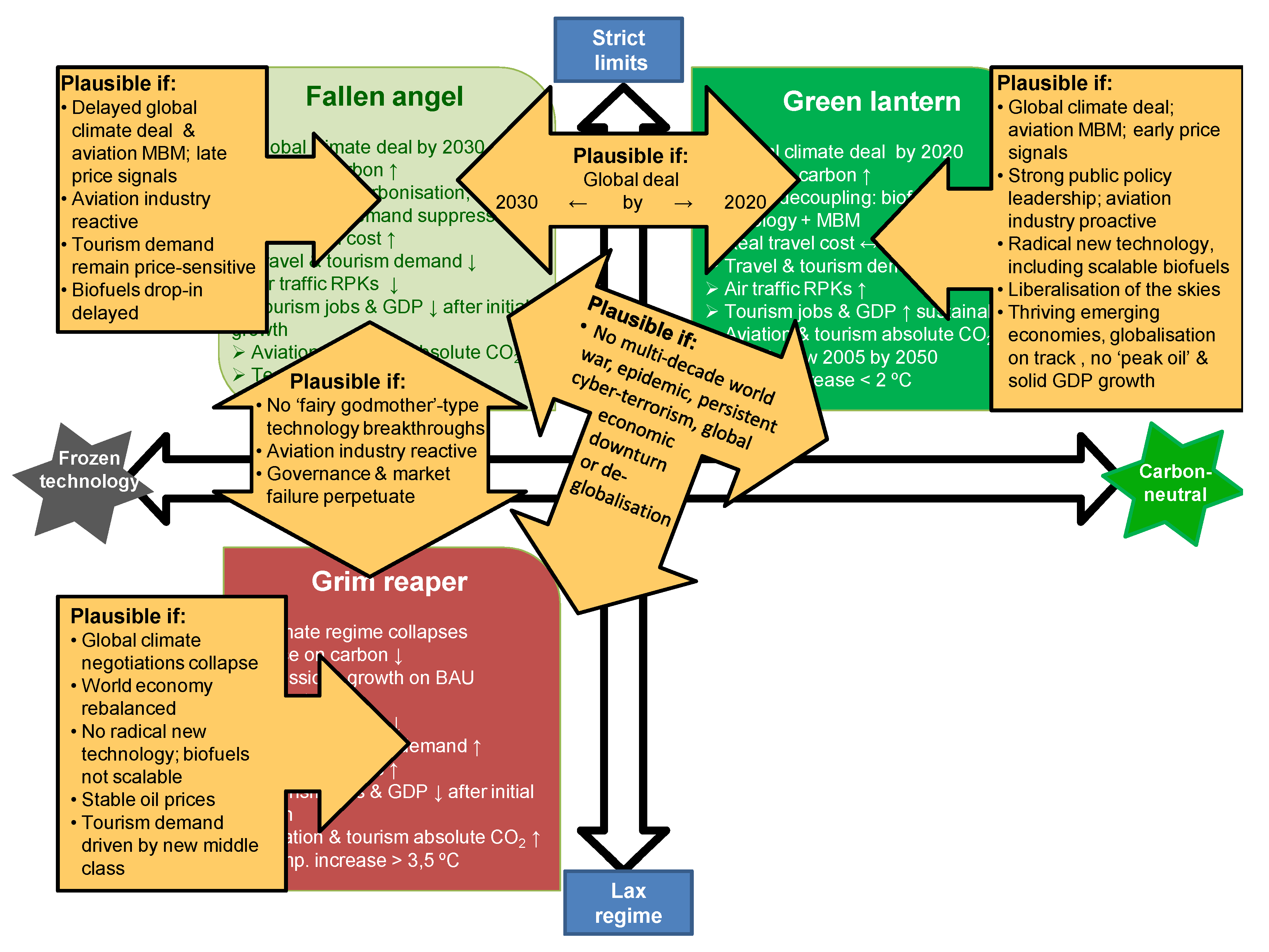
      <p>The report consists of seven sections. Following this introduction, <xref ref-type="sec" rid="sec2-sustainability-05-00001">Section 2</xref> includes reflections on scenarios as learning and planning tools, with a focus on the methodological underpinnings of the approach followed. <xref ref-type="sec" rid="sec3-sustainability-05-00001">Section 3</xref> demarcates the context of the scenario-building exercise. <xref ref-type="sec" rid="sec4-sustainability-05-00001">Section 4</xref> presents an environmental scan, based on which the overriding driving forces are described in <xref ref-type="sec" rid="sec5-sustainability-05-00001">Section 5</xref>. The latter section includes the construction of a two-dimensional matrix-type scenario gameboard, which then serves as the framework for the narrative description of three possible future scenarios, as well as signposts, assumptions and “wild cards” in <xref ref-type="sec" rid="sec6-sustainability-05-00001">Section 6</xref>. (See Mind of a Fox [<xref ref-type="bibr" rid="B7-sustainability-05-00001">7</xref>] for an elaboration on the methodology of constructing a 2 × 2 matrix-type scenario gameboard. In this report, with its international level of analysis, the version with two external variables from the contextual environment is used.) Finally, having identified the “most desirable” future, choices and actions that could activate this meta-level strategic direction are identified in <xref ref-type="sec" rid="sec7-sustainability-05-00001">Section 7</xref>.</p>
    </sec>
    <sec id="sec2-sustainability-05-00001">
      <title>2. The Scenario-Building Approach</title>
      <sec>
        <title>2.1. Methodological Underpinnings</title>
        <p>A scenario-building approach is particularly useful given the uncertain nature of the multi-dimensional, multi-decade decision-making space involved in the <italic>problematique</italic> at the centre of this report. Scenario-building has a recognized role in the tourism and aviation literature as discussed by several researchers [<xref ref-type="bibr" rid="B8-sustainability-05-00001">8</xref>,<xref ref-type="bibr" rid="B9-sustainability-05-00001">9</xref>,<xref ref-type="bibr" rid="B10-sustainability-05-00001">10</xref>,<xref ref-type="bibr" rid="B11-sustainability-05-00001">11</xref>,<xref ref-type="bibr" rid="B12-sustainability-05-00001">12</xref>,<xref ref-type="bibr" rid="B13-sustainability-05-00001">13</xref>,<xref ref-type="bibr" rid="B14-sustainability-05-00001">14</xref>,<xref ref-type="bibr" rid="B15-sustainability-05-00001">15</xref>,<xref ref-type="bibr" rid="B16-sustainability-05-00001">16</xref>]. However, note the caveat: Most of these scenario exercises consider aviation or tourism in silos, rather than in an integrated manner. Learning about possible futures, and the signposts <italic>en route</italic> to these futures, enables policy makers to manage long-term risks better and proactively seize emerging opportunities. </p>
        <p>There are three litmus tests for the plausibility of scenarios: They must be “possible”, “credible” and “relevant” [<xref ref-type="bibr" rid="B17-sustainability-05-00001">17</xref>]. “Relevance” implies that a scenario should have “decision-making utility” [<xref ref-type="bibr" rid="B18-sustainability-05-00001">18</xref>]. A distinction should also be drawn between scenario-building and scenario-planning, where the former can be seen as only a first step of the latter [<xref ref-type="bibr" rid="B19-sustainability-05-00001">19</xref>]. In moving from scenarios to action plans, Ringland [<xref ref-type="bibr" rid="B20-sustainability-05-00001">20</xref>] presents two helpful “tools”: (i) a scenario options matrix that distinguishes between the “future-robust core of strategy” (with relevance to all probable scenarios) and “focused contingent strategies” (aimed at either realising the desired future or dealing with the fall-out of feared futures); and (ii) a strategic positioning matrix that translates the broad strategic orientation into a planning framework. </p>
        <p>In addition to being plausible, scenarios must also meet the criteria of: (i) differentiation (it should not merely be minor variations of a reference case, but should present alternative futures); (ii) consistency (the internal logic should support the credibility of the scenario, and the narrative should be persuasive and coherent); (iii) challenge and creativity; and (iv) communication-friendliness [<xref ref-type="bibr" rid="B18-sustainability-05-00001">18</xref>,<xref ref-type="bibr" rid="B21-sustainability-05-00001">21</xref>,<xref ref-type="bibr" rid="B22-sustainability-05-00001">22</xref>]. </p>
        <p>There are various scenario-building techniques (for an overview, see Bishop, Hines and Collins [<xref ref-type="bibr" rid="B23-sustainability-05-00001">23</xref>]). In this report, the methodological approach is broadly consistent with the “intuitive-logic” approach [<xref ref-type="bibr" rid="B19-sustainability-05-00001">19</xref>]. This is appropriate, as the selected <italic>problematique</italic> and the four-decade time horizon extend beyond the boundaries of quantifiable economic and environmental metrics (e.g., impacts on gross domestic product or carbon abatement in tons of CO<sub>2</sub>), and also include non-quantifiable political and behavioural uncertainties.</p>
        <p>Different categories of scenarios can be identified. Walton [<xref ref-type="bibr" rid="B18-sustainability-05-00001">18</xref>] identifies two high-level categories, namely “possible” and “probable”, and then, at the normative level, “preferable” (“to be aimed at”) and “undesirable” (“to be avoided at all cost”). In this report, the scenario gameboard is narrowed down to a “possibility space”, explicitly stating assumptions about the boundaries of the plausible zone (<xref ref-type="sec" rid="sec5-sustainability-05-00001">Section 5</xref>). It also stays in the realm of the pragmatic by avoiding “apocalyptic scenarios” that would see “the world as we know it coming to an end” [<xref ref-type="bibr" rid="B18-sustainability-05-00001">18</xref>]. </p>
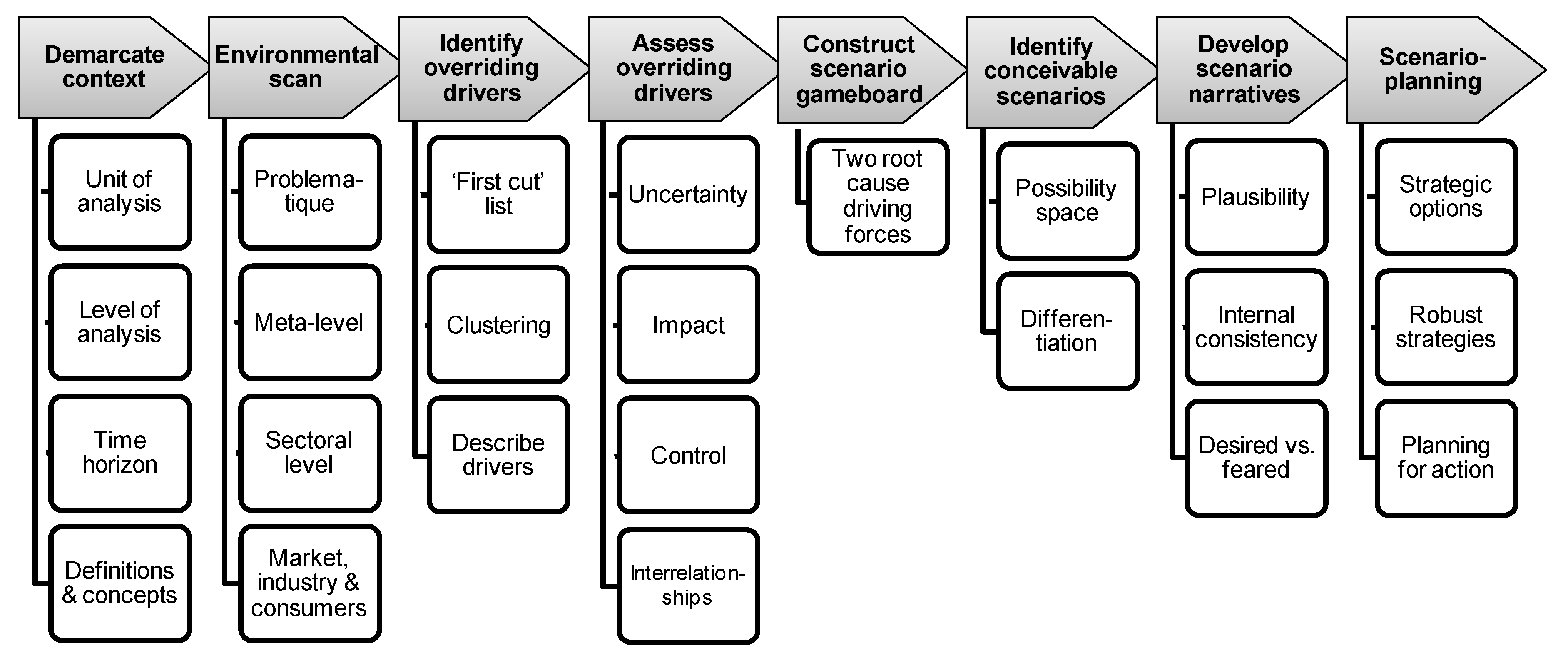
        <p>The approach in this report is furthermore “exploratory”. The environmental analysis (<xref ref-type="sec" rid="sec4-sustainability-05-00001">Section 4</xref>) starts with “past and present trends”, and works towards “a realisable future”, on the clear understanding that “the future [need not be] only a continuation of past relationships and dynamics but can also be shaped by (…) decisions of the present” [<xref ref-type="bibr" rid="B19-sustainability-05-00001">19</xref>]. The eight-step approach is summarised in <xref ref-type="table" rid="sustainability-05-00001-t001">Table 1</xref> and depicted in <xref ref-type="fig" rid="sustainability-05-00001-f001">Figure 1</xref> below, and draws on the step-wise approaches outlined by Schwartz [<xref ref-type="bibr" rid="B24-sustainability-05-00001">24</xref>], Schoemaker [<xref ref-type="bibr" rid="B25-sustainability-05-00001">25</xref>,<xref ref-type="bibr" rid="B26-sustainability-05-00001">26</xref>] and Ungerer and Herholdt [<xref ref-type="bibr" rid="B27-sustainability-05-00001">27</xref>].</p>
        <table-wrap id="sustainability-05-00001-t001" position="float">
          <object-id pub-id-type="pii">sustainability-05-00001-t001_Table 1</object-id>
          <label>Table 1</label>
          <caption>
            <p>The eight-step scenario-building approach.</p>
          </caption>
          <table rules="rows">
            <thead>
              <tr>
                
                <th align="center" valign="middle">Steps</th>
                <th align="center" valign="middle">Description</th>
              </tr>
            </thead>
            <tbody>
              <tr>
               
                <td align="left" valign="top">1</td>
                <td align="left" valign="middle">Demarcate the context of the scenario exercise, including the unit of analysis, level of analysis, time horizon and key concepts.</td>
              </tr>
              <tr>
                 
                <td align="left" valign="top">2</td>
                <td align="left" valign="middle">Describe the problematique, and brainstorm critical aspects or external drivers of change at the meta-level and in the contextual and transactional environments that could affect the prospects for LHT over the next four decades. These may include “predetermined” trends or phenomena [<xref ref-type="bibr" rid="B24-sustainability-05-00001">24</xref>] “already in the pipeline of the future” [<xref ref-type="bibr" rid="B28-sustainability-05-00001">28</xref>], but the focus is on “uncontrollable” uncertainties in the contextual environment, with “high potential impacts”.</td>
              </tr>
              <tr>
                
                <td align="left" valign="top">3</td>
                <td align="left" valign="middle">Based on the environmental analysis, cluster the first-cut list of drivers and/or uncertainties, towards identifying a limited number of overriding driving forces “that set the pattern of events and determine outcomes” [<xref ref-type="bibr" rid="B27-sustainability-05-00001">27</xref>].</td>
              </tr>
              <tr>
                
                <td align="left" valign="top">4</td>
                <td align="left" valign="middle">Assess the overriding drivers in terms of their degree of uncertainty, potential impact and controllability, using a two-dimensional ranking space technique as well as an interrelationship diagram.</td>
              </tr>
              <tr>
                
                <td align="left" valign="top">5</td>
                <td align="left" valign="middle">On this basis, identify and describe the two “root cause” driving forces, and construct a two-dimensional matrix-type scenario gameboard [<xref ref-type="bibr" rid="B7-sustainability-05-00001">7</xref>], which will form the basis of the scenario logics.</td>
              </tr>
              <tr>
                
                <td align="left" valign="top">6</td>
                <td align="left" valign="middle">Identify the conceivable scenarios in the possibility space, and do a first-cut assessment of their plausibility and differentiation. Within this “possibility space” [<xref ref-type="bibr" rid="B29-sustainability-05-00001">29</xref>], now eliminate “combinations that are not credible”, while maintaining “a reasonable range of uncertainty” [<xref ref-type="bibr" rid="B26-sustainability-05-00001">26</xref>].</td>
              </tr>
              <tr>
                 
                <td align="left" valign="top">7</td>
                <td align="left" valign="middle">Develop the scenario narratives or “rehearsals of the future” [<xref ref-type="bibr" rid="B24-sustainability-05-00001">24</xref>] by fleshing out the scenario logics. In the process, continuously assess the plausibility, internal consistency and relevance of each narrative, refining the storylines as required. To enhance decision-making utility, identify signposts (also referred to as “lead indicators” or “turning points”) for the alternative scenarios [<xref ref-type="bibr" rid="B19-sustainability-05-00001">19</xref>], and explicitly state any assumptions that underpin the scenario narratives. The narrative should also include indications of strategic imperatives, be they opportunities or risks, from the perspective of the unit of analysis. To challenge the limits of the mental models that underpin these narratives, identify any “wild cards” that may quite significantly disrupt a given scenario [<xref ref-type="bibr" rid="B28-sustainability-05-00001">28</xref>,<xref ref-type="bibr" rid="B30-sustainability-05-00001">30</xref>]. </td>
              </tr>
              <tr>
                <td align="left" valign="top">8</td>
                <td align="left" valign="middle">Finally, in moving from scenario-building to integrated scenario-planning, or from “visualisation to realisation” [<xref ref-type="bibr" rid="B18-sustainability-05-00001">18</xref>], articulate the most desired future and ways of achieving this future, both at a strategic level and by identifying critical actions that could assist to realise it. Use Ringland’s [<xref ref-type="bibr" rid="B20-sustainability-05-00001">20</xref>] scenario options and scenario-positioning matrices to translate scenarios into a broad strategic orientation, positioning and planning framework for action.</td>
              </tr>
            </tbody>
          </table>
        </table-wrap>
        <fig id="sustainability-05-00001-f001" position="float">
          <label>Figure 1</label>
          <caption>
            <p>The eight-step scenario-building approach.</p>
          </caption>
          <graphic xmlns:xlink="http://www.w3.org/1999/xlink" xlink:href="sustainability-05-00001-g001.tif"/>
        </fig>
      </sec>
      <sec>
        <title>2.2. The Process</title>
        <p>The scenario-building process went through three stages between November 2011 and June 2012. The first stage (meta-level environmental scan) leaned on a South African National Department of Tourism (NDT) scenario-building exercise. The second stage involved desktop research and scenario development by the lead author (February 2012 to May 2012) and the third stage (June 2012) an unstructured, virtual “Policy Delphi”-type process. The focus during stage three was the plausibility and robustness of the scenario narratives, and their strategic implications from a planning perspective. </p>
      </sec>
    </sec>
    <sec id="sec3-sustainability-05-00001">
      <title>3. Demarcation of the Context (Step 1 in <xref ref-type="fig" rid="sustainability-05-00001-f002">Figure 2</xref>)</title>
      <fig id="sustainability-05-00001-f002" position="float">
          <label>Figure 2</label>
          <caption>
            <p>The eight-step scenario-building approach: Step 1.</p>
          </caption>
          <graphic xmlns:xlink="http://www.w3.org/1999/xlink" xlink:href="sustainability-05-00001-g002.tif"/>
        </fig>
      <sec>
        <title>3.1. The Unit of Analysis and Focus</title>
        <p>Many mega-trends and risks may of course affect the unit of analysis, <italic>i.e.</italic>, “long-haul tourism”, over the next four decades. These include geopolitical risks; systemic financial risks; the economic prospects of tourism source markets; ageing populations who shape demand patterns; tourism logistics and supply chain disruptions, such as terrorism, natural disasters and pandemics; the disruption of technology-enabled tourism marketing; consumer demands shaped by greater customisation and disintermediation; natural resource, environmental and ecosystem degradation, and skills and talent mobility [<xref ref-type="bibr" rid="B9-sustainability-05-00001">9</xref>,<xref ref-type="bibr" rid="B13-sustainability-05-00001">13</xref>,<xref ref-type="bibr" rid="B22-sustainability-05-00001">22</xref>,<xref ref-type="bibr" rid="B31-sustainability-05-00001">31</xref>,<xref ref-type="bibr" rid="B32-sustainability-05-00001">32</xref>,<xref ref-type="bibr" rid="B33-sustainability-05-00001">33</xref>,<xref ref-type="bibr" rid="B34-sustainability-05-00001">34</xref>,<xref ref-type="bibr" rid="B35-sustainability-05-00001">35</xref>,<xref ref-type="bibr" rid="B36-sustainability-05-00001">36</xref>,<xref ref-type="bibr" rid="B37-sustainability-05-00001">37</xref>,<xref ref-type="bibr" rid="B38-sustainability-05-00001">38</xref>,<xref ref-type="bibr" rid="B39-sustainability-05-00001">39</xref>,<xref ref-type="bibr" rid="B40-sustainability-05-00001">40</xref>,<xref ref-type="bibr" rid="B41-sustainability-05-00001">41</xref>,<xref ref-type="bibr" rid="B42-sustainability-05-00001">42</xref>]. </p>
        <p>However, given the urgency of the climate change challenge indicated by science [<xref ref-type="bibr" rid="B3-sustainability-05-00001">3</xref>,<xref ref-type="bibr" rid="B43-sustainability-05-00001">43</xref>,<xref ref-type="bibr" rid="B44-sustainability-05-00001">44</xref>], coupled with the prominence that the decarbonisation of aviation and tourism is receiving in public discourse [<xref ref-type="bibr" rid="B4-sustainability-05-00001">4</xref>,<xref ref-type="bibr" rid="B5-sustainability-05-00001">5</xref>,<xref ref-type="bibr" rid="B45-sustainability-05-00001">45</xref>,<xref ref-type="bibr" rid="B46-sustainability-05-00001">46</xref>,<xref ref-type="bibr" rid="B47-sustainability-05-00001">47</xref>,<xref ref-type="bibr" rid="B48-sustainability-05-00001">48</xref>] as well as in academic literature [<xref ref-type="bibr" rid="B8-sustainability-05-00001">8</xref>,<xref ref-type="bibr" rid="B9-sustainability-05-00001">9</xref>,<xref ref-type="bibr" rid="B49-sustainability-05-00001">49</xref>], the primary focus here is narrower. It also addresses a gap identified in a 2010 literature review by Dubois and colleagues [<xref ref-type="bibr" rid="B8-sustainability-05-00001">8</xref>], namely that there are “very few long-term scenarios that focus on both climate change and tourism” and, of the studies that do so, “none consider ‘avoiding dangerous climate change’ objectives” (<italic>i.e.</italic>, the 2 °C normative assumption stated earlier). </p>
      </sec>
      <sec>
        <title>3.2. The Level of Analysis</title>
        <p>The level of analysis is firstly international, which is why the starting point for the environmental scan in <xref ref-type="sec" rid="sec4-sustainability-05-00001">Section 4</xref> is an exposition of alternative political, economic, social, technological and environmental (PESTE) futures at the meta-level. Consistent with scenario-building in a transnational industry landscape, the level of analysis is secondly also sectoral, which is why the PESTE analysis is expanded to a high-level overview of market, industry and consumer driving forces. Even though the level of analysis is global, the strategic implications of the scenarios have decision-making utility at national-destination levels. </p>
        <p>By way of motivation: (i) The aviation industry is an archetypal transnational industry [<xref ref-type="bibr" rid="B50-sustainability-05-00001">50</xref>]. (ii) Tourist destinations who depend on airlift from a portfolio of worldwide tourism source markets are exposed to global aviation trends and multilateral climate policies. (iii) Future technology research and development (R&amp;D), investment and public policy to accelerate air transport decarbonisation will predominantly be at the level of global supply chains. (iv) The future of the climate change regime will be decided globally, be that through a multilaterally negotiated climate deal or due to the disintegration of negotiations at that level. </p>
      </sec>
      <sec>
        <title>3.3. The Time Horizon</title>
        <p>The 2050 time horizon is consistent with studies that have considered tourism mobility in the context of long-term environmental challenges [<xref ref-type="bibr" rid="B8-sustainability-05-00001">8</xref>]. The year 2050 is an important reference point in international climate change negotiations [<xref ref-type="bibr" rid="B2-sustainability-05-00001">2</xref>], and represents a milestone for the stabilisation of greenhouse gases (GHGs) in the atmosphere [<xref ref-type="bibr" rid="B3-sustainability-05-00001">3</xref>]. In addition, the technology life cycle in aviation involves long lead times—often in the range of ten to 20 years for new technology R&amp;D and commercial deployment [<xref ref-type="bibr" rid="B46-sustainability-05-00001">46</xref>], with aircraft stock having residual lifespans of three to four decades [<xref ref-type="bibr" rid="B51-sustainability-05-00001">51</xref>], and even longer for other physical infrastructure such as airports. Furthermore, the decarbonisation trajectory for aviation up to 2030 is relatively certain compared to that after 2030 (see examples of the modelling [<xref ref-type="bibr" rid="B46-sustainability-05-00001">46</xref>,<xref ref-type="bibr" rid="B52-sustainability-05-00001">52</xref>,<xref ref-type="bibr" rid="B53-sustainability-05-00001">53</xref>]). Many of the technological, infrastructural and operational efficiency improvements that will reach maturity by 2030 are already in the pipeline. The major uncertainty in terms of the decoupling of aviation growth from emissions growth relates to the period 2030 to 2050. </p>
      </sec>
      <sec>
        <title>3.4. Definitions and Concepts</title>
        <p>“Tourism” is defined as “the movement of people to places outside their usual place of residence” for personal, business or leisure purposes, but not for employment, including at least an overnight stay [<xref ref-type="bibr" rid="B54-sustainability-05-00001">54</xref>]. References to “long-haul tourism” are understood to include (i) journeys over 1 500 km, (ii) journeys with a flying time of over two hours, or (iii) journeys over shorter distances or time spans, but where airlift cannot be easily substituted due to extreme geographies or other barriers. Based on the high correlation between international revenue passenger kilometres (RPKs) and tourist arrivals, RPKs are used as a proxy for tourist arrivals. </p>
        <p>Decarbonisation of aviation could involve absolute emissions reductions or relative deviations from baseline. Climate change mitigation policies could include command-and-control type limits on emissions (<italic>i.e.</italic>, directive-based), market-based incentives (e.g., emissions trading/off-setting or carbon taxes), or consumer behavioural change achieved through information-based approaches. Many authors [<xref ref-type="bibr" rid="B55-sustainability-05-00001">55</xref>,<xref ref-type="bibr" rid="B56-sustainability-05-00001">56</xref>,<xref ref-type="bibr" rid="B57-sustainability-05-00001">57</xref>,<xref ref-type="bibr" rid="B58-sustainability-05-00001">58</xref>,<xref ref-type="bibr" rid="B59-sustainability-05-00001">59</xref>,<xref ref-type="bibr" rid="B60-sustainability-05-00001">60</xref>] elaborate on the typology of the range of available environmental public policy tools. These policies could be adopted globally, regionally or nationally. </p>
      </sec>
    </sec>
    <sec id="sec4-sustainability-05-00001">
      <title>4. Environmental Scan (Step 2 in <xref ref-type="fig" rid="sustainability-05-00001-f003">Figure 3</xref>)</title>
      <fig id="sustainability-05-00001-f003" position="float">
          <label>Figure 3</label>
          <caption>
            <p>The eight-step scenario-building approach: Step 2</p>
          </caption>
          <graphic xmlns:xlink="http://www.w3.org/1999/xlink" xlink:href="sustainability-05-00001-g003.tif"/>
        </fig>
      <sec id="sec4dot1-sustainability-05-00001">
        <title>4.1. The Meta-level Contextual Environment</title>
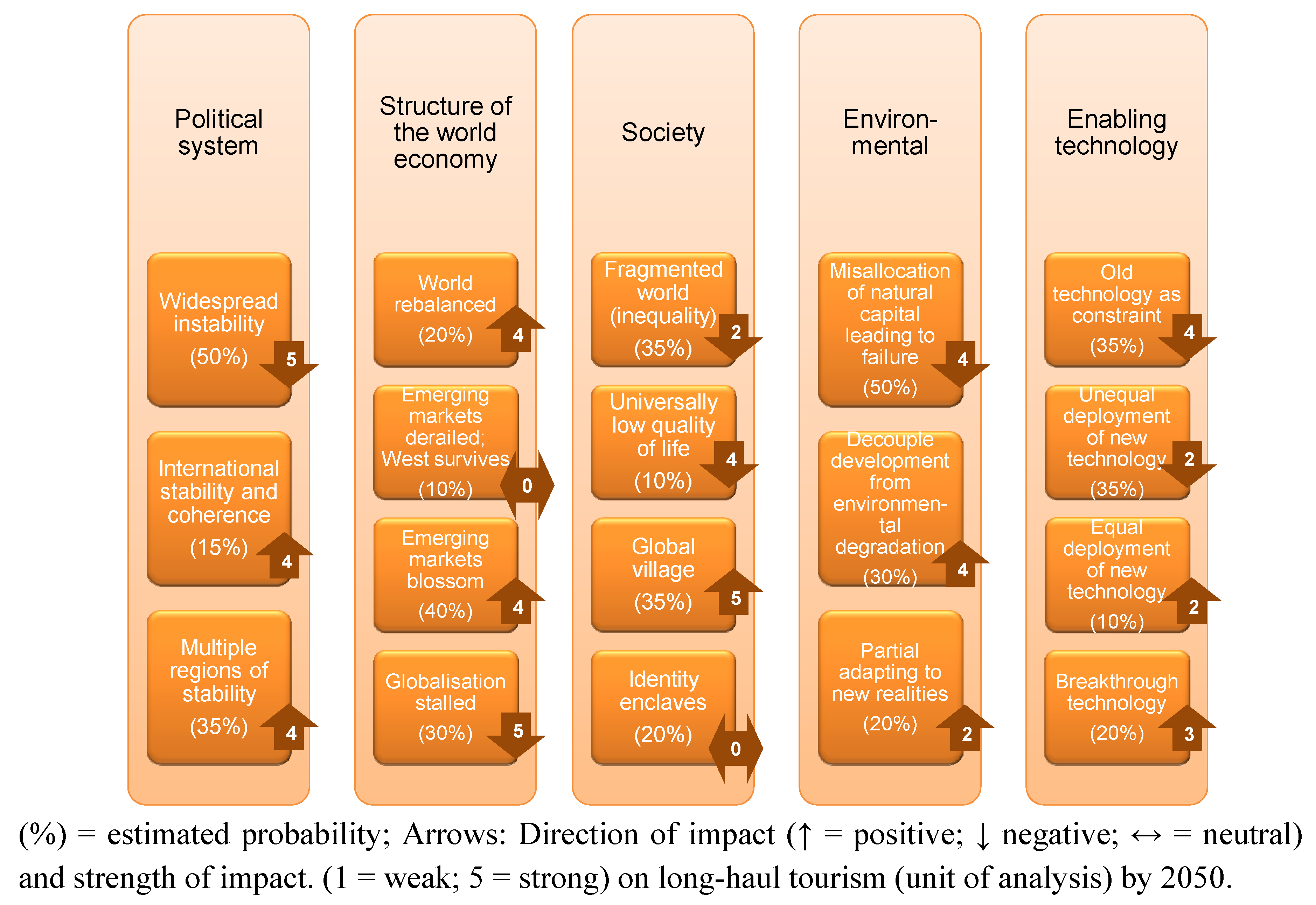
        <p>This section is based mainly on NDT [<xref ref-type="bibr" rid="B22-sustainability-05-00001">22</xref>], Hichert [<xref ref-type="bibr" rid="B61-sustainability-05-00001">61</xref>,<xref ref-type="bibr" rid="B62-sustainability-05-00001">62</xref>], Lipman [<xref ref-type="bibr" rid="B63-sustainability-05-00001">63</xref>], Saunders [<xref ref-type="bibr" rid="B64-sustainability-05-00001">64</xref>] and WEF [<xref ref-type="bibr" rid="B42-sustainability-05-00001">42</xref>]. Some drivers and uncertainties are meta-level trends, while other macro-level trends are at the sectoral level, closer to the unit of analysis (see <xref ref-type="fig" rid="sustainability-05-00001-f004">Figure 4</xref>). Based on internal and external expert opinions, probabilities were assigned to each of these alternatives (indicated between brackets in <xref ref-type="fig" rid="sustainability-05-00001-f004">Figure 4</xref>). </p>
        <fig id="sustainability-05-00001-f004" position="float">
          <label>Figure 4</label>
          <caption>
            <p>The meta-level context.</p>
          </caption>
          <graphic xmlns:xlink="http://www.w3.org/1999/xlink" xlink:href="sustainability-05-00001-g004.tif"/>
        </fig>
        <p>Systemic political stability, be that as a result of either multiple regions of stability or improved international coherence, is assigned a 50 per cent probability, as are the prospects for widespread global instability by 2050. </p>
        <p>Based on McKinsey’s Global Economic Scenarios, four alternatives for the evolution of the structure of the world economy over the next few decades can be identified [<xref ref-type="bibr" rid="B65-sustainability-05-00001">65</xref>]. Only a 30 per cent probability is assigned to the “rollback of globalisation”, or de-globalisation, which will in turn “reduce social surpluses” [<xref ref-type="bibr" rid="B42-sustainability-05-00001">42</xref>]. Such a future will be characterised by multiple economic crises and the economic collapse of the developed world, which will in turn pull down the emerging economies and global growth in its slipstream. There is only a slim chance that emerging markets’ strong growth drive will derail if the West “survives” [<xref ref-type="bibr" rid="B65-sustainability-05-00001">65</xref>], whereas a future with blossoming emerging economies is assigned the highest overall probability. The latter could either form part of a rebalanced world economic order or, despite a slowdown in the developed world, could realise if the emerging economies manage to insulate themselves against economic slowdown in the traditional developed-country markets by developing “South-South trade” routes and succeed “to suppress bubbles in their economies through capital controls, fiscal policy and financial regulation” [<xref ref-type="bibr" rid="B42-sustainability-05-00001">42</xref>]. </p>
        <p>In terms of social forces, four possible alternative futures were identified: a fragmented world with high levels of inequality (35%); universal low quality of life (10%); symbiosis in a global village characterised by less conflict and improved international harmony (35%), or the emergence of identity enclaves, in which discrete groups define social structures (20%). Many of these alternative futures for social organisation will be affected by the alternative economic and political outlooks referred to above. </p>
        <p>A rather pessimistic view prevailed in respect of environmental sustainability, with a 50:30:20 split between continued misallocation of natural capital, successful decoupling of development from environmental degradation, and the manageability of adaptation to unavoidable environmental change. The direction of change is intricately linked to economic growth and prosperity, and the water-energy-food-climate nexus. </p>
        <p>Finally, in terms of the use and availability of enabling technologies, a 35 per cent probability was assigned to old technology acting as a constraint on growth, development and environmental decoupling. A similar probability was assigned to the unequal deployment of technology, meaning that skewed development will continue perpetually, and only a 20 per cent chance was foreseen that breakthrough technology would disrupt current perceptions of the future world order.</p>
        <p>These meta-level trends, expressed as alternative futures, are important dimensions against which to assess the robustness of the assumptions underpinning the scenario narratives in <xref ref-type="sec" rid="sec6-sustainability-05-00001">Section 6</xref>. They are also useful in identifying “wild cards” that could disrupt the storylines, an aspect that is touched on later in the paper. Furthermore, they may compound the impacts of the drivers and uncertainties at a sectoral level. </p>
      </sec>
      <sec>
        <title>4.2. The Contextual and Transactional Environments (Sectoral Level)</title>
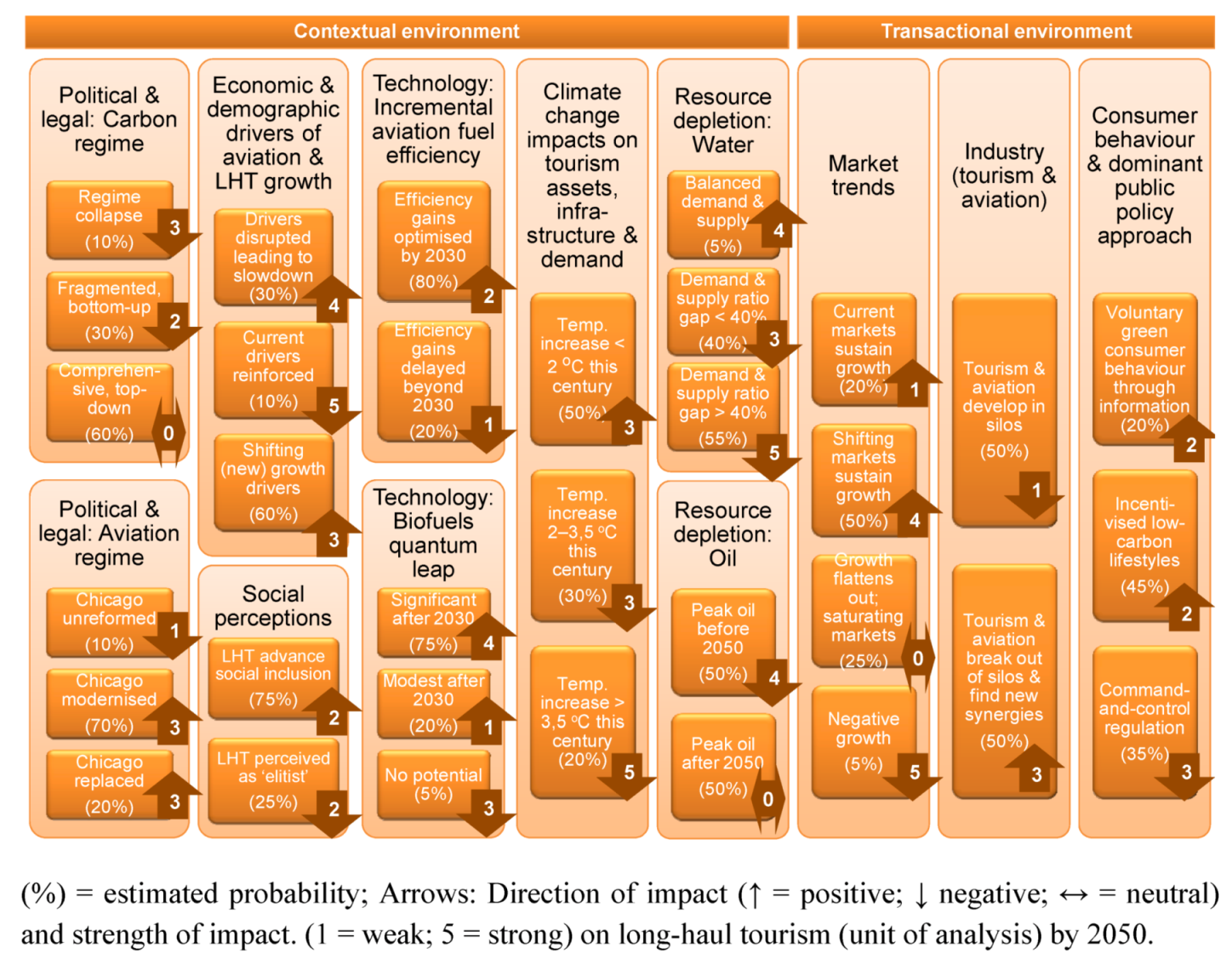
        <p>Moving from the meta-level to a sectoral level, <xref ref-type="fig" rid="sustainability-05-00001-f005">Figure 5</xref> summarises the major trends and uncertainties in the contextual and transactional environments, many of which are extensions of the meta-level trends and uncertainties identified in <xref ref-type="sec" rid="sec4dot1-sustainability-05-00001">Section 4.1</xref>. </p>
        
        <p>These possible alternatives in the macro-sectoral environment as well as the different possible market, industry and consumer forces in the transactional environment create the context for the identification of key change drivers and uncertainties, which are the focus of <xref ref-type="sec" rid="sec5-sustainability-05-00001">Section 5</xref>. </p>
        <fig id="sustainability-05-00001-f005" position="float">
          <label>Figure 5</label>
          <caption>
            <p>The contextual and transactional environments.</p>
          </caption>
          <graphic xmlns:xlink="http://www.w3.org/1999/xlink" xlink:href="sustainability-05-00001-g005.tif"/>
        </fig>
        <sec>
          <title>4.2.1. The Contextual Environment</title>
          <sec>
          <title>Political and Legal Influences</title>
          <p>Uncertainty about political stability, as observed in the meta-level macro-environment, perpetuates in global climate change and aeropolitical negotiations. As it stands, the prospects for multilateralism prevailing, as opposed to disintegration into a fragmented climate regime or complete regime collapse, is uncertain. Despite commitments to conclude negotiations on a post-2020 climate regime under the UNFCCC by 2015 [<xref ref-type="bibr" rid="B66-sustainability-05-00001">66</xref>], or to make progress in negotiations on an MBM for aviation emissions under ICAO by 2013 [<xref ref-type="bibr" rid="B67-sustainability-05-00001">67</xref>,<xref ref-type="bibr" rid="B68-sustainability-05-00001">68</xref>,<xref ref-type="bibr" rid="B69-sustainability-05-00001">69</xref>], the future-regime architecture remains uncertain. </p>
          <p>Should multilateralism prevail, this could lead to a multilateral agreement imposing top-down and legally-binding carbon constraints in the next two decades, or, alternatively, a bottom-up pledge-and-review type regime. However, as 2050 approaches and the impacts of climate change become more evident, the probability of a multilaterally agreed, top-down burden-sharing regime for climate change mitigation (<italic>i.e.</italic>, strict limits), including for aviation emissions, becomes greater. A global price on carbon linked to the capping of allowable emissions would in all likelihood then become a reality, or, if not, at least an alternative-regime architecture that imposes carbon budgets/constraints. In the absence of a global solution, countries and regions can be expected to resort to unilateral action (which, in turn, may trigger retaliatory trade wars and aviation/tourism supply chain disruptions), or carbon constraints could be introduced through the global trade regime (such as border tax adjustments).</p>
          <p>In addition, it is also unclear what the future for the regulatory regime for aviation will hold [<xref ref-type="bibr" rid="B11-sustainability-05-00001">11</xref>,<xref ref-type="bibr" rid="B63-sustainability-05-00001">63</xref>]. Negotiations on a global MBM for aviation emissions under the ICAO have been at an impasse for nearly 15 years, and because aviation has been treated as a special case in the UN system, international aviation emissions have for all intents and purposes been excluded from UNFCCC negotiations (see Article 2.2 of the Kyoto Protocol [<xref ref-type="bibr" rid="B70-sustainability-05-00001">70</xref>]). </p>
          <p>Currently, the aviation industry is regulated by the Chicago Convention, which was adopted in 1944, before the era of modern commercial aviation and the globalisation of trade [<xref ref-type="bibr" rid="B71-sustainability-05-00001">71</xref>,<xref ref-type="bibr" rid="B72-sustainability-05-00001">72</xref>]. It has been argued that this regime inhibits industry growth, competition and liberalisation of the skies [<xref ref-type="bibr" rid="B73-sustainability-05-00001">73</xref>,<xref ref-type="bibr" rid="B74-sustainability-05-00001">74</xref>]. The probability of this regime being replaced by a new treaty is regarded as small, and given the transnational nature of this industry, continuation of the status quo is also unlikely [<xref ref-type="bibr" rid="B63-sustainability-05-00001">63</xref>]. Some modernisation of the Chicago regime by tying in air transport services with the world trade regime is a possibility [<xref ref-type="bibr" rid="B73-sustainability-05-00001">73</xref>]. </p>
          </sec>
          <sec>
          <title>Economic and Demographic Influences</title>
          <p>Based on current economic and population trends, including the shifting balance of economic and political power “from North to South and West to East” [<xref ref-type="bibr" rid="B42-sustainability-05-00001">42</xref>], new patterns of global GDP growth—and with that, aviation and tourism growth—are emerging. </p>
          <p>Tourism growth is driven inter alia by the rapid expansion of the world’s middle class, the spread of global trade, the revolution in information and communication technologies, the increasing prominence of tourism in national development plans, as well as a real decline in the cost of air travel [<xref ref-type="bibr" rid="B75-sustainability-05-00001">75</xref>,<xref ref-type="bibr" rid="B76-sustainability-05-00001">76</xref>,<xref ref-type="bibr" rid="B77-sustainability-05-00001">77</xref>]. </p>
          <p>In their 2030 tourism demand modelling, the UNWTO [<xref ref-type="bibr" rid="B78-sustainability-05-00001">78</xref>] attaches the greatest weighting to (i) GDP growth, (ii) the real cost of air travel (which is in turn linked to load factors, fuel prices and fuel-efficiency gains, and global networks that render destinations more accessible), and (iii) maturing GDP elasticity of tourism demand. </p>
          <p>Over the past four decades, air traffic growth in turn was strongly negatively correlated with the real cost of air travel, where the latter has seen a decline of approximately 60 per cent since 1970. Over the same period, RPK growth has tracked world trade growth and GDP growth, but it has proved to be more sensitive to world trade than GDP growth [<xref ref-type="bibr" rid="B79-sustainability-05-00001">79</xref>]. Other drivers of aviation growth include growth in foreign direct investment (FDI) flows; the gradual deregulation of the skies, allowing for greater competition; the spread of airline alliance strategies and hub-and-spoke configurations, and the burgeoning middle class in the emerging markets [<xref ref-type="bibr" rid="B47-sustainability-05-00001">47</xref>,<xref ref-type="bibr" rid="B63-sustainability-05-00001">63</xref>,<xref ref-type="bibr" rid="B80-sustainability-05-00001">80</xref>]. Another significant trend fuelling air travel and competition has been the rise of new-model low-cost carriers [<xref ref-type="bibr" rid="B81-sustainability-05-00001">81</xref>]. </p>
          <p>The single biggest driver of future growth will likely be the rapid income growth in emerging economies. While the traditional tourism source markets remain flat following the 2008/9 economic downturn and the prevailing Eurozone crisis, emerging market outbound travel is growing by just under ten per cent per annum. These countries will bring some “2 billion new middle class consumers [into the potential market] by 2030” [<xref ref-type="bibr" rid="B82-sustainability-05-00001">82</xref>]. By 2030, the size of the global middle class is likely to grow to 4.9 billion, of whom between 3.2 and 3.9 billion will be located in emerging economies [<xref ref-type="bibr" rid="B62-sustainability-05-00001">62</xref>]. Coupled with “increased connectivity between major cities” [<xref ref-type="bibr" rid="B79-sustainability-05-00001">79</xref>], urbanisation in emerging markets is a strong lead indicator of future aviation and LHT growth [<xref ref-type="bibr" rid="B83-sustainability-05-00001">83</xref>]. IATA [<xref ref-type="bibr" rid="B79-sustainability-05-00001">79</xref>] highlights that 20 per cent of global air travel is currently generated by 26 mega-cities (&gt;10 million population) and 40 percent by 62 metropoles (&gt;5 million population). </p>
          </sec>
          <sec>
          <title>Social Influences</title>
          <p>Future public perceptions about LHT and aviation are important. LHT may be regarded as a “force for good” that leads to social inclusion and a transfer of resources from the “haves” to the “have-nots”. Because of its direct impact on GDP and job creation (in particular for young people and women) as well as other indirect and induced impacts in the broader economy, LHT is well positioned as a vehicle for social inclusion. Of the approximate 260 million total jobs sustained by travel and tourism in 2011, 100 million were direct, meaning there is a multiplier of 1.6 in employment creation potential into the broader economy [<xref ref-type="bibr" rid="B77-sustainability-05-00001">77</xref>]. In 2011, the direct, indirect and induced contribution of tourism to global GDP was some nine per cent [<xref ref-type="bibr" rid="B77-sustainability-05-00001">77</xref>]. </p>
          <p>That said, one of the future risks is that tourism as a leisure activity may be seen by local populations as an elitist activity, especially if it is not practiced in an ethically, culturally sensitive and preserving, and environmentally responsible fashion. This could introduce a future that can be described as one for the “happy few”, where locals despise tourists, and “[t]hose with money have limited time for holidays and … pay high prices for their holidays”, and those with “plenty of free time for cheap vacations at home or visiting friends and relatives” do not travel internationally and view LHT with much suspicion, thereby reinforcing “social polarisation” [<xref ref-type="bibr" rid="B8-sustainability-05-00001">8</xref>].</p>
          </sec>
          <sec>
          <title>Technological Influences</title>
          <p>The starting point is to consider historical fuel-efficiency improvements in the aviation industry. Dray, Evans and Schäfer [<xref ref-type="bibr" rid="B84-sustainability-05-00001">84</xref>] underscore that “[s]ince 1970, new aircraft have become more fuel-efficient at the rate of 1%–1.5% per year on average. The typical lifetime of an aircraft in the global fleet is around 30 years, so aircraft nearing the end of their lives can use 30% or more extra fuel than corresponding new models”. If these numbers are extrapolated into the future, the fleet in 2020, of which 42 per cent are expected to be new aircraft, will on average be 25 to 30 per cent more fuel-efficient than current stock [<xref ref-type="bibr" rid="B79-sustainability-05-00001">79</xref>,<xref ref-type="bibr" rid="B85-sustainability-05-00001">85</xref>]. Considering that fuel makes up at least 30 per cent of airline operating costs, there is a strong bottom-line incentive to reduce emissions through efficiency improvements [<xref ref-type="bibr" rid="B86-sustainability-05-00001">86</xref>,<xref ref-type="bibr" rid="B87-sustainability-05-00001">87</xref>].</p>
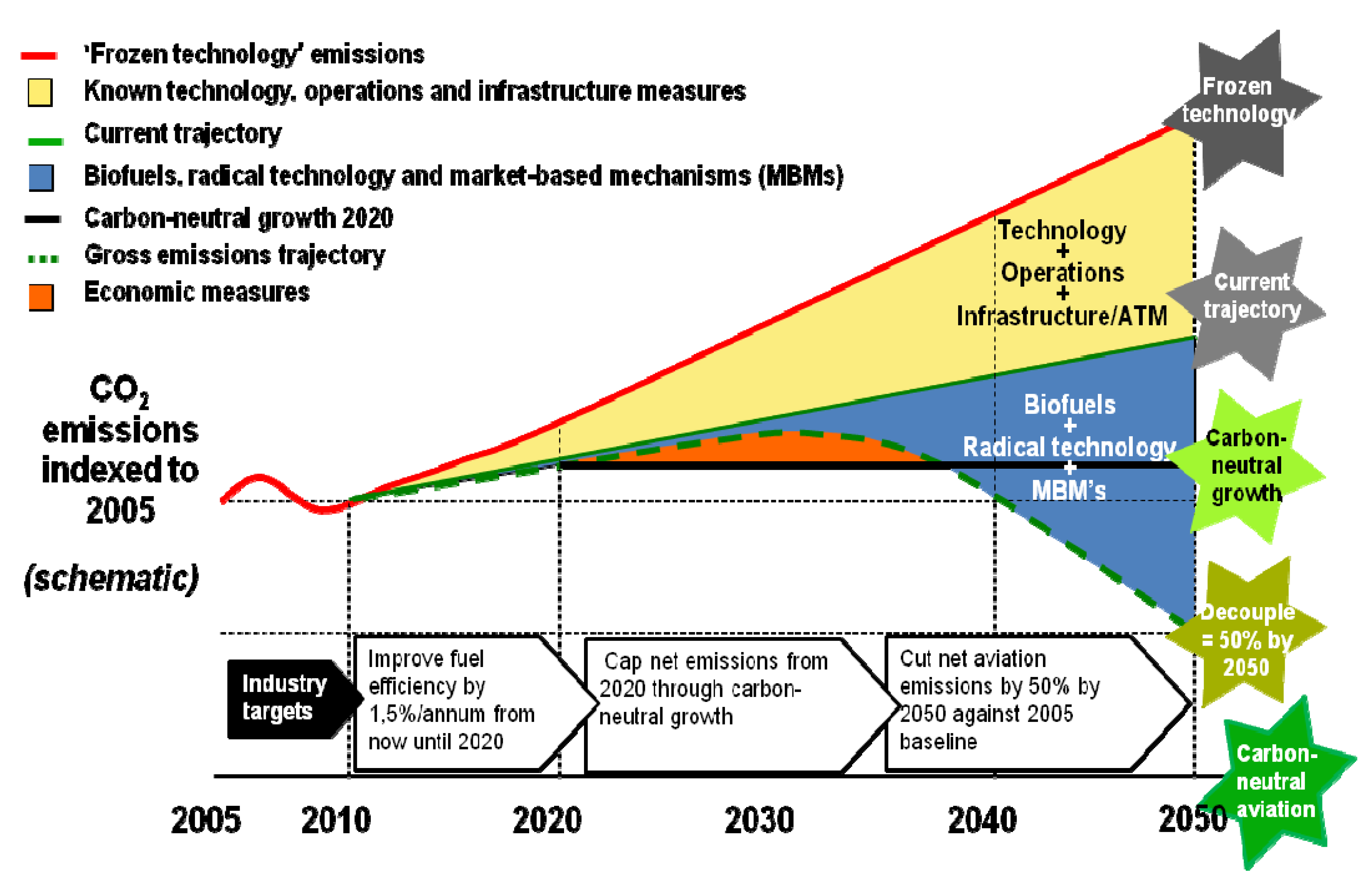
          <p>IATA has committed the airline industry to a peak-plateau-and-decline emissions trajectory (see <xref ref-type="fig" rid="sustainability-05-00001-f006">Figure 6</xref>), reducing its “net carbon footprint to 50% below what it was in 2005” by 2050. </p>
          <fig id="sustainability-05-00001-f006" position="float">
            <label>Figure 6</label>
            <caption>
              <p>The decarbonisation axis, industry targets and mitigation wedges (adjusted from ATAG [<xref ref-type="bibr" rid="B50-sustainability-05-00001">50</xref>] and WEF [<xref ref-type="bibr" rid="B46-sustainability-05-00001">46</xref>]).</p>
            </caption>
            <graphic xmlns:xlink="http://www.w3.org/1999/xlink" xlink:href="sustainability-05-00001-g006.tif"/>
          </fig>
          <p>The IATA trajectory provides for two mid-term milestones, namely “to continue to improve fleet fuel efficiency by 1,5% per year until 2002” and to “cap its net carbon emissions while continuing to grow”, <italic>i.e.</italic>, achieve carbon-neutral growth (CNG), from 2020 [<xref ref-type="bibr" rid="B4-sustainability-05-00001">4</xref>,<xref ref-type="bibr" rid="B47-sustainability-05-00001">47</xref>,<xref ref-type="bibr" rid="B50-sustainability-05-00001">50</xref>]. CNG means that total aviation emissions will peak and plateau at a certain level, despite the growth in air traffic volumes. CNG should not be confused with carbon-neutral aviation, which would imply zero net emissions. </p>
          <p>The four carbon abatement pillars underpinning these targets are as follows [<xref ref-type="bibr" rid="B46-sustainability-05-00001">46</xref>,<xref ref-type="bibr" rid="B79-sustainability-05-00001">79</xref>,<xref ref-type="bibr" rid="B88-sustainability-05-00001">88</xref>,<xref ref-type="bibr" rid="B89-sustainability-05-00001">89</xref>,<xref ref-type="bibr" rid="B90-sustainability-05-00001">90</xref>]. </p>
          <list list-type="roman-lower">
            <list-item>
              <p>Technological improvements: These interventions include (i) short-term improvements that enhance existing and new fleet efficiencies (for example retrofitting and production updates); (ii) medium-term innovations (for example new aircraft and engine design efficiencies in the pipeline), and (iii) long-term step changes (for example blended-wing design, the deployment of super-lightweight materials that emerge from the nanotechnology revolution, radical new technologies and airframe designs, and the drop-in of low-carbon aviation biofuels).</p>
            </list-item>
            <list-item>
              <p>Operational improvements: These interventions are by and large aimed at fuel savings, and include the spread of best practices for fuel conservation, greater use of fixed electrical ground power at airport terminals, centre-of-gravity optimisation, improved take-off and landing procedures (for example single-engine taxiing and the continuous-descent approach), and higher load factors (inter alia achieved through yield management).</p>
            </list-item>
            <list-item>
              <p>Infrastructural improvements: These interventions are aimed at removing inefficiencies in the utilisation of airports and airspace, including the transition to more flexible airspace use, reorganising the airspace, shortening flight routes, and improving airport and air traffic management infrastructure and technology.</p>
            </list-item>
            <list-item>
              <p>Economic measures: In IATA’s lexicon, these are positive economic measures as part of a global, sectoral, market-based approach, and could include direct offsetting/emissions trading. However, in reality, these could also include punitive economic measures, such as carbon or bunker fuel taxes and passenger or “per plane” carbon levies.</p>
            </list-item>
          </list>
          <p>What should be stressed is that after 2030, the mitigation potential of the first three pillars (<italic>i.e.</italic>, the medium-term decarbonisation options excluding long-term step changes), will have nearly reached its full potential [<xref ref-type="bibr" rid="B46-sustainability-05-00001">46</xref>]. Beyond 2030, the aviation industry enters a period of great uncertainty in respect of ways and means to achieve climate mitigation targets. By all indications, save for radical technological breakthroughs, only the gradual replacement of kerosene jet fuel with lower-carbon second-generation biofuels is on the horizon as a radical post-2030 technological solution—but even this option is clouded by uncertainty about feedstock production, its financial viability (given the prevailing subsidisation of kerosene jet fuels), and environmental sustainability considerations, such as life-cycle emissions and the impact of land-use change on emissions [<xref ref-type="bibr" rid="B46-sustainability-05-00001">46</xref>,<xref ref-type="bibr" rid="B91-sustainability-05-00001">91</xref>,<xref ref-type="bibr" rid="B92-sustainability-05-00001">92</xref>,<xref ref-type="bibr" rid="B93-sustainability-05-00001">93</xref>]. The “sustainable aviation biofuel” mitigation wedge lends itself to incremental drop-in over the next two decades, but, realistically, given the likely long lead times to develop the supply chain (involving feedstock production, production plants and refineries, blending facilities and new global distribution systems), a meaningful contribution will materialise only after 2030 [<xref ref-type="bibr" rid="B94-sustainability-05-00001">94</xref>], which is when steep, absolute emissions reductions over a two-decade trajectory are required to meet industry’s targets. WEF [<xref ref-type="bibr" rid="B46-sustainability-05-00001">46</xref>] has estimated that, by 2050, 13.6 million barrels of low-carbon jet fuel would be required per day to meet these targets.</p>
          <p>IATA [<xref ref-type="bibr" rid="B95-sustainability-05-00001">95</xref>] estimates that the drop-in of six per cent sustainable biofuels in the global aviation fuel mix could reduce emissions by five per cent by 2020. This will however be a modest contribution compared to what is required after 2030. ATAG’s [<xref ref-type="bibr" rid="B94-sustainability-05-00001">94</xref>] indicative share of drop-in biofuels in the total jet fuel mix is one per cent in 2015, 15 per cent in 2020, 30 per cent in 2030, and 50 per cent in 2040. However, due to the uncertainty about feedstock availability (which links to sustainability considerations, and physical land and water availability), other analysts suggest more conservative assumptions. The UKCCC [<xref ref-type="bibr" rid="B96-sustainability-05-00001">96</xref>], for example, suggests an upper limit of ten per cent drop-in by 2050. </p>
          <p>To deliver the volumes required by 2050, a number of barriers have to be addressed. These are (i) technical viability, safety, practicality and certification; (ii) the financial case for investment; (iii) environmental sustainability; (iv) scalability of feedstock production, processing and distribution, and (v) competition from the automotive sector.</p>
          <p>Regarding the first barrier, overwhelming evidence based on laboratory tests and test flights suggest that the drop-in of second-generation biofuels is technically sound and that “no significant aircraft engine modification is required (…) due to their comparable energy density to kerosene jet fuel” [<xref ref-type="bibr" rid="B45-sustainability-05-00001">45</xref>]. </p>
          <p>In respect of the second barrier, the status quo is characterised by “market failures due to policy uncertainty (…) and lack of adequate incentives” [<xref ref-type="bibr" rid="B46-sustainability-05-00001">46</xref>,<xref ref-type="bibr" rid="B93-sustainability-05-00001">93</xref>,<xref ref-type="bibr" rid="B97-sustainability-05-00001">97</xref>]. In addition, “[t]he energy and chemical industries have few incentives to invest in the aviation biofuels niche market if other less risky and volatile or higher-margin options exist for the use of biomass”, not least biodiesel for land transport, and renewable polymers [<xref ref-type="bibr" rid="B46-sustainability-05-00001">46</xref>]. The cost differential between conventional jet fuel and biofuels is huge, with the latter being 150 to 300 per cent more expensive than kerosene [<xref ref-type="bibr" rid="B46-sustainability-05-00001">46</xref>]. However, this is likely to change once a price incentive is in place and aviation becomes part of a global MBM for emissions trading (with a price on carbon to internalise the cost of externalities). The factors impacting the financial case will change as technology development moves through the typical maturity life stages, which run from R&amp;D, demonstration, deployment and diffusion to full commercialisation.</p>
          <p>With reference to the third barrier, the sustainability of drop-in biofuels relates to its life-cycle emissions; the impact of feedstock production on food security, water resources, forest cover and biodiversity; the energy and fertiliser inputs required; the yield per unit of production area, and the socio-economic benefits to local communities [<xref ref-type="bibr" rid="B91-sustainability-05-00001">91</xref>,<xref ref-type="bibr" rid="B94-sustainability-05-00001">94</xref>,<xref ref-type="bibr" rid="B97-sustainability-05-00001">97</xref>,<xref ref-type="bibr" rid="B98-sustainability-05-00001">98</xref>]. </p>
          <p>The biggest uncertainty relates to the fourth barrier, namely the scalability of second-generation biofuels up to and beyond 2030. A steady supply of feedstock (<italic>i.e.</italic>, raw materials/biomass from which biofuel is derived) is an obvious precondition for scaling [<xref ref-type="bibr" rid="B93-sustainability-05-00001">93</xref>,<xref ref-type="bibr" rid="B94-sustainability-05-00001">94</xref>]. It is generally accepted that feedstock “accounts for 50 to 80 per cent of biofuel production costs” [<xref ref-type="bibr" rid="B99-sustainability-05-00001">99</xref>], and, in the case of second-generation biofuels for air transport, as much as 85 per cent [<xref ref-type="bibr" rid="B92-sustainability-05-00001">92</xref>]. While recognising that a portfolio/combination of biofuel feedstock sources would be required, ATAG [<xref ref-type="bibr" rid="B94-sustainability-05-00001">94</xref>] estimates the “land area equivalents required to produce enough fuel to completely supply the aviation industry” at a hypothetical 68,000 square kilometres for algae, or 2 million and 2.7 million square kilometres respectively for camelina or jatropha. For algae, there are both on-shore and off-shore possibilities, and thus virtually no need for competition with food production [<xref ref-type="bibr" rid="B92-sustainability-05-00001">92</xref>]. To achieve the scale required, different government departments will need to break out of their silos and co-sponsor national policy frameworks in support of the biofuels industry. Not only is it necessary to align national transport, energy, aviation and environmental policies, but, from the vantage point of delivering sufficient second-generation biomass, close alignment with agricultural, rural development and water policies is also needed [<xref ref-type="bibr" rid="B46-sustainability-05-00001">46</xref>]. </p>
          <p>Depending on the scale achievable for biofuels drop-in, the creation of a global MBM that allows for off-setting of aviation emissions against cheaper emission reductions in other economic sectors are therefore indicated. Simultaneously, an MBM that puts a price on carbon could also provide a critical price incentive for investment in the development of a second-generation biofuels industry [<xref ref-type="bibr" rid="B92-sustainability-05-00001">92</xref>,<xref ref-type="bibr" rid="B100-sustainability-05-00001">100</xref>,<xref ref-type="bibr" rid="B101-sustainability-05-00001">101</xref>]. However, due to the complex aeropolitical and climate change negotiating dynamics referred to earlier, creating such an MBM is clouded by significant political uncertainty.</p>
          </sec>
          <sec>
          <title>Environmental Influences</title>
          <p>By mid-century, “a business-as-usual scenario would result in (aviation and) tourism emissions exceeding the emissions budget for the entire global economy” [<xref ref-type="bibr" rid="B49-sustainability-05-00001">49</xref>]. Although aviation is responsible for only two per cent of global carbon emissions, it is emitted by an even smaller percentage of the world population who travel. On a per-capita basis, “a single long-haul journey may exceed what can be considered sustainable per capita per year emissions” for any individual [<xref ref-type="bibr" rid="B102-sustainability-05-00001">102</xref>]. The increase in the carbon footprint of aviation will also be driven by changing consumer behaviour, specifically the twin trends of travelling over longer distances and for shorter stays [<xref ref-type="bibr" rid="B83-sustainability-05-00001">83</xref>]. </p>
          <p>Global absolute emissions need to peak and start declining in absolute terms within this decade if there is to be a (50/50) chance of avoiding a temperature increase of more than 2 ºC during this century [<xref ref-type="bibr" rid="B103-sustainability-05-00001">103</xref>]—a level which will already have far-reaching consequences, but is regarded as more manageable. Should the average global temperature increase breach certain temperature increase thresholds, the Intergovernmental Panel on Climate Change (IPCC) suggests that various tipping points will be reached, causing irreversible damage to ecosystems, human livelihoods and, by implication, tourism assets [<xref ref-type="bibr" rid="B43-sustainability-05-00001">43</xref>]. </p>
          </sec>
          <sec>
          <title>Resource Depletion</title>
          <p>Related to environmental concerns are resource constraints—more specifically, the prospects for so-called “peak oil” before mid-century as well as the threatening gap between water supply and demand [<xref ref-type="bibr" rid="B9-sustainability-05-00001">9</xref>]. </p>
          <p>The WEF’s [<xref ref-type="bibr" rid="B42-sustainability-05-00001">42</xref>] 2012 environmental scan for global risks identifies water, which is located in the “water-energy-food-climate” security nexus, as a potential resource constraint with far-reaching consequences for many economic sectors. These sectors include tourist destinations that compete with other economic sectors for water resources, for example freshwater-based tourism activities, golf tourism, agri-tourism and eco-tourism [<xref ref-type="bibr" rid="B4-sustainability-05-00001">4</xref>]. </p>
          <p>Essentially, there are four critical issues in respect of oil, namely “price, supply, availability and substitution capacity” [<xref ref-type="bibr" rid="B63-sustainability-05-00001">63</xref>]. The timing of “peak oil” (namely “the point at which half of all usable reserves are extracted”) are central to any scenario [<xref ref-type="bibr" rid="B62-sustainability-05-00001">62</xref>]. In the case of aviation, with its unique safety requirements, only second-generation drop-in biofuels offer a realistic low-carbon alternative, assuming sustainability and scalability (see discussion above). Should oil production peak before 2050, more erratic supply, energy inflation and volatile fuel prices could affect consumer demand and aviation growth, and passenger modal shifts could become the order of the day [<xref ref-type="bibr" rid="B9-sustainability-05-00001">9</xref>,<xref ref-type="bibr" rid="B31-sustainability-05-00001">31</xref>,<xref ref-type="bibr" rid="B62-sustainability-05-00001">62</xref>]. By all indications, global oil demand will increase towards 2050, but there will also be new sources of energy that will slow demand growth compared to BAU. What is not certain is whether new technologies and high oil prices “will bring vast quantities of new oil to market”, or whether the world faces an oil crunch over the next four decades that will “cripple global economic growth” [<xref ref-type="bibr" rid="B61-sustainability-05-00001">61</xref>]. </p>
          </sec>
        </sec>
        <sec>
          <title>4.2.2. Market, Industry and Consumer Trends in the Transactional Environment</title>
          <sec>
          <title>Market Overview</title>
          <p>Long-haul tourism is expected to grow from 982 million in 2011 [<xref ref-type="bibr" rid="B104-sustainability-05-00001">104</xref>] to 1.36 billion by 2020 [<xref ref-type="bibr" rid="B77-sustainability-05-00001">77</xref>], and to between 1.7 and 1.9 billion by 2030, assuming 3.5 per cent compound annual growth in outer years [<xref ref-type="bibr" rid="B78-sustainability-05-00001">78</xref>]. </p>
          <p>Tracking the global shift of economic power towards emerging economies, much of the new outbound tourism growth will be from Asia, with China and India leading the way, but with other emerging markets in Latin America and the continent of Africa not lagging far behind [<xref ref-type="bibr" rid="B63-sustainability-05-00001">63</xref>,<xref ref-type="bibr" rid="B81-sustainability-05-00001">81</xref>,<xref ref-type="bibr" rid="B105-sustainability-05-00001">105</xref>]. </p>
          </sec>
          <sec>
          <title>Industry Overview</title>
          <p>In the case of tourism, the value chain is deeply fragmented [<xref ref-type="bibr" rid="B106-sustainability-05-00001">106</xref>], linkages between sub-sectors are poorly developed, and 80 per cent of industry players are small, medium and micro-sized enterprises (SMMEs) [<xref ref-type="bibr" rid="B107-sustainability-05-00001">107</xref>]. The aviation supply chain consists of various public and private role players in the vertical supply chain that often have conflicting interests, for example the oil companies have different interests to airlines in respect of R&amp;D for second-generation biofuels [<xref ref-type="bibr" rid="B108-sustainability-05-00001">108</xref>]. Likewise, striking a balance between public and private investment in more climate-friendly technology and infrastructure is a complicated task. The lack of agreement on burden-sharing for decarbonisation between airframe manufacturers, engine manufacturers, airport and air traffic navigation authorities and airlines, points to a massive market failure. Even though many carbon abatement options entail zero or negative net cost over the medium term, upfront capital and the distribution of investment burdens through the value chain present a major challenge. </p>
          <p>Turning to the interconnectedness of aviation and tourism: Clearly, failure in one cluster has a massive impact on the system as a whole. For example, aviation and tourism are: </p>
          <list list-type="roman-lower">
            <list-item>
              <p>equally affected by archaic global legal frameworks that govern the airspace and ownership of airlines, and that limit competition in the skies as well as capital mobility [<xref ref-type="bibr" rid="B73-sustainability-05-00001">73</xref>];</p>
            </list-item>
            <list-item>
              <p>equally vulnerable to terrorist attacks in tourist destinations, cyber-terrorism (for example the threat of sabotage of air traffic navigation systems), geo-political tensions in key hot spots, pandemics such as the H1N1 influenza, natural disasters (for example the 2010 Icelandic volcanic eruption), and extreme weather conditions; and</p>
            </list-item>
            <list-item>
              <p>equally exposed to global exchange rate volatility, rising oil prices, new security concerns, non-tariff trade barriers (for example visa requirements, discriminatory travel taxes and travel advisories) and external economic shocks.</p>
            </list-item>
          </list>
          <p>Governments are increasingly recognising the integrated nature of the aviation and tourism value chains, despite the fact that it is more often than not regulated by different government line functions, with planning often occurring in silos. </p>
          </sec>
          <sec>
          <title>The Consumer Landscape</title>
          <p>Changes in the consumer landscape (e.g., the rise of green or bounded consumerism) can be voluntary, incentivised or mandatory. Voluntary behavioural change (e.g., voluntary emissions off-setting for flights, passenger modal shifts from air transport to high-speed, mass-transit land transport, vacationing closer to home, as well as substitution of business travel with videoconferencing and other modern ICTs) is generally associated with higher awareness levels, moral persuasion, austerity measures and other industry and government-driven information-based approaches. Incentive-based behavioural change can be expected to be motivated by the pricing of carbon. Finally, command-and-control-type public policy interventions, such as the introduction of personal carbon quotas, capped airline emissions or strict limits on airport infrastructure expansion, could all reduce travel propensity. </p>
          <p>British Airways Chief Executive Officer (CEO) Keith Williams [<xref ref-type="bibr" rid="B109-sustainability-05-00001">109</xref>] recently observed: “Now consumers live in a world where they are being educated about how their actions can affect the world’s fragile ecosystems and the global climate; we have seen a significant shift in the demand for ethical travel and green holidays.” As it stands, however, the uptake of voluntary off-setting of aviation emissions is at an introductory stage, and although it is growing, it is from low baselines [<xref ref-type="bibr" rid="B110-sustainability-05-00001">110</xref>]. The same applies to the substitution of business travel. Partly in response to the global financial crisis of 2008/9 and associated industry austerity and productivity enhancement measures as well as technological advances, the uptake of videoconferencing and other virtual meeting ICTs is on the rise [<xref ref-type="bibr" rid="B111-sustainability-05-00001">111</xref>]. However, whether this rapid growth will be sustained is uncertain. A recent study by Oxford Economics points to only limited substitutability—more specifically, that the return on investment in business travel is 1:12,5 (travel investment to revenue), and that face-to-face meetings with new and existing customers are respectively 85 per cent and 63 per cent more effective than virtual meetings [<xref ref-type="bibr" rid="B112-sustainability-05-00001">112</xref>].</p>
          <p>On the regulatory front, there are early indications that demand-side management in respect of LHT could become a reality in the future. Kennedy, Combes and Bellamy [<xref ref-type="bibr" rid="B113-sustainability-05-00001">113</xref>], Gleaves [<xref ref-type="bibr" rid="B114-sustainability-05-00001">114</xref>] and the UK Climate Change Committee [<xref ref-type="bibr" rid="B115-sustainability-05-00001">115</xref>], among others, all observe that active government intervention may be required in the medium term to encourage substitution of business tourism with ICT as well as passenger modal shifts away from air transport, to suppress growth in airport infrastructure, and to dis-incentivise long-haul leisure travel by charging consumers for flight emissions. Looking to 2050, some analysts [<xref ref-type="bibr" rid="B8-sustainability-05-00001">8</xref>,<xref ref-type="bibr" rid="B9-sustainability-05-00001">9</xref>,<xref ref-type="bibr" rid="B10-sustainability-05-00001">10</xref>,<xref ref-type="bibr" rid="B31-sustainability-05-00001">31</xref>] even foresee scenarios in which hard carbon constraints, such as personal carbon budgets or quotas, could be introduced. However, there are also those who believe that the shift will be in an opposite direction, at least in the next few decades, and that radical increases in demand due to the emergence of unbridled “Low Cost Low Fare Model” air transport are on the cards [<xref ref-type="bibr" rid="B116-sustainability-05-00001">116</xref>]. The latter would be characterised by lower-cost air travel due to the deregulation of the airspace, as well as increased competition, higher capacities and the spread of hub-and-spoke network models. </p>
        </sec>
</sec>
      </sec>
      <sec>
        <title>4.3. Summary of the Problematique</title>
        <p>Many tourist destinations are heavily dependent on air transport for market access. Over long distances, passenger modal shifts to high-speed rail or water transport are simply not practical [<xref ref-type="bibr" rid="B45-sustainability-05-00001">45</xref>,<xref ref-type="bibr" rid="B50-sustainability-05-00001">50</xref>]. Globally, on average, five out of every ten international tourists use air transport to reach destinations. Air transport, in turn, is (currently) entirely dependent on fossil-intensive kerosene jet fuels. </p>
        <p>Tourism is an important contributor to global economic growth, job creation and social inclusion. At the same time, however, there is a negative side to the “balance sheet”: The travel and tourism sector is responsible for five per cent of global carbon emissions [<xref ref-type="bibr" rid="B48-sustainability-05-00001">48</xref>], with the air transport sub-cluster responsible for two per cent (of which 38 per cent from domestic travel and 62 per cent from international travel) [<xref ref-type="bibr" rid="B4-sustainability-05-00001">4</xref>,<xref ref-type="bibr" rid="B48-sustainability-05-00001">48</xref>]. Eighty per cent of air transport emissions can be attributed to passenger journeys over 1 500 kilometres, a distance over which air transport is not realistically substitutable [<xref ref-type="bibr" rid="B50-sustainability-05-00001">50</xref>]. Air transport’s CO<sub>2</sub> emissions under business-as-usual are expected to increase more than threefold to 1631 million tons of carbon dioxide (MtCO<sub>2</sub>) by 2035, and fourfold to some 2000 MtCO<sub>2</sub> by 2050, taking aviation’s share to 53 per cent of total travel and tourism emissions and three per cent of global carbon emissions by 2035 [<xref ref-type="bibr" rid="B45-sustainability-05-00001">45</xref>,<xref ref-type="bibr" rid="B48-sustainability-05-00001">48</xref>,<xref ref-type="bibr" rid="B49-sustainability-05-00001">49</xref>]. </p>
        <p>Air traffic growth without carbon abatement may soon bring its carbon footprint “in conflict with global climate policy” [<xref ref-type="bibr" rid="B102-sustainability-05-00001">102</xref>], and particularly in conflict with an emissions trajectory that will limit the global temperature increase to below 2 °C above pre-industrial levels during this century [<xref ref-type="bibr" rid="B4-sustainability-05-00001">4</xref>,<xref ref-type="bibr" rid="B49-sustainability-05-00001">49</xref>]. Simultaneously, the tourism sector is extremely vulnerable to global warming, and has a strong interest in avoiding dangerous climate change (<italic>i.e.</italic>, ecosystem tipping points associated with a temperature increase of more than 2 °C) [<xref ref-type="bibr" rid="B48-sustainability-05-00001">48</xref>,<xref ref-type="bibr" rid="B117-sustainability-05-00001">117</xref>].</p>
        <p>Due to fuel efficiency gains of 1.5 per cent/annum, air transport emissions currently increase at a slower rate (<italic>i.e.</italic>, at a three per cent compound annual growth rate, or CAGR) than air traffic (<italic>i.e.</italic>, 4.5 per cent CAGR) [<xref ref-type="bibr" rid="B46-sustainability-05-00001">46</xref>]. Regardless, given industry’s targets for 2050, this leaves a mitigation gap of more than double today’s total aviation emissions, or nearly 1,700 MtCO<sub>2</sub>/annum, in 2050 [<xref ref-type="bibr" rid="B46-sustainability-05-00001">46</xref>].</p>
        <p>Against this backdrop, it is clear that carbon constraints (e.g., caps, other limitations and/or carbon pricing) imposed by a future climate change regime could have profound impacts on LHT markets, whereas the absence of constraints (read: unbridled emissions growth) will affect tourism ecosystem assets and long term sustainability. </p>
        <p>At the one extreme, the current failure of governance could persist, and the failure of markets to internalise the cost of environmental externalities could continue. At the other, the policy environment could become more stringent through a combination of climate change response policies, thereby increasing the real cost of air travel in a very price-sensitive tourism and aviation industry. </p>
      </sec>
    </sec>
    <sec id="sec5-sustainability-05-00001">
      <title>5. The Key Uncertainties, Overriding Drivers of Change and the Scenario Gameboard (Steps 3 to 5 in <xref ref-type="fig" rid="sustainability-05-00001-f007">Figure 7</xref>)</title>
      <fig id="sustainability-05-00001-f007" position="float">
          <label>Figure 7</label>
          <caption>
            <p>The eight-step scenario-building approach: Steps 3 to 5.</p>
          </caption>
          <graphic xmlns:xlink="http://www.w3.org/1999/xlink" xlink:href="sustainability-05-00001-g007.tif"/>
        </fig>
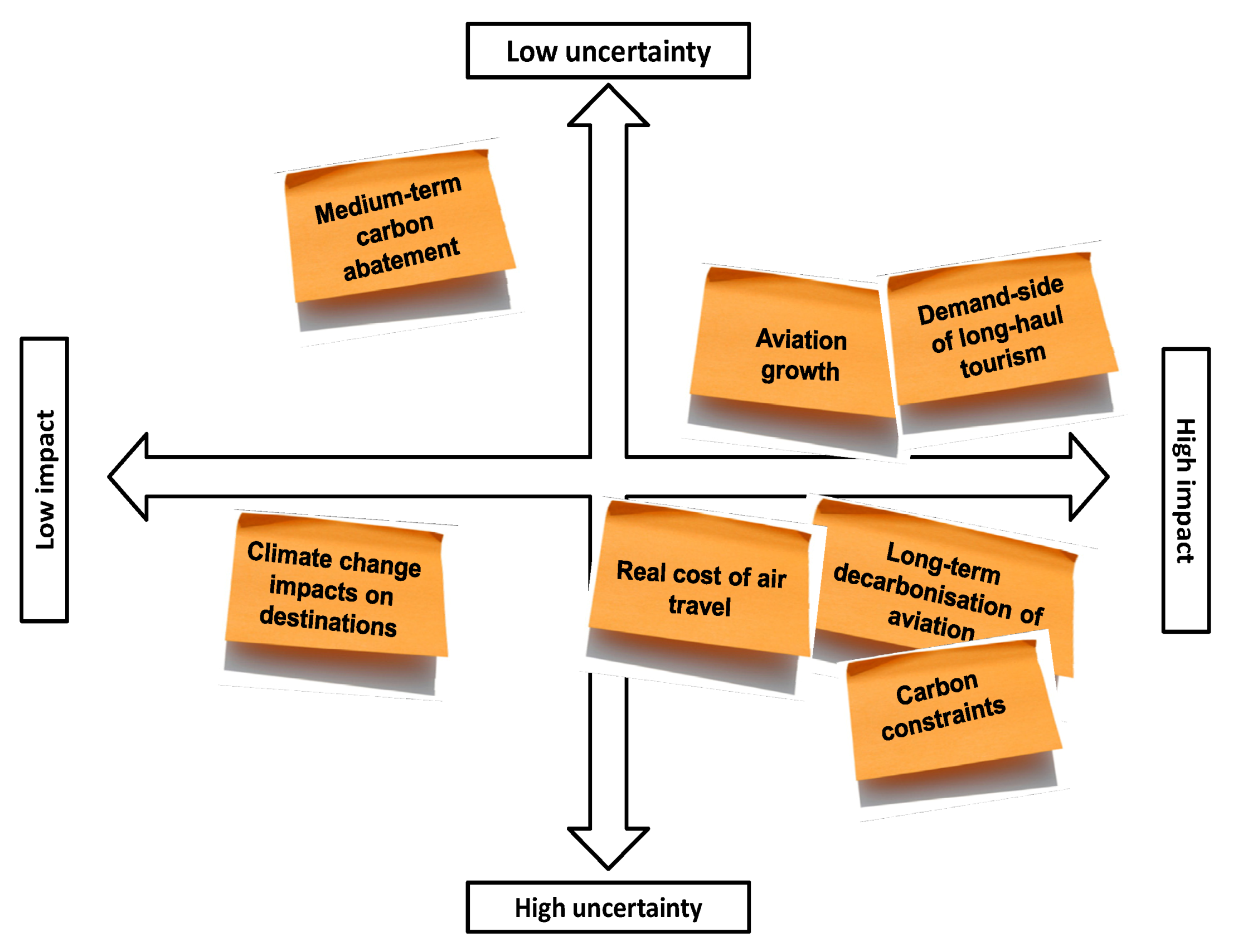
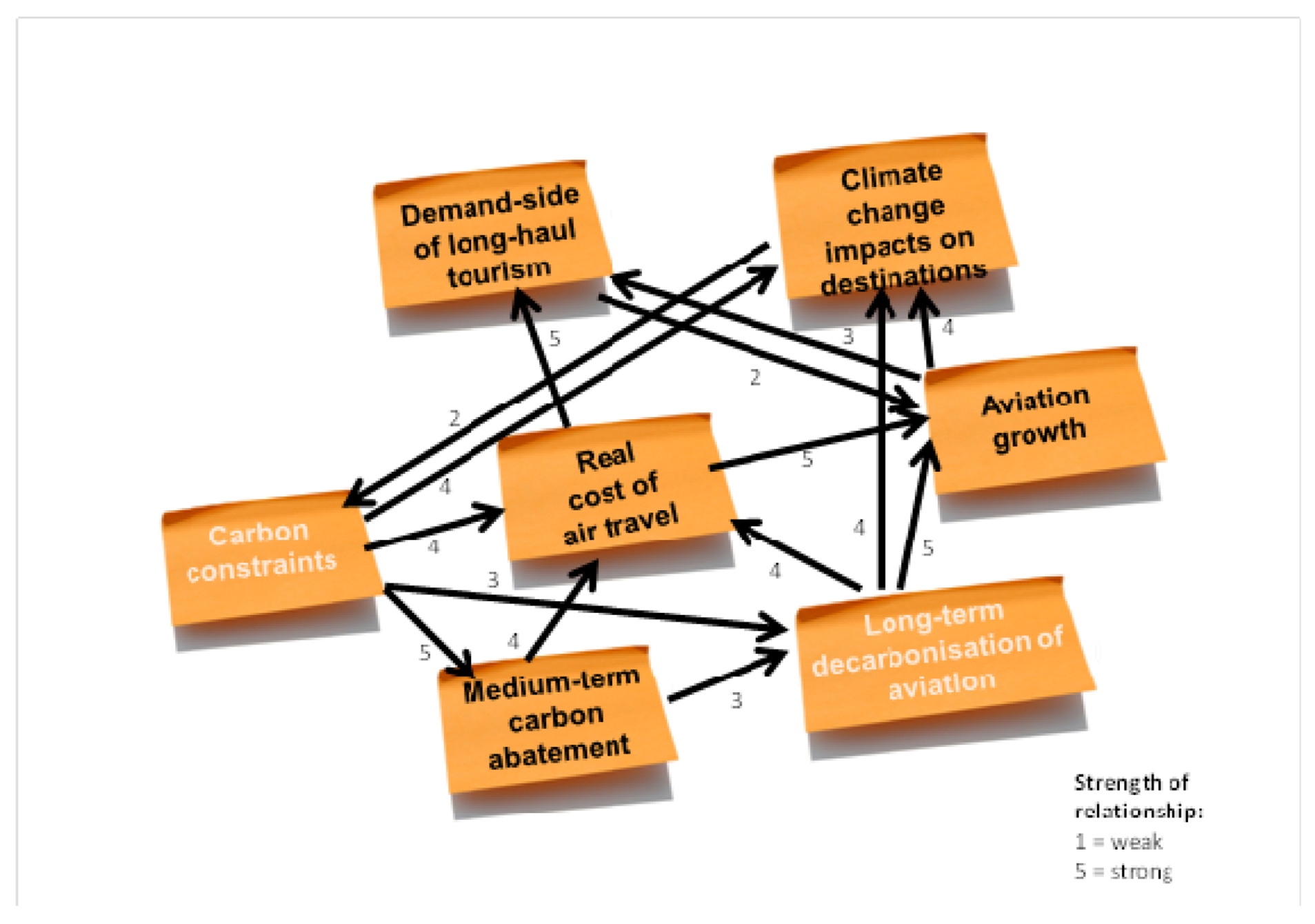
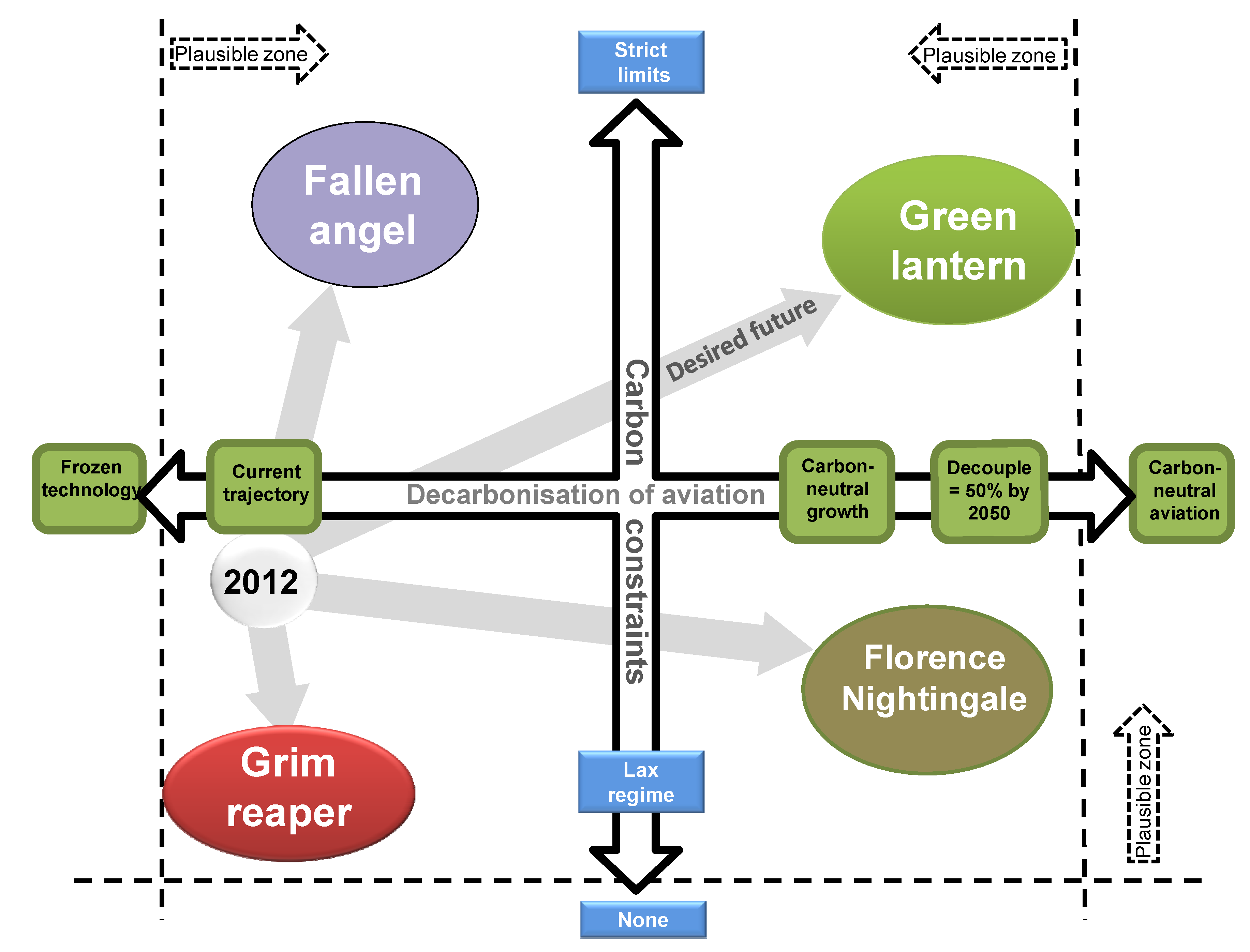
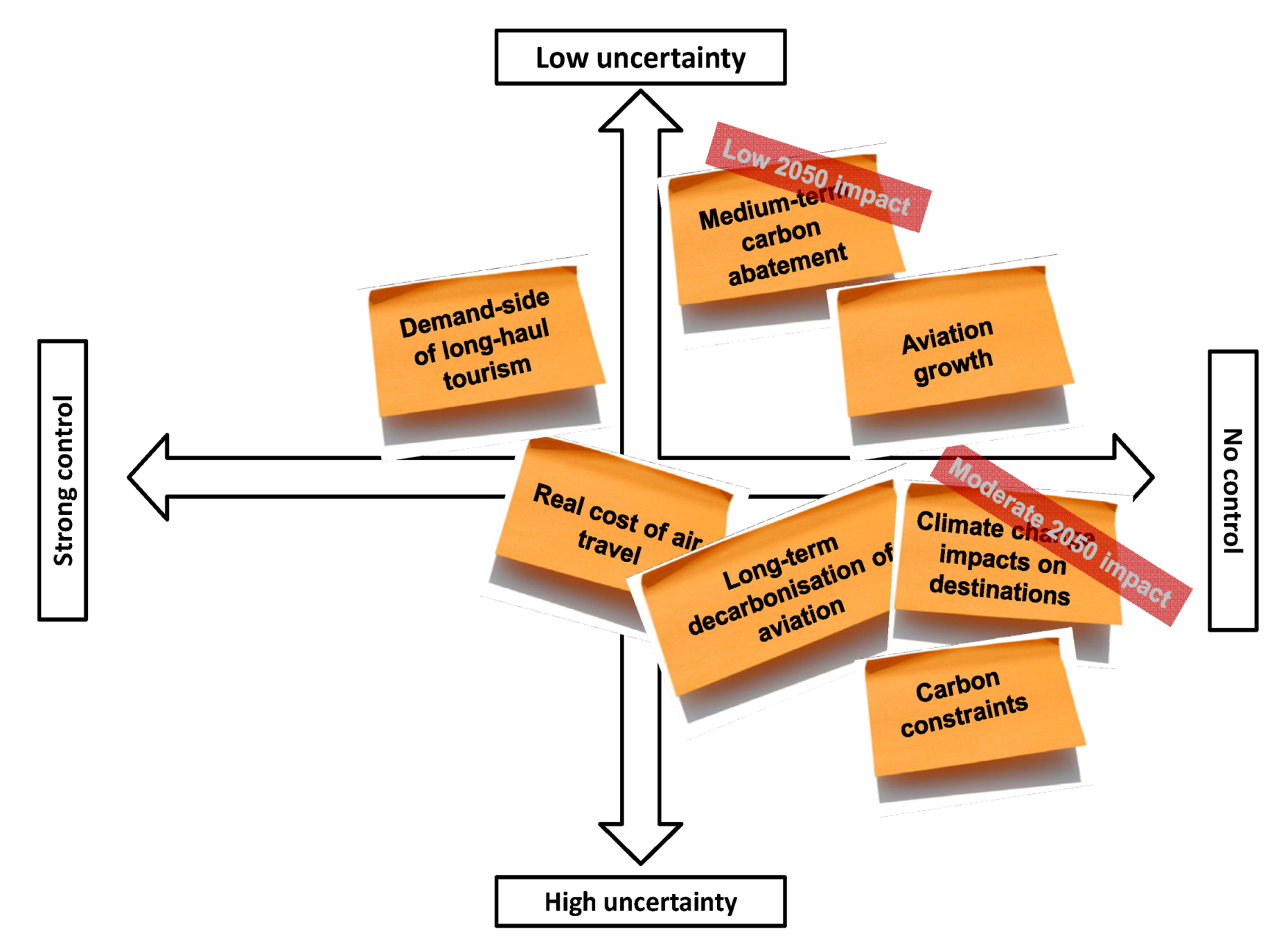
      <p>Based on the foregoing analysis, key uncertainties and drivers of change that could affect LHT in general, and particularly LHT in a carbon-constrained world, were identified. These drivers and uncertainties can be clustered into seven overriding drivers, as summarised in <xref ref-type="table" rid="sustainability-05-00001-t002">Table 2</xref> (which should be read with <xref ref-type="fig" rid="sustainability-05-00001-f008">Figure 8</xref> to <xref ref-type="fig" rid="sustainability-05-00001-f010">Figure 10</xref>).</p>
      <table-wrap id="sustainability-05-00001-t002" position="float">
        <object-id pub-id-type="pii">sustainability-05-00001-t002_Table 2</object-id>
        <label>Table 2</label>
        <caption>
          <p>Narrative description of the overriding drivers.</p>
        </caption>
        <table rules="rows">
          <thead>
            <tr>
              <th align="center" valign="middle">Overriding driver</th>
              <th align="center" valign="middle">Description</th>
            </tr>
          </thead>
          <tbody>
            <tr>
              <td align="center" valign="middle">1<break/>Climate change impacts on tourism destinations</td>
              <td align="left" valign="middle">Because tourism and aviation represent only five per cent of global emissions, and meeting “required by science” (RBS) mitigation targets for 2050 thus depends on many other economic sectors, this driving force is in the high-uncertainty, low-control quadrant. However, should the average global temperature increase move into dangerous territory by triggering critical ecosystem tipping points, the potential impacts on the tourism economy will likely enter the “high-impact” zone during the second half of the century, but not within the 2050 time horizon.</td>
            </tr>
            <tr>
              <td align="center" valign="middle">2<break/>Carbon constraints</td>
              <td align="left" valign="middle">This is by-and-large a political driver. A key uncertainty is whether multilateral negotiations will introduce carbon constraints. As will become evident in the scenario analysis, the timing of a political decision on carbon limits/carbon pricing could be a game changer in terms of decarbonisation—regardless of whether this involves a price instrument like carbon taxes or a quantity instrument like emissions trading (e.g. cap-and-trade, baseline-and-credit or offsetting). </td>
            </tr>
            <tr>
              <td align="center" valign="middle">3<break/>Medium-term carbon abatement levers (pre-2030)</td>
              <td align="left" valign="middle">These levers of change have low uncertainty, because many are already in the pipeline. These interventions may actually lead to further declines in the real cost of air travel. Even so, the impact on LHT would only be moderate to low, given that LHT growth also depends on a range of other variables. The tourism sector may be able to exert moderate influence towards implementing some of these measures—overall, though, control is low. </td>
            </tr>
            <tr>
              <td align="center" valign="middle">4<break/>Long-term decarbonisation (post-2030) </td>
              <td align="left" valign="middle">This is primarily a technological and behavioural driver. Decarbonisation through radically new (unknown) technologies, the drop-in of sustainable biofuels as jet fuel and/or the offsetting of unavoidable emissions through an MBM falls outside the tourism sector’s direct sphere of influence, and is highly uncertain for a number of reasons, including the political uncertainty about the nature and time frames for the introduction of carbon constraints (e.g. MBMs that act as price incentives), and the question marks over the scalability and costs of biofuels. The alternative to industry meeting RBS mitigation targets through technology deployment would be for governments to introduce physical constraints on the expansion of airport infrastructure, induce behavioural change among consumers, invest in infrastructure for passenger modal shifts, and incentivise information communication technology (ICT) alternatives to business travel. All these interventions fall within the high-uncertainty and no-control quadrants, and could impact on LHT through intermediary variables, such as aviation growth and the real cost of air travel.</td>
            </tr>
            <tr>
              <td align="center" valign="middle">5<break/>Real cost of air travel</td>
              <td align="left" valign="middle">Uncertainties relate to carbon pricing, other taxes and levies, oil prices and peak oil, scale economies and load factors, fuel-efficiency improvements (driven mainly by the medium-term carbon abatement levers outlined above) and the liberalisation (versus tighter regulation) of the airspace to allow for greater competition and growth of new business model, low-cost airlines. In terms of LHT demand as well as aviation growth, this is a high-impact, moderate-control driving force that also stands in direct relation to carbon constraints (read: carbon pricing) and the marginal cost of medium-term and long-term carbon abatement.</td>
            </tr>
            <tr>
              <td align="center" valign="middle">6<break/>Aviation growth</td>
              <td align="left" valign="middle">Aviation growth, or slowdown, will have a direct impact on LHT. By and large, because of institutional and regulatory silos that fragment the aviation-tourism value chain, aviation growth is a driving force outside the tourism sector’s sphere of direct influence. Aviation growth is exposed to a range of factors with various degrees of uncertainty attached to them, particularly the real cost of air travel (including oil prices), globalisation and the counter-trend of fragmentation, which could in turn have a negative impact on trade flows and business travel, the state and balance of forces in the global economy (e.g. emerging-market growth <italic>versus</italic> stagnation, the timing of global peak middle class, world trade and GDP), future consumer preferences (e.g. green consumerism), investment in airlift infrastructure <italic>versus</italic> mass-transit systems, and airline and airspace liberalisation. On balance, this driving force falls in the moderate-uncertainty zone.</td>
            </tr>
            <tr>
              <td align="center" valign="middle">7<break/>Demand side of long-haul tourism</td>
              <td align="left" valign="middle">Demand is highly correlated with aviation growth and trade volumes, and will have a definite impact on LHT. Although a range of driving forces within the organisational environment come into play, and are thus within the control of the tourism sector, tourism demand strongly depends on external variables very similar to those that drive aviation growth and the real cost of travel. This is thus a driving force of moderate uncertainty.</td>
            </tr>
          </tbody>
        </table>
      </table-wrap>
      <p>The seven overriding drivers were plotted on a control/certainty matrix (see <xref ref-type="fig" rid="sustainability-05-00001-f008">Figure 8</xref>), impact/certainty matrix (see <xref ref-type="fig" rid="sustainability-05-00001-f009">Figure 9</xref>) as well as a relationship strength map (see <xref ref-type="fig" rid="sustainability-05-00001-f010">Figure 10</xref>). Based on all these analyses, two principal driving forces were selected for the scenario logics, namely (i) carbon constraints, and (ii) the long-term decarbonisation of aviation. These forces constitute the axes on the scenario gameboard (see <xref ref-type="fig" rid="sustainability-05-00001-f011">Figure 11</xref>). (In an earlier iteration of the scenario gameboard, the vertical axis was assessed by its financial impact, namely a “high and global”<italic> versus</italic> a “low and ad hoc” price on carbon, rather than by the stringency of the climate change regime. It was initially argued that it is the price on carbon that will ultimately affect the real cost of air travel, aviation growth, incentives for decarbonisation, and LHT’s carbon footprint. However, it was decided that the two axes of <xref ref-type="fig" rid="sustainability-05-00001-f011">Figure 11</xref> should be more independent of one another. A high carbon price (vertical axis) would lead to greater decarbonsiation (horizontal axis), while the converse is also true. Therefore, any scenarios in the “high carbon price/low decarbonisation” and “low carbon price/high decarbonisation” quadrants would <italic>a priori</italic> not be that plausible. In the final analysis, it was thus decided to work with two, more independent axes and, given the political uncertainties alluded to in earlier sections, without defining the “carbon constraints” axis in terms of regime architecture and without assuming carbon pricing.)</p>
      <fig id="sustainability-05-00001-f008" position="float">
        <label>Figure 8</label>
        <caption>
          <p>Overriding driving forces relative to “certainty” and “impact”.</p>
        </caption>
        <graphic xmlns:xlink="http://www.w3.org/1999/xlink" xlink:href="sustainability-05-00001-g008.tif"/>
      </fig>
     <fig id="sustainability-05-00001-f009" position="float">
        <label>Figure 9</label>
        <caption>
          <p>Overriding driving forces relative to “certainty” and “control”.</p>
        </caption>
        <graphic xmlns:xlink="http://www.w3.org/1999/xlink" xlink:href="sustainability-05-00001-g009.tif"/>
      </fig>
      <fig id="sustainability-05-00001-f010" position="float">
        <label>Figure 10</label>
        <caption>
          <p>Relationships between overriding drivers of change.</p>
        </caption>
        <graphic xmlns:xlink="http://www.w3.org/1999/xlink" xlink:href="sustainability-05-00001-g010.tif"/>
      </fig>


      <sec>
      <title>Vertical Axis: Carbon Constraints [Political Driver]</title>
      <p>The “carbon constraints” driving force is primarily a political driver and is assessed by its stringency, namely strict limits or a lax regime—but without being specific about the architecture of the regime (e.g., top-down <italic>versus</italic> bottom-up, or carbon pricing through emissions trading <italic>versus</italic> a carbon tax). The plausible zone on the vertical axis of the scenario gameboard (<xref ref-type="fig" rid="sustainability-05-00001-f011">Figure 11</xref>) excludes the “no constraints” extreme. Besides the nature of the regime, the timing of a political decision is also a critical variable (see scenario narratives).</p></sec>
     <sec>
      <title>Horizontal Axis: Long-Term Decarbonisation of Dviation [Technological and Behavioural Driver]</title>
      <p>The horizontal axis (“long-term decarbonisation” of aviation) runs from (i) carbon-neutral aviation (meaning zero net emissions by 2050) through (ii) IATA’s decoupling target (<italic>i.e.</italic>, −50% below 2005 by 2050), (iii) IATA’s targeted 2020 CNG or emissions plateau trajectory extended to 2050, (iv) a mere extension of the current base-case trajectory to 2050 (this means the trajectory that optimises operational, infrastructural/ATM (air traffic management) and incremental technology-efficiency improvements by 2030, but does not extend the compounding effect of the 1.5%/annum fuel-efficiency gains beyond 2030), to (v) a “frozen technology” trajectory, in which emissions intensity remains unchanged up to 2050 (air traffic grows at 4.5% and emissions at 3% per annum up to 2050) [<xref ref-type="bibr" rid="B46-sustainability-05-00001">46</xref>,<xref ref-type="bibr" rid="B50-sustainability-05-00001">50</xref>,<xref ref-type="bibr" rid="B52-sustainability-05-00001">52</xref>]. Underpinning these “states of being” along the horizontal axis are a range of possible technological and behavioural drivers. The plausible zone on the scenario gameboard (<xref ref-type="fig" rid="sustainability-05-00001-f011">Figure 11</xref>) excludes (i) carbon-neutral aviation, which cannot credibly be regarded as realisable by 2050, as well as (ii) the frozen technology extreme (given current developments already in the pipeline). Some regression from the “current trajectory” base case is not to be excluded, as indicated by the positioning of the line for the plausible zone in the space between “frozen technology” and “current trajectory” in <xref ref-type="fig" rid="sustainability-05-00001-f011">Figure 11</xref>.</p>
      <p>Based on these parameters, the gameboard in <xref ref-type="fig" rid="sustainability-05-00001-f011">Figure 11</xref> indicates the “plausible extremes of the uncertainties” [<xref ref-type="bibr" rid="B13-sustainability-05-00001">13</xref>]. This frames the parameters for the scenario storylines, which are described next. </p>
      <fig id="sustainability-05-00001-f011" position="float">
        <label>Figure 11</label>
        <caption>
          <p>2050 scenarios for long-haul tourism in an evolving climate change regime.</p>
        </caption>
        <graphic xmlns:xlink="http://www.w3.org/1999/xlink" xlink:href="sustainability-05-00001-g011.tif"/>
      </fig>
      </sec>
    </sec>
    <sec id="sec6-sustainability-05-00001">
      <title>6. 2050 Scenarios for Long-haul Tourism (Steps 6 and 7 in <xref ref-type="fig" rid="sustainability-05-00001-f012">Figure 12</xref>)</title>
      <fig id="sustainability-05-00001-f012" position="float">
          <label>Figure 12</label>
          <caption>
            <p>The eight-step scenario-building approach: Steps 6 and 7</p>
          </caption>
          <graphic xmlns:xlink="http://www.w3.org/1999/xlink" xlink:href="sustainability-05-00001-g012.tif"/>
        </fig>
      <sec>
        <title>6.1. Introduction</title>
        <p>In the initial possibility space, there are four scenarios for LHT in 2050: a “green lantern” scenario, which is most desired, and three feared scenarios, namely “fallen angel”, “Florence Nightingale” and “grim reaper”. However, in the final possibility space (see <xref ref-type="fig" rid="sustainability-05-00001-f013">Figure 13</xref> and <xref ref-type="fig" rid="sustainability-05-00001-f014">Figure 14</xref>), the Florence Nightingale scenario is eliminated because of plausibility concerns (see <xref ref-type="sec" rid="sec6dot2dot4-sustainability-05-00001">Section 6.2.4</xref>). </p>
        <p>Of course, the road to 2050 starts in 2012. Therefore, the first question is: Where are we today? </p>
       
        
        <fig id="sustainability-05-00001-f013" position="float">
          <label>Figure 13</label>
          <caption>
            <p>Four scenario narratives.</p>
          </caption>
          <graphic xmlns:xlink="http://www.w3.org/1999/xlink" xlink:href="sustainability-05-00001-g013.tif"/>
        </fig>
         <fig id="sustainability-05-00001-f014" position="float">
          <label>Figure 14</label>
          <caption>
            <p>Plausible scenarios.</p>
          </caption>
          <graphic xmlns:xlink="http://www.w3.org/1999/xlink" xlink:href="sustainability-05-00001-g014.tif"/>
        </fig>
        <sec>
        <title>The Story of the Status Quo: Where Are We in 2012?</title>
        <p>After a solid recovery in international tourist arrivals following the global economic downturn of 2008/9 [<xref ref-type="bibr" rid="B77-sustainability-05-00001">77</xref>,<xref ref-type="bibr" rid="B104-sustainability-05-00001">104</xref>], the world is holding its breath for a historic year: For the first time ever, one billion international tourist arrivals are expected in 2012 [<xref ref-type="bibr" rid="B118-sustainability-05-00001">118</xref>]. For an industry that had only 25 million international arrivals in 1950 [<xref ref-type="bibr" rid="B104-sustainability-05-00001">104</xref>], this represents remarkable growth. And it is predicted that the best is yet to come. </p>
        <p>But this is not the full story. In 2012, various uncertainties also beckon on the horizon. For starters, there is the uncertainty about the outcome of UNFCCC negotiations on a global and comprehensive post-2020 climate change regime, and ICAO negotiations on a global sectoral MBM for controlling international aviation emissions [<xref ref-type="bibr" rid="B66-sustainability-05-00001">66</xref>]. If negotiations in these two forums succeed, a global and progressive price on carbon combined with absolute limits on emissions may be knocking on the door of the future. This will surely affect growth in LHT, depending on what happens with the decarbonisation of aviation over the next four decades. By 2050, carbon pricing can “double fossil fuel prices” [<xref ref-type="bibr" rid="B92-sustainability-05-00001">92</xref>]. If negotiations fail, who knows what may happen? A fragmented regime may see further unilateral imposition of carbon constraints by major blocks such as the European Union, which, in 2012, for the first time included international aviation in its own ETS [<xref ref-type="bibr" rid="B119-sustainability-05-00001">119</xref>,<xref ref-type="bibr" rid="B120-sustainability-05-00001">120</xref>,<xref ref-type="bibr" rid="B121-sustainability-05-00001">121</xref>,<xref ref-type="bibr" rid="B122-sustainability-05-00001">122</xref>], or a very weak and fragmented climate regime that disregards RBS may prevail for the next few decades. In the long run, this would of course hold dire consequences for LHT destinations, especially if the average temperature increase exceeds 2 °C during this century [<xref ref-type="bibr" rid="B4-sustainability-05-00001">4</xref>]. </p>
        <p>Fortunately, in 2012, the aviation industry is responding proactively to the prospects of a carbon-constrained world (see targets in <xref ref-type="fig" rid="sustainability-05-00001-f006">Figure 6</xref>). But, of course, these are good intentions that must still be turned into actions. Even achieving what is labelled the “current trajectory” will surely not be plain sailing. Depending on the nature of the evolving climate change regime and the decarbonisation of aviation, combined with many other major uncertainties, the future of LHT up to 2050 is hanging in mid-air. </p>
      </sec> 
      </sec>
      <sec>
        <title>6.2. 2050 Futures: The Scenario Storylines</title>
        <p>Given the uncertainties moving forward from the status quo in 2012, it is possible to imagine more than one narrative for the future. These possible futures (depicted in <xref ref-type="fig" rid="sustainability-05-00001-f011">Figure 11</xref> and summarised in <xref ref-type="fig" rid="sustainability-05-00001-f013">Figure 13</xref>) are described next. The approach is to take a retrospective look, from 2050 backwards. </p>
        <sec>
          <title>6.2.1. The “Green Lantern” Scenario</title>
          <sec>
          <title>The Green Lantern: Where Are We in 2050?</title>
          <p>The meaningful decoupling of aviation and LHT growth from carbon emissions exemplifies the global paradigm shift towards a green economy over the past four decades. In response to early warning signals in the 2010s that a future climate change regime will put a binding cap and an escalating price on aviation emissions, the rapidly growing aviation and tourism sectors proactively repositioned to become green lanterns of prosperity. These sectors contribute their fair share to ongoing efforts to limit the temperature increase to below 2 °C above pre-industrial levels, while growth in tourism demand and its associated developmental benefits continue to outstrip all expectations. Globalisation and rapid economic growth in what was formerly known as emerging economies are driving LHT and aviation growth. Although air travel as such is not yet carbon-neutral, the industry’s four-decade-old commitment to reducing emissions to 50% below 2005 levels by 2050 became a reality. All indications are that the world will be spared the worst impacts of climate change over the remainder of this century.</p>    </sec>
          <sec>
          <title>How Did We Get Here?</title>
          <sec>
          <title>2012 to 2020</title>
          <p>After receiving an unambiguous negotiating mandate at the ICAO General Assembly in 2013, the architecture of an open cap-and-trade emissions trading scheme (ETS) for international aviation emissions was finally agreed in 2016. This coincided with the conclusion of UNFCCC negotiations, which was only possible because all major economies felt comfortable that they would not be competitively disadvantaged or unfairly treated by a global top-down burden-sharing climate change regime coming into effect in 2020.</p>
          <p>Because of the long-term and legally binding nature of these global regimes, which combine command-and-control-type emissions limits with market-based price incentives, the aviation industry and governments started to invest in meaningful public-private partnerships (PPPs) towards decarbonising air transport long before 2020. “Low-carbon” became the new buzzword for competitiveness. </p>
          </sec>
          <sec>
          <title>2020 to 2030</title>
          <p>By 2030, the carbon abatement potential of operational, infrastructural and ATM as well as incremental technology-efficiency improvements foreseen in 2012 (as per IATA’s four pillar strategy) had been fully realised. It was a demonstration of unprecedented political will combined with cooperation across the entire aviation value chain. The modernisation of the eight-decades-old Chicago Convention (by closing the gap with the global trade regime, which is more appropriate for the age of globalisation) surely also played a part. Although the efficiency improvements extended linearly into the future, this alone was not enough to meet industry’s CNG goal for the next decade, and the post-2020 sectoral cap-and-trade ETS became the vehicle to offset those aviation emissions exceeding a CNG plateau trajectory against other economic sectors. </p>
          <p>The post-2020 ETS also created a long-term price incentive for R&amp;D spending and investment in the required commercial-scale production to bring radical new technologies, including second-generation drop-in biofuels, to market after 2030. Price parity with dirty kerosene jet fuel was reached by 2025 [<xref ref-type="bibr" rid="B91-sustainability-05-00001">91</xref>]. </p>
          </sec>
          <sec>
          <title>2030 to 2050</title>
          <p>The big winners in the low-carbon aviation and biofuels race since 2030 have clearly been Africa, Brazil, India and China [<xref ref-type="bibr" rid="B123-sustainability-05-00001">123</xref>]. As China rolled out its new generation of aerodynamic aircraft, Africa succeeded in allocating sufficient land for biofuel feedstock production. The massive investment in second-generation biofuels production created many new job and income opportunities [<xref ref-type="bibr" rid="B123-sustainability-05-00001">123</xref>] in African countries, where feedstock comprises vegetation such as jatropha, which is today grown on degraded wastelands, and algae, which are produced in polluted and coastal water resources. Because of early collaborative R&amp;D investment with multinational oil companies, and support by regional development banks and visionary governments for the piloting of biofuel production and refinery facilities, Africa today owns many of the intellectual property rights in this competitive market space, and is also a market leader in converting urban waste into biofuels. In addition, now that intra-African tourism has taken off and is heavily supported by a new middle class and the growth of lower-cost airlines, it is also a major consumer of home-grown low-carbon jet fuels.</p>
          <p>The volume of second-generation biofuels that would have been required to meet industry’s 2050 targets on its own would have been seven times the total volume of first-generation biofuels in the market in 2010 [<xref ref-type="bibr" rid="B46-sustainability-05-00001">46</xref>,<xref ref-type="bibr" rid="B93-sustainability-05-00001">93</xref>]. If all these biofuels had to be sourced from jatropha, a land area of one million km<sup>2</sup> would have been needed [<xref ref-type="bibr" rid="B49-sustainability-05-00001">49</xref>]. Even though biofuels did not materialise at the scale required to meet industry’s 2050 targets on its own, mainly due to limits to feedstock production, other radical new technologies, including blended-wing/body design, on-board fuel cell systems and previously inconceivable engine architectures [<xref ref-type="bibr" rid="B95-sustainability-05-00001">95</xref>] became commercially viable by 2045, and managed to close the gap between RBS and actual emissions by 2050. (Radical aeronautical technology did not change the landscape significantly by 2030. The production of a new model/engine involves long lead times. Moreover, even if some breakthrough “fell from the sky”, it would also have required a long lead time to scale commercial uptake before it could make a serious dent in overall industry performance.) As a result, air transport became less reliant on more expensive emissions trading (ET) to offset emissions, thereby keeping the real cost of air travel stable. </p>
          <p>Coupled with the rapid growth in tourism demand spurred by economic growth from China, India, Brazil and Africa, the last two decades have witnessed sustained growth in LHT and air traffic RPKs, thereby creating many new tourism-related job opportunities and increasing the tourism sector’s contribution to global gross domestic product (GDP). </p>
          
          </sec>
          </sec>

          
          <sec>
          <title>What have been the Turning Points and Signposts over the last Four Decades? What is Assumed in this Scenario? And which “Wild Cards” could have Disrupted this Storyline?</title>
          <p>The four-decade low-carbon revolution required visionary political and industry leaders, who stood ready to take the tough policy and investment decisions needed. Very little would have moved forward had the major forces not buried the hatchet in climate change negotiations—this was the first major signpost. The second signpost was the agreement on a long-term policy signal (<italic>i.e.</italic>, cap-and-trade regime) under ICAO, which also provided the critical price incentive beyond 2020 [<xref ref-type="bibr" rid="B93-sustainability-05-00001">93</xref>,<xref ref-type="bibr" rid="B97-sustainability-05-00001">97</xref>]. Only once it became clear that “perverse subsidies, such as the non-taxation of kerosene” [<xref ref-type="bibr" rid="B4-sustainability-05-00001">4</xref>], would make way for a progressive price on carbon, the different interests in the vertical aviation industry supply chain (including airframe and engine manufactures, fuel producers and distributors, airlines, airports and air transport navigation authorities) cooperated at a higher level.</p>
          <p>The aviation industry, working proactively on its own, would not have been enough—it needed its public-sector partners to resolve outstanding operational and infrastructural inefficiencies caused by decade-old conceptions of national sovereignty [<xref ref-type="bibr" rid="B73-sustainability-05-00001">73</xref>,<xref ref-type="bibr" rid="B90-sustainability-05-00001">90</xref>], allocate sufficient land and water for biofuel feedstock production [<xref ref-type="bibr" rid="B46-sustainability-05-00001">46</xref>,<xref ref-type="bibr" rid="B94-sustainability-05-00001">94</xref>], form R&amp;D partnerships [<xref ref-type="bibr" rid="B123-sustainability-05-00001">123</xref>,<xref ref-type="bibr" rid="B124-sustainability-05-00001">124</xref>], set global standards in ICAO [<xref ref-type="bibr" rid="B5-sustainability-05-00001">5</xref>,<xref ref-type="bibr" rid="B79-sustainability-05-00001">79</xref>,<xref ref-type="bibr" rid="B115-sustainability-05-00001">115</xref>,<xref ref-type="bibr" rid="B125-sustainability-05-00001">125</xref>,<xref ref-type="bibr" rid="B126-sustainability-05-00001">126</xref>], and establish creative new funding mechanisms for technology deployment to de-risk private-sector investment [<xref ref-type="bibr" rid="B46-sustainability-05-00001">46</xref>,<xref ref-type="bibr" rid="B92-sustainability-05-00001">92</xref>]. All of this led to the third and most significant signpost, which was when aviation carbon emissions started to decline in absolute terms after 2030, with LHT (assessed by RPKs) growing unhindered. However, this in itself would not have been enough to close the gap. Without radical new technology breakthroughs and commercialisation by 2045, this scenario would not have materialised.</p>
          <p>Finally, the liberalisation of the airline industry and increased competition in the skies, stable oil prices and a delay in peak oil, sustainable economic growth in Africa and the former emerging economies, linked to urbanisation and the growth of mega-cities, as well as the continued globalisation of trade, were all indispensible for the exponential growth in LHT demand and airlift. Ultimately, multilateralism and global political stability had to prevail, and globalisation had to stay on track, with emerging economies providing the necessary new impetus to the global economy. A multi-decade economic depression or de-globalisation mega-trend, which slowed down global trade and depressed household disposable income, would have been major “spoilers” in the successful unwrapping of this story.</p></sec>
          <sec>
          <title>What were the Implications for LHT Destinations? Any Risks and Opportunities? And, at a Strategic Level, how did Tourist Destinations Respond?</title>
          <p>Due to the decoupling of LHT growth from emissions growth, destinations were able to continue reaping significant social and economic benefits, but in an environmentally responsible way. This is what the new generation of green travel consumers expect. Most destinations continue to balance domestic, regional (<italic>i.e.</italic>, land arrival) and long-haul air arrival markets, as well as leisure and business tourism, mainly to hedge against unforeseen external economic and security shocks and other potential supply chain disruptions. Some destinations continue to exploit low-volume, high-value markets, while many others focus on mass-based tourism—unaffected by carbon constraints. That said, there is disproportionate growth in “proximity tourism” (domestic and regional), though not to the same extent as in the “fallen angel’ scenario [<xref ref-type="bibr" rid="B8-sustainability-05-00001">8</xref>].</p>
          <p>Due to a collective and ambitious global climate change effort, including all countries and economic sectors, global emissions peaked and started to decline early enough to avoid a temperature increase of more than 2° C. Other than for the most vulnerable small-island tourist destinations and least developed countries with low adaptive capacities, dealing with the unavoidable impacts of climate change on ecosystem assets and other tourism infrastructure remains manageable.</p>
        </sec>
        </sec>
        <sec>
          <title>6.2.2. The “Fallen Angel” Scenario</title>
          <sec>
          <title>The Fallen Angel: Where Are We in 2050?</title>
          <p>In 2050, the tourism sector is often compared to a “fallen angel”: Due to its historical contribution to GDP and employment, it had so much potential, but today, it is shackled to the ground by carbon constraints. Air transport’s carbon footprint became the Achilles heel of LHT. Due to the aviation sector’s failure to deviate much below its 2010 “current trajectory” for decarbonisation, and in the face of the escalating price on carbon following a (delayed) global climate deal in 2025, LHT is dis-incentivised through a combination of various public policy tools. By 2040, passenger growth stalled, and by 2050, growth had moved into negative territory. The impact on global employment and GDP is negative, with the exception of a number of destinations that switched to local and regional tourism (so-called low-carbon proximity tourism) early on. Unfortunately, the global aviation industry’s response over the past four decades can only be described as “too little too late”, and LHT is paying the price.</p>
          </sec>
          <sec>
          <title>How Did We Get Here?</title>
          <sec>
          <title>2012 to 2030</title>
          <p>Unfortunately, in the 2010s, rather than agreeing on a global sectoral ETS that provided a price incentive for R&amp;D investment in radical technology solutions and the building of a sustainable biofuels value chain, the aviation sector adopted a wait-and-see approach. </p>
          <p>After a ten-year delay to conclude negotiations on a post-Kyoto climate regime, the major forces resolved their outstanding differences by 2025, and agreed on a binding, top-down climate change regime with an absolute cap on global emissions to come into effect by 2030. As in the “green lantern” scenario, this regime includes flexible mechanisms that allow for ET within and between economic sectors, with a progressive, global price on carbon. But because of the lost decade, the binding RBS emissions reduction targets were extremely steep. </p>
          <p>The aviation sector did achieve some deviation from the “business as usual” (BAU) baseline between 2012 and 2030, but the industry goal of CNG after 2020 did not materialise until 2030. Ironically, many carbon abatement opportunities with net negative costs, in other words those that would have led to cost savings, were forfeited. It was a classic case of market failure combined with (national and multilateral) governance failure. For example, there were unnecessary delays and a lack of political will in the United States (US) and European Union (EU) to implement the Single European Sky ATM Research (SESAR) and the Next Generation Air Transportation System (NextGen) (which would have led to major operational and ATM-related fuel efficiency gains); agreement in the ICAO on CO<sub>2</sub> standards for new aircraft stalled; governments waited until 2025 to agree on interoperability standards for ATM and airport infrastructure, and so on. In addition, conflicts of interest in the vertical aviation supply chain persisted: Oil companies were basically holding airlines hostage by not investing in low-carbon biofuel development. Overall, the industry just never got its act together, and due to a lack of leadership and vision, the message that “co-opetition” was in everyone’s best interest simply never hit home.</p>
          </sec>
          <sec>
          <title>2030 to 2050</title>
          <p>As emissions peaked at such a late stage and such a high level, the IATA goal to reduce absolute emissions to 50% below 2005 levels by 2050, without slowing down growth in air traffic and international tourism, became an impossible dream. Even over the two decades since 2030, industry aspirations of rapid decoupling got stuck in the mud too often. As a result of a lack of early investment in low-carbon R&amp;D and the allocation of land for second-generation biofuel feedstock production by governments, the balance of mitigation efforts shifted from the technology-driven and fuel-switching options foreseen in the 2010s, to suppressing LHT demand through economic measures, <italic>i.e.</italic>, changing behaviour through punitive carbon pricing and individual carbon budgets. Between 2030 and 2040, as conditions to bring in tourists got more costly, some governments that relied heavily on LHT were inclined to “subsidise” some aspects of travel in one form or another; however, this turned out to be unsustainable in the long run. </p>
          <p>The price on carbon, which took effect in 2030, came too late to act as an incentive for proactive investment in R&amp;D for second-generation biofuels and other radical technologies. Before 2030, the financial and technological risks of biofuels investment were just too high for private investors. Governments also never came to the party with fiscal incentives that would de-risk private-sector initiatives. In fact, as early as 2015, it became clear that the more proactive automotive industry was going to win the race for access to the limited volume of feedstock available for the production of low-carbon biofuels [<xref ref-type="bibr" rid="B46-sustainability-05-00001">46</xref>,<xref ref-type="bibr" rid="B93-sustainability-05-00001">93</xref>]. </p>
          <p>By 2035, the price on carbon was so steep that it became a moderate disincentive for leisure and business travel. Because of narrow industry profit margins, these costs were passed on to airfares and the cost of cargo. By 2040, the real cost of air travel, which now fully internalised the cost of externalities, became a serious disincentive for leisure tourism. Business travel also slowed down as carbon constraints on global trade started to weigh in, and governments invested heavily in public awareness campaigns aimed at moral persuasion, encouraging people to travel less and closer to home, and businesses to replace travel with ICT solutions as their contribution to slowing down climate change. At least, that was until 2040. By then, the gap between BAU and RBS emissions trajectories forced governments to legislate for low-carbon lifestyles, and individuals had to start living within personal carbon budgets, purchase carbon allowances from other households, or face stiff penalties. By 2050, “[o]verseas tourism becomes an exception, but is still possible” and for “individuals with energy-intensive life-styles, marginal costs for more tourism are high; [and] for the wealthier, options to buy permits may be limited” [<xref ref-type="bibr" rid="B8-sustainability-05-00001">8</xref>]. After 2040, many governments also limited the construction of new airport infrastructure, and some were forced to act against airports that failed to meet the strict and mandatory operational and ATM efficiency standards adopted under the ICAO.</p>
          <p>Tourist mindsets also changed and “going local” became the new buzzword. Netflix’s virtual tourism experiences have become very popular. Today, many holidaymakers choose to deal with their “carbon guilt” by vacationing closer to home [<xref ref-type="bibr" rid="B64-sustainability-05-00001">64</xref>]. Tourists started switching to lower-carbon mass-transit systems for holidays under 1500 kilometres for the best part of the last two decades. It was no longer fashionable to boast about “our overseas holidays”, and the “why” and “how” of “travel” has taken centre stage over coffee-table discussions [<xref ref-type="bibr" rid="B64-sustainability-05-00001">64</xref>]. The hotel and restaurant industries follow a similar pattern, concerns about so-called “carbon food miles” drove initiatives like “hyper-local sourcing”, and the green cost-saving imperative led to the introduction of “metered” energy and water consumption for hotel guests [<xref ref-type="bibr" rid="B64-sustainability-05-00001">64</xref>].</p>
          <p>Linked to emerging trends of de-globalisation, especially as the growth in emerging economies flattened out by 2035 and traditional developed-country markets entered their second decade of float economic growth, a slowdown in global trade also weighed in on LHT growth. The negative impact on business tourism was compounded by the rapid advances in three-dimensional (3D) visualisation and other new-generation communication technologies. Videoconferencing increasingly substituted what used to be a lucrative business tourism subsector.</p>
          </sec></sec>
          <sec><title>What have Been the Turning Points and Signposts Over the Last Four Decades? What is Assumed in this Scenario? And which “Wild Cards” could have Disrupted this Storyline?</title>
          <p>A key turning point was when climate change negotiations collapsed in 2015, and remained deadlocked for a decade. Missing the aviation industry’s post-2020 CNG goal was then a given, as industry moved into reactive mode and ICAO negotiations on an MBM disintegrated. Role players in the value chain simply assumed that there would be no price incentive to invest in R&amp;D for radical new technologies and biofuels that would make a difference after 2030. The next signpost was when climate negotiations picked up new political momentum by 2020. Immediately, it became clear that the aviation industry, with its long R&amp;D lead times, was caught unprepared. When air traffic growth (as reflected by RPKs)—a lead indicator of LHT—dropped to below two per cent per annum by 2040 as the price on carbon and real travel costs escalated, the overall decline in the prospects for LHT became an established mega-trend. </p>
          <p>Of course, things could have been different had a “wild card” exogenous to the aviation and tourism sectors, such as a technology fix for carbon sequestration or “fairy godmother”-type solar or hydrogen-fuelled planes, entered the scene, or had a multi-decade world war, epidemic, global economic downturn or de-globalisation decimated the carbon emissions of other major emitting sectors in general, and air traffic volumes in particular, thereby reducing the pressure on air transport to deal with its carbon footprint, and dramatically increasing the opportunity cost of leisure and business travel. For a few dreamers, teleportation of tourists between continents never materialised beyond science fiction movies. The timing of peak oil is a wild card in this scenario.</p>
          </sec>
          <sec>
          <title>What were the Implications for LHT Destinations? Any Risks and Opportunities? And, at a Strategic Level, how did Tourist Destinations Respond?</title>
          <p>The nature of tourism had to change. At a macro-level, many destinations de-linked tourism from aviation, and started reducing absolute aviation emissions—not through technology-driven decarbonisation, but through demand management, <italic>i.e.</italic>, by suppressing LHT/passenger growth. In the face of carbon taxes and due to the high price elasticity of demand, LHT entered its darkest decades in history. Though LHT previously represented lower volumes compared to domestic and regional land arrivals, it had disproportionately high value in terms of tourism receipts (<italic>i.e.</italic>, spending). Consequently, job losses and GDP impacts were disproportionate to the loss in volume over the last few decades. Most destinations experienced negative tourism GDP and job impacts. </p>
          <p>Some destinations, however, had the foresight to reposition early. They decreased LHT’s share in their portfolios and, by 2020, in anticipation of unavoidable carbon constraints, shifted their focus to domestic, regional and short-haul tourism [<xref ref-type="bibr" rid="B8-sustainability-05-00001">8</xref>]. They invested heavily in mass-transit systems rather than new airports and government-subsidised airlines. These early movers also refocused their market segmentation and value propositions from mass-based low-cost markets to premium markets that deliver higher-yield tourists, which also happen to be less price-sensitive. They also only target and attract “visitors who have an affinity with its environmental outlook and [low-carbon] way of life” [<xref ref-type="bibr" rid="B9-sustainability-05-00001">9</xref>]. For them, so-called “slow” (by train, boat or bicycle) and “low-carbon” tourism became a tagline that created competitive “green” advantage in marketing and destination branding [<xref ref-type="bibr" rid="B9-sustainability-05-00001">9</xref>,<xref ref-type="bibr" rid="B64-sustainability-05-00001">64</xref>]. By recognising that LHT is not an unambiguous “good”, and that there are environmental limits to LHT, these destinations proved that alternative modes of tourism and, by implication, less LHT could still provide equal well-being to their populations. </p>
          <p>Due to the lost decade, and even though the worst impacts of climate change have been avoided, many tourist destinations still have to invest heavily in measures to adapt to unavoidable climate change, especially in low-lying coastal areas, small-island states and water-stressed regions. A temperature increase of more than 3.5 °C is not on the horizon during this century, but the dream of avoiding a temperature increase of more than 2 °C is lost. Nevertheless, tourist destinations that depend heavily on the natural environment and climate itself have started to experience demand impacts, for example because of the decline in snow-based tourism activities and the spread of vector-borne diseases to former tourist hot spots.</p>
        </sec>   </sec>
        <sec>
          <title>6.2.3. The “Grim Reaper” Scenario</title>
          <sec>
          <title>The Grim Reaper: Where Are We in 2050?</title>
          <p>Like the grim reaper, aviation and LHT have been raiding the global commons without an environmental conscience ever since global climate change negotiations collapsed in the late 2010s. There is no global limit/price on carbon that internalises the cost of negative externalities, and the real cost of air travel keeps falling on the back of new economies of scale, higher load factors, technology-driven fuel-efficiency improvements and stable oil prices. Both air traffic and emissions grew nearly unabated for four decades. This was fuelled by an expanding global middle class in the former emerging economies and Africa, persistent GDP growth in the traditional developed countries, rapid urbanisation and growth in mega-cities in Asia, booming business travel associated with the ongoing globalisation of trade, and mass-based leisure tourism supported by expansive low-cost airline networks and a consumer mindset focused on hedonistic experiences. The atmosphere is on track to warm by more than 3,5 °C during this century. Climate change has already breached critical ecosystem tipping points, with devastating social and economic impacts on many tourist destinations.</p>
          </sec>
          <sec>
          <title>How Did We Get Here?</title>
          <sec>
          <title>2012 to 2030</title>
          <p>Due to a continued deadlock between the major economies, climate change negotiations under the UNFCCC first derailed in 2015. There were various failed attempts to restart the process and seek new mandates, but member parties increasingly lost confidence in multilateral governance and the United Nations (UN) system. Eventually, following a UNFCCC Conference of the Parties (COP) 27 decision to that effect in Houston, Texas, in 2021, the UN Secretary-General had no choice but to dissolve the UNFCCC. This also meant that negotiations on an MBM for controlling and pricing international aviation emissions under ICAO came to an end. Anyhow, as an institution, ICAO had much more important challenges to deal with, including managing the security (e.g., cyber-terrorism) and navigation aspects associated with the rapid growth in air traffic worldwide. The collapse of negotiations on MBMs came as no surprise either: The narrow sectoral interest of a significant number of its member parties, defending the interests of national airline carriers, have for decades been to oppose any attempts to internalise the cost of environmental externalities—and quite understandably so, because, as early as 2010, the global airline industry operated on an average profit margin of less than one per cent, not even covering the cost of capital [<xref ref-type="bibr" rid="B79-sustainability-05-00001">79</xref>].</p>
          <p>Today, many play the blame game in seeking scapegoats for the historic market failures and the collapse of multilateral governance in the 2010s. What is clear is that very few players are blameless, including consumers who just never committed to paying a premium for a low-carbon lifestyle. Ironically, the airlines and aircraft manufacturers carry the least blame—they at least invested in incremental technological, operational and infrastructural efficiency improvements up to 2030—motivated not by climate change considerations, but by the fact that fuel costs constituted more than 30 per cent of their operating costs during those two decades [<xref ref-type="bibr" rid="B108-sustainability-05-00001">108</xref>]. However, airlines’ efforts were not enough. What was lacking was the political will on the part of governments to agree on an RBS top-down climate regime, to optimise flight routes and ensure interoperability of ATM systems, to de-risk investment in developing second-generation biofuel supply chains through creative incentive mechanisms, and to introduce fuel-blending mandates that would have forced the most guilty parties, namely the multinational producers and distributors of kerosene jet fuel, to take the low-carbon challenge seriously. In the 2010s, while airlines were struggling just to break even, these oil companies made a massive 10 per cent net profit on jet fuel supply of nearly $200 billion per annum [<xref ref-type="bibr" rid="B82-sustainability-05-00001">82</xref>]. </p>
          </sec>
          <sec>
          <title>2030 to 2050</title>
          <p>In the meantime, growth in LHT (assessed by aviation RPKs) continued at a CAGR of more than 4.5 per cent per year, driven mainly by the new markets from China, India and Brazil, but also elsewhere. As air transport demand boomed in the absence of accelerated decarbonisation, IATA’s post-2020 targets dissipated. Even with fleet renewal and efficiency gains at a normal pace up to 2030, absolute emissions reductions never materialised. There were no meaningful public-sector investments in, or incentives for, accelerated operational, infrastructural or technology-efficiency improvements up to 2030, or for switching to second-generation biofuels after 2030.</p>
          <p>By 2032, as the impacts of climate change became more visible and unavoidable, a new round of climate change negotiations was launched. World leaders, increasingly concerned about climate refugees fleeing low-lying coastal areas and small islands, and the implications this had for achieving the Millennium Development Goals (MDGs), convened in Brazil for the so-called Rio + 40 Earth Summit. The negotiations that followed eventually reintroduced, after a three-decade vacuum, a Kyoto Protocol-like top-down compliance regime, also for dealing with aviation emissions, but it was too late. The world was already committed to a temperature increase of 3.5 °C at best.</p>
          </sec>  </sec>
           <sec> <title>What Have Been the Turning Points and Signposts Over the Last Four Decades? What is Assumed in this Scenario? And which “Wild Cards” could have Disrupted this Storyline?</title>
          <p>When climate change negotiations stalled in the late 2010s, it was clear that the writing was on the wall for a regime that would accelerate the decarbonisation of air travel. Linked with a rebalanced global economy that showed strong growth for three of the last four decades, this created an inescapable new reality—and a daunting one at that. Had there been more visionary political and industry leaders in the 2010s and 2020s, had peak oil realised, or and had new sources of oil not been discovered off the coast of Africa as output from the Middle East increased, maybe the cost of air travel would have stopped declining in real terms earlier on. A number of other wild cards similar to those that apply to the “fallen angel” scenario could have disrupted this turn of events, but alas, the world failed to decouple development from resource depletion. </p>
          </sec>
          <sec>
          <title>What Were the Implications for LHT Destinations? Any Risks and Opportunities? And, at a Strategic Level, How did Tourist Destinations Respond?</title>
          <p>For LHT destinations, this is what Strong [<xref ref-type="bibr" rid="B127-sustainability-05-00001">127</xref>] refers to as “Armageddon”—an overlap of the impending climate, energy, water, food and population crisis. Even though LHT continued to grow unabated, with positive impacts on GDP and jobs until about 2040, destinations are today struggling to deal with physical damage costs associated with climate change, as well as related socio-economic pressures. Today, ecosystem collapse, unprecedented water scarcity, and community/inter-state conflicts over water resources in many destinations have a negative impact on tourism demand as well as comparative advantage between destinations—destroying jobs, GDP and foreign exchange earnings in its wake.</p>
          <p>As climate tipping points are breached and impacts become irreversible, tourism assets are depleted, inter alia due to extreme weather events, water stress, sea-level rise and coastal erosion, ecosystem and biodiversity loss, and unpredictable weather patterns [<xref ref-type="bibr" rid="B49-sustainability-05-00001">49</xref>]. The nature of the tourism supply side (<italic>i.e.</italic>, nature-based product offerings) and concomitant demand patterns, including tourists’ destination selection and seasonality of demand, are all in flux, and will increasingly be so over the next five decades. That said, a limited number of destinations were able to reposition proactively, diversifying their product offerings to rely less on nature-based, climate-sensitive tourism and more on shopping, the meetings, incentives, conferencing and exhibitions (MICE) industry, and other niche offerings.</p>
        </sec> </sec>
        <sec id="sec6dot2dot4-sustainability-05-00001">
          <title>6.2.4. The “Florence Nightingale” Scenario</title>
         <sec>
          <title>Florence Nightingale: Where Are We In 2050?</title>
          <p>Despite the collapse in multilateral climate change negotiations during the 2010s, the aviation industry made significant gains with voluntary decarbonisation. However, rather than multilaterally agreed carbon limits/pricing, a multi-decade oil price spike caused by ongoing geopolitical conflicts drove industry investment towards a low-carbon revolution. Due to significant efficiency improvements, real travel costs remained stable, and air traffic and LHT growth continued unabated, especially as emerging economies became the drivers of global trade and prosperity. Well, at least initially. By 2030, higher oil prices (which, by then, constituted 40 per cent of airline operating costs) and the financial burden of reducing its carbon footprint weighed in on the real cost of air travel and, ultimately, LHT demand. As most other economic sectors were not similarly exposed to higher oil prices, and did not face similarly constraining climate policies, aviation and LHT carried the “lantern” largely on their own, much like the good-natured Florence Nightingale. Consequently, the world is committed to a global temperature increase of more than 3.5 °C during this century. This is bound to wreak havoc with climate-sensitive tourism destinations over the remainder of the century, with early effects evident in the decades running up to 2050, including sea-level rise, species loss, the spread of vector-borne diseases and land degradation.</p>
          </sec>
          <sec>
          <title>A Reality Check: Is this Scenario Plausible?</title>
          <p>On balance, this scenario is internally inconsistent in three respects: Firstly, given the transnational nature of the industry, it is unlikely that aviation decarbonisation beyond the current trajectory will realise without the price incentive created through a global deal on climate change. Although many of the available carbon abatement options for the two decades after 2010 are affordable (<italic>i.e.</italic>, with net negative cost) without a price on carbon, beyond 2030, the real game-changing carbon abatement opportunities will need the “push” of a progressive carbon price. In addition, without a global ETS that allows for offsetting against cheaper carbon abatement opportunities in other economic sectors, the marginal cost of aviation decarbonisation will simply be too high. Without a public policy intervention, all the root causes of the prevailing global market failure will thus remain in place. Furthermore, in the absence of a global climate deal, it will likely be an insurmountable political task to convince a sector with a relatively small, albeit growing, carbon footprint and exceptionally narrow profit margins to “go it alone” by carrying such a heavy mitigation burden—especially if the worst climate change impacts on tourist destinations during the remainder of the 21st century will not be avoided due to the unchanged behaviour of the other 98 per cent of emitters. </p>
          <p>Secondly, in the absence of a global climate deal, this scenario is only plausible if decarbonisation in air travel is “pushed” due to a multi-decade oil price spike, which provides a price incentive for the development of low-carbon biofuels. However, such an oil price spike will also affect other energy-intensive economic sectors, in particular land transport. That would only serve to intensify the competition for biofuels with the automotive sector, which would in turn trigger an increase in the real cost of air travel and, due to the price elasticity of demand, would lead to a change in long-haul travel behaviour. Finally, the kind of geopolitical conflict that would trigger the type of long-term oil price spike implied is also likely to disrupt aviation and LHT supply chains through other mediating driving forces, thereby compounding the internal inconsistency of this scenario.</p>
        </sec></sec>
      </sec>
      <sec>
        <title>6.3. Summary of Strategic Choices</title>
        <p>There are three plausible (though not equally desirable) meta-level strategic choices, namely: (i) to decarbonise and grow (green lantern); (ii) to do nothing, grow in the short term, but eventually face Armageddon (grim reaper), or (iii) to do too little too late and slow down (fallen angel) (see <xref ref-type="fig" rid="sustainability-05-00001-f013">Figure 13</xref>). All of these scenarios are only plausible under certain conditions and assumptions (see <xref ref-type="fig" rid="sustainability-05-00001-f014">Figure 14</xref>). </p>
        <p>Moving from “visualisation to realisation” [<xref ref-type="bibr" rid="B18-sustainability-05-00001">18</xref>] of the desired “green lantern” scenario will require leadership from visionary decision makers in government and industry, and behavioural change on the part of tourists. At the same time, tourist destinations need to hedge against the feared scenarios. This is the focus of the next section. </p>
      </sec>
    </sec>
    <sec id="sec7-sustainability-05-00001">
      <title>7. Strategic Choices: From Visualisation to Realisation (Step 8 in <xref ref-type="fig" rid="sustainability-05-00001-f015">Figure 15</xref>)</title>
      <fig id="sustainability-05-00001-f015" position="float">
          <label>Figure 15</label>
          <caption>
            <p>The eight-step scenario-building approach.</p>
          </caption>
          <graphic xmlns:xlink="http://www.w3.org/1999/xlink" xlink:href="sustainability-05-00001-g015.tif"/>
        </fig>
      <sec>
        <title>7.1. Introduction</title>
        <p>However intuitively obvious the choice for the “green lantern” scenario may sound, the tourism sector will be but one player in the low-carbon revolution. </p>
        <p>The charge for tourist destinations will be to develop robust, future-oriented strategies that allow for reflexivity, risk management and adjustment as the narrative of tomorrow unfolds. </p>
        <p>There are a number of broad strategic choices and concomitant planning actions that could assist LHT destinations to navigate their way into the uncertain future. Essentially, what is required is a package of measures or, in the words of Gössling and colleagues [<xref ref-type="bibr" rid="B102-sustainability-05-00001">102</xref>], “carbon smart’ tourism market restructuring approaches” tailored to each destination’s unique characteristics and exposure to the various macro-level driving forces, not least their distance from the tourism source markets of the future and their exposure to climate risks. </p>
        <p>This broad strategic orientation and the planning framework for actions can be presented as matrices (see <xref ref-type="table" rid="sustainability-05-00001-t003">Table 3</xref> and <xref ref-type="table" rid="sustainability-05-00001-t004">Table 4</xref>) [<xref ref-type="bibr" rid="B20-sustainability-05-00001">20</xref>]. Understanding that they cannot control the contextual environment, but can at best influence the transactional environment, these strategies should focus on what is achievable (see <xref ref-type="table" rid="sustainability-05-00001-t003">Table 3</xref>). </p>
        <p>The indicated strategic orientation requires LHT destinations to adapt to climate change, hedge against uncertainty and market risks, decarbonise underlying activities, and then, depending on the signposts or indicators for emerging scenarios, seize new opportunities and deploy contingent strategies. </p>
        <table-wrap id="sustainability-05-00001-t003" position="float">
          <object-id pub-id-type="pii">sustainability-05-00001-t003_Table 3</object-id>
          <label>Table 3</label>
          <caption>
            <p>From visualisation to future-robust strategies: The scenario options matrix. </p>
          </caption>
          		<table rules="rows">
            <thead>
              <tr>
                <th align="center" valign="middle">Strategic thrust</th>
                <th align="center" valign="middle">Actions</th>
                <th align="center" valign="middle">Green Lantern</th>
                <th align="center" valign="middle">Fallen Angel</th>
                <th align="center" valign="middle">Grim Reaper</th>
              </tr>
            </thead>
            <tbody>
              <tr>
                <td align="center" valign="middle"><bold>Future-robust core of strategy</bold> (All three scenarios)</td>
                <td align="left" valign="middle"/>
                <td align="center" valign="middle" style="background: #7F7F7F"/>
                <td align="center" valign="middle" style="background: #7F7F7F"/>
                <td align="center" valign="middle" style="background: #7F7F7F"/>
              </tr>
              <tr>
                <td align="center" valign="middle">Adapt to climate change</td>
                <td align="left" valign="middle">Readiness: Develop tourism vulnerability assessment tools to understand and mitigate climate change risks*</td>
                <td align="center" valign="middle">++</td>
                <td align="center" valign="middle">++</td>
                <td align="center" valign="middle">++</td>
              </tr>
              <tr>
                <td align="center" valign="middle"/>
                <td align="left" valign="middle">Resilience: Adapt to unavoidable climate change and develop capacity to absorb climate impacts*</td>
                <td align="center" valign="middle">+</td>
                <td align="center" valign="middle">++</td>
                <td align="center" valign="middle">++</td>
              </tr>
              <tr>
                <td align="center" valign="middle"/>
                <td align="left" valign="middle">Resistance: Develop climate resistant physical infrastructure**</td>
                <td align="center" valign="middle">+</td>
                <td align="center" valign="middle">++</td>
                <td align="center" valign="middle">++</td>
              </tr>
              <tr>
                <td align="center" valign="middle">Hedge against uncertainty and risk</td>
                <td align="left" valign="middle">Demand-side: Follow portfolio approach to market segmentation (balanced portfolio of long-haul, regional and local tourism source markets, as well as business and leisure markets)*</td>
                <td align="center" valign="middle">++</td>
                <td align="center" valign="middle">+</td>
                <td align="center" valign="middle">O</td>
              </tr>
              <tr>
                <td align="center" valign="middle"/>
                <td align="left" valign="middle">Supply-side: Diversify tourism offerings beyond nature-based and climate exposed sectors*</td>
                <td align="center" valign="middle">+</td>
                <td align="center" valign="middle">++</td>
                <td align="center" valign="middle">++</td>
              </tr>
              <tr>
                <td align="center" valign="middle">Decarbonise underlying activities</td>
                <td align="left" valign="middle">Government regulation and incentives for low-carbon transformation of tourism supply chain (e.g. land transport, accommodation); promote green consumerism through awareness campaigns*</td>
                <td align="center" valign="middle">++</td>
                <td align="center" valign="middle">++</td>
                <td align="center" valign="middle">- -</td>
              </tr>
              <tr>
                <td align="center" valign="middle"> </td>
                <td align="left" valign="middle">Low-carbon transformation of aviation supply chain (operational, infrastructural and technological efficiency improvements, as well as carbon off-setting/price incentives)**</td>
                <td align="center" valign="middle">++</td>
                <td align="center" valign="middle">+ +</td>
                <td align="center" valign="middle">-</td>
              </tr>
              <tr>
                <td align="center" valign="middle"> </td>
                <td align="left" valign="middle">New investment in regional, land-based mass-transit systems (e.g. high-speed rail connectivity)**</td>
                <td align="center" valign="middle">++</td>
                <td align="center" valign="middle">++</td>
                <td align="center" valign="middle">O</td>
              </tr>
              <tr>
                <td align="center" valign="middle"><bold>Partly robust strategy </bold>(Fallen Angel &amp; Green Lantern)</td>
                <td align="left" valign="middle"/>
                <td align="center" valign="middle" style="background: #7F7F7F"/>
                <td align="center" valign="middle" style="background: #7F7F7F"/>
                <td align="center" valign="middle"/>
              </tr>
              <tr>
                <td align="center" valign="middle">Seize opportunities</td>
                <td align="left" valign="middle">Seize opportunities presented by low-carbon forms of tourism and green consumer sentiment (passenger modal shifts over short- to medium-haul, localised tourism, carbon-neutral accommodation and car rental, “green” branding/marketing)*</td>
                <td align="center" valign="middle">++</td>
                <td align="center" valign="middle">++</td>
                <td align="center" valign="middle">-</td>
              </tr>
              <tr>
                <td align="center" valign="middle"><bold>Focused contingent strategies</bold> (Fallen Angel)</td>
                <td align="left" valign="middle"/>
                <td align="center" valign="middle"/>
                <td align="center" valign="middle" style="background: #7F7F7F"/>
                <td align="center" valign="middle"/>
              </tr>
              <tr>
                <td align="center" valign="middle">Decouple tourism from air transport</td>
                <td align="left" valign="middle">Switch to lower-volume, higher-value source markets*</td>
                <td align="center" valign="middle">-</td>
                <td align="center" valign="middle">++</td>
                <td align="center" valign="middle">- -</td>
              </tr>
              <tr>
                <td align="center" valign="middle"/>
                <td align="left" valign="middle">Develop land arrivals and local tourism as mainstays of sustainability*</td>
                <td align="center" valign="middle">O</td>
                <td align="center" valign="middle">+ +</td>
                <td align="center" valign="middle">- -</td>
              </tr>
              <tr>
                <td align="center" valign="middle"><bold>Focused contingent strategies</bold> (Grim Reaper and Fallen Angel)</td>
                <td align="left" valign="middle"/>
                <td align="center" valign="middle"/>
               <td align="center" valign="middle" style="background: #7F7F7F"/>
               <td align="center" valign="middle" style="background: #7F7F7F"/>
              </tr>
              <tr>
                <td align="center" valign="middle">Decouple tourism from nature</td>
                <td align="left" valign="middle">Supply-side: Substitute nature-based tourist activities with new offerings*</td>
                <td align="center" valign="middle">-</td>
                <td align="center" valign="middle">+</td>
                <td align="center" valign="middle">++</td>
              </tr>
              <tr>
                <td align="center" valign="middle">Economic diversification</td>
                <td align="left" valign="middle">Diversify economy away from reliance on tourism receipts for GDP and jobs**</td>
                <td align="center" valign="middle">- -</td>
                <td align="center" valign="middle">+</td>
                <td align="center" valign="middle">++</td>
              </tr>
            </tbody>
          </table>
          <table-wrap-foot>
          <fn>
          <p><bold>Legend</bold><bold>:</bold> </p>
        <p>*: Organisational environment</p>
        <p>**: Transactional environment </p>
        <p>++: Very promising in this scenario </p>
        <p>+: Suitable for this scenario </p>
        <p>O: Neutral in this scenario </p>
        <p>­-: Not possible in this scenario </p>
        <p>­- - : Causes problems in this scenario </p>
          </fn>
          </table-wrap-foot>
        </table-wrap>
        <table-wrap id="sustainability-05-00001-t004" position="float">
          <object-id pub-id-type="pii">sustainability-05-00001-t004_Table 4</object-id>
          <label>Table 4</label>
          <caption>
            <p>From visualisation to future-robust strategies: Strategic positioning and planning matrix.</p>
          </caption>
          <table>
            <thead>
              <tr>
                <th align="left" valign="middle"/>
                <th align="center" valign="top">Planning-oriented strategies</th>
                <th colspan="3" align="center" valign="top">Reactive / preventative strategies</th>
                <th align="center" valign="top">Proactive strategies</th>
               </tr>
              <tr>
                <th align="left" valign="middle"/>
                <th align="left" valign="top" style="border-top: solid thin">React to recognisable trends</th>
                <th align="left" valign="top" style="border-top: solid thin">Manage future risks</th>
                <th align="left" valign="top" style="border-top: solid thin">Stay flexible and hedge</th>
                <th align="left" valign="top" style="border-top: solid thin">Exploit future opportunities</th>
                <th align="left" valign="top" style="border-top: solid thin">Develop and reach own visions</th>
               </tr>
            </thead>
            <tbody>
              <tr style="border-top: solid thin">
                <td align="left" valign="top"><bold>Focused contingency planning </bold><break/>(based on reference scenario)</td>
                <td align="left" valign="top"/>
                <td align="left" valign="top">Decouple tourism from nature (Grim Reaper) <break/><break/>Diversify economy away from tourism (Grim Reaper)</td>
                <td align="left" valign="top"/>
                <td align="left" valign="top">Predominantly land arrivals and local tourism (Fallen Angel)<break/><break/>Lower-volume, higher value source markets (Fallen Angel)</td>
                <td align="left" valign="top"/>
               </tr>

              <tr style="border-top: solid thin">
                <td align="left" valign="top"><bold>Robust planning</bold> <break/>(based on several scenarios; at least desired “green lantern” scenario) </td>
                <td align="left" valign="top">Deploy tourism vulnerability assessment tools <break/><break/>Adapt to unavoidable climate change impacts</td>
                <td align="left" valign="top">Build resilience capacity to deal with climate impacts<break/><break/>Climate resilient infrastructure</td>
                <td align="left" valign="top">Portfolio approach to market segmentation <break/><break/>Diversify tourism offerings beyond nature-based and climate exposed sectors</td>
                <td align="left" valign="top">Seize opportunities of low-carbon forms of tourism and green consumer sentiment</td>
                <td align="left" valign="top">Create low-carbon competitive advantages by transforming tourism supply chain and consumer behaviour<break/><break/>Accelerate decarbonisation of air transport <break/><break/>Invest in regional, land-based mass-transit systems</td>
               </tr>
            </tbody>
          </table>
        </table-wrap>
        
        
      </sec>
      <sec>
        <title>7.2. Adaptation</title>
        <p>Regardless of the scenario that unfolds, destinations will have to adapt to unavoidable climate change. Destinations will be “differentially exposed, sensitive, and adaptable to threats” [<xref ref-type="bibr" rid="B128-sustainability-05-00001">128</xref>], and the need to adapt will depend on local circumstances, the capabilities (<italic>i.e.</italic>, available resources) to adapt, the global warming range (<italic>i.e.</italic>, 2 ºC, &lt;3.5 ºC, or &gt;3.5 ºC) and ecosystem tipping points breached. </p>
        <p>To understand the extent of the problem, locally scaled tourism vulnerability assessment tools need to be developed. Vulnerability assessments and adaptation can enhance destinations’ resilience, resistance and readiness. Resilience refers to the ability to absorb changes in climatic conditions, whereas resistance reduces the scale of the impacts that will affect tourism. Readiness is the destination’s ability to mitigate risks and capitalise on new opportunities [<xref ref-type="bibr" rid="B129-sustainability-05-00001">129</xref>,<xref ref-type="bibr" rid="B130-sustainability-05-00001">130</xref>,<xref ref-type="bibr" rid="B131-sustainability-05-00001">131</xref>]. </p>
        <p>Therefore, adaptation priorities on the tourism side include improving the capacity for coping with the short-term impacts of climate variability, focusing especially on the most threatened ecosystems and conservation areas, marine resources and other ecosystem goods and services that support livelihoods and maintain our environmental health and integrity; improving conservation planning (for example wetland restoration or corridor development that allows for species migration in conservation areas); climate-resistant and resilient infrastructure development; enhancing natural and physical protection of coastlines and beaches; operational interventions, such as producing snow or improving irrigation techniques, and the combating of health threats (for example malaria) [<xref ref-type="bibr" rid="B4-sustainability-05-00001">4</xref>,<xref ref-type="bibr" rid="B48-sustainability-05-00001">48</xref>].</p>
      </sec>
      <sec>
        <title>7.3. Market Development</title>
        <p>In terms of market development, LHT destinations will be well advised to follow a risk management approach on the demand and supply sides. </p>
        <p>On the demand side, it will be best practice to develop short-haul, regional and domestic/local tourism as key market segments in a balanced portfolio, thereby hedging against the imposition of carbon constraints that could in future reduce LHT propensity. Likewise, a balance between leisure and business tourism is indicated. </p>
        <p>Destinations should also leverage the emerging green consumer sentiment by integrating low-carbon destination and transport labelling with destination marketing and branding strategies [<xref ref-type="bibr" rid="B132-sustainability-05-00001">132</xref>], and by “mainstreaming sustainability strategies… into their business models” [<xref ref-type="bibr" rid="B81-sustainability-05-00001">81</xref>]. Tourists, in turn, need to apply bottom-up pressure for change; vote with their feet by creating markets for sustainable and low-carbon tourism offerings, and reward the early movers on the industry side with increased market share.</p>
        <p>On the supply side, diversifying product offerings to reduce dependence on climate-sensitive and nature-based tourism offerings would be a good precautionary step. </p>
      </sec>
      <sec>
        <title>7.4. Internal Decarbonisation</title>
        <p>The tourism sector also needs to decarbonise its own internal value chain, including accommodation and land transport, not least through energy-efficiency retrofitting and the roll-out of renewable energies; promoting passenger modal shifts where mass-transit systems are practical; the greening of supply chains, and educating consumers and employees. Not only may this stimulate new demand in the green consumer market segment, but it could also entail significant operating cost reductions [<xref ref-type="bibr" rid="B83-sustainability-05-00001">83</xref>,<xref ref-type="bibr" rid="B132-sustainability-05-00001">132</xref>,<xref ref-type="bibr" rid="B133-sustainability-05-00001">133</xref>]. </p>
        <p>Governments have a key role to play and could integrate low-carbon considerations with tourism master plans, destination marketing budgets and consumer awareness campaigns [<xref ref-type="bibr" rid="B83-sustainability-05-00001">83</xref>], as well as deploy regulatory approaches such as the introduction of benchmarks for low-carbon tourism, green building codes, and labelling or certification rules [<xref ref-type="bibr" rid="B45-sustainability-05-00001">45</xref>,<xref ref-type="bibr" rid="B48-sustainability-05-00001">48</xref>,<xref ref-type="bibr" rid="B83-sustainability-05-00001">83</xref>,<xref ref-type="bibr" rid="B134-sustainability-05-00001">134</xref>,<xref ref-type="bibr" rid="B135-sustainability-05-00001">135</xref>].</p>
      </sec>
      <sec>
        <title>7.5. Low-Carbon Air Transport</title>
        <p>In addition, in the transactional environment, tourism government line functions and industry should add their weight to efforts to agree on a global regime for managing aviation emissions under ICAO sooner rather than later. In all the scenario storylines, the timing of carbon limits/carbon pricing is a game changer. The objective would be twofold: to avoid the worst climate change impacts, and to create the required market certainty and long-term policy signals to accelerate decarbonisation of the aviation value chain. </p>
        <p>In addition to the focus on air transport, there will be a need to work with other government line functions to modernise and optimise air space organisation, create incentive frameworks for energy-efficiency and renewable-energy roll-out, to decarbonise national electricity grids, and to invest in more environmentally friendly urban planning, accessible public transport, and integrated, multi-modal transport networks as part of a broader shift to “green cities” and low-carbon tourist destinations [<xref ref-type="bibr" rid="B4-sustainability-05-00001">4</xref>,<xref ref-type="bibr" rid="B46-sustainability-05-00001">46</xref>,<xref ref-type="bibr" rid="B83-sustainability-05-00001">83</xref>,<xref ref-type="bibr" rid="B107-sustainability-05-00001">107</xref>,<xref ref-type="bibr" rid="B135-sustainability-05-00001">135</xref>,<xref ref-type="bibr" rid="B136-sustainability-05-00001">136</xref>]. </p>
      </sec>
      <sec>
        <title>7.6. Contingency Plans</title>
        <p>Should RBS levels of decarbonisation not materialise, stakeholders in LHT will have to “envision tourism futures that are less dependent on air travel” [<xref ref-type="bibr" rid="B49-sustainability-05-00001">49</xref>]. Should a price on carbon become unavoidable as global efforts to address climate change intensify, “the profitability of energy-intense forms of tourism (long-haul, air transport-based, luxurious, cruises) will decline and the profitability of low-carbon forms of tourism (rail or coach-based, short to medium-haul, longer stays, domestic, low-carbon accommodation) will improve” [<xref ref-type="bibr" rid="B49-sustainability-05-00001">49</xref>]. This will require (i) a shift in marketing budgets to domestic and short-haul land arrival markets, (ii) investment in massively upscaled mass-transit systems, such as high-speed rail, to extend regional connectivity, and (iii) the development of appropriate product offerings that at least attract long-haul, lower-volume, higher-value markets and, in some instances, that depend less on nature itself. </p>
        <p>Clearly, LHT is not an unambiguous “good”, and, in some destinations, different manifestations of “low-carbon tourism” hold the potential to contribute equally to societal well-being (<italic>i.e.</italic>, GDP, employment and environmental sustainability). However, for small islands and other remote destinations that rely disproportionately on air arrivals, failure to decarbonise aviation is a daunting prospect, and with limited opportunities for economic diversification away from tourism, the future will be bleak and the options limited should the “green lantern” scenario not materialise: They will either literally sink due to sea-level rise (“grim reaper” scenario), or they will sink in economic terms (“fallen angel”).</p>
      </sec>
    </sec>
    <sec>
      <title>8. Conclusion</title>
      <p>The story of LHT over the next four decades hinges on the nature of the future climate change regime and the positioning of aviation within it. For both variables, the turning points are political, and for the decarbonisation of aviation, much depends on technological change, coupled with behavioural change. Turning points are political, in that global climate change negotiations and regime formation may or may not trigger a price or other limits on carbon, which in turn has various potential cross-impacts, including on R&amp;D for low-carbon jet fuels (by providing a price incentive), reducing absolute emissions through offsetting (with an MBM being the intermediate variable) and consumer behavioural change (because the real cost of air travel internalises negative externalities). Technological change will entail that which is known but uncertain, namely the scalability of second-generation biofuels, but also an unknown “space”, namely radical technology breakthroughs that are still inconceivable today. </p>
      <p>Regardless of which one of the three scenarios materialises, the consequences and flagposts are clearly defined. Long-haul tourist destinations should heed the early warning signals identified in the various scenario narratives. Above all, in their respective spheres of influence, they should become passionate advocates for the desired future, <italic>i.e.</italic>, the “green lantern” scenario. They should also guard against being passive victims if the feared scenarios materialise, by adapting, repositioning early upon reading the signposts, hedging against risks, and seizing new opportunities.</p>
      <p>Finally, much can be learnt by building scenarios. The intuitive-logic scenario process had great value; it stretched the imagination, challenged orthodoxies, unleashed creativity, and concentrated the mind to consider future-robust as well as contingent strategies. As a sense-making exercise, the scenario-building process created a better understanding of the status quo, and the risks associated with “doing nothing”. As an exercise in long-term strategic direction setting, it brought to the fore high-level strategic choices in both the organisational and transactional environments that could be exercised or influenced by long-haul tourism destinations and governments. Five broad areas for action were identified, namely: adaptation, market development, decarbonisation of the tourism value chain, transitioning to low-carbon air transport, and the development of contingency plans.</p>
      <p>Although many things are uncertain, one certainty is that the various scenario storylines will likely all turn out to be wrong. We can be sure that there will be “black swans” [<xref ref-type="bibr" rid="B137-sustainability-05-00001">137</xref>], wild cards, “fairy godmother” technologies and other “unknowables” [<xref ref-type="bibr" rid="B13-sustainability-05-00001">13</xref>,<xref ref-type="bibr" rid="B28-sustainability-05-00001">28</xref>] that are inconceivable and unimaginable today. Maybe carbon-neutral aviation becomes a reality, or the world as we know it experiences an unimaginable political or economic disruption that freezes tourism growth for decades. In that case, we will be back in a stretch zone where we depend on human intuitive logic to imagine and learn from the future. However, at least for now, we have some pointers to guide us towards a desired future.</p>
    </sec>
   
  </body>
  <back>
   <notes>
      <title>Conflict of Interest</title>
      <p>The authors declare no conflict of interest. </p>
    </notes>
    <ref-list>
      <title>References</title>
      <ref id="B1-sustainability-05-00001">
        <label>1.</label>
        <citation citation-type="book">
          <person-group person-group-type="author">
            <name>
              <surname>Stern</surname>
              <given-names>N.</given-names>
            </name>
          </person-group>
          <source>The Economics of Climate Change: The Stern Review</source>
          <publisher-name>Cambridge University Press</publisher-name>
          <publisher-loc>Cambridge, UK</publisher-loc>
          <year>2006</year>
        </citation>
      </ref>
      <ref id="B2-sustainability-05-00001">
        <label>2.</label>
        <citation citation-type="web">
        <collab>United Nations Framework Convention on Climate Change (UNFCCC)</collab>
           
          <source>Decision2/CP.15: Copenhagen Accord; COP Report, FCCC/CP/2009/11/Add.1</source>
          <publisher-name>United Nations</publisher-name>
          <publisher-loc>Bonn, Germany</publisher-loc>
          <year>2009</year>
          
          <comment>Available online:<ext-link xmlns:xlink="http://www.w3.org/1999/xlink" xlink:href="http://unfccc.int/documentation/documents/advanced_search/items/3594.php?rec=j&amp;priref=600005735#beg" ext-link-type="uri">http://unfccc.int/documentation/documents/advanced_search/items/3594.php?rec=j&amp;priref=600005735#beg</ext-link></comment>
		  <access-date>(accessed on 7 April 2010)</access-date>
        </citation>
      </ref>
      <ref id="B3-sustainability-05-00001">
        <label>3.</label>
        <citation citation-type="book">
        <collab>Intergovernmental Panel on Climate Change (IPCC)</collab>
          
          <source>Climate Change 2007:Mitigation of Climate Change. Summary for Policy Makers; Contribution of Working Group III to the Fourth Assessment Report of the Intergovernmental Panel on Climate Change</source>
          <publisher-name>Intergovernmental Panel on Climate Change</publisher-name>
          <publisher-loc>Geneva, Switzerland</publisher-loc>
          <year>2007</year>
        </citation>
      </ref>
      <ref id="B4-sustainability-05-00001">
        <label>4.</label>
        <citation citation-type="book">
        <collab>Organization for Economic Cooperation and Development (OECD)</collab>
           
          <source>Climate Change and Tourism Policy in OECD Countries; CFE/TOU(2010)10/FINAL</source>
          <publisher-name>OECD</publisher-name>
          <publisher-loc>Paris, France</publisher-loc>
          <year>2011</year>
        </citation>
      </ref>
      <ref id="B5-sustainability-05-00001">
        <label>5.</label>
        <citation citation-type="book">
        <collab>International Civil Aviation Organization (ICAO)</collab>
          
          <source>ICAO Environmental Report 2010: Aviation and Climate Change</source>
          <publisher-name>ICAO &amp; FCM Communications Inc.</publisher-name>
          <publisher-loc>Montréal, Canada</publisher-loc>
          <year>2010</year>
        </citation>
      </ref>
      <ref id="B6-sustainability-05-00001">
        <label>6.</label>
        <citation citation-type="other">
          <person-group person-group-type="author">
            <name>
              <surname>Hichert</surname>
              <given-names>T.</given-names>
            </name>
          </person-group>
          <source>Business’ Contextual Environment</source>
          <comment>Presentation, University of Stellenbosch Business School, Bellville, South Africa, 2011.</comment>
        </citation>
      </ref>
      <ref id="B7-sustainability-05-00001">
        <label>7.</label>
        <citation citation-type="web">
          <person-group person-group-type="author">
            <name>
              <surname>Ilbury</surname>
              <given-names>C.</given-names>
            </name>
            <name>
              <surname>Sunter</surname>
              <given-names>C.</given-names>
            </name>
          </person-group>
          <article-title>Scenario Gameboards</article-title>
       
          <comment>Available online:<ext-link xmlns:xlink="http://www.w3.org/1999/xlink" xlink:href="http://www.mindofafox.com/gameboard.php" ext-link-type="uri">http://www.mindofafox.com/gameboard.php</ext-link></comment>
		     <access-date>(accessed on 17 December 2012)</access-date>
        </citation>
      </ref>
      <ref id="B8-sustainability-05-00001">
        <label>8.</label>
        <citation citation-type="journal">
          <person-group person-group-type="author">
            <name>
              <surname>Dubois</surname>
              <given-names>G.</given-names>
            </name>
            <name>
              <surname>Peeters</surname>
              <given-names>P.</given-names>
            </name>
            <name>
              <surname>Ceron</surname>
              <given-names>J.P.</given-names>
            </name>
            <name>
              <surname>Gössling</surname>
              <given-names>S.</given-names>
            </name>
          </person-group>
          <article-title>The future tourism mobility of the world population: Emission growth <italic>versus </italic>climate policy</article-title>
          <source>Transport. Res. Pol. Pract. A</source>
          <year>2011</year>
          <volume>45</volume>
          <fpage>1031</fpage>
          <lpage>1042</lpage>
          <pub-id pub-id-type="doi">10.1016/j.tra.2009.11.004</pub-id>
        </citation>
      </ref>
      <ref id="B9-sustainability-05-00001">
        <label>9.</label>
        <citation citation-type="book">
          <person-group person-group-type="author">
            <name>
              <surname>Yeoman</surname>
              <given-names>I.</given-names>
            </name>
          </person-group>
          <article-title>Our Sustainable Future—Looking Back from 2050</article-title>
          <source>Green Growth and Travelism—Letters from Leaders</source>
          <person-group person-group-type="editor">
            <name>
              <surname>Lipman</surname>
              <given-names>G.</given-names>
            </name>
            <name>
              <surname>DeLacy</surname>
              <given-names>T.</given-names>
            </name>
            <name>
              <surname>Vorster</surname>
              <given-names>S.</given-names>
            </name>
            <name>
              <surname>Hawkins</surname>
              <given-names>R.</given-names>
            </name>
            <name>
              <surname>Jiang</surname>
              <given-names>M.</given-names>
            </name>
          </person-group>
          <publisher-name>Goodfellows</publisher-name>
          <publisher-loc>London, UK</publisher-loc>
          <year>2012</year>
        </citation>
      </ref>
      <ref id="B10-sustainability-05-00001">
        <label>10.</label>
        <citation citation-type="book">
          <person-group person-group-type="author">
            <name>
              <surname>Talwar</surname>
              <given-names>R.</given-names>
            </name>
          </person-group>
          <article-title>Forecasting the Future of Travel and Tourism: Scanning the Horizon</article-title>
          <source>Trends and Issues in Global Tourism 2010</source>
          <person-group person-group-type="editor">
            <name>
              <surname>Conrady</surname>
              <given-names>R.</given-names>
            </name>
            <name>
              <surname>Buck</surname>
              <given-names>M.</given-names>
            </name>
          </person-group>
          <publisher-name>Springer</publisher-name>
          <publisher-loc>Heidelberg, Germany</publisher-loc>
          <year>2010</year>
        </citation>
      </ref>
      <ref id="B11-sustainability-05-00001">
        <label>11.</label>
        <citation citation-type="book">
          <person-group person-group-type="author">
            <name>
              <surname>Feige</surname>
              <given-names>I.</given-names>
            </name>
          </person-group>
          <article-title>Forecasting the Future of Travel and Tourism: The Future of Mobility—Scenarios for the Year 2025</article-title>
          <source>Trends and Issues in Global Tourism 2010</source>
          <person-group person-group-type="editor">
            <name>
              <surname>Conrady</surname>
              <given-names>R.</given-names>
            </name>
            <name>
              <surname>Buck</surname>
              <given-names>M.</given-names>
            </name>
          </person-group>
          <publisher-name>Springer</publisher-name>
          <publisher-loc>Heidelberg, Germany</publisher-loc>
          <year>2010</year>
        </citation>
      </ref>
      <ref id="B12-sustainability-05-00001">
        <label>12.</label>
        <citation citation-type="journal">
          <person-group person-group-type="author">
            <name>
              <surname>Davies</surname>
              <given-names>F.</given-names>
            </name>
            <name>
              <surname>Moutinho</surname>
              <given-names>L.</given-names>
            </name>
            <name>
              <surname>Hutcheson</surname>
              <given-names>G.</given-names>
            </name>
          </person-group>
          <article-title>Constructing a knowledge-based system to aid scenario-based strategic planning: An application to the European airline industry</article-title>
          <source>Intell.Syst. Account Finance Manag.</source>
          <year>2005</year>
          <volume>13</volume>
          <fpage>61</fpage>
          <lpage>79</lpage>
          <pub-id pub-id-type="doi">10.1002/isaf.257</pub-id>
        </citation>
      </ref>
      <ref id="B13-sustainability-05-00001">
        <label>13.</label>
        <citation citation-type="journal">
          <person-group person-group-type="author">
            <name>
              <surname>Varum</surname>
              <given-names>C.A.</given-names>
            </name>
            <name>
              <surname>Melo</surname>
              <given-names>C.</given-names>
            </name>
            <name>
              <surname>Alvarenga</surname>
              <given-names>A.</given-names>
            </name>
            <name>
              <surname>de Carvalho</surname>
              <given-names>P.S.</given-names>
            </name>
          </person-group>
          <article-title>Scenarios and possible futures for hospitality and tourism</article-title>
          <source>Foresight</source>
          <year>2011</year>
          <volume>13</volume>
          <fpage>19</fpage>
          <lpage>35</lpage>
          <pub-id pub-id-type="doi">10.1108/14636681111109679</pub-id>
        </citation>
      </ref>
      <ref id="B14-sustainability-05-00001">
        <label>14.</label>
        <citation citation-type="journal">
          <person-group person-group-type="author">
            <name>
              <surname>Hay</surname>
              <given-names>B.</given-names>
            </name>
            <name>
              <surname>Yeoman</surname>
              <given-names>I.</given-names>
            </name>
          </person-group>
          <article-title>Turning scenarios into a strategy map: Our ambition for Scottish tourism</article-title>
          <source>JVM</source>
          <year>2005</year>
          <volume>11</volume>
          <fpage>89</fpage>
          <lpage>102</lpage>
        </citation>
      </ref>
      <ref id="B15-sustainability-05-00001">
        <label>15.</label>
        <citation citation-type="journal">
          <person-group person-group-type="author">
            <name>
              <surname>Yeoman</surname>
              <given-names>I.</given-names>
            </name>
            <name>
              <surname>McMahon-Beattie</surname>
              <given-names>U.</given-names>
            </name>
          </person-group>
          <article-title>Developing a scenario planning process using a blank piece of paper</article-title>
          <source>Tourism Hospit.Res.</source>
          <year>2005</year>
          <volume>5</volume>
          <fpage>273</fpage>
          <lpage>285</lpage>
          <pub-id pub-id-type="doi">10.1057/palgrave.thr.6040026</pub-id>
        </citation>
      </ref>
      <ref id="B16-sustainability-05-00001">
        <label>16.</label>
        <citation citation-type="journal">
          <person-group person-group-type="author">
            <name>
              <surname>Yong</surname>
              <given-names>Y.W.</given-names>
            </name>
            <name>
              <surname>Keng</surname>
              <given-names>K.A.</given-names>
            </name>
            <name>
              <surname>Leng</surname>
              <given-names>T.L.</given-names>
            </name>
          </person-group>
          <article-title>A Delphi forecast for the Singapore tourism industry: Future scenario and marketing implications</article-title>
          <source>Eur. J. Market</source>
          <year>1989</year>
          <volume>23</volume>
          <fpage>15</fpage>
          <lpage>26</lpage>
        </citation>
      </ref>
      <ref id="B17-sustainability-05-00001">
        <label>17.</label>
        <citation citation-type="book">
          <person-group person-group-type="author">
            <name>
              <surname>Fahey</surname>
              <given-names>L.</given-names>
            </name>
            <name>
              <surname>Randall</surname>
              <given-names>R.M.</given-names>
            </name>
          </person-group>
          <source>Learning from the Future: Competitive Foresight Scenarios</source>
          <publisher-name>John Wiley</publisher-name>
          <publisher-loc>New York, NY, USA</publisher-loc>
          <year>1998</year>
          <fpage>157</fpage>
        </citation>
      </ref>
      <ref id="B18-sustainability-05-00001">
        <label>18.</label>
        <citation citation-type="journal">
          <person-group person-group-type="author">
            <name>
              <surname>Walton</surname>
              <given-names>J.S.</given-names>
            </name>
          </person-group>
          <article-title>Scanning beyond the horizon: Exploring the ontological and epistemological basis for scenario planning</article-title>
          <source>Adv. Develop. Hum. Resour.</source>
          <year>2008</year>
          <volume>10</volume>
          <fpage>147</fpage>
          <lpage>165</lpage>
        <pub-id pub-id-type="doi">10.1177/1523422307304101</pub-id></citation>
      </ref>
      <ref id="B19-sustainability-05-00001">
        <label>19.</label>
        <citation citation-type="journal">
          <person-group person-group-type="author">
            <name>
              <surname>Mietzner</surname>
              <given-names>D.</given-names>
            </name>
            <name>
              <surname>Reger</surname>
              <given-names>G.</given-names>
            </name>
          </person-group>
          <article-title>Advantages and disadvantages of scenario approaches for strategic foresight</article-title>
          <source>Int. J. Tech. Intell. Plann.</source>
          <year>2005</year>
          <volume>1</volume>
          <fpage>220</fpage>
          <lpage>239</lpage>
          <pub-id pub-id-type="doi">10.1504/IJTIP.2005.006516</pub-id>
        </citation>
      </ref>
      <ref id="B20-sustainability-05-00001">
        <label>20.</label>
        <citation citation-type="book">
          <person-group person-group-type="author">
            <name>
              <surname>Ringland</surname>
              <given-names>G.</given-names>
            </name>
          </person-group>
          <source>Scenarios in Business</source>
          <publisher-name>Wiley</publisher-name>
          <publisher-loc>Chichester, UK</publisher-loc>
          <year>2002</year>
          <fpage>167</fpage>
          <lpage>174</lpage>
        </citation>
      </ref>
      <ref id="B21-sustainability-05-00001">
        <label>21.</label>
        <citation citation-type="book">
          <person-group person-group-type="author">
            <name>
              <surname>Wilson</surname>
              <given-names>I.</given-names>
            </name>
          </person-group>
          <article-title>Mental Maps of the Future</article-title>
          <source>Scenario Building: A Suitable Method For Strategic Property Planning, The Cutting Edge 1999</source>
          <person-group person-group-type="editor">
            <name>
              <surname>Ratcliff</surname>
              <given-names>J.</given-names>
            </name>
          </person-group>
          <publisher-name>St. John’s College, Cambridge, United Kingdom</publisher-name>
          <publisher-loc>5–7 September 1999</publisher-loc>
          <comment>The Property Research Conference of the RICS</comment>
        </citation>
      </ref>
      <ref id="B22-sustainability-05-00001">
        <label>22.</label>
        <citation citation-type="book">
        <collab>National Department of Tourism (NDT)</collab>
          
          <source>Shaping the Future of Tourism: 2030 Tourism Scenarios</source>
          <publisher-name>NDT</publisher-name>
          <publisher-loc>Pretoria, South Africa</publisher-loc>
          <year>2012</year>
        </citation>
      </ref>
      <ref id="B23-sustainability-05-00001">
        <label>23.</label>
        <citation citation-type="journal">
          <person-group person-group-type="author">
            <name>
              <surname>Bishop</surname>
              <given-names>P.</given-names>
            </name>
            <name>
              <surname>Hines</surname>
              <given-names>A.</given-names>
            </name>
            <name>
              <surname>Collins</surname>
              <given-names>T.</given-names>
            </name>
          </person-group>
          <article-title>The current state of scenario development: An overview of techniques</article-title>
          <source>Foresight</source>
          <year>2007</year>
          <volume>9</volume>
          <fpage>5</fpage>
          <lpage>25</lpage>
          <pub-id pub-id-type="doi">10.1108/14636680710727516</pub-id>
        </citation>
      </ref>
      <ref id="B24-sustainability-05-00001">
        <label>24.</label>
        <citation citation-type="book">
          <person-group person-group-type="author">
            <name>
              <surname>Schwartz</surname>
              <given-names>P.</given-names>
            </name>
          </person-group>
          <source>The Art of the Long View: Planning for the Future in an Uncertain World</source>
          <publisher-name>Doubleday Currency</publisher-name>
          <publisher-loc>New York, NY, USA</publisher-loc>
          <year>1991</year>
        </citation>
      </ref>
      <ref id="B25-sustainability-05-00001">
        <label>25.</label>
        <citation citation-type="journal">
          <person-group person-group-type="author">
            <name>
              <surname>Schoemaker</surname>
              <given-names>P.L.H.</given-names>
            </name>
          </person-group>
          <article-title>When and how to use scenario planning: A heuristic approach with illustration</article-title>
          <source>J. Forecast.</source>
          <year>1991</year>
          <volume>10</volume>
          <fpage>549</fpage>
          <lpage>564</lpage>
          <pub-id pub-id-type="doi">10.1002/for.3980100602</pub-id>
        </citation>
      </ref>
      <ref id="B26-sustainability-05-00001">
        <label>26.</label>
        <citation citation-type="journal">
          <person-group person-group-type="author">
            <name>
              <surname>Schoemaker</surname>
              <given-names>P.</given-names>
            </name>
          </person-group>
          <article-title>Multiple scenario development: Its conceptual and behavioural foundation</article-title>
          <source>Strat. Manag. J.</source>
          <year>1993</year>
          <volume>14</volume>
          <fpage>193</fpage>
          <lpage>213</lpage>
          <pub-id pub-id-type="doi">10.1002/smj.4250140304</pub-id>
        </citation>
      </ref>
      <ref id="B27-sustainability-05-00001">
        <label>27.</label>
        <citation citation-type="book">
          <person-group person-group-type="author">
            <name>
              <surname>Ungerer</surname>
              <given-names>M.</given-names>
            </name>
            <name>
              <surname>Herholdt</surname>
              <given-names>J.</given-names>
            </name>
          </person-group>
          <article-title>Thinking about the Future</article-title>
          <source>Viable Business Strategies: A Fieldbook for Leaders</source>
          <edition>3rd</edition>
          <person-group person-group-type="editor">
            <name>
              <surname>Ungerer</surname>
              <given-names>M.</given-names>
            </name>
            <name>
              <surname>Pretorius</surname>
              <given-names>M.</given-names>
            </name>
            <name>
              <surname>Herholdt</surname>
              <given-names>J.</given-names>
            </name>
          </person-group>
          <publisher-name>Knowres Publishing</publisher-name>
          <publisher-loc>Randburg, South Africa</publisher-loc>
          <year>2011</year>
        </citation>
      </ref>
      <ref id="B28-sustainability-05-00001">
        <label>28.</label>
        <citation citation-type="journal">
          <person-group person-group-type="author">
            <name>
              <surname>Postma</surname>
              <given-names>J.B.M.</given-names>
            </name>
            <name>
              <surname>Liebl</surname>
              <given-names>F.</given-names>
            </name>
          </person-group>
          <article-title>How to improve scenario analysis as a strategic management tool?</article-title>
          <source>Technol. Forecast. Soc. Change</source>
          <year>2005</year>
          <volume>72</volume>
          <fpage>161</fpage>
          <lpage>173</lpage>
        </citation>
      </ref>
      <ref id="B29-sustainability-05-00001">
        <label>29.</label>
        <citation citation-type="book">
          <person-group person-group-type="author">
            <name>
              <surname>Berkhout</surname>
              <given-names>F.</given-names>
            </name>
            <name>
              <surname>Hertin</surname>
              <given-names>J.</given-names>
            </name>
          </person-group>
          <source>Foresight Futures Scenarios: Developing and Applying a Participative Strategic Planning Tool</source>
          <publisher-name>University of Sussex</publisher-name>
          <publisher-loc>Sussex, UK</publisher-loc>
          <year>2002</year>
          <fpage>39</fpage>
        </citation>
      </ref>
      <ref id="B30-sustainability-05-00001">
        <label>30.</label>
        <citation citation-type="book">
          <person-group person-group-type="author">
            <name>
              <surname>Von Reibnitz</surname>
              <given-names>U.H.</given-names>
            </name>
          </person-group>
          <source>Scenario Techniques</source>
          <publisher-name>McGraw-Hill GmbH</publisher-name>
          <publisher-loc>Hamburg, Germany</publisher-loc>
          <year>1988</year>
        </citation>
      </ref>
      <ref id="B31-sustainability-05-00001">
        <label>31.</label>
        <citation citation-type="book">
        <collab>United Nations World Tourism Organisation (UNWTO)</collab>
          
          <source>Policy and Practice for Global Tourism</source>
          <publisher-name>UNWTO</publisher-name>
          <publisher-loc>Madrid, Spain</publisher-loc>
          <year>2011</year>
        </citation>
      </ref>
      <ref id="B32-sustainability-05-00001">
        <label>32.</label>
        <citation citation-type="book">
          <person-group person-group-type="author">
            <name>
              <surname>Conrady</surname>
              <given-names>R.</given-names>
            </name>
            <name>
              <surname>Buck</surname>
              <given-names>M.</given-names>
            </name>
          </person-group>
          <article-title>Preface and Overview</article-title>
          <source>Trends and Issues in Global Tourism 2010</source>
          <person-group person-group-type="editor">
            <name>
              <surname>Conrady</surname>
              <given-names>R.</given-names>
            </name>
            <name>
              <surname>Buck</surname>
              <given-names>M.</given-names>
            </name>
          </person-group>
          <publisher-name>Springer</publisher-name>
          <publisher-loc>Heidelberg, Germany</publisher-loc>
          <year>2010</year>
        </citation>
      </ref>
      <ref id="B33-sustainability-05-00001">
        <label>33.</label>
        <citation citation-type="confproc">
          <person-group person-group-type="author">
            <name>
              <surname>Goldin</surname>
              <given-names>I. </given-names>
            </name>
          </person-group>
          <source>Tourism and the G20: T20 Strategic Paper; Background Paper; T20 Tourism Ministers’ Meeting</source>
          <conf-loc>Buyeo, Republic of Korea</conf-loc>
          <conf-date>October 2010</conf-date>
        </citation>
      </ref>
      <ref id="B34-sustainability-05-00001">
        <label>34.</label>
        <citation citation-type="book">
        <collab>International Tourism Exchange (ITB)</collab>
         
          <source>ITB World Travel Trends Report 2009/2010;</source>
          <publisher-name>Messe Berlin GmbH.</publisher-name>
          <publisher-loc>Berlin, Germany</publisher-loc>
          
          <month>December</month>
          <year>2009</year>
          <comment>Paper prepared by IPK International on behalf of ITB Berlin</comment>
        </citation>
      </ref>
      <ref id="B35-sustainability-05-00001">
        <label>35.</label>
        <citation citation-type="web">
        <collab>Euromonitor</collab>
           
          <article-title>World Travel Market Trends.</article-title>
          
          <month>December</month>
  <year>2009</year>
          <comment>Available online:<ext-link xmlns:xlink="http://www.w3.org/1999/xlink" xlink:href="http://www.euromonitor.com/World_Travel_Market_Trends" ext-link-type="uri">http://www.euromonitor.com/World_Travel_Market_Trends</ext-link></comment>
		          <access-date>(accessed on 14 September 2010)</access-date>
        </citation>
      </ref>
      <ref id="B36-sustainability-05-00001">
        <label>36.</label>
        <citation citation-type="web">
        <collab>FutureBrand</collab> 
          <article-title>2009 Country Index</article-title>
         
          <comment>Available online:<ext-link xmlns:xlink="http://www.w3.org/1999/xlink" xlink:href="http://www.futurebrand.com/think/reports-studies/cbi/2009/download/" ext-link-type="uri">http://www.futurebrand.com/think/reports-studies/cbi/2009/download/</ext-link></comment>
		   <access-date>(accessed on 5 November 2010)</access-date>
        </citation>
      </ref>
      <ref id="B37-sustainability-05-00001">
        <label>37.</label>
        <citation citation-type="book">
          <person-group person-group-type="author">
            <name>
              <surname>Bode</surname>
              <given-names>A.</given-names>
            </name>
          </person-group>
          <article-title>Practical Aspects of Corporate Social Responsibility—Challenges and Solutions</article-title>
          <source>Trends and Issues in Global Tourism 2010</source>
          <person-group person-group-type="editor">
            <name>
              <surname>Conrady</surname>
              <given-names>R.</given-names>
            </name>
            <name>
              <surname>Buck</surname>
              <given-names>M.</given-names>
            </name>
          </person-group>
          <publisher-name>Springer</publisher-name>
          <publisher-loc>Heidelberg, Germany</publisher-loc>
          <year>2010</year>
        </citation>
      </ref>
      <ref id="B38-sustainability-05-00001">
        <label>38.</label>
        <citation citation-type="book">
          <person-group person-group-type="author">
            <name>
              <surname>Adlwarth</surname>
              <given-names>W.</given-names>
            </name>
          </person-group>
          <article-title>Corporate Social Responsibility—Customer Expectations and Behaviour in the Tourism Sector</article-title>
          <source>Trends and Issues in Global Tourism 2010</source>
          <person-group person-group-type="editor">
            <name>
              <surname>Conrady</surname>
              <given-names>R.</given-names>
            </name>
            <name>
              <surname>Buck</surname>
              <given-names>M.</given-names>
            </name>
          </person-group>
          <publisher-name>Springer</publisher-name>
          <publisher-loc>Heidelberg, Germany</publisher-loc>
          <year>2010</year>
        </citation>
      </ref>
      <ref id="B39-sustainability-05-00001">
        <label>39.</label>
        <citation citation-type="book">
          <person-group person-group-type="author">
            <name>
              <surname>Gasser</surname>
              <given-names>U.</given-names>
            </name>
            <name>
              <surname>Simun</surname>
              <given-names>M.</given-names>
            </name>
          </person-group>
          <article-title>Digital lifestyle and online travel: Looking at the case of digital natives</article-title>
          <source>Trends and Issues in Global Tourism 2010</source>
          <person-group person-group-type="editor">
            <name>
              <surname>Conrady</surname>
              <given-names>R.</given-names>
            </name>
            <name>
              <surname>Buck</surname>
              <given-names>M.</given-names>
            </name>
          </person-group>
          <publisher-name>Springer</publisher-name>
          <publisher-loc>Heidelberg, Germany</publisher-loc>
          <year>2010</year>
        </citation>
      </ref>
      <ref id="B40-sustainability-05-00001">
        <label>40.</label>
        <citation citation-type="confproc">
          <person-group person-group-type="author">
            <name>
              <surname>Willdorf</surname>
              <given-names>N.</given-names>
            </name>
          </person-group>
          <source>The Global Travel Consumer: Current and Emerging Trends. Presentation, WTTC Global Summit</source>
          <conf-loc>Beijing, China</conf-loc>
          <conf-date>May 2010</conf-date>
        </citation>
      </ref>
      <ref id="B41-sustainability-05-00001">
        <label>41.</label>
        <citation citation-type="confproc">
          <person-group person-group-type="author">
            <name>
              <surname>Stupnytska</surname>
              <given-names>A.</given-names>
            </name>
          </person-group>
          <source>Global Economy, the BRICS and Beyond. Presentation, WTTC Global Summit</source>
          <conf-loc>Beijing, China</conf-loc>
          <conf-date>May 2010</conf-date>
        </citation>
      </ref>
      <ref id="B42-sustainability-05-00001">
        <label>42.</label>
        <citation citation-type="web">
        <collab>World Economic Forum (WEF)</collab>
          
          <article-title>Outlook on the Global Agenda 2012</article-title>
          
          <comment>Available online:<ext-link xmlns:xlink="http://www.w3.org/1999/xlink" xlink:href="http://www3.weforum.org/docs/GAC11/WEF_GAC11_OutlookGlobalAgenda.pdf" ext-link-type="uri">http://www3.weforum.org/docs/GAC11/WEF_GAC11_OutlookGlobalAgenda.pdf</ext-link></comment>
		  <access-date>(accessed on 23 December 2011)</access-date>
        </citation>
      </ref>
      <ref id="B43-sustainability-05-00001">
        <label>43.</label>
        <citation citation-type="book">
        <collab>Intergovernmental Panel on Climate Change (IPCC)</collab>
           
          <source>Climate Change 2007: Synthesis Report; Report of the Intergovernmental Panel on Climate Change</source>
          <publisher-name>Intergovernmental Panel on Climate Change</publisher-name>
          <publisher-loc>Geneva, Switzerland</publisher-loc>
          <year>2007</year>
        </citation>
      </ref>
      <ref id="B44-sustainability-05-00001">
        <label>44.</label>
        <citation citation-type="book">
          <person-group person-group-type="author">
            <name>
              <surname>Scott</surname>
              <given-names>D.</given-names>
            </name>
          </person-group>
          <article-title>Towards Climate Compatible Travelism</article-title>
          <source>Green Growth and Travelism—Letters from Leaders</source>
          <person-group person-group-type="editor">
            <name>
              <surname>Lipman</surname>
              <given-names>G.</given-names>
            </name>
            <name>
              <surname>DeLacy</surname>
              <given-names>T.</given-names>
            </name>
            <name>
              <surname>Vorster</surname>
              <given-names>S.</given-names>
            </name>
            <name>
              <surname>Hawkins</surname>
              <given-names>R.</given-names>
            </name>
            <name>
              <surname>Jiang</surname>
              <given-names>M.</given-names>
            </name>
          </person-group>
          <publisher-name>Goodfellows</publisher-name>
          <publisher-loc>London, UK</publisher-loc>
          <year>2012</year>
        </citation>
      </ref>
      <ref id="B45-sustainability-05-00001">
        <label>45.</label>
        <citation citation-type="gov">
        <collab>World Economic Forum (WEF)</collab>
          
          <source>Towards a Low Carbon Travel &amp; Tourism Sector; Report</source>
          <publisher-name>World Economic Forum, Booz &amp; Company, WEF</publisher-name>
          <publisher-loc>Geneva, Switzerland</publisher-loc>
          
          <month>May</month>
          <year>2009</year>
        </citation>
      </ref>
      <ref id="B46-sustainability-05-00001">
        <label>46.</label>
        <citation citation-type="gov">
        <collab>World Economic Forum (WEF)</collab>
           
          <source>Policies and Collaborative Partnership for Sustainable Aviation;Project White Paper</source>
          <publisher-name>WEF</publisher-name>
          <publisher-loc>Geneva, Switzerland</publisher-loc>
          <year>2011</year>
          <month>January</month>
        </citation>
      </ref>
      <ref id="B47-sustainability-05-00001">
        <label>47.</label>
        <citation citation-type="book">
        <collab>International Air Transport Association (IATA)</collab>
           
          <source>Aviation and Climate Change</source>
          <publisher-name>IATA</publisher-name>
          <publisher-loc>Geneva, Switzerland</publisher-loc>
          
          <month>September</month>
          <year>2010</year>
        </citation>
      </ref>
      <ref id="B48-sustainability-05-00001">
        <label>48.</label>
        <citation citation-type="web">
        <collab>United Nations World Tourism Organisation</collab>
        <collab>United Nations Environment Programme</collab>
        <collab>World Meteorological Organisation (UNWTO-UNEP-WMO)</collab>
          
          <article-title>Climate Change and Tourism: Responding to Global Challenges, 2008</article-title>
         
          <comment>Available online:<ext-link xmlns:xlink="http://www.w3.org/1999/xlink" xlink:href="http://www.unwto.org/sdt/news/en/pdf/climate2008.pdf" ext-link-type="uri">http://www.unwto.org/sdt/news/en/pdf/climate2008.pdf</ext-link></comment>
		   <access-date>(accessed on 14 March 2011)</access-date>
        </citation>
      </ref>
      <ref id="B49-sustainability-05-00001">
        <label>49.</label>
        <citation citation-type="web">
          <person-group person-group-type="author">
            <name>
              <surname>Scott</surname>
              <given-names>D.</given-names>
            </name>
            <name>
              <surname>Peeters</surname>
              <given-names>P.</given-names>
            </name>
            <name>
              <surname>Gössling</surname>
              <given-names>S.</given-names>
            </name>
          </person-group>
          <source>Can Tourism ‘Seal the Deal’ of its Mitigation Commitments? The Challenge of Achieving ‘Aspirational’ Emission Reduction Targets</source>
          
          <month>September</month>
          <year>2009</year>
          <comment>Available online:<ext-link xmlns:xlink="http://www.w3.org/1999/xlink" xlink:href="http://www.cstt.nl/userdata/documents/can%20tourism%20'seal%20the%20deal'%20of%20its%20mitigation%20commitments,%20paul.pdf" ext-link-type="uri">http://www.cstt.nl/userdata/documents/can%20tourism%20'seal%20the%20deal'%20of%20its%20mitigation%20commitments,%20paul.pdf</ext-link></comment>
		  <access-date>(accessed on 19 November 2012)</access-date>
          
        </citation>
      </ref>
      <ref id="B50-sustainability-05-00001">
        <label>50.</label>
        <citation citation-type="book">
        <collab>Air Transport Action Group (ATAG)</collab>
         
          <source>Aviation: Benefits Beyond Borders</source>
          <publisher-name>ATAG</publisher-name>
          <publisher-loc>Geneva, Switzerland</publisher-loc>
          <year>2012</year>
        </citation>
      </ref>
      <ref id="B51-sustainability-05-00001">
        <label>51.</label>
        <citation citation-type="book">
          <person-group person-group-type="author">
            <name>
              <surname>Fonta</surname>
              <given-names>P.</given-names>
            </name>
          </person-group>
          <source>Pushing the Technology Envelope, in International Civil Aviation Organization; ICAO Environmental Report 2010</source>
          <publisher-name>Aviation and Climate Change, ICAO &amp; FCM Communications Inc.</publisher-name>
          <publisher-loc>Montréal, Canada</publisher-loc>
          <year>2010</year>
          <fpage>77</fpage>
        </citation>
      </ref>
      <ref id="B52-sustainability-05-00001">
        <label>52.</label>
        <citation citation-type="web">
        <collab>Air Transport Action Group (ATAG)</collab>
          
          <article-title>UNFCCC Climate Talks: The Right Flightpath to Reduce Aviation Emissions</article-title>
       
          <comment>Available online:<ext-link xmlns:xlink="http://www.w3.org/1999/xlink" xlink:href="www.atag.org/component/downloads/downloads/72.html" ext-link-type="uri">www.atag.org/component/downloads/downloads/72.html</ext-link></comment>
		     <access-date>(accessed on 27 September 2011)</access-date>
        </citation>
      </ref>
      <ref id="B53-sustainability-05-00001">
        <label>53.</label>
        <citation citation-type="book">
        <collab>International Air Transport Association (IATA) Economics</collab>
         
          <source>Aviation and Climate Change Mitigation</source>
          <publisher-name>IATA</publisher-name>
          <publisher-loc>Geneva, Switzerland</publisher-loc>
          <year>2010</year>
        </citation>
      </ref>
      <ref id="B54-sustainability-05-00001">
        <label>54.</label>
        <citation citation-type="web">
        <collab>United Nations World Tourism Organisation (UNWTO)</collab>
          
          <article-title>International Recommendations for Tourism Statistics 2008, ST/ESA/STAT/SER.M/83/Rev.1</article-title>
          
          <comment>Available online:<ext-link xmlns:xlink="http://www.w3.org/1999/xlink" xlink:href="http://unstats.un.org/unsd/tradeserv/tourism/0840120%20IRTS%202008_WEB_final%20version%20_22%20February%202010.pdf" ext-link-type="uri">http://unstats.un.org/unsd/tradeserv/tourism/0840120%20IRTS%202008_WEB_final%20version%20_22%20February%202010.pdf</ext-link></comment>
		  <access-date>(accessed on 20 March 2011)</access-date>
        </citation>
      </ref>
      <ref id="B55-sustainability-05-00001">
        <label>55.</label>
        <citation citation-type="journal">
          <person-group person-group-type="author">
            <name>
              <surname>Long</surname>
              <given-names>B.L.</given-names>
            </name>
          </person-group>
          <article-title>Environmental regulation: The third generation</article-title>
          <source>The OECD Observer</source>
          <year>1997</year>
          <volume>June/July</volume>
          <fpage>14</fpage>
          <lpage>18</lpage>
        </citation>
      </ref>
      <ref id="B56-sustainability-05-00001">
        <label>56.</label>
        <citation citation-type="web">
          <person-group person-group-type="author">
            <name>
              <surname>Keohane</surname>
              <given-names>N.O.</given-names>
            </name>
            <name>
              <surname>Revesz</surname>
              <given-names>R.L.</given-names>
            </name>
            <name>
              <surname>Stavins</surname>
              <given-names>R.N.</given-names>
            </name>
          </person-group>
          <article-title>The choice of regulatory instruments in environmental policy</article-title>
          <source>Harv. Environ. Law Rev.</source>
          <year>1998</year>
          <volume>22</volume>
          <fpage>313</fpage>
     
          <comment>Available online:<ext-link xmlns:xlink="http://www.w3.org/1999/xlink" xlink:href="http://www.hks.harvard.edu/fs/rstavins/Papers/The_choice_of_regulatory.PDF" ext-link-type="uri">http://www.hks.harvard.edu/fs/rstavins/Papers/The_choice_of_regulatory.PDF</ext-link></comment>
		       <access-date>(accessed on 26 March 2012)</access-date>
        </citation>
      </ref>
      <ref id="B57-sustainability-05-00001">
        <label>57.</label>
        <citation citation-type="web">
          <person-group person-group-type="author">
            <name>
              <surname>Dietz</surname>
              <given-names>T.</given-names>
            </name>
            <name>
              <surname>Stern</surname>
              <given-names>P.C.</given-names>
            </name>
          </person-group>
          <article-title>Exploring New Tools for Environmental Protection</article-title>
          <source>New Tools for Environmental Protection: Education, Information, and Voluntary Measures</source>
          <person-group person-group-type="editor">
            <name>
              <surname>Dietz</surname>
              <given-names>T.</given-names>
            </name>
            <name>
              <surname>Stern</surname>
              <given-names>P.C.</given-names>
            </name>
          </person-group>
          <publisher-name>National Academy Press</publisher-name>
          <publisher-loc>Washington, DC, USA</publisher-loc>
          <year>2002</year>

          <comment>Available online:<ext-link xmlns:xlink="http://www.w3.org/1999/xlink" xlink:href="http://www.nap.edu/chapterlist.php?record_id=10401&amp;type=pdf_chapter&amp;free=1" ext-link-type="uri">http://www.nap.edu/chapterlist.php?record_id=10401&amp;type=pdf_chapter&amp;free=1</ext-link></comment>
		            <access-date>(accessed on 26 March 2012)</access-date>
        </citation>
      </ref>
      <ref id="B58-sustainability-05-00001">
        <label>58.</label>
        <citation citation-type="web">
        <collab>Organization for Economic Cooperation and Development (OECD)</collab>
          
          <source>Regulatory Policies in OECD Countries: From Interventionism to Regulatory Governance; OECD Reviews of Regulatory Reform</source>
          <publisher-name>OECD Publishing</publisher-name>
          <publisher-loc>Paris, France</publisher-loc>
          <year>2002</year>
          
          <comment>Available online:<ext-link xmlns:xlink="http://www.w3.org/1999/xlink" xlink:href="http://www.oecdbookshop.org/oecd/display.asp?sf1=identifiers&amp;st1=422002121P1" ext-link-type="uri">http://www.oecdbookshop.org/oecd/display.asp?sf1=identifiers&amp;st1=422002121P1</ext-link></comment>
		  <access-date>(accessed on 26 March 2012)</access-date>
        </citation>
      </ref>
      <ref id="B59-sustainability-05-00001">
        <label>59.</label>
        <citation citation-type="book">
          <person-group person-group-type="author">
            <name>
              <surname>Stavins</surname>
              <given-names>R.N.</given-names>
            </name>
          </person-group>
          <article-title>Experience with Market-Based Environmental Policy Instruments</article-title>
          <source>The Handbook of Environmental Economics</source>
          <person-group person-group-type="editor">
            <name>
              <surname>Mäler</surname>
              <given-names>K.</given-names>
            </name>
            <name>
              <surname>Vincent</surname>
              <given-names>J.</given-names>
            </name>
          </person-group>
          <publisher-name>Elsevier Science</publisher-name>
          <publisher-loc>Amsterdam, The Netherlands</publisher-loc>
          <year>2002</year>
        </citation>
      </ref>
      <ref id="B60-sustainability-05-00001">
        <label>60.</label>
        <citation citation-type="web">
          <person-group person-group-type="author">
            <name>
              <surname>Wilbanks</surname>
              <given-names>T.J.</given-names>
            </name>
            <name>
              <surname>Stern</surname>
              <given-names>P.C.</given-names>
            </name>
          </person-group>
          <article-title>New Tools for Environmental Protection: What we Know and Need to Know</article-title>
          <source>New Tools for Environmental Protection: Education, Information, and Voluntary Measures</source>
          <person-group person-group-type="editor">
            <name>
              <surname>Dietz</surname>
              <given-names>T.</given-names>
            </name>
            <name>
              <surname>Stern</surname>
              <given-names>P.C.</given-names>
            </name>
          </person-group>
          <publisher-name>National Academy Press</publisher-name>
          <publisher-loc>Washington, DC, USA</publisher-loc>
          <year>2002</year>
          <comment>Available online:<ext-link xmlns:xlink="http://www.w3.org/1999/xlink" xlink:href="http://www.nap.edu/chapterlist.php?record_id=10401&amp;type=pdf_chapter&amp;free=1" ext-link-type="uri">http://www.nap.edu/chapterlist.php?record_id=10401&amp;type=pdf_chapter&amp;free=1</ext-link></comment>
		 
          <access-date>(accessed on 26 March 2012)</access-date>
        </citation>
      </ref>
      <ref id="B61-sustainability-05-00001">
        <label>61.</label>
        <citation citation-type="book">
          <person-group person-group-type="author">
            <name>
              <surname>Hichert</surname>
              <given-names>T.</given-names>
            </name>
          </person-group>
          <source>The Future of Tourism in South Africa: A Horizon Scan; Background Paper; National Department of Tourism’s Scenario-Building Process</source>
          <publisher-name>Institute for Futures Research</publisher-name>
          <publisher-loc>Bellville, South Africa</publisher-loc>
          <year>2012</year>
        </citation>
      </ref>
      <ref id="B62-sustainability-05-00001">
        <label>62.</label>
        <citation citation-type="book">
          <person-group person-group-type="author">
            <name>
              <surname>Hichert</surname>
              <given-names>T.</given-names>
            </name>
          </person-group>
          <source>The Future of Tourism in South Africa: Trends and Driving Forces; Background Paper</source>
          <publisher-name>National Department of Tourism’s Scenario-Building Process, Institute for Futures Research</publisher-name>
          <publisher-loc>Bellville, South Africa</publisher-loc>
          <year>2012</year>
        </citation>
      </ref>
      <ref id="B63-sustainability-05-00001">
        <label>63.</label>
        <citation citation-type="book">
          <person-group person-group-type="author">
            <name>
              <surname>Lipman</surname>
              <given-names>G.</given-names>
            </name>
          </person-group>
          <source>Report on Macro-Level Drivers that will Impact Future Tourism Scenarios; Background Paper</source>
          <publisher-name>National Department of Tourism’s Scenario-Building Process, greenearth.travel</publisher-name>
          <publisher-loc>Brussels, Belgium</publisher-loc>
          <year>2012</year>
        </citation>
      </ref>
      <ref id="B64-sustainability-05-00001">
        <label>64.</label>
        <citation citation-type="book">
          <person-group person-group-type="author">
            <name>
              <surname>Saunders</surname>
              <given-names>G.</given-names>
            </name>
          </person-group>
          <source>NDT Tourism Scenario Planning to 2030/2050: Selected Key Drivers; Background Paper; National Department of Tourism’s Scenario-Building Process</source>
          <publisher-name>GrantThornton</publisher-name>
          <publisher-loc>Sandton, South Africa</publisher-loc>
          <year>2012</year>
        </citation>
      </ref>
      <ref id="B65-sustainability-05-00001">
        <label>65.</label>
        <citation citation-type="web">
        <collab>McKinsey</collab>
           
          <source>Global Economic Scenarios 2010–2020: Volatility in a Multi-Speed World; McKinsey Quarterly Global Executive Survey</source>
          <publisher-name>McKinsey</publisher-name>
          <publisher-loc>Boston, MA, USA</publisher-loc>
          <year>2011</year>
         
          <comment>Available online:<ext-link xmlns:xlink="http://www.w3.org/1999/xlink" xlink:href="http://www.amchamsineurope.com/file/613/competitiveness%20of%20EU%20and%20US%20companies.pdf" ext-link-type="uri">http://www.amchamsineurope.com/file/613/competitiveness%20of%20EU%20and%20US%20companies.pdf</ext-link></comment>
		   <access-date>(accessed on 27 May 2012)</access-date>
        </citation>
      </ref>
      <ref id="B66-sustainability-05-00001">
        <label>66.</label>
        <citation citation-type="confproc">
        <collab>Earth Negotiations Bulletin (ENB)</collab>
          
          <source>Summary of the Bonn Climate Change Conference</source>
          <publisher-name>International Institute for Sustainable Development</publisher-name>
          <publisher-loc>Geneva, Switzerland</publisher-loc>
          <conf-loc>Bonn, Germany</conf-loc>
          <conf-date>14–25 May 2012</conf-date>
          <year>2012</year>
          <volume>12</volume>
          <fpage>1</fpage>
          <lpage>23</lpage>
        </citation>
      </ref>
      <ref id="B67-sustainability-05-00001">
        <label>67.</label>
        <citation citation-type="web">
        <collab>International Civil Aviation Organization (ICAO)</collab>
          
          <article-title>Consolidated Statement of Continuing ICAO Policies and Practices Related to Environmental Protection—Climate Change</article-title>
          <source>Resolution A37-19 adopted at the International Civil Aviation Organisation’s General Assembly, 37th Session</source>
          <conf-loc>Montréal, Canada</conf-loc>
          <conf-date>16–18 June 2010</conf-date>
          
          <comment>Available online:<ext-link xmlns:xlink="http://www.w3.org/1999/xlink" xlink:href="http://www.icao.int/env/A37_Res19_en.pdf" ext-link-type="uri">http://www.icao.int/env/A37_Res19_en.pdf</ext-link></comment>
		  <access-date>(accessed on 12 December 2010)</access-date>
        </citation>
      </ref>
      <ref id="B68-sustainability-05-00001">
        <label>68.</label>
        <citation citation-type="web">
        <collab>International Civil Aviation Organization (ICAO)</collab>
          
          <article-title>Emissions from fuel used for international aviation and maritime transport. Agenda item 6(a), FCCC/SBSTA/2010/MISC.14</article-title>
          <source>Submission by the International Civil Aviation Organization (ICAO) at the 33rd Session of the United Nations Framework Convention on Climate Change (UNFCCC) Subsidiary Body for Scientific and Technological Advice (SBSTA33)</source>
          <conf-loc>Cancun, Mexico</conf-loc>
          <conf-date>30 November–4 December 2010</conf-date>
          
          <comment>Available online:<ext-link xmlns:xlink="http://www.w3.org/1999/xlink" xlink:href="http://www.icao.int/icao/en/env2010/Statements/sbsta-33_Item-6a.pdf" ext-link-type="uri">http://www.icao.int/icao/en/env2010/Statements/sbsta-33_Item-6a.pdf</ext-link></comment>
		  <access-date>(accessed on 12 December 2010)</access-date>
        </citation>
      </ref>
      <ref id="B69-sustainability-05-00001">
        <label>69.</label>
        <citation citation-type="confproc">
        <collab>International Air Transport Association (IATA)</collab>
           
          <source>Report of the Board of Governors; Agenda item 6, Document 1; Report presented at the 67th Annual General Meeting</source>
          <conf-loc>Singapore, Singapore</conf-loc>
          <conf-date>June 2011</conf-date>
        </citation>
      </ref>
      <ref id="B70-sustainability-05-00001">
        <label>70.</label>
        <citation citation-type="web">
        <collab>United Nations Framework Convention on Climate Change (UNFCCC)</collab>
          
          <source>Kyoto Protocol to the United Nations Framework Convention on Climate Change</source>
          <publisher-name>UNFCCC Secretariat</publisher-name>
          <publisher-loc>Bonn, Germany</publisher-loc>
          <year>1997</year>
         
          <comment>Available online:<ext-link xmlns:xlink="http://www.w3.org/1999/xlink" xlink:href="http://unfccc.int/kyoto_protocol/items/2830.php" ext-link-type="uri">http://unfccc.int/kyoto_protocol/items/2830.php</ext-link></comment>
		   <access-date>(accessed on 6 March 2011)</access-date>
        </citation>
      </ref>
      <ref id="B71-sustainability-05-00001">
        <label>71.</label>
        <citation citation-type="confproc">
          <person-group person-group-type="author">
            <name>
              <surname>Havel</surname>
              <given-names>B.F.</given-names>
            </name>
          </person-group>
          <article-title>Briefing Paper 2: Do we need a new Chicago Convention?</article-title>
          <source>Proceeding of the World Economic Forum Aviation, Travel and Tourism Industry Council</source>
          <conf-loc>WEF, Geneva, Switzerland</conf-loc>
          <conf-date>2011</conf-date>
        </citation>
      </ref>
      <ref id="B72-sustainability-05-00001">
        <label>72.</label>
        <citation citation-type="journal">
          <person-group person-group-type="author">
            <name>
              <surname>Peterson</surname>
              <given-names>M.</given-names>
            </name>
          </person-group>
          <article-title>The Legality of the EU’s stand-alone approach to the climate impact of aviation: The express role given to the ICAO by the Kyoto Protocol</article-title>
          <source>Reciel.</source>
          <year>2008</year>
          <volume>17</volume>
          <fpage>196</fpage>
          <lpage>204</lpage>
        </citation>
      </ref>
      <ref id="B73-sustainability-05-00001">
        <label>73.</label>
        <citation citation-type="book">
          <person-group person-group-type="author">
            <name>
              <surname>Lyle</surname>
              <given-names>C.</given-names>
            </name>
          </person-group>
          <source>Breaking the Surly Bonds of Economic Regulation</source>
          <publisher-name>Air Transport Economics</publisher-name>
          <publisher-loc>Québec Canada</publisher-loc>
          <year>2011</year>
        </citation>
      </ref>
      <ref id="B74-sustainability-05-00001">
        <label>74.</label>
        <citation citation-type="journal">
          <person-group person-group-type="author">
            <name>
              <surname>Havel</surname>
              <given-names>B.F.</given-names>
            </name>
            <name>
              <surname>Sanchez</surname>
              <given-names>G.S.</given-names>
            </name>
          </person-group>
          <article-title>The emerging Lex Aviatica</article-title>
          <source>Georgetown J. Int. Law.</source>
          <year>2010</year>
          <volume>42</volume>
          <fpage>1</fpage>
        </citation>
      </ref>
      <ref id="B75-sustainability-05-00001">
        <label>75.</label>
        <citation citation-type="book">
        <collab>International Air Transport Association (IATA)</collab>
          
          <source>Vision 2050; Report adopted in Singapore</source>
          <publisher-name>IATA</publisher-name>
          <publisher-loc>Geneva, Switzerland</publisher-loc>
          <year>2011</year>
          <month>February</month>
		  <day>12</day> 
        </citation>
      </ref>
      <ref id="B76-sustainability-05-00001">
        <label>76.</label>
        <citation citation-type="gov">
        <collab>World Trade Organisation (WTO)</collab>
          
          <source>Tourism Services; Background note by the Secretariat</source>
          <publisher-name>S/C/W/51WTO</publisher-name>
          <publisher-loc>Geneva, Switzerland</publisher-loc>
          <day>23</day>
          <month>September</month>
          <year>1998</year>
        </citation>
      </ref>
      <ref id="B77-sustainability-05-00001">
        <label>77.</label>
        <citation citation-type="gov">
        <collab>World Travel and Tourism Council (WTTC)</collab>
       
          <source>Travel and Tourism Economic Impact 2011</source>
          <publisher-name>WTTC</publisher-name>
          <publisher-loc>London, United Kingdom</publisher-loc>
          <year>2011</year>
        </citation>
      </ref>
      <ref id="B78-sustainability-05-00001">
        <label>78.</label>
        <citation citation-type="web">
        <collab>United Nations World Tourism Organisation (UNWTO)</collab>
          
          <source>Provisional Agenda Item 5; Report of the Secretary-General, General Assembly, 19th session</source>
          <conf-loc>Gyeongju, Republic of Korea</conf-loc>
          <conf-date>8–14 October 2011</conf-date>
          
          <comment>Available online:<ext-link xmlns:xlink="http://www.w3.org/1999/xlink" xlink:href="https://s3-eu-west-1.amazonaws.com/storageapi/sites/all/files/pdf/a19_05_report_sg_e.pdf" ext-link-type="uri">https://s3-eu-west-1.amazonaws.com/storageapi/sites/all/files/pdf/a19_05_report_sg_e.pdf</ext-link></comment>
		  <access-date>(accessed on 3 October 2011)</access-date>
        </citation>
      </ref>
      <ref id="B79-sustainability-05-00001">
        <label>79.</label>
        <citation citation-type="book">
        <collab>International Air Transport Association (IATA)</collab>
          
          <source>International Air Transport Association Annual Report 2011</source>
          <publisher-name>International Air Transport Association (IATA)</publisher-name>
          <publisher-loc>Singapore, Singapore</publisher-loc>
          <month>June</month>
          <year>2011</year>
          
        </citation>
      </ref>
      <ref id="B80-sustainability-05-00001">
        <label>80.</label>
        <citation citation-type="confproc">
        <collab>International Air Transport Association (IATA)</collab>
          
          <source>A Global Framework for Addressing Aviation CO<sub>2</sub> Emissions: Frequently asked Questions; Background Paper; ICAO 37th General Assembly</source>
          <conf-loc>Montréal, Canada</conf-loc>
          <conf-date>16–18 June 2010</conf-date>
        </citation>
      </ref>
      <ref id="B81-sustainability-05-00001">
        <label>81.</label>
        <citation citation-type="book">
        <collab>World Travel and Tourism Council (WTTC)</collab>
           
          <source>Travel and Tourism 2011</source>
          <publisher-name>WTTC</publisher-name>
          <publisher-loc>London, UK</publisher-loc>
          <year>2011</year>
        </citation>
      </ref>
      <ref id="B82-sustainability-05-00001">
        <label>82.</label>
        <citation citation-type="web">
          <person-group person-group-type="author">
            <name>
              <surname>Scowsill</surname>
              <given-names>D.</given-names>
            </name>
          </person-group>
          <article-title>Speech by David Scowsill, President and CEO of the World Travel and Tourism Council, 2011</article-title>
         
          <comment>Available online:<ext-link xmlns:xlink="http://www.w3.org/1999/xlink" xlink:href="http://www.onecaribbean.org/content/files/WTTCDavidScowsill.pdf" ext-link-type="uri">http://www.onecaribbean.org/content/files/WTTCDavidScowsill.pdf</ext-link></comment>
		   <access-date>(accessed on 22 May 2012)</access-date>
        </citation>
      </ref>
      <ref id="B83-sustainability-05-00001">
        <label>83.</label>
        <citation citation-type="web">
        <collab>United Nations Environment Programme (UNEP)</collab>
        
          <source>Towards a Green Economy, Pathways to Sustainable Development and Poverty Eradication</source>
          <publisher-name>UNEP</publisher-name>
          <publisher-loc>Nairobi, Kenya</publisher-loc>
          <year>2011</year>
         
          <comment>Available online:<ext-link xmlns:xlink="http://www.w3.org/1999/xlink" xlink:href="http://www.unep.org/GreenEconomy/Portals/93/documents/Full_GER_screen.pdf" ext-link-type="uri">http://www.unep.org/GreenEconomy/Portals/93/documents/Full_GER_screen.pdf</ext-link></comment>
		   <access-date>(accessed on 22 February 2011)</access-date>
        </citation>
      </ref>
      <ref id="B84-sustainability-05-00001">
        <label>84.</label>
        <citation citation-type="confproc">
          <person-group person-group-type="author">
            <name>
              <surname>Dray</surname>
              <given-names>L.</given-names>
            </name>
            <name>
              <surname>Evans</surname>
              <given-names>A.</given-names>
            </name>
            <name>
              <surname>Schäfer</surname>
              <given-names>A.</given-names>
            </name>
          </person-group>
          <article-title>Fleet Renewal Policies—Initial Estimations</article-title>
          <source>Paper prepared for the World Economic Forum Aviation, Travel and Tourism Industry Agenda Council</source>
          <conf-loc>WEF, Geneva</conf-loc>
          <conf-date>2011</conf-date>
          <fpage>1</fpage>
        </citation>
      </ref>
      <ref id="B85-sustainability-05-00001">
        <label>85.</label>
        <citation citation-type="book">
          <person-group person-group-type="author">
            <name>
              <surname>Pearce</surname>
              <given-names>B.</given-names>
            </name>
          </person-group>
          <source>Analysis Behind the Air Transport Industry’s Global Sector Agreement on Climate Change</source>
          <publisher-name>IATA</publisher-name>
          <publisher-loc>Geneva, Switzerland</publisher-loc>
          <year>2010</year>
          <fpage>6</fpage>
          <lpage>7</lpage>
        </citation>
      </ref>
      <ref id="B86-sustainability-05-00001">
        <label>86.</label>
        <citation citation-type="book">
          <person-group person-group-type="author">
            <name>
              <surname>Tyler</surname>
              <given-names>T.</given-names>
            </name>
          </person-group>
          <article-title>A Green Economy: The Contribution of Travel and Tourism—The Aviation Viewpoint</article-title>
          <source>Green Growth and Travelism—Letters from Leaders</source>
          <person-group person-group-type="editor">
            <name>
              <surname>Lipman</surname>
              <given-names>G.</given-names>
            </name>
            <name>
              <surname>DeLacy</surname>
              <given-names>T.</given-names>
            </name>
            <name>
              <surname>Vorster</surname>
              <given-names>S.</given-names>
            </name>
            <name>
              <surname>Hawkins</surname>
              <given-names>R.</given-names>
            </name>
            <name>
              <surname>Jiang</surname>
              <given-names>M.</given-names>
            </name>
          </person-group>
          <publisher-name>Goodfellows</publisher-name>
          <publisher-loc>London, UK</publisher-loc>
          <year>2012</year>
        </citation>
      </ref>
      <ref id="B87-sustainability-05-00001">
        <label>87.</label>
        <citation citation-type="book">
          <person-group person-group-type="author">
            <name>
              <surname>Harbison</surname>
              <given-names>P.</given-names>
            </name>
          </person-group>
          <article-title>Sustainable Aviation and Green Growth—Blood, Sweat and Tears</article-title>
          <source>Green Growth and Travelism—Letters from Leaders</source>
          <person-group person-group-type="editor">
            <name>
              <surname>Lipman</surname>
              <given-names>G.</given-names>
            </name>
            <name>
              <surname>DeLacy</surname>
              <given-names>T.</given-names>
            </name>
            <name>
              <surname>Vorster</surname>
              <given-names>S.</given-names>
            </name>
            <name>
              <surname>Hawkins</surname>
              <given-names>R.</given-names>
            </name>
            <name>
              <surname>Jiang</surname>
              <given-names>M.</given-names>
            </name>
          </person-group>
          <publisher-name>Goodfellows</publisher-name>
          <publisher-loc>London, UK</publisher-loc>
          <year>2012</year>
        </citation>
      </ref>
      <ref id="B88-sustainability-05-00001">
        <label>88.</label>
        <citation citation-type="web">
        <collab>International Air Transport Association (IATA)</collab>
          
          <article-title>A Global Approach to Reducing Aviation Emissions, 2009</article-title>
          
          <comment>Available online:<ext-link xmlns:xlink="http://www.w3.org/1999/xlink" xlink:href="http://www.iata.org/SiteCollectionDocuments/Documents/Global_Approach_Reducing_Emissions_251109web.pdf" ext-link-type="uri">http://www.iata.org/SiteCollectionDocuments/Documents/Global_Approach_Reducing_Emissions_251109web.pdf</ext-link></comment>
		  <access-date>(accessed on 12 December 2010)</access-date>
        </citation>
      </ref>
      <ref id="B89-sustainability-05-00001">
        <label>89.</label>
        <citation citation-type="book">
        <collab>International Air Transport Association (IATA)</collab>
           
          <source>Fact Sheet: Environment</source>
          <publisher-name>IATA</publisher-name>
          <publisher-loc>Geneva, Switzerland</publisher-loc>
          
          <month>June</month>
          <year>2010</year>
        </citation>
      </ref>
      <ref id="B90-sustainability-05-00001">
        <label>90.</label>
        <citation citation-type="book">
        <collab>Air Transport Action Group (ATAG)</collab>
          
          <source>Beginner’s Guide to Aviation Efficiency</source>
          <publisher-name>ATAG</publisher-name>
          <publisher-loc>Geneva, Switzerland</publisher-loc>
          <year>2010</year>
        </citation>
      </ref>
      <ref id="B91-sustainability-05-00001">
        <label>91.</label>
        <citation citation-type="other">
          <person-group person-group-type="author">
            <name>
              <surname>Baljet</surname>
              <given-names>M.</given-names>
            </name>
          </person-group>
          <article-title>Aviation Biofuel</article-title>
          <comment>Presentation on behalf of IATA, Assistant Director Operations, IATA, Geneva, Switzerland, 2010.</comment>
        </citation>
      </ref>
      <ref id="B92-sustainability-05-00001">
        <label>92.</label>
        <citation citation-type="book">
        <collab>Air Transport Action Group (ATAG)</collab>
           
          <source>Aviation Biofuels</source>
          <publisher-name>ATAG</publisher-name>
          <publisher-loc>Geneva, Switzerland</publisher-loc>
          <year>2011</year>
        </citation>
      </ref>
      <ref id="B93-sustainability-05-00001">
        <label>93.</label>
        <citation citation-type="web">
          <person-group person-group-type="author">
            <name>
              <surname>O’Hanlon</surname>
              <given-names>S.</given-names>
            </name>
          </person-group>
          <article-title>Aviation Biofuels: From Fields to Wheels Up (R&amp;D to Commercialization). Presentation at a World Biofuels Conference, London, UK, 2011</article-title>
          
          <comment>Available online:<ext-link xmlns:xlink="http://www.w3.org/1999/xlink" xlink:href="http://library.greenpowerconferences.com/abm/presentation.pdf" ext-link-type="uri">http://library.greenpowerconferences.com/abm/presentation.pdf</ext-link></comment>
		  <access-date>(accessed on 14 November 2011)</access-date>
        </citation>
      </ref>
      <ref id="B94-sustainability-05-00001">
        <label>94.</label>
        <citation citation-type="book">
        <collab>Air Transport Action Group (ATAG)</collab>
          
          <source>Beginner’s Guide to Aviation Efficiency</source>
          <publisher-name>ATAG</publisher-name>
          <publisher-loc>Geneva, Switzerland</publisher-loc>
          <year>2009</year>
        </citation>
      </ref>
      <ref id="B95-sustainability-05-00001">
        <label>95.</label>
        <citation citation-type="web">
        <collab>International Air Transport Association (IATA)</collab>
           
          <source>A Global Approach to Reducing Aviation Emissions</source>
          <publisher-name>IATA</publisher-name>
          <publisher-loc>Montreal, Canada</publisher-loc>
          <year>2009</year>
          <fpage>4</fpage>
         
          <comment>Available online:<ext-link xmlns:xlink="http://www.w3.org/1999/xlink" xlink:href="http://www.iata.org/SiteCollectionDocuments/Documents/Global_Approach_Reducing_Emissions_251109web.pdf" ext-link-type="uri">http://www.iata.org/SiteCollectionDocuments/Documents/Global_Approach_Reducing_Emissions_251109web.pdf</ext-link></comment>
		   <access-date>(accessed on 12 December 2010)</access-date>
        </citation>
      </ref>
      <ref id="B96-sustainability-05-00001">
        <label>96.</label>
        <citation citation-type="book">
        <collab>United Kingdom Committee on Climate Change (UKCCC)</collab>
          
          <source>Meeting the UK Aviation Target—Options for Reducing Emissions</source>
          <publisher-name>United Kingdom Committee on Climate Change</publisher-name>
          <publisher-loc>London, UK</publisher-loc>
          <year>2009</year>
        </citation>
      </ref>
      <ref id="B97-sustainability-05-00001">
        <label>97.</label>
        <citation citation-type="book">
          <person-group person-group-type="author">
            <name>
              <surname>Bauen</surname>
              <given-names>A.</given-names>
            </name>
            <name>
              <surname>Howes</surname>
              <given-names>J.</given-names>
            </name>
            <name>
              <surname>Bertucciolli</surname>
              <given-names>L.</given-names>
            </name>
            <name>
              <surname>Chudziak</surname>
              <given-names>C.</given-names>
            </name>
          </person-group>
          <source>Review of the Potential for Biofuels in Aviation; Final E4Tech Report</source>
          <publisher-name>UK Committee on Climate Change</publisher-name>
          <publisher-loc>London, UK</publisher-loc>
          
          <month>August</month>
          <year>2009</year>
        </citation>
      </ref>
      <ref id="B98-sustainability-05-00001">
        <label>98.</label>
        <citation citation-type="book">
          <person-group person-group-type="author">
            <name>
              <surname>Hileman</surname>
              <given-names>J.I.</given-names>
            </name>
            <name>
              <surname>Ortiz</surname>
              <given-names>D.S.</given-names>
            </name>
            <name>
              <surname>Bartis</surname>
              <given-names>J.T.</given-names>
            </name>
            <name>
              <surname>Wong</surname>
              <given-names>H.M.</given-names>
            </name>
            <name>
              <surname>Donohoo</surname>
              <given-names>P.E.</given-names>
            </name>
            <name>
              <surname>Weiss</surname>
              <given-names>M.A.</given-names>
            </name>
            <name>
              <surname>Waitz</surname>
              <given-names>I.A.</given-names>
            </name>
          </person-group>
          <source>Near-Term Feasibility of Alternative Jet Fuels; Technical Report</source>
          <publisher-name>RAND Corporation and Massachusetts Institute of Technology</publisher-name>
          <publisher-loc>Santa Monica, CA, USA</publisher-loc>
          <year>2009</year>
        </citation>
      </ref>
      <ref id="B99-sustainability-05-00001">
        <label>99.</label>
        <citation citation-type="journal">
          <person-group person-group-type="author">
            <name>
              <surname>Caesar</surname>
              <given-names>W.K.</given-names>
            </name>
            <name>
              <surname>Riese</surname>
              <given-names>J.</given-names>
            </name>
            <name>
              <surname>Seitz</surname>
              <given-names>T.</given-names>
            </name>
          </person-group>
          <article-title>Betting on biofuels</article-title>
          <source>The McKinsey Quarterly</source>
          <year>2007</year>
          <volume>2</volume>
          <fpage>53</fpage>
          <lpage>63</lpage>
        </citation>
      </ref>
      <ref id="B100-sustainability-05-00001">
        <label>100.</label>
        <citation citation-type="web">
        <collab>Aviation Global Deal Group (AGD group)</collab>
         
          <source>A Sectoral Approach to Addressing International aviation Emissions; Discussion Note 2.0</source>
          <publisher-name>Aviation Global Deal Group</publisher-name>
          <publisher-loc>London, UK</publisher-loc>
          <day>9</day>
          <month>June</month>
          <year>2009</year>
         
          <comment>Available online:<ext-link xmlns:xlink="http://www.w3.org/1999/xlink" xlink:href="http://www.agdgroup.org/pdfs/090609_AGD_Discussion_Note_2.0.pdf" ext-link-type="uri">http://www.agdgroup.org/pdfs/090609_AGD_Discussion_Note_2.0.pdf</ext-link></comment>
		   <access-date>(accessed on 28 February 2011)</access-date>
        </citation>
      </ref>
      <ref id="B101-sustainability-05-00001">
        <label>101.</label>
        <citation citation-type="book">
        <collab>Aviation Global Deal Group (AGD group)</collab>
           
          <source>A Coordinated Pathway Towards a Global Sectoral Agreement for International Aviation Emissions; AGD Group Discussion Paper</source>
          <publisher-name>AGD Group</publisher-name>
          <publisher-loc>London, UK</publisher-loc>
          <year>2011</year>
          <month>December</month>
        </citation>
      </ref>
      <ref id="B102-sustainability-05-00001">
        <label>102.</label>
        <citation citation-type="journal">
          <person-group person-group-type="author">
            <name>
              <surname>Gössling</surname>
              <given-names>S.</given-names>
            </name>
            <name>
              <surname>Peeters</surname>
              <given-names>P.</given-names>
            </name>
            <name>
              <surname>Scott</surname>
              <given-names>D.</given-names>
            </name>
          </person-group>
          <article-title>Consequences of climate policy for international tourist arrivals in developing countries</article-title>
          <source>Third World Q.</source>
          <year>2008</year>
          <volume>29</volume>
          <fpage>874</fpage>
        </citation>
      </ref>
      <ref id="B103-sustainability-05-00001">
        <label>103.</label>
        <citation citation-type="confproc">
          <person-group person-group-type="author">
            <name>
              <surname>Meinshausen</surname>
              <given-names>M.</given-names>
            </name>
          </person-group>
          <source>On the Risk of Overshooting 2 ºC. Paper presented at the Scientific Symposium Avoiding Dangerous Climate Change</source>
          <conf-loc>MetOffice, Exeter, UK</conf-loc>
          <conf-date>1–3 February 2005</conf-date>
        </citation>
      </ref>
      <ref id="B104-sustainability-05-00001">
        <label>104.</label>
        <citation citation-type="confproc">
        <collab>United Nations World Tourism Organisation (UNWTO)</collab>
           
          <article-title>2010 International Tourism Results and Prospects for 2011</article-title>
          <source>Proceeding of the UNWTO News Conference</source>
          <conf-loc>Madrid, Spain</conf-loc>
          <conf-date>17 January 2011</conf-date>
        </citation>
      </ref>
      <ref id="B105-sustainability-05-00001">
        <label>105.</label>
        <citation citation-type="book">
        <collab>World Travel Market (WTM)</collab>
          
          <source>World Travel Market 2011: Industry Report</source>
          <publisher-name>WTM</publisher-name>
          <publisher-loc>London, UK</publisher-loc>
         
          <month>November</month>
           <year>2011</year>
        </citation>
      </ref>
      <ref id="B106-sustainability-05-00001">
        <label>106.</label>
        <citation citation-type="book">
          <person-group person-group-type="author">
            <name>
              <surname>Scowsill</surname>
              <given-names>D.</given-names>
            </name>
          </person-group>
          <article-title>Travel &amp; Tourism Leading the Way Towards Green Growth</article-title>
          <source>Green Growth and Travelism—Letters from Leaders</source>
          <person-group person-group-type="editor">
            <name>
              <surname>Lipman</surname>
              <given-names>G.</given-names>
            </name>
            <name>
              <surname>DeLacy</surname>
              <given-names>T.</given-names>
            </name>
            <name>
              <surname>Vorster</surname>
              <given-names>S.</given-names>
            </name>
            <name>
              <surname>Hawkins</surname>
              <given-names>R.</given-names>
            </name>
            <name>
              <surname>Jiang</surname>
              <given-names>M.</given-names>
            </name>
          </person-group>
          <publisher-name>Goodfellows</publisher-name>
          <publisher-loc>London, UK</publisher-loc>
          <year>2012</year>
        </citation>
      </ref>
      <ref id="B107-sustainability-05-00001">
        <label>107.</label>
        <citation citation-type="web">
        <collab>World Travel and Tourism Council (WTTC)</collab>
           
          <article-title>Climate Change: A Joint Approach to Addressing the Challenge, 2010</article-title>
          
          <comment>Available online:<ext-link xmlns:xlink="http://www.w3.org/1999/xlink" xlink:href="http://www.wttc.org/bin/pdf/original_pdf_file/climate_change_final.pdf" ext-link-type="uri">http://www.wttc.org/bin/pdf/original_pdf_file/climate_change_final.pdf</ext-link></comment>
		  <access-date>(accessed on 2 December 2010)</access-date>
        </citation>
      </ref>
      <ref id="B108-sustainability-05-00001">
        <label>108.</label>
        <citation citation-type="book">
          <person-group person-group-type="author">
            <name>
              <surname>Bisignani</surname>
              <given-names>G.</given-names>
            </name>
          </person-group>
          <article-title>The Mystery of Governments’ Aviation Policy</article-title>
          <source>Green Growth and Travelism—Letters from Leaders</source>
          <person-group person-group-type="editor">
            <name>
              <surname>Lipman</surname>
              <given-names>G.</given-names>
            </name>
            <name>
              <surname>DeLacy</surname>
              <given-names>T.</given-names>
            </name>
            <name>
              <surname>Vorster</surname>
              <given-names>S.</given-names>
            </name>
            <name>
              <surname>Hawkins</surname>
              <given-names>R.</given-names>
            </name>
            <name>
              <surname>Jiang</surname>
              <given-names>M.</given-names>
            </name>
          </person-group>
          <publisher-name>Goodfellows</publisher-name>
          <publisher-loc>London, UK</publisher-loc>
          <year>2012</year>
        </citation>
      </ref>
      <ref id="B109-sustainability-05-00001">
        <label>109.</label>
        <citation citation-type="web">
          <person-group person-group-type="author">
            <name>
              <surname>Williams</surname>
              <given-names>K.</given-names>
            </name>
          </person-group>
          <source>Speech by British Airways CEO, Caribbean Tourism Organization Conference</source>
          <conf-loc>Marigot, Saint-Martin</conf-loc>
          <conf-date>16 September 2011</conf-date>
         
          <comment>Available online:<ext-link xmlns:xlink="http://www.w3.org/1999/xlink" xlink:href="http://www.eturbonews.com/25264/british-airways-ceo-provides-world-view-state-tourism-industry" ext-link-type="uri">http://www.eturbonews.com/25264/british-airways-ceo-provides-world-view-state-tourism-industry</ext-link></comment>
		   <access-date>(accessed on 19 September 2011)</access-date>
        </citation>
      </ref>
      <ref id="B110-sustainability-05-00001">
        <label>110.</label>
        <citation citation-type="journal">
          <person-group person-group-type="author">
            <name>
              <surname>Gössling</surname>
              <given-names>S.</given-names>
            </name>
            <name>
              <surname>Broderick</surname>
              <given-names>J.</given-names>
            </name>
            <name>
              <surname>Upham</surname>
              <given-names>P.</given-names>
            </name>
            <name>
              <surname>Ceron</surname>
              <given-names>J.</given-names>
            </name>
            <name>
              <surname>Dubois</surname>
              <given-names>P.</given-names>
            </name>
            <name>
              <surname>Peeters</surname>
              <given-names>P.</given-names>
            </name>
            <name>
              <surname>Strasdas</surname>
              <given-names>W.</given-names>
            </name>
          </person-group>
          <article-title>Voluntary carbon offsetting schemes for aviation: Efficiency, credibility and sustainable tourism</article-title>
          <source>J. Sustain. Tourism</source>
          <year>2007</year>
          <volume>15</volume>
          <fpage>223</fpage>
          <lpage>247</lpage>
          <pub-id pub-id-type="doi">10.2167/jost758.0</pub-id>
        </citation>
      </ref>
      <ref id="B111-sustainability-05-00001">
        <label>111.</label>
        <citation citation-type="web">
          <person-group person-group-type="author">
            <name>
              <surname>Beaverstock</surname>
              <given-names>J.</given-names>
            </name>
            <name>
              <surname>Derudder</surname>
              <given-names>B.</given-names>
            </name>
            <name>
              <surname>Faulconbridge</surname>
              <given-names>J.</given-names>
            </name>
            <name>
              <surname>Witlox</surname>
              <given-names>F.</given-names>
            </name>
          </person-group>
          <article-title>International Business Travel in the Global Economy 2010</article-title>
         
          <comment>Available online:<ext-link xmlns:xlink="http://www.w3.org/1999/xlink" xlink:href="http://books.google.co.za/books?id=Z4wiZsqvm3sC&amp;pg=PA118&amp;lpg=PA118&amp;dq=virtual+technology+video+conferencing+business+travel+substitute&amp;source=bl&amp;ots=23BjCBgxuP&amp;sig=VImPFmxtFOqbNa0BXYC2XQsZbA0&amp;hl=en&amp;sa=X&amp;ei=SyLFT6vGDsrBhAfH69zvCQ&amp;redir_esc=y#v=onepage&amp;q=virtual%20technology%20video%20conferencing%20business%20travel%20substitute&amp;f=false" ext-link-type="uri">http://books.google.co.za/books?id=Z4wiZsqvm3sC&amp;pg=PA118&amp;lpg=PA118&amp;dq=virtual+technology+video+conferencing+business+travel+substitute&amp;source=bl&amp;ots=23BjCBgxuP&amp;sig=VImPFmxtFOqbNa0BXYC2XQsZbA0&amp;hl=en&amp;sa=X&amp;ei=SyLFT6vGDsrBhAfH69zvCQ&amp;redir_esc=y#v=onepage&amp;q=virtual%20technology%20video%20conferencing%20business%20travel%20substitute&amp;f=false</ext-link></comment>
		   <access-date>(accessed on 29 May 2012)</access-date>
        </citation>
      </ref>
      <ref id="B112-sustainability-05-00001">
        <label>112.</label>
        <citation citation-type="web">
          <person-group person-group-type="author">
            <name>
              <surname>Mullich</surname>
              <given-names>J.</given-names>
            </name>
          </person-group>
          <article-title>The new face of face-to-face meetings efficiencies, technology, and better metrics bring freater ROI</article-title>
          <source>Wall St. J.</source>
          <year>2010</year>
       
          <comment>Available online:<ext-link xmlns:xlink="http://www.w3.org/1999/xlink" xlink:href="http://online.wsj.com/ad/article/globaltravel-face" ext-link-type="uri">http://online.wsj.com/ad/article/globaltravel-face</ext-link></comment>
		     <access-date>(accessed on 29 May 2012)</access-date>
        </citation>
      </ref>
      <ref id="B113-sustainability-05-00001">
        <label>113.</label>
        <citation citation-type="book">
          <person-group person-group-type="author">
            <name>
              <surname>Kennedy</surname>
              <given-names>D.</given-names>
            </name>
            <name>
              <surname>Combes</surname>
              <given-names>B.</given-names>
            </name>
            <name>
              <surname>Bellamy</surname>
              <given-names>O.</given-names>
            </name>
          </person-group>
          <source>Meeting the UK Aviation Target—Options for Reducing Emissions to 2050, in International Civil Aviation Organization; ICAO Environmental Report 2010: Aviation and Climate Change</source>
          <publisher-name>ICAO &amp; FCM Communications Inc.</publisher-name>
          <publisher-loc>Montréal, Canada</publisher-loc>
          <year>2010</year>
        </citation>
      </ref>
      <ref id="B114-sustainability-05-00001">
        <label>114.</label>
        <citation citation-type="book">
          <person-group person-group-type="author">
            <name>
              <surname>Gleaves</surname>
              <given-names>S.D.</given-names>
            </name>
          </person-group>
          <source>Potential for Modal Shift from Air to Rail for UK Aviation; Report</source>
          <publisher-name>UK Committee on Climate Change</publisher-name>
          <publisher-loc>London, UK</publisher-loc>
          <year>2008</year>
          <month>September</month>
        </citation>
      </ref>
      <ref id="B115-sustainability-05-00001">
        <label>115.</label>
        <citation citation-type="book">
        <collab>United Kingdom Climate Change Committee (UKCCC)</collab>
           
          <source>Government Response to the Committee of Climate Change Report on Reducing CO<sub>2</sub> Emissions from UK Aviation to 2050</source>
          <publisher-name>UK Department for Transport</publisher-name>
          <publisher-loc>London, UK</publisher-loc>
         
          <month>August</month>
           <year>2011</year>
        </citation>
      </ref>
      <ref id="B116-sustainability-05-00001">
        <label>116.</label>
        <citation citation-type="book">
          <person-group person-group-type="author">
            <name>
              <surname>Karlitekin</surname>
              <given-names>C.</given-names>
            </name>
          </person-group>
          <article-title>Forecasting the Future of Travel and Tourism: Future of Global Aviation</article-title>
          <source>Trends and Issues in Global Tourism 2010</source>
          <person-group person-group-type="editor">
            <name>
              <surname>Conrady</surname>
              <given-names>R.</given-names>
            </name>
            <name>
              <surname>Buck</surname>
              <given-names>M.</given-names>
            </name>
          </person-group>
          <publisher-name>Springer</publisher-name>
          <publisher-loc>Heidelberg, Germany</publisher-loc>
          <year>2010</year>
        </citation>
      </ref>
      <ref id="B117-sustainability-05-00001">
        <label>117.</label>
        <citation citation-type="web">
          <person-group person-group-type="author">
            <name>
              <surname>Scott</surname>
              <given-names>D.</given-names>
            </name>
            <name>
              <surname>Lemieux</surname>
              <given-names>C.</given-names>
            </name>
          </person-group>
          <source>Weather and Climate Information for Tourism; Report</source>
          <publisher-name>World Meteorological Organisation and United Nations World Tourism Organization</publisher-name>
          <publisher-loc>Geneva, Switzerland</publisher-loc>
          <month>August</month>
          <year>2009</year>
       
          <comment>Available online:<ext-link xmlns:xlink="http://www.w3.org/1999/xlink" xlink:href="http://www.unwto.org/climate/support/en/pdf/WCC3_TourismWhitePaper.pdf" ext-link-type="uri">http://www.unwto.org/climate/support/en/pdf/WCC3_TourismWhitePaper.pdf</ext-link></comment>
		     <access-date>(accessed on 20 March 2011)</access-date>
        </citation>
      </ref>
      <ref id="B118-sustainability-05-00001">
        <label>118.</label>
        <citation citation-type="web">
        <collab>United Nations World Tourism Organisation (UNWTO)</collab>
           
          <article-title>International Tourism to Reach one Billion in 2012</article-title>
       
          <comment>Available online:<ext-link xmlns:xlink="http://www.w3.org/1999/xlink" xlink:href="http://media.unwto.org/en/press-release/2012-01-16/international-tourism-reach-one-billion-2012" ext-link-type="uri">http://media.unwto.org/en/press-release/2012-01-16/international-tourism-reach-one-billion-2012</ext-link></comment>
		     <access-date>(accessed on 11 April 2012)</access-date>
        </citation>
      </ref>
      <ref id="B119-sustainability-05-00001">
        <label>119.</label>
        <citation citation-type="web">
        <collab>European Commission (EC)</collab>
          
          <article-title>Draft Commission Decision on historical aviation emissions pursuant to Article 3c(4) of Directive 2003/87/EC of the European Parliament and of the Council establishing a scheme for greenhouse gas emission allowance trading within the Community</article-title>
       
          <comment>Available online:<ext-link xmlns:xlink="http://www.w3.org/1999/xlink" xlink:href="http://ec.europa.eu/clima/news/docs/decision_en.pdf" ext-link-type="uri">http://ec.europa.eu/clima/news/docs/decision_en.pdf</ext-link></comment>
		     <access-date>(accessed on 2 April 2011)</access-date>
        </citation>
      </ref>
      <ref id="B120-sustainability-05-00001">
        <label>120.</label>
        <citation citation-type="web">
        <collab>European Commission (EC)</collab>
   
          <article-title>Inclusion of aviation in the EU ETS: Commission publishes historical emissions data on which allocations will be based, 11 March 2011. IP/11/259</article-title>
       
          <comment>Available online:<ext-link xmlns:xlink="http://www.w3.org/1999/xlink" xlink:href="http://europa.eu/rapid/pressReleasesAction.do?reference=IP/11/259&amp;format=HTML&amp;aged=0&amp;language=EN&amp;guiLanguage=fr" ext-link-type="uri">http://europa.eu/rapid/pressReleasesAction.do?reference=IP/11/259&amp;format=HTML&amp;aged=0&amp;language=EN&amp;guiLanguage=fr</ext-link></comment>
		     <access-date>(accessed on 2 April 2011)</access-date>
        </citation>
      </ref>
      <ref id="B121-sustainability-05-00001">
        <label>121.</label>
        <citation citation-type="web">
        <collab>European Commission (EC)</collab>
           
          <article-title>Questions &amp; Answers on historic aviation emissions and the inclusion of aviation in the EU’s Emission Trading System (EU ETS). Memo/11/139, 2011c</article-title>
       
          <comment>Available online:<ext-link xmlns:xlink="http://www.w3.org/1999/xlink" xlink:href="http://europa.eu/rapid/pressReleasesAction.do?reference=MEMO/11/139&amp;format=HTML&amp;aged=0&amp;language=EN&amp;guiLanguage=fr" ext-link-type="uri">http://europa.eu/rapid/pressReleasesAction.do?reference=MEMO/11/139&amp;format=HTML&amp;aged=0&amp;language=EN&amp;guiLanguage=fr</ext-link></comment>
		     <access-date>(accessed on 2 April 2011)</access-date>
        </citation>
      </ref>
      <ref id="B122-sustainability-05-00001">
        <label>122.</label>
        <citation citation-type="web">
        <collab>European Commission (EC)</collab>
         
          <article-title>Reducing Emissions from the Aviation Sector. Fact Sheet, 2011</article-title>
       
          <comment>Available online:<ext-link xmlns:xlink="http://www.w3.org/1999/xlink" xlink:href="http://ec.europa.eu/clima/policies/transport/aviation/index_en.htm" ext-link-type="uri">http://ec.europa.eu/clima/policies/transport/aviation/index_en.htm</ext-link></comment>
		     <access-date>(accessed on 2 April 2011)</access-date>
        </citation>
      </ref>
      <ref id="B123-sustainability-05-00001">
        <label>123.</label>
        <citation citation-type="book">
        <collab>International Energy Agency (IEA)</collab>
           
          <source>Sustainable Production of Second-Generation Biofuels: Potential and Perspectives in Major Economies and Developing Countries; Information Paper</source>
          <publisher-name>IEA</publisher-name>
          <publisher-loc>Paris, France</publisher-loc>
          <year>2010</year>
        </citation>
      </ref>
      <ref id="B124-sustainability-05-00001">
        <label>124.</label>
        <citation citation-type="confproc">
          <person-group person-group-type="author">
            <name>
              <surname>Steele</surname>
              <given-names>P.</given-names>
            </name>
          </person-group>
          <source>Aviation and Environment. Presentation, IATA’s Post-COP16, UNFCCC 16th Conference of the Parties</source>
          <publisher-name>Media Briefing</publisher-name>
          <publisher-loc>Geneva, Switzerland</publisher-loc>
          <conf-loc>Cancun, Mexico</conf-loc>
          <conf-date>29 November–10 December 2012</conf-date>
          <year>2010</year>
        </citation>
      </ref>
      <ref id="B125-sustainability-05-00001">
        <label>125.</label>
        <citation citation-type="book">
          <person-group person-group-type="author">
            <name>
              <surname>Siebert</surname>
              <given-names>A.</given-names>
            </name>
            <name>
              <surname>Rodrigues</surname>
              <given-names>C.A.</given-names>
            </name>
          </person-group>
          <source>SESAR and the Environment, in International Civil Aviation Organization; ICAO Environmental Report 2010: Aviation and Climate Change</source>
          <publisher-name>ICAO &amp; FCM Communications Inc.</publisher-name>
          <publisher-loc>Montréal, Canada</publisher-loc>
          <year>2010</year>
          <fpage>109</fpage>
        </citation>
      </ref>
      <ref id="B126-sustainability-05-00001">
        <label>126.</label>
        <citation citation-type="book">
          <person-group person-group-type="author">
            <name>
              <surname>Holsclaw</surname>
              <given-names>C.A.</given-names>
            </name>
          </person-group>
          <source>Development of an Aircraft CO<sub>2</sub> Emissions Standard, in International Civil Aviation Organization; ICAO Environmental Report 2010: Aviation and Climate Change</source>
          <publisher-name>ICAO &amp; FCM Communications Inc.</publisher-name>
          <publisher-loc>Montréal, Canada</publisher-loc>
          <year>2010</year>
        </citation>
      </ref>
      <ref id="B127-sustainability-05-00001">
        <label>127.</label>
        <citation citation-type="journal">
          <person-group person-group-type="author">
            <name>
              <surname>Strong</surname>
              <given-names>M.</given-names>
            </name>
          </person-group>
          <article-title>Facing down armageddon: Our environment at a crossroads</article-title>
          <source>World Pol. J.</source>
          <year>2009</year>
          <volume>26</volume>
          <fpage>25</fpage>
          <lpage>32</lpage>
        <pub-id pub-id-type="doi">10.1162/wopj.2009.26.2.25</pub-id></citation>
      </ref>
      <ref id="B128-sustainability-05-00001">
        <label>128.</label>
        <citation citation-type="journal">
          <person-group person-group-type="author">
            <name>
              <surname>Polsky</surname>
              <given-names>C.</given-names>
            </name>
            <name>
              <surname>Neff</surname>
              <given-names>R.</given-names>
            </name>
            <name>
              <surname>Yarnal</surname>
              <given-names>B.</given-names>
            </name>
          </person-group>
          <article-title>Building comparable global change vulnerability assessments: The vulnerability scoping diagram</article-title>
          <source>Global Environ. Change</source>
          <year>2007</year>
          <volume>17</volume>
          <fpage>472</fpage>
          <lpage>485</lpage>
          <pub-id pub-id-type="doi">10.1016/j.gloenvcha.2007.01.005</pub-id>
        </citation>
      </ref>
      <ref id="B129-sustainability-05-00001">
        <label>129.</label>
        <citation citation-type="book">
          <person-group person-group-type="author">
            <name>
              <surname>Birkmann</surname>
              <given-names>J.</given-names>
            </name>
          </person-group>
          <source>Vulnerability and Resilience of Coupled Human-Environmental Systems</source>
          <publisher-name>Institute for Environment and Human Security</publisher-name>
          <publisher-loc>Tokyo, Japan</publisher-loc>
          <year>2007</year>
        </citation>
      </ref>
      <ref id="B130-sustainability-05-00001">
        <label>130.</label>
        <citation citation-type="book">
          <person-group person-group-type="author">
            <name>
              <surname>Lorenz</surname>
              <given-names>D.</given-names>
            </name>
            <name>
              <surname>Heard</surname>
              <given-names>B.</given-names>
            </name>
            <name>
              <surname>Hoekstra-Fokkink</surname>
              <given-names>L.</given-names>
            </name>
            <name>
              <surname>Orchard</surname>
              <given-names>J.</given-names>
            </name>
            <name>
              <surname>Valeri</surname>
              <given-names>S.</given-names>
            </name>
          </person-group>
          <source>Towards a City of Melbourne Climate Change Adaptation Strategy: A Risk Assessment and Action Plan; Discussion Paper</source>
          <publisher-name>Maunsell Australia Pty Ltd.</publisher-name>
          <publisher-loc>Melbourne, Australia</publisher-loc>
          <year>2008</year>
        </citation>
      </ref>
      <ref id="B131-sustainability-05-00001">
        <label>131.</label>
        <citation citation-type="book">
          <person-group person-group-type="author">
            <name>
              <surname>Sivell</surname>
              <given-names>P.M.</given-names>
            </name>
            <name>
              <surname>Reeves</surname>
              <given-names>S.J.</given-names>
            </name>
            <name>
              <surname>Baldachin</surname>
              <given-names>L.</given-names>
            </name>
            <name>
              <surname>Brightman</surname>
              <given-names>T.G.</given-names>
            </name>
          </person-group>
          <source>Climate Change Resilience Indicators</source>
          <publisher-name>South East United Kingdom Regional Assembly, Transport Research Laboratory</publisher-name>
          <publisher-loc>Berkshire, UK</publisher-loc>
          <year>2008</year>
        </citation>
      </ref>
      <ref id="B132-sustainability-05-00001">
        <label>132.</label>
        <citation citation-type="book">
        <collab>Booz &amp; Company</collab>
          
          <source>Green Tourism: A Road Map for Transformation</source>
          <publisher-name>Booz &amp; Company Inc.</publisher-name>
          <publisher-loc>Frankfurt, Germany</publisher-loc>
          <year>2010</year>
        </citation>
      </ref>
      <ref id="B133-sustainability-05-00001">
        <label>133.</label>
        <citation citation-type="book">
          <person-group person-group-type="author">
            <name>
              <surname>Fuller</surname>
              <given-names>E.D.</given-names>
            </name>
          </person-group>
          <article-title>Helping to Manage Change by Sitting at the Table</article-title>
          <source>Green Growth and Travelism—Letters from Leaders</source>
          <person-group person-group-type="editor">
            <name>
              <surname>Lipman</surname>
              <given-names>G.</given-names>
            </name>
            <name>
              <surname>DeLacy</surname>
              <given-names>T.</given-names>
            </name>
            <name>
              <surname>Vorster</surname>
              <given-names>S.</given-names>
            </name>
            <name>
              <surname>Hawkins</surname>
              <given-names>R.</given-names>
            </name>
            <name>
              <surname>Jiang</surname>
              <given-names>M.</given-names>
            </name>
          </person-group>
          <publisher-name>Goodfellows</publisher-name>
          <publisher-loc>London, UK</publisher-loc>
          <year>2012</year>
        </citation>
      </ref>
      <ref id="B134-sustainability-05-00001">
        <label>134.</label>
        <citation citation-type="book">
        <collab>World Travel and Tourism Council (WTTC)</collab>
          
          <source>Durban Communiqué</source>
          <publisher-name>WTTC</publisher-name>
          <publisher-loc>London, UK</publisher-loc>
          <day>7</day>
           <month>December</month>
          <year>2011</year>
         
		  
        </citation>
      </ref>
      <ref id="B135-sustainability-05-00001">
        <label>135.</label>
        <citation citation-type="book">
        <collab>Hotel Energy Solutions (HES)</collab>
          
          <source>Analysis of Energy use by European Hotels; Online Survey and Desk Research; Hotel Energy Solutions project publications</source>
          <edition>1st</edition>
          <publisher-name>UNWTO</publisher-name>
          <publisher-loc>Madrid, Spain</publisher-loc>
          <year>2011</year>
        </citation>
      </ref>
      <ref id="B136-sustainability-05-00001">
        <label>136.</label>
        <citation citation-type="book">
        <collab>International Task Force on Sustainable Tourism Development (ITF-STD)</collab>
          
          <source>A Three-Year Journey for Sustainable Tourism</source>
          <publisher-name>UNEP &amp; the Government of France</publisher-name>
          <publisher-loc>Paris, France</publisher-loc>
          <year>2009</year>
        </citation>
      </ref>
      <ref id="B137-sustainability-05-00001">
        <label>137.</label>
        <citation citation-type="book">
          <person-group person-group-type="author">
            <name>
              <surname>Taleb</surname>
              <given-names>N.N.</given-names>
            </name>
          </person-group>
          <source>The Black Swan: The Impact of the Highly Improbable</source>
          <publisher-name>Allen Lane</publisher-name>
          <publisher-loc>London, UK</publisher-loc>
          <year>2007</year>
        </citation>
      </ref>
    </ref-list>
  </back>
</article>