
Heaven and Earth—Sustaining Elements in Hakka Tulou

Tsung Tsin Association of Ontario, 3880 Midland Ave, Scarborough, ON M1V 5K4, Canada
Sustainability 2012, 4(11), 2795-2802; https://doi.org/10.3390/su4112795
Submission received: 19 August 2012
/
Revised: 15 October 2012
/
Accepted: 16 October 2012
/
Published: 24 October 2012
(This article belongs to the Special Issue Hakka Tulou and Sustainability: The Greenest Buildings in the World)
Abstract
:Hakka culture reveals how the ancient Chinese lived. Hakka architecture yields much evidence that modern Hakka culture of the south flows from the ancient stream of the north. The genius of the Hakka is best seen in the unique roundhouses of the mountainous borderland of three provinces—Guangdong, Fujian and Jiangxi. However, in completing the fourth of five migrations, the Hakka returned to the traditional building styles of the northern plains of China and built Wufenglou on the plains of southern Guangdong province. The structures not only facilitate environmental sustainability, but endow the inhabitants with material, social and spiritual sustainability.
1. Introduction
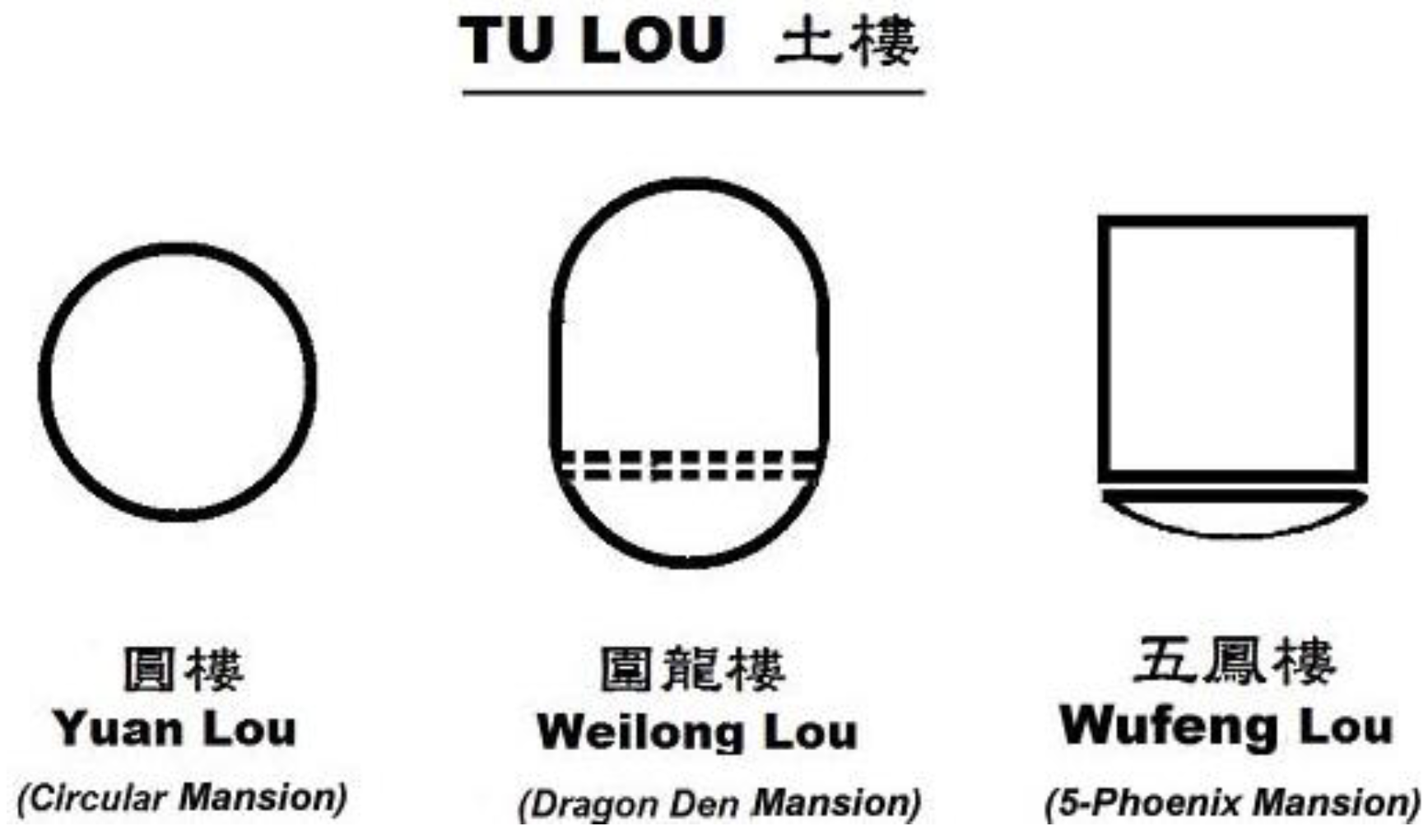
There are mainly three types of tulou or rammed-earth clan residences built by the Hakka [1,2,3,4,5,6,7], i.e. in the shape of a circle (yuanlou 圆楼), of an oval (weilonglou 围龙楼), and of a square (wufenglou 五凤楼) (Figure 1).
The term “tulou” almost always evokes the classical roundhouses which abound in the mountainous region of northwestern Fujian province, especially tulou in Yongding (永定) county which have been popularized by their UNESCO designation as a world heritage site [1,5]. However, tulou means simply “earth building” and should comprise not only round (yuan) buildings but also buildings of other shapes or footprints as long as they are made mainly from earth. The author will therefore emphasize the connection of roundhouses to other-shaped earth houses, and downplay the provincial boundaries separating Fujian, Jiangxi and Guangdong in favor of a Hakka human geography [2,3,4].
Figure 1.
Three types of Tulou—round, oval, square.
2. Round (Heaven) versus Square (Earth)
From an architectural perspective, the roundhouses have been extolled for their comfort (warm in winter, cool in summer), for their defensibility (only one entrance to guard), and their communality (shared courtyard and stairways). The square tulou in the same region receive no such praise, yet they outnumber the roundhouses by far. Why did the Hakka persist in building so many square tulou? For practical reasons, perhaps, cheaper and easier to build; or aesthetic reasons, perhaps, because when they are built next to round houses, the square houses provide dramatic contrast to the roundhouses, notably in the famous plum blossom group (Tianluokeng 田螺坑).
It is instructive to recall the ancient Chinese reverence of the round shape as symbolizing heaven and the square shape as symbolizing earth, and to recall the over-arching goal of humans to relate equally well with both entities. These entities are manifested in Beijing as the Temple of Heaven, round in shape, where the emperors prayed for blessings on the people. In contrast there were the square elements or courtyards of the Forbidden City, from which the emperor administered the social life of all people under heaven.
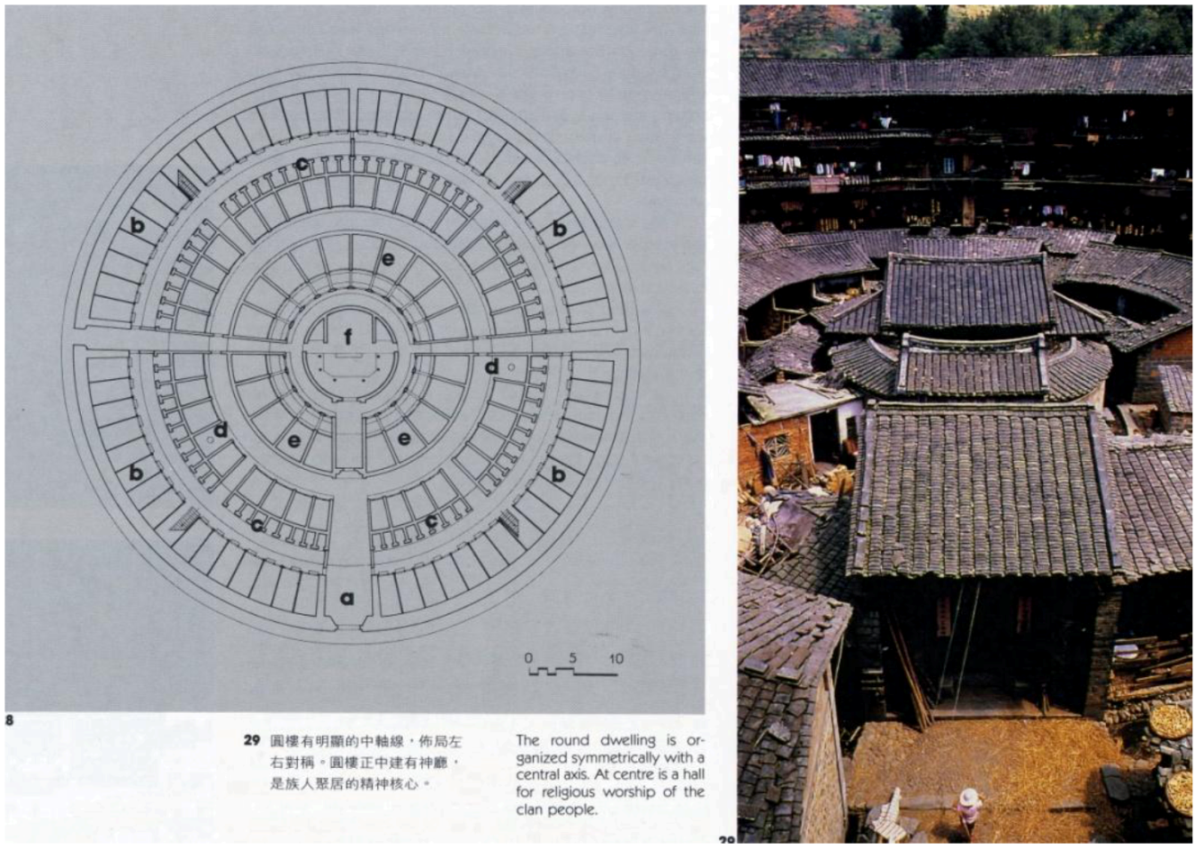
In the Central Plains of the Yellow River region from which the Hakka embarked on their five migrations, the shape of the characteristic dwelling (siheyuan 四合院) was square or rectangular. The five migrations, starting from 317 CE, were documented by Lo Hsiang Lin in his seminal book of 1933 on the people who came to be called Hakka or guest people [8]. Dating roughly from 1127, the start of the third migration, the Hakka devised the round house to meet the conditions of the mountainous terrain to which they had migrated, but the defined linear axes converging on the centre of the circle expressed their respect for the social values of the square (see Figure 2). The round house can be seen as reflecting spiritual (Daoist) values for the most part, with the square courtyard house seen as reflecting social (Confucian) values for the most part.
Figure 2.
Linear axes in round Tulou [6].
Figure 2.
Linear axes in round Tulou [6].

3. Balance of Daoist and Confucian
The author believes that a survey of tulou will demonstrate that the Hakka persisted in reconciling the circle and the square in creating the structures that sheltered and protected them, and thereby they maintained to a most remarkable degree both their Daoist and Confucian heritage. The emphasis given to one or the other of these binaries depended on the geographical environment and the socio-historical stage of their continuous migration from north to south. The Daoist stream, shared with all Chinese, ran stronger when, isolated from the empire they struggled for survival on the mountainous terrain that was left to them as guest people. The Confucian stream, flowing from their origins in the Central Plains, ran stronger when the Hakka arrived on the southern plains of Guangdong and with survival needs met were able to engage the socio-political system of the era. The Hakka further endorsed this binary in the basic injunction to their children—“till the land, study hard”—the farmer and the scholar being the two occupations generally accessible to them. Success in farming yielded the wealth that built the formidable round houses of Yongding (永定) and the weilonglou of Meixian (梅县). Success in studies, with a very high rate of passes in the civil service examinations, led to remunerative appointments and perquisites, allowing them finally to gain an economic and political foothold in the diverse economy of Guangdong to which their fourth migration brought them.
“First we shape our buildings; after that our buildings shape us,” Winston Churchill said in 1943 with reference to the rebuilding of Parliament. The Hakka seemed to have cherished this idea, not only with reference to public but also to private buildings. All tulou, both round and square, were designed with public and private spaces in mind. Ronald Knapp has observed that the more elaborate courtyard tulou delivered important lessons about family and social relations as people moved about in their daily activities [4]. The large patriarchal clan homes based on the siheyuan (四合院) reflected the hierarchies of respect and duty prescribed in Confucian society in the location of apartments, courtyards, entrances, utilities, and the like.
4. Hakka Religion
As well, important “religious” lessons were continuously imparted. The Chinese are commonly regarded as a people without an official religion, but their traditional homes nevertheless allocated more space to ancestor worship, in author’s opinion, than the homes of religious societies allocated to god worship. Temples and churches in many societies are built separate from homes, but a high proportion of Chinese homes, particularly large clan dwellings, incorporate an ancestral shrine or hall. With thick high walls like a castle, the tulou with its large and central sacred space is also like a monastery.
In the case of the round or heavenly tulou, the shrine or hall has an elevated position along the main axis. As well, in order to maintain a balance between the sacred and the secular, the ancestral hall or shrine is more distinctive in the square or earthly wufenglou than in the circular or heavenly yuanlou.
The footprint of classic European cathedrals traces the central symbol of Christianity, the cross. The main axis is from west to east, with the main entrance at the western end and the altar at the eastern end. The shorter access runs from north to south, crossing the main axis at a point where the western section or nave is much longer than the eastern section. In the round houses of Fujian, the Hakka consciously or unconsciously chose to build their clan home on the foundation of the ancient symbols of the Northern Plains—the yin-yang (阴阳) circle implied by dual wells and the octagonal bagua (八卦) implied by the eight load bearing or fire prevention walls.
People who live close to the earth are deeply affected by the shape of their dwellings. Even physical health can be affected, as in the case of the Oglala Sioux tribe in north America whose shaman Black Elk lamented that his people were dying because their white conquerors moved them from their round tepees into square houses. However, the Hakka constantly sought to reconcile rather than fight opposing shapes. In each of the three types of tulou—round, oval, square—people see in the architecture attempts to balance or harmonize the sacred and the secular, the Daoist and the Confucian, divine and human rituals.
The round tulou initially projects a divine or heavenly aura, but the shrine centred on the inner circle is designed as much for teaching as for worship. In the Zhencheng (振成楼) complex, the author observed a freestanding temple at a short distance from the round house; this temple was also used by dwellers in other tulou in the complex.
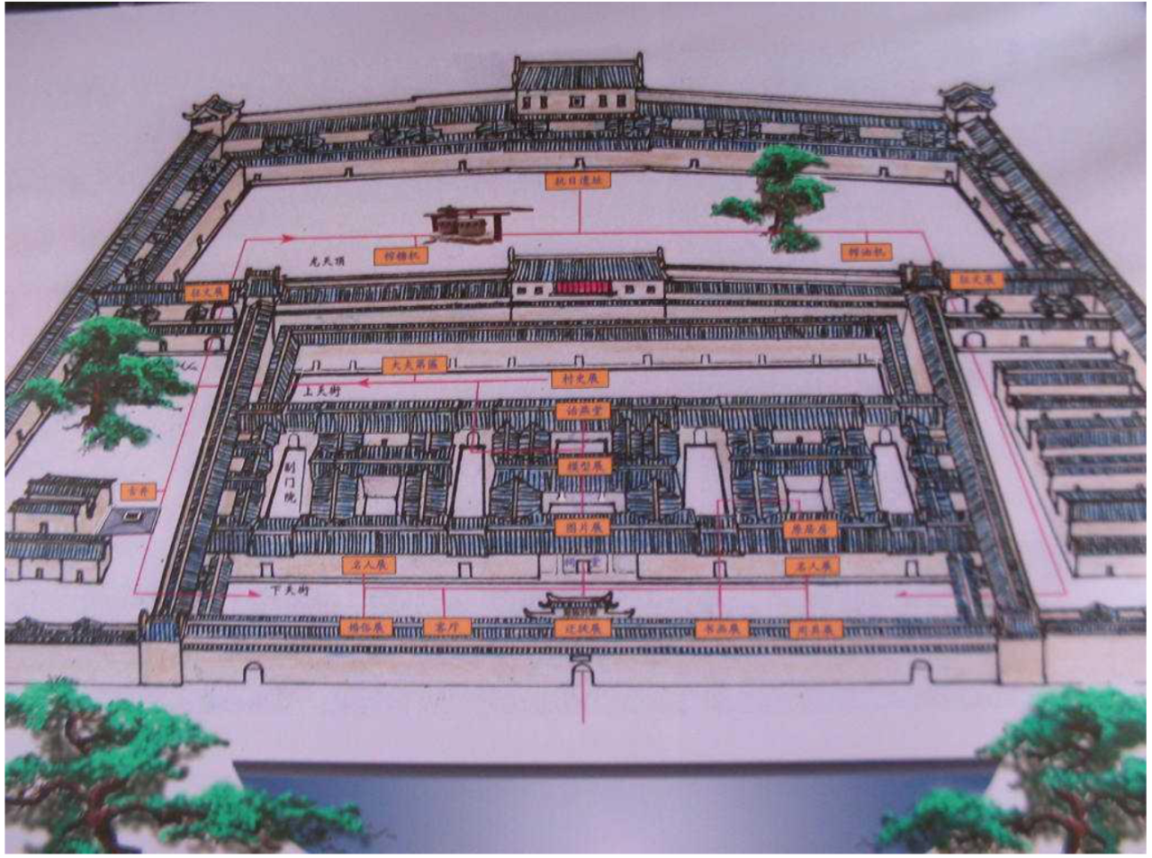
In the case of oval tulou or weilonglou, Figure 3, apartments were arranged in a rectangular design, but were complemented by smaller apartments located to the north in a semi-circle. To the south, a semicircular pond was constructed to complete the oval shape of the compound. The temple was located in the northern section of the rectangular section, and to the rear of the temple at ground level was a Daoist shrine dedicated to the five elements, namely earth, water, fire, metal and wood. The energy or vitality of the dragon which dwelled on the site may be perceived as connecting to this shrine to the elements.
In the case of the wufenglou and its extensive courtyard design (Figure 4), suggesting a strong return to Confucianism and human rituals, the temple is very ornate and is set on the increasingly raised portion of the central axis.
Figure 3.
Semicircular pond at front completes the oval shape of a Weilonglou.
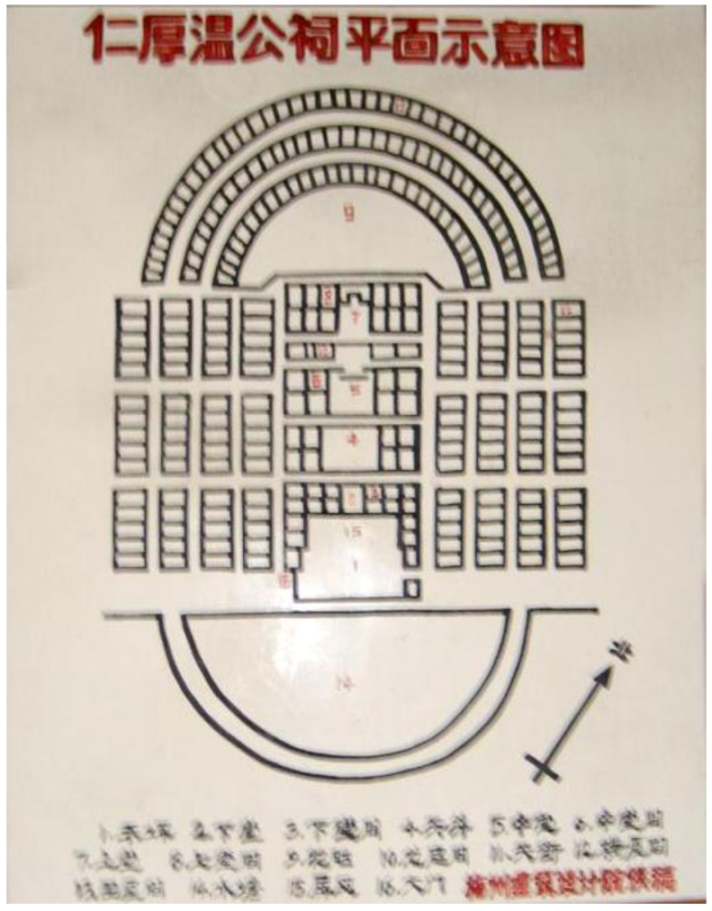
Figure 4.
Semi-circular pond in front of rectangular Wufenglou, as shown on the website of Crane Lake New Dwelling (鹤湖新居), Luo Rui He (罗瑞合), southwest of Longgang (龙岗), Shenzhen, Guangdong Province, China [7].
Figure 4.
Semi-circular pond in front of rectangular Wufenglou, as shown on the website of Crane Lake New Dwelling (鹤湖新居), Luo Rui He (罗瑞合), southwest of Longgang (龙岗), Shenzhen, Guangdong Province, China [7].

5. Maintaining Cosmic Balance
Angular projections in tulou are often rounded by various means, either materially, or symbolically by the addition of water features. The octagonal shape of the bagua is not far from the heavenly circle. We could surmise that the earliest tulou were octagonal, and that the corners of tulou were later rounded. Two octagonal tulou in Raoping (饶平), Guangdong, can be found in [3].
The presence of water, both on the surface and underground, is essential for siting tulou and maintaining their circular character. Yuanlou or roundhouses were often laid out to face a running stream. In the case of the oval weilonglou, which has a pavement for drying grain along the south wall, a small pond was created to provide roundness to the south end, thus matching the roundness of the north end, see for example Figure 3. In the case of the rectangular wufenglou, a large and well defined semi-circular pond was created to provide roundness which would have been otherwise lacking.
See for example the ground plan of Crane Lake New Dwelling (鹤湖新居), the largest of its kind in China, shown in Figure 4 [3,7]. It should be noted that despite its great size, it appears to have only one well in contrast to the dual wells created in round tulou of smaller size; signifying that circularity of the dual-well ying-yang figure is of less importance in wufenglou. Thus the impressive pond provides a rounded shape to preserve worship of heaven. As well, a rounded garden towards the rear of the enclosed rectangle has been observed at other sites.
6. Wufenglou—A Return of Hakka Origin Architecture
The roundhouses perfectly suited the mountainous topography and the violent threats of the second and third migrations. In moving south in the fourth migration (1644–1866) to the relatively flat lands of the traditional counties of Fu Yong (福永), Tong An (同安) and Bao An (宝安), all now subsumed in the Shenzhen (深圳) administrative area, the Hakka returned to the imperial sphere. The majority built detached houses clustered around a fortified three or four storey tower which had slits from which muskets could be fired. Whenever the Hakka were under attack, they would gather in the tower and defend themselves. However, some large and cohesive clans built Wufenglou, i.e. walled villages in the five-phoenix style, which had towers at the four corners and massive gates that could be defended from above. Inside were wells, granaries and workshops, as well a temple and a school house.
It is hard to find an adequate western name for Wufenglou, because it combined aspects of: (1) an imperial palace, (2) a castle or fort or compound, (3) courtyards consisting of linked two-storey townhouses, and (4) a monastery, having a large and high temple at the centre. Rectangular or quadrilateral in ground plan, wufenglou was laid out according to fengshui principles and embodied cosmic patterns, as were roundhouse or weilonglou. In addition, its ornamentation and size were determined by imperial decree.
The largest Wufenglou in the three (Fujian, Jiangxi and Guangdong) provinces and perhaps in all of China is Crane Lake New Dwelling (鹤湖新居) in Luo Shui Hap (Hakka) or Luo Rui He (罗瑞合, Mandarin), located southwest of the city of Longgang (龙岗) in the traditional county of Fu Yong (福永) [7]. The founder, Luo Rui Feng (罗瑞凤), emigrated to this plains area from the mountainous region of Xiatang (下塘), Xingning (兴宁) county, and started building the habitation in 1780. He came from a Weilonglou called Dunshang, which was founded some 16 generations before by Luo Xiao Jiu (罗小九) who had emigrated there (southwards) from his home village in Ningdu County, Ganzhou (赣州市宁都县), Jiangxi province. In 1996 Crane Lake New Dwelling was converted into a museum of Hakka customs. Billed as a major cultural-tourism site by Guangdong province, Crane Lake New Dwelling is becoming a key center for research into the history, culture and architecture of the Shenzhen administrative area.
The Wufenglou of Guangdong are impressive in size and number, and some scholars have wondered why the siheyuan-style mansion that no longer exists in the Central Plains of the Yellow River has been recreated so faithfully in the south (Lingnan region). The author’s own surmise is that by the time of their fourth migration the Hakka had become again engaged in the Middle Kingdom. Their scholars had succeeded to a high degree in the imperial examinations; based on wealth from farming and trades, strong clans could then afford to build official mansions reminiscent of their ancient origins in the north. In turn the author wonders if at the time of the first Hakka migration the Confucianist gentry of the north had created similar semi-circular ponds in front of their rectangular enclosures in order to bring some heavenly balance to their earthly mansions.
7. Sustainability
Because of significant missing links between ancient and modern Han culture, it is often very useful to look into areas of Hakka culture and lifestyle to understand how the ancient Chinese lived. This is abundantly true in the areas of linguistics and architecture. This paper examines the evolution of Hakka dwellings revealing how the Tulou design has reflected Hakka culture and lifestyle rooted in the central plains of the Yellow River region.
Material sustainability. Utilizing earth or mud as the basic building material, Hakka tulou contributed to the sustainability of the physical environment. Round walls of the yuan lou enclosed more floor space than square walls. Being cool in summer and warm in winter, they reduced usage of human and material energy to make the dwelling comfortable in all seasons. The semi-circular ponds were utilized according to a well known protocol to raise fish for food.
Social sustainability. Closed to the outside but open on the inside, the tulou created security and solidarity for the clan. Daily movement around the inside of the structure, especially in the weilonglou, reinforced the social order and the Confucian norms of behaviour. Food and water supplies inside the structure ensured security of the clan in time of conflict, and some structures had school and workshops for daily productive work.
Spiritual sustainability. The interplay between heaven and earth, embedded in the round and square patterns of the habitation, made the inhabitants constantly aware of their existence in a purposeful universe. The bagua footprint of the compound and the yin-yang location of the wells led to deep and constant contemplation of one’s role in the universe. The central family shrine connected the living to their ancestors, and the ground-level shrine to the five elements grounded individuals to the earth.
The author Keith D. Lowe (罗金生) is a former director of the Chinese Cultural Centre of Greater Toronto in Canada. He is the founder of the Toronto Hakka Conference which has convened in 2002, 2004, 2008 and 2012. He is a descendant of the Luo clan.
Conflict of Interest
The author declares no conflict of interest.
References
- CCTV. Five-part series, Secrets of Fujian Tulou. 22–26 July 2010; Available online: http://english.cntv.cn/program/journeysintime/special/tulou/index.shtml (accessed on 2 August 2011).
- Hakka Enclosed Houses, Shenzhen Museum, Cultural Artifacts Publishers: Beijing, China, 1999.
- Hakka Enclosed Houses in Guangdong and Hong Kong, Shenzhen Museum, Cultural Artifacts Publishers: Beijing, China, 2001.
- Knapp, R.G. Chinese Houses: The Architectural Heritage of a Nation; Tuttle Publishing: North Clarendon, VT, USA, 2005. [Google Scholar]
- Roundhouses. Hakka round houses in China. Available online: http://roundhouses.wordpress.com (accessed on 2 August 2011).
- Lung, D.P.Y. Chinese Traditional Vernacular Architecture; Regional Council/University of Hong Kong, and the New Territories: Hong Kong, 1991. [Google Scholar]
- Wufenglou. Website of Crane Lake New Dwelling (Wufenglou), restored as the Hakka Folk Customs Museum, Shenzhen, Guangdong. 2011. Available online: http://www.szlgkjbwg.com (accessed on 19 October 2012).
- Lo, H.L. An Introduction to the Study of the Hakka in Its Ethic, Historical and Cultural Aspects (in Chinese); Shi-Shan Library: Hsingning, Kwantung, China, 1933. [Google Scholar]
© 2012 by the authors; licensee MDPI, Basel, Switzerland. This article is an open-access article distributed under the terms and conditions of the Creative Commons Attribution license (http://creativecommons.org/licenses/by/3.0/).
Share and Cite
MDPI and ACS Style
Lowe, K.D. Heaven and Earth—Sustaining Elements in Hakka Tulou. Sustainability 2012, 4, 2795-2802. https://doi.org/10.3390/su4112795
AMA Style
Lowe KD. Heaven and Earth—Sustaining Elements in Hakka Tulou. Sustainability. 2012; 4(11):2795-2802. https://doi.org/10.3390/su4112795
Chicago/Turabian StyleLowe, Keith D. 2012. "Heaven and Earth—Sustaining Elements in Hakka Tulou" Sustainability 4, no. 11: 2795-2802. https://doi.org/10.3390/su4112795