<?xml version="1.0" encoding="UTF-8"?>
<!DOCTYPE article PUBLIC "-//NLM//DTD Journal Publishing DTD v2.3 20070202//EN" "journalpublishing.dtd">
<article xmlns:mml="http://www.w3.org/1998/Math/MathML" xmlns:xlink="http://www.w3.org/1999/xlink" xml:lang="en" article-type="research-article">
  <front>
    <journal-meta>
      <journal-id journal-id-type="publisher-id">sustainability</journal-id>
      <journal-title>Sustainability</journal-title>
      <abbrev-journal-title abbrev-type="publisher">Sustainability</abbrev-journal-title>
      <abbrev-journal-title abbrev-type="pubmed">Sustainability</abbrev-journal-title>
      <issn pub-type="epub">2071-1050</issn>
      <publisher>
        <publisher-name>MDPI</publisher-name>
      </publisher>
    </journal-meta>
    <article-meta>
      <article-id pub-id-type="doi">10.3390/su4102513</article-id>
      <article-id pub-id-type="publisher-id">sustainability-04-02513</article-id>
      <article-categories>
        <subj-group>
          <subject>Article</subject>
        </subj-group>
      </article-categories>
      <title-group>
        <article-title>Nutrient Management in Support of Environmental and Agricultural Sustainability</article-title>
      </title-group>
     
      <contrib-group>
        <contrib contrib-type="author">
          <name>
            <surname>Whitmore</surname>
            <given-names>Andrew P.</given-names>
          </name>
          <xref rid="af1-sustainability-04-02513" ref-type="aff">1</xref>
          <xref rid="c1-sustainability-04-02513" ref-type="corresp">*</xref>
        </contrib>
        <contrib contrib-type="author">
          <name>
            <surname>Goulding</surname>
            <given-names>Keith W. T.</given-names>
          </name>
          <xref rid="af1-sustainability-04-02513" ref-type="aff">1</xref>
        </contrib>
        <contrib contrib-type="author">
          <name>
            <surname>Glendining</surname>
            <given-names>Margaret J.</given-names>
          </name>
          <xref rid="af2-sustainability-04-02513" ref-type="aff">2</xref>
        </contrib>
        <contrib contrib-type="author">
          <name>
            <surname>Dailey</surname>
            <given-names>A. Gordon</given-names>
          </name>
          <xref rid="af1-sustainability-04-02513" ref-type="aff">1</xref>
        </contrib>
        <contrib contrib-type="author">
          <name>
            <surname>Coleman</surname>
            <given-names>Kevin</given-names>
          </name>
          <xref rid="af1-sustainability-04-02513" ref-type="aff">1</xref>
        </contrib>
        <contrib contrib-type="author">
          <name>
            <surname>Powlson</surname>
            <given-names>David S.</given-names>
          </name>
          <xref rid="af1-sustainability-04-02513" ref-type="aff">1</xref>
        </contrib>
      </contrib-group>
       <aff id="af1-sustainability-04-02513"><label>1 </label>Soils and Grasslands Systems Science Department, Rothamsted Research, Harpenden, Hertfordshire, AL5 2JQ, UK; Email: <email>keith.goulding@rothamsted.ac.uk</email> (K.W.T.G.);  <email>gordon.dailey@rothamsted.ac.uk</email> (A.G.D.); <email>kevin.coleman@rothamsted.ac.uk</email> (K.C.); <email>david.powlson@rothamsted.ac.uk</email> (D.S.P.)</aff>
      <aff id="af2-sustainability-04-02513"><label>2 </label>Department of Computational and Systems Biology, Rothamsted Research, Harpenden, Hertfordshire, AL5 2JQ, UK; Email: <email>margaret.glendining@rothamsted.ac.uk</email> </aff>
      <author-notes>
        <corresp id="c1-sustainability-04-02513"><label>*</label> Author  to whom correspondence should be addressed; Email: <email>andy.whitmore@rothamsted.ac.uk</email>; Tel.: +44-1582-763133; Fax: +44-1582-469036.</corresp>
      </author-notes>
      <pub-date pub-type="epub">
        <day>01</day>
        <month>10</month>
        <year>2012</year>
      </pub-date>
      <pub-date pub-type="collection"><month>10</month>
        <year>2012</year>
      </pub-date>
      <volume>4</volume>
      <issue>10</issue>
      <fpage>2513</fpage>
      <lpage>2524</lpage>
      <history>
        <date date-type="received">
          <day>09</day>
          <month>07</month>
          <year>2012</year>
        </date>
        <date date-type="rev-recd">
          <day>12</day>
          <month>09</month>
          <year>2012</year>
        </date>
        <date date-type="accepted">
          <day>24</day>
          <month>09</month>
          <year>2012</year>
        </date>
      </history>
      <permissions>
        <copyright-statement>©  2012 by the authors; licensee MDPI, Basel, Switzerland.</copyright-statement>
        <copyright-year>2012</copyright-year>
        <license xmlns:xlink="http://www.w3.org/1999/xlink" license-type="open-access" xlink:href="http://creativecommons.org/licenses/by/3.0/">
          <p>This article is an open-access article distributed under the terms and conditions of the Creative Commons Attribution license (http://creativecommons.org/licenses/by/3.0/).</p>
        </license>
      </permissions>
      <abstract>
        <p>Given that we must farm land in order to eat, the total environmental burden imposed by farming a crop, such as winter wheat in the UK, appears to be close to the minimum given current production techniques. The value of the services other than food production, such as flood water buffering, pollination, carbon storage and so on, that land can provide is relatively large compared with the value in reducing environmental burdens from pesticide use, nutrient pollution and greenhouse gas emissions that might arise by farming less intensively. More land will need to be brought into cultivation in order to provide the same amount of food if the intensity of farming is reduced and the resultant loss of ecosystem services (ES) outweighs the reduction in other burdens. Nevertheless, losses of nutrients, especially nitrogen (N), from agriculture are a serious concern and the current cost of the environmental footprint of agriculture is significant compared with the value of the food it produces. This article examines nutrient burdens and analyses the means by which the total environmental burden might be reduced relative to productivity. These include increasing the efficiency of farming, removing constraints to yield, and establishing multiple uses for land at the same time as farming. It concludes that agronomic measures which improve nutrient capture and which obtain more yield per unit area are valuable means to avoid degradation of environmental quality because both nutrient pollution and land consumption can be avoided.</p>
      </abstract>
      <kwd-group>
        <kwd>soil</kwd>
        <kwd>modelling</kwd>
        <kwd>nutrients</kwd>
        <kwd>nutrient management</kwd>
        <kwd>nitrogen use efficiency</kwd>
        <kwd>crop production</kwd>
      </kwd-group>
    </article-meta>
  </front>
  <body>
    <sec sec-type="intro">
      <title>1. Introduction</title>
      <p>Glendining <italic>et al</italic>. [<xref ref-type="bibr" rid="B1-sustainability-04-02513">1</xref>] developed a framework for comparing the financial outputs and inputs of agriculture: that is a framework that includes both the orthodox economic evaluation but also the environmental costs of agriculture. Essentially they considered the ratio of the value of all outputs to the costs of all inputs. Such a ratio is known as the Total Factor Productivity (TFP, [<xref ref-type="bibr" rid="B2-sustainability-04-02513">2</xref>,<xref ref-type="bibr" rid="B3-sustainability-04-02513">3</xref>]).Glendining <italic>et al</italic>. [<xref ref-type="bibr" rid="B1-sustainability-04-02513">1</xref>] calculated TFP for farm production but also included multiple outputs (grain and straw for e.g. bedding or fuel) as well as the environmental costs as inputs without which TFP would be biased [<xref ref-type="bibr" rid="B3-sustainability-04-02513">3</xref>]. They showed that for arable crops at least, current farming practice that is optimal for profit is very nearly optimal for environmental quality. Farming in Western Europe is very intensive but Glendining <italic>et al</italic>.’s [<xref ref-type="bibr" rid="B1-sustainability-04-02513">1</xref>] conclusion was that reducing this intensity made little sense from an environmental point of view, if more land has to be brought into production in order to produce the same amount of food. Although reducing the intensity of farming did indeed appear to reduce nutrient and greenhouse gas emissions, the value of these gains was strongly outweighed by the cost associated with the loss of the ecosystem services (ES) from the new land brought under the plough. Such arguments support the concept of land sparing [<xref ref-type="bibr" rid="B4-sustainability-04-02513">4</xref>].</p>
      <p>If the argument is taken as sound that land consumption is the primary environmental burden to be minimised, the question then becomes: can current nutrient use in farming practice be improved in the context of this primary constraint? This article takes a systems approach to agriculture with a particular focus on minimising nutrient losses while avoiding the need to farm a greater area of land. Taking data published by Glendining <italic>et al</italic>. [<xref ref-type="bibr" rid="B1-sustainability-04-02513">1</xref>] and analysing the profit and environmental costs more fully that are associated with producing a winter wheat crop as an example, we examine the scientific literature for ways in which farming might be improved to (i) deliver more profit without additional damage to the environment, (ii) deliver increased environmental quality without loss of yield, or (iii) increase both profit and environmental quality.</p>
      <p>There has been some discussion in the literature surrounding the suitability of the TFP index, most notably concerning its static nature and the role of time by definition in the concept of sustainability. Glendining <italic>et al</italic>. [<xref ref-type="bibr" rid="B1-sustainability-04-02513">1</xref>] and Barnett <italic>et al</italic>. [<xref ref-type="bibr" rid="B3-sustainability-04-02513">3</xref>] discuss some of these issues which are beyond the scope of the current article.</p>
    </sec>
    <sec sec-type="results">
      <title>2. Results and Discussion</title>
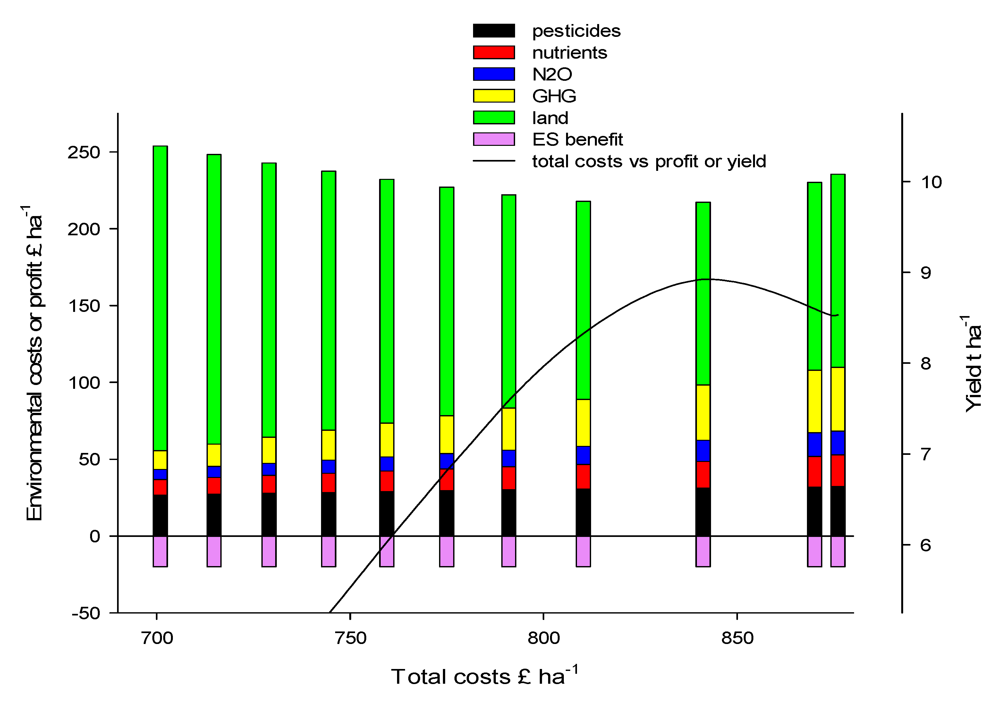
      <p>In <xref ref-type="fig" rid="sustainability-04-02513-f001">Figure 1</xref>, the environmental costs of farming wheat are broken down into those arising from the use of pesticides and other crop protection, N and P eutrophication, N<sub>2</sub>O, other GHG emissions and loss of ecosystem service from land (bars) and displayed against the total cost of farming at increasingly intensive rates of production. The ecosystem service benefit of arable land is given as a negative cost (small pink bar). Also shown in <xref ref-type="fig" rid="sustainability-04-02513-f001">Figure 1</xref> is the response (line) conceived as profit plotted against the same intensity of production. This line displays the usual diminishing return to inputs. Yield is indicated on a secondary axis. Intensity of production is largely equivalent to the nitrogen applied in this example. Maximum profit is delivered at about the same point of the total input cost (abscissa) as the minimum environmental burden. Note, however, that the environmental cost is large at this minimum and far from trivial. Farming has a cost to the environment yet the fact that this environmental cost registers as larger than the farm profit is misleading, because environmental costs are not included in farm profit and loss accounts. If they were, the cost of food would change markedly.</p>
      <fig id="sustainability-04-02513-f001" position="anchor">
        <label>Figure 1</label>
        <caption>
          <p>Environmental costs and profits as a result of growing winter wheat, plotted against total costs (orthodox economic costs plus environmental costs). Coloured bars: breakdown of environmental costs (pesticide burden, N and P loss, N<sub>2</sub>O emission, other greenhouse gases (GHG) emissions, loss of ecosystem services (ES) of native land and gain for arable land). Costs are driven mainly by increases in nitrogen fertiliser, but other costs vary with production too. Solid line: farmer’s profit as a result of growing winter wheat at the same costs of production. The yield equivalent of this profit (same solid line) is indicated with reference to the scale on the right hand axis.</p>
        </caption>
        <graphic xmlns:xlink="http://www.w3.org/1999/xlink" xlink:href="sustainability-04-02513-g001.tif"/>
      </fig>
      <sec>
        <title>2.1 Analysis of Nutrient Loss in Relation to Soil and Environmental Quality</title>
        <p>To illustrate Glendining <italic>et al.</italic>’s [<xref ref-type="bibr" rid="B1-sustainability-04-02513">1</xref>] claim that reducing inputs to agriculture substantially does not improve environmental quality, consider the effect of reducing inputs to winter wheat from those which produce maximum yield to those which produce a zero financial return. The environmental cost associated with bringing the extra land into production that is needed to make up the shortfall in productivity on a national basis is £40 (<xref ref-type="fig" rid="sustainability-04-02513-f001">Figure 1</xref>, change in height of green bars and expressed on a per hectare basis). Compared with this, the saving in all other environmental costs for the same change is £25. Of this £25 just £4 comes from reducing leaching N and P and less than £5 comes from the reduction in N<sub>2</sub>O emissions (<xref ref-type="fig" rid="sustainability-04-02513-f001">Figure 1</xref>). These prices were correct in 2006 (see methods).</p>
        <p>If this is so, and if we accept that farming is necessary to feed ourselves, then what insights does this full environmental economic analysis provide that can help to improve soil and environmental quality and especially reduce nutrient pollution? Possible means to achieve improved environmental quality are listed in the first column of <xref ref-type="table" rid="sustainability-04-02513-t001">Table 1</xref> as well as indicated on <xref ref-type="fig" rid="sustainability-04-02513-f001">Figure 1</xref>. <xref ref-type="table" rid="sustainability-04-02513-t001">Table 1</xref> includes drivers that state the pressure on farmers to improve environmental quality and indicate a potential means to achieve the change in some cases: <bold>A</bold>: The crop takes up and removes more nutrients from soil. <bold>B</bold>: Losses are reduced by whatever means. <bold>C</bold>: The efficiency of farming is improved. <bold>D</bold>: Constraints to crop growth are removed, which improves nutrient capture from soil. <bold>E</bold>: Dissemination and uptake of advice is improved to achieve optimal nutrient use and yield more widely. <bold>F</bold>: The value and extent of ES delivered by arable land is increased. This paper contains a summary of interventions that might achieve more efficient use of nitrogen and management of the crop as indicated in <xref ref-type="fig" rid="sustainability-04-02513-f001">Figure 1</xref>. Fuller details can be found in the supplementary material online.</p>
        <table-wrap id="sustainability-04-02513-t001" position="float">
          <object-id pub-id-type="pii">sustainability-04-02513-t001_Table 1</object-id>
          <label>Table 1</label>
          <caption>
            <p>Means to improve soil and environmental quality.</p>
          </caption>
          <table rules="rows">
            <thead>
              <tr>
                <th align="left" valign="top"> </th>
                <th align="center" valign="top">Means</th>
                <th align="center" valign="top">Effect on soil and/or Environmental Quality</th>
                <th align="center" valign="top">Driver</th>
                <th align="center" valign="top">Possible means to achieve this</th>
              </tr>
            </thead>
            <tbody>
              <tr>
                <td align="left" valign="top">
                  <bold>A</bold>
                </td>
                <td align="left" valign="top">Increase nutrient capture</td>
                <td align="left" valign="top">Pollution is reduced</td>
                <td align="left" valign="top">Economics</td>
                <td align="left" valign="top">
                <list list-type="order">
                <list-item><p>Use of subsoil N</p></list-item>
                </list>
                </td>
              </tr>
              <tr>
                <td align="left" valign="top">
                  <bold>B</bold>
                </td>
                <td align="left" valign="top">Reduce losses of N to the environment</td>
                <td align="left" valign="top">Less pollution</td>
                <td align="left" valign="top">Regulation</td>
                <td align="left" valign="top">
                <list list-type="order">
                <list-item><p>Use of nitrification inhibitors</p></list-item>
                <list-item><p>Splitting N application to reduce risk of loss</p></list-item>
                </list>
                </td>
              </tr>
              <tr>
                <td align="left" valign="top">
                  <bold>C</bold>
                </td>
                <td align="left" valign="top">Decrease area of farmed land directly</td>
                <td align="left" valign="top">Better provision of Ecosystem Services other than food and fibre production</td>
                <td align="left" valign="top">Pressure from other users of land</td>
                <td align="left" valign="top">
                <list list-type="order">
                <list-item><p>Maximising efficiency of production</p></list-item>
                </list>
               </td>
              </tr>
              <tr>
                <td align="left" valign="top">
                  <bold>D</bold>
                </td>
                <td align="left" valign="top">Remove constraints on yield</td>
                <td align="left" valign="top">Less land needed, less N needed</td>
                <td align="left" valign="top">Economics, yield increases if constraints are removed</td>
                <td align="left" valign="top">
                <list list-type="order">
                <list-item><p>Use of canopy management techniques</p></list-item>
                <list-item><p>Breeding</p></list-item>
                <list-item><p>Management of root environment</p></list-item>
                </list>
                </td>
              </tr>
              <tr>
                <td align="left" valign="top">
                  <bold>E</bold>
                </td>
                <td align="left" valign="top">Improve effectiveness of extension</td>
                <td align="left" valign="top">Less waste, production can be optimised for both yield and environmental quality.</td>
                <td align="left" valign="top">Economics/Regulation</td>
                <td align="left" valign="top">
                <list list-type="order">
                <list-item><p>Improved guidance on use of nutrients</p></list-item>
                <list-item><p>Improved understanding of N cycles</p></list-item>
                <list-item><p>Adoption of precision management</p></list-item>
                </list>
                </td>
              </tr>
              <tr>
                <td align="left" valign="top">
                  <bold>F</bold>
                </td>
                <td align="left" valign="top">Increase ES or functionality of farmland</td>
                <td align="left" valign="top">More services of better quality delivered per unit area of land</td>
                <td align="left" valign="top">Pressure from other users of land</td>
                <td align="left" valign="top">
                <list list-type="order">
                <list-item><p>Increase organic matter levels</p></list-item>
                <list-item><p>Adopt some form of mixed cropping</p></list-item>
                 </list>
                </td>
              </tr>
            </tbody>
          </table>
        </table-wrap>
      </sec>
      <sec>
        <title>2.2 Specific Means to Improve Soil and Environmental Quality</title>
        <p>If unfarmed land supplies more ES than farmed, it makes sense to use the farmed area as efficiently as possible in order to avoid bringing land into production. So a loss of environmental quality can be avoided by increasing nutrient capture or by increasing yield, if this avoids consumption of land. Below we consider the ways in which environmental quality might be improved in this context.</p>
        <sec>
          <title>2.2.1. Increase Nutrient Capture (A)</title>
          <p>Bradley <italic>et al.</italic> [<xref ref-type="bibr" rid="B5-sustainability-04-02513">5</xref>] report the distribution of soil carbon in England and Wales. They give data from which the average density of carbon in the subsoil (30–70 cm) can be deduced as 0.5% C by weight. A typical C : N ratio for soil is 10 or less and so this implies very crudely that the average density of N in the subsoil is 0.05%, or half the threshold of (0.1% N) that Sylvester-Bradley <italic>et al</italic>. [<xref ref-type="bibr" rid="B6-sustainability-04-02513">6</xref>] suggest might contribute significant amounts of N through mineralisation to the soil nitrogen supply to crops. Without a reported distribution or other measure of the variation it is difficult to state the prevalence of soils containing more than 0.1% N in the UK, but it is unlikely to be greater than 25% of all soils. On the other hand a soil containing 0.05% N in the soil volume from 30 to 100 cm may supply up to a third of the N contained in the topsoil and so about 20 or 30 kg N ha<sup>-1</sup> yr<sup>-1</sup>, which would probably be leached if not captured by a crop. Such N is not currently accounted for in advisory systems. Where such N is available to crops, nitrogen application could be reduced by the equivalent amount.</p>
        </sec>
        <sec>
          <title>2.2.2. Reduce Losses (B)</title>
          <p>Recent research in New Zealand and Australia has shown that nitrification inhibitors (NIs) can be extremely effective at reducing N<sub>2</sub>O emissions from intensively grazed pasture [<xref ref-type="bibr" rid="B7-sustainability-04-02513">7</xref>]. If the nitrification of ammonium N is prevented, less leaching results and less N<sub>2</sub>O is emitted during both nitrification and the subsequent denitrification of the resultant nitrate (NO<sup>-</sup><sub>3</sub>). NIs applied to urine patches have been found to reduce N<sub>2</sub>O emissions by 61–91%, to reduce NO<sup>-</sup><sub>3</sub> leaching by 30–79% and increase annual pasture yield by 0–36% [<xref ref-type="bibr" rid="B8-sustainability-04-02513">8</xref>,<xref ref-type="bibr" rid="B9-sustainability-04-02513">9</xref>,<xref ref-type="bibr" rid="B10-sustainability-04-02513">10</xref>,<xref ref-type="bibr" rid="B11-sustainability-04-02513">11</xref>,<xref ref-type="bibr" rid="B12-sustainability-04-02513">12</xref>,<xref ref-type="bibr" rid="B13-sustainability-04-02513">13</xref>]. Rates of application were of the order of 10 kg DCD (Dicyandiamide) ha<sup>-1</sup> at a cost of about £26 ha<sup>-1</sup>. Research is currently underway in the UK and the Republic of Ireland to attempt to verify these findings for conditions in the British Isles.</p>
          <p>Ammonia emissions can be reduced by the use of urease inhibitors [<xref ref-type="bibr" rid="B13-sustainability-04-02513">13</xref>] and as a consequence indirect emissions of N<sub>2</sub>O can be reduced. There is some evidence to suggest that urea is more suited for use on soils prone to waterlogging (because it is primarily lost in dry conditions), whilst ammonium nitrate is more suited to less wet soils (because it is primarily lost under wet conditions) [<xref ref-type="bibr" rid="B14-sustainability-04-02513">14</xref>]. Although NIs were effective at field capacity in this study, they were ineffective under waterlogged conditions.</p>
          <p>Delays and manipulation of delays in mineralization of N from crop residues by means of added material having a wide C : N have been reported [<xref ref-type="bibr" rid="B15-sustainability-04-02513">15</xref>] as has the effect of clay in soil on temporarily stabilizing N [<xref ref-type="bibr" rid="B16-sustainability-04-02513">16</xref>]. Better understanding of the mechanisms underlying these phenomena might lead to interventions to retain nitrogen in soil in organic forms until such time as a growing crop could take it up. </p>
          <p>There is evidence that N<sub>2</sub>O production increases at a non-linear rate when soil NO<sub>3</sub><sup>-</sup> content exceeds crop demand. This has been reported under maize [<xref ref-type="bibr" rid="B17-sustainability-04-02513">17</xref>,<xref ref-type="bibr" rid="B18-sustainability-04-02513">18</xref>] and spring barley [<xref ref-type="bibr" rid="B19-sustainability-04-02513">19</xref>]. Under these conditions, and when conditions are also conducive to denitrification, splitting fertilizer N applications could reduce N<sub>2</sub>O losses. Data presented by Zebarth <italic>et al.</italic> [<xref ref-type="bibr" rid="B19-sustainability-04-02513">19</xref>] suggest that lack of crop N uptake accounts for the relative increase in the proportion of mineral N that is emitted as N<sub>2</sub>O at high rates of N application. Dalal <italic>et al</italic>. [<xref ref-type="bibr" rid="B20-sustainability-04-02513">20</xref>] state that NO<sub>3</sub><sup>- </sup>usually inhibits full denitrification of N<sub>2</sub>O to N<sub>2</sub>, increasing the N<sub>2</sub>O:N<sub>2</sub> ratio. This lends weight to the view that splitting applications should reduce losses and that correct N fertiliser guidance is imperative. </p>
        </sec>
        <sec>
          <title>2.2.3. Decrease Area of Farmed Land Directly (C)</title>
          <p>If efficiencies can be found throughout the system, less land need be used, which reduces the environmental footprint of farming as a whole. Alternatively, farmed land might be made more productive. Bulson <italic>et al</italic>. [<xref ref-type="bibr" rid="B21-sustainability-04-02513">21</xref>] found a 29% increase in yields from barley and beans by intercropping at 150% total density compared with sole crops. Not only does this increase diversity (see F below) but less land is needed to produce the same amount of food, thus potentially increasing the supply of valuable ES on land no longer in arable production [<xref ref-type="bibr" rid="B4-sustainability-04-02513">4</xref>]. </p>
        </sec>
        <sec>
          <title>2.2.4. Remove Constraints (D)</title>
          <p>Removing constraints on productivity is likely to increase yield profitability; it may well also affect the shape of the response curve, shifting the optimum in the direction of either less or more inputs. Careful use of growth regulators and fungicides with growth regulation properties, and maintaining the correct amount of N in soil for sufficient but not excessive growth, have been found to increase oilseed rape yields by 0.36 t ha<sup>-1</sup> [<xref ref-type="bibr" rid="B22-sustainability-04-02513">22</xref>]. Lynch [<xref ref-type="bibr" rid="B23-sustainability-04-02513">23</xref>] asserts that crops tend to develop roots in the surface soil for nutrient acquisition (particularly P) and in the subsoil for water. Ho <italic>et al</italic>. [<xref ref-type="bibr" rid="B24-sustainability-04-02513">24</xref>] suggest that plants which increase the density of their roots in the topsoil are able to acquire P more effectively than those which do not. They argue further that genotypes with roots that proliferate deep in the soil are better able to withstand drought stress but also found dimorphic varieties that are able to adapt to either nutrient or water stress as appropriate. Waines and Ehdaie [<xref ref-type="bibr" rid="B25-sustainability-04-02513">25</xref>] conclude that the root systems of modern wheat cultivars are small, having perhaps two thirds of the root mass of the landraces from which they derive. Whitmore <italic>et al</italic>. [<xref ref-type="bibr" rid="B26-sustainability-04-02513">26</xref>] argue that the physical impediment to root growth is a more significant stress than the lack of accessibility of water. There thus seems scope for breeding to improve nutrient acquisition and to reduce other constraints to maximum yield and nutrient uptake such as water stress.</p>
          <p>If water or root condition is limiting yield [<xref ref-type="bibr" rid="B27-sustainability-04-02513">27</xref>], removing the constraint(s) and allowing the crop to yield to its full potential should improve nutrient use and benefit environmental quality by reducing losses and emissions. A further benefit of removing constraints to yield is that the farmer gains profit and so there is a strong economic pull from this direction, provided the action needed to remove the constraint is not excessively costly compared with the gain in yield. Because the costs of environmental pollution generally fall over the wider environment, measures to reduce nutrient loss have often been delivered through support (e.g. the EU single farm payment).</p>
        </sec>
        <sec>
          <title>2.2.5. Improve Effectiveness of Extension (E)</title>
          <p>The benefit of improved extension can also be seen to act by moving the system towards the optimum production level (<xref ref-type="fig" rid="sustainability-04-02513-f001">Figure 1</xref>). Removing constraints to crop growth increases profit and increases the ratio of profit to environmental cost. If the economic and environmental optima are not precisely aligned [<xref ref-type="bibr" rid="B1-sustainability-04-02513">1</xref>], advice to minimise deterioration of environmental quality will need to be focused on the environmental rather than economic optimum. This can save the cost of fertilizer and as well as environmental pollution. Dailey <italic>et al.</italic> [<xref ref-type="bibr" rid="B28-sustainability-04-02513">28</xref>] suggest that improved weather forecasts will make small (6 or 7 kg N ha<sup>-1</sup>) but systematic improvements to N offtake and yield where N applications are constrained by regulation such as in nitrate vulnerable zones. Recent research in NW Europe on the effectiveness of extension has tended to focus on meeting air and water quality standards (e.g. [<xref ref-type="bibr" rid="B29-sustainability-04-02513">29</xref>]) but the advice itself is often based on achieving the economic optimum [<xref ref-type="bibr" rid="B30-sustainability-04-02513">30</xref>]. Goulding <italic>et al</italic>. [<xref ref-type="bibr" rid="B31-sustainability-04-02513">31</xref>] report that nitrogen use efficiency can be 60–90% on experimental plots but sometimes as little as 20–50% on cereal farms; this gap might be bridged by improved extension or outreach from researchers.</p>
          <p>If N is uniformly applied at a rate necessary to obtain the maximum or optimum yield, given the existence of spatial variability [<xref ref-type="bibr" rid="B32-sustainability-04-02513">32</xref>] reduction of N use should reduce losses, but yields cannot be expected to improve detectably. There may be factors other than N supply that limit yield. If so, the simplistic approach of applying more N where growth is poor may be ineffective in increasing yield and risk environmental losses of N. Thus where nutrients cannot be captured by a crop, it makes environmental sense to apply less. It does seem likely, however, that N<sub>2</sub>O emission and NO<sup>-</sup><sub>3</sub> leaching can be reduced by applying N in a spatially variable way, since several studies have found no loss of yield with a reduction in total N applied (e.g. [<xref ref-type="bibr" rid="B33-sustainability-04-02513">33</xref>,<xref ref-type="bibr" rid="B34-sustainability-04-02513">34</xref>,<xref ref-type="bibr" rid="B35-sustainability-04-02513">35</xref>]). Savings in these terms have rarely been identified in the literature but could be substantial in global or national terms if most emissions derive from the under-use of applied N by crops (perhaps 1–2 kg N<sub>2</sub>O-N ha<sup>-1</sup> or 50 kg NO<sup>-</sup><sub>3</sub>-N ha<sup>-1</sup> y<sup>-1</sup>.)</p>
        </sec>
        <sec>
          <title>2.2.6. Increase ES and Functionality of Farmed Land (F)</title>
          <p>Even arable land provides ecosystem services. If a way could be found to increase the services or value of the services provided by arable land then the net environmental cost of farming would be less. For example, Whitmore and Schröder [<xref ref-type="bibr" rid="B36-sustainability-04-02513">36</xref>] showed that intercropping could reduce nutrient use and nitrate leaching by 20 – 40 kg N ha<sup>-1</sup>, without loss of yield or profit. Some measures have multiple effects. For example, increasing organic matter levels can increase soil fertility and, provided increased N supply from soil is taken into account, applications of fertiliser N can be reduced [<xref ref-type="bibr" rid="B37-sustainability-04-02513">37</xref>]. In addition, Watts <italic>et al</italic>. [<xref ref-type="bibr" rid="B38-sustainability-04-02513">38</xref>] found that increasing organic carbon in soil by 0.1% could reduce the specific plough draught by 5 kPa, which represents a fuel saving of more than 5%. Arable land that helped control flooding could make a large and valuable contribution to both the full economy of the UK [<xref ref-type="bibr" rid="B39-sustainability-04-02513">39</xref>] and to environmental quality downstream. Clearly not all land can perform all services simultaneously, but UK arable production managed as a whole might, even if not all in the same place. Multi-functional land-use at the landscape scale is therefore a means to improve environmental quality as a whole while continuing to farm the food we need to feed ourselves. However, it is important to consider the results of measures to ensure that increasing an ES such as carbon sequestration does not inadvertently lead to unexpected increases in a pollutant such as N<sub>2</sub>O emissions [<xref ref-type="bibr" rid="B40-sustainability-04-02513">40</xref>].</p>
        </sec>
      </sec>
    </sec>
    <sec sec-type="methods">
      <title>3. Methodology</title>
      <p>Glendining <italic>et al</italic>. [<xref ref-type="bibr" rid="B1-sustainability-04-02513">1</xref>] published methodology and spreadsheets for calculating the costs of producing and managing crops. Orthodox economic costs of inputs and operations were derived from agricultural almanacs such as Nix [<xref ref-type="bibr" rid="B41-sustainability-04-02513">41</xref>] and ABC [<xref ref-type="bibr" rid="B42-sustainability-04-02513">42</xref>]. Environmental costs were taken from national surveys of environmental impacts and Life Cycle Assessment [<xref ref-type="bibr" rid="B43-sustainability-04-02513">43</xref>,<xref ref-type="bibr" rid="B44-sustainability-04-02513">44</xref>,<xref ref-type="bibr" rid="B45-sustainability-04-02513">45</xref>,<xref ref-type="bibr" rid="B46-sustainability-04-02513">46</xref>,<xref ref-type="bibr" rid="B47-sustainability-04-02513">47</xref>] and attributed to sectors on a land-area basis; they include the cost of manufacture and transport of inputs such as fertilizer to the farm. Costs and burdens after agricultural products have left the farm gate are excluded. Prices were correct at the time (2006) this study was carried out. Agricultural commodity prices have risen and fallen sharply in the intervening period, emphasising the caution that must be applied when attributing and comparing costs to such diverse quantities as the additional health care as a result of using pesticides, the loss of value of amenity water as a result of eutrophication, the potential damage to the economy following emissions of greenhouse gases (GHG), the value of wheat grain and so on.</p>
      <p>We consider nutrient losses in particular here. Glendining <italic>et al</italic>. [<xref ref-type="bibr" rid="B1-sustainability-04-02513">1</xref>] included nitrous oxide (N<sub>2</sub>O) emissions as part of the full GHG burden of agriculture but here we have separated out the component of the GHG burden that can be attributed to N<sub>2</sub>O emission from land when growing wheat in order to examine the fate of nutrients especially (<xref ref-type="fig" rid="sustainability-04-02513-f001">Figure 1</xref>, blue bars). Any N<sub>2</sub>O emitted as a result of off-farm activity thus remains in the GHG data presented below (<xref ref-type="fig" rid="sustainability-04-02513-f001">Figure 1</xref>, yellow bars), but emissions from soil under agriculture are displayed explicitly. Nutrient burdens refer to nitrate and phosphorus (P) losses by all means to surface water; ammonia is neglected in this data for a winter wheat crop. A large part of the environmental burden associated with P or N occurs from their joint impact on water quality. It is very difficult therefore to disentangle these effects and attribute them separately.</p>
      <p>A major burden considered by Glendining <italic>et al</italic>. [<xref ref-type="bibr" rid="B1-sustainability-04-02513">1</xref>] was the cost of bringing land that bears woodland or native vegetation into cropping. Woodland and land in its natural state provides far more extensive and valuable ES than cropped land and this loss contributes strongly to any financial balance sheet that includes the valuation of environmental factors. Natural land supports a wider diversity of organisms, it maintains an extensive network of pores in soil that can store or transmit water, and natural vegetation, especially forest, is good at removing pollutants from the atmosphere. Agricultural grassland is considerably more valuable than arable land in this context but less valuable than native vegetation. Values of ES were taken from [<xref ref-type="bibr" rid="B48-sustainability-04-02513">48</xref>]; after discounting food and fibre production these were: arable land, £20 (US$38 ha<sup>-1</sup> in [<xref ref-type="bibr" rid="B48-sustainability-04-02513">48</xref>] exchange rate at the time the research was carried out) woodland £119 (US$227 ha<sup>-1</sup>) with the caveat that these numbers are as subject to change as any other in the economic calculations, and that services will become more valuable than we now assume if the land able to provide them becomes scarce [<xref ref-type="bibr" rid="B49-sustainability-04-02513">49</xref>]. The source of additional land is assumed to be woodland, because grassland is already in agricultural use. If grassland were substituted instead, the conclusions would change little because the value of the ecosystem services provided by grassland was estimated at £86 ($165 ha<sup>-1</sup>). </p>
    </sec>
    <sec sec-type="conclusions">
      <title>4. Conclusions</title>
      <p>A degree of consumption of environmental services must be accepted if we are to feed ourselves; naturally this impacts on soil and environmental quality. Agronomic measures to save between 5 and 40 kg N ha<sup>-1</sup> have been identified as representative of valuable savings in fertilizers. Where this comes from, e.g. additional mineralization, fertilizer should be reduced, otherwise the N saved becomes a loss and therefore a cost to environmental quality. On the other hand, if the crop can respond to an extra 40 kg ha<sup>-1</sup>, then the extra yield might be up to 1 t ha<sup>-1</sup>. UK winter wheat crops yield an average of 8 t ha<sup>-1</sup> currently from just over 2M ha. An average increase to the bottom half of the distribution of 1 t ha<sup>-1</sup> is equivalent to 0.1M ha of land from which ES might potentially be increased. Such a change would need to be made permanently, however, since native land is easy to consume but difficult to restore. The separate measures to improve soil or environmental quality proposed here are not mutually exclusive and indeed can be synergistic; for the most part a decrease in the environmental footprint at levels of production close to the maximum can be coupled with an increase in productivity and profit.</p>
      <p>Although subject to caveats, TFP [<xref ref-type="bibr" rid="B50-sustainability-04-02513">50</xref>] methodology has wider environmental, as well as economic, uses.</p>
    </sec>
    
  </body>
  <back>
  <ack>
      <title>Acknowledgments</title>
      <p>Rothamsted Research is an institute of the UK Biology and Biotechnological Sciences Research Council. This work was partly supported by GB Department of the Environment, Food and Rural Affairs (Defra, IS0216, IF0175), the BBSRC Institute Strategic Programme grants on Delivering Sustainable Systems, Soil Sustainable Function (SoilCIP) and Bioenergy and Climate Change.</p>
    </ack>
    <notes>
      <title>Conflict of Interest</title>
      <p>The authors declare no conflicts of interest. </p>
    </notes>
    <ref-list>
      <title>References</title>
      <ref id="B1-sustainability-04-02513">
        <label>1.</label>
        <citation citation-type="journal">
          <person-group person-group-type="author">
            <name>
              <surname>Glendining</surname>
              <given-names>M.J.</given-names>
            </name>
            <name>
              <surname>Dailey</surname>
              <given-names>A.G.</given-names>
            </name>
            <name>
              <surname>van Evert</surname>
              <given-names>F.K.</given-names>
            </name>
            <name>
              <surname>Williams</surname>
              <given-names>A.G.</given-names>
            </name>
            <name>
              <surname>Goulding</surname>
              <given-names>K.W.T.</given-names>
            </name>
            <name>
              <surname>Whitmore</surname>
              <given-names>A.P.</given-names>
            </name>
          </person-group>
          <article-title>Is it possible to increase the sustainability of arable and ruminant agriculture by reducing inputs?</article-title>
          <source>Agr. Syst.</source>
          <year>2009</year>
          <volume>99</volume>
          <fpage>117</fpage>
          <lpage>125</lpage>
          <pub-id pub-id-type="doi">10.1016/j.agsy.2008.11.001</pub-id>
        </citation>
      </ref>
      <ref id="B2-sustainability-04-02513">
        <label>2.</label>
        <citation citation-type="book">
          <person-group person-group-type="author">
            <name>
              <surname>Ehui</surname>
              <given-names>S.K.</given-names>
            </name>
            <name>
              <surname>Spenser</surname>
              <given-names>D.S.C.</given-names>
            </name>
          </person-group>
          <article-title>A General Approach for Evaluating the Economic Viability and Sustainability of Tropical Cropping Systems</article-title>
          <source>Issues in Agricultural Development; IAAE Occasional Paper No. 6</source>
          <person-group person-group-type="editor">
            <name>
              <surname>Bellamy</surname>
              <given-names>M.</given-names>
            </name>
            <name>
              <surname>Greenshields</surname>
              <given-names>B.</given-names>
            </name>
          </person-group>
          <publisher-name>CABI Publishing</publisher-name>
          <publisher-loc>Oxford, UK</publisher-loc>
          <year>1992</year>
          <fpage>110</fpage>
          <lpage>119</lpage>
        </citation>
      </ref>
      <ref id="B3-sustainability-04-02513">
        <label>3.</label>
        <citation citation-type="journal">
          <person-group person-group-type="author">
            <name>
              <surname>Barnett</surname>
              <given-names>V.</given-names>
            </name>
            <name>
              <surname>Landau</surname>
              <given-names>S.</given-names>
            </name>
            <name>
              <surname>Welham</surname>
              <given-names>S.J.</given-names>
            </name>
          </person-group>
          <article-title>Measuring Sustainability</article-title>
          <source>Environ. Ecol. Stat.</source>
          <year>1994</year>
          <volume>1</volume>
          <fpage>21</fpage>
          <lpage>36</lpage>
          <pub-id pub-id-type="doi">10.1007/BF00714195</pub-id>
        </citation>
      </ref>
      <ref id="B4-sustainability-04-02513">
        <label>4.</label>
        <citation citation-type="journal">
          <person-group person-group-type="author">
            <name>
              <surname>Green</surname>
              <given-names>R.E.</given-names>
            </name>
            <name>
              <surname>Cornell</surname>
              <given-names>S.J.</given-names>
            </name>
            <name>
              <surname>Scharlemann</surname>
              <given-names>J.P.W.</given-names>
            </name>
            <name>
              <surname>Balmford</surname>
              <given-names>A.</given-names>
            </name>
          </person-group>
          <article-title>Farming and the fate of wild nature</article-title>
          <source>Science</source>
          <year>2005</year>
          <volume>307</volume>
          <fpage>550</fpage>
          <lpage>555</lpage>
        <pub-id pub-id-type="doi">10.1126/science.1106049</pub-id><pub-id pub-id-type="pmid">15618485</pub-id></citation>
      </ref>
      <ref id="B5-sustainability-04-02513">
        <label>5.</label>
        <citation citation-type="journal">
          <person-group person-group-type="author">
            <name>
              <surname>Bradley</surname>
              <given-names>R.I.</given-names>
            </name>
            <name>
              <surname>Milne</surname>
              <given-names>R.</given-names>
            </name>
            <name>
              <surname>Bell</surname>
              <given-names>J.</given-names>
            </name>
            <name>
              <surname>Lilly</surname>
              <given-names>A.</given-names>
            </name>
            <name>
              <surname>Jordan</surname>
              <given-names>C.</given-names>
            </name>
            <name>
              <surname>Higgins</surname>
              <given-names>A.</given-names>
            </name>
          </person-group>
          <article-title>A soil carbon and land use database for the United Kingdom</article-title>
          <source>Soil Use Manage.</source>
          <year>2005</year>
          <volume>21</volume>
          <fpage>363</fpage>
          <lpage>369</lpage>
          <pub-id pub-id-type="doi">10.1079/SUM2005351</pub-id>
        </citation>
      </ref>
      <ref id="B6-sustainability-04-02513">
        <label>6.</label>
        <citation citation-type="journal">
          <person-group person-group-type="author">
            <name>
              <surname>Sylvester-Bradley</surname>
              <given-names>R.</given-names>
            </name>
            <name>
              <surname>Stokes</surname>
              <given-names>D.T.</given-names>
            </name>
            <name>
              <surname>Scott</surname>
              <given-names>R.K.</given-names>
            </name>
          </person-group>
          <article-title>Dynamics of nitrogen capture without fertilizer: The baseline for fertilizing winter wheat in the UK</article-title>
          <source>J. Agr. Sci.</source>
          <year>2001</year>
          <volume>136</volume>
          <fpage>15</fpage>
          <lpage>33</lpage>
          <pub-id pub-id-type="doi">10.1017/S0021859600008479</pub-id>
        </citation>
      </ref>
      <ref id="B7-sustainability-04-02513">
        <label>7.</label>
        <citation citation-type="journal">
          <person-group person-group-type="author">
            <name>
              <surname>de Klein</surname>
              <given-names>C.A.M.</given-names>
            </name>
            <name>
              <surname>Eckard</surname>
              <given-names>R.J.</given-names>
            </name>
          </person-group>
          <article-title>Targeted technologies for nitrous oxide abatement from animal agriculture</article-title>
          <source>Aust. J. Exp. Agr.</source>
          <year>2008</year>
          <volume>48</volume>
          <fpage>14</fpage>
          <lpage>20</lpage>
          <pub-id pub-id-type="doi">10.1071/EA07217</pub-id>
        </citation>
      </ref>
      <ref id="B8-sustainability-04-02513">
        <label>8.</label>
        <citation citation-type="journal">
          <person-group person-group-type="author">
            <name>
              <surname>Di</surname>
              <given-names>H.J.</given-names>
            </name>
            <name>
              <surname>Cameron</surname>
              <given-names>K.C.</given-names>
            </name>
          </person-group>
          <article-title>The use of a nitrification inhibitor, dicyandiamide (DCD), to decrease nitrate leaching and nitrous oxide emissions in a simulated grazed and irrigated grassland</article-title>
          <source>Soil Use Manage.</source>
          <year>2002</year>
          <volume>18</volume>
          <fpage>395</fpage>
          <lpage>403</lpage>
          <pub-id pub-id-type="doi">10.1079/SUM2002151</pub-id>
        </citation>
      </ref>
      <ref id="B9-sustainability-04-02513">
        <label>9.</label>
        <citation citation-type="journal">
          <person-group person-group-type="author">
            <name>
              <surname>Di</surname>
              <given-names>H.J.</given-names>
            </name>
            <name>
              <surname>Cameron</surname>
              <given-names>K.C.</given-names>
            </name>
          </person-group>
          <article-title>Mitigation of nitrous oxide emissions in spray-irrigated grazed grassland by treating the soil with dicyandiamide, a nitrification inhibitor</article-title>
          <source>Soil Use Manage.</source>
          <year>2003</year>
          <volume>19</volume>
          <fpage>284</fpage>
          <lpage>290</lpage>
          <pub-id pub-id-type="doi">10.1079/SUM2003207</pub-id>
        </citation>
      </ref>
      <ref id="B10-sustainability-04-02513">
        <label>10.</label>
        <citation citation-type="journal">
          <person-group person-group-type="author">
            <name>
              <surname>Di</surname>
              <given-names>H.J.</given-names>
            </name>
            <name>
              <surname>Cameron</surname>
              <given-names>K.C.</given-names>
            </name>
          </person-group>
          <article-title>Reducing environmental impacts of agriculture by using a fine particle suspension nitrification inhibitor to decrease nitrate leaching from grazed pastures</article-title>
          <source>Agr. Ecosyst. Environ.</source>
          <year>2005</year>
          <volume>109</volume>
          <fpage>202</fpage>
          <lpage>212</lpage>
          <pub-id pub-id-type="doi">10.1016/j.agee.2005.03.006</pub-id>
        </citation>
      </ref>
      <ref id="B11-sustainability-04-02513">
        <label>11.</label>
        <citation citation-type="journal">
          <person-group person-group-type="author">
            <name>
              <surname>Di</surname>
              <given-names>H.J.</given-names>
            </name>
            <name>
              <surname>Cameron</surname>
              <given-names>K.C.</given-names>
            </name>
          </person-group>
          <article-title>Sources of nitrous oxide from N-15-labelled animal urine and urea fertiliser with and without a nitrification inhibitor, dicyandiamide (DCD)</article-title>
          <source>Aust. J. Soil Res.</source>
          <year>2008</year>
          <volume>46</volume>
          <fpage>76</fpage>
          <lpage>82</lpage>
          <pub-id pub-id-type="doi">10.1071/SR07093</pub-id>
        </citation>
      </ref>
      <ref id="B12-sustainability-04-02513">
        <label>12.</label>
        <citation citation-type="journal">
          <person-group person-group-type="author">
            <name>
              <surname>Di</surname>
              <given-names>H.J.</given-names>
            </name>
            <name>
              <surname>Cameron</surname>
              <given-names>K.C.</given-names>
            </name>
            <name>
              <surname>Sherlock</surname>
              <given-names>R.R.</given-names>
            </name>
          </person-group>
          <article-title>Comparison of the effectiveness of a nitrification inhibitor, dicyandiamide, in reducing nitrous oxide emissions in four different soils under different climatic and management conditions</article-title>
          <source>Soil Use Manage.</source>
          <year>2007</year>
          <volume>23</volume>
          <fpage>1</fpage>
          <lpage>9</lpage>
        </citation>
      </ref>
      <ref id="B13-sustainability-04-02513">
        <label>13.</label>
        <citation citation-type="book">
          <person-group person-group-type="author">
            <name>
              <surname>Dampney</surname>
              <given-names>P.</given-names>
            </name>
            <name>
              <surname>Richards</surname>
              <given-names>G.</given-names>
            </name>
            <name>
              <surname>Bhogal</surname>
              <given-names>A.</given-names>
            </name>
          </person-group>
          <source>Nitrogen Fertilising Materials; Report for Defra Project NT2601</source>
          <publisher-name>Defra</publisher-name>
          <publisher-loc>London, UK</publisher-loc>
          <year>2003</year>
        </citation>
      </ref>
      <ref id="B14-sustainability-04-02513">
        <label>14.</label>
        <citation citation-type="journal">
          <person-group person-group-type="author">
            <name>
              <surname>Pathak</surname>
              <given-names>H.</given-names>
            </name>
            <name>
              <surname>Nedwell</surname>
              <given-names>D.B.</given-names>
            </name>
          </person-group>
          <article-title>Nitrous oxide emission from soil with different fertilizers, water levels and nitrification inhibitors</article-title>
          <source>Water Air Soil Poll.</source>
          <year>2001</year>
          <volume>129</volume>
          <fpage>217</fpage>
          <lpage>228</lpage>
          <pub-id pub-id-type="doi">10.1023/A:1010316215596</pub-id>
        </citation>
      </ref>
      <ref id="B15-sustainability-04-02513">
        <label>15.</label>
        <citation citation-type="journal">
          <person-group person-group-type="author">
            <name>
              <surname>Vinten</surname>
              <given-names>A.J.A.</given-names>
            </name>
            <name>
              <surname>Whitmore</surname>
              <given-names>A.P.</given-names>
            </name>
            <name>
              <surname>Bloem</surname>
              <given-names>J.</given-names>
            </name>
            <name>
              <surname>Howard</surname>
              <given-names>R.</given-names>
            </name>
            <name>
              <surname>Wright</surname>
              <given-names>F.</given-names>
            </name>
          </person-group>
          <article-title>Factors affecting N immobilisation/mineralisation kinetics for cellulose, glucose and straw amended sandy soils</article-title>
          <source>Biol. Fert. Soils</source>
          <year>2003</year>
          <volume>36</volume>
          <fpage>190</fpage>
          <lpage>199</lpage>
        </citation>
      </ref>
      <ref id="B16-sustainability-04-02513">
        <label>16.</label>
        <citation citation-type="journal">
          <person-group person-group-type="author">
            <name>
              <surname>Whitmore</surname>
              <given-names>A.P.</given-names>
            </name>
            <name>
              <surname>Groot</surname>
              <given-names>J.J.R.</given-names>
            </name>
          </person-group>
          <article-title>The decomposition of sugar beet residues: Mineralization <italic>versus</italic> immobilization in contrasting soil types</article-title>
          <source>Plant Soil</source>
          <year>1997</year>
          <volume>192</volume>
          <fpage>237</fpage>
          <lpage>247</lpage>
          <pub-id pub-id-type="doi">10.1023/A:1004288828793</pub-id>
        </citation>
      </ref>
      <ref id="B17-sustainability-04-02513">
        <label>17.</label>
        <citation citation-type="journal">
          <person-group person-group-type="author">
            <name>
              <surname>Chantigny</surname>
              <given-names>M.H.</given-names>
            </name>
            <name>
              <surname>Prevost</surname>
              <given-names>D.</given-names>
            </name>
            <name>
              <surname>Angers</surname>
              <given-names>D.A.</given-names>
            </name>
            <name>
              <surname>Simard</surname>
              <given-names>R.R.</given-names>
            </name>
            <name>
              <surname>Chalifour</surname>
              <given-names>F.P.</given-names>
            </name>
          </person-group>
          <article-title>Nitrous oxide production in soils cropped to corn with varying N fertilization</article-title>
          <source>Can. J. Soil Sci.</source>
          <year>1998</year>
          <volume>78</volume>
          <fpage>589</fpage>
          <lpage>596</lpage>
        <pub-id pub-id-type="doi">10.4141/S98-009</pub-id></citation>
      </ref>
      <ref id="B18-sustainability-04-02513">
        <label>18.</label>
        <citation citation-type="journal">
          <person-group person-group-type="author">
            <name>
              <surname>McSwiney</surname>
              <given-names>C.P.</given-names>
            </name>
            <name>
              <surname>Robertson</surname>
              <given-names>G.P.</given-names>
            </name>
          </person-group>
          <article-title>Nonlinear response of N<sub>2</sub>O flux to incremental fertilizer addition in a continuous maize (<italic>Zea mays L.</italic>) cropping system</article-title>
          <source>Glob. Change Biol.</source>
          <year>2005</year>
          <volume>11</volume>
          <fpage>1712</fpage>
          <lpage>1719</lpage>
          <pub-id pub-id-type="doi">10.1111/j.1365-2486.2005.01040.x</pub-id>
        </citation>
      </ref>
      <ref id="B19-sustainability-04-02513">
        <label>19.</label>
        <citation citation-type="journal">
          <person-group person-group-type="author">
            <name>
              <surname>Zebarth</surname>
              <given-names>B.J.</given-names>
            </name>
            <name>
              <surname>Rochette</surname>
              <given-names>P.</given-names>
            </name>
            <name>
              <surname>Burton</surname>
              <given-names>D.L.</given-names>
            </name>
          </person-group>
          <article-title>N2O emissions from spring barley production as influenced by fertilizer nitrogen rate</article-title>
          <source>Can. J. Soil Sci.</source>
          <year>2008</year>
          <volume>88</volume>
          <fpage>197</fpage>
          <lpage>205</lpage>
        <pub-id pub-id-type="doi">10.4141/CJSS06006</pub-id></citation>
      </ref>
      <ref id="B20-sustainability-04-02513">
        <label>20.</label>
        <citation citation-type="journal">
          <person-group person-group-type="author">
            <name>
              <surname>Dalal</surname>
              <given-names>R.C.</given-names>
            </name>
            <name>
              <surname>Wang</surname>
              <given-names>W.J.</given-names>
            </name>
            <name>
              <surname>Robertson</surname>
              <given-names>G.P.</given-names>
            </name>
            <name>
              <surname>Parton</surname>
              <given-names>W.J.</given-names>
            </name>
          </person-group>
          <article-title>Nitrous oxide emission from Australian agricultural lands and mitigation options: A review</article-title>
          <source>Aust. J. Soil Res.</source>
          <year>2003</year>
          <volume>41</volume>
          <fpage>165</fpage>
          <lpage>195</lpage>
          <pub-id pub-id-type="doi">10.1071/SR02064</pub-id>
        </citation>
      </ref>
      <ref id="B21-sustainability-04-02513">
        <label>21.</label>
        <citation citation-type="journal">
          <person-group person-group-type="author">
            <name>
              <surname>Bulson</surname>
              <given-names>B.A.J.</given-names>
            </name>
            <name>
              <surname>Snaydon</surname>
              <given-names>R.W.</given-names>
            </name>
            <name>
              <surname>Stopes</surname>
              <given-names>C.E.</given-names>
            </name>
          </person-group>
          <article-title>Effects of plant density on intercropped wheat and field beans in an organic farming system</article-title>
          <source>J. Agr. Sci.</source>
          <year>1997</year>
          <volume>128</volume>
          <fpage>59</fpage>
          <lpage>71</lpage>
          <pub-id pub-id-type="doi">10.1017/S0021859696003759</pub-id>
        </citation>
      </ref>
      <ref id="B22-sustainability-04-02513">
        <label>22.</label>
        <citation citation-type="book">
          <person-group person-group-type="author">
            <name>
              <surname>Berry</surname>
              <given-names>P.M.</given-names>
            </name>
            <name>
              <surname>Spink</surname>
              <given-names>J.H.</given-names>
            </name>
          </person-group>
          <source>“Canopy Management” and Late Nitrogen Applications to Improve Yield of Oilseed Rape; HGCA Report No 447</source>
          <publisher-name>HGCA</publisher-name>
          <publisher-loc>Warwickshire, UK</publisher-loc>
          <year>2009</year>
        </citation>
      </ref>
      <ref id="B23-sustainability-04-02513">
        <label>23.</label>
        <citation citation-type="journal">
          <person-group person-group-type="author">
            <name>
              <surname>Lynch</surname>
              <given-names>S.P.</given-names>
            </name>
          </person-group>
          <article-title>Roots of the second green revolution</article-title>
          <source>Aust. J. Bot.</source>
          <year>2007</year>
          <volume>55</volume>
          <fpage>493</fpage>
          <lpage>512</lpage>
          <pub-id pub-id-type="doi">10.1071/BT06118</pub-id>
        </citation>
      </ref>
      <ref id="B24-sustainability-04-02513">
        <label>24.</label>
        <citation citation-type="journal">
          <person-group person-group-type="author">
            <name>
              <surname>Ho</surname>
              <given-names>M.D.</given-names>
            </name>
            <name>
              <surname>Rosas</surname>
              <given-names>J.C.</given-names>
            </name>
            <name>
              <surname>Brown</surname>
              <given-names>K.M.</given-names>
            </name>
            <name>
              <surname>Lynch</surname>
              <given-names>J.P.</given-names>
            </name>
          </person-group>
          <article-title>Root architectural tradeoffs for water and phosphorus acquisition</article-title>
          <source>Funct. Plant Biol.</source>
          <year>2005</year>
          <volume>32</volume>
          <fpage>737</fpage>
          <lpage>748</lpage>
          <pub-id pub-id-type="doi">10.1071/FP05043</pub-id>
        </citation>
      </ref>
      <ref id="B25-sustainability-04-02513">
        <label>25.</label>
        <citation citation-type="journal">
          <person-group person-group-type="author">
            <name>
              <surname>Waines</surname>
              <given-names>J.G.</given-names>
            </name>
            <name>
              <surname>Ehdaie</surname>
              <given-names>B.</given-names>
            </name>
          </person-group>
          <article-title>Domestication and crop physiology: Roots of green revolution wheat</article-title>
          <source>Ann. Bot.</source>
          <year>2007</year>
          <volume>100</volume>
          <fpage>991</fpage>
          <lpage>998</lpage>
          <pub-id pub-id-type="doi">10.1093/aob/mcm180</pub-id>
        </citation>
      </ref>
      <ref id="B26-sustainability-04-02513">
        <label>26.</label>
        <citation citation-type="journal">
          <person-group person-group-type="author">
            <name>
              <surname>Whitmore</surname>
              <given-names>A.P.</given-names>
            </name>
            <name>
              <surname>Whalley</surname>
              <given-names>W.R.</given-names>
            </name>
            <name>
              <surname>Bird</surname>
              <given-names>N.R.A.</given-names>
            </name>
            <name>
              <surname>Watts</surname>
              <given-names>C.W.</given-names>
            </name>
            <name>
              <surname>Gregory</surname>
              <given-names>A.S.</given-names>
            </name>
          </person-group>
          <article-title>Estimating soil strength in the rooting zone of wheat</article-title>
          <source>Plant Soil</source>
          <year>2012</year>
          <volume>339</volume>
          <fpage>363</fpage>
          <lpage>375</lpage>
        </citation>
      </ref>
      <ref id="B27-sustainability-04-02513">
        <label>27.</label>
        <citation citation-type="journal">
          <person-group person-group-type="author">
            <name>
              <surname>Whitmore</surname>
              <given-names>A.P.</given-names>
            </name>
            <name>
              <surname>Whalley</surname>
              <given-names>W.R.</given-names>
            </name>
          </person-group>
          <article-title>Physical effects of soil drying on roots and crop growth</article-title>
          <source>J. Exp. Bot.</source>
          <year>2009</year>
          <volume>60</volume>
          <fpage>2845</fpage>
          <lpage>2857</lpage>
          <pub-id pub-id-type="doi">10.1093/jxb/erp200</pub-id>
        </citation>
      </ref>
      <ref id="B28-sustainability-04-02513">
        <label>28.</label>
        <citation citation-type="journal">
          <person-group person-group-type="author">
            <name>
              <surname>Dailey</surname>
              <given-names>A.G.</given-names>
            </name>
            <name>
              <surname>Smith</surname>
              <given-names>J.U.</given-names>
            </name>
            <name>
              <surname>Whitmore</surname>
              <given-names>A.P.</given-names>
            </name>
          </person-group>
          <article-title>How far might medium-term weather forecasts improve nitrogen fertiliser advice and benefit arable farming in the UK?</article-title>
          <source>Agr. Ecosys. Environ.</source>
          <year>2006</year>
          <volume>117</volume>
          <fpage>22</fpage>
          <lpage>28</lpage>
          <pub-id pub-id-type="doi">10.1016/j.agee.2006.03.004</pub-id>
        </citation>
      </ref>
      <ref id="B29-sustainability-04-02513">
        <label>29.</label>
        <citation citation-type="journal">
          <person-group person-group-type="author">
            <name>
              <surname>Neeteson</surname>
              <given-names>J.J.</given-names>
            </name>
          </person-group>
          <article-title>Nitrogen and phosphorus management on Dutch dairy farms: Legislation and strategies employed to meet the regulations</article-title>
          <source>Biol. Fert. Soils</source>
          <year>2000</year>
          <volume>30</volume>
          <fpage>566</fpage>
          <lpage>572</lpage>
          <pub-id pub-id-type="doi">10.1007/s003740050037</pub-id>
        </citation>
      </ref>
      <ref id="B30-sustainability-04-02513">
        <label>30.</label>
        <citation citation-type="book">
		<collab>Defra</collab>
           
          <source>Fertilizer Manual (RB209)</source>
          <edition>8th</edition>
          <publisher-name>TSO</publisher-name>
          <publisher-loc>Norwich, UK</publisher-loc>
          <year>2012</year>
          <fpage>249</fpage>
        </citation>
      </ref>
      <ref id="B31-sustainability-04-02513">
        <label>31.</label>
        <citation citation-type="journal">
          <person-group person-group-type="author">
            <name>
              <surname>Goulding</surname>
              <given-names>K.W.T.</given-names>
            </name>
            <name>
              <surname>Jarvis</surname>
              <given-names>S.C.</given-names>
            </name>
            <name>
              <surname>Whitmore</surname>
              <given-names>A.P.</given-names>
            </name>
          </person-group>
          <article-title>Optimising nutrient management for farm systems</article-title>
          <source>Philos. T. Roy. Soc.</source>
          <year>2008</year>
          <volume>363</volume>
          <fpage>667</fpage>
          <lpage>680</lpage>
          <pub-id pub-id-type="doi">10.1098/rstb.2007.2177</pub-id>
        </citation>
      </ref>
      <ref id="B32-sustainability-04-02513">
        <label>32.</label>
        <citation citation-type="confproc">
          <person-group person-group-type="author">
            <name>
              <surname>Whitmore</surname>
              <given-names>A.P.</given-names>
            </name>
            <name>
              <surname>Van Noordwijk</surname>
              <given-names>M.</given-names>
            </name>
          </person-group>
          <article-title>Bridging the Gap between Environmentally Acceptable and Agronomically Desirable Nutrient Supply</article-title>
          <source>Ecology and Integrated Farming Systems: Proceedings of the 13th Long Ashton International Symposium, 1993</source>
          <person-group person-group-type="editor">
            <name>
              <surname>Glen</surname>
              <given-names>D.M.</given-names>
            </name>
            <name>
              <surname>Greaves</surname>
              <given-names>M.P.</given-names>
            </name>
            <name>
              <surname>Anderson</surname>
              <given-names>H.M.</given-names>
            </name>
          </person-group>
          <publisher-name>John Wiley and Sons</publisher-name>
          <publisher-loc>Chichester, UK</publisher-loc>
          <year>1995</year>
          <fpage>271</fpage>
          <lpage>288</lpage>
        </citation>
      </ref>
      <ref id="B33-sustainability-04-02513">
        <label>33.</label>
        <citation citation-type="confproc">
          <person-group person-group-type="author">
            <name>
              <surname>Lark</surname>
              <given-names>R.M.</given-names>
            </name>
            <name>
              <surname>Wheeler</surname>
              <given-names>H.C.</given-names>
            </name>
          </person-group>
          <article-title>Experimental and Analytical Methods for Studying Within-Field Variation of Crop Responses to Inputs</article-title>
          <source>Proceedings of the 4th European Conference on Precision Agriculture</source>
          <person-group person-group-type="editor">
            <name>
              <surname>Stafford</surname>
              <given-names>J.</given-names>
            </name>
            <name>
              <surname>Werner</surname>
              <given-names>A.</given-names>
            </name>
          </person-group>
          <publisher-name>Wageningen Academic Publishers</publisher-name>
          <publisher-loc>Wageningen, The Netherlands</publisher-loc>
          <year>2003</year>
          <fpage>341</fpage>
          <lpage>346</lpage>
        </citation>
      </ref>
      <ref id="B34-sustainability-04-02513">
        <label>34.</label>
        <citation citation-type="confproc">
          <person-group person-group-type="author">
            <name>
              <surname>Desbourdes</surname>
              <given-names>C.</given-names>
            </name>
            <name>
              <surname>Blondlot</surname>
              <given-names>A.</given-names>
            </name>
            <name>
              <surname>Douche</surname>
              <given-names>H.</given-names>
            </name>
          </person-group>
          <article-title>Variable Nitrogen Application with Satellite View</article-title>
          <source>Proceedings of the 9th International Conference on Precision Agriculture</source>
          <conf-loc>Denver, Colorado, USA</conf-loc>
          <conf-date>20–23 July 2008</conf-date>
        </citation>
      </ref>
      <ref id="B35-sustainability-04-02513">
        <label>35.</label>
        <citation citation-type="journal">
          <person-group person-group-type="author">
            <name>
              <surname>Robertson</surname>
              <given-names>M.J.</given-names>
            </name>
            <name>
              <surname>Lyle</surname>
              <given-names>G.</given-names>
            </name>
            <name>
              <surname>Bowden</surname>
              <given-names>J.W.</given-names>
            </name>
          </person-group>
          <article-title>Within-field variability of wheat yield and economic implications for spatially variable nutrient management</article-title>
          <source>Field Crop. Res.</source>
          <year>2008</year>
          <volume>105</volume>
          <fpage>211</fpage>
          <lpage>220</lpage>
          <pub-id pub-id-type="doi">10.1016/j.fcr.2007.10.005</pub-id>
        </citation>
      </ref>
      <ref id="B36-sustainability-04-02513">
        <label>36.</label>
        <citation citation-type="journal">
          <person-group person-group-type="author">
            <name>
              <surname>Whitmore</surname>
              <given-names>A.P.</given-names>
            </name>
            <name>
              <surname>Schröder</surname>
              <given-names>J.J.</given-names>
            </name>
          </person-group>
          <article-title>Intercropping reduces nitrate leaching from under field crops without loss of yield: A modelling study</article-title>
          <source>Eur. J. Agron.</source>
          <year>2007</year>
          <volume>27</volume>
          <fpage>81</fpage>
          <lpage>88</lpage>
          <pub-id pub-id-type="doi">10.1016/j.eja.2007.02.004</pub-id>
        </citation>
      </ref>
      <ref id="B37-sustainability-04-02513">
        <label>37.</label>
        <citation citation-type="journal">
          <person-group person-group-type="author">
            <name>
              <surname>Whitmore</surname>
              <given-names>A.P.</given-names>
            </name>
            <name>
              <surname>Schröder</surname>
              <given-names>J.J.</given-names>
            </name>
          </person-group>
          <article-title>Modelling the change in soil organic C and N in response to applications of slurry manure</article-title>
          <source>Plant Soil</source>
          <year>1996</year>
          <volume>184</volume>
          <fpage>185</fpage>
          <lpage>194</lpage>
          <pub-id pub-id-type="doi">10.1007/BF00010448</pub-id>
        </citation>
      </ref>
      <ref id="B38-sustainability-04-02513">
        <label>38.</label>
        <citation citation-type="journal">
          <person-group person-group-type="author">
            <name>
              <surname>Watts</surname>
              <given-names>C.W.</given-names>
            </name>
            <name>
              <surname>Clark</surname>
              <given-names>L.J.</given-names>
            </name>
            <name>
              <surname>Poulton</surname>
              <given-names>P.R.</given-names>
            </name>
            <name>
              <surname>Powlson</surname>
              <given-names>D.S.</given-names>
            </name>
            <name>
              <surname>Whitmore</surname>
              <given-names>A.P.</given-names>
            </name>
          </person-group>
          <article-title>The role of clay, organic carbon and cropping on plough draught measured on the Broadbalk Wheat Experiment at Rothamsted</article-title>
          <source>Soil Use Manage.</source>
          <year>2006</year>
          <volume>22</volume>
          <fpage>334</fpage>
          <lpage>341</lpage>
          <pub-id pub-id-type="doi">10.1111/j.1475-2743.2006.00054.x</pub-id>
        </citation>
      </ref>
      <ref id="B39-sustainability-04-02513">
        <label>39.</label>
        <citation citation-type="journal">
          <person-group person-group-type="author">
            <name>
              <surname>Rouquette</surname>
              <given-names>J.R.</given-names>
            </name>
            <name>
              <surname>Posthumus</surname>
              <given-names>H.</given-names>
            </name>
            <name>
              <surname>Gowing</surname>
              <given-names>D.J.G.</given-names>
            </name>
            <name>
              <surname>Tucker</surname>
              <given-names>G.</given-names>
            </name>
            <name>
              <surname>Dawson</surname>
              <given-names>Q.L.</given-names>
            </name>
            <name>
              <surname>Hess</surname>
              <given-names>T.M.</given-names>
            </name>
            <name>
              <surname>Morris</surname>
              <given-names>J.</given-names>
            </name>
          </person-group>
          <article-title>Valuing nature-conservation interests on agricultural floodplains</article-title>
          <source>J. Appl. Ecol.</source>
          <year>2009</year>
          <volume>46</volume>
          <fpage>289</fpage>
          <lpage>296</lpage>
          <pub-id pub-id-type="doi">10.1111/j.1365-2664.2009.01627.x</pub-id>
        </citation>
      </ref>
      <ref id="B40-sustainability-04-02513">
        <label>40.</label>
        <citation citation-type="journal">
          <person-group person-group-type="author">
            <name>
              <surname>Powlson</surname>
              <given-names>D.S.</given-names>
            </name>
            <name>
              <surname>Bhogal</surname>
              <given-names>A.</given-names>
            </name>
            <name>
              <surname>Chambers</surname>
              <given-names>B.J.</given-names>
            </name>
            <name>
              <surname>Macdonald</surname>
              <given-names>A.J.</given-names>
            </name>
            <name>
              <surname>Coleman</surname>
              <given-names>K.</given-names>
            </name>
            <name>
              <surname>Goulding</surname>
              <given-names>K.W.T.</given-names>
            </name>
            <name>
              <surname>Whitmore</surname>
              <given-names>A.P.</given-names>
            </name>
          </person-group>
          <article-title>The potential to increase soil carbon stocks through reduced tillage or organic additions—An England and Wales case study</article-title>
          <source>Agr. Ecosys. Environ.</source>
          <year>2012</year>
          <volume>146</volume>
          <fpage>23</fpage>
          <lpage>33</lpage>
          <pub-id pub-id-type="doi">10.1016/j.agee.2011.10.004</pub-id>
        </citation>
      </ref>
      <ref id="B41-sustainability-04-02513">
        <label>41.</label>
        <citation citation-type="book">
          <person-group person-group-type="author">
            <name>
              <surname>Nix</surname>
              <given-names>J.</given-names>
            </name>
          </person-group>
          <source>Farm Management Pocketbook</source>
          <edition>35th</edition>
          <publisher-name>Wye College</publisher-name>
          <publisher-loc>London, UK</publisher-loc>
          <year>2005</year>
        </citation>
      </ref>
      <ref id="B42-sustainability-04-02513">
        <label>42.</label>
        <citation citation-type="book">
		<collab>ABC</collab>
           <source>The Agricultural Budgeting and Costing Book No. 60</source>
          <publisher-name>Agro Business Consultants Ltd.</publisher-name>
          <publisher-loc>Melton Mowbray, UK</publisher-loc>
          <year>2005</year>
        </citation>
      </ref>
      <ref id="B43-sustainability-04-02513">
        <label>43.</label>
        <citation citation-type="book">
          <person-group person-group-type="author">
            <name>
              <surname>Atkinson</surname>
              <given-names>G.</given-names>
            </name>
            <name>
              <surname>Baldock</surname>
              <given-names>D.</given-names>
            </name>
            <name>
              <surname>Bowyer</surname>
              <given-names>C.</given-names>
            </name>
            <name>
              <surname>Newcombe</surname>
              <given-names>J.</given-names>
            </name>
            <name>
              <surname>Ozdemiroglu</surname>
              <given-names>E.</given-names>
            </name>
            <name>
              <surname>Pearce</surname>
              <given-names>D.</given-names>
            </name>
            <name>
              <surname>Provins</surname>
              <given-names>A.</given-names>
            </name>
          </person-group>
          <source>Framework for Environmental Accounts for Agriculture; Final Report</source>
          <publisher-name>Economics for the Environment Consultancy</publisher-name>
          <publisher-loc>London, UK</publisher-loc>
          <year>2004</year>
          <fpage>105</fpage>
        </citation>
      </ref>
      <ref id="B44-sustainability-04-02513">
        <label>44.</label>
        <citation citation-type="journal">
          <person-group person-group-type="author">
            <name>
              <surname>Pretty</surname>
              <given-names>J.N.</given-names>
            </name>
            <name>
              <surname>Brett</surname>
              <given-names>C.</given-names>
            </name>
            <name>
              <surname>Gee</surname>
              <given-names>D.</given-names>
            </name>
            <name>
              <surname>Hine</surname>
              <given-names>R.E.</given-names>
            </name>
            <name>
              <surname>Mason</surname>
              <given-names>C.F.</given-names>
            </name>
            <name>
              <surname>Morison</surname>
              <given-names>J.I.L.</given-names>
            </name>
            <name>
              <surname>Raven</surname>
              <given-names>H.</given-names>
            </name>
            <name>
              <surname>Rayment</surname>
              <given-names>D.</given-names>
            </name>
            <name>
              <surname>van der Bijl</surname>
              <given-names>G.</given-names>
            </name>
          </person-group>
          <article-title>An assessment of the total external costs of UK agriculture</article-title>
          <source>Agr. Sys.</source>
          <year>2000</year>
          <volume>65</volume>
          <fpage>113</fpage>
          <lpage>136</lpage>
          <pub-id pub-id-type="doi">10.1016/S0308-521X(00)00031-7</pub-id>
        </citation>
      </ref>
      <ref id="B45-sustainability-04-02513">
        <label>45.</label>
        <citation citation-type="journal">
          <person-group person-group-type="author">
            <name>
              <surname>Pretty</surname>
              <given-names>J.N.</given-names>
            </name>
            <name>
              <surname>Mason</surname>
              <given-names>C.F.</given-names>
            </name>
            <name>
              <surname>Nedwell</surname>
              <given-names>D.B.</given-names>
            </name>
            <name>
              <surname>Hine</surname>
              <given-names>R.E.</given-names>
            </name>
            <name>
              <surname>Leaf</surname>
              <given-names>S.</given-names>
            </name>
            <name>
              <surname>Dils</surname>
              <given-names>R.</given-names>
            </name>
          </person-group>
          <article-title>Environmental costs of freshwater eutrophication in England and Wales</article-title>
          <source>Environ. Sci. Technol.</source>
          <year>2003</year>
          <volume>37</volume>
          <fpage>201</fpage>
          <lpage>208</lpage>
          <pub-id pub-id-type="doi">10.1021/es020793k</pub-id>
        </citation>
      </ref>
      <ref id="B46-sustainability-04-02513">
        <label>46.</label>
        <citation citation-type="book">
          <person-group person-group-type="author">
            <name>
              <surname>Hartridge</surname>
              <given-names>O.</given-names>
            </name>
            <name>
              <surname>Pearce</surname>
              <given-names>D.</given-names>
            </name>
          </person-group>
          <source>Is UK Agriculture Sustainable? Environmentally Adjusted Economic Accounts for UK Agriculture</source>
          <publisher-name>CSERGE, University College</publisher-name>
          <publisher-loc>London, UK</publisher-loc>
          <year>2001</year>
        </citation>
      </ref>
      <ref id="B47-sustainability-04-02513">
        <label>47.</label>
        <citation citation-type="journal">
          <person-group person-group-type="author">
            <name>
              <surname>Williams</surname>
              <given-names>A.G.</given-names>
            </name>
            <name>
              <surname>Audsley</surname>
              <given-names>E.</given-names>
            </name>
            <name>
              <surname>Sandars</surname>
              <given-names>D.L.</given-names>
            </name>
          </person-group>
          <article-title>Environmental burdens of producing bread wheat, oilseed rape and potatoes in England and Wales using simulation and system modeling</article-title>
          <source>Int. J. Life Cycle Ass.</source>
          <year>2010</year>
          <volume>15</volume>
          <fpage>855</fpage>
          <lpage>868</lpage>
          <pub-id pub-id-type="doi">10.1007/s11367-010-0212-3</pub-id>
        </citation>
      </ref>
      <ref id="B48-sustainability-04-02513">
        <label>48.</label>
        <citation citation-type="journal">
          <person-group person-group-type="author">
            <name>
              <surname>Costanza</surname>
              <given-names>R.</given-names>
            </name>
            <name>
              <surname>D’Arge</surname>
              <given-names>R.</given-names>
            </name>
            <name>
              <surname>de Groot</surname>
              <given-names>R.</given-names>
            </name>
            <name>
              <surname>Farber</surname>
              <given-names>S.</given-names>
            </name>
            <name>
              <surname>Grasso</surname>
              <given-names>M.</given-names>
            </name>
            <name>
              <surname>Hannon</surname>
              <given-names>B.</given-names>
            </name>
            <name>
              <surname>Limbuirg</surname>
              <given-names>K.</given-names>
            </name>
            <name>
              <surname>Naeem</surname>
              <given-names>A.</given-names>
            </name>
            <name>
              <surname>O’Neill</surname>
              <given-names>R.V.</given-names>
            </name>
            <name>
              <surname>Paruelo</surname>
              <given-names>J.</given-names>
            </name>
            <etal/>
          </person-group>
          <article-title>The value of the world’s ecosystem services and natural capital</article-title>
          <source>Nature</source>
          <year>1997</year>
          <volume>387</volume>
          <fpage>253</fpage>
          <lpage>260</lpage>
        <pub-id pub-id-type="doi">10.1038/387253a0</pub-id></citation>
      </ref>
      <ref id="B49-sustainability-04-02513">
        <label>49.</label>
        <citation citation-type="journal">
          <person-group person-group-type="author">
            <name>
              <surname>Farber</surname>
              <given-names>S.C.</given-names>
            </name>
            <name>
              <surname>Costanza</surname>
              <given-names>R.</given-names>
            </name>
            <name>
              <surname>Wilson</surname>
              <given-names>M.A.</given-names>
            </name>
          </person-group>
          <article-title>Economic and ecological concepts for valuing ecosystem services</article-title>
          <source>Ecol. Econ.</source>
          <year>2002</year>
          <volume>41</volume>
          <fpage>375</fpage>
          <lpage>392</lpage>
          <pub-id pub-id-type="doi">10.1016/S0921-8009(02)00088-5</pub-id>
        </citation>
      </ref>
      <ref id="B50-sustainability-04-02513">
        <label>50.</label>
        <citation citation-type="journal">
          <person-group person-group-type="author">
            <name>
              <surname>Lynam</surname>
              <given-names>J.K.</given-names>
            </name>
            <name>
              <surname>Herdt</surname>
              <given-names>R.W.</given-names>
            </name>
          </person-group>
          <article-title>Sense and sustainability: Sustainability as an objective in international agricultural research</article-title>
          <source>Agr. Econ.1</source>
          <year>1989</year>
          <volume>3</volume>
          <fpage>381</fpage>
          <lpage>398</lpage>
        <pub-id pub-id-type="doi">10.1016/0169-5150(89)90010-8</pub-id></citation>
      </ref>
    </ref-list>
    <app-group>
    <app>
    <title>Supplementary Material</title>
    <p>A review of related literature based on [<xref ref-type="bibr" rid="AB1-sustainability-04-02513">1</xref>].</p>
    <ref-list>
    <ref id="AB1-sustainability-04-02513">
        <label>1.</label>
        <citation citation-type="book">
          <person-group person-group-type="author">
            <name>
              <surname>Whitmore</surname>
              <given-names>A.P.</given-names>
            </name>
            <name>
              <surname>Dailey</surname>
              <given-names>A.G.</given-names>
            </name>
            <name>
              <surname>Glendining</surname>
              <given-names>M.J.</given-names>
            </name>
            <name>
              <surname>Coleman</surname>
              <given-names>K.</given-names>
            </name>
            <name>
              <surname>Powlson</surname>
              <given-names>D.S.</given-names>
            </name>
            <name>
              <surname>Goulding</surname>
              <given-names>K.W.T.</given-names>
            </name>
          </person-group>
           <source>A Critical Review of Recent Policy-Relevant Research in Nitrogen Cycling; Final report for project IF0175</source>
           <publisher-name>Defra</publisher-name>
          <publisher-loc>London, UK</publisher-loc>
          <year>2010</year>
          <fpage>68</fpage>
         </citation>
      </ref>
    </ref-list>
    </app>
    </app-group>
  </back>
</article>