
<?xml version="1.0" encoding="UTF-8"?>
<!DOCTYPE article PUBLIC "-//NLM//DTD Journal Publishing DTD v2.3 20070202//EN" "journalpublishing.dtd">
<article xmlns:mml="http://www.w3.org/1998/Math/MathML" xmlns:xlink="http://www.w3.org/1999/xlink" xml:lang="en" article-type="review-article">
<front>
<journal-meta>
<journal-id journal-id-type="publisher-id">Sustainability</journal-id>
<journal-title>Sustainability</journal-title>
<issn pub-type="epub">2071-1050</issn>
<publisher>
<publisher-name>Molecular Diversity Preservation International (MDPI)</publisher-name></publisher></journal-meta>
<article-meta>
<article-id pub-id-type="doi">10.3390/su3091531</article-id>
<article-id pub-id-type="publisher-id">sustainability-03-01531</article-id>
<article-categories>
<subj-group>
<subject>Review</subject></subj-group></article-categories>
<title-group>
<article-title>Open-Pollinated <italic>vs.</italic> Hybrid Maize Cultivars</article-title></title-group>
<contrib-group>
<contrib contrib-type="author">
<name><surname>Kutka</surname><given-names>Frank</given-names></name></contrib>
<aff id="af1-sustainability-03-01531">Northern Plains Sustainable Agriculture Society Farm Breeding Club, P.O. Box 194, 100 1st Ave. SW LaMoure, ND 58458, USA; E-Mail: <email>dakotacornman@yahoo.com</email>; Tel.: +1-701-883-4304</aff></contrib-group>
<pub-date pub-type="collection">
<year>2011</year></pub-date>
<pub-date pub-type="epub">
<day>22</day>
<month>09</month>
<year>2011</year></pub-date>
<volume>3</volume>
<issue>9</issue>
<fpage>1531</fpage>
<lpage>1554</lpage>
<history>
<date date-type="received">
<day>30</day>
<month>05</month>
<year>2011</year></date>
<date date-type="rev-recd">
<day>25</day>
<month>08</month>
<year>2011</year></date>
<date date-type="accepted">
<day>30</day>
<month>08</month>
<year>2011</year></date></history>
<permissions>
<copyright-statement>© 2011 by the authors; licensee MDPI, Basel, Switzerland.</copyright-statement>
<copyright-year>2011</copyright-year>
<license>
<p>This article is an open access article distributed under the terms and conditions of the Creative Commons Attribution license (http://creativecommons.org/licenses/by/3.0/).</p></license></permissions>
<abstract>
<p>The history of maize breeding methods in the USA is reviewed to examine the question of types of maize cultivars in sustainable agriculture. The yield potential of OP cultivars was much higher than national average yields prior to 1930, but hybrid cultivars today often out-yield OP cultivars by 50–100% or more. However, rates of gain for yield using recurrent selection on populations appear equal to that recorded for commercial hybrid breeding. The inbred-hybrid method, while successful, was not “the only sound basis” for maize improvement, as evidenced by later experiences in the United States and worldwide. It appears that maize breeders have practiced objective science and achieved concrete goals, although personal interests and goals clearly direct the work at times. As society looks for tools for sustainability based on achieving multiple goals, a special dedication to scientific validation and broad objectivity may be required. The potential for OP cultivars today is evaluated and research questions are identified.</p></abstract>
<kwd-group>
<kwd>breeding</kwd>
<kwd>composite</kwd>
<kwd>hybrid</kwd>
<kwd>inbred</kwd>
<kwd>maize</kwd>
<kwd>OP</kwd>
<kwd>open pollinated</kwd>
<kwd>synthetic</kwd></kwd-group></article-meta></front>
<body>
<sec sec-type="intro">
<label>1.</label>
<title>Introduction</title>
<p>Improved cultivars are a key element among practices used for integrated pest management and other approaches to agricultural sustainability [<xref ref-type="bibr" rid="b1-sustainability-03-01531">1</xref>-<xref ref-type="bibr" rid="b3-sustainability-03-01531">3</xref>]. The focus of plant breeders on a broad conception of sustainability has been repeatedly demonstrated. Hayes <italic>et al.</italic> said, “the primary purpose of plant breeding is to obtain or develop varieties or hybrids that are efficient in their use of plant nutrients, that give the greatest return of high-quality products per acre or unit area in relation to cost and ease of production, and that are adapted to the needs of the grower and consumer. It is of great importance also to obtain cultivars that are able to withstand extreme conditions of cold or drought or that have resistance to pathogenic organisms or insect pests. Such qualities help materially to stabilize yields by controlling extreme fluctuations” [<xref ref-type="bibr" rid="b4-sustainability-03-01531">4</xref>]. This reflects the concerns of farmers and sustainability advocates [<xref ref-type="bibr" rid="b5-sustainability-03-01531">5</xref>,<xref ref-type="bibr" rid="b6-sustainability-03-01531">6</xref>]. Plant breeding is also said to be a science, art, and business [<xref ref-type="bibr" rid="b3-sustainability-03-01531">3</xref>,<xref ref-type="bibr" rid="b7-sustainability-03-01531">7</xref>,<xref ref-type="bibr" rid="b8-sustainability-03-01531">8</xref>]. It has had great successes with increasing yields of many species for many systems [<xref ref-type="bibr" rid="b4-sustainability-03-01531">4</xref>,<xref ref-type="bibr" rid="b9-sustainability-03-01531">9</xref>,<xref ref-type="bibr" rid="b10-sustainability-03-01531">10</xref>].</p>
<p>One breeding question that comes up in sustainable agriculture circles in the United States is, “Could someone have bred a high-yielding open-pollinated corn cultivar?” Open-pollinated (OP) maize cultivars are largely farm bred, providing yields of grain that can be saved for seed. After more than eight decades since the commercial introduction of hybrid maize cultivars in the United States, there is still some doubt among some farmers and scientists as to whether OP cultivars had to be given up as inferior to hybrids. The objectivity and goals of hybrid maize breeders as “pure scientists” is either promoted or openly doubted [<xref ref-type="bibr" rid="b11-sustainability-03-01531">11</xref>,<xref ref-type="bibr" rid="b12-sustainability-03-01531">12</xref>].</p>
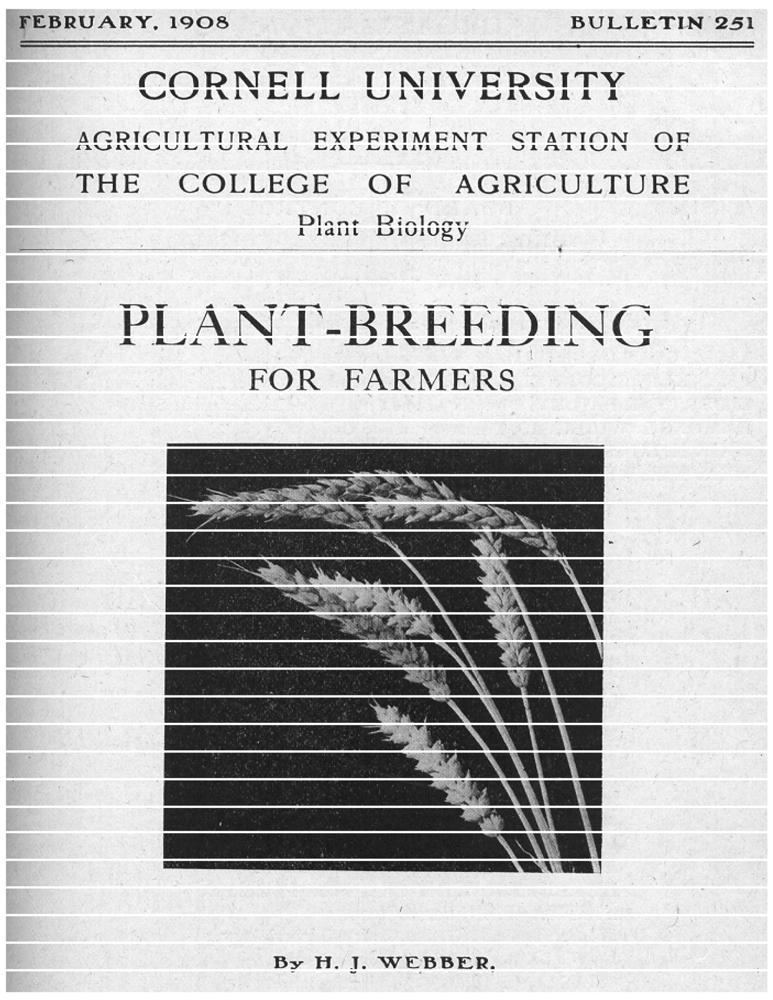
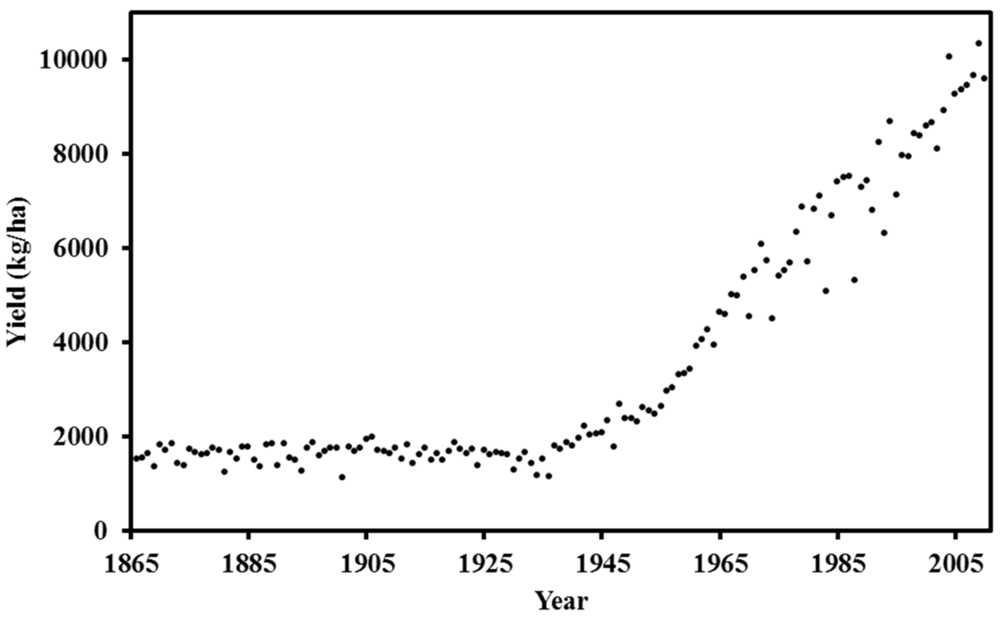
<p>Maize breeding and seed production by farmers was once the norm (<xref ref-type="fig" rid="f1-sustainability-03-01531">Figure 1</xref>). Trade in maize seed and intentional outcrossing with introduced types are ancient practices [<xref ref-type="bibr" rid="b14-sustainability-03-01531">14</xref>-<xref ref-type="bibr" rid="b16-sustainability-03-01531">16</xref>]. The result was many OP cultivars [<xref ref-type="bibr" rid="b17-sustainability-03-01531">17</xref>-<xref ref-type="bibr" rid="b21-sustainability-03-01531">21</xref>]. However, on-farm maize breeding and efforts to improve on-farm seed production were dropped after the 1930s in most of the United States once successful hybrids were released [<xref ref-type="bibr" rid="b10-sustainability-03-01531">10</xref>,<xref ref-type="bibr" rid="b22-sustainability-03-01531">22</xref>-<xref ref-type="bibr" rid="b24-sustainability-03-01531">24</xref>]. An increase in yield (<xref ref-type="fig" rid="f2-sustainability-03-01531">Figure 2</xref>) paid for these annual seed purchases and drove this change largely on economic grounds [<xref ref-type="bibr" rid="b25-sustainability-03-01531">25</xref>], although farmers were also much impressed with improved standability and the uniform look of the fields. Sometimes the yield increase observed in the USA in the 1940s seems to be attributed almost entirely to the hybrid cultivars themselves [<xref ref-type="bibr" rid="b11-sustainability-03-01531">11</xref>,<xref ref-type="bibr" rid="b26-sustainability-03-01531">26</xref>].</p>
<p>Those interested in sustainability do not doubt the potential and utility of hybrid maize cultivars. Modern hybrids often yield much more than current OP cultivars [<xref ref-type="bibr" rid="b9-sustainability-03-01531">9</xref>,<xref ref-type="bibr" rid="b28-sustainability-03-01531">28</xref>,<xref ref-type="bibr" rid="b29-sustainability-03-01531">29</xref>] and have often done so since the late 1930s [<xref ref-type="bibr" rid="b22-sustainability-03-01531">22</xref>,<xref ref-type="bibr" rid="b24-sustainability-03-01531">24</xref>,<xref ref-type="bibr" rid="b30-sustainability-03-01531">30</xref>,<xref ref-type="bibr" rid="b31-sustainability-03-01531">31</xref>]. This has also been true for forage yield [<xref ref-type="bibr" rid="b32-sustainability-03-01531">32</xref>-<xref ref-type="bibr" rid="b34-sustainability-03-01531">34</xref>]. Questions remain about the utility of other breeding methods that might allow farmers to produce their own seed, to more effectively breed for their own systems of management, and whether these might be more advantageous for them [<xref ref-type="bibr" rid="b35-sustainability-03-01531">35</xref>-<xref ref-type="bibr" rid="b39-sustainability-03-01531">39</xref>]. Also, the benefits of the yield boost from growing hybrid cultivars with high input levels are still debated given the economic and environmental problems with growing continuous maize [<xref ref-type="bibr" rid="b23-sustainability-03-01531">23</xref>,<xref ref-type="bibr" rid="b40-sustainability-03-01531">40</xref>-<xref ref-type="bibr" rid="b43-sustainability-03-01531">43</xref>]. Arguments for helping maize farmers by focusing on yield rather than profit have continued for 100 years [<xref ref-type="bibr" rid="b44-sustainability-03-01531">44</xref>], regardless of the fact that that this focus has sometimes failed to help farmers meet their economic, environmental or lifestyle needs [<xref ref-type="bibr" rid="b40-sustainability-03-01531">40</xref>,<xref ref-type="bibr" rid="b42-sustainability-03-01531">42</xref>,<xref ref-type="bibr" rid="b45-sustainability-03-01531">45</xref>].</p>
<p>Cleveland suggested that plant breeders were neither scientists in search of objective truths, nor servants within a social construct for existing political and economic interests, but some amalgam thereof [<xref ref-type="bibr" rid="b12-sustainability-03-01531">12</xref>]. This is a critical issue to consider given the changes to public and private plant breeding, the centralization of seed and gene control in agriculture, and the advent of more intrusive forms of biotechnology [<xref ref-type="bibr" rid="b23-sustainability-03-01531">23</xref>,<xref ref-type="bibr" rid="b37-sustainability-03-01531">37</xref>,<xref ref-type="bibr" rid="b46-sustainability-03-01531">46</xref>]. Were the conclusions of maize breeders presented over the last century well defended by the data or not, as has at times been alleged?</p>
<p>The purpose of this paper is to revisit the history and the current state of OP cultivars and the methods for maize improvement in order to address these questions: Were OP cultivars the cause of low yields in the USA before 1930? Was the inbred-hybrid method the only path to follow for maize improvement? What sort of breeding took place before and after hybrids were released? Is the story we teach agriculture students the real and complete story? Do OP cultivars have a place today?</p>
<sec>
<label>1.1.</label>
<title>Approach</title>
<p>I reviewed the maize breeding literature with a focus on the United States, delineating when key changes occurred and by whom. The yield potential of OP cultivars in the United States from the mid-1800s to the early 21st century was then addressed. Reports of multiple cultivar and multi-environment trials, particularly where improved management was more likely to have been practiced, were used to generate yield means under a variety of conditions. Averages for better-adapted cultivars over many environments were sought to best represent the potential of this type of cultivar.</p>
<p>Rates of gain for methods of maize improvement were generated using published summaries [<xref ref-type="bibr" rid="b10-sustainability-03-01531">10</xref>,<xref ref-type="bibr" rid="b47-sustainability-03-01531">47</xref>]. Data from the experiments of Weyrich <italic>et al.</italic> with the BS11 maize population were also incorporated [<xref ref-type="bibr" rid="b48-sustainability-03-01531">48</xref>]. Very high rates of gain (&gt;10%/cycle) observed with some tropical and other populations were ignored for the sake of generating conservative estimates more relevant to potential outcomes for high yielding populations in the higher latitudes.</p>
<p>Conservative estimates of rates of gain from selection, 0.6% annually for gridded mass selection and 1.3% annually for modified ear-to-row selection (based on an average of 83 kg/ha applied to a hypothetical population yielding 6270 kg/ha), were used to predict the yield of OP cultivars had they been bred for 80 years (since 1930), 60 years (since 1950) or 40 years (since 1970) because these two methods do not require controlled pollinations, directly provide seed for planting, and are possibly the most adaptable to on-farm breeding [<xref ref-type="bibr" rid="b35-sustainability-03-01531">35</xref>,<xref ref-type="bibr" rid="b48-sustainability-03-01531">48</xref>]. Estimated yields of OP cultivars under modern management, from the review of OP cultivar yields, were multiplied by these generated rates of gain. The predicted yield gain quantity from that first cycle was then added to the base yield for successive years to predict accumulated gains over time: steady gains can continue for many years [<xref ref-type="bibr" rid="b29-sustainability-03-01531">29</xref>]. I also sought out literature concerning synthetic and composite populations, including tropical maize breeding reports. Published results were used to generate predictions of the potential of this technique to form better OP cultivars.</p></sec></sec>
<sec sec-type="results|discussion">
<label>2.</label>
<title>Results and Discussion</title>
<sec>
<label>2.1.</label>
<title>The Age of On-Farm Selection in Maize—Origins to 1935</title>
<p>Indigenous farmers in the Americas developed maize and methods for seed production; farmers around the world continued this same process of mass selection wherein seeds from good ears or plants were saved each year [<xref ref-type="bibr" rid="b14-sustainability-03-01531">14</xref>-<xref ref-type="bibr" rid="b17-sustainability-03-01531">17</xref>,<xref ref-type="bibr" rid="b20-sustainability-03-01531">20</xref>,<xref ref-type="bibr" rid="b21-sustainability-03-01531">21</xref>,<xref ref-type="bibr" rid="b49-sustainability-03-01531">49</xref>]. Selection produced widely used cultivars, such as Improved King Philip Flint, Leaming, and Silver King [<xref ref-type="bibr" rid="b18-sustainability-03-01531">18</xref>,<xref ref-type="bibr" rid="b50-sustainability-03-01531">50</xref>,<xref ref-type="bibr" rid="b51-sustainability-03-01531">51</xref>]. Composite breeding, a technique developed by Native and Immigrant farmers, formed the entire race of Corn Belt Dent and cultivars like Reid's Yellow Dent, Krug's Yellow Dent and Falconer by crossing two racial types [<xref ref-type="bibr" rid="b16-sustainability-03-01531">16</xref>,<xref ref-type="bibr" rid="b26-sustainability-03-01531">26</xref>,<xref ref-type="bibr" rid="b48-sustainability-03-01531">48</xref>-<xref ref-type="bibr" rid="b50-sustainability-03-01531">50</xref>].</p>
<p>In the early 20th century, maize breeders and extension educators promoted a wide variety of selection techniques that were considered to be an improvement over traditional techniques [<xref ref-type="bibr" rid="b13-sustainability-03-01531">13</xref>,<xref ref-type="bibr" rid="b23-sustainability-03-01531">23</xref>,<xref ref-type="bibr" rid="b50-sustainability-03-01531">50</xref>,<xref ref-type="bibr" rid="b52-sustainability-03-01531">52</xref>-<xref ref-type="bibr" rid="b54-sustainability-03-01531">54</xref>]. Most focused on mass selection for ear and seed qualities thought to be related to yield in “pure strains,” although some more intensive systems of selection were also being promoted. Universities and associations of corn growers also established corn shows at fairs to exhibit “perfect ears” that were well matured and matched for uniformity. Rist wrote that, “If we are to estimate the value to be derived from corn shows in increased yields alone it probably would not amount to much, as we know that ‘show ears’ do not as a rule increase the yield of corn. On the other hand farmers of this state have paid thousands of dollars in tax money for scientific investigation along the line of corn improvement, yet such investigations have resulted in practically no increase in the yield of corn. Therefore, farmers could object to further investigations fully as well as could those who are opposed to corn shows object, as their results have been about the same so far as increased yields are concerned” [<xref ref-type="bibr" rid="b55-sustainability-03-01531">55</xref>]. In 1921, W.L. Burlison at the University of Illinois wrote that, “from the experiments conducted at this station it appears that while selection has had some effect in increasing the yield of corn, it has not given the results that were anticipated” [<xref ref-type="bibr" rid="b23-sustainability-03-01531">23</xref>].</p>
<p>Early breeding experiments with maize populations did not often yield impressive results for many breeders at many locations, and breeding based on ear type, though wildly popular and heavily promoted by universities, was even associated with yield reductions over time [<xref ref-type="bibr" rid="b13-sustainability-03-01531">13</xref>,<xref ref-type="bibr" rid="b52-sustainability-03-01531">52</xref>,<xref ref-type="bibr" rid="b53-sustainability-03-01531">53</xref>,<xref ref-type="bibr" rid="b56-sustainability-03-01531">56</xref>-<xref ref-type="bibr" rid="b59-sustainability-03-01531">59</xref>]. Datta visited maize breeders across the country and reviewed their techniques [<xref ref-type="bibr" rid="b52-sustainability-03-01531">52</xref>]. What he found was a mindset of progress through science and the land grant mission, along with a general abhorrence of inbreeding. However, though selection had improved the uniformity and local adaptation of many populations [<xref ref-type="bibr" rid="b49-sustainability-03-01531">49</xref>,<xref ref-type="bibr" rid="b50-sustainability-03-01531">50</xref>,<xref ref-type="bibr" rid="b60-sustainability-03-01531">60</xref>], “scientific” selection techniques promoted before 1920 appear not to have been fully evaluated before their widespread promotion [<xref ref-type="bibr" rid="b16-sustainability-03-01531">16</xref>].</p>
<p>During the 1920s, the selection program of the University of Illinois Extension Service was apparently successful in increasing yields using mass selection. J.C. Hackleman promoted selection against male plants that appeared barren, against plants with disease, and for high rates of germination. He reported yield gains of 300–600 kg/ha (5–15%) with this method [<xref ref-type="bibr" rid="b23-sustainability-03-01531">23</xref>]. Given the yields of the day, these were reasonable increases, especially since this was indirect selection for yield.</p></sec>
<sec>
<label>2.2.</label>
<title>Yield Potential of OP Cultivars in the United States—1847 to 2005</title>
<p>Reported yields of OP cultivars in university and other scientific trials were usually more than 2000 kg/ha in most parts of the United States when averaged across years, locations, and often times cultivar as well (<xref ref-type="table" rid="t1-sustainability-03-01531">Table 1</xref>), however, it is possible that very poor yields were under-reported [<xref ref-type="bibr" rid="b35-sustainability-03-01531">35</xref>]. It is clear that the yield potential of many OP cultivars with good management was often over 3000 kg/ha before modern management practices. In recent trials, yields of better-performing OP cultivars were often over 4400 kg/ha, a yield substantially lower than most hybrid checks [<xref ref-type="bibr" rid="b9-sustainability-03-01531">9</xref>,<xref ref-type="bibr" rid="b29-sustainability-03-01531">29</xref>,<xref ref-type="bibr" rid="b33-sustainability-03-01531">33</xref>,<xref ref-type="bibr" rid="b61-sustainability-03-01531">61</xref>-<xref ref-type="bibr" rid="b63-sustainability-03-01531">63</xref>].</p>
<p>High OP yields were familiar to many before 1930. Yields over 6200 kg/ha were recorded during the mid-1800s [<xref ref-type="bibr" rid="b20-sustainability-03-01531">20</xref>,<xref ref-type="bibr" rid="b21-sustainability-03-01531">21</xref>]. Montgomery reported that the four largest yields of maize on record in the United States at that time were over 12542 kg/ha for ears at husking [<xref ref-type="bibr" rid="b99-sustainability-03-01531">99</xref>], while Bowman reported the largest yield of grain belonged to South Carolina's Z.J. Drake in 1889 (15990 kg/ha) [<xref ref-type="bibr" rid="b50-sustainability-03-01531">50</xref>]. Hartley wrote that “good farmers frequently raise from 75 to 100 bushels of corn per acre [4700–6270 kg/ha]” and yields this high were regularly observed in Iowa and Wisconsin [<xref ref-type="bibr" rid="b51-sustainability-03-01531">51</xref>,<xref ref-type="bibr" rid="b54-sustainability-03-01531">54</xref>]. Cornell University cooperative trials showed average dry grain yields over 3140 kg/ha and at times over 4390 kg/ha, similar to yields reported by notable New York farmers in the 1840s [<xref ref-type="bibr" rid="b21-sustainability-03-01531">21</xref>,<xref ref-type="bibr" rid="b57-sustainability-03-01531">57</xref>,<xref ref-type="bibr" rid="b73-sustainability-03-01531">73</xref>,<xref ref-type="bibr" rid="b100-sustainability-03-01531">100</xref>,<xref ref-type="bibr" rid="b101-sustainability-03-01531">101</xref>].</p>
<p>There were two major problems for maize yields prior to 1930. Many farmers were not producing high quality seed (not well dried, freeze damage, not well selected, inbred) and were therefore obtaining poor stands and yields lower than the genetic potential of their cultivars [<xref ref-type="bibr" rid="b51-sustainability-03-01531">51</xref>,<xref ref-type="bibr" rid="b53-sustainability-03-01531">53</xref>,<xref ref-type="bibr" rid="b54-sustainability-03-01531">54</xref>,<xref ref-type="bibr" rid="b59-sustainability-03-01531">59</xref>,<xref ref-type="bibr" rid="b74-sustainability-03-01531">74</xref>,<xref ref-type="bibr" rid="b102-sustainability-03-01531">102</xref>,<xref ref-type="bibr" rid="b103-sustainability-03-01531">103</xref>]. The other problem was that soil and crop management improvements were not widely adopted, leading to unsustainable production in some cases [<xref ref-type="bibr" rid="b34-sustainability-03-01531">34</xref>,<xref ref-type="bibr" rid="b36-sustainability-03-01531">36</xref>]. Kent wrote, “By intense cultivation and proper rotation, most of the farms of Iowa would produce from 75–80 bushels of corn per acre [4700–5020 kg/ha], and under favorable climatic conditions still more” [<xref ref-type="bibr" rid="b70-sustainability-03-01531">70</xref>]. Yields in Missouri of 4870 <italic>vs.</italic> 740 kg/ha and in Illinois of 4000 kg/ha vs. 1690 kg/ha were reported for rotated vs. continuous cultivation [<xref ref-type="bibr" rid="b78-sustainability-03-01531">78</xref>,<xref ref-type="bibr" rid="b104-sustainability-03-01531">104</xref>]. Still, many farmers did not rotate or fertilize enough because: (1) fertilizers were not always economical [<xref ref-type="bibr" rid="b76-sustainability-03-01531">76</xref>,<xref ref-type="bibr" rid="b77-sustainability-03-01531">77</xref>], (2) the value of continuous maize was higher than the value of some alternative crops [<xref ref-type="bibr" rid="b105-sustainability-03-01531">105</xref>], or (3) for some other reasons. Smith wrote that “the land was corn sick” [<xref ref-type="bibr" rid="b104-sustainability-03-01531">104</xref>].</p>
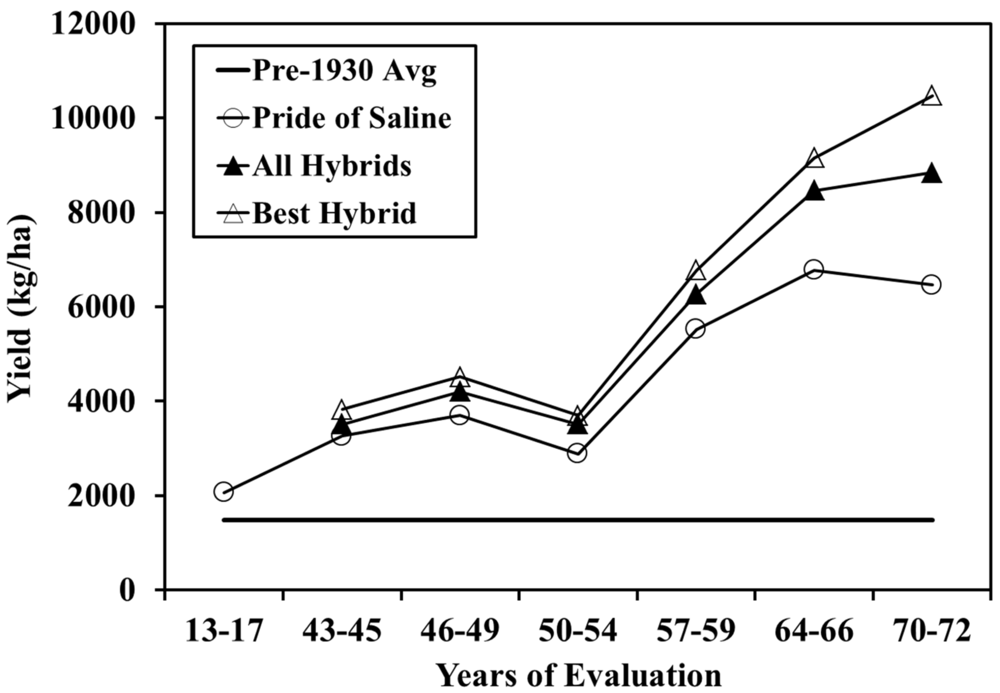
<p>One example of the importance of management for yields comes from Kansas where maize yields had fallen steadily, leading to an unsustainable situation before 1920 [<xref ref-type="bibr" rid="b79-sustainability-03-01531">79</xref>]. At that time one of the highest yielding OP cultivars was Pride of Saline, with an average yield over 1880 kg/ha [<xref ref-type="bibr" rid="b78-sustainability-03-01531">78</xref>]. In the 1940s, Pride of Saline was yielding 3140–3760 kg/ha and after 1960 it often yielded above 6270 kg/ha (<xref ref-type="fig" rid="f3-sustainability-03-01531">Figure 3</xref>). This is more than three times the Pride of Saline yield from university trials before 1920 with no reported breeding effort.</p>
<p>A complete consideration of the effects of plant breeding during the 20th century includes all of the factors that changed [<xref ref-type="bibr" rid="b22-sustainability-03-01531">22</xref>,<xref ref-type="bibr" rid="b36-sustainability-03-01531">36</xref>,<xref ref-type="bibr" rid="b114-sustainability-03-01531">114</xref>]. No more than 60–70% of the yield gain since 1930 should be attributed to breeding and using hybrid cultivars [<xref ref-type="bibr" rid="b29-sustainability-03-01531">29</xref>,<xref ref-type="bibr" rid="b115-sustainability-03-01531">115</xref>]. Hybrid yields in Kansas tests were on average 8–22% higher than Pride of Saline prior to 1960, and this difference increased after 1960 (<xref ref-type="fig" rid="f2-sustainability-03-01531">Figure 2</xref>). However, while hybrids often outperformed their OP checks in the 1930s and 1940s [<xref ref-type="bibr" rid="b22-sustainability-03-01531">22</xref>,<xref ref-type="bibr" rid="b30-sustainability-03-01531">30</xref>,<xref ref-type="bibr" rid="b31-sustainability-03-01531">31</xref>,<xref ref-type="bibr" rid="b85-sustainability-03-01531">85</xref>-<xref ref-type="bibr" rid="b88-sustainability-03-01531">88</xref>], Reid's Yellow Dent has yielded about as well as many commercial hybrids from the 1940s and early 1950s, but substantially less than post-1960 hybrids in recent tests in Iowa [<xref ref-type="bibr" rid="b9-sustainability-03-01531">9</xref>,<xref ref-type="bibr" rid="b29-sustainability-03-01531">29</xref>]. Also, improvements in standability in hybrids have been more dramatic still, making for greater gains for machine harvested yields and for more flexible grain harvest schedules [<xref ref-type="bibr" rid="b9-sustainability-03-01531">9</xref>,<xref ref-type="bibr" rid="b28-sustainability-03-01531">28</xref>-<xref ref-type="bibr" rid="b30-sustainability-03-01531">30</xref>,<xref ref-type="bibr" rid="b97-sustainability-03-01531">97</xref>,<xref ref-type="bibr" rid="b98-sustainability-03-01531">98</xref>]. Could new, more competitive OP cultivars that stand well be bred now?</p></sec>
<sec>
<label>2.3.</label>
<title>Adopting the Hybrid Method—1870 to 1935</title>
<p>Farmers had been making crosses among cultivars for thousands of years, and then reselecting new and more vigorous offspring from among the following generations with some success [<xref ref-type="bibr" rid="b49-sustainability-03-01531">49</xref>,<xref ref-type="bibr" rid="b50-sustainability-03-01531">50</xref>]. In Michigan, Beal suggested the use of F1 varietal hybrids in the 1870s as did Carrier in Virginia [<xref ref-type="bibr" rid="b4-sustainability-03-01531">4</xref>,<xref ref-type="bibr" rid="b26-sustainability-03-01531">26</xref>,<xref ref-type="bibr" rid="b116-sustainability-03-01531">116</xref>,<xref ref-type="bibr" rid="b117-sustainability-03-01531">117</xref>]. These new hybrid seeds did find some commercial use in the early 20th century, although like any hybrid seeds they required annual regeneration and further improvement in these hybrids would require ongoing improvement of each parent population.</p>
<p>Around 1910, some breeders began to think in new ways, to see vigorous cultivars, both uniform and genetically diverse, that had first passed through a period of inbreeding [<xref ref-type="bibr" rid="b11-sustainability-03-01531">11</xref>,<xref ref-type="bibr" rid="b17-sustainability-03-01531">17</xref>,<xref ref-type="bibr" rid="b44-sustainability-03-01531">44</xref>,<xref ref-type="bibr" rid="b52-sustainability-03-01531">52</xref>,<xref ref-type="bibr" rid="b80-sustainability-03-01531">80</xref>,<xref ref-type="bibr" rid="b114-sustainability-03-01531">114</xref>,<xref ref-type="bibr" rid="b118-sustainability-03-01531">118</xref>]. Early data with inbred hybrids showed great potential in the method, although it would be expensive and removed from the hands of farmers [<xref ref-type="bibr" rid="b23-sustainability-03-01531">23</xref>,<xref ref-type="bibr" rid="b49-sustainability-03-01531">49</xref>,<xref ref-type="bibr" rid="b94-sustainability-03-01531">94</xref>]. Richey said evidence suggested “pure line methods as the only sound basis for real improvement of corn” [<xref ref-type="bibr" rid="b119-sustainability-03-01531">119</xref>].</p>
<p>Richey reported that F1 varietal hybrids on average did not yield more than the parent cultivars and also noted small or no gains on average from ear-to-row breeding [<xref ref-type="bibr" rid="b119-sustainability-03-01531">119</xref>]. However, he then expounded on the best yields from Jones' hybridization work rather than showing that 11 of the 25 Leaming hybrids yielded less than the OP parent [<xref ref-type="bibr" rid="b80-sustainability-03-01531">80</xref>,<xref ref-type="bibr" rid="b119-sustainability-03-01531">119</xref>]. Concerning hybridization experiments in Nebraska, Richey wrote, “It is unlikely that all of the crosses yielded equally, and some, therefore, probably exceeded this 0.8 bushel [50 kg/ha] increase” [<xref ref-type="bibr" rid="b119-sustainability-03-01531">119</xref>]. Had Richey applied the same focus on the best gains from the other breeding methods he would have reported that 2.5% of F1 varietal hybrids outyielded the better parent by 26% or more and would have noted good yield gains in some ear-to-row breeding experiments [<xref ref-type="bibr" rid="b119-sustainability-03-01531">119</xref>]. Therefore, Richey's conclusion about pure line methods was only partly correct considering the data presented. On average, hybrids did not yield better than their OP parent cultivars, but some hybrids yielded much better, as is still true today.</p>
<p>At the time, the difficult task of finding the best hybrid combinations provided rapid yield gains in the short run but did not make for long term improvements. However, the method proved wildly successful after years of intensive development when released hybrids often outyielded OP cultivars by 9–40% [<xref ref-type="bibr" rid="b10-sustainability-03-01531">10</xref>,<xref ref-type="bibr" rid="b11-sustainability-03-01531">11</xref>,<xref ref-type="bibr" rid="b17-sustainability-03-01531">17</xref>,<xref ref-type="bibr" rid="b22-sustainability-03-01531">22</xref>,<xref ref-type="bibr" rid="b23-sustainability-03-01531">23</xref>,<xref ref-type="bibr" rid="b29-sustainability-03-01531">29</xref>,<xref ref-type="bibr" rid="b31-sustainability-03-01531">31</xref>,<xref ref-type="bibr" rid="b37-sustainability-03-01531">37</xref>,<xref ref-type="bibr" rid="b86-sustainability-03-01531">86</xref>-<xref ref-type="bibr" rid="b88-sustainability-03-01531">88</xref>,<xref ref-type="bibr" rid="b91-sustainability-03-01531">91</xref>,<xref ref-type="bibr" rid="b118-sustainability-03-01531">118</xref>,<xref ref-type="bibr" rid="b120-sustainability-03-01531">120</xref>]. From on-farm ear selection and no inbreeding with “pure” populations, breeders appear to have leapt to no population improvement and little farmer involvement. During neither period were decisions fully evaluated through experimentation.</p>
<p>After 1922, most university maize programs in the USA took up inbreeding studies [<xref ref-type="bibr" rid="b89-sustainability-03-01531">89</xref>]. Some maize breeders moved out of breeding and into different roles [<xref ref-type="bibr" rid="b22-sustainability-03-01531">22</xref>]. Hartley, the head of USDA's maize improvement efforts, was pushed from the USDA Bureau of Plant Industry over his conservatism in favor of on-farm seed production and breeding [<xref ref-type="bibr" rid="b23-sustainability-03-01531">23</xref>]. This parallels changes underway in plant science departments world-wide as molecular and transgenic techniques and courses of study have come into favor and funding for conventional public plant breeding research and education has dwindled even though the approach still works well [<xref ref-type="bibr" rid="b7-sustainability-03-01531">7</xref>,<xref ref-type="bibr" rid="b116-sustainability-03-01531">116</xref>,<xref ref-type="bibr" rid="b121-sustainability-03-01531">121</xref>,<xref ref-type="bibr" rid="b122-sustainability-03-01531">122</xref>].</p></sec>
<sec>
<label>2.4.</label>
<title>Recurrent Selection Revisited</title>
<p>Interest among hybrid maize breeders in recurrent or repeated selection rebounded in the 1940s and 1950s when they discovered the need for improved populations from which to select new inbreds [<xref ref-type="bibr" rid="b16-sustainability-03-01531">16</xref>,<xref ref-type="bibr" rid="b47-sustainability-03-01531">47</xref>,<xref ref-type="bibr" rid="b123-sustainability-03-01531">123</xref>], and this time the conclusions were very different. OP cultivars had been thought to lack the genetic variation for successful selection and this was disproven via experimentation [<xref ref-type="bibr" rid="b16-sustainability-03-01531">16</xref>,<xref ref-type="bibr" rid="b124-sustainability-03-01531">124</xref>]. Gardner wrote, “mass selection would appear to be as effective as hybridization in increasing yield” [<xref ref-type="bibr" rid="b96-sustainability-03-01531">96</xref>]. Webel and Lonnquist said of modified ear-to-row selection, “The realized gain suggests the method might be as effective as hybridization in increasing yield” [<xref ref-type="bibr" rid="b125-sustainability-03-01531">125</xref>]. Lonnquist and Gardner found “that no critical experiments where yield was the main criterion for selection were reported during the period covered by Richey's report” [<xref ref-type="bibr" rid="b95-sustainability-03-01531">95</xref>]. Sprague noted “it appears that the ear-to-row method of selection for yielding ability was discredited not because of genetic limitations of the method, but because of the inadequate field plot technique” [<xref ref-type="bibr" rid="b16-sustainability-03-01531">16</xref>]. Research after Richey's 1922 conclusion showed recurrent selection and varietal hybrids could be very successful at increasing maize yields after all, although they could not provide cultivars with the yields of the best hybrids [<xref ref-type="bibr" rid="b35-sustainability-03-01531">35</xref>,<xref ref-type="bibr" rid="b47-sustainability-03-01531">47</xref>,<xref ref-type="bibr" rid="b81-sustainability-03-01531">81</xref>,<xref ref-type="bibr" rid="b95-sustainability-03-01531">95</xref>,<xref ref-type="bibr" rid="b119-sustainability-03-01531">119</xref>,<xref ref-type="bibr" rid="b120-sustainability-03-01531">120</xref>,<xref ref-type="bibr" rid="b126-sustainability-03-01531">126</xref>-<xref ref-type="bibr" rid="b131-sustainability-03-01531">131</xref>].</p>
<p>The Hays Golden OP cultivar from Nebraska showed a yield increase of 40% from several years of recurrent selection for yield alone as compared to the 9–40% yield advantage that many hybrids had over OP cultivars with many years of development [<xref ref-type="bibr" rid="b30-sustainability-03-01531">30</xref>,<xref ref-type="bibr" rid="b47-sustainability-03-01531">47</xref>,<xref ref-type="bibr" rid="b88-sustainability-03-01531">88</xref>,<xref ref-type="bibr" rid="b123-sustainability-03-01531">123</xref>]. Average gains in yield for gridded mass selection range from 1.8–2.6% annually [<xref ref-type="bibr" rid="b10-sustainability-03-01531">10</xref>,<xref ref-type="bibr" rid="b35-sustainability-03-01531">35</xref>,<xref ref-type="bibr" rid="b47-sustainability-03-01531">47</xref>,<xref ref-type="bibr" rid="b120-sustainability-03-01531">120</xref>,<xref ref-type="bibr" rid="b132-sustainability-03-01531">132</xref>]. Modified-ear-to-row selection has demonstrated average gains per year of about 2.1–3.5% [<xref ref-type="bibr" rid="b10-sustainability-03-01531">10</xref>,<xref ref-type="bibr" rid="b35-sustainability-03-01531">35</xref>,<xref ref-type="bibr" rid="b47-sustainability-03-01531">47</xref>,<xref ref-type="bibr" rid="b48-sustainability-03-01531">48</xref>,<xref ref-type="bibr" rid="b133-sustainability-03-01531">133</xref>]. These and other recurrent breeding techniques have been very successful in breeding cultivars for farmers in the tropics [<xref ref-type="bibr" rid="b120-sustainability-03-01531">120</xref>,<xref ref-type="bibr" rid="b128-sustainability-03-01531">128</xref>,<xref ref-type="bibr" rid="b131-sustainability-03-01531">131</xref>,<xref ref-type="bibr" rid="b132-sustainability-03-01531">132</xref>]. Conservative estimates of average potential annual yield gains of 82 kg/ha for mass selection and 83 kg/ha for modified-ear-to-row selection, largely from North American data, are comparable to those experienced in an open-ended inbred hybrid breeding program from the United States, where yields have increased by about 66 kg/ha each year since 1930 [<xref ref-type="bibr" rid="b9-sustainability-03-01531">9</xref>,<xref ref-type="bibr" rid="b29-sustainability-03-01531">29</xref>,<xref ref-type="bibr" rid="b35-sustainability-03-01531">35</xref>]. Both Coors and Duvick provide lists of reasons why these results for recurrent selection might be biased comparisons and might at times favor the results for recurrent selection over the inbred-hybrid method [<xref ref-type="bibr" rid="b35-sustainability-03-01531">35</xref>,<xref ref-type="bibr" rid="b36-sustainability-03-01531">36</xref>]. Added to that, recurrent programs rarely if ever achieve the level of selection and evaluation intensity described for commercial hybrid breeding [<xref ref-type="bibr" rid="b17-sustainability-03-01531">17</xref>]. Regardless of type of cultivar, annual improvements via breeding are essentially about the same. The fastest and cheapest method which best supports sustainable agriculture outcomes will depend on yields in the target agroecosystems, grain prices, and farmer skills and interests.</p>
<p>Gardner's modification to mass selection techniques was to focus on yield among plants in small grids or plots across a seed selection field [<xref ref-type="bibr" rid="b96-sustainability-03-01531">96</xref>]. This reduces the environmental effects on observed plant phenotypes and improves selection for better genotypes, although it does not allow for evaluation in multiple agroecosystems. The method is easily adapted to farm and garden situations, although it is better for qualitative traits than for yield and may need the two step procedure suggested by Hartley for larger acreages [<xref ref-type="bibr" rid="b54-sustainability-03-01531">54</xref>]. Modified ear-to-row selection involves replicated evaluation of plant progenies at three locations and is a more intensive technique that would probably require special training for farmers or even a participating breeder [<xref ref-type="bibr" rid="b134-sustainability-03-01531">134</xref>]. Prior to 1910, some breeders had adopted replication, check rows, detasseling and the use of remnant seed in some ear-to-row breeding trials for better plant evaluations [<xref ref-type="bibr" rid="b13-sustainability-03-01531">13</xref>,<xref ref-type="bibr" rid="b52-sustainability-03-01531">52</xref>,<xref ref-type="bibr" rid="b58-sustainability-03-01531">58</xref>,<xref ref-type="bibr" rid="b135-sustainability-03-01531">135</xref>]. Use of the triple lattice design for progeny tests (a component of Lonnquist's method) was unlikely before demonstrations of its utility in accounting for finer spatial variation of soils in the early 1940s and the use of bulk seed rows for cross-pollination appears to have originated with Lonnquist [<xref ref-type="bibr" rid="b52-sustainability-03-01531">52</xref>,<xref ref-type="bibr" rid="b134-sustainability-03-01531">134</xref>,<xref ref-type="bibr" rid="b136-sustainability-03-01531">136</xref>,<xref ref-type="bibr" rid="b137-sustainability-03-01531">137</xref>]. The method often results in rapid gains and the availability of computers makes it and other complex recurrent selection methods a possibility for many farmers, especially those working in groups or when partnering with breeders.</p>
<p>What would have happened if these techniques were applied in the past had recurrent selection not been dropped prematurely? Some OP cultivars in the United States have yields of 5020–6270 kg/ha which are not currently economically advantageous [<xref ref-type="bibr" rid="b28-sustainability-03-01531">28</xref>]. Using conservative estimates of rates of gain, calculations of the predicted gains in yield suggest large gains were and are possible with enough breeding effort (<xref ref-type="table" rid="t2-sustainability-03-01531">Table 2</xref>). Gridded mass selection could have resulted in OP cultivars yielding 9280 kg/ha or more by now had selection begun by 1930. Lonnquist's modified ear-to-row method could have resulted in much faster improvements and in fairly competitive OP cultivars even if it had been employed only since its development [<xref ref-type="bibr" rid="b134-sustainability-03-01531">134</xref>]. Applying recurrent selection now, it would take many years to develop an economically competitive OP cultivar. Competitive commercial OP cultivars for the USA and some other regions were not developed and breeders (and farmers) would have had to overcome the stigma of being old-fashioned and the preference of governments and many farmers for hybrids [<xref ref-type="bibr" rid="b23-sustainability-03-01531">23</xref>]. Had higher yielding OP cultivars been released prior to 1960, would there have been an advantage? Would many farmers use high yielding OP cultivars today? Would there be an advantage in time, profitability, adaptation, <italic>etc.</italic>?</p>
<p>There are other biological problems to consider. Single plant evaluation in mass selection can increase yield under some circumstances but often results in delayed maturity and no improvement in stalk strength and other critical agronomic traits. Hyrkas and Carena and Bletsos and Goulas were unable to increase yield of improved populations using mass selection and suggested using more intensive recurrent selection techniques that could be more difficult for farmers although predicted rates of gain can be higher [<xref ref-type="bibr" rid="b35-sustainability-03-01531">35</xref>,<xref ref-type="bibr" rid="b48-sustainability-03-01531">48</xref>,<xref ref-type="bibr" rid="b133-sustainability-03-01531">133</xref>,<xref ref-type="bibr" rid="b138-sustainability-03-01531">138</xref>]. Gardner hit a yield plateau with Hays Golden after 12 cycles of mass selection; modified ear-to-row selection reached the same plateau in only six cycles [<xref ref-type="bibr" rid="b47-sustainability-03-01531">47</xref>]. Yield plateaus can be overcome by outcrossing, and then proceeding anew with the resulting composite population [<xref ref-type="bibr" rid="b131-sustainability-03-01531">131</xref>,<xref ref-type="bibr" rid="b139-sustainability-03-01531">139</xref>]. Eberhart <italic>et al.</italic> promoted the idea of cooperative work with many populations [<xref ref-type="bibr" rid="b128-sustainability-03-01531">128</xref>]. Such an approach could make available the improved populations and lines needed for outcrossing when breeding plateaus are discovered. At any time inbreds and inbred hybrids could be developed, making for a very comprehensive approach to maize breeding much akin to the successful public program at Iowa State University where theoretical studies of maize breeding technique included selection for agronomic traits as well as yield in both populations and inbreds. There need not be an either or choice with OP and hybrid cultivars.</p></sec>
<sec>
<label>2.5.</label>
<title>Composite and Synthetic Populations as OP Cultivars</title>
<p>Hybrid vigor has been harnessed by maize breeders for centuries [<xref ref-type="bibr" rid="b14-sustainability-03-01531">14</xref>,<xref ref-type="bibr" rid="b16-sustainability-03-01531">16</xref>,<xref ref-type="bibr" rid="b49-sustainability-03-01531">49</xref>]. Composite populations (intermated cultivars) and synthetic populations (intermated inbreds), like any maize population with a random mating structure, can be thought of and used as OP cultivars [<xref ref-type="bibr" rid="b140-sustainability-03-01531">140</xref>] and may offer a rapid approach to increasing OP cultivar performance. Shull and Duvick suggested that the yield of an OP cultivar is a result of all the possible hybrid combinations among the parents [<xref ref-type="bibr" rid="b36-sustainability-03-01531">36</xref>,<xref ref-type="bibr" rid="b44-sustainability-03-01531">44</xref>], and Wright demonstrated that the number and yield of parents in a synthetic population determined how much of the hybrid vigor could be retained in the F2 and later generations [<xref ref-type="bibr" rid="b141-sustainability-03-01531">141</xref>]. The equation based on his work, which was validated for both composites and synthetics by Mochizuki, predicts that as the number of parents increases the amount of retained hybrid vigor increases [<xref ref-type="bibr" rid="b142-sustainability-03-01531">142</xref>].</p>
<disp-formula id="FD1">
<label>(1)</label>
<mml:math id="mm1" display="block">
<mml:semantics id="sm1">
<mml:mrow>
<mml:mtext>F</mml:mtext>
<mml:mn>2</mml:mn>
<mml:mspace width="0.2em"/>
<mml:mtext>Synthetic Yield</mml:mtext>
<mml:mo>=</mml:mo>
<mml:mtext>H</mml:mtext>
<mml:mo>−</mml:mo>
<mml:mfrac>
<mml:mrow>
<mml:mo stretchy="false">(</mml:mo>
<mml:mtext>H</mml:mtext>
<mml:mo>−</mml:mo>
<mml:mtext>P</mml:mtext>
<mml:mo stretchy="false">)</mml:mo></mml:mrow>
<mml:mtext>n</mml:mtext></mml:mfrac></mml:mrow></mml:semantics></mml:math></disp-formula>
<list list-type="simple">
<list-item>
<p>H = avg yield of all F1 hybrids, P = avg yield of parents per se,</p></list-item>
<list-item>
<p>n = number of parents</p></list-item></list>
<p>While some saw the potential for synthetic maize cultivars in the USA early on [<xref ref-type="bibr" rid="b80-sustainability-03-01531">80</xref>,<xref ref-type="bibr" rid="b143-sustainability-03-01531">143</xref>], little work was done and most results were not promising [<xref ref-type="bibr" rid="b16-sustainability-03-01531">16</xref>,<xref ref-type="bibr" rid="b144-sustainability-03-01531">144</xref>,<xref ref-type="bibr" rid="b145-sustainability-03-01531">145</xref>]. However, many breeders have had synthetic yields at least 15% above that of common OP cultivars and up to 90% of hybrid yields [<xref ref-type="bibr" rid="b83-sustainability-03-01531">83</xref>,<xref ref-type="bibr" rid="b93-sustainability-03-01531">93</xref>,<xref ref-type="bibr" rid="b97-sustainability-03-01531">97</xref>,<xref ref-type="bibr" rid="b118-sustainability-03-01531">118</xref>,<xref ref-type="bibr" rid="b146-sustainability-03-01531">146</xref>-<xref ref-type="bibr" rid="b149-sustainability-03-01531">149</xref>]. It appears that these high yielding synthetic populations never reached farmers in the USA or many other regions for their consideration.</p>
<p>The application of Wright's equation to historical data on maize inbreds and hybrids suggests the possibility of synthetics that yield more than 90% of commercial hybrids if the research were carried out (<xref ref-type="table" rid="t3-sustainability-03-01531">Table 3</xref>), although the work would be intensive with many questions to be answered [<xref ref-type="bibr" rid="b36-sustainability-03-01531">36</xref>,<xref ref-type="bibr" rid="b141-sustainability-03-01531">141</xref>,<xref ref-type="bibr" rid="b150-sustainability-03-01531">150</xref>]. Might such diverse populations open up new ways of dealing with diseases and pests as has worked for multilines of rice [<xref ref-type="bibr" rid="b151-sustainability-03-01531">151</xref>]? Could synthetics reduce seed costs, provide competitive yields and be further improved via selection on farms? Would many farmers be interested?</p>
<p>Some answers come from the tropics where maize breeding has embraced population improvement and inbreeding and breeders develop inbred hybrids, varietal hybrids, synthetics and other OP cultivars to best fit local needs [<xref ref-type="bibr" rid="b120-sustainability-03-01531">120</xref>,<xref ref-type="bibr" rid="b128-sustainability-03-01531">128</xref>,<xref ref-type="bibr" rid="b131-sustainability-03-01531">131</xref>,<xref ref-type="bibr" rid="b152-sustainability-03-01531">152</xref>-<xref ref-type="bibr" rid="b157-sustainability-03-01531">157</xref>]. In those regions synthetic cultivars have proven useful for farmers by providing higher yields and low seed costs, although for long term improvement synthetics may require more genetic diversity than that provided by only 8–10 lines and they may require more intensive selection schemes for further improvement [<xref ref-type="bibr" rid="b133-sustainability-03-01531">133</xref>,<xref ref-type="bibr" rid="b155-sustainability-03-01531">155</xref>]. A few farmers in the United States, especially organic farmers, are looking for good cultivars of maize and other crops from which they could produce their own seed as seed prices have risen sharply in recent years and the number of commercial cultivars without transgenes has diminished [<xref ref-type="bibr" rid="b33-sustainability-03-01531">33</xref>,<xref ref-type="bibr" rid="b140-sustainability-03-01531">140</xref>,<xref ref-type="bibr" rid="b158-sustainability-03-01531">158</xref>,<xref ref-type="bibr" rid="b159-sustainability-03-01531">159</xref>]. Baltensberger <italic>et al.</italic> suggested that dryland farming and similar regions with climatic stress may be the first agroecosystems to consider for this approach as these lower yielding environments result in similar economic returns for synthetics yielding only 75% of commercial hybrids [<xref ref-type="bibr" rid="b147-sustainability-03-01531">147</xref>]. Stress environments, and those where hybrids are not economically feasible, are the targets for modern OP cultivar development in the tropics [<xref ref-type="bibr" rid="b120-sustainability-03-01531">120</xref>,<xref ref-type="bibr" rid="b152-sustainability-03-01531">152</xref>-<xref ref-type="bibr" rid="b154-sustainability-03-01531">154</xref>]. Organic farmers may be interested as well, but high organic grain prices could make lost yield opportunities economically detrimental unless cultivars without recombinant DNA were otherwise unavailable [<xref ref-type="bibr" rid="b28-sustainability-03-01531">28</xref>].</p>
<p>Any type of hybrid is still an option for on-farm seed production. Should sustainable farmers find it economically feasible to produce their own hybrid seed, varietal hybrids might still be a valuable option among several (single cross, top cross, double cross, varietal cross). Improved populations, whether synthetic or otherwise, could be crossed to produce F1 seed each year should those populations demonstrate hybrid vigor when crossed. Advantages of this approach could be higher yields than possible with populations per se, cheap hybrid seed given the levels of production that may be possible with populations compared to expected yields of inbred parent lines, and the possibility for ongoing improvement of the parent populations and their hybrids on-farm. Disadvantages could include separate seed production requirements, likely lower yield than single cross hybrids [<xref ref-type="bibr" rid="b129-sustainability-03-01531">129</xref>], and lower uniformity than that observed in single cross hybrids.</p></sec>
<sec>
<label>2.6.</label>
<title>Maize Breeding and Society</title>
<p>Cleveland suggested breeders were neither pure scientists nor only servants to social constructs, and this conclusion appears to be affirmed here [<xref ref-type="bibr" rid="b12-sustainability-03-01531">12</xref>]. Maize breeders come with their own personal interests for the work to be undertaken and certainly make subjective decisions about specific approaches and goals [<xref ref-type="bibr" rid="b8-sustainability-03-01531">8</xref>]. The widely promoted selection methods and shows before 1920 and the rejection of recurrent selection from 1922 until the late 1940s show maize breeders and their administrators sometimes got ahead of scientific validation in order to pursue exciting new options. There were some decisions involved in promoting research and development of hybrid cultivars to benefit specific seed businesses [<xref ref-type="bibr" rid="b23-sustainability-03-01531">23</xref>,<xref ref-type="bibr" rid="b37-sustainability-03-01531">37</xref>], and most professional maize breeders in the USA ignored the potential of recurrent selection in favor of the task of testing tens of thousands of lines in the 1920s and 1930s [<xref ref-type="bibr" rid="b118-sustainability-03-01531">118</xref>,<xref ref-type="bibr" rid="b119-sustainability-03-01531">119</xref>]. There were, however, many promoters of hybrid cultivars who had farmers in mind, and the science behind hybrid breeding methods eventually proved sound and useful to all forms of maize improvement [<xref ref-type="bibr" rid="b10-sustainability-03-01531">10</xref>,<xref ref-type="bibr" rid="b22-sustainability-03-01531">22</xref>,<xref ref-type="bibr" rid="b160-sustainability-03-01531">160</xref>]. Excellent and creative work was carried out that has stood the test of time and provided exceptional new cultivars of many types [<xref ref-type="bibr" rid="b10-sustainability-03-01531">10</xref>,<xref ref-type="bibr" rid="b16-sustainability-03-01531">16</xref>,<xref ref-type="bibr" rid="b17-sustainability-03-01531">17</xref>,<xref ref-type="bibr" rid="b89-sustainability-03-01531">89</xref>,<xref ref-type="bibr" rid="b123-sustainability-03-01531">123</xref>,<xref ref-type="bibr" rid="b161-sustainability-03-01531">161</xref>,<xref ref-type="bibr" rid="b162-sustainability-03-01531">162</xref>].</p>
<p>In the past thirty years maize breeding has changed further with patents, DNA marker assisted selection, and transgenic techniques joining the process. Public breeding has been fading in favor of breeding by major corporations around the world [<xref ref-type="bibr" rid="b116-sustainability-03-01531">116</xref>,<xref ref-type="bibr" rid="b163-sustainability-03-01531">163</xref>]. One might question whether this is once more the promotion of the novel in place of approaches that objectivity might instead focus upon [<xref ref-type="bibr" rid="b6-sustainability-03-01531">6</xref>,<xref ref-type="bibr" rid="b45-sustainability-03-01531">45</xref>,<xref ref-type="bibr" rid="b105-sustainability-03-01531">105</xref>]. Experience tells us that there can be some unanticipated problems with new technologies rushed to market [<xref ref-type="bibr" rid="b164-sustainability-03-01531">164</xref>], yet sometimes full economic and ecological evaluations are still unavailable for transgenic maize cultivars until well after commercial release [<xref ref-type="bibr" rid="b165-sustainability-03-01531">165</xref>-<xref ref-type="bibr" rid="b167-sustainability-03-01531">167</xref>]. Cox reiterated a calculation from Goodman and Carson comparing conventional hybrid breeding with the more expensive transgenic methods which are apparently no faster to produce new cultivars than conventional methods [<xref ref-type="bibr" rid="b168-sustainability-03-01531">168</xref>]. This situation is reminiscent of Gardener's favorable comparison of recurrent selection with hybrid breeding decades after the switch to hybrids [<xref ref-type="bibr" rid="b96-sustainability-03-01531">96</xref>]. At the American Seed Trade Association conference in 2003, John Dudley, then maize breeder from the University of Illinois, asked the audience, “Current corn yield goes up 1.9 Bu/A annually. What [trans]genes would improve this?” Given our experiences, an open and logical discussion of the goals, means, and costs of modern maize breeding appears in order as has always been the case.</p>
<p>Rather than the “March of Progress” from OP cultivars to high yielding hybrids and on to transgenic technologies, perhaps the scientific and social successes and failures of actual maize breeders (e.g., Darrah, Duvick, Hallauer, Hartley, Hayes, Gardner, Goodman, Lonnquist, Miranda Filho, Pandey, Paterniani, Richey, Sevilla, Sprague, Stringfield, Troyer, Will, <italic>etc.</italic>) in meeting the needs of farmers and consumers would be more objective and useful for students contemplating breeding for sustainability. And rather than a competition between OP and hybrid cultivars, perhaps it would be most sensible to consider this thought from Pandey <italic>et al.</italic>: “The critical question is not whether hybrids are superior to OPVs, but whether a product is superior to what the farmers grow and which new product they can afford” [<xref ref-type="bibr" rid="b152-sustainability-03-01531">152</xref>]. Breeding, like any tool with which humanity hopes to derive a better world, requires knowledge, critical thinking, hard work, humility, cooperation, objectivity, and a broad perspective in order to be successful [<xref ref-type="bibr" rid="b17-sustainability-03-01531">17</xref>,<xref ref-type="bibr" rid="b122-sustainability-03-01531">122</xref>]. If we are to make the most reasonable choices for a sustainable agriculture, it appears most fruitful to attend to all of them.</p></sec></sec>
<sec sec-type="conclusions">
<label>4.</label>
<title>Conclusions</title>
<p>OP maize cultivars were and are sometimes useful for providing low priced seeds and dependable yields to farmers, although they usually yield less than well adapted hybrid cultivars when those are available. In lower yielding agroecosystems and lower priced markets where OP cultivars appear to be more competitive, farmers need to understand selection and seed production methods and their time investment must be personally and economically satisfying to realize acceptable outcomes. This may not be of interest to farmers with high value maize crops, large enterprises, substantial off-farm activities, or access to hybrid cultivars that meet their needs. It appears that yield gains via breeding are about the same for OP and hybrid cultivars, but starting at a lower yield level, most current OP cultivars would appear to be permanently relegated to lower yield levels compared to most hybrids, although specialty traits might help them be economically competitive anyway. The moment in history when the yield of OP cultivars could have been improved to be competitive with hybrids via recurrent selection alone appears to have passed, although the possibilities of forming competitive OP cultivars using composite/synthetic methods and using more complex recurrent selection methods on-farm remain challenging options that have not been fully investigated in the United States and Europe. These approaches have at times been successful in the tropics. Yields of synthetics 5–10% less than elite hybrids are still theoretically possible but have yet to be achieved. New OP cultivars could be cost competitive in many more agroecosystems than OP cultivars are now and this process could open up more partnerships to breed maize for non-patented traits of importance to sustainable agriculture (e.g., stress tolerance, insect and disease resistance, nutrient use efficiency, grain quality). There are also existing opportunities for more on-farm development and production of hybrid cultivars. We can approach questions about maize improvement and cultivar choice for sustainable agroecosystems objectively with the most sustainable outcomes for society in mind, an approach often used in maize breeding throughout much of the world.</p></sec></body>
<back>
<sec sec-type="display-objects">
<title>Figures and Tables</title>
<fig id="f1-sustainability-03-01531" position="float">
<label>Figure 1.</label>
<caption>
<p>USDA and Agricultural Experiment Stations once actively trained farmers on the latest breeding techniques [<xref ref-type="bibr" rid="b13-sustainability-03-01531">13</xref>]. Unfortunately, the methods promoted were not always very successful for increasing yield.</p></caption>
<graphic xlink:href="sustainability-03-01531f1.gif"/></fig>
<fig id="f2-sustainability-03-01531" position="float">
<label>Figure 2.</label>
<caption>
<p>Average USA maize yields 1866–2010. Data are available from USDA [<xref ref-type="bibr" rid="b27-sustainability-03-01531">27</xref>].</p></caption>
<graphic xlink:href="sustainability-03-01531f2.gif"/></fig>
<fig id="f3-sustainability-03-01531" position="float">
<label>Figure 3.</label>
<caption>
<p>Kansas statewide yields of Pride of Saline and hybrid cultivars from 1913–1972. Data were adapted from reports of the Kansas State University Agricultural Experiment Station [<xref ref-type="bibr" rid="b78-sustainability-03-01531">78</xref>,<xref ref-type="bibr" rid="b79-sustainability-03-01531">79</xref>,<xref ref-type="bibr" rid="b91-sustainability-03-01531">91</xref>,<xref ref-type="bibr" rid="b106-sustainability-03-01531">106</xref>-<xref ref-type="bibr" rid="b113-sustainability-03-01531">113</xref>]. The “Best Hybrid” was not the highest performing individual cultivar at each location but the highest yielding cultivar when averaged across test locations.</p></caption>
<graphic xlink:href="sustainability-03-01531f3.gif"/></fig>
<table-wrap id="t1-sustainability-03-01531" position="float">
<label>Table 1.</label>
<caption>
<p>Some average yields for open-pollinated maize cultivars in the United States [<xref ref-type="bibr" rid="b9-sustainability-03-01531">9</xref>,<xref ref-type="bibr" rid="b21-sustainability-03-01531">21</xref>,<xref ref-type="bibr" rid="b24-sustainability-03-01531">24</xref>,<xref ref-type="bibr" rid="b29-sustainability-03-01531">29</xref>,<xref ref-type="bibr" rid="b31-sustainability-03-01531">31</xref>,<xref ref-type="bibr" rid="b33-sustainability-03-01531">33</xref>,<xref ref-type="bibr" rid="b56-sustainability-03-01531">56</xref>-<xref ref-type="bibr" rid="b58-sustainability-03-01531">58</xref>,<xref ref-type="bibr" rid="b61-sustainability-03-01531">61</xref>-<xref ref-type="bibr" rid="b98-sustainability-03-01531">98</xref>]. Average state yields of open-pollinated (OP) cultivars during each test are included when data were available from USDA [<xref ref-type="bibr" rid="b27-sustainability-03-01531">27</xref>]. Average state yields for the period 1866–1929 for which there are data are marked with an asterisk and are presented to demonstrate changes since this “OP era” for tests carried out after 1930.</p></caption>
<table frame="hsides" rules="groups">
<thead>
<tr>
<th align="left" valign="middle"><bold>Cultivar(s)</bold></th>
<th align="left" valign="middle"><bold>Yield kg/ha</bold></th>
<th align="left" valign="middle"><bold>State Avg. Yield kg/ha</bold></th>
<th align="left" valign="middle"><bold>Area of Evaluation</bold></th>
<th align="left" valign="middle"><bold>Year(s) of evaluation</bold></th></tr></thead>
<tbody>
<tr>
<td align="left" valign="top">14 cultivars</td>
<td align="left" valign="top">4890</td>
<td align="left" valign="top"/>
<td align="left" valign="top">New York, 1 location</td>
<td align="left" valign="top">1847</td></tr>
<tr>
<td align="left" valign="top">Kingsbury</td>
<td align="left" valign="top">3060</td>
<td align="left" valign="top">2350</td>
<td align="left" valign="top">Vermont, 2 locations</td>
<td align="left" valign="top">1873</td></tr>
<tr>
<td align="left" valign="top">4 flint, 1 dent</td>
<td align="left" valign="top">3400</td>
<td align="left" valign="top">2290</td>
<td align="left" valign="top">Massachusetts, 1 location</td>
<td align="left" valign="top">1875</td></tr>
<tr>
<td align="left" valign="top">Stowe Flint</td>
<td align="left" valign="top">3070</td>
<td align="left" valign="top">2340</td>
<td align="left" valign="top">Vermont, 1 location</td>
<td align="left" valign="top">1878–1879</td></tr>
<tr>
<td align="left" valign="top">1 dent</td>
<td align="left" valign="top">5020</td>
<td align="left" valign="top">2590</td>
<td align="left" valign="top">Iowa, cultivation trials</td>
<td align="left" valign="top">1889</td></tr>
<tr>
<td align="left" valign="top">1 dent</td>
<td align="left" valign="top">2458</td>
<td align="left" valign="top">1693</td>
<td align="left" valign="top">Minnesota, 1 location</td>
<td align="left" valign="top">1889–1891</td></tr>
<tr>
<td align="left" valign="top">4 dents</td>
<td align="left" valign="top">4950</td>
<td align="left" valign="top">2540</td>
<td align="left" valign="top">Iowa, single reps, 2 exp.</td>
<td align="left" valign="top">1891</td></tr>
<tr>
<td align="left" valign="top">Leaming</td>
<td align="left" valign="top">4900</td>
<td align="left" valign="top">1910</td>
<td align="left" valign="top">Iowa, 6 locations</td>
<td align="left" valign="top">1892</td></tr>
<tr>
<td align="left" valign="top">3 cultivars</td>
<td align="left" valign="top">3894</td>
<td align="left" valign="top">1944</td>
<td align="left" valign="top">Illinois, 1 rep., 1 location</td>
<td align="left" valign="top">1887–1894</td></tr>
<tr>
<td align="left" valign="top">Minnesota 13</td>
<td align="left" valign="top">4070</td>
<td align="left" valign="top">1913</td>
<td align="left" valign="top">Minnesota, 1 rep., 6 trt.</td>
<td align="left" valign="top">1895</td></tr>
<tr>
<td align="left" valign="top">Silver King</td>
<td align="left" valign="top">3620</td>
<td align="left" valign="top">2090</td>
<td align="left" valign="top">Wisconsin, 749 environ.</td>
<td align="left" valign="top">1904–1909</td></tr>
<tr>
<td align="left" valign="top">Wis. No. 8</td>
<td align="left" valign="top">2510</td>
<td align="left" valign="top">2020</td>
<td align="left" valign="top">N. Wisconsin, 1 location</td>
<td align="left" valign="top">1907–1910</td></tr>
<tr>
<td align="left" valign="top">6 dents</td>
<td align="left" valign="top">4280</td>
<td align="left" valign="top">2730</td>
<td align="left" valign="top">Ohio, several locations</td>
<td align="left" valign="top">1905–1914</td></tr>
<tr>
<td align="left" valign="top">1 dent</td>
<td align="left" valign="top">4110</td>
<td align="left" valign="top">1410</td>
<td align="left" valign="top">Virginia, rotation exp.</td>
<td align="left" valign="top">1909–1916</td></tr>
<tr>
<td align="left" valign="top">2 flint, 2 dent</td>
<td align="left" valign="top">2870</td>
<td align="left" valign="top">2410</td>
<td align="left" valign="top">New York, 4 locations</td>
<td align="left" valign="top">1910</td></tr>
<tr>
<td align="left" valign="top">Reid</td>
<td align="left" valign="top">4180</td>
<td align="left" valign="top">2410</td>
<td align="left" valign="top">Iowa, breeding nursery</td>
<td align="left" valign="top">1910–1911</td></tr>
<tr>
<td align="left" valign="top">Reid</td>
<td align="left" valign="top">3430</td>
<td align="left" valign="top">2680</td>
<td align="left" valign="top">Iowa, Walden farm</td>
<td align="left" valign="top">1912–1924</td></tr>
<tr>
<td align="left" valign="top">Boone County</td>
<td align="left" valign="top">3730</td>
<td align="left" valign="top">1480</td>
<td align="left" valign="top">Virginia, several locations</td>
<td align="left" valign="top">1913–1916</td></tr>
<tr>
<td align="left" valign="top">NE White Prize</td>
<td align="left" valign="top">3640</td>
<td align="left" valign="top">1720</td>
<td align="left" valign="top">Nebraska, 9–14 loc. per year</td>
<td align="left" valign="top">1914–1917</td></tr>
<tr>
<td align="left" valign="top">1 dent</td>
<td align="left" valign="top">3260</td>
<td align="left" valign="top">2510</td>
<td align="left" valign="top">Ohio, 20 yr exp.</td>
<td align="left" valign="top">pre–1915</td></tr>
<tr>
<td align="left" valign="top">Boone County</td>
<td align="left" valign="top">4550</td>
<td align="left" valign="top">1520</td>
<td align="left" valign="top">Virginia, Ag Exp Sta</td>
<td align="left" valign="top">1916–1917</td></tr>
<tr>
<td align="left" valign="top">1 dent</td>
<td align="left" valign="top">2820</td>
<td align="left" valign="top">980</td>
<td align="left" valign="top">Kansas, 8 yr trial</td>
<td align="left" valign="top">pre–1918</td></tr>
<tr>
<td align="left" valign="top">1 dent</td>
<td align="left" valign="top">4870</td>
<td align="left" valign="top">1660</td>
<td align="left" valign="top">Missouri, 17 yr trial</td>
<td align="left" valign="top">pre–1918</td></tr>
<tr>
<td align="left" valign="top">Leaming</td>
<td align="left" valign="top">4990</td>
<td align="left" valign="top">2260</td>
<td align="left" valign="top">Conn., one location</td>
<td align="left" valign="top">1916–1917</td></tr>
<tr>
<td align="left" valign="top">3 dents</td>
<td align="left" valign="top">3410</td>
<td align="left" valign="top">2450</td>
<td align="left" valign="top">New York, 14 environments</td>
<td align="left" valign="top">1918–1920</td></tr>
<tr>
<td align="left" valign="top">Onondaga</td>
<td align="left" valign="top">4170</td>
<td align="left" valign="top">2600</td>
<td align="left" valign="top">New York, 10 environments</td>
<td align="left" valign="top">1919–1920</td></tr>
<tr>
<td align="left" valign="top">2 dents</td>
<td align="left" valign="top">3190</td>
<td align="left" valign="top">2160</td>
<td align="left" valign="top">Minnesota, Ag Exp Sta</td>
<td align="left" valign="top">1919–1920</td></tr>
<tr>
<td align="left" valign="top">5 dents</td>
<td align="left" valign="top">3270</td>
<td align="left" valign="top">1810*</td>
<td align="left" valign="top">Nebraska, coop. trials</td>
<td align="left" valign="top">1932</td></tr>
<tr>
<td align="left" valign="top">3 dents</td>
<td align="left" valign="top">4110</td>
<td align="left" valign="top"/>
<td align="left" valign="top">Midwest, 7 reps, 1 location</td>
<td align="left" valign="top">1933</td></tr>
<tr>
<td align="left" valign="top">3 dents</td>
<td align="left" valign="top">1919</td>
<td align="left" valign="top">1354*</td>
<td align="left" valign="top">E. North Dakota, 1 location</td>
<td align="left" valign="top">1935–1942</td></tr>
<tr>
<td align="left" valign="top">Minn. 13</td>
<td align="left" valign="top">3130</td>
<td align="left" valign="top">1910*</td>
<td align="left" valign="top">Minnesota, 12 environments</td>
<td align="left" valign="top">1936–1940</td></tr>
<tr>
<td align="left" valign="top">Murdock</td>
<td align="left" valign="top">3470</td>
<td align="left" valign="top">1910*</td>
<td align="left" valign="top">Minnesota, 11 environments</td>
<td align="left" valign="top">1938–1940</td></tr>
<tr>
<td align="left" valign="top">3 dents</td>
<td align="left" valign="top">4170</td>
<td align="left" valign="top">2330*</td>
<td align="left" valign="top">Iowa, 15 environments</td>
<td align="left" valign="top">1939–1941</td></tr>
<tr>
<td align="left" valign="top">Clarage</td>
<td align="left" valign="top">4410</td>
<td align="left" valign="top">2270*</td>
<td align="left" valign="top">Ohio, 19 environments</td>
<td align="left" valign="top">1941–1946</td></tr>
<tr>
<td align="left" valign="top">Foster's White</td>
<td align="left" valign="top">5560</td>
<td align="left" valign="top">2270*</td>
<td align="left" valign="top">Ohio, 8 environments</td>
<td align="left" valign="top">1942–1946</td></tr>
<tr>
<td align="left" valign="top">2 dents</td>
<td align="left" valign="top">3490</td>
<td align="left" valign="top">1910*</td>
<td align="left" valign="top">Minnesota, 10 locations</td>
<td align="left" valign="top">1942–1944</td></tr>
<tr>
<td align="left" valign="top">5 dents</td>
<td align="left" valign="top">2830</td>
<td align="left" valign="top">1520*</td>
<td align="left" valign="top">S. Dakota, coop. trials</td>
<td align="left" valign="top">1942–1944</td></tr>
<tr>
<td align="left" valign="top">2 dents</td>
<td align="left" valign="top">3190</td>
<td align="left" valign="top">1480*</td>
<td align="left" valign="top">Kansas, coop. trials</td>
<td align="left" valign="top">1943–1945</td></tr>
<tr>
<td align="left" valign="top">Black Hills Sp.</td>
<td align="left" valign="top">5160</td>
<td align="left" valign="top">1520*</td>
<td align="left" valign="top">South Dakota, 1 location</td>
<td align="left" valign="top">1946–1948</td></tr>
<tr>
<td align="left" valign="top">Rainbow Flint</td>
<td align="left" valign="top">2310</td>
<td align="left" valign="top">1520*</td>
<td align="left" valign="top">S. Dakota, 4 environments</td>
<td align="left" valign="top">1951–1954</td></tr>
<tr>
<td align="left" valign="top">Dawes #2</td>
<td align="left" valign="top">4630</td>
<td align="left" valign="top">1810*</td>
<td align="left" valign="top">Nebraska, 2 locations</td>
<td align="left" valign="top">1953</td></tr>
<tr>
<td align="left" valign="top">Cornell 11</td>
<td align="left" valign="top">3320</td>
<td align="left" valign="top">2080*</td>
<td align="left" valign="top">New York, several locations</td>
<td align="left" valign="top">1953–1954</td></tr>
<tr>
<td align="left" valign="top">9 dents</td>
<td align="left" valign="top">5710</td>
<td align="left" valign="top">1810*</td>
<td align="left" valign="top">Nebraska, two locations</td>
<td align="left" valign="top">1955–1956</td></tr>
<tr>
<td align="left" valign="top">Hays Golden</td>
<td align="left" valign="top">5210</td>
<td align="left" valign="top">1810*</td>
<td align="left" valign="top">Nebraska, 1 loc., 20 reps</td>
<td align="left" valign="top">1956–1959</td></tr>
<tr>
<td align="left" valign="top">Reid type</td>
<td align="left" valign="top">5470</td>
<td align="left" valign="top">2330*</td>
<td align="left" valign="top">Iowa, 11 environments</td>
<td align="left" valign="top">1971–1973</td></tr>
<tr>
<td align="left" valign="top">Reid, Lancaster</td>
<td align="left" valign="top">3940</td>
<td align="left" valign="top"/>
<td align="left" valign="top">USA, 11 environments</td>
<td align="left" valign="top">1980–1981</td></tr>
<tr>
<td align="left" valign="top">Reid</td>
<td align="left" valign="top">5710</td>
<td align="left" valign="top">2330*</td>
<td align="left" valign="top">Iowa, 12 environments</td>
<td align="left" valign="top">1991–1994</td></tr>
<tr>
<td align="left" valign="top">Reid</td>
<td align="left" valign="top">6110</td>
<td align="left" valign="top">2330*</td>
<td align="left" valign="top">Iowa, 6 environments</td>
<td align="left" valign="top">1998, 2000</td></tr>
<tr>
<td align="left" valign="top">5 dents</td>
<td align="left" valign="top">4330</td>
<td align="left" valign="top">2330*</td>
<td align="left" valign="top">Iowa, 5 locations</td>
<td align="left" valign="top">2001</td></tr>
<tr>
<td align="left" valign="top">Krug, Reid</td>
<td align="left" valign="top">5370</td>
<td align="left" valign="top">2080*</td>
<td align="left" valign="top">New York, 6 environments</td>
<td align="left" valign="top">2001–2002</td></tr>
<tr>
<td align="left" valign="top">Nokomis Gold</td>
<td align="left" valign="top">5140</td>
<td align="left" valign="top"/>
<td align="left" valign="top">28 Midwest and NE env.</td>
<td align="left" valign="top">2001–2003</td></tr>
<tr>
<td align="left" valign="top">Wapsie Valley</td>
<td align="left" valign="top">5360</td>
<td align="left" valign="top"/>
<td align="left" valign="top">20 Northeast environments</td>
<td align="left" valign="top">2001–2004</td></tr></tbody></table></table-wrap>
<table-wrap id="t2-sustainability-03-01531" position="float">
<label>Table 2.</label>
<caption>
<p>Predicted yields of maize OP cultivars under modern management after periods of gridded mass selection and modified ear-to-row selection using conservative rates of gain [<xref ref-type="bibr" rid="b35-sustainability-03-01531">35</xref>,<xref ref-type="bibr" rid="b48-sustainability-03-01531">48</xref>].</p></caption>
<table frame="hsides" rules="groups">
<thead>
<tr>
<th align="center" valign="middle" rowspan="4"><bold>Original Yield Potential, (kg/ha)</bold></th>
<th colspan="3" align="center" valign="middle"><bold>Mass Selection</bold></th>
<th colspan="3" align="center" valign="middle"><bold>Modified Ear-to-Row Selection</bold></th></tr>
<tr>
<th valign="bottom" colspan="6">
<hr/></th></tr>
<tr>
<th align="center" valign="top"><bold>80 yrs</bold></th>
<th align="center" valign="top"><bold>60 yrs</bold></th>
<th align="center" valign="top"><bold>40 yrs</bold></th>
<th align="center" valign="top"><bold>80 yrs</bold></th>
<th align="center" valign="top"><bold>60 yrs</bold></th>
<th align="center" valign="top"><bold>40 yrs</bold></th></tr></thead>
<tbody>
<tr>
<td align="center" valign="top">6270</td>
<td align="center" valign="top">9280</td>
<td align="center" valign="top">8530</td>
<td align="center" valign="top">7780</td>
<td align="center" valign="top">12910</td>
<td align="center" valign="top">11250</td>
<td align="center" valign="top">9590</td></tr>
<tr>
<td align="center" valign="top">5020</td>
<td align="center" valign="top">7400</td>
<td align="center" valign="top">6840</td>
<td align="center" valign="top">6210</td>
<td align="center" valign="top">10241</td>
<td align="center" valign="top">8936</td>
<td align="center" valign="top">7630</td></tr></tbody></table></table-wrap>
<table-wrap id="t3-sustainability-03-01531" position="float">
<label>Table 3.</label>
<caption>
<p>Predicted F2 yields for hypothetical 8-line synthetic cultivars of maize based on average yields of seven single cross hybrids and their inbred parents from different decades [<xref ref-type="bibr" rid="b36-sustainability-03-01531">36</xref>].</p></caption>
<table frame="hsides" rules="groups">
<thead>
<tr>
<th align="left" valign="top"/>
<th align="left" valign="top"><bold>1930s</bold></th>
<th align="left" valign="top"><bold>1940s</bold></th>
<th align="left" valign="top"><bold>1950s</bold></th>
<th align="left" valign="top"><bold>1960s</bold></th>
<th align="left" valign="top"><bold>1970s</bold></th>
<th align="left" valign="top"><bold>1980s</bold></th></tr></thead>
<tbody>
<tr>
<td align="left" valign="top">Single Cross Mean</td>
<td align="left" valign="top">6717</td>
<td align="left" valign="top">7033</td>
<td align="left" valign="top">7960</td>
<td align="left" valign="top">8171</td>
<td align="left" valign="top">9098</td>
<td align="left" valign="top">10492</td></tr>
<tr>
<td align="left" valign="top">Midparent or Inbred Mean</td>
<td align="left" valign="top">2062</td>
<td align="left" valign="top">3065</td>
<td align="left" valign="top">3174</td>
<td align="left" valign="top">3493</td>
<td align="left" valign="top">4463</td>
<td align="left" valign="top">5476</td></tr>
<tr>
<td align="left" valign="top">Predicted Eight-line Synthetic</td>
<td align="left" valign="top">6135</td>
<td align="left" valign="top">6537</td>
<td align="left" valign="top">7362</td>
<td align="left" valign="top">7587</td>
<td align="left" valign="top">8519</td>
<td align="left" valign="top">9865</td></tr>
<tr>
<td align="left" valign="top">Synthetic vs. Single Cross (%)</td>
<td align="left" valign="top">91.3</td>
<td align="left" valign="top">92.9</td>
<td align="left" valign="top">92.5</td>
<td align="left" valign="top">92.9</td>
<td align="left" valign="top">93.6</td>
<td align="left" valign="top">94.0</td></tr>
<tr>
<td align="left" valign="top">Planting Density (1000/ha)</td>
<td align="left" valign="top">30</td>
<td align="left" valign="top">54</td>
<td align="left" valign="top">79</td>
<td align="left" valign="top">79</td></tr></tbody></table></table-wrap></sec>
<ack>
<p>The author would like to thank Margaret Smith, Jane Mt. Pleasant, Laurie Drinkwater, Ross Welch, Theresa Podoll, unnamed reviewers, and the editors of Sustainability for comments on various versions of this manuscript. Thanks to A.F. Troyer for inspiration and copies of his publications. Thanks also to Leonard Borries, Marcelo Carena, David Christensen, James Christensen, Vaughn Emo, Walter Goldstein, Victor Kucyk, Kendall Lamkey, Jack Lazor, Klaas Martens, David Podoll, Zeno Wicks, Steve Zwinger and many others for many discussions of this topic and to the library staff at Cornell University who made much of this research possible. Funding for the on-farm and graduate work that led to this review was provided in part by the USDA Sustainable Agriculture Research and Education program, the Organic Farming Research Foundation, the Bush Foundation, Pioneer HiBred, and the National Council of Commercial Plant Breeders.</p></ack>
<ref-list>
<title>References and Notes</title>
<ref id="b1-sustainability-03-01531"><label>1.</label><citation citation-type="book"><person-group person-group-type="author"><name><surname>Delate</surname><given-names>K.</given-names></name></person-group><article-title>Organic grains, oilseeds, and other specialty crops</article-title><source>Organic Farming: The Ecological System</source><person-group person-group-type="editor"><name><surname>Francis</surname><given-names>C.</given-names></name></person-group><publisher-name>American Society of Agronomy, Crop Science Society of America, Soil Science Society of America</publisher-name><publisher-loc>Madison, WI, USA</publisher-loc><year>2009</year><comment>Volume: Agron. Monogr</comment><volume>54</volume><fpage>113</fpage><lpage>136</lpage></citation></ref>
<ref id="b2-sustainability-03-01531"><label>2.</label><citation citation-type="book"><person-group person-group-type="author"><name><surname>Liebman</surname><given-names>M.</given-names></name><name><surname>Davis</surname><given-names>A.S.</given-names></name></person-group><article-title>Managing weeds in organic farming systems: An ecological approach</article-title><source>Organic Farming: The Ecological System</source><person-group person-group-type="editor"><name><surname>Francis</surname><given-names>C.</given-names></name></person-group><publisher-name>American Society of Agronomy, Crop Science Society of America, Soil Science Society of America</publisher-name><publisher-loc>Madison, WI, USA</publisher-loc><year>2009</year><comment>Volume: Agron. Monogr</comment><volume>54</volume><fpage>173</fpage><lpage>195</lpage></citation></ref>
<ref id="b3-sustainability-03-01531"><label>3.</label><citation citation-type="book"><person-group person-group-type="author"><name><surname>Acquaah</surname><given-names>G.</given-names></name></person-group><source>Principles of Crop Production: Theory, Techniques, and Technology</source><edition>2nd ed.</edition><publisher-name>Pearson Education, Prentice Hall</publisher-name><publisher-loc>Upper Saddle River, NJ, USA</publisher-loc><year>2004</year></citation></ref>
<ref id="b4-sustainability-03-01531"><label>4.</label><citation citation-type="book"><person-group person-group-type="author"><name><surname>Hayes</surname><given-names>H.K.</given-names></name><name><surname>Immer</surname><given-names>F.R.</given-names></name><name><surname>Smith</surname><given-names>D.C.</given-names></name></person-group><source>Methods of Plant Breeding</source><edition>2nd ed.</edition><publisher-name>McGraw-Hill Book Co.</publisher-name><publisher-loc>New York, NY, USA</publisher-loc><year>1955</year></citation></ref>
<ref id="b5-sustainability-03-01531"><label>5.</label><citation citation-type="book"><person-group person-group-type="author"><name><surname>Dobbs</surname><given-names>T.L.</given-names></name></person-group><article-title>Multifunctional economic analysis</article-title><source>Agroecosystems Analysis</source><person-group person-group-type="editor"><name><surname>Rickerl</surname><given-names>D.</given-names></name><name><surname>Francis</surname><given-names>C.</given-names></name></person-group><publisher-name>American Society of Agronomy, Crop Science Society of America, Soil Science Society of America</publisher-name><publisher-loc>Madison, WI, USA</publisher-loc><year>2004</year><series>Agron. Series No. 43</series><fpage>75</fpage><lpage>92</lpage></citation></ref>
<ref id="b6-sustainability-03-01531"><label>6.</label><citation citation-type="journal"><person-group person-group-type="author"><name><surname>Cleveland</surname><given-names>D.A.</given-names></name><name><surname>Soleri</surname><given-names>D.</given-names></name><name><surname>Smith</surname><given-names>S.E.</given-names></name></person-group><article-title>Do folk varieties have a role in sustainable agriculture?</article-title><source>Biosci.</source><year>1994</year><volume>44</volume><fpage>740</fpage><lpage>751</lpage><pub-id pub-id-type="doi">10.2307/1312583</pub-id></citation></ref>
<ref id="b7-sustainability-03-01531"><label>7.</label><citation citation-type="confproc"><person-group person-group-type="author"><name><surname>Tracy</surname><given-names>W.F.</given-names></name></person-group><article-title>What is plant breeding?</article-title><conf-name>Proceedings of Summit on Seeds and Breeds for 21st Century Agriculture</conf-name><conf-loc>Washington, DC, USA</conf-loc><conf-date>6–8 September 2003</conf-date><person-group person-group-type="editor"><name><surname>Sligh</surname><given-names>M.</given-names></name><name><surname>Lauffer</surname><given-names>L.</given-names></name></person-group><publisher-name>Rural Advancement Foundation International—USA</publisher-name><publisher-loc>Pittsboro, NC, USA</publisher-loc><year>2004</year><fpage>23</fpage><lpage>30</lpage></citation></ref>
<ref id="b8-sustainability-03-01531"><label>8.</label><citation citation-type="book"><person-group person-group-type="author"><name><surname>Bernardo</surname><given-names>R.</given-names></name></person-group><source>Breeding for Quantitative Traits in Plant</source><publisher-name>Stemma Press</publisher-name><publisher-loc>Woodbury, MN, USA</publisher-loc><year>2002</year></citation></ref>
<ref id="b9-sustainability-03-01531"><label>9.</label><citation citation-type="journal"><person-group person-group-type="author"><name><surname>Duvick</surname><given-names>D.N.</given-names></name><name><surname>Cassman</surname><given-names>K.G.</given-names></name></person-group><article-title>Post-green revolution trends in yield potential of temperate maize in the north-central United States</article-title><source>Crop Sci.</source><year>1999</year><volume>39</volume><fpage>1622</fpage><lpage>1630</lpage><pub-id pub-id-type="doi">10.2135/cropsci1999.3961622x</pub-id></citation></ref>
<ref id="b10-sustainability-03-01531"><label>10.</label><citation citation-type="book"><person-group person-group-type="author"><name><surname>Hallauer</surname><given-names>A.R.</given-names></name><name><surname>Miranda</surname><given-names>J.B.</given-names></name></person-group><source>Quantitative Genetics in Maize Breeding</source><edition>2nd ed.</edition><publisher-name>Iowa State University Press</publisher-name><publisher-loc>Ames, IA, USA</publisher-loc><year>1988</year></citation></ref>
<ref id="b11-sustainability-03-01531"><label>11.</label><citation citation-type="book"><person-group person-group-type="author"><name><surname>Crabb</surname><given-names>R.</given-names></name></person-group><source>The Hybrid Corn-Makers</source><edition>2nd ed.</edition><publisher-name>West Chicago Publishing Co.</publisher-name><publisher-loc>Chicago, IL, USA</publisher-loc><year>1992</year></citation></ref>
<ref id="b12-sustainability-03-01531"><label>12.</label><citation citation-type="journal"><person-group person-group-type="author"><name><surname>Cleveland</surname><given-names>D.A.</given-names></name></person-group><article-title>Is plant breeding science objective truth or social construction? The case of yield stability</article-title><source>Agric. Hum. Values</source><year>2001</year><volume>18</volume><fpage>251</fpage><lpage>270</lpage><pub-id pub-id-type="doi">10.1023/A:1011923222493</pub-id></citation></ref>
<ref id="b13-sustainability-03-01531"><label>13.</label><citation citation-type="journal"><person-group person-group-type="author"><name><surname>Webber</surname><given-names>H.J.</given-names></name></person-group><article-title>Plant-breeding for farmers</article-title><source>Cornell Univ. Agr. Exp. Sta. Bull.</source><year>1908</year><volume>251</volume><fpage>282</fpage><lpage>332</lpage></citation></ref>
<ref id="b14-sustainability-03-01531"><label>14.</label><citation citation-type="book"><person-group person-group-type="editor"><name><surname>Johannessen</surname><given-names>S.</given-names></name><name><surname>Hastorf</surname><given-names>C.A.</given-names></name></person-group><source>Corn and Culture in the Prehistoric New World</source><publisher-name>Westview Press</publisher-name><publisher-loc>Boulder, CO, USA</publisher-loc><year>1994</year></citation></ref>
<ref id="b15-sustainability-03-01531"><label>15.</label><citation citation-type="book"><person-group person-group-type="author"><name><surname>Wilson</surname><given-names>G.L.</given-names></name></person-group><source>Buffalo Bird Woman's Garden: Agriculture of the Hidatsa Indians</source><publisher-name>Minnesota Historical Soc. Press</publisher-name><publisher-loc>St. Paul, MN, USA</publisher-loc><year>1987</year></citation></ref>
<ref id="b16-sustainability-03-01531"><label>16.</label><citation citation-type="book"><person-group person-group-type="author"><name><surname>Sprague</surname><given-names>G.F.</given-names></name></person-group><article-title>Corn breeding</article-title><source>Corn and Corn Improvement</source><person-group person-group-type="editor"><name><surname>Sprague</surname><given-names>G.F.</given-names></name></person-group><publisher-name>Academic Press</publisher-name><publisher-loc>New York, NY, USA</publisher-loc><year>1955</year></citation></ref>
<ref id="b17-sustainability-03-01531"><label>17.</label><citation citation-type="book"><person-group person-group-type="author"><name><surname>Troyer</surname><given-names>A.F.</given-names></name></person-group><article-title>Temperate corn—Background, behavior and breeding</article-title><source>Specialty Corns</source><edition>2nd ed.</edition><person-group person-group-type="editor"><name><surname>Hallauer</surname><given-names>A.</given-names></name></person-group><publisher-name>CRC Press</publisher-name><publisher-loc>New York, NY, USA</publisher-loc><year>2000</year></citation></ref>
<ref id="b18-sustainability-03-01531"><label>18.</label><citation citation-type="journal"><person-group person-group-type="author"><name><surname>Woods</surname><given-names>T.A.</given-names></name></person-group><article-title>A short history of King Philip corn</article-title><source>Seed Savers Exchange Newslett.</source><year>1988</year><season>Summer Edition</season><fpage>44</fpage><lpage>48</lpage></citation></ref>
<ref id="b19-sustainability-03-01531"><label>19.</label><citation citation-type="book"><person-group person-group-type="author"><name><surname>Hinebauch</surname><given-names>T.D.</given-names></name></person-group><source>Corn Culture in North and Northwest</source><publisher-name>Self Published</publisher-name><publisher-loc>Tower City, ND, USA</publisher-loc><year>1902</year></citation></ref>
<ref id="b20-sustainability-03-01531"><label>20.</label><citation citation-type="book"><person-group person-group-type="author"><name><surname>Emerson</surname><given-names>W.D.</given-names></name></person-group><source>History and Incidents of Indian Corn and Its Culture, Including Statistical, Analytical and Other Tables; Also, Illustrations and Diagrams</source><publisher-name>Wrightson and Company</publisher-name><publisher-loc>Cincinnati, OH, USA</publisher-loc><year>1878</year><comment>(reprinted by Scholarly Resources, Inc.: Wilmington, DE, USA, 1973)</comment></citation></ref>
<ref id="b21-sustainability-03-01531"><label>21.</label><citation citation-type="journal"><person-group person-group-type="author"><name><surname>Salisbury</surname><given-names>J.H.</given-names></name></person-group><article-title>Analysis of Indian corn</article-title><source>Trans. N.Y. State Agric. Soc.</source><year>1848</year><volume>8</volume><fpage>678</fpage><lpage>873</lpage></citation></ref>
<ref id="b22-sustainability-03-01531"><label>22.</label><citation citation-type="journal"><person-group person-group-type="author"><name><surname>Pratt</surname><given-names>R.C.</given-names></name></person-group><article-title>An historical examination of the development and adoption of hybrid corn: A case study in Ohio</article-title><source>Maydica</source><year>2004</year><volume>49</volume><fpage>155</fpage><lpage>172</lpage></citation></ref>
<ref id="b23-sustainability-03-01531"><label>23.</label><citation citation-type="book"><person-group person-group-type="author"><name><surname>Fitzgerald</surname><given-names>D.</given-names></name></person-group><source>The Business of Breeding: Hybrid Corn in Illinois, (1890–1940)</source><publisher-name>Cornell Univ. Press</publisher-name><publisher-loc>Ithaca, NY, USA</publisher-loc><year>1990</year></citation></ref>
<ref id="b24-sustainability-03-01531"><label>24.</label><citation citation-type="journal"><person-group person-group-type="author"><name><surname>Wiidakas</surname><given-names>W.</given-names></name></person-group><article-title>Early North Dakota corn hybrids</article-title><source>Bimonthly Bull. North Dakota Agric. Exp. Stn.</source><year>1942</year><volume>4</volume><fpage>13</fpage><lpage>15</lpage></citation></ref>
<ref id="b25-sustainability-03-01531"><label>25.</label><citation citation-type="journal"><person-group person-group-type="author"><name><surname>Griliches</surname><given-names>Z.</given-names></name></person-group><article-title>Hybrid corn and the economics of innovation</article-title><source>Science</source><year>1960</year><volume>132</volume><fpage>275</fpage><lpage>280</lpage><pub-id pub-id-type="doi">10.1126/science.132.3422.275</pub-id><pub-id pub-id-type="pmid">17756993</pub-id></citation></ref>
<ref id="b26-sustainability-03-01531"><label>26.</label><citation citation-type="book"><person-group person-group-type="author"><name><surname>Wallace</surname><given-names>H.A.</given-names></name><name><surname>Brown</surname><given-names>W.L.</given-names></name></person-group><source>Corn and Its Early Fathers</source><edition>rev. ed.</edition><publisher-name>Iowa State Univ. Press</publisher-name><publisher-loc>Ames, IA, USA</publisher-loc><year>1988</year></citation></ref>
<ref id="b27-sustainability-03-01531"><label>27.</label><citation citation-type="web"><person-group person-group-type="author"><anonymous/></person-group><article-title>Quick Stats</article-title><publisher-name>USDA National Agricultural Statistics Service</publisher-name><publisher-loc>Washington, DC, USA</publisher-loc><year>1988</year><comment>Available online: <ext-link xlink:href="http://quickstats.nass.usda.gov/" ext-link-type="uri">http://quickstats.nass.usda.gov/</ext-link> (accessed on 15 September 2011)</comment></citation></ref>
<ref id="b28-sustainability-03-01531"><label>28.</label><citation citation-type="thesis"><person-group person-group-type="author"><name><surname>Kutka</surname><given-names>F.J.</given-names></name></person-group><article-title>New and Historical Issues Concerning Open-Pollinated Maize Cultivars in the United States</article-title><source>Ph.D.Thesis</source><publisher-name>Cornell University</publisher-name><publisher-loc>Ithaca, NY, USA</publisher-loc><year>2005</year></citation></ref>
<ref id="b29-sustainability-03-01531"><label>29.</label><citation citation-type="book"><person-group person-group-type="author"><name><surname>Duvick</surname><given-names>D.N.</given-names></name><name><surname>Smith</surname><given-names>J.S.C.</given-names></name><name><surname>Cooper</surname><given-names>M.</given-names></name></person-group><article-title>Changes in performance, parentage, and genetic diversity of successful corn hybrids 1930–2000</article-title><source>Corn: Origin, History, Technology and Production</source><person-group person-group-type="editor"><name><surname>Smith</surname><given-names>C.W.</given-names></name><name><surname>Betran</surname><given-names>J.</given-names></name><name><surname>Runge</surname><given-names>E.C.A.</given-names></name></person-group><publisher-name>John Wiley and Sons</publisher-name><publisher-loc>Hoboken, NJ, USA</publisher-loc><year>2004</year></citation></ref>
<ref id="b30-sustainability-03-01531"><label>30.</label><citation citation-type="journal"><person-group person-group-type="author"><name><surname>Wiidakas</surname><given-names>W.</given-names></name></person-group><article-title>Comparative yield and maturity of corn hybrids</article-title><source>Bimonthly Bull. North Dakota Agric. Exp. Stn.</source><year>1943</year><volume>5</volume><fpage>32</fpage><lpage>34</lpage></citation></ref>
<ref id="b31-sustainability-03-01531"><label>31.</label><citation citation-type="journal"><person-group person-group-type="author"><name><surname>Wiidakas</surname><given-names>W.</given-names></name></person-group><article-title>Corn variety and hybrid performance</article-title><source>Bimonthly Bull. North Dakota Agric. Exp. Stn.</source><year>1942</year><volume>4</volume><fpage>24</fpage><lpage>28</lpage></citation></ref>
<ref id="b32-sustainability-03-01531"><label>32.</label><citation citation-type="web"><person-group person-group-type="author"><name><surname>Darby</surname><given-names>H.</given-names></name><name><surname>Cummings</surname><given-names>E.</given-names></name><name><surname>Madden</surname><given-names>R.</given-names></name><name><surname>Gervais</surname><given-names>A.</given-names></name></person-group><article-title>2009 Vermont organic corn silage performance trial results</article-title><publisher-name>University of Vermont Extension</publisher-name><publisher-loc>Burlington, VT, USA</publisher-loc><year>2009</year><comment>Available online: <ext-link xlink:href="http://www.uvm.edu/pss/vtcrops/articles/CornReports/organiccorntrials09.pdf" ext-link-type="uri">http://www.uvm.edu/pss/vtcrops/articles/CornReports/organiccorntrials09.pdf</ext-link> (accessed on 14 January 2011)</comment></citation></ref>
<ref id="b33-sustainability-03-01531"><label>33.</label><citation citation-type="confproc"><person-group person-group-type="author"><name><surname>Smith</surname><given-names>M.</given-names></name><name><surname>Seiter</surname><given-names>S.</given-names></name><name><surname>Mt. Pleasant</surname><given-names>J.</given-names></name><name><surname>Kutka</surname><given-names>F.</given-names></name></person-group><article-title>Performance of open-pollinated corn varieties for grain and silage production</article-title><conf-name>Proceedings of the 58th Northeast Corn Improvement Conference</conf-name><conf-loc>Ottawa, ON, Canada</conf-loc><conf-date>13–14 February 2003</conf-date><person-group person-group-type="editor"><name><surname>Reid</surname><given-names>L.</given-names></name></person-group><publisher-name>Agriculture and Agri-Food Canada</publisher-name><publisher-loc>Ottawa, Canada</publisher-loc><year>2003</year></citation></ref>
<ref id="b34-sustainability-03-01531"><label>34.</label><citation citation-type="journal"><person-group person-group-type="author"><name><surname>Lauer</surname><given-names>J.G.</given-names></name><name><surname>Coors</surname><given-names>J.G.</given-names></name><name><surname>Flannery</surname><given-names>P.J.</given-names></name></person-group><article-title>Forage yield and quality of corn cultivars developed in different eras</article-title><source>Crop Sci.</source><year>2001</year><volume>41</volume><fpage>1449</fpage><lpage>1455</lpage><pub-id pub-id-type="doi">10.2135/cropsci2001.4151449x</pub-id></citation></ref>
<ref id="b35-sustainability-03-01531"><label>35.</label><citation citation-type="book"><person-group person-group-type="author"><name><surname>Coors</surname><given-names>J.G.</given-names></name></person-group><article-title>Selection methodology and heterosis</article-title><source>The Genetics and Exploitation of Heterosis in Crops</source><person-group person-group-type="editor"><name><surname>Coors</surname><given-names>J.G.</given-names></name><name><surname>Pandey</surname><given-names>S.</given-names></name></person-group><publisher-name>American Society of Agronomy, Crop Science Society of America, Soil Science Society of America</publisher-name><publisher-loc>Madison, WI, USA</publisher-loc><year>1999</year></citation></ref>
<ref id="b36-sustainability-03-01531"><label>36.</label><citation citation-type="book"><person-group person-group-type="author"><name><surname>Duvick</surname><given-names>D.N.</given-names></name></person-group><article-title>Heterosis Feeding people and protecting natural resources</article-title><source>The Genetics and Exploitation of Heterosis in Crops</source><person-group person-group-type="editor"><name><surname>Coors</surname><given-names>J.G.</given-names></name><name><surname>Pandey</surname><given-names>S.</given-names></name></person-group><publisher-name>American Society of Agronomy, Crop Science Society of America, Soil Science Society of America</publisher-name><publisher-loc>Madison, WI, USA</publisher-loc><year>1999</year></citation></ref>
<ref id="b37-sustainability-03-01531"><label>37.</label><citation citation-type="book"><person-group person-group-type="author"><name><surname>Kloppenburg</surname><given-names>J.R.</given-names></name></person-group><source>First the Seed: The Political Economy of Plant Biotechnology 1492–2000</source><publisher-name>Cambridge Univ. Press</publisher-name><publisher-loc>New York, NY, USA</publisher-loc><year>1988</year></citation></ref>
<ref id="b38-sustainability-03-01531"><label>38.</label><citation citation-type="journal"><person-group person-group-type="author"><name><surname>Berlan</surname><given-names>J.P.</given-names></name><name><surname>Lewontin</surname><given-names>R.</given-names></name></person-group><article-title>The political economy of hybrid corn</article-title><source>Monthly Rev.</source><year>1986</year><volume>38</volume><fpage>35</fpage><lpage>47</lpage></citation></ref>
<ref id="b39-sustainability-03-01531"><label>39.</label><citation citation-type="book"><person-group person-group-type="author"><name><surname>Simmonds</surname><given-names>N.W.</given-names></name></person-group><source>Principles of Crop Improvement</source><publisher-name>Longman</publisher-name><publisher-loc>London, UK</publisher-loc><year>1979</year></citation></ref>
<ref id="b40-sustainability-03-01531"><label>40.</label><citation citation-type="confproc"><person-group person-group-type="author"><name><surname>Brummer</surname><given-names>E.C.</given-names></name></person-group><article-title>Breeding for sustainable cropping systems</article-title><conf-name>Proceedings of Summit on Seeds and Breeds for 21st Century Agriculture</conf-name><conf-loc>Washington, DC</conf-loc><conf-date>6–8 September 2003</conf-date><person-group person-group-type="editor"><name><surname>Sligh</surname><given-names>M.</given-names></name><name><surname>Lauffer</surname><given-names>L.</given-names></name></person-group><publisher-name>Rural Advancement Foundation International—USA</publisher-name><publisher-loc>Pittsboro, NC, USA</publisher-loc><year>2004</year><fpage>63</fpage><lpage>67</lpage></citation></ref>
<ref id="b41-sustainability-03-01531"><label>41.</label><citation citation-type="book"><person-group person-group-type="author"><name><surname>Francis</surname><given-names>C.</given-names></name></person-group><article-title>2004. Soil dynamics, plant nutrition, and soil quality</article-title><source>Agroecosystems Analysis</source><person-group person-group-type="editor"><name><surname>Rickerl</surname><given-names>D.</given-names></name><name><surname>Francis</surname><given-names>C.</given-names></name></person-group><publisher-name>American Society of Agronomy, Crop Science Society of America, Soil Science Society of America</publisher-name><publisher-loc>Madison, WI, USA</publisher-loc><year>2004</year><series>Agron. Series No. 43</series><fpage>31</fpage><lpage>47</lpage></citation></ref>
<ref id="b42-sustainability-03-01531"><label>42.</label><citation citation-type="confproc"><person-group person-group-type="author"><name><surname>Kirschenmann</surname><given-names>F.</given-names></name></person-group><article-title>What would 21st Century breeding programs look like if they were geared toward a more sustainable agriculture—Objectives, goals</article-title><conf-name>Proceedings of Summit on Seeds and Breeds for 21st Century Agriculture</conf-name><conf-loc>Washington, DC</conf-loc><conf-date>6–8 September 2003</conf-date><person-group person-group-type="editor"><name><surname>Sligh</surname><given-names>M.</given-names></name><name><surname>Lauffer</surname><given-names>L.</given-names></name></person-group><publisher-name>Rural Advancement Foundation International—USA</publisher-name><publisher-loc>Pittsboro, NC, USA</publisher-loc><year>2004</year><fpage>45</fpage><lpage>54</lpage></citation></ref>
<ref id="b43-sustainability-03-01531"><label>43.</label><citation citation-type="journal"><person-group person-group-type="author"><name><surname>Keller</surname><given-names>D.R.</given-names></name><name><surname>Brummer</surname><given-names>E.C.</given-names></name></person-group><article-title>Putting food production in context: Toward a postmechanistic agricultural ethic</article-title><source>Biosci.</source><year>2002</year><volume>52</volume><fpage>264</fpage><lpage>271</lpage><pub-id pub-id-type="doi">10.1641/0006-3568(2002)052[0264:PFPICT]2.0.CO;2</pub-id></citation></ref>
<ref id="b44-sustainability-03-01531"><label>44.</label><citation citation-type="journal"><person-group person-group-type="author"><name><surname>Shull</surname><given-names>G.H.</given-names></name></person-group><article-title>The genotypes of maize</article-title><source>Am. Nat.</source><year>1911</year><volume>45</volume><fpage>234</fpage><lpage>252</lpage><pub-id pub-id-type="doi">10.1086/279207</pub-id></citation></ref>
<ref id="b45-sustainability-03-01531"><label>45.</label><citation citation-type="book"><source>The New American Farmer</source><edition>2nd ed.</edition><person-group person-group-type="editor"><name><surname>Berton</surname><given-names>V.</given-names></name></person-group><publisher-name>USDA Sustainable Agriculture Network</publisher-name><publisher-loc>Beltsville, MD, USA</publisher-loc><year>2005</year></citation></ref>
<ref id="b46-sustainability-03-01531"><label>46.</label><citation citation-type="confproc"><person-group person-group-type="author"><name><surname>Hendrickson</surname><given-names>M.</given-names></name><name><surname>Heffernan</surname><given-names>W.</given-names></name></person-group><article-title>Lessons for public breeding from structural changes in the agricultural marketplace</article-title><conf-name>Proceedings of Summit on Seeds and Breeds for 21st Century Agriculture</conf-name><conf-loc>Washington, DC</conf-loc><conf-date>6–8 September 2003</conf-date><person-group person-group-type="editor"><name><surname>Sligh</surname><given-names>M.</given-names></name><name><surname>Lauffer</surname><given-names>L.</given-names></name></person-group><publisher-name>Rural Advancement Foundation International—USA</publisher-name><publisher-loc>Pittsboro, NC, USA</publisher-loc><year>2004</year><fpage>11</fpage><lpage>22</lpage></citation></ref>
<ref id="b47-sustainability-03-01531"><label>47.</label><citation citation-type="book"><person-group person-group-type="author"><name><surname>Gardner</surname><given-names>C.O.</given-names></name></person-group><article-title>Population improvement in maize</article-title><source>Maize Breeding and Genetics</source><person-group person-group-type="editor"><name><surname>Walden</surname><given-names>D.B.</given-names></name></person-group><publisher-name>John Wiley and Sons</publisher-name><publisher-loc>New York, NY, USA</publisher-loc><year>1978</year></citation></ref>
<ref id="b48-sustainability-03-01531"><label>48.</label><citation citation-type="journal"><person-group person-group-type="author"><name><surname>Weyrich</surname><given-names>R.A.</given-names></name><name><surname>Lamkey</surname><given-names>K.R.</given-names></name><name><surname>Hallauer</surname><given-names>A.R.</given-names></name></person-group><article-title>Responses to seven methods of recurrent selection in the BS11 maize population</article-title><source>Crop Sci.</source><year>1998</year><volume>38</volume><fpage>308</fpage><lpage>321</lpage><pub-id pub-id-type="doi">10.2135/cropsci1998.0011183X003800020005x</pub-id></citation></ref>
<ref id="b49-sustainability-03-01531"><label>49.</label><citation citation-type="book"><person-group person-group-type="author"><name><surname>Will</surname><given-names>G.F.</given-names></name></person-group><source>Corn for the Northwest</source><publisher-name>Webb Publishing</publisher-name><publisher-loc>St. Paul, MN, USA</publisher-loc><year>1930</year></citation></ref>
<ref id="b50-sustainability-03-01531"><label>50.</label><citation citation-type="book"><person-group person-group-type="author"><name><surname>Bowman</surname><given-names>M.L.</given-names></name></person-group><article-title>Corn: Growing, Judging, Breeding, Feeding, Marketing</article-title><publisher-name>Waterloo Publishing Co.</publisher-name><publisher-loc>Waterloo, IA, USA</publisher-loc><year>1915</year></citation></ref>
<ref id="b51-sustainability-03-01531"><label>51.</label><citation citation-type="journal"><person-group person-group-type="author"><name><surname>Hughes</surname><given-names>H.D.</given-names></name></person-group><article-title>Silver King—A corn for northern Iowa</article-title><source>Iowa State College Agric. Exp. Stn. Bull.</source><year>1913</year><volume>138</volume><fpage>75</fpage><lpage>95</lpage></citation></ref>
<ref id="b52-sustainability-03-01531"><label>52.</label><citation citation-type="thesis"><person-group person-group-type="author"><name><surname>Datta</surname><given-names>D.</given-names></name></person-group><article-title>Corn Breeding</article-title><source>M.S. Thesis</source><publisher-name>Cornell University</publisher-name><publisher-loc>Ithaca, NY, USA</publisher-loc><year>1908</year></citation></ref>
<ref id="b53-sustainability-03-01531"><label>53.</label><citation citation-type="journal"><person-group person-group-type="author"><name><surname>Holden</surname><given-names>P.G.</given-names></name><name><surname>Atkinson</surname><given-names>A.</given-names></name><name><surname>Stevenson</surname><given-names>W.H.</given-names></name><name><surname>Olin</surname><given-names>W.H.</given-names></name></person-group><article-title>Selecting and preparing seed corn</article-title><source>Iowa State College Exp. Stn. Bull.</source><year>1903</year><volume>68</volume><fpage>273</fpage><lpage>286</lpage></citation></ref>
<ref id="b54-sustainability-03-01531"><label>54.</label><citation citation-type="book"><person-group person-group-type="author"><name><surname>Hartley</surname><given-names>C.P.</given-names></name></person-group><article-title>Improvement of corn by seed selection</article-title><source>1902 USDA Yearbook in Agriculture</source><publisher-name>US Dept. of Agriculture</publisher-name><publisher-loc>Washington, DC, USA</publisher-loc><year>1902</year><fpage>539</fpage><lpage>552</lpage></citation></ref>
<ref id="b55-sustainability-03-01531"><label>55.</label><citation citation-type="web"><person-group person-group-type="author"><name><surname>Rist</surname><given-names>F.J.</given-names></name></person-group><article-title>The value of continuing competitive corn exhibits</article-title><source>Ninth Annual Report of the Nebraska Corn Improvers Association</source><person-group person-group-type="editor"><name><surname>Kiesselbach</surname><given-names>T.A.</given-names></name></person-group><publisher-name>Nebraska Corn Improveers Association</publisher-name><publisher-loc>Lincoln, NE, USA</publisher-loc><year>1918</year><fpage>48</fpage><lpage>51</lpage><comment>Available online: <ext-link xlink:href="http://www.usgennet.org/usa/ne/topic/resources/OLLibrary/Journals/ncia/index.htm" ext-link-type="uri">http://www.usgennet.org/usa/ne/topic/resources/OLLibrary/Journals/ncia/index.htm</ext-link> (accessed on 25 May 2011)</comment></citation></ref>
<ref id="b56-sustainability-03-01531"><label>56.</label><citation citation-type="journal"><person-group person-group-type="author"><name><surname>Kiesselbach</surname><given-names>T.A.</given-names></name></person-group><article-title>Ear type selection and yield of dent corn</article-title><source>J. Am. Soc. Agron.</source><year>1922</year><volume>14</volume><fpage>27</fpage><lpage>48</lpage><pub-id pub-id-type="doi">10.2134/agronj1922.00021962001401-20003x</pub-id></citation></ref>
<ref id="b57-sustainability-03-01531"><label>57.</label><citation citation-type="journal"><person-group person-group-type="author"><name><surname>Myers</surname><given-names>C.H.</given-names></name><name><surname>Love</surname><given-names>H.H.</given-names></name><name><surname>Bussell</surname><given-names>F.P.</given-names></name></person-group><article-title>Production of new strains of corn for New York</article-title><source>Cornell Univ. Agric. Exp. Stn. Bull.</source><year>1922</year><volume>408</volume><fpage>205</fpage><lpage>268</lpage></citation></ref>
<ref id="b58-sustainability-03-01531"><label>58.</label><citation citation-type="journal"><person-group person-group-type="author"><name><surname>Williams</surname><given-names>C.G.</given-names></name><name><surname>Welton</surname><given-names>F.A.</given-names></name></person-group><article-title>Corn experiments</article-title><source>Bull. Ohio Agric. Exp. Stn.</source><year>1915</year><volume>282</volume><fpage>71</fpage><lpage>109</lpage></citation></ref>
<ref id="b59-sustainability-03-01531"><label>59.</label><citation citation-type="journal"><person-group person-group-type="author"><name><surname>Davis</surname><given-names>J.P.</given-names></name></person-group><article-title>Seed corn, its selection, care and testing</article-title><source>Michigan State Farmer Institutes Bull.</source><year>1909</year><volume>15</volume><fpage>85</fpage><lpage>97</lpage></citation></ref>
<ref id="b60-sustainability-03-01531"><label>60.</label><citation citation-type="journal"><person-group person-group-type="author"><name><surname>Kirkpatrick</surname><given-names>C.D.</given-names></name></person-group><article-title>Experience in developing a high-yielding strain of corn</article-title><source>J. Am. Soc. Agron</source><year>1925</year><volume>17</volume><fpage>487</fpage><lpage>488</lpage><pub-id pub-id-type="doi">10.2134/agronj1925.00021962001700080006x</pub-id></citation></ref>
<ref id="b61-sustainability-03-01531"><label>61.</label><citation citation-type="thesis"><person-group person-group-type="author"><name><surname>Belsito</surname><given-names>A.M.</given-names></name></person-group><article-title>Open pollinated corn variety trials and a discussion of the practical implications for open pollinated corn in small scale whiskey production</article-title><source>M.S. Thesis</source><publisher-name>Cornell University</publisher-name><publisher-loc>Ithaca, NY, USA</publisher-loc><year>2004</year></citation></ref>
<ref id="b62-sustainability-03-01531"><label>62.</label><citation citation-type="web"><person-group person-group-type="author"><name><surname>Kutka</surname><given-names>F.</given-names></name><name><surname>Conway</surname><given-names>P.</given-names></name><name><surname>Christensen</surname><given-names>J.</given-names></name></person-group><source>The Heritage Maize Project (FNC00-301) Study of Open-Pollinated Corn: Final Report to the North Central Region Sustainable Agriculture Research and Education Program</source><publisher-name>US Dept. of Agriculture SARE Program, 2004; USDA SARE program</publisher-name><publisher-loc>College Park, MD, USA</publisher-loc><year>2004</year><comment>Available online: <ext-link xlink:href="http://mysare.sare.org/mySARE/ProjectReport.aspx?do=viewRept&amp;pn=FNC00-301&amp;y=2000&amp;t=1" ext-link-type="uri">http://mysare.sare.org/mySARE/ProjectReport.aspx?do=viewRept&amp;pn=FNC00-301&amp;y=2000&amp;t=1</ext-link> (accessed on 9 September 2011)</comment></citation></ref>
<ref id="b63-sustainability-03-01531"><label>63.</label><citation citation-type="journal"><person-group person-group-type="author"><name><surname>Russell</surname><given-names>W.A.</given-names></name></person-group><article-title>Comparative performance for maize hybrids representing different eras of maize breeding</article-title><source>Proc. Ann. Corn and Sorghum Res. Conf.</source><year>1974</year><volume>29</volume><fpage>81</fpage><lpage>101</lpage></citation></ref>
<ref id="b64-sustainability-03-01531"><label>64.</label><citation citation-type="book"><person-group person-group-type="author"><name><surname>Towle</surname><given-names>E.R.</given-names></name></person-group><article-title>Fertilizers</article-title><source>Second Biennial Report of the State of Vermont State Board of Agriculture, Manufactures and Mining for the Years 1873–1874</source><person-group person-group-type="editor"><name><surname>Collier</surname><given-names>P.</given-names></name></person-group><publisher-name>Freeman Steam Printing House and Bindery</publisher-name><publisher-loc>Montpelier, VT, USA</publisher-loc><year>1874</year><fpage>146</fpage><lpage>157</lpage></citation></ref>
<ref id="b65-sustainability-03-01531"><label>65.</label><citation citation-type="book"><person-group person-group-type="author"><name><surname>Child</surname><given-names>W.</given-names></name></person-group><article-title>Grain culture—Does it pay to raise corn in Vermont?</article-title><source>Third Biennial Report of the Vermont State Board of Agriculture, Manufactures and Mining for the Years 1875–1876</source><person-group person-group-type="editor"><name><surname>Seeley</surname><given-names>H.M.</given-names></name></person-group><publisher-name>Tuttle and Co.</publisher-name><publisher-loc>Rutland, VT, USA</publisher-loc><year>1876</year><fpage>306</fpage><lpage>311</lpage></citation></ref>
<ref id="b66-sustainability-03-01531"><label>66.</label><citation citation-type="book"><person-group person-group-type="author"><name><surname>Goodwin</surname><given-names>E.M.</given-names></name></person-group><article-title>Indian corn and its cultivation</article-title><source>Eighth Vermont Agricultural Report by the State Board of Agriculture for the Years 1883–1884</source><person-group person-group-type="editor"><name><surname>Cutting</surname><given-names>H.A.</given-names></name></person-group><publisher-name>Watchman and Journal Press</publisher-name><publisher-loc>Montpelier, VT, USA</publisher-loc><year>1884</year><fpage>278</fpage><lpage>286</lpage></citation></ref>
<ref id="b67-sustainability-03-01531"><label>67.</label><citation citation-type="journal"><person-group person-group-type="author"><name><surname>Speer</surname><given-names>R.P.</given-names></name></person-group><article-title>Experiments with corn</article-title><source>Iowa Agric. Exp. Stn. Bull.</source><year>1889</year><volume>7</volume><fpage>247</fpage><lpage>259</lpage></citation></ref>
<ref id="b68-sustainability-03-01531"><label>68.</label><citation citation-type="journal"><person-group person-group-type="author"><name><surname>Curtiss</surname><given-names>C.F.</given-names></name></person-group><article-title>Corn growing</article-title><source>Iowa Agric. Exp. Stn. Bull.</source><year>1892</year><volume>16</volume><fpage>312</fpage><lpage>314</lpage></citation></ref>
<ref id="b69-sustainability-03-01531"><label>69.</label><citation citation-type="journal"><person-group person-group-type="author"><name><surname>Curtiss</surname><given-names>C.F.</given-names></name></person-group><article-title>Corn growing</article-title><source>Iowa Agric. Exp. Stn. Bull.</source><year>1892</year><volume>19</volume><fpage>605</fpage><lpage>609</lpage></citation></ref>
<ref id="b70-sustainability-03-01531"><label>70.</label><citation citation-type="journal"><person-group person-group-type="author"><name><surname>Kent</surname><given-names>D.A.</given-names></name></person-group><article-title>Crop report of the farm department</article-title><source>Iowa Agric. Exp. Stn. Bull.</source><year>1892</year><volume>16</volume><fpage>303</fpage><lpage>308</lpage></citation></ref>
<ref id="b71-sustainability-03-01531"><label>71.</label><citation citation-type="journal"><person-group person-group-type="author"><name><surname>Gardner</surname><given-names>F.D.</given-names></name></person-group><article-title>Corn experiments, 1894</article-title><source>Illinois Agric. Exp. Stn. Bull.</source><year>1895</year><volume>37</volume><fpage>1</fpage><lpage>24</lpage></citation></ref>
<ref id="b72-sustainability-03-01531"><label>72.</label><citation citation-type="journal"><person-group person-group-type="author"><name><surname>Delwiche</surname><given-names>E.J.</given-names></name></person-group><article-title>Opportunities for profitable farming in northern Wisconsin</article-title><source>Univ. Wisconsin Agric. Exp. Stn. Bull.</source><year>1910</year><volume>96</volume><fpage>3</fpage><lpage>34</lpage></citation></ref>
<ref id="b73-sustainability-03-01531"><label>73.</label><citation citation-type="journal"><person-group person-group-type="author"><name><surname>Hutcheson</surname><given-names>T.B.</given-names></name><name><surname>Hodgson</surname><given-names>E.R.</given-names></name><name><surname>Wolfe</surname><given-names>T.K.</given-names></name></person-group><article-title>Corn culture</article-title><source>Virginia Agric. Exp. Stn. Bull.</source><year>1917</year><volume>214</volume><fpage>3</fpage><lpage>12</lpage></citation></ref>
<ref id="b74-sustainability-03-01531"><label>74.</label><citation citation-type="journal"><person-group person-group-type="author"><name><surname>Minns</surname><given-names>E.R.</given-names></name></person-group><article-title>Cooperative tests of corn varieties</article-title><source>Cornell Univ. Agric. Exp. Stn. Bull.</source><year>1912</year><volume>314</volume><fpage>395</fpage><lpage>410</lpage></citation></ref>
<ref id="b75-sustainability-03-01531"><label>75.</label><citation citation-type="journal"><person-group person-group-type="author"><name><surname>Hughes</surname><given-names>H.D.</given-names></name></person-group><article-title>The germination test of seed corn</article-title><source>Iowa State College Agric. Exp. Stn. Bull.</source><year>1913</year><volume>135</volume><fpage>307</fpage><lpage>379</lpage></citation></ref>
<ref id="b76-sustainability-03-01531"><label>76.</label><citation citation-type="journal"><person-group person-group-type="author"><name><surname>Hutcheson</surname><given-names>T.B.</given-names></name><name><surname>Wolfe</surname><given-names>T.K.</given-names></name></person-group><article-title>Fertilizers and their relation to crop production in Virginia</article-title><source>Virginia Agric. Exp. Stn. Bull.</source><year>1919</year><volume>221</volume><fpage>5</fpage><lpage>74</lpage></citation></ref>
<ref id="b77-sustainability-03-01531"><label>77.</label><citation citation-type="book"><person-group person-group-type="author"><name><surname>Drinkard</surname><given-names>A.W.</given-names></name></person-group><source>Annual Report of the Virginia Polytechnic Institute Agricultural Experiment Station, 1916–1917</source><publisher-name>Brown-Morrison Co.</publisher-name><publisher-loc>Lynchburg, VA, USA</publisher-loc><year>1918</year></citation></ref>
<ref id="b78-sustainability-03-01531"><label>78.</label><citation citation-type="journal"><person-group person-group-type="author"><name><surname>Cunningham</surname><given-names>C.C.</given-names></name><name><surname>Wilson</surname><given-names>B.S.</given-names></name></person-group><article-title>Varieties of corn in Kansas</article-title><source>Kansas Agric. Exp. Stn. Bull.</source><year>1921</year><volume>227</volume><fpage>5</fpage><lpage>40</lpage></citation></ref>
<ref id="b79-sustainability-03-01531"><label>79.</label><citation citation-type="journal"><person-group person-group-type="author"><name><surname>Call</surname><given-names>L.E.</given-names></name><name><surname>Throckmorton</surname><given-names>R.I.</given-names></name></person-group><article-title>Soil fertility</article-title><source>Kansas Agric. Exp. Stn. Bull.</source><year>1918</year><volume>220</volume></citation></ref>
<ref id="b80-sustainability-03-01531"><label>80.</label><citation citation-type="journal"><person-group person-group-type="author"><name><surname>Jones</surname><given-names>D.F.</given-names></name></person-group><article-title>The effects of inbreeding and crossbreeding upon development</article-title><source>Connecticut Agric. Exp. Stn. Bull.</source><year>1918</year><volume>207</volume><fpage>5</fpage><lpage>100</lpage></citation></ref>
<ref id="b81-sustainability-03-01531"><label>81.</label><citation citation-type="journal"><person-group person-group-type="author"><name><surname>Griffee</surname><given-names>F.</given-names></name></person-group><article-title>First generation corn varietal crosses</article-title><source>J. Am. Soc. Agron.</source><year>1922</year><volume>14</volume><fpage>18</fpage><lpage>27</lpage><pub-id pub-id-type="doi">10.2134/agronj1922.00021962001401-20002x</pub-id></citation></ref>
<ref id="b82-sustainability-03-01531"><label>82.</label><citation citation-type="journal"><article-title>University of Nebraska News Service. Hybrid corn varieties produce highest yields</article-title><source>J. Heredity</source><year>1933</year><volume>24</volume><fpage>64</fpage></citation></ref>
<ref id="b83-sustainability-03-01531"><label>83.</label><citation citation-type="journal"><person-group person-group-type="author"><name><surname>Richey</surname><given-names>F.D.</given-names></name><name><surname>Stringfield</surname><given-names>G.H.</given-names></name><name><surname>Sprague</surname><given-names>G.F.</given-names></name></person-group><article-title>The loss in yield that may be expected from planting second generation double crossed seed corn</article-title><source>J. Am. Soc. Agron.</source><year>1934</year><volume>26</volume><fpage>196</fpage><lpage>199</lpage><pub-id pub-id-type="doi">10.2134/agronj1934.00021962002600030003x</pub-id></citation></ref>
<ref id="b84-sustainability-03-01531"><label>84.</label><citation citation-type="journal"><person-group person-group-type="author"><name><surname>Hayes</surname><given-names>H.K.</given-names></name><name><surname>Murphy</surname><given-names>R.P.</given-names></name><name><surname>Rinke</surname><given-names>E.H.</given-names></name><name><surname>Borgeson</surname><given-names>C.</given-names></name></person-group><article-title>Minhybrid corn varieties for Minnesota</article-title><source>Agric. Exp. Stn. Univ. Minnesota Bull.</source><year>1941</year><volume>354</volume></citation></ref>
<ref id="b85-sustainability-03-01531"><label>85.</label><citation citation-type="journal"><person-group person-group-type="author"><name><surname>Stringfield</surname><given-names>G.H.</given-names></name><name><surname>Lewis</surname><given-names>R.D.</given-names></name><name><surname>Pfaff</surname><given-names>H.L.</given-names></name></person-group><article-title>Ohio corn performance tests and recommendations—1942</article-title><source>Ohio Agric. Exp. Stn. Circ.</source><year>1942</year><volume>64</volume></citation></ref>
<ref id="b86-sustainability-03-01531"><label>86.</label><citation citation-type="journal"><person-group person-group-type="author"><name><surname>Stringfield</surname><given-names>G.H.</given-names></name><name><surname>Lewis</surname><given-names>R.D.</given-names></name><name><surname>Pfaff</surname><given-names>H.L.</given-names></name></person-group><article-title>Ohio corn performance tests and recommendations—1942</article-title><source>Ohio Agric. Exp. Stn. Circ.</source><year>1943</year><volume>66</volume></citation></ref>
<ref id="b87-sustainability-03-01531"><label>87.</label><citation citation-type="journal"><person-group person-group-type="author"><name><surname>Stringfield</surname><given-names>G.H.</given-names></name><name><surname>Lewis</surname><given-names>R.D.</given-names></name><name><surname>Pfaff</surname><given-names>H.L.</given-names></name></person-group><article-title>Ohio corn performance tests and recommendations—1943 and 1944</article-title><source>Ohio Agric. Exp. Stn. Circ.</source><year>1946</year><volume>71</volume></citation></ref>
<ref id="b88-sustainability-03-01531"><label>88.</label><citation citation-type="journal"><person-group person-group-type="author"><name><surname>Stringfield</surname><given-names>G.H.</given-names></name><name><surname>Pfaff</surname><given-names>H.L.</given-names></name></person-group><article-title>Ohio corn performance tests: 1945 and 1946</article-title><source>Ohio Agric. Exp. Stn. Circ.</source><year>1948</year><volume>77</volume></citation></ref>
<ref id="b89-sustainability-03-01531"><label>89.</label><citation citation-type="book"><person-group person-group-type="author"><name><surname>Hayes</surname><given-names>H.K.</given-names></name></person-group><source>A Professor's Story of Hybrid Corn</source><publisher-name>Burgess Publishing Co.</publisher-name><publisher-loc>Minneapolis, MN, USA</publisher-loc><year>1963</year></citation></ref>
<ref id="b90-sustainability-03-01531"><label>90.</label><citation citation-type="journal"><person-group person-group-type="author"><name><surname>Manke</surname><given-names>K.F.</given-names></name><name><surname>Grafius</surname><given-names>J.E.</given-names></name></person-group><article-title>South Dakota corn performance test, 1944</article-title><source>South Dakota Agric. Exp. Stn. Circ.</source><year>1945</year><volume>55</volume></citation></ref>
<ref id="b91-sustainability-03-01531"><label>91.</label><citation citation-type="journal"><person-group person-group-type="author"><name><surname>Heyne</surname><given-names>E.G.</given-names></name><name><surname>Clapp</surname><given-names>A.L.</given-names></name><name><surname>Porter</surname><given-names>C.R.</given-names></name><name><surname>Scott</surname><given-names>W.O.</given-names></name><name><surname>Davis</surname><given-names>C.D.</given-names></name></person-group><article-title>Kansas corn tests, 1945</article-title><source>Kansas State Univ. Agric. Exp. Stn. Bull.</source><year>1946</year><volume>329</volume></citation></ref>
<ref id="b92-sustainability-03-01531"><label>92.</label><citation citation-type="journal"><person-group person-group-type="author"><name><surname>Shank</surname><given-names>D.B.</given-names></name></person-group><article-title>1948 corn performance tests</article-title><source>South Dakota Agric. Exp. Stn. Circ.</source><year>1949</year><volume>76</volume></citation></ref>
<ref id="b93-sustainability-03-01531"><label>93.</label><citation citation-type="journal"><person-group person-group-type="author"><name><surname>Lonnquist</surname><given-names>J.H.</given-names></name><name><surname>McGill</surname><given-names>D.P.</given-names></name></person-group><article-title>Performance of corn synthetics in advanced generation of synthesis and after two cycles of recurrent selection</article-title><source>Agron. J</source><year>1956</year><volume>48</volume><fpage>249</fpage><lpage>253</lpage><pub-id pub-id-type="doi">10.2134/agronj1956.00021962004800060002x</pub-id></citation></ref>
<ref id="b94-sustainability-03-01531"><label>94.</label><citation citation-type="journal"><person-group person-group-type="author"><name><surname>Everett</surname><given-names>H.L.</given-names></name><name><surname>Crowder</surname><given-names>L.V.</given-names></name></person-group><article-title>Cornell corn breeding program</article-title><source>Cornell Univ. Agric. Exp. Stn. Bull.</source><year>1965</year><volume>1000</volume></citation></ref>
<ref id="b95-sustainability-03-01531"><label>95.</label><citation citation-type="journal"><person-group person-group-type="author"><name><surname>Lonnquist</surname><given-names>J.H.</given-names></name><name><surname>Gardner</surname><given-names>C.O.</given-names></name></person-group><article-title>Heterosis in intervarietal crosses in maize and its implication in breeding procedures</article-title><source>Crop Sci.</source><year>1961</year><volume>1</volume><fpage>179</fpage><lpage>183</lpage><pub-id pub-id-type="doi">10.2135/cropsci1961.0011183X000100030007x</pub-id></citation></ref>
<ref id="b96-sustainability-03-01531"><label>96.</label><citation citation-type="journal"><person-group person-group-type="author"><name><surname>Gardner</surname><given-names>C.O.</given-names></name></person-group><article-title>An evaluation of effects of mass selection and seed irradiation with thermal neutrons on yield of corn</article-title><source>Crop Sci</source><year>1961</year><volume>1</volume><fpage>241</fpage><lpage>245</lpage><pub-id pub-id-type="doi">10.2135/cropsci1961.0011183X000100040004x</pub-id></citation></ref>
<ref id="b97-sustainability-03-01531"><label>97.</label><citation citation-type="journal"><person-group person-group-type="author"><name><surname>Castleberry</surname><given-names>R.M.</given-names></name><name><surname>Crum</surname><given-names>C.W.</given-names></name><name><surname>Krull</surname><given-names>C.F.</given-names></name></person-group><article-title>Genetic yield improvement of U.S. maize cultivars under varying fertility and climatic environments</article-title><source>Crop Sci.</source><year>1984</year><volume>24</volume><fpage>33</fpage><lpage>36</lpage><pub-id pub-id-type="doi">10.2135/cropsci1984.0011183X002400010008x</pub-id></citation></ref>
<ref id="b98-sustainability-03-01531"><label>98.</label><citation citation-type="book"><person-group person-group-type="author"><name><surname>Delate</surname><given-names>K.</given-names></name><name><surname>Lamkey</surname><given-names>K.</given-names></name><name><surname>Burcham</surname><given-names>B.</given-names></name></person-group><source>Plant Population Effects on Open-Pollinated Corn, Report ISR F00-12 from Armstrong Research and Demonstration Farm</source><publisher-name>Iowa State Univ.</publisher-name><publisher-loc>Ames, IA, USA</publisher-loc><year>2001</year></citation></ref>
<ref id="b99-sustainability-03-01531"><label>99.</label><citation citation-type="book"><person-group person-group-type="author"><name><surname>Montgomery</surname><given-names>E.G.</given-names></name></person-group><source>The Corn Crops</source><publisher-name>The Macmillan Company</publisher-name><publisher-loc>New York, NY, USA</publisher-loc><year>1915</year></citation></ref>
<ref id="b100-sustainability-03-01531"><label>100.</label><citation citation-type="journal"><person-group person-group-type="author"><name><surname>Bliss</surname><given-names>E.C.</given-names></name></person-group><article-title>E.C. Bliss' farm, westfield, chatauque</article-title><source>Trans. N.Y. State Agric. Soc.</source><year>1848</year><volume>8</volume><fpage>202</fpage><lpage>210</lpage></citation></ref>
<ref id="b101-sustainability-03-01531"><label>101.</label><citation citation-type="journal"><person-group person-group-type="author"><name><surname>Kirtland</surname><given-names>B.B.</given-names></name></person-group><article-title>Management of the Cantonement Farm, Greenbush, Rensselaer County</article-title><source>Trans. N.Y. State Agric. Soc.</source><year>1848</year><volume>8</volume><fpage>210</fpage><lpage>218</lpage></citation></ref>
<ref id="b102-sustainability-03-01531"><label>102.</label><citation citation-type="journal"><person-group person-group-type="author"><name><surname>Kline</surname><given-names>J.</given-names></name></person-group><article-title>Breeding and selecting seed corn</article-title><source>Michigan State Farmer Institutes Bull.</source><year>1914</year><volume>20</volume><fpage>34</fpage><lpage>37</lpage></citation></ref>
<ref id="b103-sustainability-03-01531"><label>103.</label><citation citation-type="journal"><person-group person-group-type="author"><name><surname>Norgard</surname><given-names>C.P.</given-names></name></person-group><article-title>Crop demonstrations on state and county farms</article-title><source>Univ. Wisconsin Agric. Exp. Stn. Bull.</source><year>1911</year><volume>208</volume></citation></ref>
<ref id="b104-sustainability-03-01531"><label>104.</label><citation citation-type="book"><person-group person-group-type="author"><name><surname>Smith</surname><given-names>C.B.</given-names></name></person-group><article-title>Rotations in the corn belt</article-title><source>1911 USDA Yearbook in Agriculture</source><publisher-name>US Dept of Agriculture</publisher-name><publisher-loc>Washington, DC, USA</publisher-loc><year>1911</year><comment>Reprinted in Missouri Farm 1989</comment><volume>6</volume><fpage>37</fpage><lpage>39</lpage></citation></ref>
<ref id="b105-sustainability-03-01531"><label>105.</label><citation citation-type="journal"><person-group person-group-type="author"><name><surname>Karlen</surname><given-names>D.L.</given-names></name><name><surname>Varvel</surname><given-names>G.E.</given-names></name><name><surname>Bullock</surname><given-names>D.G.</given-names></name><name><surname>Cruse</surname><given-names>R.M.</given-names></name></person-group><article-title>Crop rotations for the 21st Century</article-title><source>Adv. Agron.</source><year>1994</year><volume>53</volume><fpage>1</fpage><lpage>43</lpage></citation></ref>
<ref id="b106-sustainability-03-01531"><label>106.</label><citation citation-type="journal"><person-group person-group-type="author"><name><surname>Clapp</surname><given-names>A.L.</given-names></name><name><surname>Tatum</surname><given-names>L.A.</given-names></name></person-group><article-title>Kansas corn tests—1949</article-title><source>Kansas State Univ. Agric. Exp. Stn. Bull.</source><year>1950</year><volume>342</volume></citation></ref>
<ref id="b107-sustainability-03-01531"><label>107.</label><citation citation-type="journal"><person-group person-group-type="author"><name><surname>Clapp</surname><given-names>A.L.</given-names></name><name><surname>Tatum</surname><given-names>L.A.</given-names></name><name><surname>Burkhardt</surname><given-names>C.C.</given-names></name></person-group><article-title>Kansas corn tests—1954</article-title><source>Kansas State Univ. Agric. Exp. Stn. Bull.</source><year>1955</year><volume>373</volume></citation></ref>
<ref id="b108-sustainability-03-01531"><label>108.</label><citation citation-type="journal"><person-group person-group-type="author"><name><surname>Clapp</surname><given-names>A.L.</given-names></name><name><surname>Findley</surname><given-names>W.R.</given-names></name></person-group><article-title>Kansas corn tests—1959</article-title><source>Kansas State Univ. Agric. Exp. Stn. Bull.</source><year>1960</year><volume>419</volume></citation></ref>
<ref id="b109-sustainability-03-01531"><label>109.</label><citation citation-type="journal"><person-group person-group-type="author"><name><surname>Walter</surname><given-names>T.</given-names></name></person-group><article-title>Kansas corn performance tests—1965</article-title><source>Kansas State Univ. Agric. Exp. Stn. Bull.</source><year>1966</year><volume>490</volume></citation></ref>
<ref id="b110-sustainability-03-01531"><label>110.</label><citation citation-type="journal"><person-group person-group-type="author"><name><surname>Walter</surname><given-names>T.</given-names></name></person-group><article-title>1966 report on Kansas corn performance tests</article-title><source>Kansas State Univ. Agric. Exp. Stn. Bull.</source><year>1967</year><volume>503</volume></citation></ref>
<ref id="b111-sustainability-03-01531"><label>111.</label><citation citation-type="journal"><person-group person-group-type="author"><name><surname>Walter</surname><given-names>T.</given-names></name></person-group><article-title>1967 report on Kansas corn performance tests</article-title><source>Kansas State Univ. Agric. Exp. Stn. Bull.</source><year>1967</year><volume>514</volume></citation></ref>
<ref id="b112-sustainability-03-01531"><label>112.</label><citation citation-type="journal"><person-group person-group-type="author"><name><surname>Walter</surname><given-names>T.</given-names></name></person-group><article-title>1969 report on Kansas corn performance tests</article-title><source>Kansas State Univ. Agric. Exp. Stn. Bull.</source><year>1969</year><volume>525</volume></citation></ref>
<ref id="b113-sustainability-03-01531"><label>113.</label><citation citation-type="journal"><person-group person-group-type="author"><name><surname>Walter</surname><given-names>T.L.</given-names></name></person-group><article-title>Report on 1972 Kansas corn performance tests</article-title><source>Kansas State Univ. Agric. Exp. Stn. Bull.</source><year>1973</year><volume>567</volume></citation></ref>
<ref id="b114-sustainability-03-01531"><label>114.</label><citation citation-type="journal"><person-group person-group-type="author"><name><surname>Troyer</surname><given-names>A.F.</given-names></name></person-group><article-title>Champaign County, Illinois, and the origin of hybrid corn</article-title><source>Plant Breeding Rev.</source><year>2004</year><volume>24</volume><fpage>41</fpage><lpage>59</lpage></citation></ref>
<ref id="b115-sustainability-03-01531"><label>115.</label><citation citation-type="journal"><person-group person-group-type="author"><name><surname>Duvick</surname><given-names>D.N.</given-names></name></person-group><article-title>Genetic contributions to advances in yield of U.S. maize</article-title><source>Maydica</source><year>1992</year><volume>37</volume><fpage>69</fpage><lpage>79</lpage></citation></ref>
<ref id="b116-sustainability-03-01531"><label>116.</label><citation citation-type="book"><person-group person-group-type="author"><name><surname>Murphy</surname><given-names>D.</given-names></name></person-group><source>Plant Breeding and Biotechnology: Societal Context and the Future of Agriculture</source><publisher-name>Cambridge University Press</publisher-name><publisher-loc>New York, NY, USA</publisher-loc><year>2007</year></citation></ref>
<ref id="b117-sustainability-03-01531"><label>117.</label><citation citation-type="journal"><person-group person-group-type="author"><name><surname>Carrier</surname><given-names>L.</given-names></name></person-group><article-title>The immediate effect on yield of crossing strains of corn</article-title><source>Virginia Agric. Exp. Stn. Bull.</source><year>1913</year><volume>202</volume><fpage>3</fpage><lpage>11</lpage></citation></ref>
<ref id="b118-sustainability-03-01531"><label>118.</label><citation citation-type="journal"><person-group person-group-type="author"><name><surname>Hayes</surname><given-names>H.K.</given-names></name></person-group><article-title>Present-day problems of corn breeding</article-title><source>J. Am. Soc. Agron.</source><year>1926</year><volume>18</volume><fpage>344</fpage><lpage>363</lpage><pub-id pub-id-type="doi">10.2134/agronj1926.00021962001800040006x</pub-id></citation></ref>
<ref id="b119-sustainability-03-01531"><label>119.</label><citation citation-type="journal"><person-group person-group-type="author"><name><surname>Richey</surname><given-names>F.D.</given-names></name></person-group><article-title>The experimental basis for the present status of corn breeding</article-title><source>J. Am. Soc. Agron.</source><year>1922</year><volume>14</volume><fpage>1</fpage><lpage>17</lpage><pub-id pub-id-type="doi">10.2134/agronj1922.00021962001401-20001x</pub-id></citation></ref>
<ref id="b120-sustainability-03-01531"><label>120.</label><citation citation-type="journal"><person-group person-group-type="author"><name><surname>Paterniani</surname><given-names>E.</given-names></name></person-group><article-title>Maize breeding in the tropics</article-title><source>Crit. Rev. Plant Sci.</source><year>1990</year><volume>9</volume><fpage>125</fpage><lpage>154</lpage><pub-id pub-id-type="doi">10.1080/07352689009382285</pub-id></citation></ref>
<ref id="b121-sustainability-03-01531"><label>121.</label><citation citation-type="confproc"><person-group person-group-type="author"><name><surname>Jones</surname><given-names>S.S.</given-names></name></person-group><article-title>A system out of balance—The privatization of the land grant university breeding programs</article-title><conf-name>Proceedings of Summit on Seeds and Breeds for 21st Century Agriculture</conf-name><conf-loc>Washington, DC, September</conf-loc><conf-date>6–8, 2003</conf-date><person-group person-group-type="editor"><name><surname>Sligh</surname><given-names>M.</given-names></name><name><surname>Lauffer</surname><given-names>L.</given-names></name></person-group><publisher-name>Rural Advancement Foundation International—USA</publisher-name><publisher-loc>Pittsboro, NC, USA</publisher-loc><year>2004</year><fpage>109</fpage><lpage>110</lpage></citation></ref>
<ref id="b122-sustainability-03-01531"><label>122.</label><citation citation-type="confproc"><person-group person-group-type="author"><name><surname>Lamkey</surname><given-names>K.R.</given-names></name></person-group><article-title>Plant breeding: research and education agenda</article-title><conf-name>Proceedings of Summit on Seeds and Breeds for 21st Century Agriculture</conf-name><conf-loc>Washington, DC</conf-loc><conf-date>September 6–8, 2003</conf-date><person-group person-group-type="editor"><name><surname>Sligh</surname><given-names>M.</given-names></name><name><surname>Lauffer</surname><given-names>L.</given-names></name></person-group><publisher-name>Rural Advancement Foundation International—USA</publisher-name><publisher-loc>Pittsboro, NC, USA</publisher-loc><year>2004</year><fpage>129</fpage><lpage>142</lpage></citation></ref>
<ref id="b123-sustainability-03-01531"><label>123.</label><citation citation-type="book"><person-group person-group-type="author"><name><surname>Jenkins</surname><given-names>M.T.</given-names></name></person-group><article-title>Maize breeding during the development and early years of hybrid maize</article-title><source>Maize Breeding and Genetics</source><person-group person-group-type="editor"><name><surname>Walden</surname><given-names>D.B.</given-names></name></person-group><publisher-name>John Wiley and Sons</publisher-name><publisher-loc>New York, NY, USA</publisher-loc><year>1978</year></citation></ref>
<ref id="b124-sustainability-03-01531"><label>124.</label><citation citation-type="journal"><person-group person-group-type="author"><name><surname>Robinson</surname><given-names>H.F.</given-names></name><name><surname>Comstock</surname><given-names>R.E.</given-names></name><name><surname>Harvey</surname><given-names>P.H.</given-names></name></person-group><article-title>Genetic variances in open pollinated varieties of corn</article-title><source>Genetics</source><year>1955</year><volume>40</volume><fpage>45</fpage><lpage>60</lpage><pub-id pub-id-type="pmid">17247536</pub-id></citation></ref>
<ref id="b125-sustainability-03-01531"><label>125.</label><citation citation-type="journal"><person-group person-group-type="author"><name><surname>Webel</surname><given-names>O.D.</given-names></name><name><surname>Lonnquist</surname><given-names>J.H.</given-names></name></person-group><article-title>An evaluation of modified ear-to-row selection in a population of corn</article-title><source>Crop Sci.</source><year>1967</year><volume>7</volume><fpage>651</fpage><lpage>655</lpage><pub-id pub-id-type="doi">10.2135/cropsci1967.0011183X000700060028x</pub-id></citation></ref>
<ref id="b126-sustainability-03-01531"><label>126.</label><citation citation-type="journal"><person-group person-group-type="author"><name><surname>Carena</surname><given-names>M.J.</given-names></name></person-group><article-title>Maize commercial hybrids compared to improved population hybrids for grain yield and agronomic performance</article-title><source>Euphytica</source><year>2005</year><volume>141</volume><fpage>201</fpage><lpage>208</lpage><pub-id pub-id-type="doi">10.1007/s10681-005-7072-0</pub-id></citation></ref>
<ref id="b127-sustainability-03-01531"><label>127.</label><citation citation-type="journal"><person-group person-group-type="author"><name><surname>Carena</surname><given-names>M.J.</given-names></name><name><surname>Hallauer</surname><given-names>A.R.</given-names></name></person-group><article-title>Response to inbred progeny selection in Leaming and Midland yellow dent maize populations</article-title><source>Maydica</source><year>2001</year><volume>46</volume><fpage>1</fpage><lpage>10</lpage></citation></ref>
<ref id="b128-sustainability-03-01531"><label>128.</label><citation citation-type="journal"><person-group person-group-type="author"><name><surname>Eberhart</surname><given-names>S.A.</given-names></name><name><surname>Salhuana</surname><given-names>W.</given-names></name><name><surname>Sevilla</surname><given-names>R.</given-names></name><name><surname>Taba</surname><given-names>S.</given-names></name></person-group><article-title>Principles for tropical maize breeding</article-title><source>Maydica</source><year>1995</year><volume>40</volume><fpage>339</fpage><lpage>355</lpage></citation></ref>
<ref id="b129-sustainability-03-01531"><label>129.</label><citation citation-type="journal"><person-group person-group-type="author"><name><surname>Mungoma</surname><given-names>C.</given-names></name><name><surname>Pollak</surname><given-names>L.M.</given-names></name></person-group><article-title>Heterotic patterns among ten corn belt and exotic maize populations</article-title><source>Crop Sci.</source><year>1988</year><volume>28</volume><fpage>500</fpage><lpage>504</lpage><pub-id pub-id-type="doi">10.2135/cropsci1988.0011183X002800030015x</pub-id></citation></ref>
<ref id="b130-sustainability-03-01531"><label>130.</label><citation citation-type="book"><person-group person-group-type="author"><name><surname>Stringfield</surname><given-names>G.H.</given-names></name></person-group><source>Developing Heterozygous Parent Stocks for Maize Hybrids</source><publisher-name>DeKalb AgResearch, Inc.</publisher-name><publisher-loc>DeKalb, IL, USA</publisher-loc><year>1974</year></citation></ref>
<ref id="b131-sustainability-03-01531"><label>131.</label><citation citation-type="journal"><person-group person-group-type="author"><name><surname>Darrah</surname><given-names>L.L.</given-names></name><name><surname>Eberhart</surname><given-names>S.A.</given-names></name><name><surname>Penny</surname><given-names>L.H.</given-names></name></person-group><article-title>A maize breeding methods study in Kenya</article-title><source>Crop Sci.</source><year>1972</year><volume>12</volume><fpage>605</fpage><lpage>608</lpage><pub-id pub-id-type="doi">10.2135/cropsci1972.0011183X001200050016x</pub-id></citation></ref>
<ref id="b132-sustainability-03-01531"><label>132.</label><citation citation-type="book"><person-group person-group-type="author"><name><surname>Darrah</surname><given-names>L.L.</given-names></name><name><surname>Mukuru</surname><given-names>S.Z.</given-names></name></person-group><source>Recurrent Selection Methods for Maize Improvement: The East Africa Experience</source><publisher-name>East African Agriculture and Forestry Research Organization</publisher-name><publisher-loc>Muguga, Nairobi, Kenya</publisher-loc><year>1977</year></citation></ref>
<ref id="b133-sustainability-03-01531"><label>133.</label><citation citation-type="journal"><person-group person-group-type="author"><name><surname>Hyrkas</surname><given-names>A.</given-names></name><name><surname>Carena</surname><given-names>M.J.</given-names></name></person-group><article-title>Response to long-term selection in early maturing maize synthetic varieties</article-title><source>Euphytica</source><year>2005</year><volume>143</volume><fpage>43</fpage><lpage>49</lpage><pub-id pub-id-type="doi">10.1007/s10681-005-2238-3</pub-id></citation></ref>
<ref id="b134-sustainability-03-01531"><label>134.</label><citation citation-type="journal"><person-group person-group-type="author"><name><surname>Lonnquist</surname><given-names>J.H.</given-names></name></person-group><article-title>A modification of the ear-to-row procedure for the improvement of maize populations</article-title><source>Crop Sci.</source><year>1964</year><volume>4</volume><fpage>227</fpage><lpage>228</lpage><pub-id pub-id-type="doi">10.2135/cropsci1964.0011183X000400020033x</pub-id></citation></ref>
<ref id="b135-sustainability-03-01531"><label>135.</label><citation citation-type="book"><person-group person-group-type="author"><name><surname>Bussell</surname><given-names>F.P.</given-names></name></person-group><source>Improving the Corn Crop by Selection and Breeding. The Cornell Reading Course for the Farm, Lesson 129</source><publisher-name>Cornell University</publisher-name><publisher-loc>Ithaca, NY, USA</publisher-loc><year>1917</year><fpage>111</fpage><lpage>128</lpage></citation></ref>
<ref id="b136-sustainability-03-01531"><label>136.</label><citation citation-type="journal"><person-group person-group-type="author"><name><surname>Wellhausen</surname><given-names>E.J.</given-names></name></person-group><article-title>The accuracy of incomplete block designs in varietal trials in West Virginia</article-title><source>J. Am Soc. Agron.</source><year>1943</year><volume>35</volume><fpage>66</fpage><lpage>76</lpage><pub-id pub-id-type="doi">10.2134/agronj1943.00021962003500010008x</pub-id></citation></ref>
<ref id="b137-sustainability-03-01531"><label>137.</label><citation citation-type="journal"><person-group person-group-type="author"><name><surname>Zuber</surname><given-names>M.S.</given-names></name></person-group><article-title>Relative efficiency of incomplete block designs using corn uniformity trial data</article-title><source>J. Am. Soc. Agron.</source><year>1942</year><volume>34</volume><fpage>30</fpage><lpage>47</lpage><pub-id pub-id-type="doi">10.2134/agronj1942.00021962003400010004x</pub-id></citation></ref>
<ref id="b138-sustainability-03-01531"><label>138.</label><citation citation-type="journal"><person-group person-group-type="author"><name><surname>Bletsos</surname><given-names>E.A.</given-names></name><name><surname>Goulas</surname><given-names>C.K.</given-names></name></person-group><article-title>Mass selection for improvement of grain yield and protein in a maize population</article-title><source>Crop Sci.</source><year>1999</year><volume>39</volume><fpage>1302</fpage><lpage>1305</lpage><pub-id pub-id-type="doi">10.2135/cropsci1999.3951302x</pub-id></citation></ref>
<ref id="b139-sustainability-03-01531"><label>139.</label><citation citation-type="book"><person-group person-group-type="author"><name><surname>Comstock</surname><given-names>R.E.</given-names></name></person-group><article-title>Quantitative genetics in maize breeding</article-title><source>Maize Breeding and Genetics</source><person-group person-group-type="editor"><name><surname>Walden</surname><given-names>D.B.</given-names></name></person-group><publisher-name>John Wiley and Sons</publisher-name><publisher-loc>New York, NY, USA</publisher-loc><year>1978</year></citation></ref>
<ref id="b140-sustainability-03-01531"><label>140.</label><citation citation-type="web"><person-group person-group-type="author"><name><surname>Lamkey</surname><given-names>K.R.</given-names></name></person-group><article-title>Breeding and evaluating open pollinated varieties of corn</article-title><source>Report of the North Central Corn Breeding Research Committee</source><conf-name>Proceedings of NCR-167 Annual Meeting</conf-name><conf-loc>Ames, IA, USA</conf-loc><conf-date>5–6 February 2001</conf-date><person-group person-group-type="editor"><name><surname>Hallauer</surname><given-names>A.R.</given-names></name></person-group><publisher-name>Iowa State University</publisher-name><publisher-loc>Ames, IA, USA</publisher-loc><year>2001</year><fpage>20</fpage><comment>Available online: <ext-link xlink:href="http://www.agron.iastate.edu/corn/ncr167/Minutes/2001_NCR167_" ext-link-type="uri">http://www.agron.iastate.edu/corn/ncr167/Minutes/2001_NCR167_Minutes.pdf</ext-link> (accessed on 15 September 2011).</comment></citation></ref>
<ref id="b141-sustainability-03-01531"><label>141.</label><citation citation-type="journal"><person-group person-group-type="author"><name><surname>Wright</surname><given-names>S.</given-names></name></person-group><article-title>The effects of inbreeding and crossbreeding on guinea pigs</article-title><source>USDA. Bull.</source><year>1922</year><volume>1121</volume></citation></ref>
<ref id="b142-sustainability-03-01531"><label>142.</label><citation citation-type="journal"><person-group person-group-type="author"><name><surname>Mochizuki</surname><given-names>N.</given-names></name></person-group><article-title>Theoretical approach for the choice of parents and their number to develop a highly productive synthetic variety in maize</article-title><source>Jpn. J. Breeding</source><year>1970</year><volume>20</volume><fpage>105</fpage><lpage>109</lpage></citation></ref>
<ref id="b143-sustainability-03-01531"><label>143.</label><citation citation-type="journal"><person-group person-group-type="author"><name><surname>Hayes</surname><given-names>H.K.</given-names></name><name><surname>Garber</surname><given-names>R.J.</given-names></name></person-group><article-title>Synthetic production of high protein corn in relation to breeding</article-title><source>Agron. J.</source><year>1919</year><volume>11</volume><fpage>309</fpage><lpage>318</lpage><pub-id pub-id-type="doi">10.2134/agronj1919.00021962001100080001x</pub-id></citation></ref>
<ref id="b144-sustainability-03-01531"><label>144.</label><citation citation-type="journal"><person-group person-group-type="author"><name><surname>Kinman</surname><given-names>M.L.</given-names></name><name><surname>Sprague</surname><given-names>G.F.</given-names></name></person-group><article-title>Relation between number of parental lines and theoretical performance of synthetic varieties of corn</article-title><source>J. Am. Soc. Agron.</source><year>1945</year><volume>37</volume><fpage>341</fpage><lpage>351</lpage><pub-id pub-id-type="doi">10.2134/agronj1945.00021962003700050003x</pub-id></citation></ref>
<ref id="b145-sustainability-03-01531"><label>145.</label><citation citation-type="journal"><person-group person-group-type="author"><name><surname>Sprague</surname><given-names>G.F.</given-names></name><name><surname>Jenkins</surname><given-names>M.T.</given-names></name></person-group><article-title>A comparison of synthetic varieties, multiple crosses, and double crosses in corn</article-title><source>J. Am. Soc. Agron.</source><year>1943</year><volume>35</volume><fpage>137</fpage><lpage>147</lpage><pub-id pub-id-type="doi">10.2134/agronj1943.00021962003500020007x</pub-id></citation></ref>
<ref id="b146-sustainability-03-01531"><label>146.</label><citation citation-type="web"><person-group person-group-type="author"><name><surname>Burger</surname><given-names>H.</given-names></name><name><surname>Schmidt</surname><given-names>W.</given-names></name><name><surname>Hartwig</surname><given-names>H.</given-names></name></person-group><source>Comparison of Methods for the Development of Optimal Maize Varieties for Organic Farming (in Deutsch)</source><comment>Report to Bundesprogramm Okologischer Landbau, 2006</comment><publisher-name>BLE</publisher-name><publisher-loc>Bonn, Germany</publisher-loc><year>2006</year><comment>Available online: <ext-link xlink:href="http://orgprints.org/16714/1/16714-03OE651-kws-burger-2006-maissorten.pdf" ext-link-type="uri">http://orgprints.org/16714/1/16714-03OE651-kws-burger-2006-maissorten.pdf</ext-link> (accessed on 19 August 2011)</comment></citation></ref>
<ref id="b147-sustainability-03-01531"><label>147.</label><citation citation-type="web"><person-group person-group-type="author"><name><surname>Baltensperger</surname><given-names>D.</given-names></name><name><surname>Frickel</surname><given-names>G.</given-names></name><name><surname>Russell</surname><given-names>W.K.</given-names></name><name><surname>Guillen-Portal</surname><given-names>F.</given-names></name><name><surname>Nelson</surname><given-names>L.</given-names></name></person-group><article-title>Development of dryland corn populations for the high plains</article-title><conf-name>Proceedings of ASA-CSSA-SSSA International Annual Meetings</conf-name><conf-loc>Salt Lake City, UT, USA</conf-loc><conf-date>Nov 6–10 2005</conf-date><comment>Abstract for Poster 608a; Available online: <ext-link xlink:href="http://acs.confex.com/crops/2005am/techprogram/P8839.HTM" ext-link-type="uri">http://acs.confex.com/crops/2005am/techprogram/P8839.HTM</ext-link> (accessed on 19 August 2011)</comment></citation></ref>
<ref id="b148-sustainability-03-01531"><label>148.</label><citation citation-type="journal"><person-group person-group-type="author"><name><surname>Kiesselbach</surname><given-names>T.A.</given-names></name></person-group><article-title>Performance of advanced generation corn hybrids</article-title><source>Agron. J.</source><year>1960</year><volume>52</volume><fpage>29</fpage><lpage>32</lpage><pub-id pub-id-type="doi">10.2134/agronj1960.00021962005200010009x</pub-id></citation></ref>
<ref id="b149-sustainability-03-01531"><label>149.</label><citation citation-type="journal"><person-group person-group-type="author"><name><surname>Hayes</surname><given-names>H.K.</given-names></name><name><surname>Rinke</surname><given-names>E.H.</given-names></name><name><surname>Tsiang</surname><given-names>Y.S.</given-names></name></person-group><article-title>The development of a synthetic variety of corn from inbred lines</article-title><source>J. Am. Soc. Agron.</source><year>1944</year><volume>36</volume><fpage>998</fpage><lpage>1000</lpage></citation></ref>
<ref id="b150-sustainability-03-01531"><label>150.</label><citation citation-type="journal"><person-group person-group-type="author"><name><surname>Kutka</surname><given-names>F.J.</given-names></name><name><surname>Smith</surname><given-names>M.E.</given-names></name></person-group><article-title>How many parents give the highest yield in predicted synthetic and composite populations of maize?</article-title><source>Crop Sci.</source><year>2007</year><volume>47</volume><fpage>1905</fpage><lpage>1913</lpage><pub-id pub-id-type="doi">10.2135/cropsci2006.12.0802sc</pub-id></citation></ref>
<ref id="b151-sustainability-03-01531"><label>151.</label><citation citation-type="journal"><person-group person-group-type="author"><name><surname>Zhu</surname><given-names>Y.</given-names></name><name><surname>Fen</surname><given-names>H.</given-names></name><name><surname>Wang</surname><given-names>Y.</given-names></name><name><surname>Li</surname><given-names>Y.</given-names></name><name><surname>Chen</surname><given-names>J.</given-names></name><name><surname>Hu</surname><given-names>L.</given-names></name><name><surname>Mundt</surname><given-names>C.C.</given-names></name></person-group><article-title>Genetic diversity and disease control in rice</article-title><source>Nature</source><year>2000</year><volume>406</volume><fpage>718</fpage><lpage>772</lpage><pub-id pub-id-type="doi">10.1038/35021046</pub-id><pub-id pub-id-type="pmid">10963595</pub-id></citation></ref>
<ref id="b152-sustainability-03-01531"><label>152.</label><citation citation-type="journal"><person-group person-group-type="author"><name><surname>Pandey</surname><given-names>S.</given-names></name><name><surname>Narro Leon</surname><given-names>L.A.</given-names></name><name><surname>Friesen</surname><given-names>D.K.</given-names></name><name><surname>Waddington</surname><given-names>S.R.</given-names></name></person-group><article-title>Breeding maize for tolerance to soil acidity</article-title><source>Plant Breeding Rev.</source><year>2007</year><volume>28</volume><fpage>59</fpage><lpage>100</lpage></citation></ref>
<ref id="b153-sustainability-03-01531"><label>153.</label><citation citation-type="journal"><person-group person-group-type="author"><name><surname>Muraya</surname><given-names>M.M.</given-names></name><name><surname>Ndirangu</surname><given-names>C.M.</given-names></name><name><surname>Omolo</surname><given-names>E.O.</given-names></name></person-group><article-title>Heterosis and combining ability in diallel crosses involving maize (Zea mays) S1 lines</article-title><source>Austr. J. Exp. Agric.</source><year>2006</year><volume>46</volume><fpage>387</fpage><lpage>394</lpage><pub-id pub-id-type="doi">10.1071/EA03278</pub-id></citation></ref>
<ref id="b154-sustainability-03-01531"><label>154.</label><citation citation-type="web"><source>Impact of Public- and Private-Sector Maize Breeding Research in Asia 1966–1997/1998</source><person-group person-group-type="editor"><name><surname>Gerpacio</surname><given-names>R.V.</given-names></name></person-group><publisher-name>CIMMYT</publisher-name><publisher-loc>Mexico, D.F., Mexico</publisher-loc><year>2001</year><comment>Available online: <ext-link xlink:href="http//libcatalog.cimmyt.org/download/cim/75341.pdf" ext-link-type="uri">http//libcatalog.cimmyt.org/download/cim/75341.pdf</ext-link> (accessed on 9 September 2011)</comment></citation></ref>
<ref id="b155-sustainability-03-01531"><label>155.</label><citation citation-type="book"><source>Development, Maintenance, and Seed Multiplication of Open-Pollinated Maize Varieties</source><edition>2nd ed.</edition><publisher-name>CIMMYT</publisher-name><publisher-loc>Mexico, D.F., Mexico</publisher-loc><year>1999</year></citation></ref>
<ref id="b156-sustainability-03-01531"><label>156.</label><citation citation-type="web"><person-group person-group-type="author"><name><surname>Chaves</surname><given-names>L.J.</given-names></name><name><surname>Miranda Filho</surname><given-names>J.B.</given-names></name></person-group><article-title>Predicting variety composite means without diallel crossing</article-title><source>Braz. J. Genet.</source><year>1997</year><volume>20</volume><comment>Available online: <ext-link xlink:href="http://www.scielo.br/scielo.php?script=sci_arttext&amp;pid=S0100-84551997000300023" ext-link-type="uri">http://www.scielo.br/scielo.php?script=sci_arttext&amp;pid=S0100-84551997000300023</ext-link> (accessed on 9 September 2011)</comment></citation></ref>
<ref id="b157-sustainability-03-01531"><label>157.</label><citation citation-type="journal"><person-group person-group-type="author"><name><surname>Logrono</surname><given-names>M.L.</given-names></name><name><surname>Lantin</surname><given-names>M.M.</given-names></name></person-group><article-title>Genetic effects for nine characters from variety diallel cross of six maize populations</article-title><source>Philipp. J. Crop Sci.</source><year>1985</year><volume>10</volume><fpage>87</fpage><lpage>92</lpage></citation></ref>
<ref id="b158-sustainability-03-01531"><label>158.</label><citation citation-type="confproc"><person-group person-group-type="author"><name><surname>Podoll</surname><given-names>T.</given-names></name></person-group><article-title>2003. Farm Breeding Club—Seeds for the Future</article-title><conf-name>Proceedings of Summit on Seeds and Breeds for 21st Century Agriculture</conf-name><conf-loc>Washington, DC</conf-loc><conf-date>6–8 September 2003</conf-date><person-group person-group-type="editor"><name><surname>Sligh</surname><given-names>M.</given-names></name><name><surname>Lauffer</surname><given-names>L.</given-names></name></person-group><publisher-name>Rural Advancement Foundation International—USA</publisher-name><publisher-loc>Pittsboro, NC, USA</publisher-loc><year>2004</year><fpage>165</fpage><lpage>170</lpage></citation></ref>
<ref id="b159-sustainability-03-01531"><label>159.</label><citation citation-type="web"><person-group person-group-type="author"><name><surname>Goldstein</surname><given-names>W.</given-names></name></person-group><article-title>Developing open-pollinated corn varieties for organic farmers</article-title><source>Org. Farming Res. Found. Inform. Bull.</source><year>2002</year><volume>11</volume><fpage>22</fpage><lpage>224</lpage><comment>Available online: <ext-link xlink:href="http://ofrf.org/publications/ib/ib11.pdf" ext-link-type="uri">http://ofrf.org/publications/ib/ib11.pdf</ext-link> (accessed on 9 September 2011)</comment></citation></ref>
<ref id="b160-sustainability-03-01531"><label>160.</label><citation citation-type="journal"><person-group person-group-type="author"><name><surname>Troyer</surname><given-names>A.F.</given-names></name></person-group><article-title>Phenotypic selection and evaluation of maize inbreds for adaptedness</article-title><source>Plant Breeding Rev.</source><year>2007</year><volume>28</volume><fpage>101</fpage><lpage>123</lpage></citation></ref>
<ref id="b161-sustainability-03-01531"><label>161.</label><citation citation-type="journal"><person-group person-group-type="author"><name><surname>Johnson</surname><given-names>M.W.</given-names></name><name><surname>Ayers</surname><given-names>J.E.</given-names></name></person-group><article-title>Registration of eight maize germplasm sources for Gray Leaf Spot (GLS) resistance</article-title><source>Crop Sci.</source><year>1988</year><volume>28</volume><fpage>871</fpage><lpage>872</lpage></citation></ref>
<ref id="b162-sustainability-03-01531"><label>162.</label><citation citation-type="journal"><person-group person-group-type="author"><name><surname>Richey</surname><given-names>F.D.</given-names></name></person-group><article-title>Hybrid vigor and corn breeding</article-title><source>J. Am. Soc. Agron.</source><year>1946</year><volume>38</volume><fpage>833</fpage><lpage>841</lpage><pub-id pub-id-type="doi">10.2134/agronj1946.00021962003800090008x</pub-id></citation></ref>
<ref id="b163-sustainability-03-01531"><label>163.</label><citation citation-type="book"><person-group person-group-type="author"><name><surname>Soleri</surname><given-names>D.</given-names></name><name><surname>Cleveland</surname><given-names>D.A.</given-names></name></person-group><article-title>Breeding for quantitative variables. Part 1: Farmers' and scientists' knowledge and practice in variety choice and plant selection</article-title><source>Plant breeding and farmer participation</source><person-group person-group-type="editor"><name><surname>Ceccarelli</surname><given-names>S.</given-names></name><name><surname>Guimaraes</surname><given-names>E.P.</given-names></name><name><surname>Weltzien</surname><given-names>E.</given-names></name></person-group><publisher-name>Food and Agriculture Organization of the United Nations</publisher-name><publisher-loc>Rome, Italy</publisher-loc><year>2009</year></citation></ref>
<ref id="b164-sustainability-03-01531"><label>164.</label><citation citation-type="book"><person-group person-group-type="author"><name><surname>Carson</surname><given-names>R.</given-names></name></person-group><source>Silent Spring</source><publisher-name>Houghton Mifflin</publisher-name><publisher-loc>Boston, MA, USA</publisher-loc><year>1962</year></citation></ref>
<ref id="b165-sustainability-03-01531"><label>165.</label><citation citation-type="journal"><person-group person-group-type="author"><name><surname>Hellmich</surname><given-names>R.L.</given-names></name><name><surname>Siegfried</surname><given-names>B.D.</given-names></name><name><surname>Sears</surname><given-names>M.K.</given-names></name><name><surname>Stanley-Horn</surname><given-names>D.E.</given-names></name><name><surname>Daniels</surname><given-names>M.J.</given-names></name><name><surname>Mattila</surname><given-names>H.R.</given-names></name><name><surname>Spencer</surname><given-names>T.</given-names></name><name><surname>Bidne</surname><given-names>K.G.</given-names></name><name><surname>Lewis</surname><given-names>L.C.</given-names></name></person-group><article-title>Monarch larvae sensitivity to <italic>Bacillus thuringiensis</italic>-purified proteins and pollen</article-title><source>Proc. Natl. Acad. Sci. USA</source><year>2001</year><volume>98</volume><fpage>11925</fpage><lpage>11930</lpage><pub-id pub-id-type="doi">10.1073/pnas.211297698</pub-id><pub-id pub-id-type="pmid">11559841</pub-id></citation></ref>
<ref id="b166-sustainability-03-01531"><label>166.</label><citation citation-type="journal"><person-group person-group-type="author"><name><surname>Scriber</surname><given-names>J.M.</given-names></name></person-group><article-title><italic>Bt</italic> or not <italic>Bt</italic>: Is that the question?</article-title><source>Proc. Natl. Acad. Sci. USA</source><year>2001</year><volume>98</volume><fpage>12328</fpage><lpage>12330</lpage><pub-id pub-id-type="doi">10.1073/pnas.241503398</pub-id><pub-id pub-id-type="pmid">11675483</pub-id></citation></ref>
<ref id="b167-sustainability-03-01531"><label>167.</label><citation citation-type="journal"><person-group person-group-type="author"><name><surname>Zangerl</surname><given-names>A.R.</given-names></name><name><surname>McKenna</surname><given-names>D.</given-names></name><name><surname>Wright</surname><given-names>C.L.</given-names></name><name><surname>Carroll</surname><given-names>M.</given-names></name><name><surname>Ficarello</surname><given-names>P.</given-names></name><name><surname>Warner</surname><given-names>R.</given-names></name><name><surname>Berenbaum</surname><given-names>M.R.</given-names></name></person-group><article-title>Effects of exposure to event 176 Bacillus thuringiensis corn pollen on Monarch and Black Swallowtail caterpillars under field conditions</article-title><source>Proc. Natl. Acad. Sci. USA</source><year>2001</year><volume>98</volume><fpage>11908</fpage><lpage>11912</lpage><pub-id pub-id-type="doi">10.1073/pnas.171315698</pub-id><pub-id pub-id-type="pmid">11559837</pub-id></citation></ref>
<ref id="b168-sustainability-03-01531"><label>168.</label><citation citation-type="journal"><person-group person-group-type="author"><name><surname>Cox</surname><given-names>S.</given-names></name></person-group><article-title>The mirage of genetic engineering</article-title><source>Am. J. Alt. Agric.</source><year>2002</year><volume>17</volume><fpage>41</fpage><lpage>43</lpage></citation></ref></ref-list>
<fn-group><fn id="fn1-sustainability-03-01531" fn-type="conflict">
<p><bold>Conflict of Interest:</bold> The author declares no conflict of interest.</p></fn></fn-group></back></article>