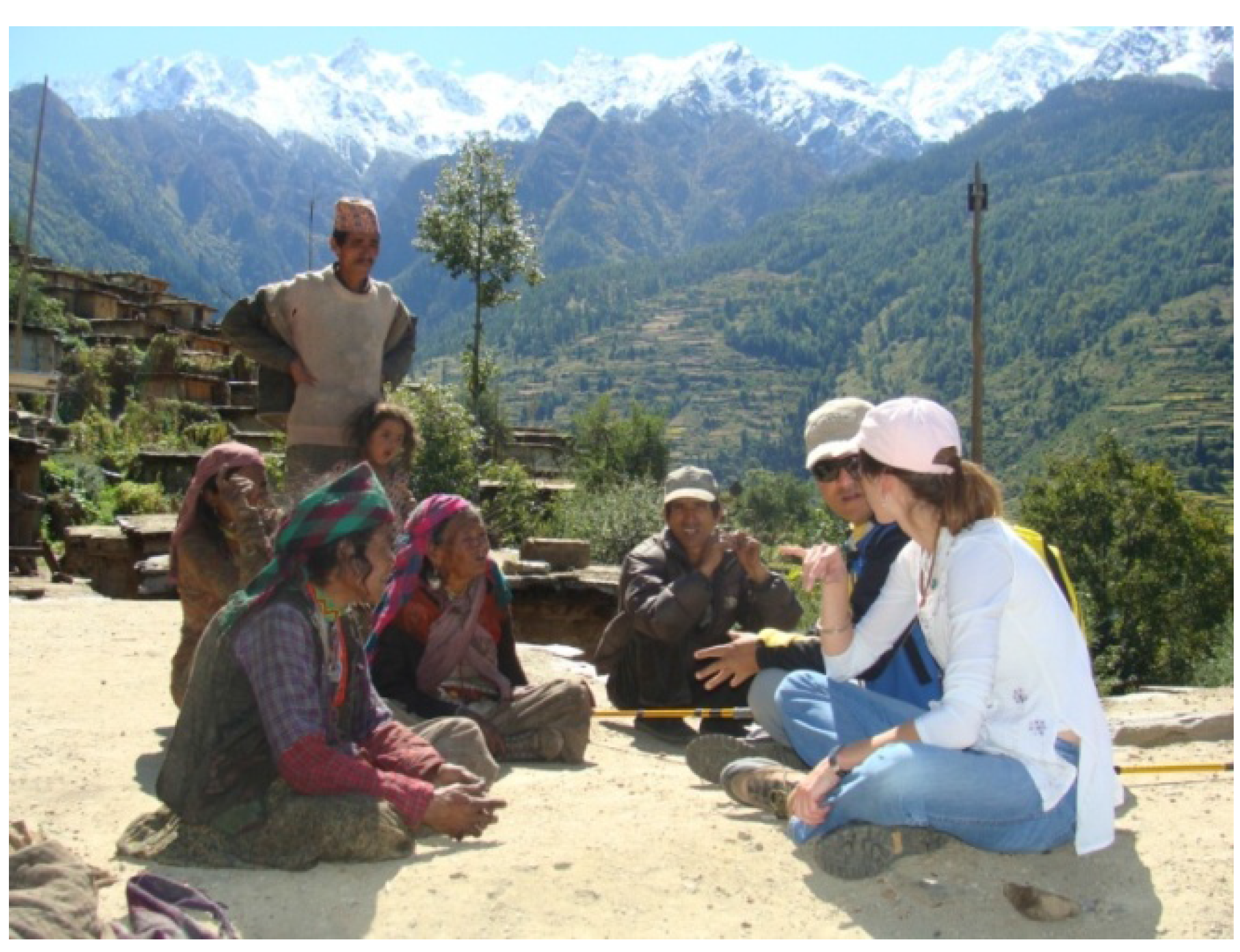
In the living conditions described above, the availability of solar photovoltaic systems has been critical to villagers. Measurements of indoor air pollution by the organization that installed the solar photovoltaic systems in combination with smokeless metal stoves (which replaced the traditional open fire cooking method) have shown a massive reduction in PM10 and PM2.5 in homes with a solar lighting and a smokeless stove, in comparison with homes heated and lit by fire. Villagers uniformly praised this outcome of switching to the new systems of heating and lighting homes. Additionally, the solar lighting is significantly brighter than jharro is, and villagers talked about how this allows children to read and look at books at night and for everyone to simply see what they are doing in their homes after dark, without relying upon flashlights or carrying around a lit stick of jharro, which is inconvenient for obvious reasons as well as unsafe for small children.
Employees of the non-government organization that installed the solar photovoltaic systems were interested in testing two different approaches to providing indoor lighting via solar energy. The two systems are the cluster and single home systems, and as I have suggested, each one has its costs and benefits. I explore these below.
3.1. The Cluster Solar Photovoltaic System
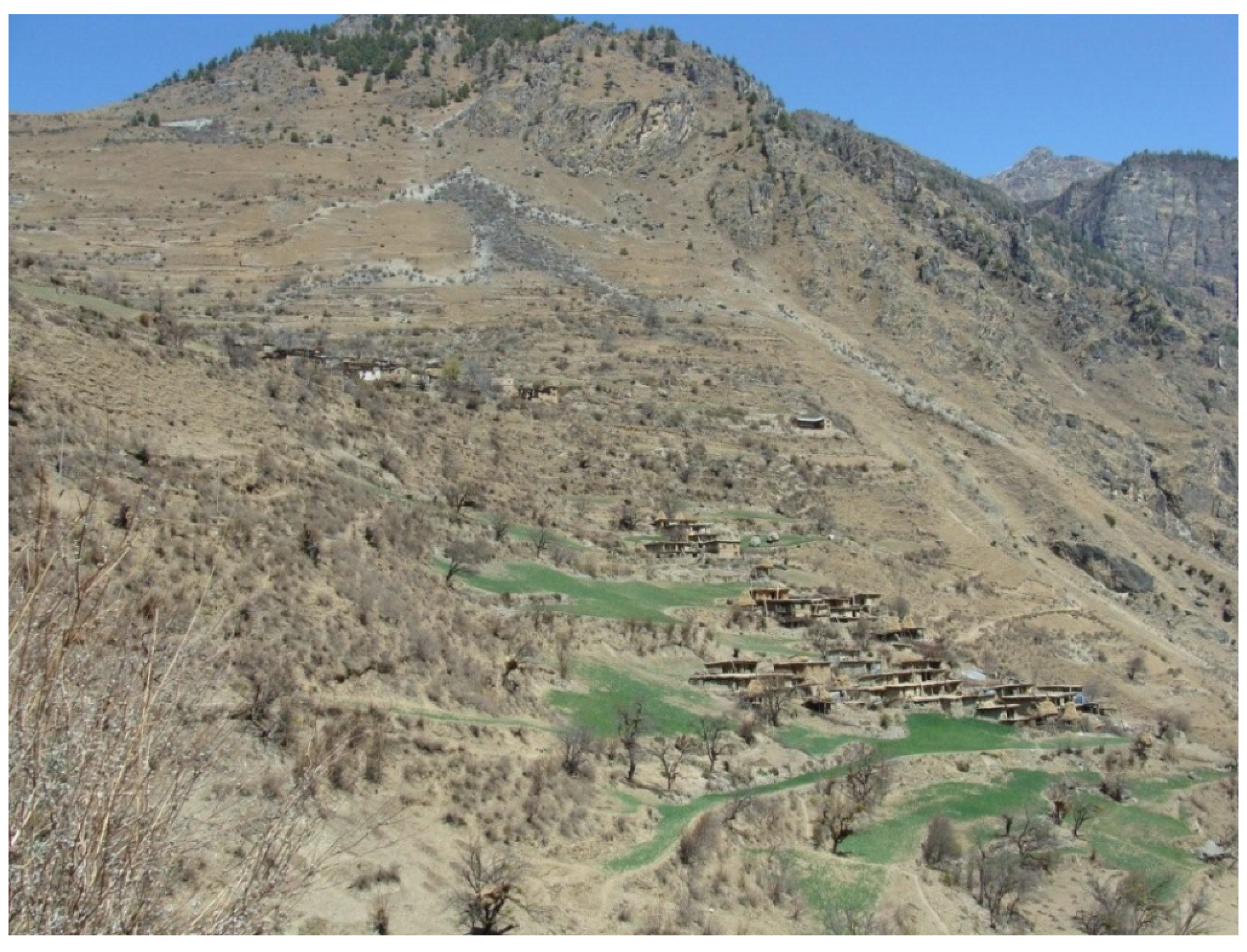
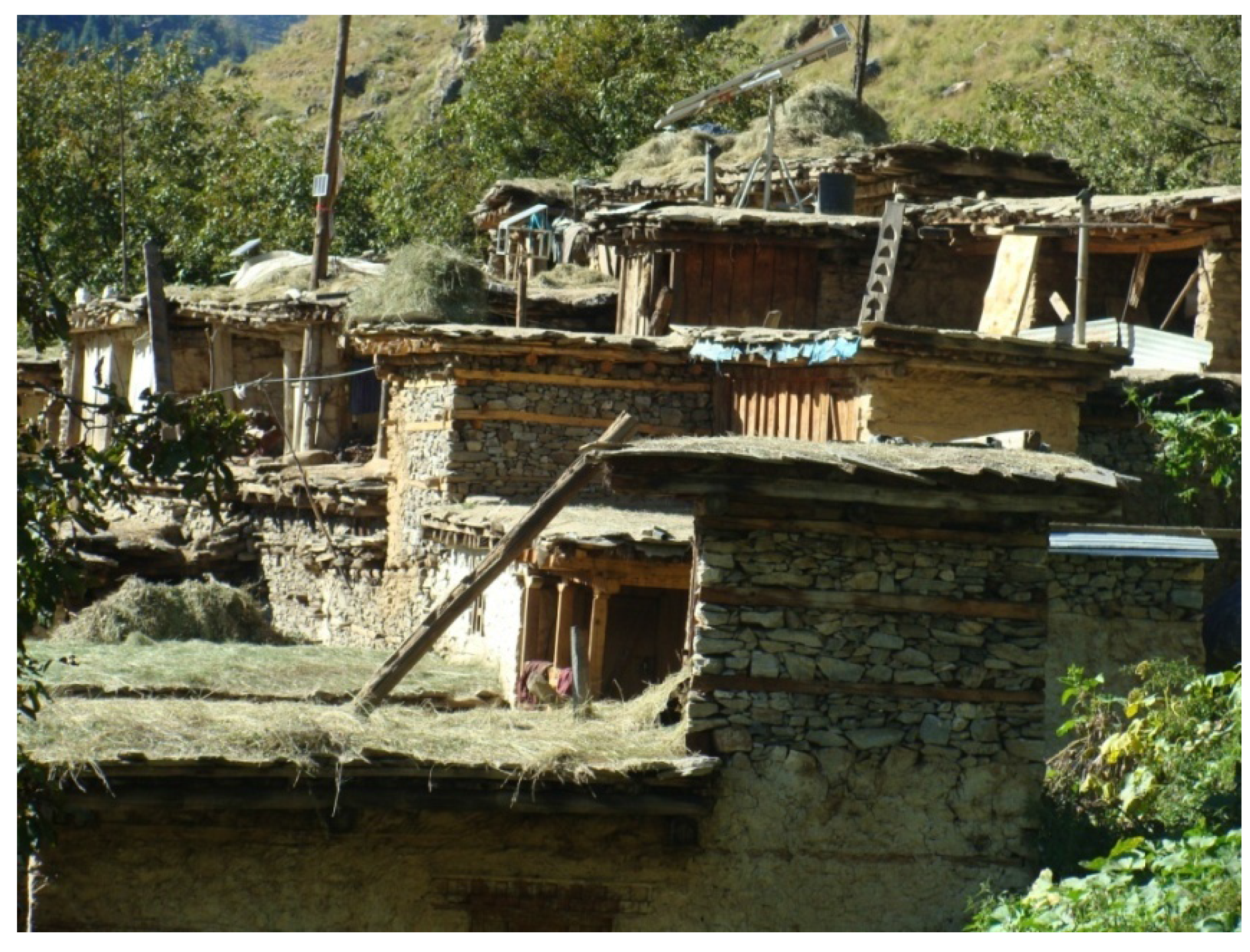
The cluster system was considered to be desirable in villages where homes had been built in distinct groupings, each distinguishable from the other. In a village such as this, the cluster photovoltaic system approach appeared to provide the best solution from both technical and economic standpoints (
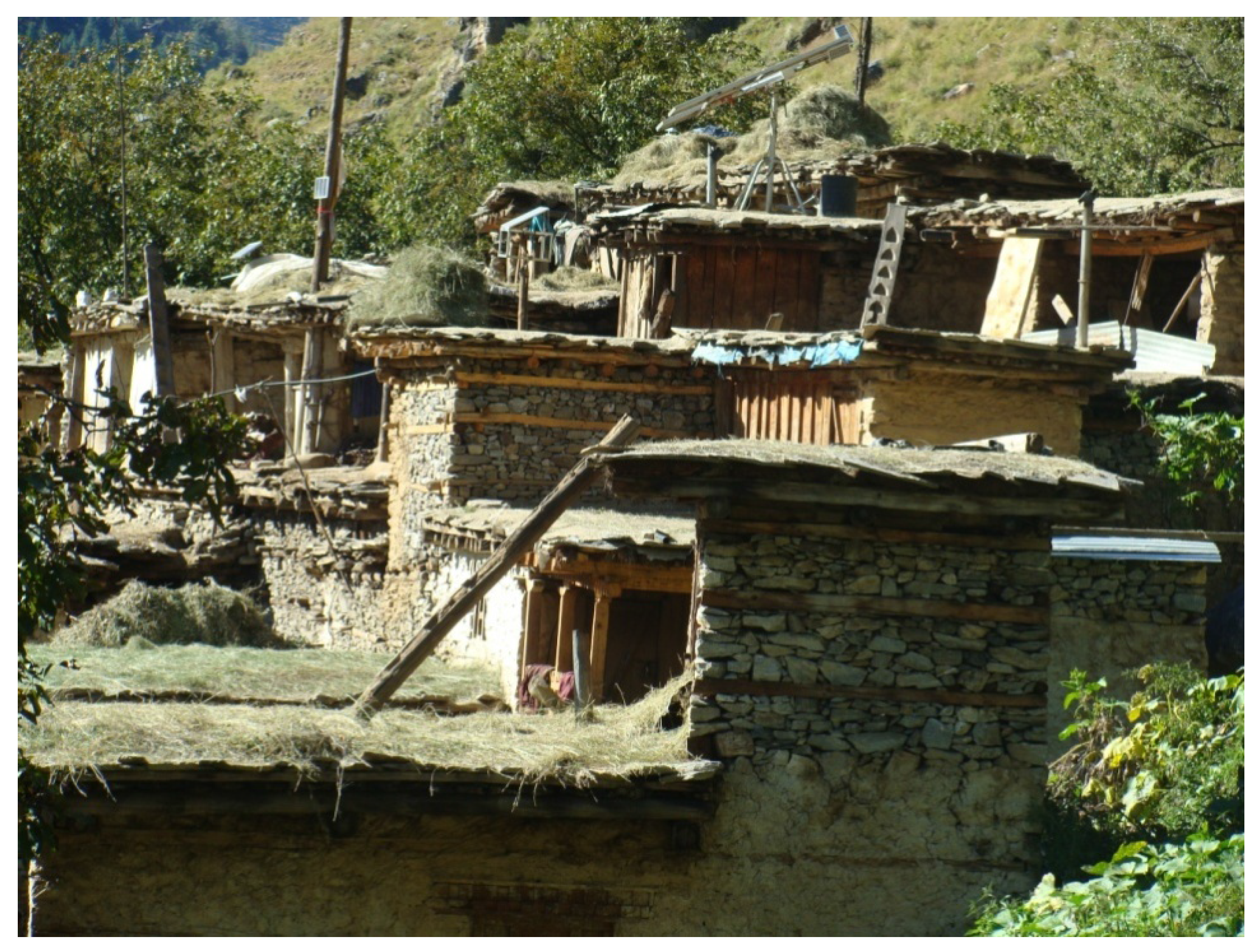
Figure 3 and
Figure 4).
Figure 3.
A village in which a cluster system was used. Note that the households are clustered, with some well below and others well above the main village, rather than uniformly distributed.
Figure 3.
A village in which a cluster system was used. Note that the households are clustered, with some well below and others well above the main village, rather than uniformly distributed.
Figure 4.
Typical Cluster System. Note the photovoltaic panel in the top center. It is connected to a battery bank servicing six households in this section of the village.
Figure 4.
Typical Cluster System. Note the photovoltaic panel in the top center. It is connected to a battery bank servicing six households in this section of the village.
As explained in previous publication [
1], a cluster typically consists of six to twelve homes. These homes share one solar PV module (usually 75 W
R), mounted on a 1-axis adjustable aluminium frame. They also share a battery bank. Each home in the cluster connects to the battery bank via armoured underground cables, and the system powers three 1 watt WLED lamps per home for roughly seven hours per day.
There are many important technical benefits to this system, and the cost of equipment and installation is often significantly less than in a typical single home photovoltaic system [
1]. There is only one battery bank to maintain, and fewer end-users will need training on how to look after the battery bank, and monitor the proper functioning of the system. However, it became clear in my interviews with villagers that there were some fairly significant issues relating to the maintenance and usage of the system. Many villagers had even begun to look more favorably upon micro or pico hydro solutions to their energy needs than they had previously.
One common complaint about the solar photovoltaic systems in general related to disposal of non-functional batteries, and it is important to point out that this complaint was voiced by end-users of both types of systems. By the time this study was conducted, villagers had seen the results when batteries had been tossed onto the ground after they are no longer useful, and the acid had spilled out and contaminated the downhill soil. As subsistence farmers, villagers were understandably alarmed to see the impact on the arability of the soil downhill from the dump site. If solar photovoltaic systems continue to be installed in the region, it will be important to pay careful attention to battery bank maintenance, to extend the lifetime of the battery for as long as technically possible. Then, when the lifetime of the battery has ended, it is critical that villagers are given disposal options that are safe for human and environmental health.
Beyond this issue, several interesting themes emerged from the discussions with villagers. Most important from both a theoretical and practical perspective is the collective action problem associated with multiple common resource users. In this case, the resource is the energy available in the battery bank. The collective action issue is proper and fair usage of the available energy and sticking to the agreed usage pattern. That is, during the installation phase, all members of the cluster agree to use the available energy only to power the white LEDs that light each home. But, because the cost of other uses of the system is borne by all members of the cluster, the temptation to use energy provided by the system to power other devices appears to be irresistible. Most commonly, end-users will splice devices into the wiring, typically radios or cell phone chargers. As in other collective action situations, these “free riders” pose additional strains on the system at little cost to themselves while imposing a relatively large cost on others (users get light and radio, for instance, while others only get reduced power to their lights).
There is also a significant second order collective action problem in these villages, which has to do with policing the system and punishing people who use the available energy for non-lighting purposes. No one is really empowered to, nor, typically, wants to be in a position of policing their neighbors. When the person splicing additional devices into the system is (as is often the case) the owner of the home that houses that battery bank, the problem takes on a particularly intransigent form. This is because the policing problem is now exacerbated by the fact that the person empowered to house the battery bank and subsequently maintain it, is usually a more educated individual, and along with higher educational attainment, as in other developing societies, comes a higher degree of social capital and, usually social and personal power. Additionally, if the cluster includes households of more than one caste, additional uses of the system by members of both high and low caste positions can be rationalized in terms of caste. A higher caste individual may convince himself that the lower caste members of the cluster don’t really deserve energy as much as he does, due to the unfortunate but evidently unavoidable fate of being born into a low caste position. Meanwhile, lower caste individuals can see the opportunity to load the system with other devices as a rare opportunity to assert some power over a cultural and social situation that generally leaves them feeling powerless. In any case, when end-users are disgruntled with the behavior of such an individual but their behavior toward that person is for example constrained by a sense of inferiority, publicly identifying the behavior, not to mention punishing it, can appear impossible. A common solution to both first and second order collective action problems is to increase the frequency of contact and transparency within the system, but, due to the nature of the configuration of homes and the wiring system within home interiors and the fact that misuse can be easily hidden or secretive, this may be hard to engineer in this particular social situation.
Another problem described by end-users is that the owner of the home with the battery bank has too much control over the system, and, if he/she is gone and the system breaks down, other cluster system users cannot enter the battery bank room in order to address the problem. Some users described battery bank “owners” as having actually removed parts or all of the battery bank to take to another location. Since these villagers are transhumance pastoralists who move a significant proportion of their population from the main village to other homes in spring, summer, and fall grazing areas for their livestock, this is a serious issue. Meanwhile, back in the main village, the rest of the cluster may go for months without light.
Another problem that came to the surface during the group interviews related to the fact that the cluster system frankly forces people to cooperate with one another, that is to say, people who otherwise would not cooperate. This has included, sometimes, people who have long-standing disputes with one another. Those disputes were either hidden or minimized during the installation and cluster identification phase, perhaps optimistically, or maybe because villagers were worried that if they didn’t appear agreeable and cooperative they would not receive any solar energy system from the non-government organization. In actual operation, these underlying disputes have caused many serious issues from an end-user standpoint. Indeed, the need for cooperation among some of the households within a cluster appears to have actually exacerbated existing, in some cases generations-old tension between and among families. In one case, villagers described the actual sabotage of the system by a disgruntled cluster member, due to a dispute between the families that went back several generations. This kind of issue proves to be a drain on everyone’s time, energy and resources, since disputes need mitigating and systems need repair.
One way to address the conflict situations described above is to study and then integrate common solutions to collective action problems. For instance, analyzing and then restructuring incentives and enhancing opportunities for and processes of negotiating cooperation could be very useful to villagers who feel trapped into the roles in which they find themselves. For instance, it may be possible to devise a culturally appropriate change in the incentive structure associated with cooperation, in order in order to make cooperation more likely. Or, end-users could be encouraged to increase the frequency with which rules are jointly revisited, revised and understood in order to give each member of the cluster the sense that they are part of the management team. This would also provide a venue in which to publicly broadcast and reinforce the notion that individual actions affect other households in a way that can negatively affect the quality of life of children, for instance, or the infirm, or other less powerful members of households. Alternatively, a single home system may be chosen.
3.2. Single Home Solar Photovoltaic System
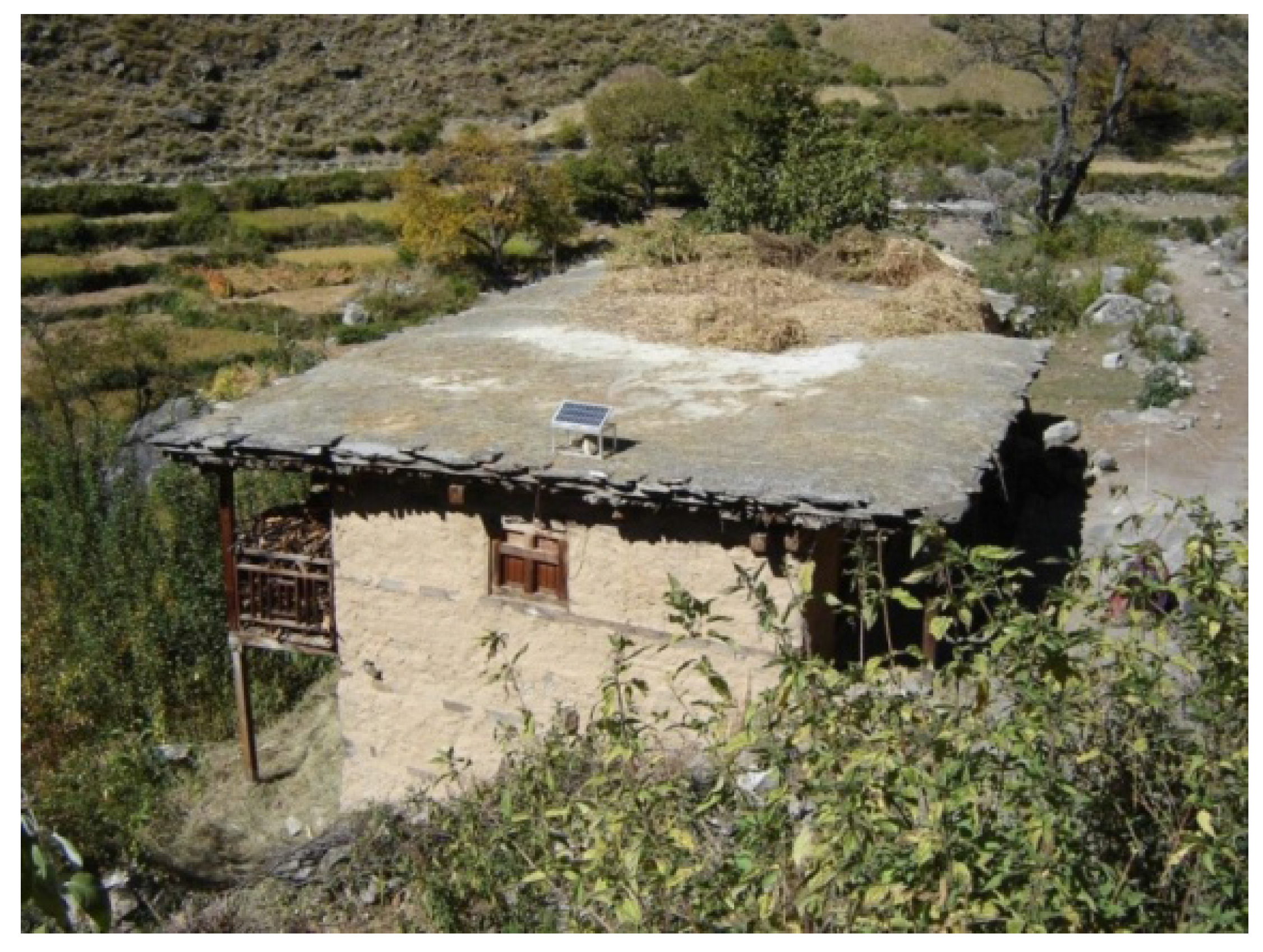
To the non-government organization in charge of the project, a single home system promised to be appropriate when the village’s houses are uniformly distributed across the village landscape, or when villages have many stand-alone homes, as can be seen in
Figure 5.
Figure 5.
Where a single home system was used. Stand alone homes or villages where homes are widely spaced may lend themselves to this approach.
Figure 5.
Where a single home system was used. Stand alone homes or villages where homes are widely spaced may lend themselves to this approach.
Due to the topography of this particular valley, the further north the village is, the more likely it is that one will find villages with many stand alone homes. This is because the valley broadens and flattens significantly as one approaches the Tibetan border, only two days walk north of the villages described herein.
In the single home system installed in this region, each house has one solar photovoltaic module mounted on an aluminium frame, a battery bank, and three white LED lamps. Each home’s battery bank provides enough energy for up to five days of usage without sunshine. In this system, a different set of challenges can arise. First, though no one admitted doing so him or herself, it was evident that in the single home system the temptation to sell system components was both strong and ungoverned by community approbation, as would have been the case in a cluster system. Also, the cost to both end-users and the organization installing the single home system is higher than in the cluster system. Additionally, the training and maintenance demands are higher. One or two members of every household have to be trained how to properly use and maintain the system, and more batteries enter the region, increasing the need for proper disposal and storage of old batteries.
However, these costs may be worthwhile. It neatly does away with the collective action issues described above. Villagers described many benefits of this approach. One of the other beauties of the single home system is that every household includes members who have been empowered with a new body of knowledge and level of technical expertise. This can be incredibly uplifting to entire communities. It can open new vistas for both men and women, particularly in societies such as in Humla, where people have relatively little exposure to formal education and modern technology. Also, because every household has the same technology and know-how, the single home system can level the playing field, whereas the cluster system can actually introduce disparity into a community. The single home system is predicated on the notion that each household owner can and will take responsibility for his or her own system. When some households are female headed, as is inevitable in human societies, the example set by women who successfully maintain and operate their systems can send a message about the ability of women that can be powerful to the age-mates of those women and to their sons and daughters. In a society such as Humla’s, where the convention is to keep girls home from school, the impact and importance of such a message on a community is difficult to overstate. It is also common for a healthy competition to arise among households, due to each owner’s pride in his or her system. That increases the likelihood that more care and maintenance takes place, increasing the system’s reliability and life expectancy [
1].