<?xml version="1.0" encoding="UTF-8"?>
<!DOCTYPE article PUBLIC "-//NLM//DTD Journal Publishing DTD v2.3 20070202//EN" "journalpublishing.dtd">
<article xmlns:mml="http://www.w3.org/1998/Math/MathML" xmlns:xlink="http://www.w3.org/1999/xlink" xml:lang="en" article-type="research-article">
  <front>
    <journal-meta>
      <journal-id journal-id-type="publisher-id">forests</journal-id>
      <journal-title>Forests</journal-title>
      <abbrev-journal-title abbrev-type="publisher">Forests</abbrev-journal-title>
      <abbrev-journal-title abbrev-type="pubmed">Forests</abbrev-journal-title>
      <issn pub-type="epub">1999-4907</issn>
      <publisher>
        <publisher-name>MDPI</publisher-name>
      </publisher>
    </journal-meta>
    <article-meta>
      <article-id pub-id-type="doi">10.3390/f3030700</article-id>
      <article-id pub-id-type="publisher-id">forests-03-00700</article-id>
      <article-categories>
        <subj-group>
          <subject>Article</subject>
        </subj-group>
      </article-categories>
      <title-group>
        <article-title>Development of Vegetation and Surface Fuels Following Fire Hazard Reduction Treatment</article-title>
      </title-group>
	  <contrib-group>
        <contrib contrib-type="author">
          <name>
            <surname>Chiono</surname>
            <given-names>Lindsay A.</given-names>
          </name>
          <xref rid="af1-forests-03-00700" ref-type="aff">1</xref>
          <xref rid="c1-forests-03-00700" ref-type="corresp">*</xref>
        </contrib>
        <contrib contrib-type="author">
          <name>
            <surname>O’Hara</surname>
            <given-names>Kevin L.</given-names>
          </name>
          <xref rid="af1-forests-03-00700" ref-type="aff">1</xref>
        </contrib>
        <contrib contrib-type="author">
          <name>
            <surname>De Lasaux</surname>
            <given-names>Michael J.</given-names>
          </name>
          <xref rid="af2-forests-03-00700" ref-type="aff">2</xref>
        </contrib>
        <contrib contrib-type="author">
          <name>
            <surname>Nader</surname>
            <given-names>Glenn A.</given-names>
          </name>
          <xref rid="af3-forests-03-00700" ref-type="aff">3</xref>
        </contrib>
        <contrib contrib-type="author">
          <name>
            <surname>Stephens</surname>
            <given-names>Scott L.</given-names>
          </name>
          <xref rid="af1-forests-03-00700" ref-type="aff">1</xref>
        </contrib>
      </contrib-group>
      
      <aff id="af1-forests-03-00700"><label>1 </label>Department of Environmental Science, University of California, Berkeley, Policy, and Management, 130 Mulford Hall #3114, Berkeley, CA 94720-3114, USA; Email: <email>kohara@berkeley.edu</email> (K.L.O.); <email>sstephens@berkeley.edu</email> (S.L.S.)</aff>
      <aff id="af2-forests-03-00700"><label>2 </label>University of California Cooperative Extension, 208 Fairground Road, Quincy, CA 95971, USA; Email: <email>mjdelasaux@ucdavis.edu</email></aff>
      <aff id="af3-forests-03-00700"><label>3 </label>University of California Cooperative Extension, 142-A Garden Highway, Yuba City, CA 95991, USA; Email: <email>ganader@ucdavis.edu</email></aff>
      <author-notes>
        <corresp id="c1-forests-03-00700"><label>*</label> Author to whom correspondence should be addressed; Email: <email>lchiono@berkeley.edu</email>; Tel.: +1-510-642-4934; Fax: +1-510-643-5438.</corresp>
      </author-notes>
      <pub-date pub-type="epub">
        <day>20</day>
        <month>08</month>
        <year>2012</year>
      </pub-date>
      <pub-date pub-type="collection">
	  <month>09</month>
        <year>2012</year>
      </pub-date>
      <volume>3</volume>
      <issue>3</issue>
      <fpage>700</fpage>
      <lpage>722</lpage>
      <history>
        <date date-type="received">
          <day>05</day>
          <month>07</month>
          <year>2012</year>
        </date>
        <date date-type="rev-recd">
          <day>07</day>
          <month>08</month>
          <year>2012</year>
        </date>
        <date date-type="accepted">
          <day>07</day>
          <month>08</month>
          <year>2012</year>
        </date>
      </history>
      <permissions>
        <copyright-statement>©  2012 by the authors; licensee MDPI, Basel, Switzerland.</copyright-statement>
        <copyright-year>2012</copyright-year>
        <license xmlns:xlink="http://www.w3.org/1999/xlink" license-type="open-access" xlink:href="http://creativecommons.org/licenses/by/3.0/">
          <p>This article is an open-access article distributed under the terms and conditions of the Creative Commons Attribution license (<uri>http://creativecommons.org/licenses/by/3.0/</uri>).</p>
        </license>
      </permissions>
      <abstract>
        <p>In dry western Unites States forests where past resource management has altered the ecological role of fire and stand characteristics alike, mechanical thinning and prescribed burning are commonly applied in wildfire hazard abatement. The reduced surface fuel loads and stand structures resulting from fuels modifications are temporary, yet few studies have assessed the lifespan of treatment effects. We sampled forest fuels and vegetation following fuels reduction in a chronosequence of time since treatment in the northern Sierra Nevada and southern Cascade regions of California. Treatments altered overstory characteristics including stand density, basal area, and species composition. These effects were still present on the oldest treatment sites (8–15 years post-treatment). Other stand characteristics, particularly timelag fuel loads, seedling density, and shrub cover, exhibited substantial variability, and differences between treatment age classes and between treatment and control groups were not statistically significant.</p>
      </abstract>
      <kwd-group>
        <kwd>eastside pine</kwd>
        <kwd>fire hazard</kwd>
        <kwd>fuel break</kwd>
        <kwd>fuel treatment longevity</kwd>
        <kwd>Jeffrey pine</kwd>
        <kwd>mixed conifer</kwd>
        <kwd>prescribed fire</kwd>
        <kwd>Sierra Nevada</kwd>
        <kwd>thinning</kwd>
      </kwd-group>
    </article-meta>
  </front>
  <body>
    <sec sec-type="intro">
      <title>1. Introduction</title>
      <p>The disturbance role of wildfire in many dry, temperate western United States forests has been altered through fire exclusion, timber harvesting, and livestock grazing. These land-use practices have affected forest structure and species composition, increasing surface fuel loads, tree density, dominance of shade-tolerant tree species, and forest homogeneity [<xref ref-type="bibr" rid="B1-forests-03-00700">1</xref>,<xref ref-type="bibr" rid="B2-forests-03-00700">2</xref>,<xref ref-type="bibr" rid="B3-forests-03-00700">3</xref>]. As a consequence, many historically fire-frequent forests are now vulnerable to spatially extensive high-severity wildfire [<xref ref-type="bibr" rid="B4-forests-03-00700">4</xref>]. A primary focus of contemporary management in these forests is the treatment of fuels and vegetation to address wildfire hazards.</p>
      <p>Fuels reduction treatments are intended to reduce the potential for high-intensity, high-severity wildfire by reducing the quantity and continuity of forest fuels. A number of techniques are employed to meet these fuels reduction objectives, and each method has associated effects on forest structure. Mechanical thinning reduces stand density, basal area, and canopy fuels [<xref ref-type="bibr" rid="B5-forests-03-00700">5</xref>,<xref ref-type="bibr" rid="B6-forests-03-00700">6</xref>,<xref ref-type="bibr" rid="B7-forests-03-00700">7</xref>]. To reduce accumulated surface fuel loads and offset the activity fuels produced during harvest operations, prescribed fire is often coupled to forest thinning. Broadcast burning can also be expected to reduce ladder fuels and elevate canopy base height [<xref ref-type="bibr" rid="B8-forests-03-00700">8</xref>,<xref ref-type="bibr" rid="B9-forests-03-00700">9</xref>]. Research generally supports the ability of such treatments to alter potential fire behavior and impacts [<xref ref-type="bibr" rid="B5-forests-03-00700">5</xref>,<xref ref-type="bibr" rid="B8-forests-03-00700">8</xref>,<xref ref-type="bibr" rid="B10-forests-03-00700">10</xref>,<xref ref-type="bibr" rid="B11-forests-03-00700">11</xref>,<xref ref-type="bibr" rid="B12-forests-03-00700">12</xref>,<xref ref-type="bibr" rid="B13-forests-03-00700">13</xref>,<xref ref-type="bibr" rid="B14-forests-03-00700">14</xref>].</p>
      <p>Though the immediate effects of treatment on forest fuels and stand structure are relatively well known, the long-term consequences remain poorly understood. Post-treatment conditions are impermanent: after treatment, the overstory responds to take advantage of newly available growing space, filling the canopy space vacated by thinned trees; the canopy base falls in height as new regeneration joins the overstory; and surface fuels accumulate as the canopy deposits leaves, cones, and branches. Some treatment techniques may actually enhance post-treatment vegetation growth, effectively shortening the lifespan of low fire hazard conditions. Reducing overstory density has long been recognized to promote regeneration [<xref ref-type="bibr" rid="B15-forests-03-00700">15</xref>] and increase understory growth [<xref ref-type="bibr" rid="B16-forests-03-00700">16</xref>,<xref ref-type="bibr" rid="B17-forests-03-00700">17</xref>]. Additionally, the exposure of mineral soil by prescribed burning fosters seed germination [<xref ref-type="bibr" rid="B18-forests-03-00700">18</xref>]. In order to retain low fire hazard conditions, areas that have been treated must be maintained following their initial establishment. However, few management tools exist to guide the division of resources between establishment of new treatments and maintenance of existing treatments.</p>
      <p>In this study, we assessed dead fuel loads, shrub cover, regeneration, and overstory characteristics in a chronosequence of sites treated for fuels reduction in the northern Sierra Nevada and southern Cascade regions of California. Sampling sites were stratified on the basis of forest type: Sierra mixed conifer and eastside pine forests are present in the study region. Our hypothesis anticipated differences in fuel development and vegetation regrowth between the two forest types, with slower accumulation of surface fuels and development of understory and ladder fuels predicted in the xeric eastern slope pine forests. This work should inform resource allocation between fuel treatment implementation and future maintenance.</p>
      <p>These management considerations are of particular interest in the study region due to the influence of the Herger-Feinstein Quincy Library Group Pilot Project and prior fuels reduction work enabled by a developing biomass industrial infrastructure. The Project was established in 1998 to promote hazardous fuels reduction in the region, aiming to treat ~16–24,000 ha (40–60,000 acres) per year within a strategic network of fuel breaks [<xref ref-type="bibr" rid="B19-forests-03-00700">19</xref>]. Support from the local community and relatively abundant economic resources dedicated to fuel treatment implementation have generated many potential sampling sites established over the years since the Project’s creation, making this region exceptionally suited for a chronosequence study of fuels reduction. Most of the treatment areas sampled in this study are shaded fuel breaks <italic>sensu</italic> Agee <italic>et al.</italic> [<xref ref-type="bibr" rid="B10-forests-03-00700">10</xref>], <italic>i.e.</italic>, areas in which fuels have been modified in order to moderate fire hazard while maintaining some forested cover. Supporting fire suppression activities is an explicit goal of fuel breaks, which are often strategically situated along roads and ridgetops and near communities and other high-value resources. Nonetheless, we expect our findings will be applicable to the broader category of fuel treatments, which include treatments intended to reduce the likelihood of wildfire ignition and/or mitigate potential fire effects and resistance to control [<xref ref-type="bibr" rid="B20-forests-03-00700">20</xref>].</p>
    </sec>
    <sec sec-type="methods">
      <title>2. Methods</title>
      <sec>
        <title>2.1. Study Area</title>
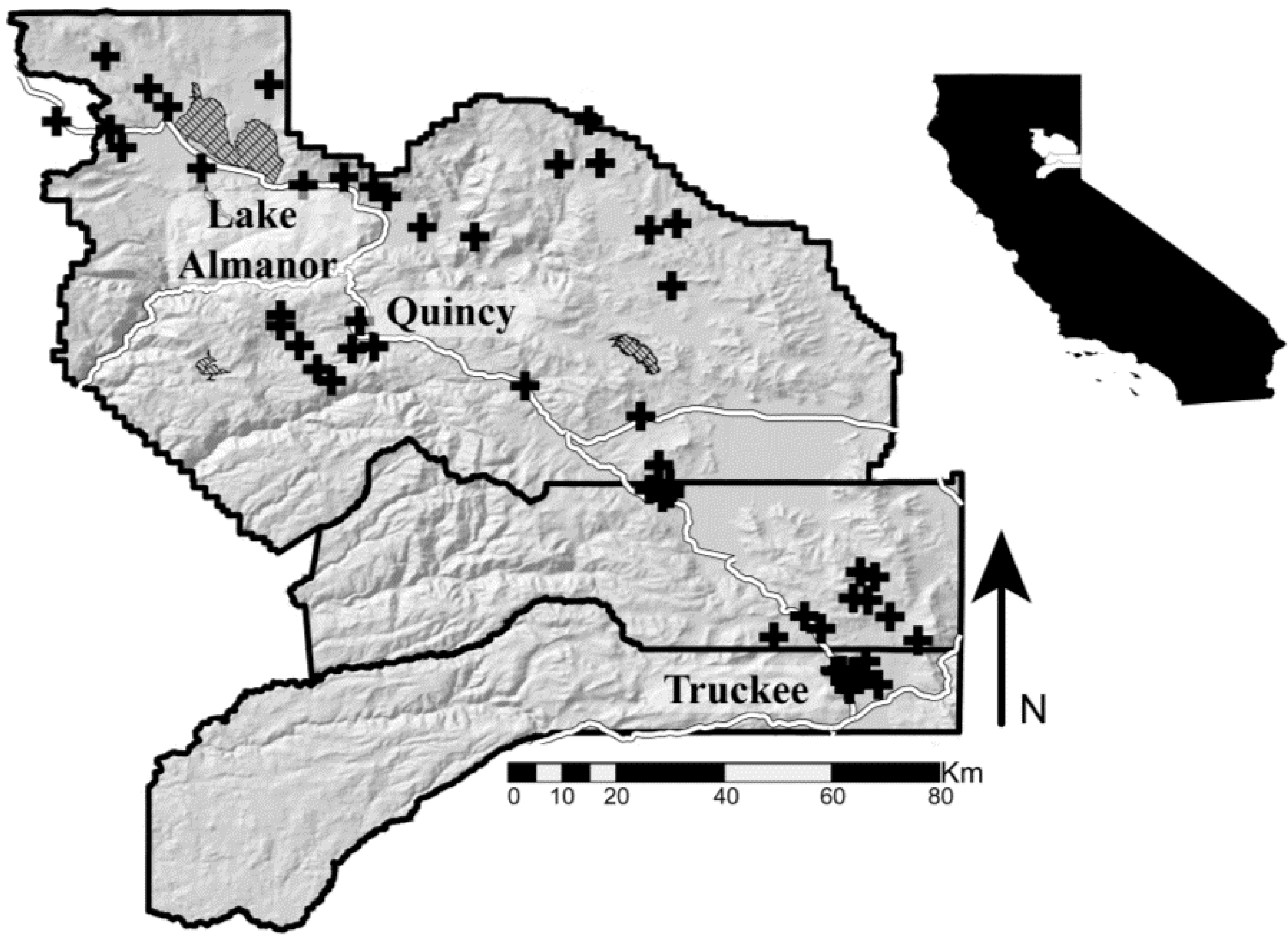
        <p>This study was conducted in Nevada, Sierra, and Plumas Counties in the northern Sierra Nevada and southern Cascade regions of California (<xref ref-type="fig" rid="forests-03-00700-f001">Figure 1</xref>). Historically, low- to moderate-severity fires here were frequent: a study of fire history in similar forests found a pre-Euro-American settlement mean composite fire return interval of 6–18 years (for fires scarring more than 10% of samples) [<xref ref-type="bibr" rid="B21-forests-03-00700">21</xref>]. The climate west of the Sierra Nevada crest is Mediterranean with warm, dry summers and cold, wet winters. To the east, the continental pattern is prevalent, and is characterized by more extreme daily and seasonal temperature shifts and lower precipitation. Most precipitation falls as snow during the winter months, and annual precipitation ranges from 38 cm on the east side to nearly 230 cm on the west [<xref ref-type="bibr" rid="B22-forests-03-00700">22</xref>]. The geologic and climatic diversity of this portion of the Sierra Nevada range have produced an equally diverse soil mosaic that includes granitic, volcanic, and serpentine soils. The west side is characterized by relatively deep and productive soils while those of the cool and dry east side are shallow and less productive [<xref ref-type="bibr" rid="B22-forests-03-00700">22</xref>]. Study site elevations range from 1100 to 2150 m.</p>
        <p>The Sierra mixed conifer forest type is dominated by sugar pine (<italic>Pinus</italic> <italic>lambertiana</italic> Dougl.), ponderosa pine (<italic>P. ponderosa</italic> Dougl.), white fir (<italic>Abies</italic> <italic>concolor</italic> (Gord. and Glend.)), incense-cedar (<italic>Calocedrus</italic> <italic>decurrens</italic> [Torr.] Florin.), Douglas-fir (<italic>Pseudotsuga</italic> <italic>menziesii</italic> var. <italic>menziesii</italic> (Mirb.) Franco), and California black oak (<italic>Quercus</italic><italic>kelloggii</italic> Newb.) [<xref ref-type="bibr" rid="B23-forests-03-00700">23</xref>] while the colder and drier lower montane eastside pine type is dominated by Jeffrey pine (<italic>Pinus jeffreyi</italic> Grev. and Balf.) and white fir.</p>
        <p>Downed fuels and understory and overstory vegetation were sampled within 51 treatment sites 2–15 years following initial treatment and 13 untreated sites. Local forest managers helped identify treatment projects suitable for sampling. Sampling sites had been treated with mechanical thinning alone or in combination with broadcast or pile burning. If applicable, follow-up burning was to occur within three years of the thinning treatment. All treatment projects fitting the study design requirements were sampled. A single treatment <italic>project</italic> often included multiple units treated over a period of several years. In order to avoid possible pseudoreplication arising from adjacent unit locations and identical timber operators, a single unit was randomly selected to represent each individual project.</p>
		<fig id="forests-03-00700-f001" position="anchor">
          <label>Figure 1</label>
          <caption>
            <p>Study area in the northern Sierra Nevada and southern Cascades, CA. Black crosses indicate study site locations.</p>
          </caption>
          <graphic xmlns:xlink="http://www.w3.org/1999/xlink" xlink:href="forests-03-00700-g001.tif"/>
        </fig>
        
        <p>The mechanical thinning treatments sampled in this study included some prescriptions that were not explicitly designed for hazardous fuels reduction. These included single-tree selection harvests and understory thinning to improve the vigor of residual trees. Incorporating thinning treatments not necessarily intended as fuel treatments in this exhaustive sampling effort permitted a larger sample size. In practice, the stand structures produced by all mechanical thinning types were similar and included reduced ladder fuels and reduced density of small- and mid-diameter trees. To limit variability in post-thinning conditions, hand-thinning and mastication treatments were not included in this study. While most stand treatments (40 of 51) were located on land managed by the US Forest Service, nine sites belonged to the Collins Pine Company, a private forest products company, and two fuel treatments had been implemented by Fire Safe Councils on privately owned land.</p>
        <p>Untreated control sites were established in stands adjacent to treatment areas. Control sites were defined as having overstory species composition and slope steepness comparable to those of the adjacent treated unit, without evidence of recent (within ~25 years) wildfire or management. Because mechanical thinning equipment is generally restricted to slopes of less than 30 percent grade, no prospective control site with a slope exceeding 30 percent was sampled. In many cases, potential control sites were deemed unsuitable for sampling because there was evidence of recent thinning or fire, such as intact stumps or char, or because the slope or dominant vegetation differed substantially from that of the adjacent treated area.</p>
      </sec>
      <sec>
        <title>2.2. Field Sampling</title>
        <p>Downed woody fuels, understory composition, and overstory characteristics were sampled using a systematic sampling design with a random starting point. Three circular plots, 50 m apart, were established in each treatment unit and placed parallel to the treatment boundary, typically a road. This choice of plot number and spacing represents a compromise between minimizing potential spatial autocorrelation between plots while ensuring that most treatment units could accommodate the sampling design. A fixed number of plots were selected because while treatments varied in areal extent, georeferenced treatment maps were often unavailable. To minimize boundary effects, plots were placed 30 m from the nearest treatment boundary. When gaps in the treatment were encountered during plot placement (e.g., a group selection unit) subsequent plots were placed on the opposite side of the treatment gap with a 30 m buffer from the gap edge.</p>
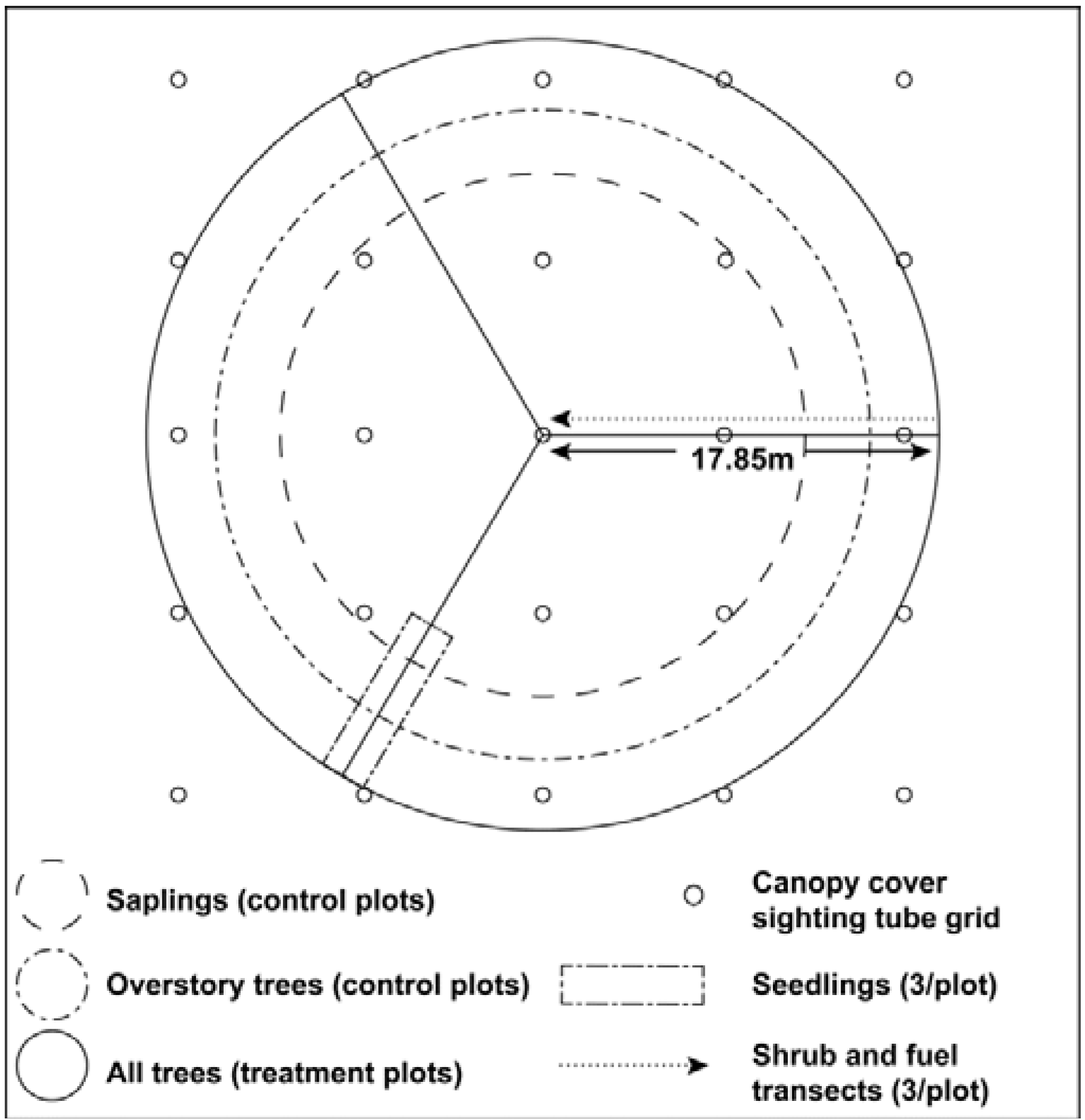
        <p>The elevation, aspect, slope, and slope position for each plot were recorded. Plot centers were permanently marked with wooden stakes and witness trees marked with aluminum tags. Three 17.85 m transects were established within each circular plot (<xref ref-type="fig" rid="forests-03-00700-f002">Figure 2</xref>). The azimuth of the first transect was chosen randomly while the second and third transects were placed with headings of 120° and 240° greater than the first. Surface and ground fuels were sampled using the planar-intercept method [<xref ref-type="bibr" rid="B24-forests-03-00700">24</xref>,<xref ref-type="bibr" rid="B25-forests-03-00700">25</xref>]. Beginning at the transect end farthest from plot center, 1 h (≤0.64 cm diameter) and 10 h timelag fuels (&gt;0.64 cm to ≤2.54 cm diameter) were tallied from 0 to 2 m and 100 h timelag fuels (&gt;2.54 cm to ≤7.62 cm diameter) were tallied from 0 to 3 m. The number and diameter of 1000 h timelag (&gt;7.62 cm) and larger fuels were recorded along the full length of the transect, and fuels were categorized according to condition (sound or rotten). Duff and litter depths were measured at 2.85 and 12.85 m. Total surface fuel depth was recorded at three points along each transect. Fuel loads were calculated using Sierra Nevada tree species-specific estimates [<xref ref-type="bibr" rid="B26-forests-03-00700">26</xref>,<xref ref-type="bibr" rid="B27-forests-03-00700">27</xref>], weighted by the contribution of each species to plot-level basal area [<xref ref-type="bibr" rid="B28-forests-03-00700">28</xref>].</p>
        <p>Shrub measurements including species, average height, and status (live or dead) were taken along each linear transect. Shrub cover was calculated as the transect length occupied by shrub divided by the total transect length. The height, caliper at base, and species of all seedlings (trees &lt;2.5 cm dbh) were recorded in three 2 m × 7 m plots, each centered on a transect and positioned at the end farthest from plot center (<xref ref-type="fig" rid="forests-03-00700-f002">Figure 2</xref>). Within each plot, overstory canopy cover was sampled with a densitometer (sighting tube) on a 25-point, 8 m × 8 m grid oriented north–south and east–west [<xref ref-type="bibr" rid="B29-forests-03-00700">29</xref>]. Percent canopy cover was estimated as the number of canopy “hits” divided by the total number of sampling points. </p>
        <p>Sampling of treated and untreated plots was identical except with regard to tree sampling. In treatment plots, the total height, height to live crown base, diameter at breast height (dbh), crown class, and species were recorded for all trees ≥2.5 cm dbh within 17.85-m radius. Because stand density on the untreated control sites was greater than for treatment sites, overstory trees (≥7.6 cm dbh) and saplings (2.5–7.6 cm dbh) were sampled in nested subplots 0.075 and 0.05 ha in size, respectively.</p>
        <p>Treatment history records associated with two of the oldest sites were incomplete. Using standard dendrochronological techniques [<xref ref-type="bibr" rid="B30-forests-03-00700">30</xref>,<xref ref-type="bibr" rid="B31-forests-03-00700">31</xref>], the year of thinning in these sites was verified using evidence from tree rings contained in stumps of small- to intermediate-diameter trees and visible logging scars on live trees presumed to have resulted from mechanical thinning operations. Stump cross-sections distributed over the sampling area were removed with a chainsaw; increment cores were removed from trees with visible logging scars. Each cross-section or core was sanded to a high polish to allow rings and scars to be viewed clearly under a microscope. The year of thinning was determined by cross-dating tree rings against a master tree-ring chronology.</p>
		<fig id="forests-03-00700-f002" position="anchor">
          <label>Figure 2</label>
          <caption>
            <p>Illustration of sampling plot layout. Three sampling plots were placed in each treatment site to investigate patterns of fuel, vegetation, and stand development after treatment. Sampling did not vary between control and treatment sites with the exception of tree data collection.</p>
          </caption>
          <graphic xmlns:xlink="http://www.w3.org/1999/xlink" xlink:href="forests-03-00700-g002.tif"/>
        </fig>
        
      </sec>
      <sec>
        <title>2.3. Canopy Fuel Calculations and Statistical Analysis</title>
        <p>The Crown Mass program (version 3.0.49) within the Fuels Management Analyst Plus (FMAPlus) suite was used to estimate canopy bulk density and canopy base height [<xref ref-type="bibr" rid="B32-forests-03-00700">32</xref>]. FMAPlus uses modified allometric equations to estimate average canopy profile characteristics from field-derived inputs including tree species, dbh, tree crown ratio, and canopy class. Canopy base height is defined in FMAPlus as the height above the ground of the first canopy layer with sufficient density of canopy fuels to carry fire vertically. The canopy bulk density is the maximum value of a running mean of vertically oriented one-foot (30.5-cm) canopy layers.</p>
        <p>The effects of treatment and differences between time-since-treatment groups were examined by analysis of variance. Data were log-transformed when necessary to meet the assumptions of statistical tests. Where significant differences occurred (<italic>p</italic> &lt; 0.05), comparisons between means were performed using Tukey’s HSD multiple comparison test. Due to limited sample sizes, data representing both methods of active treatment and major slope aspects (north and south) were combined for these analyses.</p>
        <p>An analysis of covariance (ANCOVA) was performed to examine the relationship between stand density and site factors, including stand productivity measures (combined average height of dominant and codominant trees and site index [<xref ref-type="bibr" rid="B33-forests-03-00700">33</xref>], estimated from average dominant tree height at a specified base age), forest type, slope aspect, and treatment factors, including method of fuel treatment and ownership.</p>
        <p>All statistical analyses were performed in the statistical software package <italic>R</italic> version 2.10.1 [<xref ref-type="bibr" rid="B34-forests-03-00700">34</xref>].</p>
      </sec>
    </sec>
    <sec sec-type="results">
      <title>3. Results</title>
      <sec>
        <title>3.1. Fuel Characteristics</title>
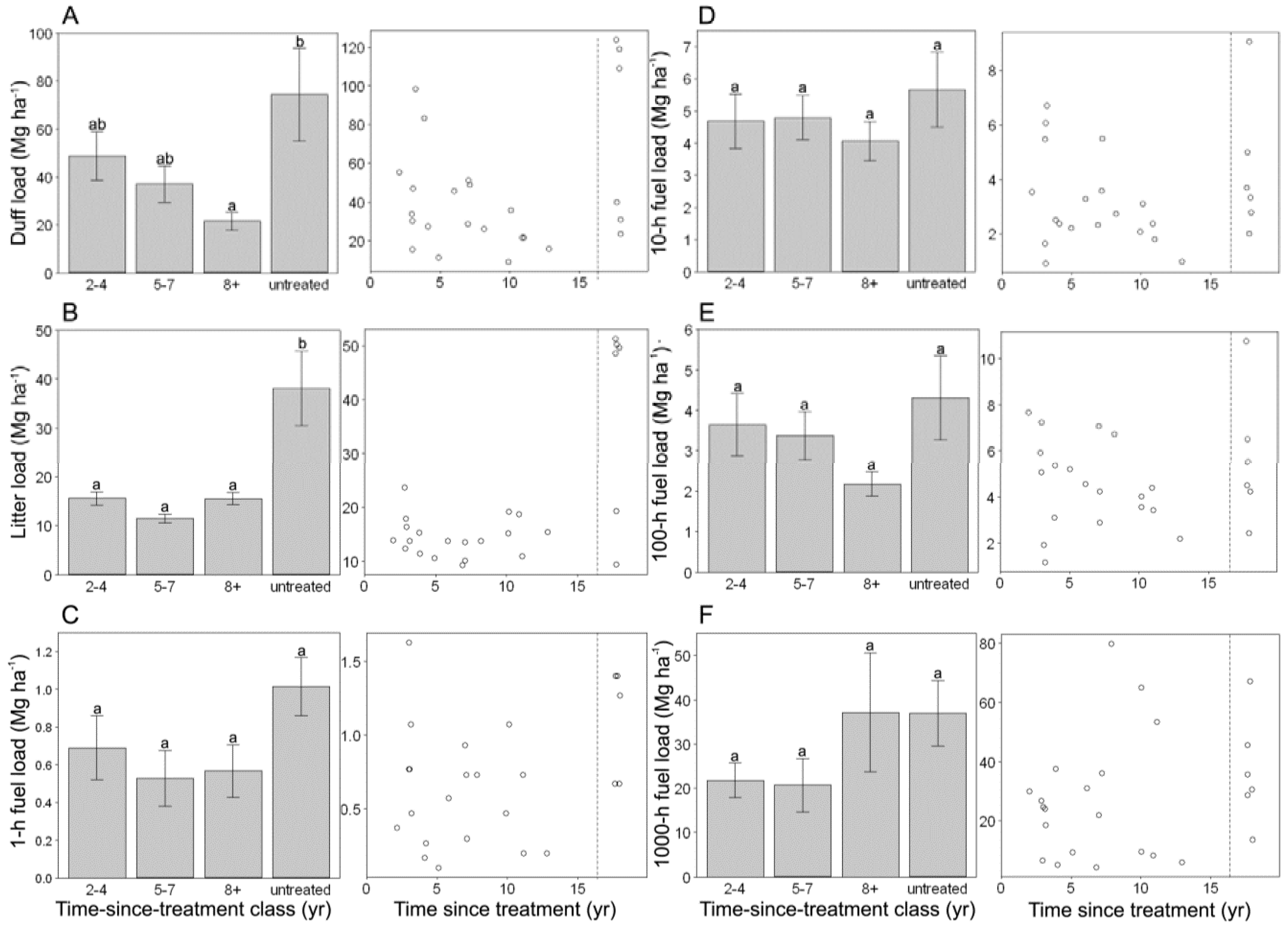
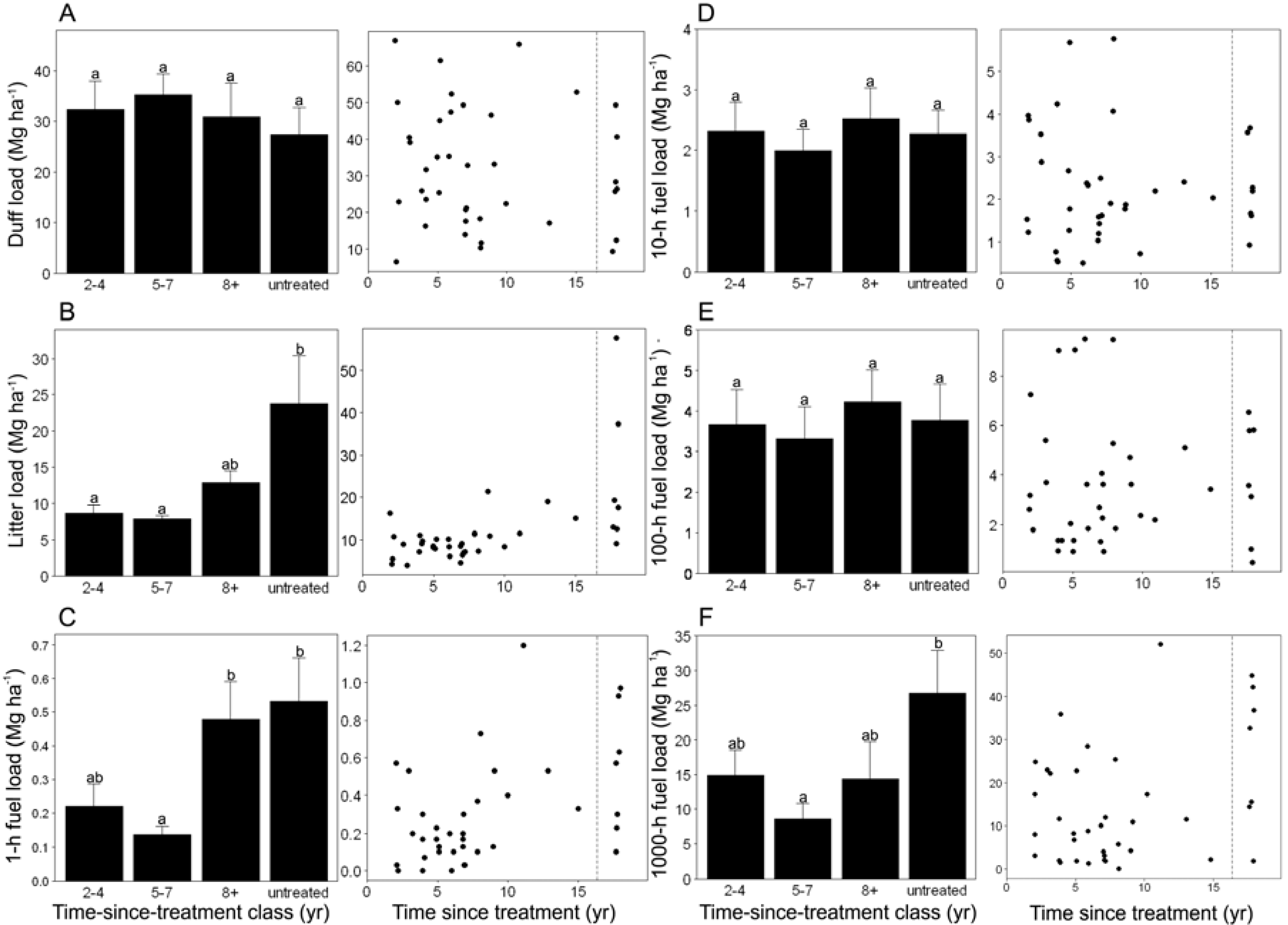
        <p><italic>Mixed Conifer.</italic>—With the exception of leaf litter, surface fuel loads in the mixed conifer forest type did not differ significantly between any of the age classes or between the treated and untreated sites (<xref ref-type="fig" rid="forests-03-00700-f003">Figure 3</xref>). Mean 1-, 10-, and 100-h fuel loads were respectively 78%, 98%, and 40% greater in the untreated sites relative to the oldest treatment class, but high variation led to insignificant differences between groups. Control litter loads were nearly double those of the treatment age classes, which were very similar. Mean ground (duff) fuel loads for the untreated sites was ~1.5–3.5 times treated site levels, though this difference was significant only for the oldest time-since-treatment class.</p>
        <fig id="forests-03-00700-f003" position="anchor">
          <label>Figure 3</label>
          <caption>
            <p>Dead surface fuel load by category in the mixed conifer chronosequence (<italic>n</italic>=19) and control (<italic>n</italic>=6) sites. Fuel load in the (<bold>A</bold>) duff layer; (<bold>B</bold>) litter layer; and the (<bold>C</bold>) 1-h; (<bold>D</bold>) 10-h; (<bold>E</bold>) 100-h; and (<bold>F</bold>) 1000-h timelag categories. Left-hand panels show means ±SE for the three age class groups and the control group. Different letters above each bar indicate significant difference in means between groups (Tukey’s HSD multiple comparison test, <italic>p</italic> &lt; 0.05). Right-hand panels show the relationship between time since treatment and each fuel category. Vertical dashed lines separate treated and untreated study sites.</p>
          </caption>
          <graphic xmlns:xlink="http://www.w3.org/1999/xlink" xlink:href="forests-03-00700-g003.tif"/>
        </fig>
        <p><italic>Eastside pine.</italic>—For the eastside pine forest type, there was no significant difference in duff or 10- and 100-h fuel loads over time following treatment and no difference between any time-since-treatment class and the untreated group (<xref ref-type="fig" rid="forests-03-00700-f004">Figure 4</xref>A,D,E). Litter loads were significantly greater in the untreated sites than for the two youngest age classes (<italic>i.e.</italic>, sites treated 2–7 years prior to sampling), but not for the oldest class (8–15 years since treatment). While 10- and 100-h fuel loads exhibited no trend over time since treatment, 1-h fuel loads were significantly lower in the mid-range treatment age class (5–7 years since treatment) than the oldest class and the untreated group. A similar trend was observed for 1000-h fuel loads (<xref ref-type="fig" rid="forests-03-00700-f004">Figure 4</xref>F).</p>
        <fig id="forests-03-00700-f004" position="anchor">
          <label>Figure 4</label>
          <caption>
            <p>Dead surface fuel load by category in the eastside pine chronosequence (<italic>n</italic>=32) and control (<italic>n</italic>=7) sites. Fuel load in the (<bold>A</bold>) duff layer; (<bold>B</bold>) litter layer; and the (<bold>C</bold>) 1-h; (<bold>D</bold>) 10-h; (<bold>E</bold>) 100-h; and (<bold>F</bold>) 1000-h timelag categories. Left-hand panels show means ±SE for the three age class groups and the control group. Different letters above each bar indicate significant difference in means between groups (Tukey’s HSD multiple comparison test, <italic>p</italic> &lt; 0.05). Right-hand panels show the relationship between time since treatment and each fuel category. Vertical dashed lines separate treated and untreated study sites.</p>
          </caption>
          <graphic xmlns:xlink="http://www.w3.org/1999/xlink" xlink:href="forests-03-00700-g004.tif"/>
        </fig>
      </sec>
      <sec>
        <title>3.2. Vegetation Characteristics</title>
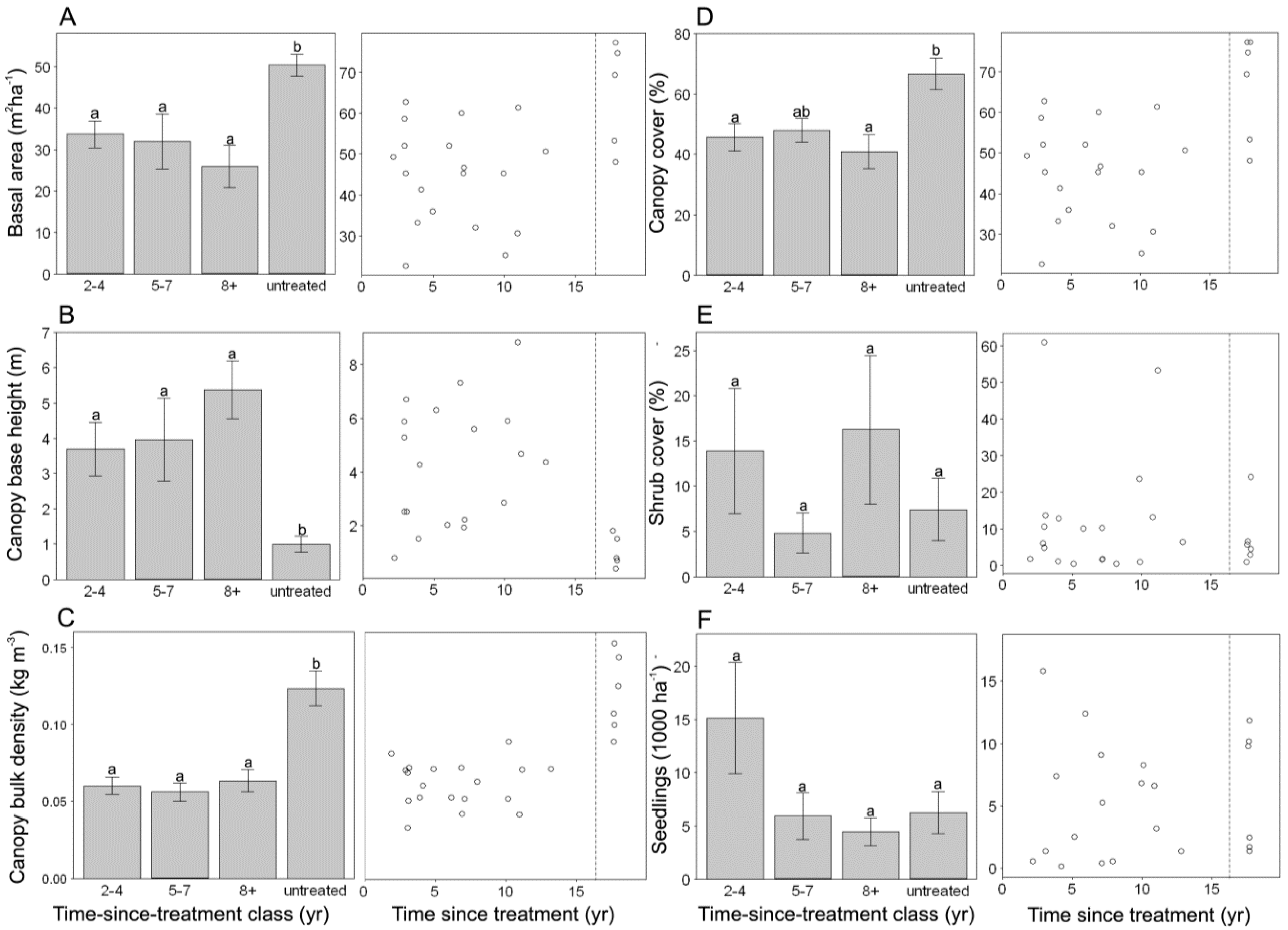
        <p><italic>Mixed conifer.</italic>—Mean stand basal area (50.3 m<sup>2</sup> ha<sup>−1</sup>) for untreated stands was double that of treated stands, and this difference was significant across time-since-treatment classes (<xref ref-type="fig" rid="forests-03-00700-f005">Figure 5</xref>A). Treatment also significantly reduced stand density (<xref ref-type="table" rid="forests-03-00700-t001">Table 1</xref>). The combined contribution of <italic>Abies concolor</italic> and <italic>A. magnifica</italic> to density (<xref ref-type="table" rid="forests-03-00700-t001">Table 1</xref>), though not basal area (<xref ref-type="table" rid="forests-03-00700-t002">Table 2</xref>), was reduced, which reflects the preferential removal of small-diameter trees. Likewise, treatment increased quadratic mean diameter (QMD) by 49.5% (<xref ref-type="table" rid="forests-03-00700-t002">Table 2</xref>). Control canopy base height (mean = 1 m) was significantly lower than for any of the treatment groups (overall treatment mean = 4.3 m) (<xref ref-type="fig" rid="forests-03-00700-f005">Figure 5</xref>B). Control canopy bulk density was approximately double that of treated sites, and exhibited no trend over time following treatment (<xref ref-type="fig" rid="forests-03-00700-f005">Figure 5</xref>C). Overstory canopy cover for the two most recent treatment classes (46% and 48%) was intermediate between the oldest time-since-treatment class (41%) and the control (67%). Treatment age classes did not differ significantly from one another with respect to canopy cover, but the 2–4 and 8–15 years-since-treatment groups each had significantly lower percent cover than the untreated control (<xref ref-type="fig" rid="forests-03-00700-f005">Figure 5</xref>D).</p>
		<fig id="forests-03-00700-f005" position="anchor">
          <label>Figure 5</label>
          <caption>
            <p>Vegetation characteristics in the mixed conifer chronosequence (<italic>n</italic>=19) and control (<italic>n</italic>=6) sites. (<bold>A</bold>) basal area; (<bold>B</bold>) canopy base height; (<bold>C</bold>) canopy bulk density; (<bold>D</bold>) canopy cover; (<bold>E</bold>) shrub cover; and (<bold>F</bold>) seedling density (all trees &lt;2.5cm dbh). Left-hand panels show means ±SE for the three age class groups and the control group. Different letters above each bar indicate significant difference in means between groups (Tukey’s HSD multiple comparison test, <italic>p</italic> &lt; 0.05). Right-hand panels show the relationship between time since treatment and each stand characteristic. Vertical dashed lines separate treated and untreated study sites.</p>
          </caption>
          <graphic xmlns:xlink="http://www.w3.org/1999/xlink" xlink:href="forests-03-00700-g005.tif"/>
        </fig>
        
        <table-wrap id="forests-03-00700-t001" position="anchor">
          <object-id pub-id-type="pii">forests-03-00700-t001_Table 1</object-id>
          <label>Table 1</label>
          <caption>
            <p>Mixed conifer mean stand density (standard error), quadratic mean diameter (QMD), and mean contribution of each tree species to total density for each time-since-treatment category. Different letters indicate significant difference in means between groups (Tukey’s HSD multiple comparison test, <italic>p</italic> &lt; 0.05). Calculations include all trees with diameter at breast height ≥2.5 cm. Tree species codes are <italic>ABSP</italic>: <italic>Abies concolor</italic> and <italic>A. magnifica</italic> (combined); <italic>CADE</italic>: <italic>Calocedrus decurrens</italic>; <italic>PIJE</italic>: <italic>Pinus jeffreyi</italic>, <italic>PILA</italic>: <italic>P. lambertiana</italic>; <italic>PIPO</italic>: <italic>P. ponderosa</italic>; <italic>PSME</italic>: <italic>Pseudotsuga menziesii</italic>; <italic>QUKE</italic>: <italic>Quercus kelloggii</italic>. Species composing less than 1% of total density are not included in % density calculations.</p>
          </caption>
          <table>
            <thead>
              <tr>
                <th rowspan="2" align="center" valign="middle">Time since treatment (years)</th>
                <th rowspan="2" align="center" valign="middle">Mean density (stems ha<sup>−1</sup>)</th>
                <th rowspan="2" align="center" valign="middle">QMD (cm)</th>
                <th colspan="7" align="center" valign="middle" style="border-bottom:solid thin">% Density by species</th>
              </tr>
              <tr>
                <th align="center" valign="middle">
                  <italic>ABSP</italic>
                </th>
                <th align="center" valign="middle">
                  <italic>CADE</italic>
                </th>
                <th align="center" valign="middle">
                  <italic>PIJE</italic>
                </th>
                <th align="center" valign="middle">
                  <italic>PILA</italic>
                </th>
                <th align="center" valign="middle">
                  <italic>PIPO</italic>
                </th>
                <th align="center" valign="middle">
                  <italic>PSME</italic>
                </th>
                <th align="center" valign="middle">
                  <italic>QUKE</italic>
                </th>
              </tr>
            </thead>
            <tbody>
              <tr>
                <td align="left" valign="middle">2–4 (<italic>n</italic> = 8)</td>
                <td align="left" valign="middle">372(47) a</td>
                <td align="center" valign="middle">33.7</td>
                <td align="center" valign="middle">26</td>
                <td align="center" valign="middle">21</td>
                <td align="center" valign="middle">12</td>
                <td align="center" valign="middle">7</td>
                <td align="center" valign="middle">7</td>
                <td align="center" valign="middle">14</td>
                <td align="center" valign="middle">13</td>
              </tr>
              <tr>
                <td align="left" valign="middle">5–7 (<italic>n</italic> = 5)</td>
                <td align="left" valign="middle">336(62) a</td>
                <td align="center" valign="middle">32.0</td>
                <td align="center" valign="middle">32</td>
                <td align="center" valign="middle">11</td>
                <td align="center" valign="middle">12</td>
                <td align="center" valign="middle">11</td>
                <td align="center" valign="middle">12</td>
                <td align="center" valign="middle">15</td>
                <td align="center" valign="middle">8</td>
              </tr>
              <tr>
                <td align="left" valign="middle">8+ (<italic>n</italic> = 7)</td>
                <td align="left" valign="middle">388(55) a</td>
                <td align="center" valign="middle">30.2</td>
                <td align="center" valign="middle">13</td>
                <td align="center" valign="middle">6</td>
                <td align="center" valign="middle">11</td>
                <td align="center" valign="middle">4</td>
                <td align="center" valign="middle">15</td>
                <td align="center" valign="middle">25</td>
                <td align="center" valign="middle">26</td>
              </tr>
              <tr>
                <td align="left" valign="middle">Untreated (<italic>n</italic> = 6)</td>
                <td align="left" valign="middle">1406(119) b</td>
                <td align="center" valign="middle">21.4</td>
                <td align="center" valign="middle">57</td>
                <td align="center" valign="middle">17</td>
                <td align="center" valign="middle">1</td>
                <td align="center" valign="middle">5</td>
                <td align="center" valign="middle">9</td>
                <td align="center" valign="middle">9</td>
                <td align="center" valign="middle">2</td>
              </tr>
            </tbody>
          </table>
        </table-wrap>
        <table-wrap id="forests-03-00700-t002" position="anchor">
          <object-id pub-id-type="pii">forests-03-00700-t002_Table 2</object-id>
          <label>Table 2</label>
          <caption>
            <p>Mixed conifer mean basal area (standard error) and mean contribution of each tree species to total basal area for each time-since-treatment category. Different letters indicate significant difference in means between groups (Tukey’s HSD multiple comparison test, <italic>p</italic> &lt; 0.05). Calculations include all trees with diameter at breast height ≥2.5 cm. Species composing less than 1% of basal area are not included in % basal area calculations. See <xref ref-type="table" rid="forests-03-00700-t001">Table 1</xref> for explanation of species codes.</p>
          </caption>
          <table>
<thead>
              <tr>
                <th rowspan="2" align="center" valign="middle">Time since treatment (years)</th>
                <th rowspan="2" align="center" valign="middle">Mean basal area (m<sup>2</sup> ha<sup>−1</sup>)</th>
                <th colspan="7" align="center" valign="middle" style="border-bottom:solid thin">% Basal area by species</th>
              </tr>
              <tr>
                <th align="center" valign="middle">
                  <italic>ABSP</italic>
                </th>
                <th align="center" valign="middle">
                  <italic>CADE</italic>
                </th>
                <th align="center" valign="middle">
                  <italic>PIJE</italic>
                </th>
                <th align="center" valign="middle">
                  <italic>PILA</italic>
                </th>
                <th align="center" valign="middle">
                  <italic>PIPO</italic>
                </th>
                <th align="center" valign="middle">
                  <italic>PSME</italic>
                </th>
                <th align="center" valign="middle">
                  <italic>QUKE</italic>
                </th>
              </tr>
            </thead>
            <tbody>
              <tr>
                <td align="left" valign="middle">2–4</td>
                <td align="left" valign="middle">33.7(3.2) a</td>
                <td align="center" valign="middle">21</td>
                <td align="center" valign="middle">18</td>
                <td align="center" valign="middle">15</td>
                <td align="center" valign="middle">15</td>
                <td align="center" valign="middle">8</td>
                <td align="center" valign="middle">18</td>
                <td align="center" valign="middle">5</td>
              </tr>
              <tr>
                <td align="left" valign="middle">5–7</td>
                <td align="left" valign="middle">32.0(6.6) a</td>
                <td align="center" valign="middle">34</td>
                <td align="center" valign="middle">7</td>
                <td align="center" valign="middle">11</td>
                <td align="center" valign="middle">22</td>
                <td align="center" valign="middle">15</td>
                <td align="center" valign="middle">12</td>
                <td align="center" valign="middle">0</td>
              </tr>
              <tr>
                <td align="left" valign="middle">8+</td>
                <td align="left" valign="middle">27.7(4.7) a</td>
                <td align="center" valign="middle">28</td>
                <td align="center" valign="middle">5</td>
                <td align="center" valign="middle">10</td>
                <td align="center" valign="middle">6</td>
                <td align="center" valign="middle">22</td>
                <td align="center" valign="middle">27</td>
                <td align="center" valign="middle">3</td>
              </tr>
              <tr>
                <td align="left" valign="middle">Untreated</td>
                <td align="left" valign="middle">50.3(2.7) b</td>
                <td align="center" valign="middle">33</td>
                <td align="center" valign="middle">10</td>
                <td align="center" valign="middle">2</td>
                <td align="center" valign="middle">15</td>
                <td align="center" valign="middle">20</td>
                <td align="center" valign="middle">17</td>
                <td align="center" valign="middle">3</td>
              </tr>
            </tbody>
          </table>
        </table-wrap>
        <p>A high degree of variability in understory vegetation characteristics contributed to a lack of significant differences between the treatment age classes and between the treatment and control groups. Tree regeneration was especially variable in the youngest time-since-treatment age class. Though mean seedling density in the youngest class was ~2.5 times greater than that of the next age class, mean densities did not differ at a significance level of 0.05 (<xref ref-type="fig" rid="forests-03-00700-f005">Figure 5</xref>F). This short-lived peak in seedling density following treatment was apparent for sites treated with mechanical thinning alone as well as those in which thinning was followed by burning (not shown). Shrub cover was generally low, and exhibited no trend over time following treatment (<xref ref-type="fig" rid="forests-03-00700-f005">Figure 5</xref>E). Shrub cover was &gt;20% in only 4 of 26 mixed conifer sites, and &gt;30% in only 2 sites.</p>
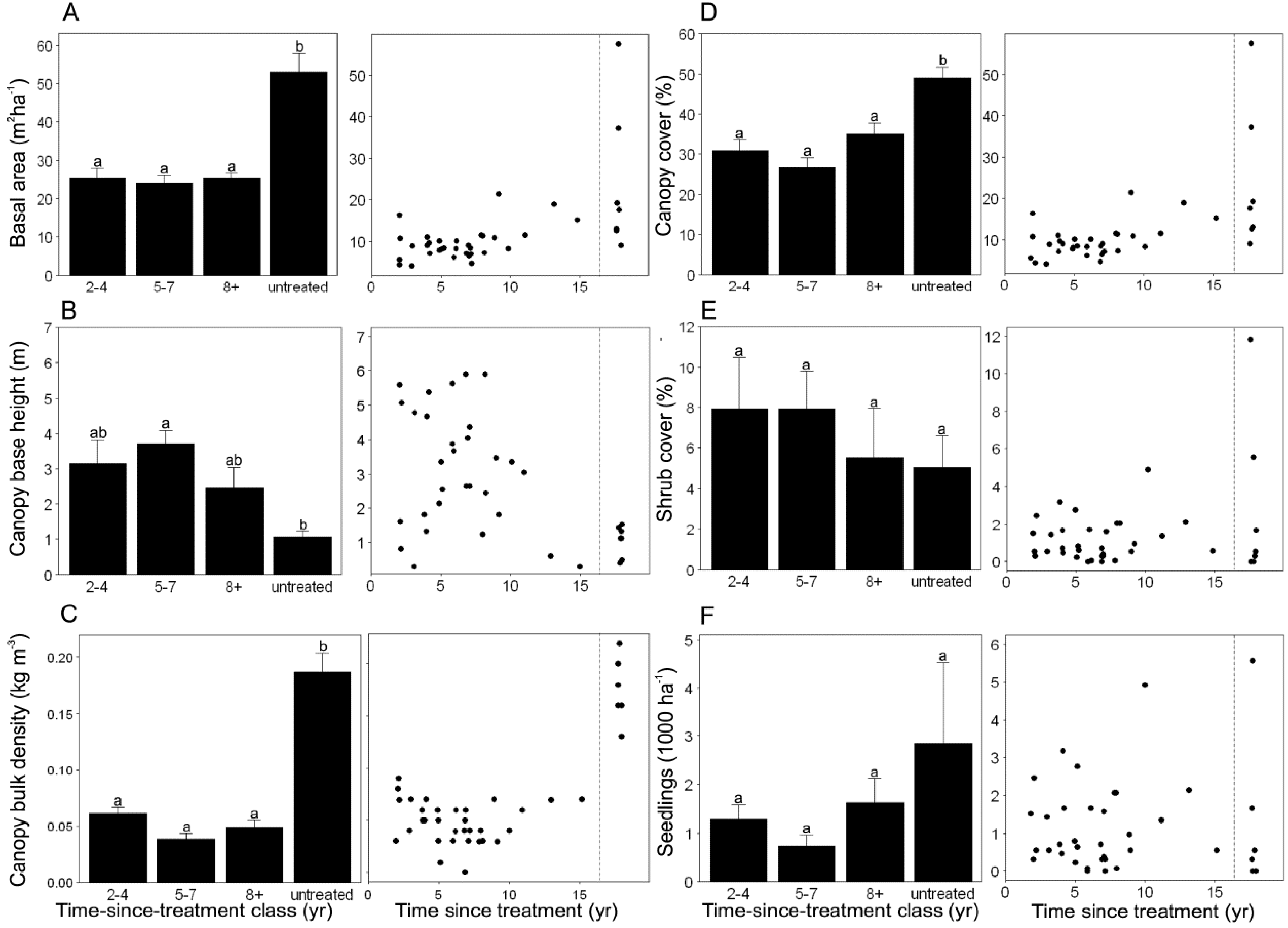
        <p><italic>Eastside pine.</italic>—Overstory characteristics generally did not vary between time-since-treatment classes, but were significantly affected by treatment. Control basal area and canopy bulk density were significantly greater than for any treatment age class (<xref ref-type="fig" rid="forests-03-00700-f006">Figure 6</xref>A,C). Basal area of the untreated sites was double that of the oldest time-since-treatment class, while control canopy bulk density was ~4 times that of the oldest treatment class. Likewise, at nearly 50%, mean control canopy cover was 39%–82% greater than for treated sites (<xref ref-type="fig" rid="forests-03-00700-f006">Figure 6</xref>D). Mean canopy base height in the control sites was 1 m compared with 2.5–3.7 m in the treatment units (<xref ref-type="fig" rid="forests-03-00700-f006">Figure 6</xref>C). In terms of stand density, treatment favored Jeffrey pine over true fir (<xref ref-type="table" rid="forests-03-00700-t003">Table 3</xref>). As thinning prescriptions generally targeted the smallest-diameter trees, QMD was increased by 55.5% (<xref ref-type="table" rid="forests-03-00700-t004">Table 4</xref>).</p>
		<fig id="forests-03-00700-f006" position="anchor">
          <label>Figure 6</label>
          <caption>
            <p>Eastside pine vegetation characteristics. (<bold>A</bold>) basal area; (<bold>B</bold>) canopy base height; (<bold>C</bold>) canopy bulk density; (<bold>D</bold>) canopy cover; (<bold>E</bold>) shrub cover; and (<bold>F</bold>) seedling density (all trees &lt;2.5cm dbh) in the eastside pine chronosequence (<italic>n</italic>=32) and control (<italic>n</italic>=7) sites. Left-hand panels show means ±SE for the three age class groups and the control group. Different letters above each bar indicate significant difference in means between groups (Tukey’s HSD multiple comparison test, <italic>p</italic> &lt; 0.05). Right-hand panels show the relationship between time since treatment and each stand characteristic. Vertical dashed lines separate treated and untreated study sites.</p>
          </caption>
          <graphic xmlns:xlink="http://www.w3.org/1999/xlink" xlink:href="forests-03-00700-g006.tif"/>
        </fig>
        
        <table-wrap id="forests-03-00700-t003" position="anchor">
          <object-id pub-id-type="pii">forests-03-00700-t003_Table 3</object-id>
          <label>Table 3</label>
          <caption>
            <p>Eastside pine mean stand density (standard error), quadratic mean diameter (QMD), and mean contribution of each tree species to total density for each time-since-treatment category. Different letters indicate significant difference in means between groups (Tukey’s HSD multiple comparison test, <italic>p</italic> &lt; 0.05). Calculations include all trees with diameter at breast height ≥2.5 cm. Tree species codes are <italic>ABSP</italic>: <italic>Abies</italic> concolor and <italic>A. magnifica</italic> (combined); <italic>CADE</italic>: <italic>Calocedrus decurrens</italic>; <italic>JUOC</italic>: <italic>Juniperus occidentalis</italic>; <italic>PIJE</italic>: <italic>Pinus jeffreyi</italic>; <italic>PIPO</italic>: <italic>P. ponderosa</italic>. Species composing less than 1% of total density are not included in % density calculations.</p>
          </caption>
          <table>
<thead>
              <tr align="center">
                <th rowspan="2" valign="middle">Time since treatment (years)</th>
                <th rowspan="2" valign="middle">Mean density (stems ha<sup>−1</sup>)</th>
                <th rowspan="2" valign="middle">QMD (cm)</th>
                <th colspan="5" valign="middle" style="border-bottom:solid thin">% Density by species</th>
              </tr>
              <tr>
                <th valign="middle">
                  <italic>ABSP</italic>
                </th>
                <th valign="middle">
                  <italic>CADE</italic>
                </th>
                <th valign="middle">
                  <italic>JUOC</italic>
                </th>
                <th valign="middle">
                  <italic>PIJE</italic>
                </th>
                <th valign="middle">
                  <italic>PIPO</italic>
                </th>
    </tr>
            </thead>
            <tbody>
              <tr>
                <td align="left" valign="middle">2–4 (<italic>n</italic> = 10)</td>
                <td align="left" valign="middle">258(31.6) a</td>
                <td align="center" valign="middle">35.3</td>
                <td align="center" valign="middle">34</td>
                <td align="center" valign="middle">1</td>
                <td align="center" valign="middle">0</td>
                <td align="center" valign="middle">64</td>
                <td align="center" valign="middle">0</td>
              </tr>
              <tr>
                <td align="left" valign="middle">5–7 (<italic>n</italic> = 13)</td>
                <td align="left" valign="middle">181.5(12.9) a</td>
                <td align="center" valign="middle">41.0</td>
                <td align="center" valign="middle">16</td>
                <td align="center" valign="middle">0</td>
                <td align="center" valign="middle">0</td>
                <td align="center" valign="middle">83</td>
                <td align="center" valign="middle">0</td>
              </tr>
              <tr>
                <td align="left" valign="middle">8+ (<italic>n</italic> = 9)</td>
                <td align="left" valign="middle">345.6(90.94) a</td>
                <td align="center" valign="middle">30.5</td>
                <td align="center" valign="middle">16</td>
                <td align="center" valign="middle">0</td>
                <td align="center" valign="middle">0</td>
                <td align="center" valign="middle">83</td>
                <td align="center" valign="middle">0</td>
              </tr>
              <tr>
                <td align="left" valign="middle">Untreated (<italic>n</italic> = 7)</td>
                <td align="left" valign="middle">1283.5(162.1) b</td>
                <td align="center" valign="middle">22.9</td>
                <td align="center" valign="middle">42</td>
                <td align="center" valign="middle">5</td>
                <td align="center" valign="middle">1</td>
                <td align="center" valign="middle">52</td>
                <td align="center" valign="middle">1</td>
              </tr>
            </tbody>
          </table>
        </table-wrap>
        <table-wrap id="forests-03-00700-t004" position="anchor">
          <object-id pub-id-type="pii">forests-03-00700-t004_Table 4</object-id>
          <label>Table 4</label>
          <caption>
            <p>Eastside pine mean basal area (standard error), and mean contribution of each tree species to total basal area for each time-since-treatment category. Different letters indicate significant difference in means between groups (Tukey’s HSD multiple comparison test, <italic>p</italic> &lt; 0.05). Calculations include all trees with diameter at breast height ≥2.5 cm. The “<italic>Abies sp.</italic>” category includes combined contributions of <italic>Abies concolor</italic> and <italic>A. magnifica</italic>. Species composing less than 1% of basal area are not included in % basal area calculations.</p>
          </caption>
          <table>
<thead>
              <tr>
                <th rowspan="2" align="center" valign="middle">Time since treatment (years)</th>
                <th rowspan="2" align="center" valign="middle">Mean basal area (m<sup>2</sup> ha<sup>−1</sup>)</th>
                <th colspan="6" align="center" valign="middle" style="border-bottom:solid thin">% Basal area by species</th>
              </tr>
              <tr>
                <th align="center" valign="middle">
                  <italic>ABSP</italic>
                </th>
                <th align="center" valign="middle">
                  <italic>CADE</italic>
                </th>
                <th align="center" valign="middle">
                  <italic>PIJE</italic>
                </th>
                <th align="center" valign="middle">
                  <italic>PILA</italic>
                </th>
                <th align="center" valign="middle">
                  <italic>PIPO</italic>
                </th>
                <th align="center" valign="middle">
                  <italic>PSME</italic>
                </th>
              </tr>
            </thead>
            <tbody>
              <tr>
                <td align="left" valign="middle">2–4</td>
                <td align="left" valign="middle">25.2(2.8) a</td>
                <td align="center" valign="middle">18</td>
                <td align="center" valign="middle">1</td>
                <td align="center" valign="middle">80</td>
                <td align="center" valign="middle">0</td>
                <td align="center" valign="middle">0</td>
                <td align="center" valign="middle">0</td>
              </tr>
              <tr>
                <td align="left" valign="middle">5–7</td>
                <td align="left" valign="middle">23.9(2.3) a</td>
                <td align="center" valign="middle">8</td>
                <td align="center" valign="middle">0</td>
                <td align="center" valign="middle">92</td>
                <td align="center" valign="middle">0</td>
                <td align="center" valign="middle">0</td>
                <td align="center" valign="middle">0</td>
              </tr>
              <tr>
                <td align="left" valign="middle">8+</td>
                <td align="left" valign="middle">25.3(1.4) a</td>
                <td align="center" valign="middle">38</td>
                <td align="center" valign="middle">3</td>
                <td align="center" valign="middle">46</td>
                <td align="center" valign="middle">1</td>
                <td align="center" valign="middle">8</td>
                <td align="center" valign="middle">4</td>
              </tr>
              <tr>
                <td align="left" valign="middle">Untreated</td>
                <td align="left" valign="middle">53.0(4.9) b</td>
                <td align="center" valign="middle">26</td>
                <td align="center" valign="middle">11</td>
                <td align="center" valign="middle">61</td>
                <td align="center" valign="middle">0</td>
                <td align="center" valign="middle">2</td>
                <td align="center" valign="middle">0</td>
              </tr>
            </tbody>
          </table>
        </table-wrap>
        <p>Shrub cover and seedling regeneration did not exhibit the high degree of variability observed for the mixed conifer forest type. Shrub cover was low overall, from 8% in the youngest treatment group to 5% in the untreated group, and did not significantly vary between control and treatment groups. Though mean control seedling density was ~2–4 times treatment group levels, this difference was not significant at <italic>p</italic> &lt; 0.05.</p>
      </sec>
    </sec>
    <sec sec-type="discussion">
      <title>4. Discussion</title>
      <sec>
        <title>4.1. Ground and Surface Fuels</title>
        <p>Downed coarse wood, often defined as material larger than 7.6 cm (3 in) in diameter [<xref ref-type="bibr" rid="B35-forests-03-00700">35</xref>], is a focus of habitat management, as it is required by many wildlife species for foraging, cover, and substrate [<xref ref-type="bibr" rid="B36-forests-03-00700">36</xref>]. It is also important with regard to ecosystem structure and function (e.g., maintenance of site productivity, protection of soils from compaction and erosion). Yet given the frequent fire regime characteristic of the study area and the high consumption of decomposed coarse wood during burning in low-moisture conditions [<xref ref-type="bibr" rid="B37-forests-03-00700">37</xref>], historic levels of large-diameter surface fuels were likely lower than at present [<xref ref-type="bibr" rid="B38-forests-03-00700">38</xref>,<xref ref-type="bibr" rid="B39-forests-03-00700">39</xref>]. Reducing pretreatment levels and ameliorating additions produced during fuels manipulation is a management concern, as large quantities of coarse woody fuels can influence potential fire behavior [<xref ref-type="bibr" rid="B5-forests-03-00700">5</xref>,<xref ref-type="bibr" rid="B10-forests-03-00700">10</xref>,<xref ref-type="bibr" rid="B40-forests-03-00700">40</xref>].</p>
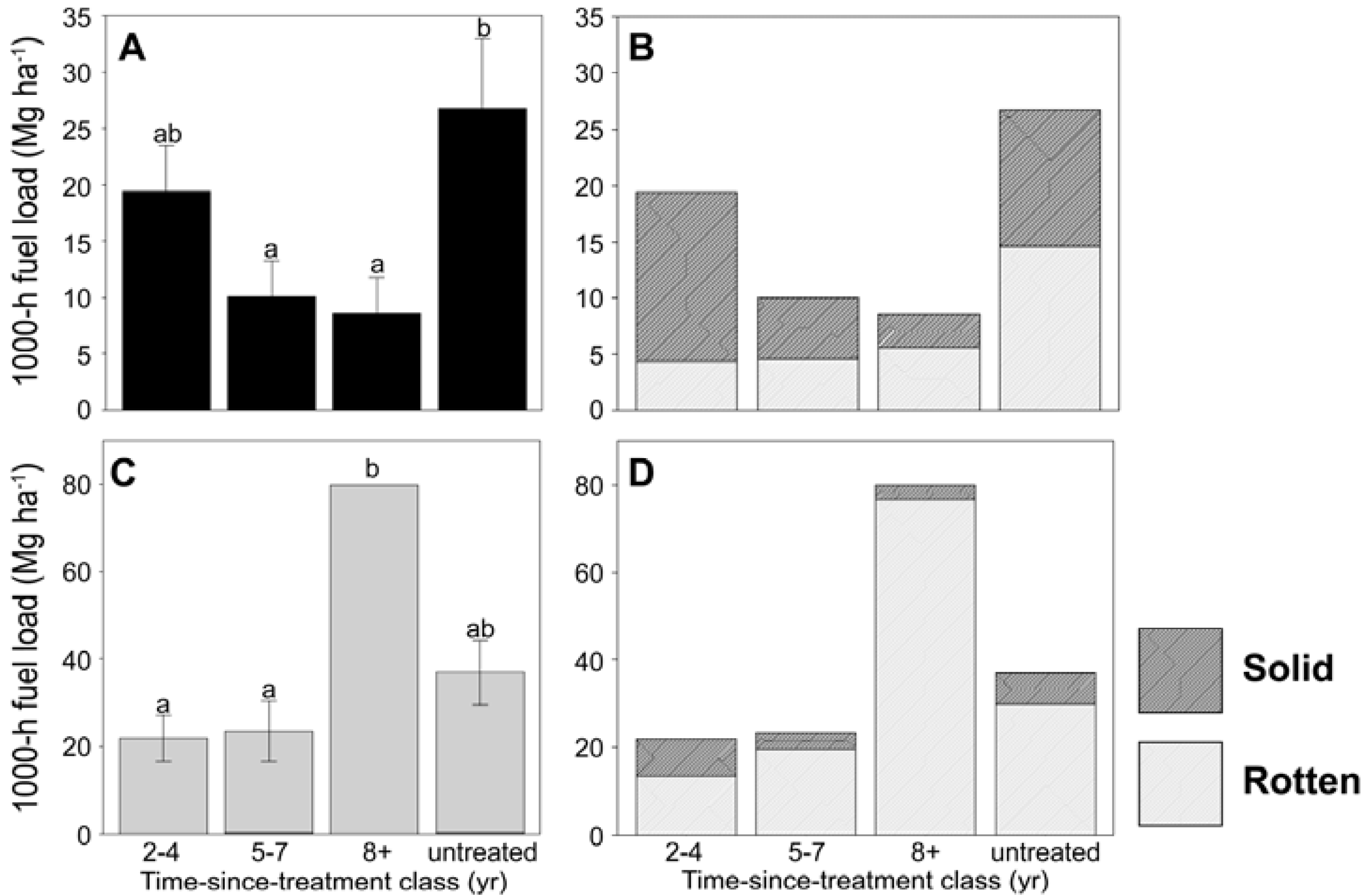
        <p>For the eastside pine forest type, loads of large-diameter fuels were significantly higher in the untreated sites than in unburned sites that had been thinned 5–15 years earlier, but they were not significantly different from loads on sites treated 2–4 years prior to sampling (<xref ref-type="fig" rid="forests-03-00700-f004">Figure 4</xref>F). In the xeric environment characteristic of the eastern Sierra Nevada, large-diameter woody fuels may remain on site for many years without follow-up treatment of activity fuels produced during thinning [<xref ref-type="bibr" rid="B41-forests-03-00700">41</xref>]. Some sites were treated with prescribed fire after thinning, but while broadcast burning effectively reduces loads of small-diameter fuels and rotten large-diameter fuels [<xref ref-type="bibr" rid="B42-forests-03-00700">42</xref>,<xref ref-type="bibr" rid="B43-forests-03-00700">43</xref>], it may have less influence on sound logs [<xref ref-type="bibr" rid="B44-forests-03-00700">44</xref>]. The initial post-harvest peak in 1000-h loads is particularly clear in <xref ref-type="fig" rid="forests-03-00700-f007">Figure 7</xref>, which shows coarse woody fuel loads in eastside pine sites treated with mechanical thinning alone. The relatively high proportion of solid coarse fuels in the most recently treated sites is likely due to additions produced during harvest. The rapid decline in solid 1000-h fuels is surprising given the expected slow rate of decomposition. Follow-up surface fuel treatment was planned but not yet completed on some sampled sites, and it may be the case that by chance such sites were overrepresented in the first time-since-treatment age class.</p>
        <fig id="forests-03-00700-f007" position="anchor">
          <label>Figure 7</label>
          <caption>
            <p>Thousand-hour timelag class (diameter &gt;7.62 cm) fuel load in eastside pine (<bold>A</bold>,<bold>B</bold>) and mixed conifer (<bold>C</bold>,<bold>D</bold>) sites treated with mechanical thinning alone or untreated. <bold>A</bold>,<bold>C</bold>: Different letters above each bar indicate significant difference in means between groups (Tukey’s HSD multiple comparison test, <italic>p</italic> &lt; 0.05);<bold>B</bold>,<bold>D</bold>: Total thousand-hour fuels by decomposition class.</p>
          </caption>
          <graphic xmlns:xlink="http://www.w3.org/1999/xlink" xlink:href="forests-03-00700-g007.tif"/>
        </fig>
        <p>The early pulse in coarse fuels was not observed in mixed conifer stands and in general, clear temporal trends among the woody timelag fuel categories were not detectable (<xref ref-type="fig" rid="forests-03-00700-f003">Figure 3</xref> and <xref ref-type="fig" rid="forests-03-00700-f004">Figure 4</xref>). Because of limited availability of treatment sites, sites with varying methods of post-thinning surface fuel treatment were grouped for the analyses shown in <xref ref-type="fig" rid="forests-03-00700-f003">Figure 3</xref>, <xref ref-type="fig" rid="forests-03-00700-f004">Figure 4</xref>, <xref ref-type="fig" rid="forests-03-00700-f005">Figure 5</xref>, and <xref ref-type="fig" rid="forests-03-00700-f006">Figure 6</xref>. While harvest activities transfer woody fuels from the canopy to the surface [<xref ref-type="bibr" rid="B9-forests-03-00700">9</xref>], several prescriptions included in the present study utilized whole-tree yarding, biomass removal, and/or grapple piling, each of which effectively reduce the activity fuels remaining onsite after treatment. Thirty-three percent of sites were treated with either pile or broadcast burning after harvesting in order to address natural and activity fuels. Burning reduces surface fuels but also produces direct and indirect tree mortality [<xref ref-type="bibr" rid="B44-forests-03-00700">44</xref>,<xref ref-type="bibr" rid="B45-forests-03-00700">45</xref>,<xref ref-type="bibr" rid="B46-forests-03-00700">46</xref>]; over time, fire-killed snags enter the surface fuel pool. Indeed, in burned sites, the number of snags in the most recently treated stands was 1.4–6.7 times that of the next age class, indicating that some trees killed during burning and still standing 2–4 years after treatment will become part of the surface fuel pool in the coming years. Combining sites treated with burning, which experience additions to the surface fuel pool in years after treatment, with those on which activity fuels were treated mechanically or left untreated would likely have the effect of masking trends in woody fuel loads over time.</p>
        <p>Though some studies have assessed long-term dynamics of large-diameter woody fuels [<xref ref-type="bibr" rid="B38-forests-03-00700">38</xref>,<xref ref-type="bibr" rid="B47-forests-03-00700">47</xref>], few have looked beyond the initial impacts of treatment with respect to small-diameter woody fuels and the litter layer, which have the greatest influence on surface fire spread. Litter loads in stands belonging to every treatment age class were substantially lower than in untreated stands, and remained at low levels throughout the chronosequence. It appeared that duff loads were not affected by treatment, as they generally did not vary between treated and untreated stands (<xref ref-type="fig" rid="forests-03-00700-f003">Figure 3</xref>A, <xref ref-type="fig" rid="forests-03-00700-f004">Figure 4</xref>A).</p>
        <p>Broadcast burning often reduces both ground and surface fuels [<xref ref-type="bibr" rid="B48-forests-03-00700">48</xref>,<xref ref-type="bibr" rid="B49-forests-03-00700">49</xref>,<xref ref-type="bibr" rid="B50-forests-03-00700">50</xref>], though these effects may not be long-lived. Keifer <italic>et al.</italic> [<xref ref-type="bibr" rid="B48-forests-03-00700">48</xref>] found that surface fuels reached approximately 85 percent of pre-fire levels within 10 years after prescribed burning in ponderosa pine and white fir-mixed conifer forests in Sequoia and Kings Canyon National Parks in the southern Sierra Nevada. In the present study, litter loads in the mixed conifer and eastside pine sites reached only 47% and 54% of untreated levels, respectively, within 8–15 years of treatment. This may indicate that surface fuels in the study area accumulate more slowly than in the southern Sierra, but may also reflect differences in litter deposition between thinned and unthinned sites, as Keifer <italic>et al.</italic> [<xref ref-type="bibr" rid="B48-forests-03-00700">48</xref>] did not include mechanical tree-removal in their study. Thinning reduces litter fall [<xref ref-type="bibr" rid="B51-forests-03-00700">51</xref>] since canopy cover is strongly linked to foliage production and litter accumulation [<xref ref-type="bibr" rid="B52-forests-03-00700">52</xref>].</p>
        <p>As a general rule, burning reduces surface fuel loads while mechanical treatments tend to increase them [<xref ref-type="bibr" rid="B6-forests-03-00700">6</xref>], yet it appears that the post-treatment reductions in litter loads observed here are not solely the result of burning. When sites treated with mechanical thinning alone (34 of 51 treatment sites) were analyzed separately, mean litter loads for every forest type/age class combination were at least 40% less than for comparable untreated sites. As a result of the reduced sample size, however, this difference was significant at <italic>p</italic> &lt; 0.05 for only the 2–4 and 5–7 year (mixed conifer) and 5–7 year (eastside pine) time-since-treatment classes.</p>
        <p>Others have found reduced duff or litter layer depths after mechanical harvesting. Stephens and Moghaddas [<xref ref-type="bibr" rid="B7-forests-03-00700">7</xref>] saw reduced litter depth after removal of chainsaw-thinned trees with rubber-tired and tracked skidders. Fulé <italic>et al.</italic> [<xref ref-type="bibr" rid="B5-forests-03-00700">5</xref>] found reduced average duff loads following both mechanical felling with broadcasting of activity fuels and whole-tree harvesting combined with slash piling. Stephens and Moghaddas [<xref ref-type="bibr" rid="B53-forests-03-00700">53</xref>] found that combined duff and litter loads following overstory removal and clear-cutting were reduced relative to young- and old-growth reserves, though loads following thin from below and individual tree selection treatments did not differ significantly from the reserves. Harvesting machinery can displace surface and ground fuel layers within a site, though it is not clear by what mechanism this should reduce ground and litter fuel mass. Alternatively, since fuel loads are typically estimated from measurements of fuel depth, compaction of the litter layer by harvesting equipment could produce an apparent reduction in loads. It is unclear whether this influence might be significant, as it has not been addressed in the literature.</p>
      </sec>
      <sec>
        <title>4.2. Tree Regeneration</title>
        <p>The lack of clear trends in tree seedling density over time was not unexpected. Mechanical thinning and thinning with prescribed fire tend to increase tree seedling density, but high variability among sites is common [<xref ref-type="bibr" rid="B6-forests-03-00700">6</xref>]. Species respond to post-treatment conditions independently [<xref ref-type="bibr" rid="B54-forests-03-00700">54</xref>,<xref ref-type="bibr" rid="B55-forests-03-00700">55</xref>], and regeneration has been linked to stand density, light levels, soil moisture and disturbance, variation in seed production (masting), and site productivity [<xref ref-type="bibr" rid="B6-forests-03-00700">6</xref>,<xref ref-type="bibr" rid="B17-forests-03-00700">17</xref>,<xref ref-type="bibr" rid="B54-forests-03-00700">54</xref>,<xref ref-type="bibr" rid="B56-forests-03-00700">56</xref>]. Interannual climate variation has also been shown to significantly influence recruitment [<xref ref-type="bibr" rid="B57-forests-03-00700">57</xref>,<xref ref-type="bibr" rid="B58-forests-03-00700">58</xref>].</p>
        <p>The early peak in seedling density in the mixed conifer treatments was not observed in the eastside forest. The relatively productive mixed conifer forest would be expected to promote higher levels of regeneration. In addition, mechanical thinning may have relatively little influence on the light environment in the eastside forest, where canopy cover in untreated stands is relatively low (~50%). Jeffrey pine, a dominant overstory species of the eastside, is associated with indirect radiation, and white and red fir are associated negatively with direct solar radiation and positively with soil moisture [<xref ref-type="bibr" rid="B56-forests-03-00700">56</xref>]. Irregularity in Jeffrey pine seed crops has also been reported [<xref ref-type="bibr" rid="B59-forests-03-00700">59</xref>].</p>
        <p>Chronosequence studies rely on the assumption that time since treatment is the primary explanatory variable. Variation in conditions at the time of treatment can make this assumption untenable. This shortcoming is particularly relevant with respect to regeneration, which is known to exhibit a high degree of spatial and temporal variation.</p>
      </sec>
      <sec>
        <title>4.3. Shrubs</title>
        <p>Some have suggested that reducing canopy cover during thinning may promote shrub growth [<xref ref-type="bibr" rid="B6-forests-03-00700">6</xref>,<xref ref-type="bibr" rid="B60-forests-03-00700">60</xref>], thereby shortening the longevity of fuel treatment effectiveness. In the short-term, fuels treatment is expected to reduce shrub cover through mechanical damage [<xref ref-type="bibr" rid="B6-forests-03-00700">6</xref>,<xref ref-type="bibr" rid="B61-forests-03-00700">61</xref>,<xref ref-type="bibr" rid="B62-forests-03-00700">62</xref>] and consumption during burning [<xref ref-type="bibr" rid="B6-forests-03-00700">6</xref>,<xref ref-type="bibr" rid="B62-forests-03-00700">62</xref>,<xref ref-type="bibr" rid="B63-forests-03-00700">63</xref>]. Beyond these initial impacts, thinning could potentially promote shrub growth through reduced overstory competition. Campbell <italic>et al.</italic> [<xref ref-type="bibr" rid="B64-forests-03-00700">64</xref>] found live shrub cover increased from 9% in unthinned controls to 32% and 22%, 3 and 16 years, respectively, after thinning-from-below in northern Sierra Nevada ponderosa pine plantations. Many shrubs in the study region are vigorous resprouters, and prescribed fire stimulates seed germination in some species [<xref ref-type="bibr" rid="B63-forests-03-00700">63</xref>]. However, potential increases in shrub growth as a result of reduced canopy cover and increased microsite availability may be limited. In the Teakettle Experimental Forest, a southern Sierra Nevada site, North <italic>et al.</italic> [<xref ref-type="bibr" rid="B65-forests-03-00700">65</xref>] determined that mixed conifer shrubs were associated with diffuse light and low soil moisture levels. Cover was reduced in both closed canopy and canopy gaps with shrubs preferentially occupying an ecotone between the two cover types.</p>
        <p>The lack of clear trends in shrub development in the years following treatment may reflect variability in pre-treatment conditions. Dodson <italic>et al.</italic> [<xref ref-type="bibr" rid="B66-forests-03-00700">66</xref>] found that pre-treatment shrub cover was much more influential than treatment with respect to changes in shrub cover over time. Although the high variability in post-treatment shrub cover precluded clear findings with respect to development over time, the hypothesis that thinning and prescribed fire treatments would promote shrub growth, exacerbating potential fire hazards, is not supported by these data, as total shrub cover was nearly always low (&lt;20%) in control and treatment sites alike. Similarly low levels of shrub cover have been observed in other dry western forests following treatment [<xref ref-type="bibr" rid="B16-forests-03-00700">16</xref>,<xref ref-type="bibr" rid="B67-forests-03-00700">67</xref>].</p>
      </sec>
      <sec>
        <title>4.4. Stand Characteristics</title>
        <p>Treatments for fuels reduction are often intended to achieve multiple objectives. Apart from fire hazard reduction, the restoration of pre-Euro-American settlement (hereafter “pre-settlement”) conditions is a common goal of treatment. Some goals of restoration align with those of hazard reduction: a focus on recreating the conditions associated with pre-settlement can also be expected to reduce fire hazards, as manipulations for restoration typically involve reducing surface fuels and the density of small-diameter trees. While many of the treatments sampled here did not include restoration as an explicit goal, and fuel treatments cannot in general be assumed to achieve restoration, they did move stands toward the structure of pre-settlement forests by some measures.</p>
        <p>The abundance of shade-tolerant fir species is a concern from a restoration standpoint as a well as a fire hazard perspective. Shade-tolerant conifers are characterized by vertically continuous crowns that can convey surface fire into the forest canopy. In mixed conifer stands in a Sierra Nevada old growth reserve (Teakettle Experimental Forest), North <italic>et al.</italic> [<xref ref-type="bibr" rid="B68-forests-03-00700">68</xref>] compared stand conditions before and after understory thinning with and without prescribed fire to stand reconstructions of 1865. As in their study, treatment in the present study increased QMD and reduced stand density. However, while North <italic>et al.</italic> found that treatment did not significantly reduce pre-treatment contributions of <italic>Abies</italic> species (red and white fir) to stand density (65.3%–71.9%), the contribution of true fir to mixed conifer stand composition in this study was reduced from 57.2% in untreated stands to &lt;26% in treated stands. By comparison, North <italic>et al.</italic> estimated that true fir composed 36.6% of stand density in their 1865 reconstruction, similar to an estimate of 42% by volume in a 1913 Plumas National Forest survey [<xref ref-type="bibr" rid="B69-forests-03-00700">69</xref>]. Though treatments in the present study reduced the contribution of true fir to stand density, its contribution to stand basal area was not altered, reflecting preferential removal of small-diameter individuals during mechanical thinning. The same pattern was observed in the eastside pine forest type, where treatment favored Jeffrey pine over true fir with respect to density but not basal area.</p>
        <p>The structural changes created by fuels management were still evident in the oldest chronosequence class. In both forest types, with respect to stand characteristics, the oldest treated units were statistically indistinguishable from more recently treated stands but were clearly distinct from untreated sites. Treatment effects included reduced vertical and horizontal fuel continuity and a higher proportion of large-diameter, fire-resistant trees. These changes indicate that treated stands are less vulnerable to high-severity fire even 8–15 years after treatment [<xref ref-type="bibr" rid="B11-forests-03-00700">11</xref>].</p>
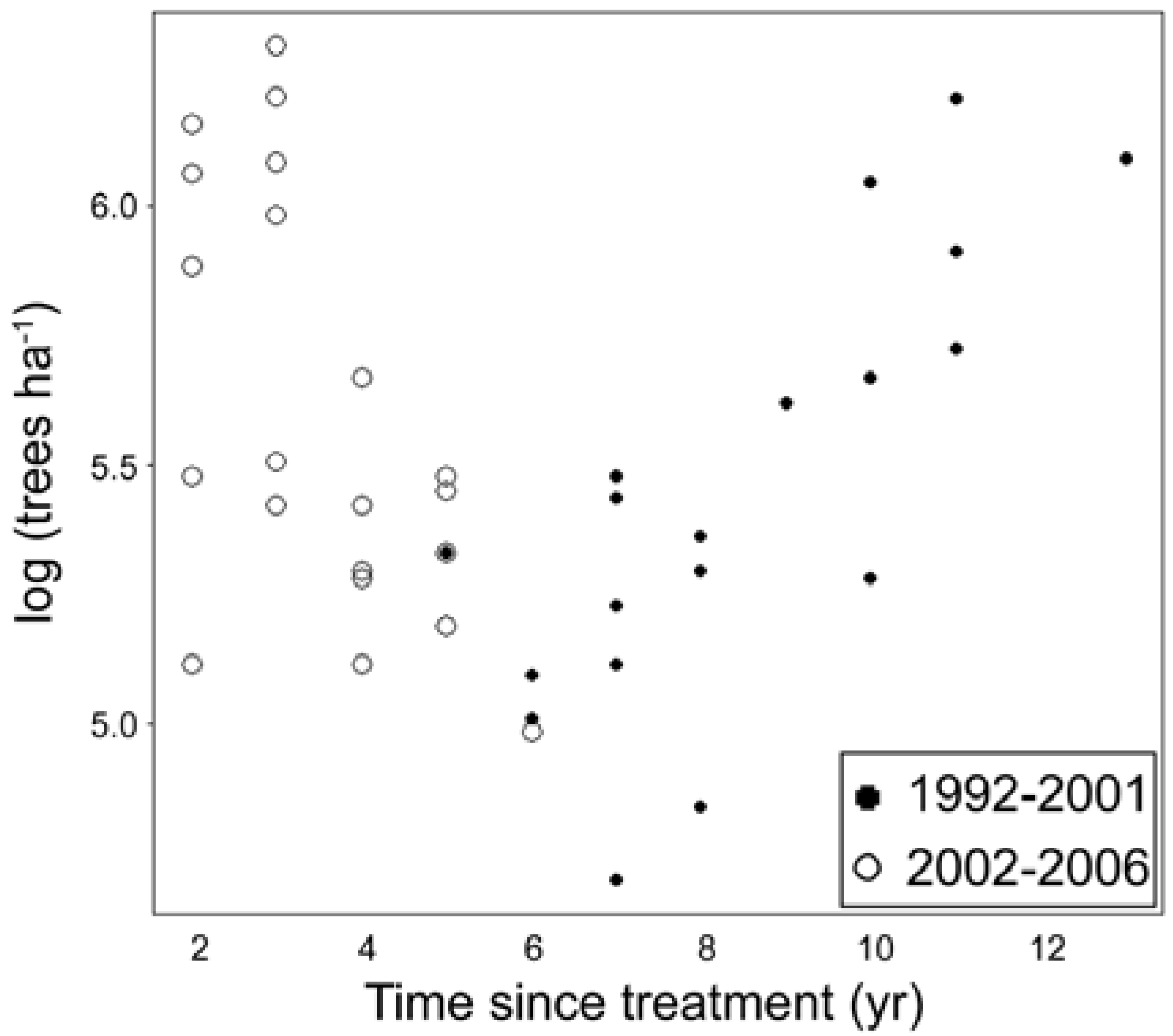
        <p>One limitation of the chronosequence approach is that variation at the time of treatment can easily be attributed to variation over time since treatment. The changes in stand structure over time may be somewhat confounded with changing mechanical thinning prescriptions over time. Changing forest management over time has frustrated other chronosequence studies [<xref ref-type="bibr" rid="B70-forests-03-00700">70</xref>]. <xref ref-type="fig" rid="forests-03-00700-f008">Figure 8</xref> illustrates the challenge. Stand density appears to exhibit a <italic>u</italic>-shaped relationship with time following treatment, which likely reflects changes in mechanical treatment prescriptions over time rather than a real trend in stand development. ANCOVA results indicated a significant interaction between treatment age and the period in which thinning occurred. The pre-2002 and post-2002 (inclusive) division was chosen to represent the period before and after the 2001 Sierra Forest Plan Amendment Record of Decision [<xref ref-type="bibr" rid="B71-forests-03-00700">71</xref>], which had the effect of reducing harvest levels in fuel treatments through canopy cover targets, diameter limits, and an emphasis on creating stand heterogeneity. While a number of other management directives certainly affected treatment implementation, notably the California Spotted Owl interim guidelines [<xref ref-type="bibr" rid="B72-forests-03-00700">72</xref>] and the Herger-Feinstein Quincy Library Group (HFQLG) Forest Recovery Act of 1998 [<xref ref-type="bibr" rid="B73-forests-03-00700">73</xref>], the 2001 split best described the pattern in stand density based on <italic>R</italic><sup>2</sup> and <italic>p</italic>-values (not reported). Only treatments completed on federal forest land are included in the analysis of density reported in <xref ref-type="fig" rid="forests-03-00700-f008">Figure 8</xref>. The larger chronosequence study includes a significant number of privately managed stands which would not be expected to be influenced by changing federal policies.</p>
        <fig id="forests-03-00700-f008" position="anchor">
          <label>Figure 8</label>
          <caption>
            <p>Stand density at the time of sampling for treatments sampled in both forest types. Figure includes data from sites located on land managed by the US Forest Service only. Symbol color represents the period in which forest thinning occurred.</p>
          </caption>
          <graphic xmlns:xlink="http://www.w3.org/1999/xlink" xlink:href="forests-03-00700-g008.tif"/>
        </fig>
        <p>Apart from historical changes in mechanical thinning prescriptions over time, we were unable to account for other probable sources of variation, including the seasons of thinning and burning, annual climatic variability, and prescribed burn intensity and fuel consumption. This variation likely contributed to the lack of significant differences between time-since-treatment groups and between treatment and control groups.</p>
      </sec>
    </sec>
    <sec sec-type="conclusions">
      <title>5. Conclusions</title>
      <p>Many have noted the need for future maintenance of post-treatment conditions in order to retain low fire hazard [<xref ref-type="bibr" rid="B10-forests-03-00700">10</xref>,<xref ref-type="bibr" rid="B74-forests-03-00700">74</xref>,<xref ref-type="bibr" rid="B75-forests-03-00700">75</xref>], yet little research exists to guide management planning beyond initial treatment establishment. This chronosequence study indicates that some treatment effects are long-lived in the mixed conifer and eastside pine forests typical of the northern Sierra Nevada and southern Cascade regions of California. Metrics of overstory structure in treated stands were significantly different from those of untreated stands even 8–15 years after treatment implementation. The lack of significant differences between the youngest post-treatment class and the oldest class is further evidence of the longevity of structural changes produced by mechanical thinning alone and in combination with burning. Other effects of treatment, namely on tree seedling regeneration, shrub cover, and most surface fuel categories, were highly variable among sites. Patterns of post-treatment recovery were difficult to discern as a result. As shrub cover across both treated and untreated sites was low (generally &lt;20%), our findings did not validate past concerns that treatment activities could enhance shrub growth, thereby exacerbating wildfire hazards and shortening the lifespan of fuel treatment effectiveness. This work could be used to plan additional fuel treatments and schedule maintenance of existing treatments. A recent analysis of the spatial scale of Sierra Nevada fuel treatments revealed that the current rate of treatment is insufficient to significantly advance restoration goals [<xref ref-type="bibr" rid="B76-forests-03-00700">76</xref>], which emphasizes the need for continued and accelerated fire hazard reduction on large forested areas.</p>
    </sec>
    
  </body>
  <back><ack>
      <title>Acknowledgments</title>
      <p>This research was completed with the assistance of many individuals. We thank J. Francis of the Collins Pine Company; M. Cerney and J. Hensel of the Lassen National Forest; P. Duncan, J. Lamb, and R. Tompkins of the Plumas National Forest; and S. Conway and B. Troedson of the Tahoe National Forest for their help in locating fuel treatments for sampling. We also thank B. Collins, D. Fry, J. Moghaddas, G. Roller, and N. Vaillant for helpful discussions and R. Andrus, J. Aney, A. Chiono, J. Chiono, A. Forrestel, D. Fry, A. Lundquist, M. Parish, G. Roller, and R. Susko for their assistance in the field. This manuscript benefitted from comments by D. Ackerly, W. Aney, and two anonymous reviewers. This research was supported by Sierra Nevada Conservancy Grant 070071, the Bureau of Land Management through the California Fire Safe Council Grants Clearing House, and the University of California Division of Agriculture and Natural Resources.</p>
    </ack>
    <notes>
      <title>Conflict of Interest</title>
      <p>The authors declare no conflict of interest.</p>
    </notes>
    <ref-list>
      <title>References</title>
      <ref id="B1-forests-03-00700">
        <label>1.</label>
        <citation citation-type="journal">
          <person-group person-group-type="author">
            <name>
              <surname>Scholl</surname>
              <given-names>A.E.</given-names>
            </name>
            <name>
              <surname>Taylor</surname>
              <given-names>A.H.</given-names>
            </name>
          </person-group>
          <article-title>Fire regimes, forest change, and self-organization in an old-growth mixed-conifer forest, Yosemite National Park, USA</article-title>
          <source>Ecol. Appl.</source>
          <year>2010</year>
          <volume>20</volume>
          <fpage>362</fpage>
          <lpage>380</lpage>
          <pub-id pub-id-type="doi">10.1890/08-2324.1</pub-id>
        </citation>
      </ref>
      <ref id="B2-forests-03-00700">
        <label>2.</label>
        <citation citation-type="journal">
          <person-group person-group-type="author">
            <name>
              <surname>Covington</surname>
              <given-names>W.W.</given-names>
            </name>
            <name>
              <surname>Moore</surname>
              <given-names>M.M.</given-names>
            </name>
          </person-group>
          <article-title>Postsettlement changes in natural fire regimes and forest structure</article-title>
          <source>J. Sustain. For.</source>
          <year>1994</year>
          <volume>2</volume>
          <fpage>153</fpage>
          <lpage>181</lpage>
          <pub-id pub-id-type="doi">10.1300/J091v02n01_07</pub-id>
        </citation>
      </ref>
      <ref id="B3-forests-03-00700">
        <label>3.</label>
        <citation citation-type="journal">
          <person-group person-group-type="author">
            <name>
              <surname>Naficy</surname>
              <given-names>C.</given-names>
            </name>
            <name>
              <surname>Sala</surname>
              <given-names>A.</given-names>
            </name>
            <name>
              <surname>Keeling</surname>
              <given-names>E.G.</given-names>
            </name>
            <name>
              <surname>Graham</surname>
              <given-names>J.</given-names>
            </name>
            <name>
              <surname>DeLuca</surname>
              <given-names>T.H.</given-names>
            </name>
          </person-group>
          <article-title>Interactive effects of historical logging and fire exclusion on ponderosa pine forest structure in the northern Rockies</article-title>
          <source>Ecol. Appl.</source>
          <year>2010</year>
          <volume>20</volume>
          <fpage>1851</fpage>
          <lpage>1864</lpage>
        <pub-id pub-id-type="doi">10.1890/09-0217.1</pub-id><pub-id pub-id-type="pmid">21049874</pub-id></citation>
      </ref>
      <ref id="B4-forests-03-00700">
        <label>4.</label>
        <citation citation-type="book">
          <person-group person-group-type="author">
            <name>
              <surname>Skinner</surname>
              <given-names>C.N.</given-names>
            </name>
            <name>
              <surname>Chang</surname>
              <given-names>C.</given-names>
            </name>
          </person-group>
          <article-title>Fire Regimes, Past and Present</article-title>
          <source>Sierra Nevada Ecosystem Project: Final Report to Congress</source>
          <publisher-name>University of California, Davis, Centers for Water and Wildland Resources</publisher-name>
          <publisher-loc>Davis, CA, USA</publisher-loc>
          <year>1996</year>
          <volume>2</volume>
          <fpage>1041</fpage>
          <lpage>1069</lpage>
        </citation>
      </ref>
      <ref id="B5-forests-03-00700">
        <label>5.</label>
        <citation citation-type="book">
          <person-group person-group-type="author">
            <name>
              <surname>Fulé</surname>
              <given-names>P.Z.</given-names>
            </name>
            <name>
              <surname>McHugh</surname>
              <given-names>C.W.</given-names>
            </name>
            <name>
              <surname>Heinlein</surname>
              <given-names>T.A.</given-names>
            </name>
            <name>
              <surname>Covington</surname>
              <given-names>W.W.</given-names>
            </name>
          </person-group>
          <source>Potential Fire Behavior is Reduced Following Forest Restoration Treatments</source>
          <publisher-name>USDA Forest Service, Rocky Mountain Research Station</publisher-name>
          <publisher-loc>Ogden, UT, USA</publisher-loc>
          <year>2001</year>
          <fpage>22</fpage>
          <lpage>28</lpage>
        </citation>
      </ref>
      <ref id="B6-forests-03-00700">
        <label>6.</label>
        <citation citation-type="journal">
          <person-group person-group-type="author">
            <name>
              <surname>Schwilk</surname>
              <given-names>D.W.</given-names>
            </name>
            <name>
              <surname>Keeley</surname>
              <given-names>J.E.</given-names>
            </name>
            <name>
              <surname>Knapp</surname>
              <given-names>E.E.</given-names>
            </name>
            <name>
              <surname>McIver</surname>
              <given-names>J.</given-names>
            </name>
            <name>
              <surname>Bailey</surname>
              <given-names>J.D.</given-names>
            </name>
            <name>
              <surname>Fettig</surname>
              <given-names>C.J.</given-names>
            </name>
            <name>
              <surname>Fiedler</surname>
              <given-names>C.E.</given-names>
            </name>
            <name>
              <surname>Harrod</surname>
              <given-names>R.J.</given-names>
            </name>
            <name>
              <surname>Moghaddas</surname>
              <given-names>J.J.</given-names>
            </name>
            <name>
              <surname>Outcalt</surname>
              <given-names>K.W.</given-names>
            </name>
            <etal/>
          </person-group>
          <article-title>The national fire and fire surrogate study: Effects of fuel reduction methods on forest vegetation structure and fuels</article-title>
          <source>Ecol. Appl.</source>
          <year>2009</year>
          <volume>19</volume>
          <fpage>285</fpage>
          <lpage>304</lpage>
        <pub-id pub-id-type="doi">10.1890/07-1747.1</pub-id><pub-id pub-id-type="pmid">19323191</pub-id></citation>
      </ref>
      <ref id="B7-forests-03-00700">
        <label>7.</label>
        <citation citation-type="journal">
          <person-group person-group-type="author">
            <name>
              <surname>Stephens</surname>
              <given-names>S.L.</given-names>
            </name>
            <name>
              <surname>Moghaddas</surname>
              <given-names>J.J.</given-names>
            </name>
          </person-group>
          <article-title>Experimental fuel treatment impacts on forest structure, potential fire behavior, and predicted tree mortality in a California mixed conifer forest</article-title>
          <source>For. Ecol. Manag.</source>
          <year>2005</year>
          <volume>215</volume>
          <fpage>21</fpage>
          <lpage>36</lpage>
          <pub-id pub-id-type="doi">10.1016/j.foreco.2005.03.070</pub-id>
        </citation>
      </ref>
      <ref id="B8-forests-03-00700">
        <label>8.</label>
        <citation citation-type="journal">
          <person-group person-group-type="author">
            <name>
              <surname>Stephens</surname>
              <given-names>S.L.</given-names>
            </name>
            <name>
              <surname>Moghaddas</surname>
              <given-names>J.J.</given-names>
            </name>
            <name>
              <surname>Edminster</surname>
              <given-names>C.</given-names>
            </name>
            <name>
              <surname>Fiedler</surname>
              <given-names>C.E.</given-names>
            </name>
            <name>
              <surname>Haase</surname>
              <given-names>S.</given-names>
            </name>
            <name>
              <surname>Harrington</surname>
              <given-names>M.</given-names>
            </name>
            <name>
              <surname>Keeley</surname>
              <given-names>J.E.</given-names>
            </name>
            <name>
              <surname>Knapp</surname>
              <given-names>E.E.</given-names>
            </name>
            <name>
              <surname>McIver</surname>
              <given-names>J.D.</given-names>
            </name>
            <name>
              <surname>Metlen</surname>
              <given-names>K.</given-names>
            </name>
            <etal/>
          </person-group>
          <article-title>Fire treatment effects on vegetation structure, fuels, and potential fire severity in western U.S. forests</article-title>
          <source>Ecol. Appl.</source>
          <year>2009</year>
          <volume>19</volume>
          <fpage>305</fpage>
          <lpage>320</lpage>
          <pub-id pub-id-type="doi">10.1890/07-1755.1</pub-id>
        </citation>
      </ref>
      <ref id="B9-forests-03-00700">
        <label>9.</label>
        <citation citation-type="journal">
          <person-group person-group-type="author">
            <name>
              <surname>Raymond</surname>
              <given-names>C.L.</given-names>
            </name>
            <name>
              <surname>Peterson</surname>
              <given-names>D.L.</given-names>
            </name>
          </person-group>
          <article-title>Fuel treatments alter the effects of wildfire in a mixed-evergreen forest, Oregon, USA</article-title>
          <source>Can. J. For. Res.</source>
          <year>2005</year>
          <volume>35</volume>
          <fpage>2981</fpage>
          <lpage>2995</lpage>
          <pub-id pub-id-type="doi">10.1139/x05-206</pub-id>
        </citation>
      </ref>
      <ref id="B10-forests-03-00700">
        <label>10.</label>
        <citation citation-type="journal">
          <person-group person-group-type="author">
            <name>
              <surname>Agee</surname>
              <given-names>J.K.</given-names>
            </name>
            <name>
              <surname>Bahro</surname>
              <given-names>B.</given-names>
            </name>
            <name>
              <surname>Finney</surname>
              <given-names>M.A.</given-names>
            </name>
            <name>
              <surname>Omi</surname>
              <given-names>P.N.</given-names>
            </name>
            <name>
              <surname>Sapsis</surname>
              <given-names>D.B.</given-names>
            </name>
            <name>
              <surname>Skinner</surname>
              <given-names>C.N.</given-names>
            </name>
            <name>
              <surname>van Wagtendonk</surname>
              <given-names>J.W.</given-names>
            </name>
            <name>
              <surname>Phillip Weatherspoon</surname>
              <given-names>C.</given-names>
            </name>
          </person-group>
          <article-title>The use of shaded fuelbreaks in landscape fire management</article-title>
          <source>For. Ecol. Manag.</source>
          <year>2000</year>
          <volume>127</volume>
          <fpage>55</fpage>
          <lpage>66</lpage>
          <pub-id pub-id-type="doi">10.1016/S0378-1127(99)00116-4</pub-id>
        </citation>
      </ref>
      <ref id="B11-forests-03-00700">
        <label>11.</label>
        <citation citation-type="journal">
          <person-group person-group-type="author">
            <name>
              <surname>Agee</surname>
              <given-names>J.K.</given-names>
            </name>
            <name>
              <surname>Skinner</surname>
              <given-names>C.N.</given-names>
            </name>
          </person-group>
          <article-title>Basic principles of forest fuel reduction treatments</article-title>
          <source>For. Ecol. Manag.</source>
          <year>2005</year>
          <volume>211</volume>
          <fpage>83</fpage>
          <lpage>96</lpage>
          <pub-id pub-id-type="doi">10.1016/j.foreco.2005.01.034</pub-id>
        </citation>
      </ref>
      <ref id="B12-forests-03-00700">
        <label>12.</label>
        <citation citation-type="journal">
          <person-group person-group-type="author">
            <name>
              <surname>Strom</surname>
              <given-names>B.A.</given-names>
            </name>
            <name>
              <surname>Fulé</surname>
              <given-names>P.Z.</given-names>
            </name>
          </person-group>
          <article-title>Pre-wildfire fuel treatments affect long-term ponderosa pine forest dynamics</article-title>
          <source>Int. J. Wildland Fire</source>
          <year>2007</year>
          <volume>16</volume>
          <fpage>128</fpage>
          <lpage>138</lpage>
          <pub-id pub-id-type="doi">10.1071/WF06051</pub-id>
        </citation>
      </ref>
      <ref id="B13-forests-03-00700">
        <label>13.</label>
        <citation citation-type="journal">
          <person-group person-group-type="author">
            <name>
              <surname>Ritchie</surname>
              <given-names>M.W.</given-names>
            </name>
            <name>
              <surname>Skinner</surname>
              <given-names>C.N.</given-names>
            </name>
            <name>
              <surname>Hamilton</surname>
              <given-names>T.A.</given-names>
            </name>
          </person-group>
          <article-title>Probability of tree survival after wildfire in an interior pine forest of northern California: Effects of thinning and prescribed fire</article-title>
          <source>For. Ecol. Manag.</source>
          <year>2007</year>
          <volume>247</volume>
          <fpage>200</fpage>
          <lpage>208</lpage>
          <pub-id pub-id-type="doi">10.1016/j.foreco.2007.04.044</pub-id>
        </citation>
      </ref>
      <ref id="B14-forests-03-00700">
        <label>14.</label>
        <citation citation-type="journal">
          <person-group person-group-type="author">
            <name>
              <surname>Stephens</surname>
              <given-names>S.L.</given-names>
            </name>
            <name>
              <surname>McIver</surname>
              <given-names>J.D.</given-names>
            </name>
            <name>
              <surname>Boerner</surname>
              <given-names>R.E.J.</given-names>
            </name>
            <name>
              <surname>Fettig</surname>
              <given-names>C.J.</given-names>
            </name>
            <name>
              <surname>Fontaine</surname>
              <given-names>J.B.</given-names>
            </name>
            <name>
              <surname>Hartsough</surname>
              <given-names>B.R.</given-names>
            </name>
            <name>
              <surname>Kennedy</surname>
              <given-names>P.</given-names>
            </name>
            <name>
              <surname>Schwilk</surname>
              <given-names>D.W.</given-names>
            </name>
          </person-group>
          <article-title>Effects of forest fuel reduction treatments in the United States</article-title>
          <source>Bioscience</source>
          <year>2012</year>
          <volume>62</volume>
          <fpage>549</fpage>
          <lpage>560</lpage>
          <pub-id pub-id-type="doi">10.1525/bio.2012.62.6.6</pub-id>
        </citation>
      </ref>
      <ref id="B15-forests-03-00700">
        <label>15.</label>
        <citation citation-type="book">
          <person-group person-group-type="author">
            <name>
              <surname>Smith</surname>
              <given-names>D.</given-names>
            </name>
            <name>
              <surname>Larson</surname>
              <given-names>B.</given-names>
            </name>
            <name>
              <surname>Kelty</surname>
              <given-names>M.J.</given-names>
            </name>
            <name>
              <surname>Ashton</surname>
              <given-names>P.M.S.</given-names>
            </name>
          </person-group>
          <source>The Practice of Silviculture: Applied Forest Ecology</source>
          <edition>9th</edition>
          <publisher-name>John Wiley &amp; Sons, Inc.</publisher-name>
          <publisher-loc>New York, NY, USA</publisher-loc>
          <year>1997</year>
        </citation>
      </ref>
      <ref id="B16-forests-03-00700">
        <label>16.</label>
        <citation citation-type="journal">
          <person-group person-group-type="author">
            <name>
              <surname>McConnell</surname>
              <given-names>B.R.</given-names>
            </name>
            <name>
              <surname>Smith</surname>
              <given-names>J.G.</given-names>
            </name>
          </person-group>
          <article-title>Response of understory vegetation to ponderosa pine thinning in eastern Washington</article-title>
          <source>J. Range Manag.</source>
          <year>1970</year>
          <volume>23</volume>
          <fpage>208</fpage>
          <lpage>212</lpage>
          <pub-id pub-id-type="doi">10.2307/3896390</pub-id>
        </citation>
      </ref>
      <ref id="B17-forests-03-00700">
        <label>17.</label>
        <citation citation-type="journal">
          <person-group person-group-type="author">
            <name>
              <surname>Bailey</surname>
              <given-names>J.D.</given-names>
            </name>
            <name>
              <surname>Tappeiner</surname>
              <given-names>J.C.</given-names>
            </name>
          </person-group>
          <article-title>Effects of thinning on structural development in 40- to 100-year-old Douglas-fir stands in western Oregon</article-title>
          <source>For. Ecol. Manag.</source>
          <year>1998</year>
          <volume>108</volume>
          <fpage>99</fpage>
          <lpage>113</lpage>
          <pub-id pub-id-type="doi">10.1016/S0378-1127(98)00216-3</pub-id>
        </citation>
      </ref>
      <ref id="B18-forests-03-00700">
        <label>18.</label>
        <citation citation-type="book">
          <person-group person-group-type="author">
            <name>
              <surname>Haase</surname>
              <given-names>S.M.</given-names>
            </name>
          </person-group>
          <source>Effects of Prescribed Burning on Soil Moisture and Germination of Southwestern Ponderosa Pine Seed on Basaltic Soils; Research Note RM-462</source>
          <publisher-name>USDA Forest Service, Rocky Mountain Forest and Range Experiment Station</publisher-name>
          <publisher-loc>Fort Collins, CO, USA</publisher-loc>
          <year>1986</year>
          <fpage>6</fpage>
        </citation>
      </ref>
      <ref id="B19-forests-03-00700">
        <label>19.</label>
        <citation citation-type="journal">
          <person-group person-group-type="author">
            <name>
              <surname>Moghaddas</surname>
              <given-names>J.J.</given-names>
            </name>
            <name>
              <surname>Craggs</surname>
              <given-names>L.</given-names>
            </name>
          </person-group>
          <article-title>A fuel treatment reduces fire severity and increases suppression efficiency in a mixed conifer forest</article-title>
          <source>Int. J. Wildland Fire</source>
          <year>2007</year>
          <volume>16</volume>
          <fpage>673</fpage>
          <lpage>678</lpage>
          <pub-id pub-id-type="doi">10.1071/WF06066</pub-id>
        </citation>
      </ref>
      <ref id="B20-forests-03-00700">
        <label>20.</label>
        <citation citation-type="web">
		<collab>National Wildfire Coordinating Group (NWCG)</collab>
          <article-title>Glossary of Wildland Fire Terminology, 2011</article-title>
          <access-date>(accessed on 1 May 2012)</access-date>
          <comment>Available online:<ext-link xmlns:xlink="http://www.w3.org/1999/xlink" xlink:href="http://www.nwcg.gov/pms/pubs/glossary/index.htm" ext-link-type="uri">http://www.nwcg.gov/pms/pubs/glossary/index.htm</ext-link></comment>
        </citation>
      </ref>
      <ref id="B21-forests-03-00700">
        <label>21.</label>
        <citation citation-type="journal">
          <person-group person-group-type="author">
            <name>
              <surname>Moody</surname>
              <given-names>T.J.</given-names>
            </name>
            <name>
              <surname>Fites-Kaufman</surname>
              <given-names>J.</given-names>
            </name>
            <name>
              <surname>Stephens</surname>
              <given-names>S.L.</given-names>
            </name>
          </person-group>
          <article-title>Fire history and climate influences from forests in the northern Sierra Nevada, USA</article-title>
          <source>Fire Ecol.</source>
          <year>2006</year>
          <volume>2</volume>
          <fpage>115</fpage>
          <lpage>141</lpage>
          <pub-id pub-id-type="doi">10.4996/fireecology.0201115</pub-id>
        </citation>
      </ref>
      <ref id="B22-forests-03-00700">
        <label>22.</label>
        <citation citation-type="gov">
		<collab>USDA Forest Service</collab>
          <source>Plumas National Forest Land and Resource Management Plan</source>
          <publisher-name>USDA Forest Service, Pacific Southwest Region</publisher-name>
          <publisher-loc>Quincy, CA, USA</publisher-loc>
          <year>1988</year>
        </citation>
      </ref>
      <ref id="B23-forests-03-00700">
        <label>23.</label>
        <citation citation-type="book">
          <person-group person-group-type="author">
            <name>
              <surname>Barbour</surname>
              <given-names>M.</given-names>
            </name>
            <name>
              <surname>Minnich</surname>
              <given-names>R.</given-names>
            </name>
          </person-group>
          <article-title>Californian upland forests and woodlands</article-title>
          <source>North American Terrestrial Vegetation</source>
          <person-group person-group-type="editor">
            <name>
              <surname>Barbour</surname>
              <given-names>M.</given-names>
            </name>
            <name>
              <surname>Billings</surname>
              <given-names>W.</given-names>
            </name>
          </person-group>
          <publisher-name>Cambridge University Press</publisher-name>
          <publisher-loc>Cambridge, UK</publisher-loc>
          <year>2000</year>
          <fpage>131</fpage>
          <lpage>164</lpage>
        </citation>
      </ref>
      <ref id="B24-forests-03-00700">
        <label>24.</label>
        <citation citation-type="journal">
          <person-group person-group-type="author">
            <name>
              <surname>Van Wagner</surname>
              <given-names>C.E.</given-names>
            </name>
          </person-group>
          <article-title>The line intercept method in forest fuel sampling</article-title>
          <source>For. Sci.</source>
          <year>1968</year>
          <volume>14</volume>
          <fpage>20</fpage>
          <lpage>26</lpage>
        </citation>
      </ref>
      <ref id="B25-forests-03-00700">
        <label>25.</label>
        <citation citation-type="book">
          <person-group person-group-type="author">
            <name>
              <surname>Brown</surname>
              <given-names>J.K.</given-names>
            </name>
          </person-group>
          <source>Handbook for Inventorying Downed Woody Material; General Technical Report INT-16</source>
          <publisher-name>USDA Forest Service</publisher-name>
          <publisher-loc>Ogden, UT, USA</publisher-loc>
          <year>1974</year>
          <fpage>32</fpage>
        </citation>
      </ref>
      <ref id="B26-forests-03-00700">
        <label>26.</label>
        <citation citation-type="journal">
          <person-group person-group-type="author">
            <name>
              <surname>Van Wagtendonk</surname>
              <given-names>J.W.</given-names>
            </name>
            <name>
              <surname>Benedict</surname>
              <given-names>J.M.</given-names>
            </name>
            <name>
              <surname>Sydoriak</surname>
              <given-names>W.M.</given-names>
            </name>
          </person-group>
          <article-title>Physical properties of woody fuel particles of Sierra Nevada conifers</article-title>
          <source>Int. J. Wildland Fire</source>
          <year>1996</year>
          <volume>6</volume>
          <fpage>117</fpage>
          <lpage>123</lpage>
          <pub-id pub-id-type="doi">10.1071/WF9960117</pub-id>
        </citation>
      </ref>
      <ref id="B27-forests-03-00700">
        <label>27.</label>
        <citation citation-type="journal">
          <person-group person-group-type="author">
            <name>
              <surname>Van Wagtendonk</surname>
              <given-names>J.W.</given-names>
            </name>
            <name>
              <surname>Benedict</surname>
              <given-names>J.M.</given-names>
            </name>
            <name>
              <surname>Sydoriak</surname>
              <given-names>W.M.</given-names>
            </name>
          </person-group>
          <article-title>Fuel bed characteristics of Sierra Nevada conifers</article-title>
          <source>West. J. Appl. For.</source>
          <year>1998</year>
          <volume>13</volume>
          <fpage>73</fpage>
          <lpage>84</lpage>
        </citation>
      </ref>
      <ref id="B28-forests-03-00700">
        <label>28.</label>
        <citation citation-type="journal">
          <person-group person-group-type="author">
            <name>
              <surname>Stephens</surname>
              <given-names>S.L.</given-names>
            </name>
          </person-group>
          <article-title>Fire history differences in adjacent Jeffrey pine and upper montane forests in the eastern Sierra Nevada</article-title>
          <source>Int. J. Wildland Fire</source>
          <year>2001</year>
          <volume>10</volume>
          <fpage>161</fpage>
          <lpage>167</lpage>
          <pub-id pub-id-type="doi">10.1071/WF01008</pub-id>
        </citation>
      </ref>
      <ref id="B29-forests-03-00700">
        <label>29.</label>
        <citation citation-type="journal">
          <person-group person-group-type="author">
            <name>
              <surname>Jennings</surname>
              <given-names>S.</given-names>
            </name>
            <name>
              <surname>Brown</surname>
              <given-names>N.</given-names>
            </name>
            <name>
              <surname>Sheil</surname>
              <given-names>D.</given-names>
            </name>
          </person-group>
          <article-title>Assessing forest canopies and understorey illumination: Canopy closure, canopy cover and other measures</article-title>
          <source>Forestry</source>
          <year>1999</year>
          <volume>72</volume>
          <fpage>59</fpage>
          <lpage>74</lpage>
          <pub-id pub-id-type="doi">10.1093/forestry/72.1.59</pub-id>
        </citation>
      </ref>
      <ref id="B30-forests-03-00700">
        <label>30.</label>
        <citation citation-type="book">
          <person-group person-group-type="author">
            <name>
              <surname>Swetnam</surname>
              <given-names>T.</given-names>
            </name>
            <name>
              <surname>Thompson</surname>
              <given-names>M.</given-names>
            </name>
            <name>
              <surname>Sutherland</surname>
              <given-names>E.</given-names>
            </name>
          </person-group>
          <source>Spruce Budworm Handbook: Using Dendrochronology to Measure Radial Growth of Defoliated Trees; Agriculture Handbook 639</source>
          <publisher-name>USDA Forest Service</publisher-name>
          <publisher-loc>Washington, DC, USA</publisher-loc>
          <year>1985</year>
        </citation>
      </ref>
      <ref id="B31-forests-03-00700">
        <label>31.</label>
        <citation citation-type="book">
          <person-group person-group-type="author">
            <name>
              <surname>Stokes</surname>
              <given-names>M.</given-names>
            </name>
            <name>
              <surname>Smiley</surname>
              <given-names>T.L.</given-names>
            </name>
          </person-group>
          <source>An Introduction to Tree-Ring Dating</source>
          <publisher-name>University of Chicago Press</publisher-name>
          <publisher-loc>Chicago, IL, USA</publisher-loc>
          <year>1977</year>
        </citation>
      </ref>
      <ref id="B32-forests-03-00700">
        <label>32.</label>
        <citation citation-type="book">
          <person-group person-group-type="author">
            <name>
              <surname>Carlton</surname>
              <given-names>D.</given-names>
            </name>
          </person-group>
          <source>Fuels Management Analyst Plus, User’s Guide to Using the CrownMass and Fuel Model Manager Programs, Version 3</source>
          <publisher-name>Fire Program Solutions LLC</publisher-name>
          <publisher-loc>Sandy, OR, USA</publisher-loc>
          <year>2005</year>
        </citation>
      </ref>
      <ref id="B33-forests-03-00700">
        <label>33.</label>
        <citation citation-type="book">
          <person-group person-group-type="author">
            <name>
              <surname>Dunning</surname>
              <given-names>D.</given-names>
            </name>
          </person-group>
          <source>A Site Classification for the Mixed-Conifer Selection Forests for the Sierra Nevada; Research Note 28</source>
          <publisher-name>USDA Forest Service, California Forest and Range Experiment Station</publisher-name>
          <publisher-loc>Berkeley, CA, USA</publisher-loc>
          <year>1942</year>
          <fpage>21</fpage>
        </citation>
      </ref>
      <ref id="B34-forests-03-00700">
        <label>34.</label>
        <citation citation-type="gov">
		<collab>R Development Core Team</collab>
          <article-title>R: A Language and Environment for Statistical Computing</article-title>
          <publisher-name>R Foundation for Statistical Computing</publisher-name>
          <publisher-loc>Vienna, Austria</publisher-loc>
          <year>2011</year>
        </citation>
      </ref>
      <ref id="B35-forests-03-00700">
        <label>35.</label>
        <citation citation-type="journal">
          <person-group person-group-type="author">
            <name>
              <surname>Harmon</surname>
              <given-names>M.E.</given-names>
            </name>
            <name>
              <surname>Franklin</surname>
              <given-names>J.F.</given-names>
            </name>
            <name>
              <surname>Swanson</surname>
              <given-names>F.J.</given-names>
            </name>
            <name>
              <surname>Sollins</surname>
              <given-names>P.</given-names>
            </name>
            <name>
              <surname>Gregory</surname>
              <given-names>S.V.</given-names>
            </name>
            <name>
              <surname>Lattin</surname>
              <given-names>J.D.</given-names>
            </name>
            <name>
              <surname>Anderson</surname>
              <given-names>N.H.</given-names>
            </name>
            <name>
              <surname>Cline</surname>
              <given-names>S.P.</given-names>
            </name>
            <name>
              <surname>Aumen</surname>
              <given-names>N.G.</given-names>
            </name>
            <name>
              <surname>Sedell</surname>
              <given-names>J.R.</given-names>
            </name>
            <etal/>
          </person-group>
          <article-title>Ecology of coarse woody debris in temperate ecosystems</article-title>
          <source>Adv. Ecol. Res.</source>
          <year>1986</year>
          <volume>15</volume>
          <fpage>133</fpage>
          <lpage>302</lpage>
          <pub-id pub-id-type="doi">10.1016/S0065-2504(08)60121-X</pub-id>
        </citation>
      </ref>
      <ref id="B36-forests-03-00700">
        <label>36.</label>
        <citation citation-type="confproc">
          <person-group person-group-type="author">
            <name>
              <surname>Bunnell</surname>
              <given-names>F.L.</given-names>
            </name>
            <name>
              <surname>Houde</surname>
              <given-names>I.</given-names>
            </name>
            <name>
              <surname>Johnston</surname>
              <given-names>B.</given-names>
            </name>
            <name>
              <surname>Wind</surname>
              <given-names>E.</given-names>
            </name>
          </person-group>
          <article-title>How Dead Trees Sustain Live Organisms in Western Forests</article-title>
          <source>Proceedings of the Symposium on the Ecology and Management of Dead Wood in Western Forests; General Technical Report PSW-GTR-181</source>
          <person-group person-group-type="editor">
            <name>
              <surname>Laudenslayer</surname>
              <given-names>W.F.</given-names>
			  <suffix>Jr.</suffix>
            </name>
            <name>
              <surname>Shea</surname>
              <given-names>P.J.</given-names>
            </name>
            <name>
              <surname>Valentine</surname>
              <given-names>B.E.</given-names>
            </name>
            <name>
              <surname>Weatherspoon</surname>
              <given-names>P.C.</given-names>
            </name>
            <name>
              <surname>Lisle</surname>
              <given-names>T.E.</given-names>
            </name>
          </person-group>
          <publisher-name>USDA Forest Service</publisher-name>
          <publisher-loc>Albany, CA, USA</publisher-loc>
          <year>2002</year>
          <fpage>291</fpage>
          <lpage>318</lpage>
        </citation>
      </ref>
      <ref id="B37-forests-03-00700">
        <label>37.</label>
        <citation citation-type="journal">
          <person-group person-group-type="author">
            <name>
              <surname>Kauffman</surname>
              <given-names>J.B.</given-names>
            </name>
            <name>
              <surname>Martin</surname>
              <given-names>R.E.</given-names>
            </name>
          </person-group>
          <article-title>Fire behavior, fuel consumption, and forest-floor changes following prescribed understory fires in Sierra Nevada mixed conifer forest</article-title>
          <source>Can. J. For. Res.</source>
          <year>1989</year>
          <volume>19</volume>
          <fpage>455</fpage>
          <lpage>462</lpage>
          <pub-id pub-id-type="doi">10.1139/x89-071</pub-id>
        </citation>
      </ref>
      <ref id="B38-forests-03-00700">
        <label>38.</label>
        <citation citation-type="book">
          <person-group person-group-type="author">
            <name>
              <surname>Brown</surname>
              <given-names>J.K.</given-names>
            </name>
            <name>
              <surname>Reinhardt</surname>
              <given-names>E.D.</given-names>
            </name>
            <name>
              <surname>Kramer</surname>
              <given-names>K.A.</given-names>
            </name>
          </person-group>
          <source>Coarse Woody Debris: Managing Benefits and Fire Hazard in the Recovering Forest; General Technical Report RMRS GTR-105</source>
          <publisher-name>USDA Forest Service, Rocky Mountain Research Station</publisher-name>
          <publisher-loc>Ogden, UT, USA</publisher-loc>
          <year>2003</year>
          <fpage>16</fpage>
        </citation>
      </ref>
      <ref id="B39-forests-03-00700">
        <label>39.</label>
        <citation citation-type="journal">
          <person-group person-group-type="author">
            <name>
              <surname>Stephens</surname>
              <given-names>S.L.</given-names>
            </name>
            <name>
              <surname>Fry</surname>
              <given-names>D.L.</given-names>
            </name>
            <name>
              <surname>Franco-Vizcaíno</surname>
              <given-names>E.</given-names>
            </name>
            <name>
              <surname>Collins</surname>
              <given-names>B.M.</given-names>
            </name>
            <name>
              <surname>Moghaddas</surname>
              <given-names>J.M.</given-names>
            </name>
          </person-group>
          <article-title>Coarse woody debris and canopy cover in an old-growth Jeffrey pine-mixed conifer forest from the Sierra San Pedro Martir, Mexico</article-title>
          <source>For. Ecol. Manag.</source>
          <year>2007</year>
          <volume>240</volume>
          <fpage>87</fpage>
          <lpage>95</lpage>
          <pub-id pub-id-type="doi">10.1016/j.foreco.2006.12.012</pub-id>
        </citation>
      </ref>
      <ref id="B40-forests-03-00700">
        <label>40.</label>
        <citation citation-type="book">
          <person-group person-group-type="author">
            <name>
              <surname>Van Wagtendonk</surname>
              <given-names>J.W.</given-names>
            </name>
          </person-group>
          <article-title>Use of a Deterministic Fire Growth Model to Test Fuel Treatments</article-title>
          <source>Sierra Nevada Ecosystem Project: Final report to Congress, Volume II</source>
          <publisher-name>Centers for Water and Wildland Resources, University of California, Davis</publisher-name>
          <publisher-loc>Davis, CA, USA</publisher-loc>
          <year>1996</year>
          <fpage>1155</fpage>
          <lpage>1165</lpage>
        </citation>
      </ref>
      <ref id="B41-forests-03-00700">
        <label>41.</label>
        <citation citation-type="journal">
          <person-group person-group-type="author">
            <name>
              <surname>Laiho</surname>
              <given-names>R.</given-names>
            </name>
            <name>
              <surname>Prescott</surname>
              <given-names>C.E.</given-names>
            </name>
          </person-group>
          <article-title>Decay and nutrient dynamics of coarse woody debris in northern coniferous forests: A synthesis</article-title>
          <source>Can. J. For. Res.</source>
          <year>2004</year>
          <volume>34</volume>
          <fpage>763</fpage>
          <lpage>777</lpage>
          <pub-id pub-id-type="doi">10.1139/x03-241</pub-id>
        </citation>
      </ref>
      <ref id="B42-forests-03-00700">
        <label>42.</label>
        <citation citation-type="journal">
          <person-group person-group-type="author">
            <name>
              <surname>Covington</surname>
              <given-names>W.W.</given-names>
            </name>
            <name>
              <surname>Sackett</surname>
              <given-names>S.S.</given-names>
            </name>
          </person-group>
          <article-title>The effect of a prescribed burn in southwestern ponderosa pine on organic matter and nutrients in woody debris and forest floor</article-title>
          <source>For. Sci.</source>
          <year>1984</year>
          <volume>30</volume>
          <fpage>183</fpage>
          <lpage>192</lpage>
        </citation>
      </ref>
      <ref id="B43-forests-03-00700">
        <label>43.</label>
        <citation citation-type="journal">
          <person-group person-group-type="author">
            <name>
              <surname>Stephens</surname>
              <given-names>S.L.</given-names>
            </name>
            <name>
              <surname>Finney</surname>
              <given-names>M.A.</given-names>
            </name>
          </person-group>
          <article-title>Prescribed fire mortality of Sierra Nevada mixed conifer tree species: Effects of crown damage and forest floor combustion</article-title>
          <source>For. Ecol. Manage.</source>
          <year>2002</year>
          <volume>162</volume>
          <fpage>261</fpage>
          <lpage>271</lpage>
          <pub-id pub-id-type="doi">10.1016/S0378-1127(01)00521-7</pub-id>
        </citation>
      </ref>
      <ref id="B44-forests-03-00700">
        <label>44.</label>
        <citation citation-type="journal">
          <person-group person-group-type="author">
            <name>
              <surname>Stephens</surname>
              <given-names>S.L.</given-names>
            </name>
            <name>
              <surname>Moghaddas</surname>
              <given-names>J.J.</given-names>
            </name>
          </person-group>
          <article-title>Fuel treatment effects on snags and coarse woody debris in a Sierra Nevada mixed conifer forest</article-title>
          <source>For. Ecol. Manag.</source>
          <year>2005</year>
          <volume>214</volume>
          <fpage>53</fpage>
          <lpage>64</lpage>
          <pub-id pub-id-type="doi">10.1016/j.foreco.2005.03.055</pub-id>
        </citation>
      </ref>
      <ref id="B45-forests-03-00700">
        <label>45.</label>
        <citation citation-type="journal">
          <person-group person-group-type="author">
            <name>
              <surname>Mutch</surname>
              <given-names>L.S.</given-names>
            </name>
            <name>
              <surname>Parsons</surname>
              <given-names>D.J.</given-names>
            </name>
          </person-group>
          <article-title>Mixed conifer forest mortality and establishment before and after prescribed fire in Sequoia National Park, California</article-title>
          <source>For. Sci.</source>
          <year>1998</year>
          <volume>44</volume>
          <fpage>341</fpage>
          <lpage>355</lpage>
        </citation>
      </ref>
      <ref id="B46-forests-03-00700">
        <label>46.</label>
        <citation citation-type="journal">
          <person-group person-group-type="author">
            <name>
              <surname>Youngblood</surname>
              <given-names>A.</given-names>
            </name>
            <name>
              <surname>Grace</surname>
              <given-names>J.B.</given-names>
            </name>
            <name>
              <surname>McIver</surname>
              <given-names>J.D.</given-names>
            </name>
          </person-group>
          <article-title>Delayed conifer mortality after fuel reduction treatments: Interactive effects of fuel, fire intensity, and bark beetles</article-title>
          <source>Ecol. Appl.</source>
          <year>2009</year>
          <volume>19</volume>
          <fpage>321</fpage>
          <lpage>337</lpage>
          <pub-id pub-id-type="doi">10.1890/07-1751.1</pub-id>
        </citation>
      </ref>
      <ref id="B47-forests-03-00700">
        <label>47.</label>
        <citation citation-type="journal">
          <person-group person-group-type="author">
            <name>
              <surname>Duvall</surname>
              <given-names>M.D.</given-names>
            </name>
            <name>
              <surname>Grigal</surname>
              <given-names>D.F.</given-names>
            </name>
          </person-group>
          <article-title>Effects of timber harvesting on coarse woody debris in red pine forests across the Great Lakes states, U.S.A</article-title>
          <source>Can. J. For. Res.</source>
          <year>1999</year>
          <volume>29</volume>
          <fpage>1926</fpage>
          <lpage>1934</lpage>
          <pub-id pub-id-type="doi">10.1139/x99-158</pub-id>
        </citation>
      </ref>
      <ref id="B48-forests-03-00700">
        <label>48.</label>
        <citation citation-type="journal">
          <person-group person-group-type="author">
            <name>
              <surname>Keifer</surname>
              <given-names>M.</given-names>
            </name>
            <name>
              <surname>van Wagtendonk</surname>
              <given-names>J.W.</given-names>
            </name>
            <name>
              <surname>Buhler</surname>
              <given-names>M.</given-names>
            </name>
          </person-group>
          <article-title>Long-term surface fuel accumulation in burned and unburned mixed-conifer forests of the central and southern Sierra Nevada, CA (USA)</article-title>
          <source>Fire Ecol.</source>
          <year>2006</year>
          <volume>2</volume>
          <fpage>53</fpage>
          <lpage>72</lpage>
          <pub-id pub-id-type="doi">10.4996/fireecology.0201053</pub-id>
        </citation>
      </ref>
      <ref id="B49-forests-03-00700">
        <label>49.</label>
        <citation citation-type="journal">
          <person-group person-group-type="author">
            <name>
              <surname>Kobziar</surname>
              <given-names>L.N.</given-names>
            </name>
            <name>
              <surname>McBride</surname>
              <given-names>J.R.</given-names>
            </name>
            <name>
              <surname>Stephens</surname>
              <given-names>S.L.</given-names>
            </name>
          </person-group>
          <article-title>The efficacy of fire and fuels reduction treatments in a Sierra Nevada pine plantation</article-title>
          <source>Int. J. Wildland Fire</source>
          <year>2009</year>
          <volume>18</volume>
          <fpage>791</fpage>
          <lpage>801</lpage>
          <pub-id pub-id-type="doi">10.1071/WF06097</pub-id>
        </citation>
      </ref>
      <ref id="B50-forests-03-00700">
        <label>50.</label>
        <citation citation-type="journal">
          <person-group person-group-type="author">
            <name>
              <surname>Vaillant</surname>
              <given-names>N.M.</given-names>
            </name>
            <name>
              <surname>Fites-Kaufman</surname>
              <given-names>J.</given-names>
            </name>
            <name>
              <surname>Reiner</surname>
              <given-names>A.L.</given-names>
            </name>
            <name>
              <surname>Noonan-Wright</surname>
              <given-names>E.K.</given-names>
            </name>
            <name>
              <surname>Daily</surname>
              <given-names>S.N.</given-names>
            </name>
          </person-group>
          <article-title>Effect of fuel treatments on fuels and potential fire behavior in California, USA, national forests</article-title>
          <source>Fire Ecol.</source>
          <year>2009</year>
          <volume>5</volume>
          <fpage>14</fpage>
          <lpage>29</lpage>
          <pub-id pub-id-type="doi">10.4996/fireecology.0502014</pub-id>
        </citation>
      </ref>
      <ref id="B51-forests-03-00700">
        <label>51.</label>
        <citation citation-type="journal">
          <person-group person-group-type="author">
            <name>
              <surname>Trofymow</surname>
              <given-names>J.A.</given-names>
            </name>
            <name>
              <surname>Barclay</surname>
              <given-names>H.J.</given-names>
            </name>
            <name>
              <surname>McCullough</surname>
              <given-names>K.M.</given-names>
            </name>
          </person-group>
          <article-title>Annual rates and elemental concentrations of litter fall in thinned and fertilized Douglas-fir</article-title>
          <source>Can. J. For. Res.</source>
          <year>1991</year>
          <volume>21</volume>
          <fpage>1601</fpage>
          <lpage>1615</lpage>
          <pub-id pub-id-type="doi">10.1139/x91-223</pub-id>
        </citation>
      </ref>
      <ref id="B52-forests-03-00700">
        <label>52.</label>
        <citation citation-type="journal">
          <person-group person-group-type="author">
            <name>
              <surname>Hall</surname>
              <given-names>S.A.</given-names>
            </name>
            <name>
              <surname>Burke</surname>
              <given-names>I.C.</given-names>
            </name>
            <name>
              <surname>Hobbs</surname>
              <given-names>N.T.</given-names>
            </name>
          </person-group>
          <article-title>Litter and dead woody dynamics in ponderosa pine forests along a 160-year chronosequence</article-title>
          <source>Ecol. Appl.</source>
          <year>2006</year>
          <volume>16</volume>
          <fpage>2344</fpage>
          <lpage>2355</lpage>
          <pub-id pub-id-type="doi">10.1890/1051-0761(2006)016[2344:LADWDI]2.0.CO;2</pub-id>
        </citation>
      </ref>
      <ref id="B53-forests-03-00700">
        <label>53.</label>
        <citation citation-type="journal">
          <person-group person-group-type="author">
            <name>
              <surname>Stephens</surname>
              <given-names>S.L.</given-names>
            </name>
            <name>
              <surname>Moghaddas</surname>
              <given-names>J.J.</given-names>
            </name>
          </person-group>
          <article-title>Silvicultural and reserve impacts on potential fire behavior and forest conservation: Twenty-five years of experience from Sierra Nevada mixed conifer forests</article-title>
          <source>Biol. Conserv.</source>
          <year>2005</year>
          <volume>125</volume>
          <fpage>369</fpage>
          <lpage>379</lpage>
          <pub-id pub-id-type="doi">10.1016/j.biocon.2005.04.007</pub-id>
        </citation>
      </ref>
      <ref id="B54-forests-03-00700">
        <label>54.</label>
        <citation citation-type="journal">
          <person-group person-group-type="author">
            <name>
              <surname>Zald</surname>
              <given-names>H.S.J.</given-names>
            </name>
            <name>
              <surname>Gray</surname>
              <given-names>A.N.</given-names>
            </name>
            <name>
              <surname>North</surname>
              <given-names>M.</given-names>
            </name>
            <name>
              <surname>Kern</surname>
              <given-names>R.A.</given-names>
            </name>
          </person-group>
          <article-title>Initial tree regeneration responses to fire and thinning treatments in a Sierra Nevada mixed-conifer forest, USA</article-title>
          <source>For. Ecol. Manag.</source>
          <year>2008</year>
          <volume>256</volume>
          <fpage>168</fpage>
          <lpage>179</lpage>
          <pub-id pub-id-type="doi">10.1016/j.foreco.2008.04.022</pub-id>
        </citation>
      </ref>
      <ref id="B55-forests-03-00700">
        <label>55.</label>
        <citation citation-type="journal">
          <person-group person-group-type="author">
            <name>
              <surname>Moghaddas</surname>
              <given-names>J.J.</given-names>
            </name>
            <name>
              <surname>York</surname>
              <given-names>R.A.</given-names>
            </name>
            <name>
              <surname>Stephens</surname>
              <given-names>S.L.</given-names>
            </name>
          </person-group>
          <article-title>Initial response of conifer and California black oak seedlings following fuel reduction activities in a Sierra Nevada mixed conifer forest</article-title>
          <source>For. Ecol. Manag.</source>
          <year>2008</year>
          <volume>255</volume>
          <fpage>3141</fpage>
          <lpage>3150</lpage>
          <pub-id pub-id-type="doi">10.1016/j.foreco.2007.11.009</pub-id>
        </citation>
      </ref>
      <ref id="B56-forests-03-00700">
        <label>56.</label>
        <citation citation-type="journal">
          <person-group person-group-type="author">
            <name>
              <surname>Gray</surname>
              <given-names>A.N.</given-names>
            </name>
            <name>
              <surname>Zald</surname>
              <given-names>H.S.J.</given-names>
            </name>
            <name>
              <surname>Kern</surname>
              <given-names>R.A.</given-names>
            </name>
            <name>
              <surname>North</surname>
              <given-names>M.</given-names>
            </name>
          </person-group>
          <article-title>Stand conditions associated with tree regeneration in Sierran mixed-conifer forests</article-title>
          <source>For. Sci.</source>
          <year>2005</year>
          <volume>51</volume>
          <fpage>198</fpage>
          <lpage>210</lpage>
        </citation>
      </ref>
      <ref id="B57-forests-03-00700">
        <label>57.</label>
        <citation citation-type="journal">
          <person-group person-group-type="author">
            <name>
              <surname>League</surname>
              <given-names>K.</given-names>
            </name>
            <name>
              <surname>Veblen</surname>
              <given-names>T.</given-names>
            </name>
          </person-group>
          <article-title>Climatic variability and episodic <italic>Pinus ponderosa</italic> establishment along the forest-grassland ecotones of Colorado</article-title>
          <source>For. Ecol. Manag.</source>
          <year>2006</year>
          <volume>228</volume>
          <fpage>98</fpage>
          <lpage>107</lpage>
          <pub-id pub-id-type="doi">10.1016/j.foreco.2006.02.030</pub-id>
        </citation>
      </ref>
      <ref id="B58-forests-03-00700">
        <label>58.</label>
        <citation citation-type="journal">
          <person-group person-group-type="author">
            <name>
              <surname>Van Mantgem</surname>
              <given-names>P.J.</given-names>
            </name>
            <name>
              <surname>Stephenson</surname>
              <given-names>N.L.</given-names>
            </name>
            <name>
              <surname>Keeley</surname>
              <given-names>J.E.</given-names>
            </name>
          </person-group>
          <article-title>Forest reproduction along a climatic gradient in the Sierra Nevada, California</article-title>
          <source>For. Ecol. Manag.</source>
          <year>2006</year>
          <volume>225</volume>
          <fpage>391</fpage>
          <lpage>399</lpage>
          <pub-id pub-id-type="doi">10.1016/j.foreco.2006.01.015</pub-id>
        </citation>
      </ref>
      <ref id="B59-forests-03-00700">
        <label>59.</label>
        <citation citation-type="book">
          <person-group person-group-type="author">
            <name>
              <surname>Hallin</surname>
              <given-names>W.E.</given-names>
            </name>
          </person-group>
          <source>The Application of Unit Area Control in the Management of Ponderosa-Jeffrey Pine at Blacks Mountain Experimental Forest; Technical Bulletin 1191</source>
          <publisher-name>United States Department of Agriculture</publisher-name>
          <publisher-loc>Washington, WA, USA</publisher-loc>
          <year>1959</year>
        </citation>
      </ref>
      <ref id="B60-forests-03-00700">
        <label>60.</label>
        <citation citation-type="thesis">
          <person-group person-group-type="author">
            <name>
              <surname>Vaillant</surname>
              <given-names>N.M.</given-names>
            </name>
          </person-group>
          <article-title>Sagehen Experimental Forest Past, Present, and Future: An Evaluation of the Fireshed Assessment Process</article-title>
          <source>Ph.D. Thesis</source>
          <publisher-name>University of California</publisher-name>
          <publisher-loc>Berkeley, CA, USA</publisher-loc>
          <year>2008</year>
        </citation>
      </ref>
      <ref id="B61-forests-03-00700">
        <label>61.</label>
        <citation citation-type="journal">
          <person-group person-group-type="author">
            <name>
              <surname>Collins</surname>
              <given-names>B.M.</given-names>
            </name>
            <name>
              <surname>Moghaddas</surname>
              <given-names>J.J.</given-names>
            </name>
            <name>
              <surname>Stephens</surname>
              <given-names>S.L.</given-names>
            </name>
          </person-group>
          <article-title>Initial changes in forest structure and understory plant communities following fuel reduction activities in a Sierra Nevada mixed conifer forest</article-title>
          <source>For. Ecol. Manag.</source>
          <year>2007</year>
          <volume>239</volume>
          <fpage>102</fpage>
          <lpage>111</lpage>
          <pub-id pub-id-type="doi">10.1016/j.foreco.2006.11.013</pub-id>
        </citation>
      </ref>
      <ref id="B62-forests-03-00700">
        <label>62.</label>
        <citation citation-type="journal">
          <person-group person-group-type="author">
            <name>
              <surname>Wayman</surname>
              <given-names>R.B.</given-names>
            </name>
            <name>
              <surname>North</surname>
              <given-names>M.</given-names>
            </name>
          </person-group>
          <article-title>Initial response of a mixed-conifer understory plant community to burning and thinning restoration treatments</article-title>
          <source>For. Ecol. Manag.</source>
          <year>2007</year>
          <volume>239</volume>
          <fpage>32</fpage>
          <lpage>44</lpage>
          <pub-id pub-id-type="doi">10.1016/j.foreco.2006.11.011</pub-id>
        </citation>
      </ref>
      <ref id="B63-forests-03-00700">
        <label>63.</label>
        <citation citation-type="journal">
          <person-group person-group-type="author">
            <name>
              <surname>Knapp</surname>
              <given-names>E.E.</given-names>
            </name>
            <name>
              <surname>Schwilk</surname>
              <given-names>D.W.</given-names>
            </name>
            <name>
              <surname>Kane</surname>
              <given-names>J.M.</given-names>
            </name>
            <name>
              <surname>Keeley</surname>
              <given-names>J.E.</given-names>
            </name>
          </person-group>
          <article-title>Role of burning season on initial understory vegetation response to prescribed fire in a mixed conifer forest</article-title>
          <source>Can. J. For. Res.</source>
          <year>2006</year>
          <volume>37</volume>
          <fpage>11</fpage>
          <lpage>22</lpage>
        </citation>
      </ref>
      <ref id="B64-forests-03-00700">
        <label>64.</label>
        <citation citation-type="journal">
          <person-group person-group-type="author">
            <name>
              <surname>Campbell</surname>
              <given-names>J.</given-names>
            </name>
            <name>
              <surname>Alberti</surname>
              <given-names>G.</given-names>
            </name>
            <name>
              <surname>Martin</surname>
              <given-names>J.</given-names>
            </name>
            <name>
              <surname>Law</surname>
              <given-names>B.E.</given-names>
            </name>
          </person-group>
          <article-title>Carbon dynamics of a ponderosa pine plantation following a thinning treatment in the northern Sierra Nevada</article-title>
          <source>For. Ecol. Manag.</source>
          <year>2009</year>
          <volume>257</volume>
          <fpage>453</fpage>
          <lpage>463</lpage>
          <pub-id pub-id-type="doi">10.1016/j.foreco.2008.09.021</pub-id>
        </citation>
      </ref>
      <ref id="B65-forests-03-00700">
        <label>65.</label>
        <citation citation-type="journal">
          <person-group person-group-type="author">
            <name>
              <surname>North</surname>
              <given-names>M.</given-names>
            </name>
            <name>
              <surname>Oakley</surname>
              <given-names>B.</given-names>
            </name>
            <name>
              <surname>Fiegener</surname>
              <given-names>R.</given-names>
            </name>
            <name>
              <surname>Gray</surname>
              <given-names>A.</given-names>
            </name>
            <name>
              <surname>Barbour</surname>
              <given-names>M.</given-names>
            </name>
          </person-group>
          <article-title>Influence of light and soil moisture on Sierran mixed-conifer understory communities</article-title>
          <source>Plant Ecol.</source>
          <year>2005</year>
          <volume>177</volume>
          <fpage>13</fpage>
          <lpage>24</lpage>
          <pub-id pub-id-type="doi">10.1007/s11258-005-2270-3</pub-id>
        </citation>
      </ref>
      <ref id="B66-forests-03-00700">
        <label>66.</label>
        <citation citation-type="journal">
          <person-group person-group-type="author">
            <name>
              <surname>Dodson</surname>
              <given-names>E.K.</given-names>
            </name>
            <name>
              <surname>Peterson</surname>
              <given-names>D.W.</given-names>
            </name>
            <name>
              <surname>Harrod</surname>
              <given-names>R.J.</given-names>
            </name>
          </person-group>
          <article-title>Understory vegetation response to thinning and burning restoration treatments in dry conifer forests of the eastern Cascades, USA</article-title>
          <source>For. Ecol. Manag.</source>
          <year>2008</year>
          <volume>255</volume>
          <fpage>3130</fpage>
          <lpage>3140</lpage>
          <pub-id pub-id-type="doi">10.1016/j.foreco.2008.01.026</pub-id>
        </citation>
      </ref>
      <ref id="B67-forests-03-00700">
        <label>67.</label>
        <citation citation-type="journal">
          <person-group person-group-type="author">
            <name>
              <surname>Perchemlides</surname>
              <given-names>K.A.</given-names>
            </name>
            <name>
              <surname>Muir</surname>
              <given-names>P.S.</given-names>
            </name>
            <name>
              <surname>Hosten</surname>
              <given-names>P.E.</given-names>
            </name>
          </person-group>
          <article-title>Responses of chaparral and oak woodland plant communities to fuel-reduction thinning in southwestern Oregon</article-title>
          <source>Rangel. Ecol. Manag.</source>
          <year>2008</year>
          <volume>61</volume>
          <fpage>98</fpage>
          <lpage>109</lpage>
          <pub-id pub-id-type="doi">10.2111/07-026R1.1</pub-id>
        </citation>
      </ref>
      <ref id="B68-forests-03-00700">
        <label>68.</label>
        <citation citation-type="journal">
          <person-group person-group-type="author">
            <name>
              <surname>North</surname>
              <given-names>M.</given-names>
            </name>
            <name>
              <surname>Innes</surname>
              <given-names>J.</given-names>
            </name>
            <name>
              <surname>Zald</surname>
              <given-names>H.</given-names>
            </name>
          </person-group>
          <article-title>Comparison of thinning and prescribed fire restoration treatments to Sierran mixed-conifer historic conditions</article-title>
          <source>Can. J. For. Res.</source>
          <year>2007</year>
          <volume>37</volume>
          <fpage>331</fpage>
          <lpage>342</lpage>
          <pub-id pub-id-type="doi">10.1139/X06-236</pub-id>
        </citation>
      </ref>
      <ref id="B69-forests-03-00700">
        <label>69.</label>
        <citation citation-type="book">
          <person-group person-group-type="author">
            <name>
              <surname>McKelvey</surname>
              <given-names>K.S.</given-names>
            </name>
            <name>
              <surname>Johnston</surname>
              <given-names>J.D.</given-names>
            </name>
          </person-group>
          <article-title>Historical Perspectives on Forests of the Sierra Nevada and the Transverse Ranges of Southern California: Forest Conditions at the Turn of the Century</article-title>
          <source>The California Spotted Owl: A Technical Assessment of Its Current Status; General Technical Report GTR-PSW-133</source>
          <person-group person-group-type="editor">
            <name>
              <surname>Verner</surname>
              <given-names>J.</given-names>
            </name>
            <name>
              <surname>McKelvey</surname>
              <given-names>K.S.</given-names>
            </name>
            <name>
              <surname>Noon</surname>
              <given-names>B.R.</given-names>
            </name>
            <name>
              <surname>Gutierrez</surname>
              <given-names>R.J.</given-names>
            </name>
            <name>
              <surname>Gould</surname>
              <given-names>G.I.</given-names>
			  <suffix>Jr.</suffix>
            </name>
            <name>
              <surname>Beck</surname>
              <given-names>T.W.</given-names>
            </name>
          </person-group>
          <publisher-name>USDA Forest Service, Pacific Southwest Research Station</publisher-name>
          <publisher-loc>Albany, CA, USA</publisher-loc>
          <year>1992</year>
          <fpage>225</fpage>
          <lpage>246</lpage>
        </citation>
      </ref>
      <ref id="B70-forests-03-00700">
        <label>70.</label>
        <citation citation-type="journal">
          <person-group person-group-type="author">
            <name>
              <surname>Yanai</surname>
              <given-names>R.D.</given-names>
            </name>
            <name>
              <surname>Arthur</surname>
              <given-names>M.A.</given-names>
            </name>
            <name>
              <surname>Siccama</surname>
              <given-names>T.G.</given-names>
            </name>
            <name>
              <surname>Federer</surname>
              <given-names>C.A.</given-names>
            </name>
          </person-group>
          <article-title>Challenges of measuring forest floor organic matter dynamics: Repeated measures from a chronosequence</article-title>
          <source>For. Ecol. Manag.</source>
          <year>2000</year>
          <volume>138</volume>
          <fpage>273</fpage>
          <lpage>283</lpage>
          <pub-id pub-id-type="doi">10.1016/S0378-1127(00)00402-3</pub-id>
        </citation>
      </ref>
      <ref id="B71-forests-03-00700">
        <label>71.</label>
        <citation citation-type="gov">
          <source>USDA Forest Service Sierra Nevada Forest Plan Amendment: Final Environmental Impact Statement</source>
          <publisher-name>USDA Forest Service, Pacific Southwest Region</publisher-name>
          <publisher-loc>Vallejo, CA, USA</publisher-loc>
          <year>2001</year>
        </citation>
      </ref>
      <ref id="B72-forests-03-00700">
        <label>72.</label>
        <citation citation-type="gov">
		<collab>USDA Forest Service</collab>
          <article-title>California Spotted Owl Sierran Province Interim Guidelines and Environmental Assessment</article-title>
          <publisher-name>USDA Forest Service, Pacific Southwest Region</publisher-name>
          <publisher-loc>San Francisco, CA, USA</publisher-loc>
          <year>1993</year>
        </citation>
      </ref>
      <ref id="B73-forests-03-00700">
        <label>73.</label>
        <citation citation-type="gov">
          <person-group person-group-type="author">
            <name>
              <surname>Herger</surname>
              <given-names>W.</given-names>
            </name>
            <name>
              <surname>Feinstein</surname>
              <given-names>D.</given-names>
            </name>
          </person-group>
          <article-title>Herger-Feinstein Quincy Library Group Forest Recovery Act</article-title>
          <source>Department of the Interior and Related Agencies Appropriations Act, Section 401</source>
          <publisher-name>U.S. Congress</publisher-name>
          <publisher-loc>Washington, DC, USA</publisher-loc>
          <year>1998</year>
        </citation>
      </ref>
      <ref id="B74-forests-03-00700">
        <label>74.</label>
        <citation citation-type="journal">
          <person-group person-group-type="author">
            <name>
              <surname>Reinhardt</surname>
              <given-names>E.D.</given-names>
            </name>
            <name>
              <surname>Keane</surname>
              <given-names>R.E.</given-names>
            </name>
            <name>
              <surname>Calkin</surname>
              <given-names>D.E.</given-names>
            </name>
            <name>
              <surname>Cohen</surname>
              <given-names>J.D.</given-names>
            </name>
          </person-group>
          <article-title>Objectives and considerations for wildland fuel treatment in forested ecosystems of the interior western United States</article-title>
          <source>For. Ecol. Manag.</source>
          <year>2008</year>
          <volume>256</volume>
          <fpage>1997</fpage>
          <lpage>2006</lpage>
          <pub-id pub-id-type="doi">10.1016/j.foreco.2008.09.016</pub-id>
        </citation>
      </ref>
      <ref id="B75-forests-03-00700">
        <label>75.</label>
        <citation citation-type="book">
          <person-group person-group-type="author">
            <name>
              <surname>Peterson</surname>
              <given-names>D.L.</given-names>
            </name>
            <name>
              <surname>Johnson</surname>
              <given-names>M.C.</given-names>
            </name>
            <name>
              <surname>Agee</surname>
              <given-names>J.K.</given-names>
            </name>
            <name>
              <surname>Jain</surname>
              <given-names>T.B.</given-names>
            </name>
            <name>
              <surname>McKenzie</surname>
              <given-names>D.</given-names>
            </name>
            <name>
              <surname>Reinhardt</surname>
              <given-names>E.D.</given-names>
            </name>
          </person-group>
          <source>Forest Structure and Fire Hazard in Dry Forests of the Western United States; General Technical Report PNW-GTR-628</source>
          <publisher-name>USDA Forest Service, Pacific Northwest Research Station</publisher-name>
          <publisher-loc>Portland, OR, USA</publisher-loc>
          <year>2005</year>
          <fpage>30</fpage>
        </citation>
      </ref>
      <ref id="B76-forests-03-00700">
        <label>76.</label>
        <citation citation-type="journal">
          <person-group person-group-type="author">
            <name>
              <surname>North</surname>
              <given-names>M.</given-names>
            </name>
            <name>
              <surname>Collins</surname>
              <given-names>B.M.</given-names>
            </name>
            <name>
              <surname>Stephens</surname>
              <given-names>S.L.</given-names>
            </name>
          </person-group>
          <article-title>Using fire to increase the scale, benefits and future maintenance of fuel treatments</article-title>
          <source>J. For.</source>
          <year>2012</year>
          <comment>in press</comment>
        </citation>
      </ref>
    </ref-list>
  </back>
</article>