1. Introduction
In his speech at the U.N. Climate Summit on 22 September2009, Chinese President Hu Jintao declared that in addition to efforts of energy conservation and efficiency enhancement, increased use of renewable and nuclear energies, and adoption of climate-friendly technologies, his country would combat climate change by planting more trees [
1]. Specifically, he committed China to expanding its forest area by 40 million hectares (ha) and stocking volume by 1.3 billion m
3 from 2006 to 2020. It is thus important for international science and policy communities to understand whether these targets represent a major step forward, what potential China’s forests have in sequestering carbon, and how China can realize this potential.
To address these questions, Yin
et al. [
2] wrote a viewpoint piece in
Environmental Science and Technology. The authors argued that adding 40 million ha of forestland is ambitious but doable; however, increasing forest stock by 1.3 billion m
3 is a modest goal given that it can absorb only about 2% of China’s CO
2 emitted from burning fossil fuels during that period of time (2006–2020). They further claimed that the potential of China’s forest resources would be as large as 3–4 times of the government target if the forest management could be adequately improved.
However, space limit did not permit the authors to address the questions thoroughly. Moreover, addressing the questions requires a close scrutiny of some key issues of forest management and governance in China, which they were unable to do at the time. Additionally, Yin
et al. [
2] had to rely on the 2005 Global Forest Resource Assessment Report, published by the Food and Agriculture Organization (FAO) [
3], which was a bit dated, for analyzing the current status and projecting the future situation of China’s forests. With the release of China’s latest National Forest Inventory and the completion of the 2010 Global Forest Resource Assessment Report and its Country Reports, including that for China, it becomes more feasible now to examine China’s forests based on more recent data and thus to make relevant inferences with greater confidence.
The objective of this article is to address the three questions we have raised above in a more thorough manner. Certainly, this is a very worthy and timely effort given (1) the importance of forest-based strategies for climate change mitigation and adaptation; (2) the significance of forest ecosystems in providing a variety of services; and (3) the lack of effective governance and management systems all over the world [
3,
4,
5]. The article is organized as follows: we will make a brief digression on the sources and comparison of international forest statistics in
Section 2, before looking into whether China’s official targets of forest expansion can make a great difference in offsetting its carbon emissions in
Section 3.
Section 4 and
Section 5 will elucidate what potential China’s forests have in sequestering carbon and providing other services and how China may achieve this potential. Finally, closing remarks will follow in
Section 6 to summarize our analysis, with an emphasis on the significance of effective management in increasing forest productivity and carbon sequestration.
2. A Brief Digression on International Comparison of Forest Statistics
To understand China’s forest statistics and to assess the dynamics and outlooks of China’s forest resources in the international context, it is useful first to know how the resource information is generated, and how an international comparison of such information can be properly made. China derives its forest resource information from the National Forest Inventory (NFI), which has been carried out since 1973 at roughly 5-year intervals [
6]. The NFI is predicated on an independent, professional surveying and analytic system, as well as a large number of permanent sample plots across the country. More recently, the surveys have been supplemented by extensive remote-sensing-based sampling schemes. The forest inventory covers such indicators as land use, forest type, ownership and designated function, stand characteristics (e.g., species, age, height, diameter at breast height, and canopy cover), disturbance, and health. The 1st NFI was completed during 1973–1976, the 2nd during 1977–1981, the 3rd during 1984–1988, the 4th during 1989–1993, the 5th during 1994–1998, the 6th during 1999–2003, and the 7th during 2004–2008.
The 2010 Global Forest Resource Assessment (or FRA 2010) and its Country Reports contain 17 tables to detail the different thematic elements of sustainable forest management. When the national government of each country developed these tables, FAO required it to provide the full reference for original data sources and an indication of the reliability of the data for all of the tables, as well as definitions of terminology used therein [
7]. Separate sections in the FRA Country Reports dealt with analysis of data, including assumptions made and the methodologies used for estimations and projections of data to the reference years; calibration of data to the official land area as held by FAO; and reclassification of data to the classes used in the reports. Comments attached to the tables often contain additional information, particularly where countries have experienced difficulty in matching national classes to those used in the reports.
FRA 2010 has its reference years of 1990, 2000, 2005, and 2010. In contrast, the reference years of the corresponding Chinese NFIs are 1986, 1991, 1996, 2001, and 2006. Consequently, adjustment, estimation, and forecasting must be made using the NFI data to obtain the relevant and comparable statistics for FRA 2010 and its China Country Report. The Chinese State Forestry Administration (SFA) has participated in FRA 2000, FRA 2005, and FRA 2010. Of course, should forests in China be defined the same as those by FAO, these activities could be done straightforwardly. Unfortunately, the technical terms used by the Chinese authorities deviate from those used by FAO.
Notably, FAO [
7] defines forest as land spanning more than 0.5 ha with trees higher than 5 m and a canopy cover of more than 10%, or trees able to reach these thresholds
in situ. With this definition, land that is predominantly under agricultural or urban use is not included in the forest category. Additionally, another term, “other wooded land,” is used by FAO to refer to woodland not spanning more than 0.5 ha; with trees higher than 5 m but a canopy cover of 5%–10%, or trees able to reach these thresholds
in situ; or with a combined cover of shrubs, bushes and trees above 10%. Similarly, excluded in this term is land that is predominantly under agricultural or urban use.
In comparison, China’s definition of forest has a higher canopy cover but a smaller area, as well as a slightly different substance [
6]. In China, forests fall into three categories—timber forest, economic forest, and bamboo forest.
Timber forest is forestland of timber species spanning more than 0.067 ha with a canopy cover of more than 20%.
Economic forest is forestland of economic species, spanning more than 0.067 ha with canopy cover of more than 20%, with the main purpose of providing non-timber forest products (resin, rubber, fruits, nuts,
etc.).
Bamboo forest is forestland spanning more than 0.067 ha, growing bamboo species with the diameter at breast height over two centimeters. Other wooded land includes open forest and shrub land. Open forest is land of arbor species with trees higher than 5 m and canopy cover ranging from 10% to 19%, and at least 0.067 ha in size. Shrub land is land spanning more than 0.067 ha, with a combined cover of shrub, bushes and trees more than 30%.
The above deviations in defining and classifying forests imply that reclassification and aggregation of Chinese forest statistics are needed in order to derive information consistent with the FAO guidelines. To be sure, this problem is not unique to China; many other countries face similar challenges when preparing their national tables for FAO. Nevertheless, reclassification and aggregation of national resource statistics will entail uncertainty and can cause concern in regard to the accuracy of the aggregated information and the consistency of this information over time. Nonetheless, FAO claims that the forest resource information in FRA 2010 is generally reliable and comprehensive [
7].
Due to the above considerations and to aid the understanding of our readers in the international community, it makes more sense for us to adopt the reference years of FAO—1990, 2000, 2005, 2010, and 2020—in the following discussion. Further, since China’s commitments to combating climate change are for the 15-year period from 2006 to 2020, it is constructive to make comparisons of the country’s forest resource changes during the earlier 15 years—from 1990 to 2005, as well as the changes that occurred over the last five years—2006–2010.
3. Can China’s Commitment Make a Significant Impact?
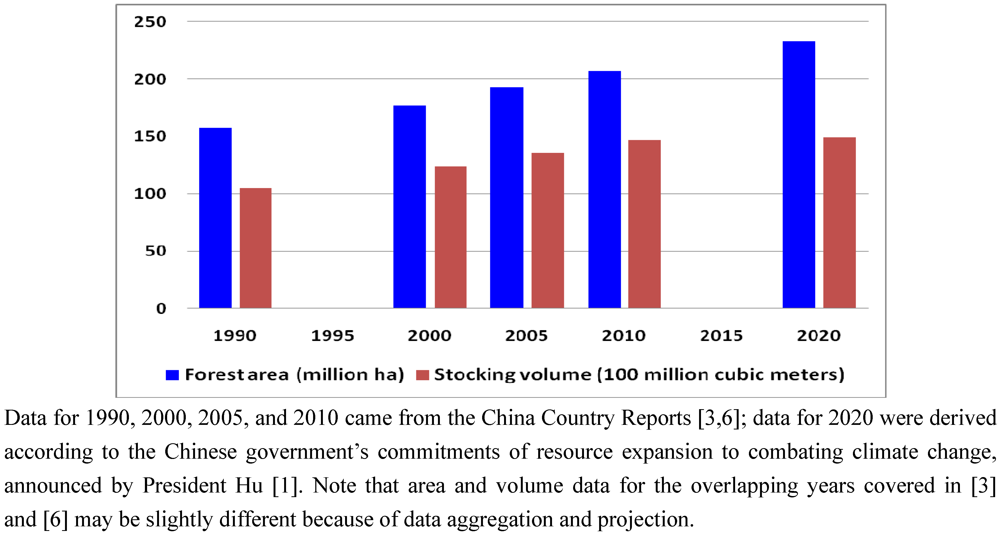
According to FAO [
6], China had a forest area of 193.04 million ha, carrying a stocking volume of 13.59 billion m
3 in 2005 (see
Table 1 and Table 6 of China Country Report, respectively). Compared to its resource status in 1990, the country’s forests gained 35.90 million ha in area and 3.10 billion m
3 in stock by 2005 (
Figure 1).
Figure 1.
Forest area and stocking volume of China.
Figure 1.
Forest area and stocking volume of China.
As such, the carbon stock in China’s forest increased by almost 1.60 billion tons in living biomass, dead wood, and litter (see Table 8 of China Country Report, but note that carbon in soil was not included). That stock is roughly the same amount of carbon China emitted from fossil fuel combustion in 2005 [
8,
9]. As a whole, China’s forests stored about 6.69 billion tons of carbon in 2005, with an additional 0.48 billion tons in other wooded land [
6].
Obviously, it is an ambitious goal to add 40 million ha of forests over the 15-year time span from 2006 to 2020, given the fact that this is unprecedented in world forestry. However, our assessment suggests that it is very likely that China will be able to do so, if history offers any indication. From 2006 to 2010, China’s forest already increased by 13.8 million ha. A further amount of 9.7 million ha was afforested but remained un-stocked in 2010 [
6], most of which should have become stocked and thus can be counted as a large addition to the forest base. Together, it can be inferred that over a half of the targeted increase of forest area perhaps had been accomplished by 2010.
This is no doubt a tremendous accomplishment, and it reflects the recent efforts of accelerated tree planting and forest establishment. Ever since the turn of the century, China has undertaken several forest-centered, large ecological restoration and resource expansion programs [
10,
11], including the Sloping Land Conversion Program, the Natural Forest Protection Program, the Shelterbelt Development Program, the Desertification Combating Program, the Wildlife Conservation and Nature Reserves Program, and the Industrial Timber Plantation Program. Using the government’s language, implementing these programs has been “a leap forward in China’s forestry development” [
3].
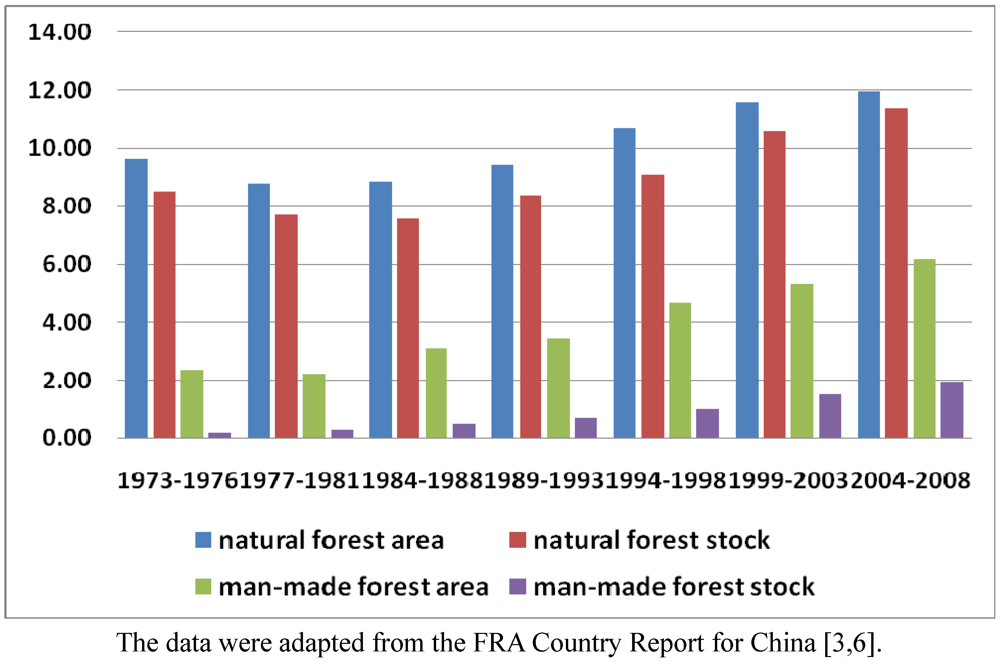
Data also indicate that China’s natural forests and plantations expanded substantially over the period of 1990–2010 (
Figure 2). Further, 35.49 million ha classified as “forest-suitable land” still remain available for afforestation or natural regeneration, according to the FRA 2010 China Country Report [
3]. Forest suitable land area is land suitable for planting trees and establishing a forest, with a canopy cover of trees less than 10% or a combined cover of shrub, bushes and trees less than 30%. Thus, all the evidence suggests that China will be able to achieve its target of forest area expansion—40 million ha, by 2020, giving rise to an expansion of more than 20%. Undoubtedly, it will be an arduous undertaking to achieve this goal; but we are confident that it will be achieved.
Figure 2.
Area changes of the major forest types of China.
Figure 2.
Area changes of the major forest types of China.
However, it seems that the proposed volume gain of 1.30 billion m
3 over 15 years represents only a modest, and even conservative, goal. First, this amount is less than a half of the volume increment for the period of 1990–2005 and only slightly greater than that for the period of 2006–2010—1.10 billion m
3 (see Table 6 of China Country Report [
6]). That suggests that the goal of stock increase has almost been fulfilled. Of course, as discussed later, it simply means that the government goal for forest stock increase is indeed conservative. Moreover, the fact is that an increase of forest stocking volume by 1.30 billion m
3 can take up a carbon stock of only about 640 million tons in woody biomass. Note that the possible increase of other wooded land has been excluded from our discussion. Given China’s continued rapid economic growth and the possible carbon intensity of its economy—the amount of CO
2 produced for each unit of economic output—this amount of carbon sequestration will not constitute a significant offset of the country’s carbon emissions.
More specifically, a consensus view is that China’s gross domestic product (GDP) will grow at an annual rate of 8% until 2020 (e.g., [
12,
13]). Meanwhile, the government has announced that China will reduce its emissions intensity by 40%–45% by 2020, compared to the level of 2005 [
14]. We have estimated that China’s cumulative carbon emissions from fossil fuel combustion during 2006–2020 will fall in the range of 32.74–34.44 billion tons, with a baseline of 1.6 billion tons in 2005 [
8,
9]. With the correction of a slight error in our earlier forecasting, this estimate is a bit higher than the figure we gave in [
2]. As such, the target of an additional carbon stock of 640 million tons in forest woody biomass is only about 2% of the country’s cumulative CO
2 emissions for the same period, even with emissions from other greenhouse gases (methane, nitrous oxide,
etc.) being excluded. Clearly, that can hardly be viewed as a major step in curbing China’s CO
2 emissions.
As a matter of fact, China’s forests witnessed an annual carbon stock increment of 80 million tons during the period of 2006–2010 [
6], which is slightly lower than the projection made by Zhang
et al. [
15]. Given that, we may conjecture that forest carbon uptake in China from 2006 to 2020 should be at least twice as large as the government target. Thus, it could be said that the official target of forest-based carbon sequestration was arbitrarily set without careful and competent assessment. It is a mystery, though, why the government has made such an arbitrary and conservative commitment.
4. Do China’s Forests Have a Greater Potential of Sequestering Carbon?
Now the question is whether China’s forests have a greater potential of sequestering carbon and generating other ecosystem services. Our answer is “Yes”. In 2010, the forest stocking level in China was only 71 m
3/ha [
6], which is very low compared to the international average of 131 m
3/ha. It is also low relative to the production capacity of the majority of the forestland in the country [
16]. For instance, according to China’s National Plan for Medium- and Long-Term Forestry Development, the stocking level of existing commercial timber plantations, which accounted for over 2/3 of the total area of forest plantations, should reach approximately 100 m
3/ha [
17]. In contrast, the current stocking level of timber plantations is just 49 m
3/ha [
18].
Specifically, while forests in much of the northwest of the country do not support a high stocking level due to moisture constraint, those in the northeast and much of the south can carry high stocking levels because of their favorable climatic conditions [
18,
19]. However, because of the combined effect of China’s single mindedness of forest area expansion, extensive degradation of existing stands, and neglect of forest management [
19,
20,
21], the stocking levels of both natural and plantation forests are at the low end of levels reported by FAO. For all of the plantation forests, the overall stocking level is only 31.8 m
3/ha; for the natural forests, the stocking level is 95.3 m
3/ha [
18]. As shown in
Table 1, in the southern provinces where plantation forests are concentrated, the forest stocking level is mostly in the range of 30–50 m
3/ha. In the northeast, a major region of natural forests, it is below 80 m
3/ha in the two larger provinces. These facts point to the country’s salient failure in improving its forest quality and productivity.
Table 1.
Area and stocking levels of individual provinces in China.
Table 1.
Area and stocking levels of individual provinces in China.
| Region/Province | Forest area (1,000 ha) | Stocking level (m3/ha) |
|---|
| Southern collective forest region |
| Fujian | 7,649.4 | 78.67 |
| Guizhou | 4,204.7 | 51.69 |
| Jiangsu | 774.1 | 51.53 |
| Guangxi | 9,838.3 | 48.80 |
| Jiangxi | 9,313.9 | 44.66 |
| Hunan | 8,607.9 | 43.56 |
| Guangdong | 8,270.0 | 42.94 |
| Anhui | 3,319.9 | 42.25 |
| Hubei | 4,975.5 | 37.04 |
| Zhejiang | 5,539.2 | 31.91 |
| Plantation forests | – | 46.59 |
| Northeastern national forest region |
| Inner Mongolia | 20,506.7 | 68.49 |
| Heilongjiang | 17,975.0 | 76.72 |
| Jilin | 7,201.2 | 114.7 |
| Natural forests | – | 95.87 |
| World | – | 131.0 |
If the overall forest stocking level can increase 10 m
3/ha, from 70.2 m
3/ha in 2006, which is derived from the aggregate statistics of the 7th NFI and differs from what the SFA prefers to use—85.9 m
3/ha for stands of tall trees only [
18], to 80.2 m
3/ha in 2020, the total stocking volume will reach 18.68 billion m
3, with a net gain of 5.09 billion m
3–almost four times the government’s goal. This total stock can absorb close to 8% of the cumulative CO
2 emissions during 2006–2020. Notice, however, that the stocking level will reach only the average for East Asia—81 m
3/ha in 2005 [
22]. In contrast, given the area and volume increases announced by President Hu, the stocking level will actually decline to 63.90 m
3/ha by 2020!
One could argue that because over 2/3 of China’s forests are categorized as young or mid-aged stands, the lower stocking level is not necessarily unreasonable. However, younger stands tend to have higher growth rates. Unfortunately, the mean growth rate of China’s timber forests is only 3.85 m
3/ha/yr [
18]. If that could be raised to 5.00 m
3/ha/yr, an additional annual increment of 222 million m
3 in 2006 and 268 million m
3 in 2020 would result. A recent study indicates that the potential of timber supply in Heilongjiang could be as high as 3.4 times the current production level [
23].
It could be further argued that the tremendous expansion of forest area makes it harder to increase the stocking level, particularly in the near future. Nonetheless, it is more relevant to focus on the increase of stand growth and forest stock, as far as carbon sequestration and the provision of many other ecosystem services are concerned. After all, expansion in forest area, even if a significant one, does not mean much without a substantive gain in stocking volume.
5. How Can China Realize Its Potential Of Forest Growth?
China must emphasize the efficiency and productivity of its forestry. To that end, silvicultural and management practices should be fundamentally improved in terms of site and species selection, planting density, quality, and timing, competition control, and thinning [
19,
20,
21].
Notably, management activities following tree planting and regeneration, such as tending and thinning, have not been adequately incorporated into the current ecological restoration and resource expansion programs [
10]. The Sloping Land Conversion Program focuses on tree planting and forest establishment only. The first phase of the Natural Forest Protection Program (NFPP, 2000–2010) has concentrated on protecting the existing forests, funding the formation of a basic social safety net, compensating laid-off and retired employees, and forestation to a lesser extent in the national forest regions. In contrast, little has been done to improve the management of the existing forests.
Moreover, the issue of poor stand quality has often been confounded by the high-density and rush planting, which are often driven by the desire of farmers and workers to meet the government’s requirement for a sufficient survival rate as early as they can. In this way, they can fulfill their contracts and thus be eligible to receive the promised subsidies or compensation from the government [
24]. Consequently, the growth rates have been low, the canopy has not closed for a long time in many instances, and stand yield and vigor, let alone ecosystem functionality, have not been satisfactory [
10].
Various intermediate operations could be adopted to control the stand dynamics or change the physical environment of tree growth [
25,
26]. Different forms of pre-commercial thinning, including release cuttings, could remove undesired species and/or poorly formed individuals of a desirable species in order to improve the species composition and quality of the new stand. Sanitation cutting, removing dead or already damaged trees or trees more susceptible to disease or predator attack, could improve the health of the entire forest. Commercial thinning seeks to increase vigor and promote the growth of young and mid-aged stands that have high densities. Without adequate management, forest stands can easily lose their growth vigor and vitality and thus become susceptible to pest and disease attack and forest fire may follow [
25]. Certainly, this is not a good situation in light of the need for forests to adapt to a warming climate.
To improve silvicultural practices, the lagging public investment in capacity building, technical training, and extension service needs to be reversed [
10,
27]. In fact, in addition to various programs of public assistance, the SFA has incorporated resource management into the budgeting for the second phase of the NFPP, which will last for ten years, from 2011 to 2020 [
28]. According to the planning, a thinning target of 17.6 million ha at a cost of 1,800 yuan per ha (or about 32 billion yuan as a whole) has been set. However, that target accounts for only 36% of the forests in the NFPP-covered regions that need to be thinned, and forest management in the vast rural society has not even been considered.
Of course, it is unrealistic to rely on central government investments alone; local public and private entities must play a much more active part [
29,
30]. Without adequate bottom-up initiatives and local engagement, people tend not to plant or properly maintain trees, resulting in meager survival and growth. Likewise, without clear responsibilities and rewards, business enterprises, state employees, and rural households will not perform effectively in forest protection or management [
24,
31]. So far, however, the authorities have relied too heavily on administrative campaigns and failed to appreciate the role of incentives as well as the importance of contracting and other market-based schemes in carrying out various activities [
10,
24].
In our view, several essential steps must be taken in the current forest tenure reform and institutional transformation to promote efficiency and productivity. First, by contracting, leasing, or other means, households, either individually or collectively, should become the direct users and beneficiaries of forestland in rural China, with clearly defined use rights and delineated land boundaries. Then, they should be allowed to transfer and reallocate the land use and forest property rights, based on their own choices [
30]. Moreover, to entice private interest and participation in forestry in the vast collective forest regions, the authorities need to: (1) relax its harvesting regulations so that farmers can decide when to cut their trees and by how much; (2) reorganize its forest administration so that excessive staff are removed and budgetary support comes from local treasuries (rather than fees collected from farmers’ timber revenues); and (3) restructure its financial system so that farmers can use their land and timber as collaterals to obtain loans for investing in forestry [
10].
While progress has been made in these directions recently [
18], there remains a long way to go before a well-functioning market system emerges in China’s rural forest sector. Particularly, the harvest quota system is detrimental to forest production efficiency and productivity [
30]. By limiting where, when, and how much timber can be cut or thinned, this policy has offset much of the incentive generated by devolving the land use rights and thus led to a diminution in people’s interest in forestry. Without adequate rights to decide how to manage the forest and dispose of and benefit from the trees, it is hard to imagine that farmers and other land users will make the needed efforts to greatly improve forest growth and yields.
In the national forest regions of the northeast and southwest, forest management could be separated from logging and manufacturing, with the latter being taken up by the private sector. Then, the permanent personnel of forest management entities could be reduced and much of the silvicultural and management activities contracted out to private enterprises. In other words, while it is necessary for the government agencies to provide certain public goods and services, they could be produced by the private sector via various forms of contracting [
32]. Also, provision should be based on the subsidiarity principle,
i.e., provision at the lowest possible level of governmental hierarchy instead of constant reliance on the central government [
33].
In relation to the tenure reform and institutional transformation, the strategy of classified forest management requires rethinking. Given the variability in biophysical conditions, accessibility, and societal needs, classified management of commercially and environmentally oriented forests over space, or zoning, can be an appealing choice [
19,
34]. However, the current configuration of classified management has been carried out by all the basic units of forest management, based on bureaucratic decree. This strategy leaves little room for markets and local communities to function in allocating resources. In particular, once a forest is classified for environmental purpose, normal commercial management activities are substantially hindered or even completely forbidden by laws and regulations. Further, in many cases, what specific environmental services the designated forest will provide is rarely clearly spelt out. This classification has disrupted the normal operations of many forest enterprises. Meanwhile, the government compensation for the forest enterprises land users has been dismally low in terms of their conservation efforts and the opportunity cost of foregone timber production by designating the land as an ecological forest [
18].
In addition, the notion that commercial forestry and other activities of private interest will not benefit the environment must be repudiated [
19]. Unless the forest has a special value in biodiversity conservation and/or other non-commercial uses, in which case it should be made part of the nature reserve system, the majority of forestland ought to be managed flexibly for multiple benefits. It is not true that commercial use of forestland will always come at the sacrifice of environmental benefits. For example, timber production does not necessarily run against watershed protection or erosion control. The idea of separating commercial uses arbitrarily from environmental uses and thus having two distinct classes of forests everywhere is unfounded and unjustifiable. This will not only complicate resource management but also hamper the realization of maximum total forest ecosystem benefits or services [
34].
Furthermore, the fact is that improved resource conditions as well as productivity driven by the private sector can alleviate the government’s burden in providing timber, fuel, fodder, and other products, in addition to generating a whole host of ecosystem services, such as erosion control, watershed regulation, and carbon storage [
4]. Thus, the forest tenure reform in the collective forest region and the state enterprise reform in the national forest region should be cohesively integrated and implemented with the ecological restoration and resource expansion efforts. Compared to the great financial and programmatic commitments to ecological restoration, however, the SFA has not fully embraced and executed effective policy and incentives to attract private interest and action. Likewise, the NFPP should have incorporated the restructuring of the state forest bureaus and resource management. Under the current governance system, financial resources cannot be utilized effectively and forest management and thus quality and productivity will continue to lag.
While China’s forest policy needs to integrate various initiatives, build a longer-term perspective, and maintain the compatibility and complementarity of different elements, this is in conflict with the current administrative system, under which the administrators are appointed by the upper-level governments for a term of 4–5 years. As a result, they have been more interested in forest area expansion, which can be easily measured and demonstrated on an annual basis, and less interested in forest management, the outcome of which will take a longer time to be seen and credited.
Finally, it is also critical to institute a meaningful monitoring and assessment system, including the performance evaluation of forest agencies and administrators. In this regard, the lack of transparency and adequate procedures and no separation of monitoring from program implementation are major problems that the SFA faces, while weak coordination and collaboration are impediments to the science and research community [
10]. In addition, the almost complete absence of scientific advisory and stakeholder representation is a common issue across all of the monitoring and assessment activities.
6. Conclusions
In this paper, we have argued that expansion in forest area, even if as large as 40 million ha in 15 years, as announced by the Chinese government, does not mean much in terms of carbon sequestration without a substantive gain in the stocking volume. Our preliminary analysis shows that China’s forests have the potential to absorb 6%–8% of the country’s cumulative CO2 emissions during 2006–2020, if forest growth can be adequately improved by making silvicultural and management practices a priority. In comparison, the official target of increasing forest volume by 1.30 billion m3 can take up a carbon stock of only 640 million tons in woody biomass—about 2% of the country’s cumulative CO2emissions for the same period.
The question is how to take full advantage of China’s forests in sequestering atmospheric carbon and providing other ecosystem services, including timber and biofuel products, which will have major environmental implications by reducing log imports from the tropical counties or substituting fossil fuel consumption. Our analysis suggests that China must focus on improving its forest quality and productivity by transforming its sivilcultural practices. That is, management activities following tree planting and regeneration, such as tending and thinning, must be adequately incorporated into the current ecological restoration and resource expansion programs. Various operations can be adopted to control the stand dynamics or change the physical environment of tree growth. With adequate management, forest stands can maintain their growth vigor and thus not become susceptible to pest and disease attack.
To improve silvicultural and management practices, the public investment in capacity building, technical training, and extension service needs to be strengthened. However, it is unrealistic to rely on government investments alone; business and private entities must play a much more active part. Without adequate bottom-up initiatives and local engagement, however, people tend not to plant or maintain trees properly. So far, the authorities have relied too heavily on administrative campaigns and failed to realize the role of incentives as well as the importance of contracting and other market-based mechanisms for carrying out various projects. Improved resource conditions as well as productivity driven by the private sector can alleviate the government’s burdens in providing timber, fuel, fodder, and other products, in addition to generating various ecosystem services. Therefore, the forest tenure reform in the collective forest region and the state enterprise reform in the national forest regions should be coupled with the ecological restoration and resource expansion efforts and more effectively implemented.
It is to be hoped that with a timely and coherent adjustment of forest policy and management, China’s forestry will be able to overcome its challenges and reach its great potential in sequestering carbon and providing other ecosystem services.
Finally, a couple of limitations of this study should be acknowledged before closing. First, we have not been able to look into the cost effectiveness of various silvicultural practices. What we would like to point out here are: (1) we are confident that applied properly, these treatments are well justified in many places/instances; (2) in case the management goal goes beyond the commercial interest, the entailed environmental benefits must be factored in their justification. Second, in addition to management practices, the carbon sequestration potential of forests in China, or elsewhere, could be altered by other factors. For example, Blanco
et al. [
35] and Wei
et al. [
36] have reported how atmospheric pollution in the form of N deposition and acid rain could increase (due to fertilization effect) or reduce (due to soil acidification) forest growth, and how these phenomena might interact with management practices. While we have not considered them, we believe that their impact on our estimates would be slight, given the time horizon of our discussion as well as the basic status of the Chinese forest ecosystems.