<?xml version="1.0" encoding="UTF-8"?>
<!DOCTYPE article PUBLIC "-//NLM//DTD Journal Publishing DTD v2.3 20070202//EN" "journalpublishing.dtd">
<article xmlns:mml="http://www.w3.org/1998/Math/MathML" xmlns:xlink="http://www.w3.org/1999/xlink" xml:lang="en" article-type="research-article">
  <front>
    <journal-meta>
      <journal-id journal-id-type="publisher-id">forests</journal-id>
      <journal-title>Forests</journal-title>
      <abbrev-journal-title abbrev-type="publisher">Forests</abbrev-journal-title>
      <abbrev-journal-title abbrev-type="pubmed">Forests</abbrev-journal-title>
      <issn pub-type="epub">1999-4907</issn>
      <publisher>
        <publisher-name>MDPI</publisher-name>
      </publisher>
    </journal-meta>
    <article-meta>
      <article-id pub-id-type="doi">10.3390/f3020207</article-id>
      <article-id pub-id-type="publisher-id">forests-03-00207</article-id>
      <article-categories>
        <subj-group>
          <subject>Article</subject>
        </subj-group>
      </article-categories>
      <title-group>
        <article-title>Do Anthropogenic Dark Earths Occur in the Interior of Borneo? Some Initial Observations from East Kalimantan</article-title>
      </title-group>
      <contrib-group>
        <contrib contrib-type="author">
          <name>
            <surname>Sheil</surname>
            <given-names>Douglas</given-names>
          </name>
          <xref rid="af10-forests-03-00207" ref-type="aff">1</xref>
          <xref rid="af2-forests-03-00207" ref-type="aff">2</xref>
          <xref rid="af3-forests-03-00207" ref-type="aff">3</xref>
          <xref rid="c1-forests-03-00207" ref-type="corresp">*</xref>
        </contrib>
        <contrib contrib-type="author">
          <name>
            <surname>Basuki</surname>
            <given-names>Imam</given-names>
          </name>
          <xref rid="af3-forests-03-00207" ref-type="aff">3</xref>
        </contrib>
        <contrib contrib-type="author">
          <name>
            <surname>German</surname>
            <given-names>Laura</given-names>
          </name>
          <xref rid="af4-forests-03-00207" ref-type="aff">4</xref>
        </contrib>
        <contrib contrib-type="author">
          <name>
            <surname>Kuyper</surname>
            <given-names>Thomas W.</given-names>
          </name>
          <xref rid="af5-forests-03-00207" ref-type="aff">5</xref>
        </contrib>
        <contrib contrib-type="author">
          <name>
            <surname>Limberg</surname>
            <given-names>Godwin</given-names>
          </name>
          <xref rid="af6-forests-03-00207" ref-type="aff">6</xref>
        </contrib>
        <contrib contrib-type="author">
          <name>
            <surname>Puri</surname>
            <given-names>Rajindra K.</given-names>
          </name>
          <xref rid="af7-forests-03-00207" ref-type="aff">7</xref>
        </contrib>
        <contrib contrib-type="author">
          <name>
            <surname>Sellato</surname>
            <given-names>Bernard</given-names>
          </name>
          <xref rid="af8-forests-03-00207" ref-type="aff">8</xref>
        </contrib>
        <contrib contrib-type="author">
          <name>
            <surname>van Noordwijk</surname>
            <given-names>Meine</given-names>
          </name>
          <xref rid="af9-forests-03-00207" ref-type="aff">9</xref>
        </contrib>
        <contrib contrib-type="author">
          <name>
            <surname>Wollenberg</surname>
            <given-names>Eva</given-names>
          </name>
          <xref rid="c1-forests-03-00207" ref-type="corresp">10</xref>
        </contrib>
      </contrib-group>
      <aff id="af1-forests-03-00207"><label>1</label> Institute of Tropical Forest Conservation, P.O. Box 44, Kabale, Uganda</aff>
      <aff id="af2-forests-03-00207"><label>2</label> School of Environmental Science and Management, Southern Cross University, P.O. Box 157, Lismore, NSW 2480, Australia</aff>
      <aff id="af3-forests-03-00207"><label>3</label> Center for International Forestry Research (CIFOR), P.O. Box 0113 BOCBD, Bogor 16000, Indonesia; Email: <email>I.Basuki@cgiar.org</email></aff>
      <aff id="af4-forests-03-00207"><label>4</label> Department of Anthropology, University of Georgia, 255 Baldwin Hall, Athens, GA 30602, USA; Email: <email>lgerman@uga.edu</email></aff>
      <aff id="af5-forests-03-00207"><label>5</label> Department of Soil Quality, Wageningen University, P.O. Box 47, Wageningen NL-6700 AA, The Netherlands; Email: <email>thom.kuyper@wur.nl</email></aff>
      <aff id="af6-forests-03-00207"><label>6</label> Fauna &amp; Flora International—Indonesia Program, Komplek Laboratorium Pusat UNAS, JL. Harsono RM No 1 Ragunan, Jakarta Selatan 12550, Indonesia; Email: <email>tingang@cbn.net.id</email></aff>
      <aff id="af7-forests-03-00207"><label>7</label> Centre for BioCultural Diversity, School of Anthropology and Conservation, University of Kent at Canterbury, Kent CT2 7NR, UK; Email: <email>r.k.puri@kent.ac.uk</email> </aff>
      <aff id="af8-forests-03-00207"><label>8</label> Centre Asie du Sud-Est (Centre National de la Recherche Scientifique and Ecole des Hautes Etudes en Sciences Sociales), Maison de l'Asie, 22, Avenue du Président Wilson, Paris 75016, France; Email: <email>bernard.sellato@wanadoo.fr</email> </aff>
      <aff id="af9-forests-03-00207"><label>9</label> World Agroforestry Centre, ICRAF Southeast Asia, Jalan CIFOR, Situgede, Sindangbarang, Bogor 16115, Indonesia; Email: <email>m.vannoordwijk@cgiar.org</email></aff>
      <aff id="af10-forests-03-00207"><label>10</label> Gund Institute for Ecological Economics and Rubenstein School of Environment and Natural Resources, University of Vermont, 617 Main Street, Burlington, VT 05405, USA; Email: <email>lini.wollenberg@uvm.edu</email></aff>
      <author-notes>
        <corresp id="c1-forests-03-00207"><label>*</label> Author to whom correspondence should be addressed; Email: <email>douglassheil@itfc.org</email> </corresp>
      </author-notes>
      <pub-date pub-type="epub">
        <day>07</day>
        <month>05</month>
        <year>2012</year>
      </pub-date>
      <pub-date pub-type="collection"><month>06</month>
        <year>2012</year>
      </pub-date>
      <volume>3</volume>
      <issue>2</issue>
      <fpage>207</fpage>
      <lpage>229</lpage>
      <history>
        <date date-type="received">
          <day>16</day>
          <month>02</month>
          <year>2012</year>
        </date>
        <date date-type="rev-recd">
          <day>31</day>
          <month>03</month>
          <year>2012</year>
        </date>
        <date date-type="accepted">
          <day>11</day>
          <month>04</month>
          <year>2012</year>
        </date>
      </history>
      <permissions>
        <copyright-statement>©  2012 by the authors; licensee MDPI, Basel, Switzerland.</copyright-statement>
        <copyright-year>2012</copyright-year>
        <license xmlns:xlink="http://www.w3.org/1999/xlink" license-type="open-access" xlink:href="http://creativecommons.org/licenses/by/3.0/">
          <p>This article is an open-access article distributed under the terms and conditions of the Creative Commons Attribution license (http://creativecommons.org/licenses/by/3.0/).</p>
        </license>
      </permissions>
      <abstract>
        <p> Anthropogenic soils of the Amazon Basin (<italic>Terra Preta</italic>, <italic>Terra Mulata</italic>) reveal that pre-Colombian peoples made lasting improvements in the agricultural potential of nutrient-poor soils. Some have argued that applying similar techniques could improve agriculture over much of the humid tropics, enhancing local livelihoods and food security, while also sequestering large quantities of carbon to mitigate climate change. Here, we present preliminary evidence for Anthropogenic Dark Earths (ADEs) in tropical Asia. Our surveys in East Kalimantan (Indonesian Borneo) identified several sites where soils possess an anthropogenic development and context similar in several respects to the Amazon’s ADEs. Similarities include riverside locations, presence of useful fruit trees, spatial extent as well as soil characteristics such as dark color, high carbon content (in some cases), high phosphorus levels, and improved apparent fertility in comparison to neighboring soils. Local people value these soils for cultivation but are unaware of their origins. We discuss these soils in the context of local history and land-use and identify numerous unknowns. Incomplete biomass burning appears key to these modified soils. More study is required to clarify soil transformations in Borneo and to determine under what circumstances such soil improvements might remain ongoing.</p>
      </abstract>
      <kwd-group>
        <kwd>char</kwd>
        <kwd>soil fertility</kwd>
        <kwd>Hortic Anthrosols</kwd>
        <kwd>slash and burn</kwd>
        <kwd>swidden</kwd>
        <kwd>
          <italic>Terra Preta</italic>
        </kwd>
      </kwd-group>
    </article-meta>
  </front>
  <body>
    <sec sec-type="intro">
      <title>1. Introduction</title>
      <p>The anthropogenic soils of the Amazon Basin have generated considerable interest. These Hortic Anthrosols, also known as <italic>Terra Preta do Indio</italic>, contrast strongly with the surrounding soils (mostly Oxisols and Ultisols) in terms of higher and more stable soil organic matter, presence of charcoal, higher phosphorus (P), and superior moisture-holding capacity [<xref ref-type="bibr" rid="B1-forests-03-00207">1</xref>]. Patches of these Anthropogenic Dark Earths (ADEs) range in size from less than one to as large as 350 ha, but most are only a few hectares [<xref ref-type="bibr" rid="B2-forests-03-00207">2</xref>]. The majority of sites are 500 to 2,500 years old [<xref ref-type="bibr" rid="B3-forests-03-00207">3</xref>]. Present-day farmers value these soils for their high and sustained productivity and ability to grow crops that would otherwise require chemical fertilizers. Glaser [<xref ref-type="bibr" rid="B1-forests-03-00207">1</xref>] argued that understanding how to generate these soils may revolutionize agricultural production in the humid tropics. The soils also store up to 150 g kg<sup>−1</sup> of carbon (C) [<xref ref-type="bibr" rid="B4-forests-03-00207">4</xref>] compared to the 20–30 g kg<sup>−1</sup>, stored in surrounding Oxisols, suggesting wider application may mitigate climate change [<xref ref-type="bibr" rid="B5-forests-03-00207">5</xref>,<xref ref-type="bibr" rid="B6-forests-03-00207">6</xref>,<xref ref-type="bibr" rid="B7-forests-03-00207">7</xref>]. The nature and origin of these soils has thus become a subject of interest. </p>
      <p>The processes, activities and human intentions that contributed to these ADEs are still debated [<xref ref-type="bibr" rid="B8-forests-03-00207">8</xref>,<xref ref-type="bibr" rid="B9-forests-03-00207">9</xref>]. Their development likely involved positive feedbacks, where soil improvement supported local population growth which led to further soil use and development [<xref ref-type="bibr" rid="B10-forests-03-00207">10</xref>]. Evidence shows that <italic>Terra Preta </italic>was formed through the addition of char (incompletely combusted organic material under conditions of low O<sub>2 </sub>availability [<xref ref-type="bibr" rid="B11-forests-03-00207">11</xref>]) and nutrient inputs from village refuse and manure [<xref ref-type="bibr" rid="B12-forests-03-00207">12</xref>,<xref ref-type="bibr" rid="B13-forests-03-00207">13</xref>,<xref ref-type="bibr" rid="B14-forests-03-00207">14</xref>]. </p>
      <p>Rainforest soils are often low in the mineral nutrients required for agriculture. This is due to prolonged weathering and leaching on stable landforms and to the tendency for soil organic matter and associated nutrients to be quickly lost to decomposition following the clearing of vegetation [<xref ref-type="bibr" rid="B15-forests-03-00207">15</xref>]. Generally soil nutrient levels, and agricultural fertility, are highly correlated with levels of soil organic matter [<xref ref-type="bibr" rid="B16-forests-03-00207">16</xref>]. Most soil organic matter is short-lived (weeks to months). Soil clay and silt content are the primary correlates of soil C in the humid tropics, as they provide physical protection of organic compounds from microbial breakdown [<xref ref-type="bibr" rid="B17-forests-03-00207">17</xref>]. By contrast char is long-lived, and independent of soil texture, due to its recalcitrance to microbial decomposition. Typical half-lives are in the order of thousands of years [<xref ref-type="bibr" rid="B18-forests-03-00207">18</xref>]. Char contains large numbers of carboxylic and phenolic groups, which underlies the high cation exchange capacity (CEC) and nutrient retention capacity found in many anthropogenic soils [<xref ref-type="bibr" rid="B11-forests-03-00207">11</xref>,<xref ref-type="bibr" rid="B19-forests-03-00207">19</xref>]. <italic>Terra Preta</italic> has markedly higher levels of soil organic matter than the surrounding soils. Most is in the form of char.</p>
      <p>Swidden farming, or the use of fire to convert vegetative biomass into nutrients, can result in either “slash-and-burn” (generating ash, rather than char, having ephemeral effects and leading to shifting cultivation with long fallows) or “slash-and-char” (generating char, having persistent effects and allowing the transformation towards permanent agriculture or short-term fallows) [<xref ref-type="bibr" rid="B20-forests-03-00207">20</xref>]. Slash-and-char produces more recalcitrant C. Other smoldering fires also produce char (such as cooking fires and fires to chase insects away). The resulting stable organic matter affects the soil’s nutrient and water-holding capacity, structure and pH buffering and provides a useful index of fertility [<xref ref-type="bibr" rid="B16-forests-03-00207">16</xref>]. </p>
      <p>Kämpf <italic>et al.</italic> [<xref ref-type="bibr" rid="B21-forests-03-00207">21</xref>] proposed criteria for the identification of Amazonian Dark Earths. These include a thickness of 20 cm or more overlying an Oxisol or Ultisol (this being evidence for accumulation of earth material); the presence of artifacts, shells and aquatic organisms or other cultural material; levels of elemental P ≥ 65 mg kg<sup>−1</sup> (Mehlich-1, an assay method widely used in Brazil), charcoal ≥ 10 g kg<sup>−1</sup> (in the top soil to 40 or 60 cm depth); a humic-to-fulvic acid (HA/FA) ratio larger than two; and clear spatial association with prior human activities. For cases where available P (Mehlich-1) do not reach 65 mg kg<sup>−1</sup> due to recent crop production and depletion of that pool Kämpf <italic>et al.</italic> [<xref ref-type="bibr" rid="B21-forests-03-00207">21</xref>] suggest an additional criterion of 200 mg kg<sup>−1</sup> of total soil P. Other features that tend to set ADEs apart from surrounding soils include higher total nitrogen (N) content (the high C:N ratio of these soils can nonetheless result in lower N availability than in surrounding soils), higher soil pH (associated with ash and inputs of shells and bones), higher CEC (associated with the high HA/FA ratio) and base saturation, coarser texture, and lower exchangeable aluminum (due to higher pH). In the Amazon, forested <italic>Terra Preta</italic> locations also support above average densities of fruit trees, palms and other useful plants [<xref ref-type="bibr" rid="B22-forests-03-00207">22</xref>]. High levels of P in ADEs are of interest given the low levels found in most lowland tropical soils and the constraint these pose to plant growth [<xref ref-type="bibr" rid="B23-forests-03-00207">23</xref>,<xref ref-type="bibr" rid="B24-forests-03-00207">24</xref>]. Phosphorus is usually the key nutrient limiting agricultural productivity in the lowland tropics [<xref ref-type="bibr" rid="B25-forests-03-00207">25</xref>]. Very high P levels are often an indicator of human settlement due to long-term additions of P rich organic material [<xref ref-type="bibr" rid="B26-forests-03-00207">26</xref>]. </p>
      <p>Aside from prolonged human presence, details of the processes that led to ADEs remain poorly understood. The processes leading to <italic>Terra Preta</italic> and the associated intensity of agriculture (e.g., long <italic>vs.</italic> short-fallow rotations, or permanent fields) are the subject of debate. Processing of soils by earthworms and other soil organisms is believed to play a role by helping to stabilize the organic matter from char [<xref ref-type="bibr" rid="B27-forests-03-00207">27</xref>,<xref ref-type="bibr" rid="B28-forests-03-00207">28</xref>,<xref ref-type="bibr" rid="B29-forests-03-00207">29</xref>]. Conventional thinking states that <italic>Terra Preta</italic> cannot result from long-fallow shifting cultivation after slash-and-burn, as most biomass is transformed to ash rather than longer-lived char, and relatively ephemeral nutrient increases. </p>
      <p>The study of anthropogenic soils in the tropics has focused on the Amazon Basin. Soils similar to ADEs have been described elsewhere in the neotropics [<xref ref-type="bibr" rid="B30-forests-03-00207">30</xref>] as well as in southern and western Africa [<xref ref-type="bibr" rid="B31-forests-03-00207">31</xref>,<xref ref-type="bibr" rid="B32-forests-03-00207">32</xref>]. However, to date, comparable evaluations in tropical Asia are absent. This paper presents findings from an exploratory search for ADEs in Malinau District, Kalimantan (Indonesian Borneo) and places these in the context of what we know and can surmise about land-use history. </p>
      <p>We use the rest of section 1 to summarize key aspects of land-use history in the interior of Borneo. In section 2 we present our results, discuss evidence for ADEs and evaluate the circumstances that could have led to their formation. In section 3 we provide a more detailed overview of the research site and our methods. We summarize our main conclusions in section 4.</p>
      <sec>
        <title>People and Cultivation in the Interior of Borneo</title>
        <p>Modern humans have been present in Borneo for over 50,000 years [<xref ref-type="bibr" rid="B33-forests-03-00207">33</xref>] and in East Kalimantan for over 10,000 years [<xref ref-type="bibr" rid="B34-forests-03-00207">34</xref>,<xref ref-type="bibr" rid="B35-forests-03-00207">35</xref>,<xref ref-type="bibr" rid="B36-forests-03-00207">36</xref>]. The earliest evidence of rice consumption in Borneo dates to <italic>c. </italic>4500 BP [<xref ref-type="bibr" rid="B37-forests-03-00207">37</xref>], though rice phytoliths dating before 7000 BP have been reported from Sarawak [<xref ref-type="bibr" rid="B33-forests-03-00207">33</xref>]. Regular clearing of significant areas of forests as a land-use system is unlikely to predate the advent of iron tools [<xref ref-type="bibr" rid="B38-forests-03-00207">38</xref>]. Suitable technologies likely reached Borneo’s coasts around 2000 BP but made slow and uneven progress into the interior [<xref ref-type="bibr" rid="B39-forests-03-00207">39</xref>,<xref ref-type="bibr" rid="B40-forests-03-00207">40</xref>]. While 19th century European explorers to Borneo’s interior predominantly found rice cultivators using iron tools, stone tools remained in use in some communities until the mid-20th century [<xref ref-type="bibr" rid="B41-forests-03-00207">41</xref>,<xref ref-type="bibr" rid="B42-forests-03-00207">42</xref>,<xref ref-type="bibr" rid="B43-forests-03-00207">43</xref>,<xref ref-type="bibr" rid="B44-forests-03-00207">44</xref>]. </p>
        <p>Pre-iron forest clearance would likely have focused on small scale cultivation of root and tuber crops [<xref ref-type="bibr" rid="B33-forests-03-00207">33</xref>,<xref ref-type="bibr" rid="B45-forests-03-00207">45</xref>,<xref ref-type="bibr" rid="B46-forests-03-00207">46</xref>]. Some modern groups still rely on a mix of rice and tubers [<xref ref-type="bibr" rid="B47-forests-03-00207">47</xref>,<xref ref-type="bibr" rid="B48-forests-03-00207">48</xref>]. Only among certain iron possessing groups was swidden rice cultivation extensively developed, contributing to these groups’ demographic, cultural and military prominence. These groups expanded their influence, conquering, assimilating, replacing and influencing others [<xref ref-type="bibr" rid="B46-forests-03-00207">46</xref>,<xref ref-type="bibr" rid="B49-forests-03-00207">49</xref>,<xref ref-type="bibr" rid="B50-forests-03-00207">50</xref>,<xref ref-type="bibr" rid="B51-forests-03-00207">51</xref>]. During the last millennium a number of these swidden rice farming groups (including Kenyah, Kayan and, in our field area, the Merap) expanded into the interior of northern East Borneo [<xref ref-type="bibr" rid="B52-forests-03-00207">52</xref>]. The resulting settlements included hundreds to thousands of inhabitants and were organized to defend their territories, especially the limited land suitable for cultivation [<xref ref-type="bibr" rid="B53-forests-03-00207">53</xref>]. </p>
        <p>All Malinau’s ethnic groups have been mobile—fleeing from wars, persecution and disease, or invading, or invited as part of new alliances [<xref ref-type="bibr" rid="B49-forests-03-00207">49</xref>,<xref ref-type="bibr" rid="B53-forests-03-00207">53</xref>,<xref ref-type="bibr" rid="B54-forests-03-00207">54</xref>,<xref ref-type="bibr" rid="B55-forests-03-00207">55</xref>]. Most Malinau communities (though not all of the Merap) say that they came from other watersheds within the last two centuries (various pers. comm. by community members to DS and IB). Other ethnic groups such as the Bulusu (or Berusu), were driven away [<xref ref-type="bibr" rid="B53-forests-03-00207">53</xref>]. Other evidence, such as the genetics of local rice cultivars, also indicates considerable migration and mixing in recent times [<xref ref-type="bibr" rid="B56-forests-03-00207">56</xref>].</p>
        <p>Ethnographic accounts suggest that settlements in Malinau were traditionally located in strategic sites for protection against inter-tribal warfare and head-hunting raids [<xref ref-type="bibr" rid="B53-forests-03-00207">53</xref>] and leading to locations comparable to Denevan’s “bluff model” for pre-Colombian Amazonian settlements [<xref ref-type="bibr" rid="B57-forests-03-00207">57</xref>]. Villages relocated within their territory four or more times each century when there was a shortage of good farm land nearby. Catastrophes (floods, epidemics) and inter-tribal warfare, also led to frequent village relocation and to a relatively dynamic history of settlement in the region [<xref ref-type="bibr" rid="B53-forests-03-00207">53</xref>]. Ethno-historical accounts suggest that all contemporary communities have relocated their settlements many times in the last two centuries [<xref ref-type="bibr" rid="B58-forests-03-00207">58</xref>]. Since the early 20th century inter-tribal warfare ceased and communities have settled in accessible riverside locations [<xref ref-type="bibr" rid="B53-forests-03-00207">53</xref>].</p>
        <p>Old village sites continue to be visited due to their high density of native fruit trees [<xref ref-type="bibr" rid="B59-forests-03-00207">59</xref>]. As the Malinau River possesses few riverside locations suited to settlement, most such sites were used at some point in the last half century (IB and DS unpublished interviews). </p>
        <p>Swidden rice farming groups are not the only inhabitants. Much of the forested interior is unsuited to agriculture and remains the domain of sparsely distributed nomadic hunter-gatherers known as “Punan” [<xref ref-type="bibr" rid="B60-forests-03-00207">60</xref>]. The Punan often formed close associations with cultivators such as the Merap, who found the Punan useful as a means to exploit and guard resources in their territory [<xref ref-type="bibr" rid="B60-forests-03-00207">60</xref>]. While the Punan had been familiar with agriculture for centuries, and often encouraged fruit trees around their camps, few developed significant gardens until the last three decades when the government encouraged them to settle [<xref ref-type="bibr" rid="B47-forests-03-00207">47</xref>]. </p>
      </sec>
    </sec>
    <sec sec-type="results">
      <title>2. Results and Discussion</title>
      <sec>
        <title>2.1. Results of the First Survey</title>
        <p>Oxisols were found at 145 sites, Ultisols at 24, while Entisols, Alfisols and Inceptisols were observed at 13, 10 and 8 sites, respectively. We found no Andisols. Seventeen sites showed poor drainage and associated high levels of C (and are excluded when analyses refer to “dryland”). In the remaining 183 sites, soil nutrient levels were consistently very low, with low pH, limited CEC, low organic C, P, and base saturation. Soils showed marked acidity. Half of the forest locations had a pH-water lower than 4.4. Ratios of Calcium (Ca) to Aluminum (Al) (<italic>i.e.</italic>, Ca<sup>2+</sup>/Al<sup>3+</sup>) were low, with median values of 0.15; 0.09; 0.23 for the Oxisols, Ultisols, and Inceptisols respectively, suggesting possible aluminum (Al) toxicity [<xref ref-type="bibr" rid="B61-forests-03-00207">61</xref>]. The best soils, in terms of nutrients required for plant growth, occurred on flood plain sites and in swampy areas. These soils were often visibly darker and richer in organic matter. Both Merap and Punan expressed a preference for these dark soils for agriculture compared to the more common red and yellow soils.</p>
        <p>Local informants had a rich vocabulary and understanding of soil properties and agricultural potential. As might be expected from their contrasting agricultural and hunter-gatherer cultures, the Merap had a richer vocabulary and conceptual framework for describing soils than the Punan. The Merap used 20 terms to describe 79 plots, while the Punan used 14 terms to describe 84 plots (other plots were excluded as Kenyah and Putuk language terms were used, for a more detailed account of local soil terminology and criteria according to Malinau’s Merap and Punan people see [<xref ref-type="bibr" rid="B62-forests-03-00207">62</xref>]). All seven communities considered black or dark soils (<italic>tiem </italic>in Merap, <italic>punyuh</italic> in Punan) the best for agriculture, even though these soils were rare and localized. In our initial survey 43 out of 200 sites were identified by local residents as such “black soil(s)”. Of these, seven were on poorly drained sites. </p>
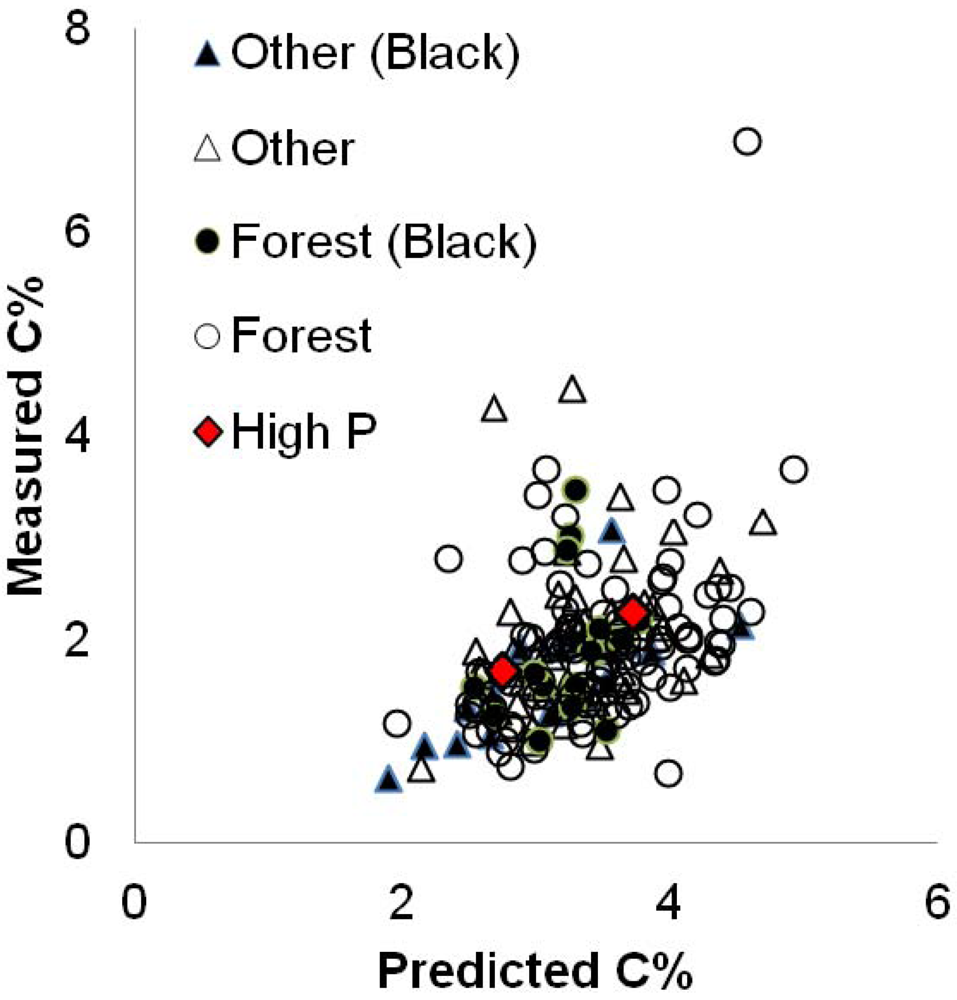
        <p>Relative levels of soil C in the dryland sites were well predicted by soil texture (Pearson’s coefficient = 0.407, n = 183, <italic>p</italic> &lt; 0.001) but were lower than expected (mean = 0.57% suggesting that topsoils in Malinau on average have lower soil C after correction for texture, than the soils in Sumatra where the equations were calibrated). There is no marked difference between forest and other land-use types, or between dark and non-dark soils (see <xref ref-type="fig" rid="forests-03-00207-f001">Figure 1</xref>). </p>
        <p>Black soils made up 36 of 183 (19%) of the dryland sites (<xref ref-type="table" rid="forests-03-00207-t001">Table 1</xref>). Black soil sites were commonly associated with human modified sites and comparatively scarce in old-growth forest sites (a null assumption that these frequencies are equal gives a <italic>χ</italic><sup>2 </sup>= 4.72, <italic>p</italic> = 0.030). Among the old village sites nearly half were black soils (the likelihood that this is the same proportion as for forest sites, <italic>χ</italic><sup>2 </sup>= 10.65, <italic>p</italic> = 0.0011). </p>
        <fig id="forests-03-00207-f001" position="anchor">
          <label>Figure 1</label>
          <caption>
            <p>Predicted versus measured percent carbon in the soil profile (0–20 cm depth) using the function developed in relatively similar conditions in Sumatra [<xref ref-type="bibr" rid="B17-forests-03-00207">17</xref>] based on soil texture and other factors applied to 183 well drained sites assessed in Malinau, Kalimantan (first survey). Symbols distinguish natural old-growth forest from other (human modified) sites, and those with black (<italic>i.e.</italic>, dark soils) from the rest. The two sites with notably high P are individually marked.</p>
          </caption>
          <graphic xmlns:xlink="http://www.w3.org/1999/xlink" xlink:href="forests-03-00207-g001.tif"/>
        </fig>
        <p>Two soils possessed high P (<xref ref-type="table" rid="forests-03-00207-t001">Table 1</xref>). Both were from relatively flat riverside locations and both surpassed the criterion of ≥65 mg kg<sup>−1</sup> elemental P for ADEs in the Amazon [<xref ref-type="bibr" rid="B21-forests-03-00207">21</xref>]. [Note that Kämpf <italic>et al.</italic> [<xref ref-type="bibr" rid="B21-forests-03-00207">21</xref>] used Mehlich-1 (a standard approach in Brazil), whereas we used Bray-1 (the standard approach in Indonesia where Mehlich-1 is not used) for P assessment. These methods give similar but not equivalent results. One study in an Amazonian oxisol suggests that Bray-1 can yield slightly higher estimates than Mehlich-1 [<xref ref-type="bibr" rid="B63-forests-03-00207">63</xref>]. Because both soils had much higher P-levels than mentioned by Kämpf <italic>et al.</italic> [<xref ref-type="bibr" rid="B21-forests-03-00207">21</xref>], we suggest they fit with the criterion of anthrosols]. One site in the territory of Gong Solok village (P concentration = 92.4 mg kg<sup>−1</sup> at 0–20 cm) was under a fruit tree garden and recognized as “tana tiem” or “black soil” in Merap. The other old village site in the territory of Laban Nyarit village (P = 206.1 mg kg<sup>−1 </sup>at 0–20 cm), was also in a fruit garden and included both black and non-black soils, and was called “tano bulah” or “mixed soil” in Punan. The Laban Nyarit site possessed higher P-levels at 20–40 cm (418.7 mg kg<sup>−1</sup>), suggesting ancient P-enrichment, while the Gong Solok site has lower deep P and is likely less ancient (P = 59.8 mg kg<sup>−1 </sup>at 20–40 cm). Selecting seven other sites in similar riverside settings judged at roughly similar likelihood of flooding (at least 10 m but not more than 50 m from any river and all on level ground a few meters above river levels) revealed much lower levels of available P (mean 8.1 mg kg<sup>−1 </sup>at 0–20 cm), not different from the non-black soils. These localized black soils cannot be classified as Hortic Anthrosols as they lack the obvious hortic, irragric, plaggic or terric horizons required by the WRB soil classification system [<xref ref-type="bibr" rid="B64-forests-03-00207">64</xref>]. It remains striking, though, that farmers classify and value these black soils, even though our soil chemical analysis did not indicate any special properties.</p>
        <p>Carbon levels and texture (clay and sand) of black soils were not significantly different from those of the other soils. The two sites with high P levels also did not show elevated levels of organic matter. Charred material was uncommon in the soil profiles. Char was seen in only 12 soil samples only four of which were black soils. The recognizable char observed in these profiles comprised small crumb-like grains and particles occasionally reaching 10 mm in diameter. These appeared to be charred wood. Some pieces were soft and brittle, while others were hard, and all shed black-dust. Char was observed in both fruit orchards with high P (Gong Solok and Laban Nyarit). All three primary forest sites that showed char were on hills near Long-Jalan—but none appeared to be black soils. Although char levels were not quantified, observations that neither C levels nor CEC were elevated in the two high P fruit orchard sites suggest only limited char deposition. Calcium levels were also not elevated in either site (<xref ref-type="table" rid="forests-03-00207-t001">Table 1</xref>).</p>
        <table-wrap id="forests-03-00207-t001" position="anchor">
          <object-id pub-id-type="pii">forests-03-00207-t001_Table 1</object-id>
          <label>Table 1</label>
          <caption>
            <p>Median (and maximum) values for key soil parameters in Malinau.</p>
          </caption>
          <table>
<thead>
              <tr>
                <th rowspan="2" align="left" valign="middle"> </th>
                <th colspan="2" style="border-bottom:solid thin" align="center" valign="middle">Forest</th>
                <th colspan="2" style="border-bottom:solid thin" align="center" valign="middle">Old village</th>
                <th colspan="2" style="border-bottom:solid thin" align="center" valign="middle">Agricultural </th>
                <th colspan="2" style="border-bottom:solid thin" align="center" valign="middle">Fallow</th>
    </tr>
              <tr>
                <th valign="middle">Black</th>
                <th valign="middle">Other</th>
                <th valign="middle">Black</th>
                <th valign="middle">Other</th>
                <th valign="middle">Black</th>
                <th valign="middle">Other</th>
                <th valign="middle">Black</th>
                <th valign="middle">Other</th>
              </tr>
            </thead>
            <tbody>
              <tr>
                <td align="left" valign="middle">N =</td>
                <td align="center" valign="middle">12</td>
                <td align="center" valign="middle">92</td>
                <td align="center" valign="middle">9</td>
                <td align="center" valign="middle">8</td>
                <td align="center" valign="middle">7</td>
                <td align="center" valign="middle">13</td>
                <td align="center" valign="middle">8</td>
                <td align="center" valign="middle">34</td>
              </tr>
              <tr>
                <td align="left" valign="middle">Sand % (0–20 cm)</td>
                <td align="center" valign="middle">30</td>
                <td align="center" valign="middle">25.5</td>
                <td align="center" valign="middle">29</td>
                <td align="center" valign="middle">40.5</td>
                <td align="center" valign="middle">27</td>
                <td align="center" valign="middle">15</td>
                <td align="center" valign="middle">11.5</td>
                <td align="center" valign="middle">25</td>
              </tr>
              <tr>
                <td align="left" valign="middle">Max</td>
                <td align="center" valign="middle">46</td>
                <td align="center" valign="middle">89</td>
                <td align="center" valign="middle">69</td>
                <td align="center" valign="middle">75</td>
                <td align="center" valign="middle">59</td>
                <td align="center" valign="middle">45</td>
                <td align="center" valign="middle">47</td>
                <td align="center" valign="middle">55</td>
              </tr>
              <tr>
                <td align="left" valign="middle">Clay % (0–20 cm)</td>
                <td align="center" valign="middle">31.5</td>
                <td align="center" valign="middle">35.5</td>
                <td align="center" valign="middle">25</td>
                <td align="center" valign="middle">25</td>
                <td align="center" valign="middle">34</td>
                <td align="center" valign="middle">30</td>
                <td align="center" valign="middle">33</td>
                <td align="center" valign="middle">34</td>
              </tr>
              <tr>
                <td align="left" valign="middle">Max</td>
                <td align="center" valign="middle">48</td>
                <td align="center" valign="middle">65</td>
                <td align="center" valign="middle">38</td>
                <td align="center" valign="middle">34</td>
                <td align="center" valign="middle">42</td>
                <td align="center" valign="middle">47</td>
                <td align="center" valign="middle">79</td>
                <td align="center" valign="middle">54</td>
              </tr>
              <tr>
                <td align="left" valign="middle">pH H<sub>2</sub>O (0–20 cm) </td>
                <td align="center" valign="middle">4.2</td>
                <td align="center" valign="middle">4.4</td>
                <td align="center" valign="middle">4.9</td>
                <td align="center" valign="middle">4.8</td>
                <td align="center" valign="middle">5.4</td>
                <td align="center" valign="middle">4.8</td>
                <td align="center" valign="middle">5.1</td>
                <td align="center" valign="middle">4.5</td>
              </tr>
              <tr>
                <td align="left" valign="middle">Max</td>
                <td align="center" valign="middle">6.0</td>
                <td align="center" valign="middle">5.2</td>
                <td align="center" valign="middle">6.2</td>
                <td align="center" valign="middle">5.7</td>
                <td align="center" valign="middle">5.9</td>
                <td align="center" valign="middle">5.8</td>
                <td align="center" valign="middle">6.0</td>
                <td align="center" valign="middle">5.6</td>
              </tr>
              <tr>
                <td align="left" valign="middle">C % (0–20 cm)</td>
                <td align="center" valign="middle">1.6</td>
                <td align="center" valign="middle">1.9</td>
                <td align="center" valign="middle">1.6</td>
                <td align="center" valign="middle">1.6</td>
                <td align="center" valign="middle">1.5</td>
                <td align="center" valign="middle">2.2</td>
                <td align="center" valign="middle">2.2</td>
                <td align="center" valign="middle">1.9</td>
              </tr>
              <tr>
                <td align="left" valign="middle">Max</td>
                <td align="center" valign="middle">3.0</td>
                <td align="center" valign="middle">6.9</td>
                <td align="center" valign="middle">2.0</td>
                <td align="center" valign="middle">2.8</td>
                <td align="center" valign="middle">2.6</td>
                <td align="center" valign="middle">3.4</td>
                <td align="center" valign="middle">3.5</td>
                <td align="center" valign="middle">4.3</td>
              </tr>
              <tr>
                <td align="left" valign="middle">C % (20–40 cm)</td>
                <td align="center" valign="middle">0.9</td>
                <td align="center" valign="middle">1.0</td>
                <td align="center" valign="middle">0.7</td>
                <td align="center" valign="middle">0.9</td>
                <td align="center" valign="middle">0.8</td>
                <td align="center" valign="middle">1.1</td>
                <td align="center" valign="middle">1.1</td>
                <td align="center" valign="middle">0.9</td>
              </tr>
              <tr>
                <td align="left" valign="middle">Max</td>
                <td align="center" valign="middle">3.1</td>
                <td align="center" valign="middle">4.6</td>
                <td align="center" valign="middle">1.3</td>
                <td align="center" valign="middle">2.4</td>
                <td align="center" valign="middle">1.2</td>
                <td align="center" valign="middle">2.9</td>
                <td align="center" valign="middle">2.5</td>
                <td align="center" valign="middle">1.6</td>
              </tr>
              <tr>
                <td align="left" valign="middle">*P mg kg<sup>−1</sup> (0–20 cm)</td>
                <td align="center" valign="middle">2.0</td>
                <td align="center" valign="middle">2.7</td>
                <td align="center" valign="middle">4.8</td>
                <td align="center" valign="middle">3.9</td>
                <td align="center" valign="middle">3.2</td>
                <td align="center" valign="middle">1.9</td>
                <td align="center" valign="middle">3.5</td>
                <td align="center" valign="middle">2.6</td>
              </tr>
              <tr>
                <td align="left" valign="middle">Max</td>
                <td align="center" valign="middle">9.7</td>
                <td align="center" valign="middle">20.0</td>
                <td align="center" valign="middle">31.6</td>
                <td align="center" valign="middle">8.0</td>
                <td align="center" valign="middle">92.4</td>
                <td align="center" valign="middle">5.0</td>
                <td align="center" valign="middle">206.1</td>
                <td align="center" valign="middle">26.8</td>
              </tr>
              <tr>
                <td align="left" valign="middle">*P mg kg<sup>−1</sup> (20–40 cm)</td>
                <td align="center" valign="middle">2.4</td>
                <td align="center" valign="middle">1.8</td>
                <td align="center" valign="middle">2.4</td>
                <td align="center" valign="middle">2.5</td>
                <td align="center" valign="middle">1.8</td>
                <td align="center" valign="middle">1.5</td>
                <td align="center" valign="middle">1.7</td>
                <td align="center" valign="middle">1.8</td>
              </tr>
              <tr>
                <td align="left" valign="middle">Max</td>
                <td align="center" valign="middle">10.1</td>
                <td align="center" valign="middle">11.5</td>
                <td align="center" valign="middle">29.5</td>
                <td align="center" valign="middle">11.2</td>
                <td align="center" valign="middle">59.8</td>
                <td align="center" valign="middle">8.1</td>
                <td align="center" valign="middle">418.8</td>
                <td align="center" valign="middle">5.1</td>
              </tr>
              <tr>
                <td align="left" valign="middle">Ca<sup>2+</sup> mMol<sub>e</sub>/100 g (0–20 cm)</td>
                <td align="center" valign="middle">0.3</td>
                <td align="center" valign="middle">0.5</td>
                <td align="center" valign="middle">7.1</td>
                <td align="center" valign="middle">3.0</td>
                <td align="center" valign="middle">4.6</td>
                <td align="center" valign="middle">7.5</td>
                <td align="center" valign="middle">3.2</td>
                <td align="center" valign="middle">1.1</td>
              </tr>
              <tr>
                <td align="left" valign="middle">Max</td>
                <td align="center" valign="middle">13.2</td>
                <td align="center" valign="middle">14.8</td>
                <td align="center" valign="middle">11.6</td>
                <td align="center" valign="middle">13.1</td>
                <td align="center" valign="middle">13.7</td>
                <td align="center" valign="middle">16.4</td>
                <td align="center" valign="middle">17.1</td>
                <td align="center" valign="middle">15.2</td>
              </tr>
              <tr>
                <td align="left" valign="middle">Ca<sup>2+</sup>mMol<sub>e</sub>/100 g (20–40 cm)</td>
                <td align="center" valign="middle">0.4</td>
                <td align="center" valign="middle">0.5</td>
                <td align="center" valign="middle">3.1</td>
                <td align="center" valign="middle">1.4</td>
                <td align="center" valign="middle">3.1</td>
                <td align="center" valign="middle">2.2</td>
                <td align="center" valign="middle">5.1</td>
                <td align="center" valign="middle">0.7</td>
              </tr>
              <tr>
                <td align="left" valign="middle">Max</td>
                <td align="center" valign="middle">7.4</td>
                <td align="center" valign="middle">22.6</td>
                <td align="center" valign="middle">10.7</td>
                <td align="center" valign="middle">9.8</td>
                <td align="center" valign="middle">10.1</td>
                <td align="center" valign="middle">12.3</td>
                <td align="center" valign="middle">12.6</td>
                <td align="center" valign="middle">6.9</td>
              </tr>
              <tr>
                <td align="left" valign="middle">ECECmMol<sub>e</sub>/100 g (0–20 cm)</td>
                <td align="center" valign="middle">8.6</td>
                <td align="center" valign="middle">10.4</td>
                <td align="center" valign="middle">6.9</td>
                <td align="center" valign="middle">9.2</td>
                <td align="center" valign="middle">9.9</td>
                <td align="center" valign="middle">13.4</td>
                <td align="center" valign="middle">9.0</td>
                <td align="center" valign="middle">9.4</td>
              </tr>
              <tr>
                <td align="left" valign="middle">Max</td>
                <td align="center" valign="middle">13.7</td>
                <td align="center" valign="middle">22.9</td>
                <td align="center" valign="middle">15.6</td>
                <td align="center" valign="middle">17.2</td>
                <td align="center" valign="middle">20.6</td>
                <td align="center" valign="middle">20.9</td>
                <td align="center" valign="middle">20.8</td>
                <td align="center" valign="middle">21.6</td>
              </tr>
              <tr>
                <td align="left" valign="middle">Base Saturation % (0–20 cm)</td>
                <td align="center" valign="middle">9.5</td>
                <td align="center" valign="middle">14.0</td>
                <td align="center" valign="middle">83.0</td>
                <td align="center" valign="middle">69.0</td>
                <td align="center" valign="middle">77.0</td>
                <td align="center" valign="middle">78.0</td>
                <td align="center" valign="middle">48.5</td>
                <td align="center" valign="middle">24.0</td>
              </tr>
              <tr>
                <td align="left" valign="middle">Max</td>
                <td align="center" valign="middle">100.0</td>
                <td align="center" valign="middle">100.0</td>
                <td align="center" valign="middle">100.0</td>
                <td align="center" valign="middle">100.0</td>
                <td align="center" valign="middle">100.0</td>
                <td align="center" valign="middle">100.0</td>
                <td align="center" valign="middle">100.0</td>
                <td align="center" valign="middle">96.0</td>
              </tr>
            </tbody>
          </table>
    <table-wrap-foot>
      <fn>
        <p>* From Bray I procedure, but expressed as mg P kg<sup>−1</sup> (see methods).</p>
      </fn>
    </table-wrap-foot>		  
        </table-wrap>
      </sec>
      <sec>
        <title>2.2. Results of the Second Survey</title>
        <p>With guidance from local respondents we selected three additional well-drained black soil sites in three communities (<xref ref-type="table" rid="forests-03-00207-t002">Table 2</xref>). Distance from the Malinau River ranged from 200 to 300 m and the three sites were not considered at risk of regular flooding. Observations of the profiles, sample locations and the wider vicinity indicated that local soils were neither Histosols nor Andisols. Each was under dryland rice cultivation at the time of sampling. All three sites, including the surroundings, had been cleared and burned in the previous 4 to 6 months, but ash was no longer visible on the soil surface. The Gong Solok site had been used as a trial coffee garden in 1981 before being converted to rice. The Lio Mutai and Long Jalan sites (far upriver—in areas traditionally used by both Punan and Merap) had been cultivated as dryland rice swidden fields in the past, but a full history was unavailable. Local people indicated that no chemical fertilizer had been used on these sites. We compared five paired soil samples for each site (black versus non-black). </p>
        <table-wrap id="forests-03-00207-t002" position="anchor">
          <object-id pub-id-type="pii">forests-03-00207-t002_Table 2</object-id>
          <label>Table 2</label>
          <caption>
            <p>Site description of black soil areas in each village.</p>
          </caption>
          <table>
            <thead>
              <tr>
                <th align="left" valign="middle"> </th>
                <th align="left" valign="middle">Gong Solok</th>
                <th align="left" valign="middle">Lio Mutai</th>
                <th align="left" valign="middle">Long Jalan</th>
              </tr>
            </thead>
            <tbody>
              <tr>
                <td align="left" valign="middle">Ethnic group</td>
                <td align="left" valign="middle">Merap</td>
                <td align="left" valign="middle">Punan</td>
                <td align="left" valign="middle">Punan</td>
              </tr>
              <tr>
                <td align="left" valign="middle">Alt (m a.s.l.)</td>
                <td align="left" valign="middle">85</td>
                <td align="left" valign="middle">142</td>
                <td align="left" valign="middle">252</td>
              </tr>
              <tr>
                <td align="left" valign="middle">Slope (%)</td>
                <td align="left" valign="middle">8</td>
                <td align="left" valign="middle">40</td>
                <td align="left" valign="middle">27</td>
              </tr>
              <tr>
                <td align="left" valign="middle">Landform</td>
                <td align="left" valign="middle">Footslope</td>
                <td align="left" valign="middle">Mid-slope</td>
                <td align="left" valign="middle">Hilltop</td>
              </tr>
              <tr>
                <td align="left" valign="middle">Extent (soil)</td>
                <td align="left" valign="middle">5 ha</td>
                <td align="left" valign="middle">1 ha</td>
                <td align="left" valign="middle">2 ha</td>
              </tr>
              <tr>
                <td align="left" valign="middle">Current land use</td>
                <td align="left" valign="middle">Swidden (mainly * hill rice)</td>
                <td align="left" valign="middle">Swidden (mainly hill rice)</td>
                <td align="left" valign="middle">Swidden (mainly hill rice)</td>
              </tr>
              <tr>
                <td align="left" valign="middle">Recent land use history</td>
                <td align="left" valign="middle">Coffee and cocoa garden until 1981</td>
                <td align="left" valign="middle">Swidden (mainly hill rice)</td>
                <td align="left" valign="middle">Swidden (mainly hill rice)</td>
              </tr>
              <tr>
                <td align="left" valign="middle">Surrounding</td>
                <td align="left" valign="middle">Rice fields, River</td>
                <td align="left" valign="middle">Rice Field, Forest, Logging Trail, River</td>
                <td align="left" valign="middle">Forest, Village, River</td>
              </tr>
            </tbody>
          </table>
    <table-wrap-foot>
      <fn>
        <p>* Areas generally include a number of other minor crops including maize, cassava, and green vegetables. </p>
      </fn>
    </table-wrap-foot>		
		</table-wrap>
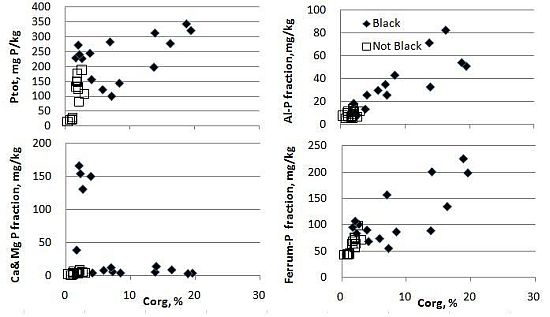
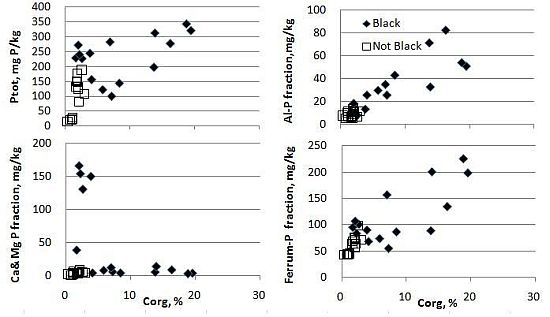
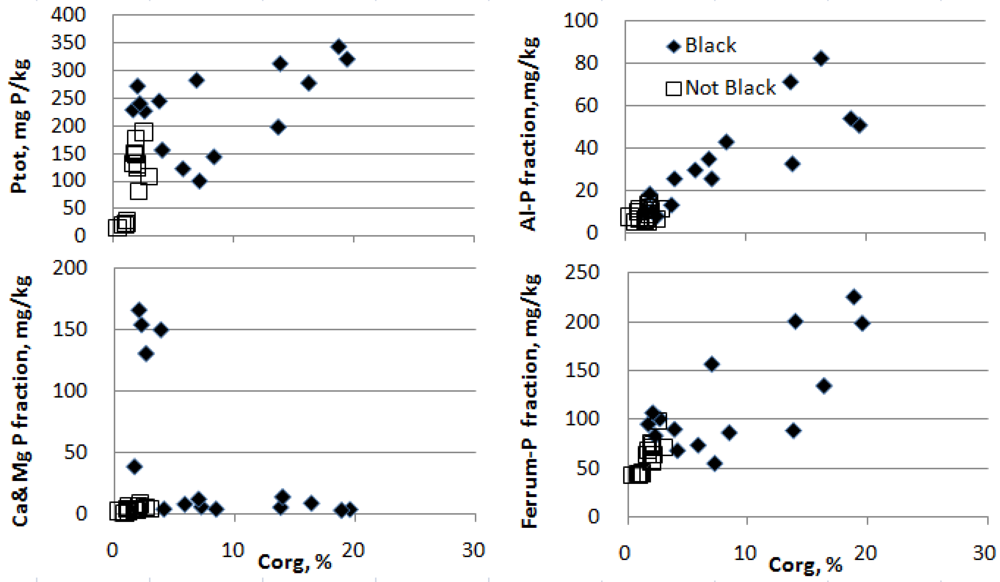
        <p>All three sites had somewhat elevated P levels (<xref ref-type="table" rid="forests-03-00207-t003">Table 3</xref>), although one site was below the 200 mg kg<sup>−1 </sup>P criterion [<xref ref-type="bibr" rid="B21-forests-03-00207">21</xref>]. The black soils at two sites had significantly higher C levels (nearly an order of magnitude more abundant) than the surrounding soils. Soil C:P ratios were around 500–600 for black soils and around 150–200 for the adjacent soils in two sites, suggesting that the increased C levels were due to inputs with very high C:P ratios (e.g., wood). On the other hand soil C:P ratios were 100 in black soils in the third site (Gong Solok) and around 200 for the adjacent soil (see <xref ref-type="table" rid="forests-03-00207-t003">Table 3</xref>) suggesting input of P-rich materials (possibly guano, and see discussion below). In that site a major part of the P was associated with the Ca-P fraction, rather than as iron (Fe) and Al (hydr-)oxides as in the two other sites (<xref ref-type="fig" rid="forests-03-00207-f002">Figure 2</xref>).</p>
        <table-wrap id="forests-03-00207-t003" position="anchor">
          <object-id pub-id-type="pii">forests-03-00207-t003_Table 3</object-id>
          <label>Table 3</label>
          <caption>
            <p>Percentage soil carbon and phosphorus from five replicates within and just outside three occurrences of fertile black soil, Mann-Whitney test statistic (Z) and one-sided <italic>p </italic>values. </p>
          </caption>
          <table>
<thead>
              <tr>
                <th rowspan="2" align="center" valign="middle">Soil</th>
                <th colspan="2" style="border-bottom:solid thin" align="center" valign="middle">C (%)</th>
                <th colspan="2" style="border-bottom:solid thin" align="center" valign="middle">Total P HCl 25% extraction (mg kg<sup>−1</sup>)</th>
                <th colspan="2" style="border-bottom:solid thin" align="center" valign="middle">Total P after fractionation (mg kg<sup>−1</sup>)</th>
              </tr>
              <tr>
                <th valign="middle">Black</th>
                <th valign="middle">Other</th>
                <th valign="middle">Black</th>
                <th valign="middle">Other</th>
                <th valign="middle">Black</th>
                <th valign="middle">Other</th>
              </tr>
            </thead>
            <tbody>
              <tr>
                <td align="left" valign="middle">Gong Solok, n =</td>
                <td align="center" valign="middle">5</td>
                <td align="center" valign="middle">5</td>
                <td align="center" valign="middle">5</td>
                <td align="center" valign="middle">5</td>
                <td align="center" valign="middle">5</td>
                <td align="center" valign="middle">5</td>
              </tr>
              <tr>
                <td align="left" valign="middle">Mean</td>
                <td align="center" valign="middle">2.50</td>
                <td align="center" valign="middle">2.24</td>
                <td align="center" valign="middle">243</td>
                <td align="center" valign="middle">114</td>
                <td align="center" valign="middle">249</td>
                <td align="center" valign="middle">94</td>
              </tr>
              <tr>
                <td align="left" valign="middle">Median</td>
                <td align="center" valign="middle">2.26</td>
                <td align="center" valign="middle">2.04</td>
                <td align="center" valign="middle">241</td>
                <td align="center" valign="middle">124</td>
                <td align="center" valign="middle">262</td>
                <td align="center" valign="middle">95</td>
              </tr>
              <tr>
                <td style="border-bottom:solid thin" align="left" valign="middle">Z, 
                <italic>p</italic> =</td>
                <td colspan="2" style="border-bottom:solid thin" align="center" valign="middle">−0.73, 
                <italic>0.548</italic></td>
                <td colspan="2" style="border-bottom:solid thin" align="center" valign="middle">−2.61, 
                <italic>0.008</italic></td>
                <td colspan="2" style="border-bottom:solid thin" align="center" valign="middle">−2.61, 
                <italic>0.008</italic></td>
              </tr>
              <tr>
                <td align="left" valign="middle">Lio Mutai, n =</td>
                <td align="center" valign="middle">5</td>
                <td align="center" valign="middle">5</td>
                <td align="center" valign="middle">5</td>
                <td align="center" valign="middle">5</td>
                <td align="center" valign="middle">5</td>
                <td align="center" valign="middle">5</td>
              </tr>
              <tr>
                <td align="left" valign="middle">Mean</td>
                <td align="center" valign="middle">7.88</td>
                <td align="center" valign="middle">0.90</td>
                <td align="center" valign="middle">145</td>
                <td align="center" valign="middle">22</td>
                <td align="center" valign="middle">130</td>
                <td align="center" valign="middle">64</td>
              </tr>
              <tr>
                <td align="left" valign="middle">Median</td>
                <td align="center" valign="middle">7.22</td>
                <td align="center" valign="middle">1.00</td>
                <td align="center" valign="middle">145</td>
                <td align="center" valign="middle">21</td>
                <td align="center" valign="middle">117</td>
                <td align="center" valign="middle">63</td>
              </tr>
              <tr>
                <td style="border-bottom:solid thin" align="left" valign="middle">Z, 
                <italic>p</italic> =</td>
                <td colspan="2" style="border-bottom:solid thin" align="center" valign="middle">−2.61, 
                <italic>0.008</italic></td>
                <td colspan="2" style="border-bottom:solid thin" align="center" valign="middle">−2.61, 
                <italic>0.008</italic></td>
                <td colspan="2" style="border-bottom:solid thin" align="center" valign="middle">−2.61, 
                <italic>0.008</italic></td>
              </tr>
              <tr>
                <td align="left" valign="middle">Long Jalan, n =</td>
                <td align="center" valign="middle">5</td>
                <td align="center" valign="middle">5</td>
                <td align="center" valign="middle">5</td>
                <td align="center" valign="middle">5</td>
                <td align="center" valign="middle">5</td>
                <td align="center" valign="middle">5</td>
              </tr>
              <tr>
                <td align="left" valign="middle">Mean</td>
                <td align="center" valign="middle">15.10</td>
                <td align="center" valign="middle">1.96</td>
                <td align="center" valign="middle">308</td>
                <td align="center" valign="middle">159</td>
                <td align="center" valign="middle">251</td>
                <td align="center" valign="middle">101</td>
              </tr>
              <tr>
                <td align="left" valign="middle">Median</td>
                <td align="center" valign="middle">16.31</td>
                <td align="center" valign="middle">1.92</td>
                <td align="center" valign="middle">313</td>
                <td align="center" valign="middle">150</td>
                <td align="center" valign="middle">256</td>
                <td align="center" valign="middle">100</td>
              </tr>
              <tr>
                <td align="left" valign="middle">Z, <italic>p</italic><italic>=</italic></td>
                <td colspan="2" align="center" valign="middle">−2.61, 
                <italic>0.008</italic></td>
                <td colspan="2" align="center" valign="middle">−2.61, 
                <italic>0.008</italic></td>
                <td colspan="2" align="center" valign="middle">−2.61, 
                <italic>0.008</italic></td>
              </tr>
            </tbody>
          </table>
        </table-wrap>
        <fig id="forests-03-00207-f002" position="anchor">
          <label>Figure 2</label>
          <caption>
            <p>Relation between organic carbon (C<sub>org</sub>, %) and total phosphorus, as well as three other P fractions (Fe-P, Al-P, Ca/Mg-P).</p>
          </caption>
          <graphic xmlns:xlink="http://www.w3.org/1999/xlink" xlink:href="forests-03-00207-g002.tif"/>
        </fig>
      </sec>
      <sec>
        <title>2.3. Evidence of Anthropogenic Dark Earths</title>
        <p>Our first survey indicated that most soils were Oxisols with low levels of organic matter and plant nutrients. According to local classifications around 20% of our dryland sites possessed black/dark soils, most of which appeared unexceptional. Nonetheless two had distinctly elevated P levels (with unremarkable C levels). The second survey, which focused on three dark agriculturally productive sites, found that two possessed markedly higher P and C levels than surrounding soils.</p>
        <p>Various characteristics of these four sites (two each from the first and second survey) are associated with ADEs: color, elevated levels of C and P, river-side locations, spatial extent, farmer-preferences and apparent extended human presence. Most strikingly, available soil P was substantially above the 65 mg kg<sup>−1</sup> in the two sites from the first survey, and total soil P was about 200 mg kg<sup>−1</sup> in the two sites from the second survey [<xref ref-type="bibr" rid="B21-forests-03-00207">21</xref>]. If these sites are anthropogenic should they also be considered as <italic>Terra Preta</italic>? We recognize several arguments against this: </p>
        <p><italic>Terra Preta</italic> soils possess significant charred organic matter. In our Borneo sites direct observations of char were limited—again, though this in itself is not conclusive, and further study is required [<xref ref-type="bibr" rid="B65-forests-03-00207">65</xref>]. </p>
        <p><italic>Terra Preta</italic> sites are characterized by high HA:FA ratios and consequently high CEC. The two sites in our first survey did not have elevated CEC. Similarly <italic>Terra Preta</italic> sites have high levels of base cations and high base saturation. Again, this was not observed except in Gong Solok, with its high levels of calcium phosphates (<xref ref-type="fig" rid="forests-03-00207-f002">Figure 2</xref>).</p>
        <p><italic>Terra Preta</italic>, like many Anthrosols [<xref ref-type="bibr" rid="B66-forests-03-00207">66</xref>], is characterized by high available (Mehlich-1, Bray-1) and total P, often in association with Ca, due to input from bones or guano. Two of our sites showed elevated available P (one also at depths below 20 cm, suggesting P enrichment took place a longer time ago), and two sites had total P consistent with the criterion of 200 mg kg<sup>−1</sup>. However, Kämpf <italic>et al.</italic> [<xref ref-type="bibr" rid="B21-forests-03-00207">21</xref>] used that criterion as a substitute only in cases where available P pool (was depleted by recent crop production. Sites in the second survey were only recently under intensive agriculture, so the application of that criterion (based on the consideration that P was only assessed that way) remains questionable. Classification of the black soils from the second survey as anthropogenic, though plausible, remains unproven.</p>
        <p><italic>Terra Preta</italic> soils are often associated with ceramics and other artifacts. Ceramics have not been found in our Malinau sites. This result is inconclusive due to the recognized differences in material cultures between regions. In contrast to Amazonia buried ceramics of any kind are, with specific exceptions, scarce precious imports in Malinau [<xref ref-type="bibr" rid="B67-forests-03-00207">67</xref>]. </p>
        <p>Sombroek (1966: 175) [<xref ref-type="bibr" rid="B68-forests-03-00207">68</xref>] proposed to subdivide the Amazonian Dark Earths into <italic>Terra Preta</italic> proper (black earth) and <italic>Terra Mulata</italic> (brown earth). <italic>Terra Mulata</italic> soils generally lack human artifacts and are of a lighter color. Others have expanded upon that distinction and suggested different origins for these soils—with <italic>Terra Preta</italic> being kitchen refuse “middens” and <italic>Terra Mulata</italic> being agricultural soils [<xref ref-type="bibr" rid="B69-forests-03-00207">69</xref>]. These distinctions remains somewhat theoretical as Amazonian Dark Earths reveal a continuum of intermediate forms [<xref ref-type="bibr" rid="B70-forests-03-00207">70</xref>]. Malinau’s soils cannot (yet) be accommodated in these schemes—more important for now are their origins. </p>
      </sec>
      <sec>
        <title>2.4. Origins</title>
        <p> Contemporary farmers seek out dark soils [<xref ref-type="bibr" rid="B62-forests-03-00207">62</xref>]. The fact that eight of 17 samples from abandoned villages assessed during our first survey were black soils also indicates some relationship with human settlements.</p>
        <p>While sustained human presence and cultivation were previously considered as prerequisites for the generation of ADEs, evidence from southern Africa and temperate Australia indicates that even non-agricultural aboriginal peoples can create such soils [<xref ref-type="bibr" rid="B31-forests-03-00207">31</xref>,<xref ref-type="bibr" rid="B71-forests-03-00207">71</xref>]. We require an open minded examination of soil formation processes and outcomes. </p>
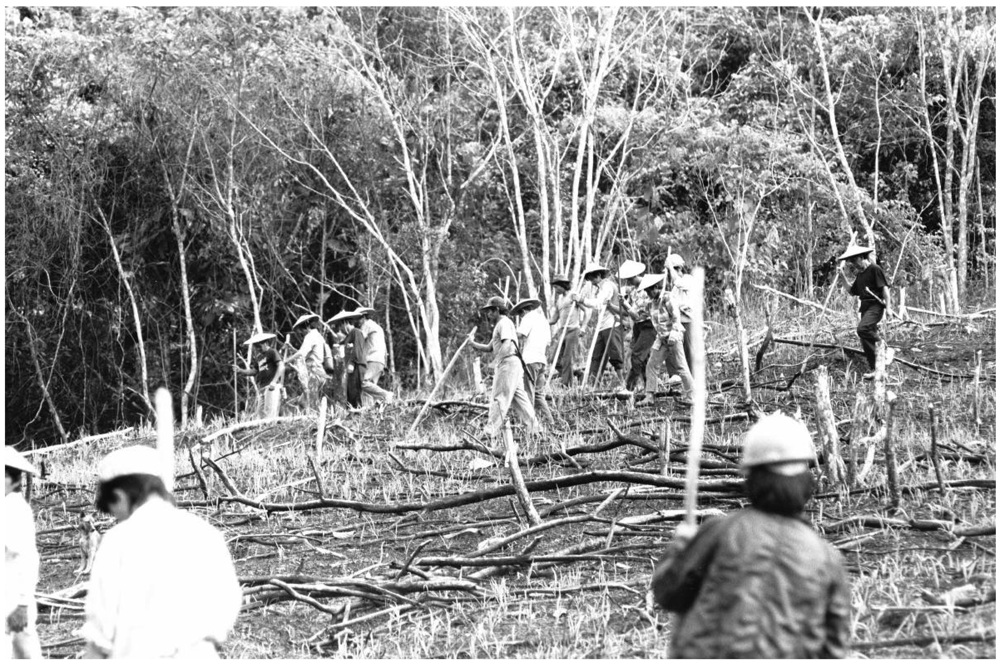
        <p>We are not in a position to judge the degree to which our P rich Borneo soils are a result of simple agricultural practices or other aspects of human presence (e.g., depositional processes associated with middens) or both. The variation in soil chemical signatures suggests mixed histories of agricultural production and settlement, and a possible continuum between slash-and-burn and slash-and-char practices. For the agricultural sites, rather than an absolute contrast between the char and burn practices, we speculate that practices have resulted in partial burns that added both ash and char to soils (see the woody debris in <xref ref-type="fig" rid="forests-03-00207-f003">Figure 3</xref>). Thus repeated burning of fallows generates darker soils with enhanced fertility and production. Such sites could contribute to more sedentary life styles. Soil heating, such as occurs with burning, can bring about other soil changes that remain incompletely understood [<xref ref-type="bibr" rid="B25-forests-03-00207">25</xref>,<xref ref-type="bibr" rid="B72-forests-03-00207">72</xref>]. In any case manure and other waste inputs would add P. Manure’s low N:P ratio allows accumulation of P. Such practices may have occurred in the past, as evidenced by the very high P levels in the 20–40 cm soil layer at one site in Laban Nyarit, and may still be occurring. An alternative and not necessarily exclusive hypothesis, particularly for sites high in both P and Ca, is that they result from human settlements.</p>
        <fig id="forests-03-00207-f003" position="anchor">
          <label>Figure 3</label>
          <caption>
            <p>Swidden farmers prepare a recently burned field cleared from secondary forest for planting with hill rice seed [<xref ref-type="bibr" rid="B73-forests-03-00207">73</xref>].</p>
          </caption>
          <graphic xmlns:xlink="http://www.w3.org/1999/xlink" xlink:href="forests-03-00207-g003.tif"/>
        </fig>
        <p>The occurrence of dark soils on steep slopes (the Lio Mutai and Long Jalan sites in our second survey) is notable. This is unlike anything reported from the Amazon region and may relate to the presence of hill-top settlements in the past—though this requires investigation. None of the soils in the first or second survey were Histosols or Andisols—this makes it less plausible that high P or organic matter might have a natural origin. </p>
        <p>We do not believe natural factors explain Malinau’s P rich black soils. Similar to <italic>Terra Preta, </italic>natural explanations for such soils have been proposed that suggest that people preferentially settled at such sites rather than improved them (Katzer, 1903: 68) [<xref ref-type="bibr" rid="B74-forests-03-00207">74</xref>]. Carbon rich peat soils do not currently occur in the Malinau Valley. Peats are generally low in mineral nutrients, do not form or persist in well-drained locations, and they decompose (and burn) when subjected to drainage, cultivation and fire [<xref ref-type="bibr" rid="B75-forests-03-00207">75</xref>,<xref ref-type="bibr" rid="B76-forests-03-00207">76</xref>]. Swampy organic-carbon rich sites may have been drained by shifting river courses or the geological warping and up-thrust that have occurred across the region [<xref ref-type="bibr" rid="B77-forests-03-00207">77</xref>] but we would not expect such organic matter to persist in aerated and drained soils under cultivation. We also excluded sites with poor drainage from our evaluation of C-rich or P-rich soils. We therefore reject explanations that such soils are natural rather than human-made. For similar reasons we consider it unlikely that organic matter has been carried from poorly drained areas and applied to the fields: such material would have low persistence, would not explain the chemical attributes (P enrichment), and would require labor inputs we judge unlikely, especially given the lack of such practices in the region, though such practices in the past cannot be excluded. </p>
        <p>Naturally occurring vegetation fires are unlikely to be localised to restricted riverside sites. We conclude that if burning has played a role in generating these soils it is predominantly human in origin. It is worth noting that, according to our data, land use has had little obvious impact on organic carbon (C<sub>org</sub>) [<xref ref-type="bibr" rid="B78-forests-03-00207">78</xref>]. If farmers select sites with higher C<sub>org</sub> this may somewhat balance any reduction caused by forest conversion but there is also a possibility that, as seen in anthropogenic soils elsewhere, such effects may not always be negative. </p>
        <p>We can speculate on the factors leading to specific soils. Some sites with increased P-levels also had high C suggesting the addition of organic material. Wood addition would have resulted, at least initially, in a very high C:P ratio, and in two sites the black soils had a C:P ratio that was around three times as high as the adjacent soils. In contrast, the black soils at the third site (Gong Solok) had a C:P ratio that was lower than that of the adjacent soil, suggesting addition of P-rich material. Refuse from a settlement would be one possible explanation. There are caves in the wider area making guano another possibility that could also explain the high levels of Ca in this soil (<xref ref-type="table" rid="forests-03-00207-t002">Table 2</xref>). In the first survey, the high P-levels in two sites suggest other origins, as they were not accompanied by higher C or Ca levels. </p>
        <p>High P can occur in locations possessing an underlying phosphate-rich geology, but none of our observations suggest such an origin. There are no active volcanoes in Borneo [<xref ref-type="bibr" rid="B79-forests-03-00207">79</xref>] and several of our sites are on raised ground. Work on repeated swidden cycles elsewhere in Kalimantan indicates that under some circumstances, P availability increases, presumably related to deep rooting of the fallow vegetation and increased storage in organic matter [<xref ref-type="bibr" rid="B25-forests-03-00207">25</xref>], but such increases are far less than in the two soils of the first survey. The likely explanation is that the P results directly from human activity. </p>
        <p>Whatever the sources of nutrients, there are potentials for feedback loops. Farmers in Malinau select cultivation sites based on soil color, surrounding vegetation, and “soil stickiness” [<xref ref-type="bibr" rid="B62-forests-03-00207">62</xref>]. Soils that are favored and further cultivated may improve over time if conditions are right and char accumulates. Furthermore, once a site has been cleared for cultivation it is more likely to be cleared and cultivated again. Clearing of fallows requires less labor than the clearing of intact rain forest (likely even more critical prior to iron-tools) and working close to settlements was safer in the days of inter-villages warfare [<xref ref-type="bibr" rid="B80-forests-03-00207">80</xref>]. </p>
      </sec>
      <sec>
        <title>2.5. Who Generated These Soils?</title>
        <p>Local people in Malinau, as in the Amazon, are unaware of how locally valued anthropogenic soils have formed. Though Borneo never suffered the catastrophic depopulation and cultural loss that occurred following European contact in the Americas, local continuity is lacking in Malinau. Large-scale population movements, limited archaeological information and changing land-use practices limit our ability to describe local cultural histories in any detail. </p>
        <p>Modern evidence of former human presence is seen in the fruiting and other useful trees in both the Amazon and in Malinau [<xref ref-type="bibr" rid="B22-forests-03-00207">22</xref>,<xref ref-type="bibr" rid="B54-forests-03-00207">54</xref>]. In Malinau, groves of fruit trees are found associated with abandoned village and camp sites often on ridges or mountain saddles inland from the main rivers. These sites are estimated to be as old as 250 years, a result consistent with oral histories and genealogical data, though the age of the trees themselves have yet to be determined. There are also old trees in and around extant villages and regular forest camps used for hunting and gathering trips, which indicate an extended human presence of at least a century and perhaps longer [<xref ref-type="bibr" rid="B54-forests-03-00207">54</xref>]. In any case, we are confident that farming people, though not necessarily rice farmers, have lived in Malinau for several centuries [<xref ref-type="bibr" rid="B51-forests-03-00207">51</xref>]. </p>
        <p>Our headwater soil sites are especially interesting due to their hill-slope locations. The short history of Punan cultivation makes it very unlikely that they are responsible if cultivation is the cause. More likely would be peoples whose lifestyles are more clearly determined by warfare and localized cultivation. While most Punan now farm to some degree, until recent decades most lived as hunter-gatherers, also trading forest products for rice and other goods. The limited soil-centered vocabulary of the Punan when compared to the Merap reflects their relative inexperience with agriculture. Merap judgments of soil properties are substantially closer to laboratory based measurements than those of the Punan [<xref ref-type="bibr" rid="B62-forests-03-00207">62</xref>]. The historical role of the Merap or other such farming peoples in these sites requires further exploration.</p>
        <p>Could these soils result from some other practices? We know that Punan have maintained extensive <italic>Imperata </italic>grasslands by regular burning elsewhere in the region [<xref ref-type="bibr" rid="B54-forests-03-00207">54</xref>] but such practices seem unlikely to have contributed to localized P rich riverside black soils where such grasslands are absent. The ovens associated with Dark Earths in Australia resulted in a specific pattern of localized mounds and soil changes [<xref ref-type="bibr" rid="B71-forests-03-00207">71</xref>] that seem inapplicable in the Malinau context. Some combination of land preparation, cultivation, and waste disposal, whether intended or inadvertent, seems the most likely explanation for the Dark Earths in our Malinau sites. </p>
        <p>Are Malinau’s dark anthropogenic soils relics as in the Amazon or are they still being created? Given how villagers clear, burn and char woody vegetation while preparing their gardens, and live nearby for years at a time, soil improvement and enrichment may be ongoing. Soils may be in various stages of transformation.</p>
      </sec>
    </sec>
    <sec>
      <title>3. Experimental Section</title>
      <sec>
        <title>3.1. Site and Land-Use Practices</title>
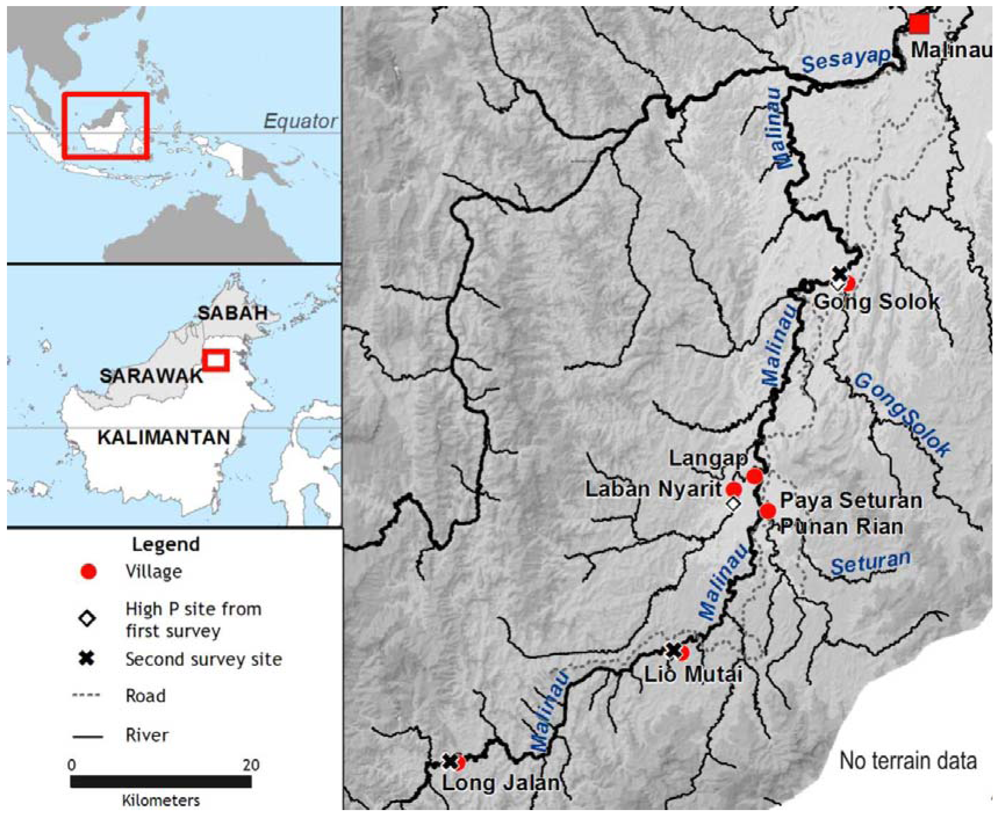
        <p>Research was carried out within the Malinau River catchment in Malinau District, East Kalimantan, Indonesia (<xref ref-type="fig" rid="forests-03-00207-f004">Figure 4</xref>). This region possesses rugged terrain, few roads and is judged to have low potential for agricultural intensification [<xref ref-type="bibr" rid="B62-forests-03-00207">62</xref>]. The region escaped the droughts and forest fires of 1997–1998 [<xref ref-type="bibr" rid="B81-forests-03-00207">81</xref>,<xref ref-type="bibr" rid="B82-forests-03-00207">82</xref>] and there are no reports, recent or historical, of large forest fires [<xref ref-type="bibr" rid="B83-forests-03-00207">83</xref>]. The area maintains dense rich rain forest, with small areas of human cultivation and fallows. Soils are diverse but no deep peats occur [<xref ref-type="bibr" rid="B62-forests-03-00207">62</xref>]. </p>
        <p>Population densities in the upper Malinau are less than one person per square kilometer [<xref ref-type="bibr" rid="B55-forests-03-00207">55</xref>,<xref ref-type="bibr" rid="B84-forests-03-00207">84</xref>]. Local people use land for a combination of shifting cultivation, gardening, permanent fruit orchards, hunting, fishing and the collection and trade of forest products [<xref ref-type="bibr" rid="B62-forests-03-00207">62</xref>,<xref ref-type="bibr" rid="B85-forests-03-00207">85</xref>,<xref ref-type="bibr" rid="B86-forests-03-00207">86</xref>]. Upland rice is now the predominant staple [<xref ref-type="bibr" rid="B54-forests-03-00207">54</xref>,<xref ref-type="bibr" rid="B62-forests-03-00207">62</xref>]. Modern-day settlements are all next to moderately sediment-rich rivers and most permanent cultivation of gardens and fruit orchards (agroforests) occurs on the restricted areas of relatively level riverside land even though these locations are often vulnerable to floods that occur every few years [<xref ref-type="bibr" rid="B86-forests-03-00207">86</xref>,<xref ref-type="bibr" rid="B87-forests-03-00207">87</xref>]. Swidden rice fields are found along the river’s edge as well as on steeper slopes inland, often alongside smaller streams and tributaries. Many farmers cultivate larger areas on the better soils near the river and smaller “insurance areas” away from the river that are less vulnerable to flood damage [<xref ref-type="bibr" rid="B62-forests-03-00207">62</xref>]. </p>
        <fig id="forests-03-00207-f004" position="anchor">
          <label>Figure 4</label>
          <caption>
            <p>Location of Borneo (top left) and study region in Borneo (mid-left) and the study area with the six focal villages and soil locations (main figure).</p>
          </caption>
          <graphic xmlns:xlink="http://www.w3.org/1999/xlink" xlink:href="forests-03-00207-g004.tif"/>
        </fig>
        <p>When clearing fields, local farmers generally cut and gather smaller woody debris into piles before burning. These piles tend to be haphazard, though often placed around the base of larger trees and stumps or on the lower slopes of hillsides. Larger material is left where it falls. As there is no pronounced dry season, people burn as soon as the material is flammable due to worries that heavy rains may otherwise intervene. Burning is often incomplete. Sometimes unburned material is gathered into piles and burned a second time—even so pieces of charred green wood and roots, and charcoal survive (IB and DS unpublished observations and interview data). Woody roots in the soil profile are especially likely to char [<xref ref-type="bibr" rid="B72-forests-03-00207">72</xref>]. Rice planting involves making holes using pointed sticks. Rice is sowed into the holes which are then filled with loose surface material including ash and charcoal (<xref ref-type="fig" rid="forests-03-00207-f004">Figure 4</xref> [<xref ref-type="bibr" rid="B88-forests-03-00207">88</xref>]). </p>
      </sec>
      <sec>
        <title>3.2. Surveys</title>
        <p>We conducted two surveys. The first explored the variation in soils, and people’s perceptions of them, with seven different communities across the upper half of the catchment of the Malinau River—an area of around 2,200 km<sup>2</sup>. We did not explicitly seek dark or anthropogenic soils. The second survey focused on three selected sites with locally valued dark soils. In both surveys burned and charred material on the soil surface (generally crumbling fragments of blackened wood) was avoided during the sampling. </p>
        <sec>
          <title>3.2.1. First Survey</title>
          <p>In seven indigenous communities we sampled two hundred sites covering a wide range of conditions (guided by a participatory mapping exercise). Sites covered all major land types recognized by the communities as well as sites of special value. “Forests” (old growth natural stands) were differentiated from “fallows” based on local informants (typically the younger vegetation in fallows was obvious), while “agriculture” referred to plots currently under cultivation. We interviewed local informants about each site, including site history and past and potential land-use. We also asked them to identify and describe the soil based on a soil profile. During the digging and describing of the soil profiles notes were made of visible particles of charcoal. Three communities were predominantly Punan (Long Jalan, Lio Mutai, and Punan Rian), three were predominantly Merap (Langap, Gong Solok, and Paya Seturan) and one was mixed (Laban Nyarit). The methods [<xref ref-type="bibr" rid="B89-forests-03-00207">89</xref>] and various results from these surveys have been published elsewhere [<xref ref-type="bibr" rid="B55-forests-03-00207">55</xref>,<xref ref-type="bibr" rid="B59-forests-03-00207">59</xref>,<xref ref-type="bibr" rid="B63-forests-03-00207">63</xref>,<xref ref-type="bibr" rid="B84-forests-03-00207">84</xref>].</p>
          <p>In each location soil samples of 0–20 cm depth were augured from three sites 10 m apart, mixed and sieved. Samples were oven dried at 105 °C for 24 hours and analyzed following standard procedures. Measurements included texture (pipette procedure; Sudjadi <italic>et al.</italic> 1971 in [<xref ref-type="bibr" rid="B90-forests-03-00207">90</xref>]), pH (KCl potassium chloride and H<sub>2</sub>O procedures; ISRIC 1993 in [<xref ref-type="bibr" rid="B90-forests-03-00207">90</xref>]), C<sub>org</sub> (Black 1965 in [<xref ref-type="bibr" rid="B89-forests-03-00207">89</xref>]), available P (Bray I; expressed as elemental P mg kg<sup>−1</sup>; Bray and Kurtz 1945 in [<xref ref-type="bibr" rid="B90-forests-03-00207">90</xref>] n.b. this is the standard measure used in Indonesia and at that time we had no reason to consider the Mehlich-1 based criteria used in Brazil), CEC, exchangeable bases, base saturation, and Al (NH4OAc procedure; ISRIC 1993 in [<xref ref-type="bibr" rid="B90-forests-03-00207">90</xref>]). Soil order classification followed standard USDA soil taxonomy [<xref ref-type="bibr" rid="B91-forests-03-00207">91</xref>,<xref ref-type="bibr" rid="B92-forests-03-00207">92</xref>]. </p>
        </sec>
        <sec>
          <title>3.2.2. Second Survey</title>
          <p>Local people identified especially fertile dark soils near each of three communities. Each site lies within 200 m of soil sampling sites from the first survey. At each site we took five paired samples (20 m apart) from these dark soils and adjacent soils (10 m from the boundary transition) at 0–20 cm depth. These samples were processed as before and analyzed for percentage of C and P. Total P was assessed by two methods: by extraction in 25%-HCl [<xref ref-type="bibr" rid="B90-forests-03-00207">90</xref>], and as the sum of P pools through P fractionation [<xref ref-type="bibr" rid="B93-forests-03-00207">93</xref>,<xref ref-type="bibr" rid="B94-forests-03-00207">94</xref>]. </p>
          <p>No carbon dating has yet been attempted on soils from either survey. </p>
          <p>Statistical analyses were performed in MS-Excel and SPSS. For comparative purposes soil C was related to soil properties based on a regression developed for Sumatra. For each location soil C content was normalized for effects of texture, elevation and pH based on a pedotransfer equation:</p>
          <p><italic>C<sub>ref</sub></italic> = (<italic>Depth</italic>/7.5)<sup>−0.527</sup> × <italic>e</italic><sup>(1.333 + 0.00994 × <italic>Clay%</italic> + 0.00699 * <italic>Silt% </italic>− 0.156 × <italic>pH_KCl</italic> + 0.000427 × <italic>Elevation</italic>)</sup> (1)</p>
          <p>here C<sub>ref</sub> is the C<sub>org</sub> expected for a forest soil of the same texture, pH and elevation; <italic>e</italic> is the base of natural logarithms, while Depth, Clay%, Silt%, pH_KCl refer to depth measured in cm, clay and silt as gravimetric percentage of soil composition; and pH_KCl is the pH of a 1 N KCl extraction solution; Elevation is meters (m) altitude above sea level, see [<xref ref-type="bibr" rid="B17-forests-03-00207">17</xref>].</p>
        </sec>
      </sec>
    </sec>
    <sec sec-type="conclusions">
      <title>4. Conclusions</title>
      <p>We have found sites in Borneo which exhibit some of the defining features of the Anthropogenic Dark Earths of tropical South America. The sites show distinguishing color and chemical signatures in terms of higher P or C levels compared to surrounding soils, fertility (as testified by local farmers), location, extent (1–5 ha) and cultural contexts. Human activity appears to be the only plausible explanation, yet we are uncertain about the age of the soils, who created them, by what processes and in what historical period(s). Farmers recognize the dark soils and favor them for both annual and perennial crops, yet they do not know what led to their formation. We suggest that the soils formed through incomplete combustion during repeated swidden cultivation and the inadvertent nutrient enrichment associated with human presence and domestic animals, resulting in the generation and accumulation of incompletely burnt biomass (char) in the soil. An alternative hypothesis, particularly for sites high in both P and Ca, is that they are due to depositional processes related to human settlement. Irrespective of the initial process, localized positive feedback cycles probably occurred in the selection of favorable sites and their further modification (cultivation and/or deposition). We underline that these soils may be young and their cultivation properties may not be durable. It is valuable to recognize the localized improvements of soil properties that can take place in specific contexts, but this does not suggest that Borneo’s soils are generally suitable for agricultural intensification or large-scale expansion of agriculture. Further research is required to clarify the origins of these soils in Malinau and whether similar soils can be found elsewhere in Borneo and the Asian tropics. </p>
      <p>Our observations have raised many exciting opportunities for further investigation. Further study on the distribution, dating, chemistry, structure, persistence and source of soil C and soil nutrients, and on local and regional palynology, archaeology and cultural and land-use history, would support more conclusive findings. The effects of pyrogenic versus other soil constituents on soil nutrients, stability and fertility should be explored. Examination of the soils, crops and local knowledge associated with different settlement histories and land-use practices elsewhere in Borneo and the wider region may shed further light on these processes and relationships. </p>
    </sec>
  </body>
  <back>
    <ack>
      <title>Acknowledgments</title>
      <p>The original survey was conducted under a project grant to CIFOR “Bulungan Model Forest Project, (PD12/97 Rev.1[F]) funded by the International Tropical Timber Organization (ITTO), the second survey was supported by funds from the European Commission. We thank Agus Salim for help preparing the map and the reviewers and editors for their comments, clarifications and corrections. DS, IB and RP designed the first survey which was undertaken by DS and IB, the second survey was designed by DS, IB and LG and undertaken by IB. Analysis and paper preparation was led by DS and IB with input from all authors. </p>
    </ack>
    <notes>
      <title>Conflict of Interest</title>
      <p>The authors declare no conflict of interest. </p>
    </notes>
    <ref-list>
      <title>References and Notes</title>
      <ref id="B1-forests-03-00207">
        <label>1.</label>
        <citation citation-type="journal">
          <person-group person-group-type="author">
            <name>
              <surname>Glaser</surname>
              <given-names>B.</given-names>
            </name>
          </person-group>
          <article-title>Prehistorically modified soils of central Amazonia: A model for sustainable agriculture in the twenty-first century</article-title>
          <source>Philos. T. R. Soc. Lon. B</source>
          <year>2007</year>
          <volume>362</volume>
          <fpage>187</fpage>
          <lpage>196</lpage>
          <issue>1478</issue>
          <pub-id pub-id-type="doi">10.1098/rstb.2006.1978</pub-id>
        </citation>
      </ref>
      <ref id="B2-forests-03-00207">
        <label>2.</label>
        <citation citation-type="journal">
          <person-group person-group-type="author">
            <name>
              <surname>Novotny</surname>
              <given-names>E.H.</given-names>
            </name>
            <name>
              <surname>Hayes</surname>
              <given-names>M.H.B.</given-names>
            </name>
            <name>
              <surname>Madari</surname>
              <given-names>B.E.</given-names>
            </name>
            <name>
              <surname>Bonagamba</surname>
              <given-names>T.J.</given-names>
            </name>
            <name>
              <surname>deAzevedo</surname>
              <given-names>E.R.</given-names>
            </name>
            <name>
              <surname>de Souza</surname>
              <given-names>A.A.</given-names>
            </name>
            <name>
              <surname>Song</surname>
              <given-names>G.X.</given-names>
            </name>
            <name>
              <surname>Nogueira</surname>
              <given-names>C.M.</given-names>
            </name>
            <name>
              <surname>Mangrich</surname>
              <given-names>A.S.</given-names>
            </name>
          </person-group>
          <article-title>Lessons from the Terra Preta de Indios of the Amazon region for the utilisation of charcoal for soil amendment</article-title>
          <source>J. Brazil. Chem. Soc.</source>
          <year>2009</year>
          <volume>20</volume>
          <fpage>1003</fpage>
          <lpage>1010</lpage>
          <issue>6</issue>
        </citation>
      </ref>
      <ref id="B3-forests-03-00207">
        <label>3.</label>
        <citation citation-type="book">
          <person-group person-group-type="author">
            <name>
              <surname>Rebellato</surname>
              <given-names>L.</given-names>
            </name>
            <name>
              <surname>Woods</surname>
              <given-names>W.I.</given-names>
            </name>
            <name>
              <surname>Neves</surname>
              <given-names>E.G.</given-names>
            </name>
          </person-group>
          <article-title>Pre-columbian settlement dynamics in the central Amazon</article-title>
          <source>Amazonian Dark Earths: Wim Sombroek’s Vision</source>
          <person-group person-group-type="editor">
            <name>
              <surname>Woods</surname>
              <given-names>W.I.</given-names>
            </name>
            <name>
              <surname>Teixeira</surname>
              <given-names>W.G.</given-names>
            </name>
            <name>
              <surname>Lehmann</surname>
              <given-names>J.</given-names>
            </name>
            <name>
              <surname>Steiner</surname>
              <given-names>C.</given-names>
            </name>
            <name>
              <surname>Prins</surname>
              <given-names>A.W.</given-names>
            </name>
            <name>
              <surname>Rebellato</surname>
              <given-names>L.</given-names>
            </name>
          </person-group>
          <publisher-name>Springer</publisher-name>
          <publisher-loc>Dordrecht, The Netherlands</publisher-loc>
          <year>2009</year>
          <fpage>15</fpage>
          <lpage>31</lpage>
        </citation>
      </ref>
      <ref id="B4-forests-03-00207">
        <label>4.</label>
        <citation citation-type="journal">
          <person-group person-group-type="author">
            <name>
              <surname>Glaser</surname>
              <given-names>B.</given-names>
            </name>
            <name>
              <surname>Haumaier</surname>
              <given-names>L.</given-names>
            </name>
            <name>
              <surname>Guggenberger</surname>
              <given-names>G.</given-names>
            </name>
            <name>
              <surname>Zech</surname>
              <given-names>W.</given-names>
            </name>
          </person-group>
          <article-title>The ‘Terra Preta’ phenomenon: A model for sustainable agriculture in the humid tropics</article-title>
          <source>Naturwissenschaften</source>
          <year>2001</year>
          <volume>88</volume>
          <fpage>37</fpage>
          <lpage>41</lpage>
          <issue>1</issue>
          <pub-id pub-id-type="doi">10.1007/s001140000193</pub-id>
        </citation>
      </ref>
      <ref id="B5-forests-03-00207">
        <label>5.</label>
        <citation citation-type="journal">
          <person-group person-group-type="author">
            <name>
              <surname>Batjes</surname>
              <given-names>N.H.</given-names>
            </name>
          </person-group>
          <article-title>Mitigation of atmospheric CO<sub>2</sub> concentrations by increased carbon sequestration in the soil</article-title>
          <source>Biol. Fert. Soils</source>
          <year>1998</year>
          <volume>27</volume>
          <fpage>230</fpage>
          <lpage>235</lpage>
          <issue>3</issue>
          <pub-id pub-id-type="doi">10.1007/s003740050425</pub-id>
        </citation>
      </ref>
      <ref id="B6-forests-03-00207">
        <label>6.</label>
        <citation citation-type="journal">
          <person-group person-group-type="author">
            <name>
              <surname>Fowles</surname>
              <given-names>M.</given-names>
            </name>
          </person-group>
          <article-title>Black carbon sequestration as an alternative to bioenergy</article-title>
          <source>Biomass Bioenerg.</source>
          <year>2007</year>
          <volume>31</volume>
          <fpage>426</fpage>
          <lpage>432</lpage>
          <issue>6</issue>
          <pub-id pub-id-type="doi">10.1016/j.biombioe.2007.01.012</pub-id>
        </citation>
      </ref>
      <ref id="B7-forests-03-00207">
        <label>7.</label>
        <citation citation-type="journal">
          <person-group person-group-type="author">
            <name>
              <surname>Lal</surname>
              <given-names>R.</given-names>
            </name>
          </person-group>
          <article-title>Global potential of soil carbon sequestration to mitigate the greenhouse effect</article-title>
          <source>CRC Crit. Rev. Plant Sci.</source>
          <year>2003</year>
          <volume>22</volume>
          <fpage>151</fpage>
          <lpage>184</lpage>
          <issue>2</issue>
          <pub-id pub-id-type="doi">10.1080/713610854</pub-id>
        </citation>
      </ref>
      <ref id="B8-forests-03-00207">
        <label>8.</label>
        <citation citation-type="book">
          <person-group person-group-type="author">
            <name>
              <surname>Denevan</surname>
              <given-names>W.M.</given-names>
            </name>
          </person-group>
          <article-title>Semi-intensive pre-European cultivation and the origins of anthropogenic dark earths in Amazonia</article-title>
          <source>Amazonian Dark Earths: Explorations in Space and Time</source>
          <person-group person-group-type="editor">
            <name>
              <surname>Glaser</surname>
              <given-names>B.</given-names>
            </name>
            <name>
              <surname>Woods</surname>
              <given-names>W.</given-names>
            </name>
          </person-group>
          <publisher-name>Springer-Verlag</publisher-name>
          <publisher-loc>Berlin, Germany</publisher-loc>
          <year>2004</year>
          <fpage>135</fpage>
          <lpage>144</lpage>
        </citation>
      </ref>
      <ref id="B9-forests-03-00207">
        <label>9.</label>
        <citation citation-type="journal">
          <person-group person-group-type="author">
            <name>
              <surname>German</surname>
              <given-names>L.A.</given-names>
            </name>
          </person-group>
          <article-title>Historical contingencies in the coevolution of environment and livelihood: Contributions to the debate on Amazonian Black Earth</article-title>
          <source>Geoderma</source>
          <year>2003</year>
          <volume>111</volume>
          <fpage>307</fpage>
          <lpage>331</lpage>
          <issue>3–4</issue>
          <pub-id pub-id-type="doi">10.1016/S0016-7061(02)00270-7</pub-id>
        </citation>
      </ref>
      <ref id="B10-forests-03-00207">
        <label>10.</label>
        <citation citation-type="book">
          <person-group person-group-type="author">
            <name>
              <surname>Van Hofwegen</surname>
              <given-names>G.</given-names>
            </name>
            <name>
              <surname>Kuyper</surname>
              <given-names>T.W.</given-names>
            </name>
            <name>
              <surname>Hoffland</surname>
              <given-names>E.</given-names>
            </name>
            <name>
              <surname>van den Broek</surname>
              <given-names>J.A.</given-names>
            </name>
            <name>
              <surname>Beck</surname>
              <given-names>G.A.</given-names>
            </name>
          </person-group>
          <article-title>Opening the black box: Deciphering carbon and nutrient flows in Terra Preta</article-title>
          <source>Amazonian Dark Earths: Wim Sombroek’s Vision</source>
          <person-group person-group-type="editor">
            <name>
              <surname>Woods</surname>
              <given-names>W.I.</given-names>
            </name>
            <name>
              <surname>Teixeira</surname>
              <given-names>W.G.</given-names>
            </name>
            <name>
              <surname>Lehmann</surname>
              <given-names>J.</given-names>
            </name>
            <name>
              <surname>Steiner</surname>
              <given-names>C.</given-names>
            </name>
            <name>
              <surname>Prins</surname>
              <given-names>A.M.G.A.W.</given-names>
            </name>
            <name>
              <surname>Rebellato</surname>
              <given-names>L.</given-names>
            </name>
          </person-group>
          <publisher-name>Springer</publisher-name>
          <publisher-loc>Dordrecht, The Netherlands</publisher-loc>
          <year>2009</year>
          <fpage>393</fpage>
          <lpage>409</lpage>
        </citation>
      </ref>
      <ref id="B11-forests-03-00207">
        <label>11.</label>
        <citation citation-type="journal">
          <person-group person-group-type="author">
            <name>
              <surname>Sohi</surname>
              <given-names>S.P.</given-names>
            </name>
            <name>
              <surname>Krull</surname>
              <given-names>E.</given-names>
            </name>
            <name>
              <surname>Elisa</surname>
              <given-names>L.C.</given-names>
            </name>
            <name>
              <surname>Bol</surname>
              <given-names>R.</given-names>
            </name>
          </person-group>
          <article-title>A review of biochar and its use and function in soil</article-title>
          <source>Adv. Agron.</source>
          <year>2010</year>
          <volume>105</volume>
          <fpage>47</fpage>
          <lpage>82</lpage>
        </citation>
      </ref>
      <ref id="B12-forests-03-00207">
        <label>12.</label>
        <citation citation-type="journal">
          <person-group person-group-type="author">
            <name>
              <surname>German</surname>
              <given-names>L.A.</given-names>
            </name>
          </person-group>
          <article-title>Ecological praxis and blackwater ecosystems: A case study from the Brazilian Amazon</article-title>
          <source>Hum. Ecol.</source>
          <year>2004</year>
          <volume>32</volume>
          <fpage>653</fpage>
          <lpage>683</lpage>
          <issue>6</issue>
          <pub-id pub-id-type="doi">10.1007/s10745-004-6831-1</pub-id>
        </citation>
      </ref>
      <ref id="B13-forests-03-00207">
        <label>13.</label>
        <citation citation-type="book">
          <person-group person-group-type="author">
            <name>
              <surname>Lehmann</surname>
              <given-names>J.</given-names>
            </name>
            <name>
              <surname>Kern</surname>
              <given-names>D.C.</given-names>
            </name>
            <name>
              <surname>Glaser</surname>
              <given-names>B.</given-names>
            </name>
            <name>
              <surname>Woods</surname>
              <given-names>W.</given-names>
            </name>
          </person-group>
          <source>Amazonia Dark Earths: Origin, Properties, Management</source>
          <publisher-name>Kluwer Academic Publishers</publisher-name>
          <publisher-loc>Dordecht, The Netherlands</publisher-loc>
          <year>2003</year>
        </citation>
      </ref>
      <ref id="B14-forests-03-00207">
        <label>14.</label>
        <citation citation-type="journal">
          <person-group person-group-type="author">
            <name>
              <surname>Lima</surname>
              <given-names>H.N.</given-names>
            </name>
            <name>
              <surname>Schaefer</surname>
              <given-names>C.E.R.</given-names>
            </name>
            <name>
              <surname>Mello</surname>
              <given-names>J.W.V.</given-names>
            </name>
            <name>
              <surname>Gilkes</surname>
              <given-names>R.J.</given-names>
            </name>
            <name>
              <surname>Ker</surname>
              <given-names>J.C.</given-names>
            </name>
          </person-group>
          <article-title>Pedogenesis and pre-Colombian land use of “Terra Preta Anthrosols” (“Indian black earth”) of Western Amazonia</article-title>
          <source>Geoderma</source>
          <year>2002</year>
          <volume>110</volume>
          <fpage>1</fpage>
          <lpage>17</lpage>
          <issue>1–2</issue>
          <pub-id pub-id-type="doi">10.1016/S0016-7061(02)00141-6</pub-id>
        </citation>
      </ref>
      <ref id="B15-forests-03-00207">
        <label>15.</label>
        <citation citation-type="journal">
          <person-group person-group-type="author">
            <name>
              <surname>Tiessen</surname>
              <given-names>H.</given-names>
            </name>
            <name>
              <surname>Cuevas</surname>
              <given-names>E.</given-names>
            </name>
            <name>
              <surname>Chacon</surname>
              <given-names>P.</given-names>
            </name>
          </person-group>
          <article-title>The role of soil organic-matter in sustaining soil fertility</article-title>
          <source>Nature</source>
          <year>1994</year>
          <volume>371</volume>
          <fpage>783</fpage>
          <lpage>785</lpage>
          <issue>6500</issue>
          <pub-id pub-id-type="doi">10.1038/371783a0</pub-id>
        </citation>
      </ref>
      <ref id="B16-forests-03-00207">
        <label>16.</label>
        <citation citation-type="journal">
          <person-group person-group-type="author">
            <name>
              <surname>Zech</surname>
              <given-names>W.</given-names>
            </name>
            <name>
              <surname>Senesi</surname>
              <given-names>N.</given-names>
            </name>
            <name>
              <surname>Guggenberger</surname>
              <given-names>G.</given-names>
            </name>
            <name>
              <surname>Kaiser</surname>
              <given-names>K.</given-names>
            </name>
            <name>
              <surname>Lehmann</surname>
              <given-names>J.</given-names>
            </name>
            <name>
              <surname>Miano</surname>
              <given-names>T.M.</given-names>
            </name>
            <name>
              <surname>Miltner</surname>
              <given-names>A.</given-names>
            </name>
            <name>
              <surname>Schroth</surname>
              <given-names>G.</given-names>
            </name>
          </person-group>
          <article-title>Factors controlling humification and mineralization of soil organic matter in the tropics</article-title>
          <source>Geoderma</source>
          <year>1997</year>
          <volume>79</volume>
          <fpage>117</fpage>
          <lpage>161</lpage>
          <issue>1–4</issue>
          <pub-id pub-id-type="doi">10.1016/S0016-7061(97)00040-2</pub-id>
        </citation>
      </ref>
      <ref id="B17-forests-03-00207">
        <label>17.</label>
        <citation citation-type="journal">
          <person-group person-group-type="author">
            <name>
              <surname>Van Noordwijk</surname>
              <given-names>M.</given-names>
            </name>
            <name>
              <surname>Woomer</surname>
              <given-names>P.</given-names>
            </name>
            <name>
              <surname>Cerri</surname>
              <given-names>C.</given-names>
            </name>
            <name>
              <surname>Bernoux</surname>
              <given-names>M.</given-names>
            </name>
            <name>
              <surname>Nugroho</surname>
              <given-names>K.</given-names>
            </name>
          </person-group>
          <article-title>Soil carbon in the humid tropical forest zone</article-title>
          <source>Geoderma</source>
          <year>1997</year>
          <volume>79</volume>
          <fpage>187</fpage>
          <lpage>225</lpage>
        </citation>
      </ref>
      <ref id="B18-forests-03-00207">
        <label>18.</label>
        <citation citation-type="journal">
          <person-group person-group-type="author">
            <name>
              <surname>Cheng</surname>
              <given-names>C.H.</given-names>
            </name>
            <name>
              <surname>Lehmann</surname>
              <given-names>J.</given-names>
            </name>
            <name>
              <surname>Thies</surname>
              <given-names>J.E.</given-names>
            </name>
            <name>
              <surname>Burton</surname>
              <given-names>S.D.</given-names>
            </name>
          </person-group>
          <article-title>Stability of black carbon in soils across a climatic gradient</article-title>
          <source>J. Geophys. Res.</source>
          <year>2008</year>
          <volume>113</volume>
          <issue>G02027</issue>
        </citation>
      </ref>
      <ref id="B19-forests-03-00207">
        <label>19.</label>
        <citation citation-type="journal">
          <person-group person-group-type="author">
            <name>
              <surname>Cunha</surname>
              <given-names>T.J.F.</given-names>
            </name>
            <name>
              <surname>Madari</surname>
              <given-names>B.E.</given-names>
            </name>
            <name>
              <surname>Canellas</surname>
              <given-names>L.P.</given-names>
            </name>
            <name>
              <surname>Ribeiro</surname>
              <given-names>L.P.</given-names>
            </name>
            <name>
              <surname>Benites</surname>
              <given-names>V.D.</given-names>
            </name>
            <name>
              <surname>Santos</surname>
              <given-names>G.D.</given-names>
            </name>
          </person-group>
          <article-title>Soil organic matter and fertility of anthropogenic dark earths (Terra Preta de Indio) in the Brazilian Amazon basin</article-title>
          <source>Rev. Bras. Cienc. Solo</source>
          <year>2009</year>
          <volume>33</volume>
          <fpage>85</fpage>
          <lpage>93</lpage>
          <issue>1</issue>
          <pub-id pub-id-type="doi">10.1590/S0100-06832009000100009</pub-id>
        </citation>
      </ref>
      <ref id="B20-forests-03-00207">
        <label>20.</label>
        <citation citation-type="book">
          <person-group person-group-type="author">
            <name>
              <surname>Steiner</surname>
              <given-names>C.</given-names>
            </name>
          </person-group>
          <source>Slash and Char as Alternative to Slash and Burn—Soil Charcoal Amendments Maintain Soil Fertility and Establish a Carbon Sink</source>
          <publisher-name>Cuvillier Verlag</publisher-name>
          <publisher-loc>Göttingen, Germany</publisher-loc>
          <year>2007</year>
        </citation>
      </ref>
      <ref id="B21-forests-03-00207">
        <label>21.</label>
        <citation citation-type="book">
          <person-group person-group-type="author">
            <name>
              <surname>Kämpf</surname>
              <given-names>N.</given-names>
            </name>
            <name>
              <surname>Woods</surname>
              <given-names>W.I.</given-names>
            </name>
            <name>
              <surname>Sombroek</surname>
              <given-names>W.</given-names>
            </name>
            <name>
              <surname>Kern</surname>
              <given-names>D.C.</given-names>
            </name>
            <name>
              <surname>Cunha</surname>
              <given-names>T.J.F.</given-names>
            </name>
          </person-group>
          <article-title>Classification of Amazonian Dark Earths and other ancient anthropic soils</article-title>
          <source>Amazonian Dark Earths: Origin, Properties, Management</source>
          <person-group person-group-type="editor">
            <name>
              <surname>Lehman</surname>
              <given-names>J.</given-names>
            </name>
            <name>
              <surname>Kern</surname>
              <given-names>D.C.</given-names>
            </name>
            <name>
              <surname>Glaser</surname>
              <given-names>B.</given-names>
            </name>
            <name>
              <surname>Woods</surname>
              <given-names>W.I.</given-names>
            </name>
          </person-group>
          <publisher-name>Kluwer</publisher-name>
          <publisher-loc>Dordrecht, The Netherlands</publisher-loc>
          <year>2003</year>
          <fpage>105</fpage>
          <lpage>124</lpage>
        </citation>
      </ref>
      <ref id="B22-forests-03-00207">
        <label>22.</label>
        <citation citation-type="book">
          <person-group person-group-type="author">
            <name>
              <surname>Clement</surname>
              <given-names>C.R.</given-names>
            </name>
            <name>
              <surname>McCann</surname>
              <given-names>J.M.</given-names>
            </name>
            <name>
              <surname>Smith</surname>
              <given-names>N.J.H.</given-names>
            </name>
          </person-group>
          <article-title>Agrobiodiversity in Amazonia and its relationship with dark earths</article-title>
          <source>Amazonian Dark Earths: Origin, Properties and Management</source>
          <person-group person-group-type="editor">
            <name>
              <surname>Lehmann</surname>
              <given-names>J.</given-names>
            </name>
            <name>
              <surname>Kern</surname>
              <given-names>D.C.</given-names>
            </name>
            <name>
              <surname>Glaser</surname>
              <given-names>B.</given-names>
            </name>
            <name>
              <surname>Woods</surname>
              <given-names>W.I.</given-names>
            </name>
          </person-group>
          <publisher-name>Kluwer</publisher-name>
          <publisher-loc>Dordrecht, The Netherlands</publisher-loc>
          <year>2003</year>
          <fpage>159</fpage>
          <lpage>178</lpage>
        </citation>
      </ref>
      <ref id="B23-forests-03-00207">
        <label>23.</label>
        <citation citation-type="journal">
          <person-group person-group-type="author">
            <name>
              <surname>Cleveland</surname>
              <given-names>C.C.</given-names>
            </name>
            <name>
              <surname>Townsend</surname>
              <given-names>A.R.</given-names>
            </name>
            <name>
              <surname>Schmidt</surname>
              <given-names>S.K.</given-names>
            </name>
          </person-group>
          <article-title>Phosphorus limitation of microbial processes in moist tropical forests: Evidence from short-term laboratory incubations and field studies</article-title>
          <source>Ecosystems</source>
          <year>2002</year>
          <volume>5</volume>
          <fpage>680</fpage>
          <lpage>691</lpage>
          <issue>7</issue>
        <pub-id pub-id-type="doi">10.1007/s10021-002-0202-9</pub-id></citation>
      </ref>
      <ref id="B24-forests-03-00207">
        <label>24.</label>
        <citation citation-type="journal">
          <person-group person-group-type="author">
            <name>
              <surname>McGroddy</surname>
              <given-names>M.E.</given-names>
            </name>
            <name>
              <surname>Silver</surname>
              <given-names>W.L.</given-names>
            </name>
            <name>
              <surname>de Oliveira</surname>
              <given-names>R.C.</given-names>
            </name>
          </person-group>
          <article-title>The effect of phosphorus availability on decomposition dynamics in a seasonal lowland Amazonian forest</article-title>
          <source>Ecosystems</source>
          <year>2004</year>
          <volume>7</volume>
          <fpage>172</fpage>
          <lpage>179</lpage>
        </citation>
      </ref>
      <ref id="B25-forests-03-00207">
        <label>25.</label>
        <citation citation-type="journal">
          <person-group person-group-type="author">
            <name>
              <surname>Lawrence</surname>
              <given-names>D.</given-names>
            </name>
            <name>
              <surname>Schlesinger</surname>
              <given-names>W.H.</given-names>
            </name>
          </person-group>
          <article-title>Changes in soil phosphorus during 200 years of shifting cultivation in Indonesia</article-title>
          <source>Ecology</source>
          <year>2001</year>
          <volume>82</volume>
          <fpage>2769</fpage>
          <lpage>2780</lpage>
          <issue>10</issue>
          <pub-id pub-id-type="doi">10.1890/0012-9658(2001)082[2769:CISPDY]2.0.CO;2</pub-id>
        </citation>
      </ref>
      <ref id="B26-forests-03-00207">
        <label>26.</label>
        <citation citation-type="journal">
          <person-group person-group-type="author">
            <name>
              <surname>Eidt</surname>
              <given-names>R.C.</given-names>
            </name>
          </person-group>
          <article-title>Detection and examination of anthrosols by phosphate analysis</article-title>
          <source>Science</source>
          <year>1977</year>
          <volume>197</volume>
          <fpage>1327</fpage>
          <lpage>1333</lpage>
          <issue>4311</issue>
        <pub-id pub-id-type="doi">10.1126/science.197.4311.1327</pub-id><pub-id pub-id-type="pmid">17746988</pub-id></citation>
      </ref>
      <ref id="B27-forests-03-00207">
        <label>27.</label>
        <citation citation-type="journal">
          <person-group person-group-type="author">
            <name>
              <surname>Topoliantz</surname>
              <given-names>S.</given-names>
            </name>
            <name>
              <surname>Ponge</surname>
              <given-names>J.F.</given-names>
            </name>
            <name>
              <surname>Lavelle</surname>
              <given-names>P.</given-names>
            </name>
          </person-group>
          <article-title>Humus components and biogenic structures under tropical slash-and burn agriculture</article-title>
          <source>Eur. J. Soil Sci.</source>
          <year>2006</year>
          <volume>57</volume>
          <fpage>548</fpage>
          <lpage>557</lpage>
          <issue>2</issue>
        </citation>
      </ref>
      <ref id="B28-forests-03-00207">
        <label>28.</label>
        <citation citation-type="journal">
          <person-group person-group-type="author">
            <name>
              <surname>Ponge</surname>
              <given-names>J.-F.</given-names>
            </name>
            <name>
              <surname>Topoliantz</surname>
              <given-names>S.</given-names>
            </name>
            <name>
              <surname>Ballof</surname>
              <given-names>S.</given-names>
            </name>
            <name>
              <surname>Rossi</surname>
              <given-names>J.P.</given-names>
            </name>
            <name>
              <surname>Lavelle</surname>
              <given-names>P.</given-names>
            </name>
            <name>
              <surname>Betsch</surname>
              <given-names>J.M.</given-names>
            </name>
            <name>
              <surname>Gaucher</surname>
              <given-names>P.</given-names>
            </name>
          </person-group>
          <article-title>Ingestion of charcoal by the Amazonian earthworm Pontoscolex corethrurus: A potential for tropical soil fertility</article-title>
          <source>Soil Biol. Biochem.</source>
          <year>2006</year>
          <volume>38</volume>
          <fpage>2008</fpage>
          <lpage>2009</lpage>
          <issue>7</issue>
          <pub-id pub-id-type="doi">10.1016/j.soilbio.2005.12.024</pub-id>
        </citation>
      </ref>
      <ref id="B29-forests-03-00207">
        <label>29.</label>
        <citation citation-type="journal">
          <person-group person-group-type="author">
            <name>
              <surname>Joseph</surname>
              <given-names>S.D.</given-names>
            </name>
            <name>
              <surname>Arbestain</surname>
              <given-names>M.C.</given-names>
            </name>
            <name>
              <surname>Lin</surname>
              <given-names>Y.</given-names>
            </name>
            <name>
              <surname>Munroe</surname>
              <given-names>P.</given-names>
            </name>
            <name>
              <surname>Chia</surname>
              <given-names>C.H.</given-names>
            </name>
            <name>
              <surname>Hook</surname>
              <given-names>J.</given-names>
            </name>
            <name>
              <surname>van Zwieten</surname>
              <given-names>L.</given-names>
            </name>
            <name>
              <surname>Kimber</surname>
              <given-names>S.</given-names>
            </name>
            <name>
              <surname>Cowie</surname>
              <given-names>A.</given-names>
            </name>
            <name>
              <surname>Singh</surname>
              <given-names>B.P.</given-names>
            </name>
            <etal/>
          </person-group>
          <article-title>An investigation into the reactions of biochar in soil</article-title>
          <source>Aust. J. Soil Res.</source>
          <year>2010</year>
          <volume>48</volume>
          <fpage>501</fpage>
          <lpage>515</lpage>
          <pub-id pub-id-type="doi">10.1071/SR10009</pub-id>
        </citation>
      </ref>
      <ref id="B30-forests-03-00207">
        <label>30.</label>
        <citation citation-type="book">
          <person-group person-group-type="author">
            <name>
              <surname>Graham</surname>
              <given-names>E.</given-names>
            </name>
          </person-group>
          <source>A Neotropical framework for Terra Preta. In Time and Complexity in Historical Ecology—Studies in the Neotropical Lowlands</source>
          <person-group person-group-type="editor">
            <name>
              <surname>Balee</surname>
              <given-names>W.</given-names>
            </name>
            <name>
              <surname>Erickson</surname>
              <given-names>C.L.</given-names>
            </name>
          </person-group>
          <publisher-name>Columbia University Press</publisher-name>
          <publisher-loc>New York, NY, USA</publisher-loc>
          <year>2006</year>
          <fpage>57</fpage>
          <lpage>86</lpage>
        </citation>
      </ref>
      <ref id="B31-forests-03-00207">
        <label>31.</label>
        <citation citation-type="journal">
          <person-group person-group-type="author">
            <name>
              <surname>Blackmore</surname>
              <given-names>A.C.</given-names>
            </name>
            <name>
              <surname>Mentis</surname>
              <given-names>M.T.</given-names>
            </name>
            <name>
              <surname>Scholes</surname>
              <given-names>R.J.</given-names>
            </name>
          </person-group>
          <article-title>The origin and extent of nutrient-enriched patches within a nutrient-poor savannah in South Africa</article-title>
          <source>J. Biogeogr.</source>
          <year>1990</year>
          <volume>17</volume>
          <fpage>463</fpage>
          <lpage>470</lpage>
        </citation>
      </ref>
      <ref id="B32-forests-03-00207">
        <label>32.</label>
        <citation citation-type="book">
          <person-group person-group-type="author">
            <name>
              <surname>Fairhead</surname>
              <given-names>J.</given-names>
            </name>
            <name>
              <surname>Leach</surname>
              <given-names>M.</given-names>
            </name>
          </person-group>
          <article-title>Amazonian Dark Earths in Africa?</article-title>
          <source>Amazonian Dark Earths: Wim Sombroek’s Vision</source>
          <person-group person-group-type="editor">
            <name>
              <surname>Woods</surname>
              <given-names>W.I.</given-names>
            </name>
            <name>
              <surname>Teixeira</surname>
              <given-names>W.G.</given-names>
            </name>
            <name>
              <surname>Lehmann</surname>
              <given-names>J.</given-names>
            </name>
            <name>
              <surname>Steiner</surname>
              <given-names>C.</given-names>
            </name>
            <name>
              <surname>WinklerPrins</surname>
              <given-names>A.M.G.A.</given-names>
            </name>
            <name>
              <surname>Rebellato</surname>
              <given-names>L.</given-names>
            </name>
          </person-group>
          <publisher-name>Springer</publisher-name>
          <publisher-loc>Dordrecht, The Netherlands</publisher-loc>
          <year>2009</year>
          <fpage>265</fpage>
          <lpage>278</lpage>
        </citation>
      </ref>
      <ref id="B33-forests-03-00207">
        <label>33.</label>
        <citation citation-type="book">
          <person-group person-group-type="author">
            <name>
              <surname>Barker</surname>
              <given-names>G.</given-names>
            </name>
          </person-group>
          <source>Rainforest Foraging and Farming in Island Southeast Asia: The Archaeology of the Niah Caves, Sarawak</source>
          <publisher-name>Sarawak Museum</publisher-name>
          <publisher-loc>Kuching, Malaysia</publisher-loc>
          <year>2011</year>
        </citation>
      </ref>
      <ref id="B34-forests-03-00207">
        <label>34.</label>
        <citation citation-type="journal">
          <person-group person-group-type="author">
            <name>
              <surname>Chazine</surname>
              <given-names>J.-M.</given-names>
            </name>
          </person-group>
          <article-title>Rock Art, Burials, and Habitations: Caves in East Kalimantan</article-title>
          <source>Asian Perspectives</source>
          <year>2005</year>
          <volume>44</volume>
          <fpage>219</fpage>
          <lpage>230</lpage>
          <issue>1</issue>
          <pub-id pub-id-type="doi">10.1353/asi.2005.0006</pub-id>
        </citation>
      </ref>
      <ref id="B35-forests-03-00207">
        <label>35.</label>
        <citation citation-type="journal">
          <person-group person-group-type="author">
            <name>
              <surname>Chazine</surname>
              <given-names>J.-M.</given-names>
            </name>
            <name>
              <surname>Ferrié</surname>
              <given-names>J.-G.</given-names>
            </name>
          </person-group>
          <article-title>Recent archaeological discoveries in East Kalimantan, Indonesia</article-title>
          <source>Bull. Indo. Pac. Pre. Hi.</source>
          <year>2008</year>
          <volume>28</volume>
          <fpage>16</fpage>
          <lpage>22</lpage>
        </citation>
      </ref>
      <ref id="B36-forests-03-00207">
        <label>36.</label>
        <citation citation-type="journal">
          <person-group person-group-type="author">
            <name>
              <surname>McDonagh</surname>
              <given-names>S.</given-names>
            </name>
          </person-group>
          <article-title>Art on the rocks: Dating ancient paintings in the caves of Borneo</article-title>
          <source>Science</source>
          <year>2003</year>
          <volume>164</volume>
          <fpage>147</fpage>
          <issue>10</issue>
        </citation>
      </ref>
      <ref id="B37-forests-03-00207">
        <label>37.</label>
        <citation citation-type="book">
          <person-group person-group-type="author">
            <name>
              <surname>Datan</surname>
              <given-names>I.</given-names>
            </name>
          </person-group>
          <source>Archaeological Excavations at Gua Sireh (Serian) and Lubang Angin (Gunung Mulu National Park), Sarawak, Malaysia</source>
          <publisher-name>Sarawak Museum</publisher-name>
          <publisher-loc>Sarawak, Malaysia</publisher-loc>
          <year>1993</year>
          <comment>The Sarawak Museum Journal. Special monograph no. 6</comment>
        </citation>
      </ref>
      <ref id="B38-forests-03-00207">
        <label>38.</label>
        <citation citation-type="journal">
          <person-group person-group-type="author">
            <name>
              <surname>Hutterer</surname>
              <given-names>K.</given-names>
            </name>
          </person-group>
          <article-title>The natural and cultural history of southeast Asian agriculture: Ecological and evolutionary considerations</article-title>
          <source>Anthropos</source>
          <year>1983</year>
          <volume>78</volume>
          <fpage>169</fpage>
          <lpage>212</lpage>
        </citation>
      </ref>
      <ref id="B39-forests-03-00207">
        <label>39.</label>
        <citation citation-type="book">
          <person-group person-group-type="author">
            <name>
              <surname>Avé</surname>
              <given-names>J.B.</given-names>
            </name>
            <name>
              <surname>King</surname>
              <given-names>V.T.</given-names>
            </name>
          </person-group>
          <source>Borneo: The People of the Weeping Forest; Tradition and Change in Borneo</source>
          <publisher-name>National Museum of Ethnology</publisher-name>
          <publisher-loc>Leiden, The Netherlands</publisher-loc>
          <year>1986</year>
        </citation>
      </ref>
      <ref id="B40-forests-03-00207">
        <label>40.</label>
        <citation citation-type="book">
          <person-group person-group-type="author">
            <name>
              <surname>Dove</surname>
              <given-names>M.</given-names>
            </name>
          </person-group>
          <article-title>The transition from stone to steel in the prehistoric Swidden agricultural technology of the Kantu’ of Kalimantan, Indonesia</article-title>
          <source>Foraging and Farming. The Evolution of Plant Exploitation</source>
          <person-group person-group-type="editor">
            <name>
              <surname>Harris</surname>
              <given-names>D.R.</given-names>
            </name>
            <name>
              <surname>Hillman</surname>
              <given-names>G.C.</given-names>
            </name>
          </person-group>
          <publisher-name>Unwin Hyman</publisher-name>
          <publisher-loc>London, UK</publisher-loc>
          <year>1989</year>
          <fpage>667</fpage>
          <lpage>677</lpage>
        </citation>
      </ref>
      <ref id="B41-forests-03-00207">
        <label>41.</label>
        <citation citation-type="journal">
          <person-group person-group-type="author">
            <name>
              <surname>Nicolaisen</surname>
              <given-names>J.</given-names>
            </name>
          </person-group>
          <article-title>The Penan of the seventh division of Sarawak: Past, present and future</article-title>
          <source>Sarawak Mus. J.</source>
          <year>1976</year>
          <volume>24</volume>
          <fpage>35</fpage>
          <lpage>62</lpage>
          <issue>45</issue>
        </citation>
      </ref>
      <ref id="B42-forests-03-00207">
        <label>42.</label>
        <citation citation-type="journal">
          <person-group person-group-type="author">
            <name>
              <surname>Nicolaisen</surname>
              <given-names>J.</given-names>
            </name>
          </person-group>
          <article-title>The Penan of Sarawak—Further Notes on the Neo-Evolutionary Concept of Hunters</article-title>
          <source>Folk</source>
          <year>1976</year>
          <volume>18</volume>
          <fpage>205</fpage>
          <lpage>236</lpage>
        </citation>
      </ref>
      <ref id="B43-forests-03-00207">
        <label>43.</label>
        <citation citation-type="book">
          <person-group person-group-type="author">
            <name>
              <surname>Harrisson</surname>
              <given-names>T.H.</given-names>
            </name>
          </person-group>
          <article-title>The prehistory of Borneo</article-title>
          <source>Prehistoric Indonesia</source>
          <person-group person-group-type="editor">
            <name>
              <surname>Velde</surname>
              <given-names>P.V.D.</given-names>
            </name>
          </person-group>
          <publisher-name>Foris</publisher-name>
          <publisher-loc>Dordrecht, The Netherlands</publisher-loc>
          <year>1984</year>
          <fpage>297</fpage>
          <lpage>326</lpage>
        </citation>
      </ref>
      <ref id="B44-forests-03-00207">
        <label>44.</label>
        <citation citation-type="book">
          <person-group person-group-type="author">
            <name>
              <surname>Sellato</surname>
              <given-names>B.</given-names>
            </name>
          </person-group>
          <source>Nomads of the Borneo Rainforest. The Economics, Politics, and Ideology of Settling Down</source>
          <publisher-name>University of Hawai’i Press</publisher-name>
          <publisher-loc>Honolulu, HI, USA</publisher-loc>
          <year>1994</year>
        </citation>
      </ref>
      <ref id="B45-forests-03-00207">
        <label>45.</label>
        <citation citation-type="journal">
          <person-group person-group-type="author">
            <name>
              <surname>Boomgaard</surname>
              <given-names>P.</given-names>
            </name>
          </person-group>
          <article-title>In the shadow of rice. Roots and tubers in Indonesian history, 1500-1950</article-title>
          <source>Agr. Hist.</source>
          <year>2003</year>
          <volume>77</volume>
          <fpage>582</fpage>
          <lpage>610</lpage>
          <issue>4</issue>
        <pub-id pub-id-type="doi">10.1525/ah.2003.77.4.582</pub-id></citation>
      </ref>
      <ref id="B46-forests-03-00207">
        <label>46.</label>
        <citation citation-type="journal">
          <person-group person-group-type="author">
            <name>
              <surname>Barton</surname>
              <given-names>H.</given-names>
            </name>
          </person-group>
          <article-title>The reversed fortunes of sago and rice, Oryza sativa, in the rainforests of Sarawak, Borneo</article-title>
          <source>Quatren. Int.</source>
          <year>2012</year>
          <volume>249</volume>
          <fpage>96</fpage>
          <lpage>104</lpage>
          <pub-id pub-id-type="doi">10.1016/j.quaint.2011.03.037</pub-id>
        </citation>
      </ref>
      <ref id="B47-forests-03-00207">
        <label>47.</label>
        <citation citation-type="journal">
          <person-group person-group-type="author">
            <name>
              <surname>Sellato</surname>
              <given-names>B.</given-names>
            </name>
          </person-group>
          <article-title>Myth, history, and modern cultural identity among hunter-gatherers: A Borneo case</article-title>
          <source>J. Southe. Asian Stud.</source>
          <year>1993</year>
          <volume>24</volume>
          <fpage>18</fpage>
          <lpage>43</lpage>
          <issue>1</issue>
          <pub-id pub-id-type="doi">10.1017/S0022463400001491</pub-id>
        </citation>
      </ref>
      <ref id="B48-forests-03-00207">
        <label>48.</label>
        <citation citation-type="book">
          <person-group person-group-type="author">
            <name>
              <surname>Sellato</surname>
              <given-names>B.</given-names>
            </name>
          </person-group>
          <article-title>Agricultural practices, social organization, settlement patterns, and ethnogenetic processes in East Kalimantan</article-title>
          <source>People and Plants of Kayan Mentarang</source>
          <person-group person-group-type="editor">
            <name>
              <surname>Sørensen</surname>
              <given-names>K.W.</given-names>
            </name>
            <name>
              <surname>Morris</surname>
              <given-names>B.</given-names>
            </name>
          </person-group>
          <publisher-name>World Wide Fund for Nature &amp; UNESCO</publisher-name>
          <publisher-loc>London, UK</publisher-loc>
          <year>1997</year>
          <fpage>27</fpage>
          <lpage>57</lpage>
        </citation>
      </ref>
      <ref id="B49-forests-03-00207">
        <label>49.</label>
        <citation citation-type="journal">
          <person-group person-group-type="author">
            <name>
              <surname>Okushima</surname>
              <given-names>M.</given-names>
            </name>
          </person-group>
          <article-title>Ethnohistory of the Kayanic peoples in Northeast Borneo</article-title>
          <source>Borneo Res. Bull.</source>
          <year>2006</year>
          <volume>37</volume>
          <fpage>86</fpage>
          <lpage>126</lpage>
        </citation>
      </ref>
      <ref id="B50-forests-03-00207">
        <label>50.</label>
        <citation citation-type="book">
          <person-group person-group-type="author">
            <name>
              <surname>Rousseau</surname>
              <given-names>J.</given-names>
            </name>
          </person-group>
          <source>Central Borneo: Ethnic Identity and Social Life in a Stratified Society</source>
          <publisher-name>Clarendon Press</publisher-name>
          <publisher-loc>Oxford, UK</publisher-loc>
          <year>1990</year>
        </citation>
      </ref>
      <ref id="B51-forests-03-00207">
        <label>51.</label>
        <citation citation-type="book">
          <person-group person-group-type="author">
            <name>
              <surname>Sellato</surname>
              <given-names>B.</given-names>
            </name>
          </person-group>
          <article-title>The Punan question and the reconstruction of Borneo’s cultural history</article-title>
          <source>Change and Development in Borneo</source>
          <publisher-name>Borneo Research Council</publisher-name>
          <publisher-loc>Williamsburg, VA, USA</publisher-loc>
          <year>1993</year>
          <fpage>47</fpage>
          <lpage>81</lpage>
        </citation>
      </ref>
      <ref id="B52-forests-03-00207">
        <label>52.</label>
        <citation citation-type="journal">
          <person-group person-group-type="author">
            <name>
              <surname>Currie</surname>
              <given-names>T.E.</given-names>
            </name>
            <name>
              <surname>Greenhill</surname>
              <given-names>S.J.</given-names>
            </name>
            <name>
              <surname>Gray</surname>
              <given-names>R.D.</given-names>
            </name>
            <name>
              <surname>Hasegawa</surname>
              <given-names>T.</given-names>
            </name>
            <name>
              <surname>Mace</surname>
              <given-names>R.</given-names>
            </name>
          </person-group>
          <article-title>Rise and fall of political complexity in island South-East Asia and the Pacific</article-title>
          <source>Nature</source>
          <year>2010</year>
          <volume>467</volume>
          <fpage>801</fpage>
          <lpage>804</lpage>
        <pub-id pub-id-type="doi">10.1038/nature09461</pub-id><pub-id pub-id-type="pmid">20944739</pub-id></citation>
      </ref>
      <ref id="B53-forests-03-00207">
        <label>53.</label>
        <citation citation-type="book">
          <person-group person-group-type="author">
            <name>
              <surname>Sellato</surname>
              <given-names>B.</given-names>
            </name>
          </person-group>
          <source>Forest, Resources and People in Bulungan: Elements for a History of Settlement, Trade, and Social Dynamics in Borneo, 1880–2000</source>
          <publisher-name>Center For International Forest Research</publisher-name>
          <publisher-loc>Bogor, Indonesia</publisher-loc>
          <year>2001</year>
        </citation>
      </ref>
      <ref id="B54-forests-03-00207">
        <label>54.</label>
        <citation citation-type="book">
          <person-group person-group-type="author">
            <name>
              <surname>Puri</surname>
              <given-names>R.K.</given-names>
            </name>
          </person-group>
          <article-title>Post-abandonment ecology of Penan fruit Camps: Anthropological and ethnobiological approaches to the history of a rain-forested valley in East Kalimantan</article-title>
          <source>Conserving Nature in Culture: Case Studies from Southeast Asia</source>
          <person-group person-group-type="editor">
            <name>
              <surname>Dove</surname>
              <given-names>M.R.</given-names>
            </name>
            <name>
              <surname>Sajise</surname>
              <given-names>P.E.</given-names>
            </name>
            <name>
              <surname>Doolittle</surname>
              <given-names>A.</given-names>
            </name>
          </person-group>
          <publisher-name>Yale University Council on Southeast Asia Studies</publisher-name>
          <publisher-loc>New Haven, CT, USA</publisher-loc>
          <year>2005</year>
          <fpage>25</fpage>
          <lpage>82</lpage>
          <comment>Yale Southeast Asia Studies Monograph Series</comment>
		  </citation>
      </ref>
      <ref id="B55-forests-03-00207">
        <label>55.</label>
        <citation citation-type="book">
          <person-group person-group-type="author">
            <name>
              <surname>Sheil</surname>
              <given-names>D.</given-names>
            </name>
          </person-group>
          <article-title>Biodiversity research in Malinau</article-title>
          <source>Technical Report Phase 1, 1997–2001. ITTO Project PD 12/97 Rev.1 (F): Forest, Science and Sustainability: The Bulungan Model Forest</source>
          <year>2002</year>
          <fpage>57</fpage>
          <lpage>107</lpage>
		  <publisher-name>CIFOR (Center for International Forestry Research)</publisher-name>
		  <publisher-loc>Bogor, Indonesia</publisher-loc>
		  <publisher-name>ITTO (International Tropical Timber Organization)</publisher-name>
		  <publisher-loc>Yokohama, Japan</publisher-loc>
          <comment>Chapter 5</comment>
        </citation>
      </ref>
      <ref id="B56-forests-03-00207">
        <label>56.</label>
        <citation citation-type="journal">
          <person-group person-group-type="author">
            <name>
              <surname>Thomson</surname>
              <given-names>M.J.</given-names>
            </name>
            <name>
              <surname>Polato</surname>
              <given-names>N.R.</given-names>
            </name>
            <name>
              <surname>Prasetiyono</surname>
              <given-names>J.</given-names>
            </name>
            <name>
              <surname>Trijatmiko</surname>
              <given-names>K.R.</given-names>
            </name>
            <name>
              <surname>Silitonga</surname>
              <given-names>T.S.</given-names>
            </name>
            <name>
              <surname>McCouch</surname>
              <given-names>S.R.</given-names>
            </name>
          </person-group>
          <article-title>Genetic diversity of isolated populations of Indonesian landraces of rice (Oryza sativa L.) collected in east Kalimantan on the island of Borneo</article-title>
          <source>Rice</source>
          <year>2009</year>
          <volume>2</volume>
          <fpage>80</fpage>
          <lpage>92</lpage>
          <issue>1</issue>
          <pub-id pub-id-type="doi">10.1007/s12284-009-9023-1</pub-id>
        </citation>
      </ref>
      <ref id="B57-forests-03-00207">
        <label>57.</label>
        <citation citation-type="journal">
          <person-group person-group-type="author">
            <name>
              <surname>Denevan</surname>
              <given-names>W.M.</given-names>
            </name>
          </person-group>
          <article-title>A bluff model of riverine settlements in prehistoric Amazonia</article-title>
          <source>Ann. Assoc. Am. Geogr.</source>
          <year>1996</year>
          <volume>86</volume>
          <fpage>654</fpage>
          <lpage>681</lpage>
        </citation>
      </ref>
      <ref id="B58-forests-03-00207">
        <label>58.</label>
        <citation citation-type="book">
          <person-group person-group-type="author">
            <name>
              <surname>Eghenter</surname>
              <given-names>C.</given-names>
            </name>
            <name>
              <surname>Sellato</surname>
              <given-names>B.</given-names>
            </name>
            <name>
              <surname>Devung</surname>
              <given-names>G.S.</given-names>
            </name>
          </person-group>
          <source>Social Science Research and Conservation Management in the Interior of Borneo: Unravelling Past and Present Interactions of People and Forests</source>
          <publisher-name>CIFOR</publisher-name>
          <publisher-loc>Bogor, Indonesia</publisher-loc>
          <year>2003</year>
        </citation>
      </ref>
      <ref id="B59-forests-03-00207">
        <label>59.</label>
        <citation citation-type="journal">
          <person-group person-group-type="author">
            <name>
              <surname>Sheil</surname>
              <given-names>D.</given-names>
            </name>
            <name>
              <surname>Liswanti</surname>
              <given-names>N.</given-names>
            </name>
          </person-group>
          <article-title>Scoring the importance of tropical forest landscapes with local people: Patterns and insights</article-title>
          <source>Environ. Manage.</source>
          <year>2006</year>
          <volume>38</volume>
          <fpage>126</fpage>
          <lpage>136</lpage>
          <issue>1</issue>
          <pub-id pub-id-type="doi">10.1007/s00267-005-0092-7</pub-id>
        </citation>
      </ref>
      <ref id="B60-forests-03-00207">
        <label>60.</label>
        <citation citation-type="book">
          <person-group person-group-type="author">
            <name>
              <surname>Sellato</surname>
              <given-names>B.</given-names>
            </name>
          </person-group>
          <article-title>Forests for food, forests for trade—between sustainability and extractivism—The economic pragmatism of traditional peoples and the trade history of northern East Kalimantan</article-title>
          <source>Histories of the Borneo Environment: Economic, Political and Social Dimensions of Change and Continuity</source>
          <person-group person-group-type="editor">
            <name>
              <surname>Wadley</surname>
              <given-names>R.L.</given-names>
            </name>
          </person-group>
          <publisher-name>KITLV Press</publisher-name>
          <publisher-loc>Leiden, The Netherlands</publisher-loc>
          <year>2005</year>
          <fpage>61</fpage>
          <lpage>86</lpage>
        </citation>
      </ref>
      <ref id="B61-forests-03-00207">
        <label>61.</label>
        <citation citation-type="book">
          <person-group person-group-type="author">
            <name>
              <surname>Wilkinson</surname>
              <given-names>S.R.</given-names>
            </name>
            <name>
              <surname>Grunes</surname>
              <given-names>D.L.</given-names>
            </name>
            <name>
              <surname>Sumner</surname>
              <given-names>M.</given-names>
            </name>
          </person-group>
          <article-title>E Nutrient interaction in soil and plant nutrition</article-title>
          <source>Handbook of Soil Science</source>
          <person-group person-group-type="editor">
            <name>
              <surname>Sumner</surname>
              <given-names>M.E.</given-names>
            </name>
          </person-group>
          <publisher-name>CRC Press</publisher-name>
          <publisher-loc>Boca Raton, FL, USA</publisher-loc>
          <year>2000</year>
          <fpage>89</fpage>
          <lpage>112</lpage>
        </citation>
      </ref>
      <ref id="B62-forests-03-00207">
        <label>62.</label>
        <citation citation-type="book">
          <person-group person-group-type="author">
            <name>
              <surname>Basuki</surname>
              <given-names>I.</given-names>
            </name>
            <name>
              <surname>Sheil</surname>
              <given-names>D.</given-names>
            </name>
          </person-group>
          <source>Local Perspectives of Forest Landscapes: A Preliminary Evaluation of Land and Soils, and Their Importance in Malinau, East Kalimantan, Indonesia</source>
          <publisher-name>CIFOR</publisher-name>
          <publisher-loc>Bogor, Indonesia</publisher-loc>
          <year>2005</year>
        </citation>
      </ref>
      <ref id="B63-forests-03-00207">
        <label>63.</label>
        <citation citation-type="journal">
          <person-group person-group-type="author">
            <name>
              <surname>Smyth</surname>
              <given-names>T.J.</given-names>
            </name>
            <name>
              <surname>Cravo</surname>
              <given-names>M.S.</given-names>
            </name>
          </person-group>
          <article-title>Critical phosphorus levels for corn and cowpea in a Brazilian oxisol</article-title>
          <source>Agron. J.</source>
          <year>1990</year>
          <volume>82</volume>
          <fpage>309</fpage>
          <lpage>312</lpage>
        </citation>
      </ref>
      <ref id="B64-forests-03-00207">
        <label>64.</label>
        <citation citation-type="book">
		<collab>IUSS-Working-Group</collab>
          <source>World Reference Base for Soil Resources</source>
          <edition>2nd</edition>
          <publisher-name>FAO</publisher-name>
          <publisher-loc>Rome, Italy</publisher-loc>
          <fpage>2007</fpage>
          <comment>World Soil Resources Reports No. 103</comment>
        </citation>
      </ref>
      <ref id="B65-forests-03-00207">
        <label>65.</label>
        <citation citation-type="journal">
          <person-group person-group-type="author">
            <name>
              <surname>Nocentini</surname>
              <given-names>C.</given-names>
            </name>
            <name>
              <surname>Certini</surname>
              <given-names>G.</given-names>
            </name>
            <name>
              <surname>Knicker</surname>
              <given-names>H.</given-names>
            </name>
            <name>
              <surname>Francioso</surname>
              <given-names>O.</given-names>
            </name>
            <name>
              <surname>Rumpel</surname>
              <given-names>C.</given-names>
            </name>
          </person-group>
          <article-title>Nature and reactivity of charcoal produced and added to soil during wildfire are particle-size dependent</article-title>
          <source>Org. Geochem.</source>
          <year>2010</year>
          <volume>41</volume>
          <fpage>682</fpage>
          <lpage>689</lpage>
        </citation>
      </ref>
      <ref id="B66-forests-03-00207">
        <label>66.</label>
        <citation citation-type="journal">
          <person-group person-group-type="author">
            <name>
              <surname>Holliday</surname>
              <given-names>V.T.</given-names>
            </name>
            <name>
              <surname>Gartner</surname>
              <given-names>W.G.</given-names>
            </name>
          </person-group>
          <article-title>Methods of soil P analysis in archaeology</article-title>
          <source>J. Archaeol. Sci.</source>
          <year>2007</year>
          <volume>34</volume>
          <fpage>301</fpage>
          <lpage>333</lpage>
        </citation>
      </ref>
      <ref id="B67-forests-03-00207">
        <label>67.</label>
        <citation citation-type="book">
          <person-group person-group-type="author">
            <name>
              <surname>Arifin</surname>
              <given-names>K.</given-names>
            </name>
            <name>
              <surname>Sellato</surname>
              <given-names>B.</given-names>
            </name>
          </person-group>
          <article-title>Archaeological surveys and research in four subdistricts of interior East Kalimantan</article-title>
          <source>Social Science Research and Conservation Management in the Interior of Borneo: Unravelling Past and Present Interactions of People and Forests</source>
          <person-group person-group-type="editor">
            <name>
              <surname>Eghenter</surname>
              <given-names>C.</given-names>
            </name>
            <name>
              <surname>Sellato</surname>
              <given-names>B.</given-names>
            </name>
            <name>
              <surname>Devung</surname>
              <given-names>G.S.</given-names>
            </name>
          </person-group>
          <publisher-name>CIFOR</publisher-name>
          <publisher-loc>Bogor, Indonesia</publisher-loc>
          <year>2003</year>
          <fpage>199</fpage>
          <lpage>239</lpage>
        </citation>
      </ref>
      <ref id="B68-forests-03-00207">
        <label>68.</label>
        <citation citation-type="book">
          <person-group person-group-type="author">
            <name>
              <surname>Sombroek</surname>
              <given-names>W.G.</given-names>
            </name>
          </person-group>
          <source>Amazon Soils: A Reconnaissance of the Soils of the Brazilian Amazon Region</source>
          <publisher-name>Centre for Agricultural Publications and Documentation</publisher-name>
          <publisher-loc>Wageningen, The Netherlands</publisher-loc>
          <year>1966</year>
        </citation>
      </ref>
      <ref id="B69-forests-03-00207">
        <label>69.</label>
        <citation citation-type="journal">
          <person-group person-group-type="author">
            <name>
              <surname>Woods</surname>
              <given-names>W.I.</given-names>
            </name>
            <name>
              <surname>McCann</surname>
              <given-names>J.M.</given-names>
            </name>
          </person-group>
          <article-title>The anthropogenic origin and persistence of Amazonian dark earths</article-title>
          <source>Yearb. Conf. Lat. Am. Geogr.</source>
          <year>1999</year>
          <volume>25</volume>
          <fpage>7</fpage>
          <lpage>14</lpage>
        </citation>
      </ref>
      <ref id="B70-forests-03-00207">
        <label>70.</label>
        <citation citation-type="journal">
          <person-group person-group-type="author">
            <name>
              <surname>Fraser</surname>
              <given-names>J.</given-names>
            </name>
            <name>
              <surname>Teixeira</surname>
              <given-names>W.</given-names>
            </name>
            <name>
              <surname>Falcão</surname>
              <given-names>N.</given-names>
            </name>
            <name>
              <surname>Woods</surname>
              <given-names>W.</given-names>
            </name>
            <name>
              <surname>Lehmann</surname>
              <given-names>J.</given-names>
            </name>
            <name>
              <surname>Junqueira</surname>
              <given-names>A.B.</given-names>
            </name>
          </person-group>
          <article-title>Anthropogenic soils in the central Amazon: from categories to a continuum</article-title>
          <source>Area</source>
          <year>2011</year>
          <volume>43</volume>
          <fpage>264</fpage>
          <lpage>273</lpage>
        </citation>
      </ref>
      <ref id="B71-forests-03-00207">
        <label>71.</label>
        <citation citation-type="journal">
          <person-group person-group-type="author">
            <name>
              <surname>Downie</surname>
              <given-names>A.E.</given-names>
            </name>
            <name>
              <surname>van Zwieten</surname>
              <given-names>L.</given-names>
            </name>
            <name>
              <surname>Smernik</surname>
              <given-names>R.J.</given-names>
            </name>
            <name>
              <surname>Morris</surname>
              <given-names>S.</given-names>
            </name>
            <name>
              <surname>Munroe</surname>
              <given-names>P.R.</given-names>
            </name>
          </person-group>
          <article-title>Terra Preta Australis: Reassessing the carbon storage capacity of temperate soils</article-title>
          <source>Agr. Ecosyst. Environ.</source>
          <year>2011</year>
          <volume>140</volume>
          <fpage>137</fpage>
          <lpage>147</lpage>
        <pub-id pub-id-type="doi">10.1016/j.agee.2010.11.020</pub-id></citation>
      </ref>
      <ref id="B72-forests-03-00207">
        <label>72.</label>
        <citation citation-type="journal">
          <person-group person-group-type="author">
            <name>
              <surname>Ketterings</surname>
              <given-names>Q.M.</given-names>
            </name>
            <name>
              <surname>van Noordwijk</surname>
              <given-names>M.</given-names>
            </name>
            <name>
              <surname>Bigham</surname>
              <given-names>J.M.</given-names>
            </name>
          </person-group>
          <article-title>Soil phosphorus availability after slash-and-burn fires of different intensities in rubber agroforests in Sumatra, Indonesia</article-title>
          <source>Agr. Ecosyst. Environ.</source>
          <year>2002</year>
          <volume>92</volume>
          <fpage>37</fpage>
          <lpage>48</lpage>
          <issue>1</issue>
          <pub-id pub-id-type="doi">10.1016/S0167-8809(01)00287-0</pub-id>
        </citation>
      </ref>
      <ref id="B73-forests-03-00207">
        <label>73.</label>
        <citation citation-type="commun">
          <person-group person-group-type="author">
            <name>
              <surname>Puri</surname>
              <given-names>R.K.</given-names>
            </name>
          </person-group>
          <article-title>Planting hill rice in a freshly burned swidden field in East Kalimantan, Indonesia</article-title>
          <publisher-name>University of Kent</publisher-name>
          <publisher-loc>Kent, UK</publisher-loc>
          <year>1991</year>
          <comment>Unpublished work</comment>
        </citation>
      </ref>
      <ref id="B74-forests-03-00207">
        <label>74.</label>
        <citation citation-type="book">
          <person-group person-group-type="author">
            <name>
              <surname>Katzer</surname>
              <given-names>F.</given-names>
            </name>
          </person-group>
          <source>Grundzüge der Geologie des unteren Amazonasgebietes (des Staates Pará in Brasilien)</source>
          <publisher-name>Verlag Max Weg</publisher-name>
          <publisher-loc>Leipzig, Germany</publisher-loc>
          <year>1903</year>
        </citation>
      </ref>
      <ref id="B75-forests-03-00207">
        <label>75.</label>
        <citation citation-type="journal">
          <person-group person-group-type="author">
            <name>
              <surname>Taylor</surname>
              <given-names>D.</given-names>
            </name>
          </person-group>
          <article-title>Biomass burning, humans and climate change in Southeast Asia</article-title>
          <source>Biodivers. Conserv.</source>
          <year>2010</year>
          <volume>19</volume>
          <fpage>1025</fpage>
          <lpage>1042</lpage>
        </citation>
      </ref>
      <ref id="B76-forests-03-00207">
        <label>76.</label>
        <citation citation-type="book">
          <person-group person-group-type="author">
            <name>
              <surname>Ghazoul</surname>
              <given-names>J.</given-names>
            </name>
            <name>
              <surname>Sheil</surname>
              <given-names>D.</given-names>
            </name>
          </person-group>
          <source>Tropical Rain Forests Ecology, Diversity and Conservation</source>
          <publisher-name>Oxford University Press</publisher-name>
          <publisher-loc>Oxford, UK</publisher-loc>
          <year>2010</year>
        </citation>
      </ref>
      <ref id="B77-forests-03-00207">
        <label>77.</label>
        <citation citation-type="journal">
          <person-group person-group-type="author">
            <name>
              <surname>McMonagle</surname>
              <given-names>L.B.</given-names>
            </name>
            <name>
              <surname>Lunt</surname>
              <given-names>P.</given-names>
            </name>
            <name>
              <surname>Wilson</surname>
              <given-names>M.E.J.</given-names>
            </name>
            <name>
              <surname>Johnson</surname>
              <given-names>K.G.</given-names>
            </name>
            <name>
              <surname>Manning</surname>
              <given-names>C.</given-names>
            </name>
            <name>
              <surname>Young</surname>
              <given-names>J.</given-names>
            </name>
          </person-group>
          <article-title>A re-assessment of age dating of fossiliferous limestones in eastern Sabah, Borneo: Implications for understanding the origins of the Indo-Pacific marine biodiversity hotspot</article-title>
          <source>Palaeogeogr. Palaeocl.</source>
          <year>2011</year>
          <volume>305</volume>
          <fpage>28</fpage>
          <lpage>42</lpage>
        <pub-id pub-id-type="doi">10.1016/j.palaeo.2011.02.009</pub-id></citation>
      </ref>
      <ref id="B78-forests-03-00207">
        <label>78.</label>
        <citation citation-type="journal">
          <person-group person-group-type="author">
            <name>
              <surname>Powers</surname>
              <given-names>J.</given-names>
            </name>
            <name>
              <surname>Corre</surname>
              <given-names>M.</given-names>
            </name>
            <name>
              <surname>Twine</surname>
              <given-names>T.</given-names>
            </name>
            <name>
              <surname>Veldkamp</surname>
              <given-names>E.</given-names>
            </name>
          </person-group>
          <article-title>Geographic bias of field observations of soil carbon stocks with tropical land-use changes precludes spatial extrapolation</article-title>
          <source>Proc. Nat. Acad. Sci. USA</source>
          <year>2011</year>
          <volume>108</volume>
          <fpage>6318</fpage>
          <lpage>6322</lpage>
        <pub-id pub-id-type="doi">10.1073/pnas.1016774108</pub-id><pub-id pub-id-type="pmid">21444813</pub-id></citation>
      </ref>
      <ref id="B79-forests-03-00207">
        <label>79.</label>
        <citation citation-type="thesis">
          <person-group person-group-type="author">
            <name>
              <surname>Chiang</surname>
              <given-names>K.K.</given-names>
            </name>
          </person-group>
          <article-title>Geochemistry of the Cenozoic Igneous Rocks of Borneo and Tectonic Implications</article-title>
          <source>Ph.D. Thesis</source>
          <publisher-name>Department of Geology, Royal Holloway, University of London</publisher-name>
          <publisher-loc>London, UK</publisher-loc>
          <year>2002</year>
        </citation>
      </ref>
      <ref id="B80-forests-03-00207">
        <label>80.</label>
        <citation citation-type="journal">
          <person-group person-group-type="author">
            <name>
              <surname>Dove</surname>
              <given-names>M.R.</given-names>
            </name>
          </person-group>
          <article-title>Forest preference in swidden agriculture</article-title>
          <source>Trop. Ecol.</source>
          <year>1983</year>
          <volume>24</volume>
          <fpage>122</fpage>
          <lpage>142</lpage>
          <issue>1</issue>
        </citation>
      </ref>
      <ref id="B81-forests-03-00207">
        <label>81.</label>
        <citation citation-type="journal">
          <person-group person-group-type="author">
            <name>
              <surname>Van Nieuwstadt</surname>
              <given-names>M.G.L.</given-names>
            </name>
            <name>
              <surname>Sheil</surname>
              <given-names>D.</given-names>
            </name>
          </person-group>
          <article-title>Drought, fire and tree survival in a Borneo rain forest, East Kalimantan, Indonesia</article-title>
          <source>J. Ecol.</source>
          <year>2005</year>
          <volume>93</volume>
          <fpage>191</fpage>
          <lpage>201</lpage>
          <issue>1</issue>
          <pub-id pub-id-type="doi">10.1111/j.1365-2745.2004.00954.x</pub-id>
        </citation>
      </ref>
      <ref id="B82-forests-03-00207">
        <label>82.</label>
        <citation citation-type="journal">
          <person-group person-group-type="author">
            <name>
              <surname>Page</surname>
              <given-names>S.E.</given-names>
            </name>
            <name>
              <surname>Siegert</surname>
              <given-names>F.</given-names>
            </name>
            <name>
              <surname>Rieley</surname>
              <given-names>J.O.</given-names>
            </name>
            <name>
              <surname>Boehm</surname>
              <given-names>H.D.V.</given-names>
            </name>
            <name>
              <surname>Jaya</surname>
              <given-names>A.</given-names>
            </name>
            <name>
              <surname>Limin</surname>
              <given-names>S.</given-names>
            </name>
          </person-group>
          <article-title>The amount of carbon released from peat and forest fires in Indonesia during 1997</article-title>
          <source>Nature</source>
          <year>2002</year>
          <volume>420</volume>
          <fpage>61</fpage>
          <lpage>65</lpage>
          <issue>6911</issue>
        <pub-id pub-id-type="doi">10.1038/nature01131</pub-id><pub-id pub-id-type="pmid">12422213</pub-id></citation>
      </ref>
      <ref id="B83-forests-03-00207">
        <label>83.</label>
        <citation citation-type="journal">
          <person-group person-group-type="author">
            <name>
              <surname>Sheil</surname>
              <given-names>D.</given-names>
            </name>
            <name>
              <surname>Kartawinata</surname>
              <given-names>K.</given-names>
            </name>
            <name>
              <surname>Samsoedin</surname>
              <given-names>I.</given-names>
            </name>
            <name>
              <surname>Priyadi</surname>
              <given-names>H.</given-names>
            </name>
            <name>
              <surname>Afriastini</surname>
              <given-names>J.J.</given-names>
            </name>
          </person-group>
          <article-title>The lowland forest tree community in Malinau, Kalimantan (Indonesian Borneo): Results from a one-hectare plot</article-title>
          <source>Plant Ecol. Divers.</source>
          <year>2010</year>
          <volume>3</volume>
          <fpage>59</fpage>
          <lpage>66</lpage>
          <issue>1</issue>
          <pub-id pub-id-type="doi">10.1080/17550874.2010.484840</pub-id>
        </citation>
      </ref>
      <ref id="B84-forests-03-00207">
        <label>84.</label>
        <citation citation-type="journal">
          <person-group person-group-type="author">
            <name>
              <surname>Sheil</surname>
              <given-names>D.</given-names>
            </name>
            <name>
              <surname>Puri</surname>
              <given-names>R.</given-names>
            </name>
            <name>
              <surname>Wan</surname>
              <given-names>M.</given-names>
            </name>
            <name>
              <surname>Basuki</surname>
              <given-names>I.</given-names>
            </name>
            <name>
              <surname>van Heist</surname>
              <given-names>M.</given-names>
            </name>
            <name>
              <surname>Liswanti</surname>
              <given-names>N.</given-names>
            </name>
            <name>
              <surname>Rukmiyati</surname>
              <given-names/>
            </name>
            <name>
              <surname>Rachmatika</surname>
              <given-names>I.</given-names>
            </name>
            <name>
              <surname>Samsoedin</surname>
              <given-names>I.</given-names>
            </name>
          </person-group>
          <article-title>Recognizing local people’s priorities for tropical forest biodiversity</article-title>
          <source>Ambio</source>
          <year>2006</year>
          <volume>35</volume>
          <fpage>17</fpage>
          <lpage>24</lpage>
          <issue>1</issue>
          <pub-id pub-id-type="doi">10.1579/0044-7447-35.1.17</pub-id>
        </citation>
      </ref>
      <ref id="B85-forests-03-00207">
        <label>85.</label>
        <citation citation-type="book">
          <person-group person-group-type="author">
            <name>
              <surname>Sheil</surname>
              <given-names>D.</given-names>
            </name>
            <name>
              <surname>van Heist</surname>
              <given-names>M.</given-names>
            </name>
            <name>
              <surname>Liswanti</surname>
              <given-names>N.</given-names>
            </name>
            <name>
              <surname>Basuki</surname>
              <given-names>I.</given-names>
            </name>
            <name>
              <surname>Wan</surname>
              <given-names>M.</given-names>
            </name>
          </person-group>
          <article-title>Biodiversity and landscapes: A local perspective</article-title>
          <source>The Decentralization of Forest Governance: Politics, Economics and the Fight for Control of Forest in Indonesian Borneo</source>
          <person-group person-group-type="editor">
            <name>
              <surname>Moelino</surname>
              <given-names>M.</given-names>
            </name>
            <name>
              <surname>Wollenberg</surname>
              <given-names>E.</given-names>
            </name>
            <name>
              <surname>Limberg</surname>
              <given-names>G.</given-names>
            </name>
          </person-group>
          <publisher-name>Earthscan</publisher-name>
          <publisher-loc>London, UK</publisher-loc>
          <year>2008</year>
          <fpage>61</fpage>
          <lpage>90</lpage>
        </citation>
      </ref>
      <ref id="B86-forests-03-00207">
        <label>86.</label>
        <citation citation-type="journal">
          <person-group person-group-type="author">
            <name>
              <surname>Basuki</surname>
              <given-names>I.</given-names>
            </name>
            <name>
              <surname>Sheil</surname>
              <given-names>D.</given-names>
            </name>
            <name>
              <surname>Padmanaba</surname>
              <given-names>M.</given-names>
            </name>
            <name>
              <surname>Liswanti</surname>
              <given-names>N.</given-names>
            </name>
            <name>
              <surname>Mulcahy</surname>
              <given-names>G.</given-names>
            </name>
            <name>
              <surname>Wan</surname>
              <given-names>M.</given-names>
            </name>
          </person-group>
          <article-title>The evolving role of tropical forests for local livelihoods in Indonesia</article-title>
          <source>Int. J. Env. Sus. Dev.</source>
          <year>2011</year>
          <volume>10</volume>
          <fpage>267</fpage>
          <lpage>287</lpage>
          <issue>3</issue>
          <pub-id pub-id-type="doi">10.1504/IJESD.2011.045367</pub-id>
        </citation>
      </ref>
      <ref id="B87-forests-03-00207">
        <label>87.</label>
        <citation citation-type="journal">
          <person-group person-group-type="author">
            <name>
              <surname>Liswanti</surname>
              <given-names>N.</given-names>
            </name>
            <name>
              <surname>Sheil</surname>
              <given-names>D.</given-names>
            </name>
            <name>
              <surname>Basuki</surname>
              <given-names>I.</given-names>
            </name>
            <name>
              <surname>Padmanaba</surname>
              <given-names>M.</given-names>
            </name>
            <name>
              <surname>Mulcahy</surname>
              <given-names>G.</given-names>
            </name>
          </person-group>
          <article-title>Falling back on forests: How forest-dwelling people cope with catastrophe in a changing landscape</article-title>
          <source>Int. For. Rev.</source>
          <year>2011</year>
          <volume>13</volume>
          <fpage>442</fpage>
          <lpage>455</lpage>
          <issue>2</issue>
        </citation>
      </ref>
      <ref id="B88-forests-03-00207">
        <label>88.</label>
        <citation citation-type="other">
          <person-group person-group-type="author">
            <name>
              <surname>Puri</surname>
              <given-names>R.K.</given-names>
            </name>
          </person-group>
          <article-title>Observations of swidden farming practices in East Kalimantan</article-title>
          <publisher-name>University of Kent</publisher-name>
          <publisher-loc>Kent, UK</publisher-loc>
          <year>1991</year>
          <comment>Unpublished work</comment>
        </citation>
      </ref>
      <ref id="B89-forests-03-00207">
        <label>89.</label>
        <citation citation-type="book">
          <person-group person-group-type="author">
            <name>
              <surname>Sheil</surname>
              <given-names>D.</given-names>
            </name>
            <name>
              <surname>Puri</surname>
              <given-names>R.</given-names>
            </name>
            <name>
              <surname>Basuki</surname>
              <given-names>I.</given-names>
            </name>
            <name>
              <surname>van Heist</surname>
              <given-names>M.</given-names>
            </name>
            <name>
              <surname>Wan</surname>
              <given-names>M.</given-names>
            </name>
            <name>
              <surname>Liswanti</surname>
              <given-names>N.</given-names>
            </name>
            <name>
              <surname>Rukmiyati</surname>
              <given-names/>
            </name>
            <name>
              <surname>Sardjono</surname>
              <given-names>M.A.</given-names>
            </name>
            <name>
              <surname>Samsoedin</surname>
              <given-names>I.</given-names>
            </name>
            <name>
              <surname>Sidiyasa</surname>
              <given-names>K.</given-names>
            </name>
            <etal/>
          </person-group>
          <source>Exploring Biological Diversity, Environment and Local People’s Perspectives in Forest Landscapes</source>
          <edition>2nd</edition>
          <publisher-name>CIFOR, MOF and ITTO</publisher-name>
          <publisher-loc>Bogor, Indonesia</publisher-loc>
          <year>2004</year>
        </citation>
      </ref>
      <ref id="B90-forests-03-00207">
        <label>90.</label>
        <citation citation-type="book">
          <person-group person-group-type="author">
            <name>
              <surname>Eviati</surname>
              <given-names>Sulaeman</given-names>
            </name>
          </person-group>
          <source>Analisis Kimia Tanah, Tanaman, Air, dan Pupuk, Petunjuk Teknis</source>
          <edition>2</edition>
          <publisher-name>Balai Penelitian Tanah</publisher-name>
          <publisher-loc>Bogor, Indonesia</publisher-loc>
          <year>2009</year>
          <comment>(Analyses of Soil Chemical, Plant, Water, and Fertilizer. Technical Guide, 2nd ed.)</comment>
        </citation>
      </ref>
      <ref id="B91-forests-03-00207">
        <label>91.</label>
        <citation citation-type="book">
		<collab>Soil-Survey-Staff</collab>
          <source>Kunci Taxonomi Tanah. Edisi Kedua Bahasa Indonesia</source>
          <publisher-name>Pusat Penelitian Tanah dan Agroklimat, Badan penelitian dan Pengembangan Pertanian</publisher-name>
          <publisher-loc>Bogor, Indonesia</publisher-loc>
          <year>1998</year>
        </citation>
      </ref>
      <ref id="B92-forests-03-00207">
        <label>92.</label>
        <citation citation-type="book">
		<collab>Soil-Survey-Staff</collab>
          <source>Keys to Soil Taxonomy</source>
          <publisher-name>USDA, Natural Resources Conservation Service</publisher-name>
          <publisher-loc>Washington, DC, USA</publisher-loc>
          <year>2010</year>
          <edition>11th</edition>
        </citation>
      </ref>
      <ref id="B93-forests-03-00207">
        <label>93.</label>
        <citation citation-type="journal">
          <person-group person-group-type="author">
            <name>
              <surname>Chang</surname>
              <given-names>S.C.</given-names>
            </name>
            <name>
              <surname>Jackson</surname>
              <given-names>M.L.</given-names>
            </name>
          </person-group>
          <article-title>Fractionation of soil phosphorus</article-title>
          <source>Soil Sci.</source>
          <year>1957</year>
          <volume>84</volume>
          <fpage>133</fpage>
          <lpage>144</lpage>
        <pub-id pub-id-type="doi">10.1097/00010694-195708000-00005</pub-id></citation>
      </ref>
      <ref id="B94-forests-03-00207">
        <label>94.</label>
        <citation citation-type="book">
          <person-group person-group-type="author">
            <name>
              <surname>Hesse</surname>
              <given-names>P.R.</given-names>
            </name>
          </person-group>
          <source>A Text Book of Soil Chemical Analyses</source>
          <publisher-name>Chemical Publishing</publisher-name>
          <publisher-loc>New York, NY, USA</publisher-loc>
          <year>1971</year>
        </citation>
      </ref>
    </ref-list>
  </back>
</article>