


Abstract
Current logistics and transportation (L&T) systems include heterogeneous fleets consisting of common internal combustion engine vehicles as well as other types of vehicles using “green” technologies, e.g., plug-in hybrid electric vehicles and electric vehicles (EVs). However, the incorporation of EVs in L&T activities also raise some additional challenges from the strategic, planning, and operational perspectives. For instance, smart cities are required to provide recharge stations for electric-based vehicles, meaning that investment decisions need to be made about the number, location, and capacity of these stations. Similarly, the limited driving-range capabilities of EVs, which are restricted by the amount of electricity stored in their batteries, impose non-trivial additional constraints when designing efficient distribution routes. Accordingly, this paper identifies and reviews several open research challenges related to the introduction of EVs in L&T activities, including: (a) environmental-related issues; and (b) strategic, planning and operational issues associated with “standard” EVs and with hydrogen-based EVs. The paper also analyzes how the introduction of EVs in L&T systems generates new variants of the well-known Vehicle Routing Problem, one of the most studied optimization problems in the L&T field, and proposes the use of metaheuristics and simheuristics as the most efficient way to deal with these complex optimization problems.
1. Introduction
Logistics and transportation (L&T) activities represent a key sector in worldwide economies, and are a significant contributor to social and economic progress in modern societies. The prevalence of the L&T industry is due to its constant growth and impact in terms of regional Gross Domestic Product (GDP). In particular, road L&T activities using motorized vehicles have significantly increased in response to the rise of globalization and commercial interchanges among countries. With the aim of making them more efficient, L&T systems have been widely studied by the Operations Research/Computer Science (OR/CS) communities for decades. Due to its potential applications to real-life operations, one of the most recurrent topics in the L&T literature is that of modeling and optimizing tour assignments of vehicles. This is known as the Vehicle Routing Problem (VRP) [1]. Numerous variants of this problem have been addressed over the last years. The basic variant is the so-called Capacitated VRP (CVRP), where each customer has a given demand that has to be satisfied without exceeding a maximum vehicle capacity. The VRP with Time Windows extends the CVRP by adding time windows to the depot and the customers. To account for additional real world aspects, the classical VRP has been redefined in various manners that are often called Rich VRPs [2] or Multi-attribute VRPs [3]. Despite the extensive literature in the VRP area, most of the existing contributions have assumed that the fleet to be managed comprises only internal combustion engine vehicles (ICEVs), which is not exactly the current picture.
A large percentage of the oil consumed in regions such as Europe or the USA is used in transport, while road transport accounts for an important percentage of CO2 emissions of the overall transport activity. Furthermore, the whole transport sector causes about 28% of the total greenhouse gas (GHG) emissions in countries such as the USA. In order to mitigate this situation, one possibility is to incorporate emission costs as an objective to be minimized in routing models, thus trading off environmental and economic goals [4,5]. A different approach is the utilization of less polluting means of transport such as plug-in hybrid electric vehicles and electric vehicles (EVs), whose specific characteristics have to be included in adequate routing models. In effect, as part of the initiative to improve the local air quality, modern cities encourage fleets of vehicles to adopt alternative technologies, such as EVs. Several factors are promoting the use of these technologies, including: (i) companies receive incentives to reduce their carbon footprint; (ii) high variability of oil-based products and long-term cost risk associated with dependence on oil-based energy sources; (iii) availability of government subsidies to reduce acquisition cost; and (iv) advances in alternative energy technologies (such as EVs), which have potential for a more environmentally sustainable solutions at a cost that is starting to be competitive. From both an environmental and energy standpoints, the use of EVs should be a first priority for the reduction of primary energy consumption. Although higher concerns are the advantages of EVs in terms of efficiency and flexibility in the use of energy, the EV technology is currently facing several weak points, which can be summarized as follows: (i) the low energy density of batteries compared to the fuel of ICEVs; (ii) the long recharge times of EVs batteries compared to the relatively fast process of refueling a tank in ICEVs; and (iii) the scarcity of public and/or private charging stations for EV batteries. In earlier years, EVs failed because of excessive battery prices and very short driving ranges. As EVs have become one of the major research areas in the automotive sector, the magnitude of these problems has been notably diminished. Although the replacement of conventional ICEVs with EVs is not profitable under most operation scenarios given the current cost conditions, the availability of increasingly long-lived batteries, the trends for rising fuel costs, and lower EV purchase costs are likely to change the picture [6]. Figure 1 shows the noticeable increase experienced during the last years in the number of EV-related articles published in Scopus-indexed journals, which proves the growing interest that the use of EVs is arising among researchers and practitioners.

Figure 1.
Evolution of electric vehicle (EV) related publications in Scopus-indexed journals.
Accordingly, this paper identifies and reviews, from an OR/CS perspective, several open research challenges related to the introduction of EVs in L&T activities, including the following dimensions: (a) environmental-related issues; (b) strategic and planning challenges associated with “standard” EVs and with hydrogen-based EVs; and (c) emerging operational issues related to the use of EVs in VRPs. Table 1 summarizes the different research challenges that have been identified in our study and that will be conveniently described and reviewed in different sections of this manuscript. For a better understanding, these research issues have been classified in three dimensions: environmental, strategic and planning, and operational. The paper also analyzes in detail how the introduction of EVs in L&T systems generates new VRP variants, i.e., in the context of the Green VRP, this work points out some of the most promising research lines yet to be fully explored. Finally, the paper also includes a discussion on which optimization approaches can better contribute to deal with these open and difficult research challenges.

Table 1.
Open Operations Research/Computer Science (OR/CS) research challenges associated with the use of EVs.
The remainder of this paper is structured as follows: Section 2 reviews and analyzes some of the environmental issues related to the use of EVs. Section 3 builds on Section 2 and identifies the main strategic and planning challenges related to the introduction of EVs in “green” L&T activities. Section 4 extends Section 2 and Section 3 by focusing on how the introduction of hybrid fleets with both ICEVs and EVs imposes new operational challenges and exploring opportunities on the popular VRP. Section 5 points out some new solving approaches that allow facing these challenges in an efficient way. Section 6 provides an overview of other related emerging issues, such as lifecycle cost analysis and the use of EVs in rural areas and to confront natural disasters. Finally, Section 7 summarizes the main contributions of this paper.
2. Environmental Issues Related to the Use of Electric Vehicles (EVs)
2.1. Environmental Aspects of Transportation
Transportation activities involve the side effects (externalities) of noise pollution, air pollution, and traffic congestion, which current city planning strategies hardly take into account. Given that the transport sector accounted for more than a 25% of world energy consumption, and producing energy increases air contamination, these externalities must be considered to ensure the sustainable growth of transportation worldwide [7]. A complete description of the problem of externalities in transportation would involve the introduction of the following sources of external costs: noise, air pollution, infrastructure wear, visual intrusion, flow congestion, traffic accidents, and so on. Nonetheless, the main environmental studies are performed on the noise and air pollution caused by transportation, due to the fact that they are very well-known externalities. Some reports and studies have tried to assess the economic impact and pricing of these externalities in Europe, but their results have not been conclusive so far. In effect, there is a great divergence in the cost estimation of externalities [8]. According to Korzhenevych et al. [9], external costs of transportation activities account for about 8.5% of the GDP in regions such as the European Union. These activities represent one of the largest sources of CO2 emissions, and there is a strong interest in mitigating their effects.
Nowadays, there is a general agreement on the need to consider these negative externalities when formulating transportation policies and logistic strategies. For instance, the European Union has developed an infrastructure-use taxation system based on the “user and polluter pays” tenet. In extraordinary cases involving infrastructures in mountainous areas, the directives suggested the rise of toll charges. Some of these directives highlight that particular attention should be devoted to mountainous regions, such as the Alps or the Pyrenees, with the consequent apportionment of European Union taxpayers’ money to its related projects. The suitable pricing of all the aforementioned externalities is essential for the success of any consideration of adequate payments in transportation policies. As stated before, two main types of traffic-related environmental pollution are considered: air pollution and noise pollution. The previous discussion about the importance of controlling different types of contaminating emissions explains the need for searching new technologies that allow reducing the environmental impact of freight transportation activities. In this sense, the increasing use of EVs in hybrid fleets constitutes a fundamental step in this direction [10]. Some basic figures will help to understand the potential contribution of EVs in promoting sustainability of freight-distribution operations: according to Figliozzi [11], while a diesel van delivering goods in a “standard” city releases about 1.0375 kgCO2/mile, using an EV instead would produce just about 0.01915 kgCO2/mile (notice that this number corresponds to the estimated emissions produced by the source of electrical power necessary to run the EV). In other words, a diesel van (ICEV) covering a mile produces about 54 times the CO2 emissions released by an EV to do the same distribution activity. Of course, this huge advantage has to be considered along with the associated disadvantages, e.g., limited autonomy of the EVs, reduction of the load to carry per mile, etc. Further, there are different alternatives to the use of “pure” or “standard” EVs, among them hydraulic hybrid EVs [12] as well as hydrogen-based EVs [13], which would further reduce CO2 emissions. From this simple example, it seems clear that the contribution of EVs to environmental sustainability can be significant.
2.2. Environmental Impact of Delivering Goods in Urban Areas
During the last decades, a large percentage of the world’s population has moved into cities [14]. Therefore, all L&T issues related to procurement and supply management of cities are critical. City managers try to identify new strategies to increase the quality of life of their citizens while maintaining their economic competitiveness. For that reason, cities around the world are worried about designing sustainable yet efficient ways of doing freight deliveries in urban areas [15]. In Europe and USA, around 80% of the population lives in urban areas already. Since urban areas usually contain large populations, extensive commercial establishments, and an increasing demand of services and commodities, there is a need to increase the frequency of urban deliveries, which requires an intensive use of the existing infrastructure. According to the US Federal Highway Administration, the total vehicle miles of travel increased 21% in the urban areas between 1996 and 2006. In fact, according to Feng and Figliozzi [16], the proportion of freight vehicles crossing urban zones also increased from 4.8% to 5.2%. As discussed before, freight distribution in densly populated cities are related to negative transportation externalities, such as congestion, pollution (both gas emissions and noise), energy inefficiencies, decreasing road safety, infrastructures degradation, lack of roadway capacity and parking space, worse breathing conditions, etc. As pointed out by Russo and Comi [17], urban freight vehicles account for about 6%–18% of the total urban travel, for about 19% of the energy use, and for about 21% of the CO2 pollution.
Some of the typical pollutants in urban districts are the following [18]: (i) mono-nitrogen oxides, which are produced by the combustion of fossil fuels and contribute to generate smog and acid rain; (ii) sulfur oxides; (iii) carbon monoxide; (iv) particulate matter; and (v) volatile organic compounds. All the previous gases have negative effects on people’s health, as discussed in Bernard et al. [19]. As a consequence, there is a strong impulse at international, national, and local levels to mitigate them by switching to zero emissions technologies, the shift to EVs being one of the most promising policies. Also, this shift can be a good solution to relieve other problems related to urban distribution. Thus, for instance, Nüesch et al. [20] propose a method to minimize the fuel consumption using hybrid EVs while tracking a given reference trajectory for both emissions and the battery state of charge. Similarly, Collin et al. [21] design a generic methodology to incorporate environmental and battery-related constraints into on-line energy management strategies for different types of hybrid EVs, while Chen et al. [22] introduce an energy management approach to minimize total energy cost associated with the use of hybrid EVs. Finally, in the context of urban transportation networks, Hwang et al. [23] propose a stochastic model to minimize the expected total cost of freight truck activities, where these costs include total delivery time, different types of emissions, and a penalty for late or early arrival.
Urban transport usually involves vehicles operating with low loading levels, thus resulting in a non-efficient use of oil-based energy. Moreover, urban delivery vans have a low average driving speed, and electric engines are more efficient at low speeds. Likewise, the routes covered in urban distribution are quite similar from one day to another, which can facilitate the design of stable policies for battery recharging or battery swapping. It is clear then that a shift from a fossil fuel fleet to an electric-powered fleet is necessary in order to reduce pollutant emissions in cities. A conversion to EVs would imply the conjoint development of transportation and power generation sectors, and would shift GHG emissions from conventional vehicle tailpipes to big electric power plants.
On the one hand, EVs using electricity from the public grid will play a critical role in reducing GHG emissions and in mitigating negative transport externalities. Nevertheless, these reductions in emissions will be only possible within a scenario of low-carbon electricity production, i.e., the replacement of ICEVs by EVs is only reasonable if the electricity generation has a low level of carbon production. Otherwise, one pollutant technology would be swapped by another pollutant technology (maybe less pollutant, but not really sustainable either). Additionally, EVs are ideal to make the distribution of light products with a low emission pollutants impact in city centers. That fact is due to: (i) the lack of gas releases in EVs; and (ii) the usually small size of EVs, which allows them to easily access high congested streets with limited parking space. Many cities allow EVs to use parking spaces for free. Thus, EVs are constrained to a lesser degree by the existence of congestion or lack of parking areas than ICEVs. This implies that the walking distances covered by the drivers of EVs are usually shorter than the ones performed by ICEVs drivers [24]. In fact, it is common to see conventional vehicles double-parked or parked in restricted areas to diminish the walking distance delivery, having to pay in many cases extra costs due to parking fines. Moreover, other advantages of EVs are related to the lower noise level produced by their use in comparison with the noise level of ICEVs [25]. Many papers have been published highlighting the good properties and advantages of EVs [26], but little work has been done so far to evaluate the environmental impact of the EVs production itself and the electricity power generation. In fact, to the best of our knowledge, there is no published carbon footprint comparison between companies which use ICEVs and those using EVs [27].
2.3. Decarbonizing the Last-Mile Delivery Process with the Use of EVs
The study and development of the EV Routing Problem, along with the variation in competitiveness due to the introduction of EVs in hybrid fleets, is a recent study area with many real applications. As noticed by Afroditi et al. [28], this study is especially interesting in the “last-mile” delivery process. The distribution process is usually critical in the last mile of the supply chain, where most of the difficult operational decisions to make are present. In effect, it is in this last mile where more details can affect the quality of the delivery service, where more routes are formed, and where the direct contact with the final customer makes a critical mix between L&T and marketing. This situation involves an exhaustive use of L&T resources to achieve the expecting quality of the delivery process. An exhaustive use of resources usually causes more negative externalities (congestion, emissions, and noise, among others). Therefore, the use of EVs in the last-mile activity can help to significantly reduce the level of the aforementioned externalities. This improvement has been clearly shown in many European cities such as Paris, London, or Vienna [29]. Thus, the EVs are revealed as a very useful tool to “decarbonize” the last mile delivery process, although their range limitation could be an important disadvantage in some cases.
The typical design of an EV is conceived in the shape of a small vehicle to take advantage of its capacity and its performance according to the electric power of its battery. Nevertheless, it is also possible to design EVs with the shape of a bike with a small electric engine hybridized with human power propulsion. These bike EVs are usually presented in the way of tricycles to provide them with more capacity. Delivery actions in the last-mile range using electric tricycles are becoming increasingly common, mainly in very congested cities [30]. These vehicles clearly benefit from the option of recharging batteries with the use of human power propulsion. Some companies showing this experience in freight deliveries are, among others: Ecopostale (Brussels, Belgium), B-line (Portland, OR, USA), La Petite Reine (Paris, France), or Txita (San Sebastian, Spain). Some studies performed by these companies range the savings in CO2 emissions from the 8.5 tons per year (Ecopostale) to the 89.125 tons per year (La Petite Reine) of oil equivalent. Another interesting experience concerning the evaluation of results in last mile delivery optimization is depicted by Browne et al. [25], who described a trial of shipped goods from a suburban depot serving customers in London. In their study, the fleet of ICEVs performing deliveries in London was replaced by EVs and tricycles working in a consolidation center in the British capital. The normal use of those EVs is not interfered with by any fossil fuel consumption or greenhouse effect due to the fact that the electricity they use was exclusively generated by renewable sources. By making a direct comparison between the emissions with conventional ICEVs and with EVs, it is possible to conclude that CO2 emissions fell by 20% if using standard EVs and by 54% if using tricycles. Moreover, GNewt Cargo, the operator of the micro-consolidation center, certified that it is possible to cut the CO2 emissions by 62%. Similarly, Conway et al. [29] describe two case studies in New York (USA) where the use of electric cargo cycles involves a savings of 11–13 tons/year of CO2 emissions and 2–2.5 lbs/year of particulate matter for the first case, and 8.3 tons/year and 1.6 lbs/year, respectively, for the second case.
As discussed in Bektas and Laporte [5], the inclusion of pollutant emissions in vehicle routing problems has allowed the design of new routing models and the development of new optimization algorithms. Likewise, it has generated an updated classification of pollution pricing models inside the VRP framework [31,32].
3. Strategic and Planning Issues Related to the Use of EVs
Due to the different aspects that distinguish EVs from traditional ICEVs, the L&T problems that have been addressed so far for conventional vehicles need to be rethought and reformulated to take into account the new features of EVs. Unlike conventional vehicles, EVs must refuel frequently due to the short length of their batteries in terms of travel distance, i.e., their limited driving range [10]. Thus, users must consider how many miles can be covered before a recharge is needed. There is no doubt that this restricts their use as transport tools. Therefore, the provision of the necessary recharging stations and their integration in the transport network are important issues to address. The main issues to determine are: (i) the number and kind of refueling stations to establish; (ii) the location of these stations; and (iii) their optimal capacity. Moreover, companies need to assess the impact of the introduction of EVs in their fleet, so that they can choose the best size and mix of vehicles to use. Hence, the fleet size and mix is another important issue to analyze. The following subsections are devoted to review and describe the influence of some of these aspects in the L&T arena.
3.1. Different Kinds of Recharging Stations
As EVs are entering the market, there is a rising demand for public refueling stations. Nowadays, when the EV’s batteries are depleted there are two possibilities: recharge them or exchange them. Charging stations can be divided into two categories: fast charging and slow charging. A fast refueling station can quickly recharge an EV in less than five minutes [33], but this kind of charging can significantly shorten the life of the batteries. Conversely, a slow refueling station needs a longer time to recharge an EV. At slow recharging stations of Level 1 or 2 (110–240 V), vehicles need to wait from 2 up to 8 h to fully charge their batteries. At recharge stations of Level 3 (480 V), charging a battery fully takes about 20–40 min. Therefore, recharge time has been a critical factor influencing public acceptance of EVs. A major solution could be to remove the existing battery that is nearly depleted and replace the battery with a fully charged one, as proposed by Li [34]. Such a method is called battery swapping. The main benefit associated with the swapping model is the speed. The whole operation could take less than 10 min, which is on par with conventional vehicles and much faster than even some fast recharging stations. Other noted features of battery swap stations include the following: (i) charging depleted batteries can be left for the night when the charging cost is low; (ii) the provision of grid-support service in a centralized charging and discharging manner; (iii) the ability for drivers to resume their journeys in minutes with a full-capacity battery; (iv) the charging of batteries in slow-charging mode to extend their lifetime; and (v) the savings in cost of EVs by providing batteries by operators. As pointed out by Yang et al. (2015) [35], a battery swapping model could be considered more appropriate than a battery recharging model since the former not only improves the productivity of vehicles but also lowers the charging cost. Due to the battery driving range limitation and the nature of battery swapping, distribution network optimization with a battery swapping infrastructure could be an important part of establishing any green L&T policy. However, companies can take this possibility, since the best battery swapping infrastructure ownership model is the company-owned business model, which indicates that the L&T companies establish and operate the battery swap stations for the EVs by themselves. This way, determining the ideal battery swap stations location strategy and vehicle routing plan for a distribution network is mainly a question of service level and operational cost for the logistics enterprises.
All in all, the major challenges encountered regarding the kind of EVs recharging stations are summarized next. On the one hand, EV consumers expect a short charging time just like refueling their current vehicles. This requirement makes fast charging stations more preferred, but this kind of charging can shorten the life of the batteries. Moreover, as clearly explained in [36], implementing centralized charging/discharging control under plug-in mode is very difficult, since EV users present a stochastic charging profile. In order to avoid uncontrolled charging, which may produce a significantly increase of the peak load and endanger power system security , some incentive strategies could be proposed. On the other hand, considering the aforementioned challenges, an alternative strategy based on a battery swap station has received increasing attention during recent years [37,38,39]. However, battery swap stations have the problem of the lack of unified battery standards for various EVs. As will be discussed in the next subsection, the majority of papers in the literature tackle transportation problems using EVs with charging stations. Nevertheless, there is an emerging number of works considering battery swap stations.
3.2. Recharging Station Location
As mentioned before, one of the main issues to be addressed regarding the EVs success is to determine the location of recharging stations. Therefore, it is important to develop methods that allow minimizing the costs of developing an alternative infrastructure. This “station location problem” can be considered a specific case of Facility Location Problem (FLP). The key questions commonly faced by facility planners include: (i) the number of facilities; (ii) the locations of these facilities; and (iii) the types of facilities (in terms of size, product variety and other design aspects). Most location models focus on either minimizing the average cost of travel (the median problem) or minimizing the maximum cost of travel (the center problem). In the particular case of optimally locating recharging stations, several location models have been proposed. These models can be divided in two main groups, node-based and flow-based, depending on their assumptions of refueling demand type [40]. The p-median model is a well-known node-based model that has been used in many articles to locate conventional gasoline or alternative-fuel vehicles refueling stations [41]. However, since the demand for vehicles is generally in the form of traffic flow that passes by the refueling facilities [42], the majority of papers in the literature are based on flow-based models. Specifically, the locations of recharging stations for EVs, which presents some peculiarities due to their limited driving range, is usually tacked using flow-based models. Thus, Hodgson [42] provided a basic theoretical framework for dealing with the problem of locating stations. However, this approach depends on the assumption that, if one station is sited on a node of a path, then all the related traffic flows will be captured. Unfortunately, this assumption cannot be applied to alternative fuel vehicles since these have a limited range and need a multi-stop system to extend their driving distance and carry out long-distance journeys.
In order to achieve the multi-stops needed for long-distance travel, Kuby and Lim [43] proposed a flow refueling location model (FRLM). The objective of the FRLM is to maximize the capture of the traffic flows on each path if a combination of stations sited on the paths can be successfully used to refuel vehicles, so that they can complete their trips. This model needs to be solved in two stages. The first stage is to find feasible combinations of candidate locations of stations to refuel the flows on each path, and the second stage is when these combinations are used as inputs to the model to determine the station locations. Due to the time-consuming process of generating combinations in first stage, Lim and Kuby [44] provided some heuristic algorithms to solve larger scale problems. Capar and Kuby [45] developed a new approach to solve the flow refueling location problem in one stage. Three locating logics were used to check whether a path could be refueled by the sited refueling stations. The first is if there is no station built at the origin then there should be at least one station built within half the vehicle range to the origin node, so that it can be reachable by half a tank of fuel or half a battery charge. The second is if there is a station built at a location, then the next built facility should be within the vehicle range, otherwise the vehicle cannot reach the next station. The third is if the vehicle range is greater than or equal to two times the path length, then a single station at any point can refuel the entire path. However, these logics are available only when the vehicle has regained its full fuel or charge level (for maximum range) after each period of refueling at the stations, e.g., via fuel-tank or battery exchange, which makes the newer approach difficult to apply with regard to multiple types of stations with different refueling or recharging efficiencies. In addition, this approach cannot solve the capacitated location problem, whereby each station has a limited number of demands to handle. Basically, such models do not consider the factors of refueling or recharging efficiency and time, and are limited to the location of a single kind of station for performing the battery exchange (or very fast refueling) to refill the vehicles.
For deploying battery swapping network infrastructure and battery management, Mak et al. [46] developed two distributionally robust optimization models for the battery swap station location problem under ambiguous information on demand distribution. A different flow-based model for economically siting fast-refueling stations, such as battery swapping or hydrogen refilling stations, was proposed by Wang and Lin [47]. The model was formulated based on vehicle refueling logic which can ensure the alternative fuel vehicle has sufficient fuel to move between the nodes, and a feasible path can then be achieved. The model can also be solved in one stage, i.e., it does not need to pre-determine the feasible combination of stations, like the original FRLM does. Moreover, this approach does not need the fuel or charge level after each refueling or recharging to be full, and thus has more flexibility with regard to different situations. Wang and Wang [33] extended the aforementioned model and proposed a bi-objective model to simultaneously consider intercity (path flow demands) and intra-city travel (the nodal demands). The flow-based model was also extended to consider battery recharging efficiency and time to locate sufficient slow-recharging stations for electric scooters traveling in a destination area [48]. However, these previous models still adopt an approach for locating a single kind of refueling stations. In Wang and Lin [47], the authors extended the previous slow-recharging station location model by considering facility budget constraints, multiple kinds of recharging stations, and vehicle routing behavior. These authors also proposed more generalized models to locate multiple kinds of refueling stations for the (maximal) coverage of battery (or non-battery) powered EV journeys on each path. At each site along paths, multiple types of charging stations, including slow-recharging, fast-recharging, and battery exchange stations, would be candidates to locate stations based on consideration of the station locating cost, recharging efficiency and time, and vehicle routing behavior. Furthermore, the available refueling time (also the length of stay) at each site can be divided into three categories, including the sight-seeing or recreational time at attractions, the battery switching time at convenience stores, and the normal refueling time at common sites (similar to the refueling time at gasoline stations). This new proposed model was compared to that produced for siting a single type of recharging station.
You and Hsieh [49] developed another model to address the problem which simultaneously combines the locations and types of recharging stations. In this case, the objective was to find the optimal origin-destination trips and alternative-fuel vehicle kinds of stations such that the number of people who can complete round-trip itineraries is maximized. These authors proposed a hybrid heuristic approach to solve this model.
Regarding hydrogen-based EVs, Melaina [50] performed a preliminary analysis in order to estimate the number of initial hydrogen stations required by emulating the existing gasoline infrastructure. Nicholas et al. [51] used geographical information systems (GIS) to map stations to locations. Nicholas and Ogden [52] based the placement of stations on customer convenience, which is taken into consideration by the average travel time to the nearest station. Schwoon [53] combined agent-based trip modeling and GIS to construct various snapshots of the initial hydrogen filling station network along Germany highways, while Stiller et al. [54] analyzed hydrogen fueling stations in highly populated regions and corridors in Europe.
3.3. Capacity of Recharging Stations
The size or capacity of recharging stations for EVs affects the transportation planning. Usually, the capacity of these stations is limited and during a specified time, a station cannot serve more than its capacity, especially recharging stations. This means that only a small number of vehicles can be recharged simultaneously. Changing the departure times of vehicles belonging to a logistic company may require different times for recharging. Moreover, travelers who start their trips in different times may also reach a station at different times. In the specified time in which vehicles reach a station, if the station is occupied, the vehicles must wait in queues. The recharge time, capacity of stations, and waiting are important problems that have been mostly neglected in the EVs station location literature. Hosseini and MirHassani [55] is one of the few works in the literature that considers some of these issues. The objective addressed in their work is to establish a strategic plan in order to build recharging stations in such a way that minimize total costs. These total costs include stations-construction cost, waiting time cost, and refueling cost. Olivella-Rosell et al. [56] propose an agent-based simulation approach that allows forecasting the EV charging demand in a certain urban area, and they successfully test the efficiency of their model in the city of Barcelona, Spain.
In the specific case of battery swapping stations, when a vehicle arrives, it requests a fully charged battery pallet to replace the nearly depleted batteries it currently holds. The request could either be satisfied by a fully charged battery pallet from the station storage, or by a pallet that is just completing its charging. If the request is indeed satisfied, the vehicle in turn deposits a fully or partially spent pallet. If there are idle battery pallet chargers at the station, the spent battery pallet is placed on one of them and its recharging begins, otherwise it is kept in a queue until a battery pallet charger is available. If, instead, there is no fully charged battery available at the station, then the vehicle could leave and go to a different station. Alternatively, it could wait for a battery to fully charge, which may take some time. The vehicle could even take, if necessary, a replacement battery that is only partially charged and use that partially charged battery to travel to another battery swap station on its route. In this case, the vehicle will have to stop earlier than planned, and this influences the routes planning, which estimated some stops at stations and suddenly the vehicle is forced to perform other not covered stops. Depending on both the number of battery pallet chargers the station holds and number of battery pallets the station keeps on hand, the size and attendant cost of the station will change. The availability of charged battery pallets at any given time depends on the size of the station, the inventory of pallets, and the demand for charged pallets the station is experiencing. The station incurs an indirect cost from the unavailability of charged pallets when an EV arrives for an exchange because the driver will not have to pay for a battery swap, and there may be a loss of goodwill from the unserved customer. Models to evaluate total direct and indirect costs for possible decisions on station sizing and inventory holding would be very important in designing the battery swapping infrastructure.
In the literature related to battery-swap station size, Zheng et al. [36] proposed a method for locating and sizing battery swap stations in distribution systems, which are two determinants keys in the take-up of EVs as explained before. The problem is modeled as maximizing the net present value of the battery swap station project, where the battery swap station model, load type, network reinforcement, and reliability are taken into consideration.
In the case of hydrogen-based EVs, since the price of hydrogen exhibits an inverse feedback interaction with the adoption rate of fuel cell vehicles and corresponding demand for hydrogen, this behavior has a compounding cyclical effect [57]. Existing models often fall short with respect to incorporating this effect into capacity decisions. Further, the capacity decision depends on the demand that is unknown a priori [58]. Game theory may be required to determine the optimal timing of capacity investment. Thus, for example, Qin et al. [59] uses an option-based approach to demonstrate the behavior or optimal capacity decisions considering a variety of factors. Struben and Sterman [60] discusses requirements of sustained adoption of hydrogen EVs, and Gnann and Plötz [61] provide a review of integrated market and infrastructure models.
3.4. Fleet Size and Mix
EVs are likely to be used in delivery fleets with other kinds of vehicles. A well-studied branch of the VRP literature is precisely addressing the problem of heterogeneous fleets in delivery fleets [62]. As noticed in Lebeau et al. (2015) [63], merging the VRP research on electric vehicles with the fleet size and mix vehicle routing problem is therefore relevant to come with recommendations for logistics decision makers. One of the first attempts to investigate the specific characteristics of EVs as part of the fleet of a VRP was achieved by Gonçalves et al. [64]. They considered a VRP with pickup and delivery using a mixed fleet that consists of EVs and vehicles using internal-combustion engines. The objective is to minimize total costs, which consist of vehicle related fixed and variable costs. They consider time and capacity constraints and assume a time for recharging the EVs, which were calculated from the total distance travelled and the range using one battery charge. Vehicles can recharge anywhere during the routes, involving a time penalty. This way, several scenarios combining kinds of vehicles were evaluated, and finally the results showed that using EVs is a more costly alternative due to the high investment required for acquiring or converting these vehicles. According to Lebeau et al. (2015) [63], one of the problems of this model is that the locations of charging spots were not considered, meaning that EVs could virtually refuel anywhere on the delivery round once the battery was empty. Erdoğan and Miller-Hooks [65] improved the previous work by developing the green VRP with the possibility of refueling vehicles at the existing alternative fueling stations along the routes. The contributions of these two works were integrated by Schneider et al. [66] in their electric VRP with time windows. Charging locations and charging times are both considered in their model which approaches well the problem of EVs. A similar approach was also developed by Conrad and Figliozzi [67]. Based on a capacitated VRP with time windows constraints, they introduced the limited range and charging times in order to get the recharging vehicle routing problem. Their main difference is regarding charging locations, since these authors consider that charging is possible at some customer locations while the formulation in [66] is more flexible as other possible charging locations are possible in the network.
Bae et al. [68] also considered the EV and internal-combustion engines vehicles fleet size and mix problem as a two-player two-stage game. They focused on determination of the level of hybrid or alternative energy delivery fleet for a logistics and transportation company. In order to do that, they constructed a model of self-selection with heterogeneous consumers who value the firm’s delivery service along two dimensions: the quality of delivery service and the relative reduction in emissions. These authors concluded that while subsidies may increase the operator’s profit they may also result in higher prices for the customers. However, these customers will benefit from a reduction in pollution if more EVs are used. More recently, Van Duin et al. [69] dealt with the electrical vehicle fleet size and mix VRP with time windows. The aim is to determine an optimal fleet of EVs and delivery routes to offer a desired service level at minimal cost to a set of customers with delivery time windows. However, as noticed by Lebeau et al. (2015) [63], they approached the problem without considering the previous work on battery electric vehicles in VRP. As a result, the model involves similar weaknesses as in [64], i.e., they do not consider the locations of charging points. An EV with a battery swapping system is modeled so that the range of this EV can be doubled. Nonetheless, the swapping system is not reflected in the constraints. It is in fact reflected in the range parameter of the vehicle which is simply doubled, meaning that the battery of the EV can be swapped virtually anywhere on the road. Hiermann et al. [70] developed that idea further to propose an electrical vehicle fleet size and mix VRP with time windows that also considers the decisions regarding the fleet composition and the choice of recharging times and locations. This work can be considered as the state of the art of delivery optimization with EVs. If vehicles cannot recharge or swap their batteries on the road, then another different problem can be discussed as in Juan et al. [10], who dealt with the VRP with multiple driving ranges, an extension of the classical routing problem where the total distance each vehicle can travel is limited and is not necessarily the same for all vehicles, i.e., the fleet is heterogeneous with respect to maximum route lengths.
Regarding hydrogen-based EVs, additional papers highlight the use of fleet vehicles to take advantage of centralized fueling while hydrogen infrastructure is being developed. Thus, for instance, Mercuri et al. [71], Joffe et al. [72], O’Garra et al. [73], and Brey et al. [74] present examples in Italy, United Kingdom, and Spain, respectively. More recently, researchers have begun to include more complete systems into the scope of their models. For example, infrastructure models have been developed for China [75], Europe [76], Germany [77], Great Britain [78], South Korea [79], and the United States [80,81,82]. For a recent literature review aimed at optimizing hydrogen infrastructure see Agnolucci and McDowall [83].
4. Emerging Vehicle Routing Problem (VRP) Operational Issues Related to the Use of EVs
Novel emerging routing models for EVs have to include the most important practical constraints of logistics service providers that use EVs for last-mile deliveries. First, vehicle capacity restrictions have to be considered for a significant share of delivery operations. Second, many companies, e.g., in the small package shipping sector, face a high percentage of time-definite deliveries, which makes the integration of customer time windows into the routing model a necessity. The second aspect is especially interesting because recharging times for EVs cannot be assumed to be fixed but depend on the current battery charge of the vehicle when arriving at the recharging station. Moreover, recharging operations take a significant amount of time, especially compared to the relatively short customer service times of, e.g., small package shippers, and thus clearly affect the route planning.
Motivated by the current transportation circumstances, Electric Vehicle Management (EVM) has recently emerged as a new challenging problem, which is strongly related to the field of green logistics and has the purpose to expedite the establishment of a customer convenient, cost-effective, EVs infrastructure. Based on the increasing relevance of the problem in the last years, a number of research groups in this field have started working on some particular aspects of this new area. The next subsections analyze some typical strategic, tactical, and operational issues arising in EVM based on the new features of EVs.
4.1. Economic Issues of EVs
This is a strategic objective that tries to determine if the emerging novel EVs technology is sustainable for certain transportation activities. Many papers have been devoted to sustainable operations in the transportation area. However, research on the economic viability of EVs is limited in the production and operations management literature. In addition, the impact of EVs on the associated supply chain is yet to be examined. Research on EVs has been mostly focused on: (i) planning infrastructure deployment [46]; (ii) impact of integrating electric vehicles into the power system [84,85]; and (iii) using incentives to promote EVs [86]. Perspectives and insights on EV adoption are only recently being developed. Thus, in the Avci et al. [87] model, the interactions between the infrastructure provider and direct consumers in a principal-agent framework. Kleindorfer et al. [88] develop a framework to determine and value optimal fleet renewal strategies for the French postal service, La Poste, under two technology options (EVs and ICEVs), uncertain fuel costs, and uncertain battery prices. Wang and Lin [89] consider a firm’s capacity adjustments over time given a portfolio of technology options when the demand and the fuel costs are uncertain. Chocteau et al. [90] use a game theory framework to study the value of cooperation between stakeholders such as fleet manager, auto manufacturer, and electricity supplier under multiple coalition settings. They also present conditions under which such cooperation can add value.
4.2. Fleet size and Mix Issues of EVs
A critical issue arising when EVs are incorporated into the set of vehicles to be managed gives place to the so-called VRPs with heterogeneous fleet. Contributions related to fleet size and mix considering EVs are recent and very limited. A Mixed Fleet or Heterogeneous VRP considers problems where different types of vehicles are available. It was first introduced in Golden et al. [91]. Subsequently, Baldacci et al. [92] identifies five major subclasses differing in the number of vehicles available (limited and unlimited), whether a fixed cost per vehicle is considered or not and if the routing cost depends on the vehicle type. The original formulation in [91] considers an unlimited number of vehicles with fixed acquisition costs and vehicle type independent routing costs, which can be classified as a Fleet Size and Mix VRP with Fixed costs (FSMF).
As described in [70], Liu and Shen [93] proposes the fleet size and mix VRP with time windows reformulating the FSMF to take into account time windows. The routing cost corresponds to the so-called en route time , which is the time between departing from and returning to the depot menus de cumulative service time at the customers in the respective route. This approach was tested using a new benchmark set based on the well-known Solomon instances for the VRP with time windows.
4.3. Charging Networks Issues of EVs
One major barrier to the success of EVs is the limited number of refueling stations. Due to the restricted range of batteries, the establishment of an infrastructure to facilitate recharging is a pressing concern. Two critical factors determine the need for infrastructure services such as battery swapping and recharging: daily driving distance and battery range. Due to the large capital costs involved in infrastructure investment, economic factors are very important in determining the number and location of stations. Therefore, studies must work to provide a theoretical basis for station deployment, such as with a facility location model, to economically and efficiently serve EV trips [33]. Location problems in general are spatial resource allocation problems dealing with one or more service facilities serving a spatially distributed set of demands. The objective is to locate facilities to optimize a spatially dependent objective such as the minimization of average traveling time or distance between demands and facilities. The most studied practical problem in this context concerns hydrogen station location. General criteria are proposed for identifying effective locations for early hydrogen stations: (i) close to areas with high traffic volume; (ii) in places to provide fuel during long distance trips; (iii) at high profile locations to increase public awareness; and (iv) in places that are accessible to individuals who are buying their first fuel-cell vehicle. These criteria are also needed to be taken into account in EVM in order to ensure consumer confidence in the reliability of the refueling network [33].
4.4. Routing Issues of EVs
Routing of EVs is a critical aspect of EVM, it consists of designing routes for maximizing the autonomy of vehicles. Efficient EV routing plays a major role for encouraging EV use. The energy shortest path problem and the energy routing problem and some relationships between these emerge as new challenges to face in the EVM. Restricted driving distance between battery charges is a fundamental impediment to increase consumer adoption of EVs. In the small-package shipping industry, several big companies, such as DHL, UPS and DPD have already started using EVs for last-mile deliveries, particularly in urban areas. Moreover, governments in all parts of the world promote the electrification trend and plan to provide the required infrastructure. As mentioned earlier, a successful transition from conventional vehicles to EVs requires the development of novel efficient route-planning techniques that take into account the specific features of EVs. Currently, the maximum driving range of most EVs is estimated to be about 100–150 miles [16], but it can be decreased significantly by cold temperatures and so-called range anxiety [94,95]. Thus, the available range is potentially not sufficient to perform the typical delivery tour of a logistics service provider in one run or to reach customers located far from the depot. Because reducing the number of deliveries performed by one vehicle is clearly not a profitable option, visits to recharging stations along the routes are required. These recharging visits have to be explicitly considered in the route planning to avoid inefficient vehicle routes with long detours, especially if the number of available recharging stations is scarce. In a recent work, Hung et al. [96] propose a queuing modeling framework to develop efficient routing strategies for EVs requesting charging at available stations. These authors show that the proposed routing strategies contribute to improving the throughput of the queuing system and also to reducing stopover times. In addition, Liu et al. [97] analyze a heterogeneous fleet version of the VRP in which the goal is to find a routing solution minimizing the carbon footprint. Similarly, Fang et al. [98] try to minimize the carbon footprint generated by bird watching tourist activities throughout optimal routing design supported by geographic information systems.
Table 2 summarizes some of the main decision variables, constraints, and objective functions related to the new VRP variants that emerge when considering heterogeneous fleets of ICEVs and EVs.
Table 2.
Details of some new VRP variants related to EVs.
5. Solving Approaches for VRPs with EVs
As discussed in the previous sections, the introduction of EVs in freight fleets imposes a number of strategic and operational challenges that must be efficiently addressed with the use of novel methods and approaches. This is particularly true for VRP models, which can be classified into three levels according to their degree of realism (Figure 2). The classical-basic VRP models are mainly theoretical models that allow the development of mathematical approaches, either if they use exact or approximate solving methods. These models are used to test solving methods in controlled environments, which allows assessing their performance before being used in practical applications. The classical-advanced VRP models are characterized by a higher level of realism, i.e., large-scale problems, multi-objective functions, integrated routing and logistics. Examples of the latter are: VRPs combined with packing [99], allocation, inventory management [100], etc. More advanced and complex VRP variants are included in this category. Usually, these problems have been solved by metaheuristic approaches, such as Genetic Algorithms, Iterated Local Search, Ant Colony Optimization, Simulated Annealing, etc. Most of the existing work in the VRP literature so far deals with these two classical types of models. Recently, however, and due to both the maturity of existing exact and metaheuristic methods as well as to new business needs, new Rich VRP models are being considered. The solving methods for these models combine different exact and metaheuristic approaches (matheuristics) [101] or even simulation with metaheuristics (simheuristics) [102]. Simheuristics allow considering uncertainty both in the objective function and the constraints of a VRP model, thus making these models a more accurate representation of real-life routing distribution systems. These hybrid methods not only can deal with uncertainty and real-time decision making [103], but they can also consider aspects such as richer objective functions (including environmental costs), dynamism [104], diversity of vehicle driving ranges, multi-periodicity in the distribution activity, integration with other supply chain components, etc.
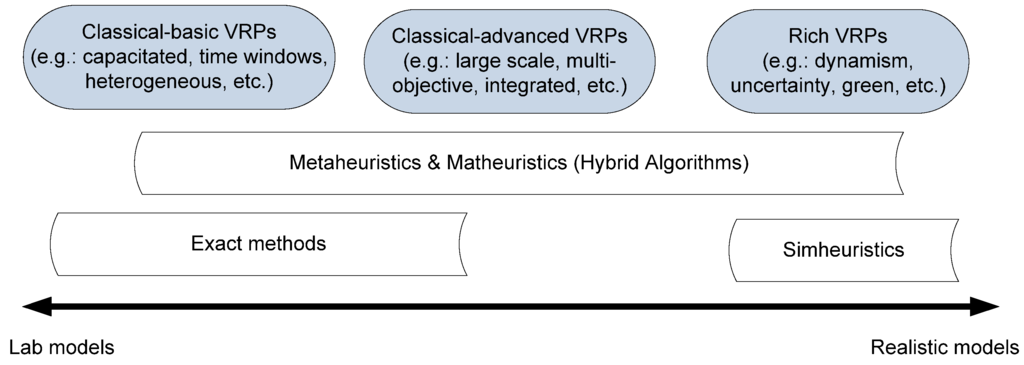
Figure 2.
Classification of Vehicle Routing Problem (VRP) models according to their degree of realism.
6. Other Related and Emergent Issues
As some experts point out, life cycle cost analysis is a necessary step in order to properly assess the long-term benefits associated with substituting ICEVs by EVs. Thus, Aguirre et al. [105] perform a study to compare the lifecycle environmental costs (energy inputs and CO2 emissions) of an ICEV, a hybrid vehicle, and an EV. According to their results, the hybrid vehicle is the most effective in terms of CO2 emissions and also the one offering the lowest net present cost. However, the EV was the most efficient in terms of total environmental impact during its lifetime. Gao and Winfield [106] investigate the lifetime GHG emissions and energy use for different types of fuel-efficient vehicles, showing that all of them improve, in both dimensions, the values associated with ICEVs. They also conclude that all these advanced vehicles require more energy for production than ICEVs, mainly due to the additional power electronics and battery packs. Nevertheless, the energy savings in the fuel cycle for these advanced vehicles compensates the marginal energy required during the vehicle cycle (production stage). Li et al. [107] compare the vehicle cycle energy and gas emission impacts of both ICEVs and EVs in China. According to their analysis, when considering the entire life cycle EVs are the best choice in terms of energy consumption and gas emissions. However, these authors also remark the importance of solving some operational and technological challenges, e.g., charging facilities location and capacity, before massively adopting EVs as the standard solution. Finally, Noori et al. [108] analyze the life cycle cost and life cycle environmental emissions of ICEVs, hybrid electric vehicles, and three different types of EVs. According to their results, ICEVs are the most cost effective vehicle type in terms of life cycle cost. However, they also conclude that shifting towards EVs reduces the environmental damage costs when considering the vehicle lifetime. At the same time, they also notice that the use of EVs has a high impact on the water footprint due to upstream electricity generation and to the water consumption necessary for battery production.
Regarding the use of EVs in rural areas, Aultman-Hall et al. [109] discuss suitability and charging requirements in these environments. They conclude that, although hybrid vehicles will still have substantial utility in these areas, EVs are quickly becoming an attractive alternative for rural mobility demand, especially in those areas with an acceptable power supply and vehicle charging infrastructure. Newman et al. [110] support the idea that EVs can be extraordinarily useful in sub-urban and rural areas, especially as a complement to deficient public transport infrastructures. Nevertheless, they also notice that, quite often, habitants of rural areas have difficulties buying EVs due to their relatively low purchasing power. Wappelhorst et al. [111] recognize two of the main obstacles impeding the expansion of EVs: their cost and their driving range limitations. In order to partially overcome these problems, they propose the use of intermodal concepts and car-sharing practices. After some empirical studies, the authors conclude that car-sharing of EVs could have the same positive adoption level in rural areas as in the urban ones.
Interruption of power supply causes serious problems in civic life, especially during the evacuation of stricken areas. It impacts medical institutions, interrupts the supply chain, and causes serious damage to the economy. Therefore, in disaster cases it is essential to minimize the period of power failure. Focused in the vehicle industry, Kinomura et al. [112] describe the development of Toyota’s electricity supply system, through which vehicles supply power directly to electrical devices, and may supply power at either a home site or at an evacuation center in the event of a natural disaster. Yamamura and Miwa [113] consider the design of an effective control method for store-carry-forward energy distribution after a disaster in which EVs and plug-in hybrid vehicles are mobile units having power generation and power storage capabilities. Finally, Yamagata et al. [114] propose and extend the concept of a community-based disaster resilient electricity sharing system. In this system, electricity generated from widely introduced photovoltaic panels is stored in the not-in-use cars.
7. Conclusions
This paper has reviewed some of the existing literature related to the introduction of electric vehicles in road transportation, paying special attention to environmental issues; the emerging strategic and operational challenges; the use of hydrogen electric vehicles as an alternative to other types of electric vehicles; and the new variants of the popular vehicle routing problem that arise as a consequence of introducing electric vehicles in the distribution fleets. From this analysis, it becomes evident that the use of sustainable energy sources in road logistics and transportation is more necessary than ever, and constitutes a critical factor for the evolution of an economically and environmentally stable world. The incorporation of electric vehicles in the road distribution activities, especially in urban areas, shows a promising trend yet to be explored in its full potential. However, the expanded use of electric vehicles raises a number of concerns and challenges that complicate planning efforts. From an operational research point of view, the following strategic and operational challenges can be highlighted: (a) the development of infrastructure networks for battery recharging/swapping, including the number, location, type, and capacity of the associated stations; (b) the size and mix composition of hybrid fleets with both traditional vehicles, hybrid electric vehicles, and pure electric vehicles; (c) the severe feasibility constraints imposed using heterogeneous fleets of vehicles with different driving ranges; (d) the additional time-window constraints related to short driving ranges; and (e) the economic impact of the introduction of electric vehicles over the entire supply chain. The development of new optimization and hybrid optimization-simulation methods to efficiently cope with these challenges, including dynamic scenarios and scenarios with uncertainty, is a necessary step to promote the desirable shift towards more sustainable energy sources in the logistics and transportation arena.
Acknowledgments
This work has been partially supported by the Spanish Ministry of Economy and Competitiveness (TRA2013-48180-C3-P and TRA2015-71883-REDT), FEDER, and the CYTED Program (CYTED2014-515RT0489). Likewise, we want to acknowledge the support received by the Catalan Government (2014-CTP-00001) and the CAN Foundation (CAN2014-3758 and CAN2015-70473).
Author Contributions
Angel Juan had the original idea for the study and coordinated the manuscript development. Javier Faulin was the main contributor of the section about environmental issues. Jesica de Armas analyzed the strategic and operational challenges related to the introduction of EVs. Scott E. Grasman provided much of the insight related to hydrogen-based EVs. Finally, Carlos Mendez was in charge of developing most of the parts related to the new EV-based variants for the Vehicle Routing Problem.
Conflicts of Interest
The authors declare no conflict of interest.
References
- Toth, P.; Vigo, D. Vehicle Routing: Problems, Methods, and Application, 2nd ed.; Society for Industrial and Applied Mathematics (SIAM): Philadelphia, PA, USA, 2014. [Google Scholar]
- Caceres, J.; Arias, P.; Guimarans, D.; Riera, D.; Juan, A. Rich Vehicle Routing Problem: Survey. ACM Comput. Surv. 2014, 47, 1–28. [Google Scholar] [CrossRef]
- Vidal, T.; Crainic, T.G.; Gendreau, M.; Prins, C. Heuristics for multi-attribute vehicle routing problems: A survey and synthesis. Eur. J. Oper. Res. 2013, 231, 1–21. [Google Scholar] [CrossRef]
- Figliozzi, M.A. Vehicle routing problem for emissions minimization. Transp. Res. Rec. J. Transp. Res. Board 2010, 2197, 1–7. [Google Scholar] [CrossRef]
- Bektas, T.; Laporte, G. The pollution-routing problem. Transp. Res. B 2011, 45, 1232–1250. [Google Scholar] [CrossRef]
- Davis, B.A.; Figliozzi, M.A. A methodology to evaluate the competitiveness of electric delivery trucks. Transp. Res. E 2013, 49, 8–23. [Google Scholar] [CrossRef]
- Sinha, K.C.; Labi, S. Transportation Decision Making: Principles of Project Evaluation and Programming; John Wiley & Sons: New Jersey, NY, USA, 2007. [Google Scholar]
- Piecyk, M.; McKinnon, A.; Allen, J. Evaluating and Internalizing the Environmental Costs of Logistics. In Green Logistics: Improving the Environmental Sustainability of Logistics; McKinnon, A., Browne, A., Whiteing, A., Eds.; Kogan Page: London, UK, 2012. [Google Scholar]
- Korzhenevych, A.; Dehnen, N.; Bröcker, J.; Holtkamp, M.; Meier, H.; Gibson, G.; Varma, A.; Cox, V. Update of the Handbook on External Costs of Transport. Ricardo-AEA/R/ED57769. 2014. Available online: http://ec.europa.eu/transport/themes/sustainable/studies/doc/2014-handbook-external-costs-transport.pdf (accessed on 16 January 2016).
- Juan, A.; Goentzel, J.; Bektaş, T. Routing fleets with multiple driving ranges: Is it possible to use greener fleet configurations? Appl. Soft Comput. 2014, 21, 84–94. [Google Scholar] [CrossRef]
- Figliozzi, M.A. The impacts of congestion on commercial vehicle tour characteristics and costs. Transp. Res. E Logist. Transp. Rev. 2010, 46, 496–506. [Google Scholar] [CrossRef]
- Chen, J. Energy efficiency comparison between hydraulic hybrid and hybrid electric vehicles. Energies 2015, 8, 4697–4723. [Google Scholar] [CrossRef]
- Martin, K.B.; Grasman, S.E. An assessment of wind-hydrogen systems for light duty vehicles. Int. J. Hydrog. Energy 2009, 34, 6581–6588. [Google Scholar] [CrossRef]
- Grimm, N.B.; Faeth, S.H.; Golubiewski, N.E.; Redman, C.L.; Wu, J.; Bai, X.; Briggs, J.M. Global change and the ecology of cities. Science 2008, 319, 756–760. [Google Scholar] [CrossRef] [PubMed]
- Schliwa, G.; Armitage, R.; Aziz, S.; Evans, J.; Rhoades, J. Sustainable city logistics: Making cargo cycles viable for urban freight transport. Res. Transp. Bus. Manag. 2015, 15, 50–57. [Google Scholar] [CrossRef]
- Feng, W.; Figliozzi, M.A. An economic and technological analysis of the key factors affecting the competitiveness of electric commercial vehicles: A case study from the USA market. Transp. Res. C 2013, 26, 135–145. [Google Scholar] [CrossRef]
- Russo, F.; Comi, A. City characteristics and urban goods movements: A way to environmental transportation system in a sustainable city. Procedia Soc. Behav. Sci. 2012, 39, 61–73. [Google Scholar] [CrossRef]
- Shahraeeni, M.; Ahmed, S.; Malek, K.; van Drimmelen, B.; Kjeang, E. Life cycle emissions and cost of transportation systems: Case study on diesel and natural gas for light duty trucks in municipal fleet operations. J. Nat. Gas Sci. Eng. 2015, 24, 26–34. [Google Scholar] [CrossRef]
- Bernard, S.M.; Samet, J.M.; Grambsch, A.; Ebi, K.L.; Romieu, I. The potential impacts of climate variability and change on air pollution-related health effects in the United States. Environ. Health Perspect. 2001, 109, 199–209. [Google Scholar] [CrossRef] [PubMed]
- Nüesch, T.; Cerofolini, A.; Mancini, G.; Cavina, N.; Onder, C.; Guzzella, L. Equivalent consumption minimization strategy for the control of real driving NOx emissions of a diesel hybrid electric vehicle. Energies 2014, 7, 3148–3178. [Google Scholar] [CrossRef]
- Colin, G.; Chamaillard, Y.; Charlet, A.; Nelson-Gruel, D. Towards a friendly energy management strategy for hybrid electric vehicles with respect to pollution, battery and drivability. Energies 2014, 7, 6013–6030. [Google Scholar] [CrossRef]
- Chen, Z.; Xiong, R.; Wang, K.; Jiao, B. Optimal energy management strategy of a plug-in hybrid electric vehicle based on a particle swarm optimization algorithm. Energies 2015, 8, 3661–3678. [Google Scholar] [CrossRef]
- Hwang, T.; Ouyang, Y. Urban freight truck routing under stochastic congestion and emission considerations. Sustainability 2015, 7, 6610–6625. [Google Scholar] [CrossRef]
- Jaller, M.; Holguín-Veras, J.; Hodge, S. Parking in the city: Challenges for freight traffic. Transp. Res. Rec. J. Transp. Res. Board 2013, 2379, 46–56. [Google Scholar] [CrossRef]
- Browne, M.; Allen, J.; Leonardi, J. Evaluating the use of an urban consolidation centre and electric vehicles in central London. IATSS Res. 2011, 35, 1–6. [Google Scholar] [CrossRef]
- Pelletier, S.; Jabali, O.; Laporte, G. Goods Distributions with Electric Vehicles: Review and Research Perspectives. CIRRELT Publications. CIRRELT-2014–44. 2014. Available online: https://www.cirrelt.ca/DocumentsTravail/CIRRELT-2014-43.pdf (accessed on 16 January 2016).
- Feng, W.; Figliozzi, M.A. Conventional vs electric commercial vehicle fleets: A case study of economic and technological factors affecting the competitiveness of electric commercial vehicles in the USA. Procedia Soc. Behav. Sci. 2012, 39, 702–711. [Google Scholar] [CrossRef]
- Afroditi, A.; Boile, M.; Theofanis, S.; Sdoukopoulos, E.; Margaritis, D. Electric Vehicle Routing Problem with industry constraints: Trends and insights for future research. Transp. Res. Procedia 2014, 3, 452–459. [Google Scholar] [CrossRef]
- Conway, A.; Fatisson, P.E.; Eickemeyer, P.; Cheng, J.; Peters, D. Urban micro-consolidation and last mile goods delivery by freight-tricycle in Manhattan: Opportunities and challenges. In Proceedings of the 91st Transportation Research Board Annual Meeting, Washington, DC, USA, 22–26 January 2012.
- Lenz, B.; Riehle, E. Bikes for urban freight? Transp. Res. Rec. J. Transp. Res. Board 2013, 2379, 39–45. [Google Scholar] [CrossRef]
- Demir, E.; Bektas, T.; Laporte, G. A review of recent research on green road freight transportation. Eur. J. Oper. Res. 2014, 237, 775–793. [Google Scholar] [CrossRef]
- Demir, E.; Huang, Y.; Scholts, S.; van Woensel, T. A selected review on the negative externalities of the freight transportation: Modeling and pricing. Transp. Res. E 2015, 77, 95–114. [Google Scholar] [CrossRef]
- Wang, Y.; Wang, C. Locating passenger vehicle refueling stations. Transp. Res. E 2010, 46, 791–801. [Google Scholar] [CrossRef]
- Li, J.Q. Transit bus scheduling with limited energy. Transp. Sci. 2014, 48, 521–539. [Google Scholar] [CrossRef]
- Yang, J.; Sun, H. Battery swap station location-routing problem with capacitated electric vehicles. Comput. Oper. Res. 2015, 55, 217–232. [Google Scholar]
- Zheng, Y.; Dong, Z.Y.; Xu, Y.; Meng, K.; Zhao, J.H.; Qiu, J. Electric vehicle battery charging/swap stations in distribution systems: Comparison study and optimal planning. IEEE Trans. Power Syst. 2014, 29, 221–229. [Google Scholar] [CrossRef]
- Liu, Y.X.; Hui, F.H.; Xu, R.L.; Chen, T.; Xu, X.; Li, J. Investigation on the construction mode of charging and battery-exchange station. In Proceedings of the Power Energy Engineering Conference, Wuhan, China, 25–28 March 2011; pp. 1–2.
- Lombardi, P.; Heuer, M.; Styczynski, Z. Battery switch station as storage system in an autonomous power system: Optimization issue. In Proceedings of the IEEE PES General Meeting, Minneapolis, MN, USA, 25–29 July 2010; pp. 1–6.
- Zhou, F.Q.; Lian, Z.W.; Wan, X.L.; Yang, X.H.; Xu, Y.S. Discussion on operation mode to the electric vehicle charging station. Power Syst. Prot. Control 2010, 1, 65–72. [Google Scholar]
- Upchurch, C.; Kuby, M. Comparing the p-median and flow refueling models for locating alternative-fuel stations. J. Transp. Geogr. 2010, 18, 750–758. [Google Scholar] [CrossRef]
- Goodchild, M.F.; Noronha, V. Location-Allocation and Impulsive Shopping the Case of Gasoline Retailing. Spatial Analysis and Location-Allocation Models; Van Nostrand Reinhold: New York, NY, USA, 1987. [Google Scholar]
- Hodgson, M. A flow-capturing location-allocation model. Geogr. Anal. 1990, 22, 270–279. [Google Scholar] [CrossRef]
- Kuby, M.; Lim, S. The flow-refueling location problem for alternative-fuel vehicles. Socio Econ. Plan. Sci. 2005, 39, 125–145. [Google Scholar] [CrossRef]
- Lim, S.; Kuby, M. Heuristic algorithms for siting alternative-fuel stations using the flow-refueling location model. Eur. J. Oper. Res. 2010, 204, 51–61. [Google Scholar] [CrossRef]
- Capar, I.; Kuby, M. An efficient formulation of the flow refueling location model for alternative-fuel stations. Inst. Ind. Eng. Trans. 2012, 44, 622–636. [Google Scholar] [CrossRef]
- Mak, H.Y.; Rong, Y.; Shen, Z.J.M. Infrastructure planning for electric vehicles with battery swapping. Manag. Sci. 2013, 59, 1557–1575. [Google Scholar] [CrossRef]
- Wang, Y.W.; Lin, C.C. Locating road-vehicle refueling stations. Transp. Res. E Logist. Transp. Rev. 2009, 45, 821–829. [Google Scholar] [CrossRef]
- Wang, Y.W. Locating flow-recharging stations at tourist destinations to serve recreational travelers. Int. J. Sustain. Transp. 2011, 5, 153–171. [Google Scholar] [CrossRef]
- You, P.S.; Hsieh, Y.C. A hybrid heuristic approach to the problem of the location of vehicle charging stations. Comput. Ind. Eng. 2014, 70, 195–204. [Google Scholar] [CrossRef]
- Melaina, M.W. Initiating hydrogen infrastructure: Preliminary analysis of a sufficient number of initial hydrogen stations in the US. Int. J. Hydrog. Energy 2003, 28, 743–755. [Google Scholar] [CrossRef]
- Nicholas, M.A.; Handy, S.L.; Sperling, D. Using GIS to evaluate siting and networks of hydrogen stations. Transp. Res. Rec. J. Transp. Res. Board 2004, 1880, 126–134. [Google Scholar] [CrossRef]
- Nicholas, M.; Ogden, J. Detailed analysis of urban station siting for California hydrogen highway network. Transp. Res. Rec. 2007, 129–139. [Google Scholar] [CrossRef]
- Schwoon, M. A tool to optimize the initial distribution of hydrogen fueling stations. Transp. Res. D Transp. Environ. 2007, 12, 70–82. [Google Scholar] [CrossRef]
- Stiller, C.; Seydel, P.; Bünger, U.; Wietschel, M. Early hydrogen user centres and corridors as part of the European hydrogen energy roadmap (HyWays). Int. J. Hydrog. Energy 2008, 33, 4193–4208. [Google Scholar] [CrossRef]
- Hosseini, M.; MirHassani, S.A. Selecting optimal location for electric recharging stations with queue. KSCE J. Civ. Eng. 2015, 19, 2271–2280. [Google Scholar] [CrossRef]
- Olivella-Rosell, P.; Villafafila-Robles, R.; Sumper, A.; Bergas-Jané, J. Probabilistic agent-based model of electric vehicle charging demand to analyse the impact on distribution networks. Energies 2015, 8, 4160–4187. [Google Scholar] [CrossRef]
- Keles, D.; Wietschel, M.; Most, D.; Rentz, O. Market penetration of fuel cell vehicles—Analysis based on agent behavior. Int. J. Hydrog. Energy 2008, 33, 4444–4455. [Google Scholar] [CrossRef]
- Dangl, T. Investment and capacity choice under uncertain demand. Eur. J. Oper. Res. 1999, 117, 415–428. [Google Scholar] [CrossRef]
- Qin, R.; Grasman, S.E.; Martin, K.B. An inventory modeling approach for hydrogen fueling station capacity considering and outside option. Energy Syst. 2013, 4, 195–217. [Google Scholar]
- Struben, J.; Sterman, J. Transition challenges for alternative fuel vehicle and transportation systems. Environ. Plan. B Plan. Des. 2007, 35, 1070–1097. [Google Scholar] [CrossRef]
- Gnann, T.; Plötz, P. A review of combined models for market diffusion of alternative fuel vehicles and refueling infrastructure. Renew. Sustain. Energy Rev. 2015, 47, 783–793. [Google Scholar] [CrossRef]
- Lin, C.; Choy, K.L.; Ho, G.T.S.; Chung, S.H.; Lam, H.Y. Survey of green vehicle routing problem: Past and future trends. Expert Syst. Appl. 2014, 3, 1118–1138. [Google Scholar] [CrossRef]
- Lebeau, P.; De Cauwer, C.; Van Mierlo, J.; Macharis, C.; Verbeke, W.; Coosemans, T. Conventional, Hybrid, or Electric Vehicles: Which Technology for an Urban Distribution Centre? Sci. World J. 2015, 302867. [Google Scholar] [CrossRef] [PubMed]
- Gonçalves, F.; Cardoso, S.R.; Relvas, S.; Barbosa-Povoa, A. Optimization of a distribution network using electric vehicles: A VRP problem. In Proceedings of the IO2011-15 Congresso da associação Portuguesa de Investigação Operacional, Coimbra, Portugal, 18–20 April 2011.
- Erdoğan, S.; Miller-Hooks, E. A green vehicle routing problem. Transp. Res. E Logist. Transp. Rev. 2012, 48, 100–114. [Google Scholar] [CrossRef]
- Schneider, M.; Stenger, A.; Goeke, D. The electric vehicle-routing problem with time windows and recharging stations. Transp. Sci. 2014, 48, 500–520. [Google Scholar] [CrossRef]
- Conrad, R.G.; Figliozzi, M.A. The Recharging Vehicle Routing Problem. Available online: http://web.cecs.pdx.edu/~maf/Conference_Proceedings/2011_The_Recharging_Vehicle_Routing_Problem.pdf (accessed on 16 January 2016).
- Bae, S.H.; Sarkis, J.; Yoo, C.S. Greening transportation fleets: Insights from a two-stage game theoretic model. Transp. Res. E Logist. Transp. Rev. 2011, 47, 793–807. [Google Scholar] [CrossRef]
- Van Duin, J.H.R.; Tavasszy, L.A.; Quak, H.J. Towards E(lectric)-urban freight: First promising steps in the electric vehicle revolution. Eur. Transp. Trasp. Eur. 2013, 54, 1–19. [Google Scholar]
- Hiermann, G.; Puchinger, J.; Hartl, R.F. The Electric Fleet Size and Mix Vehicle Routing Problem with Time Windows and Recharging Stations. 2015. Available online: http://prolog.univie.ac.at/research/publications/downloads/Hie_2015_638.pdf (accessed on 16 January 2016).
- Mercuri, R.; Bauen, A.; Hart, D. Options for refueling hydrogen fuel cell vehicles in Italy. J. Power Sources 2002, 106, 353–363. [Google Scholar] [CrossRef]
- Joffe, D.; Hart, D.; Bauen, A. Modelling of hydrogen infrastructure for vehicle refueling in London. J. Power Sources 2004, 131, 13–22. [Google Scholar] [CrossRef]
- O’Garra, T.; Mourato, S.; Pearson, P. Analyzing awareness and acceptability of hydrogen vehicles: A London case study. Int. J. Hydrog. Energy 2005, 30, 649–659. [Google Scholar] [CrossRef]
- Brey, J.J.; Brey, R.; Carazo, A.F.; Contreras, I.; Hernandez-Diaz, A.G.; Gallardo, V. Designing a gradual transition to a hydrogen economy on Spain. J. Power Sources 2006, 159, 1231–1240. [Google Scholar] [CrossRef]
- Weinert, J.X.; Liu, S.; Ogden, J.M.; Ma, J. Hydrogen refueling station costs in Shanghai. Int. J. Hydrog. Energy 2007, 32, 4089–4100. [Google Scholar] [CrossRef]
- Tzimas, E.; Castello, P.; Peteves, S. The evolution of size and cost of a hydrogen delivery infrastructure in Europe in the medium and long term. Int. J. Hydrog. Energy 2007, 32, 1355–1368. [Google Scholar] [CrossRef]
- Ball, M.; Wietschel, M.; Rentz, O. Integration of a hydrogen economy into the German energy system: An optimizing modeling approach. Int. J. Hydrog. Energy 2007, 32, 1355–1368. [Google Scholar] [CrossRef]
- Almansoori, A.; Shah, N. Design and operation of a future hydrogen supply chain: Snapshot model. Chem. Eng. Res. Des. 2006, 84, 423–438. [Google Scholar] [CrossRef]
- Kim, J.; Moon, I. Strategic design of hydrogen infrastructure considering cost and safety using multiobjective optimization. Int. J. Hydrog. Energy 2008, 33, 5887–5896. [Google Scholar] [CrossRef]
- Lin, Z.; Chen, C.; Ogden, J.; Fan, Y. The least-cost hydrogen for southern California. Int. J. Hydrog. Energy 2008, 33, 3009–3014. [Google Scholar] [CrossRef]
- Johnson, N.; Yang, C.; Ogden, J. A GIS-based assessment of coal-based hydrogen infrastructure deployment in the State of Ohio. Int. J. Hydrog. Energy 2008, 30, 5287–5303. [Google Scholar] [CrossRef]
- Ogden, J.M. Developing an infrastructure for hydrogen vehicles: A southern California case study. Int. J. Hydrog. Energy 1999, 24, 709–730. [Google Scholar] [CrossRef]
- Agnolucci, P.; McDowall, W. Designing future hydrogen infrastructure: Insights from analysis at different spatial scales. Int. J. Hydrog. Energy 2013, 38, 5181–5191. [Google Scholar] [CrossRef]
- Galus, M.D.; Zima, M.; Andersson, G. On integration of plug-in hybrid electric vehicles into existing power system structures. Energy Policy 2011, 38, 6736–6745. [Google Scholar] [CrossRef]
- Sioshansi, R. OR Forum-Modeling the impacts of electricity tariffs on plug-in hybrid electric vehicle charging, costs, and emissions. Oper. Res. 2012, 60, 506–516. [Google Scholar] [CrossRef]
- Huang, J.; Leng, M.; Liang, L.; Liu, J. Promoting electric automobiles: Supply chain analysis under a government’s subsidy incentive scheme. IIE Trans. 2012, 45, 826–844. [Google Scholar] [CrossRef]
- Avci, B.; Girortra, K.; Netessine, S. Electric vehicles with a battery switching station: Adoption and environmental impact. Manag. Sci. 2014, 61, 772–794. [Google Scholar] [CrossRef]
- Kleindorfer, P.R.; Neboian, A.; Roset, A.; Spinler, S. Fleet renewal with electric vehicles at La Poste. Interfaces 2012, 42, 465–477. [Google Scholar] [CrossRef]
- Wang, Y.W.; Lin, C.C. Locating multiple types of recharging stations for battery-powered electric vehicle transport. Transp. Res. E Logist. Transp. Rev. 2013, 58, 76–87. [Google Scholar] [CrossRef]
- Chocteau, V.; Drake, D.; Kleindorfer, P.; Orsato, R.J.; Roset, A. Collaborative innovation for sustainable fleet operations: The Electric Vehicle Adoption Decision. 2011. Available online: http://www.insead.edu/facultyresearch/research/doc.cfm?did=47857 (accessed on 16 January 2016).
- Golden, B.; Assad, A.; Levy, L.; Gheysens, F. The fleet size and mix vehicle routing problem. Comput. Oper. Res. 1984, 11, 49–66. [Google Scholar] [CrossRef]
- Baldacci, R.; Battarra, M.; Vigo, D. Routing a Heterogeneous Fleet of Vehicles. In The Vehicle Routing Problem: Latest Advances and New Challenges; Golden, B., Raghavan, S., Wasil, E., Eds.; Springer: New York, NY, USA, 2008; pp. 3–27. [Google Scholar]
- Liu, F.H.; Shen, S.Y. The fleet size and mix vehicle routing problem with time windows. J. Oper. Res. Soc. 1999, 50, 721–732. [Google Scholar] [CrossRef]
- Tredeau, F.P.; Salameh, Z.M. Evaluation of lithium iron phosphate batteries for electric vehicles application. In Proceedings of the IEEE Vehicle Power and Propulsion Conference, Dearborn, MI, USA, 7–10 September 2009; pp. 1266–1270.
- Botsford, C.; Szczepanek, A. Fast charging vs. slow charging: Pros and cons for the new age of electric vehicles. In Proceedings of the EVS24 International Battery, Hybrid and Fuel Cell Electric Vehicle Symposium, Stavanger, Norway, 13–16 May 2009.
- Hung, Y.C.; Michailidis, G. Optimal routing for electric vehicle service systems. Eur. J. Oper. Res. 2015, 247, 515–524. [Google Scholar] [CrossRef]
- Liu, W.Y.; Lin, C.C.; Chiu, C.R.; Tsao, Y.S.; Wang, Q. Minimizing the carbon footprint for the time-dependent heterogeneous-fleet vehicle routing problem with alternative paths. Sustainability 2014, 6, 4658–4684. [Google Scholar] [CrossRef]
- Fang, W.T.; Huang, C.W.; Chou, J.Y.; Cheng, B.Y.; Shih, S.S. Low carbon footprint routes for bird watching. Sustainability 2015, 7, 3290–3310. [Google Scholar] [CrossRef]
- Dominguez, O.; Juan, A.; Nuez, I.; Ouelhadj, D. An ILS-Biased Randomization algorithm for the two-dimensional loading HFVRP with sequential loading and items rotation. J. Oper. Res. Soc. 2015. [Google Scholar] [CrossRef]
- Juan, A.; Grasman, S.; Caceres, J.; Bektas, T. A Simheuristic Algorithm for the single-period stochastic inventory routing problem with stock-outs. Simul. Model. Pract. Theory 2014, 46, 40–52. [Google Scholar] [CrossRef]
- Doerner, K.F.; Schmid, V. Survey: Matheuristics for Rich Vehicle Routing Problems. In Hybrid Metaheuristics; Blesa, M.J., Blum, C., Raidl, G., Roli, A., Sampels, M., Eds.; Springer: Berlin, Germany, 2010; pp. 206–221. [Google Scholar]
- Juan, A.; Faulin, J.; Grasman, S.; Rabe, M.; Figueira, G. A review of Simheuristics: Extending metaheuristics to deal with stochastic optimization problems. Oper. Res. Perspect. 2015, 2, 62–72. [Google Scholar] [CrossRef]
- Juan, A.; Faulin, J.; Jorba, J.; Caceres, J.; Marques, J. Using parallel & distributed computing for solving real-time vehicle routing problems with stochastic demands. Ann. Oper. Res. 2013, 207, 43–65. [Google Scholar]
- Fikar, C.; Juan, A.; Martinez, E.; Hirsch, P. A discrete-event driven metaheuristic for dynamic home-service routing with synchronized trip sharing. Eur. J. Ind. Eng. 2016, in press. [Google Scholar] [CrossRef]
- Aguirre, K.; Eisenhardt, L.; Lim, C.; Nelson, B.; Norring, A.; Slowik, P.; Tu, N. Lifecycle Analysis Comparison of a Battery Electric Vehicle and a Conventional Gasoline vehicle. Available online: http://www.ioe.ucla.edu/perch/resources/files/batteryelectricvehiclelca2012.pdf (accessed on 16 January 2016).
- Gao, L.; Winfield, Z.C. Life cycle assessment of environmental and economic impacts of advanced vehicles. Energies 2012, 5, 605–620. [Google Scholar] [CrossRef]
- Li, S.; Li, J.; LI, N.; Gao, Y. Vehicle Cycle Analysis Comparison of Battery Electric Vehicle and Conventional Vehicle in China; SAE Technical Paper 2013-01-2581; SAE International: Warrendale, PA, USA, 2013. [Google Scholar]
- Noori, M.; Gardner, S.; Tatari, O. Electric vehicle cost, emissions, and water footprint in the United States: Development of a regional optimization model. Energy 2015, 89, 610–625. [Google Scholar] [CrossRef]
- Aultman-Hall, L.; Sears, J.; Dowds, J.; Hines, P. Travel demand and charging capacity for electric vehicles in rural states. Transp. Res. Rec. J. Transp. Res. Board 2012, 2287, 27–36. [Google Scholar] [CrossRef]
- Newman, D.; Wells, P.; Donovan, C.; Nieuwenhuis, P.; Davies, H. Urban, sub-urban or rural: Where is the best place for electric vehicles? Int. J. Autom. Technol. Manag. 2014, 14, 306–323. [Google Scholar] [CrossRef]
- Wappelhorst, S.; Sauer, M.; Hinkeldein, D.; Bocherding, A.; Glaß, T. Potential of electric carsharing in urban and rural areas. Transp. Res. Procedia 2014, 4, 374–386. [Google Scholar] [CrossRef]
- Kinomura, S.; Kusafuka, H.; Kamichi, K.; Ono, T. Development of Vehicle Power Connector Equipped with Outdoor Power Outlet Using Vehicle Inlet of Plug-in Hybrid Vehicle; SAE Technical Papers 2013-01-1442; SAE International: Warrendale, PA, USA, 2013. [Google Scholar]
- Yamamura, T.; Miwa, H. Store-carry-forward energy distribution method and routing control method for use in a disaster. In Proceedings of the 2014 International Conference on Intelligent Networking and Collaborative Systems, Salerno, Italy, 10–12 September 2014; pp. 289–295.
- Yamagata, Y.; Seya, H.; Kuroda, S. Energy resilient smart community: Sharing green electricity using V2C technology. Energy Procedia 2014, 61, 84–87. [Google Scholar] [CrossRef]
© 2016 by the authors; licensee MDPI, Basel, Switzerland. This article is an open access article distributed under the terms and conditions of the Creative Commons Attribution (CC-BY) license (http://creativecommons.org/licenses/by/4.0/).