

Environmental Effects of Sewage Sludge Carbonization and Other Treatment Alternatives

Abstract
:1. Introduction
2. Simulation of the Sewage Sludge Carbonization Process
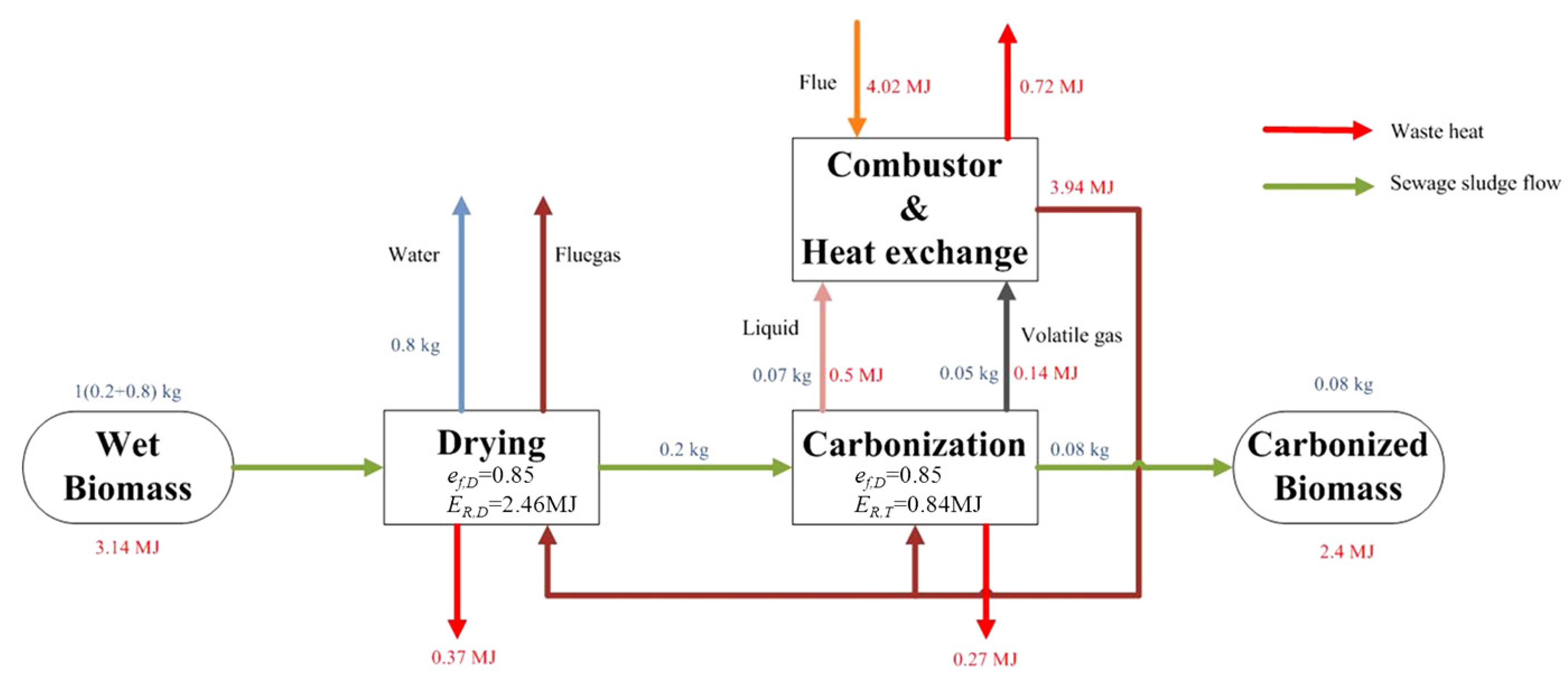

| Dewatered sludge characteristics* | Value |
|---|---|
| Moisture (wt %) | 80 |
| High heating value dry (MJ/kg) | 15.18 |
| Proximate analysis (dry basis, wt %) | |
| Ash content | 35.2 |
| Volatile matter | 64.8 |
| Elemental analysis (dry and ash free basis, wt %) | |
| C | 54.60 |
| H | 7.69 |
| N | 4.52 |
| O | 30.29 |
| S | 2.52 |
| Experimental results of carbonization yield (dry and ash free basis, wt %)** | |
| Solid yield | 39.14 |
| Liquid yield | 34.09 |
| Volatile gas | 26.77 |
3. Materials and Methods of LCA
3.1. Functional Unit
3.2. System Boundaries
- (a)
- Carbonization of dewatered sludge and co-firing of biocoal (1% by heat input) at the Linkou coal power plant, New Taipei City, Taiwan, considering coal substitution, electricity generation, and heat recovery.
- (b)
- Mono-incineration of dewatered sludge at certain industrial waste incineration plants without production of electrical energy, considering heat recovery.
- (c)
- Sanitary landfill of dewatered sludge at Wujie Township, Yilan County, Taiwan, without considering methane recovery.
- (d)
- Co-incineration of dewatered sludge (3% by weight) with MSW at the Beitou MSW incineration plant, New Taipei City, Taiwan, in which waste to electricity was considered.
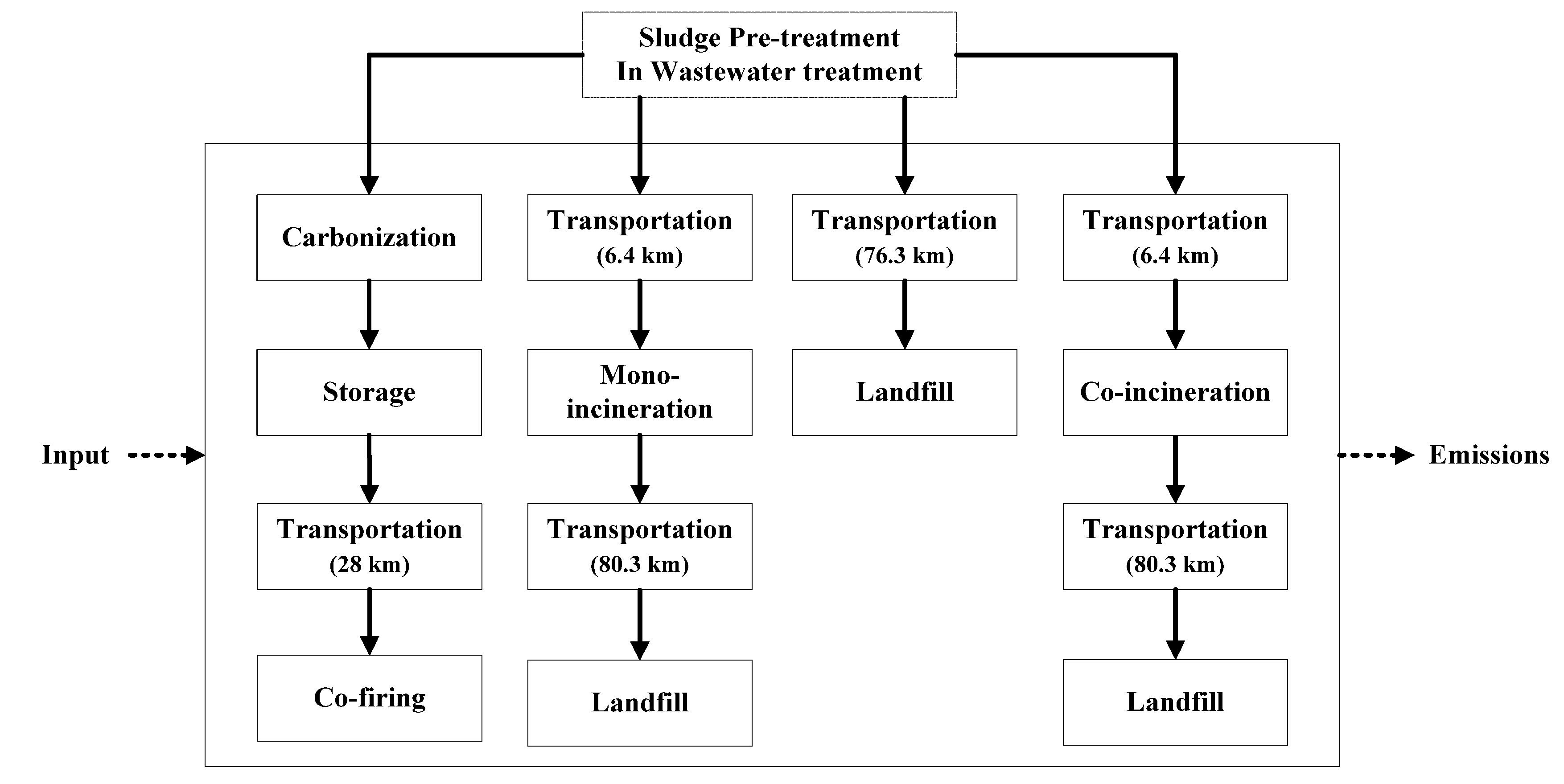
3.3. Inventory Data Source
3.3.1. Energy Use and Recovery
3.3.2. Data Quality
4. Impact Assessment and Discussion
4.1. Carbonization Scenario
| Carbonization and co-firing | Carbonization process | Co-firing of biocoal and coal in power plant | ||||||||
|---|---|---|---|---|---|---|---|---|---|---|
| Impact category | Unit | Total | Drying | Carbonization | Energy Reuse | Carbonization Facility | Biocoal Storage | Co-firing | Alternative coal | Electricity production |
| Carcinogens | kg C2H3Cl eq. | 1.98 | 1.66 | 0.51 | −0.32 | 0 | 0 | 0.32 | −0.08 | −0.11 |
| Non-carcinogens | kg C2H3Cl eq. | 2.82 | 0.23 | 0.04 | −0.02 | 0 | 0 | 2.96 | −0.17 | −0.22 |
| Respiratory inorganics | kg PM2.5 eq. | 0.08 | 0.05 | 0.01 | 0.00 | 0 | 0.04 | 0.08 | −0.04 | −0.06 |
| Ionizing radiation | Bq C−14 eq. | −1182 | 1556.3 | 158.23 | −39.90 | 0.21 | 0 | 22.68 | −274.61 | −2,605.29 |
| Ozone layer depletion | kg CFC−11 eq. | 0.00003 | 0.00 | 0.00 | 0.00 | 0 | 0 | 0.000001 | −0.000001 | −0.000002 |
| Respiratory organics | kg C2H4 eq. | 0.03 | 0.05 | 0.01 | −0.01 | 0 | 0 | 0.004 | −0.02 | −0.01 |
| Aquatic ecotoxicity | kg TEG water | −22,412 | 3,952.9 | 671.52 | −326.1 | 0.94 | 0 | 1,546 | −23,768.1 | −4,489.73 |
| Terrestrial ecotoxicity | kg TEG soil | −6,003 | 933.3 | 161.68 | −79.61 | 0.31 | 0 | 60.87 | −6,044.6 | −1,035.48 |
| Terrestrial acid/nutria | kg SO2 eq. | 1.12 | 1.26 | 0.24 | −0.12 | 0 | 0 | 2.47 | −1.45 | −1.29 |
| Land occupation | m2 land arable · year | −0.85 | 0.15 | 0.02 | −0.01 | 0 | 0.06 | 0.02 | −0.88 | −0.22 |
| Aquatic acidification | kg SO2 eq. | 0.36 | 0.34 | 0.06 | −0.03 | 0 | 0 | 0.65 | −0.27 | −0.39 |
| Aquatic eutrophication | kg PO4 eq. | −0.0004 | 0.00 | 0.00 | 0.00 | 0 | 0.0000002 | 0.0001 | −0.0006 | −0.001 |
| Global warming | kg CO2 eq. | 146.62 | 209.02 | 55.79 | −34.15 | 0.01 | 0 | 9.37 | −16.00 | −77.42 |
| Non-renewable energy | MJ primary | −1122.9 | 3,896.4 | 1,062.72 | −655.6 | 0.15 | 0 | 15.33 | −4,178.8 | −1,263.00 |
| Mineral extraction | MJ surplus | −0.02 | 0.18 | 0.04 | −0.02 | 0 | 0 | 0.02 | −0.13 | −0.12 |
4.2. Comparison of Scenarios
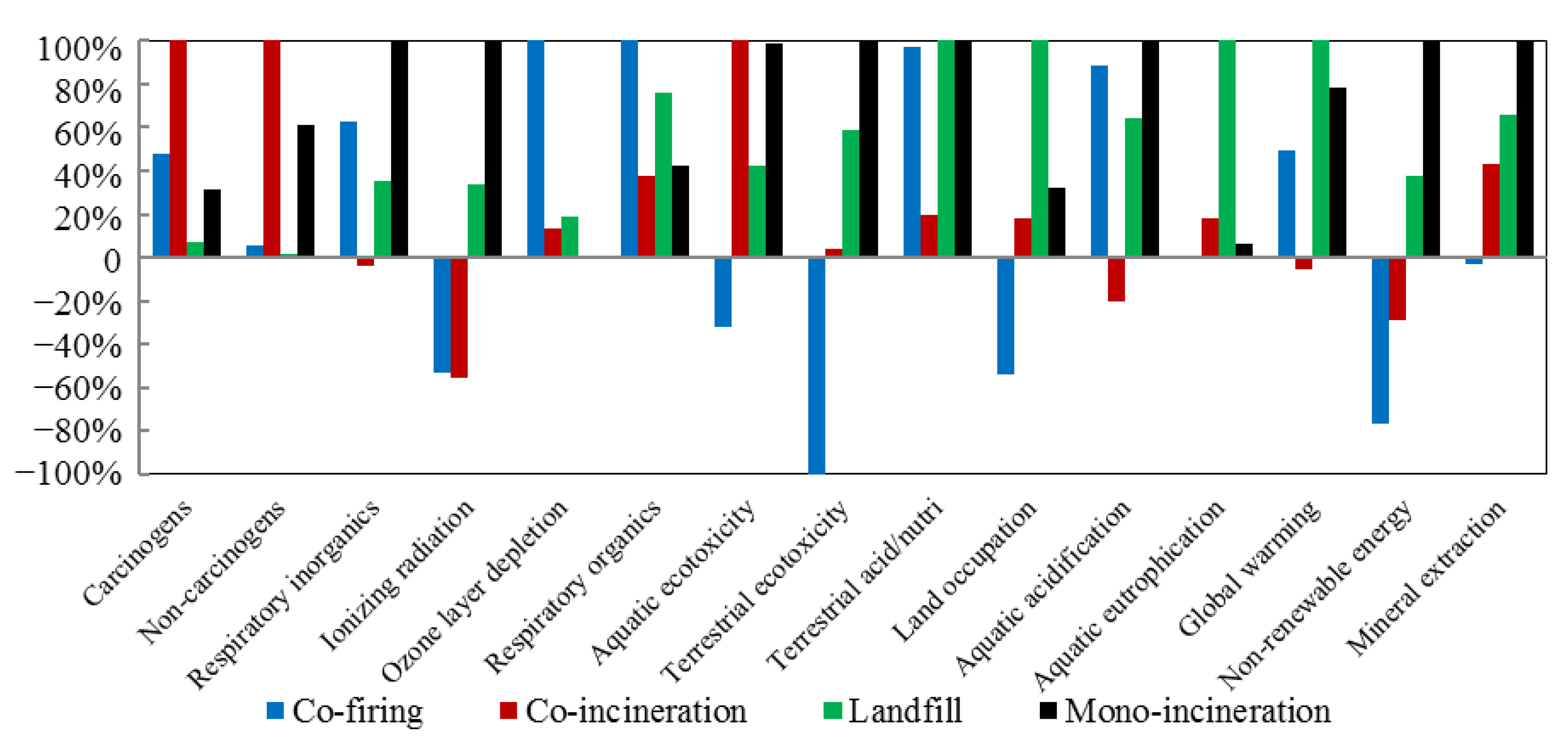
| Item | Normalized results of damage categories | Single score | GHG emission | |||
|---|---|---|---|---|---|---|
| Human health | Ecosystem quality | Climate change | Resources | |||
| Unit | - | - | - | - | Pt | kg CO2 eq. |
| Carbonization | 0.0095 | -0.0035 | 0.0148 | −0.0074 | 0.013428 | 146.6 |
| Co-incineration | 0.0204 | 0.0003 | −0.0016 | −0.0028 | 0.016414 | −15.4 |
| Landfill | 0.0048 | 0.0008 | 0.0300 | 0.0036 | 0.039208 | 296.9 |
| Mono-incineration | 0.0246 | 0.0012 | 0.0236 | 0.0097 | 0.059045 | 233.2 |
4.3. Sensitivity Analysis
| Variation | Co-firing | Co-incineration | Landfill | Mono-incineration |
|---|---|---|---|---|
| Electricity −20% | 1.09 × 10⁻² | 1.05 × 10⁻² | 3.91 × 10⁻² | 5.56 × 10⁻² |
| Electricity −10% | 1.22 × 10⁻² | 1.34 × 10⁻² | 3.92 × 10⁻² | 5.73 × 10⁻² |
| Original case | 1.34 × 10⁻² | 1.64 × 10⁻² | 3.92 × 10⁻² | 5.90 × 10⁻² |
| Electricity +10% | 1.47 × 10⁻² | 1.94 × 10⁻² | 3.93 × 10⁻² | 6.08 × 10⁻² |
| Electricity +20% | 1.60 × 10⁻² | 2.23 × 10⁻² | 3.93 × 10⁻² | 6.25 × 10⁻² |
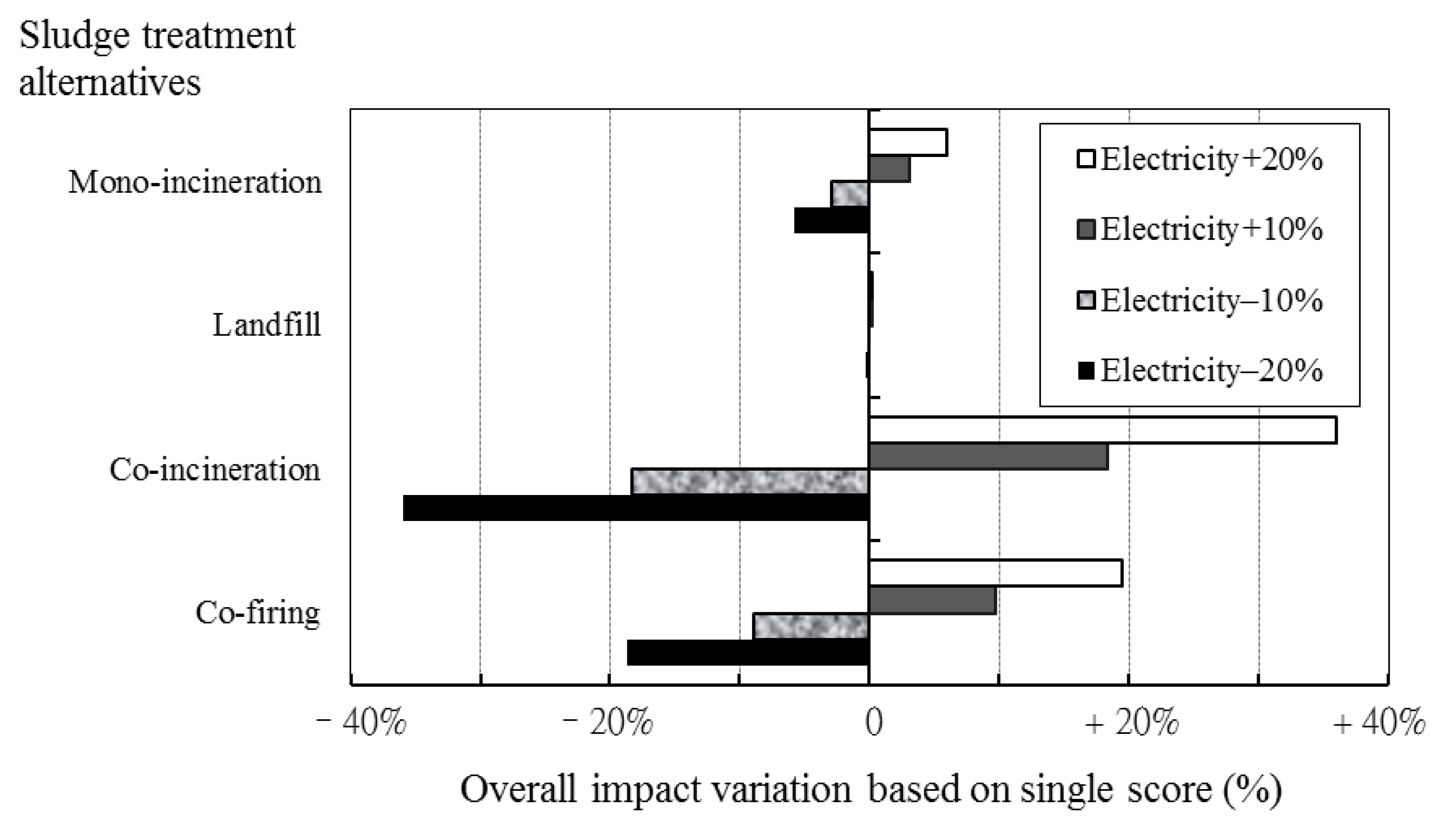
5. Conclusions
Acknowledgments
Appendix
| Nomenclature | Value | |
|---|---|---|
| Cp,b | specific heat of sewage sludge (MJ/kg K) | 0.001763 |
| Cp,w | specific heat of water (MJ/kg K) | 0.004187 |
| DB | weight of dried sludge (kg) | 0.2 |
| DBwet | percentage of dry solid in sewage sludge (wt %) | 20 |
| EA,CG | available energy from volatile gas (MJ/kg) | - |
| EA,CL | available energy from carbonized liquid (MJ/kg) | - |
| ER,C | energy use of carbonization unit (MJ/kg) | - |
| ER,D | energy use of drying unit (MJ/kg) | - |
| ef,C | efficiency of the carbonization unit | 0.85 |
| ef,C | efficiency of the combustor unit | 0.85 |
| ef,D | efficiency of the drying unit | 0.85 |
| Lv,w | latent heat of water at its boiling point(MJ/kg) | 2.27 |
| LHVliquid | heating value of the carbonized liquid(MJ/kg) | 21.7* |
| LHVvolatile | heating value of the volatile gas(MJ/kg) | 7.7* |
| Mwet | moisture content of sewage sludge(wt %) | 80 |
| min | mass of the biomass input (kg) | 1 |
| mout | mass of product output (kg) | 0.08 |
| HL | heat loss of the heat exchanger | 0.005 |
| Ti | initial temperature of sewage sludge (K) | 298 |
| TC | carbonization temperature(K) | 450 |
| yM | product yield (%) | - |
| yMG | volatile gas yield (%) | 26.77** |
| yML | carbonized liquid yield (%) | 34.09** |
| Item | Active coal | Electricity | Heavy fuel oil | Lime | Natural gas | Polymer | NaOH | NH3 |
|---|---|---|---|---|---|---|---|---|
| Unit | kg/tDM | kWh/tDM | kg/tDM | kg/tDM | m3/tDM | kg/tDM | kg/tDM | kg/tDM |
| Amount | 0.4 | 80.08 | 2.78 | 6 | 13 | 1.42 | 2.44 | 0.744 |
References
- Construction and Planning Agency of Taiwan Home Page. Available online: http://www.cpami.gov.tw/chinese/index.php?option=com_content&view=article&id=13545&Itemid=13123 (accessed on 7 January 2012).
- Assessment and Planning of Sewage Sludge Disposal; Construction and Planning Agency: Taipei, Taiwan, 2011.
- Statistics and Analysis of CO2 Emissions from Fuels Combustion; Bureau of Energy: Taipei, Taiwan, 2011.
- Park, S.W.; Jang, C.H. Characteristics of carbonized sludge for co-combustion in pulverized coal power plants. Waste Manag. 2011, 31, 523–529. [Google Scholar] [CrossRef] [PubMed]
- Kim, Y.J.; Choi, J.H.; Kim, J.H.; Lee, C.S.; Qureshi, T.I. Production and effective utilization of carbonized sludge of industrial wastewater treatment plant. J. Chem. Soc. Pak. 2010, 32, 7–12. [Google Scholar]
- Oda, T. Making Fuel Charcoal from Sewage Sludge for Thermal Power Generation Plant—First in Japan. In Proceedings of Water Environment Federation Technical Exhibition & Conference, San Diego, California, USA, 13–17 October 2007.
- Park, S.W.; Jang, C.H. Effects of carbonization and solvent-extraction on change in fuel characteristics of sewage sludge. Bioresour. Technol. 2011, 102, 8205–8210. [Google Scholar] [CrossRef] [PubMed]
- Koga, Y.; Endo, Y.; Oonuki, H.; Kakurata, K.; Amari, T.; Ose, K. Biomass solid production from sewage sludge with pyrolysis and co-firing in coal power plant fuel. Mitsubishi Heavy Ind. Tech. Rev. 2007, 44, 44–48. [Google Scholar]
- Kimuro, Y.; Furubayashi, T.; Nakata, T. An inventory analysis of sewage energy system [in Japanese]. J. Jpn. Inst. Energy 2011, 90, 247–257. [Google Scholar] [CrossRef]
- Koga, Y.; Mizutani, H.; Tsuneizumi, S.; Yamamoto, H.; Tabata, M.; Amari, T. New biomass utilization technologies such as methane fermentation and pyrolysis. Mitsubishi Heavy Ind. Tech. Rev. 2007, 44, 39–43. [Google Scholar]
- Bolin, K.M.; Dooley, B.; Kearney, R.J. Carbonization Technology Converts Biosolids to an Economical, Renewable Fuel. In Proceedings of Moving Forward Wastewater Biosolids Sustainability: Technical, Managerial, and Public Synergy, New Brunswick, Canada, 24–27 January 2007; pp. 591–597.
- ISO 14040:2006 Environmental Management—Life Cycle Assessment—Principles and Framework; International Organization for Standardization (ISO): Geneva, Switzerland, 2006.
- Hospido, A.; Moreira, M.T.; Martin, M.; Rigola, M.; Feijoo, G. Environmental evaluation of different treatment processes for sludge from urban wastewater treatments: Anaerobic digestion versus thermal processes. Int. J. Life Cycle Assess. 2005, 10, 336–345. [Google Scholar] [CrossRef]
- Hong, J.L.; Hong, J.M.; Otaki, M.; Jolliet, O. Environmental and economic life cycle assessment for sewage sludge treatment processes in Japan. Waste Manag. 2009, 29, 696–703. [Google Scholar] [CrossRef] [PubMed]
- Murray, A.; Horvath, A.; Nelson, K.L. Hybrid life-cycle environmental and cost inventory of sewage sludge treatment and end-use scenarios: A case study from China. Environ. Sci. Technol. 2008, 42, 3163–3169. [Google Scholar] [CrossRef] [PubMed]
- Maski, D.; Darr, M.; Anex, R. Torrefaction of Cellulosic Biomass Upgrading—Energy and Cost Model. In Proceedings of American Society of Agricultural and Biological Engineers Annual International Meeting, Pittsburgh, PA, USA, 20–23 June 2010; pp. 4443–4460.
- Syu, F.S.; Chiueh, P.T. Process simulation of rice straw torrefaction. Sustain. Environ. Res. 2012, 22, 177–183. [Google Scholar]
- Arlabosse, P.; Chavez, S.; Prevot, C. Drying of municipal sewage sludge: From a laboratory scale batch indirect dryer to the paddle dryer. Braz. J. Chem. Eng. 2005, 22, 227–232. [Google Scholar] [CrossRef]
- Chiueh, P.T.; Lee, K.C.; Syu, F.S.; Lo, S.L. Implications of biomass pretreatment to cost and carbon emissions: Case study of rice straw and Pennisetum in Taiwan. Bioresour. Technol. 2012, 108, 285–294. [Google Scholar] [CrossRef] [PubMed]
- Chun, Y.N.; Kim, S.C.; Yoshikawa, K. Pyrolysis gasification of dried sewage sludge in a combined screw and rotary kiln gasifier. Appl. Energy 2011, 88, 1105–1112. [Google Scholar] [CrossRef]
- Lou, R.; Wu, S.; Lv, G.; Yang, Q. Energy and resource utilization of deinking sludge pyrolysis. Appl. Energy 2012, 90, 46–50. [Google Scholar] [CrossRef]
- Bergman, P.C.A.; Boersma, A.R.; Zwart, R.W.R.; Kiel, J.H.A. Torrefaction for Biomass Co-Firing in Existing Coal-Fired Power Stations; ECNC050132005; Energy Research Centre of the Netherlands (ECN), ECN Biomass: Petten, The Netherlands, 2005. [Google Scholar]
- Fonts, I.; Juan, A.; Gea, G.; Murillo, M.B.; Sanchez, J.L. Sewage sludge pyrolysis in fluidized bed, 1: Influence of operational conditions on the product distribution. Ind. Eng. Chem. Res. 2008, 47, 5376–5385. [Google Scholar] [CrossRef]
- Fonts, I.; Kuoppala, E.; Oasmaa, A. Physicochemical properties of product liquid from pyrolysis of sewage sludge. Energy Fuel 2009, 23, 4121–4128. [Google Scholar] [CrossRef]
- Jolliet, O.; Margni, M.; Charles, R.; Humbert, S.; Payet, J.; Rebitzer, G.; Rosenbaum, R. IMPACT 2002+: A new life cycle impact assessment methodology. Int. J. Life Cycle Assess. 2003, 8, 324–330. [Google Scholar] [CrossRef]
- Tyagi, V.K.; Lo, S.L. Enhancement in mesophilic aerobic digestion of waste activated sludge by chemically assisted thermal pretreatment method. Bioresour. Technol. 2012, 119, 105–113. [Google Scholar] [CrossRef] [PubMed]
- Environmental Protection Administration of Taiwan Home Page. Available online: http://ivy4.epa.gov.tw/swims/swims_net/index.aspx (accessed on 7 January 2012).
- Houillon, G.; Jolliet, O. Life cycle assessment of processes for the treatment of wastewater urban sludge: energy and global warming analysis. J. Clean Prod. 2005, 13, 287–299. [Google Scholar] [CrossRef]
- Lundin, M.; Olofsson, M.; Pettersson, G.J.; Zetterlund, H. Environmental and economic assessment of sewage sludge handling options. Resour. Conserv. Recycl. 2004, 41, 255–278. [Google Scholar] [CrossRef]
- Svanstrom, M.; Froling, M.; Olofsson, M.; Lundin, M. Environmental assessment of supercritical water oxidation and other sewage sludge handling options. Waste Manag. Res. 2005, 23, 356–366. [Google Scholar] [CrossRef] [PubMed]
© 2013 by the authors; licensee MDPI, Basel, Switzerland. This article is an open access article distributed under the terms and conditions of the Creative Commons Attribution license (http://creativecommons.org/licenses/by/3.0/).
Share and Cite
Wang, N.-Y.; Shih, C.-H.; Chiueh, P.-T.; Huang, Y.-F. Environmental Effects of Sewage Sludge Carbonization and Other Treatment Alternatives. Energies 2013, 6, 871-883. https://doi.org/10.3390/en6020871
Wang N-Y, Shih C-H, Chiueh P-T, Huang Y-F. Environmental Effects of Sewage Sludge Carbonization and Other Treatment Alternatives. Energies. 2013; 6(2):871-883. https://doi.org/10.3390/en6020871
Chicago/Turabian StyleWang, Ning-Yi, Chun-Hao Shih, Pei-Te Chiueh, and Yu-Fong Huang. 2013. "Environmental Effects of Sewage Sludge Carbonization and Other Treatment Alternatives" Energies 6, no. 2: 871-883. https://doi.org/10.3390/en6020871
APA StyleWang, N.-Y., Shih, C.-H., Chiueh, P.-T., & Huang, Y.-F. (2013). Environmental Effects of Sewage Sludge Carbonization and Other Treatment Alternatives. Energies, 6(2), 871-883. https://doi.org/10.3390/en6020871

