
Fish Passage Assessment of an Advanced Hydropower Turbine and Conventional Turbine Using Blade-Strike Modeling

Abstract
:1. Introduction
2. Method
2.1. Study Site
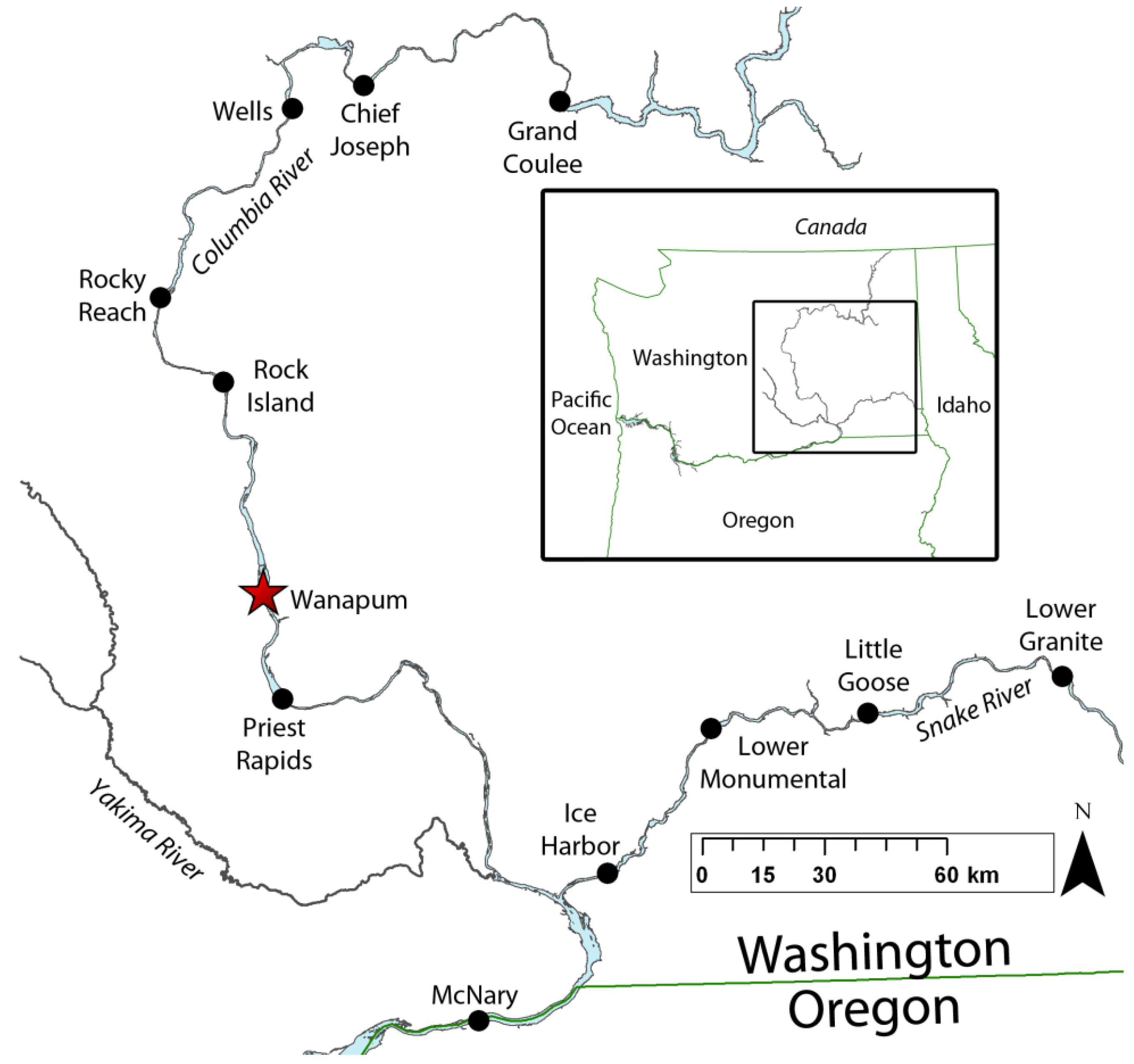
2.2. Test Conditions
2.3. Blade-Strike Model
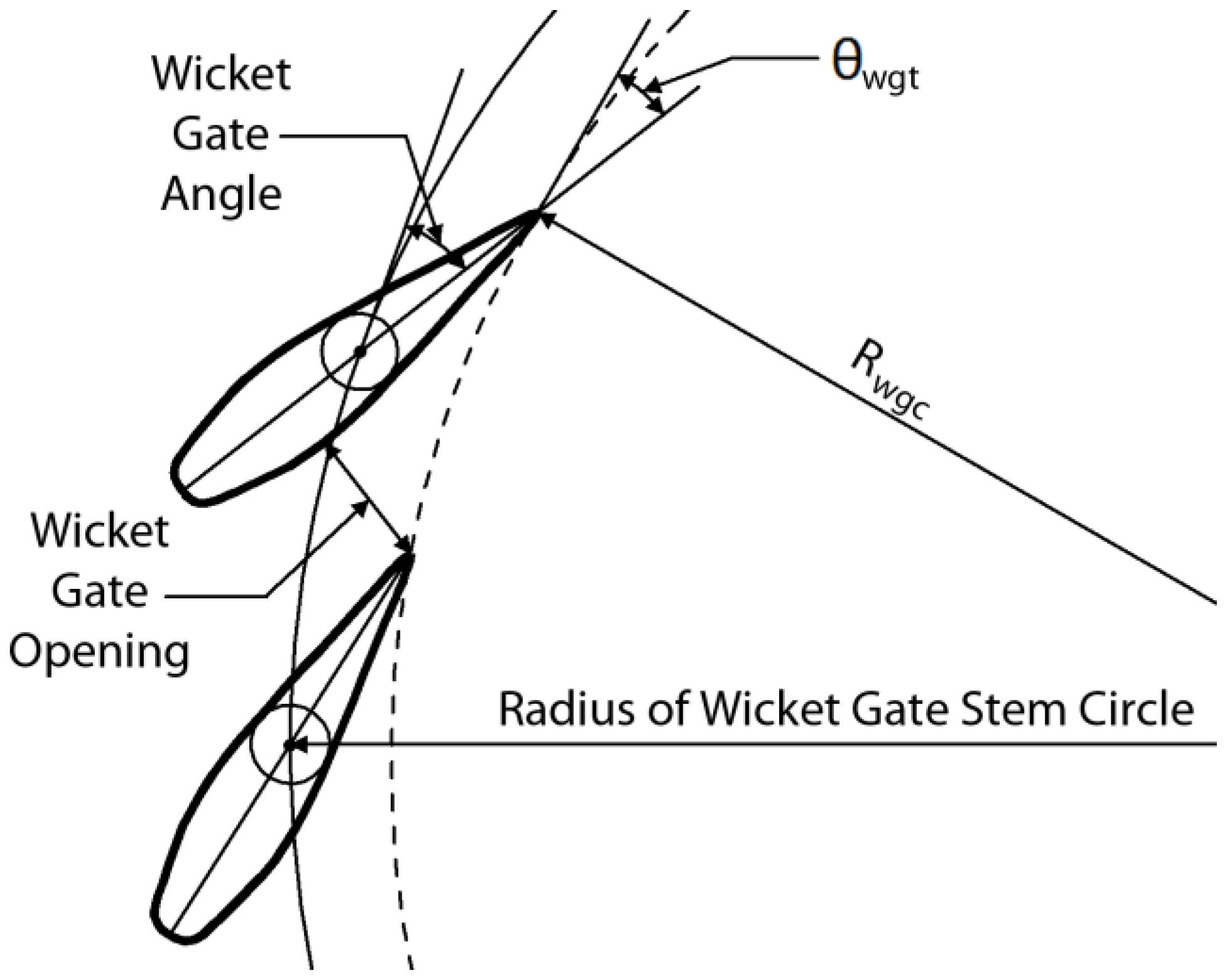
3. Results and Discussion
3.1. Deterministic Model Results

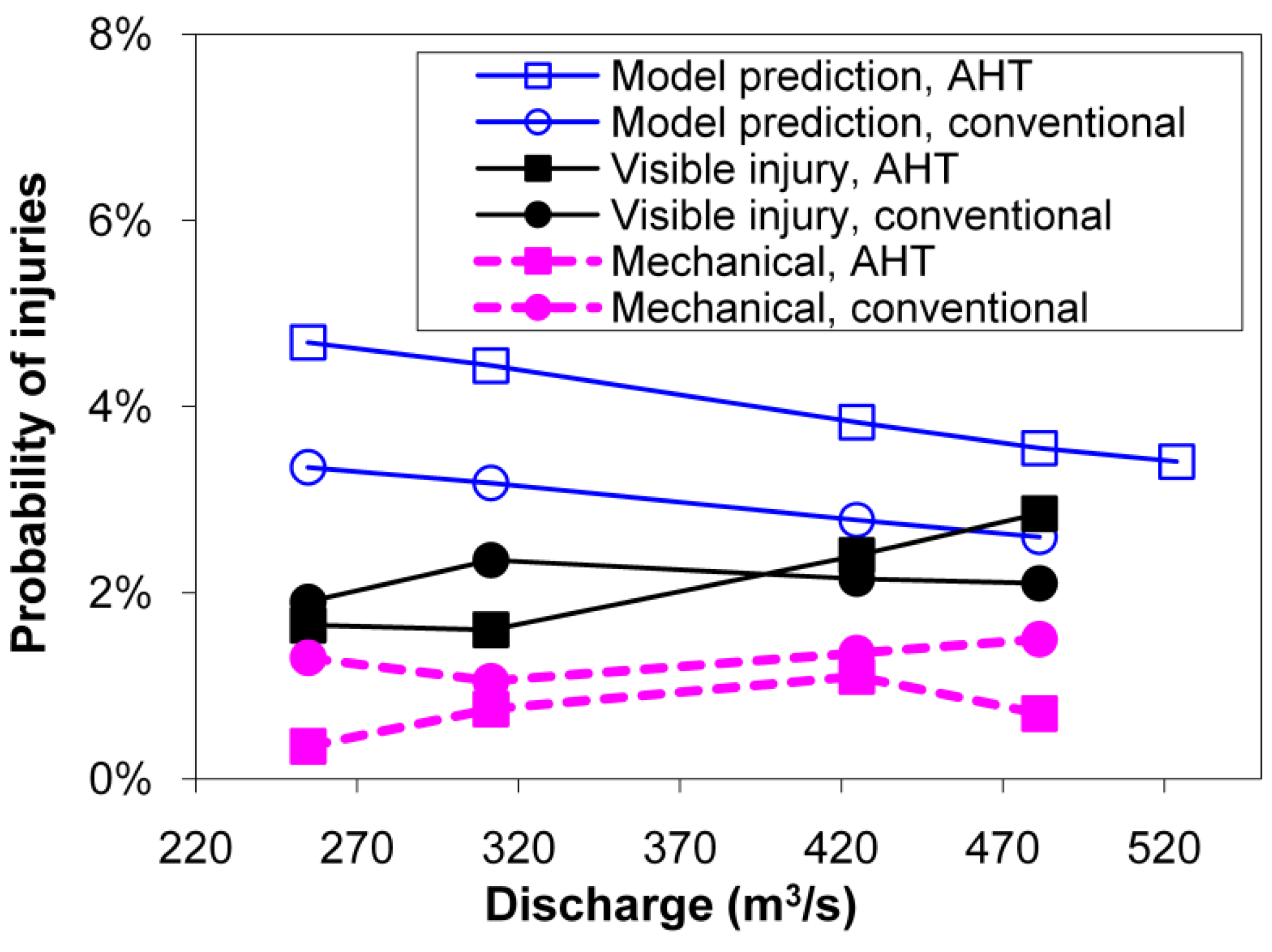
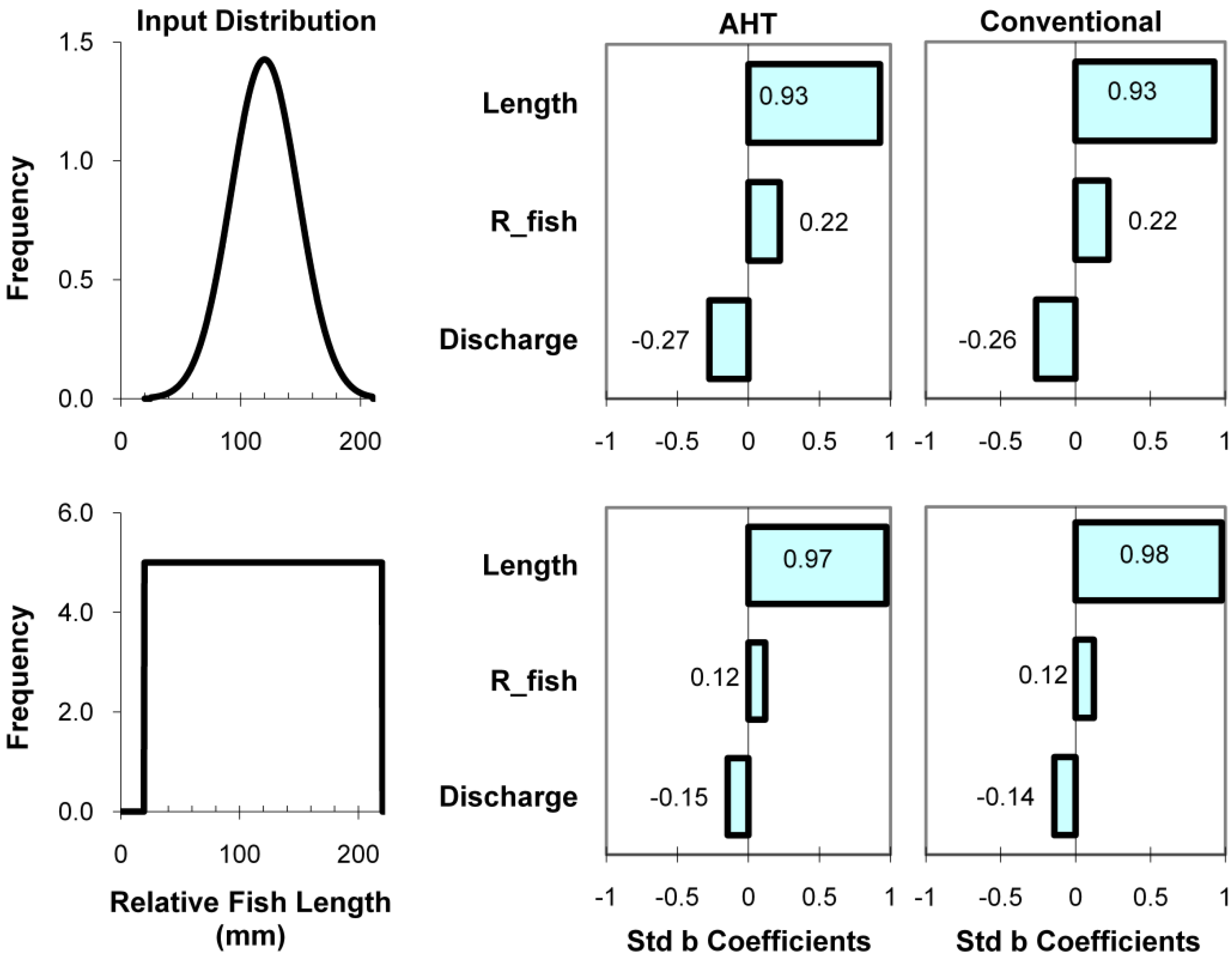
3.2. Stochastic Model Results

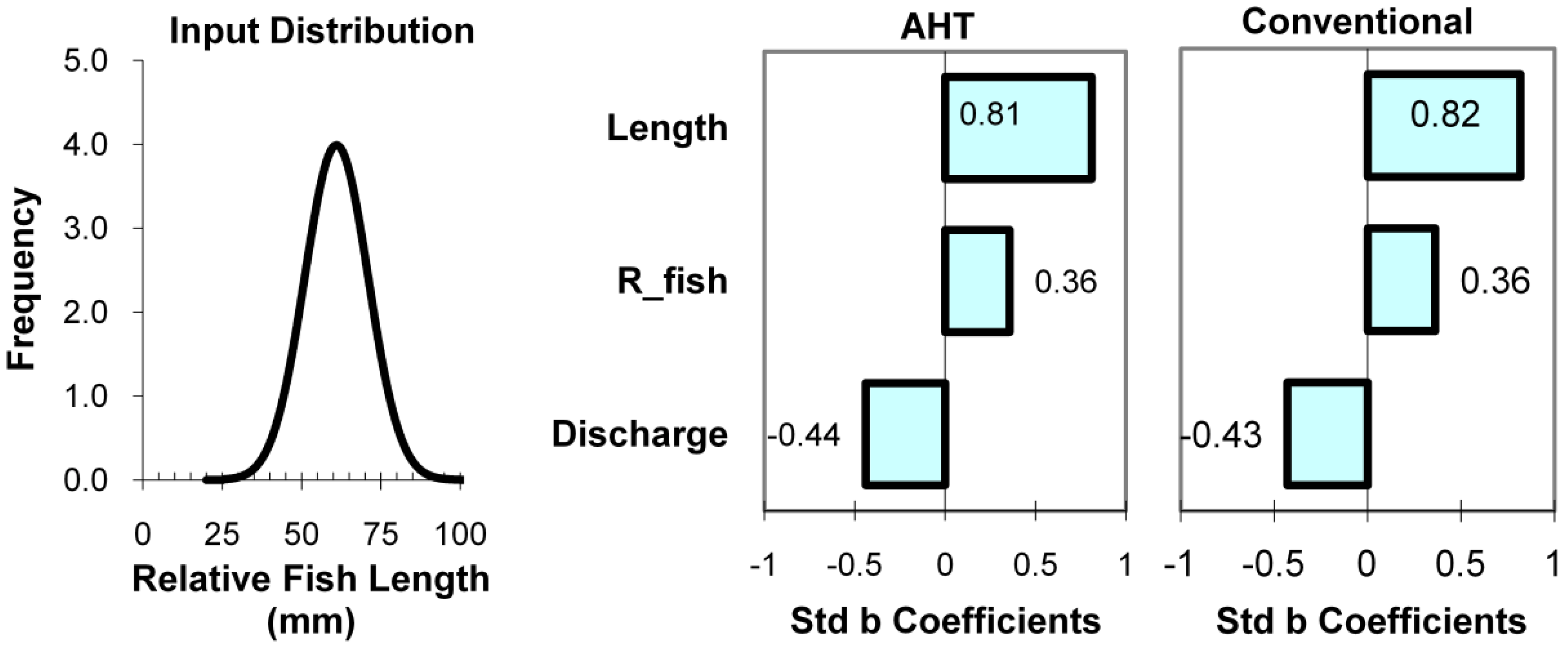


4. Conclusions
Acknowledgements
References
- Odeh, M.; Sommers, G. New design concepts for fish friendly turbines. Int. J. Hydropower Dams 2000, 73, 64–71. [Google Scholar]
- Cada, G.F. The development of advanced hydroelectric turbines to improve fish passage survival. Fisheries 2001, 26, 14–23. [Google Scholar] [CrossRef]
- Normandeau Associates, Inc.; Skalski, J.R.; Townsend, R. Performance Evaluation of the New Advanced Hydropower Turbine (AHTS) at Wanapum Dam, Columbia River, Washington; Grant County PUD: Washington, DC, USA, 2005. [Google Scholar]
- Mathur, D.; Heisey, P.G.; Euston, E.T.; Skalski, J.R.; Hays, S. Turbine passage survival estimation for Chinook salmon smolts (Oncorhynchus tshawytscha) at a large dam on the Columbia River. Can. J. Fisheries Aquat. Sci. 1996, 53, 542–549. [Google Scholar]
- Deng, Z.; Carlson, T.J.; Duncan, J.P.; Richmond, M.C.; Dauble, D.D. Use of an autonomous sensor to evaluate the biological performance of the advanced turbine at Wanapum Dam. J. Renewable Sustainable Energy 2010, 2, 053104. [Google Scholar] [CrossRef]
- Wang, Y.; Xia, Z. Assessing spawning ground hydraulic suitability for Chinese sturgeon (Acipenser sinensis) from horizontal mean vorticity in Yangtze River. Ecol. Modell. 2009, 220, 1443–1448. [Google Scholar] [CrossRef]
- Deng, Z.; Guensch, G.R.; McKinstry, C.A.; Mueller, R.P.; Dauble, D.D.; Richmond, M.C. Evaluation of fish-injury mechanisms during exposure to turbulent shear flow. Can. J. Fisheries Aquat. Sci. 2005, 62, 1513–1522. [Google Scholar] [CrossRef]
- Deng, Z.; Mueller, R.P.; Richmond, M.C.; Johnson, G.E. Injury and mortality of juvenile salmon entrained in a submerged jet entering still water. No. Am. J. Fish. Manage. 2010, 30, 623–628. [Google Scholar] [CrossRef]
- Cada, G.F.; Loar, J.; Garrison, L.; Fisher, R., Jr.; Neitzel, D.A. Efforts to reduce mortality to hydroelectric turbine-passed fish: Locating and quantifying damaging shear stresses. J. Environ. Manage. 2006, 37, 898–906. [Google Scholar] [CrossRef]
- Von Raben, K. Regarding the problem of mutilations of fishes by hydraulic turbines. Die Wasserwirtschaft 1957, 4, 97–100. [Google Scholar]
- Monten, E. Fish and Turbines: Fish Injuries during Passage through Power Station Turbines; Vattenfall: Stockholm, Sweden, 1985. [Google Scholar]
- Solomon, D.J. Fish Passage through Tidal Energy Barrages; Technical Report for Energy Technology Support Unit: Harwell, UK, 1988; ETSU TID4056. [Google Scholar]
- Turnpenny, A.W.H. Mechanisms of fish damage in low-head turbines: An experimental appraisal. In Fish Migration and Fish Bypasses; Jungwirth, M., Schmutz, S., Weiss, S., Eds.; Blackwell Publishing: Oxford, UK, 1998; pp. 300–314. [Google Scholar]
- Turnpenny, A.W.H.; Clough, S.; Hanson, K.P.; Ramsay, R.; McEwan, D. Risk Assessment for Fish Passage Through Small, Low-Head Turbines; Technical Report for Energy Technology Support Unit: Harwell, UK, 2000; ETSUH/06/00054/REP. [Google Scholar]
- Coutant, C.C.; Whitney, R.R. Fish behavior in relation to passage through hydropower turbines: A review. Trans. Am. Fisheries Soc. 2000, 129, 351–380. [Google Scholar] [CrossRef]
- Ferguson, J.W.; Ploskey, G.R.; Leonardsson, K.; Zabel, R.W.; Lundquist, H. Combining turbine blade-strike and life cycle models to assess mitigation strategies for fish passing dams. Can. J. Fisheries Aquat. Sci. 2008, 65, 1568–1585. [Google Scholar] [CrossRef]
- Deng, Z.Q.; Carlson, T.J.; Ploskey, G.R.; Richmond, M.C.; Dauble, D.D. Evaluation of blade-strike models for estimating the biological performance of Kaplan turbines. Ecol. Modell. 2007, 208, 165–176. [Google Scholar] [CrossRef]
- Deng, Z.; Carlson, T.J.; Duncan, J.P.; Richmond, M.C. Six-degree-of-freedom Sensor Fish design and instrumentation. Sensors 2007, 7, 3399–3415. [Google Scholar] [CrossRef]
- Normandeau Associates, Inc.; Skalski, J.R.; Mid-Columbia Consulting, Inc. Direct Survival and Condition of Juvenile Chinook Salmon Passed through an Existing and New Minimum Gap Runner Turbine at Bonneville Dam First Powerhouse, Columbia River; Report to U.S. Army Corps of Engineers: Portland, OR, USA, December 2000. [Google Scholar]
© 2011 by the authors; licensee MDPI, Basel, Switzerland. This article is an open access article distributed under the terms and conditions of the Creative Commons Attribution license (http://creativecommons.org/licenses/by/3.0/).
Share and Cite
Deng, Z.; Carlson, T.J.; Dauble, D.D.; Ploskey, G.R. Fish Passage Assessment of an Advanced Hydropower Turbine and Conventional Turbine Using Blade-Strike Modeling. Energies 2011, 4, 57-67. https://doi.org/10.3390/en4010057
Deng Z, Carlson TJ, Dauble DD, Ploskey GR. Fish Passage Assessment of an Advanced Hydropower Turbine and Conventional Turbine Using Blade-Strike Modeling. Energies. 2011; 4(1):57-67. https://doi.org/10.3390/en4010057
Chicago/Turabian StyleDeng, Zhiqun, Thomas J. Carlson, Dennis D. Dauble, and Gene R. Ploskey. 2011. "Fish Passage Assessment of an Advanced Hydropower Turbine and Conventional Turbine Using Blade-Strike Modeling" Energies 4, no. 1: 57-67. https://doi.org/10.3390/en4010057