<?xml version="1.0" encoding="UTF-8"?>
<!DOCTYPE article PUBLIC "-//NLM//DTD Journal Publishing DTD v2.3 20070202//EN" "journalpublishing.dtd">
<article xmlns:xlink="http://www.w3.org/1999/xlink" xml:lang="en" article-type="research-article">
<front>
<journal-meta>
<journal-id journal-id-type="publisher-id">101238455</journal-id>
<journal-title>International Journal of Environmental Research and Public Health</journal-title>
<issn pub-type="ppub">1661-7827</issn>
<issn pub-type="epub">1660-4601</issn>
<publisher>
<publisher-name>Molecular Diversity Preservation International (MDPI)</publisher-name></publisher></journal-meta>
<article-meta>
<article-id pub-id-type="doi">10.3390/ijerph8061772</article-id>
<article-id pub-id-type="publisher-id">ijerph-08-01772</article-id>
<article-categories>
<subj-group>
<subject>Article</subject></subj-group></article-categories>
<title-group>
<article-title>Evaluation of Changes in Individual Community-Related Empowerment in Community Health Promotion Interventions in Estonia</article-title></title-group>
<contrib-group>
<contrib contrib-type="author">
<name><surname>Kasmel</surname><given-names>Anu</given-names></name><xref ref-type="aff" rid="af1-ijerph-08-01772"><sup>1</sup></xref><xref ref-type="aff" rid="af2-ijerph-08-01772"><sup>2</sup></xref><xref ref-type="corresp" rid="c1-ijerph-08-01772"><sup>*</sup></xref></contrib>
<contrib contrib-type="author">
<name><surname>Tanggaard</surname><given-names>Pernille</given-names></name><xref ref-type="aff" rid="af2-ijerph-08-01772"><sup>2</sup></xref></contrib></contrib-group>
<aff id="af1-ijerph-08-01772">
<label>1</label> Institute of Political Science and Governance, University of Tallinn, Narva mnt. 10-120, Tallinn, Estonia</aff>
<aff id="af2-ijerph-08-01772">
<label>2</label> Institute of Public Health, University of Southern Denmark, Niels Bohrs Vej 9-10, 6700 Esbjerg, Denmark; E-Mail: <email>ptandersen@health.sdu.dk</email></aff>
<author-notes>
<corresp id="c1-ijerph-08-01772">
<label>*</label>Author to whom correspondence should be addressed: E-Mail: <email>anu.kasmel@gmail.com</email>; Tel: +372-51-05-621; Fax: +45-6550-42-83.</corresp></author-notes>
<pub-date pub-type="ppub">
<month>6</month>
<year>2011</year></pub-date>
<pub-date pub-type="epub">
<day>25</day>
<month>5</month>
<year>2011</year></pub-date>
<volume>8</volume>
<issue>6</issue>
<fpage>1772</fpage>
<lpage>1791</lpage>
<history>
<date date-type="received">
<day>4</day>
<month>4</month>
<year>2011</year></date>
<date date-type="accepted">
<day>10</day>
<month>5</month>
<year>2011</year></date></history>
<permissions>
<copyright-statement>© 2011 by the authors; licensee MDPI, Basel, Switzerland.</copyright-statement>
<copyright-year>2011</copyright-year>
<license license-type="open-access" xlink:href="http://creativecommons.org/licenses/by/3.0">
<p>This article is an open-access article distributed under the terms and conditions of the Creative Commons Attribution license (http://creativecommons.org/licenses/by/3.0/).</p></license></permissions>
<abstract>
<p>This study assessed changes in community members’ ratings of the dimensions of individual community related empowerment (ICRE) before and two years after the implementation of an empowerment expansion framework in three community health promotion initiatives within the Estonian context. We employed a self-administered questionnaire, the adapted <italic>mobilisation scale–individual</italic>. As the first step, we investigated the multidimensional nature of the ICRE construct and explored the validity and reliability (internal consistency) of the ICRE scale. Two datasets were used. The first dataset comprised a cross-sectional random sample of 1,000 inhabitants of Rapla County selected in 2003 from the National Population Register, which was used to confirm the composition of the dimensions of the scale and to examine the reliability of the dimensions. The second dataset comprised two waves of data: 120 participants from three health promotion programs in 2003 (pre-test) and 115 participants in 2005 (post-test), and the dataset was used to compare participants’ pre-test and post-test ratings of their levels of empowerment. The content validity ratio, determined using Lawshe’s formula, was high (0.98). Five dimensions of ICRE, <italic>self-efficacy</italic>, <italic>intention</italic>, <italic>participation</italic>, <italic>motivation</italic> and <italic>critical awareness</italic>, emerged from the factor analysis. The internal consistency (α) of the total empowerment scale was 0.86 (subscales <italic>self-efficacy</italic> α = 0.88, <italic>intention</italic> α = 0.83, <italic>participation</italic> α = 0.81 and <italic>motivation</italic> α = 0.69; <italic>critical awareness</italic> comprised only one item). The levels of ICRE dimensions measured after the application of the empowerment expansion framework were significantly more favourable for the dimensions <italic>self-efficacy</italic>, <italic>participation</italic>, <italic>intention</italic> and <italic>motivation</italic> to participate. We conclude that for Rapla community workgroups and networks, their ICRE was rendered more favourable after the implementation of the empowerment expansion framework.</p></abstract>
<kwd-group>
<kwd>individual community related empowerment</kwd>
<kwd>social change</kwd>
<kwd>health promotion</kwd>
<kwd>empowerment evaluation</kwd>
<kwd>Estonia</kwd>
<kwd>Eastern Europe</kwd></kwd-group></article-meta></front>
<body>
<sec sec-type="intro">
<label>1.</label>
<title>Introduction</title>
<p>Researchers, practitioners and politicians have all recognised that empowerment represents a core concept in health promotion. Its importance has been highlighted in the Alma-Ata Declaration [<xref ref-type="bibr" rid="b1-ijerph-08-01772">1</xref>] and the Ottawa Charter [<xref ref-type="bibr" rid="b2-ijerph-08-01772">2</xref>]. Empowerment is defined as a process whereby communities, organisations and/or individuals are enabled to assume power to act effectively to change their lives [<xref ref-type="bibr" rid="b3-ijerph-08-01772">3</xref>–<xref ref-type="bibr" rid="b6-ijerph-08-01772">6</xref>]. Embedded within this definition is a point that is crucial for research on empowerment: the level of analysis at which the construct is conceptualised, <italic>i.e.</italic>, individual, organisational and/or community levels of empowerment [<xref ref-type="bibr" rid="b7-ijerph-08-01772">7</xref>]. The scope of the current study is at the level of individual communityrelated empowerment (ICRE).</p>
<p>Individual empowerment (IE) is the expression of the empowerment construct at the level of the person and reflects one’s freedom to decide what goals to pursue [<xref ref-type="bibr" rid="b8-ijerph-08-01772">8</xref>]. IE has been seen as an effective strategy in improving employees’ health [<xref ref-type="bibr" rid="b9-ijerph-08-01772">9</xref>], empowering low income mothers [<xref ref-type="bibr" rid="b10-ijerph-08-01772">10</xref>], enabling cancer patients [<xref ref-type="bibr" rid="b11-ijerph-08-01772">11</xref>], empowering young people [<xref ref-type="bibr" rid="b12-ijerph-08-01772">12</xref>] and in improving adult outpatient mental health [<xref ref-type="bibr" rid="b13-ijerph-08-01772">13</xref>].</p>
<p>However, despite the impressive body of published studies on empowerment [<xref ref-type="bibr" rid="b3-ijerph-08-01772">3</xref>], health promotion practitioners still have few tools for the measurement of the empowerment construct. Many authors have argued that ICRE is a prerequisite for community empowerment and social change [<xref ref-type="bibr" rid="b8-ijerph-08-01772">8</xref>,<xref ref-type="bibr" rid="b14-ijerph-08-01772">14</xref>,<xref ref-type="bibr" rid="b15-ijerph-08-01772">15</xref>]. Therefore, in evaluating the empowering processes, the evaluation of community empowerment might be supported by and benefit from the measurement of ICRE.</p>
<p>The current study is a part of a wider evaluation that included two parallel assessments: an internal evaluation of the organizational domains of community empowerment and an external evaluation of the ICRE. To the best of our knowledge, no research on ICRE has previously been undertaken in Estonia.</p>
<sec sec-type="methods">
<label>1.1.</label>
<title>Aim of the Study</title>
<p>The main aim of the current study was to assess changes in ICRE in a sample of community members two years after the application of the empowerment expansion framework (see below) in the community of Rapla, Estonia. The specific objectives were as follows:
<list list-type="order">
<list-item>
<p>to assess the construct validity of the ICRE scale;</p></list-item>
<list-item>
<p>to investigate the multidimensional nature of the ICRE construct;</p></list-item>
<list-item>
<p>to assess the reliability of the ICRE scale; and;</p></list-item>
<list-item>
<p>to assess changes in participants’ ratings of the dimensions of the ICRE before and after the application of the empowerment expansion framework.</p></list-item></list></p></sec>
<sec>
<label>1.2.</label>
<title>Theoretical Framework</title>
<p>Several authors have defined empowerment as a construct that links individual strengths and competencies, natural helping systems, and proactive behaviours to matters of social policy and social change. Psychological empowerment is a process by which individuals gain control over their lives [<xref ref-type="bibr" rid="b4-ijerph-08-01772">4</xref>]. Empowerment is associated with feelings of competence to change a situation and with expectations of positive outcomes for one’s efforts [<xref ref-type="bibr" rid="b7-ijerph-08-01772">7</xref>,<xref ref-type="bibr" rid="b14-ijerph-08-01772">14</xref>,<xref ref-type="bibr" rid="b15-ijerph-08-01772">15</xref>]. Individual empowerment begins with an individual belief that what one is trying to accomplish is possible to achieve.</p>
<p>Researchers have noted that the development of a universal measure of individual empowerment may not be a feasible or appropriate goal, as empowerment differs among individuals, contexts and times [<xref ref-type="bibr" rid="b16-ijerph-08-01772">16</xref>]. Furthermore, empowerment is not understood as merely an individualistic characteristic; rather, it is related to perceived goals in one’s environment. The measurement of individual empowerment is problematic because empowerment may manifest in different forms of perceptions, behaviour, competencies and actions, and moreover, it may fluctuate over time [<xref ref-type="bibr" rid="b3-ijerph-08-01772">3</xref>].</p>
<p>Several researchers have identified somewhat different scales for the measurement of individual empowerment depending on the context and/or specificity of study group. Zimmerman [<xref ref-type="bibr" rid="b16-ijerph-08-01772">16</xref>] defined three components of IE: intrapersonal, interactional and behavioural. The intrapersonal component includes community-specific self-efficacy, motivation and intention to take action and control in an individual’s community. The interactional component refers to critical awareness and understanding of a given context. The behavioural component includes participation in collective action. In the context of ethnic identity, Gutierrez [<xref ref-type="bibr" rid="b17-ijerph-08-01772">17</xref>] specified group identification as a psychological component of empowerment for individuals. Parsons [<xref ref-type="bibr" rid="b18-ijerph-08-01772">18</xref>] identified characteristics of empowerment in the context of mental health services. One characteristic identified was the degree to which clients develop a critical awareness or critical thinking regarding system dynamics within the family or community with relation to power. McWhirter [<xref ref-type="bibr" rid="b19-ijerph-08-01772">19</xref>] described skill development, a characteristic that stresses skills in decision making and socialisation. Akey <italic>et al</italic>. [<xref ref-type="bibr" rid="b20-ijerph-08-01772">20</xref>] utilised data from 293 parents of children with disabilities living in three states in the USA and participating in family support programs aimed at empowering parents. The scale developed by these authors originally contained three subscales: attitudes related to control and competence, critical skills and knowledge, and participatory behaviour. Speer and Peterson [<xref ref-type="bibr" rid="b21-ijerph-08-01772">21</xref>] elaborated a 27-item scale for the measurement of IE and reported psychometric properties of a scale from a sample of 974 randomly selected people. They identified cognitive, emotional, and behavioural dimensions in community-organising contexts. The applicability of their measure was broad. However, they all recognised that modifications need to be made on the basis of the variety of contexts and settings in which empowerment may be applied.</p>
<p>Empowerment theory proposes that empowerment takes on different meanings in different settings [<xref ref-type="bibr" rid="b16-ijerph-08-01772">16</xref>]. The definition of ICRE employed in the current study combines multiple components: <italic>self-efficacy</italic> with self-confidence [<xref ref-type="bibr" rid="b22-ijerph-08-01772">22</xref>–<xref ref-type="bibr" rid="b24-ijerph-08-01772">24</xref>]; involvement in collective action (<italic>participation</italic>); <italic>motivation</italic> to be involved in community action [<xref ref-type="bibr" rid="b25-ijerph-08-01772">25</xref>]; willingness and <italic>intention</italic> to take action in the public domain [<xref ref-type="bibr" rid="b25-ijerph-08-01772">25</xref>]; and <italic>critical awareness</italic> that community issues are serious [<xref ref-type="bibr" rid="b9-ijerph-08-01772">9</xref>,<xref ref-type="bibr" rid="b26-ijerph-08-01772">26</xref>].</p>
<p>S<italic>elf-efficacy</italic> is an individual’s confidence in their personal capability to organise and execute the course of action required to deal with prospective situations and belief in their capability to regulate their motivation, thought processes, emotional stages and the social environment, as well as behavioural attainment [<xref ref-type="bibr" rid="b4-ijerph-08-01772">4</xref>,<xref ref-type="bibr" rid="b14-ijerph-08-01772">14</xref>,<xref ref-type="bibr" rid="b25-ijerph-08-01772">25</xref>]. It is the belief that one has the skills and ability to achieve goals accompanied by perceived improvements in knowledge and skills through participation in community problem-solving processes [<xref ref-type="bibr" rid="b27-ijerph-08-01772">27</xref>]. Perceived self-efficacy with regard to dealing with community issues is associated with a sense of community [<xref ref-type="bibr" rid="b28-ijerph-08-01772">28</xref>,<xref ref-type="bibr" rid="b29-ijerph-08-01772">29</xref>] and with social action on community issues [<xref ref-type="bibr" rid="b14-ijerph-08-01772">14</xref>,<xref ref-type="bibr" rid="b15-ijerph-08-01772">15</xref>,<xref ref-type="bibr" rid="b25-ijerph-08-01772">25</xref>]. Perceiving that one can solve community problems is a prerequisite for community involvement [<xref ref-type="bibr" rid="b30-ijerph-08-01772">30</xref>].</p>
<p><italic>Participation</italic> is the involvement in any community action that an individual attends without pay to achieve a common goal and/or social change [<xref ref-type="bibr" rid="b25-ijerph-08-01772">25</xref>,<xref ref-type="bibr" rid="b31-ijerph-08-01772">31</xref>].</p>
<p><italic>Motivation</italic> is the belief that one should participate in community problem-solving processes as a responsibility to others [<xref ref-type="bibr" rid="b25-ijerph-08-01772">25</xref>,<xref ref-type="bibr" rid="b32-ijerph-08-01772">32</xref>]. Thus, people are motivated by a sense of moral responsibility to redress practices or change conditions that they perceive to be unfair [<xref ref-type="bibr" rid="b33-ijerph-08-01772">33</xref>].</p>
<p><italic>Intention</italic> to participate is an anticipated outcome that is intended or that guides one’s planned action [<xref ref-type="bibr" rid="b25-ijerph-08-01772">25</xref>].</p>
<p><italic>Critical awareness</italic> is the sense of the importance of community issues and understanding of the purposes of community action [<xref ref-type="bibr" rid="b27-ijerph-08-01772">27</xref>]. Critical comprehension and knowledge of social and political contexts is a prerequisite for the cultivation of both individual and collective resources and skills related to social action [<xref ref-type="bibr" rid="b23-ijerph-08-01772">23</xref>].</p>
<p>Essentially, ICRE is an active type of community orientation in which an individual wishes and feels able to shape his/her role and context [<xref ref-type="bibr" rid="b16-ijerph-08-01772">16</xref>]. The applicability of this measure is broad, but modifications need to be made on the basis of the variety of social work settings in which empowerment may be applied.</p></sec>
<sec>
<label>1.3.</label>
<title>Context and Settings</title>
<p>The current study was undertaken in Rapla County, Estonia, which is a small agrarian inland community of 37,000 inhabitants. There is high employment rate and relative poverty of Rapla County’s population is high in comparison to other regions of Estonia [<xref ref-type="bibr" rid="b34-ijerph-08-01772">34</xref>]. Several health promotion interventions have been initiated in Rapla, which have been directed to different health issues. Until the current study, previous assessments of health promotion initiatives were mainly focused on measuring changes in health outcomes. In 2002 an empowerment expansion study was designed simultaneously to expand empowerment in communities and to assess changes in the organizational domains of community empowerment and also in ICRE of the participants involved in community health promotion programs [<xref ref-type="bibr" rid="b35-ijerph-08-01772">35</xref>]. This evaluation was premised on a two-pronged approach that comprised an internal evaluation undertaken by the community members and an external evaluation undertaken by a person external to the programs. The current study is an external evaluation of the ICRE. The study involved participants from three community health promotion initiatives in Rapla County: the <italic>Safe Community</italic> program; <italic>Drug Abuse and AIDS Prevention</italic> programme; and <italic>Elderly Quality of Life</italic> program. Short description of the essence of community health promotion interventions is presented in <xref ref-type="table" rid="t1-ijerph-08-01772">Table 1</xref>.</p></sec>
<sec>
<label>1.4.</label>
<title>Empowerment Expansion Framework</title>
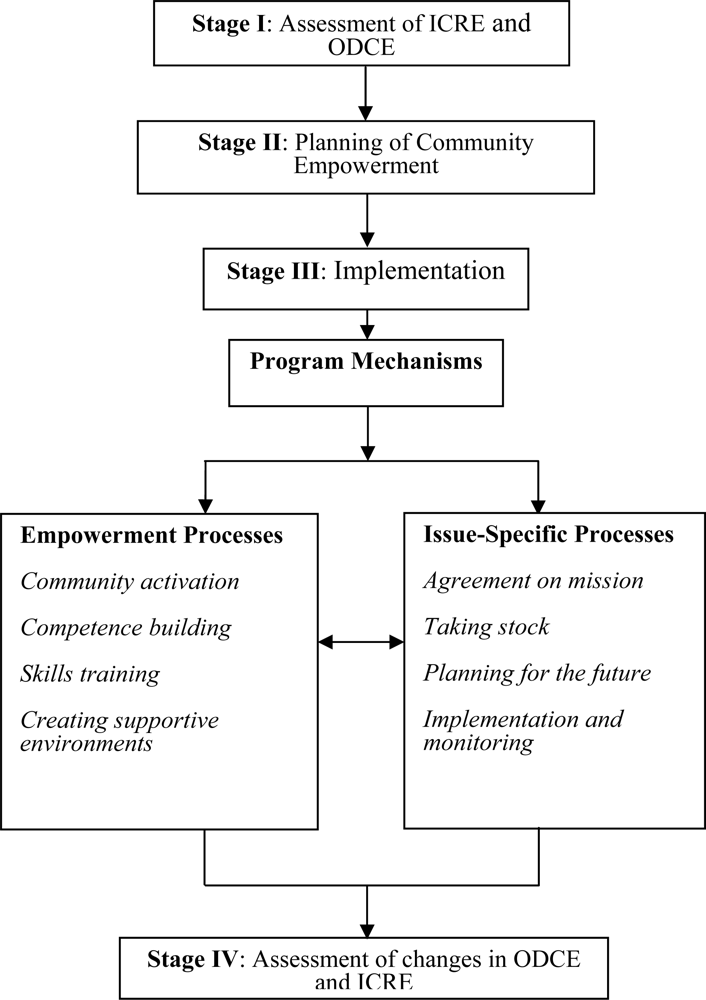
<p>The community workgroups constructed an empowerment expansion framework (<xref ref-type="fig" rid="f1-ijerph-08-01772">Figure 1</xref>) to achieve and assess changes in empowerment and health in the three different programs that were being implemented [<xref ref-type="bibr" rid="b35-ijerph-08-01772">35</xref>]. The framework was based on models of empowerment evaluation, as suggested by Fettermann [<xref ref-type="bibr" rid="b36-ijerph-08-01772">36</xref>], and the <italic>parallel tracks</italic> model elaborated by Laverack [<xref ref-type="bibr" rid="b37-ijerph-08-01772">37</xref>]. Empowerment evaluation is a process through which community members in collaboration with health promotion practitioners learn to evaluate their own programs and work together toward the improvement of the quality of their common program using several pragmatic steps.</p>
<p>Empowerment evaluation is the use of evaluation concepts, techniques, and findings to foster improvement and self-determination [<xref ref-type="bibr" rid="b36-ijerph-08-01772">36</xref>]. The advantage of the model is that it suggests a clear step-by-step empowering guide. Its limitation is that it does not suggest how to measure changes in empowerment [<xref ref-type="bibr" rid="b35-ijerph-08-01772">35</xref>].</p>
<p>The ‘parallel tracks’ program planning model elaborated by Laverack [<xref ref-type="bibr" rid="b37-ijerph-08-01772">37</xref>] integrates an empowerment approach within an issue-specific approach ensuring focus on both empowerment process goals and issue-specific goals. The advantage of this model is that by clarifying and distinguishing empowerment domains, participants are able to easily assess changes in empowerment during an intervention course and measure empowerment domains. The limitation of this model is that it does not clearly demonstrate the precise steps involved in the empowerment approach.</p>
<p>The empowerment expansion framework creates an opportunity to simultaneously expand empowerment in a community, achieve expected outcomes related to community needs and evaluate changes in both tracks. The framework of the empowerment expansion comprised four stages:</p>
<p>Stage I—assessment of ICRE (undertaken by an external evaluator among the participants in the three community programs) and evaluation of the organisational domains of community empowerment (ODCE). The latter process is beyond the scope of the current study and is not reported here.</p>
<p>Stage II—planning of community empowerment. This included the formulation and statement of the empowerment expansion (undertaken by workgroups in each of the three community programs, where goals and objectives for the empowerment expansion were defined; measurable indicators and measurement processes were identified; and action plans were agreed upon).</p>
<p>Stage III—consisted of two parallel implementation processes:
<list list-type="alpha-lower">
<list-item>
<p>Empowerment expansion processes: included numerous activities targeted at the development of the four ODCE domains (<xref ref-type="table" rid="t2-ijerph-08-01772">Table 2</xref>). These processes were debated, formulated and planned by the community while being supported, facilitated and mediated by a health promotion practitioner and an internal evaluator; and</p></list-item>
<list-item>
<p>Issue-specific processes: during which the guidelines for empowerment evaluation [<xref ref-type="bibr" rid="b36-ijerph-08-01772">36</xref>] were used, and four actions were undertaken:</p>
<list list-type="roman-lower">
<list-item>
<p>agreement on an issue-specific mission;</p></list-item>
<list-item>
<p>taking stock (activities undertaken thus far were assessed, listed, analysed and rated, and an evaluation matrix was developed);</p></list-item>
<list-item>
<p>future planning (development of issue-specific goals and expected outcomes and formulation of an action plan). This also included the selection of measurement tools, indicators and a time-schedule for the issue-specific evaluation; <italic>i.e.</italic>, the creation of a system of processes and outcome monitoring;</p></list-item>
<list-item>
<p>implementation. <xref ref-type="table" rid="t3-ijerph-08-01772">Table 3</xref> depicts some activities that were undertaken by community workgroups during the issue-specific processes.</p></list-item></list></list-item></list></p>
<p>Stage IV—evaluation of changes in community members’ ICRE (and assessment of the ODCE, which is not in the scope of the current paper).</p></sec></sec>
<sec sec-type="methods">
<label>2.</label>
<title>Methods</title>
<sec sec-type="methods">
<label>2.1.</label>
<title>Data</title>
<p>Two sets of data were collected. Ethical committee approval was not sought because in Estonia, studies that involve the voluntary participation of adults and have informed consent are exempt from further ethical approval.</p>
<p>The first dataset was used to investigate the multidimensional nature of the ICRE construct in the Estonian context and to assess the content validity and reliability of its dimensions. Questionnaires to be self-completed were mailed by regular post during April–May 2003 to a cross-sectional random sample of 1,000 inhabitants from Rapla County (selected from the National Population Register). Two reminders were subsequently mailed to those individuals who did not respond. The response rate was 67.1%. Respondents’ (n = 671) ages ranged from 17 to 71 years (Mean = 42; SD = 14.18). 392 (58.42%) female and 279 (41.58%) male respondents were included.</p>
<p>The second dataset was employed to assess changes in participants’ ratings of the dimensions of the ICRE. This sample consisted of all 120 voluntary participants from the three community programs who were involved in at least two program activities during the first intervention year of any of the three programs before the implementation of the empowerment expansion model. Two waves of the same self-administered questionnaire that was utilised for the first dataset were sent electronically: the first wave was sent one month before the first workshop related to application of the empowerment expansion framework in each community program separately (pre-test, 2003); and the second wave was sent after the last (third) workshop of the programs (post-test, January 2005). Additionally, two electronic reminders were sent to non-respondents, and phone interviews were undertaken with three individuals who did not respond electronically.</p>
<p>The pre-test was undertaken in 2003 (response rate 100%). Respondents’ (n = 120) ages ranged from 24 to 65 years (Mean = 43; SD = 10.9), and the sample comprised 78 (65%) women and 42 (35%) of men (<xref ref-type="table" rid="t4-ijerph-08-01772">Table 4</xref>). Of these participants, 22% had attained a primary level of education, 61% a secondary level, and 37% of the participants had a university education. With respect to the employment and affiliation of these individuals 19,16% were retired community members; 14,6% were people from the non-governmental sector; 10,83 worked in agriculture; 9,16% worked in the preschools and the same percentage in social work; 7,5% in the education system; 6,6% worked in the service and the same percentage in recreation sector; 3,33% were civil servants and students; 5% worked in the health care system; 2,50% were unemployed during the first measurement. In 2005, the post-test was undertaken. A total of 115 completed questionnaires were received during the post-test, which represented 95.8% of the pre-test participants. Five of the respondents who completed the pre-test had subsequently moved away from the community or were not available and, hence, were excluded from the current analysis. The mean age was 45 (SD = 10.51), and the sample consisted of 73 (63.48%) women and 42 (36.52%) of men.</p></sec>
<sec>
<label>2.2.</label>
<title>Instruments: Questionnaire (Mobilization Scale–Individual)</title>
<p>There are few instruments that measure ICRE. For instance, Israel <italic>et al.</italic> [<xref ref-type="bibr" rid="b22-ijerph-08-01772">22</xref>] developed a 12-item <italic>perceived control scale</italic> to assess empowerment at individual, organisational and community levels (internal consistency α = 0.63). Similarly, Oman <italic>et al.</italic> [<xref ref-type="bibr" rid="b38-ijerph-08-01772">38</xref>] proposed a 6-item <italic>community involvement scale</italic>, and Reinigen <italic>et al.</italic> [<xref ref-type="bibr" rid="b12-ijerph-08-01772">12</xref>] suggested a <italic>youth empowerment scale</italic> (both with α = 0.78). Likewise, Spreitzer [<xref ref-type="bibr" rid="b9-ijerph-08-01772">9</xref>] developed a tool to evaluate IE in the workplace environment (12 items) that had a reliability coefficient 0.72. The present study utilised the <italic>mobilization scale–individual</italic> [<xref ref-type="bibr" rid="b39-ijerph-08-01772">39</xref>]. This scale was selected because most of the scale’s items emphasised participants’ perceptions of having the requisite abilities and motivations to make a difference in their communities. The original scale consists of nine subscales and 49 propositions. Five subscales (self-efficacy, participation, motivation, social assets and human capital) consisting 30 questions were selected as most appropriate for study context. The questionnaire was translated from English into Estonian language by two translators independently. Thereafter, the method of back-translation [<xref ref-type="bibr" rid="b40-ijerph-08-01772">40</xref>] was employed to determine the equivalence between the primary and secondary language tools. After the back-translation, the original and back-translated questionnaires were compared, and points of divergence were noted. The scale components were modified during a workshop in which Rapla community members were invited to respond to the items and discuss their cultural understanding and relevance to their community.</p>
<p>The content validity of the translated questionnaire was assessed by an expert panel of six health promotion experts. Each item in the questionnaire was discussed and rated as ‘essential’ (1) or ‘not necessary’ (0), and the content validity ratio (CVR) was calculated using the formula developed by Lawshe [<xref ref-type="bibr" rid="b41-ijerph-08-01772">41</xref>].</p>
<p>The final questionnaire consisted of 20 items rated on a Likert-type five-point scale (1 = ‘strongly agree’, the most favourable perception, to 5 = ‘strongly disagree’, the most unfavourable perception). The questionnaire considered the multidimensional nature of empowerment and allowed the assessment of the five dimensions of ICRE: <italic>self-efficacy</italic> related to an individual′s attitude toward social change in the community (7 items, e.g., “I have confidence in my capabilities to make the changes needed in my community”); <italic>participation</italic> in community activities (3 items, e.g., “I participate in community activities”); <italic>intention</italic> to become involved in community change (4 items, e.g., “I intend to take action in my community”); <italic>motivation</italic> to be involved (3 items, e.g., “I am motivated to get involved in my community”); and <italic>critical awareness</italic> that community issues are serious (one item, “I think that the problems in my community are serious”). Collectively, these dimensions provided a broad picture of ICRE.</p></sec>
<sec sec-type="methods">
<label>2.3.</label>
<title>Data Analysis</title>
<p>The software package SPSS 12.0 was used for the statistical analysis of the data. For the first objective of the study, to assess the construct validity of the ICRE scale, we employed Lawshe’s [<xref ref-type="bibr" rid="b41-ijerph-08-01772">41</xref>] formula: CVR = (n &lt; item &gt; e + n &lt; item &gt; e)/(N × n), where ne = number of experts rating <italic>essential,</italic> and N = number of items. To investigate the multidimensional nature of the ICRE construct within the Estonian context, the first dataset was used, for which factor analysis was employed to extract the factors by applying principal components analysis (varimax rotation) (<xref ref-type="table" rid="t5-ijerph-08-01772">Table 5</xref>). To assess the reliability of the ICRE scale, we used internal consistency coefficients measured by Cronbach’s alpha, which were undertaken twice: collectively for the total empowerment scale and individually for each of the five empowerment dimensions. To assess the changes in the participants’ ratings of the dimensions of the ICRE before and after the application of the empowerment expansion framework, we compared the pre-test and post-test results using an independent sample <italic>t</italic> test (one way ANOVA). Significance level was set at <italic>p</italic> &lt; 0.5.</p></sec></sec>
<sec sec-type="results">
<label>3.</label>
<title>Results</title>
<sec sec-type="methods">
<label>3.1.</label>
<title>Study Objective 1: Construct Validity of the ICRE Scale</title>
<p>Employing the formula suggested by Lawshe [<xref ref-type="bibr" rid="b41-ijerph-08-01772">41</xref>], the content validity ratio of the ICRE scale was 0.98, which is acceptable according to Davis [<xref ref-type="bibr" rid="b42-ijerph-08-01772">42</xref>] and Lawshe [<xref ref-type="bibr" rid="b41-ijerph-08-01772">41</xref>].</p></sec>
<sec sec-type="methods">
<label>3.2.</label>
<title>Study Objective 2: Dimensionality—the Multidimensional Nature of the ICRE</title>
<p>The dimensionality of the scale was evaluated by factor analysis (<xref ref-type="table" rid="t5-ijerph-08-01772">Table 5</xref>) using Kaiser’s criterion (eigenvalue &gt; 1) [<xref ref-type="bibr" rid="b43-ijerph-08-01772">43</xref>]. The Kaiser-Meyer scale was .93, which is defined as very good [<xref ref-type="bibr" rid="b43-ijerph-08-01772">43</xref>]. <xref ref-type="table" rid="t5-ijerph-08-01772">Table 5</xref> shows that five ICRE dimensions (factors) (<italic>i.e.</italic>, <italic>self-efficacy</italic>, <italic>intention</italic>, <italic>participation</italic>, <italic>motivation</italic> and <italic>critical awareness</italic>) emerged relatively clearly. However, two items (<italic>intention</italic>—“I pitch in when there is work to be done”, and <italic>critical awareness</italic>—“I feel that community issues are important”) exhibited fairy low loadings on their associated factors and relatively high loadings on other components. All remaining factors presented relatively strong loadings on their individual components. The factors consisted of three to seven items each (though only one item for the factor <italic>critical awareness</italic>). Collectively, the five dimensions explained 62.91% of the variance in ICRE. With respect to each of the individual dimensions, <italic>self-efficacy</italic> explained 20.37% of the variance, <italic>intention</italic> 16.96%, <italic>participation</italic> 11.97%, and <italic>motivation</italic> 7.22%. Their corresponding Eigen values (a common criterion for a dimension to be useful) were 8.52, 1.91, 1.25 and 1.02 [<xref ref-type="bibr" rid="b44-ijerph-08-01772">44</xref>].</p></sec>
<sec sec-type="methods">
<label>3.3.</label>
<title>Study Objective 3: Reliability of ICRE</title>
<p>Cronbach alpha coefficients were used to assess the reliability of the scale (<xref ref-type="table" rid="t5-ijerph-08-01772">Table 5</xref>). The internal consistency (Cronbach’s α) of the total scale was 0.859, which is very good [<xref ref-type="bibr" rid="b45-ijerph-08-01772">45</xref>]. Likewise, the internal consistencies of the three sub-scales comprising three dimensions (Self-efficacy 0.883; Intention 0.834; Participation 0.808) were very good. The Motivation dimension had a lower α (0.69), which is considered satisfactory. Critical awareness comprised only one item, and hence, α was not applicable.</p></sec>
<sec sec-type="methods">
<label>3.4.</label>
<title>Study Objective 4: Comparison of Pre- and Post-Test Ratings of ICRE Dimensions (Before and After the Application of the Empowerment Expansion Model)</title>
<p><xref ref-type="table" rid="t6-ijerph-08-01772">Table 6</xref> presents the means and standard deviations of the empowerment scale at the beginning of the application of the empowerment expansion framework and two years after its application. Generally, the means of the post-test (2005) for the five dimensions of empowerment and for total empowerment were more favourable than their pre-test means (2003). These changes were statistically significant for four of the five dimensions (<italic>self-efficacy</italic>, <italic>participation</italic>, <italic>intention</italic>, and <italic>motivation</italic>).</p>
<p>These findings suggested that respondents’ perceptions of their <italic>self-efficacy</italic> related to community problem-solving had increased in 2005 in comparison with the 2003 data. Participants’ confidence in their capabilities to undertake the required changes in their communities had increased, as respondents felt they could influence their communities to take action on important issues. Furthermore, respondents’ <italic>motivation</italic> to participate, <italic>intention</italic> to participate and actual <italic>participation</italic> in community activities had all increased. Similarly, respondents’ <italic>critical awareness</italic> of the seriousness of the community issues also exhibited a moderate increase, although the increase was not significant. Nevertheless, the 2003 data indicated that the <italic>critical awareness</italic> component of empowerment already presented a high value during the pre-test period, suggesting that for these three programs, respondents’ baseline awareness of community problem seriousness was already high before the initiation of the programs.</p></sec></sec>
<sec sec-type="discussion">
<label>4.</label>
<title>Discussion</title>
<p>Given that expansion of empowerment is frequently the primary objective of community health promotion programs, the positive change in ICRE among the participants of the programs investigated in this study is gratifying. The empowerment of communities has been recognised as a key purpose and critical function of health promotion initiatives [<xref ref-type="bibr" rid="b31-ijerph-08-01772">31</xref>,<xref ref-type="bibr" rid="b32-ijerph-08-01772">32</xref>,<xref ref-type="bibr" rid="b46-ijerph-08-01772">46</xref>,<xref ref-type="bibr" rid="b47-ijerph-08-01772">47</xref>]. Not surprisingly, numerous health promotion efforts have employed empowerment as a vehicle for their programs to combat a range of health and social problems. The types of such programs in which empowerment strategies have been used are diverse and are related to, e.g., violence against women [<xref ref-type="bibr" rid="b48-ijerph-08-01772">48</xref>], promotion of mental health [<xref ref-type="bibr" rid="b49-ijerph-08-01772">49</xref>], maternal and reproductive health among internally displaced communities [<xref ref-type="bibr" rid="b50-ijerph-08-01772">50</xref>], and the reduction of sex workers’ vulnerability to HIV/STDs [<xref ref-type="bibr" rid="b51-ijerph-08-01772">51</xref>]. Similarly, empowerment has been successfully utilised in decreasing the burden of lymphatic filariasis [<xref ref-type="bibr" rid="b52-ijerph-08-01772">52</xref>], in dengue prevention [<xref ref-type="bibr" rid="b53-ijerph-08-01772">53</xref>] and in the Healthy Cities movement [<xref ref-type="bibr" rid="b54-ijerph-08-01772">54</xref>].</p>
<p>However, few studies studies on this topic have previously been reported from eastern European countries, and there remains a gap in the empowerment literature in terms of research undertaken in (post-communist) countries that are in political and economic transition, such as Estonia. The current study bridges this gap, and while Estonia is classified economically as a high-income country [<xref ref-type="bibr" rid="b55-ijerph-08-01772">55</xref>], the current study was undertaken in a mainly rural area of Estonia where the relative poverty of the county’s population was high in comparison to other regions of Estonia [<xref ref-type="bibr" rid="b34-ijerph-08-01772">34</xref>]. In such settings, the empowerment of community members through program participation has been shown to be particularly important [<xref ref-type="bibr" rid="b56-ijerph-08-01772">56</xref>]. This is probably because ‘empowerment’ mechanisms engender a belief in oneself that is accompanied by taking responsibility in community development.</p>
<p>The current study employed an empowerment expansion framework based on models of empowerment evaluation and ‘parallel tracks’ program planning [<xref ref-type="bibr" rid="b36-ijerph-08-01772">36</xref>,<xref ref-type="bibr" rid="b37-ijerph-08-01772">37</xref>]. Using this framework, program participants from three community health promotion initiatives were empowered through: (1) a range of empowerment activities (e.g., community activation, competence building and skills training, in addition to the creation of supportive environments) and (2) a variety of issue-specific actions (e.g., agreement on a mission, taking stock, planning for the future, implementation and monitoring). The post-test findings indicated that the employed empowerment processes were associated with enhanced feelings regarding <italic>self-efficacy</italic> related to social change in the community, <italic>participation</italic> in community activities, <italic>intention</italic> to become involved in community change, <italic>motivation</italic> to be involved, and <italic>critical awareness</italic> that community issues are serious.</p>
<p>Tools for the measurement of ICRE are still under development. This study undertook an initial step towards examining ICRE in the Estonian context. Hence, we adopted a <italic>mobilization scale–individual</italic> [<xref ref-type="bibr" rid="b39-ijerph-08-01772">39</xref>] that measures individual community-related empowerment. We validated the scale, which demonstrated a satisfactory five-factor solution, confirming five specific dimensions of ICRE. Factor analysis indicated that the first factor, <italic>self-efficacy,</italic> was one of the strongest and most consistent. This is in agreement with findings reported in the USA by Rogers <italic>et al.</italic> [<xref ref-type="bibr" rid="b57-ijerph-08-01772">57</xref>], who studied the individual empowerment of 271 participants in self-help groups in six states. Our results are also in support of the findings of Wowra and McCarter [<xref ref-type="bibr" rid="b13-ijerph-08-01772">13</xref>], who validated an empowerment scale in an adult outpatient mental health population in South Carolina among 283 patients and similarly reported that self- efficacy was the strongest dimension.</p>
<p>Likewise, the dimensions <italic>participation</italic> and <italic>intention</italic> to participate in community actions imply the ability and willingness to participate, which is in agreement with the results of a study by Eklund [<xref ref-type="bibr" rid="b27-ijerph-08-01772">27</xref>] among two Finnish communities where she found increased <italic>participation</italic> and <italic>intention</italic> to participate in community initiatives after utilising empowerment strategies. The results of Bejerholm and Björkman’s research among people with mental illness entering supported employment in Sweden demonstrated a higher level of engagement in daily activities [<xref ref-type="bibr" rid="b58-ijerph-08-01772">58</xref>]. In a study undertaken by Röger <italic>et al</italic>. [<xref ref-type="bibr" rid="b59-ijerph-08-01772">59</xref>] among disadvantaged women in Germany, participation in community initiatives was found to be better among empowered individuals.</p>
<p>Our findings related to the dimension <italic>motivation</italic> to participate in the community, as an important component of ICRE, are in line with those of Mok <italic>et al.</italic> [<xref ref-type="bibr" rid="b11-ijerph-08-01772">11</xref>], who studied individual empowerment among Chinese cancer patients in Hong Kong. They found that the <italic>motivation</italic> dimension was critical for IE. Similarly, our findings regarding the dimension <italic>critical awareness</italic> are in agreement with the results of a study by Champeau and Shaw [<xref ref-type="bibr" rid="b60-ijerph-08-01772">60</xref>] in which they examined critical consciousness in the dynamics of a public health community collaboration around an HIV prevention media campaign for women in the USA and observed its importance in ICRE.</p>
<p>In our sample, the five factors described above emerged sufficiently clearly. Although the factor <italic>critical awareness</italic> comprised only one item, the ICRE scale proved to be valid and appropriate for the measurement of its dimensions. Furthermore, the reliability coefficient for the total empowerment scale (α = 0.859) demonstrated very good internal consistency [<xref ref-type="bibr" rid="b45-ijerph-08-01772">45</xref>].</p>
<p>Our findings confirmed that the framework for ICRE adapted and utilised in the current study is consistent with the definitions of ICRE offered by Zimmerman and Rappaport [<xref ref-type="bibr" rid="b25-ijerph-08-01772">25</xref>] and Bracht and Tsouros [<xref ref-type="bibr" rid="b31-ijerph-08-01772">31</xref>]. The features constituting ICRE included community members’ <italic>self-efficacy</italic> and confidence in their personal capability to organise and execute the course of action required to deal with community problems; <italic>participation</italic>, <italic>motivation</italic> and <italic>intention</italic> to participate without pay to achieve a common goal and/or social change in their community; and <italic>critical awareness</italic> as the sense of importance of community issues and understanding of the purpose of community action. Our findings are consistent with those of Bejerholm and Björkman [<xref ref-type="bibr" rid="b58-ijerph-08-01772">58</xref>], who studied people with mental illness entering supported employment and found that the use of multilevel empowerment approaches to health are required to support individual empowerment.</p>
<p>Comparison of the pre- and post-test scores for the five dimensions revealed that all dimensions were improved in the post-test. The findings demonstrated a significant increase both in total empowerment and in four (of the five) dimensions related to perceived ICRE. A somewhat unexpected finding was the absence of a significant change in the fifth dimension, <italic>critical awareness</italic> of community issues. A likely reason for this might be the relatively high score for <italic>critical awareness</italic> already prevalent in the pre-test, or alternatively, the provision of insufficient focus on this particular dimension in the intervention. Nevertheless, a slight increase was also observed in the dimension <italic>critical awareness</italic>. Thus, the ICRE scale was shown to allow the researchers and community members to determine the levels of ICRE as perceived by community members before and after the implementation of an empowerment expansion model in three community programs. Furthermore, it provided members of the community workgroups with valuable information about factors that could be modified to achieve even more favourable ICRE among participants in the community programs.</p>
<p>The current study has limitations. Respondents from three health promotion programs from one county in Estonia participated in the study. This geographical limitation means that similar assessments in other regions and with larger sample sizes would be required to confirm or refute the present findings. Additionally, the community workgroups and network members who participated in the current study consisted of individuals with a heightened sense of social responsibility and social activity, as suggested by the fact they were already involved in a range of community development processes. Further studies are needed to apply the framework in more and different communities. Similarly, individuals may be greatly influenced by the context and other unanticipated events in their communities, which might influence their ICRE. Although this study affirmed that ICRE became more favourable during the intervention period, it is not possible to conclude that this materialised due to the health promotion interventions that we assessed. Furthermore, due to the cross-sectional nature of the current study, the observed trends are associations and should not be viewed as causations.</p>
<p>This study holds important implications for health promotion practice. Health promotion practitioners working with community networks might benefit from scrutinising the ICRE dimensions in the specific community contexts in which they work in a precise manner. Furthermore, asserting community members’ empowerment status (and its dimensions) prior to a planned intervention could be beneficial for needs assessment exercises in terms of the dimensions of ICRE that might require strengthening to ensure effective program planning to meet the particular needs of the community members. Thus, the use of an empowerment expansion framework described here by communities could assist them in focussing on particular ICRE dimensions, which might then become essential and integral parts of a given community health promotion program. The findings of the present study suggested that to empower community members as part of a planned effort, community workgroups, together with local health promotion practitioners and evaluators, could direct their efforts to deliberately planned activities that would increase community members’ <italic>self-efficacy</italic>, <italic>participation</italic>, <italic>motivation</italic> and <italic>intention</italic> to participate in community actions, as well as <italic>critical awareness</italic> of community issues.</p></sec>
<sec sec-type="conclusions">
<label>5.</label>
<title>Conclusions</title>
<p>The current study aimed to assess changes in community members’ ratings of ICRE after two years of application of an empowerment expansion framework in Rapla County, Estonia. Comparison of the scores from pre- and post-tests revealed that all dimensions of ICRE were improved in the post-test. Our findings demonstrated a significant increase both in total empowerment and in four (of the five) dimensions of perceived ICRE, as well as a slight non-significant increase in one item, <italic>critical awareness</italic>. To clarify the concept of ICRE, the empowerment scale was adapted to the community context, and factor analysis was utilised to identify its dimensions. A five-dimension ICRE scale emerged from the factor analysis, which was congruent with results reported in the literature, confirming the usefulness of ICRE characterised by the context-specific dimensions of perceived <italic>self-efficacy</italic>, self-reported <italic>participation</italic>, <italic>intention</italic> and <italic>motivation</italic> to participate in community actions and <italic>critical awareness</italic> of the seriousness of community problems. The internal consistency of the ICRE scale was very good. However, future studies in different communities and community workgroups will be necessary to elaborate the scale as a measurement instrument for the assessment of ICRE in community empowerment initiatives. We conclude that for the investigated Rapla community workgroups and networks, ICRE was rendered more favourable after the implementation of the empowerment expansion framework among the three health promotion programs. However, the cross-sectional study design employed here does not allow the demonstration of a cause-and-effect relationship between the intervention and ICRE outcomes.</p></sec></body>
<back>
<ack>
<p>This research was funded by the University of Southern Denmark and supported by the Rapla County Government. The authors thank the Rapla County community <italic>Safe Community</italic>, <italic>Drug Abuse and AIDS Prevention</italic> and <italic>Elderly Quality of Life</italic> program participants and county health promotion practitioners for ongoing support and Glenn Laverack and Walid El Ansary for providing suggestions for the present study.</p></ack>
<ref-list>
<title>References</title>
<ref id="b1-ijerph-08-01772"><label>1.</label><citation citation-type="web"><collab>World Health Organisation</collab><source>Declaration of Alma-Ata</source><year>1978</year><comment>Available online: <ext-link xlink:href="http://www.who.int/hpr/NPH/docs/declaration_almaata.pdf" ext-link-type="uri">http://www.who.int/hpr/NPH/docs/declaration_almaata.pdf</ext-link> (accessed on 24 November 2010).</comment></citation></ref>
<ref id="b2-ijerph-08-01772"><label>2.</label><citation citation-type="web"><collab>World Health Organisation</collab><source>Ottawa Charter for Health Promotion</source><year>1986</year><comment>Available online: <ext-link xlink:href="http://www.who.int/hpr/NPH/docs/ottawa_charter_hp.pdf" ext-link-type="uri">http://www.who.int/hpr/NPH/docs/ottawa_charter_hp.pdf</ext-link> (accessed on 24 November 2010).</comment></citation></ref>
<ref id="b3-ijerph-08-01772"><label>3.</label><citation citation-type="book"><person-group person-group-type="author"><name><surname>Wallerstein</surname><given-names>N</given-names></name></person-group><source>What Is the Evidence of Effectiveness of Empowerment to Improve Health?</source><publisher-name>WHO/EURO</publisher-name><publisher-loc>Copenhagen, Denmark</publisher-loc><year>2006</year></citation></ref>
<ref id="b4-ijerph-08-01772"><label>4.</label><citation citation-type="journal"><person-group person-group-type="author"><name><surname>Rappaport</surname><given-names>J</given-names></name></person-group><article-title>Studies in empowerment: Introduction to the issue</article-title><source>Prev. Human Serv</source><year>1984</year><volume>3</volume><fpage>1</fpage><lpage>25</lpage><pub-id pub-id-type="doi">10.1300/J293v03n02_02</pub-id></citation></ref>
<ref id="b5-ijerph-08-01772"><label>5.</label><citation citation-type="book"><person-group person-group-type="author"><name><surname>Minkler</surname><given-names>M</given-names></name></person-group><article-title>Improving Health through Community Organization and Community Building: A Health Education Perspective</article-title><source>Community Organizing &amp; Community Building for Health</source><person-group person-group-type="editor"><name><surname>Minkler</surname><given-names>M</given-names></name></person-group><publisher-name>Rutgers University Press</publisher-name><publisher-loc>London, UK</publisher-loc><year>2005</year><fpage>30</fpage><lpage>52</lpage></citation></ref>
<ref id="b6-ijerph-08-01772"><label>6.</label><citation citation-type="book"><person-group person-group-type="author"><name><surname>Fawcett</surname><given-names>SB</given-names></name><name><surname>Paine-Andrews</surname><given-names>A</given-names></name><name><surname>Francisco</surname><given-names>VT</given-names></name><name><surname>Schultz</surname><given-names>JA</given-names></name><name><surname>Richter</surname><given-names>KP</given-names></name><name><surname>Berkley-Patton</surname><given-names>J</given-names></name><name><surname>Fisher</surname><given-names>JL</given-names></name><name><surname>Lewis</surname><given-names>RK</given-names></name><name><surname>Lopez</surname><given-names>CM</given-names></name><name><surname>Russos</surname><given-names>S</given-names></name><etal/></person-group><article-title>Evaluating Community Initiatives for Health and Development</article-title><source>Evaluation in Health Promotion: Principles and Perspectives</source><person-group person-group-type="editor"><name><surname>Rootmann</surname><given-names>I</given-names></name><name><surname>Goodstadt</surname><given-names>M</given-names></name><name><surname>Hyndman</surname><given-names>B</given-names></name><name><surname>McQueen</surname><given-names>DV</given-names></name><name><surname>Potvin</surname><given-names>L</given-names></name><name><surname>Springhet</surname><given-names>J</given-names></name><name><surname>Ziglio</surname><given-names>E</given-names></name></person-group><publisher-name>WHO/EURO</publisher-name><publisher-loc>Copenhagen, Denmark</publisher-loc><year>2001</year><fpage>241</fpage><lpage>270</lpage></citation></ref>
<ref id="b7-ijerph-08-01772"><label>7.</label><citation citation-type="journal"><person-group person-group-type="author"><name><surname>Prilleltenski</surname><given-names>I</given-names></name></person-group><article-title>Empowerment in mainstream psychology: Legitimacy, obstacles, and possibilities</article-title><source>Can. J. Psychol</source><year>1994</year><volume>35</volume><fpage>358</fpage><lpage>374</lpage><pub-id pub-id-type="doi">10.1037/0708-5591.35.4.358</pub-id></citation></ref>
<ref id="b8-ijerph-08-01772"><label>8.</label><citation citation-type="journal"><person-group person-group-type="author"><name><surname>Speer</surname><given-names>PW</given-names></name><name><surname>Hughey</surname><given-names>J</given-names></name></person-group><article-title>Community organizing: An ecological route to empowerment and power</article-title><source>Am. J. Community Psychol</source><year>1995</year><volume>23</volume><fpage>729</fpage><lpage>748</lpage><pub-id pub-id-type="doi">10.1007/BF02506989</pub-id><pub-id pub-id-type="pmid">8851347</pub-id></citation></ref>
<ref id="b9-ijerph-08-01772"><label>9.</label><citation citation-type="journal"><person-group person-group-type="author"><name><surname>Spreitzer</surname><given-names>GM</given-names></name></person-group><article-title>Psychological empowerment in the workplace: Dimensions, measurement and validation</article-title><source>Acad. Manag. J</source><year>1995</year><volume>38</volume><fpage>1442</fpage><lpage>1465</lpage><pub-id pub-id-type="doi">10.2307/256865</pub-id></citation></ref>
<ref id="b10-ijerph-08-01772"><label>10.</label><citation citation-type="journal"><person-group person-group-type="author"><name><surname>Becker</surname><given-names>J</given-names></name><name><surname>Kovach</surname><given-names>AC</given-names></name><name><surname>Gronseth</surname><given-names>DL</given-names></name></person-group><article-title>Individual empowerment: how community health workers operationalize self-determination, self-sufficiency, and decision-making abilities of low-income mothers</article-title><source>J. Community Psychol</source><year>2004</year><volume>32</volume><fpage>327</fpage><lpage>342</lpage><pub-id pub-id-type="doi">10.1002/jcop.20000</pub-id></citation></ref>
<ref id="b11-ijerph-08-01772"><label>11.</label><citation citation-type="journal"><person-group person-group-type="author"><name><surname>Mok</surname><given-names>E</given-names></name><name><surname>Martinson</surname><given-names>I</given-names></name><name><surname>Wong</surname><given-names>TKS</given-names></name></person-group><article-title>Individual empowerment among Chinese cancer patients in Hong Kong</article-title><source>Western J. Nurs. Res</source><year>2004</year><volume>26</volume><fpage>59</fpage><lpage>75</lpage><pub-id pub-id-type="doi">10.1177/0193945903259037</pub-id></citation></ref>
<ref id="b12-ijerph-08-01772"><label>12.</label><citation citation-type="journal"><person-group person-group-type="author"><name><surname>Reinigen</surname><given-names>B</given-names></name><name><surname>Evans</surname><given-names>AE</given-names></name><name><surname>Griffin</surname><given-names>SF</given-names></name><name><surname>Valois</surname><given-names>RF</given-names></name><name><surname>Vincent</surname><given-names>ML</given-names></name><name><surname>Para-Medina</surname><given-names>D</given-names></name><name><surname>Taylor1</surname><given-names>DJ</given-names></name><name><surname>Zullig</surname><given-names>KJ</given-names></name></person-group><article-title>Development of a youth survey to measure risk behaviours, attitudes and assets: Examining multiple influences</article-title><source>Health Educ. Res</source><year>2003</year><volume>18</volume><fpage>461</fpage><lpage>476</lpage><pub-id pub-id-type="doi">10.1093/her/cyf046</pub-id><pub-id pub-id-type="pmid">12939128</pub-id></citation></ref>
<ref id="b13-ijerph-08-01772"><label>13.</label><citation citation-type="journal"><person-group person-group-type="author"><name><surname>Wowra</surname><given-names>SA</given-names></name><name><surname>McCarter</surname><given-names>R</given-names></name></person-group><article-title>Validation of the empowerment scale with an outpatient mental health population</article-title><source>Psych. Serv</source><year>1999</year><volume>50</volume><fpage>959</fpage><lpage>961</lpage></citation></ref>
<ref id="b14-ijerph-08-01772"><label>14.</label><citation citation-type="journal"><person-group person-group-type="author"><name><surname>Florin</surname><given-names>P</given-names></name><name><surname>Wandersman</surname><given-names>A</given-names></name></person-group><article-title>An introduction to citizen participation, voluntary organizations, and community development: insights for empowerment through research</article-title><source>Am. J. Community Psychol</source><year>1990</year><volume>18</volume><fpage>41</fpage><lpage>54</lpage><pub-id pub-id-type="doi">10.1007/BF00922688</pub-id></citation></ref>
<ref id="b15-ijerph-08-01772"><label>15.</label><citation citation-type="journal"><person-group person-group-type="author"><name><surname>Chavis</surname><given-names>D</given-names></name><name><surname>Wandersman</surname><given-names>A</given-names></name></person-group><article-title>Sense of community in the urban environment: A catalyst for participation and community development</article-title><source>Am. J. Community Psychol</source><year>1990</year><volume>18</volume><fpage>55</fpage><lpage>81</lpage><pub-id pub-id-type="doi">10.1007/BF00922689</pub-id></citation></ref>
<ref id="b16-ijerph-08-01772"><label>16.</label><citation citation-type="book"><person-group person-group-type="author"><name><surname>Zimmerman</surname><given-names>MA</given-names></name></person-group><article-title>Empowerment Theory: Psychological, Organizational and Community Levels of Analysis</article-title><source>Handbook of Community Psychology</source><person-group person-group-type="editor"><name><surname>Rappaport</surname><given-names>J</given-names></name><name><surname>Seidman</surname><given-names>E</given-names></name></person-group><publisher-name>Kluwer Academic/Plenum Publishers</publisher-name><publisher-loc>New York, NY, USA</publisher-loc><year>2000</year><fpage>43</fpage><lpage>63</lpage></citation></ref>
<ref id="b17-ijerph-08-01772"><label>17.</label><citation citation-type="journal"><person-group person-group-type="author"><name><surname>Gutierrez</surname><given-names>LM</given-names></name></person-group><article-title>Understanding the empowerment process: Does consciousness make a difference?</article-title><source>Soc. Work Res</source><year>1995</year><volume>19</volume><fpage>229</fpage><lpage>237</lpage></citation></ref>
<ref id="b18-ijerph-08-01772"><label>18.</label><citation citation-type="book"><person-group person-group-type="author"><name><surname>Parsons</surname><given-names>R</given-names></name></person-group><article-title>Assessing Helping Processes and Client Outcomes in Empowerment Practice: Amplifying Client Voice and Satisfying Funding Sources</article-title><source>Empowerment Practice in Social Work: Developing Richer Conceptual Foundations</source><person-group person-group-type="editor"><name><surname>Hera</surname><given-names>W</given-names></name><name><surname>Wells</surname><given-names>LM</given-names></name></person-group><publisher-name>Canadian Scholars Press</publisher-name><publisher-loc>Toronto, Canada</publisher-loc><year>1999</year></citation></ref>
<ref id="b19-ijerph-08-01772"><label>19.</label><citation citation-type="journal"><person-group person-group-type="author"><name><surname>McWhirter</surname><given-names>EH</given-names></name></person-group><article-title>Empowerment in counselling</article-title><source>J. Couns. Dev</source><year>1991</year><volume>69</volume><fpage>222</fpage><lpage>227</lpage><pub-id pub-id-type="doi">10.1002/j.1556-6676.1991.tb01491.x</pub-id></citation></ref>
<ref id="b20-ijerph-08-01772"><label>20.</label><citation citation-type="journal"><person-group person-group-type="author"><name><surname>Akey</surname><given-names>TM</given-names></name><name><surname>Marquis</surname><given-names>JG</given-names></name><name><surname>Ross</surname><given-names>ME</given-names></name></person-group><article-title>Validation of Scores on the Psychological Empowerment Scale: A Measure of Empowerment for Parents of Children with a Disability</article-title><source>Educ. Psychol. Meas</source><year>2000</year><volume>60</volume><fpage>419</fpage><lpage>438</lpage><pub-id pub-id-type="doi">10.1177/00131640021970637</pub-id></citation></ref>
<ref id="b21-ijerph-08-01772"><label>21.</label><citation citation-type="journal"><person-group person-group-type="author"><name><surname>Speer</surname><given-names>PW</given-names></name><name><surname>Peterson</surname><given-names>NA</given-names></name></person-group><article-title>Psychometric properties of an empowerment scale: Testing cognitive, emotional and behavioural domains</article-title><source>Soc. Work Res</source><year>2000</year><volume>24</volume><fpage>109</fpage><lpage>118</lpage><pub-id pub-id-type="doi">10.1093/swr/24.2.109</pub-id></citation></ref>
<ref id="b22-ijerph-08-01772"><label>22.</label><citation citation-type="journal"><person-group person-group-type="author"><name><surname>Israel</surname><given-names>BA</given-names></name><name><surname>Checkoway</surname><given-names>B</given-names></name><name><surname>Schulz</surname><given-names>A</given-names></name><name><surname>Zimmerman</surname><given-names>M</given-names></name></person-group><article-title>Health education and community empowerment: Conceptualizing and measuring perceptions of individual, organizational, and community control</article-title><source>Health Educ. Quart</source><year>1994</year><volume>21</volume><fpage>149</fpage><lpage>170</lpage><pub-id pub-id-type="doi">10.1177/109019819402100203</pub-id></citation></ref>
<ref id="b23-ijerph-08-01772"><label>23.</label><citation citation-type="book"><person-group person-group-type="author"><name><surname>Kieffer</surname><given-names>C</given-names></name></person-group><article-title>Citizen Empowerment: A Developmental Perspective</article-title><source>Studies in Empowerment: Steps Toward Understanding and Action</source><person-group person-group-type="editor"><name><surname>Rappaport</surname><given-names>J</given-names></name><name><surname>Swift</surname><given-names>C</given-names></name><name><surname>Hess</surname><given-names>R</given-names></name></person-group><publisher-name>The Haworth Press</publisher-name><publisher-loc>New York, NY, USA</publisher-loc><year>1984</year><fpage>60</fpage><lpage>84</lpage></citation></ref>
<ref id="b24-ijerph-08-01772"><label>24.</label><citation citation-type="journal"><person-group person-group-type="author"><name><surname>Zimmerman</surname><given-names>MA</given-names></name></person-group><article-title>Taking aim on empowerment research: On the distinction between individual and psychological conceptions</article-title><source>Am. J. Community Psychol</source><year>1990</year><volume>16</volume><fpage>725</fpage><lpage>750</lpage></citation></ref>
<ref id="b25-ijerph-08-01772"><label>25.</label><citation citation-type="journal"><person-group person-group-type="author"><name><surname>Zimmermann</surname><given-names>MA</given-names></name><name><surname>Rappaport</surname><given-names>J</given-names></name></person-group><article-title>Citizen participation, perceived control, and psychological empowerment</article-title><source>Am. J. Community Psychol</source><year>1988</year><volume>16</volume><fpage>725</fpage><lpage>750</lpage><pub-id pub-id-type="doi">10.1007/BF00930023</pub-id><pub-id pub-id-type="pmid">3218639</pub-id></citation></ref>
<ref id="b26-ijerph-08-01772"><label>26.</label><citation citation-type="journal"><person-group person-group-type="author"><name><surname>Dimidriades</surname><given-names>Z</given-names></name><name><surname>Kufidu</surname><given-names>S</given-names></name></person-group><article-title>Individual, job, organizational and contextual correlates of employment empowerment: some Greek evidence</article-title><source>Electron. J. Bus. Ethics Org. Stud</source><year>2004</year><volume>9</volume><fpage>36</fpage><lpage>43</lpage></citation></ref>
<ref id="b27-ijerph-08-01772"><label>27.</label><citation citation-type="other"><person-group person-group-type="author"><name><surname>Eklund</surname><given-names>L</given-names></name></person-group><source>From Citizen Participation towards Community Empowerment: An Analysis on Health Promotion from Citizens Perspective</source><comment>PhD Thesis; University of Tampere: Tampere, Finland</comment><year>1999</year></citation></ref>
<ref id="b28-ijerph-08-01772"><label>28.</label><citation citation-type="journal"><person-group person-group-type="author"><name><surname>Davidson</surname><given-names>WB</given-names></name><name><surname>Cotter</surname><given-names>PR</given-names></name></person-group><article-title>Sense of community and political participation</article-title><source>J. Community Psychol</source><year>1989</year><volume>17</volume><fpage>119</fpage><lpage>125</lpage><pub-id pub-id-type="doi">10.1002/1520-6629(198904)17:2&lt;119::AID-JCOP2290170203&gt;3.0.CO;2-C</pub-id></citation></ref>
<ref id="b29-ijerph-08-01772"><label>29.</label><citation citation-type="journal"><person-group person-group-type="author"><name><surname>McMillan</surname><given-names>B</given-names></name><name><surname>Florin</surname><given-names>P</given-names></name><name><surname>Stevenson</surname><given-names>J</given-names></name><name><surname>Kerman</surname><given-names>B</given-names></name><name><surname>Mitchell</surname><given-names>RE</given-names></name></person-group><article-title>Empowerment praxis in community coalitions</article-title><source>Am. J. Community Psychol</source><year>1995</year><volume>23</volume><fpage>699</fpage><lpage>727</lpage><pub-id pub-id-type="doi">10.1007/BF02506988</pub-id><pub-id pub-id-type="pmid">8851346</pub-id></citation></ref>
<ref id="b30-ijerph-08-01772"><label>30.</label><citation citation-type="journal"><person-group person-group-type="author"><name><surname>Hirsch</surname><given-names>EL</given-names></name></person-group><article-title>Sacrifice for the course: Group processes, recruitment and commitment in a student social movement</article-title><source>Am. Sociol. Rev</source><year>1990</year><volume>55</volume><fpage>243</fpage><lpage>254</lpage><pub-id pub-id-type="doi">10.2307/2095630</pub-id></citation></ref>
<ref id="b31-ijerph-08-01772"><label>31.</label><citation citation-type="journal"><person-group person-group-type="author"><name><surname>Bracht</surname><given-names>N</given-names></name><name><surname>Tsouros</surname><given-names>A</given-names></name></person-group><article-title>Principles and strategies of effective community participation</article-title><source>Health Prom. Int</source><year>1990</year><volume>5</volume><fpage>199</fpage><lpage>208</lpage><pub-id pub-id-type="doi">10.1093/heapro/5.3.199</pub-id></citation></ref>
<ref id="b32-ijerph-08-01772"><label>32.</label><citation citation-type="journal"><person-group person-group-type="author"><name><surname>Wallerstein</surname><given-names>N</given-names></name></person-group><article-title>Powerlessness, empowerment, and health: Implications for health promotion programs</article-title><source>Am. J. Health Prom</source><year>1992</year><volume>6</volume><fpage>197</fpage><lpage>205</lpage><pub-id pub-id-type="doi">10.4278/0890-1171-6.3.197</pub-id></citation></ref>
<ref id="b33-ijerph-08-01772"><label>33.</label><citation citation-type="journal"><person-group person-group-type="author"><name><surname>Horvath</surname><given-names>P</given-names></name></person-group><article-title>The organization of social action</article-title><source>Can. J. Psychol</source><year>1999</year><volume>40</volume><fpage>221</fpage><lpage>231</lpage><pub-id pub-id-type="doi">10.1037/h0086838</pub-id></citation></ref>
<ref id="b34-ijerph-08-01772"><label>34.</label><citation citation-type="book"><collab>Rapla Maavalitsus</collab><source>Rapla County and Its People</source><publisher-name>Rapla Maavalitsus</publisher-name><publisher-loc>Rapla, Estonia</publisher-loc><year>2002</year></citation></ref>
<ref id="b35-ijerph-08-01772"><label>35.</label><citation citation-type="journal"><person-group person-group-type="author"><name><surname>Kasmel</surname><given-names>A</given-names></name><name><surname>Andersen</surname><given-names>PT</given-names></name></person-group><article-title>Measurement of community empowerment in three community programs in Rapla (Estonia)</article-title><source>Int. J. Environ. Res. Public Health</source><year>2011</year><volume>8</volume><fpage>799</fpage><lpage>817</lpage><pub-id pub-id-type="doi">10.3390/ijerph8030799</pub-id><pub-id pub-id-type="pmid">21556179</pub-id></citation></ref>
<ref id="b36-ijerph-08-01772"><label>36.</label><citation citation-type="book"><person-group person-group-type="author"><name><surname>Fetterman</surname><given-names>DM</given-names></name></person-group><article-title>Empowerment Evaluation: An Introduction to Theory and Practice</article-title><source>Empowerment Evaluation: Knowledge and Tools for Self-Assessment and Accountability</source><person-group person-group-type="editor"><name><surname>Fetterman</surname><given-names>DM</given-names></name><name><surname>Kaftarian</surname><given-names>SJ</given-names></name><name><surname>Wandersman</surname><given-names>A</given-names></name></person-group><publisher-name>Sage</publisher-name><publisher-loc>Thousand Oaks, CA, USA</publisher-loc><year>1996</year><fpage>3</fpage><lpage>46</lpage></citation></ref>
<ref id="b37-ijerph-08-01772"><label>37.</label><citation citation-type="other"><person-group person-group-type="author"><name><surname>Laverack</surname><given-names>G</given-names></name></person-group><source>Addressing the Contradiction between Discourse and Practice in Health Promotion</source><comment>PhD Thesis; Deakin University: Melbourne, Australia</comment><year>1999</year></citation></ref>
<ref id="b38-ijerph-08-01772"><label>38.</label><citation citation-type="journal"><person-group person-group-type="author"><name><surname>Oman</surname><given-names>RF</given-names></name><name><surname>Vesely</surname><given-names>SK</given-names></name><name><surname>McLeroy</surname><given-names>KR</given-names></name></person-group><article-title>Reliability and validity of the Youth Asset Survey (YAS)</article-title><source>J. Adol. Health</source><year>2002</year><volume>31</volume><fpage>247</fpage><lpage>255</lpage><pub-id pub-id-type="doi">10.1016/S1054-139X(02)00363-4</pub-id></citation></ref>
<ref id="b39-ijerph-08-01772"><label>39.</label><citation citation-type="web"><person-group person-group-type="author"><name><surname>Jakes</surname><given-names>S</given-names></name><name><surname>Shannon</surname><given-names>L</given-names></name></person-group><source>Community Assets Survey</source><year>2002</year><comment>Available online: <ext-link xlink:href="http://ag.arizona.edu/fcs/cyfernet/nowg/Scale.PDF" ext-link-type="uri">http://ag.arizona.edu/fcs/cyfernet/nowg/Scale.PDF</ext-link> (accessed on 4 November 2004).</comment></citation></ref>
<ref id="b40-ijerph-08-01772"><label>40.</label><citation citation-type="journal"><person-group person-group-type="author"><name><surname>Lin</surname><given-names>YH</given-names></name><name><surname>Chen</surname><given-names>CY</given-names></name><name><surname>Chiu</surname><given-names>PK</given-names></name></person-group><article-title>Cross-Cultural Research and Back-Translation</article-title><source>Sport J</source><year>2005</year><volume>8</volume><fpage>1</fpage><lpage>10</lpage></citation></ref>
<ref id="b41-ijerph-08-01772"><label>41.</label><citation citation-type="journal"><person-group person-group-type="author"><name><surname>Lawshe</surname><given-names>CH</given-names></name></person-group><article-title>A quantitative approach to content validity</article-title><source>Person. Psychol</source><year>1975</year><volume>28</volume><fpage>563</fpage><lpage>575</lpage><pub-id pub-id-type="doi">10.1111/j.1744-6570.1975.tb01393.x</pub-id></citation></ref>
<ref id="b42-ijerph-08-01772"><label>42.</label><citation citation-type="journal"><person-group person-group-type="author"><name><surname>Davis</surname><given-names>L</given-names></name></person-group><article-title>Instrument review: Getting the most from your panel of experts</article-title><source>Appl. Nurs. Res</source><year>1992</year><volume>5</volume><fpage>194</fpage><lpage>197</lpage><pub-id pub-id-type="doi">10.1016/S0897-1897(05)80008-4</pub-id></citation></ref>
<ref id="b43-ijerph-08-01772"><label>43.</label><citation citation-type="journal"><person-group person-group-type="author"><name><surname>DeVellis</surname><given-names>RF</given-names></name></person-group><article-title>Factor analysis, scale development theory and application</article-title><source>Appl. Soc. Res. Method Ser</source><year>2003</year><volume>26</volume><fpage>10</fpage><lpage>137</lpage></citation></ref>
<ref id="b44-ijerph-08-01772"><label>44.</label><citation citation-type="book"><person-group person-group-type="author"><name><surname>Morgan</surname><given-names>GA</given-names></name><name><surname>Griego</surname><given-names>OV</given-names></name></person-group><source>Easy Use and Interpretation of SPSS for Windows</source><publisher-name>Lawrens Erlbaum Associates Publishers</publisher-name><publisher-loc>London, UK</publisher-loc><year>1998</year></citation></ref>
<ref id="b45-ijerph-08-01772"><label>45.</label><citation citation-type="book"><person-group person-group-type="author"><name><surname>Sekaran</surname><given-names>U</given-names></name></person-group><source>Research Methods for Business: A Skill Building Approach</source><edition>2nd ed</edition><publisher-name>John Willey &amp; Sons, Inc</publisher-name><publisher-loc>New York, NY, USA</publisher-loc><year>1992</year></citation></ref>
<ref id="b46-ijerph-08-01772"><label>46.</label><citation citation-type="journal"><person-group person-group-type="author"><name><surname>El Ansari</surname><given-names>W</given-names></name><name><surname>Phillips</surname><given-names>CJ</given-names></name></person-group><article-title>Empowering health care workers in Africa: Partnerships in health—beyond the rhetoric towards a model</article-title><source>Critic. Pub. Health</source><year>2001</year><volume>11</volume><fpage>231</fpage><lpage>252</lpage><pub-id pub-id-type="doi">10.1080/09581590110066676</pub-id></citation></ref>
<ref id="b47-ijerph-08-01772"><label>47.</label><citation citation-type="journal"><person-group person-group-type="author"><name><surname>Ridde</surname><given-names>V</given-names></name></person-group><article-title>Reducing social inequalities in health: Public health, community health or health promotion?</article-title><source>Promot. Educ</source><year>2007</year><volume>14</volume><fpage>63</fpage><lpage>67</lpage><pub-id pub-id-type="doi">10.1177/10253823070140021401</pub-id><pub-id pub-id-type="pmid">17665700</pub-id></citation></ref>
<ref id="b48-ijerph-08-01772"><label>48.</label><citation citation-type="journal"><person-group person-group-type="author"><name><surname>Kalaca</surname><given-names>S</given-names></name><name><surname>Dundar</surname><given-names>P</given-names></name></person-group><article-title>Violence against women: The perspective of academic women</article-title><source>BMC Pub. Health</source><year>2010</year><volume>10</volume><fpage>490</fpage></citation></ref>
<ref id="b49-ijerph-08-01772"><label>49.</label><citation citation-type="journal"><person-group person-group-type="author"><name><surname>Taylor</surname><given-names>J</given-names></name><name><surname>Jones</surname><given-names>RM</given-names></name><name><surname>O’Reilly</surname><given-names>P</given-names></name><name><surname>Oldfield</surname><given-names>W</given-names></name><name><surname>Blackburn</surname><given-names>A</given-names></name></person-group><article-title>The Station Community Mental Health Centre Inc: Nurturing and Empowering</article-title><source>Rural Rem. Health</source><year>2010</year><volume>10</volume><fpage>1411</fpage></citation></ref>
<ref id="b50-ijerph-08-01772"><label>50.</label><citation citation-type="journal"><person-group person-group-type="author"><name><surname>Mullany</surname><given-names>LC</given-names></name><name><surname>Lee</surname><given-names>TJ</given-names></name><name><surname>Yone</surname><given-names>L</given-names></name><name><surname>Lee</surname><given-names>CI</given-names></name><name><surname>Teela</surname><given-names>KC</given-names></name><name><surname>Paw</surname><given-names>P</given-names></name><name><surname>Shwe Oo</surname><given-names>EK</given-names></name><name><surname>Maung</surname><given-names>C</given-names></name><name><surname>Kuiper</surname><given-names>H</given-names></name><name><surname>Masenior</surname><given-names>NF</given-names></name><name><surname>Beyrer</surname><given-names>C</given-names></name></person-group><article-title>Impact of community-based maternal health workers on coverage of essential maternal health interventions among internally displaced communities in Eastern Burma: the MOM project</article-title><source>PLoS Med</source><year>2010</year><volume>7</volume><fpage>e1000317</fpage><pub-id pub-id-type="doi">10.1371/journal.pmed.1000317</pub-id><pub-id pub-id-type="pmid">20689805</pub-id></citation></ref>
<ref id="b51-ijerph-08-01772"><label>51.</label><citation citation-type="journal"><person-group person-group-type="author"><name><surname>Swendeman</surname><given-names>D</given-names></name><name><surname>Basu</surname><given-names>I</given-names></name><name><surname>Das</surname><given-names>S</given-names></name><name><surname>Jana</surname><given-names>S</given-names></name><name><surname>Rotheram-Borus</surname><given-names>MJ</given-names></name></person-group><article-title>Empowering sex workers in India to reduce vulnerability to HIV and sexually transmitted diseases</article-title><source>Soc. Sci. Med</source><year>2009</year><volume>69</volume><fpage>1157</fpage><lpage>1166</lpage><pub-id pub-id-type="doi">10.1016/j.socscimed.2009.07.035</pub-id><pub-id pub-id-type="pmid">19716639</pub-id></citation></ref>
<ref id="b52-ijerph-08-01772"><label>52.</label><citation citation-type="journal"><person-group person-group-type="author"><name><surname>Rajendran</surname><given-names>R</given-names></name><name><surname>Sunish</surname><given-names>IP</given-names></name><name><surname>Munirathinam</surname><given-names>A</given-names></name><name><surname>Ashok Kumar</surname><given-names>V</given-names></name><name><surname>Tyagi</surname><given-names>BK</given-names></name></person-group><article-title>Role of community empowerment in the elimination of lymphatic filariasis in south India</article-title><source>Trop. Biomed</source><year>2010</year><volume>27</volume><fpage>68</fpage><lpage>78</lpage><pub-id pub-id-type="pmid">20562816</pub-id></citation></ref>
<ref id="b53-ijerph-08-01772"><label>53.</label><citation citation-type="journal"><person-group person-group-type="author"><name><surname>Sanchez</surname><given-names>L</given-names></name><name><surname>Perez</surname><given-names>D</given-names></name><name><surname>Cruz</surname><given-names>G</given-names></name><name><surname>Castro</surname><given-names>M</given-names></name><name><surname>Kourí</surname><given-names>G</given-names></name><name><surname>Shkedy</surname><given-names>Z</given-names></name><name><surname>Vanlerberghe</surname><given-names>V</given-names></name><name><surname>van der Stuyft</surname><given-names>P</given-names></name></person-group><article-title>Intersectoral coordination, community empowerment and dengue prevention: Six years of controlled interventions in Playa Municipality, Havana, Cuba</article-title><source>Trop. Med. Int. Health</source><year>2009</year><volume>14</volume><fpage>1356</fpage><lpage>1364</lpage><pub-id pub-id-type="doi">10.1111/j.1365-3156.2009.02379.x</pub-id><pub-id pub-id-type="pmid">19840350</pub-id></citation></ref>
<ref id="b54-ijerph-08-01772"><label>54.</label><citation citation-type="journal"><person-group person-group-type="author"><name><surname>Heritage</surname><given-names>Z</given-names></name><name><surname>Dooris</surname><given-names>M</given-names></name></person-group><article-title>Community participation and empowerment in Healthy Cities</article-title><source>Health Promot. Int</source><year>2009</year><volume>24</volume><fpage>145</fpage><lpage>155</lpage></citation></ref>
<ref id="b55-ijerph-08-01772"><label>55.</label><citation citation-type="web"><collab>The World Bank</collab><source>Country and Lending Groups</source><year>2010</year><comment>Available online: <ext-link xlink:href="http://data.worldbank.org/about/country-classifications/country-and-lending-groups#Lower_middle_income.pdf" ext-link-type="uri">http://data.worldbank.org/about/country-classifications/country-and-lending-groups#Lower_middle_income.pdf</ext-link> (accessed on 12 January 2011).</comment></citation></ref>
<ref id="b56-ijerph-08-01772"><label>56.</label><citation citation-type="journal"><person-group person-group-type="author"><name><surname>Smith</surname><given-names>MA</given-names></name><name><surname>Garbharran</surname><given-names>H</given-names></name><name><surname>Edwards</surname><given-names>MJ</given-names></name><name><surname>O’Hara-Murdock</surname><given-names>P</given-names></name></person-group><article-title>Health promotion and disease prevention through sanitation education in South Africa Zulu and Xhosa women</article-title><source>J. Transcult. Nurs</source><year>2004</year><volume>15</volume><fpage>62</fpage><lpage>68</lpage><pub-id pub-id-type="doi">10.1177/1043659603259972</pub-id><pub-id pub-id-type="pmid">14768417</pub-id></citation></ref>
<ref id="b57-ijerph-08-01772"><label>57.</label><citation citation-type="journal"><person-group person-group-type="author"><name><surname>Rogers</surname><given-names>ES</given-names></name><name><surname>Chamberlin</surname><given-names>J</given-names></name><name><surname>Ellison</surname><given-names>ML</given-names></name><name><surname>Crean</surname><given-names>T</given-names></name></person-group><article-title>A consumer constructed scale to measure empowerment among users of mental health services</article-title><source>Psych. Serv</source><year>1997</year><volume>48</volume><fpage>1042</fpage><lpage>1047</lpage></citation></ref>
<ref id="b58-ijerph-08-01772"><label>58.</label><citation citation-type="journal"><person-group person-group-type="author"><name><surname>Bejerholm</surname><given-names>U</given-names></name><name><surname>Björkman</surname><given-names>T</given-names></name></person-group><article-title>Empowerment in supported employment research and practice: Is it relevant</article-title><source>Int J Soc Psychiatry</source><year>2010</year><pub-id pub-id-type="doi">10.1177/0020764010376606.</pub-id></citation></ref>
<ref id="b59-ijerph-08-01772"><label>59.</label><citation citation-type="journal"><person-group person-group-type="author"><name><surname>Röger</surname><given-names>U</given-names></name><name><surname>Rütten</surname><given-names>A</given-names></name><name><surname>Frahsa</surname><given-names>A</given-names></name><name><surname>Abu-Omar</surname><given-names>K</given-names></name><name><surname>Morgan</surname><given-names>A</given-names></name></person-group><article-title>Differences in individual empowerment outcomes of socially disadvantaged women: Effects of mode of participation and structural changes in a physical activity promotion program</article-title><source>Int J Public Health</source><year>2010</year><pub-id pub-id-type="doi">10.1007/s00038-010-0214-8.</pub-id></citation></ref>
<ref id="b60-ijerph-08-01772"><label>60.</label><citation citation-type="journal"><person-group person-group-type="author"><name><surname>Champeau</surname><given-names>DA</given-names></name><name><surname>Shaw</surname><given-names>SM</given-names></name></person-group><article-title>Power, empowerment, and critical consciousness: Lessons learned from an advisory panel for an HIV awareness media campaign for women</article-title><source>Women Health</source><year>2002</year><volume>36</volume><fpage>31</fpage><lpage>50</lpage><pub-id pub-id-type="doi">10.1300/J013v36n03_03</pub-id><pub-id pub-id-type="pmid">12539791</pub-id></citation></ref></ref-list>
<sec sec-type="display-objects">
<title>Figure and Tables</title>
<fig id="f1-ijerph-08-01772" position="float">
<label>Figure 1.</label>
<caption>
<p>Empowerment expansion framework* [<xref ref-type="bibr" rid="b35-ijerph-08-01772">35</xref>].</p></caption>
<graphic xlink:href="ijerph-08-01772f1.gif"/></fig>
<table-wrap id="t1-ijerph-08-01772" position="float">
<label>Table 1.</label>
<caption>
<p>Study sample: three community health promotion and disease prevention initiatives in Estonia [<xref ref-type="bibr" rid="b35-ijerph-08-01772">35</xref>].</p></caption>
<table frame="hsides" rules="rows">
<thead>
<tr>
<th align="left" valign="middle"><bold>Community Initiative</bold></th>
<th align="center" valign="middle"><bold>Description</bold></th></tr></thead>
<tbody>
<tr>
<td align="left" valign="top"><bold>Safe Community</bold></td>
<td align="left" valign="top">This program was initially a <italic>bottom-up</italic> initiative guided by a community workgroup. It later involved representatives from municipalities and decision makers from different sectors and had a large network in the county. It consisted of a combination of a <italic>top-down</italic> and <italic>bottom-up</italic> initiative financed on a yearly basis by a health promotion fund</td></tr>
<tr>
<td align="left" valign="top"><bold>Drug Abuse and AIDS Prevention</bold></td>
<td align="left" valign="top">A <italic>top-down</italic> program initiated and planned nationally. It had national goals, objectives and a national action plan. This program was financed by the state budget and guided by a local coalition composed of representatives from different organisations, authorities and sectors in the county</td></tr>
<tr>
<td align="left" valign="top"><bold>Elderly Quality of Life</bold></td>
<td align="left" valign="top">A <italic>bottom-up</italic> initiative. The workgroup consisted of elderly women who were interested in improving the life of elderly citizens in their community. The aim of the program was to avoid the exclusion of older people, and the group made efforts to keep elderly citizens involved socially</td></tr></tbody></table></table-wrap>
<table-wrap id="t2-ijerph-08-01772" position="float">
<label>Table 2.</label>
<caption>
<p>Examples of empowerment expansion processes: ODCE domains and corresponding activities that were implemented [<xref ref-type="bibr" rid="b35-ijerph-08-01772">35</xref>].</p></caption>
<table frame="hsides" rules="rows">
<thead>
<tr>
<th align="left" valign="middle"><bold>Domain</bold></th>
<th align="center" valign="middle"><bold>Activities</bold></th></tr></thead>
<tbody>
<tr>
<td align="left" valign="top"><bold>Community activation</bold></td>
<td align="left" valign="top">- Activities to support community members’ participation in community problem-solving processes<break/>- Involvement and engagement of more stakeholders<break/>- Motivation of new leaders<break/>- Creation and encouragement of new networks<break/>- Initiation and stimulation of new community groups among other processes</td></tr>
<tr>
<td align="left" valign="top"><bold>Community competence</bold></td>
<td align="left" valign="top">- Training to improve the awareness and knowledge of community members to solve community problems<break/>- Distribution of information on good practices and evidence-based approaches<break/>- Information sharing to improve understanding of concepts, determinants and theories in health promotion among other processes</td></tr>
<tr>
<td align="left" valign="top"><bold>Program management skills</bold></td>
<td align="left" valign="top">- Teaching program management and team building skills<break/>- Training for planning, implementation and evaluation techniques<break/>- Instruction on information use, dissemination and communication skills<break/>- Improving community groups, abilities and expertise in the use of evidence-based techniques in identifying, solving and managing their problems among other processes</td></tr>
<tr>
<td align="left" valign="top"><bold>Creation of supportive environment</bold></td>
<td align="left" valign="top">- Training community members in lobbying skills<break/>- Advocating for political support and financial resources<break/>- Promoting better access to different foundations and expert resources<break/>- Improving participants’ abilities to maintain and sustain political changes and achieve a large amount of social support, among other processes</td></tr></tbody></table>
<table-wrap-foot><fn id="tfn1-ijerph-08-01772">
<p>ODCE: organisational domains of community empowerment.</p></fn></table-wrap-foot></table-wrap>
<table-wrap id="t3-ijerph-08-01772" position="float">
<label>Table 3.</label>
<caption>
<p>Issue-specific processes: some activities undertaken by community workgroups [<xref ref-type="bibr" rid="b35-ijerph-08-01772">35</xref>].</p></caption>
<table frame="hsides" rules="rows">
<thead>
<tr>
<th align="left" valign="middle"><bold>Community Initiative</bold></th>
<th align="center" valign="middle"><bold>Issue-Specific Activities</bold></th></tr></thead>
<tbody>
<tr>
<td align="left" valign="top"><bold>Safe Community</bold></td>
<td align="left" valign="top">- Organising safety campaigns<break/>- Teaching school-children traffic behaviour<break/>- Publishing printed materials for mothers of newborn babies on the prevention of babies’ injuries<break/>- Organising swimming courses to prevent drowning<break/>- Implementing safe school campaigns<break/>- Publishing printed materials for elderly persons to prevent falls<break/>- Distribution of grants to stimulate small prevention projects</td></tr>
<tr>
<td align="left" valign="top"><bold>Drug Abuse and AIDS Prevention</bold></td>
<td align="left" valign="top">- Lobbying local policy makers to support the regulation of night sales of alcohol and to reduce youths’ access to alcohol<break/>- Organising alternative activities for youth (summer-camps, drug-free discos) <break/>- Implementing an anti-AIDS campaign and the distribution of condoms to young people<break/>- Producing printed material on sexual education for young people</td></tr>
<tr>
<td align="left" valign="top"><bold>Elderly Quality of Life</bold></td>
<td align="left" valign="top">- Organising physical activity events in nature and in sport halls<break/>- Organising picnics and cultural outings<break/>- Inviting experts to talk on and debate health issues<break/>- Undertaking social support visits to peers<break/>- Implementing elderly Health Days</td></tr></tbody></table></table-wrap>
<table-wrap id="t4-ijerph-08-01772" position="float">
<label>Table 4.</label>
<caption>
<p>Selected socio-demographic characteristics of respondents.</p></caption>
<table frame="hsides" rules="groups">
<thead>
<tr>
<th align="left" valign="middle" rowspan="2"><bold>Characteristics</bold></th>
<th colspan="2" align="center" valign="middle"><bold>Year 2003</bold>
<hr/></th>
<th colspan="2" align="center" valign="middle"><bold>Year 2005</bold>
<hr/></th></tr>
<tr>
<th align="center" valign="bottom"><bold>N</bold></th>
<th align="center" valign="bottom"><bold>%</bold></th>
<th align="center" valign="bottom"><bold>N</bold></th>
<th align="center" valign="bottom"><bold>%</bold></th></tr></thead>
<tbody>
<tr>
<td align="left" valign="top"><bold>Total</bold></td>
<td align="center" valign="top">120</td>
<td align="center" valign="top">100</td>
<td align="center" valign="top">115</td>
<td align="center" valign="top">95.8</td></tr>
<tr>
<td align="left" valign="top"><bold>Gender</bold></td>
<td align="center" valign="top"/>
<td align="center" valign="top"/></tr>
<tr>
<td align="left" valign="top">  Male</td>
<td align="center" valign="top">42</td>
<td align="center" valign="top">35.00</td>
<td align="center" valign="top">42</td>
<td align="center" valign="top">36.52</td></tr>
<tr>
<td align="left" valign="top">  Female</td>
<td align="center" valign="top">78</td>
<td align="center" valign="top">65.00</td>
<td align="center" valign="top">73</td>
<td align="center" valign="top">63.48</td></tr>
<tr>
<td align="left" valign="top"><bold>Age</bold></td>
<td align="center" valign="top"/>
<td align="center" valign="top"/></tr>
<tr>
<td align="left" valign="top">  Range y</td>
<td colspan="2" align="center" valign="top">24–65</td>
<td colspan="2" align="center" valign="top">25–65</td></tr>
<tr>
<td align="left" valign="top">  Mean y SD</td>
<td colspan="2" align="center" valign="top">43 (10.90)</td>
<td colspan="2" align="center" valign="top">45 (10.51)</td></tr>
<tr>
<td align="left" valign="top"><bold>Education</bold></td>
<td align="center" valign="top"/>
<td align="center" valign="top"/></tr>
<tr>
<td align="left" valign="top">  Primary</td>
<td align="center" valign="top">22</td>
<td align="center" valign="top">18.33</td>
<td align="center" valign="top">19</td>
<td align="center" valign="top">16.52</td></tr>
<tr>
<td align="left" valign="top">  Secondary</td>
<td align="center" valign="top">61</td>
<td align="center" valign="top">50.83</td>
<td align="center" valign="top">61</td>
<td align="center" valign="top">53.04</td></tr>
<tr>
<td align="left" valign="top">  University</td>
<td align="center" valign="top">37</td>
<td align="center" valign="top">30.83</td>
<td align="center" valign="top">35</td>
<td align="center" valign="top">30.43</td></tr>
<tr>
<td align="left" valign="top"><bold>Affiliation</bold></td>
<td align="center" valign="top"/>
<td align="center" valign="top"/></tr>
<tr>
<td align="left" valign="top">  Retired</td>
<td align="center" valign="top">23</td>
<td align="center" valign="top">19.16</td>
<td align="center" valign="top">21</td>
<td align="center" valign="top">18.26</td></tr>
<tr>
<td align="left" valign="top">  Non-governmental sector</td>
<td align="center" valign="top">17</td>
<td align="center" valign="top">14.16</td>
<td align="center" valign="top">19</td>
<td align="center" valign="top">16.52</td></tr>
<tr>
<td align="left" valign="top">  Agriculture sector</td>
<td align="center" valign="top">13</td>
<td align="center" valign="top">10.83</td>
<td align="center" valign="top">13</td>
<td align="center" valign="top">11.30</td></tr>
<tr>
<td align="left" valign="top">  Pre-school</td>
<td align="center" valign="top">11</td>
<td align="center" valign="top">9.16</td>
<td align="center" valign="top">11</td>
<td align="center" valign="top">9.56</td></tr>
<tr>
<td align="left" valign="top">  Social sector</td>
<td align="center" valign="top">11</td>
<td align="center" valign="top">9.16</td>
<td align="center" valign="top">11</td>
<td align="center" valign="top">9.56</td></tr>
<tr>
<td align="left" valign="top">  Education sector</td>
<td align="center" valign="top">9</td>
<td align="center" valign="top">7.50</td>
<td align="center" valign="top">9</td>
<td align="center" valign="top">7.83</td></tr>
<tr>
<td align="left" valign="top">  Recreation</td>
<td align="center" valign="top">8</td>
<td align="center" valign="top">6.66</td>
<td align="center" valign="top">8</td>
<td align="center" valign="top">6.96</td></tr>
<tr>
<td align="left" valign="top">  Service</td>
<td align="center" valign="top">8</td>
<td align="center" valign="top">6.66</td>
<td align="center" valign="top">8</td>
<td align="center" valign="top">6.96</td></tr>
<tr>
<td align="left" valign="top">  Students</td>
<td align="center" valign="top">7</td>
<td align="center" valign="top">5.83</td>
<td align="center" valign="top">5</td>
<td align="center" valign="top">4.35</td></tr>
<tr>
<td align="left" valign="top">  Health care sector</td>
<td align="center" valign="top">6</td>
<td align="center" valign="top">5.00</td>
<td align="center" valign="top">6</td>
<td align="center" valign="top">5.22</td></tr>
<tr>
<td align="left" valign="top">  Civil servants</td>
<td align="center" valign="top">4</td>
<td align="center" valign="top">3.33</td>
<td align="center" valign="top">4</td>
<td align="center" valign="top">3.48</td></tr>
<tr>
<td align="left" valign="top">  Unemployed</td>
<td align="center" valign="top">3</td>
<td align="center" valign="top">2.50</td>
<td align="center" valign="top">-</td>
<td align="center" valign="top">-</td></tr></tbody></table></table-wrap>
<table-wrap id="t5-ijerph-08-01772" position="float">
<label>Table 5.</label>
<caption>
<p>Assessment of the ICRE scale: principal components analysis.</p></caption>
<table frame="hsides" rules="groups">
<thead>
<tr>
<th align="left" valign="middle" rowspan="2"><bold>Dimension</bold></th>
<th align="center" valign="middle" rowspan="2"><bold>Items</bold></th>
<th colspan="5" align="center" valign="bottom"><bold>Component</bold>
<hr/></th></tr>
<tr>
<th align="center" valign="bottom"><bold>1</bold></th>
<th align="center" valign="bottom"><bold>2</bold></th>
<th align="center" valign="bottom"><bold>3</bold></th>
<th align="center" valign="bottom"><bold>4</bold></th>
<th align="center" valign="bottom"><bold>5</bold></th></tr></thead>
<tbody>
<tr>
<td align="left" valign="top"><bold>1. Self-efficacy</bold></td>
<td align="left" valign="top">- I have the knowledge and skills to influence the community</td>
<td align="left" valign="top">0.774</td>
<td align="left" valign="top"/>
<td align="left" valign="top"/></tr>
<tr>
<td align="left" valign="top" rowspan="6">α = 0.883</td>
<td align="left" valign="top">- I have the ability to impact my community in important ways</td>
<td align="left" valign="top">0.771</td>
<td align="left" valign="top"/>
<td align="left" valign="top"/></tr>
<tr>
<td align="left" valign="top">- I have confidence in my capabilities to make needed changes in my community</td>
<td align="left" valign="top">0.755</td>
<td align="left" valign="top"/>
<td align="left" valign="top"/></tr>
<tr>
<td align="left" valign="top">- I am able to affect the area in which I live</td>
<td align="left" valign="top">0.743</td>
<td align="left" valign="top"/>
<td align="left" valign="top"/></tr>
<tr>
<td align="left" valign="top">- I can influence community members to take actions on important issues</td>
<td align="left" valign="top">0.671</td>
<td align="left" valign="top"/>
<td align="left" valign="top"/></tr>
<tr>
<td align="left" valign="top">- I have the knowledge and skills to gather information relevant to my community</td>
<td align="left" valign="top">0.647</td>
<td align="left" valign="top"/>
<td align="left" valign="top"/></tr>
<tr>
<td align="left" valign="top">- I know I can make a differences in my community</td>
<td align="left" valign="top">0.561</td>
<td align="left" valign="top"/>
<td align="left" valign="top"/></tr>
<tr>
<td colspan="7" align="left" valign="top">
<hr/></td></tr>
<tr>
<td align="left" valign="top"><bold>2. Intention</bold></td>
<td align="left" valign="top">- I want to get involved in my community</td>
<td align="left" valign="top"/>
<td align="left" valign="top">0.814</td>
<td align="left" valign="top"/>
<td align="left" valign="top"/></tr>
<tr>
<td align="left" valign="top" rowspan="3">α = 0.834</td>
<td align="left" valign="top">- I am willing to get involved in my community</td>
<td align="left" valign="top"/>
<td align="left" valign="top">0.786</td>
<td align="left" valign="top"/>
<td align="left" valign="top"/></tr>
<tr>
<td align="left" valign="top">- I am going to get involved in my community</td>
<td align="left" valign="top"/>
<td align="left" valign="top">0.759</td>
<td align="left" valign="top"/>
<td align="left" valign="top"/></tr>
<tr>
<td align="left" valign="top">- I intend to take action in my community</td>
<td align="left" valign="top"/>
<td align="left" valign="top">0.603</td>
<td align="left" valign="top"/>
<td align="left" valign="top"/></tr>
<tr>
<td colspan="7" align="left" valign="top">
<hr/></td></tr>
<tr>
<td align="left" valign="top"><bold>3. Participation</bold></td>
<td align="left" valign="top">- I participate in community activities</td>
<td align="left" valign="top"/>
<td align="left" valign="top">0.697</td>
<td align="left" valign="top"/>
<td align="left" valign="top"/></tr>
<tr>
<td align="left" valign="top" rowspan="2">α = 0.808</td>
<td align="left" valign="top">- I am involved in my community</td>
<td align="left" valign="top"/>
<td align="left" valign="top">0.562</td>
<td align="left" valign="top"/>
<td align="left" valign="top"/></tr>
<tr>
<td align="left" valign="top">- I volunteer for community projects</td>
<td align="left" valign="top"/>
<td align="left" valign="top">0.512</td>
<td align="left" valign="top"/>
<td align="left" valign="top"/></tr>
<tr>
<td colspan="7" align="left" valign="top">
<hr/></td></tr>
<tr>
<td align="left" valign="top"><bold>4. Motivation</bold></td>
<td align="left" valign="top">- I think it is important for me to get involved in my community</td>
<td align="left" valign="top"/>
<td align="left" valign="top">0.558</td>
<td align="left" valign="top"/></tr>
<tr>
<td align="left" valign="top" rowspan="2">α = 0.69</td>
<td align="left" valign="top">- I feel that efforts to address community issues are worthwhile</td>
<td align="left" valign="top"/>
<td align="left" valign="top">0.522</td>
<td align="left" valign="top"/></tr>
<tr>
<td align="left" valign="top">- I am motivated to get involved in my community</td>
<td align="left" valign="top"/>
<td align="left" valign="top">0.508</td>
<td align="left" valign="top"/></tr>
<tr>
<td colspan="7" align="left" valign="top">
<hr/></td></tr>
<tr>
<td align="left" valign="top"><bold>5. Critical awareness</bold></td>
<td align="left" valign="top">- I think that the problems in my community are serious</td>
<td align="left" valign="top"/>
<td align="left" valign="top">0.707</td></tr>
<tr>
<td colspan="7" align="left" valign="top">
<hr/></td></tr>
<tr>
<td align="left" valign="top" rowspan="2"><bold>Excluded</bold></td>
<td align="left" valign="top">- I pitch in when there is work to be done</td>
<td align="left" valign="top">0.230</td>
<td align="left" valign="top">0.396</td>
<td align="left" valign="top">0.485</td>
<td align="left" valign="top">0.249</td>
<td align="left" valign="top">0.310</td></tr>
<tr>
<td align="left" valign="top">- I feel that community issues are important</td>
<td align="left" valign="top">0.136</td>
<td align="left" valign="top">0.374</td>
<td align="left" valign="top">0.406</td>
<td align="left" valign="top">0.462</td>
<td align="left" valign="top"/></tr>
<tr>
<td colspan="7" align="left" valign="top">
<hr/></td></tr>
<tr>
<td colspan="2" align="left" valign="top"><bold>Explained variance of ICRE</bold> (%)</td>
<td align="left" valign="top">20.37</td>
<td align="left" valign="top">16.96</td>
<td align="left" valign="top">110.97</td>
<td align="left" valign="top">70.22</td>
<td align="left" valign="top">60.39</td></tr></tbody></table>
<table-wrap-foot><fn id="tfn2-ijerph-08-01772">
<p>Extraction method: principal components analysis; rotation method: varimax with Kaiser Normalization.</p></fn></table-wrap-foot></table-wrap>
<table-wrap id="t6-ijerph-08-01772" position="float">
<label>Table 6.</label>
<caption>
<p>Comparison of participants’ ratings of ICRE and its dimensions before and after the application of the empowerment expansion framework (pre- and post-test).</p></caption>
<table frame="hsides" rules="groups">
<thead>
<tr>
<th align="left" valign="bottom" rowspan="3"/>
<th colspan="2" align="center" valign="bottom"><bold>Pre-Test 2003 N = 120</bold></th>
<th colspan="2" align="center" valign="bottom"><bold>Post-Test 2005 N = 115</bold></th>
<th align="center" valign="middle" rowspan="3"><bold><italic>t</italic>-value</bold></th>
<th align="center" valign="middle" rowspan="3"><bold>DF</bold></th>
<th align="center" valign="middle" rowspan="3"><bold><italic>p</italic></bold></th></tr>
<tr>
<th align="center" valign="bottom" colspan="4">
<hr/></th></tr>
<tr>
<th align="center" valign="bottom">Mean</th>
<th align="center" valign="bottom">SD</th>
<th align="center" valign="bottom">Mean</th>
<th align="center" valign="bottom">SD</th></tr></thead>
<tbody>
<tr>
<td align="left" valign="top">Empowerment (Total scale)</td>
<td align="center" valign="top">1.87</td>
<td align="center" valign="top">0.37</td>
<td align="center" valign="top">1.82</td>
<td align="center" valign="top">0.35</td>
<td align="center" valign="top">3.179</td>
<td align="center" valign="top">225</td>
<td align="center" valign="top">0.002 <xref ref-type="table-fn" rid="tfn4-ijerph-08-01772">*</xref></td></tr>
<tr>
<td align="left" valign="top">  Self-efficacy</td>
<td align="center" valign="top">2.12</td>
<td align="center" valign="top">0.43</td>
<td align="center" valign="top">2.07</td>
<td align="center" valign="top">0.41</td>
<td align="center" valign="top">2.345</td>
<td align="center" valign="top">225</td>
<td align="center" valign="top">0.020 <xref ref-type="table-fn" rid="tfn4-ijerph-08-01772">*</xref></td></tr>
<tr>
<td align="left" valign="top">  Participation</td>
<td align="center" valign="top">1.70</td>
<td align="center" valign="top">0.56</td>
<td align="center" valign="top">1.64</td>
<td align="center" valign="top">0.52</td>
<td align="center" valign="top">2.245</td>
<td align="center" valign="top">225</td>
<td align="center" valign="top">0.026 <xref ref-type="table-fn" rid="tfn4-ijerph-08-01772">*</xref></td></tr>
<tr>
<td align="left" valign="top">  Intention</td>
<td align="center" valign="top">2.02</td>
<td align="center" valign="top">0.54</td>
<td align="center" valign="top">2.01</td>
<td align="center" valign="top">0.49</td>
<td align="center" valign="top">3.192</td>
<td align="center" valign="top">225</td>
<td align="center" valign="top">0.002 <xref ref-type="table-fn" rid="tfn4-ijerph-08-01772">*</xref></td></tr>
<tr>
<td align="left" valign="top">  Motivation</td>
<td align="center" valign="top">1.83</td>
<td align="center" valign="top">0.56</td>
<td align="center" valign="top">1.73</td>
<td align="center" valign="top">0.64</td>
<td align="center" valign="top">2.173</td>
<td align="center" valign="top">225</td>
<td align="center" valign="top">0.031 <xref ref-type="table-fn" rid="tfn4-ijerph-08-01772">*</xref></td></tr>
<tr>
<td align="left" valign="top">  Critical awareness</td>
<td align="center" valign="top">1.68</td>
<td align="center" valign="top">0.33</td>
<td align="center" valign="top">1.62</td>
<td align="center" valign="top">0.31</td>
<td align="center" valign="top">1.668</td>
<td align="center" valign="top">225</td>
<td align="center" valign="top">0.097</td></tr></tbody></table>
<table-wrap-foot><fn id="tfn3-ijerph-08-01772">
<p>All items rated on a Likert-type five-point scale (1 = ‘strongly agree’—most favourable perception, 5 = ‘strongly disagree’—most unfavourable perception);</p></fn><fn id="tfn4-ijerph-08-01772">
<label>*</label>
<p>significant.</p></fn></table-wrap-foot></table-wrap></sec></back></article>