
<?xml version="1.0" encoding="UTF-8"?>
<!DOCTYPE article PUBLIC "-//NLM//DTD Journal Publishing DTD v2.3 20070202//EN" "journalpublishing.dtd">
<article xmlns:xlink="http://www.w3.org/1999/xlink" xml:lang="en" article-type="review-article">
<front>
<journal-meta>
<journal-id journal-id-type="publisher-id">101238455</journal-id>
<journal-title>International Journal of Environmental Research and Public Health</journal-title>
<issn pub-type="ppub">1661-7827</issn>
<issn pub-type="epub">1660-4601</issn>
<publisher>
<publisher-name>Molecular Diversity Preservation International (MDPI)</publisher-name></publisher></journal-meta>
<article-meta>
<article-id pub-id-type="doi">10.3390/ijerph7030814</article-id>
<article-id pub-id-type="publisher-id">ijerph-07-00814</article-id>
<article-categories>
<subj-group>
<subject>Review</subject></subj-group></article-categories>
<title-group>
<article-title>Molecular Epidemiology for Vector Research on Leishmaniasis</article-title></title-group>
<contrib-group>
<contrib contrib-type="author">
<name><surname>Kato</surname><given-names>Hirotomo</given-names></name><xref ref-type="aff" rid="af1-ijerph-07-00814">1</xref><xref ref-type="corresp" rid="c1-ijerph-07-00814">*</xref></contrib>
<contrib contrib-type="author">
<name><surname>Gomez</surname><given-names>Eduardo A</given-names></name><xref ref-type="aff" rid="af2-ijerph-07-00814">2</xref></contrib>
<contrib contrib-type="author">
<name><surname>Cáceres</surname><given-names>Abraham G</given-names></name><xref ref-type="aff" rid="af3-ijerph-07-00814">3</xref><xref ref-type="aff" rid="af4-ijerph-07-00814">4</xref></contrib>
<contrib contrib-type="author">
<name><surname>Uezato</surname><given-names>Hiroshi</given-names></name><xref ref-type="aff" rid="af5-ijerph-07-00814">5</xref></contrib>
<contrib contrib-type="author">
<name><surname>Mimori</surname><given-names>Tatsuyuki</given-names></name><xref ref-type="aff" rid="af6-ijerph-07-00814">6</xref></contrib>
<contrib contrib-type="author">
<name><surname>Hashiguchi</surname><given-names>Yoshihisa</given-names></name><xref ref-type="aff" rid="af7-ijerph-07-00814">7</xref></contrib></contrib-group>
<aff id="af1-ijerph-07-00814">
<label>1</label>Department of Veterinary Hygiene, Faculty of Agriculture, Yamaguchi University, Yamaguchi 753-8515, Japan</aff>
<aff id="af2-ijerph-07-00814">
<label>2</label>Departamento de Oncocercosis, Servicio Nacional de Erradicacion de la Malaria, Ministerio de Salud Publica, Guayaquil 10833, Ecuador; E-Mail: 
<email>egolandires@yahoo.es</email></aff>
<aff id="af3-ijerph-07-00814">
<label>3</label>Sección de Entomología, Instituto de Medicina Tropical “Daniel A. Carrion”, Facultad de Medicina, Universidad Nacional Mayor de San Marcos, Lima, Lima 1, Perú; E-Mail: 
<email>acaceres31@hotmail.com</email></aff>
<aff id="af4-ijerph-07-00814">
<label>4</label>Laboratorio de Entomología, Instituto Nacional de Salud, Lima, Lima 11, Perú</aff>
<aff id="af5-ijerph-07-00814">
<label>5</label>Department of Dermatology, Faculty of Medicine, University of the Ryukyus, Okinawa 903-0125, Japan; E-Mail: 
<email>huezato@med.u-ryukyu.ac.jp</email></aff>
<aff id="af6-ijerph-07-00814">
<label>6</label>Department of Microbiology, School of Health Sciences, Kumamoto University, Kumamoto 862-0976, Japan; E-Mail: 
<email>mimori@kumamoto-u.ac.jp</email></aff>
<aff id="af7-ijerph-07-00814">
<label>7</label>Department of Parasitology, Kochi Medical School, Kochi University, Kochi 783-8505, Japan; E-Mail: 
<email>yhashiguchi42@yahoo.co.jp</email></aff>
<author-notes>
<corresp id="c1-ijerph-07-00814">
<label>*</label>Author to whom correspondence should be addressed; E-Mails: 
<email>katoh@yamaguchi-u.ac.jp</email>; Tel. &amp; Fax: +81-83-933-5900.</corresp></author-notes>
<pub-date pub-type="epub">
<day>5</day>
<month>3</month>
<year>2010</year></pub-date>
<pub-date pub-type="ppub">
<month>3</month>
<year>2010</year></pub-date>
<volume>7</volume>
<issue>3</issue>
<fpage>814</fpage>
<lpage>826</lpage>
<history>
<date date-type="received">
<day>9</day>
<month>12</month>
<year>2009</year></date>
<date date-type="rev-recd">
<day>3</day>
<month>2</month>
<year>2010</year></date>
<date date-type="accepted">
<day>16</day>
<month>2</month>
<year>2010</year></date></history>
<permissions>
<copyright-statement>© 2010 by the authors; licensee Molecular Diversity Preservation International, Basel, Switzerland.</copyright-statement>
<copyright-year>2010</copyright-year>
<license license-type="open-access" xlink:href="http://creativecommons.org/licenses/by/3.0">
<p>This article is an open-access article distributed under the terms and conditions of the Creative Commons Attribution license (http://creativecommons.org/licenses/by/3.0/).</p></license></permissions>
<abstract>
<p>Leishmaniasis is a protozoan disease caused by the genus <italic>Leishmania</italic> transmitted by female phlebotomine sand flies. Surveillance of the prevalence of <italic>Leishmania</italic> and responsive vector species in endemic and surrounding areas is important for predicting the risk and expansion of the disease. Molecular biological methods are now widely applied to epidemiological studies of infectious diseases including leishmaniasis. These techniques are used to detect natural infections of sand fly vectors with <italic>Leishmania</italic> protozoa and are becoming powerful tools due to their sensitivity and specificity. Recently, genetic analyses have been performed on sand fly species and genotyping using PCR-RFLP has been applied to the sand fly taxonomy. In addition, a molecular mass screening method has been established that enables both sand fly species and natural leishmanial infections to be identified simultaneously in hundreds of sand flies with limited effort. This paper reviews recent advances in the study of sand flies, vectors of leishmaniasis, using molecular biological approaches.</p></abstract>
<kwd-group>
<kwd><italic>Leishmania</italic></kwd>
<kwd>sand fly</kwd>
<kwd>epidemiology</kwd>
<kwd>mass screening</kwd></kwd-group></article-meta></front>
<body>
<sec>
<label>1.</label>
<title>Leishmaniasis</title>
<p>Leishmaniasis is caused by protozoan parasites belonging to the genus <italic>Leishmania</italic>, which is further divided into two subgenera, <italic>Leishmania</italic> and <italic>Viannia. Leishmania</italic> protozoa are transmitted by the bite of the female phlebotomine sand fly [<xref ref-type="bibr" rid="b1-ijerph-07-00814">1</xref>,<xref ref-type="bibr" rid="b2-ijerph-07-00814">2</xref>]. The disease is widely distributed around the world especially in tropical and subtropical areas, affecting at least 12 million people in 88 countries, with another 350 million people at risk [<xref ref-type="bibr" rid="b1-ijerph-07-00814">1</xref>,<xref ref-type="bibr" rid="b2-ijerph-07-00814">2</xref>]. Approximately 20 <italic>Leishmania</italic> species are known to be pathogenic to humans, and the species is the major determinant of clinical outcome (cutaneous, mucocutaneous and visceral forms) [<xref ref-type="bibr" rid="b1-ijerph-07-00814">1</xref>–<xref ref-type="bibr" rid="b3-ijerph-07-00814">3</xref>].</p>
<p>Cutaneous leishmaniasis (CL), known as “Oriental Sores” and “Baghdad Boils” in the Old World and “Chiclero’s Ulcer” and “Uta” in the New World, is caused by various <italic>Leishmania</italic> species including <italic>Leishmania (Leishmania) major</italic> and <italic>L. (L.) tropica</italic> in the Old World and <italic>L. (L.) mexicana, L. (L.) amazonensis, L. (Viannia) braziliensis, L. (V.) guyanensis</italic> and <italic>L. (V.) peruviana</italic> in the New World [<xref ref-type="bibr" rid="b1-ijerph-07-00814">1</xref>,<xref ref-type="bibr" rid="b2-ijerph-07-00814">2</xref>,<xref ref-type="bibr" rid="b4-ijerph-07-00814">4</xref>]. Typical CL is characterized by localized refractory skin ulcers or nodules at sites of infection that heal spontaneously leaving life-long scars [<xref ref-type="bibr" rid="b1-ijerph-07-00814">1</xref>,<xref ref-type="bibr" rid="b2-ijerph-07-00814">2</xref>]. Other unusual types of CL include leishmaniasis recidiva cutis (LRC) characterized by the development of satellite nodules in or around the scar of a clinically healed lesion after a period of time, diffuse cutaneous leishmaniasis (DCL) producing non-ulcerating chronic nodules over the entire body resembling skin lesions of lepromatous leprosy, and post kala-azar dermal leishmaniasis (PKDL), which can appear on the skin of individuals who have recovered from visceral leishmaniasis (VL) [<xref ref-type="bibr" rid="b1-ijerph-07-00814">1</xref>,<xref ref-type="bibr" rid="b2-ijerph-07-00814">2</xref>]. Some 90% of CL cases are reported to occur in just seven countries; Afghanistan, Algeria, Iran, Saudi Arabia, Syria, Brazil and Peru [<xref ref-type="bibr" rid="b2-ijerph-07-00814">2</xref>].</p>
<p>Mucocutaneous leishmaniasis (MCL), also known as “Espundia”, is endemic in Central and South America, and characterized by destructive metastatic lesions in the mucous membranes of the nose, mouth and throat cavities and surrounding tissues that occur months or years after the onset of the primary cutaneous infection [<xref ref-type="bibr" rid="b5-ijerph-07-00814">5</xref>]. Although the principal causative agent of MCL is <italic>L. (V.) braziliensis</italic>, other <italic>Leishmania</italic> species such as <italic>L. (V.) guyanensis, L. (V.) panamensis</italic> and <italic>L. (L.) amazonensis</italic> have been reported to affect mucosal tissues [<xref ref-type="bibr" rid="b6-ijerph-07-00814">6</xref>–<xref ref-type="bibr" rid="b8-ijerph-07-00814">8</xref>].</p>
<p>VL, caused by <italic>L. (L.) donovani</italic> complex, is also known as “Kala azar” or “Dum dum fever”. VL is the most severe form of leishmaniasis, and the clinical symptoms include irregular bouts of fever, substantial weight loss, fatigue, anemia and substantial swelling of the liver and spleen [<xref ref-type="bibr" rid="b9-ijerph-07-00814">9</xref>]. The disease is usually fatal if untreated, and is the second-largest parasitic killer in the world with an estimated 500,000 new cases and more than 50,000 deaths each year [<xref ref-type="bibr" rid="b2-ijerph-07-00814">2</xref>]. Some 90% of VL cases occur in just five countries; Bangladesh, India, Nepal, Sudan and Brazil [<xref ref-type="bibr" rid="b2-ijerph-07-00814">2</xref>].</p>
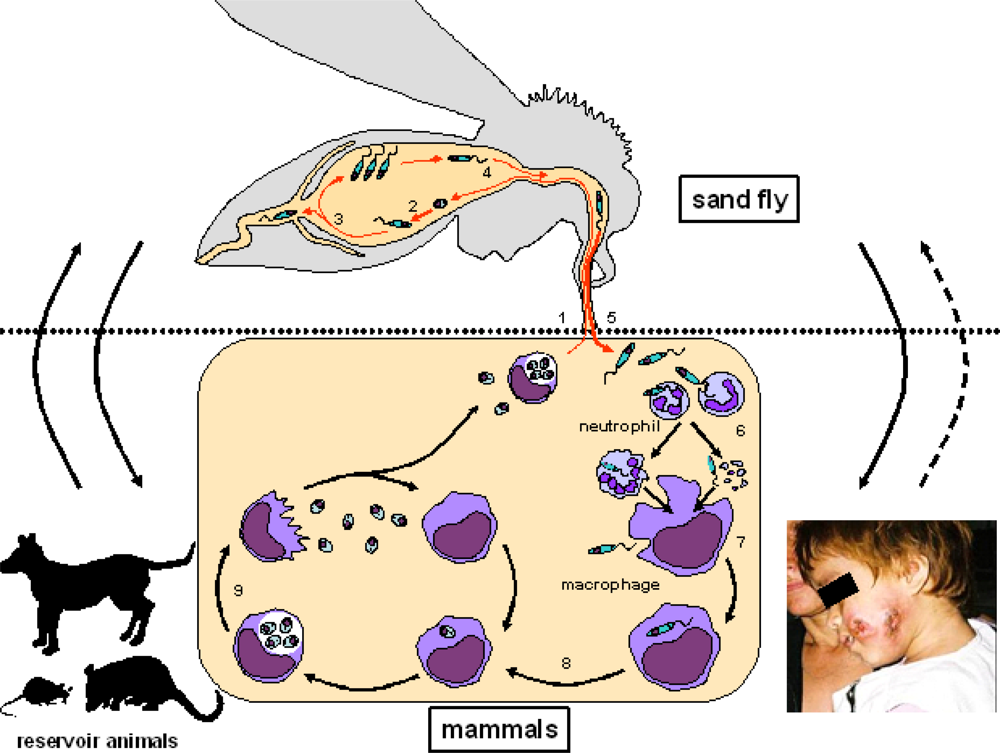
<p>Most leishmaniases are zoonotic diseases that include animal reservoir hosts in the transmission cycle [<xref ref-type="bibr" rid="b1-ijerph-07-00814">1</xref>]. Humans are considered to be an accidental host, although anthroponotic transmission without animal reservoirs is reported in some <italic>Leishmania</italic> species [<xref ref-type="bibr" rid="b1-ijerph-07-00814">1</xref>] (<xref ref-type="fig" rid="f1-ijerph-07-00814">Figure 1</xref>).</p>
<p>The life cycle of <italic>Leishmania</italic> species involves two stages; in mammalian hosts, the parasites are observed as an intracellular amastigote with a round or ovoid-shaped and immotile form, but when taken up into the gut of sand flies, they become an extracellular promastigote characterized by a spindle-shaped and motile form with an external flagellum [<xref ref-type="bibr" rid="b10-ijerph-07-00814">10</xref>]. The transformation is triggered by a change in conditions such as temperature and pH [<xref ref-type="bibr" rid="b11-ijerph-07-00814">11</xref>,<xref ref-type="bibr" rid="b12-ijerph-07-00814">12</xref>]. The main target of the parasite in mammalian hosts is macrophages, and infections are known to occur in three ways; (1) direct infection, (2) phagocytosis of infected neutrophils by macrophages (the Trojan horse model), and 3) silent infection by parasites released from apoptotic neutrophils [<xref ref-type="bibr" rid="b13-ijerph-07-00814">13</xref>]. Neutrophils, which are recruited to sites of tissue damage caused by sand fly bites in the initial phase, are considered to ingest the majority of parasites and play a central role in the establishment of the <italic>Leishmania</italic> infection [<xref ref-type="bibr" rid="b13-ijerph-07-00814">13</xref>–<xref ref-type="bibr" rid="b18-ijerph-07-00814">18</xref>] (<xref ref-type="fig" rid="f1-ijerph-07-00814">Figure 1</xref>).</p></sec>
<sec>
<label>2.</label>
<title>Phlebotomine Sand Flies as a Vector of Leishmaniasis</title>
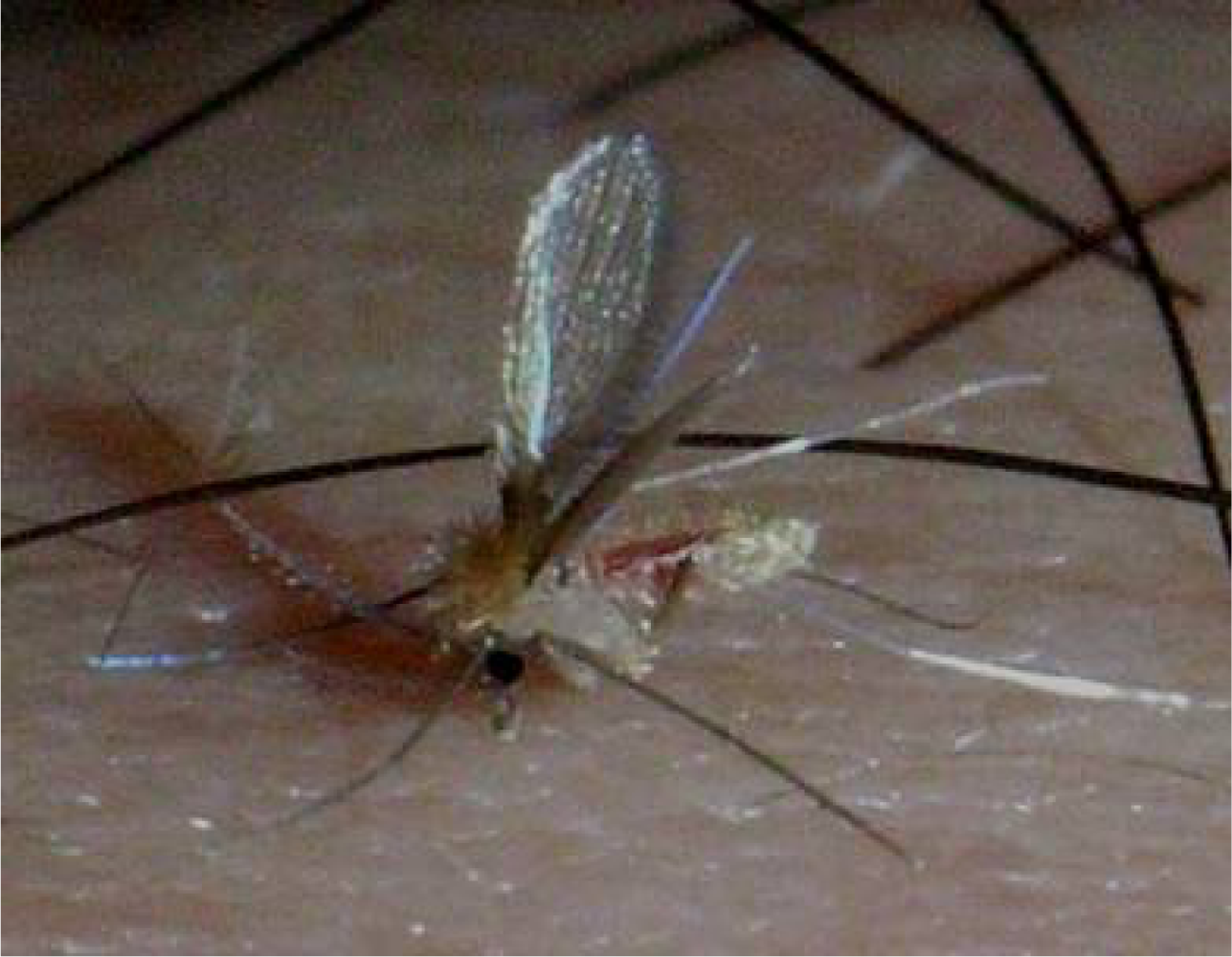
<p>Phlebotomine sand flies are tiny blood-feeding insects of the family Psychodidae in the order Diptera with a body length of approximately 2–3 mm [<xref ref-type="bibr" rid="b19-ijerph-07-00814">19</xref>]. They vary in color from silver-gray to almost black, and fold their wings into a characteristic V-shape when at rest (<xref ref-type="fig" rid="f2-ijerph-07-00814">Figure 2</xref>). They are active nocturnally and rest in houses, cellars, caves and gaps among rocks in the daytime. Unlike mosquitoes, they fly feebly and silently, and sneak up on a host using a peculiar hopping motion [<xref ref-type="bibr" rid="b20-ijerph-07-00814">20</xref>]. Only female flies suck blood for egg production, and the bites are typically painful. To date, approximately 800 sand fly species have been recorded in five major genera; <italic>Phlebotomus</italic> (94 species) and <italic>Sergentomyia</italic> (258 species) in the Old World, and <italic>Lutzomyia</italic> (379 species), <italic>Brumptomyia</italic> (23 species) and <italic>Warileya</italic> (5 species) in the New World, and of these, proven vector species of <italic>Leishmania</italic> protozoa are classified into the genus <italic>Phlebotomus</italic> and <italic>Lutzomyia</italic> [<xref ref-type="bibr" rid="b20-ijerph-07-00814">20</xref>]. The majority of the species play no part in the transmission of leishmaniasis in nature for several reasons; they may not feed on blood from humans and potential reservoir animals, and/or they may be incapable of supporting the development of <italic>Leishmania</italic> species [<xref ref-type="bibr" rid="b20-ijerph-07-00814">20</xref>,<xref ref-type="bibr" rid="b21-ijerph-07-00814">21</xref>]. Less than 10% of sand flies have been incriminated as vector species of leishmaniasis, and only about 30 species have been demonstrated to have a vectorial capacity [<xref ref-type="bibr" rid="b10-ijerph-07-00814">10</xref>]. In addition, each vector species can only support the development of and consequently transmit certain species of <italic>Leishmania</italic> [<xref ref-type="bibr" rid="b10-ijerph-07-00814">10</xref>,<xref ref-type="bibr" rid="b19-ijerph-07-00814">19</xref>]. In the susceptible vector, the promastigotes of <italic>Leishmania</italic> attach to the epithelium of the gut, multiply, and differentiate into the infective metacyclic form, which is transmitted to the mammalian host [<xref ref-type="bibr" rid="b21-ijerph-07-00814">21</xref>,<xref ref-type="bibr" rid="b22-ijerph-07-00814">22</xref>] (<xref ref-type="fig" rid="f1-ijerph-07-00814">Figure 1</xref>). The attachment of the promastigotes to the insect midgut is crucial to the completion of their life cycle in order to avoid excretion when the sand fly defecates [<xref ref-type="bibr" rid="b21-ijerph-07-00814">21</xref>,<xref ref-type="bibr" rid="b22-ijerph-07-00814">22</xref>]. The attachment is mediated by lipophosphoglycan (LPG), the major surface glycoconjugate of promastigotes, and the structures are polymorphic among species, suggesting that LPG is the major determinant specifying a vector species [<xref ref-type="bibr" rid="b22-ijerph-07-00814">22</xref>,<xref ref-type="bibr" rid="b23-ijerph-07-00814">23</xref>]. The only midgut protein of sand flies shown to interact with <italic>Leishmania</italic> is PpGalec, a β-galactoside-binding lectin, found in <italic>Phlebotomus (P.) papatasi</italic>, a principal vector of <italic>L. (L.) major</italic> in the Old World [<xref ref-type="bibr" rid="b24-ijerph-07-00814">24</xref>]. Genomic DNA hybridized with <italic>PpGalec</italic> was present in <italic>P. papatasi</italic> and <italic>P. duboscqi</italic>, both of which transmit <italic>L. (L.) major</italic> in nature, but absent in <italic>P. sergenti</italic> and <italic>P. argentipes</italic>, vector species of <italic>L. (L.) tropica</italic> and <italic>L. (L.) donovani</italic>, respectively, in the Old World, and <italic>Lutzomyia</italic> (<italic>Lu.) longipalpis</italic> and <italic>Lu. verrucarum</italic> which transmit <italic>L. (L.) infantum</italic> (previously called <italic>L. (L.) chagasi</italic>) and <italic>L.(V.) peruviana</italic>, respectively, in the New World [<xref ref-type="bibr" rid="b24-ijerph-07-00814">24</xref>]. The result strongly suggests that midgut molecules of sand flies are the key determinant of vectorial competency.</p></sec>
<sec>
<label>3.</label>
<title>Advances in Sand Fly Taxonomy</title>
<p>As described, only some of the approximately 800 sand fly species are medically important, and certain sand fly species can transmit only certain species of <italic>Leishmania</italic> [<xref ref-type="bibr" rid="b21-ijerph-07-00814">21</xref>,<xref ref-type="bibr" rid="b22-ijerph-07-00814">22</xref>]. Since the spread of leishmaniases largely depends on the distribution of the vectors, the identification of circulating sand fly species in endemic and surrounding areas is important for predictions of the risk and expansion of the disease. Sand flies are generally identified as adults based on morphologic characteristics, mainly internal structures such as the spermatheca, cibarium and pharynx in females, and terminal genitalia in males [<xref ref-type="bibr" rid="b19-ijerph-07-00814">19</xref>,<xref ref-type="bibr" rid="b20-ijerph-07-00814">20</xref>]. Other characteristics include the location and intensity of pigmentation of the thorax, and the length ratios of wing veins, and antennal and leg segments [<xref ref-type="bibr" rid="b19-ijerph-07-00814">19</xref>,<xref ref-type="bibr" rid="b20-ijerph-07-00814">20</xref>]. Approximately 90 characteristics have been demonstrated as effective descriptors, and these characters are examined and measured on each specimen under a microscope after appropriate preservation and mounting [<xref ref-type="bibr" rid="b19-ijerph-07-00814">19</xref>,<xref ref-type="bibr" rid="b20-ijerph-07-00814">20</xref>]. Thus, the morphological classification requires considerable skill as well as taxonomic expertise. In addition, the presence of intraspecific variation and cryptic species frequently complicates classifications based on morphological features [<xref ref-type="bibr" rid="b25-ijerph-07-00814">25</xref>]. Furthermore, damage caused by improper storage and mounting makes the process more difficult or can cause misidentification. Therefore, other characteristics like molecular markers have been explored for the development of simpler and more accurate ways to identify sand flies. Several genetic markers have been used to examine the systematics, relationships and evolution among sand fly species and for population analyses within species [<xref ref-type="bibr" rid="b26-ijerph-07-00814">26</xref>–<xref ref-type="bibr" rid="b52-ijerph-07-00814">52</xref>]. Most results of genetic analyses support the generally accepted classification based on morphological characteristics, however, discrepancies exist between the two classifications in several groupings, suggesting the necessity for careful reconsideration of the sand fly taxonomy [<xref ref-type="bibr" rid="b42-ijerph-07-00814">42</xref>,<xref ref-type="bibr" rid="b51-ijerph-07-00814">51</xref>,<xref ref-type="bibr" rid="b52-ijerph-07-00814">52</xref>]. With the accumulation of genetic data on sand flies, attempts have been made to establish methods of identification using simple techniques such as the PCR-restriction fragment length polymorphism (RFLP) analysis of 18S rRNA genes [<xref ref-type="bibr" rid="b33-ijerph-07-00814">33</xref>,<xref ref-type="bibr" rid="b45-ijerph-07-00814">45</xref>–<xref ref-type="bibr" rid="b47-ijerph-07-00814">47</xref>,<xref ref-type="bibr" rid="b50-ijerph-07-00814">50</xref>,<xref ref-type="bibr" rid="b51-ijerph-07-00814">51</xref>]. Although genetic diversity affecting RFLP-patterns was found in some species, the genotyping method was shown to be accurate and easy-to-use for the identification of sand fly species, requiring less expertise and with less risk of different interpretations among researchers than the conventional morphology-based classification [<xref ref-type="bibr" rid="b33-ijerph-07-00814">33</xref>,<xref ref-type="bibr" rid="b45-ijerph-07-00814">45</xref>–<xref ref-type="bibr" rid="b47-ijerph-07-00814">47</xref>,<xref ref-type="bibr" rid="b50-ijerph-07-00814">50</xref>,<xref ref-type="bibr" rid="b51-ijerph-07-00814">51</xref>]. It is important to note that this DNA-based technique doesn’t require special storage conditions for the specimens, and different methods of preservation such as drying and the use of 70% ethanol or liquid nitrogen did not affect the quality of the results [<xref ref-type="bibr" rid="b33-ijerph-07-00814">33</xref>]. In addition, damage to samples, which affects the morphologic classification in many cases, does not affect the PCR-RFLP analysis. To date, approximately 400 <italic>Lutzomyia</italic> and 100 <italic>Phlebotomus</italic> species have been recorded, and it is impossible to distinguish them all with a PCR-RFLP-based method. Usually, however, not many species coexist in an endemic area. Therefore, the PCR-RFLP-based method targeting several different genes will be a powerful tool for sand fly research as well as studying taxonomy in given leishmaniasis-endemic areas.</p>
<p>Interestingly, several studies suggested differences in vectorial capacity among populations within vector species such as mosquitoes [<xref ref-type="bibr" rid="b53-ijerph-07-00814">53</xref>,<xref ref-type="bibr" rid="b54-ijerph-07-00814">54</xref>]. The population structure has been analyzed in the Old World species <italic>P. papatasi</italic> and <italic>P. sergenti</italic> [<xref ref-type="bibr" rid="b38-ijerph-07-00814">38</xref>,<xref ref-type="bibr" rid="b39-ijerph-07-00814">39</xref>] and in the New World species <italic>Lu. longipalpis</italic> and recently <italic>Lu. hartmanni</italic> and <italic>Lu. ayacuchensis</italic> [<xref ref-type="bibr" rid="b25-ijerph-07-00814">25</xref>,<xref ref-type="bibr" rid="b52-ijerph-07-00814">52</xref>,<xref ref-type="bibr" rid="b55-ijerph-07-00814">55</xref>–<xref ref-type="bibr" rid="b60-ijerph-07-00814">60</xref>]. Heterogeneity of transcribed spacer (ITS) 2 sequences among populations was reported in <italic>P. sergenti</italic>, the main vector of <italic>L. (L.) tropica</italic>, and an association with vectorial capacity was hypothesized [<xref ref-type="bibr" rid="b38-ijerph-07-00814">38</xref>]. In addition, remarkable genetic variation among populations was also found in <italic>Lu. longipalpis</italic>, the principal vector of <italic>L. (L.) infantum</italic> (=<italic>L. (L.) chagasi)</italic>, on the basis of the mitochondria ND4 gene [<xref ref-type="bibr" rid="b55-ijerph-07-00814">55</xref>]. On the other hand, an absence of geographic distribution for both ITS2 and mitochondria ND4 genes was reported in <italic>P. papatasi</italic>, the principal vector of <italic>L. (L.) major</italic> [<xref ref-type="bibr" rid="b39-ijerph-07-00814">39</xref>], and for ITS1 and ITS2 genes in both <italic>Lu. hartmanni</italic> and <italic>Lu. ayacuchensis</italic>, which are the vector species of <italic>L. (V.) panamensis</italic> and <italic>L. (L.) mexicana</italic>, respectively [<xref ref-type="bibr" rid="b52-ijerph-07-00814">52</xref>]. The genetic heterogeneity described in <italic>P. sergenti</italic> and <italic>Lu. longipalpis</italic> may be associated with morphological variation that is observed in the two species but not in <italic>Lu. hartmanni</italic>, <italic>Lu. ayacuchensi</italic>s and <italic>P. papatasi</italic> [<xref ref-type="bibr" rid="b39-ijerph-07-00814">39</xref>,<xref ref-type="bibr" rid="b52-ijerph-07-00814">52</xref>,<xref ref-type="bibr" rid="b59-ijerph-07-00814">59</xref>]. More recently, a correlation between microsatellite markers and geographical origin was described in <italic>P. papatasi</italic>, suggesting multi-locus microsatellite typing to be effective for population analysis in sand flies [<xref ref-type="bibr" rid="b61-ijerph-07-00814">61</xref>]. Thus, further extensive study should disclose markers appropriate for population genetics in sand flies, resulting in the elucidation of vectorial capacity among population structures.</p></sec>
<sec>
<label>4.</label>
<title>Advances in the Detection and Identification of <italic>Leishmania</italic> Species within Naturally Infected Sand Flies</title>
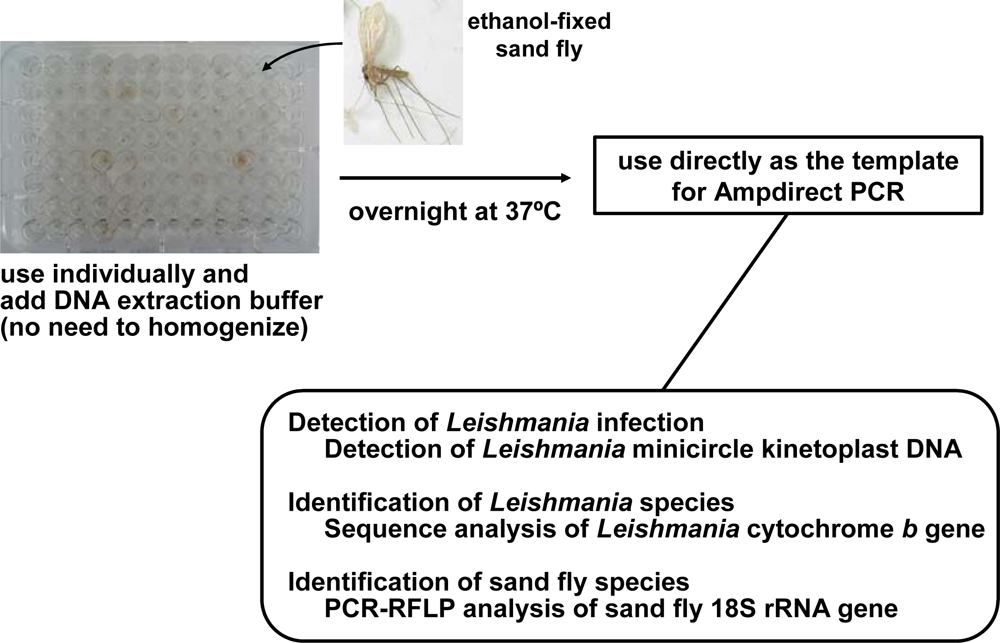
<p>Detection and identification of <italic>Leishmania</italic> species within sand flies are important for predictions of the risk and expansion of the disease in endemic and surrounding areas since the infected species is the major determinant of the clinical outcome in humans [<xref ref-type="bibr" rid="b1-ijerph-07-00814">1</xref>–<xref ref-type="bibr" rid="b3-ijerph-07-00814">3</xref>]. The infection of sand flies with <italic>Leishmania</italic> promastigotes has been examined by the dissection of individual sand flies under a microscope. For this purpose, specimens need to be fresh, and the dissection of tiny sand flies requires a highly skilled technique. The procedure takes a relatively long time, and additionally, a large number of specimens have to be examined to obtain informative data for each area since the infection rate of sand flies with <italic>Leishmania</italic> is generally very low (0.01–1%) even in endemic areas [<xref ref-type="bibr" rid="b62-ijerph-07-00814">62</xref>,<xref ref-type="bibr" rid="b63-ijerph-07-00814">63</xref>]. To improve on conventional methods, several PCR-based techniques have been developed [<xref ref-type="bibr" rid="b45-ijerph-07-00814">45</xref>,<xref ref-type="bibr" rid="b47-ijerph-07-00814">47</xref>,<xref ref-type="bibr" rid="b64-ijerph-07-00814">64</xref>–<xref ref-type="bibr" rid="b73-ijerph-07-00814">73</xref>], and infection of <italic>Leishmania</italic> species within sand flies was identified, e.g., <italic>L. (L.) major</italic> in <italic>P. papatasi</italic> [<xref ref-type="bibr" rid="b65-ijerph-07-00814">65</xref>], <italic>L. (L.) infantum</italic> in <italic>P. major</italic> [<xref ref-type="bibr" rid="b69-ijerph-07-00814">69</xref>] and <italic>L. (L.) donovani</italic> in <italic>P. argentipes</italic> [<xref ref-type="bibr" rid="b72-ijerph-07-00814">72</xref>] in the Old World, and <italic>L. (L.) mexicana</italic> in <italic>Lu. ayacuchensis</italic> [<xref ref-type="bibr" rid="b45-ijerph-07-00814">45</xref>,<xref ref-type="bibr" rid="b47-ijerph-07-00814">47</xref>] and <italic>Lu. ovallesi</italic> [<xref ref-type="bibr" rid="b66-ijerph-07-00814">66</xref>], <italic>L. (L.) amazonensis</italic> in <italic>Lu. longipalpis</italic> [<xref ref-type="bibr" rid="b67-ijerph-07-00814">67</xref>,<xref ref-type="bibr" rid="b73-ijerph-07-00814">73</xref>], <italic>L. (L.) infantum chagasi</italic> in <italic>Lu. longipalpis</italic> [<xref ref-type="bibr" rid="b67-ijerph-07-00814">67</xref>] and <italic>Lu. almerioi</italic> [<xref ref-type="bibr" rid="b73-ijerph-07-00814">73</xref>], <italic>L. peruviana</italic> in <italic>Lu. peruensis</italic> [<xref ref-type="bibr" rid="b47-ijerph-07-00814">47</xref>], <italic>L. (V.) naiffi</italic> in <italic>Lu. tortura</italic> [<xref ref-type="bibr" rid="b48-ijerph-07-00814">48</xref>] and <italic>L. (V.) braziliensis</italic> in <italic>Lu. ovallesi</italic> [<xref ref-type="bibr" rid="b66-ijerph-07-00814">66</xref>], <italic>Lu. gomezi</italic> [<xref ref-type="bibr" rid="b66-ijerph-07-00814">66</xref>] and <italic>Lu. neivai</italic> [<xref ref-type="bibr" rid="b70-ijerph-07-00814">70</xref>] in the New World. In most studies, DNA was extracted from pooled sand fly samples or from individual sand flies by use of an expensive kit or by a complicated conventional protocol using proteinase K-containing DNA extraction buffer followed by phenol/chloroform extraction and ethanol precipitation. These methods are sensitive enough to detect <italic>Leishmania</italic> species within sand flies. However, several improvements were desirable for the analysis of a large number of sand flies with less effort and cost. In addition, it is better to analyze sand flies individually because several species co-exist in most endemic areas and the use of pooled samples may spoil important information on vector epidemiology such as the prevalent sand fly species and the relationships between <italic>Leishmania</italic> and vector species. Recently, a method of mass screening sand flies for <italic>Leishmania</italic> infection was established, and its usability for field research confirmed [<xref ref-type="bibr" rid="b46-ijerph-07-00814">46</xref>,<xref ref-type="bibr" rid="b47-ijerph-07-00814">47</xref>]. The protocol is represented in <xref ref-type="fig" rid="f3-ijerph-07-00814">Figure 3</xref>. With this method, 96 individual samples can be analyzed at once with few processes. The method has a number of advantages: 1) purification of DNA is not required; that is, ethanol-fixed sand fly samples lysed in conventional DNA extraction buffer overnight at 37 °C without homogenization can be directly used as PCR templates, 2) the sensitivity and specificity are very high; leishmanial DNA is detectable if only one parasite exists in a sample, 3) data on individual sand flies can be obtained, 4) there is minimum risk of DNA loss and contamination among samples because of few processes, and 5) each sample can be used as a template for 100–150 PCRs. In addition, the sand fly species can be identified by molecular biological methods such as PCR-RFLP using the same template DNA if some genetic information is available on the prevalent sand fly species in the given endemic areas. Further, <italic>Leishmania</italic> species detected within sand flies can be identified by the analysis of leishmanial genes such as the mitochondrial cytochrome <italic>b</italic> gene [<xref ref-type="bibr" rid="b45-ijerph-07-00814">45</xref>–<xref ref-type="bibr" rid="b48-ijerph-07-00814">48</xref>,<xref ref-type="bibr" rid="b74-ijerph-07-00814">74</xref>–<xref ref-type="bibr" rid="b76-ijerph-07-00814">76</xref>]. Thus, application of the mass screening method in different areas will provide important information on risk factors, hopefully leading to the control and/or surveillance of leishmaniasis.</p></sec>
<sec>
<label>5.</label>
<title>Concluding Remarks</title>
<p>Molecular biological techniques are now becoming powerful tools for sand fly research. Therefore, more detailed information on the risk factors for leishmaniasis, such as the prevalent sand fly species as well as the seasonal variation in the infection rate and transmission risk, can be accumulated by continuous efforts using such techniques in various endemic areas in different seasons. In addition, elucidation of the relationships between <italic>Leishmania</italic> and vector species, which requires enormous effort with current methods, by use of molecular methods mentioned, will contribute to not only epidemiological research on leishmaniasis but also basic studies on parasite-vector interactions.</p></sec></body>
<back>
<ref-list>
<title>References</title>
<ref id="b1-ijerph-07-00814"><label>1.</label><citation citation-type="journal"><person-group person-group-type="author"><name><surname>Desjeux</surname><given-names>P</given-names></name></person-group><article-title>The increase of risk factors for leishmaniasis worldwide</article-title><source>Trans. R. Soc. Trop. Med. Hyg</source><year>2001</year><volume>95</volume><fpage>239</fpage><lpage>243</lpage><pub-id pub-id-type="doi">10.1016/S0035-9203(01)90223-8</pub-id><pub-id pub-id-type="pmid">11490989</pub-id></citation></ref>
<ref id="b2-ijerph-07-00814"><label>2.</label><citation citation-type="journal"><person-group person-group-type="author"><name><surname>Desjeux</surname><given-names>P</given-names></name></person-group><article-title>Leishmaniasis: current situation and new perspectives</article-title><source>Comp. Immunol. Microbiol. Infect. Dis</source><year>2004</year><volume>27</volume><fpage>305</fpage><lpage>318</lpage><pub-id pub-id-type="doi">10.1016/j.cimid.2004.03.004</pub-id><pub-id pub-id-type="pmid">15225981</pub-id></citation></ref>
<ref id="b3-ijerph-07-00814"><label>3.</label><citation citation-type="journal"><person-group person-group-type="author"><name><surname>Choi</surname><given-names>CM</given-names></name><name><surname>Lerner</surname><given-names>EA</given-names></name></person-group><article-title>Leishmaniasis as an emerging infection</article-title><source>J. Invest. Dermatol. Symp. Proc</source><year>2001</year><volume>6</volume><fpage>175</fpage><lpage>182</lpage><pub-id pub-id-type="doi">10.1046/j.0022-202x.2001.00038.x</pub-id></citation></ref>
<ref id="b4-ijerph-07-00814"><label>4.</label><citation citation-type="journal"><person-group person-group-type="author"><name><surname>Grimaldi</surname><given-names>G</given-names><suffix>Jr</suffix></name><name><surname>Tesh</surname><given-names>RB</given-names></name><name><surname>McMahon-Pratt</surname><given-names>D</given-names></name></person-group><article-title>A review of the geographic distribution and epidemiology of leishmaniasis in the New World</article-title><source>Am. J. Trop. Med. Hyg</source><year>1989</year><volume>41</volume><fpage>687</fpage><lpage>725</lpage><pub-id pub-id-type="pmid">2701633</pub-id></citation></ref>
<ref id="b5-ijerph-07-00814"><label>5.</label><citation citation-type="journal"><person-group person-group-type="author"><name><surname>Marsden</surname><given-names>PD</given-names></name></person-group><article-title>Mucosal leishmaniasis (“espundia” Escomel, 1911)</article-title><source>Trans. R. Soc. Trop. Med. Hyg</source><year>1986</year><volume>80</volume><fpage>859</fpage><lpage>876</lpage><pub-id pub-id-type="doi">10.1016/0035-9203(86)90243-9</pub-id><pub-id pub-id-type="pmid">3037735</pub-id></citation></ref>
<ref id="b6-ijerph-07-00814"><label>6.</label><citation citation-type="journal"><person-group person-group-type="author"><name><surname>Naiff</surname><given-names>RD</given-names></name><name><surname>Talhari</surname><given-names>S</given-names></name><name><surname>Barrett</surname><given-names>TV</given-names></name></person-group><article-title>Isolation of <italic>Leishmania guyanensis</italic> from lesions of the nasal mucosa</article-title><source>Mem. Inst. Oswaldo Cruz</source><year>1988</year><volume>83</volume><fpage>529</fpage><lpage>530</lpage><pub-id pub-id-type="doi">10.1590/S0074-02761988000400022</pub-id><pub-id pub-id-type="pmid">3271946</pub-id></citation></ref>
<ref id="b7-ijerph-07-00814"><label>7.</label><citation citation-type="journal"><person-group person-group-type="author"><name><surname>Barral</surname><given-names>A</given-names></name><name><surname>Pedral-Sampaio</surname><given-names>D</given-names></name><name><surname>Grimaldi</surname><given-names>G</given-names><suffix>Jr</suffix></name><name><surname>Momen</surname><given-names>H</given-names></name><name><surname>McMahon-Pratt</surname><given-names>D</given-names></name><name><surname>Ribeiro de Jesus</surname><given-names>A</given-names></name><name><surname>Almeida</surname><given-names>R</given-names></name><name><surname>Badaro</surname><given-names>R</given-names></name><name><surname>Barral-Netto</surname><given-names>M</given-names></name><name><surname>Carvalho</surname><given-names>EM</given-names></name><name><surname>Johnson</surname><given-names>WD</given-names><suffix>Jr</suffix></name></person-group><article-title>Leishmaniasis in Bahia, Brazil: evidence that <italic>Leishmania amazonensis</italic> produces a wide spectrum of clinical disease</article-title><source>Am. J. Trop. Med. Hyg</source><year>1991</year><volume>44</volume><fpage>536</fpage><lpage>546</lpage><pub-id pub-id-type="pmid">2063957</pub-id></citation></ref>
<ref id="b8-ijerph-07-00814"><label>8.</label><citation citation-type="journal"><person-group person-group-type="author"><name><surname>Osorio</surname><given-names>LE</given-names></name><name><surname>Castillo</surname><given-names>CM</given-names></name><name><surname>Ochoa</surname><given-names>MT</given-names></name></person-group><article-title>Mucosal leishmaniasis due to <italic>Leishmania (Viannia) panamensis</italic> in Colombia: clinical characteristics</article-title><source>Am. J. Trop. Med. Hyg</source><year>1998</year><volume>59</volume><fpage>49</fpage><lpage>52</lpage><pub-id pub-id-type="pmid">9684627</pub-id></citation></ref>
<ref id="b9-ijerph-07-00814"><label>9.</label><citation citation-type="book"><person-group person-group-type="author"><name><surname>Bryceson</surname><given-names>ADM</given-names></name></person-group><article-title>Leishmaniasis</article-title><source>Manson’s Tropical Disease</source><edition>20th ed</edition><person-group person-group-type="editor"><name><surname>Cook</surname><given-names>CC</given-names></name></person-group><publisher-name>W.B. Saunders Comp. Ltd</publisher-name><publisher-loc>London, Philadelphia, Tronto, Sydney and Tokyo</publisher-loc><year>1996</year><fpage>1213</fpage><lpage>1245</lpage></citation></ref>
<ref id="b10-ijerph-07-00814"><label>10.</label><citation citation-type="journal"><person-group person-group-type="author"><name><surname>Bates</surname><given-names>PA</given-names></name></person-group><article-title>Transmission of <italic>Leishmania</italic> metacyclic promastigotes by phlebotomine sand flies</article-title><source>Int. J. Parasitol</source><year>2007</year><volume>37</volume><fpage>1097</fpage><lpage>1106</lpage><pub-id pub-id-type="doi">10.1016/j.ijpara.2007.04.003</pub-id><pub-id pub-id-type="pmid">17517415</pub-id></citation></ref>
<ref id="b11-ijerph-07-00814"><label>11.</label><citation citation-type="journal"><person-group person-group-type="author"><name><surname>Bates</surname><given-names>PA</given-names></name><name><surname>Rogers</surname><given-names>ME</given-names></name></person-group><article-title>New insights into the developmental biology and transmission mechanisms of <italic>Leishmania</italic></article-title><source>Curr. Mol. Med</source><year>2004</year><volume>4</volume><fpage>601</fpage><lpage>609</lpage><pub-id pub-id-type="doi">10.2174/1566524043360285</pub-id><pub-id pub-id-type="pmid">15357211</pub-id></citation></ref>
<ref id="b12-ijerph-07-00814"><label>12.</label><citation citation-type="journal"><person-group person-group-type="author"><name><surname>Kamhawi</surname><given-names>S</given-names></name></person-group><article-title>Phlebotomine sand flies and <italic>Leishmania</italic> parasites: friends or foes?</article-title><source>Trends Parasitol</source><year>2006</year><volume>22</volume><fpage>439</fpage><lpage>445</lpage><pub-id pub-id-type="doi">10.1016/j.pt.2006.06.012</pub-id><pub-id pub-id-type="pmid">16843727</pub-id></citation></ref>
<ref id="b13-ijerph-07-00814"><label>13.</label><citation citation-type="journal"><person-group person-group-type="author"><name><surname>Peters</surname><given-names>NC</given-names></name><name><surname>Sacks</surname><given-names>DL</given-names></name></person-group><article-title>The impact of vector-mediated neutrophil recruitment on cutaneous leishmaniasis</article-title><source>Cell. Microbiol</source><year>2009</year><volume>11</volume><fpage>1290</fpage><lpage>1296</lpage><pub-id pub-id-type="doi">10.1111/j.1462-5822.2009.01348.x</pub-id><pub-id pub-id-type="pmid">19545276</pub-id></citation></ref>
<ref id="b14-ijerph-07-00814"><label>14.</label><citation citation-type="journal"><person-group person-group-type="author"><name><surname>Laskay</surname><given-names>T</given-names></name><name><surname>van Zandbergen</surname><given-names>G</given-names></name><name><surname>Solbach</surname><given-names>W</given-names></name></person-group><article-title>Neutrophil granulocytes—Trojan horses for <italic>Leishmania major</italic> and other intracellular microbes?</article-title><source>Trends Microbiol</source><year>2003</year><volume>11</volume><fpage>210</fpage><lpage>214</lpage><pub-id pub-id-type="doi">10.1016/S0966-842X(03)00075-1</pub-id><pub-id pub-id-type="pmid">12781523</pub-id></citation></ref>
<ref id="b15-ijerph-07-00814"><label>15.</label><citation citation-type="journal"><person-group person-group-type="author"><name><surname>Ribeiro-Gomes</surname><given-names>FL</given-names></name><name><surname>Otero</surname><given-names>AC</given-names></name><name><surname>Gomes</surname><given-names>NA</given-names></name><name><surname>Moniz-De-Souza</surname><given-names>MC</given-names></name><name><surname>Cysne-Finkelstein</surname><given-names>L</given-names></name><name><surname>Arnholdt</surname><given-names>AC</given-names></name><name><surname>Calich</surname><given-names>VL</given-names></name><name><surname>Coutinho</surname><given-names>SG</given-names></name><name><surname>Lopes</surname><given-names>MF</given-names></name><name><surname>DosReis</surname><given-names>GA</given-names></name></person-group><article-title>Macrophage interactions with neutrophils regulate <italic>Leishmania major</italic> infection</article-title><source>J. Immunol</source><year>2004</year><volume>172</volume><fpage>4454</fpage><lpage>4462</lpage><pub-id pub-id-type="pmid">15034061</pub-id></citation></ref>
<ref id="b16-ijerph-07-00814"><label>16.</label><citation citation-type="journal"><person-group person-group-type="author"><name><surname>van Zandbergen</surname><given-names>G</given-names></name><name><surname>Klinger</surname><given-names>M</given-names></name><name><surname>Mueller</surname><given-names>A</given-names></name><name><surname>Dannenberg</surname><given-names>S</given-names></name><name><surname>Gebert</surname><given-names>A</given-names></name><name><surname>Solbach</surname><given-names>W</given-names></name><name><surname>Laskay</surname><given-names>T</given-names></name></person-group><article-title>Cutting edge: neutrophil granulocyte serves as a vector for <italic>Leishmania</italic> entry into macrophages</article-title><source>J. Immunol</source><year>2004</year><volume>173</volume><fpage>6521</fpage><lpage>6525</lpage><pub-id pub-id-type="pmid">15557140</pub-id></citation></ref>
<ref id="b17-ijerph-07-00814"><label>17.</label><citation citation-type="journal"><person-group person-group-type="author"><name><surname>Peters</surname><given-names>NC</given-names></name><name><surname>Egen</surname><given-names>JG</given-names></name><name><surname>Secundino</surname><given-names>N</given-names></name><name><surname>Debrabant</surname><given-names>A</given-names></name><name><surname>Kimblin</surname><given-names>N</given-names></name><name><surname>Kamhawi</surname><given-names>S</given-names></name><name><surname>Lawyer</surname><given-names>P</given-names></name><name><surname>Fay</surname><given-names>MP</given-names></name><name><surname>Germain</surname><given-names>RN</given-names></name><name><surname>Sacks</surname><given-names>D</given-names></name></person-group><article-title><italic>In vivo</italic> imaging reveals an essential role for neutrophils in leishmaniasis transmitted by sand flies</article-title><source>Science</source><year>2008</year><volume>321</volume><fpage>970</fpage><lpage>974</lpage><pub-id pub-id-type="doi">10.1126/science.1159194</pub-id><pub-id pub-id-type="pmid">18703742</pub-id></citation></ref>
<ref id="b18-ijerph-07-00814"><label>18.</label><citation citation-type="journal"><person-group person-group-type="author"><name><surname>Jochim</surname><given-names>RC</given-names></name><name><surname>Teixeira</surname><given-names>C</given-names></name></person-group><article-title><italic>Leishmania</italic> commandeers the host inflammatory response through neutrophils</article-title><source>Trends Parasitol</source><year>2009</year><volume>25</volume><fpage>145</fpage><lpage>147</lpage><pub-id pub-id-type="doi">10.1016/j.pt.2009.01.001</pub-id><pub-id pub-id-type="pmid">19269250</pub-id></citation></ref>
<ref id="b19-ijerph-07-00814"><label>19.</label><citation citation-type="other"><person-group person-group-type="author"><name><surname>Young</surname><given-names>DG</given-names></name><name><surname>Duncan</surname><given-names>MA</given-names></name></person-group>Guide to the identification and geographic distribution of <italic>Lutzomyia</italic> sand flies in Mexico, the West Indies, Central and South America (Diptera: Psychodidae), Memoirs of the American Entomological Institute, 54, Associated Publishers—American Entomological Institute, Gainsville, FL, USA, <year>1994</year></citation></ref>
<ref id="b20-ijerph-07-00814"><label>20.</label><citation citation-type="book"><person-group person-group-type="author"><name><surname>Munstermann</surname><given-names>LE</given-names></name></person-group><article-title>Phlebotomine sand flies, the Psychodidae</article-title><source>Biology of Disease Vectors</source><edition>2nd ed</edition><person-group person-group-type="editor"><name><surname>Marquardt</surname><given-names>WC</given-names></name><name><surname>Black</surname><given-names>WC</given-names></name><name><surname>Freier</surname><given-names>JE</given-names></name><name><surname>Hagedorn</surname><given-names>HH</given-names></name><name><surname>Hemingway</surname><given-names>J</given-names></name><name><surname>Higgs</surname><given-names>S</given-names></name><name><surname>James</surname><given-names>AA</given-names></name><name><surname>Kondratieff</surname><given-names>B</given-names></name><name><surname>Moore</surname><given-names>CG</given-names></name></person-group><publisher-name>Elsevier</publisher-name><publisher-loc>San Diego, CA, USA</publisher-loc><year>2004</year><fpage>141</fpage><lpage>151</lpage></citation></ref>
<ref id="b21-ijerph-07-00814"><label>21.</label><citation citation-type="journal"><person-group person-group-type="author"><name><surname>Killick-Kendrick</surname><given-names>R</given-names></name></person-group><article-title>The biology and control of phlebotomine sand flies</article-title><source>Clin. Dermatol</source><year>1999</year><volume>17</volume><fpage>279</fpage><lpage>289</lpage><pub-id pub-id-type="doi">10.1016/S0738-081X(99)00046-2</pub-id><pub-id pub-id-type="pmid">10384867</pub-id></citation></ref>
<ref id="b22-ijerph-07-00814"><label>22.</label><citation citation-type="journal"><person-group person-group-type="author"><name><surname>Sacks</surname><given-names>DL</given-names></name></person-group><article-title><italic>Leishmania</italic>-sand fly interactions controlling species-specific vector competence</article-title><source>Cell. Microbiol</source><year>2001</year><volume>3</volume><fpage>189</fpage><lpage>196</lpage><pub-id pub-id-type="doi">10.1046/j.1462-5822.2001.00115.x</pub-id><pub-id pub-id-type="pmid">11298643</pub-id></citation></ref>
<ref id="b23-ijerph-07-00814"><label>23.</label><citation citation-type="journal"><person-group person-group-type="author"><name><surname>Sacks</surname><given-names>DL</given-names></name><name><surname>Modi</surname><given-names>G</given-names></name><name><surname>Rowton</surname><given-names>E</given-names></name><name><surname>Späth</surname><given-names>G</given-names></name><name><surname>Epstein</surname><given-names>L</given-names></name><name><surname>Turco</surname><given-names>SJ</given-names></name><name><surname>Beverley</surname><given-names>SM</given-names></name></person-group><article-title>The role of phosphoglycans in <italic>Leishmania</italic>-sand fly interactions</article-title><source>Proc. Natl. Acad. Sci. USA</source><year>2000</year><volume>97</volume><fpage>406</fpage><lpage>411</lpage><pub-id pub-id-type="doi">10.1073/pnas.97.1.406</pub-id><pub-id pub-id-type="pmid">10618431</pub-id></citation></ref>
<ref id="b24-ijerph-07-00814"><label>24.</label><citation citation-type="journal"><person-group person-group-type="author"><name><surname>Kamhawi</surname><given-names>S</given-names></name><name><surname>Ramalho-Ortigao</surname><given-names>M</given-names></name><name><surname>Pham</surname><given-names>VM</given-names></name><name><surname>Kumar</surname><given-names>S</given-names></name><name><surname>Lawyer</surname><given-names>PG</given-names></name><name><surname>Turco</surname><given-names>SJ</given-names></name><name><surname>Barillas-Mury</surname><given-names>C</given-names></name><name><surname>Sacks</surname><given-names>DL</given-names></name><name><surname>Valenzuela</surname><given-names>JG</given-names></name></person-group><article-title>A role for insect galectins in parasite survival</article-title><source>Cell</source><year>2004</year><volume>119</volume><fpage>329</fpage><lpage>341</lpage><pub-id pub-id-type="doi">10.1016/j.cell.2004.10.009</pub-id><pub-id pub-id-type="pmid">15543683</pub-id></citation></ref>
<ref id="b25-ijerph-07-00814"><label>25.</label><citation citation-type="journal"><person-group person-group-type="author"><name><surname>Bauzer</surname><given-names>LG</given-names></name><name><surname>Souza</surname><given-names>NA</given-names></name><name><surname>Maingon</surname><given-names>RD</given-names></name><name><surname>Peixoto</surname><given-names>AA</given-names></name></person-group><article-title><italic>Lutzomyia longipalpis</italic> in Brazil: a complex or a single species? A mini-review</article-title><source>Mem. Inst. Oswaldo Cruz</source><year>2007</year><volume>102</volume><fpage>1</fpage><lpage>12</lpage><pub-id pub-id-type="doi">10.1590/S0074-02762007000100001</pub-id><pub-id pub-id-type="pmid">17293992</pub-id></citation></ref>
<ref id="b26-ijerph-07-00814"><label>26.</label><citation citation-type="journal"><person-group person-group-type="author"><name><surname>Ready</surname><given-names>PD</given-names></name><name><surname>Smith</surname><given-names>DF</given-names></name><name><surname>Killick-Kendrick</surname><given-names>R</given-names></name></person-group><article-title>DNA hybridizations on squash-blotted sandflies to identify both <italic>Phlebotomus papatasi</italic> and infecting <italic>Leishmania major</italic></article-title><source>Med. Vet. Entomol</source><year>1988</year><volume>2</volume><fpage>109</fpage><lpage>116</lpage><pub-id pub-id-type="doi">10.1111/j.1365-2915.1988.tb00060.x</pub-id><pub-id pub-id-type="pmid">2856540</pub-id></citation></ref>
<ref id="b27-ijerph-07-00814"><label>27.</label><citation citation-type="journal"><person-group person-group-type="author"><name><surname>Ready</surname><given-names>PD</given-names></name><name><surname>Lainson</surname><given-names>R</given-names></name><name><surname>Shaw</surname><given-names>JJ</given-names></name><name><surname>Souza</surname><given-names>AA</given-names></name></person-group><article-title>DNA probes for distinguishing <italic>Psychodopygus wellcomei</italic> from <italic>Psychodopygus</italic> complexus (Diptera:Psychodidae)</article-title><source>Mem. Inst. Oswaldo Cruz</source><year>1991</year><volume>86</volume><fpage>41</fpage><lpage>49</lpage><pub-id pub-id-type="doi">10.1590/S0074-02761991000100008</pub-id><pub-id pub-id-type="pmid">1842400</pub-id></citation></ref>
<ref id="b28-ijerph-07-00814"><label>28.</label><citation citation-type="journal"><person-group person-group-type="author"><name><surname>Ready</surname><given-names>PD</given-names></name><name><surname>de Souza</surname><given-names>AA</given-names></name><name><surname>Rebelo</surname><given-names>JM</given-names></name><name><surname>Day</surname><given-names>JC</given-names></name><name><surname>Silveira</surname><given-names>FT</given-names></name><name><surname>Campbell-Lendrum</surname><given-names>D</given-names></name><name><surname>Davies</surname><given-names>CR</given-names></name><name><surname>Costa</surname><given-names>JM</given-names></name></person-group><article-title>Phylogenetic species and domesticity of <italic>Lutzomyia whitmani</italic> at the southeast boundary of Amazonian Brazil</article-title><source>Trans. R. Soc. Trop. Med. Hyg</source><year>1998</year><volume>92</volume><fpage>159</fpage><lpage>160</lpage><pub-id pub-id-type="doi">10.1016/S0035-9203(98)90726-X</pub-id><pub-id pub-id-type="pmid">9764319</pub-id></citation></ref>
<ref id="b29-ijerph-07-00814"><label>29.</label><citation citation-type="journal"><person-group person-group-type="author"><name><surname>Booth</surname><given-names>DR</given-names></name><name><surname>Ready</surname><given-names>PD</given-names></name><name><surname>Smith</surname><given-names>DF</given-names></name></person-group><article-title>Retrotransposons and evolution in phlebotomines</article-title><source>Parassitologia</source><year>1991</year><volume>33</volume><fpage>105</fpage><lpage>112</lpage><pub-id pub-id-type="pmid">1726736</pub-id></citation></ref>
<ref id="b30-ijerph-07-00814"><label>30.</label><citation citation-type="journal"><person-group person-group-type="author"><name><surname>Booth</surname><given-names>DR</given-names></name><name><surname>Ready</surname><given-names>PD</given-names></name><name><surname>Smith</surname><given-names>DF</given-names></name></person-group><article-title>Isolation of non-LTR retrotransposon reverse transcriptase-like sequences from phlebotomine sandflies</article-title><source>Insect Mol. Biol</source><year>1994</year><volume>3</volume><fpage>89</fpage><lpage>96</lpage><pub-id pub-id-type="doi">10.1111/j.1365-2583.1994.tb00155.x</pub-id><pub-id pub-id-type="pmid">7527283</pub-id></citation></ref>
<ref id="b31-ijerph-07-00814"><label>31.</label><citation citation-type="journal"><person-group person-group-type="author"><name><surname>Booth</surname><given-names>DR</given-names></name><name><surname>Ready</surname><given-names>PD</given-names></name><name><surname>Smith</surname><given-names>DF</given-names></name></person-group><article-title>Evolution of multiple families of non-LTR retrotransposons in phlebotomine sandflies</article-title><source>Genet. Res</source><year>1996</year><volume>67</volume><fpage>227</fpage><lpage>237</lpage><pub-id pub-id-type="doi">10.1017/S0016672300033711</pub-id><pub-id pub-id-type="pmid">8690271</pub-id></citation></ref>
<ref id="b32-ijerph-07-00814"><label>32.</label><citation citation-type="journal"><person-group person-group-type="author"><name><surname>Esseghir</surname><given-names>S</given-names></name><name><surname>Ready</surname><given-names>PD</given-names></name><name><surname>Killick-Kendrick</surname><given-names>R</given-names></name><name><surname>Ben-Ismail</surname><given-names>R</given-names></name></person-group><article-title>Mitochondrial haplotypes and phylogeography of <italic>Phlebotomus</italic> vectors of <italic>Leishmania major</italic></article-title><source>Insect Mol. Biol</source><year>1997</year><volume>6</volume><fpage>211</fpage><lpage>225</lpage><pub-id pub-id-type="doi">10.1046/j.1365-2583.1997.00175.x</pub-id><pub-id pub-id-type="pmid">9272439</pub-id></citation></ref>
<ref id="b33-ijerph-07-00814"><label>33.</label><citation citation-type="journal"><person-group person-group-type="author"><name><surname>Aransay</surname><given-names>AM</given-names></name><name><surname>Scoulica</surname><given-names>E</given-names></name><name><surname>Chaniotis</surname><given-names>B</given-names></name><name><surname>Tselentis</surname><given-names>Y</given-names></name></person-group><article-title>Typing of sand flies from Greece and Cyprus by DNA polymorphism of 18S rRNA gene</article-title><source>Insect Mol. Biol</source><year>1999</year><volume>8</volume><fpage>179</fpage><lpage>184</lpage><pub-id pub-id-type="doi">10.1046/j.1365-2583.1999.820179.x</pub-id><pub-id pub-id-type="pmid">10380101</pub-id></citation></ref>
<ref id="b34-ijerph-07-00814"><label>34.</label><citation citation-type="journal"><person-group person-group-type="author"><name><surname>Aransay</surname><given-names>AM</given-names></name><name><surname>Scoulica</surname><given-names>E</given-names></name><name><surname>Tselentis</surname><given-names>Y</given-names></name><name><surname>Ready</surname><given-names>PD</given-names></name></person-group><article-title>Phylogenetic relationships of phlebotomine sandflies inferred from small subunit nuclear ribosomal DNA</article-title><source>Insect Mol. Biol</source><year>2000</year><volume>9</volume><fpage>157</fpage><lpage>168</lpage><pub-id pub-id-type="doi">10.1046/j.1365-2583.2000.00168.x</pub-id><pub-id pub-id-type="pmid">10762423</pub-id></citation></ref>
<ref id="b35-ijerph-07-00814"><label>35.</label><citation citation-type="journal"><person-group person-group-type="author"><name><surname>Aransay</surname><given-names>AM</given-names></name><name><surname>Ready</surname><given-names>PD</given-names></name><name><surname>Morillas-Marquez</surname><given-names>F</given-names></name></person-group><article-title>Population differentiation of <italic>Phlebotomus perniciosus</italic> in Spain following postglacial dispersal</article-title><source>Heredity</source><year>2003</year><volume>90</volume><fpage>316</fpage><lpage>325</lpage><pub-id pub-id-type="doi">10.1038/sj.hdy.6800246</pub-id><pub-id pub-id-type="pmid">12692585</pub-id></citation></ref>
<ref id="b36-ijerph-07-00814"><label>36.</label><citation citation-type="journal"><person-group person-group-type="author"><name><surname>Campbell-Lendrum</surname><given-names>DH</given-names></name><name><surname>Brandão-Filho</surname><given-names>SP</given-names></name><name><surname>Pinto</surname><given-names>MC</given-names></name><name><surname>Vexenat</surname><given-names>A</given-names></name><name><surname>Ready</surname><given-names>PD</given-names></name><name><surname>Davies</surname><given-names>CR</given-names></name></person-group><article-title>Domesticity of <italic>Lutzomyia whitmani</italic> (Diptera: psychodidae) populations: field experiments indicate behavioural differences</article-title><source>Bull. Entomol. Res</source><year>2000</year><volume>90</volume><fpage>41</fpage><lpage>48</lpage><pub-id pub-id-type="doi">10.1017/S0007485300000699</pub-id><pub-id pub-id-type="pmid">10948362</pub-id></citation></ref>
<ref id="b37-ijerph-07-00814"><label>37.</label><citation citation-type="journal"><person-group person-group-type="author"><name><surname>Di Muccio</surname><given-names>T</given-names></name><name><surname>Marinucci</surname><given-names>M</given-names></name><name><surname>Frusteri</surname><given-names>L</given-names></name><name><surname>Maroli</surname><given-names>M</given-names></name><name><surname>Pesson</surname><given-names>B</given-names></name><name><surname>Gramiccia</surname><given-names>M</given-names></name></person-group><article-title>Phylogenetic analysis of <italic>Phlebotomus</italic> species belonging to the subgenus <italic>Larroussius</italic> (Diptera, psychodidae) by ITS2 rDNA sequences</article-title><source>Insect Biochem. Mol. Biol</source><year>2000</year><volume>30</volume><fpage>387</fpage><lpage>393</lpage><pub-id pub-id-type="doi">10.1016/S0965-1748(00)00012-6</pub-id><pub-id pub-id-type="pmid">10745162</pub-id></citation></ref>
<ref id="b38-ijerph-07-00814"><label>38.</label><citation citation-type="journal"><person-group person-group-type="author"><name><surname>Depaquit</surname><given-names>J</given-names></name><name><surname>Ferté</surname><given-names>H</given-names></name><name><surname>Léger</surname><given-names>N</given-names></name><name><surname>Lefranc</surname><given-names>F</given-names></name><name><surname>Alves-Pires</surname><given-names>C</given-names></name><name><surname>Hanafi</surname><given-names>H</given-names></name><name><surname>Maroli</surname><given-names>M</given-names></name><name><surname>Morillas-Marquez</surname><given-names>F</given-names></name><name><surname>Rioux</surname><given-names>JA</given-names></name><name><surname>Svobodova</surname><given-names>M</given-names></name></person-group><article-title>Volf, P. ITS 2 sequences heterogeneity in <italic>Phlebotomus sergenti</italic> and <italic>Phlebotomus similis</italic> (Diptera, Psychodidae): possible consequences in their ability to transmit <italic>Leishmania tropica</italic></article-title><source>Int. J. Parasitol</source><year>2002</year><volume>32</volume><fpage>1123</fpage><lpage>1131</lpage><pub-id pub-id-type="doi">10.1016/S0020-7519(02)00088-7</pub-id><pub-id pub-id-type="pmid">12117495</pub-id></citation></ref>
<ref id="b39-ijerph-07-00814"><label>39.</label><citation citation-type="journal"><person-group person-group-type="author"><name><surname>Depaquit</surname><given-names>J</given-names></name><name><surname>Lienard</surname><given-names>E</given-names></name><name><surname>Verzeaux-Griffon</surname><given-names>A</given-names></name><name><surname>Ferté</surname><given-names>H</given-names></name><name><surname>Bounamous</surname><given-names>A</given-names></name><name><surname>Gantier</surname><given-names>JC</given-names></name><name><surname>Hanafi</surname><given-names>HA</given-names></name><name><surname>Jacobson</surname><given-names>RL</given-names></name><name><surname>Maroli</surname><given-names>M</given-names></name><name><surname>Moin-Vaziri</surname><given-names>V</given-names></name><name><surname>Müller</surname><given-names>F</given-names></name><name><surname>Ozbel</surname><given-names>Y</given-names></name><name><surname>Svobodova</surname><given-names>M</given-names></name><name><surname>Volf</surname><given-names>P</given-names></name><name><surname>Léger</surname><given-names>N</given-names></name></person-group><article-title>Molecular homogeneity in diverse geographical populations of <italic>Phlebotomus papatasi</italic> (Diptera, Psychodidae) inferred from ND4 mtDNA and ITS2 rDNA epidemiological consequences</article-title><source>Infect. Genet. Evol</source><year>2008</year><volume>8</volume><fpage>159</fpage><lpage>170</lpage><pub-id pub-id-type="doi">10.1016/j.meegid.2007.12.001</pub-id><pub-id pub-id-type="pmid">18243814</pub-id></citation></ref>
<ref id="b40-ijerph-07-00814"><label>40.</label><citation citation-type="journal"><person-group person-group-type="author"><name><surname>Testa</surname><given-names>JM</given-names></name><name><surname>Montoya-Lerma</surname><given-names>J</given-names></name><name><surname>Cadena</surname><given-names>H</given-names></name><name><surname>Oviedo</surname><given-names>M</given-names></name><name><surname>Ready</surname><given-names>PD</given-names></name></person-group><article-title>Molecular identification of vectors of <italic>Leishmania</italic> in Colombia: mitochondrial introgression in the <italic>Lutzomyia townsendi</italic> series</article-title><source>Acta Trop</source><year>2002</year><volume>84</volume><fpage>205</fpage><lpage>218</lpage><pub-id pub-id-type="doi">10.1016/S0001-706X(02)00187-0</pub-id><pub-id pub-id-type="pmid">12443799</pub-id></citation></ref>
<ref id="b41-ijerph-07-00814"><label>41.</label><citation citation-type="journal"><person-group person-group-type="author"><name><surname>Torgerson</surname><given-names>DG</given-names></name><name><surname>Lampo</surname><given-names>M</given-names></name><name><surname>Velazquez</surname><given-names>Y</given-names></name><name><surname>Woo</surname><given-names>PT</given-names></name></person-group><article-title>Genetic relationships among some species groups within the genus <italic>Lutzomyia</italic> (Diptera: Psychodidae)</article-title><source>Am. J. Trop. Med. Hyg</source><year>2003</year><volume>69</volume><fpage>484</fpage><lpage>493</lpage><pub-id pub-id-type="pmid">14695085</pub-id></citation></ref>
<ref id="b42-ijerph-07-00814"><label>42.</label><citation citation-type="journal"><person-group person-group-type="author"><name><surname>Beati</surname><given-names>L</given-names></name><name><surname>Caceres</surname><given-names>AG</given-names></name><name><surname>Lee</surname><given-names>JA</given-names></name><name><surname>Munstermann</surname><given-names>LE</given-names></name></person-group><article-title>Systematic relationships among <italic>Lutzomyia</italic> sand flies (Diptera: Psychodidae) of Peru and Colombia based on the analysis of 12S and 28S ribosomal DNA sequences</article-title><source>Int. J. Parasitol</source><year>2004</year><volume>34</volume><fpage>225</fpage><lpage>234</lpage><pub-id pub-id-type="doi">10.1016/j.ijpara.2003.10.012</pub-id><pub-id pub-id-type="pmid">15037108</pub-id></citation></ref>
<ref id="b43-ijerph-07-00814"><label>43.</label><citation citation-type="journal"><person-group person-group-type="author"><name><surname>Yahia</surname><given-names>H</given-names></name><name><surname>Ready</surname><given-names>PD</given-names></name><name><surname>Hamdani</surname><given-names>A</given-names></name><name><surname>Testa</surname><given-names>JM</given-names></name><name><surname>Guessous-Idrissi</surname><given-names>N</given-names></name></person-group><article-title>Regional genetic differentiation of <italic>Phlebotomus sergenti</italic> in three Moroccan foci of cutaneous leishmaniasis caused by <italic>Leishmania tropica</italic></article-title><source>Parasite</source><year>2004</year><volume>11</volume><fpage>189</fpage><lpage>199</lpage><pub-id pub-id-type="pmid">15224581</pub-id></citation></ref>
<ref id="b44-ijerph-07-00814"><label>44.</label><citation citation-type="journal"><person-group person-group-type="author"><name><surname>Pesson</surname><given-names>B</given-names></name><name><surname>Ready</surname><given-names>JS</given-names></name><name><surname>Benabdennbi</surname><given-names>I</given-names></name><name><surname>Martín-Sánchez</surname><given-names>J</given-names></name><name><surname>Esseghir</surname><given-names>S</given-names></name><name><surname>Cadi-Soussi</surname><given-names>M</given-names></name><name><surname>Morillas-Marquez</surname><given-names>F</given-names></name><name><surname>Ready</surname><given-names>PD</given-names></name></person-group><article-title>Sandflies of the <italic>Phlebotomus perniciosus</italic> complex: mitochondrial introgression and a new sibling species of <italic>P. longicuspis</italic> in the Moroccan Rif</article-title><source>Med. Vet. Entomol</source><year>2004</year><volume>18</volume><fpage>25</fpage><lpage>37</lpage><pub-id pub-id-type="doi">10.1111/j.0269-283x.2004.0471.x</pub-id><pub-id pub-id-type="pmid">15009443</pub-id></citation></ref>
<ref id="b45-ijerph-07-00814"><label>45.</label><citation citation-type="journal"><person-group person-group-type="author"><name><surname>Kato</surname><given-names>H</given-names></name><name><surname>Uezato</surname><given-names>H</given-names></name><name><surname>Katakura</surname><given-names>K</given-names></name><name><surname>Calvopiña</surname><given-names>M</given-names></name><name><surname>Marco</surname><given-names>JD</given-names></name><name><surname>Barroso</surname><given-names>PA</given-names></name><name><surname>Gomez</surname><given-names>EA</given-names></name><name><surname>Mimori</surname><given-names>T</given-names></name><name><surname>Korenaga</surname><given-names>M</given-names></name><name><surname>Iwata</surname><given-names>H</given-names></name><name><surname>Nonaka</surname><given-names>S</given-names></name><name><surname>Hashiguchi</surname><given-names>Y</given-names></name></person-group><article-title>Detection and identification of <italic>Leishmania</italic> species within naturally infected sand flies in the Andean areas of Ecuador by a polymerase chain reaction</article-title><source>Am. J. Trop. Med. Hyg</source><year>2005</year><volume>72</volume><fpage>87</fpage><lpage>93</lpage><pub-id pub-id-type="pmid">15728872</pub-id></citation></ref>
<ref id="b46-ijerph-07-00814"><label>46.</label><citation citation-type="journal"><person-group person-group-type="author"><name><surname>Kato</surname><given-names>H</given-names></name><name><surname>Uezato</surname><given-names>H</given-names></name><name><surname>Gomez</surname><given-names>EA</given-names></name><name><surname>Terayama</surname><given-names>Y</given-names></name><name><surname>Calvopiña</surname><given-names>M</given-names></name><name><surname>Iwata</surname><given-names>H</given-names></name><name><surname>Hashiguchi</surname><given-names>Y</given-names></name></person-group><article-title>Establishment of a mass screening method of sand fly vectors for <italic>Leishmania</italic> infection by molecular biological methods</article-title><source>Am. J. Trop. Med. Hyg</source><year>2007</year><volume>77</volume><fpage>324</fpage><lpage>329</lpage><pub-id pub-id-type="pmid">17690406</pub-id></citation></ref>
<ref id="b47-ijerph-07-00814"><label>47.</label><citation citation-type="journal"><person-group person-group-type="author"><name><surname>Kato</surname><given-names>H</given-names></name><name><surname>Cáceres</surname><given-names>AG</given-names></name><name><surname>Gomez</surname><given-names>EA</given-names></name><name><surname>Mimori</surname><given-names>T</given-names></name><name><surname>Uezato</surname><given-names>H</given-names></name><name><surname>Marco</surname><given-names>JD</given-names></name><name><surname>Barroso</surname><given-names>PA</given-names></name><name><surname>Iwata</surname><given-names>H</given-names></name><name><surname>Hashiguchi</surname><given-names>Y</given-names></name></person-group><article-title>Molecular mass screening to incriminate sand fly vectors of Andean-type cutaneous leishmaniasis in Ecuador and Peru</article-title><source>Am. J. Trop. Med. Hyg</source><year>2008</year><volume>79</volume><fpage>719</fpage><lpage>721</lpage><pub-id pub-id-type="pmid">18981511</pub-id></citation></ref>
<ref id="b48-ijerph-07-00814"><label>48.</label><citation citation-type="journal"><person-group person-group-type="author"><name><surname>Kato</surname><given-names>H</given-names></name><name><surname>Gomez</surname><given-names>EA</given-names></name><name><surname>Yamamoto</surname><given-names>Y</given-names></name><name><surname>Calvopiña</surname><given-names>M</given-names></name><name><surname>Guevara</surname><given-names>AG</given-names></name><name><surname>Marco</surname><given-names>JD</given-names></name><name><surname>Barroso</surname><given-names>PA</given-names></name><name><surname>Iwata</surname><given-names>H</given-names></name><name><surname>Hashiguchi</surname><given-names>Y</given-names></name></person-group><article-title>Natural infection of <italic>Lutzomyia tortura</italic> with <italic>Leishmania (Viannia) naiffi</italic> in an Amazonian area of Ecuador</article-title><source>Am. J. Trop. Med. Hyg</source><year>2008</year><volume>79</volume><fpage>438</fpage><lpage>440</lpage><pub-id pub-id-type="pmid">18784239</pub-id></citation></ref>
<ref id="b49-ijerph-07-00814"><label>49.</label><citation citation-type="journal"><person-group person-group-type="author"><name><surname>Barón</surname><given-names>S</given-names></name><name><surname>Martín-Sánchez</surname><given-names>J</given-names></name><name><surname>Gállego</surname><given-names>M</given-names></name><name><surname>Morales-Yuste</surname><given-names>M</given-names></name><name><surname>Boussaa</surname><given-names>S</given-names></name><name><surname>Morillas-Márquez</surname><given-names>F</given-names></name></person-group><article-title>Intraspecific variability (rDNA ITS and mtDNA Cyt b) of <italic>Phlebotomus sergenti</italic> in Spain and Morocco</article-title><source>Acta Trop</source><year>2008</year><volume>107</volume><fpage>259</fpage><lpage>267</lpage><pub-id pub-id-type="doi">10.1016/j.actatropica.2008.07.003</pub-id><pub-id pub-id-type="pmid">18703008</pub-id></citation></ref>
<ref id="b50-ijerph-07-00814"><label>50.</label><citation citation-type="journal"><person-group person-group-type="author"><name><surname>Barroso</surname><given-names>PA</given-names></name><name><surname>Marco</surname><given-names>JD</given-names></name><name><surname>Kato</surname><given-names>H</given-names></name><name><surname>Tarama</surname><given-names>R</given-names></name><name><surname>Rueda</surname><given-names>P</given-names></name><name><surname>Cajal</surname><given-names>SP</given-names></name><name><surname>Basombrío</surname><given-names>MA</given-names></name><name><surname>Korenaga</surname><given-names>M</given-names></name><name><surname>Taranto</surname><given-names>NJ</given-names></name><name><surname>Hashiguchi</surname><given-names>Y</given-names></name></person-group><article-title>The identification of sand fly species, from an area of Argentina with endemic leishmaniasis, by the PCR-based analysis of the gene coding for 18S ribosomal RNA</article-title><source>Ann. Trop. Med. Parasitol</source><year>2007</year><volume>101</volume><fpage>247</fpage><lpage>253</lpage><pub-id pub-id-type="doi">10.1179/136485907X156988</pub-id><pub-id pub-id-type="pmid">17362599</pub-id></citation></ref>
<ref id="b51-ijerph-07-00814"><label>51.</label><citation citation-type="journal"><person-group person-group-type="author"><name><surname>Terayama</surname><given-names>Y</given-names></name><name><surname>Kato</surname><given-names>H</given-names></name><name><surname>Gomez</surname><given-names>EAL</given-names></name><name><surname>Uezato</surname><given-names>H</given-names></name><name><surname>Calvopiña</surname><given-names>M</given-names></name><name><surname>Iwata</surname><given-names>H</given-names></name><name><surname>Hashiguchi</surname><given-names>Y</given-names></name></person-group><article-title>Molecular typing of sand fly species (Diptera, Psychodidae, Phlebotominae) from areas endemic for leishmaniasis in Ecuador by PCR-RFLP of 18S ribosomal RNA gene</article-title><source>J. Vet. Med. Sci</source><year>2008</year><volume>70</volume><fpage>907</fpage><lpage>913</lpage><pub-id pub-id-type="doi">10.1292/jvms.70.907</pub-id><pub-id pub-id-type="pmid">18840964</pub-id></citation></ref>
<ref id="b52-ijerph-07-00814"><label>52.</label><citation citation-type="journal"><person-group person-group-type="author"><name><surname>Kuwahara</surname><given-names>K</given-names></name><name><surname>Kato</surname><given-names>H</given-names></name><name><surname>Gomez</surname><given-names>EA</given-names></name><name><surname>Uezato</surname><given-names>H</given-names></name><name><surname>Mimori</surname><given-names>T</given-names></name><name><surname>Yamamoto</surname><given-names>YI</given-names></name><name><surname>Calvopiña</surname><given-names>M</given-names></name><name><surname>Cáceres</surname><given-names>AG</given-names></name><name><surname>Iwata</surname><given-names>H</given-names></name><name><surname>Hashiguchi</surname><given-names>Y</given-names></name></person-group><article-title>Genetic diversity of ribosomal RNA internal transcribed spacer sequences in <italic>Lutzomyia</italic> species from areas endemic for New World cutaneous leishmaniasis</article-title><source>Acta Trop</source><year>2009</year><volume>112</volume><fpage>131</fpage><lpage>136</lpage><pub-id pub-id-type="doi">10.1016/j.actatropica.2009.07.010</pub-id><pub-id pub-id-type="pmid">19631188</pub-id></citation></ref>
<ref id="b53-ijerph-07-00814"><label>53.</label><citation citation-type="journal"><person-group person-group-type="author"><name><surname>Krzywinski</surname><given-names>J</given-names></name><name><surname>Besansky</surname><given-names>NJ</given-names></name></person-group><article-title>Molecular systematics of <italic>Anopheles</italic>: from subgenera to subpopulations</article-title><source>Annu. Rev. Entomol</source><year>2003</year><volume>48</volume><fpage>111</fpage><lpage>139</lpage><pub-id pub-id-type="doi">10.1146/annurev.ento.48.091801.112647</pub-id><pub-id pub-id-type="pmid">12208816</pub-id></citation></ref>
<ref id="b54-ijerph-07-00814"><label>54.</label><citation citation-type="journal"><person-group person-group-type="author"><name><surname>Obsomer</surname><given-names>V</given-names></name><name><surname>Defourny</surname><given-names>P</given-names></name><name><surname>Coosemans</surname><given-names>M</given-names></name></person-group><article-title>The <italic>Anopheles dirus</italic> complex: spatial distribution and environmental drivers</article-title><source>Malar. J</source><year>2007</year><volume>6</volume><fpage>26</fpage><pub-id pub-id-type="doi">10.1186/1475-2875-6-26</pub-id><pub-id pub-id-type="pmid">17341297</pub-id></citation></ref>
<ref id="b55-ijerph-07-00814"><label>55.</label><citation citation-type="journal"><person-group person-group-type="author"><name><surname>Soto</surname><given-names>SI</given-names></name><name><surname>Lehmann</surname><given-names>T</given-names></name><name><surname>Rowton</surname><given-names>ED</given-names></name><name><surname>Vélez</surname><given-names>BID</given-names></name><name><surname>Porter</surname><given-names>CH</given-names></name></person-group><article-title>Speciation and population structure in the morphospecies <italic>Lutzomyia longipalpis</italic> (Lutz &amp; Neiva) as derived from the mitochondrial ND4 gene</article-title><source>Mol. Phylogenet. Evol</source><year>2001</year><volume>18</volume><fpage>84</fpage><lpage>93</lpage><pub-id pub-id-type="doi">10.1006/mpev.2000.0863</pub-id><pub-id pub-id-type="pmid">11161745</pub-id></citation></ref>
<ref id="b56-ijerph-07-00814"><label>56.</label><citation citation-type="journal"><person-group person-group-type="author"><name><surname>Bottecchia</surname><given-names>M</given-names></name><name><surname>Oliveira</surname><given-names>SG</given-names></name><name><surname>Bauzer</surname><given-names>LG</given-names></name><name><surname>Souza</surname><given-names>NA</given-names></name><name><surname>Ward</surname><given-names>RD</given-names></name><name><surname>Garner</surname><given-names>KJ</given-names></name><name><surname>Kyriacou</surname><given-names>CP</given-names></name><name><surname>Peixoto</surname><given-names>AA</given-names></name></person-group><article-title>Genetic divergence in the cacophony IVS6 intron among five Brazilian populations of <italic>Lutzomyia longipalpis</italic></article-title><source>J. Mol. Evol</source><year>2004</year><volume>58</volume><fpage>754</fpage><lpage>761</lpage><pub-id pub-id-type="doi">10.1007/s00239-004-2586-y</pub-id><pub-id pub-id-type="pmid">15461432</pub-id></citation></ref>
<ref id="b57-ijerph-07-00814"><label>57.</label><citation citation-type="journal"><person-group person-group-type="author"><name><surname>Bauzer</surname><given-names>LG</given-names></name><name><surname>Souza</surname><given-names>NA</given-names></name><name><surname>Ward</surname><given-names>RD</given-names></name><name><surname>Kyriacou</surname><given-names>CP</given-names></name><name><surname>Peixoto</surname><given-names>AA</given-names></name></person-group><article-title>The period gene and genetic differentiation between three Brazilian populations of <italic>Lutzomyia longipalpis</italic></article-title><source>Insect. Mol. Biol</source><year>2002</year><volume>11</volume><fpage>315</fpage><lpage>323</lpage><pub-id pub-id-type="doi">10.1046/j.1365-2583.2002.00340.x</pub-id><pub-id pub-id-type="pmid">12144696</pub-id></citation></ref>
<ref id="b58-ijerph-07-00814"><label>58.</label><citation citation-type="journal"><person-group person-group-type="author"><name><surname>Bauzer</surname><given-names>LG</given-names></name><name><surname>Gesto</surname><given-names>JS</given-names></name><name><surname>Souza</surname><given-names>NA</given-names></name><name><surname>Ward</surname><given-names>RD</given-names></name><name><surname>Hamilton</surname><given-names>JG</given-names></name><name><surname>Kyriacou</surname><given-names>CP</given-names></name><name><surname>Peixoto</surname><given-names>AA</given-names></name></person-group><article-title>Molecular divergence in the period gene between two putative sympatric species of the <italic>Lutzomyia longipalpis</italic> complex</article-title><source>Mol. Biol. Evol</source><year>2002</year><volume>19</volume><fpage>1624</fpage><lpage>1627</lpage><pub-id pub-id-type="doi">10.1093/oxfordjournals.molbev.a004224</pub-id><pub-id pub-id-type="pmid">12200489</pub-id></citation></ref>
<ref id="b59-ijerph-07-00814"><label>59.</label><citation citation-type="journal"><person-group person-group-type="author"><name><surname>Maingon</surname><given-names>RD</given-names></name><name><surname>Ward</surname><given-names>RD</given-names></name><name><surname>Hamilton</surname><given-names>JG</given-names></name><name><surname>Bauzer</surname><given-names>LG</given-names></name><name><surname>Peixoto</surname><given-names>AA</given-names></name></person-group><article-title>The <italic>Lutzomyia longipalpis</italic> species complex: does population sub-structure matter to <italic>Leishmania</italic> transmission?</article-title><source>Trends Parasitol</source><year>2008</year><volume>24</volume><fpage>2</fpage><lpage>7</lpage></citation></ref>
<ref id="b60-ijerph-07-00814"><label>60.</label><citation citation-type="journal"><person-group person-group-type="author"><name><surname>Lins</surname><given-names>RM</given-names></name><name><surname>Souza</surname><given-names>NA</given-names></name><name><surname>Peixoto</surname><given-names>AA</given-names></name></person-group><article-title>Genetic divergence between two sympatric species of the <italic>Lutzomyia longipalpis</italic> complex in the paralytic gene, a locus associated with insecticide resistance and lovesong production</article-title><source>Mem. Inst. Oswaldo Cruz</source><year>2008</year><volume>103</volume><fpage>736</fpage><lpage>740</lpage><pub-id pub-id-type="doi">10.1590/S0074-02762008000700019</pub-id><pub-id pub-id-type="pmid">19057828</pub-id></citation></ref>
<ref id="b61-ijerph-07-00814"><label>61.</label><citation citation-type="journal"><person-group person-group-type="author"><name><surname>Hamarsheh</surname><given-names>O</given-names></name><name><surname>Presber</surname><given-names>W</given-names></name><name><surname>Yaghoobi-Ershadi</surname><given-names>MR</given-names></name><name><surname>Amro</surname><given-names>A</given-names></name><name><surname>Al-Jawabreh</surname><given-names>A</given-names></name><name><surname>Sawalha</surname><given-names>S</given-names></name><name><surname>Al-Lahem</surname><given-names>A</given-names></name><name><surname>Das</surname><given-names>ML</given-names></name><name><surname>Guernaoui</surname><given-names>S</given-names></name><name><surname>Seridi</surname><given-names>N</given-names></name><name><surname>Dhiman</surname><given-names>RC</given-names></name><name><surname>Hashiguchi</surname><given-names>Y</given-names></name><name><surname>Ghrab</surname><given-names>J</given-names></name><name><surname>Hassan</surname><given-names>M</given-names></name><name><surname>Schönian</surname><given-names>G</given-names></name></person-group><article-title>Population structure and geographical subdivision of the <italic>Leishmania major</italic> vector <italic>Phlebotomus papatasi</italic> as revealed by microsatellite variation</article-title><source>Med. Vet. Entomol</source><year>2009</year><volume>23</volume><fpage>69</fpage><lpage>77</lpage><pub-id pub-id-type="doi">10.1111/j.1365-2915.2008.00784.x</pub-id><pub-id pub-id-type="pmid">19239616</pub-id></citation></ref>
<ref id="b62-ijerph-07-00814"><label>62.</label><citation citation-type="journal"><person-group person-group-type="author"><name><surname>Hashiguchi</surname><given-names>Y</given-names></name><name><surname>Gomez</surname><given-names>EAL</given-names></name></person-group><article-title>A review of leishmaniasis in Ecuador</article-title><source>Bull. Pan Am. Hlth. Org</source><year>1991</year><volume>25</volume><fpage>64</fpage><lpage>76</lpage></citation></ref>
<ref id="b63-ijerph-07-00814"><label>63.</label><citation citation-type="book"><person-group person-group-type="author"><name><surname>Hashiguchi</surname><given-names>Y</given-names></name></person-group><article-title>Leishmaniasis</article-title><source>Progress of Medical Parasitology in Japan</source><person-group person-group-type="editor"><name><surname>Otsuru</surname><given-names>M</given-names></name><name><surname>Kamegai</surname><given-names>S</given-names></name><name><surname>Hayashi</surname><given-names>S</given-names></name></person-group><publisher-name>Megro Parasitological Museum</publisher-name><publisher-loc>Tokyo, Japan</publisher-loc><year>2003</year><volume>7</volume><fpage>537</fpage><lpage>553</lpage></citation></ref>
<ref id="b64-ijerph-07-00814"><label>64.</label><citation citation-type="journal"><person-group person-group-type="author"><name><surname>Aransay</surname><given-names>AM</given-names></name><name><surname>Scoulica</surname><given-names>E</given-names></name><name><surname>Tselentis</surname><given-names>Y</given-names></name></person-group><article-title>Detection and identification of <italic>Leishmania</italic> DNA within naturally infected sand flies by seminested PCR on minicircle kinetoplast DNA</article-title><source>Appl. Environ. Microbiol</source><year>2000</year><volume>66</volume><fpage>1933</fpage><lpage>1938</lpage><pub-id pub-id-type="doi">10.1128/AEM.66.5.1933-1938.2000</pub-id><pub-id pub-id-type="pmid">10788363</pub-id></citation></ref>
<ref id="b65-ijerph-07-00814"><label>65.</label><citation citation-type="journal"><person-group person-group-type="author"><name><surname>Parvizi</surname><given-names>P</given-names></name><name><surname>Mauricio</surname><given-names>I</given-names></name><name><surname>Aransay</surname><given-names>AM</given-names></name><name><surname>Miles</surname><given-names>MA</given-names></name><name><surname>Ready</surname><given-names>PD</given-names></name></person-group><article-title>First detection of <italic>Leishmania major</italic> in peridomestic <italic>Phlebotomus papatasi</italic> from Isfahan province, Iran: comparison of nested PCR of nuclear ITS ribosomal DNA and semi-nested PCR of minicircle kinetoplast DNA</article-title><source>Acta Trop</source><year>2005</year><volume>93</volume><fpage>75</fpage><lpage>83</lpage><pub-id pub-id-type="doi">10.1016/j.actatropica.2004.09.007</pub-id><pub-id pub-id-type="pmid">15589800</pub-id></citation></ref>
<ref id="b66-ijerph-07-00814"><label>66.</label><citation citation-type="journal"><person-group person-group-type="author"><name><surname>Jorquera</surname><given-names>A</given-names></name><name><surname>González</surname><given-names>R</given-names></name><name><surname>Marchán-Marcano</surname><given-names>E</given-names></name><name><surname>Oviedo</surname><given-names>M</given-names></name><name><surname>Matos</surname><given-names>M</given-names></name></person-group><article-title>Multiplex-PCR for detection of natural <italic>Leishmania</italic> infection in <italic>Lutzomyia</italic> spp. captured in an endemic region for cutaneous leishmaniasis in state of Sucre, Venezuela</article-title><source>Mem. Inst. Oswaldo Cruz</source><year>2005</year><volume>100</volume><fpage>45</fpage><lpage>48</lpage><pub-id pub-id-type="doi">10.1590/S0074-02762005000100008</pub-id><pub-id pub-id-type="pmid">15867962</pub-id></citation></ref>
<ref id="b67-ijerph-07-00814"><label>67.</label><citation citation-type="journal"><person-group person-group-type="author"><name><surname>Paiva</surname><given-names>BR</given-names></name><name><surname>Secundino</surname><given-names>NF</given-names></name><name><surname>Nascimento</surname><given-names>JC</given-names></name><name><surname>Pimenta</surname><given-names>PF</given-names></name><name><surname>Galati</surname><given-names>EA</given-names></name><name><surname>Junior</surname><given-names>HF</given-names></name><name><surname>Malafronte</surname><given-names>RS</given-names></name></person-group><article-title>Detection and identification of <italic>Leishmania</italic> species in field-captured phlebotomine sandflies based on mini-exon gene PCR</article-title><source>Acta Trop</source><year>2006</year><volume>99</volume><fpage>252</fpage><lpage>259</lpage><pub-id pub-id-type="doi">10.1016/j.actatropica.2006.08.009</pub-id><pub-id pub-id-type="pmid">17055444</pub-id></citation></ref>
<ref id="b68-ijerph-07-00814"><label>68.</label><citation citation-type="journal"><person-group person-group-type="author"><name><surname>Córdoba-Lanús</surname><given-names>E</given-names></name><name><surname>De Grosso</surname><given-names>ML</given-names></name><name><surname>Piñero</surname><given-names>JE</given-names></name><name><surname>Valladares</surname><given-names>B</given-names></name><name><surname>Salomón</surname><given-names>OD</given-names></name></person-group><article-title>Natural infection of <italic>Lutzomyia neivai</italic> with <italic>Leishmania</italic> spp. in northwestern Argentina</article-title><source>Acta Trop</source><year>2006</year><volume>98</volume><fpage>1</fpage><lpage>5</lpage><pub-id pub-id-type="doi">10.1016/j.actatropica.2005.11.010</pub-id><pub-id pub-id-type="pmid">16529708</pub-id></citation></ref>
<ref id="b69-ijerph-07-00814"><label>69.</label><citation citation-type="journal"><person-group person-group-type="author"><name><surname>Azizi</surname><given-names>K</given-names></name><name><surname>Rassi</surname><given-names>Y</given-names></name><name><surname>Javadian</surname><given-names>E</given-names></name><name><surname>Motazedian</surname><given-names>MH</given-names></name><name><surname>Asgari</surname><given-names>Q</given-names></name><name><surname>Yaghoobi-Ershadi</surname><given-names>MR</given-names></name></person-group><article-title>First detection of <italic>Leishmania infantum</italic> in <italic>Phlebotomus (Larroussius) major</italic> (Diptera: Psychodidae) from Iran</article-title><source>J. Med. Entomol</source><year>2008</year><volume>45</volume><fpage>726</fpage><lpage>731</lpage><pub-id pub-id-type="doi">10.1603/0022-2585(2008)45[726:FDOLII]2.0.CO;2</pub-id><pub-id pub-id-type="pmid">18714874</pub-id></citation></ref>
<ref id="b70-ijerph-07-00814"><label>70.</label><citation citation-type="journal"><person-group person-group-type="author"><name><surname>Pita-Pereira</surname><given-names>D</given-names></name><name><surname>Souza</surname><given-names>GD</given-names></name><name><surname>Zwetsch</surname><given-names>A</given-names></name><name><surname>Alves</surname><given-names>CR</given-names></name><name><surname>Britto</surname><given-names>C</given-names></name><name><surname>Rangel</surname><given-names>EF</given-names></name></person-group><article-title>First report of <italic>Lutzomyia (Nyssomyia) neivai</italic> (Diptera: Psychodidae: Phlebotominae) naturally infected by <italic>Leishmania (Viannia) braziliensis</italic> in a periurban area of south Brazil using a multiplex polymerase chain reaction assay</article-title><source>Am. J. Trop. Med. Hyg</source><year>2009</year><volume>80</volume><fpage>593</fpage><lpage>595</lpage><pub-id pub-id-type="pmid">19346382</pub-id></citation></ref>
<ref id="b71-ijerph-07-00814"><label>71.</label><citation citation-type="journal"><person-group person-group-type="author"><name><surname>Silva</surname><given-names>EA</given-names></name><name><surname>Andreotti</surname><given-names>R</given-names></name><name><surname>Dias</surname><given-names>ES</given-names></name><name><surname>Barros</surname><given-names>JC</given-names></name><name><surname>Brazuna</surname><given-names>JC</given-names></name></person-group><article-title>Detection of <italic>Leishmania</italic> DNA in phlebotomines captured in Campo Grande, Mato Grosso do Sul, Brazil</article-title><source>Exp. Parasitol</source><year>2008</year><volume>119</volume><fpage>343</fpage><lpage>348</lpage><pub-id pub-id-type="doi">10.1016/j.exppara.2008.03.011</pub-id><pub-id pub-id-type="pmid">18456262</pub-id></citation></ref>
<ref id="b72-ijerph-07-00814"><label>72.</label><citation citation-type="journal"><person-group person-group-type="author"><name><surname>Pandey</surname><given-names>K</given-names></name><name><surname>Pant</surname><given-names>S</given-names></name><name><surname>Kanbara</surname><given-names>H</given-names></name><name><surname>Shuaibu</surname><given-names>MN</given-names></name><name><surname>Mallik</surname><given-names>AK</given-names></name><name><surname>Pandey</surname><given-names>BD</given-names></name><name><surname>Kaneko</surname><given-names>O</given-names></name><name><surname>Yanagi</surname><given-names>T</given-names></name></person-group><article-title>Molecular detection of <italic>Leishmania</italic> parasites from whole bodies of sandflies collected in Nepal</article-title><source>Parasitol. Res</source><year>2008</year><volume>103</volume><fpage>293</fpage><lpage>297</lpage><pub-id pub-id-type="doi">10.1007/s00436-008-0967-7</pub-id><pub-id pub-id-type="pmid">18415124</pub-id></citation></ref>
<ref id="b73-ijerph-07-00814"><label>73.</label><citation citation-type="journal"><person-group person-group-type="author"><name><surname>Savani</surname><given-names>ES</given-names></name><name><surname>Nunes</surname><given-names>VL</given-names></name><name><surname>Galati</surname><given-names>EA</given-names></name><name><surname>Castilho</surname><given-names>TM</given-names></name><name><surname>Zampieri</surname><given-names>RA</given-names></name><name><surname>Floeter-Winter</surname><given-names>LM</given-names></name></person-group><article-title>The finding of <italic>Lutzomyia almerioi</italic> and <italic>Lutzomyia longipalpis</italic> naturally infected by <italic>Leishmania</italic> spp. in a cutaneous and canine visceral leishmaniases focus in Serra da Bodoquena, Brazil</article-title><source>Vet. Parasitol</source><year>2009</year><volume>160</volume><fpage>18</fpage><lpage>24</lpage><pub-id pub-id-type="doi">10.1016/j.vetpar.2008.10.090</pub-id><pub-id pub-id-type="pmid">19062193</pub-id></citation></ref>
<ref id="b74-ijerph-07-00814"><label>74.</label><citation citation-type="journal"><person-group person-group-type="author"><name><surname>Luyo-Acero</surname><given-names>G</given-names></name><name><surname>Uezato</surname><given-names>H</given-names></name><name><surname>Oshiro</surname><given-names>M</given-names></name><name><surname>Kariya</surname><given-names>K</given-names></name><name><surname>Katakura</surname><given-names>K</given-names></name><name><surname>Gomez</surname><given-names>EAL</given-names></name><name><surname>Hashiguchi</surname><given-names>Y</given-names></name><name><surname>Nonaka</surname><given-names>S</given-names></name></person-group><article-title>Sequence variation of the cytochrome <italic>b</italic> gene of various human infecting members of the genus <italic>Leishmania</italic> and their pathology</article-title><source>Parasitol</source><year>2004</year><volume>128</volume><fpage>483</fpage><lpage>491</lpage><pub-id pub-id-type="doi">10.1017/S0031182004004792</pub-id></citation></ref>
<ref id="b75-ijerph-07-00814"><label>75.</label><citation citation-type="journal"><person-group person-group-type="author"><name><surname>Marco</surname><given-names>JD</given-names></name><name><surname>Bhutto</surname><given-names>AM</given-names></name><name><surname>Soomro</surname><given-names>FR</given-names></name><name><surname>Baloch</surname><given-names>JH</given-names></name><name><surname>Barroso</surname><given-names>PA</given-names></name><name><surname>Kato</surname><given-names>H</given-names></name><name><surname>Uezato</surname><given-names>H</given-names></name><name><surname>Katakura</surname><given-names>K</given-names></name><name><surname>Korenaga</surname><given-names>M</given-names></name><name><surname>Nonaka</surname><given-names>S</given-names></name><name><surname>Hashiguchi</surname><given-names>Y</given-names></name></person-group><article-title>Multilocus enzyme electrophoresis and cytochrome <italic>b</italic> gene sequencing-based identification of <italic>Leishmania</italic> isolates from different foci of cutaneous leishmaniasis in Pakistan</article-title><source>Am. J. Trop. Med. Hyg</source><year>2006</year><volume>75</volume><fpage>261</fpage><lpage>266</lpage><pub-id pub-id-type="pmid">16896129</pub-id></citation></ref>
<ref id="b76-ijerph-07-00814"><label>76.</label><citation citation-type="journal"><person-group person-group-type="author"><name><surname>Marco</surname><given-names>JD</given-names></name><name><surname>Uezato</surname><given-names>H</given-names></name><name><surname>Mimori</surname><given-names>T</given-names></name><name><surname>Barroso</surname><given-names>PA</given-names></name><name><surname>Korenaga</surname><given-names>M</given-names></name><name><surname>Nonaka</surname><given-names>S</given-names></name><name><surname>Basombrio</surname><given-names>MA</given-names></name><name><surname>Taranto</surname><given-names>NJ</given-names></name><name><surname>Hashiguchi</surname><given-names>Y</given-names></name></person-group><article-title>Are cytochrome <italic>b</italic> gene sequencing and polymorphism-specific polymerase chain reaction as reliable as multilocus enzyme electrophoresis for identifying <italic>Leishmania</italic> spp. from Argentina?</article-title><source>Am. J. Trop. Med. Hyg</source><year>2006</year><volume>75</volume><fpage>256</fpage><lpage>260</lpage><pub-id pub-id-type="pmid">16896128</pub-id></citation></ref></ref-list>
<sec sec-type="display-objects">
<title>Figures</title>
<fig id="f1-ijerph-07-00814" position="float">
<label>Figure 1.</label>
<caption>
<p>Schematic life cycle of <italic>Leishmania</italic> parasites. 1. The sand fly ingests amastigotes during blood feeding. 2. Amastigotes transform into promastigotes. 3. Promastigotes colonize and multiply at the hindgut and midgut of the sand fly. 4. Infective promastigotes (metacyclics) migrate to the anterior part of the gut. 5. The infective stage of promastigotes are transmitted to a mammalian host by the bites of the sand fly. 6. Promastigotes invade host neutrophils. 7. Macrophages are infected by promastigotes directly or through the phagocytosis of infected neutrophils, or infected silently by promastigotes released from apoptotic neutrophils. 8. Promastigotes transform into amastigotes. 9. Amastigotes multiply in infected cells by binary fission. Note: Most <italic>Leishmania</italic> species are maintained by an animal-to-animal transmission cycle and humans are considered an accidental host (arrow). However, anthroponotic transmission without animal reservoirs is also reported in some <italic>Leishmania</italic> species (dashed arrow).</p></caption><graphic xlink:href="ijerph-07-00814f1.gif"/></fig>
<fig id="f2-ijerph-07-00814" position="float">
<label>Figure 2.</label>
<caption>
<p>A blood-sucking phlebotomine sand fly.</p></caption><graphic xlink:href="ijerph-07-00814f2.gif"/></fig>
<fig id="f3-ijerph-07-00814" position="float">
<label>Figure 3.</label>
<caption>
<p>A molecular mass screening method for the detection of <italic>Leishmania</italic> within individual sand flies and identification of both sand fly and <italic>Leishmania</italic> species.</p></caption><graphic xlink:href="ijerph-07-00814f3.gif"/></fig></sec></back></article>