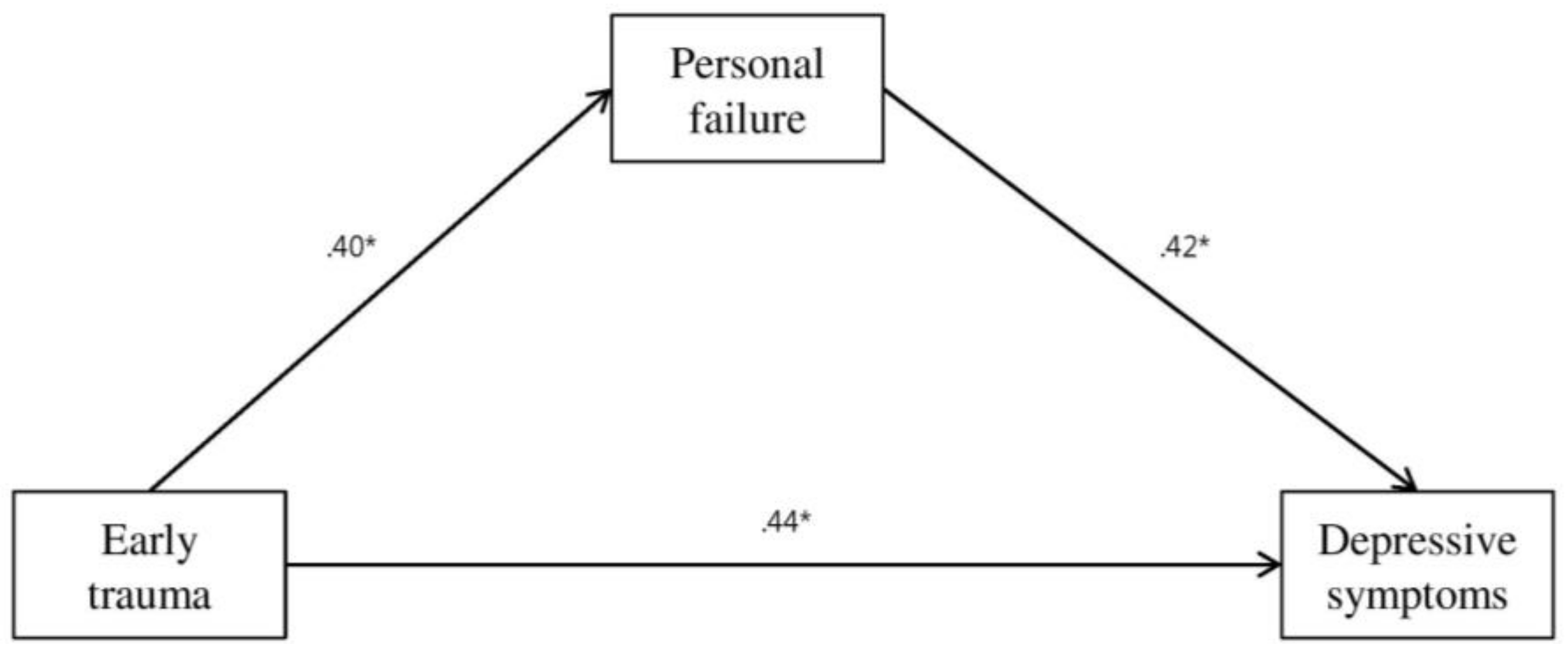
Trauma and Depression among North Korean Refugees: The Mediating Effect of Negative Cognition


Abstract
1. Introduction
2. Materials and Methods
2.1. Participants
2.2. Measures
2.3. Statistical Analysis
3. Results
4. Discussion
5. Conclusions
Acknowledgments
Author Contributions
Conflicts of Interest
References
- Jeon, W.T.; Yu, S.E.; Cho, Y.A.; Eom, J.S. Traumatic experiences and mental health of North Korean refugees in South Korea. Psychiatry Investig. 2008, 5, 213–220. [Google Scholar] [CrossRef] [Scilit] [PubMed]
- Jeon, W.; Min, S.; Lee, M.; Lee, E. A study on adaptation of North Koreans in South Korea. J. Korean Neuropsychiatr. Assoc. 1997, 36, 145–161. [Google Scholar]
- Nam, B.; Kim, J.Y.; DeVylder, J.E.; Song, A. Family functioning, resilience, and depression among North Korean refugees. Psychiatry Res. 2016, 245, 451–457. [Google Scholar] [CrossRef] [Scilit] [PubMed]
- Kim, Y.-H. Predictors for mental health problems among young North Korean refugees in South Korea. Contemp. Soc. Multicul. 2013, 3, 264–285. [Google Scholar]
- Choi, Y.; Lim, S.Y.; Jun, J.Y.; Lee, S.H.; Yoo, S.Y.; Kim, S.; Gwak, A.R.; Kim, J.-C.; Lee, Y.J.; Kim, S.J. The effect of traumatic experiences and psychiatric symptoms on the life satisfaction of North Korean refugees. Psychopathology 2017, 50, 203–210. [Google Scholar] [CrossRef] [Scilit] [PubMed]
- Park, J.; Jun, J.Y.; Lee, Y.J.; Kim, S.; Lee, S.H.; Yoo, S.Y.; Kim, S.J. The association between alexithymia and posttraumatic stress symptoms following multiple exposures to traumatic events in North Korean refugees. J. Psychosom. Res. 2015, 78, 77–81. [Google Scholar] [CrossRef] [Scilit] [PubMed]
- Kim, Y.J.; Cho, Y.A.; Kim, H.A. A mediation effect of ego resiliency between stresses and mental health of North Korean refugee youth in South Korea. Child Adolesc. Soc. Work J. 2015, 32, 481–490. [Google Scholar] [CrossRef] [Scilit]
- Emery, C.R.; Lee, J.Y.; Kang, C. Life after the pan and the fire: Depression, order, attachment, and the legacy of abuse among North Korean refugee youth and adolescent children of North Korean refugees. Child Abuse Negl. 2015, 45, 90–100. [Google Scholar] [CrossRef] [Scilit] [PubMed]
- Han, I.Y. Depressive traits of North Korean defectors. Ment. Health Soc. Work 2001, 11, 78–94. [Google Scholar]
- Kim, H.H.; Lee, Y.J.; Kim, H.K.; Kim, J.E.; Kim, S.J.; Bae, S.-M.; Cho, S.-J. Prevalence and correlates of psychiatric symptoms in North Korean defectors. Psychiatry Investig. 2011, 8, 179–185. [Google Scholar] [CrossRef] [Scilit] [PubMed]
- Beck, A.T. Cognitive models of depression. J. Cogn. Psychother. 1987, 1, 5–37. [Google Scholar]
- Seligman, M.E.P. Learned helplessness. Annu. Rev. Med. 1972, 23, 407–412. [Google Scholar] [CrossRef] [Scilit] [PubMed]
- Rose, D.T.; Abramson, L. Developmental predictors of depressive cognitive style: Research and theory. Dev. Perspect. Depress. 1992, 4, 323. [Google Scholar]
- Gibb, B.E. Childhood maltreatment and negative cognitive styles: A quantitative and qualitative review. Clin. Psychol. Rev. 2002, 22, 223–246. [Google Scholar] [CrossRef] [Scilit]
- Janoff-Bulman, R. Assumptive worlds and the stress of traumatic events: Applications of the schema construct. Soc. Cogn. 1989, 7, 113–136. [Google Scholar] [CrossRef] [Scilit]
- Beck, A.T.; Brown, B.; Steer, R.A.; Eidelson, J.I.; Riskind, J.H. Differentiating anxiety and depression utilizing the Cognition Checklist. J. Abnorm. Psychol. 1987, 96, 179–183. [Google Scholar] [CrossRef] [PubMed]
- Teasdale, J.D. Cognitive vulnerability to persistent depression. Cogn. Emotion. 1988, 2, 247–274. [Google Scholar] [CrossRef] [Scilit]
- Mathews, A.; MacLeod, C. Cognitive vulnerability to emotional disorders. Ann. Rev. Clin. Psychol. 2005, 1, 167–195. [Google Scholar] [CrossRef] [Scilit] [PubMed]
- Beck, A.T. Cognitive Therapy of the Emotional Disorders; New York American Library: New York, NY, USA, 1976. [Google Scholar]
- Beck, A.T.; Clark, D.A. Anxiety and depression: An information processing perspective. Anxiety Res. 1988, 1, 23–36. [Google Scholar] [CrossRef] [Scilit]
- Jolly, J.B.; Dyck, M.J.; Kramer, T.A.; Wherry, J.N. Integration of positive and negative affectivity and cognitive content-specificity: Improved discrimination of anxious and depressive symptoms. J. Abnorm. Psychol. 1994, 103, 544–552. [Google Scholar] [CrossRef] [PubMed]
- Clark, D.A.; Beck, A.T.; Brown, G. Cognitive mediation in general psychiatric outpatients: A test of the content-specificity hypothesis. J. Pers. Soc. Psychol. 1989, 56, 958–964. [Google Scholar] [CrossRef] [PubMed]
- Safren, S.A.; Heimberg, R.G.; Lerner, J.; Henin, A.; Warman, M.; Kendall, P.C. Differentiating anxious and depressive self-statements: Combined factor structure of the anxious self-statements questionnaire and the automatic thoughts questionnaire-revised. Cogn. Ther. Res. 2000, 24, 327–344. [Google Scholar] [CrossRef] [Scilit]
- Schniering, C.A.; Rapee, R.M. Development and validation of a measure of children’s automatic thoughts: The children’s automatic thoughts scale. Behav. Res. Ther. 2002, 40, 1091–1109. [Google Scholar] [CrossRef] [Scilit]
- Schniering, C.A.; Rapee, R.M. The structure of negative self-statements in children and adolescents: A confirmatory factor-analytic approach. J. Abnorm. Child Psychol. 2004, 32, 95–109. [Google Scholar] [CrossRef] [Scilit] [PubMed]
- Lee, Y.; Lee, M.; Park, S. Mental health status of North Korean refugees in South Korea and risk and protective factors: A 10-year review of the literature. Eur. J. Psychotraumatol. 2017, 8, 1369833. [Google Scholar] [CrossRef] [Scilit] [PubMed]
- Montgomery, E. Trauma, exile and mental health in young refugees. Acta Psychiatr. Scand. 2011, 124, 1–46. [Google Scholar] [CrossRef] [Scilit] [PubMed]
- Bremner, J.D.; Bolus, R.; Mayer, E.A. Psychometric properties of the Early Trauma Inventory-Self Report. J. Nerv. Ment. Dis. 2007, 195, 211–218. [Google Scholar] [CrossRef] [Scilit] [PubMed]
- Jeon, J.R.; Lee, E.H.; Lee, S.W.; Jeong, E.G.; Kim, J.H.; Lee, D.; Jeon, H.J. The early trauma inventory self report-short form: Psychometric properties of the Korean version. Psychiatry Investig. 2012, 9, 229–235. [Google Scholar] [CrossRef] [Scilit] [PubMed]
- Moon, H.; Oh, K.; Moon, H. Validation study of Korean Children’s Automatic Thoughts Scale. Korean J. Clin. Psychol. 2002, 21, 955–963. [Google Scholar]
- Cho, M.J.; Kim, K.H. Diagnostic validity of the CES-D (Korean version) in the assessment of DSM-III-R major depression. J. Korean Neuropsychiatr. Assoc. 1993, 32, 381–399. [Google Scholar]
- Cho, M.J.; Kim, K.H. Use of the Center for Epidemiologic Studies Depression (CES-D) Scale in Korea. J. Nerv. Ment. Dis. 1998, 186, 304–310. [Google Scholar] [CrossRef] [Scilit] [PubMed]
- Radloff, L.S. The CES-D scale: A self-report depression scale for research in the general population. Appl. Psychol. Meas. 1977, 1, 385–401. [Google Scholar] [CrossRef] [Scilit]
- Olobatuyi, M.E. A User’s Guide to Path Analysis; University Press of America: Lanham, MD, USA, 2006; p. 40. [Google Scholar]
- Lee, Y.-J.G.; Jun, J.Y.; Lee, Y.J.; Park, J.; Kim, S.; Lee, S.H.; Yu, S.Y.; Kim, S.J. Insomnia in North Korean refugees: Association with depression and post-traumatic stress symptoms. Psychiatry Investig. 2016, 13, 67–73. [Google Scholar] [CrossRef] [Scilit] [PubMed]
- Jeon, B.-H.; Kim, M.-D.; Hong, S.-C.; Kim, N.-R.; Lee, C.-I.; Kwak, Y.-S.; Park, J.-H.; Chung, J.; Chong, H.; Jwa, E.-K.; et al. Prevalence and correlates of depressive symptoms among North Korean defectors living in South Korea for more than one year. Psychiatry Investig. 2009, 6, 122–130. [Google Scholar] [CrossRef] [Scilit] [PubMed]
- Li, M.; D’Arcy, C.; Meng, X. Maltreatment in childhood substantially increases the risk of adult depression and anxiety in prospective cohort studies: Systematic review, meta-analysis, and proportional attributable fractions. Psychol. Med. 2015, 46, 717–730. [Google Scholar] [CrossRef] [Scilit] [PubMed]
- Nelson, J.; Klumparendt, A.; Doebler, P.; Ehring, T. Childhood maltreatment and characteristics of adult depression: Meta-analysis. Br. J. Psychiatry 2016. [Google Scholar] [CrossRef] [Scilit] [PubMed]
- Porter, M.; Haslam, N. Predisplacement and postdisplacement factors associated with mental health of refugees and internally displaced persons: A meta-analysis. JAMA 2005, 294, 602–612. [Google Scholar] [CrossRef] [Scilit] [PubMed]
- Steel, Z.; Chey, T.; Silove, D.; Marnane, C.; Bryant, R.A.; van Ommeren, M. Association of torture and other potentially traumatic events with mental health outcomes among populations exposed to mass conflict and displacement. JAMA 2009, 302, 537–549. [Google Scholar] [CrossRef] [Scilit] [PubMed]
- Park, S. Reliability and validity of the early trauma inventory self report-short form among Korean adolescents. J. Korean Acad. Child Adolesc. Psychiatry 2018, 29, 2–6. [Google Scholar] [CrossRef] [Scilit]
- Cho, Y.A.; Jeon, W.; Yu, J.J.; Um, J.-S. Predictors of depression among North Korean defectors: A 3-year follow-up study. Korean J. Couns. Psychother. 2005, 17, 467–484. [Google Scholar]
- Korea Hana Foundation. Survey on Social Integration of North Korean Defectors; Korea Hana Foundation: Seoul, Korea, 2017. [Google Scholar]
- Beck, A.T. Prisoners of Hate: The Cognitive Basis of Anger, Hostility, and Violence; HarperCollins: New York, NY, USA, 1999. [Google Scholar]
- Kim, Y. Posttraumatic stress disorder as a mediator between trauma exposure and comorbid mental health conditions in North Korean refugee youth resettled in South Korea. J. Interpers. Violence 2014, 31, 425–443. [Google Scholar] [CrossRef] [Scilit] [PubMed]
- Fiedler, K.; Harris, C.; Schott, M. Unwarranted inferences from statistical mediation tests—An analysis of articles published in 2015. J. Exp. Soc. Psychol. 2018, 75, 95–102. [Google Scholar] [CrossRef] [Scilit]


| Item | Frequency (%) |
|---|---|
| General trauma | 76.1 |
| T1. Natural disaster | 10.1 |
| T2. Serious accident | 20.2 |
| T3. Serious personal injury | 27.5 |
| T4. Serious injury/ illness of parent | 22.0 |
| T5. Separation of parents | 43.1 |
| T6. Serious illness/injury of sibling | 10.1 |
| T7. Serious injury of friend | 14.7 |
| T8. Witnessing violence | 34.9 |
| T9. Family mental illness | 11.0 |
| T10. Alcoholic parents | 9.2 |
| T11. Seeing someone murdered | 10.1 |
| Physical abuse | 76.1 |
| P1. Slapped in the face | 49.5 |
| P2. Burned with cigarette | 34.9 |
| P3. Punched or kicked | 47.7 |
| P4. Hit with thrown object | 41.3 |
| P5. Pushed or shoved | 37.6 |
| Emotional abuse | 57.8 |
| E1. Often put down or ridiculed | 23.9 |
| E2. Often ignored or made to feel you didn’t count | 37.6 |
| E3. Often told you are no good | 20.2 |
| E4. Most of the time treated in cold or uncaring way | 30.3 |
| E5. Parents fail to understand your needs | 27.5 |
| Sexual abuse | 18.3 |
| S1. Touched in intimate parts in way that was uncomfortable | 13.8 |
| S2. Someone rubbing genitals against you | 4.6 |
| S3. Forced to touch intimate parts | 5.5 |
| S4. Someone had genital sex against your will | 6.4 |
| S5. Forced to perform oral sex | 2.8 |
| S6. Forced to kiss someone in sexual way | 2.8 |
| Variable | 1 | 2 | 3 | 4 | 5 | 6 |
|---|---|---|---|---|---|---|
| 1. CES-D | 1 | |||||
| 2. ETI total | 0.60 ** | 1 | ||||
| 3. CATS-Personal failure | 0.61 ** | 0.40 ** | 1 | |||
| 4. CATS-Social threat | 0.20 * | 0.14 | 0.33 ** | 1 | ||
| 5. CATS-Physical threat | 0.61 ** | 0.45 ** | 0.72 ** | 0.21 * | 1 | |
| 6. CATS-Hostility | 0.53 ** | 0.43 ** | 0.67 ** | 0.22 * | 0.75 ** | 1 |
| Mean | 21.3 | 6.0 | 7.1 | 11.3 | 6.3 | 3.6 |
| Standard deviation | 10.9 | 5.0 | 8.6 | 5.6 | 8.1 | 5.3 |
© 2018 by the authors. Licensee MDPI, Basel, Switzerland. This article is an open access article distributed under the terms and conditions of the Creative Commons Attribution (CC BY) license (http://creativecommons.org/licenses/by/4.0/).
Share and Cite
Park, S.; Lee, Y.; Jun, J.Y. Trauma and Depression among North Korean Refugees: The Mediating Effect of Negative Cognition. Int. J. Environ. Res. Public Health 2018, 15, 591. https://doi.org/10.3390/ijerph15040591
Park S, Lee Y, Jun JY. Trauma and Depression among North Korean Refugees: The Mediating Effect of Negative Cognition. International Journal of Environmental Research and Public Health. 2018; 15(4):591. https://doi.org/10.3390/ijerph15040591
Chicago/Turabian StylePark, Subin, Yeeun Lee, and Jin Yong Jun. 2018. "Trauma and Depression among North Korean Refugees: The Mediating Effect of Negative Cognition" International Journal of Environmental Research and Public Health 15, no. 4: 591. https://doi.org/10.3390/ijerph15040591
APA StylePark, S., Lee, Y., & Jun, J. Y. (2018). Trauma and Depression among North Korean Refugees: The Mediating Effect of Negative Cognition. International Journal of Environmental Research and Public Health, 15(4), 591. https://doi.org/10.3390/ijerph15040591