<?xml version="1.0" encoding="UTF-8"?>
<!DOCTYPE article PUBLIC "-//NLM//DTD Journal Publishing DTD v2.3 20070202//EN" "journalpublishing.dtd">
<article xmlns:xlink="http://www.w3.org/1999/xlink" xml:lang="en" article-type="review-article">
<front>
<journal-meta>
<journal-id journal-id-type="publisher-id">MD</journal-id>
<journal-title>Marine Drugs</journal-title>
<abbrev-journal-title>MD</abbrev-journal-title>
<issn pub-type="epub">1660-3397</issn>
<publisher>
<publisher-name>Molecular Diversity Preservation International</publisher-name></publisher></journal-meta>
<article-meta>
<article-id pub-id-type="doi">10.3390/md8082252</article-id>
<article-id pub-id-type="publisher-id">marinedrugs-08-02252</article-id>
<article-categories>
<subj-group>
<subject>Review</subject></subj-group></article-categories>
<title-group>
<article-title>Chitosan Composites for Bone Tissue Engineering—An Overview</article-title></title-group>
<contrib-group>
<contrib contrib-type="author">
<name><surname>Venkatesan</surname><given-names>Jayachandran</given-names></name><xref ref-type="aff" rid="af1-marinedrugs-08-02252">1</xref></contrib>
<contrib contrib-type="author">
<name><surname>Kim</surname><given-names>Se-Kwon</given-names></name><xref ref-type="aff" rid="af1-marinedrugs-08-02252">1</xref><xref ref-type="aff" rid="af2-marinedrugs-08-02252">2</xref><xref ref-type="corresp" rid="c1-marinedrugs-08-02252">*</xref></contrib></contrib-group>
<aff id="af1-marinedrugs-08-02252">
<label>1</label> Department of Chemistry, Pukyong National University, Busan 608-737, Korea; E-Mail: <email>venkatjchem@gmail.com</email></aff>
<aff id="af2-marinedrugs-08-02252">
<label>2</label> Marine Bioprocess Research Center, Pukyong National University, Busan 608-737, Korea</aff>
<author-notes>
<corresp id="c1-marinedrugs-08-02252">*Author to whom correspondence should be addressed; E-Mail: <email>sknkim@pknu.ac.kr</email>; Tel.: +82 51 629 7097; Fax: +82 51 628 8147.</corresp></author-notes>
<pub-date pub-type="collection">
<year>2010</year></pub-date>
<pub-date pub-type="epub">
<day>2</day>
<month>8</month>
<year>2010</year></pub-date>
<volume>8</volume>
<issue>8</issue>
<fpage>2252</fpage>
<lpage>2266</lpage>
<history>
<date date-type="received">
<day>22</day>
<month>6</month>
<year>2010</year></date>
<date date-type="rev-recd">
<day>29</day>
<month>7</month>
<year>2010</year></date>
<date date-type="accepted">
<day>30</day>
<month>7</month>
<year>2010</year></date></history>
<permissions>
<copyright-statement>© 2010 by the authors; licensee Molecular Diversity Preservation International, Basel, Switzerland</copyright-statement>
<copyright-year>2010</copyright-year>
<license license-type="open-access" xlink:href="http://creativecommons.org/licenses/by/3.0">
<p>This article is an open-access article distributed under the terms and conditions of the Creative Commons Attribution license (http://creativecommons.org/licenses/by/3.0/).</p></license></permissions>
<abstract>
<p>Bone contains considerable amounts of minerals and proteins. Hydroxyapatite [Ca<sub>10</sub>(PO<sub>4</sub>)<sub>6</sub>(OH)<sub>2</sub>] is one of the most stable forms of calcium phosphate and it occurs in bones as major component (60 to 65%), along with other materials including collagen, chondroitin sulfate, keratin sulfate and lipids. In recent years, significant progress has been made in organ transplantation, surgical reconstruction and the use of artificial protheses to treat the loss or failure of an organ or bone tissue. Chitosan has played a major role in bone tissue engineering over the last two decades, being a natural polymer obtained from chitin, which forms a major component of crustacean exoskeleton. In recent years, considerable attention has been given to chitosan composite materials and their applications in the field of bone tissue engineering due to its minimal foreign body reactions, an intrinsic antibacterial nature, biocompatibility, biodegradability, and the ability to be molded into various geometries and forms such as porous structures, suitable for cell ingrowth and osteoconduction. The composite of chitosan including hydroxyapatite is very popular because of the biodegradability and biocompatibility in nature. Recently, grafted chitosan natural polymer with carbon nanotubes has been incorporated to increase the mechanical strength of these composites. Chitosan composites are thus emerging as potential materials for artificial bone and bone regeneration in tissue engineering. Herein, the preparation, mechanical properties, chemical interactions and <italic>in vitro</italic> activity of chitosan composites for bone tissue engineering will be discussed.</p></abstract>
<kwd-group>
<kwd>chitosan</kwd>
<kwd>hydroxyapatite</kwd>
<kwd>carbon nanotube</kwd>
<kwd>bone tissue engineering</kwd></kwd-group></article-meta></front>
<body>
<sec sec-type="intro">
<title>1. Introduction</title>
<p>Research on biomaterials for bone implantation and replacement has expanded considerably over the last four decades. In recent years, significant progress has been made in organ transplantation, surgical reconstruction and the use of artificial protheses to treat the loss or failure of an organ or bone tissue. The establishment of a load bearing biomaterial must be incorporated with natural bone. The implanted biomaterial should possess the following criteria: biocompatibility, osteoconductivity, high porosity and biomechanical compatibility [<xref ref-type="bibr" rid="b1-marinedrugs-08-02252">1</xref>]. For this requirement, autografts and allografts are used extensively for bone grafts. In the autograft technique, bone from another part will be harvested within the body, and this material fills the gap and provides optimal osteoinductivity, osteoconductivity and osteogenic properties. However, it has its own disadvantages: autografting often leads to complications in wound healing, additional surgery, donor pain and an inadequate supply of bone to fill the gap [<xref ref-type="bibr" rid="b2-marinedrugs-08-02252">2</xref>]. In the allograft technique, cadaver bones have been used, but it has problems with immunogenic reactions and the risk of acquiring transmissible diseases (AIDS and hepatitis) from tissues and fluids. These limitations and concerns have created substantial interest in the development of artificial materials as bone graft substitutes [<xref ref-type="bibr" rid="b3-marinedrugs-08-02252">3</xref>]. Very few compounds are classified as bioactive, biodegradable and osteoconductive. Chitosan (CTS) and hydroxyapatite (HAp) are among the best bioactive biomaterials in bone tissue engineering and renowned for their excellent biocompatibility with the human body environment [<xref ref-type="bibr" rid="b4-marinedrugs-08-02252">4</xref>].</p>
<p>Natural polymer composite materials are becoming increasingly important as scaffolds for bone tissue engineering. Next generation biomaterials should combine bioactive and bioresorbable materials, which mimic the natural function of bone and activate <italic>in vivo</italic> mechanisms of tissue regeneration. Composite materials based on combinations of biodegradable polymers and bioactive ceramics, including CTS and HAp, are discussed as suitable materials for scaffold fabrication. These composites exhibit tailored physical, biological and mechanical properties as well as predictable degradation behavior. The appropriate selection of a particular composite for a given application requires a detailed understanding of relevant cells and/or tissue response. An overview of these findings is presented and discussed in this review, highlighting the influence of material preparation methods, scaffold mechanical strength, <italic>in vitro</italic> activity of scaffold materials and chemical interaction with CTS polymer matrixes. The review also emphasises future artificial bone materials, suggesting the utility of polymer composites in this field of biomaterials science.</p>
<p>Various marine sources polysaccharides have been used for treatment of bone diseases like osteoporosis [<xref ref-type="bibr" rid="b5-marinedrugs-08-02252">5</xref>], arthritis [<xref ref-type="bibr" rid="b6-marinedrugs-08-02252">6</xref>], and so on. In order to create a moist environment for rapid wound healing, a hydrogel sheet composed of a blended powder of alginate, chitin/chitosan and fucoidan has been developed as a functional wound dressing [<xref ref-type="bibr" rid="b7-marinedrugs-08-02252">7</xref>].</p></sec>
<sec>
<title>2. Chitosan for Bone Tissue Engineering</title>
<sec sec-type="methods">
<title>2.1. Preparation of chitosan by chemical methods</title>
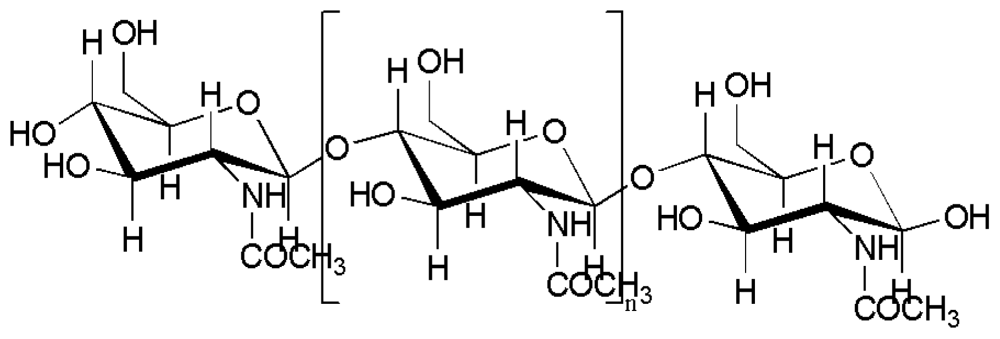
<p>Chitin (<xref ref-type="fig" rid="f1-marinedrugs-08-02252">Figure 1</xref>) is the second most abundant natural polymer after cellulose. CTS is produced from chitin, which is a natural polysaccharide found in crab, shrimp, lobster, coral, jellyfish, butterfly, ladybug, mushroom and fungi. However, marine crustacean shells are widely used as primary sources for the production of CTS [<xref ref-type="bibr" rid="b8-marinedrugs-08-02252">8</xref>,<xref ref-type="bibr" rid="b9-marinedrugs-08-02252">9</xref>]. Crab and shrimp are important marine species of great commercial importance in the tropical and subtropical waters of the Pacific, Atlantic and Indian oceans. The waste from crab and shrimp processing has recently become a serious issue in coastal areas. Selective isolation of bioactive material from these wastes is the simplest way to decrease the pollution. It not only reduces the environmental pollution because of the disposal of this under utilized by products of crabs and shrimps, but also increases the potential applications of CTS. Moreover, the chemical hydrolysis and enzymatic methods, widely used for the isolation for CTS from marine crustaceans shell, are quite inexpensive.</p>
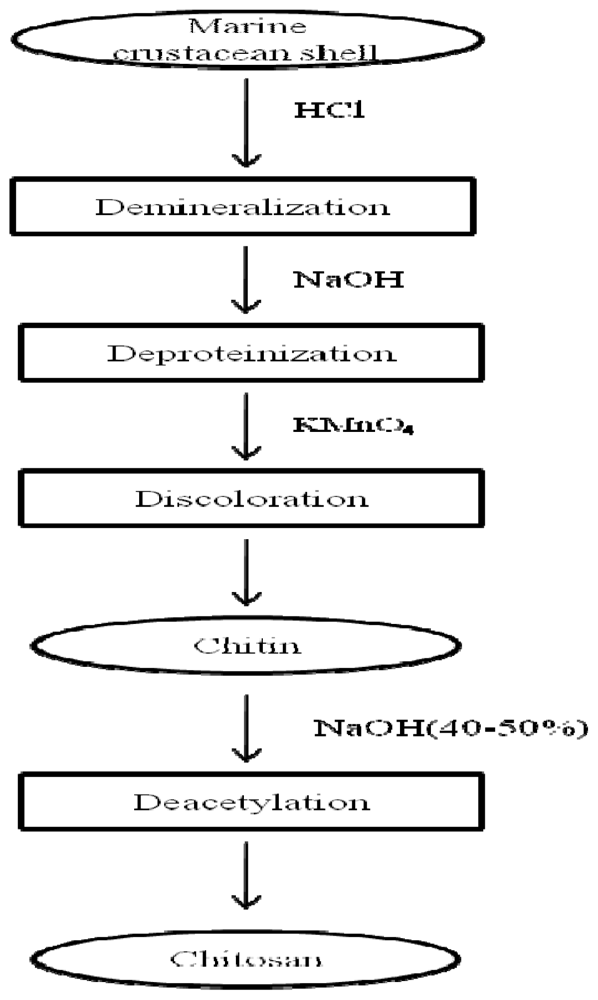
<p>In chemical hydrolysis method, four main steps are involved in order to produce CTS from marine crustacean shell as depicted in <xref ref-type="fig" rid="f2-marinedrugs-08-02252">Figure 2</xref>. They are (i) demineralization; (ii) deproteinization; (iii) discoloration and (iv) deacetylation. To produce 1 kg of 70% deacetylated CTS from shrimp shells, 6.3 kg of HCl and 1.8 kg of NaOH are required [<xref ref-type="bibr" rid="b8-marinedrugs-08-02252">8</xref>,<xref ref-type="bibr" rid="b9-marinedrugs-08-02252">9</xref>].</p></sec>
<sec>
<title>2.2. Enzymatic hydrolysis method</title>
<p>Chitosan can be isolated directly from the cell walls of certain fungi, but commercially available CTS are usually prepared from chitin. CTS can be produced via traditional chemical method, however, problems exist related to poor quality and environmental chemical pollution [<xref ref-type="bibr" rid="b10-marinedrugs-08-02252">10</xref>]. The enzymatic method could provide an alternative to the current chemical production method. The degree of deacetylation and molecular weight of the CTS depends on the source and preparation method (molecular weight ranges from 300 to over 1,000 kDa, degree of deacetylation from 30% to 95%). CTS can be degraded by enzyme and form various small molecular weight fragments. Chitosanase has been used for the preparation of small molecular weight CTS with various methods such as batch reactor, column reactor and ultrafiltration membrane reactor [<xref ref-type="bibr" rid="b11-marinedrugs-08-02252">11</xref>]. The CTS has been extracted with various enzymes like lysozyme, snailase, neutral protease and novel chitin deacetylase from <italic>Scopulariopsis brevicaulis</italic>. The average molecular weight of CTS obtained using the enzymatic method (267.97 kDa) has been reported to be far greater than that obtained by chemical method (84.04 kDa) [<xref ref-type="bibr" rid="b10-marinedrugs-08-02252">10</xref>,<xref ref-type="bibr" rid="b12-marinedrugs-08-02252">12</xref>].</p></sec>
<sec>
<title>2.3. Properties and application of chitosan</title>
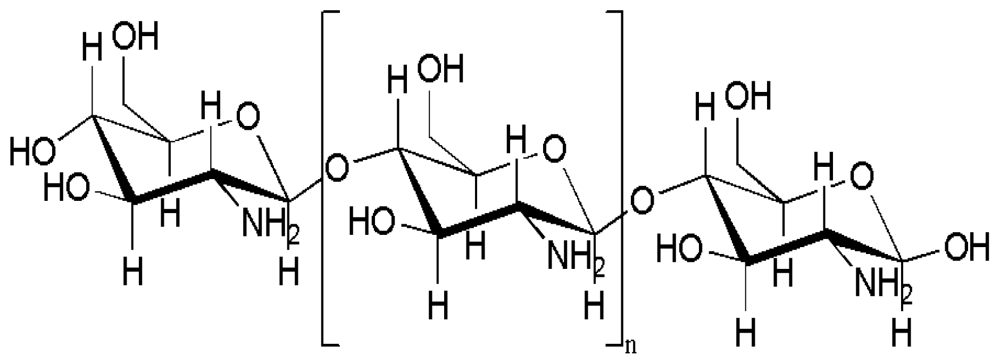
<p>CTS is a copolymer consisting of β-(1→4)-2-acetamido-d-glucose and β-(1→4)-2-amino-<sc>d</sc>-glucose unit linkages (<xref ref-type="fig" rid="f3-marinedrugs-08-02252">Figure 3</xref>) [<xref ref-type="bibr" rid="b13-marinedrugs-08-02252">13</xref>,<xref ref-type="bibr" rid="b14-marinedrugs-08-02252">14</xref>]. Over the past two decades, CTS has been developed considerably in biomedical applications due to its high biocompatibility, biodegradability, porous structure, suitability for cell ingrowth, osteoconduction and intrinsic antibacterial nature [<xref ref-type="bibr" rid="b15-marinedrugs-08-02252">15</xref>], CTS offers a wide range of applications, including cartilage tissue engineering [<xref ref-type="bibr" rid="b16-marinedrugs-08-02252">16</xref>], wound healing [<xref ref-type="bibr" rid="b17-marinedrugs-08-02252">17</xref>] and orthopedic applications [<xref ref-type="bibr" rid="b15-marinedrugs-08-02252">15</xref>]. Degradable polymeric implants eliminate the need for a second surgical operation and can prevent some of the problems associated with stress shielding during post-healing, and can also be used simultaneously to deliver therapeutic drugs to treat infections or growth factors to accelerate new bone growth [<xref ref-type="bibr" rid="b18-marinedrugs-08-02252">18</xref>]. There is a growing interest in exploiting the field of bone tissue engineering for composite preparation. This has created a wide range of application in the preparation of artificial organs.</p>
<p>CTS can be easily modified into various forms like films, fibers, beads, sponges, and more complex shapes for orthopedic treatment [<xref ref-type="bibr" rid="b15-marinedrugs-08-02252">15</xref>]. The cationic nature of CTS is responsible for attracting various negative charged proteoglycans. Porous materials have a highly significant role in the bone implantation process. Porous CTS structures can be formed by freezing and lyophilizing CTS acetic acid solutions in suitable molds [<xref ref-type="bibr" rid="b19-marinedrugs-08-02252">19</xref>,<xref ref-type="bibr" rid="b20-marinedrugs-08-02252">20</xref>]. CTS have been combined with a variety of materials such as HAp, alginate, hyaluronic acid, calcium phosphate, poly (methyl methacrylate), poly-<sc>l</sc>-lactic acid and growth factors for potential application in orthopedics.</p></sec></sec>
<sec sec-type="materials">
<title>3. Composite Materials for Bone Tissue Engineering</title>
<p>Composite materials are now playing predominant role as scaffolds in bone tissue engineering. CTS has numerous advantageous properties for orthopedic applications, as described above and elsewhere [<xref ref-type="bibr" rid="b15-marinedrugs-08-02252">15</xref>], which make it ideal as a bone graft substituent. CTS scaffolds are flexible and their mechanical properties are inferior to those of normal bone, as it is unable to support load bearing bone implants. Moreover, CTS itself is not osteoconductive, although addition of ceramic materials improves its osteoconductivity and mechanical strength.</p>
<p>CTS scaffolds alone cannot imitate all the properties of natural bone. The substantial development of composite materials with CTS mimics all the properties of bone. As proven, calcium phosphate materials are osteoconductive to mimic the inorganic portion of natural bone, while CTS/HAp composite materials show promise in mimicking the organic portion as well as the inorganic portion of natural bone. Several studies have been conducted with CTS/HAp composite materials for bone tissue engineering [<xref ref-type="bibr" rid="b15-marinedrugs-08-02252">15</xref>,<xref ref-type="bibr" rid="b18-marinedrugs-08-02252">18</xref>,<xref ref-type="bibr" rid="b21-marinedrugs-08-02252">21</xref>–<xref ref-type="bibr" rid="b30-marinedrugs-08-02252">30</xref>]. Calcium phosphate compounds are of great interest in the field of bone tissue engineering. Hydroxyapatite [Ca<sub>10</sub>(PO<sub>4</sub>)<sub>6</sub>(OH)<sub>2</sub>] is one of the most stable forms of calcium phosphate and it occurs in the bone as a major component (60 to 65%) [<xref ref-type="bibr" rid="b31-marinedrugs-08-02252">31</xref>]. HAp also possesses a variety of uses, including orthopedic, dental and maxillofacial applications. Therefore, HAp has recently emerged as an important compound for artificial bone preparation. It stimulates osteoconduction being gradually replaced by the host bone after implantation. It is being used for orthopedic replacements, especially in bone regeneration and dental implant treatment. The mechanical properties of HAp are poor, though, so it cannot be used for load bearing bone tissues. Polymers have been used to improve the mechanical properties of HAp (compressive strength, Young’s modulus, fracture toughness) [<xref ref-type="bibr" rid="b32-marinedrugs-08-02252">32</xref>]. When CTS is combined with HAp, it might be able to mimic the function of natural bone.</p>
<sec sec-type="materials">
<title>3.1. Preparation of CTS/HAp composite materials</title>
<p>Numerous methods have been used to prepare CTS/HAp composites, especially for nanocomposite preparation, which play an excellent role in the extra-space arrangement in the matrix and have the best biomedical properties and biomaterial applications [<xref ref-type="bibr" rid="b22-marinedrugs-08-02252">22</xref>]. CTS/HAp nanocomposite with a homogeneous microstructure has been prepared using <italic>in situ</italic> synthesis [<xref ref-type="bibr" rid="b33-marinedrugs-08-02252">33</xref>], precipitation method [<xref ref-type="bibr" rid="b34-marinedrugs-08-02252">34</xref>], <italic>in situ</italic> co-precipitation synthesis with an electrospinning process [<xref ref-type="bibr" rid="b21-marinedrugs-08-02252">21</xref>,<xref ref-type="bibr" rid="b23-marinedrugs-08-02252">23</xref>,<xref ref-type="bibr" rid="b30-marinedrugs-08-02252">30</xref>,<xref ref-type="bibr" rid="b35-marinedrugs-08-02252">35</xref>,<xref ref-type="bibr" rid="b36-marinedrugs-08-02252">36</xref>], simple <italic>in situ</italic> hybridization [<xref ref-type="bibr" rid="b18-marinedrugs-08-02252">18</xref>], solvent casting and evaporation method [<xref ref-type="bibr" rid="b24-marinedrugs-08-02252">24</xref>], <italic>in situ</italic> chemical method [<xref ref-type="bibr" rid="b25-marinedrugs-08-02252">25</xref>,<xref ref-type="bibr" rid="b37-marinedrugs-08-02252">37</xref>], freezing and lyophilization [<xref ref-type="bibr" rid="b26-marinedrugs-08-02252">26</xref>,<xref ref-type="bibr" rid="b27-marinedrugs-08-02252">27</xref>], combined sintering and freeze-drying technique [<xref ref-type="bibr" rid="b28-marinedrugs-08-02252">28</xref>], self-assembly of static electricity [<xref ref-type="bibr" rid="b38-marinedrugs-08-02252">38</xref>], simple mixing and heating method [<xref ref-type="bibr" rid="b29-marinedrugs-08-02252">29</xref>], biomimetic method [<xref ref-type="bibr" rid="b39-marinedrugs-08-02252">39</xref>–<xref ref-type="bibr" rid="b41-marinedrugs-08-02252">41</xref>], low temperature wet chemical method [<xref ref-type="bibr" rid="b42-marinedrugs-08-02252">42</xref>], thermally induced phase separation technique [<xref ref-type="bibr" rid="b43-marinedrugs-08-02252">43</xref>], dual membrane diffusion system [<xref ref-type="bibr" rid="b44-marinedrugs-08-02252">44</xref>], electrochemical deposition [<xref ref-type="bibr" rid="b45-marinedrugs-08-02252">45</xref>], electrochemistry assisted deposition [<xref ref-type="bibr" rid="b46-marinedrugs-08-02252">46</xref>,<xref ref-type="bibr" rid="b47-marinedrugs-08-02252">47</xref>], electrophoretic deposition [<xref ref-type="bibr" rid="b48-marinedrugs-08-02252">48</xref>,<xref ref-type="bibr" rid="b49-marinedrugs-08-02252">49</xref>], natural HAp mixed with CTS [<xref ref-type="bibr" rid="b50-marinedrugs-08-02252">50</xref>], double diffusion technique [<xref ref-type="bibr" rid="b51-marinedrugs-08-02252">51</xref>] and wet spinning method [<xref ref-type="bibr" rid="b52-marinedrugs-08-02252">52</xref>].</p></sec>
<sec>
<title>3.2. Mechanical properties of CTS/HAp composite</title>
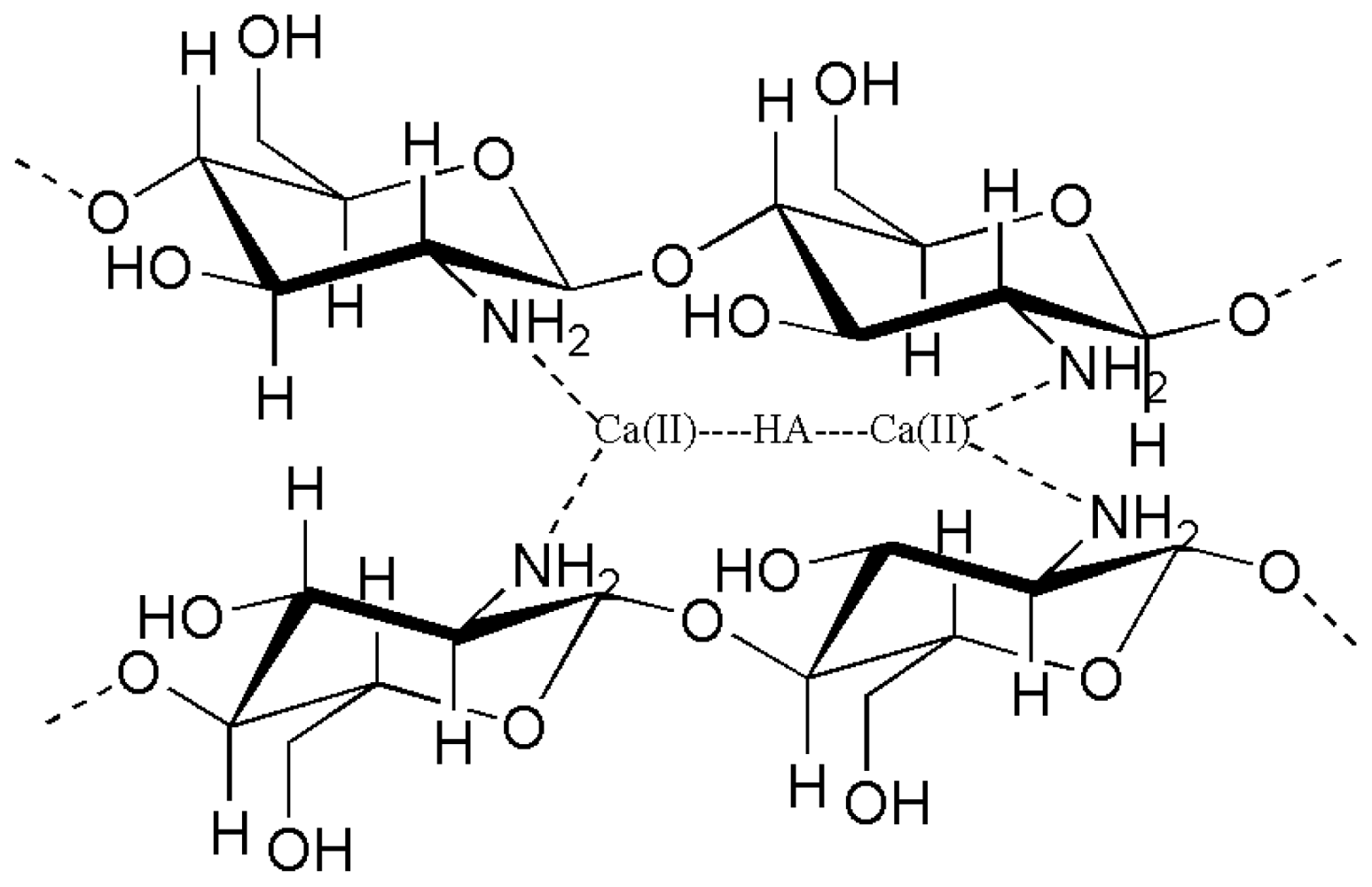
<p>The mechanical properties of the CTS/HAp composites play a significant role in bone tissue engineering. The intermolecular hydrogen bond and chelate interaction between the CTS and HAp contribute to good mechanical properties. There is a possible interaction between the NH<sub>2</sub> group and primary and secondary –OH group of CTS with Ca<sup>2+</sup> (metal coordination interaction) of HAp. The possible interaction between CTS and HAp is discussed in a later section. This interaction might be responsible for the higher mechanical strength of the composite scaffolds as compared to CTS and HAp alone. Compressive strength has been a widely used parameter to find out the mechanical strength of porous scaffolds. Li <italic>et al.</italic> compared the compressive strengths of different composite ratio of CTS/HAp and found the maximum compressive strength to be 119.86 MPa (30:70 CTS/HAp ratio). Increasing the HAp ratio leads to an increase in the compressive strength [<xref ref-type="bibr" rid="b53-marinedrugs-08-02252">53</xref>]. The incorporation of CTS into HAp matrix via blending methods would result in the decrease of mechanical properties of composite material due to the weaker interfacial bonding between CTS and HAp matrix and as a result, the compressive strength reduces to 47.8 MPa [<xref ref-type="bibr" rid="b54-marinedrugs-08-02252">54</xref>]. The molecular weights of CTS also contributes significantly to the mechanical properties. In general, the high molecular weight CTS scaffolds have higher compression modulus than medium molecular weight CTS. The compression moduli of high molecular CTS and CTS/nHAp (1%) nanocomposite scaffold were found to be 6.0 ± 0.3 kPa and 9.2 ± 0.2 kPa, respectively [<xref ref-type="bibr" rid="b27-marinedrugs-08-02252">27</xref>]. The mechanical properties of CTS composite scaffold also depend on the temperature and it increases with an increase in the temperature. A possible rationale to this may be that with an increase in the temperature, the interfacial bonding between CTS and HAp increases [<xref ref-type="bibr" rid="b30-marinedrugs-08-02252">30</xref>]. Water content of the scaffold may also have a major role to play in the mechanical strength. In a study, it was found that the nHAp/CTS/carboxymethyl cellulose (40/30/30% w/v) has highest mechanical property of 40 MPa in dry and 12 MPa in wet state [<xref ref-type="bibr" rid="b38-marinedrugs-08-02252">38</xref>].</p></sec>
<sec sec-type="methods">
<title>3.3. <italic>In vitro</italic> study of CTS/HAp composites</title>
<p>CTS have been widely used in orthopedic treatment since it was shown to promote osteoblastic cell growth. When CTS is incorporated with HAp, it remarkably increases the osteoblastic cell growth on the scaffolds [<xref ref-type="bibr" rid="b15-marinedrugs-08-02252">15</xref>,<xref ref-type="bibr" rid="b21-marinedrugs-08-02252">21</xref>,<xref ref-type="bibr" rid="b24-marinedrugs-08-02252">24</xref>,<xref ref-type="bibr" rid="b25-marinedrugs-08-02252">25</xref>,<xref ref-type="bibr" rid="b27-marinedrugs-08-02252">27</xref>]. The 3-(4,5-dimethylthiazol-2-yl)-2,5-diphenyltetrazolium bromide (MTT) method has been frequently used to determine the cytotoxicity of CTS composite materials. All the scaffolds’ results showed that the CTS/HAp composite had no cytotoxicity with positive cell attachment and proliferation growth of the osteoblast cells [<xref ref-type="bibr" rid="b15-marinedrugs-08-02252">15</xref>,<xref ref-type="bibr" rid="b23-marinedrugs-08-02252">23</xref>–<xref ref-type="bibr" rid="b25-marinedrugs-08-02252">25</xref>,<xref ref-type="bibr" rid="b50-marinedrugs-08-02252">50</xref>,<xref ref-type="bibr" rid="b51-marinedrugs-08-02252">51</xref>]. The composite scaffolds possess a pore size of 100–200 μm, providing a spatial arrangement of cells (10–30 μm) and thus cells are able to migrate towards the composite [<xref ref-type="bibr" rid="b55-marinedrugs-08-02252">55</xref>]. It was observed that when the osteoblast cells were cultured in the medium of phosphorylated CTS/HAp, the cell morphology changed within 30 min of seeding and later became triangular at 24 h, polygonal at 48 h, and finally, aggregated to be indistinct at 5 days [<xref ref-type="bibr" rid="b56-marinedrugs-08-02252">56</xref>]. Apart from HAp, other calcium phosphate minerals also provide adhesion and cell proliferation when combined with CTS. The cell proliferation and adhesion has been found with osteoblast mouse cells MC3T3-E1 and L929 cells in CTS/calcium phosphate specimens [<xref ref-type="bibr" rid="b28-marinedrugs-08-02252">28</xref>,<xref ref-type="bibr" rid="b57-marinedrugs-08-02252">57</xref>].</p>
<p>The alkaline phosphatase activity (ALP) is considered to be an important marker of the differentiation of osteoblast cells at a relatively early bone forming stage and has been widely used to evaluate ALP for scaffold materials. The CTS/HAp composite scaffolds possess higher ALP activity compared to the CTS scaffold whereas the highest ALP activity has been achieved in the composite containing 30–40% of HAp with good cell proliferation; however, cell proliferation decreases with an increase in the HAp concentration [<xref ref-type="bibr" rid="b21-marinedrugs-08-02252">21</xref>,<xref ref-type="bibr" rid="b51-marinedrugs-08-02252">51</xref>,<xref ref-type="bibr" rid="b58-marinedrugs-08-02252">58</xref>]. The modified CTS and its composites are found to have good cell proliferation and higher ALP activity then compared to non modified CTS. CTS glutamate and HAp containing cultured osteoblasts were found to be promising biomaterials for repair bone defects <italic>in vivo</italic> [<xref ref-type="bibr" rid="b56-marinedrugs-08-02252">56</xref>,<xref ref-type="bibr" rid="b59-marinedrugs-08-02252">59</xref>].</p></sec>
<sec>
<title>3.4. Chemical interaction of CTS/HAp composites</title>
<p>Ca<sup>2+</sup> ions appear on the terminated surface of HAp crystals, which have coordination number of seven and are strictly held in the structure (<xref ref-type="fig" rid="f4-marinedrugs-08-02252">Figure 4</xref>). Therefore, there is a possibility to form coordination bonds between the -NH<sub>2</sub> of CTS and Ca<sup>2+</sup> of HAp [<xref ref-type="bibr" rid="b24-marinedrugs-08-02252">24</xref>,<xref ref-type="bibr" rid="b60-marinedrugs-08-02252">60</xref>].</p></sec></sec>
<sec>
<title>4. Carbon Nano Tubes for Bone Tissue Engineering</title>
<p>Carbon nanotubes (CNTs) are allotropes of carbon with a cylindrical nanostructure and constructed with length-to-diameter ratio of up to 28,000,000:1. These cylindrical carbon molecules have novel properties, which make them potentially useful in many applications in nanotechnology, electronics, optics and materials sciences. CNTs have a high Young’s modulus (1.0–1.8 TPa), high tensile strength (30–200 GPa) and high elongation at break (10–30%). In addition, they have extremely small size (about 1–10 nm in diameter), high aspect ratio (&gt;1,000), high structural and chemical stability, and stiffness, as well as remarkable electrical, thermal, optical and bioactive properties [<xref ref-type="bibr" rid="b61-marinedrugs-08-02252">61</xref>,<xref ref-type="bibr" rid="b62-marinedrugs-08-02252">62</xref>]. All these properties make CNTs especially promising candidates as reinforcement fillers in the development of nano composites. It has been observed that the combination of CNT with CTS leads to an enormous increase in the mechanical strength of the composite [<xref ref-type="bibr" rid="b63-marinedrugs-08-02252">63</xref>].</p>
<p>CNTs hold great interest with respect to biomaterials, particularly those to be positioned in contact with bone such as prostheses for arthroplasty, plates or screws for fracture fixation, drug delivery systems, and scaffolding for bone regeneration. The most important concerns for the use of CNTs as a biomaterial are tissue safety, but only few reports have addressed the toxicity of CNTs. In particular, bone tissue compatibility is extremely important for using CNTs in biomaterials. Usui <italic>et al.</italic>, who first developed CNT, found that these tubes have good bone tissue compatibility and are capable of permitting bone repair and becoming closely integrated with bone tissue and accelerate bone formation stimulated by recombinant human bone morphogenetic protein-2 [<xref ref-type="bibr" rid="b64-marinedrugs-08-02252">64</xref>].</p>
<p>A big challenge in the bone tissue engineering is mechanical strength improvement of the scaffold materials. One of the main purposes of creating CTS composites is to improve the mechanical strength of the material. CNT is a promising material to fulfill that gap due to its strong mechanical properties. Several authors have developed many composites as well as scaffold materials with CNT. It has been observed that cell adhesion on multi-walled CNT (MWCNT) coated dish is much higher than that on the collagen coated dish [<xref ref-type="bibr" rid="b65-marinedrugs-08-02252">65</xref>].</p>
<sec>
<title>4.1. Preparation of CTS/CNT composite</title>
<p>One of the major problems in the preparation of CTS with CNT materials is the difficulty to disperse the CNTs well in the polymer matrix. Several methods have been used for this purpose such as controlled surface deposition and cross linking process [<xref ref-type="bibr" rid="b66-marinedrugs-08-02252">66</xref>], simple solution evaporation method [<xref ref-type="bibr" rid="b63-marinedrugs-08-02252">63</xref>], thermally induced phase separation followed by freeze drying [<xref ref-type="bibr" rid="b67-marinedrugs-08-02252">67</xref>], electrodeposition [<xref ref-type="bibr" rid="b68-marinedrugs-08-02252">68</xref>], spray layer by layer technique [<xref ref-type="bibr" rid="b69-marinedrugs-08-02252">69</xref>], pH and electrical actuation [<xref ref-type="bibr" rid="b70-marinedrugs-08-02252">70</xref>] and wet spinning method [<xref ref-type="bibr" rid="b71-marinedrugs-08-02252">71</xref>].</p></sec>
<sec>
<title>4.2. Mechanical properties of CTS/CNT composite</title>
<p>Wang <italic>et al.</italic> reported that CNT is homogeneously dispersed throughout the CTS matrix. When 0.8% of CNT was introduced in the CTS matrix, the mechanical properties, including the tensile modulus and strength of the nanocomposite were greatly improved by about 93% and 99% [<xref ref-type="bibr" rid="b63-marinedrugs-08-02252">63</xref>]. A small addition of CNTs significantly improves the tensile properties of CTS matrix, and the mechanical properties increase with the increase of CNTs’ loading (0.4 wt% of CNTs filler) whereas the tensile modulus and strength of the nanocomposite increases dramatically by about 78% and 94%. Due to the aggregation of CNTs within the CTS matrix at higher concentrations, with further increases of the loading level of CNTs, the tensile modulus only increases slightly, while the tensile strength remains stable. For instance, with 2.0 wt% of MWNTs filler, the tensile modulus of the CTS matrix is 2.15 GPa, only 0.07 GPa higher than that of 0.8 wt% of MWNTs. The tensile test results indicate the mechanical properties of the CTS/CNTs [<xref ref-type="bibr" rid="b63-marinedrugs-08-02252">63</xref>].</p>
<p>In another study, the tenacity of neat CTS fiber was recorded as 96 MPa, whereas that of CTS reinforced with purified but non-functionalized single-walled CNTs (p-SWCNTs) increased from 132 MPa for 0.01 wt% SWCNT addition to 180 MPa for 0.4 wt% SWCNT addition. Even at very low SWCNT concentration (0.01 wt%), a significant increase in tenacity was observed. On the other hand, on incorporation of functionalized CNT (f-CNT), the tenacity increased from 136 MPa for 0.01 wt% SWCNT addition to 226 MPa for 0.4 wt% addition. This continuous improvement in tenacity (even at higher SWCNT concentrations) may be ascribed to better dispersion as well as interaction of functionalized nanotubes in CTS [<xref ref-type="bibr" rid="b70-marinedrugs-08-02252">70</xref>]. This might be because of the strong chemical interaction as functionalized CNT’s COOH group interacts with amine group of CTS matrix.</p></sec>
<sec sec-type="methods">
<title>4.3. <italic>In vitro</italic> study of CTS/CNT composites</title>
<p>CNTs are like an inert matrix material in which cells can proliferate in easily. Zanello <italic>et al.</italic> suggested that CNTs can be used as an alternative material for the treatment of bone pathologies with the potential for the regrowth of normal bone. Osteoblast-like cells were grown on electrically neutral CNTs and they were also found to produce mineralized bone [<xref ref-type="bibr" rid="b72-marinedrugs-08-02252">72</xref>]. The impurities in commercial SWCNTs, such as metal catalysts and amorphous carbon particles, are reported to be toxic to cells and could induce intracellular reactive oxygen species. However, the addition of CTS with amine functional groups should decrease the cytotoxicity. Compared to p-SWCNTs, f-SWCNT grafted with CTS provides better cell proliferation and cell attachment. An explanation to this may be that the cellular membranes are negatively charged, and thus cells can more easily attach and grow on more positively charged surfaces [<xref ref-type="bibr" rid="b73-marinedrugs-08-02252">73</xref>].</p>
<p>Wörle-Knirsch <italic>et al</italic>. suggested that the MTT method is not reliable for finding out the cytotoxity of CNT based materials, as the MTT formazan crystals formed in the MTT reaction are lumped. As a consequence, false results may show a strong cytotoxic effect in the MTT assay after 24 h and show that roughly 50% of the cells die. But other methods, such as WST-1, lactate dehydrogenase, fluorescence-activated cell sorting assisted mitochondrial membrane potential determination and annexin-V/PI staining revealed no cytotoxicity [<xref ref-type="bibr" rid="b74-marinedrugs-08-02252">74</xref>]. Very little work has been done with CTS/CNT composite materials for bone tissue engineering. CNT can mimic the strength of natural bone in composite or scaffold materials. Research strategies still need to be developed in the field of CTS/CNT composite material preparation and <italic>in vitro</italic> as well as <italic>in vivo</italic> activity of CNT based polymeric materials.</p></sec>
<sec>
<title>4.4. Chemical interactions between CTS/CNT</title>
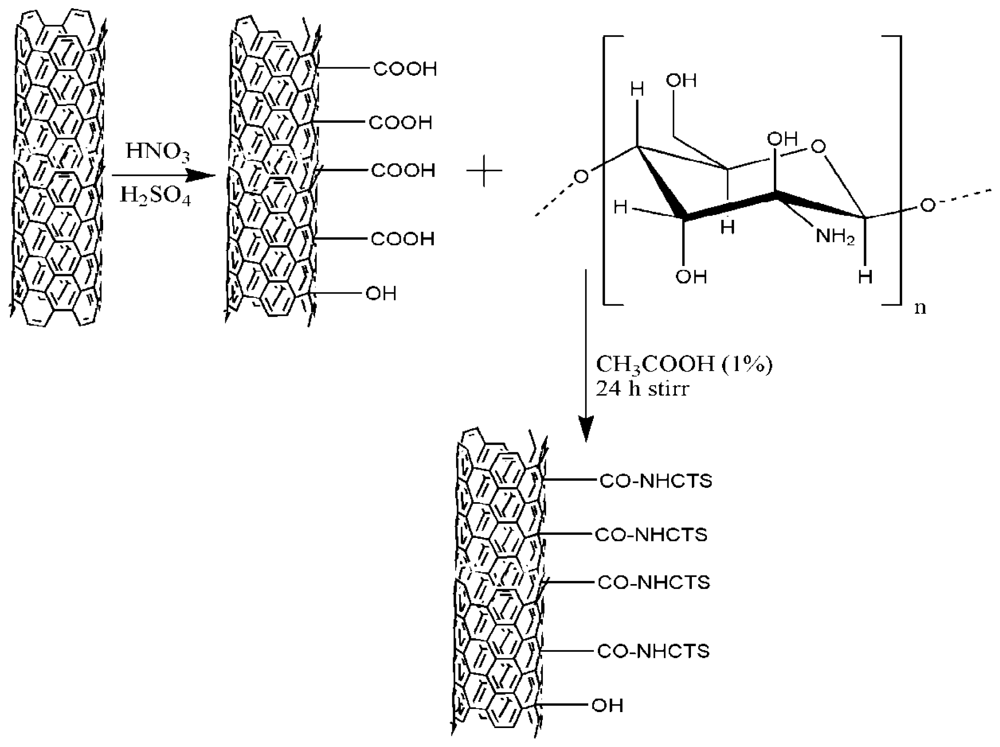
<p>The raw CNTs are mainly hydrophobic and poorly miscible with water. The acid treated CNTs contain many defects and hydrophilic groups, such as -OH and -COOH, which are very helpful for improving the solubility of CNTs in water. CTS, a hydrophilic biopolymer, possesses three kinds of functional groups <italic>viz</italic>. amino, primary, and secondary hydroxyl groups in a glucosamine unit, and the functionalized CNTs contain carboxylic and hydroxyl groups. There is great possibility that strong hydrogen bonds may form between chitosan and the CNTs (<xref ref-type="fig" rid="f5-marinedrugs-08-02252">Figure 5</xref>). The compatibility and strong interaction between MWCNTs fillers and the matrix greatly enhances the dispersion as well as the interfacial adhesion, thus significantly increasing the mechanical properties of the matrix [<xref ref-type="bibr" rid="b63-marinedrugs-08-02252">63</xref>]. The covalent functionalisation of CTS and CNT improves the interaction between CTS with CNT, reduces the damage of CNT and increases its mechanical properties.</p></sec></sec>
<sec sec-type="materials">
<title>5. Remaining Challenges and Future Directions for Bone Biomaterials</title>
<p>The organic portion plays a major role in bone implants, therefore their matrices are often hybrid in composition. Apart from CTS, HAp and CNT, large numbers of synthetic polymers have been used for the preparation of composite materials for artificial bone. It was observed that they showed better results in the case of cell viability, cell proliferation, alkaline phosphate activity and mineralization assays [<xref ref-type="bibr" rid="b75-marinedrugs-08-02252">75</xref>]. Several synthetic polymers have been used to prepare artificial scaffolding materials but have a number of disadvantages. One of the major drawbacks of synthetic polymers are their degradation times which are half than that of a natural polymer. Nowadays, synthetic polymers like poly lactic acid, poly-<sc>l</sc>-lactide acid, polyethylene glycol, polyhydroxyl ethyl methacrylate with carbon nano tubes [<xref ref-type="bibr" rid="b76-marinedrugs-08-02252">76</xref>], poly caprolactone and polylactic-co-glycolic acid are widely used for scaffold materials. The synthetic polymer not only increases the scaffold strength, but also acts as a drug delivery device to induce bioactivity. Whether synthetic polymers would be able to reinforce the mechanical properties of HAp, is still a burning question.</p>
<p>Even though CNT have tremendous mechanical strength and are able to mimic the natural bone function, the uniform dispersion of CNT in the CTS and HAp matrix still remains a challenge. CNTs are not easily dispersed and bundles form in the polymer matrix. CNT should also be in a very pure form for biomedical applications as metal-containing CNTs are toxic to cells, and the production of pure forms of CNTs is another challenge. The cytotoxity of CNT is still a controversial topic due to errors in cytotoxic analysis techniques, as reported earlier, and the toxicity of CNT might vary depending on the cell type, purity of the CNTs and functionalisation.</p></sec>
<sec sec-type="conclusions">
<title>6. Conclusions</title>
<p>Composite CTS-based materials have been found to have a predominant role in bone tissue engineering in recent years. The combination of biocompatible polymers and bioresorbable ceramic materials can mimic the natural function of bone. CTS with HAp composites are found to be potential bone implant materials with good osteoconductive, osteoinductive and osteogenic properties. The structural, mechanical, chemical interaction and <italic>in vitro</italic> study of CTS, HAp and CNT have been carried out for bone tissue engineering. Although many CTS/HAp composite materials have been developed, problems persist with their mechanical properties. Hence, much research is in progress to address the gap in the development of mechanical properties. Much research work is still needed to address the cytotoxicity of CNTs. Though challenges still exist, the addition of CNT to improve the mechanical properties of CTS and ceramic (HAp) composite would surely support and stimulate the function of natural bone. The development of research on the efficacy of CTS composite will open great possibilities for future bone tissue engineering.</p></sec></body>
<back>
<ack>
<title>Acknowledgements</title>
<p>This work was supported by a grant from the Marine Bioprocess Research Center as a part of the Marine Bio 21 Project funded by the Ministry of Land, Transport and Maritime Affairs, Korea.</p></ack>
<ref-list>
<title>References</title>
<ref id="b1-marinedrugs-08-02252"><label>1</label><citation citation-type="book"><person-group person-group-type="author"><name><surname>Pizzoferrato</surname><given-names>A</given-names></name><name><surname>Cenni</surname><given-names>E</given-names></name><name><surname>Ciapetti</surname><given-names>G</given-names></name><name><surname>Granchi</surname><given-names>D</given-names></name><name><surname>Savarino</surname><given-names>L</given-names></name><name><surname>Stea</surname><given-names>S</given-names></name></person-group><article-title>Inflammatory response to metals and ceramics</article-title><source>Integrated Biomaterials Science</source><publisher-name>Kluwer Academic/Plenum Publishers</publisher-name><publisher-loc>New York, NY, USA</publisher-loc><year>2002</year><fpage>735</fpage><lpage>791</lpage></citation></ref>
<ref id="b2-marinedrugs-08-02252"><label>2</label><citation citation-type="book"><person-group person-group-type="author"><name><surname>Wagh</surname><given-names>A</given-names></name></person-group><source>Chemically Bonded Phosphate Ceramics: Twenty-First Century Materials with Diverse Applications</source><publisher-name>Elsevier Science</publisher-name><publisher-loc>New York, NY, USA</publisher-loc><year>2004</year></citation></ref>
<ref id="b3-marinedrugs-08-02252"><label>3</label><citation citation-type="journal"><person-group person-group-type="author"><name><surname>Giannoudis</surname><given-names>P</given-names></name><name><surname>Dinopoulos</surname><given-names>H</given-names></name><name><surname>Tsiridis</surname><given-names>E</given-names></name></person-group><article-title>Bone substitutes: an update</article-title><source>Injury</source><year>2005</year><volume>36</volume><fpage>20</fpage><lpage>27</lpage></citation></ref>
<ref id="b4-marinedrugs-08-02252"><label>4</label><citation citation-type="journal"><person-group person-group-type="author"><name><surname>Wang</surname><given-names>M</given-names></name></person-group><article-title>Developing bioactive composite materials for tissue replacement</article-title><source>Biomaterials</source><year>2003</year><volume>24</volume><fpage>2133</fpage><lpage>2151</lpage><pub-id pub-id-type="doi">10.1016/S0142-9612(03)00037-1</pub-id><pub-id pub-id-type="pmid">12699650</pub-id></citation></ref>
<ref id="b5-marinedrugs-08-02252"><label>5</label><citation citation-type="journal"><person-group person-group-type="author"><name><surname>Iwata</surname><given-names>H</given-names></name><name><surname>Yana</surname><given-names>S</given-names></name><name><surname>Nasu</surname><given-names>M</given-names></name><name><surname>Yosue</surname><given-names>T</given-names></name></person-group><article-title>Effects of chitosan oligosaccharides on the femur trabecular structure in ovariectomized rats</article-title><source>Oral Radiol</source><year>2005</year><volume>21</volume><fpage>19</fpage><lpage>22</lpage><pub-id pub-id-type="doi">10.1007/s11282-005-0023-6</pub-id></citation></ref>
<ref id="b6-marinedrugs-08-02252"><label>6</label><citation citation-type="journal"><person-group person-group-type="author"><name><surname>Porporatto</surname><given-names>C</given-names></name><name><surname>Canali</surname><given-names>MM</given-names></name><name><surname>Bianco</surname><given-names>ID</given-names></name><name><surname>Correa</surname><given-names>SG</given-names></name></person-group><article-title>The biocompatible polysaccharide chitosan enhances the oral tolerance to type II collagen</article-title><source>Clin. Exp. Immunol</source><year>2009</year><volume>155</volume><fpage>79</fpage><lpage>87</lpage><pub-id pub-id-type="doi">10.1111/j.1365-2249.2008.03777.x</pub-id><pub-id pub-id-type="pmid">19076832</pub-id></citation></ref>
<ref id="b7-marinedrugs-08-02252"><label>7</label><citation citation-type="journal"><person-group person-group-type="author"><name><surname>Murakami</surname><given-names>K</given-names></name><name><surname>Aoki</surname><given-names>H</given-names></name><name><surname>Nakamura</surname><given-names>S</given-names></name><name><surname>Nakamura</surname><given-names>S-I</given-names></name><name><surname>Takikawa</surname><given-names>M</given-names></name><name><surname>Hanzawa</surname><given-names>M</given-names></name><name><surname>Kishimoto</surname><given-names>S</given-names></name><name><surname>Hattori</surname><given-names>H</given-names></name><name><surname>Tanaka</surname><given-names>Y</given-names></name><name><surname>Kiyosawa</surname><given-names>T</given-names></name><name><surname>Sato</surname><given-names>Y</given-names></name><name><surname>Ishihara</surname><given-names>M</given-names></name></person-group><article-title>Hydrogel blends of chitin/chitosan, fucoidan and alginate as healing impaired wound dressings</article-title><source>Biomaterials</source><year>2010</year><volume>31</volume><fpage>83</fpage><lpage>90</lpage><pub-id pub-id-type="doi">10.1016/j.biomaterials.2009.09.031</pub-id><pub-id pub-id-type="pmid">19775748</pub-id></citation></ref>
<ref id="b8-marinedrugs-08-02252"><label>8</label><citation citation-type="journal"><person-group person-group-type="author"><name><surname>Madhavan</surname><given-names>P</given-names></name><name><surname>Nair</surname><given-names>K</given-names></name></person-group><article-title>Utilization of prawn waste: Isolation of chitin and its conversion to chitosan</article-title><source>Fish. Technol</source><year>1974</year><volume>11</volume><fpage>50</fpage><lpage>53</lpage></citation></ref>
<ref id="b9-marinedrugs-08-02252"><label>9</label><citation citation-type="journal"><person-group person-group-type="author"><name><surname>Shahidi</surname><given-names>F</given-names></name><name><surname>Abuzaytoun</surname><given-names>R</given-names></name></person-group><article-title>Chitin, chitosan, and co products: chemistry, production, applications, and health effects</article-title><source>Adv. Food Nutr. Res</source><year>2005</year><volume>49</volume><fpage>93</fpage><lpage>135</lpage><pub-id pub-id-type="doi">10.1002/mnfr.200400053</pub-id><pub-id pub-id-type="pmid">15797344</pub-id></citation></ref>
<ref id="b10-marinedrugs-08-02252"><label>10</label><citation citation-type="journal"><person-group person-group-type="author"><name><surname>Cai</surname><given-names>J</given-names></name><name><surname>Yang</surname><given-names>J</given-names></name><name><surname>Du</surname><given-names>Y</given-names></name><name><surname>Fan</surname><given-names>L</given-names></name><name><surname>Qiu</surname><given-names>Y</given-names></name><name><surname>Li</surname><given-names>J</given-names></name><name><surname>Kennedy</surname><given-names>JF</given-names></name></person-group><article-title>Enzymatic preparation of chitosan from the waste Aspergillus niger mycelium of citric acid production plant</article-title><source>Carbohydr. Polymers</source><year>2006</year><volume>64</volume><fpage>151</fpage><lpage>157</lpage><pub-id pub-id-type="doi">10.1016/j.carbpol.2005.11.004</pub-id></citation></ref>
<ref id="b11-marinedrugs-08-02252"><label>11</label><citation citation-type="journal"><person-group person-group-type="author"><name><surname>Kim</surname><given-names>S-K</given-names></name><name><surname>Rajapakse</surname><given-names>N</given-names></name></person-group><article-title>Enzymatic production and biological activities of chitosan oligosaccharides (COS): A review</article-title><source>Carbohydr. Polymers</source><year>2005</year><volume>62</volume><fpage>357</fpage><lpage>368</lpage><pub-id pub-id-type="doi">10.1016/j.carbpol.2005.08.012</pub-id></citation></ref>
<ref id="b12-marinedrugs-08-02252"><label>12</label><citation citation-type="journal"><person-group person-group-type="author"><name><surname>No</surname><given-names>HK</given-names></name><name><surname>Meyers</surname><given-names>SP</given-names></name></person-group><article-title>Preparation and characterization of chitin and chitosan—A Review</article-title><source>J. Aquat. Food Prod. Technol</source><year>1995</year><volume>4</volume><fpage>27</fpage><lpage>52</lpage><pub-id pub-id-type="doi">10.1300/J030v04n02_03</pub-id></citation></ref>
<ref id="b13-marinedrugs-08-02252"><label>13</label><citation citation-type="journal"><person-group person-group-type="author"><name><surname>Je</surname><given-names>J</given-names></name><name><surname>Kim</surname><given-names>S</given-names></name></person-group><article-title>Water soluble chitosan derivatives as a BACE1 inhibitor</article-title><source>Bioorg. Med. Chem</source><year>2005</year><volume>13</volume><fpage>6551</fpage><lpage>6555</lpage><pub-id pub-id-type="doi">10.1016/j.bmc.2005.07.004</pub-id><pub-id pub-id-type="pmid">16084727</pub-id></citation></ref>
<ref id="b14-marinedrugs-08-02252"><label>14</label><citation citation-type="journal"><person-group person-group-type="author"><name><surname>Jeon</surname><given-names>Y</given-names></name><name><surname>Shahidi</surname><given-names>F</given-names></name><name><surname>Kim</surname><given-names>S</given-names></name></person-group><article-title>Preparation of chitin and chitosan oligomers and their applications in physiological functional foods</article-title><source>Food Rev. Int</source><year>2000</year><volume>16</volume><fpage>159</fpage><lpage>176</lpage><pub-id pub-id-type="doi">10.1081/FRI-100100286</pub-id></citation></ref>
<ref id="b15-marinedrugs-08-02252"><label>15</label><citation citation-type="journal"><person-group person-group-type="author"><name><surname>Di Martino</surname><given-names>A</given-names></name><name><surname>Sittinger</surname><given-names>M</given-names></name><name><surname>Risbud</surname><given-names>MV</given-names></name></person-group><article-title>Chitosan: A versatile biopolymer for orthopaedic tissue-engineering</article-title><source>Biomaterials</source><year>2005</year><volume>26</volume><fpage>5983</fpage><lpage>5990</lpage><pub-id pub-id-type="doi">10.1016/j.biomaterials.2005.03.016</pub-id><pub-id pub-id-type="pmid">15894370</pub-id></citation></ref>
<ref id="b16-marinedrugs-08-02252"><label>16</label><citation citation-type="journal"><person-group person-group-type="author"><name><surname>Francis Suh</surname><given-names>J</given-names></name><name><surname>Matthew</surname><given-names>H</given-names></name></person-group><article-title>Application of chitosan-based polysaccharide biomaterials in cartilage tissue engineering: a review</article-title><source>Biomaterials</source><year>2000</year><volume>21</volume><fpage>2589</fpage><lpage>2598</lpage><pub-id pub-id-type="doi">10.1016/S0142-9612(00)00126-5</pub-id><pub-id pub-id-type="pmid">11071608</pub-id></citation></ref>
<ref id="b17-marinedrugs-08-02252"><label>17</label><citation citation-type="journal"><person-group person-group-type="author"><name><surname>Ueno</surname><given-names>H</given-names></name><name><surname>Mori</surname><given-names>T</given-names></name><name><surname>Fujinaga</surname><given-names>T</given-names></name></person-group><article-title>Topical formulations and wound healing applications of chitosan</article-title><source>Adv. Drug Delivery Rev</source><year>2001</year><volume>52</volume><fpage>105</fpage><lpage>115</lpage><pub-id pub-id-type="doi">10.1016/S0169-409X(01)00189-2</pub-id></citation></ref>
<ref id="b18-marinedrugs-08-02252"><label>18</label><citation citation-type="journal"><person-group person-group-type="author"><name><surname>Hu</surname><given-names>Q</given-names></name><name><surname>Li</surname><given-names>B</given-names></name><name><surname>Wang</surname><given-names>M</given-names></name><name><surname>Shen</surname><given-names>J</given-names></name></person-group><article-title>Preparation and characterization of biodegradable chitosan/hydroxyapatite nanocomposite rods via <italic>in situ</italic> hybridization: a potential material as internal fixation of bone fracture</article-title><source>Biomaterials</source><year>2004</year><volume>25</volume><fpage>779</fpage><lpage>785</lpage><pub-id pub-id-type="doi">10.1016/S0142-9612(03)00582-9</pub-id><pub-id pub-id-type="pmid">14609666</pub-id></citation></ref>
<ref id="b19-marinedrugs-08-02252"><label>19</label><citation citation-type="journal"><person-group person-group-type="author"><name><surname>Madihally</surname><given-names>S</given-names></name><name><surname>Matthew</surname><given-names>H</given-names></name></person-group><article-title>Porous chitosan scaffolds for tissue engineering</article-title><source>Biomaterials</source><year>1999</year><volume>20</volume><fpage>1133</fpage><lpage>1142</lpage><pub-id pub-id-type="doi">10.1016/S0142-9612(99)00011-3</pub-id><pub-id pub-id-type="pmid">10382829</pub-id></citation></ref>
<ref id="b20-marinedrugs-08-02252"><label>20</label><citation citation-type="journal"><person-group person-group-type="author"><name><surname>Austin</surname><given-names>K</given-names></name></person-group><article-title>Scaffold Design: Use of Chitosan in cartilage tissue engineering</article-title><source>MMG 445 Basic Biotech. eJ</source><year>2007</year><volume>3</volume><fpage>62</fpage></citation></ref>
<ref id="b21-marinedrugs-08-02252"><label>21</label><citation citation-type="journal"><person-group person-group-type="author"><name><surname>Teng</surname><given-names>S</given-names></name><name><surname>Lee</surname><given-names>E</given-names></name><name><surname>Yoon</surname><given-names>B</given-names></name><name><surname>Shin</surname><given-names>D</given-names></name><name><surname>Kim</surname><given-names>H</given-names></name><name><surname>Oh</surname><given-names>J</given-names></name></person-group><article-title>Chitosan/nanohydroxyapatite composite membranes via dynamic filtration for guided bone regeneration</article-title><source>J. Biomed. Mater. Res. Part A</source><year>2009</year><volume>88</volume><fpage>569</fpage><lpage>580</lpage></citation></ref>
<ref id="b22-marinedrugs-08-02252"><label>22</label><citation citation-type="journal"><person-group person-group-type="author"><name><surname>Chen</surname><given-names>F</given-names></name><name><surname>Wang</surname><given-names>Z</given-names></name><name><surname>Lin</surname><given-names>C</given-names></name></person-group><article-title>Preparation and characterization of nano sized hydroxyapatite particles and hydroxyapatite/chitosan nano-composite for use in biomedical materials</article-title><source>Mater. Lett</source><year>2002</year><volume>57</volume><fpage>858</fpage><lpage>861</lpage><pub-id pub-id-type="doi">10.1016/S0167-577X(02)00885-6</pub-id></citation></ref>
<ref id="b23-marinedrugs-08-02252"><label>23</label><citation citation-type="journal"><person-group person-group-type="author"><name><surname>Zhang</surname><given-names>Y</given-names></name><name><surname>Venugopal</surname><given-names>JR</given-names></name><name><surname>El-Turki</surname><given-names>A</given-names></name><name><surname>Ramakrishna</surname><given-names>S</given-names></name><name><surname>Su</surname><given-names>B</given-names></name><name><surname>Lim</surname><given-names>CT</given-names></name></person-group><article-title>Electrospun biomimetic nanocomposite nanofibers of hydroxyapatite/chitosan for bone tissue engineering</article-title><source>Biomaterials</source><year>2008</year><volume>29</volume><fpage>4314</fpage><lpage>4322</lpage><pub-id pub-id-type="doi">10.1016/j.biomaterials.2008.07.038</pub-id><pub-id pub-id-type="pmid">18715637</pub-id></citation></ref>
<ref id="b24-marinedrugs-08-02252"><label>24</label><citation citation-type="journal"><person-group person-group-type="author"><name><surname>Xianmiao</surname><given-names>C</given-names></name><name><surname>Yubao</surname><given-names>L</given-names></name><name><surname>Yi</surname><given-names>Z</given-names></name><name><surname>Li</surname><given-names>Z</given-names></name><name><surname>Jidong</surname><given-names>L</given-names></name><name><surname>Huanan</surname><given-names>W</given-names></name></person-group><article-title>Properties and <italic>in vitro</italic> biological evaluation of nano-hydroxyapatite/chitosan membranes for bone guided regeneration</article-title><source>Mater. Sci. Eng. C</source><year>2009</year><volume>29</volume><fpage>29</fpage><lpage>35</lpage><pub-id pub-id-type="doi">10.1016/j.msec.2008.05.008</pub-id></citation></ref>
<ref id="b25-marinedrugs-08-02252"><label>25</label><citation citation-type="journal"><person-group person-group-type="author"><name><surname>Kong</surname><given-names>L</given-names></name><name><surname>Gao</surname><given-names>Y</given-names></name><name><surname>Cao</surname><given-names>W</given-names></name><name><surname>Gong</surname><given-names>Y</given-names></name><name><surname>Zhao</surname><given-names>N</given-names></name><name><surname>Zhang</surname><given-names>X</given-names></name></person-group><article-title>Preparation and characterization of nano-hydroxyapatite/chitosan composite scaffolds</article-title><source>J. Biomed. Mater. Res. Part A</source><year>2005</year><volume>75A</volume><fpage>275</fpage><lpage>282</lpage><pub-id pub-id-type="doi">10.1002/jbm.a.30414</pub-id></citation></ref>
<ref id="b26-marinedrugs-08-02252"><label>26</label><citation citation-type="journal"><person-group person-group-type="author"><name><surname>Manjubala</surname><given-names>I</given-names></name><name><surname>Ponomarev</surname><given-names>I</given-names></name><name><surname>Wilke</surname><given-names>I</given-names></name><name><surname>Jandt</surname><given-names>K</given-names></name></person-group><article-title>Growth of osteoblast like cells on biomimetic apatite-coated chitosan scaffolds</article-title><source>J. Biomed. Mater. Res. Part A: Appl. Biomater</source><year>2008</year><volume>8</volume><fpage>7</fpage><lpage>16</lpage></citation></ref>
<ref id="b27-marinedrugs-08-02252"><label>27</label><citation citation-type="journal"><person-group person-group-type="author"><name><surname>Thein-Han</surname><given-names>W</given-names></name><name><surname>Misra</surname><given-names>R</given-names></name></person-group><article-title>Biomimetic chitosan–nanohydroxyapatite composite scaffolds for bone tissue engineering</article-title><source>Acta Biomater</source><year>2009</year><volume>5</volume><fpage>1182</fpage><lpage>1197</lpage><pub-id pub-id-type="doi">10.1016/j.actbio.2008.11.025</pub-id><pub-id pub-id-type="pmid">19121983</pub-id></citation></ref>
<ref id="b28-marinedrugs-08-02252"><label>28</label><citation citation-type="journal"><person-group person-group-type="author"><name><surname>Oliveira</surname><given-names>J</given-names></name><name><surname>Rodrigues</surname><given-names>M</given-names></name><name><surname>Silva</surname><given-names>S</given-names></name><name><surname>Malafaya</surname><given-names>P</given-names></name><name><surname>Gomes</surname><given-names>M</given-names></name><name><surname>Viegas</surname><given-names>C</given-names></name><name><surname>Dias</surname><given-names>I</given-names></name><name><surname>Azevedo</surname><given-names>J</given-names></name><name><surname>Mano</surname><given-names>J</given-names></name><name><surname>Reis</surname><given-names>R</given-names></name></person-group><article-title>Novel hydroxyapatite/chitosan bilayered scaffold for osteochondral tissue-engineering applications: Scaffold design and its performance when seeded with goat bone marrow stromal cells</article-title><source>Biomaterials</source><year>2006</year><volume>27</volume><fpage>6123</fpage><lpage>6137</lpage><pub-id pub-id-type="doi">10.1016/j.biomaterials.2006.07.034</pub-id><pub-id pub-id-type="pmid">16945410</pub-id></citation></ref>
<ref id="b29-marinedrugs-08-02252"><label>29</label><citation citation-type="journal"><person-group person-group-type="author"><name><surname>Ding</surname><given-names>S</given-names></name></person-group><article-title>Biodegradation behavior of chitosan/calcium phosphate composites</article-title><source>J. Non-Cryst. Solids</source><year>2007</year><volume>353</volume><fpage>2367</fpage><lpage>2373</lpage><pub-id pub-id-type="doi">10.1016/j.jnoncrysol.2007.04.020</pub-id></citation></ref>
<ref id="b30-marinedrugs-08-02252"><label>30</label><citation citation-type="journal"><person-group person-group-type="author"><name><surname>Yamaguchi</surname><given-names>I</given-names></name><name><surname>Tokuchi</surname><given-names>K</given-names></name><name><surname>Fukuzaki</surname><given-names>H</given-names></name><name><surname>Koyama</surname><given-names>Y</given-names></name><name><surname>Takakuda</surname><given-names>K</given-names></name><name><surname>Monma</surname><given-names>H</given-names></name><name><surname>Tanaka</surname><given-names>J</given-names></name></person-group><article-title>Preparation and microstructure analysis of chitosan/hydroxyapatite nanocomposites</article-title><source>J. Biomed. Mater. Res</source><year>2001</year><volume>55</volume><fpage>20</fpage><lpage>27</lpage><pub-id pub-id-type="doi">10.1002/1097-4636(200104)55:1&lt;20::AID-JBM30&gt;3.0.CO;2-F</pub-id><pub-id pub-id-type="pmid">11426393</pub-id></citation></ref>
<ref id="b31-marinedrugs-08-02252"><label>31</label><citation citation-type="journal"><person-group person-group-type="author"><name><surname>Kim</surname><given-names>S-K</given-names></name><name><surname>Mendis</surname><given-names>E</given-names></name></person-group><article-title>Bioactive compounds from marine processing byproducts-A review</article-title><source>Food Res. Int</source><year>2006</year><volume>39</volume><fpage>383</fpage><lpage>393</lpage><pub-id pub-id-type="doi">10.1016/j.foodres.2005.10.010</pub-id></citation></ref>
<ref id="b32-marinedrugs-08-02252"><label>32</label><citation citation-type="journal"><person-group person-group-type="author"><name><surname>Nath</surname><given-names>S</given-names></name><name><surname>Dey</surname><given-names>A</given-names></name><name><surname>Mukhopadhyay</surname><given-names>AK</given-names></name><name><surname>Basu</surname><given-names>B</given-names></name></person-group><article-title>Nanoindentation response of novel hydroxyapatite-mullite composites</article-title><source>Mater. Sci. Eng. A</source><year>2009</year><volume>513–514</volume><fpage>197</fpage><lpage>201</lpage></citation></ref>
<ref id="b33-marinedrugs-08-02252"><label>33</label><citation citation-type="journal"><person-group person-group-type="author"><name><surname>Wang</surname><given-names>X</given-names></name><name><surname>Tan</surname><given-names>Y</given-names></name><name><surname>Zhang</surname><given-names>B</given-names></name><name><surname>Gu</surname><given-names>Z</given-names></name><name><surname>Li</surname><given-names>X</given-names></name></person-group><article-title>Synthesis and evaluation of collagen-chitosan-hydroxyapatite nanocomposites for bone grafting</article-title><source>J. Biomed. Mater. Res. Part A</source><year>2009</year><volume>89</volume><fpage>1079</fpage><lpage>1087</lpage></citation></ref>
<ref id="b34-marinedrugs-08-02252"><label>34</label><citation citation-type="journal"><person-group person-group-type="author"><name><surname>Wang</surname><given-names>X</given-names></name><name><surname>Ma</surname><given-names>J</given-names></name><name><surname>Wang</surname><given-names>Y</given-names></name><name><surname>He</surname><given-names>B</given-names></name></person-group><article-title>Bone repair in radii and tibias of rabbits with phosphorylated chitosan reinforced calcium phosphate cements</article-title><source>Biomaterials</source><year>2002</year><volume>23</volume><fpage>4167</fpage><lpage>4176</lpage><pub-id pub-id-type="doi">10.1016/S0142-9612(02)00153-9</pub-id><pub-id pub-id-type="pmid">12194519</pub-id></citation></ref>
<ref id="b35-marinedrugs-08-02252"><label>35</label><citation citation-type="journal"><person-group person-group-type="author"><name><surname>Kuo</surname><given-names>Y</given-names></name><name><surname>Lin</surname><given-names>C</given-names></name></person-group><article-title>Effect of genipin-crosslinked chitin-chitosan scaffolds with hydroxyapatite modifications on the cultivation of bovine knee chondrocytes</article-title><source>Biotechnol. Bioeng</source><year>2006</year><volume>95</volume><fpage>132</fpage><lpage>144</lpage><pub-id pub-id-type="doi">10.1002/bit.21007</pub-id><pub-id pub-id-type="pmid">16739223</pub-id></citation></ref>
<ref id="b36-marinedrugs-08-02252"><label>36</label><citation citation-type="journal"><person-group person-group-type="author"><name><surname>Pena</surname><given-names>J</given-names></name><name><surname>Izquierdo-Barba</surname><given-names>I</given-names></name><name><surname>García</surname><given-names>M</given-names></name><name><surname>Vallet-Regí</surname><given-names>M</given-names></name></person-group><article-title>Room temperature synthesis of chitosan/apatite powders and coatings</article-title><source>J. Eur. Ceram. Soc</source><year>2006</year><volume>26</volume><fpage>3631</fpage><lpage>3638</lpage><pub-id pub-id-type="doi">10.1016/j.jeurceramsoc.2005.12.028</pub-id></citation></ref>
<ref id="b37-marinedrugs-08-02252"><label>37</label><citation citation-type="journal"><person-group person-group-type="author"><name><surname>Madhumathi</surname><given-names>K</given-names></name><name><surname>Shalumon</surname><given-names>K</given-names></name><name><surname>Rani</surname><given-names>V</given-names></name><name><surname>Tamura</surname><given-names>H</given-names></name><name><surname>Furuike</surname><given-names>T</given-names></name><name><surname>Selvamurugan</surname><given-names>N</given-names></name><name><surname>Nair</surname><given-names>S</given-names></name><name><surname>Jayakumar</surname><given-names>R</given-names></name></person-group><article-title>Wet chemical synthesis of chitosan hydrogel-hydroxyapatite composite membranes for tissue engineering applications</article-title><source>Int. J. Biol. Macromol</source><year>2009</year><volume>45</volume><fpage>12</fpage><lpage>15</lpage><pub-id pub-id-type="doi">10.1016/j.ijbiomac.2009.03.011</pub-id><pub-id pub-id-type="pmid">19447253</pub-id></citation></ref>
<ref id="b38-marinedrugs-08-02252"><label>38</label><citation citation-type="journal"><person-group person-group-type="author"><name><surname>Liuyun</surname><given-names>J</given-names></name><name><surname>Yubao</surname><given-names>L</given-names></name><name><surname>Chengdong</surname><given-names>X</given-names></name></person-group><article-title>A novel composite membrane of chitosan-carboxymethyl cellulose polyelectrolyte complex membrane filled with nano-hydroxyapatite I. Preparation and properties</article-title><source>J. Mater. Sci.: Mater. Med</source><year>2009</year><volume>20</volume><fpage>1645</fpage><lpage>1652</lpage><pub-id pub-id-type="doi">10.1007/s10856-009-3720-6</pub-id></citation></ref>
<ref id="b39-marinedrugs-08-02252"><label>39</label><citation citation-type="journal"><person-group person-group-type="author"><name><surname>Li</surname><given-names>Q</given-names></name><name><surname>Chen</surname><given-names>Z</given-names></name><name><surname>Darvell</surname><given-names>B</given-names></name><name><surname>Zeng</surname><given-names>Q</given-names></name><name><surname>Li</surname><given-names>G</given-names></name><name><surname>Ou</surname><given-names>G</given-names></name><name><surname>Wu</surname><given-names>M</given-names></name></person-group><article-title>Biomimetic synthesis of the composites of hydroxyapatite and chitosan–phosphorylated chitosan polyelectrolyte complex</article-title><source>Mater. Lett</source><year>2006</year><volume>60</volume><fpage>3533</fpage><lpage>3536</lpage><pub-id pub-id-type="doi">10.1016/j.matlet.2006.03.046</pub-id></citation></ref>
<ref id="b40-marinedrugs-08-02252"><label>40</label><citation citation-type="journal"><person-group person-group-type="author"><name><surname>Verma</surname><given-names>D</given-names></name><name><surname>Katti</surname><given-names>K</given-names></name><name><surname>Katti</surname><given-names>D</given-names></name></person-group><article-title>Effect of Biopolymers on structure of hydroxyapatite and interfacial interactions in biomimetically synthesized hydroxyapatite/biopolymer nanocomposites</article-title><source>Ann. Biomed. Eng</source><year>2008</year><volume>36</volume><fpage>1024</fpage><lpage>1032</lpage><pub-id pub-id-type="doi">10.1007/s10439-008-9483-2</pub-id><pub-id pub-id-type="pmid">18340534</pub-id></citation></ref>
<ref id="b41-marinedrugs-08-02252"><label>41</label><citation citation-type="journal"><person-group person-group-type="author"><name><surname>Davidenko</surname><given-names>N</given-names></name><name><surname>Carrodeguas</surname><given-names>R</given-names></name><name><surname>Peniche</surname><given-names>C</given-names></name><name><surname>Solís</surname><given-names>Y</given-names></name><name><surname>Cameron</surname><given-names>R</given-names></name></person-group><article-title>Chitosan/apatite composite beads prepared by <italic>in situ</italic> generation of apatite or Si-apatite nanocrystals</article-title><source>Acta Biomater</source><year>2010</year><volume>6</volume><fpage>466</fpage><lpage>476</lpage><pub-id pub-id-type="doi">10.1016/j.actbio.2009.07.029</pub-id><pub-id pub-id-type="pmid">19632363</pub-id></citation></ref>
<ref id="b42-marinedrugs-08-02252"><label>42</label><citation citation-type="journal"><person-group person-group-type="author"><name><surname>Murugan</surname><given-names>R</given-names></name><name><surname>Ramakrishna</surname><given-names>S</given-names></name></person-group><article-title>Bioresorbable composite bone paste using polysaccharide based nano hydroxyapatite</article-title><source>Biomaterials</source><year>2004</year><volume>25</volume><fpage>3829</fpage><lpage>3835</lpage><pub-id pub-id-type="doi">10.1016/j.biomaterials.2003.10.016</pub-id><pub-id pub-id-type="pmid">15020158</pub-id></citation></ref>
<ref id="b43-marinedrugs-08-02252"><label>43</label><citation citation-type="journal"><person-group person-group-type="author"><name><surname>Zhang</surname><given-names>Y</given-names></name><name><surname>Zhang</surname><given-names>M</given-names></name></person-group><article-title>Cell growth and function on calcium phosphate reinforced chitosan scaffolds</article-title><source>J. Mater. Sci.: Mater. Med</source><year>2004</year><volume>15</volume><fpage>255</fpage><lpage>260</lpage><pub-id pub-id-type="doi">10.1023/B:JMSM.0000015485.94665.25</pub-id></citation></ref>
<ref id="b44-marinedrugs-08-02252"><label>44</label><citation citation-type="journal"><person-group person-group-type="author"><name><surname>Ehrlich</surname><given-names>H</given-names></name><name><surname>Krajewska</surname><given-names>B</given-names></name><name><surname>Hanke</surname><given-names>T</given-names></name><name><surname>Born</surname><given-names>R</given-names></name><name><surname>Heinemann</surname><given-names>S</given-names></name><name><surname>Knieb</surname><given-names>C</given-names></name><name><surname>Worch</surname><given-names>H</given-names></name></person-group><article-title>Chitosan membrane as a template for hydroxyapatite crystal growth in a model dual membrane diffusion system</article-title><source>J. Membr. Sci</source><year>2006</year><volume>273</volume><fpage>124</fpage><lpage>128</lpage><pub-id pub-id-type="doi">10.1016/j.memsci.2005.11.050</pub-id></citation></ref>
<ref id="b45-marinedrugs-08-02252"><label>45</label><citation citation-type="journal"><person-group person-group-type="author"><name><surname>Redepenning</surname><given-names>J</given-names></name><name><surname>Venkataraman</surname><given-names>G</given-names></name><name><surname>Chen</surname><given-names>J</given-names></name><name><surname>Stafford</surname><given-names>N</given-names></name></person-group><article-title>Electrochemical preparation of chitosan/hydroxyapatite composite coatings on titanium substrates</article-title><source>J. Biomed. Mater. Res</source><year>2003</year><volume>66</volume><fpage>411</fpage><lpage>416</lpage></citation></ref>
<ref id="b46-marinedrugs-08-02252"><label>46</label><citation citation-type="journal"><person-group person-group-type="author"><name><surname>Pang</surname><given-names>X</given-names></name><name><surname>Zhitomirsky</surname><given-names>I</given-names></name></person-group><article-title>Electrodeposition of composite hydroxyapatite–chitosan films</article-title><source>Mater. Chem. Phys</source><year>2005</year><volume>94</volume><fpage>245</fpage><lpage>251</lpage><pub-id pub-id-type="doi">10.1016/j.matchemphys.2005.04.040</pub-id></citation></ref>
<ref id="b47-marinedrugs-08-02252"><label>47</label><citation citation-type="journal"><person-group person-group-type="author"><name><surname>Huang</surname><given-names>Z</given-names></name><name><surname>Dong</surname><given-names>Y</given-names></name><name><surname>Chu</surname><given-names>C</given-names></name><name><surname>Lin</surname><given-names>P</given-names></name></person-group><article-title>Electrochemistry assisted reacting deposition of hydroxyapatite in porous chitosan scaffolds</article-title><source>Mater. Lett</source><year>2008</year><volume>62</volume><fpage>3376</fpage><lpage>3378</lpage><pub-id pub-id-type="doi">10.1016/j.matlet.2008.03.045</pub-id></citation></ref>
<ref id="b48-marinedrugs-08-02252"><label>48</label><citation citation-type="journal"><person-group person-group-type="author"><name><surname>Pang</surname><given-names>X</given-names></name><name><surname>Casagrande</surname><given-names>T</given-names></name><name><surname>Zhitomirsky</surname><given-names>I</given-names></name></person-group><article-title>Electrophoretic deposition of hydroxyapatite–CaSiO3– chitosan composite coatings</article-title><source>J. Colloid Interface Sci</source><year>2009</year><volume>330</volume><fpage>323</fpage><lpage>329</lpage><pub-id pub-id-type="doi">10.1016/j.jcis.2008.10.070</pub-id><pub-id pub-id-type="pmid">19012892</pub-id></citation></ref>
<ref id="b49-marinedrugs-08-02252"><label>49</label><citation citation-type="journal"><person-group person-group-type="author"><name><surname>Pang</surname><given-names>X</given-names></name><name><surname>Zhitomirsky</surname><given-names>I</given-names></name></person-group><article-title>Electrophoretic deposition of composite hydroxyapatite-chitosan coatings</article-title><source>Mater. Charact</source><year>2007</year><volume>58</volume><fpage>339</fpage><lpage>348</lpage><pub-id pub-id-type="doi">10.1016/j.matchar.2006.05.011</pub-id></citation></ref>
<ref id="b50-marinedrugs-08-02252"><label>50</label><citation citation-type="journal"><person-group person-group-type="author"><name><surname>Yuan</surname><given-names>H</given-names></name><name><surname>Chen</surname><given-names>N</given-names></name><name><surname>Lü</surname><given-names>X</given-names></name><name><surname>Zheng</surname><given-names>B</given-names></name></person-group><article-title>Experimental study of natural hydroxyapatite/chitosan composite on reconstructing bone defects</article-title><source>J. Nanjing Med. Univ</source><year>2008</year><volume>22</volume><fpage>372</fpage><lpage>375</lpage><pub-id pub-id-type="doi">10.1016/S1007-4376(09)60009-5</pub-id></citation></ref>
<ref id="b51-marinedrugs-08-02252"><label>51</label><citation citation-type="journal"><person-group person-group-type="author"><name><surname>Manjubala</surname><given-names>I</given-names></name><name><surname>Scheler</surname><given-names>S</given-names></name><name><surname>Bössert</surname><given-names>J</given-names></name><name><surname>Jandt</surname><given-names>K</given-names></name></person-group><article-title>Mineralisation of chitosan scaffolds with nano-apatite formation by double diffusion technique</article-title><source>Acta Biomater</source><year>2006</year><volume>2</volume><fpage>75</fpage><lpage>84</lpage><pub-id pub-id-type="doi">10.1016/j.actbio.2005.09.007</pub-id><pub-id pub-id-type="pmid">16701861</pub-id></citation></ref>
<ref id="b52-marinedrugs-08-02252"><label>52</label><citation citation-type="journal"><person-group person-group-type="author"><name><surname>Matsuda</surname><given-names>A</given-names></name><name><surname>Ikoma</surname><given-names>T</given-names></name><name><surname>Kobayashi</surname><given-names>H</given-names></name><name><surname>Tanaka</surname><given-names>J</given-names></name></person-group><article-title>Preparation and mechanical property of core-shell type chitosan/calcium phosphate composite fiber</article-title><source>Mater. Sci. Eng. C</source><year>2004</year><volume>24</volume><fpage>723</fpage><lpage>728</lpage><pub-id pub-id-type="doi">10.1016/j.msec.2004.08.047</pub-id></citation></ref>
<ref id="b53-marinedrugs-08-02252"><label>53</label><citation citation-type="journal"><person-group person-group-type="author"><name><surname>Li</surname><given-names>Z</given-names></name><name><surname>Yubao</surname><given-names>L</given-names></name><name><surname>Aiping</surname><given-names>Y</given-names></name><name><surname>Xuelin</surname><given-names>P</given-names></name><name><surname>Xuejiang</surname><given-names>W</given-names></name><name><surname>Xiang</surname><given-names>Z</given-names></name></person-group><article-title>Preparation and <italic>in vitro</italic> investigation of chitosan/nano-hydroxyapatite composite used as bone substitute materials</article-title><source>J. Mater. Sci. Mater. Med</source><year>2005</year><volume>16</volume><fpage>213</fpage><lpage>219</lpage><pub-id pub-id-type="doi">10.1007/s10856-005-6682-3</pub-id><pub-id pub-id-type="pmid">15744612</pub-id></citation></ref>
<ref id="b54-marinedrugs-08-02252"><label>54</label><citation citation-type="journal"><person-group person-group-type="author"><name><surname>Li</surname><given-names>B</given-names></name><name><surname>Hu</surname><given-names>Q</given-names></name><name><surname>Qian</surname><given-names>X</given-names></name><name><surname>Fang</surname><given-names>Z</given-names></name><name><surname>Shen</surname><given-names>J</given-names></name></person-group><article-title>Bioabsorbable chitosan/hydroxyapatite composite rod for internal fixation of bone fracture prepared by <italic>in situ</italic> precipitation</article-title><source>Acta Polym. Sin</source><year>2002</year><volume>6</volume><fpage>828</fpage><lpage>833</lpage></citation></ref>
<ref id="b55-marinedrugs-08-02252"><label>55</label><citation citation-type="journal"><person-group person-group-type="author"><name><surname>Aronow</surname><given-names>M</given-names></name><name><surname>Gerstenfeld</surname><given-names>L</given-names></name><name><surname>Owen</surname><given-names>T</given-names></name><name><surname>Tassinari</surname><given-names>M</given-names></name><name><surname>Stein</surname><given-names>G</given-names></name><name><surname>Lian</surname><given-names>J</given-names></name></person-group><article-title>Factors that promote progressive development of the osteoblast phenotype in cultured fetal rat calvaria cells</article-title><source>J. Cell. Physiol</source><year>1990</year><volume>143</volume><fpage>213</fpage><lpage>221</lpage><pub-id pub-id-type="doi">10.1002/jcp.1041430203</pub-id><pub-id pub-id-type="pmid">2332447</pub-id></citation></ref>
<ref id="b56-marinedrugs-08-02252"><label>56</label><citation citation-type="journal"><person-group person-group-type="author"><name><surname>Li</surname><given-names>Q</given-names></name><name><surname>Wu</surname><given-names>M</given-names></name><name><surname>Tang</surname><given-names>L</given-names></name></person-group><article-title>Bioactivity of a Novel Nano composite of hydroxyapatite and chitosan phosphorylated chitosan polyelectrolyte complex</article-title><source>J. Bioact. Compat. Polym</source><year>2008</year><volume>23</volume><fpage>520</fpage><pub-id pub-id-type="doi">10.1177/0883911508097370</pub-id></citation></ref>
<ref id="b57-marinedrugs-08-02252"><label>57</label><citation citation-type="journal"><person-group person-group-type="author"><name><surname>Xu</surname><given-names>H</given-names></name><name><surname>Simon</surname><given-names>C</given-names></name></person-group><article-title>Fast setting calcium phosphate–chitosan scaffold: mechanical properties and biocompatibility</article-title><source>Biomaterials</source><year>2005</year><volume>26</volume><fpage>1337</fpage><lpage>1348</lpage><pub-id pub-id-type="doi">10.1016/j.biomaterials.2004.04.043</pub-id><pub-id pub-id-type="pmid">15482821</pub-id></citation></ref>
<ref id="b58-marinedrugs-08-02252"><label>58</label><citation citation-type="journal"><person-group person-group-type="author"><name><surname>Zhang</surname><given-names>Y</given-names></name><name><surname>Ni</surname><given-names>M</given-names></name><name><surname>Zhang</surname><given-names>M</given-names></name><name><surname>Ratner</surname><given-names>B</given-names></name></person-group><article-title>Calcium phosphate chitosan composite scaffolds for bone tissue engineering</article-title><source>Tissue Eng</source><year>2003</year><volume>9</volume><fpage>337</fpage><lpage>345</lpage><pub-id pub-id-type="doi">10.1089/107632703764664800</pub-id><pub-id pub-id-type="pmid">12740096</pub-id></citation></ref>
<ref id="b59-marinedrugs-08-02252"><label>59</label><citation citation-type="journal"><person-group person-group-type="author"><name><surname>Mukherjee</surname><given-names>D</given-names></name><name><surname>Tunkle</surname><given-names>A</given-names></name><name><surname>Roberts</surname><given-names>R</given-names></name><name><surname>Clavenna</surname><given-names>A</given-names></name><name><surname>Rogers</surname><given-names>S</given-names></name><name><surname>Smith</surname><given-names>D</given-names></name></person-group><article-title>An animal evaluation of a paste of chitosan glutamate and hydroxyapatite as a synthetic bone graft material</article-title><source>J. Biomed. Mater. Res. Part B: Appl. Biomater</source><year>2003</year><volume>67</volume><fpage>603</fpage><lpage>609</lpage></citation></ref>
<ref id="b60-marinedrugs-08-02252"><label>60</label><citation citation-type="journal"><person-group person-group-type="author"><name><surname>Kikuchi</surname><given-names>M</given-names></name><name><surname>Ikoma</surname><given-names>T</given-names></name><name><surname>Itoh</surname><given-names>S</given-names></name><name><surname>Matsumoto</surname><given-names>H</given-names></name><name><surname>Koyama</surname><given-names>Y</given-names></name><name><surname>Takakuda</surname><given-names>K</given-names></name><name><surname>Shinomiya</surname><given-names>K</given-names></name><name><surname>Tanaka</surname><given-names>J</given-names></name></person-group><article-title>Biomimetic synthesis of bone like nanocomposites using the self-organization mechanism of hydroxyapatite and collagen</article-title><source>Compos. Sci. Technol</source><year>2004</year><volume>64</volume><fpage>819</fpage><lpage>825</lpage><pub-id pub-id-type="doi">10.1016/j.compscitech.2003.09.002</pub-id></citation></ref>
<ref id="b61-marinedrugs-08-02252"><label>61</label><citation citation-type="journal"><person-group person-group-type="author"><name><surname>Ajayan</surname><given-names>P</given-names></name><name><surname>Zhou</surname><given-names>O</given-names></name></person-group><article-title>Applications of carbon nanotubes</article-title><source>Carbon Nanotubes</source><year>2001</year><volume>80</volume><fpage>391</fpage><lpage>425</lpage></citation></ref>
<ref id="b62-marinedrugs-08-02252"><label>62</label><citation citation-type="journal"><person-group person-group-type="author"><name><surname>Samal</surname><given-names>S</given-names></name><name><surname>Bal</surname><given-names>S</given-names></name></person-group><article-title>Carbon Nanotube Reinforced Ceramic Matrix Composites-A Review</article-title><source>J. Miner. Mater. Charact. Eng</source><year>2008</year><volume>7</volume><fpage>355</fpage><lpage>370</lpage></citation></ref>
<ref id="b63-marinedrugs-08-02252"><label>63</label><citation citation-type="journal"><person-group person-group-type="author"><name><surname>Wang</surname><given-names>SF</given-names></name><name><surname>Shen</surname><given-names>L</given-names></name><name><surname>Zhang</surname><given-names>WD</given-names></name><name><surname>Tong</surname><given-names>YJ</given-names></name></person-group><article-title>Preparation and Mechanical Properties of Chitosan/Carbon Nanotubes Composites</article-title><source>Biomacromolecules</source><year>2005</year><volume>6</volume><fpage>3067</fpage><lpage>3072</lpage><pub-id pub-id-type="doi">10.1021/bm050378v</pub-id><pub-id pub-id-type="pmid">16283728</pub-id></citation></ref>
<ref id="b64-marinedrugs-08-02252"><label>64</label><citation citation-type="journal"><person-group person-group-type="author"><name><surname>Usui</surname><given-names>Y</given-names></name><name><surname>Aoki</surname><given-names>K</given-names></name><name><surname>Narita</surname><given-names>N</given-names></name><name><surname>Murakami</surname><given-names>N</given-names></name><name><surname>Nakamura</surname><given-names>I</given-names></name><name><surname>Nakamura</surname><given-names>K</given-names></name><name><surname>Ishigaki</surname><given-names>N</given-names></name><name><surname>Yamazaki</surname><given-names>H</given-names></name><name><surname>Horiuchi</surname><given-names>H</given-names></name><name><surname>Kato</surname><given-names>H</given-names></name></person-group><article-title>Carbon nanotubes with high bone-tissue compatibility and bone-formation acceleration effects</article-title><source>Small</source><year>2008</year><volume>4</volume><fpage>240</fpage><pub-id pub-id-type="doi">10.1002/smll.200700670</pub-id><pub-id pub-id-type="pmid">18205152</pub-id></citation></ref>
<ref id="b65-marinedrugs-08-02252"><label>65</label><citation citation-type="journal"><person-group person-group-type="author"><name><surname>Terada</surname><given-names>M</given-names></name><name><surname>Abe</surname><given-names>S</given-names></name><name><surname>Akasaka</surname><given-names>T</given-names></name><name><surname>Uo</surname><given-names>M</given-names></name><name><surname>Kitagawa</surname><given-names>Y</given-names></name><name><surname>Watari</surname><given-names>F</given-names></name></person-group><article-title>Development of a multiwalled carbon nanotube coated collagen dish</article-title><source>Dental Mater. J</source><year>2009</year><volume>28</volume><fpage>82</fpage><lpage>88</lpage><pub-id pub-id-type="doi">10.4012/dmj.28.82</pub-id></citation></ref>
<ref id="b66-marinedrugs-08-02252"><label>66</label><citation citation-type="journal"><person-group person-group-type="author"><name><surname>Liu</surname><given-names>Y</given-names></name><name><surname>Tang</surname><given-names>J</given-names></name><name><surname>Chen</surname><given-names>X</given-names></name><name><surname>Xin</surname><given-names>JH</given-names></name></person-group><article-title>Decoration of carbon nanotubes with chitosan</article-title><source>Carbon</source><year>2005</year><volume>43</volume><fpage>3178</fpage><lpage>3180</lpage><pub-id pub-id-type="doi">10.1016/j.carbon.2005.06.020</pub-id></citation></ref>
<ref id="b67-marinedrugs-08-02252"><label>67</label><citation citation-type="journal"><person-group person-group-type="author"><name><surname>Lau</surname><given-names>C</given-names></name><name><surname>Cooney</surname><given-names>MJ</given-names></name><name><surname>Atanassov</surname><given-names>P</given-names></name></person-group><article-title>Conductive macroporous composite chitosan carbon nanotube scaffolds</article-title><source>Langmuir</source><year>2008</year><volume>24</volume><fpage>7004</fpage><lpage>7010</lpage><pub-id pub-id-type="doi">10.1021/la8005597</pub-id><pub-id pub-id-type="pmid">18517231</pub-id></citation></ref>
<ref id="b68-marinedrugs-08-02252"><label>68</label><citation citation-type="journal"><person-group person-group-type="author"><name><surname>Qiu</surname><given-names>JD</given-names></name><name><surname>Xie</surname><given-names>HY</given-names></name><name><surname>Liang</surname><given-names>RP</given-names></name></person-group><article-title>Preparation of porous chitosan/carbon nanotubes film modified electrode for biosensor application</article-title><source>Microchim. Acta</source><year>2008</year><volume>162</volume><fpage>57</fpage><lpage>64</lpage><pub-id pub-id-type="doi">10.1007/s00604-007-0871-3</pub-id></citation></ref>
<ref id="b69-marinedrugs-08-02252"><label>69</label><citation citation-type="journal"><person-group person-group-type="author"><name><surname>Kumar</surname><given-names>B</given-names></name><name><surname>Feller</surname><given-names>J-F</given-names></name><name><surname>Castro</surname><given-names>M</given-names></name><name><surname>Lu</surname><given-names>J</given-names></name></person-group><article-title>Conductive bio polymer nano composites (CPC): Chitosan carbon nanotube transducers assembled via spray layer by layer for volatile organic compound sensing</article-title><source>Talanta</source><year>2010</year><volume>81</volume><fpage>908</fpage><lpage>915</lpage><pub-id pub-id-type="doi">10.1016/j.talanta.2010.01.036</pub-id><pub-id pub-id-type="pmid">20298872</pub-id></citation></ref>
<ref id="b70-marinedrugs-08-02252"><label>70</label><citation citation-type="journal"><person-group person-group-type="author"><name><surname>Ozarkar</surname><given-names>S</given-names></name><name><surname>Jassal</surname><given-names>M</given-names></name><name><surname>Agrawal</surname><given-names>A</given-names></name></person-group><article-title>pH and electrical actuation of single walled carbon nanotube/chitosan composite fibers</article-title><source>Smart Mater. Struct</source><year>2008</year><volume>17</volume><fpage>055016</fpage><pub-id pub-id-type="doi">10.1088/0964-1726/17/5/055016</pub-id></citation></ref>
<ref id="b71-marinedrugs-08-02252"><label>71</label><citation citation-type="journal"><person-group person-group-type="author"><name><surname>Spinks</surname><given-names>GM</given-names></name><name><surname>Shin</surname><given-names>SR</given-names></name><name><surname>Wallace</surname><given-names>GG</given-names></name><name><surname>Whitten</surname><given-names>PG</given-names></name><name><surname>Kim</surname><given-names>SI</given-names></name><name><surname>Kim</surname><given-names>SJ</given-names></name></person-group><article-title>Mechanical properties of chitosan/CNT microfibers obtained with improved dispersion</article-title><source>Sens. Actuat. B: Chem</source><year>2006</year><volume>115</volume><fpage>678</fpage><lpage>684</lpage><pub-id pub-id-type="doi">10.1016/j.snb.2005.10.047</pub-id></citation></ref>
<ref id="b72-marinedrugs-08-02252"><label>72</label><citation citation-type="journal"><person-group person-group-type="author"><name><surname>Zanello</surname><given-names>LP</given-names></name><name><surname>Zhao</surname><given-names>B</given-names></name><name><surname>Hu</surname><given-names>H</given-names></name><name><surname>Haddon</surname><given-names>RC</given-names></name></person-group><article-title>Bone cell proliferation on carbon nanotubes</article-title><source>Nano Lett</source><year>2006</year><volume>6</volume><fpage>562</fpage><lpage>567</lpage><pub-id pub-id-type="doi">10.1021/nl051861e</pub-id><pub-id pub-id-type="pmid">16522063</pub-id></citation></ref>
<ref id="b73-marinedrugs-08-02252"><label>73</label><citation citation-type="journal"><person-group person-group-type="author"><name><surname>Zhang</surname><given-names>X</given-names></name><name><surname>Meng</surname><given-names>L</given-names></name><name><surname>Lu</surname><given-names>Q</given-names></name></person-group><article-title>Cell Behaviors on polysaccharide wrapped single wall carbon nanotubes: A quantitative study of the surface properties of biomimetic nanofibrous scaffolds</article-title><source>ACS Nano</source><year>2009</year><volume>3</volume><fpage>3200</fpage><lpage>3206</lpage><pub-id pub-id-type="doi">10.1021/nn9006362</pub-id><pub-id pub-id-type="pmid">19719149</pub-id></citation></ref>
<ref id="b74-marinedrugs-08-02252"><label>74</label><citation citation-type="journal"><person-group person-group-type="author"><name><surname>Wörle-Knirsch</surname><given-names>JM</given-names></name><name><surname>Pulskamp</surname><given-names>K</given-names></name><name><surname>Krug</surname><given-names>HF</given-names></name></person-group><article-title>Oops they did it again! carbon nanotubes hoax scientists in viability assays</article-title><source>Nano Lett</source><year>2006</year><volume>6</volume><fpage>1261</fpage><lpage>1268</lpage><pub-id pub-id-type="doi">10.1021/nl060177c</pub-id><pub-id pub-id-type="pmid">16771591</pub-id></citation></ref>
<ref id="b75-marinedrugs-08-02252"><label>75</label><citation citation-type="journal"><person-group person-group-type="author"><name><surname>Spitalsky</surname><given-names>Z</given-names></name><name><surname>Tasis</surname><given-names>D</given-names></name><name><surname>Papagelis</surname><given-names>K</given-names></name><name><surname>Galiotis</surname><given-names>C</given-names></name></person-group><article-title>Carbon nanotube polymer composites: Chemistry, processing, mechanical and electrical properties</article-title><source>Prog. Polym. Sci</source><year>2010</year><volume>35</volume><fpage>357</fpage><lpage>401</lpage><pub-id pub-id-type="doi">10.1016/j.progpolymsci.2009.09.003</pub-id></citation></ref>
<ref id="b76-marinedrugs-08-02252"><label>76</label><citation citation-type="journal"><person-group person-group-type="author"><name><surname>Ashok Kumar</surname><given-names>N</given-names></name><name><surname>Ganapathy</surname><given-names>HS</given-names></name><name><surname>Kim</surname><given-names>JS</given-names></name><name><surname>Jeong</surname><given-names>YS</given-names></name><name><surname>Jeong</surname><given-names>YT</given-names></name></person-group><article-title>Preparation of poly 2-hydroxyethyl methacrylate functionalized carbon nanotubes as novel biomaterial nanocomposites</article-title><source>Eur. Polym. J</source><year>2008</year><volume>44</volume><fpage>579</fpage><lpage>586</lpage><pub-id pub-id-type="doi">10.1016/j.eurpolymj.2007.12.009</pub-id></citation></ref></ref-list>
<sec sec-type="display-objects">
<title>Figures</title>
<fig id="f1-marinedrugs-08-02252" position="float">
<label>Figure 1</label>
<caption>
<p>Structure of chitin.</p></caption><graphic xlink:href="marinedrugs-08-02252f1.gif"/></fig>
<fig id="f2-marinedrugs-08-02252" position="float">
<label>Figure 2</label>
<caption>
<p>Preparation of chitin and chitosan from marine crustaceans.</p></caption><graphic xlink:href="marinedrugs-08-02252f2.gif"/></fig>
<fig id="f3-marinedrugs-08-02252" position="float">
<label>Figure 3</label>
<caption>
<p>Structure of fully deacetylated chitosan.</p></caption><graphic xlink:href="marinedrugs-08-02252f3.gif"/></fig>
<fig id="f4-marinedrugs-08-02252" position="float">
<label>Figure 4</label>
<caption>
<p>Chemical interaction between CTS-Hap.</p></caption><graphic xlink:href="marinedrugs-08-02252f4.gif"/></fig>
<fig id="f5-marinedrugs-08-02252" position="float">
<label>Figure 5</label>
<caption>
<p>Chemical interactions between CTS and CNT.</p></caption><graphic xlink:href="marinedrugs-08-02252f5.gif"/></fig></sec></back></article>